Stanford-Binet
Intelligence Scales
(SB5)
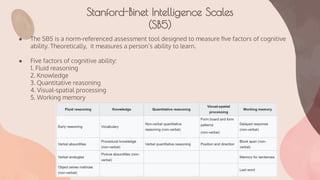
Stanford-Binet Intelligence Scales
(SB5)
● The SB5 is a norm-referenced assessment tool designed to measure five factors of cognitive
ability. Theoretically, it measures a person’s ability to learn.
● Five factors of cognitive ability:
1. Fluid reasoning
2. Knowledge
3. Quantitative reasoning
4. Visual-spatial processing
5. Working memory
Stanford-Binet Intelligence Scales
(SB5)
● Can be used for ages 2 years 0 months to 89 years 11 months.
● The SB5 is rated high for reliability. Extensive validity studies have been conducted to prove
validity.
● Validity has been determined by three methods: Professional judgement of content,
coverage of important constructs, and item analysis.
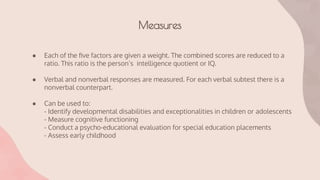
Measures
● Each of the five factors are given a weight. The combined scores are reduced to a
ratio. This ratio is the person’s intelligence quotient or IQ.
● Verbal and nonverbal responses are measured. For each verbal subtest there is a
nonverbal counterpart.
● Can be used to:
- Identify developmental disabilities and exceptionalities in children or adolescents
- Measure cognitive functioning
- Conduct a psycho-educational evaluation for special education placements
- Assess early childhood
How to Administer
1. Two routing subtests are given to identify an appropriate developmental starting
point. Separate routing subtests are given to identify appropriate starting points
for verbal and nonverbal domains.
2. All other subtests are groups into testlets. They are arranged into levels of
difficulty with 5 levels in the verbal domain and 6 in the non-verbal domain.
References
Community-University Partnership for the Study of Children, Youth, and Families
(2011). Review of the Stanford-Binet Intelligence Scales – Fifth Edition (SB5).
Edmonton, Alberta, Canada
Roid, G. H., & Pomplun, M. (2012). The Stanford-Binet Intelligence Scales, Fifth
Edition. In D. P. Flanagan & P. L. Harrison (Eds.), Contemporary intellectual
assessment: Theories, tests, and issues (pp. 249–268). The Guilford Press.
What does the Stanford-Binet test measure. (n.d.) Stanford-Binet Test. Retrieved
From: https://stanfordbinettest.com/all-about-stanford-binet-test/what-does-
stanford-binet-test-measure

Stanford-Binet Intelligence Scale Presentation

  • 1.
  • 2.
    Stanford-Binet Intelligence Scales (SB5) ●The SB5 is a norm-referenced assessment tool designed to measure five factors of cognitive ability. Theoretically, it measures a person’s ability to learn. ● Five factors of cognitive ability: 1. Fluid reasoning 2. Knowledge 3. Quantitative reasoning 4. Visual-spatial processing 5. Working memory
  • 3.
    Stanford-Binet Intelligence Scales (SB5) ●Can be used for ages 2 years 0 months to 89 years 11 months. ● The SB5 is rated high for reliability. Extensive validity studies have been conducted to prove validity. ● Validity has been determined by three methods: Professional judgement of content, coverage of important constructs, and item analysis.
  • 4.
    Measures ● Each ofthe five factors are given a weight. The combined scores are reduced to a ratio. This ratio is the person’s intelligence quotient or IQ. ● Verbal and nonverbal responses are measured. For each verbal subtest there is a nonverbal counterpart. ● Can be used to: - Identify developmental disabilities and exceptionalities in children or adolescents - Measure cognitive functioning - Conduct a psycho-educational evaluation for special education placements - Assess early childhood
  • 5.
    How to Administer 1.Two routing subtests are given to identify an appropriate developmental starting point. Separate routing subtests are given to identify appropriate starting points for verbal and nonverbal domains. 2. All other subtests are groups into testlets. They are arranged into levels of difficulty with 5 levels in the verbal domain and 6 in the non-verbal domain.
  • 6.
    References Community-University Partnership forthe Study of Children, Youth, and Families (2011). Review of the Stanford-Binet Intelligence Scales – Fifth Edition (SB5). Edmonton, Alberta, Canada Roid, G. H., & Pomplun, M. (2012). The Stanford-Binet Intelligence Scales, Fifth Edition. In D. P. Flanagan & P. L. Harrison (Eds.), Contemporary intellectual assessment: Theories, tests, and issues (pp. 249–268). The Guilford Press. What does the Stanford-Binet test measure. (n.d.) Stanford-Binet Test. Retrieved From: https://stanfordbinettest.com/all-about-stanford-binet-test/what-does- stanford-binet-test-measure