STANDARDS DIVISION

  ROLE, STRUCTURE OF SABS
          AND
BENEFITS OF STANDARDIZATION

        YN NDLHOVU
INTRODUCTION
 !   OVERVIEW AND THE ROLE OF SABS

 !   STANDARDIZATION BODIES

 !   COMMITTEES: Role and structure

 !   STANDARDS DEVELOPMENT PROCESS

 !   SIGNIFICANCE OF ITS STANDARDS

 !   ASSESSMENT OF SOCIO-ECONOMIC BENEFIT OF
     STANDARDS
OVERVIEW AND THE ROLE OF SABS
!   Standards Act of 1945, amended in 2008

!   DTI mandate

!   Develop and maintain SANS

!   Testing, certification and training services

!   Facilitates standardization process

!   Neutral body and a publishing house
STANDARDIZATION BODIES
!   International (IEC, ITU,ISO)

!   Regional (SADC, CEN, CENELEC)

!   National (DIN, ANSI, BSI, SABS, JISC, etc)

!   Consortia (W3C, OASIS, etc)

!   Regulatory bodies (NRCS, ICASA, etc)
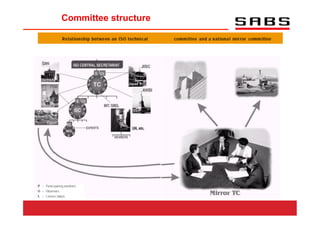
COMMITTEES : role and structure
!       Backbone in standard development
!       Project approach and consensus building process
!       Participation through organizations
!       Choice of membership levels

!   Balanced representation of all stakeholders:
    - manufactures
    - service providers
    - public sectors
    - private sectors
    - consumers
    - regulators
    - academia
Committee structure
TC/SC route                             Deliverables
                 NP
      (new work item proposal)
                                    First CD (Committee draft)
                                       • Simple Maj of P-members
     Building expert consensus


                                    DIS.
                                      •  2/3 Maj of P-members
     Consensus building within
             TC/SC

                                    Final text for processing as
        Enquiry on DIS (Draft       FDIS (Final Draft International Standard)
       International Standard)      2/ Maj of P-members less than 1/ negative
                                      3                               4
                                    votes
     Formal vote on FDIS (proof        Final text of International Standard
        check by secretariat)

     Publication of International       ISO International Standard
              Standard              Review: 5 years
SABS ITS COMMITTEE
!   SABS SC 71H: Intelligent transport systems

!   Scope:
    Standardization of information, communication and control systems in the field of urban
    and rural surface transportation, traveler information, traffic management, public
    transport, commercial transport, emergency services and commercial services,
    generally referred to as “Intelligent Transport Systems”

!   P member of ISO/TC 204: Intelligent transport systems
    Benefits of membership (avoid reinvention of the wheel, influence international stds,
    adoption, etc)

!   Members of SABS SC71H: 36 (P,O and L)

!   Number of standards published: 43

!   POW : 4

!   Working Groups
   - WG 1: ITS architecture
   - WG 4: Automatic vehicle and equipment identification
   - WG 5: Fee and toll collection (EFC)
   - WG 8: Public transport/emergency (including fare payment)
   - WG14: Vehicle/Roadway Warning and control systems
SIGNIFICANCE OF ITS STANDARDS
!   Primary enabler of the dissemination of ITS technologies

!   Allow successful transfer of data from devices to be translated into useful
    info for location based services

!   Avoiding premature obsolescence

!   Facilitating coordination among operating agencies

!   Reducing life-cycle costs

!   Enabling a competitive marketplace

!   Improve safety

!   Increase productivity

!   Reduce costs

!   Protect the environment
Categories of ITS standards
!   ITS Infrastructure standards
    Standards that facilitate interoperability between infrastructure
    components, most often connected via wireline.
    Referred as Center-to-Center(C2C) and Center-to-field (C2F)
    interconnectivity standards.
- traffic signal controllers,
- ramp meters,
- dynamic message signs
- Traffic information centers

!   Cooperative systems standards
    Standards associated with vehicle to vehicle (V2V), vehicle to
    infrastructure (V2I) and vehicle to device connectivity.
    Enable the cooperative nature of the transformative, multi-modal
    technologies and applications
SOCIO-ECONOMIC BENEFIT OF STANDARDS
!   Establishment of new department – Economic Impact and IP

!   To gauge, measure, and monitor and evaluate the economic impact
    of standards on the South African economy.
!   Programmes

- Development of suitable methodology to measure the impact of
  standards on the SA economy

 - Industrial policy and WTO/TBT enquiry point

 - Advisory services and gap analysis

  - Publications
Thank You

   ????
 012 428 6254

Standards process development & benefits

  • 1.
    STANDARDS DIVISION ROLE, STRUCTURE OF SABS AND BENEFITS OF STANDARDIZATION YN NDLHOVU
  • 2.
    INTRODUCTION !  OVERVIEW AND THE ROLE OF SABS !   STANDARDIZATION BODIES !   COMMITTEES: Role and structure !   STANDARDS DEVELOPMENT PROCESS !   SIGNIFICANCE OF ITS STANDARDS !   ASSESSMENT OF SOCIO-ECONOMIC BENEFIT OF STANDARDS
  • 3.
    OVERVIEW AND THEROLE OF SABS !   Standards Act of 1945, amended in 2008 !   DTI mandate !   Develop and maintain SANS !   Testing, certification and training services !   Facilitates standardization process !   Neutral body and a publishing house
  • 4.
    STANDARDIZATION BODIES !  International (IEC, ITU,ISO) !   Regional (SADC, CEN, CENELEC) !   National (DIN, ANSI, BSI, SABS, JISC, etc) !   Consortia (W3C, OASIS, etc) !   Regulatory bodies (NRCS, ICASA, etc)
  • 5.
    COMMITTEES : roleand structure !   Backbone in standard development !   Project approach and consensus building process !   Participation through organizations !   Choice of membership levels !   Balanced representation of all stakeholders: - manufactures - service providers - public sectors - private sectors - consumers - regulators - academia
  • 6.
  • 7.
    TC/SC route Deliverables NP (new work item proposal) First CD (Committee draft) • Simple Maj of P-members Building expert consensus DIS. •  2/3 Maj of P-members Consensus building within TC/SC Final text for processing as Enquiry on DIS (Draft FDIS (Final Draft International Standard) International Standard) 2/ Maj of P-members less than 1/ negative 3 4 votes Formal vote on FDIS (proof Final text of International Standard check by secretariat) Publication of International ISO International Standard Standard Review: 5 years
  • 8.
    SABS ITS COMMITTEE !  SABS SC 71H: Intelligent transport systems !   Scope: Standardization of information, communication and control systems in the field of urban and rural surface transportation, traveler information, traffic management, public transport, commercial transport, emergency services and commercial services, generally referred to as “Intelligent Transport Systems” !   P member of ISO/TC 204: Intelligent transport systems Benefits of membership (avoid reinvention of the wheel, influence international stds, adoption, etc) !   Members of SABS SC71H: 36 (P,O and L) !   Number of standards published: 43 !   POW : 4 !   Working Groups - WG 1: ITS architecture - WG 4: Automatic vehicle and equipment identification - WG 5: Fee and toll collection (EFC) - WG 8: Public transport/emergency (including fare payment) - WG14: Vehicle/Roadway Warning and control systems
  • 9.
    SIGNIFICANCE OF ITSSTANDARDS !   Primary enabler of the dissemination of ITS technologies !   Allow successful transfer of data from devices to be translated into useful info for location based services !   Avoiding premature obsolescence !   Facilitating coordination among operating agencies !   Reducing life-cycle costs !   Enabling a competitive marketplace !   Improve safety !   Increase productivity !   Reduce costs !   Protect the environment
  • 10.
    Categories of ITSstandards !   ITS Infrastructure standards Standards that facilitate interoperability between infrastructure components, most often connected via wireline. Referred as Center-to-Center(C2C) and Center-to-field (C2F) interconnectivity standards. - traffic signal controllers, - ramp meters, - dynamic message signs - Traffic information centers !   Cooperative systems standards Standards associated with vehicle to vehicle (V2V), vehicle to infrastructure (V2I) and vehicle to device connectivity. Enable the cooperative nature of the transformative, multi-modal technologies and applications
  • 11.
    SOCIO-ECONOMIC BENEFIT OFSTANDARDS !   Establishment of new department – Economic Impact and IP !   To gauge, measure, and monitor and evaluate the economic impact of standards on the South African economy. !   Programmes - Development of suitable methodology to measure the impact of standards on the SA economy - Industrial policy and WTO/TBT enquiry point - Advisory services and gap analysis - Publications
  • 12.
    Thank You ???? 012 428 6254