Vermont Public Service Board
         Standard Offer Workshop

        Lessons Learned in the Design
of Standard Offer and Feed-in Tariff Programs

                   July 10, 2009


                       John Dalton
              jdalton@poweradvisoryllc.com
                    Tel: 978 369-2465
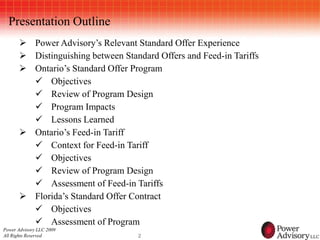
Presentation Outline
        Power Advisory’s Relevant Standard Offer Experience
        Distinguishing between Standard Offers and Feed-in Tariffs
        Ontario’s Standard Offer Program
          Objectives
          Review of Program Design
          Program Impacts
          Lessons Learned
        Ontario’s Feed-in Tariff
          Context for Feed-in Tariff
          Objectives
          Review of Program Design
          Assessment of Feed-in Tariffs
        Florida’s Standard Offer Contract
          Objectives
          Assessment of Program
Power Advisory LLC 2009
All Rights Reserved                 2
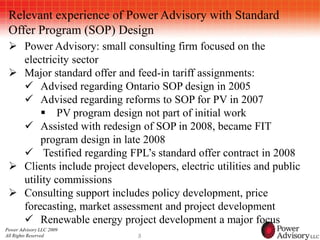
Relevant experience of Power Advisory with Standard
 Offer Program (SOP) Design
  Power Advisory: small consulting firm focused on the
   electricity sector
  Major standard offer and feed-in tariff assignments:
    Advised regarding Ontario SOP design in 2005
    Advised regarding reforms to SOP for PV in 2007
        PV program design not part of initial work
    Assisted with redesign of SOP in 2008, became FIT
       program design in late 2008
    Testified regarding FPL’s standard offer contract in 2008
  Clients include project developers, electric utilities and public
   utility commissions
  Consulting support includes policy development, price
   forecasting, market assessment and project development
    Renewable energy project development a major focus
Power Advisory LLC 2009
All Rights Reserved           3
Distinguishing between Standard Offers and Feed-in Tariffs

  The pricing for standard offer programs typically value-
   based
    Prices don’t distinguish between the type of resource
    Value often based on avoided costs
  The pricing for feed-in tariffs typically cost-based
    Different prices set for different renewable energy
      resources, based on cost differences
    Feed-in tariffs typically designed to provide greater
      price stability
       Long-term price schedule, e.g., degression
    Proven to be effective in promoting rapid adoption of
      renewable energy technologies
    Often used as economic development policy
Power Advisory LLC 2009
All Rights Reserved        4
Ontario’s experience with Standard Offer Program

  Ontario implemented a Standard Offer Program in
   November 2006
    Objective to remove barriers that prevented smaller
     renewable energy projects from proceeding
      Addressed barriers RFP processes present to
         small generators:
         1. Financial security requirements
         2. Complexity of the contracting process
         3. High cost of proposal development relative to
             project size
         4. Uncertainty of proposal outcome
         5. Administrative burden of RFP processes
Power Advisory LLC 2009
All Rights Reserved       5
Ontario’s Standard Offer Program Design

  Program provided a fixed price of 11 cents/kWh (Can$)
   for eligible renewable technologies
    20% of contract price escalated with CPI
    Pricing based on recent renewable RFP, along with
      distribution premium
       Premium (3.52 cents/kWh) available for projects
          which could focus output into peak periods
    Solar PV received 42 cents/kWh
  Projects no more than 10 MW and connected to
   distribution network
  20-year contract terms provided

Power Advisory LLC 2009
All Rights Reserved       6
The Standard Offer Contract and program evolution

  Standard Offer Contract was 34 pages
    No security or contract deposits required
  No cap on the amount of capacity contracted
  Program to be evaluated after two years
  In May 2008 program was suspended
    314 contracts representing over 1,300 MW
       56% of capacity was wind
       34% solar


Power Advisory LLC 2009
All Rights Reserved       7
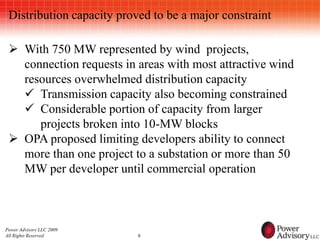
Distribution capacity proved to be a major constraint

  With 750 MW represented by wind projects,
   connection requests in areas with most attractive wind
   resources overwhelmed distribution capacity
    Transmission capacity also becoming constrained
    Considerable portion of capacity from larger
      projects broken into 10-MW blocks
  OPA proposed limiting developers ability to connect
   more than one project to a substation or more than 50
   MW per developer until commercial operation


Power Advisory LLC 2009
All Rights Reserved        8
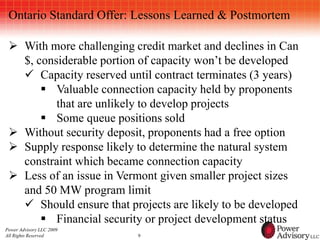
Ontario Standard Offer: Lessons Learned & Postmortem

  With more challenging credit market and declines in Can
   $, considerable portion of capacity won’t be developed
    Capacity reserved until contract terminates (3 years)
        Valuable connection capacity held by proponents
          that are unlikely to develop projects
        Some queue positions sold
  Without security deposit, proponents had a free option
  Supply response likely to determine the natural system
   constraint which became connection capacity
  Less of an issue in Vermont given smaller project sizes
   and 50 MW program limit
    Should ensure that projects are likely to be developed
        Financial security or project development status
Power Advisory LLC 2009
All Rights Reserved       9
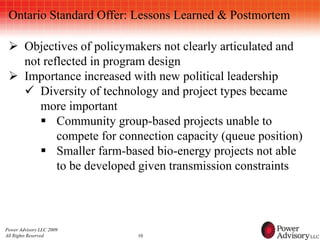
Ontario Standard Offer: Lessons Learned & Postmortem

  Objectives of policymakers not clearly articulated and
   not reflected in program design
  Importance increased with new political leadership
    Diversity of technology and project types became
      more important
       Community group-based projects unable to
          compete for connection capacity (queue position)
       Smaller farm-based bio-energy projects not able
          to be developed given transmission constraints


Power Advisory LLC 2009
All Rights Reserved       10
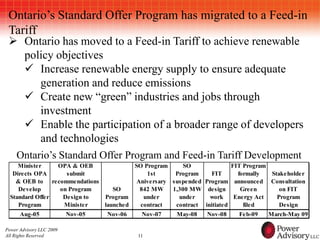
Ontario’s Standard Offer Program has migrated to a Feed-in
 Tariff
  Ontario has moved to a Feed-in Tariff to achieve renewable
   policy objectives
    Increase renewable energy supply to ensure adequate
      generation and reduce emissions
    Create new “green” industries and jobs through
      investment
    Enable the participation of a broader range of developers
      and technologies
    Ontario’s Standard Offer Program and Feed-in Tariff Development
     Minister    OPA & OEB            SO Program      SO              FIT Program
   Directs OPA     submit                 1st      Program    FIT       formally  Stakeholder
    & OEB to recommendations           Aniversary suspended Program announced Consultation
     Develop     on Program     SO      842 MW    1,300 MW design        Green       on FIT
  Standard Offer  Design to  Program     under      under     work     Energy Act   Program
     Program      Minister   launched   contract   contract initiated     filed      Design
      Aug-05              Nov-05   Nov-06    Nov-07   May-08   Nov-08   Feb-09   March-May 09

Power Advisory LLC 2009
All Rights Reserved                         11
New Ontario Energy Minister impressed with German and
 Spanish Feed-in Tariffs
  Green Energy and Green Economy Act (GEGEA) filed
   and passed in 3 months: job creation a major focus
    Auto sector major employer, seeking new industry
  Recognized that had to compete with RPS and federal
   tax incentives offered in the US
  Feed-in Tariff to provide stability to attract industry
    Promoting investor confidence which is key to
      investment decisions by manufacturers
  Risk if you get the Feed-in Tariff (FIT) price wrong
    Ability to reset prices to limit rate impacts
    Undermines investor confidence
  Major source of tension with FIT implementation
Power Advisory LLC 2009
All Rights Reserved       12
GEGEA cornerstone of broader framework to promote
 renewables
  Accelerated the development of the transmission
   network to accommodate more renewable energy
    FIT program evaluated connection capacity upfront
      prior to contract award
    Economic test developed to evaluate where wires
      expansion economic. Expansion costs socialized.
  Streamlined approvals process for renewable projects
    Reducing municipal oversight
  Domestic content requirements can be specified
    Essential to economic development benefits


Power Advisory LLC 2009
All Rights Reserved       13
Feed-in Tariff program design addressed the failings of
 Standard Offer Program
  Development security required with contract
   application
  Prices differentiated by technology to promote wide
   range of technologies
  Prices differentiated by proponent
    Community group and aboriginal projects to receive
      premium prices
       Based on higher development costs and inability
          to obtain economies commercial developers
          realize with equipment vendors


Power Advisory LLC 2009
All Rights Reserved        14
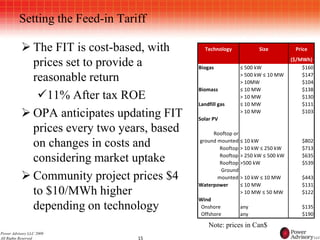
Setting the Feed-in Tariff

            The FIT is cost-based, with        Technology           Size          Price
                                                                                  ($/MWh)
             prices set to provide a         Biogas          ≤ 500 kW                 $160
                                                             > 500 kW ≤ 10 MW         $147
             reasonable return                               > 10MW                   $104
                                             Biomass         ≤ 10 MW                  $138
              11% After tax ROE                             > 10 MW                  $130
                                             Landfill gas    ≤ 10 MW                  $111
            OPA anticipates updating FIT    Solar PV
                                                             > 10 MW                  $103


             prices every two years, based         Rooftop or

             on changes in costs and         ground mounted ≤ 10 kW
                                                      Rooftop > 10 kW ≤ 250 kW
                                                                                      $802
                                                                                      $713

             considering market uptake                Rooftop > 250 kW ≤ 500 kW
                                                      Rooftop >500 kW
                                                                                      $635
                                                                                      $539
                                                      Ground
            Community project prices $4             mounted > 10 kW ≤ 10 MW          $443
                                             Waterpower       ≤ 10 MW                 $131
             to $10/MWh higher                                > 10 MW ≤ 50 MW         $122
                                             Wind
             depending on technology          Onshore         any                     $135
                                              Offshore        any                     $190

                                                 Note: prices in Can$
Power Advisory LLC 2009
All Rights Reserved               15
Assessment of FITs

              FITs can be an effective strategy for promoting
               the development of renewable energy resources
               where:
                Costs and operating performance of
                  renewable resources are well understood and
                  subject to limited variation
                Project size is such that the costs of
                  participating in a formal competitive
                  procurement process cannot be justified


Power Advisory LLC 2009
All Rights Reserved               16
Assessment of FITs

             Significant risk associated with FIT pricing
               Cornerstone of the program is stability
                   Essential if economic development benefits
                    from siting of major renewable energy
                    production facilities to be realized
               If price too high significant market response
                 can leave consumers exposed to higher costs
               Risk most significant for PV given its pricing
             The 50 MW program cap mitigates these risks
              for Vermont

Power Advisory LLC 2009
All Rights Reserved              17
Assessment of Ontario FIT

             Ontario program could be a victim of its own success
              and be “oversubscribed”
                Renewable survey indicated 15,000 MW under
                  development (88% wind and 8% solar)
             Ability of Ontario to integrate the baseload
              generation provided by FIT
               6 week period this spring when wholesale prices
                 were negative for 1/3 of hours
               Ability to put enough transmission/distribution
                 wires in place in time to integrate FIT projects
             Need to incent production during times when
              most valuable
Power Advisory LLC 2009
All Rights Reserved                18
Review of Florida Power & Light Standard Offer
          Program
             Florida utilities mandated to provide Standard
              Offer Contract (SOC)
                Objective to promote development of
                  renewable energy in Florida
             Under Florida PSC rules SOC prices based on
              next avoidable fossil fueled generating unit
                Not an appropriate avoided cost benchmark
                  given objective of promoting renewable
                  energy
             Required similar operating performance as fossil
              units
                Not realistic or appropriate
Power Advisory LLC 2009
All Rights Reserved               19
Review of Florida Power & Light Standard Offer
          Program
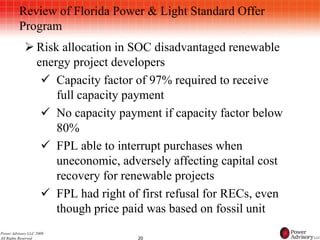
             Risk allocation in SOC disadvantaged renewable
              energy project developers
                Capacity factor of 97% required to receive
                  full capacity payment
                No capacity payment if capacity factor below
                  80%
                FPL able to interrupt purchases when
                  uneconomic, adversely affecting capital cost
                  recovery for renewable projects
                FPL had right of first refusal for RECs, even
                  though price paid was based on fossil unit
Power Advisory LLC 2009
All Rights Reserved              20
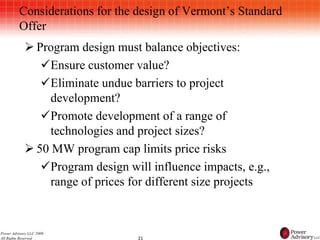
Considerations for the design of Vermont’s Standard
          Offer
             Program design must balance objectives:
               Ensure customer value?
               Eliminate undue barriers to project
                 development?
               Promote development of a range of
                 technologies and project sizes?
             50 MW program cap limits price risks
               Program design will influence impacts, e.g.,
                 range of prices for different size projects


Power Advisory LLC 2009
All Rights Reserved               21
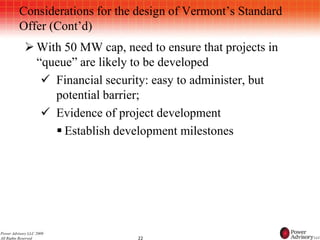
Considerations for the design of Vermont’s Standard
          Offer (Cont’d)
             With 50 MW cap, need to ensure that projects in
              “queue” are likely to be developed
                Financial security: easy to administer, but
                 potential barrier;
                Evidence of project development
                  Establish development milestones


Power Advisory LLC 2009
All Rights Reserved              22
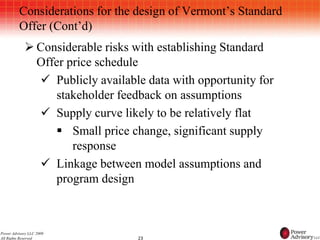
Considerations for the design of Vermont’s Standard
          Offer (Cont’d)
             Considerable risks with establishing Standard
              Offer price schedule
               Publicly available data with opportunity for
                 stakeholder feedback on assumptions
               Supply curve likely to be relatively flat
                  Small price change, significant supply
                     response
               Linkage between model assumptions and
                 program design


Power Advisory LLC 2009
All Rights Reserved              23
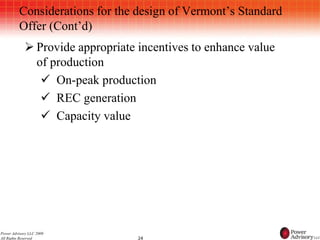
Considerations for the design of Vermont’s Standard
          Offer (Cont’d)
             Provide appropriate incentives to enhance value
              of production
                On-peak production
                REC generation
                Capacity value


Power Advisory LLC 2009
All Rights Reserved               24
Thank you for your attention


                          John Dalton
                          Power Advisory LLC
                          jdalton@poweradvisoryllc.com
                          (978) 369-2465
                          www.poweradvisoryllc.com


Power Advisory LLC 2009
All Rights Reserved                 25

Standard Offer and Feed-in Tariff Development Lessons Learned

  • 1.
    Vermont Public ServiceBoard Standard Offer Workshop Lessons Learned in the Design of Standard Offer and Feed-in Tariff Programs July 10, 2009 John Dalton jdalton@poweradvisoryllc.com Tel: 978 369-2465
  • 2.
    Presentation Outline  Power Advisory’s Relevant Standard Offer Experience  Distinguishing between Standard Offers and Feed-in Tariffs  Ontario’s Standard Offer Program  Objectives  Review of Program Design  Program Impacts  Lessons Learned  Ontario’s Feed-in Tariff  Context for Feed-in Tariff  Objectives  Review of Program Design  Assessment of Feed-in Tariffs  Florida’s Standard Offer Contract  Objectives  Assessment of Program Power Advisory LLC 2009 All Rights Reserved 2
  • 3.
    Relevant experience ofPower Advisory with Standard Offer Program (SOP) Design  Power Advisory: small consulting firm focused on the electricity sector  Major standard offer and feed-in tariff assignments:  Advised regarding Ontario SOP design in 2005  Advised regarding reforms to SOP for PV in 2007  PV program design not part of initial work  Assisted with redesign of SOP in 2008, became FIT program design in late 2008  Testified regarding FPL’s standard offer contract in 2008  Clients include project developers, electric utilities and public utility commissions  Consulting support includes policy development, price forecasting, market assessment and project development  Renewable energy project development a major focus Power Advisory LLC 2009 All Rights Reserved 3
  • 4.
    Distinguishing between StandardOffers and Feed-in Tariffs  The pricing for standard offer programs typically value- based  Prices don’t distinguish between the type of resource  Value often based on avoided costs  The pricing for feed-in tariffs typically cost-based  Different prices set for different renewable energy resources, based on cost differences  Feed-in tariffs typically designed to provide greater price stability  Long-term price schedule, e.g., degression  Proven to be effective in promoting rapid adoption of renewable energy technologies  Often used as economic development policy Power Advisory LLC 2009 All Rights Reserved 4
  • 5.
    Ontario’s experience withStandard Offer Program  Ontario implemented a Standard Offer Program in November 2006  Objective to remove barriers that prevented smaller renewable energy projects from proceeding  Addressed barriers RFP processes present to small generators: 1. Financial security requirements 2. Complexity of the contracting process 3. High cost of proposal development relative to project size 4. Uncertainty of proposal outcome 5. Administrative burden of RFP processes Power Advisory LLC 2009 All Rights Reserved 5
  • 6.
    Ontario’s Standard OfferProgram Design  Program provided a fixed price of 11 cents/kWh (Can$) for eligible renewable technologies  20% of contract price escalated with CPI  Pricing based on recent renewable RFP, along with distribution premium  Premium (3.52 cents/kWh) available for projects which could focus output into peak periods  Solar PV received 42 cents/kWh  Projects no more than 10 MW and connected to distribution network  20-year contract terms provided Power Advisory LLC 2009 All Rights Reserved 6
  • 7.
    The Standard OfferContract and program evolution  Standard Offer Contract was 34 pages  No security or contract deposits required  No cap on the amount of capacity contracted  Program to be evaluated after two years  In May 2008 program was suspended  314 contracts representing over 1,300 MW  56% of capacity was wind  34% solar Power Advisory LLC 2009 All Rights Reserved 7
  • 8.
    Distribution capacity provedto be a major constraint  With 750 MW represented by wind projects, connection requests in areas with most attractive wind resources overwhelmed distribution capacity  Transmission capacity also becoming constrained  Considerable portion of capacity from larger projects broken into 10-MW blocks  OPA proposed limiting developers ability to connect more than one project to a substation or more than 50 MW per developer until commercial operation Power Advisory LLC 2009 All Rights Reserved 8
  • 9.
    Ontario Standard Offer:Lessons Learned & Postmortem  With more challenging credit market and declines in Can $, considerable portion of capacity won’t be developed  Capacity reserved until contract terminates (3 years)  Valuable connection capacity held by proponents that are unlikely to develop projects  Some queue positions sold  Without security deposit, proponents had a free option  Supply response likely to determine the natural system constraint which became connection capacity  Less of an issue in Vermont given smaller project sizes and 50 MW program limit  Should ensure that projects are likely to be developed  Financial security or project development status Power Advisory LLC 2009 All Rights Reserved 9
  • 10.
    Ontario Standard Offer:Lessons Learned & Postmortem  Objectives of policymakers not clearly articulated and not reflected in program design  Importance increased with new political leadership  Diversity of technology and project types became more important  Community group-based projects unable to compete for connection capacity (queue position)  Smaller farm-based bio-energy projects not able to be developed given transmission constraints Power Advisory LLC 2009 All Rights Reserved 10
  • 11.
    Ontario’s Standard OfferProgram has migrated to a Feed-in Tariff  Ontario has moved to a Feed-in Tariff to achieve renewable policy objectives  Increase renewable energy supply to ensure adequate generation and reduce emissions  Create new “green” industries and jobs through investment  Enable the participation of a broader range of developers and technologies Ontario’s Standard Offer Program and Feed-in Tariff Development Minister OPA & OEB SO Program SO FIT Program Directs OPA submit 1st Program FIT formally Stakeholder & OEB to recommendations Aniversary suspended Program announced Consultation Develop on Program SO 842 MW 1,300 MW design Green on FIT Standard Offer Design to Program under under work Energy Act Program Program Minister launched contract contract initiated filed Design Aug-05 Nov-05 Nov-06 Nov-07 May-08 Nov-08 Feb-09 March-May 09 Power Advisory LLC 2009 All Rights Reserved 11
  • 12.
    New Ontario EnergyMinister impressed with German and Spanish Feed-in Tariffs  Green Energy and Green Economy Act (GEGEA) filed and passed in 3 months: job creation a major focus  Auto sector major employer, seeking new industry  Recognized that had to compete with RPS and federal tax incentives offered in the US  Feed-in Tariff to provide stability to attract industry  Promoting investor confidence which is key to investment decisions by manufacturers  Risk if you get the Feed-in Tariff (FIT) price wrong  Ability to reset prices to limit rate impacts  Undermines investor confidence  Major source of tension with FIT implementation Power Advisory LLC 2009 All Rights Reserved 12
  • 13.
    GEGEA cornerstone ofbroader framework to promote renewables  Accelerated the development of the transmission network to accommodate more renewable energy  FIT program evaluated connection capacity upfront prior to contract award  Economic test developed to evaluate where wires expansion economic. Expansion costs socialized.  Streamlined approvals process for renewable projects  Reducing municipal oversight  Domestic content requirements can be specified  Essential to economic development benefits Power Advisory LLC 2009 All Rights Reserved 13
  • 14.
    Feed-in Tariff programdesign addressed the failings of Standard Offer Program  Development security required with contract application  Prices differentiated by technology to promote wide range of technologies  Prices differentiated by proponent  Community group and aboriginal projects to receive premium prices  Based on higher development costs and inability to obtain economies commercial developers realize with equipment vendors Power Advisory LLC 2009 All Rights Reserved 14
  • 15.
    Setting the Feed-inTariff  The FIT is cost-based, with Technology Size Price ($/MWh) prices set to provide a Biogas ≤ 500 kW $160 > 500 kW ≤ 10 MW $147 reasonable return > 10MW $104 Biomass ≤ 10 MW $138 11% After tax ROE > 10 MW $130 Landfill gas ≤ 10 MW $111  OPA anticipates updating FIT Solar PV > 10 MW $103 prices every two years, based Rooftop or on changes in costs and ground mounted ≤ 10 kW Rooftop > 10 kW ≤ 250 kW $802 $713 considering market uptake Rooftop > 250 kW ≤ 500 kW Rooftop >500 kW $635 $539 Ground  Community project prices $4 mounted > 10 kW ≤ 10 MW $443 Waterpower ≤ 10 MW $131 to $10/MWh higher > 10 MW ≤ 50 MW $122 Wind depending on technology Onshore any $135 Offshore any $190 Note: prices in Can$ Power Advisory LLC 2009 All Rights Reserved 15
  • 16.
    Assessment of FITs  FITs can be an effective strategy for promoting the development of renewable energy resources where: Costs and operating performance of renewable resources are well understood and subject to limited variation Project size is such that the costs of participating in a formal competitive procurement process cannot be justified Power Advisory LLC 2009 All Rights Reserved 16
  • 17.
    Assessment of FITs  Significant risk associated with FIT pricing Cornerstone of the program is stability  Essential if economic development benefits from siting of major renewable energy production facilities to be realized If price too high significant market response can leave consumers exposed to higher costs Risk most significant for PV given its pricing  The 50 MW program cap mitigates these risks for Vermont Power Advisory LLC 2009 All Rights Reserved 17
  • 18.
    Assessment of OntarioFIT  Ontario program could be a victim of its own success and be “oversubscribed”  Renewable survey indicated 15,000 MW under development (88% wind and 8% solar)  Ability of Ontario to integrate the baseload generation provided by FIT 6 week period this spring when wholesale prices were negative for 1/3 of hours Ability to put enough transmission/distribution wires in place in time to integrate FIT projects  Need to incent production during times when most valuable Power Advisory LLC 2009 All Rights Reserved 18
  • 19.
    Review of FloridaPower & Light Standard Offer Program  Florida utilities mandated to provide Standard Offer Contract (SOC)  Objective to promote development of renewable energy in Florida  Under Florida PSC rules SOC prices based on next avoidable fossil fueled generating unit  Not an appropriate avoided cost benchmark given objective of promoting renewable energy  Required similar operating performance as fossil units  Not realistic or appropriate Power Advisory LLC 2009 All Rights Reserved 19
  • 20.
    Review of FloridaPower & Light Standard Offer Program  Risk allocation in SOC disadvantaged renewable energy project developers  Capacity factor of 97% required to receive full capacity payment  No capacity payment if capacity factor below 80%  FPL able to interrupt purchases when uneconomic, adversely affecting capital cost recovery for renewable projects  FPL had right of first refusal for RECs, even though price paid was based on fossil unit Power Advisory LLC 2009 All Rights Reserved 20
  • 21.
    Considerations for thedesign of Vermont’s Standard Offer  Program design must balance objectives: Ensure customer value? Eliminate undue barriers to project development? Promote development of a range of technologies and project sizes?  50 MW program cap limits price risks Program design will influence impacts, e.g., range of prices for different size projects Power Advisory LLC 2009 All Rights Reserved 21
  • 22.
    Considerations for thedesign of Vermont’s Standard Offer (Cont’d)  With 50 MW cap, need to ensure that projects in “queue” are likely to be developed  Financial security: easy to administer, but potential barrier;  Evidence of project development  Establish development milestones Power Advisory LLC 2009 All Rights Reserved 22
  • 23.
    Considerations for thedesign of Vermont’s Standard Offer (Cont’d)  Considerable risks with establishing Standard Offer price schedule  Publicly available data with opportunity for stakeholder feedback on assumptions  Supply curve likely to be relatively flat  Small price change, significant supply response  Linkage between model assumptions and program design Power Advisory LLC 2009 All Rights Reserved 23
  • 24.
    Considerations for thedesign of Vermont’s Standard Offer (Cont’d)  Provide appropriate incentives to enhance value of production  On-peak production  REC generation  Capacity value Power Advisory LLC 2009 All Rights Reserved 24
  • 25.
    Thank you foryour attention John Dalton Power Advisory LLC jdalton@poweradvisoryllc.com (978) 369-2465 www.poweradvisoryllc.com Power Advisory LLC 2009 All Rights Reserved 25