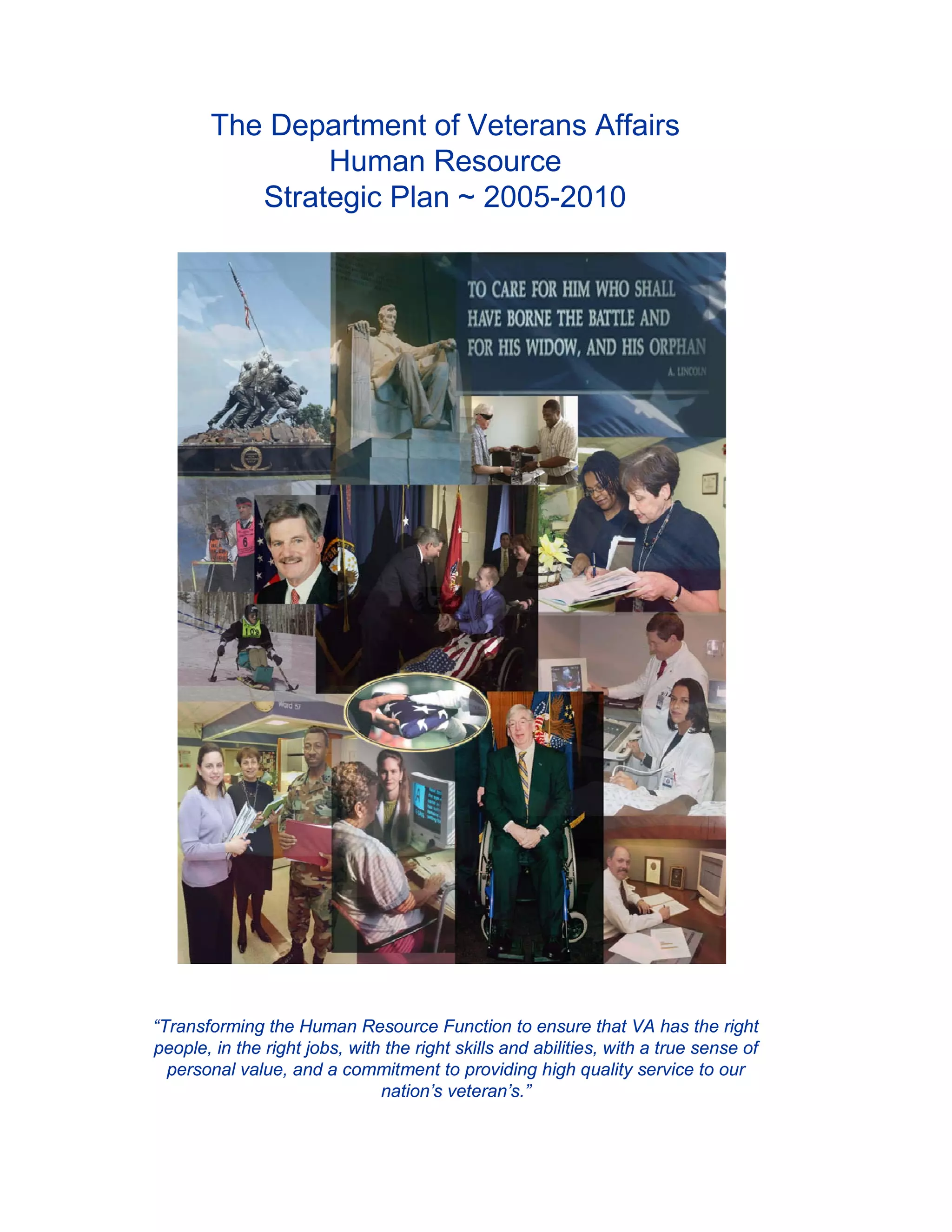
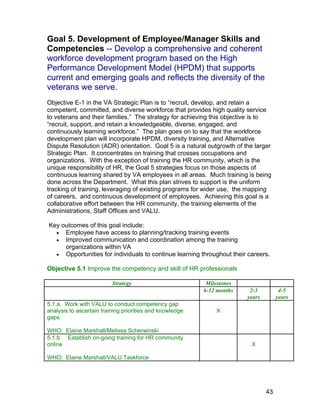
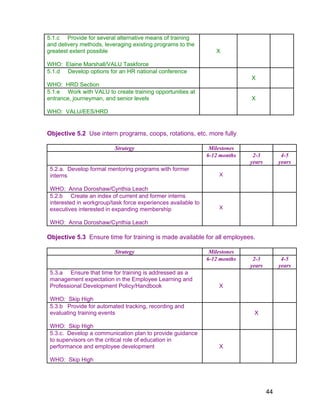
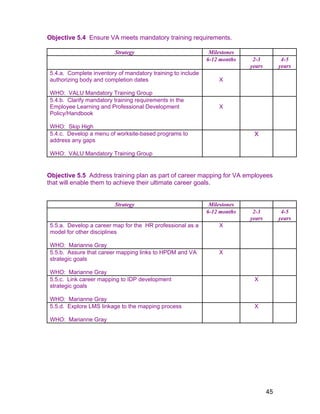
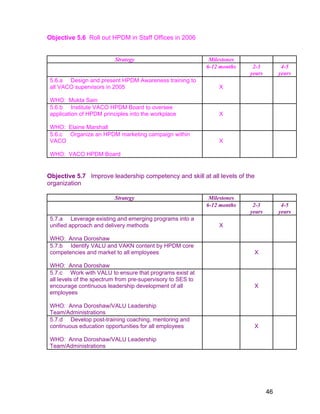
The Department of Veterans Affairs
Human Resource
Strategic Plan ~ 2005-2010
“Transforming the Human Resource Function to ensure that VA has the right
people, in the right jobs, with the right skills and abilities, with a true sense of
personal value, and a commitment to providing high quality service to our
nation’s veteran’s.”
Transforming VA’s Human Resources – Message from the Assistant Secretary
The Honorable R. Allen Pittman
Assistant Secretary for
Human Resources and Administration
The traditional personnel system at VA, much like those of the rest of the Federal
government, is being confronted by market pressures that are provoking important
changes. In order to compete for the talent necessary to fulfill VA’s mission, our system
for managing our human capital must evolve. It must become more flexible, agile,
effective and accountable in order to provide the range of services our Nation’s veterans
have been promised. The Strategic Plan that the Office of Human Resources and
Administration (HR&A) has developed in partnership with the Human Resources
community begins the process of transformation. The Office of Human Resources and
Administration will oversee a centralized HR governance process that will monitor the
implementation of this Plan, ensure compliance with federal and VA HR policies and
procedures, and maintain accountability at all levels.
The first step in the process is to improve the development, implementation, and
evaluation of HR policies and procedures throughout the Department. This includes
converting the direction and requirements established by the President, the Secretary
and VA leadership, the Office of Personnel Management (OPM), the Office of
Management and Budget (OMB), the Congress and on occasion, other Federal
agencies, into VA policies and procedures that ensure compliance and consistency of
application. To that end, VA’s HR policies and procedures must be written in such a
way that is clear and understandable to the end user. Standardized tools and other aids
must be routinely provided during the implementation phase to jump start the learning
curve and enable consistent application. Additional efforts are required to provide easy
access to the new policies as well as a search-functionality. This will enable HR
practitioners to quickly locate, navigate through and research specific aspects of the
policies, thus providing them with an increased capability to provide accurate and timely
guidance to managers.
Underlying and supporting the planned systemic changes in the Human Resources
environment is the development of an effective, user-friendly, Human Resources
Information System. The key part of this system will be a web-based HR Resource
Center, a tool that HR professionals and managers can use to address local
classification actions while staying consistent with both Office of Personnel
2
Management and VA classification guidelines. It will include position descriptions,
performance standards, functional statements and competencies, performance-based
interview questions and eventually, electronic employee records. In practical terms, this
system will, when a performance measure for a certain grade is needed, enable an HR
professional to go on-line and look up and select from several examples of performance
measures at the grade in question.
In addition, this system will make both historical and current workforce data available so
that HR professionals will be able to do trend analysis to help VA managers determine
future workforce needs based on retirements, promotions, re-assignments and other
significant personnel actions.
The next step in the strategic process is to ensure that VA’s human capital plans and
strategies are developed and implemented in such a way that they serve the mission,
goals, objectives and budget of the entire Department. This requires clear lines of
communication, effective planning processes between the Administrations, Staff Offices
and HR&A, skilled HR staffing throughout VA, and a One-VA approach to marketing
and staffing. The five major goals of the HR Strategic Plan are replete with
commitments that will appropriately align HR activities within the One-VA context.
Workforce and Succession Planning encompasses a substantial part of VA’s human
capital program. A properly functioning human capital program will provide an adequate
supply of qualified prospective employees for planned departures and new openings.
VA is developing new information systems that will help identify an appropriate pool of
internal VA candidates for these openings. Also, by expanding the collection and
dissemination of personnel data, additional benefits will accrue. Databases that
maintain an inventory of employees’ skills, core competency requirements for each
position, and training programs to fulfill the competencies and to prepare employees for
their future posts, will establish the critical base for a successful human capital program.
Closely related to the Workforce and Succession Plan is our “One-VA Marketing and
Recruitment Program” where our focus will be on hiring veterans, an expanded minority
outreach program that will move us to the point where our workforce mirrors the
Nation’s workforce, and a well-integrated Co-Op and Intern program that targets and
nurtures VA’s future leaders. Inherent in our recruitment activities, is the necessity to
ensure that all employees have a VA career plan so that they and their supervisors
know what lies ahead and what training they need to get there.
Training and development is also critical to the transformation process defined in this
plan. We will formalize the programmatic links between training and career progression
in our leadership development programs – the Senior Executive Service Candidate
Development Program and Leadership VA – so that targeted openings for candidates in
the Senior Executive Service exist once the training is completed. We will also ensure
that career mapping takes place and Individual Development Plans (IDPs) are
developed for all employees at all levels to support their career progression. The
creation of this kind of commitment to all VA employees is an important part of the
planned transformation within VA’s HR environment. A key aspect of training and
3
development is to ensure that VA’s leaders and managers have the ability to effectively
manage people, ensure continuity of leadership, and sustain a learning environment
that drives continuous improvement in performance. VA will provide programmed core
competency training for supervisors and leaders to assure that the people in line for
leadership positions have the training they need to perform. We will also be formalizing
the programmatic links between training and career progression in leadership
development programs.
To achieve the transformation described in this plan, VA can not work in a vacuum or in
stovepipes. VA will collaborate with internal and external stakeholders and partners to
identify, develop, and integrate tools and systems that meet business needs. VA will
also endeavor to improve internal cooperation within the HR community to ensure
consistent implementation of policies and procedures, improve corporate-level training
and development, enhance operating systems, and build a corporate HR information
system. This philosophy of collaboration will transcend all five of the goals included in
this Plan and serve as a basic operating principal for Human Resources Management.
The notion of a One-VA HR Strategic Plan is an important one. This plan is not an
“internal” creation of HR&A. It was developed with the critical and integral participation
of HR&A’s customers: the Administrations – both in the field and at VA’s Central Office,
the Staff Offices, and the Office of Personnel Management, with their needs and
requirements paramount in our deliberations. VA is an organization with multiple
functions and separate operational entities; the services that VA provides to our
Nation’s veterans must be supported by an integrated personnel system that serves all
VA. The Office of Human Resources and Administration’s commitment is to establish a
flexible human capital program that will support and sustain the variety of personnel
requirements that comprise today’s VA, by providing governance, and ensuring
compliance and accountability. This HR Strategic Plan begins the transformation
process that will keep VA competitive in a human capital environment that is rapidly
evolving. The plan will align HR activities within the overall mission and budget of VA,
make VA’s human resource function more responsive to the needs of VA’s HR
professionals, address the development needs of VA’s employees and the organization
at the same time, thereby creating a mutually supportive and well-functioning work
environment.
The Honorable R. Allen Pittman
Assistant Secretary for
Human Resources and Administration
4
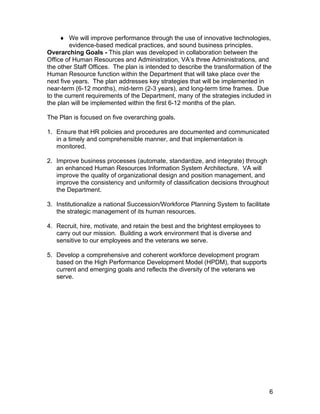
VA Human Resources Strategic Plan
Mission Statement for Human Resources – Recruit, develop, and retain a competent,
committed, and diverse workforce that provides high quality service to veterans and their
families.
Vision Statement – The VA Human Resource community is a dynamic, innovative, flexible
organization that thoroughly understands VA’s business lines. VA Human Resources
ensures that VA has the right people, in the right jobs, with the right skills and abilities,
with a true sense of personal value, and a commitment to providing high quality service to
our Nation’s veterans.
VA’s Mission – “To care for him who has borne the battle and for his widow and
his orphan” - President Abraham Lincoln
VA’s Core Values - The men and women of VA are dedicated to fulfilling the
Department’s mission and they commit their abilities and energy to continue the
rich history of providing for those that have served America. In doing so, we will
strive to uphold the following core values that represent the basic fabric of our
organizational culture.
Commitment
♦ Veterans have earned our respect and commitment, and their health care,
benefits, and memorial services needs drive our actions.
♦ We will value our commitment to veterans though all contingencies and
remain fully prepared to achieve our mission.
Excellence
♦ We strive to exceed the service delivery expectations of veterans and
their families.
♦ We perform at the highest level of competence with pride in our
accomplishments.
People
♦ We are committed to a highly skilled, diverse, and compassionate
workforce.
♦ We foster a culture of respect, equal opportunity, innovation, and
accountability.
Communication
♦ We practice open, accurate, and timely communication with veterans,
employees, and external stakeholders, and seek continuous
improvement in our programs and services by carefully listening to their
concerns.
Stewardship
♦ We will ensure responsible stewardship of the human, financial,
information, and natural resources entrusted to us.
5
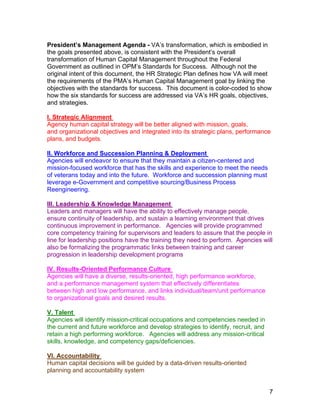
♦ We will improve performance through the use of innovative technologies,
evidence-based medical practices, and sound business principles.
Overarching Goals - This plan was developed in collaboration between the
Office of Human Resources and Administration, VA’s three Administrations, and
the other Staff Offices. The plan is intended to describe the transformation of the
Human Resource function within the Department that will take place over the
next five years. The plan addresses key strategies that will be implemented in
near-term (6-12 months), mid-term (2-3 years), and long-term time frames. Due
to the current requirements of the Department, many of the strategies included in
the plan will be implemented within the first 6-12 months of the plan.
The Plan is focused on five overarching goals.
1. Ensure that HR policies and procedures are documented and communicated
in a timely and comprehensible manner, and that implementation is
monitored.
2. Improve business processes (automate, standardize, and integrate) through
an enhanced Human Resources Information System Architecture. VA will
improve the quality of organizational design and position management, and
improve the consistency and uniformity of classification decisions throughout
the Department.
3. Institutionalize a national Succession/Workforce Planning System to facilitate
the strategic management of its human resources.
4. Recruit, hire, motivate, and retain the best and the brightest employees to
carry out our mission. Building a work environment that is diverse and
sensitive to our employees and the veterans we serve.
5. Develop a comprehensive and coherent workforce development program
based on the High Performance Development Model (HPDM), that supports
current and emerging goals and reflects the diversity of the veterans we
serve.
6
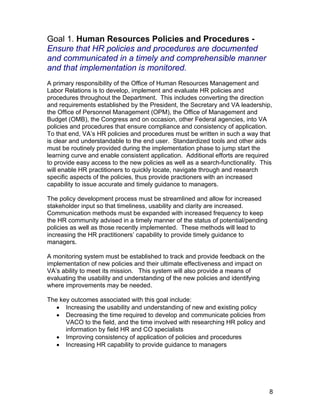
President’s Management Agenda - VA’s transformation, which is embodied in
the goals presented above, is consistent with the President’s overall
transformation of Human Capital Management throughout the Federal
Government as outlined in OPM’s Standards for Success. Although not the
original intent of this document, the HR Strategic Plan defines how VA will meet
the requirements of the PMA’s Human Capital Management goal by linking the
objectives with the standards for success. This document is color-coded to show
how the six standards for success are addressed via VA’s HR goals, objectives,
and strategies.
I. Strategic Alignment
Agency human capital strategy will be better aligned with mission, goals,
and organizational objectives and integrated into its strategic plans, performance
plans, and budgets.
II. Workforce and Succession Planning & Deployment
Agencies will endeavor to ensure that they maintain a citizen-centered and
mission-focused workforce that has the skills and experience to meet the needs
of veterans today and into the future. Workforce and succession planning must
leverage e-Government and competitive sourcing/Business Process
Reengineering.
III. Leadership & Knowledge Management
Leaders and managers will have the ability to effectively manage people,
ensure continuity of leadership, and sustain a learning environment that drives
continuous improvement in performance. Agencies will provide programmed
core competency training for supervisors and leaders to assure that the people in
line for leadership positions have the training they need to perform. Agencies will
also be formalizing the programmatic links between training and career
progression in leadership development programs
IV. Results-Oriented Performance Culture
Agencies will have a diverse, results-oriented, high performance workforce,
and a performance management system that effectively differentiates
between high and low performance, and links individual/team/unit performance
to organizational goals and desired results.
V. Talent
Agencies will identify mission-critical occupations and competencies needed in
the current and future workforce and develop strategies to identify, recruit, and
retain a high performing workforce. Agencies will address any mission-critical
skills, knowledge, and competency gaps/deficiencies.
VI. Accountability
Human capital decisions will be guided by a data-driven results-oriented
planning and accountability system
7
Goal 1. Human Resources Policies and Procedures -
Ensure that HR policies and procedures are documented
and communicated in a timely and comprehensible manner
and that implementation is monitored.
A primary responsibility of the Office of Human Resources Management and
Labor Relations is to develop, implement and evaluate HR policies and
procedures throughout the Department. This includes converting the direction
and requirements established by the President, the Secretary and VA leadership,
the Office of Personnel Management (OPM), the Office of Management and
Budget (OMB), the Congress and on occasion, other Federal agencies, into VA
policies and procedures that ensure compliance and consistency of application.
To that end, VA’s HR policies and procedures must be written in such a way that
is clear and understandable to the end user. Standardized tools and other aids
must be routinely provided during the implementation phase to jump start the
learning curve and enable consistent application. Additional efforts are required
to provide easy access to the new policies as well as a search-functionality. This
will enable HR practitioners to quickly locate, navigate through and research
specific aspects of the policies, thus provide practioners with an increased
capability to issue accurate and timely guidance to managers.
The policy development process must be streamlined and allow for increased
stakeholder input so that timeliness, usability and clarity are increased.
Communication methods must be expanded with increased frequency to keep
the HR community advised in a timely manner of the status of potential/pending
policies as well as those recently implemented. These methods will lead to
increasing the HR practitioners’ capability to provide timely guidance to
managers.
A monitoring system must be established to track and provide feedback on the
implementation of new policies and their ultimate effectiveness and impact on
VA’s ability to meet its mission. This system will also provide a means of
evaluating the usability and understanding of the new policies and identifying
where improvements may be needed.
The key outcomes associated with this goal include:
• Increasing the usability and understanding of new and existing policy
• Decreasing the time required to develop and communicate policies from
VACO to the field, and the time involved with researching HR policy and
information by field HR and CO specialists
• Improving consistency of application of policies and procedures
• Increasing HR capability to provide guidance to managers
8
Goal 1 Co-leaders: Carol Mellen, Brian McVeigh
NOTE: Items in Bold below were deemed as high priority by the Policy
Workgroup
Objective 1.1 Develop/Issue clear and useful policies so that the ease and
consistency of application as well as the level of compliance is increased. This
enables broader use of the flexibilities inherent in the policies to recruit/retain a
high quality workforce. [Note this objective is intended to be prospective and
applies to new rather than retrofitting existing policies.]
Strategy Milestones
6-12
months
2-3
years
4-5
years
1.1.a. Establish Standard Operating Procedures in
OHRM for all policy makers to address these new
requirements for this Goal
WHO: Workgroup representing OHRM services
X
1.1.b. Reduce Directive content – keep it bare bones with
majority of material in Handbooks
- Identify minimum components
- Obtain approval of minimum components from
Directives Management (if necessary)
- Pilot with policies currently in development phase
- Require justification during concurrence phase if
directive exceeds minimum
- Evaluate pilot and fully implement
WHO: Workgroup representing OHRM services
X
X
X
X
1.1.b (1) Maintain appropriate flexibilities - Supply only what
needs to be decided by CO and leave flexibility in the field
when applicable
- Require rationale for delegations in briefing checklist
WHO: Workgroup representing OHRM services;
policymaker
X
9
1.1.b (2) In purpose paragraph of Policy Directives, identify
desired outcomes and key indicators as identified in
1.2.e.(2)
- Obtain approval (if necessary) from Directives
Management
- Develop sample outcomes and automated key
indicators & share with policymakers
- Pilot with policies currently under development
- Evaluate pilot and fully implement
WHO: Workgroup representing OHRM services;
policymaker
X
X
X
X
1.1.c. Develop and/or augment handbooks so they are
more detailed and useful to include supporting
tools/aids for implementation (actual location of
tools/aids may vary)
- Develop checklist of potential tools/aids (FAQs,
performance tools, job aids, examples, training
package, implementation time table, Power Point
Slides for use in local discussions, Sample letters to
issue at field level, Sample SOPs, HRML, etc) and
locations (web site, teleconference, email, handbook,
Vtel, train the trainer at a designated facility,
newsletter, etc) [NOTE: Implementation also identifies
potential resource impact on field]
- Pilot requirement for policy developers to develop
specific tools/aids and include checklist with
concurrence package [NOTE: tools/aids may be
developed with field participation]
- Evaluate pilot and fully implement
WHO: Workgroup representing OHRM services;
policymaker
X
X
X
X
1.1.c (1) Develop mechanism to make cross-
referencing/researching of the Handbooks and CFR fast and
easy
- Hotlink Directive/Handbook policies with related CFRs
- Hotlink CFR list with relevant Directive/Handbook
policies
- Create “Google” function for searches
- Update web document “Guide to VA Handbooks” for
easy reference
WHO: IT staff; Iris Gresham; Policymakers
X X
X
X
X
10
1.1.c (2 ) Establish/include standardized report format for
any policies containing future reporting requirements
- Develop checklist for identifying need for report,
rationale, related data elements, collection level,
source/location of data and report template/format
- Pilot use of checklist and require its inclusion during
concurrence phase
- If local input required, create template for entering data
elements (preferably nationwide on-line database)
- If collection is at VACO level, identify current PAID data
that may be used
- Evaluate Pilot and fully implement
WHO: Workgroup representing OHRM services;
Policymaker in conjunction with IT or PAID staff
X
X
X
X
X
X
X
X
X
X
X
X
Objective 1.2 Improve the policy development and approval process (timeliness)
in order to increase the quality of the policy and expedite its implementation.
Strategy Milestones
6-12 months 2-3
years
4-5
years
1.2.a. Establish a protocol in which the ad-hoc (field)
experts can be included in pre-draft or post-draft
policy development before it is submitted for official
concurrence (Example: The SHRAC sub-committee is
working on protocols for VHA)
WHO: OHRM, Administrations, and Staff Office
representatives in workgroup [may be included in SOP]
X
1.2.b. Establish annual policy call – Administrations
and Staff Offices can recommend changes to existing
policies
WHO: A/S for HR&A (based on document drafted by
Carol Mellen)
X
1.2.c. Use data from monitoring process to identify policy
areas in need of change
WHO: OHRM Service Directors
X
1.2.d. Prioritize combined responses to annual policy call
and data results by forming a workgroup and building in
dialogue ability
WHO: Workgroup of OHRM Managers and top
Administration/Staff Office representatives
X
11
1.2.d (1) Partner with affected Administration and Staff
Offices to develop priority changes to policy that will obtain
input/clarification from stakeholders
WHO: OHRM Policymakers and representatives from
affected administration/
Staff Office
X
1.2.e. Update policies/handbooks as prioritized
WHO: OHRM Policymakers with input from
Administrations and Staff Offices and field experts (see
1.2)
X
1.2.e (1) Develop supporting tools/aids for implementation
- Add a toolbox with FAQ’s that can be added
to/updated with questions from the field
- Performance tools/job aids
- Examples: 2-3 Scenarios (available outside policy)
(See 1.1)
WHO: OHRM Policymakers with input from
Administrations and Staff Offices and field experts
X
1.2.e (2) Identify desired outcomes and key indicators (if
not already existing) such as what metrics? What data
sources? Will data be standardized? (See 1.1)
WHO: OHRM Policymakers, Administration and Staff
Offices, field experts and WIST staff
X
1.2.e (3) Identify methods for measuring success such as
time, quality (if not already existing)
WHO: OHRM Policymakers, Administrations and Staff
Offices, field experts
X
1.2.f. Encourage Administration and Staff Offices to draft
language to fast-track (with OHRM involvement). Limit
use for single focused changes only
WHO: OHRM Policymakers, Administrations
X
1.2.g. Distribute draft policy to field (e.g., VHA SHRAC,
VBA HRC) and allow for feedback [NOTE: this will be
driven by time, complexity of subject, impact]
- Turn around in 14-28 days
- Include a focused conference call to discuss draft
(This may be done concurrently with the OPM
comment period)
- This may also be a time to begin developing potential
FAQs (see 1.1)
WHO: OHRM Policymakers, Administration and Staff
Offices
X
12
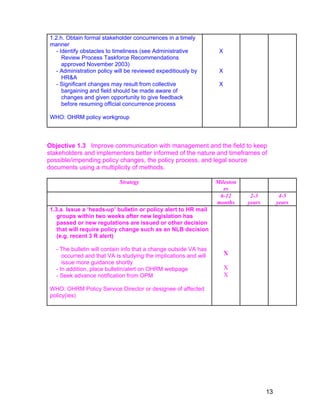
1.2.h. Obtain formal stakeholder concurrences in a timely
manner
- Identify obstacles to timeliness (see Administrative
Review Process Taskforce Recommendations
approved November 2003)
- Administration policy will be reviewed expeditiously by
HR&A
- Significant changes may result from collective
bargaining and field should be made aware of
changes and given opportunity to give feedback
before resuming official concurrence process
WHO: OHRM policy workgroup
X
X
X
Objective 1.3 Improve communication with management and the field to keep
stakeholders and implementers better informed of the nature and timeframes of
possible/impending policy changes, the policy process, and legal source
documents using a multiplicity of methods.
Strategy Mileston
es
6-12
months
2-3
years
4-5
years
1.3.a. Issue a ‘heads-up’ bulletin or policy alert to HR mail
groups within two weeks after new legislation has
passed or new regulations are issued or other decision
that will require policy change such as an NLB decision
(e.g. recent 3 R alert)
- The bulletin will contain info that a change outside VA has
occurred and that VA is studying the implications and will
issue more guidance shortly
- In addition, place bulletin/alert on OHRM webpage
- Seek advance notification from OPM
WHO: OHRM Policy Service Director or designee of affected
policy(ies)
X
X
X
13
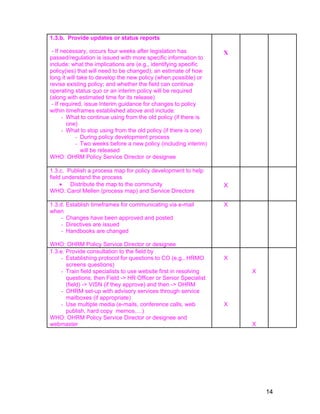
1.3.b. Provide updates or status reports
- If necessary, occurs four weeks after legislation has
passed/regulation is issued with more specific information to
include: what the implications are (e.g., identifying specific
policy(ies) that will need to be changed); an estimate of how
long it will take to develop the new policy (when possible) or
revise existing policy; and whether the field can continue
operating status quo or an interim policy will be required
(along with estimated time for its release)
- If required, issue Interim guidance for changes to policy
within timeframes established above and include:
- What to continue using from the old policy (if there is
one)
- What to stop using from the old policy (if there is one)
- During policy development process
- Two weeks before a new policy (including interim)
will be released
WHO: OHRM Policy Service Director or designee
X
1.3.c. Publish a process map for policy development to help
field understand the process
• Distribute the map to the community
WHO: Carol Mellen (process map) and Service Directors
X
1.3.d. Establish timeframes for communicating via e-mail
when
- Changes have been approved and posted
- Directives are issued
- Handbooks are changed
WHO: OHRM Policy Service Director or designee
X
1.3.e. Provide consultation to the field by
- Establishing protocol for questions to CO (e.g., HRMO
screens questions)
- Train field specialists to use website first in resolving
questions; then Field -> HR Officer or Senior Specialist
(field) -> VISN (if they approve) and then -> OHRM
- OHRM set-up with advisory services through service
mailboxes (if appropriate)
- Use multiple media (e-mails, conference calls, web
publish, hard copy memos,…)
WHO: OHRM Policy Service Director or designee and
webmaster
X
X
X
X
14
1.3.f. Improve website
- Benchmark against other agency sites; Look at other
websites (both policies and procedures); some are easier to
navigate and understand (Examples: Social Security, Dept
of Agriculture/USDA, Dept of Army and DoD)
- Include “Google” or “First Gov” search function to improve
search results
- Create list serve function for notifying field of updates
- Provide training tools (e.g. web links) on rule making and
legislative process (i.e. how a bill becomes a law, etc.)
which is described in Thomas Ben’s Guide to the U.S.
Government for Kids on how laws are made
(http://thomas.loc.gov/home/lawsmade.bysec/lawsnew.txt),
http://bensguide.gpo.gov/9-12/lawmaking/index.html,
how are rules codified into the CFR - the rulemaking
process from start to finish
(http://www.archives.gov/federal_register/tutorial/tutorial_07
0.pdf] ),
and “The Federal Register: What it is and how to use it”
(http://www.archives.gov/federal_register/tutorial/about_tuto
rial.html)
- Ensure that adequate resources are assigned to improve,
monitor and update web site
- Establish introductory information to new HR specialists –
how to use OHRM website, where it is, what info is
contained on website, etc.
- Add a user rating system (qualitative and quantitative) to
website in order to identify problem policies quickly such as
a continuous feedback “pop-up” survey
WHO: A/S for HR&A, DAS for HRM-LR, OHRM Webmaster
and OHRM workgroup
X
X
X
X
X
X
X
15
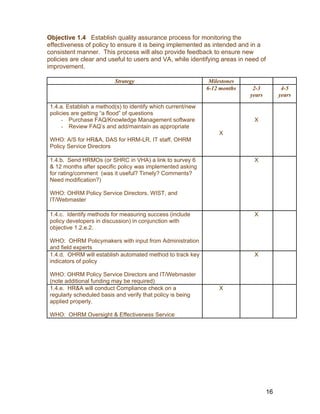
Objective 1.4 Establish quality assurance process for monitoring the
effectiveness of policy to ensure it is being implemented as intended and in a
consistent manner. This process will also provide feedback to ensure new
policies are clear and useful to users and VA, while identifying areas in need of
improvement.
Strategy Milestones
6-12 months 2-3
years
4-5
years
1.4.a. Establish a method(s) to identify which current/new
policies are getting “a flood” of questions
- Purchase FAQ/Knowledge Management software
- Review FAQ’s and add/maintain as appropriate
WHO: A/S for HR&A, DAS for HRM-LR, IT staff, OHRM
Policy Service Directors
X
X
1.4.b. Send HRMOs (or SHRC in VHA) a link to survey 6
& 12 months after specific policy was implemented asking
for rating/comment (was it useful? Timely? Comments?
Need modification?)
WHO: OHRM Policy Service Directors, WIST, and
IT/Webmaster
X
1.4.c. Identify methods for measuring success (include
policy developers in discussion) in conjunction with
objective 1.2.e.2.
WHO: OHRM Policymakers with input from Administration
and field experts
X
1.4.d. OHRM will establish automated method to track key
indicators of policy
WHO: OHRM Policy Service Directors and IT/Webmaster
(note additional funding may be required)
X
1.4.e. HR&A will conduct Compliance check on a
regularly scheduled basis and verify that policy is being
applied properly.
WHO: OHRM Oversight & Effectiveness Service
X
16
Goal 1: Performance Measures
Outcome Measures FY2005
Target
Strategic Target
Clarity
• Volume of questions generated from implementing new or
revised policy are within acceptable range
0% Estab baseline FY
2008; 80% by 2010
• Responses to 6 & 12 month follow up surveys on specific
policies (and communication/training materials) indicate they
were clear.
FY 08
Timeliness
• Status of potential and pending policies is made available to
HR community within 5 business days (e.g., Executive
Orders, Federal Register Notices, Requests for Comments,
Bills enacted into laws, final regulations, current policies in
pipeline) [one time event]
o Info provided will contain a line or two of context (e.g.,
Law was enacted, but OPM must issue regulations
before VA can issue policy)
0% 100% by 4th
Quarter,
FY 06
• A timeline will be developed for all policy changes and
communicated to field with information about where it is at
any given time (status updates). A list of policies scheduled to
be changed over next 6-12 months will be posted(e.g. OPM’s
Policy review schedule which is updated every 6 months–
what’s currently in formation stage, concurrence stage,
implementation stage – possible use of flowchart for
reference)
100% by 4th
Quarter
FY 06
Customer Satisfaction (HRMOs surveyed)
• Responses to the annual HR Customer Survey indicate
increased satisfaction with timeliness of policies
Revise
Survey
Establish Baseline
FY 06
• Responses to the annual HR Customer Survey indicate
increased satisfaction with clarity of written policies
Revise
Survey
Establish Baseline
FY 06
• Responses to the annual HR Customer Survey indicate
increased satisfaction with usefulness of policies
Revise
Survey
Establish Baseline
FY 06
• Responses to 6 & 12 month follow up surveys on specific
policies (and communication/training materials) indicate they
were clear, useful and timely
FY 08
HR Self Evaluation (field Mangers surveyed)
• Majority of overall VA responses to “Is HR policy or guidance
clear and sufficient?” indicate “Frequently clear and sufficient”
and/or “Almost always clear and sufficient.”
FY 08
To be developed at a later date
Compliance/Consistency of application/Impact of policies
• Findings during OHRM on-site reviews reflect high level of
compliance and consistent application of policies
• Findings during OPM on-site reviews reflect compliance and
consistent application
• Review(s) and trend analysis of PAID data indicate policies
are having the desired impact
TBD
As Scheduled
TBD
17
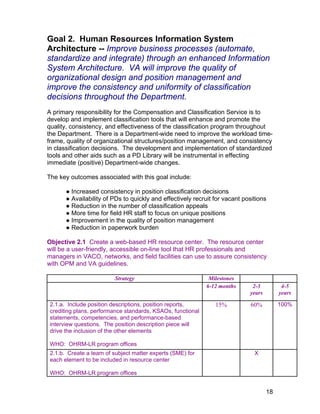
Goal 2. Human Resources Information System
Architecture -- Improve business processes (automate,
standardize and integrate) through an enhanced Information
System Architecture. VA will improve the quality of
organizational design and position management and
improve the consistency and uniformity of classification
decisions throughout the Department.
A primary responsibility for the Compensation and Classification Service is to
develop and implement classification tools that will enhance and promote the
quality, consistency, and effectiveness of the classification program throughout
the Department. There is a Department-wide need to improve the workload time-
frame, quality of organizational structures/position management, and consistency
in classification decisions. The development and implementation of standardized
tools and other aids such as a PD Library will be instrumental in effecting
immediate (positive) Department-wide changes.
The key outcomes associated with this goal include:
● Increased consistency in position classification decisions
● Availability of PDs to quickly and effectively recruit for vacant positions
● Reduction in the number of classification appeals
● More time for field HR staff to focus on unique positions
● Improvement in the quality of position management
● Reduction in paperwork burden
Objective 2.1 Create a web-based HR resource center. The resource center
will be a user-friendly, accessible on-line tool that HR professionals and
managers in VACO, networks, and field facilities can use to assure consistency
with OPM and VA guidelines.
Strategy Milestones
6-12 months 2-3
years
4-5
years
2.1.a. Include position descriptions, position reports,
crediting plans, performance standards, KSAOs, functional
statements, competencies, and performance-based
interview questions. The position description piece will
drive the inclusion of the other elements
WHO: OHRM-LR program offices
15% 60% 100%
2.1.b. Create a team of subject matter experts (SME) for
each element to be included in resource center
WHO: OHRM-LR program offices
X
18
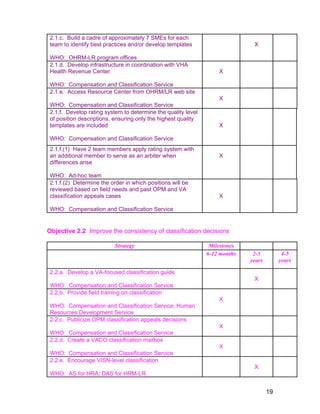
2.1.c. Build a cadre of approximately 7 SMEs for each
team to identify best practices and/or develop templates
WHO: OHRM-LR program offices
X
2.1.d. Develop infrastructure in coordination with VHA
Health Revenue Center
WHO: Compensation and Classification Service
X
2.1.e. Access Resource Center from OHRM/LR web site
WHO: Compensation and Classification Service
X
2.1.f. Develop rating system to determine the quality level
of position descriptions, ensuring only the highest quality
templates are included
WHO: Compensation and Classification Service
X
2.1.f.(1) Have 2 team members apply rating system with
an additional member to serve as an arbiter when
differences arise
WHO: Ad-hoc team
X
2.1.f.(2) Determine the order in which positions will be
reviewed based on field needs and past OPM and VA
classification appeals cases
WHO: Compensation and Classification Service
X
Objective 2.2 Improve the consistency of classification decisions
Strategy Milestones
6-12 months 2-3
years
4-5
years
2.2.a. Develop a VA-focused classification guide
WHO: Compensation and Classification Service
X
2.2.b. Provide field training on classification
WHO: Compensation and Classification Service; Human
Resources Development Service
X
2.2.c. Publicize OPM classification appeals decisions
WHO: Compensation and Classification Service
X
2.2.d. Create a VACO classification mailbox
WHO: Compensation and Classification Service
X
2.2.e. Encourage VISN-level classification
WHO: AS for HRA; DAS for HRM-LR
X
19
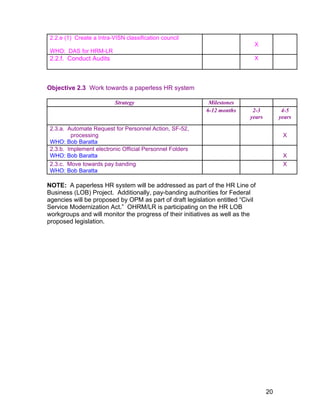
2.2.e (1) Create a Intra-VISN classification council
WHO: DAS for HRM-LR
X
2.2.f. Conduct Audits X
Objective 2.3 Work towards a paperless HR system
Strategy Milestones
6-12 months 2-3
years
4-5
years
2.3.a. Automate Request for Personnel Action, SF-52,
processing
WHO: Bob Baratta
X
2.3.b. Implement electronic Official Personnel Folders
WHO: Bob Baratta X
2.3.c. Move towards pay banding
WHO: Bob Baratta
X
NOTE: A paperless HR system will be addressed as part of the HR Line of
Business (LOB) Project. Additionally, pay-banding authorities for Federal
agencies will be proposed by OPM as part of draft legislation entitled “Civil
Service Modernization Act.” OHRM/LR is participating on the HR LOB
workgroups and will monitor the progress of their initiatives as well as the
proposed legislation.
20
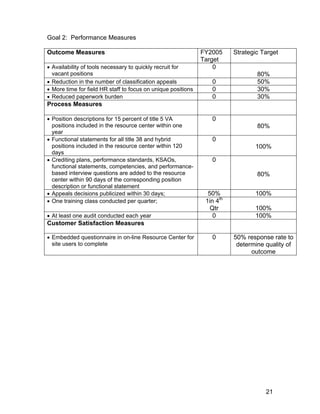
Goal 2: Performance Measures
Outcome Measures FY2005
Target
Strategic Target
• Availability of tools necessary to quickly recruit for
vacant positions
0
80%
• Reduction in the number of classification appeals 0 50%
• More time for field HR staff to focus on unique positions 0 30%
• Reduced paperwork burden 0 30%
Process Measures
• Position descriptions for 15 percent of title 5 VA
positions included in the resource center within one
year
0
80%
• Functional statements for all title 38 and hybrid
positions included in the resource center within 120
days
0
100%
• Crediting plans, performance standards, KSAOs,
functional statements, competencies, and performance-
based interview questions are added to the resource
center within 90 days of the corresponding position
description or functional statement
0
80%
• Appeals decisions publicized within 30 days; 50% 100%
• One training class conducted per quarter; 1in 4th
Qtr 100%
• At least one audit conducted each year 0 100%
Customer Satisfaction Measures
• Embedded questionnaire in on-line Resource Center for
site users to complete
0 50% response rate to
determine quality of
outcome
21
GOAL 3. VA Succession and Workforce Planning --
Institutionalize a national Succession/Workforce
Planning System to facilitate the strategic management
of its human resources.
Succession Planning ensures that there are highly qualified people in all
positions for today and in the future. Succession planning establishes a process
that recruits employees, develops their skills and abilities, prepares them for a
life-long career with the VA, and permits agencies to ensure a return on the
organization's training investment.
Succession planning involves understanding the organization's long-term goals
and objectives, identifying the workforce's developmental needs and determining
workforce trends and predictions. With good succession planning, employees
are ready for new leadership roles as the need arises, and when someone
leaves, a talented group of employees are ready to step-up to the plate.
Succession planning guarantees that employees will be constantly developed so
that competency gaps are filled.
Succession planning works in conjunction with workforce planning. Workforce
planning is the continuous management process of determining the kinds of
employees and infrastructure required to accomplish the organization’s mission.
Workforce planning addresses not only the knowledge, skills, and abilities necessary
for the successful accomplishment of strategic goals, but it also encompasses an
examination of the resources that employees need to perform effectively. Such
resources include funding, technology, management structures, information, work life
programs, environment, rewards, and incentives. In short, workforce planning is an
ongoing, deliberate, and systematic effort by management to produce desirable
outcomes and foster stewardship through their employees.
The focus of this goal and that of the work group that will coordinate its
implementation, is to assess the current state of VA workforce as it relates to the
Human Resources Management (HRM) career field, and identify strategies which
address gaps between the current employee base and the future workload and
mission requirements.
Although the focus of this plan is limited to the HRM occupation, VA is faced with
challenges in recruitment and retention in many occupations. To address these
challenges and to comply with the President’s Management Agenda, VA has
been conducting workforce and succession planning across and throughout all
levels of the Department. Workforce plans created by the Department, the
Administrations and Staff Offices can be accessed by visiting the following link
http://vaww.va.gov/vaworkforceplanning/guide/workforceplans.htm
Each of these plans, outlines strategies, initiatives and action plans to address
gaps in VA’s future workforce requirements. Below are examples of initiatives
22
involving mission-critical occupations that are producing positive results as VA
organizations implement action plans, as a result of their workforce and
succession planning efforts are provided:
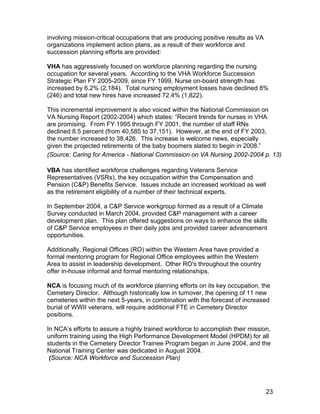
VHA has aggressively focused on workforce planning regarding the nursing
occupation for several years. According to the VHA Workforce Succession
Strategic Plan FY 2005-2009, since FY 1999, Nurse on-board strength has
increased by 6.2% (2,184). Total nursing employment losses have declined 8%
(246) and total new hires have increased 72.4% (1,822).
This incremental improvement is also voiced within the National Commission on
VA Nursing Report (2002-2004) which states: “Recent trends for nurses in VHA
are promising. From FY 1995 through FY 2001, the number of staff RNs
declined 8.5 percent (from 40,585 to 37,151). However, at the end of FY 2003,
the number increased to 38,426. This increase is welcome news, especially
given the projected retirements of the baby boomers slated to begin in 2008.”
(Source: Caring for America - National Commission on VA Nursing 2002-2004 p. 13)
VBA has identified workforce challenges regarding Veterans Service
Representatives (VSRs), the key occupation within the Compensation and
Pension (C&P) Benefits Service. Issues include an increased workload as well
as the retirement eligibility of a number of their technical experts.
In September 2004, a C&P Service workgroup formed as a result of a Climate
Survey conducted in March 2004, provided C&P management with a career
development plan. This plan offered suggestions on ways to enhance the skills
of C&P Service employees in their daily jobs and provided career advancement
opportunities.
Additionally, Regional Offices (RO) within the Western Area have provided a
formal mentoring program for Regional Office employees within the Western
Area to assist in leadership development. Other RO's throughout the country
offer in-house informal and formal mentoring relationships.
NCA is focusing much of its workforce planning efforts on its key occupation, the
Cemetery Director. Although historically low in turnover, the opening of 11 new
cemeteries within the next 5-years, in combination with the forecast of increased
burial of WWII veterans, will require additional FTE in Cemetery Director
positions.
In NCA’s efforts to assure a highly trained workforce to accomplish their mission,
uniform training using the High Performance Development Model (HPDM) for all
students in the Cemetery Director Trainee Program began in June 2004, and the
National Training Center was dedicated in August 2004.
(Source: NCA Workforce and Succession Plan)
23
These are a few examples of how the Administration’s plans address key mission
critical occupations.
As previously noted, this section of the plan will focus on the HRM professionals.
One of the key challenges facing VA is the lack of skilled HRM professionals who
understand the complexities of titles 5 and 38. Of note is the fact that, VA cannot
recruit experienced HRM professionals with title 38 experience from outside the
Department since VA is the sole user of this legal authority. Furthermore, VA
must address the workload demands and potential for increased turnover caused
by understaffing of HRM; the aging of the HRM workforce; the current early and
regular retirement eligibility of 50% of VA’s HRM professionals; and the 3-5 year
period needed to fully develop a seasoned HRM professional.
This occupation has crosscutting implications and the need to address this
occupation is critical. The key outcomes associated with this goal are as follows:
● VA must complete a Department-wide Plan that defines future workforce
requirements.
• VA develops an HR workforce that is capable of meeting the current and
future HR needs of the Department.
• VA establishes a systematic process that is documented in a Guidebook to
support implementation of Workforce and Succession Planning at all levels of
the organization.
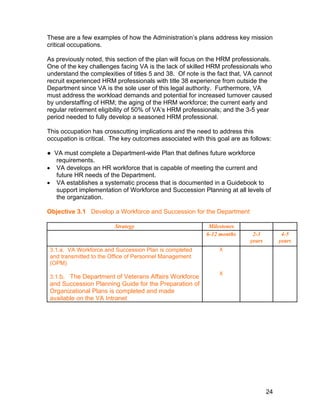
Objective 3.1 Develop a Workforce and Succession for the Department
Strategy Milestones
6-12 months 2-3
years
4-5
years
3.1.a. VA Workforce and Succession Plan is completed
and transmitted to the Office of Personnel Management
(OPM)
3.1.b. The Department of Veterans Affairs Workforce
and Succession Planning Guide for the Preparation of
Organizational Plans is completed and made
available on the VA Intranet
X
X
24
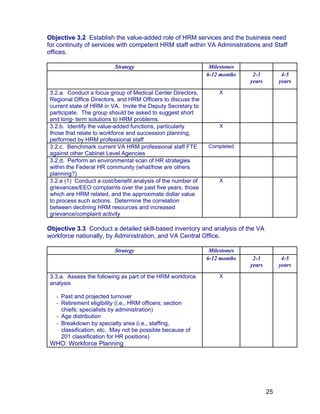
Objective 3.2 Establish the value-added role of HRM services and the business need
for continuity of services with competent HRM staff within VA Administrations and Staff
offices.
Strategy Milestones
6-12 months 2-3
years
4-5
years
3.2.a. Conduct a focus group of Medical Center Directors,
Regional Office Directors, and HRM Officers to discuss the
current state of HRM in VA. Invite the Deputy Secretary to
participate. The group should be asked to suggest short
and long- term solutions to HRM problems.
X
3.2.b. Identify the value-added functions, particularly
those that relate to workforce and succession planning,
performed by HRM professional staff
X
3.2.c. Benchmark current VA HRM professional staff FTE
against other Cabinet Level Agencies
Completed
3.2.d. Perform an environmental scan of HR strategies
within the Federal HR community (what/how are others
planning?)
3.2.e (1) Conduct a cost/benefit analysis of the number of
grievances/EEO complaints over the past five years, those
which are HRM related, and the approximate dollar value
to process such actions. Determine the correlation
between declining HRM resources and increased
grievance/complaint activity
X
Objective 3.3 Conduct a detailed skill-based inventory and analysis of the VA
workforce nationally, by Administration, and VA Central Office.
Strategy Milestones
6-12 months 2-3
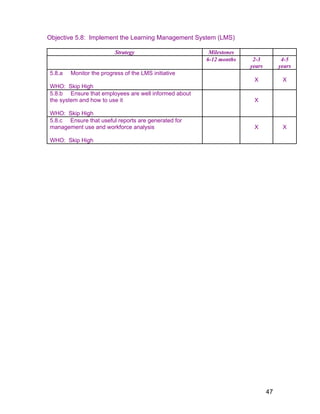
years
4-5
years
3.3.a. Assess the following as part of the HRM workforce
analysis
- Past and projected turnover
- Retirement eligibility (i.e., HRM officers; section
chiefs; specialists by administration)
- Age distribution
- Breakdown by specialty area (i.e., staffing,
classification, etc. May not be possible because of
201 classification for HR positions)
WHO: Workforce Planning
X
25
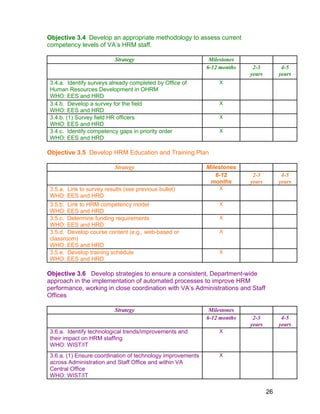
Objective 3.4 Develop an appropriate methodology to assess current
competency levels of VA’s HRM staff.
Strategy Milestones
6-12 months 2-3
years
4-5
years
3.4.a. Identify surveys already completed by Office of
Human Resources Development in OHRM
WHO: EES and HRD
X
3.4.b. Develop a survey for the field
WHO: EES and HRD
X
3.4.b. (1) Survey field HR officers
WHO: EES and HRD
X
3.4.c. Identify competency gaps in priority order
WHO: EES and HRD
X
Objective 3.5 Develop HRM Education and Training Plan
Strategy Milestones
6-12
months
2-3
years
4-5
years
3.5.a. Link to survey results (see previous bullet)
WHO: EES and HRD
X
3.5.b. Link to HRM competency model
WHO: EES and HRD
X
3.5.c. Determine funding requirements
WHO: EES and HRD
X
3.5.d. Develop course content (e.g., web-based or
classroom)
WHO: EES and HRD
X
3.5.e. Develop training schedule
WHO: EES and HRD
X
Objective 3.6 Develop strategies to ensure a consistent, Department-wide
approach in the implementation of automated processes to improve HRM
performance, working in close coordination with VA’s Administrations and Staff
Offices
Strategy Milestones
6-12 months 2-3
years
4-5
years
3.6.a. Identify technological trends/improvements and
their impact on HRM staffing
WHO: WIST/IT
X
3.6.a. (1) Ensure coordination of technology improvements
across Administration and Staff Office and within VA
Central Office
WHO: WIST/IT
X
26
3.6.b. Determine resource implications for enhanced HRM
technology
WHO: WIST/IT
X
Note: Technology initiatives are being addressed by other work groups and
should be incorporated into this plan to determine the impact on HRM in the
future.
Objective 3.7 Develop an appropriate methodology to determine the number of
HRM professionals and leaders needed through FY 2008, broken down by
specialty areas, and secure resources to meet deficiencies.
Strategy Milestones
6-12 months 2-3
years
4-5
years
3.7.a. Conduct a staffing survey to examine the
distribution of retirement eligible employees in the GS-13
through GS-15 levels
WHO: Workforce Planning
X
3.7.b. Develop a plan to use retired HRM professionals as
consultant (teaching, mentoring, developing training
curricula, on-site advisors in VA facilities with “at risk”
programs)
WHO: Workforce Planning
X
3.7.b.(1) Initiate succession planning efforts to ensure
HRM staff are available for projected leadership vacancies
WHO: Workforce Planning
X
3.7.c. Develop plans within each Administration and Staff
Office to achieve desired HRM staff at all levels or, as an
alternative, an assessment addressing future capability to
provide HRM services (i.e., organizational structure,
staffing levels, plans to train current and new staff)
WHO: Workforce Planning
X
3.7.c.(1) Gather previous VISN, Administration, and Staff
Office studies related to this topic and review their
recommendations
WHO: Workforce Planning
X
3.7.d. Obtain funding to support additional HRM staff
through VA budget process based on the workforce
analysis recommendations
WHO: Workforce Planning
X
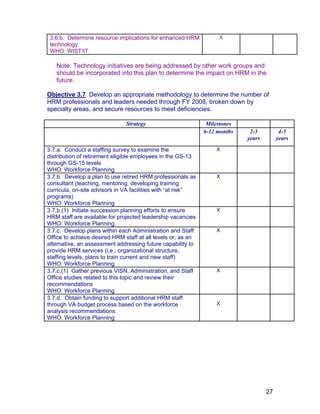
27
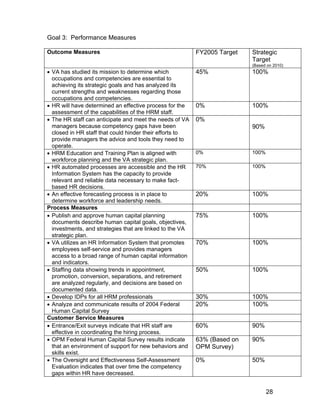
Goal 3: Performance Measures
Outcome Measures FY2005 Target Strategic
Target
(Based on 2010)
• VA has studied its mission to determine which
occupations and competencies are essential to
achieving its strategic goals and has analyzed its
current strengths and weaknesses regarding those
occupations and competencies.
45% 100%
• HR will have determined an effective process for the
assessment of the capabilities of the HRM staff.
0% 100%
• The HR staff can anticipate and meet the needs of VA
managers because competency gaps have been
closed in HR staff that could hinder their efforts to
provide managers the advice and tools they need to
operate.
0%
90%
• HRM Education and Training Plan is aligned with
workforce planning and the VA strategic plan.
0% 100%
• HR automated processes are accessible and the HR
Information System has the capacity to provide
relevant and reliable data necessary to make fact-
based HR decisions.
70% 100%
• An effective forecasting process is in place to
determine workforce and leadership needs.
20% 100%
Process Measures
• Publish and approve human capital planning
documents describe human capital goals, objectives,
investments, and strategies that are linked to the VA
strategic plan.
75% 100%
• VA utilizes an HR Information System that promotes
employees self-service and provides managers
access to a broad range of human capital information
and indicators.
70% 100%
• Staffing data showing trends in appointment,
promotion, conversion, separations, and retirement
are analyzed regularly, and decisions are based on
documented data.
50% 100%
• Develop IDPs for all HRM professionals 30% 100%
• Analyze and communicate results of 2004 Federal
Human Capital Survey
20% 100%
Customer Service Measures
• Entrance/Exit surveys indicate that HR staff are
effective in coordinating the hiring process.
60% 90%
• OPM Federal Human Capital Survey results indicate
that an environment of support for new behaviors and
skills exist.
63% (Based on
OPM Survey)
90%
• The Oversight and Effectiveness Self-Assessment
Evaluation indicates that over time the competency
gaps within HR have decreased.
0% 50%
28
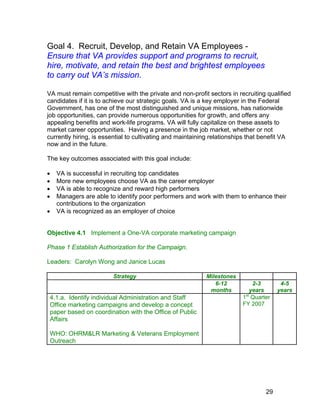
Goal 4. Recruit, Develop, and Retain VA Employees -
Ensure that VA provides support and programs to recruit,
hire, motivate, and retain the best and brightest employees
to carry out VA’s mission.
VA must remain competitive with the private and non-profit sectors in recruiting qualified
candidates if it is to achieve our strategic goals. VA is a key employer in the Federal
Government, has one of the most distinguished and unique missions, has nationwide
job opportunities, can provide numerous opportunities for growth, and offers any
appealing benefits and work-life programs. VA will fully capitalize on these assets to
market career opportunities. Having a presence in the job market, whether or not
currently hiring, is essential to cultivating and maintaining relationships that benefit VA
now and in the future.
The key outcomes associated with this goal include:
• VA is successful in recruiting top candidates
• More new employees choose VA as the career employer
• VA is able to recognize and reward high performers
• Managers are able to identify poor performers and work with them to enhance their
contributions to the organization
• VA is recognized as an employer of choice
Objective 4.1 Implement a One-VA corporate marketing campaign
Phase 1 Establish Authorization for the Campaign.
Leaders: Carolyn Wong and Janice Lucas
Strategy Milestones
6-12
months
2-3
years
4-5
years
4.1.a. Identify individual Administration and Staff
Office marketing campaigns and develop a concept
paper based on coordination with the Office of Public
Affairs
WHO: OHRM&LR Marketing & Veterans Employment
Outreach
1st
Quarter
FY 2007
29
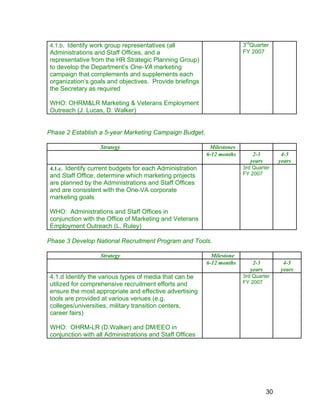
4.1.b. Identify work group representatives (all
Administrations and Staff Offices, and a
representative from the HR Strategic Planning Group)
to develop the Department’s One-VA marketing
campaign that complements and supplements each
organization’s goals and objectives. Provide briefings
the Secretary as required
WHO: OHRM&LR Marketing & Veterans Employment
Outreach (J. Lucas, D. Walker)
3rd
Quarter
FY 2007
Phase 2 Establish a 5-year Marketing Campaign Budget.
Strategy Milestones
6-12 months 2-3
years
4-5
years
4.1.c. Identify current budgets for each Administration
and Staff Office; determine which marketing projects
are planned by the Administrations and Staff Offices
and are consistent with the One-VA corporate
marketing goals
WHO: Administrations and Staff Offices in
conjunction with the Office of Marketing and Veterans
Employment Outreach (L. Ruley)
3rd Quarter
FY 2007
Phase 3 Develop National Recruitment Program and Tools.
Strategy Milestone
6-12 months 2-3
years
4-5
years
4.1.d Identify the various types of media that can be
utilized for comprehensive recruitment efforts and
ensure the most appropriate and effective advertising
tools are provided at various venues (e.g.
colleges/universities, military transition centers,
career fairs)
WHO: OHRM-LR (D.Walker) and DM/EEO in
conjunction with all Administrations and Staff Offices
3rd Quarter
FY 2007
30
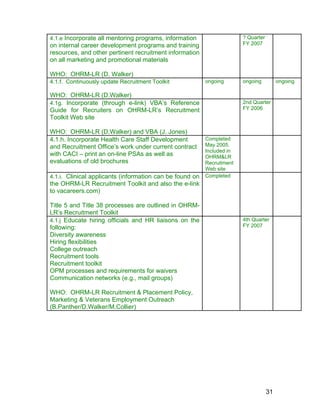
4.1.e Incorporate all mentoring programs, information
on internal career development programs and training
resources, and other pertinent recruitment information
on all marketing and promotional materials
WHO: OHRM-LR (D. Walker)
? Quarter
FY 2007
4.1.f. Continuously update Recruitment Toolkit
WHO: OHRM-LR (D.Walker)
ongoing ongoing ongoing
4.1g. Incorporate (through e-link) VBA’s Reference
Guide for Recruiters on OHRM-LR’s Recruitment
Toolkit Web site
WHO: OHRM-LR (D.Walker) and VBA (J. Jones)
2nd Quarter
FY 2006
4.1.h. Incorporate Health Care Staff Development
and Recruitment Office’s work under current contract
with CACI – print an on-line PSAs as well as
evaluations of old brochures
Completed
May 2005.
Included in
OHRM&LR
Recruitment
Web site
4.1.i. Clinical applicants (information can be found on
the OHRM-LR Recruitment Toolkit and also the e-link
to vacareers.com)
Title 5 and Title 38 processes are outlined in OHRM-
LR’s Recruitment Toolkit
Completed
4.1.j Educate hiring officials and HR liaisons on the
following:
Diversity awareness
Hiring flexibilities
College outreach
Recruitment tools
Recruitment toolkit
OPM processes and requirements for waivers
Communication networks (e.g., mail groups)
WHO: OHRM-LR Recruitment & Placement Policy,
Marketing & Veterans Employment Outreach
(B.Panther/D.Walker/M.Collier)
4th Quarter
FY 2007
31
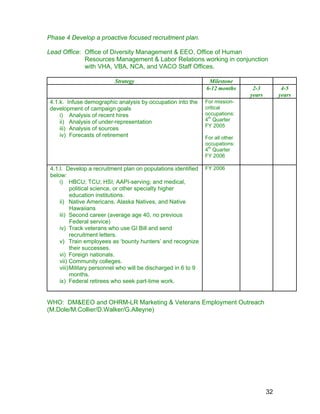
Phase 4 Develop a proactive focused recruitment plan.
Lead Office: Office of Diversity Management & EEO, Office of Human
Resources Management & Labor Relations working in conjunction
with VHA, VBA, NCA, and VACO Staff Offices.
Strategy Milestone
6-12 months 2-3
years
4-5
years
4.1.k. Infuse demographic analysis by occupation into the
development of campaign goals
i) Analysis of recent hires
ii) Analysis of under-representation
iii) Analysis of sources
iv) Forecasts of retirement
For mission-
critical
occupations:
4th
Quarter
FY 2005
For all other
occupations:
4th
Quarter
FY 2006
4.1.l. Develop a recruitment plan on populations identified
below:
i) HBCU; TCU; HSI; AAPI-serving; and medical,
political science, or other specialty higher
education institutions.
ii) Native Americans, Alaska Natives, and Native
Hawaiians
iii) Second career (average age 40, no previous
Federal service)
iv) Track veterans who use GI Bill and send
recruitment letters.
v) Train employees as ‘bounty hunters’ and recognize
their successes.
vi) Foreign nationals.
vii) Community colleges.
viii)Military personnel who will be discharged in 6 to 9
months.
ix) Federal retirees who seek part-time work.
FY 2006
WHO: DM&EEO and OHRM-LR Marketing & Veterans Employment Outreach
(M.Dole/M.Collier/D.Walker/G.Alleyne)
32
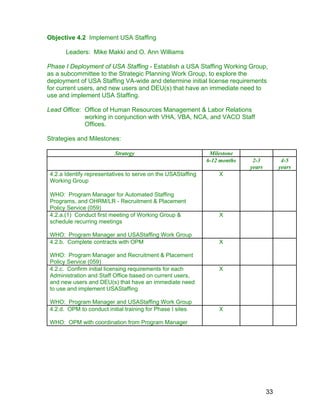
Objective 4.2 Implement USA Staffing
Leaders: Mike Makki and O. Ann Williams
Phase I Deployment of USA Staffing - Establish a USA Staffing Working Group,
as a subcommittee to the Strategic Planning Work Group, to explore the
deployment of USA Staffing VA-wide and determine initial license requirements
for current users, and new users and DEU(s) that have an immediate need to
use and implement USA Staffing.
Lead Office: Office of Human Resources Management & Labor Relations
working in conjunction with VHA, VBA, NCA, and VACO Staff
Offices.
Strategies and Milestones:
Strategy Milestone
6-12 months 2-3
years
4-5
years
4.2.a Identify representatives to serve on the USAStaffing
Working Group
WHO: Program Manager for Automated Staffing
Programs, and OHRM/LR - Recruitment & Placement
Policy Service (059)
X
4.2.a.(1) Conduct first meeting of Working Group &
schedule recurring meetings
WHO: Program Manager and USAStaffing Work Group
X
4.2.b. Complete contracts with OPM
WHO: Program Manager and Recruitment & Placement
Policy Service (059)
X
4.2.c. Confirm initial licensing requirements for each
Administration and Staff Office based on current users,
and new users and DEU(s) that have an immediate need
to use and implement USAStaffing
WHO: Program Manager and USAStaffing Work Group
X
4.2.d. OPM to conduct initial training for Phase I sites
WHO: OPM with coordination from Program Manager
X
33
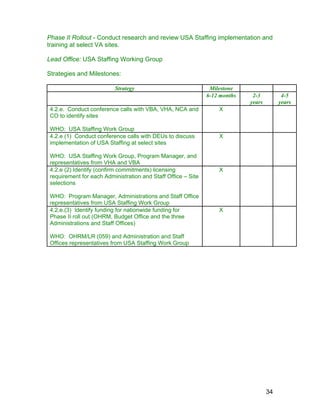
Phase II Rollout - Conduct research and review USA Staffing implementation and
training at select VA sites.
Lead Office: USA Staffing Working Group
Strategies and Milestones:
Strategy Milestone
6-12 months 2-3
years
4-5
years
4.2.e. Conduct conference calls with VBA, VHA, NCA and
CO to identify sites
WHO: USA Staffing Work Group
X
4.2.e (1) Conduct conference calls with DEUs to discuss
implementation of USA Staffing at select sites
WHO: USA Staffing Work Group, Program Manager, and
representatives from VHA and VBA
X
4.2.e (2) Identify (confirm commitments) licensing
requirement for each Administration and Staff Office – Site
selections
WHO: Program Manager, Administrations and Staff Office
representatives from USA Staffing Work Group
X
4.2.e.(3) Identify funding for nationwide funding for
Phase II roll out (OHRM, Budget Office and the three
Administrations and Staff Offices)
WHO: OHRM/LR (059) and Administration and Staff
Offices representatives from USA Staffing Work Group
X
34
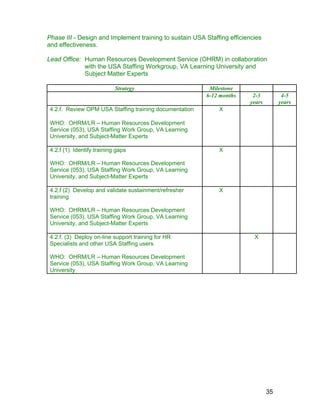
Phase III - Design and Implement training to sustain USA Staffing efficiencies
and effectiveness.
Lead Office: Human Resources Development Service (OHRM) in collaboration
with the USA Staffing Workgroup, VA Learning University and
Subject Matter Experts
Strategy Milestone
6-12 months 2-3
years
4-5
years
4.2.f. Review OPM USA Staffing training documentation
WHO: OHRM/LR – Human Resources Development
Service (053), USA Staffing Work Group, VA Learning
University, and Subject-Matter Experts
X
4.2.f (1) Identify training gaps
WHO: OHRM/LR – Human Resources Development
Service (053), USA Staffing Work Group, VA Learning
University, and Subject-Matter Experts
X
4.2.f (2) Develop and validate sustainment/refresher
training
WHO: OHRM/LR – Human Resources Development
Service (053), USA Staffing Work Group, VA Learning
University, and Subject-Matter Experts
X
4.2.f. (3) Deploy on-line support training for HR
Specialists and other USA Staffing users
WHO: OHRM/LR – Human Resources Development
Service (053), USA Staffing Work Group, VA Learning
University
X
35
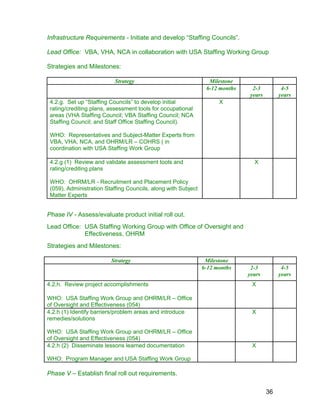
Infrastructure Requirements - Initiate and develop “Staffing Councils”.
Lead Office: VBA, VHA, NCA in collaboration with USA Staffing Working Group
Strategies and Milestones:
Strategy Milestone
6-12 months 2-3
years
4-5
years
4.2.g. Set up “Staffing Councils” to develop initial
rating/crediting plans, assessment tools for occupational
areas (VHA Staffing Council; VBA Staffing Council; NCA
Staffing Council; and Staff Office Staffing Council).
WHO: Representatives and Subject-Matter Experts from
VBA, VHA, NCA, and OHRM/LR – COHRS ( in
coordination with USA Staffing Work Group
X
4.2.g (1) Review and validate assessment tools and
rating/crediting plans
WHO: OHRM/LR - Recruitment and Placement Policy
(059), Administration Staffing Councils, along with Subject
Matter Experts
X
Phase IV - Assess/evaluate product initial roll out.
Lead Office: USA Staffing Working Group with Office of Oversight and
Effectiveness, OHRM
Strategies and Milestones:
Strategy Milestone
6-12 months 2-3
years
4-5
years
4.2.h. Review project accomplishments
WHO: USA Staffing Work Group and OHRM/LR – Office
of Oversight and Effectiveness (054)
X
4.2.h (1) Identify barriers/problem areas and introduce
remedies/solutions
WHO: USA Staffing Work Group and OHRM/LR – Office
of Oversight and Effectiveness (054)
X
4.2.h (2) Disseminate lessons learned documentation
WHO: Program Manager and USA Staffing Work Group
X
Phase V – Establish final roll out requirements.
36
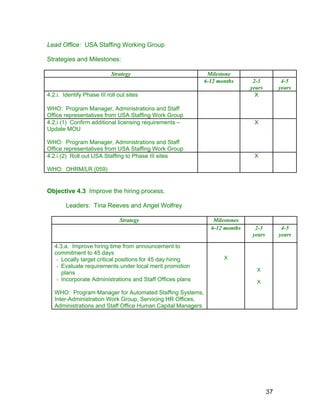
Lead Office: USA Staffing Working Group
Strategies and Milestones:
Strategy Milestone
6-12 months 2-3
years
4-5
years
4.2.i. Identify Phase III roll out sites
WHO: Program Manager, Administrations and Staff
Office representatives from USA Staffing Work Group
X
4.2.i (1) Confirm additional licensing requirements –
Update MOU
WHO: Program Manager, Administrations and Staff
Office representatives from USA Staffing Work Group
X
4.2.i (2) Roll out USA Staffing to Phase III sites
WHO: OHRM/LR (059)
X
Objective 4.3 Improve the hiring process.
Leaders: Tina Reeves and Angel Wolfrey
Strategy Milestones
6-12 months 2-3
years
4-5
years
4.3.a. Improve hiring time from announcement to
commitment to 45 days
- Locally target critical positions for 45 day hiring
- Evaluate requirements under local merit promotion
plans
- Incorporate Administrations and Staff Offices plans
WHO: Program Manager for Automated Staffing Systems,
Inter-Administration Work Group, Servicing HR Offices,
Administrations and Staff Office Human Capital Managers
X
X
X
37
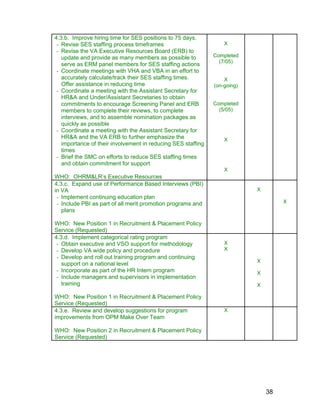
4.3.b. Improve hiring time for SES positions to 75 days.
- Revise SES staffing process timeframes
- Revise the VA Executive Resources Board (ERB) to
update and provide as many members as possible to
serve as ERM panel members for SES staffing actions
- Coordinate meetings with VHA and VBA in an effort to
accurately calculate/track their SES staffing times.
Offer assistance in reducing time
- Coordinate a meeting with the Assistant Secretary for
HR&A and Under/Assistant Secretaries to obtain
commitments to encourage Screening Panel and ERB
members to complete their reviews, to complete
interviews, and to assemble nomination packages as
quickly as possible
- Coordinate a meeting with the Assistant Secretary for
HR&A and the VA ERB to further emphasize the
importance of their involvement in reducing SES staffing
times
- Brief the SMC on efforts to reduce SES staffing times
and obtain commitment for support
WHO: OHRM&LR’s Executive Resources
X
Completed
(7/05)
X
(on-going)
Completed
(5/05)
X
X
4.3.c. Expand use of Performance Based Interviews (PBI)
in VA
- Implement continuing education plan
- Include PBI as part of all merit promotion programs and
plans
WHO: New Position 1 in Recruitment & Placement Policy
Service (Requested)
X
X
4.3.d. Implement categorical rating program
- Obtain executive and VSO support for methodology
- Develop VA wide policy and procedure
- Develop and roll out training program and continuing
support on a national level
- Incorporate as part of the HR Intern program
- Include managers and supervisors in implementation
training
WHO: New Position 1 in Recruitment & Placement Policy
Service (Requested)
X
X
X
X
X
4.3.e. Review and develop suggestions for program
improvements from OPM Make Over Team
WHO: New Position 2 in Recruitment & Placement Policy
Service (Requested)
X
38
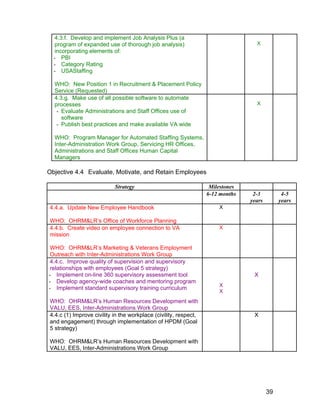
4.3.f. Develop and implement Job Analysis Plus (a
program of expanded use of thorough job analysis)
incorporating elements of:
- PBI
- Category Rating
- USAStaffing
WHO: New Position 1 in Recruitment & Placement Policy
Service (Requested)
X
4.3.g. Make use of all possible software to automate
processes
- Evaluate Administrations and Staff Offices use of
software
- Publish best practices and make available VA wide
WHO: Program Manager for Automated Staffing Systems,
Inter-Administration Work Group, Servicing HR Offices,
Administrations and Staff Offices Human Capital
Managers
X
Objective 4.4 Evaluate, Motivate, and Retain Employees
Strategy Milestones
6-12 months 2-3
years
4-5
years
4.4.a. Update New Employee Handbook
WHO: OHRM&LR’s Office of Workforce Planning
X
4.4.b. Create video on employee connection to VA
mission
WHO: OHRM&LR’s Marketing & Veterans Employment
Outreach with Inter-Administrations Work Group
X
4.4.c. Improve quality of supervision and supervisory
relationships with employees (Goal 5 strategy)
- Implement on-line 360 supervisory assessment tool
- Develop agency-wide coaches and mentoring program
- Implement standard supervisory training curriculum
WHO: OHRM&LR’s Human Resources Development with
VALU, EES, Inter-Administrations Work Group
X
X
X
4.4.c (1) Improve civility in the workplace (civility, respect,
and engagement) through implementation of HPDM (Goal
5 strategy)
WHO: OHRM&LR’s Human Resources Development with
VALU, EES, Inter-Administrations Work Group
X
39
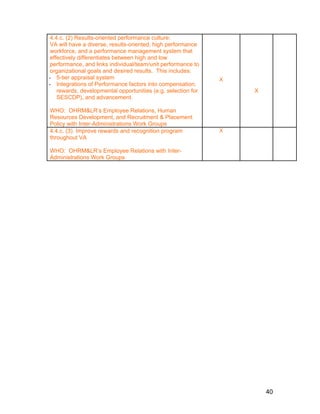
4.4.c. (2) Results-oriented performance culture:
VA will have a diverse, results-oriented, high performance
workforce, and a performance management system that
effectively differentiates between high and low
performance, and links individual/team/unit performance to
organizational goals and desired results. This includes:
- 5-tier appraisal system
- Integrations of Performance factors into compensation,
rewards, developmental opportunities (e.g. selection for
SESCDP), and advancement.
WHO: OHRM&LR’s Employee Relations, Human
Resources Development, and Recruitment & Placement
Policy with Inter-Administrations Work Groups
X
X
4.4.c. (3) Improve rewards and recognition program
throughout VA
WHO: OHRM&LR’s Employee Relations with Inter-
Administrations Work Groups
X
40
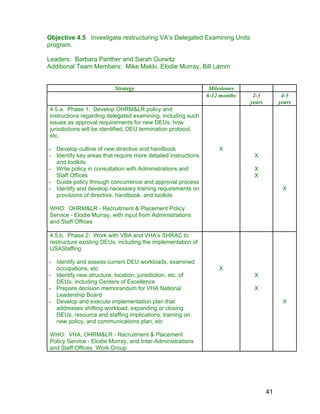
Objective 4.5 Investigate restructuring VA’s Delegated Examining Units
program.
Leaders: Barbara Panther and Sarah Gurwitz
Additional Team Members: Mike Makki, Elodie Murray, Bill Lamm
Strategy Milestones
6-12 months 2-3
years
4-5
years
4.5.a. Phase 1: Develop OHRM&LR policy and
instructions regarding delegated examining, including such
issues as approval requirements for new DEUs, how
jurisdictions will be identified, DEU termination protocol,
etc.
- Develop outline of new directive and handbook
- Identify key areas that require more detailed instructions
and toolkits
- Write policy in consultation with Administrations and
Staff Offices
- Guide policy through concurrence and approval process
- Identify and develop necessary training requirements on
provisions of directive, handbook, and toolkits
WHO: OHRM&LR - Recruitment & Placement Policy
Service - Elodie Murray, with input from Administrations
and Staff Offices
X
X
X
X
X
4.5.b. Phase 2: Work with VBA and VHA’s SHRAC to
restructure existing DEUs, including the implementation of
USAStaffing
- Identify and assess current DEU workloads, examined
occupations, etc
- Identify new structure, location, jurisdiction, etc. of
DEUs, including Centers of Excellence
- Prepare decision memorandum for VHA National
Leadership Board
- Develop and execute implementation plan that
addresses shifting workload, expanding or closing
DEUs, resource and staffing implications, training on
new policy, and communications plan, etc
WHO: VHA, OHRM&LR - Recruitment & Placement
Policy Service - Elodie Murray, and Inter-Administrations
and Staff Offices Work Group
X
X
X
X
41
Goal 4: Performance Measures
Outcome Measures FY2005
Target
Strategic
Target (Based on
2010)
• Increase number of applicants from a wide variety of
sources and backgrounds.
0% +2%
• Increase the number of stations using USA Staffing. +5% +15%
• Improved responses in employee morale items related to
recognition and respect on Employee Survey.
+0.5%
(in 2006)
+1.5%
• Reduce the number of Delegated Examining Units and
establish efficient jurisdictions
0% 100%
Process Measures
• Frequency that VA/Jobs website is accessed 0% +5%
• Improve hiring times for general and SES positions. 10% 75%
• Increase in use of awards and recognition programs in VA. +0.5% +1.5%
• Frequency that OHRM&LR website information on using
Delegated Examining Units is accessed.
0% +50%
Customer Satisfaction
• Improved quality of applicants based on expanded
applicant pool due to marketing, use of performance based
interviewing, and use of categorical rating based on 6-
month post-implementation survey and HR self-evaluation.
+2%
(in 2006)
+10%
• Responses to Delegated Examining Unit feedback
instruments indicate quality and timeliness of certificates of
eligibles are meeting VA workforce needs.
• HR Customer Survey responses indicate expanded VA
policy on Delegated Examining Units was clear and useful.
0%
0%
85%
85%
42
Goal 5. Development of Employee/Manager Skills and
Competencies -- Develop a comprehensive and coherent
workforce development program based on the High
Performance Development Model (HPDM) that supports
current and emerging goals and reflects the diversity of the
veterans we serve.
Objective E-1 in the VA Strategic Plan is to “recruit, develop, and retain a
competent, committed, and diverse workforce that provides high quality service
to veterans and their families.” The strategy for achieving this objective is to
“recruit, support, and retain a knowledgeable, diverse, engaged, and
continuously learning workforce.” The plan goes on to say that the workforce
development plan will incorporate HPDM, diversity training, and Alternative
Dispute Resolution (ADR) orientation. Goal 5 is a natural outgrowth of the larger
Strategic Plan. It concentrates on training that crosses occupations and
organizations. With the exception of training the HR community, which is the
unique responsibility of HR, the Goal 5 strategies focus on those aspects of
continuous learning shared by VA employees in all areas. Much training is being
done across the Department. What this plan strives to support is the uniform
tracking of training, leveraging of existing programs for wider use, the mapping
of careers, and continuous development of employees. Achieving this goal is a
collaborative effort between the HR community, the training elements of the
Administrations, Staff Offices and VALU.
Key outcomes of this goal include:
• Employee have access to planning/tracking training events
• Improved communication and coordination among the training
organizations within VA
• Opportunities for individuals to continue learning throughout their careers.
Objective 5.1 Improve the competency and skill of HR professionals
Strategy Milestones
6-12 months 2-3
years
4-5
years
5.1.a. Work with VALU to conduct competency gap
analysis to ascertain training priorities and knowledge
gaps
WHO: Elaine Marshall/Melissa Scherwinski
X
5.1.b Establish on-going training for HR community
online
WHO: Elaine Marshall/VALU Taskforce
X
43
5.1.c Provide for several alternative means of training
and delivery methods, leveraging existing programs to the
greatest extent possible
WHO: Elaine Marshall/VALU Taskforce
X
5.1.d Develop options for an HR national conference
WHO: HRD Section
X
5.1.e Work with VALU to create training opportunities at
entrance, journeyman, and senior levels
WHO: VALU/EES/HRD
X
Objective 5.2 Use intern programs, coops, rotations, etc. more fully
Strategy Milestones
6-12 months 2-3
years
4-5
years
5.2.a. Develop formal mentoring programs with former
interns
WHO: Anna Doroshaw/Cynthia Leach
X
5.2.b Create an index of current and former interns
interested in workgroup/task force experiences available to
executives interested in expanding membership
WHO: Anna Doroshaw/Cynthia Leach
X
Objective 5.3 Ensure time for training is made available for all employees.
Strategy Milestones
6-12 months 2-3
years
4-5
years
5.3.a Ensure that time for training is addressed as a
management expectation in the Employee Learning and
Professional Development Policy/Handbook
WHO: Skip High
X
5.3.b Provide for automated tracking, recording and
evaluating training events
WHO: Skip High
X
5.3.c. Develop a communication plan to provide guidance
to supervisors on the critical role of education in
performance and employee development
WHO: Skip High
X
44
Objective 5.4 Ensure VA meets mandatory training requirements.
Strategy Milestones
6-12 months 2-3
years
4-5
years
5.4.a. Complete inventory of mandatory training to include
authorizing body and completion dates
WHO: VALU Mandatory Training Group
X
5.4.b. Clarify mandatory training requirements in the
Employee Learning and Professional Development
Policy/Handbook
WHO: Skip High
X
5.4.c. Develop a menu of worksite-based programs to
address any gaps
WHO: VALU Mandatory Training Group
X
Objective 5.5 Address training plan as part of career mapping for VA employees
that will enable them to achieve their ultimate career goals.
Strategy Milestones
6-12 months 2-3
years
4-5
years
5.5.a. Develop a career map for the HR professional as a
model for other disciplines
WHO: Marianne Gray
X
5.5.b. Assure that career mapping links to HPDM and VA
strategic goals
WHO: Marianne Gray
X
5.5.c. Link career mapping to IDP development
strategic goals
WHO: Marianne Gray
X
5.5.d. Explore LMS linkage to the mapping process
WHO: Marianne Gray
X
45
Objective 5.6 Roll out HPDM in Staff Offices in 2006
Strategy Milestones
6-12 months 2-3
years
4-5
years
5.6.a Design and present HPDM Awareness training to
all VACO supervisors in 2005
WHO: Mukta Sain
X
5.6.b Institute VACO HPDM Board to oversee
application of HPDM principles into the workplace
WHO: Elaine Marshall
X
5.6.c Organize an HPDM marketing campaign within
VACO
WHO: VACO HPDM Board
X
Objective 5.7 Improve leadership competency and skill at all levels of the
organization
Strategy Milestones
6-12 months 2-3
years
4-5
years
5.7.a Leverage existing and emerging programs into a
unified approach and delivery methods
WHO: Anna Doroshaw
X
5.7.b Identify VALU and VAKN content by HPDM core
competencies and market to all employees
WHO: Anna Doroshaw
X
5.7.c Work with VALU to ensure that programs exist at
all levels of the spectrum from pre-supervisory to SES to
encourage continuous leadership development of all
employees
WHO: Anna Doroshaw/VALU Leadership
Team/Administrations
X
5.7.d Develop post-training coaching, mentoring and
continuous education opportunities for all employees
WHO: Anna Doroshaw/VALU Leadership
Team/Administrations
X
46
Objective 5.8: Implement the Learning Management System (LMS)
Strategy Milestones
6-12 months 2-3
years
4-5
years
5.8.a Monitor the progress of the LMS initiative
WHO: Skip High
X X
5.8.b Ensure that employees are well informed about
the system and how to use it
WHO: Skip High
X
5.8.c Ensure that useful reports are generated for
management use and workforce analysis
WHO: Skip High
X X
47
Goal 5: Performance Measures
Outcome Measures FY2005
Target
Strategic Target
• Employee core competencies and skills will be
identified and tracked
50% of
critical
occupations
100% of critical and
cross cutting
occupations
80% of all other
• A continuum of opportunities exists to improve
employee competencies and encourage individual
growth
Available for 90% of
critical and cross
cutting occupations
70% of all other
• Improvement in HR accuracy and reduction of
validated complaints
• Compliance and completion of mandatory training
requirements across the Department
75% 100%
Customer Satisfaction Measures FY2005
Target
Strategic Target
• Improvement in employee feedback on One-VA
survey pertaining to supervisor support of learning
opportunities
10%
improvement
Continuous
improvement
• New training events for the HR community are
marketed timely and delivered regularly
Process Measures FY2005
Target
Strategic Target
• Staff Offices HPDM plans are in place 10% 100%
• CO supervisors HPDM training will be completed 100%
• Employees will use LMS to plan and track
individual development plans
0% 80%
48
Acknowledgements
The following individuals committed their time, energy, and expertise to the development
of this Strategic Plan and will participate in the implementation of the strategies
contained within.
-Larry Ables
-Jon Baker
-Robert Baratta
-Thomas Barritt
-Linda Belton
-Lawrence Bifareti
-Geraldine Breakfield
-Anna Cenatiempo
-Joleen Clark
-Nigel Collie
-Ronald Cowles
-Leslie Douglas-Jones
-Kristen Faudree
-Sarah Gurwitz
-Patrick Hallinan
-Willie Hensley
-Thomas Hogan
-Joy Hunter
-James Jones
-Janice Lucas
-Robert Lynch
-Dorothy Mackay
-Norma Madrid
-Mike Makki
-Elaine Marshall
-Regis Massimino
-Susan McHugh
-Brian McVeigh
-Carol Mellen
-Joanne Moffett
-John Oswalt
-Marisa Palkuti
-Barbra Panther
-R. Allen Pittman
-Charles Percell
-Rayshad Holmes
-Harvey Roberts
-Melissa Scherwinski
-Donna Schroeder
-Melvin Sessa
-Gary Steinberg
-Maxcine Sterling
-Susan Theroux
-Dale Turner
-Deno Verenes
-Veronica Wales
-Michael Watson
-Nevin Weaver
-Angel Wolfrey
-Carolyn Wong
-Peter Yoon
49

Standard Human Resources Strategic Plan.pdf

  • 1.
    The Department ofVeterans Affairs Human Resource Strategic Plan ~ 2005-2010 “Transforming the Human Resource Function to ensure that VA has the right people, in the right jobs, with the right skills and abilities, with a true sense of personal value, and a commitment to providing high quality service to our nation’s veteran’s.”
  • 2.
    Transforming VA’s HumanResources – Message from the Assistant Secretary The Honorable R. Allen Pittman Assistant Secretary for Human Resources and Administration The traditional personnel system at VA, much like those of the rest of the Federal government, is being confronted by market pressures that are provoking important changes. In order to compete for the talent necessary to fulfill VA’s mission, our system for managing our human capital must evolve. It must become more flexible, agile, effective and accountable in order to provide the range of services our Nation’s veterans have been promised. The Strategic Plan that the Office of Human Resources and Administration (HR&A) has developed in partnership with the Human Resources community begins the process of transformation. The Office of Human Resources and Administration will oversee a centralized HR governance process that will monitor the implementation of this Plan, ensure compliance with federal and VA HR policies and procedures, and maintain accountability at all levels. The first step in the process is to improve the development, implementation, and evaluation of HR policies and procedures throughout the Department. This includes converting the direction and requirements established by the President, the Secretary and VA leadership, the Office of Personnel Management (OPM), the Office of Management and Budget (OMB), the Congress and on occasion, other Federal agencies, into VA policies and procedures that ensure compliance and consistency of application. To that end, VA’s HR policies and procedures must be written in such a way that is clear and understandable to the end user. Standardized tools and other aids must be routinely provided during the implementation phase to jump start the learning curve and enable consistent application. Additional efforts are required to provide easy access to the new policies as well as a search-functionality. This will enable HR practitioners to quickly locate, navigate through and research specific aspects of the policies, thus providing them with an increased capability to provide accurate and timely guidance to managers. Underlying and supporting the planned systemic changes in the Human Resources environment is the development of an effective, user-friendly, Human Resources Information System. The key part of this system will be a web-based HR Resource Center, a tool that HR professionals and managers can use to address local classification actions while staying consistent with both Office of Personnel 2
  • 3.
    Management and VAclassification guidelines. It will include position descriptions, performance standards, functional statements and competencies, performance-based interview questions and eventually, electronic employee records. In practical terms, this system will, when a performance measure for a certain grade is needed, enable an HR professional to go on-line and look up and select from several examples of performance measures at the grade in question. In addition, this system will make both historical and current workforce data available so that HR professionals will be able to do trend analysis to help VA managers determine future workforce needs based on retirements, promotions, re-assignments and other significant personnel actions. The next step in the strategic process is to ensure that VA’s human capital plans and strategies are developed and implemented in such a way that they serve the mission, goals, objectives and budget of the entire Department. This requires clear lines of communication, effective planning processes between the Administrations, Staff Offices and HR&A, skilled HR staffing throughout VA, and a One-VA approach to marketing and staffing. The five major goals of the HR Strategic Plan are replete with commitments that will appropriately align HR activities within the One-VA context. Workforce and Succession Planning encompasses a substantial part of VA’s human capital program. A properly functioning human capital program will provide an adequate supply of qualified prospective employees for planned departures and new openings. VA is developing new information systems that will help identify an appropriate pool of internal VA candidates for these openings. Also, by expanding the collection and dissemination of personnel data, additional benefits will accrue. Databases that maintain an inventory of employees’ skills, core competency requirements for each position, and training programs to fulfill the competencies and to prepare employees for their future posts, will establish the critical base for a successful human capital program. Closely related to the Workforce and Succession Plan is our “One-VA Marketing and Recruitment Program” where our focus will be on hiring veterans, an expanded minority outreach program that will move us to the point where our workforce mirrors the Nation’s workforce, and a well-integrated Co-Op and Intern program that targets and nurtures VA’s future leaders. Inherent in our recruitment activities, is the necessity to ensure that all employees have a VA career plan so that they and their supervisors know what lies ahead and what training they need to get there. Training and development is also critical to the transformation process defined in this plan. We will formalize the programmatic links between training and career progression in our leadership development programs – the Senior Executive Service Candidate Development Program and Leadership VA – so that targeted openings for candidates in the Senior Executive Service exist once the training is completed. We will also ensure that career mapping takes place and Individual Development Plans (IDPs) are developed for all employees at all levels to support their career progression. The creation of this kind of commitment to all VA employees is an important part of the planned transformation within VA’s HR environment. A key aspect of training and 3
  • 4.
    development is toensure that VA’s leaders and managers have the ability to effectively manage people, ensure continuity of leadership, and sustain a learning environment that drives continuous improvement in performance. VA will provide programmed core competency training for supervisors and leaders to assure that the people in line for leadership positions have the training they need to perform. We will also be formalizing the programmatic links between training and career progression in leadership development programs. To achieve the transformation described in this plan, VA can not work in a vacuum or in stovepipes. VA will collaborate with internal and external stakeholders and partners to identify, develop, and integrate tools and systems that meet business needs. VA will also endeavor to improve internal cooperation within the HR community to ensure consistent implementation of policies and procedures, improve corporate-level training and development, enhance operating systems, and build a corporate HR information system. This philosophy of collaboration will transcend all five of the goals included in this Plan and serve as a basic operating principal for Human Resources Management. The notion of a One-VA HR Strategic Plan is an important one. This plan is not an “internal” creation of HR&A. It was developed with the critical and integral participation of HR&A’s customers: the Administrations – both in the field and at VA’s Central Office, the Staff Offices, and the Office of Personnel Management, with their needs and requirements paramount in our deliberations. VA is an organization with multiple functions and separate operational entities; the services that VA provides to our Nation’s veterans must be supported by an integrated personnel system that serves all VA. The Office of Human Resources and Administration’s commitment is to establish a flexible human capital program that will support and sustain the variety of personnel requirements that comprise today’s VA, by providing governance, and ensuring compliance and accountability. This HR Strategic Plan begins the transformation process that will keep VA competitive in a human capital environment that is rapidly evolving. The plan will align HR activities within the overall mission and budget of VA, make VA’s human resource function more responsive to the needs of VA’s HR professionals, address the development needs of VA’s employees and the organization at the same time, thereby creating a mutually supportive and well-functioning work environment. The Honorable R. Allen Pittman Assistant Secretary for Human Resources and Administration 4
  • 5.
    VA Human ResourcesStrategic Plan Mission Statement for Human Resources – Recruit, develop, and retain a competent, committed, and diverse workforce that provides high quality service to veterans and their families. Vision Statement – The VA Human Resource community is a dynamic, innovative, flexible organization that thoroughly understands VA’s business lines. VA Human Resources ensures that VA has the right people, in the right jobs, with the right skills and abilities, with a true sense of personal value, and a commitment to providing high quality service to our Nation’s veterans. VA’s Mission – “To care for him who has borne the battle and for his widow and his orphan” - President Abraham Lincoln VA’s Core Values - The men and women of VA are dedicated to fulfilling the Department’s mission and they commit their abilities and energy to continue the rich history of providing for those that have served America. In doing so, we will strive to uphold the following core values that represent the basic fabric of our organizational culture. Commitment ♦ Veterans have earned our respect and commitment, and their health care, benefits, and memorial services needs drive our actions. ♦ We will value our commitment to veterans though all contingencies and remain fully prepared to achieve our mission. Excellence ♦ We strive to exceed the service delivery expectations of veterans and their families. ♦ We perform at the highest level of competence with pride in our accomplishments. People ♦ We are committed to a highly skilled, diverse, and compassionate workforce. ♦ We foster a culture of respect, equal opportunity, innovation, and accountability. Communication ♦ We practice open, accurate, and timely communication with veterans, employees, and external stakeholders, and seek continuous improvement in our programs and services by carefully listening to their concerns. Stewardship ♦ We will ensure responsible stewardship of the human, financial, information, and natural resources entrusted to us. 5
  • 6.
    ♦ We willimprove performance through the use of innovative technologies, evidence-based medical practices, and sound business principles. Overarching Goals - This plan was developed in collaboration between the Office of Human Resources and Administration, VA’s three Administrations, and the other Staff Offices. The plan is intended to describe the transformation of the Human Resource function within the Department that will take place over the next five years. The plan addresses key strategies that will be implemented in near-term (6-12 months), mid-term (2-3 years), and long-term time frames. Due to the current requirements of the Department, many of the strategies included in the plan will be implemented within the first 6-12 months of the plan. The Plan is focused on five overarching goals. 1. Ensure that HR policies and procedures are documented and communicated in a timely and comprehensible manner, and that implementation is monitored. 2. Improve business processes (automate, standardize, and integrate) through an enhanced Human Resources Information System Architecture. VA will improve the quality of organizational design and position management, and improve the consistency and uniformity of classification decisions throughout the Department. 3. Institutionalize a national Succession/Workforce Planning System to facilitate the strategic management of its human resources. 4. Recruit, hire, motivate, and retain the best and the brightest employees to carry out our mission. Building a work environment that is diverse and sensitive to our employees and the veterans we serve. 5. Develop a comprehensive and coherent workforce development program based on the High Performance Development Model (HPDM), that supports current and emerging goals and reflects the diversity of the veterans we serve. 6
  • 7.
    President’s Management Agenda- VA’s transformation, which is embodied in the goals presented above, is consistent with the President’s overall transformation of Human Capital Management throughout the Federal Government as outlined in OPM’s Standards for Success. Although not the original intent of this document, the HR Strategic Plan defines how VA will meet the requirements of the PMA’s Human Capital Management goal by linking the objectives with the standards for success. This document is color-coded to show how the six standards for success are addressed via VA’s HR goals, objectives, and strategies. I. Strategic Alignment Agency human capital strategy will be better aligned with mission, goals, and organizational objectives and integrated into its strategic plans, performance plans, and budgets. II. Workforce and Succession Planning & Deployment Agencies will endeavor to ensure that they maintain a citizen-centered and mission-focused workforce that has the skills and experience to meet the needs of veterans today and into the future. Workforce and succession planning must leverage e-Government and competitive sourcing/Business Process Reengineering. III. Leadership & Knowledge Management Leaders and managers will have the ability to effectively manage people, ensure continuity of leadership, and sustain a learning environment that drives continuous improvement in performance. Agencies will provide programmed core competency training for supervisors and leaders to assure that the people in line for leadership positions have the training they need to perform. Agencies will also be formalizing the programmatic links between training and career progression in leadership development programs IV. Results-Oriented Performance Culture Agencies will have a diverse, results-oriented, high performance workforce, and a performance management system that effectively differentiates between high and low performance, and links individual/team/unit performance to organizational goals and desired results. V. Talent Agencies will identify mission-critical occupations and competencies needed in the current and future workforce and develop strategies to identify, recruit, and retain a high performing workforce. Agencies will address any mission-critical skills, knowledge, and competency gaps/deficiencies. VI. Accountability Human capital decisions will be guided by a data-driven results-oriented planning and accountability system 7
  • 8.
    Goal 1. HumanResources Policies and Procedures - Ensure that HR policies and procedures are documented and communicated in a timely and comprehensible manner and that implementation is monitored. A primary responsibility of the Office of Human Resources Management and Labor Relations is to develop, implement and evaluate HR policies and procedures throughout the Department. This includes converting the direction and requirements established by the President, the Secretary and VA leadership, the Office of Personnel Management (OPM), the Office of Management and Budget (OMB), the Congress and on occasion, other Federal agencies, into VA policies and procedures that ensure compliance and consistency of application. To that end, VA’s HR policies and procedures must be written in such a way that is clear and understandable to the end user. Standardized tools and other aids must be routinely provided during the implementation phase to jump start the learning curve and enable consistent application. Additional efforts are required to provide easy access to the new policies as well as a search-functionality. This will enable HR practitioners to quickly locate, navigate through and research specific aspects of the policies, thus provide practioners with an increased capability to issue accurate and timely guidance to managers. The policy development process must be streamlined and allow for increased stakeholder input so that timeliness, usability and clarity are increased. Communication methods must be expanded with increased frequency to keep the HR community advised in a timely manner of the status of potential/pending policies as well as those recently implemented. These methods will lead to increasing the HR practitioners’ capability to provide timely guidance to managers. A monitoring system must be established to track and provide feedback on the implementation of new policies and their ultimate effectiveness and impact on VA’s ability to meet its mission. This system will also provide a means of evaluating the usability and understanding of the new policies and identifying where improvements may be needed. The key outcomes associated with this goal include: • Increasing the usability and understanding of new and existing policy • Decreasing the time required to develop and communicate policies from VACO to the field, and the time involved with researching HR policy and information by field HR and CO specialists • Improving consistency of application of policies and procedures • Increasing HR capability to provide guidance to managers 8
  • 9.
    Goal 1 Co-leaders:Carol Mellen, Brian McVeigh NOTE: Items in Bold below were deemed as high priority by the Policy Workgroup Objective 1.1 Develop/Issue clear and useful policies so that the ease and consistency of application as well as the level of compliance is increased. This enables broader use of the flexibilities inherent in the policies to recruit/retain a high quality workforce. [Note this objective is intended to be prospective and applies to new rather than retrofitting existing policies.] Strategy Milestones 6-12 months 2-3 years 4-5 years 1.1.a. Establish Standard Operating Procedures in OHRM for all policy makers to address these new requirements for this Goal WHO: Workgroup representing OHRM services X 1.1.b. Reduce Directive content – keep it bare bones with majority of material in Handbooks - Identify minimum components - Obtain approval of minimum components from Directives Management (if necessary) - Pilot with policies currently in development phase - Require justification during concurrence phase if directive exceeds minimum - Evaluate pilot and fully implement WHO: Workgroup representing OHRM services X X X X 1.1.b (1) Maintain appropriate flexibilities - Supply only what needs to be decided by CO and leave flexibility in the field when applicable - Require rationale for delegations in briefing checklist WHO: Workgroup representing OHRM services; policymaker X 9
  • 10.
    1.1.b (2) Inpurpose paragraph of Policy Directives, identify desired outcomes and key indicators as identified in 1.2.e.(2) - Obtain approval (if necessary) from Directives Management - Develop sample outcomes and automated key indicators & share with policymakers - Pilot with policies currently under development - Evaluate pilot and fully implement WHO: Workgroup representing OHRM services; policymaker X X X X 1.1.c. Develop and/or augment handbooks so they are more detailed and useful to include supporting tools/aids for implementation (actual location of tools/aids may vary) - Develop checklist of potential tools/aids (FAQs, performance tools, job aids, examples, training package, implementation time table, Power Point Slides for use in local discussions, Sample letters to issue at field level, Sample SOPs, HRML, etc) and locations (web site, teleconference, email, handbook, Vtel, train the trainer at a designated facility, newsletter, etc) [NOTE: Implementation also identifies potential resource impact on field] - Pilot requirement for policy developers to develop specific tools/aids and include checklist with concurrence package [NOTE: tools/aids may be developed with field participation] - Evaluate pilot and fully implement WHO: Workgroup representing OHRM services; policymaker X X X X 1.1.c (1) Develop mechanism to make cross- referencing/researching of the Handbooks and CFR fast and easy - Hotlink Directive/Handbook policies with related CFRs - Hotlink CFR list with relevant Directive/Handbook policies - Create “Google” function for searches - Update web document “Guide to VA Handbooks” for easy reference WHO: IT staff; Iris Gresham; Policymakers X X X X X 10
  • 11.
    1.1.c (2 )Establish/include standardized report format for any policies containing future reporting requirements - Develop checklist for identifying need for report, rationale, related data elements, collection level, source/location of data and report template/format - Pilot use of checklist and require its inclusion during concurrence phase - If local input required, create template for entering data elements (preferably nationwide on-line database) - If collection is at VACO level, identify current PAID data that may be used - Evaluate Pilot and fully implement WHO: Workgroup representing OHRM services; Policymaker in conjunction with IT or PAID staff X X X X X X X X X X X X Objective 1.2 Improve the policy development and approval process (timeliness) in order to increase the quality of the policy and expedite its implementation. Strategy Milestones 6-12 months 2-3 years 4-5 years 1.2.a. Establish a protocol in which the ad-hoc (field) experts can be included in pre-draft or post-draft policy development before it is submitted for official concurrence (Example: The SHRAC sub-committee is working on protocols for VHA) WHO: OHRM, Administrations, and Staff Office representatives in workgroup [may be included in SOP] X 1.2.b. Establish annual policy call – Administrations and Staff Offices can recommend changes to existing policies WHO: A/S for HR&A (based on document drafted by Carol Mellen) X 1.2.c. Use data from monitoring process to identify policy areas in need of change WHO: OHRM Service Directors X 1.2.d. Prioritize combined responses to annual policy call and data results by forming a workgroup and building in dialogue ability WHO: Workgroup of OHRM Managers and top Administration/Staff Office representatives X 11
  • 12.
    1.2.d (1) Partnerwith affected Administration and Staff Offices to develop priority changes to policy that will obtain input/clarification from stakeholders WHO: OHRM Policymakers and representatives from affected administration/ Staff Office X 1.2.e. Update policies/handbooks as prioritized WHO: OHRM Policymakers with input from Administrations and Staff Offices and field experts (see 1.2) X 1.2.e (1) Develop supporting tools/aids for implementation - Add a toolbox with FAQ’s that can be added to/updated with questions from the field - Performance tools/job aids - Examples: 2-3 Scenarios (available outside policy) (See 1.1) WHO: OHRM Policymakers with input from Administrations and Staff Offices and field experts X 1.2.e (2) Identify desired outcomes and key indicators (if not already existing) such as what metrics? What data sources? Will data be standardized? (See 1.1) WHO: OHRM Policymakers, Administration and Staff Offices, field experts and WIST staff X 1.2.e (3) Identify methods for measuring success such as time, quality (if not already existing) WHO: OHRM Policymakers, Administrations and Staff Offices, field experts X 1.2.f. Encourage Administration and Staff Offices to draft language to fast-track (with OHRM involvement). Limit use for single focused changes only WHO: OHRM Policymakers, Administrations X 1.2.g. Distribute draft policy to field (e.g., VHA SHRAC, VBA HRC) and allow for feedback [NOTE: this will be driven by time, complexity of subject, impact] - Turn around in 14-28 days - Include a focused conference call to discuss draft (This may be done concurrently with the OPM comment period) - This may also be a time to begin developing potential FAQs (see 1.1) WHO: OHRM Policymakers, Administration and Staff Offices X 12
  • 13.
    1.2.h. Obtain formalstakeholder concurrences in a timely manner - Identify obstacles to timeliness (see Administrative Review Process Taskforce Recommendations approved November 2003) - Administration policy will be reviewed expeditiously by HR&A - Significant changes may result from collective bargaining and field should be made aware of changes and given opportunity to give feedback before resuming official concurrence process WHO: OHRM policy workgroup X X X Objective 1.3 Improve communication with management and the field to keep stakeholders and implementers better informed of the nature and timeframes of possible/impending policy changes, the policy process, and legal source documents using a multiplicity of methods. Strategy Mileston es 6-12 months 2-3 years 4-5 years 1.3.a. Issue a ‘heads-up’ bulletin or policy alert to HR mail groups within two weeks after new legislation has passed or new regulations are issued or other decision that will require policy change such as an NLB decision (e.g. recent 3 R alert) - The bulletin will contain info that a change outside VA has occurred and that VA is studying the implications and will issue more guidance shortly - In addition, place bulletin/alert on OHRM webpage - Seek advance notification from OPM WHO: OHRM Policy Service Director or designee of affected policy(ies) X X X 13
  • 14.
    1.3.b. Provide updatesor status reports - If necessary, occurs four weeks after legislation has passed/regulation is issued with more specific information to include: what the implications are (e.g., identifying specific policy(ies) that will need to be changed); an estimate of how long it will take to develop the new policy (when possible) or revise existing policy; and whether the field can continue operating status quo or an interim policy will be required (along with estimated time for its release) - If required, issue Interim guidance for changes to policy within timeframes established above and include: - What to continue using from the old policy (if there is one) - What to stop using from the old policy (if there is one) - During policy development process - Two weeks before a new policy (including interim) will be released WHO: OHRM Policy Service Director or designee X 1.3.c. Publish a process map for policy development to help field understand the process • Distribute the map to the community WHO: Carol Mellen (process map) and Service Directors X 1.3.d. Establish timeframes for communicating via e-mail when - Changes have been approved and posted - Directives are issued - Handbooks are changed WHO: OHRM Policy Service Director or designee X 1.3.e. Provide consultation to the field by - Establishing protocol for questions to CO (e.g., HRMO screens questions) - Train field specialists to use website first in resolving questions; then Field -> HR Officer or Senior Specialist (field) -> VISN (if they approve) and then -> OHRM - OHRM set-up with advisory services through service mailboxes (if appropriate) - Use multiple media (e-mails, conference calls, web publish, hard copy memos,…) WHO: OHRM Policy Service Director or designee and webmaster X X X X 14
  • 15.
    1.3.f. Improve website -Benchmark against other agency sites; Look at other websites (both policies and procedures); some are easier to navigate and understand (Examples: Social Security, Dept of Agriculture/USDA, Dept of Army and DoD) - Include “Google” or “First Gov” search function to improve search results - Create list serve function for notifying field of updates - Provide training tools (e.g. web links) on rule making and legislative process (i.e. how a bill becomes a law, etc.) which is described in Thomas Ben’s Guide to the U.S. Government for Kids on how laws are made (http://thomas.loc.gov/home/lawsmade.bysec/lawsnew.txt), http://bensguide.gpo.gov/9-12/lawmaking/index.html, how are rules codified into the CFR - the rulemaking process from start to finish (http://www.archives.gov/federal_register/tutorial/tutorial_07 0.pdf] ), and “The Federal Register: What it is and how to use it” (http://www.archives.gov/federal_register/tutorial/about_tuto rial.html) - Ensure that adequate resources are assigned to improve, monitor and update web site - Establish introductory information to new HR specialists – how to use OHRM website, where it is, what info is contained on website, etc. - Add a user rating system (qualitative and quantitative) to website in order to identify problem policies quickly such as a continuous feedback “pop-up” survey WHO: A/S for HR&A, DAS for HRM-LR, OHRM Webmaster and OHRM workgroup X X X X X X X 15
  • 16.
    Objective 1.4 Establishquality assurance process for monitoring the effectiveness of policy to ensure it is being implemented as intended and in a consistent manner. This process will also provide feedback to ensure new policies are clear and useful to users and VA, while identifying areas in need of improvement. Strategy Milestones 6-12 months 2-3 years 4-5 years 1.4.a. Establish a method(s) to identify which current/new policies are getting “a flood” of questions - Purchase FAQ/Knowledge Management software - Review FAQ’s and add/maintain as appropriate WHO: A/S for HR&A, DAS for HRM-LR, IT staff, OHRM Policy Service Directors X X 1.4.b. Send HRMOs (or SHRC in VHA) a link to survey 6 & 12 months after specific policy was implemented asking for rating/comment (was it useful? Timely? Comments? Need modification?) WHO: OHRM Policy Service Directors, WIST, and IT/Webmaster X 1.4.c. Identify methods for measuring success (include policy developers in discussion) in conjunction with objective 1.2.e.2. WHO: OHRM Policymakers with input from Administration and field experts X 1.4.d. OHRM will establish automated method to track key indicators of policy WHO: OHRM Policy Service Directors and IT/Webmaster (note additional funding may be required) X 1.4.e. HR&A will conduct Compliance check on a regularly scheduled basis and verify that policy is being applied properly. WHO: OHRM Oversight & Effectiveness Service X 16
  • 17.
    Goal 1: PerformanceMeasures Outcome Measures FY2005 Target Strategic Target Clarity • Volume of questions generated from implementing new or revised policy are within acceptable range 0% Estab baseline FY 2008; 80% by 2010 • Responses to 6 & 12 month follow up surveys on specific policies (and communication/training materials) indicate they were clear. FY 08 Timeliness • Status of potential and pending policies is made available to HR community within 5 business days (e.g., Executive Orders, Federal Register Notices, Requests for Comments, Bills enacted into laws, final regulations, current policies in pipeline) [one time event] o Info provided will contain a line or two of context (e.g., Law was enacted, but OPM must issue regulations before VA can issue policy) 0% 100% by 4th Quarter, FY 06 • A timeline will be developed for all policy changes and communicated to field with information about where it is at any given time (status updates). A list of policies scheduled to be changed over next 6-12 months will be posted(e.g. OPM’s Policy review schedule which is updated every 6 months– what’s currently in formation stage, concurrence stage, implementation stage – possible use of flowchart for reference) 100% by 4th Quarter FY 06 Customer Satisfaction (HRMOs surveyed) • Responses to the annual HR Customer Survey indicate increased satisfaction with timeliness of policies Revise Survey Establish Baseline FY 06 • Responses to the annual HR Customer Survey indicate increased satisfaction with clarity of written policies Revise Survey Establish Baseline FY 06 • Responses to the annual HR Customer Survey indicate increased satisfaction with usefulness of policies Revise Survey Establish Baseline FY 06 • Responses to 6 & 12 month follow up surveys on specific policies (and communication/training materials) indicate they were clear, useful and timely FY 08 HR Self Evaluation (field Mangers surveyed) • Majority of overall VA responses to “Is HR policy or guidance clear and sufficient?” indicate “Frequently clear and sufficient” and/or “Almost always clear and sufficient.” FY 08 To be developed at a later date Compliance/Consistency of application/Impact of policies • Findings during OHRM on-site reviews reflect high level of compliance and consistent application of policies • Findings during OPM on-site reviews reflect compliance and consistent application • Review(s) and trend analysis of PAID data indicate policies are having the desired impact TBD As Scheduled TBD 17
  • 18.
    Goal 2. HumanResources Information System Architecture -- Improve business processes (automate, standardize and integrate) through an enhanced Information System Architecture. VA will improve the quality of organizational design and position management and improve the consistency and uniformity of classification decisions throughout the Department. A primary responsibility for the Compensation and Classification Service is to develop and implement classification tools that will enhance and promote the quality, consistency, and effectiveness of the classification program throughout the Department. There is a Department-wide need to improve the workload time- frame, quality of organizational structures/position management, and consistency in classification decisions. The development and implementation of standardized tools and other aids such as a PD Library will be instrumental in effecting immediate (positive) Department-wide changes. The key outcomes associated with this goal include: ● Increased consistency in position classification decisions ● Availability of PDs to quickly and effectively recruit for vacant positions ● Reduction in the number of classification appeals ● More time for field HR staff to focus on unique positions ● Improvement in the quality of position management ● Reduction in paperwork burden Objective 2.1 Create a web-based HR resource center. The resource center will be a user-friendly, accessible on-line tool that HR professionals and managers in VACO, networks, and field facilities can use to assure consistency with OPM and VA guidelines. Strategy Milestones 6-12 months 2-3 years 4-5 years 2.1.a. Include position descriptions, position reports, crediting plans, performance standards, KSAOs, functional statements, competencies, and performance-based interview questions. The position description piece will drive the inclusion of the other elements WHO: OHRM-LR program offices 15% 60% 100% 2.1.b. Create a team of subject matter experts (SME) for each element to be included in resource center WHO: OHRM-LR program offices X 18
  • 19.
    2.1.c. Build acadre of approximately 7 SMEs for each team to identify best practices and/or develop templates WHO: OHRM-LR program offices X 2.1.d. Develop infrastructure in coordination with VHA Health Revenue Center WHO: Compensation and Classification Service X 2.1.e. Access Resource Center from OHRM/LR web site WHO: Compensation and Classification Service X 2.1.f. Develop rating system to determine the quality level of position descriptions, ensuring only the highest quality templates are included WHO: Compensation and Classification Service X 2.1.f.(1) Have 2 team members apply rating system with an additional member to serve as an arbiter when differences arise WHO: Ad-hoc team X 2.1.f.(2) Determine the order in which positions will be reviewed based on field needs and past OPM and VA classification appeals cases WHO: Compensation and Classification Service X Objective 2.2 Improve the consistency of classification decisions Strategy Milestones 6-12 months 2-3 years 4-5 years 2.2.a. Develop a VA-focused classification guide WHO: Compensation and Classification Service X 2.2.b. Provide field training on classification WHO: Compensation and Classification Service; Human Resources Development Service X 2.2.c. Publicize OPM classification appeals decisions WHO: Compensation and Classification Service X 2.2.d. Create a VACO classification mailbox WHO: Compensation and Classification Service X 2.2.e. Encourage VISN-level classification WHO: AS for HRA; DAS for HRM-LR X 19
  • 20.
    2.2.e (1) Createa Intra-VISN classification council WHO: DAS for HRM-LR X 2.2.f. Conduct Audits X Objective 2.3 Work towards a paperless HR system Strategy Milestones 6-12 months 2-3 years 4-5 years 2.3.a. Automate Request for Personnel Action, SF-52, processing WHO: Bob Baratta X 2.3.b. Implement electronic Official Personnel Folders WHO: Bob Baratta X 2.3.c. Move towards pay banding WHO: Bob Baratta X NOTE: A paperless HR system will be addressed as part of the HR Line of Business (LOB) Project. Additionally, pay-banding authorities for Federal agencies will be proposed by OPM as part of draft legislation entitled “Civil Service Modernization Act.” OHRM/LR is participating on the HR LOB workgroups and will monitor the progress of their initiatives as well as the proposed legislation. 20
  • 21.
    Goal 2: PerformanceMeasures Outcome Measures FY2005 Target Strategic Target • Availability of tools necessary to quickly recruit for vacant positions 0 80% • Reduction in the number of classification appeals 0 50% • More time for field HR staff to focus on unique positions 0 30% • Reduced paperwork burden 0 30% Process Measures • Position descriptions for 15 percent of title 5 VA positions included in the resource center within one year 0 80% • Functional statements for all title 38 and hybrid positions included in the resource center within 120 days 0 100% • Crediting plans, performance standards, KSAOs, functional statements, competencies, and performance- based interview questions are added to the resource center within 90 days of the corresponding position description or functional statement 0 80% • Appeals decisions publicized within 30 days; 50% 100% • One training class conducted per quarter; 1in 4th Qtr 100% • At least one audit conducted each year 0 100% Customer Satisfaction Measures • Embedded questionnaire in on-line Resource Center for site users to complete 0 50% response rate to determine quality of outcome 21
  • 22.
    GOAL 3. VASuccession and Workforce Planning -- Institutionalize a national Succession/Workforce Planning System to facilitate the strategic management of its human resources. Succession Planning ensures that there are highly qualified people in all positions for today and in the future. Succession planning establishes a process that recruits employees, develops their skills and abilities, prepares them for a life-long career with the VA, and permits agencies to ensure a return on the organization's training investment. Succession planning involves understanding the organization's long-term goals and objectives, identifying the workforce's developmental needs and determining workforce trends and predictions. With good succession planning, employees are ready for new leadership roles as the need arises, and when someone leaves, a talented group of employees are ready to step-up to the plate. Succession planning guarantees that employees will be constantly developed so that competency gaps are filled. Succession planning works in conjunction with workforce planning. Workforce planning is the continuous management process of determining the kinds of employees and infrastructure required to accomplish the organization’s mission. Workforce planning addresses not only the knowledge, skills, and abilities necessary for the successful accomplishment of strategic goals, but it also encompasses an examination of the resources that employees need to perform effectively. Such resources include funding, technology, management structures, information, work life programs, environment, rewards, and incentives. In short, workforce planning is an ongoing, deliberate, and systematic effort by management to produce desirable outcomes and foster stewardship through their employees. The focus of this goal and that of the work group that will coordinate its implementation, is to assess the current state of VA workforce as it relates to the Human Resources Management (HRM) career field, and identify strategies which address gaps between the current employee base and the future workload and mission requirements. Although the focus of this plan is limited to the HRM occupation, VA is faced with challenges in recruitment and retention in many occupations. To address these challenges and to comply with the President’s Management Agenda, VA has been conducting workforce and succession planning across and throughout all levels of the Department. Workforce plans created by the Department, the Administrations and Staff Offices can be accessed by visiting the following link http://vaww.va.gov/vaworkforceplanning/guide/workforceplans.htm Each of these plans, outlines strategies, initiatives and action plans to address gaps in VA’s future workforce requirements. Below are examples of initiatives 22
  • 23.
    involving mission-critical occupationsthat are producing positive results as VA organizations implement action plans, as a result of their workforce and succession planning efforts are provided: VHA has aggressively focused on workforce planning regarding the nursing occupation for several years. According to the VHA Workforce Succession Strategic Plan FY 2005-2009, since FY 1999, Nurse on-board strength has increased by 6.2% (2,184). Total nursing employment losses have declined 8% (246) and total new hires have increased 72.4% (1,822). This incremental improvement is also voiced within the National Commission on VA Nursing Report (2002-2004) which states: “Recent trends for nurses in VHA are promising. From FY 1995 through FY 2001, the number of staff RNs declined 8.5 percent (from 40,585 to 37,151). However, at the end of FY 2003, the number increased to 38,426. This increase is welcome news, especially given the projected retirements of the baby boomers slated to begin in 2008.” (Source: Caring for America - National Commission on VA Nursing 2002-2004 p. 13) VBA has identified workforce challenges regarding Veterans Service Representatives (VSRs), the key occupation within the Compensation and Pension (C&P) Benefits Service. Issues include an increased workload as well as the retirement eligibility of a number of their technical experts. In September 2004, a C&P Service workgroup formed as a result of a Climate Survey conducted in March 2004, provided C&P management with a career development plan. This plan offered suggestions on ways to enhance the skills of C&P Service employees in their daily jobs and provided career advancement opportunities. Additionally, Regional Offices (RO) within the Western Area have provided a formal mentoring program for Regional Office employees within the Western Area to assist in leadership development. Other RO's throughout the country offer in-house informal and formal mentoring relationships. NCA is focusing much of its workforce planning efforts on its key occupation, the Cemetery Director. Although historically low in turnover, the opening of 11 new cemeteries within the next 5-years, in combination with the forecast of increased burial of WWII veterans, will require additional FTE in Cemetery Director positions. In NCA’s efforts to assure a highly trained workforce to accomplish their mission, uniform training using the High Performance Development Model (HPDM) for all students in the Cemetery Director Trainee Program began in June 2004, and the National Training Center was dedicated in August 2004. (Source: NCA Workforce and Succession Plan) 23
  • 24.
    These are afew examples of how the Administration’s plans address key mission critical occupations. As previously noted, this section of the plan will focus on the HRM professionals. One of the key challenges facing VA is the lack of skilled HRM professionals who understand the complexities of titles 5 and 38. Of note is the fact that, VA cannot recruit experienced HRM professionals with title 38 experience from outside the Department since VA is the sole user of this legal authority. Furthermore, VA must address the workload demands and potential for increased turnover caused by understaffing of HRM; the aging of the HRM workforce; the current early and regular retirement eligibility of 50% of VA’s HRM professionals; and the 3-5 year period needed to fully develop a seasoned HRM professional. This occupation has crosscutting implications and the need to address this occupation is critical. The key outcomes associated with this goal are as follows: ● VA must complete a Department-wide Plan that defines future workforce requirements. • VA develops an HR workforce that is capable of meeting the current and future HR needs of the Department. • VA establishes a systematic process that is documented in a Guidebook to support implementation of Workforce and Succession Planning at all levels of the organization. Objective 3.1 Develop a Workforce and Succession for the Department Strategy Milestones 6-12 months 2-3 years 4-5 years 3.1.a. VA Workforce and Succession Plan is completed and transmitted to the Office of Personnel Management (OPM) 3.1.b. The Department of Veterans Affairs Workforce and Succession Planning Guide for the Preparation of Organizational Plans is completed and made available on the VA Intranet X X 24
  • 25.
    Objective 3.2 Establishthe value-added role of HRM services and the business need for continuity of services with competent HRM staff within VA Administrations and Staff offices. Strategy Milestones 6-12 months 2-3 years 4-5 years 3.2.a. Conduct a focus group of Medical Center Directors, Regional Office Directors, and HRM Officers to discuss the current state of HRM in VA. Invite the Deputy Secretary to participate. The group should be asked to suggest short and long- term solutions to HRM problems. X 3.2.b. Identify the value-added functions, particularly those that relate to workforce and succession planning, performed by HRM professional staff X 3.2.c. Benchmark current VA HRM professional staff FTE against other Cabinet Level Agencies Completed 3.2.d. Perform an environmental scan of HR strategies within the Federal HR community (what/how are others planning?) 3.2.e (1) Conduct a cost/benefit analysis of the number of grievances/EEO complaints over the past five years, those which are HRM related, and the approximate dollar value to process such actions. Determine the correlation between declining HRM resources and increased grievance/complaint activity X Objective 3.3 Conduct a detailed skill-based inventory and analysis of the VA workforce nationally, by Administration, and VA Central Office. Strategy Milestones 6-12 months 2-3 years 4-5 years 3.3.a. Assess the following as part of the HRM workforce analysis - Past and projected turnover - Retirement eligibility (i.e., HRM officers; section chiefs; specialists by administration) - Age distribution - Breakdown by specialty area (i.e., staffing, classification, etc. May not be possible because of 201 classification for HR positions) WHO: Workforce Planning X 25
  • 26.
    Objective 3.4 Developan appropriate methodology to assess current competency levels of VA’s HRM staff. Strategy Milestones 6-12 months 2-3 years 4-5 years 3.4.a. Identify surveys already completed by Office of Human Resources Development in OHRM WHO: EES and HRD X 3.4.b. Develop a survey for the field WHO: EES and HRD X 3.4.b. (1) Survey field HR officers WHO: EES and HRD X 3.4.c. Identify competency gaps in priority order WHO: EES and HRD X Objective 3.5 Develop HRM Education and Training Plan Strategy Milestones 6-12 months 2-3 years 4-5 years 3.5.a. Link to survey results (see previous bullet) WHO: EES and HRD X 3.5.b. Link to HRM competency model WHO: EES and HRD X 3.5.c. Determine funding requirements WHO: EES and HRD X 3.5.d. Develop course content (e.g., web-based or classroom) WHO: EES and HRD X 3.5.e. Develop training schedule WHO: EES and HRD X Objective 3.6 Develop strategies to ensure a consistent, Department-wide approach in the implementation of automated processes to improve HRM performance, working in close coordination with VA’s Administrations and Staff Offices Strategy Milestones 6-12 months 2-3 years 4-5 years 3.6.a. Identify technological trends/improvements and their impact on HRM staffing WHO: WIST/IT X 3.6.a. (1) Ensure coordination of technology improvements across Administration and Staff Office and within VA Central Office WHO: WIST/IT X 26
  • 27.
    3.6.b. Determine resourceimplications for enhanced HRM technology WHO: WIST/IT X Note: Technology initiatives are being addressed by other work groups and should be incorporated into this plan to determine the impact on HRM in the future. Objective 3.7 Develop an appropriate methodology to determine the number of HRM professionals and leaders needed through FY 2008, broken down by specialty areas, and secure resources to meet deficiencies. Strategy Milestones 6-12 months 2-3 years 4-5 years 3.7.a. Conduct a staffing survey to examine the distribution of retirement eligible employees in the GS-13 through GS-15 levels WHO: Workforce Planning X 3.7.b. Develop a plan to use retired HRM professionals as consultant (teaching, mentoring, developing training curricula, on-site advisors in VA facilities with “at risk” programs) WHO: Workforce Planning X 3.7.b.(1) Initiate succession planning efforts to ensure HRM staff are available for projected leadership vacancies WHO: Workforce Planning X 3.7.c. Develop plans within each Administration and Staff Office to achieve desired HRM staff at all levels or, as an alternative, an assessment addressing future capability to provide HRM services (i.e., organizational structure, staffing levels, plans to train current and new staff) WHO: Workforce Planning X 3.7.c.(1) Gather previous VISN, Administration, and Staff Office studies related to this topic and review their recommendations WHO: Workforce Planning X 3.7.d. Obtain funding to support additional HRM staff through VA budget process based on the workforce analysis recommendations WHO: Workforce Planning X 27
  • 28.
    Goal 3: PerformanceMeasures Outcome Measures FY2005 Target Strategic Target (Based on 2010) • VA has studied its mission to determine which occupations and competencies are essential to achieving its strategic goals and has analyzed its current strengths and weaknesses regarding those occupations and competencies. 45% 100% • HR will have determined an effective process for the assessment of the capabilities of the HRM staff. 0% 100% • The HR staff can anticipate and meet the needs of VA managers because competency gaps have been closed in HR staff that could hinder their efforts to provide managers the advice and tools they need to operate. 0% 90% • HRM Education and Training Plan is aligned with workforce planning and the VA strategic plan. 0% 100% • HR automated processes are accessible and the HR Information System has the capacity to provide relevant and reliable data necessary to make fact- based HR decisions. 70% 100% • An effective forecasting process is in place to determine workforce and leadership needs. 20% 100% Process Measures • Publish and approve human capital planning documents describe human capital goals, objectives, investments, and strategies that are linked to the VA strategic plan. 75% 100% • VA utilizes an HR Information System that promotes employees self-service and provides managers access to a broad range of human capital information and indicators. 70% 100% • Staffing data showing trends in appointment, promotion, conversion, separations, and retirement are analyzed regularly, and decisions are based on documented data. 50% 100% • Develop IDPs for all HRM professionals 30% 100% • Analyze and communicate results of 2004 Federal Human Capital Survey 20% 100% Customer Service Measures • Entrance/Exit surveys indicate that HR staff are effective in coordinating the hiring process. 60% 90% • OPM Federal Human Capital Survey results indicate that an environment of support for new behaviors and skills exist. 63% (Based on OPM Survey) 90% • The Oversight and Effectiveness Self-Assessment Evaluation indicates that over time the competency gaps within HR have decreased. 0% 50% 28
  • 29.
    Goal 4. Recruit,Develop, and Retain VA Employees - Ensure that VA provides support and programs to recruit, hire, motivate, and retain the best and brightest employees to carry out VA’s mission. VA must remain competitive with the private and non-profit sectors in recruiting qualified candidates if it is to achieve our strategic goals. VA is a key employer in the Federal Government, has one of the most distinguished and unique missions, has nationwide job opportunities, can provide numerous opportunities for growth, and offers any appealing benefits and work-life programs. VA will fully capitalize on these assets to market career opportunities. Having a presence in the job market, whether or not currently hiring, is essential to cultivating and maintaining relationships that benefit VA now and in the future. The key outcomes associated with this goal include: • VA is successful in recruiting top candidates • More new employees choose VA as the career employer • VA is able to recognize and reward high performers • Managers are able to identify poor performers and work with them to enhance their contributions to the organization • VA is recognized as an employer of choice Objective 4.1 Implement a One-VA corporate marketing campaign Phase 1 Establish Authorization for the Campaign. Leaders: Carolyn Wong and Janice Lucas Strategy Milestones 6-12 months 2-3 years 4-5 years 4.1.a. Identify individual Administration and Staff Office marketing campaigns and develop a concept paper based on coordination with the Office of Public Affairs WHO: OHRM&LR Marketing & Veterans Employment Outreach 1st Quarter FY 2007 29
  • 30.
    4.1.b. Identify workgroup representatives (all Administrations and Staff Offices, and a representative from the HR Strategic Planning Group) to develop the Department’s One-VA marketing campaign that complements and supplements each organization’s goals and objectives. Provide briefings the Secretary as required WHO: OHRM&LR Marketing & Veterans Employment Outreach (J. Lucas, D. Walker) 3rd Quarter FY 2007 Phase 2 Establish a 5-year Marketing Campaign Budget. Strategy Milestones 6-12 months 2-3 years 4-5 years 4.1.c. Identify current budgets for each Administration and Staff Office; determine which marketing projects are planned by the Administrations and Staff Offices and are consistent with the One-VA corporate marketing goals WHO: Administrations and Staff Offices in conjunction with the Office of Marketing and Veterans Employment Outreach (L. Ruley) 3rd Quarter FY 2007 Phase 3 Develop National Recruitment Program and Tools. Strategy Milestone 6-12 months 2-3 years 4-5 years 4.1.d Identify the various types of media that can be utilized for comprehensive recruitment efforts and ensure the most appropriate and effective advertising tools are provided at various venues (e.g. colleges/universities, military transition centers, career fairs) WHO: OHRM-LR (D.Walker) and DM/EEO in conjunction with all Administrations and Staff Offices 3rd Quarter FY 2007 30
  • 31.
    4.1.e Incorporate allmentoring programs, information on internal career development programs and training resources, and other pertinent recruitment information on all marketing and promotional materials WHO: OHRM-LR (D. Walker) ? Quarter FY 2007 4.1.f. Continuously update Recruitment Toolkit WHO: OHRM-LR (D.Walker) ongoing ongoing ongoing 4.1g. Incorporate (through e-link) VBA’s Reference Guide for Recruiters on OHRM-LR’s Recruitment Toolkit Web site WHO: OHRM-LR (D.Walker) and VBA (J. Jones) 2nd Quarter FY 2006 4.1.h. Incorporate Health Care Staff Development and Recruitment Office’s work under current contract with CACI – print an on-line PSAs as well as evaluations of old brochures Completed May 2005. Included in OHRM&LR Recruitment Web site 4.1.i. Clinical applicants (information can be found on the OHRM-LR Recruitment Toolkit and also the e-link to vacareers.com) Title 5 and Title 38 processes are outlined in OHRM- LR’s Recruitment Toolkit Completed 4.1.j Educate hiring officials and HR liaisons on the following: Diversity awareness Hiring flexibilities College outreach Recruitment tools Recruitment toolkit OPM processes and requirements for waivers Communication networks (e.g., mail groups) WHO: OHRM-LR Recruitment & Placement Policy, Marketing & Veterans Employment Outreach (B.Panther/D.Walker/M.Collier) 4th Quarter FY 2007 31
  • 32.
    Phase 4 Developa proactive focused recruitment plan. Lead Office: Office of Diversity Management & EEO, Office of Human Resources Management & Labor Relations working in conjunction with VHA, VBA, NCA, and VACO Staff Offices. Strategy Milestone 6-12 months 2-3 years 4-5 years 4.1.k. Infuse demographic analysis by occupation into the development of campaign goals i) Analysis of recent hires ii) Analysis of under-representation iii) Analysis of sources iv) Forecasts of retirement For mission- critical occupations: 4th Quarter FY 2005 For all other occupations: 4th Quarter FY 2006 4.1.l. Develop a recruitment plan on populations identified below: i) HBCU; TCU; HSI; AAPI-serving; and medical, political science, or other specialty higher education institutions. ii) Native Americans, Alaska Natives, and Native Hawaiians iii) Second career (average age 40, no previous Federal service) iv) Track veterans who use GI Bill and send recruitment letters. v) Train employees as ‘bounty hunters’ and recognize their successes. vi) Foreign nationals. vii) Community colleges. viii)Military personnel who will be discharged in 6 to 9 months. ix) Federal retirees who seek part-time work. FY 2006 WHO: DM&EEO and OHRM-LR Marketing & Veterans Employment Outreach (M.Dole/M.Collier/D.Walker/G.Alleyne) 32
  • 33.
    Objective 4.2 ImplementUSA Staffing Leaders: Mike Makki and O. Ann Williams Phase I Deployment of USA Staffing - Establish a USA Staffing Working Group, as a subcommittee to the Strategic Planning Work Group, to explore the deployment of USA Staffing VA-wide and determine initial license requirements for current users, and new users and DEU(s) that have an immediate need to use and implement USA Staffing. Lead Office: Office of Human Resources Management & Labor Relations working in conjunction with VHA, VBA, NCA, and VACO Staff Offices. Strategies and Milestones: Strategy Milestone 6-12 months 2-3 years 4-5 years 4.2.a Identify representatives to serve on the USAStaffing Working Group WHO: Program Manager for Automated Staffing Programs, and OHRM/LR - Recruitment & Placement Policy Service (059) X 4.2.a.(1) Conduct first meeting of Working Group & schedule recurring meetings WHO: Program Manager and USAStaffing Work Group X 4.2.b. Complete contracts with OPM WHO: Program Manager and Recruitment & Placement Policy Service (059) X 4.2.c. Confirm initial licensing requirements for each Administration and Staff Office based on current users, and new users and DEU(s) that have an immediate need to use and implement USAStaffing WHO: Program Manager and USAStaffing Work Group X 4.2.d. OPM to conduct initial training for Phase I sites WHO: OPM with coordination from Program Manager X 33
  • 34.
    Phase II Rollout- Conduct research and review USA Staffing implementation and training at select VA sites. Lead Office: USA Staffing Working Group Strategies and Milestones: Strategy Milestone 6-12 months 2-3 years 4-5 years 4.2.e. Conduct conference calls with VBA, VHA, NCA and CO to identify sites WHO: USA Staffing Work Group X 4.2.e (1) Conduct conference calls with DEUs to discuss implementation of USA Staffing at select sites WHO: USA Staffing Work Group, Program Manager, and representatives from VHA and VBA X 4.2.e (2) Identify (confirm commitments) licensing requirement for each Administration and Staff Office – Site selections WHO: Program Manager, Administrations and Staff Office representatives from USA Staffing Work Group X 4.2.e.(3) Identify funding for nationwide funding for Phase II roll out (OHRM, Budget Office and the three Administrations and Staff Offices) WHO: OHRM/LR (059) and Administration and Staff Offices representatives from USA Staffing Work Group X 34
  • 35.
    Phase III -Design and Implement training to sustain USA Staffing efficiencies and effectiveness. Lead Office: Human Resources Development Service (OHRM) in collaboration with the USA Staffing Workgroup, VA Learning University and Subject Matter Experts Strategy Milestone 6-12 months 2-3 years 4-5 years 4.2.f. Review OPM USA Staffing training documentation WHO: OHRM/LR – Human Resources Development Service (053), USA Staffing Work Group, VA Learning University, and Subject-Matter Experts X 4.2.f (1) Identify training gaps WHO: OHRM/LR – Human Resources Development Service (053), USA Staffing Work Group, VA Learning University, and Subject-Matter Experts X 4.2.f (2) Develop and validate sustainment/refresher training WHO: OHRM/LR – Human Resources Development Service (053), USA Staffing Work Group, VA Learning University, and Subject-Matter Experts X 4.2.f. (3) Deploy on-line support training for HR Specialists and other USA Staffing users WHO: OHRM/LR – Human Resources Development Service (053), USA Staffing Work Group, VA Learning University X 35
  • 36.
    Infrastructure Requirements -Initiate and develop “Staffing Councils”. Lead Office: VBA, VHA, NCA in collaboration with USA Staffing Working Group Strategies and Milestones: Strategy Milestone 6-12 months 2-3 years 4-5 years 4.2.g. Set up “Staffing Councils” to develop initial rating/crediting plans, assessment tools for occupational areas (VHA Staffing Council; VBA Staffing Council; NCA Staffing Council; and Staff Office Staffing Council). WHO: Representatives and Subject-Matter Experts from VBA, VHA, NCA, and OHRM/LR – COHRS ( in coordination with USA Staffing Work Group X 4.2.g (1) Review and validate assessment tools and rating/crediting plans WHO: OHRM/LR - Recruitment and Placement Policy (059), Administration Staffing Councils, along with Subject Matter Experts X Phase IV - Assess/evaluate product initial roll out. Lead Office: USA Staffing Working Group with Office of Oversight and Effectiveness, OHRM Strategies and Milestones: Strategy Milestone 6-12 months 2-3 years 4-5 years 4.2.h. Review project accomplishments WHO: USA Staffing Work Group and OHRM/LR – Office of Oversight and Effectiveness (054) X 4.2.h (1) Identify barriers/problem areas and introduce remedies/solutions WHO: USA Staffing Work Group and OHRM/LR – Office of Oversight and Effectiveness (054) X 4.2.h (2) Disseminate lessons learned documentation WHO: Program Manager and USA Staffing Work Group X Phase V – Establish final roll out requirements. 36
  • 37.
    Lead Office: USAStaffing Working Group Strategies and Milestones: Strategy Milestone 6-12 months 2-3 years 4-5 years 4.2.i. Identify Phase III roll out sites WHO: Program Manager, Administrations and Staff Office representatives from USA Staffing Work Group X 4.2.i (1) Confirm additional licensing requirements – Update MOU WHO: Program Manager, Administrations and Staff Office representatives from USA Staffing Work Group X 4.2.i (2) Roll out USA Staffing to Phase III sites WHO: OHRM/LR (059) X Objective 4.3 Improve the hiring process. Leaders: Tina Reeves and Angel Wolfrey Strategy Milestones 6-12 months 2-3 years 4-5 years 4.3.a. Improve hiring time from announcement to commitment to 45 days - Locally target critical positions for 45 day hiring - Evaluate requirements under local merit promotion plans - Incorporate Administrations and Staff Offices plans WHO: Program Manager for Automated Staffing Systems, Inter-Administration Work Group, Servicing HR Offices, Administrations and Staff Office Human Capital Managers X X X 37
  • 38.
    4.3.b. Improve hiringtime for SES positions to 75 days. - Revise SES staffing process timeframes - Revise the VA Executive Resources Board (ERB) to update and provide as many members as possible to serve as ERM panel members for SES staffing actions - Coordinate meetings with VHA and VBA in an effort to accurately calculate/track their SES staffing times. Offer assistance in reducing time - Coordinate a meeting with the Assistant Secretary for HR&A and Under/Assistant Secretaries to obtain commitments to encourage Screening Panel and ERB members to complete their reviews, to complete interviews, and to assemble nomination packages as quickly as possible - Coordinate a meeting with the Assistant Secretary for HR&A and the VA ERB to further emphasize the importance of their involvement in reducing SES staffing times - Brief the SMC on efforts to reduce SES staffing times and obtain commitment for support WHO: OHRM&LR’s Executive Resources X Completed (7/05) X (on-going) Completed (5/05) X X 4.3.c. Expand use of Performance Based Interviews (PBI) in VA - Implement continuing education plan - Include PBI as part of all merit promotion programs and plans WHO: New Position 1 in Recruitment & Placement Policy Service (Requested) X X 4.3.d. Implement categorical rating program - Obtain executive and VSO support for methodology - Develop VA wide policy and procedure - Develop and roll out training program and continuing support on a national level - Incorporate as part of the HR Intern program - Include managers and supervisors in implementation training WHO: New Position 1 in Recruitment & Placement Policy Service (Requested) X X X X X 4.3.e. Review and develop suggestions for program improvements from OPM Make Over Team WHO: New Position 2 in Recruitment & Placement Policy Service (Requested) X 38
  • 39.
    4.3.f. Develop andimplement Job Analysis Plus (a program of expanded use of thorough job analysis) incorporating elements of: - PBI - Category Rating - USAStaffing WHO: New Position 1 in Recruitment & Placement Policy Service (Requested) X 4.3.g. Make use of all possible software to automate processes - Evaluate Administrations and Staff Offices use of software - Publish best practices and make available VA wide WHO: Program Manager for Automated Staffing Systems, Inter-Administration Work Group, Servicing HR Offices, Administrations and Staff Offices Human Capital Managers X Objective 4.4 Evaluate, Motivate, and Retain Employees Strategy Milestones 6-12 months 2-3 years 4-5 years 4.4.a. Update New Employee Handbook WHO: OHRM&LR’s Office of Workforce Planning X 4.4.b. Create video on employee connection to VA mission WHO: OHRM&LR’s Marketing & Veterans Employment Outreach with Inter-Administrations Work Group X 4.4.c. Improve quality of supervision and supervisory relationships with employees (Goal 5 strategy) - Implement on-line 360 supervisory assessment tool - Develop agency-wide coaches and mentoring program - Implement standard supervisory training curriculum WHO: OHRM&LR’s Human Resources Development with VALU, EES, Inter-Administrations Work Group X X X 4.4.c (1) Improve civility in the workplace (civility, respect, and engagement) through implementation of HPDM (Goal 5 strategy) WHO: OHRM&LR’s Human Resources Development with VALU, EES, Inter-Administrations Work Group X 39
  • 40.
    4.4.c. (2) Results-orientedperformance culture: VA will have a diverse, results-oriented, high performance workforce, and a performance management system that effectively differentiates between high and low performance, and links individual/team/unit performance to organizational goals and desired results. This includes: - 5-tier appraisal system - Integrations of Performance factors into compensation, rewards, developmental opportunities (e.g. selection for SESCDP), and advancement. WHO: OHRM&LR’s Employee Relations, Human Resources Development, and Recruitment & Placement Policy with Inter-Administrations Work Groups X X 4.4.c. (3) Improve rewards and recognition program throughout VA WHO: OHRM&LR’s Employee Relations with Inter- Administrations Work Groups X 40
  • 41.
    Objective 4.5 Investigaterestructuring VA’s Delegated Examining Units program. Leaders: Barbara Panther and Sarah Gurwitz Additional Team Members: Mike Makki, Elodie Murray, Bill Lamm Strategy Milestones 6-12 months 2-3 years 4-5 years 4.5.a. Phase 1: Develop OHRM&LR policy and instructions regarding delegated examining, including such issues as approval requirements for new DEUs, how jurisdictions will be identified, DEU termination protocol, etc. - Develop outline of new directive and handbook - Identify key areas that require more detailed instructions and toolkits - Write policy in consultation with Administrations and Staff Offices - Guide policy through concurrence and approval process - Identify and develop necessary training requirements on provisions of directive, handbook, and toolkits WHO: OHRM&LR - Recruitment & Placement Policy Service - Elodie Murray, with input from Administrations and Staff Offices X X X X X 4.5.b. Phase 2: Work with VBA and VHA’s SHRAC to restructure existing DEUs, including the implementation of USAStaffing - Identify and assess current DEU workloads, examined occupations, etc - Identify new structure, location, jurisdiction, etc. of DEUs, including Centers of Excellence - Prepare decision memorandum for VHA National Leadership Board - Develop and execute implementation plan that addresses shifting workload, expanding or closing DEUs, resource and staffing implications, training on new policy, and communications plan, etc WHO: VHA, OHRM&LR - Recruitment & Placement Policy Service - Elodie Murray, and Inter-Administrations and Staff Offices Work Group X X X X 41
  • 42.
    Goal 4: PerformanceMeasures Outcome Measures FY2005 Target Strategic Target (Based on 2010) • Increase number of applicants from a wide variety of sources and backgrounds. 0% +2% • Increase the number of stations using USA Staffing. +5% +15% • Improved responses in employee morale items related to recognition and respect on Employee Survey. +0.5% (in 2006) +1.5% • Reduce the number of Delegated Examining Units and establish efficient jurisdictions 0% 100% Process Measures • Frequency that VA/Jobs website is accessed 0% +5% • Improve hiring times for general and SES positions. 10% 75% • Increase in use of awards and recognition programs in VA. +0.5% +1.5% • Frequency that OHRM&LR website information on using Delegated Examining Units is accessed. 0% +50% Customer Satisfaction • Improved quality of applicants based on expanded applicant pool due to marketing, use of performance based interviewing, and use of categorical rating based on 6- month post-implementation survey and HR self-evaluation. +2% (in 2006) +10% • Responses to Delegated Examining Unit feedback instruments indicate quality and timeliness of certificates of eligibles are meeting VA workforce needs. • HR Customer Survey responses indicate expanded VA policy on Delegated Examining Units was clear and useful. 0% 0% 85% 85% 42
  • 43.
    Goal 5. Developmentof Employee/Manager Skills and Competencies -- Develop a comprehensive and coherent workforce development program based on the High Performance Development Model (HPDM) that supports current and emerging goals and reflects the diversity of the veterans we serve. Objective E-1 in the VA Strategic Plan is to “recruit, develop, and retain a competent, committed, and diverse workforce that provides high quality service to veterans and their families.” The strategy for achieving this objective is to “recruit, support, and retain a knowledgeable, diverse, engaged, and continuously learning workforce.” The plan goes on to say that the workforce development plan will incorporate HPDM, diversity training, and Alternative Dispute Resolution (ADR) orientation. Goal 5 is a natural outgrowth of the larger Strategic Plan. It concentrates on training that crosses occupations and organizations. With the exception of training the HR community, which is the unique responsibility of HR, the Goal 5 strategies focus on those aspects of continuous learning shared by VA employees in all areas. Much training is being done across the Department. What this plan strives to support is the uniform tracking of training, leveraging of existing programs for wider use, the mapping of careers, and continuous development of employees. Achieving this goal is a collaborative effort between the HR community, the training elements of the Administrations, Staff Offices and VALU. Key outcomes of this goal include: • Employee have access to planning/tracking training events • Improved communication and coordination among the training organizations within VA • Opportunities for individuals to continue learning throughout their careers. Objective 5.1 Improve the competency and skill of HR professionals Strategy Milestones 6-12 months 2-3 years 4-5 years 5.1.a. Work with VALU to conduct competency gap analysis to ascertain training priorities and knowledge gaps WHO: Elaine Marshall/Melissa Scherwinski X 5.1.b Establish on-going training for HR community online WHO: Elaine Marshall/VALU Taskforce X 43
  • 44.
    5.1.c Provide forseveral alternative means of training and delivery methods, leveraging existing programs to the greatest extent possible WHO: Elaine Marshall/VALU Taskforce X 5.1.d Develop options for an HR national conference WHO: HRD Section X 5.1.e Work with VALU to create training opportunities at entrance, journeyman, and senior levels WHO: VALU/EES/HRD X Objective 5.2 Use intern programs, coops, rotations, etc. more fully Strategy Milestones 6-12 months 2-3 years 4-5 years 5.2.a. Develop formal mentoring programs with former interns WHO: Anna Doroshaw/Cynthia Leach X 5.2.b Create an index of current and former interns interested in workgroup/task force experiences available to executives interested in expanding membership WHO: Anna Doroshaw/Cynthia Leach X Objective 5.3 Ensure time for training is made available for all employees. Strategy Milestones 6-12 months 2-3 years 4-5 years 5.3.a Ensure that time for training is addressed as a management expectation in the Employee Learning and Professional Development Policy/Handbook WHO: Skip High X 5.3.b Provide for automated tracking, recording and evaluating training events WHO: Skip High X 5.3.c. Develop a communication plan to provide guidance to supervisors on the critical role of education in performance and employee development WHO: Skip High X 44
  • 45.
    Objective 5.4 EnsureVA meets mandatory training requirements. Strategy Milestones 6-12 months 2-3 years 4-5 years 5.4.a. Complete inventory of mandatory training to include authorizing body and completion dates WHO: VALU Mandatory Training Group X 5.4.b. Clarify mandatory training requirements in the Employee Learning and Professional Development Policy/Handbook WHO: Skip High X 5.4.c. Develop a menu of worksite-based programs to address any gaps WHO: VALU Mandatory Training Group X Objective 5.5 Address training plan as part of career mapping for VA employees that will enable them to achieve their ultimate career goals. Strategy Milestones 6-12 months 2-3 years 4-5 years 5.5.a. Develop a career map for the HR professional as a model for other disciplines WHO: Marianne Gray X 5.5.b. Assure that career mapping links to HPDM and VA strategic goals WHO: Marianne Gray X 5.5.c. Link career mapping to IDP development strategic goals WHO: Marianne Gray X 5.5.d. Explore LMS linkage to the mapping process WHO: Marianne Gray X 45
  • 46.
    Objective 5.6 Rollout HPDM in Staff Offices in 2006 Strategy Milestones 6-12 months 2-3 years 4-5 years 5.6.a Design and present HPDM Awareness training to all VACO supervisors in 2005 WHO: Mukta Sain X 5.6.b Institute VACO HPDM Board to oversee application of HPDM principles into the workplace WHO: Elaine Marshall X 5.6.c Organize an HPDM marketing campaign within VACO WHO: VACO HPDM Board X Objective 5.7 Improve leadership competency and skill at all levels of the organization Strategy Milestones 6-12 months 2-3 years 4-5 years 5.7.a Leverage existing and emerging programs into a unified approach and delivery methods WHO: Anna Doroshaw X 5.7.b Identify VALU and VAKN content by HPDM core competencies and market to all employees WHO: Anna Doroshaw X 5.7.c Work with VALU to ensure that programs exist at all levels of the spectrum from pre-supervisory to SES to encourage continuous leadership development of all employees WHO: Anna Doroshaw/VALU Leadership Team/Administrations X 5.7.d Develop post-training coaching, mentoring and continuous education opportunities for all employees WHO: Anna Doroshaw/VALU Leadership Team/Administrations X 46
  • 47.
    Objective 5.8: Implementthe Learning Management System (LMS) Strategy Milestones 6-12 months 2-3 years 4-5 years 5.8.a Monitor the progress of the LMS initiative WHO: Skip High X X 5.8.b Ensure that employees are well informed about the system and how to use it WHO: Skip High X 5.8.c Ensure that useful reports are generated for management use and workforce analysis WHO: Skip High X X 47
  • 48.
    Goal 5: PerformanceMeasures Outcome Measures FY2005 Target Strategic Target • Employee core competencies and skills will be identified and tracked 50% of critical occupations 100% of critical and cross cutting occupations 80% of all other • A continuum of opportunities exists to improve employee competencies and encourage individual growth Available for 90% of critical and cross cutting occupations 70% of all other • Improvement in HR accuracy and reduction of validated complaints • Compliance and completion of mandatory training requirements across the Department 75% 100% Customer Satisfaction Measures FY2005 Target Strategic Target • Improvement in employee feedback on One-VA survey pertaining to supervisor support of learning opportunities 10% improvement Continuous improvement • New training events for the HR community are marketed timely and delivered regularly Process Measures FY2005 Target Strategic Target • Staff Offices HPDM plans are in place 10% 100% • CO supervisors HPDM training will be completed 100% • Employees will use LMS to plan and track individual development plans 0% 80% 48
  • 49.
    Acknowledgements The following individualscommitted their time, energy, and expertise to the development of this Strategic Plan and will participate in the implementation of the strategies contained within. -Larry Ables -Jon Baker -Robert Baratta -Thomas Barritt -Linda Belton -Lawrence Bifareti -Geraldine Breakfield -Anna Cenatiempo -Joleen Clark -Nigel Collie -Ronald Cowles -Leslie Douglas-Jones -Kristen Faudree -Sarah Gurwitz -Patrick Hallinan -Willie Hensley -Thomas Hogan -Joy Hunter -James Jones -Janice Lucas -Robert Lynch -Dorothy Mackay -Norma Madrid -Mike Makki -Elaine Marshall -Regis Massimino -Susan McHugh -Brian McVeigh -Carol Mellen -Joanne Moffett -John Oswalt -Marisa Palkuti -Barbra Panther -R. Allen Pittman -Charles Percell -Rayshad Holmes -Harvey Roberts -Melissa Scherwinski -Donna Schroeder -Melvin Sessa -Gary Steinberg -Maxcine Sterling -Susan Theroux -Dale Turner -Deno Verenes -Veronica Wales -Michael Watson -Nevin Weaver -Angel Wolfrey -Carolyn Wong -Peter Yoon 49