Thinking Strategically
in a Global Context


         PETE LABURN
Thinking Strategically
in a Global Context


         PETE LABURN
“The trouble with our times
 is that the future is not what
          it used to be”


           Paul Valery

Strategy                 © Peter Laburn
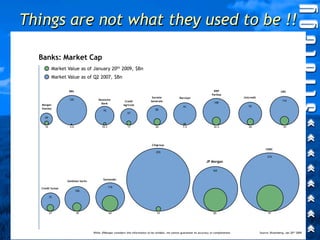
Things are not what they used to be !!


Strategy                      © Peter Laburn
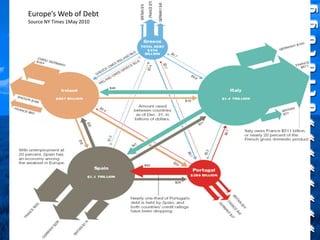
!"#$%&'()*&+)$,)-&+.)
  /$"#0&)12)345&()6789):;6;)


Strategy                       © Peter Laburn
“It is difficult to get a man to understand
                   something,
        when his salary depends on him
             not understanding it”

           Upton Sinclair 1860’s


Strategy                             © Peter Laburn
What % of intended strategy
actually gets implemented?
What % of intended strategy
actually gets implemented?
What % of intended strategy
actually gets implemented?

     Less than …..   10 %
What % of intended strategy
actually gets implemented?

       Less than …..   10 %
So 2 questions
 - why is it so low ?
 - why bother with a Strategic Process ?
“Logical Incrementalism”
‘In reality organizations proceeded
by trial and error, constantly revising
strategy in the light of experience’
                     James Quinn
“Logical Incrementalism”
‘In reality organizations proceeded
by trial and error, constantly revising
strategy in the light of experience’
                     James Quinn
Is strategy created ….

           or does it evolve ?????


Strategy                      © Peter Laburn
Strategy –
would love to do it, but we are
too busy with today’s
challenges
Strategy –
would love to do it, but we are
too busy with today’s
challenges
Strategy is not Operation Tactics


Strategy                       © Peter Laburn
Strategy is not Operation Tactics


• Strategy - are we really doing the right
  things? Are we effectively going in the
  right direction bearing in mind all the
  things that are changing?


Strategy                           © Peter Laburn
Strategy is not Operation Tactics


• Strategy - are we really doing the right
  things? Are we effectively going in the
  right direction bearing in mind all the
  things that are changing?

• Operational Tactics - the things that we
  choose to do, do we do them right /
  really well, with maximum efficiency?

Strategy                           © Peter Laburn
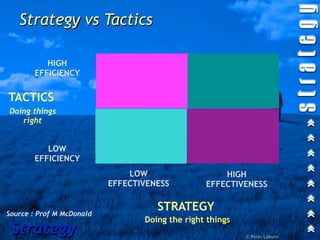
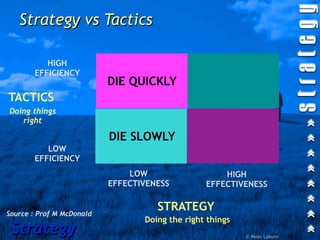
Strategy vs Tactics

          HIGH
       EFFICIENCY


TACTICS
Doing things
   right


          LOW
       EFFICIENCY
                               LOW                   HIGH
                           EFFECTIVENESS         EFFECTIVENESS


Source : Prof M McDonald
                                     STRATEGY
                                  Doing the right things
 Strategy                                                  © Peter Laburn
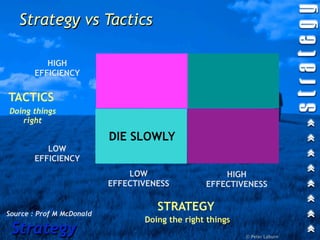
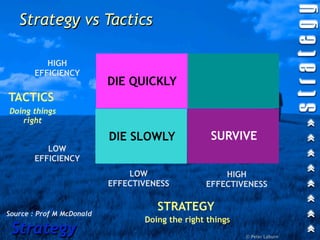
Strategy vs Tactics

          HIGH
       EFFICIENCY


TACTICS
Doing things
   right

                           DIE SLOWLY
          LOW
       EFFICIENCY
                               LOW                   HIGH
                           EFFECTIVENESS         EFFECTIVENESS


Source : Prof M McDonald
                                     STRATEGY
                                  Doing the right things
 Strategy                                                  © Peter Laburn
Strategy vs Tactics

          HIGH
       EFFICIENCY
                           DIE QUICKLY
TACTICS
Doing things
   right

                           DIE SLOWLY
          LOW
       EFFICIENCY
                               LOW                   HIGH
                           EFFECTIVENESS         EFFECTIVENESS


Source : Prof M McDonald
                                     STRATEGY
                                  Doing the right things
 Strategy                                                  © Peter Laburn
Strategy vs Tactics

          HIGH
       EFFICIENCY
                           DIE QUICKLY
TACTICS
Doing things
   right

                           DIE SLOWLY              SURVIVE
          LOW
       EFFICIENCY
                               LOW                   HIGH
                           EFFECTIVENESS         EFFECTIVENESS


Source : Prof M McDonald
                                     STRATEGY
                                  Doing the right things
 Strategy                                                  © Peter Laburn
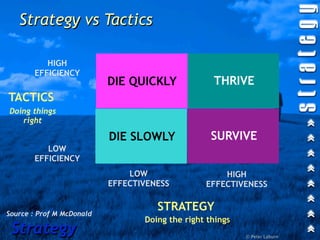
Strategy vs Tactics

          HIGH
       EFFICIENCY
                           DIE QUICKLY             THRIVE
TACTICS
Doing things
   right

                           DIE SLOWLY              SURVIVE
          LOW
       EFFICIENCY
                               LOW                   HIGH
                           EFFECTIVENESS         EFFECTIVENESS


Source : Prof M McDonald
                                     STRATEGY
                                  Doing the right things
 Strategy                                                  © Peter Laburn
Strategy –
things are going well ..
   don’t rock the boat!
Strategy –
things are going well ..
   don’t rock the boat!
Hidden realities of change


 Change comes at us …

   without asking permission


   without making a sound


   without giving us a template of how to cope

Strategy                              © Peter Laburn
Strategy –
is about change
Strategy –
is about change
Strategy –
is about change

And we are ‘creatures of habit’
“ If we want things to
      stay as they are,
things will have to change”


     di Lampedusa - The Leopard


Strategy                      © Peter Laburn
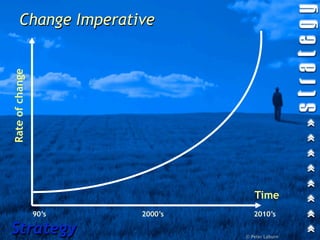
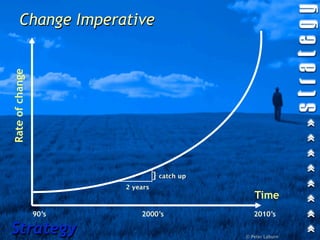
Change Imperative
Rate of change


                                    Time
                 90’s   2000’s      2010’s

Strategy                         © Peter Laburn
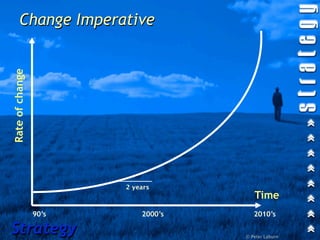
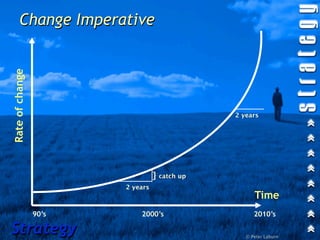
Change Imperative
Rate of change


                        2 years
                                        Time
                 90’s       2000’s      2010’s

Strategy                             © Peter Laburn
Change Imperative
Rate of change


                                  } catch up
                        2 years
                                                  Time
                 90’s       2000’s                2010’s

Strategy                                       © Peter Laburn
Change Imperative
Rate of change


                                               2 years


                                  } catch up
                        2 years
                                                     Time
                 90’s       2000’s                   2010’s

Strategy                                          © Peter Laburn
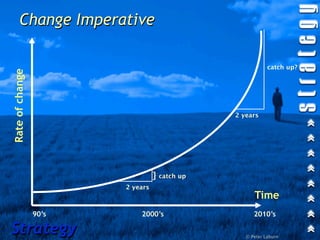
Change Imperative

                                                           catch up?
Rate of change


                                               2 years


                                  } catch up
                        2 years
                                                     Time
                 90’s       2000’s                   2010’s

Strategy                                          © Peter Laburn
Strategies need to be changed –

  not because the historical strategies
  may have been wrong , but because
  past strategies (however good they
  were) may be obsolete and no longer
  appropriate …


 the rules have changed

Strategy                           © Peter Laburn
Times of Turbulence

     “The greatest danger in times of
  turbulence is not the turbulence, it
     is to act with yesterdays logic”
                      Peter Drucker

Strategy                       © Peter Laburn
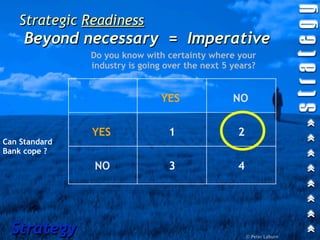
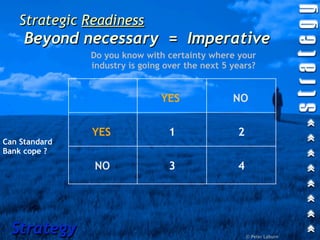
Strategic Readiness
     Beyond necessary = Imperative
               Do you know with certainty where your
               industry is going over the next 5 years?


                               YES               NO


               YES               1                2
Can Standard
Bank cope ?
               NO                3                4


  Strategy                                            © Peter Laburn
Strategic Readiness
     Beyond necessary = Imperative
               Do you know with certainty where your
               industry is going over the next 5 years?


                               YES               NO


               YES               1                2
Can Standard
Bank cope ?
               NO                3                4


  Strategy                                            © Peter Laburn
DOING WHAT YOU HAVE ALWAYS
 BEEN DOING AND EXPECTING
     DIFFERENT RESULTS


                         Peter Laburn International
INSANITY

DOING WHAT YOU HAVE ALWAYS
 BEEN DOING AND EXPECTING
     DIFFERENT RESULTS


                         Peter Laburn International
Strategy as Revolution

“I believe that only those companies that
are capable of reinventing themselves and
 their industry in a profound way, will be
        around in a decade hence”

                Gary Hamel


Strategy                            © Peter Laburn
Strategy is a holistic process


10.15am
Strategy is a holistic process


10.15am
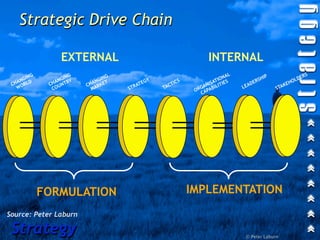
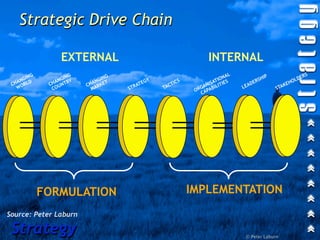
Strategic Drive Chain

                  EXTERNAL                                            INTERNAL
         G            G
                                ING                                           AL            IP                    RS
     GIN          GIN         NG ET         GY                             ION S          SH                LDE
   AN LD        AN TRY      A                            ICS             T
                                                                      ISA IE           ER                HO
 CH OR        CH UN       CH ARK         ATE        CT              AN BILIT       LEA
                                                                                      D              KE
   W           CO           M         STR        TA               G
                                                                OR APA                           STA
                                                                  C


             FORMULATION                                       IMPLEMENTATION
Source: Peter Laburn

 Strategy                                                                           © Peter Laburn
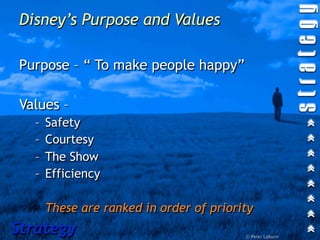
Disney’s Purpose and Values

Purpose – “ To make people happy”

Values –
  –   Safety
  –   Courtesy
  –   The Show
  –   Efficiency

      These are ranked in order of priority
Strategy                                 © Peter Laburn
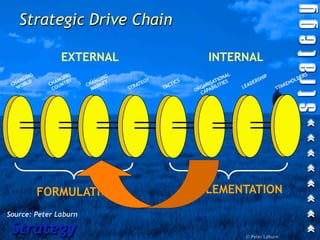
Strategic Drive Chain

                  EXTERNAL                                            INTERNAL
         G            G
                                ING                                           AL            IP                    RS
     GIN          GIN         NG ET         GY                             ION S          SH                LDE
   AN LD        AN TRY      A                            ICS             T
                                                                      ISA IE           ER                HO
 CH OR        CH UN       CH ARK         ATE        CT              AN BILIT       LEA
                                                                                      D              KE
   W           CO           M         STR        TA               G
                                                                OR APA                           STA
                                                                  C


             FORMULATION                                       IMPLEMENTATION
Source: Peter Laburn

 Strategy                                                                           © Peter Laburn
Strategic Drive Chain

                  EXTERNAL                                            INTERNAL
         G            G
                                ING                                           AL            IP                    RS
     GIN          GIN         NG ET         GY                             ION S          SH                LDE
   AN LD        AN TRY      A                            ICS             T
                                                                      ISA IE           ER                HO
 CH OR        CH UN       CH ARK         ATE        CT              AN BILIT       LEA
                                                                                      D              KE
   W           CO           M         STR        TA               G
                                                                OR APA                           STA
                                                                  C


             FORMULATION                                       IMPLEMENTATION
Source: Peter Laburn

 Strategy                                                                           © Peter Laburn
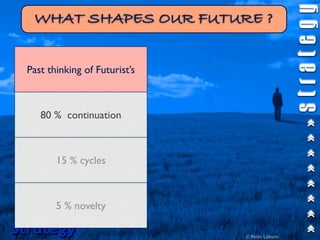
WHAT SHAPES OUR FUTURE ?


 Past thinking of Futurist’s


    80 % continuation


        15 % cycles


        5 % novelty

Strategy                       © Peter Laburn
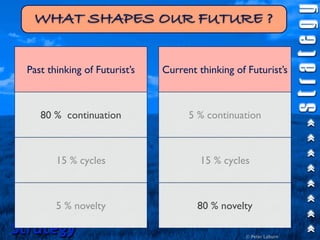
WHAT SHAPES OUR FUTURE ?


 Past thinking of Futurist’s   Current thinking of Futurist’s


    80 % continuation                5 % continuation


        15 % cycles                     15 % cycles


        5 % novelty                    80 % novelty

Strategy                                           © Peter Laburn
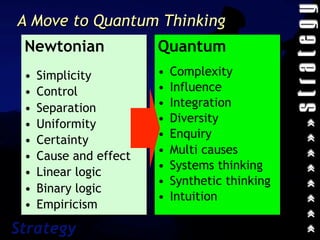
A Move to Quantum Thinking
 Newtonian              Quantum
 •   Simplicity         •   Complexity
 •   Control            •   Influence
 •   Separation         •   Integration
 •   Uniformity         •   Diversity
                        •   Enquiry
 •   Certainty
                        •   Multi causes
 •   Cause and effect
                        •   Systems thinking
 •   Linear logic
                        •   Synthetic thinking
 •   Binary logic
                        •   Intuition
 •   Empiricism

Strategy                                 © Peter Laburn
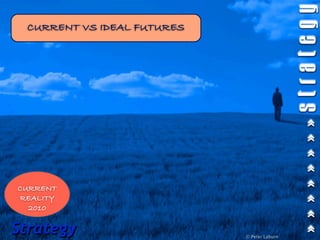
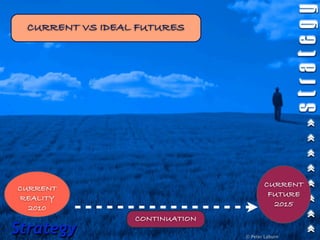
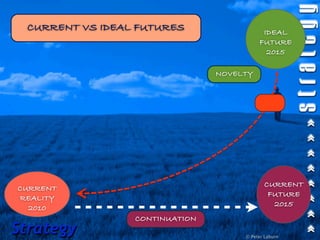
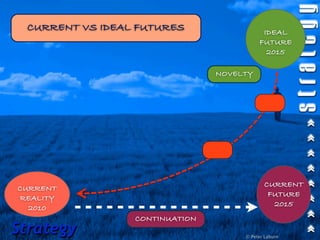
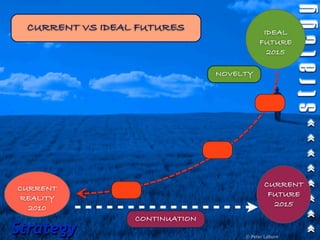
CURRENT VS IDEAL FUTURES


CURRENT
REALITY
  2010

Strategy                    © Peter Laburn
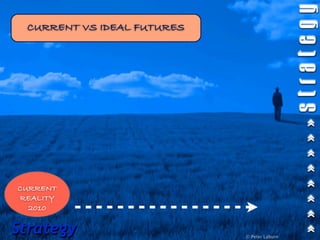
CURRENT VS IDEAL FUTURES


CURRENT
REALITY
  2010

Strategy                    © Peter Laburn
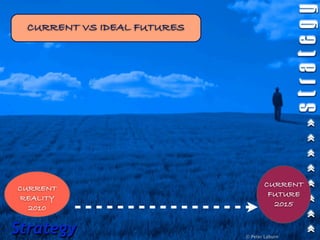
CURRENT VS IDEAL FUTURES


                                   CURRENT
CURRENT
                                    FUTURE
REALITY
                                     2015
  2010

Strategy                    © Peter Laburn
CURRENT VS IDEAL FUTURES


                                       CURRENT
CURRENT
                                        FUTURE
REALITY
                                         2015
  2010
                 CONTINUATION
Strategy                        © Peter Laburn
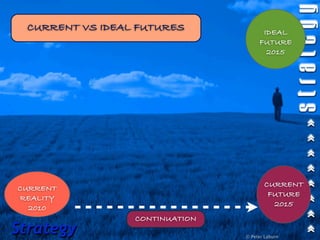
CURRENT VS IDEAL FUTURES             IDEAL
                                     FUTURE
                                       2015


                                       CURRENT
CURRENT
                                        FUTURE
REALITY
                                         2015
  2010
                 CONTINUATION
Strategy                        © Peter Laburn
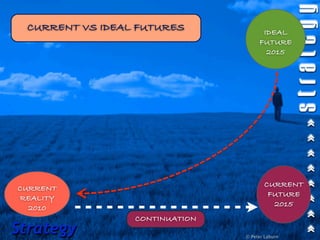
CURRENT VS IDEAL FUTURES             IDEAL
                                     FUTURE
                                       2015


                                       CURRENT
CURRENT
                                        FUTURE
REALITY
                                         2015
  2010
                 CONTINUATION
Strategy                        © Peter Laburn
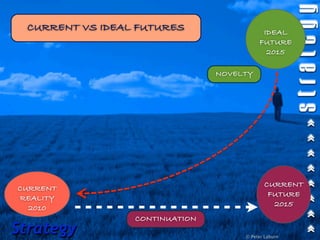
CURRENT VS IDEAL FUTURES                  IDEAL
                                          FUTURE
                                            2015

                                NOVELTY


                                            CURRENT
CURRENT
                                             FUTURE
REALITY
                                              2015
  2010
                 CONTINUATION
Strategy                             © Peter Laburn
CURRENT VS IDEAL FUTURES                  IDEAL
                                          FUTURE
                                            2015

                                NOVELTY


                                            CURRENT
CURRENT
                                             FUTURE
REALITY
                                              2015
  2010
                 CONTINUATION
Strategy                             © Peter Laburn
CURRENT VS IDEAL FUTURES                  IDEAL
                                          FUTURE
                                            2015

                                NOVELTY


                                            CURRENT
CURRENT
                                             FUTURE
REALITY
                                              2015
  2010
                 CONTINUATION
Strategy                             © Peter Laburn
CURRENT VS IDEAL FUTURES                  IDEAL
                                          FUTURE
                                            2015

                                NOVELTY


                                            CURRENT
CURRENT
                                             FUTURE
REALITY
                                              2015
  2010
                 CONTINUATION
Strategy                             © Peter Laburn
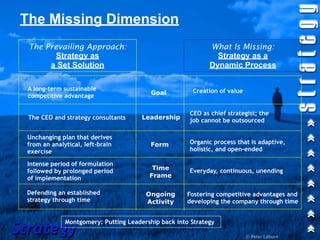
The Missing Dimension
  The Prevailing Approach:                                   What Is Missing:
         Strategy as                                           Strategy as a
       a Set Solution                                        Dynamic Process

  A long-term sustainable                              Creation of value
  competitive advantage                   Goal


                                                      CEO as chief strategist; the
  The CEO and strategy consultants     Leadership     job cannot be outsourced

 Unchanging plan that derives
 from an analytical, left-brain           Form        Organic process that is adaptive,
 exercise                                             holistic, and open-ended

 Intense period of formulation
 followed by prolonged period             Time        Everyday, continuous, unending
 of implementation                       Frame

 Defending an established               Ongoing       Fostering competitive advantages and
 strategy through time                  Activity      developing the company through time


              Montgomery: Putting Leadership back into Strategy
Strategy                                                                   © Peter Laburn
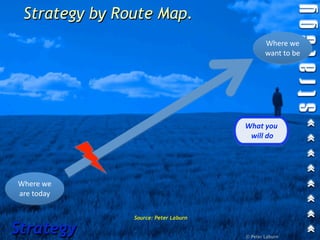
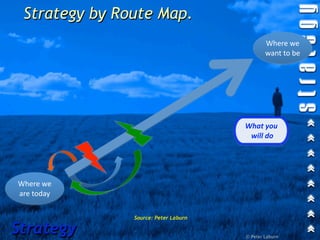
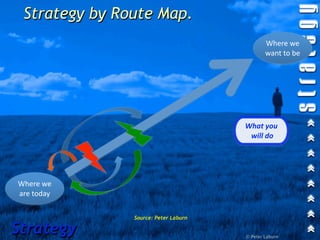
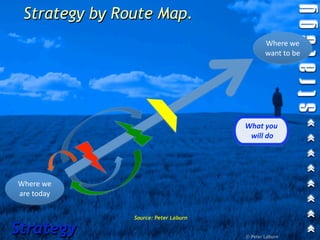
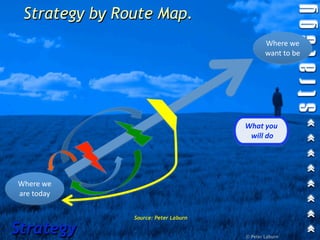
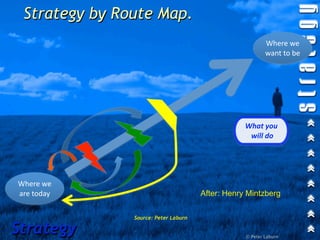
Strategy by Route Map.


               Source: Peter Laburn

Strategy                              © Peter Laburn
Strategy by Route Map.


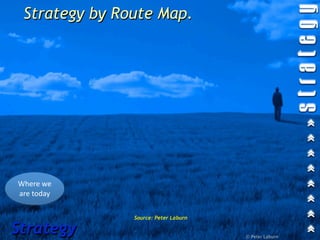
Where
we

are
today

               Source: Peter Laburn

Strategy                              © Peter Laburn
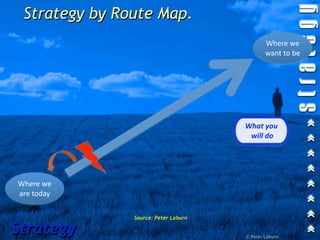
Strategy by Route Map.
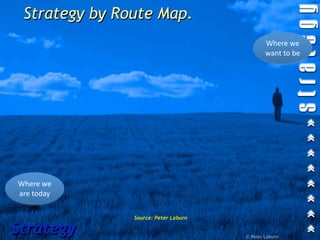
                                              Where
we

                                              want
to
be


Where
we

are
today

               Source: Peter Laburn

Strategy                              © Peter Laburn
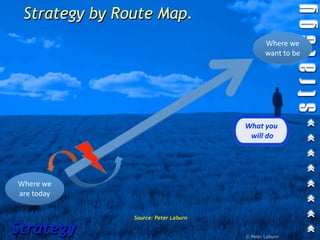
Strategy by Route Map.
                                              Where
we

                                              want
to
be


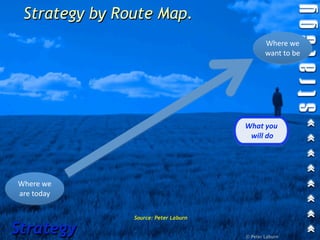
                                      What
you
                                       
will
do


Where
we

are
today

               Source: Peter Laburn

Strategy                              © Peter Laburn
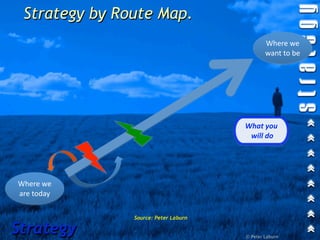
Strategy by Route Map.
                                              Where
we

                                              want
to
be


                                      What
you
                                       
will
do


Where
we

are
today

               Source: Peter Laburn

Strategy                              © Peter Laburn
Strategy by Route Map.
                                              Where
we

                                              want
to
be


                                      What
you
                                       
will
do


Where
we

are
today

               Source: Peter Laburn

Strategy                              © Peter Laburn
Strategy by Route Map.
                                              Where
we

                                              want
to
be


                                      What
you
                                       
will
do


Where
we

are
today

               Source: Peter Laburn

Strategy                              © Peter Laburn
Strategy by Route Map.
                                              Where
we

                                              want
to
be


                                      What
you
                                       
will
do


Where
we

are
today

               Source: Peter Laburn

Strategy                              © Peter Laburn
Strategy by Route Map.
                                              Where
we

                                              want
to
be


                                      What
you
                                       
will
do


Where
we

are
today

               Source: Peter Laburn

Strategy                              © Peter Laburn
Strategy by Route Map.
                                              Where
we

                                              want
to
be


                                      What
you
                                       
will
do


Where
we

are
today

               Source: Peter Laburn

Strategy                              © Peter Laburn
Strategy by Route Map.
                                              Where
we

                                              want
to
be


                                      What
you
                                       
will
do


Where
we

are
today

               Source: Peter Laburn

Strategy                              © Peter Laburn
Strategy by Route Map.
                                              Where
we

                                              want
to
be


                                      What
you
                                       
will
do


Where
we

are
today

               Source: Peter Laburn

Strategy                              © Peter Laburn
Strategy by Route Map.
                                                          Where
we

                                                          want
to
be


                                                  What
you
                                                   
will
do


Where
we

are
today                             After: Henry Mintzberg

               Source: Peter Laburn

Strategy                                          © Peter Laburn
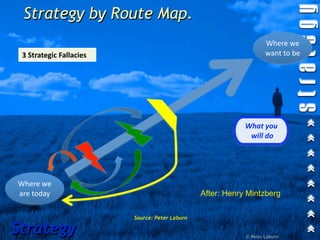
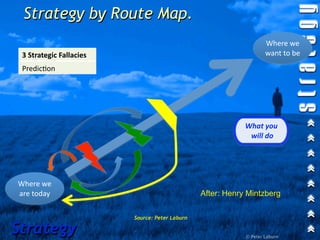
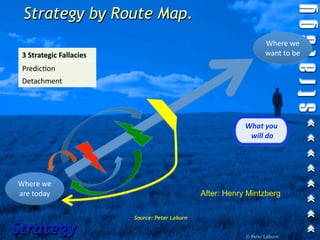
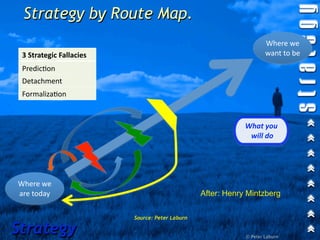
Strategy by Route Map.
                                                                     Where
we

 3
Strategic
Fallacies
                                              want
to
be
 Predic1on

 Detachment
 Formaliza1on


                                                             What
you
                                                              
will
do


Where
we

are
today                                        After: Henry Mintzberg

                          Source: Peter Laburn

Strategy                                                     © Peter Laburn
Strategy by Route Map.
                                                                     Where
we

 3
Strategic
Fallacies
                                              want
to
be
 Predic1on

 Detachment
 Formaliza1on


                                                             What
you
                                                              
will
do


Where
we

are
today                                        After: Henry Mintzberg

                          Source: Peter Laburn

Strategy                                                     © Peter Laburn
Strategy by Route Map.
                                                                     Where
we

 3
Strategic
Fallacies
                                              want
to
be
 Predic1on

 Detachment
 Formaliza1on


                                                             What
you
                                                              
will
do


Where
we

are
today                                        After: Henry Mintzberg

                          Source: Peter Laburn

Strategy                                                     © Peter Laburn
Strategy by Route Map.
                                                                     Where
we

 3
Strategic
Fallacies
                                              want
to
be
 Predic1on

 Detachment
 Formaliza1on


                                                             What
you
                                                              
will
do


Where
we

are
today                                        After: Henry Mintzberg

                          Source: Peter Laburn

Strategy                                                     © Peter Laburn
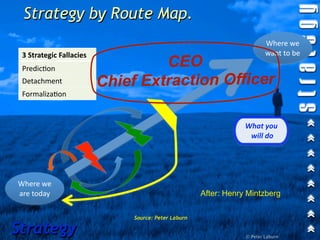
Strategy by Route Map.
                                                                          Where
we

 3
Strategic
Fallacies
                                                   want
to
be
 Predic1on

                                   CEO
 Detachment               Chief Extraction Officer
 Formaliza1on


                                                                  What
you
                                                                   
will
do


Where
we

are
today                                             After: Henry Mintzberg

                               Source: Peter Laburn

Strategy                                                          © Peter Laburn
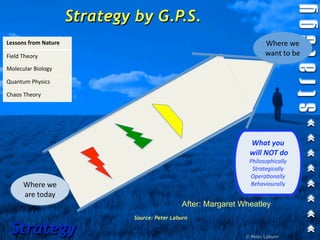
Strategy by G.P.S.


               Source: Peter Laburn

Strategy                              © Peter Laburn
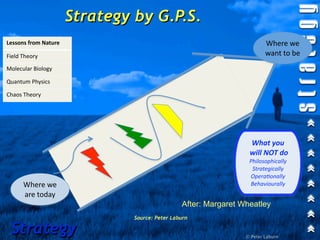
Strategy by G.P.S.


                                After: Margaret Wheatley
               Source: Peter Laburn

Strategy                                         © Peter Laburn
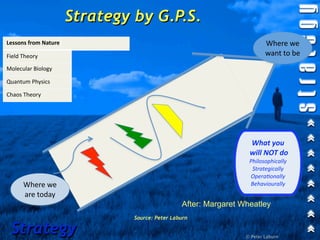
Strategy by G.P.S.
Lessons
from
Nature

Field
Theory

Molecular
Biology

Quantum
Physics

Chaos
Theory


                                                After: Margaret Wheatley
                               Source: Peter Laburn

 Strategy                                                        © Peter Laburn
Strategy by G.P.S.
Lessons
from
Nature

Field
Theory

Molecular
Biology

Quantum
Physics

Chaos
Theory


                                                After: Margaret Wheatley
                               Source: Peter Laburn

 Strategy                                                        © Peter Laburn
Strategy by G.P.S.
Lessons
from
Nature

Field
Theory

Molecular
Biology

Quantum
Physics

Chaos
Theory


                                                After: Margaret Wheatley
                               Source: Peter Laburn

 Strategy                                                        © Peter Laburn
Strategy by G.P.S.
Lessons
from
Nature

Field
Theory

Molecular
Biology

Quantum
Physics

Chaos
Theory


                                                After: Margaret Wheatley
                               Source: Peter Laburn

 Strategy                                                        © Peter Laburn
Strategy by G.P.S.
Lessons
from
Nature

Field
Theory

Molecular
Biology

Quantum
Physics

Chaos
Theory


                                                After: Margaret Wheatley
                               Source: Peter Laburn

 Strategy                                                        © Peter Laburn
Strategy by G.P.S.
Lessons
from
Nature                                                      Where
we

Field
Theory                                                             want
to
be
Molecular
Biology

Quantum
Physics

Chaos
Theory


      Where
we

      are
today
                                                After: Margaret Wheatley
                               Source: Peter Laburn

 Strategy                                                        © Peter Laburn
Strategy by G.P.S.
Lessons
from
Nature                                                      Where
we

Field
Theory                                                             want
to
be
Molecular
Biology

Quantum
Physics

Chaos
Theory


      Where
we

      are
today
                                                After: Margaret Wheatley
                               Source: Peter Laburn

 Strategy                                                        © Peter Laburn
Strategy by G.P.S.
Lessons
from
Nature                                                      Where
we

Field
Theory                                                             want
to
be
Molecular
Biology

Quantum
Physics

Chaos
Theory


                                                                  What
you
                                                                 
will
NOT
do
                                                                  Philosophically
                                                                   Strategically
                                                                  Opera1onally
      Where
we
                                                   Behaviourally
      are
today
                                                After: Margaret Wheatley
                               Source: Peter Laburn

 Strategy                                                        © Peter Laburn
Strategy by G.P.S.
Lessons
from
Nature                                                      Where
we

Field
Theory                                                             want
to
be
Molecular
Biology

Quantum
Physics

Chaos
Theory


                                                                  What
you
                                                                 
will
NOT
do
                                                                  Philosophically
                                                                   Strategically
                                                                  Opera1onally
      Where
we
                                                   Behaviourally
      are
today
                                                After: Margaret Wheatley
                               Source: Peter Laburn

 Strategy                                                        © Peter Laburn
Strategy by G.P.S.
Lessons
from
Nature                                                      Where
we

Field
Theory                                                             want
to
be
Molecular
Biology

Quantum
Physics

Chaos
Theory


                                                                  What
you
                                                                 
will
NOT
do
                                                                  Philosophically
                                                                   Strategically
                                                                  Opera1onally
      Where
we
                                                   Behaviourally
      are
today
                                                After: Margaret Wheatley
                               Source: Peter Laburn

 Strategy                                                        © Peter Laburn
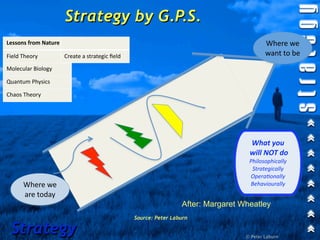
Strategy by G.P.S.
Lessons
from
Nature                                                                       Where
we

Field
Theory          Create
a
strategic
field                                             want
to
be
Molecular
Biology     Open
source
info
flow

Quantum
Physics       Maximize
rela1onships

Chaos
Theory          Let
mild
chaos
flow


                                                                                   What
you
                                                                                  
will
NOT
do
                                                                                   Philosophically
                                                                                    Strategically
                                                                                   Opera1onally
      Where
we
                                                                    Behaviourally
      are
today
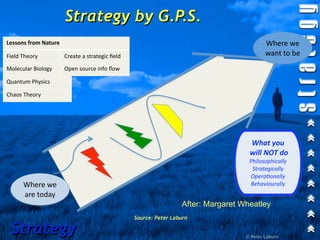
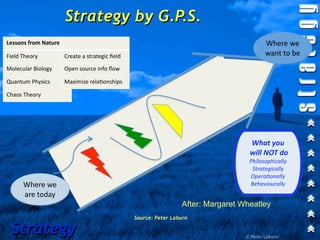
                                                                 After: Margaret Wheatley
                                                Source: Peter Laburn

 Strategy                                                                         © Peter Laburn
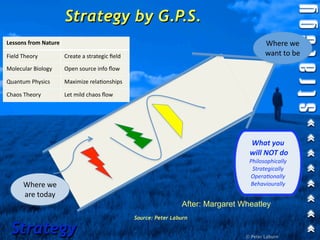
Strategy by G.P.S.
Lessons
from
Nature                                                                       Where
we

Field
Theory          Create
a
strategic
field                                             want
to
be
Molecular
Biology     Open
source
info
flow

Quantum
Physics       Maximize
rela1onships

Chaos
Theory          Let
mild
chaos
flow


                                                                                   What
you
                                                                                  
will
NOT
do
                                                                                   Philosophically
                                                                                    Strategically
                                                                                   Opera1onally
      Where
we
                                                                    Behaviourally
      are
today
                                                                 After: Margaret Wheatley
                                                Source: Peter Laburn

 Strategy                                                                         © Peter Laburn
Strategy by G.P.S.
Lessons
from
Nature                                                                       Where
we

Field
Theory          Create
a
strategic
field                                             want
to
be
Molecular
Biology     Open
source
info
flow

Quantum
Physics       Maximize
rela1onships

Chaos
Theory          Let
mild
chaos
flow


                                                                                   What
you
                                                                                  
will
NOT
do
                                                                                   Philosophically
                                                                                    Strategically
                                                                                   Opera1onally
      Where
we
                                                                    Behaviourally
      are
today
                                                                 After: Margaret Wheatley
                                                Source: Peter Laburn

 Strategy                                                                         © Peter Laburn
Strategy by G.P.S.
Lessons
from
Nature                                                                       Where
we

Field
Theory          Create
a
strategic
field                                             want
to
be
Molecular
Biology     Open
source
info
flow

Quantum
Physics       Maximize
rela1onships

Chaos
Theory          Let
mild
chaos
flow


                                                                                   What
you
                                                                                  
will
NOT
do
                                                                                   Philosophically
                                                                                    Strategically
                                                                                   Opera1onally
      Where
we
                                                                    Behaviourally
      are
today
                                                                 After: Margaret Wheatley
                                                Source: Peter Laburn

 Strategy                                                                         © Peter Laburn
Strategy by G.P.S.
Lessons
from
Nature                                                                       Where
we

Field
Theory          Create
a
strategic
field                                             want
to
be
Molecular
Biology     Open
source
info
flow

Quantum
Physics       Maximize
rela1onships

Chaos
Theory          Let
mild
chaos
flow


                                                                                   What
you
                                                                                  
will
NOT
do
                                                                                   Philosophically
                                                                                    Strategically
                                                                                   Opera1onally
      Where
we
                                                                    Behaviourally
      are
today
                                                                 After: Margaret Wheatley
                                                Source: Peter Laburn

 Strategy                                                                         © Peter Laburn
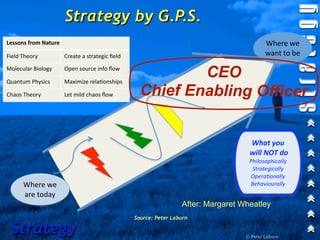
Strategy by G.P.S.
Lessons
from
Nature                                                                       Where
we

Field
Theory          Create
a
strategic
field                                             want
to
be
Molecular
Biology

Quantum
Physics
                      Open
source
info
flow

                      Maximize
rela1onships
                                                          CEO
Chaos
Theory          Let
mild
chaos
flow          Chief Enabling Officer


                                                                                   What
you
                                                                                  
will
NOT
do
                                                                                   Philosophically
                                                                                    Strategically
                                                                                   Opera1onally
      Where
we
                                                                    Behaviourally
      are
today
                                                                 After: Margaret Wheatley
                                                Source: Peter Laburn

 Strategy                                                                         © Peter Laburn
Some Newer Thoughts
 on Strategic Thinking
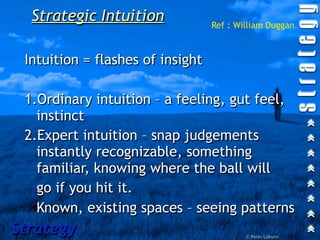
Strategic Intuition             Ref : William Duggan


 Intuition = flashes of insight

 1.Ordinary intuition – a feeling, gut feel,
   instinct
 2.Expert intuition – snap judgements
   instantly recognizable, something
   familiar, knowing where the ball will
   go if you hit it.
   Known, existing spaces – seeing patterns
Strategy                                  © Peter Laburn
Strategic Intuition - cont         Ref :
                                      William Duggan

3. Strategic Intuition –
  – Doesn’t start with a ‘big idea’
  – Begins by being open to possibilities
  – Builds off other (very different) ideas
  – It’s a clear thought, it slowly evolves
  – Not fast or impulsive
  – It is edified by a multiplicity of factors
  – Takes you into unknown, new spaces
  – Once ‘flash of insight’ occurs - strike
     fast, pursue relentlessly
Strategy                             © Peter Laburn
A Brief perspective… von Clausewitz


Strategy   Source: Strategic Intuition by William Duggan   © Peter Laburn
A Brief perspective… von Clausewitz

Examples from History - strategic intuition draws on the knowledge
and experience of all of history far and wide, all stored in the shelves
of the mind

Presence of mind - refers to a clear mind, clear of all expectations
and previous ideas of what you might do or even what your goal is.

Flash of insight - In a free mind selected elements from various
examples come together in a new combination.

Resolution i.e. Resolve / determination - you not only need to see
what to do but also be ready to do it. The flash of insight carries with
it the force of action that propels you forward, but you need the
resolve to push on and make your strategy happen


Strategy                Source: Strategic Intuition by William Duggan   © Peter Laburn
Obliquity
 Why
 !! Our goals are best achieved indirectly
                   eg
 !! The Happiest people don’t pursue happiness
 !! The Wealthiest people don’t puruse
       materialism
 !! The most profitable companies are not the
       most profit orientated
       Think “Snakes and Ladders”


Strategy                               © Peter Laburn
The need for Obliquity
Muddling through – why obliquity succeeds
Pluralism – why there is usually more than one answer
       to any problem
Interaction – why the outcome of what we do depends
       on why we do it
Complexity – how the world is too complex for
       directness to be direct
Incompleteness – how we rarely know enough about
       the nature of our problems
Abstraction – why models are imperfect descriptions of
       reality


Strategy                                      © Peter Laburn
Some current realities
 !! We mistakingly infer design from outcome
 !! We have less freedom of choice than we think
 !! Decision makers don’t recognise the limits of their
          knowledge
 !! Adaptation is smarter than we are
 !! We know more than we can tell
 !! Complex outcomes are achieved without knowledge of an
          overall purpose
 !! It is more important to be right that to be consistent
 !! Spurious rationality is often confused with good decision
          making


Strategy                                          © Peter Laburn
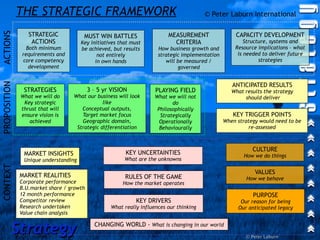
ACTIONS
              THE STRATEGIC FRAMEWORK                                                   © Peter Laburn International

                 STRATEGIC             MUST WIN BATTLES                  MEASUREMENT                CAPACITY DEVELOPMENT
                  ACTIONS             Key initiatives that must            CRITERIA                     Structure, systems and
                Both minimum          be achieved, but results       How business growth and        Resource implications – what
              requirements and               not entirely            strategic implementation        is needed to deliver future
              core competency               in own hands                will be measured /                    strategies
                 development                                                 governed
PROPOSITION


                                                                                                   ANTICIPATED RESULTS
               STRATEGIES                 3 – 5 yr VISION           PLAYING FIELD                  What results the strategy
              What we will do     What our business will look       What we will not                    should deliver
               Key strategic                  like                         do
              thrust that will       Conceptual outputs,             Philosophically
              ensure vision is       Target market focus              Strategically                KEY TRIGGER POINTS
                 achieved            Geographic domain,               Operationally             When strategy would need to be
                                   Strategic differentiation          Behaviourally                       re-assessed


                                                                                                           CULTURE
               MARKET INSIGHTS                          KEY UNCERTAINTIES                               How we do things
               Unique understanding                     What are the unknowns
CONTEXT


                                                                                                            VALUES
              MARKET REALITIES                          RULES OF THE GAME                                How we behave
              Corporate performance                    How the market operates
              B.U.market share / growth
              12 month performance                                                                         PURPOSE
              Competitor review                              KEY DRIVERS                              Our reason for being
              Research undertaken                 What really influences our thinking                Our anticipated legacy
              Value chain analysis


         Strategy                           CHANGING WORLD - What is changing in our world
                                                                                                        © Peter Laburn
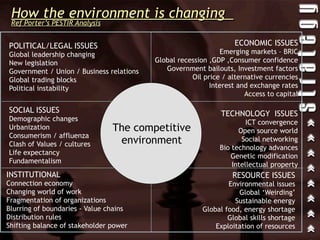
How the environment is changing
 Ref Porter’s PESTIR Analysis


POLITICAL/LEGAL ISSUES                                             ECONOMIC ISSUES
Global leadership changing                                    Emerging markets – BRIC
New legislation                           Global recession ,GDP ,Consumer confidence
Government / Union / Business relations      Government bailouts, Investment factors
Global trading blocks                                Oil price / alternative currencies
Political instability                                      Interest and exchange rates
                                                                      Access to capital

SOCIAL ISSUES                                                 TECHNOLOGY ISSUES
Demographic changes                                                    ICT convergence
Urbanization                    The competitive                     Open source world
Consumerism / affluenza
Clash of Values / cultures       environment                         Social networking
                                                              Bio technology advances
Life expectancy                                                  Genetic modification
Fundamentalism                                                    Intellectual property
INSTITUTIONAL                                                     RESOURCE ISSUES
Connection economy                                              Environmental issues
Changing world of work                                             Global ‘Weirding’
Fragmentation of organizations                                    Sustainable energy
Blurring of boundaries - Value chains                   Global food, energy shortage
Distribution rules                                              Global skills shortage
 Strategy
Shifting balance of stakeholder power                       Exploitation of resources
                                                                      © Peter Laburn
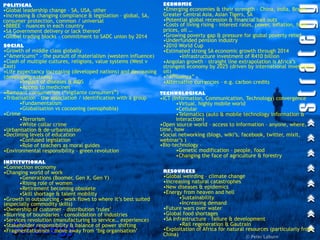
POLITICAL                                                         ECONOMIC
•Global leadership change – SA, USA, other                        •Emerging economies & their strength – China, India, Brazil,
•Increasing & changing compliance & legislation – global, SA,     Greater Central Asia, Asian Tigers, SA
consumer protection, common / universal                           •Potential global recession & financial bail outs
•BBBEE – nuances in each country                                  •Costs of living rising – interest rates, power, inflation, food
•SA Government delivery or lack thereof                           prices, oil …
•Global trading blocks – commitment to SADC union by 2014         •Growing poverty gap & pressure for global poverty relief
                                                                  •Underfunded pension industry
SOCIAL                                                            •2010 World Cup
•Growth of middle class globally                                  •Estimated strong SA economic growth through 2014
•“Americums” – the pursuit of materialism (western influence)            •Infrastructure investment of R410 billion
•Clash of multiple cultures, religions, value systems (West v     •Angolan growth – straight line extrapolation is Africa’s
East)                                                             strongest economy by 2025 (driven by international investment,
•Life expectancy increasing (developed nations) and decreasing    oil)
(developing nations)                                              •“Affluenza” -
       •Impact of diseases & AIDS                                 •Alternative currencies – e.g. carbon credits
       •Access to medicines
•Rampant consumerism (“vigilante consumers”)                     TECHNOLOGICAL
•Tribalisation – the association / identification with a group   •ICT (Information, Communication, Technology) convergence
       •Fundamentalism                                                  •Virtual, highly mobile world
       •Globalisation vs cocooning (xenophobia)                         •Cellular
•Crime                                                                  •Telematics (auto & mobile technology information &
       •Terrorism                                                       interaction)
       •White collar crime                                       •Open source world – access to information – anyone, where,
•Urbanisation & de-urbanisation                                  time, how
•Declining levels of education                                   •Social networking (blogs, wiki’s, facebook, twitter, mixit,
       •Confused legislation                                     webinar’s )
       •Role of teachers as moral guides                         •Bio-technology –
•Environmental responsibility – green revolution                        •Genetic modification – people, food
                                                                        •Changing the face of agriculture & forestry
INSTITUTIONAL
•Connection economy
•Changing world of work                                           RESOURCES
       •Generations (Boomer, Gen X, Gen Y)                        •Global weirding – climate change
       •Rising role of women                                      •Increasing natural catastrophes
       •Retirement becoming obsolete                              •New diseases & epidemics
       •Skill shortage & talent mobility                          •Energy from heaven and hell
•Growth in outsourcing – work flows to where it’s best suited            •Sustainability
(especially commodity skills)                                            •Increasing demand
•Ownership of customer – distribution ‘rules’                     •Future wars over water
•Blurring of boundaries - consolidation of industries             •Global food shortages
•Services revolution (manufacturing to service… experience)       •SA infrastructure – failure & development

   Strategy
•Stakeholder responsibility & balance of power shifting
•Fragmentationism – move away from ‘big organisation’
                                                                         •Rail regeneration & Gautrain
                                                                  •Exploitation of Africa for natural resources (particularly from
                                                                  China)                              © Peter Laburn
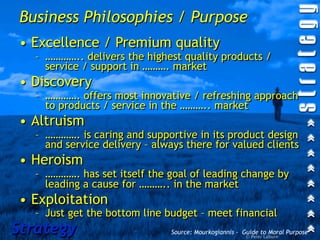
Business Philosophies / Purpose
• Excellence / Premium quality
  – ………….. delivers the highest quality products /
    service / support in ………. market
• Discovery
  – …………. offers most innovative / refreshing approach
    to products / service in the ……….. market
• Altruism
  – …………. is caring and supportive in its product design
    and service delivery – always there for valued clients
• Heroism
  – …………. has set itself the goal of leading change by
    leading a cause for ……….. in the market
• Exploitation
  – Just get the bottom line budget – meet financial
Strategy                      Source: Mourkogiannis - Guide to Moral Purpose
                                                       © Peter Laburn
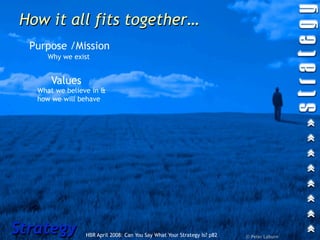
How it all fits together…


Strategy   HBR April 2008: Can You Say What Your Strategy Is? p82   © Peter Laburn
How it all fits together…
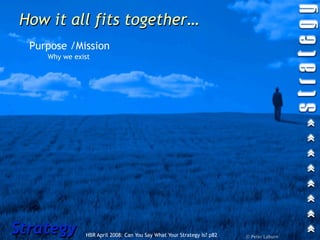
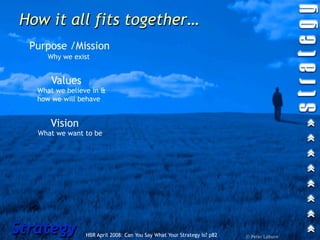
  Purpose /Mission
     Why we exist


Strategy       HBR April 2008: Can You Say What Your Strategy Is? p82   © Peter Laburn
How it all fits together…
  Purpose /Mission
      Why we exist


       Values
   What we believe in &
   how we will behave


Strategy         HBR April 2008: Can You Say What Your Strategy Is? p82   © Peter Laburn
How it all fits together…
  Purpose /Mission
      Why we exist


       Values
   What we believe in &
   how we will behave


      Vision
   What we want to be


Strategy         HBR April 2008: Can You Say What Your Strategy Is? p82   © Peter Laburn
How it all fits together…
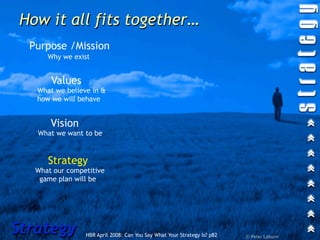
  Purpose /Mission
      Why we exist


       Values
   What we believe in &
   how we will behave


       Vision
   What we want to be


      Strategy
   What our competitive
    game plan will be


Strategy         HBR April 2008: Can You Say What Your Strategy Is? p82   © Peter Laburn
How it all fits together…
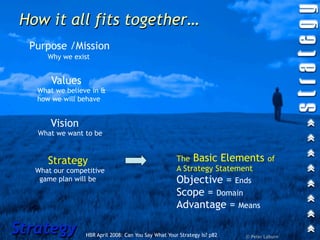
  Purpose /Mission
      Why we exist


       Values
   What we believe in &
   how we will behave


       Vision
   What we want to be


      Strategy                                        The Basic Elements of
   What our competitive                               A Strategy Statement
    game plan will be                                 Objective = Ends
                                                      Scope = Domain
                                                      Advantage = Means

Strategy         HBR April 2008: Can You Say What Your Strategy Is? p82   © Peter Laburn
How it all fits together…
  Purpose /Mission
      Why we exist

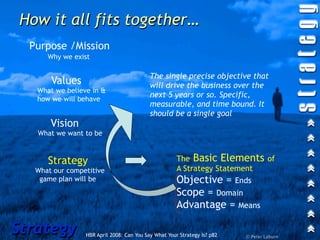
                                           The single precise objective that
       Values                              will drive the business over the
   What we believe in &
                                           next 5 years or so. Specific,
   how we will behave
                                           measurable, and time bound. It
                                           should be a single goal
       Vision
   What we want to be


      Strategy                                        The Basic Elements of
   What our competitive                               A Strategy Statement
    game plan will be                                 Objective = Ends
                                                      Scope = Domain
                                                      Advantage = Means

Strategy         HBR April 2008: Can You Say What Your Strategy Is? p82   © Peter Laburn
How it all fits together…
  Purpose /Mission
      Why we exist


       Values
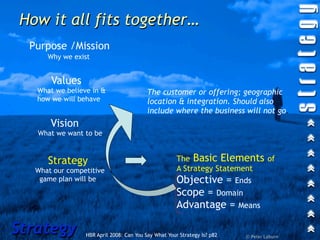
   What we believe in &                   The customer or offering; geographic
   how we will behave                     location & integration. Should also
                                          include where the business will not go.
       Vision
   What we want to be


      Strategy                                        The Basic Elements of
   What our competitive                               A Strategy Statement
    game plan will be                                 Objective = Ends
                                                      Scope = Domain
                                                      Advantage = Means

Strategy         HBR April 2008: Can You Say What Your Strategy Is? p82   © Peter Laburn
How it all fits together…
  Purpose /Mission
      Why we exist


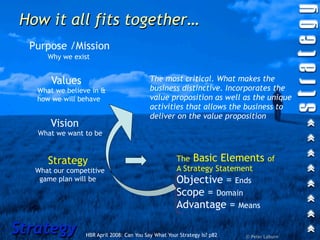
       Values                              The most critical. What makes the
   What we believe in &                    business distinctive. Incorporates the
   how we will behave                      value proposition as well as the unique
                                           activities that allows the business to
                                           deliver on the value proposition
       Vision
   What we want to be


      Strategy                                        The Basic Elements of
   What our competitive                               A Strategy Statement
    game plan will be                                 Objective = Ends
                                                      Scope = Domain
                                                      Advantage = Means

Strategy         HBR April 2008: Can You Say What Your Strategy Is? p82   © Peter Laburn
An alternative perspective

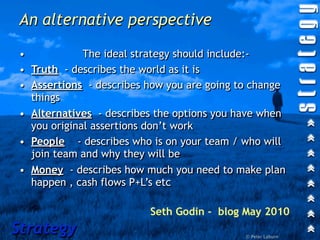
•            The ideal strategy should include:-
• Truth - describes the world as it is
• Assertions - describes how you are going to change
  things
• Alternatives - describes the options you have when
  you original assertions don’t work
• People - describes who is on your team / who will
  join team and why they will be
• Money - describes how much you need to make plan
  happen , cash flows P+L’s etc

                         Seth Godin - blog May 2010
Strategy                                    © Peter Laburn
Vision – what our business will look like


      •What game are we in ?
      •How do we add value ?
      •What competencies needed ?
      •What differentiation ?
      •What is sustainable ?


Strategy                          © Peter Laburn
Strategy Statement


 “We
aspire
to
be
a
leading

 emerging
markets
financial

   services
organisa1on”


Strategy                    © Peter Laburn
– Group strategic statement
“We
 aim
 to
 build
 a
 leading
 emerging
 markets

financial
 services
 organiza=on
 using
 all
 our

compe==ve
advantages
to
the
full.
We
 focus
 on
 delivering
 superior
 sustainable

shareholder
 value
 by
 cost
 effec=vely
 serving
 the

needs
 of
 our
 customers
 and
 where
 appropriate,

connec=ng
them
globally.
The
key
to
achieving
our
strategy
is
our
people”
Strategy                                    © Peter Laburn
9 Key Strategic Deliverables

• 


1.
Grow,
develop
and
recognize
our
people

• 


2.
Ensure
our
values
live
and
grow
within
the
organisa1on


        3.
Promote
a
nimble
and
proac1ve
approach
to
our
customers
      4.
Deliver
superior
returns
and
sustainable
growth
for
shareholders
      5.
Ensure
that
the
three
core
business
units
work
together
and
maximize
on

         the
synergies.
      6.
We've
got
to
build
a
strong
and
unified
brand
      7.
Deploy
our
scarce
capital
appropriately
      8.
Constantly
balance
risk
and
return
and
also
ensure
appropriate
corporate

         governance
      9.
Create
a
world
class
infrastructure,
with
the
emphasis
on
cost
efficiency

Strategy                                                                 © Peter Laburn
BUILDING A
    STRATEGIC PROPOSITION


Strategy              © Peter Laburn
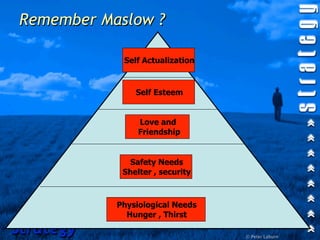
Remember Maslow ?

            Self Actualization


               Self Esteem


                Love and
                Friendship


              Safety Needs
            Shelter , security


           Physiological Needs
             Hunger , Thirst

Strategy                         © Peter Laburn
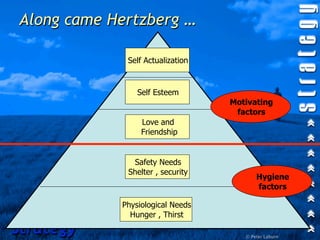
Along came Hertzberg …

             Self Actualization


                Self Esteem
                                  Motivating
                                   factors
                 Love and
                 Friendship


              Safety Needs
             Shelter , security
                                         Hygiene
                                         factors

            Physiological Needs
              Hunger , Thirst

Strategy                             © Peter Laburn
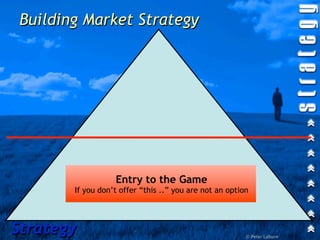
Building Market Strategy


Strategy                   © Peter Laburn
Building Market Strategy


                  Entry to the Game
       If you don’t offer “this ..” you are not an option


Strategy                                                © Peter Laburn
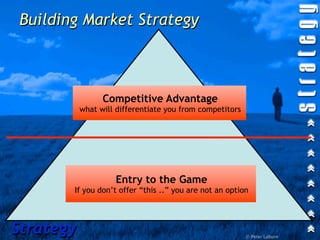
Building Market Strategy


                 Competitive Advantage
           what will differentiate you from competitors


                    Entry to the Game
       If you don’t offer “this ..” you are not an option


Strategy                                                  © Peter Laburn
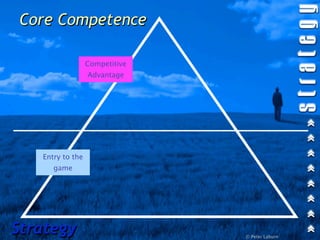
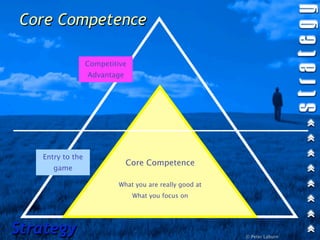
Core Competence

                  Competitive
                  Advantage


   Entry to the
      game


Strategy                        © Peter Laburn
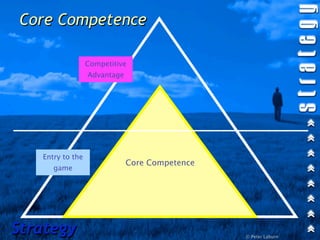
Core Competence

                  Competitive
                  Advantage


   Entry to the
                              Core Competence
      game


Strategy                                        © Peter Laburn
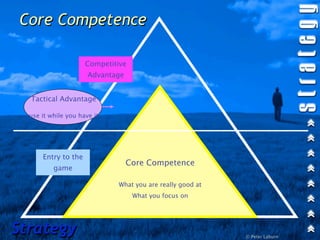
Core Competence

                  Competitive
                  Advantage


   Entry to the
                              Core Competence
      game

                          What you are really good at
                                What you focus on


Strategy                                                © Peter Laburn
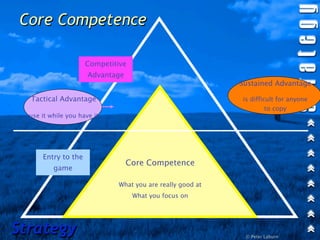
Core Competence

                     Competitive
                      Advantage


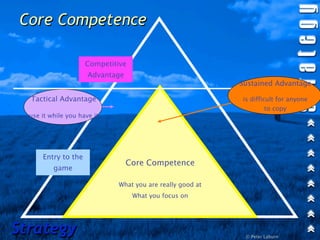
  Tactical Advantage

  use it while you have it


      Entry to the
                                  Core Competence
          game

                             What you are really good at
                                   What you focus on


Strategy                                                   © Peter Laburn
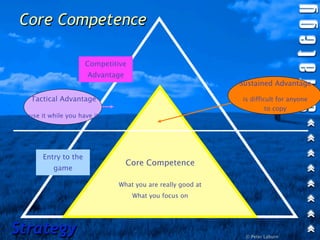
Core Competence

                     Competitive
                      Advantage
                                                           Sustained Advantage

  Tactical Advantage                                       is difficult for anyone
                                                                    to copy
  use it while you have it


      Entry to the
                                  Core Competence
          game

                             What you are really good at
                                   What you focus on


Strategy                                                    © Peter Laburn
Core Competence

                     Competitive
                      Advantage
                                                           Sustained Advantage

  Tactical Advantage                                       is difficult for anyone
                                                                    to copy
  use it while you have it


      Entry to the
                                  Core Competence
          game

                             What you are really good at
                                   What you focus on


Strategy                                                    © Peter Laburn
Core Competence

                     Competitive
                      Advantage
                                                           Sustained Advantage

  Tactical Advantage                                       is difficult for anyone
                                                                    to copy
  use it while you have it


      Entry to the
                                  Core Competence
          game

                             What you are really good at
                                   What you focus on


Strategy                                                    © Peter Laburn
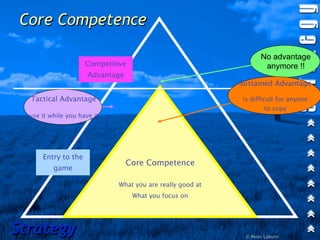
Core Competence

                                                                  No advantage
                     Competitive                                   anymore !!
                      Advantage
                                                           Sustained Advantage

  Tactical Advantage                                       is difficult for anyone
                                                                    to copy
  use it while you have it


      Entry to the
                                  Core Competence
          game

                             What you are really good at
                                   What you focus on


Strategy                                                    © Peter Laburn
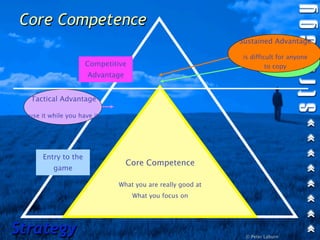
Core Competence
                                                           Sustained Advantage

                                                           is difficultadvantage
                                                                  No for anyone
                     Competitive                                     anymore !!
                                                                    to copy
                      Advantage


  Tactical Advantage

  use it while you have it


      Entry to the
                                  Core Competence
          game

                             What you are really good at
                                   What you focus on


Strategy                                                    © Peter Laburn
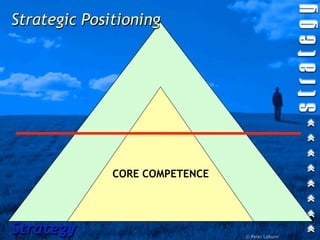
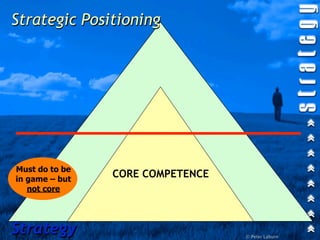
Strategic Positioning


              CORE COMPETENCE


             CORE COMPETENCE

Strategy                        © Peter Laburn
Strategic Positioning


Must do to be
in game – but
                 CORE COMPETENCE
   not core

                CORE COMPETENCE

Strategy                           © Peter Laburn
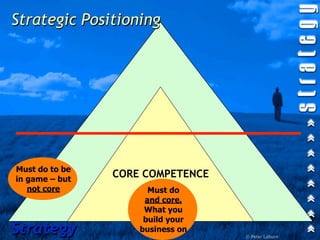
Strategic Positioning


Must do to be
in game – but
                 CORE COMPETENCE
   not core               Must do
                         and core.
                CORE   COMPETENCE
                         What you
                         build your
Strategy                business on
                                      © Peter Laburn
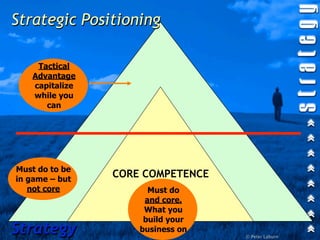
Strategic Positioning

    Tactical
   Advantage
   capitalize
   while you
      can


Must do to be
in game – but
                 CORE COMPETENCE
   not core               Must do
                         and core.
                CORE   COMPETENCE
                         What you
                         build your
Strategy                business on
                                      © Peter Laburn
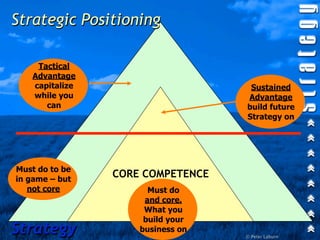
Strategic Positioning

    Tactical
   Advantage
   capitalize                          Sustained
   while you                          Advantage
      can                             build future
                                      Strategy on


Must do to be
in game – but
                 CORE COMPETENCE
   not core               Must do
                         and core.
                CORE   COMPETENCE
                         What you
                         build your
Strategy                business on
                                      © Peter Laburn
“The ‘surplus society’ has a surplus of
similar companies, employing similar
   people, with similar educational
 backgrounds, coming up with similar
 ideas, producing similar things, with
 similar prices and similar quality.”

                  Funky Business
           Kjell Nordström and Jonas Ridderstråle


Strategy                                            © Peter Laburn
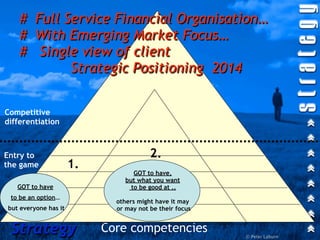
# Full Service Financial Organisation…
   # With Emerging Market Focus…
   # Single view of client
           Strategic Positioning 2014

Competitive
differentiation


Entry to                                2.
the game              1.
                                   GOT to have,
                                but what you want
   GOT to have                    to be good at ..
 to be an option…
                             others might have it may
but everyone has it          or may not be their focus


 Strategy                  Core competencies             © Peter Laburn
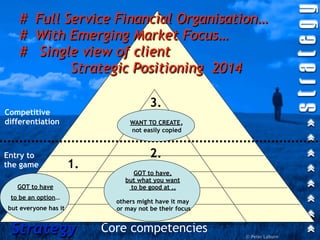
# Full Service Financial Organisation…
   # With Emerging Market Focus…
   # Single view of client
           Strategic Positioning 2014

                                        3.
Competitive
differentiation                  WANT TO CREATE,
                                 not easily copied


Entry to                                2.
the game              1.
                                   GOT to have,
                                but what you want
   GOT to have                    to be good at ..
 to be an option…
                             others might have it may
but everyone has it          or may not be their focus


 Strategy                  Core competencies             © Peter Laburn
The Change House


            Source: Ashridge Business School
The Change House


            Source: Ashridge Business School
Change House Business Cycle

  •Movement always anti clockwise
  •Business can never skip a room or go
  back in a clockwise direction
  •Leadership determine time spent in a
  specific room
  • Challenge: To stay in constant
  Renewal


                         Source: Ashridge Business School
Change House Business Cycle

  •Movement always anti clockwise
  •Business can never skip a room or go
  back in a clockwise direction
  •Leadership determine time spent in a
  specific room
  • Challenge: To stay in constant
  Renewal


                         Source: Ashridge Business School
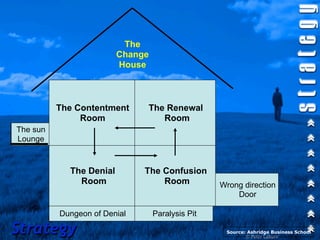
The
                         Change
                         House


          The Contentment     The Renewal
               Room              Room
The sun
Lounge


            The Denial        The Confusion
              Room                Room            Wrong direction
                                                      Door

          Dungeon of Denial       Paralysis Pit

Strategy                                           Source: Ashridge Business School
                                                          © Peter Laburn
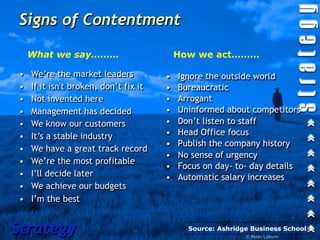
Signs of Contentment

    What we say………                         How we act………

•   We’re the market leaders           •   Ignore the outside world
•   If it isn't broken, don’t fix it   •   Bureaucratic
•   Not invented here                  •   Arrogant
•   Management has decided             •   Uninformed about competitors
•   We know our customers              •   Don’t listen to staff
•   It’s a stable industry             •   Head Office focus
                                       •   Publish the company history
•   We have a great track record
                                       •   No sense of urgency
•   We’re the most profitable
                                       •   Focus on day- to- day details
•   I’ll decide later                  •   Automatic salary increases
•   We achieve our budgets
•   I’m the best


Strategy                                     Source: Ashridge Business School
                                                            © Peter Laburn
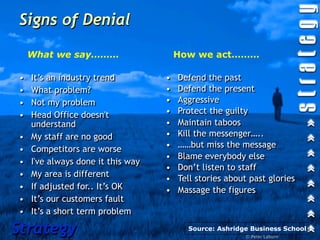
Signs of Denial

    What we say………                     How we act………

•   It’s an industry trend         •   Defend the past
•   What problem?                  •   Defend the present
•   Not my problem                 •   Aggressive
•   Head Office doesn't            •   Protect the guilty
    understand                     •   Maintain taboos
•   My staff are no good           •   Kill the messenger…..
                                   •   ……but miss the message
•   Competitors are worse
                                   •   Blame everybody else
•   I've always done it this way
                                   •   Don’t listen to staff
•   My area is different           •   Tell stories about past glories
•   If adjusted for.. It’s OK      •   Massage the figures
•   It’s our customers fault
•   It’s a short term problem

Strategy                                 Source: Ashridge Business School
                                                         © Peter Laburn
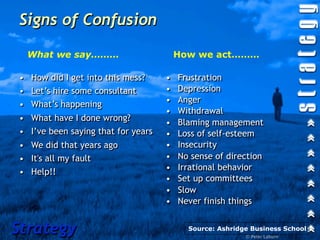
Signs of Confusion

 What we say………                         How we act………

• How did I get into this mess?     •   Frustration
• Let’s hire some consultant        •   Depression
                                    •   Anger
• What’s happening
                                    •   Withdrawal
• What have I done wrong?           •   Blaming management
• I’ve been saying that for years   •   Loss of self-esteem
• We did that years ago             •   Insecurity
• It's all my fault                 •   No sense of direction
                                    •   Irrational behavior
• Help!!
                                    •   Set up committees
                                    •   Slow
                                    •   Never finish things


Strategy                                  Source: Ashridge Business School
                                                         © Peter Laburn
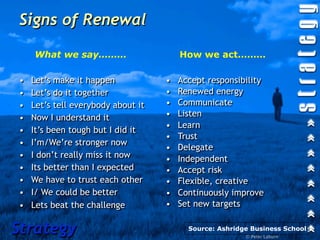
Signs of Renewal

    What we say………                      How we act………

•   Let’s make it happen            •   Accept responsibility
•   Let’s do it together            •   Renewed energy
•   Let’s tell everybody about it   •   Communicate
•   Now I understand it             •   Listen
                                    •   Learn
•   It’s been tough but I did it
                                    •   Trust
•   I’m/We’re stronger now
                                    •   Delegate
•   I don’t really miss it now      •   Independent
•   Its better than I expected      •   Accept risk
•   We have to trust each other     •   Flexible, creative
•   I/ We could be better           •   Continuously improve
•   Lets beat the challenge         •   Set new targets


Strategy                                  Source: Ashridge Business School
                                                         © Peter Laburn
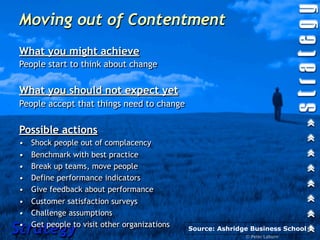
Moving out of Contentment
What you might achieve
People start to think about change


What you should not expect yet
People accept that things need to change


Possible actions
•   Shock people out of complacency
•   Benchmark with best practice
•   Break up teams, move people
•   Define performance indicators
•   Give feedback about performance
•   Customer satisfaction surveys
•   Challenge assumptions

Strategy
•   Get people to visit other organizations   Source: Ashridge Business School
                                                             © Peter Laburn
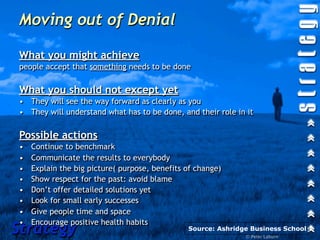
Moving out of Denial

What you might achieve
people accept that something needs to be done


What you should not except yet
• They will see the way forward as clearly as you
• They will understand what has to be done, and their role in it


Possible actions
•   Continue to benchmark
•   Communicate the results to everybody
•   Explain the big picture( purpose, benefits of change)
•   Show respect for the past: avoid blame
•   Don’t offer detailed solutions yet
•   Look for small early successes
•   Give people time and space
•   Encourage positive health habits
Strategy                                       Source: Ashridge Business School
                                                              © Peter Laburn
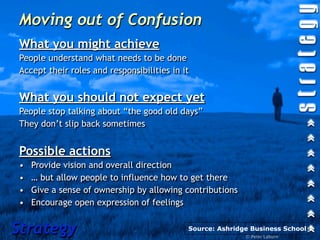
Moving out of Confusion
What you might achieve
People understand what needs to be done
Accept their roles and responsibilities in it


What you should not expect yet
People stop talking about “the good old days”
They don’t slip back sometimes


Possible actions
•   Provide vision and overall direction
•   … but allow people to influence how to get there
•   Give a sense of ownership by allowing contributions
•   Encourage open expression of feelings


Strategy                                    Source: Ashridge Business School
                                                           © Peter Laburn
The Strategic Change Process:


Strategy                   © Peter Laburn
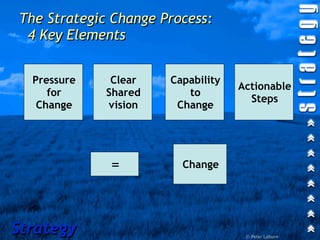
The Strategic Change Process:
 4 Key Elements


  Pressure    Clear   Capability
                                   Actionable
     for     Shared      to
                                     Steps
   Change    vision    Change


             =          Change


Strategy                            © Peter Laburn
The Strategic Change Process:
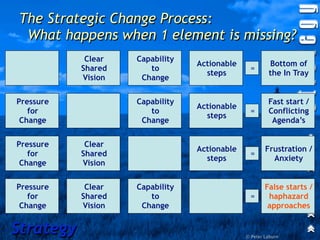
 What happens when 1 element is missing?


Strategy                             © Peter Laburn
The Strategic Change Process:
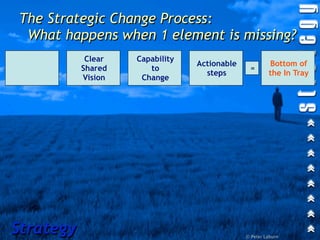
 What happens when 1 element is missing?
            Clear   Capability
                                 Actionable            Bottom of
           Shared      to                       =
                                   steps               the In Tray
           Vision    Change


Strategy                                      © Peter Laburn
The Strategic Change Process:
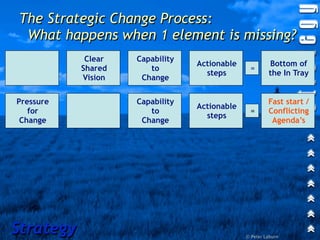
 What happens when 1 element is missing?
            Clear   Capability
                                 Actionable            Bottom of
           Shared      to                       =
                                   steps               the In Tray
           Vision    Change


Pressure            Capability                         Fast start /
                                 Actionable
   for                 to                       =      Conflicting
                                   steps
 Change              Change                             Agenda’s


Strategy                                      © Peter Laburn
The Strategic Change Process:
 What happens when 1 element is missing?
            Clear   Capability
                                 Actionable            Bottom of
           Shared      to                       =
                                   steps               the In Tray
           Vision    Change


Pressure            Capability                         Fast start /
                                 Actionable
   for                 to                       =      Conflicting
                                   steps
 Change              Change                             Agenda’s


Pressure    Clear
                                 Actionable           Frustration /
   for     Shared                               =
                                   steps                Anxiety
 Change    Vision


Strategy                                      © Peter Laburn
The Strategic Change Process:
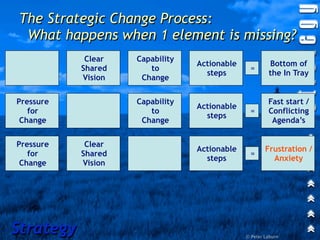
 What happens when 1 element is missing?
            Clear   Capability
                                 Actionable            Bottom of
           Shared      to                       =
                                   steps               the In Tray
           Vision    Change


Pressure            Capability                         Fast start /
                                 Actionable
   for                 to                       =      Conflicting
                                   steps
 Change              Change                             Agenda’s


Pressure    Clear
                                 Actionable           Frustration /
   for     Shared                               =
                                   steps                Anxiety
 Change    Vision


Pressure    Clear   Capability                        False starts /
   for     Shared      to                       =      haphazard
 Change    Vision    Change                            approaches


Strategy                                      © Peter Laburn
Strategic Thinking
 at Standard Bank

Your responsibility!
Strategic Thinking
 at Standard Bank

Your responsibility!
Pete Laburn

   – web:           http://www.petelaburn.com
   – email: petelaburn@iafrica.com
   – cell:                     +27 82 553 3198
   – Blog: petelaburn@wordpress.co.za
   – Twitter:                  petelaburn
                               Synthesis of this presentation by:
                       The TomorrowToday.biz frameworkers
     Multimedia courtesy of the naughty world of MP3 and MPG, as registered with SAMRO,
     and under international fair use regulations. Purchase the albums at our on-line store.


Strategy                                                                            © Peter Laburn

Standard Bank Presentation - PLi 2010

  • 1.
    Thinking Strategically in aGlobal Context PETE LABURN
  • 2.
    Thinking Strategically in aGlobal Context PETE LABURN
  • 3.
    “The trouble withour times is that the future is not what it used to be” Paul Valery Strategy © Peter Laburn
  • 4.
    Things are notwhat they used to be !! Strategy © Peter Laburn
  • 5.
  • 6.
    “It is difficultto get a man to understand something, when his salary depends on him not understanding it” Upton Sinclair 1860’s Strategy © Peter Laburn
  • 7.
    What % ofintended strategy actually gets implemented?
  • 8.
    What % ofintended strategy actually gets implemented?
  • 9.
    What % ofintended strategy actually gets implemented? Less than ….. 10 %
  • 10.
    What % ofintended strategy actually gets implemented? Less than ….. 10 % So 2 questions - why is it so low ? - why bother with a Strategic Process ?
  • 11.
    “Logical Incrementalism” ‘In realityorganizations proceeded by trial and error, constantly revising strategy in the light of experience’ James Quinn
  • 12.
    “Logical Incrementalism” ‘In realityorganizations proceeded by trial and error, constantly revising strategy in the light of experience’ James Quinn
  • 13.
    Is strategy created…. or does it evolve ????? Strategy © Peter Laburn
  • 14.
    Strategy – would loveto do it, but we are too busy with today’s challenges
  • 15.
    Strategy – would loveto do it, but we are too busy with today’s challenges
  • 16.
    Strategy is notOperation Tactics Strategy © Peter Laburn
  • 17.
    Strategy is notOperation Tactics • Strategy - are we really doing the right things? Are we effectively going in the right direction bearing in mind all the things that are changing? Strategy © Peter Laburn
  • 18.
    Strategy is notOperation Tactics • Strategy - are we really doing the right things? Are we effectively going in the right direction bearing in mind all the things that are changing? • Operational Tactics - the things that we choose to do, do we do them right / really well, with maximum efficiency? Strategy © Peter Laburn
  • 19.
    Strategy vs Tactics HIGH EFFICIENCY TACTICS Doing things right LOW EFFICIENCY LOW HIGH EFFECTIVENESS EFFECTIVENESS Source : Prof M McDonald STRATEGY Doing the right things Strategy © Peter Laburn
  • 20.
    Strategy vs Tactics HIGH EFFICIENCY TACTICS Doing things right DIE SLOWLY LOW EFFICIENCY LOW HIGH EFFECTIVENESS EFFECTIVENESS Source : Prof M McDonald STRATEGY Doing the right things Strategy © Peter Laburn
  • 21.
    Strategy vs Tactics HIGH EFFICIENCY DIE QUICKLY TACTICS Doing things right DIE SLOWLY LOW EFFICIENCY LOW HIGH EFFECTIVENESS EFFECTIVENESS Source : Prof M McDonald STRATEGY Doing the right things Strategy © Peter Laburn
  • 22.
    Strategy vs Tactics HIGH EFFICIENCY DIE QUICKLY TACTICS Doing things right DIE SLOWLY SURVIVE LOW EFFICIENCY LOW HIGH EFFECTIVENESS EFFECTIVENESS Source : Prof M McDonald STRATEGY Doing the right things Strategy © Peter Laburn
  • 23.
    Strategy vs Tactics HIGH EFFICIENCY DIE QUICKLY THRIVE TACTICS Doing things right DIE SLOWLY SURVIVE LOW EFFICIENCY LOW HIGH EFFECTIVENESS EFFECTIVENESS Source : Prof M McDonald STRATEGY Doing the right things Strategy © Peter Laburn
  • 24.
    Strategy – things aregoing well .. don’t rock the boat!
  • 25.
    Strategy – things aregoing well .. don’t rock the boat!
  • 26.
    Hidden realities ofchange Change comes at us … without asking permission without making a sound without giving us a template of how to cope Strategy © Peter Laburn
  • 27.
  • 28.
  • 29.
    Strategy – is aboutchange And we are ‘creatures of habit’
  • 30.
    “ If wewant things to stay as they are, things will have to change” di Lampedusa - The Leopard Strategy © Peter Laburn
  • 31.
    Change Imperative Rate ofchange Time 90’s 2000’s 2010’s Strategy © Peter Laburn
  • 32.
    Change Imperative Rate ofchange 2 years Time 90’s 2000’s 2010’s Strategy © Peter Laburn
  • 33.
    Change Imperative Rate ofchange } catch up 2 years Time 90’s 2000’s 2010’s Strategy © Peter Laburn
  • 34.
    Change Imperative Rate ofchange 2 years } catch up 2 years Time 90’s 2000’s 2010’s Strategy © Peter Laburn
  • 35.
    Change Imperative catch up? Rate of change 2 years } catch up 2 years Time 90’s 2000’s 2010’s Strategy © Peter Laburn
  • 36.
    Strategies need tobe changed – not because the historical strategies may have been wrong , but because past strategies (however good they were) may be obsolete and no longer appropriate … the rules have changed Strategy © Peter Laburn
  • 37.
    Times of Turbulence “The greatest danger in times of turbulence is not the turbulence, it is to act with yesterdays logic” Peter Drucker Strategy © Peter Laburn
  • 38.
    Strategic Readiness Beyond necessary = Imperative Do you know with certainty where your industry is going over the next 5 years? YES NO YES 1 2 Can Standard Bank cope ? NO 3 4 Strategy © Peter Laburn
  • 39.
    Strategic Readiness Beyond necessary = Imperative Do you know with certainty where your industry is going over the next 5 years? YES NO YES 1 2 Can Standard Bank cope ? NO 3 4 Strategy © Peter Laburn
  • 40.
    DOING WHAT YOUHAVE ALWAYS BEEN DOING AND EXPECTING DIFFERENT RESULTS Peter Laburn International
  • 41.
    INSANITY DOING WHAT YOUHAVE ALWAYS BEEN DOING AND EXPECTING DIFFERENT RESULTS Peter Laburn International
  • 42.
    Strategy as Revolution “Ibelieve that only those companies that are capable of reinventing themselves and their industry in a profound way, will be around in a decade hence” Gary Hamel Strategy © Peter Laburn
  • 43.
    Strategy is aholistic process 10.15am
  • 44.
    Strategy is aholistic process 10.15am
  • 45.
    Strategic Drive Chain EXTERNAL INTERNAL G G ING AL IP RS GIN GIN NG ET GY ION S SH LDE AN LD AN TRY A ICS T ISA IE ER HO CH OR CH UN CH ARK ATE CT AN BILIT LEA D KE W CO M STR TA G OR APA STA C FORMULATION IMPLEMENTATION Source: Peter Laburn Strategy © Peter Laburn
  • 46.
    Disney’s Purpose andValues Purpose – “ To make people happy” Values – – Safety – Courtesy – The Show – Efficiency These are ranked in order of priority Strategy © Peter Laburn
  • 47.
    Strategic Drive Chain EXTERNAL INTERNAL G G ING AL IP RS GIN GIN NG ET GY ION S SH LDE AN LD AN TRY A ICS T ISA IE ER HO CH OR CH UN CH ARK ATE CT AN BILIT LEA D KE W CO M STR TA G OR APA STA C FORMULATION IMPLEMENTATION Source: Peter Laburn Strategy © Peter Laburn
  • 48.
    Strategic Drive Chain EXTERNAL INTERNAL G G ING AL IP RS GIN GIN NG ET GY ION S SH LDE AN LD AN TRY A ICS T ISA IE ER HO CH OR CH UN CH ARK ATE CT AN BILIT LEA D KE W CO M STR TA G OR APA STA C FORMULATION IMPLEMENTATION Source: Peter Laburn Strategy © Peter Laburn
  • 49.
    WHAT SHAPES OURFUTURE ? Past thinking of Futurist’s 80 % continuation 15 % cycles 5 % novelty Strategy © Peter Laburn
  • 50.
    WHAT SHAPES OURFUTURE ? Past thinking of Futurist’s Current thinking of Futurist’s 80 % continuation 5 % continuation 15 % cycles 15 % cycles 5 % novelty 80 % novelty Strategy © Peter Laburn
  • 51.
    A Move toQuantum Thinking Newtonian Quantum • Simplicity • Complexity • Control • Influence • Separation • Integration • Uniformity • Diversity • Enquiry • Certainty • Multi causes • Cause and effect • Systems thinking • Linear logic • Synthetic thinking • Binary logic • Intuition • Empiricism Strategy © Peter Laburn
  • 52.
    CURRENT VS IDEALFUTURES CURRENT REALITY 2010 Strategy © Peter Laburn
  • 53.
    CURRENT VS IDEALFUTURES CURRENT REALITY 2010 Strategy © Peter Laburn
  • 54.
    CURRENT VS IDEALFUTURES CURRENT CURRENT FUTURE REALITY 2015 2010 Strategy © Peter Laburn
  • 55.
    CURRENT VS IDEALFUTURES CURRENT CURRENT FUTURE REALITY 2015 2010 CONTINUATION Strategy © Peter Laburn
  • 56.
    CURRENT VS IDEALFUTURES IDEAL FUTURE 2015 CURRENT CURRENT FUTURE REALITY 2015 2010 CONTINUATION Strategy © Peter Laburn
  • 57.
    CURRENT VS IDEALFUTURES IDEAL FUTURE 2015 CURRENT CURRENT FUTURE REALITY 2015 2010 CONTINUATION Strategy © Peter Laburn
  • 58.
    CURRENT VS IDEALFUTURES IDEAL FUTURE 2015 NOVELTY CURRENT CURRENT FUTURE REALITY 2015 2010 CONTINUATION Strategy © Peter Laburn
  • 59.
    CURRENT VS IDEALFUTURES IDEAL FUTURE 2015 NOVELTY CURRENT CURRENT FUTURE REALITY 2015 2010 CONTINUATION Strategy © Peter Laburn
  • 60.
    CURRENT VS IDEALFUTURES IDEAL FUTURE 2015 NOVELTY CURRENT CURRENT FUTURE REALITY 2015 2010 CONTINUATION Strategy © Peter Laburn
  • 61.
    CURRENT VS IDEALFUTURES IDEAL FUTURE 2015 NOVELTY CURRENT CURRENT FUTURE REALITY 2015 2010 CONTINUATION Strategy © Peter Laburn
  • 62.
    The Missing Dimension The Prevailing Approach: What Is Missing: Strategy as Strategy as a a Set Solution Dynamic Process A long-term sustainable Creation of value competitive advantage Goal CEO as chief strategist; the The CEO and strategy consultants Leadership job cannot be outsourced Unchanging plan that derives from an analytical, left-brain Form Organic process that is adaptive, exercise holistic, and open-ended Intense period of formulation followed by prolonged period Time Everyday, continuous, unending of implementation Frame Defending an established Ongoing Fostering competitive advantages and strategy through time Activity developing the company through time Montgomery: Putting Leadership back into Strategy Strategy © Peter Laburn
  • 63.
    Strategy by RouteMap. Source: Peter Laburn Strategy © Peter Laburn
  • 64.
    Strategy by RouteMap. Where
we
 are
today Source: Peter Laburn Strategy © Peter Laburn
  • 65.
    Strategy by RouteMap. Where
we
 want
to
be Where
we
 are
today Source: Peter Laburn Strategy © Peter Laburn
  • 66.
    Strategy by RouteMap. Where
we
 want
to
be What
you 
will
do Where
we
 are
today Source: Peter Laburn Strategy © Peter Laburn
  • 67.
    Strategy by RouteMap. Where
we
 want
to
be What
you 
will
do Where
we
 are
today Source: Peter Laburn Strategy © Peter Laburn
  • 68.
    Strategy by RouteMap. Where
we
 want
to
be What
you 
will
do Where
we
 are
today Source: Peter Laburn Strategy © Peter Laburn
  • 69.
    Strategy by RouteMap. Where
we
 want
to
be What
you 
will
do Where
we
 are
today Source: Peter Laburn Strategy © Peter Laburn
  • 70.
    Strategy by RouteMap. Where
we
 want
to
be What
you 
will
do Where
we
 are
today Source: Peter Laburn Strategy © Peter Laburn
  • 71.
    Strategy by RouteMap. Where
we
 want
to
be What
you 
will
do Where
we
 are
today Source: Peter Laburn Strategy © Peter Laburn
  • 72.
    Strategy by RouteMap. Where
we
 want
to
be What
you 
will
do Where
we
 are
today Source: Peter Laburn Strategy © Peter Laburn
  • 73.
    Strategy by RouteMap. Where
we
 want
to
be What
you 
will
do Where
we
 are
today Source: Peter Laburn Strategy © Peter Laburn
  • 74.
    Strategy by RouteMap. Where
we
 want
to
be What
you 
will
do Where
we
 are
today Source: Peter Laburn Strategy © Peter Laburn
  • 75.
    Strategy by RouteMap. Where
we
 want
to
be What
you 
will
do Where
we
 are
today After: Henry Mintzberg Source: Peter Laburn Strategy © Peter Laburn
  • 76.
    Strategy by RouteMap. Where
we
 3
Strategic
Fallacies
 want
to
be Predic1on
 Detachment Formaliza1on What
you 
will
do Where
we
 are
today After: Henry Mintzberg Source: Peter Laburn Strategy © Peter Laburn
  • 77.
    Strategy by RouteMap. Where
we
 3
Strategic
Fallacies
 want
to
be Predic1on
 Detachment Formaliza1on What
you 
will
do Where
we
 are
today After: Henry Mintzberg Source: Peter Laburn Strategy © Peter Laburn
  • 78.
    Strategy by RouteMap. Where
we
 3
Strategic
Fallacies
 want
to
be Predic1on
 Detachment Formaliza1on What
you 
will
do Where
we
 are
today After: Henry Mintzberg Source: Peter Laburn Strategy © Peter Laburn
  • 79.
    Strategy by RouteMap. Where
we
 3
Strategic
Fallacies
 want
to
be Predic1on
 Detachment Formaliza1on What
you 
will
do Where
we
 are
today After: Henry Mintzberg Source: Peter Laburn Strategy © Peter Laburn
  • 80.
    Strategy by RouteMap. Where
we
 3
Strategic
Fallacies
 want
to
be Predic1on
 CEO Detachment Chief Extraction Officer Formaliza1on What
you 
will
do Where
we
 are
today After: Henry Mintzberg Source: Peter Laburn Strategy © Peter Laburn
  • 81.
    Strategy by G.P.S. Source: Peter Laburn Strategy © Peter Laburn
  • 82.
    Strategy by G.P.S. After: Margaret Wheatley Source: Peter Laburn Strategy © Peter Laburn
  • 83.
  • 84.
  • 85.
  • 86.
  • 87.
  • 88.
    Strategy by G.P.S. Lessons
from
Nature Where
we
 Field
Theory want
to
be Molecular
Biology Quantum
Physics Chaos
Theory Where
we
 are
today After: Margaret Wheatley Source: Peter Laburn Strategy © Peter Laburn
  • 89.
    Strategy by G.P.S. Lessons
from
Nature Where
we
 Field
Theory want
to
be Molecular
Biology Quantum
Physics Chaos
Theory Where
we
 are
today After: Margaret Wheatley Source: Peter Laburn Strategy © Peter Laburn
  • 90.
    Strategy by G.P.S. Lessons
from
Nature Where
we
 Field
Theory want
to
be Molecular
Biology Quantum
Physics Chaos
Theory What
you 
will
NOT
do Philosophically Strategically Opera1onally Where
we
 Behaviourally are
today After: Margaret Wheatley Source: Peter Laburn Strategy © Peter Laburn
  • 91.
    Strategy by G.P.S. Lessons
from
Nature Where
we
 Field
Theory want
to
be Molecular
Biology Quantum
Physics Chaos
Theory What
you 
will
NOT
do Philosophically Strategically Opera1onally Where
we
 Behaviourally are
today After: Margaret Wheatley Source: Peter Laburn Strategy © Peter Laburn
  • 92.
    Strategy by G.P.S. Lessons
from
Nature Where
we
 Field
Theory want
to
be Molecular
Biology Quantum
Physics Chaos
Theory What
you 
will
NOT
do Philosophically Strategically Opera1onally Where
we
 Behaviourally are
today After: Margaret Wheatley Source: Peter Laburn Strategy © Peter Laburn
  • 93.
    Strategy by G.P.S. Lessons
from
Nature Where
we
 Field
Theory Create
a
strategic
field want
to
be Molecular
Biology Open
source
info
flow Quantum
Physics Maximize
rela1onships Chaos
Theory Let
mild
chaos
flow What
you 
will
NOT
do Philosophically Strategically Opera1onally Where
we
 Behaviourally are
today After: Margaret Wheatley Source: Peter Laburn Strategy © Peter Laburn
  • 94.
    Strategy by G.P.S. Lessons
from
Nature Where
we
 Field
Theory Create
a
strategic
field want
to
be Molecular
Biology Open
source
info
flow Quantum
Physics Maximize
rela1onships Chaos
Theory Let
mild
chaos
flow What
you 
will
NOT
do Philosophically Strategically Opera1onally Where
we
 Behaviourally are
today After: Margaret Wheatley Source: Peter Laburn Strategy © Peter Laburn
  • 95.
    Strategy by G.P.S. Lessons
from
Nature Where
we
 Field
Theory Create
a
strategic
field want
to
be Molecular
Biology Open
source
info
flow Quantum
Physics Maximize
rela1onships Chaos
Theory Let
mild
chaos
flow What
you 
will
NOT
do Philosophically Strategically Opera1onally Where
we
 Behaviourally are
today After: Margaret Wheatley Source: Peter Laburn Strategy © Peter Laburn
  • 96.
    Strategy by G.P.S. Lessons
from
Nature Where
we
 Field
Theory Create
a
strategic
field want
to
be Molecular
Biology Open
source
info
flow Quantum
Physics Maximize
rela1onships Chaos
Theory Let
mild
chaos
flow What
you 
will
NOT
do Philosophically Strategically Opera1onally Where
we
 Behaviourally are
today After: Margaret Wheatley Source: Peter Laburn Strategy © Peter Laburn
  • 97.
    Strategy by G.P.S. Lessons
from
Nature Where
we
 Field
Theory Create
a
strategic
field want
to
be Molecular
Biology Open
source
info
flow Quantum
Physics Maximize
rela1onships Chaos
Theory Let
mild
chaos
flow What
you 
will
NOT
do Philosophically Strategically Opera1onally Where
we
 Behaviourally are
today After: Margaret Wheatley Source: Peter Laburn Strategy © Peter Laburn
  • 98.
    Strategy by G.P.S. Lessons
from
Nature Where
we
 Field
Theory Create
a
strategic
field want
to
be Molecular
Biology Quantum
Physics Open
source
info
flow Maximize
rela1onships CEO Chaos
Theory Let
mild
chaos
flow Chief Enabling Officer What
you 
will
NOT
do Philosophically Strategically Opera1onally Where
we
 Behaviourally are
today After: Margaret Wheatley Source: Peter Laburn Strategy © Peter Laburn
  • 100.
    Some Newer Thoughts on Strategic Thinking
  • 101.
    Strategic Intuition Ref : William Duggan Intuition = flashes of insight 1.Ordinary intuition – a feeling, gut feel, instinct 2.Expert intuition – snap judgements instantly recognizable, something familiar, knowing where the ball will go if you hit it. Known, existing spaces – seeing patterns Strategy © Peter Laburn
  • 102.
    Strategic Intuition -cont Ref : William Duggan 3. Strategic Intuition – – Doesn’t start with a ‘big idea’ – Begins by being open to possibilities – Builds off other (very different) ideas – It’s a clear thought, it slowly evolves – Not fast or impulsive – It is edified by a multiplicity of factors – Takes you into unknown, new spaces – Once ‘flash of insight’ occurs - strike fast, pursue relentlessly Strategy © Peter Laburn
  • 103.
    A Brief perspective…von Clausewitz Strategy Source: Strategic Intuition by William Duggan © Peter Laburn
  • 104.
    A Brief perspective…von Clausewitz Examples from History - strategic intuition draws on the knowledge and experience of all of history far and wide, all stored in the shelves of the mind Presence of mind - refers to a clear mind, clear of all expectations and previous ideas of what you might do or even what your goal is. Flash of insight - In a free mind selected elements from various examples come together in a new combination. Resolution i.e. Resolve / determination - you not only need to see what to do but also be ready to do it. The flash of insight carries with it the force of action that propels you forward, but you need the resolve to push on and make your strategy happen Strategy Source: Strategic Intuition by William Duggan © Peter Laburn
  • 105.
    Obliquity Why !!Our goals are best achieved indirectly eg !! The Happiest people don’t pursue happiness !! The Wealthiest people don’t puruse materialism !! The most profitable companies are not the most profit orientated Think “Snakes and Ladders” Strategy © Peter Laburn
  • 106.
    The need forObliquity Muddling through – why obliquity succeeds Pluralism – why there is usually more than one answer to any problem Interaction – why the outcome of what we do depends on why we do it Complexity – how the world is too complex for directness to be direct Incompleteness – how we rarely know enough about the nature of our problems Abstraction – why models are imperfect descriptions of reality Strategy © Peter Laburn
  • 107.
    Some current realities !! We mistakingly infer design from outcome !! We have less freedom of choice than we think !! Decision makers don’t recognise the limits of their knowledge !! Adaptation is smarter than we are !! We know more than we can tell !! Complex outcomes are achieved without knowledge of an overall purpose !! It is more important to be right that to be consistent !! Spurious rationality is often confused with good decision making Strategy © Peter Laburn
  • 108.
    ACTIONS THE STRATEGIC FRAMEWORK © Peter Laburn International STRATEGIC MUST WIN BATTLES MEASUREMENT CAPACITY DEVELOPMENT ACTIONS Key initiatives that must CRITERIA Structure, systems and Both minimum be achieved, but results How business growth and Resource implications – what requirements and not entirely strategic implementation is needed to deliver future core competency in own hands will be measured / strategies development governed PROPOSITION ANTICIPATED RESULTS STRATEGIES 3 – 5 yr VISION PLAYING FIELD What results the strategy What we will do What our business will look What we will not should deliver Key strategic like do thrust that will Conceptual outputs, Philosophically ensure vision is Target market focus Strategically KEY TRIGGER POINTS achieved Geographic domain, Operationally When strategy would need to be Strategic differentiation Behaviourally re-assessed CULTURE MARKET INSIGHTS KEY UNCERTAINTIES How we do things Unique understanding What are the unknowns CONTEXT VALUES MARKET REALITIES RULES OF THE GAME How we behave Corporate performance How the market operates B.U.market share / growth 12 month performance PURPOSE Competitor review KEY DRIVERS Our reason for being Research undertaken What really influences our thinking Our anticipated legacy Value chain analysis Strategy CHANGING WORLD - What is changing in our world © Peter Laburn
  • 109.
    How the environmentis changing Ref Porter’s PESTIR Analysis POLITICAL/LEGAL ISSUES ECONOMIC ISSUES Global leadership changing Emerging markets – BRIC New legislation Global recession ,GDP ,Consumer confidence Government / Union / Business relations Government bailouts, Investment factors Global trading blocks Oil price / alternative currencies Political instability Interest and exchange rates Access to capital SOCIAL ISSUES TECHNOLOGY ISSUES Demographic changes ICT convergence Urbanization The competitive Open source world Consumerism / affluenza Clash of Values / cultures environment Social networking Bio technology advances Life expectancy Genetic modification Fundamentalism Intellectual property INSTITUTIONAL RESOURCE ISSUES Connection economy Environmental issues Changing world of work Global ‘Weirding’ Fragmentation of organizations Sustainable energy Blurring of boundaries - Value chains Global food, energy shortage Distribution rules Global skills shortage Strategy Shifting balance of stakeholder power Exploitation of resources © Peter Laburn
  • 110.
    POLITICAL ECONOMIC •Global leadership change – SA, USA, other •Emerging economies & their strength – China, India, Brazil, •Increasing & changing compliance & legislation – global, SA, Greater Central Asia, Asian Tigers, SA consumer protection, common / universal •Potential global recession & financial bail outs •BBBEE – nuances in each country •Costs of living rising – interest rates, power, inflation, food •SA Government delivery or lack thereof prices, oil … •Global trading blocks – commitment to SADC union by 2014 •Growing poverty gap & pressure for global poverty relief •Underfunded pension industry SOCIAL •2010 World Cup •Growth of middle class globally •Estimated strong SA economic growth through 2014 •“Americums” – the pursuit of materialism (western influence) •Infrastructure investment of R410 billion •Clash of multiple cultures, religions, value systems (West v •Angolan growth – straight line extrapolation is Africa’s East) strongest economy by 2025 (driven by international investment, •Life expectancy increasing (developed nations) and decreasing oil) (developing nations) •“Affluenza” - •Impact of diseases & AIDS •Alternative currencies – e.g. carbon credits •Access to medicines •Rampant consumerism (“vigilante consumers”) TECHNOLOGICAL •Tribalisation – the association / identification with a group •ICT (Information, Communication, Technology) convergence •Fundamentalism •Virtual, highly mobile world •Globalisation vs cocooning (xenophobia) •Cellular •Crime •Telematics (auto & mobile technology information & •Terrorism interaction) •White collar crime •Open source world – access to information – anyone, where, •Urbanisation & de-urbanisation time, how •Declining levels of education •Social networking (blogs, wiki’s, facebook, twitter, mixit, •Confused legislation webinar’s ) •Role of teachers as moral guides •Bio-technology – •Environmental responsibility – green revolution •Genetic modification – people, food •Changing the face of agriculture & forestry INSTITUTIONAL •Connection economy •Changing world of work RESOURCES •Generations (Boomer, Gen X, Gen Y) •Global weirding – climate change •Rising role of women •Increasing natural catastrophes •Retirement becoming obsolete •New diseases & epidemics •Skill shortage & talent mobility •Energy from heaven and hell •Growth in outsourcing – work flows to where it’s best suited •Sustainability (especially commodity skills) •Increasing demand •Ownership of customer – distribution ‘rules’ •Future wars over water •Blurring of boundaries - consolidation of industries •Global food shortages •Services revolution (manufacturing to service… experience) •SA infrastructure – failure & development Strategy •Stakeholder responsibility & balance of power shifting •Fragmentationism – move away from ‘big organisation’ •Rail regeneration & Gautrain •Exploitation of Africa for natural resources (particularly from China) © Peter Laburn
  • 111.
    Business Philosophies /Purpose • Excellence / Premium quality – ………….. delivers the highest quality products / service / support in ………. market • Discovery – …………. offers most innovative / refreshing approach to products / service in the ……….. market • Altruism – …………. is caring and supportive in its product design and service delivery – always there for valued clients • Heroism – …………. has set itself the goal of leading change by leading a cause for ……….. in the market • Exploitation – Just get the bottom line budget – meet financial Strategy Source: Mourkogiannis - Guide to Moral Purpose © Peter Laburn
  • 112.
    How it allfits together… Strategy HBR April 2008: Can You Say What Your Strategy Is? p82 © Peter Laburn
  • 113.
    How it allfits together… Purpose /Mission Why we exist Strategy HBR April 2008: Can You Say What Your Strategy Is? p82 © Peter Laburn
  • 114.
    How it allfits together… Purpose /Mission Why we exist Values What we believe in & how we will behave Strategy HBR April 2008: Can You Say What Your Strategy Is? p82 © Peter Laburn
  • 115.
    How it allfits together… Purpose /Mission Why we exist Values What we believe in & how we will behave Vision What we want to be Strategy HBR April 2008: Can You Say What Your Strategy Is? p82 © Peter Laburn
  • 116.
    How it allfits together… Purpose /Mission Why we exist Values What we believe in & how we will behave Vision What we want to be Strategy What our competitive game plan will be Strategy HBR April 2008: Can You Say What Your Strategy Is? p82 © Peter Laburn
  • 117.
    How it allfits together… Purpose /Mission Why we exist Values What we believe in & how we will behave Vision What we want to be Strategy The Basic Elements of What our competitive A Strategy Statement game plan will be Objective = Ends Scope = Domain Advantage = Means Strategy HBR April 2008: Can You Say What Your Strategy Is? p82 © Peter Laburn
  • 118.
    How it allfits together… Purpose /Mission Why we exist The single precise objective that Values will drive the business over the What we believe in & next 5 years or so. Specific, how we will behave measurable, and time bound. It should be a single goal Vision What we want to be Strategy The Basic Elements of What our competitive A Strategy Statement game plan will be Objective = Ends Scope = Domain Advantage = Means Strategy HBR April 2008: Can You Say What Your Strategy Is? p82 © Peter Laburn
  • 119.
    How it allfits together… Purpose /Mission Why we exist Values What we believe in & The customer or offering; geographic how we will behave location & integration. Should also include where the business will not go. Vision What we want to be Strategy The Basic Elements of What our competitive A Strategy Statement game plan will be Objective = Ends Scope = Domain Advantage = Means Strategy HBR April 2008: Can You Say What Your Strategy Is? p82 © Peter Laburn
  • 120.
    How it allfits together… Purpose /Mission Why we exist Values The most critical. What makes the What we believe in & business distinctive. Incorporates the how we will behave value proposition as well as the unique activities that allows the business to deliver on the value proposition Vision What we want to be Strategy The Basic Elements of What our competitive A Strategy Statement game plan will be Objective = Ends Scope = Domain Advantage = Means Strategy HBR April 2008: Can You Say What Your Strategy Is? p82 © Peter Laburn
  • 121.
    An alternative perspective • The ideal strategy should include:- • Truth - describes the world as it is • Assertions - describes how you are going to change things • Alternatives - describes the options you have when you original assertions don’t work • People - describes who is on your team / who will join team and why they will be • Money - describes how much you need to make plan happen , cash flows P+L’s etc Seth Godin - blog May 2010 Strategy © Peter Laburn
  • 122.
    Vision – whatour business will look like •What game are we in ? •How do we add value ? •What competencies needed ? •What differentiation ? •What is sustainable ? Strategy © Peter Laburn
  • 123.
    Strategy Statement “We
aspire
to
be
a
leading
 emerging
markets
financial
 services
organisa1on” Strategy © Peter Laburn
  • 124.
    – Group strategicstatement “We
 aim
 to
 build
 a
 leading
 emerging
 markets
 financial
 services
 organiza=on
 using
 all
 our
 compe==ve
advantages
to
the
full. We
 focus
 on
 delivering
 superior
 sustainable
 shareholder
 value
 by
 cost
 effec=vely
 serving
 the
 needs
 of
 our
 customers
 and
 where
 appropriate,
 connec=ng
them
globally. The
key
to
achieving
our
strategy
is
our
people” Strategy © Peter Laburn
  • 125.
    9 Key StrategicDeliverables • 


1.
Grow,
develop
and
recognize
our
people
 • 


2.
Ensure
our
values
live
and
grow
within
the
organisa1on


 3.
Promote
a
nimble
and
proac1ve
approach
to
our
customers 4.
Deliver
superior
returns
and
sustainable
growth
for
shareholders 5.
Ensure
that
the
three
core
business
units
work
together
and
maximize
on
 the
synergies. 6.
We've
got
to
build
a
strong
and
unified
brand 7.
Deploy
our
scarce
capital
appropriately 8.
Constantly
balance
risk
and
return
and
also
ensure
appropriate
corporate
 governance 9.
Create
a
world
class
infrastructure,
with
the
emphasis
on
cost
efficiency Strategy © Peter Laburn
  • 126.
    BUILDING A STRATEGIC PROPOSITION Strategy © Peter Laburn
  • 127.
    Remember Maslow ? Self Actualization Self Esteem Love and Friendship Safety Needs Shelter , security Physiological Needs Hunger , Thirst Strategy © Peter Laburn
  • 128.
    Along came Hertzberg… Self Actualization Self Esteem Motivating factors Love and Friendship Safety Needs Shelter , security Hygiene factors Physiological Needs Hunger , Thirst Strategy © Peter Laburn
  • 129.
  • 130.
    Building Market Strategy Entry to the Game If you don’t offer “this ..” you are not an option Strategy © Peter Laburn
  • 131.
    Building Market Strategy Competitive Advantage what will differentiate you from competitors Entry to the Game If you don’t offer “this ..” you are not an option Strategy © Peter Laburn
  • 132.
    Core Competence Competitive Advantage Entry to the game Strategy © Peter Laburn
  • 133.
    Core Competence Competitive Advantage Entry to the Core Competence game Strategy © Peter Laburn
  • 134.
    Core Competence Competitive Advantage Entry to the Core Competence game What you are really good at What you focus on Strategy © Peter Laburn
  • 135.
    Core Competence Competitive Advantage Tactical Advantage use it while you have it Entry to the Core Competence game What you are really good at What you focus on Strategy © Peter Laburn
  • 136.
    Core Competence Competitive Advantage Sustained Advantage Tactical Advantage is difficult for anyone to copy use it while you have it Entry to the Core Competence game What you are really good at What you focus on Strategy © Peter Laburn
  • 137.
    Core Competence Competitive Advantage Sustained Advantage Tactical Advantage is difficult for anyone to copy use it while you have it Entry to the Core Competence game What you are really good at What you focus on Strategy © Peter Laburn
  • 138.
    Core Competence Competitive Advantage Sustained Advantage Tactical Advantage is difficult for anyone to copy use it while you have it Entry to the Core Competence game What you are really good at What you focus on Strategy © Peter Laburn
  • 139.
    Core Competence No advantage Competitive anymore !! Advantage Sustained Advantage Tactical Advantage is difficult for anyone to copy use it while you have it Entry to the Core Competence game What you are really good at What you focus on Strategy © Peter Laburn
  • 140.
    Core Competence Sustained Advantage is difficultadvantage No for anyone Competitive anymore !! to copy Advantage Tactical Advantage use it while you have it Entry to the Core Competence game What you are really good at What you focus on Strategy © Peter Laburn
  • 141.
    Strategic Positioning CORE COMPETENCE CORE COMPETENCE Strategy © Peter Laburn
  • 142.
    Strategic Positioning Must doto be in game – but CORE COMPETENCE not core CORE COMPETENCE Strategy © Peter Laburn
  • 143.
    Strategic Positioning Must doto be in game – but CORE COMPETENCE not core Must do and core. CORE COMPETENCE What you build your Strategy business on © Peter Laburn
  • 144.
    Strategic Positioning Tactical Advantage capitalize while you can Must do to be in game – but CORE COMPETENCE not core Must do and core. CORE COMPETENCE What you build your Strategy business on © Peter Laburn
  • 145.
    Strategic Positioning Tactical Advantage capitalize Sustained while you Advantage can build future Strategy on Must do to be in game – but CORE COMPETENCE not core Must do and core. CORE COMPETENCE What you build your Strategy business on © Peter Laburn
  • 146.
    “The ‘surplus society’has a surplus of similar companies, employing similar people, with similar educational backgrounds, coming up with similar ideas, producing similar things, with similar prices and similar quality.” Funky Business Kjell Nordström and Jonas Ridderstråle Strategy © Peter Laburn
  • 147.
    # Full ServiceFinancial Organisation… # With Emerging Market Focus… # Single view of client Strategic Positioning 2014 Competitive differentiation Entry to 2. the game 1. GOT to have, but what you want GOT to have to be good at .. to be an option… others might have it may but everyone has it or may not be their focus Strategy Core competencies © Peter Laburn
  • 148.
    # Full ServiceFinancial Organisation… # With Emerging Market Focus… # Single view of client Strategic Positioning 2014 3. Competitive differentiation WANT TO CREATE, not easily copied Entry to 2. the game 1. GOT to have, but what you want GOT to have to be good at .. to be an option… others might have it may but everyone has it or may not be their focus Strategy Core competencies © Peter Laburn
  • 149.
    The Change House Source: Ashridge Business School
  • 150.
    The Change House Source: Ashridge Business School
  • 151.
    Change House BusinessCycle •Movement always anti clockwise •Business can never skip a room or go back in a clockwise direction •Leadership determine time spent in a specific room • Challenge: To stay in constant Renewal Source: Ashridge Business School
  • 152.
    Change House BusinessCycle •Movement always anti clockwise •Business can never skip a room or go back in a clockwise direction •Leadership determine time spent in a specific room • Challenge: To stay in constant Renewal Source: Ashridge Business School
  • 153.
    The Change House The Contentment The Renewal Room Room The sun Lounge The Denial The Confusion Room Room Wrong direction Door Dungeon of Denial Paralysis Pit Strategy Source: Ashridge Business School © Peter Laburn
  • 154.
    Signs of Contentment What we say……… How we act……… • We’re the market leaders • Ignore the outside world • If it isn't broken, don’t fix it • Bureaucratic • Not invented here • Arrogant • Management has decided • Uninformed about competitors • We know our customers • Don’t listen to staff • It’s a stable industry • Head Office focus • Publish the company history • We have a great track record • No sense of urgency • We’re the most profitable • Focus on day- to- day details • I’ll decide later • Automatic salary increases • We achieve our budgets • I’m the best Strategy Source: Ashridge Business School © Peter Laburn
  • 155.
    Signs of Denial What we say……… How we act……… • It’s an industry trend • Defend the past • What problem? • Defend the present • Not my problem • Aggressive • Head Office doesn't • Protect the guilty understand • Maintain taboos • My staff are no good • Kill the messenger….. • ……but miss the message • Competitors are worse • Blame everybody else • I've always done it this way • Don’t listen to staff • My area is different • Tell stories about past glories • If adjusted for.. It’s OK • Massage the figures • It’s our customers fault • It’s a short term problem Strategy Source: Ashridge Business School © Peter Laburn
  • 156.
    Signs of Confusion What we say……… How we act……… • How did I get into this mess? • Frustration • Let’s hire some consultant • Depression • Anger • What’s happening • Withdrawal • What have I done wrong? • Blaming management • I’ve been saying that for years • Loss of self-esteem • We did that years ago • Insecurity • It's all my fault • No sense of direction • Irrational behavior • Help!! • Set up committees • Slow • Never finish things Strategy Source: Ashridge Business School © Peter Laburn
  • 157.
    Signs of Renewal What we say……… How we act……… • Let’s make it happen • Accept responsibility • Let’s do it together • Renewed energy • Let’s tell everybody about it • Communicate • Now I understand it • Listen • Learn • It’s been tough but I did it • Trust • I’m/We’re stronger now • Delegate • I don’t really miss it now • Independent • Its better than I expected • Accept risk • We have to trust each other • Flexible, creative • I/ We could be better • Continuously improve • Lets beat the challenge • Set new targets Strategy Source: Ashridge Business School © Peter Laburn
  • 158.
    Moving out ofContentment What you might achieve People start to think about change What you should not expect yet People accept that things need to change Possible actions • Shock people out of complacency • Benchmark with best practice • Break up teams, move people • Define performance indicators • Give feedback about performance • Customer satisfaction surveys • Challenge assumptions Strategy • Get people to visit other organizations Source: Ashridge Business School © Peter Laburn
  • 159.
    Moving out ofDenial What you might achieve people accept that something needs to be done What you should not except yet • They will see the way forward as clearly as you • They will understand what has to be done, and their role in it Possible actions • Continue to benchmark • Communicate the results to everybody • Explain the big picture( purpose, benefits of change) • Show respect for the past: avoid blame • Don’t offer detailed solutions yet • Look for small early successes • Give people time and space • Encourage positive health habits Strategy Source: Ashridge Business School © Peter Laburn
  • 160.
    Moving out ofConfusion What you might achieve People understand what needs to be done Accept their roles and responsibilities in it What you should not expect yet People stop talking about “the good old days” They don’t slip back sometimes Possible actions • Provide vision and overall direction • … but allow people to influence how to get there • Give a sense of ownership by allowing contributions • Encourage open expression of feelings Strategy Source: Ashridge Business School © Peter Laburn
  • 161.
    The Strategic ChangeProcess: Strategy © Peter Laburn
  • 162.
    The Strategic ChangeProcess: 4 Key Elements Pressure Clear Capability Actionable for Shared to Steps Change vision Change = Change Strategy © Peter Laburn
  • 163.
    The Strategic ChangeProcess: What happens when 1 element is missing? Strategy © Peter Laburn
  • 164.
    The Strategic ChangeProcess: What happens when 1 element is missing? Clear Capability Actionable Bottom of Shared to = steps the In Tray Vision Change Strategy © Peter Laburn
  • 165.
    The Strategic ChangeProcess: What happens when 1 element is missing? Clear Capability Actionable Bottom of Shared to = steps the In Tray Vision Change Pressure Capability Fast start / Actionable for to = Conflicting steps Change Change Agenda’s Strategy © Peter Laburn
  • 166.
    The Strategic ChangeProcess: What happens when 1 element is missing? Clear Capability Actionable Bottom of Shared to = steps the In Tray Vision Change Pressure Capability Fast start / Actionable for to = Conflicting steps Change Change Agenda’s Pressure Clear Actionable Frustration / for Shared = steps Anxiety Change Vision Strategy © Peter Laburn
  • 167.
    The Strategic ChangeProcess: What happens when 1 element is missing? Clear Capability Actionable Bottom of Shared to = steps the In Tray Vision Change Pressure Capability Fast start / Actionable for to = Conflicting steps Change Change Agenda’s Pressure Clear Actionable Frustration / for Shared = steps Anxiety Change Vision Pressure Clear Capability False starts / for Shared to = haphazard Change Vision Change approaches Strategy © Peter Laburn
  • 168.
    Strategic Thinking atStandard Bank Your responsibility!
  • 169.
    Strategic Thinking atStandard Bank Your responsibility!
  • 170.
    Pete Laburn – web: http://www.petelaburn.com – email: petelaburn@iafrica.com – cell: +27 82 553 3198 – Blog: petelaburn@wordpress.co.za – Twitter: petelaburn Synthesis of this presentation by: The TomorrowToday.biz frameworkers Multimedia courtesy of the naughty world of MP3 and MPG, as registered with SAMRO, and under international fair use regulations. Purchase the albums at our on-line store. Strategy © Peter Laburn

Editor's Notes

  • #2 \n
  • #3 \n
  • #4 \n
  • #5 \n
  • #6 \n
  • #7 \n
  • #8 \n
  • #9 \n
  • #10 \n
  • #11 \n
  • #12 \n
  • #13 \n
  • #14 \n
  • #15 \n
  • #16 \n
  • #17 \nstrat not op tactics\n - strat = journey - r we going in right dir?\n - analogy of car\n
  • #18 \nstrat not op tactics\n - strat = journey - r we going in right dir?\n - analogy of car\n
  • #19 \nstrat not op tactics\n - strat = journey - r we going in right dir?\n - analogy of car\n
  • #20 \nStrat/Tactics\n - Top rt might not happen because of short term thinking\n
  • #21 \nStrat/Tactics\n - Top rt might not happen because of short term thinking\n
  • #22 \nStrat/Tactics\n - Top rt might not happen because of short term thinking\n
  • #23 \nStrat/Tactics\n - Top rt might not happen because of short term thinking\n
  • #24 \n
  • #25 \n
  • #26 \n
  • #27 \n
  • #28 \n
  • #29 Rate of change graph - eg Gates 2 yr from oblivion\n- 2 yrs hypotheticol - foshion = 2 mnths, mining = 20 yrs, fin services = 2 yrs\n
  • #30 Rate of change graph - eg Gates 2 yr from oblivion\n- 2 yrs hypotheticol - foshion = 2 mnths, mining = 20 yrs, fin services = 2 yrs\n
  • #31 Rate of change graph - eg Gates 2 yr from oblivion\n- 2 yrs hypotheticol - foshion = 2 mnths, mining = 20 yrs, fin services = 2 yrs\n
  • #32 Rate of change graph - eg Gates 2 yr from oblivion\n- 2 yrs hypotheticol - foshion = 2 mnths, mining = 20 yrs, fin services = 2 yrs\n
  • #33 Rate of change graph - eg Gates 2 yr from oblivion\n- 2 yrs hypotheticol - foshion = 2 mnths, mining = 20 yrs, fin services = 2 yrs\n
  • #34 Rate of change graph - eg Gates 2 yr from oblivion\n- 2 yrs hypotheticol - foshion = 2 mnths, mining = 20 yrs, fin services = 2 yrs\n
  • #35 Rate of change graph - eg Gates 2 yr from oblivion\n- 2 yrs hypotheticol - foshion = 2 mnths, mining = 20 yrs, fin services = 2 yrs\n
  • #36 Rate of change graph - eg Gates 2 yr from oblivion\n- 2 yrs hypotheticol - foshion = 2 mnths, mining = 20 yrs, fin services = 2 yrs\n
  • #37 Change does not equal failure\n
  • #38 \n
  • #39 \n
  • #40 \n
  • #41 \n
  • #42 \n
  • #43 \n
  • #44 Drive Change\n - accel on left\n - brakes on right\n -- world/country = dealt to us\n - strat ask market 2 yrs - 'don't know' - up to us to see trends - pm of course = 1st 2 wheels\n - convergence of scenarios\n - competitors are allies - secure current paradigm\n-- Then flip to stakeholders (cry not here)\n - Only strat u'll implement is the ones u r capable of (less than 10%)\n- std bank = people, R 250 m\n- If stakeholders brake then org cap stopped\n - where does axle snap?\n - Tactics then become crisis\n - Leadership critical\n - Constant? Axle = Purpose & Values\n
  • #45 \n
  • #46 Drive Change\n - accel on left\n - brakes on right\n -- world/country = dealt to us\n - strat ask market 2 yrs - 'don't know' - up to us to see trends - pm of course = 1st 2 wheels\n - convergence of scenarios\n - competitors are allies - secure current paradigm\n-- Then flip to stakeholders (cry not here)\n - Only strat u'll implement is the ones u r capable of (less than 10%)\n- std bank = people, R 250 m\n- If stakeholders brake then org cap stopped\n - where does axle snap?\n - Tactics then become crisis\n - Leadership critical\n - Constant? Axle = Purpose & Values\n
  • #47 \n
  • #48 \n
  • #49 \n
  • #50 \n
  • #51 \n
  • #52 \n
  • #53 \n
  • #54 \n
  • #55 \n
  • #56 \n
  • #57 \n
  • #58 \n
  • #59 \n
  • #60 \n
  • #61 \n
  • #62 \n
  • #63 \n
  • #64 \n
  • #65 \n
  • #66 \n
  • #67 \n
  • #68 \n
  • #69 \n
  • #70 \n
  • #71 \n
  • #72 \n
  • #73 \n
  • #74 \n
  • #75 \n
  • #76 \n
  • #77 \n
  • #78 \n
  • #79 \n
  • #80 \n
  • #81 \n
  • #82 \n
  • #83 \n
  • #84 \n
  • #85 \n
  • #86 \n
  • #87 \n
  • #88 \n
  • #89 \n
  • #90 \n
  • #91 \n
  • #92 \n
  • #93 \n
  • #94 \n
  • #95 \n
  • #96 \n
  • #97 \n
  • #98 \n
  • #99 \n
  • #100 \n
  • #101 \n
  • #102 \n
  • #103 \n
  • #104 \n
  • #105 \n
  • #106 \n
  • #107 \n
  • #108 \n
  • #109 \n
  • #110 \n
  • #111 \n
  • #112 \n
  • #113 \n
  • #114 Purpose\n- Altru - Starbucks\n- Heroism - Branson\n- Exploit - default\nConfidential - vote, where now & future\n
  • #115 \n
  • #116 \n
  • #117 \n
  • #118 \n
  • #119 \n
  • #120 \n
  • #121 \n
  • #122 \n
  • #123 \n
  • #124 \n
  • #125 \n
  • #126 \n
  • #127 \n
  • #128 \n
  • #129 \n
  • #130 \n
  • #131 \n
  • #132 \n
  • #133 \n
  • #134 \n
  • #135 \n
  • #136 \n
  • #137 \n
  • #138 \n
  • #139 \n
  • #140 \n
  • #141 \n
  • #142 \n
  • #143 \n
  • #144 \n
  • #145 \n
  • #146 \n
  • #147 \n
  • #148 \n
  • #149 \n
  • #150 \n
  • #151 Green = things you do well, that you have a lucky break in – but not basic core comepetencies\nNOTE: Std bank uses “core competence” \n
  • #152 Green = things you do well, that you have a lucky break in – but not basic core comepetencies\nNOTE: Std bank uses “core competence” \n
  • #153 Green = things you do well, that you have a lucky break in – but not basic core comepetencies\nNOTE: Std bank uses “core competence” \n
  • #154 Green = things you do well, that you have a lucky break in – but not basic core comepetencies\nNOTE: Std bank uses “core competence” \n
  • #155 Green = things you do well, that you have a lucky break in – but not basic core comepetencies\nNOTE: Std bank uses “core competence” \n
  • #156 Green = things you do well, that you have a lucky break in – but not basic core comepetencies\nNOTE: Std bank uses “core competence” \n
  • #157 \n
  • #158 \n
  • #159 \n
  • #160 \n
  • #161 \n
  • #162 \n
  • #163 \n
  • #164 \n
  • #165 \n
  • #166 \n
  • #167 \n
  • #168 \n
  • #169 \n
  • #170 \n
  • #171 \n
  • #172 \n
  • #173 The BOHICA syndrome – bend over, here it comes again…\n
  • #174 e.g. Going on holiday, and not telling the family where you’re going. Get to first stop street – how do we know where to turn? What did everyone pack?\n5,000 piece jigsaw puzzle – to two teams, but only one team has the box\nIf you don’t know where you’re going how do you know you got there?\n
  • #175 HOW\n - can kick into anxiety\n - “what’s in it for me?” test\n - how many of you are change happy? If YES, did you get out of bed the same side this morning?\n
  • #176 e.g. Bafana…\n
  • #177 \n
  • #178 \n