Stack
Qamar Rehman
Stacks
“A Stack is a special kind of list in which all
insertions and deletions take place at one end,
called the Top”
Other Names
 Pushdown List
 Last In First Out (LIFO)
Stacks
Examples:
 Books on a floor
 Dishes on a shelf
Common Operations on Stacks
1.
2.
3.
4.
5.

MAKENULL(S): Make Stack S be an empty stack.
TOP(S): Return the element at the top of stack S.
POP(S): Remove the top element of the stack.
PUSH(S): Insert the element x at the top of the stack.
EMPTY(S): Return true if S is an empty stack; return false otherwise.
Static and Dynamic Stacks
• There are two kinds of stack data structure – a) static, i.e. they have a fixed size, and are
implemented as arrays.
– b) dynamic, i.e. they grow in size as needed, and
implemented as linked lists
An Array Implementation of Stacks

Since, in a stack the insertion and deletion take
place only at the top, so…
A better Implementation:

Anchor the bottom of the stack at the bottom of the array

Let the stack grow towards the top of the array

Top indicates the current position of the first stack element.
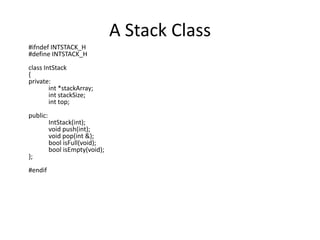
A Stack Class
#ifndef INTSTACK_H
#define INTSTACK_H
class IntStack
{
private:
int *stackArray;
int stackSize;
int top;
public:

};
#endif

IntStack(int);
void push(int);
void pop(int &);
bool isFull(void);
bool isEmpty(void);
Implementation
//*******************
// Constructor *
//*******************
IntStack::IntStack(int size)
{
stackArray = new int[size];
stackSize = size;
top = -1;
}
Push
// Member function push pushes the argument onto *
// the stack.
*
void IntStack::push(int num)
{
if (isFull())
cout << "The stack is full.n";
else
{
top++;
stackArray[top] = num;
}
}
// Member function pop pops the value at the top
// of the stack off, and copies it into the variable
// passed as an argument.
void IntStack::pop(int &num)
{
if (isEmpty())
cout << "The stack is empty.n";
else
{
num = stackArray[top];
top--;
}
}
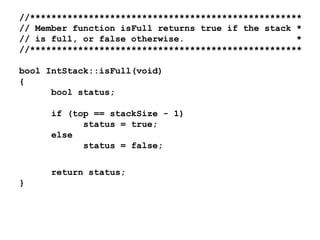
//***************************************************
// Member function isFull returns true if the stack *
// is full, or false otherwise.
*
//***************************************************
bool IntStack::isFull(void)
{
bool status;
if (top == stackSize - 1)
status = true;
else
status = false;
return status;
}
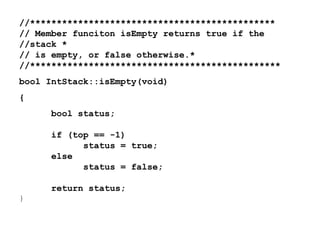
//**********************************************
// Member funciton isEmpty returns true if the
//stack *
// is empty, or false otherwise.*
//***********************************************
bool IntStack::isEmpty(void)
{
bool status;

if (top == -1)
status = true;
else
status = false;
return status;
}
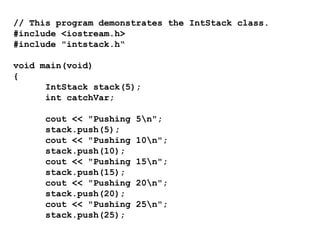
// This program demonstrates the IntStack class.
#include <iostream.h>
#include "intstack.h“
void main(void)
{
IntStack stack(5);
int catchVar;
cout << "Pushing
stack.push(5);
cout << "Pushing
stack.push(10);
cout << "Pushing
stack.push(15);
cout << "Pushing
stack.push(20);
cout << "Pushing
stack.push(25);

5n";
10n";
15n";
20n";
25n";
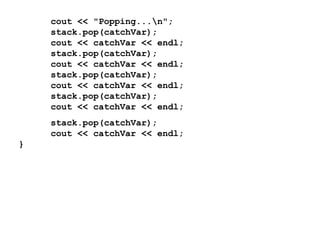
cout << "Popping...n";
stack.pop(catchVar);
cout << catchVar << endl;
stack.pop(catchVar);
cout << catchVar << endl;
stack.pop(catchVar);
cout << catchVar << endl;
stack.pop(catchVar);
cout << catchVar << endl;
stack.pop(catchVar);
cout << catchVar << endl;
}
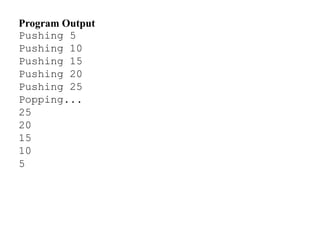
Program Output
Pushing 5
Pushing 10
Pushing 15
Pushing 20
Pushing 25
Popping...
25
20
15
10
5
About Program 1

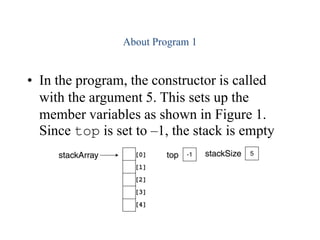
• In the program, the constructor is called
with the argument 5. This sets up the
member variables as shown in Figure 1.
Since top is set to –1, the stack is empty
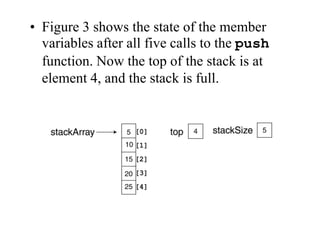
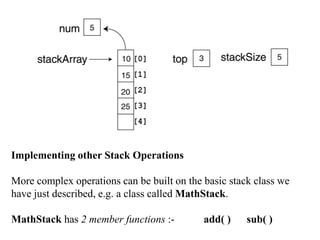
• Figure 3 shows the state of the member
variables after all five calls to the push
function. Now the top of the stack is at
element 4, and the stack is full.
Notice that the pop function uses a reference
parameter, num.
The value that is popped off the stack is copied into
num so it can be used later in the program.
Figure 4 (on the next slide) depicts the state of
the class members, and the num parameter, just

after the first value is popped off the stack.
Implementing other Stack Operations
More complex operations can be built on the basic stack class we
have just described, e.g. a class called MathStack.
MathStack has 2 member functions :-

add( )

sub( )

Stack

  • 1.
  • 2.
    Stacks “A Stack isa special kind of list in which all insertions and deletions take place at one end, called the Top” Other Names  Pushdown List  Last In First Out (LIFO)
  • 3.
    Stacks Examples:  Books ona floor  Dishes on a shelf
  • 4.
    Common Operations onStacks 1. 2. 3. 4. 5. MAKENULL(S): Make Stack S be an empty stack. TOP(S): Return the element at the top of stack S. POP(S): Remove the top element of the stack. PUSH(S): Insert the element x at the top of the stack. EMPTY(S): Return true if S is an empty stack; return false otherwise.
  • 5.
    Static and DynamicStacks • There are two kinds of stack data structure – a) static, i.e. they have a fixed size, and are implemented as arrays. – b) dynamic, i.e. they grow in size as needed, and implemented as linked lists
  • 6.
    An Array Implementationof Stacks Since, in a stack the insertion and deletion take place only at the top, so… A better Implementation:  Anchor the bottom of the stack at the bottom of the array  Let the stack grow towards the top of the array  Top indicates the current position of the first stack element.
  • 7.
    A Stack Class #ifndefINTSTACK_H #define INTSTACK_H class IntStack { private: int *stackArray; int stackSize; int top; public: }; #endif IntStack(int); void push(int); void pop(int &); bool isFull(void); bool isEmpty(void);
  • 8.
    Implementation //******************* // Constructor * //******************* IntStack::IntStack(intsize) { stackArray = new int[size]; stackSize = size; top = -1; }
  • 9.
    Push // Member functionpush pushes the argument onto * // the stack. * void IntStack::push(int num) { if (isFull()) cout << "The stack is full.n"; else { top++; stackArray[top] = num; } }
  • 10.
    // Member functionpop pops the value at the top // of the stack off, and copies it into the variable // passed as an argument. void IntStack::pop(int &num) { if (isEmpty()) cout << "The stack is empty.n"; else { num = stackArray[top]; top--; } }
  • 11.
    //*************************************************** // Member functionisFull returns true if the stack * // is full, or false otherwise. * //*************************************************** bool IntStack::isFull(void) { bool status; if (top == stackSize - 1) status = true; else status = false; return status; }
  • 12.
    //********************************************** // Member funcitonisEmpty returns true if the //stack * // is empty, or false otherwise.* //*********************************************** bool IntStack::isEmpty(void) { bool status; if (top == -1) status = true; else status = false; return status; }
  • 13.
    // This programdemonstrates the IntStack class. #include <iostream.h> #include "intstack.h“ void main(void) { IntStack stack(5); int catchVar; cout << "Pushing stack.push(5); cout << "Pushing stack.push(10); cout << "Pushing stack.push(15); cout << "Pushing stack.push(20); cout << "Pushing stack.push(25); 5n"; 10n"; 15n"; 20n"; 25n";
  • 14.
    cout << "Popping...n"; stack.pop(catchVar); cout<< catchVar << endl; stack.pop(catchVar); cout << catchVar << endl; stack.pop(catchVar); cout << catchVar << endl; stack.pop(catchVar); cout << catchVar << endl; stack.pop(catchVar); cout << catchVar << endl; }
  • 15.
    Program Output Pushing 5 Pushing10 Pushing 15 Pushing 20 Pushing 25 Popping... 25 20 15 10 5
  • 16.
    About Program 1 •In the program, the constructor is called with the argument 5. This sets up the member variables as shown in Figure 1. Since top is set to –1, the stack is empty
  • 17.
    • Figure 3shows the state of the member variables after all five calls to the push function. Now the top of the stack is at element 4, and the stack is full.
  • 18.
    Notice that thepop function uses a reference parameter, num. The value that is popped off the stack is copied into num so it can be used later in the program. Figure 4 (on the next slide) depicts the state of the class members, and the num parameter, just after the first value is popped off the stack.
  • 19.
    Implementing other StackOperations More complex operations can be built on the basic stack class we have just described, e.g. a class called MathStack. MathStack has 2 member functions :- add( ) sub( )