Download to read offline
![International Research Journal of Engineering and Technology (IRJET) e-ISSN: 2395-0056
Volume: 09 Issue: 02 | Feb 2022 www.irjet.net p-ISSN: 2395-0072
© 2022, IRJET | Impact Factor value: 7.529 | ISO 9001:2008 Certified Journal | Page 50
STABILIZATION OF SOIL USING COIR FIBER
Ujala Kumar1, Dr Vikrama Pandey2, Prashant Ranjan Malviya3
1M.Tech Scholar, Department of Civil Engineering, B.I.T Sindri, Dhanbad
2Professor, Department of Civil Engineering, B.I.T Sindri, Dhanbad
3Assistant Professor, Department of Civil Engineering, B.I.T Sindri, Dhanbad
---------------------------------------------------------------------***----------------------------------------------------------------------
Abstract This research focused on the compaction
characteristics (MDD, OMC & UCS) and strength properties
(CBR Values) of expansive soils such as clayeysoil. Compaction
characteristics and bearing capacity can be improved by
stabilization process of soil. These properties can be improved
by controlled compaction using mechanical equipment or by
addition of suitable admixture or reinforcing the soil with
crumb rubber, plastic waste, fiber etc. here we used natural
fiber like coconut coir fiber. Reinforcement of soil with coir
fiber is low-cost approach for improving the soil
properties such as (unconfined shear strength, MDD value,
CBR value). It includes effects of coir fiber on clayey soil based
on the results of Standard Proctor tests, unconfined
compressive strength tests, Atterberg limit test, andCalifornia
Bearing Ratio (CBR) tests. Coir Fiber was added in different
proportions of 0.25%, 0.50%, 0.75% and 1% respectively. It is
found that with addition of coconut coir fiber at 0.5%, with
clayey soil M.D.D changes from 1.87gm/ccto1.96gm/cc. C.B.R
ratio from 2.12% to 6.71% and U.C.S value from 0.2058
kg/cm2 to 0.3753 kg/cm2 at O.M.C of 12.25%.
Key Words: Coir Fiber, Stabilization, Clayey Soil,
Maximum Dry Density
1.INTRODUCTION
Soil stabilization is the process of improving the soil
properties by different methods. Due to various reasons the
soil at a particular site does not meet the requirement of
particular project such as shear strength, unconfined
compressive strength and bearing capacity of soil. In that
case, it is most necessary to modify the soil propertiesasper
requirements. This study utilizescoirfiberforimprovingthe
strength parameters of clayey soil. Coir fiber extracted from
the outer shell of a coconut husk. It isa low-costmaterial and
readily available.by performing soil improvement following
advantages can be achieved:
It improves Bearing Capacity of soil
It reduces ground settlements.
Many research work has been doneutilizingthecoirfiber for
stabilization of soil which are:
[1] Sasikala S et al. (2019). When Soil was reinforced with
1.2 % Coconut Coir Fiber, it was observed that there was
47.4 % increase in UCS strength and 4 times increase in
soaked CBR value compared to unreinforced soil. The
maximum Unconfined compressive strength was increased
to 132 kPa from 90 kPa.
[2]Prag M Chaple (2016)
In the test it was observed that the U.B.C has increased from
250kN/m2 to 415kN/m2 for 0.25% coir fiber, 495kN/m2 for
0.50% coir fiber , 445 kN/m2 for 0.75% coir fiber and finally
it reduces to 360kN/m2 for 1% coir fiber.
[3] Singh and Mittal et al (2014)
The CBR value of soil mixed with 1% coir fibre improves
from 4.75 percent to 9.22 percent when it is wet, and from
8.72 % to 13.55 % when it is not soaked. When 1 percent
randomly dispersed coconut is added to the soil, the UCS
increases from 2.75 kg/cm2 to 6.33 kg/cm2
[4] Singh and Arif (2014)
They conducted an experimental study on silty sand (SM)
(local soil) mixed with varying percentage of coal ash (20%,
30%, 40% and 50%) and coconut coir fibre (0.25, 0.50, 0.75
and 1.0%). They performed unconfined compressive
strength (UCS) and California bearing ratio (CBR) tests on
the soil mixed with coal ash & coir fibre both. They observed
the significant improvement in UCS andCBRvaluebyadding
20% of coal ash and 0.25% coir fiber in the soil. Theirresults
showed that the UCS value is maximum (2.81 kg/cm2), for
20% coal ash mixed with 0.25% coir fiber insoil thenthe un-
soaked and soaked CBR values was increased from 10.5%
and 5.6% to 27.7% and 14.6%, respectively. The optimum
percentage of soil-coal ash-coir fibre mix is arrived at
79.75:20:0.25 (by weight)
2. MATERIAL USED IN STUDY
2.1 CLAYEY SOIL
Clay is a finely grained natural rock or soil material that is
made by the combination of one or more clayey minerals. It
contains high percentage of fine particles and colloidal
substances, it become sticky when wet. Clays are plastic due
to particle size and geometry as well as water content. It
becomes hard, brittle and non-plastic upon drying. Claysare
distinguished from other fine-grained soils by differencesin
size and mineralogy., despite the fact that many naturally
occurring deposits contain both silts and clay. It is classified
as clay when particle size is smaller than 2 µ by ISO 14688.](https://image.slidesharecdn.com/irjet-v9i208-220913085502-11223237/85/STABILIZATION-OF-SOIL-USING-COIR-FIBER-1-320.jpg)
![International Research Journal of Engineering and Technology (IRJET) e-ISSN: 2395-0056
Volume: 09 Issue: 02 | Feb 2022 www.irjet.net p-ISSN: 2395-0072
© 2022, IRJET | Impact Factor value: 7.529 | ISO 9001:2008 Certified Journal | Page 50
STABILIZATION OF SOIL USING COIR FIBER
Ujala Kumar1, Dr Vikrama Pandey2, Prashant Ranjan Malviya3
1M.Tech Scholar, Department of Civil Engineering, B.I.T Sindri, Dhanbad
2Professor, Department of Civil Engineering, B.I.T Sindri, Dhanbad
3Assistant Professor, Department of Civil Engineering, B.I.T Sindri, Dhanbad
---------------------------------------------------------------------***----------------------------------------------------------------------
Abstract This research focused on the compaction
characteristics (MDD, OMC & UCS) and strength properties
(CBR Values) of expansive soils such as clayeysoil. Compaction
characteristics and bearing capacity can be improved by
stabilization process of soil. These properties can be improved
by controlled compaction using mechanical equipment or by
addition of suitable admixture or reinforcing the soil with
crumb rubber, plastic waste, fiber etc. here we used natural
fiber like coconut coir fiber. Reinforcement of soil with coir
fiber is low-cost approach for improving the soil
properties such as (unconfined shear strength, MDD value,
CBR value). It includes effects of coir fiber on clayey soil based
on the results of Standard Proctor tests, unconfined
compressive strength tests, Atterberg limit test, andCalifornia
Bearing Ratio (CBR) tests. Coir Fiber was added in different
proportions of 0.25%, 0.50%, 0.75% and 1% respectively. It is
found that with addition of coconut coir fiber at 0.5%, with
clayey soil M.D.D changes from 1.87gm/ccto1.96gm/cc. C.B.R
ratio from 2.12% to 6.71% and U.C.S value from 0.2058
kg/cm2 to 0.3753 kg/cm2 at O.M.C of 12.25%.
Key Words: Coir Fiber, Stabilization, Clayey Soil,
Maximum Dry Density
1.INTRODUCTION
Soil stabilization is the process of improving the soil
properties by different methods. Due to various reasons the
soil at a particular site does not meet the requirement of
particular project such as shear strength, unconfined
compressive strength and bearing capacity of soil. In that
case, it is most necessary to modify the soil propertiesasper
requirements. This study utilizescoirfiberforimprovingthe
strength parameters of clayey soil. Coir fiber extracted from
the outer shell of a coconut husk. It isa low-costmaterial and
readily available.by performing soil improvement following
advantages can be achieved:
It improves Bearing Capacity of soil
It reduces ground settlements.
Many research work has been doneutilizingthecoirfiber for
stabilization of soil which are:
[1] Sasikala S et al. (2019). When Soil was reinforced with
1.2 % Coconut Coir Fiber, it was observed that there was
47.4 % increase in UCS strength and 4 times increase in
soaked CBR value compared to unreinforced soil. The
maximum Unconfined compressive strength was increased
to 132 kPa from 90 kPa.
[2]Prag M Chaple (2016)
In the test it was observed that the U.B.C has increased from
250kN/m2 to 415kN/m2 for 0.25% coir fiber, 495kN/m2 for
0.50% coir fiber , 445 kN/m2 for 0.75% coir fiber and finally
it reduces to 360kN/m2 for 1% coir fiber.
[3] Singh and Mittal et al (2014)
The CBR value of soil mixed with 1% coir fibre improves
from 4.75 percent to 9.22 percent when it is wet, and from
8.72 % to 13.55 % when it is not soaked. When 1 percent
randomly dispersed coconut is added to the soil, the UCS
increases from 2.75 kg/cm2 to 6.33 kg/cm2
[4] Singh and Arif (2014)
They conducted an experimental study on silty sand (SM)
(local soil) mixed with varying percentage of coal ash (20%,
30%, 40% and 50%) and coconut coir fibre (0.25, 0.50, 0.75
and 1.0%). They performed unconfined compressive
strength (UCS) and California bearing ratio (CBR) tests on
the soil mixed with coal ash & coir fibre both. They observed
the significant improvement in UCS andCBRvaluebyadding
20% of coal ash and 0.25% coir fiber in the soil. Theirresults
showed that the UCS value is maximum (2.81 kg/cm2), for
20% coal ash mixed with 0.25% coir fiber insoil thenthe un-
soaked and soaked CBR values was increased from 10.5%
and 5.6% to 27.7% and 14.6%, respectively. The optimum
percentage of soil-coal ash-coir fibre mix is arrived at
79.75:20:0.25 (by weight)
2. MATERIAL USED IN STUDY
2.1 CLAYEY SOIL
Clay is a finely grained natural rock or soil material that is
made by the combination of one or more clayey minerals. It
contains high percentage of fine particles and colloidal
substances, it become sticky when wet. Clays are plastic due
to particle size and geometry as well as water content. It
becomes hard, brittle and non-plastic upon drying. Claysare
distinguished from other fine-grained soils by differencesin
size and mineralogy., despite the fact that many naturally
occurring deposits contain both silts and clay. It is classified
as clay when particle size is smaller than 2 µ by ISO 14688.](https://image.slidesharecdn.com/irjet-v9i208-220913085502-11223237/75/STABILIZATION-OF-SOIL-USING-COIR-FIBER-1-2048.jpg)
![International Research Journal of Engineering and Technology (IRJET) e-ISSN: 2395-0056
Volume: 09 Issue: 02 | Feb 2022 www.irjet.net p-ISSN: 2395-0072
© 2022, IRJET | Impact Factor value: 7.529 | ISO 9001:2008 Certified Journal | Page 53
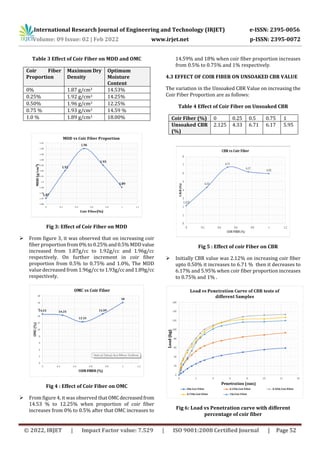
It was observed that the optimum CBR value comes while
adding coir fiber 0.5% to the clayey soil having value of
6.17%.
4.4 EFFECT OF COIR FIBER ON UCS value
The variation in the UCS value on increasing the Coir Fiber
Proportion are as follows:
Table 5 Effect of Coir Fiber on UCS values
Coir Fiber (%) 0 0.25 0.5 0.75 1
UCS (kg/cm2) 0.21 0.34 0.38 0.34 0.29
fig 7 : Effect of Coir fiber on UCS
UCS value of natural soil was 0.21 kg/cm2 on increasing
coir fiber ucs value increase till 0.5 % of coir fiber to
0.38 kg/cm2 after that it decreases to 0.29 kg/cm2 at1%
coir Fiber
5. CONCLUSIONS
As per the data and results obtained from the experimental
work on the soil stability investigation on clayey soil with
different proportion of coir fiber i.e. (0.25%, 0.50% , 0.75%
and 1% ) as a reinforcing material, following conclusion can
be drawn:
The soil used for the study was clayoflowplasticity(CL)
soil.
C.B.R value increased by 3 timesonadditionof0.5%coir
fiber, CBR value increased from 2.12% to 6.71%.
M.D.D value increases by 4.62% after addition of 0.5%
coir fiber. The M.D.D value increased from 1.87g/cm3 to
1.96 g/cm3
U.C.S Value increased by 81 % on addition of 0.5% coir
fiber, It increased from 0.21 kg/cm2 to 0.38 kg/cm2.
It can be concluded that 0.5% coir fiber in soil is
optimum percentage for maximum CBR value and UCS
value.
Since the C.B.R value increased after inclusion of coir
fiber so less thickness of subgrade layer is required
REFERENCES
[1]. A.K SHARBAN P.K JAIN Review on Stabilization of Soil
Using Coir Fiber IJER ISSN:2319-6890) Volume No.4,
Issue No.6, p p : 296-299
[2]. DEDVATT SHIKHA ,R.SAXENA, 2015 , Soil stabilization
using coconut coir fiber IJRET,Vol.3,
[3]. HEJAZI SAYYED, ABTAHI MAHDI (2012). A simple
review of soil reinforcement by using natural and
synthetic fibers. ConstructionandBuildingMaterials30,
100-116.
[4]. Mamta Mishra and N. K. Saxena Improving Strength of
Soil using Fiber and Fly ash Volume: 03 Issue: 10 | Oct -
2016
[5]. Parag M. Chaple, A I. Dhatrak Performance of Coir fiber
Reinforced Clayey Soil e (IJES) /Volume||2 ||Issue|| 4
[6]. R.R Singh, Er. Shelly Mittal IMPROVEMENT OF LOCAL
SUBGRADE SOIL FOR ROAD Volume: 03 Issue: -2014,
[7]. S. Muthu Lakshmi, S. Priya Utilization of Coconut Coir
Fibre For Improving Subgrade Strength (IRJET) Apr-
2018
[8]. S.SURYAVANSHI, (2014) Waste product ‘bagasse ash’
from sugar industry can be used as stabilizing material
for expansive soils IJRET: volume: 03 issue: 03 | March
[9]. Shrivastava D., Singhai e.t, 2014, Effect of lime and RHA
on index properties of black cotton soil, International
journal of engineering science and research technology,
Vol. 3, Issue 4.
[10]. OLUYEMI-AVIBIOWU, D. FADUGA Stabilization of
Lateritic Soil Using Coir Fiber as Natural Reinforcement
volume 05, Issue 02, February 2019 |
[11]. IS: 2720 (Part 7) – 1980 Standard proctor test
[12]. IS: 2720 (Part 10) – 1991 Unconfined compressive
strength (UCS) test
[13]. IS: 2720 (Part 16) - 1987 CBR test (California
Bearing Ratio) test
[14]. IS: 2720 (Part 5) - 1985 Atterberg Limit test for
liquids and plastics](https://image.slidesharecdn.com/irjet-v9i208-220913085502-11223237/85/STABILIZATION-OF-SOIL-USING-COIR-FIBER-4-320.jpg)
![International Research Journal of Engineering and Technology (IRJET) e-ISSN: 2395-0056
Volume: 09 Issue: 02 | Feb 2022 www.irjet.net p-ISSN: 2395-0072
© 2022, IRJET | Impact Factor value: 7.529 | ISO 9001:2008 Certified Journal | Page 54
[15]. IS:2720 (Part 3) – 1980 Specific gravity test of soil
using pycnometer
AUTHOR
NAME: UJALA KUMAR
Affiliation: M. Tech Research
Scholar
BIT SINDRI](https://image.slidesharecdn.com/irjet-v9i208-220913085502-11223237/85/STABILIZATION-OF-SOIL-USING-COIR-FIBER-5-320.jpg)

This document summarizes research on stabilizing clayey soil using coir fiber. Standard Proctor, unconfined compressive strength, and California Bearing Ratio tests were conducted on soil mixed with 0.25%, 0.5%, 0.75%, and 1% coir fiber. The maximum dry density increased from 1.87 g/cc to 1.96 g/cc with 0.5% fiber, while the optimum moisture content decreased from 14.53% to 12.25%. The CBR value increased from 2.12% to 6.71% and the UCS value rose from 0.21 kg/cm2 to 0.3753 kg/cm2 with 0.5% fiber addition.


