Sustainable Sanitation

       Practice
                                                                Issue 12, 07/2012


                                      •	 Treatment Wetlands in Austria


                                      •	 The „French System“ for Treating Raw
                                         Wastewater


                                      •	 Experiences of Constructed Wetlands in
                                         Uganda

                                      •	 Small Community Wastewater Treatment and
                                         Agricultural Reuse, Marocco

                                      •	 CWs for Urban Wastewater Treatment in Egypt

                                      •	 Sludge Treatment in Reed Beds Systems


Treatment wetlands                                                           partner of:


Sustainable Sanitation Practice   1                                Issue 12/2012
Impressum

 published by / Medieninhaber, Herausgeber und Verleger
 	 EcoSan Club
 	 Schopenhauerstr. 15/8
 	 A-1180 Vienna
 	 Austria
 	 www.ecosan.at

 Editors / Redaktion
 	 Elke Müllegger, Günter Langergraber, Markus Lechner • EcoSan Club
 Journal Manager / Journal Management
 	 Fritz Kleemann
 Contact / Kontakt
 	 ssp@ecosan.at

 Disclaimer / Haftungsausschluss
 	 The content of the articles does not necessarily reflect the views of EcoSan Club or the editors and should not be
    acted upon without independent consideration and professional advice. EcoSan Club and the editors will not accept
    responsibility for any loss or damage suffered by any person acting or refraining from acting upon any material
    contained in this publication.
 	 Die in den Artikeln vertretenen Standpunkte entsprechen nicht notwendigerweise der Haltung und Ansichten des EcoSan Clubs oder des
    Redaktionsteams. Der praktischen Anwendung dargestellter Inhalte muss eine unabhängige Begutachtung und professionelle Beratung
    vorausgehen. EcoSan Club und das Redaktionsteam haften in keiner Weise für Schäden (Sachschaden oder Personenschaden), die durch die
    Anwendung, oder Nichtanwendung der in dieser Publikation vermittelten Inhalte, entstehen.
 Reproduction / Reproduktion
 	   Permission is granted for reproduction of this material, in whole or part, for education, scientific or development
     related purposes except those involving commercial sale, provided that full citation of the source is given. Cover
     photo excluded.
 	  Die Reproduktion, Übernahme und Nutzung der Inhalte von SSP, vollständig oder teilweise, für Bildungszwecke, für die Wissenschaft und im
    Zusammenhang mit Entwicklung ist unter Voraussetzung der vollständigen Quellenangabe gestattet und erwünscht. Titelbild ausgenommen.
 Aim and Scope / Offenlegung der Blattlinie gemäß § 25, Abs. 4 Mediengesetz
 	   Sustainable Sanitation Practice (SSP) aims to make available high quality information on practical experiences with
     sustainable sanitation systems. For SSP a sanitation system is sustainable when it is not only economically viable,
     socially acceptable and technically and institutionally appropriate, but it should also protect the environment and the
     natural resources. SSP is therefore fully in line with SuSanA, the Sustainable Sanitation Alliance (www.susana.org). •
     SSP targets people that are interested in sustainable sanitation systems and the practical approach to it. • Articles are
     published after blind review only. • Sustainable Sanitation Practice is published quarterly. It is available for free on
     www.ecosan.at/ssp.
 	   Sustainable Sanitation Practice (SSP) hat zum Ziel praxisrelevante Information in hoher Qualität im Zusammenhang mit „sustainable sanitation“
     bereit zu stellen. „sustainable“ also nachhaltig ist ein Sanitärsystem für SSP wenn es wirtschaftlich machbar, soziokulturell akzeptiert, technisch als
     auch institutionell angemessen ist und die Umwelt und deren Ressourcen schützt. Diese Ansicht harmoniert mit SuSanA, the Sustainable Sanitation
     Alliance (www.susana.org). • SSP richtet sich an Personen, die sich für die praktische Umsetzung von „sustainable sanitation“ interessieren. • Artikel
     werden nur nach einer Begutachtung veröffentlicht. • Sustainable Sanitation Practice erschient vierteljährlich, kostenlos unter: www.ecosan.at/ssp.
 Information on the publisher / Offenlegung gemäß § 25 Mediengesetz
 	   Publisher: EcoSan Club, Schopenhauerstr. 15/8, A-1180 Vienna, Austria • chairperson: Günter Langergraber • website:
     http://www.ecosan.at/ • scope: EcoSan Club was funded as a non profit association in 2002 by a group of people
     active in research and development as well as planning and consultancy in the field of sanitation. The underlying aim
     is the realisation of ecological concepts to close material cycles in settlements.
 	   Medieninhaber: EcoSan Club, Schopenhauerstr. 15/8, A-1180 Vienna, Austria • Obmann: Günter Langergraber • Gegenstand des Vereins: Der
     EcoSan Club wurde 2002 als gemeinnütziger Verein von einer Gruppe von Personen gegründet, die in Forschung, Entwicklung, Planung und
     Beratung in der Siedlungshygiene - Sammlung, Behandlung oder Beseitigung flüssiger und fester Abfälle aus Siedlungen - tätig waren und sind. Das
     Ziel des EcoSan Clubs ist die Umsetzung kreislauforientierter Siedlungshygienekonzepte (EcoSan Konzepte) zu fördern, um einen Beitrag zum Schutz
     der Umwelt zu leisten.


 Cover Photo / Titelbild
 © Günter Langergraber


Sustainable Sanitation Practice                                               2                                                            Issue 12/2012
Editorial
  Natural wetlands have been used for wastewater treatment for centuries. In many cases, however, the reasoning behind
  this use was disposal, rather than treatment and the wetland simply served as a convenient recipient that was closer than
  the nearest river or other waterway. Constructed treatment wetlands are engineered systems designed and constructed
  to utilize the natural processes involving wetland vegetation, soils, and their associated microbial assemblages to assist
  in treating water. They are designed to take advantage of many of the same processes that occur in natural wetlands, but
  do so within a more controlled environment.

  Constructed treatment wetlands (TWs) are a simple technology in construction as well as in operation and maintenance.
  They have a high buffer capacity for hydraulic and organic load fluctuations as well as a high robustness and process
  stability. TWs are therefore a suitable technological solution for small villages and single households and are becoming
  more and more popular all around the world for treating different types of water. Currently, the estimated number of CW
  systems in Austria is more than 3000.

  Issue 12 of Sustainable Sanitation Practice (SSP) on „Treatment wetlands“ includes 6 contributions:

  1.	 the Austrian experience with single-stage sand and gravel based vertical flow systems with intermittent loading (the
      Austrian type is for treating mechanically pre-treated wastewater),
  2.	 the French experiences with two-stage vertical flow systems treating raw wastewater.
  3.	 EcoSan Club‘s experiences with TWs in Uganda,
  4.	 	 esults from multi-stage TW treating raw wastewater in Morocco.
      r
  5.	 	 esults from horizontal flow experimental systems from Egypt, and
      r
  6.	 	 xperiences from Denmark and UK on reed beds treating excess sludge from activated sludge plants.
      e

  The thematic topic of SSP‘s next issue will be „Faecal sludge management“ (issue 13, October 2012). Information
  on further issues planned is available from the journal homepage (www.ecosan.at/ssp). As always we would like to
  encourage readers and potential contributors for further issues to suggest possible contributions and topics of high
  interest to the SSP editorial office (ssp@ecosan.at). Also, we would like to invite you to contact the editorial office if you
  volunteer to act as a reviewer for the journal.

  SSP is available online from the journal homepage at the EcoSan Club website (www.ecosan.at/SSP) for free. We
  also invite you to visit SSP and EcoSan Club on facebook (www.facebook.com/SustainableSanitationPractice and
  www.facebook.com/EcoSanClubAustria, respectively).

  With best regards,
  Günter Langergraber, Markus Lechner, Elke Müllegger
  EcoSan Club Austria (www.ecosan.at/ssp)


 Content

     ͳͳ Treatment wetlands in Austria: Practical experiences in planning, construction and maintenance .............. 4

     ͳͳ Constructed Wetlands for the Treatment of raw Wastewater: the French Experience .................................. 9

     ͳͳ Comparing the treatment efficiency of different wastewater treatment technologies in Uganda ................ 16

     ͳͳ A Hybrid Wetland for Small Community Wastewater Treatment in Morocco ............................................... 22

     ͳͳ Constructed Wetlands for Urban Wastewater Treatment in Egypt ............................................................... 27

     ͳͳ Sludge Treatment in Reed Beds Systems – Development, design, experiences ...................................................... 33


Sustainable Sanitation Practice                                          3                                                        Issue 12/2012


     Treatment wetlands in Austria: Practical
     experiences in planning, construction and maintenance
     This paper presents information on practical experiences with constructed wetland
     systems in Austria.

                                                                                         Author: Gabriele Mitterer-Reichmann


     Abstract
     In this paper we report our experience regarding design, operation and maintenance of constructed wetlands (CWs)
     for treating domestic wastewater in Austria. About 1600 vertical flow (VF) CWs have been constructed by our company
     Ökologisches Projekt Ltd (ÖP ltd) during the last 20 years. The company also provides operation and maintenance services
     for owners of CWs and carries out the yearly monitoring for about 750 systems. Based on these experiences we present
     our considerations and recommendations concerning the operation of constructed wetlands.

 Introduction                                                         application for CW systems is treatment of domestic
                                                                      wastewater. Additionally, reed beds are used to dewater
 2008 in Austria about 93 % of the wastewater is collected            and stabilize excess sludge from technical plants and
 in central sewers and biologically treated. For the                  sludge from primary pre-treatments.
 remaining small rural settlements and single households
 decentralised small scale biological treatment is more               To reach a steady treatment efficiency operators have
 feasible for economic and ecologic reasons. In the                   to observe some operation and maintenance measures.
 beginning of the 1980’s the first horizontal flow constructed        The water authority prescribes a regular monitoring
 wetlands went into operation in Styria. Since the 1990’s             by the operator plus a yearly report of an external
 vertical flow constructed wetlands are favoured because              professional which has to prove the observance of the
 also small scale treatment plants have to fulfil nitrification       effluent standards.
 according Austrian effluent standards (1.AEVkA, 1996).
 The effluent standards for plants <500 PE are:
                                                                      CW System description – Type
 	           COD:		               90 mg/L                             Ökologisches Projekt
 	           BOD5:		              25 mg/L
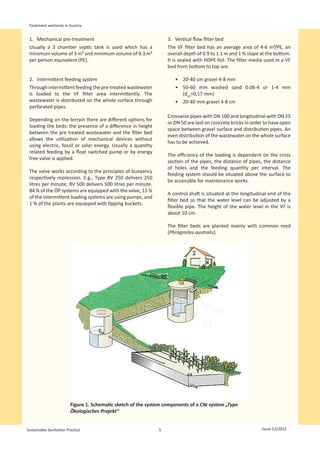
 	           NH4-N:		             10 mg/L (T>12° C)                   Figure 1 shows a sketch of the system components of
                                                                      the CW system „Type Ökologisches Projekt“. The system
 Meanwhile some thousand CWs are in operation (the                    comprises a mechanical pre-treatment, an intermittent
 estimated number is between 3000 and 4000), most                     tank and the VF filter bed. In the following a description
 of them in the province Styria. The most common                      of the technical components is given:


 Key factors:
       •	 In Austria constructed wetlands have developed from an alternative solution to a conventional and well accepted
          technology for wastewater treatment in rural areas.
       •	 The typical Austrian CW system comprises mechanical pre-treatment, an intermittent tank for storing the
          wastewater for the intermittent loading and a VF filter bed.
       •	 According to the Austrian design standard the VF filter bed is designed with a specific surface area of 4 m² per
          people equivalent.
       •	 With this design the stringent Austrian effluent requirement regarding nitrification can be met.
       •	 Regular checks by the plant operators plus a yearly external plant inspection within a maintenance contract help
          to detect or rather prevent malfunctions of the CW system.

Sustainable Sanitation Practice                                   4                                                  Issue 12/2012
Treatment wetlands in Austria


 1.	 Mechanical pre-treatment                                      3.	 Vertical flow filter bed
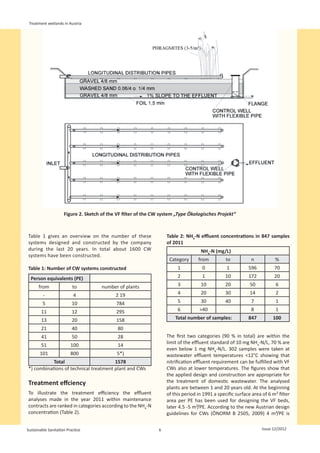
 Usually a 3 chamber septic tank is used which has a               The VF filter bed has an average area of 4-6 m²/PE, an
 minimum volume of 3 m³ and minimum volume of 0.3 m³               overall depth of 0.9 to 1.1 m and 1 % slope at the bottom.
 per person equivalent (PE).                                       It is sealed with HDPE foil. The filter media used in a VF
                                                                   bed from bottom to top are:

 2.	 Intermittent feeding system                                      •	 20-40 cm gravel 4-8 mm
 Through intermittent feeding the pre-treated wastewater              •	 50-60 mm washed sand 0.06-4 or 1-4 mm
 is loaded to the VF filter area intermittently. The                     (d10>0,17 mm)
 wastewater is distributed on the whole surface through               •	 20-40 mm gravel 4-8 cm
 perforated pipes.
                                                                   Crosswise pipes with DN 100 and longitudinal with DN 25
 Depending on the terrain there are different options for
                                                                   or DN 50 are laid on concrete bricks in order to have open
 loading the beds: the presence of a difference in height
                                                                   space between gravel surface and distribution pipes. An
 between the pre treated wastewater and the filter bed
                                                                   even distribution of the wastewater on the whole surface
 allows the utilization of mechanical devices without
                                                                   has to be achieved.
 using electric, fossil or solar energy. Usually a quantity
 related feeding by a float switched pump or by energy
                                                                   The efficiency of the loading is dependent on the cross
 free valve is applied.
                                                                   section of the pipes, the distance of pipes, the distance
                                                                   of holes and the feeding quantity per interval. The
 The valve works according to the principles of buoyancy
                                                                   feeding system should be situated above the surface to
 respectively repression. E.g., Type RV 250 delivers 250
                                                                   be accessible for maintenance works.
 litres per minute; RV 500 delivers 500 litres per minute.
 84 % of the ÖP systems are equipped with the valve, 15 %
                                                                   A control shaft is situated at the longitudinal end of the
 of the intermittent loading systems are using pumps, and
                                                                   filter bed so that the water level can be adjusted by a
 1 % of the plants are equipped with tipping buckets.
                                                                   flexible pipe. The height of the water level in the VF is
                                                                   about 10 cm.

                                                                   The filter beds are planted mainly with common reed
                                                                   (Phragmites australis).


                         Figure 1. Schematic sketch of the system components of a CW system „Type
                         Ökologisches Projekt“


Sustainable Sanitation Practice                                5                                               Issue 12/2012
Treatment wetlands in Austria


                     Figure 2. Sketch of the VF filter of the CW system „Type Ökologisches Projekt“


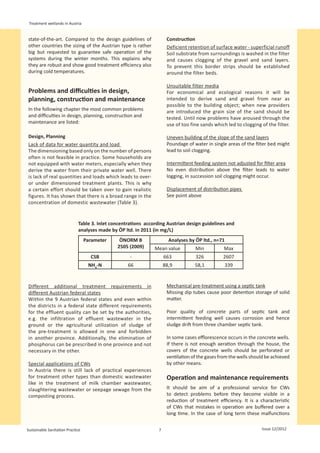
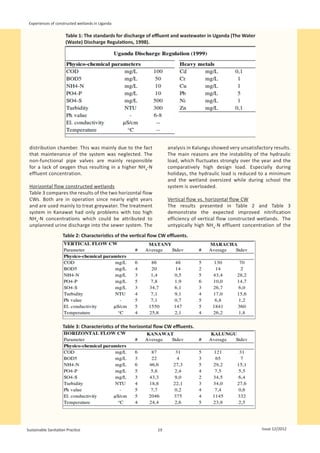
Table 1 gives an overview on the number of these                    Table 2: NH4-N effluent concentrations in 847 samples
systems designed and constructed by the company                     of 2011
during the last 20 years. In total about 1600 CW                                     NH4-N (mg/L)
systems have been constructed.
                                                                     Category      from          to          n            %
Table 1: Number of CW systems constructed                                1           0           1          596          70
  Person equivalents (PE)                                                2           1           10         172          20
      from                to          number of plants                   3           10          20          50           6
         -                4                 2 19                         4           20          30          14           2
         5                10                784                          5           30          40          7            1
        11                12                295                          6          >40                      8            1
        13                20                158                         Total number of samples:            847         100
        21                40                 80
        41                50                 28                     The first two categories (90 % in total) are within the
                                                                    limit of the effluent standard of 10 mg NH4-N/L, 70 % are
        51               100                 14
                                                                    even below 1 mg NH4-N/L. 302 samples were taken at
       101               800                 5*)                    wastewater effluent temperatures <12°C showing that
           Total                       1578                         nitrification effluent requirement can be fulfilled with VF
*) combinations of technical treatment plant and CWs                CWs also at lower temperatures. The figures show that
                                                                    the applied design and construction are appropriate for
Treatment effciency                                                 the treatment of domestic wastewater. The analysed
                                                                    plants are between 1 and 20 years old. At the beginning
To illustrate the treatment efficiency the effluent                 of this period in 1991 a specific surface area of 6 m² filter
analyses made in the year 2011 within maintenance                   area per PE has been used for designing the VF beds,
contracts are ranked in categories according to the NH4-N           later 4.5 -5 m²/PE. According to the new Austrian design
concentration (Table 2).                                            guidelines for CWs (ÖNORM B 2505, 2009) 4 m²/PE is


Sustainable Sanitation Practice                                 6                                                  Issue 12/2012
Treatment wetlands in Austria


state-of-the-art. Compared to the design guidelines of                Construction
other countries the sizing of the Austrian type is rather             Deficient retention of surface water - superficial runoff
big but requested to guarantee safe operation of the                  Soil substrate from surroundings is washed in the filter
systems during the winter months. This explains why                   and causes clogging of the gravel and sand layers.
they are robust and show good treatment efficiency also               To prevent this border strips should be established
during cold temperatures.                                             around the filter beds.

                                                                      Unsuitable filter media
Problems and difficulties in design,                                  For economical and ecological reasons it will be
planning, construction and maintenance                                intended to derive sand and gravel from near as
                                                                      possible to the building object; when new providers
In the following chapter the most common problems                     are introduced the grain size of the sand should be
and difficulties in design, planning, construction and                tested. Until now problems have aroused through the
maintenance are listed:                                               use of too fine sands which led to clogging of the filter.

Design, Planning                                                      Uneven building of the slope of the sand layers
Lack of data for water quantity and load                              Poundage of water in single areas of the filter bed might
The dimensioning based only on the number of persons                  lead to soil clogging.
often is not feasible in practice. Some households are
not equipped with water meters, especially when they                  Intermittent feeding system not adjusted for filter area
derive the water from their private water well. There                 No even distribution above the filter leads to water
is lack of real quantities and loads which leads to over-             logging, in succession soil clogging might occur.
or under dimensioned treatment plants. This is why
a certain effort should be taken over to gain realistic               Displacement of distribution pipes
figures. It has shown that there is a broad range in the              See point above
concentration of domestic wastewater (Table 3).


                             Table 3. Inlet concentrations according Austrian design guidelines and
                             analyses made by ÖP ltd. in 2011 (in mg/L)
                                  Parameter    ÖNORM B                 Analyses by ÖP ltd., n=71
                                              2505 (2009)      Mean value          Min           Max
                                    CSB             -                663           326          2607
                                   NH4-N           66                88,9          58,1            339


Different additional treatment requirements in                        Mechanical pre-treatment using a septic tank
different Austrian federal states                                     Missing dip tubes cause poor detention storage of solid
Within the 9 Austrian federal states and even within                  matter.
the districts in a federal state different requirements
for the effluent quality can be set by the authorities,               Poor quality of concrete parts of septic tank and
e.g. the infiltration of effluent wastewater in the                   intermittent feeding well causes corrosion and hence
ground or the agricultural utilization of sludge of                   sludge drift from three chamber septic tank.
the pre-treatment is allowed in one and forbidden
in another province. Additionally, the elimination of                 In some cases efflorescence occurs in the concrete wells.
phosphorus can be prescribed in one province and not                  If there is not enough aeration through the house, the
necessary in the other.                                               covers of the concrete wells should be perforated or
                                                                      ventilation of the gases from the wells should be achieved
Special applications of CWs                                           by other means.
In Austria there is still lack of practical experiences
for treatment other types than domestic wastewater                    Operation and maintenance requirements
like in the treatment of milk chamber wastewater,
slaughtering wastewater or seepage sewage from the                    It should be aim of a professional service for CWs
composting process.                                                   to detect problems before they become visible in a
                                                                      reduction of treatment efficiency. It is a characteristic
                                                                      of CWs that mistakes in operation are buffered over a
                                                                      long time. In the case of long term these malfunctions


Sustainable Sanitation Practice                                  7                                                Issue 12/2012
Treatment wetlands in Austria


might lead to soil clogging. When it is evident in reduced           Conclusion
treatment efficiency it can take a long time until they are
completely restored.                                                 Constructed wetlands have developed from an
                                                                     “alternative green idea” to a conventional and well
The plant owners are instructed about the necessary                  accepted technology for wastewater treatment in rural
maintenance works and obliged to keep a “maintenance                 areas of Austria.
book” documenting weekly or monthly controls of
nitrification with a test kit. They also should check                To keep a high treatment efficiency and steady operation
the condition of the three chamber septic tank, the                  the operators have to observe some maintenance works
intermittent feeding system and the even distribution                and regular controls of the system components.
through the pipe system in regular intervals.
                                                                     A regular external examination by a professional helps
Pre treatment                                                        to detect problems and recommendations can be given
                                                                     to the operators. Finally the long term operation is also
The sludge of the pre-treatment has to be emptied
                                                                     documented in a “plant history” by the company.
in time in order to prevent sludge drift into the reed
beds. The emptying intervals depend on the size of the
pre-treatment system and vary between one year and                   References
several years. The sludge can be stabilized in a separate            1.AEVkA (1996): 1. Abwasseremissionsverordnung für kommunales
sludge drying reed bed on the spot. Alternatively it                    Abwasser (Austrian regulation for emissions from domestic
can be transported to a central sewer plant for further                 wastewater). BGBl.210/1996, Vienna, Austria [in German].
treatment.                                                           ÖNORM B 2505 (2009): Bepflanzte Bodenfilter (Pflanzenkläranlagen)
                                                                       – Anwendung, Bemessung, Bau und Betrieb (Subsurface-flow
                                                                       constructed wetlands – Application, dimensioning, installation
Intermittent feeding system                                            and operation). Norm, Österreichisches Normungsinstitut, Vienna,
The functioning of the intermittent feeding by the valve               Austria [in German].
can be checked by measuring the difference in height in
the well before and after the feeding process. After some
years the rubber part of the flexible pipe can be porous
which is why the wastewater seeps continuously only
into the front part of the filter bed. If this is not detected
the filter will be clogged after some time. This is why the
device should be controlled once a month.

Filter bed
During the first year attention should be paid to the
growing of the plants. Weeds should be removed until
the reed is established.

An uneven distribution of wastewater above the filter
is the most common problem of malfunctioning of
constructed wetlands. It can be measured by collecting
the water flowing out the pipes at the 4 corner points
of the filter bed. The distribution system can be best
adjusted and cleaned after the cutting of the plants.

The cutting of the plants can be made in spring. Some
operators prefer to cut the reed in autumn, lay the dry
straw on the filter surface and remove it in spring because
then there are less small leave parts on the filter surface.
The water level in the filter bed should be as low as
possible.


                                                                              Name: Gabriele Mitterer-Reichmann
                                                                              Organisation: Technisches Büro für
                                                                              Kulturtechnik GmbH
                                                                              Town, Country: Graz, Austria
                                                                              eMail: mitterer.oepro@aon.at


Sustainable Sanitation Practice                                  8                                                      Issue 12/2012


  Constructed Wetlands for the Treatment
  of raw Wastewater: the French Experience
  This paper describes the experiences with the French CW system for treating raw
  wastewater.
  						
                                                                                      Authors: Stephane Troesch, Dirk Esser


 Abstract
 Vertical Flow Constructed Wetlands for small communities (< 5000 people equivalent) have been successfully developed
 in France since the 1990’s. This paper summarizes the results and performances of 70 plants designed and built by
 Epur Nature or SINT. The results show clearly that the design perform well for organic matter removal and nitrification
 and make easy the sludge management. Therefore if well designed, such systems can achieve an outlet quality of
 BOD5 < 20 mg/L, COD < 90 mg/L, SS < 30 mg/L and TKN < 15 mg/L. Besides, in order to reduce global footprint a new
 vertical flow configuration, patented by Epur Nature, is presented.


 Introduction
                                                                   and the low operation costs, it is easy to understand the
 Among the different constructed wetlands systems                  choice that small communities (less than 5000 PE) in
 treating domestic wastewater, a two stage Vertical                France have made and are still making. “French systems”
 Flow (VF) Constructed Wetland (CW) is the most common             have also been recently build in Switzerland, Germany,
 design developed in France.                                       Belgium, Spain, Portugal, Italy and more and more other
 The originality of this “French System” is that it accepts        countries, but they have not achieved there yet the
 raw sewage directly onto the first stage and treats the           “Number 1” position this technology has gained today as
 primary sludge on the surface of the first stage beds.            the most popular system for treating system for waste
 This greatly facilitates sludge management as compared            water streams from rural communities in France.
 to systems which need to deal with primary sludge. The            An estimated 2000 to 2500 CWs treating raw sewage exist
 use of this system, developed by the CEMAGREF (now                today in France, for capacities of 20 to 6000 PE (Figure 1).
 IRSTEA) in the early 1980’s (Liénard, 1987), really took          Roughly a third of these plants (around 800) have been
 off when it was developed by SINT in the 1990’s under             designed or designed and build by SINT or Epur Nature
 the brand name Phragmifilter®. Indeed, if we add to               or companies associated with them. Figure  2 shows
 the easier sludge management the good performances                the plant in Roussillon in the south of France which is
 obtained for SS, COD and nitrification (Molle et al., 2005)       designed for 1250 PE.


 Key factors:
     •	 Two-stage vertical flow constructed wetlands for treating raw wastewater have been introduced in France and
        successfully applied (currently > 2000 plants are in operation).
     •	 Each stage of the integrated sludge and wastewater treatment wetland has parallel operated filter beds: under
        normal conditions 3 beds in the first stage and 2 beds at the second stage.
     •	 Each bed of the first stage receives the full organic load during the feeding phase, which usually lasts 3 to 4 days,
        before being rested for twice this amount of time.
     •	 The specific surface area requirement for the system has been found to be 1.2 m² per people equivalent (PE) for
        the first and 0.8 m² per PE for the second stage, resulting in an area requirement of 2 m² per PE for the whole
        system.
     •	 The treated sludge from the first stage has to be removed every 10 to 15 years and is usually directly valorised by
        land spreading.
     •	 During the last years, a deep single-stage vertical flow bed that comprises both stages into one has been developed
        with the aim to reduce the footprint. The Bi-filtre® system has a footprint of 1.5 m²/PE.

Sustainable Sanitation Practice                                9                                                     Issue 12/2012
The „French System“ for treating raw wastewater


 Figure 1: Development of vertical flow CW over time in France (French Ministry           Figure 2: Roussillon plant, France
 data base)                                                                               (1250 PE, Epur Nature)

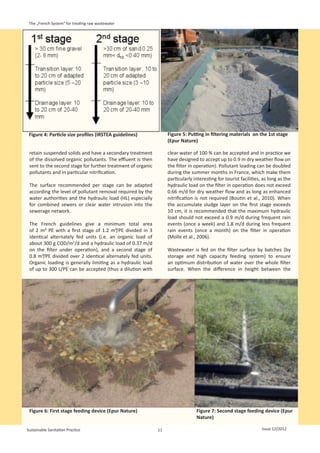
 Design and Results                                                 configuration and media profile are presented in Figure
                                                                    3 and Figure 4.
 Design
 The sizing of VF CWs is still roughly based on organic load        After a coarse screening (30 mm) of the raw sewage
 acceptance (in terms of active surface area per people             wastewater the influent is transferred onto the first
 equivalent [PE] - one people equivalent (PE) is defined            stage. Each primary stage unit receives the full organic
 in France as the following production of pollutants:               load during the feeding phase which lasts 3.5 days,
 150L/PE/d, 90 g SS/PE/d (combined sewer) or 60 g SS/PE/d           before being rested for 7 days. These alternating phases
 (separate sewer), 120 g COD/PE/d, 60 g BOD5/PE/d, 15 g             of feeding and rest are fundamental in controlling the
 TKN/PE/d and 2.2 g TP/PE/d). Current recommendations               growth of the attached biomass on the filter media (avoid
 are 2 stages of filters with a total active area of 2m²/PE.        biological clogging), to maintain aerobic conditions
 While the first stage is divided into 3 identical filters,         within the filter and to mineralize the sludge deposit
 the second is divided into identical two filters. Filter           accumulated on the surface. The role of the first stage is to


 Figure 3: VF CW configuration with siphon
Sustainable Sanitation Practice                                10                                                 Issue 12/2012
The „French System“ for treating raw wastewater


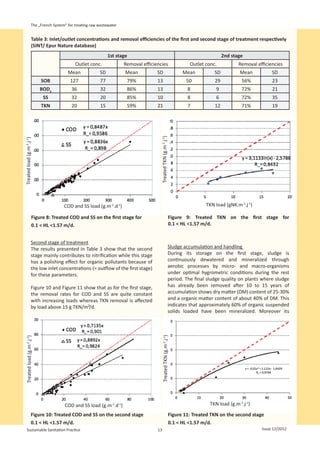
 Figure 4: Particle size profiles (IRSTEA guidelines)             Figure 5: Putting in filtering materials on the 1st stage
                                                                  (Epur Nature)

 retain suspended solids and have a secondary treatment           clear water of 100 % can be accepted and in practice we
 of the dissolved organic pollutants. The effluent is then        have designed to accept up to 0.9 m dry weather flow on
 sent to the second stage for further treatment of organic        the filter in operation). Pollutant loading can be doubled
 pollutants and in particular nitrification.                      during the summer months in France, which make them
                                                                  particularly interesting for tourist facilities, as long as the
 The surface recommended per stage can be adapted                 hydraulic load on the filter in operation does not exceed
 according the level of pollutant removal required by the         0.66 m/d for dry weather flow and as long as enhanced
 water authorities and the hydraulic load (HL) especially         nitrification is not required (Boutin et al., 2010). When
 for combined sewers or clear water intrusion into the            the accumulate sludge layer on the first stage exceeds
 sewerage network.                                                10 cm, it is recommended that the maximum hydraulic
                                                                  load should not exceed a 0.9 m/d during frequent rain
 The French guidelines give a minimum total area                  events (once a week) and 1.8 m/d during less frequent
 of 2  m²  PE with a first stage of 1.2 m²/PE divided in 3        rain events (once a month) on the filter in operation
 identical alternately fed units (i.e. an organic load of         (Molle et al., 2006).
 about 300 g COD/m2/d and a hydraulic load of 0.37 m/d
 on the filter under operation), and a second stage of            Wastewater is fed on the filter surface by batches (by
 0.8 m²/PE divided over 2 identical alternately fed units.        storage and high capacity feeding system) to ensure
 Organic loading is generally limiting as a hydraulic load        an optimum distribution of water over the whole filter
 of up to 300 L/PE can be accepted (thus a dilution with          surface. When the difference in height between the


 Figure 6: First stage feeding device (Epur Nature)                             Figure 7: Second stage feeding device (Epur
                                                                                Nature)

Sustainable Sanitation Practice                              11                                                   Issue 12/2012
The „French System“ for treating raw wastewater


   Table 1: Characteristics of the data base plants (70 units, SINT/Epur Nature database)
          Age of the Plant (years of                       Hydraulic load                             Organic load
                 operation)
         ≤3          3 < age < 6         >6       50 % <    50 % < 100 %     >100 %       < 50 %      50 % < 100 %      > 100 %
        54 %             40 %            6%        43%          43%           14%          52%              41 %          7%


   Table 2: Inlet/outlet concentrations and removal efficiencies of a two stage VF CWs (SINT/Epur Nature database)
                             Inlet concentration (mg/L)       Outlet concentration (mg/L)           Removal efficiencies (%)
                                Mean              SD             Mean               SD               Mean                SD
           COD                     651            282             50                29                 92                7
          BOD5                     291            140              8                  9                97                3
            SS                     242            133              8                  6                97                3
           TKN                     56             34               7                12                 90                12
            TP                     7               4               6                  3                32                25


   inlet and the outlet is sufficient, it is possible to work           effluent quality for all parameters except phosphorous
   without energy by using a siphon (e.g. Aquasaf siphon,               (P-removal is mainly correlated to the phosphate
   Figure 2) as feeding device. The water distribution onto             adsorption capacity of the filtering materials and not
   each stage has a fundamental importance; therefore                   long-lasting) and denitrification (due to the prevailing
   it is recommended to design i) the feeding system for                aerobic conditions in the filters).
   the first stage to deliver a flow of 0.5 m3/h per square
   meter of fed bed surface, with one feeding point for                 Removal efficiencies of organic pollutants are fairly
   a maximum of 50 m² and ii) the feeding system of the                 constant, (low standard deviation [SD]) while the
   second stage to deliver 0.25 m3/h to 0.5 m3/ per square              nitrification rate (assumed as the TKN removal) shows
   meter, according to the characteristics of the sand, with            a 12 % standard deviation and, not surprisingly, SD for
   one feeding point for 1 m² of filter surface (Figure 6 and           phosphorus is even higher. Varying nitrification rates are
   Figure 7).                                                           caused by differences between filter materials and also
                                                                        are correlated to the hydraulic and organic loads.
   Concerning the sludge management, with an                            Finally, the statistical data treatment showed that there
   accumulation rate of 1 to 2 cm/year, a free board of 50              is no significant impact of the season on the removal
   cm on the first stage ensures its accumulation for about             rate of the assessed parameters.
   10 years before emptying.
                                                                        First stage of treatment
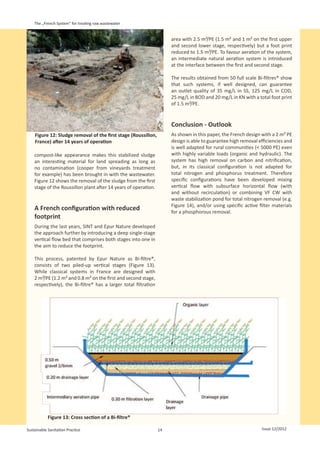
                                                                        The results observed on the first stage are summarized
   Global Efficiencies                                                  in Table 3. We can clearly observe that the first stage of
   Pollutant Removal efficiencies                                       treatment concerns mainly SS, COD and BOD5 removal,
   The global removal efficiencies were assessed on                     although nitrification is not negligible with a mean of
   constructed wetlands following the French design for                 60 % of TKN removal. The removal efficiency of the first
   domestic raw wastewater and were based on a statistical              stage is enhanced by the sludge layer deposit which
   treatment of a data base of 70 plants built by SINT or               regulates the infiltration and the hydraulics of the filter.
   Epur Nature. The plants characteristics (age, organic
   and hydraulic load) of these plants are summarized                   As observed in Figure 8 which presents the removal
   in Table 1. They all are 2 stages VFCW (with a 2 m²/PE               performances in relation the applied load (100 %
   design) with 0.4-0.6 m of gravel (2-8 mm) on the first               removal represented by the dotted line) the first stage
   stage and 0.3 to 0.4 m of sand (0-4 mm) on the second                removal efficiencies for COD and SS are linear, even for
   stage, fed with raw wastewater                                       loads above 300 g COD/m²/d on the filter in operation,
                                                                        without clogging. On the other hand, nitrification
                                                                        removal decreases rapidly with an increasing load as
   Table 2 shows the inlet/outlet concentrations and the
                                                                        showed on Figure 9. This is the result of a higher oxygen
   global removal efficiency for plants with a hydraulic
                                                                        demand induced by concomitant higher organic loads
   load lower than 0.9 m/d on the filter in operation on
                                                                        and lower oxygenation rates due to higher hydraulic
   the first stage. The influent is quite variable mainly due
                                                                        loads.
   to the different characteristics of sewerage networks
   (combined or separate and amount of clear water
   intrusion). Globally the system is able to achieve a good

 Sustainable Sanitation Practice                                   12                                                 Issue 12/2012
The „French System“ for treating raw wastewater


                       Table 3: Inlet/outlet concentrations and removal efficiencies of the first and second stage of treatment respectively
                       (SINT/ Epur Nature database)
                                                                 1st stage                                                                  2nd stage
                                              Outlet conc.              Removal efficiencies                                Outlet conc.           Removal efficiencies
                                          Mean             SD            Mean          SD                               Mean           SD          Mean           SD
                             SOB           127              77           79%           13                                 50           29           56%           23
                             BOD5           36              32           86%           13                                  8            9           72%           21
                              SS            32              20           85%           10                                  8            6           72%           35
                             TKN            20              15           59%           21                                  7           12           71%           19


                                                                                        Treated TKN (g.m-2.j-1)
Treated load (g.m-2.j-1)


                                        COD and SS load (g.m-2.d-1)                                                                TKN load (gNK.m-2.j-1)

                       Figure 8: Treated COD and SS on the first stage for                                        Figure 9: Treated TKN on the first stage for
                       0.1 < HL <1.57 m/d.                                                                        0.1 < HL <1.57 m/d.


                      Second stage of treatment
                      The results presented in Table 3 show that the second                                       Sludge accumulation and handling
                      stage mainly contributes to nitrification while this stage                                  During its storage on the first stage, sludge is
                      has a polishing effect for organic pollutants because of                                    continuously dewatered and mineralized through
                      the low inlet concentrations (= outflow of the first stage)                                 aerobic processes by micro- and macro-organisms
                      for these parameters.                                                                       under optimal hygrometric conditions during the rest
                                                                                                                  period. The final sludge quality on plants where sludge
                      Figure 10 and Figure 11 show that as for the first stage,                                   has already been removed after 10 to 15 years of
                      the removal rates for COD and SS are quite constant                                         accumulation shows dry matter (DM) content of 25-30%
                      with increasing loads whereas TKN removal is affected                                       and a organic matter content of about 40% of DM. This
                      by load above 15 g TKN/m²/d.                                                                indicates that approximately 60% of organic suspended
                                                                                                                  solids loaded have been mineralized. Moreover its
                                                                                          Treated TKN (g.m-2.j-1)
  Treated load (g.m-2.j-1)


                                        COD and SS load (g.m-2.d-1)                                                                  TKN load (g.m-2.j-1)

                      Figure 10: Treated COD and SS on the second stage                                           Figure 11: Treated TKN on the second stage
                      0.1 < HL <1.57 m/d.                                                                         0.1 < HL <1.57 m/d.
      Sustainable Sanitation Practice                                                  13                                                                    Issue 12/2012
The „French System“ for treating raw wastewater


                                                                       area with 2.5 m²/PE (1.5 m² and 1 m² on the first upper
                                                                       and second lower stage, respectively) but a foot print
                                                                       reduced to 1.5 m²/PE. To favour aeration of the system,
                                                                       an intermediate natural aeration system is introduced
                                                                       at the interface between the first and second stage.

                                                                       The results obtained from 50 full scale Bi-filtres® show
                                                                       that such systems, if well designed, can guarantee
                                                                       an outlet quality of 35 mg/L in SS, 125 mg/L in COD,
                                                                       25 mg/L in BOD and 20 mg/L in KN with a total foot print
                                                                       of 1.5 m²/PE.


                                                                       Conclusion - Outlook
    Figure 12: Sludge removal of the first stage (Roussillon,          As shown in this paper, the French design with a 2 m² PE
    France) after 14 years of operation                                design is able to guarantee high removal efficiencies and
                                                                       is well adapted for rural communities (< 5000 PE) even
    compost-like appearance makes this stabilized sludge               with highly variable loads (organic and hydraulic). The
    an interesting material for land spreading as long as              system has high removal on carbon and nitrification,
    no contamination (cooper from vineyards treatment                  but, in its classical configuration is not adapted for
    for example) has been brought in with the wastewater.              total nitrogen and phosphorus treatment. Therefore
    Figure 12 shows the removal of the sludge from the first           specific configurations have been developed mixing
    stage of the Roussillon plant after 14 years of operation.         vertical flow with subsurface horizontal flow (with
                                                                       and without recirculation) or combining VF CW with
                                                                       waste stabilization pond for total nitrogen removal (e.g.
                                                                       Figure  14), and/or using specific active filter materials
    A French configuration with reduced                                for a phosphorous removal.
    footprint
    During the last years, SINT and Epur Nature developed
    the approach further by introducing a deep single-stage
    vertical flow bed that comprises both stages into one in
    the aim to reduce the footprint.

    This process, patented by Epur Nature as Bi-filtre®,
    consists of two piled-up vertical stages (Figure 13).
    While classical systems in France are designed with
    2 m²/PE (1.2 m² and 0.8 m² on the first and second stage,
    respectively), the Bi-filtre® has a larger total filtration


            Figure 13: Cross section of a Bi-filtre®

Sustainable Sanitation Practice                                   14                                              Issue 12/2012
The „French System“ for treating raw wastewater


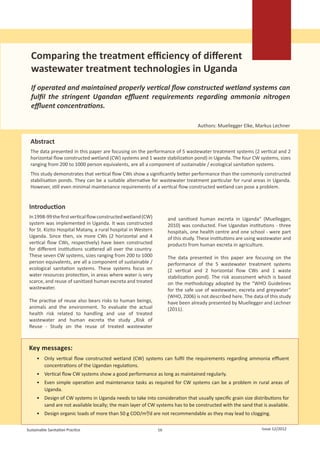
               Figure 14: Saint Etienne de Tulmont, France (1900 PE, Epur Nature)

    References
    Boutin, C., Prost-Boucle, S., Boucher, M. (2010): Robustness of vertical
      Reed Bed Filters facing loads variations: the particular case of
      campsites. In: Masi, F., Nivala, J. (eds.): Proceedings of the 12th
      IWA Specialized Group Conference on „Wetland Systems for Water
      Pollution Control“, 3-8 October 2010, San Servolo, Venice, Italy,
      pp.177-185 (ISBN 978-88-6060-300-5).
    Liénard, A. (1987): Domestic wastewater treatment in tanks with
       emergent hydrophytes: latest results of a recent plant in France.
       Water Sci Technol 19(12), 373–375.
    Molle, P., Liénard, A., Boutin, C.; Merlin, G., Iwema, A. (2005). How to
     treat raw sewage with constructed wetlands: an overview of the
     french systems. Water Sci Technol 51(9), 11-21.
    Molle, P., Liénard, A., Grasmick, A., Iwema, A. (2006). Effect of reeds
     and feeding operations on hydraulic behavior of vertical flow
     constructed wetlands under hydraulic overloads. Water Res 40(3),
     606-612.


                                                                                    Names: Stephane Troesch
                                                                                    Organisation: Epur Nature, ZAC des Balarucs
                                                                                    Town, Country: Caumont-sur-Durance, France
                                                                                    eMail: stephane.troesch@epurnature.fr

                                                                                    Names: Dirk Esser
                                                                                    Organisation: SINT (Société d‘Ingénierie
                                                                                    Nature & Technique)
                                                                                    Town, Country: La Chapelle du Mont du Chat,
                                                                                    France
                                                                                    eMail: dirk.esser@sint.fr


Sustainable Sanitation Practice                                                15                                   Issue 12/2012


  Comparing the treatment efficiency of different
  wastewater treatment technologies in Uganda
  If operated and maintained properly vertical flow constructed wetland systems can
  fulfil the stringent Ugandan effluent requirements regarding ammonia nitrogen
  effluent concentrations.

                                                                                  Authors: Muellegger Elke, Markus Lechner


  Abstract
  The data presented in this paper are focusing on the performance of 5 wastewater treatment systems (2 vertical and 2
  horizontal flow constructed wetland (CW) systems and 1 waste stabilization pond) in Uganda. The four CW systems, sizes
  ranging from 200 to 1000 person equivalents, are all a component of sustainable / ecological sanitation systems.
  This study demonstrates that vertical flow CWs show a significantly better performance than the commonly constructed
  stabilisation ponds. They can be a suitable alternative for wastewater treatment particular for rural areas in Uganda.
  However, still even minimal maintenance requirements of a vertical flow constructed wetland can pose a problem.


 Introduction
 In 1998-99 the first vertical flow constructed wetland (CW)        and sanitised human excreta in Uganda“ (Muellegger,
 system was implemented in Uganda. It was constructed               2010) was conducted. Five Ugandan institutions - three
 for St. Kizito Hospital Matany, a rural hospital in Western        hospitals, one health centre and one school - were part
 Uganda. Since then, six more CWs (2 horizontal and 4               of this study. These institutions are using wastewater and
 vertical flow CWs, respectively) have been constructed             products from human excreta in agriculture.
 for different institutions scattered all over the country.
 These seven CW systems, sizes ranging from 200 to 1000             The data presented in this paper are focusing on the
 person equivalents, are all a component of sustainable /           performance of the 5 wastewater treatment systems
 ecological sanitation systems. These systems focus on              (2 vertical and 2 horizontal flow CWs and 1 waste
 water resources protection, in areas where water is very           stabilization pond). The risk assessment which is based
 scarce, and reuse of sanitized human excreta and treated           on the methodology adopted by the “WHO Guidelines
 wastewater.                                                        for the safe use of wastewater, excreta and greywater”
                                                                    (WHO, 2006) is not described here. The data of this study
 The practise of reuse also bears risks to human beings,            have been already presented by Muellegger and Lechner
 animals and the environment. To evaluate the actual                (2011).
 health risk related to handling and use of treated
 wastewater and human excreta the study „Risk of
 Reuse - Study on the reuse of treated wastewater


 Key messages:
     •	 Only vertical flow constructed wetland (CW) systems can fulfil the requirements regarding ammonia effluent
        concentrations of the Ugandan regulations.
     •	 Vertical flow CW systems show a good performance as long as maintained regularly.
     •	 Even simple operation and maintenance tasks as required for CW systems can be a problem in rural areas of
        Uganda.
     •	 Design of CW systems in Uganda needs to take into consideration that usually specific grain size distributions for
        sand are not available locally; the main layer of CW systems has to be constructed with the sand that is available.
     •	 Design organic loads of more than 50 g COD/m²/d are not recommendable as they may lead to clogging.


Sustainable Sanitation Practice                                16                                                  Issue 12/2012
Experiences of constructed wetlands in Uganda


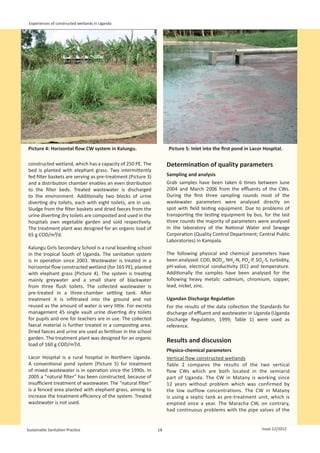
 Figure 1: Sieve Analyses Filter Sand at Matany Hospital                       Picture 1: Vertical flow CW system in Matany
                                                                                                                                       

                                                                               Hospital.

 Materials and methods                                               and all other treatment plants described below locally
                                                                     available sand was used for the construction of the filter.
 Site descriptions                                                   The quality of the sand varies; in the case of Matany
 Five Ugandan institutions were part of this study:                  Hospital’s treatment plant the grading curve is shown in
 St.  Kizito Hospital Matany and Kanawat Health Centre,              Figure 1.
 St.  Mary´s Hospital Lacor and Maracha Hospital and
 Kalungu Girls Secondary School.                                     Kanawat Health Centre is located in the north-east
                                                                     of Karamoja. The sanitation system was completely
 St. Kizito Hospital Matany is a rural hospital in the               replaced in 2003 and 2004. Wastewater from flush
 semiarid region of Karamoja, in eastern Uganda. The                 toilets is treated in a horizontal flow constructed wetland
 sanitation system is in operation since 1999. Wastewater            system (Picture 2), with a capacity of 30 PE. The filter
 from flush toilets and showers is treated in a vertical flow        bed is planted with elephant grass. A three-chamber
 constructed wetland system (Picture 1), with a capacity             settling tank is pre-treating the wastewater and a sludge
 of 625 PE. The wetland is separated in three individual             drying bed was constructed for stabilised sludge from the
 beds and planted with elephant grass (Pennistum                     settling tank. An underground collection tank is storing
 purpureum). A three-chamber settling tank serves as                 the treated wastewater for irrigation of trees. Staff of
 wastewater pre-treatment and a mechanical distribution              the health centre is using urine diverting dry toilets, one
 unit enables an intermittent distribution to the three              block with four units. The treatment plant was designed
 beds. The treated wastewater is collected in a storage              for an organic load of 53 g COD/m²/d.
 tank for irrigation. Furthermore dried sludge from septic
 tanks and pit latrines is used as soil conditioner. Both            Maracha Hospital is a rural hospital in north-western
 fractions are only used to fertilise trees. The plant was           Uganda. The sanitation infrastructure was rehabilitated
 designed for an organic load of 47 g COD/m²/d. For this             in 2001 and 2002. Wastewater is treated in a vertical flow


 Picture 2: Horizontal flow CW system in Kanawat Health          
   Picture 3: Filter baskets as wastewater pre-treatment in
 Centre.                                                             Maracha Hospital.                                             

Sustainable Sanitation Practice                                 17                                                Issue 12/2012
Experiences of constructed wetlands in Uganda


Picture 4: Horizontal flow CW system in Kalungu.
                                                               
   Picture 5: Inlet into the first pond in Lacor Hospital.


constructed wetland, which has a capacity of 250 PE. The           Determination of quality parameters
bed is planted with elephant grass. Two intermittently
fed filter baskets are serving as pre-treatment (Picture 3)        Sampling and analysis
and a distribution chamber enables an even distribution            Grab samples have been taken 6 times between June
to the filter beds. Treated wastewater is discharged               2004 and March 2006 from the effluents of the CWs.
to the environment. Additionally two blocks of urine               During the first three sampling rounds most of the
diverting dry toilets, each with eight toilets, are in use.        wastewater parameters were analysed directly on
Sludge from the filter baskets and dried faeces from the           spot with field testing equipment. Due to problems of
urine diverting dry toilets are composted and used in the          transporting the testing equipment by bus, for the last
hospitals own vegetable garden and sold respectively.              three rounds the majority of parameters were analysed
The treatment plant was designed for an organic load of            in the laboratory of the National Water and Sewage
65 g COD/m²/d.                                                     Corporation (Quality Control Department; Central Public
                                                                   Laboratories) in Kampala.
Kalungu Girls Secondary School is a rural boarding school
in the tropical South of Uganda. The sanitation system             The following physical and chemical parameters have
is in operation since 2003. Wastewater is treated in a             been analysed: COD, BOD5, NH4-N, PO4-P, SO4-S, turbidity,
horizontal flow constructed wetland (for 165 PE), planted          pH-value, electrical conductivity (EC) and temperature.
with elephant grass (Picture 4). The system is treating            Additionally the samples have been analysed for the
mainly greywater and a small share of blackwater                   following heavy metals: cadmium, chromium, copper,
from three flush toilets. The collected wastewater is              lead, nickel, zinc.
pre-treated in a three-chamber settling tank. After
treatment it is infiltrated into the ground and not                Ugandan Discharge Regulation
reused as the amount of water is very little. For excreta          For the results of the data collection the Standards for
management 45 single vault urine diverting dry toilets             discharge of effluent and wastewater in Uganda (Uganda
for pupils and one for teachers are in use. The collected          Discharge Regulation, 1999; Table 1) were used as
faecal material is further treated in a composting area.           reference.
Dried faeces and urine are used as fertiliser in the school
garden. The treatment plant was designed for an organic
                                                                   Results and discussion
load of 160 g COD/m²/d.
                                                                   Physico-chemical parameters
Lacor Hospital is a rural hospital in Northern Uganda.             Vertical flow constructed wetlands
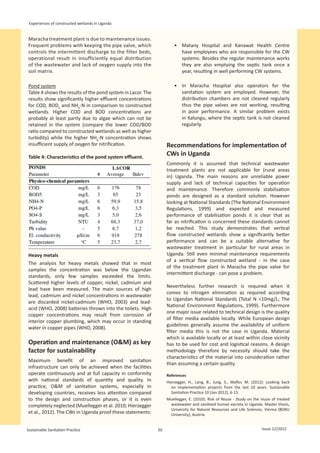
A conventional pond system (Picture 5) for treatment               Table 2 compares the results of the two vertical
of mixed wastewater is in operation since the 1990s. In            flow CWs which are both located in the semiarid
2005 a “natural filter” has been constructed, because of           part of Uganda. The CW in Matany is working since
insufficient treatment of wastewater. The “natural filter”         12 years without problem which was confirmed by
is a fenced area planted with elephant grass, aiming to            the low outflow concentrations. The CW in Matany
increase the treatment efficiency of the system. Treated           is using a septic tank as pre-treatment unit, which is
wastewater is not used.                                            emptied once a year. The Maracha CW, on contrary,
                                                                   had continuous problems with the pipe valves of the


Sustainable Sanitation Practice                               18                                                Issue 12/2012
Experiences of constructed wetlands in Uganda

                      Table 1: The standards for discharge of effluent and wastewater in Uganda (The Water
                      (Waste) Discharge Regulations, 1998).


 distribution chamber. This was mainly due to the fact               analysis in Kalungu showed very unsatisfactory results.
 that maintenance of the system was neglected. The                   The main reasons are the instability of the hydraulic
 non-functional pipe valves are mainly responsible                   load, which fluctuates strongly over the year and the
 for a lack of oxygen thus resulting in a higher NH4-N               comparatively high design load. Especially during
 effluent concentration.                                             holidays, the hydraulic load is reduced to a minimum
                                                                     and the wetland oversized while during school the
 Horizontal flow constructed wetlands                                system is overloaded.
 Table 3 compares the results of the two horizontal flow
 CWs. Both are in operation since nearly eight years                 Vertical flow vs. horizontal flow CW
 and are used mainly to treat greywater. The treatment               The results presented in Table 2 and Table 3
 system in Kanawat had only problems with too high                   demonstrate the expected improved nitrification
 NH4-N concentrations which could be attributed to                   efficiency of vertical flow constructed wetlands. The
 unplanned urine discharge into the sewer system. The                untypically high NH4-N effluent concentration of the
                    Table 2: Characteristics of the vertical flow CW effluents.


                    Table 3: Characteristics of the horizontal flow CW effluents.


Sustainable Sanitation Practice                                 19                                               Issue 12/2012
Experiences of constructed wetlands in Uganda


Maracha treatment plant is due to maintenance issues.
Frequent problems with keeping the pipe valve, which                      •	 Matany Hospital and Kanawat Health Centre
controls the intermittent discharge to the filter beds,                      have employees who are responsible for the CW
operational result in insufficiently equal distribution                      systems. Besides the regular maintenance works
of the wastewater and lack of oxygen supply into the                         they are also emptying the septic tank once a
soil matrix.                                                                 year, resulting in well performing CW systems.

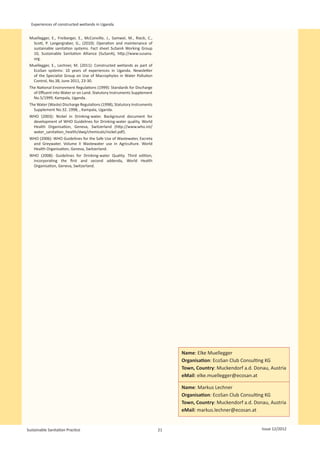
Pond system                                                               •	 In Maracha Hospital also operators for the
Table 4 shows the results of the pond system in Lacor. The                   sanitation system are employed. However, the
results show significantly higher effluent concentrations                    distribution chambers are not cleaned regularly
for COD, BOD5 and NH4-N in comparison to constructed                         thus the pipe valves are not working, resulting
wetlands. Higher COD and BOD concentrations are                              in poor performance. A similar problem exists
probably at least partly due to algae which can not be                       in Kalungu, where the septic tank is not cleaned
retained in the system (compare the lower COD/BOD                            regularly.
ratio compared to constructed wetlands as well as higher
turbidity) while the higher NH4-N concentration shows
insufficient supply of oxygen for nitrification.                      Recommendations for implementation of
Table 4: Characteristics of the pond system effluent.
                                                                      CWs in Uganda
                                                                      Commonly it is assumed that technical wastewater
                                                                      treatment plants are not applicable for (rural areas
                                                                      in) Uganda. The main reasons are unreliable power
                                                                      supply and lack of technical capacities for operation
                                                                      and maintenance. Therefore commonly stabilisation
                                                                      ponds are designed as a standard solution. However
                                                                      looking at National Standards (The National Environment
                                                                      Regulations, 1999) and expected and measured
                                                                      performance of stabilisation ponds it is clear that as
                                                                      far as nitrification is concerned these standards cannot
                                                                      be reached. This study demonstrates that vertical
                                                                      flow constructed wetlands show a significantly better
                                                                      performance and can be a suitable alternative for
                                                             
        wastewater treatment in particular for rural areas in
Heavy metals                                                          Uganda. Still even minimal maintenance requirements
                                                                      of a vertical flow constructed wetland - in the case
The analysis for heavy metals showed that in most
                                                                      of the treatment plant in Maracha the pipe valve for
samples the concentration was below the Ugandan
                                                                      intermittent discharge - can pose a problem.
standards, only few samples exceeded the limits.
Scattered higher levels of copper, nickel, cadmium and
                                                                      Nevertheless further research is required when it
lead have been measured. The main sources of high
                                                                      comes to nitrogen elimination as required according
lead, cadmium and nickel concentrations in wastewater
                                                                      to Ugandan National Standards (Total N <10mg/L; The
are discarded nickel-cadmium (WHO, 2003) and lead-
                                                                      National Environment Regulations, 1999). Furthermore
acid (WHO, 2008) batteries thrown into the toilets. High
                                                                      one major issue related to technical design is the quality
copper concentrations may result from corrosion of
                                                                      of filter media available locally. While European design
interior copper plumbing, which may occur in standing
                                                                      guidelines generally assume the availability of uniform
water in copper pipes (WHO, 2008).
                                                                      filter media this is not the case in Uganda. Material
                                                                      which is available locally or at least within close vicinity
Operation and maintenance (O&M) as key                                has to be used for cost and logistical reasons. A design
factor for sustainability                                             methodology therefore by necessity should take the
                                                                      characteristics of the material into consideration rather
Maximum benefit of an improved sanitation
                                                                      than assuming a certain quality.
infrastructure can only be achieved when the facilities
operate continuously and at full capacity in conformity               References
with national standards of quantity and quality. In                   Hierzegger, H., Lang, B., Jung, S., Wafler, M. (2012): Looking back
practice, O&M of sanitation systems, especially in                      on implementation projects from the last 10 years. Sustainable
developing countries, receives less attention compared                  Sanitation Practice 10 (Jan 2012), 6-13.
to the design and construction phases, or it is even                  Muellegger, E. (2010): Risk of Reuse - Study on the reuse of treated
completely neglected (Muellegger et al. 2010; Hierzegger               wastewater and sanitised human excreta in Uganda. Master thesis,
                                                                       University for Natural Resources and Life Sciences, Vienna (BOKU
et al., 2012). The CWs in Uganda proof these statements:               University), Austria.


Sustainable Sanitation Practice                                  20                                                       Issue 12/2012
Experiences of constructed wetlands in Uganda


 Muellegger, E., Freiberger, E., McConville, J., Samwel, M., Rieck, C.,
  Scott, P. Langergraber, G., (2010): Operation and maintenance of
  sustainable sanitation systems. Fact sheet SuSanA Working Group
  10, Sustainable Sanitation Alliance (SuSanA), http://www.susana.
  org.
 Muellegger, E., Lechner, M. (2011): Constructed wetlands as part of
  EcoSan systems: 10 years of experiences in Uganda. Newsletter
  of the Specialist Group on Use of Macrophytes in Water Pollution
  Control, No.38, June 2011, 23-30.
 The National Environment Regulations (1999): Standards for Discharge
   of Effluent into Water or on Land. Statutory Instruments Supplement
   No.5/1999, Kampala, Uganda.
 The Water (Waste) Discharge Regulations (1998), Statutory Instruments
   Supplement No.32. 1998, , Kampala, Uganda.
 WHO (2003): Nickel in Drinking-water. Background document for
  development of WHO Guidelines for Drinking-water quality, World
  Health Organisation, Geneva, Switzerland (http://www.who.int/
  water_sanitation_health/dwq/chemicals/nickel.pdf).
 WHO (2006): WHO Guidelines for the Safe Use of Wastewater, Excreta
  and Greywater. Volume II Wastewater use in Agriculture. World
  Health Organisation, Geneva, Switzerland.
 WHO (2008): Guidelines for Drinking-water Quality. Third edition,
  incorporating the first and second addenda, World Health
  Organisation, Geneva, Switzerland.


                                                                               Name: Elke Muellegger
                                                                               Organisation: EcoSan Club Consulting KG
                                                                               Town, Country: Muckendorf a.d. Donau, Austria
                                                                               eMail: elke.muellegger@ecosan.at

                                                                               Name: Markus Lechner
                                                                               Organisation: EcoSan Club Consulting KG
                                                                               Town, Country: Muckendorf a.d. Donau, Austria
                                                                               eMail: markus.lechner@ecosan.at


Sustainable Sanitation Practice                                           21                                     Issue 12/2012


  A Hybrid Wetland for Small
  Community Wastewater Treatment in Morocco
  This paper presents design parameters for a hybrid constructed wetland and
  tentative strategies for optimizing treated effluent reuse for irrigation.


                                                           Authors: Bouchaib El Hamouri, Christopher Kinsley, Anna Crolla


  Abstract
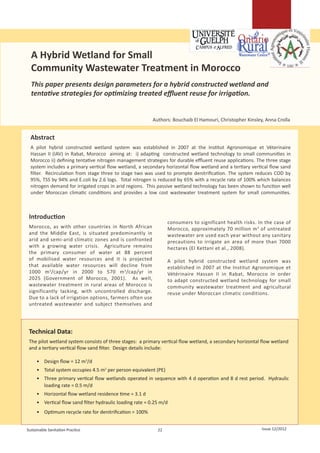
  A pilot hybrid constructed wetland system was established in 2007 at the Institut Agronomique et Véterinaire
  Hassan  II  (IAV) in Rabat, Morocco aiming at: i) adapting constructed wetland technology to small communities in
  Morocco ii) defining tentative nitrogen management strategies for durable effluent reuse applications. The three stage
  system includes a primary vertical flow wetland, a secondary horizontal flow wetland and a tertiary vertical flow sand
  filter. Recirculation from stage three to stage two was used to prompte denitrification. The system reduces COD by
  95%, TSS by 94% and E.coli by 2.6 logs. Total nitrogen is reduced by 65% with a recycle rate of 100% which balances
  nitrogen demand for irrigated crops in arid regions. This passive wetland technology has been shown to function well
  under Moroccan climatic conditions and provides a low cost wastewater treatment system for small communities.


 Introduction
                                                                   consumers to significant health risks. In the case of
 Morocco, as with other countries in North African                 Morocco, approximately 70 million m 3 of untreated
 and the Middle East, is situated predominantly in                 wastewater are used each year without any sanitary
 arid and semi-arid climatic zones and is confronted               precautions to irrigate an area of more than 7000
 with a growing water crisis. Agriculture remains                  hectares (El Kettani et al., 2008).
 the primary consumer of water at 88 percent
 of mobilised water resources and it is projected                  A pilot hybrid constructed wetland system was
 that available water resources will decline from                  established in 2007 at the Institut Agronomique et
 1000 m 3/cap/yr in 2000 to 570 m 3/cap/yr in                      Vétérinaire Hassan II in Rabat, Morocco in order
 2025 (Government of Morocco, 2001). As well,                      to adapt constructed wetland technology for small
 wastewater treatment in rural areas of Morocco is                 community wastewater treatment and agricultural
 significantly lacking, with uncontrolled discharge.               reuse under Moroccan climatic conditions.
 Due to a lack of irrigation options, farmers often use
 untreated wastewater and subject themselves and


 Technical Data:
 The pilot wetland system consists of three stages: a primary vertical flow wetland, a secondary horizontal flow wetland
 and a tertiary vertical flow sand filter. Design details include:

     •	 Design flow = 12 m3/d
     •	 Total system occupies 4.5 m2 per person equivalent (PE)
     •	 Three primary vertical flow wetlands operated in sequence with 4 d operation and 8 d rest period. Hydraulic
        loading rate = 0.5 m/d
     •	 Horizontal flow wetland residence time = 3.1 d
     •	 Vertical flow sand filter hydraulic loading rate = 0.25 m/d
     •	 Optimum recycle rate for denitrification = 100%


Sustainable Sanitation Practice                               22                                               Issue 12/2012
Small Community Wastewater Treatment and Agricultural Reuse, Marocco


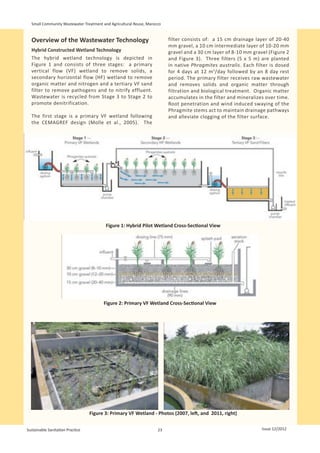
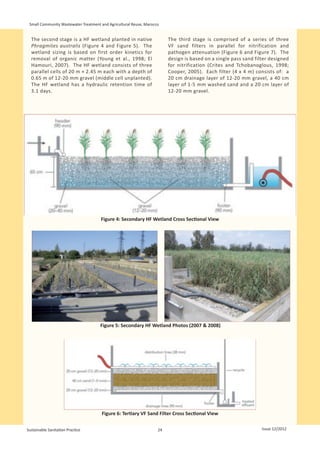
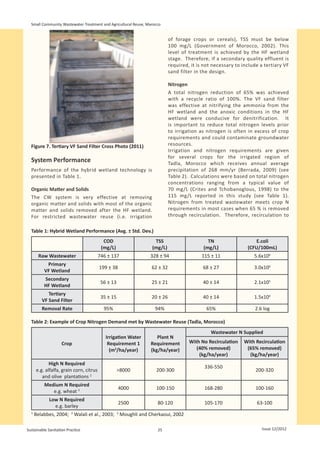
  Overview of the Wastewater Technology                                  filter consists of: a 15 cm drainage layer of 20-40
                                                                         mm gravel, a 10 cm intermediate layer of 10-20 mm
  Hybrid Constructed Wetland Technology                                  gravel and a 30 cm layer of 8-10 mm gravel (Figure 2
  The hybrid wetland technology is depicted in                           and Figure 3). Three filters (5 x 5 m) are planted
  Figure 1 and consists of three stages: a primary                       in native Phragmites australis. Each filter is dosed
  vertical flow (VF) wetland to remove solids, a                         for 4 days at 12 m 3/day followed by an 8 day rest
  secondary horizontal flow (HF) wetland to remove                       period. The primary filter receives raw wastewater
  organic matter and nitrogen and a tertiary VF sand                     and removes solids and organic matter through
  filter to remove pathogens and to nitrify effluent.                    filtration and biological treatment. Organic matter
  Wastewater is recycled from Stage 3 to Stage 2 to                      accumulates in the filter and mineralizes over time.
  promote denitrification.                                               Root penetration and wind induced swaying of the
                                                                         Phragmite stems act to maintain drainage pathways
  The first stage is a primary VF wetland following                      and alleviate clogging of the filter surface.
  the CEMAGREF design (Molle et al., 2005). The


                                         Figure 1: Hybrid Pilot Wetland Cross-Sectional View


                                        Figure 2: Primary VF Wetland Cross-Sectional View


                                  Figure 3: Primary VF Wetland - Photos (2007, left, and 2011, right)


Sustainable Sanitation Practice                                     23                                           Issue 12/2012
Small Community Wastewater Treatment and Agricultural Reuse, Marocco


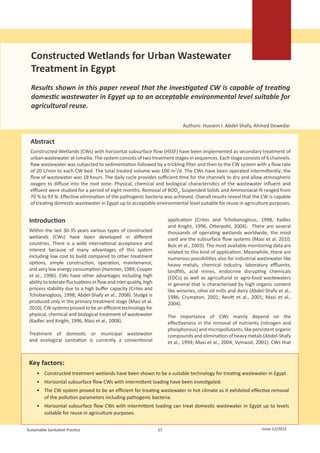
  The second stage is a HF wetland planted in native                     The third stage is comprised of a series of three
  Phragmites australis (Figure 4 and Figure 5). The                      VF sand filters in parallel for nitrification and
  wetland sizing is based on first order kinetics for                    pathogen attenuation (Figure 6 and Figure 7). The
  removal of organic matter (Young et al., 1998; El                      design is based on a single pass sand filter designed
  Hamouri, 2007). The HF wetland consists of three                       for nitrification (Crites and Tchobanoglous, 1998;
  parallel cells of 20 m × 2.45 m each with a depth of                   Cooper, 2005). Each filter (4 x 4 m) consists of: a
  0.65 m of 12-20 mm gravel (middle cell unplanted).                     20 cm drainage layer of 12-20 mm gravel, a 40 cm
  The HF wetland has a hydraulic retention time of                       layer of 1-5 mm washed sand and a 20 cm layer of
  3.1 days.                                                              12-20 mm gravel.


                                      Figure 4: Secondary HF Wetland Cross Sectional View


                                      Figure 5: Secondary HF Wetland Photos (2007 & 2008)


                                       Figure 6: Tertiary VF Sand Filter Cross Sectional View

Sustainable Sanitation Practice                                     24                                            Issue 12/2012
Small Community Wastewater Treatment and Agricultural Reuse, Marocco


                                                                           of forage crops or cereals), TSS must be below
                                                                           100 mg/L (Government of Morocco, 2002). This
                                                                           level of treatment is achieved by the HF wetland
  	                                                                        stage. Therefore, if a secondary quality effluent is
                                                                           required, it is not necessary to include a tertiary VF
                                                                           sand filter in the design.

                                                                           Nitrogen
                                                                           A total nitrogen reduction of 65% was achieved
                                                                           with a recycle ratio of 100%. The VF sand filter
                                                                           was effective at nitrifying the ammonia from the
                                                                           HF wetland and the anoxic conditions in the HF
                                                                           wetland were conducive for denitrification. It
                                                                           is important to reduce total nitrogen levels prior
                                                                           to irrigation as nitrogen is often in excess of crop
                                                                           requirements and could contaminate groundwater
  Figure 7. Tertiary VF Sand Filter Cross Photo (2011)                     resources.
                                                                           Irrigation and nitrogen requirements are given
                                                                           for several crops for the irrigated region of
  System Performance                                                       Tadla, Morocco which receives annual average
  Performance of the hybrid wetland technology is                          precipitation of 268 mm/yr (Berrada, 2009) (see
  presented in Table 1.                                                    Table 2). Calculations were based on total nitrogen
                                                                           concentrations ranging from a typical value of
  Organic Matter and Solids                                                70 mg/L (Crites and Tchobanoglous, 1998) to the
  The CW system is very effective at removing                              115 mg/L reported in this study (see Table 1).
  organic matter and solids with most of the organic                       Nitrogen from treated wastewater meets crop N
  matter and solids removed after the HF wetland.                          requirements in most cases when 65 % is removed
  For restricted wastewater reuse (i.e. irrigation                         through recirculation. Therefore, recirculation to

  Table 1: Hybrid Wetland Performance (Avg. ± Std. Dev.)
                                           COD                    TSS                       TN                    E.coli
                                          (mg/L)                 (mg/L)                   (mg/L)              (CFU/100mL)
       Raw Wastewater                    746 ± 137              328 ± 94                  115 ± 11               5.6x10⁶
           Primary
                                         199 ± 38                62 ± 32                  68 ± 27                3.0x10⁶
          VF Wetland
          Secondary
                                          56 ± 13                25 ± 21                  40 ± 14                2.1x10⁵
          HF Wetland
            Tertiary
                                          35 ± 15                20 ± 26                  40 ± 14                1.5x10⁴
         VF Sand Filter
         Removal Rate                      95%                     94%                      65%                  2.6 log

  Table 2: Example of Crop Nitrogen Demand met by Wastewater Reuse (Tadla, Morocco)
                                                                                              Wastewater N Supplied
                                            Irrigation Water       Plant N
                    Crop                     Requirement 1      Requirement         With No Recirculation   With Recirculation
                                              (m3/ha/year)      (kg/ha/year)           (40% removed)         (65% removed)
                                                                                        (kg/ha/year)          (kg/ha/year)
             High N Required
                                                                                           336-550
      e.g. alfalfa, grain corn, citrus              >8000          200-300                                        200-320
         and olive plantations 2
          Medium N Required
                                                    4000           100-150                 168-280                100-160
             e.g. wheat 3
            Low N Required
                                                    2500            80-120                 105-170                63-100
              e.g. barley
  1
      Belabbes, 2004; 2 Walali et al., 2003; 3 Moughli and Cherkaoui, 2002

Sustainable Sanitation Practice                                     25                                              Issue 12/2012
Small Community Wastewater Treatment and Agricultural Reuse, Marocco


  promote denitrification will often be necessary to                                Technology 51(9), 81-90.
  avoid nitrate contamination of the groundwater in                               Crites, R., Tchobanoglous, G. (1998): Small and Decentralised
  arid regions with significant water demand.                                        Wastewater Management Systems. McGraw Hill, Toronto, Canada.
                                                                                  El Hamouri, B. (2007): Subsurface-horizontal flow constructed
                                                                                    wetland for sewage treatment under Moroccan climate conditions.
  Pathogens                                                                         Desalination 215, 153-158.
  The two pathogen indicators governing wastewater                                El Kettani, S., Azzouzi, E., Boukachabine, K., El Yamani, M.,
  reuse are E.coli bacteria and helminth eggs. E.coli                               Maata, A., Rajaoui, M. (2008): Intestinal parasitosis and use of
  numbers are reduced by 2.6 logs throughout the                                    untreated wastewater for agriculture in Settat, Morocco. Eastern
                                                                                    Mediterranean Health Journal 14(6), 1435-1444.
  system from 5.6 x 10 6 in the raw wastewater to
                                                                                  Government of Morocco (2001): Etat de l‘environnement du
  1.5  x  10 4 CFU/100mL at the outlet of the VF sand                               Maroc. Ministère de l‘Aménagement du Territoire, de l‘Eau et de
  filter. Although not enumerated in this study,                                    l‘Environnement, Rabat, Morocco [in French].
  helminth eggs are effectively removed through                                   Government of Morocco (2002): Directives marocaines pour la
  filtration and will likely be removed in the first filter,                        réutilisation des eaux usées en agriculture. Directive n° 1276-01 du
  as they are closely associated with wastewater                                    10 Chaabane 1423. Ministre de l’Équipement et du Ministre chargé
                                                                                    de l’Aménagement du Territoire, de l’Urbanisme, de l’Habitat et de
  sludge (Kengne et al., 2009).
                                                                                    l’Environnement du Maroc, Rabat, Morocco [in French].
                                                                                  Kengne, I.M., Akoa, A., Koné, D. (2009). Recovery of biosolids from
  For unrestricted reuse (i.e. irrigation of produce                                constructed wetlands used of faecal sludge dewatering in tropical
  eaten raw) pathogen standards are typically                                       regions. Environmental Science and Technology 43, 6816-6821.
  10 3 CFU/100mL E.coli and <1 helminth egg/litre                                 Molle, P., Liénard, A., Boutin, C., Merlin, G., Iwema, A. (2005) How to
  (WHO,  2006). A further disinfection step would                                  treat raw sewage with constructed wetlands : An overview of the
  therefore be required as the VF Sand Filter reduces                              French systems. Water Science and Technology 51(9), 11-21.
  E.coli to only 1.5 x 10⁴ CFU/100mL.                                             Moughli and Cherkaoui (2002): Programme de réduction des excès
                                                                                   d’azote apportés à la betterave à sucre et au blé dans le périmètre
                                                                                   irrigué du Tadla. Revue HTE No. 123. [in French]
  Conclusions                                                                     Walali, L.D., Skiredj, A., Elattir, H. (2003): Transfert de technologie en
                                                                                   agriculture No. 105, Ministère de l’Agriculture et du Développement
  The hybrid constructed wetland technology is a                                   Rural du Maroc, Rabat, Morocco [in French].
  promising wastewater treatment alternative for                                  WHO (2006): Guidelines for the Safe Use of Wastewater, Excreta and
  small communities in Morocco and for communities                                 Greywater. Volume II. Wastewater Use in Agriculture. World Health
  with comparable socio-economic and climatic                                      Organisation, Geneva, Switzerland.
  conditions. The system has been shown to function                               Young, R., White, G., Brown, M., Burton, J., Atkins, B. (Eds.) (1998):
                                                                                    The Constructed Wetlands Manual. Department of Land and Water
  well over four years of continuous operation.
                                                                                    Conservation, New South Wales, Australia.
  The passive wetland technology provides several
  advantages including: low capital and operating
  costs, low energy requirements and high levels
  of treatment.     The system produces tertiary
  quality effluent suitable for direct discharge or
  for irrigation of forage crops, cereals and fruit
  trees while reducing pathogen risk and protecting
  groundwater from excess nitrogen leaching.                                               Name: Bouchaib El Hamouri
                                                                                           Organisation: Département Eau
  Acknowledgements                                                                         Environnement et Infrastructures, Institut
  Support for this research study was provided by                                          Agronomique et Vétérinaire Hassan II
  the Canadian International Development Agency –                                          Town, Country: Rabat, Morocco
  University Partnerships in Cooperation and
                                                                                           eMail: belhamouri@gmail.com
  Development Program.
                                                                                           Name: Christopher Kinsley
                                                                                           Organisation: Ontario Rural Wastewater
  References
  Belabbes, K. (2004): Rapport de prestation d’expertise sur le thème                      Centre, University of Guelph-Campus d’Alfred
    Besoins en eau des cultures dans le périmètre du Tadla. Projet                         Town, Country: Ontario, Canada
    d’initiative propre : Ecobilans appliqués à l’agriculture et Formation
    de Conseillers agricoles en environnement au Maroc (EFCA-PIP) [in
                                                                                           eMail: ckinsley@alfredc.uoguelph.ca
    French].
  Berrada, A. (2009): Assessment of Drip Irrigation in Morocco With                        Name: Anna Crolla
    Particular Emphasis on the Plain of Tadla. Limited Technical                           Organisation: Ontario Rural Wastewater
    Bulletin Agricultural Experimental Station LTB09-01. Colorado State
    University, USA.                                                                       Centre, University of Guelph-Campus d’Alfred
  Cooper, P. (2005): The Performance of Vertical Flow Constructed                          Town, Country: Ontario, Canada
    Wetland systems with special reference to the significance of                          eMail: acrolla@alfredc.uoguelph.ca
    Oxygen Transfer and Hydraulic Loading Rates. Water Science and


Sustainable Sanitation Practice                                              26                                                            Issue 12/2012


  Constructed Wetlands for Urban Wastewater
  Treatment in Egypt
  Results shown in this paper reveal that the investigated CW is capable of treating
  domestic wastewater in Egypt up to an acceptable environmental level suitable for
  agricultural reuse.

                                                                                Authors: Hussein I. Abdel-Shafy, Ahmed Dewedar


  Abstract
  Constructed-Wetlands (CWs) with horizontal subsurface flow (HSSF) have been implemented as secondary treatment of
  urban wastewater at Ismailia. The system consists of two treatment stages in sequences. Each stage consists of 6 channels.
  Raw wastewater was subjected to sedimentation followed by a trickling filter and then to the CW system with a flow rate
  of 20 L/min to each CW bed. The total treated volume was 100 m3/d. The CWs have been operated intermittently; the
  flow of wastewater was 18 hours. The daily cycle provides sufficient time for the channels to dry and allow atmospheric
  oxygen to diffuse into the root zone. Physical, chemical and biological characteristics of the wastewater influent and
  effluent were studied for a period of eight months. Removal of BOD5, Suspended Solids and Ammoniacal-N ranged from
  70 % to 93 %. Effective elimination of the pathogenic bacteria was achieved. Overall results reveal that the CW is capable
  of treating domestic wastewater in Egypt up to acceptable environmental level suitable for reuse in agriculture purposes.


 Introduction                                                            application (Crites and Tchobanoglous, 1998, Kadlec
                                                                         and Knight, 1996, Otterpohl, 2004). There are several
 Within the last 30-35 years various types of constructed                thousands of operating wetlands worldwide, the most
 wetlands (CWs) have been developed in different                         used are the subsurface flow systems (Masi et al. 2010,
 countries. There is a wide international acceptance and                 Bulc et al., 2003). The most available monitoring data are
 interest because of many advantages of this system                      related to this kind of application. Meanwhile, there are
 including low cost to build compared to other treatment                 numerous possibilities also for industrial wastewater like
 options, simple construction, operation, maintenance,                   heavy metals, chemical industry, laboratory effluents,
 and very low energy consumption (Hammer, 1989; Cooper                   landfills, acid mines, endocrine disrupting chemicals
 et al., 1996). CWs have other advantages including high                 (EDCs) as well as agricultural or agro-food wastewaters
 ability to tolerate fluctuations in flow and inlet quality, high        in general that is characterised by high organic content
 process stability due to a high buffer capacity (Crites and             like wineries, olive oil mills and dairy (Abdel-Shafy et al.,
 Tchobanoglous, 1998; Abdel-Shafy et al., 2008). Sludge is               1986; Crumpton, 2001; Revitt et al., 2001; Masi et al.,
 produced only in the primary treatment stage (Masi et al.               2004).
 2010). CW systems proved to be an efficient technology for
 physical, chemical and biological treatment of wastewater               The importance of CWs mainly depend on the
 (Kadlec and Knight, 1996, Masi et al., 2008).                           effectiveness in the removal of nutrients (nitrogen and
                                                                         phosphorous) and micropollutants, like persistent organic
 Treatment of domestic or municipal wastewater                           compounds and elimination of heavy metals (Abdel-Shafy
 and ecological sanitation is currently a conventional                   et al., 1994; Masi et al., 2004; Vymazal, 2001). CWs that


 Key factors:
     •	 Constructed treatment wetlands have been shown to be a suitable technology for treating wastewater in Egypt.
     •	 Horizontal subsurface flow CWs with intermittent loading have been investigated.
     •	 The CW system proved to be an efficient for treating wastewater in hot climate as it exhibited effective removal
        of the pollution parameters including pathogenic bacteria.
     •	 Horizontal subsurface flow CWs with intermittent loading can treat domestic wastewater in Egypt up to levels
        suitable for reuse in agriculture purposes.


Sustainable Sanitation Practice                                     27                                                    Issue 12/2012
CWs for Urban Wastewater Treatment in Egypt


            Figure 1: Schematic sketch of a CW bed with HSSF

 consist of inclined channels lined with an impermeable            system comprised 6 parallel channels with 2 HSSF beds
 geomembrane and filled with flint, can treat wastewater           in series each (Figure 2). The HSSF beds of the 1st stage
 effluents depending on several factors including bed              had different lengths (50 m and 100 m), 2.5 m width and
 length, depth, gradient, retention time as well as type of        different depths (300 mm and 600 mm). The dimensions
 aquatic plant and aggregate (Masi et al., 2008, Revitt et         of the beds of the 2nd stage were: 40 m length, 2.5 m
 al., 2001, WateReuse Research Foundation, 2011).                  width and 300 mm depth. The gradient of the channels
                                                                   ranged from 1:20 to 1:50. The flow rate for each channel
 A field-scale CW with horizontal subsurface flow (HSSF)           was controlled by a mean V-notch and was adjusted daily
 was established in Ismailia, Egypt, to study the success          to 20 L/min to each bed. The loading of the CW system
 factors, performance and effects on the characteristics           was for 18 hours per day, to leave the channels free of
 and effluent quality produced by the system in                    wastewater for the rest of the day by night time (i.e.
 sub-tropical climate areas. The main aim was to evaluate          6 hours), to allow atmospheric oxygen to diffuse into
 the efficiency of CWs as secondary municipal treatment            the root zone. The first stage represents the treatment
 process in terms of physical, chemical and biological             phase which was filled with various types of aggregates
 parameters. Different media for the CW main layer were            (flint gravel, limestone and basalt each with grain size of
 implemented for the purpose of studying their effect on           4-6 cm). These channels were planted with Phragmites
 the CW treatment performance.                                     australis and Napier grass (Figure 3). The channels of the
                                                                   second phase were cultivated with appropriate seasonal
 Materials and Methods                                             crops. Details of design and construction as well as
                                                                   sampling position are summarized in Table 1.
 A field-scale CW system with HSSF (Figure 1) was
 designed and constructed in Ismailia, Egypt, to treat
 100 m3/d of primary treated municipal wastewater. Raw
 wastewater was subjected to sedimentation followed by
 a trickling filter, then finally to the CW system. The CW


 Figure 2: 1st stage HSSF beds, CW system in Ismailia,                  Figure 3: Effluent sampling points at the 6
 Egypt                                                                  1st stage HSSF beds
Sustainable Sanitation Practice                               28                                                Issue 12/2012
CWs for Urban Wastewater Treatment in Egypt


 Table 1: Detailed description of the two stages CW system.
                                                                     Length         Width          Depth       Type Of Media
       Stage          Channel             Type of Plant
                                                                       (m)           (m)           (mm)          (4-6 mm)
         1                 1          Phragmites australis            100             2.5            600               Flint
                           2              Napier grass                100             2.5            600              Basalt
                           3          Phragmites australis            100             2.5            600          Limestone
                           4          Phragmites australis            100             2.5            300               Flint
                           5              Napier grass                50              2.5            300              Basalt
                           6                   Papyrus                50              2.5            300          Limestone
         2                 1             seasonal crops               50              2.5           300                Flint
                           2             seasonal crops               40              2.5           300               Basalt
                           3             seasonal crops               40              2.5           300           Limestone
                           4             seasonal crops               40              2.5           300                Flint
                           5             seasonal crops               40              2.5           300               Basalt
                           6             seasonal crops               40              2.5           300           Limestone


Wastewater inlet and outlet to the CW were sampled                    Results and Discussion
weekly for continuous period of eight months for the
determination of the physical, chemical and biological                The physical and chemical characteristics of the primary
characteristics (total coliform, faecal coliform and faecal           treated municipal wastewater are given in Table 2. The
streptococci) according to APHA (2005). Sodium, calcium               results show that primary treatment process was efficient.
and magnesium were determined in the influent and                     The concentrations of COD, BOD, TSS, and total nitrogen
effluent using Flame Photometer in the same samples                   in the influent of the CW system were 220, 126, 195 and
of the wastewater. The samples were filtered through                  76 mg/L, respectively. The TKN and ammonia nitrogen
Whatmann No.4 and acidified by A.R. nitric acid to a pH               concentrations were 41 and 23 mg/L. The influent
value below 2.0 before determination.                                 wastewater was anaerobic, no nitrates could be detected
                                                                      and the sulphides concentration were 2.4 mg S/L.

Table 2: Physical and chemical characteristics of the primary treated municipal wastewater, i.e. the influent to the
CW system.
  Parameters                               N                  Min.                     Max.                 Mean value
  pH                                      32                  7.1                       7.5                   7.1 - 7.5
  Turbidity                               32                  160                       280                    220.1
  Dissolved Oxygen (mg/L)                 32                  0.00                      0.20                    0.15
  COD (mg/L)                              32                  188                       320                     220
  BOD (mg/L)                              32                  101                       187                     126
  TKN (mg/L)                              32                  28                        49                       41
  Ammonia N (mg/L)                        32                  16                        24                       23
  TN (mg/L)                               32                  52                        89                       76
  Organic N (mg/L)                        32                  17                        37                       28
  Nitrates N (mg/L)                       32                  n.d.                      n.d.                    n.d.
  TSS (mg/L)                              32                  230                       121                     195
  VSS (mg/L)                              32                   98                       57                       79
  TDS (mg/L)                              32                  1176                     1788                     1474
  TR (mg/L)                               32                  107                       188                     129
  VR (mg/L)                               32                  87                        125                     107
  Oil & Grease (mg/L)                     32                  37                        67                       48
 Sulphides S (mg/L)                 32                        1.2                       4.4                      2.4
N = number of samples; n.d. = not detected

Sustainable Sanitation Practice                                 29                                                Issue 12/2012
CWs for Urban Wastewater Treatment in Egypt


 Table 3: Physical and chemical characteristics of the inlet and outlet of the Ismailia CW system (N = number of
 samples).*
                                                                       DO             TSS          BOD         NH4-N            NO3-N
  Sampling position                       N           pH
                                                                     (mg/L)          (mg/L)       (mg/L)       (mg/L)           (mg/L)
  Inlet                                  25         7.1 - 7.5          0.15           195          126           23              0.00
  Outlet short bed (50 m)                25         7.1 - 7.5          1.90            30             25         17              0.51
  Outlet long bed (100 m)**              25         7.1 - 7.5          3.90            20             14         12              0.94
  Outlet long bed (100 m)***             25         7.1 - 7.5          3.15            22             15         12              0.92
  Crop bed (40 m)                        25         7.1 - 7.5          4.19            12             11         10              2.16
 * presented values are the averages of all studied samples.
 ** Channel planted with Phragmites australis.
 *** Channel planted with Napier grass.

 Table 4: Total coliform, faecal coliform and faecal streptococci contamination in the inlet and outlet of the Ismailia
 CW system (mean values, N = number of samples).

                                                                Total coliforms          Faecal coliforms       Faecal streptococci
  Sampling position                            N
                                                                 (10³ CFU/mL)              (10³ CFU/mL)            (10³ CFU/mL)
  Inlet                                        21                    497                        129                      28.3
  Outlet planted bed                           21                    34.6                      6.91                     0.0995
  Outlet crop bed                              21                    1.53                      0.080                    0.0994
  Outlet non-vegetated bed                     21                    4.6                       0.091                    0.029


 The physical and chemical characteristics of the municipal                   Furthermore, the CW system was effective in eliminating
 wastewater inlet and outlet of the variable CW channels                      pathogenic bacteria as indicted by total coliforms,
 are presented in Table 3 as mean values. The pH values                       faecal coliforms and faecal streptococci (Table 4). The
 showed no variation in the long or short channel. This                       die-off rates of microbial groups were calculated for the
 indicates a buffering capacity of the system. For the                        determination of the removal rates. The results indicate
 dissolved oxygen (DO) gradual increase towards the                           that the mean bacterial count is the highest die-off rates
 outlet could be observed. The effluent from the short                        in all the studied cases. However, increasing the bed
 channel had lower DO (1.90 mg/L) in correlation to the                       length showed no importance effect on the removal
 effluent from the long one (3.91 mg/L) that planted                          of bacterial indicators. The general observation shows
 with Phragmites australis, and (3.15 mg/L) that planted                      that effective removal of indicator bacteria, namely
 with Napier grass. The value of the D.O. increased                           total coliform, faecal coliform and faecal streptococci,
 to (4.19 mg/L) in the outlet of the crop channel.                            was achieved in all cases due to the long retention
                                                                              time. Higher removal was achieved in the second stage
 The removal efficiencies calculated from Table 3 for total                   for the same reason; namely longer duration time of
 suspended solids (TSS) have been 84.6 %, 89.7 %, 88.7 %                      wastewater in the CW.
 and 93.8 % for short channel, Phragmites long channel,
 Napier long channel and crop channel respectively.                           Concentrations of Na, Ca and Mg in the influent and
 BOD removal was 80.2 % for the short channel, 88.9 %                         effluent of the 6 CW channels are given in Table 5. The
 for both long channels, and 92.1 % for crop channel.                         results indicated that the level of the studied metals
 Remarkable improvement was achieved in terms of the                          increased in the effluent. This can be attributed to the
 ammonium and nitrate nitrogen. The short beds showed                         partial evaporation of the wastewater on the surface of
 little changes for NH4-N (26.1 % removal). However,                          the CW during the long retention time of the treatment
 better improvement was recorded in the effluent of the                       process. It is worth noting that the level of Ca and to
 long beds as well as the crop channels (47.8 % and 56.5 %                    less extend Mg in the limestone channels numbers 3
 respectively). The nitrate-nitrogen (NO3-N) exhibited                        and 6 exhibited slight higher increase as indication of
 increase from zero to 0.51 mg/L in the short bed outlet                      slow release of Ca and Mg from the limestone media
 then slight improvement was achieved in long channels.                       of these channels. On the contrary, the other channels;
 Further increased was reached in the effluent of the crop                    namely flint and basalt; did not exhibit any release of
 channel (2.16 mg/L).                                                         Na, Ca or Mg as indication that these materials are
                                                                              stable and inert with wastewater. However, flint was


Sustainable Sanitation Practice                                        30                                                 Issue 12/2012
CWs for Urban Wastewater Treatment in Egypt


 Table 5 : Concentrations of Na, Ca and Mg in the municipal wastewater in the inlet and outlet of the Ismailia CW
 system (N = number of samples, in mg/L).
                                                Na                                Ca                             Mg
      Channel               N
                                           IN          OUT                 IN              OUT              IN           OUT
           1                16             56           63                 56              59               44            55
           2                16             68           70                 68              75               50            54
           3                16             65           80                 65              79               50            68
           4                16             60           74                 66              70               42            60
           5                16             63           74                 62              70               49            55
           6                16             62           69                 67              81               43             59

 Table 6: Effluent concentrations of the Ismailia CW system and Egyptian regulation* for wastewater reuse
  Parameter                                         1st group                2nd group             3rd group
                                                                                                                   Effluent of the
                                    Unit         Primary treated             Secondary             Advanced
                                                                                                                     CW system
                                                      water                treated water         treated water
  BOD5                              mg/L                300                      40                   20                 11 - 25
  COD (dichromate)                  mg/L                600                      80                   40                 28 - 76
  TSS                               mg/L                350                      40                   20                 12 - 30
  Oil and grease                    mg/L             Not limited                 10                   5                   3-5
  Number of cells or
                                  Counts/L               5                       1                    1                     -
  eggs of Nematodes
  E.Coli                           100/mL            Not limited                1000                 100                 < 100
  TDS                               mg/L                2500                    2000                 2000              998 - 1763
  Na absorption ratio                 %                  25                      20                   20                 12 - 19
  Cl-                               mg/L                350                     300                  300                84 - 121
  B                                 mg/L                 5                       3                    3                   2-3
 * The permissible limits for irrigation according to the Egyptian Law 48, No.61-63, Permissible values and Law of the
 Environmental Protection (1994); updated by No.44, (2000).

circular or curved shape, but basalt was sharp edged.                   and NO3-N (2.2 mg/L) and dissolved oxygen (3.8 mg/L)
This means that flint has an advantage over the basalt                  as good indicator of adequate treatment. Slight release
for supporting larger surface area.                                     of Ca from the channels using limestone as filter media
                                                                        was confirmed.
The average final effluent concentrations of BOD5,
COD, TSS, oil & grease, TDS, chloride and Boron of the                  Conclusions
CW system ranged from 11 - 25, 28 - 76, 12 - 30, 3 - 5,
998  -  1763, 84 – 121, and 2 – 3 mg/L, respectively                    The following conclusions can be drawn:
(Table 6). The calculated Na absorption ratio ranged from
12 - 19 and the E.Coli count were less than 100 MPN/100                 1.	 Constructed wetlands (CWs) with horizontal
mL. Such quality of treated effluent is accepted as “3rd                    subsurface flow and intermittent loading showed
group advanced treated water” classified as “Class                          efficient treatment of primary treated municipal
Excellent” according to the Egyptian irrigation regulation                  wastewater.
(EEAA, 2000).                                                           2.	 Removal efficiencies for BOD5, total suspended solids
                                                                            and ammoniacal-N were 90 %, 93 % and 54 to 70 %,
The overall results reveal that a CW system with HSSF and                   respectively.
intermittent loading is capable of treating the domestic                3.	 Effective elimination of the indicator bacteria (total
wastewater in Egypt up to acceptable environmental                          coliforms, faecal coliforms and faecal streptococci)
level suitable for irrigating agriculture products where                    was achieved. However, increasing the bed length
the crops are not intended for immediate human                              showed no importance effect on the removal of
consumption without further processing. The treatment                       bacterial indicators.
process provides effluent appropriate for crop irrigation
with acceptable level of nitrogen as NH4-N (7.8 mg/L)


Sustainable Sanitation Practice                                    31                                                 Issue 12/2012
Experiences of constructed wetlands in Uganda


 4.	 Longer beds up to 100 m were more efficient than                              Kadlec, R., Knight, R. (1996): Treatment Wetlands. Lewis Publisher CRC
     shorter beds (50 m) as indicated by the quality of the                          press, Boca Raton, Florida, USA.
     effluent.                                                                     Masi, F., Conte, G., Lepri, L., Martellini, T., Del Bubba, M. (2004):
                                                                                    Endocrine disrupting chemicals (EDCs) and pathogens removal in
 5.	 Beds planted with papyrus showed similar treatment                             the hybrid CW system for a tourist facility wastewater treatment
     efficiency as beds planted with Phragmites australis                           and reuse. In: IWA (eds.): Proceedings of the „9th IWA International
     and Napier grass.                                                              Conference on Wetland Systems for Water Pollution Control“ – Vol.2,
                                                                                    26 September - 1 October 2004, Avignon, France, pp.461-468.
 6.	 Concentration of Na, Ca and Mg is slightly increased                          Masi, F., Conte, G., Martinuzzi N. (2008): Sustainable Sanitation by
     in the effluent due to the high evaporation rate in                            Constructed Wetlands in the Mediterranean countries: experiences
     Egypt‘s hot climate. In addition, release of Ca and Mg                         in small/medium size communities and tourism facilities. In: Al-Baz
     from the limestone channels may occur. Therefore,                              I., Otterpohl, R., Wendland, C. (Eds.): Efficient Management of
                                                                                    Wastewater, Its Treatment and Reuse in Water Scarce Countries.
     it is recommended to avoid using limestone as filter                           Springer, New York, USA, ISBN 978-3-540-74491-7, pp.125-138.
     media in CWs.                                                                 Masi, F., El-Hamouri, B., Abdel-Shafy H.I., Baban, A., Ghrabi,
 7.	 Using flint as filter media in CWs has advantage over                          A., Regelsberger, M. (2010): Treatment of segregated black/
     the basalt for supporting larger surface area.                                 grey domestic wastewater using Constructed Wetlands in the
                                                                                    Mediterranean basin - the Zer0-m Experience. Water Sci Technol
 8.	 The overall results reveal that the CW system is                               61(1), 97-105.
     capable of treating the domestic wastewater up to                             Otterpohl R. (2004): New technological developments in ecological
     an level suitable for irrigating agriculture products                           sanitation. In: Werner, C., et al. (Eds.): „Ecosan - closing the loop“
     where the crops are not intended for immediate                                  - Proceedings of the 2nd International Symposium on ecological
                                                                                     sanitation, 7-11 April 2003, Lübeck, Germany, pp.455-462.
     human consumption without further processing.
                                                                                   Revitt, D., Worrall, P., Brewer, D. (2001): The integration of constructed-
                                                                                     wetlands into a treatment system for airport runoff. Water Sci
                                                                                     Technol 44(11/12), 469-476.
 Acknowledgement
                                                                                   Vymazal, J. (2001): Transformation of Nutrients in Natural and
 The full financial support of the UK Overseas                                       Constructed-Wetlands. 1st edition, Backhuys Publisher, Leiden,
 Development Administration (ODA) to construct                                       Netherlands.
 and conduct this project is greatly appreciated. The                              WateReuse Research Foundation (2011): Evaluate Wetland-Systems
                                                                                    for Treated Wastewater Performance to Meet Competing Effluent
 authors are in debt to the National Research Centre,                               Quality Goals. Publication Number 05-0061-1, Washington, D.C.,
 Suez Canal University and the Ismailia Sewage Works                                USA.
 Authorities for the facilities provided.

 References:
 Abdel-Shafy, H.I., Cooper, W., Handley-Raven, L., Casey, L. (1986): Short-
   Term fate of heavy Metals in the Gravel Bed Hydroponics wastewater
   treatment system, J Environ. Protection Eng 12(1), 61-80.
 Abdel-Shafy, H.I., Hegemann, W., Teiner, A. (1994): Accumulation of
   metals by Vascular plants. J. Environ. Management Health 5(2),
   21-24.
 Abdel-Shafy, H.I., Regelsberger, M., Masi, F., Platzer, C., El-Khteeb,
   M.A. (2008): Constructed Wetlands in Egypt. Sustainable Water
   Management, Journal of the EU project Zer0-M 3/2008, 10-14.
 APHA (2005): Standard Methods for the Examination of Water and
   Wastewater. American Public Health Association, Washington, D.C.,
   USA.
 Bulc, T., Zupancic, M., Vrhovsek, D. (2003): Constructed Wetland
   experiences in Slovenia: development and application. In:
   Proceedings of the Conference on Constructed-Wetlands:
   Applications and Future Possibilities, 2003, Volterra, Italy, pp.90–
   105.
 Cooper P.F., Job G.D., Green M.B., Shutes R.B.E. (1996): Reed beds and
   constructed wetlands for wastewater treatment. WRc plc, Swindon,
   UK.
 Crites, R., Tchobanoglous, G. (1998): Small and decentralized
    wastewater management systems, 2nd edition, McGraw-Hill, N.Y.C.,
                                                                                            Name: Hussein I. Abdel-Shafy
    USA.                                                                                    Organisation: Water Research & Pollution
 Crumpton, W. (2001): Using wetlands for water quality improvement                          Control Department, National Research Centre
   in agricultural watersheds: the importance of a watershed scale
   approach. Water Sci Technol 44(11/12), 559-564.                                          Town, Country: Cairo, Egypt.
 EEAA (2000): Egyptian Environmental Association Affair, Law 48, No.61-                     eMail: hshafywater@yahoo.com
   63, Law of the Environmental Protection (1994) - updating No.(44),
   (2000), Cairo, Egypt.                                                                    Name: Ahmed Dewedar
 Hammer, D.A. (1989): Constructed Wetlands for Wastewater Treatment                         Organisation: Suez Canal University
   Municipal, Industrial and Agricultural. Lewis Publishers, Michigan,
   USA.                                                                                     Town, Country: Ismailia, Egypt


Sustainable Sanitation Practice                                               32                                                            Issue 12/2012


  Sludge Treatment in Reed Beds Systems –
  Development, design, experiences
  Sludge treatment in reed bed systems is a thoroughly tested method. Experience
  shows that the method is an environmentally friendly and cost efficient sludge
  treatment
  						
                                                                                                       Author: Steen Nielsen


 Abstract
 There are important differences in the environmental perspectives and costs involved in mechanical sludge dewatering
 followed by disposal on agricultural land compared to reed bed sludge treatment. The effect on the environment of the
 operation of a Sludge Treatment in Reed Beds system is seen as quite limited compared to traditional sludge treatment
 systems such as mechanical dewatering and drying, with their accompanying use of chemicals; incineration; direct
 deposition on landfill sites, etc. After reduction, dewatering, and mineralisation in a reed bed sludge treatment system,
 sludge with a solids content of 0.5-3% can attain depending on the sludge quality dry solids content of up to 20-40%. In
 addition, mineralisation removes up to 25% of the organic matter in the sludge. The quality of the final product in sludge
 reed beds with respect to pathogen removal and mineralisation of hazardous organic compounds after treatment make
 it possible to recycle the biosolids to agriculture.


 Loading - operational strategy                                    decrease to zero for periods. The length of the loading
                                                                   periods and rest periods between loadings depends
 The operation of a reed bed system may be divided                 on the age of the system/basin, the dry solid content,
 into a number of periods relating to the lifetime of the          the thickness of the sludge residue and the intensity of
 system. A system generally runs for a total of at least 30        partial loadings during the period of loading. On a daily
 years; this period is divided into two or three 8-12 year         basis, the basins are subjected to a loading of 1-3 partial
 phases. Each phase consists of commissioning, normal              loadings of approx. 1 hour for a short period (from a few
 loading, emptying and re-establishment of the system.             days to a maximum of 2 weeks during commissioning)
 Full Operation following the commissioning of the plant           until the quota is used and loading switches to the next
 operations means that the yearly loading is increased to          basin.
 the sludge production from the wastewater treatment
 plant corresponding to the maximum capacity (tons dry             Mechanical sludge dewatering involves conditioning with
 solid/year) of the sludge reed bed system. The loading            chemicals, usually in connection with the dewatering
 strategy involves assigning an individual quota to each           process itself. Either organic polyelectrolytes or inorganic
 individual basin. This quota is a sludge volume which             conditioning substances are used (Table 1). In a sludge
 generally increases throughout the entire period of               reed bed system the dewatering process is governed
 operation until emptying, but it may also vary or even


 Key factors:
     •	 Long-term experience (> 20 years) exists for Sludge Treatment Reed Bed Systems
     •	 Operation is reliable and flexible, with very low operating costs, low energy consumption and no use of chemicals
     •	 The areal loading rate is set to maximum 30 - 60 kg dry solid/m²/year after commissioning
     •	 Regardless of sludge type and the size of sludge production, a minimum of 8 – 10 basins are necessary
     •	 The basin depth must be no less than 1.7-1.8 m from the filter surface to the crown edge
     •	 Beds are usually emptied every 8-10 years, a final dry solids content of 20 – 40 % can be achieved before emptying
        the beds.
     •	 Experience shows that final sludge quality allows recycling the biosolids on agricultural land.


Sustainable Sanitation Practice                               33                                                     Issue 12/2012
Sludge Treatment in Reed Beds Systems


 Table 1: Dry solid content related to dewatering method
      Dewatering                                                                             Traditional       Sludge Reed Beds
                                  Centrifuge   Filter Belt Press         Filter Press
       method                                                                                Sludge Bed            Systems
   % Dry Solid (DS)                 15-20        24 (15-20)                  32                   10                20 – 40


 by the sludge quality, the climate, the wind, the gravity              mesophile or thermophile digestion) are of importance
 and the vegetation. The water in sludge with a dry                     to the sludge dewatering capacity and to the final
 solid content of 5% can be divided into pore water                     dimensioning and number of basins. In addition to the
 (66.7%), capillary water (25%), adsorption water and                   sludge dewatering capacity, loss on ignition is a factor in
 structurally bound water (8.3%). Dewatering the pore                   the dimensioning. As a rule, a loss on ignition of 50-65%
 water concentrates the sludge to a dry solid content                   is recommended.
 of about 15%. Further dewatering by removal of the
 capillary water concentrates the sludge up to a dry solid              Areal loading rate
 content of about 50%. The remainder of the water in                    The areal loading rate is determined in relation to the
 the sludge may be removed by drying. Reed beds have                    sludge type, climate and must take emptying into
 been used for sludge reduction in Denmark and Europe                   account. With regard to loading of surplus activated
 since 1988 when the first sludge processing system was                 sludge, the areal loading rate is set to maximum
 introduced. Long-term sludge reduction takes place in                  30  -  60 kg dry solid/m²/year after commissioning. With
 reed-planted basins, partly due to dewatering (draining,               regard to sludge types, e.g. from digesters (mesophile,
 evapotranspiration) and partly due to mineralisation                   thermophile), sludge with a high fat content, or sludge
 of the organic matter in the sludge. From waste-water                  with a low sludge age (< 20 days), an area loading rate of
 treatment plants the sludge is pumped onto the basin                   maximum 30 - 50 kg DS/m²/year is recommended.
 surface/sludge residue. The dewatering phase thus results
 in the dry solid content of the sludge remaining on the                Number of basins
 basin surface as sludge residue, whereas the majority of
                                                                        In relation to a 10-year period of operation, dewatering,
 its water content continues to flow vertically through the
                                                                        vegetation and mineralisation, it is necessary to operate
 sludge residue and filter layer. The sludge residue water
                                                                        the basins with alternating periods of loading and
 content is further reduced through evapotranspiration.
                                                                        resting. Regardless of sludge type and the size of sludge
 In addition to dewatering, the organic matter in the
                                                                        production, a minimum of 8 – 10 basins are necessary,
 sludge is mineralised, thereby minimising the sludge
                                                                        in order to achieve the required ratio between loading
 volume. The overall sludge volume reduction occurs
                                                                        and resting periods. Experience shows that systems with
 without the use of chemicals and involves only a very
                                                                        too few basins, i.e. fewer than 8, often run into operating
 low level of energy consumption for pumping sludge and
                                                                        problems, including very short periods of operation until
 reject water. Experience from the reference plants is that
                                                                        emptying with poorly dewatered sludge residues and
 this type of system is capable of treating many types of
                                                                        poor mineralisation. The basin depth must be no less
 sludge with a dry solid of approx. 0.5 to approx. 3-5%.
                                                                        than 1.70-1.80 m from the filter surface to the crown
                                                                        edge. The basins must have a sufficiently high freeboard
 The system runs at full capacity for subsequent 10-year
                                                                        to allow for 1.50-1.60 m of sludge residue accumulation.
 periods of operation, including periods of emptying.
                                                                        Basin capacity must also allow for increased loadings
 Normally, emptying is planned to start in year 8 and
                                                                        during the emptying phase of e.g. 2-4 years until all
 is completed in year 12 of each operation period. In
                                                                        basins have been emptied.
 order to meet the requirements of capacity for a
 10-year treatment period of operation, as well as
 dewatering of the sludge residue to a dry matter
 content of approx. 20 - 40% depending on the
 sludge quality (Table 1), the following dimensioning
 standards are recommended. Dimensioning of the
 sludge reed bed systems is based on the following
 factors: Sludge production (tons of dry solid per
 year), sludge quality, sludge type and climate.

 Sludge quality
 The physical quality of the sludge changes at
 different stages of the dewatering process. The
 content of fat (max 5000 mg/kg DS) in the sludge,
 as well as the form of production (e.g. low sludge
 age, concentration, pre-dewatering using polymer,          Figure 1: Kolding Sludge Reed Bed System for 125000 PE
                                                            (September 2000)
Sustainable Sanitation Practice                                    34                                                Issue 12/2012
Sludge Treatment in Reed Beds Systems


 System description and design                                      Better working environment
                                                                    When the system is setup, there is no contact with the
 Sludge from the wastewater treatment plant the sludge
                                                                    sludge. There is no noise from the system as there is
 may be pumped out from the active sludge plant, final
                                                                    from many other types of treatment systems, and there
 settling tanks, concentration tanks or digesters in batches
                                                                    is no odour from it either. The system works effectively to
 into the basins.
                                                                    reduce pathogenic bacteria like Salmonella, Enterococci
                                                                    and E. coli, thus making it a lot safer to be on site.
 Filter design and reeds
 Each basin forms a unit consisting of a membrane, filter,          A cost effective system
 sludge loading system and reject water and aeration
                                                                    The man-hours needed to run the system are fewer than
 system. (Figure 1). The total filter height is approx.
                                                                    with traditional methods, and require only a weekly
 0.55 0.60 m before sludge loading. The reeds contribute
                                                                    control-visit to the site of about one to two hours. Sludge
 to dewatering the sludge via increased evapotranspiration
                                                                    treatment reed bed systems utilise the forces of nature
 from the sludge residue and by mechanically influencing
                                                                    to reduce and treat sludge. The only appreciable power
 the sludge residue and filter. Finally, the presence of
                                                                    consumption is by the pumps used to transport sludge
 reeds contributes to the mineralisation of the organic
                                                                    and reject water. This means that the reed bed system
 solid in the sludge.
                                                                    uses much less power than other systems. Transport
                                                                    costs will be reduced substantially, while the volume of
 Sludge loading, reject water and aeration systems
                                                                    sludge can be reduced to approximately 1.5-2.5 % of its
 Loading must be planned in such a way as not to inhibit            original volume. The sludge will be of a better quality
 development of the reeds and to prevent the sludge                 and suited for use on agricultural land. This offers more
 residue from growing so fast that the reeds cannot keep            opportunities for disposing of the sludge after treatment.
 up horizontally and vertically. It is not recommended to
 apply a 100% loading rate immediately after planting.              No chemicals needed
 Pressure pipes are installed to each basin, terminating
                                                                    Sludge treatment in Reed Bed Systems uses no chemicals
 in a distribution system to distribute the sludge. An
                                                                    in the dewatering process. This means a considerable
 important detail is to ensure that the sludge is pumped
                                                                    improvement in the working environment along with a
 out in a way which creates a uniform and even sludge
                                                                    reduction of the chemical residue in the treated waste
 load across the entire filter area. The reject water system
                                                                    water passing into the environment.
 has two functions. The first is to collect and return the
 filtered water to the wastewater treatment plant. The
                                                                    Good options for recycling
 second function is to aerate the filter and the sludge
 residue.                                                           The content of substances in sludge that are foreign
                                                                    to the environment can be reduced to such a degree
                                                                    that the sludge conforms to the limits and norms for
 Environmental impact assessment                                    deposition on agricultural land. Treatment in a sludge
 Sludge treatment in reed bed systems is a thoroughly               reed bed system was shown to be effective at treating
 tested method with a number of proven advantages.                  raw sludge containing large amounts of pathogenic
 Experience shows that the method is an environmentally             bacteria including Salmonella, Enterococci and E. Coli. As
 friendly and cost efficient sludge treatment. It uses              a general rule, pathogenic bacteria that are excreted and
 very little energy and no chemicals, has a minimum of              end in an alien environment only live for a short period of
 CO2-emissions, provides a good working environment,                time, depending upon various environmental factors and
 and reduces sludge residue significantly. The European             the bacteria’s own characteristics.
 Union Water Framework Directive (2000/60/EC) calling
 for cleaner discharges from our waste water treatment              The sludge (approximately 0.5-0.8% DS) loaded into the
 facilities can result in more sludge, due to the improved          individual basins contained a large number of bacteria.
 treatment; however, managing sludge is rather costly.              Salmonella, Enterococci and E. Coli were found in the
 In countries like Denmark, Germany, France, Spain and              sludge in the following quantities: 10-300 per 100 g
 Sweden sludge treatment in Reed Bed Systems are a                  (wet weight), 7000 – 250000 CFU/g (wet weight) and
 common and a well-proven method during the last 20-24              800  -  10000.103 CFU/100 g (wet weight), respectively.
 years (De Maeseneer, 1997, Giraldi et al., 2008; Lienard           Analysis of the reduction in pathogens in the sludge
 et al., 1995; Nielsen, 2003a, 2003b, 2008; Pempkowiak              residue through a period of 1-4 months after the last
 and Obarska-Pemkowiak, 2002; Obarska-Pemkowiak                     loading from the Helsinge sludge reed bed system (basin
 et al., 2003; Peruzzi et al., 2007; Troesch et al., 2008a,         no. 8) indicated that the pathogen content was reduced
 2008b; Uggetti et al., 2009a, 2009b; Zwara and Obarska-            to <2 per 100g (Salmonella), <10 CFU/g (Enterococci)
 Pemkowiak, 2000).                                                  and <200 number/100 g (E. Coli). For Enterococci and E.
                                                                    Coli the reduction was approximately log 5 and log 6-7,
                                                                    respectively (Nielsen, 2007).


Sustainable Sanitation Practice                                35                                                Issue 12/2012
Sludge Treatment in Reed Beds Systems


   Figure 2: Sludge production and sludge load (left: Helsinge, right: Nordborg)
   Mineralisation of Linear Alkylbenzene Sulphonates               of capacity. From 2000 to 2005, loading has increased
   (LAS) and Nonylphenolethoxylates (NPE), which may               by approx. 130 tons dry solids. The loading regime of
   be detrimental to the environment, if spread in large           the system consists of applications of approximately
   concentrations, in mesophilic digested sludge was               130-150 m3 of sludge (mixed sludge) being applied
   observed during a 9 month monitoring programme.                 once or twice daily to the plant’s basins in relation to
   The reduction was 98% for LAS and 93% NPE. After                individual basins’ loading quota and capacity, with the
   the treatment of sludge, recycling options are good,            feed concentration being approximately. 0.5-0.8 % DS.
   particularly in agriculture. The sludge quality is              Each basin was subjected to a loading quota of 1,500 m3
   cleaner and more adaptable in the natural cycle than            over a period of approximately 6-8 days. Loading was
   mechanically dewatered sludge (Nielsen, 2005).                  followed by 45-65 rest days.

   Case Studies                                                    After commissioning the individual basins were
                                                                   subjected to an average loading rate of approximately
   Experience from a large number of systems in many               55-65 TDS per year, resulting in an average area-specific
   countries treating a whole range of sludge types has            loading rate of 55-64kg DS/m2/year. Because of the
   shown the efficiency of the method, which can be                increasing sludge production and emptying of two basins
   demonstrated in selected cases.                                 yearly, the area-specific loading rate has increased from
                                                                   approximately 46 kg DS/m2/year in 2000 to 68-88 kg DS/
   Helsinge sludge reed bed system                                 m2/year in 2007. The sludge residue height status in
                                                                   basin 1 in relation to time and area-specific loading rate
   Sludge production from the Helsinge wastewater
                                                                   (kg dry solid/m2/year) was calculated on the basis of
   treatment plant (42000 PE) consists of activated sludge
                                                                   scale pole readings. The sludge residue height increase
   directly from the activated sludge plant and activated
                                                                   from 1998 to 2005 was approx. 1.20 m (basin no. 1),
   sludge from final settling tanks. This production (tons
                                                                   and the total sludge residue height by April 2008 was
   dry solids) constitutes approximately 66% of the loading
                                                                   approximately 1.60m (Figure 4). Helsinge sludge reed
   of the sludge reed bed system. The remaining 33% of the
                                                                   bed system has been emptied over a 4-year period
   sludge production consists of concentrated anaerobic
                                                                   (2005-2008), with 2-3 out of 10 basins selected for
   activated sludge from 4 smaller wastewater treatment
                                                                   emptying per year. Capacity during the emptying period
   plants. The type of sludge was mixed in each delivery
                                                                   was maintained at 630 tons of dry solids per year. The
   before being added to the reed bed system. The sludge
                                                                   last 3 basins were emptied in 2008.
   was pumped via a mixing tank and a valve building,
   where the sludge flow and dry solids were registered
   before being led to the respective basins. Total sludge
   production has increased during the period from 1997-
   2005 from approx. 209 tons of dry solid annually to
   approx. 606 tons of dry solid annually. Annual sludge
   production amounts to 550 - 600 TDS (Figure 2, left).

   The Helsinge Sludge Reed Bed System is a Danish
   system that was established in 1996 and consists of
   10 basins, each having an area of 1050 m2 at the filter
   surface. The system has a capacity of 630 TDS per year
   and a maximum area loading rate of 60 kg DS/m2/year.
   The annual load rate (tons dry solids) of the Helsinge
   sludge reed bed system during the period from start of          Figure 3 Helsinge Sludge Reed Bed System (basin no.1)
   operations and to 2010 has been in the order of 90 %
                                                                   Average area loading rate (kg DS/m2/year)

 Sustainable Sanitation Practice                              36                                               Issue 12/2012
Sludge Treatment in Reed Beds Systems


  Figure 4 Sludge residue increment


                                                                   regeneration after emptying in both 2005 and 2006, so
  Sludge residue quality                                           that re-planting basins has only been necessary in few
  The quality of the sludge residue in the Helsinge sludge         of the 10 basins.
  reed bed system met valid statutory order criteria
  with regard to heavy metals and hazardous organic                Nordborg sludge reed bed system
  compounds for use on agricultural land after ten years
                                                                   Nordborg Sludge Reed Bed System (dimensioned to
  of biological treatment in the sludge reed bed system.
                                                                   process wastewater from 18000 PE.) is another Danish
  The dry solids content in the sludge residue was up to
                                                                   system with 10 basins. The system was established with
  35.5%. Nitrogen and Phosphorus contents were on the
                                                                   reeds in 2003 and has a capacity of 350 TDS per year.
  order of 22-28 and 30 g/kg DS, respectively.
                                                                   Each of the basins has an area of approx. 705  m2 at
                                                                   the filter surface and a maximum area-loading rate of
  Emptying, Recycling and Regeneration
                                                                   50 kg DS/m2/year. Sludge production from the WWTP
  The plan was to empty the Helsinge over a 5-year period          consists of activated sludge (SAS) directly from the
  (2005-2008) with 2-3 out of 10 basins selected for               activated sludge plant and digested sludge from a
  emptying per year. The two basins selected for emptying          mesophil digester. The two sludge types are mixed
  are excluded from the loading plan approximately ½-1             before being added to the Reed Bed System. 90 – 120 m3
  year before emptying, and have a reduced load the                (approx. 0.5 % DS.) of SAS is mixed with 3-6  m3 of
  first year after emptying. Capacity during the emptying          digested sludge (approx. 2-3 % DS). The Annual sludge
  period (5 years) was maintained at 630 tons of dry solids        production amounts to 250 - 300 TDS (Figure 2, right).
  per year despite reduction of the basin number during
  the emptying period. The loading of individual basins            Finally, the batch is diluted with effluent from the
  increased from approximately 55 to 88 kg DS/m2/year,             WWTP to a final volume of 140-160 m3. The system’s
  as system loading during the emptying period applies to          loading regime consists of applications of approximately
  only 6-8 basins. From each of the basins approximately           140-160  m3 of sludge (approx. 0.6-08 % DS) once daily.
  1000-1400 tons of sludge residue were removed. The               From 2006 on, each basin was subjected to a loading
  sludge residue was deposited on approx. 158-170 ha               quota of 600 m3 over a period of approximately 4 days.
  taking into consideration Phosphorus content with                Loading was followed by a 36-64 days’ rest period. The
  max. 90 kg P/ha for individual areas every third year.           area-specific loading rate was between 36-44 kg DS/m2/
  Maintaining full capacity during emptying is only                year in period 2004 to 2009. The sludge residue height
  possible provided that the basins are re-established             increased in the period from 2004 to 2009 by 0.83 m
  after emptying with sufficient regeneration of                   (Figure 4). The plan is to empty Nordborg sludge reed bed
  vegetation, and provided that the loading rate is                system over a 4-year period (2011 2014), with 2-3 out of
  adapted to vegetation growth. Helsinge sludge reed               10 basins selected for emptying per year. Capacity during
  bed system has generally had a satisfactory rate of              the emptying period will be maintained at 350 tons of dry


Sustainable Sanitation Practice                               37                                               Issue 12/2012
Sludge Treatment in Reed Beds Systems


    Figure 5 Nordborg Sludge Reed Bed Systems                      Figure 6 Trials for Hanningfield Sludge Reed Bed
                                                                   Systems (June 2009)
    solids per year.


                                                                   from Denmark. The accumulation of knowledge,
    Hanningfield sludge reed bed system                            guidelines for dimensioning and operations, and
    Hanningfield Water Treatment Work is supplied with             descriptions are based on experience from more
    raw water from Hanningfield Reservoir (354  ha)                than 10 sludge reed bed systems, mainly loaded with
    with a water production of 150 million litres/day for          activated sludge residue. The Sludge Treatment Reed
    1.5 million people. The Hanningfield (England) Sludge          Bed System is a long-term sludge solution, and the
    Reed Bed System is a new system treating water works           systems are built to treat sludge for an average operative
    sludge. The use of reed bed systems not only reduces           period of 10 years. Experience shows that operation is
    the capital and operating cost, but also provides the          reliable and flexible, with very low operating costs, low
    site with an environmentally-friendly operational              energy consumption, no use of chemicals (polymers) for
    area. Therefore, 6 trials bed (20 m2 each) have been           dewatering, an improved working environment and the
    monitored (2008  – 2010) to examine the dewatering             freeing-up of waste water treatment capacity. The basins
    processes of the liquid sludge produced from the               in Helsinge sludge reed bed system have, since 1998,
    water treatment process, which includes treatment              been subjected to an average loading rate of approx. 55
    with iron sulphate to help dirt particles to coagulate.        tons DS per year, resulting in an average area-specific
    It is possible to get the vegetation to grow in ferric         loading rate of 55-64 kg DS/m2/year. The sludge residue
    sludge, where the pH was measured to 7.7. It has               height in relation to time and area-specific loading rate
    not been necessary to use fertilizer. The influence            increased from 1998 to 2008 was approximately 1.60 m.
    of the loading programs (15-50 kg DS/m2/year) was              or approximately 0.16 m per year. It has been possible
    tested. It is possible to drain and treat ferric sludge        to maintain full capacity during emptying because the
    (approximately 300000 mg Fe/kg DS). Generally the              basins are re-established after emptying with sufficient
    dewatering profile is a peak with a maximum over               regeneration of vegetation.
    0.010 – 0.025 l/sec/m2. The times for dewatering of
    6-12 m3 are approximately 15 hours and over 90 %               It has thus not been necessary to re-plant basins.
    of the load is dewatered in that period. Even for the          Experience shows that good mineralisation of hazardous
    basins which had been loaded with 12 m3 each day for           organic compounds, good reduction of pathogenic
    4-6 days. The dry solid (0.13 - 0.20 %) in the sludge          microorganisms and a final dry solids content of 20 -
    has been concentrated approximately 200 times.                 40% can be achieved. With respect to heavy metals,
    The dewatering phase results in ferric sludge with             hazardous organic compounds and pathogen removal
    30-40% dry solid which cracks up very quickly. In spite        10 years of treatment make it possible to recycle the
    of the different loading programs, volume reduction            biosolids on agricultural land.
    is very high at over 99 %. Based on a total load of
                                                                   References
    1275 tons/year, the test results lead to a design with
                                                                   De Maeseneer, J.L. (1997): Constructed wetland for sludge dewatering.
    a loading rate of 30 kg DS/m2/year, a red bed area of
                                                                     Water Sci Technol 35(5), 279-285.
    42500 m², and 16 parallel basins.
                                                                   Giraldi, D., Masciandaro, G., Peruzzi, E., Bianchi, V., Peruzzi, P.,
                                                                      Ceccanti, B., Iannelli, R. (2008): Hydraulic and biochemical analysis
    Conclusion                                                        on real scale sludge consolidation reed beds in Tuscany (Italy).
                                                                      In: Billore S., Dass P., Vymazal J. (Eds.): Proceedings of the „11th
    This paper presents experience and know-how from a                International Conference on Wetland Systems for Water Pollution
    24-year period (1988-2012), primarily with references             Control“, 1-7 November 2008, Indore, India, pp.634-639.


Sustainable Sanitation Practice                               38                                                         Issue 12/2012
Sludge Treatment in Reed Beds Systems


    Liénard, A., Duchène, Ph., Gorini, D. (1995): A study of activated
       sludge dewatering in experimental reed-planted or unplanted
       sludge drying beds. Water Sci Technol 32(3), 251-261.


    Nielsen, S. (2003a): Sludge Drying Reed Beds. Water Sci Technol 48(5),
      101-109.
    Nielsen, S. (2003b). Helsinge Sludge Reed Bed System – Reduction
      of Pathogenic Microorganisms. In: Dias, V., Vymazal, J. (Eds.):
      Proceedings of the „10th International Conference on Wetland
      Systems for Water Pollution Control“, 23-29 September 2006,
      Lisbon, Portugal, pp.1785-1794.
    Nielsen, S. (2005). Mineralization of hazardous organic compounds
      in a sludge reed bed and sludge storage. Water Sci Technol 51(9),
      109-117.
    Nielsen, S. (2007). Helsinge sludge reed beds systems: reduction of
      pathogenic microorganisms. Water Sci Technol 56(3), 175-182.
    Nielsen, S. (2008). Sludge treatment and drying reed bed systems 20
      years of experience. In: Proceedings of the European Conference
      on Sludge Management, Liège, Belgium.
    Obarska-Pempkowiak, H., Tuszynska, A., Sobocinski, Z. (2003). Polish
      experience with sewage sludge dewatering in reed systems. Water
      Sci Technol 48(5), 111 117.
    Pempkowiak, J., Obarska-Pempkowiak, H. (2002). Long-term changes
      in sewage sludge stored in a reed bed. Sci Total Environ 297, 59-65.
    Peruzzi, E., Macci, C., Doni, S., Masciandaro, G., Peruzzi, P., Aiello,
      M., Caccianti, B. (2007). Wetland cane (Phragmites australis)
      for sewage sludge stabilization. In: Borin, M., Bacelle, S. (Eds.):
      Proceedings of the International Conference on Multi Functions of
      Wetland Systems, 26-29 june 2007, Padova, Italy, pp.78-81.
    Troesch, S., Liènard, A., Molle, P., Merlin, G., Esser, D. (2008a).
       Treatment of septage in sludge drying reed beds: a case study on
       pilot-scale beds. In: Dias, V., Vymazal, J. (Eds.): Proceedings of the
       „10th International Conference on Wetland Systems for Water
       Pollution Control“, 23-29 September 2006, Lisbon, Portugal, pp.24-
       34.
    Troesch, S., Liènard, A., Molle, P., Merlin, G., Esser, D. (2008b). Sludge
       drying reed beds: a full and pilot-scales study for activated sludge
       treatment. In: Dias, V., Vymazal, J. (Eds.): Proceedings of the „10th
       International Conference on Wetland Systems for Water Pollution
       Control“, 23-29 September 2006, Lisbon, Portugal, pp.218-225.
    Uggetti, E., Llorens, E., Pedescoll, A., Ferrer, I., Castellnou, R., García,
      J. (2009a). Sludge dewatering and stabilization in drying reed beds:
      characterization of three full-scale systems in Catalonia, Spain.
      Biores Technol 100, 3882-3890.
    Uggetti, E., Llorens, E., Pedescoll, A., Ferrer, I., Castellnou, R., García, J.
      (2009b). Sludge drying reed beds: a case study. Journal of Residuals
      Science and Technology 6(1), 57-59.
    Zwara, W., Obarska-Pempkowiak, H., (2000). Polish experience with
      sewage sludge utilization in reed beds. Water Sci Technol 41(1),
      65-68.


                                                                                           Names: Steen Nielsen
                                                                                           Organisation: Orbicon A/S
                                                                                           Town, Country: Roskilde, Denmark
                                                                                           eMail: smni@orbicon.dk


Sustainable Sanitation Practice                                                       39                                  Issue 12/2012
Next issue:

Issue 13, October 20120: „Faecal sludge management“
Contribution due to 1. September 2012


Further information:
www.ecosan.at/ssp


Contact:
ssp@ecosan.at
www.facebook.com/SustainableSanitationPractice
www.facebook.com/EcoSanClubAustria

Ssp 12 jul2012

  • 1.
    Sustainable Sanitation Practice Issue 12, 07/2012 • Treatment Wetlands in Austria • The „French System“ for Treating Raw Wastewater • Experiences of Constructed Wetlands in Uganda • Small Community Wastewater Treatment and Agricultural Reuse, Marocco • CWs for Urban Wastewater Treatment in Egypt • Sludge Treatment in Reed Beds Systems Treatment wetlands partner of: Sustainable Sanitation Practice 1 Issue 12/2012
  • 2.
    Impressum published by/ Medieninhaber, Herausgeber und Verleger EcoSan Club Schopenhauerstr. 15/8 A-1180 Vienna Austria www.ecosan.at Editors / Redaktion Elke Müllegger, Günter Langergraber, Markus Lechner • EcoSan Club Journal Manager / Journal Management Fritz Kleemann Contact / Kontakt ssp@ecosan.at Disclaimer / Haftungsausschluss The content of the articles does not necessarily reflect the views of EcoSan Club or the editors and should not be acted upon without independent consideration and professional advice. EcoSan Club and the editors will not accept responsibility for any loss or damage suffered by any person acting or refraining from acting upon any material contained in this publication. Die in den Artikeln vertretenen Standpunkte entsprechen nicht notwendigerweise der Haltung und Ansichten des EcoSan Clubs oder des Redaktionsteams. Der praktischen Anwendung dargestellter Inhalte muss eine unabhängige Begutachtung und professionelle Beratung vorausgehen. EcoSan Club und das Redaktionsteam haften in keiner Weise für Schäden (Sachschaden oder Personenschaden), die durch die Anwendung, oder Nichtanwendung der in dieser Publikation vermittelten Inhalte, entstehen. Reproduction / Reproduktion Permission is granted for reproduction of this material, in whole or part, for education, scientific or development related purposes except those involving commercial sale, provided that full citation of the source is given. Cover photo excluded. Die Reproduktion, Übernahme und Nutzung der Inhalte von SSP, vollständig oder teilweise, für Bildungszwecke, für die Wissenschaft und im Zusammenhang mit Entwicklung ist unter Voraussetzung der vollständigen Quellenangabe gestattet und erwünscht. Titelbild ausgenommen. Aim and Scope / Offenlegung der Blattlinie gemäß § 25, Abs. 4 Mediengesetz Sustainable Sanitation Practice (SSP) aims to make available high quality information on practical experiences with sustainable sanitation systems. For SSP a sanitation system is sustainable when it is not only economically viable, socially acceptable and technically and institutionally appropriate, but it should also protect the environment and the natural resources. SSP is therefore fully in line with SuSanA, the Sustainable Sanitation Alliance (www.susana.org). • SSP targets people that are interested in sustainable sanitation systems and the practical approach to it. • Articles are published after blind review only. • Sustainable Sanitation Practice is published quarterly. It is available for free on www.ecosan.at/ssp. Sustainable Sanitation Practice (SSP) hat zum Ziel praxisrelevante Information in hoher Qualität im Zusammenhang mit „sustainable sanitation“ bereit zu stellen. „sustainable“ also nachhaltig ist ein Sanitärsystem für SSP wenn es wirtschaftlich machbar, soziokulturell akzeptiert, technisch als auch institutionell angemessen ist und die Umwelt und deren Ressourcen schützt. Diese Ansicht harmoniert mit SuSanA, the Sustainable Sanitation Alliance (www.susana.org). • SSP richtet sich an Personen, die sich für die praktische Umsetzung von „sustainable sanitation“ interessieren. • Artikel werden nur nach einer Begutachtung veröffentlicht. • Sustainable Sanitation Practice erschient vierteljährlich, kostenlos unter: www.ecosan.at/ssp. Information on the publisher / Offenlegung gemäß § 25 Mediengesetz Publisher: EcoSan Club, Schopenhauerstr. 15/8, A-1180 Vienna, Austria • chairperson: Günter Langergraber • website: http://www.ecosan.at/ • scope: EcoSan Club was funded as a non profit association in 2002 by a group of people active in research and development as well as planning and consultancy in the field of sanitation. The underlying aim is the realisation of ecological concepts to close material cycles in settlements. Medieninhaber: EcoSan Club, Schopenhauerstr. 15/8, A-1180 Vienna, Austria • Obmann: Günter Langergraber • Gegenstand des Vereins: Der EcoSan Club wurde 2002 als gemeinnütziger Verein von einer Gruppe von Personen gegründet, die in Forschung, Entwicklung, Planung und Beratung in der Siedlungshygiene - Sammlung, Behandlung oder Beseitigung flüssiger und fester Abfälle aus Siedlungen - tätig waren und sind. Das Ziel des EcoSan Clubs ist die Umsetzung kreislauforientierter Siedlungshygienekonzepte (EcoSan Konzepte) zu fördern, um einen Beitrag zum Schutz der Umwelt zu leisten. Cover Photo / Titelbild © Günter Langergraber Sustainable Sanitation Practice 2 Issue 12/2012
  • 3.
    Editorial Naturalwetlands have been used for wastewater treatment for centuries. In many cases, however, the reasoning behind this use was disposal, rather than treatment and the wetland simply served as a convenient recipient that was closer than the nearest river or other waterway. Constructed treatment wetlands are engineered systems designed and constructed to utilize the natural processes involving wetland vegetation, soils, and their associated microbial assemblages to assist in treating water. They are designed to take advantage of many of the same processes that occur in natural wetlands, but do so within a more controlled environment. Constructed treatment wetlands (TWs) are a simple technology in construction as well as in operation and maintenance. They have a high buffer capacity for hydraulic and organic load fluctuations as well as a high robustness and process stability. TWs are therefore a suitable technological solution for small villages and single households and are becoming more and more popular all around the world for treating different types of water. Currently, the estimated number of CW systems in Austria is more than 3000. Issue 12 of Sustainable Sanitation Practice (SSP) on „Treatment wetlands“ includes 6 contributions: 1. the Austrian experience with single-stage sand and gravel based vertical flow systems with intermittent loading (the Austrian type is for treating mechanically pre-treated wastewater), 2. the French experiences with two-stage vertical flow systems treating raw wastewater. 3. EcoSan Club‘s experiences with TWs in Uganda, 4. esults from multi-stage TW treating raw wastewater in Morocco. r 5. esults from horizontal flow experimental systems from Egypt, and r 6. xperiences from Denmark and UK on reed beds treating excess sludge from activated sludge plants. e The thematic topic of SSP‘s next issue will be „Faecal sludge management“ (issue 13, October 2012). Information on further issues planned is available from the journal homepage (www.ecosan.at/ssp). As always we would like to encourage readers and potential contributors for further issues to suggest possible contributions and topics of high interest to the SSP editorial office (ssp@ecosan.at). Also, we would like to invite you to contact the editorial office if you volunteer to act as a reviewer for the journal. SSP is available online from the journal homepage at the EcoSan Club website (www.ecosan.at/SSP) for free. We also invite you to visit SSP and EcoSan Club on facebook (www.facebook.com/SustainableSanitationPractice and www.facebook.com/EcoSanClubAustria, respectively). With best regards, Günter Langergraber, Markus Lechner, Elke Müllegger EcoSan Club Austria (www.ecosan.at/ssp) Content ͳͳ Treatment wetlands in Austria: Practical experiences in planning, construction and maintenance .............. 4 ͳͳ Constructed Wetlands for the Treatment of raw Wastewater: the French Experience .................................. 9 ͳͳ Comparing the treatment efficiency of different wastewater treatment technologies in Uganda ................ 16 ͳͳ A Hybrid Wetland for Small Community Wastewater Treatment in Morocco ............................................... 22 ͳͳ Constructed Wetlands for Urban Wastewater Treatment in Egypt ............................................................... 27 ͳͳ Sludge Treatment in Reed Beds Systems – Development, design, experiences ...................................................... 33 Sustainable Sanitation Practice 3 Issue 12/2012
  • 4.


 Treatment wetlands in Austria: Practical experiences in planning, construction and maintenance This paper presents information on practical experiences with constructed wetland systems in Austria. Author: Gabriele Mitterer-Reichmann Abstract In this paper we report our experience regarding design, operation and maintenance of constructed wetlands (CWs) for treating domestic wastewater in Austria. About 1600 vertical flow (VF) CWs have been constructed by our company Ökologisches Projekt Ltd (ÖP ltd) during the last 20 years. The company also provides operation and maintenance services for owners of CWs and carries out the yearly monitoring for about 750 systems. Based on these experiences we present our considerations and recommendations concerning the operation of constructed wetlands. Introduction application for CW systems is treatment of domestic wastewater. Additionally, reed beds are used to dewater 2008 in Austria about 93 % of the wastewater is collected and stabilize excess sludge from technical plants and in central sewers and biologically treated. For the sludge from primary pre-treatments. remaining small rural settlements and single households decentralised small scale biological treatment is more To reach a steady treatment efficiency operators have feasible for economic and ecologic reasons. In the to observe some operation and maintenance measures. beginning of the 1980’s the first horizontal flow constructed The water authority prescribes a regular monitoring wetlands went into operation in Styria. Since the 1990’s by the operator plus a yearly report of an external vertical flow constructed wetlands are favoured because professional which has to prove the observance of the also small scale treatment plants have to fulfil nitrification effluent standards. according Austrian effluent standards (1.AEVkA, 1996). The effluent standards for plants <500 PE are: CW System description – Type COD: 90 mg/L Ökologisches Projekt BOD5: 25 mg/L NH4-N: 10 mg/L (T>12° C) Figure 1 shows a sketch of the system components of the CW system „Type Ökologisches Projekt“. The system Meanwhile some thousand CWs are in operation (the comprises a mechanical pre-treatment, an intermittent estimated number is between 3000 and 4000), most tank and the VF filter bed. In the following a description of them in the province Styria. The most common of the technical components is given: Key factors: • In Austria constructed wetlands have developed from an alternative solution to a conventional and well accepted technology for wastewater treatment in rural areas. • The typical Austrian CW system comprises mechanical pre-treatment, an intermittent tank for storing the wastewater for the intermittent loading and a VF filter bed. • According to the Austrian design standard the VF filter bed is designed with a specific surface area of 4 m² per people equivalent. • With this design the stringent Austrian effluent requirement regarding nitrification can be met. • Regular checks by the plant operators plus a yearly external plant inspection within a maintenance contract help to detect or rather prevent malfunctions of the CW system. Sustainable Sanitation Practice 4 Issue 12/2012
  • 5.
    Treatment wetlands inAustria 1. Mechanical pre-treatment 3. Vertical flow filter bed Usually a 3 chamber septic tank is used which has a The VF filter bed has an average area of 4-6 m²/PE, an minimum volume of 3 m³ and minimum volume of 0.3 m³ overall depth of 0.9 to 1.1 m and 1 % slope at the bottom. per person equivalent (PE). It is sealed with HDPE foil. The filter media used in a VF bed from bottom to top are: 2. Intermittent feeding system • 20-40 cm gravel 4-8 mm Through intermittent feeding the pre-treated wastewater • 50-60 mm washed sand 0.06-4 or 1-4 mm is loaded to the VF filter area intermittently. The (d10>0,17 mm) wastewater is distributed on the whole surface through • 20-40 mm gravel 4-8 cm perforated pipes. Crosswise pipes with DN 100 and longitudinal with DN 25 Depending on the terrain there are different options for or DN 50 are laid on concrete bricks in order to have open loading the beds: the presence of a difference in height space between gravel surface and distribution pipes. An between the pre treated wastewater and the filter bed even distribution of the wastewater on the whole surface allows the utilization of mechanical devices without has to be achieved. using electric, fossil or solar energy. Usually a quantity related feeding by a float switched pump or by energy The efficiency of the loading is dependent on the cross free valve is applied. section of the pipes, the distance of pipes, the distance of holes and the feeding quantity per interval. The The valve works according to the principles of buoyancy feeding system should be situated above the surface to respectively repression. E.g., Type RV 250 delivers 250 be accessible for maintenance works. litres per minute; RV 500 delivers 500 litres per minute. 84 % of the ÖP systems are equipped with the valve, 15 % A control shaft is situated at the longitudinal end of the of the intermittent loading systems are using pumps, and filter bed so that the water level can be adjusted by a 1 % of the plants are equipped with tipping buckets. flexible pipe. The height of the water level in the VF is about 10 cm. The filter beds are planted mainly with common reed (Phragmites australis). 
 Figure 1. Schematic sketch of the system components of a CW system „Type Ökologisches Projekt“ Sustainable Sanitation Practice 5 Issue 12/2012
  • 6.
    Treatment wetlands inAustria Figure 2. Sketch of the VF filter of the CW system „Type Ökologisches Projekt“ Table 1 gives an overview on the number of these Table 2: NH4-N effluent concentrations in 847 samples systems designed and constructed by the company of 2011 during the last 20 years. In total about 1600 CW NH4-N (mg/L) systems have been constructed. Category from to n % Table 1: Number of CW systems constructed 1 0 1 596 70 Person equivalents (PE) 2 1 10 172 20 from to number of plants 3 10 20 50 6 - 4 2 19 4 20 30 14 2 5 10 784 5 30 40 7 1 11 12 295 6 >40 8 1 13 20 158 Total number of samples: 847 100 21 40 80 41 50 28 The first two categories (90 % in total) are within the limit of the effluent standard of 10 mg NH4-N/L, 70 % are 51 100 14 even below 1 mg NH4-N/L. 302 samples were taken at 101 800 5*) wastewater effluent temperatures <12°C showing that Total 1578 nitrification effluent requirement can be fulfilled with VF *) combinations of technical treatment plant and CWs CWs also at lower temperatures. The figures show that the applied design and construction are appropriate for Treatment effciency the treatment of domestic wastewater. The analysed plants are between 1 and 20 years old. At the beginning To illustrate the treatment efficiency the effluent of this period in 1991 a specific surface area of 6 m² filter analyses made in the year 2011 within maintenance area per PE has been used for designing the VF beds, contracts are ranked in categories according to the NH4-N later 4.5 -5 m²/PE. According to the new Austrian design concentration (Table 2). guidelines for CWs (ÖNORM B 2505, 2009) 4 m²/PE is Sustainable Sanitation Practice 6 Issue 12/2012
  • 7.
    Treatment wetlands inAustria state-of-the-art. Compared to the design guidelines of Construction other countries the sizing of the Austrian type is rather Deficient retention of surface water - superficial runoff big but requested to guarantee safe operation of the Soil substrate from surroundings is washed in the filter systems during the winter months. This explains why and causes clogging of the gravel and sand layers. they are robust and show good treatment efficiency also To prevent this border strips should be established during cold temperatures. around the filter beds. Unsuitable filter media Problems and difficulties in design, For economical and ecological reasons it will be planning, construction and maintenance intended to derive sand and gravel from near as possible to the building object; when new providers In the following chapter the most common problems are introduced the grain size of the sand should be and difficulties in design, planning, construction and tested. Until now problems have aroused through the maintenance are listed: use of too fine sands which led to clogging of the filter. Design, Planning Uneven building of the slope of the sand layers Lack of data for water quantity and load Poundage of water in single areas of the filter bed might The dimensioning based only on the number of persons lead to soil clogging. often is not feasible in practice. Some households are not equipped with water meters, especially when they Intermittent feeding system not adjusted for filter area derive the water from their private water well. There No even distribution above the filter leads to water is lack of real quantities and loads which leads to over- logging, in succession soil clogging might occur. or under dimensioned treatment plants. This is why a certain effort should be taken over to gain realistic Displacement of distribution pipes figures. It has shown that there is a broad range in the See point above concentration of domestic wastewater (Table 3). Table 3. Inlet concentrations according Austrian design guidelines and analyses made by ÖP ltd. in 2011 (in mg/L) Parameter ÖNORM B Analyses by ÖP ltd., n=71 2505 (2009) Mean value Min Max CSB - 663 326 2607 NH4-N 66 88,9 58,1 339 Different additional treatment requirements in Mechanical pre-treatment using a septic tank different Austrian federal states Missing dip tubes cause poor detention storage of solid Within the 9 Austrian federal states and even within matter. the districts in a federal state different requirements for the effluent quality can be set by the authorities, Poor quality of concrete parts of septic tank and e.g. the infiltration of effluent wastewater in the intermittent feeding well causes corrosion and hence ground or the agricultural utilization of sludge of sludge drift from three chamber septic tank. the pre-treatment is allowed in one and forbidden in another province. Additionally, the elimination of In some cases efflorescence occurs in the concrete wells. phosphorus can be prescribed in one province and not If there is not enough aeration through the house, the necessary in the other. covers of the concrete wells should be perforated or ventilation of the gases from the wells should be achieved Special applications of CWs by other means. In Austria there is still lack of practical experiences for treatment other types than domestic wastewater Operation and maintenance requirements like in the treatment of milk chamber wastewater, slaughtering wastewater or seepage sewage from the It should be aim of a professional service for CWs composting process. to detect problems before they become visible in a reduction of treatment efficiency. It is a characteristic of CWs that mistakes in operation are buffered over a long time. In the case of long term these malfunctions Sustainable Sanitation Practice 7 Issue 12/2012
  • 8.
    Treatment wetlands inAustria might lead to soil clogging. When it is evident in reduced Conclusion treatment efficiency it can take a long time until they are completely restored. Constructed wetlands have developed from an “alternative green idea” to a conventional and well The plant owners are instructed about the necessary accepted technology for wastewater treatment in rural maintenance works and obliged to keep a “maintenance areas of Austria. book” documenting weekly or monthly controls of nitrification with a test kit. They also should check To keep a high treatment efficiency and steady operation the condition of the three chamber septic tank, the the operators have to observe some maintenance works intermittent feeding system and the even distribution and regular controls of the system components. through the pipe system in regular intervals. A regular external examination by a professional helps Pre treatment to detect problems and recommendations can be given to the operators. Finally the long term operation is also The sludge of the pre-treatment has to be emptied documented in a “plant history” by the company. in time in order to prevent sludge drift into the reed beds. The emptying intervals depend on the size of the pre-treatment system and vary between one year and References several years. The sludge can be stabilized in a separate 1.AEVkA (1996): 1. Abwasseremissionsverordnung für kommunales sludge drying reed bed on the spot. Alternatively it Abwasser (Austrian regulation for emissions from domestic can be transported to a central sewer plant for further wastewater). BGBl.210/1996, Vienna, Austria [in German]. treatment. ÖNORM B 2505 (2009): Bepflanzte Bodenfilter (Pflanzenkläranlagen) – Anwendung, Bemessung, Bau und Betrieb (Subsurface-flow constructed wetlands – Application, dimensioning, installation Intermittent feeding system and operation). Norm, Österreichisches Normungsinstitut, Vienna, The functioning of the intermittent feeding by the valve Austria [in German]. can be checked by measuring the difference in height in the well before and after the feeding process. After some years the rubber part of the flexible pipe can be porous which is why the wastewater seeps continuously only into the front part of the filter bed. If this is not detected the filter will be clogged after some time. This is why the device should be controlled once a month. Filter bed During the first year attention should be paid to the growing of the plants. Weeds should be removed until the reed is established. An uneven distribution of wastewater above the filter is the most common problem of malfunctioning of constructed wetlands. It can be measured by collecting the water flowing out the pipes at the 4 corner points of the filter bed. The distribution system can be best adjusted and cleaned after the cutting of the plants. The cutting of the plants can be made in spring. Some operators prefer to cut the reed in autumn, lay the dry straw on the filter surface and remove it in spring because then there are less small leave parts on the filter surface. The water level in the filter bed should be as low as possible. Name: Gabriele Mitterer-Reichmann Organisation: Technisches Büro für Kulturtechnik GmbH Town, Country: Graz, Austria eMail: mitterer.oepro@aon.at Sustainable Sanitation Practice 8 Issue 12/2012
  • 9.


 Constructed Wetlands for the Treatment of raw Wastewater: the French Experience This paper describes the experiences with the French CW system for treating raw wastewater. Authors: Stephane Troesch, Dirk Esser Abstract Vertical Flow Constructed Wetlands for small communities (< 5000 people equivalent) have been successfully developed in France since the 1990’s. This paper summarizes the results and performances of 70 plants designed and built by Epur Nature or SINT. The results show clearly that the design perform well for organic matter removal and nitrification and make easy the sludge management. Therefore if well designed, such systems can achieve an outlet quality of BOD5 < 20 mg/L, COD < 90 mg/L, SS < 30 mg/L and TKN < 15 mg/L. Besides, in order to reduce global footprint a new vertical flow configuration, patented by Epur Nature, is presented. Introduction and the low operation costs, it is easy to understand the Among the different constructed wetlands systems choice that small communities (less than 5000 PE) in treating domestic wastewater, a two stage Vertical France have made and are still making. “French systems” Flow (VF) Constructed Wetland (CW) is the most common have also been recently build in Switzerland, Germany, design developed in France. Belgium, Spain, Portugal, Italy and more and more other The originality of this “French System” is that it accepts countries, but they have not achieved there yet the raw sewage directly onto the first stage and treats the “Number 1” position this technology has gained today as primary sludge on the surface of the first stage beds. the most popular system for treating system for waste This greatly facilitates sludge management as compared water streams from rural communities in France. to systems which need to deal with primary sludge. The An estimated 2000 to 2500 CWs treating raw sewage exist use of this system, developed by the CEMAGREF (now today in France, for capacities of 20 to 6000 PE (Figure 1). IRSTEA) in the early 1980’s (Liénard, 1987), really took Roughly a third of these plants (around 800) have been off when it was developed by SINT in the 1990’s under designed or designed and build by SINT or Epur Nature the brand name Phragmifilter®. Indeed, if we add to or companies associated with them. Figure  2 shows the easier sludge management the good performances the plant in Roussillon in the south of France which is obtained for SS, COD and nitrification (Molle et al., 2005) designed for 1250 PE. Key factors: • Two-stage vertical flow constructed wetlands for treating raw wastewater have been introduced in France and successfully applied (currently > 2000 plants are in operation). • Each stage of the integrated sludge and wastewater treatment wetland has parallel operated filter beds: under normal conditions 3 beds in the first stage and 2 beds at the second stage. • Each bed of the first stage receives the full organic load during the feeding phase, which usually lasts 3 to 4 days, before being rested for twice this amount of time. • The specific surface area requirement for the system has been found to be 1.2 m² per people equivalent (PE) for the first and 0.8 m² per PE for the second stage, resulting in an area requirement of 2 m² per PE for the whole system. • The treated sludge from the first stage has to be removed every 10 to 15 years and is usually directly valorised by land spreading. • During the last years, a deep single-stage vertical flow bed that comprises both stages into one has been developed with the aim to reduce the footprint. The Bi-filtre® system has a footprint of 1.5 m²/PE. Sustainable Sanitation Practice 9 Issue 12/2012
  • 10.
    The „French System“for treating raw wastewater Figure 1: Development of vertical flow CW over time in France (French Ministry Figure 2: Roussillon plant, France data base) (1250 PE, Epur Nature) Design and Results configuration and media profile are presented in Figure 3 and Figure 4. Design The sizing of VF CWs is still roughly based on organic load After a coarse screening (30 mm) of the raw sewage acceptance (in terms of active surface area per people wastewater the influent is transferred onto the first equivalent [PE] - one people equivalent (PE) is defined stage. Each primary stage unit receives the full organic in France as the following production of pollutants: load during the feeding phase which lasts 3.5 days, 150L/PE/d, 90 g SS/PE/d (combined sewer) or 60 g SS/PE/d before being rested for 7 days. These alternating phases (separate sewer), 120 g COD/PE/d, 60 g BOD5/PE/d, 15 g of feeding and rest are fundamental in controlling the TKN/PE/d and 2.2 g TP/PE/d). Current recommendations growth of the attached biomass on the filter media (avoid are 2 stages of filters with a total active area of 2m²/PE. biological clogging), to maintain aerobic conditions While the first stage is divided into 3 identical filters, within the filter and to mineralize the sludge deposit the second is divided into identical two filters. Filter accumulated on the surface. The role of the first stage is to Figure 3: VF CW configuration with siphon Sustainable Sanitation Practice 10 Issue 12/2012
  • 11.
    The „French System“for treating raw wastewater Figure 4: Particle size profiles (IRSTEA guidelines) Figure 5: Putting in filtering materials on the 1st stage (Epur Nature) retain suspended solids and have a secondary treatment clear water of 100 % can be accepted and in practice we of the dissolved organic pollutants. The effluent is then have designed to accept up to 0.9 m dry weather flow on sent to the second stage for further treatment of organic the filter in operation). Pollutant loading can be doubled pollutants and in particular nitrification. during the summer months in France, which make them particularly interesting for tourist facilities, as long as the The surface recommended per stage can be adapted hydraulic load on the filter in operation does not exceed according the level of pollutant removal required by the 0.66 m/d for dry weather flow and as long as enhanced water authorities and the hydraulic load (HL) especially nitrification is not required (Boutin et al., 2010). When for combined sewers or clear water intrusion into the the accumulate sludge layer on the first stage exceeds sewerage network. 10 cm, it is recommended that the maximum hydraulic load should not exceed a 0.9 m/d during frequent rain The French guidelines give a minimum total area events (once a week) and 1.8 m/d during less frequent of 2  m²  PE with a first stage of 1.2 m²/PE divided in 3 rain events (once a month) on the filter in operation identical alternately fed units (i.e. an organic load of (Molle et al., 2006). about 300 g COD/m2/d and a hydraulic load of 0.37 m/d on the filter under operation), and a second stage of Wastewater is fed on the filter surface by batches (by 0.8 m²/PE divided over 2 identical alternately fed units. storage and high capacity feeding system) to ensure Organic loading is generally limiting as a hydraulic load an optimum distribution of water over the whole filter of up to 300 L/PE can be accepted (thus a dilution with surface. When the difference in height between the Figure 6: First stage feeding device (Epur Nature) Figure 7: Second stage feeding device (Epur Nature) Sustainable Sanitation Practice 11 Issue 12/2012
  • 12.
    The „French System“for treating raw wastewater Table 1: Characteristics of the data base plants (70 units, SINT/Epur Nature database) Age of the Plant (years of Hydraulic load Organic load operation) ≤3 3 < age < 6 >6 50 % < 50 % < 100 % >100 % < 50 % 50 % < 100 % > 100 % 54 % 40 % 6% 43% 43% 14% 52% 41 % 7% Table 2: Inlet/outlet concentrations and removal efficiencies of a two stage VF CWs (SINT/Epur Nature database) Inlet concentration (mg/L) Outlet concentration (mg/L) Removal efficiencies (%) Mean SD Mean SD Mean SD COD 651 282 50 29 92 7 BOD5 291 140 8 9 97 3 SS 242 133 8 6 97 3 TKN 56 34 7 12 90 12 TP 7 4 6 3 32 25 inlet and the outlet is sufficient, it is possible to work effluent quality for all parameters except phosphorous without energy by using a siphon (e.g. Aquasaf siphon, (P-removal is mainly correlated to the phosphate Figure 2) as feeding device. The water distribution onto adsorption capacity of the filtering materials and not each stage has a fundamental importance; therefore long-lasting) and denitrification (due to the prevailing it is recommended to design i) the feeding system for aerobic conditions in the filters). the first stage to deliver a flow of 0.5 m3/h per square meter of fed bed surface, with one feeding point for Removal efficiencies of organic pollutants are fairly a maximum of 50 m² and ii) the feeding system of the constant, (low standard deviation [SD]) while the second stage to deliver 0.25 m3/h to 0.5 m3/ per square nitrification rate (assumed as the TKN removal) shows meter, according to the characteristics of the sand, with a 12 % standard deviation and, not surprisingly, SD for one feeding point for 1 m² of filter surface (Figure 6 and phosphorus is even higher. Varying nitrification rates are Figure 7). caused by differences between filter materials and also are correlated to the hydraulic and organic loads. Concerning the sludge management, with an Finally, the statistical data treatment showed that there accumulation rate of 1 to 2 cm/year, a free board of 50 is no significant impact of the season on the removal cm on the first stage ensures its accumulation for about rate of the assessed parameters. 10 years before emptying. First stage of treatment The results observed on the first stage are summarized Global Efficiencies in Table 3. We can clearly observe that the first stage of Pollutant Removal efficiencies treatment concerns mainly SS, COD and BOD5 removal, The global removal efficiencies were assessed on although nitrification is not negligible with a mean of constructed wetlands following the French design for 60 % of TKN removal. The removal efficiency of the first domestic raw wastewater and were based on a statistical stage is enhanced by the sludge layer deposit which treatment of a data base of 70 plants built by SINT or regulates the infiltration and the hydraulics of the filter. Epur Nature. The plants characteristics (age, organic and hydraulic load) of these plants are summarized As observed in Figure 8 which presents the removal in Table 1. They all are 2 stages VFCW (with a 2 m²/PE performances in relation the applied load (100 % design) with 0.4-0.6 m of gravel (2-8 mm) on the first removal represented by the dotted line) the first stage stage and 0.3 to 0.4 m of sand (0-4 mm) on the second removal efficiencies for COD and SS are linear, even for stage, fed with raw wastewater loads above 300 g COD/m²/d on the filter in operation, without clogging. On the other hand, nitrification removal decreases rapidly with an increasing load as Table 2 shows the inlet/outlet concentrations and the showed on Figure 9. This is the result of a higher oxygen global removal efficiency for plants with a hydraulic demand induced by concomitant higher organic loads load lower than 0.9 m/d on the filter in operation on and lower oxygenation rates due to higher hydraulic the first stage. The influent is quite variable mainly due loads. to the different characteristics of sewerage networks (combined or separate and amount of clear water intrusion). Globally the system is able to achieve a good Sustainable Sanitation Practice 12 Issue 12/2012
  • 13.
    The „French System“for treating raw wastewater Table 3: Inlet/outlet concentrations and removal efficiencies of the first and second stage of treatment respectively (SINT/ Epur Nature database) 1st stage 2nd stage Outlet conc. Removal efficiencies Outlet conc. Removal efficiencies Mean SD Mean SD Mean SD Mean SD SOB 127 77 79% 13 50 29 56% 23 BOD5 36 32 86% 13 8 9 72% 21 SS 32 20 85% 10 8 6 72% 35 TKN 20 15 59% 21 7 12 71% 19 Treated TKN (g.m-2.j-1) Treated load (g.m-2.j-1) COD and SS load (g.m-2.d-1) TKN load (gNK.m-2.j-1) Figure 8: Treated COD and SS on the first stage for Figure 9: Treated TKN on the first stage for 0.1 < HL <1.57 m/d. 0.1 < HL <1.57 m/d. Second stage of treatment The results presented in Table 3 show that the second Sludge accumulation and handling stage mainly contributes to nitrification while this stage During its storage on the first stage, sludge is has a polishing effect for organic pollutants because of continuously dewatered and mineralized through the low inlet concentrations (= outflow of the first stage) aerobic processes by micro- and macro-organisms for these parameters. under optimal hygrometric conditions during the rest period. The final sludge quality on plants where sludge Figure 10 and Figure 11 show that as for the first stage, has already been removed after 10 to 15 years of the removal rates for COD and SS are quite constant accumulation shows dry matter (DM) content of 25-30% with increasing loads whereas TKN removal is affected and a organic matter content of about 40% of DM. This by load above 15 g TKN/m²/d. indicates that approximately 60% of organic suspended solids loaded have been mineralized. Moreover its Treated TKN (g.m-2.j-1) Treated load (g.m-2.j-1) COD and SS load (g.m-2.d-1) TKN load (g.m-2.j-1) Figure 10: Treated COD and SS on the second stage Figure 11: Treated TKN on the second stage 0.1 < HL <1.57 m/d. 0.1 < HL <1.57 m/d. Sustainable Sanitation Practice 13 Issue 12/2012
  • 14.
    The „French System“for treating raw wastewater area with 2.5 m²/PE (1.5 m² and 1 m² on the first upper and second lower stage, respectively) but a foot print reduced to 1.5 m²/PE. To favour aeration of the system, an intermediate natural aeration system is introduced at the interface between the first and second stage. The results obtained from 50 full scale Bi-filtres® show that such systems, if well designed, can guarantee an outlet quality of 35 mg/L in SS, 125 mg/L in COD, 25 mg/L in BOD and 20 mg/L in KN with a total foot print of 1.5 m²/PE. Conclusion - Outlook Figure 12: Sludge removal of the first stage (Roussillon, As shown in this paper, the French design with a 2 m² PE France) after 14 years of operation design is able to guarantee high removal efficiencies and is well adapted for rural communities (< 5000 PE) even compost-like appearance makes this stabilized sludge with highly variable loads (organic and hydraulic). The an interesting material for land spreading as long as system has high removal on carbon and nitrification, no contamination (cooper from vineyards treatment but, in its classical configuration is not adapted for for example) has been brought in with the wastewater. total nitrogen and phosphorus treatment. Therefore Figure 12 shows the removal of the sludge from the first specific configurations have been developed mixing stage of the Roussillon plant after 14 years of operation. vertical flow with subsurface horizontal flow (with and without recirculation) or combining VF CW with waste stabilization pond for total nitrogen removal (e.g. Figure  14), and/or using specific active filter materials A French configuration with reduced for a phosphorous removal. footprint During the last years, SINT and Epur Nature developed the approach further by introducing a deep single-stage vertical flow bed that comprises both stages into one in the aim to reduce the footprint. This process, patented by Epur Nature as Bi-filtre®, consists of two piled-up vertical stages (Figure 13). While classical systems in France are designed with 2 m²/PE (1.2 m² and 0.8 m² on the first and second stage, respectively), the Bi-filtre® has a larger total filtration Figure 13: Cross section of a Bi-filtre® Sustainable Sanitation Practice 14 Issue 12/2012
  • 15.
    The „French System“for treating raw wastewater Figure 14: Saint Etienne de Tulmont, France (1900 PE, Epur Nature) References Boutin, C., Prost-Boucle, S., Boucher, M. (2010): Robustness of vertical Reed Bed Filters facing loads variations: the particular case of campsites. In: Masi, F., Nivala, J. (eds.): Proceedings of the 12th IWA Specialized Group Conference on „Wetland Systems for Water Pollution Control“, 3-8 October 2010, San Servolo, Venice, Italy, pp.177-185 (ISBN 978-88-6060-300-5). Liénard, A. (1987): Domestic wastewater treatment in tanks with emergent hydrophytes: latest results of a recent plant in France. Water Sci Technol 19(12), 373–375. Molle, P., Liénard, A., Boutin, C.; Merlin, G., Iwema, A. (2005). How to treat raw sewage with constructed wetlands: an overview of the french systems. Water Sci Technol 51(9), 11-21. Molle, P., Liénard, A., Grasmick, A., Iwema, A. (2006). Effect of reeds and feeding operations on hydraulic behavior of vertical flow constructed wetlands under hydraulic overloads. Water Res 40(3), 606-612. Names: Stephane Troesch Organisation: Epur Nature, ZAC des Balarucs Town, Country: Caumont-sur-Durance, France eMail: stephane.troesch@epurnature.fr Names: Dirk Esser Organisation: SINT (Société d‘Ingénierie Nature & Technique) Town, Country: La Chapelle du Mont du Chat, France eMail: dirk.esser@sint.fr Sustainable Sanitation Practice 15 Issue 12/2012
  • 16.


 Comparing the treatment efficiency of different wastewater treatment technologies in Uganda If operated and maintained properly vertical flow constructed wetland systems can fulfil the stringent Ugandan effluent requirements regarding ammonia nitrogen effluent concentrations. Authors: Muellegger Elke, Markus Lechner Abstract The data presented in this paper are focusing on the performance of 5 wastewater treatment systems (2 vertical and 2 horizontal flow constructed wetland (CW) systems and 1 waste stabilization pond) in Uganda. The four CW systems, sizes ranging from 200 to 1000 person equivalents, are all a component of sustainable / ecological sanitation systems. This study demonstrates that vertical flow CWs show a significantly better performance than the commonly constructed stabilisation ponds. They can be a suitable alternative for wastewater treatment particular for rural areas in Uganda. However, still even minimal maintenance requirements of a vertical flow constructed wetland can pose a problem. Introduction In 1998-99 the first vertical flow constructed wetland (CW) and sanitised human excreta in Uganda“ (Muellegger, system was implemented in Uganda. It was constructed 2010) was conducted. Five Ugandan institutions - three for St. Kizito Hospital Matany, a rural hospital in Western hospitals, one health centre and one school - were part Uganda. Since then, six more CWs (2 horizontal and 4 of this study. These institutions are using wastewater and vertical flow CWs, respectively) have been constructed products from human excreta in agriculture. for different institutions scattered all over the country. These seven CW systems, sizes ranging from 200 to 1000 The data presented in this paper are focusing on the person equivalents, are all a component of sustainable / performance of the 5 wastewater treatment systems ecological sanitation systems. These systems focus on (2 vertical and 2 horizontal flow CWs and 1 waste water resources protection, in areas where water is very stabilization pond). The risk assessment which is based scarce, and reuse of sanitized human excreta and treated on the methodology adopted by the “WHO Guidelines wastewater. for the safe use of wastewater, excreta and greywater” (WHO, 2006) is not described here. The data of this study The practise of reuse also bears risks to human beings, have been already presented by Muellegger and Lechner animals and the environment. To evaluate the actual (2011). health risk related to handling and use of treated wastewater and human excreta the study „Risk of Reuse - Study on the reuse of treated wastewater Key messages: • Only vertical flow constructed wetland (CW) systems can fulfil the requirements regarding ammonia effluent concentrations of the Ugandan regulations. • Vertical flow CW systems show a good performance as long as maintained regularly. • Even simple operation and maintenance tasks as required for CW systems can be a problem in rural areas of Uganda. • Design of CW systems in Uganda needs to take into consideration that usually specific grain size distributions for sand are not available locally; the main layer of CW systems has to be constructed with the sand that is available. • Design organic loads of more than 50 g COD/m²/d are not recommendable as they may lead to clogging. Sustainable Sanitation Practice 16 Issue 12/2012
  • 17.
    Experiences of constructedwetlands in Uganda Figure 1: Sieve Analyses Filter Sand at Matany Hospital Picture 1: Vertical flow CW system in Matany 
 Hospital. Materials and methods and all other treatment plants described below locally available sand was used for the construction of the filter. Site descriptions The quality of the sand varies; in the case of Matany Five Ugandan institutions were part of this study: Hospital’s treatment plant the grading curve is shown in St.  Kizito Hospital Matany and Kanawat Health Centre, Figure 1. St.  Mary´s Hospital Lacor and Maracha Hospital and Kalungu Girls Secondary School. Kanawat Health Centre is located in the north-east of Karamoja. The sanitation system was completely St. Kizito Hospital Matany is a rural hospital in the replaced in 2003 and 2004. Wastewater from flush semiarid region of Karamoja, in eastern Uganda. The toilets is treated in a horizontal flow constructed wetland sanitation system is in operation since 1999. Wastewater system (Picture 2), with a capacity of 30 PE. The filter from flush toilets and showers is treated in a vertical flow bed is planted with elephant grass. A three-chamber constructed wetland system (Picture 1), with a capacity settling tank is pre-treating the wastewater and a sludge of 625 PE. The wetland is separated in three individual drying bed was constructed for stabilised sludge from the beds and planted with elephant grass (Pennistum settling tank. An underground collection tank is storing purpureum). A three-chamber settling tank serves as the treated wastewater for irrigation of trees. Staff of wastewater pre-treatment and a mechanical distribution the health centre is using urine diverting dry toilets, one unit enables an intermittent distribution to the three block with four units. The treatment plant was designed beds. The treated wastewater is collected in a storage for an organic load of 53 g COD/m²/d. tank for irrigation. Furthermore dried sludge from septic tanks and pit latrines is used as soil conditioner. Both Maracha Hospital is a rural hospital in north-western fractions are only used to fertilise trees. The plant was Uganda. The sanitation infrastructure was rehabilitated designed for an organic load of 47 g COD/m²/d. For this in 2001 and 2002. Wastewater is treated in a vertical flow Picture 2: Horizontal flow CW system in Kanawat Health 
 Picture 3: Filter baskets as wastewater pre-treatment in Centre. Maracha Hospital. 
 Sustainable Sanitation Practice 17 Issue 12/2012
  • 18.
    Experiences of constructedwetlands in Uganda Picture 4: Horizontal flow CW system in Kalungu. 
 Picture 5: Inlet into the first pond in Lacor Hospital. 
 constructed wetland, which has a capacity of 250 PE. The Determination of quality parameters bed is planted with elephant grass. Two intermittently fed filter baskets are serving as pre-treatment (Picture 3) Sampling and analysis and a distribution chamber enables an even distribution Grab samples have been taken 6 times between June to the filter beds. Treated wastewater is discharged 2004 and March 2006 from the effluents of the CWs. to the environment. Additionally two blocks of urine During the first three sampling rounds most of the diverting dry toilets, each with eight toilets, are in use. wastewater parameters were analysed directly on Sludge from the filter baskets and dried faeces from the spot with field testing equipment. Due to problems of urine diverting dry toilets are composted and used in the transporting the testing equipment by bus, for the last hospitals own vegetable garden and sold respectively. three rounds the majority of parameters were analysed The treatment plant was designed for an organic load of in the laboratory of the National Water and Sewage 65 g COD/m²/d. Corporation (Quality Control Department; Central Public Laboratories) in Kampala. Kalungu Girls Secondary School is a rural boarding school in the tropical South of Uganda. The sanitation system The following physical and chemical parameters have is in operation since 2003. Wastewater is treated in a been analysed: COD, BOD5, NH4-N, PO4-P, SO4-S, turbidity, horizontal flow constructed wetland (for 165 PE), planted pH-value, electrical conductivity (EC) and temperature. with elephant grass (Picture 4). The system is treating Additionally the samples have been analysed for the mainly greywater and a small share of blackwater following heavy metals: cadmium, chromium, copper, from three flush toilets. The collected wastewater is lead, nickel, zinc. pre-treated in a three-chamber settling tank. After treatment it is infiltrated into the ground and not Ugandan Discharge Regulation reused as the amount of water is very little. For excreta For the results of the data collection the Standards for management 45 single vault urine diverting dry toilets discharge of effluent and wastewater in Uganda (Uganda for pupils and one for teachers are in use. The collected Discharge Regulation, 1999; Table 1) were used as faecal material is further treated in a composting area. reference. Dried faeces and urine are used as fertiliser in the school garden. The treatment plant was designed for an organic Results and discussion load of 160 g COD/m²/d. Physico-chemical parameters Lacor Hospital is a rural hospital in Northern Uganda. Vertical flow constructed wetlands A conventional pond system (Picture 5) for treatment Table 2 compares the results of the two vertical of mixed wastewater is in operation since the 1990s. In flow CWs which are both located in the semiarid 2005 a “natural filter” has been constructed, because of part of Uganda. The CW in Matany is working since insufficient treatment of wastewater. The “natural filter” 12 years without problem which was confirmed by is a fenced area planted with elephant grass, aiming to the low outflow concentrations. The CW in Matany increase the treatment efficiency of the system. Treated is using a septic tank as pre-treatment unit, which is wastewater is not used. emptied once a year. The Maracha CW, on contrary, had continuous problems with the pipe valves of the Sustainable Sanitation Practice 18 Issue 12/2012
  • 19.
    Experiences of constructedwetlands in Uganda Table 1: The standards for discharge of effluent and wastewater in Uganda (The Water (Waste) Discharge Regulations, 1998). 
 distribution chamber. This was mainly due to the fact analysis in Kalungu showed very unsatisfactory results. that maintenance of the system was neglected. The The main reasons are the instability of the hydraulic non-functional pipe valves are mainly responsible load, which fluctuates strongly over the year and the for a lack of oxygen thus resulting in a higher NH4-N comparatively high design load. Especially during effluent concentration. holidays, the hydraulic load is reduced to a minimum and the wetland oversized while during school the Horizontal flow constructed wetlands system is overloaded. Table 3 compares the results of the two horizontal flow CWs. Both are in operation since nearly eight years Vertical flow vs. horizontal flow CW and are used mainly to treat greywater. The treatment The results presented in Table 2 and Table 3 system in Kanawat had only problems with too high demonstrate the expected improved nitrification NH4-N concentrations which could be attributed to efficiency of vertical flow constructed wetlands. The unplanned urine discharge into the sewer system. The untypically high NH4-N effluent concentration of the Table 2: Characteristics of the vertical flow CW effluents. 
 Table 3: Characteristics of the horizontal flow CW effluents. 
 Sustainable Sanitation Practice 19 Issue 12/2012
  • 20.
    Experiences of constructedwetlands in Uganda Maracha treatment plant is due to maintenance issues. Frequent problems with keeping the pipe valve, which • Matany Hospital and Kanawat Health Centre controls the intermittent discharge to the filter beds, have employees who are responsible for the CW operational result in insufficiently equal distribution systems. Besides the regular maintenance works of the wastewater and lack of oxygen supply into the they are also emptying the septic tank once a soil matrix. year, resulting in well performing CW systems. Pond system • In Maracha Hospital also operators for the Table 4 shows the results of the pond system in Lacor. The sanitation system are employed. However, the results show significantly higher effluent concentrations distribution chambers are not cleaned regularly for COD, BOD5 and NH4-N in comparison to constructed thus the pipe valves are not working, resulting wetlands. Higher COD and BOD concentrations are in poor performance. A similar problem exists probably at least partly due to algae which can not be in Kalungu, where the septic tank is not cleaned retained in the system (compare the lower COD/BOD regularly. ratio compared to constructed wetlands as well as higher turbidity) while the higher NH4-N concentration shows insufficient supply of oxygen for nitrification. Recommendations for implementation of Table 4: Characteristics of the pond system effluent. CWs in Uganda Commonly it is assumed that technical wastewater treatment plants are not applicable for (rural areas in) Uganda. The main reasons are unreliable power supply and lack of technical capacities for operation and maintenance. Therefore commonly stabilisation ponds are designed as a standard solution. However looking at National Standards (The National Environment Regulations, 1999) and expected and measured performance of stabilisation ponds it is clear that as far as nitrification is concerned these standards cannot be reached. This study demonstrates that vertical flow constructed wetlands show a significantly better performance and can be a suitable alternative for 
 wastewater treatment in particular for rural areas in Heavy metals Uganda. Still even minimal maintenance requirements of a vertical flow constructed wetland - in the case The analysis for heavy metals showed that in most of the treatment plant in Maracha the pipe valve for samples the concentration was below the Ugandan intermittent discharge - can pose a problem. standards, only few samples exceeded the limits. Scattered higher levels of copper, nickel, cadmium and Nevertheless further research is required when it lead have been measured. The main sources of high comes to nitrogen elimination as required according lead, cadmium and nickel concentrations in wastewater to Ugandan National Standards (Total N <10mg/L; The are discarded nickel-cadmium (WHO, 2003) and lead- National Environment Regulations, 1999). Furthermore acid (WHO, 2008) batteries thrown into the toilets. High one major issue related to technical design is the quality copper concentrations may result from corrosion of of filter media available locally. While European design interior copper plumbing, which may occur in standing guidelines generally assume the availability of uniform water in copper pipes (WHO, 2008). filter media this is not the case in Uganda. Material which is available locally or at least within close vicinity Operation and maintenance (O&M) as key has to be used for cost and logistical reasons. A design factor for sustainability methodology therefore by necessity should take the characteristics of the material into consideration rather Maximum benefit of an improved sanitation than assuming a certain quality. infrastructure can only be achieved when the facilities operate continuously and at full capacity in conformity References with national standards of quantity and quality. In Hierzegger, H., Lang, B., Jung, S., Wafler, M. (2012): Looking back practice, O&M of sanitation systems, especially in on implementation projects from the last 10 years. Sustainable developing countries, receives less attention compared Sanitation Practice 10 (Jan 2012), 6-13. to the design and construction phases, or it is even Muellegger, E. (2010): Risk of Reuse - Study on the reuse of treated completely neglected (Muellegger et al. 2010; Hierzegger wastewater and sanitised human excreta in Uganda. Master thesis, University for Natural Resources and Life Sciences, Vienna (BOKU et al., 2012). The CWs in Uganda proof these statements: University), Austria. Sustainable Sanitation Practice 20 Issue 12/2012
  • 21.
    Experiences of constructedwetlands in Uganda Muellegger, E., Freiberger, E., McConville, J., Samwel, M., Rieck, C., Scott, P. Langergraber, G., (2010): Operation and maintenance of sustainable sanitation systems. Fact sheet SuSanA Working Group 10, Sustainable Sanitation Alliance (SuSanA), http://www.susana. org. Muellegger, E., Lechner, M. (2011): Constructed wetlands as part of EcoSan systems: 10 years of experiences in Uganda. Newsletter of the Specialist Group on Use of Macrophytes in Water Pollution Control, No.38, June 2011, 23-30. The National Environment Regulations (1999): Standards for Discharge of Effluent into Water or on Land. Statutory Instruments Supplement No.5/1999, Kampala, Uganda. The Water (Waste) Discharge Regulations (1998), Statutory Instruments Supplement No.32. 1998, , Kampala, Uganda. WHO (2003): Nickel in Drinking-water. Background document for development of WHO Guidelines for Drinking-water quality, World Health Organisation, Geneva, Switzerland (http://www.who.int/ water_sanitation_health/dwq/chemicals/nickel.pdf). WHO (2006): WHO Guidelines for the Safe Use of Wastewater, Excreta and Greywater. Volume II Wastewater use in Agriculture. World Health Organisation, Geneva, Switzerland. WHO (2008): Guidelines for Drinking-water Quality. Third edition, incorporating the first and second addenda, World Health Organisation, Geneva, Switzerland. Name: Elke Muellegger Organisation: EcoSan Club Consulting KG Town, Country: Muckendorf a.d. Donau, Austria eMail: elke.muellegger@ecosan.at Name: Markus Lechner Organisation: EcoSan Club Consulting KG Town, Country: Muckendorf a.d. Donau, Austria eMail: markus.lechner@ecosan.at Sustainable Sanitation Practice 21 Issue 12/2012
  • 22.


 A Hybrid Wetland for Small Community Wastewater Treatment in Morocco This paper presents design parameters for a hybrid constructed wetland and tentative strategies for optimizing treated effluent reuse for irrigation. Authors: Bouchaib El Hamouri, Christopher Kinsley, Anna Crolla Abstract A pilot hybrid constructed wetland system was established in 2007 at the Institut Agronomique et Véterinaire Hassan  II  (IAV) in Rabat, Morocco aiming at: i) adapting constructed wetland technology to small communities in Morocco ii) defining tentative nitrogen management strategies for durable effluent reuse applications. The three stage system includes a primary vertical flow wetland, a secondary horizontal flow wetland and a tertiary vertical flow sand filter. Recirculation from stage three to stage two was used to prompte denitrification. The system reduces COD by 95%, TSS by 94% and E.coli by 2.6 logs. Total nitrogen is reduced by 65% with a recycle rate of 100% which balances nitrogen demand for irrigated crops in arid regions. This passive wetland technology has been shown to function well under Moroccan climatic conditions and provides a low cost wastewater treatment system for small communities. Introduction consumers to significant health risks. In the case of Morocco, as with other countries in North African Morocco, approximately 70 million m 3 of untreated and the Middle East, is situated predominantly in wastewater are used each year without any sanitary arid and semi-arid climatic zones and is confronted precautions to irrigate an area of more than 7000 with a growing water crisis. Agriculture remains hectares (El Kettani et al., 2008). the primary consumer of water at 88 percent of mobilised water resources and it is projected A pilot hybrid constructed wetland system was that available water resources will decline from established in 2007 at the Institut Agronomique et 1000 m 3/cap/yr in 2000 to 570 m 3/cap/yr in Vétérinaire Hassan II in Rabat, Morocco in order 2025 (Government of Morocco, 2001). As well, to adapt constructed wetland technology for small wastewater treatment in rural areas of Morocco is community wastewater treatment and agricultural significantly lacking, with uncontrolled discharge. reuse under Moroccan climatic conditions. Due to a lack of irrigation options, farmers often use untreated wastewater and subject themselves and Technical Data: The pilot wetland system consists of three stages: a primary vertical flow wetland, a secondary horizontal flow wetland and a tertiary vertical flow sand filter. Design details include: • Design flow = 12 m3/d • Total system occupies 4.5 m2 per person equivalent (PE) • Three primary vertical flow wetlands operated in sequence with 4 d operation and 8 d rest period. Hydraulic loading rate = 0.5 m/d • Horizontal flow wetland residence time = 3.1 d • Vertical flow sand filter hydraulic loading rate = 0.25 m/d • Optimum recycle rate for denitrification = 100% Sustainable Sanitation Practice 22 Issue 12/2012
  • 23.
    Small Community WastewaterTreatment and Agricultural Reuse, Marocco Overview of the Wastewater Technology filter consists of: a 15 cm drainage layer of 20-40 mm gravel, a 10 cm intermediate layer of 10-20 mm Hybrid Constructed Wetland Technology gravel and a 30 cm layer of 8-10 mm gravel (Figure 2 The hybrid wetland technology is depicted in and Figure 3). Three filters (5 x 5 m) are planted Figure 1 and consists of three stages: a primary in native Phragmites australis. Each filter is dosed vertical flow (VF) wetland to remove solids, a for 4 days at 12 m 3/day followed by an 8 day rest secondary horizontal flow (HF) wetland to remove period. The primary filter receives raw wastewater organic matter and nitrogen and a tertiary VF sand and removes solids and organic matter through filter to remove pathogens and to nitrify effluent. filtration and biological treatment. Organic matter Wastewater is recycled from Stage 3 to Stage 2 to accumulates in the filter and mineralizes over time. promote denitrification. Root penetration and wind induced swaying of the Phragmite stems act to maintain drainage pathways The first stage is a primary VF wetland following and alleviate clogging of the filter surface. the CEMAGREF design (Molle et al., 2005). The Figure 1: Hybrid Pilot Wetland Cross-Sectional View Figure 2: Primary VF Wetland Cross-Sectional View Figure 3: Primary VF Wetland - Photos (2007, left, and 2011, right) Sustainable Sanitation Practice 23 Issue 12/2012
  • 24.
    Small Community WastewaterTreatment and Agricultural Reuse, Marocco The second stage is a HF wetland planted in native The third stage is comprised of a series of three Phragmites australis (Figure 4 and Figure 5). The VF sand filters in parallel for nitrification and wetland sizing is based on first order kinetics for pathogen attenuation (Figure 6 and Figure 7). The removal of organic matter (Young et al., 1998; El design is based on a single pass sand filter designed Hamouri, 2007). The HF wetland consists of three for nitrification (Crites and Tchobanoglous, 1998; parallel cells of 20 m × 2.45 m each with a depth of Cooper, 2005). Each filter (4 x 4 m) consists of: a 0.65 m of 12-20 mm gravel (middle cell unplanted). 20 cm drainage layer of 12-20 mm gravel, a 40 cm The HF wetland has a hydraulic retention time of layer of 1-5 mm washed sand and a 20 cm layer of 3.1 days. 12-20 mm gravel. Figure 4: Secondary HF Wetland Cross Sectional View Figure 5: Secondary HF Wetland Photos (2007 & 2008) Figure 6: Tertiary VF Sand Filter Cross Sectional View Sustainable Sanitation Practice 24 Issue 12/2012
  • 25.
    Small Community WastewaterTreatment and Agricultural Reuse, Marocco of forage crops or cereals), TSS must be below 100 mg/L (Government of Morocco, 2002). This level of treatment is achieved by the HF wetland stage. Therefore, if a secondary quality effluent is required, it is not necessary to include a tertiary VF sand filter in the design. Nitrogen A total nitrogen reduction of 65% was achieved with a recycle ratio of 100%. The VF sand filter was effective at nitrifying the ammonia from the HF wetland and the anoxic conditions in the HF wetland were conducive for denitrification. It is important to reduce total nitrogen levels prior to irrigation as nitrogen is often in excess of crop requirements and could contaminate groundwater Figure 7. Tertiary VF Sand Filter Cross Photo (2011) resources. Irrigation and nitrogen requirements are given for several crops for the irrigated region of System Performance Tadla, Morocco which receives annual average Performance of the hybrid wetland technology is precipitation of 268 mm/yr (Berrada, 2009) (see presented in Table 1. Table 2). Calculations were based on total nitrogen concentrations ranging from a typical value of Organic Matter and Solids 70 mg/L (Crites and Tchobanoglous, 1998) to the The CW system is very effective at removing 115 mg/L reported in this study (see Table 1). organic matter and solids with most of the organic Nitrogen from treated wastewater meets crop N matter and solids removed after the HF wetland. requirements in most cases when 65 % is removed For restricted wastewater reuse (i.e. irrigation through recirculation. Therefore, recirculation to Table 1: Hybrid Wetland Performance (Avg. ± Std. Dev.) COD TSS TN E.coli (mg/L) (mg/L) (mg/L) (CFU/100mL) Raw Wastewater 746 ± 137 328 ± 94 115 ± 11 5.6x10⁶ Primary 199 ± 38 62 ± 32 68 ± 27 3.0x10⁶ VF Wetland Secondary 56 ± 13 25 ± 21 40 ± 14 2.1x10⁵ HF Wetland Tertiary 35 ± 15 20 ± 26 40 ± 14 1.5x10⁴ VF Sand Filter Removal Rate 95% 94% 65% 2.6 log Table 2: Example of Crop Nitrogen Demand met by Wastewater Reuse (Tadla, Morocco) Wastewater N Supplied Irrigation Water Plant N Crop Requirement 1 Requirement With No Recirculation With Recirculation (m3/ha/year) (kg/ha/year) (40% removed) (65% removed) (kg/ha/year) (kg/ha/year) High N Required 336-550 e.g. alfalfa, grain corn, citrus >8000 200-300 200-320 and olive plantations 2 Medium N Required 4000 100-150 168-280 100-160 e.g. wheat 3 Low N Required 2500 80-120 105-170 63-100 e.g. barley 1 Belabbes, 2004; 2 Walali et al., 2003; 3 Moughli and Cherkaoui, 2002 Sustainable Sanitation Practice 25 Issue 12/2012
  • 26.
    Small Community WastewaterTreatment and Agricultural Reuse, Marocco promote denitrification will often be necessary to Technology 51(9), 81-90. avoid nitrate contamination of the groundwater in Crites, R., Tchobanoglous, G. (1998): Small and Decentralised arid regions with significant water demand. Wastewater Management Systems. McGraw Hill, Toronto, Canada. El Hamouri, B. (2007): Subsurface-horizontal flow constructed wetland for sewage treatment under Moroccan climate conditions. Pathogens Desalination 215, 153-158. The two pathogen indicators governing wastewater El Kettani, S., Azzouzi, E., Boukachabine, K., El Yamani, M., reuse are E.coli bacteria and helminth eggs. E.coli Maata, A., Rajaoui, M. (2008): Intestinal parasitosis and use of numbers are reduced by 2.6 logs throughout the untreated wastewater for agriculture in Settat, Morocco. Eastern Mediterranean Health Journal 14(6), 1435-1444. system from 5.6 x 10 6 in the raw wastewater to Government of Morocco (2001): Etat de l‘environnement du 1.5  x  10 4 CFU/100mL at the outlet of the VF sand Maroc. Ministère de l‘Aménagement du Territoire, de l‘Eau et de filter. Although not enumerated in this study, l‘Environnement, Rabat, Morocco [in French]. helminth eggs are effectively removed through Government of Morocco (2002): Directives marocaines pour la filtration and will likely be removed in the first filter, réutilisation des eaux usées en agriculture. Directive n° 1276-01 du as they are closely associated with wastewater 10 Chaabane 1423. Ministre de l’Équipement et du Ministre chargé de l’Aménagement du Territoire, de l’Urbanisme, de l’Habitat et de sludge (Kengne et al., 2009). l’Environnement du Maroc, Rabat, Morocco [in French]. Kengne, I.M., Akoa, A., Koné, D. (2009). Recovery of biosolids from For unrestricted reuse (i.e. irrigation of produce constructed wetlands used of faecal sludge dewatering in tropical eaten raw) pathogen standards are typically regions. Environmental Science and Technology 43, 6816-6821. 10 3 CFU/100mL E.coli and <1 helminth egg/litre Molle, P., Liénard, A., Boutin, C., Merlin, G., Iwema, A. (2005) How to (WHO,  2006). A further disinfection step would treat raw sewage with constructed wetlands : An overview of the therefore be required as the VF Sand Filter reduces French systems. Water Science and Technology 51(9), 11-21. E.coli to only 1.5 x 10⁴ CFU/100mL. Moughli and Cherkaoui (2002): Programme de réduction des excès d’azote apportés à la betterave à sucre et au blé dans le périmètre irrigué du Tadla. Revue HTE No. 123. [in French] Conclusions Walali, L.D., Skiredj, A., Elattir, H. (2003): Transfert de technologie en agriculture No. 105, Ministère de l’Agriculture et du Développement The hybrid constructed wetland technology is a Rural du Maroc, Rabat, Morocco [in French]. promising wastewater treatment alternative for WHO (2006): Guidelines for the Safe Use of Wastewater, Excreta and small communities in Morocco and for communities Greywater. Volume II. Wastewater Use in Agriculture. World Health with comparable socio-economic and climatic Organisation, Geneva, Switzerland. conditions. The system has been shown to function Young, R., White, G., Brown, M., Burton, J., Atkins, B. (Eds.) (1998): The Constructed Wetlands Manual. Department of Land and Water well over four years of continuous operation. Conservation, New South Wales, Australia. The passive wetland technology provides several advantages including: low capital and operating costs, low energy requirements and high levels of treatment. The system produces tertiary quality effluent suitable for direct discharge or for irrigation of forage crops, cereals and fruit trees while reducing pathogen risk and protecting groundwater from excess nitrogen leaching. Name: Bouchaib El Hamouri Organisation: Département Eau Acknowledgements Environnement et Infrastructures, Institut Support for this research study was provided by Agronomique et Vétérinaire Hassan II the Canadian International Development Agency – Town, Country: Rabat, Morocco University Partnerships in Cooperation and eMail: belhamouri@gmail.com Development Program. Name: Christopher Kinsley Organisation: Ontario Rural Wastewater References Belabbes, K. (2004): Rapport de prestation d’expertise sur le thème Centre, University of Guelph-Campus d’Alfred Besoins en eau des cultures dans le périmètre du Tadla. Projet Town, Country: Ontario, Canada d’initiative propre : Ecobilans appliqués à l’agriculture et Formation de Conseillers agricoles en environnement au Maroc (EFCA-PIP) [in eMail: ckinsley@alfredc.uoguelph.ca French]. Berrada, A. (2009): Assessment of Drip Irrigation in Morocco With Name: Anna Crolla Particular Emphasis on the Plain of Tadla. Limited Technical Organisation: Ontario Rural Wastewater Bulletin Agricultural Experimental Station LTB09-01. Colorado State University, USA. Centre, University of Guelph-Campus d’Alfred Cooper, P. (2005): The Performance of Vertical Flow Constructed Town, Country: Ontario, Canada Wetland systems with special reference to the significance of eMail: acrolla@alfredc.uoguelph.ca Oxygen Transfer and Hydraulic Loading Rates. Water Science and Sustainable Sanitation Practice 26 Issue 12/2012
  • 27.


 Constructed Wetlands for Urban Wastewater Treatment in Egypt Results shown in this paper reveal that the investigated CW is capable of treating domestic wastewater in Egypt up to an acceptable environmental level suitable for agricultural reuse. Authors: Hussein I. Abdel-Shafy, Ahmed Dewedar Abstract Constructed-Wetlands (CWs) with horizontal subsurface flow (HSSF) have been implemented as secondary treatment of urban wastewater at Ismailia. The system consists of two treatment stages in sequences. Each stage consists of 6 channels. Raw wastewater was subjected to sedimentation followed by a trickling filter and then to the CW system with a flow rate of 20 L/min to each CW bed. The total treated volume was 100 m3/d. The CWs have been operated intermittently; the flow of wastewater was 18 hours. The daily cycle provides sufficient time for the channels to dry and allow atmospheric oxygen to diffuse into the root zone. Physical, chemical and biological characteristics of the wastewater influent and effluent were studied for a period of eight months. Removal of BOD5, Suspended Solids and Ammoniacal-N ranged from 70 % to 93 %. Effective elimination of the pathogenic bacteria was achieved. Overall results reveal that the CW is capable of treating domestic wastewater in Egypt up to acceptable environmental level suitable for reuse in agriculture purposes. Introduction application (Crites and Tchobanoglous, 1998, Kadlec and Knight, 1996, Otterpohl, 2004). There are several Within the last 30-35 years various types of constructed thousands of operating wetlands worldwide, the most wetlands (CWs) have been developed in different used are the subsurface flow systems (Masi et al. 2010, countries. There is a wide international acceptance and Bulc et al., 2003). The most available monitoring data are interest because of many advantages of this system related to this kind of application. Meanwhile, there are including low cost to build compared to other treatment numerous possibilities also for industrial wastewater like options, simple construction, operation, maintenance, heavy metals, chemical industry, laboratory effluents, and very low energy consumption (Hammer, 1989; Cooper landfills, acid mines, endocrine disrupting chemicals et al., 1996). CWs have other advantages including high (EDCs) as well as agricultural or agro-food wastewaters ability to tolerate fluctuations in flow and inlet quality, high in general that is characterised by high organic content process stability due to a high buffer capacity (Crites and like wineries, olive oil mills and dairy (Abdel-Shafy et al., Tchobanoglous, 1998; Abdel-Shafy et al., 2008). Sludge is 1986; Crumpton, 2001; Revitt et al., 2001; Masi et al., produced only in the primary treatment stage (Masi et al. 2004). 2010). CW systems proved to be an efficient technology for physical, chemical and biological treatment of wastewater The importance of CWs mainly depend on the (Kadlec and Knight, 1996, Masi et al., 2008). effectiveness in the removal of nutrients (nitrogen and phosphorous) and micropollutants, like persistent organic Treatment of domestic or municipal wastewater compounds and elimination of heavy metals (Abdel-Shafy and ecological sanitation is currently a conventional et al., 1994; Masi et al., 2004; Vymazal, 2001). CWs that Key factors: • Constructed treatment wetlands have been shown to be a suitable technology for treating wastewater in Egypt. • Horizontal subsurface flow CWs with intermittent loading have been investigated. • The CW system proved to be an efficient for treating wastewater in hot climate as it exhibited effective removal of the pollution parameters including pathogenic bacteria. • Horizontal subsurface flow CWs with intermittent loading can treat domestic wastewater in Egypt up to levels suitable for reuse in agriculture purposes. Sustainable Sanitation Practice 27 Issue 12/2012
  • 28.
    CWs for UrbanWastewater Treatment in Egypt 
 Figure 1: Schematic sketch of a CW bed with HSSF consist of inclined channels lined with an impermeable system comprised 6 parallel channels with 2 HSSF beds geomembrane and filled with flint, can treat wastewater in series each (Figure 2). The HSSF beds of the 1st stage effluents depending on several factors including bed had different lengths (50 m and 100 m), 2.5 m width and length, depth, gradient, retention time as well as type of different depths (300 mm and 600 mm). The dimensions aquatic plant and aggregate (Masi et al., 2008, Revitt et of the beds of the 2nd stage were: 40 m length, 2.5 m al., 2001, WateReuse Research Foundation, 2011). width and 300 mm depth. The gradient of the channels ranged from 1:20 to 1:50. The flow rate for each channel A field-scale CW with horizontal subsurface flow (HSSF) was controlled by a mean V-notch and was adjusted daily was established in Ismailia, Egypt, to study the success to 20 L/min to each bed. The loading of the CW system factors, performance and effects on the characteristics was for 18 hours per day, to leave the channels free of and effluent quality produced by the system in wastewater for the rest of the day by night time (i.e. sub-tropical climate areas. The main aim was to evaluate 6 hours), to allow atmospheric oxygen to diffuse into the efficiency of CWs as secondary municipal treatment the root zone. The first stage represents the treatment process in terms of physical, chemical and biological phase which was filled with various types of aggregates parameters. Different media for the CW main layer were (flint gravel, limestone and basalt each with grain size of implemented for the purpose of studying their effect on 4-6 cm). These channels were planted with Phragmites the CW treatment performance. australis and Napier grass (Figure 3). The channels of the second phase were cultivated with appropriate seasonal Materials and Methods crops. Details of design and construction as well as sampling position are summarized in Table 1. A field-scale CW system with HSSF (Figure 1) was designed and constructed in Ismailia, Egypt, to treat 100 m3/d of primary treated municipal wastewater. Raw wastewater was subjected to sedimentation followed by a trickling filter, then finally to the CW system. The CW Figure 2: 1st stage HSSF beds, CW system in Ismailia, Figure 3: Effluent sampling points at the 6 Egypt 1st stage HSSF beds Sustainable Sanitation Practice 28 Issue 12/2012
  • 29.
    CWs for UrbanWastewater Treatment in Egypt Table 1: Detailed description of the two stages CW system. Length Width Depth Type Of Media Stage Channel Type of Plant (m) (m) (mm) (4-6 mm) 1 1 Phragmites australis 100 2.5 600 Flint 2 Napier grass 100 2.5 600 Basalt 3 Phragmites australis 100 2.5 600 Limestone 4 Phragmites australis 100 2.5 300 Flint 5 Napier grass 50 2.5 300 Basalt 6 Papyrus 50 2.5 300 Limestone 2 1 seasonal crops 50 2.5 300 Flint 2 seasonal crops 40 2.5 300 Basalt 3 seasonal crops 40 2.5 300 Limestone 4 seasonal crops 40 2.5 300 Flint 5 seasonal crops 40 2.5 300 Basalt 6 seasonal crops 40 2.5 300 Limestone Wastewater inlet and outlet to the CW were sampled Results and Discussion weekly for continuous period of eight months for the determination of the physical, chemical and biological The physical and chemical characteristics of the primary characteristics (total coliform, faecal coliform and faecal treated municipal wastewater are given in Table 2. The streptococci) according to APHA (2005). Sodium, calcium results show that primary treatment process was efficient. and magnesium were determined in the influent and The concentrations of COD, BOD, TSS, and total nitrogen effluent using Flame Photometer in the same samples in the influent of the CW system were 220, 126, 195 and of the wastewater. The samples were filtered through 76 mg/L, respectively. The TKN and ammonia nitrogen Whatmann No.4 and acidified by A.R. nitric acid to a pH concentrations were 41 and 23 mg/L. The influent value below 2.0 before determination. wastewater was anaerobic, no nitrates could be detected and the sulphides concentration were 2.4 mg S/L. Table 2: Physical and chemical characteristics of the primary treated municipal wastewater, i.e. the influent to the CW system. Parameters N Min. Max. Mean value pH 32 7.1 7.5 7.1 - 7.5 Turbidity 32 160 280 220.1 Dissolved Oxygen (mg/L) 32 0.00 0.20 0.15 COD (mg/L) 32 188 320 220 BOD (mg/L) 32 101 187 126 TKN (mg/L) 32 28 49 41 Ammonia N (mg/L) 32 16 24 23 TN (mg/L) 32 52 89 76 Organic N (mg/L) 32 17 37 28 Nitrates N (mg/L) 32 n.d. n.d. n.d. TSS (mg/L) 32 230 121 195 VSS (mg/L) 32 98 57 79 TDS (mg/L) 32 1176 1788 1474 TR (mg/L) 32 107 188 129 VR (mg/L) 32 87 125 107 Oil & Grease (mg/L) 32 37 67 48 Sulphides S (mg/L) 32 1.2 4.4 2.4 N = number of samples; n.d. = not detected Sustainable Sanitation Practice 29 Issue 12/2012
  • 30.
    CWs for UrbanWastewater Treatment in Egypt Table 3: Physical and chemical characteristics of the inlet and outlet of the Ismailia CW system (N = number of samples).* DO TSS BOD NH4-N NO3-N Sampling position N pH (mg/L) (mg/L) (mg/L) (mg/L) (mg/L) Inlet 25 7.1 - 7.5 0.15 195 126 23 0.00 Outlet short bed (50 m) 25 7.1 - 7.5 1.90 30 25 17 0.51 Outlet long bed (100 m)** 25 7.1 - 7.5 3.90 20 14 12 0.94 Outlet long bed (100 m)*** 25 7.1 - 7.5 3.15 22 15 12 0.92 Crop bed (40 m) 25 7.1 - 7.5 4.19 12 11 10 2.16 * presented values are the averages of all studied samples. ** Channel planted with Phragmites australis. *** Channel planted with Napier grass. Table 4: Total coliform, faecal coliform and faecal streptococci contamination in the inlet and outlet of the Ismailia CW system (mean values, N = number of samples). Total coliforms Faecal coliforms Faecal streptococci Sampling position N (10³ CFU/mL) (10³ CFU/mL) (10³ CFU/mL) Inlet 21 497 129 28.3 Outlet planted bed 21 34.6 6.91 0.0995 Outlet crop bed 21 1.53 0.080 0.0994 Outlet non-vegetated bed 21 4.6 0.091 0.029 The physical and chemical characteristics of the municipal Furthermore, the CW system was effective in eliminating wastewater inlet and outlet of the variable CW channels pathogenic bacteria as indicted by total coliforms, are presented in Table 3 as mean values. The pH values faecal coliforms and faecal streptococci (Table 4). The showed no variation in the long or short channel. This die-off rates of microbial groups were calculated for the indicates a buffering capacity of the system. For the determination of the removal rates. The results indicate dissolved oxygen (DO) gradual increase towards the that the mean bacterial count is the highest die-off rates outlet could be observed. The effluent from the short in all the studied cases. However, increasing the bed channel had lower DO (1.90 mg/L) in correlation to the length showed no importance effect on the removal effluent from the long one (3.91 mg/L) that planted of bacterial indicators. The general observation shows with Phragmites australis, and (3.15 mg/L) that planted that effective removal of indicator bacteria, namely with Napier grass. The value of the D.O. increased total coliform, faecal coliform and faecal streptococci, to (4.19 mg/L) in the outlet of the crop channel. was achieved in all cases due to the long retention time. Higher removal was achieved in the second stage The removal efficiencies calculated from Table 3 for total for the same reason; namely longer duration time of suspended solids (TSS) have been 84.6 %, 89.7 %, 88.7 % wastewater in the CW. and 93.8 % for short channel, Phragmites long channel, Napier long channel and crop channel respectively. Concentrations of Na, Ca and Mg in the influent and BOD removal was 80.2 % for the short channel, 88.9 % effluent of the 6 CW channels are given in Table 5. The for both long channels, and 92.1 % for crop channel. results indicated that the level of the studied metals Remarkable improvement was achieved in terms of the increased in the effluent. This can be attributed to the ammonium and nitrate nitrogen. The short beds showed partial evaporation of the wastewater on the surface of little changes for NH4-N (26.1 % removal). However, the CW during the long retention time of the treatment better improvement was recorded in the effluent of the process. It is worth noting that the level of Ca and to long beds as well as the crop channels (47.8 % and 56.5 % less extend Mg in the limestone channels numbers 3 respectively). The nitrate-nitrogen (NO3-N) exhibited and 6 exhibited slight higher increase as indication of increase from zero to 0.51 mg/L in the short bed outlet slow release of Ca and Mg from the limestone media then slight improvement was achieved in long channels. of these channels. On the contrary, the other channels; Further increased was reached in the effluent of the crop namely flint and basalt; did not exhibit any release of channel (2.16 mg/L). Na, Ca or Mg as indication that these materials are stable and inert with wastewater. However, flint was Sustainable Sanitation Practice 30 Issue 12/2012
  • 31.
    CWs for UrbanWastewater Treatment in Egypt Table 5 : Concentrations of Na, Ca and Mg in the municipal wastewater in the inlet and outlet of the Ismailia CW system (N = number of samples, in mg/L). Na Ca Mg Channel N IN OUT IN OUT IN OUT 1 16 56 63 56 59 44 55 2 16 68 70 68 75 50 54 3 16 65 80 65 79 50 68 4 16 60 74 66 70 42 60 5 16 63 74 62 70 49 55 6 16 62 69 67 81 43 59 Table 6: Effluent concentrations of the Ismailia CW system and Egyptian regulation* for wastewater reuse Parameter 1st group 2nd group 3rd group Effluent of the Unit Primary treated Secondary Advanced CW system water treated water treated water BOD5 mg/L 300 40 20 11 - 25 COD (dichromate) mg/L 600 80 40 28 - 76 TSS mg/L 350 40 20 12 - 30 Oil and grease mg/L Not limited 10 5 3-5 Number of cells or Counts/L 5 1 1 - eggs of Nematodes E.Coli 100/mL Not limited 1000 100 < 100 TDS mg/L 2500 2000 2000 998 - 1763 Na absorption ratio % 25 20 20 12 - 19 Cl- mg/L 350 300 300 84 - 121 B mg/L 5 3 3 2-3 * The permissible limits for irrigation according to the Egyptian Law 48, No.61-63, Permissible values and Law of the Environmental Protection (1994); updated by No.44, (2000). circular or curved shape, but basalt was sharp edged. and NO3-N (2.2 mg/L) and dissolved oxygen (3.8 mg/L) This means that flint has an advantage over the basalt as good indicator of adequate treatment. Slight release for supporting larger surface area. of Ca from the channels using limestone as filter media was confirmed. The average final effluent concentrations of BOD5, COD, TSS, oil & grease, TDS, chloride and Boron of the Conclusions CW system ranged from 11 - 25, 28 - 76, 12 - 30, 3 - 5, 998  -  1763, 84 – 121, and 2 – 3 mg/L, respectively The following conclusions can be drawn: (Table 6). The calculated Na absorption ratio ranged from 12 - 19 and the E.Coli count were less than 100 MPN/100 1. Constructed wetlands (CWs) with horizontal mL. Such quality of treated effluent is accepted as “3rd subsurface flow and intermittent loading showed group advanced treated water” classified as “Class efficient treatment of primary treated municipal Excellent” according to the Egyptian irrigation regulation wastewater. (EEAA, 2000). 2. Removal efficiencies for BOD5, total suspended solids and ammoniacal-N were 90 %, 93 % and 54 to 70 %, The overall results reveal that a CW system with HSSF and respectively. intermittent loading is capable of treating the domestic 3. Effective elimination of the indicator bacteria (total wastewater in Egypt up to acceptable environmental coliforms, faecal coliforms and faecal streptococci) level suitable for irrigating agriculture products where was achieved. However, increasing the bed length the crops are not intended for immediate human showed no importance effect on the removal of consumption without further processing. The treatment bacterial indicators. process provides effluent appropriate for crop irrigation with acceptable level of nitrogen as NH4-N (7.8 mg/L) Sustainable Sanitation Practice 31 Issue 12/2012
  • 32.
    Experiences of constructedwetlands in Uganda 4. Longer beds up to 100 m were more efficient than Kadlec, R., Knight, R. (1996): Treatment Wetlands. Lewis Publisher CRC shorter beds (50 m) as indicated by the quality of the press, Boca Raton, Florida, USA. effluent. Masi, F., Conte, G., Lepri, L., Martellini, T., Del Bubba, M. (2004): Endocrine disrupting chemicals (EDCs) and pathogens removal in 5. Beds planted with papyrus showed similar treatment the hybrid CW system for a tourist facility wastewater treatment efficiency as beds planted with Phragmites australis and reuse. In: IWA (eds.): Proceedings of the „9th IWA International and Napier grass. Conference on Wetland Systems for Water Pollution Control“ – Vol.2, 26 September - 1 October 2004, Avignon, France, pp.461-468. 6. Concentration of Na, Ca and Mg is slightly increased Masi, F., Conte, G., Martinuzzi N. (2008): Sustainable Sanitation by in the effluent due to the high evaporation rate in Constructed Wetlands in the Mediterranean countries: experiences Egypt‘s hot climate. In addition, release of Ca and Mg in small/medium size communities and tourism facilities. In: Al-Baz from the limestone channels may occur. Therefore, I., Otterpohl, R., Wendland, C. (Eds.): Efficient Management of Wastewater, Its Treatment and Reuse in Water Scarce Countries. it is recommended to avoid using limestone as filter Springer, New York, USA, ISBN 978-3-540-74491-7, pp.125-138. media in CWs. Masi, F., El-Hamouri, B., Abdel-Shafy H.I., Baban, A., Ghrabi, 7. Using flint as filter media in CWs has advantage over A., Regelsberger, M. (2010): Treatment of segregated black/ the basalt for supporting larger surface area. grey domestic wastewater using Constructed Wetlands in the Mediterranean basin - the Zer0-m Experience. Water Sci Technol 8. The overall results reveal that the CW system is 61(1), 97-105. capable of treating the domestic wastewater up to Otterpohl R. (2004): New technological developments in ecological an level suitable for irrigating agriculture products sanitation. In: Werner, C., et al. (Eds.): „Ecosan - closing the loop“ where the crops are not intended for immediate - Proceedings of the 2nd International Symposium on ecological sanitation, 7-11 April 2003, Lübeck, Germany, pp.455-462. human consumption without further processing. Revitt, D., Worrall, P., Brewer, D. (2001): The integration of constructed- wetlands into a treatment system for airport runoff. Water Sci Technol 44(11/12), 469-476. Acknowledgement Vymazal, J. (2001): Transformation of Nutrients in Natural and The full financial support of the UK Overseas Constructed-Wetlands. 1st edition, Backhuys Publisher, Leiden, Development Administration (ODA) to construct Netherlands. and conduct this project is greatly appreciated. The WateReuse Research Foundation (2011): Evaluate Wetland-Systems for Treated Wastewater Performance to Meet Competing Effluent authors are in debt to the National Research Centre, Quality Goals. Publication Number 05-0061-1, Washington, D.C., Suez Canal University and the Ismailia Sewage Works USA. Authorities for the facilities provided. References: Abdel-Shafy, H.I., Cooper, W., Handley-Raven, L., Casey, L. (1986): Short- Term fate of heavy Metals in the Gravel Bed Hydroponics wastewater treatment system, J Environ. Protection Eng 12(1), 61-80. Abdel-Shafy, H.I., Hegemann, W., Teiner, A. (1994): Accumulation of metals by Vascular plants. J. Environ. Management Health 5(2), 21-24. Abdel-Shafy, H.I., Regelsberger, M., Masi, F., Platzer, C., El-Khteeb, M.A. (2008): Constructed Wetlands in Egypt. Sustainable Water Management, Journal of the EU project Zer0-M 3/2008, 10-14. APHA (2005): Standard Methods for the Examination of Water and Wastewater. American Public Health Association, Washington, D.C., USA. Bulc, T., Zupancic, M., Vrhovsek, D. (2003): Constructed Wetland experiences in Slovenia: development and application. In: Proceedings of the Conference on Constructed-Wetlands: Applications and Future Possibilities, 2003, Volterra, Italy, pp.90– 105. Cooper P.F., Job G.D., Green M.B., Shutes R.B.E. (1996): Reed beds and constructed wetlands for wastewater treatment. WRc plc, Swindon, UK. Crites, R., Tchobanoglous, G. (1998): Small and decentralized wastewater management systems, 2nd edition, McGraw-Hill, N.Y.C., Name: Hussein I. Abdel-Shafy USA. Organisation: Water Research & Pollution Crumpton, W. (2001): Using wetlands for water quality improvement Control Department, National Research Centre in agricultural watersheds: the importance of a watershed scale approach. Water Sci Technol 44(11/12), 559-564. Town, Country: Cairo, Egypt. EEAA (2000): Egyptian Environmental Association Affair, Law 48, No.61- eMail: hshafywater@yahoo.com 63, Law of the Environmental Protection (1994) - updating No.(44), (2000), Cairo, Egypt. Name: Ahmed Dewedar Hammer, D.A. (1989): Constructed Wetlands for Wastewater Treatment Organisation: Suez Canal University Municipal, Industrial and Agricultural. Lewis Publishers, Michigan, USA. Town, Country: Ismailia, Egypt Sustainable Sanitation Practice 32 Issue 12/2012
  • 33.


 Sludge Treatment in Reed Beds Systems – Development, design, experiences Sludge treatment in reed bed systems is a thoroughly tested method. Experience shows that the method is an environmentally friendly and cost efficient sludge treatment Author: Steen Nielsen Abstract There are important differences in the environmental perspectives and costs involved in mechanical sludge dewatering followed by disposal on agricultural land compared to reed bed sludge treatment. The effect on the environment of the operation of a Sludge Treatment in Reed Beds system is seen as quite limited compared to traditional sludge treatment systems such as mechanical dewatering and drying, with their accompanying use of chemicals; incineration; direct deposition on landfill sites, etc. After reduction, dewatering, and mineralisation in a reed bed sludge treatment system, sludge with a solids content of 0.5-3% can attain depending on the sludge quality dry solids content of up to 20-40%. In addition, mineralisation removes up to 25% of the organic matter in the sludge. The quality of the final product in sludge reed beds with respect to pathogen removal and mineralisation of hazardous organic compounds after treatment make it possible to recycle the biosolids to agriculture. Loading - operational strategy decrease to zero for periods. The length of the loading periods and rest periods between loadings depends The operation of a reed bed system may be divided on the age of the system/basin, the dry solid content, into a number of periods relating to the lifetime of the the thickness of the sludge residue and the intensity of system. A system generally runs for a total of at least 30 partial loadings during the period of loading. On a daily years; this period is divided into two or three 8-12 year basis, the basins are subjected to a loading of 1-3 partial phases. Each phase consists of commissioning, normal loadings of approx. 1 hour for a short period (from a few loading, emptying and re-establishment of the system. days to a maximum of 2 weeks during commissioning) Full Operation following the commissioning of the plant until the quota is used and loading switches to the next operations means that the yearly loading is increased to basin. the sludge production from the wastewater treatment plant corresponding to the maximum capacity (tons dry Mechanical sludge dewatering involves conditioning with solid/year) of the sludge reed bed system. The loading chemicals, usually in connection with the dewatering strategy involves assigning an individual quota to each process itself. Either organic polyelectrolytes or inorganic individual basin. This quota is a sludge volume which conditioning substances are used (Table 1). In a sludge generally increases throughout the entire period of reed bed system the dewatering process is governed operation until emptying, but it may also vary or even Key factors: • Long-term experience (> 20 years) exists for Sludge Treatment Reed Bed Systems • Operation is reliable and flexible, with very low operating costs, low energy consumption and no use of chemicals • The areal loading rate is set to maximum 30 - 60 kg dry solid/m²/year after commissioning • Regardless of sludge type and the size of sludge production, a minimum of 8 – 10 basins are necessary • The basin depth must be no less than 1.7-1.8 m from the filter surface to the crown edge • Beds are usually emptied every 8-10 years, a final dry solids content of 20 – 40 % can be achieved before emptying the beds. • Experience shows that final sludge quality allows recycling the biosolids on agricultural land. Sustainable Sanitation Practice 33 Issue 12/2012
  • 34.
    Sludge Treatment inReed Beds Systems Table 1: Dry solid content related to dewatering method Dewatering Traditional Sludge Reed Beds Centrifuge Filter Belt Press Filter Press method Sludge Bed Systems % Dry Solid (DS) 15-20 24 (15-20) 32 10 20 – 40 by the sludge quality, the climate, the wind, the gravity mesophile or thermophile digestion) are of importance and the vegetation. The water in sludge with a dry to the sludge dewatering capacity and to the final solid content of 5% can be divided into pore water dimensioning and number of basins. In addition to the (66.7%), capillary water (25%), adsorption water and sludge dewatering capacity, loss on ignition is a factor in structurally bound water (8.3%). Dewatering the pore the dimensioning. As a rule, a loss on ignition of 50-65% water concentrates the sludge to a dry solid content is recommended. of about 15%. Further dewatering by removal of the capillary water concentrates the sludge up to a dry solid Areal loading rate content of about 50%. The remainder of the water in The areal loading rate is determined in relation to the the sludge may be removed by drying. Reed beds have sludge type, climate and must take emptying into been used for sludge reduction in Denmark and Europe account. With regard to loading of surplus activated since 1988 when the first sludge processing system was sludge, the areal loading rate is set to maximum introduced. Long-term sludge reduction takes place in 30  -  60 kg dry solid/m²/year after commissioning. With reed-planted basins, partly due to dewatering (draining, regard to sludge types, e.g. from digesters (mesophile, evapotranspiration) and partly due to mineralisation thermophile), sludge with a high fat content, or sludge of the organic matter in the sludge. From waste-water with a low sludge age (< 20 days), an area loading rate of treatment plants the sludge is pumped onto the basin maximum 30 - 50 kg DS/m²/year is recommended. surface/sludge residue. The dewatering phase thus results in the dry solid content of the sludge remaining on the Number of basins basin surface as sludge residue, whereas the majority of In relation to a 10-year period of operation, dewatering, its water content continues to flow vertically through the vegetation and mineralisation, it is necessary to operate sludge residue and filter layer. The sludge residue water the basins with alternating periods of loading and content is further reduced through evapotranspiration. resting. Regardless of sludge type and the size of sludge In addition to dewatering, the organic matter in the production, a minimum of 8 – 10 basins are necessary, sludge is mineralised, thereby minimising the sludge in order to achieve the required ratio between loading volume. The overall sludge volume reduction occurs and resting periods. Experience shows that systems with without the use of chemicals and involves only a very too few basins, i.e. fewer than 8, often run into operating low level of energy consumption for pumping sludge and problems, including very short periods of operation until reject water. Experience from the reference plants is that emptying with poorly dewatered sludge residues and this type of system is capable of treating many types of poor mineralisation. The basin depth must be no less sludge with a dry solid of approx. 0.5 to approx. 3-5%. than 1.70-1.80 m from the filter surface to the crown edge. The basins must have a sufficiently high freeboard The system runs at full capacity for subsequent 10-year to allow for 1.50-1.60 m of sludge residue accumulation. periods of operation, including periods of emptying. Basin capacity must also allow for increased loadings Normally, emptying is planned to start in year 8 and during the emptying phase of e.g. 2-4 years until all is completed in year 12 of each operation period. In basins have been emptied. order to meet the requirements of capacity for a 10-year treatment period of operation, as well as dewatering of the sludge residue to a dry matter content of approx. 20 - 40% depending on the sludge quality (Table 1), the following dimensioning standards are recommended. Dimensioning of the sludge reed bed systems is based on the following factors: Sludge production (tons of dry solid per year), sludge quality, sludge type and climate. Sludge quality The physical quality of the sludge changes at different stages of the dewatering process. The content of fat (max 5000 mg/kg DS) in the sludge, as well as the form of production (e.g. low sludge age, concentration, pre-dewatering using polymer, Figure 1: Kolding Sludge Reed Bed System for 125000 PE (September 2000) Sustainable Sanitation Practice 34 Issue 12/2012
  • 35.
    Sludge Treatment inReed Beds Systems System description and design Better working environment When the system is setup, there is no contact with the Sludge from the wastewater treatment plant the sludge sludge. There is no noise from the system as there is may be pumped out from the active sludge plant, final from many other types of treatment systems, and there settling tanks, concentration tanks or digesters in batches is no odour from it either. The system works effectively to into the basins. reduce pathogenic bacteria like Salmonella, Enterococci and E. coli, thus making it a lot safer to be on site. Filter design and reeds Each basin forms a unit consisting of a membrane, filter, A cost effective system sludge loading system and reject water and aeration The man-hours needed to run the system are fewer than system. (Figure 1). The total filter height is approx. with traditional methods, and require only a weekly 0.55 0.60 m before sludge loading. The reeds contribute control-visit to the site of about one to two hours. Sludge to dewatering the sludge via increased evapotranspiration treatment reed bed systems utilise the forces of nature from the sludge residue and by mechanically influencing to reduce and treat sludge. The only appreciable power the sludge residue and filter. Finally, the presence of consumption is by the pumps used to transport sludge reeds contributes to the mineralisation of the organic and reject water. This means that the reed bed system solid in the sludge. uses much less power than other systems. Transport costs will be reduced substantially, while the volume of Sludge loading, reject water and aeration systems sludge can be reduced to approximately 1.5-2.5 % of its Loading must be planned in such a way as not to inhibit original volume. The sludge will be of a better quality development of the reeds and to prevent the sludge and suited for use on agricultural land. This offers more residue from growing so fast that the reeds cannot keep opportunities for disposing of the sludge after treatment. up horizontally and vertically. It is not recommended to apply a 100% loading rate immediately after planting. No chemicals needed Pressure pipes are installed to each basin, terminating Sludge treatment in Reed Bed Systems uses no chemicals in a distribution system to distribute the sludge. An in the dewatering process. This means a considerable important detail is to ensure that the sludge is pumped improvement in the working environment along with a out in a way which creates a uniform and even sludge reduction of the chemical residue in the treated waste load across the entire filter area. The reject water system water passing into the environment. has two functions. The first is to collect and return the filtered water to the wastewater treatment plant. The Good options for recycling second function is to aerate the filter and the sludge residue. The content of substances in sludge that are foreign to the environment can be reduced to such a degree that the sludge conforms to the limits and norms for Environmental impact assessment deposition on agricultural land. Treatment in a sludge Sludge treatment in reed bed systems is a thoroughly reed bed system was shown to be effective at treating tested method with a number of proven advantages. raw sludge containing large amounts of pathogenic Experience shows that the method is an environmentally bacteria including Salmonella, Enterococci and E. Coli. As friendly and cost efficient sludge treatment. It uses a general rule, pathogenic bacteria that are excreted and very little energy and no chemicals, has a minimum of end in an alien environment only live for a short period of CO2-emissions, provides a good working environment, time, depending upon various environmental factors and and reduces sludge residue significantly. The European the bacteria’s own characteristics. Union Water Framework Directive (2000/60/EC) calling for cleaner discharges from our waste water treatment The sludge (approximately 0.5-0.8% DS) loaded into the facilities can result in more sludge, due to the improved individual basins contained a large number of bacteria. treatment; however, managing sludge is rather costly. Salmonella, Enterococci and E. Coli were found in the In countries like Denmark, Germany, France, Spain and sludge in the following quantities: 10-300 per 100 g Sweden sludge treatment in Reed Bed Systems are a (wet weight), 7000 – 250000 CFU/g (wet weight) and common and a well-proven method during the last 20-24 800  -  10000.103 CFU/100 g (wet weight), respectively. years (De Maeseneer, 1997, Giraldi et al., 2008; Lienard Analysis of the reduction in pathogens in the sludge et al., 1995; Nielsen, 2003a, 2003b, 2008; Pempkowiak residue through a period of 1-4 months after the last and Obarska-Pemkowiak, 2002; Obarska-Pemkowiak loading from the Helsinge sludge reed bed system (basin et al., 2003; Peruzzi et al., 2007; Troesch et al., 2008a, no. 8) indicated that the pathogen content was reduced 2008b; Uggetti et al., 2009a, 2009b; Zwara and Obarska- to <2 per 100g (Salmonella), <10 CFU/g (Enterococci) Pemkowiak, 2000). and <200 number/100 g (E. Coli). For Enterococci and E. Coli the reduction was approximately log 5 and log 6-7, respectively (Nielsen, 2007). Sustainable Sanitation Practice 35 Issue 12/2012
  • 36.
    Sludge Treatment inReed Beds Systems Figure 2: Sludge production and sludge load (left: Helsinge, right: Nordborg) Mineralisation of Linear Alkylbenzene Sulphonates of capacity. From 2000 to 2005, loading has increased (LAS) and Nonylphenolethoxylates (NPE), which may by approx. 130 tons dry solids. The loading regime of be detrimental to the environment, if spread in large the system consists of applications of approximately concentrations, in mesophilic digested sludge was 130-150 m3 of sludge (mixed sludge) being applied observed during a 9 month monitoring programme. once or twice daily to the plant’s basins in relation to The reduction was 98% for LAS and 93% NPE. After individual basins’ loading quota and capacity, with the the treatment of sludge, recycling options are good, feed concentration being approximately. 0.5-0.8 % DS. particularly in agriculture. The sludge quality is Each basin was subjected to a loading quota of 1,500 m3 cleaner and more adaptable in the natural cycle than over a period of approximately 6-8 days. Loading was mechanically dewatered sludge (Nielsen, 2005). followed by 45-65 rest days. Case Studies After commissioning the individual basins were subjected to an average loading rate of approximately Experience from a large number of systems in many 55-65 TDS per year, resulting in an average area-specific countries treating a whole range of sludge types has loading rate of 55-64kg DS/m2/year. Because of the shown the efficiency of the method, which can be increasing sludge production and emptying of two basins demonstrated in selected cases. yearly, the area-specific loading rate has increased from approximately 46 kg DS/m2/year in 2000 to 68-88 kg DS/ Helsinge sludge reed bed system m2/year in 2007. The sludge residue height status in basin 1 in relation to time and area-specific loading rate Sludge production from the Helsinge wastewater (kg dry solid/m2/year) was calculated on the basis of treatment plant (42000 PE) consists of activated sludge scale pole readings. The sludge residue height increase directly from the activated sludge plant and activated from 1998 to 2005 was approx. 1.20 m (basin no. 1), sludge from final settling tanks. This production (tons and the total sludge residue height by April 2008 was dry solids) constitutes approximately 66% of the loading approximately 1.60m (Figure 4). Helsinge sludge reed of the sludge reed bed system. The remaining 33% of the bed system has been emptied over a 4-year period sludge production consists of concentrated anaerobic (2005-2008), with 2-3 out of 10 basins selected for activated sludge from 4 smaller wastewater treatment emptying per year. Capacity during the emptying period plants. The type of sludge was mixed in each delivery was maintained at 630 tons of dry solids per year. The before being added to the reed bed system. The sludge last 3 basins were emptied in 2008. was pumped via a mixing tank and a valve building, where the sludge flow and dry solids were registered before being led to the respective basins. Total sludge production has increased during the period from 1997- 2005 from approx. 209 tons of dry solid annually to approx. 606 tons of dry solid annually. Annual sludge production amounts to 550 - 600 TDS (Figure 2, left). The Helsinge Sludge Reed Bed System is a Danish system that was established in 1996 and consists of 10 basins, each having an area of 1050 m2 at the filter surface. The system has a capacity of 630 TDS per year and a maximum area loading rate of 60 kg DS/m2/year. The annual load rate (tons dry solids) of the Helsinge sludge reed bed system during the period from start of Figure 3 Helsinge Sludge Reed Bed System (basin no.1) operations and to 2010 has been in the order of 90 % Average area loading rate (kg DS/m2/year) Sustainable Sanitation Practice 36 Issue 12/2012
  • 37.
    Sludge Treatment inReed Beds Systems Figure 4 Sludge residue increment regeneration after emptying in both 2005 and 2006, so Sludge residue quality that re-planting basins has only been necessary in few The quality of the sludge residue in the Helsinge sludge of the 10 basins. reed bed system met valid statutory order criteria with regard to heavy metals and hazardous organic Nordborg sludge reed bed system compounds for use on agricultural land after ten years Nordborg Sludge Reed Bed System (dimensioned to of biological treatment in the sludge reed bed system. process wastewater from 18000 PE.) is another Danish The dry solids content in the sludge residue was up to system with 10 basins. The system was established with 35.5%. Nitrogen and Phosphorus contents were on the reeds in 2003 and has a capacity of 350 TDS per year. order of 22-28 and 30 g/kg DS, respectively. Each of the basins has an area of approx. 705  m2 at the filter surface and a maximum area-loading rate of Emptying, Recycling and Regeneration 50 kg DS/m2/year. Sludge production from the WWTP The plan was to empty the Helsinge over a 5-year period consists of activated sludge (SAS) directly from the (2005-2008) with 2-3 out of 10 basins selected for activated sludge plant and digested sludge from a emptying per year. The two basins selected for emptying mesophil digester. The two sludge types are mixed are excluded from the loading plan approximately ½-1 before being added to the Reed Bed System. 90 – 120 m3 year before emptying, and have a reduced load the (approx. 0.5 % DS.) of SAS is mixed with 3-6  m3 of first year after emptying. Capacity during the emptying digested sludge (approx. 2-3 % DS). The Annual sludge period (5 years) was maintained at 630 tons of dry solids production amounts to 250 - 300 TDS (Figure 2, right). per year despite reduction of the basin number during the emptying period. The loading of individual basins Finally, the batch is diluted with effluent from the increased from approximately 55 to 88 kg DS/m2/year, WWTP to a final volume of 140-160 m3. The system’s as system loading during the emptying period applies to loading regime consists of applications of approximately only 6-8 basins. From each of the basins approximately 140-160  m3 of sludge (approx. 0.6-08 % DS) once daily. 1000-1400 tons of sludge residue were removed. The From 2006 on, each basin was subjected to a loading sludge residue was deposited on approx. 158-170 ha quota of 600 m3 over a period of approximately 4 days. taking into consideration Phosphorus content with Loading was followed by a 36-64 days’ rest period. The max. 90 kg P/ha for individual areas every third year. area-specific loading rate was between 36-44 kg DS/m2/ Maintaining full capacity during emptying is only year in period 2004 to 2009. The sludge residue height possible provided that the basins are re-established increased in the period from 2004 to 2009 by 0.83 m after emptying with sufficient regeneration of (Figure 4). The plan is to empty Nordborg sludge reed bed vegetation, and provided that the loading rate is system over a 4-year period (2011 2014), with 2-3 out of adapted to vegetation growth. Helsinge sludge reed 10 basins selected for emptying per year. Capacity during bed system has generally had a satisfactory rate of the emptying period will be maintained at 350 tons of dry Sustainable Sanitation Practice 37 Issue 12/2012
  • 38.
    Sludge Treatment inReed Beds Systems Figure 5 Nordborg Sludge Reed Bed Systems Figure 6 Trials for Hanningfield Sludge Reed Bed Systems (June 2009) solids per year. from Denmark. The accumulation of knowledge, Hanningfield sludge reed bed system guidelines for dimensioning and operations, and Hanningfield Water Treatment Work is supplied with descriptions are based on experience from more raw water from Hanningfield Reservoir (354  ha) than 10 sludge reed bed systems, mainly loaded with with a water production of 150 million litres/day for activated sludge residue. The Sludge Treatment Reed 1.5 million people. The Hanningfield (England) Sludge Bed System is a long-term sludge solution, and the Reed Bed System is a new system treating water works systems are built to treat sludge for an average operative sludge. The use of reed bed systems not only reduces period of 10 years. Experience shows that operation is the capital and operating cost, but also provides the reliable and flexible, with very low operating costs, low site with an environmentally-friendly operational energy consumption, no use of chemicals (polymers) for area. Therefore, 6 trials bed (20 m2 each) have been dewatering, an improved working environment and the monitored (2008  – 2010) to examine the dewatering freeing-up of waste water treatment capacity. The basins processes of the liquid sludge produced from the in Helsinge sludge reed bed system have, since 1998, water treatment process, which includes treatment been subjected to an average loading rate of approx. 55 with iron sulphate to help dirt particles to coagulate. tons DS per year, resulting in an average area-specific It is possible to get the vegetation to grow in ferric loading rate of 55-64 kg DS/m2/year. The sludge residue sludge, where the pH was measured to 7.7. It has height in relation to time and area-specific loading rate not been necessary to use fertilizer. The influence increased from 1998 to 2008 was approximately 1.60 m. of the loading programs (15-50 kg DS/m2/year) was or approximately 0.16 m per year. It has been possible tested. It is possible to drain and treat ferric sludge to maintain full capacity during emptying because the (approximately 300000 mg Fe/kg DS). Generally the basins are re-established after emptying with sufficient dewatering profile is a peak with a maximum over regeneration of vegetation. 0.010 – 0.025 l/sec/m2. The times for dewatering of 6-12 m3 are approximately 15 hours and over 90 % It has thus not been necessary to re-plant basins. of the load is dewatered in that period. Even for the Experience shows that good mineralisation of hazardous basins which had been loaded with 12 m3 each day for organic compounds, good reduction of pathogenic 4-6 days. The dry solid (0.13 - 0.20 %) in the sludge microorganisms and a final dry solids content of 20 - has been concentrated approximately 200 times. 40% can be achieved. With respect to heavy metals, The dewatering phase results in ferric sludge with hazardous organic compounds and pathogen removal 30-40% dry solid which cracks up very quickly. In spite 10 years of treatment make it possible to recycle the of the different loading programs, volume reduction biosolids on agricultural land. is very high at over 99 %. Based on a total load of References 1275 tons/year, the test results lead to a design with De Maeseneer, J.L. (1997): Constructed wetland for sludge dewatering. a loading rate of 30 kg DS/m2/year, a red bed area of Water Sci Technol 35(5), 279-285. 42500 m², and 16 parallel basins. Giraldi, D., Masciandaro, G., Peruzzi, E., Bianchi, V., Peruzzi, P., Ceccanti, B., Iannelli, R. (2008): Hydraulic and biochemical analysis Conclusion on real scale sludge consolidation reed beds in Tuscany (Italy). In: Billore S., Dass P., Vymazal J. (Eds.): Proceedings of the „11th This paper presents experience and know-how from a International Conference on Wetland Systems for Water Pollution 24-year period (1988-2012), primarily with references Control“, 1-7 November 2008, Indore, India, pp.634-639. Sustainable Sanitation Practice 38 Issue 12/2012
  • 39.
    Sludge Treatment inReed Beds Systems Liénard, A., Duchène, Ph., Gorini, D. (1995): A study of activated sludge dewatering in experimental reed-planted or unplanted sludge drying beds. Water Sci Technol 32(3), 251-261. Nielsen, S. (2003a): Sludge Drying Reed Beds. Water Sci Technol 48(5), 101-109. Nielsen, S. (2003b). Helsinge Sludge Reed Bed System – Reduction of Pathogenic Microorganisms. In: Dias, V., Vymazal, J. (Eds.): Proceedings of the „10th International Conference on Wetland Systems for Water Pollution Control“, 23-29 September 2006, Lisbon, Portugal, pp.1785-1794. Nielsen, S. (2005). Mineralization of hazardous organic compounds in a sludge reed bed and sludge storage. Water Sci Technol 51(9), 109-117. Nielsen, S. (2007). Helsinge sludge reed beds systems: reduction of pathogenic microorganisms. Water Sci Technol 56(3), 175-182. Nielsen, S. (2008). Sludge treatment and drying reed bed systems 20 years of experience. In: Proceedings of the European Conference on Sludge Management, Liège, Belgium. Obarska-Pempkowiak, H., Tuszynska, A., Sobocinski, Z. (2003). Polish experience with sewage sludge dewatering in reed systems. Water Sci Technol 48(5), 111 117. Pempkowiak, J., Obarska-Pempkowiak, H. (2002). Long-term changes in sewage sludge stored in a reed bed. Sci Total Environ 297, 59-65. Peruzzi, E., Macci, C., Doni, S., Masciandaro, G., Peruzzi, P., Aiello, M., Caccianti, B. (2007). Wetland cane (Phragmites australis) for sewage sludge stabilization. In: Borin, M., Bacelle, S. (Eds.): Proceedings of the International Conference on Multi Functions of Wetland Systems, 26-29 june 2007, Padova, Italy, pp.78-81. Troesch, S., Liènard, A., Molle, P., Merlin, G., Esser, D. (2008a). Treatment of septage in sludge drying reed beds: a case study on pilot-scale beds. In: Dias, V., Vymazal, J. (Eds.): Proceedings of the „10th International Conference on Wetland Systems for Water Pollution Control“, 23-29 September 2006, Lisbon, Portugal, pp.24- 34. Troesch, S., Liènard, A., Molle, P., Merlin, G., Esser, D. (2008b). Sludge drying reed beds: a full and pilot-scales study for activated sludge treatment. In: Dias, V., Vymazal, J. (Eds.): Proceedings of the „10th International Conference on Wetland Systems for Water Pollution Control“, 23-29 September 2006, Lisbon, Portugal, pp.218-225. Uggetti, E., Llorens, E., Pedescoll, A., Ferrer, I., Castellnou, R., García, J. (2009a). Sludge dewatering and stabilization in drying reed beds: characterization of three full-scale systems in Catalonia, Spain. Biores Technol 100, 3882-3890. Uggetti, E., Llorens, E., Pedescoll, A., Ferrer, I., Castellnou, R., García, J. (2009b). Sludge drying reed beds: a case study. Journal of Residuals Science and Technology 6(1), 57-59. Zwara, W., Obarska-Pempkowiak, H., (2000). Polish experience with sewage sludge utilization in reed beds. Water Sci Technol 41(1), 65-68. Names: Steen Nielsen Organisation: Orbicon A/S Town, Country: Roskilde, Denmark eMail: smni@orbicon.dk Sustainable Sanitation Practice 39 Issue 12/2012
  • 40.
    Next issue: Issue 13,October 20120: „Faecal sludge management“ Contribution due to 1. September 2012 Further information: www.ecosan.at/ssp Contact: ssp@ecosan.at www.facebook.com/SustainableSanitationPractice www.facebook.com/EcoSanClubAustria