1 University of Oregon Investment Group
Covering Analysts:
Joe Hiefield – jhiefie6@uoregon.edu
Charles Pontrelli – cpp@uoregon.edu
April 22, 2016
Technology
Investment Thesis
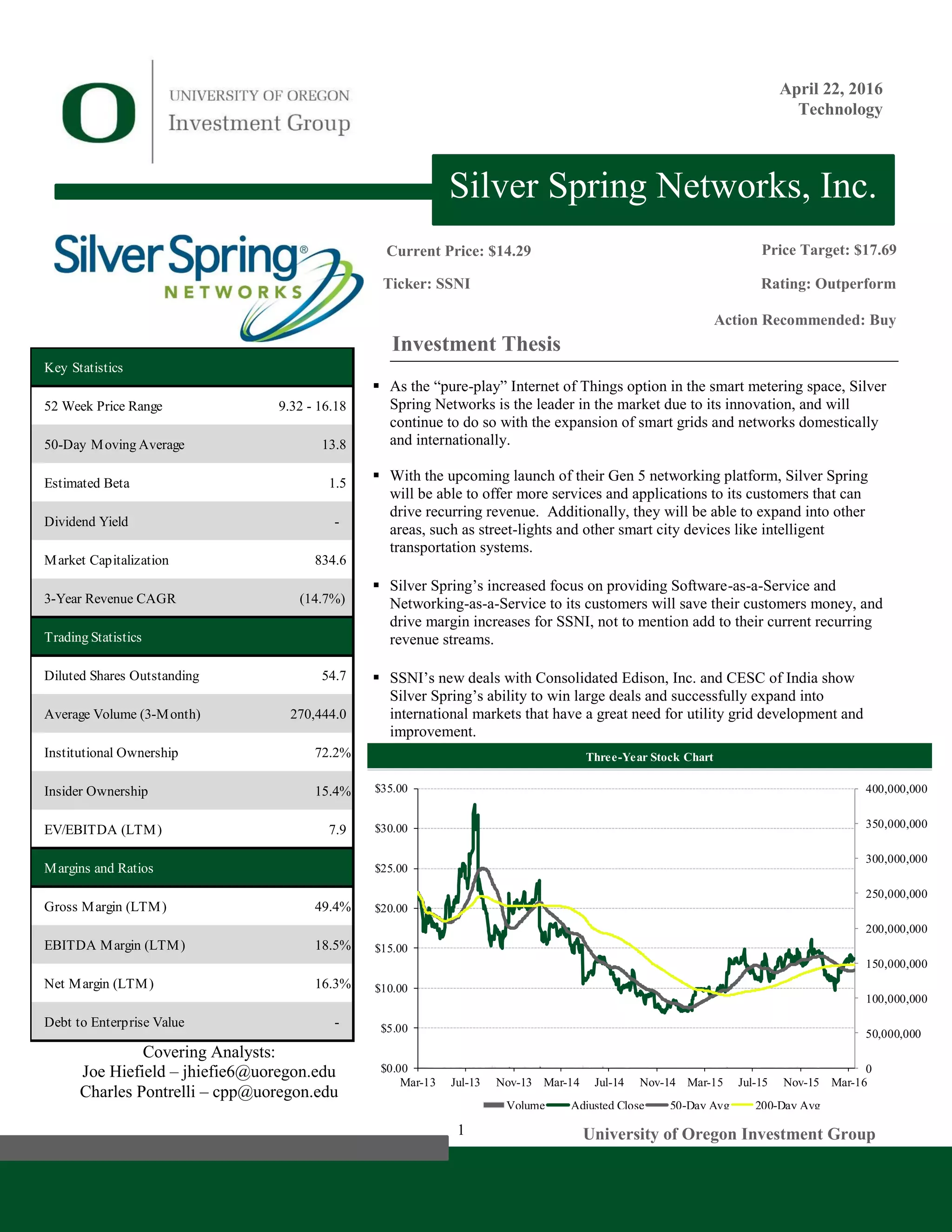
 As the “pure-play” Internet of Things option in the smart metering space, Silver
Spring Networks is the leader in the market due to its innovation, and will
continue to do so with the expansion of smart grids and networks domestically
and internationally.
 With the upcoming launch of their Gen 5 networking platform, Silver Spring
will be able to offer more services and applications to its customers that can
drive recurring revenue. Additionally, they will be able to expand into other
areas, such as street-lights and other smart city devices like intelligent
transportation systems.
 Silver Spring’s increased focus on providing Software-as-a-Service and
Networking-as-a-Service to its customers will save their customers money, and
drive margin increases for SSNI, not to mention add to their current recurring
revenue streams.
 SSNI’s new deals with Consolidated Edison, Inc. and CESC of India show
Silver Spring’s ability to win large deals and successfully expand into
international markets that have a great need for utility grid development and
improvement.
Silver Spring Networks, Inc.
Three-Year Stock Chart
0
50,000,000
100,000,000
150,000,000
200,000,000
250,000,000
300,000,000
350,000,000
400,000,000
$0.00
$5.00
$10.00
$15.00
$20.00
$25.00
$30.00
$35.00
Mar-13 Jul-13 Nov-13 Mar-14 Jul-14 Nov-14 Mar-15 Jul-15 Nov-15 Mar-16
Volume Adjusted Close 50-Day Avg 200-Day Avg
Key Statistics
52 Week Price Range 9.32 - 16.18
50-Day Moving Average 13.8
Estimated Beta 1.5
Dividend Yield -
Market Capitalization 834.6
3-Year Revenue CAGR (14.7%)
Trading Statistics
Diluted Shares Outstanding 54.7
Average Volume (3-Month) 270,444.0
Institutional Ownership 72.2%
Insider Ownership 15.4%
EV/EBITDA (LTM) 7.9
Margins and Ratios
Gross Margin (LTM) 49.4%
EBITDA Margin (LTM) 18.5%
Net Margin (LTM) 16.3%
Debt to Enterprise Value -
Ticker: SSNI Rating: Outperform
Price Target: $17.69
Action Recommended: Buy
Current Price: $14.29
UOIG 2
University of Oregon Investment Group April 22, 2016
Business Overview
Silver Spring Networks, Inc. (SSNI) was founded in July, 2002 in Butler,
Wisconsin as Real Time Techomm. In 2003, they relocated to Redwood City,
California, where they are currently headquartered. On March 13, 2013 SSNI
went public on the New York Stock Exchange with the ticker symbol SSNI. They
currently specialize in creating, building, and deploying large scale networks and
solutions that enable “Internet of Things” (“IoT”) for infrastructure. While their
first area of focus was energy by creating a smart grid network platform, they have
broadened their operations to other utility networks, including gas and water, as
well as street lights. Their technologies allow cities to run smarter and more
efficient.
Business Segments
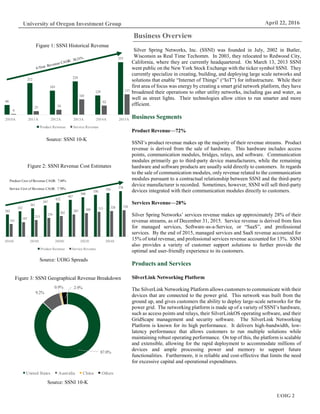
Product Revenue—72%
SSNI’s product revenue makes up the majority of their revenue streams. Product
revenue is derived from the sale of hardware. This hardware includes access
points, communication modules, bridges, relays, and software. Communication
modules primarily go to third-party device manufacturers, while the remaining
hardware and software products are usually sold directly to customers. In regards
to the sale of communication modules, only revenue related to the communication
modules pursuant to a contractual relationship between SSNI and the third-party
device manufacturer is recorded. Sometimes, however, SSNI will sell third-party
devices integrated with their communication modules directly to customers.
Services Revenue—28%
Silver Spring Networks’ services revenue makes up approximately 28% of their
revenue streams, as of December 31, 2015. Service revenue is derived from fees
for managed services, Software-as-a-Service, or “SaaS”, and professional
services. By the end of 2015, managed services and SaaS revenue accounted for
15% of total revenue, and professional services revenue accounted for 13%. SSNI
also provides a variety of customer support solutions to further provide the
optimal and user-friendly experience to its customers.
Products and Services
SilverLink Networking Platform
The SilverLink Networking Platform allows customers to communicate with their
devices that are connected to the power grid. This network was built from the
ground up, and gives customers the ability to deploy large-scale networks for the
power grid. The networking platform is made up of a variety of SSNI’s hardware,
such as access points and relays, their SilverLinkOS operating software, and their
GridScape management and security software. The SilverLink Networking
Platform is known for its high performance. It delivers high-bandwidth, low-
latency performance that allows customers to run multiple solutions while
maintaining robust operating performance. On top of this, the platform is scalable
and extensible, allowing for the rapid deployment to accommodate millions of
devices and ample processing power and memory to support future
functionalities. Furthermore, it is reliable and cost-effective that limits the need
for excessive capital and operational expenditures.
Figure 1: SSNI Historical Revenue
66
212
163
224
129
353
4
25 34
103
62
137
2010A 2011A 2012A 2013A 2014A 2015A
Product Revenue Service Revenue
Source: SSNI 10-K
Product Revenue Service Revenue
282
322
361
397
432
467
500
530
556
578
161
187
213
239
262 283 300 315 328 338
2016E 2018E 2020E 2022E 2024E
Product Revenue Service Revenue
Product Cost of Revenue CAGR: 7.44%
Service Cost of Revenue CAGR: 7.70%
Figure 2: SSNI Revenue Cost Estimates
Source: UOIG Spreads
87.0%
9.2%
0.9% 2.9%
United States Australia China Others
Figure 3: SSNI Geographical Revenue Breakdown
Source: SSNI 10-K
UOIG 3
University of Oregon Investment Group April 22, 2016
Recently, SSNI unveiled the fifth generation of their networking platform. This
new generation is a significant improvement from the Gen 4 platform. Gen 5 will
be able to reach speeds of up to 2.4 Mbps and will support 4G LTE. On top of
this, its latency is down to 10 milliseconds from 30 milliseconds, its range has
increased up to 50 miles from a maximum of about 15, it computes ten times faster
and has eight times the memory, and it also has an operational life that is twice as
long but will only use about a fifth of the power. Not to mention, the hardware is
smaller, allowing it to fit well into non-meter form factors for smart city
deployments. This newer generation has a lower cost point, and will drive cost
and capital expenditure savings for utilities and cities, while allowing SSNI to
monetize the accompanying software and increase their margin expansion.
SilverLink Data Platform
The SilverLink Data Platform’s goal is to assist SSNI’s customers in using data
generated by devices on the network in order to provide insightful analytics for
decision-making. Their applications collect, organize, and visualize data from
various internal and external systems that allows for real-time processing. Their
SensorIQ system enables customers to convert physical devices on the grid at
hand into multiple software-defined sensors. These sensors can then relay
information to any application at the frequency and granularity that makes sense
for said application. Additionally, Silver Spring Network’s solutions allow
customers and partners to develop their own apps that can be then showcased in
the Silver Spring application catalogue. SSNI plans to expand available apps and
sensors over time to deliver more value to their customers and grow their recurring
managed services and SaaS business.
Advanced Metering
SSNI’s advanced metering solution allows utility companies to automate a
multitude of manual processes and improve operational efficiencies. This
solution allows utilities to remotely perform functions such as reading meter
usage, connecting and disconnecting service, capturing time-of-use consumption
data, and detecting power outages. Silver Spring Networks does not manufacture
the meters, but instead partners with various meter manufacturers to provide a
range of meter options for customers.
Distribution Automation
The distribution automation solution provides two-way communications from
distribution devices along the power grid to back offices or substations. This
provides utility companies with real-time information for grid monitoring and
control. The distribution automation solution is comprised of their SensorIQ
application, Outage Detection System application, GridScape application, and
Operations Optimizer application. While utility companies have utilized
distribution automation for years, two-way communications are not as common,
and improve the utility company’s visibility and control over the power grid. This
allows for the ability to resolve outages quicker, monitor power-quality metrics
with increased accuracy and detail, and adjust voltage levels dynamically to adjust
for higher and lower times of power usage.
Demand-Side Management
Silver Spring Network’s demand-side management gives utilities the ability to
offer customer programs and incentives to use energy more efficiently and adjust
usage during peak demand. Their Energy Efficiency solution helps reduce overall
energy consumption through providing detailed energy usage analysis. The
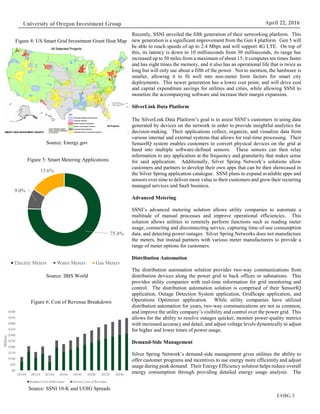
Figure 4: US Smart Grid Investment Grant Heat Map
Source: Energy.gov
75.4%
9.0%
15.6%
Electric Meters Water Meters Gas Meters
Figure 5: Smart Metering Applications
Source: IBIS World
Figure 6: Cost of Revenue Breakdown
Source: SSNI 10-K and UOIG Spreads
$0
$50
$100
$150
$200
$250
$300
$350
$400
$450
$500
2010A 2012A 2014A 2016E 2018E 2020E 2022E 2024E
Millons
Product Cost of Revenue Service Cost of Revenue
UOIG 4
University of Oregon Investment Group April 22, 2016
Demand Response solution is an initiative that leverages the two-way
communications of SSNI’s products. It enables utilities to incentivize consumers
to reduce their energy consumptions, and send messages to consumers in
anticipation of a peak-load event. This solution allows utilities to support both
price-based and load control-based demand response programs.
Electric Vehicle
With an increase in electric vehicle purchases, utilities are beginning to devote
more power to vehicle charging stations, which, at 240 volts, require a
considerable amount of power. With SSNI’s technology, utilities can incentivize
consumers to charge their vehicles during non-peak times, helping utilities
manage the new demand.
Street Lights
SSNI has recently expanded into providing technologies for the operation and
maintenance of street lights. By networking street lights, utility companies can
lower operating and maintenance costs, enable better control, and provide greater
precision for turn-on and turn-off times. These solutions, combined with the
integration of LED lighting, also allow for variable brightness and enhances
energy efficiency.
Professional Services
Silver Spring Network’s professional services include network design and
optimization, deployment support, software and systems integration, consulting
services, training, and program management. This also includes the occasional
installation of third-party meters and network infrastructure.
Managed Services and SaaS
The managed services include the monitoring of the performance of the network,
tracking trends, providing alerts, planning disaster response, and monitoring
security. Through their managed application services, SSNI manages the
SilverLink Applications and SilverLink Control Platform. Additionally, SSNI
can provide their solutions via a SaaS model, where the company owns the entire
solution, including the servers and software, and runs the solution through their
data center. This is up to the customer’s preference. Furthermore, SSNI can
manage the aforementioned platform and applications on servers and software
owned by the utility, thus providing a managed service. By providing a SaaS
option, utility customers can eliminate or decrease their initial investments in
software and hardware systems, and transform the system usage to an on-demand
basis.
Industry
Overview
Silver Spring Networks, Inc. operates in the technology sector and primarily in
the Smart Meter Manufacturing industry. Businesses in this industry manufacture
smart meters, which are electrical, gas or water meters that record consumption
information in intervals of an hour or less and communicate this information back
to the utility for monitoring and billing purposes. There are approximately 57
businesses in this industry. It is an extremely small industry, with Itron Inc.
holding a large portion of the market share. Previously, General Electric was the
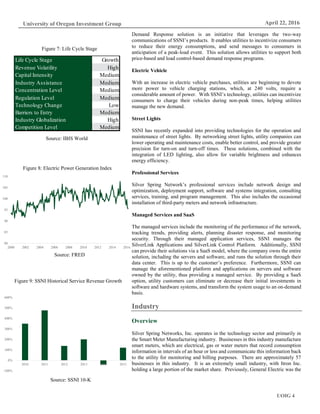
Life Cycle Stage Growth
Revenue Volatility High
Capital Intensity Medium
Industry Assistance Medium
Concentration Level Medium
Regulation Level Medium
Technology Change Low
Barriers to Entry Medium
Industry Globalization High
Competition Level Medium
Figure 7: Life Cycle Stage
Source: IBIS World
80
85
90
95
100
105
110
2000 2002 2004 2006 2008 2010 2012 2014 2016
Figure 8: Electric Power Generation Index
Source: FRED
Figure 9: SSNI Historical Service Revenue Growth
Source: SSNI 10-K
-100%
0%
100%
200%
300%
400%
500%
600%
2010 2011 2012 2013 2014 2015
UOIG 5
University of Oregon Investment Group April 22, 2016
largest player in the space. However, they have since sold their smart metering
division.
As mentioned before, Itron makes up a large portion of the industry. The rest of
the industry is dominated by smaller companies that compete on a local or
regional basis. These companies either specialize in a certain region, or a certain
smart grid and smart meter solution. Many of the smart meters and their solutions
are actually manufactured outside of the US and then imported. Prominent
companies that do this are Landis+Gyr, which was recently bought by Toshiba,
and German firm Elster.
Capital intensity in the Smart Meter Manufacturing industry is moderate, with it
being estimated that for every $1.00 spent on wages $0.30 is spent on capital
investments. The majority of these capital requirements are associated with
startup costs, as companies must invest in equipment and facilities that are used
in the actual manufacturing process. However, this can vary among firms, as
some companies, such as Silver Spring Networks, provide other products such as
software and networking solutions, which require far less capital. Additionally,
the industry is beginning to move towards automation, which is putting more of
the costs on capital instead of wages. This has caused a decreasing need for the
highly trained and knowledgeable staff that goes along with participating in the
industry.
The Smart Metering Manufacturing industry is subject to a low amount of
technological change, because, at the moment, it is still in its nascent stages. The
general utility industry is very slow in adopting smart meter solutions, but this is
expected to pick up in the next couple years. According to a report from Cowen
and Company on the DistribuTECH conference held in Orlando, FL, utility
companies are preparing for more changes over the next 5-10 years than they have
seen in the past 100. Internet of Things (“IoT”) technologies have existed in the
space for a little while now, but have not been implemented effectively. As the
way electricity is produced and delivered is changing dramatically, so is how it is
measured and analyzed. More cities and utilities are making a strong push
towards smart grids and networks, as well as networked devices in homes, in order
to enable real-time views into the supply and demand of energy. Energy
conservation and efficiency is becoming more of a priority with utilities and cities,
and smart metering and its two-way communications allow for this. As smart grid
implementation and spending picks up, more companies such as SSNI will need
to increase their technological innovation. SSNI is at the forefront of this, with
their variety of hardware and software solutions, including their new Gen 5
networking platform and their recently introduced Starfish solution.
Regulation in this space is relatively moderate but is expected to increase in the
coming years. There is not much federal regulation, but there is quite a bit of state
and local regulation that varies. Much of the legislation deals with privacy
concerns and how smart metering infringes on customers’ privacy by the type and
amount of data it provides utilities. Additionally, some states, such as California,
require an “opt-out” policy in case customers do not want smart meters installed.
Still, many states are encouraging the adoption of smart meters and smart grids in
order to increase efficiencies in energy usage, and provide real-time feedback in
order to help conserve more energy.
The industry used to receive a good amount of direct government assistance to
help consumers and utilities install smart grids and meters. The American
Recovery and Reinvestment Act (ARRA) of 2009, also known as the Stimulus,
provided the most amount of funding. The Obama administration signed ARRA
due the onset of the recession. ARRA allocated approximately $3.4 billion
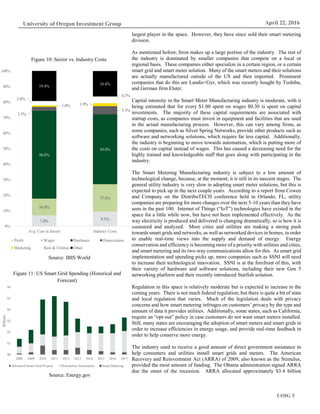
7.0% 9.5%
10.8%
17.6%
56.6%
45.0%
2.5%
5.3%
1.0% 1.9%
2.8%
4.3%
19.4%
16.4%
0%
10%
20%
30%
40%
50%
60%
70%
80%
90%
100%
Avg. Cost in Sector Industry Costs
Profit Wages Purchases Depreciation
Marketing Rent & Utilities Other
Figure 10: Sector vs. Industry Costs
Source: IBIS World
$0
$1
$2
$3
$4
$5
$6
2008 2009 2010 2011 2012 2013 2014 2015 2016 2017
Billions
Advanced Smart Grid Projects Distribution Automation Smart Metering
Source: Energy.gov
Figure 11: US Smart Grid Spending (Historical and
Forecast)
UOIG 6
University of Oregon Investment Group April 22, 2016
towards improving the American smart grid, including smart meters,
communications hardware, applications software, energy storage systems, and
meter and grid data management software. While this boosted the industry
tremendously, funding has tapered off since 2009. However, the Obama
administration continues to advocate for the integration of smart grids, which will
hopefully continue into the coming years.
Macro factors
Value of Utilities Construction
The value of utilities construction is made up of the total private and public
spending on utilities infrastructure. When more money is allocated to utility
infrastructure construction and capital expenditures, we see a greater
implementation of smart grids and networks in the US. This allows for revenue
gains for firms like SSNI. As mentioned previously, utility construction was
bolstered greatly in the few years after 2008 because of the implementation of the
American Recovery and Reinvestment Act (ARRA). However, much of this has
been used up. According to Cowen and Company, the overall utilities space
should grow along with GDP +2% in the coming years.
Housing Starts
Housing Starts play a large role in the smart metering industry. As new residential
communities are built, smart meters and sensors are increasingly likely to be
installed along these new houses. Industry revenue typically moves in line with
trends in the housing market. According to the US Department of Housing and
Urban Development’s construction statistics for February 2016 (released March
16th
, 2016) single-family housing starts were 30.9% higher than the previous year,
and 7.2% higher than January’s number. It is expected that the number of housing
starts is going to continue increasing significantly through the rest of 2016.
US Electrical Energy Consumption
US electrical energy consumption plays an important role in SSNI’s operations.
Electricity demand can drive a lot of the conversion from traditional utilities to
smart grids and smart networks. When the recession occurred, energy
consumption retreated, but has been steadily climbing since 2012. Energy
consumption is expected to steadily climb as the economy expands and
manufacturers and industrial producers increase the productivity of their
operations. Additionally, households are starting to relax their restrictions on
energy usage as consumers become more confident in the overall economic
conditions in the US.
Competition
The competition of the Smart Metering Industry is relatively moderate, but is
dominated by a few huge players. SSNI faces some large competitors, but
because they are highly specialized and one of the only “pure-play” smart grid
and IoT developers, they are able to stay successful in the industry. While most
of their competitors are quite larger than they are, these companies usually focus
more in different areas within the Smart Metering Industry, such as the
manufacturing of the actual meters, instead of the endpoints, nodes, sensors, and
software that SSNI specializes in. In order for SSNI to stay competitive within
the industry, they must be able to offer low prices while maintain the standards of
technology and security they are known for. They value they add to utility
companies and consumers is how they can increase their efficiencies and cut back
on energy costs. Thankfully, SSNI is known for the quality of its hardware and
software, as well as the price points of their products. For example, by integrating
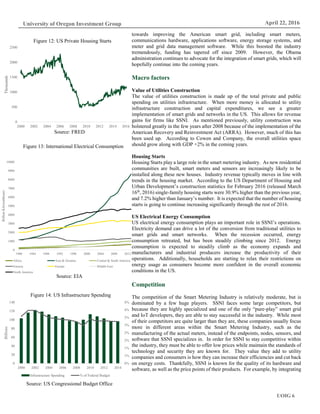
0%
1%
1%
2%
2%
3%
3%
4%
4%
0
20
40
60
80
100
120
140
2000 2002 2004 2006 2008 2010 2012 2014
Billions
Infrastructure Spending % of Federal Budget
0
500
1000
1500
2000
2500
2000 2002 2004 2006 2008 2010 2012 2014 2016
Thousands
Source: FRED
Figure 12: US Private Housing Starts
0
1000
2000
3000
4000
5000
6000
7000
8000
9000
10000
1980 1984 1988 1992 1996 2000 2004 2008 2012
BillionKilowatthours
Africa Asia & Oceania Central & South America
Eurasia Europe Middle East
North America
Source: EIA
Source: US Congressional Budget Office
Figure 14: US Infrastructure Spending
Figure 13: International Electrical Consumption
UOIG 7
University of Oregon Investment Group April 22, 2016
Silver Spring Networks’ Silver Spring CustomerIQ web portal, its IP-based
networking and applications platform, the Smart Energy Platform, and its various
in-home devices, Oklahoma Gas and Electric has been able to avoid the building
of two new 165MW peaking generation plants, and are expecting a cost savings
of over $320 million. This is just one example of the savings that SSNI can offer
its customers.
Silver Spring Networks faces a variety of competitors. Their key competitors are
Itron Inc., Elster Group GmbH (recently acquired by Honeywell International
Inc.), Landis+Gyr AG (recently acquired by Toshiba Corporation), Sensus
Metering Systems Inc., and Trilliant Holdings, Inc. They also compete with
providers of distribution automation equipment, such as General Electric
Company and Cisco Systems, Inc. Larger companies such as AT&T Inc., Cisco,
GE, Fujitsu Limited, IBM Corp., Siemens, and Sprint Nextel Corp. have
announced plans to pursue business opportunities related to smart cities, smart
grid, and the larger IoT area. While SSNI expects to face stiff competition as they
continue to expand into new domestic and global markets, they are confident they
will be able to compete fiercely due to their competitive prices, high quality
products, and robust services.
Strategic Positioning
While Silver Spring Networks does face competition in the space, they are the
only “pure-play” company in the advanced metering and smart grid space. They
specialize in developing Internet of Things technology for infrastructure, focusing
specifically on smart grid networks and advanced metering. Other companies,
such as Opower and EnerNOC, create software for demand response and energy
efficiencies like Silver Spring’s software. Companies such as Itron and Badger
Meter create advanced metering solutions and some smart grid solutions.
However, Silver Spring offers the software, the nodes, sensors, and circuit boards
to its customers, while connecting them all through internet of things technology.
They are one of the only companies that offers all of these products and services,
and is the leader in the space due to its platforms’ fast processing speeds,
affordable pricing, large bandwidth, and great security.
Over the last couple years, Silver Spring’s management has been focusing on the
development of their software and providing more SaaS options in order to
increase recurring revenue and margins. This, combined with the expansion of
their professional services, should provide substantial increases in their margins.
Additionally, they have been signing significant deals with various customers in
order to drive revenue. For example, they were selected by Consolidated Edison,
Inc. to deploy their fifth-generation network and advanced metering infrastructure
to over 3.9 million electric and 1.3 million gas customers in Con Edison’s entire
service territory. CESC of India also selected Silver Spring Networks to deploy
an advanced, multi-application smart network in Kolkata. SSNI will allow the
city to automate its electricity distribution grid with its recently developed Starfish
program. Silver Spring’s Starfish program will also allow CESC of India to
leverage its network for broader Internet of Things applications.
Because of its proven track record of providing excellent products and solutions
to its customers, SSNI has developed a strong reputation in the utility and internet
of things spaces. It is also known for its innovative technology, and was named
one of the Top 100 most innovative San Francisco Bay area companies in the
Reuters Top 100 Global Innovators report. Led by an experienced management
team that has been in a variety of leadership positions with top technology
companies, SSNI is positioned to continue being a leader and innovator.
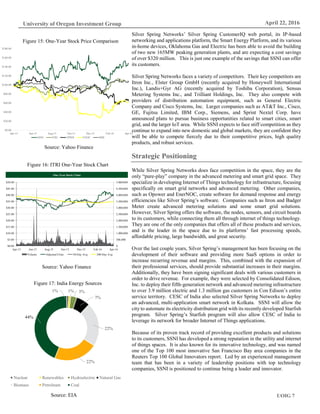
$0.00
$20.00
$40.00
$60.00
$80.00
$100.00
$120.00
$140.00
$160.00
$180.00
Apr-15 Jun-15 Aug-15 Oct-15 Dec-15 Feb-16 Apr-16
SSNI ITRI OPWR ENOC BMI
Source: Yahoo Finance
Figure 15: One-Year Stock Price Comparison
One-Year Stock Chart
0
500,000
1,000,000
1,500,000
2,000,000
2,500,000
3,000,000
3,500,000
4,000,000
4,500,000
5,000,000
$0.00
$5.00
$10.00
$15.00
$20.00
$25.00
$30.00
$35.00
$40.00
$45.00
$50.00
Apr-15 Jun-15 Aug-15 Oct-15 Dec-15 Feb-16 Apr-16
Volume Adjusted Close 50-Day Avg 200-Day Avg
Source: Yahoo Finance
Figure 16: ITRI One-Year Stock Chart
1% 1% 3%
7%
22%
22%
44%
Nuclear Renewables Hydroelectric Natural Gas
Biomass Petroleum Coal
Source: EIA
Figure 17: India Energy Sources
UOIG 8
University of Oregon Investment Group April 22, 2016
Business Growth Strategies
Currently, one of SSNI’s major business growth strategies is leveraging its
multiple offerings and delivering additional applications beyond their traditional
advanced metering solutions. For example, an existing utility customer is using
Silver Spring’s services to connect approximately 250,000 street lights by using
its multi-application advanced metering infrastructure. Additionally, they are the
leader in endpoints delivered. With their recent win with Con Edison, it is
estimated that they control 34% of total endpoints awarded to date, which is
estimated to be 12 percentage points ahead of their nearest competitor.
SSNI has also been expanding its geographical operations, shown by their new
deal with CESC of India and Ausnet Services in Australia. They have also
identified various European cities that will be the first cities to receive their new
IPv6 network service for IoT, Starfish. Bristol, Copenhagen, and Glasgow are
some of the cities they will be offering Starfish too. Additionally, they are
planning on expanding into South America and Eastern Asia, such as Brazil,
Thailand, and Malaysia. Currently, Silver Spring’s international business makes
up approximately 13% of their total revenue mix. They plan to expand
internationally aggressively.
Finally, the company believes that the smart grid and smart city markets are still
in their nascent stages, and are investing in long-term growth. Management
expects to maintain their current research and development levels, with the
possibility of them increasing marginally.
Management and Employee Relations
Michael Bell – President and CEO
Michael Bell is the President and CEO for Silver Spring Networks. Previously,
he has held multiple leadership positions at Intel Corp, where he led the
company’s expansion of connected devices. Before that, he was part of the
executive management team at Palm Inc., where he was responsible for all aspects
of the development and deployment, product strategy, and bringing various Palm
products to market. He was also the VP of CPU Software and Macintosh
Hardware Division at Apple Inc. He earned his bachelor’s degree in mechanical
engineering from the University of Pennsylvania in 1988.
Scott A. Lang – Executive Chairman and Chairman of the
Board of Directors
Scott Lang is currently the Executive Chairman and Chairman of the Board of
Directors for Silver Spring Networks. He was the company’s founding chief
executive and served as President for 11 years. Before this, he held a variety of
positions at Electronic Data Systems and Perot Systems (under Ross Perot). In
2011, Mr. Lang was named the Most Admired CEO in Sustainability by the San
Francisco Business times. He holds a BS in Business Administration from the
University of Mississippi and was a graduate of the Advanced Executive Program
from the Kellogg School of Management at Northwestern University.
James P. Burns – Executive VP and CFO
James “Jim” Burns is the current Executive Vice President and Chief Financial
Officer of the company. Before joining Silver Spring, he worked at Hewlett-
Packard for over 20 years, where he held various leadership and senior executive
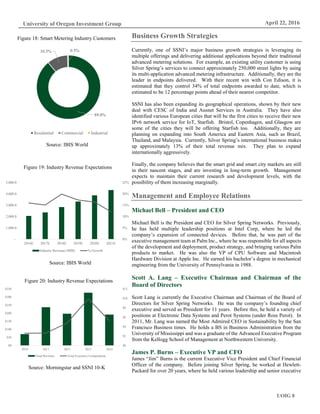
89.0%
10.5% 0.5%
Residential Commercial Industrial
Source: IBIS World
Figure 18: Smart Metering Industry Customers
Source: IBIS World
Figure 19: Industry Revenue Expectations
0%
5%
10%
15%
20%
25%
-
1,000.0
2,000.0
3,000.0
4,000.0
5,000.0
2016E 2017E 2018E 2019E 2020E 2021E
Industry Revenue (MM) % Growth
$0
$2
$4
$6
$8
$10
$12
$0
$50
$100
$150
$200
$250
$300
$350
2010 2011 2012 2013 2014
Total Revenue Total Executive Compenation
Source: Morningstar and SSNI 10-K
Figure 20: Industry Revenue Expectations
UOIG 9
University of Oregon Investment Group April 22, 2016
roles in their hardware, software, and services businesses, including their
Enterprise Services, Enterprise Business, Investor Relations, and their PC
Services and Accessories. He also worked as a CPA at Ernst and Young, and
received a BS degree in Accounting from Santa Clara University.
Management Guidance
It should be noted that, while Silver Spring’s management does provide guidance,
they mostly focus on non-GAAP guidance and not GAAP guidance. However,
they have provided GAAP compliant guidance for 2016. They expect revenue
between $370 million and $450 million, with gross margins around 25%. While
our revenue is in line, our projected margins vary. This is due to management
consistently providing low guidance on their operations. For example, in 2015
they reported guidance of about 20% GAAP gross margin, but earned 47%. They
consistently underestimate their operations, and we continue to think they will do
so. For the 2016 fiscal year, management also expects operating expense to be
about $150 million.
Portfolio Strategy
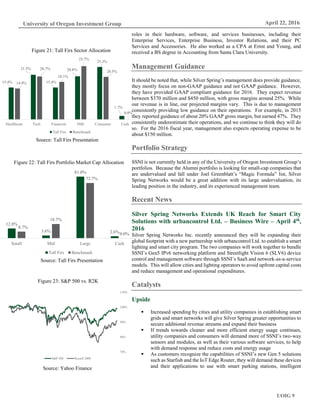
SSNI is not currently held in any of the University of Oregon Investment Group’s
portfolios. Because the Alumni portfolio is looking for small-cap companies that
are undervalued and fall under Joel Greenblatt’s “Magic Formula” list, Silver
Spring Networks would be a great addition with its large undervaluation, its
leading position in the industry, and its experienced management team.
Recent News
Silver Spring Networks Extends UK Reach for Smart City
Solutions with urbancontrol Ltd. – Business Wire – April 4th,
2016
Silver Spring Networks Inc. recently announced they will be expanding their
global footprint with a new partnership with urbancontrol Ltd. to establish a smart
lighting and smart city program. The two companies will work together to bundle
SSNI’s Gen5 IPv6 networking platform and Streetlight Vision 6 (SLV6) device
control and management software through SSNI’s SaaS and network-as-a-service
models. This will allow cities and lighting operators to avoid upfront capital costs
and reduce management and operational expenditures.
Catalysts
Upside
 Increased spending by cities and utility companies in establishing smart
grids and smart networks will give Silver Spring greater opportunities to
secure additional revenue streams and expand their business
 If trends towards cleaner and more efficient energy usage continues,
utility companies and consumers will demand more of SSNI’s two-way
sensors and modules, as well as their various software services, to help
with demand response and reduce costs and energy usage
 As customers recognize the capabilities of SSNI’s new Gen 5 solutions
such as Starfish and the IoT Edge Router, they will demand these devices
and their applications to use with smart parking stations, intelligent
15.4%
21.5%
15.4%
20.8%
25.3%
1.7%
14.9%
20.7%
18.1%
25.7%
20.5%
0.0%
Healthcare Tech Financial IME Consumer Cash
Tall Firs Benchmark
Source: Tall Firs Presentation
Figure 21: Tall Firs Sector Allocation
12.8%
3.6%
81.0%
2.6%
8.7%
18.7%
72.7%
0.0%
Small Mid Large Cash
Tall Firs Benchmark
Figure 22: Tall Firs Portfolio Market Cap Allocation
Source: Tall Firs Presentation
70%
80%
90%
100%
110%
S&P 500 Russell 2000
Figure 23: S&P 500 vs. R2K
Source: Yahoo Finance
UOIG 10
University of Oregon Investment Group April 22, 2016
transportation systems, bicycle rental kiosks, and electric vehicle
charging stations
Downside
 SSNI depends on their limited number of customers, and losing any in
the future could be detrimental to their performance
 Government funding supports a lot of the projects that use SSNI’s
products and services. Any delays associated with government funding
could lower SSNI’s revenue
 SSNI’s sensors and modules deal with a significant amount of consumer
data. If there’s any security breaches of SSNI’s software or hardware,
this could prevent them from securing customers in the future and hurt
their image
 The timing of acceptance of SSNI’s products and software by their
customers could impact when they recognize their revenue under their
accounting policies
Comparable Analysis—10%
In order to find Silver Spring’s relative value a comparable universe was
constructed in order to capture SSNI’s growth and large gross margins since they
are a quickly growing tech company. Various utility software and meter
manufacturing companies within the technology sector were screened for their
operational segments, growth rates, and margins that were similar to those of
Silver Spring. Ultimately, four companies were chosen and weighted using a
weighted average of metric similarity and importance.
The metrics that were used in order to determine weightings included the
companies’ operating segments, revenue growth, and gross margins. Because of
Silver Spring’s unique positioning with differing revenue growths between years
and wide margins, multiple metrics had to be used to accurately find its valuation
in the space. Additionally, it was difficult to find the right comparable companies
to fully encapsulate SSNI’s operations. Forward comparable analysis was done
for the fiscal years ending December 31, 2016 and December 31, 2017, where
2016 comparables 50% and 2017 comparables were weighted 50%. Using the
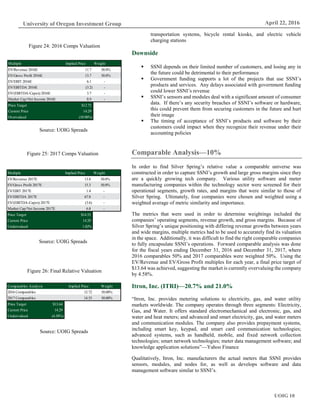
EV/Revenue and EV/Gross Profit multiples for each year, a final price target of
$13.64 was achieved, suggesting the market is currently overvaluing the company
by 4.58%.
Itron, Inc. (ITRI)—20.7% and 21.0%
“Itron, Inc. provides metering solutions to electricity, gas, and water utility
markets worldwide. The company operates through three segments: Electricity,
Gas, and Water. It offers standard electromechanical and electronic, gas, and
water and heat meters; and advanced and smart electricity, gas, and water meters
and communication modules. The company also provides prepayment systems,
including smart key, keypad, and smart card communication technologies;
advanced systems, such as handheld, mobile, and fixed network collection
technologies; smart network technologies; meter data management software; and
knowledge application solutions”—Yahoo Finance
Qualitatively, Itron, Inc. manufacturers the actual meters that SSNI provides
sensors, modules, and nodes for, as well as develops software and data
management software similar to SSNI’s.
Multiple Implied Price Weight
EV/Revenue 2016E 11.7 50.0%
EV/Gross Profit 2016E 13.7 50.0%
EV/EBIT 2016E 6.1 -
EV/EBITDA 2016E (3.2) -
EV/(EBITDA-Capex) 2016E 3.7 -
Market Cap/Net Income 2016E 8.9 -
Price Target $12.72
Current Price 14.29
Overvalued (10.98%)
Multiple Implied Price Weight
EV/Revenue 2017E 13.8 50.0%
EV/Gross Profit 2017E 15.3 50.0%
EV/EBIT 2017E 1.4 -
EV/EBITDA 2017E 67.8 -
EV/(EBITDA-Capex) 2017E (3.6) -
Market Cap/Net Income 2017E 6.8 -
Price Target $14.55
Current Price 14.29
Undervalued 1.82%
Implied Price Weight
12.72 50.00%
14.55 50.00%
Price Target $13.64
Current Price 14.29
Undervalued (4.58%)
Comparables Analysis
2016 Comparables
2017 Comparables
Figure 24: 2016 Comps Valuation
Source: UOIG Spreads
Figure 25: 2017 Comps Valuation
Source: UOIG Spreads
Figure 26: Final Relative Valuation
Source: UOIG Spreads
UOIG 11
University of Oregon Investment Group April 22, 2016
Quantitatively, ITRI is much larger than SSNI, with ITRI having approximately
twice the market capitalization of SSNI. Additionally, they primarily only
manufacture traditional meters. Only a quarter of their revenue comes from
advanced and smart meters. Additionally, they have lower margins and different
growth rates than SSNI.
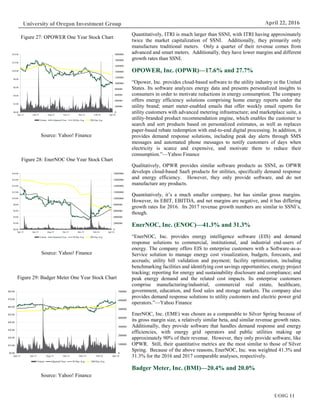
OPOWER, Inc. (OPWR)—17.6% and 27.7%
“Opower, Inc. provides cloud-based software to the utility industry in the United
States. Its software analyzes energy data and presents personalized insights to
consumers in order to motivate reductions in energy consumption. The company
offers energy efficiency solutions comprising home energy reports under the
utility brand; smart meter-enabled emails that offer weekly email reports for
utility customers with advanced metering infrastructure; and marketplace suite, a
utility-branded product recommendation engine, which enables the customer to
search and sort products based on personalized estimates, as well as replaces
paper-based rebate redemption with end-to-end digital processing. In addition, it
provides demand response solutions, including peak day alerts through SMS
messages and automated phone messages to notify customers of days when
electricity is scarce and expensive, and motivate them to reduce their
consumption.”—Yahoo Finance
Qualitatively, OPWR provides similar software products as SSNI, as OPWR
develops cloud-based SaaS products for utilities, specifically demand response
and energy efficiency. However, they only provide software, and do not
manufacture any products.
Quantitatively, it’s a much smaller company, but has similar gross margins.
However, its EBIT, EBITDA, and net margins are negative, and it has differing
growth rates for 2016. Its 2017 revenue growth numbers are similar to SSNI’s,
though.
EnerNOC, Inc. (ENOC)—41.3% and 31.3%
“EnerNOC, Inc. provides energy intelligence software (EIS) and demand
response solutions to commercial, institutional, and industrial end-users of
energy. The company offers EIS to enterprise customers with a Software-as-a-
Service solution to manage energy cost visualization, budgets, forecasts, and
accruals; utility bill validation and payment; facility optimization, including
benchmarking facilities and identifying cost savings opportunities; energy project
tracking; reporting for energy and sustainability disclosure and compliance; and
peak energy demand and the related cost impacts. Its enterprise customers
comprise manufacturing/industrial, commercial real estate, healthcare,
government, education, and food sales and storage markets. The company also
provides demand response solutions to utility customers and electric power grid
operators.”—Yahoo Finance
EnerNOC, Inc. (EME) was chosen as a comparable to Silver Spring because of
its gross margin size, a relatively similar beta, and similar revenue growth rates.
Additionally, they provide software that handles demand response and energy
efficiencies, with energy grid operators and public utilities making up
approximately 90% of their revenue. However, they only provide software, like
OPWR. Still, their quantitative metrics are the most similar to those of Silver
Spring. Because of the above reasons, EnerNOC, Inc. was weighted 41.3% and
31.3% for the 2016 and 2017 comparable analyses, respectively.
Badger Meter, Inc. (BMI)—20.4% and 20.0%
Source: Yahoo! Finance
Figure 27: OPOWER One Year Stock Chart
Figure 28: EnerNOC One Year Stock Chart
Source: Yahoo! Finance
Figure 29: Badger Meter One Year Stock Chart
0
200000
400000
600000
800000
1000000
1200000
1400000
1600000
1800000
2000000
$0.00
$2.00
$4.00
$6.00
$8.00
$10.00
$12.00
$14.00
Apr-15 Jun-15 Aug-15 Oct-15 Dec-15 Feb-16 Apr-16
Volume Adjusted Close 50-Day Avg 200-Day Avg
0
2000000
4000000
6000000
8000000
10000000
12000000
14000000
16000000
18000000
$0.00
$2.00
$4.00
$6.00
$8.00
$10.00
$12.00
$14.00
$16.00
$18.00
Apr-15 Jun-15 Aug-15 Oct-15 Dec-15 Feb-16 Apr-16
Volume Adjusted Close 50-Day Avg 200-Day Avg
0
100000
200000
300000
400000
500000
600000
700000
$0.00
$10.00
$20.00
$30.00
$40.00
$50.00
$60.00
$70.00
$80.00
Apr-15 Jun-15 Aug-15 Oct-15 Dec-15 Feb-16 Apr-16
Volume Adjusted Close 50-Day Avg 200-Day Avg
UOIG 12
University of Oregon Investment Group April 22, 2016
“Badger Meter, Inc. manufactures and sells flow measurement and control
technologies related products. It offers mechanical and electronic water meters,
and related technologies and services to municipal water utilities; and meters and
valves to measure and control materials flowing through a pipe or pipeline, such
as water, air, steam, oil, and other liquids and gases, as well as for use in
water/wastewater, heating, ventilating and air conditioning, oil and gas, chemical
and petrochemical, test and measurement, automotive aftermarket, and the
concrete construction process. The company provides flow measurement
technologies to original equipment manufacturers as the primary flow
measurement device in a product or system.”—Yahoo Finance
Badger Meter, Inc. (BMI) was added as a comparable company because it
operates in a similar space as SSNI. Additionally, they have similar margins and
a similar market capitalization. However, their growth rates differ somewhat, and
they focus primarily on manufacturing flow instruments for water instead of
energy usage. Also, they cater to other customers besides public utilities and
cities, such as chemical, automotive, and industrial companies. Therefore, it
received weightings of 20.4% and 20.0% for 2016 and 2017 comparables,
respectively, based on their metric similarities to SSNI.
Discounted Cash Flow Analysis—90%
Revenue Model
Silver Spring Networks, Inc. breaks their revenue out into their two segments,
Product Revenue and Service Revenue. Much of their historical revenue is
sporadic due to the contractual nature of their business operations, but they are
starting to focus on acquiring more recurring revenue sources. Additionally, they
changed their revenue recognition accounting principles during 2015. This does
not affect their non-GAAP results, but it can increase their GAAP results because
it is easier to recognize revenue now, since it is no longer necessary to have a
receipt of a customer’s acceptance of a deal. The revenue for 2016 was primarily
based off of management guidance provided at the end of their 2015 fiscal year.
Additionally, it is slightly affected by the upcoming launch of their 5th
gen
networking platform in mid-2016. The Con Edison deal that they recently closed
will utilize this technology. For 2017 and beyond, a few catalysts were used to
project their growth. Increasing awareness of the benefits of the implementation
of a smart grid across the US will bolster demand for SSNI’s products. For
example, the New York State Public Service Commission recently approved Con
Edison’s Advanced Metering Infrastructure plan that utilizes Silver Spring’s
multi-application networking, data, and control platform that will support New
York State’s Reforming the Energy Vision Initiative. This initiative’s goal is to
make energy more affordable, create a longer lasting energy system, make energy
information readily available to customers, and cut energy usage. SSNI’s
platforms can do all of this, and smart grid awareness should increase in the
coming years.
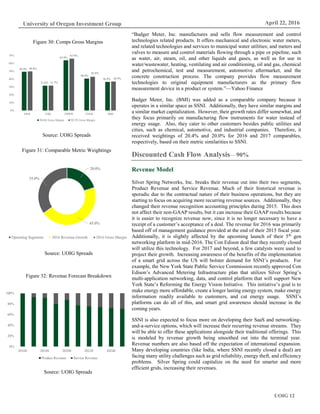
SSNI is also expected to focus more on developing their SaaS and networking-
and-a-service options, which will increase their recurring revenue streams. They
will be able to offer these applications alongside their traditional offerings. This
is modeled by revenue growth being smoothed out into the terminal year.
Revenue numbers are also based off the expectation of international expansion.
Many developing countries (like India, where SSNI recently closed a deal) are
facing many utility challenges such as grid reliability, energy theft, and efficiency
problems. Silver Spring could capitalize on the need for smarter and more
efficient grids, increasing their revenues.
49.4%
31.6%
63.9%
40.6%
36.4%
49.8%
31.7%
65.9%
42.8%
36.9%
0%
10%
20%
30%
40%
50%
60%
70%
SSNI ITRI OPWR ENOC BMI
2016E Gross Margin 2017E Gross Margin
Figure 30: Comps Gross Margins
Source: UOIG Spreads
Figure 31: Comparable Metric Weightings
Source: UOIG Spreads
Figure 32: Revenue Forecast Breakdown
Source: UOIG Spreads
20.0%
-
45.0%
35.0%
Operating Segments 2016 Revenue Growth 2016 Gross Margin
0%
20%
40%
60%
80%
100%
2016E 2018E 2020E 2022E 2024E
Product Revenue Service Revenue
UOIG 13
University of Oregon Investment Group April 22, 2016
Finally, the launch of their 5th
Gen networking platform will allow them to expand
into other areas, such as the IoT streetlight market, where they have already made
a name for themselves. They are currently partnered with Florida Power & Light
to establish the world’s largest connected lighting project of 500,000 networked
street lights across Miami and South Florida. SSNI has delivered over 21.5
million IPv6-connected devices for infrastructure networks across five continents,
and their 5th
Gen networking platform will allow them to continue being the leader
in the space, thus allowing for continued revenue growth.
Cost of Revenues Model
Cost of revenue represents the costs associated with products and services
delivered and accepted by the customer. The cost of revenue is divided into the
product cost of revenue and the service cost of revenue. Product cost of revenue
historically made up about 70% of the total cost of revenue. The cost of product
revenue includes contract manufacturing costs, raw materials, components,
associated freight, and compensation for manufacturing personnel. Both
segments were projected off a percentage of their respective revenue segments.
Product and service costs of revenue were both trended down into the terminal
year. Product cost of revenue is expected to decrease as a percentage of product
revenue due to the lower input costs for their new Gen 5 platform. The circuit
boards are smaller and require less materials. Also, management has been
focusing on greater efficiencies in their manufacturing plants, thus lowering costs.
Cost of service revenues include personnel-related costs and software hosting
costs. Services costs of revenue are expected to decrease marginally in the first
few years while Silver Spring increases their software development efficiencies.
It is then to flat-line into the terminal year as 40% of service revenue as their
software business becomes more established.
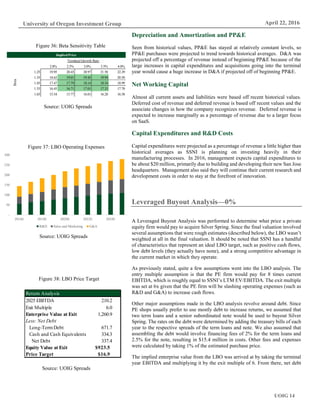
Beta
Silver Spring’s beta calculations were composed of a 90% weighting of the 3-year
daily beta and a 10% weighting of the Hamada Comps beta. The 3-year daily beta
was calculated by regressing SSNI’s 3-year daily returns against the returns of the
S&P 500 index, and then adjusted using the non-operating cash of SSNI (it was
assumed that operation cash is equal to 2% of revenue, while non-operating cash
is equal to 98% of revenue). The 3-year daily beta was used because it is believed
that this beta encapsulates its historical performance and its more recent stock
performance. The Hamada beta was weighted only 10% because, while we
believe that SSNI’s increased development of its software will move it closer to
some of its competitors, it is still the “pure-play” in the space, and will have a
different beta.
NOL Carryforwards
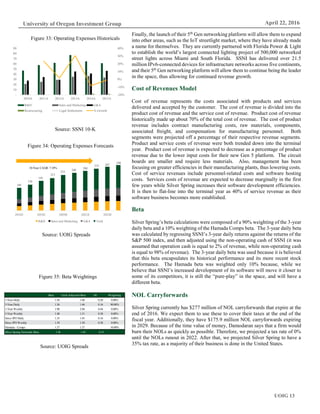
Silver Spring currently has $277 million of NOL carryforwards that expire at the
end of 2016. We expect them to use these to cover their taxes at the end of the
fiscal year. Additionally, they have $175.9 million NOL carryforwards expiring
in 2029. Because of the time value of money, Damodaran says that a firm would
burn their NOLs as quickly as possible. Therefore, we projected a tax rate of 0%
until the NOLs runout in 2022. After that, we projected Silver Spring to have a
35% tax rate, as a majority of their business is done in the United States.
10-Year CAGR: 7.18%
149
170
195
213
233
248
260
275 287
298
2016E 2018E 2020E 2022E 2024E
R&D Sales and Marketing G&A Total
Figure 33: Operating Expenses Historicals
Source: SSNI 10-K
Figure 34: Operating Expenses Forecasts
Source: UOIG Spreads
Figure 35: Beta Weightings
Source: UOIG Spreads
-20%
-10%
0%
10%
20%
30%
40%
-
10
20
30
40
50
60
70
80
90
2010A 2011A 2012A 2013A 2014A 2015A
R&D Sales and Marketing G&A
Restructuring Legal Settlements % Growth
Beta Cash Adjusted Beta SE Weighting
1-Year Daily 1.56 1.68 0.20 0.00%
3-Year Daily 1.36 1.46 0.16 90.00%
1-Year Weekly 1.90 2.04 0.44 0.00%
3-Year Weekly 1.40 1.51 0.38 0.00%
Since IPO Daily 1.35 1.45 0.16 0.00%
Since IPO Weekly 1.39 1.50 0.38 0.00%
Hamada - Comps 1.37 1.37 10.00%
Silver Spring Networks Beta 1.36 1.45 0.15
UOIG 14
University of Oregon Investment Group April 22, 2016
Depreciation and Amortization and PP&E
Seen from historical values, PP&E has stayed at relatively constant levels, so
PP&E purchases were projected to trend towards historical averages. D&A was
projected off a percentage of revenue instead of beginning PP&E because of the
large increases in capital expenditures and acquisitions going into the terminal
year would cause a huge increase in D&A if projected off of beginning PP&E.
Net Working Capital
Almost all current assets and liabilities were based off recent historical values.
Deferred cost of revenue and deferred revenue is based off recent values and the
associate changes in how the company recognizes revenue. Deferred revenue is
expected to increase marginally as a percentage of revenue due to a larger focus
on SaaS.
Capital Expenditures and R&D Costs
Capital expenditures were projected as a percentage of revenue a little higher than
historical averages as SSNI is planning on investing heavily in their
manufacturing processes. In 2016, management expects capital expenditures to
be about $20 million, primarily due to building and developing their new San Jose
headquarters. Management also said they will continue their current research and
development costs in order to stay at the forefront of innovation.
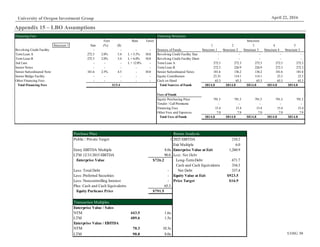
Leveraged Buyout Analysis—0%
A Leveraged Buyout Analysis was performed to determine what price a private
equity firm would pay to acquire Silver Spring. Since the final valuation involved
several assumptions that were rough estimates (described below), the LBO wasn’t
weighted at all in the final valuation. It should be noted that SSNI has a handful
of characteristics that represent an ideal LBO target, such as positive cash flows,
low debt levels (they actually have none), and a strong competitive advantage in
the current market in which they operate.
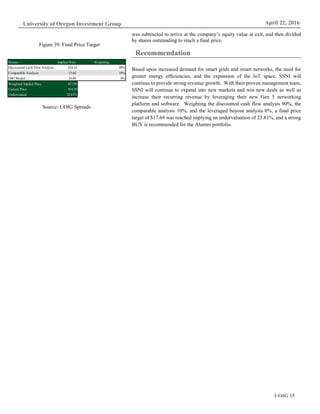
As previously stated, quite a few assumptions went into the LBO analysis. The
entry multiple assumption is that the PE firm would pay for 8 times current
EBITDA, which is roughly equal to SSNI’s LTM EV/EBITDA. The exit multiple
was set at 6x given that the PE firm will be slashing operating expenses (such as
R&D and G&A) to increase cash flows.
Other major assumptions made in the LBO analysis revolve around debt. Since
PE shops usually prefer to use mostly debt to increase returns, we assumed that
two term loans and a senior subordinated note would be used to buyout Silver
Spring. The rates on the debt were determined by adding the treasury bills of each
year to the respective spreads of the term loans and note. We also assumed that
assembling the debt would involve financing fees of 2% for the term loans and
2.5% for the note, resulting in $15.4 million in costs. Other fees and expenses
were calculated by taking 1% of the estimated purchase price.
The implied enterprise value from the LBO was arrived at by taking the terminal
year EBITDA and multiplying it by the exit multiple of 6. From there, net debt
Figure 38: LBO Price Target
Source: UOIG Spreads
Return Analysis
2025 EBITDA 210.2
Exit Multiple 6.0
Enterprise Value at Exit 1,260.9
Less: Net Debt
Long-TermDebt 671.7
Cash and Cash Equivalents 334.3
Net Debt 337.4
Equity Value at Exit $923.5
Price Target $16.9
-
50
100
150
200
250
300
2016E 2018E 2020E 2022E 2024E
R&D Sales and Marketing G&A
Figure 37: LBO Operating Expenses
Source: UOIG Spreads
ImpliedPrice Undervalued/(Overvalued)
Terminal Growth Rate Terminal Growth Rate
2.0% 2.5% 3.0% 3.5% 4.0%
1.25 19.95 20.43 20.97 21.58 22.29
1.35 18.62 19.01 19.45 19.94 20.50
1.45 17.47 17.79 18.14 18.54 18.99
1.55 16.45 16.71 17.01 17.33 17.70
1.65 15.54 15.77 16.01 16.28 16.58
Beta
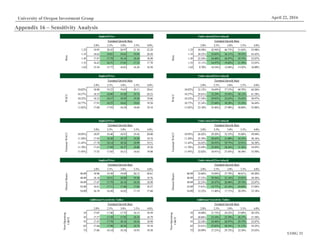
Figure 36: Beta Sensitivity Table
Source: UOIG Spreads
UOIG 15
University of Oregon Investment Group April 22, 2016
was subtracted to arrive at the company’s equity value at exit, and then divided
by shares outstanding to reach a final price.
Recommendation
Based upon increased demand for smart grids and smart networks, the need for
greater energy efficiencies, and the expansion of the IoT space, SSNI will
continue to provide strong revenue growth. With their proven management team,
SSNI will continue to expand into new markets and win new deals as well as
increase their recurring revenue by leveraging their new Gen 5 networking
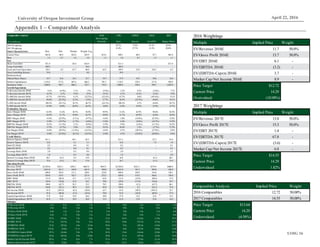
platform and software. Weighting the discounted cash flow analysis 90%, the
comparable analysis 10%, and the leveraged buyout analysis 0%, a final price
target of $17.69 was reached implying an undervaluation of 23.81%, and a strong
BUY is recommended for the Alumni portfolio.
Figure 39: Final Price Target
Source Implied Price Weighting
Discounted Cash Flow Analysis $18.14 90%
Comparable Analysis 13.64 10%
LBO Model 16.89 0%
Weighted Implied Price $17.69
Current Price $14.29
Undervalued 23.81%
Source: UOIG Spreads
UOIG 16
University of Oregon Investment Group April 22, 2016
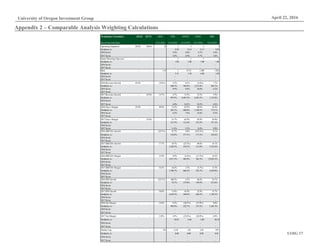
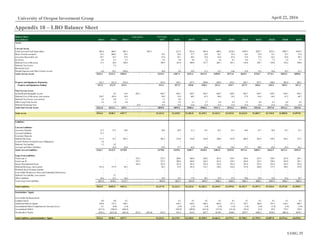
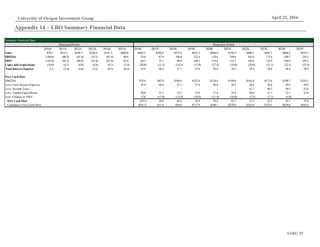
Appendix 1 – Comparable Analysis
2016 Weightings
Multiple Implied Price Weight
EV/Revenue 2016E 11.7 50.0%
EV/Gross Profit 2016E 13.7 50.0%
EV/EBIT 2016E 6.1 -
EV/EBITDA 2016E (3.2) -
EV/(EBITDA-Capex) 2016E 3.7 -
Market Cap/Net Income 2016E 8.9 -
Price Target $12.72
Current Price 14.29
Overvalued (10.98%)
2017 Weightings
Multiple Implied Price Weight
EV/Revenue 2017E 13.8 50.0%
EV/Gross Profit 2017E 15.3 50.0%
EV/EBIT 2017E 1.4 -
EV/EBITDA 2017E 67.8 -
EV/(EBITDA-Capex) 2017E (3.6) -
Market Cap/Net Income 2017E 6.8 -
Price Target $14.55
Current Price 14.29
Undervalued 1.82%
Implied Price Weight
12.72 50.00%
14.55 50.00%
Price Target $13.64
Current Price 14.29
Undervalued (4.58%)
Comparables Analysis
2016 Comparables
2017 Comparables
Comparables Analysis SSNI ITRI OPWR ENOC BMI
($ in millions)
Silver Spring
Networks Itron Opower EnerNOC Badger Meter
2016 Weighting 20.7% 17.6% 41.3% 20.4%
2017 Weighting 21.0% 27.7% 31.3% 20.0%
Stock Characteristics Max Min Median Weight Avg.
Current Price $65.8 $6.9 $23.6 $25.9 $14.3 $40.1 $6.9 $7.1 $65.8
Beta 1.5 0.7 1.0 1.0 1.5 1.0 0.7 1.2 1.1
Size
Short-TermDebt $71.4 - $5.6 $16.9 - $11.3 - - $71.4
Long-TermDebt 369.5 - - 76.6 - 369.5 - - -
Cash and Cash Equivalent 138.1 8.2 67.7 86.0 65.3 109.5 25.9 138.1 8.2
Non-Controlling Interest 19.4 - - 4.0 - 19.4 - - -
Preferred Stock - - - - - - - - -
Diluted Basic Shares 54.7 14.6 34.3 33.1 54.7 37.9 54.5 30.6 14.6
Market Capitalization 1,518.2 217.6 667.6 666.2 781.5 1,518.2 376.4 217.6 958.8
Enterprise Value 1,808.8 190.7 686.2 723.7 716.2 1,808.8 350.4 190.7 1,022.0
Growth Expectations
% Revenue Growth 2016E 8.3% (9.4%) 5.1% 1.5% (9.4%) 2.5% 8.3% (5.0%) 7.7%
% Revenue Growth 2017E 14.7% 4.7% 9.2% 9.5% 14.7% 4.7% 12.5% 12.5% 5.9%
% EBITDA Growth 2016E 47.7% (107.6%) 6.1% (32.2%) (22.5%) 47.7% 4.0% (107.6%) 8.1%
% EBITDA Growth 2017E 49.6% (25.3%) 12.3% 13.6% 17.7% 10.5% (25.3%) 49.6% 14.1%
% EPS Growth 2016E 108.3% (22.1%) 34.7% 46.7% (22.1%) 108.3% 4.7% 44.6% 24.7%
% EPS Growth 2017E 43.9% 10.0% 20.8% 26.3% 10.0% 13.8% 43.9% 25.9% 15.7%
Profitability Margins
Gross Margin 2016E 63.9% 31.6% 38.5% 42.0% 49.4% 31.6% 63.9% 40.6% 36.4%
Gross Margin 2017E 65.9% 31.7% 39.8% 45.7% 49.8% 31.7% 65.9% 42.8% 36.9%
EBIT Margin 2016E 14.4% (25.9%) (5.1%) (9.7%) 14.4% 5.8% (16.0%) (25.9%) 12.8%
EBIT Margin 2017E 13.9% (19.7%) (1.7%) (4.8%) 13.8% 6.4% (9.8%) (19.7%) 13.9%
EBITDA Margin 2016E 16.2% (11.5%) 2.1% (0.4%) 15.9% 9.9% (5.6%) (11.5%) 16.2%
EBITDA Margin 2017E 17.5% (5.7%) 5.8% 4.3% 16.3% 10.4% 1.3% (5.7%) 17.5%
Net Margin 2016E 14.4% (30.5%) (11.8%) (14.3%) 14.4% 4.2% (30.5%) (27.8%) 8.0%
Net Margin 2017E 13.8% (23.6%) (8.1%) (10.3%) 13.8% 4.5% (23.6%) (20.8%) 8.8%
Credit Metrics
Interest Expense 2016E $11.3 - $4.1 $5.5 - $11.3 - $7.2 $1.0
Interest Expense 2017E 12.6 - 4.1 5.1 - 12.6 - 7.2 1.0
Debt/EV2016E 0.2 - 0.0 0.1 - 0.2 - - 0.1
Debt/EV2017E 0.2 - 0.0 0.1 - 0.2 - - 0.1
Leverage Ratio 2016E 2.0 - 0.5 0.6 - 2.0 - - 1.1
Leverage Ratio 2017E 1.8 - 0.5 0.6 - 1.8 - - 0.9
Interest Coverage Ratio 2016E 66.1 (6.1) 8.4 14.4 - 16.8 - (6.1) 66.1
Interest Coverage Ratio 2017E 75.4 (3.1) 8.3 17.6 - 16.7 - (3.1) 75.4
Operating Results
Revenue 2016E $1,924.0 $161.1 $393.1 $667.0 $443.5 $1,924.0 $161.1 $379.4 $406.8
Revenue 2017E 2,015.0 181.2 410.0 681.9 508.8 2,015.0 181.2 389.0 430.9
Gross Profit 2016E 608.0 103.0 151.1 238.0 218.9 608.0 103.0 154.0 148.1
Gross Profit 2017E 639.0 119.5 162.7 251.4 253.3 639.0 119.5 166.6 158.8
EBIT 2016E 111.0 (98.2) 13.1 (11.5) 63.8 111.0 (25.8) (98.2) 51.9
EBIT 2017E 129.0 (76.6) 21.0 10.2 70.0 129.0 (17.8) (76.6) 59.7
EBITDA 2016E 190.0 (43.7) 28.5 33.2 70.3 190.0 (9.1) (43.7) 66.1
EBITDA 2017E 210.0 (22.1) 38.9 53.0 82.8 210.0 2.3 (22.1) 75.4
Net Income 2016E 81.0 (105.5) (8.3) (28.8) 63.7 81.0 (49.2) (105.5) 32.7
Net Income 2017E 91.0 (80.9) (2.5) (10.4) 70.0 91.0 (42.8) (80.9) 37.9
Capital Expenditures 2016E 57.0 12.0 19.0 26.6 20.0 57.0 12.0 23.6 14.3
Capital Expenditures 2017E 61.0 13.8 18.8 26.8 15.3 61.0 13.8 23.0 14.6
Multiples
EV/Revenue 2016E 2.5x 0.5x 1.6x 1.3x 1.6x 0.9x 2.2x 0.5x 2.5x
EV/Revenue 2017E 2.4x 0.5x 1.4x 1.4x 1.4x 0.9x 1.9x 0.5x 2.4x
EV/Gross Profit 2016E 6.9x 1.2x 3.2x 3.1x 3.3x 3.0x 3.4x 1.2x 6.9x
EV/Gross Profit 2017E 6.4x 1.1x 2.9x 3.1x 2.8x 2.8x 2.9x 1.1x 6.4x
EV/EBIT 2016E 19.7x (13.6x) 7.2x 4.2x 11.2x 16.3x (13.6x) (1.9x) 19.7x
EV/EBIT 2017E 17.1x (19.7x) 5.8x 0.1x 10.2x 14.0x (19.7x) (2.5x) 17.1x
EV/EBITDA 2016E 15.5x (38.5x) 2.6x (3.5x) 10.2x 9.5x (38.5x) (4.4x) 15.5x
EV/EBITDA 2017E 152.4x (8.6x) 11.1x 44.0x 8.6x 8.6x 152.4x (8.6x) 13.6x
EV/(EBITDA-Capex) 2016E 19.7x (16.6x) 5.4x 2.7x 14.2x 13.6x (16.6x) (2.8x) 19.7x
EV/(EBITDA-Capex) 2017E 16.8x (30.5x) 4.0x (3.8x) 10.6x 12.1x (30.5x) (4.2x) 16.8x
Market Cap/Net Income 2016E 29.3x (7.6x) 8.3x 7.7x 12.3x 18.7x (7.6x) (2.1x) 29.3x
Market Cap/Net Income 2017E 25.3x (8.8x) 7.0x 5.3x 11.2x 16.7x (8.8x) (2.7x) 25.3x
UOIG 17
University of Oregon Investment Group April 22, 2016
Appendix 2 – Comparable Analysis Weighting Calculations
Weightings Calculation 2016E 2017E SSNI ITRI OPWR ENOC BMI
Fiscal Year End Date 12/31/2015 12/31/2015 12/31/2015 12/31/2015 12/31/2015
Operating Segments 20.0% 20.0% 10 5 3 4 5
Similarity to: 0.20 0.14 0.17 0.20
2016 Score 5.6% 4.0% 4.7% 5.6%
2017 Score 5.6% 4.0% 4.7% 5.6%
Smart Metering Exposure - - - 1 1 1 1
Similarity to: 1.00 1.00 1.00 1.00
2016 Score - - - -
2017 Score - - - -
Beta - - 1.45 1 0.731 1.209 1.052
Similarity to: 2.15 1.38 4.09 2.49
2016 Score - - - -
2017 Score - - - -
2016 Revenue Growth 45.0% - (9.4%) 2.5% 8.3% (5.0%) 7.7%
Similarity to: 840.1% 564.9% 2,271.0% 584.7%
2016 Score 8.9% 6.0% 24.0% 6.2%
2017 Score - - - -
2017 Revenue Growth - 45.0% 14.7% 4.7% 12.5% 12.5% 5.9%
Similarity to: 997.4% 4,491.5% 4,491.5% 1,133.0%
2016 Score - - - -
2017 Score 4.0% 18.2% 18.2% 4.6%
2016 Gross Margin 35.0% - 49.4% 31.6% 63.9% 40.6% 36.4%
Similarity to: 563.1% 686.0% 1,140.5% 772.1%
2016 Score 6.2% 7.6% 12.6% 8.5%
2017 Score - - - -
2017 Gross Margin - 35.0% - 31.7% 65.9% 42.8% 36.9%
Similarity to: 315.3% 151.6% 233.5% 271.3%
2016 Score - - - -
2017 Score 11.4% 5.5% 8.4% 9.8%
2016 EBITDA Growth - - (22.5%) 47.7% 4.0% (107.6%) 8.1%
Similarity to: 142.4% 377.1% 117.5% 326.6%
2016 Score - - - -
2017 Score - - - -
2017 EBITDA Growth - - 17.7% 10.5% (25.3%) 49.6% 14.1%
Similarity to: 1,382.5% 232.5% 313.8% 2,752.4%
2016 Score - - - -
2017 Score - - - -
2016 EBITDA Margin - - 15.9% 9.9% (5.6%) (11.5%) 16.2%
Similarity to: 1,671.3% 465.0% 365.3% 25,622.5%
2016 Score - - - -
2017 Score - - - -
2017 EBITDA Margin - - 16.3% 10.4% 1.3% (5.7%) 17.5%
Similarity to: 1,708.7% 666.5% 455.5% 8,169.0%
2016 Score - - - -
2017 Score - - - -
2016 EPS Growth - - (22.1%) 108.3% 4.7% 44.6% 24.7%
Similarity to: 76.7% 373.0% 149.9% 213.6%
2016 Score - - - -
2017 Score - - - -
2017 EPS Growth - - 10.0% 13.8% 43.9% 25.9% 15.7%
Similarity to: 2,618.3% 294.8% 628.2% 1,748.5%
2016 Score - - - -
2017 Score - - - -
2016 Net Margin - - 14.4% 4.2% (30.5%) (27.8%) 8.0%
Similarity to: 985.8% 222.7% 237.2% 1,583.3%
2016 Score - - - -
2017 Score - - - -
2017 Net Margin - - 13.8% 4.5% (23.6%) (20.8%) 8.8%
Similarity to: 10.82 2.68 2.89 20.14
2016 Score - - - -
2017 Score - - - -
Market Cap - - 781 1,518 376 218 959
Similarity to: 0.00 0.00 0.00 0.01
2016 Score - - - -
2017 Score - - - -
UOIG 18
University of Oregon Investment Group April 22, 2016
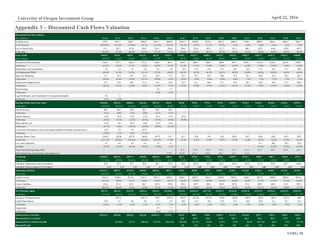
Appendix 3 – Discounted Cash Flows Valuation
DiscountedCash FlowAnalysis
($ in millions) 2010A 2011A 2012A 2013A 2014A 2015A 2016E 2017E 2018E 2019E 2020E 2021E 2022E 2023E 2024E 2025E
Total Revenue $70.2 $237.1 $196.7 $326.9 $191.3 $489.6 $443.5 $508.8 $573.6 $635.3 $694.8 $750.4 $800.1 $845.1 $884.2 $916.3
% YoY Growth 2,029.9% 237.6% (17.0%) 66.1% (41.5%) 155.9% (9.4%) 14.7% 12.7% 10.7% 9.4% 8.0% 6.6% 5.6% 4.6% 3.6%
Cost of Goods Sold 115.1 207.1 157.8 204.9 128.5 256.0 224.6 255.6 285.3 312.7 341.3 368.1 392.2 414.0 432.8 447.5
% Revenue 163.9% 87.4% 80.2% 62.7% 67.2% 52.3% 50.6% 50.2% 49.7% 49.2% 49.1% 49.1% 49.0% 49.0% 48.9% 48.8%
Gross Profit ($44.9) $29.9 $39.0 $122.0 $62.8 $233.6 $218.9 $253.3 $288.4 $322.5 $353.5 $382.3 $407.9 $431.1 $451.4 $468.8
Gross Margin (63.9%) 12.6% 19.8% 37.3% 32.8% 47.7% 49.4% 49.8% 50.3% 50.8% 50.9% 50.9% 51.0% 51.0% 51.1% 51.2%
Research and Development $47.0 $57.5 $62.0 $77.0 $64.8 $61.3 $59.9 $68.7 $80.3 $88.9 $97.3 $105.1 $112.0 $118.3 $123.8 $128.3
% Revenue 67.0% 24.3% 31.5% 23.6% 33.9% 12.5% 13.5% 13.5% 14.0% 14.0% 14.0% 14.0% 14.0% 14.0% 14.0% 14.0%
Depreciation and Amortization 5.2 7.0 7.3 6.6 6.5 7.8 6.6 12.8 13.9 14.1 14.8 16.0 17.3 18.5 19.7 20.8
% of Beginning PP&E 49.0% 41.9% 52.0% 52.3% 52.3% 60.8% 46.5% 46.5% 46.5% 46.5% 46.0% 46.0% 46.0% 46.0% 46.0% 46.0%
Sales and Marketing 21.1 25.2 29.1 34.9 36.4 33.5 35.5 40.7 45.9 50.8 55.6 56.3 60.0 63.4 66.3 68.7
% Revenue 30.0% 10.6% 14.8% 10.7% 19.0% 6.8% 8.0% 8.0% 8.0% 8.0% 8.0% 7.5% 7.5% 7.5% 7.5% 7.5%
General and Administrative 27.5 34.4 29.3 45.2 41.3 46.4 53.2 61.1 68.8 73.1 79.9 86.3 88.0 93.0 97.3 100.8
% Revenue 39.1% 14.5% 14.9% 13.8% 21.6% 9.5% 12.0% 12.0% 12.0% 11.5% 11.5% 11.5% 11.0% 11.0% 11.0% 11.0%
Restructuring - - - - 1.8 1.7 - - - - - - - - - -
% Revenue - - - - 0.9% 0.3% - - - - - - - - - -
Legal Settlements and Amortization of Acquired Intangibles 0.2 1.1 - - - - - - - - - - - - - -
% Revenue 0.2% 0.5% - - - - - - - - - - - - - -
Earnings Before Interest & Taxes ($145.8) ($95.2) ($88.6) ($41.8) ($87.9) $83.0 $63.8 $70.0 $79.4 $95.6 $105.9 $118.7 $130.6 $138.0 $144.3 $150.2
% Revenue (207.6%) (40.2%) (45.1%) (12.8%) (45.9%) 16.9% 14.4% 13.8% 13.8% 15.0% 15.2% 15.8% 16.3% 16.3% 16.3% 16.4%
Interest Income $0.2 $0.0 $2.0 $0.1 $0.3 $0.5 - - - - - - - - - -
% Revenue 0.3% 0.0% 1.0% 0.0% 0.2% 0.1% - - - - - - - - - -
Interest Expense (0.2) (0.3) (4.3) (1.2) (0.1) (0.1) (0.1) - - - - - - - - -
% Revenue (0.2%) (0.1%) (2.2%) (0.4%) (0.1%) (0.0%) (0.0%) - - - - - - - - -
Other expense, net (0.1) 0.0 (0.3) (0.0) (0.1) (0.3) - - - - - - - - - -
% Revenue (0.1%) 0.0% (0.1%) (0.0%) (0.0%) (0.1%) - - - - - - - - - -
Conversion of promissory notes and remeasurement of warrants and derivatives (2.5) 3.5 3.9 (23.7) - - - - - - - - - - - -
% Revenue (3.6%) 1.5% 2.0% (7.2%) - - - - - - - - - - - -
Earnings Before Taxes (148.3) (92.0) (87.3) (66.6) (87.7) 83.1 63.7 70.0 79.4 95.6 105.9 118.7 130.6 138.0 144.3 150.2
% Revenue (211.2%) (38.8%) (44.4%) (20.4%) (45.9%) 17.0% 14.4% 13.8% 13.8% 15.0% 15.2% 15.8% 16.3% 16.3% 16.3% 16.4%
Less Taxes (Benefits) 0.1 0.4 0.4 0.2 1.4 3.1 - - - - - - 41.7 48.3 50.5 52.6
Tax Rate (0.1%) (0.4%) (0.4%) (0.3%) (1.6%) 3.7% - - - - - - 31.9% 35.0% 35.0% 35.0%
Taxes Owed Disregarding NOLs 22.3 24.5 27.8 33.5 37.1 41.5 45.7 48.3 50.5 52.6
NOLs Remaining at End of Year After Deduction 277.0 175.9 151.4 123.6 90.1 53.1 11.5 - - - -
Net Income ($148.4) ($92.4) ($87.7) ($66.8) ($89.2) $80.0 $63.7 $70.0 $79.4 $95.6 $105.9 $118.7 $88.9 $89.7 $93.8 $97.6
Net Margin (211.4%) (39.0%) (44.6%) (20.4%) (46.6%) 16.3% 14.4% 13.8% 13.8% 15.0% 15.2% 15.8% 11.1% 10.6% 10.6% 10.7%
Add Back: Depreciation and Amortization $5.2 $7.0 $7.3 $6.6 $6.5 $7.8 $6.6 $12.8 $13.9 $14.1 $14.8 $16.0 $17.3 $18.5 $19.7 $20.8
Add Back: Interest Expense*(1-TaxRate) 0.15 0.34 4.32 1.20 0.13 0.05 0.11 0.00 0.00 0.00 0.00 0.00 0.00 0.00 0.00 0.00
Operating Cash Flow ($143.1) ($85.1) ($76.2) ($59.0) ($82.6) $87.9 $70.3 $82.8 $93.3 $109.7 $120.7 $134.6 $106.2 $108.2 $113.5 $118.4
% Revenue (203.8%) (35.9%) (38.7%) (18.0%) (43.2%) 17.9% 15.9% 16.3% 16.3% 17.3% 17.4% 17.9% 13.3% 12.8% 12.8% 12.9%
Current Assets $156.4 $140.0 $113.0 $116.3 $101.5 $260.1 $246.7 $284.2 $321.5 $358.2 $393.3 $426.2 $457.2 $484.8 $508.9 $531.0
% Revenue 222.7% 59.0% 57.4% 35.6% 53.0% 53.1% 55.6% 55.9% 56.0% 56.4% 56.6% 56.8% 57.1% 57.4% 57.6% 58.0%
Current Liabilities 213.6 221.3 142.3 166.7 143.9 378.8 339.6 389.7 438.5 484.9 529.8 571.6 609.1 642.9 672.1 693.5
% Revenue 304.2% 93.4% 72.3% 51.0% 75.2% 77.4% 76.6% 76.6% 76.4% 76.3% 76.2% 76.2% 76.1% 76.1% 76.0% 75.7%
Net Working Capital ($57.2) ($81.4) ($29.3) ($50.4) ($42.4) ($118.8) ($92.9) ($105.5) ($117.0) ($126.7) ($136.5) ($145.4) ($151.9) ($158.1) ($163.2) ($162.5)
% Revenue (81.4%) (34.3%) (14.9%) (15.4%) (22.2%) (24.3%) (20.9%) (20.7%) (20.4%) (19.9%) (19.6%) (19.4%) (19.0%) (18.7%) (18.5%) (17.7%)
Change in Working Capital - ($24.2) - ($21.1) $8.0 ($76.4) $25.9 ($12.6) ($11.6) ($9.6) ($9.8) ($8.9) ($6.5) ($6.2) ($5.1) $0.6
Capital Expenditures 10.9 4.1 4.9 4.0 6.1 5.4 20.0 15.3 14.3 15.9 17.4 18.8 20.0 21.1 22.1 22.9
% Revenue 15.6% 1.7% 2.5% 1.2% 3.2% 1.1% 4.5% 3.0% 2.5% 2.5% 2.5% 2.5% 2.5% 2.5% 2.5% 2.5%
Acquisitions - - - - 8.7 7.1 - - - - - - - - - -
% Revenue - - - - 4.6% 1.4% - - - - - - - - - -
UnleveredFree Cash Flow ($154.1) ($65.0) ($81.0) ($41.8) ($105.3) $151.8 $24.5 $80.1 $90.6 $103.5 $113.2 $124.8 $92.7 $93.3 $96.5 $94.9
DiscountedFree Cash Flow 22.0 64.9 66.0 67.8 66.7 66.2 44.3 40.1 37.3 33.0
UnleveredFree Cash FlowGrowth - (57.8%) 24.7% (48.4%) 151.9% (244.1%) (83.9%) 227.3% 13.0% 14.3% 9.3% 10.3% (25.7%) 0.6% 3.5% (1.7%)
Discount Period 1.0 2.0 3.0 4.0 5.0 6.0 7.0 8.0 9.0 10.0
UOIG 19
University of Oregon Investment Group April 22, 2016
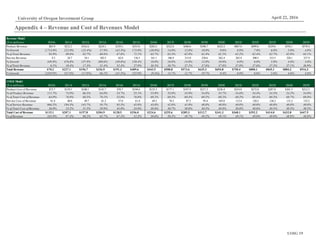
Appendix 4 – Revenue and Cost of Revenues Model
Revenue Model
($ in millions) 2010A 2011A 2012A 2013A 2014A 2015A 2016E 2017E 2018E 2019E 2020E 2021E 2022E 2023E 2024E 2025E
Product Revenue $65.9 $212.3 $162.6 $224.3 $129.3 $353.0 $282.4 $322.0 $360.6 $396.7 $432.4 $467.0 $499.6 $529.6 $556.1 $578.4
% Growth 2,713.0% 222.0% (23.4%) 37.9% (42.3%) 173.0% (20.0%) 14.0% 12.0% 10.0% 9.0% 8.0% 7.0% 6.0% 5.0% 4.0%
% of Total Revenue 93.9% 89.6% 82.7% 68.6% 67.6% 72.1% 63.7% 63.3% 62.9% 62.4% 62.2% 62.2% 62.4% 62.7% 62.9% 63.1%
Service Revenue 4.3 24.7 34.1 102.5 62.0 136.5 161.1 186.9 213.0 238.6 262.4 283.4 300.5 315.5 328.1 337.9
% Growth 349.9% 476.8% 137.9% 200.6% (39.6%) 120.4% 18.0% 16.0% 14.0% 12.0% 10.0% 8.0% 6.0% 5.0% 4.0% 3.0%
% of Total Revenue 6.1% 10.4% 17.3% 31.4% 32.4% 27.9% 36.3% 36.7% 37.1% 37.6% 37.8% 37.8% 37.6% 37.3% 37.1% 36.9%
Total Revenue $70.2 $237.1 $196.7 $326.9 $191.3 $489.6 $443.5 $508.8 $573.6 $635.3 $694.8 $750.4 $800.1 $845.1 $884.2 $916.3
% Growth 2,029.9% 237.6% (17.0%) 66.1% (41.5%) 155.9% (9.4%) 14.7% 12.7% 10.7% 9.4% 8.0% 6.6% 5.6% 4.6% 3.6%
COGS Model
($ in millions) 2010A 2011A 2012A 2013A 2014A 2015A 2016E 2017E 2018E 2019E 2020E 2021E 2022E 2023E 2024E 2025E
Product Cost of Revenue $73.7 $159.1 $108.1 $143.7 $70.7 $194.6 $155.3 $177.1 $197.9 $217.3 $236.4 $254.8 $272.0 $287.8 $301.5 $312.3
% of Product Revenue 111.7% 74.9% 66.5% 64.0% 54.7% 55.1% 55.0% 55.0% 54.9% 54.8% 54.7% 54.6% 54.4% 54.3% 54.2% 54.0%
% of Total Cost of Revenue 64.0% 76.8% 68.5% 70.1% 55.0% 76.0% 69.2% 69.3% 69.4% 69.5% 69.2% 69.2% 69.4% 69.5% 69.7% 69.8%
Service Cost of Revenue 41.4 48.0 49.7 61.2 57.8 61.4 69.3 78.5 87.3 95.4 105.0 113.4 120.2 126.2 131.2 135.2
% of Service Revenue 966.2% 194.3% 145.7% 59.7% 93.3% 45.0% 43.0% 42.0% 41.0% 40.0% 40.0% 40.0% 40.0% 40.0% 40.0% 40.0%
% of Total Cost of Revenue 36.0% 23.2% 31.5% 29.9% 45.0% 24.0% 30.8% 30.7% 30.6% 30.5% 30.8% 30.8% 30.6% 30.5% 30.3% 30.2%
Total Cost of Revenue $115.1 $207.1 $157.8 $204.9 $128.5 $256.0 $224.6 $255.6 $285.3 $312.7 $341.3 $368.1 $392.2 $414.0 $432.8 $447.5
% of Revenue 163.9% 87.4% 80.2% 62.7% 67.2% 52.3% 50.6% 50.2% 49.7% 49.2% 49.1% 49.1% 49.0% 49.0% 48.9% 48.8%
UOIG 20
University of Oregon Investment Group April 22, 2016
Appendix 5 – DCF Income Statement
Income Statement
($ in millions) 2010A 2011A 2012A 2013A 2014A 2015A 2016E 2017E 2018E 2019E 2020E 2021E 2022E 2023E 2024E 2025E
Product Revenue $65.9 $212.3 $162.6 $224.3 $129.3 $353.0 $282.4 $322.0 $360.6 $396.7 $432.4 $467.0 $499.6 $529.6 $556.1 $578.4
Service Revenue 4.3 24.7 34.1 102.5 62.0 136.5 161.1 186.9 213.0 238.6 262.4 283.4 300.5 315.5 328.1 337.9
Total Revenue 70.2 237.1 196.7 326.9 191.3 489.6 443.5 508.8 573.6 635.3 694.8 750.4 800.1 845.1 884.2 916.3
Product Cost of Revenue 78.8 166.1 115.3 150.3 77.2 202.4 161.9 189.9 211.9 231.4 251.1 270.7 289.3 306.3 322.4 312.3
Service Cost of Revenue 41.4 48.0 49.7 61.2 57.8 61.4 69.3 78.5 87.3 95.4 105.0 113.4 120.2 126.2 131.2 135.2
Total Cost of Revenue 120.2 214.1 165.0 211.5 135.0 263.8 231.2 268.4 299.2 326.9 356.1 384.1 409.5 432.5 453.6 447.5
Gross Profit ($50.0) $23.0 $31.7 $115.4 $56.3 $225.7 $212.4 $240.5 $274.4 $308.4 $338.7 $366.3 $390.6 $412.6 $430.6 $468.8
Gross Margin -71.23% 9.68% 16.12% 35.29% 29.45% 46.11% 47.88% 47.26% 47.84% 48.55% 48.75% 48.81% 48.82% 48.83% 48.70% 51.16%
Operating Expenses:
Research and Development 47.0 57.5 62.0 77.0 64.8 61.3 59.9 68.7 80.3 88.9 97.3 105.1 112.0 118.3 123.8 128.3
Sales and Marketing 21.1 25.2 29.1 34.9 36.4 33.5 35.5 40.7 45.9 50.8 55.6 56.3 60.0 63.4 66.3 68.7
General and Administrative 27.5 34.4 29.3 45.2 41.3 46.4 53.2 61.1 68.8 73.1 79.9 86.3 88.0 93.0 97.3 100.8
Restructuring - - - - 1.8 1.7 - - - - - - - - - -
Legal Settlements and Amortization of Acquired Intangibles 0.2 1.1 - - - - - - - - - - - - - -
Total Operating Expenses $95.7 $118.2 $120.4 $157.1 $144.2 $142.8 $148.6 $170.5 $195.0 $212.8 $232.8 $247.6 $260.0 $274.7 $287.4 $297.8
Operating Income ($145.8) ($95.2) ($88.6) ($41.8) ($87.9) $83.0 $63.8 $70.0 $79.4 $95.6 $105.9 $118.7 $130.6 $138.0 $143.2 $171.0
Operating Margin (207.6%) (40.2%) (45.1%) (12.8%) (45.9%) 16.9% 14.4% 13.8% 13.8% 15.0% 15.2% 15.8% 16.3% 16.3% 16.2% 18.7%
Other Income (Expense), Net
Interest Income 0.2 0.0 2.0 0.1 0.3 0.5 - - - - - - - - - -
Interest Expense (0.2) (0.3) (4.3) (1.2) (0.1) (0.1) (0.1) - - - - - - - - -
Other Expense, Net (0.1) 0.0 (0.3) (0.0) (0.1) (0.3) - - - - - - - - - -
Conversion of promissory notes and remeasurement of warrants and derivatives (2.5) 3.5 3.9 (23.7) - - - - - - - - - - - -
Total Other Income (Expense), Net ($2.6) $3.2 $1.3 ($24.8) $0.1 $0.1 ($0.1) - - - - - - - - -
Earnings Before Taxes ($148.3) ($92.0) ($87.3) ($66.6) ($87.7) $83.1 $63.7 $70.0 $79.4 $95.6 $105.9 $118.7 $130.6 $138.0 $143.2 $171.0
Provision for (Benefit) fromIncome Taxes 0.1 0.4 0.4 0.2 1.4 3.1 - - - - - - 41.7 48.3 50.5 52.6
Net Income (Loss) ($148.4) ($92.4) ($87.7) ($66.8) ($89.2) $80.0 $63.7 $70.0 $79.4 $95.6 $105.9 $118.7 $88.9 $89.7 $93.8 $97.6
Net Margin (211.4%) (39.0%) (44.6%) (20.4%) (46.6%) 16.3% 14.4% 13.8% 13.8% 15.0% 15.2% 15.8% 11.1% 10.6% 10.6% 10.7%
UOIG 21
University of Oregon Investment Group April 22, 2016
Appendix 6 – DCF Balance Sheet
Balance Sheet
($ in millions) 2010A 2011A 2012A 2013A 2014A 2015A 2016E 2017E 2018E 2019E 2020E 2021E 2022E 2023E 2024E 2025E
Assets
Current Assets
Total Cash and Cash Equivalents $42.7 $71.7 $72.6 $82.6 $60.5 $65.3 $118.4 $237.0 $363.7 $509.8 $658.9 $823.4 $950.6 $1,078.3 $1,211.9 $1,339.1
Short-TermInvestments 25.1 - - 63.3 $60.3 59.2 58.4 57.7 56.9 56.1 55.4 54.6 53.9 53.1 52.3 51.6
Accounts Receivable, net 37.0 33.4 56.5 69.7 54.7 47.8 43.1 49.5 55.6 61.8 67.6 72.8 77.8 82.2 85.8 89.1
Inventory 5.4 2.5 7.7 4.4 6.7 4.5 4.0 4.6 5.2 5.6 6.1 6.6 7.1 7.5 7.8 7.7
Deferred Cost of Revenue 96.1 99.5 45.3 37.5 29.6 196.9 181.8 209.8 237.7 264.7 291.1 316.0 338.7 359.6 378.2 394.8
Deferred TaxAssets - - - - 5.3 - - - - - - - - - - -
Restricted Cash 14.0 - - - - - - - - - - - - - - -
Prepaid Expense and Other Current Assets 3.9 4.6 3.5 4.8 5.1 10.8 8.9 10.2 11.5 13.3 14.6 15.8 17.6 18.6 19.5 21.1
Total Current Assets $224.3 $211.7 $185.7 $262.1 $222.3 $384.5 $414.7 $568.7 $730.6 $911.4 $1,093.7 $1,289.2 $1,445.7 $1,599.3 $1,755.5 $1,903.4
Property andEquipment, Beginning $10.5 $16.6 $14.0 $12.7 $12.4 $12.9 $14.1 $27.5 $30.0 $30.4 $32.1 $34.7 $37.5 $40.3 $42.9 $45.3
Property andEquipment, Ending $16.6 $14.0 $12.7 $12.4 $12.9 $14.1 $27.5 $30.0 $30.4 $32.1 $34.7 $37.5 $40.3 $42.9 $45.3 $47.3
Non-Current Assets
Goodwill and Intangible Assets - - - - $8.2 $14.4 $14.4 $14.4 $14.4 $14.4 $14.4 $14.4 $14.4 $14.4 $14.4 $14.4
Deferred Cost of Revenue, non-current 161.4 106.8 199.9 238.7 303.4 38.9 35.0 40.2 45.3 49.6 54.2 57.8 61.6 64.2 67.2 68.7
Deferred TaxAssets, non-current 25.6 21.6 8.3 1.6 0.4 1.1 0.9 - - - - - - - - -
Other Long-TermAssets 4.4 6.9 11.3 1.6 1.0 4.8 4.4 5.1 5.7 6.4 6.9 7.5 8.0 8.5 8.8 9.2
Total Non-Current Assets $191.3 $135.3 $219.4 $241.8 $313.1 $59.1 $54.8 $59.7 $65.4 $70.3 $75.5 $79.7 $84.0 $87.1 $90.4 $92.3
Total Assets $432.2 $360.9 $417.7 $516.4 $548.2 $457.7 $496.938 $658.4 $826.4 $1,013.9 $1,203.9 $1,406.4 $1,569.9 $1,729.3 $1,891.2 $2,043.0
Liabilities
Current Liabilities
Accounts Payable $25.9 $17.5 $28.1 $31.3 $27.5 $30.6 $26.9 $31.2 $34.7 $38.1 $41.5 $44.6 $47.7 $50.4 $52.7 $52.1
Accrued Liabilities 15.3 17.5 14.8 21.3 - - - - - - - - - - - -
Customer Deposits 12.6 7.4 - - - - - - - - - - - - - -
Deferred Revenue 132.2 156.5 89.8 111.3 91.7 305.5 275.0 316.0 356.9 396.0 433.9 469.4 501.4 530.5 556.1 577.3
Current Portion of Capital Lease Obligations 2.0 0.9 1.6 1.6 - - - - - - - - - - - -
Deferred TaxLiability 25.5 21.5 7.9 1.2 0.2 - - - - - - - - - - -
Accrued and Other Liabilities - - - - 24.4 42.8 37.7 42.4 46.8 50.8 54.4 57.5 60.0 62.0 63.4 64.1
Total Current Liabilities $213.6 $221.3 $142.3 $166.7 $143.9 $378.8 $339.6 $389.7 $438.5 $484.9 $529.8 $571.6 $609.1 $642.9 $672.1 $693.5
Long-Term Liabilities
Deferred Revenue, non-current $269.2 $244.0 $418.2 $413.4 $517.9 $96.3 $87.4 $101.8 $114.7 $130.2 $142.4 $157.6 $168.0 $177.5 $190.1 $197.0
Preferred Stock Warrant Liability 17.0 13.5 11.3 - - - - - - - - - - - - -
Convertible Promissory Notes and Embedded Derivatives - 24.1 56.3 - - - - - - - - - - - - -
Deferred TaxLiability, non-current - - - - 5.1 - - - - - - - - - - -
Other Liabilities 12.7 12.7 18.4 14.4 15.1 16.4 15.5 17.8 20.1 25.4 27.8 30.0 32.0 33.8 35.4 36.7
Total Long-TermLiabilities $298.9 $294.2 $504.2 $427.8 $538.1 $112.7 $102.9 $119.6 $134.8 $155.6 $170.2 $187.6 $200.0 $211.3 $225.5 $233.7
Total Liabilities $512.5 $515.6 $646.5 $594.5 $682.0 $491.6 $442.5 $509.3 $573.3 $640.5 $700.0 $759.2 $809.1 $854.1 $897.6 $927.2
Stockholders' Equity
Convertible Preferred Stock $270.7 $270.7 $270.7 - - - - - - - - - - - - -
Common Stock 0.0 0.0 0.0 0.0 0.0 0.1 0.1 0.1 0.1 0.1 0.1 0.1 0.1 0.1 0.1 0.1
Additional Paid in Capital 17.3 35.4 51.1 539.0 573.3 594.3 618.9 643.6 668.2 692.9 717.5 742.1 766.8 791.4 816.1 840.7
Accumulated Other Comprehensive Income (Loss) 0.0 (0.0) (0.1) 0.1 (0.8) (1.8) (1.8) (1.8) (1.8) (1.8) (1.8) (1.8) (1.8) (1.8) (1.8) (1.8)
Accumulated Deficit (368.4) (460.7) (550.5) (617.3) (706.4) (626.4) (562.8) (492.8) (413.4) (317.8) (211.8) (93.2) (4.3) 85.4 179.3 276.9
Total Stockholders' Equity ($80.3) ($154.6) ($228.8) ($78.1) ($133.8) ($33.9) $54.4 $149.1 $253.1 $373.4 $503.9 $647.2 $760.8 $875.1 $993.6 $1,115.9
Total Liabilities andStockholders' Equity $432.2 $360.9 $417.7 $516.4 $548.2 $457.7 $496.938 $658.4 $826.4 $1,013.9 $1,203.9 $1,406.4 $1,569.9 $1,729.3 $1,891.2 $2,043.0
UOIG 22
University of Oregon Investment Group April 22, 2016
Appendix 7 – DCF Cash Flow Statement
Statement of Cash Flows
($ in millions) 2010A 2011A 2012A 2013A 2014A 2015A 2016E 2017E 2018E 2019E 2020E 2021E 2022E 2023E 2024E 2025E
Cash FlowFrom Operating Activities
Net Income (Loss) From Continuing Operations ($148.4) ($92.4) ($87.7) ($66.8) ($89.2) $80.0 $63.7 $70.0 $79.4 $95.6 $105.9 $118.7 $88.9 $89.7 $93.8 $97.6
Adjustments to Reconcile:
Deferred Taxes - - - ($0.2) ($0.2) ($1.5) $0.2 $0.9 - - - - - - - -
Depreciation and Amortization 5.2 7.0 7.3 6.6 6.5 7.8 6.6 12.8 13.9 14.1 14.8 16.0 17.3 18.5 19.7 20.8
Stock-based Compensation 6.5 14.8 15.1 52.5 33.9 26.5 26.5 26.5 26.5 26.5 26.5 26.5 26.5 26.5 26.5 26.5
Fair Value of Common Stock Warrants Issued - 2.5 - - - - - - - - - - - - - -
Remeasurement of Preferred Stock Warrants 2.5 (3.5) - - - - - - - - - - - - - -
Conversion of Promissory Notes and Remeasurement of Warrants and Derivatives - - (3.9) 23.7 - - - - - - - - - - - -
Provision for Inventory Obsolescence 0.4 0.1 1.2 0.4 - - - - - - - - - - - -
Provision for Deferred Taxes (0.0) (0.1) - - - - - - - - - - - - - -
Non-Cash Interest Expense on Convertible Notes - - 1.5 0.9 - - - - - - - - - - - -
Other Non-Cash Adjustments 0.5 0.3 0.4 0.1 - - - - - - - - - - - -
Changes in Assets and Liabilities:
Accounts Receivable (2.1) 3.7 (23.2) (13.2) 15.6 7.4 4.7 (6.4) (6.1) (6.1) (5.8) (5.2) (5.0) (4.4) (3.6) (3.4)
Inventory 0.4 2.8 (6.4) 3.0 (2.3) 2.2 0.6 (0.6) (0.5) (0.5) (0.5) (0.5) (0.5) (0.4) (0.3) 0.1
Prepaid Expenses and Other Current Assets (0.4) (0.6) 1.1 (1.2) 0.2 (5.1) 2.0 (1.3) (1.3) (1.9) (1.3) (1.2) (1.8) (1.0) (0.9) (1.6)
Contingent Payments Related to Detectent Acquisition, Held in Escrow - - - - - (4.0) - - - - - - - - - -
Deferred Cost of Revenue (99.0) 51.2 (38.9) (31.0) (56.9) 97.3 18.9 (33.1) (33.1) (31.2) (31.0) (28.5) (26.5) (23.5) (21.6) (18.0)
Other Long-TermAssets (2.7) (2.9) (3.4) 4.5 - - 0.3 (0.7) (0.6) (0.6) (0.6) (0.6) (0.5) (0.5) (0.4) (0.3)
Accounts Payable (5.7) (8.5) 10.9 2.8 (4.1) 3.1 (3.7) 4.3 3.5 3.3 3.4 3.1 3.1 2.7 2.3 (0.6)
Accrued Liabilities 5.0 2.4 (3.2) 4.7 - - - - - - - - - - - -
Customer Deposits 12.6 (5.2) (7.0) (0.1) 0.3 (0.4) - - - - - - - - - -
Deferred Revenue 191.1 (0.9) 107.6 16.6 84.6 (208.3) (39.5) 55.5 53.8 54.6 50.1 50.7 42.4 38.6 38.2 28.1
Accrued and Other Liabilities 4.6 0.9 6.5 (3.6) 2.5 14.0 (5.9) 7.0 6.7 9.3 6.0 5.3 4.5 3.8 3.0 2.1
Net Cash Providedby Operating Activities ($29.5) ($28.5) ($22.3) ($0.2) ($9.2) $18.9 $74.2 $134.9 $142.1 $163.1 $167.5 $184.3 $148.3 $150.0 $156.7 $151.3
Cash Flows Providedby (usedin) Investing Activities
Decrease in Restricted Cash ($2.7) $13.9 $0.1 - - - - - - - - - - - - -
Business Acquisition, Net of Cash Acquired - - - - (8.7) (7.1) - - - - - - - - - -
Proceeds fromSales of Available-for-Sale Investments - - - 9.1 53.5 15.7 15.7 15.7 15.7 15.7 15.7 15.7 15.7 15.7 15.7 15.7
Proceeds fromMaturities of Available-for-Sale Investments 35.4 25.0 - - 6.8 9.3 9.3 9.3 9.3 9.3 9.3 9.3 9.3 9.3 9.3 9.3
Purchases of Short-TermInvestments (61.0) - - (72.3) (57.7) (24.2) (24.2) (24.2) (24.2) (24.2) (24.2) (24.2) (24.2) (24.2) (24.2) (24.2)
Purchases of Property and Equipment (10.9) (4.1) (4.9) (4.0) (6.1) (5.4) (20.0) (15.3) (14.3) (15.9) (17.4) (18.8) (20.0) (21.1) (22.1) (22.9)
Net Cash Providedby Investing Activities ($39.3) $34.8 ($4.7) ($67.2) ($12.3) ($11.7) ($19.2) ($14.5) ($13.6) ($15.1) ($16.6) ($18.0) ($19.2) ($20.4) ($21.3) ($22.1)
Cash Flowfrom Financing Activities
Payment Upon Termination of Preferred Stock Warrants of a Related Party - - - ($12.0) - - - - - - - - - - - -
Proceeds fromInitial Public Offering, Net of Offering Costs - - - 84.2 - - - - - - - - - - - -
Proceeds fromPrivate Placement of Common Stock with a Related Party - - - 12.0 - - - - - - - - - - - -
Payments on Capital Lease Obligations (1.5) (2.2) (1.3) (2.0) (1.6) (1.2) - - - - - - - - - -
Proceeds fromSale-Leaseback of Property and Equipment 1.5 - 1.7 - - - - - - - - - - - - -
Proceeds fromIssuance of Convertible Preferred Stock, Net of Paid Issuance Costs (1.9) - - - - - - - - - - - - - - -
Proceeds fromIssuance of Convertible Promissory Note - 24.0 29.0 - - - - - - - - - - - - -
Proceeds fromIssuance of Common Stock, Net of Repurchases 1.2 0.8 0.6 2.9 7.0 3.8 3.8 3.8 3.8 3.8 3.8 3.8 3.8 3.8 3.8 3.8
Excess TaxBenefit fromShare-Based Payment Awards - - - - - 0.2 0.2 0.2 0.2 0.2 0.2 0.2 0.2 0.2 0.2 0.2
Taxes Paid Related to Net Share Settlement of Equity Awards - - - (8.0) (6.5) (5.8) (5.8) (5.8) (5.8) (5.8) (5.8) (5.8) (5.8) (5.8) (5.8) (5.8)
Net Cash Providedby Financing Activities ($0.7) $22.6 $30.0 $77.1 ($1.0) ($3.0) ($1.8) ($1.8) ($1.8) ($1.8) ($1.8) ($1.8) ($1.8) ($1.8) ($1.8) ($1.8)
Effect of Exchange Rate Changes on Cash and Cash Equivalents - - - - ($0.1) ($0.2) - - - - - - - - - -
Net Increase (Decrease) in Cash and Cash Equivalents (69.4) 28.9 1.0 10.0 (22.1) 4.8 53.2 118.6 126.7 146.1 149.1 164.5 127.2 127.7 133.5 127.3
Cash and Cash Equivalents - Beginning of Period 112.2 42.7 71.7 72.6 82.6 60.5 65.3 118.4 237.0 363.7 509.8 658.9 823.4 950.6 1,078.3 1,211.9
Cash and Cash Equivalents - End of Period 42.7 71.7 72.6 82.6 60.5 65.3 118.4 237.0 363.7 509.8 658.9 823.4 950.6 1,078.3 1,211.9 1,339.1
Supplemental Cash Flow Information - Cash Paid for Income Taxes 0.4 0.4 0.8 0.2 0.7 2.7 - - - - - - - - - -
Supplemental Cash Flow Information - Cash Paid for Interest 0.1 0.2 0.4 0.3 0.1 0.1 - - - - - - - - - -
Non-Cash Investing andFinancing Activities
Issuance of Preferred Stock Warrants $0.0 $0.0 - - - - - - - - - - - - - -
Conversion of Convertible Preferred Stock into Common Stock - - - 270.7 - - - - - - - - - - - -
Fair Value of Common Stock Issued on Conversion of Convertible Promissory Notes - - - 79.4 - - - - - - - - - - - -
Deferred Offering Costs not yet Paid - - - 0.0 - - - - - - - - - -
Unpaid Purchases of Property and Equipment - - - 0.8 0.5 2.9 - - - - - - - - - -
Property and Equipment Acquired under Capital Lease 4.7 0.4 2.9 1.8 - - - - - - - - - - - -
Issuance of Common Stock Warrant - - 2.5 - - - - - - - - - - - - -
Leasehold Improvements Funded by Lease Incentives - - - - 0.7 - - - - - - - - - - -
UOIG 23
University of Oregon Investment Group April 22, 2016
Appendix 8 – DCF Assumptions, Final Price Target, and Beta
DiscountedFree Cash FlowAssumptions Considerations
TaxRate 35.00% Terminal Growth Rate 3.00%
Risk Free Rate 1.76% Terminal Value 1,099
Beta 1.45 PVof Terminal Value 279
Market Risk Premium 6.45% Sumof PVFree Cash Flows 589
% Equity 100.00% FirmValue 868
% Debt 0.00% Total Debt 0
Cost of Debt 0.00% Non-Operating C&CE 55
CAPM 11.14% Market Capitalization 923
WACC 11.14% Fully Diluted Shares 51
Terminal Risk Free Rate 2.69% Implied Price $18.14
Terminal CAPM 12.07% Current Price $14.29
Terminal WACC 12.07% Undervalued 26.97%
Source Implied Price Weighting
Discounted Cash Flow Analysis $18.14 90%
Comparable Analysis 13.64 10%
LBO Model 16.89 0%
Weighted Implied Price $17.69
Current Price $14.29
Undervalued 23.81%
Beta Cash Adjusted Beta SE Weighting
1-Year Daily 1.56 1.68 0.20 0.00%
3-Year Daily 1.36 1.46 0.16 90.00%
1-Year Weekly 1.90 2.04 0.44 0.00%
3-Year Weekly 1.40 1.51 0.38 0.00%
Since IPO Daily 1.35 1.45 0.16 0.00%
Since IPO Weekly 1.39 1.50 0.38 0.00%
Hamada - Comps 1.37 1.37 10.00%
Silver Spring Networks Beta 1.36 1.45 0.15
UOIG 24
University of Oregon Investment Group April 22, 2016
Appendix 9 – LBO Income Statement
Income Statement
($ in millions) 2010A 2011A 2012A 2013A 2014A 2015A 2016E 2017E 2018E 2019E 2020E 2021E 2022E 2023E 2024E 2025E
Product Revenue $65.9 $212.3 $162.6 $224.3 $129.3 $353.0 $282.4 $322.0 $360.6 $396.7 $432.4 $467.0 $499.6 $529.6 $556.1 $578.4
Service Revenue $4.3 $24.7 $34.1 $102.5 $62.0 $136.5 $161.1 $186.9 $213.0 $238.6 $262.4 $283.4 $300.5 $315.5 $328.1 $337.9
Total Revenue $70.2 $237.1 $196.7 $326.9 $191.3 $489.6 $443.5 $508.8 $573.6 $635.3 $694.8 $750.4 $800.1 $845.1 $884.2 $916.3
Product Cost of Revenue 78.8 166.1 115.3 150.3 77.2 202.4 161.9 189.9 211.9 231.4 251.1 270.7 289.3 306.3 322.4 312.3
Service Cost of Revenue 41.4 48.0 49.7 61.2 57.8 61.4 69.3 78.5 87.3 95.4 105.0 113.4 120.2 126.2 131.2 135.2
Total Cost of Revenue 120.2 214.1 165.0 211.5 135.0 263.8 231.2 268.4 299.2 326.9 356.1 384.1 409.5 432.5 453.6 447.5
Gross Profit ($50.0) $23.0 $31.7 $115.4 $56.3 $225.7 $212.4 $240.5 $274.4 $308.4 $338.7 $366.3 $390.6 $412.6 $430.6 $468.8
Gross Margin -71.23% 9.68% 16.12% 35.29% 29.45% 46.11% 47.88% 47.26% 47.84% 48.55% 48.75% 48.81% 48.82% 48.83% 48.70% 51.16%
Operating Expenses:
Research and Development 47.0 57.5 62.0 77.0 64.8 61.3 55.4 63.6 68.8 76.2 83.4 90.0 96.0 101.4 106.1 110.0
Sales and Marketing 21.1 25.2 29.1 34.9 36.4 33.5 35.5 40.7 45.9 50.8 55.6 56.3 60.0 63.4 66.3 68.7
General and Administrative 27.5 34.4 29.3 45.2 41.3 46.4 53.2 61.1 68.8 73.1 79.9 86.3 88.0 93.0 97.3 100.8
Restructuring - - - - 1.8 1.7 - - - - - - - - - -
Legal Settlements and Amortization of Acquired Intangibles 0.2 1.1 - - - - - - - - - - - - - -
Total Operating Expenses $95.7 $118.2 $120.4 $157.1 $144.2 $142.8 $144.1 $165.4 $183.6 $200.1 $218.9 $232.6 $244.0 $257.8 $269.7 $279.5
Operating Income ($145.8) ($95.2) ($88.6) ($41.8) ($87.9) $83.0 $68.2 $75.1 $90.9 $108.3 $119.8 $133.7 $146.6 $154.9 $160.9 $189.3
Operating Margin (207.6%) (40.2%) (45.1%) (12.8%) (45.9%) 16.9% 15.4% 14.8% 15.8% 17.0% 17.2% 17.8% 18.3% 18.3% 18.2% 20.7%
Other Income (Expense), Net
Interest Income (0.2) (0.0) (2.0) (0.1) (0.3) (0.5) - - - - - - - - - -
Interest Expense - - - - - - - - -
Revolving Credit Facility - - - - - - - - - - - - - - - -
TermLoan A - - - - - - 16.4 16.7 17.0 17.2 17.5 17.6 17.7 17.8 17.9 17.9
TermLoan B - - - - - - 17.7 18.1 18.3 18.6 18.8 18.9 19.0 19.0 19.1 19.2
Senior Subordinated Notes - - - - - - 21.8 21.8 21.8 21.8 21.8 21.8 21.8 21.8 21.8 21.8
Interest Income - - - - - - - - - - - - - - - -
Net Interest Expense - - - - - - 55.9 56.6 57.1 57.6 58.0 58.2 58.4 58.6 58.8 58.9
Other Expense, Net 0.1 (0.0) 0.3 0.0 0.1 0.3 - - - - - - - - - -
Conversion of promissory notes and remeasurement of warrants and derivatives 2.5 (3.5) (3.9) 23.7 - - - - - - - - - - - -
Total Other Expense (Income), Net $2.4 ($3.6) ($5.6) $23.6 ($0.3) ($0.2) $55.9 $56.6 $57.1 $57.6 $58.0 $58.2 $58.4 $58.6 $58.8 $58.9
Earnings Before Taxes ($148.3) ($92.0) ($87.3) ($66.6) ($87.7) $83.1 $12.3 $18.5 $33.8 $50.7 $61.8 $75.5 $88.2 $96.3 $102.2 $130.4
Provision for (Benefit) fromIncome Taxes 0.1 0.4 0.4 0.2 1.4 3.1 - - - - - - 41.7 48.3 50.5 52.6
Net Income (Loss) ($148.4) ($92.4) ($87.7) ($66.8) ($89.2) $80.0 $12.3 $18.5 $33.8 $50.7 $61.8 $75.5 $46.5 $48.0 $51.7 $77.9
Net Margin (211.4%) (39.0%) (44.6%) (20.4%) (46.6%) 16.3% 2.8% 3.6% 5.9% 8.0% 8.9% 10.1% 5.8% 5.7% 5.8% 8.5%
UOIG 25
University of Oregon Investment Group April 22, 2016
Appendix 10 – LBO Balance Sheet
Balance Sheet Adjustments Pro Forma
($ in millions) 2013A 2014A 2015A + - 2015 2016E 2017E 2018E 2019E 2020E 2021E 2022E 2023E 2024E 2025E
Assets 0.00 0.00 0.00 0.00 0.00 0.00 0.00 0.00 0.00 0.00 0.00 0.00 0.00
0.00 0.00 0.00 0.00 0.00 0.00 0.00 0.00 0.00 0.00 0.00 0.00 0.00 0.00
Current Assets
Total Cash and Cash Equivalents $82.6 $60.5 $65.3 $65.3 - $11.2 $21.6 $45.6 $89.3 $136.2 $199.3 $225.7 $253.1 $285.7 $334.3
Short-TermInvestments 63.3 $60.3 59.2 59.2 58.4 57.7 56.9 56.1 55.4 54.6 53.9 53.1 52.3 51.6
Accounts Receivable, net 69.7 54.7 47.8 47.8 43.1 49.5 55.6 61.8 67.6 72.8 77.8 82.2 85.8 89.1
Inventory 4.4 6.7 4.5 4.5 4.0 4.6 5.2 5.6 6.1 6.6 7.1 7.5 7.8 7.7
Deferred Cost of Revenue 37.5 29.6 196.9 196.9 181.8 209.8 237.7 264.7 291.1 316.0 338.7 359.6 378.2 394.8
Deferred TaxAssets - 5.3 - - - - - - - - - - - -
Restricted Cash - - - - - - - - - - - - - -
Prepaid Expense and Other Current Assets 4.8 $5.1 $10.8 10.8 8.9 10.2 11.5 13.3 14.6 15.8 17.6 18.6 19.5 21.1
Total Current Assets $262.1 $222.3 $384.5 - - $319.2 $307.5 $353.3 $412.5 $490.9 $571.0 $665.1 $720.7 $774.1 $829.3 $898.6
Property andEquipment, Beginning $12.7 $12.4 $12.9 $12.9 $14.1 $27.5 $30.0 $30.4 $32.1 $34.7 $37.5 $40.3 $42.9 $45.3
Property andEquipment, Ending $12.4 $12.9 $14.1 $14.1 $27.5 $30.0 $30.4 $32.1 $34.7 $37.5 $40.3 $42.9 $45.3 $47.3
Non-Current Assets
Goodwill and Intangible Assets - 8.2 14.4 825.3 839.7 839.7 839.7 839.7 839.7 839.7 839.7 839.7 839.7 839.7 839.7
Deferred Cost of Revenue, non-current 238.7 303.4 38.9 38.9 35.0 40.2 45.3 49.6 54.2 57.8 61.6 64.2 67.2 68.7
Deferred TaxAssets, non-current 1.6 0.4 1.1 1.1 0.9 - - - - - - - - -
Other Long-TermAssets 1.6 1.0 4.8 4.8 4.4 5.1 5.7 6.4 6.9 7.5 8.0 8.5 8.8 9.2
Deferred Financing Fees - - - 15.4 15.4 15.4 15.4 15.4 15.4 15.4 15.4 15.4 15.4 15.4 15.4
Total Non-Current Assets $241.8 $313.1 $59.1 - - $899.9 $895.5 $900.4 $906.2 $911.1 $916.3 $920.4 $924.8 $927.8 $931.2 $933.0
Total Assets $516.4 $548.2 $457.7 - - $1,233.2 $1,230.5 $1,283.8 $1,349.1 $1,434.1 $1,522.0 $1,623.0 $1,685.7 $1,744.8 $1,805.8 $1,879.0
Liabilities
Current Liabilities
Accounts Payable 31.3 27.5 30.6 30.6 26.9 31.2 34.7 38.1 41.5 44.6 47.7 50.4 52.7 52.1
Accrued Liabilities 21.3 - - - - - - - - - - - - -
Customer Deposits - - - - - - - - - - - - - -
Deferred Revenue 111.3 91.7 305.5 305.5 275.0 316.0 356.9 396.0 433.9 469.4 501.4 530.5 556.1 577.3
Current Portion of Capital Lease Obligations 1.6 - - - - - - - - - - - - -
Deferred TaxLiability 1.2 0.2 - - - - - - - - - - - -
Accrued and Other Liabilities - 24.4 42.8 42.8 37.7 42.4 46.8 50.8 54.4 57.5 60.0 62.0 63.4 64.1
Total Current Liabilities $166.7 $143.9 $378.8 $378.8 $339.6 $389.7 $438.5 $484.9 $529.8 $571.6 $609.1 $642.9 $672.1 $693.5
Long-Term Liabilities
TermLoan A - - - 272.3 272.3 269.6 266.9 264.2 261.4 258.7 256.0 253.3 250.5 247.8 245.1
TermLoan B - - - 272.3 272.3 269.6 266.9 264.2 261.4 258.7 256.0 253.3 250.5 247.8 245.1
Senior Subordinated Notes - - - 181.6 181.6 181.6 181.6 181.6 181.6 181.6 181.6 181.6 181.6 181.6 181.6
Deferred Revenue, non-current 413.4 517.9 96.3 96.3 87.4 101.8 114.7 130.2 142.4 157.6 168.0 177.5 190.1 197.0
Preferred Stock Warrant Liability - - - - - - - - - - - - - -
Convertible Promissory Notes and Embedded Derivatives - - - - - - - - - - - - - -
Deferred TaxLiability, non-current - 5.1 - - - - - - - - - - - -
Other Liabilities 14.4 15.1 16.4 16.4 15.5 17.8 20.1 25.4 27.8 30.0 32.0 33.8 35.4 36.7
Total Long-TermLiabilities $427.8 $538.1 $112.7 $838.9 $823.7 $834.9 $844.7 $860.1 $869.2 $881.1 $888.1 $893.9 $902.7 $905.4
Total Liabilities $594.5 $682.0 $491.6 $1,217.8 $1,163.3 $1,224.6 $1,283.2 $1,344.9 $1,399.0 $1,452.7 $1,497.2 $1,536.8 $1,574.8 $1,598.9
Stockholders' Equity
Convertible Preferred Stock - - - - - - - - - - - - -
Common Stock 0.0 0.0 0.1 0.1 0.1 0.1 0.1 0.1 0.1 0.1 0.1 0.1 0.1
Additional Paid in Capital 539.0 573.3 594.3 670.7 643.6 668.2 692.9 717.5 742.1 766.8 791.4 816.1 840.7
Accumulated Other Comprehensive Income (Loss) 0.1 (0.8) (1.8) (1.8) (1.8) (1.8) (1.8) (1.8) (1.8) (1.8) (1.8) (1.8) (1.8)
Accumulated Deficit (617.3) (706.4) (626.4) (562.8) (492.8) (413.4) (317.8) (211.8) (93.2) (4.3) 85.4 179.3 276.9
Stockholders' Equity ($78.1) ($133.8) ($33.9) $15.4 ($33.9) $15.4 $15.4 $33.9 $67.7 $118.4 $180.2 $255.7 $302.2 $350.2 $401.8 $479.7
Total Liabilities andStockholders' Equity $516.4 $548.2 $457.7 $1,233.2 $1,178.7 $1,258.5 $1,350.9 $1,463.3 $1,579.2 $1,708.3 $1,799.4 $1,887.0 $1,976.6 $2,078.6
UOIG 26
University of Oregon Investment Group April 22, 2016
Appendix 11 – LBO Cash Flow Statement
Statement of Cash Flows
($ in millions) 2010A 2011A 2012A 2013A 2014A 2015A 2016E 2017E 2018E 2019E 2020E 2021E 2022E 2023E 2024E 2025E
Cash FlowFrom Operating Activities
Net Income (Loss) From Continuing Operations ($148.4) ($92.4) ($87.7) ($66.8) ($89.2) $80.0 $12.3 $18.5 $33.8 $50.7 $61.8 $75.5 $46.5 $48.0 $51.7 $77.9
Adjustments to Reconcile:
Deferred Taxes - - - ($0.2) ($0.2) ($1.5) $0.2 $0.9 - - - - - - - -
Depreciation and Amortization 5.2 7.0 7.3 6.6 6.5 7.8 6.6 12.8 13.9 14.1 14.8 16.0 17.3 18.5 19.7 20.8
Stock-based Compensation 6.5 14.8 15.1 52.5 33.9 26.5 26.5 26.5 26.5 26.5 26.5 26.5 26.5 26.5 26.5 26.5
Fair Value of Common Stock Warrants Issued - 2.5 - - - - - - - - - - - - - -
Remeasurement of Preferred Stock Warrants 2.5 (3.5) - - - - - - - - - - - - - -
Conversion of Promissory Notes and Remeasurement of Warrants and Derivatives - - (3.9) 23.7 - - - - - - - - - - - -
Provision for Inventory Obsolescence 0.4 0.1 1.2 0.4 - - - - - - - - - - - -
Provision for Deferred Taxes (0.0) (0.1) - - - - - - - - - - - - - -
Non-Cash Interest Expense on Convertible Notes - - 1.5 0.9 - - - - - - - - - - - -
Other Non-Cash Adjustments 0.5 0.3 0.4 0.1 - - - - - - - - - - - -
Changes in Assets and Liabilities: - - - - - - - - - - - - - - - -
Accounts Receivable (2.1) 3.7 (23.2) (13.2) 15.6 7.4 4.7 (6.4) (6.1) (6.1) (5.8) (5.2) (5.0) (4.4) (3.6) (3.4)
Inventory 0.4 2.8 (6.4) 3.0 (2.3) 2.2 0.6 (0.6) (0.5) (0.5) (0.5) (0.5) (0.5) (0.4) (0.3) 0.1
Prepaid Expenses and Other Current Assets (0.4) (0.6) 1.1 (1.2) 0.2 (5.1) 2.0 (1.3) (1.3) (1.9) (1.3) (1.2) (1.8) (1.0) (0.9) (1.6)
Contingent Payments Related to Detectent Acquisition, Held in Escrow - - - - - (4.0) - - - - - - - - - -
Deferred Cost of Revenue (99.0) 51.2 (38.9) (31.0) (56.9) 97.3 18.9 (33.1) (33.1) (31.2) (31.0) (28.5) (26.5) (23.5) (21.6) (18.0)
Other Long-TermAssets (2.7) (2.9) (3.4) 4.5 - - 0.3 (0.7) (0.6) (0.6) (0.6) (0.6) (0.5) (0.5) (0.4) (0.3)
Accounts Payable (5.7) (8.5) 10.9 2.8 (4.1) 3.1 (3.7) 4.3 3.5 3.3 3.4 3.1 3.1 2.7 2.3 (0.6)
Accrued Liabilities 5.0 2.4 (3.2) 4.7 - - - - - - - - - - - -
Customer Deposits 12.6 (5.2) (7.0) (0.1) 0.3 (0.4) - - - - - - - - - -
Deferred Revenue 191.1 (0.9) 107.6 16.6 84.6 (208.3) (39.5) 55.5 53.8 54.6 50.1 50.7 42.4 38.6 38.2 28.1
Accrued and Other Liabilities 4.6 0.9 6.5 (3.6) 2.5 14.0 (5.9) 7.0 6.7 9.3 6.0 5.3 4.5 3.8 3.0 2.1
Net Cash Providedby Operating Activities ($29.5) ($28.5) ($22.3) ($0.2) ($9.2) $18.9 $22.9 $83.4 $96.5 $118.2 $123.4 $141.1 $105.8 $108.3 $114.5 $131.5
Cash Flows Providedby (usedin) Investing Activities
Decrease in Restricted Cash ($2.7) $13.9 $0.1 - - - - - - - - - - - - -
Business Acquisition, Net of Cash Acquired - - - - (8.7) (7.1) - - - - - - - - - -
Proceeds fromSales of Available-for-Sale Investments - - - 9.1 53.5 15.7 15.7 15.7 15.7 15.7 15.7 15.7 15.7 15.7 15.7 15.7
Proceeds fromMaturities of Available-for-Sale Investments 35.4 25.0 - - 6.8 9.3 9.3 9.3 9.3 9.3 9.3 9.3 9.3 9.3 9.3 9.3
Purchases of Short-TermInvestments (61.0) - - (72.3) (57.7) (24.2) (24.2) (24.2) (24.2) (24.2) (24.2) (24.2) (24.2) (24.2) (24.2) (24.2)
Purchases of Property and Equipment (10.9) (4.1) (4.9) (4.0) (6.1) (5.4) (20.0) (15.3) (14.3) (15.9) (17.4) (18.8) (20.0) (21.1) (22.1) (22.9)
Net Cash Providedby Investing Activities ($39.3) $34.8 ($4.7) ($67.2) ($12.3) ($11.7) ($19.2) ($14.5) ($13.6) ($15.1) ($16.6) ($18.0) ($19.2) ($20.4) ($21.3) ($22.1)
Cash Flowfrom Financing Activities
Payment Upon Termination of Preferred Stock Warrants of a Related Party - - - ($12.0) - - - - - - - - - - - -
Proceeds fromIssuance of Long-TermDebt - - - - - $726.2 - - - - - - - - - -
Proceeds fromInitial Public Offering, Net of Offering Costs - - - 84.2 - - - - - - - - - - - -
Proceeds fromPrivate Placement of Common Stock with a Related Party - - - 12.0 - - - - - - - - - - - -
Payments on Capital Lease Obligations (1.5) (2.2) (1.3) (2.0) (1.6) (1.2) - - - - - - - - - -
Proceeds fromSale-Leaseback of Property and Equipment 1.5 - 1.7 - - - - - - - - - - - - -
Proceeds fromIssuance of Convertible Preferred Stock, Net of Paid Issuance Costs (1.9) - - - - - - - - - - - - - - -
Proceeds fromIssuance of Convertible Promissory Note - 24.0 29.0 - - - - - - - - - - - - -
Proceeds fromIssuance of Common Stock, Net of Repurchases 1.2 0.8 0.6 2.9 7.0 3.8 3.8 3.8 3.8 3.8 3.8 3.8 3.8 3.8 3.8 3.8
Repayments on Long-TermDebt - - - - - - (55.9) (56.6) (57.1) (57.6) (58.0) (58.2) (58.4) (58.6) (58.8) (58.9)
Excess TaxBenefit fromShare-Based Payment Awards - - - - - 0.2 0.2 0.2 0.2 0.2 0.2 0.2 0.2 0.2 0.2 0.2
Repurchase of Common Stock - - - - - 791.5 - - - - - - - - - -
Taxes Paid Related to Net Share Settlement of Equity Awards - - - (8.0) (6.5) (5.8) (5.8) (5.8) (5.8) (5.8) (5.8) (5.8) (5.8) (5.8) (5.8) (5.8)
Net Cash Providedby Financing Activities ($0.7) $22.6 $30.0 $77.1 ($1.0) ($3.0) ($57.7) ($58.5) ($58.9) ($59.4) ($59.9) ($60.1) ($60.3) ($60.4) ($60.6) ($60.7)
Effect of Exchange Rate Changes on Cash and Cash Equivalents - - - - ($0.1) ($0.2) - - - - - - - - - -
Net Increase (Decrease) in Cash and Cash Equivalents (69.4) 28.9 1.0 10.0 (22.1) 4.8 (54.1) 10.4 24.0 43.7 47.0 63.1 26.3 27.5 32.6 48.6
Cash and Cash Equivalents - Beginning of Period 112.2 42.7 71.7 72.6 82.6 60.5 65.3 11.2 21.6 45.6 89.3 136.2 199.3 225.7 253.1 285.7
Cash and Cash Equivalents - End of Period 42.7 71.7 72.6 82.6 60.5 65.3 11.2 21.6 45.6 89.3 136.2 199.3 225.7 253.1 285.7 334.3
Supplemental Cash Flow Information - Cash Paid for Income Taxes 0.4 0.4 0.8 0.2 0.7 2.7 - - - - - - - - - -
Supplemental Cash Flow Information - Cash Paid for Interest 0.1 0.2 0.4 0.3 0.1 0.1 - - - - - - - - - -
Non-Cash Investing andFinancing Activities
Issuance of Preferred Stock Warrants $0.0 $0.0 - - - - - - - - - - - - - -
Conversion of Convertible Preferred Stock into Common Stock - - - 270.7 - - - - - - - - - - - -
Fair Value of Common Stock Issued on Conversion of Convertible Promissory Notes - - - 79.4 - - - - - - - - - - - -
Deferred Offering Costs not yet Paid - - - 0.0 - - - - - - - - - - - -
Unpaid Purchases of Property and Equipment - - - 0.8 0.5 2.9 - - - - - - - - - -
Property and Equipment Acquired under Capital Lease 4.7 0.4 2.9 1.8 - - - - - - - - - - - -
Issuance of Common Stock Warrant - - 2.5 - - - - - - - - - - - - -
Leasehold Improvements Funded by Lease Incentives - - - - 0.7 - - - - - - - - - - -
UOIG 27
University of Oregon Investment Group April 22, 2016
Appendix 12 – LBO Debt Schedule
Debt Schedule
Pro Forma Year 1 Year 2 Year 3 Year 4 Year 5 Year 6 Year 7 Year 8 Year 9 Year 10
2015 2016 2017 2018 2019 2020 2021 2022 2023 2024 2025
Forward LIBOR Curve 0.5% 0.5% 0.7% 0.9% 1.0% 1.2% 1.3% 1.4% 1.5% 1.6% 1.7%
Cash Flow fromOperating Activities
Cash Flow fromInvesting Activities
Cash Available for Debt Repayment
Total Mandatory Repayments MinCash
Cash fromBalance Sheet -
Cash Available for Optional Debt Repayment
Revolving Credit Facility
Revolving Credit Facility -
Spread 3.3%
Term 10
Commitment Fee on Unused Portion 0.5%
Beginning Balance - - - - - - - - - -
Drawdown / (Repayment) - - - - - - - - - -
Ending Balance - - - - - - - - - -
Interest Rate 3.8% 3.8% 4.0% 4.1% 4.3% 4.4% 4.5% 4.7% 4.8% 4.9%
Interest Expense - - - - - - - - - -
Commitment Fee 0.5 0.5 0.5 0.5 0.5 0.5 0.5 0.5 0.5 0.5
Term Loan A Facility
Size 272.3$
Spread 5.5%
Term 10 years
Repayment Schedule 1.00% per Annum, Bullet at Maturity
Beginning Balance $272.3 $269.6 $266.9 $264.2 $261.4 $258.7 $256.0 $253.3 $250.5 $247.8
Mandatory Repayments 2.7 2.7 2.7 2.7 2.7 2.7 2.7 2.7 2.7 2.7
Optional Repayments - - - - - - - - - -
Ending Balance $269.6 $266.9 $264.2 $261.4 $258.7 $256.0 $253.3 $250.5 $247.8 $245.1
Interest Rate 6.0% 6.2% 6.4% 6.5% 6.7% 6.8% 6.9% 7.0% 7.1% 7.2%
Interest Expense 16.4 16.7 17.0 17.2 17.5 17.6 17.7 17.8 17.9 17.9
Projection Period
UOIG 28
University of Oregon Investment Group April 22, 2016
Appendix 13 – LBO Debt Schedule (Cont’d)
Term Loan B Facility
Size 272.3$
Spread 6.0%
Term 10 years
Repayment Schedule 1.00% per Annum, Bullet at Maturity
Beginning Balance $272.3 $269.6 $266.9 $264.2 $261.4 $258.7 $256.0 $253.3 $250.5 $247.8
Mandatory Repayments 2.7 2.7 2.7 2.7 2.7 2.7 2.7 2.7 2.7 2.7
Optional Repayments - - - - - - - - - -
Ending Balance $269.6 $266.9 $264.2 $261.4 $258.7 $256.0 $253.3 $250.5 $247.8 $245.1
Interest Rate 6.5% 6.7% 6.9% 7.0% 7.2% 7.3% 7.4% 7.5% 7.6% 7.7%
Interest Exepense 17.7 18.1 18.3 18.6 18.8 18.9 19.0 19.0 19.1 19.2
Senior Subordinated Notes
Size 181.6$
Coupon 12.0%
Term 10 years
Beginning Balance $181.6 $181.6 $181.6 $181.6 $181.6 $181.6 $181.6 $181.6 $181.6 $181.6
Repayment - - - - - - - - - -
Ending Balance $181.6 $181.6 $181.6 $181.6 $181.6 $181.6 $181.6 $181.6 $181.6 $181.6
Interest Rate 12.5% 12.7% 12.9% 13.0% 13.2% 13.3% 13.4% 13.5% 13.6% 13.7%
Interest Expense 21.8 21.8 21.8 21.8 21.8 21.8 21.8 21.8 21.8 21.8
UOIG 29
University of Oregon Investment Group April 22, 2016
Appendix 14 – LBO Summary Financial Data
Summary Financial Data
2010A 2011A 2012A 2013A 2014A 2015A 2016E 2017E 2018E 2019E 2020E 2021E 2022E 2023E 2024E 2025E
Sales $70.2 $237.1 $196.7 $326.9 $191.3 $489.6 $443.5 $508.8 $573.6 $635.3 $694.8 $750.4 $800.1 $845.1 $884.2 $916.3
EBITDA (140.6) (88.3) (81.4) (35.1) (81.4) 90.8 74.8 87.9 104.8 122.4 134.6 149.6 163.9 173.4 180.7 210.2
EBIT (145.8) (95.2) (88.6) (41.8) (87.9) 83.0 68.2 75.1 90.9 108.3 119.8 133.7 146.6 154.9 160.9 189.3
Capex andAcquisitions (10.9) (4.1) (4.9) (4.0) (6.1) (5.4) (20.0) (15.3) (14.3) (15.9) (17.4) (18.8) (20.0) (21.1) (22.1) (22.9)
Total Interest Expense 2.4 (3.6) (5.6) 23.6 (0.3) (0.2) 55.9 56.6 57.1 57.6 58.0 58.2 58.4 58.6 58.8 58.9
Free Cash Flow
EBITDA $74.8 $87.9 $104.8 $122.4 $134.6 $149.6 $163.9 $173.4 $180.7 $210.2
Less: Cash Interest Expense 55.9 56.6 57.1 57.6 58.0 58.2 58.4 58.6 58.8 58.9
Less: Income Taxes - - - - - - 41.7 48.3 50.5 52.6
Less: Capital Expenditures 20.0 15.3 14.3 15.9 17.4 18.8 20.0 21.1 22.1 22.9
Less: Change in NWC 17.0 (13.9) (12.9) (10.9) (11.0) (10.0) (7.5) (7.1) (5.9) -
Free Cash Flow (18.1) 29.9 46.2 59.9 70.2 82.7 51.3 52.5 55.1 75.8
Cumulative Free Cash Flow ($18.1) $11.8 $58.0 $117.9 $188.1 $270.8 $322.0 $374.5 $429.6 $505.4
Projection PeriodHistorical Period
UOIG 30
University of Oregon Investment Group April 22, 2016
Appendix 15 – LBO Assumptions
Financing Fees Financing Structures
Rate Tenor
Structure 1 Size (%) ($) 1 2 3 4 5
Revolving Credit Facility - - - - Sources of Funds Structure 1 Structure 2 Structure 3 Structure 4 Structure 5
TermLoan A 272.3 2.0% 5.4 L + 5.5% 10.0 Revolving Credit Facility Size - - - - -
TermLoan B 272.3 2.0% 5.4 L + 6.0% 10.0 Revolving Credit Facility Draw - - - - -
2nd Lien - - - L + 12.0% - TermLoan A 272.3 272.3 272.3 272.3 272.3
Senior Notes - - - - - TermLoan B 272.3 226.9 226.9 272.3 272.3
Senior Subordinated Note 181.6 2.5% 4.5 - 10.0 Senior Subordinated Notes 181.6 136.2 136.2 181.6 181.6
Senior Bridge Facility - - - - - Equity Contribution 23.35 114.1 114.1 23.3 23.3
Other Financing Fees - - - - - Cash on Hand 65.3 65.3 65.3 65.3 65.3
Total Financing Fees $15.4 Total Sources of Funds $814.8 $814.8 $814.8 $814.8 $814.8
Uses of Funds
Equity Purchasing Price 791.5 791.5 791.5 791.5 791.5
Tender / Call Premiums - - - - -
Financing Fees 15.4 15.4 15.4 15.4 15.4
Other Fees and Expenses 7.9 7.9 7.9 7.9 7.9
Total Uses of Funds $814.8 $814.8 $814.8 $814.8 $814.8
Fees Structure
Purchase Price Return Analysis
Public / Private Target 1 2025 EBITDA 210.2
Exit Multiple 6.0
Entry EBITDA Multiple 8.0x Enterprise Value at Exit 1,260.9
LTM 12/31/2015 EBITDA 90.8 Less: Net Debt
Enterprise Value $726.2 Long-TermDebt 671.7
Cash and Cash Equivalents 334.3
Less: Total Debt - Net Debt 337.4
Less: Preferred Securities - Equity Value at Exit $923.5
Less: Noncontrolling Interest - Price Target $16.9
Plus: Cash and Cash Equivalents 65.3
Equity Purhcase Price $791.5
Enterprise Value / Sales
NTM 443.5 1.6x
LTM 489.6 1.5x
Enterprise Value / EBITDA
NTM 70.3 10.3x
LTM 90.8 8.0x
Transaction Multiples
UOIG 31
University of Oregon Investment Group April 22, 2016
Appendix 16 – Sensitivity Analysis
ImpliedPrice Undervalued/(Overvalued)
Terminal Growth Rate Terminal Growth Rate
2.0% 2.5% 3.0% 3.5% 4.0% 2.0% 2.5% 3.0% 3.5% 4.0%
1.25 19.95 20.43 20.97 21.58 22.29 1.25 39.58% 42.94% 46.73% 51.04% 55.98%
1.35 18.62 19.01 19.45 19.94 20.50 1.35 30.32% 33.05% 36.11% 39.55% 43.45%
1.45 17.47 17.79 18.14 18.54 18.99 1.45 22.24% 24.48% 26.97% 29.75% 32.87%
1.55 16.45 16.71 17.01 17.33 17.70 1.55 15.11% 16.97% 19.02% 21.29% 23.83%
1.65 15.54 15.77 16.01 16.28 16.58 1.65 8.78% 10.34% 12.04% 13.92% 16.00%
ImpliedPrice Undervalued/(Overvalued)
Terminal Growth Rate Terminal Growth Rate
2.0% 2.5% 3.0% 3.5% 4.0% 2.0% 2.5% 3.0% 3.5% 4.0%
10.02% 18.88 19.25 19.65 20.11 20.61 10.02% 32.13% 34.69% 37.53% 40.70% 44.26%
10.27% 18.55 18.90 19.30 19.74 20.23 10.27% 29.81% 32.29% 35.05% 38.12% 41.58%
10.52% 18.23 18.57 18.95 19.38 19.86 10.52% 27.54% 29.95% 32.63% 35.62% 38.97%
10.77% 17.91 18.25 18.62 19.03 19.50 10.77% 25.34% 27.68% 30.28% 33.18% 36.44%
11.02% 17.60 17.93 18.29 18.69 19.14 11.02% 23.18% 25.46% 27.98% 30.80% 33.96%
ImpliedPrice Undervalued/(Overvalued)
Terminal Growth Rate Terminal Growth Rate
2.0% 2.5% 3.0% 3.5% 4.0% 2.0% 2.5% 3.0% 3.5% 4.0%
10.95% 18.07 18.46 18.91 19.42 20.00 10.95% 26.42% 29.20% 32.33% 35.88% 39.94%
11.20% 17.92 18.30 18.72 19.20 19.74 11.20% 25.39% 28.03% 31.00% 34.35% 38.16%
11.45% 17.78 18.14 18.54 18.99 19.51 11.45% 24.42% 26.93% 29.75% 32.91% 36.50%
11.70% 17.65 17.99 18.37 18.80 19.28 11.70% 23.49% 25.89% 28.56% 31.56% 34.95%
11.95% 17.52 17.85 18.21 18.62 19.08 11.95% 22.62% 24.91% 27.45% 30.30% 33.50%
ImpliedPrice Undervalued/(Overvalued)
Terminal Growth Rate Terminal Growth Rate
2.0% 2.5% 3.0% 3.5% 4.0% 2.0% 2.5% 3.0% 3.5% 4.0%
46.89 18.96 19.30 19.69 20.12 20.61 46.89 32.66% 35.09% 37.79% 40.81% 44.20%
48.89 18.18 18.51 18.89 19.30 19.76 48.89 27.23% 29.56% 32.16% 35.05% 38.30%
50.89 17.47 17.79 18.14 18.54 18.99 50.89 22.23% 24.47% 26.96% 29.74% 32.87%
52.89 16.81 17.11 17.46 17.84 18.27 52.89 17.61% 19.77% 22.16% 24.84% 27.84%
54.89 16.19 16.49 16.82 17.19 17.60 54.89 13.32% 15.40% 17.71% 20.29% 23.18%
Additional Sensitivity Tables Additional Senstivity Tables
Terminal Growth Rate Terminal Growth Rate
2.0% 2.5% 3.0% 3.5% 4.0% 2.0% 2.5% 3.0% 3.5% 4.0%
35 17.07 17.40 17.75 18.15 18.59 35 19.48% 21.73% 24.22% 27.00% 30.12%
45 17.27 17.59 17.95 18.34 18.79 45 20.86% 23.10% 25.59% 28.37% 31.50%
55 17.47 17.79 18.14 18.54 18.99 55 22.24% 24.48% 26.97% 29.75% 32.87%
65 17.66 17.98 18.34 18.74 19.18 65 23.61% 25.85% 28.34% 31.13% 34.25%
75 17.86 18.18 18.54 18.93 19.38 75 24.99% 27.23% 29.72% 32.50% 35.63%
Non-Operating
C&CE
Non-Operating
C&CE
DilutedShares
DilutedShares
Beta
Beta
WACC
WACC
TerminalWACC
TerminalWACC
UOIG 32
University of Oregon Investment Group April 22, 2016
Appendix 17 - Sources
Congressional Budget Office
Energy Information Administration
Energy.gov
FactSet
Federal Reserve Economic Data
IBISWorld
Morningstar
Seeking Alpha
Silver Spring Networks 10-K
Silver Spring Networks 10-Q
Silver Spring Networks S-1
Silver Spring Networks Earnings Presentations
Silver Spring Networks Investor Relations
Wall Street Journal
Yahoo Finance

SSNI-Report-Final

  • 1.
    1 University ofOregon Investment Group Covering Analysts: Joe Hiefield – jhiefie6@uoregon.edu Charles Pontrelli – cpp@uoregon.edu April 22, 2016 Technology Investment Thesis  As the “pure-play” Internet of Things option in the smart metering space, Silver Spring Networks is the leader in the market due to its innovation, and will continue to do so with the expansion of smart grids and networks domestically and internationally.  With the upcoming launch of their Gen 5 networking platform, Silver Spring will be able to offer more services and applications to its customers that can drive recurring revenue. Additionally, they will be able to expand into other areas, such as street-lights and other smart city devices like intelligent transportation systems.  Silver Spring’s increased focus on providing Software-as-a-Service and Networking-as-a-Service to its customers will save their customers money, and drive margin increases for SSNI, not to mention add to their current recurring revenue streams.  SSNI’s new deals with Consolidated Edison, Inc. and CESC of India show Silver Spring’s ability to win large deals and successfully expand into international markets that have a great need for utility grid development and improvement. Silver Spring Networks, Inc. Three-Year Stock Chart 0 50,000,000 100,000,000 150,000,000 200,000,000 250,000,000 300,000,000 350,000,000 400,000,000 $0.00 $5.00 $10.00 $15.00 $20.00 $25.00 $30.00 $35.00 Mar-13 Jul-13 Nov-13 Mar-14 Jul-14 Nov-14 Mar-15 Jul-15 Nov-15 Mar-16 Volume Adjusted Close 50-Day Avg 200-Day Avg Key Statistics 52 Week Price Range 9.32 - 16.18 50-Day Moving Average 13.8 Estimated Beta 1.5 Dividend Yield - Market Capitalization 834.6 3-Year Revenue CAGR (14.7%) Trading Statistics Diluted Shares Outstanding 54.7 Average Volume (3-Month) 270,444.0 Institutional Ownership 72.2% Insider Ownership 15.4% EV/EBITDA (LTM) 7.9 Margins and Ratios Gross Margin (LTM) 49.4% EBITDA Margin (LTM) 18.5% Net Margin (LTM) 16.3% Debt to Enterprise Value - Ticker: SSNI Rating: Outperform Price Target: $17.69 Action Recommended: Buy Current Price: $14.29
  • 2.
    UOIG 2 University ofOregon Investment Group April 22, 2016 Business Overview Silver Spring Networks, Inc. (SSNI) was founded in July, 2002 in Butler, Wisconsin as Real Time Techomm. In 2003, they relocated to Redwood City, California, where they are currently headquartered. On March 13, 2013 SSNI went public on the New York Stock Exchange with the ticker symbol SSNI. They currently specialize in creating, building, and deploying large scale networks and solutions that enable “Internet of Things” (“IoT”) for infrastructure. While their first area of focus was energy by creating a smart grid network platform, they have broadened their operations to other utility networks, including gas and water, as well as street lights. Their technologies allow cities to run smarter and more efficient. Business Segments Product Revenue—72% SSNI’s product revenue makes up the majority of their revenue streams. Product revenue is derived from the sale of hardware. This hardware includes access points, communication modules, bridges, relays, and software. Communication modules primarily go to third-party device manufacturers, while the remaining hardware and software products are usually sold directly to customers. In regards to the sale of communication modules, only revenue related to the communication modules pursuant to a contractual relationship between SSNI and the third-party device manufacturer is recorded. Sometimes, however, SSNI will sell third-party devices integrated with their communication modules directly to customers. Services Revenue—28% Silver Spring Networks’ services revenue makes up approximately 28% of their revenue streams, as of December 31, 2015. Service revenue is derived from fees for managed services, Software-as-a-Service, or “SaaS”, and professional services. By the end of 2015, managed services and SaaS revenue accounted for 15% of total revenue, and professional services revenue accounted for 13%. SSNI also provides a variety of customer support solutions to further provide the optimal and user-friendly experience to its customers. Products and Services SilverLink Networking Platform The SilverLink Networking Platform allows customers to communicate with their devices that are connected to the power grid. This network was built from the ground up, and gives customers the ability to deploy large-scale networks for the power grid. The networking platform is made up of a variety of SSNI’s hardware, such as access points and relays, their SilverLinkOS operating software, and their GridScape management and security software. The SilverLink Networking Platform is known for its high performance. It delivers high-bandwidth, low- latency performance that allows customers to run multiple solutions while maintaining robust operating performance. On top of this, the platform is scalable and extensible, allowing for the rapid deployment to accommodate millions of devices and ample processing power and memory to support future functionalities. Furthermore, it is reliable and cost-effective that limits the need for excessive capital and operational expenditures. Figure 1: SSNI Historical Revenue 66 212 163 224 129 353 4 25 34 103 62 137 2010A 2011A 2012A 2013A 2014A 2015A Product Revenue Service Revenue Source: SSNI 10-K Product Revenue Service Revenue 282 322 361 397 432 467 500 530 556 578 161 187 213 239 262 283 300 315 328 338 2016E 2018E 2020E 2022E 2024E Product Revenue Service Revenue Product Cost of Revenue CAGR: 7.44% Service Cost of Revenue CAGR: 7.70% Figure 2: SSNI Revenue Cost Estimates Source: UOIG Spreads 87.0% 9.2% 0.9% 2.9% United States Australia China Others Figure 3: SSNI Geographical Revenue Breakdown Source: SSNI 10-K
  • 3.
    UOIG 3 University ofOregon Investment Group April 22, 2016 Recently, SSNI unveiled the fifth generation of their networking platform. This new generation is a significant improvement from the Gen 4 platform. Gen 5 will be able to reach speeds of up to 2.4 Mbps and will support 4G LTE. On top of this, its latency is down to 10 milliseconds from 30 milliseconds, its range has increased up to 50 miles from a maximum of about 15, it computes ten times faster and has eight times the memory, and it also has an operational life that is twice as long but will only use about a fifth of the power. Not to mention, the hardware is smaller, allowing it to fit well into non-meter form factors for smart city deployments. This newer generation has a lower cost point, and will drive cost and capital expenditure savings for utilities and cities, while allowing SSNI to monetize the accompanying software and increase their margin expansion. SilverLink Data Platform The SilverLink Data Platform’s goal is to assist SSNI’s customers in using data generated by devices on the network in order to provide insightful analytics for decision-making. Their applications collect, organize, and visualize data from various internal and external systems that allows for real-time processing. Their SensorIQ system enables customers to convert physical devices on the grid at hand into multiple software-defined sensors. These sensors can then relay information to any application at the frequency and granularity that makes sense for said application. Additionally, Silver Spring Network’s solutions allow customers and partners to develop their own apps that can be then showcased in the Silver Spring application catalogue. SSNI plans to expand available apps and sensors over time to deliver more value to their customers and grow their recurring managed services and SaaS business. Advanced Metering SSNI’s advanced metering solution allows utility companies to automate a multitude of manual processes and improve operational efficiencies. This solution allows utilities to remotely perform functions such as reading meter usage, connecting and disconnecting service, capturing time-of-use consumption data, and detecting power outages. Silver Spring Networks does not manufacture the meters, but instead partners with various meter manufacturers to provide a range of meter options for customers. Distribution Automation The distribution automation solution provides two-way communications from distribution devices along the power grid to back offices or substations. This provides utility companies with real-time information for grid monitoring and control. The distribution automation solution is comprised of their SensorIQ application, Outage Detection System application, GridScape application, and Operations Optimizer application. While utility companies have utilized distribution automation for years, two-way communications are not as common, and improve the utility company’s visibility and control over the power grid. This allows for the ability to resolve outages quicker, monitor power-quality metrics with increased accuracy and detail, and adjust voltage levels dynamically to adjust for higher and lower times of power usage. Demand-Side Management Silver Spring Network’s demand-side management gives utilities the ability to offer customer programs and incentives to use energy more efficiently and adjust usage during peak demand. Their Energy Efficiency solution helps reduce overall energy consumption through providing detailed energy usage analysis. The Figure 4: US Smart Grid Investment Grant Heat Map Source: Energy.gov 75.4% 9.0% 15.6% Electric Meters Water Meters Gas Meters Figure 5: Smart Metering Applications Source: IBIS World Figure 6: Cost of Revenue Breakdown Source: SSNI 10-K and UOIG Spreads $0 $50 $100 $150 $200 $250 $300 $350 $400 $450 $500 2010A 2012A 2014A 2016E 2018E 2020E 2022E 2024E Millons Product Cost of Revenue Service Cost of Revenue
  • 4.
    UOIG 4 University ofOregon Investment Group April 22, 2016 Demand Response solution is an initiative that leverages the two-way communications of SSNI’s products. It enables utilities to incentivize consumers to reduce their energy consumptions, and send messages to consumers in anticipation of a peak-load event. This solution allows utilities to support both price-based and load control-based demand response programs. Electric Vehicle With an increase in electric vehicle purchases, utilities are beginning to devote more power to vehicle charging stations, which, at 240 volts, require a considerable amount of power. With SSNI’s technology, utilities can incentivize consumers to charge their vehicles during non-peak times, helping utilities manage the new demand. Street Lights SSNI has recently expanded into providing technologies for the operation and maintenance of street lights. By networking street lights, utility companies can lower operating and maintenance costs, enable better control, and provide greater precision for turn-on and turn-off times. These solutions, combined with the integration of LED lighting, also allow for variable brightness and enhances energy efficiency. Professional Services Silver Spring Network’s professional services include network design and optimization, deployment support, software and systems integration, consulting services, training, and program management. This also includes the occasional installation of third-party meters and network infrastructure. Managed Services and SaaS The managed services include the monitoring of the performance of the network, tracking trends, providing alerts, planning disaster response, and monitoring security. Through their managed application services, SSNI manages the SilverLink Applications and SilverLink Control Platform. Additionally, SSNI can provide their solutions via a SaaS model, where the company owns the entire solution, including the servers and software, and runs the solution through their data center. This is up to the customer’s preference. Furthermore, SSNI can manage the aforementioned platform and applications on servers and software owned by the utility, thus providing a managed service. By providing a SaaS option, utility customers can eliminate or decrease their initial investments in software and hardware systems, and transform the system usage to an on-demand basis. Industry Overview Silver Spring Networks, Inc. operates in the technology sector and primarily in the Smart Meter Manufacturing industry. Businesses in this industry manufacture smart meters, which are electrical, gas or water meters that record consumption information in intervals of an hour or less and communicate this information back to the utility for monitoring and billing purposes. There are approximately 57 businesses in this industry. It is an extremely small industry, with Itron Inc. holding a large portion of the market share. Previously, General Electric was the Life Cycle Stage Growth Revenue Volatility High Capital Intensity Medium Industry Assistance Medium Concentration Level Medium Regulation Level Medium Technology Change Low Barriers to Entry Medium Industry Globalization High Competition Level Medium Figure 7: Life Cycle Stage Source: IBIS World 80 85 90 95 100 105 110 2000 2002 2004 2006 2008 2010 2012 2014 2016 Figure 8: Electric Power Generation Index Source: FRED Figure 9: SSNI Historical Service Revenue Growth Source: SSNI 10-K -100% 0% 100% 200% 300% 400% 500% 600% 2010 2011 2012 2013 2014 2015
  • 5.
    UOIG 5 University ofOregon Investment Group April 22, 2016 largest player in the space. However, they have since sold their smart metering division. As mentioned before, Itron makes up a large portion of the industry. The rest of the industry is dominated by smaller companies that compete on a local or regional basis. These companies either specialize in a certain region, or a certain smart grid and smart meter solution. Many of the smart meters and their solutions are actually manufactured outside of the US and then imported. Prominent companies that do this are Landis+Gyr, which was recently bought by Toshiba, and German firm Elster. Capital intensity in the Smart Meter Manufacturing industry is moderate, with it being estimated that for every $1.00 spent on wages $0.30 is spent on capital investments. The majority of these capital requirements are associated with startup costs, as companies must invest in equipment and facilities that are used in the actual manufacturing process. However, this can vary among firms, as some companies, such as Silver Spring Networks, provide other products such as software and networking solutions, which require far less capital. Additionally, the industry is beginning to move towards automation, which is putting more of the costs on capital instead of wages. This has caused a decreasing need for the highly trained and knowledgeable staff that goes along with participating in the industry. The Smart Metering Manufacturing industry is subject to a low amount of technological change, because, at the moment, it is still in its nascent stages. The general utility industry is very slow in adopting smart meter solutions, but this is expected to pick up in the next couple years. According to a report from Cowen and Company on the DistribuTECH conference held in Orlando, FL, utility companies are preparing for more changes over the next 5-10 years than they have seen in the past 100. Internet of Things (“IoT”) technologies have existed in the space for a little while now, but have not been implemented effectively. As the way electricity is produced and delivered is changing dramatically, so is how it is measured and analyzed. More cities and utilities are making a strong push towards smart grids and networks, as well as networked devices in homes, in order to enable real-time views into the supply and demand of energy. Energy conservation and efficiency is becoming more of a priority with utilities and cities, and smart metering and its two-way communications allow for this. As smart grid implementation and spending picks up, more companies such as SSNI will need to increase their technological innovation. SSNI is at the forefront of this, with their variety of hardware and software solutions, including their new Gen 5 networking platform and their recently introduced Starfish solution. Regulation in this space is relatively moderate but is expected to increase in the coming years. There is not much federal regulation, but there is quite a bit of state and local regulation that varies. Much of the legislation deals with privacy concerns and how smart metering infringes on customers’ privacy by the type and amount of data it provides utilities. Additionally, some states, such as California, require an “opt-out” policy in case customers do not want smart meters installed. Still, many states are encouraging the adoption of smart meters and smart grids in order to increase efficiencies in energy usage, and provide real-time feedback in order to help conserve more energy. The industry used to receive a good amount of direct government assistance to help consumers and utilities install smart grids and meters. The American Recovery and Reinvestment Act (ARRA) of 2009, also known as the Stimulus, provided the most amount of funding. The Obama administration signed ARRA due the onset of the recession. ARRA allocated approximately $3.4 billion 7.0% 9.5% 10.8% 17.6% 56.6% 45.0% 2.5% 5.3% 1.0% 1.9% 2.8% 4.3% 19.4% 16.4% 0% 10% 20% 30% 40% 50% 60% 70% 80% 90% 100% Avg. Cost in Sector Industry Costs Profit Wages Purchases Depreciation Marketing Rent & Utilities Other Figure 10: Sector vs. Industry Costs Source: IBIS World $0 $1 $2 $3 $4 $5 $6 2008 2009 2010 2011 2012 2013 2014 2015 2016 2017 Billions Advanced Smart Grid Projects Distribution Automation Smart Metering Source: Energy.gov Figure 11: US Smart Grid Spending (Historical and Forecast)
  • 6.
    UOIG 6 University ofOregon Investment Group April 22, 2016 towards improving the American smart grid, including smart meters, communications hardware, applications software, energy storage systems, and meter and grid data management software. While this boosted the industry tremendously, funding has tapered off since 2009. However, the Obama administration continues to advocate for the integration of smart grids, which will hopefully continue into the coming years. Macro factors Value of Utilities Construction The value of utilities construction is made up of the total private and public spending on utilities infrastructure. When more money is allocated to utility infrastructure construction and capital expenditures, we see a greater implementation of smart grids and networks in the US. This allows for revenue gains for firms like SSNI. As mentioned previously, utility construction was bolstered greatly in the few years after 2008 because of the implementation of the American Recovery and Reinvestment Act (ARRA). However, much of this has been used up. According to Cowen and Company, the overall utilities space should grow along with GDP +2% in the coming years. Housing Starts Housing Starts play a large role in the smart metering industry. As new residential communities are built, smart meters and sensors are increasingly likely to be installed along these new houses. Industry revenue typically moves in line with trends in the housing market. According to the US Department of Housing and Urban Development’s construction statistics for February 2016 (released March 16th , 2016) single-family housing starts were 30.9% higher than the previous year, and 7.2% higher than January’s number. It is expected that the number of housing starts is going to continue increasing significantly through the rest of 2016. US Electrical Energy Consumption US electrical energy consumption plays an important role in SSNI’s operations. Electricity demand can drive a lot of the conversion from traditional utilities to smart grids and smart networks. When the recession occurred, energy consumption retreated, but has been steadily climbing since 2012. Energy consumption is expected to steadily climb as the economy expands and manufacturers and industrial producers increase the productivity of their operations. Additionally, households are starting to relax their restrictions on energy usage as consumers become more confident in the overall economic conditions in the US. Competition The competition of the Smart Metering Industry is relatively moderate, but is dominated by a few huge players. SSNI faces some large competitors, but because they are highly specialized and one of the only “pure-play” smart grid and IoT developers, they are able to stay successful in the industry. While most of their competitors are quite larger than they are, these companies usually focus more in different areas within the Smart Metering Industry, such as the manufacturing of the actual meters, instead of the endpoints, nodes, sensors, and software that SSNI specializes in. In order for SSNI to stay competitive within the industry, they must be able to offer low prices while maintain the standards of technology and security they are known for. They value they add to utility companies and consumers is how they can increase their efficiencies and cut back on energy costs. Thankfully, SSNI is known for the quality of its hardware and software, as well as the price points of their products. For example, by integrating 0% 1% 1% 2% 2% 3% 3% 4% 4% 0 20 40 60 80 100 120 140 2000 2002 2004 2006 2008 2010 2012 2014 Billions Infrastructure Spending % of Federal Budget 0 500 1000 1500 2000 2500 2000 2002 2004 2006 2008 2010 2012 2014 2016 Thousands Source: FRED Figure 12: US Private Housing Starts 0 1000 2000 3000 4000 5000 6000 7000 8000 9000 10000 1980 1984 1988 1992 1996 2000 2004 2008 2012 BillionKilowatthours Africa Asia & Oceania Central & South America Eurasia Europe Middle East North America Source: EIA Source: US Congressional Budget Office Figure 14: US Infrastructure Spending Figure 13: International Electrical Consumption
  • 7.
    UOIG 7 University ofOregon Investment Group April 22, 2016 Silver Spring Networks’ Silver Spring CustomerIQ web portal, its IP-based networking and applications platform, the Smart Energy Platform, and its various in-home devices, Oklahoma Gas and Electric has been able to avoid the building of two new 165MW peaking generation plants, and are expecting a cost savings of over $320 million. This is just one example of the savings that SSNI can offer its customers. Silver Spring Networks faces a variety of competitors. Their key competitors are Itron Inc., Elster Group GmbH (recently acquired by Honeywell International Inc.), Landis+Gyr AG (recently acquired by Toshiba Corporation), Sensus Metering Systems Inc., and Trilliant Holdings, Inc. They also compete with providers of distribution automation equipment, such as General Electric Company and Cisco Systems, Inc. Larger companies such as AT&T Inc., Cisco, GE, Fujitsu Limited, IBM Corp., Siemens, and Sprint Nextel Corp. have announced plans to pursue business opportunities related to smart cities, smart grid, and the larger IoT area. While SSNI expects to face stiff competition as they continue to expand into new domestic and global markets, they are confident they will be able to compete fiercely due to their competitive prices, high quality products, and robust services. Strategic Positioning While Silver Spring Networks does face competition in the space, they are the only “pure-play” company in the advanced metering and smart grid space. They specialize in developing Internet of Things technology for infrastructure, focusing specifically on smart grid networks and advanced metering. Other companies, such as Opower and EnerNOC, create software for demand response and energy efficiencies like Silver Spring’s software. Companies such as Itron and Badger Meter create advanced metering solutions and some smart grid solutions. However, Silver Spring offers the software, the nodes, sensors, and circuit boards to its customers, while connecting them all through internet of things technology. They are one of the only companies that offers all of these products and services, and is the leader in the space due to its platforms’ fast processing speeds, affordable pricing, large bandwidth, and great security. Over the last couple years, Silver Spring’s management has been focusing on the development of their software and providing more SaaS options in order to increase recurring revenue and margins. This, combined with the expansion of their professional services, should provide substantial increases in their margins. Additionally, they have been signing significant deals with various customers in order to drive revenue. For example, they were selected by Consolidated Edison, Inc. to deploy their fifth-generation network and advanced metering infrastructure to over 3.9 million electric and 1.3 million gas customers in Con Edison’s entire service territory. CESC of India also selected Silver Spring Networks to deploy an advanced, multi-application smart network in Kolkata. SSNI will allow the city to automate its electricity distribution grid with its recently developed Starfish program. Silver Spring’s Starfish program will also allow CESC of India to leverage its network for broader Internet of Things applications. Because of its proven track record of providing excellent products and solutions to its customers, SSNI has developed a strong reputation in the utility and internet of things spaces. It is also known for its innovative technology, and was named one of the Top 100 most innovative San Francisco Bay area companies in the Reuters Top 100 Global Innovators report. Led by an experienced management team that has been in a variety of leadership positions with top technology companies, SSNI is positioned to continue being a leader and innovator. $0.00 $20.00 $40.00 $60.00 $80.00 $100.00 $120.00 $140.00 $160.00 $180.00 Apr-15 Jun-15 Aug-15 Oct-15 Dec-15 Feb-16 Apr-16 SSNI ITRI OPWR ENOC BMI Source: Yahoo Finance Figure 15: One-Year Stock Price Comparison One-Year Stock Chart 0 500,000 1,000,000 1,500,000 2,000,000 2,500,000 3,000,000 3,500,000 4,000,000 4,500,000 5,000,000 $0.00 $5.00 $10.00 $15.00 $20.00 $25.00 $30.00 $35.00 $40.00 $45.00 $50.00 Apr-15 Jun-15 Aug-15 Oct-15 Dec-15 Feb-16 Apr-16 Volume Adjusted Close 50-Day Avg 200-Day Avg Source: Yahoo Finance Figure 16: ITRI One-Year Stock Chart 1% 1% 3% 7% 22% 22% 44% Nuclear Renewables Hydroelectric Natural Gas Biomass Petroleum Coal Source: EIA Figure 17: India Energy Sources
  • 8.
    UOIG 8 University ofOregon Investment Group April 22, 2016 Business Growth Strategies Currently, one of SSNI’s major business growth strategies is leveraging its multiple offerings and delivering additional applications beyond their traditional advanced metering solutions. For example, an existing utility customer is using Silver Spring’s services to connect approximately 250,000 street lights by using its multi-application advanced metering infrastructure. Additionally, they are the leader in endpoints delivered. With their recent win with Con Edison, it is estimated that they control 34% of total endpoints awarded to date, which is estimated to be 12 percentage points ahead of their nearest competitor. SSNI has also been expanding its geographical operations, shown by their new deal with CESC of India and Ausnet Services in Australia. They have also identified various European cities that will be the first cities to receive their new IPv6 network service for IoT, Starfish. Bristol, Copenhagen, and Glasgow are some of the cities they will be offering Starfish too. Additionally, they are planning on expanding into South America and Eastern Asia, such as Brazil, Thailand, and Malaysia. Currently, Silver Spring’s international business makes up approximately 13% of their total revenue mix. They plan to expand internationally aggressively. Finally, the company believes that the smart grid and smart city markets are still in their nascent stages, and are investing in long-term growth. Management expects to maintain their current research and development levels, with the possibility of them increasing marginally. Management and Employee Relations Michael Bell – President and CEO Michael Bell is the President and CEO for Silver Spring Networks. Previously, he has held multiple leadership positions at Intel Corp, where he led the company’s expansion of connected devices. Before that, he was part of the executive management team at Palm Inc., where he was responsible for all aspects of the development and deployment, product strategy, and bringing various Palm products to market. He was also the VP of CPU Software and Macintosh Hardware Division at Apple Inc. He earned his bachelor’s degree in mechanical engineering from the University of Pennsylvania in 1988. Scott A. Lang – Executive Chairman and Chairman of the Board of Directors Scott Lang is currently the Executive Chairman and Chairman of the Board of Directors for Silver Spring Networks. He was the company’s founding chief executive and served as President for 11 years. Before this, he held a variety of positions at Electronic Data Systems and Perot Systems (under Ross Perot). In 2011, Mr. Lang was named the Most Admired CEO in Sustainability by the San Francisco Business times. He holds a BS in Business Administration from the University of Mississippi and was a graduate of the Advanced Executive Program from the Kellogg School of Management at Northwestern University. James P. Burns – Executive VP and CFO James “Jim” Burns is the current Executive Vice President and Chief Financial Officer of the company. Before joining Silver Spring, he worked at Hewlett- Packard for over 20 years, where he held various leadership and senior executive 89.0% 10.5% 0.5% Residential Commercial Industrial Source: IBIS World Figure 18: Smart Metering Industry Customers Source: IBIS World Figure 19: Industry Revenue Expectations 0% 5% 10% 15% 20% 25% - 1,000.0 2,000.0 3,000.0 4,000.0 5,000.0 2016E 2017E 2018E 2019E 2020E 2021E Industry Revenue (MM) % Growth $0 $2 $4 $6 $8 $10 $12 $0 $50 $100 $150 $200 $250 $300 $350 2010 2011 2012 2013 2014 Total Revenue Total Executive Compenation Source: Morningstar and SSNI 10-K Figure 20: Industry Revenue Expectations
  • 9.
    UOIG 9 University ofOregon Investment Group April 22, 2016 roles in their hardware, software, and services businesses, including their Enterprise Services, Enterprise Business, Investor Relations, and their PC Services and Accessories. He also worked as a CPA at Ernst and Young, and received a BS degree in Accounting from Santa Clara University. Management Guidance It should be noted that, while Silver Spring’s management does provide guidance, they mostly focus on non-GAAP guidance and not GAAP guidance. However, they have provided GAAP compliant guidance for 2016. They expect revenue between $370 million and $450 million, with gross margins around 25%. While our revenue is in line, our projected margins vary. This is due to management consistently providing low guidance on their operations. For example, in 2015 they reported guidance of about 20% GAAP gross margin, but earned 47%. They consistently underestimate their operations, and we continue to think they will do so. For the 2016 fiscal year, management also expects operating expense to be about $150 million. Portfolio Strategy SSNI is not currently held in any of the University of Oregon Investment Group’s portfolios. Because the Alumni portfolio is looking for small-cap companies that are undervalued and fall under Joel Greenblatt’s “Magic Formula” list, Silver Spring Networks would be a great addition with its large undervaluation, its leading position in the industry, and its experienced management team. Recent News Silver Spring Networks Extends UK Reach for Smart City Solutions with urbancontrol Ltd. – Business Wire – April 4th, 2016 Silver Spring Networks Inc. recently announced they will be expanding their global footprint with a new partnership with urbancontrol Ltd. to establish a smart lighting and smart city program. The two companies will work together to bundle SSNI’s Gen5 IPv6 networking platform and Streetlight Vision 6 (SLV6) device control and management software through SSNI’s SaaS and network-as-a-service models. This will allow cities and lighting operators to avoid upfront capital costs and reduce management and operational expenditures. Catalysts Upside  Increased spending by cities and utility companies in establishing smart grids and smart networks will give Silver Spring greater opportunities to secure additional revenue streams and expand their business  If trends towards cleaner and more efficient energy usage continues, utility companies and consumers will demand more of SSNI’s two-way sensors and modules, as well as their various software services, to help with demand response and reduce costs and energy usage  As customers recognize the capabilities of SSNI’s new Gen 5 solutions such as Starfish and the IoT Edge Router, they will demand these devices and their applications to use with smart parking stations, intelligent 15.4% 21.5% 15.4% 20.8% 25.3% 1.7% 14.9% 20.7% 18.1% 25.7% 20.5% 0.0% Healthcare Tech Financial IME Consumer Cash Tall Firs Benchmark Source: Tall Firs Presentation Figure 21: Tall Firs Sector Allocation 12.8% 3.6% 81.0% 2.6% 8.7% 18.7% 72.7% 0.0% Small Mid Large Cash Tall Firs Benchmark Figure 22: Tall Firs Portfolio Market Cap Allocation Source: Tall Firs Presentation 70% 80% 90% 100% 110% S&P 500 Russell 2000 Figure 23: S&P 500 vs. R2K Source: Yahoo Finance
  • 10.
    UOIG 10 University ofOregon Investment Group April 22, 2016 transportation systems, bicycle rental kiosks, and electric vehicle charging stations Downside  SSNI depends on their limited number of customers, and losing any in the future could be detrimental to their performance  Government funding supports a lot of the projects that use SSNI’s products and services. Any delays associated with government funding could lower SSNI’s revenue  SSNI’s sensors and modules deal with a significant amount of consumer data. If there’s any security breaches of SSNI’s software or hardware, this could prevent them from securing customers in the future and hurt their image  The timing of acceptance of SSNI’s products and software by their customers could impact when they recognize their revenue under their accounting policies Comparable Analysis—10% In order to find Silver Spring’s relative value a comparable universe was constructed in order to capture SSNI’s growth and large gross margins since they are a quickly growing tech company. Various utility software and meter manufacturing companies within the technology sector were screened for their operational segments, growth rates, and margins that were similar to those of Silver Spring. Ultimately, four companies were chosen and weighted using a weighted average of metric similarity and importance. The metrics that were used in order to determine weightings included the companies’ operating segments, revenue growth, and gross margins. Because of Silver Spring’s unique positioning with differing revenue growths between years and wide margins, multiple metrics had to be used to accurately find its valuation in the space. Additionally, it was difficult to find the right comparable companies to fully encapsulate SSNI’s operations. Forward comparable analysis was done for the fiscal years ending December 31, 2016 and December 31, 2017, where 2016 comparables 50% and 2017 comparables were weighted 50%. Using the EV/Revenue and EV/Gross Profit multiples for each year, a final price target of $13.64 was achieved, suggesting the market is currently overvaluing the company by 4.58%. Itron, Inc. (ITRI)—20.7% and 21.0% “Itron, Inc. provides metering solutions to electricity, gas, and water utility markets worldwide. The company operates through three segments: Electricity, Gas, and Water. It offers standard electromechanical and electronic, gas, and water and heat meters; and advanced and smart electricity, gas, and water meters and communication modules. The company also provides prepayment systems, including smart key, keypad, and smart card communication technologies; advanced systems, such as handheld, mobile, and fixed network collection technologies; smart network technologies; meter data management software; and knowledge application solutions”—Yahoo Finance Qualitatively, Itron, Inc. manufacturers the actual meters that SSNI provides sensors, modules, and nodes for, as well as develops software and data management software similar to SSNI’s. Multiple Implied Price Weight EV/Revenue 2016E 11.7 50.0% EV/Gross Profit 2016E 13.7 50.0% EV/EBIT 2016E 6.1 - EV/EBITDA 2016E (3.2) - EV/(EBITDA-Capex) 2016E 3.7 - Market Cap/Net Income 2016E 8.9 - Price Target $12.72 Current Price 14.29 Overvalued (10.98%) Multiple Implied Price Weight EV/Revenue 2017E 13.8 50.0% EV/Gross Profit 2017E 15.3 50.0% EV/EBIT 2017E 1.4 - EV/EBITDA 2017E 67.8 - EV/(EBITDA-Capex) 2017E (3.6) - Market Cap/Net Income 2017E 6.8 - Price Target $14.55 Current Price 14.29 Undervalued 1.82% Implied Price Weight 12.72 50.00% 14.55 50.00% Price Target $13.64 Current Price 14.29 Undervalued (4.58%) Comparables Analysis 2016 Comparables 2017 Comparables Figure 24: 2016 Comps Valuation Source: UOIG Spreads Figure 25: 2017 Comps Valuation Source: UOIG Spreads Figure 26: Final Relative Valuation Source: UOIG Spreads
  • 11.
    UOIG 11 University ofOregon Investment Group April 22, 2016 Quantitatively, ITRI is much larger than SSNI, with ITRI having approximately twice the market capitalization of SSNI. Additionally, they primarily only manufacture traditional meters. Only a quarter of their revenue comes from advanced and smart meters. Additionally, they have lower margins and different growth rates than SSNI. OPOWER, Inc. (OPWR)—17.6% and 27.7% “Opower, Inc. provides cloud-based software to the utility industry in the United States. Its software analyzes energy data and presents personalized insights to consumers in order to motivate reductions in energy consumption. The company offers energy efficiency solutions comprising home energy reports under the utility brand; smart meter-enabled emails that offer weekly email reports for utility customers with advanced metering infrastructure; and marketplace suite, a utility-branded product recommendation engine, which enables the customer to search and sort products based on personalized estimates, as well as replaces paper-based rebate redemption with end-to-end digital processing. In addition, it provides demand response solutions, including peak day alerts through SMS messages and automated phone messages to notify customers of days when electricity is scarce and expensive, and motivate them to reduce their consumption.”—Yahoo Finance Qualitatively, OPWR provides similar software products as SSNI, as OPWR develops cloud-based SaaS products for utilities, specifically demand response and energy efficiency. However, they only provide software, and do not manufacture any products. Quantitatively, it’s a much smaller company, but has similar gross margins. However, its EBIT, EBITDA, and net margins are negative, and it has differing growth rates for 2016. Its 2017 revenue growth numbers are similar to SSNI’s, though. EnerNOC, Inc. (ENOC)—41.3% and 31.3% “EnerNOC, Inc. provides energy intelligence software (EIS) and demand response solutions to commercial, institutional, and industrial end-users of energy. The company offers EIS to enterprise customers with a Software-as-a- Service solution to manage energy cost visualization, budgets, forecasts, and accruals; utility bill validation and payment; facility optimization, including benchmarking facilities and identifying cost savings opportunities; energy project tracking; reporting for energy and sustainability disclosure and compliance; and peak energy demand and the related cost impacts. Its enterprise customers comprise manufacturing/industrial, commercial real estate, healthcare, government, education, and food sales and storage markets. The company also provides demand response solutions to utility customers and electric power grid operators.”—Yahoo Finance EnerNOC, Inc. (EME) was chosen as a comparable to Silver Spring because of its gross margin size, a relatively similar beta, and similar revenue growth rates. Additionally, they provide software that handles demand response and energy efficiencies, with energy grid operators and public utilities making up approximately 90% of their revenue. However, they only provide software, like OPWR. Still, their quantitative metrics are the most similar to those of Silver Spring. Because of the above reasons, EnerNOC, Inc. was weighted 41.3% and 31.3% for the 2016 and 2017 comparable analyses, respectively. Badger Meter, Inc. (BMI)—20.4% and 20.0% Source: Yahoo! Finance Figure 27: OPOWER One Year Stock Chart Figure 28: EnerNOC One Year Stock Chart Source: Yahoo! Finance Source: Yahoo! Finance Figure 29: Badger Meter One Year Stock Chart 0 200000 400000 600000 800000 1000000 1200000 1400000 1600000 1800000 2000000 $0.00 $2.00 $4.00 $6.00 $8.00 $10.00 $12.00 $14.00 Apr-15 Jun-15 Aug-15 Oct-15 Dec-15 Feb-16 Apr-16 Volume Adjusted Close 50-Day Avg 200-Day Avg 0 2000000 4000000 6000000 8000000 10000000 12000000 14000000 16000000 18000000 $0.00 $2.00 $4.00 $6.00 $8.00 $10.00 $12.00 $14.00 $16.00 $18.00 Apr-15 Jun-15 Aug-15 Oct-15 Dec-15 Feb-16 Apr-16 Volume Adjusted Close 50-Day Avg 200-Day Avg 0 100000 200000 300000 400000 500000 600000 700000 $0.00 $10.00 $20.00 $30.00 $40.00 $50.00 $60.00 $70.00 $80.00 Apr-15 Jun-15 Aug-15 Oct-15 Dec-15 Feb-16 Apr-16 Volume Adjusted Close 50-Day Avg 200-Day Avg
  • 12.
    UOIG 12 University ofOregon Investment Group April 22, 2016 “Badger Meter, Inc. manufactures and sells flow measurement and control technologies related products. It offers mechanical and electronic water meters, and related technologies and services to municipal water utilities; and meters and valves to measure and control materials flowing through a pipe or pipeline, such as water, air, steam, oil, and other liquids and gases, as well as for use in water/wastewater, heating, ventilating and air conditioning, oil and gas, chemical and petrochemical, test and measurement, automotive aftermarket, and the concrete construction process. The company provides flow measurement technologies to original equipment manufacturers as the primary flow measurement device in a product or system.”—Yahoo Finance Badger Meter, Inc. (BMI) was added as a comparable company because it operates in a similar space as SSNI. Additionally, they have similar margins and a similar market capitalization. However, their growth rates differ somewhat, and they focus primarily on manufacturing flow instruments for water instead of energy usage. Also, they cater to other customers besides public utilities and cities, such as chemical, automotive, and industrial companies. Therefore, it received weightings of 20.4% and 20.0% for 2016 and 2017 comparables, respectively, based on their metric similarities to SSNI. Discounted Cash Flow Analysis—90% Revenue Model Silver Spring Networks, Inc. breaks their revenue out into their two segments, Product Revenue and Service Revenue. Much of their historical revenue is sporadic due to the contractual nature of their business operations, but they are starting to focus on acquiring more recurring revenue sources. Additionally, they changed their revenue recognition accounting principles during 2015. This does not affect their non-GAAP results, but it can increase their GAAP results because it is easier to recognize revenue now, since it is no longer necessary to have a receipt of a customer’s acceptance of a deal. The revenue for 2016 was primarily based off of management guidance provided at the end of their 2015 fiscal year. Additionally, it is slightly affected by the upcoming launch of their 5th gen networking platform in mid-2016. The Con Edison deal that they recently closed will utilize this technology. For 2017 and beyond, a few catalysts were used to project their growth. Increasing awareness of the benefits of the implementation of a smart grid across the US will bolster demand for SSNI’s products. For example, the New York State Public Service Commission recently approved Con Edison’s Advanced Metering Infrastructure plan that utilizes Silver Spring’s multi-application networking, data, and control platform that will support New York State’s Reforming the Energy Vision Initiative. This initiative’s goal is to make energy more affordable, create a longer lasting energy system, make energy information readily available to customers, and cut energy usage. SSNI’s platforms can do all of this, and smart grid awareness should increase in the coming years. SSNI is also expected to focus more on developing their SaaS and networking- and-a-service options, which will increase their recurring revenue streams. They will be able to offer these applications alongside their traditional offerings. This is modeled by revenue growth being smoothed out into the terminal year. Revenue numbers are also based off the expectation of international expansion. Many developing countries (like India, where SSNI recently closed a deal) are facing many utility challenges such as grid reliability, energy theft, and efficiency problems. Silver Spring could capitalize on the need for smarter and more efficient grids, increasing their revenues. 49.4% 31.6% 63.9% 40.6% 36.4% 49.8% 31.7% 65.9% 42.8% 36.9% 0% 10% 20% 30% 40% 50% 60% 70% SSNI ITRI OPWR ENOC BMI 2016E Gross Margin 2017E Gross Margin Figure 30: Comps Gross Margins Source: UOIG Spreads Figure 31: Comparable Metric Weightings Source: UOIG Spreads Figure 32: Revenue Forecast Breakdown Source: UOIG Spreads 20.0% - 45.0% 35.0% Operating Segments 2016 Revenue Growth 2016 Gross Margin 0% 20% 40% 60% 80% 100% 2016E 2018E 2020E 2022E 2024E Product Revenue Service Revenue
  • 13.
    UOIG 13 University ofOregon Investment Group April 22, 2016 Finally, the launch of their 5th Gen networking platform will allow them to expand into other areas, such as the IoT streetlight market, where they have already made a name for themselves. They are currently partnered with Florida Power & Light to establish the world’s largest connected lighting project of 500,000 networked street lights across Miami and South Florida. SSNI has delivered over 21.5 million IPv6-connected devices for infrastructure networks across five continents, and their 5th Gen networking platform will allow them to continue being the leader in the space, thus allowing for continued revenue growth. Cost of Revenues Model Cost of revenue represents the costs associated with products and services delivered and accepted by the customer. The cost of revenue is divided into the product cost of revenue and the service cost of revenue. Product cost of revenue historically made up about 70% of the total cost of revenue. The cost of product revenue includes contract manufacturing costs, raw materials, components, associated freight, and compensation for manufacturing personnel. Both segments were projected off a percentage of their respective revenue segments. Product and service costs of revenue were both trended down into the terminal year. Product cost of revenue is expected to decrease as a percentage of product revenue due to the lower input costs for their new Gen 5 platform. The circuit boards are smaller and require less materials. Also, management has been focusing on greater efficiencies in their manufacturing plants, thus lowering costs. Cost of service revenues include personnel-related costs and software hosting costs. Services costs of revenue are expected to decrease marginally in the first few years while Silver Spring increases their software development efficiencies. It is then to flat-line into the terminal year as 40% of service revenue as their software business becomes more established. Beta Silver Spring’s beta calculations were composed of a 90% weighting of the 3-year daily beta and a 10% weighting of the Hamada Comps beta. The 3-year daily beta was calculated by regressing SSNI’s 3-year daily returns against the returns of the S&P 500 index, and then adjusted using the non-operating cash of SSNI (it was assumed that operation cash is equal to 2% of revenue, while non-operating cash is equal to 98% of revenue). The 3-year daily beta was used because it is believed that this beta encapsulates its historical performance and its more recent stock performance. The Hamada beta was weighted only 10% because, while we believe that SSNI’s increased development of its software will move it closer to some of its competitors, it is still the “pure-play” in the space, and will have a different beta. NOL Carryforwards Silver Spring currently has $277 million of NOL carryforwards that expire at the end of 2016. We expect them to use these to cover their taxes at the end of the fiscal year. Additionally, they have $175.9 million NOL carryforwards expiring in 2029. Because of the time value of money, Damodaran says that a firm would burn their NOLs as quickly as possible. Therefore, we projected a tax rate of 0% until the NOLs runout in 2022. After that, we projected Silver Spring to have a 35% tax rate, as a majority of their business is done in the United States. 10-Year CAGR: 7.18% 149 170 195 213 233 248 260 275 287 298 2016E 2018E 2020E 2022E 2024E R&D Sales and Marketing G&A Total Figure 33: Operating Expenses Historicals Source: SSNI 10-K Figure 34: Operating Expenses Forecasts Source: UOIG Spreads Figure 35: Beta Weightings Source: UOIG Spreads -20% -10% 0% 10% 20% 30% 40% - 10 20 30 40 50 60 70 80 90 2010A 2011A 2012A 2013A 2014A 2015A R&D Sales and Marketing G&A Restructuring Legal Settlements % Growth Beta Cash Adjusted Beta SE Weighting 1-Year Daily 1.56 1.68 0.20 0.00% 3-Year Daily 1.36 1.46 0.16 90.00% 1-Year Weekly 1.90 2.04 0.44 0.00% 3-Year Weekly 1.40 1.51 0.38 0.00% Since IPO Daily 1.35 1.45 0.16 0.00% Since IPO Weekly 1.39 1.50 0.38 0.00% Hamada - Comps 1.37 1.37 10.00% Silver Spring Networks Beta 1.36 1.45 0.15
  • 14.
    UOIG 14 University ofOregon Investment Group April 22, 2016 Depreciation and Amortization and PP&E Seen from historical values, PP&E has stayed at relatively constant levels, so PP&E purchases were projected to trend towards historical averages. D&A was projected off a percentage of revenue instead of beginning PP&E because of the large increases in capital expenditures and acquisitions going into the terminal year would cause a huge increase in D&A if projected off of beginning PP&E. Net Working Capital Almost all current assets and liabilities were based off recent historical values. Deferred cost of revenue and deferred revenue is based off recent values and the associate changes in how the company recognizes revenue. Deferred revenue is expected to increase marginally as a percentage of revenue due to a larger focus on SaaS. Capital Expenditures and R&D Costs Capital expenditures were projected as a percentage of revenue a little higher than historical averages as SSNI is planning on investing heavily in their manufacturing processes. In 2016, management expects capital expenditures to be about $20 million, primarily due to building and developing their new San Jose headquarters. Management also said they will continue their current research and development costs in order to stay at the forefront of innovation. Leveraged Buyout Analysis—0% A Leveraged Buyout Analysis was performed to determine what price a private equity firm would pay to acquire Silver Spring. Since the final valuation involved several assumptions that were rough estimates (described below), the LBO wasn’t weighted at all in the final valuation. It should be noted that SSNI has a handful of characteristics that represent an ideal LBO target, such as positive cash flows, low debt levels (they actually have none), and a strong competitive advantage in the current market in which they operate. As previously stated, quite a few assumptions went into the LBO analysis. The entry multiple assumption is that the PE firm would pay for 8 times current EBITDA, which is roughly equal to SSNI’s LTM EV/EBITDA. The exit multiple was set at 6x given that the PE firm will be slashing operating expenses (such as R&D and G&A) to increase cash flows. Other major assumptions made in the LBO analysis revolve around debt. Since PE shops usually prefer to use mostly debt to increase returns, we assumed that two term loans and a senior subordinated note would be used to buyout Silver Spring. The rates on the debt were determined by adding the treasury bills of each year to the respective spreads of the term loans and note. We also assumed that assembling the debt would involve financing fees of 2% for the term loans and 2.5% for the note, resulting in $15.4 million in costs. Other fees and expenses were calculated by taking 1% of the estimated purchase price. The implied enterprise value from the LBO was arrived at by taking the terminal year EBITDA and multiplying it by the exit multiple of 6. From there, net debt Figure 38: LBO Price Target Source: UOIG Spreads Return Analysis 2025 EBITDA 210.2 Exit Multiple 6.0 Enterprise Value at Exit 1,260.9 Less: Net Debt Long-TermDebt 671.7 Cash and Cash Equivalents 334.3 Net Debt 337.4 Equity Value at Exit $923.5 Price Target $16.9 - 50 100 150 200 250 300 2016E 2018E 2020E 2022E 2024E R&D Sales and Marketing G&A Figure 37: LBO Operating Expenses Source: UOIG Spreads ImpliedPrice Undervalued/(Overvalued) Terminal Growth Rate Terminal Growth Rate 2.0% 2.5% 3.0% 3.5% 4.0% 1.25 19.95 20.43 20.97 21.58 22.29 1.35 18.62 19.01 19.45 19.94 20.50 1.45 17.47 17.79 18.14 18.54 18.99 1.55 16.45 16.71 17.01 17.33 17.70 1.65 15.54 15.77 16.01 16.28 16.58 Beta Figure 36: Beta Sensitivity Table Source: UOIG Spreads
  • 15.
    UOIG 15 University ofOregon Investment Group April 22, 2016 was subtracted to arrive at the company’s equity value at exit, and then divided by shares outstanding to reach a final price. Recommendation Based upon increased demand for smart grids and smart networks, the need for greater energy efficiencies, and the expansion of the IoT space, SSNI will continue to provide strong revenue growth. With their proven management team, SSNI will continue to expand into new markets and win new deals as well as increase their recurring revenue by leveraging their new Gen 5 networking platform and software. Weighting the discounted cash flow analysis 90%, the comparable analysis 10%, and the leveraged buyout analysis 0%, a final price target of $17.69 was reached implying an undervaluation of 23.81%, and a strong BUY is recommended for the Alumni portfolio. Figure 39: Final Price Target Source Implied Price Weighting Discounted Cash Flow Analysis $18.14 90% Comparable Analysis 13.64 10% LBO Model 16.89 0% Weighted Implied Price $17.69 Current Price $14.29 Undervalued 23.81% Source: UOIG Spreads
  • 16.
    UOIG 16 University ofOregon Investment Group April 22, 2016 Appendix 1 – Comparable Analysis 2016 Weightings Multiple Implied Price Weight EV/Revenue 2016E 11.7 50.0% EV/Gross Profit 2016E 13.7 50.0% EV/EBIT 2016E 6.1 - EV/EBITDA 2016E (3.2) - EV/(EBITDA-Capex) 2016E 3.7 - Market Cap/Net Income 2016E 8.9 - Price Target $12.72 Current Price 14.29 Overvalued (10.98%) 2017 Weightings Multiple Implied Price Weight EV/Revenue 2017E 13.8 50.0% EV/Gross Profit 2017E 15.3 50.0% EV/EBIT 2017E 1.4 - EV/EBITDA 2017E 67.8 - EV/(EBITDA-Capex) 2017E (3.6) - Market Cap/Net Income 2017E 6.8 - Price Target $14.55 Current Price 14.29 Undervalued 1.82% Implied Price Weight 12.72 50.00% 14.55 50.00% Price Target $13.64 Current Price 14.29 Undervalued (4.58%) Comparables Analysis 2016 Comparables 2017 Comparables Comparables Analysis SSNI ITRI OPWR ENOC BMI ($ in millions) Silver Spring Networks Itron Opower EnerNOC Badger Meter 2016 Weighting 20.7% 17.6% 41.3% 20.4% 2017 Weighting 21.0% 27.7% 31.3% 20.0% Stock Characteristics Max Min Median Weight Avg. Current Price $65.8 $6.9 $23.6 $25.9 $14.3 $40.1 $6.9 $7.1 $65.8 Beta 1.5 0.7 1.0 1.0 1.5 1.0 0.7 1.2 1.1 Size Short-TermDebt $71.4 - $5.6 $16.9 - $11.3 - - $71.4 Long-TermDebt 369.5 - - 76.6 - 369.5 - - - Cash and Cash Equivalent 138.1 8.2 67.7 86.0 65.3 109.5 25.9 138.1 8.2 Non-Controlling Interest 19.4 - - 4.0 - 19.4 - - - Preferred Stock - - - - - - - - - Diluted Basic Shares 54.7 14.6 34.3 33.1 54.7 37.9 54.5 30.6 14.6 Market Capitalization 1,518.2 217.6 667.6 666.2 781.5 1,518.2 376.4 217.6 958.8 Enterprise Value 1,808.8 190.7 686.2 723.7 716.2 1,808.8 350.4 190.7 1,022.0 Growth Expectations % Revenue Growth 2016E 8.3% (9.4%) 5.1% 1.5% (9.4%) 2.5% 8.3% (5.0%) 7.7% % Revenue Growth 2017E 14.7% 4.7% 9.2% 9.5% 14.7% 4.7% 12.5% 12.5% 5.9% % EBITDA Growth 2016E 47.7% (107.6%) 6.1% (32.2%) (22.5%) 47.7% 4.0% (107.6%) 8.1% % EBITDA Growth 2017E 49.6% (25.3%) 12.3% 13.6% 17.7% 10.5% (25.3%) 49.6% 14.1% % EPS Growth 2016E 108.3% (22.1%) 34.7% 46.7% (22.1%) 108.3% 4.7% 44.6% 24.7% % EPS Growth 2017E 43.9% 10.0% 20.8% 26.3% 10.0% 13.8% 43.9% 25.9% 15.7% Profitability Margins Gross Margin 2016E 63.9% 31.6% 38.5% 42.0% 49.4% 31.6% 63.9% 40.6% 36.4% Gross Margin 2017E 65.9% 31.7% 39.8% 45.7% 49.8% 31.7% 65.9% 42.8% 36.9% EBIT Margin 2016E 14.4% (25.9%) (5.1%) (9.7%) 14.4% 5.8% (16.0%) (25.9%) 12.8% EBIT Margin 2017E 13.9% (19.7%) (1.7%) (4.8%) 13.8% 6.4% (9.8%) (19.7%) 13.9% EBITDA Margin 2016E 16.2% (11.5%) 2.1% (0.4%) 15.9% 9.9% (5.6%) (11.5%) 16.2% EBITDA Margin 2017E 17.5% (5.7%) 5.8% 4.3% 16.3% 10.4% 1.3% (5.7%) 17.5% Net Margin 2016E 14.4% (30.5%) (11.8%) (14.3%) 14.4% 4.2% (30.5%) (27.8%) 8.0% Net Margin 2017E 13.8% (23.6%) (8.1%) (10.3%) 13.8% 4.5% (23.6%) (20.8%) 8.8% Credit Metrics Interest Expense 2016E $11.3 - $4.1 $5.5 - $11.3 - $7.2 $1.0 Interest Expense 2017E 12.6 - 4.1 5.1 - 12.6 - 7.2 1.0 Debt/EV2016E 0.2 - 0.0 0.1 - 0.2 - - 0.1 Debt/EV2017E 0.2 - 0.0 0.1 - 0.2 - - 0.1 Leverage Ratio 2016E 2.0 - 0.5 0.6 - 2.0 - - 1.1 Leverage Ratio 2017E 1.8 - 0.5 0.6 - 1.8 - - 0.9 Interest Coverage Ratio 2016E 66.1 (6.1) 8.4 14.4 - 16.8 - (6.1) 66.1 Interest Coverage Ratio 2017E 75.4 (3.1) 8.3 17.6 - 16.7 - (3.1) 75.4 Operating Results Revenue 2016E $1,924.0 $161.1 $393.1 $667.0 $443.5 $1,924.0 $161.1 $379.4 $406.8 Revenue 2017E 2,015.0 181.2 410.0 681.9 508.8 2,015.0 181.2 389.0 430.9 Gross Profit 2016E 608.0 103.0 151.1 238.0 218.9 608.0 103.0 154.0 148.1 Gross Profit 2017E 639.0 119.5 162.7 251.4 253.3 639.0 119.5 166.6 158.8 EBIT 2016E 111.0 (98.2) 13.1 (11.5) 63.8 111.0 (25.8) (98.2) 51.9 EBIT 2017E 129.0 (76.6) 21.0 10.2 70.0 129.0 (17.8) (76.6) 59.7 EBITDA 2016E 190.0 (43.7) 28.5 33.2 70.3 190.0 (9.1) (43.7) 66.1 EBITDA 2017E 210.0 (22.1) 38.9 53.0 82.8 210.0 2.3 (22.1) 75.4 Net Income 2016E 81.0 (105.5) (8.3) (28.8) 63.7 81.0 (49.2) (105.5) 32.7 Net Income 2017E 91.0 (80.9) (2.5) (10.4) 70.0 91.0 (42.8) (80.9) 37.9 Capital Expenditures 2016E 57.0 12.0 19.0 26.6 20.0 57.0 12.0 23.6 14.3 Capital Expenditures 2017E 61.0 13.8 18.8 26.8 15.3 61.0 13.8 23.0 14.6 Multiples EV/Revenue 2016E 2.5x 0.5x 1.6x 1.3x 1.6x 0.9x 2.2x 0.5x 2.5x EV/Revenue 2017E 2.4x 0.5x 1.4x 1.4x 1.4x 0.9x 1.9x 0.5x 2.4x EV/Gross Profit 2016E 6.9x 1.2x 3.2x 3.1x 3.3x 3.0x 3.4x 1.2x 6.9x EV/Gross Profit 2017E 6.4x 1.1x 2.9x 3.1x 2.8x 2.8x 2.9x 1.1x 6.4x EV/EBIT 2016E 19.7x (13.6x) 7.2x 4.2x 11.2x 16.3x (13.6x) (1.9x) 19.7x EV/EBIT 2017E 17.1x (19.7x) 5.8x 0.1x 10.2x 14.0x (19.7x) (2.5x) 17.1x EV/EBITDA 2016E 15.5x (38.5x) 2.6x (3.5x) 10.2x 9.5x (38.5x) (4.4x) 15.5x EV/EBITDA 2017E 152.4x (8.6x) 11.1x 44.0x 8.6x 8.6x 152.4x (8.6x) 13.6x EV/(EBITDA-Capex) 2016E 19.7x (16.6x) 5.4x 2.7x 14.2x 13.6x (16.6x) (2.8x) 19.7x EV/(EBITDA-Capex) 2017E 16.8x (30.5x) 4.0x (3.8x) 10.6x 12.1x (30.5x) (4.2x) 16.8x Market Cap/Net Income 2016E 29.3x (7.6x) 8.3x 7.7x 12.3x 18.7x (7.6x) (2.1x) 29.3x Market Cap/Net Income 2017E 25.3x (8.8x) 7.0x 5.3x 11.2x 16.7x (8.8x) (2.7x) 25.3x
  • 17.
    UOIG 17 University ofOregon Investment Group April 22, 2016 Appendix 2 – Comparable Analysis Weighting Calculations Weightings Calculation 2016E 2017E SSNI ITRI OPWR ENOC BMI Fiscal Year End Date 12/31/2015 12/31/2015 12/31/2015 12/31/2015 12/31/2015 Operating Segments 20.0% 20.0% 10 5 3 4 5 Similarity to: 0.20 0.14 0.17 0.20 2016 Score 5.6% 4.0% 4.7% 5.6% 2017 Score 5.6% 4.0% 4.7% 5.6% Smart Metering Exposure - - - 1 1 1 1 Similarity to: 1.00 1.00 1.00 1.00 2016 Score - - - - 2017 Score - - - - Beta - - 1.45 1 0.731 1.209 1.052 Similarity to: 2.15 1.38 4.09 2.49 2016 Score - - - - 2017 Score - - - - 2016 Revenue Growth 45.0% - (9.4%) 2.5% 8.3% (5.0%) 7.7% Similarity to: 840.1% 564.9% 2,271.0% 584.7% 2016 Score 8.9% 6.0% 24.0% 6.2% 2017 Score - - - - 2017 Revenue Growth - 45.0% 14.7% 4.7% 12.5% 12.5% 5.9% Similarity to: 997.4% 4,491.5% 4,491.5% 1,133.0% 2016 Score - - - - 2017 Score 4.0% 18.2% 18.2% 4.6% 2016 Gross Margin 35.0% - 49.4% 31.6% 63.9% 40.6% 36.4% Similarity to: 563.1% 686.0% 1,140.5% 772.1% 2016 Score 6.2% 7.6% 12.6% 8.5% 2017 Score - - - - 2017 Gross Margin - 35.0% - 31.7% 65.9% 42.8% 36.9% Similarity to: 315.3% 151.6% 233.5% 271.3% 2016 Score - - - - 2017 Score 11.4% 5.5% 8.4% 9.8% 2016 EBITDA Growth - - (22.5%) 47.7% 4.0% (107.6%) 8.1% Similarity to: 142.4% 377.1% 117.5% 326.6% 2016 Score - - - - 2017 Score - - - - 2017 EBITDA Growth - - 17.7% 10.5% (25.3%) 49.6% 14.1% Similarity to: 1,382.5% 232.5% 313.8% 2,752.4% 2016 Score - - - - 2017 Score - - - - 2016 EBITDA Margin - - 15.9% 9.9% (5.6%) (11.5%) 16.2% Similarity to: 1,671.3% 465.0% 365.3% 25,622.5% 2016 Score - - - - 2017 Score - - - - 2017 EBITDA Margin - - 16.3% 10.4% 1.3% (5.7%) 17.5% Similarity to: 1,708.7% 666.5% 455.5% 8,169.0% 2016 Score - - - - 2017 Score - - - - 2016 EPS Growth - - (22.1%) 108.3% 4.7% 44.6% 24.7% Similarity to: 76.7% 373.0% 149.9% 213.6% 2016 Score - - - - 2017 Score - - - - 2017 EPS Growth - - 10.0% 13.8% 43.9% 25.9% 15.7% Similarity to: 2,618.3% 294.8% 628.2% 1,748.5% 2016 Score - - - - 2017 Score - - - - 2016 Net Margin - - 14.4% 4.2% (30.5%) (27.8%) 8.0% Similarity to: 985.8% 222.7% 237.2% 1,583.3% 2016 Score - - - - 2017 Score - - - - 2017 Net Margin - - 13.8% 4.5% (23.6%) (20.8%) 8.8% Similarity to: 10.82 2.68 2.89 20.14 2016 Score - - - - 2017 Score - - - - Market Cap - - 781 1,518 376 218 959 Similarity to: 0.00 0.00 0.00 0.01 2016 Score - - - - 2017 Score - - - -
  • 18.
    UOIG 18 University ofOregon Investment Group April 22, 2016 Appendix 3 – Discounted Cash Flows Valuation DiscountedCash FlowAnalysis ($ in millions) 2010A 2011A 2012A 2013A 2014A 2015A 2016E 2017E 2018E 2019E 2020E 2021E 2022E 2023E 2024E 2025E Total Revenue $70.2 $237.1 $196.7 $326.9 $191.3 $489.6 $443.5 $508.8 $573.6 $635.3 $694.8 $750.4 $800.1 $845.1 $884.2 $916.3 % YoY Growth 2,029.9% 237.6% (17.0%) 66.1% (41.5%) 155.9% (9.4%) 14.7% 12.7% 10.7% 9.4% 8.0% 6.6% 5.6% 4.6% 3.6% Cost of Goods Sold 115.1 207.1 157.8 204.9 128.5 256.0 224.6 255.6 285.3 312.7 341.3 368.1 392.2 414.0 432.8 447.5 % Revenue 163.9% 87.4% 80.2% 62.7% 67.2% 52.3% 50.6% 50.2% 49.7% 49.2% 49.1% 49.1% 49.0% 49.0% 48.9% 48.8% Gross Profit ($44.9) $29.9 $39.0 $122.0 $62.8 $233.6 $218.9 $253.3 $288.4 $322.5 $353.5 $382.3 $407.9 $431.1 $451.4 $468.8 Gross Margin (63.9%) 12.6% 19.8% 37.3% 32.8% 47.7% 49.4% 49.8% 50.3% 50.8% 50.9% 50.9% 51.0% 51.0% 51.1% 51.2% Research and Development $47.0 $57.5 $62.0 $77.0 $64.8 $61.3 $59.9 $68.7 $80.3 $88.9 $97.3 $105.1 $112.0 $118.3 $123.8 $128.3 % Revenue 67.0% 24.3% 31.5% 23.6% 33.9% 12.5% 13.5% 13.5% 14.0% 14.0% 14.0% 14.0% 14.0% 14.0% 14.0% 14.0% Depreciation and Amortization 5.2 7.0 7.3 6.6 6.5 7.8 6.6 12.8 13.9 14.1 14.8 16.0 17.3 18.5 19.7 20.8 % of Beginning PP&E 49.0% 41.9% 52.0% 52.3% 52.3% 60.8% 46.5% 46.5% 46.5% 46.5% 46.0% 46.0% 46.0% 46.0% 46.0% 46.0% Sales and Marketing 21.1 25.2 29.1 34.9 36.4 33.5 35.5 40.7 45.9 50.8 55.6 56.3 60.0 63.4 66.3 68.7 % Revenue 30.0% 10.6% 14.8% 10.7% 19.0% 6.8% 8.0% 8.0% 8.0% 8.0% 8.0% 7.5% 7.5% 7.5% 7.5% 7.5% General and Administrative 27.5 34.4 29.3 45.2 41.3 46.4 53.2 61.1 68.8 73.1 79.9 86.3 88.0 93.0 97.3 100.8 % Revenue 39.1% 14.5% 14.9% 13.8% 21.6% 9.5% 12.0% 12.0% 12.0% 11.5% 11.5% 11.5% 11.0% 11.0% 11.0% 11.0% Restructuring - - - - 1.8 1.7 - - - - - - - - - - % Revenue - - - - 0.9% 0.3% - - - - - - - - - - Legal Settlements and Amortization of Acquired Intangibles 0.2 1.1 - - - - - - - - - - - - - - % Revenue 0.2% 0.5% - - - - - - - - - - - - - - Earnings Before Interest & Taxes ($145.8) ($95.2) ($88.6) ($41.8) ($87.9) $83.0 $63.8 $70.0 $79.4 $95.6 $105.9 $118.7 $130.6 $138.0 $144.3 $150.2 % Revenue (207.6%) (40.2%) (45.1%) (12.8%) (45.9%) 16.9% 14.4% 13.8% 13.8% 15.0% 15.2% 15.8% 16.3% 16.3% 16.3% 16.4% Interest Income $0.2 $0.0 $2.0 $0.1 $0.3 $0.5 - - - - - - - - - - % Revenue 0.3% 0.0% 1.0% 0.0% 0.2% 0.1% - - - - - - - - - - Interest Expense (0.2) (0.3) (4.3) (1.2) (0.1) (0.1) (0.1) - - - - - - - - - % Revenue (0.2%) (0.1%) (2.2%) (0.4%) (0.1%) (0.0%) (0.0%) - - - - - - - - - Other expense, net (0.1) 0.0 (0.3) (0.0) (0.1) (0.3) - - - - - - - - - - % Revenue (0.1%) 0.0% (0.1%) (0.0%) (0.0%) (0.1%) - - - - - - - - - - Conversion of promissory notes and remeasurement of warrants and derivatives (2.5) 3.5 3.9 (23.7) - - - - - - - - - - - - % Revenue (3.6%) 1.5% 2.0% (7.2%) - - - - - - - - - - - - Earnings Before Taxes (148.3) (92.0) (87.3) (66.6) (87.7) 83.1 63.7 70.0 79.4 95.6 105.9 118.7 130.6 138.0 144.3 150.2 % Revenue (211.2%) (38.8%) (44.4%) (20.4%) (45.9%) 17.0% 14.4% 13.8% 13.8% 15.0% 15.2% 15.8% 16.3% 16.3% 16.3% 16.4% Less Taxes (Benefits) 0.1 0.4 0.4 0.2 1.4 3.1 - - - - - - 41.7 48.3 50.5 52.6 Tax Rate (0.1%) (0.4%) (0.4%) (0.3%) (1.6%) 3.7% - - - - - - 31.9% 35.0% 35.0% 35.0% Taxes Owed Disregarding NOLs 22.3 24.5 27.8 33.5 37.1 41.5 45.7 48.3 50.5 52.6 NOLs Remaining at End of Year After Deduction 277.0 175.9 151.4 123.6 90.1 53.1 11.5 - - - - Net Income ($148.4) ($92.4) ($87.7) ($66.8) ($89.2) $80.0 $63.7 $70.0 $79.4 $95.6 $105.9 $118.7 $88.9 $89.7 $93.8 $97.6 Net Margin (211.4%) (39.0%) (44.6%) (20.4%) (46.6%) 16.3% 14.4% 13.8% 13.8% 15.0% 15.2% 15.8% 11.1% 10.6% 10.6% 10.7% Add Back: Depreciation and Amortization $5.2 $7.0 $7.3 $6.6 $6.5 $7.8 $6.6 $12.8 $13.9 $14.1 $14.8 $16.0 $17.3 $18.5 $19.7 $20.8 Add Back: Interest Expense*(1-TaxRate) 0.15 0.34 4.32 1.20 0.13 0.05 0.11 0.00 0.00 0.00 0.00 0.00 0.00 0.00 0.00 0.00 Operating Cash Flow ($143.1) ($85.1) ($76.2) ($59.0) ($82.6) $87.9 $70.3 $82.8 $93.3 $109.7 $120.7 $134.6 $106.2 $108.2 $113.5 $118.4 % Revenue (203.8%) (35.9%) (38.7%) (18.0%) (43.2%) 17.9% 15.9% 16.3% 16.3% 17.3% 17.4% 17.9% 13.3% 12.8% 12.8% 12.9% Current Assets $156.4 $140.0 $113.0 $116.3 $101.5 $260.1 $246.7 $284.2 $321.5 $358.2 $393.3 $426.2 $457.2 $484.8 $508.9 $531.0 % Revenue 222.7% 59.0% 57.4% 35.6% 53.0% 53.1% 55.6% 55.9% 56.0% 56.4% 56.6% 56.8% 57.1% 57.4% 57.6% 58.0% Current Liabilities 213.6 221.3 142.3 166.7 143.9 378.8 339.6 389.7 438.5 484.9 529.8 571.6 609.1 642.9 672.1 693.5 % Revenue 304.2% 93.4% 72.3% 51.0% 75.2% 77.4% 76.6% 76.6% 76.4% 76.3% 76.2% 76.2% 76.1% 76.1% 76.0% 75.7% Net Working Capital ($57.2) ($81.4) ($29.3) ($50.4) ($42.4) ($118.8) ($92.9) ($105.5) ($117.0) ($126.7) ($136.5) ($145.4) ($151.9) ($158.1) ($163.2) ($162.5) % Revenue (81.4%) (34.3%) (14.9%) (15.4%) (22.2%) (24.3%) (20.9%) (20.7%) (20.4%) (19.9%) (19.6%) (19.4%) (19.0%) (18.7%) (18.5%) (17.7%) Change in Working Capital - ($24.2) - ($21.1) $8.0 ($76.4) $25.9 ($12.6) ($11.6) ($9.6) ($9.8) ($8.9) ($6.5) ($6.2) ($5.1) $0.6 Capital Expenditures 10.9 4.1 4.9 4.0 6.1 5.4 20.0 15.3 14.3 15.9 17.4 18.8 20.0 21.1 22.1 22.9 % Revenue 15.6% 1.7% 2.5% 1.2% 3.2% 1.1% 4.5% 3.0% 2.5% 2.5% 2.5% 2.5% 2.5% 2.5% 2.5% 2.5% Acquisitions - - - - 8.7 7.1 - - - - - - - - - - % Revenue - - - - 4.6% 1.4% - - - - - - - - - - UnleveredFree Cash Flow ($154.1) ($65.0) ($81.0) ($41.8) ($105.3) $151.8 $24.5 $80.1 $90.6 $103.5 $113.2 $124.8 $92.7 $93.3 $96.5 $94.9 DiscountedFree Cash Flow 22.0 64.9 66.0 67.8 66.7 66.2 44.3 40.1 37.3 33.0 UnleveredFree Cash FlowGrowth - (57.8%) 24.7% (48.4%) 151.9% (244.1%) (83.9%) 227.3% 13.0% 14.3% 9.3% 10.3% (25.7%) 0.6% 3.5% (1.7%) Discount Period 1.0 2.0 3.0 4.0 5.0 6.0 7.0 8.0 9.0 10.0
  • 19.
    UOIG 19 University ofOregon Investment Group April 22, 2016 Appendix 4 – Revenue and Cost of Revenues Model Revenue Model ($ in millions) 2010A 2011A 2012A 2013A 2014A 2015A 2016E 2017E 2018E 2019E 2020E 2021E 2022E 2023E 2024E 2025E Product Revenue $65.9 $212.3 $162.6 $224.3 $129.3 $353.0 $282.4 $322.0 $360.6 $396.7 $432.4 $467.0 $499.6 $529.6 $556.1 $578.4 % Growth 2,713.0% 222.0% (23.4%) 37.9% (42.3%) 173.0% (20.0%) 14.0% 12.0% 10.0% 9.0% 8.0% 7.0% 6.0% 5.0% 4.0% % of Total Revenue 93.9% 89.6% 82.7% 68.6% 67.6% 72.1% 63.7% 63.3% 62.9% 62.4% 62.2% 62.2% 62.4% 62.7% 62.9% 63.1% Service Revenue 4.3 24.7 34.1 102.5 62.0 136.5 161.1 186.9 213.0 238.6 262.4 283.4 300.5 315.5 328.1 337.9 % Growth 349.9% 476.8% 137.9% 200.6% (39.6%) 120.4% 18.0% 16.0% 14.0% 12.0% 10.0% 8.0% 6.0% 5.0% 4.0% 3.0% % of Total Revenue 6.1% 10.4% 17.3% 31.4% 32.4% 27.9% 36.3% 36.7% 37.1% 37.6% 37.8% 37.8% 37.6% 37.3% 37.1% 36.9% Total Revenue $70.2 $237.1 $196.7 $326.9 $191.3 $489.6 $443.5 $508.8 $573.6 $635.3 $694.8 $750.4 $800.1 $845.1 $884.2 $916.3 % Growth 2,029.9% 237.6% (17.0%) 66.1% (41.5%) 155.9% (9.4%) 14.7% 12.7% 10.7% 9.4% 8.0% 6.6% 5.6% 4.6% 3.6% COGS Model ($ in millions) 2010A 2011A 2012A 2013A 2014A 2015A 2016E 2017E 2018E 2019E 2020E 2021E 2022E 2023E 2024E 2025E Product Cost of Revenue $73.7 $159.1 $108.1 $143.7 $70.7 $194.6 $155.3 $177.1 $197.9 $217.3 $236.4 $254.8 $272.0 $287.8 $301.5 $312.3 % of Product Revenue 111.7% 74.9% 66.5% 64.0% 54.7% 55.1% 55.0% 55.0% 54.9% 54.8% 54.7% 54.6% 54.4% 54.3% 54.2% 54.0% % of Total Cost of Revenue 64.0% 76.8% 68.5% 70.1% 55.0% 76.0% 69.2% 69.3% 69.4% 69.5% 69.2% 69.2% 69.4% 69.5% 69.7% 69.8% Service Cost of Revenue 41.4 48.0 49.7 61.2 57.8 61.4 69.3 78.5 87.3 95.4 105.0 113.4 120.2 126.2 131.2 135.2 % of Service Revenue 966.2% 194.3% 145.7% 59.7% 93.3% 45.0% 43.0% 42.0% 41.0% 40.0% 40.0% 40.0% 40.0% 40.0% 40.0% 40.0% % of Total Cost of Revenue 36.0% 23.2% 31.5% 29.9% 45.0% 24.0% 30.8% 30.7% 30.6% 30.5% 30.8% 30.8% 30.6% 30.5% 30.3% 30.2% Total Cost of Revenue $115.1 $207.1 $157.8 $204.9 $128.5 $256.0 $224.6 $255.6 $285.3 $312.7 $341.3 $368.1 $392.2 $414.0 $432.8 $447.5 % of Revenue 163.9% 87.4% 80.2% 62.7% 67.2% 52.3% 50.6% 50.2% 49.7% 49.2% 49.1% 49.1% 49.0% 49.0% 48.9% 48.8%
  • 20.
    UOIG 20 University ofOregon Investment Group April 22, 2016 Appendix 5 – DCF Income Statement Income Statement ($ in millions) 2010A 2011A 2012A 2013A 2014A 2015A 2016E 2017E 2018E 2019E 2020E 2021E 2022E 2023E 2024E 2025E Product Revenue $65.9 $212.3 $162.6 $224.3 $129.3 $353.0 $282.4 $322.0 $360.6 $396.7 $432.4 $467.0 $499.6 $529.6 $556.1 $578.4 Service Revenue 4.3 24.7 34.1 102.5 62.0 136.5 161.1 186.9 213.0 238.6 262.4 283.4 300.5 315.5 328.1 337.9 Total Revenue 70.2 237.1 196.7 326.9 191.3 489.6 443.5 508.8 573.6 635.3 694.8 750.4 800.1 845.1 884.2 916.3 Product Cost of Revenue 78.8 166.1 115.3 150.3 77.2 202.4 161.9 189.9 211.9 231.4 251.1 270.7 289.3 306.3 322.4 312.3 Service Cost of Revenue 41.4 48.0 49.7 61.2 57.8 61.4 69.3 78.5 87.3 95.4 105.0 113.4 120.2 126.2 131.2 135.2 Total Cost of Revenue 120.2 214.1 165.0 211.5 135.0 263.8 231.2 268.4 299.2 326.9 356.1 384.1 409.5 432.5 453.6 447.5 Gross Profit ($50.0) $23.0 $31.7 $115.4 $56.3 $225.7 $212.4 $240.5 $274.4 $308.4 $338.7 $366.3 $390.6 $412.6 $430.6 $468.8 Gross Margin -71.23% 9.68% 16.12% 35.29% 29.45% 46.11% 47.88% 47.26% 47.84% 48.55% 48.75% 48.81% 48.82% 48.83% 48.70% 51.16% Operating Expenses: Research and Development 47.0 57.5 62.0 77.0 64.8 61.3 59.9 68.7 80.3 88.9 97.3 105.1 112.0 118.3 123.8 128.3 Sales and Marketing 21.1 25.2 29.1 34.9 36.4 33.5 35.5 40.7 45.9 50.8 55.6 56.3 60.0 63.4 66.3 68.7 General and Administrative 27.5 34.4 29.3 45.2 41.3 46.4 53.2 61.1 68.8 73.1 79.9 86.3 88.0 93.0 97.3 100.8 Restructuring - - - - 1.8 1.7 - - - - - - - - - - Legal Settlements and Amortization of Acquired Intangibles 0.2 1.1 - - - - - - - - - - - - - - Total Operating Expenses $95.7 $118.2 $120.4 $157.1 $144.2 $142.8 $148.6 $170.5 $195.0 $212.8 $232.8 $247.6 $260.0 $274.7 $287.4 $297.8 Operating Income ($145.8) ($95.2) ($88.6) ($41.8) ($87.9) $83.0 $63.8 $70.0 $79.4 $95.6 $105.9 $118.7 $130.6 $138.0 $143.2 $171.0 Operating Margin (207.6%) (40.2%) (45.1%) (12.8%) (45.9%) 16.9% 14.4% 13.8% 13.8% 15.0% 15.2% 15.8% 16.3% 16.3% 16.2% 18.7% Other Income (Expense), Net Interest Income 0.2 0.0 2.0 0.1 0.3 0.5 - - - - - - - - - - Interest Expense (0.2) (0.3) (4.3) (1.2) (0.1) (0.1) (0.1) - - - - - - - - - Other Expense, Net (0.1) 0.0 (0.3) (0.0) (0.1) (0.3) - - - - - - - - - - Conversion of promissory notes and remeasurement of warrants and derivatives (2.5) 3.5 3.9 (23.7) - - - - - - - - - - - - Total Other Income (Expense), Net ($2.6) $3.2 $1.3 ($24.8) $0.1 $0.1 ($0.1) - - - - - - - - - Earnings Before Taxes ($148.3) ($92.0) ($87.3) ($66.6) ($87.7) $83.1 $63.7 $70.0 $79.4 $95.6 $105.9 $118.7 $130.6 $138.0 $143.2 $171.0 Provision for (Benefit) fromIncome Taxes 0.1 0.4 0.4 0.2 1.4 3.1 - - - - - - 41.7 48.3 50.5 52.6 Net Income (Loss) ($148.4) ($92.4) ($87.7) ($66.8) ($89.2) $80.0 $63.7 $70.0 $79.4 $95.6 $105.9 $118.7 $88.9 $89.7 $93.8 $97.6 Net Margin (211.4%) (39.0%) (44.6%) (20.4%) (46.6%) 16.3% 14.4% 13.8% 13.8% 15.0% 15.2% 15.8% 11.1% 10.6% 10.6% 10.7%
  • 21.
    UOIG 21 University ofOregon Investment Group April 22, 2016 Appendix 6 – DCF Balance Sheet Balance Sheet ($ in millions) 2010A 2011A 2012A 2013A 2014A 2015A 2016E 2017E 2018E 2019E 2020E 2021E 2022E 2023E 2024E 2025E Assets Current Assets Total Cash and Cash Equivalents $42.7 $71.7 $72.6 $82.6 $60.5 $65.3 $118.4 $237.0 $363.7 $509.8 $658.9 $823.4 $950.6 $1,078.3 $1,211.9 $1,339.1 Short-TermInvestments 25.1 - - 63.3 $60.3 59.2 58.4 57.7 56.9 56.1 55.4 54.6 53.9 53.1 52.3 51.6 Accounts Receivable, net 37.0 33.4 56.5 69.7 54.7 47.8 43.1 49.5 55.6 61.8 67.6 72.8 77.8 82.2 85.8 89.1 Inventory 5.4 2.5 7.7 4.4 6.7 4.5 4.0 4.6 5.2 5.6 6.1 6.6 7.1 7.5 7.8 7.7 Deferred Cost of Revenue 96.1 99.5 45.3 37.5 29.6 196.9 181.8 209.8 237.7 264.7 291.1 316.0 338.7 359.6 378.2 394.8 Deferred TaxAssets - - - - 5.3 - - - - - - - - - - - Restricted Cash 14.0 - - - - - - - - - - - - - - - Prepaid Expense and Other Current Assets 3.9 4.6 3.5 4.8 5.1 10.8 8.9 10.2 11.5 13.3 14.6 15.8 17.6 18.6 19.5 21.1 Total Current Assets $224.3 $211.7 $185.7 $262.1 $222.3 $384.5 $414.7 $568.7 $730.6 $911.4 $1,093.7 $1,289.2 $1,445.7 $1,599.3 $1,755.5 $1,903.4 Property andEquipment, Beginning $10.5 $16.6 $14.0 $12.7 $12.4 $12.9 $14.1 $27.5 $30.0 $30.4 $32.1 $34.7 $37.5 $40.3 $42.9 $45.3 Property andEquipment, Ending $16.6 $14.0 $12.7 $12.4 $12.9 $14.1 $27.5 $30.0 $30.4 $32.1 $34.7 $37.5 $40.3 $42.9 $45.3 $47.3 Non-Current Assets Goodwill and Intangible Assets - - - - $8.2 $14.4 $14.4 $14.4 $14.4 $14.4 $14.4 $14.4 $14.4 $14.4 $14.4 $14.4 Deferred Cost of Revenue, non-current 161.4 106.8 199.9 238.7 303.4 38.9 35.0 40.2 45.3 49.6 54.2 57.8 61.6 64.2 67.2 68.7 Deferred TaxAssets, non-current 25.6 21.6 8.3 1.6 0.4 1.1 0.9 - - - - - - - - - Other Long-TermAssets 4.4 6.9 11.3 1.6 1.0 4.8 4.4 5.1 5.7 6.4 6.9 7.5 8.0 8.5 8.8 9.2 Total Non-Current Assets $191.3 $135.3 $219.4 $241.8 $313.1 $59.1 $54.8 $59.7 $65.4 $70.3 $75.5 $79.7 $84.0 $87.1 $90.4 $92.3 Total Assets $432.2 $360.9 $417.7 $516.4 $548.2 $457.7 $496.938 $658.4 $826.4 $1,013.9 $1,203.9 $1,406.4 $1,569.9 $1,729.3 $1,891.2 $2,043.0 Liabilities Current Liabilities Accounts Payable $25.9 $17.5 $28.1 $31.3 $27.5 $30.6 $26.9 $31.2 $34.7 $38.1 $41.5 $44.6 $47.7 $50.4 $52.7 $52.1 Accrued Liabilities 15.3 17.5 14.8 21.3 - - - - - - - - - - - - Customer Deposits 12.6 7.4 - - - - - - - - - - - - - - Deferred Revenue 132.2 156.5 89.8 111.3 91.7 305.5 275.0 316.0 356.9 396.0 433.9 469.4 501.4 530.5 556.1 577.3 Current Portion of Capital Lease Obligations 2.0 0.9 1.6 1.6 - - - - - - - - - - - - Deferred TaxLiability 25.5 21.5 7.9 1.2 0.2 - - - - - - - - - - - Accrued and Other Liabilities - - - - 24.4 42.8 37.7 42.4 46.8 50.8 54.4 57.5 60.0 62.0 63.4 64.1 Total Current Liabilities $213.6 $221.3 $142.3 $166.7 $143.9 $378.8 $339.6 $389.7 $438.5 $484.9 $529.8 $571.6 $609.1 $642.9 $672.1 $693.5 Long-Term Liabilities Deferred Revenue, non-current $269.2 $244.0 $418.2 $413.4 $517.9 $96.3 $87.4 $101.8 $114.7 $130.2 $142.4 $157.6 $168.0 $177.5 $190.1 $197.0 Preferred Stock Warrant Liability 17.0 13.5 11.3 - - - - - - - - - - - - - Convertible Promissory Notes and Embedded Derivatives - 24.1 56.3 - - - - - - - - - - - - - Deferred TaxLiability, non-current - - - - 5.1 - - - - - - - - - - - Other Liabilities 12.7 12.7 18.4 14.4 15.1 16.4 15.5 17.8 20.1 25.4 27.8 30.0 32.0 33.8 35.4 36.7 Total Long-TermLiabilities $298.9 $294.2 $504.2 $427.8 $538.1 $112.7 $102.9 $119.6 $134.8 $155.6 $170.2 $187.6 $200.0 $211.3 $225.5 $233.7 Total Liabilities $512.5 $515.6 $646.5 $594.5 $682.0 $491.6 $442.5 $509.3 $573.3 $640.5 $700.0 $759.2 $809.1 $854.1 $897.6 $927.2 Stockholders' Equity Convertible Preferred Stock $270.7 $270.7 $270.7 - - - - - - - - - - - - - Common Stock 0.0 0.0 0.0 0.0 0.0 0.1 0.1 0.1 0.1 0.1 0.1 0.1 0.1 0.1 0.1 0.1 Additional Paid in Capital 17.3 35.4 51.1 539.0 573.3 594.3 618.9 643.6 668.2 692.9 717.5 742.1 766.8 791.4 816.1 840.7 Accumulated Other Comprehensive Income (Loss) 0.0 (0.0) (0.1) 0.1 (0.8) (1.8) (1.8) (1.8) (1.8) (1.8) (1.8) (1.8) (1.8) (1.8) (1.8) (1.8) Accumulated Deficit (368.4) (460.7) (550.5) (617.3) (706.4) (626.4) (562.8) (492.8) (413.4) (317.8) (211.8) (93.2) (4.3) 85.4 179.3 276.9 Total Stockholders' Equity ($80.3) ($154.6) ($228.8) ($78.1) ($133.8) ($33.9) $54.4 $149.1 $253.1 $373.4 $503.9 $647.2 $760.8 $875.1 $993.6 $1,115.9 Total Liabilities andStockholders' Equity $432.2 $360.9 $417.7 $516.4 $548.2 $457.7 $496.938 $658.4 $826.4 $1,013.9 $1,203.9 $1,406.4 $1,569.9 $1,729.3 $1,891.2 $2,043.0
  • 22.
    UOIG 22 University ofOregon Investment Group April 22, 2016 Appendix 7 – DCF Cash Flow Statement Statement of Cash Flows ($ in millions) 2010A 2011A 2012A 2013A 2014A 2015A 2016E 2017E 2018E 2019E 2020E 2021E 2022E 2023E 2024E 2025E Cash FlowFrom Operating Activities Net Income (Loss) From Continuing Operations ($148.4) ($92.4) ($87.7) ($66.8) ($89.2) $80.0 $63.7 $70.0 $79.4 $95.6 $105.9 $118.7 $88.9 $89.7 $93.8 $97.6 Adjustments to Reconcile: Deferred Taxes - - - ($0.2) ($0.2) ($1.5) $0.2 $0.9 - - - - - - - - Depreciation and Amortization 5.2 7.0 7.3 6.6 6.5 7.8 6.6 12.8 13.9 14.1 14.8 16.0 17.3 18.5 19.7 20.8 Stock-based Compensation 6.5 14.8 15.1 52.5 33.9 26.5 26.5 26.5 26.5 26.5 26.5 26.5 26.5 26.5 26.5 26.5 Fair Value of Common Stock Warrants Issued - 2.5 - - - - - - - - - - - - - - Remeasurement of Preferred Stock Warrants 2.5 (3.5) - - - - - - - - - - - - - - Conversion of Promissory Notes and Remeasurement of Warrants and Derivatives - - (3.9) 23.7 - - - - - - - - - - - - Provision for Inventory Obsolescence 0.4 0.1 1.2 0.4 - - - - - - - - - - - - Provision for Deferred Taxes (0.0) (0.1) - - - - - - - - - - - - - - Non-Cash Interest Expense on Convertible Notes - - 1.5 0.9 - - - - - - - - - - - - Other Non-Cash Adjustments 0.5 0.3 0.4 0.1 - - - - - - - - - - - - Changes in Assets and Liabilities: Accounts Receivable (2.1) 3.7 (23.2) (13.2) 15.6 7.4 4.7 (6.4) (6.1) (6.1) (5.8) (5.2) (5.0) (4.4) (3.6) (3.4) Inventory 0.4 2.8 (6.4) 3.0 (2.3) 2.2 0.6 (0.6) (0.5) (0.5) (0.5) (0.5) (0.5) (0.4) (0.3) 0.1 Prepaid Expenses and Other Current Assets (0.4) (0.6) 1.1 (1.2) 0.2 (5.1) 2.0 (1.3) (1.3) (1.9) (1.3) (1.2) (1.8) (1.0) (0.9) (1.6) Contingent Payments Related to Detectent Acquisition, Held in Escrow - - - - - (4.0) - - - - - - - - - - Deferred Cost of Revenue (99.0) 51.2 (38.9) (31.0) (56.9) 97.3 18.9 (33.1) (33.1) (31.2) (31.0) (28.5) (26.5) (23.5) (21.6) (18.0) Other Long-TermAssets (2.7) (2.9) (3.4) 4.5 - - 0.3 (0.7) (0.6) (0.6) (0.6) (0.6) (0.5) (0.5) (0.4) (0.3) Accounts Payable (5.7) (8.5) 10.9 2.8 (4.1) 3.1 (3.7) 4.3 3.5 3.3 3.4 3.1 3.1 2.7 2.3 (0.6) Accrued Liabilities 5.0 2.4 (3.2) 4.7 - - - - - - - - - - - - Customer Deposits 12.6 (5.2) (7.0) (0.1) 0.3 (0.4) - - - - - - - - - - Deferred Revenue 191.1 (0.9) 107.6 16.6 84.6 (208.3) (39.5) 55.5 53.8 54.6 50.1 50.7 42.4 38.6 38.2 28.1 Accrued and Other Liabilities 4.6 0.9 6.5 (3.6) 2.5 14.0 (5.9) 7.0 6.7 9.3 6.0 5.3 4.5 3.8 3.0 2.1 Net Cash Providedby Operating Activities ($29.5) ($28.5) ($22.3) ($0.2) ($9.2) $18.9 $74.2 $134.9 $142.1 $163.1 $167.5 $184.3 $148.3 $150.0 $156.7 $151.3 Cash Flows Providedby (usedin) Investing Activities Decrease in Restricted Cash ($2.7) $13.9 $0.1 - - - - - - - - - - - - - Business Acquisition, Net of Cash Acquired - - - - (8.7) (7.1) - - - - - - - - - - Proceeds fromSales of Available-for-Sale Investments - - - 9.1 53.5 15.7 15.7 15.7 15.7 15.7 15.7 15.7 15.7 15.7 15.7 15.7 Proceeds fromMaturities of Available-for-Sale Investments 35.4 25.0 - - 6.8 9.3 9.3 9.3 9.3 9.3 9.3 9.3 9.3 9.3 9.3 9.3 Purchases of Short-TermInvestments (61.0) - - (72.3) (57.7) (24.2) (24.2) (24.2) (24.2) (24.2) (24.2) (24.2) (24.2) (24.2) (24.2) (24.2) Purchases of Property and Equipment (10.9) (4.1) (4.9) (4.0) (6.1) (5.4) (20.0) (15.3) (14.3) (15.9) (17.4) (18.8) (20.0) (21.1) (22.1) (22.9) Net Cash Providedby Investing Activities ($39.3) $34.8 ($4.7) ($67.2) ($12.3) ($11.7) ($19.2) ($14.5) ($13.6) ($15.1) ($16.6) ($18.0) ($19.2) ($20.4) ($21.3) ($22.1) Cash Flowfrom Financing Activities Payment Upon Termination of Preferred Stock Warrants of a Related Party - - - ($12.0) - - - - - - - - - - - - Proceeds fromInitial Public Offering, Net of Offering Costs - - - 84.2 - - - - - - - - - - - - Proceeds fromPrivate Placement of Common Stock with a Related Party - - - 12.0 - - - - - - - - - - - - Payments on Capital Lease Obligations (1.5) (2.2) (1.3) (2.0) (1.6) (1.2) - - - - - - - - - - Proceeds fromSale-Leaseback of Property and Equipment 1.5 - 1.7 - - - - - - - - - - - - - Proceeds fromIssuance of Convertible Preferred Stock, Net of Paid Issuance Costs (1.9) - - - - - - - - - - - - - - - Proceeds fromIssuance of Convertible Promissory Note - 24.0 29.0 - - - - - - - - - - - - - Proceeds fromIssuance of Common Stock, Net of Repurchases 1.2 0.8 0.6 2.9 7.0 3.8 3.8 3.8 3.8 3.8 3.8 3.8 3.8 3.8 3.8 3.8 Excess TaxBenefit fromShare-Based Payment Awards - - - - - 0.2 0.2 0.2 0.2 0.2 0.2 0.2 0.2 0.2 0.2 0.2 Taxes Paid Related to Net Share Settlement of Equity Awards - - - (8.0) (6.5) (5.8) (5.8) (5.8) (5.8) (5.8) (5.8) (5.8) (5.8) (5.8) (5.8) (5.8) Net Cash Providedby Financing Activities ($0.7) $22.6 $30.0 $77.1 ($1.0) ($3.0) ($1.8) ($1.8) ($1.8) ($1.8) ($1.8) ($1.8) ($1.8) ($1.8) ($1.8) ($1.8) Effect of Exchange Rate Changes on Cash and Cash Equivalents - - - - ($0.1) ($0.2) - - - - - - - - - - Net Increase (Decrease) in Cash and Cash Equivalents (69.4) 28.9 1.0 10.0 (22.1) 4.8 53.2 118.6 126.7 146.1 149.1 164.5 127.2 127.7 133.5 127.3 Cash and Cash Equivalents - Beginning of Period 112.2 42.7 71.7 72.6 82.6 60.5 65.3 118.4 237.0 363.7 509.8 658.9 823.4 950.6 1,078.3 1,211.9 Cash and Cash Equivalents - End of Period 42.7 71.7 72.6 82.6 60.5 65.3 118.4 237.0 363.7 509.8 658.9 823.4 950.6 1,078.3 1,211.9 1,339.1 Supplemental Cash Flow Information - Cash Paid for Income Taxes 0.4 0.4 0.8 0.2 0.7 2.7 - - - - - - - - - - Supplemental Cash Flow Information - Cash Paid for Interest 0.1 0.2 0.4 0.3 0.1 0.1 - - - - - - - - - - Non-Cash Investing andFinancing Activities Issuance of Preferred Stock Warrants $0.0 $0.0 - - - - - - - - - - - - - - Conversion of Convertible Preferred Stock into Common Stock - - - 270.7 - - - - - - - - - - - - Fair Value of Common Stock Issued on Conversion of Convertible Promissory Notes - - - 79.4 - - - - - - - - - - - - Deferred Offering Costs not yet Paid - - - 0.0 - - - - - - - - - - Unpaid Purchases of Property and Equipment - - - 0.8 0.5 2.9 - - - - - - - - - - Property and Equipment Acquired under Capital Lease 4.7 0.4 2.9 1.8 - - - - - - - - - - - - Issuance of Common Stock Warrant - - 2.5 - - - - - - - - - - - - - Leasehold Improvements Funded by Lease Incentives - - - - 0.7 - - - - - - - - - - -
  • 23.
    UOIG 23 University ofOregon Investment Group April 22, 2016 Appendix 8 – DCF Assumptions, Final Price Target, and Beta DiscountedFree Cash FlowAssumptions Considerations TaxRate 35.00% Terminal Growth Rate 3.00% Risk Free Rate 1.76% Terminal Value 1,099 Beta 1.45 PVof Terminal Value 279 Market Risk Premium 6.45% Sumof PVFree Cash Flows 589 % Equity 100.00% FirmValue 868 % Debt 0.00% Total Debt 0 Cost of Debt 0.00% Non-Operating C&CE 55 CAPM 11.14% Market Capitalization 923 WACC 11.14% Fully Diluted Shares 51 Terminal Risk Free Rate 2.69% Implied Price $18.14 Terminal CAPM 12.07% Current Price $14.29 Terminal WACC 12.07% Undervalued 26.97% Source Implied Price Weighting Discounted Cash Flow Analysis $18.14 90% Comparable Analysis 13.64 10% LBO Model 16.89 0% Weighted Implied Price $17.69 Current Price $14.29 Undervalued 23.81% Beta Cash Adjusted Beta SE Weighting 1-Year Daily 1.56 1.68 0.20 0.00% 3-Year Daily 1.36 1.46 0.16 90.00% 1-Year Weekly 1.90 2.04 0.44 0.00% 3-Year Weekly 1.40 1.51 0.38 0.00% Since IPO Daily 1.35 1.45 0.16 0.00% Since IPO Weekly 1.39 1.50 0.38 0.00% Hamada - Comps 1.37 1.37 10.00% Silver Spring Networks Beta 1.36 1.45 0.15
  • 24.
    UOIG 24 University ofOregon Investment Group April 22, 2016 Appendix 9 – LBO Income Statement Income Statement ($ in millions) 2010A 2011A 2012A 2013A 2014A 2015A 2016E 2017E 2018E 2019E 2020E 2021E 2022E 2023E 2024E 2025E Product Revenue $65.9 $212.3 $162.6 $224.3 $129.3 $353.0 $282.4 $322.0 $360.6 $396.7 $432.4 $467.0 $499.6 $529.6 $556.1 $578.4 Service Revenue $4.3 $24.7 $34.1 $102.5 $62.0 $136.5 $161.1 $186.9 $213.0 $238.6 $262.4 $283.4 $300.5 $315.5 $328.1 $337.9 Total Revenue $70.2 $237.1 $196.7 $326.9 $191.3 $489.6 $443.5 $508.8 $573.6 $635.3 $694.8 $750.4 $800.1 $845.1 $884.2 $916.3 Product Cost of Revenue 78.8 166.1 115.3 150.3 77.2 202.4 161.9 189.9 211.9 231.4 251.1 270.7 289.3 306.3 322.4 312.3 Service Cost of Revenue 41.4 48.0 49.7 61.2 57.8 61.4 69.3 78.5 87.3 95.4 105.0 113.4 120.2 126.2 131.2 135.2 Total Cost of Revenue 120.2 214.1 165.0 211.5 135.0 263.8 231.2 268.4 299.2 326.9 356.1 384.1 409.5 432.5 453.6 447.5 Gross Profit ($50.0) $23.0 $31.7 $115.4 $56.3 $225.7 $212.4 $240.5 $274.4 $308.4 $338.7 $366.3 $390.6 $412.6 $430.6 $468.8 Gross Margin -71.23% 9.68% 16.12% 35.29% 29.45% 46.11% 47.88% 47.26% 47.84% 48.55% 48.75% 48.81% 48.82% 48.83% 48.70% 51.16% Operating Expenses: Research and Development 47.0 57.5 62.0 77.0 64.8 61.3 55.4 63.6 68.8 76.2 83.4 90.0 96.0 101.4 106.1 110.0 Sales and Marketing 21.1 25.2 29.1 34.9 36.4 33.5 35.5 40.7 45.9 50.8 55.6 56.3 60.0 63.4 66.3 68.7 General and Administrative 27.5 34.4 29.3 45.2 41.3 46.4 53.2 61.1 68.8 73.1 79.9 86.3 88.0 93.0 97.3 100.8 Restructuring - - - - 1.8 1.7 - - - - - - - - - - Legal Settlements and Amortization of Acquired Intangibles 0.2 1.1 - - - - - - - - - - - - - - Total Operating Expenses $95.7 $118.2 $120.4 $157.1 $144.2 $142.8 $144.1 $165.4 $183.6 $200.1 $218.9 $232.6 $244.0 $257.8 $269.7 $279.5 Operating Income ($145.8) ($95.2) ($88.6) ($41.8) ($87.9) $83.0 $68.2 $75.1 $90.9 $108.3 $119.8 $133.7 $146.6 $154.9 $160.9 $189.3 Operating Margin (207.6%) (40.2%) (45.1%) (12.8%) (45.9%) 16.9% 15.4% 14.8% 15.8% 17.0% 17.2% 17.8% 18.3% 18.3% 18.2% 20.7% Other Income (Expense), Net Interest Income (0.2) (0.0) (2.0) (0.1) (0.3) (0.5) - - - - - - - - - - Interest Expense - - - - - - - - - Revolving Credit Facility - - - - - - - - - - - - - - - - TermLoan A - - - - - - 16.4 16.7 17.0 17.2 17.5 17.6 17.7 17.8 17.9 17.9 TermLoan B - - - - - - 17.7 18.1 18.3 18.6 18.8 18.9 19.0 19.0 19.1 19.2 Senior Subordinated Notes - - - - - - 21.8 21.8 21.8 21.8 21.8 21.8 21.8 21.8 21.8 21.8 Interest Income - - - - - - - - - - - - - - - - Net Interest Expense - - - - - - 55.9 56.6 57.1 57.6 58.0 58.2 58.4 58.6 58.8 58.9 Other Expense, Net 0.1 (0.0) 0.3 0.0 0.1 0.3 - - - - - - - - - - Conversion of promissory notes and remeasurement of warrants and derivatives 2.5 (3.5) (3.9) 23.7 - - - - - - - - - - - - Total Other Expense (Income), Net $2.4 ($3.6) ($5.6) $23.6 ($0.3) ($0.2) $55.9 $56.6 $57.1 $57.6 $58.0 $58.2 $58.4 $58.6 $58.8 $58.9 Earnings Before Taxes ($148.3) ($92.0) ($87.3) ($66.6) ($87.7) $83.1 $12.3 $18.5 $33.8 $50.7 $61.8 $75.5 $88.2 $96.3 $102.2 $130.4 Provision for (Benefit) fromIncome Taxes 0.1 0.4 0.4 0.2 1.4 3.1 - - - - - - 41.7 48.3 50.5 52.6 Net Income (Loss) ($148.4) ($92.4) ($87.7) ($66.8) ($89.2) $80.0 $12.3 $18.5 $33.8 $50.7 $61.8 $75.5 $46.5 $48.0 $51.7 $77.9 Net Margin (211.4%) (39.0%) (44.6%) (20.4%) (46.6%) 16.3% 2.8% 3.6% 5.9% 8.0% 8.9% 10.1% 5.8% 5.7% 5.8% 8.5%
  • 25.
    UOIG 25 University ofOregon Investment Group April 22, 2016 Appendix 10 – LBO Balance Sheet Balance Sheet Adjustments Pro Forma ($ in millions) 2013A 2014A 2015A + - 2015 2016E 2017E 2018E 2019E 2020E 2021E 2022E 2023E 2024E 2025E Assets 0.00 0.00 0.00 0.00 0.00 0.00 0.00 0.00 0.00 0.00 0.00 0.00 0.00 0.00 0.00 0.00 0.00 0.00 0.00 0.00 0.00 0.00 0.00 0.00 0.00 0.00 0.00 Current Assets Total Cash and Cash Equivalents $82.6 $60.5 $65.3 $65.3 - $11.2 $21.6 $45.6 $89.3 $136.2 $199.3 $225.7 $253.1 $285.7 $334.3 Short-TermInvestments 63.3 $60.3 59.2 59.2 58.4 57.7 56.9 56.1 55.4 54.6 53.9 53.1 52.3 51.6 Accounts Receivable, net 69.7 54.7 47.8 47.8 43.1 49.5 55.6 61.8 67.6 72.8 77.8 82.2 85.8 89.1 Inventory 4.4 6.7 4.5 4.5 4.0 4.6 5.2 5.6 6.1 6.6 7.1 7.5 7.8 7.7 Deferred Cost of Revenue 37.5 29.6 196.9 196.9 181.8 209.8 237.7 264.7 291.1 316.0 338.7 359.6 378.2 394.8 Deferred TaxAssets - 5.3 - - - - - - - - - - - - Restricted Cash - - - - - - - - - - - - - - Prepaid Expense and Other Current Assets 4.8 $5.1 $10.8 10.8 8.9 10.2 11.5 13.3 14.6 15.8 17.6 18.6 19.5 21.1 Total Current Assets $262.1 $222.3 $384.5 - - $319.2 $307.5 $353.3 $412.5 $490.9 $571.0 $665.1 $720.7 $774.1 $829.3 $898.6 Property andEquipment, Beginning $12.7 $12.4 $12.9 $12.9 $14.1 $27.5 $30.0 $30.4 $32.1 $34.7 $37.5 $40.3 $42.9 $45.3 Property andEquipment, Ending $12.4 $12.9 $14.1 $14.1 $27.5 $30.0 $30.4 $32.1 $34.7 $37.5 $40.3 $42.9 $45.3 $47.3 Non-Current Assets Goodwill and Intangible Assets - 8.2 14.4 825.3 839.7 839.7 839.7 839.7 839.7 839.7 839.7 839.7 839.7 839.7 839.7 Deferred Cost of Revenue, non-current 238.7 303.4 38.9 38.9 35.0 40.2 45.3 49.6 54.2 57.8 61.6 64.2 67.2 68.7 Deferred TaxAssets, non-current 1.6 0.4 1.1 1.1 0.9 - - - - - - - - - Other Long-TermAssets 1.6 1.0 4.8 4.8 4.4 5.1 5.7 6.4 6.9 7.5 8.0 8.5 8.8 9.2 Deferred Financing Fees - - - 15.4 15.4 15.4 15.4 15.4 15.4 15.4 15.4 15.4 15.4 15.4 15.4 Total Non-Current Assets $241.8 $313.1 $59.1 - - $899.9 $895.5 $900.4 $906.2 $911.1 $916.3 $920.4 $924.8 $927.8 $931.2 $933.0 Total Assets $516.4 $548.2 $457.7 - - $1,233.2 $1,230.5 $1,283.8 $1,349.1 $1,434.1 $1,522.0 $1,623.0 $1,685.7 $1,744.8 $1,805.8 $1,879.0 Liabilities Current Liabilities Accounts Payable 31.3 27.5 30.6 30.6 26.9 31.2 34.7 38.1 41.5 44.6 47.7 50.4 52.7 52.1 Accrued Liabilities 21.3 - - - - - - - - - - - - - Customer Deposits - - - - - - - - - - - - - - Deferred Revenue 111.3 91.7 305.5 305.5 275.0 316.0 356.9 396.0 433.9 469.4 501.4 530.5 556.1 577.3 Current Portion of Capital Lease Obligations 1.6 - - - - - - - - - - - - - Deferred TaxLiability 1.2 0.2 - - - - - - - - - - - - Accrued and Other Liabilities - 24.4 42.8 42.8 37.7 42.4 46.8 50.8 54.4 57.5 60.0 62.0 63.4 64.1 Total Current Liabilities $166.7 $143.9 $378.8 $378.8 $339.6 $389.7 $438.5 $484.9 $529.8 $571.6 $609.1 $642.9 $672.1 $693.5 Long-Term Liabilities TermLoan A - - - 272.3 272.3 269.6 266.9 264.2 261.4 258.7 256.0 253.3 250.5 247.8 245.1 TermLoan B - - - 272.3 272.3 269.6 266.9 264.2 261.4 258.7 256.0 253.3 250.5 247.8 245.1 Senior Subordinated Notes - - - 181.6 181.6 181.6 181.6 181.6 181.6 181.6 181.6 181.6 181.6 181.6 181.6 Deferred Revenue, non-current 413.4 517.9 96.3 96.3 87.4 101.8 114.7 130.2 142.4 157.6 168.0 177.5 190.1 197.0 Preferred Stock Warrant Liability - - - - - - - - - - - - - - Convertible Promissory Notes and Embedded Derivatives - - - - - - - - - - - - - - Deferred TaxLiability, non-current - 5.1 - - - - - - - - - - - - Other Liabilities 14.4 15.1 16.4 16.4 15.5 17.8 20.1 25.4 27.8 30.0 32.0 33.8 35.4 36.7 Total Long-TermLiabilities $427.8 $538.1 $112.7 $838.9 $823.7 $834.9 $844.7 $860.1 $869.2 $881.1 $888.1 $893.9 $902.7 $905.4 Total Liabilities $594.5 $682.0 $491.6 $1,217.8 $1,163.3 $1,224.6 $1,283.2 $1,344.9 $1,399.0 $1,452.7 $1,497.2 $1,536.8 $1,574.8 $1,598.9 Stockholders' Equity Convertible Preferred Stock - - - - - - - - - - - - - Common Stock 0.0 0.0 0.1 0.1 0.1 0.1 0.1 0.1 0.1 0.1 0.1 0.1 0.1 Additional Paid in Capital 539.0 573.3 594.3 670.7 643.6 668.2 692.9 717.5 742.1 766.8 791.4 816.1 840.7 Accumulated Other Comprehensive Income (Loss) 0.1 (0.8) (1.8) (1.8) (1.8) (1.8) (1.8) (1.8) (1.8) (1.8) (1.8) (1.8) (1.8) Accumulated Deficit (617.3) (706.4) (626.4) (562.8) (492.8) (413.4) (317.8) (211.8) (93.2) (4.3) 85.4 179.3 276.9 Stockholders' Equity ($78.1) ($133.8) ($33.9) $15.4 ($33.9) $15.4 $15.4 $33.9 $67.7 $118.4 $180.2 $255.7 $302.2 $350.2 $401.8 $479.7 Total Liabilities andStockholders' Equity $516.4 $548.2 $457.7 $1,233.2 $1,178.7 $1,258.5 $1,350.9 $1,463.3 $1,579.2 $1,708.3 $1,799.4 $1,887.0 $1,976.6 $2,078.6
  • 26.
    UOIG 26 University ofOregon Investment Group April 22, 2016 Appendix 11 – LBO Cash Flow Statement Statement of Cash Flows ($ in millions) 2010A 2011A 2012A 2013A 2014A 2015A 2016E 2017E 2018E 2019E 2020E 2021E 2022E 2023E 2024E 2025E Cash FlowFrom Operating Activities Net Income (Loss) From Continuing Operations ($148.4) ($92.4) ($87.7) ($66.8) ($89.2) $80.0 $12.3 $18.5 $33.8 $50.7 $61.8 $75.5 $46.5 $48.0 $51.7 $77.9 Adjustments to Reconcile: Deferred Taxes - - - ($0.2) ($0.2) ($1.5) $0.2 $0.9 - - - - - - - - Depreciation and Amortization 5.2 7.0 7.3 6.6 6.5 7.8 6.6 12.8 13.9 14.1 14.8 16.0 17.3 18.5 19.7 20.8 Stock-based Compensation 6.5 14.8 15.1 52.5 33.9 26.5 26.5 26.5 26.5 26.5 26.5 26.5 26.5 26.5 26.5 26.5 Fair Value of Common Stock Warrants Issued - 2.5 - - - - - - - - - - - - - - Remeasurement of Preferred Stock Warrants 2.5 (3.5) - - - - - - - - - - - - - - Conversion of Promissory Notes and Remeasurement of Warrants and Derivatives - - (3.9) 23.7 - - - - - - - - - - - - Provision for Inventory Obsolescence 0.4 0.1 1.2 0.4 - - - - - - - - - - - - Provision for Deferred Taxes (0.0) (0.1) - - - - - - - - - - - - - - Non-Cash Interest Expense on Convertible Notes - - 1.5 0.9 - - - - - - - - - - - - Other Non-Cash Adjustments 0.5 0.3 0.4 0.1 - - - - - - - - - - - - Changes in Assets and Liabilities: - - - - - - - - - - - - - - - - Accounts Receivable (2.1) 3.7 (23.2) (13.2) 15.6 7.4 4.7 (6.4) (6.1) (6.1) (5.8) (5.2) (5.0) (4.4) (3.6) (3.4) Inventory 0.4 2.8 (6.4) 3.0 (2.3) 2.2 0.6 (0.6) (0.5) (0.5) (0.5) (0.5) (0.5) (0.4) (0.3) 0.1 Prepaid Expenses and Other Current Assets (0.4) (0.6) 1.1 (1.2) 0.2 (5.1) 2.0 (1.3) (1.3) (1.9) (1.3) (1.2) (1.8) (1.0) (0.9) (1.6) Contingent Payments Related to Detectent Acquisition, Held in Escrow - - - - - (4.0) - - - - - - - - - - Deferred Cost of Revenue (99.0) 51.2 (38.9) (31.0) (56.9) 97.3 18.9 (33.1) (33.1) (31.2) (31.0) (28.5) (26.5) (23.5) (21.6) (18.0) Other Long-TermAssets (2.7) (2.9) (3.4) 4.5 - - 0.3 (0.7) (0.6) (0.6) (0.6) (0.6) (0.5) (0.5) (0.4) (0.3) Accounts Payable (5.7) (8.5) 10.9 2.8 (4.1) 3.1 (3.7) 4.3 3.5 3.3 3.4 3.1 3.1 2.7 2.3 (0.6) Accrued Liabilities 5.0 2.4 (3.2) 4.7 - - - - - - - - - - - - Customer Deposits 12.6 (5.2) (7.0) (0.1) 0.3 (0.4) - - - - - - - - - - Deferred Revenue 191.1 (0.9) 107.6 16.6 84.6 (208.3) (39.5) 55.5 53.8 54.6 50.1 50.7 42.4 38.6 38.2 28.1 Accrued and Other Liabilities 4.6 0.9 6.5 (3.6) 2.5 14.0 (5.9) 7.0 6.7 9.3 6.0 5.3 4.5 3.8 3.0 2.1 Net Cash Providedby Operating Activities ($29.5) ($28.5) ($22.3) ($0.2) ($9.2) $18.9 $22.9 $83.4 $96.5 $118.2 $123.4 $141.1 $105.8 $108.3 $114.5 $131.5 Cash Flows Providedby (usedin) Investing Activities Decrease in Restricted Cash ($2.7) $13.9 $0.1 - - - - - - - - - - - - - Business Acquisition, Net of Cash Acquired - - - - (8.7) (7.1) - - - - - - - - - - Proceeds fromSales of Available-for-Sale Investments - - - 9.1 53.5 15.7 15.7 15.7 15.7 15.7 15.7 15.7 15.7 15.7 15.7 15.7 Proceeds fromMaturities of Available-for-Sale Investments 35.4 25.0 - - 6.8 9.3 9.3 9.3 9.3 9.3 9.3 9.3 9.3 9.3 9.3 9.3 Purchases of Short-TermInvestments (61.0) - - (72.3) (57.7) (24.2) (24.2) (24.2) (24.2) (24.2) (24.2) (24.2) (24.2) (24.2) (24.2) (24.2) Purchases of Property and Equipment (10.9) (4.1) (4.9) (4.0) (6.1) (5.4) (20.0) (15.3) (14.3) (15.9) (17.4) (18.8) (20.0) (21.1) (22.1) (22.9) Net Cash Providedby Investing Activities ($39.3) $34.8 ($4.7) ($67.2) ($12.3) ($11.7) ($19.2) ($14.5) ($13.6) ($15.1) ($16.6) ($18.0) ($19.2) ($20.4) ($21.3) ($22.1) Cash Flowfrom Financing Activities Payment Upon Termination of Preferred Stock Warrants of a Related Party - - - ($12.0) - - - - - - - - - - - - Proceeds fromIssuance of Long-TermDebt - - - - - $726.2 - - - - - - - - - - Proceeds fromInitial Public Offering, Net of Offering Costs - - - 84.2 - - - - - - - - - - - - Proceeds fromPrivate Placement of Common Stock with a Related Party - - - 12.0 - - - - - - - - - - - - Payments on Capital Lease Obligations (1.5) (2.2) (1.3) (2.0) (1.6) (1.2) - - - - - - - - - - Proceeds fromSale-Leaseback of Property and Equipment 1.5 - 1.7 - - - - - - - - - - - - - Proceeds fromIssuance of Convertible Preferred Stock, Net of Paid Issuance Costs (1.9) - - - - - - - - - - - - - - - Proceeds fromIssuance of Convertible Promissory Note - 24.0 29.0 - - - - - - - - - - - - - Proceeds fromIssuance of Common Stock, Net of Repurchases 1.2 0.8 0.6 2.9 7.0 3.8 3.8 3.8 3.8 3.8 3.8 3.8 3.8 3.8 3.8 3.8 Repayments on Long-TermDebt - - - - - - (55.9) (56.6) (57.1) (57.6) (58.0) (58.2) (58.4) (58.6) (58.8) (58.9) Excess TaxBenefit fromShare-Based Payment Awards - - - - - 0.2 0.2 0.2 0.2 0.2 0.2 0.2 0.2 0.2 0.2 0.2 Repurchase of Common Stock - - - - - 791.5 - - - - - - - - - - Taxes Paid Related to Net Share Settlement of Equity Awards - - - (8.0) (6.5) (5.8) (5.8) (5.8) (5.8) (5.8) (5.8) (5.8) (5.8) (5.8) (5.8) (5.8) Net Cash Providedby Financing Activities ($0.7) $22.6 $30.0 $77.1 ($1.0) ($3.0) ($57.7) ($58.5) ($58.9) ($59.4) ($59.9) ($60.1) ($60.3) ($60.4) ($60.6) ($60.7) Effect of Exchange Rate Changes on Cash and Cash Equivalents - - - - ($0.1) ($0.2) - - - - - - - - - - Net Increase (Decrease) in Cash and Cash Equivalents (69.4) 28.9 1.0 10.0 (22.1) 4.8 (54.1) 10.4 24.0 43.7 47.0 63.1 26.3 27.5 32.6 48.6 Cash and Cash Equivalents - Beginning of Period 112.2 42.7 71.7 72.6 82.6 60.5 65.3 11.2 21.6 45.6 89.3 136.2 199.3 225.7 253.1 285.7 Cash and Cash Equivalents - End of Period 42.7 71.7 72.6 82.6 60.5 65.3 11.2 21.6 45.6 89.3 136.2 199.3 225.7 253.1 285.7 334.3 Supplemental Cash Flow Information - Cash Paid for Income Taxes 0.4 0.4 0.8 0.2 0.7 2.7 - - - - - - - - - - Supplemental Cash Flow Information - Cash Paid for Interest 0.1 0.2 0.4 0.3 0.1 0.1 - - - - - - - - - - Non-Cash Investing andFinancing Activities Issuance of Preferred Stock Warrants $0.0 $0.0 - - - - - - - - - - - - - - Conversion of Convertible Preferred Stock into Common Stock - - - 270.7 - - - - - - - - - - - - Fair Value of Common Stock Issued on Conversion of Convertible Promissory Notes - - - 79.4 - - - - - - - - - - - - Deferred Offering Costs not yet Paid - - - 0.0 - - - - - - - - - - - - Unpaid Purchases of Property and Equipment - - - 0.8 0.5 2.9 - - - - - - - - - - Property and Equipment Acquired under Capital Lease 4.7 0.4 2.9 1.8 - - - - - - - - - - - - Issuance of Common Stock Warrant - - 2.5 - - - - - - - - - - - - - Leasehold Improvements Funded by Lease Incentives - - - - 0.7 - - - - - - - - - - -
  • 27.
    UOIG 27 University ofOregon Investment Group April 22, 2016 Appendix 12 – LBO Debt Schedule Debt Schedule Pro Forma Year 1 Year 2 Year 3 Year 4 Year 5 Year 6 Year 7 Year 8 Year 9 Year 10 2015 2016 2017 2018 2019 2020 2021 2022 2023 2024 2025 Forward LIBOR Curve 0.5% 0.5% 0.7% 0.9% 1.0% 1.2% 1.3% 1.4% 1.5% 1.6% 1.7% Cash Flow fromOperating Activities Cash Flow fromInvesting Activities Cash Available for Debt Repayment Total Mandatory Repayments MinCash Cash fromBalance Sheet - Cash Available for Optional Debt Repayment Revolving Credit Facility Revolving Credit Facility - Spread 3.3% Term 10 Commitment Fee on Unused Portion 0.5% Beginning Balance - - - - - - - - - - Drawdown / (Repayment) - - - - - - - - - - Ending Balance - - - - - - - - - - Interest Rate 3.8% 3.8% 4.0% 4.1% 4.3% 4.4% 4.5% 4.7% 4.8% 4.9% Interest Expense - - - - - - - - - - Commitment Fee 0.5 0.5 0.5 0.5 0.5 0.5 0.5 0.5 0.5 0.5 Term Loan A Facility Size 272.3$ Spread 5.5% Term 10 years Repayment Schedule 1.00% per Annum, Bullet at Maturity Beginning Balance $272.3 $269.6 $266.9 $264.2 $261.4 $258.7 $256.0 $253.3 $250.5 $247.8 Mandatory Repayments 2.7 2.7 2.7 2.7 2.7 2.7 2.7 2.7 2.7 2.7 Optional Repayments - - - - - - - - - - Ending Balance $269.6 $266.9 $264.2 $261.4 $258.7 $256.0 $253.3 $250.5 $247.8 $245.1 Interest Rate 6.0% 6.2% 6.4% 6.5% 6.7% 6.8% 6.9% 7.0% 7.1% 7.2% Interest Expense 16.4 16.7 17.0 17.2 17.5 17.6 17.7 17.8 17.9 17.9 Projection Period
  • 28.
    UOIG 28 University ofOregon Investment Group April 22, 2016 Appendix 13 – LBO Debt Schedule (Cont’d) Term Loan B Facility Size 272.3$ Spread 6.0% Term 10 years Repayment Schedule 1.00% per Annum, Bullet at Maturity Beginning Balance $272.3 $269.6 $266.9 $264.2 $261.4 $258.7 $256.0 $253.3 $250.5 $247.8 Mandatory Repayments 2.7 2.7 2.7 2.7 2.7 2.7 2.7 2.7 2.7 2.7 Optional Repayments - - - - - - - - - - Ending Balance $269.6 $266.9 $264.2 $261.4 $258.7 $256.0 $253.3 $250.5 $247.8 $245.1 Interest Rate 6.5% 6.7% 6.9% 7.0% 7.2% 7.3% 7.4% 7.5% 7.6% 7.7% Interest Exepense 17.7 18.1 18.3 18.6 18.8 18.9 19.0 19.0 19.1 19.2 Senior Subordinated Notes Size 181.6$ Coupon 12.0% Term 10 years Beginning Balance $181.6 $181.6 $181.6 $181.6 $181.6 $181.6 $181.6 $181.6 $181.6 $181.6 Repayment - - - - - - - - - - Ending Balance $181.6 $181.6 $181.6 $181.6 $181.6 $181.6 $181.6 $181.6 $181.6 $181.6 Interest Rate 12.5% 12.7% 12.9% 13.0% 13.2% 13.3% 13.4% 13.5% 13.6% 13.7% Interest Expense 21.8 21.8 21.8 21.8 21.8 21.8 21.8 21.8 21.8 21.8
  • 29.
    UOIG 29 University ofOregon Investment Group April 22, 2016 Appendix 14 – LBO Summary Financial Data Summary Financial Data 2010A 2011A 2012A 2013A 2014A 2015A 2016E 2017E 2018E 2019E 2020E 2021E 2022E 2023E 2024E 2025E Sales $70.2 $237.1 $196.7 $326.9 $191.3 $489.6 $443.5 $508.8 $573.6 $635.3 $694.8 $750.4 $800.1 $845.1 $884.2 $916.3 EBITDA (140.6) (88.3) (81.4) (35.1) (81.4) 90.8 74.8 87.9 104.8 122.4 134.6 149.6 163.9 173.4 180.7 210.2 EBIT (145.8) (95.2) (88.6) (41.8) (87.9) 83.0 68.2 75.1 90.9 108.3 119.8 133.7 146.6 154.9 160.9 189.3 Capex andAcquisitions (10.9) (4.1) (4.9) (4.0) (6.1) (5.4) (20.0) (15.3) (14.3) (15.9) (17.4) (18.8) (20.0) (21.1) (22.1) (22.9) Total Interest Expense 2.4 (3.6) (5.6) 23.6 (0.3) (0.2) 55.9 56.6 57.1 57.6 58.0 58.2 58.4 58.6 58.8 58.9 Free Cash Flow EBITDA $74.8 $87.9 $104.8 $122.4 $134.6 $149.6 $163.9 $173.4 $180.7 $210.2 Less: Cash Interest Expense 55.9 56.6 57.1 57.6 58.0 58.2 58.4 58.6 58.8 58.9 Less: Income Taxes - - - - - - 41.7 48.3 50.5 52.6 Less: Capital Expenditures 20.0 15.3 14.3 15.9 17.4 18.8 20.0 21.1 22.1 22.9 Less: Change in NWC 17.0 (13.9) (12.9) (10.9) (11.0) (10.0) (7.5) (7.1) (5.9) - Free Cash Flow (18.1) 29.9 46.2 59.9 70.2 82.7 51.3 52.5 55.1 75.8 Cumulative Free Cash Flow ($18.1) $11.8 $58.0 $117.9 $188.1 $270.8 $322.0 $374.5 $429.6 $505.4 Projection PeriodHistorical Period
  • 30.
    UOIG 30 University ofOregon Investment Group April 22, 2016 Appendix 15 – LBO Assumptions Financing Fees Financing Structures Rate Tenor Structure 1 Size (%) ($) 1 2 3 4 5 Revolving Credit Facility - - - - Sources of Funds Structure 1 Structure 2 Structure 3 Structure 4 Structure 5 TermLoan A 272.3 2.0% 5.4 L + 5.5% 10.0 Revolving Credit Facility Size - - - - - TermLoan B 272.3 2.0% 5.4 L + 6.0% 10.0 Revolving Credit Facility Draw - - - - - 2nd Lien - - - L + 12.0% - TermLoan A 272.3 272.3 272.3 272.3 272.3 Senior Notes - - - - - TermLoan B 272.3 226.9 226.9 272.3 272.3 Senior Subordinated Note 181.6 2.5% 4.5 - 10.0 Senior Subordinated Notes 181.6 136.2 136.2 181.6 181.6 Senior Bridge Facility - - - - - Equity Contribution 23.35 114.1 114.1 23.3 23.3 Other Financing Fees - - - - - Cash on Hand 65.3 65.3 65.3 65.3 65.3 Total Financing Fees $15.4 Total Sources of Funds $814.8 $814.8 $814.8 $814.8 $814.8 Uses of Funds Equity Purchasing Price 791.5 791.5 791.5 791.5 791.5 Tender / Call Premiums - - - - - Financing Fees 15.4 15.4 15.4 15.4 15.4 Other Fees and Expenses 7.9 7.9 7.9 7.9 7.9 Total Uses of Funds $814.8 $814.8 $814.8 $814.8 $814.8 Fees Structure Purchase Price Return Analysis Public / Private Target 1 2025 EBITDA 210.2 Exit Multiple 6.0 Entry EBITDA Multiple 8.0x Enterprise Value at Exit 1,260.9 LTM 12/31/2015 EBITDA 90.8 Less: Net Debt Enterprise Value $726.2 Long-TermDebt 671.7 Cash and Cash Equivalents 334.3 Less: Total Debt - Net Debt 337.4 Less: Preferred Securities - Equity Value at Exit $923.5 Less: Noncontrolling Interest - Price Target $16.9 Plus: Cash and Cash Equivalents 65.3 Equity Purhcase Price $791.5 Enterprise Value / Sales NTM 443.5 1.6x LTM 489.6 1.5x Enterprise Value / EBITDA NTM 70.3 10.3x LTM 90.8 8.0x Transaction Multiples
  • 31.
    UOIG 31 University ofOregon Investment Group April 22, 2016 Appendix 16 – Sensitivity Analysis ImpliedPrice Undervalued/(Overvalued) Terminal Growth Rate Terminal Growth Rate 2.0% 2.5% 3.0% 3.5% 4.0% 2.0% 2.5% 3.0% 3.5% 4.0% 1.25 19.95 20.43 20.97 21.58 22.29 1.25 39.58% 42.94% 46.73% 51.04% 55.98% 1.35 18.62 19.01 19.45 19.94 20.50 1.35 30.32% 33.05% 36.11% 39.55% 43.45% 1.45 17.47 17.79 18.14 18.54 18.99 1.45 22.24% 24.48% 26.97% 29.75% 32.87% 1.55 16.45 16.71 17.01 17.33 17.70 1.55 15.11% 16.97% 19.02% 21.29% 23.83% 1.65 15.54 15.77 16.01 16.28 16.58 1.65 8.78% 10.34% 12.04% 13.92% 16.00% ImpliedPrice Undervalued/(Overvalued) Terminal Growth Rate Terminal Growth Rate 2.0% 2.5% 3.0% 3.5% 4.0% 2.0% 2.5% 3.0% 3.5% 4.0% 10.02% 18.88 19.25 19.65 20.11 20.61 10.02% 32.13% 34.69% 37.53% 40.70% 44.26% 10.27% 18.55 18.90 19.30 19.74 20.23 10.27% 29.81% 32.29% 35.05% 38.12% 41.58% 10.52% 18.23 18.57 18.95 19.38 19.86 10.52% 27.54% 29.95% 32.63% 35.62% 38.97% 10.77% 17.91 18.25 18.62 19.03 19.50 10.77% 25.34% 27.68% 30.28% 33.18% 36.44% 11.02% 17.60 17.93 18.29 18.69 19.14 11.02% 23.18% 25.46% 27.98% 30.80% 33.96% ImpliedPrice Undervalued/(Overvalued) Terminal Growth Rate Terminal Growth Rate 2.0% 2.5% 3.0% 3.5% 4.0% 2.0% 2.5% 3.0% 3.5% 4.0% 10.95% 18.07 18.46 18.91 19.42 20.00 10.95% 26.42% 29.20% 32.33% 35.88% 39.94% 11.20% 17.92 18.30 18.72 19.20 19.74 11.20% 25.39% 28.03% 31.00% 34.35% 38.16% 11.45% 17.78 18.14 18.54 18.99 19.51 11.45% 24.42% 26.93% 29.75% 32.91% 36.50% 11.70% 17.65 17.99 18.37 18.80 19.28 11.70% 23.49% 25.89% 28.56% 31.56% 34.95% 11.95% 17.52 17.85 18.21 18.62 19.08 11.95% 22.62% 24.91% 27.45% 30.30% 33.50% ImpliedPrice Undervalued/(Overvalued) Terminal Growth Rate Terminal Growth Rate 2.0% 2.5% 3.0% 3.5% 4.0% 2.0% 2.5% 3.0% 3.5% 4.0% 46.89 18.96 19.30 19.69 20.12 20.61 46.89 32.66% 35.09% 37.79% 40.81% 44.20% 48.89 18.18 18.51 18.89 19.30 19.76 48.89 27.23% 29.56% 32.16% 35.05% 38.30% 50.89 17.47 17.79 18.14 18.54 18.99 50.89 22.23% 24.47% 26.96% 29.74% 32.87% 52.89 16.81 17.11 17.46 17.84 18.27 52.89 17.61% 19.77% 22.16% 24.84% 27.84% 54.89 16.19 16.49 16.82 17.19 17.60 54.89 13.32% 15.40% 17.71% 20.29% 23.18% Additional Sensitivity Tables Additional Senstivity Tables Terminal Growth Rate Terminal Growth Rate 2.0% 2.5% 3.0% 3.5% 4.0% 2.0% 2.5% 3.0% 3.5% 4.0% 35 17.07 17.40 17.75 18.15 18.59 35 19.48% 21.73% 24.22% 27.00% 30.12% 45 17.27 17.59 17.95 18.34 18.79 45 20.86% 23.10% 25.59% 28.37% 31.50% 55 17.47 17.79 18.14 18.54 18.99 55 22.24% 24.48% 26.97% 29.75% 32.87% 65 17.66 17.98 18.34 18.74 19.18 65 23.61% 25.85% 28.34% 31.13% 34.25% 75 17.86 18.18 18.54 18.93 19.38 75 24.99% 27.23% 29.72% 32.50% 35.63% Non-Operating C&CE Non-Operating C&CE DilutedShares DilutedShares Beta Beta WACC WACC TerminalWACC TerminalWACC
  • 32.
    UOIG 32 University ofOregon Investment Group April 22, 2016 Appendix 17 - Sources Congressional Budget Office Energy Information Administration Energy.gov FactSet Federal Reserve Economic Data IBISWorld Morningstar Seeking Alpha Silver Spring Networks 10-K Silver Spring Networks 10-Q Silver Spring Networks S-1 Silver Spring Networks Earnings Presentations Silver Spring Networks Investor Relations Wall Street Journal Yahoo Finance