Vision
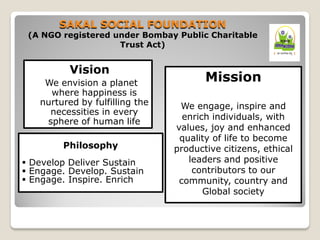
We envision a planet
where happiness is
nurtured by fulfilling the
necessities in every
sphere of human life
Mission
We engage, inspire and
enrich individuals, with
values, joy and enhanced
quality of life to become
productive citizens, ethical
leaders and positive
contributors to our
community, country and
Global society
Philosophy
 Develop Deliver Sustain
 Engage. Develop. Sustain
 Engage. Inspire. Enrich
SAKAL SOCIAL FOUNDATION
(A NGO registered under Bombay Public Charitable
Trust Act)
Values
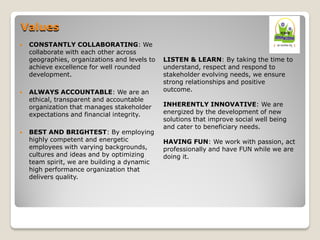
 CONSTANTLY COLLABORATING: We
collaborate with each other across
geographies, organizations and levels to
achieve excellence for well rounded
development.
 ALWAYS ACCOUNTABLE: We are an
ethical, transparent and accountable
organization that manages stakeholder
expectations and financial integrity.
 BEST AND BRIGHTEST: By employing
highly competent and energetic
employees with varying backgrounds,
cultures and ideas and by optimizing
team spirit, we are building a dynamic
high performance organization that
delivers quality.
LISTEN & LEARN: By taking the time to
understand, respect and respond to
stakeholder evolving needs, we ensure
strong relationships and positive
outcome.
INHERENTLY INNOVATIVE: We are
energized by the development of new
solutions that improve social well being
and cater to beneficiary needs.
HAVING FUN: We work with passion, act
professionally and have FUN while we are
doing it.
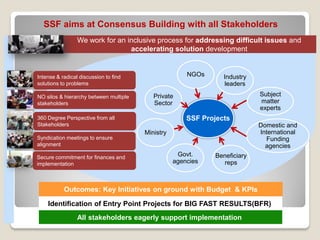
SSF Projects
NGOs Industry
leaders
Beneficiary
reps
Govt.
agencies
Ministry
Private
Sector
Subject
matter
experts
We work for an inclusive process for addressing difficult issues and
accelerating solution development
Domestic and
International
Funding
agencies
SSF aims at Consensus Building with all Stakeholders
Intense & radical discussion to find
solutions to problems
NO silos & hierarchy between multiple
stakeholders
Syndication meetings to ensure
alignment
Secure commitment for finances and
implementation
360 Degree Perspective from all
Stakeholders
Outcomes: Key Initiatives on ground with Budget & KPIs
Identification of Entry Point Projects for BIG FAST RESULTS(BFR)
All stakeholders eagerly support implementation
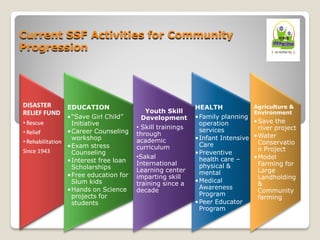
HEALTH
•Family planning
operation
services
•Infant Intensive
Care
•Preventive
health care –
physical &
mental
•Medical
Awareness
Program
•Peer Educator
Program
EDUCATION
•“Save Girl Child”
Initiative
•Career Counseling
workshop
•Exam stress
Counseling
•Interest free loan
Scholarships
•Free education for
Slum kids
•Hands on Science
projects for
students
Agriculture &
Environment
•Save the
river project
•Water
Conservatio
n Project
•Model
Farming for
Large
Landholding
&
Community
farming
Youth Skill
Development
• Skill trainings
through
academic
curriculum
•Sakal
International
Learning center
imparting skill
training since a
decade
Current SSF Activities for Community
Progression
Possible Areas for collaboration-
A. Education-
1. Saar Programme
SAAR focuses on imparting quality English
language programme to support vernacular
schools from the primary level (1st standard to 4th
Standard currently), using simple and easy to
operate technology through audio-visual teaching
aids based on school curriculum.
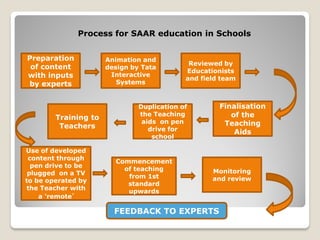
Process for SAAR education in Schools
Preparation
of content
with inputs
by experts
Animation and
design by Tata
Interactive
Systems
Reviewed by
Educationists
and field team
Finalisation
of the
Teaching
Aids
Duplication of
the Teaching
aids on pen
drive for
school
Training to
Teachers
Use of developed
content through
pen drive to be
plugged on a TV
to be operated by
the Teacher with
a ‘remote’
Commencement
of teaching
from 1st
standard
upwards
Monitoring
and review
FEEDBACK TO EXPERTS
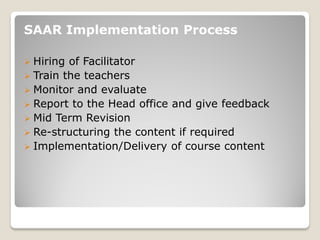
SAAR Implementation Process
 Hiring of Facilitator
 Train the teachers
 Monitor and evaluate
 Report to the Head office and give feedback
 Mid Term Revision
 Re-structuring the content if required
 Implementation/Delivery of course content
Advantages-
 Child centric and simple;
 low cost and effective
 Standardised and replicable.
 Can reach the last mile
 Addresses a critical need at the bottom of the pyramid
 Uses existing curriculum, schools, teachers & infrastructure
 Joyful teaching
 Brings paradigm shift in child’s perception that learning is fun
 Takes away fear of learning a foreign language
 Instils confidence in the early years
 Empowering and enriching teachers through a sensitive mode of
training and teaching
 Parents are not forced to put their children in unaffordable
expensive private English schools
 Quality of education in schools improves by using technology and
innovative methods which can be extended to other subjects
2. Project Kushal: vocational education
as part of secondary school
Sakal is working with local NGO partner for its skill Development program
which integrates job and life skills training in existing school curricula to make
high school education more practical and relevant. The multi-skill vocational
education program complements the existing school curriculum with
vocational education to help the students learn better. It provides students
with hands-on experience in skills such as electrical wiring, welding, carpentry,
plumbing, gardening, basic health and hygiene, agriculture etc. The program
is delivered by local trade practitioners (carpenters, plumbers, electricians,
etc.) who teach their trade at high schools.
Project Kushal (meaning expert) is a four year multi-skill job and life skills
training program, integrating vocational training with secondary and higher
secondary school curriculum and introducing school students to the “World of
Work” during grades 8th to 12th.
Curriculum: This multi-skill program covers four Sections:
 Basic Engineering (welding, carpentry, fabrication, plumbing etc.)
 Energy and Environment (Electrical wiring, solar energy, bio-gas)
 Home and Health (nutrition, hygiene, basic health care) / Food
Processing Techniques
 Horticulture, Nursery and Agriculture Techniques
Trainers: Program delivered via local micro-entrepreneurs
who are trained to provide multi-skill training.
Gender Neutral: Program does not distinguish between
boys and girls. Everyone undergoes same curriculum.
Key Performance Indicators
 Increase in enrollment and attendance in the class : 5%
 Reduction in dropout rate: 5%
 Average revenue generated through student led projects
per school: INR 20,000 per school over four years
 Number of youth choosing vocational education stream
post 10th grade : 15% of the class
 Number of students starting their own business within
three years of working : 20% of the class
B. Health Area
1. Health Camps
Sakal Social Foundation organizes various ( Eye check-up, Dental, ENT,
Physiotherapy ) health check-up camps for under privileged communities in
tribal, rural and urban areas for last three years specially focussing on the
areas that do not have motorable roads.
Welfare via well being for all : When it comes to development and social
welfare ,the first issue that automatically takes centre stage is that of family
and individual health of citizens. A healthy society is a wealthy society indeed
and SSF truly believes in promoting the cause of well being through its
various initiatives meant for all sections including rural and urban women ,
children , working professionals in the police and IT sectors School children ,
parents , teachers etc.
Current Initiatives-
Check-up for School Children :- ======================
Nearly 6,000 school children from 500 schools , their parents
and other school staff benefited from a mega health check-up drive that
was conducted all over Maharashtra.
Fitness for Police Personnel :- =======================
When it comes to health , the most ignored sections of the society are
the police personnel owing to their busy schedules . To combat fatigue ,
less fitness , eye dental , ENT and other problems among the police
force , SSF carried out health check-up camps for them in
various cities like Aurangabad , Kolhapur , Nashik and pune.
Campaigns for Tribals : -
================== For the under privileged and backward
sections of the society like the kanjar Bhat community , Thakkars
, Mahadev koli and other tribals of rural Maharashtra , who are prone
to malnutrition and anaemia , health awareness workshops , medical
camps and specialised check-ups like eye, cancer, dental etc. were held
at community setups
Process of Conducting
Health Camps-
 Identification of location based on
general/specialised Health camp need
 Tie-up with medical facilities available in the area
and local administration
 Approval from Govt. Health Department for
conducting a health camp
 Procurement of medicines as per the health
indicators of that area
 Community mobilisation for participation in the
health camp
 Set up of specialised health equipments
2. Mobile Medical Vans
Mobile Medical Van (MMV) is a national level multi- centric project
initiated by Sakal Social Foundation (SSF) with an objective of
providing a comprehensive range of health care services to rural community
in remote areas and semi urban slums through an equipped mobile medical
van. The programme is based on innovative concept of “Community
Centric Sustainable Health Delivery Model”.
The programme focuses on providing wide range of Promotive, Preventive
and Curative health services to the beneficiaries. The model envisages an
efficient and cost effective health delivery system for the community. SSF’s
vision through MMV is to provide affordable & advance health care facilities
at the door steps of the underprivileged communities.
In the coming years we plan to launch 50 such Mobile Medical Vans
in Maharashtra, so as to benefit more than 1 Crore of the rural
people out of the current 6 Crore rural population.
 Each MMV reaches out to 25000 population every month.
 Each MMV provides health benefit to around 2000 patients per month
 MMV would be reaching in small towns and remote villages of Maharastra
every month.
These Mobile Medical vans will be planned to benefit in 50 districts
of Maharashtra as per need identified.
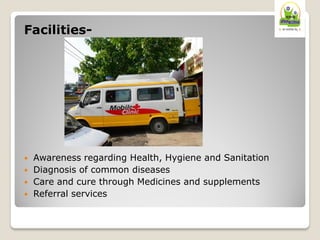
Facilities-
 Awareness regarding Health, Hygiene and Sanitation
 Diagnosis of common diseases
 Care and cure through Medicines and supplements
 Referral services
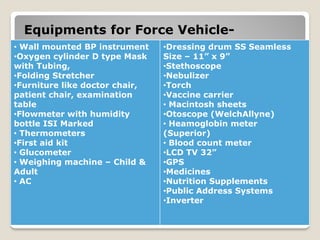
Equipments for Force Vehicle-
• Wall mounted BP instrument
•Oxygen cylinder D type Mask
with Tubing,
•Folding Stretcher
•Furniture like doctor chair,
patient chair, examination
table
•Flowmeter with humidity
bottle ISI Marked
• Thermometers
•First aid kit
• Glucometer
• Weighing machine – Child &
Adult
• AC
•Dressing drum SS Seamless
Size – 11” x 9”
•Stethoscope
•Nebulizer
•Torch
•Vaccine carrier
• Macintosh sheets
•Otoscope (WelchAllyne)
• Heamoglobin meter
(Superior)
• Blood count meter
•LCD TV 32”
•GPS
•Medicines
•Nutrition Supplements
•Public Address Systems
•Inverter
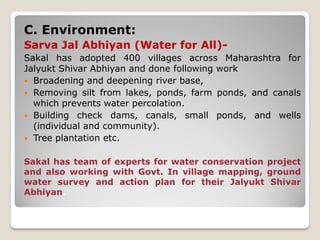
C. Environment:
Sarva Jal Abhiyan (Water for All)-
Sakal has adopted 400 villages across Maharashtra for
Jalyukt Shivar Abhiyan and done following work
 Broadening and deepening river base,
 Removing silt from lakes, ponds, farm ponds, and canals
which prevents water percolation.
 Building check dams, canals, small ponds, and wells
(individual and community).
 Tree plantation etc.
Sakal has team of experts for water conservation project
and also working with Govt. In village mapping, ground
water survey and action plan for their Jalyukt Shivar
Abhiyan.
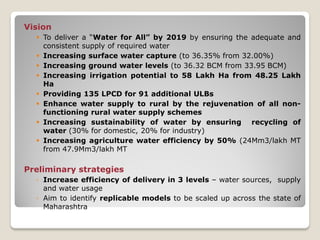
Vision
 To deliver a “Water for All” by 2019 by ensuring the adequate and
consistent supply of required water
 Increasing surface water capture (to 36.35% from 32.00%)
 Increasing ground water levels (to 36.32 BCM from 33.95 BCM)
 Increasing irrigation potential to 58 Lakh Ha from 48.25 Lakh
Ha
 Providing 135 LPCD for 91 additional ULBs
 Enhance water supply to rural by the rejuvenation of all non-
functioning rural water supply schemes
 Increasing sustainability of water by ensuring recycling of
water (30% for domestic, 20% for industry)
 Increasing agriculture water efficiency by 50% (24Mm3/lakh MT
from 47.9Mm3/lakh MT
Preliminary strategies
◦ Increase efficiency of delivery in 3 levels – water sources, supply
and water usage
◦ Aim to identify replicable models to be scaled up across the state of
Maharashtra
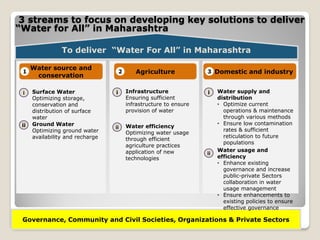
3 streams to focus on developing key solutions to deliver
“Water for All” in Maharashtra
Governance, Community and Civil Societies, Organizations & Private Sectors
i Surface Water
Optimizing storage,
conservation and
distribution of surface
water
To deliver “Water For All” in Maharashtra
Agriculture Domestic and industry
Water source and
conservation
1 2 3
i
ii Water efficiency
Optimizing water usage
through efficient
agriculture practices
application of new
technologies
Infrastructure
Ensuring sufficient
infrastructure to ensure
provision of water
i
ii
Water usage and
efficiency
• Enhance existing
governance and increase
public-private Sectors
collaboration in water
usage management
• Ensure enhancements to
existing policies to ensure
effective governance
Water supply and
distribution
• Optimize current
operations & maintenance
through various methods
• Ensure low contamination
rates & sufficient
reticulation to future
populations
ii Ground Water
Optimizing ground water
availability and recharge
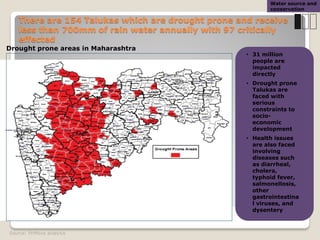
There are 154 Talukas which are drought prone and receive
less than 700mm of rain water annually with 97 critically
effected
Source: PriMove analysis
• 31 million
people are
impacted
directly
• Drought prone
Talukas are
faced with
serious
constraints to
socio-
economic
development
• Health issues
are also faced
involving
diseases such
as diarrheal,
cholera,
typhoid fever,
salmonellosis,
other
gastrointestina
l viruses, and
dysentery
Drought prone areas in Maharashtra
Water source and
conservation
Thank You
www.sakalsocialfoundation.org/

SSF concept Note_Tata Motors

  • 1.
    Vision We envision aplanet where happiness is nurtured by fulfilling the necessities in every sphere of human life Mission We engage, inspire and enrich individuals, with values, joy and enhanced quality of life to become productive citizens, ethical leaders and positive contributors to our community, country and Global society Philosophy  Develop Deliver Sustain  Engage. Develop. Sustain  Engage. Inspire. Enrich SAKAL SOCIAL FOUNDATION (A NGO registered under Bombay Public Charitable Trust Act)
  • 2.
    Values  CONSTANTLY COLLABORATING:We collaborate with each other across geographies, organizations and levels to achieve excellence for well rounded development.  ALWAYS ACCOUNTABLE: We are an ethical, transparent and accountable organization that manages stakeholder expectations and financial integrity.  BEST AND BRIGHTEST: By employing highly competent and energetic employees with varying backgrounds, cultures and ideas and by optimizing team spirit, we are building a dynamic high performance organization that delivers quality. LISTEN & LEARN: By taking the time to understand, respect and respond to stakeholder evolving needs, we ensure strong relationships and positive outcome. INHERENTLY INNOVATIVE: We are energized by the development of new solutions that improve social well being and cater to beneficiary needs. HAVING FUN: We work with passion, act professionally and have FUN while we are doing it.
  • 3.
    SSF Projects NGOs Industry leaders Beneficiary reps Govt. agencies Ministry Private Sector Subject matter experts Wework for an inclusive process for addressing difficult issues and accelerating solution development Domestic and International Funding agencies SSF aims at Consensus Building with all Stakeholders Intense & radical discussion to find solutions to problems NO silos & hierarchy between multiple stakeholders Syndication meetings to ensure alignment Secure commitment for finances and implementation 360 Degree Perspective from all Stakeholders Outcomes: Key Initiatives on ground with Budget & KPIs Identification of Entry Point Projects for BIG FAST RESULTS(BFR) All stakeholders eagerly support implementation
  • 4.
    HEALTH •Family planning operation services •Infant Intensive Care •Preventive healthcare – physical & mental •Medical Awareness Program •Peer Educator Program EDUCATION •“Save Girl Child” Initiative •Career Counseling workshop •Exam stress Counseling •Interest free loan Scholarships •Free education for Slum kids •Hands on Science projects for students Agriculture & Environment •Save the river project •Water Conservatio n Project •Model Farming for Large Landholding & Community farming Youth Skill Development • Skill trainings through academic curriculum •Sakal International Learning center imparting skill training since a decade Current SSF Activities for Community Progression
  • 5.
    Possible Areas forcollaboration- A. Education- 1. Saar Programme SAAR focuses on imparting quality English language programme to support vernacular schools from the primary level (1st standard to 4th Standard currently), using simple and easy to operate technology through audio-visual teaching aids based on school curriculum.
  • 6.
    Process for SAAReducation in Schools Preparation of content with inputs by experts Animation and design by Tata Interactive Systems Reviewed by Educationists and field team Finalisation of the Teaching Aids Duplication of the Teaching aids on pen drive for school Training to Teachers Use of developed content through pen drive to be plugged on a TV to be operated by the Teacher with a ‘remote’ Commencement of teaching from 1st standard upwards Monitoring and review FEEDBACK TO EXPERTS
  • 7.
    SAAR Implementation Process Hiring of Facilitator  Train the teachers  Monitor and evaluate  Report to the Head office and give feedback  Mid Term Revision  Re-structuring the content if required  Implementation/Delivery of course content
  • 8.
    Advantages-  Child centricand simple;  low cost and effective  Standardised and replicable.  Can reach the last mile  Addresses a critical need at the bottom of the pyramid  Uses existing curriculum, schools, teachers & infrastructure  Joyful teaching  Brings paradigm shift in child’s perception that learning is fun  Takes away fear of learning a foreign language  Instils confidence in the early years  Empowering and enriching teachers through a sensitive mode of training and teaching  Parents are not forced to put their children in unaffordable expensive private English schools  Quality of education in schools improves by using technology and innovative methods which can be extended to other subjects
  • 9.
    2. Project Kushal:vocational education as part of secondary school Sakal is working with local NGO partner for its skill Development program which integrates job and life skills training in existing school curricula to make high school education more practical and relevant. The multi-skill vocational education program complements the existing school curriculum with vocational education to help the students learn better. It provides students with hands-on experience in skills such as electrical wiring, welding, carpentry, plumbing, gardening, basic health and hygiene, agriculture etc. The program is delivered by local trade practitioners (carpenters, plumbers, electricians, etc.) who teach their trade at high schools. Project Kushal (meaning expert) is a four year multi-skill job and life skills training program, integrating vocational training with secondary and higher secondary school curriculum and introducing school students to the “World of Work” during grades 8th to 12th.
  • 10.
    Curriculum: This multi-skillprogram covers four Sections:  Basic Engineering (welding, carpentry, fabrication, plumbing etc.)  Energy and Environment (Electrical wiring, solar energy, bio-gas)  Home and Health (nutrition, hygiene, basic health care) / Food Processing Techniques  Horticulture, Nursery and Agriculture Techniques Trainers: Program delivered via local micro-entrepreneurs who are trained to provide multi-skill training. Gender Neutral: Program does not distinguish between boys and girls. Everyone undergoes same curriculum.
  • 11.
    Key Performance Indicators Increase in enrollment and attendance in the class : 5%  Reduction in dropout rate: 5%  Average revenue generated through student led projects per school: INR 20,000 per school over four years  Number of youth choosing vocational education stream post 10th grade : 15% of the class  Number of students starting their own business within three years of working : 20% of the class
  • 12.
    B. Health Area 1.Health Camps Sakal Social Foundation organizes various ( Eye check-up, Dental, ENT, Physiotherapy ) health check-up camps for under privileged communities in tribal, rural and urban areas for last three years specially focussing on the areas that do not have motorable roads. Welfare via well being for all : When it comes to development and social welfare ,the first issue that automatically takes centre stage is that of family and individual health of citizens. A healthy society is a wealthy society indeed and SSF truly believes in promoting the cause of well being through its various initiatives meant for all sections including rural and urban women , children , working professionals in the police and IT sectors School children , parents , teachers etc.
  • 13.
    Current Initiatives- Check-up forSchool Children :- ====================== Nearly 6,000 school children from 500 schools , their parents and other school staff benefited from a mega health check-up drive that was conducted all over Maharashtra. Fitness for Police Personnel :- ======================= When it comes to health , the most ignored sections of the society are the police personnel owing to their busy schedules . To combat fatigue , less fitness , eye dental , ENT and other problems among the police force , SSF carried out health check-up camps for them in various cities like Aurangabad , Kolhapur , Nashik and pune. Campaigns for Tribals : - ================== For the under privileged and backward sections of the society like the kanjar Bhat community , Thakkars , Mahadev koli and other tribals of rural Maharashtra , who are prone to malnutrition and anaemia , health awareness workshops , medical camps and specialised check-ups like eye, cancer, dental etc. were held at community setups
  • 14.
    Process of Conducting HealthCamps-  Identification of location based on general/specialised Health camp need  Tie-up with medical facilities available in the area and local administration  Approval from Govt. Health Department for conducting a health camp  Procurement of medicines as per the health indicators of that area  Community mobilisation for participation in the health camp  Set up of specialised health equipments
  • 15.
    2. Mobile MedicalVans Mobile Medical Van (MMV) is a national level multi- centric project initiated by Sakal Social Foundation (SSF) with an objective of providing a comprehensive range of health care services to rural community in remote areas and semi urban slums through an equipped mobile medical van. The programme is based on innovative concept of “Community Centric Sustainable Health Delivery Model”. The programme focuses on providing wide range of Promotive, Preventive and Curative health services to the beneficiaries. The model envisages an efficient and cost effective health delivery system for the community. SSF’s vision through MMV is to provide affordable & advance health care facilities at the door steps of the underprivileged communities. In the coming years we plan to launch 50 such Mobile Medical Vans in Maharashtra, so as to benefit more than 1 Crore of the rural people out of the current 6 Crore rural population.  Each MMV reaches out to 25000 population every month.  Each MMV provides health benefit to around 2000 patients per month  MMV would be reaching in small towns and remote villages of Maharastra every month. These Mobile Medical vans will be planned to benefit in 50 districts of Maharashtra as per need identified.
  • 16.
    Facilities-  Awareness regardingHealth, Hygiene and Sanitation  Diagnosis of common diseases  Care and cure through Medicines and supplements  Referral services
  • 17.
    Equipments for ForceVehicle- • Wall mounted BP instrument •Oxygen cylinder D type Mask with Tubing, •Folding Stretcher •Furniture like doctor chair, patient chair, examination table •Flowmeter with humidity bottle ISI Marked • Thermometers •First aid kit • Glucometer • Weighing machine – Child & Adult • AC •Dressing drum SS Seamless Size – 11” x 9” •Stethoscope •Nebulizer •Torch •Vaccine carrier • Macintosh sheets •Otoscope (WelchAllyne) • Heamoglobin meter (Superior) • Blood count meter •LCD TV 32” •GPS •Medicines •Nutrition Supplements •Public Address Systems •Inverter
  • 18.
    C. Environment: Sarva JalAbhiyan (Water for All)- Sakal has adopted 400 villages across Maharashtra for Jalyukt Shivar Abhiyan and done following work  Broadening and deepening river base,  Removing silt from lakes, ponds, farm ponds, and canals which prevents water percolation.  Building check dams, canals, small ponds, and wells (individual and community).  Tree plantation etc. Sakal has team of experts for water conservation project and also working with Govt. In village mapping, ground water survey and action plan for their Jalyukt Shivar Abhiyan.
  • 19.
    Vision  To delivera “Water for All” by 2019 by ensuring the adequate and consistent supply of required water  Increasing surface water capture (to 36.35% from 32.00%)  Increasing ground water levels (to 36.32 BCM from 33.95 BCM)  Increasing irrigation potential to 58 Lakh Ha from 48.25 Lakh Ha  Providing 135 LPCD for 91 additional ULBs  Enhance water supply to rural by the rejuvenation of all non- functioning rural water supply schemes  Increasing sustainability of water by ensuring recycling of water (30% for domestic, 20% for industry)  Increasing agriculture water efficiency by 50% (24Mm3/lakh MT from 47.9Mm3/lakh MT Preliminary strategies ◦ Increase efficiency of delivery in 3 levels – water sources, supply and water usage ◦ Aim to identify replicable models to be scaled up across the state of Maharashtra
  • 20.
    3 streams tofocus on developing key solutions to deliver “Water for All” in Maharashtra Governance, Community and Civil Societies, Organizations & Private Sectors i Surface Water Optimizing storage, conservation and distribution of surface water To deliver “Water For All” in Maharashtra Agriculture Domestic and industry Water source and conservation 1 2 3 i ii Water efficiency Optimizing water usage through efficient agriculture practices application of new technologies Infrastructure Ensuring sufficient infrastructure to ensure provision of water i ii Water usage and efficiency • Enhance existing governance and increase public-private Sectors collaboration in water usage management • Ensure enhancements to existing policies to ensure effective governance Water supply and distribution • Optimize current operations & maintenance through various methods • Ensure low contamination rates & sufficient reticulation to future populations ii Ground Water Optimizing ground water availability and recharge
  • 21.
    There are 154Talukas which are drought prone and receive less than 700mm of rain water annually with 97 critically effected Source: PriMove analysis • 31 million people are impacted directly • Drought prone Talukas are faced with serious constraints to socio- economic development • Health issues are also faced involving diseases such as diarrheal, cholera, typhoid fever, salmonellosis, other gastrointestina l viruses, and dysentery Drought prone areas in Maharashtra Water source and conservation
  • 22.