딥러닝을 위한
신경망 기초
nonezerok@gmail.com
Computer Vison Pattern Recognition Lab.
1
2
인공신경망
입력층 히든층 출력층
hidden
3
심층신경망; deep neural networks
4
• 1957 The Perceptron (Rosenblatt, 1957)
• 1969 Perceptrons (Minsky and Papert)
• 1980 Neocognitron (Fukushima, 1980)
• 1982 Hopfield network,
• 1982 SOM (Kohonen, 1982)
• 1982 Neural PCA (Oja, 1982)
• 1985 Boltzmann machines (Ackley et al., 1985)
• 1986 Multilayer perceptrons and backpropagation (Rumelhart et al., 1986)
• 1988 RBF networks (Broomhead&Lowe, 1988)
• 1989 Autoencoders (Baldi&Hornik, 1989)
• 1989 Convolutional network (LeCun, 1989, 1995)
• 1992 Sigmoid belief network (Neal, 1992)
• 1993 Sparse coding (Field, 1993)
• 2006 DBN (Hinton, 2006)
• 2012 AlexNet (2012)
신경망의 역사
5
http://www.deeplearningbook.org/
6
http://www.deeplearningbook.org/
MIT Press, 2016
Neural Networks
Multi-Layer Perceptron
DBN
CNN
RNN
RBM AE
2-Layer Perceptron ~ Regression
Linear
Logistic
Softmax
Deep
Neural
Networks
GAN
Reinforcement Learning
Supervised Learning
Unsupervised Learning
7
심층학습; Deep Learning
Discriminative Model
Generative Model
8
Machine Learning Data Mining
Decision Support System
Big Data
Cloud ~ Web
Artificial Intelligence
Image Processing
Computer Vision
Machine Vision
Neural Networks
Pattern Recognition
관련 연구분야
9
10
11
12
weight
height
{(, )}…

키와 몸무게가 주어졌을 때
13
weight
height
{(, )}…

 =   −  …

14
weight
height
Nearest Neighbor Classification
{(, )}…

 =   −  …

15
16
17
모델링
수상돌기
축색돌기
축색돌기 끝
신경세포 1개를 멋지게 모델링하여 만든 하나의 그림 모델
18



식으로 바꾸기
19






20






 × 
 × 
 × 
21






 × 
 ×  +
 ×  +
22






 ×  +
 ×  +
 × 
23






 
 
24






 
+1
−1
25






 
+1
−1

26
 = 1





 
+1
−1
i  


> 0+1
ℎ .−1
 =

27
i  


> 0+1
ℎ .−1
 , ⋯ ,  =
모델링
수상돌기
축색돌기
축색돌기 끝
신경세포
인공신경세포
28
i  +  + ⋯ +  > 0+1
ℎ .−1
 , ⋯ ,  =
i  > 0+1
ℎ .−1
  =
신경세포 1개를 멋지게 모델링하여 만든 하나의 수식 모델
29
1





 
+1
−1

Perceptron (1957)
i  +  + ⋯ +  > 0+1
ℎ .−1
 , ⋯ ,  =
i  > 0+1
ℎ .−1
  =
30
 +  = 0
 = −1
 = +1
 +  < 0
 +  > 0
직선
31
 = 0
 = −1
 = +1
 < 0
 > 0
Hyper-plane
초평면
plane
평면
 +  = 0
 


= 0

=  
 =


32

퍼셉트론에서 학습이란?
33
Learning Perceptron
학습집합을 이용해서 를 어떻게 구하지 ?
 =  + + ⋯ + 
{(, )}…
34
Learning Perceptron
방법:
 =  + + ⋯ + 
35
차이의 합을 구해보자
  ≡
1
2
  − 

∈
 target
 output
 
 
36
Cost/Loss Function
  ≡
1
2
  − 

∈
Squared Loss
  ≡
1
2
1

  − 

∈
Mean
Squared Loss
 학습집합 크기
37
()



∆ =음수 for 
∆ =양수 for 
∆ 를 어떻게 결정할까
사람은 그림을 보면 바로 판단이 선다
컴퓨터는 ?
38
+-
기울기; Gradient


()

39
+-
갱신 방향 판정


()

기울기-
40
+-
갱신 크기 결정


()

기울기×아주 작은값-
41
-
경사하강법; Gradient Descent Method
+


()

학습률; learning rate
42


=


1
2
  − 


=
1
2



 − 


=
1
2
 2  − 


 − 

=   − 


 −  −, − , − ⋯ − ,

=   −  −,



=   −  (−1)

43
 =  + ∆
∆ = −


=    −  ,

 =  + ∆
∆ = −


=    − 

44
i  +  + ⋯ +  > 0+1
ℎ .−1
 =
 =  + + ⋯ + 
 = () = 

• 배치
• 단일
• 미니-배치
45
가중치 갱신 모드
∆ =    −  ,
∈
∆ =   −  ,
∆ = 
1

  −  ,
∈
 ⊂ 
 ℎ 
Gradient Descent
Incremental Gradient Descent
~ gradient descent,
if η is small enough
Stochastic Gradient Descent
46
숫자인식
1 이다
아니다
47
0
9
1
-0.2
+0.8
+0.1
48
 =
1
1
 = +1
 =
−1
1
 = −1
 =
−1
−1
 = −1
 =
1
−1
 = −1
C 코드 예제
 ∈ −1, +1
49
 =
1
1
 = 1
 =
0
1
 = 0
 =
0
0
 = 0
 =
1
0
 = 0
 ∈ 0, 1
50
 =
1
1
 = 1
 =
0
1
 = 0
 =
0
0
 = 0
 =
1
0
 = 0
 =  + + 
51


1




 =  + + 
52
#include <stdio.h>
#include <stdlib.h>
#include <limits.h>
#define TRAIN_SAMPLES 4
void main()
{
//
//training set for OR pattern
//
// input: X
double X[TRAIN_SAMPLES][2] =
{
0, 0, // 클래스 0
0, 1, // 클래스 0
1, 0, // 클래스 0
1, 1 // 클래스 1
};
// target Y
double Y[TRAIN_SAMPLES] =
{
0, 0, 0, 1
};
//
// weight
//
double W[3];
//------------------------------------------------------------
// 1) Training
//------------------------------------------------------------
//
// initialize W
//
for (int i = 0; i < 3; i++)
W[i] = ((double)rand() / RAND_MAX)*0.5 - 0.25;
unsigned int epoch = 0;
unsigned int MAX_EPOCH = 500;
double Etha = 0.05;
double output;
double x1, x2;
double target;
53
while (epoch++ < MAX_EPOCH)
{
//
// 1 epoch (for all training samples)
//
// compute deltaWi for each Wi
//
double deltaW[3];
for (int i = 0; i < TRAIN_SAMPLES; i++)
{
deltaW[0] = 0.0;
deltaW[1] = 0.0;
deltaW[2] = 0.0;
x1 = X[i][0];
x2 = X[i][1];
target = Y[i];
output = 1 * W[0] + x1 * W[1] + x2 * W[2];
deltaW[0] += (target - output) * 1;
deltaW[1] += (target - output) * x1;
deltaW[2] += (target - output) * x2;
}
//
// update W
//
W[0] = W[0] + Etha * (deltaW[0] / TRAIN_SAMPLES);
W[1] = W[1] + Etha * (deltaW[1] / TRAIN_SAMPLES);
W[2] = W[2] + Etha * (deltaW[2] / TRAIN_SAMPLES);
54
//
// compute the Cost
//
double cost;
cost = 0.0;
for (int i = 0; i < TRAIN_SAMPLES; i++)
{
x1 = X[i][0];
x2 = X[i][1];
target = Y[i];
output = 1 * W[0] + x1 * W[1] + x2 * W[2];
cost += (target - output) * (target - output);
}
cost = 0.5 * cost / TRAIN_SAMPLES;
printf("%05d: cost = %10.9lf n", epoch, cost);
}
printf("training donenn");
55
//------------------------------------------------------------
// 2) Testing for the training set
//------------------------------------------------------------
for (int i = 0; i < TRAIN_SAMPLES; i++)
{
x1 = X[i][0];
x2 = X[i][1];
target = Y[i];
output = 1 * W[0] + x1 * W[1] + x2 * W[2];
printf("%2.1lf %2.1lf (%d) %2.1lf n", x1, x2, (int)target, output);
}
printf("training test donenn");
//------------------------------------------------------------
// 3) Testing for unknown data
//------------------------------------------------------------
x1 = 0.8; // <----- 이 값을 0~1사이로 바꾸어서 테스트 해 봅니다.
x2 = 0.7; // <----- 이 값을 0~1사이로 바꾸어서 테스트 해 봅니다.
double Threshold = 0.5; // <----- 이 값을 바꾸어 최종 클래스 판단처리,
// 나중에 출력을 2개 이상으로 하면 가장 큰 값 나오는 노드를 최종 클래스로 판단
output = 1 * W[0] + x1 * W[1] + x2 * W[2];
int output_class = (output > Threshold) ? 1 : 0;
printf("%2.1lf %2.1lf (%d) %2.1lfn", x1, x2, output_class, output);
}
56



1  

 = 1, 0
 = 0, 1
 − 1 
 + 1 
출력을 2개로
57
 =




=
0 0
0 1
1 0
1 1
 =




=
1 0
1 0
1 0
0 1
58



1
 

 
⋮
 = 1, 0, ⋯ , 0
 = 0, 1, ⋯ , 0
 1 
 2 
 = 0, 0, ⋯ , 1   
⋮ ⋮
one-hot encoding
59
 =
1
1
 = 1
 =
0
1
 = 0
 =
0
0
 = 0
 =
1
0
 = 0
퍼셉트론이 다루지 못하는 문제
60





좀 더 복잡한 문제를 다루기 위해
결과를 다시 퍼셉트론의 입력으로
61





Input
Layer
Hidden
Layer
Output
Layer
Multi-Layer Perceptron
[그림] http://cs231n.github.io/neural-networks-1/
62


  =  ×  +  +  ×  + 
=  +  +  + 
=  +  +  +  

1 = 






 =  + 
층을 늘리긴 했는데…
여전히 직선(초평면Hyper-plane)~선형
63




1 = 






선형일 수 밖에 없는 이유
 
 = () = 
선형함수는 가중합만 낳을 뿐
비선형 함수를 도입
 =   =
1
1 + 
=

1 + 
64
65
1





  
1





  
활성함수; activation function
  = 
  =
1
1 + 


66
시그모이드 함수 및 미분특성
  =
1
1 + 
=

1 + 


  = () 1 − ()
67


  =


1
1 + 
=
1
1 +  

=
1
1 +   1 −
1
1 + 
=    1 −  
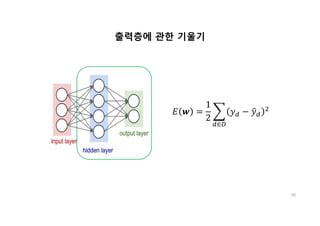
출력층에 관한 기울기
  =
1
2
  − 

∈
68
69
 =  + ∆
∆ = −


=    1 −   −  ,

출력층에 관한 가중치 갱신
70


=


1
2
  − 


=
1
2



 − 


=
1
2
 2  − 


 − 

=   − 


−

= −   − 





= −   − 
 

  + , + ⋯ + ,


= −   −   1 −  ,

 =   =
1
1 + 


  =   1 −  
 =  
히든층에 관한 기울기
71
72


=


1
2
 ? −


Hidden 노드에서는 Target 값을 모른다
73
오류가 전달되었다
오류에 대한 가중치 변화율


=


1
2
  − 


74
∆, =  ,  =  when  is of the first layer
오류 역전파 알고리즘
∆ = −


=   1 −   −  ,
 ←  1 −   − 
 ←  1 −   ,


, ← , + ∆,

ℎ
,





=






=  −    1 −   =  −   1 −  
 =
1
2
 − 

 =  
 =  + 
 =  
 =  + 


=










=  −   1 −   1 −  



= 
 1 −  =
′ 
75


= 



= 
 
= 
 1 −  =
′ 

=  −   1 −  =  −  ′ 
In case of output layer
In case of hidden layer


= 


= 
76


=
 + 

=






+






=  −    1 −   =  −   1 −  
 =  +  =
1
2
 − 
 +
1
2
 − 

0


=
 + 

=






+






=  −    1 −   =  −   1 −  
0


′ 
′  77


=
 + 

=






+






=










+










=  −   1 −   1 −   +  −   1 −   1 −  
=  −   1 −   +  −   1 −    1 −  

 ′ 
78
 =  +  =
1
2
 − 
 +
1
2
 − 



= 



= 



= 


=  −   1 −  =  −  ′ 

=  −   1 −  =  −  ′ 

= 
 + 
 ′ 
In case of output layer
In case of hidden layer
79
80
심층신경망; deep neural networks
hidden 층이 2개 이상
fully connected neural networks
• Weight 수가 과다 → 더 많은 수의 학습 데이터 요구됨
• Vanishing Gradient Problem 발생 → Weight 갱신이 안됨
 =  + ∆
∆ = −




=  1 −   −  −
  =
1
1 + 
 

=   1 −  
81
심층신경망의 문제점
82
회귀분석
2-layer network
83

̅
독립변수
종속변수
직선정합; 회귀분석
error3
error2
error1
 =  + (, )
(, )
(, )
 =
1
2
  −  


84
 =
1
2
 +  − 

+  +  − 

+  +  − 

(̅, )
85



잔차
회귀
86
Information, Entropy, Cross-Entropy
  =   =   = 
 =   =  ()

 베르누이 확률변수
87
1
 
1
 
1
 
×

1
 

1
 
+
   
−    
88
−(0)  1 − (1)  0
Information, Entropy, Cross-Entropy
89
성공만 나온 경우
 =   = 1 = 1
실패만 나온 경우
 =   = 1 = 0
최댓값
성공이나 실패만 나온 경우
01
+  + 1 −   1 − 
90
성공과 실패가 반반 나온 경우
 =   = 1 = 0.5
0.5
91
성공 70%과 실패 30%나온 경우
0.7
 =   = 1 = 0.7
92
Ronald Aylmer Fisher (1890~1962)
cross-entropy = negative maximum log likelihood estimator
Odds Ratio
93
 베르누이 확률변수
Logit function
94
입력
출력
0 ~ 1
+∞
−∞
Logit의 출력을 신경망 출력으로 간주
95
입력
출력
+∞
−∞
96
입력과 출력을 뒤 바꾸면…
97
신경망의 출력을 확률로 간주할 수 있다!
 + 
+∞−∞


Sigmoid function
98
positive class
negative class
0.5
  +  =
1
1 +  
99
  +  =
1
1 + 
100
Logistic Regression for 2-class Classification
101



1

 
Logistic Regression for 2-class Classification
102
Loss function:   = − ∑   + 1 −   1 − 


Activation () =

  ∈ 0, 1
베르누이 시행, 확률변수



1

 
Softmax Regression for Multi-class Classification
103



1
 

 
⋮

 +  + ⋯ + 


 +  + ⋯ + 


 +  + ⋯ + 

Softmax Regression for Multi-class Classification
104
Loss function:   = − ∑ ∑  




() =

∑ 

 = 0 0 1 0 0 0 0 0 0 0 



1
 

 
⋮

 +  + ⋯ + 


 +  + ⋯ + 


 +  + ⋯ + 

Softmax Function
105
 =  + ∆
∆ = −


=    1 −   −  ,

106
Deep Belief Networks
107
V
h2
h1
O
w1
w2
w3
V
h2
h1
O
w1
w2
w3
V
h2
h1
O
w1
w2
w3
Pre-Training by Layer-Wise Training with RBM
RBM을 이용한 선행 학습, 미세조정
108
Auto-Encoder를 이용한 선행 학습
1 2
109
Convolutional Neural Networks
110
가중치 공유; weight sharing
1 2주변만 연결 공유
36 16 4
111
1 2주변만 연결 공유
36 16 4
합성곱; convolution 연산
112
113
convolution layer
http://neuralnetworksanddeeplearning.com/index.html
114
특징 맵; feature map
입력영상, 가중치의 합성곱의 결과
feature map
115
pooling layer
http://neuralnetworksanddeeplearning.com/index.html
116
CNN in Practice for MNIST
fully-connected
http://neuralnetworksanddeeplearning.com/index.html
117
Rectified Liner Unit (ReLU)
1





  
  = 

0
  > 0
ℎ

118https://nn.readthedocs.io/en/rtd/transfer/
활성함수 미분
sigmoid hyper tangent ReLU
 =  + ∆
∆ = −


=    −   1 −  ,



  = () 1 − ()
vanishing gradient problem
119
데이터 설정, 학습, 평가
http://cs231n.github.io/
120
classification accuracy
epoch
상대적으로 우수
성능비교; 하이퍼파라미터 조정
적응적 학습률
http://cs231n.github.io/neural-networks-3/
Momentum
∆  =   −   1 −  , + ∆  − 1
good
high
low
very high
epoch
loss
학습률
과적합; overfitting
122
https://en.wikipedia.org/wiki/Overfitting
loss
epoch
training
testing
학습, 검증, 테스트 분석
123
epoch
accuracy
training
validation;
little overfitting
validation;
strong overfitting
124
정규화; regularization
  =
1
2
  − 

∈
+
1
2

  = −    




+
1
2

 regularization strength
1
2
  
L2-regularization L1-regularization
 = 0.01~0.0001
125
 =  + ∆
∆ = −


= −   1 −   −  −,

+ 
가중치 감쇠; weight decay
가중치는 자신의 크기에 비례하여 줄어듦
바이어스에 대해서는 정규화 사용하지 않음
126
Dropout ~ Ensemble
Dropout: A simple way to prevent neural networks from overfitting." The Journal of Machine Learning Research 15.1 (2014): 1929-1958.
데이터 전처리
127
http://cs231n.github.io/neural-networks-2/
가중치, 편향치 초기화
128
LeCun
Xavier Glorot & Bengio
(2010)
He (2015)
 = 0, 0.01
good for sigmoid
better for PReLU
good for ReLU
129
공개 프레임워크
https://developer.nvidia.com/deep-learning-frameworks
• Tom Mitchell, Machine Learning, McGraw Hill, 1997.
• Nielsen, Michael, Neural Networks and Deep Learning, 2015.
• http://neuralnetworksanddeeplearning.com/index.html
• CS231n Convolution Neural Networks for Visual Recognition
• http://cs231n.github.io/
130
참고문헌
131
https://en.wikipedia.org/wiki/Paul_Werbos
1947
132
https://en.wikipedia.org/wiki/Geoffrey_Hinton
1947
133
요슈아 벤지오
얀 르쿤 리차드 서튼
마이클 조던 블라디미르 뱁닉
이안 굿펠로우앤드류 응

딥러닝기본-신경망기초