Femininity at Work:  The Construction of the Gendered Body in Synchronized SwimmingYasmine M. JahanmirFinal Projects NYU Department of Performance StudiesProfessor: Barbara BrowningTA:  SujayPandit
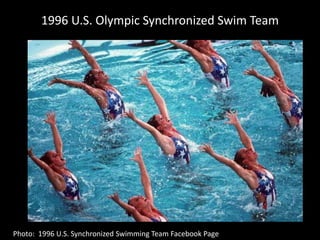
1996 U.S. Olympic Synchronized Swim TeamPhoto:  1996 U.S. Synchronized Swimming Team Facebook Page
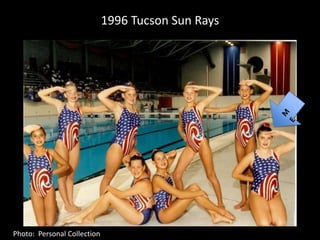
1996 Tucson Sun RaysMEPhoto:  Personal Collection
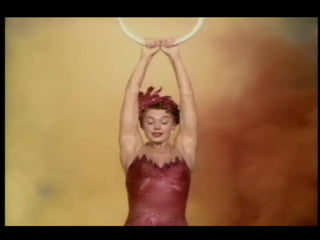
Annette Kellerman and Esther WilliamsSimultaneous focus on their performance and their looks.Mulvey’s “to-be-looked-at-ness.”Privileges statues as an erotic object, rather than a performing subject.Photos:  history.sa.gov.au and http://www.skylighters.org/photos/sep99pu.html
Sequins and the Female BodySequins were originally gold coins sewn onto women’s garments to connote value.Modern sequins have become a replacement object for value.Sequins are used tofetishize the woman’s body, detracting from her performance.Photo:  Flickr:  Don Le
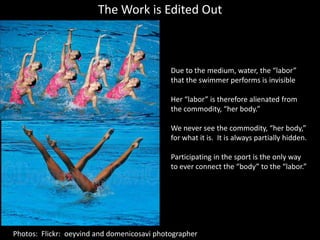
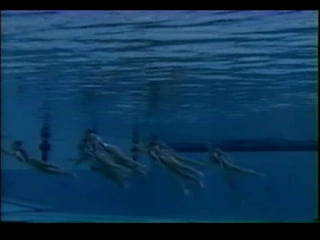
The Work is Edited OutDue to the medium, water, the “labor” that the swimmer performs is invisibleHer “labor” is therefore alienated from the commodity, “her body.”We never see the commodity, “her body,” for what it is.  It is always partially hidden.Participating in the sport is the only way to ever connect the “body” to the “labor.”Photos:  Flickr:  oeyvind and domenicosavi photographer
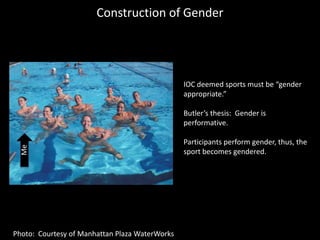
Construction of GenderIOC deemed sports must be “gender appropriate.”Butler’s thesis:  Gender is performative.Participants perform gender, thus, the sport becomes gendered.MePhoto:  Courtesy of Manhattan Plaza WaterWorks
A détournement?Participates in the language of the spectacle.Exaggeration exposes theatricality of gender.Questions authenticity of preconceived notions of gender.Photo:  Courtesy of Manhattan Plaza WaterWorks
Works Cited1996 Summer Olympic Broadcast.  NBC.  KVOA, Tucson, AZ.  Personal collection of the author. 30 July 1996. Butler, Judith.  Gender Trouble.  New York: Routledge. [1990] 2008.Debord, Guy.  The Society of Spectacle. New York: Zone Books.  [1967], 2004.Freud, Sigmund.  Translator Philip Reiff.  Sexuality and the Psychology of Love.   New York: Simon and Schuster, 1997.Halberstam, Judith.  Female Masculinity.  Durham and London:  Duke University Press. 1998.Marx, Karl.  Capital.  New York:  Penguin Classics, [1867] 1990. Million Dollar Mermaid, DVD.  Directed by MervynLeRoy.  MGM.  1952.Mulvey, Laura.  Visual and Other Pleasures.  Bloomington and Indianapolis:  Indiana University Press.  1989.Wamsley, Kevin B. and Gertrud Pfister.  “Olympic Men and Women: The Politics of Gender in the Modern Games.” From Global Olympics: Historical and Sociological Studies of the Modern Games.  New York: Elsevier.  Pg. 103-126.  2005.

Ss

  • 1.
    Femininity at Work: The Construction of the Gendered Body in Synchronized SwimmingYasmine M. JahanmirFinal Projects NYU Department of Performance StudiesProfessor: Barbara BrowningTA: SujayPandit
  • 2.
    1996 U.S. OlympicSynchronized Swim TeamPhoto: 1996 U.S. Synchronized Swimming Team Facebook Page
  • 3.
    1996 Tucson SunRaysMEPhoto: Personal Collection
  • 5.
    Annette Kellerman andEsther WilliamsSimultaneous focus on their performance and their looks.Mulvey’s “to-be-looked-at-ness.”Privileges statues as an erotic object, rather than a performing subject.Photos: history.sa.gov.au and http://www.skylighters.org/photos/sep99pu.html
  • 6.
    Sequins and theFemale BodySequins were originally gold coins sewn onto women’s garments to connote value.Modern sequins have become a replacement object for value.Sequins are used tofetishize the woman’s body, detracting from her performance.Photo: Flickr: Don Le
  • 7.
    The Work isEdited OutDue to the medium, water, the “labor” that the swimmer performs is invisibleHer “labor” is therefore alienated from the commodity, “her body.”We never see the commodity, “her body,” for what it is. It is always partially hidden.Participating in the sport is the only way to ever connect the “body” to the “labor.”Photos: Flickr: oeyvind and domenicosavi photographer
  • 8.
    Construction of GenderIOCdeemed sports must be “gender appropriate.”Butler’s thesis: Gender is performative.Participants perform gender, thus, the sport becomes gendered.MePhoto: Courtesy of Manhattan Plaza WaterWorks
  • 11.
    A détournement?Participates inthe language of the spectacle.Exaggeration exposes theatricality of gender.Questions authenticity of preconceived notions of gender.Photo: Courtesy of Manhattan Plaza WaterWorks
  • 12.
    Works Cited1996 SummerOlympic Broadcast. NBC. KVOA, Tucson, AZ. Personal collection of the author. 30 July 1996. Butler, Judith. Gender Trouble. New York: Routledge. [1990] 2008.Debord, Guy. The Society of Spectacle. New York: Zone Books. [1967], 2004.Freud, Sigmund. Translator Philip Reiff. Sexuality and the Psychology of Love. New York: Simon and Schuster, 1997.Halberstam, Judith. Female Masculinity. Durham and London: Duke University Press. 1998.Marx, Karl. Capital. New York: Penguin Classics, [1867] 1990. Million Dollar Mermaid, DVD. Directed by MervynLeRoy. MGM. 1952.Mulvey, Laura. Visual and Other Pleasures. Bloomington and Indianapolis: Indiana University Press. 1989.Wamsley, Kevin B. and Gertrud Pfister. “Olympic Men and Women: The Politics of Gender in the Modern Games.” From Global Olympics: Historical and Sociological Studies of the Modern Games. New York: Elsevier. Pg. 103-126. 2005.