輻射及其生物效應
清華大學生命科學系
林泓叡
Deinococcus radiodurans
“the world’s toughest bacterium”
• Natural habitat unknown
extraordinarily resistant to desiccation and radiation 
Can survive at 30,000,000‐50,000,000 Gy
※human effective dose: 100 mSv/yr
Efficient DNA repair system
within 12‐24 hours can repair chromosomes fragmented by 
exposure to radiation
大綱
1.放射性同位素
2.背景輻射
3.突變與癌症
4.線性無閾值假設與毒物激發效應
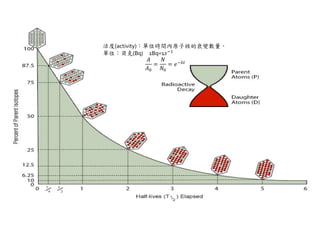
活度(activity):單位時間內原子核的衰變數量。
單位:貝克(Bq)     1Bq=1
Background radiation
背景輻射:環境中所具有的輻射,通常以等效劑量表示。
吸收劑量:單位質量的物質接受的輻射平均能量,單位:戈雷(Gy)
1Gy=1J/kg
有效劑量:吸收劑量考慮射值因素的修正。
等效劑量:考慮射值因素與器官敏感度的修正。
Human effective dose : 100mSv/yr
∝
1
4
日本原子力管制委員會
http://radioactivity.nsr.go
.jp/map/ja/area.html
Max: 202.94 mSv/yr
原能會-全國環境輻射監
測
http://www.aec.gov.tw/g
ammadetect.html
石崩山: 0.74 mSv/yr
台北:0.51 mSv/yr
蘭嶼: 0.37 mSv/yr
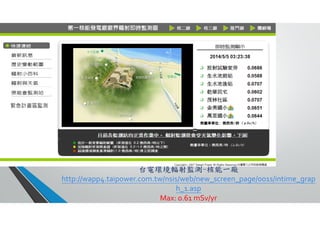
台電環境輻射監測-核能一廠
http://wapp4.taipower.com.tw/nsis/web/new_screen_page/001s/intime_grap
h_1.asp
Max: 0.61 mSv/yr
台電環境輻射監測-蘭嶼儲存場
http://wapp4.taipower.com.tw/nsis/web/new_screen_page/005l/intime_gr
aph_5.asp
Max: 0.59 mSv/yr
One of the most abundant in nature: Radon 222 and Potassium 40
So, do you still care the biological effect?
輻射能量與生物效應
游離輻射與生物效應
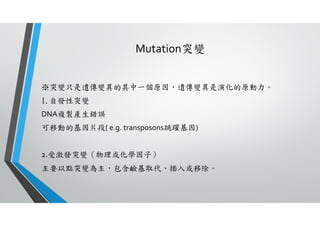
Mutation突變
※突變只是遺傳變異的其中一個原因,遺傳變異是演化的原動力。
1.自發性突變
DNA複製產生錯誤
可移動的基因片段( e.g. transposons跳躍基因)
2.受激發突變(物理或化學因子)
主要以點突變為主,包含鹼基取代、插入或移除。
DNA 修復
Cancer
• 未受控制的細胞增生
主要機制來自oncogene(致癌基因)與 tumor‐suppressor(腫瘤抑制基因)
Carcinogenesis(癌發生): proto‐oncogene→oncogene
tumor‐suppressor inhibited
原因:
細胞的DNA損傷
未受控制的細胞週期
tumor suppressor protein受抑制(e.g. p53) 
其他胞外訊號
病毒感染(by turn on the oncogene→transformation)
只有少於5% 的細胞變異是來自於背景輻射!
But in fact, the major effect of radiation is not DNA 
damage…
→ Create free radicals(自由基)
Antioxidants 抗氧化劑
Radical inhibitor自由基抑制物
Linear no‐threshold model (LNT)
線性無閾值假設
• 量化模型描述游離輻射對生物體的影響(以產生癌症為計)
• ICRP建議一般人年劑量需低於額外1 mSv,職業工作者需低於 50 mSv
• 100mSv 以上的LNT預估,符合流行病學統計結果。
• 劑量在100mSv以下實驗統計結果較不準確,數據也不符合LNT。
(Threshold exists?)
• 劑量<10mSv更加偏離預期,對生物影響較具爭議。
→Radiation hormesis(毒物激發效應)
(Low‐dose radiation may be beneficial)
※ Effective dose <100mSv/yr : The risks are too low to be detectable and may be 
nonexistent.
LNT Model
車諾比的動物天堂
https://www.youtube.com/watch?v=8HatG5‐
fxcU&list=PL9A034A14A7AA4351
Birds Adapting to Chernobyl's 
Radiation
結論:
1.許多文章或報導的真偽性可由基礎物理或化學知識等加以判斷。
2.了解輻射的物理本質後,其並不如我們平常想的那樣可怕。
3.突變或癌症並不是真正與輻射那麼相關。
4.低劑量輻射對生物體的影響還是熱門的研究主題,且具有極大啟發性。
Deinococcus radiodurans
“the world’s toughest bacterium”
• Natural habitat unknown
extraordinarily resistant to desiccation and radiation 
Can survive at 30,000,000‐50,000,000 Gy
※ human effective dose : 100 mSv/yr
Efficient DNA repair system
within 12‐24 hours can repair chromosomes fragmented by exposure 
to radiation
Thanks!!
Supplement slides
放射性衰變
活度(activity):單位時間內原子核的衰變數量。
單位:貝克(Bq)     1Bq=1
																																																																						 0
→
	 ,
.
≡ N: number of nuclides
A: activity
λ: decay rate
→
.
T: mean life time
分子生物學中心法則
DNA
(轉錄)
mRNA
(轉譯)
Protein
DNA ‐ genetic code(遺傳密碼): A、T、C、G  含氮鹼基
RNA ‐ codon(密碼子): A、U、C、G 含氮鹼基
4 64	 (many‐to‐one)
Protein – 主要行使生理功能的巨分子。
20 amino acids(胺基酸)
DNA 雙螺旋
輻射及其生物效應
輻射及其生物效應
輻射及其生物效應

輻射及其生物效應