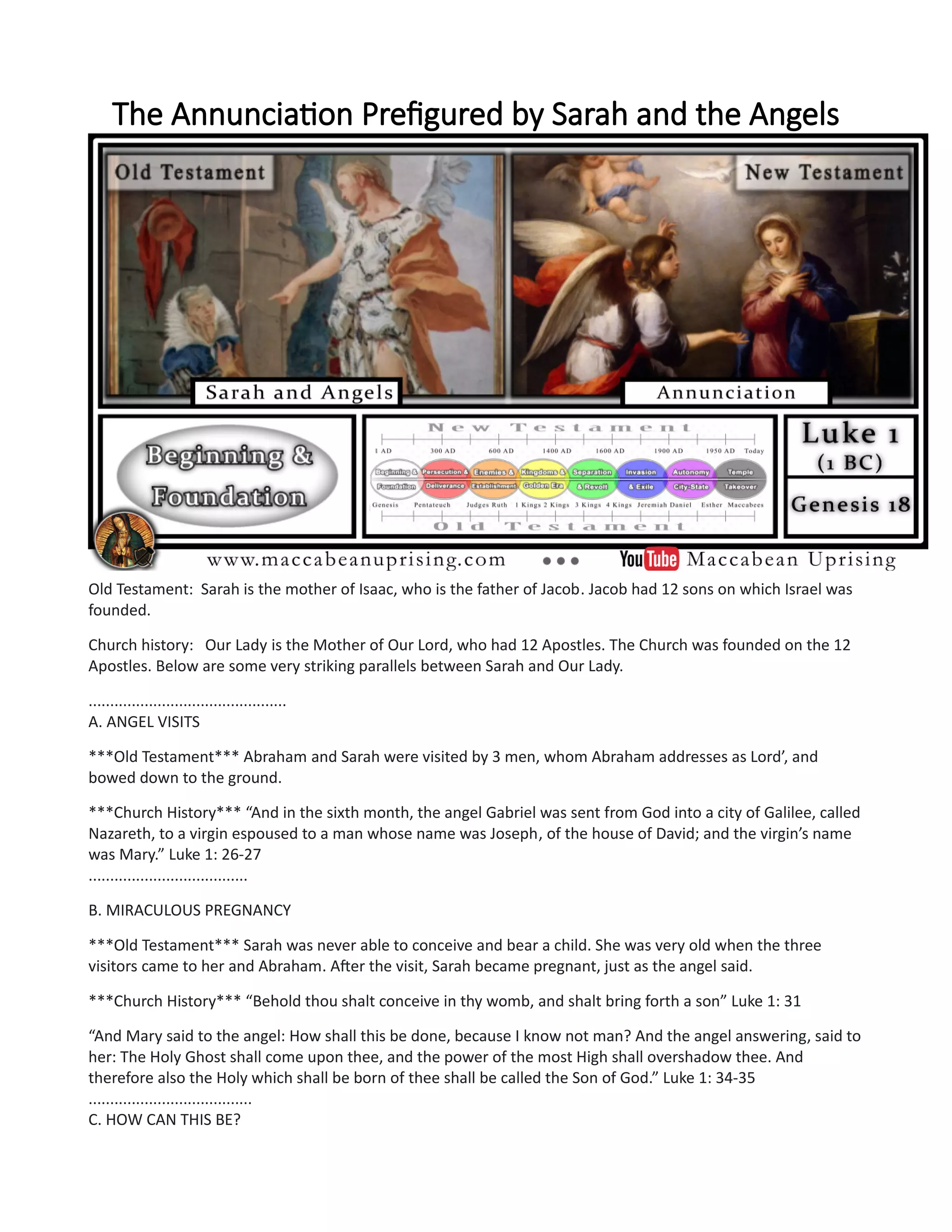
The Annunciation Prefigured by Sarah and the Angels
Old Testament: Sarah is the mother of Isaac, who is the father of Jacob. Jacob had 12 sons on which Israel was
founded.
Church history: Our Lady is the Mother of Our Lord, who had 12 Apostles. The Church was founded on the 12
Apostles. Below are some very striking parallels between Sarah and Our Lady.
..............................................
A. ANGEL VISITS
***Old Testament*** Abraham and Sarah were visited by 3 men, whom Abraham addresses as Lord’, and
bowed down to the ground.
***Church History*** “And in the sixth month, the angel Gabriel was sent from God into a city of Galilee, called
Nazareth, to a virgin espoused to a man whose name was Joseph, of the house of David; and the virgin’s name
was Mary.” Luke 1: 26-27
.....................................
B. MIRACULOUS PREGNANCY
***Old Testament*** Sarah was never able to conceive and bear a child. She was very old when the three
visitors came to her and Abraham. After the visit, Sarah became pregnant, just as the angel said.
***Church History*** “Behold thou shalt conceive in thy womb, and shalt bring forth a son” Luke 1: 31
“And Mary said to the angel: How shall this be done, because I know not man? And the angel answering, said to
her: The Holy Ghost shall come upon thee, and the power of the most High shall overshadow thee. And
therefore also the Holy which shall be born of thee shall be called the Son of God.” Luke 1: 34-35
......................................
C. HOW CAN THIS BE?
***Old Testament*** When the visitors told Abraham that next year, Sarah would have given birth to a son,
Sarah laughed in disbelief. She asked if she were to bear a son, despite her very old age.
***Church History*** “And Mary said to the angel: How shall this be done, because I know not man?” Luke 1:
34
......................................
D. ANGEL NAMES THE CHILD
***Old Testament*** Because Sarah laughed at the Angel’s words, the Angel said that her son will be named
Isaac, which means “laughter”. When the child was born, his name was ‘Isaac’.
***Church History*** “Behold thou shalt conceive in thy womb, and shalt bring forth a son; and thou shalt call
his name Jesus.” Luke 1: 31
......................................
E. ALL IS POSSIBLE FOR GOD
***Old Testament*** “Is there anything hard to God? According to appointment I will return to thee at this
same time, life accompanying, and Sara shall have a son.” Genesis 18: 14
***Church History*** And behold thy cousin Elizabeth, she also hath conceived a son in her old age; and this is
the sixth month with her that is called barren: Because no word shall be impossible with God. Luke 1: 36-37
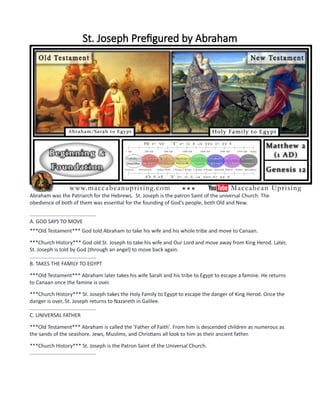
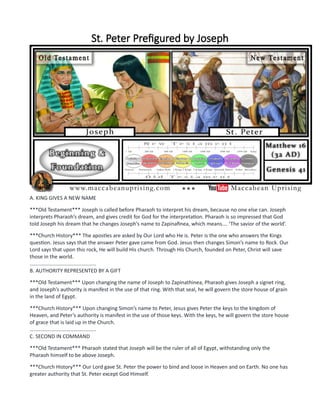
St. Joseph Prefigured by Abraham
Abraham was the Patriarch for the Hebrews. St. Joseph is the patron Saint of the universal Church. The
obedience of both of them was essential for the founding of God's people, both Old and New.
..............................................
A. GOD SAYS TO MOVE
***Old Testament*** God told Abraham to take his wife and his whole tribe and move to Canaan.
***Church History*** God old St. Joseph to take his wife and Our Lord and move away from King Herod. Later,
St. Joseph is told by God (through an angel) to move back again.
..............................................
B. TAKES THE FAMILY TO EGYPT
***Old Testament*** Abraham later takes his wife Sarah and his tribe to Egypt to escape a famine. He returns
to Canaan once the famine is over.
***Church History*** St. Joseph takes the Holy Family to Egypt to escape the danger of King Herod. Once the
danger is over, St. Joseph returns to Nazareth in Galilee.
..............................................
C. UNIVERSAL FATHER
***Old Testament*** Abraham is called the 'Father of Faith'. From him is descended children as numerous as
the sands of the seashore. Jews, Muslims, and Christians all look to him as their ancient father.
***Church History*** St. Joseph is the Patron Saint of the Universal Church.
..............................................
D. OBEDIENT IN ALL THINGS
***Old Testament*** Whenever Abraham heard the voice of God, he obeyed... even to offer his firstborn son
Isaac as a sacrifice on Mount Moriah (but the angel stopped him).
***Church History*** St. Joseph does not speak one word in the Gospels, but his sanctity is demonstrated by
his complete obedience to the commands of God.
..............................................
E. MIRACLE PREGNANCY
***Old Testament*** Abraham's wife, Sarah, conceived miraculously. Sarah was too old to bear a son, but
despite this, she became pregnant and bore the child Isaac. Isaac begot Jacob who had 12 sons and founded
Israel.
***Church History*** St. Joseph's wife (Our Lady) conceived miraculously. Our Lady is ever-virgin and
conceived Our Lord by the Holy Ghost. Our Lord had 12 apostles on which He founded His Church (the New
Israel).
..............................................
F. THE CHOSEN WOMAN
***Old Testament*** Abraham and Sarah were not conceiving a child, so Sarah gave Abraham her slave servant
Hagar. With Hagar, Abraham had a child named Ishmael. However, God said that His promises would be fulfilled
through Sarah, who was the chosen woman.
***Church History*** Our Lady conceived through the Holy Ghost. St. Joseph, seeing that Our Lady was
pregnant, was going to divorce Her quietly. However, an angel came to him and told him that Our Lady was
chosen by God. God's promises to humanity would be fulfilled through Our Lady!
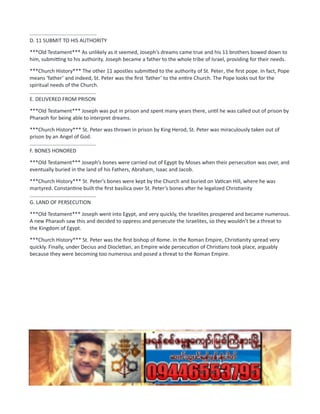
St. Peter Prefigured by Joseph
A. KING GIVES A NEW NAME
***Old Testament*** Joseph is called before Pharaoh to interpret his dream, because no one else can. Joseph
interprets Pharaoh’s dream, and gives credit for God for the interpretation. Pharaoh is so impressed that God
told Joseph his dream that he changes Joseph’s name to Zapinafinea, which means…. ‘The savior of the world’.
***Church History*** The apostles are asked by Our Lord who He is. Peter is the one who answers the Kings
question. Jesus says that the answer Peter gave came from God. Jesus then changes Simon’s name to Rock. Our
Lord says that upon this rock, He will build His church. Through His Church, founded on Peter, Christ will save
those in the world.
..............................................
B. AUTHORITY REPRESENTED BY A GIFT
***Old Testament*** Upon changing the name of Joseph to Zapinathinea, Pharaoh gives Joseph a signet ring,
and Joseph’s authority is manifest in the use of that ring. With that seal, he will govern the store house of grain
in the land of Egypt.
***Church History*** Upon changing Simon’s name to Peter, Jesus gives Peter the keys to the kingdom of
Heaven, and Peter’s authority is manifest in the use of those keys. With the keys, he will govern the store house
of grace that is laid up in the Church.
..............................................
C. SECOND IN COMMAND
***Old Testament*** Pharaoh stated that Joseph will be the ruler of all of Egypt, withstanding only the
Pharaoh himself to be above Joseph.
***Church History*** Our Lord gave St. Peter the power to bind and loose in Heaven and on Earth. No one has
greater authority that St. Peter except God Himself.
..............................................
D. 11 SUBMIT TO HIS AUTHORITY
***Old Testament*** As unlikely as it seemed, Joseph’s dreams came true and his 11 brothers bowed down to
him, submitting to his authority. Joseph became a father to the whole tribe of Israel, providing for their needs.
***Church History*** The other 11 apostles submitted to the authority of St. Peter, the first pope. In fact, Pope
means ‘father’ and indeed, St. Peter was the first ‘father’ to the entire Church. The Pope looks out for the
spiritual needs of the Church.
..............................................
E. DELIVERED FROM PRISON
***Old Testament*** Joseph was put in prison and spent many years there, until he was called out of prison by
Pharaoh for being able to interpret dreams.
***Church History*** St. Peter was thrown in prison by King Herod, St. Peter was miraculously taken out of
prison by an Angel of God.
..............................................
F. BONES HONORED
***Old Testament*** Joseph’s bones were carried out of Egypt by Moses when their persecution was over, and
eventually buried in the land of his Fathers, Abraham, Isaac and Jacob.
***Church History*** St. Peter’s bones were kept by the Church and buried on Vatican Hill, where he was
martyred. Constantine built the first basilica over St. Peter’s bones after he legalized Christianity
..............................................
G. LAND OF PERSECUTION
***Old Testament*** Joseph went into Egypt, and very quickly, the Israelites prospered and became numerous.
A new Pharaoh saw this and decided to oppress and persecute the Israelites, so they wouldn’t be a threat to
the Kingdom of Egypt.
***Church History*** St. Peter was the first bishop of Rome. In the Roman Empire, Christianity spread very
quickly. Finally, under Decius and Diocletian, an Empire wide persecution of Christians took place, arguably
because they were becoming too numerous and posed a threat to the Roman Empire.
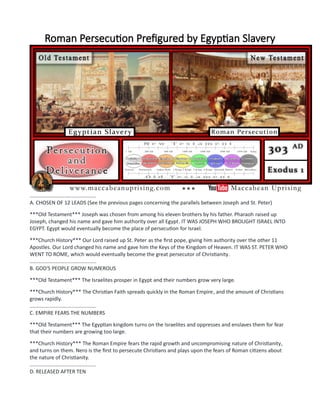
Roman Persecution Prefigured by Egyptian Slavery
..............................................
A. CHOSEN OF 12 LEADS (See the previous pages concerning the parallels between Joseph and St. Peter)
***Old Testament*** Joseph was chosen from among his eleven brothers by his father. Pharaoh raised up
Joseph, changed his name and gave him authority over all Egypt. IT WAS JOSEPH WHO BROUGHT ISRAEL INTO
EGYPT. Egypt would eventually become the place of persecution for Israel.
***Church History*** Our Lord raised up St. Peter as the first pope, giving him authority over the other 11
Apostles. Our Lord changed his name and gave him the Keys of the Kingdom of Heaven. IT WAS ST. PETER WHO
WENT TO ROME, which would eventually become the great persecutor of Christianity.
..............................................
B. GOD'S PEOPLE GROW NUMEROUS
***Old Testament*** The Israelites prosper in Egypt and their numbers grow very large.
***Church History*** The Christian Faith spreads quickly in the Roman Empire, and the amount of Christians
grows rapidly.
..............................................
C. EMPIRE FEARS THE NUMBERS
***Old Testament*** The Egyptian kingdom turns on the Israelites and oppresses and enslaves them for fear
that their numbers are growing too large.
***Church History*** The Roman Empire fears the rapid growth and uncompromising nature of Christianity,
and turns on them. Nero is the first to persecute Christians and plays upon the fears of Roman citizens about
the nature of Christianity.
..............................................
D. RELEASED AFTER TEN
***Old Testament*** God sent 10 plagues into Egypt. After the 10th plague (which was the worst one), Moses
was able to lead his people to freedom and the persecution of the Israelites stopped.
***Church History*** There were 10 Roman persecutions of Christians. The last one was the worst, under
Diocletian. After the 10th Roman persecution of Christians, Constantine legalized the religion and the
persecution stopped.
..............................................
E. WORST PERSECUTION LAST
***Old Testament*** The worst persecution of the Israelites by the Egyptians was the murder of the male
Hebrew children. This atrocity took place near the very end of the Israelites time in Egypt.
***Church History*** The worst persecution of the Christians took place under Diocletian. Countless atrocities
were committed against Christians. The persecution took place almost immediately before the legalization of
Christianity by Constantine.
..............................................
F. LEADER WORSHIPED AS A GOD
***Old Testament*** The Egyptians were very distinguished among the peoples of the ancient world because
they worshiped their leader, Pharaoh, as a living god.
***Church History*** The Romans were also distinguished among their time because they also would offer
worship to the Emperor as a god.
..............................................
G. EMPIRE IS A GREAT BUILDER
***Old Testament*** Ancient Egypt was renowned for its construction.
***Church History*** Rome was renowned for its engineering and construction.
..............................................
H. FREED BY A PRINCE
***Old Testament*** Israel was freed by Moses. Moses was a prince of Egypt, even though his mother was an
Israelite.
***Church History*** Christianity was legalized by Constantine. Constantine was first a "prince" of Rome, being
the son a Caesar. Constantine would go on to become Emperor of Rome, even though his mother was a Catholic
Saint (St. Helena).
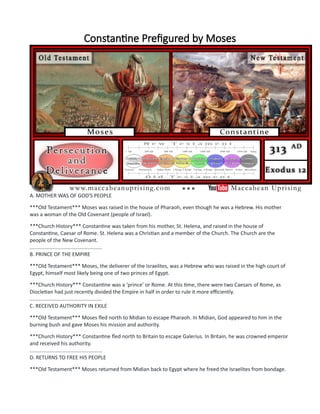
Constantine Prefigured by Moses
A. MOTHER WAS OF GOD'S PEOPLE
***Old Testament*** Moses was raised in the house of Pharaoh, even though he was a Hebrew. His mother
was a woman of the Old Covenant (people of Israel).
***Church History*** Constantine was taken from his mother, St. Helena, and raised in the house of
Constantine, Caesar of Rome. St. Helena was a Christian and a member of the Church. The Church are the
people of the New Covenant.
..................................................
B. PRINCE OF THE EMPIRE
***Old Testament*** Moses, the deliverer of the Israelites, was a Hebrew who was raised in the high court of
Egypt, himself most likely being one of two princes of Egypt.
***Church History*** Constantine was a ‘prince’ or Rome. At this time, there were two Caesars of Rome, as
Diocletian had just recently divided the Empire in half in order to rule it more efficiently.
..................................................
C. RECEIVED AUTHORITY IN EXILE
***Old Testament*** Moses fled north to Midian to escape Pharaoh. In Midian, God appeared to him in the
burning bush and gave Moses his mission and authority.
***Church History*** Constantine fled north to Britain to escape Galerius. In Britain, he was crowned emperor
and received his authority.
..................................................
D. RETURNS TO FREE HIS PEOPLE
***Old Testament*** Moses returned from Midian back to Egypt where he freed the Israelites from bondage.
***Church History*** Constantine returned from Britain and issued the 'Edict of Milan' which stopped the
persecution of Christianity.
..................................................
E. ENEMY ARMY DROWNS
***Old Testament*** Once freed, the Israelites were pursued by Pharaoh and his army. At the crossing of the
Red Sea, Pharaoh and his army drowned, thus ending the threat to the Israelites.
***Church History*** After Constantine issued the 'Edict of Milan', the other Emperor, Maxentius, opposed the
rule of Constantine. Maxentius wanted the persecution of Christians to continue. At the Battle of Milvian
Bridge, Maxentius and his whole army drowned in the Tiber River. This definitively ended the threat of
persecution to the Christians.
..................................................
F. LEADS PEOPLE INTO WILDERNESS
***Old Testament*** Once freed, Moses led the Israelites out into the wilderness where they would be free.
***Church History*** Once freed from persecution, Constantine founded a new city in the wilderness. The city
of Constantinople became a haven for Christians, where they would be alone and free.
..................................................
G. GIVES THE PEOPLE BREAD
***Old Testament*** The Israelites were hungry in the desert, and God gave the people Manna from Heaven...
through the intercession of Moses.
***Church History*** Constantine gave the people of Constantinople free grain. He diverted grain shipments
from Alexandria to Constantinople, and gave it out to the people on a daily basis.
..................................................
H. WATER FROM THE ROCK
***Old Testament*** The Israelites were thirsty in the desert. Moses struck a rock, which issued forth water for
the people.
***Church History*** The new city of Constantinople was without an adequate water source. Constantine
started to construct the world's largest aqueduct to date.. which supplied Constantinople with enough fresh
water for the people. An aqueduct is made of rock.. and it issues forth water!
..................................................
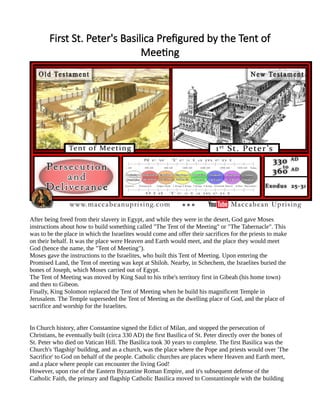
First St. Peter's Basilica Prefigured by the Tent of
Meeting
After being freed from their slavery in Egypt, and while they were in the desert, God gave Moses
instructions about how to build something called "The Tent of the Meeting" or "The Tabernacle". This
was to be the place in which the Israelites would come and offer their sacrifices for the priests to make
on their behalf. It was the place were Heaven and Earth would meet, and the place they would meet
God (hence the name, the "Tent of Meeting").
Moses gave the instructions to the Israelites, who built this Tent of Meeting. Upon entering the
Promised Land, the Tent of meeting was kept at Shiloh. Nearby, in Schechem, the Israelites buried the
bones of Joseph, which Moses carried out of Egypt.
The Tent of Meeting was moved by King Saul to his tribe's territory first in Gibeah (his home town)
and then to Gibeon.
Finally, King Solomon replaced the Tent of Meeting when he build his magnificent Temple in
Jerusalem. The Temple superseded the Tent of Meeting as the dwelling place of God, and the place of
sacrifice and worship for the Israelites.
In Church history, after Constantine signed the Edict of Milan, and stopped the persecution of
Christians, he eventually built (circa 330 AD) the first Basilica of St. Peter directly over the bones of
St. Peter who died on Vatican Hill. The Basilica took 30 years to complete. The first Basilica was the
Church's 'flagship' building, and as a church, was the place where the Pope and priests would over 'The
Sacrifice' to God on behalf of the people. Catholic churches are places where Heaven and Earth meet,
and a place where people can encounter the living God!
However, upon rise of the Eastern Byzantine Roman Empire, and it's subsequent defense of the
Catholic Faith, the primary and flagship Catholic Basilica moved to Constantinople with the building
of Haggia Sophia in 537 AD.
However, the final Basilica, and that which definitively replaced the Old Basilica and all others, was
the second Basilica of St. Peter's, that was built over the ruins of the first Basilica during the
Renaissance in 1506 AD (construction started on that date).
***** (NOTE)*****In later pages, we will demonstrate the parallels between King Saul and the
Byzantine Empire...... and between the Renaissance and the reign of King Solomon. Thus, the parallels
mentioned in the above paragraph are complete in their extension into future periods of Church history!
God is absolutely amazing!
***Also recall the parallels between Joseph and St. Peter.
Julian the Apostate Prefigured by the Golden Calf
A. FREED FROM OPPRESSION
***Old Testament*** Moses freed the Israelites from their slavery in Egypt and led them out into the
wilderness.
***Church History*** Constantine stopped the persecution of Christians in 313 AD, and freed them to worship
God in the open.
..................................................
B. HOLY LEADER GOES AWAY
***Old Testament*** When Moses climbed Mt. Sinai, and was long delayed in returning to the people.
***Church History*** St. Athanasius was sent into exile. St. Athanasius was the strongest (and practically the
only) pillar of Faith in the ancient world at that time. He was resilient and single-minded in his promotion and
defense of the True Faith!
..................................................
C. RETURN TO FALSE RELIGION
***Old Testament*** After Moses freed the Israelites, they still struggled with the worship of false gods. When
Moses was on Mount Sinai, the people reverted back to pagan worship and made a giant golden calf.
***Church History*** Sometime after Constantine, a new Emperor arose named Julian the Apostate. He strove
to revert the Roman Empire back to its pagan roots, by worshiping classical pagan Roman gods... and was very
much opposed to Christianity.
..................................................
D. TOO MUCH PRESSURE
***Old Testament*** While Moses was away, the Israelites pressured Aaron (the brother of Moses, and the
high priest of Israel) to make a golden calf so they could worship it.
***Church History*** While St Athanasius was in exile, Pope Liberius was put under tremendous pressure to
sign a document that favored the heretical Arian position (an issue that was hotly contested at the time). This
episode with Pope Liberius is STILL contested to this day!
..................................................
E. HOLY LEADER RETURNS
***Old Testament*** When Moses came back from his time away on the Mt. Sinai, he was furious. Aaron
immediately found his courage again, now that Moses was back. Aaron made an excuse that is recorded thus in
Sacred Scripture (Exodus 32:21-24).....
21 And he said to Aaron: What has this people done to thee, that thou shouldst bring upon them a most
heinous sin?
22 And he answered him: Let not my lord be offended: for thou knowest this people, that they are prone to
evil.
23 They said to me: Make us gods, that may go before us: for as to this Moses, who brought us forth out of the
land of Egypt, we know not what is befallen him.
24 And I said to them: Which of you hath any gold? and they took and brought it to me: and I cast it into the
fire, and this calf came out.
***Church History*** Julian the Apostate died and a new Emperor was crowned. This new emperor, Jovian,
recalled St. Athanasius from exile. When St. Athanasius returned from exile, he strengthened the weakened
Pope Liberius, who regained a tremendous amount of confidence now that St. Athanasius returned.
..................................................
F. THE APOSTATES ARE SLAIN
***Old Testament*** Moses then instructed the Tribe of Levi to go around and slay all those who worshiped
the golden calf. Twenty-three thousand were slain that day.
***Church History*** Emperor Jovian was a strong defender of the true Faith, and he instituted a policy that
anyone who worshiped pagan gods was to be killed! Many pagans died under Jovian's new policy.
..................................................
Theotokos Prefigured by the Construction of the Ark of
the Covenant
A. "CONSTRUCTED" AFTER PERSECUTION
***Old Testament*** After Moses freed the Israelites from their persecution in Egypt, they went out into the
desert. There, they forged their religious identity and were given the laws of belief and worship. It was during
this time that God commanded the Israelites to construct the "Ark of the Covenant".
***Church History*** After Christians were freed by Constantine from their persecution, the Faith became
legal. Bishops and theologians were free to discuss and form the Catholic religion. Church councils were held to
establish doctrines/dogmas of belief and right worship. It was during these times that the dogma of
"Theotokos" was established.
..................................................
B. GOD-BEARER
***Old Testament*** The Ark of the Covenant was the dwelling place of God's presence on earth. The
Israelites carried the Ark of the Covenant around with them in the desert.
***Church History*** The dogma of "Theotokos" that was proclaimed by the Council of Ephesus in 461 AD
means that Our Lady is the "Mother of God". Our Lady is the "New Ark of the Covenant" in that She bore God
to us. "Theotokos" means "God-Bearer".
..................................................
C. FOUNDATIONAL TO WORSHIP
***Old Testament*** The construction of the Ark was a foundational moment in the history of Israel. The Ark
was given a central place in the very heart of the Temple. The Ark was the holiest object to the Israelites.
***Church History*** The proclamation of "Theotokos" in 461 AD was a foundational moment in Catholic
history. The "Theotokos" dogma established Our Lady as the Mother of God. Without this understanding, the
future dogmas of Our Lady would not be possible.
..................................................
D. COVERED IN BLUE
***Old Testament*** God commanded that the Ark of the Covenant be covered in dark blue coverings.
***Church History*** Our Lady is depicted in dark blue clothing.
..................................................
E. INCORRUPTIBLE
***Old Testament*** The Ark was built out of setim wood and gold. Setim wood is known for its resistance to
decay. Gold is incorruptible.
***Church History*** Our Lady is free of sin, both original and personal. Her body never saw decay, as She was
assumed into Heaven both body and soul. Our Lady is incorruptible.
..................................................
F. GOD SPEAKS TO US
***Old Testament*** God spoke to Moses and the Israelites from atop of the Ark of the Covenant.
***Church History*** God spoke to us throughout Church history through apparitions of Our Lady (such as
Lourdes, LaSalette, and so many others). God speaks to us also from the "New Ark of the Covenant".
..................................................
G. VANGUARD OF BATTLE
***Old Testament*** The Israelites would carry the Ark into Battle with them.
***Church History*** Throughout Catholic history, Catholic armies would carry statues and/or images of Our
Lady into battle... such as in Vienna in 1683, Lepanto in 1571, the Cristeros wars, and so many other examples.
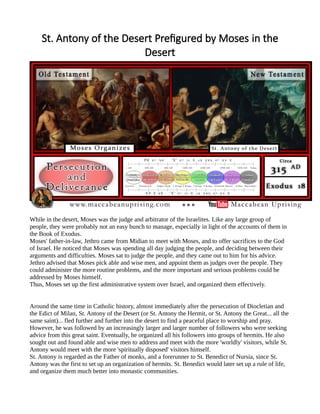
St. Antony of the Desert Prefigured by Moses in the
Desert
While in the desert, Moses was the judge and arbitrator of the Israelites. Like any large group of
people, they were probably not an easy bunch to manage, especially in light of the accounts of them in
the Book of Exodus.
Moses' father-in-law, Jethro came from Midian to meet with Moses, and to offer sacrifices to the God
of Israel. He noticed that Moses was spending all day judging the people, and deciding between their
arguments and difficulties. Moses sat to judge the people, and they came out to him for his advice.
Jethro advised that Moses pick able and wise men, and appoint them as judges over the people. They
could administer the more routine problems, and the more important and serious problems could be
addressed by Moses himself.
Thus, Moses set up the first administrative system over Israel, and organized them effectively.
Around the same time in Catholic history, almost immediately after the persecution of Diocletian and
the Edict of Milan, St. Antony of the Desert (or St. Antony the Hermit, or St. Antony the Great... all the
same saint)... fled further and further into the desert to find a peaceful place to worship and pray.
However, he was followed by an increasingly larger and larger number of followers who were seeking
advice from this great saint. Eventually, he organized all his followers into groups of hermits. He also
sought out and found able and wise men to address and meet with the more 'worldly' visitors, while St.
Antony would meet with the more 'spiritually disposed' visitors himself.
St. Antony is regarded as the Father of monks, and a forerunner to St. Benedict of Nursia, since St.
Antony was the first to set up an organization of hermits. St. Benedict would later set up a rule of life,
and organize them much better into monastic communities.
Pictured below are paintings depicting Jethro making suggestions to Moses, and also, the meeting of St. Paul
the Hermit and St. Antony of the Desert.
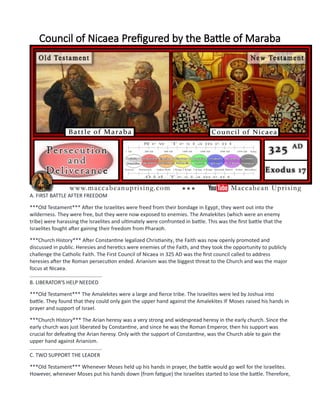
Council of Nicaea Prefigured by the Battle of Maraba
A. FIRST BATTLE AFTER FREEDOM
***Old Testament*** After the Israelites were freed from their bondage in Egypt, they went out into the
wilderness. They were free, but they were now exposed to enemies. The Amalekites (which were an enemy
tribe) were harassing the Israelites and ultimately were confronted in battle. This was the first battle that the
Israelites fought after gaining their freedom from Pharaoh.
***Church History*** After Constantine legalized Christianity, the Faith was now openly promoted and
discussed in public. Heresies and heretics were enemies of the Faith, and they took the opportunity to publicly
challenge the Catholic Faith. The First Council of Nicaea in 325 AD was the first council called to address
heresies after the Roman persecution ended. Arianism was the biggest threat to the Church and was the major
focus at Nicaea.
..................................................
B. LIBERATOR'S HELP NEEDED
***Old Testament*** The Amalekites were a large and fierce tribe. The Israelites were led by Joshua into
battle. They found that they could only gain the upper hand against the Amalekites IF Moses raised his hands in
prayer and support of Israel.
***Church History*** The Arian heresy was a very strong and widespread heresy in the early church. Since the
early church was just liberated by Constantine, and since he was the Roman Emperor, then his support was
crucial for defeating the Arian heresy. Only with the support of Constantine, was the Church able to gain the
upper hand against Arianism.
..................................................
C. TWO SUPPORT THE LEADER
***Old Testament*** Whenever Moses held up his hands in prayer, the battle would go well for the Israelites.
However, whenever Moses put his hands down (from fatigue) the Israelites started to lose the battle. Therefore,
Aaron and Hur supported Moses and held up his hands. Because of Moses, and the help of Aaron and Hur, the
Israelites beat the Amalekites in battle.
***Church History*** The support of Constantine was crucial for the Church since he was the emperor (his
opinion counted greatly at that time). However, Constantine's support for the Church wavered. St. Athanasius
and Hosius of Cordova supported and strengthened the Emperor's support of the Church. Thus, the council was
able to denounce Arius as a heretic and exiled him.
..................................................
D. THE BATTLE IS WON
***Old Testament*** The Israelites won the battle against the Amalekites. It was a great victory for Israel.
***Church History*** Because of Constantine's support, the Church won a great victory over Arianism at the
Council of Nicaea. The vote of the council was overwhelming... 301-17 against Arianism.
..................................................
E. THE ENEMY IS RELATED
***Old Testament*** The Amalekite tribe descends from Essau, who is the brother of Jacob. The twelve tribes
of Israel descend from Jacob, while the Amalekites descend from Jacob's brother. Thus, the nations are related
to each other.
***Church History*** Arianism is a heresy that started with the Catholic bishop Arius. Arius took Catholic
teaching and distorted it. However, Arianism shares many traits with the True Faith, but at the same time, it is a
false doctrine.
..................................................
F. THE WAR IS FAR FROM OVER
***Old Testament*** The Israelites defeated the Amalekites that day, but the war between them was far from
over. The Amalekites continued to plague Israel until King David finally put an end to them.
***Church History*** Arianism was soundly defeated at the council of Nicaea in 325 Ad. But, Arianism
continued to plague the Church for centuries until Charlemagne finally put an end to the last Arian kinds of
Europe, and converted them to the Catholic Faith.
..................................................
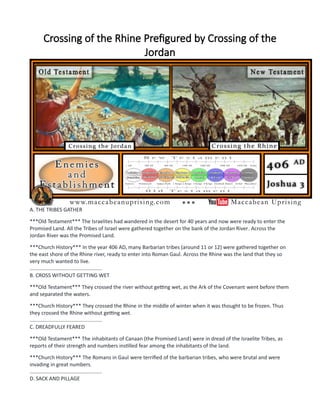
Crossing of the Rhine Prefigured by Crossing of the
Jordan
A. THE TRIBES GATHER
***Old Testament*** The Israelites had wandered in the desert for 40 years and now were ready to enter the
Promised Land. All the Tribes of Israel were gathered together on the bank of the Jordan River. Across the
Jordan River was the Promised Land.
***Church History*** In the year 406 AD, many Barbarian tribes (around 11 or 12) were gathered together on
the east shore of the Rhine river, ready to enter into Roman Gaul. Across the Rhine was the land that they so
very much wanted to live.
..................................................
B. CROSS WITHOUT GETTING WET
***Old Testament*** They crossed the river without getting wet, as the Ark of the Covenant went before them
and separated the waters.
***Church History*** They crossed the Rhine in the middle of winter when it was thought to be frozen. Thus
they crossed the Rhine without getting wet.
..................................................
C. DREADFULLY FEARED
***Old Testament*** The inhabitants of Canaan (the Promised Land) were in dread of the Israelite Tribes, as
reports of their strength and numbers instilled fear among the inhabitants of the land.
***Church History*** The Romans in Gaul were terrified of the barbarian tribes, who were brutal and were
invading in great numbers.
..................................................
D. SACK AND PILLAGE
***Old Testament*** Upon entering the land, the Israelites killed most of the Canaanites, so they could take
their place in the Promised Land.
***Church History*** Upon entering into Roman Gaul, the barbarians put many of the Romans to the sword
and took their place as rulers of the land.
..................................................
E. ACCEPT THE SIGN
***Old Testament*** Shortly AFTER the Israelites crossed the Jordan, God commanded Joshua to have all the
Israelites circumcised. (this is recorded in Joshua 5). This is because this new generation of Israelites were not
yet circumcised, and this was a requirement for being God's chosen people, in the Promised Land.
***Church History*** After their entrance into Roman Gaul, the barbarians consented to baptism (we see this
most clearly with Clovis, who was a barbarian Frank). Baptism is the necessary requirement to become a child
of God.
..................................................
F. TAKE OVER THE ENTIRE LAND
***Old Testament*** The Israelites filled the whole land. The 12 Tribes spread out and eventually founded the
Kingdom of Israel.
***Church History*** The barbarians, once becoming Christians, eventually grew and became the Holy Roman
Empire and the foundation for Western Christendom.
..................................................
G. MIX WITH ORIGINAL INHABITANTS
***Old Testament*** God commanded that the Israelites kill all the pagan inhabitants so that the Israelites
didn't adopt any of their pagan beliefs or practices. The Israelites did not obey and left many pagans live.
Because of this, paganism was mixed in the land, and eventually, the Israelites did adopt many pagan beliefs
and practices.
***Church History*** Some of the Roman citizens survived the barbarian invasion of the Roman Empire.
Christian Roman practices and beliefs influenced the barbarians and helped to develop the feudal system, as
well as many practices of the Christian middle ages.
..................................................
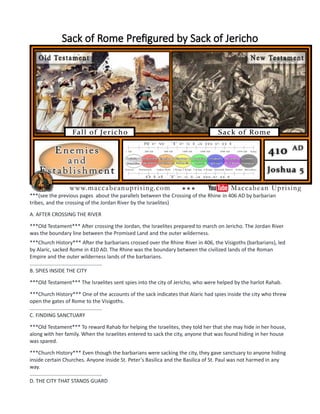
Sack of Rome Prefigured by Sack of Jericho
***(see the previous pages about the parallels between the Crossing of the Rhine in 406 AD by barbarian
tribes, and the crossing of the Jordan River by the Israelites)
A. AFTER CROSSING THE RIVER
***Old Testament*** After crossing the Jordan, the Israelites prepared to march on Jericho. The Jordan River
was the boundary line between the Promised Land and the outer wilderness.
***Church History*** After the barbarians crossed over the Rhine River in 406, the Visigoths (barbarians), led
by Alaric, sacked Rome in 410 AD. The Rhine was the boundary between the civilized lands of the Roman
Empire and the outer wilderness lands of the barbarians.
..................................................
B. SPIES INSIDE THE CITY
***Old Testament*** The Israelites sent spies into the city of Jericho, who were helped by the harlot Rahab.
***Church History*** One of the accounts of the sack indicates that Alaric had spies inside the city who threw
open the gates of Rome to the Visigoths.
..................................................
C. FINDING SANCTUARY
***Old Testament*** To reward Rahab for helping the Israelites, they told her that she may hide in her house,
along with her family. When the Israelites entered to sack the city, anyone that was found hiding in her house
was spared.
***Church History*** Even though the barbarians were sacking the city, they gave sanctuary to anyone hiding
inside certain Churches. Anyone inside St. Peter's Basilica and the Basilica of St. Paul was not harmed in any
way.
..................................................
D. THE CITY THAT STANDS GUARD
***Old Testament*** The conquering of the city of Jericho, a fortified city, paved the way for the Israelites to
enter the land and further conquer. Jericho stood guard over the entrance into the Promised Land.
***Church History*** The sack of Rome in 410 AD severely weakened the Western Roman Empire's resistance
to the barbarian invasion, and paved the way for a more complete barbarian takeover of Roman Gaul.
................................................
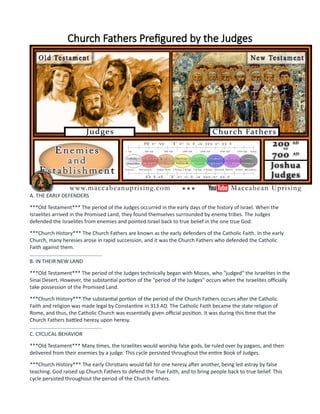
Church Fathers Prefigured by the Judges
A. THE EARLY DEFENDERS
***Old Testament*** The period of the Judges occurred in the early days of the history of Israel. When the
Israelites arrived in the Promised Land, they found themselves surrounded by enemy tribes. The Judges
defended the Israelites from enemies and pointed Israel back to true belief in the one true God.
***Church History*** The Church Fathers are known as the early defenders of the Catholic Faith. In the early
Church, many heresies arose in rapid succession, and it was the Church Fathers who defended the Catholic
Faith against them.
..................................................
B. IN THEIR NEW LAND
***Old Testament*** The period of the Judges technically began with Moses, who "judged" the Israelites in the
Sinai Desert. However, the substantial portion of the "period of the Judges" occurs when the Israelites officially
take possession of the Promised Land.
***Church History*** The substantial portion of the period of the Church Fathers occurs after the Catholic
Faith and religion was made legal by Constantine in 313 AD. The Catholic Faith became the state religion of
Rome, and thus, the Catholic Church was essentially given official position. It was during this time that the
Church Fathers battled heresy upon heresy.
..................................................
C. CYCLICAL BEHAVIOR
***Old Testament*** Many times, the Israelites would worship false gods, be ruled over by pagans, and then
delivered from their enemies by a judge. This cycle persisted throughout the entire Book of Judges.
***Church History*** The early Christians would fall for one heresy after another, being led astray by false
teaching. God raised up Church Fathers to defend the True Faith, and to bring people back to true belief. This
cycle persisted throughout the period of the Church Fathers.
..................................................
D. DIFFERENT TIMES AND PLACES
***Old Testament*** The Judges were not an organized entity. Instead, the Judges rose up in different times
and places during the early years of Israel. They operated independent from each other and were given
extraordinary abilities or insights by God to aid them.
***Church History*** The Church Fathers rose up in different times and places throughout the ancient
Christian world. Often, these great Saints overcame incredible odds in preserving the Catholic Faith. Clearly,
God was with them.
..................................................
E. DID WHAT WAS THOUGHT BEST
***Old Testament*** In Israel at that time, because there was no king, there was no central authority, and no
central leadership. As a result, the Israelites all did what they thought was best. (Judges 17:6)
***Church History*** During this time, Catholic Doctrine was largely un-established, and bishops taught what
they thought was best. Because of this, many bishops taught novel ideas and fell into heresy.
.................................................
F. BEFORE THE KINGDOM
***Old Testament*** After the period of the Judges follows the period of the Kings. Israel will soon have a
central authority and will be protected from enemies at the official, governmental level.
***Church History*** Following the period of the Church Fathers is the start of the Holy Roman Empire.
Charlemagne will protect the Catholic Faith with military might and political power.
..................................................
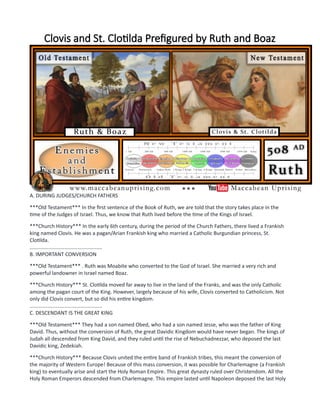
Clovis and St. Clotilda Prefigured by Ruth and Boaz
A. DURING JUDGES/CHURCH FATHERS
***Old Testament*** In the first sentence of the Book of Ruth, we are told that the story takes place in the
time of the Judges of Israel. Thus, we know that Ruth lived before the time of the Kings of Israel.
***Church History*** In the early 6th century, during the period of the Church Fathers, there lived a Frankish
king named Clovis. He was a pagan/Arian Frankish king who married a Catholic Burgundian princess, St.
Clotilda.
..................................................
B. IMPORTANT CONVERSION
***Old Testament*** . Ruth was Moabite who converted to the God of Israel. She married a very rich and
powerful landowner in Israel named Boaz.
***Church History*** St. Clotilda moved far away to live in the land of the Franks, and was the only Catholic
among the pagan court of the King. However, largely because of his wife, Clovis converted to Catholicism. Not
only did Clovis convert, but so did his entire kingdom.
..................................................
C. DESCENDANT IS THE GREAT KING
***Old Testament*** They had a son named Obed, who had a son named Jesse, who was the father of King
David. Thus, without the conversion of Ruth, the great Davidic Kingdom would have never began. The kings of
Judah all descended from King David, and they ruled until the rise of Nebuchadnezzar, who deposed the last
Davidic king, Zedekiah.
***Church History*** Because Clovis united the entire band of Frankish tribes, this meant the conversion of
the majority of Western Europe! Because of this mass conversion, it was possible for Charlemagne (a Frankish
king) to eventually arise and start the Holy Roman Empire. This great dynasty ruled over Christendom. All the
Holy Roman Emperors descended from Charlemagne. This empire lasted until Napoleon deposed the last Holy
Roman Emperor, Francs II, in 1806.
..................................................
D. SECOND MARRIAGE
***Old Testament*** Ruth was married before Boaz, but her husband died.
***Church History*** Clovis was married before St. Clotilda, but his wife previous wife died.
..................................................
E. HELPS THE POOR WOMEN
***Old Testament*** Ruth was married to the son of Naomi. However, upon the death of Naomi's husband
and her two sons, Naomi departed the land of Moab with her two Moabite daughters in law. It was Ruth that
stayed with Naomi, and they moved to Bethlehem. Boaz asked Ruth to marry him, even though she was a
Moabite.
***Church History*** Upon the death of St. Clotilda's father, her mother and her sister all moved together
from Burgundy to live in Geneva with the uncle of St. Clotilda. St. Clotilda's sister, Chrona, stayed with her
mother in Geneva, but St. Clotilda went off to marry Clovis, who asked for her hand in marriage. St. Clotilda
consented, even though Clovis was an Arian. He later converted to Catholicism.
..................................................
F. MARRIED IN A FOREIGN LAND
***Old Testament*** Ruth agreed to go to Israel with her mother in law, although she would be a foreigner in a
new and strange land. She was in danger of remaining an outcast because of being foreign. Boaz admired her
conversion, and her fidelity to her mother in law. Boaz protected her and married her.
***Church History*** St. Clotilda was a Catholic princess from Burgundy. She was not a Frank. She consented
to marry Clovis, and had to travel and live by herself among the Franks, who were Arians. Clovis was impressed
with her beauty, her purity and her goodness. Although she was surrounded by Arians at court, and was the
only Catholic, she eventually was able to facilitate the conversion of her husband to the Catholic Faith.
..................................................
G. UNWRITTEN LAW OF THE ELDERS
***Old Testament*** When Boaz wanted to marry Ruth, he called together the near kinsman who had first
claim to the field and to Ruth. He also called together the elders of Bethlehem, that they might arbitrate and
witness the conversation between Boaz and the near kinsman. The near kinsman declined his right to the land,
and to Ruth, and this was confirmed and witnessed by the elders. Thus, the right passed to Boaz.
***Church History*** During the time of Clovis, the Salic Laws were given which governed the issues of
inheritance, next of kin and marriage concerning the transfer of property. During this time, the laws remained
unwritten, and were adjudicated by the elders who kept the laws in their minds, and decided upon cases that
were brought to them.
..................................................
H. MANY SONS, ONE GREAT KING
***Old Testament*** The conversion of Ruth, and her marriage to Boaz produced a son, Obed. Obed was the
father of Jesse, and Jesse was the father of 8 sons, the youngest of which was King David. David was anointed
king over all of Israel, and started the Davidic dynasty.
***Church History*** Clovis united all the Franks under one kingdom, and his marriage and subsequent
conversion to Catholicism caused his whole kingdom to convert. Clovis' united kingdom broke apart upon his
death, and many lines of Frankish kings followed. However, it was the youngest of these lines, the Carolingian
line, that would produce Charlemagne, the great unifier of Europe, and the founder of the Holy Roman Empire.
..................................................
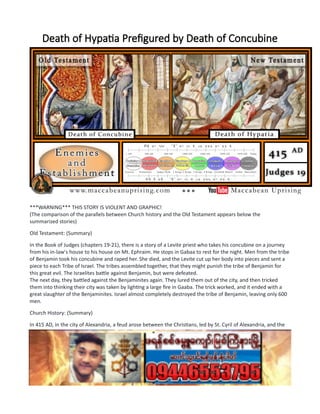
Death of Hypatia Prefigured by Death of Concubine
***WARNING*** THIS STORY IS VIOLENT AND GRAPHIC!
(The comparison of the parallels between Church history and the Old Testament appears below the
summarized stories)
Old Testament: (Summary)
In the Book of Judges (chapters 19-21), there is a story of a Levite priest who takes his concubine on a journey
from his in-law's house to his house on Mt. Ephraim. He stops in Gabaa to rest for the night. Men from the tribe
of Benjamin took his concubine and raped her. She died, and the Levite cut up her body into pieces and sent a
piece to each Tribe of Israel. The tribes assembled together, that they might punish the tribe of Benjamin for
this great evil. The Israelites battle against Benjamin, but were defeated.
The next day, they battled against the Benjaminites again. They lured them out of the city, and then tricked
them into thinking their city was taken by lighting a large fire in Gaaba. The trick worked, and it ended with a
great slaughter of the Benjaminites. Israel almost completely destroyed the tribe of Benjamin, leaving only 600
men.
Church History: (Summary)
In 415 AD, in the city of Alexandria, a feud arose between the Christians, led by St. Cyril of Alexandria, and the
governor, Orestes. There were public displays of dancing that were prone to the public disorder. Orestes
published new rules for such gatherings that angered both the Jews and Christians. A devout Christian, named
Hierax, was perceived by Orestes to arouse the crowd against him. Orestes was jealous at the growing power of
the Christian Bishops in Alexandria. Orestes had Hierax seized and publicly tortured.
St. Cyril was very angry at the harsh punishment for Hierax and threatened to retaliate against the Jews with
the utmost severity, if the harassment of Christians didn’t stop, immediately. In response, the Jews became
more furious and resorted to violence against the Christians. The Jews, at night, tricked the Christians by saying
their Church was on fire. When they came out of their homes, they massacred the Christians in the streets.
The next day, St. Cyril rounded up all the Jews in Alexandria, stripped them of all their possessions and banished
them from the city. Orestes was very upset at St. Cyril, and a feud followed between them. A group of 500
monks descended on the city and attacked Orestes.
Finally, at the end of the affair, there was a female pagan philosopher named Hypatia. She was very close to
Orestes and was known to give him counsel. A Christian mob abducted her and murdered her, ripping her body
into pieces.
***SUMMARY OF THE PARALLELS***
A. DURING JUDGES/CHURCH FATHERS
***Old Testament*** The story of the "slaughter of the Benjaminites" takes place in the period of the Judges. (
***Church History*** The death of Hypatia, and the massacre of Christians in Alexandria takes place during the
period of the Church Fathers.
..................................................
B. DEATH/MUTILATION OF WOMAN
***Old Testament*** The concubine was brutally raped and died. Her husband cut her body up into pieces and
send them all over Israel.
***Church History*** The pagan philosopher, Hypatia, was dragged around by a Christian mob and killed. Her
body was cut into pieces by the mob.
..................................................
C. TRICKED BY A FIRE
***Old Testament*** Israel tricked the Benjaminites from leaving their stronghold by lighting a fire behind
them. They thought their city was on fire, and retreated, and were thus slaughtered.
***Church History*** The Jews tricked the Christians into leaving their houses in the middle of the night by
yelling that their Church was on fire. When the Christians came out of their houses, the Jews slaughtered them.
..................................................
D. A MASSIVE SLAUGHTER
***Old Testament*** The Benjaminites were massively slaughtered.
***Church History*** The Christians were massively slaughtered by the Jews in Alexandria.
..................................................
E. GREAT INJUSTICE REVENGED
***Old Testament*** Israel was revenging the rape and death of the concubine.
***Church History*** The Christians were revenging poor treatment by the governor Orestes, and the
slaughter of their people by the Jews.
..................................................
F. ELIMINATING A CERTAIN PEOPLE
***Old Testament*** The Benjaminites were almost completely wiped out as a consequence of this dramatic
event.
***Church History*** The Jews in Alexandria were driven from the city by St. Cyril, almost eliminating the
presence of Judaism in the area.
..................................................
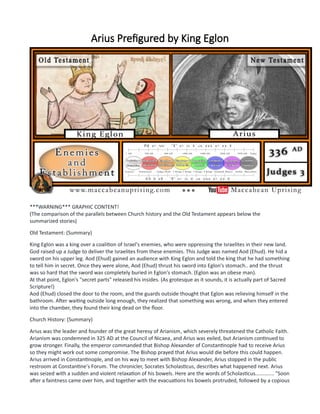
Arius Prefigured by King Eglon
***WARNING*** GRAPHIC CONTENT!
(The comparison of the parallels between Church history and the Old Testament appears below the
summarized stories)
Old Testament: (Summary)
King Eglon was a king over a coalition of Israel's enemies, who were oppressing the Israelites in their new land.
God raised up a Judge to deliver the Israelites from these enemies. This Judge was named Aod (Ehud). He hid a
sword on his upper leg. Aod (Ehud) gained an audience with King Eglon and told the king that he had something
to tell him in secret. Once they were alone, Aod (Ehud) thrust his sword into Eglon's stomach.. and the thrust
was so hard that the sword was completely buried in Eglon's stomach. (Eglon was an obese man).
At that point, Eglon's "secret parts" released his insides. (As grotesque as it sounds, it is actually part of Sacred
Scripture!)
Aod (Ehud) closed the door to the room, and the guards outside thought that Eglon was relieving himself in the
bathroom. After waiting outside long enough, they realized that something was wrong, and when they entered
into the chamber, they found their king dead on the floor.
Church History: (Summary)
Arius was the leader and founder of the great heresy of Arianism, which severely threatened the Catholic Faith.
Arianism was condemned in 325 AD at the Council of Nicaea, and Arius was exiled, but Arianism continued to
grow stronger. Finally, the emperor commanded that Bishop Alexander of Constantinople had to receive Arius
so they might work out some compromise. The Bishop prayed that Arius would die before this could happen.
Arius arrived in Constantinople, and on his way to meet with Bishop Alexander, Arius stopped in the public
restroom at Constantine's Forum. The chronicler, Socrates Scholasticus, describes what happened next. Arius
was seized with a sudden and violent relaxation of his bowels. Here are the words of Scholasticus............. "Soon
after a faintness came over him, and together with the evacuations his bowels protruded, followed by a copious
hemorrhage, and the descent of the smaller intestines: moreover portions of his spleen and liver were brought
off in the effusion of blood so that he almost immediately died.".................... Thus, he died on the bathroom
floor with his insides spilled out.... just like Eglon!
A. LEADER OF THE ENEMIES OF GOD
***Old Testament*** During the period of the Judges, King Eglon was the leader of the pagan tribes who were
enemies of Israel, and greatly oppressing Israel.
***Church History*** During the early days of the period of the Church Fathers, the very destructive heresy of
Arianism was started by Bishop Arius. Arius was the leader of this heretical movement.
(***NOTE***)-see the amazing parallels between the period of the Judges and the period of the Church
Fathers.
..................................................
B. INSIDES SPILL OUT THE "BOTTOM"
***Old Testament*** King Eglon had a private meeting with Aod(Ehud). When they were along, Aod(Ehud)
drove a sword into Eglon's stomach. This caused a condition in which all of Eglon's insides came out through his
"secret parts".. meaning his "bottom".
***Church History*** Bishop Arius was called to Constantinople to speak with Bishop Alexander. While he was
in Constantinople, he went into a bathroom to relieve himself. By an apparent act of God, Arius's insides
spontaneously protruded while he was relieving himself.
..................................................
C. DEATH ON THE BATHROOM FLOOR
***Old Testament*** King Eglon died on the floor of his chamber. Aod(Ehud) closed the doors to his chamber
and left through the back door. Eglon's guards thought he was relieving himself inside, and that is why it was
taking so long.
***Church History*** Arius died on the floor of a public bathroom in Constantinople.
..................................................
D. HUGE RELIEF TO GOD'S PEOPLE
***Old Testament*** The death of King Eglon was a huge relief to the Israelites. Their enemies still threatened
them, but their enemies were now without a leader.
***Church History*** The death of Arius was a big relief to the Church. Arianism still continued as a heresy, but
at least it was now less organized and without its founder and leader.
..................................................
St. Jerome Prefigured by Samson
***IMPORTANT NOTE*** - St. Jerome was one of the most prominent Church Fathers. Samson is one of the
most well-known Judges of Israel. Please see prior pages for the general parallels between the period of the
Church Fathers and the Period of the Judges.
-----------------------------------------------------------------------
A. FOLLOWING HIS PASSIONS
***Old Testament*** Samson was led by his lust for foreign women, which caused him to break the laws of
God. He acted on his base passions and impulses and gave little mind to God.
***Church History*** In his early years, St. Jerome threw off his Christian upbringing followed his base
passions when he was a student in Rome. St. Jerome felt remorse for this, and eventually gave himself to God,
and denied his passions and impulses.
................................................
B. MORTIFICATION FOR GOD
***Old Testament*** Samson was consecrated to God as a Nazarite. As part of his vow, he was not to eat or
drink wine, or anything that comes from the vine. He also was not to cut his hair or come in contact with any
dead person or animal.
***Church History*** After his early years in Rome, St. Jerome traveled to Antioch and became a hermit. St.
Jerome adopted a life of penance and mortification, giving up many worldly pleasures for the sake of God.
................................................
C. WEAKNESS FOR WOMEN
***Old Testament*** Samson's greatest weakness was his lust for women. This weakness eventually became
his undoing, as Delilah betrayed him to the Philistines. Delilah was given a large sum of money for her betrayal.
***Church History*** St. Jerome was attacked by thoughts of dancing girls and lust for women. St. Jerome
didn't give in to his temptations but instead fled to Christ. St. Jerome did have many relationships with upper-
class Roman women and brought many to live holy Christian lives. His closest companion, St. Paula, stayed with
him to the end of his life.
She was rich, but gave up all her money to the poor, and to fund St. Jerome's work.
................................................
D. DESPERATE TURN TO GOD
***Old Testament*** Samson was taken prisoner by the Philistines, blinded and made to do the bidding of his
captures. He had no power to stop them, and in his weakness, finally cried out to God. God gave him the final
strength to overcome his enemies
***Church History*** St. Jerome, as strong-minded and forceful as he was, was powerless to remove the
images of Roman dancing girls from his mind. Desperate for relief, he fled to the feet of Christ and was given
the strength to overcome his temptations.
It is interesting that St. Jerome spent time with Didymus the Blind, in later years.
................................................
E. FLARING TEMPER
***Old Testament*** Samson had a fiery temper, and throughout the story, his temper often erupted quickly
and powerfully to the destruction of the Philistines. Samson was a hero and a judge to the Israelites, despite his
ungodly behavior and rash temper.
***Church History*** St. Jerome had a fiery temper, and throughout his adult life, his temper often erupted in
his letters and led to the powerful denunciation of heretics and heresies. St. Jerome is a Church Father and a
Saint, despite his character flaws and volatile temper.
................................................
F. REJECTED BY HIS PEOPLE
***Old Testament*** After punishing the Philistines for killing his Philistine wife, Samson flees to the southern
tribe of Judah. However, the Judeans, who are afraid of their Philistine overlords, don't want any trouble and
send Samson away from them.
***Church History*** St. Jerome, while in Rome, opposed the vices and excesses of the Roman clergy, and in
the opulent and excessive luxury of the Roman upper class. He brought many rich women into a life of austerity.
However, the Romans are upset at the trouble that St. Jerome is causing in Rome, and drive him out of the city.
................................................
G. LIVED IN A CAVE
***Old Testament*** After coming into Judah, Samson takes up his residence in a cave at Etam.
***Church History*** St. Jerome lived in a cave in Bethlehem, thought to be the cave in which Christ was born.
................................................
H. THE GIVING LION
***Old Testament*** Samson kills a lion with his bare hands.
Later, inside the lion's mouth, Samson finds honeycomb and eats of the honey. He gives a riddle to the
Philistines, saying "out of the strong came forth, sweetness".
***Church History*** St. Jerome is often depicted with a lion. St. Jerome was approached by a lion who
appeared to be in pain. St. Jerome removed the thorn from the lion's paw, and the lion became his friend. The
lion is sweet-hearted and watches over St. Jerome's donkey.
................................................
True Cross Taken Prefigured by the Ark Being Taken
(The comparison of the parallels between Church history and the Old Testament appears below the
summarized stories)
Old Testament: (Summary)
During the end of the period of the Judges, the Israelites were under constant threat by the Philistines, who
have attacked many times, and captured much Israelite territory along the southwestern borders. At that time,
the Ark of the Covenant was kept by the Israelites at Shiloh. The Israelites decided to take the Ark of the
Covenant into battle with them against the Philistines. Tragically, the Israelites were defeated and the Ark was
taken by Philistines. This was a huge demoralizing blow to the Israelites, as the Ark of the Covenant was their
holiest and most important object.
Sometime later, the Ark was returned to the Israelites by the Philistines (who were suffering plagues by God's
power). The Ark was moved to a new location, to a town called Cariath-Jiarem, where it could be kept more
securely and properly looked after by Abinadab, who was sanctified to this purpose.
Church History: (Summary)
The Byzantine Empire was being attacked by the Sassanid Persians along their eastern frontier. The Persians
succeeded in taking much land from the Byzantines, including Jerusalem. The Byzantines lost something more
than a battle and territory.... as the Persians took the relic of the True Cross of Christ as a trophy of their victory
against the Christian Byzantine Empire! This was a huge demoralizing blow to Christians, to have their most
important relic, the True Cross of Christ, in the hands of pagans!
However, within 13 years, the Byzantines succeeded in re-obtaining the relic of the True Cross, at which time,
the emperor Heraclius had the True Cross brought back to Constantinople for safe keeping.
A. END OF THE PERIOD
***Old Testament*** The taking of the Ark of the Covenant by the Philistines takes place at the end of the
period of the Judges since this happened in the early life of Samuel. Samuel grew to be the last Judge of Israel.
***Church History*** The taking of the True Cross of Christ by the Persians takes place near the end of the
period of the 'Church Fathers' which is generally considered to have ended around the year 700 AD.
................................................
B. EARLY ARCH ENEMY THREATENS
***Old Testament*** The Philistines took the Ark of the Covenant. The Philistines were a constant thorn in the
side of Israel and were their early arch enemy.
***Church History*** The Persians took the True Cross of Christ. The Persian Empire was a gigantic problem for
the Byzantine Empire and was their early arch enemy.
................................................
C. GOD'S PEOPLE ARE DEFEATED
***Old Testament*** The Israelites suffered a crushing defeat
***Church History*** The Christian Byzantine Empire suffered a crushing defeat when the Persians defeated
and occupied Jerusalem.. which up until that point, had always been a Christian city.
................................................
D. THE HOLIEST OBJECT IS TAKEN
***Old Testament*** The Philistines took the Ark of the Covenant.
***Church History*** The Persians took the True Cross of Christ.
................................................
E. HOLIEST OBJECT RECOVERED
***Old Testament*** Sometime later, the Ark was recovered from the Philistines.
***Church History*** Sometime later, the True Cross was recovered from the Persians.
................................................
F. TAKEN BACK TO EARLY CAPITAL
***Old Testament*** The Ark was taken back to a more secure location in Cariath-Jiarem, where it could be
kept more securely and properly looked after by Abinadab, who was sanctified for this purpose.
***Church History*** The emperor Heraclius had the True Cross brought back to Constantinople for safe
keeping.
................................................
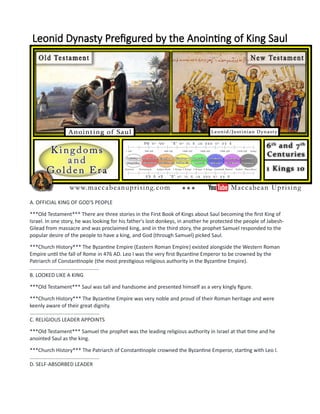
Leonid Dynasty Prefigured by the Anointing of King Saul
A. OFFICIAL KING OF GOD'S PEOPLE
***Old Testament*** There are three stories in the First Book of Kings about Saul becoming the first King of
Israel. In one story, he was looking for his father's lost donkeys, in another he protected the people of Jabesh-
Gilead from massacre and was proclaimed king, and in the third story, the prophet Samuel responded to the
popular desire of the people to have a king, and God (through Samuel) picked Saul.
***Church History*** The Byzantine Empire (Eastern Roman Empire) existed alongside the Western Roman
Empire until the fall of Rome in 476 AD. Leo I was the very first Byzantine Emperor to be crowned by the
Patriarch of Constantinople (the most prestigious religious authority in the Byzantine Empire).
................................................
B. LOOKED LIKE A KING
***Old Testament*** Saul was tall and handsome and presented himself as a very kingly figure.
***Church History*** The Byzantine Empire was very noble and proud of their Roman heritage and were
keenly aware of their great dignity.
................................................
C. RELIGIOUS LEADER APPOINTS
***Old Testament*** Samuel the prophet was the leading religious authority in Israel at that time and he
anointed Saul as the king.
***Church History*** The Patriarch of Constantinople crowned the Byzantine Emperor, starting with Leo I.
................................................
D. SELF-ABSORBED LEADER
***Old Testament*** King Saul was demonstrably concerned with his public image, his kingly stature, and
dignity.
***Church History*** The Byzantine Empire (Eastern Roman Empire) had a strong cultural identity and were
fiercely proud of their heritage as Romans. Not only were they now protectors of God's Church, but also saw
themselves as protectors of Roman heritage and tradition.
................................................
E. UNIFIED MOST OF THE PEOPLE
***Old Testament*** King Saul did not enjoy the same, universal acclaim and support that King David would
later enjoy. Instead, King Saul's actual kingdom comprised Benjamin, Gilead, and Ephraim. Saul enjoyed the
support of almost all of Israel, but not universal acclaim and allegiance.
***Church History*** The Byzantine Empire (Eastern Roman Empire) was the most powerful political/military
force in Europe after the fall of Rome (Western Roman Empire) in 476 AD. Catholics across Europe supported
the Byzantine Empire because they all shared a common religion. However, the Byzantines struggled very much
to exercise direct authority and control to most of Western Europe.
................................................
F. CHOSE THE FIRST CAPITAL
***Old Testament*** King Saul chose to locate his center of operations in Gibeah (which is likely where he was
originally from). The center and capital of Israel would later be moved to Jerusalem by King David, after Saul's
demise.
***Church History*** The first center of Christendom was Constantinople. It was the capital city of the Eastern
Roman Empire, and after the fall of Rome in 476 AD, was the unopposed center of Christianity. However, after
the schism of 1054 AD, and subsequent fall of the Byzantine Empire.. the transition of the center of
Christendom became complete, and the city of Rome now completely enjoyed the status as the capital.
................................................
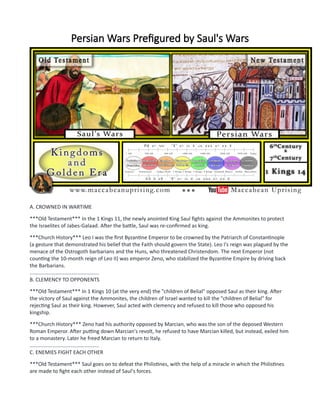
Persian Wars Prefigured by Saul's Wars
A. CROWNED IN WARTIME
***Old Testament*** In the 1 Kings 11, the newly anointed King Saul fights against the Ammonites to protect
the Israelites of Jabes-Galaad. After the battle, Saul was re-confirmed as king.
***Church History*** Leo I was the first Byzantine Emperor to be crowned by the Patriarch of Constantinople
(a gesture that demonstrated his belief that the Faith should govern the State). Leo I's reign was plagued by the
menace of the Ostrogoth barbarians and the Huns, who threatened Christendom. The next Emperor (not
counting the 10-month reign of Leo II) was emperor Zeno, who stabilized the Byzantine Empire by driving back
the Barbarians.
................................................
B. CLEMENCY TO OPPONENTS
***Old Testament*** In 1 Kings 10 (at the very end) the "children of Belial" opposed Saul as their king. After
the victory of Saul against the Ammonites, the children of Israel wanted to kill the "children of Belial" for
rejecting Saul as their king. However, Saul acted with clemency and refused to kill those who opposed his
kingship.
***Church History*** Zeno had his authority opposed by Marcian, who was the son of the deposed Western
Roman Emperor. After putting down Marcian's revolt, he refused to have Marcian killed, but instead, exiled him
to a monastery. Later he freed Marcian to return to Italy.
................................................
C. ENEMIES FIGHT EACH OTHER
***Old Testament*** Saul goes on to defeat the Philistines, with the help of a miracle in which the Philistines
are made to fight each other instead of Saul's forces.
***Church History*** In a brilliant political and military strategy, Zeno is able to play the barbarians against
each other, instead of uniting to fight the Byzantine Empire.
................................................
D. INTERJECTING INTO RELIGION
***Old Testament*** In 1 Kings 13, Saul's forces attack a Philistine garrison but the Israelites were very afraid
and his soldiers begin to slip away and desert him. To rally them together, Saul offers a sacrifice (which is
something only a priest can do, and Saul is not a priest). Upon hearing this, Samuel the prophet reproves Saul
for not obeying the Lord's commands.
***Church History*** Zeno inserted himself into theological matters, (infringing upon the authority and role of
the papacy) when he tried to settle the theological dispute between the Chalcedonians and Monophysites. He
did this to unite his empire and stop the Monophysites from slipping away from Imperial influence (The
Monophysites were primarily centered in the east, in Syria and Palestine). The pope rejected Zeno's
interference into theological matters. This affair started the tension between future Byzantine Emperors and
the papacy, as the Byzantine Empire demonstrated in future events that it thought itself the theological
superior of the papacy.
................................................
E. CONSTANTLY AT WAR
***Old Testament*** At the end of 1 Kings 14, it states that there was a great war between Israel and the
Philistines all the days of King Saul.
***Church History*** Shortly after Zeno's reign, the Persian empire rose to threaten the Byzantine empire. The
Byzantines and Persians would be in constant warfare until the fall and conquest of the Persian Empire by the
Arab Muslims. However, the Muslims picked up the war against the Byzantines and didn't relent until the fall of
Constantinople in 1453.
...............................................
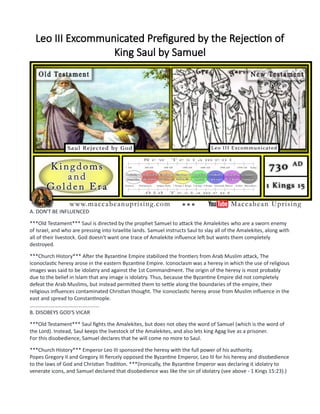
Leo III Excommunicated Prefigured by the Rejection of
King Saul by Samuel
A. DON'T BE INFLUENCED
***Old Testament*** Saul is directed by the prophet Samuel to attack the Amalekites who are a sworn enemy
of Israel, and who are pressing into Israelite lands. Samuel instructs Saul to slay all of the Amalekites, along with
all of their livestock. God doesn't want one trace of Amalekite influence left but wants them completely
destroyed.
***Church History*** After the Byzantine Empire stabilized the frontiers from Arab Muslim attack, The
Iconoclastic heresy arose in the eastern Byzantine Empire. Iconoclasm was a heresy in which the use of religious
images was said to be idolatry and against the 1st Commandment. The origin of the heresy is most probably
due to the belief in Islam that any image is idolatry. Thus, because the Byzantine Empire did not completely
defeat the Arab Muslims, but instead permitted them to settle along the boundaries of the empire, their
religious influences contaminated Christian thought. The iconoclastic heresy arose from Muslim influence in the
east and spread to Constantinople.
................................................
B. DISOBEYS GOD'S VICAR
***Old Testament*** Saul fights the Amalekites, but does not obey the word of Samuel (which is the word of
the Lord). Instead, Saul keeps the livestock of the Amalekites, and also lets king Agag live as a prisoner.
For this disobedience, Samuel declares that he will come no more to Saul.
***Church History*** Emperor Leo III sponsored the heresy with the full power of his authority.
Popes Gregory II and Gregory III fiercely opposed the Byzantine Emperor, Leo III for his heresy and disobedience
to the laws of God and Christian Tradition. ***(Ironically, the Byzantine Emperor was declaring it idolatry to
venerate icons, and Samuel declared that disobedience was like the sin of idolatry (see above - 1 Kings 15:23).)
................................................
C. REJECTED BY GOD
***Old Testament*** Samuel also declares "Because it is like the sin of witchcraft, to rebel: and like the crime
of idolatry, to refuse to obey. Forasmuch therefore as thou hast rejected the word of the Lord, the Lord hath
also rejected thee from being king." - 1 Kings 15:23
***Church History*** The pope excommunicated Leo III in 730 AD
................................................
D. TEARING AWAY FROM THE VICAR
***Old Testament*** Samuel turns to leave, but Saul reaches out and grabs Samuel's cloak and tears a piece
from it.
***Church History*** After the pope excommunicated Leo III in 730 AD, the Emperor ripped lands in northern
Italy away from the papacy.
................................................
E. KINGDOM GIVEN TO ANOTHER
***Old Testament*** Samuel declares that now "The Lord hath rent the kingdom of Israel from thee this day,
and hath given it to thy neighbor who is better than thee." - 1 Kings 15:28.
***Church History*** The papacy was soon to find a new protector of Christendom, because 2 years later, the
Frankish hero, Charles Martel would defeat the Muslims, and drive them from France at the Battle of Tours.
Charles would have a grandson, Charlemagne, who would be later crowned Holy Roman Emperor, and found
the great dynasty that ruled over Western Christendom for the next 1000 years.
...............................................
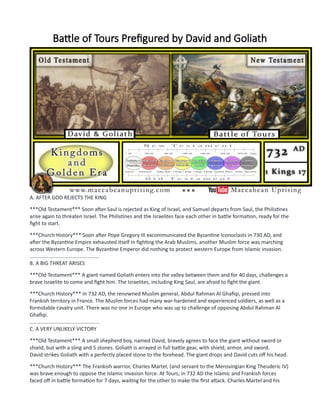
Battle of Tours Prefigured by David and Goliath
A. AFTER GOD REJECTS THE KING
***Old Testament*** Soon after Saul is rejected as King of Israel, and Samuel departs from Saul, the Philistines
arise again to threaten Israel. The Philistines and the Israelites face each other in battle formation, ready for the
fight to start.
***Church History*** Soon after Pope Gregory III excommunicated the Byzantine Iconoclasts in 730 AD, and
after the Byzantine Empire exhausted itself in fighting the Arab Muslims, another Muslim force was marching
across Western Europe. The Byzantine Emperor did nothing to protect western Europe from Islamic invasion.
................................................
B. A BIG THREAT ARISES
***Old Testament*** A giant named Goliath enters into the valley between them and for 40 days, challenges a
brave Israelite to come and fight him. The Israelites, including King Saul, are afraid to fight the giant.
***Church History*** In 732 AD, the renowned Muslim general, Abdul Rahman Al Ghafiqi, pressed into
Frankish territory in France. The Muslim forces had many war-hardened and experienced soldiers, as well as a
formidable cavalry unit. There was no one in Europe who was up to challenge of opposing Abdul Rahman Al
Ghafiqi.
................................................
C. A VERY UNLIKELY VICTORY
***Old Testament*** A small shepherd boy, named David, bravely agrees to face the giant without sword or
shield, but with a sling and 5 stones. Goliath is arrayed in full battle gear, with shield, armor, and sword.
David strikes Goliath with a perfectly placed stone to the forehead. The giant drops and David cuts off his head.
***Church History*** The Frankish warrior, Charles Martel, (and servant to the Merovingian King Theuderic IV)
was brave enough to oppose the Islamic invasion force. At Tours, in 732 AD the Islamic and Frankish forces
faced off in battle formation for 7 days, waiting for the other to make the first attack. Charles Martel and his
band of men defeated the Muslims, even though Charles had no cavalry. Such a feat was unheard of in military
history.
................................................
D. OVERTAKING THE CAMP
***Old Testament*** The Israelites chase after them and overtake the camp of the Philistines, which they
plunder.
***Church History*** The Franks pursued the fleeing Muslims, and overtook their camp, which the Muslims
left behind... they fled so far and so fast from the Franks.
................................................
E. VICTORY BRINGS GREAT FAME
***Old Testament*** Because of David's incredible victory, his bravery and because he delivered Israel from a
threat of which they were very fearful, David was acclaimed as a great hero. David's popularity spread
throughout all the land.
***Church History*** The victory of Charles Martel caused him to be an instant celebrity in Europe, who hailed
him as the great hero who saved them from certain Muslim conquest.
................................................
F. MARKS RISE OF THE GREAT KING
***Old Testament*** David's fame (because of his victory) launched him on a military/political career that
culminated with him eventually being crowned king of all Israel. David is remembered as the greatest king of
Israel, and the founder of the Davidic Dynasty. King David's descendants sat on the throne of Judah until the
kingdom was abolished by Nebuchadnezzar.
***Church History*** Charles Martel's fame (because of his victory) launched his household (the house of
Carol) into the very center and apogee of European military and political activity. Charles Martel's grandson was
Charlemagne... the great Catholic Emperor of Europe. Charlemagne founded the Holy Roman Empire around
the year 800 AD. Charlemagne's descendants ruled as Holy Roman Emperors until the eventual abolishment of
the Holy Roman Empire by Napoleon in 1806 AD.
...............................................
Crowning of Charlemagne Prefigured by the Anointing
of King David
A. KINGDOM GIVEN TO ANOTHER
***Old Testament*** After King Saul was rejected by Samuel (and by God) for his disobedience, Samuel told
Saul that God would take the kingdom away from him, and give it to his neighbor, who "is better than thee". - 1
Kings 15:28.
***Church History*** After the Byzantine Emperor Leo III was excommunicated by Pope Gregory III in 730 AD,
and after the continuation of the Iconoclast heresy in the Byzantine Empire, the papacy realized it needed a
new protector. The Franks of Western Europe have defended Europe from Islamic invasion and were devout
Catholics who submitted to Papal authority.
................................................
B. ANOINT THE YOUNG ONE
***Old Testament*** Samuel is then instructed by God to go find Jesse from the tribe of Judah, and anoint one
of his sons, the one that God chooses. God chose the young shepherd boy, David, who was called out of the
fields.
***Church History*** The Franks had many divisions and feuded often. A relatively new clan of Franks, the
Carolingians, produced a man named Charles Martel, who defeated the Muslim forces in Tours in 732 AD. This
victory launched the House of Carol (the Carolingians) into immense fame and prestige. In 752 AD, Pope St.
Zachary ended all Frankish feuds when he proclaimed Pepin (from the house of Carol) as king of the Franks,
thus supplanting the older and more respected Frankish Merovingian line of kings, and establishing a new line,
the Frankish Carolingian line.
................................................
C. ANOINTED BY SURPRISE
***Old Testament*** David is anointed by surprise, in the presence of his family. He is the youngest of all his
brothers, but he has become their king and their superior.
***Church History*** 48 years later, in 800 AD, Charlemagne (the grandson of Charles Martel), the son of Pepin
is crowned 'Holy Roman Emperor' by surprise by Pope Leo III on Christmas Day at St. Peter's Basilica in Rome.
................................................
D. ALREADY A REIGNING KING
***Old Testament*** There are now two Kings in Israel, King Saul, and King David.
***Church History*** Now there were two Emperors in Christendom, Charlemagne and the Byzantine Emperor
in Constantinople.
................................................
E. START OF A GREAT DRAMA
***Old Testament*** At first, Saul loves David for his valor in battle. But, eventually, Saul distrusts David and is
jealous that David is more admired in Israel than Saul is himself.
***Church History*** The Byzantine Empire viewed Charlemagne very controversially because the papacy
recognized Charlemagne as Emperor and not the Emperor in Constantinople. The victories of the Carolingian
kings against the forces of Islam and the Magyars probably didn't help the Byzantine Emperors not to feel
jealous either.
................................................
Carolingians Prefigured by King David
A. THREE CROWNS AND A SURPRISE
***Old Testament*** King David didn't know that Samuel was going to anoint him, King, until it happened.
When David was anointed King by Samuel, King Saul was already the reigning King. David was first anointed
King by Samuel, then anointed again as King of Judah, and finally anointed King of all Israel
***Church History*** Charlemagne didn't know that Pope Leo III was going to crown him emperor until it
happened. When Charlemagne was crowned Emperor, Empress Irene was already reigning from
Constantinople. Charlemagne was first crowned king of the Franks, then crowned King of the Lombards in Italy,
and finally, he was crowned Holy Roman Emperor.
................................................
B. HERO OF THE PEOPLE
***Old Testament*** David was the great hero to the Israelites because of the famous victory he had over
Goliath. His fame eventually led to the people rallying behind him and he started a new line of kings in Israel,
the Davidic Dynasty.
***Church History*** Charlemagne's grandfather, Charles Martel, was the great hero of Europe because he
won a very unlikely victory of the Muslims at the Battle of Tours and saved
Europe from further Islamic invasion. His fame eventually led to his son and grandson to become the first in a
new line of European Kings, the Carolingian Kings.
................................................
C. EXPANSION BY CONQUEST
***Old Testament*** King David greatly expanded the Kingdom of Israel through all his battles and conquests.
He defeated many of the enemies of Israel and established dominance. He upheld the Covenant and promoted
the worship of the True God.
***Church History*** Charlemagne greatly expanded the Holy Roman Empire, through his battles and
conquests. He defeated and converted many of the Arian barbarian tribes, and established dominance of
almost all of Europe. He promoted the Catholic Faith in all his lands.
................................................
D. DESCENDANTS RULE UNTIL THE END
***Old Testament*** King David was promised by God that his Kingdom would endure. From David came all
the rest of the kings of Israel, then of Judah all the way up until the end of the
Davidic Kingdom, when Nebuchadnezzar abolished the kingdom during the Babylonian Exile.
***Church History*** Charlemagne's descendant ruled the Holy Roman Empire all the way up until it's
eventual end in 1806 when Napoleon deposed the last of the Holy Roman Emperors, Francis II.
................................................
E. SEXUAL SINS OF THE KING
***Old Testament*** David was described as a man after God's own heart, however, his great sin was
committing adultery with Bathsheba, then having her husband killed.
David also had many wives and concubines as well as illegitimate children.
***Church History*** Charlemagne was a true son of the Church, and submitted to Her authority, however,
Charlemagne was many wives and mistresses, as well as illegitimate children.
................................................
F. REVOLT OF THE KING'S SON
***Old Testament*** David's son, Absalom, revolted against him and plotted to overthrow his kingdom. David
was able to stop Absalom and retained control.
***Church History*** Charlemagne's oldest son, Pepin, also plotted to overthrow his father's empire.
Charlemagne discovered the plot and sent Pepin away into exile, and retained control of his Empire.
................................................
G. PROMOTION OF THE SACRED MUSIC
***Old Testament*** David is credited with composing some of Psalms, although it can't be proven. David
played the harp, and loved music, especially to glorify God. The Psalms served as the central liturgical music
tradition for the entire history of the Israelites.
***Church History*** The Carolingian kings promoted and shaped Gregorian chant throughout all of Europe.
Gregorian chant served as the central liturgical musical tradition for the entire history of the Catholic Church.
................................................
H. THE DAUGHTER'S SHAME
***Old Testament*** King David's daughter Tamar was denied the offer for marriage, then forced into a sexual
relationship. David, her father, didn't do anything about the forced relationship. It was her brother Absalom
that took her in and covered her shame.
***Church History*** Charlemagne didn't allow his daughters to marry, but instead, allowed them to engage in
adultery. At the death of Charlemagne, the brother of the daughters of Charlemagne, Pepin the Pius, covered
the shame of his sisters by sending them to convents to live out the rest of their days.
................................................
Battle of Lechfeld Prefigured by David's Success in King
Saul's Army
A. BROUGHT INTO THE KING'S ARMY
***Old Testament*** After David defeated Goliath, he was taken into the house of King Saul. David was made a
captain over King Saul's army.
***Church History*** In the early 10th century, the Magyars descended into Eastern Europe from the Ural
Mountains. They were a fierce tribe and conducted raids into Byzantine territory and into Western Europe. They
were a terror to the Christians in both the east and the west. This descendant of Charlemagne (and Charles
Martel) was a new force to protect Christianity and whose help the Byzantine Empire welcomed... at least, at
first.
................................................
B. A SUCCESSFUL WARRIOR
***Old Testament*** David prospered in all his endeavors, and was very successful in defeating the Philistines,
who were a constant threat to the Israelites.
***Church History*** The Magyar threat was checked by Holy Roman Emperor Otto II, who defeated them
solidly at the Battle of Lechfeld in 955 AD.
................................................
C. PEOPLE LOVE THE NEW HERO
***Old Testament*** The people of Israel loved David, and they said: "Saul kills a thousand, but David will kill
ten thousand". Thus, the nation of Israel looked at David as their great hero, even though Saul was their
reigning king.
***Church History*** This victory gave incredible popularity to Otto II, who was able to found the official Holy
Roman Empire as a result (although Charlemagne can also be viewed as its founder also). Christians were
beginning to place their trust and hope for protection in the Holy Roman Empire, and not so much in the
Byzantine Empire, who was not able to stop the Magyar threat, as the Magyars continued to raid into Byzantine
territory until 970 AD. In the year 1000 AD, Pope Sylvester II crowned St. Stephen as the first Christian king of
Hungary (Magyar). The Magyar threat completely ended for the east and west.
................................................
D. THE KING IS JEALOUS
***Old Testament*** Of course, this infuriated Saul, and turned his heart against David.
***Church History*** Even though the Byzantine Empire benefited from the actions of the Papacy and the Holy
Roman Empire, their prestige was diminishing, and it contributed to the estrangement between the Byzantine
Empire and the Holy Roman Empire.
................................................
Otto II and Theofanu Prefigured by David and Michol
A. INTO THE ROYAL FAMILY
***Old Testament*** Because of David's victories, and his increasing popularity among the people, King Saul
sought to undermine David. He promised David that he could marry his (Saul's) daughter if David brought back
100 foreskins of dead Philistines.
***Church History*** The victories of the papacy and of the Holy Roman Empire over the pagan Magyars
increased the popularity of the Latins tremendously. The Latins both defeated the Magyars in battle at Lechfeld
in 955 AD but also brought them into the New Covenant with the mass conversion (and baptisms) of the
Magyars after the year 1000 AD.
Otto I, the Holy Roman Empire, was expanding his territory to the south and the east, which made the
Byzantine Empire more and more nervous. To ease the political situation, the Byzantine princess Theofanu was
married to the son of Otto I.
................................................
B. A PROVEN DEVOUT WARRIOR
***Old Testament*** This was a symbolic act because the foreskin was the part of the male body that was cut
off during circumcision. Circumcision was the way that one entered into the Old Testament Covenant with God.
By giving King Saul 100 foreskins, it was a gesture meant to show that David was committed to eliminating the
enemies of Israel.
***Church History*** The Western Holy Roman Empire was very successful in defeating the enemies of
Christendom in Eastern Europe. The Byzantine Empire was not nearly as successful and benefited much from
the Western Holy Roman Empire.
................................................
C. A GREAT HONOR
***Old Testament*** In David's eyes, it was a great honor to become the son-in-law of King Saul. He didn't
realize that King Saul sent him off to fight the Philistines in the hopes that they would kill David. When David
brought back the Philistine foreskins, Saul did give his daughter Michol to David in marriage.
***Church History*** Otto II thought it was a great honor to marry a Byzantine Princess! Theofanu was a
beautiful and loving wife to her husband, Otto II. She was loved by her subjects in Western Europe and
introduced many things to them, such as the fork!
................................................
D. THE KING'S JEALOUSY AND TREACHERY
***Old Testament*** Saul wanted Michol to be a stumbling block to David, but she ended up falling madly in
love with David instead.
***Church History*** Otto II continued to expand his empire, but suffered a devastating defeat by the Muslims
at the Battle of Silo in 982 AD. Some sources claim that the Muslims had received support from the Byzantines.
The Byzantines were looking to undermine the Holy Roman Empire and stop its expansion.
................................................
Schism of 1054 Prefigured by the Separation of David
and Saul
A. GROWING ESTRANGEMENT
***Old Testament*** King Saul was growing increasingly jealous of David. When David knew that King Saul was
seeking after David to kill him, David fled from Saul. There came a point when David definitively split from Saul,
never to see him again.
***Church History*** In 1054 AD, the Pope excommunicated the Patriarch of Constantinople. This was the
result of a century-long, and ongoing estrangement between the Latin west and the Greek east. This date is
referred to as the 'Great Schism' and is the definitive moment that the two empires officially and permanently
separated from each other.
................................................
B. CONSECRATED BREAD AND A WEAPON
***Old Testament*** David first fled to the priest city of Nobe, where the high priest gave David consecrated
'bread of proposition', but only after making sure that David had abstained for the proper amount of time (that
is, abstained from women). The high priest also gave David the sword of Goliath, so that David could properly
defend himself.
***Church History*** In the year 1119 AD, the pope created the first military order of fighting monks, the
Knights Templar, which proved to be a great weapon for the Latin Empire in defending Christendom. In 1215 AD
the pope called the 'Fourth Council of the Lateran'. This council dogmatized the teaching of
TRANSUBSTANTIATION, the Catholic Church's teaching that bread and wine are changed in their very substance,
to the Body, Blood, Soul, and Divinity of Our Lord Jesus Christ. Thus, in the period of Church history, the papacy
gave the Latin Empire a great weapon (the Knights Templar) and also gave the teaching about the Holy
Eucharist, which is like the "consecrated bread" that the high priest gave to David. (David had to abstain, and so
must we abstain from food and drink before we consume the Holy Eucharist!)
................................................
C. COULD HAVE KILLED THE KING
***Old Testament*** David fled further from Saul, into the forest and the desert. At one point, David was
hiding in a cave. Saul entered, not knowing David was hiding in that cave. David secretly cut off a piece of Saul's
cloak to prove to Saul that he could have killed him, but that he has no desire to do so since Saul was the Lord's
anointed. Later still, David stealthily entered into Saul's tent at night when he was sleeping. David stole Saul's
spear and water jug, to again prove that he meant Saul no harm and that he could have killed him.
***Church History*** During the Crusades, which were taking place around this time also, the Holy Roman
Emperor Frederick Barbarossa was traveling with his army to the Holy Land, on a crusade. He made a treaty
with the Byzantine Empire that he would be allowed to pass through Byzantine lands. The Byzantine Emperor
agreed, but he secretly made an alliance with the Muslims. As soon as Frederick Barbarossa entered into
Byzantine lands, he was attacked by the Byzantines. Frederick and his Latin army easily defeated the Byzantine
forces, but only so much as to protect themselves. Frederick could have easily sacked Constantinople and
ended the Byzantine Empire, but he had no desire to do so. Instead, he passed peacefully through Byzantine
lands despite the Byzantine aggression towards him.
................................................
D. LIVING AMONG THE ENEMY
***Old Testament*** After this encounter, David separated himself from Saul definitively, and they never met
again. David fled into the land of the Philistines and abode among them for a time.
***Church History*** The Crusaders abode in the Holy Land, among the Muslims for decades. The Byzantine
Empire was very close to the Crusaders in the Holy Land, but the Crusaders lived on their own, in established
Latin kingdoms among the Muslims in the Middle East.
................................................
Battle of Manzikert Prefigured by the Battle of Gilboa
A. GATHERING OF ENEMY FORCES
***Old Testament*** The Philistines were preparing for a major offensive against Israel, and gathered all their
forces together for a major attack.
***Church History*** Islam had spread throughout the east, converting different pagan tribes and uniting
them under a common religion (even though they still feuded with each other considerably). The Turks from
the north were converted to Islam and were enemies of the Byzantines.
................................................
B. ENEMY MOVES DEEP INLAND
***Old Testament*** The Philistines marched deep into Israelite territory, and fought the Israelites on Mount
Gilboa.
***Church History*** In 1071 AD, the Byzantine Emperor led an army into Anatolia (present-day Turkey).
Anatolia was the heart of the Byzantine Empire and was crucial to its survival. However, the Byzantine's were
defeated by the Turks in 1071 AD, at the Battle of Manzikert. This was the death blow to the Byzantine Empire,
as their tax collection and soldier recruitment heartland was now in Muslim hands.
................................................
C. A MAJOR BLOW TO THE LINEAGE
***Old Testament*** Saul and his son Jonathon died in the battle, however, Saul's other descendants survived,
and kept the house of Saul alive and reigning over Israel.
***Church History*** However, the Byzantine Empire still controlled the city of Constantinople and the Balkan
Peninsula.
................................................
D. THE NEW KING HAS RESPONSIBILITY
***Old Testament*** David mourned for Saul's death, and David realized that now the defense of Israel fell
upon him.
***Church History*** The Latin west was saddened by the news of the defeat of the Byzantines, for even
though they were estranged from each other, the Byzantines were still considered Christians, and still fought
the enemies of Christendom.
The defeat of the Byzantine's at the Battle of Manzikert demonstrated to the Latin west that the responsibility
for defending Christendom now belonged to them. Shortly after this battle, Pope Urban II called the First
Crusade to take back the Holy Land from the Muslim forces, and to aide the Byzantine Empire.
................................................
Crusades Prefigured by the Wars of King David
A. KING'S LINE WEAK, BUT ALIVE
***Old Testament*** After the death of King Saul King, David was crowned King of the Tribe of Judah.
However, the son of King Saul, Ishbosheth, was claiming King Saul's crown, and thus claimed the throne of the
King of Israel. A civil war erupted between the men of David, and the men loyal to the house of King Saul
***Church History*** After the defeat of the Byzantines at the Battle of Manzikert in 1071 AD, the Byzantine
Empire was severely weakened, but still had a small empire. In the west, in 1155 AD, the descendant of
Charlemagne, Frederick I Barbarossa was crowned the Holy Roman Emperor in Italy. (Italy is paralleled with the
tribe of Judah, which we will address in upcoming pages). War broke out between the Latin west and the Greek
east.
B. TAKING OF JERUSALEM
***Old Testament*** Once David became the King of Israel, he wanted a new capital city. He conquered the
city of Jerusalem and took it from the Jebusites. It is not certain which date in history David did this, but using
Biblical evidence, the date of 999 BC is suggested.
***Church History*** The Latin west launched the Crusades to defend Christendom from the growing and
pernicious Islamic threat. In the year 1099 AD, the Crusaders conquered and captured the city of Jerusalem and
established the Kingdom of Jerusalem.
................................................
C. MAKING GOD'S PEOPLE SECURE
***Old Testament*** David fought many wars, as described in 2 Kings 8. He secured the borders of Israel and
laid the foundation for an era of peace and prosperity. This era of peace and prosperity would come with the
reign of King Solomon, David's son.
***Church History*** For hundreds of more years, the Crusades raged in the east. Even though the Crusaders
failed in their ultimate goal of keeping Jerusalem, they did succeed in driving back the Muslim forces to such a
degree that the Islamic jihad no longer threatened the European Continent. Even in Spain, the Reconquista was
slowly taking back the Iberian Peninsula for Christendom. The Crusades laid the foundation for an era of peace
and prosperity that would follow during the Renaissance. (much more on this later)
................................................
Crusading Orders Prefigured by David's Mighty Men
A. KING'S MEN NUMBER AROUND 30
***Old Testament*** David had an entourage of exceptionally powerful warriors. These were called "David's
Mighty Men" in 2 Kings 23. Based on the Biblical evidence, there were anywhere from 30 to 37 of these 'Mighty
Men' of David.
***Church History*** The Holy Roman Empire initiated around 30+ military orders during the Crusades.
................................................
B. CRUCIAL FOR THE KING'S WARS
***Old Testament*** David's mighty men were crucial in fighting against the enemies of Israel. Here is a list of
the deeds of some of David's Mighty Men.
Jesbaham - "killed eight hundred men at one onset" - 2 Kings 23:8
Eleazar- "he stood and smote the Philistines till his hand was weary, and grew stiff with the sword" - 2 Kings
23:10
Semma- "He stood in the midst of the field, and defended it, and defeated the Philistines" 2 - Kings 23:12
Abisai- "he lifted up his spear against three hundred whom he slew" 2 Kings 23:18
Banaia- "he slew the two lions of Moab" - 2 Kings 23:20
***Church History*** These military orders were elite fighting units that provided crucial services during the
Crusades, and also had incredible military accomplishments. Here are some of the remarkable victories of the
military orders.
Knights Templar - In 1177 AD, during the Battle of Montgisard, about 500 Templar knights lead a couple
thousand infantry to victory against a Muslim force of approximately 26,000.
Knights Hospitaler- In 1191 AD, at the Battle of Arsuf, the Knights Hospitalers led a devastating cavalry charge
against the Muslim forces of Saladin. A relatively small number of Knights were able to rout a much larger
enemy force.
Knights of St. Lazarus - These were knights from other orders who contracted leprosy. The fatal disease made
them more fearless of death, as well as deadened their nerve endings, so they did not feel pain. This order
exhibited incredible bravery, often against great odds.
................................................
C. ONE IS BETRAYED AND KILLED BY THE KING
***Old Testament*** There were many other mighty men of David. One of the more famous of these mighty
men was Uriah the Hittite. Uriah was betrayed by King David because David had impregnated Uriah's wife,
Bathsheba. (more on this in upcoming pages).
***Church History*** There were many other military orders that were established during the Crusading years.
However, the most famous is probably the Knights Templar. The story of their disbandment is very controversial,
but there is very good evidence that points to their betrayal and murder by King Philip IV of France, who owed
the Knights a very large sum of money and didn't want to pay it back. (more on this in upcoming pages)
................................................
Duns Scotus Prefigured by Uzzah Touching the Ark
A. A PALACE FOR THE KING
***Old Testament*** After the death of Saul, Abner and Ishbosheth, David was unopposed as the King of
Israel. He wanted to secure a new capital for his Kingdom, and he conquered the city of Jerusalem which was
owned by the Jebusites. The King of Tyre send magnificent building supplies from present-day Lebanon, and
David constructed for himself a magnificent palace.
***Church History*** After the Battle of Manzikert in 1071 AD, and the subsequent sack of Constantinople in
1204 AD and the establishment of the Latin Kingdom of Constantinople, the papacy was at the height of its
temporal power. Pope Innocent III greatly enhanced the Lateran Palace, where the popes reside. At this time, it
was the most beautiful building in Western Europe and was luxurious and magnificent.
................................................
B. A NEW FOCUS ON THE ARK
***Old Testament*** The next thing David did was to travel to Gabaa, which is where the Ark of the Covenant
was being kept. David wanted to move the Ark to Jerusalem, in his new capital city.
***Church History*** At this time also, a great era of theological growth and blossoming occurred. Roman
Catholic Theology started to desire a greater precision in Christian philosophy.... and in particular, in the
theological field of Mariology.
................................................
C. IMPROPER HANDLING OF THE ARK
***Old Testament*** However, the way that David chose to transport the Ark was very problematic. The Ark
was supposed to be carried by priests, who had to cautiously and attentively care the ark on poles, that were
run through metal rings that were attached to the Ark. In this way, the Ark would be handled with the utmost
respect, and also, the priests would not touch the Ark... for it was forbidden to touch the Ark.
Instead, David put the Ark of the Covenant on the back of an Ox cart and pulled it along towards Jerusalem.
This was not the proper way in which the Ark should be treated because this method of transportation did not
give adequate respect to the Ark, and also put the Ark at risk of falling off of the cart onto the ground (which
would have been a great sacrilege).
***Church History*** A great debate arose over the question about Our Lady's sinlessness and purity.
However, instead of calling a theological council, or sponsoring a proper forum for this issue to be resolved,
discussions and arguments occurred in an unofficial capacity. This was not the proper respect and decorum due
to Our Lady.
Many great theologians and even great Saints were not sure that Our Lady was immaculately conceived and
was free from all stain of sin, either personal or original sin. St. Thomas Aquinas made statements indicating he
believed Mary to have sin... and so did St. Bonaventure make similar arguments.
................................................
D. THE ARK IS "UNTOUCHABLE"
***Old Testament*** In fact, this is just what happened, because Ox cart hit a rock, and the Ark started to tip
over. It was going to fall off the cart onto the ground, except at the last second a man named Uzah rushed
towards the Ark and pushed it back onto the cart. He saved the Ark from falling, but Uzah was instantly killed
for touching the Ark (which was forbidden... the Ark was to remain untouched and undefiled).
***Church History*** However, one man came forward to preserve the doctrine of Our Lady from "falling on
the ground"... so to speak. This man was Duns Scotus, and he articulated a theological position that preserved
Our Lady from all sin, and kept the doctrine of Our Lady "untouched". Our Lady was conceived without any sin,
and She remained sinless Her whole life. This is the Dogma of the Immaculate Conception.
What is very interesting, is that later in life, Duns Scotus dies very suddenly and unexpectedly. Perhaps, Duns
Scotus died that way for "touching the Ark". The Dogma of the Immaculate Conception was officially taught by
the Catholic Church by Pope Pius IX in 1854 in his papal bull Ineffabilis Deus.
................................................
E. FIRST KING IGNORES THE ARK
***Old Testament*** Of further interest is the parallel with Gabaa, the town from which David took the Ark...
and the Byzantine theology about Our Lady. Gabaa was a town in the Tribe of Benjamin (which was the tribe of
which King Saul came from). King Saul did not give great honor to the Ark. In the days of Saul, the Israelites
were not in the habit of consulting the Ark, and neither was King Saul. 1 Paralipomenon 13:3.
***Church History*** Similarly, in the time of the Byzantine Empire, no attention was given to develop the
doctrines and beliefs concerning the Blessed Virgin Mary. Our Lady was displayed in religious art, but no
conscious and deliberate attempt was made to honor Her by studying her in great detail since the proclamation
of Theotokos in 431 AD. Our Lady was to be given honor and much more attention by Roman Catholic theology,
particularly from the mid 13th century onward................................................
Knights Templar Prefigured by Uriah the Hittite.
A. KING STAYS BACK FROM BATTLE
***Old Testament*** During the later days of King David's wars, a story unfolds about David and his great sin.
In the early days of David's reign, he led his men in battle. In this story, however, David is resting in his palace
while his men are out fighting the enemy.
***Church History*** At the beginning of the 14th century, the Crusades already have been raging for almost
200 years. The kings of Europe used to go on Crusade with their armies as did King Richard the Lionheart and
St. King Louis of France. However, during this time, political support for the Crusades is diminishing, although
there are many military orders of fighting monks who are stationed around the Mediterranean, desiring to
launch another Crusade to re-take Jerusalem again.
The King of France, King Philip IV (otherwise known as King Philip the Fair...because he was so handsome), liked
to live in luxury.
................................................
B. THE KING COVETS FROM HIS PERCH
***Old Testament*** David's palace is the highest building in Jerusalem, and from it, he can look down on his
kingdom. He looks out and sees a beautiful woman bathing on her roof. He sends word to find out who she is,
and the word comes back that her name is Bathsheba, the wife of Uriah the Hittite, one of David's Mighty Men.
***Church History*** King Philip IV is at the top of political and social life in his kingdom of France. He is
desiring more money and lands. During a riot in Paris, he took shelter with the Knights Templar, at which time
his court (and himself) borrowed a large sum of money from the Knights which he never paid back (nor did he
want to pay it back). King Philip knows that the Knights Templar are in possession of great wealth and property.
................................................
C. WARRIOR CALLED BACK FROM BATTLE
***Old Testament*** Uriah is out with the army fighting Israel's enemies. David sends for her, and she comes
to him. She becomes pregnant with David's child. David is now concerned about how he can get out of this
situation without having to face any difficulties, so he decides to call Uriah the Hittite back from battle.
***Church History*** Jacques DeMolay, the grand-master of the Knights Templar, is out in the field with his
fighting Knights. He is called back from the Crusading effort by Pope Clement V (who is greatly influenced by
Philip IV of France).
................................................
D. LOYAL WARRIOR REJECTS COMFORT
***Old Testament*** Once Uriah appears before him, he asks Uriah how the war is going. Then, he tells Uriah
to go back to his house and to be with his wife, Bathsheba. David hopes that by sending Uriah home to be with
his wife, he will be able to cover up his act with Bathsheba and hide the fact that David is the father of
Bathsheba's baby. However, Uriah refuses to go home, because he does not want to be lounging in luxury while
his fellow soldiers are fighting. He sleeps in the court of David's palace.
***Church History*** The Pope, and King Philip want to know if Jacques DeMolay would agree to a merger of
his order with the Knights Hospitaler... with Philip IV as the new head of the merged organization. (This would
have effectively wiped out Philip's debts to the Templars, and gave him access to their money and land). The
Knights are wealthy, but they don't enjoy their wealth, but instead live austere lives so they can stay sharp and
focused towards their goal of conquering back the Holy Land for Christ and His Church. Therefore, Jacques
DeMolay politely rejects the proposition of a merger.
................................................
E. BETRAYED BY THE KING'S LETTER
***Old Testament*** So, David then decides to kill Uriah, so he can then marry Bathsheba, and thus solve the
problem about Bathsheba's pregnancy. To accomplish this, David writes a sealed letter to Joab, his army
general. He gives the letter to Uriah and sends him back to the army. Joab opens the sealed letter, in which it
states to have Uriah killed by placing him in the worst part of the battle and then leaving him alone to fight.
Uriah is killed, and David then takes Bathsheba to be his wife.
***Church History*** Philip IV decides to eradicate the Knights Templar and take their money by force. He
sends out sealed letters to his men in France, with orders to open them on a specified day. On that day, the
King's men open the letters, which tell them to immediately arrest and torture the Knights Templar in France.
The Knights Templar make confessions under torture, saying that they did outrageous acts of immorality and
blasphemy. The Pope, based on these confessions, ends the Knights Templar. King Philip IV keeps the monetary
assets of the Templars, as well as the automatic forgiveness of his debts to them. Jacques DeMolay is burnt at
the stake in Paris, all the while declaring his innocence before God, and retracting the confession he made
under torture.
St. Catherine of Sienna Prefigured by Nathan the
Prophet
A. TAKING, AFTER THE BETRAYAL
***Old Testament*** After David committed his great sin of adultery with Bathsheba, and then the murder of
her husband (and his mighty warrior) Uriah the Hittite, he then takes Bathsheba to be his wife.
***Church History*** At the beginning of the 14th century, in the year 1309 AD, a French pope was elected,
Pope Clement V. He was greatly influenced by the powerful King Philip IV of France, and Pope Clement decided
to move the papal court from Rome to a city in Avignon, France. At this same time, the Knights Templar were
arrested and tortured by King Philip IV of France, probably because he wanted to erase his debts to them and
take their money.
The papal court in Avignon became more and more corrupt, and it was a very dangerous development for the
Church... as the papal court seemed more and more secular and less and less clerical. It was a great scandal for
Christendom to have the papacy in a place where it did not belong, instead of Rome.
................................................
B. ADMONISHED FOR HIS SIN
***Old Testament*** However, he is confronted by Nathan the Prophet who admonishes David for his sin and
calls him to repentance.
Nathan tells a parable about a rich man who has many sheep but instead chooses to steal the sheep of another
(this is a metaphor for David already having many wives, but instead taking the wife of another man). David has
taken what does not belong to him.
***Church History*** In 1375 AD, St. Catherine of Sienna was able (through God's grace) to convince Pope
Gregory XI to return to Rome... and he returned to Rome in 1377 AD. This was the end of the Avignon Papacy..
the pope was finally back in Rome where he belonged!
................................................
C. THE SWORD SHALL NEVER LEAVE HIS HOUSE
***Old Testament*** As a punishment for David's sin, God tells him that the sword shall never leave his house.
Indeed, from this point on, the house of David is plagued by violence and even the rebellion of his own son,
Absalom who claims the throne of his father. David's house remains in turmoil until his death, and the reign of
his son, Solomon.
***Church History*** the Avignon Papacy was the start of a long crisis for the papacy that lasted for over 100
years. The Great Papal Schism followed the Avignon papacy, in which a series of anti-popes claimed to be the
pope, even while the real pope was reigning in Rome. Order was restored just as the Renaissance was
beginning.
Black Death Prefigured by the Plague of King David
***OLD TESTAMENT***
In reading through Biblical commentaries, there is a lot of evidence to suggest that 2 Kings 21 - 24 are not
placed in chronological order inside the Book of 2 Kings. This can be deduced when comparing the
corresponding story from 2 Kings 24 with it's placement in 1 Paralipomenon 21. The proper chronological
placement of the story of David's plague in 2 Kings 24 would have probably occurred sometime after David
brought the Ark to Jerusalem and sometime before Absalom's rebellion. (so, that would be somewhere
between 2 Kings 6 and 2 Kings 18.) Nonetheless, apart from this educated speculation, here is a summary of
the story from 2 Kings 24.
--------------------------------------------------------------------------------
King David has vanquished his enemies and was ruling over a very prosperous and numerous people. His pride
wanted to know just how big and powerful his kingdom had become, so he called a census to be taken
throughout the Kingdom of Israel.
Afterwards, he realized that he had done foolishly, and asked God for mercy. However, the prophet Gad came to
David and told him he could pick his punishment. Either he could pick 7 years of famine, 3 months of running
from his enemies or 3 days of plague. David chose the plague, and an incredible sickness spread through the
land killing 70,000 people very quickly. David recognized and admitted that it was because of his sin that this
terrible plague had come upon his people.
***CHURCH HISTORY (NEW TESTAMENT)***
In 1315 AD, Europe was struck with a great famine, generally thought to have occurred partly because the crop
production was not keeping pace with the rapidly growing... exploding.... European population. Europe had a
lot of people.... and in some parts of Europe in the early 1300's, the population was as high as it would later be
in the 19th century.
This was also the time in which Europe started to turn from its altruistic and pious motivations (as exhibited in
the myriads of Europeans who risked life and limb to re-Christianize the Holy Land). During this time, the
English King invaded France in order to claim vast tracts of land for the English crown. This time also saw the
start of the Avignon papacy and the greed and corruption of the French King, Philip IV.
In the midst of these events, the Black Death swept into Europe, around the year 1347 AD and continued until
1353 AD. The death toll in Europe was unimaginable with vast percentages of the population dying, in the
ranges of 30% to sometimes 70%, depending on season and location.
The people of Europe turned to the Church for an answer and a solution. The Church responded by saying that
the Black Death was a punishment from God for the sins of the people, and the solution was to pray, pray, pray
to Almighty God for an end of the plague.
***NOTE*** Because it is likely that the account of the plague in 2 Kings 24 actually occurred closer to the
events in the middle of the 2 Kings, then that would place the plague of David much closer to the
chronologically ordered parallel of the Black Death in the corresponding time point in Church History!
England Invades France Prefigured by Amnon and
Thamar
A. THE SWORD SHALL NOT LEAVE
***Old Testament*** After David's great sin of adultery with Bathsheba, and the murder of her husband Uriah,
David repented of his sin. God forgave David but said that his punishment would be that the sword would never
leave David's house. David's house (his family) would be plagued by atrocities and bloodshed.
***Church History*** The start of the 14th century was the start of very tumultuous times for the papacy, and
for Christendom. The 1300's started with two great scandals, that of the Avignon papacy (in which the papacy
moved to France, where it did not belong) and secondly, this time saw the betrayal and murder of the Knights
Templar by King Philip IV, and the abolishment of their order by Pope Clement V. These events (particularly the
Avignon papacy) contributed directly to future scandals, such as the Great Papal Schism and the 100 Years War.
(see below)
............................................................................
B. THE CHILDREN ARE MATURE
***Old Testament*** David's children (especially his older children) were maturing, and the focus of the story
of King David shifts inwards, into the interior life of his family. As his children get older, their desires grow and so
does their sense of autonomy and their craving for power. This will be manifest in the story of Amnon and of
Absalom, among others as well.
***Church History*** Europe had lost the desire to Crusade, and Europe is now safe from Islamic invasion. The
kingdoms of Europe have matured and have grown more self-aware of their own specific cultures and have
grown considerably in their self-determination. Historians attribute the rise in European national identity to
effects of the 100 Year War (the 100 Years War was the war between France and England that started in 1337
AD when England invaded France.)
............................................................................
C. LUST FOR HIS HALF SISTER
***Old Testament*** The start of this punishment occurred with a situation that arose between David's son
Amnon and David's daughter Thamar. Amnon and Thamar had the same father (King David), but different
mothers. Amnon found himself to be extremely attracted to his virgin sister, Thamar. Although he desired her,
because she was a virgin, it was hard for him to imagine that he could dishonestly take her.
***Church History*** In 1328 AD, the French King Charles IV died without any male heirs. France just
established, in 1316 AD, a rule that women could not claim the throne. Therefore King Edward III of England
wanted to claim the French throne (Edward III was related to the French King Charles IV.... because Edward's
mother was Isabella of France, and sister to the French King Charles IV.........thus the kingdoms of England and
France were related). Edward did not insist on his claim to the French throne and didn't challenge when Philip
Valois, and cousin to Charles IV, took the throne of France.
............................................................................
D. EVIL ADVICE FROM A TRUSTED FRIEND
***Old Testament*** Amnon had a friend who advised him to rape Thamar. He did this by tricking her into
thinking he was sick in bed. When she got close, he grabbed her and raped her. Thamar asked him not to do
such a dishonest act, and if only Amnon would ask their father David, then she could be given to him in
marriage honestly and appropriately.
***Church History*** King Edward III had a close friend named Robert III Alois, who instigated Edward III, and
told him to start a war with France to claim the kingdom for himself!
............................................................................
E. ONCE RAVAGED, THEN HATED
***Old Testament*** After he ravaged her, he immediately hated her and kicked her out. She was crushed with
shame for what he did to her. When King David found out about Thamar's rape by Amnon, he was greatly
grieved. But, David did not do anything about it, because Amnon was his firstborn.
***Church History*** England invaded France on June 22, 1340 AD. The English sailed into the English Channel
and met the French Navy. The English managed to trick the French into thinking they were retreating. But,
when the English attacked, they almost totally destroyed the French Navy in a devastating victory. In 1346 AD,
the English continued into France and ravaged the French in each battle and encounter. The papacy, which was
in Avignon at the time, was perceived to be weak and unable to properly broker a peace between the two
children of the Church. Like King David, the papacy was unable to stop the invasion of France. (Also, of
noteworthiness is the hatred that existed between France and England after the 100 Years War... similar to the
hatred that Amnon had for Thamar after he raped her).
............................................................................
F. VINDICATED LATER
***Old Testament*** Her full-blooded brother (of the same mother and father), Absalom vowed revenge on
Amnon... and two years later, he devised a plot in which he was able to have Amnon killed for the rape of his
sister. Absalom fled into exile, and was later reconciled to David and returned to Jerusalem.
***Church History*** After the initial gains by the English at the onset of the 100 Years War, the French were
eventually able to turn the tables and drive the English from France. St. Joan of Arc was very instrumental in
this. Even though St. Joan of Arc didn't appear until the 15th century (the 1400's), it is remarkable to think of
the parallels between St. Joan of Arc and Thamar.
1. Thamar pleaded for Amnon to not ravage her... and St. Joan pleaded for the English to leave France.
2. Both were virgins and were pure of heart and intention.
3. Both were violated, even though there were innocent. St. Joan of Arc was not sexually violated (that God!),
but she was unjustly put to death, and called the vilest names by the English during her trial.
4. Thamar was hated by Amnon after he raped her... and St. John of Arc was hated by the English.
5. Both were later vindicated... Thamar was vindicated by the revenge of her brother Absalom, and St. Joan was
vindicated later when the pope declared her trial to be illegal, and then later was made a saint!
............................................................................
Papal Schism Prefigured by Absalom on David's Throne
A. AFTER BROTHER RAVAGES SISTER
***Old Testament*** The rebellion of Absalom (when he pretended to be king of Israel) was preceded by the
rape of David's daughter Thamar by her half-brother Amnon. This greatly saddened David, but he didn't do
anything about the rape of his daughter because Amnon was his firstborn son.
***Church History*** The Papal Schism was preceded by the invasion of France by England, of which the Pope
in Avignon was not able to stop, nor did he condemn.
................................................
B. A SKILLFUL POLITICIAN
***Old Testament*** When Absalom came back from exile and was welcomed again by King David, he started
to spend a lot of time greeting the people of Israel as they came to King David. He was very skillfully building
trust and alliance with the people so that when he claimed David's throne, Israel would follow him (Absalom).
***Church History*** The papacy came back to Rome after being in "exile" for almost 70 years in Avignon.
Upon the election of the new Pope, Urban VI, the cardinals began to regret their choice. They retired to
southern Italy and secretly started plotting to elect a new 'pope', Clement VII, who was a very skillful politician.
When he openly declared himself to be "pope", and Urban VI to be a "false pope", he was able to convince half
of Christendom to follow him instead of the real pope, Urban VI, in Rome!
................................................
C. PROCLAIMS HIMSELF KING, PEOPLE ARE CONFUSED
***Old Testament*** Absalom proclaimed that he was king of Israel while David was still ruling as King in
Jerusalem. Israel was confused, not knowing who was the rightful king, so the people of Israel picked the side
that suited them best, and was best for their personal interests. The majority sided with Absalom, even though
he was not the rightful king. Absalom commanded the large majority of the army of Israel.
***Church History*** Clement VII gained much support from Christen Europe. Christendom did not know who
was the real pope, as there were Catholic Saints on each side of the divide. They simply chose the side that
seemed to have the best argument or the side that suited their interests the best. Antipope Clement VII, before
his election to anti-pope, was commander of the papal troops. Thus, most of the papal troops supported and
followed Clement VII.
................................................
D. USING WHAT WAS FOR THE KING
***Old Testament*** Absalom wanted to discredit King David as the true king of Israel, so he was advised to
take all of David's concubines who were left in Jerusalem and to have intercourse with them in public. By this
act, all Israel would see the dishonor done to David, and would further rally behind Absalom.
***Church History*** The antipope Clement VII wanted to raise support for his claim to the papal throne. In
order to raise funds and support, he went into the lands of the papal states (the territories of the pope in Italy).
This gave him legitimacy in the eyes of Europe, as only the real pope had authority over the papal states.
................................................
E. PEOPLE LOSE FAITH
***Old Testament*** This crisis of the kingship of Israel was eventually resolved upon the death of Absalom.
However, at the very end of David's life, another of his sons, Adonias, claims to be the king of Israel while David
is yet alive! These scandals caused many in Israel to lose some faith in the institution of the king of Israel.
Rebellions to the very authority of the institution of the kingship of Israel formed, most notably that of Seba's
rebellion. (more to come on this in upcoming pages).
***Church History*** The papal schism worsened towards the end by the election of a third papal claimant!
However, all this was eventually corrected by the Council of Constance in 1414 AD in which the real pope, and
the two anti-popes all were either deposed or stepped down willingly, and just one new pope was elected.
However, the damage to the reputation of the papacy was sadly accomplished. Many in northern Europe lost
faith in the institution of the papacy. Theological rebellions arose, most notably that of Jan Hus.
................................................
F. THE PEOPLE DICTATE TO THE KING
***Old Testament*** Joab tells David that his people need him, and to stop mourning for the death of his son
Absalom. Thus, someone, really a group of people led by Joab, it telling the king what to do.
***Church History*** The Papal Schism gave rise to the heresy of 'Conciliarism', which indicated the pope
could be replaced or deposed by a council, and that the council, in essence, could tell a pope what to do. This
heresy undermined the primacy of the chair of St. Peter and the "power of the keys" which were given to the
papacy by Our Blessed Lord.
................................................
Jan Hus' Rebellion Prefigured by Seba's Rebellion
A. LOSS OF FAITH IN THE KING
***Old Testament*** The rebellion of Absalom confused the entire nation of Israel, as they did not know who
was the real king. This scandal, along with the scandal of David and Bathsheba caused many in Israel to have a
lower opinion of the Davidic Kingdom in general. Not only did they lose faith in King David personally, but they
also lost faith David's right to rule them at all, as well as David's heirs.
***Church History*** The Avignon Papacy, and then the following Papal Schism caused confusion all over
Christendom. During the Papal Schism, Christians of good will were divided about who was the real pope.
During this time, a heresy of "Conciliarism" arose which taught that a council had authority over the papacy. In
England, John Wycliffe started a theological rebellion in which he denied the papacy's right to exist at all.
................................................
B. THE REBEL LEADER
***Old Testament*** A man named Seba, not of the tribe of Judah, blew a trumpet and said that Israel has no
part in the kingship of David. He told all of Israel (the 12 Tribes) to return to their dwellings and to stop
following David. All the tribes of Israel listened to Seba and followed him. However, the men of Judah still
followed David, their King.
***Church History*** Jan Hus, a professor at the Charles University of Prague (and also a Catholic priest),
started teaching and preaching against the papacy. Jan Hus was a follower of the writings of John Wycliffe, who
among other heresies, also attacked the very existence of the papacy. In the countryside of Bohemia, Jan Hus
gathered a very large following. He became a symbol of Bohemian national identity, which was very important
to the Bohemians since they were ruled over largely by ethnic Germans, connected with the Holy Roman
Emperor.
................................................
C. POLITICAL MANEUVERING
***Old Testament*** King David decided to send soldiers after Seba to stop him from leading a rebellion.
However, David didn't send his trusted general Joab to lead the forces but instead gave command of his forces
to another man named Amasa. David's choice of sending this new commander instead of his usual, and trusted
general, Joab, seems to stem from David's intuition that Joab was gaining power over King David. It was Joab
who commanded King David to stop mourning for Absalom, and who also appeared strong and powerful in the
eyes of Israel while David appeared weaker (due to David's loss of control of his own son Absalom, who started
a rebellion against his own father, David.)
***Church History*** Jan Hus and his heretical teachings were tolerated at the University for a time until the
writings of John Wycliffe were officially condemned by the Church. Wycliffe's writings were ordered to be
burned, but instead, Jan Hus only intensified his public teachings. At that time, the Papal Schism in
Rome/Avignon was causing much division in Europe. The Bohemian King Wenceslaus was afraid that the Papal
claimant (and real pope Gregory XII in Rome) would block his attempt at being crowned the Holy Roman
Emperor, so King Wenceslaus ordered all the Bohemian clergy to stay neutral in the Papal Schism. However, the
clergy sided with Rome, and only the University staff (including Jan Hus) stayed neutral. In another plot twist
(sorry for all this detail!!), King Wenceslaus' brother, Sigismund was able to gain the Bohemian crown by
supporting an uprising against Wenceslaus. Sigismund then made himself the leader in the effort to bring down
Jan Hus and have him burned at the stake for heresy at the Council of Constance.
................................................
D. WANTING THE HIGH PROFILE JOB
***Old Testament*** Joab gained control of the soldiers anyway because he killed Amasa while they all were
together pursuing after Seba. Joab gained command, even though he didn't have the right of that command
from the King.
***Church History*** Even though Sigismund took the Bohemian crown by unseating his brother, and even
though Sigismund did not yet have the title of Holy Roman Emperor, he still took command of the campaign to
bring Jan Hus to trial for heresy and have him burned at the stake. It can be argued that since the Jan Hus affair
was of such a high profile in Europe, and since Jan Hus was attacking the institution of the papacy, that if
Sigismund could be seen as the leader in the fight against Jan Hus and the Hussites, then it would greatly
bolster Sigismund in his efforts to be crowned Holy Roman Emperor.
................................................
E. HELD UP IN A UNIVERSITY
***Old Testament*** Joab and the soldiers came to a walled-in town in which Seba was hiding and taking
refuge. Joab started to besiege the town. An old woman came to the walls and spoke with Joab. She told Joab
that this city was a place of wisdom and of peace, and asked why Joab was besieging the city. *****A point of
great noteworthiness is that the footnotes in the Catholic Haydock Bible indicate that there was an academy of
learning in that city****** Here is a quote from the Catholic Haydock Bible footnotes for the corresponding
chapter and verse: "Ver. 19. Truth. Hebrew, "I am peaceable, faithful in Israel." (Haydock) --- I am one of the
cities most inclined to peace, and to the king's service, noted for lessons of loyalty. (Calmet) --- Probably there
was an academy here. "
***Church History*** (see ‘F’ Below)
................................................
F. WE DON'T WANT ANY TROUBLE
***Old Testament*** The people of the city gladly gave up Seba, and wanted to stay loyal to King David
(probably because they didn't want any trouble, and just wanted to be left in peace)
***Church History*** The University in Prague in which Jan Hus was a professor was ordered by the Church to
put down the Hussites in the University. All copies of Wycliffe were burned. The Hussites responded by burning
a papal bull, and openly opposed the Catholic Church. The University responded by beheading three Hussites
for their open opposition to the Church. (The University did not want any trouble, so it willingly beheaded the
followers of Jan Hus).
................................................
G. OFF WITH HIS HEAD
***Old Testament*** . Seba's head was cut off and thrown over the wall of the city. This ended the rebellion of
Seba, but all of Israel, that followed Seba in this rebellion, didn't just change their minds about the reasons they
followed Seba in the first place. Whatever motivated the tribes of Israel to revolt against their King remained in
their hearts. Later, after the reign of King Solomon, the same tribes of Israel would follow a new leader named
Jeroboam and revolt again, but this time, the revolt will not be defeated but will be successful.
***Church History*** Jan Hus was brought before the Council of Constance in 1415 AD (by Sigismund) where
he was led, his rebellion still lived on in the hearts of the Bohemians. The rebellion of Jan Hus was ultimately
unsuccessful (except for a small group that stayed loyal to Hus for the next 100 years). However, another revolt
that is extremely similar to that of Jan Hus will begin about 100 years later, and this time, it will be successful! It
will be Martin Luther that will declare openly " “Ja, ich bin Hussite” (“Yes, I am a Hussite”).
................................................
Fall of Constantinople Prefigured by the Death of Saul's
Descendants
A. WEAK DESCENDANTS OF KING
***Old Testament*** King Saul was the first King of Israel. He was anointed by Samuel the great prophet. He
displeased and offended God by his disobedience, and as a result, God told Samuel to anoint another, King
David. Saul's house (his family legacy and descendants) took an obviously major blow when Saul and his
firstborn and valiant son, Jonathon, were killed in Battle on Mt. Gilboa. This was the death blow to Saul's house
and marked the beginning of the end for his legacy. However, Saul's other son, Ishbosheth ruled over Israel for a
short time until he was murdered, and King David received his crown. Saul still had descendants, but they were
scattered, weak and unable to claim any authority over David.
***Church History*** The Byzantine Empire was the first imperial guardian of Christianity. Emperor Leo I was
the first Byzantine Emperor to submit to the Patriarch of Constantinople for his coronation. The Byzantine
Empire fell into heresy during the 8th century when it officially promoted Iconoclasm, and the Pope
excommunicated the emperor. Very soon after, the papacy found a new protector in the Carolingian dynasty.
The great Carolingian king, Charlemagne, was crowned Holy Roman Emperor in 800 AD, even though another
emperor was already reigning in Constantinople. The Byzantine Empire lost a major battle in Manzikert in 1071
AD, which has been called by historians as the beginning of the end of the Byzantine Empire. However, the
Byzantine Empire continued on for a short while until the sack of Constantinople in 1204 by the 4th Crusade.
The Latins started a new kingdom from Constantinople, and the Byzantine Empire was shattered and scattered
into many smaller Byzantine States, each fighting each other for the title of Byzantine emperor.
................................................
B. LAST DESCENDANTS ARE KILLED
***Old Testament*** At the end of the Book of 2 Kings, after the accounts of David's great sin, of the rape of
Thamar by Amnon, of the rebellion of his son Absalom and finally of Seba's rebellion, comes the account of the
death of Saul's descendants and the near extinction of his house all together. (It is uncertain if the events in 2
Kings 21 occur chronologically after the events of 2 Kings 20, or if they might have occurred earlier in 2 Kings.)
***Church History*** The Fall of Constantinople, and the almost complete destruction of the Byzantine Empire
occurred in 1453 AD. (We say near destruction because a very small and powerless Byzantine state managed to
exist until 1461 AD, but we will address that below). Thus, the fall of Constantinople came at the end of a string
of events that started with the Avignon Papacy in 1305 AD, the start of the 100 Years War in 1337 AD, the Papal
Schism in 1378 AD and the Jan Hus Affair in 1415 AD.
................................................
C. HANDED OVER FOR DESTRUCTION
***Old Testament*** A great famine struck Israel, and David consulted the Lord to find out why. God told David
that it was because of the unjust murder by Saul of a group of people called the Gaboanites. David went to the
Gaboanites to find out how he could make it right with them, and they told him to deliver over to them the
descendants of King Saul, that they might crucify them and end his house altogether. David handed the
descendants of Saul over to the Gaboanites and David didn't prevent their destruction.
***Church History*** At the start of the 15th century (the 1400's), the Byzantine Empire was becoming more
and more aware of its eventual destruction at the hands of the growing Ottoman Empire. The Byzantine Empire
was reduced to a very small area and only existed at all because of the high and strong walls of Constantinople.
However, the recent invention of gunpowder and cannon severely reduced the protection those walls could
offer. The Byzantine Emperor made trips to Rome and to the West to find help among the Latin Holy Roman
Empire. However, the Latins essentially handed the Byzantines over to destruction because they provided no
resistance to the Ottoman Turks who conquered the city in 1453 AD.
................................................
D. A LITTLE RELIEF FROM A FRIEND
***Old Testament*** One of Saul's former concubines named Respha stayed with Saul's dying descendants
and gave them comfort in their death. She kept the birds and beasts from picking at them, and also gave them
water.
***Church History*** Some relief and aid did come from merchant states in Northern Italy. These merchant
states (such as Venice) made a lot of money over the centuries by trading with the Byzantine Empire. They send
relief supplies, such as food and other provisions. Also, they sent archers and an elite unit of soldiers that
specialized in guarding and defending the walls of Constantinople from enemy attack. Other small token relief
efforts were made, but they were not part of any large or official effort on the part of any Latin Kingdom.
................................................
E. A FULL MOON THAT NIGHT
***Old Testament*** The death of Saul's descendants occurred during the harvest time (we are told this
explicitly in the text of 2 Kings 21.) In ancient Israel, the harvest was always done during the full moon so the
harvesters could work into the night. Therefore, a full moon was in the sky during the extinction and death of
the house of Saul.
***Church History*** There was an ancient Byzantine prophecy (supposedly given by Constantine himself) that
said the fall of Constantinople would coincide with a great sign of the full moon. In May of 1453 AD, only days
before the fall of the city, the moon rose as a new moon, or a crescent moon when it should have been a full
moon. There were no clouds in the sky and the air was crystal clear. Then to the amazement of the Muslim
Turks and the Byzantines, the moon turned from a crescent moon into a full moon within the span of a few
hours. This was a great sign, and it fulfilled the ancient prophecy about the fall of this great city. (GOOGLE this
prophecy, as it is very well recorded by history).
................................................
F. SAVES ONE LAME DESCENDANT
***Old Testament*** David did hold back and he did preserve one descendant of King Saul from destruction.
His name was Mephibosheth, who was the son of Jonathon (David's friend, but also the son of King Saul).
Mephibosheth was lame of foot. David took pity on him and invited him to eat at David's table and to be
protected and provided for by David. (David did this out of love for Jonathon, and for the respect due to the
descendant of Saul, the Lord's former anointed).
***Church History*** After the fall of Constantinople and the effective end of the Byzantine Empire in 1453 AD,
there was one small Byzantine territory that was left. This was the Byzantine Despotate of Morea in Greek
Peloponnesia, and it stayed independent until 1461 AD. Morea was a powerless Byzantine state that was not
able to send any soldiers to the defense of Constantinople in May of 1453 AD. The ruler of Morea, Thomas
Palaiologos, was the relative of the last Byzantine Emperor. Thomas was invited to Italy and was provided for by
the Pope out of respect for the former Byzantine Empire, and out of Christian charity.
................................................
Renaissance Prefigured by the Reign of King Solomon
A. AFTER ENEMIES ARE SUBDUED
***Old Testament*** At the end of the Book of 2 Kings, David has defeated the enemies of Israel (for the most
part) and the story shifts away from David's struggles as he is coming to power, and it shifts towards the affairs
of David's family once he has gained control over Israel. This period was the start of the building up of
Jerusalem and Israel. This is evident by the story of David and Bathsheba, where David is relaxing in his large
kingly palace looking out over Jerusalem, or of the story when David takes a census of his large and prosperous
empire just for the sake of knowing how great it has become.
***Church History*** At the end of the 14th century, and the beginning of the 15th century, the Renaissance
was in it's beginning stages and the city-states of Florence and Sienna were experiencing a boom in architecture
and population. The Crusades are over (for the most part) and the attention of Europe shifts inwards towards
their own affairs, and away from the Crusading movement that characterized the centuries of history before.
Now it was a time for national rivalries, economic growth, innovation, art, and learning.
................................................
B. A SECOND CLAIMS TO BE KING
***Old Testament*** At the end of David's life, another of his sons exalted himself as King of Israel when David
was yet alive, and his name was Adonias. Nathan the Prophet and Bathsheba (David's wife) approach David and
tell him what Adonias is doing, and also recall to David that he (David) promised that Bathsheba's son,
Solomon, would be made the king. David agreed and told them what to do in order to make Solomon the king
of Israel. Solomon was crowned before all Israel, and Adonias fled away.
***Church History*** The Papal Schism was coming to an end at the beginning of the 15th century, as a council
was called to settle the issue once and for all, and to set the Church on a new, fresh course. But, before the
Papal Schism would be over, a third papal claimant would arise in Pisa. So, not only was their a papal claimant
in Avignon (an anti-pope) and a papal claimant in Rome (the real pope), but there would also be a third in Pisa
(the second line of anti-popes). The Council of Constance (the getting together of the Church) in 1418 AD
recommended that all papal claimants step down and one new pope be elected. Pope Martin V emerged, and is
known as the first "Renaissance Pope".
................................................
C. MOVING INTO A TIME OF PEACE
***Old Testament*** King Solomon's reign is a relatively peaceful and extremely prosperous time for Israel.
Solomon is unmatched in all the world for his wealth, wisdom and power.
***Church History*** The Renaissance is marked by a relative peace (when compared to the Crusading period
that preceded it). Of course, the Renaissance is known for the massive increase in wealth of the Italian city-
states, and eventually, spreading to the rest of Europe. The Renaissance is also known for the great advances in
science and learning, as evidenced by Leonardo DaVinci and other notable individuals.
................................................
D. THE 'HIGH-WATER' MARK
***Old Testament*** During the reign of King Solomon, the nation of Israel reaches its largest size
geographically, and also reaches the height of its influence and power.
***Church History*** The Papal States reach their largest size geographically. Near the beginning of the
Renaissance, Europe is at the height of her power and influence. This is also the age of discovery when Europe
begins to expand her influence all over the world!
................................................
E. A NEW PALACE FOR THE KING
***Old Testament*** King Solomon builds himself a new palace to live in, and chooses not to live in the palace
that King David constructed.
***Church History*** During the Renaissance, the popes decide to leave their residence in the Lateran Palace,
which was the traditional residence of the papacy and build a new and more opulent palace at the Vatican.
................................................
F. GOOD START, BAD ENDING
***Old Testament*** King Solomon started his reign with the intention to follow the God of Israel, but over
time, Solomon accumulated 700 wives, many of them from pagan lands. These wives turned his heart away
from the worship of the True God. The Kingdom of Israel was being corrupted by King Solomon, and he
resembled more and more a worldly leader like the nations all around him, and less and less like a nation set
apart by God that trusted in God alone.
***Church History*** The Renaissance papacy, starting with Pope Martin V, starts off very well. However, in
time the papacy will be held by some of the most corrupt men to ever be successors of St. Peter. These men
never taught heresy, but they had great personal sins, some of them fathering children and treating the papacy
as if it were merely a temporal kingdom and not a Divine institution. (much more could be said here, but we
will refrain since the point has been made).
................................................
G. BUILDING THE GREAT 'TEMPLE'
***Old Testament*** In the midst of the story of King Solomon is the extremely significant and monumental
event of the building of the Temple in Jerusalem. The Temple instantly becomes the icon for Israelite (and later
only Jewish) identity and serves as the focal point for so much of the upcoming events in the Old Testament.
***Church History*** It was during the time of the Renaissance and in particular, the Renaissance Papacy (the
popes from 1417 AD to 1565 AD) that Rome was built up to be a magnificent city. But the crown jewel, and the
most significant building project in all of Christendom off all time was the construction of St. Peter's Basilica in
1506 AD. St. Peter's could easily be described as the most beautiful and magnificent building in the entire
world, and instantly became an icon for Catholic identity. St. Peter's Basilica and the Vatican would be the focal
point for so much of the upcoming events in Catholic history.
................................................
The parallels between King Solomon and the beginning of the Renaissance (or the Renaissance Papacy) are very
numerous and detailed, and rightfully should be broken up into several separate pages.
1. The start of the African slave trade
2 The Age of Discovery and European colonization
3. The quest for gold in the new world
4. The desire for Europe to re-discover the pagan philosophers of antiquity
Building of St. Peter's Basilica Prefigured by the building
of Solomon's Temple
A. TEMPLE BUILT BY WEALTH AND WISDOM
***Old Testament*** The Temple was built by King Solomon and was made possible because of the great
wealth and wisdom that characterized his reign.
***Church History*** St. Peter's Basilica was built during the Renaissance, and was made possible because of
the great wealth and architectural and construction abilities that characterized the Renaissance.
................................................
B. THE MASTER CRAFTSMAN
***Old Testament*** King Solomon pulled together many master artisans to build the Temple. However, there
is one man whose skill and artistic ability went unmatched in the text of the Sacred Scriptures. His name was
Hiram (the widow's son) and was very skillful in casting bronze, which was an important skill needed in the
construction of the Temple. In Medieval writings, Hiram was also given credit for other works inside the Temple,
such as the throne of King Solomon.
***Church History*** Of all the craftsman who was involved in the building of St. Peter's Basilica, one stands
out above the rest. Michelangelo was the architect of the great dome of St. Peter's Basilica, as well many other
smaller aspects of its construction. But, not only did Michelangelo design the dome, but he also created many
great works of art and sculpture that are incorporated in the Vatican, such as the Sistine Chapel and the Pieta
(which now resides in the Vatican).
................................................
C. TAXING PEOPLE SPARKS REVOLT
***Old Testament*** In order for King Solomon to build the Temple, it is thought that he taxed the nation of
Israel somewhat heavily. This is given to us in the text of 3 Kings (we will see this in upcoming pages), and it was
the first reason given by Jeroboam for the start of his rebellion against the king of Israel, and the breaking off of
the 10 northern tribes. Thus, an abuse of the king's authority to tax the people was the catalyst for a rebellion
that ended up breaking Israel in two.
***Church History*** In order to raise money for the construction of St. Peter's Basilica, the pope authorized
the sale of indulgences, particularly in German lands. Many people saw this as an abuse of papal authority. The
sale of indulgences (which can be done correctly and without abuse) was used by Luther as a primary reason
for starting the Protestant Revolt that split Christendom in two.
................................................
D. BECOMES AN ICON AND FOCAL POINT
***Old Testament*** The Temple would be a major focal point in future events in Israelite (and then only
Jewish) history. One of the most tragic of these events would be the conquest of Jerusalem by Nebuchadnezzar,
and the Babylonian captivity of the Jews. During this time, Nebuchadnezzar destroyed the Temple, took the
land of the Jews away from them and brought the Jews as prisoners into Babylon. (we will examine this event in
much, much more detail in the BLUE time period)
***Church History*** St. Peter's Basilica and the Vatican would be a major focal point in future events in
Church history. One of the most tragic would be the Spoliation of the Papal States in 1870 AD by King Victor
Emanuelle II. He took all of the lands of the Church (the Papal States). From this point forwards the Vatican was
completely without any land and the popes described themselves as "Prisoners in the Vatican" as the popes of
this time never left the Vatican. Even the very land under their feet, St Peter's Basilica and the Vatican, was not
owned by the Church during this time. (we will examine this event in much, much more detail in the BLUE time
period)
................................................
Martin Luther Prefigured by Jeroboam
A. ABUSIVE MONEY COLLECTION
***Old Testament*** At the end of King Solomon's reign, there were clear abuses of his power. He taxed the
people very heavily for his many building projects and especially for the construction of the Temple in
Jerusalem.
***Church History*** In the early 1500's, the granting of indulgences was abused in many parts of Europe.
Johann Tetzel, the Grand Commissioner for indulgences in Germany, was collecting money for indulgences. It
was widely believed that the revenues collected were earmarked for funds that contributed to the construction
of St. Peter's Basilica.
................................................
B. HIGH RANKING MAN TURNS REBEL
***Old Testament*** King Solomon took note of a valiant and mighty young man named Jeroboam and King
Solomon put him in charge of the tributes for the Tribe of Joseph. - 3 Kings 11:28
***Church History*** Around the same time in Germany, a monk and priest was rising through the ranks of the
clergy in Germany. Martin Luther was awarded a doctorate in Theology in 1512 AD, then made provincial vicar
of Saxony and Thuringia by his religious order in 1515 AD.
................................................
C. THE REBEL FLEES FOR HIS LIFE
***Old Testament*** Jeroboam lifted up his hand in rebellion to King Solomon and was told by a prophet that
he would lead 10 tribes in rebellion against the house of David. Because of this, King Solomon sought to kill
Jeroboam. Jeroboam therefor fled to Egypt and was protected by King Sesac, staying there until the death of
King Solomon. 3 Kings 11:40
***Church History*** Luther started to oppose the selling of indulgences by Johann Tetzel. He nailed (or was
said to have nailed) 95 thesis against the sale of indulgences. He was declared an outlaw by the Holy Roman
Emperor Charles V in the Edict of Worms in 1521 AD. He was a wanted man, and the Emperor gave permission
for anyone to kill him without legal consequence, and also forbade anyone to help Luther in any way. Because
of this, Luther was "kidnapped" (but not really, actually he was given protection) by Frederick III and escorted to
Wartburg Castle at Eisenach where Luther could hide in safety.
................................................
D. INITIAL INTENTION WAS NOT TO REBEL
***Old Testament*** Upon the death of Solomon and the crowing of Roboam (Solomon's son) as king over
Israel, Jeroboam came back out of exile and appeared before King Roboam. Jeroboam was called for, and he
appeared before King Roboam with all of Israel. Jeroboam told the king that his father (King Solomon) put a
heavy yoke on them with taxes, and if he would lower the taxes, Israel would stay loyal to the house of David.
King Roboam was advised by the older advisors to listen to Jeroboam and lower the taxes. However, King
Roboam instead took the council of his friends (the younger advisors). Instead of lowering the taxes on Israel,
Reboam responded by saying that he (Roboam) was the king, and he doubled down on Jeroboam.
***Church History*** In October 1517 AD, Luther wrote to his local bishop protesting the sale of indulgences.
Historian Hans Hillerbrand states that Luther had no initial intention of challenging the Catholic Church, but
merely was presenting a scholarly work against the notion of selling indulgences. Nonetheless, in Luther's 95
Thesis, there was a tone of opposition to the papacy, especially in thesis number 86, which states "Why does
the pope, whose wealth today is greater than the wealth of the richest Crassus, build the basilica of St. Peter
with the money of poor believers rather than with his own money?"
Around this same time, a new pope was elected in Rome.
Giovanni di Lorenzo de' Medici was elected Pope Leo X on March 9th, 1513 AD. The conclave was divided into
two groups, the younger and noble cardinals favoring Giovanni (Pope Leo X) and a group of older cardinals
favoring another candidate. Pope Leo X responded to Luther's protests by simply condemning Luther and
writing a dogmatic papal bull (Exsurge Domine) requiring all Christians to believe in the Pope's power to grant
indulgences. He simply doubled down on Martin Luther.
................................................
E. REBEL REBUFFED, TURNS INDIGNANT
***Old Testament*** This caused Jeroboam to announce a revolt. From that point on, the 10 northern tribes of
Israel followed Jeroboam and only two tribes remained loyal to the king. (The tribe of Judah stayed loyal to the
king, but it was from the tribe of Judah in which the Davidic kingdom came from. Thus, King David, King
Solomon, and King Roboam were all from the tribe of Judah... and it was also in the tribe of Judah that the holy
city of Jerusalem and the Temple were located. Thus, the religion and politics of God's Old Testament people
were highly centralized in Jerusalem around the tribe of Judah).
***Church History*** After Luther's complaints about indulgences were shoved to the side, and formally put
down by Pope Leo X, Luther responded by increasing in his boldness. He soon attacked the papacy and the
Church outright, and the beginning of the Protestant Revolt unfolded under Luther's leadership. Many of the
northern European countries of Europe followed Luther in his revolt. However, southern Europe stayed
Catholic, especially Italy. The holy city of Rome was located in Italy, and the new and magnificent Basilica of St.
Peter's was being built in Rome. Most of the popes and most of the Church administration was Italian.
(compare this Judah, the Temple and the city of Jerusalem in point E above).
................................................
F. NO INITIAL MILITARY RESPONSE
***Old Testament*** Roboam raised an army and wanted to go after Jeroboam to stop the revolt. However,
God stopped Roboam from launching an attack. God said, "You shall not go up nor fight against your brethren
the children of Israel". 3 Kings 12:24. (However, we will see wars break out later)
***Church History*** Remarkably, even though Holy Roman Emperor Charles V proclaimed Luther as an
outlaw and was so opposed to him initially, the Holy Roman Emperor Charles V did very little militarily to stop
the spread of Lutheranism in Europe. The Protestants were allowed to revolt (at least initially) without any
opposition by the Holy Roman Empire. (However, we will see wars break out later)
................................................
G. THE REVOLT DEEPENS RELIGIOUSLY
***Old Testament*** Jeroboam realized that if the Israelites from the 10 northern tribes (those who went into
revolt)... if those tribes were to go down to Jerusalem and offer sacrifice in the Temple (like God commanded
and prescribed) then, those people would eventually turn their hearts back to the King. Thus, in order to keep
their allegiance and to gain control over them, Jeroboam changed their religion. 3 Kings 12:26
***Church History*** The rebellion of Luther was initially based on his protests of the abusive sale of
indulgences. But, as his fame spread across Europe (due to the printing press, and copies of his works reaching
far and wide) Luther started to intensify and articulate matters of a much deeper religious significance. It wasn't
long before Luther's revolt became a full-throttle religious movement that substantially and materially departed
from the teachings of the Catholic Church! In particular, Luther was very aggressively opposed to the Holy
Sacrifice of the Mass!
................................................
H. PLACING TWO SUBSTITUTES
***Old Testament*** Jeroboam set up two golden calves for the people to worship. One he put in Dan and the
other he put in Bethel. He proclaimed that those two calves were the true gods of Israel, who brought the
Israelites out of the land of Egypt. The people believed Jeroboam, worshiped the calves and committed a great
sin. 3 Kings 12:30 Jeroboam gave the 10 northern tribes these 2 golden calves as a substitute to their former
belief in the God of Israel, and the teachings of Moses.
***Church History*** Luther developed two new ideas (that he claimed were part of the Christian Faith from
the beginning... just like how Jeroboam claimed the golden calves delivered Israel out of Egypt)..... These two
new religious ideas were "SOLA SCRIPTURA" and "SOLA FIDEI". Those two new doctrines of Luther translate
into "SCRIPTURE ALONE" and "FAITH ALONE". These two new Lutheran doctrines undercut the Catholic Mass
and the authority of the Church (and particularly the papacy). Without getting into too much dense theology,
these two "golden calves" of Luther had the effect of theologically separating his followers from the Catholic
Faith.
................................................
I. A NEW APOSTATE "FEAST DAY"
***Old Testament*** Jeroboam appointed a new Feast Day for the northern tribes. He made this feast day up..
and Scripture says " And he went up to the altar, which he had built in Bethel, on the fifteenth day of the eighth
month, which he had devised of his own heart". The new Feast Day, on the 15th day of the 8th Jewish month,
was meant to be a new and distinct feast day to differentiate the northern Israelites from the southern tribes
that stayed loyal to the King.
***Church History*** Lutheranism does not abide by most all of the Catholic Feast Days (that I am aware of)...
but Lutherans and other Protestants do celebrate one feast day that Catholics will never celebrate. This feast
day is special and unique to Lutherans, and it is "Reformation Day". Reformation Day is the day in which
Lutherans celebrate Luther's protest of the Catholic Church on October 31st, 1517. Therefore, Reformation Day
is celebrated by Lutherans on October 31st each year. BY AN AMAZING ACT OF GOD, if you convert the 15th day
of the 8th month (the new feast day of Jeroboam...see Note I above) to a date on our calendar, it coincides with
the end of October or the beginning of November. What this means, REMARKABLY, is that the new feast day of
Jeroboam and Reformation Day are practically on the SAME DAY!
................................................
J. BREAKING THE PRIESTLY LINE
***Old Testament*** Jeroboam made priests for his new religion, but they were not from the tribe of Levi. (In
the Old Testament, only sons of the Tribe of Levi could be real priests).
***Church History*** Luther had no respect at all for the Catholic priesthood, and Apostolic succession and
ordination of priests by a dully consecrated Catholic Bishop. Anyone could be a minister in Luther's new
religion.
................................................
K. DEATH OF HIS YOUNG CHILD
***Old Testament*** Jeroboam had a young child named Abia (3 Kings 14), who was very sick and dying.
Jeroboam's wife took the child to a prophet from the tribe of Judah. The prophet foretold the death of the
young child, but also said that Jeroboam and his house would be cut down. Also, the prophet said that God will
uproot the rebellious 10 tribes (now known as Israel) and remove them from the land.
***Church History*** Luther married an ex-nun who left the Faith. They had many children, but one of their
children died as an infant. Additionally, to further parallel Jeroboam... Luther did not remain the leader of the
Revolt for very long. It wasn't too long before other leaders arose to challenge him, like Zwingli and Calvin.
................................................
Franklin Roosevelt Prefigured by Alexander the Great
This final time period in the Old Testament will focus on just two books, 1 Maccabees and 2 Maccabees. These
two books are the last two historical books in the Old Testament and contain the last of the recorded Old
Testament history.
Each of the two books of Maccabees are focused on the same story but told from a slightly different
perspective. They also each give details that the other book doesn't give. The book of 1 Maccabees covers a
longer time period, as it ends in approx. 130 BC, while the book of 2 Maccabees ends at approx. 160 BC.
*** As a side-note, only Catholic Bibles contain these two books. Protestants regard these books as uninspired.
Luther separated these books from the Protestant bible, along with other Old Testament Books.***
....................................................................................
A. CONQUEROR RULES 12 YEARS
***Old Testament*** Alexander the Great reigned as king of Macedon (and all of Greece) after his father's
assassination in 336 BC. Alexander himself died only a short time later, in 323 BC. During that time, Alexander
the Great conquered almost the entire ancient world.
The book of 1 Maccabees disagrees with the time of his reign or perhaps counts it slightly different. The book of
1 Maccabees states that Alexander the Great reigned for 12 years. I am going with the Holy Bible, and saying he
reigned for 12 years!
1 Maccabees 1: 1-3, 8
1 Now it came to pass, after that Alexander the son of Philip the Macedonian, who first reigned in Greece,
coming out of the land of Cethim, had overthrown Darius king of the Persians and Medes:
2 He fought many battles, and took the strong holds of all, and slew the kings of the earth:
3 And he went through even to the ends of the earth, and took the spoils of many nations: and the earth was
quiet before him.
8 And Alexander reigned twelve years, and he died.
***Church History*** President Franklin Roosevelt was the only President to serve in office for 12 consecutive
years! Because of the Great Depression and the widespread popularity of Roosevelt, the traditional 2 term limit
for American Presidents was overlooked, and Roosevelt was able to serve into his 4th term. He died in the
middle of his 4th term, thus ending his 12-year reign as President of the U.S.A. (this has never occurred before
or since Roosevelt).
...............................................
B. UNITES A LEAGUE FOR CONQUEST
***Old Testament*** Alexander's father, Philip II of Macedon, forged an alliance of Greek City States. This
league is referred to as the "League of Corinth" or the "Hellenic League". The reason for forming this league
was to conquer the Persians. Philip II died, and his son Alexander the Great inherited the crown and the league.
Alexander the Great was the commander and chief of the united Greek army.
***Church History*** Franklin Roosevelt is credited with initiating the Allied Forces (or the United Nations). He
came up with the name, and spearheaded the initiative. The founding document was signed in Washington D.C.
As can be seen in our previous pages, the stated initial purpose of the United Nations was to come together and
defeat Hitler.
...............................................
C. THE LEAGUE DOMINATES
***Old Testament*** Alexander the Great was a brilliant military leader. But, his army also had tactical
advantages over the Persians which made the Greek Army much more likely to dominate in battle. The Greeks
developed a very long pike called the Sarissa, which changed the nature of ancient combat, and put the
Persians at an extreme disadvantage.
Alexander the Great's army swept through Persian lands, never losing a battle. The Greeks conquered Asia
Minor, Egypt, Syria, Palestine, Persia and even into India!
1 Maccabees 1: 3-5
3 And he went through even to the ends of the earth, and took the spoils of many nations: and the earth was
quiet before him.
4 And he gathered a power, and a very strong army: and his heart was exalted and lifted up.
5 And he subdued countries of nations, and princes: and they became tributaries to him.
***Church History*** The Allied Forces (United Nations) of World War II defeated the Nazis swiftly. Once the
Allied forces landed in Normandy, it was a steady push eastward to Berlin. After World War II, the Allied Nations
came to dominate vast regions of the world, from Japan to the Middle East to North Africa to Eastern Europe.
Sometimes this took the form of economic domination, sometimes it was militarily. However, after World War
II, the world was in the shadow of the United Nations.
...............................................
D. DIED SUDDENLY AFTER CONQUEST
***Old Testament*** After having conquered the ancient world, Alexander was poised to rule over the largest
empire in history (at least until that point). He was famous everywhere, and ruled with clemency to those who
submitted to him. However, Alexander died very suddenly. The reason for his death is not known, but his death
was so sudden and unexpected that when reports of his death reached Greece, they were dismissed and not
believed.
***Church History*** Franklin Roosevelt surprised the world (especially America) with his sudden death.
Roosevelt had been ill, but he hid his illness from the general public. So, when he died, the public was not
expecting and was shocked. Apparently, it was a big deal, because newspaper headlines from the time bear the
title "President Roosevelt Dies Suddenly".
...............................................
E. FOREFATHER ONLY HAS 1 EYE
***Old Testament*** Alexander the Great's father was Philip II of Macedon. Philip was king of Macedon, which
is the title that Alexander would also have after Philip's death. Interestingly about Philip, is that he only had one
eye. He lost one of his eyes in combat.
***Church History*** Franklin Roosevelt was not the only Roosevelt who was president of the U.S.A. His 5th
cousin, Theodore Roosevelt became president in 1901. Franklin's father had died in 1900, so the young
Roosevelt came to look up to his cousin Theodore as a role model. Amazingly, when Franklin Roosevelt grew up,
he got to occupy the same office as his role model and relative.
Something interesting about Theodore Roosevelt is that he was blind in one eye. He was hit so hard in a boxing
match, that it detached the retina nerve in one of his eyes. He was blind in that eye for the rest of his life.
...............................................
F. FROM GREEK ORIGINS
***Old Testament*** As stated above, Alexander the Great was from Macedon. Macedon is the region just
north of Greece proper... and it is hotly contested as to whether Macedon should be considered part of Greece
or not. However, Macedon did have Greek culture, and all the Greeks accepted Alexander's rule over them. For
all intents and purposes, we can say that Alexander was Greek!
***Church History*** Franklin Roosevelt was from the eastern region of the State of New York. This part of the
state has an inordinate amount of cities and towns with Greek names. Here are a few: Utica, Syracuse, Troy,
Ithaca, Athens, Sparta, Ulysses, Virgil, Ilion, Macedon, and Greece. (these are just some of them, there are still
more!)
I don't know of any region of the United States that has as many Greek named towns and cities as does Eastern
New York.
...............................................
Four Part Division of German Prefigured by Four Part
Division of Alexander's Empire
If you recall from recent pages, both Alexander the Great and Franklin Roosevelt:
1. Reigned/ruled for 12 years
2. Were the heads of "Allied Forces"
3. Conquered a vast territory
4. Died suddenly
After their deaths, the vast empire was divided. The term "Diadochi" refers to rival Greek factions (generals,
relatives, friends) who all competed with each other for territory.
.....................................................................
A. AFTER A SUDDEN DEATH, A FIGHT FOR TERRITORY
***Old Testament*** After the death of Alexander the Great, there was no provision given for a successor to
the vast Greek empire. When asked who should inherit the empire, Alexander famously remarked: "it should go
to the strongest". Therefore, following his sudden death, there was a series of intrigues and conflicts as the
Diadochi scrambled to secure themselves a territory. This is alluded to in 1 Maccabees also:
1 Maccabees 1: 8-10
8 And Alexander reigned twelve years, and he died.
9 And his servants made themselves kings every one in his place:
10 And they all put crowns upon themselves after his death, and their sons after them many years, and evils
were multiplied in the earth.
***Church History*** After the death of Franklin Roosevelt in April of 1945, there still was no finalized
agreement for the governance of conquered Germany. It was at the Potsdam Conference in July of 1945 that
the leaders of the Allied Forced got together to determine how conquered Germany would be partitioned, as
well as how the future of other Eastern European states would be handled.
However, the relationship between the heads of State for the Allied forces was markedly different after the
death of Franklin Roosevelt. Franklin Roosevelt was criticized for having a blind trust in Joseph Stalin (leader of
the Soviet Union). Upon the death of Roosevelt, his Vice President Harry Truman became President. Truman
was very skeptical and suspicious of Stalin and saw in Stalin a desire for aggressive expansion of the Soviet
Empire. Winston Churchill was also very critical of Stalin.
The Potsdam Conference was held in the home of Crown Prince Wilhelm of Germany. Thus, each of the three
heads of state (Truman, Churchill, and Stalin) each were given a private wing of the mansion for their residence.
They would come together and meet each day in the main lobby/living room. It has been speculated that Stalin
had listening devices placed in strategic locations in the mansion, to overhear the private discussions between
Churchill and Truman, who both wanted to contain the power of the growing Soviet Union. Stalin came out of
the Potsdam Conference with very favorable agreements concerning the Soviet Union's expansion into Eastern
Europe. It was as if he knew the discussion strategies of the Americans and British. (probably because he was
eavesdropping on them!)
Another tension that occurred at the Potsdam Conference was the indication by Truman to Stalin that the
Americans had developed an atomic bomb. Truman mentioned this to Stalin in a clear attempt to intimidate
him, and thus gain a more favorable position for America during the conference. The Americans would find out
much later that Stalin was already completely aware of the Atomic Bomb since Russian spies had heavily
infiltrated the Manhattan Project (the American project that developed the Atomic Bomb).
In addition to these, another conflict for power/territory/control occurred between the United States and
France. At the Yalta Conference, some months before, it was agreed that France would be involved in the
partition of Germany. However, Truman insisted that the French NOT be invited to the Potsdam Conference,
because of disagreements between the Americans and the French. This diplomatic slight was taken very hard
by the French and was not forgotten.
****All these above occurrences are only meant to show the almost immediate distrust and competition that
occurred between the Allied Forces, after the death of Roosevelt and the end of World War II.
...............................................
B. CONQUERED LAND BROKEN INTO 4 PARTS
***Old Testament*** The First War of the Diadochi (322 AD) was the most important, in the sense that it
established the initial and predominant boundaries for the breakup of Alexander's empire. The empire was
broken up into 4 parts, which were ruled over by former generals, friends and/or relatives of Alexander. Those 4
divisions were as follows:
1. Ptolemy - ruled Egypt, North African and Palestine
2. Seleucus - ruled a vast territory from Asia Minor to Pakistan
3. Cassander - ruled over Greece
4. Lysimachus - ruled western Asia Minor
***The breakup of Alexander's empire by the Diadochi into 4 divisions is widely viewed as the starting point for
the future wars between the Greek states.
This is also reflected in the Douay Rheims Bible, as the Book of Daniel, Chapter 8 (footnotes) indicates the same
division into 4 parts. The footnotes in the Douay Rheims Bible were written in the 1500's AD, thus reflecting just
how established and accepted it is that Alexander's empire was initially broken up into 4 parts.
"FOOTNOTES: Daniel chapter 8, verse 8: "Seleucus, Antigonus (ruled the territory of Lysimachus), Philip (ruled
the territory of Cassander) and Ptolemeus, the successors of Alexander, who divided his empire among them."
***Church History*** The Potsdam Conference ended in August of 1945, and the Allied Powers came to an
agreement. Germany was to be divided up into 4 parts, with each of the Allied Forces receiving complete
control over their respective partition.
1. American Germany
2. British Germany
3. Soviet Germany
4. French Germany
*** It was at the Potts dam Conference that the initial boundaries were set up between the Western nations
and the Soviet Union, which also is widely viewed as the start of the Cold War.
...............................................
C. FOCUS ON TWO OF THE FOUR DIVISIONS
***Old Testament*** In upcoming pages, we will be focusing a lot on two of the four divisions in the Greek
Empire. Those two divisions are the Ptolemaic and Seleucid kingdoms.
1. Ptolemaic - became the booming economy and center of Greek culture in the ancient world.
2. Seleucid - a vast territory spanning many different lands and cultures. The Seleucids developed a policy of
forced "ethnic unity". This policy imposed Greek culture and beliefs on the people of their vast kingdom, which
included the worship of the Greek king as a god (this was particularly the case with Antiochus IV Epiphanes,
king of Seleucia).
***Church History*** In upcoming pages, we will focus on two of those 4 divisions of Germany... namely the
Americans and the Soviets. These became the two superpowers of the world after World War II.
1. The United States of America had a growing and successful economy. America was the land of opportunity as
many peoples from around the world came to find a job and have a better standard of living. America became
the center of modern culture, as American cuisine (McDonald’s hamburgers), movies, fashion, and ideas were
spread all over the world during this time.
2. The Soviet Union had a vast territory that spanned all of Asia. Under Stalin, the Soviet Union was extremely
oppressive and mandated that all peoples accept the Communist propaganda and belief system. The Soviets
shut out all outside influences from the Western world in order to create a unified people who didn't have a lot
of different thoughts and ideas.
Stalin's image was everywhere in the Soviet Union at that time. It was almost like he wanted himself to be
worshiped as a god. The next leader of the Soviet Union, Nikita Khrushchev, would come to criticize Stalin for
building such a cult around his own image and person.
...............................................
Cold War Prefigured by the Syrian Wars
A. 4 PART DIVISION, INTO CONFLICT
***Old Testament*** After the sudden death of Alexander the Great, the division of the Alexandrian Empire
very soon was settled down to 4 Greek kingdoms. (see previous pages). These geographic/political divisions
became the foundation for future conflicts all the way through the era of Greek rule of the ancient world, until
the rise of the Roman Empire.
***Church History*** After the sudden death of Franklin Roosevelt, and the victory of the Allied Forces over
Nazi Germany, the country of Germany was divided into 4 occupation zones. Each of the 4 Allied powers of
France, Britain, America and the Soviet Union could extract wealth from their respective occupation zone as
payment of war reparations. The division of Germany in 1945, into the West and East, would serve as the
epicenter and the symbol of all future conflicts for the next 45 years.
...............................................
B. 2 DIVISIONS ARE "SUPER-POWERS"
***Old Testament*** Of the four divisions of Alexander's Empire, two of them came to dominate the ancient
Greek world. These two kingdoms were that of Ptolemy and Seleucid.
1. The Ptolemaic Kingdom of Egypt was very wealthy. The Ptolemies (Greek rulers of Egypt) ran the kingdom
like a business and had a strong focus on the economy and on trade. The geographical location of the kingdom
made it very difficult to conquer (it was surrounded by desert and by ocean). ***We will examine this kingdom
in more detail in a upcoming pages***
2. The Seleucid Kingdom was very different from the Ptolemaic Kingdom. It occupied an extremely vast
territory made up of many different ethnic groups and languages (unlike the Ptolemaic). The Seleucid kings
claimed ownership of everything in the kingdom, even the towns and people (who were traded like property by
the Greek Seleucid nobility). Greek culture was mandated and enforced. ***We will examine this kingdom in
more detail in upcoming pages***
***Church History*** Of the countries that controlled one of Germany's 4 occupation zones after World War II,
two of them came to dominate the world. The United States and the Soviet Union are recognized as the two
superpowers of the world, and greatly influenced global politics.
1. The United States had a booming economy and was very wealthy. The American government was very
focused on trade, business, innovation, consumer goods, and economic growth. The geographic location of
America kept it very safe from foreign attack and invasion. ***In upcoming pages, we will examine the parallels
between the Ptolemaic Kingdom and post-World War II America (particularly New York!)
2. The Soviet Union was in many ways an opposite of the United States. The Soviet Union spanned an
immense territory from Central Europe to the Pacific Ocean, comprising many different language, cultures, and
peoples (unlike the United States, which was relatively homogeneous by comparison). The Soviet Communist
regime claimed that ownership of everything in the country was owned by the people (but in actuality and in
practice, the whole country was really owned by the Communist Party.... the ruling elite). Communist
propaganda was fed the people incessantly, all the while outside influences were restricted by the government.
***In upcoming pages, we will examine the parallels between the Seleucid Kingdom and the Soviet Union.
...............................................
C. A LONG SERIES OF WARS ARE FOUGHT
***Old Testament*** The two kingdoms of Ptolemy and Seleucid fought a long series of wars during the whole
period of the Hellenistic Age (the Hellenistic Age spans from the conquest of Alexander the Great until the rise
of the Roman Empire). These wars between the Ptolemaic Kingdom and the Seleucid Kingdom are known as
the "Syrian Wars".
The Syrian Wars never resulted in the conquest of one kingdom by the other, but resulted in the gaining or
losing of territory/influence/wealth by one kingdom over the other. The most hotly contested territory
between the two kingdoms was the area of Palestine, which was located geographically between the two.
Palestine (including Jerusalem) was a crossroads of the ancient world and was a great benefit to possess.
Palestine came under the control of the Ptolemaic Kingdom.
The Syrian Wars only ended when the Roman Empire rose to power and conquered the Greek kingdoms,
absorbing both the Seleucid Kingdom and the Ptolemaic Kingdom into the Roman Empire.
***Church History*** The end of World War II was the effective start of the Cold War. The Cold War was
fought between the United States and the Soviet Union.
The Cold War was not a direct war between the two superpowers, but instead, was a series of smaller incidents
and wars that were fought between the two superpowers indirectly through proxy warfare (funding other
groups to fight). Immediately after World War II, the country of Italy was a battleground between the United
States and the Soviet Union. (Just as Palestine was a hotly contested area between the Ptolemaic and Seleucid
kingdoms.... the land of Palestine contained the Holy City of Jerusalem and the Temple.......... so too did the
hotly contested country of Italy contain Vatican City and St. Peter's Basilica). After an initial conflict,
Communism was suppressed, as Italy became a Christian Democracy (with the constitution of 1948). Control of
Italy was vital, for it was recognized by both the Communists and the Western World that if Italy became
Communist, it could very easily spread to other countries in Europe (Italy was a sort of political crossroads)
The Cold War between the United States and the Soviet Union didn't come to an official end until the
dissolution of the Soviet Union in 1991. Until 1991, Europe as split into two halves by the Cold War. However,
shortly after 1991, the Maastricht Treaty was signed in 1992, which officially formed the European Union. (The
European Union grew to occupy all of Europe, both East and West, just as the Roman Empire came to absorb
the Greek kingdoms of Ptolemy and Seleucid). *** We will explore in upcoming pages the parallels between
the European Union and the Roman Empire.
...............................................
D. SIX SEPARATE EPISODES
***Old Testament*** There were six episodes to the Syrian Wars, each conflict lasting for a period of time,
then followed by a period of peace. Each conflict in the Syrian Wars was sparked by some event, sometimes it
was not intentional, and sometimes it was a deliberate act of aggression by one kingdom against the other.
***Church History*** The Cold War was really a series of isolated conflicts/wars/incidences that occurred
throughout the world, but were caused by the political polarity of the two world superpowers. Because of the
mistrust and lack of understanding that the United States had of the Soviet Union, and vice versa, some of the
Cold War conflicts were caused unintentionally... as each side reacted to perceived motives of the other side
(when in fact the intentions of each side were being misunderstood by the other side). However, other times,
the conflicts were caused by direct acts of aggression by on side or the other. (such as the Cuban Missile Crisis)
...............................................
E. KING OF NORTH AND SOUTH
***Old Testament*** he Syrian Wars are prophesied in the Book of Daniel Chapter 11. In the Douay Rheims
Catholic Bible Chapter 11 footnotes, one can clearly read the Church approved interpretation of Chapter 11
(which is a very confusing segment of Sacred Scripture).
***Church History*** Because of the parallels between the Old Testament and Church history, I strongly
suspect that because Daniel 11 is a detailed prophecy about the Syrian Wars, then it also would be a prophecy
about the Cold War as well (since the two seem to parallel each other). As of yet, it still remains a mystery, and
no direct parallels between Daniel Chapter 11 and the Cold War are evident. If any parallels between the two
do exist, and if it is God's will, perhaps we can learn of them!
In fact, when you read Daniel Chapter 11, the two opposing parties are described as "the king of the north" and
"the king of the south". I can't help but notice that often in the nature of Cold War conflicts, the opposing sides
are separated into northern and southern divisions... such is the case in Vietnam and Korea (North Vietnam
and North Korea were/are communist, and South Vietnam and South Korea were allied with America).
...............................................
Cold War Prefigured by the Syrian Wars Symbols
A picture says a thousand words! However, I don't have 1,000 words to say about this graphic. The picture
pretty much says it all.
(At this point, some might be inclined to think that I am making this up. But, honestly, I was exploring the
history of this time period, and I came across the Greek symbols for this time period on accident. I did a double
take myself, because it just seems so unbelievable!)
***OLD TESTAMENT***
After the split up of Alexander's Empire, a series a wars were fought between two of emergent kingdoms.
These two very powerful kingdoms of Ptolemaic Egypt and the Seleucid kingdom fought a series of wars for
over 100 years. These wars were called "The Syrian Wars".
The Greeks didn't have flags that flew over their cities (as far as I know), but they did paint their emblems on
their shields. The Seleucid kingdom developed a symbol of an anchor. The Ptolemies on the other hand,
adopted more of an Egyptian image, however, they did very often use the "Macedonian Star" which was the
traditional symbol used by Alexander the Great. The Ptolemies would often use the Macedonian Star in their
imagery because the Ptolemies were very interested in continuing the cult of Alexander. It was the first
Ptolemy that hijacked Alexander's body after his death, as it was on its way back to Macedon for burial.
Ptolemy hijacked the body and had it buried in Egypt instead, as a way to legitimize and aggrandize the new
Ptolemaic Kingdom. Therefore, use of the Macedonian Star was also of interest to Ptolemy as well.
Pictured in the graphic are the Macedonian Star on the left and the Seleucid Anchor on the right.
-------------------------------------------------------
***CHURCH HISTORY (NEW TESTAMENT)***
After World War II, and the partition of conquered Germany, America and the Soviet Union were left as the
world's two superpowers. The end of World War II was the start of the Cold War (See previous pages), which
was a series of indirect wars/incidents between America and its allies, and Russia and its allies. The Western
powers formed NATO as their official organization to oppose the Soviet Union. The Soviet Union formed the
"Warsaw Pact" which was the equivalent of NATO for the communists.
Pictured in the graphic is the NATO star .....and the symbol for the Soviet Union (the hammer and sickle), which
was the universal Soviet Communist symbol.
***Of course, the similarities between the two sets of symbols are remarkable! Coincidence? Perhaps.
Cuban Missile Crisis Prefigured by Antiochus in a Circle
Still must be written… to be done at a later date per God’s will.
Americanization of the World Prefigured by the
Hellenization of the Ancient World
Description of the graphics:
1. The first graphic is the main subject, highlighting the pervasive spread of Greek culture and language across
the entire ancient world after the conquest of Alexander the Great. This is directly comparable to the pervasive
spreading of American culture and language virtually throughout the entire world following World War II. (see
the below comparison points for more details)
2. The second graphic is a map of the ancient world under the rule of the Greek kingdoms. These kingdoms
formed from the unified kingdom of Alexander the Great. After he died, his empire was eventually divided into
4 parts by his generals. (This is comparable to the partition of Germany into 4 divisions after the death of
Franklin Roosevelt. See previous pages for more details).
3. The third graphic is older, made in the BLUE time period. It highlighted the parallels between the initial era of
Greek colonization along the coast of the Mediterranean (between the 700's BC and 500's BC) .... and the era of
British colonization around the world between the 1700's and early 1900's. This era of colonization laid the
foundation for the eventual formation of the Allied forces (both in Old and New Testament times) later on.
4. The fourth graphic is a screenshot from Wikipedia, showing just how many British colonies there were that
joined the Allied Forces in World War II. (this is paralleled with the numerous former Greek colonies (which
later became city-states in their own right) who joined the Hellenic League (under the command of Alexander
the Great) to defeat the Persians.
..........................................................................
A. INITIAL, LOCALIZED COLONIZATION
***Old Testament*** Recall from a previous page in the BLUE time period (see the attached graphic) that the
Greeks colonized the ancient Mediterranean from around the 700's BC to about the 500's BC. The Greek
colonies started as trading posts, but as the period of Greek colonization ended, the colonies matured into self-
sustaining city-states, some of which started colonies of their own.
The Greek colonies did spread Greek language and culture, but only so far as the boundaries of those specific
colonies. The Greeks in those colonies (between 700 BC and 500 BC) didn't yet rule vast kingdoms and empires.
Thus, the spreading of Greek culture and language was localized to specific locations along the coast of the
Mediterranean.
It was these colonies (which matured into city-states) that eventually formed the Hellenic League under the
command of Alexander the Great and defeated the Persian Empire around the year 331 BC.
***Church History*** Recall from a previous page in the BLUE time period (see the attached graphic) that the
British colonized many parts of the world from around the 1700's to the early 1900's. Most of these British
colonies were established as trading posts (like the British American colonies, or the British Indian colony), but
as time progressed, many of these colonies turned into countries in their own right. (Like the United States,
Canada, Australia, and others).
The British did spread English culture and language throughout the world wherever their colonies were
founded. However, the spread of the English language and culture was not universal throughout the world but
was localized to just the areas of the British colonies.
It was these colonies, many of which became countries in their own right that fought together as part of the
Allied Nations of World War II (founded by Franklin Roosevelt). The Canadians, Americans, British, and
Australians all fought together as Allies in World War II. (For an unbelievably large list of all British colonies and
dominions that fought in the Allied Forces of World War II, see the attached fourth graphic).
...............................................
B. AFTER A GREAT CONQUEST, MASSIVE SPREAD OF LANGUAGE/CULTURE
***Old Testament*** In 335 BC, the Greek City States (former Greek colonies) united into the Hellenic League,
which was led by Alexander the Great. Alexander conquered virtually the entire ancient world. During his
conquest, Alexander the Great founded dozens of Greek cities around the ancient world which eventually
became centers of Greek culture.
Furthermore, the division of Alexander's empire after his death eventually led to the creation of Greek
kingdoms (see the 2nd graphic). The local native populations in these kingdoms were all ruled over by an elite
Greek ruling class. The Greek ruling class (across the whole ancient world) would spread Greek culture and
language far and wide. In these kingdoms, the Greeks had the power and the wealth, and if a local wanted to
progress upwards through society, he had to learn Greek language and culture.
(To highlight just how pervasive the Greek language was in the ancient world, it is noteworthy to point out that
the Catholic Old Testament was originally written in Greek. This work is called the "Septuagint" and was written
in Greek Egypt (Ptolemaic Egypt) by Jews who lived there. Since all the cultures in the ancient world were
exposed to Greek, then Greek became the universal language in which different peoples were able to
communicate with each other.)
***Church History*** Many former British Colonies (America included) formed into the Allied Forces (United
Nations) founded by Franklin Roosevelt, in order to defeat Hitler and the Nazis. Together, the Allied forces
conquered or exerted power/influence over much of the world.
After the destruction of Europe in World War II, the Americans funded the rebuilding of Western Europe
through the Marshall Plan. This plan gave the Europeans over $13 Billion to rebuild. However, much of that
money was used to purchase goods from the United States. This trend gave birth to the age of Americanization,
in which American products and culture began to be exported 'en masse', throughout much of the world.
Throughout the world, English as a second language was taught. People from nations and cultures around the
world had a much better chance of rising high in society if they were able to speak English, and were familiar
with western culture.
...............................................
C. TENSION BETWEEN LOCAL TRADITION AND NEW, IMPOSED CULTURE
***Old Testament*** Because of the Hellenization of the ancient world, a common tension was created in
virtually every culture/ethnic group that the Greeks ruled over. The tension was caused by the desire of most
cultures to retain their ancient ways and language.... and on the other hand, the desire to adapt to the new
modern way of the Greeks (a way which promised a much better chance at rising up through society). This
tension played out to varying degrees and in various ways in different Greek kingdoms (as we will see).
***Church History*** Because of the Americanization of the world, which intensified as the decades
progressed after World War II, a common tension was created in the majority of nations and cultures across the
world. Traditional societies were now invaded by MTV, Disney and McDonald’s chain restaurants! The kids in
Japan were now listening to Elvis Presley, and the boys in the Middle East looked up to Michael Jordan and
wore NIKE shoes.
The elders of many traditional peoples across the world were saddened by the decision of their youth, who
often chose to adopt modern ways, in the hopes of becoming part of Western Society.. and hopefully landing a
good job.
...............................................
Globalization Prefigured by Hellenistic Age Trade
The Hellenistic Age was a major period in the history of the ancient world, spanning from the conquest of
Alexander the Great (circa 330 BC), until the rise of the Roman Empire (circa 180 BC - 63 BC.. depending on
what date you use to mark Rome's ascension in the Middle East). The word "Hellenistic" is derived from the
Greek word "Hellas" which is the word for 'Greece', in the Greek language. Thus, the Hellenistic Age refers to
the age of Greek influence over the ancient world.
This is my synthesis of different sources concerning the Hellenistic Age. I have watched many videos and read
many articles. However, for a summary of the economic conditions of the Hellenistic Age, I found this article to
be well presented.
http://www.greek-thesaurus.gr/hellenistic-age-economic-social.html
A. ADVANCED CULTURE RULES THE WORLD
***Old Testament*** Alexander the Great conquered a vast territory that was subsequently ruled over by
Greek kings, who carved up his empire. The hegemony of Greeks rule enabled the Greek language and culture
to flourish throughout the entire ancient world from the Balkans in the west, to India in the east and as far
south as Egypt.
Greek culture was the most advanced culture of the ancient world, excelling in logic, mathematics, art, the
natural sciences, political organization, philosophy, and economic practices. The result was that the people of
the ancient world were very enticed to make themselves part of Greek society by learning to speak Greek and
adopting Greek practices. Being 'Hellenized' gave someone a much better chance of success.
***Church History*** After World War II, the founding countries in the Allied Forces found themselves ruling
over or exerting powerful influence throughout a great many regions of the world. The United States was
paying to rebuild Europe, which gave it a huge amount of influence in Europe after World War II. In a short
time, American products, ideas, the English language, business practices, etc... were exported to the four
corners of the world, especially as technology improved over the decades following the end of the war.
The American economy, business, and industrial practices, technology, and political system were very much
advanced over most of the world. The result was that many people around the world desired American
products and culture. Learning English as a second language, and being familiar with American culture gave
people around the world a better chance for success in the emerging international community.
...............................................
B. STANDARDIZED LANGUAGE AND CULTURE FOR TRADE
***Old Testament*** Because the Greek language and culture became so widespread across the ancient
world, it facilitated a much easier transfer of people and ideas from one part of the Greek empire to the next.
Before the Greeks ruled the ancient world, you would have to learn the language and culture of a specific
region/location, if you wished to live and work there. After Alexander's conquest, you could live and work in
virtually any city of the ancient world if you knew Greek. This international mobility was an impetus for the
flourishing of trade and the sharing of ideas on a scale that was never seen up until this point in history.
***Church History*** The Americanization (or possibly Anglicization ***Victor Santos***) of the modern
world, especially the international adoption of 'English as a second language', played a very large role in the
process of globalization. Globalization can be defined in many ways, but in general, it refers to the integration of
world economies. It is easy to see the importance of a standard language to facilitate globalization, but perhaps
a bit more difficult to understand the importance of cultural unity (even at the most basic and superficial
levels). Because American companies established operations all over the world, then therefor those who could
communicate in the desired American cultural context were much more likely to rise up through the ranks of
business and commerce.
Production was increasingly outsourced to developing countries, and in America, a much greater proportion of
the workforce was 'white collar'. (This is paralleled by the Greeks who retained the positions in the upper class,
while native local populations performed the manual work of production, and unfortunately did not share
proportionately in the profits.)
...............................................
C. NEW, STANDARDIZED TRADE CURRENCY FACILITATES TRADE
***Old Testament*** Again, because of Greek hegemony, the ancient world was able to standardize currency.
Greek coins became accepted everywhere in the ancient world. This was also a great factor in the growth and
flourishing of trade and innovation in this time period. Just like language and culture, if the money is also
standardized, it is just one less obstacle to overcome in order to conduct business in different cultures/regions
of the ancient world.
***Church History*** After World War II, and in the age of 'globalization'.. or the opening up of global markets
for international trade, it was the American Dollar that became the currency of international trade. It was very
beneficial for foreign companies to keep monetary reserves in American Dollars (as opposed to some other
currency) because they knew it was very likely that they would engage in future transactions that would require
American Dollars. In this way, they did not have to incur fees from monetary exchanges.
(***Note***Greek coinage was the dominant currency during the Hellenistic Age. However with the rise of the
Roman Empire, Greek coinage was still allowed, but it was relegated to local, provincial status. Roman coinage
would, of course, predominate as the new universal currency. THIS IS ALSO PARALLELED IN OUR HISTORY AS
WELL. We will see in upcoming pages that the European Union is the 'New Roman Empire', as the parallels are
very striking. Just as the Roman Empire supplanted the Greek kingdoms in the ancient world, so too did the
European Union supplant the Cold War system that dominated Europe from 1947 to 1991. And, of course, with
the coming of the European Union, we have the implementation of a new European currency..... the EURO. The
Euro has taken the place of the American Dollar in all trade between European countries and also has expanded
too much of the international monetary market as well.
...............................................
D. GOVERNMENT TAX AND ECONOMIC POLICIES FAVORED TRADE
***Old Testament*** Another major factor for the growth and flourishing of trade during the Hellenistic Age
was the governmental policies of Greek kingdoms that encouraged and facilitated trade. The Greek Ptolemaic
Kingdom is the best example, as it came to understand that it could generate wealth for the kingdom NOT just
with the imposition of taxes on its people, but with the stimulation of trade into its ports and cities. More trade
meant more wealth for the kingdom, which included more tariff income, tax income, political power... etc.
***Church History*** International Trade most always grows in an environment of deregulation. The American
government came to understand that if it made it easier for businesses to conduct operations, they could
generate more wealth. The American government therefore implemented foreign policies that aimed at giving
American companies advantages in world markets. Without getting into too much jargon.... the age of
globalization was marked by the awareness that increased trade meant increased wealth.
...............................................
New York City Prefigured by Alexandria
A. BUSTLING PORT / CENTER OF TRADE
***Old Testament*** Almost immediately after Alexander the Great conquered Egypt in 332 BC, he founded
the new city of Alexandria, on the western mouth of the Nile River. One of Alexander's generals, a man named
Ptolemy, seized control of Egypt after Alexander's death and founded the Ptolemaic dynasty. Ptolemy was very
interested in promoting trade and commerce, and quickly turned the new city of Alexandria into the bustling
capital of trade in the ancient world.
The harbor at Alexandria was very well suited for trade/commerce. The harbor could hold over 1,200 ships,
which was enormous by ancient standards.
Ptolemy built the famous lighthouse of Alexandria, which was located on Pharos Island in the middle of the
harbor. The lighthouse was built to be a beacon to incoming travelers and to safely guide the ships into the
harbor.
***Church History*** After the destruction of Europe after World War II, most of the major western cities were
either destroyed or severely crippled. New York City remained the only major world city that was unaffected by
the war. Therefore, after World War II, New York City quickly became the world capital of commerce and trade,
exceeding every other city in this capacity.
The natural harbor in New York City is very well suited for trade and commerce since it is one of the largest
natural harbors in the world.
Inside the harbor stands the Statue of Liberty, which was built to be a metaphorical "beacon" to the world. The
official name of the statue is actually "Liberty Enlightening the World" which was the phrase given by the
French when they gave the statue to the United States. The Statue of Liberty was famous for welcoming
travelers and immigrants as they arrived in New York City. What is also very noteworthy is that the Statue of
Liberty is largely modeled after the Greek statue "The Colossus of Rhodes", which looks strikingly similar to the
Statue of Liberty.
...........................................................
B. MELTING POT OF THE WORLD
***Old Testament*** Because Alexandria was such a hustling and bustling port city (and because of the
Hellenization of the ancient world), then Alexandria also came to be a melting pot, as well as a thriving center
of trade. Greeks and Hellenized peoples from around the ancient world would come to Alexandria for purposes
of business, employment opportunities or cultural enrichment (Alexandria was also the home of the famous
"Library of Alexandria", which we will address below).
In watching a lecture about Alexandria and Ptolemaic Egypt, I was especially struck with the way in which
Greeks referred to Alexandria. (see the below video clip, and fast forward to the 24:40 minute marker). It
seems that Alexandria was such an incredibly large and important city, that the Greeks simply referred to
Alexandria as "The City".... as if there were no other cities in the world. (see letter B below, about how New
Yorker's also call New York City as "The City", for the same reasons Greeks did in the ancient world.)
https://www.youtube.com/watch?v=df7DnPY49z8
***Church History*** I think we are all aware of New York City's role as the great melting pot. Peoples from all
over the world have traveled to visit or to live in New York City, in order to find opportunities of all kinds.
And, if you have ever spent any amount of time in New York City, you will know that New Yorkers famously refer
to New York City as "The City". To New Yorker's, the State of New York is comprised of New York City.... and
then every other part of the state is lumped together into the term "upstate".
...........................................................
C. BREADBASKET OF THE WORLD
***Old Testament*** Ptolemaic Egypt was the breadbasket of the ancient world. The Nile River overflowed its
banks each year, and the flooded river banks were moist and fertile land for growing grain. The Egyptians
exported a very large quantity of grain, which in the future, the Roman Empire came to depend upon for the
sustenance of their growing population.
***Church History*** The United States is known as the 'Breadbasket of the World'. The American mid-west
produces a very large amount of corn/wheat/soybean, much of which is exported to foreign markets.
...........................................................
D. GREAT CONQUEROR BURIED ALONG THE RIVER
***Old Testament*** When Alexander the Great died in 323 BC, it was decided that his body should be
transferred back to Macedon (in upper Greece) so it could be buried in his homeland. But, Ptolemy was able to
divert the transfer of Alexander's body, and re-route the caravan to Ptolemaic Egypt. Ptolemy initially had
Alexander the Great buried in Memphis (against the expressed wishes of Alexander). Memphis is a city along
the Nile River. Alexander's body rested there for some time, but then something happened (which we don't
know) and his body became lost to history.
***Church History*** When Franklin Roosevelt died, his casket was displayed at the White House for a small
time. Then, his body was transported back to his home estate at Hyde Park, NY. He was buried there on the
estate grounds. If you look on the map, Hyde Park is north of New York City, along the Hudson River. (compare
that to the burial place of Alexander along the Nile, south of Alexandria).
...........................................................
E. PLACE OF RELIGIOUS FREEDOM
***Old Testament*** Ptolemaic Egypt was a religiously free land. The Greek Ptolemaic rulers incorporated
themselves into the Egyptian religious system. Ptolemy made himself into a pharaoh, he built traditional
Egyptian temples to honor Egyptian gods and did not impose Greek religion on the people. A very large Jewish
population also lived in Ptolemaic Egypt and existed there without any major persecutions or problems
***Church History*** The United States (particularly after World War II) was very much a land of religious
liberty. Although America did allow persecution of various religious groups in the 1800's (like Catholics!),
religious liberty was practiced by the United States government during the Cold War period, and arguably even
up to the present day.
...........................................................
F. HOME TO THE GREAT LIBRARY
***Old Testament*** In the city of Alexandria (at the mouth of the Nile river delta), Ptolemy built a magnificent
library. The library at Alexandria was an open library that housed thousands and thousands of scrolls, of all
types. Ancient mathematicians, astronomers, scientists and learned men of all kinds could access the scrolls in
the library for free. Alexandria very quickly became the ancient capital of science and learning, poetry and art.
So many amazing discoveries and inventions took place in Alexandria as a result.
The Ptolemaic government in Alexandria made a law that upon docking in the harbor of "The City", each ship
had to be searched for scrolls. If any scrolls were found, and if the Library didn't already have a copy of that
scroll, then the officials would confiscate the scroll, and make a copy of it. The original would be kept at the
library and the copy was returned to the original owner.
***Church History*** The United States is home to the largest public library in the entire world. The Library of
Congress (housed in Washington D.C.), houses a universal collection of books on all subjects, with 2/3rds of its
new acquisitions each year being non-English titles.
The Library of Congress was granted the right from the United States Government to be able to bypass
copyright law. Thus, any newly published work in the United States is allowed to be copied by the Library of
Congress, with or without the author's consent or knowledge. In this way, the Library was able to accumulate
an incredibly large collection of written works, and then make that collection open to the public.
...........................................................
Soviet Union Prefigured by Seleucid Kingdom
A. POWERFUL RIVAL EMPIRE
***Old Testament*** After the division of Alexander's vast empire, two Greek superpowers emerged. The
Ptolemaic kingdom occupied Egypt and Palestine, while the Seleucid kingdom occupied a vast territory from
Asia Minor to India. These two Greek kingdoms quickly became bitter rivals and would oppose each other until
the rise of the Roman Republic around the year 60 BC.
***Church History*** After World War II (and the partition of Germany) two nations emerged as the world's
superpowers... the United States and the Soviet Union, and whom quickly became bitter rivals. This rivalry
would continue until the fall of the Soviet Union in 1991, coinciding with the rise of the European Union.
.............................................................
B. ENEMY WAS PROSPEROUS / STABLE
***Old Testament*** The Ptolemaic kingdom was a prosperous economy focused on free trade and
innovation. (see previous pages about New York City and Alexandria). It had a very stable form of government
and geographically situated in such a way that invasion by foreign armies was very difficult. (It was surrounded
by desert and ocean)
***Church History*** The United States (the rival of the Soviet Union) was by comparison to the Soviet Union,
a prosperous economy. The American government was very stable, with a secure and pre-determined system
for changing leadership. The United States also benefited from its geographical location, which made it very
difficult to invade.
.............................................................
C. RAPID EXPANSION, UNSTABLE LEADERSHIP
***Old Testament*** The Seleucid kingdom was not as stable as the Ptolemaic kingdom. In the beginning
years of the Seleucid kingdom, it engaged in as much land grabbing (territorial expansion) as it could. Thus, at
the height of its power, the Seleucid kingdom ruled over a vast territory comprising many different ethnic
groups.
The style of rule in the Seleucid kingdom varied from one king to the next, each one choosing to rule the
country through different policies. This contrasted with the rule of consistent laws that prevailed in the
Ptolemaic kingdom.
The succession of Seleucid kings, from one to the next, was usually a tumultuous affair. After the death of a
Seleucid king, the next king would be determined by who was the craftiest of the strongest.. and not by any
pre-arranged procedure or rule.
***Church History*** The Soviet Union, by comparison to the United States, was not stable. Immediately after
World War II, the Soviet Union went through an intense expansionary phase, grabbing up Eastern European
countries into its sphere of influence. At the height of Soviet power, the Communist party ruled over a vast
territory of many varied ethnicities, and cultures.
Since the leadership of the Soviet Union ruled like dictators, the policies of the government changed from one
Prime Minister to the next. The style of rule of Stalin varied greatly from his successor Nikita Khrushchev, who
varied greatly from Mikhail Gorbachev. This contrasted greatly with the rule of law that predominated in the
United States. The United States Presidents were bound by the American organization of government, well-
established executive, judiciary and parliamentary procedures.
And similar to the succession of Seleucid Kings, the transfer of power in the Soviet Union from one Prime
Minister to the next was tumultuous. The Prime Minister was whoever came out on top, by hook or by crook.
.............................................................
D. GOVERNMENT OWNED LAND AND PEOPLE
***Old Testament*** The Seleucid king owned vast lands inside his empire. Furthermore, the king actually
owned the towns and even the people in those lands. They were called "the king's people", and they could be
traded or bought just like any other property. This is contrasted by the treatment of subjects in the Ptolemaic
kingdom, who were free to live their lives, just as long as they paid their taxes (but were given many positive
incentives to produce)
Here is a lecture about the Seleucid Kingdom. To hear about the ownership of the people by the king, fast
forward to the 22:00 minute marker.
https://www.youtube.com/watch?v=Y039kOx_xVw
***Church History*** The Soviet Union is well known as a Communist State. The land is supposed to be owned
collectively by the people, but in actuality and in practice, the land was owned and controlled by the
Communist Party. The people were treated as property, were forcibly relocated, were killed in horrendous acts
of genocide and were given very meager food rations. Truly, the Communist Party thought that it owned the
people.
.............................................................
E. DISINTEGRATED AT THE END
***Old Testament*** The end of the lifespan of the Seleucid kingdom saw its disintegration. It could no longer
hold together its vast territory and its varied ethnic groups. Regions began to break off and declare their
independence from Seleucid rule like dominoes. In the end, only the capital city of Antioch was left, along with
some smaller surrounding cities in Syria.
***Church History*** Near the end of the lifespan of the Soviet Union, it disintegrated very quickly. This
process could be said to have started in 1989 when the Berlin Wall was taken down. From that point (and
actually, earlier) the Soviet Union began its collapse, with many countries and regions declaring independence
from the Soviet Union like falling dominoes. The Soviet Union was finally dissolved completely on Dec. 25th,
1991.
.............................................................
F. OPPRESSIVE AND FORCEFUL
***Old Testament*** During the height of the Seleucid kingdom, the ruling class was very much concerned
with forcing the people to adopt a common religion and belief system. This led to an extremely harsh and
brutal persecution of religious groups... most notably against the Jews in Jerusalem. This horrible persecution
was the absolute worst and horrific persecution that the Jews had faced in their history, and is the last that they
will face until the birth of Christ.
***Church History*** During the height of the Soviet Union, it committed the most horrible persecution of
Christians perhaps the world has ever seen. What was particularly horrible was the mindbogglingly evil
persecution of the Eastern Catholic Churches, and the mass execution of millions of its citizens.
.............................................................
Cardinal Mindszenty Prefigured by Eleazar
Hopefully, previous pages in the BLACK time period have established the parallels between the Cold War and
the Syrian Wars (between Ptolemy and Seleucid). Now that the Seleucid Kingdom and the Ptolemaic Kingdom
have been introduced, we can move on to the events in books of the Maccabees from the Old Testament.
The Seleucid Kingdom (particularly king Antiochus IV) was responsible for the great persecution of the Jews that
took place in the books of the Maccabees. If you recall, Alexander the Great's empire was divided upon his
death. The region of Judah and Jerusalem was initially part of the Ptolemaic Kingdom. Under Ptolemy, the Jews
enjoyed the freedom to practice their religion is peace. But, later on, the Seleucids were able to take Jerusalem
out of the hand of the Ptolemaic kingdom. It was at this time that the Seleucid King Antiochus IV raided the
Temple treasury, and then descended on Jerusalem with his army and persecuted the Jews with great ferocity.
The following is the story of the old Jewish scribe, Eleazar, who refuses to submit to the mandates of the evil
Seleucid King Antiochus. Paralleled with the story of Eleazar, is the story of the old Cardinal Mindszenty who
refused to accommodate the Communists, and was horribly tortured and imprisoned, only later to have been
betrayed by his own people in the Vatican upon his release!
***OLD TESTAMENT***
Eleazar was commanded to eat pork (this was against the Law of Moses). Eleazar refused and was manfully
walking to receive his torture and death when some of his fellow Jews (who were aiding the Seleucids in the
persecution) offered to save his life if he just pretended to eat pork. That way, he would not have to break the
law and would not have to die. But, Eleazar responded that it would not become his old age and distinction to
perform such a cowardly act, and said he would give scandal to all those who would have thought that he
(Eleazar) capitulated, and broke God's laws just to save his life. So, Eleazar was tortured and killed but provided
a heroic and manly example for others to follow.
Here are the words from Scripture:
2 Maccabees 6: 18-31
18 Eleazar one of the chief of the scribes, a man advanced in years, and of a comely countenance, was pressed
to open his mouth to eat swine's flesh.
19 But he, choosing rather a most glorious death than a hateful life, went forward voluntarily to the torment.
20 And considering in what manner he was come to it, patiently bearing, he determined not to do any unlawful
things for the love of life.
21 But they that stood by, being moved with wicked pity, for the old friendship they had with the man, taking
him aside, desired that flesh might be brought, which it was lawful for him to eat, that he might make as if he
had eaten, as the king had commanded of the flesh of the sacrifice:
22 That by so doing he might be delivered from death: and for the sake of their old friendship with the man
they did him this courtesy.
23 But he began to consider the dignity of his age, and his ancient years, and the inbred honour of his grey
head, and his good life and conversation from a child: and he answered without delay, according to the
ordinances of the holy law made by God, saying, that he would rather be sent into the other world.
24 For it doth not become our age, said he, to dissemble: whereby many young persons might think that
Eleazar, at the age of fourscore and ten years, was gone over to the life of the heathens:
25 And so they, through my dissimulation, and for a little time of a corruptible life, should be deceived, and
hereby I should bring a stain and a curse upon my old age.
26 For though, for the present time, I should be delivered from the punishments of men, yet should I not
escape the hand of the Almighty neither alive nor dead.
27 Wherefore by departing manfully out of this life, I shall shew myself worthy of my old age:
28 And I shall leave an example of fortitude to young men, if with a ready mind and constancy I suffer an
honourable death, for the most venerable and most holy laws. And having spoken thus, he was forthwith
carried to execution.
29 And they that led him, and had been a little before more mild, were changed to wrath for the words he had
spoken, which they thought were uttered out of arrogance.
30 But when he was now ready to die with the stripes, he groaned, and said: O Lord, who hast the holy
knowledge, thou knowest manifestly that whereas I might be delivered from death, I suffer grievous pains in
body: but in soul am well content to suffer these things because I fear thee.
31 Thus did this man die, leaving not only to young men but also to the whole nation, the memory of his death
for an example of virtue and fortitude.
-----------------
***SUMMARY***
A. Eleazar was an honored elder of Israel
B. Eleazar would rather die than break the law of God
C. His persecutors were fellow Jews who wanted to accommodate the Greeks in their persecution of their own
people!
D. Eleazar was given a chance to save his life by pretending to go along with the king's evil demands. However,
Eleazar did not want to lead other Jews into thinking that he capitulated. He died with great honor and in great
virtue because he never submitted to the evil demands of the king, despite torture and death.
------------------------------------------
***CHURCH HISTORY (NEW TESTAMENT)***
József Cardinal Mindszenty was a Catholic clergyman in Hungary during World War II and was a staunch and
vocal opponent of the Nazis, for which he was imprisoned and tortured. Following the war, Pope Pius XII raised
him to the position of Primate of Hungary (effectively leading the Catholic Church in Hungary). After the Nazis
were defeated, however, Hungary was occupied by Soviet troops, and Communists took over the government.
Cardinal Mindszenty toured the country urging his fellow Hungarians to resist the Communists and made public
speeches against the Communist regime in Hungary. Then, in 1946, Pope Pius XII made him a cardinal
(presumably for his heroic public stance against Communism). By December of 1948, the Communist regime in
Hungary finally arrested Cardinal Mindszentry for treason.
The good Cardinal was taken to prison and tortured horribly for 40 days and nights, deprived of sleep and
beaten constantly. He was given mind-altering drugs in his food, in order to break his mind. Finally on February
3rd, 1949, he was brought out of jail into a televised Communist show trial. After days of torture and mind-
altering drugs, Cardinal Mindszenty admitted to a list of the most ridiculous charges. The world was watching
the trial, and could see the bruises on the Cardinal's face... they knew the trial was a farce and the confession
was coerced against the Cardinal's will. Prior to his initial arrest, and anticipating the torture he would receive,
he wrote a message indicating that any confessions that he might make in the future would be false and
coerced. The verdict of the trial was life imprisonment.
Cardinal Mindszenty came to be seen as the symbol of Catholic Church opposition to Communism. He would
not relent in his opposition to the Communists. In 1956, when the Hungarians managed to throw out the
Communist party for a very brief period of time, Cardinal Mindszenty was freed from his Communist prison and
fled to the American Embassy in Hungary where he lived under American protection for the next 15 years. He
refused to leave Hungary even though he was given many chances. When the Communists took back control of
Hungary, even they volunteered to escort him out of the country. However, the good Cardinal wanted to be
close to his flock, who were suffering so greatly under the extremely harsh persecution of Catholics in Hungary.
It wasn't until 1971 that Cardinal Mindszenty was persuaded to leave Hungary by Paul VI. The Cardinal did not
want to leave Hungary and opposed the idea, but ultimately agreed to leave under obedience. In the time of
Mindszenty's absence, the Communist regime had taken control of the Catholic Church in Hungary. The bishops
and priests in Hungary all bowed to the Communist regime and obeyed their orders.
The Vatican itself seemed to capitulate to the Hungarian Communist regime with its policy of "Ostpolitik". With
this policy, the Vatican did not oppose the Communist regime, but rather appeased them. Because of the
Vatican's policy of "Ostpolitik", Cardinal Mindzsenty became a liability and an embarrassment to the relations
between the Vatican and the Hungarian Communists. For this reason, it is supposed, Paul VI talked Cardinal
Mindszenty into leaving Hungary, since the Cardinal was a symbol to all of the Catholic defiance of Communism.
The trials and sufferings for the good Cardinal Mindszenty did not end when he left Hungary! Now that he was
free from the hand of the Communists, he hoped he could help his people by going public with his story. As he
was preparing his memoirs in his exile in Vienna, he was requested by the Vatican to resign from his position as
Primate of Hungary. When Cardinal Mindszenty refused to resign, the Vatican responded by publicly declaring
that his 'see' (his diocese) was now vacant. (The Vatican forcibly removed him from his position). Curiously,
after Cardinal Mindszenty was forcibly removed from his office, it was never filled again by the Vatican but was
left vacant.
Following the Vatican's forced removal of Cardinal Mindszenty (presumably because he was about to publish his
memoirs) the Vatican issued a crafty statement making it seem that Cardinal Mindszenty resigned of his own
free will. To counter this statement by the Vatican, the Cardinal's office issued its own statement that made
several points very clear, one of which was his forced resignation by the Vatican. Cardinal Mindszenty spent the
rest of his days ministering in his priestly capacity and finally died in 1975. He declared until his dying day that
he never resigned, but was forcibly removed by the Vatican. He didn't want anyone to think he gave up, but
instead that he opposed the Communists to the very end of his life! God bless the good Cardinal Mindszenty!
For further reading, here are some articles from which I pulled some of the above information:
https://www.catholicculture.org/culture/library/view.cfm…
http://www.historyinanhour.com/…/cardinal-mindszenty-summa…/
http://www.nytimes.com/…/mindszenty-derries-retiring-volunt…
***Also... this is very much worth reading! If you remember Pope Pius XII was a staunch opponent of
Communism. Her is a speech he gave in 1949 to a large crowd that came to the Vatican to protest the show trial
of Cardinal Mindszenty! God bless Pope Pius XII for this heroic speech!
"Do you want a Church that remains silent when She should speak; that diminishes the law of God where she is
called to proclaim it loudly, wanting to accommodate it to the will of man? Do you want a Church that departs
from the unshakable foundations upon which Christ founded Her, taking the easy way of adapting Herself to the
opinion of the day; a Church that is a prey to current trends; a Church that does not condemn the suppression
of conscience and does not stand up for the just liberty of the people; a Church that locks Herself up within the
four walls of Her temple in unseemly sycophancy, forgetting the divine mission received from Christ: 'Go out the
crossroads and preach the people'? Beloved sons and daughters! Spiritual heirs of numberless confessors and
martyrs! Is this the Church you venerate and love? Would you recognize in such a Church the features of your
Mother? Would you be able to imagine a Successor of St. Peter submitting to such demands?" According to
Sister Pascalina, who witnessed the rally, "In reply to the Holy Father came a single cry like thunder still ringing
in our ears: 'No!'"
-------------------------
Here is a video link to the protest crown and the Pope Pius XII's speech denouncing the show trial of Cardinal
Mindszenty, and his forceful denunciation of Communism.
https://www.youtube.com/watch?v=IH7rFQWP0Lk
-----------------------------------------------------
The Parallels:
1. Both Eleazar and Cardinal Mindszenty refused to submit to the evil persecutors until their dying day. They
were both very aware of their public image and wanted to give a good example of courage and virtue in the
face of great evil.
2. They both were given an easy way out of their persecution, but both chose not to accept the easy way out.
They were motivated by love of God, love of God's people and a desire to be a good example for them to
follow.
3. Both Eleazar and Cardinal Mindsznenty were betrayed by their own people.
4. Eleazar was asked by the Jews to pretend to eat pork, in order to save his life. (He refused to do so). Similarly,
Cardinal Mindszenty was tortured into pretending that he committed all the ridiculous "crimes"... of which he
"confessed" them at his show trial. As soon as he had control of his mind again, he immediately repudiated his
false confession.
Persecution of Eastern Catholic Churches Prefigured by
Mother and 7 Sons
The Catholic Church is comprised of many different rites. Most of us are familiar with the Latin Rite.. however
throughout the history of the Church, other rites have organically developed that have always been recognized
as not only valid, but rich in history and expression. These rites are usually termed as the "Eastern Catholic
Rites". Almost all of these rites went into schism by rejecting the authority of the papacy. These schisms
occurred in the early years of Church history.. during the times of the heresies of Nestorianism (5th century),
Monophysitism (5th Century) and the Great Schism of 1054 AD when most Eastern Rite Catholic Churches were
excommunicated.
In the 17th, 18th and 19th centuries, large portions of clergy and faithful in many of the Eastern Rites chose to
come back to the Catholic Church. These returns formally created new rites in the Catholic Church with ancient
roots and valid Sacraments. These new 'sons of the Church' faced many obstacles after centuries of schism and
were cared for by various acts and decrees of the popes throughout the 18th and 19th centuries. Many of
these Eastern Rites were given special privileges because of their unique character and in order to preserve
their historical identity and beauty.
After World War II, the Soviet Union occupied Eastern European countries. The Communists were very much
focused on persecuting Catholicism, because of the allegiance of Catholics to the Holy Father and the Church in
Rome. Unfortunately, many Eastern Rite Catholic Churches resided in these Eastern European countries and
were faced with the most terrible tortures at the hands of the Soviet Communists. (keep in mind the parallels
between the Soviet Communists after World War II and the Seleucid Kingdom.... see previous pages).
--------------
Finally, a brief word about the Old Testament story of the "Mother and Her 7 Sons" might be useful as well. The
story of the "Mother and Her 7 Sons" is without a doubt, the most well-known story from the Books of the
Maccabees. The story evokes feelings of fear and horror, but also inspires in us deep feelings of religious zeal
and draws us to a desire of the glorious final sacrifice of martyrdom!
In the story of the "Mother and Her 7 Sons", the Greek Seleucid King, Antiochus IV, is demanding that each of
the 7 sons reject the Law of Moses and submit to Greek ways. Each of the 7 sons bravely rejects the evil king
and virtuously and bravely proclaims the God of Israel and His Laws. As a consequence, each of the 7 sons is
tortured and martyred in the cruelest, slow and painful way... which is vividly described in the text of the story.
The mother witnesses the death of her 7 sons and encourages them to die with manly courage for the laws of
God. (even now, while I type this, tears are coming to my eyes... to think of that mother, her love of God, her
courage to embrace suffering for God, and her great zeal (so much so, that she enthusiastically encouraged her
sons to receive martyrdom!). In the story, she describes how she raised and cared for her sons from infancy.
I highly recommend that you read the entire story in 2 Maccabees 7.
.............................................................
A. A VERY CRUEL RELIGIOUS PERSECUTION
***Old Testament*** The Seleucid king Antiochus IV swept into Jerusalem and initiated the cruelest and
horrible persecution of Jews. He intentionally mandated that they do and eat certain things that were
outlawed by the Laws of God. Many Jews actually wanted to live like Greeks, and many more were so terrified
of the cruel and intense persecution that they denied their God and His Laws. However, some of the Jews
chose instead to suffer the cruelest torture and death, instead of denying the Laws of their God! A glorious
example of this bravery and virtue is the story of the "Mother and Her 7 Sons" from 2 Maccabees chapter 7.
***Church History*** Atheistic Communist regimes were set up all over Eastern Europe after Soviet Occupation
and World War II. These Communists would not tolerate any group or any person to have any allegiance other
than the Communist Party. The Russian and other Eastern Orthodox churches (the are eastern rites NOT in
communion with the Catholic Church) submitted to Communist authority, and let the Communists control their
churches. However, the Eastern Rite CATHOLIC Churches (see the above description) refused to deny their
allegiance to the Pope (which was specifically demanded of them by the Communists). These Eastern Rite
Catholic Churches were made to undergo the most severe and cruel torments possibly that have ever occurred
on the face of the Earth!
..................................................................
B. THE MOTHERING OF THE CHILDREN
***Old Testament*** In the story of the Mother and her 7 sons, she describes how she bore, cared for and
raised her children... and then encourages them to receive death instead of denying God!
2 Maccabees 7: 27-29
27 So bending herself towards him, mocking the cruel tyrant, she said in her own language: My son, have pity
upon me, that bore thee nine months in my womb, and gave thee suck three years, and nourished thee, and
brought thee up unto this age.
28 I beseech thee, my son, look upon heaven and earth, and all that is in them: and consider that God made
them out of nothing, and mankind also:
29 So thou shalt not fear this tormentor but being made a worthy partner with thy brethren, receive death, that
in that mercy I may receive thee again with thy brethren.
***Church History*** In the 17th, 18th and 19th centuries, large groups from various schismatic eastern rite
Orthodox churches chose to join back to the Catholic Church. These newly formed Eastern Rite Catholic
Churches had special needs, different from the Latin Rite Catholic Church (it was the Latin rite that most of the
world's Catholics belong to). These Eastern Rite Catholic Churches were given special privileges and were cared
for and "raised up" by various popes throughout the centuries to make sure they were not absorbed into the
Latin Rite. (The Holy Father didn't want each of these individual Eastern Rite Catholic Churches to lose their
unique identity and beauty deeply rooted in history).
Here are some examples of Eastern Rite Churches, and when they reunited with the Pope and the Catholic
Church. These are just a couple examples, there are many, many more.
1. Albanian Greek Catholic Church: Reunited in 1628
2. Armenian Catholic Church: Reunited in 1742
3. Greek Catholic Church of Croatia and Serbia: 1611
4. Ruthenian Byzantine Catholic Church: 1646
5. Ukrainian Greek Catholic Church: 1595
Each of these Churches once joined with the Catholic Church was given special attention. Pope Pius XII issued
several encyclicals just for the Eastern Rite Catholic Churches and also reformed Eastern Rite Canon Law, which
gave them special privileges that the Latin Rite did not possess.
..................................................................
C. THE SONS DIE FOR THEIR HOLY RELIGION, WON'T DENY IT
***Old Testament*** Each of the 7 sons chose to die for their religion, instead of denying God's Laws. They
gave brave and manly speeches with full knowledge of the torture they would soon endure.
2 Maccabees 7: 2-5
2 But one of them, who was the eldest, said thus: What wouldst thou ask, or learn of us? we are ready to die
rather than to transgress the laws of God, received from our fathers.
3 Then the king being angry commanded frying pans, and brazen caldrons to be made hot: which forthwith
being heated,
4 He commanded to cut out the tongue of him that had spoken first: and the skin of his head being drawn off,
to chop off also the extremities of his hands and feet, the rest of his brethren, and his mother, looking on.
5 And when he was now maimed in all parts, he commanded him, being yet alive, to be brought to the fire, and
to be fried in the fryingpan: and while he was suffering therein long torments, the rest, together with the
mother, exhorted one another to die manfully,
***Church History*** Perhaps the Eastern Rite Catholic Church that was the most horribly persecuted was the
Ukrainian Catholic Church. The Soviets unleashed a satanic persecution on the Ukrainian people, particularly
against the Catholics. So many priests and religious were brutally tortured and killed because they would not
reject their Catholic Faith. In the Ukrainian region of Lemko, in 1945, over 500 catholic priests were deported
and sent into the dreaded Gulags (Soviet torture prisons). Throughout Ukraine, Church properties were
confiscated, looted and closed.
The Communist regime was demanding that the hierarchy of the Ukrainian Catholic Church renounce their
loyalty to the Holy Father and submit to Communist authority... and then their Churches would be allowed to
remain open. However, the brave bishops of the Ukrainian Catholic Church all rejected the Communists
demands, and one after another, they were tortured in the cruelest ways and sent off to Gulags. Some would
come back, only to be sent off again. Here is a list of Ukrainian Catholic Bishops who refused to submit to
Communist demands, and were tortured and martyred. (some of them did not die immediately, but died in
later years as a consequence of the treatment they received while in captivity).
Between the years 1945 and 1964, seven (7) Ukrainian Catholic Bishops were tortured and martyred. (2 more
died years later in 1973)
1. Bishop and Martyr, Gregory Khomyshyn: died in 1945
2. Bishop and Martyr, Theodore Romzha: died in 1947
r3. Bishop and Martyr, Josaphat Kotsylovskyi: died 1947
4. Bishop and Martyr, Nykyta Budka: died in 1949
5. Bishop and Martyr, Gregory Lakota: died in 1950
6. Bishop and Martyr Nicholas Charnetskyi: died in 1959
7. Bishop and Martyr, Simeon Lukach: died in 1964
(even though now the focus is on the persecution of the clergy, the laity in Ukraine also was brutally treated by
the Communists. The regime starved millions of Ukrainians intentionally, and punishment for their anti-
communist beliefs. Stalin then deported over 1/2 of the Catholics in Ukraine as well.)
..................................................................
D. MOTHER POWERLESS TO STOP SON'S DEATH, SHE ENCOURAGES THEM
***Old Testament*** The mother of the 7 sons was forced to watch her son's torture and martyrdom... and
she was powerless to help them. She was able to encourage them not to give up their Faith and to die for the
Laws of God. She also gave them hope that God would raise them up again, because of their faithfulness, even
in the face of such great suffering.
2 Maccabees 7: 28-29
28 I beseech thee, my son, look upon heaven and earth, and all that is in them: and consider that God made
them out of nothing, and mankind also:
29 So thou shalt not fear this tormentor but being made a worthy partner with thy brethren, receive death, that
in that mercy I may receive thee again with thy brethren.
***Church History*** During the persecution of the Ukrainian Catholic Church by the Communists, Pope Pius
XII was very aware of what was happening but was completely powerless to stop it in any way. He had written
encyclicals for the Eastern Rite Catholic Churches, including "Orientales Omnes Ecclesias" and "Orientales
Ecclesias". He also revised Canon Law for the Eastern Churches.
In his encyclical "Orientales Omnes Ecclesias" written in 1945, the Holy Father, Pope Pius XII calls to mind all of
the special attention that the Catholic Church in Rome has given to the Ukrainian Catholic Church. He also
encourages the Ukrainian Catholics to remain strong in their Faith, and not to deny their "sacred and religious
allegiance". Here are some quotes from the encyclical. (The Ukrainian Catholic Church is also known as the
"Ruthenian Church")
ORIENTALES OMNES ECCLESIAS - Pope Pius XII - December 23rd, 1945
Paragraph 62. "Lastly we address all of you, Catholics of the Ruthenian Church. We share your sorrows and
afflictions with a father's heart. We know that grievous snares are being set for your faith. There seems ground
for fear that in the near future still greater hardships will befall those who refuse to betray their sacred religious
allegiance. For that reason we even now exhort you in the Lord, beloved sons, to be terrified by no menaces or
injuries, to be moved by no danger of exile or risk even of life ever to abjure your faith and your fidelity to
Mother Church"
European Union Prefigured by the Roman Empire
Before we get too far into the Books of the Maccabees, and the terrible persecution of the Jews by the Greek
King Antiochus... I would just like to lay out the rest of the foundation for this time period.
As you might recall, there seem to be definite parallels between the Greek kingdoms after the death of
Alexander the Great.. and post-World War II Europe after the death of Franklin Roosevelt. (See previous pages).
The Ptolemaic and Seleucid Greek kingdoms were enemies for over 100 years and fought a series of wars.
Similarly, American and the Soviet Union were engaged in the Cold War from 1947 to 1991.
In the Old Testament, it was the rise of the Roman Empire that finally put an end to the Greek kingdoms. The
conflict between the Ptolemaic and Seleucid Kingdoms ended when Rome conquered the Seleucid Kingdom in
63 BC.
Similarly, in our history, the Cold War ended with the dissolution of the Soviet Union in 1991. It was only two
years later that the European Union was officially formed, and began to spread across Eastern Europe (formerly
Communist countries allied with the Soviet Union).
..................................................................................
A. GRADUAL GROWTH BY CONQUEST AND TREATIES
***Old Testament*** Roman civilization didn't grow all at once (unlike the Greek empire that was formed
almost immediately after the conquest of Alexander the Great). Instead, the rise of the Roman Republic (and
then the
Roman Empire) occurred gradually, as the Romans won successive battles against neighboring peoples. As the
Romans conquered their neighbors, they would sign treaties with them to arrange their official relationships
inside the growing Roman Republic.
The center of Roman civilization started in the city of Rome. The city of Rome continued as the capital for the
entire history of Rome Empire in ancient times (eventually, the capital of the Roman Empire was moved to
Constantinople in the 4h century AD by Constantine... .but that is well outside of our time period).
***Church History*** The European Union started off as a small trade partnership between 6 European
nations (Belgium, France, West Germany, Italy, the Netherlands, and Luxembourg). These 6 countries signed the
"Treaty of Paris" which established the European Coal and Steel Community in 1951. Later in 1957, another
treaty was signed which expanded the European trade partnership even further. This treaty was called "The
Treaty of Rome", which further expanded the scope of the union between member countries. As the years
progressed, more treaties were signed, giving more power and influence to the European trade partnership.
Other countries were almost forced to join the growing European community since they were losing markets
for their products to the ever-growing trade deals between European Union member countries. The European
Union grew through a kind of economic forced conquest.
The unofficial capital and headquarters of the European Union is Brussels. Brussels has been the headquarters
of the European Union from the very beginning in 1958. In many ways, Brussels can be considered a new Rome,
since it is the center of so much of the EU government.
...............................................
B. A BIG BUREAUCRACY, UNAPPOINTED LEADERS
***Old Testament*** Roman Civilization didn't immediately start out as an empire. Before the Empire, Rome
was first a Republic ruled by decentralized government, and not by an emperor. The Roman Republic was
headed by two "consuls" who were elected bi-annually by the citizens of Rome. The real power in the Roman
Republic rested with the Senate. The Senate could only be occupied by appointees from the upper class of
Rome. The "plebeians" who were the middle and lower class of Roman society, had no input into who was
appointed to the Senate. The upper class of Rome were called the "patricians", which were an elite group of
Roman families that traced their ancestry back to the founding of Rome. The patricians (through the Senate)
ruled autocratically, without the input, approval or permission of the plebeian class of Roman society.
The Roman Republic was careful not to permit too much power to fall into any one person's hands. Thus, they
had three branches of government in the Roman Republic, each with subdivisions. The three main branches of
government were the judicial branch, executive branch, and the legislative branch. In Roman terms, these
would be the Praetors (judicial), Consuls (executive) and the Senate (legislative).
***Church History*** The European Union is noticeably without an iconic top government position, like a king,
a president (such as the American presidency), or a prime minister. If the average person were to be asked who
is the head of the European Union, they would not be able to give an answer (I know that I would not be able to
respond). No one person in the European Union is permitted to accumulate power.
The European Union is very bureaucratic, with many levels and branches of government.
The office of "Presidency of the Council of the EU" is a rotating position that is held by a member of the country
holding the council presidency. This is rotated every six months. (much like the Roman Consuls, who were
rotated as well).
One of the greatest complaints of citizens of the European Union is that they have laws determined for them
without their permission and consent. In fact, part of the government of the European Union is representative
of the general masses, however, many of the higher positions in the European Union (such as members of the
European Commission) are appointed without any input from the general public. In reality, there is an upper
class of Europeans that imposes its will on the individual member countries of the European Union. This has
been a constant, very common and lasting complaint of Europeans since the start of the EU.
...............................................
C. AS IT EXPANDS, INCREASINGLY DIFFICULT TO MAINTAIN UNITY
***Old Testament*** As Roman civilization expanded territoriality, it became harder and harder for the Roman
government to maintain control. There were too many different groups of people in too many distant corners of
the empire. As a result, the Romans developed a strategy for dealing with dissent groups. The Romans dealt
with them with severe violence and brutality...which was meant to dissuade others from rebelling also. (We will
see this with the destruction of the Jewish Temple in 70 AD).
***Church History*** As the European Union expanded through the 1990's and the 2000's, its territory was
greatly increased. It grew to encompass much of the former Soviet Union allied countries of Eastern Europe.
However, such a diverse and large group of cultures made it very hard to maintain cohesion. This is best seen in
the debt crisis of Greece and Spain. As a result, the European Union executed very harsh measures on the
Greek economy, as an incentive for themselves and other member states to get their fiscal houses in order.
Another example of EU brutality is the response that is given to any country or Provence that wants to leave the
European Union. This can be seen by the situation of Britain, who has voted to leave the EU. The British vote on
BREXIT was met with the most severe language, political and legal "strong-arming"... in an attempt to keep the
United Kingdom inside of the European Union. Catalonia is another example of a group that wants to leave the
EU but is meeting with very strong opposition.
...............................................
D. FLOODED WITH BARBARIANS
***Old Testament*** Towards the latter stages of the Roman Empire, it was flooded with barbarians.
Compared to the civilized lifestyle that the Romans were used to, the Barbarians were shockingly different.
They did not value the rich history, sophistication, and beauty of Roman civilization. Instead, they came to
plunder the empire of its riches and get land for themselves inside the empire.
The Romans had a love/hate relationship with the barbarians. They clearly looked upon them with disdain, but
at the same time, they needed barbarians to fill up the lower ranks of their armies. Thus, they had the idea that
they could "Romanize" the barbarians to the extent that they would integrate (somewhat) into Roman
civilization... and be grateful to the Romans for the chance of serving the empire and being included in the
lower levels of society. The barbarians, on the other hand, had a different idea.... as they flooded more and
more into the empire and eventually sacked Rome and ended the Western Roman Empire completely. From
that point onward, Europe would be ruled by the barbarians (the Franks). (However, this is far outside the
scope of this time period).
***Church History*** In recent history, we have seen the mass immigration of Muslims into the European
Union. These immigrants are coming primarily from Africa and the Middle East, and are arriving in Europe is
such shockingly large numbers! We probably have all seen videos of Muslim collective behavior in Europe that
is so strikingly different from standard European culture/society.
A very large amount of immigrants are arriving in Europe to take advantage of the social welfare programs of
Europe, which are often very generous. In this way, they are depleting the collective wealth of Europe at a much
faster rate than it was occurring before their arrival.
If you dig into the demographic information of Europe, you will see that the European birthrates are shockingly
low.... so much so that the European population is actually shrinking because there are not enough babies
being born to maintain a stable population. Thus, just like the barbarians in the Roman Empire who were
disdained by the Romans, but needed the barbarians to fill up lower class positions in the army... so too might it
be with Muslim immigration into the European Union.
...............................................
The Internet Prefigured by the Roman Road System
The parallels with the Internet and the Roman road network are made all the more striking when we compare
the dates of their occurrences on their respective timelines. In doing so, we see that they both were started
around the same time on the respective Old Testament and New Testament timelines!
The Romans started building their paved roads in Italy a short time after the Greeks had conquered the eastern
Mediterranean world. This parallels with the timing of the creation of the internet in America following World
War II.
........................................................................
A. STARTS AS ONLY A SMALL NETWORK OF ONLY A FEW
***Old Testament*** The paved Roman road system started with the construction of the Appian Way in the
year 312 BC. The Appian Way was the first paved Roman road that led southwards from the city of Rome. As
the Roman Republic (and later the Roman Empire) grew, the Roman road network was extended and grew
more concentrated as more interconnecting roads were built in between the main arteries.
****In the year 312 BC (the year the first paved Roman road was built in Italy) Alexander the Great had already
conquered the eastern Mediterranean world. (Alexander the Great and the Greeks did not conquer Italy/Rome,
which lies west of Greece). Thus the Romans were building their first paved road (Appian Way in 312 BC)
shortly after the time that the Greeks conquered the eastern Mediterranean world (Alexander conquered in
330 BC).****
***Church History*** The very first network of connected computers occurred in the late 1960's in the United
States. This network was called "Apranet" and connected the University of Utah with three research centers in
California. As the years passed, the "Arpanet" network was extended, with more interconnections between the
major connecting hubs and smaller stations. In 1984, the "Apranet" became known as the "Internet", which
was, in essence, a large network made up of smaller networks. The internet continued to grow until it
eventually became international, spreading (at first) all over the western world.
****The "Apranet" was created in 1969, which was 24 years after the end of World War II, and the partition of
Germany (see previous pages for the parallels pertaining to the partition of Germany and the partitioning of
Alexander the Great's Empire). Thus, the internet was in its infancy stage in America shortly after the end of
World War II...... in the same way that the Roman road network was in its infancy stage in Italy (with the
creation of the first paved Roman road in 312 BC) shortly after the Greeks conquered the eastern
Mediterranean world.
...............................................
B. WAS INITIALLY A MILITARY PROJECT, USED EVENTUALLY BY THE PUBLIC
***Old Testament*** The Roman road system was first built for the Roman army, as a way to speed up troop
movements. As the Roman road network grew, it was increasingly used for commercial and private purposes.
Goods from all over the ancient world could easily be transported anywhere in the Roman Empire in ways and
at speeds that were never before possible before the Roman road network existed.
***Church History*** The "Apranet" and later the "Internet" were projects funded by the American military.
The Internet remained a military project until it was privatized by President Bill Clinton in 1993. Once
privatized, the internet became enormously useful for business. Private applications of the internet (such as
personal email, Facebook, etc.) also grew as well.
The internet opened up the world to the individual person. Now, communication was possible from anyone to
anyone in the world, granted they had access to the internet.
...............................................
C. THE HUB AND SPOKE SYSTEM
***Old Testament*** The Roman road system was a network of interconnected roads throughout the empire.
The roads radiated out of the large cities, with primary road arteries connecting major cities. The
interconnection of major cities resembled a "hub and spokes" with smaller roads leading to smaller cities in
proportion to the amount of regular traffic. Often, if a traveler's destination was a smaller town or city, they
first had to pass through the main hub (often a larger city) for a connection to their destination.
***Church History*** The Internet grew into a world wide web, and was structured in such a way that
connections between major network hubs would serve as the main arteries of traffic. From those main
network hubs, smaller lines (with less bandwidth) would radiate out and connect to smaller hubs, or possibly
ending points along the network lines. Thus, for example, if someone were sending an email from a major city
such as Paris to a small town in the United States, then that information being sent would first have to travel to
the major network hubs, before being re-routed to a smaller line leading to its eventual destination.
***Also, amazingly, this "hub and spoke" system of network inter-connectivity can also be clearly seen in the
modern airline and American Interstate systems. Both the modern airline and American highway systems were
started shortly after the end of World War II, just like the "Apranet". Modern airline travel began in the late
1940's, and the American Interstate system was constructed by President Dwight D. Eisenhower starting in
1956. The construction of the American Interstate system was also done initially for military purposes, just like
the Roman road network! ***
...............................................
D. REVOLUTIONIZE TRADE AND COMMUNICATION
***Old Testament*** The Roman road network was truly a wonder for the people of the ancient world. The
ancient world was brought together by the road network, which was accessible to anyone in the empire.
People, goods, and ideas were able to travel from one end of the empire to the other.
However, the roads did not extend beyond the boundaries of the Roman Empire. If someone lived outside the
Roman Empire, they lived in a blackout zone where people, goods, and ideas were much less likely to be
transported, or at least were much more difficult to transport.
***Church History*** The internet is still a wonder to us today.... even though it has been around for decades.
The internet has brought the people of the modern world together in ways that were never possible before.
However, if someone lives in an area without internet access (yes, those places still exist) or if they live in an
area without a cell phone signal... then communication with that person seems incredibly difficult! Imagine....
that person would actually have to use a landline, and could only communicate by old-fashioned telephone....
or perhaps (gasp)... letter writing!
...............................................
There are 2 Books of Maccabees that the Church canonized and included in the Catholic Bible. These two
books both describe the same series of events (although the First Book of Maccabees covers a longer time
period). They both give details that the other book does not. Therefore, to gain the best understanding of this
period of Jewish history, we have to look at the two books together.
The attached graphic is meant to give an overview of some key events in the books of the Maccabees.. and to
integrate the events from each of the books onto the same timeline (so we can see how they relate to each
other).
BASIC OVERVIEW
------------------------------
The Books of the Maccabees take their name from Judas Maccabeus (The word "Maccabeus" is thought to
mean 'hammer').
As we have seen in previous pages, after the death of Alexander the Great, his vast empire was divided The
region of Jerusalem was first part of the Ptolemaic kingdom... but was later annexed by the Seleucid kingdom.
In 175 BC, a new king reigned from the Seleucid throne, whose name was Antiochus IV Epiphanes (Epiphanes
means "The Illustrious").
At this same time, inside of Jerusalem, there was a very deep division among the Jews. Many of the leading
Jews in Jerusalem (particularly in the priestly class) wanted to "Hellenize" and become like the Greeks.
(Remember how pervasive Greek culture was, and how much of an influence it projected on the ancient
world... see previous pages about 'Hellenization'). There were two groups of Jews in Jerusalem.... one group
wanted to keep the traditions and customs of their past, and the other wanted to 'Hellenize', in order to bring
the Jews into conformity with the world around them.
Antiochus IV took advantage of this division, and marched into Jerusalem and imposed Greek religion on the
Jews from the very heart of the Jewish Temple. He stopped the traditional Jewish sacrifice and instituted a new,
mandatory sacrifice that was profane to the Jews. He terribly desecrated the Temple and fiercely persecuted
the Jews who wanted to remain loyal to their religion (Such as Eleazar and the Mother and 7 sons).
Faithful Jews fled Jerusalem or were killed, and the Greeks completely occupied the city and the Temple. There
was, however, one old priest who lived in the hill country. This old priest was named Mathathias, and he openly
refused to perform the new profane sacrifice of Antiochus. Mathathias called for all Jews who loved the
covenant and the Law of Moses to follow him into the hills, where they established a base camp and formed a
resistance.
However, Mathathias was old and was about to die. Before he died, he passed on the rebellion to his sons (the
Maccabees). Judas Maccabees assumed leadership and fought their way back into Jerusalem and were able to
drive the Greeks out. The Maccabees then cleansed the Temple and rededicated it, after its desecration by the
Greeks. (This was the first Hanukkah.)
Olympics in Rome Prefigured by the Greek Games in
Jerusalem
The Olympic Games can be traced back to 776 BC in ancient Greece. They were originally held to honor the
false god, Zeus. They kept their overt religious significance throughout ancient times. When the Romans
conquered the Greek ancient world, the Romans kept the Olympic Games. (The Romans were very pragmatic,
and adopted many Greek ideas, including Greek (false) gods, of whom they gave Roman names.)
The Olympics remained popular throughout Roman times, up until the Christianization of the Roman Empire in
the 4th century. In 393 AD (not BC, but AD)... Emperor Theodosius banned the Olympics in the Roman Empire,
as he was making Christianity the State religion of the Roman Empire, and the Olympics were pagan ceremonies
(that was the reasoning back then).
The Olympics remained banned and were not conducted from that time (393 AD) forward. All throughout the
history of Christendom, the Olympics remained banned and were left in the "dustbin" of history.
With the shattering of Christendom by the French Revolution in 1789 AD and the subsequent European secular
Napoleonic Empire, the "shackles" of Christianity were removed from western civilization. Thus, in Athens in
1896 AD, the Olympics were once again conducted on European soil, after having been banned by the Christian
Roman Emperor Theodosius.... and having remained thus for 1503 years!
..................................................................................
A. TWO GROUPS OF GOD'S PEOPLE, ONE WANTS TO APOSTATIZE
***Old Testament*** In Jerusalem, at the beginning of the Books of the Maccabees, there were many upper-
class Jews who wanted to "Hellenize" Jerusalem. Most of the ancient world had accepted Greek religion,
customs, and practices to some degree or another. But up until that point, the Jewish people (as a whole) had
remained obstinately opposed to adopting Greek ways. However, the forces and numbers of "Hellenizing" Jews
grew to such a point that a confrontation was imminent between the traditionally minded Jews and the
Hellenizing Jews.
1 Maccabees 1: 12-14
12 In those days there went out of Israel wicked men, and they persuaded many, saying: Let us go, and make a
covenant with the heathens that are round about us: for since we departed from them, many evils have
befallen us.
13 And the word seemed good in their eyes.
14 And some of the people determined to do this and went to the king: and he gave them license to do after
the ordinances of the heathens.
***Church History*** All the way back in the early 1900's, Pope St. Pius X warned Catholics about the forces of
Modernism, that were alive and very active inside the walls of the Church. Modernists wanted to change
Catholic rites, beliefs and practices to be in line with the modern world. Pope St. Pius X conducted a fierce
campaign against Modernism inside the Church. He had a secret spy force to detect hidden Modernists inside
the Vatican, he declared excommunication for those who believed Modernist philosophies, he issued
encyclicals in which he identified Modernist tactics and ways to overcome them and he even initiated an oath
against modernism that all clerics were required to profess.
However, upon the death of Pope St. Pius X, the Church relaxed its vigilance against modernism. The Modernist
ideas and clerics, which were driven underground by Pops St. Pius X, were slowly resurfacing throughout the
early 1900's.
The term "Modernism" fell out of mainstream use in the 1960's. The oath against modernism (established by
Pope St. Pius X) was also abolished.
...............................................
B. USURPER HIGH PRIEST OVERSEES THE GREEK GAMES IN THE HOLY CITY
***Old Testament*** The first official promoter of Hellenization in Jerusalem came from the high priest Jason.
Jason obtained the office of the high priesthood through dishonesty, and not through the established and
lawful way. The name "Jason" is itself a Greek name, signifying that Jason chose intentionally to identify
himself with the Greeks, and not with the Jews.
Jason was responsible for bringing the Greek games to Jerusalem, which were abhorrent to traditional Jews.
The Greek games involved nudity (immodesty) and participation in the Greek religion.
The Book of 2 Maccabees states that Jason was an "impious wretch and no priest" - 2 Maccabees 4: 13
...........
2 Maccabees 4: 7-10, 12-13
7 But after the death of Seleucus, when Antiochus, who was called the Illustrious, had taken possession of the
kingdom, Jason the brother of Onias ambitiously sought the high priesthood:
8 And went to the king, promising him three hundred and sixty talents of silver, and out of other revenues
fourscore talents.
9 Besides this he promised also a hundred and fifty more if he might have license to set him up a place for
exercise, and a place for youth, and to entitle them, that were at Jerusalem, Antiochians.
10 Which when the king had granted, and he had gotten the rule into his hands, forthwith he began to bring
over his countrymen to the fashion of the heathens.
12 For he had the boldness to set up, under the very castle, a place of exercise, and to put all the choicest
youths in brothel houses.
13 Now this was not the beginning, but an increase, and progress of heathenish and foreign manners, through
the abominable and unheard of wickedness of Jason, that impious wretch, and no priest.
***Church History*** Following the death of Pope Pius XII in 1958, a conclave was called to elect his successor.
There was confusion during the conclave when white smoke came out of the chimney on two separate
occasions on Oct. 26th, 1958. On the second occurrence, white smoke was emitted from the chimney for a full
5 minutes. Because of the white smoke, Vatican Radio announced to all the world “There can be absolutely no
doubt. A Pope has been elected!”
The 200,000 Faithful present in St. Peter's Square were cheering, and waiting for their new pope to appear on
the papal balcony that night of Oct. 26th, 1958. Later that evening, Vatican Radio announces that there had
been a mistake and that no pope had been elected. Two days later, on October 28th, 1958, white smoke
emerged again from the chimney. This time, Angelo Roncalli emerged onto the papal balcony and took the
name "John XXIII".
Because of these strange occurrences of white smoke 2 days before the election of John XXIII, there persists a
theory that perhaps another pope was elected on that day of Oct. 26th, but perhaps there was some foul play
at work which suppressed his election. Considering some of the facts about John XXIII (see below), it isn't an
unreasonable theory that perhaps Angelo Roncalli rose through dishonest means. (Just like Jason in the Books
of the Maccabees).
..........
In 1925, at the age of 44, Fr. Angelo Roncalli (John XXIII) was removed from his teaching position and
Professorship, mid-semester, at the Lateran Seminary in Rome for teaching and promoting the modernist ideas
of Rudolf Steiner. Rudolf Steiner was an Austrian philosopher and esotericist who developed and spread his
non-Catholic (secular) spiritual ideas. Fr. Angelo Roncalli was called before his superiors and ordered to stop
teaching modernism. He was then sent to Bulgaria on a diplomatic mission.
Fr. Angelo Roncalli also kept close acquaintances with well-known and excommunicated modernists, including
Ernesto Buonaiuti, who was excommunicated for heresy in 1926.
When Fr. Roncalli was made a cardinal, he chose to have his 'red hat' placed on his head by the atheistic and
anti-clerical president of France, Vincent Auriol.
The name "John XXIII" appeared first many centuries ago in the 1300's. During the Great Papal Schism, one of
the anti-popes chose the name "John XXIII", and ruled as anti-pope from Pisa. Because of the stigma associated
with the name "John XXIII", no pope had chosen the name "John" for about 600 years....until Angelo Roncalli
chose it in 1958. (Just as Jason's name signified something, so too does it seem that the name of John XXIII also
has a negative connotation).
Finally... it was John XXIII who called the Second Vatican Council in 1959. He announced his desire for a council
to the surprise of many. One of the council's main themes was to discuss the role of the Church in the Modern
World. Indeed, the documents of the council and the occurrences afterward show that the Church was
modernized significantly. This is evident everywhere, with new music, modern art, new vestments, new dress
codes, etc.. (Thus, just like how Jason "Hellenized" Jerusalem, so too did John XXIII bring about the
modernization in the Church)
...............................................
C. CONDONING THE ONCE FORBIDDEN GAMES
***Old Testament*** As we can see from the above Scripture passages, Jason brought the Greek games (and
the gymnasiums) into Jerusalem.
***Church History*** Just as Jason brought the Greek games into Jerusalem... so too did John XXIII witness the
Olympics in Rome in 1960. He came out into St. Peter's Square in 1960 and gave his blessing to all the Olympic
athletes present, as well as the Olympic crowds. There is no evidence to suggest that he had anything to do
with bringing the Olympics to Rome..... but it does not appear at all to be a coincidence that the Olympics
(which had been banned by the Church for over 1500 years) made their appearance again in Rome under the
reign of John XXIII.... considering all the other parallels between him and Jason.
...............................................
D. APPEASEMENT TO THE EVIL PERSECUTORS
***Old Testament*** Jason was a sympathizer with the Greek Seleucids. He wanted to be on good terms with
them.
***Church History*** The Second Vatican Council (guided by John XXIII) is known for its absolute silence on the
subject of Communism. The Vatican's position towards Communism following the Second Vatican Council can
be seen in the Vatican's policy of "Ostpolitik" which tried to appease the Communists instead of confronting
them. (see previous pages about Cardinal Mindszenty).
Furthermore, at social functions in Paris, Fr. Angelo Roncalli would socialize with the Soviet ambassador, M.
Bogomolov, despite the Soviet Union's brutal extermination policy of Catholics in Russia at the time.
Indeed, there is a stark difference between the courageous and outspoken opposition to Communism by Pius
XII and the stance of John XXIII.
Thus, just as Jason was a sympathizer with the Seleucids, so too did it appear that John XXIII was a sympathizer
with the Communists. (remember the parallels between the Communists and the Seleucids... see previous
pages).
Here is a quote from the Books of the Maccabees regarding the relationship of Hellenizing Jews and the
Seleucid Greeks. Remember the murder of Catholics by Communists all throughout Eastern Europe and Russia!
And, keep in mind the parallels between the Communists and the Seleucids.
2 Maccabees 4: 15-16
15 And setting nought by the honours of their fathers, they (the Hellenizing Jews) esteemed the Grecian glories
for the best:
16 For the sake of which they incurred a dangerous contention, and followed earnestly their ordinances, and in
all things they coveted to be like them, who were their enemies and murderers
Ornaments Removed in Churches Prefigured by the
Removal of the Ornaments in the Temple
***OLD TESTAMENT***
A. Following the Hellenizing efforts of the high priest Jason, King Antiochus IV (the Seleucid King) came to the
Temple in Jerusalem and stripped it off all its ornaments and sacred vessels. Then, he broke all the ornaments
and vessels into pieces.
1 Maccabees 1: 21-24
21 And after Antiochus had ravaged Egypt in the hundred and forty-third year, he returned and went up against
Israel.
22 And he went up to Jerusalem with a great multitude.
23 And he proudly entered into the sanctuary, and took away the golden altar, and the candlestick of light, and
all the vessels thereof, and the table of proposition, and the pouring vessels, and the vials, and the little mortars
of gold, and the veil, and the crowns, and the golden ornament that was before the temple: and he broke them
all in pieces.
24 And he took the silver and gold, and the precious vessels: and he took the hidden treasures which he found:
and when he had taken all away he departed into his own country.
---------------------------------------------------
***CHURCH HISTORY***
A. In the years following the Second Vatican Council, which was called and overseen by John XXIII (and Paul VI
afterward), there were a great many changes that occurred in Catholic churches across the entire world. One of
the most notable changes was to the interior of the churches themselves. To varying degrees depending on
Diocese or country,
1. Statues were removed
2. Tabernacles were moved off to the side or into adjoining rooms
3. Altar rails were removed
4. Ornate traditional altars were removed
5. In many churches, kneelers were removed
6. Classical religious art was removed, and replaced with modern art
7. Sacred vessels made of precious metal were replaced with those of ceramic, wood or glass
8. Floor plans were re-arranged
There are many other examples of this radical and sudden stripping of the traditional Catholic identity in
churches across the world. A term has developed to describe what happened to churches in the years
following Vatican II. This term is "wreckovation", to connote the ugliness of the renovating efforts of those
times.
***On a personal note, about 12 years ago, my wife and I were asked if we would like to have a collection of
life-size traditional Catholic Church statues. An older couple was trying to find them a good home since the
couple was going to be moving off into a nursing home. They said that they saved the statues many years ago,
following the Second Vatican Council. They told us that statues were being smashed across the Diocese.... and
they managed to save them from destruction. We were given 5 statues... two of the Sacred Heart of Jesus, two
of Our Lady and one of St. Anthony of Padua. We gave away three to our friends and kept two, which are still in
our bedroom to this day :)
I don't have proof, but I have heard that smashing Catholic statues was, unfortunately, a common practice in
many places after the Second Vatican Council. If this is so, then what a remarkable parallel this is with the
smashing into pieces of the Temple ornaments by Antiochus in 1 Maccabees 1: 23
Paul VI gives away Papal Tiara Prefigured by the Sacred
Vessels being given away by Menelaus
After the priest Jason obtained the high priesthood by paying money to the Greek Seleucid King Antiochus IV,
he reigned in Jerusalem for a time. During his reign, he brought Greek religion and practices into Jerusalem
through his authority as the high priest.
However, just as Jason obtained the position of high priest of the Temple by bribery, it was taken away from him
in the same way. Another priest named "Menelaus" offered to pay more than Jason, and he was awarded by
Antiochus IV with the position of the high priesthood.
------------------------------------------
***OLD TESTAMENT***
A. Menelaus promised to pay more to Antiochus IV in order to obtain the position of the high priesthood. In
doing so, he implicitly admitted the power and authority of the King Antiochus IV over himself and the Temple.
Menelaus took sacred vessels from the Temple and had them sold, to give the money to Antiochus IV.
.............
(bids more than Jason to receive the position of the high priest)
2 Maccabees 4: 24-25
24 But he (Menelaus) being recommended to the king, when he had magnified the appearance of his power,
got the high priesthood for himself, by offering more than Jason by three hundred talents of silver.
25 So having received the king's mandate, he returned bringing nothing worthy of the high priesthood: but
having the mind of a cruel tyrant, and the rage of a savage beast.
.............
(takes sacred Temple vessels)
2 Maccabees 4: 32
32 Then Menelaus supposing that he had found a convenient time, having stolen certain vessels of gold out of
the temple, gave them to Andronicus, and others he had sold at Tyre, and in the neighboring cities.
----------------------------------------------------------
***CHURCH HISTORY (NEW TESTAMENT)***
A. Following the death of John XXIII in June of 1963, came the election of Giovanni Battista Montini. He was
elected that same month in 1963, and took the name "Paul VI".
At the end of the second session of the Second Vatican Council in 1964, Paul VI formally relinquished the papal
tiara. The papal tiara is an ancient crown that the popes of the Catholic Church were crowned with upon their
coronation. It actually was a triple crown, symbolizing the papacy as having kingship over all earthly kings, and
also possessing all spiritual authority (which was invested in the papacy by Christ Himself, when He made St.
Peter the first pope. Christ said "He who hears you, hears Me".)
Just as Menelaus took sacred vessels and sold them, so too did Paul VI sell the Papal tiara. He announced in
1964, that the Papal tiara would be sold, and the proceeds given to the poor. Cardinal Spellman and American
Catholics purchased the tiara, and it still resides today in Washington D.C. Since the selling of the papal tiara, it
has never been worn since by any of the predecessors of Paul VI.
------------------
Furthermore, in 1964, Paul VI gave away his papal cross and papal ring to the United Nations, as a sign of
tribute and deference to their authority. He gave a speech to the United Nations in front of the UN General
Assembly in which he praised the United Nations and even asked their permission to carry out his work at the
Vatican.
Paul VI first conveys to the UN that the papacy is not in competition with any sovereign nation at the UN and
that he wishes to have no temporal power. What follows then is his requesting permission from the United
Nations:
" As a matter of fact, we have nothing to ask, no question to raise; at most a desire to formulate, a permission
to seek: that of being allowed to serve you in the area of our competence, with disinterestedness, humility, and
love. "
..............
Further on in the speech, Paul VI praises the United Nations as the last hope for peace and harmony in the
world. He then offers his tribute to them. Here is that portion of his speech:
"People turn to the United Nations as if it were their last hope for peace and harmony. We presume to bring
here their tribute of honor and of hope along with our own."
Here is a link to the entire speech, taken from the Vatican website:
https://w2.vatican.va/content/paul-vi/en/speeches/1965/documents/hf_p-vi_spe_19651004_united-
nations.html
-------------------------------------------------------
SUMMARY:
The Papacy was established by Our Lord Jesus Christ to be His direct representative on Earth, and to be the
head of His Mystical Body, the Catholic Church. There is no power on earth, or under the earth, that has
greater authority than the papacy of the Catholic Church.
Thus, just as Menelaus deferred to the authority of the pagan Greek king Antiochus (and therefore placed the
Temple and the Jews implicitly under the authority of the Greek king) so too did Paul VI when he handed over
the papal tiara, his papal cross, and papal ring. He gave his cross and ring to the non-Catholic, secular United
Nations, praising them as the last hope for peace on earth.
Rite of Paul VI Prefigured by the Abomination of
Desolation
I think this is possibly the most important parallel. This is by no means the end of the story, but it is a critical
point in Church history.
First and foremost, these parallels demonstrate the omnipotence and glory of God! Also, they testify to the
Catholic Church as God's New Testament people. They also give us a deeper understanding of our own Church
history.
However, there appears to still be more of a purpose for these parallels. I would present the assertion that
clearly God has caused the Old Testament history to be a prefigurement of the history of the Catholic Church.
Also, as far as I am able to determine, it appears that God is just letting us see these parallels (from start to
finish) in the current time. If this is true, then it appears that one of the purposes of the parallels is to give us
some help. Those of us who love the Church and are confused with the current circumstances are able to draw
some answers from these parallels (objectively taken).
The parallel presented on these pages follows the order of all the other Old Testament parallels. It is also
essential for understanding the occurrences of the upcoming events (in upcoming pages). However, this alone
will possibly leave you even more confused/upset instead of less. But, the picture will become increasingly clear
as the timeline continues. I can assure you that when I first saw this parallel, I didn't quite know what to make
of it. However, as usual, the parallels between Old and New are very hard to deny... especially considering how
they are part of a magnificent and far-reaching, seamless prefigurement of our Church history by the Old
Testament.
------------------------------
SOME BACKGROUND INFO
The reign of Antiochus IV (the Greek Seleucid King) was possibly the worst persecution that the Jews had ever
endured. The Jews had their Temple destroyed by King Nebuchadnezzar and were carried into exile in Babylon,
but they probably would have never imagined that God would have allowed a pagan Greek king to enter into
their very Temple and take if over! It's one thing to have the Temple destroyed, but it's another to turn the
Temple into the center of pagan Greek worship!
The first chapter of the First Book of Maccabees contains most of the story. I would recommend just reading
that one chapter ( 1 Maccabees 1) to get a better understanding of the Old Testament story.
In summary, King Antiochus stripped the Temple of its ornaments and beauty. (see previous pages). Then, he
erected a new second altar, over and against the altar of God in the very heart of the Temple. On this new
second altar, he performed a new and unholy sacrifice. Then, he outlawed the traditional Jewish religion and
mandated that everyone perform his new sacrifice. Anyone who remained in Jerusalem had to either capitulate
to the Greek king or die. All faithful Jews had to flee the city (much more on this in upcoming pages).
-----------------------------------------
***OLD TESTAMENT***
A. After having stripped the Temple, Antiochus went even further in his profanation of God's holy religion. On
the 15th day of the month of Kislev (or also called "Casleu"), King Antiochus erected a new and second altar
right on top (probably) of the Jewish altar. On this new and second altar, he performed a new (pagan) sacrifice
that was profane to the Jews. (He also placed an idol there as well, but we will get to that idol in upcoming
pages).
The new sacrifice on the second altar (along with the idol) is called "The Abomination of Desolation".. in the
actual text. Of course, this name "The Abomination of Desolation" has immense significance (and we will
address it in upcoming pages).
1 Maccabees 1: 57, 62
57 On the fifteenth day of the month Casleu, in the hundred and forty-fifth year, King Antiochus set up the
abominable idol of desolation upon the altar of God.....
62 And on the five and twentieth day of the month, they sacrificed upon the altar of the idol that was over
against the altar of God.
***NOTE*** in verse 57, it mentions the idol placed on the altar of God, but then in verse 62 it mentions that
there was actually a new and second altar for the Idol, and it was on that new and second altar was the new
sacrifice performed. (it is thought that a pig was sacrificed, in a deliberate provocation to the Jews).
----------------------------------------------------------
***CHURCH HISTORY (NEW TESTAMENT)***
A. Sometime after "the changes" that started occurring in Catholic churches after Vatican II (statues being
removed, Tabernacles moved to the side, modern art, etc...), Paul VI announced a new rite to be used in "Latin
Rite" Catholic churches (the vast majority of Catholic churches).
In addition to the new rite, a new and second altar was erected in virtually every single Catholic Church in the
world.
In the Catholic churches that were constructed PRIOR to Vatican II, they were all constructed with the
traditional Catholic altar, which was almost always against the back wall. The priest would say the Holy Mass
with his back towards the people, leading the faithful behind him. Sometime after Vatican II, in these churches,
a new and second altar was constructed. In some cases, the back altar was taken out, while in other cases, the
back altar remained. (We will examine the churches built AFTER Vatican II because they are part of another
parallel).
The new rite of Paul VI is only said on the new second altar, and not on the traditional Catholic altar.
...........................
At the time of the promulgation of this new rite, there was a great deal of concern over it. Cardinal Alfredo
Ottaviani issued a letter on Sept. 25th, 1969, which was signed by many concerned clerics. This document was
called "The Ottaviani Intervention", and was addressed to Paul VI. It communicated grave concerns with the
new rite, and said the new rite........" represents both as a whole, and in its details, a striking departure from the
Catholic theology of the Mass as it was formulated in Session 22 of the Council of Trent"
It also says:...... "Not a word do we now find as to the priest's power to sacrifice, or about his act of
consecration, the bringing about through him of the Eucharistic Presence. He now appears as nothing more
than a Protestant minister."
Another striking quote:....... "To abandon a liturgical tradition which for four centuries was both the sign and
the pledge of unity of worship (and to replace it with another which cannot but be a sign of division by virtue of
the countless liberties implicitly authorized, and which teems with insinuations or manifest errors against the
integrity of the Catholic religion) is, we feel in conscience bound to proclaim, an incalculable error."
There is much more to the letter from Cardinal Ottaviani.
Cardinal Ottaviani himself resigned from his position in the Roman Curia and Church Administration on January
8th, 1968, due to the new direction and changes instituted after Vatican II.
..........................
In the "Ottaviani Intervention", it references the Council of Trent. In the mid-1500's, the Council of Trent
codified the Catholic Mass. (See previous pages in the GREEN time period about Pops St. Pius V). Pope St. Pius V
reached back as far into Catholic history as he could, and retrieved the Catholic Mass from ancient days. He
then codified the Catholic Mass giving it specific rubrics and prayers that now applied universally to the Catholic
Church. (this was possible because of the new invention of the printing press). The Catholic Mass remained in
this state from the Council of Trent until our own modern times.
In his encyclical "Quo Primum" of 1570, Pope St. Pius V issued very strong words for the preservation of this
Mass. There is much debate concerning the encyclical, but even so, it is relevant nonetheless. Here are some
quotes from the 1570 AD encyclical 'Quo Primum':
"By this present Constitution, which will be valid henceforth, now, and forever, We order and enjoin that
nothing must be added to Our recently published Missal, nothing omitted from it, nor anything whatsoever be
changed within it."
and another:
"No one whosoever is permitted to alter this notice of Our permission, statute, ordinance, command, precept,
grant, indult, declaration, will, decree, and prohibition. Should anyone dare to contravene it, let him know that
he will incur the wrath of Almighty God and of the Blessed Apostles Peter and Paul."
......................
Another striking parallel is the date in which this new rite was finally and universally mandated. Paul VI first
signed and officially promulgated this new rite on April 3rd, 1969 (A very significant date that we will come back
to later). However, the Tridentine Catholic Mass (Mass of the Council of Trent) was not yet officially outlawed as
of 1969. The Tridentine Mass was still permitted if bishops across the world wished until translations were
prepared for the new rite. (remember, the Tridentine Rite was only in Latin, but the new rite would be in the
local language.... thus necessitating many different translations!)
Paul VI finally and universally mandated that all churches must use the new rite by November 28th, 1971. After
that date, bishops were no longer allowed to have the Tridentine Rite in their Diocese, and they were required
to use the new rite (which was nicknamed the "Novus Ordo"... which means "New Order").
If you convert the date of November 28th, 1971 into a date on the Jewish calendar, it is remarkably close to the
15th of Kislev. If you recall from the Scripture passage above, the 15th of Kislev is the date in which Antiochus
erected the second altar. He sacrificed on that altar on the 25th of Kislev.
In fact, Nov 28th, 1971 is the closest Sunday to the 15th of Kislev possible, without going past the Jewish
calendar date. (See the attached graphic for the 15th of Kislev.)
New Modern churches Prefigured by the new altars of Antiochus IV
***OLD TESTAMENT***
A. Once Antiochus set up the 'abomination of desolation' in the Jewish Temple, he then had new altars set up
all around the province of Judah. The purpose of the new altars was to create designated worship sites for the
new mandated pagan sacrifice of Antiochus.
The text of Sacred Scripture does not indicate such, but given the 'Hellenization' of the ancient world, it would
not be a stretch to image these altars being built in the Greek style.
1 Maccabees 1: 57
57 On the fifteenth day of the month Casleu, in the hundred and forty-fifth year, king Antiochus set up the
abominable idol of desolation upon the altar of God, and they built altars throughout all the cities of Juda
round about:
***CHURCH HISTORY***
A. Following the mandated implementation of the new rite of Paul VI (Novus Ordo), new modern churches
began popping up all over the world. I am sure we all have been inside them before. They usually have Greek
amphitheater seating (instead of the traditional straight lined pews from front to back). The architecture of the
new churches is always overemphasized in some way (typical of modern "art"). It's my opinion that they are
ugly!
However, the most striking aspect of them is the altar area. In every single new modern church, there is one
and only one 'altar'.... that being the one specifically designated for the new rite of Paul VI. None of them
possess the traditional Catholic altar. Upon reflection, these new churches are designed and constructed ONLY
for the new, mandated rite of Paul VI.
Archbishop Lefebvre Prefigured by Mathathias
The Books of the Maccabees are named after a Jewish man named "Judas Maccabeus". Judas was one of 5
brothers, all sons of the old priest, Mathathias. Judas eventually became the leader of the Jewish rebellion to
the Greek King Antiochus IV. The name "Maccabeus" is Hebrew for the word "hammer". In fact, Judas was like
a hammer to the Greeks, as he defeated them consistently in battle.
However, Judas Maccabeus did not start out as the leader of the Maccabean rebellion. Its founder and first
leader was the old priest, Mathathias.
A. FAITHFUL FLEE TO THE HILLS
***Old Testament*** Antiochus IV (the Seleucid Greek King) had placed the abomination of desolation and
sacrificed on the new second altar in the Temple. This sacrilege along with the forced apostasy of the Jews (at
the hands of Antiochus) caused faithful Jews to flee the city, and run to the hills west of the city.
In a little hill town named Modin, there lived an old and honored priest named Mathathias.
***Church History*** After the promulgation of the new rite of Paul VI (performed on the second altar in all
churches), any clerics, bishops or cardinals in Rome who opposed the reforms of Paul VI and Vatican II had to
either go along with the changes or were removed. However, in 1969-1970, a group of seminarians in Rome
approached an old and honored bishop (who at the time was living in Rome) and asked him to open a new
seminary which did not go along with all the changes.
The name of this bishop was Marcel Lefebvre. He had previously spent decades in West Africa building up the
Catholic Faith and was looking forward to retirement. However, he agreed to open a seminary that didn't teach
or include any of the novelties of Vatican II (and especially not the new rite of Paul VI) He opened up this new
seminary outside of the little town of Econe, high up in the middle of the Swiss Alps.
...............................................
B. REPRESENTATIVES SENT TO COMPEL FAITHFUL TO NEW SACRIFICE
***Old Testament*** King Antiochus sent a representative to the town of Modin, in the hills of Judah, in order
to compel those that have fled there to perform the new sacrifice of Antiochus. The king's representative first
approached Mathathias and asked him to be the first to fulfill the king’s decree.
1 Maccabees 2: 15-18
15 And they that were sent from king Antiochus came thither, to compel them that were fled into the city of
Modin, to sacrifice, and to burn incense, and to depart from the law of God.
16 And many of the people of Israel consented and came to them: but Mathathias and his sons stood firm.
17 And they that were sent from Antiochus, answering, said to Mathathias: Thou art a ruler, and an honourable,
and great man in this city, and adorned with sons, and brethren.
18 Therefore come thou first, and obey the king's commandment, as all nations have done, and the men of
Juda, and they that remain in Jerusalem: and thou, and thy sons, shall be in the number of the king's friends,
and enriched with gold, and silver, and many presents.
***Church History*** The new seminary in Econe Switzerland grew in scope. In November 1970, Bishop
François Charrière of Fribourg (bishop of the diocese of which Econe was located) established the International
Priestly Society of Saint Pius X. This new society, which is called the SSPX (Society of Saint Pius X), was an
organization of priests, who for the most part, were ordained in Econe by Archbishop Lefebvre. Also, any other
clerics who didn't want to participate in the changes of Vatican II and the new rite of Paul VI were also
welcome.
In 1972, the bishops of France came together to condemn Archbishop Lefebvre, the seminary in Econe, and the
SSPX. They accused him of being a rebel, and not going along with the decrees of Vatican II and the new rite of
Paul VI. Cardinal Vilot (from the Vatican) also accused bishop Marcel Lefebvre of rebellious behavior.
...............................................
C. DEFIED THE KING'S DECREE
***Old Testament*** Mathathias boldly and loudly defied the king's decree to perform the king's profane
sacrifice. He killed the king's representative and then cried out in a loud voice that if anyone wished to
preserve their sacred religion, that they should follow him. They together fled into the hills to establish their
camp.
1 Maccabees 2: 19-22, 27-28
19 Then Mathathias answered, and said with a loud voice: Although all nations obey king Antiochus, so as to
depart every man from the service of the law of his fathers and consent to his commandments:
20 I and my sons, and my brethren will obey the law of our fathers.
21 God be merciful unto us: it is not profitable for us to forsake the law, and the justices of God:
22 We will not hearken to the words of king Antiochus, neither will we sacrifice, and transgress the
commandments of our law, to go another way.
27 And Mathathias cried out in the city with a loud voice, saying: Every one that hath zeal for the law, and
maintaineth the testament, let him follow me.
28 So he, and his sons fled into the mountains, and left all that they had in the city.
***Church History*** In 1975-1976, the Vatican sent as many as six separate visits to inspect the seminary in
Econe, Switzerland. The Vatican visitors were reported by Bishop Marcel Lefebvre of being extremely liberal.
They made statements in favor of married priests and other revolutionary ideas. It is also reported that they
conveyed to Archbishop Marcel Lefebvre that even though his seminary and priestly society (SSPX) opposed the
novelties of Vatican II, if only he would just say one "Novus Ordo missae".... one new rite of Paul VI, then the
Vatican would overlook all the rest, and all would be well again.
Here is a link from a SSPX website that tells this story: you need to scroll down to the entry dated July 1, 1976
(and read from that portion downward)
http://sspx.org/en/faq-page/wasnt-archbishop-lefebvre-suspended-faq4
Bishop Marcel Lefebvre refused to say even one Novus Ordo (new rite of Paul VI).
...............................................
D. BROUGHT BACK THE HOLY RELIGION TO THE PEOPLE
***Old Testament*** Mathathias led the rebellion against King Antiochus. Together with his followers, they
reconquered many cities and towns around Jerusalem, and brought the Jewish religion back to the people, in
defiance of the king. However, Mathathias was growing old and was about to die. He gathered his 5 sons
together and passed on the rebellion to his sons. Judas Maccabees assumed leadership of the rebellion, which
was soon named "The Maccabean Rebellion". Mathathias was buried in the hill town of Modin, where the
rebellion first started.
1 Maccabees 2: 45-51, 64-70
45 And Mathathias and his friends went round about, and they threw down the altars:
46 And they circumcised all the children whom they found in the confines of Israel that were uncircumcised:
and they did valiantly.
47 And they pursued after the children of pride, and the work prospered in their hands:
48 And they recovered the law out of the hands of the nations, and out of the hands of the kings: and they
yielded not the horn to the sinner.
49 Now the days drew near that Mathathias should die, and he said to his sons: Now hath pride and
chastisement gotten strength, and the time of destruction, and the wrath of indignation:
50 Now, therefore, O my sons, be ye zealous for the law, and give your lives for the covenant of your fathers.
51 And call to remembrance the works of the fathers, which they have done in their generations: and you shall
receive great glory, and an everlasting name.
64 You therefore, my sons, take courage, and behave manfully in the law: for by it you shall be glorious.
65 And behold, I know that your brother Simon is a man of counsel: give ear to him always, and he shall be a
father to you.
66 And Judas Machabeus who is valiant and strong from his youth up, let him be the leader of your army, and
he shall manage the war of the people.
67 And you shall take to you all that observe the law: and revenge ye the wrong of your people.
68 Render to the Gentiles their reward, and take heed to the precepts of the law.
69 And he blessed them, and was joined to his fathers.
70 And he died in the hundred and forty-sixth year: and he was buried by his sons in the sepulchres of his
fathers in Modin, and all Israel mourned for him with great mourning.
***Church History*** Years went by, and Archbishop Lefebvre (the SSPX) and the Vatican continued to have
disagreements. Paul VI and the Vatican suspended Bishop Marcel Lefebvre, who on his part continued his work
in Econe.
The situation came to a head in 1988. Bishop Marcel Lefebvre was getting very old and was dying. He needed
bishops for the SSPX to carry on his work after he died. If the SSPX did not have a bishop (or several), the SSPX
would not be able to ordain new priests and would eventually die out completely.
Therefore, in defiance against Rome, on June 30th, 1988, Archbishop Lefebvre personally consecrated 4 new
bishops to carry on the work of the SSPX. He and the 4 new bishops were excommunicated by John Paul II for
this act.
Bishop Marcel Lefebvre died 3 years later in 1991 and was buried in Econe Switzerland... the place where the
Traditional Catholic rebellion started.
In the years between 1969 and 1988, the SSPX grew is popularity (and after 1988 as well). Many Catholics who
were upset with all the bizarre changes in Catholic parishes were delighted to know that the Traditional Catholic
Mass and Faith was still alive. The SSPX opened up chapels throughout the region, and eventually throughout
the whole world... and thus were able to bring the Traditional Catholic Faith back to the people.
***It must be noted that until 1988 the SSPX was the ONLY organization in the entire world that was preserving
the Traditional Latin Mass and the Traditional Catholic Faith. If Archbishop Lefebvre did not resist the Vatican
from the onset in 1969, the Traditional Latin Mass of the ages might be gone. Further, the line of priestly
ordinations and bishop consecrations in the Traditional Catholic Rite was preserved by Bishop Lefebvre. All
other ordinations of priests and consecration of bishops after Nov 28th, 1971, were performed in the new rites
of Paul VI. ***
---------------------------------------------------
SUMMARY:
1. Mathathias and Bishop Marcel Lefebvre were both old and honored priests. They were both approached by
a representative of the king and asked to perform the new sacrifice. They both refused and were the only ones
to start a rebellion in order to bring the traditional religion back to the people.
2. Mathathias and Bishop Marcel Lefebvre both established their group in the hills. Mathathias in the hills of
Judah and Bishop Marcel Lefebvre in the Alps of Switzerland.
3. The word "Maccabeus" means "hammer" in Hebrew. And, amazingly, the name "Marcel" is a French form of
the Latin name "Martel" which also means "hammer"!
4. Mathathias and Bishop Marcel Lefebvre were both old and about to die. They each passed on their work to
their sons. Mathathias passed it on to his natural sons and Bishop Lefebvre consecrated 4 bishops from among
the priests he ordained. Thus, they were his spiritual sons.
5. Now, we have new insight into the words of Our Blessed Lord who said in Matthew 24: 15-16
15 When therefore you shall see the abomination of desolation, which was spoken of by Daniel the prophet,
standing in the holy place: he that readeth let him understand.
16 Then they that are in Judea, let them flee to the mountains:
............
When the Jews saw the "abomination of desolation" of Antiochus in the Temple, faithful Jews fled to the
mountains to join the Maccabees.
Thus, by parallel, when Catholics saw the new rite of Paul VI, they fled to the Alps to join up with Bishop Marcel
Lefebvre and the SSPX. (note that they didn't literally have to go to the Alps to join them, they could simply
attend a SSPX chapel on Sunday for Mass, as the SSPX started to spread across the world).
****There are still quite a bit more parallels between the SSPX and the Maccabees.... and between Bishop
Marcel Lefebvre and Mathathias.
...............................................
Econe Switzerland Prefigured by the Town of Modin in
Judean Hills
Most of the content for this set of parallels was included in previous pages about Mathathias and Archbishop
Marcel Lefebvre. It is the images that are so striking, and that I really wished to share them.
When I was looking for images of Econe Switzerland, I was stunned by the background in most of the photos.
The white-capped mountain peaks of the Alps really couldn't be more prominent in some of those photos! I
got the impression that the SSPX seminary in Econe Switzerland couldn't have been any more in the mountains
unless they built it on a mountain peak.
It could just be my perception, but if Our Lord told us to flee to the mountains when we see the abomination of
desolation in the holy place, then I can't imagine a more appropriate scenario than having a remnant of
Traditional Catholicism 'holding out' high up in the Alps!
------------------------------------------------------------------
A. FLEE TO THE MOUNTAINS
***Old Testament*** The Jews who did not give into the apostasy imposed by King Antiochus could either flee
Jerusalem or be martyred. Of those that fled, many of them fled into the mountains.
It was in the small mountain village of Modin, in which Mathathias refused to perform the new sacrifice of King
Antiochus... and thus, the Maccabean Uprising started. The Maccabees would later bring the traditional Jewish
religion back to the people after winning many victories against the Greek Seleucids.
***Church History*** Some Catholics who opposed the changes after Vatican II and the new rite of Paul VI
chose to join the SSPX in Econe, Switzerland.
It was in this small mountain seminary that Archbishop Marcel Lefebvre refused the Vatican representative's
insistence to offer the new rite of Paul VI. The SSPX would grow into an international organization with chapels
throughout the world (many of them in the United States and France).
...............................................
B. PASSES ON THE REBELLION BEFORE HE DIES
***Old Testament*** Mathathias was old and was about to die. He called together his sons and passed on the
movement to them. He placed his son Judas Maccabeus in charge of the movement.
***I didn't mention this before, but Mathathias and his sons were of the tribe of Levi... and thus were priests.
Therefore, the Maccabees could be thought of as a priestly society that was fighting to bring the traditional
religion back to the Jews. It was Judas and his 4 brothers (all priests) who led the uprising.
***Church History*** By 1988, Archbishop Marcel Lefebvre was very advanced in years. He knew he had to
obtain a bishop for the SSPX if it was going to continue. He came to the conclusion that he had to consecrate 4
bishops (from his SSPX priests) in order to secure the future of the SSPX. It was soon after the death of
Archbishop Lefebvre that one of the 4 bishops assumed the leadership role of the SSPX. This was the newly
consecrated bishop Bernard Fellay.
***The SSPX is an acronym for "The Society of St. Pius X". The SSPX is formally organized as a group of priests.
It is termed as a "priestly society". Catholic laity are welcomed by the SSPX to attend Mass in their chapels, but
the movement is officially formed as a group of priests. (Just like the Maccabees... the 5 sons of Mathathias,
who were also priests).
...............................................
C. DON'T LET THOSE IN JERUSALEM KNOW ABOUT THE REVOLT
***Old Testament*** This is my speculation, but I'm sure you would agree it is likely. That King Antiochus and
the Greek Seleucids would have probably not publicized the actions of the Maccabees to the Jews who
remained in Jerusalem.
If you recall, any Jews who remained in Jerusalem had to comply with the new decrees of Antiochus. Thus, it
would have been to the advantage of Antiochus to try to keep the news of the Maccabean Uprising away from
the Jews in Jerusalem, lest any of them be inspired to rise up and join them. It seems that the Greeks, who had
100 % control of Jerusalem, would have employed as much 'spin' and 'fake news' as possible, in order to
diminish the growing popularity of the Maccabean Uprising outside of Jerusalem.
***Church History*** I was born in 1977, and grew up in a small town in Pennsylvania (one of the 50 US
States). I went to parochial school and Catholic high school. I grew up attending the new rite of Paul VI (the
Novus Ordo), and I never knew any different. In Catholic high school, I never once heard of "Traditional
Catholicism".
Years later when my wife and I had a conversion at Lourdes, we became very interested in the Catholic Faith.
We would devour anything we could find concerning the Catholic Faith... and yet....unbelievably, we never
heard of Traditional Catholicism. It didn't appear on EWTN, it didn't appear in any magazines, or in our local
parishes. It was as if it didn't exist.
It was only about 4 years ago that I first learned about it, but even then, I was given a very poor impression of
Traditional Catholics. Therefore, you can imagine my shock when I first started seeing these parallels in the
Books of the Maccabees!
Just like how the Greeks would have downplayed the Maccabees to those in Jerusalem, so too did all
mainstream Catholic sources omit any mention, downplay or denigrate Traditional Catholicism. This would only
change with Benedict XVI (and partly by John Paul II). But, this too seems to be prefigured as we will see.
Saint Nicholas De Chardonnet Prefigured by the retaking
of the Temple
Here is a recap of the major events of the Temple Takeover so far... and also an interesting occurrence in Church
history of the SSPX simply waking in and commandeering a beautiful Catholic church building in downtown
Paris, Saint-Nicolas-du-Chardonnet. This story shares many parallels with the Maccabees taking back their
Temple by force.
Here is a recap of the major events so far.
***OLD TESTAMENT***
A. If you recall from previous pages...
1. King Antiochus IV acted together with Hellenizing Jews to bring pagan practices to Jerusalem, and to promote
them among the people.
2. King Antiochus soon came to Jerusalem himself, and stripped the Temple of its ornaments, smashing them to
pieces.
3. Then, King Antiochus erected a second altar over and against the altar of God, on which he placed the
abomination of desolation and performed a new pagan sacrifice on that second altar.
4. King Antiochus outlawed traditional Jewish worship and religion, and he mandated that all Jews perform his
new pagan sacrifice.
5. The king sent a representative to Jews who fled to the hills, in the small town of Modin in the Judean
Mountains, and compelled them to perform the king's new sacrifice. One old priest named Mathathias openly
and boldly refused. Mathathias started a rebellion to keep the Jewish Religion alive, and he led his followers
into the hills. He was old, so before he died he passed on the rebellion to his sons, the Maccabees.
6. The Maccabees fought a "guerilla" war (a non-conventional war) against the overwhelmingly large Greek
forces. The Maccabees fought brilliantly and succeeded in eventually taking back their Temple. They re-
dedicated the Temple, after its profanation by the Greeks.
Here are some selected verses from the Book of Maccabees to tell us about the re-taking of the Jewish Temple.
1 Maccabees 4: 36-40, 47-53
36 Then Judas, and his brethren said: Behold our enemies are discomfited: let us go up now to cleanse the holy
places and to repair them.
37 And all the army assembled together, and they went up into mount Sion.
38 And they saw the sanctuary desolate, and the altar profaned, and the gates burnt, and shrubs growing up in
the courts as in a forest, or on the mountains, and the chambers joining to the temple thrown down.
39 And they rent their garments, and made great lamentation, and put ashes on their heads:
40 And they fell face down to the ground on their faces, and they sounded with the trumpets of alarm, and
they cried towards heaven.
47 Then they took whole stones according to the law, and built a new altar according to the former:
48 And they built up the holy places, and the things that were within the temple: and they sanctified the
temple, and the courts.
49 And they made new holy vessels, and brought in the candlestick, and the altar of incense, and the table into
the temple.
50 And they put incense upon the altar, and lighted up the lamps that were upon the candlestick, and they gave
light in the temple.
51 And they set the loaves upon the table, and hung up the veils, and finished all the works that they had
begun to make.
52 And they arose before the morning on the five and twentieth day of the ninth month (which is the month of
Casleu) in the hundred and forty-eighth year.
53 And they offered sacrifice according to the law upon the new altar of holocausts which they had made.
***CHURCH HISTORY (NEW TESTAMENT)***
A. If you recall from previous pages...
1. John XXIII called the Second Vatican Council, after which many Catholic traditions and practices were
discontinued and new modern 'experiments' were ushered into parishes across the world.
2. In the years following Vatican II, Catholic Church decoration (statuary, ornaments, and stain glassed
windows) as well as the movement of Tabernacles, and so much more was arrogantly pushed upon us.
3. The new rite of Paul VI was only performed on the new second altars that were erected in every parish
worldwide.
4. In 1969, the new rite of Paul VI was signed and officially promulgated. By Nov 28th, 1971, every parish
across the world had to be using the new rite of Paul VI, and the Old Traditional Catholic Rite of Mass was
effectively outlawed.
5. Archbishop Lefebvre boldly refused to perform even one rite of Paul VI, and only celebrated the Traditional
Latin Mass. Resistance coalesced around him, and he started a seminary for Traditional Catholics in the Alps.
He was old, and before he died, he consecrated 4 bishops to carry on the work of his organization... the Priestly
Society of St. Pius X (SSPX).
6. The SSPX did not spread through the Catholic Diocesan system. Their finances were little, so they had to
improvise and spread through unconventional means. The Vatican (and local Diocese across the world) made it
a solemn point to make sure that no 'closing parish church buildings' EVER ended up in the hands of the SSPX.
So, the SSPX was forced to buy old Protestant churches or other non-conventional buildings, and convert them
into chapels to provide the Traditional Catholic Mass to the Faithful around the world.
One exception to this, however, occurred early on during the history of the SSPX. On February 27th, 1977... a
Catholic priest named Fr. François Ducaud-Bourget led hundreds of lay members of the SSPX into a literal
"takeover" of a big, beautiful Catholic church in Paris.
Fr. François Ducaud-Bourget had refused to say the Novus Ordo since its inception in 1969. He was able to
continue to say the Traditional Mass undetected by his local bishop for years at a small chapel in a local
hospital. However, so many people were so disenfranchised with the rite of Paul VI that word spread quickly
about Fr. François Ducaud-Bourget, and his Traditional Latin Mass. His group grew so big, that he was forced to
find another location. He asked Archbishop Lefebvre what to do, and he was given the reply "Go find a
Church".
So, on Feb. 27th, 1977, his group of Catholics simply walked in and occupied the church of Saint-Nicolas-du-
Chardonnet in Paris. They literally escorted the Diocesan priest to the door. (who was by that time only saying
the new rite of Paul VI). Upon the death of Fr. François Ducaud-Bourget, the church was turned over to the
SSPX, who has kept it ever since. It is the flagship church of the SSPX in Paris, and by far, the most beautiful
church building that the SSPX possess.
Just like the Maccabees when they took over the Temple, the SSPX had to remove the second altar and make
other modifications to the church building after having been out of Traditional Catholic control for the last 7-8
years. I don't know, but I would think it very possible that the church building had to be re-consecrated or re-
dedicated again... just like the Temple in the Old Testament.
Here is a great blog article that tells the story. The story starts on the 4 paragraph from the top, with the words
"In 1977 the Second Vatican Council was news twelve years old"
http://theradtrad.blogspot.com/2014/01/return-of-rad-trad-takeover-of-st.html
Women in the Sanctuary Prefigured by Women
Thrusting themselves into the Holy Places of the Temple
This is just another parallel to throw on the pile of parallels between the Books of the Maccabees and Vatican
II / Novus Ordo (rite of Paul VI).
Historically, for almost all of the history of the Catholic Church, women have been excluded from service on the
altar. This exclusion only changed after Vatican II.
And, by means of parallel, the same thing happened in the Old Testament as well. Women were not permitted
to serve in the Temple. Temple service was only permitted for men of the Tribe of Levi (which was the priestly
tribe). But, during the time of Antiochus, women entered into the restricted parts of the Temple for the first
time.
This is not meant to provide any commentary on the Church's historical decision to exclude women... it is just
merely pointing out the parallel between Old and New. (However, I'm sure you know what I think about it)
***OLD TESTAMENT***
A. During the time of the desecration of the Temple by Antiochus, Sacred Scripture says that women "thrust
themselves" into the holy places of the Temple. I am often a little embarrassed by the direct language used in
the Bible..... which obviously gives no respect to the idea of "political correctness"!
2 Maccabees 6: 4-5
4...And women thrust themselves of their accord into the holy places, and brought in things that were not
lawful.
5 The altar also was filled with unlawful things, which were forbidden by the laws.
***CHURCH HISTORY (NEW TESTAMENT)***
A. After the Second Vatican Council, and the new rite of Paul VI... women started the perform tasks on the altar.
(In fact, non-ordained men did as well) In most mainstream parishes, these new roles were usually the
positions of lector, extraordinary minister, or later on in the 1990's... it would be the altar girl. More rarely
seen, but definitely not uncommon, was the new role of the "Liturgical Dancer".
As it was that I grew up attending the rite of Paul VI (Novus Ordo), I invariably overheard or was part of many
conversations about the liturgy (especially the older and more involved I became in my parish). I remember the
big discussions about 'altar girls', and I remember just how forceful was the group of parents who wanted their
girls to be altar girls and to take part in the change of the longstanding restriction that kept girls out of this
particular role.
John Paul II Prefigured by King Antiochus IV Epiphanes
DIVINE POETRY (a refresher from earlier)
...............
I'm sure you might recall our description of these parallels as being akin to "Divine Poetry". There isn't a
mechanical, binary or rigid correspondence to many of these parallels... but instead, they are a combination of
concrete and objective elements AND elements of artistry and uniqueness.
For example... the Old Testament figure of King David (and all his biblically recorded actions) seems to be
paralleled in the history of the Church by about a 500 year period, which includes the actions of several Popes
and Holy Roman Emperors. Together, over the course of this time frame, the life and events of King David
transpire 'in parallel fashion' in the history of the Catholic Church. This is because (I think) that the story of
David takes up so many pages in the Old Testament.... and thus, also takes up a substantial portion of Church
history. HOWEVER...
God seems also to have caused the person of King David to also be paralleled with the individual figure of
Charlemagne as well. The events in the life of King David and the events in the life of Charlemagne also have
very much in common.
I am going over all this because I see the same phenomena taking place again with the Old Testament character
of Antiochus. The actions of King Antiochus that are recorded in the Books of the Maccabees seem to be
spread out "in parallel" by events in the Church from the election of John XXIII to the events during the reign of
John Paul II. HOWEVER.... it also seems that the events in the life of Antiochus also parallel the events in the life
of John Paul II as well.
..................................................................................
A. CAME FROM THE SELEUCIDS
***Old Testament*** King Antiochus was a Seleucid Greek.
***Church History*** John Paul II rose up through the ranks of the Church in Poland, during the time when
Communism was engaging in harsh anti-Catholic initiatives in Poland. During this time, the Polish Communist
government had policies and programs in place (one of which was called "Patriot Priests") that rewarded
Catholic priests who cooperated with Communist authorities. "Patriot Priests" were allowed by the Communist
government to communicate with and travel to Rome, as well as many other liberties. During this time as well,
the Communists were placing many agents into the seminaries as spies/informants... and also as long-term
'plants' that would advance through the Church hierarchy and undermine the Church from within.
(This was confirmed by ex-Communists, such as Bella Dodd, who testified in 1950 before the U.S. Congress
about the existence of Communist infiltrators in the Catholic Church.)
** Recall the parallels with the Communists and the Seleucids***
** See this link for more information about Bella Dodd's biography and testimony.
https://en.wikipedia.org/wiki/Bella_Dodd
...............................................
B. THE KING FROM THE NORTH
***Old Testament*** King Antiochus descended from to north. In Biblical prophecy, this is a well-known term
"the king from the north", and it applies to Antiochus who came from the north and entered into Jerusalem and
the Temple.
But, King Antiochus had the way prepared for him by Hellenizing Jews who were from the land of Judah but
sympathized with Greek ideas/religion/culture. Two of the most prominent Hellenizing Jews served as high
priests of the Temple.... those two being Jason and Menelaus (see previous pages).
***Church History*** John Paul II came from Poland, which is in northern Europe. He was the first non-Italian
to reign as king in Rome for over 400 years.
The public actions of John Paul II would have caused a great upset if they were performed in the late 1950's...
such as the "world day of prayer" in Assisi 1986. However, just like Antiochus who had the way prepared for
him by the Hellenizing high priests of Jason and Menelaus... so too did John Paul II have the way prepared for
him by Vatican II... and the conditioning of John XXIII and Paul VI (both of whom were Italians.... just as Jason
and Menelaus were Judeans). Both John XXIII and Paul VI wore the papal tiara. John Paul II never wore the
papal tiara!
Apparently, both John XXIII and Paul VI were special in the eyes of John Paul II, since he took both of their
names into his name.. John-Paul.
...............................................
C. DEATH OF THE KING BEFORE HIM
***Old Testament*** In order for him to become the sole king, Antiochus IV killed the younger heir and rightful
king of Seleucia. After he killed him, Antiochus was able to take the throne for himself. This child shared the
same name.... that of Antiochus (although he was not given a number designation.. such as the 3rd or the 4th).
***Church History*** Very mysteriously and suddenly, the king of Vatican City prior to John Paul II died... after
only reigning a brief 33 days. This king was, of course, John Paul I.
John Paul I was the first to take two names together. In the entire history of the Catholic Church, every single
pope only ever had one name... such as Innocent, or Clement or Pius. However, 'John Paul I' was the first ever
to pick two names. Furthermore, he insisted on being called "the first". In all other circumstances when the
pope was the first to pick a new, previously unused name, he would never call himself "the first". For example,
the first pope to choose the name "Pius" did not call himself Pope Pius "the first". He was simply referred to as
'Pope Pius'. It was only later on.. when another pope chose the name "Pius" that he would be given the suffix
"the second"..... and then the first 'Pope Pius' would retroactively be given the suffix "the first".
The fact that John Paul I insisted on being called "the first" almost presupposed he was anticipating another
would come along after him and take that same exact (and very unusual) double name!
...............................................
D. CHANGER OF TIMES AND LAWS
***Old Testament*** King Antiochus took over the Temple in Jerusalem. From his seat in Jerusalem, he
proceeded to outlaw the religion of the Jews. He changed all the laws and practices of the Jews (by force) to
include dietary laws, laws of worship and many other religious laws. By his decrees, Antiochus forced the Jews
to abandon their religion (or die).
***Church History*** During his reign, John Paul II altered virtually every aspect of the Catholic Faith.
1. Issued a new catechism to reflect the teachings of the Second Vatican Council (this is a MAJOR change)
2. Issued a new code of canon law to reflect the teachings of the Second Vatican Council (this is a MAJOR
change)
3. Added a new group of "mysteries" to the rosary
4. Started world youth day
5. Allowed altar girls
6. 'Apologized' for the 'past sins' of the Church
7 Was the first to enter a Muslim Mosque, received the "sign of Shiva" on his forehead by a Hindu priestess,
drank a potion prepared by pagans in Papua New Guinea, 'dotted the eyes of the lion' which was a pagan
practice in the Solomon Islands, was 'blessed' by a Native American witch doctor.. and many more acts of
apostasy from the Catholic Faith. (by the way...all the above-listed acts were done in public... and there are
photographs for all of them).
8 Universally established the new devotion of "Divine Mercy", even when it was placed on the forbidden book
list in 1959 by the very traditionally minded Cardinal Ottaviani.
9. 'Canonized' more 'saints' than all the previous popes of the last 1,000 years combined! A total of 480!
10. Started a new teaching on sex/marriage called "The Theology of the Body".. which was based on the new
teachings on Christian marriage given in the Second Vatican Council. (the two ends of marriage were re-
arranged. Before Vatican II, the two ends of marriage were hierarchical. 'Procreation' was placed over, and was
superior to the second end, which was 'mutual aid' of the spouses). Vatican II placed these two ends on equal
footing.
***Truly, John Paul II changed many things!***
...............................................
E. TREASURY ROBBED
***Old Testament*** During the time of Antiochus, the Jewish Temple was robbed repeatedly.. and its money
and other wealth were taken by the Seleucids.
***Church History*** During the reign of John Paul II, in 1982, the Vatican Bank was involved in a great scandal
which included the Italian Mafia and a leading Italian Freemasonic Lodge called P2.
This scandal was called the "P2" scandal, in which the Vatican Bank lost the equivalent of $200 to $250 million!!
This is still shrouded in deep mystery, by murder (of journalist Mino Pecorelli and banker Roberto Calvi) and by
the intrigues of very powerful men.
...............................................
F. FOUGHT THE FAITHFUL REBELS
***Old Testament*** Antiochus was almost successful in destroying the Jewish religion, except for the
rebellion of Mathathias and the Maccabees! At first, Antiochus reached out to Mathathias... but after the rigid
and unwavering stance of Mathathias (to preserve the traditions and laws of his Jewish fathers), Antiochus
sought to kill Mathathias instead.
***Church History*** The Vatican, under John Paul II, was discussing with Archbishop Lefebvre the possibility
of providing the SSPX with a bishop for the society before the Archbishop passed away. (this is extremely
important, because, without a bishop, the Society would not be able to ordain priests, and would be in danger
of dying out). After many years of discussion, Archbishop Lefebvre was old and approaching death. He got the
'gut feeling' that the Vatican had no interest in providing a bishop for the SSPX, but was merely playing for time
(waiting for him to die). Archbishop Lefebvre took the matter into his own hands and consecrated 4 bishops
himself, thus guaranteeing the future of the society.
Immediately following this act by Archbishop Lefebvre the Vatican very quickly proclaimed him to be
excommunicated, and forbid any Catholics from attending the Masses or Sacraments provided by the SSPX.
What is unusual about this very sudden, and strong act of excommunication by the Vatican is the otherwise
extremely lenient reactions of the Vatican for nearly all other groups. It seems that Catholics who wanted to
retain the Traditions from before Vatican II were dealt with severe and swift retribution, but others who
promoted abortion, sexually abused children and/or taught all manner of heresy were left to continue their
deeds relatively unhindered.
...............................................
G. "THE ILLUSTRIOUS ONE"
***Old Testament*** Antiochus IV is known along with the prefix that is attached to his name. This prefix is
the title "Epiphanes", which can be translated as "The Illustrious One"
***Church History*** John Paul II, almost immediately upon his death, was unofficially (but universally
nonetheless) given the prefix title "The Great".
...............................................
H. PUTS THE IDOL ON THE ALTAR
***Old Testament*** Antiochus put an idol on the Jewish altar (this idol was given the name "Abomination of
Desolation". )
***Church History*** The 'world day of prayer' which was organized by John Paul II, and occurred in Assisi Italy
in 1986. At this event, leaders of the world's religions were called together to offer 'prayers' to their god/gods.
Attending this event were Voodoo 'priests', Muslims, Hindus, Animist religions of Africa, Buddhists, Shinto,
Jews, and many schismatic and heretical Christian sects.
It was at this world historic event, John Paul II allowed the Dalai Llama to place a statue of Buddha on the
Tabernacle of the Church in Assisi (in full public view). There are pictures on the internet.
...............................................
SSPX Deal with Rome Prefigured by the Maccabees Deal with Rome
After the death of their founder, Mathathias, the Maccabees continued the fight against the Greeks. The Greek
Seleucids had taken control of the city of Jerusalem, and even though the Maccabees were able to win many
battles, and were able to bring the Jewish religion back to the Jews, still the Greeks were an overwhelming
enemy with huge armies, vast resources and an entire Hellenized world that thought as they did.
The Maccabees reached out to Rome and sought to make an alliance with them. Rome promised the
Maccabees protection from their enemies. But, this treaty with Rome marked a shift in the prior stance of the
Maccabees... away from fighting and towards that of diplomacy and political maneuvering. In order to achieve
their aims, they started to play politics... and gave up their burning, uncompromising zeal that they exhibited in
the early part of their rebellion from the Greeks.
The Maccabean rebellion can be broken down into some clear phases.
1. Founding of the Maccabean rebellion by Mathathias.
2. The Maccabees fight strongly against the Seleucids
3. The Maccabees are worn down by constant fighting
4. The Maccabees shift to a more diplomatic stance
5. The Romans take control of Judea/Jerusalem
------------------------------------------------------------
***Pictured in the image is Bishop Bernard Fellay, Superior of the Society of St. Pius X (SSPX) as he meets with
Benedict XVI in 2009.***
...................................................................
A. OLD PRIEST KEEPS THE FAITH
***Old Testament*** Mathathias is an old and honored Jewish priest. He is asked to perform the new
mandated profane sacrifice of King Antiochus (Greek Seleucid King). The king's messenger tells Mathathias that
if he does obey the king and perform the king's profane sacrifice that he will be numbered among the king's
friends. Mathathias refused, and proclaimed that he would follow the law of God!
1 Maccabees 2: 18-20
18 Therefore come thou first, and obey the king's commandment, as all nations have done, and the men of
Juda, and they that remain in Jerusalem: and thou, and thy sons, shall be in the number of the king's friends,
and enriched with gold, and silver, and many presents.
19 Then Mathathias answered, and said with a loud voice: Although all nations obey king Antiochus, so as to
depart every man from the service of the law of his fathers and consent to his commandments:
20 I and my sons, and my brethren will obey the law of our fathers.
***Church History*** Archbishop Marcel Lefebvre was an old and honored bishop in the Catholic Church..
having spent decades in the selfless promotion of the Catholic Faith in West Africa. After the 'changes' of
Vatican II and the new rite of Paul VI, he was one of the very few that offered resistance to the new rite and the
'new theology'. He was approached by representatives from the Vatican that told him if he simply just offered
one rite of Paul VI, that all his opposition would be forgotten and he would be accounted to be in the good
graces of the Vatican. Archbishop Lefebvre refused, proclaiming he would stay true to the Catholic traditions
that were faithfully passed down to him.
.............................................................
B. A GREAT START TO THE REBELLION
***Old Testament*** After the death of Mathathias, the Maccabean revolt was led by Judas Maccabeus who
was an uncompromising and effective military leader. He defeated the Seleucid armies time and again, bringing
the Jewish religion to any Jews who still wanted to practice it. So many of the Jews chose to remain 'Hellenized'.
At this point, the Seleucids and the Maccabees were bitter enemies... but the Seleucids were not able to stop
the spread of the Maccabean revolt.
***Church History*** After the death of Archbishop Lefebvre, the SSPX (the group of Traditionally ordained
and catechized Catholic priests that was founded by Archbishop Lefebvre) .... they burnt with zeal. They
witnessed the modernism that had infected Rome and had spread to all parishes across the world. Under
effective leadership, the SSPX spread all over the world, bringing the Traditional Catholic Faith and Sacraments
back to any Catholics who still wished to practice and receive them. (Most always, it was inconvenient for
Traditional Catholics, who would have to drive long distances for Sunday Mass. Gone were the days of driving to
your local parish... but instead, SSPX chapels are usually located in cities, so the most amount of people could
drive in and attend Mass).
During the years following the 'excommunications' of 1988, the SSPX remained as bitter enemies of the
Vatican.. and the SSPX maintained their strong and zealous rhetoric against the modernists in the Vatican and
the modernism that was spread to parishes across the world.
.............................................................
C. SIGNS OF WEAKENING
***Old Testament*** After so many battles, the Maccabees were showing signs that their fire was burning out.
From the start of the Maccabean Revolt, the Maccabees won battle after battle against overwhelming odds!
God was with them, and He delivered them and gave them victory. But, towards the middle of the story, for the
first time, the Maccabean fighters showed signs that "common sense" was starting to overcome their burning
zeal and blind trust in God to deliver them from their enemies.
After the death of Antiochus, the Maccabees reached out to the new Hellenized apostate high priest in
Jerusalem (named Alcimus). Through this diplomatic effort, the Maccabees were able to obtain friendly
relations with the Greek general, Nicanor. It wasn't long before the friendship fell apart, and the Maccabees
fought and won yet another battle against the Seleucids, killing Nicanor. (1 Maccabees 7)
The Maccabees then reached out to Rome to make an alliance. The Romans agreed to come to the defense of
the Maccabees in the event they were threatened, and the Maccabees agreed to support Rome if needed by
them. This treaty with Rome never proved useful to the Maccabees, who were never helped by Rome against
the Seleucids. (1 Maccabees 8)
At this point, and yet again, the Maccabees were besieged by yet another overwhelming Greek army. ***(By
the way, if you try to read the Books of the Maccabees, you will be inundated with battles, Greek kings,
generals, and Hellenizing Jews!)***. This time, however, the Maccabean soldiers showed signs that they had
lost some of their "fire" and zealotry... because as the army approached, the Maccabean warriors told Judas
Maccabeus (the leader, and one of the sons of Mathathias) that the Greek army was just too large and that they
should retreat. Just about 3/4's of Judas' army retreated... leaving Judas to stand and fight with only 800 men.
Judas and his men were killed in battle! (1 Maccabees 9)
***Church History*** After the death of John Paul II, Benedict XVI was elected. He was both the new king of
Vatican City and also the new high priest. Benedict XVI made many overtures to Traditional Catholics by wearing
many papal garments that were abandoned by John XXIII, Paul VI, JP I and JP II. (However, Benedict never wore
the
papal tiara, which was last worn by Paul VI before he gave it away). By wearing such traditional garments, he
projected a much more traditionally Catholic image to many.
In July of 2007, Benedict XVI wrote a document known as his 'Motu Proprio', in which he famously gave
permission for the Traditional Latin Mass (of 1962) to be said in any diocese without the permission of the local
ecclesiastical authorities. On paper, this looked very good, because Traditional Catholics thought that they could
now attend the Latin Mass much closer to home (and not attend the chapels of the SSPX, who were proclaimed
to be excommunicated). But, in reality, local bishops would put up many roadblocks, and very few Novus Ordo
priests even knew how to say the Latin Rite (They were never trained, and it was completely foreign to them).
But... the SSPX saw the chance for diplomacy with Benedict XVI, who seemed like he could be a friend to them.
In January of 2009, after diplomatic relations with Rome (a deal with Rome), Benedict XVI announced that he
was going to lift the excommunications on the 4 SSPX bishops. This created a very strange situation, in which
the SSPX appeared to be in a kind of canonical limbo. On one hand, the SSPX was no longer 'excommunicated'...
but on the other hand, the Vatican was saying that they were still in an "irregular situation", canonically
speaking.
However, just about the same time that Benedict XVI and the SSPX were becoming friendly... Swedish television
aired an interview that was previously recorded, of SSPX Bishop Williamson.
Bishop Williamson was on tape, being asked questions about the Holocaust. He did not deny that Jews were
targeted, but he did contest the asserted number of 6 million Jews. He referenced evidence supplied by
contemporary investigations for his arguments. (By the way, Bishop Williamson is extremely zealous and has
vocally opposed ANY deal with the Vatican... as long as they continue to espouse modernist heresy.)
Because of Bishop Williamson's opposition to diplomacy, and because of his refusal to retract his statement
about the Holocaust (he refused to retreat), the SSPX ejected him from the Society in 2012.
***Thus, there are many parallels between Judas Maccabeus and Bishop Williamson, and with the Maccabees
(mid-story) and the SSPX (mid-story).
1. Judas Maccabeus was not afraid to face the vast numbers of Greeks... but his fellow soldiers thought there
were just too many. They retreated leaving Judas to face the vast numbers alone. About 3/4's of the Jews
retreated, leaving about 1/4 with Judas.
Bishop Williamson was not afraid to question the very high numbers of Holocaust victims, but his fellow SSPX
bishops could not take the heat that his comments were making around the world. They retreated and cut
Bishop Williamson loose from the Society. (There were 4 bishops, so by ejecting him, they retained 3/4's of
their original numbers)
2. Both the Maccabees and the SSPX got wrapped up in negotiations and deals with the same people that they
previously had determined to oppose.
.............................................................
D. ACCEPTS TITLE FROM THE KING
***Old Testament*** Upon the death of Judas Maccabeus, his brother Jonathan (also the son of Mathathias)
took over the leadership of the Maccabees. Although Jonathan was a warrior like his brother Judas
Maccabeus... the strongest quality of Jonathan's leadership was his diplomacy. Jonathan took advantage of
infighting among the Seleucids and was able to gain a high position inside the Seleucid kingdom. Jonathan even
received the title "chief friend of the King" - 1 Maccabees 10: 65.
(Thus we have a very ironic situation... because if you recall, Mathathias refused to be "counted among the
friends of the king" at the beginning of the story. Now, his son Jonathan, through his cooperation with the
Seleucids, had just accepted the title "chief friend of the king"!)
***Church History*** After the expulsion of Bishop Williamson in 2012, the SSPX was free to pursue diplomatic
discussions with Rome (the Vatican) without the public interference and opposition of Bishop Williamson. A
growing uneasiness was felt by many of the SSPX faithful, who were uncomfortable with the new position put
forward by the SSPX leadership. The strong and zealous language of the SSPX (from her early days) was slowly
being mitigated by more measured and tempered statements (in regard to Vatican II and the Novus Ordo).
Those of us who are familiar with the SSPX and the negotiations with Rome will immediately recognize that I
am referring to.)
.............................................................
E. A DEAL WITH ROME
***Old Testament*** The Greek Seleucids were eventually dethroned. The Roman Empire expanded and in 63
BC, the Romans took control of Judah and Jerusalem. The treaty that the Maccabees had signed with Rome had
come back to hurt them... because over time Rome only tightened its control over the Jews in Judea. The
Romans removed the descendants of the Maccabees (The Hasmoneans) and installed their own religious
leaders over the Jewish people. It wouldn't be long before Our Lord would be born... into this world of Roman
Jerusalem, under the reign of the first Roman Emperor Augustus.
***Church History*** In 2013, Benedict XVI resigned very unexpectedly. The rumors of what occurred behind
the scenes in the Vatican speculate about all kinds of political intrigue, outside pressures, financial scandals,
and sexual abuse cover-ups etc... It is likely that Benedict XVI was forced to resign for some reason, and it is
clear by the new administration of Bergoglio..... that a radical change has taken place in the Vatican. Benedict
XVI could have spoken up at any point in the last years but has remained silent. Only the most determined
optimism will fail to see the nefarious elements that are likely at play behind the scenes in the Vatican.
(In many ways, it can be viewed as a new regime that took over the Vatican. Benedict XVI was a close friend of
John Paul II, and they shared the same ideas, thoughts, and beliefs. However, it is clear that Francis (Bergoglio)
is clearly cut from a different fabric. Could he represent the Romans taking over, after having dethroned the
Greeks?)
.............................................................
SSPV Prefigured by the Land of Onias
There were three overall reactions of the Jews to the Seleucid Greeks who took over the Temple and outlawed
the Traditional Jewish religion. We have already seen two of those three various reactions. The two we have so
far seen have been:
1. Acquiescence - some Jews did not resist, but just went along with the changes of Antiochus
2. Resistance - some Jews refused to go along with Antiochus. These Jews were either martyred or they fought
back against the Greeks. The Maccabees would be the example of the Jews who chose to fight back. However,
there was a third reaction to King Antiochus... which was the reaction of "flight".
3. Flight - some Jews fled far away
A group of devout Jews chose not to stay in Judah and face the Greeks. Instead, they chose to flee to the
neighboring Ptolemaic Kingdom... outside of the reach of King Antiochus. (Recall the parallels between the
Ptolemaic and Seleucid Kingdoms, and the United States (New York) and the Soviet Union. See previous pages).
In Ptolemaic Egypt, these Jews were granted the liberty to practice the Jewish religion is complete peace. The
descendant of the last good/holy high priest, Onias (who was betrayed by Jason), fled to Ptolemaic Egypt with a
following of devout Jews. There, under the authority of this descendant, Onias IV, the Jews built a new Temple
in Egypt where they could carry out the prescribed sacrifice without fear or interference.
..................................................................
A. THE LAST TRUE HIGH PRIEST
***Old Testament*** The last true and good high priest of the Temple was Onias. He is mentioned in the
Second Book of Maccabees as having been betrayed by Jason (who brought Greek customs into Jerusalem and
to the people)
***Church History*** Pope Pius XII was the pope before the election of John XXIII. Pope Pius XII was not a
modernist, unlike John XXIII. It was John XXIII who called the Second Vatican Council and was responsible for
starting events in motion that would lead to the great modernization of Catholics in parishes across the world.
................................................................
B. COMPROMISE WITH PAGANS
***Old Testament*** When Antiochus IV introduced the "abomination of desolation" into the Temple and
forced the Jews to give up their religious practices.... it was then that a rebellion started in the mountains of
Judea. This rebellion was started and led by Mathathias, which was called the Maccabean revolt. The
Maccabees fought hard to bring the Jewish religion back to the people in Judea. However, as we have seen ,
they ended up becoming "friends of the king"... a title signifying their cooperation and diplomacy with the
Greek Seleucids.
The Maccabees chose to compromise with the Greeks, as a strategy to achieve their goals. One of the main
compromises was recognizing the Greek kings over their people, despite the Greeks being complete pagans,
and being responsible for so much destruction and death.
***Church History*** When Paul VI introduced the Novus Ordo rite in 1969-1971 and forced Catholics to
abandon the Traditional Latin Mass, it was then that Archbishop Lefebvre formed the SSPX in the Alps of
Switzerland. The SSPX fought long and hard and grew into an international organization. However, with the
election of Benedict XVI, a new phase of diplomacy and cooperation was launched between the Vatican and the
SSPX.
The SSPX insists that the papal claimants after the Second Vatican Council are all real and valid popes, and they
reject any arguments that say they could be anti-popes. The SSPX are "friends of the king" just like the
Maccabees had become. They have chosen to work with the modernists in Rome. (I am not judging the actions
or the motives of the SSPX... I'm just trying to objectively state the circumstances).
................................................................
C. FLEE TO PRESERVE THE HOLY RELIGION
***Old Testament*** Another group of devout Jews had the same intention as the Maccabees, which was to
preserve their God-given religion from destruction by the Seleucids. This group chose to flee to the Ptolemaic
kingdom, which was across the great Sinai Desert. Under the authority of Onias IV, these Jews built a new
Temple in Egypt.
This Temple was located very close to the present day city of Cairo. At the time, the Temple was said to be in
the district of Heliopolis (or Leontopolis). This location was close the initial burial place of Alexander the
Great.... which in turn was upstream from the great port city of Alexandria.
Unlike the Maccabees, these Jews would most likely NOT have recognized the Greek kings as rightful rulers of
Jerusalem and Judah, since they would have had absolutely no motivation to do so. There were no concessions
to be gained, no political points to be won.... and they would have been completely free to speak their mind on
that issue without any fear of reprisal, or loss of any benefit.
***Church History*** Many seminarians flocked to the seminary of the SSPX in Econe Switzerland, once word
got out that the Traditional Faith and Mass were still preserved there by Archbishop Lefebvre. The seminary of
the SSPX in Econe had a large assortment of nationalities. The two main groups were the Americans and the
French.
As events unfolded in Rome, many theories were discussed among the priests and seminarians in Econe... as to
what could possibly be transpiring in the Church. For instance, were the Novus Ordo sacraments real and valid,
or where they invalid and fake? Were the papal claimants real popes, or were they antipopes? What about the
massive increase in marriage annulments... could they possibly be legitimate? Archbishop Lefebvre made
statements and questioned these topics himself, and often would let his thoughts be known.
The Americans in Econe developed the position that the papal claimants were doubtfully real popes... that the
Novus Ordo sacraments were doubtfully valid sacraments (Baptism and Marriage less doubtful) and that the
massive increase in marriage annulments were also doubtful (those people were still married in the eyes of
God). A disagreement arose because the SSPX was solidifying their positions, and they were contrary to the
position of the American priests in Econe.
The American priests left the SSPX and started a new group of Traditional priests called the SSPV (Society of St.
Pius V). Unlike the SSPX, the SSPV does not insist that the papal claimants after Vatican II have been valid popes.
They instead say that it is possible they are not real popes, but instead are antipopes. (they don't insist on this,
but merely offer it as a possibility). ***Just as the Jews in Egypt would have likely denied the legitimacy of the
Seleucid kings in Jerusalem, so too does it seem that the SSPV does not insist on the papal claimants after
Vatican II having been real popes of the Catholic Church***
The SSPV headquarters is near the town of Cairo, New York, in the United States. There, they have built their
Seminary and a Convent, which currently houses 70 Traditional Catholic sisters.
The SSPV only exists in the United States of America, and nowhere else in the world... unlike the SSPX which is
international. (compare the SSPV only existing in the United States to the "Land of Onias" being located in
Ptolemaic Egypt!). Also, if you travel down river (the Hudson River) from the SSPV headquarters, you will come
to the burial place of Franklin Roosevelt (see previous pages with the parallels between Alexander the Great
and Franklin Roosevelt). Finally, further down river, is New York City.... the new Alexandria!
Although the SSPV headquarters is located near Cairo, NY.... they do have Mass chapels throughout the United
States.
The SSPV has no relationship with the Vatican. They remain completely free and independent, and have been
left to practice the Traditional Catholic Faith without any interference or disruption. Like the Jews in Egypt who
were far away from Jerusalem.. the trip to reach them was a difficult one... so too is the theological journey to
the SSPV somewhat difficult since they hold that the Novus Ordo sacraments are very likely invalid, and so are
the Novus Ordo clergy doubtfully ordained (they are not real priests)
................................................................
D. DESCEND FROM THE LAST HIGH PRIEST
***Old Testament*** This Temple in Egypt was called "the Land of Onias". This is because the founder of the
Temple traces his lineage back to Onias, the last good and true high priest of the Temple.
In the Old Testament, the priesthood was a hereditary institution. You could only be a priest if your father was
of a priestly family. The Temple in Egypt was able to trace its priestly lineage directly back to the last good high
priest of the Jerusalem Temple.
***Church History*** The SSPV was started by Bishop Kelly... who was ordained by Archbishop Lefebvre in
Econe. Bishop Kelly can trace his episcopal lineage back to Pope Pius XII... the last good pope in Rome before
the "troubles" started with John XXIII. (compare this to Onias IV, who founded the Temple in Egypt. He was the
descendant of Onias, the last good high priest of the Jewish Temple).
................................................................
E. LEFT IN PEACE, FAR AWAY
***Old Testament*** The Temple in Egypt was left in peace and never suffered any disturbance. It was later
destroyed by the Romans around 75 AD after the Romans destroyed the Temple in Jerusalem.
***Church History*** Hopefully, the SSPV will be left in peace to practice the Traditional Catholic Faith until the
Second Coming of Christ!
................................................................
Petrus Romanus Prefigured by the Roman Emperors
THE ROMAN EMPIRE and THE JEWS
The final empire to rule over the Jews before (and during) the First Coming of Our Lord.... was, of course, the
Roman Empire. The Romans took control of Judea in 63 BC. They first ruled through puppet kings (like King
Herod the Great), but it was just before the birth of Christ that the Romans decided to send Roman governors
to Judea and rule over the territory directly. (a Roman governor such as Pontius Pilate). The very first Roman
Emperor ruled in Rome at the time of the birth of Christ. This Emperor was Octavian Augustus Caesar.
The Romans started off well enough, but it wasn't long before Roman rule became very oppressive to the Jews,
who started to resist more and more. Various groups of rebel Jews would form to clandestinely oppose Roman
rule. Even among the Jewish clergy, the allegiance was split. The Pharisees detested Roman rule, but the
Sadducees benefited from it greatly.
Finally, in 66 AD, the Jews broke out into open rebellion against the Roman rule of their land. Halley's Comet
appeared in the sky in 66 AD, as an omen (nobody knew what for, but there it was). It was only 4 years later, in
70 AD that the Romans completely surrounded Jerusalem and besieged the city. Within months, they broke
through the walls and laid waste to Jerusalem and the Temple. As Our Lord said, not one stone was left on top
of another stone. The destruction of the Temple marked the end of the Jewish sacrifice in Jerusalem. It has
never occurred since then... ever.
Again, this took place in 70 AD, 40 years after the start of the public ministry of Christ (which started around 30
AD). By the time the Temple was destroyed, Christ had already risen into Heaven, and Christianity was starting
to spread around the ancient world.
Not very long before Jerusalem was destroyed by the Romans, the Christians all received a sign from God, and
fled the city. So, when the city and Temple were destroyed in 70 AD, God had gotten all of his people out of the
city first. Only the Jews were slaughtered... the Jews who did not accept Christ, whom God had prepared for the
coming of the Messiah for millennia, but who did not recognize Him when He came... because of the hardness
of their hearts!
---------------------------------------------------------------------------------
As for the parallels between the Roman rule of Judea and Francis (Jorge Bergoglio)... we first need to lay just a
little more groundwork.
...............
There is an ancient prophecy from St. Malachy of Ireland which has been named "the prophecy of the popes".
There is much debate as to whether it is authentic or not. The prophecy gives a two word Latin phrase for every
single pope AND antipope that claims the Chair of St. Peter until the very end of the world. If we line up Francis
on that list... he is the very last one. (I'm not kidding). Here is a link to Wikipedia, so you can read about it if you
want.
https://en.wikipedia.org/wiki/Prophecy_of_the_Popes
The name that corresponds to Francis would be "Petrus Romanus" or "Peter the ROMAN".
------------------------------------------------------------------------
Now that we have introduced "Petrus Romanus"... let's move onto the parallels. It seems that ever since Francis
took over.. he has been paralleling significant aspects of the lives of the Roman Emperors, starting with
Octavian Augustus... and ending (I think) with Vespasian:
1. Augustus
Augustus (27 BC – 14 AD) Was the first emperor of Rome. It was Augustus who reigned during the Roman
census in Judea. Augustus was concerned about identifying with the common people of Rome. He put forth
stories to the public that depicted himself as frugal. He made it known that he lived in a modest house, slept in
a low bed, fasted often and ate very simple food.
Francis also started his reign by issuing a census as well!
Francis (Peter the Roman) started off his rule of the Vatican in 2013 and 2014 with much fanfare, and many
headlines about his ‘humility’ and his ‘frugality’. He chose not to use a Vatican Passport but instead uses his
Argentine passport. He is driven around in a small ‘eco-friendly’ car, he chose not to stay in the Apostolic Palace
but instead lives in the Vatican guesthouse.
.........................
2. Tiberius
Tiberius (14 AD – 37 AD) He was a reluctant emperor of Rome. He started by acting the same as Augustus, in his
effort to appear modest, frugal and humble.
Francis (Peter the Roman) is constantly trying to present himself as ‘the people’s pope’ by appearing to be
frugal, concerned with the poor, and somehow like just an ‘average guy’ who happens to live in the Vatican.
............................
3. Caligula
Caligula (37 AD – 41 AD) He was known for his sadistic and perverse behavior. Caligula was exceedingly power
hungry and worked to increase the unconstrained personal power of the emperor.
Francis (Peter the Roman) has been criticized for his dictator-like style of rule. He has broken with established
precedent and protocol that was used to guide the channels of decision making and authority. Instead, Francis
makes proclamations from the back of airplanes to the surprise and astonishment of his own curia and
immediate subordinates.
Also, during the rule of Francis (Peter the Roman), the Vatican police broke up a cocaine-fueled homosexual
orgy inside the Vatican. A perverse culture apparently exists among those in the administration of Francis.
.......................................
4. Claudius
Claudius (41 AD – 54 AD) A relatively uneventful and unremarkable emperor. He did walk with a limp.
Francis (Peter the Roman) walks with a marked peculiarity. He has been described at times as walking with a
limp, due to his speculated medical condition of sciatica, as well as knee pain.
...........................................
5. Nero
Nero (54 AD – 68 AD) He was known for his brutality and severe style of ruling, which most likely stemmed from
a deep-rooted psychological disorder. He was personally insecure, and his subordinates were often killed
because they did not adequately please him in some way or another. He ruled with fear. He is also well known
for either starting the fire in Rome or at least letting Rome burn. Finally, Nero was the first emperor to
persecute Christians, which he did in the cruelest ways. The Jewish Revolt of 66 AD started while Nero was
Emperor.
Francis (Peter the Roman) rules the Vatican with fear and intimidation. People who oppose or offer any criticism
of his policies are removed. The total debacle that has been caused by his document “Amoris Laetitia”
continues to “burn” to this very day. He “lit the fire” so to speak, by indicating that the divorced and remarried
can receive communion. Conservatives have been seeking clarification from him for years, but he simply refuses
to offer any response at all. Like Nero, he lit the flame and is doing nothing to put the fire out.
................................................
6. Year of 4 Emperors
Year of 4 Emperors (68 AD – 69 AD) This period was filled with political turmoil in Rome, as emperor after
emperor came and left. The four emperors were
Galba
Otho
Vitellius
Vespasian
The year ended with Vespasian as emperor.
...
Currently, it does not appear that we have reached this point yet. I do not anticipate that Francis will be
replaced or step down from his reign in the Vatican.
It is my guess that the conservatives and traditionalists who are persecuted under Francis will do or collectively
proclaim something that will put into question the legitimacy of Francis' reign. However, when it’s over, Francis
will still be present and will regain his control. But, now… he will be ready for revenge against the conservatives.
-------------------------------------------------
7 Vespasian
Vespasian (69 AD – 79 AD) He was ruling from Rome when Jerusalem and the Temple were destroyed by his son
Titus in 70 AD. The siege of Jerusalem was started on the Passover.
It appears also that we have not yet reached this part of paralleled history. We anticipate that Francis (Peter the
Roman) will seek to violently punish and definitely destroy the spirit of the conservatives, who have been
opposing him so much. Just as Vespasian destroyed the Temple and the Jewish sacrifice in 70 AD, IF the
parallels run through as usual, during the reign of Francis, all will somehow come to a definitive end.
-----------------------------------------------------
On our website, we have a whole page devoted to this parallel between Francis and the Romans. There is so
much more than was just presented here.

ကက္သလစ္

  • 1.
    The Annunciation Prefiguredby Sarah and the Angels Old Testament: Sarah is the mother of Isaac, who is the father of Jacob. Jacob had 12 sons on which Israel was founded. Church history: Our Lady is the Mother of Our Lord, who had 12 Apostles. The Church was founded on the 12 Apostles. Below are some very striking parallels between Sarah and Our Lady. .............................................. A. ANGEL VISITS ***Old Testament*** Abraham and Sarah were visited by 3 men, whom Abraham addresses as Lord’, and bowed down to the ground. ***Church History*** “And in the sixth month, the angel Gabriel was sent from God into a city of Galilee, called Nazareth, to a virgin espoused to a man whose name was Joseph, of the house of David; and the virgin’s name was Mary.” Luke 1: 26-27 ..................................... B. MIRACULOUS PREGNANCY ***Old Testament*** Sarah was never able to conceive and bear a child. She was very old when the three visitors came to her and Abraham. After the visit, Sarah became pregnant, just as the angel said. ***Church History*** “Behold thou shalt conceive in thy womb, and shalt bring forth a son” Luke 1: 31 “And Mary said to the angel: How shall this be done, because I know not man? And the angel answering, said to her: The Holy Ghost shall come upon thee, and the power of the most High shall overshadow thee. And therefore also the Holy which shall be born of thee shall be called the Son of God.” Luke 1: 34-35 ...................................... C. HOW CAN THIS BE?
  • 2.
    ***Old Testament*** Whenthe visitors told Abraham that next year, Sarah would have given birth to a son, Sarah laughed in disbelief. She asked if she were to bear a son, despite her very old age. ***Church History*** “And Mary said to the angel: How shall this be done, because I know not man?” Luke 1: 34 ...................................... D. ANGEL NAMES THE CHILD ***Old Testament*** Because Sarah laughed at the Angel’s words, the Angel said that her son will be named Isaac, which means “laughter”. When the child was born, his name was ‘Isaac’. ***Church History*** “Behold thou shalt conceive in thy womb, and shalt bring forth a son; and thou shalt call his name Jesus.” Luke 1: 31 ...................................... E. ALL IS POSSIBLE FOR GOD ***Old Testament*** “Is there anything hard to God? According to appointment I will return to thee at this same time, life accompanying, and Sara shall have a son.” Genesis 18: 14 ***Church History*** And behold thy cousin Elizabeth, she also hath conceived a son in her old age; and this is the sixth month with her that is called barren: Because no word shall be impossible with God. Luke 1: 36-37
  • 3.
    St. Joseph Prefiguredby Abraham Abraham was the Patriarch for the Hebrews. St. Joseph is the patron Saint of the universal Church. The obedience of both of them was essential for the founding of God's people, both Old and New. .............................................. A. GOD SAYS TO MOVE ***Old Testament*** God told Abraham to take his wife and his whole tribe and move to Canaan. ***Church History*** God old St. Joseph to take his wife and Our Lord and move away from King Herod. Later, St. Joseph is told by God (through an angel) to move back again. .............................................. B. TAKES THE FAMILY TO EGYPT ***Old Testament*** Abraham later takes his wife Sarah and his tribe to Egypt to escape a famine. He returns to Canaan once the famine is over. ***Church History*** St. Joseph takes the Holy Family to Egypt to escape the danger of King Herod. Once the danger is over, St. Joseph returns to Nazareth in Galilee. .............................................. C. UNIVERSAL FATHER ***Old Testament*** Abraham is called the 'Father of Faith'. From him is descended children as numerous as the sands of the seashore. Jews, Muslims, and Christians all look to him as their ancient father. ***Church History*** St. Joseph is the Patron Saint of the Universal Church. ..............................................
  • 4.
    D. OBEDIENT INALL THINGS ***Old Testament*** Whenever Abraham heard the voice of God, he obeyed... even to offer his firstborn son Isaac as a sacrifice on Mount Moriah (but the angel stopped him). ***Church History*** St. Joseph does not speak one word in the Gospels, but his sanctity is demonstrated by his complete obedience to the commands of God. .............................................. E. MIRACLE PREGNANCY ***Old Testament*** Abraham's wife, Sarah, conceived miraculously. Sarah was too old to bear a son, but despite this, she became pregnant and bore the child Isaac. Isaac begot Jacob who had 12 sons and founded Israel. ***Church History*** St. Joseph's wife (Our Lady) conceived miraculously. Our Lady is ever-virgin and conceived Our Lord by the Holy Ghost. Our Lord had 12 apostles on which He founded His Church (the New Israel). .............................................. F. THE CHOSEN WOMAN ***Old Testament*** Abraham and Sarah were not conceiving a child, so Sarah gave Abraham her slave servant Hagar. With Hagar, Abraham had a child named Ishmael. However, God said that His promises would be fulfilled through Sarah, who was the chosen woman. ***Church History*** Our Lady conceived through the Holy Ghost. St. Joseph, seeing that Our Lady was pregnant, was going to divorce Her quietly. However, an angel came to him and told him that Our Lady was chosen by God. God's promises to humanity would be fulfilled through Our Lady!
  • 5.
    St. Peter Prefiguredby Joseph A. KING GIVES A NEW NAME ***Old Testament*** Joseph is called before Pharaoh to interpret his dream, because no one else can. Joseph interprets Pharaoh’s dream, and gives credit for God for the interpretation. Pharaoh is so impressed that God told Joseph his dream that he changes Joseph’s name to Zapinafinea, which means…. ‘The savior of the world’. ***Church History*** The apostles are asked by Our Lord who He is. Peter is the one who answers the Kings question. Jesus says that the answer Peter gave came from God. Jesus then changes Simon’s name to Rock. Our Lord says that upon this rock, He will build His church. Through His Church, founded on Peter, Christ will save those in the world. .............................................. B. AUTHORITY REPRESENTED BY A GIFT ***Old Testament*** Upon changing the name of Joseph to Zapinathinea, Pharaoh gives Joseph a signet ring, and Joseph’s authority is manifest in the use of that ring. With that seal, he will govern the store house of grain in the land of Egypt. ***Church History*** Upon changing Simon’s name to Peter, Jesus gives Peter the keys to the kingdom of Heaven, and Peter’s authority is manifest in the use of those keys. With the keys, he will govern the store house of grace that is laid up in the Church. .............................................. C. SECOND IN COMMAND ***Old Testament*** Pharaoh stated that Joseph will be the ruler of all of Egypt, withstanding only the Pharaoh himself to be above Joseph. ***Church History*** Our Lord gave St. Peter the power to bind and loose in Heaven and on Earth. No one has greater authority that St. Peter except God Himself.
  • 6.
    .............................................. D. 11 SUBMITTO HIS AUTHORITY ***Old Testament*** As unlikely as it seemed, Joseph’s dreams came true and his 11 brothers bowed down to him, submitting to his authority. Joseph became a father to the whole tribe of Israel, providing for their needs. ***Church History*** The other 11 apostles submitted to the authority of St. Peter, the first pope. In fact, Pope means ‘father’ and indeed, St. Peter was the first ‘father’ to the entire Church. The Pope looks out for the spiritual needs of the Church. .............................................. E. DELIVERED FROM PRISON ***Old Testament*** Joseph was put in prison and spent many years there, until he was called out of prison by Pharaoh for being able to interpret dreams. ***Church History*** St. Peter was thrown in prison by King Herod, St. Peter was miraculously taken out of prison by an Angel of God. .............................................. F. BONES HONORED ***Old Testament*** Joseph’s bones were carried out of Egypt by Moses when their persecution was over, and eventually buried in the land of his Fathers, Abraham, Isaac and Jacob. ***Church History*** St. Peter’s bones were kept by the Church and buried on Vatican Hill, where he was martyred. Constantine built the first basilica over St. Peter’s bones after he legalized Christianity .............................................. G. LAND OF PERSECUTION ***Old Testament*** Joseph went into Egypt, and very quickly, the Israelites prospered and became numerous. A new Pharaoh saw this and decided to oppress and persecute the Israelites, so they wouldn’t be a threat to the Kingdom of Egypt. ***Church History*** St. Peter was the first bishop of Rome. In the Roman Empire, Christianity spread very quickly. Finally, under Decius and Diocletian, an Empire wide persecution of Christians took place, arguably because they were becoming too numerous and posed a threat to the Roman Empire.
  • 7.
    Roman Persecution Prefiguredby Egyptian Slavery .............................................. A. CHOSEN OF 12 LEADS (See the previous pages concerning the parallels between Joseph and St. Peter) ***Old Testament*** Joseph was chosen from among his eleven brothers by his father. Pharaoh raised up Joseph, changed his name and gave him authority over all Egypt. IT WAS JOSEPH WHO BROUGHT ISRAEL INTO EGYPT. Egypt would eventually become the place of persecution for Israel. ***Church History*** Our Lord raised up St. Peter as the first pope, giving him authority over the other 11 Apostles. Our Lord changed his name and gave him the Keys of the Kingdom of Heaven. IT WAS ST. PETER WHO WENT TO ROME, which would eventually become the great persecutor of Christianity. .............................................. B. GOD'S PEOPLE GROW NUMEROUS ***Old Testament*** The Israelites prosper in Egypt and their numbers grow very large. ***Church History*** The Christian Faith spreads quickly in the Roman Empire, and the amount of Christians grows rapidly. .............................................. C. EMPIRE FEARS THE NUMBERS ***Old Testament*** The Egyptian kingdom turns on the Israelites and oppresses and enslaves them for fear that their numbers are growing too large. ***Church History*** The Roman Empire fears the rapid growth and uncompromising nature of Christianity, and turns on them. Nero is the first to persecute Christians and plays upon the fears of Roman citizens about the nature of Christianity. .............................................. D. RELEASED AFTER TEN
  • 8.
    ***Old Testament*** Godsent 10 plagues into Egypt. After the 10th plague (which was the worst one), Moses was able to lead his people to freedom and the persecution of the Israelites stopped. ***Church History*** There were 10 Roman persecutions of Christians. The last one was the worst, under Diocletian. After the 10th Roman persecution of Christians, Constantine legalized the religion and the persecution stopped. .............................................. E. WORST PERSECUTION LAST ***Old Testament*** The worst persecution of the Israelites by the Egyptians was the murder of the male Hebrew children. This atrocity took place near the very end of the Israelites time in Egypt. ***Church History*** The worst persecution of the Christians took place under Diocletian. Countless atrocities were committed against Christians. The persecution took place almost immediately before the legalization of Christianity by Constantine. .............................................. F. LEADER WORSHIPED AS A GOD ***Old Testament*** The Egyptians were very distinguished among the peoples of the ancient world because they worshiped their leader, Pharaoh, as a living god. ***Church History*** The Romans were also distinguished among their time because they also would offer worship to the Emperor as a god. .............................................. G. EMPIRE IS A GREAT BUILDER ***Old Testament*** Ancient Egypt was renowned for its construction. ***Church History*** Rome was renowned for its engineering and construction. .............................................. H. FREED BY A PRINCE ***Old Testament*** Israel was freed by Moses. Moses was a prince of Egypt, even though his mother was an Israelite. ***Church History*** Christianity was legalized by Constantine. Constantine was first a "prince" of Rome, being the son a Caesar. Constantine would go on to become Emperor of Rome, even though his mother was a Catholic Saint (St. Helena).
  • 9.
    Constantine Prefigured byMoses A. MOTHER WAS OF GOD'S PEOPLE ***Old Testament*** Moses was raised in the house of Pharaoh, even though he was a Hebrew. His mother was a woman of the Old Covenant (people of Israel). ***Church History*** Constantine was taken from his mother, St. Helena, and raised in the house of Constantine, Caesar of Rome. St. Helena was a Christian and a member of the Church. The Church are the people of the New Covenant. .................................................. B. PRINCE OF THE EMPIRE ***Old Testament*** Moses, the deliverer of the Israelites, was a Hebrew who was raised in the high court of Egypt, himself most likely being one of two princes of Egypt. ***Church History*** Constantine was a ‘prince’ or Rome. At this time, there were two Caesars of Rome, as Diocletian had just recently divided the Empire in half in order to rule it more efficiently. .................................................. C. RECEIVED AUTHORITY IN EXILE ***Old Testament*** Moses fled north to Midian to escape Pharaoh. In Midian, God appeared to him in the burning bush and gave Moses his mission and authority. ***Church History*** Constantine fled north to Britain to escape Galerius. In Britain, he was crowned emperor and received his authority. .................................................. D. RETURNS TO FREE HIS PEOPLE ***Old Testament*** Moses returned from Midian back to Egypt where he freed the Israelites from bondage.
  • 10.
    ***Church History*** Constantinereturned from Britain and issued the 'Edict of Milan' which stopped the persecution of Christianity. .................................................. E. ENEMY ARMY DROWNS ***Old Testament*** Once freed, the Israelites were pursued by Pharaoh and his army. At the crossing of the Red Sea, Pharaoh and his army drowned, thus ending the threat to the Israelites. ***Church History*** After Constantine issued the 'Edict of Milan', the other Emperor, Maxentius, opposed the rule of Constantine. Maxentius wanted the persecution of Christians to continue. At the Battle of Milvian Bridge, Maxentius and his whole army drowned in the Tiber River. This definitively ended the threat of persecution to the Christians. .................................................. F. LEADS PEOPLE INTO WILDERNESS ***Old Testament*** Once freed, Moses led the Israelites out into the wilderness where they would be free. ***Church History*** Once freed from persecution, Constantine founded a new city in the wilderness. The city of Constantinople became a haven for Christians, where they would be alone and free. .................................................. G. GIVES THE PEOPLE BREAD ***Old Testament*** The Israelites were hungry in the desert, and God gave the people Manna from Heaven... through the intercession of Moses. ***Church History*** Constantine gave the people of Constantinople free grain. He diverted grain shipments from Alexandria to Constantinople, and gave it out to the people on a daily basis. .................................................. H. WATER FROM THE ROCK ***Old Testament*** The Israelites were thirsty in the desert. Moses struck a rock, which issued forth water for the people. ***Church History*** The new city of Constantinople was without an adequate water source. Constantine started to construct the world's largest aqueduct to date.. which supplied Constantinople with enough fresh water for the people. An aqueduct is made of rock.. and it issues forth water! ..................................................
  • 11.
    First St. Peter'sBasilica Prefigured by the Tent of Meeting After being freed from their slavery in Egypt, and while they were in the desert, God gave Moses instructions about how to build something called "The Tent of the Meeting" or "The Tabernacle". This was to be the place in which the Israelites would come and offer their sacrifices for the priests to make on their behalf. It was the place were Heaven and Earth would meet, and the place they would meet God (hence the name, the "Tent of Meeting"). Moses gave the instructions to the Israelites, who built this Tent of Meeting. Upon entering the Promised Land, the Tent of meeting was kept at Shiloh. Nearby, in Schechem, the Israelites buried the bones of Joseph, which Moses carried out of Egypt. The Tent of Meeting was moved by King Saul to his tribe's territory first in Gibeah (his home town) and then to Gibeon. Finally, King Solomon replaced the Tent of Meeting when he build his magnificent Temple in Jerusalem. The Temple superseded the Tent of Meeting as the dwelling place of God, and the place of sacrifice and worship for the Israelites. In Church history, after Constantine signed the Edict of Milan, and stopped the persecution of Christians, he eventually built (circa 330 AD) the first Basilica of St. Peter directly over the bones of St. Peter who died on Vatican Hill. The Basilica took 30 years to complete. The first Basilica was the Church's 'flagship' building, and as a church, was the place where the Pope and priests would over 'The Sacrifice' to God on behalf of the people. Catholic churches are places where Heaven and Earth meet, and a place where people can encounter the living God! However, upon rise of the Eastern Byzantine Roman Empire, and it's subsequent defense of the Catholic Faith, the primary and flagship Catholic Basilica moved to Constantinople with the building
  • 12.
    of Haggia Sophiain 537 AD. However, the final Basilica, and that which definitively replaced the Old Basilica and all others, was the second Basilica of St. Peter's, that was built over the ruins of the first Basilica during the Renaissance in 1506 AD (construction started on that date). ***** (NOTE)*****In later pages, we will demonstrate the parallels between King Saul and the Byzantine Empire...... and between the Renaissance and the reign of King Solomon. Thus, the parallels mentioned in the above paragraph are complete in their extension into future periods of Church history! God is absolutely amazing! ***Also recall the parallels between Joseph and St. Peter.
  • 13.
    Julian the ApostatePrefigured by the Golden Calf A. FREED FROM OPPRESSION ***Old Testament*** Moses freed the Israelites from their slavery in Egypt and led them out into the wilderness. ***Church History*** Constantine stopped the persecution of Christians in 313 AD, and freed them to worship God in the open. .................................................. B. HOLY LEADER GOES AWAY ***Old Testament*** When Moses climbed Mt. Sinai, and was long delayed in returning to the people. ***Church History*** St. Athanasius was sent into exile. St. Athanasius was the strongest (and practically the only) pillar of Faith in the ancient world at that time. He was resilient and single-minded in his promotion and defense of the True Faith! .................................................. C. RETURN TO FALSE RELIGION ***Old Testament*** After Moses freed the Israelites, they still struggled with the worship of false gods. When Moses was on Mount Sinai, the people reverted back to pagan worship and made a giant golden calf. ***Church History*** Sometime after Constantine, a new Emperor arose named Julian the Apostate. He strove to revert the Roman Empire back to its pagan roots, by worshiping classical pagan Roman gods... and was very much opposed to Christianity. .................................................. D. TOO MUCH PRESSURE ***Old Testament*** While Moses was away, the Israelites pressured Aaron (the brother of Moses, and the high priest of Israel) to make a golden calf so they could worship it.
  • 14.
    ***Church History*** WhileSt Athanasius was in exile, Pope Liberius was put under tremendous pressure to sign a document that favored the heretical Arian position (an issue that was hotly contested at the time). This episode with Pope Liberius is STILL contested to this day! .................................................. E. HOLY LEADER RETURNS ***Old Testament*** When Moses came back from his time away on the Mt. Sinai, he was furious. Aaron immediately found his courage again, now that Moses was back. Aaron made an excuse that is recorded thus in Sacred Scripture (Exodus 32:21-24)..... 21 And he said to Aaron: What has this people done to thee, that thou shouldst bring upon them a most heinous sin? 22 And he answered him: Let not my lord be offended: for thou knowest this people, that they are prone to evil. 23 They said to me: Make us gods, that may go before us: for as to this Moses, who brought us forth out of the land of Egypt, we know not what is befallen him. 24 And I said to them: Which of you hath any gold? and they took and brought it to me: and I cast it into the fire, and this calf came out. ***Church History*** Julian the Apostate died and a new Emperor was crowned. This new emperor, Jovian, recalled St. Athanasius from exile. When St. Athanasius returned from exile, he strengthened the weakened Pope Liberius, who regained a tremendous amount of confidence now that St. Athanasius returned. .................................................. F. THE APOSTATES ARE SLAIN ***Old Testament*** Moses then instructed the Tribe of Levi to go around and slay all those who worshiped the golden calf. Twenty-three thousand were slain that day. ***Church History*** Emperor Jovian was a strong defender of the true Faith, and he instituted a policy that anyone who worshiped pagan gods was to be killed! Many pagans died under Jovian's new policy. ..................................................
  • 15.
    Theotokos Prefigured bythe Construction of the Ark of the Covenant A. "CONSTRUCTED" AFTER PERSECUTION ***Old Testament*** After Moses freed the Israelites from their persecution in Egypt, they went out into the desert. There, they forged their religious identity and were given the laws of belief and worship. It was during this time that God commanded the Israelites to construct the "Ark of the Covenant". ***Church History*** After Christians were freed by Constantine from their persecution, the Faith became legal. Bishops and theologians were free to discuss and form the Catholic religion. Church councils were held to establish doctrines/dogmas of belief and right worship. It was during these times that the dogma of "Theotokos" was established. .................................................. B. GOD-BEARER ***Old Testament*** The Ark of the Covenant was the dwelling place of God's presence on earth. The Israelites carried the Ark of the Covenant around with them in the desert. ***Church History*** The dogma of "Theotokos" that was proclaimed by the Council of Ephesus in 461 AD means that Our Lady is the "Mother of God". Our Lady is the "New Ark of the Covenant" in that She bore God to us. "Theotokos" means "God-Bearer". .................................................. C. FOUNDATIONAL TO WORSHIP ***Old Testament*** The construction of the Ark was a foundational moment in the history of Israel. The Ark was given a central place in the very heart of the Temple. The Ark was the holiest object to the Israelites. ***Church History*** The proclamation of "Theotokos" in 461 AD was a foundational moment in Catholic history. The "Theotokos" dogma established Our Lady as the Mother of God. Without this understanding, the
  • 16.
    future dogmas ofOur Lady would not be possible. .................................................. D. COVERED IN BLUE ***Old Testament*** God commanded that the Ark of the Covenant be covered in dark blue coverings. ***Church History*** Our Lady is depicted in dark blue clothing. .................................................. E. INCORRUPTIBLE ***Old Testament*** The Ark was built out of setim wood and gold. Setim wood is known for its resistance to decay. Gold is incorruptible. ***Church History*** Our Lady is free of sin, both original and personal. Her body never saw decay, as She was assumed into Heaven both body and soul. Our Lady is incorruptible. .................................................. F. GOD SPEAKS TO US ***Old Testament*** God spoke to Moses and the Israelites from atop of the Ark of the Covenant. ***Church History*** God spoke to us throughout Church history through apparitions of Our Lady (such as Lourdes, LaSalette, and so many others). God speaks to us also from the "New Ark of the Covenant". .................................................. G. VANGUARD OF BATTLE ***Old Testament*** The Israelites would carry the Ark into Battle with them. ***Church History*** Throughout Catholic history, Catholic armies would carry statues and/or images of Our Lady into battle... such as in Vienna in 1683, Lepanto in 1571, the Cristeros wars, and so many other examples.
  • 17.
    St. Antony ofthe Desert Prefigured by Moses in the Desert While in the desert, Moses was the judge and arbitrator of the Israelites. Like any large group of people, they were probably not an easy bunch to manage, especially in light of the accounts of them in the Book of Exodus. Moses' father-in-law, Jethro came from Midian to meet with Moses, and to offer sacrifices to the God of Israel. He noticed that Moses was spending all day judging the people, and deciding between their arguments and difficulties. Moses sat to judge the people, and they came out to him for his advice. Jethro advised that Moses pick able and wise men, and appoint them as judges over the people. They could administer the more routine problems, and the more important and serious problems could be addressed by Moses himself. Thus, Moses set up the first administrative system over Israel, and organized them effectively. Around the same time in Catholic history, almost immediately after the persecution of Diocletian and the Edict of Milan, St. Antony of the Desert (or St. Antony the Hermit, or St. Antony the Great... all the same saint)... fled further and further into the desert to find a peaceful place to worship and pray. However, he was followed by an increasingly larger and larger number of followers who were seeking advice from this great saint. Eventually, he organized all his followers into groups of hermits. He also sought out and found able and wise men to address and meet with the more 'worldly' visitors, while St. Antony would meet with the more 'spiritually disposed' visitors himself. St. Antony is regarded as the Father of monks, and a forerunner to St. Benedict of Nursia, since St. Antony was the first to set up an organization of hermits. St. Benedict would later set up a rule of life, and organize them much better into monastic communities.
  • 18.
    Pictured below arepaintings depicting Jethro making suggestions to Moses, and also, the meeting of St. Paul the Hermit and St. Antony of the Desert.
  • 19.
    Council of NicaeaPrefigured by the Battle of Maraba A. FIRST BATTLE AFTER FREEDOM ***Old Testament*** After the Israelites were freed from their bondage in Egypt, they went out into the wilderness. They were free, but they were now exposed to enemies. The Amalekites (which were an enemy tribe) were harassing the Israelites and ultimately were confronted in battle. This was the first battle that the Israelites fought after gaining their freedom from Pharaoh. ***Church History*** After Constantine legalized Christianity, the Faith was now openly promoted and discussed in public. Heresies and heretics were enemies of the Faith, and they took the opportunity to publicly challenge the Catholic Faith. The First Council of Nicaea in 325 AD was the first council called to address heresies after the Roman persecution ended. Arianism was the biggest threat to the Church and was the major focus at Nicaea. .................................................. B. LIBERATOR'S HELP NEEDED ***Old Testament*** The Amalekites were a large and fierce tribe. The Israelites were led by Joshua into battle. They found that they could only gain the upper hand against the Amalekites IF Moses raised his hands in prayer and support of Israel. ***Church History*** The Arian heresy was a very strong and widespread heresy in the early church. Since the early church was just liberated by Constantine, and since he was the Roman Emperor, then his support was crucial for defeating the Arian heresy. Only with the support of Constantine, was the Church able to gain the upper hand against Arianism. .................................................. C. TWO SUPPORT THE LEADER ***Old Testament*** Whenever Moses held up his hands in prayer, the battle would go well for the Israelites. However, whenever Moses put his hands down (from fatigue) the Israelites started to lose the battle. Therefore,
  • 20.
    Aaron and Hursupported Moses and held up his hands. Because of Moses, and the help of Aaron and Hur, the Israelites beat the Amalekites in battle. ***Church History*** The support of Constantine was crucial for the Church since he was the emperor (his opinion counted greatly at that time). However, Constantine's support for the Church wavered. St. Athanasius and Hosius of Cordova supported and strengthened the Emperor's support of the Church. Thus, the council was able to denounce Arius as a heretic and exiled him. .................................................. D. THE BATTLE IS WON ***Old Testament*** The Israelites won the battle against the Amalekites. It was a great victory for Israel. ***Church History*** Because of Constantine's support, the Church won a great victory over Arianism at the Council of Nicaea. The vote of the council was overwhelming... 301-17 against Arianism. .................................................. E. THE ENEMY IS RELATED ***Old Testament*** The Amalekite tribe descends from Essau, who is the brother of Jacob. The twelve tribes of Israel descend from Jacob, while the Amalekites descend from Jacob's brother. Thus, the nations are related to each other. ***Church History*** Arianism is a heresy that started with the Catholic bishop Arius. Arius took Catholic teaching and distorted it. However, Arianism shares many traits with the True Faith, but at the same time, it is a false doctrine. .................................................. F. THE WAR IS FAR FROM OVER ***Old Testament*** The Israelites defeated the Amalekites that day, but the war between them was far from over. The Amalekites continued to plague Israel until King David finally put an end to them. ***Church History*** Arianism was soundly defeated at the council of Nicaea in 325 Ad. But, Arianism continued to plague the Church for centuries until Charlemagne finally put an end to the last Arian kinds of Europe, and converted them to the Catholic Faith. ..................................................
  • 21.
    Crossing of theRhine Prefigured by Crossing of the Jordan A. THE TRIBES GATHER ***Old Testament*** The Israelites had wandered in the desert for 40 years and now were ready to enter the Promised Land. All the Tribes of Israel were gathered together on the bank of the Jordan River. Across the Jordan River was the Promised Land. ***Church History*** In the year 406 AD, many Barbarian tribes (around 11 or 12) were gathered together on the east shore of the Rhine river, ready to enter into Roman Gaul. Across the Rhine was the land that they so very much wanted to live. .................................................. B. CROSS WITHOUT GETTING WET ***Old Testament*** They crossed the river without getting wet, as the Ark of the Covenant went before them and separated the waters. ***Church History*** They crossed the Rhine in the middle of winter when it was thought to be frozen. Thus they crossed the Rhine without getting wet. .................................................. C. DREADFULLY FEARED ***Old Testament*** The inhabitants of Canaan (the Promised Land) were in dread of the Israelite Tribes, as reports of their strength and numbers instilled fear among the inhabitants of the land. ***Church History*** The Romans in Gaul were terrified of the barbarian tribes, who were brutal and were invading in great numbers. .................................................. D. SACK AND PILLAGE
  • 22.
    ***Old Testament*** Uponentering the land, the Israelites killed most of the Canaanites, so they could take their place in the Promised Land. ***Church History*** Upon entering into Roman Gaul, the barbarians put many of the Romans to the sword and took their place as rulers of the land. .................................................. E. ACCEPT THE SIGN ***Old Testament*** Shortly AFTER the Israelites crossed the Jordan, God commanded Joshua to have all the Israelites circumcised. (this is recorded in Joshua 5). This is because this new generation of Israelites were not yet circumcised, and this was a requirement for being God's chosen people, in the Promised Land. ***Church History*** After their entrance into Roman Gaul, the barbarians consented to baptism (we see this most clearly with Clovis, who was a barbarian Frank). Baptism is the necessary requirement to become a child of God. .................................................. F. TAKE OVER THE ENTIRE LAND ***Old Testament*** The Israelites filled the whole land. The 12 Tribes spread out and eventually founded the Kingdom of Israel. ***Church History*** The barbarians, once becoming Christians, eventually grew and became the Holy Roman Empire and the foundation for Western Christendom. .................................................. G. MIX WITH ORIGINAL INHABITANTS ***Old Testament*** God commanded that the Israelites kill all the pagan inhabitants so that the Israelites didn't adopt any of their pagan beliefs or practices. The Israelites did not obey and left many pagans live. Because of this, paganism was mixed in the land, and eventually, the Israelites did adopt many pagan beliefs and practices. ***Church History*** Some of the Roman citizens survived the barbarian invasion of the Roman Empire. Christian Roman practices and beliefs influenced the barbarians and helped to develop the feudal system, as well as many practices of the Christian middle ages. ..................................................
  • 23.
    Sack of RomePrefigured by Sack of Jericho ***(see the previous pages about the parallels between the Crossing of the Rhine in 406 AD by barbarian tribes, and the crossing of the Jordan River by the Israelites) A. AFTER CROSSING THE RIVER ***Old Testament*** After crossing the Jordan, the Israelites prepared to march on Jericho. The Jordan River was the boundary line between the Promised Land and the outer wilderness. ***Church History*** After the barbarians crossed over the Rhine River in 406, the Visigoths (barbarians), led by Alaric, sacked Rome in 410 AD. The Rhine was the boundary between the civilized lands of the Roman Empire and the outer wilderness lands of the barbarians. .................................................. B. SPIES INSIDE THE CITY ***Old Testament*** The Israelites sent spies into the city of Jericho, who were helped by the harlot Rahab. ***Church History*** One of the accounts of the sack indicates that Alaric had spies inside the city who threw open the gates of Rome to the Visigoths. .................................................. C. FINDING SANCTUARY ***Old Testament*** To reward Rahab for helping the Israelites, they told her that she may hide in her house, along with her family. When the Israelites entered to sack the city, anyone that was found hiding in her house was spared. ***Church History*** Even though the barbarians were sacking the city, they gave sanctuary to anyone hiding inside certain Churches. Anyone inside St. Peter's Basilica and the Basilica of St. Paul was not harmed in any way. .................................................. D. THE CITY THAT STANDS GUARD
  • 24.
    ***Old Testament*** Theconquering of the city of Jericho, a fortified city, paved the way for the Israelites to enter the land and further conquer. Jericho stood guard over the entrance into the Promised Land. ***Church History*** The sack of Rome in 410 AD severely weakened the Western Roman Empire's resistance to the barbarian invasion, and paved the way for a more complete barbarian takeover of Roman Gaul. ................................................
  • 25.
    Church Fathers Prefiguredby the Judges A. THE EARLY DEFENDERS ***Old Testament*** The period of the Judges occurred in the early days of the history of Israel. When the Israelites arrived in the Promised Land, they found themselves surrounded by enemy tribes. The Judges defended the Israelites from enemies and pointed Israel back to true belief in the one true God. ***Church History*** The Church Fathers are known as the early defenders of the Catholic Faith. In the early Church, many heresies arose in rapid succession, and it was the Church Fathers who defended the Catholic Faith against them. .................................................. B. IN THEIR NEW LAND ***Old Testament*** The period of the Judges technically began with Moses, who "judged" the Israelites in the Sinai Desert. However, the substantial portion of the "period of the Judges" occurs when the Israelites officially take possession of the Promised Land. ***Church History*** The substantial portion of the period of the Church Fathers occurs after the Catholic Faith and religion was made legal by Constantine in 313 AD. The Catholic Faith became the state religion of Rome, and thus, the Catholic Church was essentially given official position. It was during this time that the Church Fathers battled heresy upon heresy. .................................................. C. CYCLICAL BEHAVIOR ***Old Testament*** Many times, the Israelites would worship false gods, be ruled over by pagans, and then delivered from their enemies by a judge. This cycle persisted throughout the entire Book of Judges. ***Church History*** The early Christians would fall for one heresy after another, being led astray by false teaching. God raised up Church Fathers to defend the True Faith, and to bring people back to true belief. This cycle persisted throughout the period of the Church Fathers.
  • 26.
    .................................................. D. DIFFERENT TIMESAND PLACES ***Old Testament*** The Judges were not an organized entity. Instead, the Judges rose up in different times and places during the early years of Israel. They operated independent from each other and were given extraordinary abilities or insights by God to aid them. ***Church History*** The Church Fathers rose up in different times and places throughout the ancient Christian world. Often, these great Saints overcame incredible odds in preserving the Catholic Faith. Clearly, God was with them. .................................................. E. DID WHAT WAS THOUGHT BEST ***Old Testament*** In Israel at that time, because there was no king, there was no central authority, and no central leadership. As a result, the Israelites all did what they thought was best. (Judges 17:6) ***Church History*** During this time, Catholic Doctrine was largely un-established, and bishops taught what they thought was best. Because of this, many bishops taught novel ideas and fell into heresy. ................................................. F. BEFORE THE KINGDOM ***Old Testament*** After the period of the Judges follows the period of the Kings. Israel will soon have a central authority and will be protected from enemies at the official, governmental level. ***Church History*** Following the period of the Church Fathers is the start of the Holy Roman Empire. Charlemagne will protect the Catholic Faith with military might and political power. ..................................................
  • 27.
    Clovis and St.Clotilda Prefigured by Ruth and Boaz A. DURING JUDGES/CHURCH FATHERS ***Old Testament*** In the first sentence of the Book of Ruth, we are told that the story takes place in the time of the Judges of Israel. Thus, we know that Ruth lived before the time of the Kings of Israel. ***Church History*** In the early 6th century, during the period of the Church Fathers, there lived a Frankish king named Clovis. He was a pagan/Arian Frankish king who married a Catholic Burgundian princess, St. Clotilda. .................................................. B. IMPORTANT CONVERSION ***Old Testament*** . Ruth was Moabite who converted to the God of Israel. She married a very rich and powerful landowner in Israel named Boaz. ***Church History*** St. Clotilda moved far away to live in the land of the Franks, and was the only Catholic among the pagan court of the King. However, largely because of his wife, Clovis converted to Catholicism. Not only did Clovis convert, but so did his entire kingdom. .................................................. C. DESCENDANT IS THE GREAT KING ***Old Testament*** They had a son named Obed, who had a son named Jesse, who was the father of King David. Thus, without the conversion of Ruth, the great Davidic Kingdom would have never began. The kings of Judah all descended from King David, and they ruled until the rise of Nebuchadnezzar, who deposed the last Davidic king, Zedekiah. ***Church History*** Because Clovis united the entire band of Frankish tribes, this meant the conversion of the majority of Western Europe! Because of this mass conversion, it was possible for Charlemagne (a Frankish king) to eventually arise and start the Holy Roman Empire. This great dynasty ruled over Christendom. All the Holy Roman Emperors descended from Charlemagne. This empire lasted until Napoleon deposed the last Holy
  • 28.
    Roman Emperor, FrancsII, in 1806. .................................................. D. SECOND MARRIAGE ***Old Testament*** Ruth was married before Boaz, but her husband died. ***Church History*** Clovis was married before St. Clotilda, but his wife previous wife died. .................................................. E. HELPS THE POOR WOMEN ***Old Testament*** Ruth was married to the son of Naomi. However, upon the death of Naomi's husband and her two sons, Naomi departed the land of Moab with her two Moabite daughters in law. It was Ruth that stayed with Naomi, and they moved to Bethlehem. Boaz asked Ruth to marry him, even though she was a Moabite. ***Church History*** Upon the death of St. Clotilda's father, her mother and her sister all moved together from Burgundy to live in Geneva with the uncle of St. Clotilda. St. Clotilda's sister, Chrona, stayed with her mother in Geneva, but St. Clotilda went off to marry Clovis, who asked for her hand in marriage. St. Clotilda consented, even though Clovis was an Arian. He later converted to Catholicism. .................................................. F. MARRIED IN A FOREIGN LAND ***Old Testament*** Ruth agreed to go to Israel with her mother in law, although she would be a foreigner in a new and strange land. She was in danger of remaining an outcast because of being foreign. Boaz admired her conversion, and her fidelity to her mother in law. Boaz protected her and married her. ***Church History*** St. Clotilda was a Catholic princess from Burgundy. She was not a Frank. She consented to marry Clovis, and had to travel and live by herself among the Franks, who were Arians. Clovis was impressed with her beauty, her purity and her goodness. Although she was surrounded by Arians at court, and was the only Catholic, she eventually was able to facilitate the conversion of her husband to the Catholic Faith. .................................................. G. UNWRITTEN LAW OF THE ELDERS ***Old Testament*** When Boaz wanted to marry Ruth, he called together the near kinsman who had first claim to the field and to Ruth. He also called together the elders of Bethlehem, that they might arbitrate and witness the conversation between Boaz and the near kinsman. The near kinsman declined his right to the land, and to Ruth, and this was confirmed and witnessed by the elders. Thus, the right passed to Boaz. ***Church History*** During the time of Clovis, the Salic Laws were given which governed the issues of inheritance, next of kin and marriage concerning the transfer of property. During this time, the laws remained unwritten, and were adjudicated by the elders who kept the laws in their minds, and decided upon cases that were brought to them. .................................................. H. MANY SONS, ONE GREAT KING ***Old Testament*** The conversion of Ruth, and her marriage to Boaz produced a son, Obed. Obed was the father of Jesse, and Jesse was the father of 8 sons, the youngest of which was King David. David was anointed king over all of Israel, and started the Davidic dynasty. ***Church History*** Clovis united all the Franks under one kingdom, and his marriage and subsequent conversion to Catholicism caused his whole kingdom to convert. Clovis' united kingdom broke apart upon his
  • 29.
    death, and manylines of Frankish kings followed. However, it was the youngest of these lines, the Carolingian line, that would produce Charlemagne, the great unifier of Europe, and the founder of the Holy Roman Empire. ..................................................
  • 30.
    Death of HypatiaPrefigured by Death of Concubine ***WARNING*** THIS STORY IS VIOLENT AND GRAPHIC! (The comparison of the parallels between Church history and the Old Testament appears below the summarized stories) Old Testament: (Summary) In the Book of Judges (chapters 19-21), there is a story of a Levite priest who takes his concubine on a journey from his in-law's house to his house on Mt. Ephraim. He stops in Gabaa to rest for the night. Men from the tribe of Benjamin took his concubine and raped her. She died, and the Levite cut up her body into pieces and sent a piece to each Tribe of Israel. The tribes assembled together, that they might punish the tribe of Benjamin for this great evil. The Israelites battle against Benjamin, but were defeated. The next day, they battled against the Benjaminites again. They lured them out of the city, and then tricked them into thinking their city was taken by lighting a large fire in Gaaba. The trick worked, and it ended with a great slaughter of the Benjaminites. Israel almost completely destroyed the tribe of Benjamin, leaving only 600 men. Church History: (Summary) In 415 AD, in the city of Alexandria, a feud arose between the Christians, led by St. Cyril of Alexandria, and the governor, Orestes. There were public displays of dancing that were prone to the public disorder. Orestes published new rules for such gatherings that angered both the Jews and Christians. A devout Christian, named Hierax, was perceived by Orestes to arouse the crowd against him. Orestes was jealous at the growing power of the Christian Bishops in Alexandria. Orestes had Hierax seized and publicly tortured. St. Cyril was very angry at the harsh punishment for Hierax and threatened to retaliate against the Jews with the utmost severity, if the harassment of Christians didn’t stop, immediately. In response, the Jews became more furious and resorted to violence against the Christians. The Jews, at night, tricked the Christians by saying their Church was on fire. When they came out of their homes, they massacred the Christians in the streets.
  • 31.
    The next day,St. Cyril rounded up all the Jews in Alexandria, stripped them of all their possessions and banished them from the city. Orestes was very upset at St. Cyril, and a feud followed between them. A group of 500 monks descended on the city and attacked Orestes. Finally, at the end of the affair, there was a female pagan philosopher named Hypatia. She was very close to Orestes and was known to give him counsel. A Christian mob abducted her and murdered her, ripping her body into pieces. ***SUMMARY OF THE PARALLELS*** A. DURING JUDGES/CHURCH FATHERS ***Old Testament*** The story of the "slaughter of the Benjaminites" takes place in the period of the Judges. ( ***Church History*** The death of Hypatia, and the massacre of Christians in Alexandria takes place during the period of the Church Fathers. .................................................. B. DEATH/MUTILATION OF WOMAN ***Old Testament*** The concubine was brutally raped and died. Her husband cut her body up into pieces and send them all over Israel. ***Church History*** The pagan philosopher, Hypatia, was dragged around by a Christian mob and killed. Her body was cut into pieces by the mob. .................................................. C. TRICKED BY A FIRE ***Old Testament*** Israel tricked the Benjaminites from leaving their stronghold by lighting a fire behind them. They thought their city was on fire, and retreated, and were thus slaughtered. ***Church History*** The Jews tricked the Christians into leaving their houses in the middle of the night by yelling that their Church was on fire. When the Christians came out of their houses, the Jews slaughtered them. .................................................. D. A MASSIVE SLAUGHTER ***Old Testament*** The Benjaminites were massively slaughtered. ***Church History*** The Christians were massively slaughtered by the Jews in Alexandria. .................................................. E. GREAT INJUSTICE REVENGED ***Old Testament*** Israel was revenging the rape and death of the concubine. ***Church History*** The Christians were revenging poor treatment by the governor Orestes, and the slaughter of their people by the Jews. .................................................. F. ELIMINATING A CERTAIN PEOPLE ***Old Testament*** The Benjaminites were almost completely wiped out as a consequence of this dramatic event.
  • 32.
    ***Church History*** TheJews in Alexandria were driven from the city by St. Cyril, almost eliminating the presence of Judaism in the area. ..................................................
  • 33.
    Arius Prefigured byKing Eglon ***WARNING*** GRAPHIC CONTENT! (The comparison of the parallels between Church history and the Old Testament appears below the summarized stories) Old Testament: (Summary) King Eglon was a king over a coalition of Israel's enemies, who were oppressing the Israelites in their new land. God raised up a Judge to deliver the Israelites from these enemies. This Judge was named Aod (Ehud). He hid a sword on his upper leg. Aod (Ehud) gained an audience with King Eglon and told the king that he had something to tell him in secret. Once they were alone, Aod (Ehud) thrust his sword into Eglon's stomach.. and the thrust was so hard that the sword was completely buried in Eglon's stomach. (Eglon was an obese man). At that point, Eglon's "secret parts" released his insides. (As grotesque as it sounds, it is actually part of Sacred Scripture!) Aod (Ehud) closed the door to the room, and the guards outside thought that Eglon was relieving himself in the bathroom. After waiting outside long enough, they realized that something was wrong, and when they entered into the chamber, they found their king dead on the floor. Church History: (Summary) Arius was the leader and founder of the great heresy of Arianism, which severely threatened the Catholic Faith. Arianism was condemned in 325 AD at the Council of Nicaea, and Arius was exiled, but Arianism continued to grow stronger. Finally, the emperor commanded that Bishop Alexander of Constantinople had to receive Arius so they might work out some compromise. The Bishop prayed that Arius would die before this could happen. Arius arrived in Constantinople, and on his way to meet with Bishop Alexander, Arius stopped in the public restroom at Constantine's Forum. The chronicler, Socrates Scholasticus, describes what happened next. Arius was seized with a sudden and violent relaxation of his bowels. Here are the words of Scholasticus............. "Soon after a faintness came over him, and together with the evacuations his bowels protruded, followed by a copious
  • 34.
    hemorrhage, and thedescent of the smaller intestines: moreover portions of his spleen and liver were brought off in the effusion of blood so that he almost immediately died.".................... Thus, he died on the bathroom floor with his insides spilled out.... just like Eglon! A. LEADER OF THE ENEMIES OF GOD ***Old Testament*** During the period of the Judges, King Eglon was the leader of the pagan tribes who were enemies of Israel, and greatly oppressing Israel. ***Church History*** During the early days of the period of the Church Fathers, the very destructive heresy of Arianism was started by Bishop Arius. Arius was the leader of this heretical movement. (***NOTE***)-see the amazing parallels between the period of the Judges and the period of the Church Fathers. .................................................. B. INSIDES SPILL OUT THE "BOTTOM" ***Old Testament*** King Eglon had a private meeting with Aod(Ehud). When they were along, Aod(Ehud) drove a sword into Eglon's stomach. This caused a condition in which all of Eglon's insides came out through his "secret parts".. meaning his "bottom". ***Church History*** Bishop Arius was called to Constantinople to speak with Bishop Alexander. While he was in Constantinople, he went into a bathroom to relieve himself. By an apparent act of God, Arius's insides spontaneously protruded while he was relieving himself. .................................................. C. DEATH ON THE BATHROOM FLOOR ***Old Testament*** King Eglon died on the floor of his chamber. Aod(Ehud) closed the doors to his chamber and left through the back door. Eglon's guards thought he was relieving himself inside, and that is why it was taking so long. ***Church History*** Arius died on the floor of a public bathroom in Constantinople. .................................................. D. HUGE RELIEF TO GOD'S PEOPLE ***Old Testament*** The death of King Eglon was a huge relief to the Israelites. Their enemies still threatened them, but their enemies were now without a leader. ***Church History*** The death of Arius was a big relief to the Church. Arianism still continued as a heresy, but at least it was now less organized and without its founder and leader. ..................................................
  • 35.
    St. Jerome Prefiguredby Samson ***IMPORTANT NOTE*** - St. Jerome was one of the most prominent Church Fathers. Samson is one of the most well-known Judges of Israel. Please see prior pages for the general parallels between the period of the Church Fathers and the Period of the Judges. ----------------------------------------------------------------------- A. FOLLOWING HIS PASSIONS ***Old Testament*** Samson was led by his lust for foreign women, which caused him to break the laws of God. He acted on his base passions and impulses and gave little mind to God. ***Church History*** In his early years, St. Jerome threw off his Christian upbringing followed his base passions when he was a student in Rome. St. Jerome felt remorse for this, and eventually gave himself to God, and denied his passions and impulses. ................................................ B. MORTIFICATION FOR GOD ***Old Testament*** Samson was consecrated to God as a Nazarite. As part of his vow, he was not to eat or drink wine, or anything that comes from the vine. He also was not to cut his hair or come in contact with any dead person or animal. ***Church History*** After his early years in Rome, St. Jerome traveled to Antioch and became a hermit. St. Jerome adopted a life of penance and mortification, giving up many worldly pleasures for the sake of God. ................................................ C. WEAKNESS FOR WOMEN ***Old Testament*** Samson's greatest weakness was his lust for women. This weakness eventually became his undoing, as Delilah betrayed him to the Philistines. Delilah was given a large sum of money for her betrayal.
  • 36.
    ***Church History*** St.Jerome was attacked by thoughts of dancing girls and lust for women. St. Jerome didn't give in to his temptations but instead fled to Christ. St. Jerome did have many relationships with upper- class Roman women and brought many to live holy Christian lives. His closest companion, St. Paula, stayed with him to the end of his life. She was rich, but gave up all her money to the poor, and to fund St. Jerome's work. ................................................ D. DESPERATE TURN TO GOD ***Old Testament*** Samson was taken prisoner by the Philistines, blinded and made to do the bidding of his captures. He had no power to stop them, and in his weakness, finally cried out to God. God gave him the final strength to overcome his enemies ***Church History*** St. Jerome, as strong-minded and forceful as he was, was powerless to remove the images of Roman dancing girls from his mind. Desperate for relief, he fled to the feet of Christ and was given the strength to overcome his temptations. It is interesting that St. Jerome spent time with Didymus the Blind, in later years. ................................................ E. FLARING TEMPER ***Old Testament*** Samson had a fiery temper, and throughout the story, his temper often erupted quickly and powerfully to the destruction of the Philistines. Samson was a hero and a judge to the Israelites, despite his ungodly behavior and rash temper. ***Church History*** St. Jerome had a fiery temper, and throughout his adult life, his temper often erupted in his letters and led to the powerful denunciation of heretics and heresies. St. Jerome is a Church Father and a Saint, despite his character flaws and volatile temper. ................................................ F. REJECTED BY HIS PEOPLE ***Old Testament*** After punishing the Philistines for killing his Philistine wife, Samson flees to the southern tribe of Judah. However, the Judeans, who are afraid of their Philistine overlords, don't want any trouble and send Samson away from them. ***Church History*** St. Jerome, while in Rome, opposed the vices and excesses of the Roman clergy, and in the opulent and excessive luxury of the Roman upper class. He brought many rich women into a life of austerity. However, the Romans are upset at the trouble that St. Jerome is causing in Rome, and drive him out of the city. ................................................ G. LIVED IN A CAVE ***Old Testament*** After coming into Judah, Samson takes up his residence in a cave at Etam. ***Church History*** St. Jerome lived in a cave in Bethlehem, thought to be the cave in which Christ was born. ................................................ H. THE GIVING LION ***Old Testament*** Samson kills a lion with his bare hands. Later, inside the lion's mouth, Samson finds honeycomb and eats of the honey. He gives a riddle to the Philistines, saying "out of the strong came forth, sweetness". ***Church History*** St. Jerome is often depicted with a lion. St. Jerome was approached by a lion who appeared to be in pain. St. Jerome removed the thorn from the lion's paw, and the lion became his friend. The lion is sweet-hearted and watches over St. Jerome's donkey. ................................................
  • 37.
    True Cross TakenPrefigured by the Ark Being Taken (The comparison of the parallels between Church history and the Old Testament appears below the summarized stories) Old Testament: (Summary) During the end of the period of the Judges, the Israelites were under constant threat by the Philistines, who have attacked many times, and captured much Israelite territory along the southwestern borders. At that time, the Ark of the Covenant was kept by the Israelites at Shiloh. The Israelites decided to take the Ark of the Covenant into battle with them against the Philistines. Tragically, the Israelites were defeated and the Ark was taken by Philistines. This was a huge demoralizing blow to the Israelites, as the Ark of the Covenant was their holiest and most important object. Sometime later, the Ark was returned to the Israelites by the Philistines (who were suffering plagues by God's power). The Ark was moved to a new location, to a town called Cariath-Jiarem, where it could be kept more securely and properly looked after by Abinadab, who was sanctified to this purpose. Church History: (Summary) The Byzantine Empire was being attacked by the Sassanid Persians along their eastern frontier. The Persians succeeded in taking much land from the Byzantines, including Jerusalem. The Byzantines lost something more than a battle and territory.... as the Persians took the relic of the True Cross of Christ as a trophy of their victory against the Christian Byzantine Empire! This was a huge demoralizing blow to Christians, to have their most important relic, the True Cross of Christ, in the hands of pagans! However, within 13 years, the Byzantines succeeded in re-obtaining the relic of the True Cross, at which time, the emperor Heraclius had the True Cross brought back to Constantinople for safe keeping. A. END OF THE PERIOD ***Old Testament*** The taking of the Ark of the Covenant by the Philistines takes place at the end of the period of the Judges since this happened in the early life of Samuel. Samuel grew to be the last Judge of Israel.
  • 38.
    ***Church History*** Thetaking of the True Cross of Christ by the Persians takes place near the end of the period of the 'Church Fathers' which is generally considered to have ended around the year 700 AD. ................................................ B. EARLY ARCH ENEMY THREATENS ***Old Testament*** The Philistines took the Ark of the Covenant. The Philistines were a constant thorn in the side of Israel and were their early arch enemy. ***Church History*** The Persians took the True Cross of Christ. The Persian Empire was a gigantic problem for the Byzantine Empire and was their early arch enemy. ................................................ C. GOD'S PEOPLE ARE DEFEATED ***Old Testament*** The Israelites suffered a crushing defeat ***Church History*** The Christian Byzantine Empire suffered a crushing defeat when the Persians defeated and occupied Jerusalem.. which up until that point, had always been a Christian city. ................................................ D. THE HOLIEST OBJECT IS TAKEN ***Old Testament*** The Philistines took the Ark of the Covenant. ***Church History*** The Persians took the True Cross of Christ. ................................................ E. HOLIEST OBJECT RECOVERED ***Old Testament*** Sometime later, the Ark was recovered from the Philistines. ***Church History*** Sometime later, the True Cross was recovered from the Persians. ................................................ F. TAKEN BACK TO EARLY CAPITAL ***Old Testament*** The Ark was taken back to a more secure location in Cariath-Jiarem, where it could be kept more securely and properly looked after by Abinadab, who was sanctified for this purpose. ***Church History*** The emperor Heraclius had the True Cross brought back to Constantinople for safe keeping. ................................................
  • 39.
    Leonid Dynasty Prefiguredby the Anointing of King Saul A. OFFICIAL KING OF GOD'S PEOPLE ***Old Testament*** There are three stories in the First Book of Kings about Saul becoming the first King of Israel. In one story, he was looking for his father's lost donkeys, in another he protected the people of Jabesh- Gilead from massacre and was proclaimed king, and in the third story, the prophet Samuel responded to the popular desire of the people to have a king, and God (through Samuel) picked Saul. ***Church History*** The Byzantine Empire (Eastern Roman Empire) existed alongside the Western Roman Empire until the fall of Rome in 476 AD. Leo I was the very first Byzantine Emperor to be crowned by the Patriarch of Constantinople (the most prestigious religious authority in the Byzantine Empire). ................................................ B. LOOKED LIKE A KING ***Old Testament*** Saul was tall and handsome and presented himself as a very kingly figure. ***Church History*** The Byzantine Empire was very noble and proud of their Roman heritage and were keenly aware of their great dignity. ................................................ C. RELIGIOUS LEADER APPOINTS ***Old Testament*** Samuel the prophet was the leading religious authority in Israel at that time and he anointed Saul as the king. ***Church History*** The Patriarch of Constantinople crowned the Byzantine Emperor, starting with Leo I. ................................................ D. SELF-ABSORBED LEADER
  • 40.
    ***Old Testament*** KingSaul was demonstrably concerned with his public image, his kingly stature, and dignity. ***Church History*** The Byzantine Empire (Eastern Roman Empire) had a strong cultural identity and were fiercely proud of their heritage as Romans. Not only were they now protectors of God's Church, but also saw themselves as protectors of Roman heritage and tradition. ................................................ E. UNIFIED MOST OF THE PEOPLE ***Old Testament*** King Saul did not enjoy the same, universal acclaim and support that King David would later enjoy. Instead, King Saul's actual kingdom comprised Benjamin, Gilead, and Ephraim. Saul enjoyed the support of almost all of Israel, but not universal acclaim and allegiance. ***Church History*** The Byzantine Empire (Eastern Roman Empire) was the most powerful political/military force in Europe after the fall of Rome (Western Roman Empire) in 476 AD. Catholics across Europe supported the Byzantine Empire because they all shared a common religion. However, the Byzantines struggled very much to exercise direct authority and control to most of Western Europe. ................................................ F. CHOSE THE FIRST CAPITAL ***Old Testament*** King Saul chose to locate his center of operations in Gibeah (which is likely where he was originally from). The center and capital of Israel would later be moved to Jerusalem by King David, after Saul's demise. ***Church History*** The first center of Christendom was Constantinople. It was the capital city of the Eastern Roman Empire, and after the fall of Rome in 476 AD, was the unopposed center of Christianity. However, after the schism of 1054 AD, and subsequent fall of the Byzantine Empire.. the transition of the center of Christendom became complete, and the city of Rome now completely enjoyed the status as the capital. ................................................
  • 41.
    Persian Wars Prefiguredby Saul's Wars A. CROWNED IN WARTIME ***Old Testament*** In the 1 Kings 11, the newly anointed King Saul fights against the Ammonites to protect the Israelites of Jabes-Galaad. After the battle, Saul was re-confirmed as king. ***Church History*** Leo I was the first Byzantine Emperor to be crowned by the Patriarch of Constantinople (a gesture that demonstrated his belief that the Faith should govern the State). Leo I's reign was plagued by the menace of the Ostrogoth barbarians and the Huns, who threatened Christendom. The next Emperor (not counting the 10-month reign of Leo II) was emperor Zeno, who stabilized the Byzantine Empire by driving back the Barbarians. ................................................ B. CLEMENCY TO OPPONENTS ***Old Testament*** In 1 Kings 10 (at the very end) the "children of Belial" opposed Saul as their king. After the victory of Saul against the Ammonites, the children of Israel wanted to kill the "children of Belial" for rejecting Saul as their king. However, Saul acted with clemency and refused to kill those who opposed his kingship. ***Church History*** Zeno had his authority opposed by Marcian, who was the son of the deposed Western Roman Emperor. After putting down Marcian's revolt, he refused to have Marcian killed, but instead, exiled him to a monastery. Later he freed Marcian to return to Italy. ................................................ C. ENEMIES FIGHT EACH OTHER ***Old Testament*** Saul goes on to defeat the Philistines, with the help of a miracle in which the Philistines are made to fight each other instead of Saul's forces.
  • 42.
    ***Church History*** Ina brilliant political and military strategy, Zeno is able to play the barbarians against each other, instead of uniting to fight the Byzantine Empire. ................................................ D. INTERJECTING INTO RELIGION ***Old Testament*** In 1 Kings 13, Saul's forces attack a Philistine garrison but the Israelites were very afraid and his soldiers begin to slip away and desert him. To rally them together, Saul offers a sacrifice (which is something only a priest can do, and Saul is not a priest). Upon hearing this, Samuel the prophet reproves Saul for not obeying the Lord's commands. ***Church History*** Zeno inserted himself into theological matters, (infringing upon the authority and role of the papacy) when he tried to settle the theological dispute between the Chalcedonians and Monophysites. He did this to unite his empire and stop the Monophysites from slipping away from Imperial influence (The Monophysites were primarily centered in the east, in Syria and Palestine). The pope rejected Zeno's interference into theological matters. This affair started the tension between future Byzantine Emperors and the papacy, as the Byzantine Empire demonstrated in future events that it thought itself the theological superior of the papacy. ................................................ E. CONSTANTLY AT WAR ***Old Testament*** At the end of 1 Kings 14, it states that there was a great war between Israel and the Philistines all the days of King Saul. ***Church History*** Shortly after Zeno's reign, the Persian empire rose to threaten the Byzantine empire. The Byzantines and Persians would be in constant warfare until the fall and conquest of the Persian Empire by the Arab Muslims. However, the Muslims picked up the war against the Byzantines and didn't relent until the fall of Constantinople in 1453. ...............................................
  • 43.
    Leo III ExcommunicatedPrefigured by the Rejection of King Saul by Samuel A. DON'T BE INFLUENCED ***Old Testament*** Saul is directed by the prophet Samuel to attack the Amalekites who are a sworn enemy of Israel, and who are pressing into Israelite lands. Samuel instructs Saul to slay all of the Amalekites, along with all of their livestock. God doesn't want one trace of Amalekite influence left but wants them completely destroyed. ***Church History*** After the Byzantine Empire stabilized the frontiers from Arab Muslim attack, The Iconoclastic heresy arose in the eastern Byzantine Empire. Iconoclasm was a heresy in which the use of religious images was said to be idolatry and against the 1st Commandment. The origin of the heresy is most probably due to the belief in Islam that any image is idolatry. Thus, because the Byzantine Empire did not completely defeat the Arab Muslims, but instead permitted them to settle along the boundaries of the empire, their religious influences contaminated Christian thought. The iconoclastic heresy arose from Muslim influence in the east and spread to Constantinople. ................................................ B. DISOBEYS GOD'S VICAR ***Old Testament*** Saul fights the Amalekites, but does not obey the word of Samuel (which is the word of the Lord). Instead, Saul keeps the livestock of the Amalekites, and also lets king Agag live as a prisoner. For this disobedience, Samuel declares that he will come no more to Saul. ***Church History*** Emperor Leo III sponsored the heresy with the full power of his authority. Popes Gregory II and Gregory III fiercely opposed the Byzantine Emperor, Leo III for his heresy and disobedience to the laws of God and Christian Tradition. ***(Ironically, the Byzantine Emperor was declaring it idolatry to venerate icons, and Samuel declared that disobedience was like the sin of idolatry (see above - 1 Kings 15:23).)
  • 44.
    ................................................ C. REJECTED BYGOD ***Old Testament*** Samuel also declares "Because it is like the sin of witchcraft, to rebel: and like the crime of idolatry, to refuse to obey. Forasmuch therefore as thou hast rejected the word of the Lord, the Lord hath also rejected thee from being king." - 1 Kings 15:23 ***Church History*** The pope excommunicated Leo III in 730 AD ................................................ D. TEARING AWAY FROM THE VICAR ***Old Testament*** Samuel turns to leave, but Saul reaches out and grabs Samuel's cloak and tears a piece from it. ***Church History*** After the pope excommunicated Leo III in 730 AD, the Emperor ripped lands in northern Italy away from the papacy. ................................................ E. KINGDOM GIVEN TO ANOTHER ***Old Testament*** Samuel declares that now "The Lord hath rent the kingdom of Israel from thee this day, and hath given it to thy neighbor who is better than thee." - 1 Kings 15:28. ***Church History*** The papacy was soon to find a new protector of Christendom, because 2 years later, the Frankish hero, Charles Martel would defeat the Muslims, and drive them from France at the Battle of Tours. Charles would have a grandson, Charlemagne, who would be later crowned Holy Roman Emperor, and found the great dynasty that ruled over Western Christendom for the next 1000 years. ...............................................
  • 45.
    Battle of ToursPrefigured by David and Goliath A. AFTER GOD REJECTS THE KING ***Old Testament*** Soon after Saul is rejected as King of Israel, and Samuel departs from Saul, the Philistines arise again to threaten Israel. The Philistines and the Israelites face each other in battle formation, ready for the fight to start. ***Church History*** Soon after Pope Gregory III excommunicated the Byzantine Iconoclasts in 730 AD, and after the Byzantine Empire exhausted itself in fighting the Arab Muslims, another Muslim force was marching across Western Europe. The Byzantine Emperor did nothing to protect western Europe from Islamic invasion. ................................................ B. A BIG THREAT ARISES ***Old Testament*** A giant named Goliath enters into the valley between them and for 40 days, challenges a brave Israelite to come and fight him. The Israelites, including King Saul, are afraid to fight the giant. ***Church History*** In 732 AD, the renowned Muslim general, Abdul Rahman Al Ghafiqi, pressed into Frankish territory in France. The Muslim forces had many war-hardened and experienced soldiers, as well as a formidable cavalry unit. There was no one in Europe who was up to challenge of opposing Abdul Rahman Al Ghafiqi. ................................................ C. A VERY UNLIKELY VICTORY ***Old Testament*** A small shepherd boy, named David, bravely agrees to face the giant without sword or shield, but with a sling and 5 stones. Goliath is arrayed in full battle gear, with shield, armor, and sword. David strikes Goliath with a perfectly placed stone to the forehead. The giant drops and David cuts off his head. ***Church History*** The Frankish warrior, Charles Martel, (and servant to the Merovingian King Theuderic IV) was brave enough to oppose the Islamic invasion force. At Tours, in 732 AD the Islamic and Frankish forces faced off in battle formation for 7 days, waiting for the other to make the first attack. Charles Martel and his
  • 46.
    band of mendefeated the Muslims, even though Charles had no cavalry. Such a feat was unheard of in military history. ................................................ D. OVERTAKING THE CAMP ***Old Testament*** The Israelites chase after them and overtake the camp of the Philistines, which they plunder. ***Church History*** The Franks pursued the fleeing Muslims, and overtook their camp, which the Muslims left behind... they fled so far and so fast from the Franks. ................................................ E. VICTORY BRINGS GREAT FAME ***Old Testament*** Because of David's incredible victory, his bravery and because he delivered Israel from a threat of which they were very fearful, David was acclaimed as a great hero. David's popularity spread throughout all the land. ***Church History*** The victory of Charles Martel caused him to be an instant celebrity in Europe, who hailed him as the great hero who saved them from certain Muslim conquest. ................................................ F. MARKS RISE OF THE GREAT KING ***Old Testament*** David's fame (because of his victory) launched him on a military/political career that culminated with him eventually being crowned king of all Israel. David is remembered as the greatest king of Israel, and the founder of the Davidic Dynasty. King David's descendants sat on the throne of Judah until the kingdom was abolished by Nebuchadnezzar. ***Church History*** Charles Martel's fame (because of his victory) launched his household (the house of Carol) into the very center and apogee of European military and political activity. Charles Martel's grandson was Charlemagne... the great Catholic Emperor of Europe. Charlemagne founded the Holy Roman Empire around the year 800 AD. Charlemagne's descendants ruled as Holy Roman Emperors until the eventual abolishment of the Holy Roman Empire by Napoleon in 1806 AD. ...............................................
  • 47.
    Crowning of CharlemagnePrefigured by the Anointing of King David A. KINGDOM GIVEN TO ANOTHER ***Old Testament*** After King Saul was rejected by Samuel (and by God) for his disobedience, Samuel told Saul that God would take the kingdom away from him, and give it to his neighbor, who "is better than thee". - 1 Kings 15:28. ***Church History*** After the Byzantine Emperor Leo III was excommunicated by Pope Gregory III in 730 AD, and after the continuation of the Iconoclast heresy in the Byzantine Empire, the papacy realized it needed a new protector. The Franks of Western Europe have defended Europe from Islamic invasion and were devout Catholics who submitted to Papal authority. ................................................ B. ANOINT THE YOUNG ONE ***Old Testament*** Samuel is then instructed by God to go find Jesse from the tribe of Judah, and anoint one of his sons, the one that God chooses. God chose the young shepherd boy, David, who was called out of the fields. ***Church History*** The Franks had many divisions and feuded often. A relatively new clan of Franks, the Carolingians, produced a man named Charles Martel, who defeated the Muslim forces in Tours in 732 AD. This victory launched the House of Carol (the Carolingians) into immense fame and prestige. In 752 AD, Pope St. Zachary ended all Frankish feuds when he proclaimed Pepin (from the house of Carol) as king of the Franks, thus supplanting the older and more respected Frankish Merovingian line of kings, and establishing a new line, the Frankish Carolingian line. ................................................ C. ANOINTED BY SURPRISE
  • 48.
    ***Old Testament*** Davidis anointed by surprise, in the presence of his family. He is the youngest of all his brothers, but he has become their king and their superior. ***Church History*** 48 years later, in 800 AD, Charlemagne (the grandson of Charles Martel), the son of Pepin is crowned 'Holy Roman Emperor' by surprise by Pope Leo III on Christmas Day at St. Peter's Basilica in Rome. ................................................ D. ALREADY A REIGNING KING ***Old Testament*** There are now two Kings in Israel, King Saul, and King David. ***Church History*** Now there were two Emperors in Christendom, Charlemagne and the Byzantine Emperor in Constantinople. ................................................ E. START OF A GREAT DRAMA ***Old Testament*** At first, Saul loves David for his valor in battle. But, eventually, Saul distrusts David and is jealous that David is more admired in Israel than Saul is himself. ***Church History*** The Byzantine Empire viewed Charlemagne very controversially because the papacy recognized Charlemagne as Emperor and not the Emperor in Constantinople. The victories of the Carolingian kings against the forces of Islam and the Magyars probably didn't help the Byzantine Emperors not to feel jealous either. ................................................
  • 49.
    Carolingians Prefigured byKing David A. THREE CROWNS AND A SURPRISE ***Old Testament*** King David didn't know that Samuel was going to anoint him, King, until it happened. When David was anointed King by Samuel, King Saul was already the reigning King. David was first anointed King by Samuel, then anointed again as King of Judah, and finally anointed King of all Israel ***Church History*** Charlemagne didn't know that Pope Leo III was going to crown him emperor until it happened. When Charlemagne was crowned Emperor, Empress Irene was already reigning from Constantinople. Charlemagne was first crowned king of the Franks, then crowned King of the Lombards in Italy, and finally, he was crowned Holy Roman Emperor. ................................................ B. HERO OF THE PEOPLE ***Old Testament*** David was the great hero to the Israelites because of the famous victory he had over Goliath. His fame eventually led to the people rallying behind him and he started a new line of kings in Israel, the Davidic Dynasty. ***Church History*** Charlemagne's grandfather, Charles Martel, was the great hero of Europe because he won a very unlikely victory of the Muslims at the Battle of Tours and saved Europe from further Islamic invasion. His fame eventually led to his son and grandson to become the first in a new line of European Kings, the Carolingian Kings. ................................................ C. EXPANSION BY CONQUEST ***Old Testament*** King David greatly expanded the Kingdom of Israel through all his battles and conquests. He defeated many of the enemies of Israel and established dominance. He upheld the Covenant and promoted the worship of the True God.
  • 50.
    ***Church History*** Charlemagnegreatly expanded the Holy Roman Empire, through his battles and conquests. He defeated and converted many of the Arian barbarian tribes, and established dominance of almost all of Europe. He promoted the Catholic Faith in all his lands. ................................................ D. DESCENDANTS RULE UNTIL THE END ***Old Testament*** King David was promised by God that his Kingdom would endure. From David came all the rest of the kings of Israel, then of Judah all the way up until the end of the Davidic Kingdom, when Nebuchadnezzar abolished the kingdom during the Babylonian Exile. ***Church History*** Charlemagne's descendant ruled the Holy Roman Empire all the way up until it's eventual end in 1806 when Napoleon deposed the last of the Holy Roman Emperors, Francis II. ................................................ E. SEXUAL SINS OF THE KING ***Old Testament*** David was described as a man after God's own heart, however, his great sin was committing adultery with Bathsheba, then having her husband killed. David also had many wives and concubines as well as illegitimate children. ***Church History*** Charlemagne was a true son of the Church, and submitted to Her authority, however, Charlemagne was many wives and mistresses, as well as illegitimate children. ................................................ F. REVOLT OF THE KING'S SON ***Old Testament*** David's son, Absalom, revolted against him and plotted to overthrow his kingdom. David was able to stop Absalom and retained control. ***Church History*** Charlemagne's oldest son, Pepin, also plotted to overthrow his father's empire. Charlemagne discovered the plot and sent Pepin away into exile, and retained control of his Empire. ................................................ G. PROMOTION OF THE SACRED MUSIC ***Old Testament*** David is credited with composing some of Psalms, although it can't be proven. David played the harp, and loved music, especially to glorify God. The Psalms served as the central liturgical music tradition for the entire history of the Israelites. ***Church History*** The Carolingian kings promoted and shaped Gregorian chant throughout all of Europe. Gregorian chant served as the central liturgical musical tradition for the entire history of the Catholic Church. ................................................ H. THE DAUGHTER'S SHAME ***Old Testament*** King David's daughter Tamar was denied the offer for marriage, then forced into a sexual relationship. David, her father, didn't do anything about the forced relationship. It was her brother Absalom that took her in and covered her shame. ***Church History*** Charlemagne didn't allow his daughters to marry, but instead, allowed them to engage in adultery. At the death of Charlemagne, the brother of the daughters of Charlemagne, Pepin the Pius, covered the shame of his sisters by sending them to convents to live out the rest of their days. ................................................
  • 51.
    Battle of LechfeldPrefigured by David's Success in King Saul's Army A. BROUGHT INTO THE KING'S ARMY ***Old Testament*** After David defeated Goliath, he was taken into the house of King Saul. David was made a captain over King Saul's army. ***Church History*** In the early 10th century, the Magyars descended into Eastern Europe from the Ural Mountains. They were a fierce tribe and conducted raids into Byzantine territory and into Western Europe. They were a terror to the Christians in both the east and the west. This descendant of Charlemagne (and Charles Martel) was a new force to protect Christianity and whose help the Byzantine Empire welcomed... at least, at first. ................................................ B. A SUCCESSFUL WARRIOR ***Old Testament*** David prospered in all his endeavors, and was very successful in defeating the Philistines, who were a constant threat to the Israelites. ***Church History*** The Magyar threat was checked by Holy Roman Emperor Otto II, who defeated them solidly at the Battle of Lechfeld in 955 AD. ................................................ C. PEOPLE LOVE THE NEW HERO ***Old Testament*** The people of Israel loved David, and they said: "Saul kills a thousand, but David will kill ten thousand". Thus, the nation of Israel looked at David as their great hero, even though Saul was their reigning king. ***Church History*** This victory gave incredible popularity to Otto II, who was able to found the official Holy Roman Empire as a result (although Charlemagne can also be viewed as its founder also). Christians were
  • 52.
    beginning to placetheir trust and hope for protection in the Holy Roman Empire, and not so much in the Byzantine Empire, who was not able to stop the Magyar threat, as the Magyars continued to raid into Byzantine territory until 970 AD. In the year 1000 AD, Pope Sylvester II crowned St. Stephen as the first Christian king of Hungary (Magyar). The Magyar threat completely ended for the east and west. ................................................ D. THE KING IS JEALOUS ***Old Testament*** Of course, this infuriated Saul, and turned his heart against David. ***Church History*** Even though the Byzantine Empire benefited from the actions of the Papacy and the Holy Roman Empire, their prestige was diminishing, and it contributed to the estrangement between the Byzantine Empire and the Holy Roman Empire. ................................................
  • 53.
    Otto II andTheofanu Prefigured by David and Michol A. INTO THE ROYAL FAMILY ***Old Testament*** Because of David's victories, and his increasing popularity among the people, King Saul sought to undermine David. He promised David that he could marry his (Saul's) daughter if David brought back 100 foreskins of dead Philistines. ***Church History*** The victories of the papacy and of the Holy Roman Empire over the pagan Magyars increased the popularity of the Latins tremendously. The Latins both defeated the Magyars in battle at Lechfeld in 955 AD but also brought them into the New Covenant with the mass conversion (and baptisms) of the Magyars after the year 1000 AD. Otto I, the Holy Roman Empire, was expanding his territory to the south and the east, which made the Byzantine Empire more and more nervous. To ease the political situation, the Byzantine princess Theofanu was married to the son of Otto I. ................................................ B. A PROVEN DEVOUT WARRIOR ***Old Testament*** This was a symbolic act because the foreskin was the part of the male body that was cut off during circumcision. Circumcision was the way that one entered into the Old Testament Covenant with God. By giving King Saul 100 foreskins, it was a gesture meant to show that David was committed to eliminating the enemies of Israel. ***Church History*** The Western Holy Roman Empire was very successful in defeating the enemies of Christendom in Eastern Europe. The Byzantine Empire was not nearly as successful and benefited much from the Western Holy Roman Empire. ................................................ C. A GREAT HONOR
  • 54.
    ***Old Testament*** InDavid's eyes, it was a great honor to become the son-in-law of King Saul. He didn't realize that King Saul sent him off to fight the Philistines in the hopes that they would kill David. When David brought back the Philistine foreskins, Saul did give his daughter Michol to David in marriage. ***Church History*** Otto II thought it was a great honor to marry a Byzantine Princess! Theofanu was a beautiful and loving wife to her husband, Otto II. She was loved by her subjects in Western Europe and introduced many things to them, such as the fork! ................................................ D. THE KING'S JEALOUSY AND TREACHERY ***Old Testament*** Saul wanted Michol to be a stumbling block to David, but she ended up falling madly in love with David instead. ***Church History*** Otto II continued to expand his empire, but suffered a devastating defeat by the Muslims at the Battle of Silo in 982 AD. Some sources claim that the Muslims had received support from the Byzantines. The Byzantines were looking to undermine the Holy Roman Empire and stop its expansion. ................................................
  • 55.
    Schism of 1054Prefigured by the Separation of David and Saul A. GROWING ESTRANGEMENT ***Old Testament*** King Saul was growing increasingly jealous of David. When David knew that King Saul was seeking after David to kill him, David fled from Saul. There came a point when David definitively split from Saul, never to see him again. ***Church History*** In 1054 AD, the Pope excommunicated the Patriarch of Constantinople. This was the result of a century-long, and ongoing estrangement between the Latin west and the Greek east. This date is referred to as the 'Great Schism' and is the definitive moment that the two empires officially and permanently separated from each other. ................................................ B. CONSECRATED BREAD AND A WEAPON ***Old Testament*** David first fled to the priest city of Nobe, where the high priest gave David consecrated 'bread of proposition', but only after making sure that David had abstained for the proper amount of time (that is, abstained from women). The high priest also gave David the sword of Goliath, so that David could properly defend himself. ***Church History*** In the year 1119 AD, the pope created the first military order of fighting monks, the Knights Templar, which proved to be a great weapon for the Latin Empire in defending Christendom. In 1215 AD the pope called the 'Fourth Council of the Lateran'. This council dogmatized the teaching of TRANSUBSTANTIATION, the Catholic Church's teaching that bread and wine are changed in their very substance, to the Body, Blood, Soul, and Divinity of Our Lord Jesus Christ. Thus, in the period of Church history, the papacy gave the Latin Empire a great weapon (the Knights Templar) and also gave the teaching about the Holy Eucharist, which is like the "consecrated bread" that the high priest gave to David. (David had to abstain, and so must we abstain from food and drink before we consume the Holy Eucharist!)
  • 56.
    ................................................ C. COULD HAVEKILLED THE KING ***Old Testament*** David fled further from Saul, into the forest and the desert. At one point, David was hiding in a cave. Saul entered, not knowing David was hiding in that cave. David secretly cut off a piece of Saul's cloak to prove to Saul that he could have killed him, but that he has no desire to do so since Saul was the Lord's anointed. Later still, David stealthily entered into Saul's tent at night when he was sleeping. David stole Saul's spear and water jug, to again prove that he meant Saul no harm and that he could have killed him. ***Church History*** During the Crusades, which were taking place around this time also, the Holy Roman Emperor Frederick Barbarossa was traveling with his army to the Holy Land, on a crusade. He made a treaty with the Byzantine Empire that he would be allowed to pass through Byzantine lands. The Byzantine Emperor agreed, but he secretly made an alliance with the Muslims. As soon as Frederick Barbarossa entered into Byzantine lands, he was attacked by the Byzantines. Frederick and his Latin army easily defeated the Byzantine forces, but only so much as to protect themselves. Frederick could have easily sacked Constantinople and ended the Byzantine Empire, but he had no desire to do so. Instead, he passed peacefully through Byzantine lands despite the Byzantine aggression towards him. ................................................ D. LIVING AMONG THE ENEMY ***Old Testament*** After this encounter, David separated himself from Saul definitively, and they never met again. David fled into the land of the Philistines and abode among them for a time. ***Church History*** The Crusaders abode in the Holy Land, among the Muslims for decades. The Byzantine Empire was very close to the Crusaders in the Holy Land, but the Crusaders lived on their own, in established Latin kingdoms among the Muslims in the Middle East. ................................................
  • 57.
    Battle of ManzikertPrefigured by the Battle of Gilboa A. GATHERING OF ENEMY FORCES ***Old Testament*** The Philistines were preparing for a major offensive against Israel, and gathered all their forces together for a major attack. ***Church History*** Islam had spread throughout the east, converting different pagan tribes and uniting them under a common religion (even though they still feuded with each other considerably). The Turks from the north were converted to Islam and were enemies of the Byzantines. ................................................ B. ENEMY MOVES DEEP INLAND ***Old Testament*** The Philistines marched deep into Israelite territory, and fought the Israelites on Mount Gilboa. ***Church History*** In 1071 AD, the Byzantine Emperor led an army into Anatolia (present-day Turkey). Anatolia was the heart of the Byzantine Empire and was crucial to its survival. However, the Byzantine's were defeated by the Turks in 1071 AD, at the Battle of Manzikert. This was the death blow to the Byzantine Empire, as their tax collection and soldier recruitment heartland was now in Muslim hands. ................................................ C. A MAJOR BLOW TO THE LINEAGE ***Old Testament*** Saul and his son Jonathon died in the battle, however, Saul's other descendants survived, and kept the house of Saul alive and reigning over Israel. ***Church History*** However, the Byzantine Empire still controlled the city of Constantinople and the Balkan Peninsula. ................................................ D. THE NEW KING HAS RESPONSIBILITY
  • 58.
    ***Old Testament*** Davidmourned for Saul's death, and David realized that now the defense of Israel fell upon him. ***Church History*** The Latin west was saddened by the news of the defeat of the Byzantines, for even though they were estranged from each other, the Byzantines were still considered Christians, and still fought the enemies of Christendom. The defeat of the Byzantine's at the Battle of Manzikert demonstrated to the Latin west that the responsibility for defending Christendom now belonged to them. Shortly after this battle, Pope Urban II called the First Crusade to take back the Holy Land from the Muslim forces, and to aide the Byzantine Empire. ................................................
  • 59.
    Crusades Prefigured bythe Wars of King David A. KING'S LINE WEAK, BUT ALIVE ***Old Testament*** After the death of King Saul King, David was crowned King of the Tribe of Judah. However, the son of King Saul, Ishbosheth, was claiming King Saul's crown, and thus claimed the throne of the King of Israel. A civil war erupted between the men of David, and the men loyal to the house of King Saul ***Church History*** After the defeat of the Byzantines at the Battle of Manzikert in 1071 AD, the Byzantine Empire was severely weakened, but still had a small empire. In the west, in 1155 AD, the descendant of Charlemagne, Frederick I Barbarossa was crowned the Holy Roman Emperor in Italy. (Italy is paralleled with the tribe of Judah, which we will address in upcoming pages). War broke out between the Latin west and the Greek east. B. TAKING OF JERUSALEM ***Old Testament*** Once David became the King of Israel, he wanted a new capital city. He conquered the city of Jerusalem and took it from the Jebusites. It is not certain which date in history David did this, but using Biblical evidence, the date of 999 BC is suggested. ***Church History*** The Latin west launched the Crusades to defend Christendom from the growing and pernicious Islamic threat. In the year 1099 AD, the Crusaders conquered and captured the city of Jerusalem and established the Kingdom of Jerusalem. ................................................ C. MAKING GOD'S PEOPLE SECURE ***Old Testament*** David fought many wars, as described in 2 Kings 8. He secured the borders of Israel and laid the foundation for an era of peace and prosperity. This era of peace and prosperity would come with the reign of King Solomon, David's son.
  • 60.
    ***Church History*** Forhundreds of more years, the Crusades raged in the east. Even though the Crusaders failed in their ultimate goal of keeping Jerusalem, they did succeed in driving back the Muslim forces to such a degree that the Islamic jihad no longer threatened the European Continent. Even in Spain, the Reconquista was slowly taking back the Iberian Peninsula for Christendom. The Crusades laid the foundation for an era of peace and prosperity that would follow during the Renaissance. (much more on this later) ................................................
  • 61.
    Crusading Orders Prefiguredby David's Mighty Men A. KING'S MEN NUMBER AROUND 30 ***Old Testament*** David had an entourage of exceptionally powerful warriors. These were called "David's Mighty Men" in 2 Kings 23. Based on the Biblical evidence, there were anywhere from 30 to 37 of these 'Mighty Men' of David. ***Church History*** The Holy Roman Empire initiated around 30+ military orders during the Crusades. ................................................ B. CRUCIAL FOR THE KING'S WARS ***Old Testament*** David's mighty men were crucial in fighting against the enemies of Israel. Here is a list of the deeds of some of David's Mighty Men. Jesbaham - "killed eight hundred men at one onset" - 2 Kings 23:8 Eleazar- "he stood and smote the Philistines till his hand was weary, and grew stiff with the sword" - 2 Kings 23:10 Semma- "He stood in the midst of the field, and defended it, and defeated the Philistines" 2 - Kings 23:12 Abisai- "he lifted up his spear against three hundred whom he slew" 2 Kings 23:18 Banaia- "he slew the two lions of Moab" - 2 Kings 23:20 ***Church History*** These military orders were elite fighting units that provided crucial services during the Crusades, and also had incredible military accomplishments. Here are some of the remarkable victories of the military orders. Knights Templar - In 1177 AD, during the Battle of Montgisard, about 500 Templar knights lead a couple thousand infantry to victory against a Muslim force of approximately 26,000.
  • 62.
    Knights Hospitaler- In1191 AD, at the Battle of Arsuf, the Knights Hospitalers led a devastating cavalry charge against the Muslim forces of Saladin. A relatively small number of Knights were able to rout a much larger enemy force. Knights of St. Lazarus - These were knights from other orders who contracted leprosy. The fatal disease made them more fearless of death, as well as deadened their nerve endings, so they did not feel pain. This order exhibited incredible bravery, often against great odds. ................................................ C. ONE IS BETRAYED AND KILLED BY THE KING ***Old Testament*** There were many other mighty men of David. One of the more famous of these mighty men was Uriah the Hittite. Uriah was betrayed by King David because David had impregnated Uriah's wife, Bathsheba. (more on this in upcoming pages). ***Church History*** There were many other military orders that were established during the Crusading years. However, the most famous is probably the Knights Templar. The story of their disbandment is very controversial, but there is very good evidence that points to their betrayal and murder by King Philip IV of France, who owed the Knights a very large sum of money and didn't want to pay it back. (more on this in upcoming pages) ................................................
  • 63.
    Duns Scotus Prefiguredby Uzzah Touching the Ark A. A PALACE FOR THE KING ***Old Testament*** After the death of Saul, Abner and Ishbosheth, David was unopposed as the King of Israel. He wanted to secure a new capital for his Kingdom, and he conquered the city of Jerusalem which was owned by the Jebusites. The King of Tyre send magnificent building supplies from present-day Lebanon, and David constructed for himself a magnificent palace. ***Church History*** After the Battle of Manzikert in 1071 AD, and the subsequent sack of Constantinople in 1204 AD and the establishment of the Latin Kingdom of Constantinople, the papacy was at the height of its temporal power. Pope Innocent III greatly enhanced the Lateran Palace, where the popes reside. At this time, it was the most beautiful building in Western Europe and was luxurious and magnificent. ................................................ B. A NEW FOCUS ON THE ARK ***Old Testament*** The next thing David did was to travel to Gabaa, which is where the Ark of the Covenant was being kept. David wanted to move the Ark to Jerusalem, in his new capital city. ***Church History*** At this time also, a great era of theological growth and blossoming occurred. Roman Catholic Theology started to desire a greater precision in Christian philosophy.... and in particular, in the theological field of Mariology. ................................................ C. IMPROPER HANDLING OF THE ARK ***Old Testament*** However, the way that David chose to transport the Ark was very problematic. The Ark was supposed to be carried by priests, who had to cautiously and attentively care the ark on poles, that were run through metal rings that were attached to the Ark. In this way, the Ark would be handled with the utmost respect, and also, the priests would not touch the Ark... for it was forbidden to touch the Ark. Instead, David put the Ark of the Covenant on the back of an Ox cart and pulled it along towards Jerusalem.
  • 64.
    This was notthe proper way in which the Ark should be treated because this method of transportation did not give adequate respect to the Ark, and also put the Ark at risk of falling off of the cart onto the ground (which would have been a great sacrilege). ***Church History*** A great debate arose over the question about Our Lady's sinlessness and purity. However, instead of calling a theological council, or sponsoring a proper forum for this issue to be resolved, discussions and arguments occurred in an unofficial capacity. This was not the proper respect and decorum due to Our Lady. Many great theologians and even great Saints were not sure that Our Lady was immaculately conceived and was free from all stain of sin, either personal or original sin. St. Thomas Aquinas made statements indicating he believed Mary to have sin... and so did St. Bonaventure make similar arguments. ................................................ D. THE ARK IS "UNTOUCHABLE" ***Old Testament*** In fact, this is just what happened, because Ox cart hit a rock, and the Ark started to tip over. It was going to fall off the cart onto the ground, except at the last second a man named Uzah rushed towards the Ark and pushed it back onto the cart. He saved the Ark from falling, but Uzah was instantly killed for touching the Ark (which was forbidden... the Ark was to remain untouched and undefiled). ***Church History*** However, one man came forward to preserve the doctrine of Our Lady from "falling on the ground"... so to speak. This man was Duns Scotus, and he articulated a theological position that preserved Our Lady from all sin, and kept the doctrine of Our Lady "untouched". Our Lady was conceived without any sin, and She remained sinless Her whole life. This is the Dogma of the Immaculate Conception. What is very interesting, is that later in life, Duns Scotus dies very suddenly and unexpectedly. Perhaps, Duns Scotus died that way for "touching the Ark". The Dogma of the Immaculate Conception was officially taught by the Catholic Church by Pope Pius IX in 1854 in his papal bull Ineffabilis Deus. ................................................ E. FIRST KING IGNORES THE ARK ***Old Testament*** Of further interest is the parallel with Gabaa, the town from which David took the Ark... and the Byzantine theology about Our Lady. Gabaa was a town in the Tribe of Benjamin (which was the tribe of which King Saul came from). King Saul did not give great honor to the Ark. In the days of Saul, the Israelites were not in the habit of consulting the Ark, and neither was King Saul. 1 Paralipomenon 13:3. ***Church History*** Similarly, in the time of the Byzantine Empire, no attention was given to develop the doctrines and beliefs concerning the Blessed Virgin Mary. Our Lady was displayed in religious art, but no conscious and deliberate attempt was made to honor Her by studying her in great detail since the proclamation of Theotokos in 431 AD. Our Lady was to be given honor and much more attention by Roman Catholic theology, particularly from the mid 13th century onward................................................
  • 65.
    Knights Templar Prefiguredby Uriah the Hittite. A. KING STAYS BACK FROM BATTLE ***Old Testament*** During the later days of King David's wars, a story unfolds about David and his great sin. In the early days of David's reign, he led his men in battle. In this story, however, David is resting in his palace while his men are out fighting the enemy. ***Church History*** At the beginning of the 14th century, the Crusades already have been raging for almost 200 years. The kings of Europe used to go on Crusade with their armies as did King Richard the Lionheart and St. King Louis of France. However, during this time, political support for the Crusades is diminishing, although there are many military orders of fighting monks who are stationed around the Mediterranean, desiring to launch another Crusade to re-take Jerusalem again. The King of France, King Philip IV (otherwise known as King Philip the Fair...because he was so handsome), liked to live in luxury. ................................................ B. THE KING COVETS FROM HIS PERCH ***Old Testament*** David's palace is the highest building in Jerusalem, and from it, he can look down on his kingdom. He looks out and sees a beautiful woman bathing on her roof. He sends word to find out who she is, and the word comes back that her name is Bathsheba, the wife of Uriah the Hittite, one of David's Mighty Men. ***Church History*** King Philip IV is at the top of political and social life in his kingdom of France. He is desiring more money and lands. During a riot in Paris, he took shelter with the Knights Templar, at which time his court (and himself) borrowed a large sum of money from the Knights which he never paid back (nor did he want to pay it back). King Philip knows that the Knights Templar are in possession of great wealth and property. ................................................ C. WARRIOR CALLED BACK FROM BATTLE
  • 66.
    ***Old Testament*** Uriahis out with the army fighting Israel's enemies. David sends for her, and she comes to him. She becomes pregnant with David's child. David is now concerned about how he can get out of this situation without having to face any difficulties, so he decides to call Uriah the Hittite back from battle. ***Church History*** Jacques DeMolay, the grand-master of the Knights Templar, is out in the field with his fighting Knights. He is called back from the Crusading effort by Pope Clement V (who is greatly influenced by Philip IV of France). ................................................ D. LOYAL WARRIOR REJECTS COMFORT ***Old Testament*** Once Uriah appears before him, he asks Uriah how the war is going. Then, he tells Uriah to go back to his house and to be with his wife, Bathsheba. David hopes that by sending Uriah home to be with his wife, he will be able to cover up his act with Bathsheba and hide the fact that David is the father of Bathsheba's baby. However, Uriah refuses to go home, because he does not want to be lounging in luxury while his fellow soldiers are fighting. He sleeps in the court of David's palace. ***Church History*** The Pope, and King Philip want to know if Jacques DeMolay would agree to a merger of his order with the Knights Hospitaler... with Philip IV as the new head of the merged organization. (This would have effectively wiped out Philip's debts to the Templars, and gave him access to their money and land). The Knights are wealthy, but they don't enjoy their wealth, but instead live austere lives so they can stay sharp and focused towards their goal of conquering back the Holy Land for Christ and His Church. Therefore, Jacques DeMolay politely rejects the proposition of a merger. ................................................ E. BETRAYED BY THE KING'S LETTER ***Old Testament*** So, David then decides to kill Uriah, so he can then marry Bathsheba, and thus solve the problem about Bathsheba's pregnancy. To accomplish this, David writes a sealed letter to Joab, his army general. He gives the letter to Uriah and sends him back to the army. Joab opens the sealed letter, in which it states to have Uriah killed by placing him in the worst part of the battle and then leaving him alone to fight. Uriah is killed, and David then takes Bathsheba to be his wife. ***Church History*** Philip IV decides to eradicate the Knights Templar and take their money by force. He sends out sealed letters to his men in France, with orders to open them on a specified day. On that day, the King's men open the letters, which tell them to immediately arrest and torture the Knights Templar in France. The Knights Templar make confessions under torture, saying that they did outrageous acts of immorality and blasphemy. The Pope, based on these confessions, ends the Knights Templar. King Philip IV keeps the monetary assets of the Templars, as well as the automatic forgiveness of his debts to them. Jacques DeMolay is burnt at the stake in Paris, all the while declaring his innocence before God, and retracting the confession he made under torture.
  • 67.
    St. Catherine ofSienna Prefigured by Nathan the Prophet A. TAKING, AFTER THE BETRAYAL ***Old Testament*** After David committed his great sin of adultery with Bathsheba, and then the murder of her husband (and his mighty warrior) Uriah the Hittite, he then takes Bathsheba to be his wife. ***Church History*** At the beginning of the 14th century, in the year 1309 AD, a French pope was elected, Pope Clement V. He was greatly influenced by the powerful King Philip IV of France, and Pope Clement decided to move the papal court from Rome to a city in Avignon, France. At this same time, the Knights Templar were arrested and tortured by King Philip IV of France, probably because he wanted to erase his debts to them and take their money. The papal court in Avignon became more and more corrupt, and it was a very dangerous development for the Church... as the papal court seemed more and more secular and less and less clerical. It was a great scandal for Christendom to have the papacy in a place where it did not belong, instead of Rome. ................................................ B. ADMONISHED FOR HIS SIN ***Old Testament*** However, he is confronted by Nathan the Prophet who admonishes David for his sin and calls him to repentance. Nathan tells a parable about a rich man who has many sheep but instead chooses to steal the sheep of another (this is a metaphor for David already having many wives, but instead taking the wife of another man). David has taken what does not belong to him. ***Church History*** In 1375 AD, St. Catherine of Sienna was able (through God's grace) to convince Pope Gregory XI to return to Rome... and he returned to Rome in 1377 AD. This was the end of the Avignon Papacy..
  • 68.
    the pope wasfinally back in Rome where he belonged! ................................................ C. THE SWORD SHALL NEVER LEAVE HIS HOUSE ***Old Testament*** As a punishment for David's sin, God tells him that the sword shall never leave his house. Indeed, from this point on, the house of David is plagued by violence and even the rebellion of his own son, Absalom who claims the throne of his father. David's house remains in turmoil until his death, and the reign of his son, Solomon. ***Church History*** the Avignon Papacy was the start of a long crisis for the papacy that lasted for over 100 years. The Great Papal Schism followed the Avignon papacy, in which a series of anti-popes claimed to be the pope, even while the real pope was reigning in Rome. Order was restored just as the Renaissance was beginning.
  • 69.
    Black Death Prefiguredby the Plague of King David ***OLD TESTAMENT*** In reading through Biblical commentaries, there is a lot of evidence to suggest that 2 Kings 21 - 24 are not placed in chronological order inside the Book of 2 Kings. This can be deduced when comparing the corresponding story from 2 Kings 24 with it's placement in 1 Paralipomenon 21. The proper chronological placement of the story of David's plague in 2 Kings 24 would have probably occurred sometime after David brought the Ark to Jerusalem and sometime before Absalom's rebellion. (so, that would be somewhere between 2 Kings 6 and 2 Kings 18.) Nonetheless, apart from this educated speculation, here is a summary of the story from 2 Kings 24. -------------------------------------------------------------------------------- King David has vanquished his enemies and was ruling over a very prosperous and numerous people. His pride wanted to know just how big and powerful his kingdom had become, so he called a census to be taken throughout the Kingdom of Israel. Afterwards, he realized that he had done foolishly, and asked God for mercy. However, the prophet Gad came to David and told him he could pick his punishment. Either he could pick 7 years of famine, 3 months of running from his enemies or 3 days of plague. David chose the plague, and an incredible sickness spread through the land killing 70,000 people very quickly. David recognized and admitted that it was because of his sin that this terrible plague had come upon his people. ***CHURCH HISTORY (NEW TESTAMENT)*** In 1315 AD, Europe was struck with a great famine, generally thought to have occurred partly because the crop production was not keeping pace with the rapidly growing... exploding.... European population. Europe had a lot of people.... and in some parts of Europe in the early 1300's, the population was as high as it would later be in the 19th century. This was also the time in which Europe started to turn from its altruistic and pious motivations (as exhibited in the myriads of Europeans who risked life and limb to re-Christianize the Holy Land). During this time, the English King invaded France in order to claim vast tracts of land for the English crown. This time also saw the
  • 70.
    start of theAvignon papacy and the greed and corruption of the French King, Philip IV. In the midst of these events, the Black Death swept into Europe, around the year 1347 AD and continued until 1353 AD. The death toll in Europe was unimaginable with vast percentages of the population dying, in the ranges of 30% to sometimes 70%, depending on season and location. The people of Europe turned to the Church for an answer and a solution. The Church responded by saying that the Black Death was a punishment from God for the sins of the people, and the solution was to pray, pray, pray to Almighty God for an end of the plague. ***NOTE*** Because it is likely that the account of the plague in 2 Kings 24 actually occurred closer to the events in the middle of the 2 Kings, then that would place the plague of David much closer to the chronologically ordered parallel of the Black Death in the corresponding time point in Church History!
  • 71.
    England Invades FrancePrefigured by Amnon and Thamar A. THE SWORD SHALL NOT LEAVE ***Old Testament*** After David's great sin of adultery with Bathsheba, and the murder of her husband Uriah, David repented of his sin. God forgave David but said that his punishment would be that the sword would never leave David's house. David's house (his family) would be plagued by atrocities and bloodshed. ***Church History*** The start of the 14th century was the start of very tumultuous times for the papacy, and for Christendom. The 1300's started with two great scandals, that of the Avignon papacy (in which the papacy moved to France, where it did not belong) and secondly, this time saw the betrayal and murder of the Knights Templar by King Philip IV, and the abolishment of their order by Pope Clement V. These events (particularly the Avignon papacy) contributed directly to future scandals, such as the Great Papal Schism and the 100 Years War. (see below) ............................................................................ B. THE CHILDREN ARE MATURE ***Old Testament*** David's children (especially his older children) were maturing, and the focus of the story of King David shifts inwards, into the interior life of his family. As his children get older, their desires grow and so does their sense of autonomy and their craving for power. This will be manifest in the story of Amnon and of Absalom, among others as well. ***Church History*** Europe had lost the desire to Crusade, and Europe is now safe from Islamic invasion. The kingdoms of Europe have matured and have grown more self-aware of their own specific cultures and have grown considerably in their self-determination. Historians attribute the rise in European national identity to effects of the 100 Year War (the 100 Years War was the war between France and England that started in 1337 AD when England invaded France.)
  • 72.
    ............................................................................ C. LUST FORHIS HALF SISTER ***Old Testament*** The start of this punishment occurred with a situation that arose between David's son Amnon and David's daughter Thamar. Amnon and Thamar had the same father (King David), but different mothers. Amnon found himself to be extremely attracted to his virgin sister, Thamar. Although he desired her, because she was a virgin, it was hard for him to imagine that he could dishonestly take her. ***Church History*** In 1328 AD, the French King Charles IV died without any male heirs. France just established, in 1316 AD, a rule that women could not claim the throne. Therefore King Edward III of England wanted to claim the French throne (Edward III was related to the French King Charles IV.... because Edward's mother was Isabella of France, and sister to the French King Charles IV.........thus the kingdoms of England and France were related). Edward did not insist on his claim to the French throne and didn't challenge when Philip Valois, and cousin to Charles IV, took the throne of France. ............................................................................ D. EVIL ADVICE FROM A TRUSTED FRIEND ***Old Testament*** Amnon had a friend who advised him to rape Thamar. He did this by tricking her into thinking he was sick in bed. When she got close, he grabbed her and raped her. Thamar asked him not to do such a dishonest act, and if only Amnon would ask their father David, then she could be given to him in marriage honestly and appropriately. ***Church History*** King Edward III had a close friend named Robert III Alois, who instigated Edward III, and told him to start a war with France to claim the kingdom for himself! ............................................................................ E. ONCE RAVAGED, THEN HATED ***Old Testament*** After he ravaged her, he immediately hated her and kicked her out. She was crushed with shame for what he did to her. When King David found out about Thamar's rape by Amnon, he was greatly grieved. But, David did not do anything about it, because Amnon was his firstborn. ***Church History*** England invaded France on June 22, 1340 AD. The English sailed into the English Channel and met the French Navy. The English managed to trick the French into thinking they were retreating. But, when the English attacked, they almost totally destroyed the French Navy in a devastating victory. In 1346 AD, the English continued into France and ravaged the French in each battle and encounter. The papacy, which was in Avignon at the time, was perceived to be weak and unable to properly broker a peace between the two children of the Church. Like King David, the papacy was unable to stop the invasion of France. (Also, of noteworthiness is the hatred that existed between France and England after the 100 Years War... similar to the hatred that Amnon had for Thamar after he raped her). ............................................................................ F. VINDICATED LATER ***Old Testament*** Her full-blooded brother (of the same mother and father), Absalom vowed revenge on Amnon... and two years later, he devised a plot in which he was able to have Amnon killed for the rape of his sister. Absalom fled into exile, and was later reconciled to David and returned to Jerusalem. ***Church History*** After the initial gains by the English at the onset of the 100 Years War, the French were eventually able to turn the tables and drive the English from France. St. Joan of Arc was very instrumental in this. Even though St. Joan of Arc didn't appear until the 15th century (the 1400's), it is remarkable to think of the parallels between St. Joan of Arc and Thamar. 1. Thamar pleaded for Amnon to not ravage her... and St. Joan pleaded for the English to leave France.
  • 73.
    2. Both werevirgins and were pure of heart and intention. 3. Both were violated, even though there were innocent. St. Joan of Arc was not sexually violated (that God!), but she was unjustly put to death, and called the vilest names by the English during her trial. 4. Thamar was hated by Amnon after he raped her... and St. John of Arc was hated by the English. 5. Both were later vindicated... Thamar was vindicated by the revenge of her brother Absalom, and St. Joan was vindicated later when the pope declared her trial to be illegal, and then later was made a saint! ............................................................................
  • 74.
    Papal Schism Prefiguredby Absalom on David's Throne A. AFTER BROTHER RAVAGES SISTER ***Old Testament*** The rebellion of Absalom (when he pretended to be king of Israel) was preceded by the rape of David's daughter Thamar by her half-brother Amnon. This greatly saddened David, but he didn't do anything about the rape of his daughter because Amnon was his firstborn son. ***Church History*** The Papal Schism was preceded by the invasion of France by England, of which the Pope in Avignon was not able to stop, nor did he condemn. ................................................ B. A SKILLFUL POLITICIAN ***Old Testament*** When Absalom came back from exile and was welcomed again by King David, he started to spend a lot of time greeting the people of Israel as they came to King David. He was very skillfully building trust and alliance with the people so that when he claimed David's throne, Israel would follow him (Absalom). ***Church History*** The papacy came back to Rome after being in "exile" for almost 70 years in Avignon. Upon the election of the new Pope, Urban VI, the cardinals began to regret their choice. They retired to southern Italy and secretly started plotting to elect a new 'pope', Clement VII, who was a very skillful politician. When he openly declared himself to be "pope", and Urban VI to be a "false pope", he was able to convince half of Christendom to follow him instead of the real pope, Urban VI, in Rome! ................................................ C. PROCLAIMS HIMSELF KING, PEOPLE ARE CONFUSED ***Old Testament*** Absalom proclaimed that he was king of Israel while David was still ruling as King in Jerusalem. Israel was confused, not knowing who was the rightful king, so the people of Israel picked the side that suited them best, and was best for their personal interests. The majority sided with Absalom, even though he was not the rightful king. Absalom commanded the large majority of the army of Israel.
  • 75.
    ***Church History*** ClementVII gained much support from Christen Europe. Christendom did not know who was the real pope, as there were Catholic Saints on each side of the divide. They simply chose the side that seemed to have the best argument or the side that suited their interests the best. Antipope Clement VII, before his election to anti-pope, was commander of the papal troops. Thus, most of the papal troops supported and followed Clement VII. ................................................ D. USING WHAT WAS FOR THE KING ***Old Testament*** Absalom wanted to discredit King David as the true king of Israel, so he was advised to take all of David's concubines who were left in Jerusalem and to have intercourse with them in public. By this act, all Israel would see the dishonor done to David, and would further rally behind Absalom. ***Church History*** The antipope Clement VII wanted to raise support for his claim to the papal throne. In order to raise funds and support, he went into the lands of the papal states (the territories of the pope in Italy). This gave him legitimacy in the eyes of Europe, as only the real pope had authority over the papal states. ................................................ E. PEOPLE LOSE FAITH ***Old Testament*** This crisis of the kingship of Israel was eventually resolved upon the death of Absalom. However, at the very end of David's life, another of his sons, Adonias, claims to be the king of Israel while David is yet alive! These scandals caused many in Israel to lose some faith in the institution of the king of Israel. Rebellions to the very authority of the institution of the kingship of Israel formed, most notably that of Seba's rebellion. (more to come on this in upcoming pages). ***Church History*** The papal schism worsened towards the end by the election of a third papal claimant! However, all this was eventually corrected by the Council of Constance in 1414 AD in which the real pope, and the two anti-popes all were either deposed or stepped down willingly, and just one new pope was elected. However, the damage to the reputation of the papacy was sadly accomplished. Many in northern Europe lost faith in the institution of the papacy. Theological rebellions arose, most notably that of Jan Hus. ................................................ F. THE PEOPLE DICTATE TO THE KING ***Old Testament*** Joab tells David that his people need him, and to stop mourning for the death of his son Absalom. Thus, someone, really a group of people led by Joab, it telling the king what to do. ***Church History*** The Papal Schism gave rise to the heresy of 'Conciliarism', which indicated the pope could be replaced or deposed by a council, and that the council, in essence, could tell a pope what to do. This heresy undermined the primacy of the chair of St. Peter and the "power of the keys" which were given to the papacy by Our Blessed Lord. ................................................
  • 76.
    Jan Hus' RebellionPrefigured by Seba's Rebellion A. LOSS OF FAITH IN THE KING ***Old Testament*** The rebellion of Absalom confused the entire nation of Israel, as they did not know who was the real king. This scandal, along with the scandal of David and Bathsheba caused many in Israel to have a lower opinion of the Davidic Kingdom in general. Not only did they lose faith in King David personally, but they also lost faith David's right to rule them at all, as well as David's heirs. ***Church History*** The Avignon Papacy, and then the following Papal Schism caused confusion all over Christendom. During the Papal Schism, Christians of good will were divided about who was the real pope. During this time, a heresy of "Conciliarism" arose which taught that a council had authority over the papacy. In England, John Wycliffe started a theological rebellion in which he denied the papacy's right to exist at all. ................................................ B. THE REBEL LEADER ***Old Testament*** A man named Seba, not of the tribe of Judah, blew a trumpet and said that Israel has no part in the kingship of David. He told all of Israel (the 12 Tribes) to return to their dwellings and to stop following David. All the tribes of Israel listened to Seba and followed him. However, the men of Judah still followed David, their King. ***Church History*** Jan Hus, a professor at the Charles University of Prague (and also a Catholic priest), started teaching and preaching against the papacy. Jan Hus was a follower of the writings of John Wycliffe, who among other heresies, also attacked the very existence of the papacy. In the countryside of Bohemia, Jan Hus gathered a very large following. He became a symbol of Bohemian national identity, which was very important to the Bohemians since they were ruled over largely by ethnic Germans, connected with the Holy Roman Emperor. ................................................ C. POLITICAL MANEUVERING
  • 77.
    ***Old Testament*** KingDavid decided to send soldiers after Seba to stop him from leading a rebellion. However, David didn't send his trusted general Joab to lead the forces but instead gave command of his forces to another man named Amasa. David's choice of sending this new commander instead of his usual, and trusted general, Joab, seems to stem from David's intuition that Joab was gaining power over King David. It was Joab who commanded King David to stop mourning for Absalom, and who also appeared strong and powerful in the eyes of Israel while David appeared weaker (due to David's loss of control of his own son Absalom, who started a rebellion against his own father, David.) ***Church History*** Jan Hus and his heretical teachings were tolerated at the University for a time until the writings of John Wycliffe were officially condemned by the Church. Wycliffe's writings were ordered to be burned, but instead, Jan Hus only intensified his public teachings. At that time, the Papal Schism in Rome/Avignon was causing much division in Europe. The Bohemian King Wenceslaus was afraid that the Papal claimant (and real pope Gregory XII in Rome) would block his attempt at being crowned the Holy Roman Emperor, so King Wenceslaus ordered all the Bohemian clergy to stay neutral in the Papal Schism. However, the clergy sided with Rome, and only the University staff (including Jan Hus) stayed neutral. In another plot twist (sorry for all this detail!!), King Wenceslaus' brother, Sigismund was able to gain the Bohemian crown by supporting an uprising against Wenceslaus. Sigismund then made himself the leader in the effort to bring down Jan Hus and have him burned at the stake for heresy at the Council of Constance. ................................................ D. WANTING THE HIGH PROFILE JOB ***Old Testament*** Joab gained control of the soldiers anyway because he killed Amasa while they all were together pursuing after Seba. Joab gained command, even though he didn't have the right of that command from the King. ***Church History*** Even though Sigismund took the Bohemian crown by unseating his brother, and even though Sigismund did not yet have the title of Holy Roman Emperor, he still took command of the campaign to bring Jan Hus to trial for heresy and have him burned at the stake. It can be argued that since the Jan Hus affair was of such a high profile in Europe, and since Jan Hus was attacking the institution of the papacy, that if Sigismund could be seen as the leader in the fight against Jan Hus and the Hussites, then it would greatly bolster Sigismund in his efforts to be crowned Holy Roman Emperor. ................................................ E. HELD UP IN A UNIVERSITY ***Old Testament*** Joab and the soldiers came to a walled-in town in which Seba was hiding and taking refuge. Joab started to besiege the town. An old woman came to the walls and spoke with Joab. She told Joab that this city was a place of wisdom and of peace, and asked why Joab was besieging the city. *****A point of great noteworthiness is that the footnotes in the Catholic Haydock Bible indicate that there was an academy of learning in that city****** Here is a quote from the Catholic Haydock Bible footnotes for the corresponding chapter and verse: "Ver. 19. Truth. Hebrew, "I am peaceable, faithful in Israel." (Haydock) --- I am one of the cities most inclined to peace, and to the king's service, noted for lessons of loyalty. (Calmet) --- Probably there was an academy here. " ***Church History*** (see ‘F’ Below) ................................................ F. WE DON'T WANT ANY TROUBLE ***Old Testament*** The people of the city gladly gave up Seba, and wanted to stay loyal to King David (probably because they didn't want any trouble, and just wanted to be left in peace) ***Church History*** The University in Prague in which Jan Hus was a professor was ordered by the Church to put down the Hussites in the University. All copies of Wycliffe were burned. The Hussites responded by burning a papal bull, and openly opposed the Catholic Church. The University responded by beheading three Hussites
  • 78.
    for their openopposition to the Church. (The University did not want any trouble, so it willingly beheaded the followers of Jan Hus). ................................................ G. OFF WITH HIS HEAD ***Old Testament*** . Seba's head was cut off and thrown over the wall of the city. This ended the rebellion of Seba, but all of Israel, that followed Seba in this rebellion, didn't just change their minds about the reasons they followed Seba in the first place. Whatever motivated the tribes of Israel to revolt against their King remained in their hearts. Later, after the reign of King Solomon, the same tribes of Israel would follow a new leader named Jeroboam and revolt again, but this time, the revolt will not be defeated but will be successful. ***Church History*** Jan Hus was brought before the Council of Constance in 1415 AD (by Sigismund) where he was led, his rebellion still lived on in the hearts of the Bohemians. The rebellion of Jan Hus was ultimately unsuccessful (except for a small group that stayed loyal to Hus for the next 100 years). However, another revolt that is extremely similar to that of Jan Hus will begin about 100 years later, and this time, it will be successful! It will be Martin Luther that will declare openly " “Ja, ich bin Hussite” (“Yes, I am a Hussite”). ................................................
  • 79.
    Fall of ConstantinoplePrefigured by the Death of Saul's Descendants A. WEAK DESCENDANTS OF KING ***Old Testament*** King Saul was the first King of Israel. He was anointed by Samuel the great prophet. He displeased and offended God by his disobedience, and as a result, God told Samuel to anoint another, King David. Saul's house (his family legacy and descendants) took an obviously major blow when Saul and his firstborn and valiant son, Jonathon, were killed in Battle on Mt. Gilboa. This was the death blow to Saul's house and marked the beginning of the end for his legacy. However, Saul's other son, Ishbosheth ruled over Israel for a short time until he was murdered, and King David received his crown. Saul still had descendants, but they were scattered, weak and unable to claim any authority over David. ***Church History*** The Byzantine Empire was the first imperial guardian of Christianity. Emperor Leo I was the first Byzantine Emperor to submit to the Patriarch of Constantinople for his coronation. The Byzantine Empire fell into heresy during the 8th century when it officially promoted Iconoclasm, and the Pope excommunicated the emperor. Very soon after, the papacy found a new protector in the Carolingian dynasty. The great Carolingian king, Charlemagne, was crowned Holy Roman Emperor in 800 AD, even though another emperor was already reigning in Constantinople. The Byzantine Empire lost a major battle in Manzikert in 1071 AD, which has been called by historians as the beginning of the end of the Byzantine Empire. However, the Byzantine Empire continued on for a short while until the sack of Constantinople in 1204 by the 4th Crusade. The Latins started a new kingdom from Constantinople, and the Byzantine Empire was shattered and scattered into many smaller Byzantine States, each fighting each other for the title of Byzantine emperor. ................................................ B. LAST DESCENDANTS ARE KILLED ***Old Testament*** At the end of the Book of 2 Kings, after the accounts of David's great sin, of the rape of Thamar by Amnon, of the rebellion of his son Absalom and finally of Seba's rebellion, comes the account of the death of Saul's descendants and the near extinction of his house all together. (It is uncertain if the events in 2 Kings 21 occur chronologically after the events of 2 Kings 20, or if they might have occurred earlier in 2 Kings.)
  • 80.
    ***Church History*** TheFall of Constantinople, and the almost complete destruction of the Byzantine Empire occurred in 1453 AD. (We say near destruction because a very small and powerless Byzantine state managed to exist until 1461 AD, but we will address that below). Thus, the fall of Constantinople came at the end of a string of events that started with the Avignon Papacy in 1305 AD, the start of the 100 Years War in 1337 AD, the Papal Schism in 1378 AD and the Jan Hus Affair in 1415 AD. ................................................ C. HANDED OVER FOR DESTRUCTION ***Old Testament*** A great famine struck Israel, and David consulted the Lord to find out why. God told David that it was because of the unjust murder by Saul of a group of people called the Gaboanites. David went to the Gaboanites to find out how he could make it right with them, and they told him to deliver over to them the descendants of King Saul, that they might crucify them and end his house altogether. David handed the descendants of Saul over to the Gaboanites and David didn't prevent their destruction. ***Church History*** At the start of the 15th century (the 1400's), the Byzantine Empire was becoming more and more aware of its eventual destruction at the hands of the growing Ottoman Empire. The Byzantine Empire was reduced to a very small area and only existed at all because of the high and strong walls of Constantinople. However, the recent invention of gunpowder and cannon severely reduced the protection those walls could offer. The Byzantine Emperor made trips to Rome and to the West to find help among the Latin Holy Roman Empire. However, the Latins essentially handed the Byzantines over to destruction because they provided no resistance to the Ottoman Turks who conquered the city in 1453 AD. ................................................ D. A LITTLE RELIEF FROM A FRIEND ***Old Testament*** One of Saul's former concubines named Respha stayed with Saul's dying descendants and gave them comfort in their death. She kept the birds and beasts from picking at them, and also gave them water. ***Church History*** Some relief and aid did come from merchant states in Northern Italy. These merchant states (such as Venice) made a lot of money over the centuries by trading with the Byzantine Empire. They send relief supplies, such as food and other provisions. Also, they sent archers and an elite unit of soldiers that specialized in guarding and defending the walls of Constantinople from enemy attack. Other small token relief efforts were made, but they were not part of any large or official effort on the part of any Latin Kingdom. ................................................ E. A FULL MOON THAT NIGHT ***Old Testament*** The death of Saul's descendants occurred during the harvest time (we are told this explicitly in the text of 2 Kings 21.) In ancient Israel, the harvest was always done during the full moon so the harvesters could work into the night. Therefore, a full moon was in the sky during the extinction and death of the house of Saul. ***Church History*** There was an ancient Byzantine prophecy (supposedly given by Constantine himself) that said the fall of Constantinople would coincide with a great sign of the full moon. In May of 1453 AD, only days before the fall of the city, the moon rose as a new moon, or a crescent moon when it should have been a full moon. There were no clouds in the sky and the air was crystal clear. Then to the amazement of the Muslim Turks and the Byzantines, the moon turned from a crescent moon into a full moon within the span of a few hours. This was a great sign, and it fulfilled the ancient prophecy about the fall of this great city. (GOOGLE this prophecy, as it is very well recorded by history). ................................................ F. SAVES ONE LAME DESCENDANT ***Old Testament*** David did hold back and he did preserve one descendant of King Saul from destruction. His name was Mephibosheth, who was the son of Jonathon (David's friend, but also the son of King Saul). Mephibosheth was lame of foot. David took pity on him and invited him to eat at David's table and to be protected and provided for by David. (David did this out of love for Jonathon, and for the respect due to the descendant of Saul, the Lord's former anointed).
  • 81.
    ***Church History*** Afterthe fall of Constantinople and the effective end of the Byzantine Empire in 1453 AD, there was one small Byzantine territory that was left. This was the Byzantine Despotate of Morea in Greek Peloponnesia, and it stayed independent until 1461 AD. Morea was a powerless Byzantine state that was not able to send any soldiers to the defense of Constantinople in May of 1453 AD. The ruler of Morea, Thomas Palaiologos, was the relative of the last Byzantine Emperor. Thomas was invited to Italy and was provided for by the Pope out of respect for the former Byzantine Empire, and out of Christian charity. ................................................
  • 82.
    Renaissance Prefigured bythe Reign of King Solomon A. AFTER ENEMIES ARE SUBDUED ***Old Testament*** At the end of the Book of 2 Kings, David has defeated the enemies of Israel (for the most part) and the story shifts away from David's struggles as he is coming to power, and it shifts towards the affairs of David's family once he has gained control over Israel. This period was the start of the building up of Jerusalem and Israel. This is evident by the story of David and Bathsheba, where David is relaxing in his large kingly palace looking out over Jerusalem, or of the story when David takes a census of his large and prosperous empire just for the sake of knowing how great it has become. ***Church History*** At the end of the 14th century, and the beginning of the 15th century, the Renaissance was in it's beginning stages and the city-states of Florence and Sienna were experiencing a boom in architecture and population. The Crusades are over (for the most part) and the attention of Europe shifts inwards towards their own affairs, and away from the Crusading movement that characterized the centuries of history before. Now it was a time for national rivalries, economic growth, innovation, art, and learning. ................................................ B. A SECOND CLAIMS TO BE KING ***Old Testament*** At the end of David's life, another of his sons exalted himself as King of Israel when David was yet alive, and his name was Adonias. Nathan the Prophet and Bathsheba (David's wife) approach David and tell him what Adonias is doing, and also recall to David that he (David) promised that Bathsheba's son, Solomon, would be made the king. David agreed and told them what to do in order to make Solomon the king of Israel. Solomon was crowned before all Israel, and Adonias fled away. ***Church History*** The Papal Schism was coming to an end at the beginning of the 15th century, as a council was called to settle the issue once and for all, and to set the Church on a new, fresh course. But, before the Papal Schism would be over, a third papal claimant would arise in Pisa. So, not only was their a papal claimant in Avignon (an anti-pope) and a papal claimant in Rome (the real pope), but there would also be a third in Pisa (the second line of anti-popes). The Council of Constance (the getting together of the Church) in 1418 AD
  • 83.
    recommended that allpapal claimants step down and one new pope be elected. Pope Martin V emerged, and is known as the first "Renaissance Pope". ................................................ C. MOVING INTO A TIME OF PEACE ***Old Testament*** King Solomon's reign is a relatively peaceful and extremely prosperous time for Israel. Solomon is unmatched in all the world for his wealth, wisdom and power. ***Church History*** The Renaissance is marked by a relative peace (when compared to the Crusading period that preceded it). Of course, the Renaissance is known for the massive increase in wealth of the Italian city- states, and eventually, spreading to the rest of Europe. The Renaissance is also known for the great advances in science and learning, as evidenced by Leonardo DaVinci and other notable individuals. ................................................ D. THE 'HIGH-WATER' MARK ***Old Testament*** During the reign of King Solomon, the nation of Israel reaches its largest size geographically, and also reaches the height of its influence and power. ***Church History*** The Papal States reach their largest size geographically. Near the beginning of the Renaissance, Europe is at the height of her power and influence. This is also the age of discovery when Europe begins to expand her influence all over the world! ................................................ E. A NEW PALACE FOR THE KING ***Old Testament*** King Solomon builds himself a new palace to live in, and chooses not to live in the palace that King David constructed. ***Church History*** During the Renaissance, the popes decide to leave their residence in the Lateran Palace, which was the traditional residence of the papacy and build a new and more opulent palace at the Vatican. ................................................ F. GOOD START, BAD ENDING ***Old Testament*** King Solomon started his reign with the intention to follow the God of Israel, but over time, Solomon accumulated 700 wives, many of them from pagan lands. These wives turned his heart away from the worship of the True God. The Kingdom of Israel was being corrupted by King Solomon, and he resembled more and more a worldly leader like the nations all around him, and less and less like a nation set apart by God that trusted in God alone. ***Church History*** The Renaissance papacy, starting with Pope Martin V, starts off very well. However, in time the papacy will be held by some of the most corrupt men to ever be successors of St. Peter. These men never taught heresy, but they had great personal sins, some of them fathering children and treating the papacy as if it were merely a temporal kingdom and not a Divine institution. (much more could be said here, but we will refrain since the point has been made). ................................................ G. BUILDING THE GREAT 'TEMPLE' ***Old Testament*** In the midst of the story of King Solomon is the extremely significant and monumental event of the building of the Temple in Jerusalem. The Temple instantly becomes the icon for Israelite (and later only Jewish) identity and serves as the focal point for so much of the upcoming events in the Old Testament. ***Church History*** It was during the time of the Renaissance and in particular, the Renaissance Papacy (the popes from 1417 AD to 1565 AD) that Rome was built up to be a magnificent city. But the crown jewel, and the most significant building project in all of Christendom off all time was the construction of St. Peter's Basilica in 1506 AD. St. Peter's could easily be described as the most beautiful and magnificent building in the entire world, and instantly became an icon for Catholic identity. St. Peter's Basilica and the Vatican would be the focal
  • 84.
    point for somuch of the upcoming events in Catholic history. ................................................ The parallels between King Solomon and the beginning of the Renaissance (or the Renaissance Papacy) are very numerous and detailed, and rightfully should be broken up into several separate pages. 1. The start of the African slave trade 2 The Age of Discovery and European colonization 3. The quest for gold in the new world 4. The desire for Europe to re-discover the pagan philosophers of antiquity
  • 85.
    Building of St.Peter's Basilica Prefigured by the building of Solomon's Temple A. TEMPLE BUILT BY WEALTH AND WISDOM ***Old Testament*** The Temple was built by King Solomon and was made possible because of the great wealth and wisdom that characterized his reign. ***Church History*** St. Peter's Basilica was built during the Renaissance, and was made possible because of the great wealth and architectural and construction abilities that characterized the Renaissance. ................................................ B. THE MASTER CRAFTSMAN ***Old Testament*** King Solomon pulled together many master artisans to build the Temple. However, there is one man whose skill and artistic ability went unmatched in the text of the Sacred Scriptures. His name was Hiram (the widow's son) and was very skillful in casting bronze, which was an important skill needed in the construction of the Temple. In Medieval writings, Hiram was also given credit for other works inside the Temple, such as the throne of King Solomon. ***Church History*** Of all the craftsman who was involved in the building of St. Peter's Basilica, one stands out above the rest. Michelangelo was the architect of the great dome of St. Peter's Basilica, as well many other smaller aspects of its construction. But, not only did Michelangelo design the dome, but he also created many great works of art and sculpture that are incorporated in the Vatican, such as the Sistine Chapel and the Pieta (which now resides in the Vatican). ................................................ C. TAXING PEOPLE SPARKS REVOLT ***Old Testament*** In order for King Solomon to build the Temple, it is thought that he taxed the nation of Israel somewhat heavily. This is given to us in the text of 3 Kings (we will see this in upcoming pages), and it was
  • 86.
    the first reasongiven by Jeroboam for the start of his rebellion against the king of Israel, and the breaking off of the 10 northern tribes. Thus, an abuse of the king's authority to tax the people was the catalyst for a rebellion that ended up breaking Israel in two. ***Church History*** In order to raise money for the construction of St. Peter's Basilica, the pope authorized the sale of indulgences, particularly in German lands. Many people saw this as an abuse of papal authority. The sale of indulgences (which can be done correctly and without abuse) was used by Luther as a primary reason for starting the Protestant Revolt that split Christendom in two. ................................................ D. BECOMES AN ICON AND FOCAL POINT ***Old Testament*** The Temple would be a major focal point in future events in Israelite (and then only Jewish) history. One of the most tragic of these events would be the conquest of Jerusalem by Nebuchadnezzar, and the Babylonian captivity of the Jews. During this time, Nebuchadnezzar destroyed the Temple, took the land of the Jews away from them and brought the Jews as prisoners into Babylon. (we will examine this event in much, much more detail in the BLUE time period) ***Church History*** St. Peter's Basilica and the Vatican would be a major focal point in future events in Church history. One of the most tragic would be the Spoliation of the Papal States in 1870 AD by King Victor Emanuelle II. He took all of the lands of the Church (the Papal States). From this point forwards the Vatican was completely without any land and the popes described themselves as "Prisoners in the Vatican" as the popes of this time never left the Vatican. Even the very land under their feet, St Peter's Basilica and the Vatican, was not owned by the Church during this time. (we will examine this event in much, much more detail in the BLUE time period) ................................................
  • 87.
    Martin Luther Prefiguredby Jeroboam A. ABUSIVE MONEY COLLECTION ***Old Testament*** At the end of King Solomon's reign, there were clear abuses of his power. He taxed the people very heavily for his many building projects and especially for the construction of the Temple in Jerusalem. ***Church History*** In the early 1500's, the granting of indulgences was abused in many parts of Europe. Johann Tetzel, the Grand Commissioner for indulgences in Germany, was collecting money for indulgences. It was widely believed that the revenues collected were earmarked for funds that contributed to the construction of St. Peter's Basilica. ................................................ B. HIGH RANKING MAN TURNS REBEL ***Old Testament*** King Solomon took note of a valiant and mighty young man named Jeroboam and King Solomon put him in charge of the tributes for the Tribe of Joseph. - 3 Kings 11:28 ***Church History*** Around the same time in Germany, a monk and priest was rising through the ranks of the clergy in Germany. Martin Luther was awarded a doctorate in Theology in 1512 AD, then made provincial vicar of Saxony and Thuringia by his religious order in 1515 AD. ................................................ C. THE REBEL FLEES FOR HIS LIFE ***Old Testament*** Jeroboam lifted up his hand in rebellion to King Solomon and was told by a prophet that he would lead 10 tribes in rebellion against the house of David. Because of this, King Solomon sought to kill Jeroboam. Jeroboam therefor fled to Egypt and was protected by King Sesac, staying there until the death of King Solomon. 3 Kings 11:40 ***Church History*** Luther started to oppose the selling of indulgences by Johann Tetzel. He nailed (or was said to have nailed) 95 thesis against the sale of indulgences. He was declared an outlaw by the Holy Roman
  • 88.
    Emperor Charles Vin the Edict of Worms in 1521 AD. He was a wanted man, and the Emperor gave permission for anyone to kill him without legal consequence, and also forbade anyone to help Luther in any way. Because of this, Luther was "kidnapped" (but not really, actually he was given protection) by Frederick III and escorted to Wartburg Castle at Eisenach where Luther could hide in safety. ................................................ D. INITIAL INTENTION WAS NOT TO REBEL ***Old Testament*** Upon the death of Solomon and the crowing of Roboam (Solomon's son) as king over Israel, Jeroboam came back out of exile and appeared before King Roboam. Jeroboam was called for, and he appeared before King Roboam with all of Israel. Jeroboam told the king that his father (King Solomon) put a heavy yoke on them with taxes, and if he would lower the taxes, Israel would stay loyal to the house of David. King Roboam was advised by the older advisors to listen to Jeroboam and lower the taxes. However, King Roboam instead took the council of his friends (the younger advisors). Instead of lowering the taxes on Israel, Reboam responded by saying that he (Roboam) was the king, and he doubled down on Jeroboam. ***Church History*** In October 1517 AD, Luther wrote to his local bishop protesting the sale of indulgences. Historian Hans Hillerbrand states that Luther had no initial intention of challenging the Catholic Church, but merely was presenting a scholarly work against the notion of selling indulgences. Nonetheless, in Luther's 95 Thesis, there was a tone of opposition to the papacy, especially in thesis number 86, which states "Why does the pope, whose wealth today is greater than the wealth of the richest Crassus, build the basilica of St. Peter with the money of poor believers rather than with his own money?" Around this same time, a new pope was elected in Rome. Giovanni di Lorenzo de' Medici was elected Pope Leo X on March 9th, 1513 AD. The conclave was divided into two groups, the younger and noble cardinals favoring Giovanni (Pope Leo X) and a group of older cardinals favoring another candidate. Pope Leo X responded to Luther's protests by simply condemning Luther and writing a dogmatic papal bull (Exsurge Domine) requiring all Christians to believe in the Pope's power to grant indulgences. He simply doubled down on Martin Luther. ................................................ E. REBEL REBUFFED, TURNS INDIGNANT ***Old Testament*** This caused Jeroboam to announce a revolt. From that point on, the 10 northern tribes of Israel followed Jeroboam and only two tribes remained loyal to the king. (The tribe of Judah stayed loyal to the king, but it was from the tribe of Judah in which the Davidic kingdom came from. Thus, King David, King Solomon, and King Roboam were all from the tribe of Judah... and it was also in the tribe of Judah that the holy city of Jerusalem and the Temple were located. Thus, the religion and politics of God's Old Testament people were highly centralized in Jerusalem around the tribe of Judah). ***Church History*** After Luther's complaints about indulgences were shoved to the side, and formally put down by Pope Leo X, Luther responded by increasing in his boldness. He soon attacked the papacy and the Church outright, and the beginning of the Protestant Revolt unfolded under Luther's leadership. Many of the northern European countries of Europe followed Luther in his revolt. However, southern Europe stayed Catholic, especially Italy. The holy city of Rome was located in Italy, and the new and magnificent Basilica of St. Peter's was being built in Rome. Most of the popes and most of the Church administration was Italian. (compare this Judah, the Temple and the city of Jerusalem in point E above). ................................................ F. NO INITIAL MILITARY RESPONSE ***Old Testament*** Roboam raised an army and wanted to go after Jeroboam to stop the revolt. However, God stopped Roboam from launching an attack. God said, "You shall not go up nor fight against your brethren the children of Israel". 3 Kings 12:24. (However, we will see wars break out later)
  • 89.
    ***Church History*** Remarkably,even though Holy Roman Emperor Charles V proclaimed Luther as an outlaw and was so opposed to him initially, the Holy Roman Emperor Charles V did very little militarily to stop the spread of Lutheranism in Europe. The Protestants were allowed to revolt (at least initially) without any opposition by the Holy Roman Empire. (However, we will see wars break out later) ................................................ G. THE REVOLT DEEPENS RELIGIOUSLY ***Old Testament*** Jeroboam realized that if the Israelites from the 10 northern tribes (those who went into revolt)... if those tribes were to go down to Jerusalem and offer sacrifice in the Temple (like God commanded and prescribed) then, those people would eventually turn their hearts back to the King. Thus, in order to keep their allegiance and to gain control over them, Jeroboam changed their religion. 3 Kings 12:26 ***Church History*** The rebellion of Luther was initially based on his protests of the abusive sale of indulgences. But, as his fame spread across Europe (due to the printing press, and copies of his works reaching far and wide) Luther started to intensify and articulate matters of a much deeper religious significance. It wasn't long before Luther's revolt became a full-throttle religious movement that substantially and materially departed from the teachings of the Catholic Church! In particular, Luther was very aggressively opposed to the Holy Sacrifice of the Mass! ................................................ H. PLACING TWO SUBSTITUTES ***Old Testament*** Jeroboam set up two golden calves for the people to worship. One he put in Dan and the other he put in Bethel. He proclaimed that those two calves were the true gods of Israel, who brought the Israelites out of the land of Egypt. The people believed Jeroboam, worshiped the calves and committed a great sin. 3 Kings 12:30 Jeroboam gave the 10 northern tribes these 2 golden calves as a substitute to their former belief in the God of Israel, and the teachings of Moses. ***Church History*** Luther developed two new ideas (that he claimed were part of the Christian Faith from the beginning... just like how Jeroboam claimed the golden calves delivered Israel out of Egypt)..... These two new religious ideas were "SOLA SCRIPTURA" and "SOLA FIDEI". Those two new doctrines of Luther translate into "SCRIPTURE ALONE" and "FAITH ALONE". These two new Lutheran doctrines undercut the Catholic Mass and the authority of the Church (and particularly the papacy). Without getting into too much dense theology, these two "golden calves" of Luther had the effect of theologically separating his followers from the Catholic Faith. ................................................ I. A NEW APOSTATE "FEAST DAY" ***Old Testament*** Jeroboam appointed a new Feast Day for the northern tribes. He made this feast day up.. and Scripture says " And he went up to the altar, which he had built in Bethel, on the fifteenth day of the eighth month, which he had devised of his own heart". The new Feast Day, on the 15th day of the 8th Jewish month, was meant to be a new and distinct feast day to differentiate the northern Israelites from the southern tribes that stayed loyal to the King. ***Church History*** Lutheranism does not abide by most all of the Catholic Feast Days (that I am aware of)... but Lutherans and other Protestants do celebrate one feast day that Catholics will never celebrate. This feast day is special and unique to Lutherans, and it is "Reformation Day". Reformation Day is the day in which Lutherans celebrate Luther's protest of the Catholic Church on October 31st, 1517. Therefore, Reformation Day is celebrated by Lutherans on October 31st each year. BY AN AMAZING ACT OF GOD, if you convert the 15th day of the 8th month (the new feast day of Jeroboam...see Note I above) to a date on our calendar, it coincides with the end of October or the beginning of November. What this means, REMARKABLY, is that the new feast day of Jeroboam and Reformation Day are practically on the SAME DAY!
  • 90.
    ................................................ J. BREAKING THEPRIESTLY LINE ***Old Testament*** Jeroboam made priests for his new religion, but they were not from the tribe of Levi. (In the Old Testament, only sons of the Tribe of Levi could be real priests). ***Church History*** Luther had no respect at all for the Catholic priesthood, and Apostolic succession and ordination of priests by a dully consecrated Catholic Bishop. Anyone could be a minister in Luther's new religion. ................................................ K. DEATH OF HIS YOUNG CHILD ***Old Testament*** Jeroboam had a young child named Abia (3 Kings 14), who was very sick and dying. Jeroboam's wife took the child to a prophet from the tribe of Judah. The prophet foretold the death of the young child, but also said that Jeroboam and his house would be cut down. Also, the prophet said that God will uproot the rebellious 10 tribes (now known as Israel) and remove them from the land. ***Church History*** Luther married an ex-nun who left the Faith. They had many children, but one of their children died as an infant. Additionally, to further parallel Jeroboam... Luther did not remain the leader of the Revolt for very long. It wasn't too long before other leaders arose to challenge him, like Zwingli and Calvin. ................................................
  • 91.
    Franklin Roosevelt Prefiguredby Alexander the Great This final time period in the Old Testament will focus on just two books, 1 Maccabees and 2 Maccabees. These two books are the last two historical books in the Old Testament and contain the last of the recorded Old Testament history. Each of the two books of Maccabees are focused on the same story but told from a slightly different perspective. They also each give details that the other book doesn't give. The book of 1 Maccabees covers a longer time period, as it ends in approx. 130 BC, while the book of 2 Maccabees ends at approx. 160 BC. *** As a side-note, only Catholic Bibles contain these two books. Protestants regard these books as uninspired. Luther separated these books from the Protestant bible, along with other Old Testament Books.*** .................................................................................... A. CONQUEROR RULES 12 YEARS ***Old Testament*** Alexander the Great reigned as king of Macedon (and all of Greece) after his father's assassination in 336 BC. Alexander himself died only a short time later, in 323 BC. During that time, Alexander the Great conquered almost the entire ancient world. The book of 1 Maccabees disagrees with the time of his reign or perhaps counts it slightly different. The book of 1 Maccabees states that Alexander the Great reigned for 12 years. I am going with the Holy Bible, and saying he reigned for 12 years! 1 Maccabees 1: 1-3, 8 1 Now it came to pass, after that Alexander the son of Philip the Macedonian, who first reigned in Greece, coming out of the land of Cethim, had overthrown Darius king of the Persians and Medes: 2 He fought many battles, and took the strong holds of all, and slew the kings of the earth:
  • 92.
    3 And hewent through even to the ends of the earth, and took the spoils of many nations: and the earth was quiet before him. 8 And Alexander reigned twelve years, and he died. ***Church History*** President Franklin Roosevelt was the only President to serve in office for 12 consecutive years! Because of the Great Depression and the widespread popularity of Roosevelt, the traditional 2 term limit for American Presidents was overlooked, and Roosevelt was able to serve into his 4th term. He died in the middle of his 4th term, thus ending his 12-year reign as President of the U.S.A. (this has never occurred before or since Roosevelt). ............................................... B. UNITES A LEAGUE FOR CONQUEST ***Old Testament*** Alexander's father, Philip II of Macedon, forged an alliance of Greek City States. This league is referred to as the "League of Corinth" or the "Hellenic League". The reason for forming this league was to conquer the Persians. Philip II died, and his son Alexander the Great inherited the crown and the league. Alexander the Great was the commander and chief of the united Greek army. ***Church History*** Franklin Roosevelt is credited with initiating the Allied Forces (or the United Nations). He came up with the name, and spearheaded the initiative. The founding document was signed in Washington D.C. As can be seen in our previous pages, the stated initial purpose of the United Nations was to come together and defeat Hitler. ............................................... C. THE LEAGUE DOMINATES ***Old Testament*** Alexander the Great was a brilliant military leader. But, his army also had tactical advantages over the Persians which made the Greek Army much more likely to dominate in battle. The Greeks developed a very long pike called the Sarissa, which changed the nature of ancient combat, and put the Persians at an extreme disadvantage. Alexander the Great's army swept through Persian lands, never losing a battle. The Greeks conquered Asia Minor, Egypt, Syria, Palestine, Persia and even into India! 1 Maccabees 1: 3-5 3 And he went through even to the ends of the earth, and took the spoils of many nations: and the earth was quiet before him. 4 And he gathered a power, and a very strong army: and his heart was exalted and lifted up. 5 And he subdued countries of nations, and princes: and they became tributaries to him. ***Church History*** The Allied Forces (United Nations) of World War II defeated the Nazis swiftly. Once the Allied forces landed in Normandy, it was a steady push eastward to Berlin. After World War II, the Allied Nations came to dominate vast regions of the world, from Japan to the Middle East to North Africa to Eastern Europe. Sometimes this took the form of economic domination, sometimes it was militarily. However, after World War II, the world was in the shadow of the United Nations. ............................................... D. DIED SUDDENLY AFTER CONQUEST ***Old Testament*** After having conquered the ancient world, Alexander was poised to rule over the largest empire in history (at least until that point). He was famous everywhere, and ruled with clemency to those who
  • 93.
    submitted to him.However, Alexander died very suddenly. The reason for his death is not known, but his death was so sudden and unexpected that when reports of his death reached Greece, they were dismissed and not believed. ***Church History*** Franklin Roosevelt surprised the world (especially America) with his sudden death. Roosevelt had been ill, but he hid his illness from the general public. So, when he died, the public was not expecting and was shocked. Apparently, it was a big deal, because newspaper headlines from the time bear the title "President Roosevelt Dies Suddenly". ............................................... E. FOREFATHER ONLY HAS 1 EYE ***Old Testament*** Alexander the Great's father was Philip II of Macedon. Philip was king of Macedon, which is the title that Alexander would also have after Philip's death. Interestingly about Philip, is that he only had one eye. He lost one of his eyes in combat. ***Church History*** Franklin Roosevelt was not the only Roosevelt who was president of the U.S.A. His 5th cousin, Theodore Roosevelt became president in 1901. Franklin's father had died in 1900, so the young Roosevelt came to look up to his cousin Theodore as a role model. Amazingly, when Franklin Roosevelt grew up, he got to occupy the same office as his role model and relative. Something interesting about Theodore Roosevelt is that he was blind in one eye. He was hit so hard in a boxing match, that it detached the retina nerve in one of his eyes. He was blind in that eye for the rest of his life. ............................................... F. FROM GREEK ORIGINS ***Old Testament*** As stated above, Alexander the Great was from Macedon. Macedon is the region just north of Greece proper... and it is hotly contested as to whether Macedon should be considered part of Greece or not. However, Macedon did have Greek culture, and all the Greeks accepted Alexander's rule over them. For all intents and purposes, we can say that Alexander was Greek! ***Church History*** Franklin Roosevelt was from the eastern region of the State of New York. This part of the state has an inordinate amount of cities and towns with Greek names. Here are a few: Utica, Syracuse, Troy, Ithaca, Athens, Sparta, Ulysses, Virgil, Ilion, Macedon, and Greece. (these are just some of them, there are still more!) I don't know of any region of the United States that has as many Greek named towns and cities as does Eastern New York. ...............................................
  • 94.
    Four Part Divisionof German Prefigured by Four Part Division of Alexander's Empire If you recall from recent pages, both Alexander the Great and Franklin Roosevelt: 1. Reigned/ruled for 12 years 2. Were the heads of "Allied Forces" 3. Conquered a vast territory 4. Died suddenly After their deaths, the vast empire was divided. The term "Diadochi" refers to rival Greek factions (generals, relatives, friends) who all competed with each other for territory. ..................................................................... A. AFTER A SUDDEN DEATH, A FIGHT FOR TERRITORY ***Old Testament*** After the death of Alexander the Great, there was no provision given for a successor to the vast Greek empire. When asked who should inherit the empire, Alexander famously remarked: "it should go to the strongest". Therefore, following his sudden death, there was a series of intrigues and conflicts as the Diadochi scrambled to secure themselves a territory. This is alluded to in 1 Maccabees also: 1 Maccabees 1: 8-10 8 And Alexander reigned twelve years, and he died. 9 And his servants made themselves kings every one in his place: 10 And they all put crowns upon themselves after his death, and their sons after them many years, and evils were multiplied in the earth.
  • 95.
    ***Church History*** Afterthe death of Franklin Roosevelt in April of 1945, there still was no finalized agreement for the governance of conquered Germany. It was at the Potsdam Conference in July of 1945 that the leaders of the Allied Forced got together to determine how conquered Germany would be partitioned, as well as how the future of other Eastern European states would be handled. However, the relationship between the heads of State for the Allied forces was markedly different after the death of Franklin Roosevelt. Franklin Roosevelt was criticized for having a blind trust in Joseph Stalin (leader of the Soviet Union). Upon the death of Roosevelt, his Vice President Harry Truman became President. Truman was very skeptical and suspicious of Stalin and saw in Stalin a desire for aggressive expansion of the Soviet Empire. Winston Churchill was also very critical of Stalin. The Potsdam Conference was held in the home of Crown Prince Wilhelm of Germany. Thus, each of the three heads of state (Truman, Churchill, and Stalin) each were given a private wing of the mansion for their residence. They would come together and meet each day in the main lobby/living room. It has been speculated that Stalin had listening devices placed in strategic locations in the mansion, to overhear the private discussions between Churchill and Truman, who both wanted to contain the power of the growing Soviet Union. Stalin came out of the Potsdam Conference with very favorable agreements concerning the Soviet Union's expansion into Eastern Europe. It was as if he knew the discussion strategies of the Americans and British. (probably because he was eavesdropping on them!) Another tension that occurred at the Potsdam Conference was the indication by Truman to Stalin that the Americans had developed an atomic bomb. Truman mentioned this to Stalin in a clear attempt to intimidate him, and thus gain a more favorable position for America during the conference. The Americans would find out much later that Stalin was already completely aware of the Atomic Bomb since Russian spies had heavily infiltrated the Manhattan Project (the American project that developed the Atomic Bomb). In addition to these, another conflict for power/territory/control occurred between the United States and France. At the Yalta Conference, some months before, it was agreed that France would be involved in the partition of Germany. However, Truman insisted that the French NOT be invited to the Potsdam Conference, because of disagreements between the Americans and the French. This diplomatic slight was taken very hard by the French and was not forgotten. ****All these above occurrences are only meant to show the almost immediate distrust and competition that occurred between the Allied Forces, after the death of Roosevelt and the end of World War II. ............................................... B. CONQUERED LAND BROKEN INTO 4 PARTS ***Old Testament*** The First War of the Diadochi (322 AD) was the most important, in the sense that it established the initial and predominant boundaries for the breakup of Alexander's empire. The empire was broken up into 4 parts, which were ruled over by former generals, friends and/or relatives of Alexander. Those 4 divisions were as follows: 1. Ptolemy - ruled Egypt, North African and Palestine 2. Seleucus - ruled a vast territory from Asia Minor to Pakistan 3. Cassander - ruled over Greece 4. Lysimachus - ruled western Asia Minor ***The breakup of Alexander's empire by the Diadochi into 4 divisions is widely viewed as the starting point for the future wars between the Greek states. This is also reflected in the Douay Rheims Bible, as the Book of Daniel, Chapter 8 (footnotes) indicates the same division into 4 parts. The footnotes in the Douay Rheims Bible were written in the 1500's AD, thus reflecting just how established and accepted it is that Alexander's empire was initially broken up into 4 parts.
  • 96.
    "FOOTNOTES: Daniel chapter8, verse 8: "Seleucus, Antigonus (ruled the territory of Lysimachus), Philip (ruled the territory of Cassander) and Ptolemeus, the successors of Alexander, who divided his empire among them." ***Church History*** The Potsdam Conference ended in August of 1945, and the Allied Powers came to an agreement. Germany was to be divided up into 4 parts, with each of the Allied Forces receiving complete control over their respective partition. 1. American Germany 2. British Germany 3. Soviet Germany 4. French Germany *** It was at the Potts dam Conference that the initial boundaries were set up between the Western nations and the Soviet Union, which also is widely viewed as the start of the Cold War. ............................................... C. FOCUS ON TWO OF THE FOUR DIVISIONS ***Old Testament*** In upcoming pages, we will be focusing a lot on two of the four divisions in the Greek Empire. Those two divisions are the Ptolemaic and Seleucid kingdoms. 1. Ptolemaic - became the booming economy and center of Greek culture in the ancient world. 2. Seleucid - a vast territory spanning many different lands and cultures. The Seleucids developed a policy of forced "ethnic unity". This policy imposed Greek culture and beliefs on the people of their vast kingdom, which included the worship of the Greek king as a god (this was particularly the case with Antiochus IV Epiphanes, king of Seleucia). ***Church History*** In upcoming pages, we will focus on two of those 4 divisions of Germany... namely the Americans and the Soviets. These became the two superpowers of the world after World War II. 1. The United States of America had a growing and successful economy. America was the land of opportunity as many peoples from around the world came to find a job and have a better standard of living. America became the center of modern culture, as American cuisine (McDonald’s hamburgers), movies, fashion, and ideas were spread all over the world during this time. 2. The Soviet Union had a vast territory that spanned all of Asia. Under Stalin, the Soviet Union was extremely oppressive and mandated that all peoples accept the Communist propaganda and belief system. The Soviets shut out all outside influences from the Western world in order to create a unified people who didn't have a lot of different thoughts and ideas. Stalin's image was everywhere in the Soviet Union at that time. It was almost like he wanted himself to be worshiped as a god. The next leader of the Soviet Union, Nikita Khrushchev, would come to criticize Stalin for building such a cult around his own image and person. ...............................................
  • 97.
    Cold War Prefiguredby the Syrian Wars A. 4 PART DIVISION, INTO CONFLICT ***Old Testament*** After the sudden death of Alexander the Great, the division of the Alexandrian Empire very soon was settled down to 4 Greek kingdoms. (see previous pages). These geographic/political divisions became the foundation for future conflicts all the way through the era of Greek rule of the ancient world, until the rise of the Roman Empire. ***Church History*** After the sudden death of Franklin Roosevelt, and the victory of the Allied Forces over Nazi Germany, the country of Germany was divided into 4 occupation zones. Each of the 4 Allied powers of France, Britain, America and the Soviet Union could extract wealth from their respective occupation zone as payment of war reparations. The division of Germany in 1945, into the West and East, would serve as the epicenter and the symbol of all future conflicts for the next 45 years. ............................................... B. 2 DIVISIONS ARE "SUPER-POWERS" ***Old Testament*** Of the four divisions of Alexander's Empire, two of them came to dominate the ancient Greek world. These two kingdoms were that of Ptolemy and Seleucid. 1. The Ptolemaic Kingdom of Egypt was very wealthy. The Ptolemies (Greek rulers of Egypt) ran the kingdom like a business and had a strong focus on the economy and on trade. The geographical location of the kingdom made it very difficult to conquer (it was surrounded by desert and by ocean). ***We will examine this kingdom in more detail in a upcoming pages*** 2. The Seleucid Kingdom was very different from the Ptolemaic Kingdom. It occupied an extremely vast territory made up of many different ethnic groups and languages (unlike the Ptolemaic). The Seleucid kings claimed ownership of everything in the kingdom, even the towns and people (who were traded like property by the Greek Seleucid nobility). Greek culture was mandated and enforced. ***We will examine this kingdom in more detail in upcoming pages***
  • 98.
    ***Church History*** Ofthe countries that controlled one of Germany's 4 occupation zones after World War II, two of them came to dominate the world. The United States and the Soviet Union are recognized as the two superpowers of the world, and greatly influenced global politics. 1. The United States had a booming economy and was very wealthy. The American government was very focused on trade, business, innovation, consumer goods, and economic growth. The geographic location of America kept it very safe from foreign attack and invasion. ***In upcoming pages, we will examine the parallels between the Ptolemaic Kingdom and post-World War II America (particularly New York!) 2. The Soviet Union was in many ways an opposite of the United States. The Soviet Union spanned an immense territory from Central Europe to the Pacific Ocean, comprising many different language, cultures, and peoples (unlike the United States, which was relatively homogeneous by comparison). The Soviet Communist regime claimed that ownership of everything in the country was owned by the people (but in actuality and in practice, the whole country was really owned by the Communist Party.... the ruling elite). Communist propaganda was fed the people incessantly, all the while outside influences were restricted by the government. ***In upcoming pages, we will examine the parallels between the Seleucid Kingdom and the Soviet Union. ............................................... C. A LONG SERIES OF WARS ARE FOUGHT ***Old Testament*** The two kingdoms of Ptolemy and Seleucid fought a long series of wars during the whole period of the Hellenistic Age (the Hellenistic Age spans from the conquest of Alexander the Great until the rise of the Roman Empire). These wars between the Ptolemaic Kingdom and the Seleucid Kingdom are known as the "Syrian Wars". The Syrian Wars never resulted in the conquest of one kingdom by the other, but resulted in the gaining or losing of territory/influence/wealth by one kingdom over the other. The most hotly contested territory between the two kingdoms was the area of Palestine, which was located geographically between the two. Palestine (including Jerusalem) was a crossroads of the ancient world and was a great benefit to possess. Palestine came under the control of the Ptolemaic Kingdom. The Syrian Wars only ended when the Roman Empire rose to power and conquered the Greek kingdoms, absorbing both the Seleucid Kingdom and the Ptolemaic Kingdom into the Roman Empire. ***Church History*** The end of World War II was the effective start of the Cold War. The Cold War was fought between the United States and the Soviet Union. The Cold War was not a direct war between the two superpowers, but instead, was a series of smaller incidents and wars that were fought between the two superpowers indirectly through proxy warfare (funding other groups to fight). Immediately after World War II, the country of Italy was a battleground between the United States and the Soviet Union. (Just as Palestine was a hotly contested area between the Ptolemaic and Seleucid kingdoms.... the land of Palestine contained the Holy City of Jerusalem and the Temple.......... so too did the hotly contested country of Italy contain Vatican City and St. Peter's Basilica). After an initial conflict, Communism was suppressed, as Italy became a Christian Democracy (with the constitution of 1948). Control of Italy was vital, for it was recognized by both the Communists and the Western World that if Italy became Communist, it could very easily spread to other countries in Europe (Italy was a sort of political crossroads) The Cold War between the United States and the Soviet Union didn't come to an official end until the dissolution of the Soviet Union in 1991. Until 1991, Europe as split into two halves by the Cold War. However, shortly after 1991, the Maastricht Treaty was signed in 1992, which officially formed the European Union. (The European Union grew to occupy all of Europe, both East and West, just as the Roman Empire came to absorb the Greek kingdoms of Ptolemy and Seleucid). *** We will explore in upcoming pages the parallels between the European Union and the Roman Empire.
  • 99.
    ............................................... D. SIX SEPARATEEPISODES ***Old Testament*** There were six episodes to the Syrian Wars, each conflict lasting for a period of time, then followed by a period of peace. Each conflict in the Syrian Wars was sparked by some event, sometimes it was not intentional, and sometimes it was a deliberate act of aggression by one kingdom against the other. ***Church History*** The Cold War was really a series of isolated conflicts/wars/incidences that occurred throughout the world, but were caused by the political polarity of the two world superpowers. Because of the mistrust and lack of understanding that the United States had of the Soviet Union, and vice versa, some of the Cold War conflicts were caused unintentionally... as each side reacted to perceived motives of the other side (when in fact the intentions of each side were being misunderstood by the other side). However, other times, the conflicts were caused by direct acts of aggression by on side or the other. (such as the Cuban Missile Crisis) ............................................... E. KING OF NORTH AND SOUTH ***Old Testament*** he Syrian Wars are prophesied in the Book of Daniel Chapter 11. In the Douay Rheims Catholic Bible Chapter 11 footnotes, one can clearly read the Church approved interpretation of Chapter 11 (which is a very confusing segment of Sacred Scripture). ***Church History*** Because of the parallels between the Old Testament and Church history, I strongly suspect that because Daniel 11 is a detailed prophecy about the Syrian Wars, then it also would be a prophecy about the Cold War as well (since the two seem to parallel each other). As of yet, it still remains a mystery, and no direct parallels between Daniel Chapter 11 and the Cold War are evident. If any parallels between the two do exist, and if it is God's will, perhaps we can learn of them! In fact, when you read Daniel Chapter 11, the two opposing parties are described as "the king of the north" and "the king of the south". I can't help but notice that often in the nature of Cold War conflicts, the opposing sides are separated into northern and southern divisions... such is the case in Vietnam and Korea (North Vietnam and North Korea were/are communist, and South Vietnam and South Korea were allied with America). ...............................................
  • 100.
    Cold War Prefiguredby the Syrian Wars Symbols A picture says a thousand words! However, I don't have 1,000 words to say about this graphic. The picture pretty much says it all. (At this point, some might be inclined to think that I am making this up. But, honestly, I was exploring the history of this time period, and I came across the Greek symbols for this time period on accident. I did a double take myself, because it just seems so unbelievable!) ***OLD TESTAMENT*** After the split up of Alexander's Empire, a series a wars were fought between two of emergent kingdoms. These two very powerful kingdoms of Ptolemaic Egypt and the Seleucid kingdom fought a series of wars for over 100 years. These wars were called "The Syrian Wars". The Greeks didn't have flags that flew over their cities (as far as I know), but they did paint their emblems on their shields. The Seleucid kingdom developed a symbol of an anchor. The Ptolemies on the other hand, adopted more of an Egyptian image, however, they did very often use the "Macedonian Star" which was the traditional symbol used by Alexander the Great. The Ptolemies would often use the Macedonian Star in their imagery because the Ptolemies were very interested in continuing the cult of Alexander. It was the first Ptolemy that hijacked Alexander's body after his death, as it was on its way back to Macedon for burial. Ptolemy hijacked the body and had it buried in Egypt instead, as a way to legitimize and aggrandize the new Ptolemaic Kingdom. Therefore, use of the Macedonian Star was also of interest to Ptolemy as well. Pictured in the graphic are the Macedonian Star on the left and the Seleucid Anchor on the right. ------------------------------------------------------- ***CHURCH HISTORY (NEW TESTAMENT)*** After World War II, and the partition of conquered Germany, America and the Soviet Union were left as the world's two superpowers. The end of World War II was the start of the Cold War (See previous pages), which
  • 101.
    was a seriesof indirect wars/incidents between America and its allies, and Russia and its allies. The Western powers formed NATO as their official organization to oppose the Soviet Union. The Soviet Union formed the "Warsaw Pact" which was the equivalent of NATO for the communists. Pictured in the graphic is the NATO star .....and the symbol for the Soviet Union (the hammer and sickle), which was the universal Soviet Communist symbol. ***Of course, the similarities between the two sets of symbols are remarkable! Coincidence? Perhaps.
  • 102.
    Cuban Missile CrisisPrefigured by Antiochus in a Circle Still must be written… to be done at a later date per God’s will.
  • 103.
    Americanization of theWorld Prefigured by the Hellenization of the Ancient World
  • 105.
    Description of thegraphics: 1. The first graphic is the main subject, highlighting the pervasive spread of Greek culture and language across the entire ancient world after the conquest of Alexander the Great. This is directly comparable to the pervasive spreading of American culture and language virtually throughout the entire world following World War II. (see the below comparison points for more details) 2. The second graphic is a map of the ancient world under the rule of the Greek kingdoms. These kingdoms formed from the unified kingdom of Alexander the Great. After he died, his empire was eventually divided into 4 parts by his generals. (This is comparable to the partition of Germany into 4 divisions after the death of Franklin Roosevelt. See previous pages for more details). 3. The third graphic is older, made in the BLUE time period. It highlighted the parallels between the initial era of Greek colonization along the coast of the Mediterranean (between the 700's BC and 500's BC) .... and the era of British colonization around the world between the 1700's and early 1900's. This era of colonization laid the foundation for the eventual formation of the Allied forces (both in Old and New Testament times) later on. 4. The fourth graphic is a screenshot from Wikipedia, showing just how many British colonies there were that joined the Allied Forces in World War II. (this is paralleled with the numerous former Greek colonies (which later became city-states in their own right) who joined the Hellenic League (under the command of Alexander the Great) to defeat the Persians. .......................................................................... A. INITIAL, LOCALIZED COLONIZATION ***Old Testament*** Recall from a previous page in the BLUE time period (see the attached graphic) that the Greeks colonized the ancient Mediterranean from around the 700's BC to about the 500's BC. The Greek colonies started as trading posts, but as the period of Greek colonization ended, the colonies matured into self- sustaining city-states, some of which started colonies of their own. The Greek colonies did spread Greek language and culture, but only so far as the boundaries of those specific colonies. The Greeks in those colonies (between 700 BC and 500 BC) didn't yet rule vast kingdoms and empires.
  • 106.
    Thus, the spreadingof Greek culture and language was localized to specific locations along the coast of the Mediterranean. It was these colonies (which matured into city-states) that eventually formed the Hellenic League under the command of Alexander the Great and defeated the Persian Empire around the year 331 BC. ***Church History*** Recall from a previous page in the BLUE time period (see the attached graphic) that the British colonized many parts of the world from around the 1700's to the early 1900's. Most of these British colonies were established as trading posts (like the British American colonies, or the British Indian colony), but as time progressed, many of these colonies turned into countries in their own right. (Like the United States, Canada, Australia, and others). The British did spread English culture and language throughout the world wherever their colonies were founded. However, the spread of the English language and culture was not universal throughout the world but was localized to just the areas of the British colonies. It was these colonies, many of which became countries in their own right that fought together as part of the Allied Nations of World War II (founded by Franklin Roosevelt). The Canadians, Americans, British, and Australians all fought together as Allies in World War II. (For an unbelievably large list of all British colonies and dominions that fought in the Allied Forces of World War II, see the attached fourth graphic). ............................................... B. AFTER A GREAT CONQUEST, MASSIVE SPREAD OF LANGUAGE/CULTURE ***Old Testament*** In 335 BC, the Greek City States (former Greek colonies) united into the Hellenic League, which was led by Alexander the Great. Alexander conquered virtually the entire ancient world. During his conquest, Alexander the Great founded dozens of Greek cities around the ancient world which eventually became centers of Greek culture. Furthermore, the division of Alexander's empire after his death eventually led to the creation of Greek kingdoms (see the 2nd graphic). The local native populations in these kingdoms were all ruled over by an elite Greek ruling class. The Greek ruling class (across the whole ancient world) would spread Greek culture and language far and wide. In these kingdoms, the Greeks had the power and the wealth, and if a local wanted to progress upwards through society, he had to learn Greek language and culture. (To highlight just how pervasive the Greek language was in the ancient world, it is noteworthy to point out that the Catholic Old Testament was originally written in Greek. This work is called the "Septuagint" and was written in Greek Egypt (Ptolemaic Egypt) by Jews who lived there. Since all the cultures in the ancient world were exposed to Greek, then Greek became the universal language in which different peoples were able to communicate with each other.) ***Church History*** Many former British Colonies (America included) formed into the Allied Forces (United Nations) founded by Franklin Roosevelt, in order to defeat Hitler and the Nazis. Together, the Allied forces conquered or exerted power/influence over much of the world. After the destruction of Europe in World War II, the Americans funded the rebuilding of Western Europe through the Marshall Plan. This plan gave the Europeans over $13 Billion to rebuild. However, much of that money was used to purchase goods from the United States. This trend gave birth to the age of Americanization, in which American products and culture began to be exported 'en masse', throughout much of the world. Throughout the world, English as a second language was taught. People from nations and cultures around the world had a much better chance of rising high in society if they were able to speak English, and were familiar with western culture. ...............................................
  • 107.
    C. TENSION BETWEENLOCAL TRADITION AND NEW, IMPOSED CULTURE ***Old Testament*** Because of the Hellenization of the ancient world, a common tension was created in virtually every culture/ethnic group that the Greeks ruled over. The tension was caused by the desire of most cultures to retain their ancient ways and language.... and on the other hand, the desire to adapt to the new modern way of the Greeks (a way which promised a much better chance at rising up through society). This tension played out to varying degrees and in various ways in different Greek kingdoms (as we will see). ***Church History*** Because of the Americanization of the world, which intensified as the decades progressed after World War II, a common tension was created in the majority of nations and cultures across the world. Traditional societies were now invaded by MTV, Disney and McDonald’s chain restaurants! The kids in Japan were now listening to Elvis Presley, and the boys in the Middle East looked up to Michael Jordan and wore NIKE shoes. The elders of many traditional peoples across the world were saddened by the decision of their youth, who often chose to adopt modern ways, in the hopes of becoming part of Western Society.. and hopefully landing a good job. ...............................................
  • 108.
    Globalization Prefigured byHellenistic Age Trade The Hellenistic Age was a major period in the history of the ancient world, spanning from the conquest of Alexander the Great (circa 330 BC), until the rise of the Roman Empire (circa 180 BC - 63 BC.. depending on what date you use to mark Rome's ascension in the Middle East). The word "Hellenistic" is derived from the Greek word "Hellas" which is the word for 'Greece', in the Greek language. Thus, the Hellenistic Age refers to the age of Greek influence over the ancient world. This is my synthesis of different sources concerning the Hellenistic Age. I have watched many videos and read many articles. However, for a summary of the economic conditions of the Hellenistic Age, I found this article to be well presented. http://www.greek-thesaurus.gr/hellenistic-age-economic-social.html A. ADVANCED CULTURE RULES THE WORLD ***Old Testament*** Alexander the Great conquered a vast territory that was subsequently ruled over by Greek kings, who carved up his empire. The hegemony of Greeks rule enabled the Greek language and culture to flourish throughout the entire ancient world from the Balkans in the west, to India in the east and as far south as Egypt. Greek culture was the most advanced culture of the ancient world, excelling in logic, mathematics, art, the natural sciences, political organization, philosophy, and economic practices. The result was that the people of the ancient world were very enticed to make themselves part of Greek society by learning to speak Greek and adopting Greek practices. Being 'Hellenized' gave someone a much better chance of success. ***Church History*** After World War II, the founding countries in the Allied Forces found themselves ruling over or exerting powerful influence throughout a great many regions of the world. The United States was paying to rebuild Europe, which gave it a huge amount of influence in Europe after World War II. In a short
  • 109.
    time, American products,ideas, the English language, business practices, etc... were exported to the four corners of the world, especially as technology improved over the decades following the end of the war. The American economy, business, and industrial practices, technology, and political system were very much advanced over most of the world. The result was that many people around the world desired American products and culture. Learning English as a second language, and being familiar with American culture gave people around the world a better chance for success in the emerging international community. ............................................... B. STANDARDIZED LANGUAGE AND CULTURE FOR TRADE ***Old Testament*** Because the Greek language and culture became so widespread across the ancient world, it facilitated a much easier transfer of people and ideas from one part of the Greek empire to the next. Before the Greeks ruled the ancient world, you would have to learn the language and culture of a specific region/location, if you wished to live and work there. After Alexander's conquest, you could live and work in virtually any city of the ancient world if you knew Greek. This international mobility was an impetus for the flourishing of trade and the sharing of ideas on a scale that was never seen up until this point in history. ***Church History*** The Americanization (or possibly Anglicization ***Victor Santos***) of the modern world, especially the international adoption of 'English as a second language', played a very large role in the process of globalization. Globalization can be defined in many ways, but in general, it refers to the integration of world economies. It is easy to see the importance of a standard language to facilitate globalization, but perhaps a bit more difficult to understand the importance of cultural unity (even at the most basic and superficial levels). Because American companies established operations all over the world, then therefor those who could communicate in the desired American cultural context were much more likely to rise up through the ranks of business and commerce. Production was increasingly outsourced to developing countries, and in America, a much greater proportion of the workforce was 'white collar'. (This is paralleled by the Greeks who retained the positions in the upper class, while native local populations performed the manual work of production, and unfortunately did not share proportionately in the profits.) ............................................... C. NEW, STANDARDIZED TRADE CURRENCY FACILITATES TRADE ***Old Testament*** Again, because of Greek hegemony, the ancient world was able to standardize currency. Greek coins became accepted everywhere in the ancient world. This was also a great factor in the growth and flourishing of trade and innovation in this time period. Just like language and culture, if the money is also standardized, it is just one less obstacle to overcome in order to conduct business in different cultures/regions of the ancient world. ***Church History*** After World War II, and in the age of 'globalization'.. or the opening up of global markets for international trade, it was the American Dollar that became the currency of international trade. It was very beneficial for foreign companies to keep monetary reserves in American Dollars (as opposed to some other currency) because they knew it was very likely that they would engage in future transactions that would require American Dollars. In this way, they did not have to incur fees from monetary exchanges. (***Note***Greek coinage was the dominant currency during the Hellenistic Age. However with the rise of the Roman Empire, Greek coinage was still allowed, but it was relegated to local, provincial status. Roman coinage would, of course, predominate as the new universal currency. THIS IS ALSO PARALLELED IN OUR HISTORY AS WELL. We will see in upcoming pages that the European Union is the 'New Roman Empire', as the parallels are very striking. Just as the Roman Empire supplanted the Greek kingdoms in the ancient world, so too did the European Union supplant the Cold War system that dominated Europe from 1947 to 1991. And, of course, with
  • 110.
    the coming ofthe European Union, we have the implementation of a new European currency..... the EURO. The Euro has taken the place of the American Dollar in all trade between European countries and also has expanded too much of the international monetary market as well. ............................................... D. GOVERNMENT TAX AND ECONOMIC POLICIES FAVORED TRADE ***Old Testament*** Another major factor for the growth and flourishing of trade during the Hellenistic Age was the governmental policies of Greek kingdoms that encouraged and facilitated trade. The Greek Ptolemaic Kingdom is the best example, as it came to understand that it could generate wealth for the kingdom NOT just with the imposition of taxes on its people, but with the stimulation of trade into its ports and cities. More trade meant more wealth for the kingdom, which included more tariff income, tax income, political power... etc. ***Church History*** International Trade most always grows in an environment of deregulation. The American government came to understand that if it made it easier for businesses to conduct operations, they could generate more wealth. The American government therefore implemented foreign policies that aimed at giving American companies advantages in world markets. Without getting into too much jargon.... the age of globalization was marked by the awareness that increased trade meant increased wealth. ...............................................
  • 111.
    New York CityPrefigured by Alexandria A. BUSTLING PORT / CENTER OF TRADE
  • 112.
    ***Old Testament*** Almostimmediately after Alexander the Great conquered Egypt in 332 BC, he founded the new city of Alexandria, on the western mouth of the Nile River. One of Alexander's generals, a man named Ptolemy, seized control of Egypt after Alexander's death and founded the Ptolemaic dynasty. Ptolemy was very interested in promoting trade and commerce, and quickly turned the new city of Alexandria into the bustling capital of trade in the ancient world. The harbor at Alexandria was very well suited for trade/commerce. The harbor could hold over 1,200 ships, which was enormous by ancient standards. Ptolemy built the famous lighthouse of Alexandria, which was located on Pharos Island in the middle of the harbor. The lighthouse was built to be a beacon to incoming travelers and to safely guide the ships into the harbor. ***Church History*** After the destruction of Europe after World War II, most of the major western cities were either destroyed or severely crippled. New York City remained the only major world city that was unaffected by the war. Therefore, after World War II, New York City quickly became the world capital of commerce and trade, exceeding every other city in this capacity. The natural harbor in New York City is very well suited for trade and commerce since it is one of the largest natural harbors in the world. Inside the harbor stands the Statue of Liberty, which was built to be a metaphorical "beacon" to the world. The official name of the statue is actually "Liberty Enlightening the World" which was the phrase given by the French when they gave the statue to the United States. The Statue of Liberty was famous for welcoming travelers and immigrants as they arrived in New York City. What is also very noteworthy is that the Statue of Liberty is largely modeled after the Greek statue "The Colossus of Rhodes", which looks strikingly similar to the Statue of Liberty. ........................................................... B. MELTING POT OF THE WORLD ***Old Testament*** Because Alexandria was such a hustling and bustling port city (and because of the Hellenization of the ancient world), then Alexandria also came to be a melting pot, as well as a thriving center of trade. Greeks and Hellenized peoples from around the ancient world would come to Alexandria for purposes of business, employment opportunities or cultural enrichment (Alexandria was also the home of the famous "Library of Alexandria", which we will address below). In watching a lecture about Alexandria and Ptolemaic Egypt, I was especially struck with the way in which Greeks referred to Alexandria. (see the below video clip, and fast forward to the 24:40 minute marker). It seems that Alexandria was such an incredibly large and important city, that the Greeks simply referred to Alexandria as "The City".... as if there were no other cities in the world. (see letter B below, about how New Yorker's also call New York City as "The City", for the same reasons Greeks did in the ancient world.) https://www.youtube.com/watch?v=df7DnPY49z8 ***Church History*** I think we are all aware of New York City's role as the great melting pot. Peoples from all over the world have traveled to visit or to live in New York City, in order to find opportunities of all kinds. And, if you have ever spent any amount of time in New York City, you will know that New Yorkers famously refer to New York City as "The City". To New Yorker's, the State of New York is comprised of New York City.... and then every other part of the state is lumped together into the term "upstate". ........................................................... C. BREADBASKET OF THE WORLD
  • 113.
    ***Old Testament*** PtolemaicEgypt was the breadbasket of the ancient world. The Nile River overflowed its banks each year, and the flooded river banks were moist and fertile land for growing grain. The Egyptians exported a very large quantity of grain, which in the future, the Roman Empire came to depend upon for the sustenance of their growing population. ***Church History*** The United States is known as the 'Breadbasket of the World'. The American mid-west produces a very large amount of corn/wheat/soybean, much of which is exported to foreign markets. ........................................................... D. GREAT CONQUEROR BURIED ALONG THE RIVER ***Old Testament*** When Alexander the Great died in 323 BC, it was decided that his body should be transferred back to Macedon (in upper Greece) so it could be buried in his homeland. But, Ptolemy was able to divert the transfer of Alexander's body, and re-route the caravan to Ptolemaic Egypt. Ptolemy initially had Alexander the Great buried in Memphis (against the expressed wishes of Alexander). Memphis is a city along the Nile River. Alexander's body rested there for some time, but then something happened (which we don't know) and his body became lost to history. ***Church History*** When Franklin Roosevelt died, his casket was displayed at the White House for a small time. Then, his body was transported back to his home estate at Hyde Park, NY. He was buried there on the estate grounds. If you look on the map, Hyde Park is north of New York City, along the Hudson River. (compare that to the burial place of Alexander along the Nile, south of Alexandria). ........................................................... E. PLACE OF RELIGIOUS FREEDOM ***Old Testament*** Ptolemaic Egypt was a religiously free land. The Greek Ptolemaic rulers incorporated themselves into the Egyptian religious system. Ptolemy made himself into a pharaoh, he built traditional Egyptian temples to honor Egyptian gods and did not impose Greek religion on the people. A very large Jewish population also lived in Ptolemaic Egypt and existed there without any major persecutions or problems ***Church History*** The United States (particularly after World War II) was very much a land of religious liberty. Although America did allow persecution of various religious groups in the 1800's (like Catholics!), religious liberty was practiced by the United States government during the Cold War period, and arguably even up to the present day. ........................................................... F. HOME TO THE GREAT LIBRARY ***Old Testament*** In the city of Alexandria (at the mouth of the Nile river delta), Ptolemy built a magnificent library. The library at Alexandria was an open library that housed thousands and thousands of scrolls, of all types. Ancient mathematicians, astronomers, scientists and learned men of all kinds could access the scrolls in the library for free. Alexandria very quickly became the ancient capital of science and learning, poetry and art. So many amazing discoveries and inventions took place in Alexandria as a result. The Ptolemaic government in Alexandria made a law that upon docking in the harbor of "The City", each ship had to be searched for scrolls. If any scrolls were found, and if the Library didn't already have a copy of that scroll, then the officials would confiscate the scroll, and make a copy of it. The original would be kept at the library and the copy was returned to the original owner.
  • 114.
    ***Church History*** TheUnited States is home to the largest public library in the entire world. The Library of Congress (housed in Washington D.C.), houses a universal collection of books on all subjects, with 2/3rds of its new acquisitions each year being non-English titles. The Library of Congress was granted the right from the United States Government to be able to bypass copyright law. Thus, any newly published work in the United States is allowed to be copied by the Library of Congress, with or without the author's consent or knowledge. In this way, the Library was able to accumulate an incredibly large collection of written works, and then make that collection open to the public. ...........................................................
  • 115.
    Soviet Union Prefiguredby Seleucid Kingdom A. POWERFUL RIVAL EMPIRE ***Old Testament*** After the division of Alexander's vast empire, two Greek superpowers emerged. The Ptolemaic kingdom occupied Egypt and Palestine, while the Seleucid kingdom occupied a vast territory from Asia Minor to India. These two Greek kingdoms quickly became bitter rivals and would oppose each other until the rise of the Roman Republic around the year 60 BC. ***Church History*** After World War II (and the partition of Germany) two nations emerged as the world's superpowers... the United States and the Soviet Union, and whom quickly became bitter rivals. This rivalry would continue until the fall of the Soviet Union in 1991, coinciding with the rise of the European Union. ............................................................. B. ENEMY WAS PROSPEROUS / STABLE ***Old Testament*** The Ptolemaic kingdom was a prosperous economy focused on free trade and innovation. (see previous pages about New York City and Alexandria). It had a very stable form of government and geographically situated in such a way that invasion by foreign armies was very difficult. (It was surrounded by desert and ocean) ***Church History*** The United States (the rival of the Soviet Union) was by comparison to the Soviet Union, a prosperous economy. The American government was very stable, with a secure and pre-determined system for changing leadership. The United States also benefited from its geographical location, which made it very difficult to invade. ............................................................. C. RAPID EXPANSION, UNSTABLE LEADERSHIP
  • 116.
    ***Old Testament*** TheSeleucid kingdom was not as stable as the Ptolemaic kingdom. In the beginning years of the Seleucid kingdom, it engaged in as much land grabbing (territorial expansion) as it could. Thus, at the height of its power, the Seleucid kingdom ruled over a vast territory comprising many different ethnic groups. The style of rule in the Seleucid kingdom varied from one king to the next, each one choosing to rule the country through different policies. This contrasted with the rule of consistent laws that prevailed in the Ptolemaic kingdom. The succession of Seleucid kings, from one to the next, was usually a tumultuous affair. After the death of a Seleucid king, the next king would be determined by who was the craftiest of the strongest.. and not by any pre-arranged procedure or rule. ***Church History*** The Soviet Union, by comparison to the United States, was not stable. Immediately after World War II, the Soviet Union went through an intense expansionary phase, grabbing up Eastern European countries into its sphere of influence. At the height of Soviet power, the Communist party ruled over a vast territory of many varied ethnicities, and cultures. Since the leadership of the Soviet Union ruled like dictators, the policies of the government changed from one Prime Minister to the next. The style of rule of Stalin varied greatly from his successor Nikita Khrushchev, who varied greatly from Mikhail Gorbachev. This contrasted greatly with the rule of law that predominated in the United States. The United States Presidents were bound by the American organization of government, well- established executive, judiciary and parliamentary procedures. And similar to the succession of Seleucid Kings, the transfer of power in the Soviet Union from one Prime Minister to the next was tumultuous. The Prime Minister was whoever came out on top, by hook or by crook. ............................................................. D. GOVERNMENT OWNED LAND AND PEOPLE ***Old Testament*** The Seleucid king owned vast lands inside his empire. Furthermore, the king actually owned the towns and even the people in those lands. They were called "the king's people", and they could be traded or bought just like any other property. This is contrasted by the treatment of subjects in the Ptolemaic kingdom, who were free to live their lives, just as long as they paid their taxes (but were given many positive incentives to produce) Here is a lecture about the Seleucid Kingdom. To hear about the ownership of the people by the king, fast forward to the 22:00 minute marker. https://www.youtube.com/watch?v=Y039kOx_xVw ***Church History*** The Soviet Union is well known as a Communist State. The land is supposed to be owned collectively by the people, but in actuality and in practice, the land was owned and controlled by the Communist Party. The people were treated as property, were forcibly relocated, were killed in horrendous acts of genocide and were given very meager food rations. Truly, the Communist Party thought that it owned the people. ............................................................. E. DISINTEGRATED AT THE END ***Old Testament*** The end of the lifespan of the Seleucid kingdom saw its disintegration. It could no longer hold together its vast territory and its varied ethnic groups. Regions began to break off and declare their independence from Seleucid rule like dominoes. In the end, only the capital city of Antioch was left, along with some smaller surrounding cities in Syria.
  • 117.
    ***Church History*** Nearthe end of the lifespan of the Soviet Union, it disintegrated very quickly. This process could be said to have started in 1989 when the Berlin Wall was taken down. From that point (and actually, earlier) the Soviet Union began its collapse, with many countries and regions declaring independence from the Soviet Union like falling dominoes. The Soviet Union was finally dissolved completely on Dec. 25th, 1991. ............................................................. F. OPPRESSIVE AND FORCEFUL ***Old Testament*** During the height of the Seleucid kingdom, the ruling class was very much concerned with forcing the people to adopt a common religion and belief system. This led to an extremely harsh and brutal persecution of religious groups... most notably against the Jews in Jerusalem. This horrible persecution was the absolute worst and horrific persecution that the Jews had faced in their history, and is the last that they will face until the birth of Christ. ***Church History*** During the height of the Soviet Union, it committed the most horrible persecution of Christians perhaps the world has ever seen. What was particularly horrible was the mindbogglingly evil persecution of the Eastern Catholic Churches, and the mass execution of millions of its citizens. .............................................................
  • 118.
    Cardinal Mindszenty Prefiguredby Eleazar Hopefully, previous pages in the BLACK time period have established the parallels between the Cold War and the Syrian Wars (between Ptolemy and Seleucid). Now that the Seleucid Kingdom and the Ptolemaic Kingdom have been introduced, we can move on to the events in books of the Maccabees from the Old Testament. The Seleucid Kingdom (particularly king Antiochus IV) was responsible for the great persecution of the Jews that took place in the books of the Maccabees. If you recall, Alexander the Great's empire was divided upon his death. The region of Judah and Jerusalem was initially part of the Ptolemaic Kingdom. Under Ptolemy, the Jews enjoyed the freedom to practice their religion is peace. But, later on, the Seleucids were able to take Jerusalem out of the hand of the Ptolemaic kingdom. It was at this time that the Seleucid King Antiochus IV raided the Temple treasury, and then descended on Jerusalem with his army and persecuted the Jews with great ferocity. The following is the story of the old Jewish scribe, Eleazar, who refuses to submit to the mandates of the evil Seleucid King Antiochus. Paralleled with the story of Eleazar, is the story of the old Cardinal Mindszenty who refused to accommodate the Communists, and was horribly tortured and imprisoned, only later to have been betrayed by his own people in the Vatican upon his release! ***OLD TESTAMENT*** Eleazar was commanded to eat pork (this was against the Law of Moses). Eleazar refused and was manfully walking to receive his torture and death when some of his fellow Jews (who were aiding the Seleucids in the persecution) offered to save his life if he just pretended to eat pork. That way, he would not have to break the law and would not have to die. But, Eleazar responded that it would not become his old age and distinction to perform such a cowardly act, and said he would give scandal to all those who would have thought that he (Eleazar) capitulated, and broke God's laws just to save his life. So, Eleazar was tortured and killed but provided a heroic and manly example for others to follow. Here are the words from Scripture: 2 Maccabees 6: 18-31
  • 119.
    18 Eleazar oneof the chief of the scribes, a man advanced in years, and of a comely countenance, was pressed to open his mouth to eat swine's flesh. 19 But he, choosing rather a most glorious death than a hateful life, went forward voluntarily to the torment. 20 And considering in what manner he was come to it, patiently bearing, he determined not to do any unlawful things for the love of life. 21 But they that stood by, being moved with wicked pity, for the old friendship they had with the man, taking him aside, desired that flesh might be brought, which it was lawful for him to eat, that he might make as if he had eaten, as the king had commanded of the flesh of the sacrifice: 22 That by so doing he might be delivered from death: and for the sake of their old friendship with the man they did him this courtesy. 23 But he began to consider the dignity of his age, and his ancient years, and the inbred honour of his grey head, and his good life and conversation from a child: and he answered without delay, according to the ordinances of the holy law made by God, saying, that he would rather be sent into the other world. 24 For it doth not become our age, said he, to dissemble: whereby many young persons might think that Eleazar, at the age of fourscore and ten years, was gone over to the life of the heathens: 25 And so they, through my dissimulation, and for a little time of a corruptible life, should be deceived, and hereby I should bring a stain and a curse upon my old age. 26 For though, for the present time, I should be delivered from the punishments of men, yet should I not escape the hand of the Almighty neither alive nor dead. 27 Wherefore by departing manfully out of this life, I shall shew myself worthy of my old age: 28 And I shall leave an example of fortitude to young men, if with a ready mind and constancy I suffer an honourable death, for the most venerable and most holy laws. And having spoken thus, he was forthwith carried to execution. 29 And they that led him, and had been a little before more mild, were changed to wrath for the words he had spoken, which they thought were uttered out of arrogance. 30 But when he was now ready to die with the stripes, he groaned, and said: O Lord, who hast the holy knowledge, thou knowest manifestly that whereas I might be delivered from death, I suffer grievous pains in body: but in soul am well content to suffer these things because I fear thee. 31 Thus did this man die, leaving not only to young men but also to the whole nation, the memory of his death for an example of virtue and fortitude. ----------------- ***SUMMARY*** A. Eleazar was an honored elder of Israel B. Eleazar would rather die than break the law of God C. His persecutors were fellow Jews who wanted to accommodate the Greeks in their persecution of their own people! D. Eleazar was given a chance to save his life by pretending to go along with the king's evil demands. However, Eleazar did not want to lead other Jews into thinking that he capitulated. He died with great honor and in great virtue because he never submitted to the evil demands of the king, despite torture and death. ------------------------------------------ ***CHURCH HISTORY (NEW TESTAMENT)*** József Cardinal Mindszenty was a Catholic clergyman in Hungary during World War II and was a staunch and vocal opponent of the Nazis, for which he was imprisoned and tortured. Following the war, Pope Pius XII raised
  • 120.
    him to theposition of Primate of Hungary (effectively leading the Catholic Church in Hungary). After the Nazis were defeated, however, Hungary was occupied by Soviet troops, and Communists took over the government. Cardinal Mindszenty toured the country urging his fellow Hungarians to resist the Communists and made public speeches against the Communist regime in Hungary. Then, in 1946, Pope Pius XII made him a cardinal (presumably for his heroic public stance against Communism). By December of 1948, the Communist regime in Hungary finally arrested Cardinal Mindszentry for treason. The good Cardinal was taken to prison and tortured horribly for 40 days and nights, deprived of sleep and beaten constantly. He was given mind-altering drugs in his food, in order to break his mind. Finally on February 3rd, 1949, he was brought out of jail into a televised Communist show trial. After days of torture and mind- altering drugs, Cardinal Mindszenty admitted to a list of the most ridiculous charges. The world was watching the trial, and could see the bruises on the Cardinal's face... they knew the trial was a farce and the confession was coerced against the Cardinal's will. Prior to his initial arrest, and anticipating the torture he would receive, he wrote a message indicating that any confessions that he might make in the future would be false and coerced. The verdict of the trial was life imprisonment. Cardinal Mindszenty came to be seen as the symbol of Catholic Church opposition to Communism. He would not relent in his opposition to the Communists. In 1956, when the Hungarians managed to throw out the Communist party for a very brief period of time, Cardinal Mindszenty was freed from his Communist prison and fled to the American Embassy in Hungary where he lived under American protection for the next 15 years. He refused to leave Hungary even though he was given many chances. When the Communists took back control of Hungary, even they volunteered to escort him out of the country. However, the good Cardinal wanted to be close to his flock, who were suffering so greatly under the extremely harsh persecution of Catholics in Hungary. It wasn't until 1971 that Cardinal Mindszenty was persuaded to leave Hungary by Paul VI. The Cardinal did not want to leave Hungary and opposed the idea, but ultimately agreed to leave under obedience. In the time of Mindszenty's absence, the Communist regime had taken control of the Catholic Church in Hungary. The bishops and priests in Hungary all bowed to the Communist regime and obeyed their orders. The Vatican itself seemed to capitulate to the Hungarian Communist regime with its policy of "Ostpolitik". With this policy, the Vatican did not oppose the Communist regime, but rather appeased them. Because of the Vatican's policy of "Ostpolitik", Cardinal Mindzsenty became a liability and an embarrassment to the relations between the Vatican and the Hungarian Communists. For this reason, it is supposed, Paul VI talked Cardinal Mindszenty into leaving Hungary, since the Cardinal was a symbol to all of the Catholic defiance of Communism. The trials and sufferings for the good Cardinal Mindszenty did not end when he left Hungary! Now that he was free from the hand of the Communists, he hoped he could help his people by going public with his story. As he was preparing his memoirs in his exile in Vienna, he was requested by the Vatican to resign from his position as Primate of Hungary. When Cardinal Mindszenty refused to resign, the Vatican responded by publicly declaring that his 'see' (his diocese) was now vacant. (The Vatican forcibly removed him from his position). Curiously, after Cardinal Mindszenty was forcibly removed from his office, it was never filled again by the Vatican but was left vacant. Following the Vatican's forced removal of Cardinal Mindszenty (presumably because he was about to publish his memoirs) the Vatican issued a crafty statement making it seem that Cardinal Mindszenty resigned of his own free will. To counter this statement by the Vatican, the Cardinal's office issued its own statement that made several points very clear, one of which was his forced resignation by the Vatican. Cardinal Mindszenty spent the rest of his days ministering in his priestly capacity and finally died in 1975. He declared until his dying day that he never resigned, but was forcibly removed by the Vatican. He didn't want anyone to think he gave up, but instead that he opposed the Communists to the very end of his life! God bless the good Cardinal Mindszenty! For further reading, here are some articles from which I pulled some of the above information: https://www.catholicculture.org/culture/library/view.cfm… http://www.historyinanhour.com/…/cardinal-mindszenty-summa…/
  • 121.
    http://www.nytimes.com/…/mindszenty-derries-retiring-volunt… ***Also... this isvery much worth reading! If you remember Pope Pius XII was a staunch opponent of Communism. Her is a speech he gave in 1949 to a large crowd that came to the Vatican to protest the show trial of Cardinal Mindszenty! God bless Pope Pius XII for this heroic speech! "Do you want a Church that remains silent when She should speak; that diminishes the law of God where she is called to proclaim it loudly, wanting to accommodate it to the will of man? Do you want a Church that departs from the unshakable foundations upon which Christ founded Her, taking the easy way of adapting Herself to the opinion of the day; a Church that is a prey to current trends; a Church that does not condemn the suppression of conscience and does not stand up for the just liberty of the people; a Church that locks Herself up within the four walls of Her temple in unseemly sycophancy, forgetting the divine mission received from Christ: 'Go out the crossroads and preach the people'? Beloved sons and daughters! Spiritual heirs of numberless confessors and martyrs! Is this the Church you venerate and love? Would you recognize in such a Church the features of your Mother? Would you be able to imagine a Successor of St. Peter submitting to such demands?" According to Sister Pascalina, who witnessed the rally, "In reply to the Holy Father came a single cry like thunder still ringing in our ears: 'No!'" ------------------------- Here is a video link to the protest crown and the Pope Pius XII's speech denouncing the show trial of Cardinal Mindszenty, and his forceful denunciation of Communism. https://www.youtube.com/watch?v=IH7rFQWP0Lk ----------------------------------------------------- The Parallels: 1. Both Eleazar and Cardinal Mindszenty refused to submit to the evil persecutors until their dying day. They were both very aware of their public image and wanted to give a good example of courage and virtue in the face of great evil. 2. They both were given an easy way out of their persecution, but both chose not to accept the easy way out. They were motivated by love of God, love of God's people and a desire to be a good example for them to follow. 3. Both Eleazar and Cardinal Mindsznenty were betrayed by their own people. 4. Eleazar was asked by the Jews to pretend to eat pork, in order to save his life. (He refused to do so). Similarly, Cardinal Mindszenty was tortured into pretending that he committed all the ridiculous "crimes"... of which he "confessed" them at his show trial. As soon as he had control of his mind again, he immediately repudiated his false confession.
  • 122.
    Persecution of EasternCatholic Churches Prefigured by Mother and 7 Sons The Catholic Church is comprised of many different rites. Most of us are familiar with the Latin Rite.. however throughout the history of the Church, other rites have organically developed that have always been recognized as not only valid, but rich in history and expression. These rites are usually termed as the "Eastern Catholic Rites". Almost all of these rites went into schism by rejecting the authority of the papacy. These schisms occurred in the early years of Church history.. during the times of the heresies of Nestorianism (5th century), Monophysitism (5th Century) and the Great Schism of 1054 AD when most Eastern Rite Catholic Churches were excommunicated. In the 17th, 18th and 19th centuries, large portions of clergy and faithful in many of the Eastern Rites chose to come back to the Catholic Church. These returns formally created new rites in the Catholic Church with ancient roots and valid Sacraments. These new 'sons of the Church' faced many obstacles after centuries of schism and were cared for by various acts and decrees of the popes throughout the 18th and 19th centuries. Many of these Eastern Rites were given special privileges because of their unique character and in order to preserve their historical identity and beauty. After World War II, the Soviet Union occupied Eastern European countries. The Communists were very much focused on persecuting Catholicism, because of the allegiance of Catholics to the Holy Father and the Church in Rome. Unfortunately, many Eastern Rite Catholic Churches resided in these Eastern European countries and were faced with the most terrible tortures at the hands of the Soviet Communists. (keep in mind the parallels between the Soviet Communists after World War II and the Seleucid Kingdom.... see previous pages). -------------- Finally, a brief word about the Old Testament story of the "Mother and Her 7 Sons" might be useful as well. The story of the "Mother and Her 7 Sons" is without a doubt, the most well-known story from the Books of the Maccabees. The story evokes feelings of fear and horror, but also inspires in us deep feelings of religious zeal and draws us to a desire of the glorious final sacrifice of martyrdom!
  • 123.
    In the storyof the "Mother and Her 7 Sons", the Greek Seleucid King, Antiochus IV, is demanding that each of the 7 sons reject the Law of Moses and submit to Greek ways. Each of the 7 sons bravely rejects the evil king and virtuously and bravely proclaims the God of Israel and His Laws. As a consequence, each of the 7 sons is tortured and martyred in the cruelest, slow and painful way... which is vividly described in the text of the story. The mother witnesses the death of her 7 sons and encourages them to die with manly courage for the laws of God. (even now, while I type this, tears are coming to my eyes... to think of that mother, her love of God, her courage to embrace suffering for God, and her great zeal (so much so, that she enthusiastically encouraged her sons to receive martyrdom!). In the story, she describes how she raised and cared for her sons from infancy. I highly recommend that you read the entire story in 2 Maccabees 7. ............................................................. A. A VERY CRUEL RELIGIOUS PERSECUTION ***Old Testament*** The Seleucid king Antiochus IV swept into Jerusalem and initiated the cruelest and horrible persecution of Jews. He intentionally mandated that they do and eat certain things that were outlawed by the Laws of God. Many Jews actually wanted to live like Greeks, and many more were so terrified of the cruel and intense persecution that they denied their God and His Laws. However, some of the Jews chose instead to suffer the cruelest torture and death, instead of denying the Laws of their God! A glorious example of this bravery and virtue is the story of the "Mother and Her 7 Sons" from 2 Maccabees chapter 7. ***Church History*** Atheistic Communist regimes were set up all over Eastern Europe after Soviet Occupation and World War II. These Communists would not tolerate any group or any person to have any allegiance other than the Communist Party. The Russian and other Eastern Orthodox churches (the are eastern rites NOT in communion with the Catholic Church) submitted to Communist authority, and let the Communists control their churches. However, the Eastern Rite CATHOLIC Churches (see the above description) refused to deny their allegiance to the Pope (which was specifically demanded of them by the Communists). These Eastern Rite Catholic Churches were made to undergo the most severe and cruel torments possibly that have ever occurred on the face of the Earth! .................................................................. B. THE MOTHERING OF THE CHILDREN ***Old Testament*** In the story of the Mother and her 7 sons, she describes how she bore, cared for and raised her children... and then encourages them to receive death instead of denying God! 2 Maccabees 7: 27-29 27 So bending herself towards him, mocking the cruel tyrant, she said in her own language: My son, have pity upon me, that bore thee nine months in my womb, and gave thee suck three years, and nourished thee, and brought thee up unto this age. 28 I beseech thee, my son, look upon heaven and earth, and all that is in them: and consider that God made them out of nothing, and mankind also: 29 So thou shalt not fear this tormentor but being made a worthy partner with thy brethren, receive death, that in that mercy I may receive thee again with thy brethren. ***Church History*** In the 17th, 18th and 19th centuries, large groups from various schismatic eastern rite Orthodox churches chose to join back to the Catholic Church. These newly formed Eastern Rite Catholic Churches had special needs, different from the Latin Rite Catholic Church (it was the Latin rite that most of the world's Catholics belong to). These Eastern Rite Catholic Churches were given special privileges and were cared for and "raised up" by various popes throughout the centuries to make sure they were not absorbed into the
  • 124.
    Latin Rite. (TheHoly Father didn't want each of these individual Eastern Rite Catholic Churches to lose their unique identity and beauty deeply rooted in history). Here are some examples of Eastern Rite Churches, and when they reunited with the Pope and the Catholic Church. These are just a couple examples, there are many, many more. 1. Albanian Greek Catholic Church: Reunited in 1628 2. Armenian Catholic Church: Reunited in 1742 3. Greek Catholic Church of Croatia and Serbia: 1611 4. Ruthenian Byzantine Catholic Church: 1646 5. Ukrainian Greek Catholic Church: 1595 Each of these Churches once joined with the Catholic Church was given special attention. Pope Pius XII issued several encyclicals just for the Eastern Rite Catholic Churches and also reformed Eastern Rite Canon Law, which gave them special privileges that the Latin Rite did not possess. .................................................................. C. THE SONS DIE FOR THEIR HOLY RELIGION, WON'T DENY IT ***Old Testament*** Each of the 7 sons chose to die for their religion, instead of denying God's Laws. They gave brave and manly speeches with full knowledge of the torture they would soon endure. 2 Maccabees 7: 2-5 2 But one of them, who was the eldest, said thus: What wouldst thou ask, or learn of us? we are ready to die rather than to transgress the laws of God, received from our fathers. 3 Then the king being angry commanded frying pans, and brazen caldrons to be made hot: which forthwith being heated, 4 He commanded to cut out the tongue of him that had spoken first: and the skin of his head being drawn off, to chop off also the extremities of his hands and feet, the rest of his brethren, and his mother, looking on. 5 And when he was now maimed in all parts, he commanded him, being yet alive, to be brought to the fire, and to be fried in the fryingpan: and while he was suffering therein long torments, the rest, together with the mother, exhorted one another to die manfully, ***Church History*** Perhaps the Eastern Rite Catholic Church that was the most horribly persecuted was the Ukrainian Catholic Church. The Soviets unleashed a satanic persecution on the Ukrainian people, particularly against the Catholics. So many priests and religious were brutally tortured and killed because they would not reject their Catholic Faith. In the Ukrainian region of Lemko, in 1945, over 500 catholic priests were deported and sent into the dreaded Gulags (Soviet torture prisons). Throughout Ukraine, Church properties were confiscated, looted and closed. The Communist regime was demanding that the hierarchy of the Ukrainian Catholic Church renounce their loyalty to the Holy Father and submit to Communist authority... and then their Churches would be allowed to remain open. However, the brave bishops of the Ukrainian Catholic Church all rejected the Communists demands, and one after another, they were tortured in the cruelest ways and sent off to Gulags. Some would come back, only to be sent off again. Here is a list of Ukrainian Catholic Bishops who refused to submit to Communist demands, and were tortured and martyred. (some of them did not die immediately, but died in later years as a consequence of the treatment they received while in captivity). Between the years 1945 and 1964, seven (7) Ukrainian Catholic Bishops were tortured and martyred. (2 more died years later in 1973) 1. Bishop and Martyr, Gregory Khomyshyn: died in 1945
  • 125.
    2. Bishop andMartyr, Theodore Romzha: died in 1947 r3. Bishop and Martyr, Josaphat Kotsylovskyi: died 1947 4. Bishop and Martyr, Nykyta Budka: died in 1949 5. Bishop and Martyr, Gregory Lakota: died in 1950 6. Bishop and Martyr Nicholas Charnetskyi: died in 1959 7. Bishop and Martyr, Simeon Lukach: died in 1964 (even though now the focus is on the persecution of the clergy, the laity in Ukraine also was brutally treated by the Communists. The regime starved millions of Ukrainians intentionally, and punishment for their anti- communist beliefs. Stalin then deported over 1/2 of the Catholics in Ukraine as well.) .................................................................. D. MOTHER POWERLESS TO STOP SON'S DEATH, SHE ENCOURAGES THEM ***Old Testament*** The mother of the 7 sons was forced to watch her son's torture and martyrdom... and she was powerless to help them. She was able to encourage them not to give up their Faith and to die for the Laws of God. She also gave them hope that God would raise them up again, because of their faithfulness, even in the face of such great suffering. 2 Maccabees 7: 28-29 28 I beseech thee, my son, look upon heaven and earth, and all that is in them: and consider that God made them out of nothing, and mankind also: 29 So thou shalt not fear this tormentor but being made a worthy partner with thy brethren, receive death, that in that mercy I may receive thee again with thy brethren. ***Church History*** During the persecution of the Ukrainian Catholic Church by the Communists, Pope Pius XII was very aware of what was happening but was completely powerless to stop it in any way. He had written encyclicals for the Eastern Rite Catholic Churches, including "Orientales Omnes Ecclesias" and "Orientales Ecclesias". He also revised Canon Law for the Eastern Churches. In his encyclical "Orientales Omnes Ecclesias" written in 1945, the Holy Father, Pope Pius XII calls to mind all of the special attention that the Catholic Church in Rome has given to the Ukrainian Catholic Church. He also encourages the Ukrainian Catholics to remain strong in their Faith, and not to deny their "sacred and religious allegiance". Here are some quotes from the encyclical. (The Ukrainian Catholic Church is also known as the "Ruthenian Church") ORIENTALES OMNES ECCLESIAS - Pope Pius XII - December 23rd, 1945 Paragraph 62. "Lastly we address all of you, Catholics of the Ruthenian Church. We share your sorrows and afflictions with a father's heart. We know that grievous snares are being set for your faith. There seems ground for fear that in the near future still greater hardships will befall those who refuse to betray their sacred religious allegiance. For that reason we even now exhort you in the Lord, beloved sons, to be terrified by no menaces or injuries, to be moved by no danger of exile or risk even of life ever to abjure your faith and your fidelity to Mother Church"
  • 126.
    European Union Prefiguredby the Roman Empire Before we get too far into the Books of the Maccabees, and the terrible persecution of the Jews by the Greek King Antiochus... I would just like to lay out the rest of the foundation for this time period. As you might recall, there seem to be definite parallels between the Greek kingdoms after the death of Alexander the Great.. and post-World War II Europe after the death of Franklin Roosevelt. (See previous pages). The Ptolemaic and Seleucid Greek kingdoms were enemies for over 100 years and fought a series of wars. Similarly, American and the Soviet Union were engaged in the Cold War from 1947 to 1991. In the Old Testament, it was the rise of the Roman Empire that finally put an end to the Greek kingdoms. The conflict between the Ptolemaic and Seleucid Kingdoms ended when Rome conquered the Seleucid Kingdom in 63 BC. Similarly, in our history, the Cold War ended with the dissolution of the Soviet Union in 1991. It was only two years later that the European Union was officially formed, and began to spread across Eastern Europe (formerly Communist countries allied with the Soviet Union). .................................................................................. A. GRADUAL GROWTH BY CONQUEST AND TREATIES ***Old Testament*** Roman civilization didn't grow all at once (unlike the Greek empire that was formed almost immediately after the conquest of Alexander the Great). Instead, the rise of the Roman Republic (and then the Roman Empire) occurred gradually, as the Romans won successive battles against neighboring peoples. As the Romans conquered their neighbors, they would sign treaties with them to arrange their official relationships inside the growing Roman Republic. The center of Roman civilization started in the city of Rome. The city of Rome continued as the capital for the entire history of Rome Empire in ancient times (eventually, the capital of the Roman Empire was moved to Constantinople in the 4h century AD by Constantine... .but that is well outside of our time period).
  • 127.
    ***Church History*** TheEuropean Union started off as a small trade partnership between 6 European nations (Belgium, France, West Germany, Italy, the Netherlands, and Luxembourg). These 6 countries signed the "Treaty of Paris" which established the European Coal and Steel Community in 1951. Later in 1957, another treaty was signed which expanded the European trade partnership even further. This treaty was called "The Treaty of Rome", which further expanded the scope of the union between member countries. As the years progressed, more treaties were signed, giving more power and influence to the European trade partnership. Other countries were almost forced to join the growing European community since they were losing markets for their products to the ever-growing trade deals between European Union member countries. The European Union grew through a kind of economic forced conquest. The unofficial capital and headquarters of the European Union is Brussels. Brussels has been the headquarters of the European Union from the very beginning in 1958. In many ways, Brussels can be considered a new Rome, since it is the center of so much of the EU government. ............................................... B. A BIG BUREAUCRACY, UNAPPOINTED LEADERS ***Old Testament*** Roman Civilization didn't immediately start out as an empire. Before the Empire, Rome was first a Republic ruled by decentralized government, and not by an emperor. The Roman Republic was headed by two "consuls" who were elected bi-annually by the citizens of Rome. The real power in the Roman Republic rested with the Senate. The Senate could only be occupied by appointees from the upper class of Rome. The "plebeians" who were the middle and lower class of Roman society, had no input into who was appointed to the Senate. The upper class of Rome were called the "patricians", which were an elite group of Roman families that traced their ancestry back to the founding of Rome. The patricians (through the Senate) ruled autocratically, without the input, approval or permission of the plebeian class of Roman society. The Roman Republic was careful not to permit too much power to fall into any one person's hands. Thus, they had three branches of government in the Roman Republic, each with subdivisions. The three main branches of government were the judicial branch, executive branch, and the legislative branch. In Roman terms, these would be the Praetors (judicial), Consuls (executive) and the Senate (legislative). ***Church History*** The European Union is noticeably without an iconic top government position, like a king, a president (such as the American presidency), or a prime minister. If the average person were to be asked who is the head of the European Union, they would not be able to give an answer (I know that I would not be able to respond). No one person in the European Union is permitted to accumulate power. The European Union is very bureaucratic, with many levels and branches of government. The office of "Presidency of the Council of the EU" is a rotating position that is held by a member of the country holding the council presidency. This is rotated every six months. (much like the Roman Consuls, who were rotated as well). One of the greatest complaints of citizens of the European Union is that they have laws determined for them without their permission and consent. In fact, part of the government of the European Union is representative of the general masses, however, many of the higher positions in the European Union (such as members of the European Commission) are appointed without any input from the general public. In reality, there is an upper class of Europeans that imposes its will on the individual member countries of the European Union. This has been a constant, very common and lasting complaint of Europeans since the start of the EU. ............................................... C. AS IT EXPANDS, INCREASINGLY DIFFICULT TO MAINTAIN UNITY
  • 128.
    ***Old Testament*** AsRoman civilization expanded territoriality, it became harder and harder for the Roman government to maintain control. There were too many different groups of people in too many distant corners of the empire. As a result, the Romans developed a strategy for dealing with dissent groups. The Romans dealt with them with severe violence and brutality...which was meant to dissuade others from rebelling also. (We will see this with the destruction of the Jewish Temple in 70 AD). ***Church History*** As the European Union expanded through the 1990's and the 2000's, its territory was greatly increased. It grew to encompass much of the former Soviet Union allied countries of Eastern Europe. However, such a diverse and large group of cultures made it very hard to maintain cohesion. This is best seen in the debt crisis of Greece and Spain. As a result, the European Union executed very harsh measures on the Greek economy, as an incentive for themselves and other member states to get their fiscal houses in order. Another example of EU brutality is the response that is given to any country or Provence that wants to leave the European Union. This can be seen by the situation of Britain, who has voted to leave the EU. The British vote on BREXIT was met with the most severe language, political and legal "strong-arming"... in an attempt to keep the United Kingdom inside of the European Union. Catalonia is another example of a group that wants to leave the EU but is meeting with very strong opposition. ............................................... D. FLOODED WITH BARBARIANS ***Old Testament*** Towards the latter stages of the Roman Empire, it was flooded with barbarians. Compared to the civilized lifestyle that the Romans were used to, the Barbarians were shockingly different. They did not value the rich history, sophistication, and beauty of Roman civilization. Instead, they came to plunder the empire of its riches and get land for themselves inside the empire. The Romans had a love/hate relationship with the barbarians. They clearly looked upon them with disdain, but at the same time, they needed barbarians to fill up the lower ranks of their armies. Thus, they had the idea that they could "Romanize" the barbarians to the extent that they would integrate (somewhat) into Roman civilization... and be grateful to the Romans for the chance of serving the empire and being included in the lower levels of society. The barbarians, on the other hand, had a different idea.... as they flooded more and more into the empire and eventually sacked Rome and ended the Western Roman Empire completely. From that point onward, Europe would be ruled by the barbarians (the Franks). (However, this is far outside the scope of this time period). ***Church History*** In recent history, we have seen the mass immigration of Muslims into the European Union. These immigrants are coming primarily from Africa and the Middle East, and are arriving in Europe is such shockingly large numbers! We probably have all seen videos of Muslim collective behavior in Europe that is so strikingly different from standard European culture/society. A very large amount of immigrants are arriving in Europe to take advantage of the social welfare programs of Europe, which are often very generous. In this way, they are depleting the collective wealth of Europe at a much faster rate than it was occurring before their arrival. If you dig into the demographic information of Europe, you will see that the European birthrates are shockingly low.... so much so that the European population is actually shrinking because there are not enough babies being born to maintain a stable population. Thus, just like the barbarians in the Roman Empire who were disdained by the Romans, but needed the barbarians to fill up lower class positions in the army... so too might it be with Muslim immigration into the European Union. ...............................................
  • 129.
    The Internet Prefiguredby the Roman Road System The parallels with the Internet and the Roman road network are made all the more striking when we compare the dates of their occurrences on their respective timelines. In doing so, we see that they both were started around the same time on the respective Old Testament and New Testament timelines! The Romans started building their paved roads in Italy a short time after the Greeks had conquered the eastern Mediterranean world. This parallels with the timing of the creation of the internet in America following World War II. ........................................................................ A. STARTS AS ONLY A SMALL NETWORK OF ONLY A FEW ***Old Testament*** The paved Roman road system started with the construction of the Appian Way in the year 312 BC. The Appian Way was the first paved Roman road that led southwards from the city of Rome. As the Roman Republic (and later the Roman Empire) grew, the Roman road network was extended and grew more concentrated as more interconnecting roads were built in between the main arteries. ****In the year 312 BC (the year the first paved Roman road was built in Italy) Alexander the Great had already conquered the eastern Mediterranean world. (Alexander the Great and the Greeks did not conquer Italy/Rome, which lies west of Greece). Thus the Romans were building their first paved road (Appian Way in 312 BC) shortly after the time that the Greeks conquered the eastern Mediterranean world (Alexander conquered in 330 BC).**** ***Church History*** The very first network of connected computers occurred in the late 1960's in the United States. This network was called "Apranet" and connected the University of Utah with three research centers in California. As the years passed, the "Arpanet" network was extended, with more interconnections between the major connecting hubs and smaller stations. In 1984, the "Apranet" became known as the "Internet", which
  • 130.
    was, in essence,a large network made up of smaller networks. The internet continued to grow until it eventually became international, spreading (at first) all over the western world. ****The "Apranet" was created in 1969, which was 24 years after the end of World War II, and the partition of Germany (see previous pages for the parallels pertaining to the partition of Germany and the partitioning of Alexander the Great's Empire). Thus, the internet was in its infancy stage in America shortly after the end of World War II...... in the same way that the Roman road network was in its infancy stage in Italy (with the creation of the first paved Roman road in 312 BC) shortly after the Greeks conquered the eastern Mediterranean world. ............................................... B. WAS INITIALLY A MILITARY PROJECT, USED EVENTUALLY BY THE PUBLIC ***Old Testament*** The Roman road system was first built for the Roman army, as a way to speed up troop movements. As the Roman road network grew, it was increasingly used for commercial and private purposes. Goods from all over the ancient world could easily be transported anywhere in the Roman Empire in ways and at speeds that were never before possible before the Roman road network existed. ***Church History*** The "Apranet" and later the "Internet" were projects funded by the American military. The Internet remained a military project until it was privatized by President Bill Clinton in 1993. Once privatized, the internet became enormously useful for business. Private applications of the internet (such as personal email, Facebook, etc.) also grew as well. The internet opened up the world to the individual person. Now, communication was possible from anyone to anyone in the world, granted they had access to the internet. ............................................... C. THE HUB AND SPOKE SYSTEM ***Old Testament*** The Roman road system was a network of interconnected roads throughout the empire. The roads radiated out of the large cities, with primary road arteries connecting major cities. The interconnection of major cities resembled a "hub and spokes" with smaller roads leading to smaller cities in proportion to the amount of regular traffic. Often, if a traveler's destination was a smaller town or city, they first had to pass through the main hub (often a larger city) for a connection to their destination. ***Church History*** The Internet grew into a world wide web, and was structured in such a way that connections between major network hubs would serve as the main arteries of traffic. From those main network hubs, smaller lines (with less bandwidth) would radiate out and connect to smaller hubs, or possibly ending points along the network lines. Thus, for example, if someone were sending an email from a major city such as Paris to a small town in the United States, then that information being sent would first have to travel to the major network hubs, before being re-routed to a smaller line leading to its eventual destination. ***Also, amazingly, this "hub and spoke" system of network inter-connectivity can also be clearly seen in the modern airline and American Interstate systems. Both the modern airline and American highway systems were started shortly after the end of World War II, just like the "Apranet". Modern airline travel began in the late 1940's, and the American Interstate system was constructed by President Dwight D. Eisenhower starting in 1956. The construction of the American Interstate system was also done initially for military purposes, just like the Roman road network! *** ............................................... D. REVOLUTIONIZE TRADE AND COMMUNICATION
  • 131.
    ***Old Testament*** TheRoman road network was truly a wonder for the people of the ancient world. The ancient world was brought together by the road network, which was accessible to anyone in the empire. People, goods, and ideas were able to travel from one end of the empire to the other. However, the roads did not extend beyond the boundaries of the Roman Empire. If someone lived outside the Roman Empire, they lived in a blackout zone where people, goods, and ideas were much less likely to be transported, or at least were much more difficult to transport. ***Church History*** The internet is still a wonder to us today.... even though it has been around for decades. The internet has brought the people of the modern world together in ways that were never possible before. However, if someone lives in an area without internet access (yes, those places still exist) or if they live in an area without a cell phone signal... then communication with that person seems incredibly difficult! Imagine.... that person would actually have to use a landline, and could only communicate by old-fashioned telephone.... or perhaps (gasp)... letter writing! ............................................... There are 2 Books of Maccabees that the Church canonized and included in the Catholic Bible. These two books both describe the same series of events (although the First Book of Maccabees covers a longer time period). They both give details that the other book does not. Therefore, to gain the best understanding of this period of Jewish history, we have to look at the two books together. The attached graphic is meant to give an overview of some key events in the books of the Maccabees.. and to integrate the events from each of the books onto the same timeline (so we can see how they relate to each other).
  • 132.
    BASIC OVERVIEW ------------------------------ The Booksof the Maccabees take their name from Judas Maccabeus (The word "Maccabeus" is thought to mean 'hammer'). As we have seen in previous pages, after the death of Alexander the Great, his vast empire was divided The region of Jerusalem was first part of the Ptolemaic kingdom... but was later annexed by the Seleucid kingdom. In 175 BC, a new king reigned from the Seleucid throne, whose name was Antiochus IV Epiphanes (Epiphanes means "The Illustrious"). At this same time, inside of Jerusalem, there was a very deep division among the Jews. Many of the leading Jews in Jerusalem (particularly in the priestly class) wanted to "Hellenize" and become like the Greeks. (Remember how pervasive Greek culture was, and how much of an influence it projected on the ancient world... see previous pages about 'Hellenization'). There were two groups of Jews in Jerusalem.... one group wanted to keep the traditions and customs of their past, and the other wanted to 'Hellenize', in order to bring the Jews into conformity with the world around them. Antiochus IV took advantage of this division, and marched into Jerusalem and imposed Greek religion on the Jews from the very heart of the Jewish Temple. He stopped the traditional Jewish sacrifice and instituted a new, mandatory sacrifice that was profane to the Jews. He terribly desecrated the Temple and fiercely persecuted the Jews who wanted to remain loyal to their religion (Such as Eleazar and the Mother and 7 sons). Faithful Jews fled Jerusalem or were killed, and the Greeks completely occupied the city and the Temple. There was, however, one old priest who lived in the hill country. This old priest was named Mathathias, and he openly refused to perform the new profane sacrifice of Antiochus. Mathathias called for all Jews who loved the covenant and the Law of Moses to follow him into the hills, where they established a base camp and formed a resistance. However, Mathathias was old and was about to die. Before he died, he passed on the rebellion to his sons (the Maccabees). Judas Maccabees assumed leadership and fought their way back into Jerusalem and were able to drive the Greeks out. The Maccabees then cleansed the Temple and rededicated it, after its desecration by the Greeks. (This was the first Hanukkah.)
  • 133.
    Olympics in RomePrefigured by the Greek Games in Jerusalem The Olympic Games can be traced back to 776 BC in ancient Greece. They were originally held to honor the false god, Zeus. They kept their overt religious significance throughout ancient times. When the Romans conquered the Greek ancient world, the Romans kept the Olympic Games. (The Romans were very pragmatic, and adopted many Greek ideas, including Greek (false) gods, of whom they gave Roman names.) The Olympics remained popular throughout Roman times, up until the Christianization of the Roman Empire in the 4th century. In 393 AD (not BC, but AD)... Emperor Theodosius banned the Olympics in the Roman Empire, as he was making Christianity the State religion of the Roman Empire, and the Olympics were pagan ceremonies (that was the reasoning back then). The Olympics remained banned and were not conducted from that time (393 AD) forward. All throughout the history of Christendom, the Olympics remained banned and were left in the "dustbin" of history. With the shattering of Christendom by the French Revolution in 1789 AD and the subsequent European secular Napoleonic Empire, the "shackles" of Christianity were removed from western civilization. Thus, in Athens in 1896 AD, the Olympics were once again conducted on European soil, after having been banned by the Christian Roman Emperor Theodosius.... and having remained thus for 1503 years! .................................................................................. A. TWO GROUPS OF GOD'S PEOPLE, ONE WANTS TO APOSTATIZE ***Old Testament*** In Jerusalem, at the beginning of the Books of the Maccabees, there were many upper- class Jews who wanted to "Hellenize" Jerusalem. Most of the ancient world had accepted Greek religion, customs, and practices to some degree or another. But up until that point, the Jewish people (as a whole) had remained obstinately opposed to adopting Greek ways. However, the forces and numbers of "Hellenizing" Jews grew to such a point that a confrontation was imminent between the traditionally minded Jews and the Hellenizing Jews.
  • 134.
    1 Maccabees 1:12-14 12 In those days there went out of Israel wicked men, and they persuaded many, saying: Let us go, and make a covenant with the heathens that are round about us: for since we departed from them, many evils have befallen us. 13 And the word seemed good in their eyes. 14 And some of the people determined to do this and went to the king: and he gave them license to do after the ordinances of the heathens. ***Church History*** All the way back in the early 1900's, Pope St. Pius X warned Catholics about the forces of Modernism, that were alive and very active inside the walls of the Church. Modernists wanted to change Catholic rites, beliefs and practices to be in line with the modern world. Pope St. Pius X conducted a fierce campaign against Modernism inside the Church. He had a secret spy force to detect hidden Modernists inside the Vatican, he declared excommunication for those who believed Modernist philosophies, he issued encyclicals in which he identified Modernist tactics and ways to overcome them and he even initiated an oath against modernism that all clerics were required to profess. However, upon the death of Pope St. Pius X, the Church relaxed its vigilance against modernism. The Modernist ideas and clerics, which were driven underground by Pops St. Pius X, were slowly resurfacing throughout the early 1900's. The term "Modernism" fell out of mainstream use in the 1960's. The oath against modernism (established by Pope St. Pius X) was also abolished. ............................................... B. USURPER HIGH PRIEST OVERSEES THE GREEK GAMES IN THE HOLY CITY ***Old Testament*** The first official promoter of Hellenization in Jerusalem came from the high priest Jason. Jason obtained the office of the high priesthood through dishonesty, and not through the established and lawful way. The name "Jason" is itself a Greek name, signifying that Jason chose intentionally to identify himself with the Greeks, and not with the Jews. Jason was responsible for bringing the Greek games to Jerusalem, which were abhorrent to traditional Jews. The Greek games involved nudity (immodesty) and participation in the Greek religion. The Book of 2 Maccabees states that Jason was an "impious wretch and no priest" - 2 Maccabees 4: 13 ........... 2 Maccabees 4: 7-10, 12-13 7 But after the death of Seleucus, when Antiochus, who was called the Illustrious, had taken possession of the kingdom, Jason the brother of Onias ambitiously sought the high priesthood: 8 And went to the king, promising him three hundred and sixty talents of silver, and out of other revenues fourscore talents. 9 Besides this he promised also a hundred and fifty more if he might have license to set him up a place for exercise, and a place for youth, and to entitle them, that were at Jerusalem, Antiochians. 10 Which when the king had granted, and he had gotten the rule into his hands, forthwith he began to bring over his countrymen to the fashion of the heathens. 12 For he had the boldness to set up, under the very castle, a place of exercise, and to put all the choicest youths in brothel houses.
  • 135.
    13 Now thiswas not the beginning, but an increase, and progress of heathenish and foreign manners, through the abominable and unheard of wickedness of Jason, that impious wretch, and no priest. ***Church History*** Following the death of Pope Pius XII in 1958, a conclave was called to elect his successor. There was confusion during the conclave when white smoke came out of the chimney on two separate occasions on Oct. 26th, 1958. On the second occurrence, white smoke was emitted from the chimney for a full 5 minutes. Because of the white smoke, Vatican Radio announced to all the world “There can be absolutely no doubt. A Pope has been elected!” The 200,000 Faithful present in St. Peter's Square were cheering, and waiting for their new pope to appear on the papal balcony that night of Oct. 26th, 1958. Later that evening, Vatican Radio announces that there had been a mistake and that no pope had been elected. Two days later, on October 28th, 1958, white smoke emerged again from the chimney. This time, Angelo Roncalli emerged onto the papal balcony and took the name "John XXIII". Because of these strange occurrences of white smoke 2 days before the election of John XXIII, there persists a theory that perhaps another pope was elected on that day of Oct. 26th, but perhaps there was some foul play at work which suppressed his election. Considering some of the facts about John XXIII (see below), it isn't an unreasonable theory that perhaps Angelo Roncalli rose through dishonest means. (Just like Jason in the Books of the Maccabees). .......... In 1925, at the age of 44, Fr. Angelo Roncalli (John XXIII) was removed from his teaching position and Professorship, mid-semester, at the Lateran Seminary in Rome for teaching and promoting the modernist ideas of Rudolf Steiner. Rudolf Steiner was an Austrian philosopher and esotericist who developed and spread his non-Catholic (secular) spiritual ideas. Fr. Angelo Roncalli was called before his superiors and ordered to stop teaching modernism. He was then sent to Bulgaria on a diplomatic mission. Fr. Angelo Roncalli also kept close acquaintances with well-known and excommunicated modernists, including Ernesto Buonaiuti, who was excommunicated for heresy in 1926. When Fr. Roncalli was made a cardinal, he chose to have his 'red hat' placed on his head by the atheistic and anti-clerical president of France, Vincent Auriol. The name "John XXIII" appeared first many centuries ago in the 1300's. During the Great Papal Schism, one of the anti-popes chose the name "John XXIII", and ruled as anti-pope from Pisa. Because of the stigma associated with the name "John XXIII", no pope had chosen the name "John" for about 600 years....until Angelo Roncalli chose it in 1958. (Just as Jason's name signified something, so too does it seem that the name of John XXIII also has a negative connotation). Finally... it was John XXIII who called the Second Vatican Council in 1959. He announced his desire for a council to the surprise of many. One of the council's main themes was to discuss the role of the Church in the Modern World. Indeed, the documents of the council and the occurrences afterward show that the Church was modernized significantly. This is evident everywhere, with new music, modern art, new vestments, new dress codes, etc.. (Thus, just like how Jason "Hellenized" Jerusalem, so too did John XXIII bring about the modernization in the Church) ............................................... C. CONDONING THE ONCE FORBIDDEN GAMES ***Old Testament*** As we can see from the above Scripture passages, Jason brought the Greek games (and the gymnasiums) into Jerusalem.
  • 136.
    ***Church History*** Justas Jason brought the Greek games into Jerusalem... so too did John XXIII witness the Olympics in Rome in 1960. He came out into St. Peter's Square in 1960 and gave his blessing to all the Olympic athletes present, as well as the Olympic crowds. There is no evidence to suggest that he had anything to do with bringing the Olympics to Rome..... but it does not appear at all to be a coincidence that the Olympics (which had been banned by the Church for over 1500 years) made their appearance again in Rome under the reign of John XXIII.... considering all the other parallels between him and Jason. ............................................... D. APPEASEMENT TO THE EVIL PERSECUTORS ***Old Testament*** Jason was a sympathizer with the Greek Seleucids. He wanted to be on good terms with them. ***Church History*** The Second Vatican Council (guided by John XXIII) is known for its absolute silence on the subject of Communism. The Vatican's position towards Communism following the Second Vatican Council can be seen in the Vatican's policy of "Ostpolitik" which tried to appease the Communists instead of confronting them. (see previous pages about Cardinal Mindszenty). Furthermore, at social functions in Paris, Fr. Angelo Roncalli would socialize with the Soviet ambassador, M. Bogomolov, despite the Soviet Union's brutal extermination policy of Catholics in Russia at the time. Indeed, there is a stark difference between the courageous and outspoken opposition to Communism by Pius XII and the stance of John XXIII. Thus, just as Jason was a sympathizer with the Seleucids, so too did it appear that John XXIII was a sympathizer with the Communists. (remember the parallels between the Communists and the Seleucids... see previous pages). Here is a quote from the Books of the Maccabees regarding the relationship of Hellenizing Jews and the Seleucid Greeks. Remember the murder of Catholics by Communists all throughout Eastern Europe and Russia! And, keep in mind the parallels between the Communists and the Seleucids. 2 Maccabees 4: 15-16 15 And setting nought by the honours of their fathers, they (the Hellenizing Jews) esteemed the Grecian glories for the best: 16 For the sake of which they incurred a dangerous contention, and followed earnestly their ordinances, and in all things they coveted to be like them, who were their enemies and murderers
  • 137.
    Ornaments Removed inChurches Prefigured by the Removal of the Ornaments in the Temple ***OLD TESTAMENT*** A. Following the Hellenizing efforts of the high priest Jason, King Antiochus IV (the Seleucid King) came to the Temple in Jerusalem and stripped it off all its ornaments and sacred vessels. Then, he broke all the ornaments and vessels into pieces. 1 Maccabees 1: 21-24 21 And after Antiochus had ravaged Egypt in the hundred and forty-third year, he returned and went up against Israel. 22 And he went up to Jerusalem with a great multitude. 23 And he proudly entered into the sanctuary, and took away the golden altar, and the candlestick of light, and all the vessels thereof, and the table of proposition, and the pouring vessels, and the vials, and the little mortars of gold, and the veil, and the crowns, and the golden ornament that was before the temple: and he broke them all in pieces. 24 And he took the silver and gold, and the precious vessels: and he took the hidden treasures which he found: and when he had taken all away he departed into his own country. --------------------------------------------------- ***CHURCH HISTORY*** A. In the years following the Second Vatican Council, which was called and overseen by John XXIII (and Paul VI afterward), there were a great many changes that occurred in Catholic churches across the entire world. One of the most notable changes was to the interior of the churches themselves. To varying degrees depending on Diocese or country,
  • 138.
    1. Statues wereremoved 2. Tabernacles were moved off to the side or into adjoining rooms 3. Altar rails were removed 4. Ornate traditional altars were removed 5. In many churches, kneelers were removed 6. Classical religious art was removed, and replaced with modern art 7. Sacred vessels made of precious metal were replaced with those of ceramic, wood or glass 8. Floor plans were re-arranged There are many other examples of this radical and sudden stripping of the traditional Catholic identity in churches across the world. A term has developed to describe what happened to churches in the years following Vatican II. This term is "wreckovation", to connote the ugliness of the renovating efforts of those times. ***On a personal note, about 12 years ago, my wife and I were asked if we would like to have a collection of life-size traditional Catholic Church statues. An older couple was trying to find them a good home since the couple was going to be moving off into a nursing home. They said that they saved the statues many years ago, following the Second Vatican Council. They told us that statues were being smashed across the Diocese.... and they managed to save them from destruction. We were given 5 statues... two of the Sacred Heart of Jesus, two of Our Lady and one of St. Anthony of Padua. We gave away three to our friends and kept two, which are still in our bedroom to this day :) I don't have proof, but I have heard that smashing Catholic statues was, unfortunately, a common practice in many places after the Second Vatican Council. If this is so, then what a remarkable parallel this is with the smashing into pieces of the Temple ornaments by Antiochus in 1 Maccabees 1: 23
  • 139.
    Paul VI givesaway Papal Tiara Prefigured by the Sacred Vessels being given away by Menelaus After the priest Jason obtained the high priesthood by paying money to the Greek Seleucid King Antiochus IV, he reigned in Jerusalem for a time. During his reign, he brought Greek religion and practices into Jerusalem through his authority as the high priest. However, just as Jason obtained the position of high priest of the Temple by bribery, it was taken away from him in the same way. Another priest named "Menelaus" offered to pay more than Jason, and he was awarded by Antiochus IV with the position of the high priesthood. ------------------------------------------ ***OLD TESTAMENT*** A. Menelaus promised to pay more to Antiochus IV in order to obtain the position of the high priesthood. In doing so, he implicitly admitted the power and authority of the King Antiochus IV over himself and the Temple. Menelaus took sacred vessels from the Temple and had them sold, to give the money to Antiochus IV. ............. (bids more than Jason to receive the position of the high priest) 2 Maccabees 4: 24-25 24 But he (Menelaus) being recommended to the king, when he had magnified the appearance of his power, got the high priesthood for himself, by offering more than Jason by three hundred talents of silver. 25 So having received the king's mandate, he returned bringing nothing worthy of the high priesthood: but having the mind of a cruel tyrant, and the rage of a savage beast. ............. (takes sacred Temple vessels)
  • 140.
    2 Maccabees 4:32 32 Then Menelaus supposing that he had found a convenient time, having stolen certain vessels of gold out of the temple, gave them to Andronicus, and others he had sold at Tyre, and in the neighboring cities. ---------------------------------------------------------- ***CHURCH HISTORY (NEW TESTAMENT)*** A. Following the death of John XXIII in June of 1963, came the election of Giovanni Battista Montini. He was elected that same month in 1963, and took the name "Paul VI". At the end of the second session of the Second Vatican Council in 1964, Paul VI formally relinquished the papal tiara. The papal tiara is an ancient crown that the popes of the Catholic Church were crowned with upon their coronation. It actually was a triple crown, symbolizing the papacy as having kingship over all earthly kings, and also possessing all spiritual authority (which was invested in the papacy by Christ Himself, when He made St. Peter the first pope. Christ said "He who hears you, hears Me".) Just as Menelaus took sacred vessels and sold them, so too did Paul VI sell the Papal tiara. He announced in 1964, that the Papal tiara would be sold, and the proceeds given to the poor. Cardinal Spellman and American Catholics purchased the tiara, and it still resides today in Washington D.C. Since the selling of the papal tiara, it has never been worn since by any of the predecessors of Paul VI. ------------------ Furthermore, in 1964, Paul VI gave away his papal cross and papal ring to the United Nations, as a sign of tribute and deference to their authority. He gave a speech to the United Nations in front of the UN General Assembly in which he praised the United Nations and even asked their permission to carry out his work at the Vatican. Paul VI first conveys to the UN that the papacy is not in competition with any sovereign nation at the UN and that he wishes to have no temporal power. What follows then is his requesting permission from the United Nations: " As a matter of fact, we have nothing to ask, no question to raise; at most a desire to formulate, a permission to seek: that of being allowed to serve you in the area of our competence, with disinterestedness, humility, and love. " .............. Further on in the speech, Paul VI praises the United Nations as the last hope for peace and harmony in the world. He then offers his tribute to them. Here is that portion of his speech: "People turn to the United Nations as if it were their last hope for peace and harmony. We presume to bring here their tribute of honor and of hope along with our own." Here is a link to the entire speech, taken from the Vatican website: https://w2.vatican.va/content/paul-vi/en/speeches/1965/documents/hf_p-vi_spe_19651004_united- nations.html ------------------------------------------------------- SUMMARY: The Papacy was established by Our Lord Jesus Christ to be His direct representative on Earth, and to be the head of His Mystical Body, the Catholic Church. There is no power on earth, or under the earth, that has greater authority than the papacy of the Catholic Church.
  • 141.
    Thus, just asMenelaus deferred to the authority of the pagan Greek king Antiochus (and therefore placed the Temple and the Jews implicitly under the authority of the Greek king) so too did Paul VI when he handed over the papal tiara, his papal cross, and papal ring. He gave his cross and ring to the non-Catholic, secular United Nations, praising them as the last hope for peace on earth.
  • 142.
    Rite of PaulVI Prefigured by the Abomination of Desolation
  • 143.
    I think thisis possibly the most important parallel. This is by no means the end of the story, but it is a critical point in Church history. First and foremost, these parallels demonstrate the omnipotence and glory of God! Also, they testify to the Catholic Church as God's New Testament people. They also give us a deeper understanding of our own Church history. However, there appears to still be more of a purpose for these parallels. I would present the assertion that clearly God has caused the Old Testament history to be a prefigurement of the history of the Catholic Church. Also, as far as I am able to determine, it appears that God is just letting us see these parallels (from start to finish) in the current time. If this is true, then it appears that one of the purposes of the parallels is to give us some help. Those of us who love the Church and are confused with the current circumstances are able to draw some answers from these parallels (objectively taken). The parallel presented on these pages follows the order of all the other Old Testament parallels. It is also essential for understanding the occurrences of the upcoming events (in upcoming pages). However, this alone will possibly leave you even more confused/upset instead of less. But, the picture will become increasingly clear as the timeline continues. I can assure you that when I first saw this parallel, I didn't quite know what to make of it. However, as usual, the parallels between Old and New are very hard to deny... especially considering how they are part of a magnificent and far-reaching, seamless prefigurement of our Church history by the Old Testament. ------------------------------ SOME BACKGROUND INFO The reign of Antiochus IV (the Greek Seleucid King) was possibly the worst persecution that the Jews had ever endured. The Jews had their Temple destroyed by King Nebuchadnezzar and were carried into exile in Babylon, but they probably would have never imagined that God would have allowed a pagan Greek king to enter into their very Temple and take if over! It's one thing to have the Temple destroyed, but it's another to turn the Temple into the center of pagan Greek worship! The first chapter of the First Book of Maccabees contains most of the story. I would recommend just reading that one chapter ( 1 Maccabees 1) to get a better understanding of the Old Testament story. In summary, King Antiochus stripped the Temple of its ornaments and beauty. (see previous pages). Then, he erected a new second altar, over and against the altar of God in the very heart of the Temple. On this new second altar, he performed a new and unholy sacrifice. Then, he outlawed the traditional Jewish religion and mandated that everyone perform his new sacrifice. Anyone who remained in Jerusalem had to either capitulate to the Greek king or die. All faithful Jews had to flee the city (much more on this in upcoming pages). ----------------------------------------- ***OLD TESTAMENT*** A. After having stripped the Temple, Antiochus went even further in his profanation of God's holy religion. On the 15th day of the month of Kislev (or also called "Casleu"), King Antiochus erected a new and second altar right on top (probably) of the Jewish altar. On this new and second altar, he performed a new (pagan) sacrifice that was profane to the Jews. (He also placed an idol there as well, but we will get to that idol in upcoming pages). The new sacrifice on the second altar (along with the idol) is called "The Abomination of Desolation".. in the actual text. Of course, this name "The Abomination of Desolation" has immense significance (and we will address it in upcoming pages). 1 Maccabees 1: 57, 62 57 On the fifteenth day of the month Casleu, in the hundred and forty-fifth year, King Antiochus set up the abominable idol of desolation upon the altar of God.....
  • 144.
    62 And onthe five and twentieth day of the month, they sacrificed upon the altar of the idol that was over against the altar of God. ***NOTE*** in verse 57, it mentions the idol placed on the altar of God, but then in verse 62 it mentions that there was actually a new and second altar for the Idol, and it was on that new and second altar was the new sacrifice performed. (it is thought that a pig was sacrificed, in a deliberate provocation to the Jews). ---------------------------------------------------------- ***CHURCH HISTORY (NEW TESTAMENT)*** A. Sometime after "the changes" that started occurring in Catholic churches after Vatican II (statues being removed, Tabernacles moved to the side, modern art, etc...), Paul VI announced a new rite to be used in "Latin Rite" Catholic churches (the vast majority of Catholic churches). In addition to the new rite, a new and second altar was erected in virtually every single Catholic Church in the world. In the Catholic churches that were constructed PRIOR to Vatican II, they were all constructed with the traditional Catholic altar, which was almost always against the back wall. The priest would say the Holy Mass with his back towards the people, leading the faithful behind him. Sometime after Vatican II, in these churches, a new and second altar was constructed. In some cases, the back altar was taken out, while in other cases, the back altar remained. (We will examine the churches built AFTER Vatican II because they are part of another parallel). The new rite of Paul VI is only said on the new second altar, and not on the traditional Catholic altar. ........................... At the time of the promulgation of this new rite, there was a great deal of concern over it. Cardinal Alfredo Ottaviani issued a letter on Sept. 25th, 1969, which was signed by many concerned clerics. This document was called "The Ottaviani Intervention", and was addressed to Paul VI. It communicated grave concerns with the new rite, and said the new rite........" represents both as a whole, and in its details, a striking departure from the Catholic theology of the Mass as it was formulated in Session 22 of the Council of Trent" It also says:...... "Not a word do we now find as to the priest's power to sacrifice, or about his act of consecration, the bringing about through him of the Eucharistic Presence. He now appears as nothing more than a Protestant minister." Another striking quote:....... "To abandon a liturgical tradition which for four centuries was both the sign and the pledge of unity of worship (and to replace it with another which cannot but be a sign of division by virtue of the countless liberties implicitly authorized, and which teems with insinuations or manifest errors against the integrity of the Catholic religion) is, we feel in conscience bound to proclaim, an incalculable error." There is much more to the letter from Cardinal Ottaviani. Cardinal Ottaviani himself resigned from his position in the Roman Curia and Church Administration on January 8th, 1968, due to the new direction and changes instituted after Vatican II. .......................... In the "Ottaviani Intervention", it references the Council of Trent. In the mid-1500's, the Council of Trent codified the Catholic Mass. (See previous pages in the GREEN time period about Pops St. Pius V). Pope St. Pius V reached back as far into Catholic history as he could, and retrieved the Catholic Mass from ancient days. He then codified the Catholic Mass giving it specific rubrics and prayers that now applied universally to the Catholic Church. (this was possible because of the new invention of the printing press). The Catholic Mass remained in this state from the Council of Trent until our own modern times.
  • 145.
    In his encyclical"Quo Primum" of 1570, Pope St. Pius V issued very strong words for the preservation of this Mass. There is much debate concerning the encyclical, but even so, it is relevant nonetheless. Here are some quotes from the 1570 AD encyclical 'Quo Primum': "By this present Constitution, which will be valid henceforth, now, and forever, We order and enjoin that nothing must be added to Our recently published Missal, nothing omitted from it, nor anything whatsoever be changed within it." and another: "No one whosoever is permitted to alter this notice of Our permission, statute, ordinance, command, precept, grant, indult, declaration, will, decree, and prohibition. Should anyone dare to contravene it, let him know that he will incur the wrath of Almighty God and of the Blessed Apostles Peter and Paul." ...................... Another striking parallel is the date in which this new rite was finally and universally mandated. Paul VI first signed and officially promulgated this new rite on April 3rd, 1969 (A very significant date that we will come back to later). However, the Tridentine Catholic Mass (Mass of the Council of Trent) was not yet officially outlawed as of 1969. The Tridentine Mass was still permitted if bishops across the world wished until translations were prepared for the new rite. (remember, the Tridentine Rite was only in Latin, but the new rite would be in the local language.... thus necessitating many different translations!) Paul VI finally and universally mandated that all churches must use the new rite by November 28th, 1971. After that date, bishops were no longer allowed to have the Tridentine Rite in their Diocese, and they were required to use the new rite (which was nicknamed the "Novus Ordo"... which means "New Order"). If you convert the date of November 28th, 1971 into a date on the Jewish calendar, it is remarkably close to the 15th of Kislev. If you recall from the Scripture passage above, the 15th of Kislev is the date in which Antiochus erected the second altar. He sacrificed on that altar on the 25th of Kislev. In fact, Nov 28th, 1971 is the closest Sunday to the 15th of Kislev possible, without going past the Jewish calendar date. (See the attached graphic for the 15th of Kislev.)
  • 146.
    New Modern churchesPrefigured by the new altars of Antiochus IV ***OLD TESTAMENT*** A. Once Antiochus set up the 'abomination of desolation' in the Jewish Temple, he then had new altars set up all around the province of Judah. The purpose of the new altars was to create designated worship sites for the new mandated pagan sacrifice of Antiochus. The text of Sacred Scripture does not indicate such, but given the 'Hellenization' of the ancient world, it would not be a stretch to image these altars being built in the Greek style. 1 Maccabees 1: 57 57 On the fifteenth day of the month Casleu, in the hundred and forty-fifth year, king Antiochus set up the abominable idol of desolation upon the altar of God, and they built altars throughout all the cities of Juda round about: ***CHURCH HISTORY*** A. Following the mandated implementation of the new rite of Paul VI (Novus Ordo), new modern churches began popping up all over the world. I am sure we all have been inside them before. They usually have Greek amphitheater seating (instead of the traditional straight lined pews from front to back). The architecture of the new churches is always overemphasized in some way (typical of modern "art"). It's my opinion that they are ugly! However, the most striking aspect of them is the altar area. In every single new modern church, there is one and only one 'altar'.... that being the one specifically designated for the new rite of Paul VI. None of them possess the traditional Catholic altar. Upon reflection, these new churches are designed and constructed ONLY for the new, mandated rite of Paul VI.
  • 147.
    Archbishop Lefebvre Prefiguredby Mathathias The Books of the Maccabees are named after a Jewish man named "Judas Maccabeus". Judas was one of 5 brothers, all sons of the old priest, Mathathias. Judas eventually became the leader of the Jewish rebellion to the Greek King Antiochus IV. The name "Maccabeus" is Hebrew for the word "hammer". In fact, Judas was like a hammer to the Greeks, as he defeated them consistently in battle. However, Judas Maccabeus did not start out as the leader of the Maccabean rebellion. Its founder and first leader was the old priest, Mathathias. A. FAITHFUL FLEE TO THE HILLS ***Old Testament*** Antiochus IV (the Seleucid Greek King) had placed the abomination of desolation and sacrificed on the new second altar in the Temple. This sacrilege along with the forced apostasy of the Jews (at the hands of Antiochus) caused faithful Jews to flee the city, and run to the hills west of the city. In a little hill town named Modin, there lived an old and honored priest named Mathathias. ***Church History*** After the promulgation of the new rite of Paul VI (performed on the second altar in all churches), any clerics, bishops or cardinals in Rome who opposed the reforms of Paul VI and Vatican II had to either go along with the changes or were removed. However, in 1969-1970, a group of seminarians in Rome approached an old and honored bishop (who at the time was living in Rome) and asked him to open a new seminary which did not go along with all the changes. The name of this bishop was Marcel Lefebvre. He had previously spent decades in West Africa building up the Catholic Faith and was looking forward to retirement. However, he agreed to open a seminary that didn't teach or include any of the novelties of Vatican II (and especially not the new rite of Paul VI) He opened up this new seminary outside of the little town of Econe, high up in the middle of the Swiss Alps. ............................................... B. REPRESENTATIVES SENT TO COMPEL FAITHFUL TO NEW SACRIFICE
  • 148.
    ***Old Testament*** KingAntiochus sent a representative to the town of Modin, in the hills of Judah, in order to compel those that have fled there to perform the new sacrifice of Antiochus. The king's representative first approached Mathathias and asked him to be the first to fulfill the king’s decree. 1 Maccabees 2: 15-18 15 And they that were sent from king Antiochus came thither, to compel them that were fled into the city of Modin, to sacrifice, and to burn incense, and to depart from the law of God. 16 And many of the people of Israel consented and came to them: but Mathathias and his sons stood firm. 17 And they that were sent from Antiochus, answering, said to Mathathias: Thou art a ruler, and an honourable, and great man in this city, and adorned with sons, and brethren. 18 Therefore come thou first, and obey the king's commandment, as all nations have done, and the men of Juda, and they that remain in Jerusalem: and thou, and thy sons, shall be in the number of the king's friends, and enriched with gold, and silver, and many presents. ***Church History*** The new seminary in Econe Switzerland grew in scope. In November 1970, Bishop François Charrière of Fribourg (bishop of the diocese of which Econe was located) established the International Priestly Society of Saint Pius X. This new society, which is called the SSPX (Society of Saint Pius X), was an organization of priests, who for the most part, were ordained in Econe by Archbishop Lefebvre. Also, any other clerics who didn't want to participate in the changes of Vatican II and the new rite of Paul VI were also welcome. In 1972, the bishops of France came together to condemn Archbishop Lefebvre, the seminary in Econe, and the SSPX. They accused him of being a rebel, and not going along with the decrees of Vatican II and the new rite of Paul VI. Cardinal Vilot (from the Vatican) also accused bishop Marcel Lefebvre of rebellious behavior. ............................................... C. DEFIED THE KING'S DECREE ***Old Testament*** Mathathias boldly and loudly defied the king's decree to perform the king's profane sacrifice. He killed the king's representative and then cried out in a loud voice that if anyone wished to preserve their sacred religion, that they should follow him. They together fled into the hills to establish their camp. 1 Maccabees 2: 19-22, 27-28 19 Then Mathathias answered, and said with a loud voice: Although all nations obey king Antiochus, so as to depart every man from the service of the law of his fathers and consent to his commandments: 20 I and my sons, and my brethren will obey the law of our fathers. 21 God be merciful unto us: it is not profitable for us to forsake the law, and the justices of God: 22 We will not hearken to the words of king Antiochus, neither will we sacrifice, and transgress the commandments of our law, to go another way. 27 And Mathathias cried out in the city with a loud voice, saying: Every one that hath zeal for the law, and maintaineth the testament, let him follow me. 28 So he, and his sons fled into the mountains, and left all that they had in the city. ***Church History*** In 1975-1976, the Vatican sent as many as six separate visits to inspect the seminary in Econe, Switzerland. The Vatican visitors were reported by Bishop Marcel Lefebvre of being extremely liberal. They made statements in favor of married priests and other revolutionary ideas. It is also reported that they conveyed to Archbishop Marcel Lefebvre that even though his seminary and priestly society (SSPX) opposed the
  • 149.
    novelties of VaticanII, if only he would just say one "Novus Ordo missae".... one new rite of Paul VI, then the Vatican would overlook all the rest, and all would be well again. Here is a link from a SSPX website that tells this story: you need to scroll down to the entry dated July 1, 1976 (and read from that portion downward) http://sspx.org/en/faq-page/wasnt-archbishop-lefebvre-suspended-faq4 Bishop Marcel Lefebvre refused to say even one Novus Ordo (new rite of Paul VI). ............................................... D. BROUGHT BACK THE HOLY RELIGION TO THE PEOPLE ***Old Testament*** Mathathias led the rebellion against King Antiochus. Together with his followers, they reconquered many cities and towns around Jerusalem, and brought the Jewish religion back to the people, in defiance of the king. However, Mathathias was growing old and was about to die. He gathered his 5 sons together and passed on the rebellion to his sons. Judas Maccabees assumed leadership of the rebellion, which was soon named "The Maccabean Rebellion". Mathathias was buried in the hill town of Modin, where the rebellion first started. 1 Maccabees 2: 45-51, 64-70 45 And Mathathias and his friends went round about, and they threw down the altars: 46 And they circumcised all the children whom they found in the confines of Israel that were uncircumcised: and they did valiantly. 47 And they pursued after the children of pride, and the work prospered in their hands: 48 And they recovered the law out of the hands of the nations, and out of the hands of the kings: and they yielded not the horn to the sinner. 49 Now the days drew near that Mathathias should die, and he said to his sons: Now hath pride and chastisement gotten strength, and the time of destruction, and the wrath of indignation: 50 Now, therefore, O my sons, be ye zealous for the law, and give your lives for the covenant of your fathers. 51 And call to remembrance the works of the fathers, which they have done in their generations: and you shall receive great glory, and an everlasting name. 64 You therefore, my sons, take courage, and behave manfully in the law: for by it you shall be glorious. 65 And behold, I know that your brother Simon is a man of counsel: give ear to him always, and he shall be a father to you. 66 And Judas Machabeus who is valiant and strong from his youth up, let him be the leader of your army, and he shall manage the war of the people. 67 And you shall take to you all that observe the law: and revenge ye the wrong of your people. 68 Render to the Gentiles their reward, and take heed to the precepts of the law. 69 And he blessed them, and was joined to his fathers. 70 And he died in the hundred and forty-sixth year: and he was buried by his sons in the sepulchres of his fathers in Modin, and all Israel mourned for him with great mourning. ***Church History*** Years went by, and Archbishop Lefebvre (the SSPX) and the Vatican continued to have disagreements. Paul VI and the Vatican suspended Bishop Marcel Lefebvre, who on his part continued his work in Econe.
  • 150.
    The situation cameto a head in 1988. Bishop Marcel Lefebvre was getting very old and was dying. He needed bishops for the SSPX to carry on his work after he died. If the SSPX did not have a bishop (or several), the SSPX would not be able to ordain new priests and would eventually die out completely. Therefore, in defiance against Rome, on June 30th, 1988, Archbishop Lefebvre personally consecrated 4 new bishops to carry on the work of the SSPX. He and the 4 new bishops were excommunicated by John Paul II for this act. Bishop Marcel Lefebvre died 3 years later in 1991 and was buried in Econe Switzerland... the place where the Traditional Catholic rebellion started. In the years between 1969 and 1988, the SSPX grew is popularity (and after 1988 as well). Many Catholics who were upset with all the bizarre changes in Catholic parishes were delighted to know that the Traditional Catholic Mass and Faith was still alive. The SSPX opened up chapels throughout the region, and eventually throughout the whole world... and thus were able to bring the Traditional Catholic Faith back to the people. ***It must be noted that until 1988 the SSPX was the ONLY organization in the entire world that was preserving the Traditional Latin Mass and the Traditional Catholic Faith. If Archbishop Lefebvre did not resist the Vatican from the onset in 1969, the Traditional Latin Mass of the ages might be gone. Further, the line of priestly ordinations and bishop consecrations in the Traditional Catholic Rite was preserved by Bishop Lefebvre. All other ordinations of priests and consecration of bishops after Nov 28th, 1971, were performed in the new rites of Paul VI. *** --------------------------------------------------- SUMMARY: 1. Mathathias and Bishop Marcel Lefebvre were both old and honored priests. They were both approached by a representative of the king and asked to perform the new sacrifice. They both refused and were the only ones to start a rebellion in order to bring the traditional religion back to the people. 2. Mathathias and Bishop Marcel Lefebvre both established their group in the hills. Mathathias in the hills of Judah and Bishop Marcel Lefebvre in the Alps of Switzerland. 3. The word "Maccabeus" means "hammer" in Hebrew. And, amazingly, the name "Marcel" is a French form of the Latin name "Martel" which also means "hammer"! 4. Mathathias and Bishop Marcel Lefebvre were both old and about to die. They each passed on their work to their sons. Mathathias passed it on to his natural sons and Bishop Lefebvre consecrated 4 bishops from among the priests he ordained. Thus, they were his spiritual sons. 5. Now, we have new insight into the words of Our Blessed Lord who said in Matthew 24: 15-16 15 When therefore you shall see the abomination of desolation, which was spoken of by Daniel the prophet, standing in the holy place: he that readeth let him understand. 16 Then they that are in Judea, let them flee to the mountains: ............ When the Jews saw the "abomination of desolation" of Antiochus in the Temple, faithful Jews fled to the mountains to join the Maccabees. Thus, by parallel, when Catholics saw the new rite of Paul VI, they fled to the Alps to join up with Bishop Marcel Lefebvre and the SSPX. (note that they didn't literally have to go to the Alps to join them, they could simply attend a SSPX chapel on Sunday for Mass, as the SSPX started to spread across the world). ****There are still quite a bit more parallels between the SSPX and the Maccabees.... and between Bishop Marcel Lefebvre and Mathathias. ...............................................
  • 151.
    Econe Switzerland Prefiguredby the Town of Modin in Judean Hills Most of the content for this set of parallels was included in previous pages about Mathathias and Archbishop Marcel Lefebvre. It is the images that are so striking, and that I really wished to share them. When I was looking for images of Econe Switzerland, I was stunned by the background in most of the photos. The white-capped mountain peaks of the Alps really couldn't be more prominent in some of those photos! I got the impression that the SSPX seminary in Econe Switzerland couldn't have been any more in the mountains unless they built it on a mountain peak. It could just be my perception, but if Our Lord told us to flee to the mountains when we see the abomination of desolation in the holy place, then I can't imagine a more appropriate scenario than having a remnant of Traditional Catholicism 'holding out' high up in the Alps! ------------------------------------------------------------------ A. FLEE TO THE MOUNTAINS ***Old Testament*** The Jews who did not give into the apostasy imposed by King Antiochus could either flee Jerusalem or be martyred. Of those that fled, many of them fled into the mountains. It was in the small mountain village of Modin, in which Mathathias refused to perform the new sacrifice of King Antiochus... and thus, the Maccabean Uprising started. The Maccabees would later bring the traditional Jewish religion back to the people after winning many victories against the Greek Seleucids. ***Church History*** Some Catholics who opposed the changes after Vatican II and the new rite of Paul VI chose to join the SSPX in Econe, Switzerland.
  • 152.
    It was inthis small mountain seminary that Archbishop Marcel Lefebvre refused the Vatican representative's insistence to offer the new rite of Paul VI. The SSPX would grow into an international organization with chapels throughout the world (many of them in the United States and France). ............................................... B. PASSES ON THE REBELLION BEFORE HE DIES ***Old Testament*** Mathathias was old and was about to die. He called together his sons and passed on the movement to them. He placed his son Judas Maccabeus in charge of the movement. ***I didn't mention this before, but Mathathias and his sons were of the tribe of Levi... and thus were priests. Therefore, the Maccabees could be thought of as a priestly society that was fighting to bring the traditional religion back to the Jews. It was Judas and his 4 brothers (all priests) who led the uprising. ***Church History*** By 1988, Archbishop Marcel Lefebvre was very advanced in years. He knew he had to obtain a bishop for the SSPX if it was going to continue. He came to the conclusion that he had to consecrate 4 bishops (from his SSPX priests) in order to secure the future of the SSPX. It was soon after the death of Archbishop Lefebvre that one of the 4 bishops assumed the leadership role of the SSPX. This was the newly consecrated bishop Bernard Fellay. ***The SSPX is an acronym for "The Society of St. Pius X". The SSPX is formally organized as a group of priests. It is termed as a "priestly society". Catholic laity are welcomed by the SSPX to attend Mass in their chapels, but the movement is officially formed as a group of priests. (Just like the Maccabees... the 5 sons of Mathathias, who were also priests). ............................................... C. DON'T LET THOSE IN JERUSALEM KNOW ABOUT THE REVOLT ***Old Testament*** This is my speculation, but I'm sure you would agree it is likely. That King Antiochus and the Greek Seleucids would have probably not publicized the actions of the Maccabees to the Jews who remained in Jerusalem. If you recall, any Jews who remained in Jerusalem had to comply with the new decrees of Antiochus. Thus, it would have been to the advantage of Antiochus to try to keep the news of the Maccabean Uprising away from the Jews in Jerusalem, lest any of them be inspired to rise up and join them. It seems that the Greeks, who had 100 % control of Jerusalem, would have employed as much 'spin' and 'fake news' as possible, in order to diminish the growing popularity of the Maccabean Uprising outside of Jerusalem. ***Church History*** I was born in 1977, and grew up in a small town in Pennsylvania (one of the 50 US States). I went to parochial school and Catholic high school. I grew up attending the new rite of Paul VI (the Novus Ordo), and I never knew any different. In Catholic high school, I never once heard of "Traditional Catholicism". Years later when my wife and I had a conversion at Lourdes, we became very interested in the Catholic Faith. We would devour anything we could find concerning the Catholic Faith... and yet....unbelievably, we never heard of Traditional Catholicism. It didn't appear on EWTN, it didn't appear in any magazines, or in our local parishes. It was as if it didn't exist. It was only about 4 years ago that I first learned about it, but even then, I was given a very poor impression of Traditional Catholics. Therefore, you can imagine my shock when I first started seeing these parallels in the Books of the Maccabees! Just like how the Greeks would have downplayed the Maccabees to those in Jerusalem, so too did all mainstream Catholic sources omit any mention, downplay or denigrate Traditional Catholicism. This would only change with Benedict XVI (and partly by John Paul II). But, this too seems to be prefigured as we will see.
  • 153.
    Saint Nicholas DeChardonnet Prefigured by the retaking of the Temple Here is a recap of the major events of the Temple Takeover so far... and also an interesting occurrence in Church history of the SSPX simply waking in and commandeering a beautiful Catholic church building in downtown Paris, Saint-Nicolas-du-Chardonnet. This story shares many parallels with the Maccabees taking back their Temple by force. Here is a recap of the major events so far. ***OLD TESTAMENT*** A. If you recall from previous pages... 1. King Antiochus IV acted together with Hellenizing Jews to bring pagan practices to Jerusalem, and to promote them among the people. 2. King Antiochus soon came to Jerusalem himself, and stripped the Temple of its ornaments, smashing them to pieces. 3. Then, King Antiochus erected a second altar over and against the altar of God, on which he placed the abomination of desolation and performed a new pagan sacrifice on that second altar. 4. King Antiochus outlawed traditional Jewish worship and religion, and he mandated that all Jews perform his new pagan sacrifice. 5. The king sent a representative to Jews who fled to the hills, in the small town of Modin in the Judean Mountains, and compelled them to perform the king's new sacrifice. One old priest named Mathathias openly and boldly refused. Mathathias started a rebellion to keep the Jewish Religion alive, and he led his followers into the hills. He was old, so before he died he passed on the rebellion to his sons, the Maccabees.
  • 154.
    6. The Maccabeesfought a "guerilla" war (a non-conventional war) against the overwhelmingly large Greek forces. The Maccabees fought brilliantly and succeeded in eventually taking back their Temple. They re- dedicated the Temple, after its profanation by the Greeks. Here are some selected verses from the Book of Maccabees to tell us about the re-taking of the Jewish Temple. 1 Maccabees 4: 36-40, 47-53 36 Then Judas, and his brethren said: Behold our enemies are discomfited: let us go up now to cleanse the holy places and to repair them. 37 And all the army assembled together, and they went up into mount Sion. 38 And they saw the sanctuary desolate, and the altar profaned, and the gates burnt, and shrubs growing up in the courts as in a forest, or on the mountains, and the chambers joining to the temple thrown down. 39 And they rent their garments, and made great lamentation, and put ashes on their heads: 40 And they fell face down to the ground on their faces, and they sounded with the trumpets of alarm, and they cried towards heaven. 47 Then they took whole stones according to the law, and built a new altar according to the former: 48 And they built up the holy places, and the things that were within the temple: and they sanctified the temple, and the courts. 49 And they made new holy vessels, and brought in the candlestick, and the altar of incense, and the table into the temple. 50 And they put incense upon the altar, and lighted up the lamps that were upon the candlestick, and they gave light in the temple. 51 And they set the loaves upon the table, and hung up the veils, and finished all the works that they had begun to make. 52 And they arose before the morning on the five and twentieth day of the ninth month (which is the month of Casleu) in the hundred and forty-eighth year. 53 And they offered sacrifice according to the law upon the new altar of holocausts which they had made. ***CHURCH HISTORY (NEW TESTAMENT)*** A. If you recall from previous pages... 1. John XXIII called the Second Vatican Council, after which many Catholic traditions and practices were discontinued and new modern 'experiments' were ushered into parishes across the world. 2. In the years following Vatican II, Catholic Church decoration (statuary, ornaments, and stain glassed windows) as well as the movement of Tabernacles, and so much more was arrogantly pushed upon us. 3. The new rite of Paul VI was only performed on the new second altars that were erected in every parish worldwide. 4. In 1969, the new rite of Paul VI was signed and officially promulgated. By Nov 28th, 1971, every parish across the world had to be using the new rite of Paul VI, and the Old Traditional Catholic Rite of Mass was effectively outlawed. 5. Archbishop Lefebvre boldly refused to perform even one rite of Paul VI, and only celebrated the Traditional Latin Mass. Resistance coalesced around him, and he started a seminary for Traditional Catholics in the Alps. He was old, and before he died, he consecrated 4 bishops to carry on the work of his organization... the Priestly Society of St. Pius X (SSPX).
  • 155.
    6. The SSPXdid not spread through the Catholic Diocesan system. Their finances were little, so they had to improvise and spread through unconventional means. The Vatican (and local Diocese across the world) made it a solemn point to make sure that no 'closing parish church buildings' EVER ended up in the hands of the SSPX. So, the SSPX was forced to buy old Protestant churches or other non-conventional buildings, and convert them into chapels to provide the Traditional Catholic Mass to the Faithful around the world. One exception to this, however, occurred early on during the history of the SSPX. On February 27th, 1977... a Catholic priest named Fr. François Ducaud-Bourget led hundreds of lay members of the SSPX into a literal "takeover" of a big, beautiful Catholic church in Paris. Fr. François Ducaud-Bourget had refused to say the Novus Ordo since its inception in 1969. He was able to continue to say the Traditional Mass undetected by his local bishop for years at a small chapel in a local hospital. However, so many people were so disenfranchised with the rite of Paul VI that word spread quickly about Fr. François Ducaud-Bourget, and his Traditional Latin Mass. His group grew so big, that he was forced to find another location. He asked Archbishop Lefebvre what to do, and he was given the reply "Go find a Church". So, on Feb. 27th, 1977, his group of Catholics simply walked in and occupied the church of Saint-Nicolas-du- Chardonnet in Paris. They literally escorted the Diocesan priest to the door. (who was by that time only saying the new rite of Paul VI). Upon the death of Fr. François Ducaud-Bourget, the church was turned over to the SSPX, who has kept it ever since. It is the flagship church of the SSPX in Paris, and by far, the most beautiful church building that the SSPX possess. Just like the Maccabees when they took over the Temple, the SSPX had to remove the second altar and make other modifications to the church building after having been out of Traditional Catholic control for the last 7-8 years. I don't know, but I would think it very possible that the church building had to be re-consecrated or re- dedicated again... just like the Temple in the Old Testament. Here is a great blog article that tells the story. The story starts on the 4 paragraph from the top, with the words "In 1977 the Second Vatican Council was news twelve years old" http://theradtrad.blogspot.com/2014/01/return-of-rad-trad-takeover-of-st.html
  • 156.
    Women in theSanctuary Prefigured by Women Thrusting themselves into the Holy Places of the Temple This is just another parallel to throw on the pile of parallels between the Books of the Maccabees and Vatican II / Novus Ordo (rite of Paul VI). Historically, for almost all of the history of the Catholic Church, women have been excluded from service on the altar. This exclusion only changed after Vatican II. And, by means of parallel, the same thing happened in the Old Testament as well. Women were not permitted to serve in the Temple. Temple service was only permitted for men of the Tribe of Levi (which was the priestly tribe). But, during the time of Antiochus, women entered into the restricted parts of the Temple for the first time. This is not meant to provide any commentary on the Church's historical decision to exclude women... it is just merely pointing out the parallel between Old and New. (However, I'm sure you know what I think about it) ***OLD TESTAMENT*** A. During the time of the desecration of the Temple by Antiochus, Sacred Scripture says that women "thrust themselves" into the holy places of the Temple. I am often a little embarrassed by the direct language used in the Bible..... which obviously gives no respect to the idea of "political correctness"! 2 Maccabees 6: 4-5 4...And women thrust themselves of their accord into the holy places, and brought in things that were not lawful. 5 The altar also was filled with unlawful things, which were forbidden by the laws. ***CHURCH HISTORY (NEW TESTAMENT)***
  • 157.
    A. After theSecond Vatican Council, and the new rite of Paul VI... women started the perform tasks on the altar. (In fact, non-ordained men did as well) In most mainstream parishes, these new roles were usually the positions of lector, extraordinary minister, or later on in the 1990's... it would be the altar girl. More rarely seen, but definitely not uncommon, was the new role of the "Liturgical Dancer". As it was that I grew up attending the rite of Paul VI (Novus Ordo), I invariably overheard or was part of many conversations about the liturgy (especially the older and more involved I became in my parish). I remember the big discussions about 'altar girls', and I remember just how forceful was the group of parents who wanted their girls to be altar girls and to take part in the change of the longstanding restriction that kept girls out of this particular role.
  • 158.
    John Paul IIPrefigured by King Antiochus IV Epiphanes DIVINE POETRY (a refresher from earlier) ............... I'm sure you might recall our description of these parallels as being akin to "Divine Poetry". There isn't a mechanical, binary or rigid correspondence to many of these parallels... but instead, they are a combination of concrete and objective elements AND elements of artistry and uniqueness. For example... the Old Testament figure of King David (and all his biblically recorded actions) seems to be paralleled in the history of the Church by about a 500 year period, which includes the actions of several Popes and Holy Roman Emperors. Together, over the course of this time frame, the life and events of King David transpire 'in parallel fashion' in the history of the Catholic Church. This is because (I think) that the story of David takes up so many pages in the Old Testament.... and thus, also takes up a substantial portion of Church history. HOWEVER... God seems also to have caused the person of King David to also be paralleled with the individual figure of Charlemagne as well. The events in the life of King David and the events in the life of Charlemagne also have very much in common. I am going over all this because I see the same phenomena taking place again with the Old Testament character of Antiochus. The actions of King Antiochus that are recorded in the Books of the Maccabees seem to be spread out "in parallel" by events in the Church from the election of John XXIII to the events during the reign of John Paul II. HOWEVER.... it also seems that the events in the life of Antiochus also parallel the events in the life of John Paul II as well. .................................................................................. A. CAME FROM THE SELEUCIDS ***Old Testament*** King Antiochus was a Seleucid Greek.
  • 159.
    ***Church History*** JohnPaul II rose up through the ranks of the Church in Poland, during the time when Communism was engaging in harsh anti-Catholic initiatives in Poland. During this time, the Polish Communist government had policies and programs in place (one of which was called "Patriot Priests") that rewarded Catholic priests who cooperated with Communist authorities. "Patriot Priests" were allowed by the Communist government to communicate with and travel to Rome, as well as many other liberties. During this time as well, the Communists were placing many agents into the seminaries as spies/informants... and also as long-term 'plants' that would advance through the Church hierarchy and undermine the Church from within. (This was confirmed by ex-Communists, such as Bella Dodd, who testified in 1950 before the U.S. Congress about the existence of Communist infiltrators in the Catholic Church.) ** Recall the parallels with the Communists and the Seleucids*** ** See this link for more information about Bella Dodd's biography and testimony. https://en.wikipedia.org/wiki/Bella_Dodd ............................................... B. THE KING FROM THE NORTH ***Old Testament*** King Antiochus descended from to north. In Biblical prophecy, this is a well-known term "the king from the north", and it applies to Antiochus who came from the north and entered into Jerusalem and the Temple. But, King Antiochus had the way prepared for him by Hellenizing Jews who were from the land of Judah but sympathized with Greek ideas/religion/culture. Two of the most prominent Hellenizing Jews served as high priests of the Temple.... those two being Jason and Menelaus (see previous pages). ***Church History*** John Paul II came from Poland, which is in northern Europe. He was the first non-Italian to reign as king in Rome for over 400 years. The public actions of John Paul II would have caused a great upset if they were performed in the late 1950's... such as the "world day of prayer" in Assisi 1986. However, just like Antiochus who had the way prepared for him by the Hellenizing high priests of Jason and Menelaus... so too did John Paul II have the way prepared for him by Vatican II... and the conditioning of John XXIII and Paul VI (both of whom were Italians.... just as Jason and Menelaus were Judeans). Both John XXIII and Paul VI wore the papal tiara. John Paul II never wore the papal tiara! Apparently, both John XXIII and Paul VI were special in the eyes of John Paul II, since he took both of their names into his name.. John-Paul. ............................................... C. DEATH OF THE KING BEFORE HIM ***Old Testament*** In order for him to become the sole king, Antiochus IV killed the younger heir and rightful king of Seleucia. After he killed him, Antiochus was able to take the throne for himself. This child shared the same name.... that of Antiochus (although he was not given a number designation.. such as the 3rd or the 4th). ***Church History*** Very mysteriously and suddenly, the king of Vatican City prior to John Paul II died... after only reigning a brief 33 days. This king was, of course, John Paul I. John Paul I was the first to take two names together. In the entire history of the Catholic Church, every single pope only ever had one name... such as Innocent, or Clement or Pius. However, 'John Paul I' was the first ever to pick two names. Furthermore, he insisted on being called "the first". In all other circumstances when the pope was the first to pick a new, previously unused name, he would never call himself "the first". For example,
  • 160.
    the first popeto choose the name "Pius" did not call himself Pope Pius "the first". He was simply referred to as 'Pope Pius'. It was only later on.. when another pope chose the name "Pius" that he would be given the suffix "the second"..... and then the first 'Pope Pius' would retroactively be given the suffix "the first". The fact that John Paul I insisted on being called "the first" almost presupposed he was anticipating another would come along after him and take that same exact (and very unusual) double name! ............................................... D. CHANGER OF TIMES AND LAWS ***Old Testament*** King Antiochus took over the Temple in Jerusalem. From his seat in Jerusalem, he proceeded to outlaw the religion of the Jews. He changed all the laws and practices of the Jews (by force) to include dietary laws, laws of worship and many other religious laws. By his decrees, Antiochus forced the Jews to abandon their religion (or die). ***Church History*** During his reign, John Paul II altered virtually every aspect of the Catholic Faith. 1. Issued a new catechism to reflect the teachings of the Second Vatican Council (this is a MAJOR change) 2. Issued a new code of canon law to reflect the teachings of the Second Vatican Council (this is a MAJOR change) 3. Added a new group of "mysteries" to the rosary 4. Started world youth day 5. Allowed altar girls 6. 'Apologized' for the 'past sins' of the Church 7 Was the first to enter a Muslim Mosque, received the "sign of Shiva" on his forehead by a Hindu priestess, drank a potion prepared by pagans in Papua New Guinea, 'dotted the eyes of the lion' which was a pagan practice in the Solomon Islands, was 'blessed' by a Native American witch doctor.. and many more acts of apostasy from the Catholic Faith. (by the way...all the above-listed acts were done in public... and there are photographs for all of them). 8 Universally established the new devotion of "Divine Mercy", even when it was placed on the forbidden book list in 1959 by the very traditionally minded Cardinal Ottaviani. 9. 'Canonized' more 'saints' than all the previous popes of the last 1,000 years combined! A total of 480! 10. Started a new teaching on sex/marriage called "The Theology of the Body".. which was based on the new teachings on Christian marriage given in the Second Vatican Council. (the two ends of marriage were re- arranged. Before Vatican II, the two ends of marriage were hierarchical. 'Procreation' was placed over, and was superior to the second end, which was 'mutual aid' of the spouses). Vatican II placed these two ends on equal footing. ***Truly, John Paul II changed many things!*** ............................................... E. TREASURY ROBBED ***Old Testament*** During the time of Antiochus, the Jewish Temple was robbed repeatedly.. and its money and other wealth were taken by the Seleucids. ***Church History*** During the reign of John Paul II, in 1982, the Vatican Bank was involved in a great scandal which included the Italian Mafia and a leading Italian Freemasonic Lodge called P2.
  • 161.
    This scandal wascalled the "P2" scandal, in which the Vatican Bank lost the equivalent of $200 to $250 million!! This is still shrouded in deep mystery, by murder (of journalist Mino Pecorelli and banker Roberto Calvi) and by the intrigues of very powerful men. ............................................... F. FOUGHT THE FAITHFUL REBELS ***Old Testament*** Antiochus was almost successful in destroying the Jewish religion, except for the rebellion of Mathathias and the Maccabees! At first, Antiochus reached out to Mathathias... but after the rigid and unwavering stance of Mathathias (to preserve the traditions and laws of his Jewish fathers), Antiochus sought to kill Mathathias instead. ***Church History*** The Vatican, under John Paul II, was discussing with Archbishop Lefebvre the possibility of providing the SSPX with a bishop for the society before the Archbishop passed away. (this is extremely important, because, without a bishop, the Society would not be able to ordain priests, and would be in danger of dying out). After many years of discussion, Archbishop Lefebvre was old and approaching death. He got the 'gut feeling' that the Vatican had no interest in providing a bishop for the SSPX, but was merely playing for time (waiting for him to die). Archbishop Lefebvre took the matter into his own hands and consecrated 4 bishops himself, thus guaranteeing the future of the society. Immediately following this act by Archbishop Lefebvre the Vatican very quickly proclaimed him to be excommunicated, and forbid any Catholics from attending the Masses or Sacraments provided by the SSPX. What is unusual about this very sudden, and strong act of excommunication by the Vatican is the otherwise extremely lenient reactions of the Vatican for nearly all other groups. It seems that Catholics who wanted to retain the Traditions from before Vatican II were dealt with severe and swift retribution, but others who promoted abortion, sexually abused children and/or taught all manner of heresy were left to continue their deeds relatively unhindered. ............................................... G. "THE ILLUSTRIOUS ONE" ***Old Testament*** Antiochus IV is known along with the prefix that is attached to his name. This prefix is the title "Epiphanes", which can be translated as "The Illustrious One" ***Church History*** John Paul II, almost immediately upon his death, was unofficially (but universally nonetheless) given the prefix title "The Great". ............................................... H. PUTS THE IDOL ON THE ALTAR ***Old Testament*** Antiochus put an idol on the Jewish altar (this idol was given the name "Abomination of Desolation". ) ***Church History*** The 'world day of prayer' which was organized by John Paul II, and occurred in Assisi Italy in 1986. At this event, leaders of the world's religions were called together to offer 'prayers' to their god/gods. Attending this event were Voodoo 'priests', Muslims, Hindus, Animist religions of Africa, Buddhists, Shinto, Jews, and many schismatic and heretical Christian sects. It was at this world historic event, John Paul II allowed the Dalai Llama to place a statue of Buddha on the Tabernacle of the Church in Assisi (in full public view). There are pictures on the internet. ...............................................
  • 162.
    SSPX Deal withRome Prefigured by the Maccabees Deal with Rome After the death of their founder, Mathathias, the Maccabees continued the fight against the Greeks. The Greek Seleucids had taken control of the city of Jerusalem, and even though the Maccabees were able to win many battles, and were able to bring the Jewish religion back to the Jews, still the Greeks were an overwhelming enemy with huge armies, vast resources and an entire Hellenized world that thought as they did. The Maccabees reached out to Rome and sought to make an alliance with them. Rome promised the Maccabees protection from their enemies. But, this treaty with Rome marked a shift in the prior stance of the Maccabees... away from fighting and towards that of diplomacy and political maneuvering. In order to achieve their aims, they started to play politics... and gave up their burning, uncompromising zeal that they exhibited in the early part of their rebellion from the Greeks. The Maccabean rebellion can be broken down into some clear phases. 1. Founding of the Maccabean rebellion by Mathathias. 2. The Maccabees fight strongly against the Seleucids 3. The Maccabees are worn down by constant fighting 4. The Maccabees shift to a more diplomatic stance 5. The Romans take control of Judea/Jerusalem ------------------------------------------------------------ ***Pictured in the image is Bishop Bernard Fellay, Superior of the Society of St. Pius X (SSPX) as he meets with Benedict XVI in 2009.*** ................................................................... A. OLD PRIEST KEEPS THE FAITH
  • 163.
    ***Old Testament*** Mathathiasis an old and honored Jewish priest. He is asked to perform the new mandated profane sacrifice of King Antiochus (Greek Seleucid King). The king's messenger tells Mathathias that if he does obey the king and perform the king's profane sacrifice that he will be numbered among the king's friends. Mathathias refused, and proclaimed that he would follow the law of God! 1 Maccabees 2: 18-20 18 Therefore come thou first, and obey the king's commandment, as all nations have done, and the men of Juda, and they that remain in Jerusalem: and thou, and thy sons, shall be in the number of the king's friends, and enriched with gold, and silver, and many presents. 19 Then Mathathias answered, and said with a loud voice: Although all nations obey king Antiochus, so as to depart every man from the service of the law of his fathers and consent to his commandments: 20 I and my sons, and my brethren will obey the law of our fathers. ***Church History*** Archbishop Marcel Lefebvre was an old and honored bishop in the Catholic Church.. having spent decades in the selfless promotion of the Catholic Faith in West Africa. After the 'changes' of Vatican II and the new rite of Paul VI, he was one of the very few that offered resistance to the new rite and the 'new theology'. He was approached by representatives from the Vatican that told him if he simply just offered one rite of Paul VI, that all his opposition would be forgotten and he would be accounted to be in the good graces of the Vatican. Archbishop Lefebvre refused, proclaiming he would stay true to the Catholic traditions that were faithfully passed down to him. ............................................................. B. A GREAT START TO THE REBELLION ***Old Testament*** After the death of Mathathias, the Maccabean revolt was led by Judas Maccabeus who was an uncompromising and effective military leader. He defeated the Seleucid armies time and again, bringing the Jewish religion to any Jews who still wanted to practice it. So many of the Jews chose to remain 'Hellenized'. At this point, the Seleucids and the Maccabees were bitter enemies... but the Seleucids were not able to stop the spread of the Maccabean revolt. ***Church History*** After the death of Archbishop Lefebvre, the SSPX (the group of Traditionally ordained and catechized Catholic priests that was founded by Archbishop Lefebvre) .... they burnt with zeal. They witnessed the modernism that had infected Rome and had spread to all parishes across the world. Under effective leadership, the SSPX spread all over the world, bringing the Traditional Catholic Faith and Sacraments back to any Catholics who still wished to practice and receive them. (Most always, it was inconvenient for Traditional Catholics, who would have to drive long distances for Sunday Mass. Gone were the days of driving to your local parish... but instead, SSPX chapels are usually located in cities, so the most amount of people could drive in and attend Mass). During the years following the 'excommunications' of 1988, the SSPX remained as bitter enemies of the Vatican.. and the SSPX maintained their strong and zealous rhetoric against the modernists in the Vatican and the modernism that was spread to parishes across the world. ............................................................. C. SIGNS OF WEAKENING ***Old Testament*** After so many battles, the Maccabees were showing signs that their fire was burning out. From the start of the Maccabean Revolt, the Maccabees won battle after battle against overwhelming odds! God was with them, and He delivered them and gave them victory. But, towards the middle of the story, for the first time, the Maccabean fighters showed signs that "common sense" was starting to overcome their burning zeal and blind trust in God to deliver them from their enemies.
  • 164.
    After the deathof Antiochus, the Maccabees reached out to the new Hellenized apostate high priest in Jerusalem (named Alcimus). Through this diplomatic effort, the Maccabees were able to obtain friendly relations with the Greek general, Nicanor. It wasn't long before the friendship fell apart, and the Maccabees fought and won yet another battle against the Seleucids, killing Nicanor. (1 Maccabees 7) The Maccabees then reached out to Rome to make an alliance. The Romans agreed to come to the defense of the Maccabees in the event they were threatened, and the Maccabees agreed to support Rome if needed by them. This treaty with Rome never proved useful to the Maccabees, who were never helped by Rome against the Seleucids. (1 Maccabees 8) At this point, and yet again, the Maccabees were besieged by yet another overwhelming Greek army. ***(By the way, if you try to read the Books of the Maccabees, you will be inundated with battles, Greek kings, generals, and Hellenizing Jews!)***. This time, however, the Maccabean soldiers showed signs that they had lost some of their "fire" and zealotry... because as the army approached, the Maccabean warriors told Judas Maccabeus (the leader, and one of the sons of Mathathias) that the Greek army was just too large and that they should retreat. Just about 3/4's of Judas' army retreated... leaving Judas to stand and fight with only 800 men. Judas and his men were killed in battle! (1 Maccabees 9) ***Church History*** After the death of John Paul II, Benedict XVI was elected. He was both the new king of Vatican City and also the new high priest. Benedict XVI made many overtures to Traditional Catholics by wearing many papal garments that were abandoned by John XXIII, Paul VI, JP I and JP II. (However, Benedict never wore the papal tiara, which was last worn by Paul VI before he gave it away). By wearing such traditional garments, he projected a much more traditionally Catholic image to many. In July of 2007, Benedict XVI wrote a document known as his 'Motu Proprio', in which he famously gave permission for the Traditional Latin Mass (of 1962) to be said in any diocese without the permission of the local ecclesiastical authorities. On paper, this looked very good, because Traditional Catholics thought that they could now attend the Latin Mass much closer to home (and not attend the chapels of the SSPX, who were proclaimed to be excommunicated). But, in reality, local bishops would put up many roadblocks, and very few Novus Ordo priests even knew how to say the Latin Rite (They were never trained, and it was completely foreign to them). But... the SSPX saw the chance for diplomacy with Benedict XVI, who seemed like he could be a friend to them. In January of 2009, after diplomatic relations with Rome (a deal with Rome), Benedict XVI announced that he was going to lift the excommunications on the 4 SSPX bishops. This created a very strange situation, in which the SSPX appeared to be in a kind of canonical limbo. On one hand, the SSPX was no longer 'excommunicated'... but on the other hand, the Vatican was saying that they were still in an "irregular situation", canonically speaking. However, just about the same time that Benedict XVI and the SSPX were becoming friendly... Swedish television aired an interview that was previously recorded, of SSPX Bishop Williamson. Bishop Williamson was on tape, being asked questions about the Holocaust. He did not deny that Jews were targeted, but he did contest the asserted number of 6 million Jews. He referenced evidence supplied by contemporary investigations for his arguments. (By the way, Bishop Williamson is extremely zealous and has vocally opposed ANY deal with the Vatican... as long as they continue to espouse modernist heresy.) Because of Bishop Williamson's opposition to diplomacy, and because of his refusal to retract his statement about the Holocaust (he refused to retreat), the SSPX ejected him from the Society in 2012. ***Thus, there are many parallels between Judas Maccabeus and Bishop Williamson, and with the Maccabees (mid-story) and the SSPX (mid-story).
  • 165.
    1. Judas Maccabeuswas not afraid to face the vast numbers of Greeks... but his fellow soldiers thought there were just too many. They retreated leaving Judas to face the vast numbers alone. About 3/4's of the Jews retreated, leaving about 1/4 with Judas. Bishop Williamson was not afraid to question the very high numbers of Holocaust victims, but his fellow SSPX bishops could not take the heat that his comments were making around the world. They retreated and cut Bishop Williamson loose from the Society. (There were 4 bishops, so by ejecting him, they retained 3/4's of their original numbers) 2. Both the Maccabees and the SSPX got wrapped up in negotiations and deals with the same people that they previously had determined to oppose. ............................................................. D. ACCEPTS TITLE FROM THE KING ***Old Testament*** Upon the death of Judas Maccabeus, his brother Jonathan (also the son of Mathathias) took over the leadership of the Maccabees. Although Jonathan was a warrior like his brother Judas Maccabeus... the strongest quality of Jonathan's leadership was his diplomacy. Jonathan took advantage of infighting among the Seleucids and was able to gain a high position inside the Seleucid kingdom. Jonathan even received the title "chief friend of the King" - 1 Maccabees 10: 65. (Thus we have a very ironic situation... because if you recall, Mathathias refused to be "counted among the friends of the king" at the beginning of the story. Now, his son Jonathan, through his cooperation with the Seleucids, had just accepted the title "chief friend of the king"!) ***Church History*** After the expulsion of Bishop Williamson in 2012, the SSPX was free to pursue diplomatic discussions with Rome (the Vatican) without the public interference and opposition of Bishop Williamson. A growing uneasiness was felt by many of the SSPX faithful, who were uncomfortable with the new position put forward by the SSPX leadership. The strong and zealous language of the SSPX (from her early days) was slowly being mitigated by more measured and tempered statements (in regard to Vatican II and the Novus Ordo). Those of us who are familiar with the SSPX and the negotiations with Rome will immediately recognize that I am referring to.) ............................................................. E. A DEAL WITH ROME ***Old Testament*** The Greek Seleucids were eventually dethroned. The Roman Empire expanded and in 63 BC, the Romans took control of Judah and Jerusalem. The treaty that the Maccabees had signed with Rome had come back to hurt them... because over time Rome only tightened its control over the Jews in Judea. The Romans removed the descendants of the Maccabees (The Hasmoneans) and installed their own religious leaders over the Jewish people. It wouldn't be long before Our Lord would be born... into this world of Roman Jerusalem, under the reign of the first Roman Emperor Augustus. ***Church History*** In 2013, Benedict XVI resigned very unexpectedly. The rumors of what occurred behind the scenes in the Vatican speculate about all kinds of political intrigue, outside pressures, financial scandals, and sexual abuse cover-ups etc... It is likely that Benedict XVI was forced to resign for some reason, and it is clear by the new administration of Bergoglio..... that a radical change has taken place in the Vatican. Benedict XVI could have spoken up at any point in the last years but has remained silent. Only the most determined optimism will fail to see the nefarious elements that are likely at play behind the scenes in the Vatican. (In many ways, it can be viewed as a new regime that took over the Vatican. Benedict XVI was a close friend of John Paul II, and they shared the same ideas, thoughts, and beliefs. However, it is clear that Francis (Bergoglio)
  • 166.
    is clearly cutfrom a different fabric. Could he represent the Romans taking over, after having dethroned the Greeks?) .............................................................
  • 167.
    SSPV Prefigured bythe Land of Onias There were three overall reactions of the Jews to the Seleucid Greeks who took over the Temple and outlawed the Traditional Jewish religion. We have already seen two of those three various reactions. The two we have so far seen have been: 1. Acquiescence - some Jews did not resist, but just went along with the changes of Antiochus 2. Resistance - some Jews refused to go along with Antiochus. These Jews were either martyred or they fought back against the Greeks. The Maccabees would be the example of the Jews who chose to fight back. However, there was a third reaction to King Antiochus... which was the reaction of "flight". 3. Flight - some Jews fled far away A group of devout Jews chose not to stay in Judah and face the Greeks. Instead, they chose to flee to the neighboring Ptolemaic Kingdom... outside of the reach of King Antiochus. (Recall the parallels between the Ptolemaic and Seleucid Kingdoms, and the United States (New York) and the Soviet Union. See previous pages). In Ptolemaic Egypt, these Jews were granted the liberty to practice the Jewish religion is complete peace. The descendant of the last good/holy high priest, Onias (who was betrayed by Jason), fled to Ptolemaic Egypt with a following of devout Jews. There, under the authority of this descendant, Onias IV, the Jews built a new Temple in Egypt where they could carry out the prescribed sacrifice without fear or interference. .................................................................. A. THE LAST TRUE HIGH PRIEST ***Old Testament*** The last true and good high priest of the Temple was Onias. He is mentioned in the Second Book of Maccabees as having been betrayed by Jason (who brought Greek customs into Jerusalem and to the people)
  • 168.
    ***Church History*** PopePius XII was the pope before the election of John XXIII. Pope Pius XII was not a modernist, unlike John XXIII. It was John XXIII who called the Second Vatican Council and was responsible for starting events in motion that would lead to the great modernization of Catholics in parishes across the world. ................................................................ B. COMPROMISE WITH PAGANS ***Old Testament*** When Antiochus IV introduced the "abomination of desolation" into the Temple and forced the Jews to give up their religious practices.... it was then that a rebellion started in the mountains of Judea. This rebellion was started and led by Mathathias, which was called the Maccabean revolt. The Maccabees fought hard to bring the Jewish religion back to the people in Judea. However, as we have seen , they ended up becoming "friends of the king"... a title signifying their cooperation and diplomacy with the Greek Seleucids. The Maccabees chose to compromise with the Greeks, as a strategy to achieve their goals. One of the main compromises was recognizing the Greek kings over their people, despite the Greeks being complete pagans, and being responsible for so much destruction and death. ***Church History*** When Paul VI introduced the Novus Ordo rite in 1969-1971 and forced Catholics to abandon the Traditional Latin Mass, it was then that Archbishop Lefebvre formed the SSPX in the Alps of Switzerland. The SSPX fought long and hard and grew into an international organization. However, with the election of Benedict XVI, a new phase of diplomacy and cooperation was launched between the Vatican and the SSPX. The SSPX insists that the papal claimants after the Second Vatican Council are all real and valid popes, and they reject any arguments that say they could be anti-popes. The SSPX are "friends of the king" just like the Maccabees had become. They have chosen to work with the modernists in Rome. (I am not judging the actions or the motives of the SSPX... I'm just trying to objectively state the circumstances). ................................................................ C. FLEE TO PRESERVE THE HOLY RELIGION ***Old Testament*** Another group of devout Jews had the same intention as the Maccabees, which was to preserve their God-given religion from destruction by the Seleucids. This group chose to flee to the Ptolemaic kingdom, which was across the great Sinai Desert. Under the authority of Onias IV, these Jews built a new Temple in Egypt. This Temple was located very close to the present day city of Cairo. At the time, the Temple was said to be in the district of Heliopolis (or Leontopolis). This location was close the initial burial place of Alexander the Great.... which in turn was upstream from the great port city of Alexandria. Unlike the Maccabees, these Jews would most likely NOT have recognized the Greek kings as rightful rulers of Jerusalem and Judah, since they would have had absolutely no motivation to do so. There were no concessions to be gained, no political points to be won.... and they would have been completely free to speak their mind on that issue without any fear of reprisal, or loss of any benefit. ***Church History*** Many seminarians flocked to the seminary of the SSPX in Econe Switzerland, once word got out that the Traditional Faith and Mass were still preserved there by Archbishop Lefebvre. The seminary of the SSPX in Econe had a large assortment of nationalities. The two main groups were the Americans and the French. As events unfolded in Rome, many theories were discussed among the priests and seminarians in Econe... as to what could possibly be transpiring in the Church. For instance, were the Novus Ordo sacraments real and valid, or where they invalid and fake? Were the papal claimants real popes, or were they antipopes? What about the
  • 169.
    massive increase inmarriage annulments... could they possibly be legitimate? Archbishop Lefebvre made statements and questioned these topics himself, and often would let his thoughts be known. The Americans in Econe developed the position that the papal claimants were doubtfully real popes... that the Novus Ordo sacraments were doubtfully valid sacraments (Baptism and Marriage less doubtful) and that the massive increase in marriage annulments were also doubtful (those people were still married in the eyes of God). A disagreement arose because the SSPX was solidifying their positions, and they were contrary to the position of the American priests in Econe. The American priests left the SSPX and started a new group of Traditional priests called the SSPV (Society of St. Pius V). Unlike the SSPX, the SSPV does not insist that the papal claimants after Vatican II have been valid popes. They instead say that it is possible they are not real popes, but instead are antipopes. (they don't insist on this, but merely offer it as a possibility). ***Just as the Jews in Egypt would have likely denied the legitimacy of the Seleucid kings in Jerusalem, so too does it seem that the SSPV does not insist on the papal claimants after Vatican II having been real popes of the Catholic Church*** The SSPV headquarters is near the town of Cairo, New York, in the United States. There, they have built their Seminary and a Convent, which currently houses 70 Traditional Catholic sisters. The SSPV only exists in the United States of America, and nowhere else in the world... unlike the SSPX which is international. (compare the SSPV only existing in the United States to the "Land of Onias" being located in Ptolemaic Egypt!). Also, if you travel down river (the Hudson River) from the SSPV headquarters, you will come to the burial place of Franklin Roosevelt (see previous pages with the parallels between Alexander the Great and Franklin Roosevelt). Finally, further down river, is New York City.... the new Alexandria! Although the SSPV headquarters is located near Cairo, NY.... they do have Mass chapels throughout the United States. The SSPV has no relationship with the Vatican. They remain completely free and independent, and have been left to practice the Traditional Catholic Faith without any interference or disruption. Like the Jews in Egypt who were far away from Jerusalem.. the trip to reach them was a difficult one... so too is the theological journey to the SSPV somewhat difficult since they hold that the Novus Ordo sacraments are very likely invalid, and so are the Novus Ordo clergy doubtfully ordained (they are not real priests) ................................................................ D. DESCEND FROM THE LAST HIGH PRIEST ***Old Testament*** This Temple in Egypt was called "the Land of Onias". This is because the founder of the Temple traces his lineage back to Onias, the last good and true high priest of the Temple. In the Old Testament, the priesthood was a hereditary institution. You could only be a priest if your father was of a priestly family. The Temple in Egypt was able to trace its priestly lineage directly back to the last good high priest of the Jerusalem Temple. ***Church History*** The SSPV was started by Bishop Kelly... who was ordained by Archbishop Lefebvre in Econe. Bishop Kelly can trace his episcopal lineage back to Pope Pius XII... the last good pope in Rome before the "troubles" started with John XXIII. (compare this to Onias IV, who founded the Temple in Egypt. He was the descendant of Onias, the last good high priest of the Jewish Temple). ................................................................ E. LEFT IN PEACE, FAR AWAY ***Old Testament*** The Temple in Egypt was left in peace and never suffered any disturbance. It was later destroyed by the Romans around 75 AD after the Romans destroyed the Temple in Jerusalem.
  • 170.
    ***Church History*** Hopefully,the SSPV will be left in peace to practice the Traditional Catholic Faith until the Second Coming of Christ! ................................................................
  • 171.
    Petrus Romanus Prefiguredby the Roman Emperors THE ROMAN EMPIRE and THE JEWS The final empire to rule over the Jews before (and during) the First Coming of Our Lord.... was, of course, the Roman Empire. The Romans took control of Judea in 63 BC. They first ruled through puppet kings (like King Herod the Great), but it was just before the birth of Christ that the Romans decided to send Roman governors to Judea and rule over the territory directly. (a Roman governor such as Pontius Pilate). The very first Roman Emperor ruled in Rome at the time of the birth of Christ. This Emperor was Octavian Augustus Caesar. The Romans started off well enough, but it wasn't long before Roman rule became very oppressive to the Jews, who started to resist more and more. Various groups of rebel Jews would form to clandestinely oppose Roman rule. Even among the Jewish clergy, the allegiance was split. The Pharisees detested Roman rule, but the Sadducees benefited from it greatly. Finally, in 66 AD, the Jews broke out into open rebellion against the Roman rule of their land. Halley's Comet appeared in the sky in 66 AD, as an omen (nobody knew what for, but there it was). It was only 4 years later, in 70 AD that the Romans completely surrounded Jerusalem and besieged the city. Within months, they broke through the walls and laid waste to Jerusalem and the Temple. As Our Lord said, not one stone was left on top of another stone. The destruction of the Temple marked the end of the Jewish sacrifice in Jerusalem. It has never occurred since then... ever. Again, this took place in 70 AD, 40 years after the start of the public ministry of Christ (which started around 30 AD). By the time the Temple was destroyed, Christ had already risen into Heaven, and Christianity was starting to spread around the ancient world. Not very long before Jerusalem was destroyed by the Romans, the Christians all received a sign from God, and fled the city. So, when the city and Temple were destroyed in 70 AD, God had gotten all of his people out of the city first. Only the Jews were slaughtered... the Jews who did not accept Christ, whom God had prepared for the
  • 172.
    coming of theMessiah for millennia, but who did not recognize Him when He came... because of the hardness of their hearts! --------------------------------------------------------------------------------- As for the parallels between the Roman rule of Judea and Francis (Jorge Bergoglio)... we first need to lay just a little more groundwork. ............... There is an ancient prophecy from St. Malachy of Ireland which has been named "the prophecy of the popes". There is much debate as to whether it is authentic or not. The prophecy gives a two word Latin phrase for every single pope AND antipope that claims the Chair of St. Peter until the very end of the world. If we line up Francis on that list... he is the very last one. (I'm not kidding). Here is a link to Wikipedia, so you can read about it if you want. https://en.wikipedia.org/wiki/Prophecy_of_the_Popes The name that corresponds to Francis would be "Petrus Romanus" or "Peter the ROMAN". ------------------------------------------------------------------------ Now that we have introduced "Petrus Romanus"... let's move onto the parallels. It seems that ever since Francis took over.. he has been paralleling significant aspects of the lives of the Roman Emperors, starting with Octavian Augustus... and ending (I think) with Vespasian: 1. Augustus Augustus (27 BC – 14 AD) Was the first emperor of Rome. It was Augustus who reigned during the Roman census in Judea. Augustus was concerned about identifying with the common people of Rome. He put forth stories to the public that depicted himself as frugal. He made it known that he lived in a modest house, slept in a low bed, fasted often and ate very simple food. Francis also started his reign by issuing a census as well! Francis (Peter the Roman) started off his rule of the Vatican in 2013 and 2014 with much fanfare, and many headlines about his ‘humility’ and his ‘frugality’. He chose not to use a Vatican Passport but instead uses his Argentine passport. He is driven around in a small ‘eco-friendly’ car, he chose not to stay in the Apostolic Palace but instead lives in the Vatican guesthouse. ......................... 2. Tiberius Tiberius (14 AD – 37 AD) He was a reluctant emperor of Rome. He started by acting the same as Augustus, in his effort to appear modest, frugal and humble. Francis (Peter the Roman) is constantly trying to present himself as ‘the people’s pope’ by appearing to be frugal, concerned with the poor, and somehow like just an ‘average guy’ who happens to live in the Vatican. ............................ 3. Caligula Caligula (37 AD – 41 AD) He was known for his sadistic and perverse behavior. Caligula was exceedingly power hungry and worked to increase the unconstrained personal power of the emperor. Francis (Peter the Roman) has been criticized for his dictator-like style of rule. He has broken with established precedent and protocol that was used to guide the channels of decision making and authority. Instead, Francis
  • 173.
    makes proclamations fromthe back of airplanes to the surprise and astonishment of his own curia and immediate subordinates. Also, during the rule of Francis (Peter the Roman), the Vatican police broke up a cocaine-fueled homosexual orgy inside the Vatican. A perverse culture apparently exists among those in the administration of Francis. ....................................... 4. Claudius Claudius (41 AD – 54 AD) A relatively uneventful and unremarkable emperor. He did walk with a limp. Francis (Peter the Roman) walks with a marked peculiarity. He has been described at times as walking with a limp, due to his speculated medical condition of sciatica, as well as knee pain. ........................................... 5. Nero Nero (54 AD – 68 AD) He was known for his brutality and severe style of ruling, which most likely stemmed from a deep-rooted psychological disorder. He was personally insecure, and his subordinates were often killed because they did not adequately please him in some way or another. He ruled with fear. He is also well known for either starting the fire in Rome or at least letting Rome burn. Finally, Nero was the first emperor to persecute Christians, which he did in the cruelest ways. The Jewish Revolt of 66 AD started while Nero was Emperor. Francis (Peter the Roman) rules the Vatican with fear and intimidation. People who oppose or offer any criticism of his policies are removed. The total debacle that has been caused by his document “Amoris Laetitia” continues to “burn” to this very day. He “lit the fire” so to speak, by indicating that the divorced and remarried can receive communion. Conservatives have been seeking clarification from him for years, but he simply refuses to offer any response at all. Like Nero, he lit the flame and is doing nothing to put the fire out. ................................................ 6. Year of 4 Emperors Year of 4 Emperors (68 AD – 69 AD) This period was filled with political turmoil in Rome, as emperor after emperor came and left. The four emperors were Galba Otho Vitellius Vespasian The year ended with Vespasian as emperor. ... Currently, it does not appear that we have reached this point yet. I do not anticipate that Francis will be replaced or step down from his reign in the Vatican. It is my guess that the conservatives and traditionalists who are persecuted under Francis will do or collectively proclaim something that will put into question the legitimacy of Francis' reign. However, when it’s over, Francis will still be present and will regain his control. But, now… he will be ready for revenge against the conservatives. -------------------------------------------------
  • 174.
    7 Vespasian Vespasian (69AD – 79 AD) He was ruling from Rome when Jerusalem and the Temple were destroyed by his son Titus in 70 AD. The siege of Jerusalem was started on the Passover. It appears also that we have not yet reached this part of paralleled history. We anticipate that Francis (Peter the Roman) will seek to violently punish and definitely destroy the spirit of the conservatives, who have been opposing him so much. Just as Vespasian destroyed the Temple and the Jewish sacrifice in 70 AD, IF the parallels run through as usual, during the reign of Francis, all will somehow come to a definitive end. ----------------------------------------------------- On our website, we have a whole page devoted to this parallel between Francis and the Romans. There is so much more than was just presented here.