Security and Privacy in 
Computer Forensics Applications 
1 
S. Srinivasan 
Professor of CIS 
Director, Center for Information Assurance 
University of Louisville 
Louisville, Kentucky
2 
Outline 
• Computer Forensics in academia 
– History 
– Emerging curricula 
– Technology 
– Collaboration 
• Applications 
• Security issues 
• Privacy concerns
Computer Forensics 
3 
• Computer Forensics 
– process involves: 
• Collection 
• Preservation 
• Analysis 
• Presentation 
of evidence from digital sources 
• Historically a law enforcement 
responsibility
Computer Forensics 
• 1984 – FBI forms the Computer Analysis and 
Response Team (CART) 
• 1993 - first international Computer Evidence 
conference held 
• 1995 – International Organization for 
Computer Evidence formed 
• 1997 – G-8 Summit in Moscow calls for 
training law enforcement personnel for 
solving high tech crimes 
4
Computer Forensics 
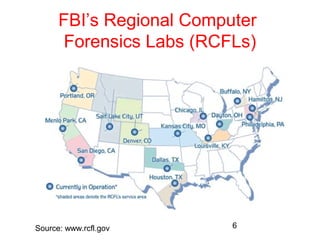
• 2000 – first Regional Computer Forensics 
Lab formed in Dallas 
• 2006 – latest (14th) RCFL opened in 
Louisville, KY 
5
FBI’s Regional Computer 
Forensics Labs (RCFLs) 
6 
Source: www.rcfl.gov
Computer Forensics in Academia 
• Many programs housed in Criminal Justice 
departments 
• Main focus on evidence preservation and 
presentation 
• Analysis done by forensic examiners well 
versed in computing 
• Over 100 CF programs exist today in US 
7
Computer Forensics in Academia 
• Important programs to review: 
– Purdue University, West Lafayette, IN 
– University of Tulsa, Tulsa, OK 
– University of Central Florida, Orlando, FL 
– Mississippi State Univ., Mississippi State, MS 
– Champlain College, Burlington, VT 
8
Emerging Curricula 
• Typical courses in Computer Forensics program: 
9 
– Networking 
– Operating Systems 
– Data Communications 
– Computer Evidence 
– Criminal Law 
– Basic Computer Forensics 
– Advanced Computer Forensics 
– Ethics 
– Algebra and Statistics
Emerging Curricula 
• Emphasis on both technology and policy 
• Exposure to forensic tools 
– EnCase 
– FTK 
• Significance of chain of evidence 
10
11 
Technology 
• Understanding of 
– storage technology 
– operating system features 
• Windows 
• Linux 
• Unix 
• Mac OS 
– file systems
12 
Technology 
• Knowledge of 
– Slack space 
– Host Protected Area (HPA) 
– Device Configuration Overlay (DCO) 
• Disk imaging 
• Data recovery 
• Total data deletion 
• Handling encryption
13 
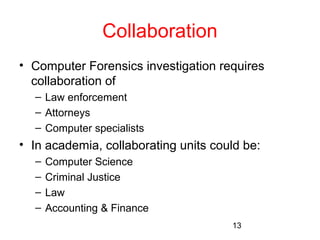
Collaboration 
• Computer Forensics investigation requires 
collaboration of 
– Law enforcement 
– Attorneys 
– Computer specialists 
• In academia, collaborating units could be: 
– Computer Science 
– Criminal Justice 
– Law 
– Accounting & Finance
14 
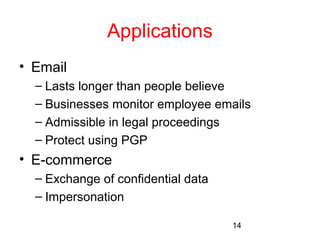
Applications 
• Email 
– Lasts longer than people believe 
– Businesses monitor employee emails 
– Admissible in legal proceedings 
– Protect using PGP 
• E-commerce 
– Exchange of confidential data 
– Impersonation
15 
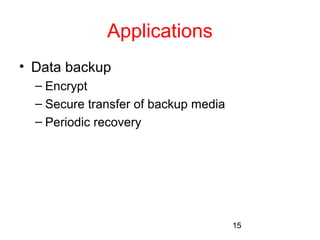
Applications 
• Data backup 
– Encrypt 
– Secure transfer of backup media 
– Periodic recovery
16 
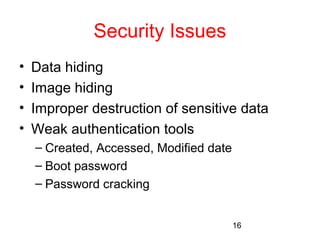
Security Issues 
• Data hiding 
• Image hiding 
• Improper destruction of sensitive data 
• Weak authentication tools 
– Created, Accessed, Modified date 
– Boot password 
– Password cracking
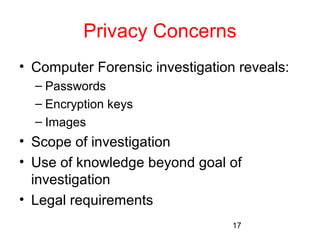
Privacy Concerns 
• Computer Forensic investigation reveals: 
– Passwords 
– Encryption keys 
– Images 
• Scope of investigation 
• Use of knowledge beyond goal of 
investigation 
• Legal requirements 
17
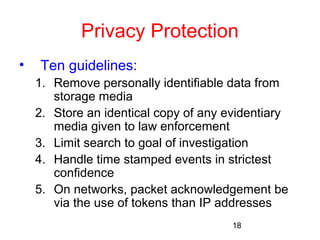
Privacy Protection 
• Ten guidelines: 
1. Remove personally identifiable data from 
18 
storage media 
2. Store an identical copy of any evidentiary 
media given to law enforcement 
3. Limit search to goal of investigation 
4. Handle time stamped events in strictest 
confidence 
5. On networks, packet acknowledgement be 
via the use of tokens than IP addresses
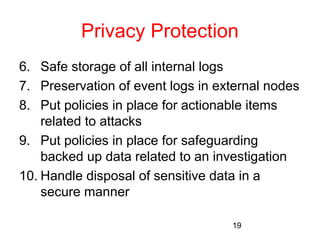
Privacy Protection 
6. Safe storage of all internal logs 
7. Preservation of event logs in external nodes 
8. Put policies in place for actionable items 
19 
related to attacks 
9. Put policies in place for safeguarding 
backed up data related to an investigation 
10. Handle disposal of sensitive data in a 
secure manner
20 
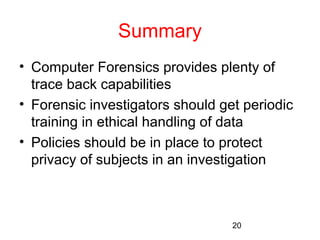
Summary 
• Computer Forensics provides plenty of 
trace back capabilities 
• Forensic investigators should get periodic 
training in ethical handling of data 
• Policies should be in place to protect 
privacy of subjects in an investigation
21 
References 
• Computer Evidence: Collection and 
Preservation by Christopher Brown, Thomson 
Publishers, MA 2006, ISBN: 1-58450-405-6 
• Guide to Computer Forensics and 
Investigations, 2nd edition by Bill Nelson et al, 
Thomson Publishers, MA 2006, ISBN: 0-619- 
21706-5 
• Computer Forensics – Hacking Exposed: 
Secrets and Solutions by Chris Davis et al, 
Osborne-McGraw Hill Publishers, NY 2005, 
ISBN: 0-070225675-3
22 
References 
• File System Forensic Analysis by Brian 
Carrier, Addison-Wesley, MA, 2005, ISBN: 
0321268172 
• Alec Yasinsac, Robert Earbacher, Donald 
G. Marks, Mark Pollitt, Peter M. Sommer, 
"Computer Forensics Education", IEEE 
Computer Security and Privacy Magazine, 
July-Aug 2003, Vol. 1, No. 4, pp. 15-23
23 
References 
• EnCase http://www.guidancesoftware.com 
• FTK http://www.accessdata.com 
• FileHound http://www.filehound.org 
• SATA http://www.serialata.org/ 
• Creating disk image 
http://darkdust.net/marc/diskimagehowto.php 
• National Institute of Justice document on dd 
command 
http://www.ncjrs.gov/pdffiles1/nij/203095.pdf
24 
References 
• Computer Forensics programs 
http://www.e-evidence.info/education.html 
• Brian Carrier http://dftt.sourceforge.net/
25 
Thank you! 
srini@louisville.edu 
www.louisville.edu/infosec

Srini

  • 1.
    Security and Privacyin Computer Forensics Applications 1 S. Srinivasan Professor of CIS Director, Center for Information Assurance University of Louisville Louisville, Kentucky
  • 2.
    2 Outline •Computer Forensics in academia – History – Emerging curricula – Technology – Collaboration • Applications • Security issues • Privacy concerns
  • 3.
    Computer Forensics 3 • Computer Forensics – process involves: • Collection • Preservation • Analysis • Presentation of evidence from digital sources • Historically a law enforcement responsibility
  • 4.
    Computer Forensics •1984 – FBI forms the Computer Analysis and Response Team (CART) • 1993 - first international Computer Evidence conference held • 1995 – International Organization for Computer Evidence formed • 1997 – G-8 Summit in Moscow calls for training law enforcement personnel for solving high tech crimes 4
  • 5.
    Computer Forensics •2000 – first Regional Computer Forensics Lab formed in Dallas • 2006 – latest (14th) RCFL opened in Louisville, KY 5
  • 6.
    FBI’s Regional Computer Forensics Labs (RCFLs) 6 Source: www.rcfl.gov
  • 7.
    Computer Forensics inAcademia • Many programs housed in Criminal Justice departments • Main focus on evidence preservation and presentation • Analysis done by forensic examiners well versed in computing • Over 100 CF programs exist today in US 7
  • 8.
    Computer Forensics inAcademia • Important programs to review: – Purdue University, West Lafayette, IN – University of Tulsa, Tulsa, OK – University of Central Florida, Orlando, FL – Mississippi State Univ., Mississippi State, MS – Champlain College, Burlington, VT 8
  • 9.
    Emerging Curricula •Typical courses in Computer Forensics program: 9 – Networking – Operating Systems – Data Communications – Computer Evidence – Criminal Law – Basic Computer Forensics – Advanced Computer Forensics – Ethics – Algebra and Statistics
  • 10.
    Emerging Curricula •Emphasis on both technology and policy • Exposure to forensic tools – EnCase – FTK • Significance of chain of evidence 10
  • 11.
    11 Technology •Understanding of – storage technology – operating system features • Windows • Linux • Unix • Mac OS – file systems
  • 12.
    12 Technology •Knowledge of – Slack space – Host Protected Area (HPA) – Device Configuration Overlay (DCO) • Disk imaging • Data recovery • Total data deletion • Handling encryption
  • 13.
    13 Collaboration •Computer Forensics investigation requires collaboration of – Law enforcement – Attorneys – Computer specialists • In academia, collaborating units could be: – Computer Science – Criminal Justice – Law – Accounting & Finance
  • 14.
    14 Applications •Email – Lasts longer than people believe – Businesses monitor employee emails – Admissible in legal proceedings – Protect using PGP • E-commerce – Exchange of confidential data – Impersonation
  • 15.
    15 Applications •Data backup – Encrypt – Secure transfer of backup media – Periodic recovery
  • 16.
    16 Security Issues • Data hiding • Image hiding • Improper destruction of sensitive data • Weak authentication tools – Created, Accessed, Modified date – Boot password – Password cracking
  • 17.
    Privacy Concerns •Computer Forensic investigation reveals: – Passwords – Encryption keys – Images • Scope of investigation • Use of knowledge beyond goal of investigation • Legal requirements 17
  • 18.
    Privacy Protection •Ten guidelines: 1. Remove personally identifiable data from 18 storage media 2. Store an identical copy of any evidentiary media given to law enforcement 3. Limit search to goal of investigation 4. Handle time stamped events in strictest confidence 5. On networks, packet acknowledgement be via the use of tokens than IP addresses
  • 19.
    Privacy Protection 6.Safe storage of all internal logs 7. Preservation of event logs in external nodes 8. Put policies in place for actionable items 19 related to attacks 9. Put policies in place for safeguarding backed up data related to an investigation 10. Handle disposal of sensitive data in a secure manner
  • 20.
    20 Summary •Computer Forensics provides plenty of trace back capabilities • Forensic investigators should get periodic training in ethical handling of data • Policies should be in place to protect privacy of subjects in an investigation
  • 21.
    21 References •Computer Evidence: Collection and Preservation by Christopher Brown, Thomson Publishers, MA 2006, ISBN: 1-58450-405-6 • Guide to Computer Forensics and Investigations, 2nd edition by Bill Nelson et al, Thomson Publishers, MA 2006, ISBN: 0-619- 21706-5 • Computer Forensics – Hacking Exposed: Secrets and Solutions by Chris Davis et al, Osborne-McGraw Hill Publishers, NY 2005, ISBN: 0-070225675-3
  • 22.
    22 References •File System Forensic Analysis by Brian Carrier, Addison-Wesley, MA, 2005, ISBN: 0321268172 • Alec Yasinsac, Robert Earbacher, Donald G. Marks, Mark Pollitt, Peter M. Sommer, "Computer Forensics Education", IEEE Computer Security and Privacy Magazine, July-Aug 2003, Vol. 1, No. 4, pp. 15-23
  • 23.
    23 References •EnCase http://www.guidancesoftware.com • FTK http://www.accessdata.com • FileHound http://www.filehound.org • SATA http://www.serialata.org/ • Creating disk image http://darkdust.net/marc/diskimagehowto.php • National Institute of Justice document on dd command http://www.ncjrs.gov/pdffiles1/nij/203095.pdf
  • 24.
    24 References •Computer Forensics programs http://www.e-evidence.info/education.html • Brian Carrier http://dftt.sourceforge.net/
  • 25.
    25 Thank you! srini@louisville.edu www.louisville.edu/infosec