International Journal of Electrical and Computer Engineering (IJECE)
Vol. 10, No. 5, October 2020, pp. 5147~5154
ISSN: 2088-8708, DOI: 10.11591/ijece.v10i5.pp5147-5154  5147
Journal homepage: http://ijece.iaescore.com/index.php/IJECE
SrBaSiO4:Eu2+
phosphor: a novel application for improving
the luminous flux and color quality of multi-chip
white LED lamps
Nguyen Thi Phuong Loan1
, Nguyen Doan Quoc Anh2
1
Faculty of Fundamental 2, Posts and Telecommunications Institute of Technology, Vietnam
2
Power System Optimization Research Group, Faculty of Electrical and Electronics Engineering,
Ton Duc Thang University, Vietnam
Article Info ABSTRACT
Article history:
Received Sep 11, 2019
Revised Apr 22, 2020
Accepted May 5, 2020
This paper described in detail the chromatic homogeneity and luminous flux
influences in producing better quality white LED devices with various
phosphor layers (MCW-LEDs). The method is to let Eu2+
-activated
strontium–barium silicate (SrBaSiO4:Eu2+
) mixed with their phosphor
compounding, which results in notable impact on lighting performance.
The increase in concentration of yellow-green-emitting SrBaSiO4:Eu2+
phosphor also promotes the color performance and lumen output of WLED
devices at high correlated color temperature around 8500K. This is the first
time this approach is applied and it results can be utilized for better
understanding of optical properties interaction with phosphor materials.
Although SrBaSiO4:Eu2+
receives many positive responses, we still need to
limit it concentration for high SrBaSiO4:Eu2+
concentration is detrimental to
CQS. The appropriate choice of concentration and size of SrBaSiO4:Eu2+
is
the principal factor to decide the performance of MCW-LEDs.
Keywords:
Color quality scale
Luminous flux
Mie-scattering theory
SrBaSiO4:Eu2+
WLEDs
Copyright © 2020 Institute of Advanced Engineering and Science.
All rights reserved.
Corresponding Author:
Nguyen Doan Quoc Anh,
Power System Optimization Research Group,
Faculty of Electrical and Electronics Engineering,
Ton Duc Thang University,
No. 19 Nguyen Huu Tho Street, Tan Phong Ward, District 7, Ho Chi Minh City, Vietnam.
Email: nguyendoanquocanh@tdtu.edu.vn
1. INTRODUCTION
Recently, perfecting the optical properties of WLED, especially the luminous efficacy and
color-related attributes, is a leading research goal of many scientists, which has been mentioned in previous
papers [1-5]. After many experiments, Anh and his colleagues discover the mixture of YAG:Ce3+
phosphor
compounding with SiO2 particles could significantly increase the lighting efficiency of white LED lighting
devices [6-8]. In addition, the combination of yellow YAG:Ce3+
phosphor with the silicone substance could
support the blue light and yellow light extraction [9-12] and also generate the white light. This process
includes two stages: disintegrating in phosphor compounds and moving through phosphor particles, in which
the YAG:Ce3+
phosphor layer will metabolize the blue light and simultaneously make it become
weaker [13-16]. However, the converted yellow light tends to be more intense after every scattering, which
makes the normal extracted light from the WLED to be more blue, while if it is placed near the LED exterior,
the color tend to be more yellow [17-19]. Won was in collaboration with his partner to prove the marked
effect of phosphor configuration on the lighting efficiency of LED devices with great color quality scale
(CQS), where blue LEDs and multiple phosphor materials such as green (Ba,Sr)2SiO4:Eu2+
and red
CaAlSiN3:Eu2+
were applied in various phosphor structures to achieve optimal efficiency [20]. In contrast,
 ISSN: 2088-8708
Int J Elec & Comp Eng, Vol. 10, No. 5, October 2020 : 5147 - 5154
5148
Oh’s group proposed the multiple phosphor LED with three primary colors green, yellow, and red, which
focus on enabling the luminous flux and color consistency to reach the most satisfactory result [21]. Zhang’s
team used multi-chromatic materials for better quality of CRI in LED products [22]. The improvement of
CRI and optical output is of interest to many researchers, but the increase in color uniformity seems to be
ignored. Furthermore, their research subjects is solely white LED with one chip, which gives out low CRI
and therefore not really applicable to modern lighting applications that require multiple chips for lighting
devices with high CCTs.
Understanding the needs for an advanced study in optical properties enhancement and more relevant
results to the current WLED structures, this research present experiments in which the chromatic phosphor is
employed in a multi-chip LED configuration. Based on previous studies that targeted at the optical properties
such as lumen output, CRI, and chromatic quality, we introduce an innovative research method that exploits
the advantageous findings while adding in new aspects for research. For example, the application of red
phosphor Mg8Ge2O11F2:Mn4+
in the dual-layer WLED at 6600 K CCT is confirmed to optimize the lumen
output and CRI. On the other hand, the remote phosphor configuration is proven to be the optimal set up for
WLED among the three configurations including the in-cup phosphor and conformal phosphor after
the achieved lumen output of this configuration is demonstrated as better than others [23-25]. However, there
are currently a lack of diversity in the applicable types of phosphor for WLED. Therefore, we conducted
experiments on a new phosphor, known as the yellow-green phosphor SrBaSiO4:Eu2+
, on WLEDs with three
different phosphor structures respectively. The approach this research suggests allow comparison between
performances of SrBaSiO4:Eu2+
in each phosphor configuration, which assists the identification of the best
combination. The yellow-green SrBaSiO4:Eu2+
phosphor plays a supporting role for chromatic homogeneity
and luminous efficacy so that the greatest efficiency could be attained from the phosphor materials in
MCW-LEDs during the scattering process. The participation of SrBaSiO4:Eu2+
particles will decide lighting
quality color uniformity. Regarding the remote phosphor structure, there are the remote structure with two
flat phosphor layers (FDRP) and the remote structure with two curved phosphor layers (CDRP). However,
a preceding study claims that FDRP is the better choice as CDRP yields less lumen while having a more
complex fabricating procedure, therefore, the dual-remote WLED in this research is simulated with FDRP
arrangement [26-28]. This research has 3 phases: (1) Simulating the MCW-LEDs prototype; (2) Applying
SrBaSiO4:Eu2+
as a phosphor material for the MCW-LEDs; (3) Studying the influences of SrBaSiO4:Eu2+
on
the optical properties, including the emission spectra and the scattering coefficient. In sum, mixing
SrBaSiO4:Eu2+
and YAG:Ce3+
phosphors together is considered as an optimal method to maximize quality
and lighting efficiency. The conclusions in this manuscript are useful references for luminous flux and
chromatic performance development while also effective in supporting the manufacturers in choosing
the suitable configuration for quality WLEDs production.
2. PREPARATION AND SIMULATION
2.1. Preparation of yellow-green SrBaSiO4:Eu2+
phosphor
Yellow-green SrBaSiO4:Eu2+
phosphor particles contain many superb characteristics, for example,
great quantum yield and consistency at high temperature with an emission peak up to 2.36 eV, which makes
it become more popular recently [29]. The particle sizes and concentration directly affect the luminescence
properties of SrBaSiO4:Eu2+
phosphor. The composition including SrCO3, BaCO3, SiO2, Eu2O3, NH4Cl, and
Eu2+
ion are used as raw materials as shown in Table 1. Some heavy duty and long lifetime fluorescent lights
prefer to use SrBaSiO4:Eu2+
. Therefore, it turns into the most well-known commercialized oxide material in
the lighting market. The fabrication process of SrBaSiO4:Eu2+
is described specifically as follows:
Firstly, the materials are soaked in water to be dissolved before being crushed into small particles.
Then they will be pulverized as soon as being dried in the air. Secondly, the powder will be heated in
a closed quartz tube with CO at 1100ºC for one hour and crushed into powder by dry grinding. Then 5.4 g
NH4Cl is added and mixed with this compound by dry grinding. Next, they will be reheated in the capped
quartz tubes with CO at 1100ºC for one hour and will be pulverized. Finally, the materials are washed in
water several times (pH ranged from 10 to 12) and dried afterward.
Table 1. Composition of yellow-green-emitting SrBaSiO4:Eu2+
phosphor
Ingredient Mole (%) By weight (g) Molar mass (g/mol) Mole(mol) Ions Mole (mol) Mole (%)
SrCO3 31.28 145 147.63 0.982 Sr2+
0.982 0.088
BaCO3 31.79 197 197.34 0.998 Ba2+
0.998 0.090
SiO2 33.40 63 60.08 1.049 Si4+
1.049 0.094
Eu2O3 0.32 3.5 351.926 0.01 O2-
8.068 0.726
NH4Cl 3.22 5.4 53.49 0.101 Eu2+
0.02 0.002
Int J Elec & Comp Eng ISSN: 2088-8708 
SrBaSiO4:Eu2+
phosphor: a novel application for improving … (Nguyen Thi Phuong Loan)
5149
2.2. Construction of MC-WLEDs
Based on the LightTools 8.5.0 software and Monte Carlo method [30-32], the prototype simulation
of MCW-LEDs is conducted through two main periods with a flat silicone layer. Setting up and
manufacturing the framework and lighting characteristics of MCW-LED at first, then the influences of
phosphor compounding with different SrBaSiO4:Eu2+
concentration is analyzed based on the performance of
MCW-LED with different phosphor geometries. The realistic simulated product is present in Figure 1(a) with
technical measurements can be seen from Figure 1(b). Among them, the two types of compounding which
have average CCT of 8500 K, conformal and in-cup phosphor, are picked to analyze. A distinct description
for MCW-LEDs with conformal phosphor structure, in-cup structure, and remote structure with the average
CCT of 8500 K was shown in Figure 1(c), (d), and (e) respectively. The components of the MCW-LED is an
8x2.07x9.85 mm at bottom, height, and surface reflector, 0.08 mm phosphor layer in phosphor compound,
and 9 LED chips. Each chip is 1.14 mm2
in acreage and 0.15 mm in height with 1.16 W energy emission for
each individual at 453 nm maximum wavelength connected to the base of the structure.
(a) Lead frame: 4.7 mm Jentech Size-S
LED chip: V45H
Die attach: Sumitomo 1295SA
Gold Wire: 1.0 mil
Phosphor: ITC NYAG4_EL
(b)
Figure 1. Illustration of phosphor-converted MCW-LEDs as doping SrBaSiO4:Eu2+
:
(a) the actual MCW-LEDs and (b) its parameters; (c) conformal phosphor geometry (CPG);
(d) in-cup phosphor geometry (IPG); and (e) remote phosphor geometry (RPG)
As can be seen from Figure 1(c), the chips are covered with phosphor particles diffused by
conformal coating. Conversely, separate methods are used for the structure with in-cup phosphor and for
mixture with silicone lens. The scattering analysis of these two structures was carried out based on
Mie-theory. The measurement for particles in this research is 14.5 μm in size, similar to the real parameter.
The phosphor composite is a combination of SrBaSiO4:Eu2+
, YAG:Ce3+
, and the silicone gel with the same
sizes as the real parameters and own the refractive indexes respectively of 1.85, 1.83, and 1.52. Once
the refractive index and diameter of phosphor particles are set, we can study the emission spectra of research
subjects. Figure 2 (top) described the emission spectra of the conformal structure WLED at different
SrBaSiO4:Eu2+
concentration fluctuating from 0% toward 24%. Figure 2 (bottom) expresses in details
the emission spectra of in-cup structure WLED with different ranges of SrBaSiO4:Eu2+
concentration
which can reach 1.4%. According to this chart, the lighting efficiency of MCW-LEDs will improve after
SrBaSiO4:Eu2+
phosphor are added to the structure.
(c) (d)
(e)
 ISSN: 2088-8708
Int J Elec & Comp Eng, Vol. 10, No. 5, October 2020 : 5147 - 5154
5150
Figure 2. Emission spectra of multiple phosphors: (a) CPG; (b) IPG; and (c) RPG
3. COMPUTATION AND DISCUSSION
Based on the Mie theory [23-35], the scattering coefficient μsca are computed to verify the optical
properties of phosphor compounding. The relationship among the scattering coefficient (SC), the wavelength,
and diameter of SrBaSiO4:Eu2+
particles is expressed in the formula below:
( ) ( )sca sca
c
C
m
   (1)
, ( ) (D)dD
( )
(D)dD
sca D
sca
C f
C
f

 


(2)
(D) (D)dD
(D)dD
im f
m
f



(3)
( )
( )
( )
sca
sca
inc
P
C
I



 (4)
where, f(D) is the function of diameter distribution, c is the distribution density of phosphor (g/cm3
), Csca,D is
the scattering cross-section of the phosphor having particle diameter D. While ( )scaC  and m are
the scattering cross-section and the particle mass of the phosphor integrated over f(D), respectively. ( )scaP 
and ( )incI  are the scattered power by phosphor particles and the irradiance intensity in turn.
When SrBaSiO4:Eu2+
phosphor involves in the scattering, the scattering coefficient (SC) of
the phosphor layer is indicated in Figure 3. Concentrations and other agents of SrBaSiO4:Eu2+
will be
the catalyst that makes SC of phosphorus mixture significantly change. This also verifies that previous
concentrations and stimulation of SrBaSiO4:Eu2+
affect the color quality of both CPG and IPG structures.
When SrBaSiO4:Eu2+
concentration increases, SC also tends to develop regardless of SrBaSiO4:Eu2+
particle
size. With a size of about 1 μm, SC can achieve optimum value and making color uniformity better
regardless of the larger sizes. Therefore, if the target is CQS, SrBaSiO4:Eu2+
size can be approximately 1 μm.
Int J Elec & Comp Eng ISSN: 2088-8708 
SrBaSiO4:Eu2+
phosphor: a novel application for improving … (Nguyen Thi Phuong Loan)
5151
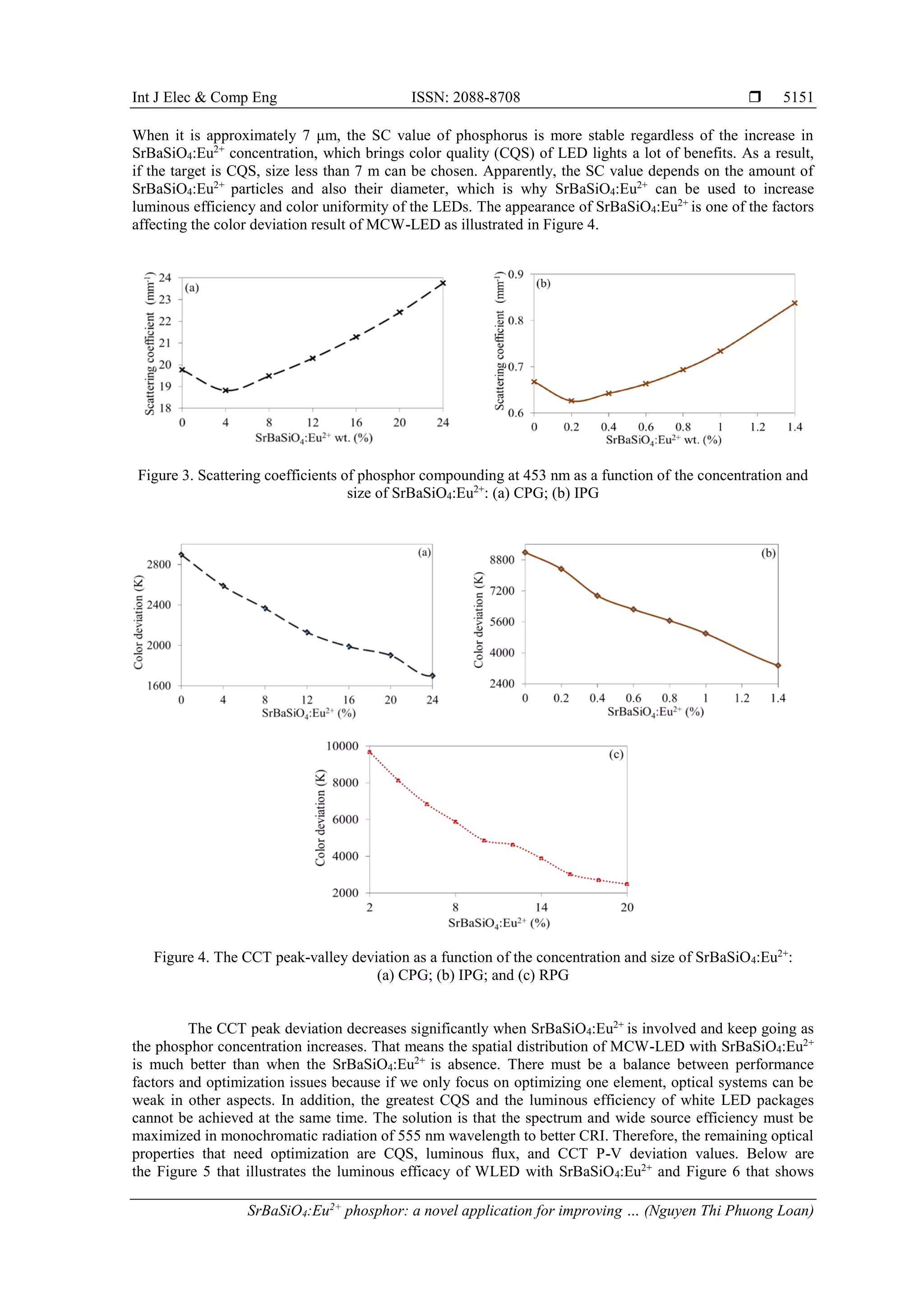
When it is approximately 7 μm, the SC value of phosphorus is more stable regardless of the increase in
SrBaSiO4:Eu2+
concentration, which brings color quality (CQS) of LED lights a lot of benefits. As a result,
if the target is CQS, size less than 7 m can be chosen. Apparently, the SC value depends on the amount of
SrBaSiO4:Eu2+
particles and also their diameter, which is why SrBaSiO4:Eu2+
can be used to increase
luminous efficiency and color uniformity of the LEDs. The appearance of SrBaSiO4:Eu2+
is one of the factors
affecting the color deviation result of MCW-LED as illustrated in Figure 4.
Figure 3. Scattering coefficients of phosphor compounding at 453 nm as a function of the concentration and
size of SrBaSiO4:Eu2+
: (a) CPG; (b) IPG
Figure 4. The CCT peak-valley deviation as a function of the concentration and size of SrBaSiO4:Eu2+
:
(a) CPG; (b) IPG; and (c) RPG
The CCT peak deviation decreases significantly when SrBaSiO4:Eu2+
is involved and keep going as
the phosphor concentration increases. That means the spatial distribution of MCW-LED with SrBaSiO4:Eu2+
is much better than when the SrBaSiO4:Eu2+
is absence. There must be a balance between performance
factors and optimization issues because if we only focus on optimizing one element, optical systems can be
weak in other aspects. In addition, the greatest CQS and the luminous efficiency of white LED packages
cannot be achieved at the same time. The solution is that the spectrum and wide source efficiency must be
maximized in monochromatic radiation of 555 nm wavelength to better CRI. Therefore, the remaining optical
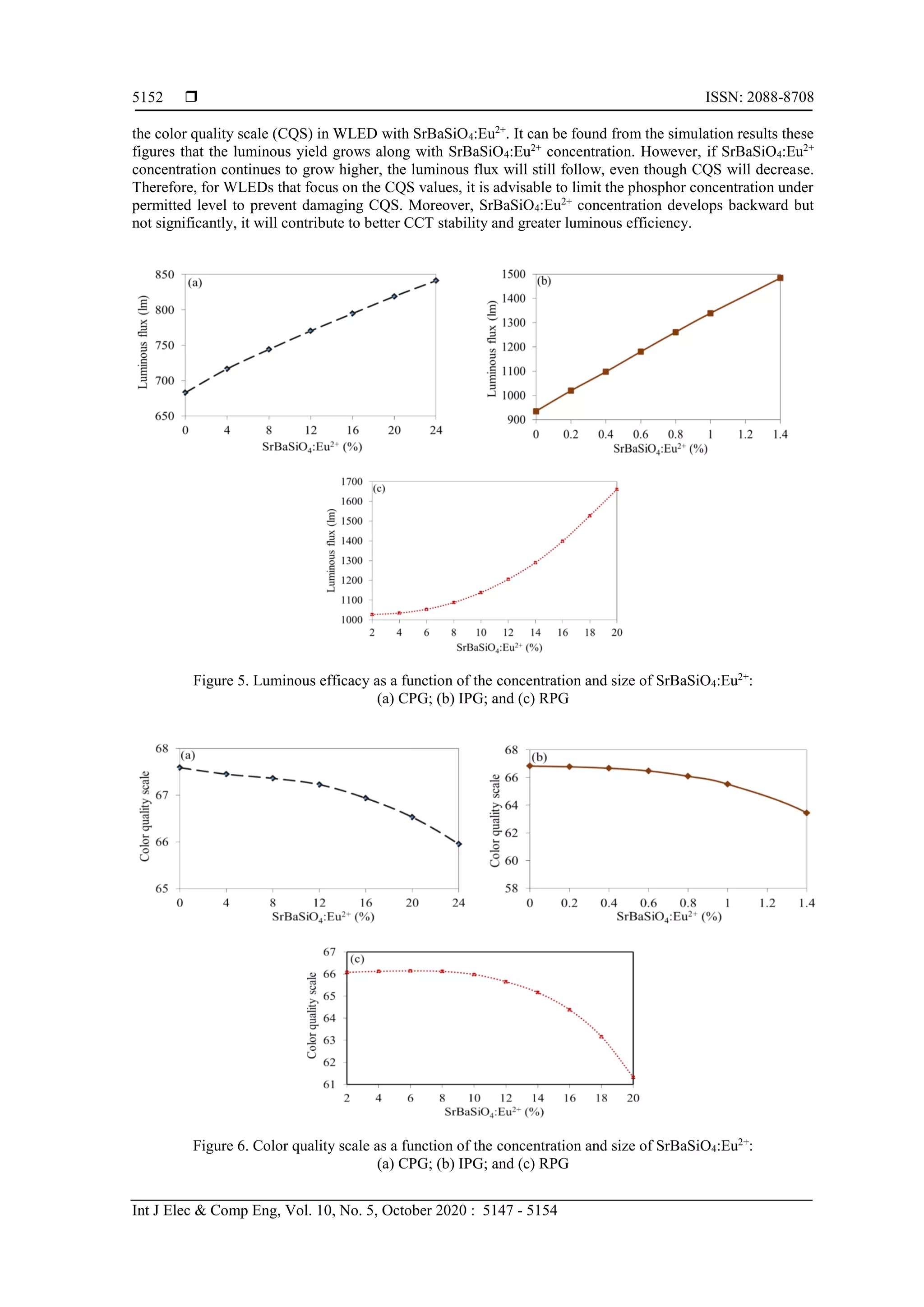
properties that need optimization are CQS, luminous flux, and CCT P-V deviation values. Below are
the Figure 5 that illustrates the luminous efficacy of WLED with SrBaSiO4:Eu2+
and Figure 6 that shows
 ISSN: 2088-8708
Int J Elec & Comp Eng, Vol. 10, No. 5, October 2020 : 5147 - 5154
5152
the color quality scale (CQS) in WLED with SrBaSiO4:Eu2+
. It can be found from the simulation results these
figures that the luminous yield grows along with SrBaSiO4:Eu2+
concentration. However, if SrBaSiO4:Eu2+
concentration continues to grow higher, the luminous flux will still follow, even though CQS will decrease.
Therefore, for WLEDs that focus on the CQS values, it is advisable to limit the phosphor concentration under
permitted level to prevent damaging CQS. Moreover, SrBaSiO4:Eu2+
concentration develops backward but
not significantly, it will contribute to better CCT stability and greater luminous efficiency.
Figure 5. Luminous efficacy as a function of the concentration and size of SrBaSiO4:Eu2+
:
(a) CPG; (b) IPG; and (c) RPG
Figure 6. Color quality scale as a function of the concentration and size of SrBaSiO4:Eu2+
:
(a) CPG; (b) IPG; and (c) RPG
Int J Elec & Comp Eng ISSN: 2088-8708 
SrBaSiO4:Eu2+
phosphor: a novel application for improving … (Nguyen Thi Phuong Loan)
5153
4. CONCLUSION
In summary, the effectiveness of the yellow-green SrBaSiO4:Eu2+
in improving color quality and
light output of WLEDs devices was verified through some references in the article. The experimental results
from this research are also viable to conclude about the optical properties influences as follows. First,
no matter what the average CCT value, color uniformity can be very diverse according to Mie scattering
theory. This is the effect of light loss from scattering in white LED packages. Second, through Monte Carlo
method, the luminous efficacy is confirmed to increase with SrBaSiO4:Eu2+
concentration. Particularly,
the emitted light will grow as long as SrBaSiO4:Eu2+
concentration keep increasing at any phosphor
geometry. Finally, selecting SrBaSiO4:Eu2+
phosphor is the appropriate solution for developing phosphorus
materials as well as producing white LED packages. Although SrBaSiO4:Eu2+
phosphor is an effective
enhancement material, the concentration of this phosphor must be monitored in application as any amount
of SrBaSiO4:Eu2+
is good for lumen output and CCT deviation, however, CQS can be damaged if
the SrBaSiO4:Eu2+
concentration is too high. This research not only presented a new approach by applying
the yellow-green phosphor to WLED but also compared the performance based on the type of phosphor
geometry and phosphor concentration, which opens more options for manufacturers to develop their products
and leaves valuable references for future studies.
REFERENCES
[1] C. Tian, et al., “Mn4+
activated Al2O3 red-emitting ceramic phosphor with excellent thermal conductivity," Optics
Express, vol. 27, no. 22, pp. 32666-32678, 2019.
[2] J. Cheng, et al., “Photoluminescence properties of Ca4La6(SiO4)4(PO4)2O2-based phosphors for wLEDs,” Chinese
Optics Letters, vol. 17, no. 5, pp. 051602, 2019.
[3] X. Liu, et al., “Upconversion luminescence, intrinsic optical bistability, and optical thermometry in Ho3+/
Yb3+
:
BaMoO4 phosphors,” Chin. Opt. Lett., vol. 17, no. 11, pp. 111601, 2019.
[4] Shaojun, et al., “Energy transfer between Ce3+
and Tb3+
and the enhanced luminescence of a green phosphor
SrB2O4:Ce3+
, Tb3+
, Na+
,” Optical Materials Express, vol. 6, no. 4, pp. 1172-1185, 2016.
[5] Yang, et al., “Optical performance improvement of phosphor-in-glass based white light-emitting diodes through
optimized packaging structure,” Applied Optics, vol. 55, no. 29, pp. 8189-8195, 2016.
[6] Zhengfa, et al., “Influence of co-doping Si ions on persistent luminescence of ZnGa2O4: Cr3+
red phosphors,”
Optical Materials Express, vol. 6, no. 4, pp. 1329-1338, 2016.
[7] Jia, et al., “Investigations on the luminescence of Ba2Mg(PO4)2:Eu2+
,Mn2+
phosphors for LEDs,” Optical Materials
Express, vol. 6, no. 11, pp. 3470-3475, 2016.
[8] Jia, et al., “Generation of tunable-emission in Li4Ca1-xSr0.96 + x(SiO4)2:0.04Eu2+
phosphors for LEDs application,”
Optical Materials Express, vol. 5, no. 8, pp. 1704-1714, 2015.
[9] Huajuan, et al., “Close-relationship between the luminescence and structural characteristics in efficient nano-
phosphor Y2Mo4O15:Eu3+
,” Optical Materials Express, vol. 5, no. 3, pp. 490-496, 2015.
[10] Qi. D., et al., “Circadian-effect engineering of solid-state lighting spectra for beneficial and tunable lighting,”
Optics Express, vol. 24, no. 18, pp. 20049-20059, 2016.
[11] Ruijin, et al., “Eu3+-activated CdY4Mo3O16 nanoparticles with narrow red-emission and broad excitation in near-
UV wavelength region,” Optical Materials Express, vol. 6, no. 11, pp. 2397-2403, 2016.
[12] Luting, et al., “Luminescent properties of novel red-emitting phosphor: Gd2O2CN2:Eu3+
,” Optical Materials
Express, vol. 5, no. 11, pp. 2616-2624, 2015.
[13] Yumiko, et al., “Persistent luminescence properties of Cr3+
-Sm3+
activated LaAlO3 perovskite,” Optical Materials
Express, vol. 6, no. 5, pp. 1500-1505, 2016.
[14] Y. J. Park, et al., “Development of high luminous efficacy red-emitting phosphor-in-glass for high-power LED
lighting systems using our original low Tg and Ts glass,” Opt. Lett., vol. 44, no. 24, pp. 6057-6060, 2019.
[15] L. Yang, et al., "Thermally stable lead-free phosphor in glass enhancement performance of light emitting diodes
application," Appl. Opt, vol. 58, pp. 4099-4104, 2019.
[16] T. Wei, Wang et al., “Single Pr3+
-activated high-color-stability fluoride white-light phosphor for white-light-
emitting diodes,” Opt. Mater. Express, vol. 9, no. 1, pp. 223-233, 2019.
[17] Xiaona, et al., “Color-tunable upconversion photoluminescence and highly performed optical temperature sensing
in Er3+
/Yb3+
co-doped ZnWO4,” Optics Express, vol. 24, no. 20, pp. 22438-22447, 2016.
[18] Song, et al., “Luminescence characteristics of the Ce3+
-doped garnets: the case of Gd-admixed Y3Al5O12
transparent ceramics,” Optical Materials Express, vol. 5, no. 12, pp. 2902-2910, 2015.
[19] Huang, et al., “Liquid-crystal-modulated correlated color temperature tunable light-emitting diode with highly
accurate regulation,” Optics Express, vol. 23, no. 3, pp. A149-A156, 2015.
[20] Qi Hong, et al., “High-efficiency quantum dot remote phosphor film,” Applied Optics, vol. 54, no. 15,
pp. 4617-4622, 2015.
[21] Cunlong, et al., “Highly pure green light emission of perovskite CsPbBr3 quantum dots and their application for
green light-emitting diodes,” Optics Express, vol. 24, no. 13, pp. 15071-15078, 2016.
[22] Oh Kwon, et al., “White luminescence characteristics of red/green silicate phosphor-glass thick film layers printed
on glass substrate,” Optical Materials Express, vol. 6, no. 3, pp. 938-945, 2016.
 ISSN: 2088-8708
Int J Elec & Comp Eng, Vol. 10, No. 5, October 2020 : 5147 - 5154
5154
[23] Le Wang, et al., “Highly efficient narrow-band green and red phosphors enabling wider color-gamut LED backlight
for more brilliant displays,” Optics Express, vol. 23, no. 22, pp. 28707-28717, 2015.
[24] Vineet, et al., “Efficient Color Tunable ZnWO4:Er3+
-Yb3+
Phosphor for High Temperature Sensing,” Journal of
Display Technology, vol. 12, no. 11, pp. 1472-1477, 2016.
[25] L. Duan, et al., "Wide color gamut display with white and emerald backlighting," Appl. Opt, vol. 57,
pp. 1338-1344, 2018.
[26] Wang, et al., “Accurate control of chromaticity and spectra by feedback phosphor-coating,” Optics Express,
vol. 23, no. 9, pp. 11576-11585, 2015.
[27] S. Bindai, et al., "Realization of phosphor-in-glass thin film on soda-lime silicate glass with low sintering
temperature for high color rendering white LEDs," Appl. Opt, vol. 58, pp. 2372-2381, 2019.
[28] Jagjeet, et al., “Luminescence Studies on Ba2MgSi2O7 Doped With Eu2+
and Tm3+
Phosphors,” Journal of Display
Technology, vol. 12, no. 5, pp. 460-465, 2016.
[29] Jonas, et al., “Persistent phosphor SrAl2O4:Eu,Dy in outdoor conditions: saved by the trap distribution,” Optics
Express, vol. 23, no. 15, pp. A868-A881, 2015.
[30] Yahong, et al., “Luminescent properties of a green long persistent phosphor Li2MgGeO4:Mn2+
,” Optical Materials
Express, vol. 6, no. 3, pp. 929-937, 2016.
[31] Zhongyang, et al., “Enhanced forward emission of YAG:Ce3+
phosphor with polystyrene nanosphere coating,”
Applied Optics, vol. 54, no. 19, pp. 6025-6028, 2015.
[32] F. B. Chen, et al., “Investigation on Modulation Speed of Photon-Recycling White Light-Emitting Diodes with
Vertical-Conduction Structure,” J. Lightwave Technol., vol. 37, no. 4, pp. 1225-1230, 2019.
[33] R. Q. Wan, et al., “Simultaneously improve the luminous efficiency and color-rendering index of GaN-based
white-light-emitting diodes using metal localized surface plasmon resonance,” Optics Letters, vol. 44, no. 17,
pp. 4155-4158, 2019.
[34] S. K. Abeysekera, et al., “Impact of circadian tuning on the illuminance and color uniformity of a multichannel
luminaire with spatially optimized LED placement,” Opt. Express, vol. 28, no. 1, pp. 130-145, 2020.
[35] Q. W. Xu, et al., “Nanocrystal-filled polymer for improving angular color uniformity of phosphor-converted white
LEDs,” Appl. Opt., vol. 58, no. 27, pp. 7649-7654, 2019.

SrBaSiO 4 :Eu 2+ phosphor: a novel application for improvingthe luminous flux and color quality of multi-chip white LED lamps

  • 1.
    International Journal ofElectrical and Computer Engineering (IJECE) Vol. 10, No. 5, October 2020, pp. 5147~5154 ISSN: 2088-8708, DOI: 10.11591/ijece.v10i5.pp5147-5154  5147 Journal homepage: http://ijece.iaescore.com/index.php/IJECE SrBaSiO4:Eu2+ phosphor: a novel application for improving the luminous flux and color quality of multi-chip white LED lamps Nguyen Thi Phuong Loan1 , Nguyen Doan Quoc Anh2 1 Faculty of Fundamental 2, Posts and Telecommunications Institute of Technology, Vietnam 2 Power System Optimization Research Group, Faculty of Electrical and Electronics Engineering, Ton Duc Thang University, Vietnam Article Info ABSTRACT Article history: Received Sep 11, 2019 Revised Apr 22, 2020 Accepted May 5, 2020 This paper described in detail the chromatic homogeneity and luminous flux influences in producing better quality white LED devices with various phosphor layers (MCW-LEDs). The method is to let Eu2+ -activated strontium–barium silicate (SrBaSiO4:Eu2+ ) mixed with their phosphor compounding, which results in notable impact on lighting performance. The increase in concentration of yellow-green-emitting SrBaSiO4:Eu2+ phosphor also promotes the color performance and lumen output of WLED devices at high correlated color temperature around 8500K. This is the first time this approach is applied and it results can be utilized for better understanding of optical properties interaction with phosphor materials. Although SrBaSiO4:Eu2+ receives many positive responses, we still need to limit it concentration for high SrBaSiO4:Eu2+ concentration is detrimental to CQS. The appropriate choice of concentration and size of SrBaSiO4:Eu2+ is the principal factor to decide the performance of MCW-LEDs. Keywords: Color quality scale Luminous flux Mie-scattering theory SrBaSiO4:Eu2+ WLEDs Copyright © 2020 Institute of Advanced Engineering and Science. All rights reserved. Corresponding Author: Nguyen Doan Quoc Anh, Power System Optimization Research Group, Faculty of Electrical and Electronics Engineering, Ton Duc Thang University, No. 19 Nguyen Huu Tho Street, Tan Phong Ward, District 7, Ho Chi Minh City, Vietnam. Email: nguyendoanquocanh@tdtu.edu.vn 1. INTRODUCTION Recently, perfecting the optical properties of WLED, especially the luminous efficacy and color-related attributes, is a leading research goal of many scientists, which has been mentioned in previous papers [1-5]. After many experiments, Anh and his colleagues discover the mixture of YAG:Ce3+ phosphor compounding with SiO2 particles could significantly increase the lighting efficiency of white LED lighting devices [6-8]. In addition, the combination of yellow YAG:Ce3+ phosphor with the silicone substance could support the blue light and yellow light extraction [9-12] and also generate the white light. This process includes two stages: disintegrating in phosphor compounds and moving through phosphor particles, in which the YAG:Ce3+ phosphor layer will metabolize the blue light and simultaneously make it become weaker [13-16]. However, the converted yellow light tends to be more intense after every scattering, which makes the normal extracted light from the WLED to be more blue, while if it is placed near the LED exterior, the color tend to be more yellow [17-19]. Won was in collaboration with his partner to prove the marked effect of phosphor configuration on the lighting efficiency of LED devices with great color quality scale (CQS), where blue LEDs and multiple phosphor materials such as green (Ba,Sr)2SiO4:Eu2+ and red CaAlSiN3:Eu2+ were applied in various phosphor structures to achieve optimal efficiency [20]. In contrast,
  • 2.
     ISSN: 2088-8708 IntJ Elec & Comp Eng, Vol. 10, No. 5, October 2020 : 5147 - 5154 5148 Oh’s group proposed the multiple phosphor LED with three primary colors green, yellow, and red, which focus on enabling the luminous flux and color consistency to reach the most satisfactory result [21]. Zhang’s team used multi-chromatic materials for better quality of CRI in LED products [22]. The improvement of CRI and optical output is of interest to many researchers, but the increase in color uniformity seems to be ignored. Furthermore, their research subjects is solely white LED with one chip, which gives out low CRI and therefore not really applicable to modern lighting applications that require multiple chips for lighting devices with high CCTs. Understanding the needs for an advanced study in optical properties enhancement and more relevant results to the current WLED structures, this research present experiments in which the chromatic phosphor is employed in a multi-chip LED configuration. Based on previous studies that targeted at the optical properties such as lumen output, CRI, and chromatic quality, we introduce an innovative research method that exploits the advantageous findings while adding in new aspects for research. For example, the application of red phosphor Mg8Ge2O11F2:Mn4+ in the dual-layer WLED at 6600 K CCT is confirmed to optimize the lumen output and CRI. On the other hand, the remote phosphor configuration is proven to be the optimal set up for WLED among the three configurations including the in-cup phosphor and conformal phosphor after the achieved lumen output of this configuration is demonstrated as better than others [23-25]. However, there are currently a lack of diversity in the applicable types of phosphor for WLED. Therefore, we conducted experiments on a new phosphor, known as the yellow-green phosphor SrBaSiO4:Eu2+ , on WLEDs with three different phosphor structures respectively. The approach this research suggests allow comparison between performances of SrBaSiO4:Eu2+ in each phosphor configuration, which assists the identification of the best combination. The yellow-green SrBaSiO4:Eu2+ phosphor plays a supporting role for chromatic homogeneity and luminous efficacy so that the greatest efficiency could be attained from the phosphor materials in MCW-LEDs during the scattering process. The participation of SrBaSiO4:Eu2+ particles will decide lighting quality color uniformity. Regarding the remote phosphor structure, there are the remote structure with two flat phosphor layers (FDRP) and the remote structure with two curved phosphor layers (CDRP). However, a preceding study claims that FDRP is the better choice as CDRP yields less lumen while having a more complex fabricating procedure, therefore, the dual-remote WLED in this research is simulated with FDRP arrangement [26-28]. This research has 3 phases: (1) Simulating the MCW-LEDs prototype; (2) Applying SrBaSiO4:Eu2+ as a phosphor material for the MCW-LEDs; (3) Studying the influences of SrBaSiO4:Eu2+ on the optical properties, including the emission spectra and the scattering coefficient. In sum, mixing SrBaSiO4:Eu2+ and YAG:Ce3+ phosphors together is considered as an optimal method to maximize quality and lighting efficiency. The conclusions in this manuscript are useful references for luminous flux and chromatic performance development while also effective in supporting the manufacturers in choosing the suitable configuration for quality WLEDs production. 2. PREPARATION AND SIMULATION 2.1. Preparation of yellow-green SrBaSiO4:Eu2+ phosphor Yellow-green SrBaSiO4:Eu2+ phosphor particles contain many superb characteristics, for example, great quantum yield and consistency at high temperature with an emission peak up to 2.36 eV, which makes it become more popular recently [29]. The particle sizes and concentration directly affect the luminescence properties of SrBaSiO4:Eu2+ phosphor. The composition including SrCO3, BaCO3, SiO2, Eu2O3, NH4Cl, and Eu2+ ion are used as raw materials as shown in Table 1. Some heavy duty and long lifetime fluorescent lights prefer to use SrBaSiO4:Eu2+ . Therefore, it turns into the most well-known commercialized oxide material in the lighting market. The fabrication process of SrBaSiO4:Eu2+ is described specifically as follows: Firstly, the materials are soaked in water to be dissolved before being crushed into small particles. Then they will be pulverized as soon as being dried in the air. Secondly, the powder will be heated in a closed quartz tube with CO at 1100ºC for one hour and crushed into powder by dry grinding. Then 5.4 g NH4Cl is added and mixed with this compound by dry grinding. Next, they will be reheated in the capped quartz tubes with CO at 1100ºC for one hour and will be pulverized. Finally, the materials are washed in water several times (pH ranged from 10 to 12) and dried afterward. Table 1. Composition of yellow-green-emitting SrBaSiO4:Eu2+ phosphor Ingredient Mole (%) By weight (g) Molar mass (g/mol) Mole(mol) Ions Mole (mol) Mole (%) SrCO3 31.28 145 147.63 0.982 Sr2+ 0.982 0.088 BaCO3 31.79 197 197.34 0.998 Ba2+ 0.998 0.090 SiO2 33.40 63 60.08 1.049 Si4+ 1.049 0.094 Eu2O3 0.32 3.5 351.926 0.01 O2- 8.068 0.726 NH4Cl 3.22 5.4 53.49 0.101 Eu2+ 0.02 0.002
  • 3.
    Int J Elec& Comp Eng ISSN: 2088-8708  SrBaSiO4:Eu2+ phosphor: a novel application for improving … (Nguyen Thi Phuong Loan) 5149 2.2. Construction of MC-WLEDs Based on the LightTools 8.5.0 software and Monte Carlo method [30-32], the prototype simulation of MCW-LEDs is conducted through two main periods with a flat silicone layer. Setting up and manufacturing the framework and lighting characteristics of MCW-LED at first, then the influences of phosphor compounding with different SrBaSiO4:Eu2+ concentration is analyzed based on the performance of MCW-LED with different phosphor geometries. The realistic simulated product is present in Figure 1(a) with technical measurements can be seen from Figure 1(b). Among them, the two types of compounding which have average CCT of 8500 K, conformal and in-cup phosphor, are picked to analyze. A distinct description for MCW-LEDs with conformal phosphor structure, in-cup structure, and remote structure with the average CCT of 8500 K was shown in Figure 1(c), (d), and (e) respectively. The components of the MCW-LED is an 8x2.07x9.85 mm at bottom, height, and surface reflector, 0.08 mm phosphor layer in phosphor compound, and 9 LED chips. Each chip is 1.14 mm2 in acreage and 0.15 mm in height with 1.16 W energy emission for each individual at 453 nm maximum wavelength connected to the base of the structure. (a) Lead frame: 4.7 mm Jentech Size-S LED chip: V45H Die attach: Sumitomo 1295SA Gold Wire: 1.0 mil Phosphor: ITC NYAG4_EL (b) Figure 1. Illustration of phosphor-converted MCW-LEDs as doping SrBaSiO4:Eu2+ : (a) the actual MCW-LEDs and (b) its parameters; (c) conformal phosphor geometry (CPG); (d) in-cup phosphor geometry (IPG); and (e) remote phosphor geometry (RPG) As can be seen from Figure 1(c), the chips are covered with phosphor particles diffused by conformal coating. Conversely, separate methods are used for the structure with in-cup phosphor and for mixture with silicone lens. The scattering analysis of these two structures was carried out based on Mie-theory. The measurement for particles in this research is 14.5 μm in size, similar to the real parameter. The phosphor composite is a combination of SrBaSiO4:Eu2+ , YAG:Ce3+ , and the silicone gel with the same sizes as the real parameters and own the refractive indexes respectively of 1.85, 1.83, and 1.52. Once the refractive index and diameter of phosphor particles are set, we can study the emission spectra of research subjects. Figure 2 (top) described the emission spectra of the conformal structure WLED at different SrBaSiO4:Eu2+ concentration fluctuating from 0% toward 24%. Figure 2 (bottom) expresses in details the emission spectra of in-cup structure WLED with different ranges of SrBaSiO4:Eu2+ concentration which can reach 1.4%. According to this chart, the lighting efficiency of MCW-LEDs will improve after SrBaSiO4:Eu2+ phosphor are added to the structure. (c) (d) (e)
  • 4.
     ISSN: 2088-8708 IntJ Elec & Comp Eng, Vol. 10, No. 5, October 2020 : 5147 - 5154 5150 Figure 2. Emission spectra of multiple phosphors: (a) CPG; (b) IPG; and (c) RPG 3. COMPUTATION AND DISCUSSION Based on the Mie theory [23-35], the scattering coefficient μsca are computed to verify the optical properties of phosphor compounding. The relationship among the scattering coefficient (SC), the wavelength, and diameter of SrBaSiO4:Eu2+ particles is expressed in the formula below: ( ) ( )sca sca c C m    (1) , ( ) (D)dD ( ) (D)dD sca D sca C f C f      (2) (D) (D)dD (D)dD im f m f    (3) ( ) ( ) ( ) sca sca inc P C I     (4) where, f(D) is the function of diameter distribution, c is the distribution density of phosphor (g/cm3 ), Csca,D is the scattering cross-section of the phosphor having particle diameter D. While ( )scaC  and m are the scattering cross-section and the particle mass of the phosphor integrated over f(D), respectively. ( )scaP  and ( )incI  are the scattered power by phosphor particles and the irradiance intensity in turn. When SrBaSiO4:Eu2+ phosphor involves in the scattering, the scattering coefficient (SC) of the phosphor layer is indicated in Figure 3. Concentrations and other agents of SrBaSiO4:Eu2+ will be the catalyst that makes SC of phosphorus mixture significantly change. This also verifies that previous concentrations and stimulation of SrBaSiO4:Eu2+ affect the color quality of both CPG and IPG structures. When SrBaSiO4:Eu2+ concentration increases, SC also tends to develop regardless of SrBaSiO4:Eu2+ particle size. With a size of about 1 μm, SC can achieve optimum value and making color uniformity better regardless of the larger sizes. Therefore, if the target is CQS, SrBaSiO4:Eu2+ size can be approximately 1 μm.
  • 5.
    Int J Elec& Comp Eng ISSN: 2088-8708  SrBaSiO4:Eu2+ phosphor: a novel application for improving … (Nguyen Thi Phuong Loan) 5151 When it is approximately 7 μm, the SC value of phosphorus is more stable regardless of the increase in SrBaSiO4:Eu2+ concentration, which brings color quality (CQS) of LED lights a lot of benefits. As a result, if the target is CQS, size less than 7 m can be chosen. Apparently, the SC value depends on the amount of SrBaSiO4:Eu2+ particles and also their diameter, which is why SrBaSiO4:Eu2+ can be used to increase luminous efficiency and color uniformity of the LEDs. The appearance of SrBaSiO4:Eu2+ is one of the factors affecting the color deviation result of MCW-LED as illustrated in Figure 4. Figure 3. Scattering coefficients of phosphor compounding at 453 nm as a function of the concentration and size of SrBaSiO4:Eu2+ : (a) CPG; (b) IPG Figure 4. The CCT peak-valley deviation as a function of the concentration and size of SrBaSiO4:Eu2+ : (a) CPG; (b) IPG; and (c) RPG The CCT peak deviation decreases significantly when SrBaSiO4:Eu2+ is involved and keep going as the phosphor concentration increases. That means the spatial distribution of MCW-LED with SrBaSiO4:Eu2+ is much better than when the SrBaSiO4:Eu2+ is absence. There must be a balance between performance factors and optimization issues because if we only focus on optimizing one element, optical systems can be weak in other aspects. In addition, the greatest CQS and the luminous efficiency of white LED packages cannot be achieved at the same time. The solution is that the spectrum and wide source efficiency must be maximized in monochromatic radiation of 555 nm wavelength to better CRI. Therefore, the remaining optical properties that need optimization are CQS, luminous flux, and CCT P-V deviation values. Below are the Figure 5 that illustrates the luminous efficacy of WLED with SrBaSiO4:Eu2+ and Figure 6 that shows
  • 6.
     ISSN: 2088-8708 IntJ Elec & Comp Eng, Vol. 10, No. 5, October 2020 : 5147 - 5154 5152 the color quality scale (CQS) in WLED with SrBaSiO4:Eu2+ . It can be found from the simulation results these figures that the luminous yield grows along with SrBaSiO4:Eu2+ concentration. However, if SrBaSiO4:Eu2+ concentration continues to grow higher, the luminous flux will still follow, even though CQS will decrease. Therefore, for WLEDs that focus on the CQS values, it is advisable to limit the phosphor concentration under permitted level to prevent damaging CQS. Moreover, SrBaSiO4:Eu2+ concentration develops backward but not significantly, it will contribute to better CCT stability and greater luminous efficiency. Figure 5. Luminous efficacy as a function of the concentration and size of SrBaSiO4:Eu2+ : (a) CPG; (b) IPG; and (c) RPG Figure 6. Color quality scale as a function of the concentration and size of SrBaSiO4:Eu2+ : (a) CPG; (b) IPG; and (c) RPG
  • 7.
    Int J Elec& Comp Eng ISSN: 2088-8708  SrBaSiO4:Eu2+ phosphor: a novel application for improving … (Nguyen Thi Phuong Loan) 5153 4. CONCLUSION In summary, the effectiveness of the yellow-green SrBaSiO4:Eu2+ in improving color quality and light output of WLEDs devices was verified through some references in the article. The experimental results from this research are also viable to conclude about the optical properties influences as follows. First, no matter what the average CCT value, color uniformity can be very diverse according to Mie scattering theory. This is the effect of light loss from scattering in white LED packages. Second, through Monte Carlo method, the luminous efficacy is confirmed to increase with SrBaSiO4:Eu2+ concentration. Particularly, the emitted light will grow as long as SrBaSiO4:Eu2+ concentration keep increasing at any phosphor geometry. Finally, selecting SrBaSiO4:Eu2+ phosphor is the appropriate solution for developing phosphorus materials as well as producing white LED packages. Although SrBaSiO4:Eu2+ phosphor is an effective enhancement material, the concentration of this phosphor must be monitored in application as any amount of SrBaSiO4:Eu2+ is good for lumen output and CCT deviation, however, CQS can be damaged if the SrBaSiO4:Eu2+ concentration is too high. This research not only presented a new approach by applying the yellow-green phosphor to WLED but also compared the performance based on the type of phosphor geometry and phosphor concentration, which opens more options for manufacturers to develop their products and leaves valuable references for future studies. REFERENCES [1] C. Tian, et al., “Mn4+ activated Al2O3 red-emitting ceramic phosphor with excellent thermal conductivity," Optics Express, vol. 27, no. 22, pp. 32666-32678, 2019. [2] J. Cheng, et al., “Photoluminescence properties of Ca4La6(SiO4)4(PO4)2O2-based phosphors for wLEDs,” Chinese Optics Letters, vol. 17, no. 5, pp. 051602, 2019. [3] X. Liu, et al., “Upconversion luminescence, intrinsic optical bistability, and optical thermometry in Ho3+/ Yb3+ : BaMoO4 phosphors,” Chin. Opt. Lett., vol. 17, no. 11, pp. 111601, 2019. [4] Shaojun, et al., “Energy transfer between Ce3+ and Tb3+ and the enhanced luminescence of a green phosphor SrB2O4:Ce3+ , Tb3+ , Na+ ,” Optical Materials Express, vol. 6, no. 4, pp. 1172-1185, 2016. [5] Yang, et al., “Optical performance improvement of phosphor-in-glass based white light-emitting diodes through optimized packaging structure,” Applied Optics, vol. 55, no. 29, pp. 8189-8195, 2016. [6] Zhengfa, et al., “Influence of co-doping Si ions on persistent luminescence of ZnGa2O4: Cr3+ red phosphors,” Optical Materials Express, vol. 6, no. 4, pp. 1329-1338, 2016. [7] Jia, et al., “Investigations on the luminescence of Ba2Mg(PO4)2:Eu2+ ,Mn2+ phosphors for LEDs,” Optical Materials Express, vol. 6, no. 11, pp. 3470-3475, 2016. [8] Jia, et al., “Generation of tunable-emission in Li4Ca1-xSr0.96 + x(SiO4)2:0.04Eu2+ phosphors for LEDs application,” Optical Materials Express, vol. 5, no. 8, pp. 1704-1714, 2015. [9] Huajuan, et al., “Close-relationship between the luminescence and structural characteristics in efficient nano- phosphor Y2Mo4O15:Eu3+ ,” Optical Materials Express, vol. 5, no. 3, pp. 490-496, 2015. [10] Qi. D., et al., “Circadian-effect engineering of solid-state lighting spectra for beneficial and tunable lighting,” Optics Express, vol. 24, no. 18, pp. 20049-20059, 2016. [11] Ruijin, et al., “Eu3+-activated CdY4Mo3O16 nanoparticles with narrow red-emission and broad excitation in near- UV wavelength region,” Optical Materials Express, vol. 6, no. 11, pp. 2397-2403, 2016. [12] Luting, et al., “Luminescent properties of novel red-emitting phosphor: Gd2O2CN2:Eu3+ ,” Optical Materials Express, vol. 5, no. 11, pp. 2616-2624, 2015. [13] Yumiko, et al., “Persistent luminescence properties of Cr3+ -Sm3+ activated LaAlO3 perovskite,” Optical Materials Express, vol. 6, no. 5, pp. 1500-1505, 2016. [14] Y. J. Park, et al., “Development of high luminous efficacy red-emitting phosphor-in-glass for high-power LED lighting systems using our original low Tg and Ts glass,” Opt. Lett., vol. 44, no. 24, pp. 6057-6060, 2019. [15] L. Yang, et al., "Thermally stable lead-free phosphor in glass enhancement performance of light emitting diodes application," Appl. Opt, vol. 58, pp. 4099-4104, 2019. [16] T. Wei, Wang et al., “Single Pr3+ -activated high-color-stability fluoride white-light phosphor for white-light- emitting diodes,” Opt. Mater. Express, vol. 9, no. 1, pp. 223-233, 2019. [17] Xiaona, et al., “Color-tunable upconversion photoluminescence and highly performed optical temperature sensing in Er3+ /Yb3+ co-doped ZnWO4,” Optics Express, vol. 24, no. 20, pp. 22438-22447, 2016. [18] Song, et al., “Luminescence characteristics of the Ce3+ -doped garnets: the case of Gd-admixed Y3Al5O12 transparent ceramics,” Optical Materials Express, vol. 5, no. 12, pp. 2902-2910, 2015. [19] Huang, et al., “Liquid-crystal-modulated correlated color temperature tunable light-emitting diode with highly accurate regulation,” Optics Express, vol. 23, no. 3, pp. A149-A156, 2015. [20] Qi Hong, et al., “High-efficiency quantum dot remote phosphor film,” Applied Optics, vol. 54, no. 15, pp. 4617-4622, 2015. [21] Cunlong, et al., “Highly pure green light emission of perovskite CsPbBr3 quantum dots and their application for green light-emitting diodes,” Optics Express, vol. 24, no. 13, pp. 15071-15078, 2016. [22] Oh Kwon, et al., “White luminescence characteristics of red/green silicate phosphor-glass thick film layers printed on glass substrate,” Optical Materials Express, vol. 6, no. 3, pp. 938-945, 2016.
  • 8.
     ISSN: 2088-8708 IntJ Elec & Comp Eng, Vol. 10, No. 5, October 2020 : 5147 - 5154 5154 [23] Le Wang, et al., “Highly efficient narrow-band green and red phosphors enabling wider color-gamut LED backlight for more brilliant displays,” Optics Express, vol. 23, no. 22, pp. 28707-28717, 2015. [24] Vineet, et al., “Efficient Color Tunable ZnWO4:Er3+ -Yb3+ Phosphor for High Temperature Sensing,” Journal of Display Technology, vol. 12, no. 11, pp. 1472-1477, 2016. [25] L. Duan, et al., "Wide color gamut display with white and emerald backlighting," Appl. Opt, vol. 57, pp. 1338-1344, 2018. [26] Wang, et al., “Accurate control of chromaticity and spectra by feedback phosphor-coating,” Optics Express, vol. 23, no. 9, pp. 11576-11585, 2015. [27] S. Bindai, et al., "Realization of phosphor-in-glass thin film on soda-lime silicate glass with low sintering temperature for high color rendering white LEDs," Appl. Opt, vol. 58, pp. 2372-2381, 2019. [28] Jagjeet, et al., “Luminescence Studies on Ba2MgSi2O7 Doped With Eu2+ and Tm3+ Phosphors,” Journal of Display Technology, vol. 12, no. 5, pp. 460-465, 2016. [29] Jonas, et al., “Persistent phosphor SrAl2O4:Eu,Dy in outdoor conditions: saved by the trap distribution,” Optics Express, vol. 23, no. 15, pp. A868-A881, 2015. [30] Yahong, et al., “Luminescent properties of a green long persistent phosphor Li2MgGeO4:Mn2+ ,” Optical Materials Express, vol. 6, no. 3, pp. 929-937, 2016. [31] Zhongyang, et al., “Enhanced forward emission of YAG:Ce3+ phosphor with polystyrene nanosphere coating,” Applied Optics, vol. 54, no. 19, pp. 6025-6028, 2015. [32] F. B. Chen, et al., “Investigation on Modulation Speed of Photon-Recycling White Light-Emitting Diodes with Vertical-Conduction Structure,” J. Lightwave Technol., vol. 37, no. 4, pp. 1225-1230, 2019. [33] R. Q. Wan, et al., “Simultaneously improve the luminous efficiency and color-rendering index of GaN-based white-light-emitting diodes using metal localized surface plasmon resonance,” Optics Letters, vol. 44, no. 17, pp. 4155-4158, 2019. [34] S. K. Abeysekera, et al., “Impact of circadian tuning on the illuminance and color uniformity of a multichannel luminaire with spatially optimized LED placement,” Opt. Express, vol. 28, no. 1, pp. 130-145, 2020. [35] Q. W. Xu, et al., “Nanocrystal-filled polymer for improving angular color uniformity of phosphor-converted white LEDs,” Appl. Opt., vol. 58, no. 27, pp. 7649-7654, 2019.