Java RMI
A. Thirugnanasambandha Murthy
Asst. Prof (GL),
Thiruvalluvar University
Unit -2
Java RMI
What Is Java RMI?
• A distributed interoperability technology for Java
– Packages java.rmi, java.rmi.server and java.rmi.registry
– Tools rmic and rmiregistry
• Java’s answer to CORBA
– Java is the interface definition language
– Key limitation: both client and server must be written in Java
• Part of Enterprise JavaBeans
– Along with JDBC (Java DataBase Connectivity), Java Security, Java
Messaging Services, Java Transactions Services, Java IDL, other APIs
– like CORBA’s common object services
• Detailed documentation is available at
http://java.sun.com/
Java RMI = Java Remote Method Invocation
Unit -2
Java RMI
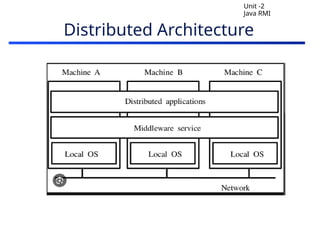
Distributed Architecture
Unit -2
Java RMI
Client/Server Programming
with Java RMI (I)
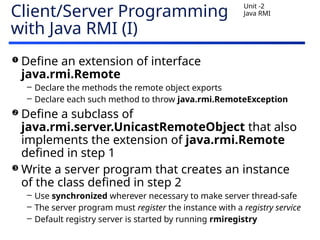
 Define an extension of interface
java.rmi.Remote
– Declare the methods the remote object exports
– Declare each such method to throw java.rmi.RemoteException
 Define a subclass of
java.rmi.server.UnicastRemoteObject that also
implements the extension of java.rmi.Remote
defined in step 1
 Write a server program that creates an instance
of the class defined in step 2
– Use synchronized wherever necessary to make server thread-safe
– The server program must register the instance with a registry service
– Default registry server is started by running rmiregistry
Unit -2
Java RMI
Client/Server Programming
with Java RMI (II)
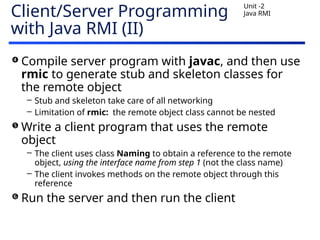
 Compile server program with javac, and then use
rmic to generate stub and skeleton classes for
the remote object
– Stub and skeleton take care of all networking
– Limitation of rmic: the remote object class cannot be nested
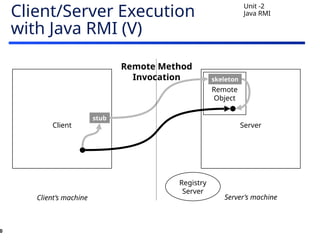
 Write a client program that uses the remote
object
– The client uses class Naming to obtain a reference to the remote
object, using the interface name from step 1 (not the class name)
– The client invokes methods on the remote object through this
reference
 Run the server and then run the client
Unit -2
Java RMI
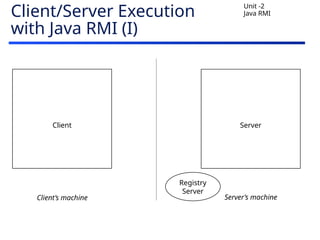
Client/Server Execution
with Java RMI (I)
Client Server
Client’s machine Server’s machine
Registry
Server
Unit -2
Java RMI
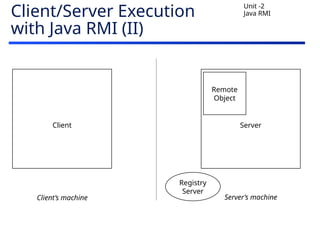
Client/Server Execution
with Java RMI (II)
Client Server
Remote
Object
Client’s machine Server’s machine
Registry
Server
Unit -2
Java RMI
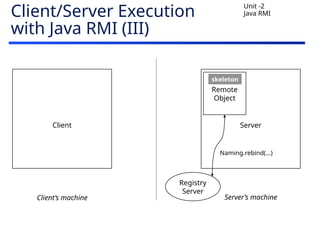
Client/Server Execution
with Java RMI (III)
Client Server
Remote
Object
Naming.rebind(…)
skeleton
Client’s machine Server’s machine
Registry
Server
Unit -2
Java RMI
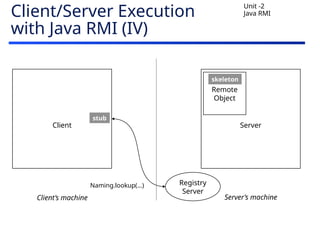
Client/Server Execution
with Java RMI (IV)
Client Server
Remote
Object
Naming.lookup(…)
skeleton
stub
Client’s machine Server’s machine
Registry
Server
0
Unit -2
Java RMI
Client/Server Execution
with Java RMI (V)
Client Server
Remote
Object
skeleton
stub
Remote Method
Invocation
Client’s machine Server’s machine
Registry
Server
1
Unit -2
Java RMI
Default RMI Registry
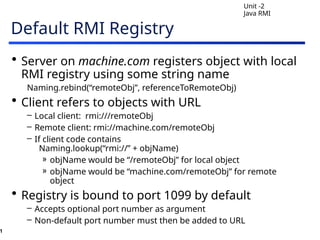
• Server on machine.com registers object with local
RMI registry using some string name
Naming.rebind(“remoteObj”, referenceToRemoteObj)
• Client refers to objects with URL
– Local client: rmi:///remoteObj
– Remote client: rmi://machine.com/remoteObj
– If client code contains
Naming.lookup(“rmi://” + objName)
» objName would be “/remoteObj” for local object
» objName would be “machine.com/remoteObj” for remote
object
• Registry is bound to port 1099 by default
– Accepts optional port number as argument
– Non-default port number must then be added to URL
2
Unit -2
Java RMI
Example:
Air Traffic Control
• Air traffic control is divided into several sectors
• Each sector is managed by a different controller
• Airplanes check in with a controller and then
periodically send the controller position reports
• The controller analyzes position reports and tells
an airplane when its position is too close to other
planes
3
Unit -2
Java RMI
Air Traffic Control:
ATC Exception
package ATC;
public class ATCException extends Exception {
public ATCException(String msg) { super(msg); }
}
• For server-specific exceptions
• Different from RemoteException, which is thrown as a
result of RMI failure
4
Unit -2
Java RMI
Air Traffic Control:
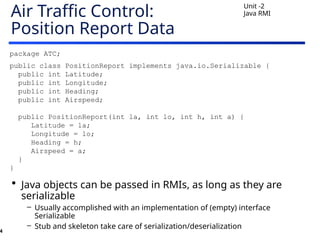
Position Report Data
package ATC;
public class PositionReport implements java.io.Serializable {
public int Latitude;
public int Longitude;
public int Heading;
public int Airspeed;
public PositionReport(int la, int lo, int h, int a) {
Latitude = la;
Longitude = lo;
Heading = h;
Airspeed = a;
}
}
• Java objects can be passed in RMIs, as long as they are
serializable
– Usually accomplished with an implementation of (empty) interface
Serializable
– Stub and skeleton take care of serialization/deserialization
5
Unit -2
Java RMI
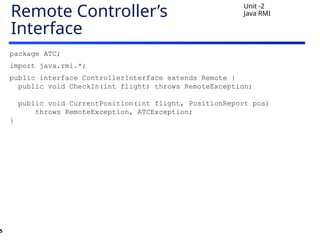
Remote Controller’s
Interface
package ATC;
import java.rmi.*;
public interface ControllerInterface extends Remote {
public void CheckIn(int flight) throws RemoteException;
public void CurrentPosition(int flight, PositionReport pos)
throws RemoteException, ATCException;
}
6
Unit -2
Java RMI
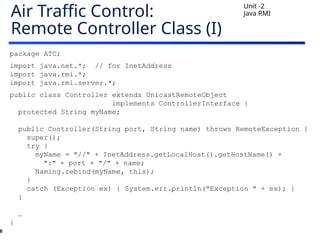
Air Traffic Control:
Remote Controller Class (I)
package ATC;
import java.net.*; // for InetAddress
import java.rmi.*;
import java.rmi.server.*;
public class Controller extends UnicastRemoteObject
implements ControllerInterface {
protected String myName;
public Controller(String port, String name) throws RemoteException {
super();
try {
myName = "//" + InetAddress.getLocalHost().getHostName() +
":" + port + "/" + name;
Naming.rebind(myName, this);
}
catch (Exception ex) { System.err.println("Exception " + ex); }
}
…
}
7
Unit -2
Java RMI
Air Traffic Control:
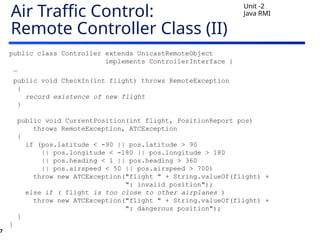
Remote Controller Class (II)
public class Controller extends UnicastRemoteObject
implements ControllerInterface {
…
public void CheckIn(int flight) throws RemoteException
{
record existence of new flight
}
public void CurrentPosition(int flight, PositionReport pos)
throws RemoteException, ATCException
{
if (pos.latitude < -90 || pos.latitude > 90
|| pos.longitude < -180 || pos.longitude > 180
|| pos.heading < 1 || pos.heading > 360
|| pos.airspeed < 50 || pos.airspeed > 700)
throw new ATCException("flight " + String.valueOf(flight) +
": invalid position");
else if ( flight is too close to other airplanes )
throw new ATCException("flight " + String.valueOf(flight) +
": dangerous position");
}
}
8
Unit -2
Java RMI
Air Traffic Control:
ATC Server
package ATC;
import java.rmi.*;
public class ATCServer {
public static void main(String[] args) {
try {
Controller c = new Controller(args[0], args[1]);
}
catch (Exception ex) {
System.err.println("Exception " + ex);
System.err.println("usage: java ATCServer port# controllerName");
}
}
}
9
Unit -2
Java RMI
Air Traffic Control:
Airplane Client (I)
package ATC;
import java.rmi.*;
public class Airplane {
protected int myFlightNumber;
protected String myController;
protected PositionReport myPosition
= new PositionReport(34, -118, 180, 350);
public static void main(String[] args) {
try {
myFlightNumber = Integer.parseInt(args[0]);
myController = args[1];
ControllerInterface c = // The interface, not the class!
(ControllerInterface)Naming.lookup("rmi://" + myController);
c.CheckIn(myFlightNumber);
…
}
…
}
}
0
Unit -2
Java RMI
Air Traffic Control:
Airplane Client (II)
public class Airplane {
…
public static void main(String[] args) {
try {
…
for (;;) {
c.CurrentPosition(myFlightNumber, myPosition);
java.lang.Thread.sleep(200);
update position
}
}
catch (RemoteException ex)
{ System.err.println("RemoteException " + ex); }
catch (ATCException ex)
{ System.err.println("ATCException " + ex); }
catch (Exception ex) {
System.err.println("Exception " + ex);
System.err.println("usage: java Airplane flight# controllerName");
}
}
}
1
Unit -2
Java RMI
Air Traffic Control:
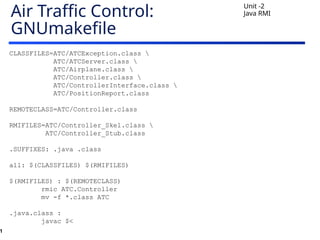
GNUmakefile
CLASSFILES=ATC/ATCException.class 
ATC/ATCServer.class 
ATC/Airplane.class 
ATC/Controller.class 
ATC/ControllerInterface.class 
ATC/PositionReport.class
REMOTECLASS=ATC/Controller.class
RMIFILES=ATC/Controller_Skel.class 
ATC/Controller_Stub.class
.SUFFIXES: .java .class
all: $(CLASSFILES) $(RMIFILES)
$(RMIFILES) : $(REMOTECLASS)
rmic ATC.Controller
mv -f *.class ATC
.java.class :
javac $<
2
Unit -2
Java RMI
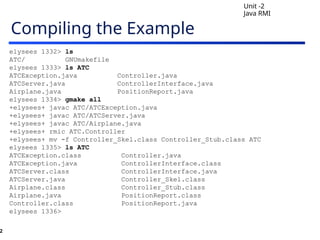
Compiling the Example
elysees 1332> ls
ATC/ GNUmakefile
elysees 1333> ls ATC
ATCException.java Controller.java
ATCServer.java ControllerInterface.java
Airplane.java PositionReport.java
elysees 1334> gmake all
+elysees+ javac ATC/ATCException.java
+elysees+ javac ATC/ATCServer.java
+elysees+ javac ATC/Airplane.java
+elysees+ rmic ATC.Controller
+elysees+ mv -f Controller_Skel.class Controller_Stub.class ATC
elysees 1335> ls ATC
ATCException.class Controller.java
ATCException.java ControllerInterface.class
ATCServer.class ControllerInterface.java
ATCServer.java Controller_Skel.class
Airplane.class Controller_Stub.class
Airplane.java PositionReport.class
Controller.class PositionReport.java
elysees 1336>
3
Unit -2
Java RMI
Running the Example:
Local Client and Server
Server on elysees (using the default registry port number):
Client on elysees:
elysees 1355> java ATC.Airplane 100 /LosAngeles
ATCException ATC.ATCException: flight 100: invalid position
elysees 1356> java ATC.Airplane 100 elysees.ics.uci.edu/LosAngeles
ATCException ATC.ATCException: flight 100: invalid position
elysees 1357>
elysees 1352> rmiregistry &
[1] 5398
elysees 1353> java ATC.ATCServer 1099 LosAngeles &
[2] 5407
elysees 1354>
4
Unit -2
Java RMI
Running the Example:
Remote Client and Server
Server on elysees (using a non-default registry port number):
Client on octavian:
octavian 1356> java ATC.Airplane 100 /LosAngeles
RemoteException java.rmi.ConnectException: Connection refused
to host: [octavian.ics.uci.edu:1099]; nested exception is:
java.net.ConnectException: Connection refused
octavian 1357> java ATC.Airplane 100 elysees.ics.uci.edu/LosAngeles
RemoteException java.rmi.ConnectException: Connection refused
to host: [elysees.ics.uci.edu:1099]; nested exception is:
java.net.ConnectException: Connection refused
octavian 1358> java ATC.Airplane 100 elysees.ics.uci.edu:1033/LosAngeles
ATCException ATC.ATCException: flight 100: invalid position
octavian 1359>
elysees 1352> rmiregistry 1033 &
[1] 5398
elysees 1353> java ATC.ATCServer 1033 LosAngeles &
[2] 5407
elysees 1354>
5
Unit -2
Java RMI
Other Possible
Architectures
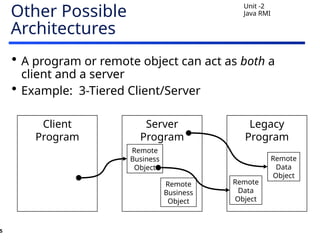
• A program or remote object can act as both a
client and a server
• Example: 3-Tiered Client/Server
Client
Program
Legacy
Program
Remote
Data
Object
Remote
Data
Object
Server
Program
Remote
Business
Object
Remote
Business
Object
6
Unit -2
Java RMI
Principal Similarities
Between CORBA and RMI
• Suitable for distributed, object-oriented,
client/server systems
• Synchronous interaction via remote procedure
call (RPC)
• RPC implemented via client stubs and server
skeletons, which hide networking and data
representation
• Objects can be both client and server
7
Unit -2
Java RMI
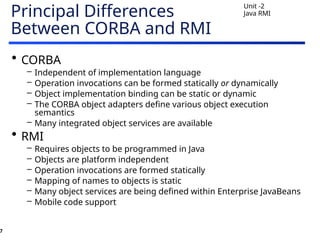
Principal Differences
Between CORBA and RMI
• CORBA
– Independent of implementation language
– Operation invocations can be formed statically or dynamically
– Object implementation binding can be static or dynamic
– The CORBA object adapters define various object execution
semantics
– Many integrated object services are available
• RMI
– Requires objects to be programmed in Java
– Objects are platform independent
– Operation invocations are formed statically
– Mapping of names to objects is static
– Many object services are being defined within Enterprise JavaBeans
– Mobile code support
8
Unit -2
Java RMI
Sidebar Discussion:
Dynamic Proxies in Java
• Introduced in J2SEv1.3 (JDK1.3)
• Created using the java.lang.reflect.Proxy class
• Allows dynamic creation of objects that
implement an arbitrary interface class without
writing code
• All methods are called through a single invoke()
method, which you implement:
– public Object invoke(Object proxy, Method method, Object[] args)
throws Throwable
• You can get a proxy with a call like this:
– ActionListener listener =
(ActionListener)Proxy.createProxy(myInvocationHandler,
ActionListener.class);
» Some detail omitted for clarity
9
Unit -2
Java RMI
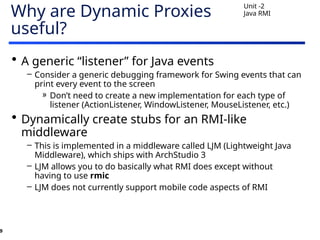
Why are Dynamic Proxies
useful?
• A generic “listener” for Java events
– Consider a generic debugging framework for Swing events that can
print every event to the screen
» Don’t need to create a new implementation for each type of
listener (ActionListener, WindowListener, MouseListener, etc.)
• Dynamically create stubs for an RMI-like
middleware
– This is implemented in a middleware called LJM (Lightweight Java
Middleware), which ships with ArchStudio 3
– LJM allows you to do basically what RMI does except without
having to use rmic
– LJM does not currently support mobile code aspects of RMI
0
Unit -2
Java RMI
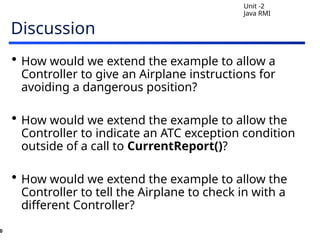
Discussion
• How would we extend the example to allow a
Controller to give an Airplane instructions for
avoiding a dangerous position?
• How would we extend the example to allow the
Controller to indicate an ATC exception condition
outside of a call to CurrentReport()?
• How would we extend the example to allow the
Controller to tell the Airplane to check in with a
different Controller?

Sql and plsql syntax and commands aaaaaa

  • 1.
    Java RMI A. ThirugnanasambandhaMurthy Asst. Prof (GL), Thiruvalluvar University
  • 2.
    Unit -2 Java RMI WhatIs Java RMI? • A distributed interoperability technology for Java – Packages java.rmi, java.rmi.server and java.rmi.registry – Tools rmic and rmiregistry • Java’s answer to CORBA – Java is the interface definition language – Key limitation: both client and server must be written in Java • Part of Enterprise JavaBeans – Along with JDBC (Java DataBase Connectivity), Java Security, Java Messaging Services, Java Transactions Services, Java IDL, other APIs – like CORBA’s common object services • Detailed documentation is available at http://java.sun.com/ Java RMI = Java Remote Method Invocation
  • 3.
  • 4.
    Unit -2 Java RMI Client/ServerProgramming with Java RMI (I)  Define an extension of interface java.rmi.Remote – Declare the methods the remote object exports – Declare each such method to throw java.rmi.RemoteException  Define a subclass of java.rmi.server.UnicastRemoteObject that also implements the extension of java.rmi.Remote defined in step 1  Write a server program that creates an instance of the class defined in step 2 – Use synchronized wherever necessary to make server thread-safe – The server program must register the instance with a registry service – Default registry server is started by running rmiregistry
  • 5.
    Unit -2 Java RMI Client/ServerProgramming with Java RMI (II)  Compile server program with javac, and then use rmic to generate stub and skeleton classes for the remote object – Stub and skeleton take care of all networking – Limitation of rmic: the remote object class cannot be nested  Write a client program that uses the remote object – The client uses class Naming to obtain a reference to the remote object, using the interface name from step 1 (not the class name) – The client invokes methods on the remote object through this reference  Run the server and then run the client
  • 6.
    Unit -2 Java RMI Client/ServerExecution with Java RMI (I) Client Server Client’s machine Server’s machine Registry Server
  • 7.
    Unit -2 Java RMI Client/ServerExecution with Java RMI (II) Client Server Remote Object Client’s machine Server’s machine Registry Server
  • 8.
    Unit -2 Java RMI Client/ServerExecution with Java RMI (III) Client Server Remote Object Naming.rebind(…) skeleton Client’s machine Server’s machine Registry Server
  • 9.
    Unit -2 Java RMI Client/ServerExecution with Java RMI (IV) Client Server Remote Object Naming.lookup(…) skeleton stub Client’s machine Server’s machine Registry Server
  • 10.
    0 Unit -2 Java RMI Client/ServerExecution with Java RMI (V) Client Server Remote Object skeleton stub Remote Method Invocation Client’s machine Server’s machine Registry Server
  • 11.
    1 Unit -2 Java RMI DefaultRMI Registry • Server on machine.com registers object with local RMI registry using some string name Naming.rebind(“remoteObj”, referenceToRemoteObj) • Client refers to objects with URL – Local client: rmi:///remoteObj – Remote client: rmi://machine.com/remoteObj – If client code contains Naming.lookup(“rmi://” + objName) » objName would be “/remoteObj” for local object » objName would be “machine.com/remoteObj” for remote object • Registry is bound to port 1099 by default – Accepts optional port number as argument – Non-default port number must then be added to URL
  • 12.
    2 Unit -2 Java RMI Example: AirTraffic Control • Air traffic control is divided into several sectors • Each sector is managed by a different controller • Airplanes check in with a controller and then periodically send the controller position reports • The controller analyzes position reports and tells an airplane when its position is too close to other planes
  • 13.
    3 Unit -2 Java RMI AirTraffic Control: ATC Exception package ATC; public class ATCException extends Exception { public ATCException(String msg) { super(msg); } } • For server-specific exceptions • Different from RemoteException, which is thrown as a result of RMI failure
  • 14.
    4 Unit -2 Java RMI AirTraffic Control: Position Report Data package ATC; public class PositionReport implements java.io.Serializable { public int Latitude; public int Longitude; public int Heading; public int Airspeed; public PositionReport(int la, int lo, int h, int a) { Latitude = la; Longitude = lo; Heading = h; Airspeed = a; } } • Java objects can be passed in RMIs, as long as they are serializable – Usually accomplished with an implementation of (empty) interface Serializable – Stub and skeleton take care of serialization/deserialization
  • 15.
    5 Unit -2 Java RMI RemoteController’s Interface package ATC; import java.rmi.*; public interface ControllerInterface extends Remote { public void CheckIn(int flight) throws RemoteException; public void CurrentPosition(int flight, PositionReport pos) throws RemoteException, ATCException; }
  • 16.
    6 Unit -2 Java RMI AirTraffic Control: Remote Controller Class (I) package ATC; import java.net.*; // for InetAddress import java.rmi.*; import java.rmi.server.*; public class Controller extends UnicastRemoteObject implements ControllerInterface { protected String myName; public Controller(String port, String name) throws RemoteException { super(); try { myName = "//" + InetAddress.getLocalHost().getHostName() + ":" + port + "/" + name; Naming.rebind(myName, this); } catch (Exception ex) { System.err.println("Exception " + ex); } } … }
  • 17.
    7 Unit -2 Java RMI AirTraffic Control: Remote Controller Class (II) public class Controller extends UnicastRemoteObject implements ControllerInterface { … public void CheckIn(int flight) throws RemoteException { record existence of new flight } public void CurrentPosition(int flight, PositionReport pos) throws RemoteException, ATCException { if (pos.latitude < -90 || pos.latitude > 90 || pos.longitude < -180 || pos.longitude > 180 || pos.heading < 1 || pos.heading > 360 || pos.airspeed < 50 || pos.airspeed > 700) throw new ATCException("flight " + String.valueOf(flight) + ": invalid position"); else if ( flight is too close to other airplanes ) throw new ATCException("flight " + String.valueOf(flight) + ": dangerous position"); } }
  • 18.
    8 Unit -2 Java RMI AirTraffic Control: ATC Server package ATC; import java.rmi.*; public class ATCServer { public static void main(String[] args) { try { Controller c = new Controller(args[0], args[1]); } catch (Exception ex) { System.err.println("Exception " + ex); System.err.println("usage: java ATCServer port# controllerName"); } } }
  • 19.
    9 Unit -2 Java RMI AirTraffic Control: Airplane Client (I) package ATC; import java.rmi.*; public class Airplane { protected int myFlightNumber; protected String myController; protected PositionReport myPosition = new PositionReport(34, -118, 180, 350); public static void main(String[] args) { try { myFlightNumber = Integer.parseInt(args[0]); myController = args[1]; ControllerInterface c = // The interface, not the class! (ControllerInterface)Naming.lookup("rmi://" + myController); c.CheckIn(myFlightNumber); … } … } }
  • 20.
    0 Unit -2 Java RMI AirTraffic Control: Airplane Client (II) public class Airplane { … public static void main(String[] args) { try { … for (;;) { c.CurrentPosition(myFlightNumber, myPosition); java.lang.Thread.sleep(200); update position } } catch (RemoteException ex) { System.err.println("RemoteException " + ex); } catch (ATCException ex) { System.err.println("ATCException " + ex); } catch (Exception ex) { System.err.println("Exception " + ex); System.err.println("usage: java Airplane flight# controllerName"); } } }
  • 21.
    1 Unit -2 Java RMI AirTraffic Control: GNUmakefile CLASSFILES=ATC/ATCException.class ATC/ATCServer.class ATC/Airplane.class ATC/Controller.class ATC/ControllerInterface.class ATC/PositionReport.class REMOTECLASS=ATC/Controller.class RMIFILES=ATC/Controller_Skel.class ATC/Controller_Stub.class .SUFFIXES: .java .class all: $(CLASSFILES) $(RMIFILES) $(RMIFILES) : $(REMOTECLASS) rmic ATC.Controller mv -f *.class ATC .java.class : javac $<
  • 22.
    2 Unit -2 Java RMI Compilingthe Example elysees 1332> ls ATC/ GNUmakefile elysees 1333> ls ATC ATCException.java Controller.java ATCServer.java ControllerInterface.java Airplane.java PositionReport.java elysees 1334> gmake all +elysees+ javac ATC/ATCException.java +elysees+ javac ATC/ATCServer.java +elysees+ javac ATC/Airplane.java +elysees+ rmic ATC.Controller +elysees+ mv -f Controller_Skel.class Controller_Stub.class ATC elysees 1335> ls ATC ATCException.class Controller.java ATCException.java ControllerInterface.class ATCServer.class ControllerInterface.java ATCServer.java Controller_Skel.class Airplane.class Controller_Stub.class Airplane.java PositionReport.class Controller.class PositionReport.java elysees 1336>
  • 23.
    3 Unit -2 Java RMI Runningthe Example: Local Client and Server Server on elysees (using the default registry port number): Client on elysees: elysees 1355> java ATC.Airplane 100 /LosAngeles ATCException ATC.ATCException: flight 100: invalid position elysees 1356> java ATC.Airplane 100 elysees.ics.uci.edu/LosAngeles ATCException ATC.ATCException: flight 100: invalid position elysees 1357> elysees 1352> rmiregistry & [1] 5398 elysees 1353> java ATC.ATCServer 1099 LosAngeles & [2] 5407 elysees 1354>
  • 24.
    4 Unit -2 Java RMI Runningthe Example: Remote Client and Server Server on elysees (using a non-default registry port number): Client on octavian: octavian 1356> java ATC.Airplane 100 /LosAngeles RemoteException java.rmi.ConnectException: Connection refused to host: [octavian.ics.uci.edu:1099]; nested exception is: java.net.ConnectException: Connection refused octavian 1357> java ATC.Airplane 100 elysees.ics.uci.edu/LosAngeles RemoteException java.rmi.ConnectException: Connection refused to host: [elysees.ics.uci.edu:1099]; nested exception is: java.net.ConnectException: Connection refused octavian 1358> java ATC.Airplane 100 elysees.ics.uci.edu:1033/LosAngeles ATCException ATC.ATCException: flight 100: invalid position octavian 1359> elysees 1352> rmiregistry 1033 & [1] 5398 elysees 1353> java ATC.ATCServer 1033 LosAngeles & [2] 5407 elysees 1354>
  • 25.
    5 Unit -2 Java RMI OtherPossible Architectures • A program or remote object can act as both a client and a server • Example: 3-Tiered Client/Server Client Program Legacy Program Remote Data Object Remote Data Object Server Program Remote Business Object Remote Business Object
  • 26.
    6 Unit -2 Java RMI PrincipalSimilarities Between CORBA and RMI • Suitable for distributed, object-oriented, client/server systems • Synchronous interaction via remote procedure call (RPC) • RPC implemented via client stubs and server skeletons, which hide networking and data representation • Objects can be both client and server
  • 27.
    7 Unit -2 Java RMI PrincipalDifferences Between CORBA and RMI • CORBA – Independent of implementation language – Operation invocations can be formed statically or dynamically – Object implementation binding can be static or dynamic – The CORBA object adapters define various object execution semantics – Many integrated object services are available • RMI – Requires objects to be programmed in Java – Objects are platform independent – Operation invocations are formed statically – Mapping of names to objects is static – Many object services are being defined within Enterprise JavaBeans – Mobile code support
  • 28.
    8 Unit -2 Java RMI SidebarDiscussion: Dynamic Proxies in Java • Introduced in J2SEv1.3 (JDK1.3) • Created using the java.lang.reflect.Proxy class • Allows dynamic creation of objects that implement an arbitrary interface class without writing code • All methods are called through a single invoke() method, which you implement: – public Object invoke(Object proxy, Method method, Object[] args) throws Throwable • You can get a proxy with a call like this: – ActionListener listener = (ActionListener)Proxy.createProxy(myInvocationHandler, ActionListener.class); » Some detail omitted for clarity
  • 29.
    9 Unit -2 Java RMI Whyare Dynamic Proxies useful? • A generic “listener” for Java events – Consider a generic debugging framework for Swing events that can print every event to the screen » Don’t need to create a new implementation for each type of listener (ActionListener, WindowListener, MouseListener, etc.) • Dynamically create stubs for an RMI-like middleware – This is implemented in a middleware called LJM (Lightweight Java Middleware), which ships with ArchStudio 3 – LJM allows you to do basically what RMI does except without having to use rmic – LJM does not currently support mobile code aspects of RMI
  • 30.
    0 Unit -2 Java RMI Discussion •How would we extend the example to allow a Controller to give an Airplane instructions for avoiding a dangerous position? • How would we extend the example to allow the Controller to indicate an ATC exception condition outside of a call to CurrentReport()? • How would we extend the example to allow the Controller to tell the Airplane to check in with a different Controller?