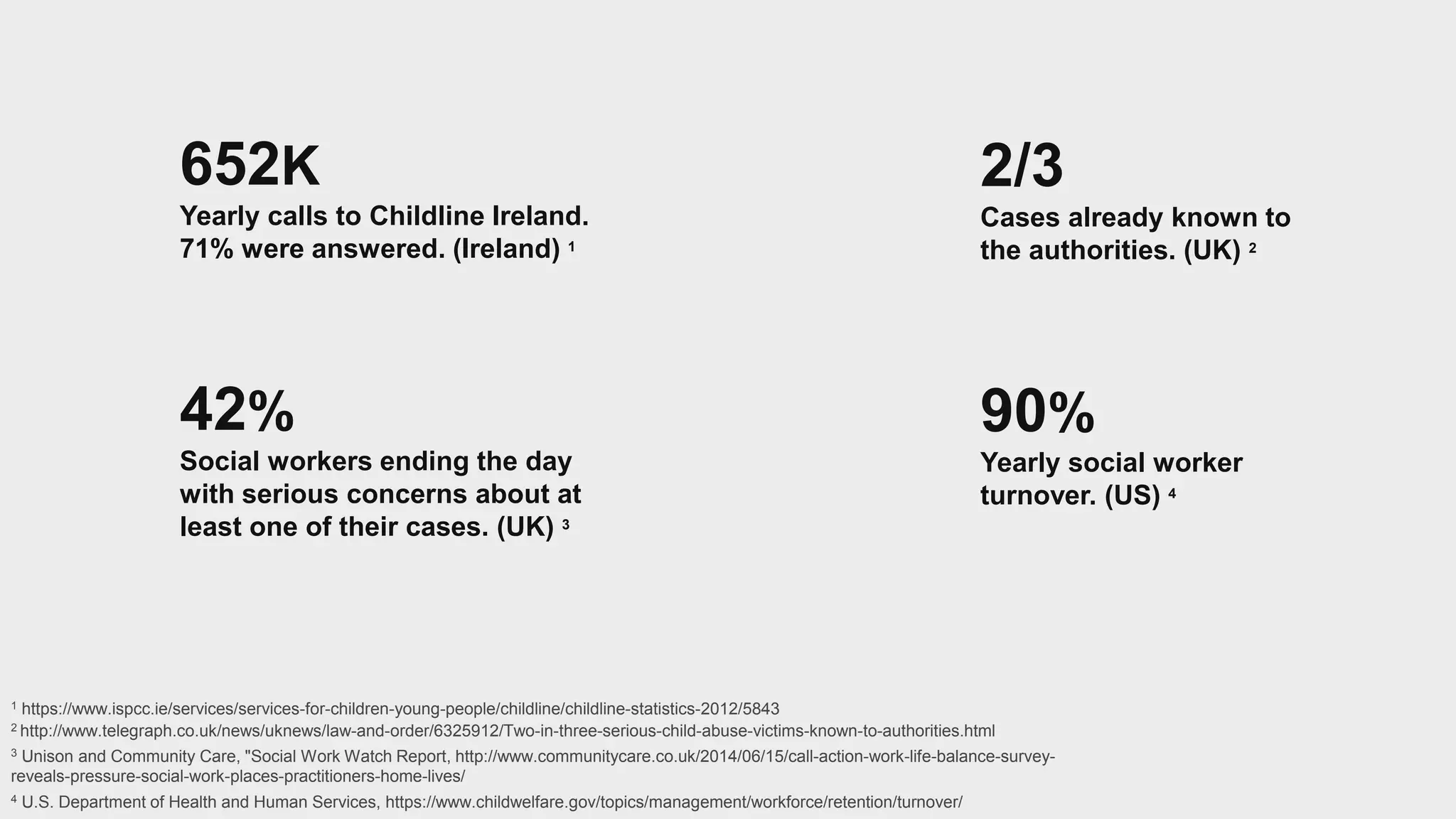
2/3
Cases already known to
the authorities. (UK) 2
90%
Yearly social worker
turnover. (US) 4
4 U.S. Department of Health and Human Services, https://www.childwelfare.gov/topics/management/workforce/retention/turnover/
42%
Social workers ending the day
with serious concerns about at
least one of their cases. (UK) 3
3 Unison and Community Care, "Social Work Watch Report, http://www.communitycare.co.uk/2014/06/15/call-action-work-life-balance-survey-
reveals-pressure-social-work-places-practitioners-home-lives/
2 http://www.telegraph.co.uk/news/uknews/law-and-order/6325912/Two-in-three-serious-child-abuse-victims-known-to-authorities.html
652K
Yearly calls to Childline Ireland.
71% were answered. (Ireland) 1
1 https://www.ispcc.ie/services/services-for-children-young-people/childline/childline-statistics-2012/5843
Child Welfare Intake
Screening
decision
Individuals
involved
Nature of
the
allegation
Family
situation
Guidelines
and
processes
Screen out
Screen In
24 hours
10 days
Human touch Background information Guidelines and processes

Spyros Kotoulas

  • 1.
    2/3 Cases already knownto the authorities. (UK) 2 90% Yearly social worker turnover. (US) 4 4 U.S. Department of Health and Human Services, https://www.childwelfare.gov/topics/management/workforce/retention/turnover/ 42% Social workers ending the day with serious concerns about at least one of their cases. (UK) 3 3 Unison and Community Care, "Social Work Watch Report, http://www.communitycare.co.uk/2014/06/15/call-action-work-life-balance-survey- reveals-pressure-social-work-places-practitioners-home-lives/ 2 http://www.telegraph.co.uk/news/uknews/law-and-order/6325912/Two-in-three-serious-child-abuse-victims-known-to-authorities.html 652K Yearly calls to Childline Ireland. 71% were answered. (Ireland) 1 1 https://www.ispcc.ie/services/services-for-children-young-people/childline/childline-statistics-2012/5843
  • 2.
    Child Welfare Intake Screening decision Individuals involved Natureof the allegation Family situation Guidelines and processes Screen out Screen In 24 hours 10 days
  • 3.
    Human touch Backgroundinformation Guidelines and processes

Editor's Notes

  • #2 I will describe some of the work we are doing in Ireland and the United States around child protection. Some, rather sobering, facts about child protection: Just in Ireland, childline is receiving more than 500K calls per year. Keep in mind that Ireland have less than 5 million inhabitants. In 2012, they were able to answer only 71% of these calls. Globally, there are hundreds of child protection organisations and agencies receiving tens of millions of calls. For around 2/3 of serious child abuse cases in the UK, the families were known to the authorities before the event. In my opinion, social workers are everyday heroes: They under immense pressure: they are constantly pressed for time, it is a hard domain to work in and they are often left with doubts. A study in the UK has shown that 42% of social workers end the day with serious concerns about at least one of their cases. Some numbers from the US are equally discouraging: attrition rates for social workers is up to 90% yearly (this essentially means that people do this job only for one year and then resign). The question is: How can Artificial Intelligence help them?
  • #3 For this presentation, we will focus on a specific process in child welfare – the intake process. Child welfare intake workers answer calls from families, law enforcement officials, or other mandated reporters such as teachers or medical professionals. Their job is to determine whether the child is safe. During a report, the intake worker needs to understand who are the parties involved, the nature of the allegation, the family and other critical factors to determine if the child is safe and to determine whether to screen in or screen out the report. They also need to decide on the level of response that is appropriate.
  • #4 There are three things that you should know about this domain: Firstly, maintaining the human touch is paramount, it is very hard to automate compassion, and the people making calls to child protection services are often distressed. Secondly, there is a large volume of background information which requires caseworkers potentially many hours to manually review the details and complex family situations. The outcome can be devastating if key information is missed or information may not be documented.  Thirdly, child welfare principles and guidelines are not linear. There are many factors and considerations to help support the worker to make the “right” decision on a child’s safety - and intake workers work with tight deadlines. The solution follows the characteristics of the domain: What we are aiming at here is a system that works together with care workers, empowering them and giving them the time to focus on what they do best – which is helping people. To do that: We are building techniques that look into the background information, and provide relevant insights, saving care workers time and reducing the chance of missing something. At the same time, we are aligning this information in the context of guidelines and processes, and we provide suggestions on where they may want to take the conversation next. I think that this is better seen that described, so I will now show you a demo. This demo is about a hypothetical scenario where a mandated reported (a teacher in this case) makes a call to child protection agencies. There are two people in this scenario (Karen, the teacher, whose voice you will hear recorded), and the care worker (John), whose role in this I will be describing.