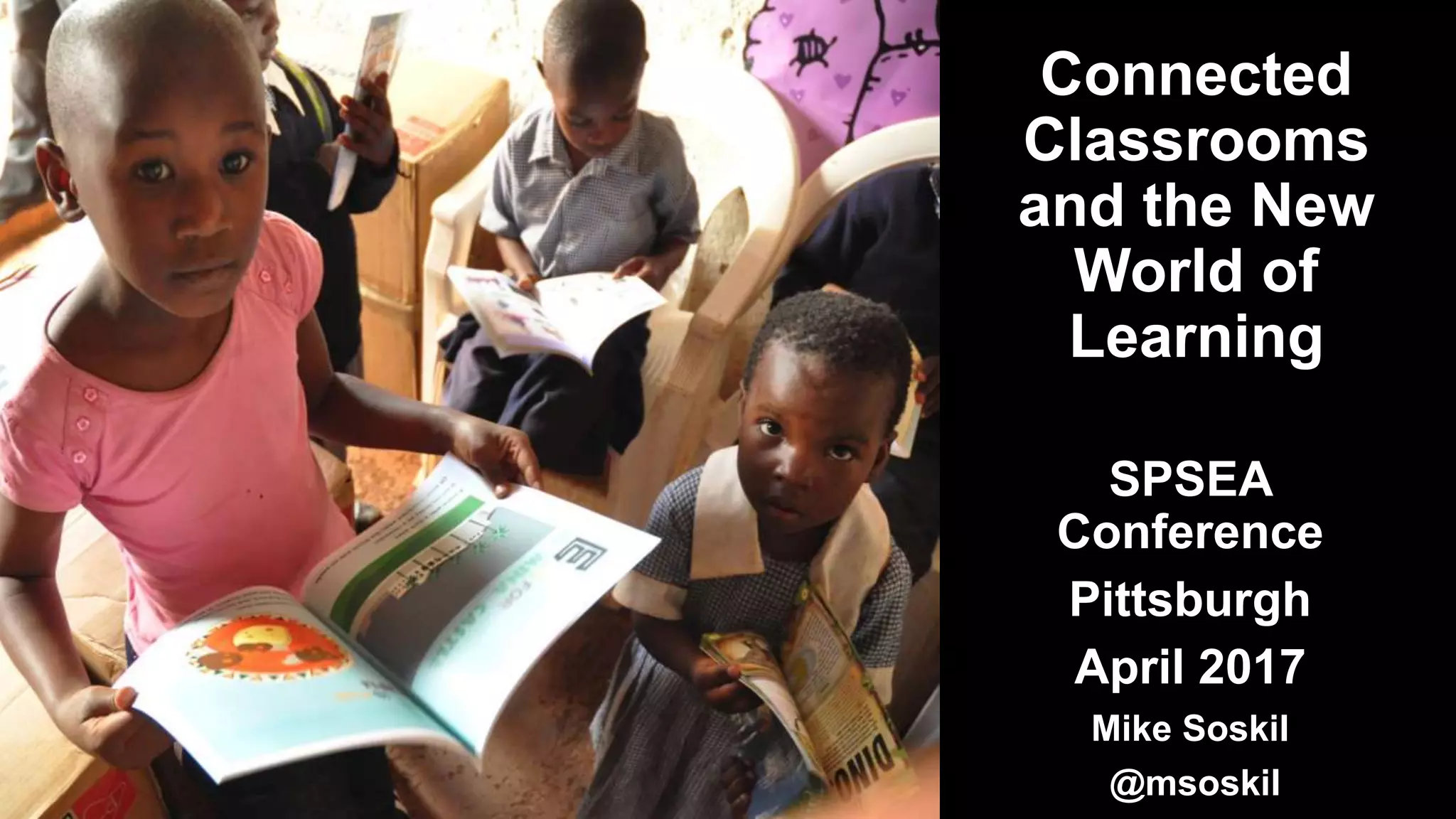
Connected
Classrooms
and the New
World of
Learning
SPSEA
Conference
Pittsburgh
April 2017
Mike Soskil
@msoskil
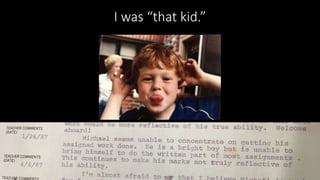
I was “that kid.”
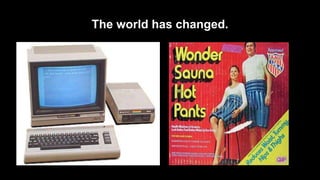
The world has changed.
15 Years Ago…
• The iPhone and mobile technology hadn’t been invented yet
• YouTube didn’t exist
• Social Media didn’t exist. Facebook and Twitter weren’t created yet
• No Uber, Airbnb, Paypal
• Videoconferencing was very expensive and limited (No Skype, GHO)
15 years ago, thinking globally was a luxury.
Now, the world is interconnected like never before.
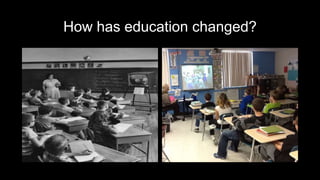
How has education changed?
It’s time to start preparing students for their
future
in a globally connected society
instead of the isolation of our past.
How can children learn global citizenship
when they often are not allowed to be citizens
of their own classrooms?
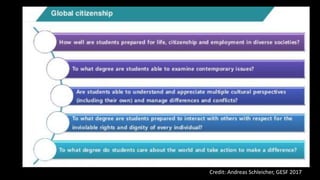
What are the qualities of a
good citizen?
Credit: Andreas Schleicher, GESF 2017
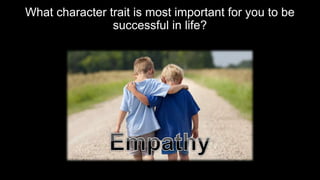
What character trait is most important for you to be
successful in life?
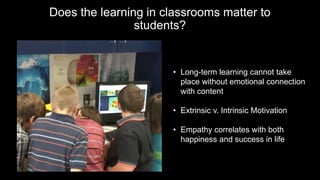
Does the learning in classrooms matter to
students?
• Long-term learning cannot take
place without emotional connection
with content
• Extrinsic v. Intrinsic Motivation
• Empathy correlates with both
happiness and success in life
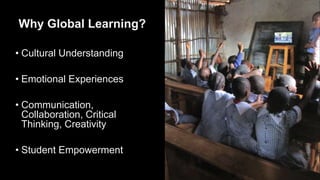
Why Global Learning?
• Cultural Understanding
• Emotional Experiences
• Communication,
Collaboration, Critical
Thinking, Creativity
• Student Empowerment
It’s hard to change the world when you
don’t know much about it.
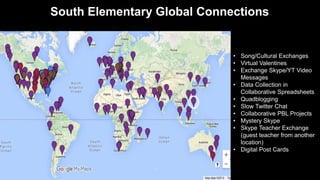
South Elementary Global Connections
• Song/Cultural Exchanges
• Virtual Valentines
• Exchange Skype/YT Video
Messages
• Data Collection in
Collaborative Spreadsheets
• Quadblogging
• Slow Twitter Chat
• Collaborative PBL Projects
• Mystery Skype
• Skype Teacher Exchange
(guest teacher from another
location)
• Digital Post Cards
The Magic Words
“We should do something about that.”
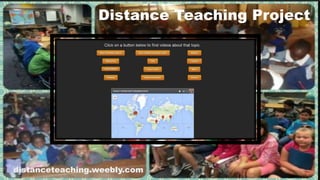
Distance Teaching Project
distanceteaching.weebly.com
Fundraising, by itself, does not build empathy.
Students need relationships with others who are
different than they are.
Service projects should always be a two-way
street.
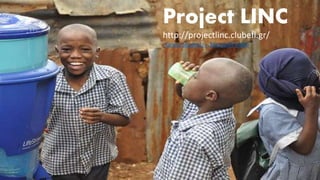
Project LINC
http://projectlinc.clubefl.gr/
Kansas Students – Microsoft Video
Children who feel the joy of doing good for others
continue to look for new ways to make a
positive impact on the world.
They grow to be the problem solving leaders of the
next generation.
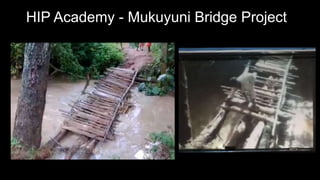
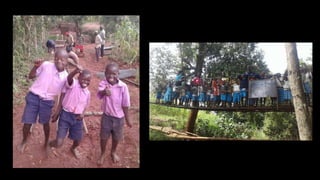
HIP Academy - Mukuyuni Bridge Project
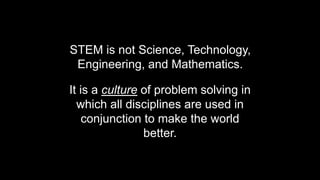
STEM is not Science, Technology,
Engineering, and Mathematics.
It is a culture of problem solving in
which all disciplines are used in
conjunction to make the world
better.
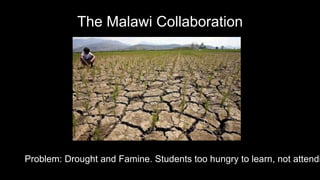
The Malawi Collaboration
Problem: Drought and Famine. Students too hungry to learn, not attendi
That’s great for your students.
But, how do I do that?
Growth Mindset
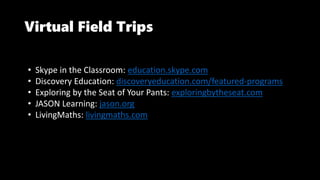
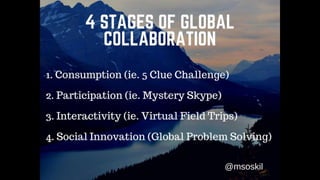
Virtual Field Trips
• Skype in the Classroom: education.skype.com
• Discovery Education: discoveryeducation.com/featured-programs
• Exploring by the Seat of Your Pants: exploringbytheseat.com
• JASON Learning: jason.org
• LivingMaths: livingmaths.com
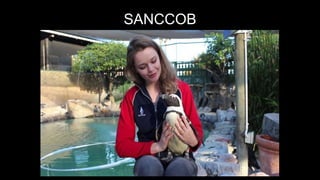
SANCCOB
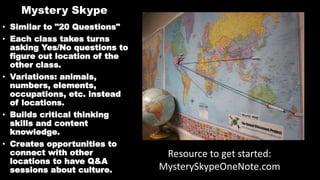
Mystery Skype
• Similar to "20 Questions"
• Each class takes turns
asking Yes/No questions to
figure out location of the
other class.
• Variations: animals,
numbers, elements,
occupations, etc. instead
of locations.
• Builds critical thinking
skills and content
knowledge.
• Creates opportunities to
connect with other
locations to have Q&A
sessions about culture.
Resource to get started:
MysterySkypeOneNote.com
Mystery Skype w/ Ms. H
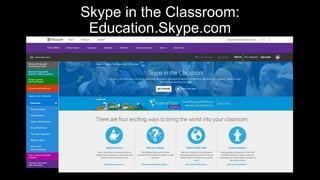
Skype in the Classroom:
Education.Skype.com
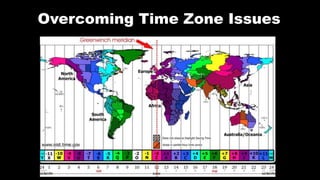
Overcoming Time Zone Issues
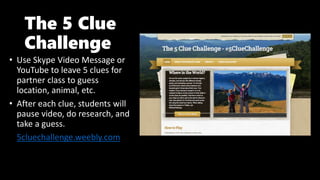
The 5 Clue
Challenge
• Use Skype Video Message or
YouTube to leave 5 clues for
partner class to guess
location, animal, etc.
• After each clue, students will
pause video, do research, and
take a guess.
• 5cluechallenge.weebly.com
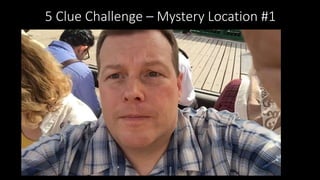
5 Clue Challenge – Mystery Location #1
5 Clue Challenge – Mystery Location #2
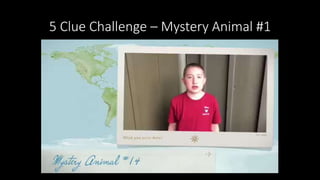
5 Clue Challenge – Mystery Animal #1
Global Teacher Leaders Projects
Curriculum based global projects where we make the
connections easy for you
• World Read Aloud Skypeathon
• Awesome Squiggles
• Virtual Valentines Project
• Global Kidwish Project
• Global Video Exchange
GlobalTeacherLeaders.com
TheGlobalReadAloud.com
How do I make connections?
Twitter
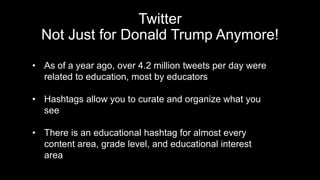
Not Just for Donald Trump Anymore!
• As of a year ago, over 4.2 million tweets per day were
related to education, most by educators
• Hashtags allow you to curate and organize what you
see
• There is an educational hashtag for almost every
content area, grade level, and educational interest
area
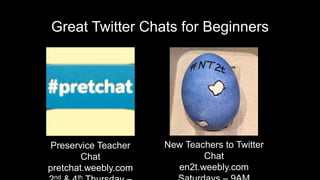
Great Twitter Chats for Beginners
Preservice Teacher
Chat
pretchat.weebly.com
nd th
New Teachers to Twitter
Chat
en2t.weebly.com
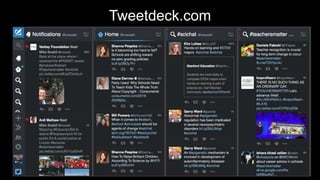
Tweetdeck.com
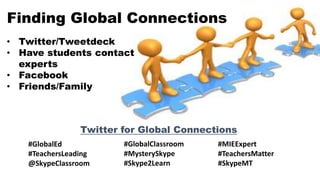
Finding Global Connections
• Twitter/Tweetdeck
• Have students contact
experts
• Facebook
• Friends/Family
Twitter for Global Connections
#GlobalEd
#TeachersLeading
@SkypeClassroom
#GlobalClassroom
#MysterySkype
#Skype2Learn
#MIEExpert
#TeachersMatter
#SkypeMT
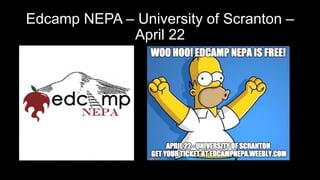
Edcamp NEPA – University of Scranton –
April 22
#TeachersMatter
Every problem in the world has a solution
trapped inside our students’ passions.
Helping them see the connection
is our job as teachers.
Connect with Me
Twitter: @msoskil
Website: michaelsoskil.com
Email: mrsoskil@gmail.com
Link to this presentation:
Spsea 2017

Spsea 2017

  • 1.
    Connected Classrooms and the New Worldof Learning SPSEA Conference Pittsburgh April 2017 Mike Soskil @msoskil
  • 4.
  • 5.
    The world haschanged.
  • 6.
    15 Years Ago… •The iPhone and mobile technology hadn’t been invented yet • YouTube didn’t exist • Social Media didn’t exist. Facebook and Twitter weren’t created yet • No Uber, Airbnb, Paypal • Videoconferencing was very expensive and limited (No Skype, GHO) 15 years ago, thinking globally was a luxury. Now, the world is interconnected like never before.
  • 7.
  • 8.
    It’s time tostart preparing students for their future in a globally connected society instead of the isolation of our past.
  • 9.
    How can childrenlearn global citizenship when they often are not allowed to be citizens of their own classrooms? What are the qualities of a good citizen?
  • 10.
  • 11.
    What character traitis most important for you to be successful in life?
  • 12.
    Does the learningin classrooms matter to students? • Long-term learning cannot take place without emotional connection with content • Extrinsic v. Intrinsic Motivation • Empathy correlates with both happiness and success in life
  • 13.
    Why Global Learning? •Cultural Understanding • Emotional Experiences • Communication, Collaboration, Critical Thinking, Creativity • Student Empowerment
  • 14.
    It’s hard tochange the world when you don’t know much about it.
  • 15.
    South Elementary GlobalConnections • Song/Cultural Exchanges • Virtual Valentines • Exchange Skype/YT Video Messages • Data Collection in Collaborative Spreadsheets • Quadblogging • Slow Twitter Chat • Collaborative PBL Projects • Mystery Skype • Skype Teacher Exchange (guest teacher from another location) • Digital Post Cards
  • 16.
    The Magic Words “Weshould do something about that.”
  • 17.
  • 18.
    Fundraising, by itself,does not build empathy. Students need relationships with others who are different than they are. Service projects should always be a two-way street.
  • 19.
  • 20.
    Children who feelthe joy of doing good for others continue to look for new ways to make a positive impact on the world. They grow to be the problem solving leaders of the next generation.
  • 21.
    HIP Academy -Mukuyuni Bridge Project
  • 22.
    STEM is notScience, Technology, Engineering, and Mathematics. It is a culture of problem solving in which all disciplines are used in conjunction to make the world better.
  • 25.
    The Malawi Collaboration Problem:Drought and Famine. Students too hungry to learn, not attendi
  • 27.
    That’s great foryour students. But, how do I do that?
  • 28.
  • 29.
    Virtual Field Trips •Skype in the Classroom: education.skype.com • Discovery Education: discoveryeducation.com/featured-programs • Exploring by the Seat of Your Pants: exploringbytheseat.com • JASON Learning: jason.org • LivingMaths: livingmaths.com
  • 30.
  • 31.
    Mystery Skype • Similarto "20 Questions" • Each class takes turns asking Yes/No questions to figure out location of the other class. • Variations: animals, numbers, elements, occupations, etc. instead of locations. • Builds critical thinking skills and content knowledge. • Creates opportunities to connect with other locations to have Q&A sessions about culture. Resource to get started: MysterySkypeOneNote.com
  • 32.
  • 33.
    Skype in theClassroom: Education.Skype.com
  • 34.
  • 35.
    The 5 Clue Challenge •Use Skype Video Message or YouTube to leave 5 clues for partner class to guess location, animal, etc. • After each clue, students will pause video, do research, and take a guess. • 5cluechallenge.weebly.com
  • 36.
    5 Clue Challenge– Mystery Location #1
  • 37.
    5 Clue Challenge– Mystery Location #2
  • 38.
    5 Clue Challenge– Mystery Animal #1
  • 39.
    Global Teacher LeadersProjects Curriculum based global projects where we make the connections easy for you • World Read Aloud Skypeathon • Awesome Squiggles • Virtual Valentines Project • Global Kidwish Project • Global Video Exchange GlobalTeacherLeaders.com
  • 40.
  • 42.
    How do Imake connections?
  • 43.
    Twitter Not Just forDonald Trump Anymore! • As of a year ago, over 4.2 million tweets per day were related to education, most by educators • Hashtags allow you to curate and organize what you see • There is an educational hashtag for almost every content area, grade level, and educational interest area
  • 44.
    Great Twitter Chatsfor Beginners Preservice Teacher Chat pretchat.weebly.com nd th New Teachers to Twitter Chat en2t.weebly.com
  • 45.
  • 46.
    Finding Global Connections •Twitter/Tweetdeck • Have students contact experts • Facebook • Friends/Family Twitter for Global Connections #GlobalEd #TeachersLeading @SkypeClassroom #GlobalClassroom #MysterySkype #Skype2Learn #MIEExpert #TeachersMatter #SkypeMT
  • 50.
    Edcamp NEPA –University of Scranton – April 22
  • 51.
  • 52.
    Every problem inthe world has a solution trapped inside our students’ passions. Helping them see the connection is our job as teachers.
  • 53.
    Connect with Me Twitter:@msoskil Website: michaelsoskil.com Email: mrsoskil@gmail.com Link to this presentation:

Editor's Notes

  • #3  ----- Meeting Notes (11/18/16 12:28) ----- The purpose of school is not to prepare kids for tests, colleges, or careers. The purpose of school is to give students the tools they need to be happy in their lives.
  • #12  ----- Meeting Notes (10/23/16 18:05) ----- Whether we define success as financial or personal happiness, research has shown that empathy correlates best with success in later life. We must focus on this in schools.
  • #13  ----- Meeting Notes (11/18/16 10:36) ----- Emotion - Limbic System Motivation - Karl Drucker (Candle Experiment)