J.E. Sprittles (University of Oxford, U.K.)
Y.D. Shikhmurzaev (University of Birmingham, U.K.)
European Coating Symposium, Mons
September 2013
Coating Phenomena
Impact of a
solid on a liquid
Duez et al 07
Dip coating experiments
Courtesy of Terry Blake
Impact of a liquid on a solid
Xu et al 05
Questions
?
1) Why is there still so much debate about wetting?
2) Are computational techniques essential?
3) Are the gas’ dynamics important?
4) How can we identify the ‘true’ physics?
Coating Experiments
Advantages:
Flow is steady making
experimental analysis more
tractable.
Parameter space is easier to
map:
Speeds over 6 orders
Viscosities over 3 orders
appθ
clU Liquid
GasSolid
The
‘apparent angle’
Coating Results
Apparent angle measured at resolution of 20microns for
water-glycerol solutions with μ=1, 10, 100 mPas.
Increasing μ
cl
cl
U
Ca
µ
σ
=
You only observe the ‘apparent angle’. The actual one is fixed.
Free surface bends below the experiment’s resolution (20μm)
Interpretation A: Static Contact Angle
eθ
r
U
( )app rθ
The ‘actual angle’
Dynamics of angle cause change in apparent angle
Dynamic contact angle is a function of speed
Interpretation B: Dynamic Contact Angle
rU
dθ ( )app rθ
Slip Models
A: Equilibrium contact angle
B: Slip - typically Navier-slip
eθ
U ( )app rθ
ls
B: No-slip => No solution
Often, we have
Asymptotics for the Apparent Angle
( ) ( )
( )
( ) ( ) ( )
( ) ( ) ( ){ }
2 2
22 2 2
0
2 2
ln
sin cos sin
,
2sin 2 sin sin
( ) sin
app d
s
g
l
Lg g Ca
l
k K d
g k
k K k
K
k
θ
µ
µ
µ µ
µ
αθ θ
θ θ θ θ θ θ θ
θ
θ θ θ θ θ θ θ
θ θ θ
µ
µ
 = +  ÷
 
  Π − + + Π − −   =
  + Π − + + Π − −   
= −
=
∫
, 1sl
Ca
L
=
3 3
9 lnapp d
s
LCa
l
αθ θ  = +  ÷
 
( ) ( ) lnapp d
s
Lg g Ca
l
αθ θ  = +  ÷
 
1dθ =
In Cox 86, it was shown that in this case:
And for Voinov (76) has shown:
JES & YDS 2013, Finite Element Simulation of Dynamic Wetting Flows as an
Interface Formation Process, Journal of Computational Physics, 233, 34-65
Computational Domain
U Gas
Liquid
x1x10x10
8
x10
2
x10
4
Resolution:
Arbitrary Lagrangian Eulerian Mesh
Based on the ‘spine method’ of Scriven and co-workers
Microdrop simulation
with impact, spreading and rebound
Free Surface Profiles
With: 67 , 1nme slθ = =o
Computations vs Asymptotics
Ca=0.5
Ca=0.05
Ca=0.005
Solid line: Computations
Dashed line: Asymptotic (Cox’s) result
Limitations of Cox’s Formula
Chen, Rame & Garoff 95:
“Aspects of the unique hydrodynamics acting in the inner
region, not included in the model, project out and
become visible in the imaged region.”
0.1Ca = 0.5Ca =
( )r mµ
appθ
( )r mµ
appθ
2) Are computational techniques essential?
Yes!
To accurately capture high-speed coating flows.
Slip Model vs Experiments
Gas’ viscosity leads to air entrainment at a finite speed.
Decreasing viscosity ratio
Hydrodynamic Assist
U, cm/s
dθ
Blake et al 99
-1
(ms )U
appθ
appθ
Vary Flow
Rate
30dθ∆ ≈ o
U
Effect is not due to
free surface bending
(Wilson et al 06)
Physics of Dynamic Wetting
Make a dry solid wet.
Create a new/fresh liquid-solid interface.
Class of flows with forming interfaces.
Forming
interface
Formed interface
Liquid-solidLiquid-solid
interfaceinterface
SolidSolid
Relevance of the Young Equation
U
1 3 2cose e e eσ θ σ σ= − 1 3 2cos dσ θ σ σ= −
R
σ1e
σ3e - σ2e
Dynamic contact angle results from dynamic surface tensions.
The angle is now determined by the flow field.
Slip created by surface tension gradients (Marangoni effect)
θe θd
Static situation Dynamic wetting
σ1
σ3 - σ2
R
2u 1
u 0, u u up
t
ν
ρ
∂
∇× = + ×∇ = − ∇ + ∇
∂
s s
1 1 1 2 2 2
1 3 2
v e v e 0
cos
s s
d
ρ ρ
σ θ σ σ
× + × =
= −
s
1
*
1
*
1
s 1 1
1
s 1 11
1 1
1 1|| ||
v 0
n [( u) ( u) ] n n
n [( u) ( u) ] (I nn) 0
(u v ) n
( v )
(1 4 ) 4 (v u )
s s
e
s ss
s e
s
f
f
t
p
t
µ σ
µ σ
ρ ρ
ρ
τ
ρ ρρ
ρ
τ
αβ σ β
∂
+ ×∇ =
∂
− + × ∇ + ∇ × = ∇×
× ∇ + ∇ × − + ∇ =
−
− × =
−∂
+ ∇ = −
∂
+ ∇ = −
In the bulk (Navier Stokes):
At contact lines:
On free surfaces:
Interface Formation Model
θd
e2
e1
n
n
f (r, t )=0
Interface Formation Modelling
( )*
2 || ||
s 2 2
2
s 2 22
2 2
2|| || || 2
2
1,2 1,2 1,2
1n [ u ( u) ] (I nn) u U
2
(u v ) n
( v )
1v (u U )
2
( )
s s
e
s ss
s e
s
s s
t
a b
µ σ β
ρ ρ
ρ
τ
ρ ρρ
ρ
τ
α σ
σ ρ ρ
×∇ + ∇ × − + ∇ = −
−
− × =
−∂
+ ∇ × = −
∂
= + = ∇
= −
Liquid-solid interface
Interface Formation vs Experiments
Apparent angle = Dynamic actual angle
1) Why is there still a debate about wetting?
Fundamentally different models describe experiments
(with reasonable parameter values).
+ Viscous bending
Influence of Gas Pressure
Splashing in Drop
Impact:
Xu, Zhang & Nagel 05
Air Entrainment Speed
in Dip Coating
Benkreira & Ikin 10
(Lack of) Influence of Inertia
 Bulk flow can’t be responsible for the effect.
Re = 0
Re = 100
Rarefied Gas Dynamics
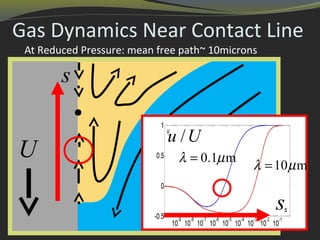
Slip at solid-gas interface is due to finite mean free path.
Mean free path (hence Kn) depends on gas density.
λ 1Kn
L
λ
= =U
( )
u
Kn u U
y
∂
= −
∂
Gas Dynamics Near Contact Line
U
Atmospheric pressure: mean free path ~ 0.1 microns
/u U
s
s
0.1 mλ µ=
Gas Dynamics Near Contact Line
At Reduced Pressure: mean free path~ 10microns
/u U
s
U
s
0.1 mλ µ=
10 mλ µ=
Delayed Air Entrainment
Mean free paths (mfp) are:
Atmospheric pressure: mfp ~ 0.1 microns
Reduced pressure (10mbar): mfp ~ 10 microns
cCa
( )mfp mµ
3) Are the gas’ dynamics important?
Yes, its behaviour is key to air entrainment
Microdrop Impact
JES & YDS 2012, The Dynamics of Liquid Drops and their Interaction with
Solids of Varying Wettability, Physics of Fluids, 24, 082001.
Coalescence of Liquid Drops
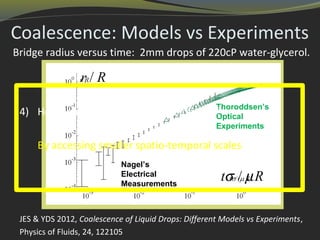
Developed framework can be adapted for coalescence.
Thoroddsen’s Group:
Ultra high-speed imaging
Nagel’s Group:
Sub-optical electrical
measurements r
Thoroddsen et al 2005
dθ
Simulation
Experiment
Coalescence: Models vs Experiments
Bridge radius versus time: 2mm drops of 220cP water-glycerol.
Interface
formation
Conventional
Nagel’s
Electrical
Measurements
Thoroddsen’s
Optical
Experiments
/r R
/t Rσ µ
4) How can we identify the ‘true’ physics?
By accessing smaller spatio-temporal scales
JES & YDS 2012, Coalescence of Liquid Drops: Different Models vs Experiments,
Physics of Fluids, 24, 122105
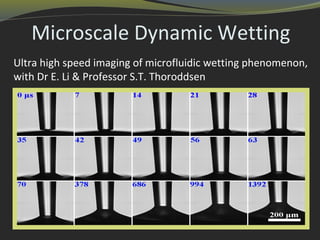
Microscale Dynamic Wetting
Ultra high speed imaging of microfluidic wetting phenomenon,
with Dr E. Li & Professor S.T. Thoroddsen
Funding
Funding
This presentation is based on work supported by:
Computations vs Experiments
1.5, 10, 104 mPa sµ =Water-glycerol solutions of
& Asymptotics
Asymptotic Formula for Actual Angle in IFM
( ) ( )
( ) ( )
2 1 0
2
2
2 2 2 2 2
0
2 2 2 2
2 2
2
2 ( , )
cos cos
.
sin cos ( ) sin cos ( )
( , )
sin cos ( ) sin cos ( )
, ( ) sin
s s
e e d
e d s
e
d d d
d
d d d d
d
V u k
V V
V Sc Ca
K k K
u k
K k K
K
µ
µ
µ
µ
ρ ρ θ
θ θ
ρ
θ θ θ θ θ θ θ θ
θ
θ θ θ θ θ θ θ θ
θ θ θ θ θ
 + − =
+ +
=
− − −
=
− + −
= Π − = −
When there is no ‘hydrodynamic assist’, for small capillary
numbers the actual angle is dynamic:
Moffat 64
IFM vs Experiments
Shikhmurzaev 93
Shikhmurzaev 93 + Cox 86
& Asymptotics
Actual angle varies and free surface bends.
‘Hydrodynamic Resist’
Smaller Capillaries
U
dθ
R
New effect: contact angle depends on capillary size
( m)R µ
Sobolev et al 01
dθ
1/3
U
Fibre Coating: Effect of Geometry
appθ
d
Simpkins & Kuck 03
appπ θ−
4mmd =
Uµ σ
2mmd =
U
Drop Spreading: Effect of Impact
Speed
1
0.18ms−
1
0.25ms−
)
U
appθ
-1
(ms )U
appθ
Bayer & Megaridis 06
30dθ∆ ≈ o
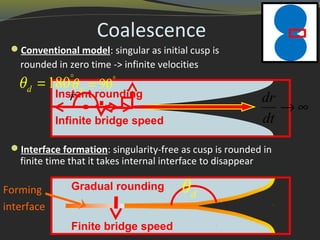
Coalescence
Conventional model: singular as initial cusp is
rounded in zero time -> infinite velocities
Interface formation: singularity-free as cusp is rounded in
finite time that it takes internal interface to disappear
Forming
interface
dθ
Instant rounding
Infinite bridge speed
90dθ °
=180dθ °
=
dr
dt
→ ∞
r
Gradual rounding
Finite bridge speed
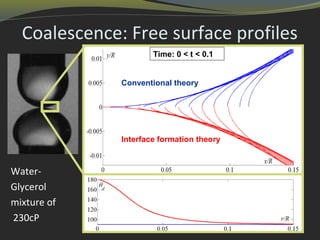
Coalescence: Free surface profiles
Interface formation theory
Conventional theory
Water-
Glycerol
mixture of
230cP
Time: 0 < t < 0.1
0.01 - 0.36
0.03 - 0.365
0.1 - 0.37
0.6 - 0.39
1 - 0.4
3 - 0.42
6 - 0.44
10 - 0.45
Wetting6 (1489) running 1166,2277 and 0.1microns –
saved previous t_info – running for current info
Microdrop Impact
25 micron water drop impacting at 5m/s on
left: wettable substrate right: nonwettable substrate

Sprittles presentation

  • 1.
    J.E. Sprittles (Universityof Oxford, U.K.) Y.D. Shikhmurzaev (University of Birmingham, U.K.) European Coating Symposium, Mons September 2013
  • 2.
    Coating Phenomena Impact ofa solid on a liquid Duez et al 07 Dip coating experiments Courtesy of Terry Blake Impact of a liquid on a solid Xu et al 05
  • 3.
    Questions ? 1) Why isthere still so much debate about wetting? 2) Are computational techniques essential? 3) Are the gas’ dynamics important? 4) How can we identify the ‘true’ physics?
  • 4.
    Coating Experiments Advantages: Flow issteady making experimental analysis more tractable. Parameter space is easier to map: Speeds over 6 orders Viscosities over 3 orders appθ clU Liquid GasSolid The ‘apparent angle’
  • 5.
    Coating Results Apparent anglemeasured at resolution of 20microns for water-glycerol solutions with μ=1, 10, 100 mPas. Increasing μ cl cl U Ca µ σ =
  • 6.
    You only observethe ‘apparent angle’. The actual one is fixed. Free surface bends below the experiment’s resolution (20μm) Interpretation A: Static Contact Angle eθ r U ( )app rθ The ‘actual angle’
  • 7.
    Dynamics of anglecause change in apparent angle Dynamic contact angle is a function of speed Interpretation B: Dynamic Contact Angle rU dθ ( )app rθ
  • 9.
    Slip Models A: Equilibriumcontact angle B: Slip - typically Navier-slip eθ U ( )app rθ ls B: No-slip => No solution
  • 10.
    Often, we have Asymptoticsfor the Apparent Angle ( ) ( ) ( ) ( ) ( ) ( ) ( ) ( ) ( ){ } 2 2 22 2 2 0 2 2 ln sin cos sin , 2sin 2 sin sin ( ) sin app d s g l Lg g Ca l k K d g k k K k K k θ µ µ µ µ µ αθ θ θ θ θ θ θ θ θ θ θ θ θ θ θ θ θ θ θ θ µ µ  = +  ÷     Π − + + Π − −   =   + Π − + + Π − −    = − = ∫ , 1sl Ca L = 3 3 9 lnapp d s LCa l αθ θ  = +  ÷   ( ) ( ) lnapp d s Lg g Ca l αθ θ  = +  ÷   1dθ = In Cox 86, it was shown that in this case: And for Voinov (76) has shown:
  • 11.
    JES & YDS2013, Finite Element Simulation of Dynamic Wetting Flows as an Interface Formation Process, Journal of Computational Physics, 233, 34-65
  • 12.
  • 13.
    Arbitrary Lagrangian EulerianMesh Based on the ‘spine method’ of Scriven and co-workers Microdrop simulation with impact, spreading and rebound
  • 15.
    Free Surface Profiles With:67 , 1nme slθ = =o
  • 16.
    Computations vs Asymptotics Ca=0.5 Ca=0.05 Ca=0.005 Solidline: Computations Dashed line: Asymptotic (Cox’s) result
  • 17.
    Limitations of Cox’sFormula Chen, Rame & Garoff 95: “Aspects of the unique hydrodynamics acting in the inner region, not included in the model, project out and become visible in the imaged region.” 0.1Ca = 0.5Ca = ( )r mµ appθ ( )r mµ appθ 2) Are computational techniques essential? Yes! To accurately capture high-speed coating flows.
  • 18.
    Slip Model vsExperiments Gas’ viscosity leads to air entrainment at a finite speed. Decreasing viscosity ratio
  • 20.
    Hydrodynamic Assist U, cm/s dθ Blakeet al 99 -1 (ms )U appθ appθ Vary Flow Rate 30dθ∆ ≈ o U Effect is not due to free surface bending (Wilson et al 06)
  • 21.
    Physics of DynamicWetting Make a dry solid wet. Create a new/fresh liquid-solid interface. Class of flows with forming interfaces. Forming interface Formed interface Liquid-solidLiquid-solid interfaceinterface SolidSolid
  • 22.
    Relevance of theYoung Equation U 1 3 2cose e e eσ θ σ σ= − 1 3 2cos dσ θ σ σ= − R σ1e σ3e - σ2e Dynamic contact angle results from dynamic surface tensions. The angle is now determined by the flow field. Slip created by surface tension gradients (Marangoni effect) θe θd Static situation Dynamic wetting σ1 σ3 - σ2 R
  • 23.
    2u 1 u 0,u u up t ν ρ ∂ ∇× = + ×∇ = − ∇ + ∇ ∂ s s 1 1 1 2 2 2 1 3 2 v e v e 0 cos s s d ρ ρ σ θ σ σ × + × = = − s 1 * 1 * 1 s 1 1 1 s 1 11 1 1 1 1|| || v 0 n [( u) ( u) ] n n n [( u) ( u) ] (I nn) 0 (u v ) n ( v ) (1 4 ) 4 (v u ) s s e s ss s e s f f t p t µ σ µ σ ρ ρ ρ τ ρ ρρ ρ τ αβ σ β ∂ + ×∇ = ∂ − + × ∇ + ∇ × = ∇× × ∇ + ∇ × − + ∇ = − − × = −∂ + ∇ = − ∂ + ∇ = − In the bulk (Navier Stokes): At contact lines: On free surfaces: Interface Formation Model θd e2 e1 n n f (r, t )=0 Interface Formation Modelling ( )* 2 || || s 2 2 2 s 2 22 2 2 2|| || || 2 2 1,2 1,2 1,2 1n [ u ( u) ] (I nn) u U 2 (u v ) n ( v ) 1v (u U ) 2 ( ) s s e s ss s e s s s t a b µ σ β ρ ρ ρ τ ρ ρρ ρ τ α σ σ ρ ρ ×∇ + ∇ × − + ∇ = − − − × = −∂ + ∇ × = − ∂ = + = ∇ = − Liquid-solid interface
  • 24.
    Interface Formation vsExperiments Apparent angle = Dynamic actual angle 1) Why is there still a debate about wetting? Fundamentally different models describe experiments (with reasonable parameter values). + Viscous bending
  • 26.
    Influence of GasPressure Splashing in Drop Impact: Xu, Zhang & Nagel 05 Air Entrainment Speed in Dip Coating Benkreira & Ikin 10
  • 27.
    (Lack of) Influenceof Inertia  Bulk flow can’t be responsible for the effect. Re = 0 Re = 100
  • 28.
    Rarefied Gas Dynamics Slipat solid-gas interface is due to finite mean free path. Mean free path (hence Kn) depends on gas density. λ 1Kn L λ = =U ( ) u Kn u U y ∂ = − ∂
  • 29.
    Gas Dynamics NearContact Line U Atmospheric pressure: mean free path ~ 0.1 microns /u U s s 0.1 mλ µ=
  • 30.
    Gas Dynamics NearContact Line At Reduced Pressure: mean free path~ 10microns /u U s U s 0.1 mλ µ= 10 mλ µ=
  • 31.
    Delayed Air Entrainment Meanfree paths (mfp) are: Atmospheric pressure: mfp ~ 0.1 microns Reduced pressure (10mbar): mfp ~ 10 microns cCa ( )mfp mµ 3) Are the gas’ dynamics important? Yes, its behaviour is key to air entrainment
  • 33.
    Microdrop Impact JES &YDS 2012, The Dynamics of Liquid Drops and their Interaction with Solids of Varying Wettability, Physics of Fluids, 24, 082001.
  • 34.
    Coalescence of LiquidDrops Developed framework can be adapted for coalescence. Thoroddsen’s Group: Ultra high-speed imaging Nagel’s Group: Sub-optical electrical measurements r Thoroddsen et al 2005 dθ Simulation Experiment
  • 35.
    Coalescence: Models vsExperiments Bridge radius versus time: 2mm drops of 220cP water-glycerol. Interface formation Conventional Nagel’s Electrical Measurements Thoroddsen’s Optical Experiments /r R /t Rσ µ 4) How can we identify the ‘true’ physics? By accessing smaller spatio-temporal scales JES & YDS 2012, Coalescence of Liquid Drops: Different Models vs Experiments, Physics of Fluids, 24, 122105
  • 36.
    Microscale Dynamic Wetting Ultrahigh speed imaging of microfluidic wetting phenomenon, with Dr E. Li & Professor S.T. Thoroddsen
  • 37.
    Funding Funding This presentation isbased on work supported by:
  • 39.
    Computations vs Experiments 1.5,10, 104 mPa sµ =Water-glycerol solutions of & Asymptotics
  • 40.
    Asymptotic Formula forActual Angle in IFM ( ) ( ) ( ) ( ) 2 1 0 2 2 2 2 2 2 2 0 2 2 2 2 2 2 2 2 ( , ) cos cos . sin cos ( ) sin cos ( ) ( , ) sin cos ( ) sin cos ( ) , ( ) sin s s e e d e d s e d d d d d d d d d V u k V V V Sc Ca K k K u k K k K K µ µ µ µ ρ ρ θ θ θ ρ θ θ θ θ θ θ θ θ θ θ θ θ θ θ θ θ θ θ θ θ θ θ  + − = + + = − − − = − + − = Π − = − When there is no ‘hydrodynamic assist’, for small capillary numbers the actual angle is dynamic: Moffat 64
  • 41.
    IFM vs Experiments Shikhmurzaev93 Shikhmurzaev 93 + Cox 86 & Asymptotics Actual angle varies and free surface bends.
  • 42.
    ‘Hydrodynamic Resist’ Smaller Capillaries U dθ R Neweffect: contact angle depends on capillary size ( m)R µ Sobolev et al 01 dθ 1/3 U
  • 43.
    Fibre Coating: Effectof Geometry appθ d Simpkins & Kuck 03 appπ θ− 4mmd = Uµ σ 2mmd = U
  • 44.
    Drop Spreading: Effectof Impact Speed 1 0.18ms− 1 0.25ms− ) U appθ -1 (ms )U appθ Bayer & Megaridis 06 30dθ∆ ≈ o
  • 45.
    Coalescence Conventional model: singularas initial cusp is rounded in zero time -> infinite velocities Interface formation: singularity-free as cusp is rounded in finite time that it takes internal interface to disappear Forming interface dθ Instant rounding Infinite bridge speed 90dθ ° =180dθ ° = dr dt → ∞ r Gradual rounding Finite bridge speed
  • 46.
    Coalescence: Free surfaceprofiles Interface formation theory Conventional theory Water- Glycerol mixture of 230cP Time: 0 < t < 0.1
  • 47.
    0.01 - 0.36 0.03- 0.365 0.1 - 0.37 0.6 - 0.39 1 - 0.4 3 - 0.42 6 - 0.44 10 - 0.45 Wetting6 (1489) running 1166,2277 and 0.1microns – saved previous t_info – running for current info
  • 48.
    Microdrop Impact 25 micronwater drop impacting at 5m/s on left: wettable substrate right: nonwettable substrate