Spring Essentials 1st Edition Kunjumohamed Shameer Sattari Hamidreza
1.
Spring Essentials 1stEdition Kunjumohamed
Shameer Sattari Hamidreza pdf download
https://textbookfull.com/product/spring-essentials-1st-edition-
kunjumohamed-shameer-sattari-hamidreza/
Download more ebook from https://textbookfull.com
2.
We believe theseproducts will be a great fit for you. Click
the link to download now, or visit textbookfull.com
to discover even more!
Distributed Real Time Architecture for Mixed
Criticality Systems 1st Edition Hamidreza Ahmadian
(Editor)
https://textbookfull.com/product/distributed-real-time-
architecture-for-mixed-criticality-systems-1st-edition-hamidreza-
ahmadian-editor/
Mountain Spring Fever Spring s Mountain Men 1st Edition
Andrea Marie Marie Andrea
https://textbookfull.com/product/mountain-spring-fever-spring-s-
mountain-men-1st-edition-andrea-marie-marie-andrea/
Spring Data 1st Edition Petri Kainulainen
https://textbookfull.com/product/spring-data-1st-edition-petri-
kainulainen/
Spring Cookbook 1st Edition Jaglale Jerome
https://textbookfull.com/product/spring-cookbook-1st-edition-
jaglale-jerome/
3.
Pro Spring MVCwith WebFlux: Web Development in Spring
Framework 5 and Spring Boot 2 2nd Edition Marten Deinum
https://textbookfull.com/product/pro-spring-mvc-with-webflux-web-
development-in-spring-framework-5-and-spring-boot-2-2nd-edition-
marten-deinum/
Pro Spring MVC with WebFlux: Web Development in Spring
Framework 5 and Spring Boot 2 2nd Edition Marten Deinum
https://textbookfull.com/product/pro-spring-mvc-with-webflux-web-
development-in-spring-framework-5-and-spring-boot-2-2nd-edition-
marten-deinum-2/
Spring MVC Cookbook 1st Edition Bretet Alex
https://textbookfull.com/product/spring-mvc-cookbook-1st-edition-
bretet-alex/
Mockito for Spring 1st Edition Acharya Sujoy
https://textbookfull.com/product/mockito-for-spring-1st-edition-
acharya-sujoy/
Spring Quick Reference Guide: A Pocket Handbook for
Spring Framework, Spring Boot, and More Adam L. Davis
https://textbookfull.com/product/spring-quick-reference-guide-a-
pocket-handbook-for-spring-framework-spring-boot-and-more-adam-l-
davis/
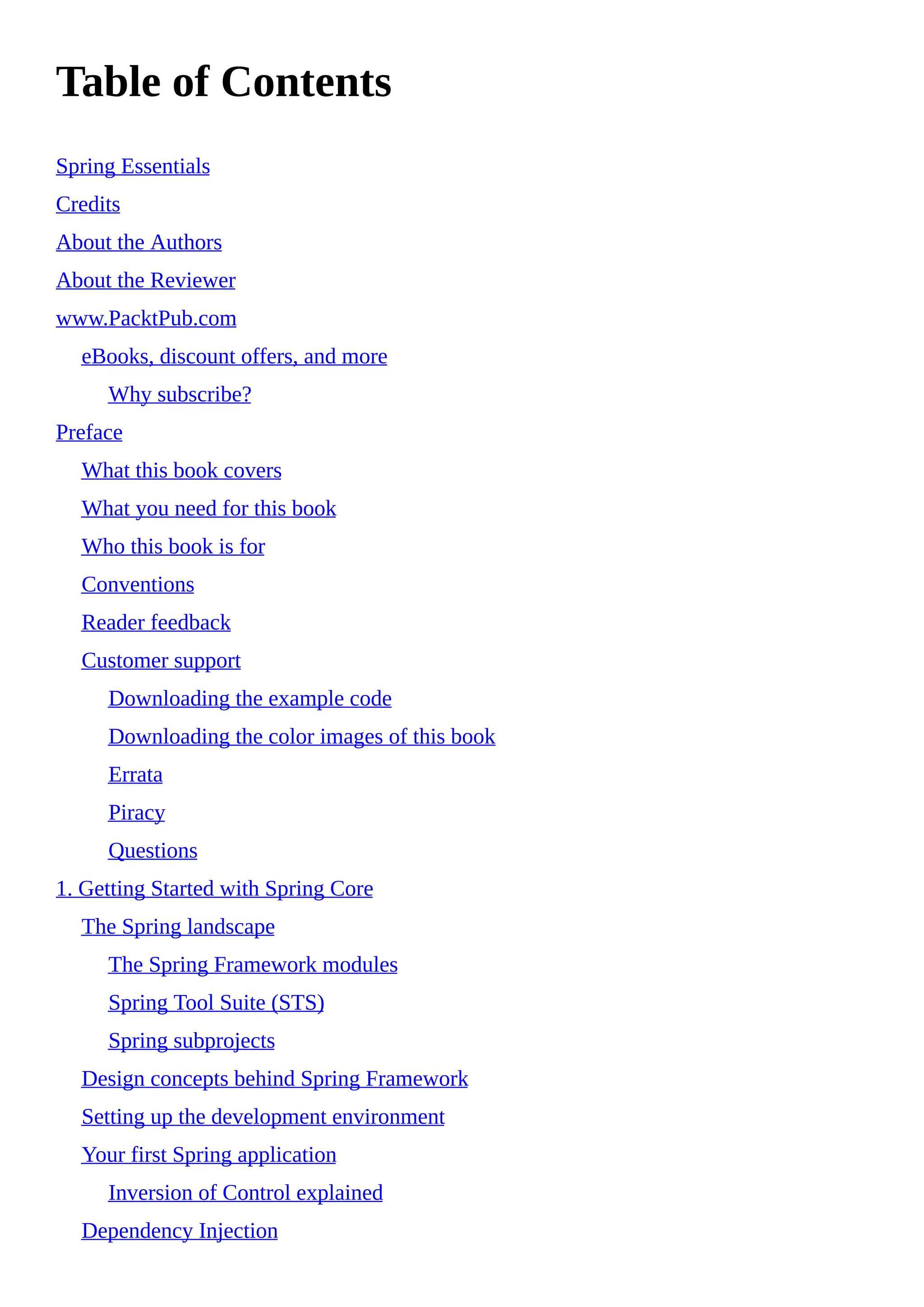
Table of Contents
SpringEssentials
Credits
About the Authors
About the Reviewer
www.PacktPub.com
eBooks, discount offers, and more
Why subscribe?
Preface
What this book covers
What you need for this book
Who this book is for
Conventions
Reader feedback
Customer support
Downloading the example code
Downloading the color images of this book
Errata
Piracy
Questions
1. Getting Started with Spring Core
The Spring landscape
The Spring Framework modules
Spring Tool Suite (STS)
Spring subprojects
Design concepts behind Spring Framework
Setting up the development environment
Your first Spring application
Inversion of Control explained
Dependency Injection
8.
The Spring IoCcontainer
Configuration metadata
XML-based configuration metadata
Annotation-based configuration metadata
XML-based versus annotation-based configuration
Component stereotype annotations
Java-based configuration metadata
JSR 330 standard annotations
Beans in detail
Bean definition
Instantiating beans
With constructors
With a static factory-method
With an instance factory-method
Injecting bean dependencies
Constructor-based Dependency Injection
Setter-based Dependency Injection
Constructor-based or setter-based DI – which is better?
Cleaner bean definitions with namespace shortcuts
Wiring a List as a dependency
Wiring a Map as a dependency
Autowiring dependencies
Bean scoping
Dependency Injection with scoped beans
Creating a custom scope
Hooking to bean life cycles
Implementing InitializingBean and DisposableBean
Annotating @PostConstruct and @PreDestroy on @Components
The init-method and destroy-method attributes of <bean/>
Container-level default-init-method and default-destroy-method
Working with bean definition profiles
9.
Injecting properties intothe Spring environment
Externalizing properties with PropertyPlaceholderConfigurer
Handling resources
Spring Expression Language
SpEL features
SpEL annotation support
The SpEL API
Aspect Oriented Programming
Static and dynamic AOP
AOP concepts and terminology
Spring AOP – definition and configuration styles
XML schema-based AOP
@AspectJ annotation-based AOP
Declaring an @Aspect annotation
Pointcuts
Pointcut designators
Pointcut examples
Advices
The @Around Advice
Accessing Advice parameters
Testing with Spring
Mock objects
Unit and integration testing utilities
Summary
2. Building the Web Layer with Spring Web MVC
Features of Spring MVC
The Model-View-Controller pattern
Your first Spring MVC application
Setting up a Spring MVC application
The project structure of a Spring MVC application
The web.xml file – Springifying the web app
10.
ApplicationContext files ina Spring MVC application
HomeController – @Controller for the home screen
The home.jsp file – the landing screen
Handling incoming requests
The architecture and components of Spring MVC
DispatcherServlet explained
WebApplicationContext – ApplicationContext for the Web
Beans supporting DispatcherServlet and their roles
Controllers in detail
Mapping request URLs with @RequestMapping
URI template patterns with the @PathVariable annotation
Binding parameters with the @RequestParam annotation
Request handler method arguments
Request handler method return types
Setting Model attributes
Building RESTful services for JSON and XML media
Building a RESTful service with RestController
Asynchronous request processing in Spring MVC
Working with views
Resolving views
Resolving JSP views
Binding Model attributes in JSP pages using JSTL
Spring and Spring form tag libraries
Composing a form in JSP
Validating forms
Handling file uploads
Resolving Thymeleaf views
More view technologies
Summary
3. Accessing Data with Spring
Configuring DataSource
11.
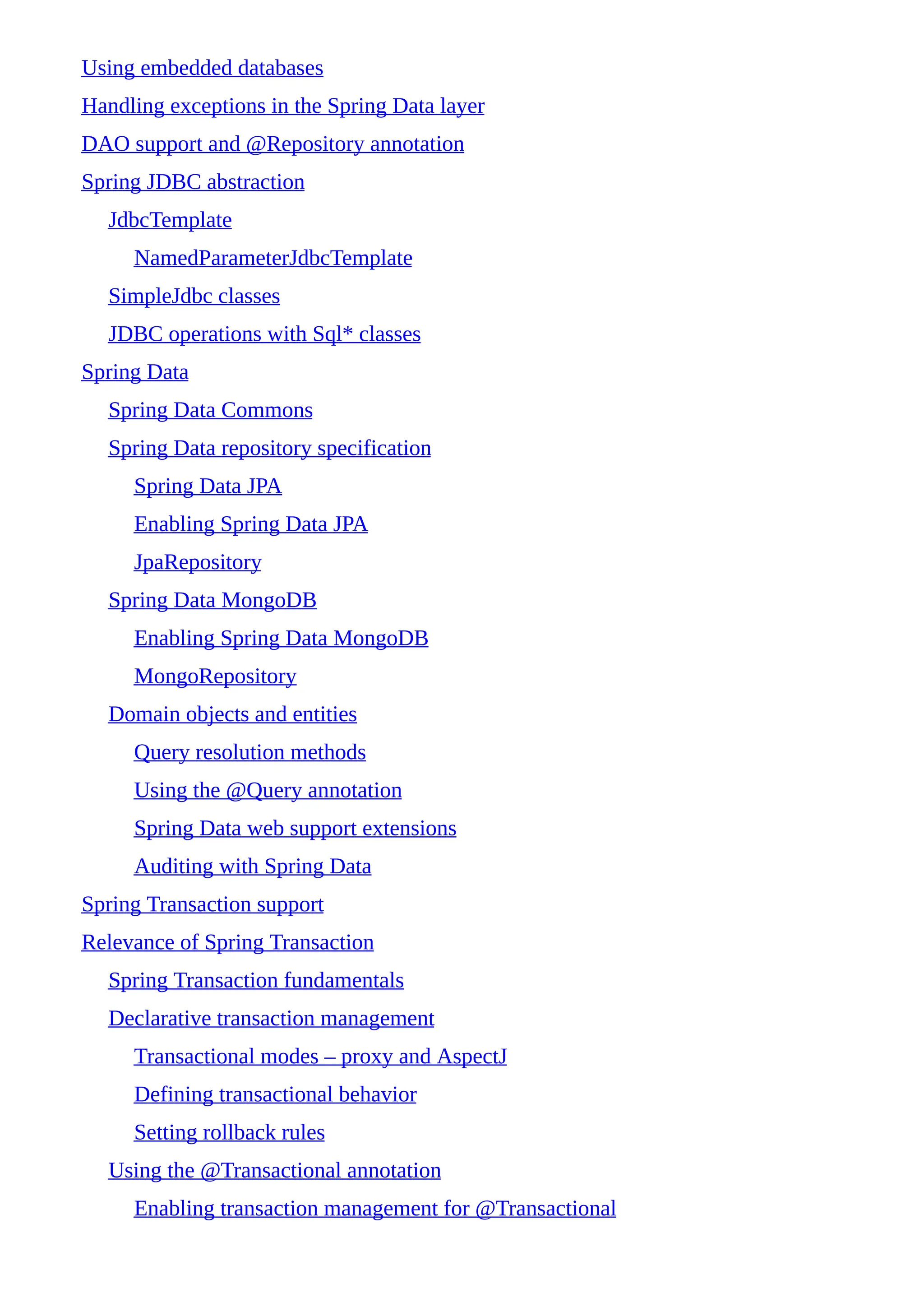
Using embedded databases
Handlingexceptions in the Spring Data layer
DAO support and @Repository annotation
Spring JDBC abstraction
JdbcTemplate
NamedParameterJdbcTemplate
SimpleJdbc classes
JDBC operations with Sql* classes
Spring Data
Spring Data Commons
Spring Data repository specification
Spring Data JPA
Enabling Spring Data JPA
JpaRepository
Spring Data MongoDB
Enabling Spring Data MongoDB
MongoRepository
Domain objects and entities
Query resolution methods
Using the @Query annotation
Spring Data web support extensions
Auditing with Spring Data
Spring Transaction support
Relevance of Spring Transaction
Spring Transaction fundamentals
Declarative transaction management
Transactional modes – proxy and AspectJ
Defining transactional behavior
Setting rollback rules
Using the @Transactional annotation
Enabling transaction management for @Transactional
12.
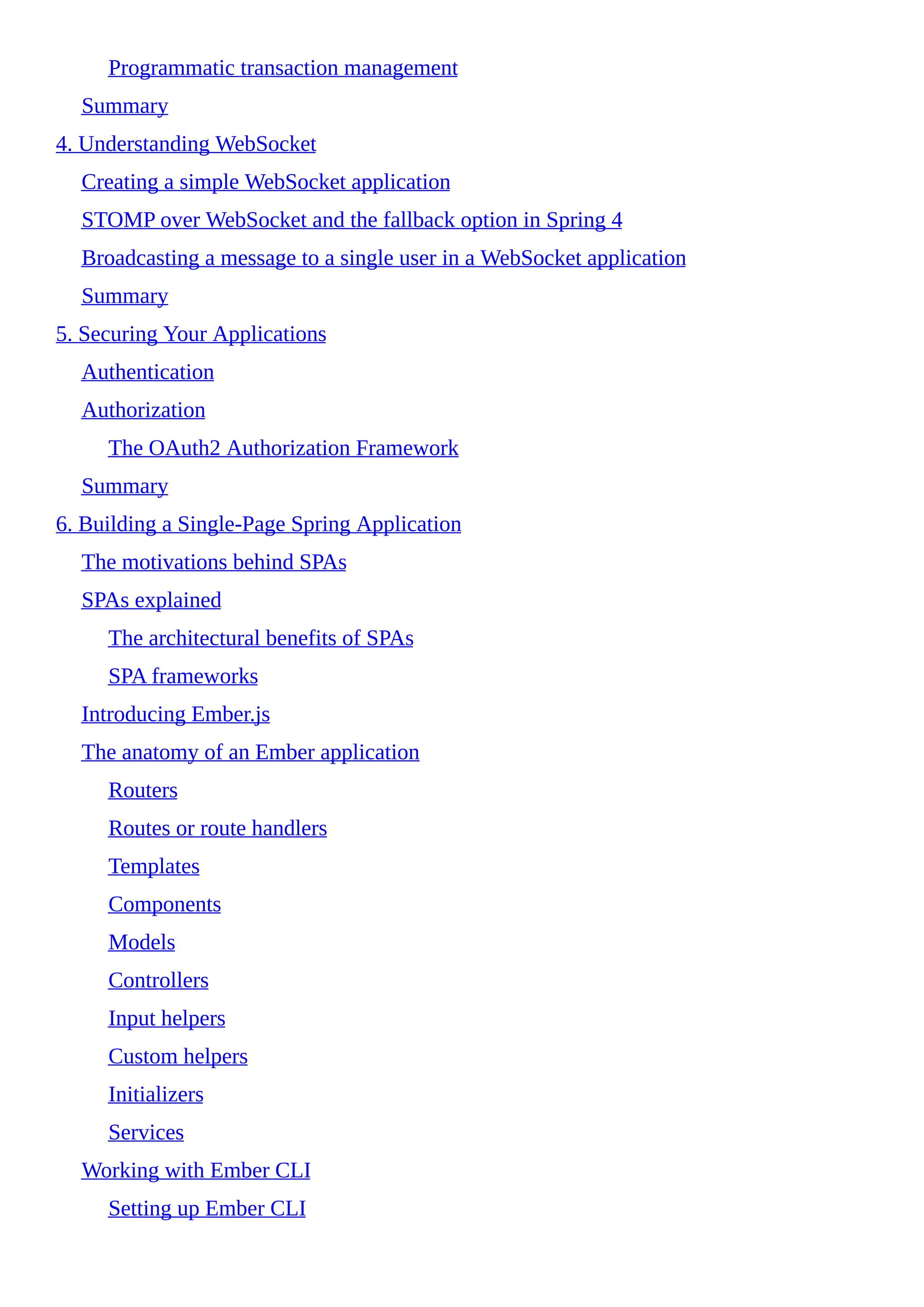
Programmatic transaction management
Summary
4.Understanding WebSocket
Creating a simple WebSocket application
STOMP over WebSocket and the fallback option in Spring 4
Broadcasting a message to a single user in a WebSocket application
Summary
5. Securing Your Applications
Authentication
Authorization
The OAuth2 Authorization Framework
Summary
6. Building a Single-Page Spring Application
The motivations behind SPAs
SPAs explained
The architectural benefits of SPAs
SPA frameworks
Introducing Ember.js
The anatomy of an Ember application
Routers
Routes or route handlers
Templates
Components
Models
Controllers
Input helpers
Custom helpers
Initializers
Services
Working with Ember CLI
Setting up Ember CLI
13.
Getting started withEmber CLI commands
The Ember project structure
Working with the POD structure
Understanding the Ember object model
Declaring types (classes) and instances
Accessing and mutating properties
Computed properties
Property observers
Working with collections
Building UI templates using Handlebars
Handlebars helpers
Data binding with input helpers
Using control flow helpers in Handlebars
Using event helpers
Handling routes
Handling UI behavior using components
Building a ToggleButton component step by step
Persisting data with Ember Data
Ember Data architecture
Defining models
Defining model relationships
Building a Taskify application
Building the API server app
Setting up and configuring the project
Defining the model definitions – User and Task
Building API endpoints for the Taskify app
UserController.java
TaskController.java
Building the Taskify Ember app
Setting up Taskify as an Ember CLI project
Setting up Ember Data
14.
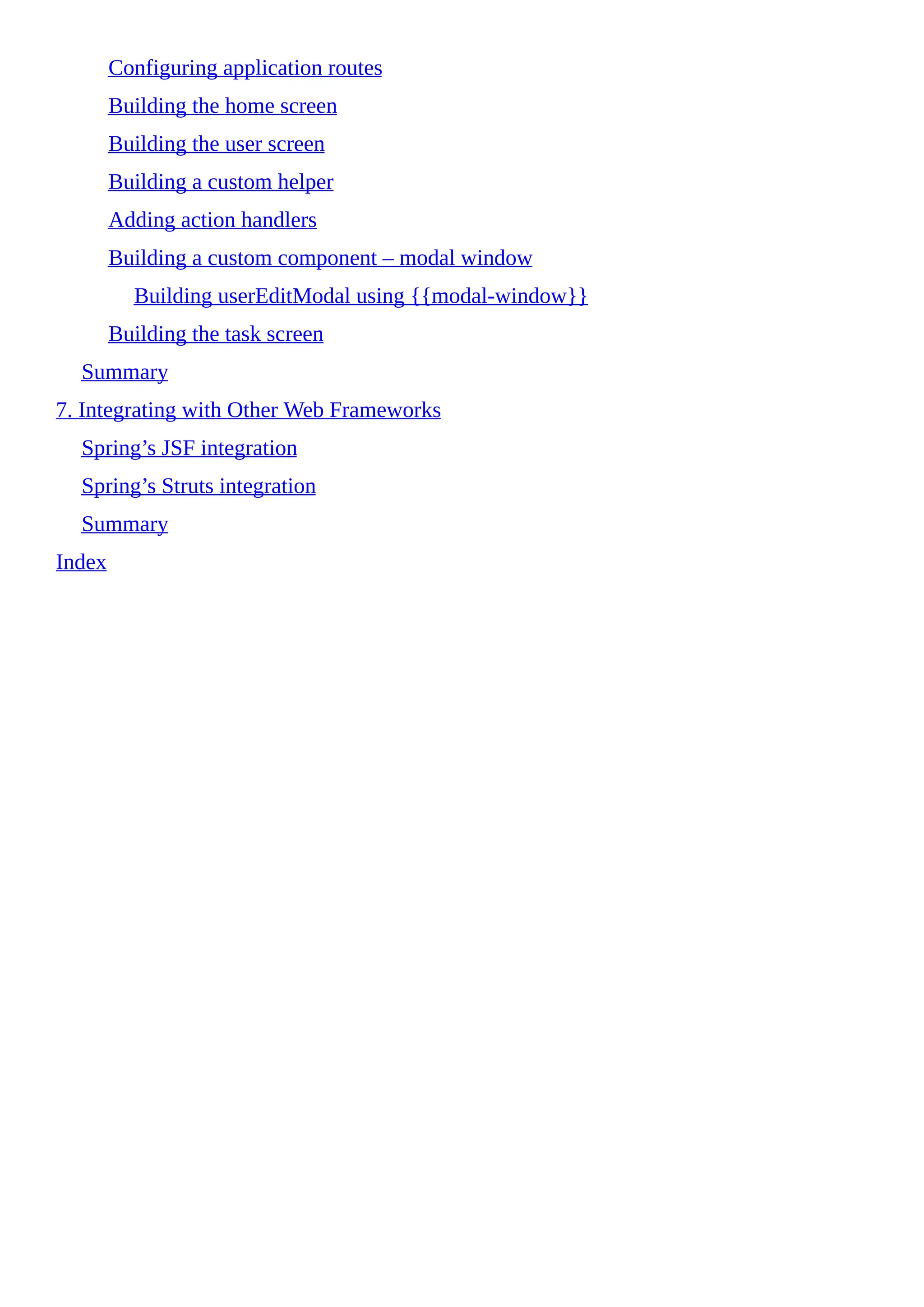
Configuring application routes
Buildingthe home screen
Building the user screen
Building a custom helper
Adding action handlers
Building a custom component – modal window
Building userEditModal using {{modal-window}}
Building the task screen
Summary
7. Integrating with Other Web Frameworks
Spring’s JSF integration
Spring’s Struts integration
Summary
Index
Credits
Authors
Shameer Kunjumohamed
Hamidreza Sattari
Reviewer
JarosławKrochmalski
Commissioning Editor
Julian Ursell
Acquisition Editors
Larissa Pinto
Pratik Shah
Content Development Editor
Aishwarya Pandere
Technical Editor
Siddhi Rane
Copy Editors
Kevin McGowan
Madhusudan Uchil
Project Coordinator
Nidhi Joshi
Proofreader
Safis Editing
Indexer
Hemangini Bari
Graphics
Kirk D’Penha
Production Coordinator
Shantanu N. Zagade
Cover Work
Shantanu N. Zagade
22.
About the Authors
ShameerKunjumohamed is a software architect specializing in Java-based enterprise
application integrations, SOA, and the cloud. Besides Java, he is well-versed in the
Node.js and Microsoft .NET platforms. He is interested in JavaScript MVC frameworks
such as EmberJS, AngularJS, and ReactJS.
Shameer has co-authored another book, Spring Web Services 2 Cookbook, Packt
Publishing with Hamidreza Sattari, who is the co-author of this book as well.
Based in Dubai, UAE, Shameer has over 15 years of experience in various functional
domains. He currently works as a principal applications architect for a major shipping
company in Dubai.
I would like to extend my thanks to a number of people who have inspired and influenced
me throughout my technical career. The Java, Spring, and Ember communities gave me
the knowledge and confidence to write this book. I thank my parents; my wife, Shehida;
and my daughters, Shireen, Shahreen, and Safa, who supported me and put up with me
when I was busy writing the chapters; it was their precious time I was taking for this book.
Special thanks to my friend Hamidreza, who is a great friend and colleague, and to the
coordinators and reviewers at Packt Publishing, who made this book a wonderful resource
for learning Spring.
Hamidreza Sattari is an IT professional and has worked in several areas of software
engineering, from programming to architecture as well as management. He holds a
master’s degree in software engineering from Herriot Watt University, UK. In recent
years, his areas of interest have been software architecture, data science, and machine
learning. He co-authored the book Spring Web Services 2 Cookbook, Packt Publishing in
2012. He maintains the blog http://justdeveloped-blog.blogspot.com/.
First, I should thank the members of the open source community, who are far too many to
name. I have been able to write this book by using their products, ideas, articles, and
blogs. I would like to give special thanks to my friend Shameer P.K. for his significant role
in writing this book.
24.
About the Reviewer
JarosławKrochmalski is a passionate software designer and developer who specializes
in the financial business domain. He has over 12 years of experience in software
development. He is a clean code and software craftsmanship enthusiast. He is a Certified
ScrumMaster and a fan of Agile. His professional interests include new technologies in
web application development, design patterns, enterprise architecture, and integration
patterns. He has been designing and developing software professionally since 2000 and
has been using Java as his primary programming language since 2002. In the past, he
worked for companies such as Kredyt Bank (KBC) and Bank BPS on many large-scale
projects, such as international money orders, express payments, and collection systems.
He currently works as a consultant at the Danish company 7N as an IT architect for
Nykredit Bank. You can reach him via Twitter at @jkroch or by e-mail at
<jarek@finsys.pl>.
I would like to say hello to my friends at 7N and Nykredit; keep up the great job!
eBooks, discount offers,and more
Did you know that Packt offers eBook versions of every book published, with PDF and
ePub files available? You can upgrade to the eBook version at www.PacktPub.com and as
a print book customer, you are entitled to a discount on the eBook copy. Get in touch with
us at <customercare@packtpub.com> for more details.
At www.PacktPub.com, you can also read a collection of free technical articles, sign up
for a range of free newsletters and receive exclusive discounts and offers on Packt books
and eBooks.
https://www2.packtpub.com/books/subscription/packtlib
Do you need instant solutions to your IT questions? PacktLib is Packt’s online digital
book library. Here, you can search, access, and read Packt’s entire library of books.
28.
Why subscribe?
Fully searchableacross every book published by Packt
Copy and paste, print, and bookmark content
On demand and accessible via a web browser
30.
Preface
There are alot of books written about Spring Framework and its subprojects. A multitude
of online references are also available. Most of these massive resources discuss Spring in a
lot of detail, which makes learning Spring a very time-consuming and sometimes tedious
effort. The idea of this book is to allow novice Java developers or architects to master
Spring without spending much time and effort and at the same time provide them with a
strong foundation on the topic in order to enable them to design high-performance systems
that are scalable and easily maintainable.
We have been using Spring Framework and its subprojects for more than a decade to
develop enterprise applications in various domains. While the usage of Spring quickly
raises the design quality of projects with its smart templates and subframeworks
abstracting many error-prone and routine programming tasks, a developer needs a
thorough understanding of its concepts, features, best practices, and above all, the Spring
programming model in order to utilize Spring to its best.
We have seen Spring used wrongly inside many projects mainly because the developer
either didn’t understand the right use of a particular Spring component or didn’t bother to
follow the design approach Spring suggests for that component. Often, developers didn’t
appear to have the right knowledge of Spring Framework; when asked, their complaint
mostly was the uphill task of learning such a vast framework from huge documentation.
Most of this category of developers find Spring a mammoth framework that is difficult to
learn, which is not really true.
Spring, if the basics are understood correctly, is very easy to conquer further. A developer
needs to understand the Spring style of programming and architecting applications, and
the result will be a piece of art. The design will look simple, pretty straightforward, and
easily understandable, which is very important for the evolution of applications in the long
run. This book is an attempt to fill that gap and provide a very solid foundation in Spring,
its concepts, design styles, and best practices, in a very quick and easy way.
This book tries to engage the reader by providing the feeling of developing a realistic,
modern enterprise application using Spring and its necessary features while giving him or
her a solid understanding of its concepts, benefits, and usage with real-life examples. It
covers the most important concepts and features of Spring Framework and a few of its
critical subprojects that are necessary for building modern web applications.
The goal of Spring is to simplify enterprise application development. We hope this book
simplifies mastering Spring so that developers can build smarter systems that make the
world a better place.
31.
What this bookcovers
Chapter 1, Getting Started with Spring Core, introduces the core Spring Framework,
including its core concepts, such as POJO-based programming, Dependency Injection, and
Aspect Oriented Programming, to the reader. It further explains the Spring IoC container,
bean configurations, Spring Expression Language (SpEL), resource management, and
bean definition profiles, all which become the foundation for the advanced topics.
Chapter 2, Building the Web Layer with Spring Web MVC, gives in-depth coverage of the
Spring MVC web framework with its features and various different ways of configuring
and tuning web applications using Spring. The chapter covers the building of both view-
based web applications and REST APIs with many available options, including
asynchronous request processing.
Chapter 3, Accessing Data with Spring, discusses the different data-access and persistence
mechanisms that Spring offers, including the Spring Data family of projects, such as
Spring Data JPA and Spring Data Mongo. This chapter enables the reader to design an
elegant data layer for his or her Spring application, delegating all the heavylifting to
Spring.
Chapter 4, Understanding WebSocket, discusses the WebSocket technology, which is
gaining wider usage inside modern web applications, where low latency and high
frequency of communication are critical. This chapter explains how to create a WebSocket
application and broadcast a message to all subscribed clients as well as send a message to
a specific client, and shows how a broker-based messaging system works with STOMP
over WebSocket. It also shows how Spring’s WebSocket fallback option can tackle
browser incompatibility.
Chapter 5, Securing Your Applications, teaches the reader how to secure his or her Spring
applications. It starts with authentication and explains Spring flexibility on authorization.
You learn how to integrate your existing authentication framework with Spring. On
authorization, it shows how to use Spring EL expressions for web, method, and domain
object authorization. It also explains the OAuth 2.0 Authorization Framework and how to
allow third-party limited access to user’s protected resources on a server without sharing
user’s username and password.
Chapter 6, Building a Single-Page Spring Application, demonstrates how Spring can be
used as the API server for modern single-page applications (SPAs) with an example of an
Ember JS application. At first, it introduces the concept of SPAs, and then it explores
using Ember JS to build the SPA. Finally, it covers building the backend API that
processes requests asynchronously using Spring MVC and implements persistence using
Spring Data JPA.
Chapter 7, Integrating with Other Web Frameworks, demonstrates how Spring can be
integrated with Java web frameworks such as JSF and Struts so that even web applications
not based on Spring MVC can leverage the power of Spring.
better; and strivedto convince them that it was much more to the
interest of humanity, and to the advantage of the citizens, not to
drive to desperation the powerful army still remaining, to which they
were opposed; but, with the superiority they possessed, to attempt
to bring about an adjustment of the quarrel between the
government and the people, on such terms as should leave the latter
nothing to desire, and the former no power to tyrannise.
“My suggestions were not received with the cordiality which they
deserved. The deputation talked of the merciless slaughter of the
citizens—the cruelty that had been exercised upon me—and the
necessity of making an example of the offenders. I answered, that it
would only be treading in the steps of our oppressors by desiring
vengeance for injuries—that those who had been wronged could
receive no benefit by the death of those who had injured them—that
the evils the government had committed could not be remedied by
their destruction—and that it was the most unwise policy a
community could follow, to punish an offence that had been
committed by taking a life, for it made it impossible that the offender
should ever make amends to society for the mischief done. ‘Prevent
as effectively as possible,’ said I, ‘the evil doer from repeating a
wrong, and let him, by the exercise of virtuous inclinations among
the community, outweigh the evil he has effected, and you will do
more good than has been done by punishment since the creation of
the world.’
“I regretted to observe a disinclination to follow my advice. The
hearts of my companions seemed filled with resentment, and their
minds with prejudice. Again they pressed on me the offers of the
people, and again I refused; and then they took their leave of me,
expressing their intention of acquainting the citizens with my
resolution. I was most anxiously desirous that the warfare should
terminate; and, knowing that the time was opportune for exacting
the most favourable conditions for the nation from the government,
I was eager to bring about an accommodation. The mass of my
countrymen I found too much heated by the conflict to listen with a
proper feeling to the peaceful measures it was my aim to
35.
accomplish. Arms werestill in their hands, and the blood of their
friends still stained the public streets. I published my sentiments
among them in the most convincing form of which I was master;
and, in addition to the opinions I have already stated, I offered, if
they would intrust me with the office, to act as mediator, having
powers to effect an arrangement between the contending parties on
such conditions as would secure the liberties of the people on the
most firm and enlarged basis, and reduce the influence of the crown
to an extent which would not be dangerous to the community.
“Five days had elapsed since the contest commenced; and the
troops were hemmed in around the palace, deprived of sufficient
provisions, and harassed in every way that the valour and ingenuity
of the citizens could devise. The ministers had now become as
humble as they had before been intolerant. They attempted to bring
about a reconciliation. They offered largely, and promised more.
There they were, in the midst of sixty thousand picked men,
trembling for the consequences of their own misgovernment; for
they saw that the whole country was in the hands of the citizens,
and that it would be impossible much longer to continue a
resistance. Hitherto all their efforts at accommodation had been
treated with studied indifference; but, having succeeded in procuring
from the people the office I desired, I immediately set about
communicating with the government the only terms upon which
peace could be restored; and these were, that the ministers by
whom the Emperor had been advised in his late measures should be
banished from the court—never again to exert any authority over the
people—and that half their estates should be confiscated to the
relations of those who had perished in the conflict—that the Emperor
should grant a charter to the people, by which all the privileges of
freemen—right of opinion—liberty of conscience—a perfect
representation of the popular will—unshackled trade—a liberal
patronage of genius and industry—and the abolition of oppressive
taxes and undeserved pensions should be preserved to them and
their posterity for ever—that a standing army, beyond what was
necessary to maintain security from foreign invasion, should no
36.
longer exist—and thatno attempt should be made by the Crown
either to punish any citizen who had assisted in the late struggle, or
to repossess itself of the power which had been found so dangerous
to the welfare of the people.
“I suppose these conditions seemed hard; for some days elapsed,
and frequent attempts were made to have them rendered more
agreeable. Not only did I refuse to alter them in the slightest degree,
but I at last gave them four and twenty hours for consideration, at
which time, if they were not accepted, I stated that I should insist
upon unconditional surrender. Before the day was over, the
conditions were agreed to—the charter signed and sworn to by the
Emperor, in the presence of an almost countless multitude of citizens
—the ministers, among whom, of course, was that unpitying man,
Philadelphia, were banished from the city; half their estates were
confiscated, and a new and more liberal administration chosen in
their place—and, as the intelligence extended from one end of this
mighty empire to the other, nothing was heard but sounds of
congratulation and gladness, of thankfulness for the past, and hope
for the future. All that I had desired was accomplished. The marks of
the recent strife were soon erased. The citizens, returning to their
social duties, ceased to think of the wounds they had received and
inflicted; and all the blessings of peace began to flow in their
accustomed channels. Had the struggle continued with the design of
overpowering all opposition, and changing the form of government,
the war would have been resumed in the provinces; might have
been prolonged from father to son in efforts to restore the fallen
dynasty; and, as a change, when attempted in a settled form of
government, always produces an unsettled state of the public mind,
the country would have been continually disturbed, and the
happiness of the people rendered exceedingly insecure.
“All Columbia are satisfied with my exertions: they acknowledge
the worth of what I have done. Even the Emperor seems desirous of
paying me attention; and, although I have not much faith in his
sincerity, his conduct serves to keep up the harmony which prevails.
And, by my refusal to accept power at the expense of the happiness
37.
of my fellow-citizens,I have now the gratification of seeing the
country prosperous, the people enjoying a greater degree of liberty
than they have known for centuries, and the whole population vying
with each other to show their estimation of my services. There is
one thing that gives me peculiar satisfaction; and that is, your
absence from the country at this eventful period. I know that, had
you been here, your impetuous spirit would have hurried you into
every wild and rash undertaking, and that you would have effected
more mischief in a day than I should ever have been enabled to
efface. Proceed with your voyage, Oriel, and when you return you
will have reason to rejoice at the change which has been produced
during your absence.”
Oriel Porphyry had read the preceding communication with intense
interest; every moment stopping to regret that he should have been
so far away at a period so important.
“Oh, had I but been there!” he exclaimed at the conclusion. “Here
is a golden opportunity lost! The very moment for which I have so
anxiously looked has escaped me. The great battle has been fought,
and I not in the field. Surely, such a disappointment is enough to
make one curse one’s destiny. My father’s notions are too chimerical.
He is good—ay, the very best among the good; but his spirit is not
young enough for the age. He should have crushed the hydra when
he had it at his feet. Had I but been there! He will find, too late, that
it is no use patching things that are radically bad: they cannot be
mended; they are worn out, rotten, and useless. And that proud
tyrant to have used him so inhumanly! Had I but been there! What a
field there was for exertion, what splendid opportunities for daring
valour! Perhaps a body of two hundred thousand armed citizens, all
eager, all desperate, wanting only a leader to make them irresistible.
Oh, this wretched fate, that kept me here like an inactive slave,
while glory is to be won by a mere effort! And he was offered the
supreme authority, and refused it? Noble, but unwise. He could
confer more good on the people in a year than this thing, called an
Emperor, can effect during the whole of his useless existence. Now
the time is gone. The renown after which I yearn, the distinction and
38.
the power, wouldhave been mine, had I been in the place where it
might have been acquired. Had I but been there! How long am I to
carry on this profitless existence? How long must I be forced to stifle
my own energies, and live, from day to day, in the same dull round
of inactivity? Must the wings of that spirit, that soars so far above
the unambitious herd, still continue to be pinioned, leaving me to
crawl upon the earth, following out the same ignoble purposes as
those around me? Oh, deplorable fate! The rock to which
Prometheus was chained, and the bird that pierced his vitals, are but
types of the barrenness of my prospects, and the disappointed
hopes that prey upon my peace. Oh, wretched destiny! The thirst
with which Tantalus was devoured was a blessing, compared with
the curse with which I am tormented. Eureka! Eureka! The
greatness I have desired so earnestly, to make me more worthy of
your excellence, has been waiting for my eager grasp, while I was
far, far from its reach. Oh, had I but been there!”
39.
CHAP. VI.
CHINA, ITSLAWS, CUSTOMS, AND PEOPLE.
The Albatross was just entering the Chinese sea, and making way in
gallant style through the heavy waves. Her crew were numerous,
and of picked men, chosen at the different ports at which the ship
had touched since her departure from the pirates’ haunt on the
Madagascar coast, by the experienced judgment of Captain Hearty.
Several promotions had taken place among the old hands.
Climberkin, who had distinguished himself on many occasions as a
brave and skilful seaman, became second in command. Boggle,
though liable to confuse his understanding with abstract
speculations, was always to be depended upon in an emergency,
and was honest, persevering, and well acquainted with the
management of a ship at sea, and he was made second lieutenant.
Loop was created a midshipman. Oriel Porphyry had offered to settle
Ardent in comfortable circumstances in his native country; but he
stated that having lost all that made dear to him the land of his
birth, and having found so many kind friends on board the Albatross,
he should prefer remaining in the vessel in any capacity in which he
could be of service, and as he was known to be well qualified for the
office, to him were assigned the duties of purser and captain’s clerk.
As for Roly Poly, the offer of an empire would not have induced him
to resign the custody of the roast and boiled; and he therefore
continued absolute and undisputed sovereign of the cook-house. He
seemed to be getting fatter every day. His back appeared to bend
beneath the load of flesh it carried, and his huge black cheeks had
become so large as to threaten to close up his eyes. To gain his
good opinion, nothing was necessary but to praise his cookery; but
as soon as any poor fellow attempted to find fault with the viands,
or the way in which they were dressed, the abuse he received for
40.
what was consideredhis presumption and ignorance, made him glad
to make his peace with the indignant cook upon any terms. For all
this Roly Poly was held in much estimation by his shipmates. The
important service he rendered with his mop was not forgotten; and
though he was continually relating in a manner peculiarly his own,
the way in which he had served out “dat ignorant jackmorass who
sulted him by telling diclus impossumbilities,” the story was
invariably received with the same hearty laugh and boisterous praise
that marked the first hearing.
Although the manners of Captain Hearty and his officers were
rather unpolished, the education which was common to all
Columbians, and the experience they had gained in their profession,
made them perfectly qualified to fulfil the duties they had
undertaken; and the ship was as skilfully navigated, as if under the
superintendence of the most gentlemanly officers in the service. As
has before been stated, the commercial character of the Albatross
had been changed by skilful hands for one of a more threatening
aspect, nor was the alteration at all displeasing to the taste of Oriel.
The only pleasure he seemed to enjoy with any zest, was in seeing
the men exercised at the guns, practising at a mark, or engaged in
improving themselves in the use of the broadsword; and in these
pursuits he would join with intense interest, encouraging those who
seemed anxious to excel, and rewarding those who evinced the most
skill. His satisfaction at the arming of the vessel was increased when
he considered the possibility of being attacked by pirates in the
different seas that lay in the ship’s course, who might easily, as
Captain Death and his associates had done, have made themselves
masters of the Albatross; but who would now find it a matter very
difficult to be accomplished.
“Come Zabra, I am plagued to death by my own thoughts. Cheer
me with a song:” said Oriel Porphyry to his young friend as they sat
together in the cabin.
“That you shall have, Oriel,” replied the handsome musician, as his
hand ran lightly over the chords of the harp; “and I will try to
41.
humour your martialfeelings to keep you in good temper with
yourself. Listen to
“THE SONG OF THE HERO TO HIS SWORD.
42.
“‘Foe Smiter! Tothe light thy blade I draw,
To gaze enraptured on thy glitt’ring sheen:
I see thee still, thou gem without a flaw!
Sharp, strong, and shining, as thou’st ever been
Since that proud day when first the spoilers came,
Reddening my own fair land with blood and flame,
With vig’rous arm I pluck’d thee from thy sheath,
And made thee drink the crimson draught of death!
“‘Death Dealer! Here I have thee once again!
I see thy fatal lightning flashing near,
As round me rise the spirits of the slain,
And the dark shadows, shudd’ring, disappear.
Who ever stood unscathed before thy path?
Who ever lived to babble of thy wrath?
Annihilation must thy deeds proclaim,
And conquest grant thy memory to fame!
“‘Fame Winner! Let me grasp thee firmer yet;
New fields are to be fought, new foes to dare;
I must have glory ere the sun hath set;
I yearn new triumphs, noble spoils to share.
See where th’ insulting enemy advance!
And as they come, with dark and scornful glance,
Waving thy brilliant steel I seek the fray,
And pierce the quiv’ring flesh that stops my way!’”
“By all that’s glorious, ’tis a noble strain!” exclaimed Oriel, while
his brilliant eyes flashed with excitement; “a strain fit to stir the
heart to noble deeds. I feel my soul thrilled with an heroic spirit that
would do battle even with the fierce enemy—Death! Give me a fair
field and a good cause—a band of warlike brothers moved by the
same mighty impulse as that by which I am now excited—and let us
have fit weapons and enough of them, and we would sweep the
oppressors of the world from the earth, like rotten reeds before a
whirlwind. Wisely did the ancients honour their bards above all
human greatness. Well was it that they gave them precedence and
dignity and wealth in abundance—the gold chain round the neck,
and the seat of honour near the throne. If they possessed but the
power you have evinced, they were worthy of the first place and the
43.
richest gifts: forthey must have been the leading spirits of the age—
the movers of armies—the winners of triumph. What nature, with
the common energies of manhood, could resist such a stimulus?
Stone walls, the crushing iron, and the penetrating steel—would
these be as obstacles in its way? Straws! Had I lived in those days,
the leader of a warlike generation, and heard a song such as you
have sung, I should have felt inclined to have exalted the bard
above my own dignity, knowing that his influence upon the
dispositions over which I ruled could be rendered far more effective
for the purposes that gave me supremacy, than my own.”
“I expected it would move you in some measure,” said Zabra,
gazing with affectionate interest upon the flushed cheek of his
patron.
“Move me! would a mælstrom move me?” cried the young
merchant. “It seems to have stirred the sluggish blood in every
hidden vein and artery. My brain throbs as if it would move up the
scalp in which it is confined, and the pulsations of my heart appear
to have acquired the action of a boiling torrent.”
“I am afraid I have done mischief,” observed the musician
anxiously; “I did not count upon producing so violent an effect. Let
me undo the evil I have created by singing to you some lyric of an
opposite tendency.”
“Where got you this power?” asked his companion, fixing a
searching glance upon the lustrous eyes before him. “By what
means gained you the rare art which you practise with such
wondrous effect? Your’s is no common skill for the ignorant to
admire; it is an influence which the most tutored in worldly wisdom
must feel and worship. You never could have gained it while
employed in the laborious idleness of a page. You are too young to
have acquired it by study. What mystery is this you have gathered
around you which gives you such a mastery over the affections of
your associates?”
A slight tremor passed over the graceful form of the young
musician: his eyes shrunk before the earnest gaze of Oriel Porphyry,
and, shaded by their long dark lashes, were fixed upon the floor.
44.
“I will tellyou;” said he at length. “Although great care was taken
with my education, from a very early age I was left much to my own
inclinations; and being gifted with an extraordinary love for
knowledge, and a rare facility in its acquirement, and a powerful
tendency towards that knowledge which was most ennobling, I
rapidly obtained a degree of intelligence which was rarely found
even in a more mature period of life. There were two particular
objects of study to which I for years dedicated an intense degree of
attention: these were music and poetry. Music was a source of the
most exquisite gratification to me at all times, and I applied
diligently to make myself master of all its difficulties. In this, after
constant application, superintended by the best masters, I
succeeded, so as to be able to create at pleasure any effect I was
desirous of producing. In the study of poetry I had no teachers,
excepting the only teacher capable of giving instruction—Nature. I
went amid the stir of leaves in the heart of the primeval forest; I
stood beneath the dazzling glances of the countless eyes of heaven;
I looked down upon the waters of the great deep, till I knew how to
interpret its mighty voices; and the whisper of the wind to the
blushing flower became to me a lesson full of an exquisite and
impressive eloquence. There was not a sound in the air—a light
upon the skies—a splendour on the earth—or a motion in the sea,
that did not assist me in my study; for there were beauty and truth
and power; and these are the constituents of all natural poetry. But
there was something still wanting to breathe the spirit of life into the
new conceptions that had been created in my nature. This I found;
and from that time there has been a gladness in what I knew, and a
purpose in what I did. Now let me remove the too powerful
impression I have produced, by something more in accordance with
my own sympathies. You shall hear ‘The Poet’s Song to his
Mistress.’”
A symphony, full of the most touching interest, preceded a melody
so impassioned, yet so sweet in its expression, and harmonised in so
rich and masterly a manner, that the young merchant had soon all
his faculties engaged in deep and earnest attention.
45.
“That I shouldlove thee is not strange,
For excellence doth love create;
But that my love should die or change
Can never be—’tis not in Fate:
For as thy worth, in heaven’s bright view,
Must ever hold its glorious stature;
Shall not that bliss which from it grew
Partake of its immortal nature?
“Nor can exist a taint of schism
In these fond feelings thou hast made;
For, like the colours in the prism,
They cannot change, they never fade.
Thus is it, then, sweet friend! my love
From thy fond worth Time ne’er can sever;
And must a natural goodness prove:
Things made from gold are sterling ever.”
At the conclusion of this song, which Zabra sang with a thrilling
pathos which must have reached the heart of his auditor, the two
friends were interrupted by a message from the captain, to acquaint
Oriel that a pilot had come on board to conduct the vessel up the
river to Canton; and that if he wished to observe the Chinese coast,
there was now an excellent opportunity. All thought of poetry and
music seemed forgotten for the time; for the musician and the
young merchant immediately hastened upon deck.
The Albatross was passing Macao, and steering her course
towards Whampoa; and a group were on the quarter-deck noticing
the appearance of the country, the junks and other strange vessels
they were passing, and making observations upon what they saw.
“We are approaching a people,” said Fortyfolios, “who, if they are
not the most ancient that exist, lay claim to an antiquity of which
few could boast. They are the most extraordinary race on the globe,
and the most unchangeable in their habits. Though they preceded
the rest of the world in the march of civilisation; though they
invented the arts of printing, and of manufacturing silk fabrics and
porcelain goods; though they discovered the composition of
gunpowder and the use of the magnetic compass; they have never
46.
progressed beyond theseadvances. Thousands of years have passed
—nations that were not then in existence, in intelligence have left
them far behind—and still they remain exactly as they were, and are
not only indifferent to the improvements around them, but look upon
all other nations as barbarians unworthy of their association. In vain
have they been conquered: conquest could make no change in their
habits or opinions. Among the most celebrated of their masters were
the Manchews, a people doubtless so called from their attachment to
cannibalism, by whom they were held in subjection for several
centuries; and the English, who made a conquest of their empire
when in the zenith of their greatness. Their subjugation by the latter
was caused by their own pride and insolence. The Chinese were so
impressed with an opinion of their own superior greatness, that they
behaved to all foreigners who visited their shores for the purposes of
traffic with humiliating insolence. They were only allowed to trade at
one port, their merchandise was subjected to the most arbitrary
duties, and their merchants were treated with every kind of insult.
This was borne for a considerable period by the mercantile world, in
consideration of the importance of their commerce, and the
impossibility of finding their exports in other countries. But toleration
only increased the audacity of the Chinese authorities. They
proceeded to acts of violence: several vessels were plundered, and
their crews were murdered, or carried away, and never heard of
after. At last the English, having endured this treatment without
being able to procure the slightest redress, determined on
retaliation. From their possessions in India they invaded the Chinese
territory with a powerful army, and at the same time ravaged their
coasts with a naval armament that destroyed their shipping,
plundered their towns, and laid their defences in ashes. The
Chinese, as cowardly as they had been insolent, though possessed
of an immense population and extraordinary resources, made but a
feeble resistance, and were glad to purchase peace upon any terms
they could make; but the English had discovered the weakness of
their enemy, and had not forgotten the oppressions they had
endured, and did not desist from the conflict till they had annexed
the mighty empire of China to their immense dominions in India.”
47.
“All very true,”added Tourniquet. “They were ignorant, bigoted,
and slavish, but for all that they were the most prosperous nation
under the sun, don’t you see.”
“Their prosperity was occasioned by the laws by which they were
governed,” said the professor. “Industry was encouraged. Agriculture
was pursued as the most honourable occupation, as one in which
the emperor delighted; and obedience was inculcated as the first
duty of a citizen.”
“But what was the spirit of their laws?” inquired Oriel Porphyry.
“Every father of a family was despotic in his own household: the
emperor was regarded by his subjects with the same reverence that
a family looked up to its domestic ruler; and an offence against the
monarch was punished in a similar manner as an offence against the
parent;” replied Fortyfolios.
“I can imagine no state of things so arbitrary and so contrary to
common sense, don’t you see;” observed the doctor. “By such a law,
whether a man be a drunkard or a profligate, a fool or a knave, he
has unlimited supremacy over his offspring; he can punish with
death when he pleases, and the poor wretches who acknowledge his
relationship, dare not murmur. He is a father; and fatherhood, like
charity, covereth a multitude of sins. There is nothing so ridiculous
as this notion. No individual in the great family of nature is entitled
to the slightest respect, unless he is respectable in his conduct. All
relationship is an accident. A father has no right to the obedience of
his child, because he is his father: that can only be the most absurd
of claims; for he produced the child to please himself, and at the
time could have no sympathy towards an object that was not in
existence.”
“That cannot be disputed;” replied the professor. “But I must
maintain, that obedience in a child, to a reasonable extent, ought to
exist as a natural consequence of the care and anxiety of
parentage.”
“Granted, with the limitations;” said the surgeon. “When a father
brings up his child with a proper affection, affection from the
offspring ought to be expected; but in no case has the parent a right
48.
to implicit obedience,unless he has so acted, and the law he wishes
to make absolute is such as will not affect the welfare of the child. In
many instances the son possesses more intelligence than the father;
and yet, if parental subjugation were allowed, the wise must be held
in subjection by the opinion of the ignorant.”
“I should imagine such a form of government likely to be very
ancient;” observed Oriel.
“It is unquestionably of great antiquity, and derived from the
patriarchal ages, when the oldest member of the family held
supreme authority over the rest;” responded Fortyfolios.
“About as much as the ocean has originated from the drops of rain
that fell from the sky, don’t you see;” added the doctor.
“I maintain that the progenitors of the Chinese were a nomadic
race;” said the professor rather sharply.
“Granted; and what then?” inquired the surgeon, in his usual
good-humoured manner.
“That they were a collection of single families,” continued
Fortyfolios.
“So are all nations at the present time, don’t you see;” remarked
the doctor.
“Not in the manner which existed at the age to which I allude;”
rejoined his antagonist. “Every man dwelt in his own tent,
surrounded by his children and his children’s children, and wandered
with his herds and flocks, to wherever he could find them sufficient
pasturage. He governed as a monarch with power of life and death,
and the rules he found necessary to preserve his government he
transmitted to his successor; till, the family increasing, it was found
necessary that they should separate into distinct divisions, each
having its own father or ruler, and, residing for mutual protection
near each other, they constituted tribes. The rules, which the
experience of the first father had found necessary for maintaining
his authority, had been conveyed with modifications and additions
through his successors, till they became possessed by the elders of
the tribe, in whom all wisdom and government resided; until the
increase of their numbers, and the want of sufficient
49.
accommodation, induced themto invade the more desirable territory
of other tribes; and then it was that he who distinguished himself
most in this warfare obtained supremacy over the rest, and having
conquered other tribes, and rendered himself by his superior bravery
the object of fear and admiration, he became king of all the people
who acknowledged his rule, and governed them by the laws that
had existed previously in his own particular family or tribe.”
“A very plausible hypothesis, but nothing more, don’t you see;”
replied the doctor. “Doubtless all societies originated in one family,
the supreme head of which did what he thought fit; but I doubt
much whether he exercised such an authority as could sacrifice a life
for an offence real or imaginary; or created any code of laws for the
government of his relations. He did only what he thought necessary
for the time; and whether that constituted a precedent or not, it is
not easy to determine. The punishment which would be necessary at
one time, might not be thought necessary at another, don’t you see.
Where the judge is absolute, and has no constitution to guide him, it
is the mood in which he may be when called upon to judge, that
makes the sentence severe or mild; and every judge, being
independent of any higher authority, and liable to act from prejudice
or partiality, would create nothing but inconsistent decisions, which
could never be tolerated as a code of laws. It is opinion that creates
law. The heterogeneous mass of absurdities that the few promulgate
to hold the many in subjection would not be tolerated except in a
state of perfect slavery. Where there is any intelligence among the
people, and intelligence must make its appearance sooner or later,
every law that is found existing passes the ordeal of public opinion,
and if it be unwise or unjust, it will not be regarded or its abrogation
will be enforced. The multitude have a better notion of the
difference between right and wrong, than is generally supposed; and
nothing is so productive of a clearness of distinction in these things
among the people than a proper simplicity and applicability of the
laws by which they are governed. It is intelligence that produces
opinion, don’t you see—and opinion that creates law—and law
cannot long exist in opposition to opinion.”
50.
While the disputantswere intently engaged in their argument,
Oriel Porphyry and Zabra had walked to another part of the deck,
where the captain and his lieutenant were giving orders about the
management of the vessel.
“Fine old country, this, captain;” said the young merchant.
“Yes, sir,” replied Hearty: “fine old country, certainly. They do say
it’s as old as Methusalem; but I never was in sight o’ that coast,
therefore can’t say what difference there may be between ’em.”
“You have been in this part of the world before, I should
suppose?” inquired Oriel.
“Many times,” responded the old man: “I knows the place well.
I’ve been afloat ever since I was a small craft as could hardly steer
without capsizing; and there arn’t many seas in the world as I
haven’t been over. John Chinaman and I are ’ticular acquaintances,
because I’ve seen a good deal on him. He’s rather smart in his own
notions o’ himself, but he makes a good reefer when aboard, and
he’ll carry like a steam engine when ashore. Often when I’ve landed
at this port from one or other o’ your father’s ships, I’ve seen him
bearing sich loads as ’ould make a horse’s back bone unkimmen
ticklish. We’re enterin’ the river now; and after sailing a few points
west of north, we shall be nigh upon the first bar, from whence we
must steer due west to Whampoa, where we shall cast anchor. You’ll
have then to go about ten miles to the Factories, to which you must
proceed in boats.”
“What strange looking ships these are;” remarked Zabra, pointing
to several vessels they were passing.
“Ay, they are very queer shaped craft,” said the captain. “But John
Chinaman’s no great shakes at ship-buildin’, although he thinks he’s
wonderful. Look at that heavy lumbering junk. She looks like a great
thick-headed old muff, as does’n’t know his helm from his taffrail.
The Albatross would take the conceit out o’ her in no time. And look
at these here outlandish looking barges—there’s no sense in ’em.”
“The country has rather an interesting character;” observed Oriel.
“It’s all accordin’ to taste,” replied Hearty.
51.
“These here islandso’ sand ar’nt ’ticularly lovely to my thinking;
and I can’t abide the ugliness o’ the craft.”
“In what manner do these people now behave to foreigners?”
inquired Zabra.
“Why it ar’nt quite so bad as what I’ve read on in ancient history;”
said the captain. “They’ve had a sick’ner for coming that sort o’ fun;
but they coil up their noses pretty stiffish even now. They allow
travellers to wander about and examine their notables, which they
did’nt use to do; but I should recommend any fellow, who’s more
nor ordinary ’quisitive, to look out for squalls. I have heard say as
people ha’ been missed who was axing their way through the
country; and not a spar or a bolt-rope on ’em ever heard on again.”
“About five years ago I was in this here part o’ the world,” said
Climberkin, joining in the conversation; “and I had a very narrow
escape o’ bein’ done for in that fashion. I was bo’sun aboard the
Whittington, a reg’lar tip top merchantman, as Master Porphyry had
in the China trade at that time, and after a wearisome cruise I had
been jollificating up the country with a few mates, when I came
alongside as smart a piece o’ China ware as ever I clapped my eyes
on. Well, she did’nt understand none o’ my lingo, and I could’nt
circumnavigate any o’ her’n; but we had signals flying at our eyes
like winkin’, and we pretty soon heaved to, and were yard arm and
yard arm, and looked at each other till all was blue again. I
discovered that she belonged to the crew o’ a man-tea-maker’s
’stablishment, and got her livin’ pretty comfortable, by alays ’turnin’
over a new leaf (though she never did nuffin wrong to sinnify); and
so I thought as how if that was the way o’ sailin’, I might bring her
to book wi’ her own leave, without any botheration whatsomdever.
Just as I was making way in the business, I received a ’munication
from one o’ my mates, who was up to their lingo, that some half a
dozen o’ the Chinamen with whom she ’sociated, were on a reg’lar
take in about my consortin’ wi’ her, and had entered into a ’spiracy
to nail down the hatches on my goings on. Me and my little frigate
were in the habit o’ cruisin’ in a grove o’ prime timber, by the side o’
a rice field, and it was here-about’s that the man-tea-makers
52.
thought o’ dishingme as strong as could be; but I took care that
they should meet wi’ a mighty difference. After preparin’ every thin’
as was necessary, I got my mates to lie in ambush, and began a
courtin’ a way in a style as would make the jealousy rise out o’ a
dead nigger. I had’nt been long at this here fun, when up comes the
whole lot on ’em screechin’ like mad, and they bears down upon me
threatenin’ the most completest spiflification as you can imagine.
Their eyes flared up most immensely. Their teeth seemed playing at
knives to grind; and they whirled about monstrous bludgeons that
would have made no bones o’ me, had I suffered ’em to scrape my
acquaintance. My cretur struck her flag and down she went; but
before the teapots came to close quarters, I put my bo’sun’s whistle
into play; and pulled out a pair of ‘do-for-you’s,’ as my mates coming
up and showing the same signs o’ welcome, surrounded the poor
devils in such a way as they could’nt move no how.”
“And what did you do with your rivals?” inquired Oriel,
considerably amused by the lieutenant’s narrative.
“Why, I’d al’ays heard it recommended to do as you’d be done by,”
replied Climberkin; “so we got the sticks from the Chinamen, and
took the flavour out on ’em in a manner as left ’em nuffin to
complain of. But we wern’t satisfied with such an act o’ justice. You
must know that each o’ these tea-dealers has a tail to his head, from
two to three feet long, o’ which he is as proud as is a peacock o’ his
tail, and shaves all the rest o’ his cranium as smooth as glass.
Knowin’ this, we’d brought lots o’ rosin and twine; and, while some
o’ our chaps made ’em lump it if they didn’t like it most considerably,
we spliced them all together from the small ends down’ards, for
several inches, strong and tight as a patent cable; then, seeing a
tree close at hand with the loveliest fork possible for our purpose,
we hauled ’em up wi’ ropes over the branch till half on ’em hung on
one side and half on the tother, by nuffin in the world but their own
precious tails. Didn’t they raise a bit of a shindy! Such howlin’, such
squallin’—such kickin’, such scratchin’—such a reg’lar rowdy-dow no
set o’ humans ever made afore. And there we left ’em, as the
53.
ancient poet says,wi’ each partic’lar hair standin’ on end, while we
crowded all sail to our own ship.”
“It was rather too bad of you, lieutenant,” said the merchant’s son,
attempting unsuccessfully to look grave; “and I wonder you did not
get yourself into trouble in consequence.”
“Why it did raise a smartish bit o’ a bobbery,” replied Climberkin;
“but we all kept so snug aboard, and sailed so soon arter, that not
one on us were diskivered.”
“We shall anchor immediately,” said the captain, returning to the
group he had left to speak to the pilot. “Is it your wish, sir, to go
ashore?”
“I must be at Canton without delay,” rejoined Oriel Porphyry.
“Man the galley, and get a boat’s crew ready to proceed up the
river,” shouted Hearty to the second lieutenant.
“Ay, ay, sir,” was the ready reply; and while the boat was lowered
into the sea, and all her appurtenances provided, Zabra and his
patron made their arrangements for landing on the Chinese territory.
54.
CHAP. VII.
A CHINESEPOET.
In an elegant room, the floor of which was covered with clean white
matting, while the furniture, consisting principally of a divan or sofa,
mirrors, pictures, couches, Japan tables, and large porcelain vases,
was of a superior description, cross-legged on the divan, eating
sweetmeats from a small silver saucer, richly chased, which he held
in his hand, sat a young man, of less than the ordinary stature, with
a countenance that seemed possessed of a perpetual melancholy. He
was dressed with the most studied effect. He wore a robe of dark
rich silk, and over it a vest of delicate blue satin, beautifully figured.
Upon his head, which was shaved, with the exception of a long lock
of hair that hung from the crown over the shoulder, was a small
black cap of fine felt, with the brim turned up, and the crown, of a
conical shape, covered with a fringe of scarlet silk, having a peculiar
button in front. Below wide trowsers were seen stockings of silk,
remarkably thin, having their feet cased in small slippers of
embroidered satin; and round his waist was a girdle, drawn very
tight, to which was appended a small gold case, a purse, and a
pouch of silk. Opposite to him sat Oriel Porphyry and Zabra, in their
usual dresses, also eating sweetmeats from similar saucers.
“What an ineffable felicity I enjoy in being able to speak your
language,” observed the young Chinese.
“I have no doubt you find it an advantage in your communication
with foreigners,” replied the merchant’s son.
“An advantage!” exclaimed the other rapturously. “By the great Fo,
’tis the most superlative of enjoyments. I bless the gods that my
mother was an Anglo-Indian, and that she conferred on me the
exquisite gratifications arising from proficiency in the use of her
language. My father passed a great portion of his life in India, and
55.
acquired a facilityin its pronunciation which is rarely obtained by a
Chinese; so that I was born with extraordinary advantages.”
“You were fortunate, certainly,” added Oriel.
“Fortunate! By the immaculate tail of Confucius, I was favoured
beyond all experience,” cried his host.
There being nothing more to say on that subject, at least so the
young merchant thought, he inquired—“Your father, I suppose, will
be here shortly?”
“He is paying his devotions at the neighbouring temple. Long Chi
enjoys a religious reputation, and he loves the society of holy men.
But I was telling you of the indescribable happiness I possess in
having acquired a proficiency in my mother tongue,” added Long Chi
the younger. “I am blest with a poetic genius.”
“Indeed!” exclaimed Zabra, with some surprise.
“Wonderful as it may appear, the fact is what I have stated,”
replied the young poet, putting down the silver saucer on a small
japanned table before him, and opening the pouch at his side, from
which he took a bundle of papers. “I may say that my compositions
have attracted an extraordinary degree of attention in the world of
letters. They are considered phenomena in literature, I assure you.
Do not imagine I wish to overrate their value. I should not think of
such a thing for the thousandth part of a moment; and to prove this
to you, allow me to enrapture you with some of my effusions.”
“Certainly,” said Oriel, expecting at least to be amused.
“The effort of a profound sublimity I am about to breathe into
your enlightened ears, you will have the intellectual discrimination to
observe, is a perfect specimen of the true Anglian pastoral,”
remarked Long Chi. “It has been created by that etherial sense of
delicious enjoyment which your ancient poets called love. She for
whose immaculate glorification it was called into existence, is a
combination of miraculous excellencies—an incarnation of
inconceivable perfections; and therefore your superior sagacities
must not deem it at all more than ordinary extraordinary, if the
merits of this indestructible conception fill you with a ravishing
amazement.”
56.
“From what youhave said I should expect something particularly
clever,” observed Zabra, evidently considerably amused by the poet’s
phraseology.
“Clever!” exclaimed the young Chinese, with emphatic fervour. “By
the great Fo you will find it supernaturally perfect.” Then arranging a
rumple in his vest, and taking a glance of satisfaction at the
reflection of his person in a large mirror beside him, with a slow and
careful enunciation of each word, and a peculiar wave of the hand to
mark the measure, the melancholy poet read the following verses:—
“Have you seen my Fee Fo Fum,
Tell me did she this way come?
She it is of whom I speak
Hath a pink on either cheek;
In the middle of her face
Is a flower of nameless grace,
Which the name of nose hath known,
And blooms the brightest when ’tis blown.
And her eyes are garden plots
Filled with young forget-me-nots,
That by lovers’ eyes are found
Flow’ring all the seasons round.
Shepherds did she this way come?
Have you seen my Fee Fo Fum?
“If below her nose you look,
There’s a little rosy nook;
Two twin buds half open ask,
Smiling, for some fondling task,
While within, in each row,
The lilies of the valley grow.
Just beneath them both begins
The blossom of the best of chins;
Fair and round, and smooth as silk,
And like a peach fresh bathed in milk.
Shepherds, did she this way come?
Have you seen my Fee Fo Fum?
“Breast of mutton, breast of veal,
All your merits now conceal;
What can ye afford to taste
Half so pleasant, half so chaste,
57.
As the daintybits that lie
Hid from epicurean eye?
What to them compared are ye,
Calipash and calipee?
Go! the sweeter flesh I’ve known
Wants no sauce to coax it down.
Shepherds, did she this way come?
Have you seen my Fee Fo Fum?
“She of whom I’m in pursuit
Hath to these a foot ‘to boot;’
Such a foot! ’tis like a rose,
Budding out with five small toes.
Calf’s foot, likened as a treat,
To a jelly it would beat:
She hath two—but my regard
Makes each foot excel a yard—
Go any lengths it might reveal,
Save when she turns upon her heel.
Shepherds, did she this way come?
Have you seen my Fee Fo Fum?”
“It certainly is a superlative composition,” remarked Zabra,
attempting to conceal a laugh.
“I can safely say I never heard any thing like it,” added Oriel in a
similar tone.
“I entertained an incipient conviction that you would find it
marvellously admirable,” replied the poet, elevating his head, and
stroking his mustachios. “’Tis ineffably divine, is it not?”
“Beautiful!” exclaimed both, looking at each other with a smile of
peculiar meaning.
“Beautiful!” echoed Long Chi, raising his voice and eyebrows. “By
the invulnerable tail of Confucius, ’tis something for which a name
cannot be found. But exquisitely perfect as it may be, here is a
production that excels it in the very unapproachableness of its
excellence.”
While the two friends listened with admirable patience, the young
Chinese unfolded another paper, and read with the same gravity
these lines:—
58.
“When first wemet ’twas in the spring,
When dicky birds begin to sing,
When nature dishes up her greens
To make removes for rural scenes;
And teaches, with unaltered brows,
When trees take leaf, to make their boughs;
Then first I met thee passing by,
Then first I had thee—in my eye.
“When next we met ’twas summer time,
When trees, well loaded, seemed to prime;
And other plants just taking root,
Meaning no harm, began to shoot;
When beans their hollow ‘shells’ would doff,
And marrow fats were going off;
Then first our hearts were growing warm,
Then first I had thee—arm in arm.
“’Twas autumn when we met again,
When sunshine parched the peas and plain;
When plums are blooming on the wall,
And into flour would gladly fall;
When apples are to fritters torn,
And earth’s square feet feel many a corn:
Then first did I forget my fears,
Then first I had thee—box my ears.
“I saw thee last when winter, nice
In eating, loves to have his ice;
When ‘cold without’ comes near and far,
And all his sweetmeats frosted are,
To ballot when the white balls roll
Unask’d for, hastening to the poll:
Then first I ‘broke the ice,’ and then
Was I the happiest of men.”
“That exceeds the last certainly,” said Oriel Porphyry, amused with
the perfect gravity with which the poet read his verses.
“It appears to me quite a new style of poetry,” remarked Zabra,
with as much seriousness as he could assume.
“Unquestionably! it is novel in the novelest degree,” replied Long
Chi, smiling with all the graciousness of gratified vanity. “I may with
59.
Welcome to ourwebsite – the ideal destination for book lovers and
knowledge seekers. With a mission to inspire endlessly, we offer a
vast collection of books, ranging from classic literary works to
specialized publications, self-development books, and children's
literature. Each book is a new journey of discovery, expanding
knowledge and enriching the soul of the reade
Our website is not just a platform for buying books, but a bridge
connecting readers to the timeless values of culture and wisdom. With
an elegant, user-friendly interface and an intelligent search system,
we are committed to providing a quick and convenient shopping
experience. Additionally, our special promotions and home delivery
services ensure that you save time and fully enjoy the joy of reading.
Let us accompany you on the journey of exploring knowledge and
personal growth!
textbookfull.com