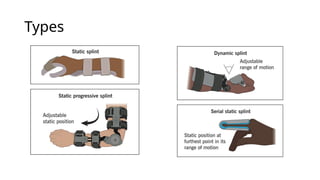
Definition
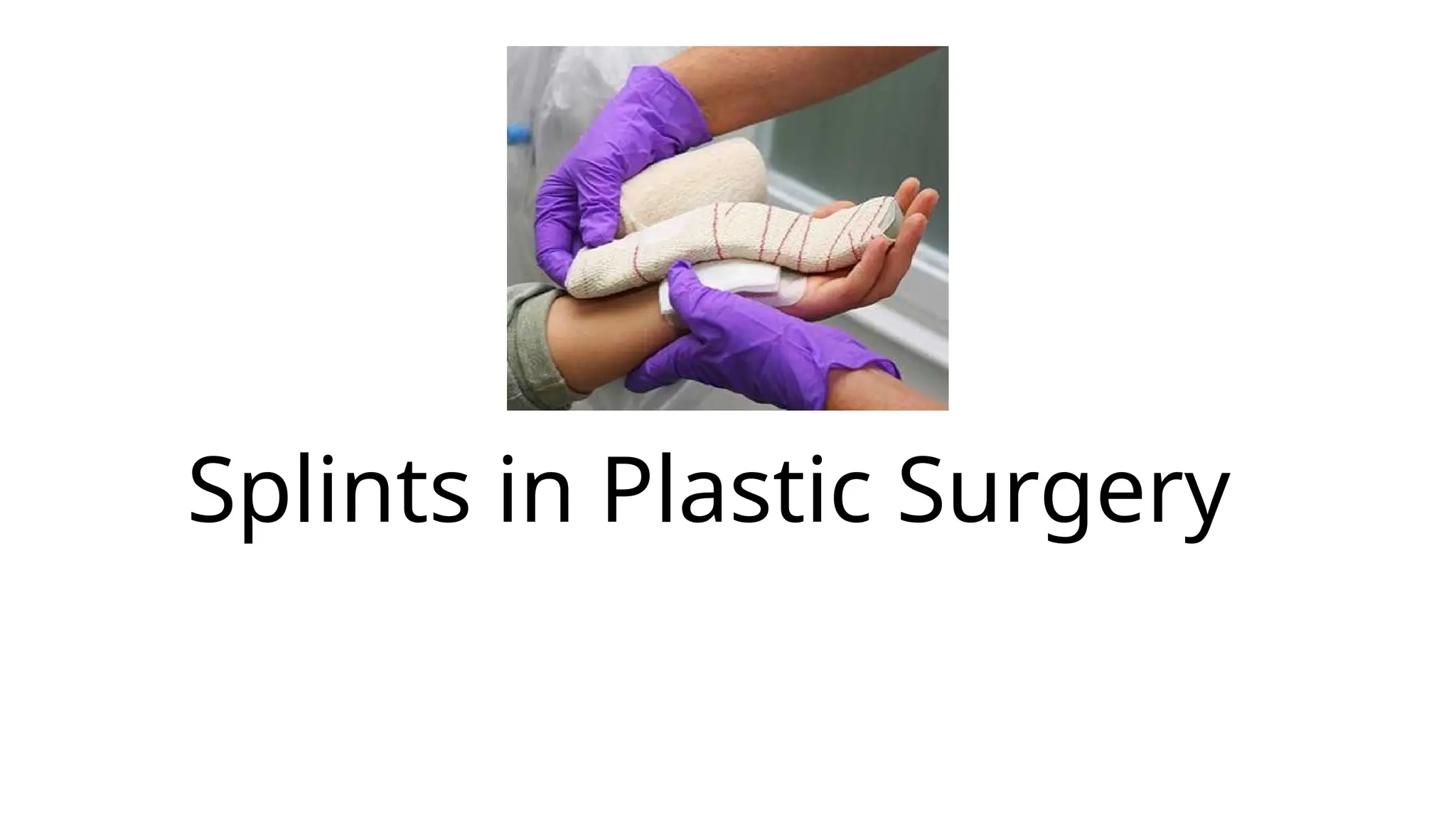
• A rigidor semi-rigid external device
• support, immobilize, or protect tissues post-surgery or
injury.
• Purpose: Maintain correct alignment, protect repair, prevent
contractures, and allow healing.
• Differs from casts (non-removable and circumferential)
• Splints are removable, non circumferential and adjustable.
3.
Introduction : Materialssplints are
made up of
• Plaster of Paris
• Fiberglass
• Thermoplastics
• Aluminium
• Cardboard
• Sticks
• 3D printed materials
4.
Introduction : uses
Immobilization
Supportto Promote Healing
Positioning or supporting during function
Pain Relief
Substitute for Weak Muscles
Prevention and Correction of Contracture & Deformity
• Restoration or Maintenance of Range of Motion
Splints used inupper limb
• Dorsal Blocking Splint: Used after flexor tendon repair to
prevent overextension.
• Volar Resting Splint: Immobilizes wrist and hand post-
graft/flap inset.
• Thumb Spica Splint: Stabilizes thumb CMC and MCP joints
for fractures or tendon repair.
• Anti-Claw Splint: Maintains MCP flexion to counteract ulnar
nerve palsy deformity.
7.
Splints used inlower limb
• Ankle-Foot Orthosis (AFO): Maintains dorsiflexion, prevents
equinus deformity, supports flaps.
• Thomas Splint: Provides traction in femoral fractures and
maintains limb alignment.
• Posterior Leaf Splint: Used for foot drop and to protect
grafts on the dorsum of foot.
• Off-loading Splints: Prevent pressure ulcers and safeguard
grafts/flaps in diabetic foot reconstruction.
8.
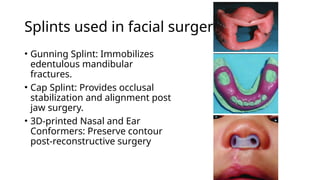
Splints used infacial surgery
• Gunning Splint: Immobilizes
edentulous mandibular
fractures.
• Cap Splint: Provides occlusal
stabilization and alignment post
jaw surgery.
• 3D-printed Nasal and Ear
Conformers: Preserve contour
post-reconstructive surgery