SPELLBOUND
       LO: To make predictions
       about the poem based on the
       language choices of the poet.
       To analyse the phonological
       features of the poem.
SPELLBOUND
   What clues might the title give us about the
    poem?

   Who might be speaking?

   What might the subject be?
FIRST GLANCE
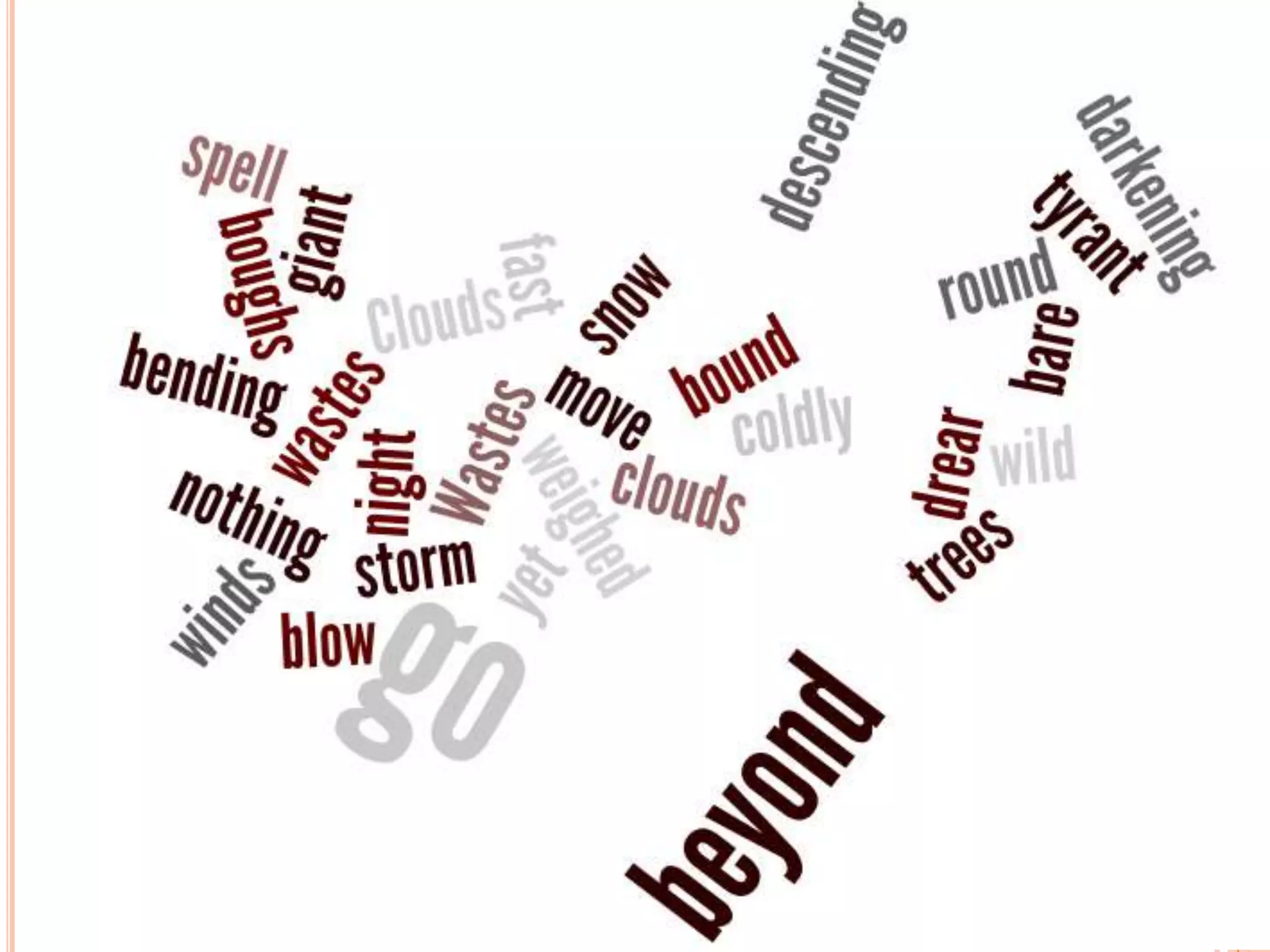
   Highlight/underline all of the words with
    negative connotations.

   How many are there?

   What effect does this create?


   http://www.bbc.co.uk/schools/gcsebitesize/engli
    sh_literature/poetryplace/spellboundact.shtml
STANZA 1
1.   Where do you think the speaker is?
2.   What impression do we get of the setting?
3.   Who might be the ‘tyrant’?
4.   What is the effect of the poet repeating the
     word ‘cannot’?
STANZA 2
1.   What is happening in stanza 2?
2.   What technique has the poet used to create a
     menacing image of the trees?
3.   Why has the poet done this?
STANZA 3
1.   What is the effect of the repetition in this
     stanza?
2.   Why do you think the speaker cannot move?
   Written in November 1837 when Emily would have
    been only 19, this poem is usually attributed to
    Emily's 'Gondal' period – Gondal being an imaginary
    world created by Emily and her siblings in which
    heroes and heroines battled in romantic and
    desperate situations. The editor of the Selected
    Poems of the Brontës, Juliet Barker, quotes an
    earlier authority, Fannie Ratchford (Complete Poems
    of Emily Jane Brontë) and suggests that the poem
    refers to an incident when one of the heroines
    exposes her child to die on the mountains in winter.
    Although she cannot bear to watch the child die, the
    mother is held by the 'tyrant spell' of maternal
    emotions and cannot tear herself away.
PHONOLOGY
   Use the sheet to pick out phonological features
    from the poem.
REVIEW

   Write a S.E.A paragraph analysing the writers
    use of alliteration or assonance.

Spellbound 1

  • 2.
    SPELLBOUND LO: To make predictions about the poem based on the language choices of the poet. To analyse the phonological features of the poem.
  • 3.
    SPELLBOUND  What clues might the title give us about the poem?  Who might be speaking?  What might the subject be?
  • 4.
    FIRST GLANCE  Highlight/underline all of the words with negative connotations.  How many are there?  What effect does this create?  http://www.bbc.co.uk/schools/gcsebitesize/engli sh_literature/poetryplace/spellboundact.shtml
  • 5.
    STANZA 1 1. Where do you think the speaker is? 2. What impression do we get of the setting? 3. Who might be the ‘tyrant’? 4. What is the effect of the poet repeating the word ‘cannot’?
  • 6.
    STANZA 2 1. What is happening in stanza 2? 2. What technique has the poet used to create a menacing image of the trees? 3. Why has the poet done this?
  • 7.
    STANZA 3 1. What is the effect of the repetition in this stanza? 2. Why do you think the speaker cannot move?
  • 8.
    Written in November 1837 when Emily would have been only 19, this poem is usually attributed to Emily's 'Gondal' period – Gondal being an imaginary world created by Emily and her siblings in which heroes and heroines battled in romantic and desperate situations. The editor of the Selected Poems of the Brontës, Juliet Barker, quotes an earlier authority, Fannie Ratchford (Complete Poems of Emily Jane Brontë) and suggests that the poem refers to an incident when one of the heroines exposes her child to die on the mountains in winter. Although she cannot bear to watch the child die, the mother is held by the 'tyrant spell' of maternal emotions and cannot tear herself away.
  • 9.
    PHONOLOGY  Use the sheet to pick out phonological features from the poem.
  • 10.
    REVIEW  Write a S.E.A paragraph analysing the writers use of alliteration or assonance.