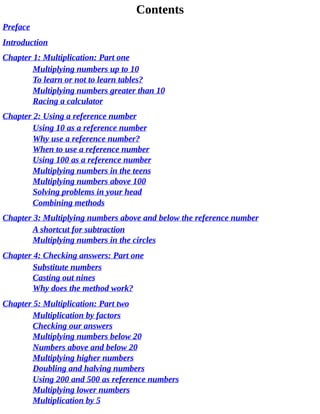
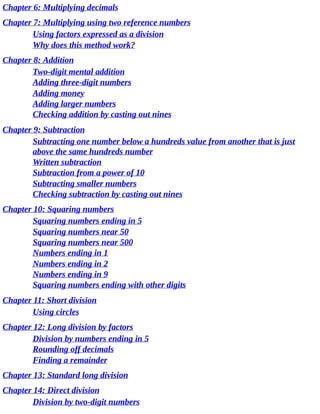
Contents
Preface
Introduction
Chapter	1:	Multiplication:	Part	one
Multiplying	numbers	up	to	10
To	learn	or	not	to	learn	tables?
Multiplying	numbers	greater	than	10
Racing	a	calculator
Chapter	2:	Using	a	reference	number
Using	10	as	a	reference	number
Why	use	a	reference	number?
When	to	use	a	reference	number
Using	100	as	a	reference	number
Multiplying	numbers	in	the	teens
Multiplying	numbers	above	100
Solving	problems	in	your	head
Combining	methods
Chapter	3:	Multiplying	numbers	above	and	below	the	reference	number
A	shortcut	for	subtraction
Multiplying	numbers	in	the	circles
Chapter	4:	Checking	answers:	Part	one
Substitute	numbers
Casting	out	nines
Why	does	the	method	work?
Chapter	5:	Multiplication:	Part	two
Multiplication	by	factors
Checking	our	answers
Multiplying	numbers	below	20
Numbers	above	and	below	20
Multiplying	higher	numbers
Doubling	and	halving	numbers
Using	200	and	500	as	reference	numbers
Multiplying	lower	numbers
Multiplication	by	5
Chapter	6:	Multiplying	decimals
Chapter	7:	Multiplying	using	two	reference	numbers
Using	factors	expressed	as	a	division
Why	does	this	method	work?
Chapter	8:	Addition
Two-digit	mental	addition
Adding	three-digit	numbers
Adding	money
Adding	larger	numbers
Checking	addition	by	casting	out	nines
Chapter	9:	Subtraction
Subtracting	one	number	below	a	hundreds	value	from	another	that	is	just
above	the	same	hundreds	number
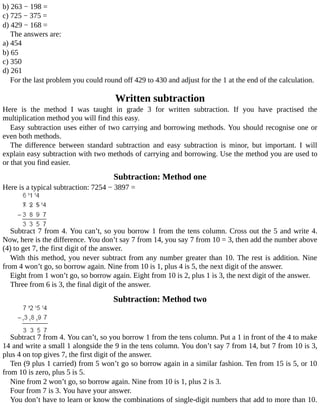
Written	subtraction
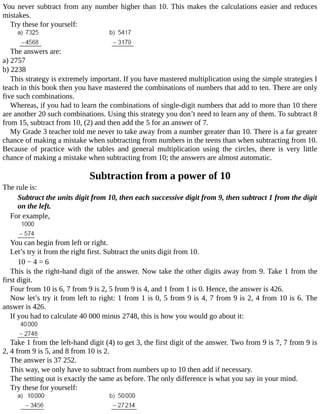
Subtraction	from	a	power	of	10
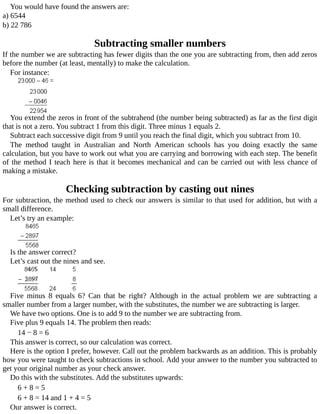
Subtracting	smaller	numbers
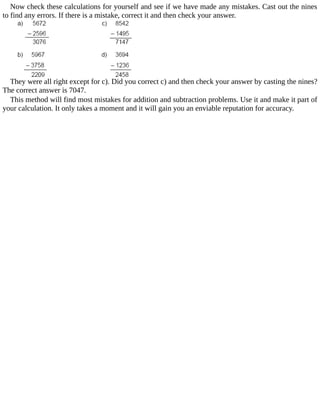
Checking	subtraction	by	casting	out	nines
Chapter	10:	Squaring	numbers
Squaring	numbers	ending	in	5
Squaring	numbers	near	50
Squaring	numbers	near	500
Numbers	ending	in	1
Numbers	ending	in	2
Numbers	ending	in	9
Squaring	numbers	ending	with	other	digits
Chapter	11:	Short	division
Using	circles
Chapter	12:	Long	division	by	factors
Division	by	numbers	ending	in	5
Rounding	off	decimals
Finding	a	remainder
Chapter	13:	Standard	long	division
Chapter	14:	Direct	division
Division	by	two-digit	numbers
A	reverse	technique
Division	by	three-digit	numbers
Chapter	15:	Division	by	addition
Dividing	by	three-digit	numbers
Possible	complications
Chapter	16:	Checking	answers:	Part	two
Casting	out	elevens
Chapter	17:	Estimating	square	roots
Square	roots	of	larger	numbers
A	mental	calculation
When	the	number	is	just	below	a	square
A	shortcut
Greater	accuracy
Chapter	18:	Calculating	square	roots
Cross	multiplication
Using	cross	multiplication	to	extract	square	roots
Comparing	methods
A	question	from	a	reader
Chapter	19:	Fun	shortcuts
Multiplication	by	11
Calling	out	the	answers
Multiplying	multiples	of	11
Multiplying	larger	numbers
A	maths	game
Multiplication	by	9
Division	by	9
Multiplication	using	factors
Division	by	factors
Multiplying	two	numbers	that	have	the	same	tens	digits	and	whose	units	digits
add	to	10
Multiplying	numbers	when	the	units	digits	add	to	10	and	the	tens	digits	differ
by	1
Multiplying	numbers	near	50
Subtraction	from	numbers	ending	in	zeros
Chapter	20:	Adding	and	subtracting	fractions
Addition
Another	shortcut
Subtraction
Chapter	21:	Multiplying	and	dividing	fractions
Multiplying	fractions
Dividing	fractions
Chapter	22:	Direct	multiplication
Multiplication	by	single-digit	numbers
Multiplying	larger	numbers
Combining	methods
Chapter	23:	Estimating	answers
Practical	examples
Chapter	24:	Estimating	hypotenuse
Where	the	lengths	of	the	sides	are	the	same	or	similar
Where	the	lengths	of	the	sides	are	different
Chapter	25:	Memorising	numbers
Phonetic	values
Rules	for	phonetic	values
Phonetic	values	test
Chapter	26:	Phonetic	pegs
An	impressive	demonstration
Six	rules	for	making	associations
Memorising	square	roots
Chapter	27:	Memorising	long	numbers
Memorising	pi
Mental	calculation
Chapter	28:	Logarithms
What	are	logarithms?
Components	of	logarithms
Why	learn	the	table	of	logarithms?
Antilogs
Calculating	compound	interest
The	rule	of	72
Two-figure	logarithms
Chapter	29:	Using	what	you	have	learned
Travelling	abroad
Temperature	conversion
Time	and	distances
Money	exchange
Speeds	and	distances
Pounds	to	kilograms
Sporting	statistics
Sales	tax	or	GST
Estimating	distances
Miscellaneous	hints
Apply	the	strategies
Afterword
Appendix	A:	Frequently	asked	questions
Appendix	B:	Estimating	cube	roots
Appendix	C:	Finding	any	root	of	a	number
Appendix	D:	Checks	for	divisibility
Appendix	E:	Why	our	methods	work
Appendix	F:	Casting	out	nines	—	why	it	works
Appendix	G:	Squaring	feet	and	inches
Appendix	H:	How	do	you	get	students	to	enjoy	mathematics?
Appendix	I:	Solving	problems
Glossary
Index
Dedicated	to
Benyomin	Goldschmiedt
Also	by	Bill	Handley:	Teach	Your	Children	Tables,	Speed	Maths	for	Kids	and	Fast	Easy	Way	to	Learn	a
Language
(published	by	and	available	from	Wrightbooks)
Third	edition	first	published	2008	by	Wrightbooks
an	imprint	of	John	Wiley	&	Sons	Australia,	Ltd
42	McDougall	Street,	Milton	Qld	4064
Office	also	in	Melbourne
First	edition	2000
Second	edition	2003
Typeset	in	11.5/13.2	pt	Goudy
©	Bill	Handley	2008
The	moral	rights	of	the	author	have	been	asserted
National	Library	of	Australia
Cataloguing-in-Publication	data:
Author: Handley,	Bill.
Title: Speed	mathematics	/	author,	Bill	Handley.
Edition: 3rd	ed.
Publisher: Camberwell,	Vic.	:	John	Wiley	and	Sons	Australia,	2008.
ISBN: 9780731407811	(pbk.)
Subjects: Mental	arithmetic	—	Study	and	teaching.
Dewey	Number: 513.9
All	rights	reserved.	Except	as	permitted	under	the	Australian	Copyright	Act	1968	(for	example,	a	fair
dealing	for	the	purposes	of	study,	research,	criticism	or	review),	no	part	of	this	book	may	be	reproduced,
stored	in	a	retrieval	system,	communicated	or	transmitted	in	any	form	or	by	any	means	without	prior
written	permission.	All	inquiries	should	be	made	to	the	publisher	at	the	address	above.
Cover	design	by	Rob	Cowpe
Author	photograph	by	Karl	Mandl
Preface
I	made	a	number	of	changes	to	the	book	for	the	second	edition	of	Speed	Mathematics;	 many	 minor
changes	 where	 I,	 or	 my	 readers,	 thought	 something	 could	 be	 explained	 more	 clearly.	 The	 more
important	changes	were	to	the	chapters	on	direct	long	division	(including	a	new	chapter),	calculating
square	 roots	 (where	 I	 included	 replies	 to	 frustrated	 readers)	 and	 to	 the	 appendices.	 I	 included	 an
algebraic	 explanation	 for	 multiplication	 using	 two	 reference	 numbers	 and	 an	 appendix	 on	 how	 to
motivate	students	to	enjoy	mathematics.
I	decided	to	produce	a	third	edition	after	receiving	mail	from	around	the	world	from	people	who	have
enjoyed	my	book	and	found	it	helpful.	Many	teachers	have	written	to	say	that	the	methods	have	inspired
their	students,	but	some	informed	me	that	they	have	had	trouble	keeping	track	of	totals	as	they	make
mental	calculations.
In	this	third	edition,	I	have	included	extra	material	on	keeping	numbers	in	your	head,	memorising
numbers,	 working	 with	 logarithms	 and	 working	 with	 right-angled	 triangles.	 I	 have	 expanded	 the
chapters	on	squaring	numbers	and	tests	for	divisibility	and	included	an	idea	from	an	American	reader
from	Kentucky.
I	 have	 produced	 a	 teachers’	 handbook	 with	 explanations	 of	 how	 to	 teach	 these	 methods	 in	 the
classroom	 with	 many	 handout	 sheets	 and	 problem	 sheets.	 Please	 email	 me	 or	 visit	 my	 website	 for
details.
Many	people	have	asked	me	if	my	methods	are	similar	to	those	developed	by	Jakow	Trachtenberg.
He	inspired	millions	with	his	methods	and	revolutionary	approach	to	mathematics.	Trachtenberg’s	book
inspired	me	when	I	was	a	teenager.	After	reading	it	I	found	to	my	delight	that	I	was	capable	of	making
large	mental	calculations	I	would	not	otherwise	have	believed	possible.	From	his	ideas,	I	developed	a
love	for	working,	playing	and	experimenting	with	numbers.	I	owe	him	a	lot.
My	methods	are	not	the	same,	although	there	are	some	areas	where	our	methods	meet	and	overlap.
We	use	the	same	formula	for	squaring	numbers	ending	in	five.	Trachtenberg	also	taught	casting	out
nines	to	check	answers.	Whereas	he	has	a	different	rule	for	multiplication	by	each	number	from	1	to	12,
I	use	a	single	formula.	Whenever	anyone	links	my	methods	to	Trachtenberg’s,	I	take	it	as	a	compliment.
My	methods	are	my	own	and	my	approach	and	style	are	my	own.	Any	shortcomings	in	the	book	are
mine.
Some	of	the	information	in	Speed	Mathematics	can	be	found	in	my	first	book,	Teach	Your	Children
Tables.	 I	 have	 repeated	 this	 information	 for	 the	 sake	 of	 completeness.	 Teach	 Your	 Children	 Tables
teaches	problem-solving	strategies	that	are	not	covered	in	this	book.	The	practice	examples	in	my	first
book	use	puzzles	to	make	learning	the	strategies	enjoyable.	It	is	a	good	companion	to	this	book.
Speed	Maths	For	Kids	is	another	companion	which	takes	some	of	the	methods	in	this	book	further.	It
is	a	fun	book	for	both	kids	and	older	readers,	giving	added	insight	by	playing	and	experimenting	with
the	ideas.
My	sincere	wish	is	that	this	book	will	inspire	my	readers	to	enjoy	mathematics	and	help	them	realise
that	they	are	capable	of	greatness.
Bill	Handley
Melbourne,	Australia,	January	2008
<bhandley@speedmathematics.com>
<http://www.speedmathematics.com>
Introduction
Imagine	being	able	to	multiply	large	numbers	in	your	head	—	faster	than	you	could	tap	the	numbers
into	 a	 calculator.	 Imagine	 being	 able	 to	 make	 a	 ‘lightning’	 mental	 check	 to	 see	 if	 you	 have	 made	 a
mistake.	How	would	your	colleagues	react	if	you	could	calculate	square	roots	—	and	even	cube	roots	—
mentally?	 Would	 you	 gain	 a	 reputation	 for	 being	 extremely	 intelligent?	 Would	 your	 friends	 and
colleagues	treat	you	differently?	How	about	your	teachers,	lecturers,	clients,	management?
People	equate	mathematical	ability	with	intelligence.	If	you	are	able	to	do	multiplication,	division,
squaring	and	square	roots	in	your	head	in	less	time	than	your	friends	can	retrieve	their	calculators	from
their	bags,	they	will	believe	you	have	a	superior	intellect.
I	 taught	 a	 young	 boy	 some	 of	 the	 strategies	 you	 will	 learn	 in	 Speed	 Mathematics	 before	 he	 had
entered	Grade	1	and	he	was	treated	like	a	prodigy	throughout	primary	and	secondary	school.
Engineers	familiar	with	these	kinds	of	strategies	gain	a	reputation	for	being	geniuses	because	they
can	give	almost	instant	answers	to	square	root	problems.	Mentally	finding	the	length	of	a	hypotenuse	is
child’s	play	using	the	methods	taught	in	this	book.
As	 these	 people	 are	 perceived	 as	 being	 extremely	 intelligent,	 they	 are	 treated	 differently	 by	 their
friends	 and	 family,	 at	 school	 and	 in	 the	 workplace.	 And	 because	 they	 are	 treated	 as	 being	 more
intelligent,	they	are	more	inclined	to	act	more	intelligently.
Why	teach	basic	number	facts	and	basic	arithmetic?
Once	I	was	interviewed	on	a	national	radio	programme.	After	my	interview,	the	interviewer	spoke	with
a	 representative	 from	 the	 mathematics	 department	 at	 a	 leading	 Melbourne	 university.	 He	 said	 that
teaching	students	to	calculate	is	a	waste	of	time.	Why	does	anyone	need	to	square	numbers,	multiply
numbers,	find	square	roots	or	divide	numbers	when	we	have	calculators?	Many	parents	telephoned	the
network	to	say	his	attitude	could	explain	the	difficulties	their	children	were	having	in	school.
I	have	also	had	discussions	with	educators	about	the	value	of	teaching	basic	number	facts.	Many	say
children	don’t	need	to	know	that	5	plus	2	equals	7	or	2	times	3	is	6.
When	these	comments	are	made	in	the	classroom	I	ask	the	students	to	take	out	their	calculators.	I	get
them	to	tap	the	buttons	as	I	give	them	a	problem.	‘Two	plus	three	times	four	equals..?’
Some	students	get	20	as	an	answer	on	their	calculator.	Others	get	an	answer	of	14.
Which	number	is	correct?	How	can	calculators	give	two	different	answers	when	you	press	the	same
buttons?
This	is	because	there	is	an	order	of	mathematical	functions.	You	multiply	and	divide	before	you	add
or	subtract.	Some	calculators	know	this;	some	don’t.
A	 calculator	 can’t	 think	 for	 you.	 You	 must	 understand	 what	 you	 are	 doing	 yourself.	 If	 you	 don’t
understand	mathematics,	a	calculator	is	of	little	help.
Here	 are	 some	 reasons	 why	 I	 believe	 an	 understanding	 of	 mathematics	 is	 not	 only	 desirable,	 but
essential	for	everyone,	whether	student	or	otherwise:
	
People	equate	mathematical	ability	with	general	intelligence.	If	you	are	good	at	maths,	you	are
generally	regarded	as	highly	intelligent.	High-achieving	maths	students	are	treated	differently	by
their	 teachers	 and	 colleagues.	 Teachers	 have	 higher	 expectations	 of	 them	 and	 they	 generally
perform	better	—	not	only	at	mathematics	but	in	other	subject	areas	as	well.
Learning	 to	 work	 with	 numbers,	 especially	 mastering	 the	 mental	 calculations,	 will	 give	 an
appreciation	for	the	properties	of	numbers.
Mental	calculation	improves	concentration,	develops	memory,	and	enhances	the	ability	to	retain
several	ideas	at	once.	Students	learn	to	work	with	different	concepts	simultaneously.
Mental	 calculation	 will	 enable	 you	 to	 develop	 a	 ‘feel’	 for	 numbers.	 You	 will	 be	 able	 to	 better
estimate	answers.
Understanding	 mathematics	 fosters	 an	 ability	 to	 think	 laterally.	 The	 strategies	 taught	 in	 Speed
Mathematics	will	help	you	develop	an	ability	to	try	alternative	ways	of	thinking;	you	will	learn	to
look	for	non-traditional	methods	of	problem-solving	and	calculations.
Mathematical	knowledge	boosts	your	confidence	and	self-esteem.	These	methods	will	give	you
confidence	in	your	mental	faculties,	intelligence	and	problem-solving	abilities.
Checking	methods	gives	immediate	feedback	to	the	problem-solver.	If	you	make	a	mistake,	you
know	 immediately	 and	 you	 are	 able	 to	 correct	 it.	 If	 you	 are	 right,	 you	 have	 the	 immediate
satisfaction	of	knowing	it.	Immediate	feedback	keeps	you	motivated.
Mathematics	impacts	on	our	everyday	lives.	Whether	you	are	at	the	football	or	buying	groceries,
there	 are	 many	 practical	 uses	 of	 mental	 calculation.	 We	 all	 need	 to	 be	 able	 to	 make	 quick
calculations.
Mathematical	mind
Is	it	true	that	some	people	are	born	with	a	mathematical	mind?	Do	some	people	have	an	advantage	over
others?	 And,	 conversely,	 are	 some	 people	 at	 a	 disadvantage	 when	 they	 have	 to	 solve	 mathematical
problems?
The	difference	between	high	achievers	and	low	achievers	is	not	the	brain	they	were	born	with	but
how	they	learn	to	use	it.	High	achievers	use	better	strategies	than	low	achievers.
Speed	Mathematics	will	teach	you	better	strategies.	These	methods	are	easier	than	those	you	have
learnt	in	the	past	so	you	will	solve	problems	more	quickly	and	make	fewer	mistakes.
Imagine	there	are	two	students	sitting	in	class	and	the	teacher	gives	them	a	maths	problem.	Student	A
says,	‘This	is	hard.	The	teacher	hasn’t	taught	us	how	to	do	this.	So	how	am	I	supposed	to	work	it	out?
Dumb	teacher,	dumb	school.’
Student	B	says,	‘This	is	hard.	The	teacher	hasn’t	taught	us	how	to	do	this.	So	how	am	I	supposed	to
work	it	out?	He	knows	what	we	know	and	what	we	can	do	so	we	must	have	been	taught	enough	to	work
this	out	for	ourselves.	Where	can	I	start?’
Which	student	is	more	likely	to	solve	the	problem?	Obviously,	it	is	student	B.
What	happens	the	next	time	the	class	is	given	a	similar	problem?	Student	A	says,	‘I	can’t	do	this.	This
is	like	the	last	problem	we	had.	It’s	too	hard.	I	am	no	good	at	these	problems.	Why	can’t	they	give	us
something	easy?’
Student	B	says,	‘This	is	similar	to	the	last	problem.	I	can	solve	this.	I	am	good	at	these	kinds	of
problems.	They	aren’t	easy,	but	I	can	do	them.	How	do	I	begin	with	this	problem?’
Both	students	have	commenced	a	pattern;	one	of	failure,	the	other	of	success.	Has	it	anything	to	do
with	their	intelligence?	Perhaps,	but	not	necessarily.	They	could	be	of	equal	intelligence.	It	has	more	to
do	with	attitude,	and	their	attitude	could	depend	on	what	they	have	been	told	in	the	past,	as	well	as	their
previous	successes	or	failures.	It	is	not	enough	to	tell	people	to	change	their	attitude.	That	makes	them
annoyed.	I	prefer	to	tell	them	they	can	do	better	and	I	will	show	them	how.	Let	success	change	their
attitude.	People’s	faces	light	up	as	they	exclaim,	‘Hey,	I	can	do	that!’
Here	is	my	first	rule	of	mathematics:
The	easier	the	method	you	use	to	solve	a	problem,	the	faster	you	will	solve	it	with	less	chance	of
making	a	mistake.
The	more	complicated	the	method	you	use,	the	longer	you	take	to	solve	a	problem	and	the	greater	the
chance	of	making	an	error.	People	who	use	better	methods	are	faster	at	getting	the	answer	and	make
fewer	mistakes,	while	those	who	use	poor	methods	are	slower	at	getting	the	answer	and	make	more
mistakes.	It	doesn’t	have	much	to	do	with	intelligence	or	having	a	‘mathematical	brain’.
How	to	use	this	book
I	have	tried	to	write	a	non-technical	book	that	anyone	can	understand.	By	the	end	of	this	book,	you	will
understand	 mathematics	 as	 never	 before.	 Mathematics	 is	 an	 extremely	 satisfying	 subject.	 Solving	 a
difficult	 problem	 in	 mathematics	 or	 logic	 can	 be	 rewarding	 and	 give	 a	 high	 beyond	 most	 people’s
imagination.	This	book	will	teach	you	how.
Each	section	has	a	number	of	examples.	Try	them,	rather	than	just	read	them	through.	You	will	find
the	 examples	 are	 not	 difficult,	 and	 it	 is	 by	 trying	 them	 that	 you	 will	 really	 learn	 the	 strategies	 and
principles	and	you	will	be	really	motivated.	It	is	only	by	trying	the	examples	that	you	will	discover	how
easy	the	methods	really	are.
Some	readers	have	written	to	say	they	have	read	chapter	1	and	couldn’t	get	the	methods	to	work	for
some	 calculations.	 The	 book	 teaches	 the	 methods	 and	 principles	 in	 order,	 so	 you	 may	 have	 to	 read
several	chapters	until	you	completely	master	a	strategy.
I	encourage	you	to	take	your	time,	and	practise	the	examples	both	by	writing	them	down	and	by
calculating	the	answers	mentally.	Work	your	way	through	the	book,	and	you	will	be	amazed	that	maths
can	be	so	easy	and	so	enjoyable.
Chapter	1
Multiplication:	Part	one
How	well	do	you	know	your	basic	multiplication	tables?
How	would	you	like	to	master	your	tables	up	to	the	10	times	tables	in	less	than	10	minutes?	And	your
tables	up	to	the	20	times	tables	in	less	than	half	an	hour?	You	can,	using	the	methods	I	explain	in	this
book.	I	only	assume	you	know	the	2	times	tables	reasonably	well,	and	that	you	can	add	and	subtract
simple	numbers.
Multiplying	numbers	up	to	10
We	will	begin	by	learning	how	to	multiply	numbers	up	to	10	×	10.	This	is	how	it	works:
We’ll	take	7	×	8	as	an	example.
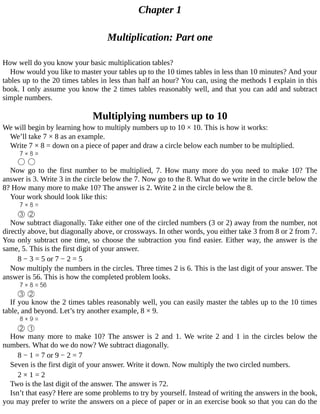
Write	7	×	8	=	down	on	a	piece	of	paper	and	draw	a	circle	below	each	number	to	be	multiplied.
Now	 go	 to	 the	 first	 number	 to	 be	 multiplied,	 7.	 How	 many	 more	 do	 you	 need	 to	 make	 10?	 The
answer	is	3.	Write	3	in	the	circle	below	the	7.	Now	go	to	the	8.	What	do	we	write	in	the	circle	below	the
8?	How	many	more	to	make	10?	The	answer	is	2.	Write	2	in	the	circle	below	the	8.
Your	work	should	look	like	this:
Now	subtract	diagonally.	Take	either	one	of	the	circled	numbers	(3	or	2)	away	from	the	number,	not
directly	above,	but	diagonally	above,	or	crossways.	In	other	words,	you	either	take	3	from	8	or	2	from	7.
You	only	subtract	one	time,	so	choose	the	subtraction	you	find	easier.	Either	way,	the	answer	is	the
same,	5.	This	is	the	first	digit	of	your	answer.
8	−	3	=	5	or	7	−	2	=	5
Now	multiply	the	numbers	in	the	circles.	Three	times	2	is	6.	This	is	the	last	digit	of	your	answer.	The
answer	is	56.	This	is	how	the	completed	problem	looks.
If	you	know	the	2	times	tables	reasonably	well,	you	can	easily	master	the	tables	up	to	the	10	times
table,	and	beyond.	Let’s	try	another	example,	8	×	9.
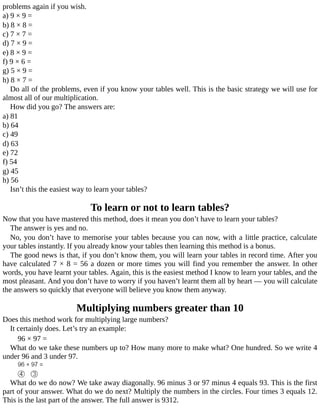
How	many	more	to	make	10?	The	answer	is	2	and	1.	We	write	2	and	1	in	the	circles	below	the
numbers.	What	do	we	do	now?	We	subtract	diagonally.
8	−	1	=	7	or	9	−	2	=	7
Seven	is	the	first	digit	of	your	answer.	Write	it	down.	Now	multiply	the	two	circled	numbers.
2	×	1	=	2
Two	is	the	last	digit	of	the	answer.	The	answer	is	72.
Isn’t	that	easy?	Here	are	some	problems	to	try	by	yourself.	Instead	of	writing	the	answers	in	the	book,
you	may	prefer	to	write	the	answers	on	a	piece	of	paper	or	in	an	exercise	book	so	that	you	can	do	the
problems	again	if	you	wish.
a)	9	×	9	=
b)	8	×	8	=
c)	7	×	7	=
d)	7	×	9	=
e)	8	×	9	=
f)	9	×	6	=
g)	5	×	9	=
h)	8	×	7	=
Do	all	of	the	problems,	even	if	you	know	your	tables	well.	This	is	the	basic	strategy	we	will	use	for
almost	all	of	our	multiplication.
How	did	you	go?	The	answers	are:
a)	81
b)	64
c)	49
d)	63
e)	72
f)	54
g)	45
h)	56
Isn’t	this	the	easiest	way	to	learn	your	tables?
To	learn	or	not	to	learn	tables?
Now	that	you	have	mastered	this	method,	does	it	mean	you	don’t	have	to	learn	your	tables?
The	answer	is	yes	and	no.
No,	you	don’t	have	to	memorise	your	tables	because	you	can	now,	with	a	little	practice,	calculate
your	tables	instantly.	If	you	already	know	your	tables	then	learning	this	method	is	a	bonus.
The	good	news	is	that,	if	you	don’t	know	them,	you	will	learn	your	tables	in	record	time.	After	you
have	calculated	7	×	8	=	56	a	dozen	or	more	times	you	will	find	you	remember	the	answer.	In	other
words,	you	have	learnt	your	tables.	Again,	this	is	the	easiest	method	I	know	to	learn	your	tables,	and	the
most	pleasant.	And	you	don’t	have	to	worry	if	you	haven’t	learnt	them	all	by	heart	—	you	will	calculate
the	answers	so	quickly	that	everyone	will	believe	you	know	them	anyway.
Multiplying	numbers	greater	than	10
Does	this	method	work	for	multiplying	large	numbers?
It	certainly	does.	Let’s	try	an	example:
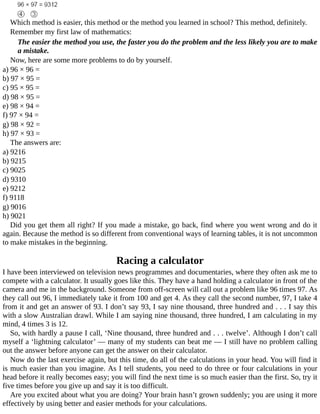
96	×	97	=
What	do	we	take	these	numbers	up	to?	How	many	more	to	make	what?	One	hundred.	So	we	write	4
under	96	and	3	under	97.
What	do	we	do	now?	We	take	away	diagonally.	96	minus	3	or	97	minus	4	equals	93.	This	is	the	first
part	of	your	answer.	What	do	we	do	next?	Multiply	the	numbers	in	the	circles.	Four	times	3	equals	12.
This	is	the	last	part	of	the	answer.	The	full	answer	is	9312.
Which	method	is	easier,	this	method	or	the	method	you	learned	in	school?	This	method,	definitely.
Remember	my	first	law	of	mathematics:
The	easier	the	method	you	use,	the	faster	you	do	the	problem	and	the	less	likely	you	are	to	make
a	mistake.
Now,	here	are	some	more	problems	to	do	by	yourself.
a)	96	×	96	=
b)	97	×	95	=
c)	95	×	95	=
d)	98	×	95	=
e)	98	×	94	=
f)	97	×	94	=
g)	98	×	92	=
h)	97	×	93	=
The	answers	are:
a)	9216
b)	9215
c)	9025
d)	9310
e)	9212
f)	9118
g)	9016
h)	9021
Did	you	get	them	all	right?	If	you	made	a	mistake,	go	back,	find	where	you	went	wrong	and	do	it
again.	Because	the	method	is	so	different	from	conventional	ways	of	learning	tables,	it	is	not	uncommon
to	make	mistakes	in	the	beginning.
Racing	a	calculator
I	have	been	interviewed	on	television	news	programmes	and	documentaries,	where	they	often	ask	me	to
compete	with	a	calculator.	It	usually	goes	like	this.	They	have	a	hand	holding	a	calculator	in	front	of	the
camera	and	me	in	the	background.	Someone	from	off-screen	will	call	out	a	problem	like	96	times	97.	As
they	call	out	96,	I	immediately	take	it	from	100	and	get	4.	As	they	call	the	second	number,	97,	I	take	4
from	it	and	get	an	answer	of	93.	I	don’t	say	93,	I	say	nine	thousand,	three	hundred	and	.	.	.	I	say	this
with	a	slow	Australian	drawl.	While	I	am	saying	nine	thousand,	three	hundred,	I	am	calculating	in	my
mind,	4	times	3	is	12.
So,	with	hardly	a	pause	I	call,	‘Nine	thousand,	three	hundred	and	.	.	.	twelve’.	Although	I	don’t	call
myself	a	‘lightning	calculator’	—	many	of	my	students	can	beat	me	—	I	still	have	no	problem	calling
out	the	answer	before	anyone	can	get	the	answer	on	their	calculator.
Now	do	the	last	exercise	again,	but	this	time,	do	all	of	the	calculations	in	your	head.	You	will	find	it
is	much	easier	than	you	imagine.	As	I	tell	students,	you	need	to	do	three	or	four	calculations	in	your
head	before	it	really	becomes	easy;	you	will	find	the	next	time	is	so	much	easier	than	the	first.	So,	try	it
five	times	before	you	give	up	and	say	it	is	too	difficult.
Are	you	excited	about	what	you	are	doing?	Your	brain	hasn’t	grown	suddenly;	you	are	using	it	more
effectively	by	using	better	and	easier	methods	for	your	calculations.
Chapter	2
Using	a	reference	number
We	haven’t	quite	reached	the	end	of	our	explanation	for	multiplication.	The	method	for	multiplication
has	worked	for	the	problems	we	have	done	until	now,	but	with	a	slight	adjustment,	we	can	make	it	work
for	any	numbers.
Using	10	as	a	reference	number
Let’s	go	back	to	7	times	8.
The	10	to	the	left	of	the	problem	is	our	reference	number.	It	is	the	number	we	subtract	our	multipliers
from.
Write	the	reference	number	to	the	left	of	the	problem.	We	then	ask	ourselves,	is	the	number	we	are
multiplying	above	or	below	the	reference	number?	In	this	case	the	answer	is	below	each	time.	So	we	put
the	circles	below	the	multipliers.	How	much	below?	Three	and	2.	We	write	3	and	2	in	the	circles.	Seven
is	10	minus	3,	so	put	a	minus	sign	in	front	of	the	3.	Eight	is	10	minus	2,	so	put	a	minus	sign	in	front	of
the	2.
We	now	work	diagonally.	Seven	minus	2	or	8	minus	3	is	5.	We	write	5	after	the	equals	sign.	Now,
multiply	the	5	by	the	reference	number,	10.	Five	times	10	is	50,	so	write	a	0	after	the	5.	(To	multiply
any	number	by	10	we	affix	a	zero.)	Fifty	is	our	subtotal.
Now	multiply	the	numbers	in	the	circles.	Three	times	2	is	6.	Add	this	to	the	subtotal	of	50	for	the
final	answer	of	56.
Your	full	working	should	look	like	this:
Why	use	a	reference	number?
Why	not	use	the	method	we	used	in	chapter	1?	Wasn’t	that	easier?	Our	method	used	10	and	100	as
reference	numbers,	anyway.	Using	it	this	way	allows	us	to	calculate	6	×	6,	and	6	×	7,	4	×	7	and	4	×	8
and	 so	 on.	 Let’s	 try	 6	 ×	 7	 using	 the	 method	 we	 used	 in	 chapter	 1.	 We	 draw	 the	 circles	 below	 the
numbers	and	subtract	from	ten.	We	write	4	and	3	in	the	circles	below.	Our	work	should	look	like	this:
Subtract	crossways.	Three	from	6	or	4	from	7	is	3.	Write	3	after	the	equals	sign.	Four	times	3	is	12.
Write	12	after	the	3	for	an	answer	of	312.
Is	this	the	correct	answer?	No.	Let’s	do	the	calculation	again,	this	time	using	the	reference	number.
As	a	rule,	I	would	always	set	out	the	calculations	as	above	until	the	method	is	natural.	Then	you	can
simply	use	the	reference	number	mentally.
When	to	use	a	reference	number
People	ask	me,	‘When	should	I	use	a	reference	number?’	When	you	solve	6	times	7	in	your	head,	you
are	automatically	using	a	reference	number.	You	subtract	3	from	6	to	get	an	answer	of	three.	You	don’t
say	‘Three’,	you	say,	‘Thirty	.	.	.’
Then	you	calculate	4	times	3	is	12.	You	wouldn’t	say,	‘Thirty-twelve’.	You	know	you	must	add	the	12
to	the	30	to	get	‘forty-two’.	Calculating	in	your	head	actually	forces	you	to	use	this	method.
The	simple	answer	is:	always	use	a	reference	number.
As	you	become	familiar	with	the	strategies	you	will	find	you	are	automatically	using	the	reference,
even	if	you	don’t	continue	to	write	it	down	in	your	calculations.
Using	100	as	a	reference	number
What	was	our	reference	number	for	96	×	97	in	chapter	1?	One	hundred,	because	we	asked	how	many
more	do	we	need	to	make	100.	The	problem	worked	out	in	full	would	look	like	this:
Let’s	multiply	98	by	98.
We	take	98	and	98	from	100	and	get	an	answer	of	2	and	2.	We	take	2	from	98	and	get	an	answer	of
96.	But,	we	don’t	say,	‘Ninety-six’.	We	say,	‘Nine	thousand,	six	hundred	and	.	.	.’	Nine	thousand,	six
hundred	is	the	answer	we	get	when	we	multiply	96	by	the	reference	number	of	100.	We	now	multiply
the	numbers	in	the	circles.	Two	times	2	is	4,	so	we	can	say	the	full	answer	of	nine	thousand,	six	hundred
and	four.	Without	using	the	reference	number	we	could	have	got	an	answer	of	964	instead	of	9604.
Do	these	problems	in	your	head:
a)	96	×	96	=
b)	97	×	97	=
c)	99	×	99	=
d)	95	×	95	=
Your	answers	should	be:
a)	9216
b)	9409
c)	9801
d)	9025
This	is	quite	impressive	because	you	should	be	able	to	give	lightning	fast	answers	to	these	kinds	of
problems.	You	should	be	able	to	multiply	numbers	below	10	very	quickly.	For	example,	if	you	wanted
to	calculate	9	×	9,	you	would	immediately	‘see’	1	and	1	below	the	nines.	One	from	9	is	8	—	you	say	80
(8	times	10).	One	times	1	is	1.	Your	answer	is	81.
Multiplying	numbers	in	the	teens
Let’s	see	how	we	apply	this	method	to	multiplying	numbers	in	the	teens.	We	will	use	13	times	14	as	an
example	and	use	10	as	our	reference	number.
Both	13	and	14	are	above	the	reference	number,	10,	so	we	put	the	circles	above.	How	much	above?
Three	and	4;	so	we	write	3	and	4	in	the	circles	above	13	and	14.	Thirteen	equals	10	plus	3	so	you	can
write	a	plus	sign	in	front	of	the	3;	14	is	10	plus	4	so	we	can	write	a	plus	sign	in	front	of	the	4.
As	before,	we	work	diagonally.	Thirteen	plus	4,	or	14	plus	3,	is	17.	Write	17	after	the	equals	sign.	We
multiply	the	17	by	the	reference	number,	10,	and	get	170.	(To	multiply	any	number	by	10	we	affix	a
zero.)	One	hundred	and	seventy	is	our	subtotal,	so	write	170	after	the	equals	sign.
For	the	last	step,	we	multiply	the	numbers	in	the	circles.	Three	times	4	equals	12.	Add	12	to	170	and
we	get	our	answer	of	182.	This	is	how	we	write	the	problem	in	full:
If	 the	 number	 we	 are	 multiplying	 is	 above	 the	 reference	 number	 we	 put	 the	 circle	 above.	 If	 the
number	is	below	the	reference	number	we	put	the	circle	below.
If	 the	 circled	 number	 is	 above	 we	 add	 diagonally,	 if	 the	 number	 is	 below	 we	 subtract
diagonally.
Now,	try	these	problems	by	yourself:
a)	12	×	15	=
b)	13	×	15	=
c)	12	×	12	=
d)	13	×	13	=
e)	12	×	14	=
f)	12	×	16	=
g)	14	×	14	=
h)	15	×	15	=
The	answers	are:
a)	180
b)	195
c)	144
d)	169
e)	168
f)	192
g)	196
h)	225
If	you	got	any	wrong,	read	through	this	section	again	and	find	what	you	did	wrong,	then	try	them
again.
How	would	you	multiply	12	×	21?	Let’s	try	it.
We	use	a	reference	number	of	10.	Both	numbers	are	above	10	so	we	draw	the	circles	above.	Twelve	is
2	above	10,	21	is	11	above	so	we	write	2	and	11	in	the	circles.	Twenty-one	plus	2	is	23,	times	10	is	230.
Two	times	11	is	22,	added	to	230	makes	252.
This	is	how	your	completed	problem	should	look:
Multiplying	numbers	above	100
Can	we	use	this	method	for	multiplying	numbers	above	100?	By	all	means.
To	multiply	106	by	104,	we	would	use	100	as	our	reference	number.
The	numbers	are	above	the	reference	number,	100,	so	we	draw	circles	above	106	and	104.	How	much
above	100?	Six	and	4.	Write	6	and	4	in	the	circles.	They	are	plus	numbers	(positive	numbers)	because
106	is	100	plus	6	and	104	is	100	plus	4.
We	add	crossways.	106	plus	4	is	110.	Write	110	after	the	equals	sign.
Multiply	our	answer,	110,	by	the	reference	number,	100.	How	do	we	multiply	by	100?	By	adding	two
zeros	to	the	end	of	the	number.	That	makes	our	subtotal	11	000,	or	eleven	thousand.
Now	multiply	the	numbers	in	the	circles.	6	×	4	=	24.	Add	that	to	11	000	to	get	11	024.
Our	completed	calculation	looks	like	this:
Try	these	for	yourself:
a)	102	×	114	=
b)	103	×	112	=
c)	112	×	112	=
d)	102	×	125	=
The	answers	are
a)	11	628
b)	11	536
c)	12	544
d)	12	750
With	a	little	practice,	you	should	be	able	to	calculate	all	of	these	problems	without	pencil	or	paper.
That	is	most	impressive.
Solving	problems	in	your	head
When	we	use	these	strategies,	what	we	say	inside	our	head	is	very	important,	and	can	help	us	solve
problems	more	easily	and	more	quickly.
Let’s	multiply	16	×	16	and	look	at	what	we	would	say	inside	our	heads.	Adding	diagonally,	16	plus	6
(from	the	second	16)	equals	22,	times	10	equals	220.	Six	times	6	is	36.	Add	the	30	first,	then	the	6.	Two
twenty	plus	30	is	250,	plus	6	is	256.
Inside	your	head	you	would	say,	‘Sixteen	plus	six,	twenty-two,	two	twenty.	Thirty-six,	two	fifty-six’.
With	practice,	we	can	leave	out	half	of	that.	You	don’t	have	to	give	yourself	a	running	commentary	on
everything	you	do.	You	would	only	say,	‘Two	twenty,	two	fifty-six’.
Practise	this.	Saying	the	right	things	in	your	head	as	you	do	the	calculations	can	more	than	halve	the
time	it	takes.
How	would	you	calculate	7	times	8	in	your	head?	You	would	‘see’	3	and	2	below	the	7	and	8.	You
would	take	2	from	the	7	(or	3	from	the	8)	and	say,	‘Fifty’,	multiplying	by	10	in	the	same	step.	Three
times	2	is	‘Six’.	All	you	would	say	is,	‘Fifty	.	.	.	six’.
What	about	6	times	7?	You	would	‘see’	4	and	3	below	the	6	and	7.	Six	minus	3	is	3;	you	say,	‘Thirty’.
Four	times	3	is	12,	plus	30	is	42.	You	would	just	say,	‘Thirty,	forty-two’.	It’s	not	as	hard	as	it	sounds,	is
it?	And	it	will	become	easier	the	more	calculations	you	do.
Combining	methods
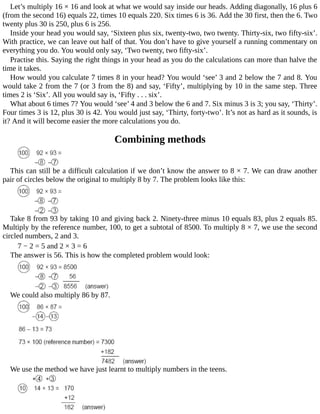
This	can	still	be	a	difficult	calculation	if	we	don’t	know	the	answer	to	8	×	7.	We	can	draw	another
pair	of	circles	below	the	original	to	multiply	8	by	7.	The	problem	looks	like	this:
Take	8	from	93	by	taking	10	and	giving	back	2.	Ninety-three	minus	10	equals	83,	plus	2	equals	85.
Multiply	by	the	reference	number,	100,	to	get	a	subtotal	of	8500.	To	multiply	8	×	7,	we	use	the	second
circled	numbers,	2	and	3.
7	−	2	=	5	and	2	×	3	=	6
The	answer	is	56.	This	is	how	the	completed	problem	would	look:
We	could	also	multiply	86	by	87.
We	use	the	method	we	have	just	learnt	to	multiply	numbers	in	the	teens.
You	should	be	able	to	do	this	mentally	with	just	a	little	practice.
Try	these	problems:
a)	92	×	92	=
b)	91	×	91	=
c)	91	×	92	=
d)	88	×	85	=
The	answers	are:
a)	8464
b)	8281
c)	8372
d)	7480
Combining	the	methods	taught	in	this	book	creates	endless	possibilities.	Experiment	for	yourself.
Chapter	3
Multiplying	numbers	above	and	below	the	reference	number
Up	 until	 now	 we	 have	 multiplied	 numbers	 that	 were	 both	 lower	 than	 the	 reference	 number	 or	 both
higher	than	the	reference	number.	How	do	we	multiply	numbers	when	one	number	is	higher	than	the
reference	number	and	the	other	is	lower	than	the	reference	number?
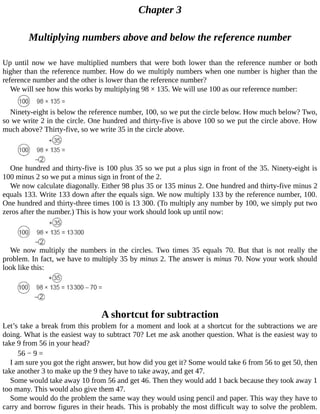
We	will	see	how	this	works	by	multiplying	98	×	135.	We	will	use	100	as	our	reference	number:
Ninety-eight	is	below	the	reference	number,	100,	so	we	put	the	circle	below.	How	much	below?	Two,
so	we	write	2	in	the	circle.	One	hundred	and	thirty-five	is	above	100	so	we	put	the	circle	above.	How
much	above?	Thirty-five,	so	we	write	35	in	the	circle	above.
One	hundred	and	thirty-five	is	100	plus	35	so	we	put	a	plus	sign	in	front	of	the	35.	Ninety-eight	is
100	minus	2	so	we	put	a	minus	sign	in	front	of	the	2.
We	now	calculate	diagonally.	Either	98	plus	35	or	135	minus	2.	One	hundred	and	thirty-five	minus	2
equals	133.	Write	133	down	after	the	equals	sign.	We	now	multiply	133	by	the	reference	number,	100.
One	hundred	and	thirty-three	times	100	is	13	300.	(To	multiply	any	number	by	100,	we	simply	put	two
zeros	after	the	number.)	This	is	how	your	work	should	look	up	until	now:
We	 now	 multiply	 the	 numbers	 in	 the	 circles.	 Two	 times	 35	 equals	 70.	 But	 that	 is	 not	 really	 the
problem.	In	fact,	we	have	to	multiply	35	by	minus	2.	The	answer	is	minus	70.	Now	your	work	should
look	like	this:
A	shortcut	for	subtraction
Let’s	take	a	break	from	this	problem	for	a	moment	and	look	at	a	shortcut	for	the	subtractions	we	are
doing.	What	is	the	easiest	way	to	subtract	70?	Let	me	ask	another	question.	What	is	the	easiest	way	to
take	9	from	56	in	your	head?
56	−	9	=
I	am	sure	you	got	the	right	answer,	but	how	did	you	get	it?	Some	would	take	6	from	56	to	get	50,	then
take	another	3	to	make	up	the	9	they	have	to	take	away,	and	get	47.
Some	would	take	away	10	from	56	and	get	46.	Then	they	would	add	1	back	because	they	took	away	1
too	many.	This	would	also	give	them	47.
Some	would	do	the	problem	the	same	way	they	would	using	pencil	and	paper.	This	way	they	have	to
carry	and	borrow	figures	in	their	heads.	This	is	probably	the	most	difficult	way	to	solve	the	problem.
Remember:
The	easiest	way	to	solve	a	problem	is	also	the	fastest,	with	the	least	chance	of	making	a	mistake.
Most	people	find	the	easiest	way	to	subtract	9	is	to	take	away	10,	then	add	1	to	the	answer.	The
easiest	way	to	subtract	8	is	to	take	away	10,	then	add	2	to	the	answer;	and	to	subtract	7	is	to	take	away
10,	then	add	3	to	the	answer.	Here	are	some	more	‘easy’	ways:
	
What	is	the	easiest	way	to	take	90	from	a	number?	Take	100	and	give	back	10.
What	is	the	easiest	way	to	take	80	from	a	number?	Take	100	and	give	back	20.
What	is	the	easiest	way	to	take	70	from	a	number?	Take	100	and	give	back	30.
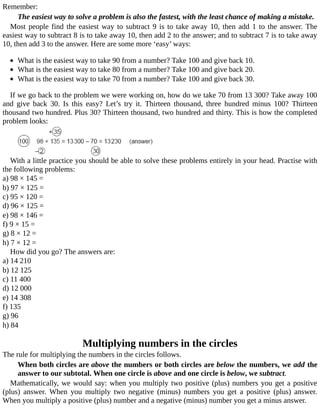
If	we	go	back	to	the	problem	we	were	working	on,	how	do	we	take	70	from	13	300?	Take	away	100
and	 give	 back	 30.	 Is	 this	 easy?	 Let’s	 try	 it.	 Thirteen	 thousand,	 three	 hundred	 minus	 100?	 Thirteen
thousand	two	hundred.	Plus	30?	Thirteen	thousand,	two	hundred	and	thirty.	This	is	how	the	completed
problem	looks:
With	a	little	practice	you	should	be	able	to	solve	these	problems	entirely	in	your	head.	Practise	with
the	following	problems:
a)	98	×	145	=
b)	97	×	125	=
c)	95	×	120	=
d)	96	×	125	=
e)	98	×	146	=
f)	9	×	15	=
g)	8	×	12	=
h)	7	×	12	=
How	did	you	go?	The	answers	are:
a)	14	210
b)	12	125
c)	11	400
d)	12	000
e)	14	308
f)	135
g)	96
h)	84
Multiplying	numbers	in	the	circles
The	rule	for	multiplying	the	numbers	in	the	circles	follows.
When	both	circles	are	above	the	numbers	or	both	circles	are	below	the	numbers,	we	add	the
answer	to	our	subtotal.	When	one	circle	is	above	and	one	circle	is	below,	we	subtract.
Mathematically,	we	would	say:	when	you	multiply	two	positive	(plus)	numbers	you	get	a	positive
(plus)	 answer.	 When	 you	 multiply	 two	 negative	 (minus)	 numbers	 you	 get	 a	 positive	 (plus)	 answer.
When	you	multiply	a	positive	(plus)	number	and	a	negative	(minus)	number	you	get	a	minus	answer.
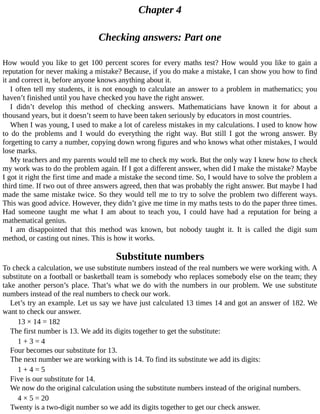
Would	our	method	work	for	multiplying	8	×	45?
Let’s	try	it.	We	choose	a	reference	number	of	10.	Eight	is	2	less	than	10	and	45	is	35	more	than	10.
You	either	take	2	from	45	or	add	35	to	8.	Two	from	45	is	43,	times	the	reference	number,	10,	is	430.
Minus	2	times	35	is	−70.	To	take	70	from	430	we	take	100,	which	equals	330,	then	give	back	30	for	a
final	answer	of	360.
Does	this	replace	learning	your	tables?	No,	it	replaces	the	method	of	learning	your	tables.	After	you
have	calculated	7	times	8	equals	56	or	13	times	14	equals	182	a	dozen	times	or	more,	you	stop	doing	the
calculation;	you	remember	the	answer.	This	is	much	more	enjoyable	than	chanting	your	tables	over	and
over.
We	haven’t	finished	with	multiplication	yet,	but	we	can	take	a	rest	here	and	practise	what	we	have
already	learnt.	If	some	problems	don’t	seem	to	work	out	easily,	don’t	worry;	we	still	have	more	to	cover.
In	the	next	chapter	we	will	look	at	a	simple	method	for	checking	our	answers.
Chapter	4
Checking	answers:	Part	one
How	would	you	like	to	get	100	percent	scores	for	every	maths	test?	How	would	you	like	to	gain	a
reputation	for	never	making	a	mistake?	Because,	if	you	do	make	a	mistake,	I	can	show	you	how	to	find
it	and	correct	it,	before	anyone	knows	anything	about	it.
I	often	tell	my	students,	it	is	not	enough	to	calculate	an	answer	to	a	problem	in	mathematics;	you
haven’t	finished	until	you	have	checked	you	have	the	right	answer.
I	 didn’t	 develop	 this	 method	 of	 checking	 answers.	 Mathematicians	 have	 known	 it	 for	 about	 a
thousand	years,	but	it	doesn’t	seem	to	have	been	taken	seriously	by	educators	in	most	countries.
When	I	was	young,	I	used	to	make	a	lot	of	careless	mistakes	in	my	calculations.	I	used	to	know	how
to	 do	 the	 problems	 and	 I	 would	 do	 everything	 the	 right	 way.	 But	 still	 I	 got	 the	 wrong	 answer.	 By
forgetting	to	carry	a	number,	copying	down	wrong	figures	and	who	knows	what	other	mistakes,	I	would
lose	marks.
My	teachers	and	my	parents	would	tell	me	to	check	my	work.	But	the	only	way	I	knew	how	to	check
my	work	was	to	do	the	problem	again.	If	I	got	a	different	answer,	when	did	I	make	the	mistake?	Maybe
I	got	it	right	the	first	time	and	made	a	mistake	the	second	time.	So,	I	would	have	to	solve	the	problem	a
third	time.	If	two	out	of	three	answers	agreed,	then	that	was	probably	the	right	answer.	But	maybe	I	had
made	the	same	mistake	twice.	So	they	would	tell	me	to	try	to	solve	the	problem	two	different	ways.
This	was	good	advice.	However,	they	didn’t	give	me	time	in	my	maths	tests	to	do	the	paper	three	times.
Had	 someone	 taught	 me	 what	 I	 am	 about	 to	 teach	 you,	 I	 could	 have	 had	 a	 reputation	 for	 being	 a
mathematical	genius.
I	 am	 disappointed	 that	 this	 method	 was	 known,	 but	 nobody	 taught	 it.	 It	 is	 called	 the	 digit	 sum
method,	or	casting	out	nines.	This	is	how	it	works.
Substitute	numbers
To	check	a	calculation,	we	use	substitute	numbers	instead	of	the	real	numbers	we	were	working	with.	A
substitute	on	a	football	or	basketball	team	is	somebody	who	replaces	somebody	else	on	the	team;	they
take	another	person’s	place.	That’s	what	we	do	with	the	numbers	in	our	problem.	We	use	substitute
numbers	instead	of	the	real	numbers	to	check	our	work.
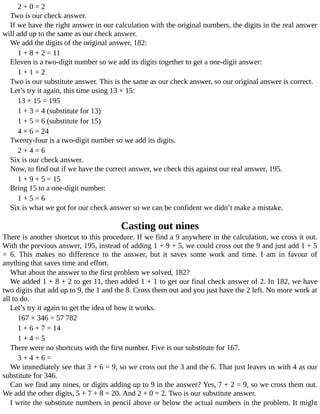
Let’s	try	an	example.	Let	us	say	we	have	just	calculated	13	times	14	and	got	an	answer	of	182.	We
want	to	check	our	answer.
13	×	14	=	182
The	first	number	is	13.	We	add	its	digits	together	to	get	the	substitute:
1	+	3	=	4
Four	becomes	our	substitute	for	13.
The	next	number	we	are	working	with	is	14.	To	find	its	substitute	we	add	its	digits:
1	+	4	=	5
Five	is	our	substitute	for	14.
We	now	do	the	original	calculation	using	the	substitute	numbers	instead	of	the	original	numbers.
4	×	5	=	20
Twenty	is	a	two-digit	number	so	we	add	its	digits	together	to	get	our	check	answer.
2	+	0	=	2
Two	is	our	check	answer.
If	we	have	the	right	answer	in	our	calculation	with	the	original	numbers,	the	digits	in	the	real	answer
will	add	up	to	the	same	as	our	check	answer.
We	add	the	digits	of	the	original	answer,	182:
1	+	8	+	2	=	11
Eleven	is	a	two-digit	number	so	we	add	its	digits	together	to	get	a	one-digit	answer:
1	+	1	=	2
Two	is	our	substitute	answer.	This	is	the	same	as	our	check	answer,	so	our	original	answer	is	correct.
Let’s	try	it	again,	this	time	using	13	×	15:
13	×	15	=	195
1	+	3	=	4	(substitute	for	13)
1	+	5	=	6	(substitute	for	15)
4	×	6	=	24
Twenty-four	is	a	two-digit	number	so	we	add	its	digits.
2	+	4	=	6
Six	is	our	check	answer.
Now,	to	find	out	if	we	have	the	correct	answer,	we	check	this	against	our	real	answer,	195.
1	+	9	+	5	=	15
Bring	15	to	a	one-digit	number:
1	+	5	=	6
Six	is	what	we	got	for	our	check	answer	so	we	can	be	confident	we	didn’t	make	a	mistake.
Casting	out	nines
There	is	another	shortcut	to	this	procedure.	If	we	find	a	9	anywhere	in	the	calculation,	we	cross	it	out.
With	the	previous	answer,	195,	instead	of	adding	1	+	9	+	5,	we	could	cross	out	the	9	and	just	add	1	+	5
=	 6.	 This	 makes	 no	 difference	 to	 the	 answer,	 but	 it	 saves	 some	 work	 and	 time.	 I	 am	 in	 favour	 of
anything	that	saves	time	and	effort.
What	about	the	answer	to	the	first	problem	we	solved,	182?
We	added	1	+	8	+	2	to	get	11,	then	added	1	+	1	to	get	our	final	check	answer	of	2.	In	182,	we	have
two	digits	that	add	up	to	9,	the	1	and	the	8.	Cross	them	out	and	you	just	have	the	2	left.	No	more	work	at
all	to	do.
Let’s	try	it	again	to	get	the	idea	of	how	it	works.
167	×	346	=	57	782
1	+	6	+	7	=	14
1	+	4	=	5
There	were	no	shortcuts	with	the	first	number.	Five	is	our	substitute	for	167.
3	+	4	+	6	=
We	immediately	see	that	3	+	6	=	9,	so	we	cross	out	the	3	and	the	6.	That	just	leaves	us	with	4	as	our
substitute	for	346.
Can	we	find	any	nines,	or	digits	adding	up	to	9	in	the	answer?	Yes,	7	+	2	=	9,	so	we	cross	them	out.
We	add	the	other	digits,	5	+	7	+	8	=	20.	And	2	+	0	=	2.	Two	is	our	substitute	answer.
I	write	the	substitute	numbers	in	pencil	above	or	below	the	actual	numbers	in	the	problem.	It	might
look	like	this:
Did	we	get	the	right	answer?
We	multiply	the	substitute	numbers,	5	times	4	equals	20,	which	equals	2	(2	+	0	=	2).	This	is	the	same
as	our	substitute	answer,	so	we	were	right.
Let’s	try	one	more	example:
456	×	831	=	368	936
We	write	in	our	substitute	numbers:
That	was	easy	because	we	cast	out	(or	crossed	out)	4	and	5	from	the	first	number,	leaving	6;	we
crossed	out	8	and	1	from	the	second	number,	leaving	3;	and	almost	every	digit	was	crossed	out	of	the
answer,	3	and	6	twice,	and	a	9.
We	now	see	if	the	substitutes	work	out	correctly.	Six	times	3	is	18,	which	adds	up	to	9,	which	also
gets	crossed	out,	leaving	zero.	Our	substitute	answer	is	8,	so	we	got	it	wrong	somewhere.
When	we	calculate	the	problem	again,	we	get	378	936.
Did	we	get	it	right	this	time?	The	936	cancels	out,	so	we	add	3	+	7	+	8,	giving	us	18,	which	adds	up
to	9,	which	in	turn	cancels,	leaving	0.	This	is	the	same	as	our	check	answer,	so	this	time	we	have	it
right.
Does	casting	out	nines	prove	we	have	the	right	answer?	No,	but	we	can	be	almost	certain	(see	chapter
16).	For	instance,	say	we	got	3	789	360	for	our	last	answer.	By	mistake	we	put	a	zero	at	the	end	of	our
answer.	The	final	zero	wouldn’t	affect	our	check	when	casting	out	nines;	we	wouldn’t	know	we	had
made	a	mistake.	But	when	it	showed	we	had	made	a	mistake,	the	check	definitely	proved	we	had	the
wrong	answer.
Casting	out	nines	is	a	simple,	fast	check	that	will	find	most	mistakes,	and	should	help	you	achieve
100	percent	scores	in	most	of	your	maths	tests.
Why	does	the	method	work?
Think	of	a	number	and	multiply	it	by	nine.	What	are	four	nines?	Thirty-six	(36).	Add	the	digits	in	the
answer	together	(3	+	6)	and	you	get	nine.
Let’s	try	another	number.	Three	nines	are	27.	Add	the	digits	of	the	answer	together,	2	+	7,	and	you	get
9	again.
Eleven	nines	are	ninety-nine	(99).	Nine	plus	9	equals	18.	Wrong	answer!	No,	not	yet.	Eighteen	is	a
two-digit	number	so	we	add	its	digits	together:	1	+	8.	Again,	the	answer	is	nine.
If	you	multiply	any	number	by	nine,	the	sum	of	the	digits	in	the	answer	will	always	add	up	to	nine	if
you	keep	adding	the	digits	in	the	answer	until	you	get	a	one-digit	number.	This	is	an	easy	way	to	tell	if	a
number	is	evenly	divisible	by	nine.
If	the	digits	of	any	number	add	up	to	nine,	or	a	multiple	of	nine,	then	the	number	itself	is	evenly
divisible	by	nine.	That	is	why,	when	you	multiply	any	number	by	nine,	or	a	multiple	of	nine,	the	digits
of	the	answer	must	add	up	to	nine.	For	instance,	say	you	were	checking	the	following	calculation:
135	×	83	615	=	11	288	025
Add	the	digits	in	the	first	number:
1	+	3	+	5	=	9
To	check	our	answer,	we	don’t	need	to	add	the	digits	of	the	second	number,	83	615,	because	we	know
135	has	a	digit	sum	of	9.	If	our	answer	is	correct,	it	too	should	have	a	digit	sum	of	9.
Let	us	add	the	digits	in	the	answer:
1	+	1	+	2	+	8	+	8	+	0	+	2	+	5	=
Eight	plus	1	cancels	twice,	2	+	2	+	5	=	9,	so	we	got	it	right.
You	can	have	fun	playing	with	this.
If	the	digits	of	a	number	add	up	to	any	number	other	than	nine,	that	number	is	the	remainder	you
would	get	after	dividing	the	number	by	nine.
Let’s	take	14.	One	plus	4	is	5.	Five	is	the	digit	sum	of	14.	This	will	be	the	remainder	you	would	get	if
you	divided	by	9.	Nine	goes	into	14	once,	with	5	remainder.	If	you	add	3	to	the	number,	you	add	3	to
the	remainder.	If	you	double	the	number,	you	double	the	remainder.
Whatever	you	do	to	the	number,	you	do	to	the	remainder,	so	we	can	use	the	remainders	as	substitutes.
Why	do	we	use	nine	remainders;	couldn’t	we	use	the	remainders	after	dividing	by,	say,	17?	Certainly,
but	 there	 is	 so	 much	 work	 involved	 in	 dividing	 by	 17,	 the	 check	 would	 be	 harder	 than	 the	 original
problem.	We	choose	nine	because	of	the	easy	shortcut	for	finding	the	remainder.
For	more	information	on	why	this	method	works,	see	appendix	F.
Chapter	5
Multiplication:	Part	two
In	chapter	1	we	learned	how	to	multiply	numbers	using	an	easy	method	that	makes	multiplication	fun.
This	method	is	easy	to	use	when	the	numbers	are	near	10	or	100.	But	what	about	multiplying	numbers
that	are	around	30	or	60?	Can	we	still	use	this	method?	Yes,	we	certainly	can.
We	chose	reference	numbers	of	10	and	100	because	it	is	easy	to	multiply	by	those	numbers.	The
method	will	work	just	as	well	with	other	reference	numbers,	but	we	must	choose	numbers	that	are	easy
to	multiply	by.
Multiplication	by	factors
It	is	easy	to	multiply	by	20,	as	20	is	2	times	10.	And	it	is	simple	to	multiply	by	10	and	by	2.	This	is
called	multiplication	by	factors,	as	10	and	2	are	factors	of	20.
10	×	2	=	20
Let’s	try	an	example:
23	×	24	=
Twenty-three	and	24	are	higher	than	the	reference	number,	20,	so	we	put	the	circles	above.	How
much	 higher	 are	 they?	 Three	 and	 4.	 We	 write	 these	 numbers	 in	 the	 circles.	 We	 write	 them	 above
because	they	are	plus	numbers	(23	=	20	+	3,	24	=	20	+	4).
We	add	diagonally	as	before:
23	+	4	=	27	or,
24	+	3	=	27
Now	multiply	this	answer,	27,	by	the	reference	number	20.	To	do	this	we	multiply	by	2,	then	by	10:
27	×	2	=	54
54	×	10	=	540
(Later	in	this	chapter,	we	will	look	at	an	easy	way	to	multiply	numbers	like	27	by	2.)	The	rest	is	the
same	as	before.	We	multiply	the	numbers	in	the	circles	and	add	this	to	our	subtotal:
3	×	4	=	12
540	+	12	=	552
Your	work	should	look	like	this:
Checking	our	answers
Let’s	apply	what	we	learned	in	chapter	4	and	check	our	answer:
The	substitute	numbers	for	23	and	24	are	5	and	6.
5	×	6	=	30
3	+	0	=	3
Three	is	our	check	answer.
The	digits	in	our	original	answer,	552,	add	up	to	3:
5	+	5	+	2	=	12
1	+	2	=	3
This	is	the	same	as	our	check	answer,	so	we	were	right.
Let’s	try	another:
23	×	31	=
We	put	3	and	11	above	23	and	31	as	the	multipliers	are	3	and	11	above	the	reference	number,	20.
Adding	diagonally,	we	get	34:
31	+	3	=	34	or	23	+	11	=	34
We	multiply	this	answer	by	the	reference	number,	20.	To	do	this,	we	multiply	34	by	2,	then	multiply
by	10.
34	×	2	=	68
68	×	10	=	680
This	is	our	subtotal.	We	now	multiply	the	numbers	in	the	circles,	3	and	11:
3	×	11	=	33
Add	this	to	680:
680	+	33	=	713
The	completed	calculation	will	look	as	follows	overleaf.
We	check	by	casting	out	the	nines.
Multiply	our	substitute	numbers	and	then	add	the	digits	in	the	answer:
5	×	4	=	20
2	+	0	=	2
This	checks	with	our	substitute	answer	so	we	can	accept	713	as	the	correct	answer.
Here	are	some	problems	to	try	for	yourself.	When	you	have	finished	them,	check	your	answers	by
casting	out	the	nines.
a)	21	×	26	=
b)	24	×	24	=
c)	23	×	23	=
d)	23	×	27	=
e)	21	×	36	=
f)	26	×	24	=
You	should	be	able	to	do	all	of	these	problems	in	your	head.	It’s	not	difficult	with	a	little	practice.
Multiplying	numbers	below	20
How	about	multiplying	numbers	below	20?	If	the	numbers	(or	one	of	the	numbers	to	be	multiplied)	are
in	the	high	teens,	we	can	use	20	as	a	reference	number.
Let’s	try	an	example:
19	×	16	=
Using	20	as	a	reference	number	we	get:
Subtract	diagonally:
16	−	1	=	15	or	19	−	4	=	15
Multiply	by	20:
15	×	2	=	30
30	×	10	=	300
Three	hundred	is	our	subtotal.
Now	we	multiply	the	numbers	in	the	circles	and	then	add	the	result	to	our	subtotal:
1	×	4	=	4
300	+	4	=	304
Your	completed	work	should	look	like	this:
Let’s	try	the	same	example	using	10	as	a	reference	number.
Add	diagonally,	then	multiply	by	10	to	get	a	subtotal:
19	+	6	=	25
10	×	25	=	250
Multiply	the	numbers	in	the	circles	and	add	this	to	our	subtotal:
9	×	6	=	54
250	+	54	=	304
Your	completed	work	should	look	like	this:
This	confirms	our	first	answer.
There	isn’t	much	difference	between	the	two	reference	numbers.	It	is	a	matter	of	personal	preference.
Simply	choose	the	reference	number	you	find	easier	to	work	with.
Numbers	above	and	below	20
The	third	possibility	is	if	one	number	is	above	and	the	other	below	20.	For	example:
We	 can	 either	 add	 18	 to	 12	 or	 subtract	 2	 from	 32,	 and	 then	 multiply	 the	 result	 by	 our	 reference
number:
32	−	2	=	30
30	×	20	=	600
We	now	multiply	the	numbers	in	the	circles:
2	×	12	=	24
It	is	actually	minus	2	times	12	so	our	answer	is	−24.
600	−	24	=	576
Your	work	should	look	like	this:
(To	subtract	24,	we	subtracted	30	and	added	6.)
Let’s	check	the	answer	by	casting	out	the	nines:
Zero	times	5	is	0,	so	the	answer	is	correct.
Multiplying	higher	numbers
That	takes	care	of	the	numbers	up	to	around	30	times	30.	What	if	the	numbers	are	higher?	Then	we	can
use	50	as	a	reference	number.	It	is	easy	to	multiply	by	50	because	50	is	half	of	100,	or	100	divided	by	2.
So,	to	multiply	by	50,	we	multiply	the	number	by	100,	then	divide	that	answer	by	2.
Let’s	try	it:
Subtract	diagonally:
46	−	2	=	44	or	48	−	4	=	44
Multiply	44	by	100:
44	×	100	=	4400
To	say	it	in	your	head,	just	say,	‘Forty-four	by	one	hundred	is	forty-four	hundred’.	Then	halve,	to
multiply	by	50,	which	gives	you	2200.
4400	÷	2	=	2200
Now	multiply	the	numbers	in	the	circles,	and	add	this	result	to	2200:
Fantastic.	That	was	so	easy.	Let’s	try	another:
Add	diagonally,	then	multiply	the	result	by	the	reference	number	(multiply	by	100	and	then	divide	by
2):
57	+	3	=	60
60	×	100	=	6000
6000	÷	2	=	3000
Multiply	the	numbers	in	the	circles	and	add	the	result	to	3000:
3	×	7	=	21
3000	+	21	=	3021
Your	work	should	look	like	this:
Let’s	try	one	more:
Add	diagonally	and	multiply	the	result	by	the	reference	number	(multiply	by	100	and	then	divide	by
2):
63	+	2	=	65
65	×	100	=	6500
Then	we	halve	the	answer.
If	we	say	‘Six	thousand	five	hundred’,	the	answer	is	easy.	‘Half	of	six	thousand	is	three	thousand.
Half	of	five	hundred	is	two	hundred	and	fifty.	Our	subtotal	is	three	thousand,	two	hundred	and	fifty.’
Now	multiply	the	numbers	in	the	circles:
2	×	13	=	26
Add	26	to	our	subtotal	and	we	get	3276.	Your	work	should	now	look	like	this:
We	can	check	this	by	casting	out	the	nines.
Six	plus	3	in	63	adds	up	to	9,	which	cancels	to	leave	0.
In	the	answer,	3	+	6	=	9,	2	+	7	=	9.	It	all	cancels.	Seven	times	zero	gives	us	zero,	so	the	answer	is
correct.
Here	are	some	problems	for	you	to	do.	See	how	many	you	can	do	in	your	head.
a)	46	×	42	=
b)	47	×	49	=
c)	46	×	47	=
d)	44	×	44	=
e)	51	×	55	=
f)	54	×	56	=
g)	51	×	68	=
h)	51	×	72	=
The	answers	are:
a)	1932
b)	2303
c)	2162
d)	1936
e)	2805
f)	3024
g)	3468
h)	3672
How	did	you	go	with	those	problems?	You	should	have	had	no	trouble	doing	all	of	them	in	your
head.	Now	check	your	answers	by	casting	out	the	nines.
Doubling	and	halving	numbers
To	use	20	and	50	as	reference	numbers,	we	need	to	be	able	to	double	and	halve	numbers	easily.
Sometimes,	such	as	when	you	must	halve	a	two-digit	number	and	the	tens	digit	is	odd,	the	calculation
is	not	straightforward.	For	example:
78	÷	2	=
To	halve	78,	you	might	halve	70,	then	halve	8	and	add	the	answers,	but	there	is	an	easier	method.
78	=	80	−	2.	Half	of	(80	−	2)	is	(40	−	1).	That	is	your	answer.
40	−	1	=	39
To	double	38,	think	of	(40	−	2).	Double	would	be	(80	−	4)	=	76.
Try	these	for	yourself:
a)	38	×	2	=
b)	29	×	2	=
c)	59	×	2	=
d)	68	×	2	=
e)	39	×	2	=
f)	47	×	2	=
The	answers	are:
a)	76
b)	58
c)	118
d)	136
e)	78
f)	94
Now	try	these:
a)	38	÷	2	=
b)	56	÷	2	=
c)	78	÷	2	=
d)	94	÷	2	=
e)	34	÷	2	=
f)	58	÷	2	=
g)	18	÷	2	=
h)	76	÷	2	=
The	answers	are:
a)	19
b)	28
c)	39
d)	47
e)	17
f)	29
g)	9
h)	38
This	strategy	can	easily	be	used	to	multiply	or	divide	larger	numbers	by	3	or	4.	For	instance:
19	×	3	=	(20	−	1)	×	3	=	60	−	3	=	57
38	×	4	=	(40	−	2)	×	4	=	160	−	8	=	152
Using	200	and	500	as	reference	numbers
If	the	numbers	you	are	multiplying	are	close	to	either	200	or	500,	the	calculation	is	easy	because	it	isn’t
difficult	to	use	200	and	500	as	reference	numbers.
How	would	you	multiply	216	by	216?
If	you	use	200	as	your	reference	number,	the	calculation	is	simple,	and	easily	done	in	your	head.
Calculate	16	×	16	using	10	as	a	reference:
How	about	512	×	512?
524	times	500	is	524	times	1000	divided	by	2.
524	×	1000	=	524	000	or	524	thousand.
Half	of	524	thousand	is	262	000.
You	 could	 split	 up	 the	 524	 thousand	 into	 500	 thousand	 and	 24	 thousand.	 Both	 are	 easy	 to	 halve
mentally.
Half	of	500	thousand	is	250	thousand.	Half	of	24	thousand	is	12	thousand.	250	thousand	plus	12
thousand	is	262	thousand.
Now	multiply	the	numbers	in	the	circles:
12	×	12	=	144
262	000	+	144	=	262	144	(answer)
Multiplying	lower	numbers
Let’s	try	6	×	4:
We	use	a	reference	number	of	10.	The	circles	go	below	because	the	numbers	6	and	4	are	lower	than
10.	We	subtract	diagonally:
6	−	6	=	0	or	4	−	4	=	0
We	then	multiply	the	numbers	in	the	circles:
4	×	6	=
That	was	our	original	problem,	(6	×	4).	The	method	doesn’t	seem	to	help.	Can	we	make	our	method
or	formula	work	in	this	case?	We	can,	but	we	must	use	a	different	reference	number.
Let’s	try	a	reference	number	of	5.	Five	is	10	divided	by	2,	or	half	of	10.	The	easy	way	to	multiply	by
5	is	to	multiply	by	10	and	halve	the	answer.
Six	is	above	5	so	we	put	the	circle	above.	Four	is	below	5	so	we	put	the	circle	below.	Six	is	1	higher
than	5	and	4	is	1	lower,	so	we	put	1	in	each	circle.
We	add	or	subtract	diagonally:
6	−	1	=	5	or	4	+	1	=	5
We	multiply	5	by	the	reference	number,	which	is	also	5.
To	do	this,	we	multiply	by	10,	which	gives	us	50,	and	then	divide	by	2,	which	gives	us	25.	Now	we
multiply	the	numbers	in	the	circles:
1	×	−1	=	−1
Because	the	result	is	a	negative	number,	we	subtract	it	from	our	subtotal	rather	than	adding	it:
25	−	1	=	24
This	is	a	long-winded	and	complicated	method	for	multiplying	low	numbers,	but	it	shows	we	can
make	our	method	work	with	a	little	ingenuity.	Actually,	these	strategies	will	develop	our	ability	to	think
laterally.	Lateral	thinking	is	very	important	for	mathematicians	and	also,	generally,	for	succeeding	in
life.
Let’s	try	some	more,	even	though	you	probably	know	your	lower	tables	quite	well:
Subtract	diagonally:
4	−	1	=	3
Multiply	your	answer	by	the	reference	number:
3	×	10	=	30
30	÷	2	=	15
Now	multiply	the	numbers	in	the	circles:
1	×	1	=	1
Add	that	to	our	subtotal:
15	+	1	=	16
Thus:
Try	the	following:
a)	3	×	4	=
b)	3	×	3	=
c)	6	×	6	=
d)	3	×	6	=
e)	3	×	7	=
f)	4	×	7	=
The	answers	are:
a)	12
b)	9
c)	36
d)	18
e)	21
f)	28
I’m	sure	you	had	no	trouble	doing	those.	I	don’t	really	think	that	is	the	easiest	way	to	learn	those
tables.	I	think	it	is	easier	to	simply	remember	them.	But	some	people	want	to	learn	how	to	multiply	low
numbers	just	to	check	that	the	method	will	work.	Others	like	to	know	that	if	they	can’t	remember	some
of	their	tables,	there	is	an	easy	method	to	calculate	the	answer.	Even	if	you	know	your	tables	for	these
numbers,	it	is	still	fun	to	play	with	numbers	and	experiment.
Multiplication	by	5
As	we	have	seen,	to	multiply	by	5	we	can	multiply	by	10	and	then	halve	the	answer.	Five	is	half	of	10.
To	multiply	6	by	5,	we	can	multiply	6	by	10,	which	is	60,	and	then	halve	the	answer	to	get	30.
Try	these:
a)	8	×	5	=
b)	4	×	5	=
c)	2	×	5	=
d)	6	×	5	=
The	answers	are:
a)	40
b)	20
c)	10
d)	30
This	is	what	we	do	when	the	tens	digit	is	odd.	Let’s	try	7	×	5.
7	×	10	=	70
If	you	find	it	difficult	to	halve	the	70,	split	it	into	60	+	10.	Half	of	60	+	10	is	30	+	5,	which	equals	35.
Let’s	try	another:
9	×	5	=
Ten	nines	are	90.	Ninety	splits	to	80	+	10.	Half	of	80	+	10	is	40	+	5,	so	our	answer	is	45.
Try	these	for	yourself:
a)	3	×	5	=
b)	5	×	5	=
c)	9	×	5	=
d)	7	×	5	=
The	answers	are:
a)	15
b)	25
c)	45
d)	35
This	is	an	easy	method	to	teach	the	5	times	multiplication	tables.	And	it	works	for	numbers	of	any
size	multiplied	by	5.
For	example:
14	×	5	=
14	×	10	=	140,	divided	by	2	is	70
Likewise:
23	×	5	=
23	×	10	=	230
230	=	220	+	10
Half	of	220	+	10	is	110	+	5
110	+	5	=	115
These	are	lightning	mental	calculations	after	just	a	minute’s	practice.
Chapter	6
Multiplying	decimals
Numbers	are	made	up	of	the	digits	0,	1,	2,	3,	4,	5,	6,	7,	8	and	9.	Digits	are	like	the	letters	that	construct	a
word.	Twenty-three	(23)	is	a	two-digit	number,	made	from	the	digits	2	and	3.	The	position	of	the	digit	in
the	number	determines	the	digit’s	place	value.	For	instance,	the	2	in	the	number	23	has	a	place	value	of
2	tens,	the	3	has	a	place	value	of	3	units	or	ones.	Four	hundred	and	thirty-five	(435)	is	a	three-digit
number.	The	4	is	the	hundreds	digit	and	signifies	4	hundreds,	or	400.	Three	(3)	is	the	tens	digit	and
signifies	3	tens,	or	30.	Five	(5)	is	the	units	digit	and	signifies	5	ones,	or	simply,	5.	When	we	write	a
number,	the	position	of	the	digits	is	important.
When	we	write	prices,	or	numbers	representing	money,	we	use	a	decimal	point	to	separate	the	dollars
from	the	cents.	For	example,	$1.25	represents	one	dollar	and	25	hundredths	of	a	dollar.	The	first	digit
after	the	decimal	point	represents	tenths	of	a	dollar	(ten	10¢	coins	make	a	dollar).	The	second	digit	after
the	decimal	point	represents	hundredths	of	a	dollar	(one	hundred	cents	make	a	dollar).
Multiplying	decimals	is	no	more	complicated	than	multiplying	any	other	numbers.	This	is	how	we	do
it.
Let’s	take	an	example:
1.3	×	1.4	=
(1.3	equals	one	and	three	tenths,	and	1.4	equals	one	and	four	tenths.)
We	write	down	the	problem	as	it	is,	but	ignore	the	decimal	points.
Although	we	write	1.3	×	1.4,	we	treat	the	problem	as:
13	×	14	=
Ignore	the	decimal	point	in	the	calculation	and	say,	‘Thirteen	plus	four	is	seventeen,	times	ten	is	one
hundred	 and	 seventy.	 Four	 times	 three	 is	 twelve,	 plus	 one	 hundred	 and	 seventy	 is	 one	 hundred	 and
eighty-two.’
Our	work	thus	far	looks	like	this:
However,	our	problem	was	1.3	×	1.4	and	at	this	point	we	have	calculated	13	×	14.	Our	work	isn’t
finished	yet.	We	have	to	place	a	decimal	point	in	the	answer.	To	find	where	we	put	the	decimal	point	we
look	at	the	problem	and	count	the	number	of	digits	after	the	decimal	points.	There	are	two	digits	after
the	decimal	points,	the	3	in	1.3,	and	the	4	in	1.4.	Because	there	are	two	digits	after	the	decimal	points	in
the	 problem	 there	 must	 be	 two	 digits	 after	 the	 decimal	 point	 in	 the	 answer.	 We	 count	 two	 places
backwards	and	put	the	decimal	point	between	the	1	and	the	8,	leaving	two	digits	after	it.
1.82	(answer)
An	easy	way	to	double-check	our	answer	would	be	to	approximate.	That	means,	instead	of	using	the
numbers	we	were	given,	1.3	×	1.4,	we	round	off	to	1	and	1.5.	1	times	1.5	is	1.5.	The	answer	should	be
somewhere	between	1	and	2,	not	20	or	200.	This	tells	us	our	decimal	point	is	in	the	right	place.
Let’s	try	another.
9.6	×	97	=
We	write	the	problem	down	as	it	is,	but	call	the	numbers	96	and	97.
Where	do	we	put	the	decimal	point?	How	many	digits	follow	the	decimal	point	in	the	problem?	One.
That’s	how	many	digits	follow	the	decimal	point	in	the	answer.
931.2	(answer)
To	place	the	decimal	point,	we	count	the	total	number	of	digits	following	the	decimal	points	in	both
numbers	we	are	multiplying.	Make	sure	we	have	the	same	number	of	digits	following	the	decimal	point
in	the	answer.	We	can	double-check	our	answer	by	estimating	10	times	90;	we	know	the	answer	is	going
to	be	somewhere	near	900,	not	9000	or	90.
If	the	problem	had	been	9.6	×	9.7,	then	the	answer	would	have	been	93.12.	Knowing	this	can	enable
us	 to	 take	 some	 shortcuts	 that	 might	 not	 be	 apparent	 otherwise.	 We	 will	 look	 at	 some	 of	 these
possibilities	shortly.	In	the	meantime,	try	your	hand	at	these	problems.
a)	1.3	×	1.3	=
b)	1.4	×	1.4	=
c)	14	×	0.14	=
d)	96	×	0.97	=
e)	0.96	×	9.6	=
f)	13	×	1.5	=
How	did	you	go?	The	answers	are:
a)	1.69
b)	1.96
c)	1.96
d)	93.12
e)	9.216
f)	19.5
What	if	you	had	to	multiply:
0.13	×	0.14	=
We	recall	that:
13	×	14	=	182
Where	do	we	put	the	decimal	point?	How	many	digits	come	after	the	decimal	point	in	the	problem?
Four,	the	1	and	3	in	the	first	number	and	1	and	4	in	the	second.	So	we	count	back	four	digits	in	the
answer.	But	wait	a	minute	—	there	are	only	three	digits	in	the	answer.	We	have	to	supply	the	fourth
digit.	So,	we	count	back	three	digits,	then	supply	a	fourth	digit	by	putting	a	zero	in	front	of	the	number.
The	answer	looks	like	this:
0.0182	(answer)
We	should	also	write	another	zero	before	the	decimal	point,	because	there	should	always	be	at	least
one	digit	before	the	decimal	point.	In	this	case,	we	add	a	zero	to	make	the	fourth	digit	after	the	decimal
point,	and	place	another	zero	before	the	decimal	point.
Try	another	to	get	the	idea:
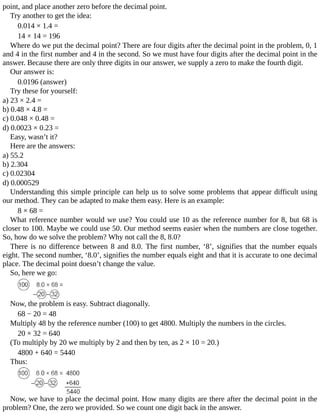
0.014	×	1.4	=
14	×	14	=	196
Where	do	we	put	the	decimal	point?	There	are	four	digits	after	the	decimal	point	in	the	problem,	0,	1
and	4	in	the	first	number	and	4	in	the	second.	So	we	must	have	four	digits	after	the	decimal	point	in	the
answer.	Because	there	are	only	three	digits	in	our	answer,	we	supply	a	zero	to	make	the	fourth	digit.
Our	answer	is:
0.0196	(answer)
Try	these	for	yourself:
a)	23	×	2.4	=
b)	0.48	×	4.8	=
c)	0.048	×	0.48	=
d)	0.0023	×	0.23	=
Easy,	wasn’t	it?
Here	are	the	answers:
a)	55.2
b)	2.304
c)	0.02304
d)	0.000529
Understanding	this	simple	principle	can	help	us	to	solve	some	problems	that	appear	difficult	using
our	method.	They	can	be	adapted	to	make	them	easy.	Here	is	an	example:
8	×	68	=
What	reference	number	would	we	use?	You	could	use	10	as	the	reference	number	for	8,	but	68	is
closer	to	100.	Maybe	we	could	use	50.	Our	method	seems	easier	when	the	numbers	are	close	together.
So,	how	do	we	solve	the	problem?	Why	not	call	the	8,	8.0?
There	 is	 no	 difference	 between	 8	 and	 8.0.	 The	 first	 number,	 ‘8’,	 signifies	 that	 the	 number	 equals
eight.	The	second	number,	‘8.0’,	signifies	the	number	equals	eight	and	that	it	is	accurate	to	one	decimal
place.	The	decimal	point	doesn’t	change	the	value.
So,	here	we	go:
Now,	the	problem	is	easy.	Subtract	diagonally.
68	−	20	=	48
Multiply	48	by	the	reference	number	(100)	to	get	4800.	Multiply	the	numbers	in	the	circles.
20	×	32	=	640
(To	multiply	by	20	we	multiply	by	2	and	then	by	ten,	as	2	×	10	=	20.)
4800	+	640	=	5440
Thus:
Now,	we	have	to	place	the	decimal	point.	How	many	digits	are	there	after	the	decimal	point	in	the
problem?	One,	the	zero	we	provided.	So	we	count	one	digit	back	in	the	answer.
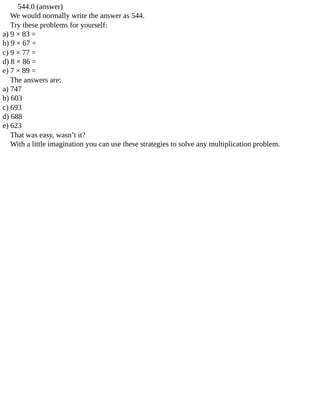
544.0	(answer)
We	would	normally	write	the	answer	as	544.
Try	these	problems	for	yourself:
a)	9	×	83	=
b)	9	×	67	=
c)	9	×	77	=
d)	8	×	86	=
e)	7	×	89	=
The	answers	are:
a)	747
b)	603
c)	693
d)	688
e)	623
That	was	easy,	wasn’t	it?
With	a	little	imagination	you	can	use	these	strategies	to	solve	any	multiplication	problem.
Chapter	7
Multiplying	using	two	reference	numbers
Our	 method	 for	 multiplication	 has	 worked	 well	 for	 numbers	 that	 are	 close	 to	 each	 other.	 When	 the
numbers	are	not	close,	the	method	still	works	but	the	calculation	is	more	difficult.	For	instance,	what	if
we	 wanted	 to	 multiply	 numbers	 like	 13	 ×	 64?	 Which	 reference	 number	 would	 we	 choose?	 In	 this
chapter,	we	will	look	at	an	easy	method	to	use	our	strategy	with	two	reference	numbers.
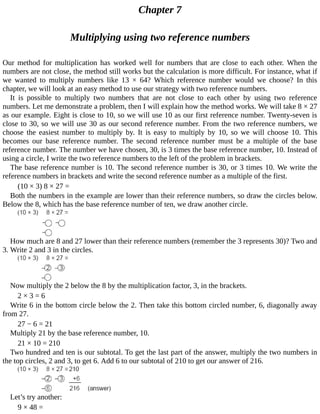
It	 is	 possible	 to	 multiply	 two	 numbers	 that	 are	 not	 close	 to	 each	 other	 by	 using	 two	 reference
numbers.	Let	me	demonstrate	a	problem,	then	I	will	explain	how	the	method	works.	We	will	take	8	×	27
as	our	example.	Eight	is	close	to	10,	so	we	will	use	10	as	our	first	reference	number.	Twenty-seven	is
close	to	30,	so	we	will	use	30	as	our	second	reference	number.	From	the	two	reference	numbers,	we
choose	 the	 easiest	 number	 to	 multiply	 by.	 It	 is	 easy	 to	 multiply	 by	 10,	 so	 we	 will	 choose	 10.	 This
becomes	 our	 base	 reference	 number.	 The	 second	 reference	 number	 must	 be	 a	 multiple	 of	 the	 base
reference	number.	The	number	we	have	chosen,	30,	is	3	times	the	base	reference	number,	10.	Instead	of
using	a	circle,	I	write	the	two	reference	numbers	to	the	left	of	the	problem	in	brackets.
The	base	reference	number	is	10.	The	second	reference	number	is	30,	or	3	times	10.	We	write	the
reference	numbers	in	brackets	and	write	the	second	reference	number	as	a	multiple	of	the	first.
(10	×	3)	8	×	27	=
Both	the	numbers	in	the	example	are	lower	than	their	reference	numbers,	so	draw	the	circles	below.
Below	the	8,	which	has	the	base	reference	number	of	ten,	we	draw	another	circle.
How	much	are	8	and	27	lower	than	their	reference	numbers	(remember	the	3	represents	30)?	Two	and
3.	Write	2	and	3	in	the	circles.
Now	multiply	the	2	below	the	8	by	the	multiplication	factor,	3,	in	the	brackets.
2	×	3	=	6
Write	6	in	the	bottom	circle	below	the	2.	Then	take	this	bottom	circled	number,	6,	diagonally	away
from	27.
27	−	6	=	21
Multiply	21	by	the	base	reference	number,	10.
21	×	10	=	210
Two	hundred	and	ten	is	our	subtotal.	To	get	the	last	part	of	the	answer,	multiply	the	two	numbers	in
the	top	circles,	2	and	3,	to	get	6.	Add	6	to	our	subtotal	of	210	to	get	our	answer	of	216.
Let’s	try	another:
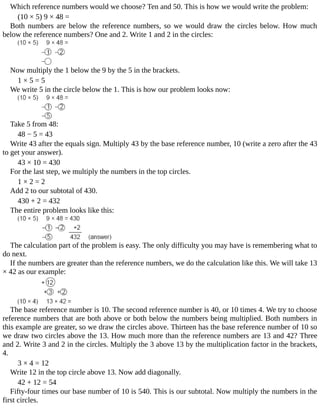
9	×	48	=
Which	reference	numbers	would	we	choose?	Ten	and	50.	This	is	how	we	would	write	the	problem:
(10	×	5)	9	×	48	=
Both	numbers	are	below	the	reference	numbers,	so	we	would	draw	the	circles	below.	How	much
below	the	reference	numbers?	One	and	2.	Write	1	and	2	in	the	circles:
Now	multiply	the	1	below	the	9	by	the	5	in	the	brackets.
1	×	5	=	5
We	write	5	in	the	circle	below	the	1.	This	is	how	our	problem	looks	now:
Take	5	from	48:
48	−	5	=	43
Write	43	after	the	equals	sign.	Multiply	43	by	the	base	reference	number,	10	(write	a	zero	after	the	43
to	get	your	answer).
43	×	10	=	430
For	the	last	step,	we	multiply	the	numbers	in	the	top	circles.
1	×	2	=	2
Add	2	to	our	subtotal	of	430.
430	+	2	=	432
The	entire	problem	looks	like	this:
The	calculation	part	of	the	problem	is	easy.	The	only	difficulty	you	may	have	is	remembering	what	to
do	next.
If	the	numbers	are	greater	than	the	reference	numbers,	we	do	the	calculation	like	this.	We	will	take	13
×	42	as	our	example:
The	base	reference	number	is	10.	The	second	reference	number	is	40,	or	10	times	4.	We	try	to	choose
reference	numbers	that	are	both	above	or	both	below	the	numbers	being	multiplied.	Both	numbers	in
this	example	are	greater,	so	we	draw	the	circles	above.	Thirteen	has	the	base	reference	number	of	10	so
we	draw	two	circles	above	the	13.	How	much	more	than	the	reference	numbers	are	13	and	42?	Three
and	2.	Write	3	and	2	in	the	circles.	Multiply	the	3	above	13	by	the	multiplication	factor	in	the	brackets,
4.
3	×	4	=	12
Write	12	in	the	top	circle	above	13.	Now	add	diagonally.
42	+	12	=	54
Fifty-four	times	our	base	number	of	10	is	540.	This	is	our	subtotal.	Now	multiply	the	numbers	in	the
first	circles.
3	×	2	=	6
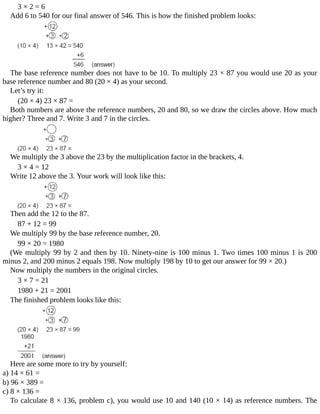
Add	6	to	540	for	our	final	answer	of	546.	This	is	how	the	finished	problem	looks:
The	base	reference	number	does	not	have	to	be	10.	To	multiply	23	×	87	you	would	use	20	as	your
base	reference	number	and	80	(20	×	4)	as	your	second.
Let’s	try	it:
(20	×	4)	23	×	87	=
Both	numbers	are	above	the	reference	numbers,	20	and	80,	so	we	draw	the	circles	above.	How	much
higher?	Three	and	7.	Write	3	and	7	in	the	circles.
We	multiply	the	3	above	the	23	by	the	multiplication	factor	in	the	brackets,	4.
3	×	4	=	12
Write	12	above	the	3.	Your	work	will	look	like	this:
Then	add	the	12	to	the	87.
87	+	12	=	99
We	multiply	99	by	the	base	reference	number,	20.
99	×	20	=	1980
(We	multiply	99	by	2	and	then	by	10.	Ninety-nine	is	100	minus	1.	Two	times	100	minus	1	is	200
minus	2,	and	200	minus	2	equals	198.	Now	multiply	198	by	10	to	get	our	answer	for	99	×	20.)
Now	multiply	the	numbers	in	the	original	circles.
3	×	7	=	21
1980	+	21	=	2001
The	finished	problem	looks	like	this:
Here	are	some	more	to	try	by	yourself:
a)	14	×	61	=
b)	96	×	389	=
c)	8	×	136	=
To	calculate	8	×	136,	problem	c),	you	would	use	10	and	140	(10	×	14)	as	reference	numbers.	The
answers	are:
a)	854
b)	37	344
c)	1088
Let’s	calculate	b)	and	c)	together:
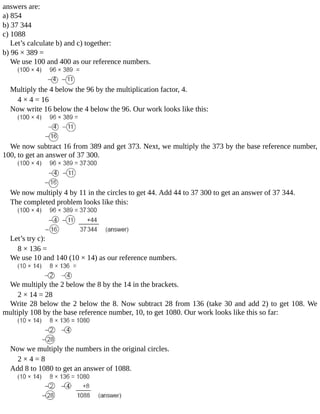
b)	96	×	389	=
We	use	100	and	400	as	our	reference	numbers.
Multiply	the	4	below	the	96	by	the	multiplication	factor,	4.
4	×	4	=	16
Now	write	16	below	the	4	below	the	96.	Our	work	looks	like	this:
We	now	subtract	16	from	389	and	get	373.	Next,	we	multiply	the	373	by	the	base	reference	number,
100,	to	get	an	answer	of	37	300.
We	now	multiply	4	by	11	in	the	circles	to	get	44.	Add	44	to	37	300	to	get	an	answer	of	37	344.
The	completed	problem	looks	like	this:
Let’s	try	c):
8	×	136	=
We	use	10	and	140	(10	×	14)	as	our	reference	numbers.
We	multiply	the	2	below	the	8	by	the	14	in	the	brackets.
2	×	14	=	28
Write	28	below	the	2	below	the	8.	Now	subtract	28	from	136	(take	30	and	add	2)	to	get	108.	We
multiply	108	by	the	base	reference	number,	10,	to	get	1080.	Our	work	looks	like	this	so	far:
Now	we	multiply	the	numbers	in	the	original	circles.
2	×	4	=	8
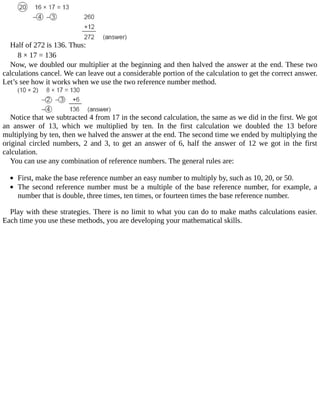
Add	8	to	1080	to	get	an	answer	of	1088.
Using	factors	expressed	as	a	division
To	multiply	96	×	47,	you	could	use	reference	numbers	of	100	and	50:	(50	×	2)	or	(100	÷	2).	Here,	(100
÷	2)	would	be	easier	because	100	then	becomes	your	base	reference	number.	It	is	easier	to	multiply	by
100	than	it	is	by	50.	When	writing	the	multiplication	problem,	be	sure	to	write	the	number	that	has	the
base	reference	number	first.
For	example:
96	×	47	=
Use	100	and	50	as	reference	numbers.
Divide	the	4	below	96	by	the	2	in	the	brackets.
4	÷	2	=	2
Now	we	write	this	2	in	the	second	circle	below	96.
Now,	subtract	2	from	47	and	multiply	the	answer,	45,	by	the	base	reference	number,	100.	This	gives
our	subtotal,	4500.
Next,	 multiply	 the	 first	 two	 circles	 (−	 4	 ×	 −3	 =	 12),	 and	 add	 this	 to	 our	 subtotal.	 This	 gives	 our
answer	of	4512.
If	you	were	multiplying	96	×	23	you	could	use	100	as	your	base	reference	number	and	25	(100	÷	4)
as	your	second	reference	number.	You	would	write	it	like	this:
Ninety-six	is	4	below	100	and	23	is	2	below	25.	We	now	divide	the	4	below	96	by	the	4	in	the
brackets.	Four	divided	by	4	is	1.	Write	this	number	below	the	4	below	the	96.
Subtract	1	from	23	to	get	22.	Multiply	this	22	by	the	base	reference	number,	100,	to	get	2200.
Multiply	the	numbers	in	the	original	circles.
4	×	2	=	8
Add	this	to	2200	to	get	our	answer	of	2208.
What	if	we	had	multiplied	97	by	23?	Would	our	strategy	still	work?	Let’s	try	it:
Three	divided	by	4	is	3	over	4,	or	¾.	Take	¾	from	23.	(Take	1	and	give	back	a	¼.)
23	−	¾	=	22¼
One	quarter	expressed	as	a	decimal	is	0.25	(¼	of	100	equals	25).	Hence:
22¼	×	100	=	2225
Multiply	the	numbers	in	the	circles.
So	our	method	works	well	for	such	problems.
How	about	88	×	343?	We	can	use	base	numbers	of	100	and	350.
To	find	the	answer	to	3½	×	12,	you	multiply	12	by	3,	which	is	36,	and	then	add	half	of	12,	which	is	6,
to	get	42.
Why	does	this	method	work?
I	won’t	give	a	full	explanation,	but	this	may	help.	Let’s	take	an	example	of	8	×	17.	We	could	double	the
8	to	make	16,	multiply	it	by	17,	and	then	halve	the	answer	to	get	the	correct	answer	for	the	original
problem.	This	is	a	hard	way	to	go	about	it,	but	it	will	illustrate	why	the	method	using	two	reference
numbers	works.	We	will	use	a	reference	number	of	20.
Subtract	4	from	17	and	you	get	13.	Multiply	the	13	by	the	reference	number,	20,	to	get	260.	Now
multiply	the	numbers	in	the	circles.
4	×	3	=	12
Add	12	to	the	previous	answer	of	260	for	a	final	answer	of	272.	But	we	multiplied	by	16	instead	of	8,
so	we	have	doubled	the	answer.	Two	hundred	and	seventy-two	divided	by	2	gives	us	our	answer	for	8
times	17	of	136.
Half	of	272	is	136.	Thus:
8	×	17	=	136
Now,	we	doubled	our	multiplier	at	the	beginning	and	then	halved	the	answer	at	the	end.	These	two
calculations	cancel.	We	can	leave	out	a	considerable	portion	of	the	calculation	to	get	the	correct	answer.
Let’s	see	how	it	works	when	we	use	the	two	reference	number	method.
Notice	that	we	subtracted	4	from	17	in	the	second	calculation,	the	same	as	we	did	in	the	first.	We	got
an	 answer	 of	 13,	 which	 we	 multiplied	 by	 ten.	 In	 the	 first	 calculation	 we	 doubled	 the	 13	 before
multiplying	by	ten,	then	we	halved	the	answer	at	the	end.	The	second	time	we	ended	by	multiplying	the
original	 circled	 numbers,	 2	 and	 3,	 to	 get	 an	 answer	 of	 6,	 half	 the	 answer	 of	 12	 we	 got	 in	 the	 first
calculation.
You	can	use	any	combination	of	reference	numbers.	The	general	rules	are:
	
First,	make	the	base	reference	number	an	easy	number	to	multiply	by,	such	as	10,	20,	or	50.
The	second	reference	number	must	be	a	multiple	of	the	base	reference	number,	for	example,	a
number	that	is	double,	three	times,	ten	times,	or	fourteen	times	the	base	reference	number.
Play	with	these	strategies.	There	is	no	limit	to	what	you	can	do	to	make	maths	calculations	easier.
Each	time	you	use	these	methods,	you	are	developing	your	mathematical	skills.
Chapter	8
Addition
Most	of	us	find	addition	easier	than	subtraction.	We	will	learn	in	this	chapter	how	to	make	addition	even
easier.
How	would	you	add	43	plus	9	in	your	head?
The	easy	way	would	be	to	add	10	(to	make	53),	and	take	away	1.	The	answer	is	52.
It	is	easy	to	add	10	to	any	number;	36	plus	10	is	46;	34	plus	10	is	44,	etc.	Simply	increase	the	tens
digit	by	1	each	time	you	add	10	to	a	number.	(See	chapter	6	for	an	explanation	of	the	breakdown	of
numbers	into	digits.)
Here	is	a	basic	rule	for	mental	addition:
To	add	9,	add	10	and	subtract	1;	to	add	8,	add	10	and	subtract	2;	to	add	7,	add	10	and	subtract	3,
and	so	on.
If	you	wanted	to	add	47,	you	would	add	50	and	subtract	3.	To	add	196,	add	200	and	subtract	4.	This
makes	it	easy	to	hold	numbers	in	your	head.	To	add	38	to	a	number,	add	40	and	subtract	2.	To	add	288
to	a	number,	add	300	and	subtract	12.
Try	these	quickly	in	your	head.	Call	out	the	answers.	For	34	+	9,	don’t	call	out,	‘Forty-four,	forty-
three’.	Make	the	adjustment	in	your	head	while	you	call	out	the	answer.	Just	say,	‘Forty-three’.	Try	the
following	examples.	Help	is	given	with	two	of	them.
The	answers	are:
a)	64
b)	47
c)	85
d)	74
e)	55
f)	33
Two-digit	mental	addition
How	would	you	add	38?	To	add	38,	you	would	add	40	and	subtract	2.
How	about	57?	You	would	add	60	and	subtract	3.
How	would	you	add	86?	To	add	86,	you	would	add	100	and	subtract	14.
There	is	a	simple	principle	for	mental	addition.
If	the	units	digit	is	high,	round	off	to	the	next	ten	and	then	subtract	the	difference.	If	the	units
digit	is	low,	add	the	tens,	then	the	units.
With	two-digit	mental	addition	you	add	the	tens	digit	of	each	number	first,	then	the	units.	If	the	units
digit	is	high,	round	off	the	number	upwards	and	then	subtract	the	difference.	For	instance,	if	you	are
adding	47,	add	50,	and	then	subtract	3.
To	add	35,	67	and	43	together	you	would	begin	with	35,	add	70	to	get	105,	subtract	3	to	get	102,	add
40	to	get	142	then	the	3	to	get	your	answer	of	145.
With	a	little	practice,	you	will	be	amazed	at	how	you	can	keep	the	numbers	in	your	head.	Try	these
for	yourself:
a)	34	+	48	=
b)	62	+	26	=
c)	82	+	39	=
d)	27	+	31	=
e)	33	+	44	=
f)	84	+	76	=
g)	44	+	37	=
The	answers	are:
a)	82
b)	88
c)	121
d)	58
e)	77
f)	160
g)	81
For	the	last	example	you	could	have	seen	that	37	is	3	less	than	40,	so	you	could	add	40	and	then
subtract	3;	or	you	could	have	taken	the	3	from	44	before	you	added	to	get	41,	and	added	40	to	get	your
answer	of	81.	When	you	actually	calculate	the	problems	mentally	you	find	it	is	not	so	difficult	and	you
will	recognise	shortcuts	as	you	go.
Adding	three-digit	numbers
We	use	the	same	method	for	adding	three-digit	numbers.
To	add	355,	752	and	694	together	you	would	say	in	your	head,	‘three	fifty-five,	add	seven	hundred,
(ten	fifty-five),	add	fifty,	(eleven	hundred	and	five),	plus	two,	(eleven	oh	seven),	plus	seven	hundred
less	six,	eighteen	hundred	and	one’.	Or,	you	may	prefer	to	add	from	left	to	right;	adding	the	hundreds
first,	then	the	tens	and	then	the	units.
With	a	little	practice,	you	will	find	such	problems	very	easy.
Here	are	some	to	try	for	yourself:
a)	359	+	523	=
b)	123	+	458	=
c)	456	+	298	=
d)	345	+	288	=
The	answers	are:
a)	882
b)	581
c)	754
d)	633
For	a),	you	would	round	off	359	to	360.	Five	hundred	and	twenty-three	plus	300	is	823;	plus	60	is
883,	minus	1	is	882.	Or,	you	could	say,	360	plus	500	is	860,	plus	23	is	883,	minus	1	is	882.	Either	way
is	easy.
You	should	have	found	c)	very	easy.	You	would	round	298	to	300.
456	+	300	=	756
756	−	2	=	754
Mental	addition	is	easier	than	the	effort	of	finding	a	pen	and	paper	or	retrieving	a	calculator	from
your	bag.
Adding	money
If	we	had	to	add	$4.95,	$6.95	and	$13.95,	we	would	add	$5	+	$7	+	$14	and	subtract	15¢	from	the	total.
Add	the	tens	first,	then	the	units	to	get	12,	22,	26.
5	+	7	=	12
12	+	14	=	26
Our	answer	is	$26.00.	We	then	subtract	15¢	to	reach	an	answer	of	$25.85.
If	we	had	to	add:
then	 the	 answer	 might	 not	 be	 so	 obvious.	 Yet	 it	 is	 the	 same	 problem.	 We	 might	 naturally	 use	 that
method	for	adding	sums	of	money	(not	many	do)	but	fail	to	see	that	it	is	precisely	the	same	problem
without	the	dollar	sign	and	decimals.
If	you	find	one	value	repeated	many	times	in	the	calculation,	multiply	that	value	by	the	number	of
times	it	appears.	Let’s	say	you	had	to	add	the	following	numbers:
These	 may	 be,	 for	 instance,	 the	 prices	 of	 materials	 sold	 by	 a	 local	 supplier.	 How	 would	 you	 add
them?
Firstly,	you	would	round	off	each	price	(number)	to	an	easy	number.	$119.95	would	be	rounded	off	to
$120.	$59.95	would	be	rounded	up	to	$60,	and	$14.95	would	be	rounded	up	to	$15.	You	would	adjust
for	each	5¢	when	you	have	finished.
Secondly,	because	the	price	$119.95	appears	four	times,	you	would	multiply	it	by	4,	and	then	add	the
other	values.	$120	times	4	equals	$480.	Then	add	$60	and	$15.	Four	hundred	and	eighty	plus	60	is	540,
plus	15	gives	us	555.
Now	adjust	for	the	5¢	we	previously	added	to	round	each	price	off.	There	were	six	prices	to	which	we
added	5¢.	We	multiply	5¢	by	6	items	to	get	a	total	of	30¢	we	added.	Subtract	this	to	correct	our	answer.
$555	minus	30¢	is	$554.70.
Adding	larger	numbers
Here	is	an	example	of	a	mental	addition	with	larger	numbers:
We	begin	with	the	thousands	column.
Eight	plus	5	is	13.	Because	we	are	working	in	thousands,	our	answer	is	13	thousand.	We	observe	that
the	numbers	in	the	hundreds	column	conveniently	add	to	10,	so	that	gives	us	another	thousand.	Our
running	total	is	now	14	thousand.
Add	the	61	from	the	top	figure	to	get	14061.
Then	add	78.
I	would	add	80	and	subtract	2.	To	add	80,	I	add	100	and	subtract	20.	So	we	have	to	add	100,	subtract
20,	then	subtract	another	2.
Fourteen	thousand	and	sixty-one	plus	100	equals	14	161.	Less	20	is	14	141.	Less	2	is	14	139.
Another	 method	 is	 to	 begin	 with	 the	 first	 number,	 8461,	 and	 add	 the	 second	 number	 in	 parts,
beginning	with	the	thousands,	then	the	hundreds,	the	tens	and	the	units.
You	would	say,	‘Eight	thousand,	four	hundred	and	sixty-one	plus	five	thousand,	thirteen	thousand,
four	hundred	and	sixty-one,	plus	six	hundred	is	fourteen	thousand	and	sixty-one,	plus	seventy-eight’.
Add	the	78	as	above.
Try	these	for	yourself,	adding	from	left	to	right:
Answers:
a)	7370
b)	11	426
c)	5418
d)	7889
e)	4654
Let’s	say	we	have	to	add	the	following	numbers:
The	easy	way	to	add	the	numbers	would	be	to	add:
6	+	4	=	10,	plus	8	=	18
Most	people	would	find	that	easier	than	6	+	8	+	4	=	18.	(Six	plus	8	equals	14,	plus	4	equals	18.)
So,	an	easy	rule	is:
When	adding	a	column	of	numbers,	add	pairs	of	digits	to	make	tens	first,	then	add	the	other
digits.
Also,	add	a	digit	to	make	the	total	up	to	the	next	multiple	of	ten.	That	is,	if	you	have	reached,	say,	27
in	your	addition,	and	the	next	two	numbers	to	add	are	8	and	3,	add	the	3	before	the	8	to	make	30,	and
then	add	8	to	make	38.	Using	our	methods	of	multiplication	will	imprint	the	combinations	of	numbers
that	add	to	10	in	your	mind,	and	this	should	become	automatic.
Checking	addition	by	casting	out	nines
Just	 as	 we	 cast	 out	 nines	 to	 check	 our	 answers	 for	 multiplication,	 so	 we	 can	 use	 the	 strategy	 for
checking	our	addition	and	subtraction.
Here	is	an	example:
We	add	the	numbers	to	get	our	total	of	144835.
Is	our	answer	correct?
Let’s	check	by	casting	out	nines,	or	working	with	our	substitute	numbers.
Our	substitutes	are	6,	3,	3	and	4.	The	first	6	and	3	cancel	to	leave	us	with	just	3	and	4	to	add.	3	+	4	=
7.	Seven	is	our	check	or	substitute	answer.
The	real	answer	should	add	to	7.	Let’s	check	and	see.
Our	answer	is	correct.
If	the	above	figures	were	amounts	of	money	with	a	decimal	it	would	make	no	difference.	You	can	use
this	method	to	check	almost	all	of	your	additions,	subtractions,	multiplications	and	divisions.
Try	these	for	yourself.	Are	all	of	these	answers	right?	Check	them	by	casting	out	the	nines.	If	there	is
a	mistake,	correct	it	and	check	your	answer	by	casting	out	the	nines.
Chapter	9
Subtraction
Most	 people	 find	 subtraction	 more	 difficult	 than	 addition.	 It	 need	 not	 be	 so.	 We	 will	 learn	 some
strategies	in	this	chapter	that	will	make	subtraction	easy.
Firstly,	we	will	deal	with	mental	subtraction.
To	subtract	mentally,	try	to	round	off	the	number	you	are	subtracting	and	then	correct	the	answer.
To	subtract	9,	take	10	and	add	1;	to	subtract	8,	take	10	and	add	2;	to	subtract	7,	take	10	and	add	3.	For
instance:
To	take	9	from	56	in	your	head,	the	easiest	and	fastest	method	is	to	subtract	10,	(46)	and	add	1,	(47).
To	take	8	from	47,	take	10,	(37)	and	add	2	(39).
To	subtract	38	from	54,	take	40,	(14)	and	add	2	to	get	your	answer	of	16.
Written	down,	the	problem	should	look	like	this:
Fifty-four	minus	40	is	14,	plus	2	(in	the	circle)	makes	16.
To	subtract	a	number	near	100,	take	100	and	add	the	remainder.	For	instance,	to	subtract	87	from	a
number,	take	100	and	add	13,	as	100	is	13	more	than	you	wanted	to	subtract.
Take	100	to	get	336.	Add	13	(add	10	and	then	3)	to	get	349.	Easy.
Subtracting	one	number	below	a	hundreds	value	from	another	that	is
just	above	the	same	hundreds	number
If	the	number	you	are	subtracting	is	below	100	and	the	number	you	are	subtracting	from	is	above	100
and	below	200,	here	is	an	easy	method	to	calculate	in	your	head.
For	example:
Seventy-six	is	24	below	100.	One	hundred	and	thirty-four	is	34	above	100.	Add	24	to	34	for	an	easy
answer	of	58.
Let’s	try	another:
Try	these	for	yourself:
a)	142	−	88	=
b)	164	−	75	=
c)	123	−	70	=
d)	114	−	80	=
e)	112	−	85	=
f)	136	−	57	=
How	did	you	go?
They	are	easy	if	you	know	how.
Here	are	the	answers:
a)	54
b)	89
c)	53
d)	34
e)	27
f)	79
If	you	made	any	mistakes,	go	back	and	re-read	the	explanation	then	try	them	again.
The	same	principle	applies	for	numbers	above	and	below	ten.	For	instance:
Try	these	for	yourself:
a)	12	−	7	=
b)	15	−	8	=
c)	13	−	9	=
d)	14	−	8	=
The	answers	are:
a)	5
b)	7
c)	4
d)	6
Also,	the	strategy	works	for	any	three-digit	subtraction.
We	do	one	easy	subtraction;	the	rest	is	addition.
Let’s	try	another:
Say	14	to	make	300,	plus	500	to	make	800	(514),	plus	34	is	548.
To	add	the	34,	you	can	add	30,	then	4.
This	 is	 an	 easy	 method	 for	 mental	 subtraction.	 There	 is	 no	 carrying	 or	 borrowing,	 and	 it	 is	 not
difficult	to	keep	track	of	the	numbers	in	your	head.
Try	these	for	yourself:
a)	541	−	87	=
b)	263	−	198	=
c)	725	−	375	=
d)	429	−	168	=
The	answers	are:
a)	454
b)	65
c)	350
d)	261
For	the	last	problem	you	could	round	off	429	to	430	and	adjust	for	the	1	at	the	end	of	the	calculation.
Written	subtraction
Here	 is	 the	 method	 I	 was	 taught	 in	 grade	 3	 for	 written	 subtraction.	 If	 you	 have	 practised	 the
multiplication	method	you	will	find	this	easy.
Easy	subtraction	uses	either	of	two	carrying	and	borrowing	methods.	You	should	recognise	one	or
even	both	methods.
The	 difference	 between	 standard	 subtraction	 and	 easy	 subtraction	 is	 minor,	 but	 important.	 I	 will
explain	easy	subtraction	with	two	methods	of	carrying	and	borrowing.	Use	the	method	you	are	used	to
or	that	you	find	easier.
Subtraction:	Method	one
Here	is	a	typical	subtraction:	7254	−	3897	=
Subtract	7	from	4.	You	can’t,	so	you	borrow	1	from	the	tens	column.	Cross	out	the	5	and	write	4.
Now,	here	is	the	difference.	You	don’t	say	7	from	14,	you	say	7	from	10	=	3,	then	add	the	number	above
(4)	to	get	7,	the	first	digit	of	the	answer.
With	this	method,	you	never	subtract	from	any	number	greater	than	10.	The	rest	is	addition.	Nine
from	4	won’t	go,	so	borrow	again.	Nine	from	10	is	1,	plus	4	is	5,	the	next	digit	of	the	answer.
Eight	from	1	won’t	go,	so	borrow	again.	Eight	from	10	is	2,	plus	1	is	3,	the	next	digit	of	the	answer.
Three	from	6	is	3,	the	final	digit	of	the	answer.
Subtraction:	Method	two
Subtract	7	from	4.	You	can’t,	so	you	borrow	1	from	the	tens	column.	Put	a	1	in	front	of	the	4	to	make
14	and	write	a	small	1	alongside	the	9	in	the	tens	column.	You	don’t	say	7	from	14,	but	7	from	10	is	3,
plus	4	on	top	gives	7,	the	first	digit	of	the	answer.
Ten	(9	plus	1	carried)	from	5	won’t	go	so	borrow	again	in	a	similar	fashion.	Ten	from	15	is	5,	or	10
from	10	is	zero,	plus	5	is	5.
Nine	from	2	won’t	go,	so	borrow	again.	Nine	from	10	is	1,	plus	2	is	3.
Four	from	7	is	3.	You	have	your	answer.
You	don’t	have	to	learn	or	know	the	combinations	of	single-digit	numbers	that	add	to	more	than	10.
You	never	subtract	from	any	number	higher	than	10.	This	makes	the	calculations	easier	and	reduces
mistakes.
Try	these	for	yourself:
The	answers	are:
a)	2757
b)	2238
This	strategy	is	extremely	important.	If	you	have	mastered	multiplication	using	the	simple	strategies	I
teach	in	this	book	then	you	have	mastered	the	combinations	of	numbers	that	add	to	ten.	There	are	only
five	such	combinations.
Whereas,	if	you	had	to	learn	the	combinations	of	single-digit	numbers	that	add	to	more	than	10	there
are	another	20	such	combinations.	Using	this	strategy	you	don’t	need	to	learn	any	of	them.	To	subtract	8
from	15,	subtract	from	10,	(2)	and	then	add	the	5	for	an	answer	of	7.
My	Grade	3	teacher	told	me	never	to	take	away	from	a	number	greater	than	10.	There	is	a	far	greater
chance	of	making	a	mistake	when	subtracting	from	numbers	in	the	teens	than	when	subtracting	from	10.
Because	 of	 practice	 with	 the	 tables	 and	 general	 multiplication	 using	 the	 circles,	 there	 is	 very	 little
chance	of	making	a	mistake	when	subtracting	from	10;	the	answers	are	almost	automatic.
Subtraction	from	a	power	of	10
The	rule	is:
Subtract	the	units	digit	from	10,	then	each	successive	digit	from	9,	then	subtract	1	from	the	digit
on	the	left.
For	example,
You	can	begin	from	left	or	right.
Let’s	try	it	from	the	right	first.	Subtract	the	units	digit	from	10.
10	−	4	=	6
This	is	the	right-hand	digit	of	the	answer.	Now	take	the	other	digits	away	from	9.	Take	1	from	the
first	digit.
Four	from	10	is	6,	7	from	9	is	2,	5	from	9	is	4,	and	1	from	1	is	0.	Hence,	the	answer	is	426.
Now	let’s	try	it	from	left	to	right:	1	from	1	is	0,	5	from	9	is	4,	7	from	9	is	2,	4	from	10	is	6.	The
answer	is	426.
If	you	had	to	calculate	40	000	minus	2748,	this	is	how	you	would	go	about	it:
Take	1	from	the	left-hand	digit	(4)	to	get	3,	the	first	digit	of	the	answer.	Two	from	9	is	7,	7	from	9	is
2,	4	from	9	is	5,	and	8	from	10	is	2.
The	answer	is	37	252.
This	way,	we	only	have	to	subtract	from	numbers	up	to	10	then	add	if	necessary.
The	setting	out	is	exactly	the	same	as	before.	The	only	difference	is	what	you	say	in	your	mind.
Try	these	for	yourself:
You	would	have	found	the	answers	are:
a)	6544
b)	22	786
Subtracting	smaller	numbers
If	the	number	we	are	subtracting	has	fewer	digits	than	the	one	you	are	subtracting	from,	then	add	zeros
before	the	number	(at	least,	mentally)	to	make	the	calculation.
For	instance:
You	extend	the	zeros	in	front	of	the	subtrahend	(the	number	being	subtracted)	as	far	as	the	first	digit
that	is	not	a	zero.	You	subtract	1	from	this	digit.	Three	minus	1	equals	2.
Subtract	each	successive	digit	from	9	until	you	reach	the	final	digit,	which	you	subtract	from	10.
The	 method	 taught	 in	 Australian	 and	 North	 American	 schools	 has	 you	 doing	 exactly	 the	 same
calculation,	but	you	have	to	work	out	what	you	are	carrying	and	borrowing	with	each	step.	The	benefit
of	the	method	I	teach	here	is	that	it	becomes	mechanical	and	can	be	carried	out	with	less	chance	of
making	a	mistake.
Checking	subtraction	by	casting	out	nines
For	subtraction,	the	method	used	to	check	our	answers	is	similar	to	that	used	for	addition,	but	with	a
small	difference.
Let’s	try	an	example:
Is	the	answer	correct?
Let’s	cast	out	the	nines	and	see.
Five	 minus	 8	 equals	 6?	 Can	 that	 be	 right?	 Although	 in	 the	 actual	 problem	 we	 are	 subtracting	 a
smaller	number	from	a	larger	number,	with	the	substitutes,	the	number	we	are	subtracting	is	larger.
We	have	two	options.	One	is	to	add	9	to	the	number	we	are	subtracting	from.
Five	plus	9	equals	14.	The	problem	then	reads:
14	−	8	=	6
This	answer	is	correct,	so	our	calculation	was	correct.
Here	is	the	option	I	prefer,	however.	Call	out	the	problem	backwards	as	an	addition.	This	is	probably
how	you	were	taught	to	check	subtractions	in	school.	Add	your	answer	to	the	number	you	subtracted	to
get	your	original	number	as	your	check	answer.
Do	this	with	the	substitutes.	Add	the	substitutes	upwards:
6	+	8	=	5
6	+	8	=	14	and	1	+	4	=	5
Our	answer	is	correct.
Now	check	these	calculations	for	yourself	and	see	if	we	have	made	any	mistakes.	Cast	out	the	nines
to	find	any	errors.	If	there	is	a	mistake,	correct	it	and	then	check	your	answer.
They	were	all	right	except	for	c).	Did	you	correct	c)	and	then	check	your	answer	by	casting	the	nines?
The	correct	answer	is	7047.
This	method	will	find	most	mistakes	for	addition	and	subtraction	problems.	Use	it	and	make	it	part	of
your	calculation.	It	only	takes	a	moment	and	it	will	gain	you	an	enviable	reputation	for	accuracy.
Chapter	10
Squaring	numbers
To	square	a	number	simply	means	to	multiply	it	by	itself.	Visualise	this	by	imagining	you	have	a	square
brick	section	in	your	garden	and	you	want	to	know	the	total	number	of	bricks	making	up	the	square,	so
you	count	the	bricks	on	one	side	and	multiply	the	number	by	itself	to	get	the	answer.	If	you	have	three
bricks	on	one	side	of	the	square,	you	have	a	total	of	9	bricks	that	make	the	square	(3	×	3	=	9).	If	there
are	5	bricks	on	one	side,	you	have	25	bricks	making	the	square	(5	×	5	=	25).
Five	squared	means	5	×	5.	It	is	written	as	52
.	The	small	2	written	after	the	5	means	there	are	two	fives
multiplied	together.	What	would	a	small	3	written	after	the	5	mean?	It	would	mean	there	are	three	fives
to	be	multiplied.	This	is	a	common	mathematical	procedure	and	one	that	everyone	should	know.	Here
are	a	few	examples:
53
	=	5	×	5	×	5
45
	=	4	×	4	×	4	×	4	×	4
73
	=	7	×	7	×	7
62
	(we	say,	‘six	squared’)	=	36	because	6	×	6	=	36.	We	say	that	36	is	the	square	of	6.
132
	=	13	×	13	=	169
We	 can	 easily	 calculate	 this	 using	 our	 methods	 for	 multiplying	 numbers	 in	 the	 teens.	 In	 fact,	 the
method	of	multiplication	with	circles	is	easy	to	apply	to	square	numbers,	because	it	is	easiest	to	use
when	the	numbers	are	close	to	each	other.	In	fact,	all	of	the	strategies	taught	in	this	chapter	make	use	of
our	general	strategy	for	multiplication.
Squaring	numbers	ending	in	5
The	 method	 for	 squaring	 numbers	 ending	 in	 5	 uses	 the	 same	 formula	 we	 have	 used	 for	 general
multiplication.	It	is	a	fun	way	to	play	with	the	strategies	we	have	already	learnt.
If	you	have	to	square	a	number	ending	in	5,	separate	the	final	5	from	the	digit	or	digits	that	come
before	it.	Add	1	to	the	number	in	front	of	the	5,	then	multiply	these	two	numbers	together.	Write	25	at
the	end	of	the	answer	and	the	calculation	is	complete.
For	example:
352
	=
Separate	the	5	from	the	digits	in	front.	In	this	case	there	is	only	a	3	in	front	of	the	5.	Add	1	to	the	3	to
get	4:
3	+	1	=	4
Multiply	these	numbers	together:
3	×	4	=	12
Write	25	(5	squared)	after	the	12	for	our	answer	of	1225.
352
	=	1225
Let’s	try	another:
752
,	or	75	squared	=
Separate	the	7	from	the	5.	Add	1	to	the	7	to	get	8.	Eight	times	7	is	56.	This	is	the	first	part	of	our
answer.	Write	25	at	the	end	of	our	answer	and	we	get	5625.
752
	=	5625
We	can	combine	methods	to	get	even	more	impressive	answers.	Let’s	try	another:
1352
	=
Separate	the	13	from	the	5.	Add	1	to	13	to	give	14.	Thirteen	times	14	is	182	(use	the	method	taught	in
chapter	2).	Write	25	at	the	end	of	182	for	our	answer	of	18	225.	This	can	easily	be	calculated	in	your
head.
1352
	=	18	225
One	more	example:
9652
	=
Ninety-six	plus	1	is	97.	Multiply	96	by	97,	which	gives	us	9312.	Now	write	25	at	the	end	for	our
answer	of	931	225.
9652
	=	931	225
That	is	impressive,	isn’t	it?	Try	these	for	yourself:
a)	152
	=
b)	452
	=
c)	252
	=
d)	652
	=
e)	952
	=
f)	1152
	=
g)	1452
	=
h)	9552
	=
If	you	used	pencil	and	paper	to	calculate	the	answers,	do	them	again	in	your	head.	You	will	find	it
quite	easy.
The	answers	are:
a)	225
b)	2025
c)	625
d)	4225
e)	9025
f)	13	225
g)	21	025
h)	912	025
This	shortcut	also	applies	to	numbers	with	decimals.	For	instance,	with	6.5	×	6.5	you	would	ignore
the	decimal	and	place	it	at	the	end	of	the	calculation.
6.52
	=
652
	=	4225
There	are	two	digits	after	the	decimal	when	the	problem	is	written	in	full,	so	there	would	be	two
digits	after	the	decimal	in	the	answer.	Hence,	the	answer	is	42.25.
6.52
	=	42.25
It	would	also	work	for	6.5	×	65	=	422.5.
Likewise,	if	you	have	to	multiply	3	½	×	3	½	=	12	¼.
There	are	many	applications	for	this	shortcut.
Squaring	numbers	near	50
Our	 method	 for	 squaring	 numbers	 near	 50	 uses	 the	 same	 formula	 as	 for	 general	 multiplication	 but,
again,	there	is	an	easy	shortcut.
For	example:
462
	=
Forty-six	squared	means	46	×	46.	Rounding	upwards,	50	×	50	=	2500.	We	take	50	and	2500	as	our
reference	points.
Forty-six	is	below	50	so	we	draw	a	circle	below.
Forty-six	is	4	less	than	50,	so	we	write	a	4	in	the	circle.	It	is	a	minus	number.
We	take	4	from	the	number	of	hundreds	in	2500.
25	−	4	=	21
That	is	the	number	of	hundreds	in	the	answer.	Our	subtotal	is	2100.	To	get	the	rest	of	the	answer,	we
square	the	number	in	the	circle.
42
	=	16
2100	+	16	=	2116	(answer)
Here’s	another	example:
562
	=
Fifty-six	is	more	than	50	so	draw	the	circle	above.
We	add	6	to	the	number	of	hundreds	in	2500.	Twenty-five	plus	6	equals	31.	Our	subtotal	is	3100.
62
	=	36
3100	+	36	=	3136	(answer)
Let’s	try	one	more:
Practise	with	these:
a)	572
	=
b)	512
	=
c)	482
	=
d)	392
	=
e)	452
	=
The	answers	are:
a)	3249
b)	2601
c)	2304
d)	1521
e)	2025
With	a	little	practice,	you	should	be	able	to	call	out	the	answer	without	a	pause.
Squaring	numbers	near	500
This	is	similar	to	our	strategy	for	squaring	numbers	near	50.
Five	hundred	times	500	is	250	000.	We	take	500	and	250	000	as	our	reference	points.	For	example:
5062
	=
Five	hundred	and	six	is	greater	than	500,	so	we	draw	the	circle	above.	We	write	6	in	the	circle.
The	number	in	the	circle	above	is	added	to	the	thousands.
250	+	6	=	256	thousand
Square	the	number	in	the	circle:
62
	=	36
256	000	+	36	=	256	036	(answer)
Another	example	is:
To	square	numbers	just	below	500,	use	the	following	strategy.
We’ll	take	an	example:
4882
	=
Four	hundred	and	eighty-eight	is	below	500	so	we	draw	the	circle	below.	Four	hundred	and	eighty-
eight	is	12	less	than	500	so	we	write	12	in	the	circle.
Two	hundred	and	fifty	thousand	minus	12	thousand	is	238	thousand.	Plus	12	squared	(122
	=	144).
238	000	+	144	=	238	144	(answer)
We	can	make	it	even	more	impressive.
For	example:
This	is	easily	calculated	in	your	head.	We	used	two	shortcuts	—	the	method	for	squaring	numbers
near	500	and	the	strategy	for	squaring	numbers	ending	in	5.
What	about	6352
	?
To	find	1352
	we	use	our	shortcut	for	numbers	ending	in	5	and	for	multiplying	numbers	in	the	teens
(13	+	1	=	14,	13	×	14	=	182).	Put	25	on	the	end	for	1352
	=	18	225.
We	say,	‘Eighteen	thousand,	two	two	five’.
To	add	18	000,	we	add	20	and	subtract	2:
385	+	20	=	405
405	−	2	=	403
Add	225	to	the	end.
Our	answer	is	403	225.
Try	these	for	yourself:
a)	5062
	=
b)	5342
	=
c)	4892
	=
d)	4452
	=
Here	are	the	answers:
a)	256	036
b)	285	156
c)	239	121
d)	198	025
Let’s	solve	the	last	problem	together:
We	could	have	solved	the	entire	problem	by	using	the	shortcut	for	squaring	numbers	ending	in	5.
The	number	before	the	5	is	44.
Affix	25	to	our	answer	for	198	025.
So	you	now	have	a	choice	of	methods.
Numbers	ending	in	1
This	 shortcut	 works	 well	 for	 squaring	 any	 number	 ending	 in	 1.	 If	 you	 multiply	 the	 numbers	 the
traditional	way	you	will	see	why	this	works.
For	example:
312
	=
Firstly,	subtract	1	from	the	number.	The	number	now	ends	in	zero	and	should	be	easy	to	square.
302
	=	900	(3	×	3	×	10	×	10)
This	is	our	subtotal.
Secondly,	add	together	30	and	31	—	the	number	we	squared	plus	the	number	we	want	to	square.
30	+	31	=	61
Add	this	to	our	subtotal,	900,	to	get	961.
900	+	61	=	961	(answer)
For	the	second	step	you	can	simply	double	the	number	we	squared,	30	×	2,	and	then	add	1.
Another	example	is:
1212
	=
121	−	1	=	120
1202
	=	14	400	(12	×	12	×	10	×	10)
120	+	121	=	241
14	400	+	241	=	14	641	(answer)
Let’s	try	another:
3512
	=
3502
	=	122	500	(use	shortcut	for	squaring	numbers	ending	in	5)
350	+	351	=	701
122	500	+	701	=	123	201	(answer)
One	more	example:
862
	=
We	can	also	use	the	method	for	squaring	numbers	ending	in	1	for	those	ending	in	6.	For	instance,	let’s
calculate	862
.	We	treat	the	problem	as	being	1	more	than	85.
852
	=	7225
85	+	86	=	171
7225	+	171	=	7396	(answer)
Practise	with	these:
a)	212
	=
b)	412
	=
c)	612
	=
d)	712
	=
e)	812
	=
f)	1312
	=
g)	1412
	=
h)	662
	=
The	answers	are:
a)	441
b)	1681
c)	3721
d)	5041
e)	6561
f)	17	161
g)	19	881
h)	4356
To	calculate	the	answers	mentally,	I	say	the	first	subtotal	in	hundreds	to	make	the	second	subtotal
easy	to	add.	To	square	71	in	my	head	I	say,	‘Seventy	squared	is	forty-nine	hundred;	seventy	doubled	is
one	hundred	and	forty,	fifty	forty,	plus	one,	fifty	forty-one	(5041)’.
I	don’t	say	all	of	this.	I	just	say,	‘Forty-nine	hundred,	five	thousand	and	forty.	.	.	one’.
To	square	66	mentally	I	say,	‘Sixty-five	squared	is	forty-two	twenty-five’	—	shortcut	for	squaring
numbers	 ending	 in	 5.	 ‘Sixty-five	 doubled	 is	 one	 hundred	 and	 thirty,	 forty-three	 fifty-five,	 plus	 one,
forty-three	fifty-six	(4356).’
Now	try	all	of	the	above	problems	in	your	head.
Numbers	ending	in	2
To	square	32	we	use	a	similar	method.	We	subtract	2	from	the	number	to	get	an	answer	ending	with
zero.	In	this	case	the	answer	is	30.
We	square	30	as	before	to	get	an	answer	of	900	(30	×	30	=	900).
We	add	both	numbers	as	before	and	then	double	the	answer.
30	+	32	=	62
Sixty-two	doubled	is	124
Add	900	+	124	for	a	final	answer	of	1024.
Numbers	ending	in	9
An	example	is:
292
	=
Firstly,	add	1	to	the	number.	The	number	now	ends	in	zero	and	is	easy	to	square.
302
	=	900	(3	×	3	×	10	×	10)
This	 is	 our	 subtotal.	 Now	 add	 30	 plus	 29	 (the	 number	 we	 squared	 plus	 the	 number	 we	 want	 to
square):
30	+	29	=	59
Subtract	59	from	900	to	get	an	answer	of	841.	(I	would	double	30	to	get	60,	subtract	60	from	900,
and	then	add	the	1.)
900	−	59	=	841	(answer)
Let’s	try	another:
1192
	=
119	+	1	=	120
1202
	=	14	400	(12	×	12	×	10	×	10)
120	+	119	=	239
14	400	−	239	=	14	161
14	400	−	240	+	1	=	14	161	(answer)
Another	example	is:
3492
	=
3502
	=	122	500	(use	shortcut	for	squaring	numbers	ending	in	5)
350	+	349	=	699
(Subtract	1000,	then	add	301	to	get	the	answer)
122	500	−	699	=	121	801	(answer)
How	would	we	calculate	84	squared?
We	can	also	use	this	method	for	squaring	numbers	ending	in	9	for	those	ending	in	4.	We	treat	the
problem	as	being	1	less	than	85.
842
	=
852
	=	7225
85	+	84	=	169
Now	subtract	169	from	7225:
7225	−	169	=	7056	(answer)
(Subtract	200,	then	add	31	to	get	your	answer.)
Try	these	for	yourself:
a)	692
	=
b)	792
	=
c)	892
	=
d)	742
	=
The	answers	are:
a)	4761
b)	6241
c)	7921
d)	5476
Let’s	solve	b)	together.	To	square	79	in	my	head	I	would	say,	‘Eighty	squared	is	sixty-four	hundred.
Twice	eighty	is	one	hundred	and	sixty.	Sixty-four	hundred	minus	two	hundred	is	sixty-two	hundred,
plus	forty	is	sixty-two	hundred	and	forty,	plus	one,	sixty-two	hundred	and	forty-one	(6241)’.
Of	course,	you	wouldn’t	say	all	of	this	in	your	head.	You	would	just	say,	‘Sixty-four	hundred,	sixty-
two	forty.	.	.	one’.
For	 c),	 it	 is	 probably	 easier	 to	 use	 our	 general	 multiplication	 formula	 —	 use	 100	 as	 a	 reference
number	and	multiply	89	by	89.	These	strategies	give	you	a	choice	of	methods;	it	is	up	to	you	to	find	the
easiest.
Practise	these	in	your	head	until	you	can	do	them	without	effort.
Squaring	numbers	ending	with	other	digits
We	can	use	the	basic	formula	to	square	numbers	ending	in	any	digit.
Firstly,	 to	 square	 a	 number	 ending	 in	 1,	 you	 square	 the	 number	 that	 is	 one	 below	 the	 number	 in
question,	then	add	that	number	below	to	the	original	number.	For	instance,	to	square	21	you	would
square	20	(400)	then	add	20	+	21	to	get	41	and	add	to	400.
400	+	41	=	441
The	method	for	squaring	numbers	ending	in	2	is	similar.
To	square	22	you	square	20	to	get	400	as	before.	Add	20	plus	22	to	get	42	and	double	to	get	84.
400	+	84	=	484
The	method	for	squaring	numbers	ending	in	4	is	similar	to	the	method	for	numbers	ending	in	9.
To	square	24	you	add	1	to	get	25.	Twenty-five	squared	is	625	(see	the	shortcut	earlier	in	this	chapter
for	squaring	numbers	ending	in	5).
25	+	24	=	49
Subtract	49	from	625	(subtract	50	and	add	1).
625	−	49	=	576
To	square	23	you	square	25	(625)	and	subtract	twice	23	+	25.
23	+	25	=	48
48	×	2	=	96	(48	=	50	−	2	2[50	−	2]	=	100	−	4)
625	−	96	=	529
The	numbers	above	25	follow	the	same	pattern.	To	square	26	you	consider	it	as	1	above	25.	Twenty-
five	squared	is	625,	25	+	26	is	51.
625	+	51	=	676
Consider	27	as	2	above	25.	Twenty-five	squared	=	625.
25	+	27	=	52
Twice	52	is	104.	Six	hundred	and	twenty-five	plus	104	equals	729.
Twenty-eight	is	2	below	30.	Thirty	squared	is	900.
30	+	28	=	58
58	×	2	=	116
900	−	116	=	784
All	of	these	calculations	can	be	made	mentally.
Try	these	calculations	for	yourself:
a)	422
b)	332
c)	382
d)	772
The	answers	are:	a)	1764	b)	1089	c)	1444	d)	5929
An	easy	option	for	problem	b)	would	be	to	consider	33	as	3	above	30.
302
	=	900
30	+	33	=	63
63	×	3	=	189
900	+	189	=	1089
An	easier	method	of	solving	problem	a)	would	be	to	use	the	method	for	numbers	near	50.
50	−	42	=	8
25	−	8	=	17	(1700	becomes	our	subtotal)
82
	=	64
1700	+	64	=	1764
You	now	have	a	choice	of	methods	for	squaring	numbers.
Chapter	11
Short	division
If	you	are	confident	with	short	division	you	can	skip	this	chapter.	Many	people,	however,	have	difficulty
calculating	simple	division	problems.	Some	schools	have	even	dropped	division	from	their	curriculum.
If	you	have	$32	to	divide	among	four	people,	you	would	divide	32	by	4	to	find	out	how	much	each
person	would	get.	Because	four	eights	are	thirty-two	(4	×	8	=	32),	then	each	of	the	four	people	would
receive	$8.	This	is	a	simple	example	of	division.	If	you	divided	$32	among	eight	people,	each	would	get
$4.
If	you	divided	35	books	among	four	people,	they	would	each	receive	eight	books	and	there	would	be
three	left	over.	We	call	the	three	left	over	the	remainder.	We	would	write	the	calculation	like	this:
or	like	this:
Here	is	how	we	would	divide	a	larger	number.	To	divide	4921	by	4,	we	would	set	out	the	problem
like	this:
We	begin	from	the	left-hand	side	of	the	number	we	are	dividing.	Four	(4)	is	the	first	digit	on	the	left.
We	begin	by	asking,	what	do	you	multiply	by	4	to	get	an	answer	of	4?	The	answer	is	1,	because	1×	4	=
4.	We	would	write	1	below	the	4,	the	number	we	are	dividing.	Four	divides	evenly	into	4,	so	there	is
nothing	left	over	(no	remainder)	to	carry.
We	now	move	to	the	next	digit,	9.	What	do	you	multiply	by	4	to	get	9?	There	is	no	number	that	gives
you	9	when	you	multiply	it	by	4.	We	now	ask,	what	will	give	an	answer	below	9?	Two	times	4	is	8,
which	is	as	close	as	we	can	get	without	going	above.	We	write	2	below	the	9,	and	the	1	left	over	is
carried	to	the	next	digit	and	put	in	front	of	it.
We	now	divide	4	into	12.	What	number	multiplied	by	4	gives	an	answer	of	12?	The	answer	is	3	(3	×	4
=	12).	Write	3	below	the	2.	The	last	digit	is	less	than	4	so	it	can’t	be	divided.	Four	divides	into	1	zero
times	with	1	remainder.
or:
The	1	remainder	can	be	expressed	as	a	fraction,	¼.	The	answer	would	be	1230¼,	or	1230.25.
Using	circles
Just	as	our	formula	can	be	used	to	multiply	numbers	easily,	it	can	also	be	used	in	reverse	for	division.
The	method	works	best	for	division	by	7,	8	and	9.
Here	is	a	simple	example:
Here	is	how	it	works.	We	are	dividing	56	by	8.	We	set	the	problem	out	as	on	the	previous	page	or,	if
you	prefer,	set	the	problem	out	like	below.	Stick	with	the	way	you	have	been	taught.
I	will	explain	using	the	first	layout	(on	page	90).	We	draw	a	circle	below	the	8	(the	number	we	are
dividing	by	—	the	divisor)	and	then	ask,	how	many	do	we	need	to	make	10?	The	answer	is	2,	so	we
write	2	in	the	circle	below	the	8.	We	add	the	2	to	the	tens	digit	of	the	number	we	are	dividing	(5	is	the
tens	digit	of	56)	and	get	an	answer	of	7.	Write	7	below	the	6	in	56.	Draw	a	circle	below	our	answer	(7).
Again,	how	many	more	do	you	need	to	make	10?	The	answer	is	3,	so	write	3	in	the	circle	below	the	7.
Now	multiply	the	numbers	in	the	circles.
2	×	3	=	6
Subtract	6	from	the	units	digit	of	56	to	get	the	remainder.
6	−	6	=	0
There	is	zero	remainder.
The	answer	is	7	with	0	remainder.
Here	is	another	example:
Nine	is	1	lower	than	10,	so	we	write	1	in	the	circle	below	the	9.	Add	the	1	to	the	tens	digit	(6)	to	get
an	answer	of	7.	Write	7	as	our	answer	below	the	5.	Draw	a	circle	below	the	7.	How	many	more	to	make
10?	The	answer	is	3.	Write	3	in	the	circle	below	the	7.	Multiply	the	numbers	in	the	circles,	1	×	3	to	get
3.	Take	3	from	the	units	digit	(5)	to	get	the	remainder,	2.	The	answer	is	7	r2.
Here’s	another	example	that	will	explain	what	we	do	when	the	result	is	too	high:
Eight	is	2	below	10,	so	we	write	2	in	the	circle	below	it.	Two	plus	4	equals	6.	We	write	6	above	the
units	digit.	We	now	draw	another	circle	above	the	6.	How	many	to	make	10?	The	answer	is	4	so	we
write	4	in	the	circle.	To	get	the	remainder,	we	multiply	the	two	numbers	in	the	circles	and	take	the
answer	from	the	units	digit.	Our	work	should	look	like	this:
We	find,	though,	that	we	can’t	take	8	from	the	units	digit,	3.	Our	answer	is	too	high.	To	rectify	this,
we	drop	the	answer	by	1	to	5,	and	write	a	small	1	in	front	of	the	units	digit,	3,	making	it	13.
We	multiply	the	two	circled	numbers,	2	×	5	=	10.	Take	10	from	the	units	digit,	now	13.
13	−	10	=	3	remainder
5	r3	(answer)
Try	these	problems	for	yourself:
a)	76	÷	9	=
b)	76	÷	8	=
c)	71	÷	8	=
d)	62	÷	8	=
e)	45	÷	7	=
f)	57	÷	9	=
The	answers	are:
a)	8	r4
b)	9	r4
c)	8	r7
d)	7	r6
e)	6	r3
f)	6	r3
This	 method	 is	 useful	 if	 you	 are	 still	 learning	 your	 multiplication	 tables	 and	 have	 difficulty	 with
division,	or	if	you	are	not	certain	and	just	want	to	check	your	answer.	As	you	get	to	know	your	tables
better	you	will	find	standard	short	division	to	be	easy.
Chapter	12
Long	division	by	factors
If	you	have	$368	to	divide	among	16	people,	you	would	divide	368	by	16	to	find	out	how	much	each
person	would	get.
If	you	don’t	know	your	16	times	tables,	there	is	an	easy	way	to	solve	the	problem.	Sixteen	is	two
eights,	and	it	is	also	4	times	4.	An	easy	way	to	divide	by	16	is	to	use	factors.	We	could	divide	by	4,	and
then	divide	that	answer	by	4.	This	is	the	same	as	dividing	by	16,	because	4	times	4	equals	16.
We	could	set	out	the	problem	like	this:
If	this	is	upside	down	to	the	way	you	usually	do	short	division,	set	it	out	like	this:
Division	by	numbers	like	14	and	16	should	be	easy	to	do	mentally.	It	is	easy	to	halve	a	number	before
dividing	 by	 a	 factor.	 If	 you	 had	 to	 divide	 368	 by	 16	 mentally,	 you	 would	 say,	 ‘Half	 of	 thirty-six	 is
eighteen,	half	of	eight	is	four’.	You	have	a	subtotal	of	184.	It	is	easy	to	keep	track	of	this	as	you	divide
by	8.
Eighteen	divided	by	8	is	2	with	2	remainder.	The	2	carries	to	the	final	digit	of	the	number,	4,	giving
24.	Twenty-four	divided	by	8	is	exactly	3.	The	answer	is	23	with	no	remainder.	This	is	easily	done	in
your	head.
A	good	general	rule	for	dividing	by	factors	is	to	divide	by	the	smaller	number	first	and	then	by
the	larger	number.
The	idea	is	that	you	have	a	smaller	number	to	divide	by	the	larger	number.
For	example,	if	you	had	to	divide	3444	by	21,	you	would	divide	by	3	first,	then	by	7.	By	the	time	you
divide	by	7	you	have	a	smaller	number	to	divide.
3444	÷	3	=	1148
1148	÷	7	=	164
It	is	easier	to	divide	1148	by	7	than	to	divide	3444	by	7.
Division	by	numbers	ending	in	5
To	divide	by	a	two-digit	number	ending	in	5,	double	both	numbers	and	use	factors.
For	example:
1085	÷	35	=
Double	both	numbers.	Double	1000	is	2000,	2	times	85	is	170.
1085	×	2	=	2170
35	×	2	=	70
The	problem	is	now:
2170	÷	70	=
To	divide	by	70,	divide	by	10,	then	by	7	(using	factors),	as	is	shown	over	the	page.
2170	÷	10	=	217
217	÷	7	=	31
This	is	an	easy	calculation.	Seven	divides	into	21	three	times	(3	×	7	=	21)	and	divides	into	7	once.
Now	we	have	the	answer	for	our	original	problem:
1085	÷	35	=	31	(answer)
Let’s	try	another:
512	÷	35	=
Five	 hundred	 doubled	 is	 1000.	 Twelve	 doubled	 is	 24.	 Hence,	 512	 doubled	 is	 1024.	 Thirty-five
doubled	is	70.
The	problem	is	now:
1024	÷	70	=
Divide	1024	by	10,	then	by	7.
1024	÷	10	=	102.4
102.4	÷	7	=
Seven	divides	into	10	once.	One	is	the	first	digit	of	the	answer.	Carry	the	3	remainder	to	the	two,
giving	32.
32	÷	7	=	4	r4
We	now	have	an	answer	of	14	with	some	remainder.	We	carry	the	4	to	the	next	digit,	4	to	get	44.
44	÷	7	=	6	r2
Our	answer	is	14.6.	This	is	the	answer	to	our	original	problem:
512	÷	35	=	14.6
You	can	divide	numbers	using	factors	to	as	many	decimal	places	as	you	like.
Put	as	many	zeros	after	the	decimal	point	as	you	require	for	your	answer	and	then	add	one	more.	This
ensures	that	your	final	decimal	place	is	accurate.
For	instance,	if	you	were	dividing	736	by	21	and	you	need	two	decimal	place	accuracy,	put	three
zeros	after	the	number.
You	would	divide	736.000	by	21.	Thus:
The	next	section	explains	how	to	round	these	three	decimal	places	to	two	places.
Rounding	off	decimals
To	round	off	to	two	decimal	places,	take	the	third	digit	after	the	decimal.	If	it	is	below	5,	you	leave	the
second	digit	as	it	is	and	simply	delete	the	third.	If	the	third	digit	is	5	or	more,	add	one	to	the	second	digit
and	then	delete	the	third.
In	this	previous	example,	the	third	digit	after	the	decimal	is	7.	Seven	is	higher	than	5	so	we	round	off
the	answer	by	adding	1	to	the	second	digit,	4,	to	make	5.
The	answer	is	then	35.05	to	two	decimal	places.
The	full	answer	to	seven	decimal	places	is	35.0476190.	The	decimal	places	begin	over	again,	so	to	13
decimal	places	the	answer	is:
35.0476190476190
To	round	off	to	12	decimal	places,	the	thirteenth	place	is	a	zero	(below	5),	so	the	9	stands:
35.047619047619
To	 round	 off	 to	 11	 decimal	 places,	 the	 twelfth	 place	 is	 a	 nine	 (above	 5),	 so	 the	 1	 is	 rounded	 off
upwards	to	2:
35.04761904762
To	round	off	to	10	decimal	places,	the	eleventh	place	is	a	two	(below	5),	so	the	6	stands:
35.0476190476
Try	these	for	yourself.	Calculate	these	to	two	decimal	places:
a)	4356	÷	42	=
b)	2355	÷	35	=
c)	4173	÷	27	=
d)	8317	÷	36	=
The	answers	are:
a)	103.71
b)	67.29
c)	154.56
d)	231.03
Finding	a	remainder
Sometimes	 when	 we	 divide,	 we	 would	 like	 a	 remainder	 instead	 of	 a	 decimal.	 How	 do	 we	 get	 a
remainder	when	we	divide	using	factors?
The	rule	is:
Multiply	the	first	divisor	by	the	second	remainder	and	add	the	first	remainder.
For	the	above	problem,	we	would	do	it	like	this:
We	begin	by	multiplying	the	corner	numbers	(the	first	divisor	and	the	final	remainder),	3	×	0	=	0.
Now	add	the	first	remainder,	1.	The	final	remainder	is	1,	or	 .
One	final	example:
2327	÷	35	=
We	use	7	÷	5	as	factors	for	35.
To	find	the	final	remainder,	we	multiply	the	corners	(3	×	5	=	15).	Now	add	the	other	remainder,	2.
15	+	2	=	17
The	answer	is	66	remainder	17.
Try	these	for	yourself,	calculating	the	remainder:
a)	4335	÷	36
b)	2710	÷	24
The	answers	are:
a)	120	r15
b)	112	r22
Long	division	by	factors	allows	you	to	do	many	mental	calculations	that	the	average	person	would
not	attempt.	I	always	calculate	sporting	statistics	mentally	while	a	game	is	in	progress	to	check	a	team’s
progress.	It	is	a	fun	way	to	practise	the	strategies.
If	I	want	to	calculate	the	runs	per	over	during	a	cricket	match	I	simply	divide	the	score	by	the	number
of	overs	bowled.	When	more	than	12	overs	have	been	bowled	I	will	use	factors	for	my	calculations.
Why	not	try	it	with	your	favourite	sports	and	hobbies?
Chapter	13
Standard	long	division
When	we	divide	by	prime	numbers,	we	can’t	use	factors	to	turn	the	problem	into	simple	short	division.
(Prime	numbers	are	numbers	that	have	no	factors,	like	29.)
However,	you	can	still	use	factors	to	solve	the	problem.	This	is	done	by	making	estimates	as	you	go.
So,	for	29	we	would	divide	by	30	(divide	by	10,	then	by	3).	For	example:
We	can’t	divide	29	into	24,	so	we	bring	down	the	next	digit	into	the	number	we	are	dividing.	How
many	times	do	you	multiply	29	to	get	245?	This	is	where	people	complain,	how	am	I	supposed	to	know
the	answer	to	that?
There	is	an	easy	way.	Twenty-nine	is	almost	30,	so	we	can	estimate	by	dividing	by	30.	To	divide	by
30,	we	divide	by	10	(easy)	and	then	by	3	(also	easy).
To	divide	245	by	10,	simply	drop	the	last	digit	and	disregard	the	remainder	for	now.	The	problem	is
now	24	divided	by	3,	which	is	easy.	Three	times	8	equals	24.	Eight	is	the	first	digit	of	your	answer.	It
goes	above	the	line,	above	the	5,	because	we	are	dividing	into	245.
We	now	multiply	our	answer,	8,	by	29	to	find	our	remainder.	An	easy	way	to	multiply	29	by	8	is	to
multiply	30	by	8	and	subtract	8	(30	times	8	equals	240,	minus	8	is	232).
8	×	29	=	232
Taking	232	from	245	gives	a	remainder	of	13.	Our	work	should	look	like	this:
We	now	bring	down	the	next	digit	in	the	number	we	are	dividing	(the	dividend).	The	next	digit	is	6.
Bring	it	down	to	the	13	remainder	and	we	get	136.	We	write	an	x	under	the	6	to	remind	us	we	have	used
it.
We	divide	136	by	29	the	same	way	as	before;	divide	by	10	and	by	3.	One	hundred	and	thirty-six
divided	by	10	is	13	(dropping	the	remainder),	and	13	divided	by	3	is	4,	ignoring	the	remainder	(4	×	3	=
12).	The	next	digit	of	the	answer	is	4.	Four	times	29	is	116.	Take	116	from	136	to	get	20.
Bring	down	the	0	to	get	200.	Divide	200	by	30	(10	×	3):
200	÷	10	=	20
20	÷	3	=	6
This	is	the	last	digit	of	our	answer.
6	×	29	=	174
Subtract	174	from	200	to	get	the	remainder,	26.	The	completed	problem	looks	like	this:
846	r26	(answer)
The	general	rule	for	standard	long	division	is	this:
Round	off	the	divisor	to	the	nearest	ten,	hundred	or	thousand	to	make	an	easy	estimate.
	
If	you	are	dividing	by	31,	round	off	to	30	and	divide	by	3	and	10.
If	you	are	dividing	by	87,	round	off	to	90	and	divide	by	9	and	10.
If	you	are	dividing	by	321,	round	off	to	300	and	divide	by	3	and	100.
If	you	are	dividing	by	487,	round	off	to	500	and	divide	by	5	and	100.
If	you	are	dividing	by	6142,	round	off	to	6000	and	divide	by	6	and	1000.
This	way,	you	are	able	to	make	an	easy	estimate	and	then	proceed	in	the	usual	way	to	correct	as	you
go.
Let’s	do	another	example:
13	570	÷	317	=
You	set	out	the	problem	in	the	usual	way:
We	will	round	off	317	to	300	for	our	estimates	and	use	factors	of	100	and	3.
You	can’t	divide	300	into	1	or	13.	You	can’t	divide	300	into	135	but	it	will	divide	into	1357.	How
many	times?
To	divide	by	300,	we	divide	1357	by	100	and	then	by	3.
To	divide	1357	by	100	you	move	the	decimal	two	places	to	the	left	or,	easier	still	for	our	purposes,
drop	the	last	two	digits.	The	problem	is	now	13	÷	3.
The	answer,	of	course,	is	4	remainder	1.	We	are	not	concerned	about	the	remainder	at	this	stage,	just
the	answer,	4.	We	write	4	as	the	first	digit	of	the	answer.
We	divided	1357	by	317	to	get	our	answer	so	we	write	4	above	the	final	digit	of	the	number	we
divided,	7.
Now	multiply	317	by	4	to	get	the	actual	answer	and	remainder.
317	×	4	=	1268
Write	1268	below	1357	and	subtract.
1357	−	1268	=	89
Our	calculation	thus	far	should	look	like	this:
Now	bring	down	the	next	digit	of	the	number	we	are	dividing.	The	next	digit	is	0.	Our	new	working
number	is	890.	We	now	have	to	divide	890	by	317.	Divide	by	100	equals	8.	Divide	by	3	equals	2.	Place
this	digit	above	the	zero	in	the	problem.
We	multiply	317	by	2	to	find	the	remainder.
2	×	317	=	634
890	−	634	=	256
Two	hundred	and	fifty-six	is	our	remainder.
Our	final	calculation	looks	like	this:
If	we	want	our	answer	to	be	expressed	as	a	decimal,	we	continue	the	operation.	The	general	rule
when	dividing	is	to	write	one	more	zero	after	the	decimal	than	the	number	of	decimal	places	you	want
in	the	answer.
If	we	would	like	our	answer	to	one	decimal	place,	divide	13	570.00	by	317	and	round	off:
In	this	case,	even	if	we	continue	to	another	decimal	place	we	can	see	that	if	we	bring	down	another
zero	to	make	the	next	step	240	÷	317,	we	would	have	an	answer	of	less	than	one.	That	would	give	us
42.80,	so	our	answer	of	42.8	is	certainly	accurate	to	one	decimal	place.
To	divide	by	317,	the	largest	number	we	used	to	divide	by	was	3.	That	made	the	calculation	simple.
Thus,	we	can	say	that	long	division	is	not	difficult.
Which	numbers	would	you	use	as	factors	to	divide	by	these	numbers?
a)	78
b)	289
c)	723
d)	401
Here	are	the	numbers	I	would	use	for	my	estimates:
a)	8	×	10	(80)
b)	3	×	100	(300)
c)	7	×	100	(700)
d)	4	×	10	(400)
What	estimate	would	you	use	to	divide	by	347?	Three	hundred	and	forty-seven	is	closer	to	300	than
to	400,	but	neither	is	really	satisfactory.	An	easier	option	would	be	to	double	both	the	divisor	and	the
dividend.	For	example,	to	divide	33	480	by	347,	double	both	numbers	for	the	same	answer.	Doubling	33
480	we	get	66	960,	347	doubled	is	694.
The	problem	is	now	66	960	divided	by	694.	We	use	700	as	our	estimate.	You	could	easily	make	a
close	mental	estimate	by	dividing	67	000	by	700.
Dividing	by	100	we	get	670,	then	dividing	670	by	7	we	get	9	with	4	remainder.	Divide	7	into	40	to
get	almost	6.	Our	estimate	is	96.
Performing	the	actual	calculation	we	get	96.48.
At	one	time,	I	was	taking	part	in	a	US	government	program	to	teach	students	effective	methods	of
learning	and	I	made	the	statement	that	I	taught	students	how	to	use	factors	to	divide	by	prime	numbers.
That	was	too	much	for	one	teacher,	who	challenged	me	to	demonstrate.
I	showed	the	teachers	of	the	particular	school	the	methods	I	teach	in	this	chapter.	The	teacher	who
made	the	challenge	said:	‘You	know,	I	have	always	done	long	division	that	way,	but	it	never	occurred	to
me	to	explain	it	that	way	to	my	students’.
Chapter	14
Direct	division
If	you	are	comfortable	with	short	division,	long	division	should	be	easy.	If	you	are	dividing	by	a	number
that	is	not	a	prime	—	which	means	the	number	can	be	broken	down	into	factors	—	the	problem	is	easy.
Standard	 long	 division	 is	 also	 easy	 if	 you	 use	 the	 principle	 of	 factors	 to	 estimate.	 Here	 is	 another
alternative	which	can	be	used	for	division	by	two-digit	and	three-digit	numbers.
Division	by	two-digit	numbers
Let’s	take	an	example:
2590	÷	73	=
Firstly,	we	round	off	73	to	70	and	divide	the	number	by	10	and	7,	making	corrections	as	we	go	for	the
3.
Divide	the	number	by	10.	This	will	place	a	decimal	point	in	the	answer.
2590	÷	10	=	259.0
We	now	divide	259.0	by	7,	correcting	for	the	3	as	we	go.
Seven	divides	into	25	three	times	(3	×	7	=	21)	with	4	remainder.	Three	is	the	first	digit	of	the	answer.
We	carry	the	remainder	as	in	standard	division.	Carrying	the	4	to	the	next	digit,	9,	gives	a	working	total
of	49.	We	now	correct	this	by	multiplying	the	previous	digit	of	the	answer	(3)	by	the	units	digit	(3)	of
the	actual	divisor,	73.	That	is,	3	times	3	equals	9.	Subtract	9	from	our	working	total	(49)	to	give	an
answer	of	40.	We	now	divide	7	into	40.	The	answer	is	5,	as	5	×	7	=	35.	Five	is	the	second	digit	of	the
answer.	We	carry	5	remainder	to	the	next	digit	and	50	becomes	our	next	working	number.
Multiply	our	last	answer,	5,	by	the	units	digit	of	the	divisor,	3,	to	get	15.	Subtract	15	from	50	to	get
35.	We	divide	35	by	7	to	get	an	exact	answer	of	5.	We	have	no	remainder,	and	that	gives	us	a	problem
because	we	have	to	subtract	our	answer	multiplied	by	3	from	our	next	working	number.	So	we	drop	the
answer	by	1	to	4	with	7	remainder.
Multiply	this	answer,	4,	by	the	units	digit,	3,	to	get	12.	Subtract	12	from	70	to	get	58.	Fifty-eight
divided	by	7	gives	8	with	2	remainder.	The	2	carried	will	give	us	a	new	working	number	of	20.	Is	this
big	enough?	We	will	have	to	subtract	3	×	8	=	24	from	20.	Our	answer	is	too	high	again	so	we	decrease	it
by	1	to	get	7.	Fifty-eight	divided	by	7	gives	us	7	with	9	remainder.	Write	7	and	carry	the	9.	We	have	a
working	number	of	90.	Next,	7	×	3	=	21	and	90	−	21	=	69.	This	is	acceptable.
Dividing	69	by	7	we	get	9	with	6	remainder.	9	is	the	next	digit	of	the	answer.
With	practice,	all	this	can	be	calculated	mentally.
Let’s	try	another.
2567	÷	31	=
Thirty	is	3	times	10,	so	we	divide	by	10,	then	by	3,	correcting	for	the	units	digit.
2567	÷	10	=	256.7
Three	divides	into	25	eight	times	with	1	remainder.	Eight	is	the	first	digit	of	our	answer.	The	1	is
carried	to	the	next	digit,	to	give	16.
Correcting	for	the	units	digit,	we	multiply	our	last	answer,	8,	by	the	units	digit,	1.	Eight	times	1	is	8.
Subtract	8	from	the	new	working	number,	16,	for	an	answer	of	8.
We	now	divide	8	by	3.	The	answer	is	2	with	2	remainder.	Carry	the	2	remainder	to	the	next	digit.	We
have	a	new	working	number	of	27.	We	still	need	to	correct	this	with	respect	to	the	units	digit.
The	previous	digit	of	the	answer	was	2.	Multiply	this	by	the	units	digit	of	the	divisor.	Two	times	1	is
2,	27	minus	2	equals	25.	Divide	25	by	3	to	get	8	with	1	remainder.
Multiply	this	digit	of	the	answer,	8,	by	the	units	digit,	1,	to	get	an	answer	of	8.	Subtract	8	from	the
new	working	number,	10.	Ten	minus	8	equals	2.	Three	divides	into	2	zero	times.	The	next	digit	of	the
answer	is	zero.
This	gives	us	an	answer	correct	to	one	decimal	place,	82.8.
Try	 the	 following	 problems	 for	 yourself.	 If	 you	 like,	 you	 can	 write	 the	 full	 workings	 out.	 Try	 to
mentally	calculate	some	answers	then	write	the	answer	only.
a)	368	÷	71	=
b)	236	÷	43	=
c)	724	÷	61	=
d)	549	÷	61	=
e)	1234	÷	41	=
The	answers	are:
a)	5.18
b)	5.488
c)	11.869
d)	9
e)	30.09756
A	reverse	technique
If	you	have	a	high	units	digit,	you	can	solve	the	problem	using	a	reverse	procedure.
For	example:
2590	÷	69	=
For	69,	substitute	(70	−	1).
We	divide	by	10	and	then	by	7,	making	corrections	as	we	go.
Seven	divides	into	25	three	times	(3	×	7	=	21)	with	4	remainder.	We	carry	the	4	as	before	to	give	a
working	number	of	49.	We	now	multiply	our	answer,	3,	by	the	1	which	we	regard	as	our	units	digit.	The
answer	is	3.	We	add	this	answer	to	our	working	number	to	get	52.	Next,	divide	52	by	7	to	get	7	with	3
remainder.	Write	the	7	and	carry	the	3.	We	have	a	working	number	of	30.
Now	multiply	our	last	answer,	7,	by	1,	which	equals	7.	Add	7	to	30	to	get	37.	Thirty-seven	divided	by
7	is	5	remainder	2.	Write	5	and	carry	2.
We	have	a	working	number	of	20.	Add	5	×	1	=	5	and	we	get	25.	Twenty-five	divided	by	7	equals	3
remainder	4.	Carry	the	4	to	get	40.	Add	3	to	get	43.	Forty-three	divided	by	7	is	6,	the	next	digit	of	the
answer.	You	can	take	the	answer	to	as	many	decimal	places	as	you	wish.	The	completed	problem	up	to
three	decimal	places	looks	like	this:
Try	these	examples	for	yourself:
a)	2671	÷	41	=
b)	3825	÷	58	=
c)	3825	÷	62	=
d)	2536	÷	39	=
The	answers	are:
a)	65.146
b)	65.948
c)	61.69
d)	65.0256
If	you	round	up	the	original	divisor	to	get	the	substitute	divisor,	you	then	add	the	corrections	to
your	working	numbers.	If	you	round	down	the	original	divisor	to	get	the	substitute	divisor,	you
subtract	the	corrections	from	your	working	numbers.
An	easy	way	to	remember	if	you	add	or	subtract	the	correction	is	to	think	of	dividing	15	gifts	among
9	people	or	among	11	people.	Which	division	would	give	the	greater	remainder?	If	you	divided	by	10,
in	the	first	instance,	you	would	have	to	add	1	to	correct	for	dividing	by	9.	In	the	second	instance,	you
would	subtract	1	to	correct	for	dividing	by	11.
Here	is	an	example	of	a	complication	using	this	method	and	how	to	deal	with	it.
Let’s	try	2536	÷	39.	Here	is	how	I	set	out	the	problem:
I	write	the	divisor,	39,	then	write	‘+1’	above	to	make	our	working	divisor	of	40.	(The	plus	1	tells	me
to	add	plus	1	times	the	last	digit	of	the	answer	for	the	correction.)
To	divide	by	40,	we	divide	by	10,	then	by	4.
Two	 thousand,	 five	 hundred	 and	 thirty-six	 divided	 by	 10	 is	 253.6.	 Now	 divide	 by	 4,	 making	 our
corrections	as	we	go.
Four	divides	into	25	six	times	with	a	remainder	of	1.	Carry	the	1	to	the	next	digit,	3,	to	make	13.
Now	make	the	correction.	Six	times	+1	is	+6.	Add	6	to	our	working	number	of	13	to	get	19.	Nineteen
divided	by	4	is	4	with	3	remainder.	Write	the	4	and	carry	the	3	to	get	36	as	our	next	working	number.
Four	times	+4	is	+4.	Thirty-six	plus	4	equals	40.	Forty	divided	by	4	is	10.
Now	we	have	a	problem.	Ten	is	not	a	valid	digit	so	we	know	our	last	answer	was	too	low.	Raise	it
from	4	to	5.
Four	divides	into	19	five	times,	with	−1	remainder.
(In	other	words,	5	times	4	is	20.	Nineteen,	the	working	number	we	are	dividing,	is	20	−	1.)
When	we	carry	1	to	the	next	digit,	it	represents	a	10.	(Two	represents	20,	3	represents	30	and	so	on.
We	are	multiplying	the	carried	number	by	10.)
Multiply	the	last	digit	of	our	answer,	5,	by	+1	to	get	+5.	The	next	working	number	is	6	(minus	10
carried)	plus	5	is	11,	minus	the	10	carried	is	1.
Four	divides	into	1	zero	times	with	1	remainder.
The	next	working	number	is	10,	plus	zero	times	+1	=	10.
Four	divided	into	10	goes	twice	with	2	remainder.
We	now	have	a	working	number	of	20	plus	2	times	1,	giving	us	22.
Four	divided	into	22	goes	5	times	with	2	remainder.
Now	our	working	number	is	20,	plus	5	gives	us	25.
Four	divided	into	25	gives	us	6	with	1	remainder.
Ten	plus	6	is	16,	divided	by	4	gives	us	4.	We	can	see	our	answer,	65.0256,	is	accurate	to	4	decimal
places.
When	we	get	an	answer	of	10	during	our	division,	we	know	we	have	to	raise	the	last	digit	of	our
answer	by	1.	We	then	get	a	negative	remainder	to	carry,	which	represents	10	times	the	carried	number.
Ignore	it	until	you	have	made	the	correction	by	multiplying	the	previous	digit	of	your	answer	by	the
correction	factor.	It	is	easier	to	subtract	a	multiple	of	10	at	the	end	than	to	subtract	at	the	beginning	and
work	with	negative	numbers.
Division	by	three-digit	numbers
Division	by	three-digit	numbers	is	similar	to	division	by	two-digit	numbers.	For	example:
45	678	÷	321	=
We	set	out	the	problem	the	same	way	as	we	did	for	the	two-digit	division.
Firstly,	we	divide	by	300.	This	means	we	will	divide	by	100,	then	by	3.
To	divide	by	100,	we	move	the	decimal	point	two	places	to	the	left.	That	gives	us	456.78.
Now	we	divide	by	3,	making	corrections	as	we	go.
Three	divides	into	4	one	time	with	1	remainder,	so	1	is	the	first	digit	of	the	answer.	Write	1	below	the
4.	Carry	the	1	remainder	to	the	next	digit	to	make	a	working	number	of	15.
We	now	multiply	our	answer,	1,	by	the	second	digit	of	the	divisor,	2.	One	times	2	is	2.	Subtract	2
from	our	working	total,	15,	for	an	answer	of	13.	We	now	divide	13	by	3.	Thirteen	divided	by	3	is	4	with
1	remainder.	Four	is	the	next	digit	of	the	answer.	Carry	the	1	remainder	to	get	a	new	working	number	of
16.
We	now	multiply	our	answer,	4,	by	the	second	digit	of	the	divisor:
4	×	2	=	8
We	also	multiply	our	previous	answer,	1,	by	the	third	digit	of	the	divisor,	1.	Add	these	two	answers	(8
+	1	=	9)	and	subtract	from	our	working	number.	Our	working	number	is	16.	So,	16	−	9	=	7.
We	divide	7	by	3	to	get	the	next	digit	of	the	answer.	Seven	divided	by	3	equals	2	with	1	remainder.
We	carry	the	remainder	to	the	next	digit,	7,	to	give	a	new	working	number	of	17.
We	multiply	crossways	the	last	two	digits	of	the	answer	with	the	last	two	digits	of	the	divisor.	Then
add	these	two	numbers	together.
2	×	2	=	4
4	×	1	=	4
4	+	4	=	8
Subtract	8	from	our	working	number,	17	(17	−	8	=	9).	Divide	9	by	3.
We	 know	 we	 need	 a	 remainder	 to	 subtract	 from.	 If	 we	 carry	 nothing,	 will	 the	 next	 digit,	 8,	 be
enough?	Yes,	our	next	cross	multiplication	will	add	up	to	8	(8	÷	3	=	2	r2,	then	3	×	2	=	6,	2	×	2	=	2,	6	+	2
=	8),	but	there	would	be	no	remainder	left	for	the	final	step.	So	we	drop	our	answer	by	1	to	give	3
remainder.	Let’s	continue:
We	now	have	a	working	number	of	38.	Multiply	crossways,	then	add.
2	×	2	=	4
2	×	1	=	2
4	+	2	=	6
38	−	6	=	32
We	divide	32	by	3	and	get	an	answer	of	9	with	5	remainder.	(We	can’t	get	10	as	an	answer	—	the
answer	must	be	a	single-digit	number.)	We	now	know	we	will	have	a	larger	number	to	subtract	when	we
multiply	crossways	because	of	our	9	answer.
Our	next	working	number	is	50.	Multiply	crossways:
9	×	2	=	18
2	×	1	=	2
18	+	2	=	20
50	−	20	=	30
We	know	30	is	all	right	because	it	still	allows	a	cross	multiplication	to	be	subtracted.
We	now	have	a	working	number	of	30.	Multiply	crossways:
9	×	2	=	18
9	×	1	=	9
18	+	9	=	27
30	−	27	=	3
Three	won’t	divide	by	3	and	give	a	remainder	so	the	next	digit	is	zero.
We	will	leave	the	problem	there	for	an	answer	of	142.2990,	which	is	accurate	to	four	decimal	places.
You	can	continue	for	as	many	decimal	places	as	you	wish.
Isn’t	this	easier	than	conventional	long	division?
Here	are	some	problems	to	try	for	yourself:
a)	7120	÷	312	=
b)	4235	÷	213	=
The	answers	are	overleaf.
a)	22.82
b)	19.88
Try	your	own	examples	and	check	your	answers	with	a	calculator.	In	chapter	16	we	will	learn	a	quick
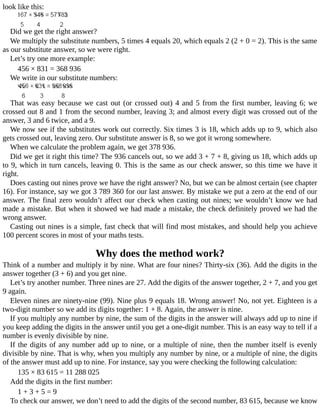
and	easy	method	for	checking	problems	like	these.
Chapter	15
Division	by	addition
This	method	of	division	is	great	for	dividing	by	numbers	a	little	lower	than	powers	of	10	or	multiples	of
powers	of	10.	It	also	helps	to	illustrate	what	division	is	all	about.
How	many	times	will	9	divide	into	10?	One	time	with	1	remainder.	That	is,	for	every	10,	9	will	divide
once	with	1	remainder.	So,	for	20,	9	will	divide	twice	with	2	remainder.	For	40,	9	will	divide	four	times
with	4	remainder.	For	every	10,	9	divides	once	with	1	remainder.
If	you	have	a	handful	of	dollars	you	can	buy	one	item	costing	90¢	for	each	dollar	and	have	10¢
change.	If	you	have	enough	dollars,	you	can	buy	some	extra	items	out	of	the	change.	This	brings	us	to	a
new	and	easy	way	of	calculating	some	long	division	problems.	If	you	are	dividing	by	90,	divide	by	100
(a	dollar)	and	give	back	the	change.
For	instance,	if	you	are	buying	a	drink	for	95¢	and	you	have	$1.20,	you	would	hand	over	a	dollar	and
keep	the	20¢	in	your	pocket,	plus	you	would	get	5¢	change,	making	25¢	left	over,	or	25¢	remainder.
So,	you	could	say,	95	divides	into	120	one	time	with	25	remainder.
Let’s	try	an	example:
We	are	dividing	234	by	96.	We	write	the	problem	in	the	conventional	way	but	we	draw	a	circle	below
the	divisor,	96,	and	write	4	in	the	circle.	(How	many	to	make	100?)
Now,	instead	of	dividing	by	96,	we	divide	by	100.	How	many	times	will	100	divide	into	234?	Two
times	with	34	remainder.	Write	2	as	the	answer.
We	have	our	34	remainder	plus	another	4	remainder	for	every	100.	We	have	two	hundreds	so	our
remainder	is	2	times	4,	which	is	8,	plus	the	34	from	234,	giving	us	a	total	of	42	remainder.
We	would	set	out	the	problem	like	this:
We	don’t	add	the	hundreds	digit	because	we	have	finished	with	it.	In	effect,	what	we	are	saying	is,
100	divides	into	234	twice,	with	34	left	over.	Because	we	are	really	dividing	by	96,	we	also	have	4
remainder	for	each	hundred	it	divides	into.
If	we	were	purchasing	articles	for	96¢	and	we	had	$2.34	in	our	pocket,	we	would	hand	$2.00	to	the
seller	and	keep	the	34¢	in	our	pocket.	We	would	get	8¢	change	which,	added	to	the	34¢,	makes	a	total	of
42¢.
Let’s	try	another.
705	÷	89	=
We	set	it	out:
Eighty-nine	is	11	less	than	100	so	we	write	11	below	the	89.
How	many	hundreds	are	there	in	705?	Obviously	7,	so	we	write	7	as	the	answer.
What	is	our	remainder?	For	every	hundred	we	have	11	remainder.	We	have	7	hundreds	so	we	have	7
times	11	remainder.	Seven	times	11	is	77,	plus	the	5	left	over	from	705	gives	us	82	(77	+	5	=	82).
Again,	we	add	the	77	to	the	5,	not	705	as	we	have	finished	with	the	hundreds	and	are	only	concerned
with	the	5	remainder.
Let’s	take	the	answer	to	two	decimal	places.
We	now	divide	89	into	820.
We	have	8	hundreds	so	8	is	the	next	digit	of	the	answer.	Eight	times	11	equals	88.
Eighty-eight	plus	20	equals	108	remainder.	This	is	obviously	too	high	as	it	is	greater	than	our	divisor
so	we	add	1	to	our	answer.	Our	calculation	now	looks	like	this:
Because	we	had	to	increase	the	answer	by	one,	we	subtract	one	times	the	working	divisor,	100,	from
our	remainder.	We	cross	out	the	hundreds	digit	of	the	remainder	to	get	an	actual	remainder	of	19.
We	bring	down	the	next	zero	to	make	it	190.
We	can	see	that	89	will	divide	twice	into	190	so	we	can	simply	write	2	as	the	next	digit	of	the	answer.
(The	90	part	of	the	number	is	already	greater	than	our	divisor.)
(If	we	couldn’t	see	at	a	glance	that	the	answer	is	2,	we	could	write	1	as	the	next	digit	because	there	is
1	hundred	in	190.	One	times	11	gives	us	11	to	add	to	the	90	of	190	to	make	101	remainder.	Seeing	our
divisor	is	only	89,	we	can’t	have	a	remainder	of	101.)
Because	we	increased	the	digit	of	the	answer	by	1,	we	subtract	1	times	100	from	the	remainder.	One
hundred	and	twelve	minus	100	is	12.	Bring	down	the	final	zero	to	make	120.
Eighty-nine	divides	once	into	120	making	the	answer	7.921.	Seeing	we	only	need	our	answer	to	two
decimal	places,	we	can	round	off	to	7.92.	You	could	easily	solve	this	entirely	in	your	head.
Try	calculating	all	of	these	in	your	head,	just	giving	the	answer	with	remainder.
a)	645	÷	98	=
b)	2345	÷	95	=
c)	234	÷	88	=
d)	1234	÷	89	=
The	answers	are:
a)	6	r57
b)	24	r65
c)	2	r58
d)	13	r77
Easy,	weren’t	they?
This	method	works	well	when	dividing	by	numbers	just	below	a	power	of	10,	or	a	multiple	of	a
power	of	10,	but	it	can	be	made	to	work	for	other	numbers	as	well.
Dividing	by	three-digit	numbers
Example:
23	456	÷	187	=
We	set	out	the	problem	like	this:
We	use	a	working	divisor	of	200	because	187	is	200	minus	13.
We	make	our	first	calculation.	Two	hundred	divides	into	234	one	time,	so	the	first	digit	of	the	answer
is	1.	We	write	the	1	over	the	4.
We	multiply	the	answer,	1,	by	the	number	in	the	circle,	13,	to	get	an	answer	of	13.	Write	13	under
234	and	add	it	to	the	34.
Now	bring	down	the	next	digit,	5,	to	make	475.
Divide	475	by	200.	Two	hundred	divides	into	400	twice,	so	2	is	the	next	digit	of	the	answer.
Multiply	2	by	13	to	get	26.
75	+	26	=	101
Bring	down	the	next	digit,	6.
Divide	1016	by	200.	Two	hundred	divides	into	1000	five	times,	so	the	next	digit	of	the	answer	is	5.
Five	times	13	is	65.	Sixty-five	plus	16	equals	81;	this	is	our	remainder.
The	answer	is	125	with	81	remainder.
It	is	much	easier	to	multiply	the	13	by	each	digit	of	the	answer	than	to	multiply	187	by	each	digit.
The	following	example	will	show	what	to	do	when	you	have	a	remainder	when	you	divide	by	your
working	divisor.
4567	÷	293	=
We	set	out	the	problem	like	this:
We	divide	400	by	300	to	get	an	answer	of	1	with	100	remainder.	I	write	a	small	1	to	indicate	the
remainder.
One	times	7	is	7,	so	we	add	7	to	56,	plus	the	100	carried	to	get	our	remainder.
Bring	down	the	next	digit	of	the	number	we	are	dividing.	We	now	divide	1637	by	300.
Three	hundred	divides	into	1600	five	times	with	100	remainder.	We	follow	the	same	procedure.
Thirty-seven	 plus	 135	 gives	 us	 our	 remainder	 of	 172.	 We	 had	 to	 carry	 a	 remainder	 twice	 in	 this
calculation.
Here	is	another	example:
45	678	÷	378	=
Three	hundred	and	seventy-eight	is	22	less	than	400	so	we	can	easily	use	this	method.
Here	is	how	we	set	out	the	problem:
We	use	400	as	our	working	divisor.
The	first	calculation	is	easy.	Four	hundred	divides	once	into	456.
One	times	22	is	22.	Add	22	to	56	to	get	78.
Bring	down	the	next	digit	of	the	number	we	are	dividing,	7.
Four	hundred	divides	once	into	787	but	787	is	almost	800	and	we	are	not	actually	dividing	by	400,
but	by	378.	We	can	see	the	answer	is	probably	2.	Let’s	try	it.
Two	times	22	is	44.	Eighty-seven	plus	44	is	131.	Subtract	100	to	get	31	because	we	have	added	1	to
our	answer	to	make	2	instead	of	1.	Does	this	make	sense?	Yes,	because	we	are	finding	the	remainder
from	subtracting	twice	378	from	787.	The	answer	must	be	less	than	100.	Now	bring	down	the	next	digit,
8.
Four	hundred	will	not	divide	into	318.	We	now	check	with	our	actual	divisor.	Three	hundred	and
seventy-eight	will	not	divide	into	318	so	the	next	digit	of	the	answer	is	zero	and	the	318	becomes	the
remainder.
How	would	you	solve	this	problem?
1410	÷	95	=
You	could	solve	this	two	ways	using	this	method.	Let’s	see.	Here	is	the	first	way.
You	could	ask	yourself,	‘How	many	times	does	one	hundred	divide	into	fourteen	hundred?’	Fourteen
times.	Write	down	14	as	the	answer.
Now	the	remainder.	Fourteen	times	5	is	70.	(Fourteen	is	2	times	7.	Five	by	2	makes	10,	and	10	by	7
makes	70.)	Seventy	plus	the	remainder	from	1410	(10)	makes	80.	The	answer	is	14	with	80	remainder.
Here	is	the	second	way:
One	hundred	divides	into	141	one	time	with	41	remainder.
One	times	5	is	5,	plus	41	remainder	makes	46.	Bring	down	the	next	digit,	0,	to	make	460.
One	hundred	divides	into	460	four	times	with	60	remainder.	Four	times	5	is	20,	plus	the	60	remainder
makes	a	remainder	of	80.
The	first	method	is	easier,	don’t	you	think,	and	more	suited	to	mental	calculation?	Try	calculating	the
problem	both	ways	in	your	head	and	see	if	you	agree.
Possible	complications
Here	is	an	interesting	example	which	demonstrates	possible	complications	using	this	method.
3456	÷	187	=
We	set	out	the	problem:
We	divide	200	into	300	of	345.	The	answer	is	1,	with	100	remainder.
We	write	it	like	this:
We	write	a	small	1	above	the	hundreds	digit	(3	is	the	hundreds	digit	of	345)	to	signify	100	remainder.
Now	multiply	1	times	13	equals	13.	Add	this	to	the	45	of	345,	plus	our	100	carried.
What	we	are	saying	is	this:	if	we	have	$345	in	our	pocket	and	purchase	something	for	$187,	we	can
hand	over	$200	to	the	seller	and	keep	the	other	$145	in	our	pocket.	We	will	be	given	$13	change	which,
added	to	the	money	in	our	pocket,	makes	$158	we	have	left.
We	bring	down	the	6	for	the	final	part	of	the	calculation.	Now	we	have	1586	divided	by	200.
Two	 hundred	 divides	 into	 1500	 seven	 times	 with	 100	 left	 over.	 Don’t	 forget	 to	 write	 this	 100
remainder	as	a	small	1	in	the	hundreds	column.	Because	we	have	7	times	13	remainder,	plus	the	186
from	1,586,	we	can	see	we	can	raise	our	answer	by	1	to	8.	Eight	times	13	is	easy.	Eight	times	10	is	80,
plus	8	times	3	is	24,	104.
Because	the	extra	1	we	have	added	to	the	answer	accounts	for	another	200	we	are	dividing	by,	this
must	be	subtracted	from	the	remainder.	I	write	‘−200’	to	the	side	of	my	work	to	remind	me.
We	add	186	to	104	to	get	290.	Now	subtract	the	200	written	at	the	side	to	get	our	final	remainder	of
90.	That	is	as	complicated	as	it	can	get	but	you	will	find	it	becomes	easy	with	practice.	As	long	as	you
can	keep	track	of	what	you	are	doing	it	won’t	be	difficult.	Practise	some	problems	for	yourself	and	you
will	find	it	will	become	very	easy.
Can	we	use	this	method	to	divide	34	567	by	937?	Although	937	is	not	far	from	1000,	we	still	have	a
larger	difference	—	one	that	is	not	so	easy	to	multiply.
Let’s	try	it.
The	first	calculation	would	be,	3000	divided	by	1000.	The	answer	is	obviously	3.	This	is	the	first
digit	of	the	answer.
Now	we	have	to	multiply	our	circled	number,	63,	by	3.
Three	times	60	is	180,	and	3	times	3	is	9;	the	answer	is	189.	Write	189	below	3456	and	add	it	to	456,
for	the	remainder.
Now	bring	down	the	next	digit,	7.
We	now	have	to	divide	6457	by	1000.
Six	thousand	divided	by	1000	is	6.	Now	we	multiply	63	by	6.	Is	this	difficult?	No.	Six	times	60	is
360,	plus	3	×	6	=	18,	giving	us	378.
Add	this	to	457	to	get	our	remainder	of	835.
So,	34	567	divided	by	937	is	36	with	835	remainder.
Let	us	continue	the	calculation	to	two	decimal	places.
We	add	one	more	zero	(or	decimal	place)	than	we	need	for	the	answer.
Bring	down	the	first	zero	to	make	8350.	How	many	times	will	1000	divide	into	8000?	Eight	times,	so
8	is	the	next	digit	of	the	answer.
Eight	times	63	is	504.	(Eight	times	60	is	480	and	8	times	3	is	24.	Four	hundred	and	eighty	plus	24
equals	504.)
Bring	down	the	next	digit,	0,	to	make	8540,	and	divide	8540	by	1000	to	get	8	again.
We	know	that	8	multiplied	by	63	is	504,	so	we	add	this	to	540	to	get	1044.
This	is	clearly	wrong	because	we	have	a	remainder	higher	than	our	divisor	so	we	have	to	increase	our
last	digit	of	the	answer	by	1.	We	cross	out	the	last	digit,	8,	and	raise	it	to	9.	Nine	times	63	is	567.	(Nine
times	60	equals	540,	9	times	3	is	27,	and	540	plus	27	equals	567.)
We	subtract	1000	because	we	raised	the	last	digit	of	our	answer	by	1.	Bring	down	the	final	zero	to
calculate	the	third	decimal	place.	One	thousand	and	seventy	divided	by	1000	is	1.	This	gives	us	an
answer	 of	 36.891.	 We	 want	 an	 answer	 to	 two	 decimal	 places:	 36.891	 rounds	 off	 to	 36.89.	 Our
calculation	is	complete.
Again,	it	is	much	easier	to	multiply	63	by	each	digit	of	our	answer	than	to	multiply	937.	The	full
calculation	looks	like	this:
Try	these	problems	for	yourself.	Calculate	for	a	remainder,	then	to	one	decimal	place.
a)	456	÷	194	=
b)	6789	÷	288	=
c)	5678	÷	186	=
d)	73	251	÷	978	=
How	did	you	go?	Here	are	the	problems	fully	worked.
The	answer	is	2.4	to	one	decimal	place.
The	answer	is	23.6	to	one	decimal	place.
The	answer	is	30.5	to	one	decimal	place.
To	multiply	by	14	we	simply	multiply	by	7	and	then	double	the	answer	(2	×	7	=	14).
The	answer	is	74.9	to	one	decimal	place.
In	this	problem	we	had	to	multiply	by	22.	This	is	easy	if	we	remember	that	22	is	2	times	11.	It	is	easy
to	multiply	by	2	and	by	11	using	our	shortcut.	For	instance,	we	had	to	multiply	8	times	22.	Multiply	8
by	2,	then	by	11.
8	×	2	=	16
16	×	11	=	176
To	divide	by	19,	29	or	39	it	would	be	easier	to	use	our	method	of	direct	division,	but	when	the	divisor
is	just	below	100,	200,	a	multiple	of	100	or	1000,	you	may	find	this	method	easier.
You	should	be	able	to	solve	problems	like	1312	divided	by	96	in	your	head.	You	would	divide	by	100
minus	4.	One	hundred	divides	into	13	hundred	thirteen	times,	so	you	should	be	able	to	say	immediately,
‘Thirteen	with	4	times	13	remainder,	plus	12,	or,	13	with	64	remainder’.
Then,	if	you	want	the	answer	to	one	decimal	place,	multiply	64	remainder	by	10	and	divide	again.	Six
hundred	and	forty	divided	by	96	is	6	with	40	plus	24	remainder,	64.	This	is	obviously	going	to	repeat	so
you	 take	 the	 answer	 to	 as	 many	 decimal	 places	 as	 you	 like.	 The	 answer	 to	 three	 decimal	 places	 is
13.667.
To	complete	this	chapter,	let	us	compare	this	method	with	the	regular	method	for	long	division.
Example:
705	÷	94	=
The	‘addition’	method:
How	many	times	does	100	divide	into	705?	Seven	times.
Then	 we	 multiply	 6	 times	 7	 and	 add	 the	 answer	 to	 5	 (in	 705)	 to	 get	 our	 remainder.	 It	 is	 easy	 to
multiply	6	times	7	and	easy	to	add	42	plus	5.
Now,	let’s	compare	this	with	regular	long	division.
How	many	times	does	94	divide	into	705?	Seven	times.
Then	 we	 multiply	 7	 times	 94	 to	 get	 our	 answer	 of	 658.	 We	 subtract	 658	 from	 705	 to	 get	 our
remainder.
Our	method	is	much	easier,	don’t	you	think?
Chapter	16
Checking	answers:	Part	two
We	can	use	our	strategy	of	casting	out	nines	for	checking	answers	of	division	problems.
For	example,	if	we	want	to	check	that	42	divided	by	2	equals	21,	you	could	cast	out	the	nines.	Firstly,
we	need	to	generate	substitute	numbers:
42	÷	2	=	21
6	÷	2	=	3
This	 check	 is	 straightforward	 and	 needs	 no	 special	 explanation.	 But	 how	 about	 the	 following
problem?
161	÷	7	=	23
8	÷	7	=	5
Here	we	need	to	adopt	a	strategy	similar	to	that	which	we	used	for	subtraction.	An	easy	way	to	check
division	is	to	multiply	the	answer	by	the	divisor	to	give	the	original	number	being	divided.	So	we	can
write	the	problem	thus:
8	=	5	×	7	or	7	×	5	=	8
Is	this	correct?
5	×	7	=	35	and	3	+	5	=	8
Yes,	our	answer	is	correct.
What	if	we	are	checking	an	answer	with	a	remainder?	How	would	we	check	the	following	problem?
165	÷	7	=	23	r4
Have	we	made	a	mistake?	Casting	out	nines	will	find	most	mistakes	without	doing	the	calculation
again.
When	casting	out	nines	for	division	problems	we	rewrite	the	calculation	as	a	multiplication.	But	what
do	we	do	with	the	remainder?	We	write	it	as:
23	×	7	=	165	−	4
We	subtract	the	remainder	from	the	number	we	divided.	That	is	because	we	had	a	remainder	of	4
after	we	divided	the	number.	If	the	number	had	been	smaller	by	4	we	would	not	have	had	a	remainder.
Using	substitute	numbers,	the	equation	becomes:
5	×	7	=	3	−	4
The	remainder	(4)	is	greater	than	the	answer	(3),	so	either	subtract	it	first	(165	−	4	=	161)	or	add	9	to
the	number	we	are	subtracting	from.	Either	way,	we	end	up	with:
5	×	7	=	8
35	=	8
8	=	8
So	our	answer	was	correct.
However,	there	is	an	important	note:
You	cannot	cast	out	the	nines	to	check	a	division	problem	when	the	answer	is	rounded	off	to	a
specified	number	of	decimal	places.	Casting	nines	can	only	be	used	to	check	exact	answers.
Check	these	problems	for	yourself	by	casting	nines:
a)	248	746	÷	721	=	345	r1
b)	36	679	÷	137	=	26	722
c)	6054	÷	17	=	356	r2
d)	3283	÷	49	=	67
Answers:	a),	c)	and	d)	were	right,	b)	was	wrong.
Casting	out	elevens
Casting	out	elevens	is	another	simple	method	for	checking	answers.	It	has	an	advantage	over	casting	out
nines	in	that	it	will	detect	if	the	decimal	is	wrong	by	one	place	or	if	a	zero	is	added	or	missing.	It	is
useful	if	used	with	casting	out	nines	as	a	double-check.	If	I	am	multiplying	by	a	multiple	of	11	(e.g.	66
or	77)	I	will	use	this	method	as	well	as	casting	out	nines.
I	will	now	show	you	two	easy	methods	for	finding	the	elevens	remainder.
The	rule	is	simple	with	two-digit	numbers;	subtract	the	tens	digit	from	the	units	digit.	If	the	units
digit	is	smaller,	add	11	to	it.
For	example:
13	×	14	=	182
The	first	number	is	13.	Subtract	1	(tens	digit)	from	the	3	(units	digit)	to	get	an	answer	of	2.	Thus,	2	is
the	elevens	remainder.
The	second	number,	14	has	an	elevens	remainder	of	3	(4	−	1	=	3).
To	find	the	elevens	remainder	of	a	longer	number:
Mark	off	the	evenly	placed	digits	going	back	from	the	decimal.	Subtract	the	evenly	placed	digits
from	the	oddly	placed	digits.
To	find	the	elevens	remainder	of	182	we	mark	the	evenly	placed	digits.
1	8	2
*
Eight	is	the	second	digit	back	from	the	decimal.	The	odd-placed	digits	are	1	and	2.	Adding	the	odd
digits	we	get:
1	+	2	=	3
We	can’t	subtract	8	from	3	so	we	add	11	to	the	3.
3	+	11	=	14
14	−	8	=	6
Six	is	our	check	answer.
Our	substitutes	for	13	and	14	were	2	and	3.	Multiplying	them	should	equal	our	check	answer.
2	×	3	=	6
This	is	the	same	as	our	check	answer,	so	our	answer	is	correct.
Casting	out	nines	would	have	given	us	the	check	with	less	effort.	Why	cast	out	elevens?	If	our	answer
had	been	18.2	instead	of	182,	casting	out	nines	would	not	have	picked	up	the	mistake	but	casting	out
elevens	would.	Had	our	answer	been	1712	(incorrectly	using	our	method	for	multiplying	teens),	casting
out	nines	would	check	the	answer	as	correct.	But	once	again,	casting	out	elevens	would	indicate	an
error.
Let’s	check	both	of	these	answers	by	casting	out	elevens:
1	8.	2
*	*
The	evenly	placed	digits	add	to	3	(1	+	2	=	3).	The	oddly	placed	digit	is	8.	Our	elevens	remainder	is	5
(8	−	3	=	5).
Our	problem	becomes:
2	×	3	=	5
This	is	obviously	wrong.
Our	other	incorrect	answer	was	1712.
1	7	1	2
*	*
Adding	the	evenly	placed	digits	(1	+	1)	we	get	2.	The	oddly	placed	digits	(7	and	2)	add	to	9.
9	−	2	=	7
Our	problem,	which	is	also	wrong,	becomes:
2	×	3	=	7
Casting	out	elevens	found	both	answers	to	be	wrong	whereas	casting	out	nines	did	not	find	an	error.
Let’s	try	one	more	example.
1.3	×	14	=	18.2
With	 1.3,	 1	 is	 the	 oddly	 placed	 digit	 counting	 back	 from	 the	 decimal,	 which	 makes	 3	 the	 evenly
placed	digit.
We	subtract	3	from	1.	Because	1	is	smaller	than	3,	we	add	11.
11	+	1	=	12
Now	we	can	subtract	3	from	12.
12	−	3	=	9
We	subtract	1	from	4	to	get	our	elevens	remainder	for	14.
4	−	1	=	3
With	our	answer,	18.2,	1	and	2	are	the	evenly	placed	digits	and	8	is	our	odd	digit.
1	+	2	=	3
8	−	3	=	5
Our	check	problem	becomes:
9	×	3	=	5
Nine	times	3	is	27.	To	find	the	substitute	for	27	we	subtract	2	from	7.
Seven	minus	2	equals	5,	the	same	as	our	check	answer.
An	answer	of	1.82	or	182	would	have	checked	incorrect	by	casting	out	elevens.
Find	the	elevens	remainder	for	the	following	numbers:
a)	123
b)	5237
c)	716
d)	625	174
e)	2156
f)	8137
The	answers	are:
a)	2
b)1
c)	1	(12,	then	1)
d)	0
e)	0
f)	8
If	you	weren’t	sure	how	to	find	the	elevens	remainder,	go	back	and	read	the	explanation	again.	It	is
worth	the	effort	to	learn	the	method.
Now	you	need	to	be	able	to	put	the	method	into	practice.	Here	are	some	sample	problems.	Check
these	answers	for	yourself:
a)	17	×	17	=	289
b)	154	×	23	=	3542
c)	32	×	41	=	1312
d)	46	×	42	=	1942
One	of	the	answers	is	incorrect	—	I	won’t	say	which	one.	Casting	out	nines	would	have	found	the
mistake	as	well.	Try	this	as	a	double-check.
With	either	method,	casting	out	nines	or	casting	out	elevens,	I	also	like	to	make	a	further	check	by
estimating	the	answer.
These	are	useful	tools	if	you	work	with	numbers	—	either	at	school	or	on	the	job.
Chapter	17
Estimating	square	roots
When	we	square	a	number,	we	multiply	it	by	itself.	For	instance,	4	squared	is	16	because	4	times	4
equals	16.
Finding	a	square	root	is	doing	this	process	in	reverse.	To	find	the	square	root	of	16,	we	have	to	find
which	number	multiplied	by	itself	will	give	an	answer	of	16.	The	answer,	of	course,	is	4.	Likewise,	the
square	root	of	25	is	5,	because	5	times	5	equals	25.
What	is	the	square	root	of	64?	The	answer	is	8	because	8	times	8	equals	64.
How	about	the	square	root	of	56?	That	is	more	difficult	because	it	is	not	an	exact	square.	Seven	times
7	 is	 49,	 which	 is	 too	 low	 and	 8	 times	 8	 is	 64,	 which	 is	 too	 high.	 The	 answer	 must	 lie	 somewhere
between	7	and	8.	This	is	how	we	estimate	the	square	root.	We	choose	the	number	whose	square	is	just
below	the	number	we	are	working	with	—	in	this	case,	56	—	and	divide	it	into	the	number.
We	choose	7,	which	has	a	square	just	below	56.	Eight	is	too	high	because	the	8	squared	is	above	56.
We	now	divide	7	into	56	to	get	an	answer	of	8.
Then	average	7	and	8,	or	split	the	difference.	The	answer	is	7.5.	(One	way	of	finding	the	average	is	to
add	the	numbers	and	then	divide	the	answer	by	how	many	numbers	you	are	averaging.)	This	answer
will	always	be	slightly	higher	than	the	correct	one	so	we	can	round	off	downwards	to	7.48.
The	answer,	7.48,	is	accurate	to	three	digits.	Our	first	answer	of	7.5	was	accurate	to	two	digits.	Often,
that	is	all	the	accuracy	we	need.
This	is	the	sign	for	a	square	root:	
The	symbol	is	written	before	the	number.	 ,	means	the	square	root	of	16	equals	4.
Let’s	try	an	example:
First,	try	to	guess	the	square	root.
Now,	divide	the	number	by	your	approximate	answer.
70	÷	8	=	8.75
Then,	 split	 the	 difference	 between	 your	 estimate	 (in	 this	 case,	 8)	 and	 the	 answer	 you	 got	 after
dividing	the	number	by	your	estimate,	8.75.	The	difference	equals:
8.75	−	8	=	0.75
Splitting	the	difference	(dividing	by	2)	we	get:
0.75	÷	2	=	0.375
Finally,	add	this	result	to	the	original	estimate,	8:
8	+	0.375	=	8.375
The	answer	will	always	be	slightly	high,	so	round	off	downwards.	In	this	case,	make	the	answer	8.37.
This	answer	has	an	error	of	less	than	one-twentieth	of	1	percent.
Let’s	try	another.	How	would	we	calculate	the	square	root	of	29?
We	choose	5	as	our	first	estimate	(5	×	5	=	25).	We	divide	29	by	5	to	get	a	more	accurate	estimate.
Five	divides	into	29	five	times	with	4	remainder.	Five	divides	into	40	(the	4	remainder	times	10)	eight
times,	which	gives	us	an	answer	of	5.8.
29	÷	5	=	5.8
The	difference	between	5	and	5.8	is	0.8.	Half	of	0.8	is	0.4.	Add	this	to	the	5	we	used	as	our	first
estimate	to	get	a	corrected	estimate	of	5.4.
The	actual	answer	is	5.385,	but	5.4	is	accurate	to	two	digits.	We	had	an	error	of	around	0.2	of	1
percent.	That	is	sufficiently	accurate	for	most	purposes.
Square	roots	of	larger	numbers
Let’s	try	another:
Pair	off	the	numbers	backwards	from	the	decimal	point:
*	*
For	each	digit	pair	in	the	number	we	are	working	with	we	allocate	one	digit	of	the	answer.
In	this	example,	our	answer	will	be	a	two-digit	number,	disregarding	any	digit	after	the	decimal	point.
Even	if	you	have	a	single	digit	for	the	first	left-hand	digit	pair,	it	still	counts	as	a	digit	pair.
To	 calculate	 the	 first	 digit	 of	 the	 answer,	 we	 estimate	 the	 square	 root	 of	 the	 first	 two	 digits.	 Our
estimate	of	the	square	root	of	31	is	5	(5	×	5	=	25).	The	following	digits	in	our	estimated	answer	will
always	be	zeros.	There	is	one	more	digit	in	the	answer,	so	we	add	one	zero	to	the	5	to	get	50.
To	divide	by	50,	we	divide	by	10,	and	then	by	5:
3125	÷	10	=	312.5
We	now	divide	by	5	to	get	62.5:
Find	and	split	the	difference:
62.5	−	50	=	12.5
12.5	÷	2	=	6.25
Round	off	downwards	to	6	and	add	this	to	your	original	estimate:
50	+	6	=	56
Using	a	calculator	the	answer	is:
Our	 calculated	 answer	 is	 accurate	 to	 within	 two-tenths	 of	 1	 percent.	 Had	 we	 not	 rounded	 off
downward,	our	answer	still	would	have	been	accurate	to	within	1	percent.
These	calculations	can	easily	be	done	in	your	head.	Yet	most	people	are	unable	to	calculate	square
roots	using	a	pen	and	paper.
A	mental	calculation
Do	the	next	calculation	in	your	head.
What	is	the	square	root	of	500,	( )?
Firstly,	we	break	the	number	into	digit	pairs.	How	many	digit	pairs	do	we	have?	Two.	So	there	are
two	digits	in	the	answer.
What	 is	 the	 first	 digit	 pair?	 It	 only	 has	 one	 digit,	 5.	 What	 is	 the	 square	 root	 of	 5?	 We	 choose	 2,
because	2	×	2	=	4.
We	make	up	the	second	digit	of	the	square	root	with	a	zero.	Our	estimate	is	20.
We	now	have	to	divide	500	by	20.	How	do	we	do	this?	We	divide	500	by	10,	then	by	2.
500	÷	10	=	50
50	÷	2	=	25
We	now	split	the	difference	between	20	and	25	to	get	22.5.	We	round	downwards	to	22.4.
The	answer,	using	a	calculator,	is	22.36.
Our	estimate	of	22.5	had	about	half	of	1	percent	error.	Our	rounded	off	estimate	of	22.4	had	less	than
0.2	of	1	percent	error.	That’s	pretty	good	for	a	mental	calculation	—	especially	when	we	realise	that	the
only	method	most	people	know	for	calculating	square	roots	is	to	use	a	calculator.	Calculating	square
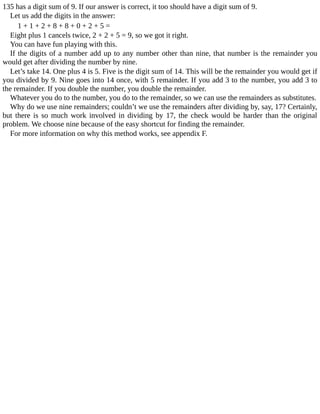
roots	in	your	head	will	almost	certainly	gain	you	a	reputation	for	being	a	mathematical	genius.
Let’s	try	another	example:
We	pair	off	the	digits.
*	*	*
The	first	digit	pair	is	9.	The	square	root	of	9	is	3	(3	×	3	=	9).	There	are	three	digit	pairs,	so	we	add
two	zeros	to	the	3	to	make	up	three	digits.	Our	estimate	is	300.
To	divide	by	300,	we	divide	by	100	and	then	by	3.	(To	divide	by	100,	move	the	decimal	two	places	to
the	left.)
With	a	calculator	we	get	an	answer	of	305.8758.	We	have	an	error	of	0.0079	percent.
Let’s	try	one	more	together:
That	looks	an	impressive	problem.	If	we	were	doing	this	in	our	head,	we	could	round	off	downwards
before	we	begin.	Let’s	do	the	full	calculation	first.
Firstly,	we	pair	off	the	digits:
*	*	*	*
There	are	four	digit	pairs	so	there	will	be	four	digits	in	the	answer.
The	first	digit	pair	is	38.	We	estimate	the	square	root	of	38	as	6	because	6	times	6	is	36.	We	make	up
the	other	digits	with	zeros.	Our	estimate	is	6000.
We	divide	38	472	148	by	our	estimate.	First	divide	by	1000	and	then	by	6.
38	472	148	÷	1000	=	38	472.148
Because	we	are	only	estimating,	we	can	drop	the	digits	after	the	decimal.	We	now	divide	38	472	by	6:
38	472	÷	6	=	6412
We	split	the	difference	between	6000	and	6412.	The	difference	is	412,	and	half	of	412	is	206.	(Half	of
400	is	200	and	half	of	12	is	6.)
Add	206	to	our	first	estimate	and	we	get	6206.	We	round	off	downwards	to	get:
6200	(answer)
The	 actual	 answer	 is	 6202.59.	 For	 practical	 purposes,	 our	 estimate	 was	 probably	 close	 enough.
However,	if	we	want	an	accurate	answer,	the	method	taught	in	the	next	chapter	is	the	easiest	method	I
know.
In	the	meantime,	calculate	these	for	yourself.	See	how	many	you	can	do	without	using	pen	and	paper.
The	answers	are:
a)	41.5
b)	50.99
c)	8.94
d)	6.48
e)	71.64
f)	30.82
g)	54
h)	35
When	the	number	is	just	below	a	square
The	more	accurate	your	estimate,	the	more	accurate	your	final	answer	will	be.	Thus,	we	need	to	choose
an	estimate	as	close	as	possible	to	the	actual	square	root.
The	examples	we	have	worked	with	thus	far	are	just	above	a	square.	For	instance,	in	the	exercises
you	just	tried,	2600	is	just	above	50	squared	(2500),	so	we	use	50	as	our	estimate.
Here	is	a	procedure	for	working	with	numbers	that	are	just	below	a	square.	To	get	a	more	accurate
answer,	instead	of	choosing	the	lower	number	as	our	first	estimate,	we	can	choose	the	higher	number	if
it	is	closer	to	our	answer.
For	example:
Split	the	number	into	digit	pairs:
*	*
We	estimate	the	square	root	of	24	as	5	because	24	is	closer	to	5	squared	(25)	than	it	is	to	4	squared
(16).	Our	estimate	of	the	square	root	of	2400	is	50.
We	now	divide	2400	by	50.	To	divide	by	50,	divide	by	100,	then	double	the	answer	(50	=	100	÷	2).
2400	÷	100	=	24
24	×	2	=	48
Split	the	difference	between	48	and	50.
50	−	48	=	2
2	÷	2	=	1
Adding	1	to	48	gives	our	answer:	49.
A	calculator	gives	the	answer	as	48.98979.	We	had	an	error	of	about	0.02	of	1	percent.
Let’s	try	another:
We	pair	the	digits:
*	*
Our	estimate	of	the	first	digit	pair	is	8	because	63	is	much	closer	to	8	squared	(64)	than	it	is	to	7
squared	(49).	Thus,	our	estimate	is	80.
We	divide	by	10,	then	by	8:
6300	÷	10	=	630
630	÷	8	=	78.75
We	now	split	78.75	and	80.	We	can	subtract	78.75	from	80,	halve	the	answer,	and	deduct	the	result
from	80.
Here	is	the	good	news	—	we	have	a	shortcut.
A	shortcut
What	we	are	really	doing	is	averaging	the	amounts.
To	average	78.75	and	80,	we	add	them	together	(158.75)	and	halve	the	result.
Here	is	the	shortcut.	We	know	the	answer	is	in	the	seventies,	so	7	is	the	first	digit	of	the	answer.	For
the	rest	of	the	answer,	put	a	1	in	front	of	the	8.75	(to	get	18.75)	and	halve	it.	No	further	addition	or
subtraction	is	needed.
Half	of	18	is	9.	Place	the	nine	next	to	the	7	to	get	79.	Half	of	75	is	37.5.	Our	answer	becomes	79.375.
We	would	round	off	downwards	to	79.37.
The	actual	answer	is	79.3725,	which	means	we	had	an	error	of	0.003	of	1	percent.	Had	we	used	70	as
our	first	estimate	we	would	have	got	an	answer	of	80.
Why	did	our	shortcut	work?	Because,	to	average	the	numbers,	78.75	and	80,	we	add	them	and	then
halve	the	answer.
78.75	+	80	=	158.75
158.75	÷	2	=	79.375
When	we	divided	15	by	2	we	got	an	answer	of	7	and	carried	1	to	the	8	to	make	18.	In	our	shortcut	we
simply	skipped	that	part	of	the	calculation.
Greater	accuracy
If	we	need	greater	accuracy	for	our	calculation	we	can	repeat	the	procedure	using	our	estimate	answer
as	a	second	estimate.
Let’s	use	the	first	example	cited	in	this	chapter:
Our	first	estimate	is	7	(7	×	7	=	49).
56	÷	7	=	8
8	−	7	=	1	(the	difference)
1	÷	2	=	0.5
7	+	0.5	=	7.5
Now,	repeat	the	process.	Divide	56	by	7.5.	It	isn’t	difficult	to	divide	by	7.5.	It	is	the	same	as	112	÷	15
or	224	÷	30.	If	we	double	both	numbers	the	ratio	stays	the	same.
Two	hundred	and	twenty-four	is	easily	divided	by	30.	We	divide	by	10	(22.4)	and	then	by	3.
224	÷	30	=	7.4667
We	can	use	our	shortcut	to	average	the	answers.	We	know	the	first	part	of	the	answer	is	7.4.	We	put
our	carried	1	in	front	of	667	to	get	1667	and	divide	by	2.
1667	÷	2	=	833.5
We	attach	833	to	7.4	for	our	answer	of	7.4833.	This	answer	is	correct	for	all	expressed	digits.
Generally	 speaking,	 each	 time	 we	 repeat	 this	 process	 we	 double	 the	 number	 of	 significant	 digits
which	are	accurate.
Let’s	try	another.
One	of	our	earlier	mental	calculations	was	the	square	root	of	500.	We	can	continue	the	process	in	our
head	to	increase	the	accuracy	of	our	answer.
We	calculated	 .
Instead	of	dividing	500	by	20,	we	now	divide	by	22.5.	Is	this	difficult?	No,	not	if	we	double	our
numbers	twice.
500	and	22.5	doubled	is	1000	and	45.	Doubled	again	we	get	2000	and	90.
We	divide	2000	by	90	to	get	a	more	accurate	estimate.	To	divide	2000	by	90	we	divide	by	10	and
then	by	9.
2000	÷	10	=	200
200	÷	9	=	22.22
We	now	split	the	difference	between	22.22	and	22.5.
The	22	in	front	of	the	decimal	point	is	obviously	correct.	To	find	out	what	comes	after	it	we	simply
average	22	and	50.
22	+	50	=	72
72	÷	2	=	36
Add	0.36	to	22	for	an	answer	which	is	accurate	for	all	digits	given.
22	+	0.36	=	22.36	(answer)
With	a	little	practice,	this	procedure	can	be	carried	out	entirely	in	your	head.	Try	it!
Chapter	18
Calculating	square	roots
There	is	an	easy	method	for	calculating	the	exact	answer	for	square	roots.	It	involves	a	process	that	I
call	cross	multiplication.
Here’s	how	it	works.
Cross	multiplication
To	cross	multiply	a	single	digit,	you	square	it.
32
	=	3	×	3	=	9
If	you	have	two	digits	in	a	number,	you	multiply	them	and	double	the	answer.	For	example:
34	=	3	×	4	=	12
12	×	2	=	24
With	three	digits,	multiply	the	first	and	third	digits,	double	the	answer,	and	add	this	to	the	square	of
the	middle	digit.	For	example,	345	cross	multiplied	is:
3	×	5	=	15
15	×	2	=	30
30	+	42
	=	46
The	general	rule	for	cross	multiplication	of	an	even	number	of	digits	is:
Multiply	the	first	digit	by	the	last	digit,	the	second	by	the	second	last,	the	third	by	the	third	last
and	so	on,	until	you	have	multiplied	all	of	the	digits.	Add	them	together	and	double	the	total.
In	practice,	you	would	add	them	as	you	go	and	double	your	final	answer.
The	general	rule	for	cross	multiplication	of	an	odd	number	of	digits	is:
Multiply	the	first	digit	by	the	last	digit,	the	second	by	the	second	last,	the	third	by	the	third	last
and	so	on,	until	you	have	multiplied	all	of	the	digits	up	to	the	middle	digit.	Add	the	answers	and
double	the	total.	Then	square	the	middle	digit	and	add	it	to	the	total.
Here	are	some	examples:
123	=	1	×	3	=	3,	3	×	2	=	6,	6	+	22
	(4)	=	10
1234	=	1	×	4	(4),	+	2	×	3	(6)	=	10,	10	×	2	=	20
12345	=	1	×	5	(5),	+	2	×	4	(8)	=	13,	13	×	2	=	26,	26	+	32
	(9)	=	35
Using	cross	multiplication	to	extract	square	roots
Here	is	the	method	for	extracting	square	roots.
For	example:
Firstly,	pair	the	digits	back	from	the	decimal.	There	will	be	one	digit	in	the	answer	for	each	digit	pair
in	the	number.
*	*
This	problem	will	have	a	two-digit	answer.
Secondly,	estimate	the	square	root	of	the	first	digit	pair.	The	square	root	of	28	is	5	(5	×	5	=	25).	So	5
is	the	first	digit	of	the	answer.
Double	the	first	digit	of	the	answer	(2	×	5	=	10)	and	write	it	to	the	left	of	the	number.	This	number
will	be	our	divisor.	Write	5,	the	first	digit	of	our	answer,	above	the	8	in	the	first	digit	pair,	28.
Your	work	should	look	like	this:
We	have	finished	working	with	the	first	digit	of	the	answer.
To	find	the	second	digit	of	the	answer,	square	the	first	digit	of	your	answer	and	subtract	the	answer
from	your	first	digit	pair.
52
	=	25
28	−	25	=	3
Three	is	our	remainder.	Carry	the	3	remainder	to	the	next	digit	of	the	number	being	squared.	This
gives	us	a	new	working	number	of	30.
Divide	our	new	working	number,	30,	by	our	divisor,	10.	This	gives	3,	the	next	digit	of	our	answer.
Ten	divides	evenly	into	30,	so	there	is	no	remainder	to	carry.	Nine	is	our	new	working	number.
Our	work	should	look	like	this:
Finally,	 cross	 multiply	 the	 last	 digit	 of	 the	 answer.	 (We	 don’t	 cross	 multiply	 the	 first	 digit	 of	 our
answer.	After	the	initial	workings	the	first	digit	of	the	answer	takes	no	further	part	in	the	calculation.)
32
	=	9
Subtract	this	answer	from	our	working	number.
9	−	9	=	0
There	is	no	remainder:	2809	is	a	perfect	square.	The	square	root	is	53.
Let’s	try	another	example:
First,	pair	the	digits.	There	are	three	digit	pairs.	The	answer	will	be	a	three-digit	number.
*	*	*
Now	estimate	the	square	root	of	the	first	digit	pair.	Five	is	the	first	digit	pair.	Our	estimate	is	2	(2	×	2
=	4).
Write	2	as	the	first	digit	of	the	answer.	Double	the	first	digit	of	the	answer	to	get	our	divisor	(2	×	2	=
4).
Our	work	looks	like	this:
Square	the	first	digit	of	the	answer,	write	it	underneath	and	subtract	this	from	the	first	digit	pair.
22
	=	4
5	−	4	=	1
We	carry	the	1	to	the	next	digit.	We	now	have	a	working	number	of	14.
Divide	14	by	our	divisor,	4.	The	answer	is	3	with	a	remainder	of	2	(3	×	4	=	12).	Carry	the	remainder
to	the	next	digit.	Our	next	working	number	is	27.
Cross	multiply.	We	don’t	include	the	first	digit	of	the	answer	so	we	cross	multiply	the	3.
32
	=	9
Subtract	the	cross	multiplication	from	the	working	number.
27	−	9	=	18
Divide	18	by	4	for	an	answer	of	4	with	2	remainder.	So	4	is	the	final	digit	of	the	answer.	Any	other
digits	we	work	out	now	go	to	the	right	of	the	decimal	point.	We	carry	the	2	remainder.
We	now	have	a	working	number	of	25.
Cross	multiply.
4	×	3	=	12
12	×	2	=	24
Subtract	24	from	our	working	number,	25	for	an	answer	of	1.	Divide	1	by	4.	We	get	an	answer	of
zero	with	1	remainder.	Carry	the	1	to	the	final	digit	of	the	number.	We	now	have	a	working	number	of
16.
Cross	multiply:
0	×	3	=	0
42
	=	16
Subtract	16	from	our	working	number	to	get	an	answer	of	zero.	We	have	no	remainder.
Again,	54	756	is	a	perfect	square.	The	square	root	is	234.
If	we	had	a	remainder,	we	would	simply	carry	it	to	the	next	digit	and	continue	the	calculation	to
however	many	decimal	places	we	wish.
Comparing	methods
What	 would	 our	 answer	 have	 been	 had	 we	 estimated	 the	 square	 root	 by	 the	 method	 taught	 in	 the
previous	chapter?
*	*	*
We	estimate	2	as	the	first	digit	of	the	answer.	The	following	digits	automatically	become	zeros.	Our
first	estimate	is	200.
Divide	54	756	by	200.	We	divide	by	100,	then	by	2.
54	756	÷	100	=	547.56
547	÷	2	=	273
Splitting	the	difference,	we	get	236.	We	would	round	off	downwards	to	235	—	one	off	the	actual
answer,	or	an	error	of	about	one	half	of	a	percent.	This	is	probably	acceptable	for	most	purposes.	But	if
you	want	an	accurate	calculation,	the	cross	multiplication	strategy	is	the	easiest	method	I	am	aware	of	to
calculate	square	roots.
Try	these	for	yourself.
The	answers	are:
a)	57
b)	46
Let’s	work	through	c)	together:
We	split	the	number	into	digit	pairs.
*	*	*
There	are	three	digit	pairs	so	we	know	there	will	be	three	digits	in	the	answer	before	the	decimal
point.
We	estimate	the	square	root	of	the	first	digit	pair.	The	first	digit	pair	is	10.	Three	times	3	is	9.	Four
squared	would	be	too	high.	The	first	digit	of	our	answer	is	3.	Therefore,	our	divisor	is	6.
Three	squared	is	9.	Subtracting	9	from	10	gives	us	a	remainder	of	1.	Carry	the	remainder	to	the	next
digit.	This	gives	us	a	new	working	number	of	13.
Divide	13	by	our	divisor,	6.
13	÷	6	=	2	r1
The	next	digit	of	our	answer	is	2.	Our	next	working	number	is	10.
We	cross	multiply	the	2	to	get	4.	Subtract	4	from	our	working	number.
10	−	4	=	6
Divide	6	by	6.
6	÷	6	=	1
One	is	the	final	digit	of	our	answer.	There	is	no	remainder	to	carry.
Our	new	working	number	is	4.	We	cross	multiply.	Twenty-one	cross	multiplied	is	4	(2	×	1	=	2,	2	×	2
=	4).	Subtract	4	from	4	for	an	answer	of	zero.
Our	new	working	number	is	1.
Cross	multiply.
0	×	2	=	0
12
	=	1
Subtract	1	from	1.	Our	final	answer	is	zero,	so	103	041	is	a	perfect	square.	The	square	root	is	exactly
321.
Also,	with	a	little	practice,	you	should	be	able	to	perform	the	above	calculation	entirely	in	your	head.
That	is	impressive.
A	question	from	a	reader
A	reader	asked	me	how	I	would	find	the	square	root	of	2401.
Paired	off,	the	problem	looks	like	this:
*	*
We	have	two	digit	pairs	so	there	are	two	digits	in	the	answer.
He	says,	‘I	get	the	4	as	my	estimate	of	the	square	root	of	24	(4	×	4	=	16)	and	a	divisor	of	8,	but	16
from	24	leaves	8,	and	8	into	80	goes	10	times,	so	what	am	I	doing	wrong?’
Nothing!	Because	10	is	not	a	valid	digit,	we	reduce	it	by	1	to	get	a	second	digit	of	the	answer	of	9
with	a	remainder	of	8	which	you	carry	to	the	1,	making	81.
Cross	multiply	the	9	(9	squared)	=	81.	Subtract	81	from	the	next	working	number,	81.
81	−	81	=	0
So	we	have	zero	remainder.	The	answer,	49,	is	exact.
He	then	asked	how	I	would	calculate	the	following	square	root:
Paired	off,	the	problem	looks	like	this:
*	*	*	*
The	fully	worked	problem	would	look	like	this:
Each	time	you	divide	you	have	to	keep	in	mind	the	remainder	carried	must	give	a	total	higher	than
the	cross	multiplication.	Also,	9	is	the	highest	possible	digit,	even	if	the	divisor	will	go	10	or	11	times.
If	the	divisor	divides	exactly	into	the	number	leaving	no	remainder	and	you	already	have	digits	in	the
answer	to	cross	multiply,	you	must	drop	the	answer	by	at	least	1.
I	usually	use	the	first	method	to	estimate	a	square	root,	but	if	I	need	an	exact	answer,	this	is	the	way
to	go.	The	larger	the	number	you	are	working	with,	the	more	difficult	the	calculation	as	you	have	to
cross	multiply	larger	numbers	as	you	go.	Then	the	estimation	method	is	easier.
Let’s	compare	both	methods	for	finding	the	square	root	of	196.	Firstly,	by	estimation:
*	*
We	split	the	number	into	digit	pairs.	There	are	two	digit	pairs,	so	we	have	two	digits	in	the	answer.
We	estimate	the	square	root	of	the	first	digit	pair,	1.
The	square	root	of	1	is	1.	We	have	the	first	digit	of	the	answer,	1.
We	supply	a	zero	for	the	next	digit.	Our	first	estimate	is	10.
196	÷	10	=	19.6
We	round	off	downwards	and	split	the	difference.	Round	off	to	19.	The	difference	is	9	(19	−	10	=	9).
Half	of	9	is	4.5.	We	add	4.5	to	10	to	get	our	answer	of	14.5.
For	increased	accuracy,	we	could	use	15	as	a	second	estimate.
Divide	196	by	15.	The	easy	way	to	do	that	is	to	double	both	numbers	(196	=	200	−	4,	double	200	−	4
is	400	−	8).	We	now	have	392	÷	30.	To	divide	392	by	30,	we	divide	by	10	and	then	by	3.
392	÷	10	=	39.2
39.2	÷	3	=	13.06
We	round	this	off	to	13.
Split	the	difference	between	13	and	15.	Half	of	2	is	1.	Deduct	this	from	our	originally	rounded-up
estimate	(15	−	1	=	14).	The	answer	is	14,	which	happens	to	be	the	correct	answer.
How	would	our	second	method	using	cross	multiplication	work	for	calculating	the	square	root	of
196?
Split	the	number	into	digit	pairs:
*	*
Estimate	the	square	root	of	the	first	digit	pair.	The	square	root	of	1	is	1.	That	is	the	first	digit	of	the
answer.	We	double	the	first	digit,	1,	to	find	our	divisor.	Two	times	1	is	2.
We	divide	2	into	the	next	digit,	9.
9	÷	2	=	4	and	1r
Write	4	as	the	second	digit	of	the	answer	and	carry	the	1	remainder	to	the	next	digit,	6,	making	16.
Cross	 multiply	 (square)	 the	 4	 of	 our	 answer	 and	 subtract	 from	 our	 working	 number	 of	 16.	 Four
squared	is	16,	subtracted	from	16	gives	us	zero	remainder.	196	is	a	perfect	square.
In	 this	 particular	 case,	 the	 method	 taught	 in	 this	 chapter	 is	 the	 easier	 method	 for	 calculating	 the
square	root.	You	now	have	a	choice	of	methods	for	finding	square	roots	of	numbers.
Chapter	19
Fun	shortcuts
Many	books	have	been	written	about	mathematical	shortcuts.	Such	shortcuts	will	not	only	save	time	and
effort,	they	can	be	useful	in	developing	number	skills	as	well.	In	this	chapter,	I	will	show	you	several
fun	shortcuts.
Multiplication	by	11
To	 multiply	 a	 two-digit	 number	 by	 11,	 simply	 add	 the	 two	 digits	 together	 and	 insert	 the	 result	 in
between.
For	example,	to	multiply	23	by	11,	add	2	plus	3,	which	equals	5,	and	insert	the	5	between	the	2	and
the	3.	The	answer	is	253.
To	multiply	14	by	11,	add	1	plus	4,	which	equals	5,	and	insert	the	5	between	the	1	and	the	4.	The
answer	is	154.
Try	these	for	yourself:
a)	63	×	11	=
b)	52	×	11	=
c)	34	×	11	=
d)	26	×	11	=
e)	71	×	11	=
f)	30	×	11	=
The	answers	are:
a)	693
b)	572
c)	374
d)	286
e)	781
f)	330
In	the	examples	above,	the	two	digits	add	up	to	less	than	9.	What	do	we	do	if	the	two	digits	add	to	a
number	higher	than	9?	When	the	result	is	a	two-digit	number,	insert	the	units	digit	of	the	result	between
the	digits	and	carry	the	one	to	the	first	digit	of	the	answer.
For	instance,	to	multiply	28	by	11,	add	2	to	8,	which	equals	10.	Insert	the	0	between	the	2	and	8	to	get
208,	and	carry	the	1	to	the	first	digit,	2,	to	give	an	answer	of	308.
Let’s	try	88	×	11:
8	+	8	=	16
Insert	6	between	the	88	to	give	868,	then	add	1	to	the	first	8	to	give	an	answer	of	968.
Calling	out	the	answers
Giving	children	these	problems	(and	doing	them	ourselves)	will	develop	basic	number	skills.	Children
of	all	ages	will	become	very	quick	at	calling	out	the	answers.
If	someone	were	to	ask	you	to	multiply	77	by	11,	you	would	immediately	see	that	7	plus	7	equals	14,
which	is	more	than	9.	You	would	immediately	add	1	to	the	first	7	and	call	out,	‘Eight	hundred	and	.	.	.’
The	next	digit	will	be	the	4	from	the	14,	followed	by	the	remaining	7,	so	then	you	could	say,	‘.	.	.	forty	.
.	.	seven’.	Try	it.	It	is	much	easier	than	it	sounds.
Here	is	another	example:	if	you	had	to	multiply	84	by	11,	you	would	see	8	plus	4	is	more	than	9,	so
you	would	add	1	to	the	8	and	say,	‘Nine	hundred	and	.	.	.’	Now	we	add	8	and	4,	which	is	12,	so	the
middle	digit	is	2.	You	would	say,	‘.	.	.	twenty	.	.	.’	The	final	digit	remains	4,	‘.	.	.	four’.	Your	answer	is,
‘Nine	hundred	and	twenty-four’.
How	about	96	×	11?
Nine	plus	6	is	15.	Add	one	to	the	9	to	get	10.	Work	with	10	as	you	would	with	a	single-digit	number:
10	is	the	first	part	of	the	answer.	Five	is	the	middle	digit	and	6	remains	the	final	digit.	The	answer	is
1056.
If	you	were	doing	this	problem	in	your	head,	you	would	visualise,	‘Nine	plus	one	carried	is	ten’.	Out
loud	you	would	say,	‘One	thousand	and	.	.	.’	You	would	then	see	that	the	5	from	the	15	is	the	tens	digit,
so	you	continue,	‘.	.	.	fifty	.	.	.’	The	units	digit	remains	the	same,	6.	You	can	then	give	the	answer,	‘One
thousand	and	.	.	.	fifty	.	.	.	six’.	Or	you	could	say,	‘Ten.	.	.	fifty-six’.
Try	these	for	yourself.	Call	out	the	answers	as	fast	as	you	can.
a)	37	×	11	=
b)	48	×	11	=
c)	76	×	11	=
d)	92	×	11	=
e)	82	×	11	=
f)	66	×	11	=
The	answers	are:
a)	407
b)	528
c)	836
d)	1012
e)	902
f)	726
Multiplying	multiples	of	11
How	would	you	multiply	330	by	12?
It	doesn’t	seem	like	we	can	use	our	shortcut	for	multiplication	by	11,	but	have	another	look.
330	=	3	×	11	×	10
(Get	used	to	ignoring	the	zero	on	the	end	of	a	number	when	you	have	to	use	it	in	a	multiplication	or
division.	It	is	just	a	statement	that	the	number	in	front	has	been	multiplied	by	ten.)
Because	33	is	three	elevens,	we	can	multiply	12	by	3,	then	by	11.	Twelve	times	3	is	36,	and	36	times
11	is	396	—	using	our	shortcut.	Multiply	by	10	and	we	have	3960.
Always	look	to	see	if	you	can	use	this	shortcut	when	multiplying	by	any	multiple	of	11;	that	is,	22,
33,	44,	55,	or	2.2,	3.3,	5.5,	etc.	For	example,	there	are	2.2	pounds	in	a	kilogram.	To	convert	kilograms	to
pounds	you	multiply	by	2.2.	Double	the	number,	multiply	by	11,	and	then	divide	by	10	to	account	for
the	decimal	place.
To	convert	80	kilograms	to	pounds,	double	80	to	get	160.	Then	multiply	this	by	11	(1760),	and	divide
by	10	to	get	176	pounds.
What	is	90	kilograms	in	pounds?
90	×	2	=	180
180	×	11	=	1980
1980	÷	10	=	198	pounds	(answer)
Multiplying	larger	numbers
To	multiply	larger	numbers	by	11,	we	use	a	similar	method.	Let’s	take	the	example	of	12345	×	11.	We
would	write	the	problem	like	this:
012345	×	11	=
We	write	a	zero	in	front	of	the	number	we	are	multiplying.	You	will	see	why	in	a	moment.	Beginning
with	the	units	digit,	add	each	digit	to	the	digit	on	its	immediate	right.	In	this	case,	add	5	to	the	digit	on
its	right.	There	is	no	digit	on	its	right,	so	add	nothing:
5	+	0	=	5
Write	5	as	the	last	digit	of	your	answer.	Your	calculation	should	look	like	this:
Now	go	to	the	4.	Five	is	the	digit	on	the	right	of	the	4:
4	+	5	=	9
Write	9	as	the	next	digit	of	your	answer.	Your	calculation	should	now	look	like	this:
Continue	the	same	way:
3	+	4	=	7
2	+	3	=	5
1	+	2	=	3
0	+	1	=	1
Here	is	the	finished	calculation:
If	we	hadn’t	written	the	zero	in	front	of	the	number	to	be	multiplied,	we	might	have	forgotten	the
final	step.
This	is	an	easy	method	to	multiply	by	11.	The	strategy	also	develops	addition	skills	while	students	are
using	the	method	as	a	shortcut.
Let’s	try	another	problem.	This	time	we	will	have	to	carry	digits.	Note	that	the	only	digit	you	can
carry,	using	this	method,	is	1.
Let’s	try	this	example:
217475	×	11	=
We	write	the	problem	like	this:
0217475	×	11
We	add	the	units	digit	to	the	digit	on	its	right.	There	is	no	digit	to	the	right,	so	5	plus	nothing	is	5.
Write	down	5	below	the	5.	Now	add	the	7	and	the	5:
7	+	5	=	12
Write	the	2	as	the	next	digit	of	the	answer	and	carry	the	1.	Your	working	should	look	like	this:
The	next	steps	are:
4	+	7	+	1	(carried)	=	12
Write	2	and	carry	1.	Add	the	next	numbers:
7	+	4	+	1	(carried)	=	12
Two	is	again	the	next	digit	of	the	answer.	Carry	the	1.
1	+	7	+	1	(carried)	=	9
2	+	1	=	3
0	+	2	=	2
Here	is	the	finished	calculation:
A	maths	game
We	 can	 also	 use	 this	 method	 as	 a	 game.	 This	 involves	 a	 simple	 check	 for	 multiplication	 by	 11.
Remember,	the	problem	isn’t	completed	until	we	have	checked	it.	Let’s	check	our	first	problem:
Write	 a	 cross	 under	 every	 second	 digit	 of	 the	 answer,	 beginning	 from	 the	 right-hand	 end	 of	 the
number.	The	calculation	will	now	look	like	this:
Now,	add	the	digits	with	the	cross	under	them:
1	+	5	+	9	=	15
Fifteen	is	our	check	answer.	Then,	add	the	digits	without	the	cross:
3	+	7	+	5	=	15
Fifteen	is	our	second	check	answer.
If	the	original	answer	is	correct,	the	check	answers	will	either	be	the	same,	have	a	difference	of	11,	or
a	difference	of	a	multiple	of	11,	such	as	22,	33,	44	or	55.	In	the	example	above,	both	check	answers
added	to	15,	so	our	answer	is	correct.	This	is	also	a	good	test	to	see	if	a	number	can	be	evenly	divided
by	11.
Let’s	check	the	second	problem.
Add	the	digits	with	the	cross	under	them:
3	+	2	+	2	=	7
Add	the	digits	without	the	cross:
2	+	9	+	2	+	5	=	18
To	find	the	difference	between	7	and	18,	we	take	the	smaller	number	from	the	larger	number:
18	−	7	=	11
If	 the	 difference	 is	 0,	 11,	 22,	 33,	 44,	 55,	 66,	 etc.,	 then	 the	 answer	 is	 correct.	 Here,	 we	 have	 a
difference	of	11,	so	our	answer	is	correct.
Give	these	problems	to	children.	Ask	them	to	make	up	their	own	numbers	to	multiply	by	11	and	see
how	 big	 a	 difference	 they	 can	 get.	 The	 larger	 the	 number	 they	 are	 multiplying,	 the	 greater	 the
difference.	Let	them	try	for	a	new	record.
Children	will	multiply	a	one	hundred-digit	number	by	11	in	their	attempt	to	set	a	new	record.	While
they	are	trying	for	a	new	world	record,	they	are	improving	their	basic	addition	skills	and	checking	their
work	as	they	do	so.
Multiplication	by	9
Just	as	there	is	an	easy	shortcut	for	multiplication	by	11	because	11	is	one	more	than	10,	so	there	is	an
easy	shortcut	for	multiplication	by	9	because	9	is	one	less	than	10.	Instead	of	adding	each	digit	to	the
digit	on	the	right,	we	subtract	each	digit	from	the	digit	on	the	right.
Because	 subtraction	 involves	 borrowing	 and	 carrying,	 we	 can	 make	 the	 following	 shortcut.	 We
subtract	the	units	digit	from	10,	then	subtract	each	successive	digit	from	9	and	add	the	neighbour.	We
subtract	1	from	the	first	digit	of	the	number	for	the	first	digit	of	the	answer.
For	example:
254	×	9	=
Subtracting	4	from	10	gives	us	6.	Subtract	5	from	9	is	4,	plus	4	is	8	(86).	Subtract	2	from	9	is	7,	plus
5	is	12.	Write	2,	carry	1	(286).
Now,	subtract	1	from	the	first	digit,	2,	and	add	the	1	carried	for	our	answer,	2	(2286).
254	×	9	=	21
286	(answer)
Division	by	9
Here	is	an	easy	way	to	divide	any	two-digit	number	by	9.
To	divide	42	by	9,	take	the	tens	digit,	4,	as	the	answer,	and	add	both	digits	of	the	number	for	the
remainder.	4	+	2	=	6	remainder.
4	r6	(answer)
Let’s	try	another.
34	÷	9	=
The	tens	digit	is	3	so	3	is	our	answer.
3	+	4	=	7
3	r7	(answer)
How	about	71?
The	tens	digit	is	.	.	.	?
The	remainder	is	.	.	.	?
The	answer	is	7	with	8	remainder.
Try	these	for	yourself.
a)	52	÷	9	=
b)	33	÷	9	=
c)	61	÷	9	=
d)	44	÷	9	=
The	answers	are:
a)	5	r7
b)	3	r6
c)	6	r7
d)	4	r8
Those	were	easy.	But	you	are	probably	asking	yourself,	what	if	you	want	to	divide	46	by	9?	We	have
a	problem	because	4	plus	6	equals	10.	What	do	we	do?
Let’s	do	it.
46	÷	9	=
The	tens	digit	is	4	so	our	answer	is	4.
Four	plus	6	equals	10	remainder.	Our	remainder	is	more	than	9	so	it	can’t	be	right.	We	can’t	have	a
remainder	that	is	larger	than	the	divisor.	Ten	divided	by	9	is	1	with	1	remainder.	(Our	tens	digit	is	1	plus
1	+	0	=	1	remainder.)
Add	the	answer	of	1	to	the	previous	answer,	4,	to	get	a	final	answer	of	5	with	1	remainder	which	we
got	from	the	second	step.
Let’s	try	another.
75	÷	9	=
The	tens	digit	is	7.
Seven	plus	5	equals	12	remainder.	We	can’t	have	a	remainder	that	is	larger	than	the	divisor	so	we
divide	the	remainder.
12	÷	9	=
The	tens	digit	is	1.	This	increases	our	first	answer	by	1.
7	+	1	=	8
1	+	2	=	3	remainder
8	r3	(answer)
Try	these	for	yourself.
a)	85	÷	9	=
b)	37	÷	9	=
c)	28	÷	9	=
d)	57	÷	9	=
The	answers	are
a)	9	r4
b)	4	r1
c)	3	r1
d)	6	r3
Multiplication	using	factors
Often,	when	you	have	to	multiply	two	numbers,	the	calculation	can	be	made	easier	if	you	can	double
one	number	and	halve	the	other	(the	method	is	sometimes	called	‘double	and	halve’).	What	you	are
really	doing	is	multiplying	using	factors.
An	easy	way	to	multiply	3	times	14	is	to	double	3	and	halve	14	to	get	6	times	7.	Why	does	this	work?
Because,	if	you	break	14	into	2	times	7,	you	can	multiply	3	by	2	and	then	by	7.
3	×	14	=	3	×	(2	×	7)	=	6	×	7	=	42
To	multiply	4	times	22,	you	would	multiply	4	by	2	to	get	8,	then	by	11.	(You	doubled	the	4	and
halved	22.)	Actually,	you	just	used	factors	of	22	(2	times	11)	to	make	the	calculation	easy.	Whenever
you	have	to	multiply	a	large	number	by	a	smaller	number,	look	to	see	if	you	can	use	this	principle	to
make	the	calculation	easier.
Let’s	 say	 you	 need	 to	 multiply	 14	 times	 24.	 You	 could	 use	 10	 as	 a	 reference	 number	 and	 the
calculation	is	straightforward.
Adding	crossways	we	get	28	(14	+	14	or	24	+	4).	Multiply	28	by	the	reference	number,	10,	to	get
280.
Now	we	have	to	multiply	the	numbers	in	the	circles,	4	times	14.	We	could	say	4	times	10	is	40,	plus	4
times	4,	16,	makes	56.
Or,	we	could	double	and	halve.
Fourteen	is	2	times	7	and	4	times	2	is	8.	Hence,	4	times	14	is	the	same	as	8	times	7.	Eight	times	7	is
56.
We	doubled	4	and	halved	14	to	get	8	times	7.
Our	subtotal,	280,	plus	56,	gives	an	answer	of	336.
Try	these:
a)	4	×	18	=
b)	6	×	24	=
c)	48	×	180	=
The	answers	are:
a)	72
b)	144
c)	8640
(The	problems	became	8	×	9,	12	×	12	and	96	×	90.)
With	a	little	practice	you	will	easily	recognise	these	opportunities.
Division	by	factors
If	you	have	a	100mg	bottle	of	medicine	and	you	have	to	take	two	doses	each	day	of	7.5	mg,	how	many
days	will	the	medicine	last?
It	seems	difficult	to	divide	100	by	7.5.
You	don’t	have	to.	If	you	take	two	doses	each	day,	you	are	taking	15	mg	per	day.	But	you	can’t	divide
100	evenly	by	15.
There	is	an	easier	way	to	solve	this	problem.	If	we	double	both	values,	the	answer	remains	the	same.
Double	100	divided	by	15	is	200	divided	by	30.
To	divide	by	30,	we	divide	by	10,	then	by	3.
200	÷	10	=	20
20	÷	3	=	6
The	medicine	will	last	for	6	and	a	half	days.	(You	would	take	two-thirds	of	a	dose	for	your	last	dose
to	finish	the	bottle.)
This	seems	an	impressive	calculation	but	it	is	really	simple.
An	easy	way	to:
	
divide	by	15	is	to	double	the	number	and	divide	by	30
divide	by	25	is	to	double	the	number	and	divide	by	50
divide	by	35	is	to	double	the	number	and	divide	by	70
divide	by	45	is	to	double	the	number	and	divide	by	90.
For	example,	if	you	wanted	to	divide	2341	by	35,	you	would	double	2341	and	divide	by	10,	then	by
7.
2341	×	2	=	4682
4682	÷	10	=	468.2
468.2	÷	7	=	66.8857
This	is	an	easy	calculation	using	simple	division.
Try	these	for	yourself:
a)	600	÷	15	=
b)	217	÷	35	=
c)	560	÷	35	=
d)	630	÷	45	=
The	answers	are:
a)	40
b)	6.2
c)	16
d)	14
Multiplying	two	numbers	that	have	the	same	tens	digits	and	whose
units	digits	add	to	10
In	chapter	10	we	learned	an	easy	method	for	squaring	numbers	ending	in	5.	There	is	a	related	shortcut
that	uses	a	similar	formula.
For	example,	if	you	want	to	multiply	13	×	17,	you	observe	the	tens	digits	are	the	same	and	the	units
digits	add	to	10.
Firstly,	multiply	the	tens	digit	by	one	more	than	itself.
Adding	1	to	the	tens	digit	we	get,	1	+	1	=	2.	Multiply	1	by	2	to	get	2.	This	will	be	the	hundreds	digit
(200).
Next,	multiply	the	units	digits.	Three	times	7	equals	21.
200	+	21	=	221
Another	example:
62	×	68	=
The	tens	digits	of	both	numbers	is	6.	Add	1	to	6	(6	+	1	=	7).	Multiply	6	by	7	to	get	42.	This	is	the
number	of	hundreds	so	our	subtotal	is	4200.	Then,	2	×	8	=	16.
4200	+	16	=	4216	(answer)
If	you	work	with	numbers	you	will	find	you	encounter	these	situations	more	often	than	you	would
expect.
Let’s	try	another:
123	×	127	=
12	+	1	=	13
12	×	13	=	156
This	is	the	number	of	hundreds	so	we	say	15600.
3	×	7	=	21
The	answer	is	15621.
Try	these	for	yourself:
a)	43	×	47	=
b)	21	×	29	=
c)	114	×	116	=
d)	32	×	38	=
e)	46	×	44	=
f)	148	×	142	=
The	answers	are:
a)	2021
b)	609
c)	13	224
d)	1216
e)	2024
f)	21	016
Those	 were	 so	 easy	 there	 was	 almost	 no	 effort	 involved	 at	 all.	 Yet	 it	 seems	 you’re	 performing
calculations	like	a	genius.	This	only	goes	to	show,	geniuses	generally	know	better	methods	than	the	rest
of	us.	Learn	their	methods	and	you	will	perform	like	a	genius.
Multiplying	numbers	when	the	units	digits	add	to	10	and	the	tens
digits	differ	by	1
If	you	had	to	multiply	38	by	42	there	is	an	easy	shortcut	you	can	use.
When	 the	 units	 digits	 add	 to	 ten	 and	 the	 tens	 digits	 differ	 by	 one,	 the	 lower	 number	 is	 the	 same
amount	lower	than	the	tens	digit	as	the	other	is	higher.	In	this	case,	38	is	2	lower	than	40	and	42	is	2
higher.	There	is	a	rule	in	mathematics	that	if	you	multiply	two	numbers	that	differ	above	and	below	a
square	by	the	same	amount,	the	answer	will	be	that	number	squared	less	the	difference	squared.
Let’s	take	our	example:
38	×	42	=
Thirty-eight	is	2	lower	than	40	and	42	is	2	higher.	It	is	easy	to	multiply	40	×	40:	40	squared	is	1600
(to	multiply	40	times	40,	drop	the	zeros,	multiply	4	times	4	is	16,	then	add	the	zeros	to	the	end	of	the
number).
Thirty-eight	and	42	are	2	above	and	2	below.	Two	squared	equals	4.
1600	−	4	=	1596	(answer)
That’s	all	there	is	to	it.
Let’s	try	another:
67	×	73	=
If	we	multiply	67	×	73,	we	see	that	each	number	is	3	away	from	70;	67	is	3	lower	and	73	is	3	higher.
The	answer	will	be	70	squared	less	3	squared.
702
	=	4900
32
	=	9
4900	−	9	=	4891	(answer)
Try	these	problems	for	yourself:
a)	27	×	33	=
b)	46	×	54	=
c)	122	×	118	=
d)	9	×	11	=
The	answers	are:
a)	891
b)	2484
c)	14	396
d)	99
(The	last	problem	was	included	as	a	gift.)
Multiplying	numbers	near	50
Here	is	another	shortcut	related	to	the	method	for	squaring	numbers	we	learned	in	chapter	10.
To	multiply	two	numbers	near	50,	add	the	numbers	in	the	circles,	halve	the	answer	and	add	to	25.
That	will	give	the	number	of	hundreds	in	the	answer.	Then	multiply	the	numbers	in	the	circles.	Add	this
to	the	answer.
Let’s	try	an	example:
Add	the	digits	in	the	circles.	Four	plus	8	is	12.	Half	of	12	is	6.	Add	6	to	25.
25	+	6	=	31
That	is	the	number	of	hundreds	in	the	answer.	(Multiply	31	by	100	to	get	3100.)	Multiply	the	circled
digits:
4	×	8	=	32
The	answer	is	3132.
What	if	one	units	digit	is	odd	and	the	other	is	even?	Let’s	try	it	and	see.
53	×	54	=
3	+	4	=	7
Half	of	7	is	3	½.
25	+	3	½	=	28	½.
Multiply	28	½	×	100	=	28	½	hundred,	or	2850.	Multiply	the	circled	digits:
3	×	4	=	12
2850	+	12	=	2862	(answer)
These	are	easy.	Let’s	try	one	more:
Add	the	numbers	in	the	circles:
2	+	13	=	15
Half	of	15	is	7½.
25	+	7½	=	32½
Our	working	total	is	3250.
Now	multiply	the	numbers	in	the	circles.
2	×	13	=	26
3250	+	26	=	3276	(answer)
Now	try	these	for	yourself:
a)	52	×	56	=
b)	61	×	57	=
c)	53	×	59	=
d)	54	×	62	=
The	answers	are:
a)	2912
b)	3477
c)	3127
d)	3348
What	if	the	numbers	are	just	below	50?
Let’s	try	an	example:
Half	of	6	is	3.	Instead	of	adding	this	to	25,	we	subtract	it.	This	is	because	our	multipliers	are	lower
than	50,	rather	than	higher.
25	−	3	=	22
Our	subtotal	is	2200.	Multiply	the	numbers	in	the	circles	and	add	them	to	our	subtotal.
4	×	2	=	8
2200	+	8	=	2208	(answer)
Let’s	try	another:
Add	the	numbers	in	the	circles:
3	+	6	=	9
Half	of	9	is	4½.	Take	4½	from	25.	(Take	5	and	add	½.)
25	−	4½	=	20½
20½	×	100	=	2050
Multiply	the	numbers	in	the	circles:
3	×	6	=	18
2050	+	18	=	2068
These	problems	can	easily	be	calculated	in	your	head.	Try	these	for	yourself:
a)	49	×	48	=
b)	46	×	47	=
The	answers	are:
a)	2352
b)	2162
Subtraction	from	numbers	ending	in	zeros
The	simple	rule	for	subtracting	any	number	from	a	number	where	all	the	digits	are	zeros	except	the	first
digit	is	to	subtract	the	final	digit	of	the	subtrahend	(the	number	we	are	subtracting)	from	10,	then	each
successive	digit	from	nine.	Subtract	1	from	the	first	digit	of	the	minuend	(the	number	we	are	subtracting
from).
Example:
We	subtract	3	from	10	to	get	7.	Subtract	the	other	digits	from	9.
One	from	9	is	8,	7	from	9	is	2,	5	from	9	is	4,	2	from	9	is	7.	Subtract	1	from	the	first	digit	to	get	2.
This	is	what	we	do	if	the	number	we	are	subtracting	has	fewer	digits	than	the	one	we	are	subtracting
from:
We	simply	add	zeros	to	the	number	we	are	subtracting	to	make	up	the	extra	digits.
Because	 we	 don’t	 have	 to	 worry	 about	 carrying	 or	 borrowing	 numbers,	 we	 can	 perform	 the
subtraction	from	the	left	or	from	the	right.	Calculating	from	left	to	right	can	be	very	impressive.
This	is	an	easy	way	to	subtract	from	100	or	1000.	For	example:
1000	−	257	=	743
You	should	be	able	to	call	the	answer	at	a	glance	from	left	to	right.	You	would	say,	seven	four	three	as
you	subtract	each	digit	from	9,	working	from	the	right.	Of	course,	you	would	subtract	the	final	digit
from	10.	And	the	first	digit	is	easy,	as	1	minus	1	is	0.
As	you	work	with	numbers	you	will	develop	many	strategies	of	your	own.	At	one	time	in	Australia
there	was	a	sales	tax	of	27½	percent.	I	asked	a	man	who	had	to	make	the	calculation	constantly	how	he
did	it.	This	was	in	the	days	before	electronic	calculators.
He	told	me	that	25	percent	plus	2½	percent	makes	27½	percent.	Twenty-five	percent	is	a	quarter	of
the	amount	being	taxed.	If	you	add	one	tenth	of	the	quarter	you	get	27½	percent.
So,	if	you	had	to	find	27½	percent	sales	tax	on	an	item	costing	80¢,	you	would	first	find	a	quarter	of
80.	Twenty	is	25	percent	of	80	and	one	tenth	of	20	is	2.	Thus,	27½	percent	of	an	80¢	item	is	22¢.
He	 and	 his	 colleagues	 developed	 this	 simple	 method	 to	 save	 themselves	 work.	 That	 is	 how	 most
discoveries	are	made.
If	you	are	prepared	to	look	for	shortcuts	and	try	things	differently	to	how	you	have	been	taught,	you
may	make	some	great	discoveries.
Chapter	20
Adding	and	subtracting	fractions
Fractions	are	easy.	We	work	with	fractions	all	the	time.	If	you	tell	the	time,	chances	are	you	are	using
fractions	(half	past,	a	quarter	to,	a	quarter	past,	etc.).	When	you	eat	a	quarter	of	chicken	or	talk	about
football	or	basketball	(half	time,	second	half,	three-quarter	time,	etc.),	you	are	dealing	with	fractions.
We	even	add	and	subtract	fractions,	often	without	realising	it	or	thinking	about	it.	We	know	that	two
quarters	make	a	half.	Half	time	during	a	basketball	game	is	at	the	end	of	the	second	quarter.
To	calculate	that	half	of	6	is	3,	you	have	also	done	a	calculation	involving	fractions.
In	this	chapter,	we	are	going	to	learn	an	easy	method	to	add	and	subtract	fractions.
This	is	a	fraction:
The	top	number	is	called	the	numerator	and	the	bottom	number	is	called	the	denominator.
The	 bottom	 number,	 the	 denominator,	 tells	 you	 how	 many	 parts	 something	 is	 divided	 into.	 For
instance,	an	Australian	Rules	football	game	is	divided	into	four	parts,	or	quarters.
The	top	number,	the	numerator,	tells	you	how	many	of	the	parts	we	are	working	with.	It	may	be	three
quarters	of	a	cake	or	one	eighth	of	a	pizza.
	is	another	way	of	saying	1	divided	by	 	means	6	divided	by	3	and	is	another	way	of	expressing	2.
We	often	have	to	add,	subtract,	multiply	or	divide	parts	of	things.	That	is	another	way	of	saying	we
often	have	to	add,	subtract,	multiply	or	divide	fractions.
Here	is	how	we	add	and	subtract	fractions.
Addition
Adding	 fractions	 is	 easy.	 To	 add	 	 you	 multiply	 crossways	 and	 then	 multiply	 the	 two
denominators.
Let’s	try	an	example:
We	multiply	crossways:
1	×	3	=	3
4	×	2	=	8
We	add	these	numbers	to	get	the	numerator	of	the	answer.
3	+	8	=	11
We	multiply	the	denominators,	4	×	3	=	12	to	get	the	denominator	of	the	answer.
The	answer	is	 	Easy.
Let’s	try	another:
We	multiply	crossways.
We	add	the	answers	for	the	numerator	of	the	answer.
10	+	3	=	13
Multiply	the	denominators	for	the	denominator	of	the	answer.
3	×	5	=	15
The	completed	problem	looks	like	this:
Here	is	another	example:
Multiply	crossways.
2	×	6	=	12
3	×	1	=	3
We	add	the	totals	for	the	numerator,	15.	Now	multiply	the	denominators.
3	×	6	=	18
This	is	the	denominator	of	the	answer.
There	is	still	one	more	step.	Can	the	answer	be	simplified?
If	both	the	numerator	and	denominator	are	even,	we	can	divide	them	by	2	to	get	a	simpler	answer.	For
example, 	could	be	simplified	to	 	and	even	further	 .
In	the	above	answer	of	 	the	terms	can’t	be	divided	by	2,	but	15	and	18	are	evenly	divisible	by	3.	(15
÷	3	=	5,	18	÷	3	=	6.)
Our	final	answer	is	 .
Each	time	you	calculate	fractions,	you	should	give	the	answer	in	its	simplest	form.	Check	to	see	if
numerator	and	denominator	are	both	divisible	by	2,	3	or	5,	or	any	other	number.	If	so,	divide	them	to
give	the	answer	in	its	simplest	form.
For	instance, 	would	be	 	(both	21	and	28	are	divisible	by	7).
Try	these	for	yourself:
How	did	you	go?
The	answers	are:
Another	shortcut
Here	is	a	shortcut.	If	the	numerators	are	both	1,	we	add	the	denominators	to	get	the	numerator	of	the
answer	(top	number),	and	we	multiply	the	denominators	to	get	the	denominator	of	the	answer.
Look	at	this	example:
This	method	allows	you	to	add	and	subtract	fractions	without	having	to	calculate	the	lowest	common
denominator	and	often	allows	you	to	‘see’	the	answer	at	a	glance.
You	should	‘see’	that:
and	that:
If	you	want	to	add	three	fractions,	add	the	first	two,	then	add	the	answer	to	the	third.
For	example:
The	numerator	of	the	answer,	37,	is	higher	than	the	denominator	so	we	subtract	30	from	37	(or	divide
37	by	30)	to	get	our	answer:
Thirty	divides	once	into	37	with	7	remainder.
Subtraction
A	similar	method	is	used	for	subtraction.
For	example:
Again,	multiply	crossways,	to	get	2	×	4	=	8	and	1	×	3	=	3	for	the	numerator	values.	Then	multiply	the
denominators	for	the	value	of	the	denominator	of	the	answer.
Try	these	for	yourself:
Fractions	are	easy	when	you	know	how.	The	answers	are:
Chapter	21
Multiplying	and	dividing	fractions
If	you	add	fractions,	you	end	up	with	an	answer	that	is	bigger	than	any	of	the	individual	values.	If	you
subtract	fractions,	the	number	you	are	working	with	becomes	smaller,	as	you	would	expect.
Multiplying	and	dividing	with	fractions	is	quite	different	from	doing	so	with	whole	numbers	and	this
seems	to	complicate	the	subject	for	many	people.	Division	usually	reduces	the	size	of	a	number,	but
dividing	by	a	fraction	actually	makes	the	number	larger.	Multiplication	by	a	fraction	reduces	the	size	of
the	number.	It	seems	like	a	backwards	world	where	nothing	makes	sense.
When	I	was	a	teenager,	I	played	football	for	a	junior	team.	At	three-quarter	time,	we	had	a	tradition
of	eating	oranges.	We	would	each	get	a	quarter	of	an	orange.	There	were	20	players	in	my	Australian
football	team	(including	reserves);	how	many	oranges	were	necessary	to	feed	all	20?	Remember,	we
each	received	a	quarter	of	an	orange.
One	orange	would	feed	4	of	us,	so	5	oranges	would	feed	20.	An	orange	divided	into	quarters	makes	4
pieces.	Five	oranges	divided	into	quarters	makes	20	pieces.	Five	oranges	divided	into	halves	would	only
feed	10	players.	Dividing	oranges	increases	the	number	of	orange	pieces	available.
How	about	multiplication?	If	a	quarter	of	the	players	were	injured	after	a	game,	how	many	players
would	that	be?	A	quarter	of	20	is	5.	Why	didn’t	we	divide	to	find	out	how	many	players?	We	could	have
divided	by	4	to	find	the	answer.	Dividing	by	4	is	the	same	as	multiplying	by	a	quarter.
	
What	answer	do	you	get	by	multiplying	6	by	10?	60.
What	answer	do	you	get	by	multiplying	6	by	8?	48.
What	answer	do	you	get	by	multiplying	6	by	5?	30.
What	answer	do	you	get	by	multiplying	6	by	2?	12.
What	answer	do	you	get	by	multiplying	6	by	1?	6.
What	answer	do	you	get	by	multiplying	6	by	 ?	3.
What	answer	do	you	get	by	multiplying	6	by	 ?	2.
This	makes	sense.	The	smaller	the	number	you	multiply	by,	the	smaller	the	answer.
So,	saying	‘half	of	6’	is	the	same	as	saying	‘multiply	6	by	a	half’.	We	know	that	saying	‘half	of	6’	is
the	same	as	saying	‘6	divided	by	2’.
Let’s	go	back	to	our	definition	for	multiplication.	Three	times	7	means	three	sevens	added	together.
You	would	add	7	plus	7	plus	7.
Two	times	10	would	be	10	plus	10.
What	about	 	times	10?
That	would	be	10	plus	a	half	of	10.	We	multiply	10	times	 	to	get	15.
Ten	times	 	would	simply	be	half	of	10,	which	is	5.
Multiplying	fractions
You	probably	know	the	answer	to	the	following	problem	without	doing	any	calculation.
Let’s	examine	how	we	would	calculate	the	answer.
We	multiply	the	numbers	on	the	top,	the	numerators,	to	get	the	numerator	of	the	answer.
1	×	1	=	1
We	multiply	the	numbers	on	the	bottom,	the	denominators,	to	get	the	denominator	of	the	answer.
2	×	4	=	8
The	answer	is	 	.
That’s	the	explanation.	Who	said	fractions	were	difficult?	They	are	easy.	Let’s	try	another.
(What	we	are	saying	is,	‘What	is	a	quarter	of	a	third	or	a	third	of	a	quarter?’)
Let’s	do	one	more:
Multiply	the	numerators:
2	×	1	=	2
Multiply	the	denominators:
3	×	2	=	6
The	answer	is	 ,	which	reduces	to	 .
Again,	we	can	see	this	is	so	because,	how	many	thirds	did	we	have	to	begin	with?	Two.	We	had	to
work	out	what	is	half	of	two-thirds.	Half	of	2	is	1,	so	the	answer	is	one-third.
Try	these	for	yourself.
To	calculate	the	final	problem,	you	would	use	the	method	for	calculating	numbers	in	the	teens	in	your
head.
The	answers	are:
How	would	you	multiply	 	by	 	?
Firstly,	you	would	change	them	from	mixed	numbers	to	improper	fractions.	A	mixed	number	is	one
that	 contains	 both	 whole	 numbers	 and	 fractions.	 Improper	 fractions	 are	 fractions,	 the	 numerator	 of
which	is	larger	than	the	denominator.
To	 change	 	 to	 an	 improper	 fraction,	 multiply	 the	 number	 (1)	 by	 the	 denominator,	 (2)	 to	 get	 an
answer	of	2,	and	then	add	the	numerators	to	give	a	new	numerator	of	3.	The	answer	is	 .	(One	and	a
half	is	the	same	as	three	halves.)
An	easy	way	to	understand	the	procedure	is	to	look	at	the	1,	then	the	half.	How	many	halves	are	there
in	1?	That’s	easy,	2.	Plus	one	more	half	for	the	fraction	for	a	total	of	3	halves.
Let’s	try	it	for	 .	Multiply	the	number	(3)	by	the	denominator	to	get	12	quarters,	plus	one	more
quarter	gives	an	answer	of	 .	Now	we	can	write	the	problem	as:
Multiply	 the	 numerators:	 3	 ×	 13	 =	 39.	 That	 is	 the	 numerator	 of	 the	 answer.	 Multiply	 the
denominators:	2	×	4	=	8.
The	answer	is	 .
How	do	we	change	the	answer	back	to	a	mixed	number?
We	divide	8	into	39.	Eight	divides	into	39	four	times	(8	×	4	=	32)	with	7	remainder.
That	gives	us:	
What	if	you	want	to	multiply	a	whole	number	by	a	fraction?
Let’s	try	7	times	 .	Another	way	of	expressing	this	is	to	say,	‘What	is	three	quarters	of	7?’	Three
quarters	of	8	is	6,	so	the	answer	will	be	slightly	less	than	6.
Express	7	as	a	fraction,	which	would	be	 .
To	express	this	as	a	mixed	number,	divide	the	21	by	4,	which	gives	us	 .	(Four	divides	into	21	five
times	with	1	remainder.)
Dividing	fractions
To	find	the	half	of	a	number	you	divide	by	2.	For	example,	half	of	6	is	3.	You	would	write	it	like	this:
Or	you	could	do	one	of	the	following:
The	rule	is	this:
To	divide	by	a	fraction,	you	turn	it	upside	down	and	multiply.
Another	way	to	express	this	would	be	to	ask,	‘How	many	quarters	can	you	get	from	6	oranges?’	You
divide	 6	 oranges	 into	 quarters	 and	 you	 get	 24	 pieces,	 enough	 to	 feed	 a	 football	 team	 (with	 reserve
players),	the	coach	and	trainer,	and	still	have	some	pieces	left	over.
Divide	two	cakes	into	sixths	 	and	you	would	have	12	pieces.	You	could	give	12	people	one	piece
each.
Therefore,	2	divided	by	 .
The	calculation	would	look	like	this:
Try	these	division	problems:
The	answers	are:
The	third	problem	would	be	calculated:
The	answer	is	 .	Both	the	numerator	and	the	denominator	are	even	numbers	so	we	can	divide	them
by	2	to	get	our	answer	of	 .
Chapter	22
Direct	multiplication
A	 simple	 way	 to	 multiply	 numbers	 that	 don’t	 suggest	 any	 easy	 reference	 number	 is	 by	 the	 direct
method.	This	is	the	usual	method	employed	by	people	who	are	lightning	calculators.
For	example:
36	×	72	=
Here	is	how	you	would	set	the	problem	out	in	your	head:
You	would	calculate	from	left	to	right,	beginning	with	70	times	30.	You	would	multiply	7	×	3	and
multiply	the	answer	by	100.	(In	practice,	you	can	multiply	7	×	3	and	then	add	the	two	zeros	to	the
answer.)
7	×	3	=	21
21	×	100	=	2100
This	is	our	first	working	total.	Now	multiply	crossways,	7	×	6	and	3	×	2	and	add	the	answers.
7	×	6	=	42
3	×	2	=	6
42	+	6	=	48
Multiply	this	answer	by	10	and	add	to	our	working	total:
48	×	10	=	480
2100	+	480	=	2580
If	you	say,	‘Twenty-one	hundred	plus	four	hundred	is	twenty-five	hundred,	plus	the	eighty	is	twenty-
five	hundred	and	eighty’,	you	will	have	no	trouble	doing	this	mentally.
Then	multiply	the	units	digits.	Six	times	2	is	12.	Add	12	to	our	running	total	to	get	an	answer	of
2592.
2580	+	12	=	2592	(answer)
By	commencing	the	calculation	from	the	left	you	get	an	approximate	answer	with	your	first	step.
Each	further	calculation	refines	your	answer.
And	all	of	this	can	be	calculated	entirely	in	your	head.
Let’s	try	another:
34	×	73	=
We	set	it	out	like	this:
We	multiply	7	×	3	=	21,	plus	two	zeros	(one	zero	for	each	digit	after	the	digits	we	are	multiplying)
gives	a	running	total	of	2100.
Now	we	multiply	crossways:
(3	×	3)	+	(7	×	4)	=
9	+	28	=	37
We	 add	 one	 zero	 for	 the	 cross	 multiplied	 numbers	 because	 there	 was	 one	 digit	 after	 each
multiplication.	That	gives	us	370.
We	 would	 say,	 ‘Twenty-one	 hundred	 plus	 three	 hundred	 and	 seventy	 is	 twenty-four	 hundred	 and
seventy’.	 We	 add,	 ‘Twenty-one	 hundred	 plus	 three	 hundred	 is	 twenty-four	 hundred,	 plus	 seventy	 is
twenty-four	hundred	and	seventy’.
Our	running	total	is	2470.
Now	we	multiply	the	units	digits.
4	×	3	=	12
2470	+	12	=	2482	(answer)
Try	these	for	yourself.
a)	42	×	74	=
b)	37	×	64	=
c)	27	×	81	=
d)	34	×	72	=
Are	you	impressed	by	how	easy	it	is	to	calculate	these	problems	in	your	head?
The	answers	are:
a)	3108
b)	2368
c)	2187
d)	2448
This	method	is	extremely	useful	when	no	easy	shortcut	is	apparent.
Multiplication	by	single-digit	numbers
Direct	multiplication	by	a	single-digit	number	is	easy.
To	multiply	43	by	6,	you	would	multiply	40	by	6	and	then	add	3	sixes.	To	multiply	40	by	6,	you
multiply	6	×	4	and	add	a	zero	to	the	number.
6	×	4	=	24
24	×	10	=	240
3	×	6	=	18
240	+	18	=	258
That	was	easy.	It	was	easier	than	using	reference	numbers	and	our	general	multiplication	formula.
How	about	6	×	17?
Six	times	10	is	60,	plus	6	sevens	are	42.	This	gives	an	answer	of	102.
Let’s	say	we	want	to	calculate	63
.	That	means	6	×	6	×	6,	three	sixes	multiplied	together.
We	multiply	the	first	two	sixes:
6	×	6	=	36
Now	we	multiply	the	answer,	36,	by	6.	To	do	this	we	multiply	30	by	6,	then	6	by	6,	and	add	the
answers:
6	×	30	=	180
Plus	6	×	6	=	36	gives	us:
180	+	36	=	216
To	add	180	plus	36,	I	would	add	20	from	the	36	to	make	200,	and	then	add	the	other	16	to	get	the
final	answer	of	216.
Direct	multiplication	by	a	single-digit	number	is	easy	and	almost	automatic.
Try	these	for	yourself:
a)	7	×	13	=
b)	8	×	23	=
c)	6	×	42	=
d)	9	×	26	=
e)	6	×	124	=
f)	8	×	206	=
They	were	not	difficult.	The	answers	are:
a)	91
b)	184
c)	252
d)	234
e)	744
f)	1648
Here’s	a	tip	for	e).	Multiply	6	×	120	and	then	add	6	×	4.
Did	you	get	them	all	correct?	Most	people	feel	these	calculations	look	too	difficult	and	won’t	try
them.	 If	 you	 can	 give	 an	 immediate	 answer	 you	 will	 appear	 to	 be	 highly	 intelligent	 and	 gifted	 at
mathematics.
Multiplying	larger	numbers
Let’s	try	123	×	45:
To	find	the	answer	we	would	multiply	1	times	4.	Then	1	times	5	plus	2	times	4.	Then	2	times	5	plus	3
times	4.	Then,	finally,	3	times	5.
You	can	see	how	the	pattern	works.
100	×	40	=	4000
(I	would	say,	‘Four	times	100	is	400,	times	10	because	we	are	multiplying	by	40,	4000’.)
One	hundred	times	5	is	500,	plus	20	times	40	(800),	is	1300.
4000	+	1300	=	5300
Twenty	times	5	is	100,	plus	3	times	40,	120,	is	220.
5300	+	220	=	5520
Five	times	3	is	15.
5520	+	15	=	5535	(answer)
To	arrive	at	our	answer,	our	running	totals	were	4000,	5300,	5520	and	5535.
Standard	multiplication	would	first	give	you	the	units	digit	of	5.	Although	you	can	use	the	direct
multiplication	 from	 left	 to	 right	 or	 from	 right	 to	 left,	 beginning	 with	 the	 higher	 digits	 gives	 us	 an
immediate	answer	close	to	the	actual	answer.
Here	is	another	way	to	visualise	our	calculation:
One	hundred	times	40	equals	4000.	Working	total	is	4000.
Five	times	100	is	500	plus	20	times	40	equals	800,	gives	1300.	Working	total	is	5300.
Five	times	20	is	100	plus	3	times	40	is	120,	which	gives	220.	Working	total	is	5520.
Three	times	5	equals	15.	Final	total	of	5535.
To	multiply	321	×	427	with	pencil	and	paper,	you	need	only	write	the	answer.
Write	a	zero	for	each	digit	after	the	digits	you	are	multiplying.
You	can	keep	track	of	your	place	with	your	fingers.
Try	these	problems	for	yourself.	At	first,	try	them	with	pencil	and	paper.	Then,	just	write	the	answer
or	calculate	them	mentally.
a)	123	×	345	=
b)	204	×	436	=
c)	623	×	316	=
d)	724	×	315	=
The	answers	are:
a)	42	435
b)	88	944
c)	196	868
d)	228	060
Combining	methods
You	can	combine	direct	multiplication	with	our	method	of	using	a	reference	number.	We	try	to	choose
simple	reference	numbers	of	10,	20,	50,	and	100.	If	you	want	to	use	30	or	70	as	reference	numbers,	then
you	can	use	them	combined	with	the	direct	multiplication	method.
If	you	wanted	to	multiply	68	×	68	for	instance,	you	could	use	70	as	a	reference	number.
Subtract	diagonally.
68	−	2	=	66
To	find	the	subtotal	we	multiply	66	by	the	reference	number,	70.	Using	direct	multiplication:
70	×	66	=
60	×	70	=	4200
6	×	70	=	420
4200	+	420	=	4620
Now	multiply	the	numbers	in	the	circles	and	add	the	answer	to	our	subtotal:
2	×	2	=	4
4620	+	4	=	4624
Actually,	you	could	use	a	shortcut	for	this	example.	You	could	factorise	66	to	6	×	11.
Now	the	calculation	becomes	7	×	6	×	11	×	10.
7	×	6	=	42
42	×	11	=	462	(elevens	shortcut)
462	×	10	=	4620
Multiplying	the	numbers	in	the	circles	and	adding	this	to	our	subtotal	gives	us	our	answer	of	4624.
Using	the	direct	method	of	multiplication	will	make	it	possible	to	use	any	reference	number.
Chapter	23
Estimating	answers
There	are	many	times	we	need	to	estimate	answers.	How	much	will	it	cost	to	run	my	car	this	year?	How
much	 will	 the	 repairs	 cost	 me?	 How	 much	 bank	 interest	 will	 I	 pay	 or	 be	 paid?	 Likewise,	 when	 we
calculate	a	currency	conversion	it	is	impossible	to	get	an	accurate	answer.	Rates	change	every	day.	We
don’t	know	what	the	bank	will	charge	as	a	commission.	At	best,	our	calculation	is	an	estimate.
Once,	I	was	in	a	supermarket	buying	some	food	for	my	dinner	and	I	suddenly	realised	I	only	had	a
$20	note	in	my	pocket.
I	 checked	 the	 food	 in	 my	 trolley	 and	 discovered	 the	 food	 added	 to	 approximately	 $22.	 From	 the
trolley	 I	 chose	 something	 worth	 about	 $3.50,	 put	 it	 back	 on	 the	 shelf,	 and	 took	 my	 goods	 to	 the
checkout.
This	was	in	the	days	before	the	scanners,	so	the	checkout	girl	manually	entered	the	prices	into	the
register.
She	told	me,	‘That’s	twenty-six	dollars	forty’.
I	said,	‘I	am	sorry,	you	have	made	a	mistake.	It	is	less	than	twenty	dollars’.
The	girl	burst	into	tears	and	the	manager	hurried	over.
‘What	appears	to	be	the	trouble?’	he	asked.
She	explained,	‘This	man	says	I	have	made	a	mistake	with	his	total’.
‘How	do	you	figure	that?’	he	asked,	looking	at	me	with	suspicion.
I	explained	I	only	had	$20.00	in	my	pocket	and	I	had	bought	accordingly.
We	checked	the	prices	against	the	register	docket	and	found	the	checkout	girl	had	failed	to	insert	a
decimal	 point.	 Had	 I	 not	 done	 a	 mental	 estimate,	 I	 would	 never	 have	 noticed	 the	 mistake.	 Later,	 I
discovered	it	was	the	girl’s	first	day	on	the	job	and	I	felt	a	little	guilty.
There	are	many	times	we	need	to	make	quick	estimates	in	mathematics.	We	don’t	need	an	accurate
answer,	we	just	need	an	approximate	answer.	Estimating	is	a	skill	you	can	easily	learn.
How	do	we	estimate	what	we	will	have	to	pay	in	the	supermarket?	Round	off	all	prices	to	the	nearest
dollar	or	half	dollar.	Some	you	will	round	upwards,	some	downwards.	That	makes	it	easy	to	get	an
approximate	answer	that	will	tell	you	if	you	have	sufficient	in	your	pocket	to	pay	for	the	purchases.	Try
it	when	you	go	to	the	supermarket	and	see	how	accurately	you	can	estimate	the	total.
Practical	examples
How	many	people	are	there	in	the	auditorium?
We	look	around	and	it	is	almost	full.	Count	the	number	of	rows.	We	count	16.	How	many	people	in	a
row?	We	count	20	chairs,	but	the	average	row	seems	to	have	14	people.	The	numbers	vary	from	row	to
row,	but	14	seems	to	be	the	average.
We	multiply	14	by	16	to	get	224.	Even	though	our	answer	is	an	exact	number,	it	is	still	only	an
estimate.	We	would	say,	‘Just	over	two	hundred	people’.
How	much	is	a	holiday	going	to	cost?
Allow	so	much	per	night	for	hotel	bills,	so	much	for	petrol	and	your	hire	car,	so	much	for	meals,	and
so	much	for	incidentals	such	as	souvenirs.	Adding	these	together	will	give	you	an	approximate	price.
Holidaying	experience	tells	us	to	add	50	percent	to	the	answer	because	everything	costs	more	than	you
think.
What	is	the	cost	of	a	secondhand	car?
The	answer	is,	whatever	you	pay	for	the	car,	plus	at	least	$1000	for	repairs	you	may	find	it	needs
after	you	buy	it.	I	tell	people,	budget	for	the	repairs.	If	they	aren’t	necessary,	you	have	come	out	ahead.
It	is	a	bonus.	If	you	do	have	to	pay,	you	don’t	feel	ripped	off.
What	is	the	estimated	cost	of	227	articles	at	$485	each?
If	we	don’t	know	the	final	price	we	will	be	charged,	we	can	estimate	it	and	hopefully	negotiate	the
price	down.	About	how	much	will	they	cost?	We	can	round	the	numbers	off	to	200	times	500	to	get	an
answer	of	$100	000.	(You	will	notice	that	I	rounded	one	number	upwards	and	the	other	downwards	to
minimise	any	error.)
We	could	also	estimate	another	way,	and	multiply	230	×	480	using	the	methods	in	this	book:
Our	answer	is	approximately	$110	000.	Both	answers	are	valid	estimates.	Hopefully	we	could	then
negotiate	the	price	down	to	about	$105	000.
The	simple	method	for	estimation	is	to	round	off	all	numbers	to	the	number	of	significant	digits	we
need	in	the	answer.	Make	up	the	rest	of	the	digits	with	zeros.
Your	brother	bought	253	used	photocopiers	for	$10	000.	How	much	did	he	pay	per	copier?
To	calculate	an	exact	answer,	you	would	divide	10	000	by	253.	If	you	don’t	have	a	calculator	with
you,	you	can	give	a	close	estimate	by	rounding	off	the	numbers.
To	estimate	the	answer,	you	would	divide	10	000	by	250.	Two	hundred	and	fifty	is	a	quarter	of	one
thousand,	so	you	can	divide	by	1000	and	multiply	by	4.	Ten	thousand	divided	by	1000	is	10.	(What	you
are	asking	is,	how	many	thousands	make	up	ten	thousand?)
Ten	times	4	is	40.	The	answer	is	just	under	$40	per	copier.	This	is	probably	close	enough	for	your
requirements.	The	actual	answer	is	$39.53	per	copier.
When	estimating	answers	for	addition,	subtraction,	multiplication	and	division,	you	simply	round	off
the	numbers.	If	you	round	one	number	upwards,	round	the	other	number	downwards.
In	these	days	of	cheap	electronic	calculators,	why	do	we	need	to	estimate	when	our	calculator	will
give	an	exact	answer?
Firstly,	in	the	above	examples,	you	are	not	sure	of	the	figures;	you	can	only	put	approximate	figures
into	your	calculator.	Secondly,	calculators	have	actually	increased	the	need	for	mental	estimation.	I	will
explain	why.
I	once	asked	a	class	to	make	the	following	calculation.	Petrol	sold	at	that	time	for	67¢	per	litre.
You	put	52	litres	of	petrol	in	your	car.	How	much	do	you	pay?
A	student	gave	an	answer	of	several	million	dollars.	I	asked	him	if	it	was	the	correct	answer.	The
student	replied	yes,	because	he	obtained	it	with	his	calculator.
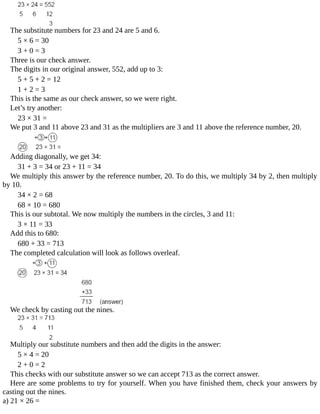
I	then	asked	him	if	67¢	was	a	reasonable	price	for	a	litre	of	petrol.	The	student	again	replied	yes.	I
asked	him	if	his	father’s	car	fuel	tank	could	hold	52	litres.	He	said	yes	again,	and	told	me	the	size	of	the
fuel	tank.
Finally,	I	asked	him	if	his	father	had	ever	paid	$3	000	000	for	a	tank	of	petrol.	Then	it	sank	in.	The
calculator	gave	an	answer	but	it	wasn’t	correct.	He	must	have	pressed	a	wrong	button.	The	answer	was
actually	$34.84.
Perhaps	the	most	important	rule	for	estimating	and	checking	answers	is:	does	the	answer	make	sense
—	is	it	reasonable?
Many	people	accept	a	calculator	answer	without	question.	We	need	to	be	able	to	estimate	answers	so
that	we	can	see	if	we	have	made	a	mistake	using	our	calculator.
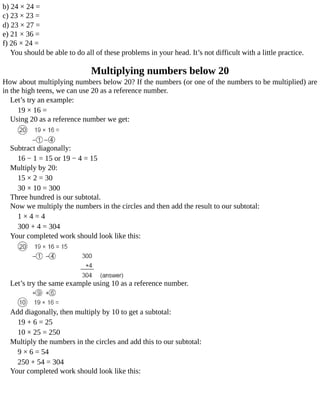
Chapter	24
Estimating	hypotenuse
Technicians,	 engineers,	 scientists	 and	 people	 in	 a	 diversity	 of	 other	 fields	 are	 often	 called	 upon	 to
calculate	the	length	of	the	hypotenuse	of	a	right-angled	triangle.
In	this	chapter	I	will	show	you	two	easy	methods	for	estimating	the	hypotenuse	of	a	right-angled
triangle.	The	standard	formula	for	calculating	the	length	of	the	hypotenuse	(h)	is:
h2
	=	a2
	+	b2
Earlier	in	this	book	I	showed	you	some	easy	methods	for	squaring	and	finding	the	square	roots	of
numbers,	so	the	above	formula	is	not	so	difficult	to	use.	However,	we	can	simplify	the	formula	even
more	 to	 get	 an	 estimate	 that	 is	 quite	 accurate	 with	 a	 minimum	 of	 effort.	 Here	 are	 two	 formulas	 to
experiment	with.
Where	the	lengths	of	the	sides	are	the	same	or	similar
Where	the	lengths	of	the	two	shorter	sides	of	a	right-angled	triangle	are	close	to	each	other	or	the	same,
you	can	use	the	following	formula:
It	is	much	easier	to	mentally	multiply	by	0.707	than	by	1.414.	The	twos	cancel	out,	so	we	are	left
with	the	easy	formula:	h	=	0.707	×	(a	+	b).
This	will	give	an	exact	answer	only	if	the	sides	are	exactly	the	same,	but	the	level	of	error	is	not	very
great	when	the	values	are	close.
Let’s	try	a	triangle	with	sides	measuring	3	and	4:
3	+	4	=	7
7	×	0.707	=	4.949
This	 is	 very	 close	 to	 the	 correct	 answer	 of	 5	 and	 can	 easily	 be	 calculated	 mentally.	 Because	 this
formula	will	give	an	answer	slightly	lower	than	the	actual	answer,	we	should	round	off	upwards	when
making	our	estimate.
Let’s	try	another	triangle,	this	time	with	sides	of	11	and	13.
11	+	13	=	24
Our	calculation	is	24	×	0.707.
To	multiply	by	24,	let’s	use	factors	of	12	and	2.
12	×	7	=	84,	so	12	×	0.707	=	8.484
We	now	multiply	8.484	by	2.	Because	the	answer	will	be	slightly	lower	than	the	actual	value,	we	can
round	8.484	upwards	to	8.5.
8.5	×	2	=	17
Actual	value	=	17.029
Our	answer	is	very	close;	close	enough	for	most	practical	purposes.
Let’s	try	a	triangle	with	sides	of	8	and	10.
8	+	10	=	18
To	multiply	by	18,	we	will	multiply	by	9	and	then	by	2.
9	×	0.707	=	6.363
6.363	×	2	=	12.726
This	calculation	can	easily	be	done	mentally.	Twice	6	is	12,	twice	36	is	72	and	2	threes	are	6.
Rounded	upwards,	this	gives	us	an	answer	of	12.8.	The	actual	answer	is	12.806	so	our	answer	came
very	close	with	a	minimum	of	effort.	This	is	impressive.
Let’s	try	one	more	—	a	triangle	with	sides	measuring	14	and	16.
14	+	16	=	30
30	×	0.707
3	×	7.07	=	21.21
Actual	value	=	21.26
Where	the	lengths	of	the	sides	are	different
When	the	sides	of	a	right-angled	triangle	differ	by	a	ratio	of	at	least	2	to	1,	we	use	a	different	formula.
Here	it	is:
This	time,	the	answer	will	be	slightly	high,	so	we	round	off	downwards.
Let’s	try	an	example.	Imagine	a	triangle	with	sides	of	5	and	15	(the	ratio	is	3:1).
Fifteen	and	30	are	both	divisible	by	5,	so	we	simplify	these	figures	to	 ,	which	is	approximately	0.83.
15	+	0.83	=	15.83
Actual	value	=	15.81
I	recently	had	to	calculate	the	hypotenuse	for	a	right-angled	triangle	with	sides	of	2	and	8	(a	ratio	of	4
to	1).
Using	our	easy	formula,	we	get:
This	simplifies	to	8¼	or	8.25.
How	 does	 this	 compare	 with	 the	 standard	 method	 of	 calculating	 a	 hypotenuse?	 In	 this	 case,	 the
numbers	are	easy,	so	let’s	try	it.
22
	+	82
	=	4	+	64	=	68
Now	we	find	the	square	root	for	68.	Let’s	use	the	estimation	method.
Our	estimate	is	8	(8	×	8	=	64)
Eight	divides	into	68	exactly	8½	times	(or	8.5).
Splitting	the	difference	gives	us	8.25,	which	is	the	same	as	our	shortcut	answer.
The	 actual	 answer	 is	 8.246,	 which	 rounds	 off	 to	 8.25.	 Both	 methods	 are	 easy	 to	 use	 and	 the
calculation	 can	 be	 made	 mentally	 using	 either	 method.	 I	 think	 the	 shortcut	 taught	 in	 this	 chapter	 is
easier	and	quicker.
How	about	a	triangle	with	sides	of	6	and	22?
36	and	44	are	both	divisible	by	4,	simplifying	to	 ,	which	is	approximately	0.82.
22	+	0.82	=	22.82
The	actual	answer	is	22.80.
Now	let’s	try	the	well-known	values	of	3,	4	and	5,	even	though	the	shorter	sides	are	of	similar	length.
This	answer	is	out	by	2.5	percent,	which	is	not	bad	considering	the	two	sides	are	very	close	in	value.
Using	our	other	formula,	we	got	an	answer	with	an	error	of	about	1	percent.
Neither	 formula	 gives	 an	 exact	 answer,	 but	 they	 will	 both	 give	 a	 quick,	 easy	 answer	 that	 can	 be
calculated	mentally.
These	formulas	are	extremely	useful	and	will	impress	your	friends	and	colleagues.	Try	using	them	in
class	and	you	will	gain	a	reputation	for	being	a	mathematical	genius.
Chapter	25
Memorising	numbers
I	have	received	many	emails	from	readers	around	the	world	asking	how	they	can	keep	multiple	numbers
in	their	heads	while	they	make	a	calculation.	They	either	have	trouble	remembering	subtotals	or	they
lose	track	of	the	original	number	they	are	working	with	halfway	through	the	calculation.
You	 will	 improve	 with	 practice.	 Solving	 problems	 mentally	 will	 develop	 your	 ability	 to	 hold
information	in	your	head	and	will	improve	your	concentration.	In	this	chapter	I	will	explain	a	method	of
memorising	numbers	that	is	well	worth	the	effort.
We	all	need	to	remember	numbers.	Our	lives	seem	to	be	governed	by	numbers;	telephone	numbers,
personal	 identification	 numbers	 (PINs),	 social	 security	 numbers,	 employee	 numbers,	 model	 numbers
and	bank	account	numbers	—	there	seems	to	be	no	end	to	the	numbers	we	have	to	carry	in	our	heads.
If	you	make	mathematical	calculations	on	a	regular	basis,	or	take	mathematics	seriously,	there	are
also	some	mathematical	constants	you	need	to	know.	Everyone,	for	example,	should	know	the	value	of
pi.
Phonetic	values
By	far	the	most	versatile	of	memory	systems,	phonetic	values	will	not	only	make	memorisation	of	long
numbers	 easy;	 it	 can	 be	 used	 for	 memorising	 lectures,	 speeches,	 textbooks	 —	 in	 fact,	 any	 kind	 of
information	you	might	need	to	learn.	There	are	just	ten	simple	values	to	learn,	with	no	rote	memory
involved.
In	 his	 book	 Mind	 and	 Memory	 Training	 (1936),	 Ernest	 E	 Wood	 describes	 how,	 when	 he	 was
recuperating	from	a	long	illness	in	1910,	he	looked	at	systems	for	memorising	numbers	and	found	them
to	be	deficient	—	they	were	too	complicated.
He	devised	his	own	system,	which	has	been	adopted	by	mathematicians	and	memory	experts	around
the	world.
Table	25.1	shows	how	it	works.	Each	digit	has	a	phonetic	value	so	that	words	can	be	converted	to
numbers,	and	numbers	to	words.
Table	25.1	—	phonetic	values	from	1	to	5
Digit
Phonetic
value
Reminder
1 t
	
One	downstroke
It	looks	like	the	number	one	with	a	short	horizontal	crossbar
2 n
	
Two	downstrokes
3 m
	
Three	downstrokes
If	you	tip	the	letter	on	its	side,	it	resembles	the	number	three
4 r
	
‘R’	is	the	fourth	letter	of	the	word	‘four’
5 l
	
Hold	out	your	left	hand	in	front	of	you	with	the	palm	facing	away.	With	your	fingers	together	and	your	thumb
out,	your	hand	forms	the	letter	L.
Five	fingers	(including	thumb)	=	L
L	in	Roman	numerals	=	50.
At	this	stage,	keeping	your	place,	close	the	book	and	repeat	the	phonetic	values	of	the	numbers	one	to
five.
Easy,	wasn’t	it?	You	learned	them	without	realising	that	you	were	committing	them	to	memory.
Now	to	continue.	Table	25.2	shows	the	next	five	phonetic	values.
Table	25.2	—	phonetic	values	from	6	to	0
Now	close	the	book	again	and	call	off	the	phonetic	values	of	one	through	zero	from	memory.	If	you
make	a	mistake,	read	the	explanation	for	that	digit	again	and	try	them	through	once	more.	No	doubt	you
will	get	them	all	right	on	the	second	attempt.
You	will	notice	that	the	phonetic	equivalents	of	the	digits	are	all	consonants.	The	five	vowels	(a,	e,	i,
o,	u)	have	no	phonetic	value.	Therefore,	to	make	a	word	equal	to	the	number	twelve,	you	would	take	the
equivalent	of	1	(t)	and	2	(n),	and	by	inserting	a	vowel	between,	you	can	form	the	words	‘tan’,	‘ten’,
‘tin’,	‘ton’,	‘teen’,	‘tone’	and	‘tune’.
Take	a	pencil	and	paper	and	see	how	many	words	you	can	form	with	the	value	of	91.	By	taking	the
value	of	9	and	the	value	of	1	and	inserting	vowels,	you	should	be	able	to	come	up	with	quite	a	few.
Don’t	read	any	further	without	making	the	attempt,	even	if	you	try	without	writing	them	down.
What	is	the	value	of	9?	Remember	the	mirror	image?	And	the	value	of	1?	Again	remember,	one
downstroke.	 Your	 list	 should	 look	 something	 like	 this:	 ‘pat’,	 ‘pet’,	 ‘pit’,	 ‘pot’,	 ‘put’,	 ‘pate’,	 ‘peat’,
‘poet’.	Are	you	getting	the	idea	now?
Let	us	look	at	it	from	the	other	direction.	What	is	the	phonetic	value	of	the	word	‘moon’?	How	about
the	word	‘man’?	You	should	have	said	32	for	both	words;	m	=	3,	n	=	2.	What	is	the	value	of	the	words
‘tire’,	‘tar’	and	‘tree’?	Did	you	say	14?
Rules	for	phonetic	values
Now	let	us	look	at	a	few	simple	rules.	We	call	these	phonetic	values	because	we	assign	a	consonant	to
each	value	according	to	how	it	is	pronounced.
For	example,	if	a	‘c’	is	pronounced	like	a	‘k’,	as	in	‘carry’	or	‘can’,	it	has	a	value	of	7,	the	same	as
‘k’.	Say	the	words	‘kay’	and	‘gay’	out	loud.	Did	you	notice	that	these	sounds	are	similar,	with	the	‘k’
and	hard	‘g’	pronounced	at	the	back	of	the	throat?	A	hard	‘g’	also	has	a	value	of	7.
Say	the	letters	‘t’	and	‘d’	out	loud.	Notice	that	you	position	your	tongue	the	same	way	to	make	both
sounds.	A	‘t’	is	like	a	hard	‘d,’	so	according	to	our	system	they	both	have	a	value	of	1.
‘V’	and	‘f’	are	both	pronounced	with	your	upper	teeth	on	your	lower	lip.	An	‘f’	is	basically	a	hard	‘v’,
so	they	both	have	a	value	of	8.	The	‘ph’	sound	in	words	such	as	‘photo’	is	pronounced	like	an	‘f’	and
has	the	same	value,	8.
The	letters	‘b’	and	‘p’	are	both	formed	with	the	lips	(try	it!)	and	have	the	same	value,	9.	Thinking	of
BP	(British	Petroleum)	will	help	you	remember	this.
The	‘j’	sound	is	similar	to	many	sounds	in	English;	the	soft	‘g’	in	‘magic’	and	‘Geoff’,	the	‘dge’	in
‘edge’,	the	‘sh’	in	‘shoe’	and	the	‘ch’	in	‘chow’	all	therefore	have	a	value	of	6.	The	‘s’	in	treasure	and	‘c’
in	ocean	also	have	a	value	of	6.
You	will	readily	see	that	‘z’	and	‘s’	have	a	similar	sound.	They	both	have	a	value	of	zero.	A	soft	‘c’
(as	in	‘cent’)	is	pronounced	the	same	as	an	‘s’	(as	in	‘sent’)	and	has	the	value	of	zero	as	well.
Silent	letters,	such	as	the	‘k’	in	‘knife’,	‘knob’	and	‘knee’,	the	‘b’	in	‘comb’	and	‘limb’,	and	the	‘l’	in
‘palm’	and	‘walk’,	have	no	value.
The	only	other	consonants	without	value	are	‘w’,	‘h’	and	‘y’.	These	are	easy	to	remember	because
they	spell	the	word	‘why’.	Table	25.3	is	a	more	detailed	list	of	the	phonetic	values.
Table	25.3	—	phonetic	values
Digit Phonetic	value Reminder
1 t	and	d One	downstroke
2 n Two	downstrokes
3 m Three	downstrokes
4 r ‘R’	is	the	fourth	letter	of	the	word	‘four’
5 l
L	=	50	in	Roman	numerals	Left	hand	with	fingers	together	and	thumb	out	makes	an	‘L’	Five	fingers
(including	thumb)	=	L
6
j,	sh,	ch,	tch,	soft	G	and
dge
‘J’	looks	like	a	mirror	image	of	six
7 k,	hard	c	and	hard	g ‘K’	can	be	written	with	two	sevens
8 f,	v,	ph A	handwritten	f	looks	like	an	eight
9 p	and	b ‘P’	looks	like	a	mirror	image	of	nine
0 z,s	and	soft	c ‘Zero’	begins	with	a	‘z’
Also:
	
Vowels	have	no	value.
Consonants	‘w’,	‘h’	and	‘y’	have	no	value.
Double	letters	that	don’t	change	the	consonant	sound	have	the	value	of	a	single	letter.
Silent	letters	have	no	value.
Pronunciation	determines	the	value	of	any	letter.
For	our	purposes,	‘r’	is	always	pronounced.
Double	letters,	such	as	the	double	‘t’	in	‘butter’	or	the	double	‘b’	in	‘rabbit’,	are	pronounced	the
same	 way	 as	 if	 they	 were	 single	 letters,	 because	 they	 only	 change	 the	 sound	 of	 the	 vowel.
Therefore,	 ‘matter’	 would	 have	 a	 value	 of	 314,	 not	 3114.	 ‘Letter’	 would	 be	 514,	 not	 5114.	 Be
careful,	though,	with	words	like	‘accent’,	in	which	each	‘c’	is	pronounced	differently;	the	first	‘c’	is
7	(pronounced	like	a	‘k’)	and	the	second	is	zero	(pronounced	like	an	‘s’).
Now	let’s	see	how	we	can	use	phonetic	values	to	memorise	numbers.
In	Melbourne,	Australia,	the	telephone	number	to	dial	for	the	talking	clock	is	1194.	If	you	picture	a
teddy	bear	answering	the	phone	and	telling	you	the	time,	you	will	never	forget	the	number.
This	picture	joins	the	number	to	the	reason	for	learning	it.
How	would	you	remember	the	value	of	pi?	Pi	has	a	value	of	3.141592653579.	The	value	rounded	off
to	 eight	 digits	 to	 fill	 an	 eight-digit	 calculator	 would	 be	 3.1415927.	 An	 easy	 way	 to	 remember	 the
number	is	to	convert	it	to	ma	turtle	bank.
Who	is	baking	the	pie?	Ma.	What	kind	of	pie	is	it?	A	turtle	pie.	Where	do	you	go	to	get	turtles?	A
turtle	bank,	of	course!	Imagine	your	ma	going	to	a	turtle	bank	and	saying,	‘I	want	to	withdraw	two
turtles.	I	want	to	bake	a	turtle	pie’.	The	letter	values	would	look	like	this:
You	will	never	forget	the	value	of	pi.	I	have	had	students	use	my	methods	to	memorise	pi	to	hundreds
of	decimal	places	and	call	out	the	number	both	backwards	and	forwards.	Imagine	doing	this	just	for	fun!
I	use	this	method	to	memorise	the	PINs	for	my	credit	cards.	One	of	my	old	cards	had	a	PIN	of	8435,
which	converts	to	‘formal’.	I	pictured	having	to	dress	formally	each	time	I	had	to	visit	that	particular
bank	or	they	wouldn’t	allow	me	through	the	door.	Make	a	picture	that	joins	the	number	to	the	particular
card	or	establishment.
You	can	use	this	system	to	memorise	all	of	your	friends’	telephone	numbers.	Dates,	mathematical
constants,	prices,	specifications,	quantities	—	in	fact,	anything	to	do	with	numbers	—	become	easy	to
memorise	using	this	system.
Read	through	this	section	again	to	review	all	the	phonetic	values.
Phonetic	values	test
Here	is	a	test	to	see	how	well	you	have	mastered	the	material	in	this	section.	What	are	the	phonetic
values	of	the	following	words?
boot.	.	..	.	..	.	..	.	..	.	..	.	..	.	..	.	. television.	.	..	.	..	.	..	.	..	.	..
foot.	.	..	.	..	.	..	.	..	.	..	.	..	.	..	.	. nation.	.	..	.	..	.	..	.	..	.	..	.	...
photo.	.	..	.	..	.	..	.	..	.	..	.	..	.	... concentration.	.	..	.	..	.	..	.	..
hurry.	.	..	.	..	.	..	.	..	.	..	.	..	.	... chrome.	.	..	.	..	.	..	.	..	.	..	.	...
vision.	.	..	.	..	.	..	.	..	.	..	.	..	.	.. battery.	.	..	.	..	.	..	.	..	.	..	.	..
comb.	.	..	.	..	.	..	.	..	.	..	.	..	.	..	.	.
Your	answers	to	the	words	above	should	be:	boot	=	91;	foot	=	81;	photo	=	81;	hurry	=	4;	vision	=
862,	(careful	—	‘si’	in	‘vision’	has	a	value	of	6,	pronounced	like	a	soft	‘sh’),	comb	=	73	(‘b’	is	silent,
having	no	value).	Television	=	15862;	nation	=	262;	concentration	is	72021462,	(note	the	two	values	of
‘c’	and	‘t’)	chrome	=	743	(‘ch’	=	7,	pronounced	like	a	‘k’)	and	battery	=	914.
Recheck	the	rules	for	the	values	you	got	wrong	and	try	them	again.	This	time	you	should	get	them	all
correct.
Please	note	that	‘r’	is	always	pronounced	for	the	purposes	of	this	system.	In	some	parts	of	England,
New	Zealand	and	Australia,	we	tend	to	pronounce	words	such	as	‘form’,	‘farm’,	‘arm’	and	‘turn’	as	if
the	‘r’	was	missing.
‘Th’	has	the	value	of	1,	but	we	will	avoid	using	it	where	we	can.	‘Ng’	has	a	value	of	27.	For	example,
‘sing’	=	027.
In	 the	 next	 chapter	 you	 will	 learn	 how	 to	 use	 the	 phonetic	 values	 as	 a	 mental	 filing	 system	 to
memorise	 huge	 chunks	 of	 information.	 You	 will	 also	 learn	 a	 method	 to	 immediately	 come	 up	 with
phonetic	equivalents	for	any	number.
Chapter	26
Phonetic	pegs
Because	I	have	memorised	a	list	of	words	that	I	use	to	represent	numbers	from	1	to	100,	I	don’t	have	to
search	in	my	mind	for	a	phonetic	equivalent	when	I	am	given	a	number	to	memorise.	I	also	use	the	list
as	 a	 mental	 filing	 system	 to	 memorise	 information	 and	 arguments.	 It	 is	 also	 useful	 for	 memorising
numbers	during	a	calculation.
I	call	these	words	reminders,	or	pegs.	When	I	attended	primary	school	there	were	pegs	outside	the
classrooms	on	which	to	hang	our	hats	and	coats.	When	you	wanted	your	coat	again,	you	simply	went	to
the	appropriate	peg	and	got	it.
I	 use	 pegs	 to	 hang	 my	 information	 on.	 When	 I	 want	 to	 retrieve	 some	 information,	 I	 go	 to	 the
appropriate	peg	or	reminder.	This	is	an	effective	and	efficient	method	for	study.	Tests	have	shown	that
students	are	able	to	do	more	than	two	hours	of	study	in	less	than	ten	minutes	using	this	method.	Pegs
take	the	hard	work	out	of	study	and	can	even	make	learning	dull	information	an	enjoyable	experience.
Now	that	you	know	the	phonetic	values,	you	will	have	no	trouble	learning	the	phonetic	pegs.	These
pegs	will	be	your	companions	for	the	rest	of	your	life	and	will	serve	you	over	and	over	again.
The	peg	for	1	is	‘tie’.	Why	‘tie’?	Because	the	word	‘tie’	has	a	phonetic	value	of	1	(‘t’	=	1	and	the
vowels	 have	 no	 value).	 Picture	 a	 necktie.	 Making	 a	 quick	 mental	 picture	 requires	 a	 high	 level	 of
concentration	and	you	will	find	that	this	method	makes	it	easier	to	remember	the	phonetic	equivalent	for
1.	If	you	were	to	forget	the	peg	for	1,	you	know	that	1	equals	‘t’	or	‘d’.	You	would	then	try	the	vowels
after	the	phonetic	equivalent	until	you	recognised	the	correct	word:	‘Tay’,	‘tea’,	‘tie’;	that’s	it,	‘tie’!	If
you	didn’t	recognise	the	peg,	you	would	try	listing	vowels	after	letter	‘d’:	‘Day’,	‘dee’,	‘die’,	‘doe’,	‘do’
or	‘dew’.	There	is	no	rote	memory	involved	here.
Here	are	the	pegs	from	one	to	ten:
1	tie
2	Noah
3	ma	(picture	your	mother	or	mother-in-law)
4	rye	(picture	a	loaf	of	rye	bread)
5	law	(picture	a	police	officer)
6	shoe
7	cow
8	ivy	(picture	an	object	covered	with	ivy.	If	you	are	a	male	and	married,	you	could	substitute	‘wife’	for
8)
9	bee	(picture	the	object	to	be	memorised	being	stung	by	a	bee)
10	toes	(picture	your	own	toes,	if	possible,	with	the	thing	to	be	memorised.	T	=	1,	s	=	0;	also,	you
probably	have	ten	toes).
Read	the	pegs	through	once	again,	and	picture	each	peg	briefly	before	passing	on	to	the	next.	Now
close	the	book	and	repeat	them	from	memory.
If	you	forget	any,	make	a	vivid	picture	of	the	peg	in	your	mind	and	try	again.	You	certainly	got	them
all	right	this	time.
Now	let’s	put	our	newly	learnt	pegs	to	work.	Let’s	say	there	are	six	things	you	want	to	remember	to
do	tomorrow.	Firstly,	you	want	to	buy	a	dozen	eggs.	Associate	eggs	with	tie	and	you	have	it.	You	could
picture	yourself	using	the	tie	as	a	slingshot	and	hurling	the	eggs	at	targets,	or	you	may	imagine	a	carton
of	eggs	tied	to	the	end	of	your	necktie.
Number	two:	you	want	to	pay	your	dentist’s	bill.	Imagine	yourself	going	to	your	dentist’s	waiting
room	to	find	Noah	waiting	there	with	the	animals	from	his	ark.	A	giraffe,	a	hippo	and	an	elephant	have
taken	all	of	the	seats,	and	you	have	trouble	getting	through	the	door.
Number	three:	you	have	to	buy	a	lamp.	Imagine	plugging	your	ma	into	the	power	socket	and	she
lights	up	like	a	lamp.	See	it	in	your	mind.	Silly,	but	effective.
Number	four:	you	want	to	have	the	car	washed.	Imagine	yourself	washing	the	car	with	a	loaf	of	rye
bread	instead	of	a	sponge.
Number	five:	you	want	to	withdraw	some	money	from	the	bank.	This	one	sounds	easy.	Imagine	a
bank	hold-up	in	your	local	branch,	with	the	law	and	the	robbers	having	a	shoot-out,	and	you	in	the
middle.
Number	six:	you	want	to	remember	to	telephone	your	aunt	tomorrow.	You	picture	yourself	speaking
into	your	shoe	instead	of	the	telephone	handset.
Now	call	back	the	things	you	have	memorised	for	tomorrow.	Number	one,	tie;	number	two,	Noah;
and	so	on.	You	probably	had	no	trouble	recalling	all	six.	It	is	just	as	easy	with	10	or	20	items.	Isn’t	that
fantastic?	You	can	use	this	simple	technique	every	time	you	go	shopping	or	to	plan	your	daily	schedule.
This	list	of	reminders	is	also	vital	for	memorising	long	numbers,	memorising	numerical	tables	and
also	for	keeping	track	of	numbers	as	you	make	involved	calculations.
Here	are	the	pegs	for	11	to	20.
11	tot	(visualise	a	small	child	whom	you	know	well;	your	own	son	or	daughter,	a	neighbour’s	child,	or	a
brother	or	sister.	Imagine	the	same	child	each	time.	That	child	will	now	represent	eleven	from	now	on).
12	tin
13	tomb
14	tyre	(I	visualise	a	car	tyre)
15	towel
16	dish
17	dog	(your	own,	or	one	you	know)
18	dive
19	tub
20	nose
Read	these	pegs	through	a	couple	of	times,	picturing	each	peg	as	you	read	it	and	then	close	the	book
and	call	them	back.	Say	you	forget	number	12;	you	will	easily	recall	it	by	remembering	the	values	for	1
and	2	(‘t’	and	‘n’).
Then,	go	through	the	vowels,	inserting	them	between	the	consonants,	until	you	recognise	the	peg.
‘Tan’,	‘ten’,	‘tin’;	that’s	it,	‘tin’!	How	about	13?	‘Tam’,	‘tem’,	‘tim’,	‘tom’,	‘tum’;	no,	not	yet.	So	we
continue	with	the	long	vowels.	‘Tame’,	‘team’,	‘time’,	‘tome’,	‘tomb’;	that	sounds	like	it,	‘tomb’!	You
can	see	how	difficult	it	would	be	to	forget	the	pegs.
An	impressive	demonstration
Now,	here	is	an	exercise	I	want	to	give	you.	As	soon	as	you	feel	confident	with	the	pegs	from	1	to	20,
ask	a	friend	or	someone	in	your	family	to	give	you	a	test.	Have	them	write	the	numbers	1	to	20	down
the	 left-hand	 side	 of	 a	 piece	 of	 paper.	 Then	 have	 them	 call	 out	 one	 of	 the	 numbers	 and	 an	 object,
something	tangible,	not	abstract,	and	write	it	down	alongside	that	number.	For	instance,	they	might	say,
‘Fifteen,	sailboat.’	You	would	picture	a	sailboat	with	your	bathroom	towels	for	sails.
Make	a	ridiculous	picture	in	your	mind	to	join	the	peg	(reminder)	with	the	item	they	name.	They
continue	to	call	out	numbers	and	objects	in	random	order	until	all	twenty	have	been	called.	If	you	need
extra	time	to	make	a	connection,	ask	for	it	—	you	are	the	person	giving	the	demonstration.
You	 will	 find	 that	 with	 practice	 it	 will	 become	 easier	 to	 make	 the	 connections.	 Then,	 to	 the
astonishment	of	your	audience,	you	will	be	able	to	call	out	the	numbers	1	to	20	with	the	appropriate
object,	 and	 in	 the	 correct	 order.	 This	 is	 very	 impressive	 —	 and	 so	 it	 should	 be.	 You	 have	 done
something	that	very	few	people	can	do.
So	impressive,	in	fact,	that	people	will	not	believe	what	they	see	and	hear;	they	will	insist	that	there	is
a	trick	involved.	Don’t	be	kidded	that	it	was	a	trick	—	you	are	simply	using	a	very	effective	memory
technique.	No	matter	how	you	memorised	the	material,	the	fact	remains	that	you	are	now	able	to	repeat
it	from	memory.	This	is	a	fun	way	to	practise	your	pegs	and	your	associations.
Six	rules	for	making	associations
Here	are	some	rules	to	help	you	make	effective	pictures	in	your	mind	to	memorise	new	information.
	
Exaggerate	the	size	(make	it	bigger,	not	smaller)	of	the	object	you	are	trying	to	memorise.
Exaggerate	the	number	of	the	items	to	be	memorised.	Visualise	millions	of	them.
Involve	action.	Have	the	item	doing	something,	or	having	something	done	to	it.
Substitute	the	peg	for	the	item,	or	the	item	for	the	peg.
Make	 the	 association	 ridiculous.	 We	 remember	 the	 absurd	 long	 after	 we	 have	 forgotten	 the
ordinary	incidents	of	life.	Also,	the	effort	involved	in	making	a	ridiculous	association	forces	us	to
concentrate	more	on	whatever	it	is	we	are	trying	to	memorise.
Form	a	vivid	mental	picture	of	the	association.	This	is	probably	the	most	important	rule.	A	brilliant
association	that	is	not	visualised	is	more	likely	to	be	forgotten	than	a	poor	association	that	you	see
clearly	in	your	mind.	Try	to	involve	your	other	senses	in	your	mental	picture	to	make	it	more	real.
Imagine	that	you	can	hear	and	feel	your	association,	if	you	can,	rather	than	just	see	it.
Now	go	on	and	memorise	the	pegs	up	to	100.	Here	are	some	tips	that	will	make	it	easier	for	you.
Learn	them	in	chunks	of	ten.	As	soon	as	you	can	repeat	ten	pegs,	go	on	to	the	next.	Push	yourself	until
you	have	learned	the	whole	hundred.
It	 is	 better	 if	 you	 don’t	 put	 time	 aside	 to	 do	 this.	 Memorise	 the	 hundred	 pegs	 while	 you	 are
performing	chores	that	don’t	require	your	full	concentration,	such	as	washing	a	mountain	of	dishes,
cleaning	your	garage,	or	mowing	your	lawn.
Go	 through	 the	 hundred	 pegs	 as	 quickly	 as	 possible.	 Then	 concentrate	 on	 the	 pegs	 that	 give	 you
trouble.	 Those	 with	 complex	 vowel	 sounds	 like	 52	 (‘lion’),	 require	 special	 attention.	 They	 can’t	 be
recalled	by	going	through	the	long	and	short	vowels,	although	a	similar-sounding	word	might	remind
you	of	the	correct	peg.	Note	those	problem	pegs	and	form	especially	vivid	pictures	of	those	words	in
your	mind.	If	you	review	the	hundred	pegs	every	day	for	a	month,	you	will	know	them	well.
Reviewing	the	pegs	is	no	problem	either.	You	don’t	need	to	have	this	book	with	you.	While	you	are
sitting	in	the	bath,	eating	in	a	restaurant,	or	walking	down	the	street,	go	over	the	pegs	in	your	mind	and
take	note	of	the	numbers	you	can’t	recall.	When	you	return	to	your	list	to	check	the	correct	peg,	it	will
impress	itself	in	your	mind.	Again,	be	sure	to	visualise	a	picture	of	the	peg.	If	you	are	stuck	for	a	good
association,	even	a	good	picture	with	a	poor	association	will	usually	work.
For	number	23,	‘name’,	imagine	a	business	card	with	your	name	on	it,	or	a	nameplate	on	your	office
door	or	desk.	For	24,	imagine	Nero	wearing	a	toga	and	playing	his	fiddle.	I	picture	an	evil	man.	For	26,
‘notch’,	I	think	of	cutting	a	notch	in	something	to	keep	count.
Thirty-three	is	an	Egyptian	mummy,	46	is	a	cockroach,	an	insect	pest	that	gets	into	food,	and	43	is	a
ram.	So	that	I	don’t	get	43	confused	with	53,	‘lamb’,	I	think	of	a	battering	ram.	Eighty-nine	is	‘fob’	—
you	can	think	of	a	pocket	watch	attachment,	or	a	man’s	fob	pocket	in	his	trousers.	You	could	use	the
pocket	watch	itself	as	your	peg;	many	people	call	it	a	fob	watch.
When	you	are	confident	with	your	hundred	pegs,	or	to	help	you	learn	them,	you	can	use	them	to	plan
your	whole	week.	Use	the	pegs	from	10	to	19	for	the	first	day	of	the	week,	20	to	29	for	the	second	day,
up	to	70	to	79	for	Saturday,	the	seventh	day	of	the	week.
You	will	also	be	able	to	memorise	a	magazine	or	book	by	page	number	and	you	will	find	it	easy	to
memorise	an	outline	or	summary	of	each	page.	This	could	be	an	impressive	demonstration,	and	useful
too.	Figure	26.1	shows	the	phonetic	pegs	from	1	to	100.
Figure	26.1	—	phonetic	pegs	from	1	to	100
	
Memorising	square	roots
Here	is	how	I	use	pegs	(or	reminders)	to	memorise	the	square	roots	of	numbers	up	to	10.	We	don’t	need
to	memorise	the	square	roots	of	1,	4	and	9,	as	they	are	easily	calculated	and	you	shouldn’t	need	any
reminder.
Let’s	begin	with	the	square	root	of	2.	The	reminder	for	2	is	‘Noah’	and	the	square	root	is	1.414.	We
know	the	value	must	lie	between	1	and	2,	so	we	really	only	need	to	memorise	the	digits	that	follow	the
decimal	point.	We	have	chosen	the	phonetic	equivalent	of	‘rudder’	to	remind	us	of	414,	an	object	that	is
easily	associated	with	Noah’s	Ark.	Picture	yourself	manning	the	rudder	on	Noah’s	Ark	and	steering	it
where	you	want	it	to	go.	You	have	just	memorised	the	square	root	of	2.
For	three,	the	reminder	is	‘ma’.	The	square	root	of	3	is	1.732.	Picture	your	ma	wearing	a	kimono.
Picture	your	ma	wearing	a	kimono	in	an	embarrassing	situation!
We	skip	4	and	go	on	to	5.	Five	is	‘law’	and	the	value	is	2.236,	which	we	convert	to	‘name	show.’	The
police	(the	‘law’)	have	staged	a	line-up	and	everyone	stands	in	line	holding	a	card	with	their	name.
Visualise	it	as	a	‘name	show’.
Six	is	2.449,	which	we	can	convert	to	‘raw	rope’.	The	peg	for	6	is	shoe.	I	picture	shoes	from	the
sixties	which	were	made	from	rope.	The	rope	hasn’t	been	cooked	so	it	is	raw.
The	peg	for	7	is	‘cow’	and	the	square	root	is	2.646.	We	can	convert	646	as	either	‘charge’	(imagine	a
cow	charging	you)	or	‘George’;	you	have	named	your	cow	George.	I	would	choose	the	picture	of	the
cow	charging	at	you,	as	this	image	is	more	memorable.
The	peg	for	8	is	‘ivy’	and	the	square	root	is	2.848.	This	peg	could	be	‘verve’	or	‘heavy	roof’.	Picture
ivy	growing	all	over	your	roof	that	is	so	heavy	it	causes	your	roof	to	collapse.
The	peg	for	10	is	‘toes’	and	the	square	root	of	10	is	3.162.	If	you	picture	your	toes	shining	(‘toe
shine’),	you	will	have	no	trouble	remembering	the	square	root	of	10.	Picture	them	lighting	up	at	night.
Table	26.1	shows	all	of	these	square	roots	and	their	phonetic	pegs.
Table	26.1	—	square	roots	and	their	pegs
Number Square	root Peg
2 1.414 rudder
3 1.732 kimono
4 2
5 2.236 name	show
6 2.449 raw	rope
7 2.645 charge,	George
8 2.828 heavy	roof
9 3
10 3.162 toe	shine
Now,	read	through	the	list,	see	the	pictures	as	clearly	in	your	mind	as	you	can,	then	close	the	book
and	call	back	the	square	roots	from	memory.
You	have	learned	the	square	roots	to	three	decimal	places	in	record	time	with	hardly	any	effort.	Are
you	impressed?
Chapter	27
Memorising	long	numbers
It	is	one	thing	to	memorise	lists	of	two,	three	or	four-digit	numbers,	but	how	can	we	apply	this	method
to	learning	longer	numbers	of	10	to	20	digits,	such	as	credit	card,	bank	account	and	telephone	numbers?
I	had	a	student	memorise	the	value	of	pi	to	several	hundred	digits.	The	number	was	written	around
the	walls	of	his	maths	classroom	at	school	and	he	not	only	memorised	the	number,	he	was	able	to	call	it
out	in	forward	or	reverse	order,	much	to	the	amazement	of	his	classmates.
Let	us	use	pi	as	an	example	of	how	to	memorise	long	numbers	with	a	minimum	of	effort.	The	method
actually	makes	it	fun.
Memorising	pi
First,	I	told	the	student	to	break	the	number	up	into	digit	pairs.	The	first	20	digits	after	the	decimal
would	be	written	like	this:
14	15	92	65	35	89	79	32	38	46
Now	we	find	the	phonetic	pegs	for	each	of	the	two-digit	numbers.	I	told	him	to	leave	the	first	four
digits	as	turtle.	That	gives	us:	turtle,	pen,	jail,	mail,	fob	(as	in	fob	pocket	or	fob	watch),	cap,	moon,
movie	and	roach.
Now	we	join	the	words.	We	don’t	do	this	by	making	a	story—that	leaves	too	big	a	margin	for	error.
You	could	leave	out	part	of	the	story	and	be	unaware	of	it.	I	link	each	word	to	the	next	word	in	the	list.
We	do	this	by	means	of	a	crazy	picture.	See	the	picture	clearly	in	your	mind	(or	as	clearly	as	you	can)
and	you	will	attain	a	high	level	of	concentration.	Here	is	how	I	would	memorise	the	value	of	pi	to
twenty	decimal	places.
3.	14	15	92	65	35	89	79	32	38	46
ma	turtle	pen	jail	mail	fob	cap	moon	movie	roach
I	join	the	first	word	to	the	reason	for	learning	the	list.	We	are	learning	the	value	of	pi	so	I	picture	my
ma	baking	a	pie.	What	kind	of	pie?	A	turtle	pie.	Imagine	the	turtles	going	into	the	pie.	Now	I	join	turtle
to	pen.	Picture	writing	letters	on	a	turtle	shell	with	a	waterproof	pen.	Visualise	it!
I	join	pen	to	jail	by	picturing	writing	my	life	story	on	the	cell	wall.	I	could	also	imagine	that	the
prison	bars	are	really	pens,	or	that	people	smuggle	letters	into	my	cell	rolled	up	in	a	pen.	I	can	join	jail
to	mail	by	mailing	myself	outside	the	prison,	or	receiving	a	huge	pile	of	fan	mail	inside	the	prison.
A	fob	pocket	is	the	small	pocket	in	the	front	of	your	trousers	that	you	use	for	your	small	change	or	to
hold	your	fob	watch	(pocket	watch).	Instead	of	putting	your	mail	in	the	mail	slot	you	put	it	in	your	fob
pocket.	See	it.	Or	visualise	yourself	taking	your	mail	from	your	fob	pocket	to	put	in	the	post.
We	now	join	fob	to	cap.	Picture	a	giant	fob	pocket	so	large	that	you	can	slip	your	head	into	it	and
wear	it	like	a	cap.
To	join	moon	with	cap	I	simply	imagine	the	moon	up	in	the	sky	wearing	my	cap	and	smiling	down	at
me.	That	enables	me	to	remember	it.	Now	we	join	moon	with	movie.	Picture	a	giant,	super-powered
projector	that	you	use	to	show	your	home	movies	to	the	entire	world,	using	the	moon	as	a	giant	screen.
Lastly,	we	have	the	word	roach,	or	cockroach.	Picture	cockroaches	crawling	all	over	the	projector	lens,
or	a	horror	movie	about	killer	cockroaches.
I	often	have	people	tell	me	that	this	method	hasn’t	worked	for	them.	They	are	embarrassed	by	the
silly	pictures	I	suggest.	I	surprise	them	by	asking	them	questions	to	demonstrate	that	they	actually	have
memorised	the	material	without	being	aware	of	it.	See	if	you	can	answer	the	following	ten	questions.
	
Who	is	baking	the	pie?
What	kind	of	pie	is	it?
What	are	you	doing	with	the	turtle?	What	with?
Where	are	the	pens?
How	do	you	get	out?
Where	are	you	putting	it?
What	are	you	wearing?
Where	is	the	cap?	Who	or	what	is	wearing	it?
What	are	you	using	the	moon	for?
What	is	the	movie	about?
If	you	missed	any,	make	the	picture	again	and	try	to	see	it	more	clearly.	Add	more	detail	and	make
the	picture	as	crazy	as	possible,	then	go	through	the	list	again.	This	time	you	will	get	them	all	right.	This
is	much	better	than	rote	memorisation	—	more	pleasant	and	more	effective.
Now	surprise	yourself	by	calling	the	words	backwards.
I	am	sure	you	found	that	to	be	easy.	Now	change	the	words	to	numbers	and	this	time	call	out	the
value	of	pi	to	20	decimal	places	or	21	digits.	This	is	the	easiest	way	to	memorise	long	numbers.
There	may	not	be	much	practical	use	to	memorising	a	20,	30	or	40-digit	number,	but	you	can	easily
use	this	method	to	keep	track	of	numbers	during	a	mental	calculation.
In	the	meantime,	here	is	the	value	of	pi	to	50	decimal	places.
3.1415926535	8979323846	2643383279	5028841971	6939937510
You	will	see	that	in	the	next	ten	digits	to	memorise,	the	digit	pair	38	comes	up	again,	followed	by	32
and	79.	Instead	of	using	movie	and	moon	again,	I	visualise	‘mafia	men’	riding	in	a	cab.	Instead	of	‘cab’,
you	 might	 choose	 to	 use	 ‘cop’,	 which	 fits	 in	 with	 the	 idea	 of	 mafia	 men.	 You	 could	 picture	 a	 cop
arresting	the	gangsters.
You	might	as	well	learn	the	value	of	pi	to	30	decimal	places	now,	as	you	have	already	done	most	of
the	work.
Join	roach	to	notch,	26;	I	imagine	cutting	notches	to	keep	count	of	the	number	of	roaches	I	have
squashed.	The	next	digit	pair	is	43,	‘ram’.	You	can	imagine	a	male	sheep	or	a	battering	ram.	In	this	case
I	would	go	for	a	battering	ram	and	visualise	cutting	notches	to	keep	count	of	the	number	of	doors	I	have
smashed	with	it.	Then	I	use	the	ram	to	smash	the	door	of	the	mafia	headquarters	while	the	mafia	men
make	their	getaway	in	a	cab.
There,	you	have	now	learnt	the	value	of	pi	to	30	decimal	places,	and	almost	without	effort!	Now	call
out	pi	to	30	decimal	places	and	then	call	it	again	backwards.
You	are	now	ready	to	use	this	method	as	a	tool	in	making	complicated	mental	calculations.
Mental	calculation
I	was	walking	up	Bourke	Street	in	Melbourne	and	I	decided	to	cube	88	in	my	head	before	I	reached
Exhibition	Street,	two	blocks	away.	I	knew	I	could	do	it	because	I	could	always	stall	and	buy	myself	a
drink	if	I	needed	extra	time.	I	decided	the	easiest	method	was	to	multiply	8	×	8	×	8	and	multiply	the
answer	by	11	×	11	×	11.	The	biggest	problem	was	keeping	track	of	the	numbers	I	was	working	with.	In
the	second-half	of	this	chapter	I	am	going	to	explain	how	to	keep	track	of	working	totals	as	you	make
your	calculations.
Let	me	give	you	a	blow-by-blow	account	of	how	we	would	make	this	calculation.
We	multiply	8	×	8	×	8	without	difficulty.
8	×	8	=	64
64	×	8	=	512
Then	we	have	to	multiply	512	by	11.	Using	the	shortcut	method	taught	in	this	book,	we	add	each
digit	to	the	digit	on	its	right.
To	multiply	512	by	11,	we	add	2	to	the	digit	on	the	right,	which	is	nothing,	so	the	answer	is	2.	Next,
we	add	1	+	2	to	get	3.	We	now	have	the	final	two	digits	of	the	answer,	32.	The	peg	for	32	is	‘moon’,	so
we	picture	the	moon.	Then	we	add	5	+	1	=	6	to	get	the	next	digit	of	the	answer.	The	last	addition	is	0	+	5
=	5,	so	the	first	two	digits	are	56	(‘leech’).	The	first	answer	is	5632,	which	we	have	memorised	as	‘leech
moon’.	Imagine	giant	leeches	crawling	all	over	the	moon.
Next,	we	multiply	5632	by	11.	The	last	word	in	the	chain	is	‘moon’,	so	the	final	digit	is	2.	Two	plus
nothing	is	2,	the	final	digit.	We	add	3	plus	2	(in	moon)	to	get	5;	so	the	final	digits	are	52,	‘lion’.	Six	plus
3	is	9.	Five	plus	6	is	11;	take	1	and	carry	1.
The	next	digits	are	19,	‘tub’.	Now	we	link	‘tub’	with	‘lion’	by	imagining	an	African	lion	bathing	in	a
bathtub.	The	last	addition	is	nothing	plus	5,	plus	1	carried,	equals	6.	That	is	the	final	digit	so	the	peg	for
6	is	‘shoe’	—	the	bathtub	is	actually	a	giant	shoe!	We	link	‘shoe’,	‘tub’,	and	‘lion’	to	get	our	answer,	61
952.
There	is	one	more	multiplication	by	11	to	go.	Multiply	61	952	by	11.	The	final	digits	are	‘lion’,	or	52.
Two	plus	nothing	is	2,	so	that	will	be	the	last	digit	of	the	answer.	Five	plus	2	(lion)	is	7,	so	the	final
digits	are	72,	‘coin’.	Picture	a	coin.	Next	we	have	9	(from	‘tub’)	plus	5	to	get	14.	Carry	1.	Next	we	add
1	+	9	+	1	carried,	giving	us	11.	Again	we	carry	1.	The	latest	two	digits	are	1	and	4,	giving	us	‘tyre’.	We
join	‘tyre’	to	‘coin’	by	picturing	giant	coins	on	a	car	instead	of	tyres.
Now	we	add	6	+	1	+	1	carried,	giving	us	8.	Then,	nothing	+	6	=	6,	giving	us	68	for	the	final	digits.
‘Shave’	is	the	peg	for	68,	so	I	imagine	applying	shaving	cream	to	my	car	tyres	and	shaving	them.	We
have	now	memorised	the	answer	—	681	472.
Is	this	answer	correct?	We	can	check	by	casting	out	the	elevens.	The	odd-placed	digits	should	add	up
to	the	same	as	the	even-placed	digits,	or	there	should	be	a	difference	of	eleven	or	a	multiple	of	eleven.
That	is	easily	checked	using	the	two	digit	pegs.	We	add	the	first	digit	of	each	pair;	the	6	in	‘shave’,	the	1
in	‘tyre’	and	the	7	in	‘coin’.
6	+	1	+	7	=	14
Then	we	add	the	second	digit	of	each	pair;	8	in	‘shave’,	4	in	‘tyre’	and	2	in	‘coin’.
8	+	4	+	2	=	14
The	answers	are	the	same	so	it	looks	like	our	answer	of	681472	is	correct.	We	can	also	cast	out	nines
in	order	to	double-check.	What	should	the	answer	be?	The	two	digits	in	88	add	up	to	16,	which	in	turn
adds	up	to	7.	Seven	squared	is	49,	which	adds	up	to	4	(cast	out	the	9).	Four	×	7	=	28,	which	adds	up	to
10,	which	adds	up	to	1.	One	is	our	check	answer.
Casting	the	nines	from	the	answer,	8	and	1	cancel	out,	as	do	7	and	2,	which	leaves	us	with	6	+	4	=	10,
which	adds	up	to	1.	Our	answer	checks	both	ways.
This	 calculation	 and	 check	 would	 have	 been	 very	 difficult	 without	 our	 system	 for	 memorising
numbers.	I	use	it	often	to	keep	track	of	calculations	while	I	perform	them	mentally.
Chapter	28
Logarithms
I	was	travelling	by	train	from	the	city	to	my	home.	The	journey	took	about	55	minutes.	I	was	reading	a
book	by	an	American	mathematician	who	asserted	that	anyone	who	seriously	works	with	mathematics
should	memorise	the	basic	table	of	logarithms.	He	insisted	that	everyone	should	know	the	five-figure
logs	from	1	to	10	and	then	the	logs	of	the	prime	numbers	up	to	20.
He	gave	some	excellent	reasons	why	a	knowledge	of	logarithms	is	useful,	so	I	decided	to	use	my
method	of	memorising	numbers	to	learn	the	five-figure	log	tables	before	I	reached	my	railway	station.
That	gave	me	around	45	to	50	minutes	to	learn	them.	I	was	pleased	when	I	made	it	with	one	station	to
spare,	or	around	five	minutes	before	reaching	my	stop.
Afterwards,	I	read	a	book	by	a	Russian	author	who	said	that	it	wasn’t	necessary	to	learn	the	five-
figure	log	tables	—	the	two-figure	tables	are	quite	sufficient.	I	was	sorry	I	hadn’t	read	the	Russian	book
first.
What	are	logarithms?
The	 discovery	 of	 logarithms	 was	 a	 very	 important	 step	 in	 the	 development	 of	 our	 knowledge	 of
mathematics.	Simply	stated,	logarithms	express	numbers	as	a	power	of	ten	(this	applies	only	to	ten-
based	logarithms	—	everything	in	this	chapter	will	apply	to	ten-based	logarithms).
The	number	100	can	be	expressed	as	10	×	10	or	102
.	The	number	1000	can	be	expressed	as	10	×	10	×
10	or	103
.
So,	we	have	the	following:
10	=	101
100	=	102
1000	=	103
10	000	=	104
The	index	(or	power)	that	10	is	raised	to	becomes	the	logarithm	for	the	number.
Therefore,	the	logs	for	the	following	are:
10	=	1
100	=	2
1000	=	3
10	000	=	4
100	000	=	5
If	you	want	to	multiply	100	by	1000,	simply	add	the	logarithms	for	the	numbers.	The	log	for	100	is	2
and	the	log	for	1000	is	3.
2	+	3	=	5
To	get	the	answer,	you	then	find	the	number	with	the	logarithm	of	5,	which	we	can	see	from	our	list	is
100	000.	Addition	is	easier	than	multiplication.
The	value	of	the	logarithm	is	simply	the	number	of	zeros	that	follow	the	1	in	each	of	the	numbers	in
our	list.	We	don’t	need	to	refer	to	a	table	to	find	out	what	number	has	the	logarithm	of	6.	We	just	write	1
followed	by	six	zeros.
This	also	works	in	reverse	for	division.
1000	÷	10	=	100
This	can	be	written	as	103
	÷	101
	=	102
.
1000	has	a	log	of	3,	10	has	a	log	of	1	and	100	has	a	log	of	2,	so	you	can	make	the	division	calculation
by	subtracting	the	logs.
3	−	1	=	2
Remember,	to	multiply	you	add	the	logarithms	and	to	divide	you	subtract	the	logarithms.
Here	is	an	interesting	fact.
100
	=	1
How	do	we	know	this?
Or	we	could	say	that	102−2
	=	100
	=	1,	because	any	number	divided	by	itself	equals	1.
To	square	a	number,	you	double	the	exponent	or	logarithm.	Ten	equals	101
,	so	ten	squared	is	102
,	or
100.	One	thousand	is	103
	and	one	thousand	squared	is	106
,	or	one	million.
You	 could	 also	 say	 that	 to	 find	 the	 square	 root	 of	 a	 number	 you	 simply	 halve	 the	 exponent	 or
logarithm.	The	square	root	of	100	(102
)	is	101
,	or	10.	The	square	root	of	1000,	or	103
,	must	be	101.5
.	The
square	root	of	10	(101
)	is	100.5
.
The	cube	root	of	1000	is	10	because	1000	equals	10	×	10	×	10.	One	thousand	is	103
	and	the	cube	root
of	103
	is	10,	or	101
,	so	to	find	the	cube	root	you	divide	the	power	(or	exponent)	by	3.	To	find	the	fourth
root	you	divide	the	exponent	by	4;	to	find	the	fifth	root	you	divide	the	exponent	by	5.
We	know	the	logarithms	for	the	powers	of	ten.	We	know	that	ten	has	a	log	of	1	and	that	one	hundred
has	a	log	of	2,	but	what	about	the	numbers	in	between?	The	log	for	11	will	be	slightly	more	than	1	and
the	log	for	90	will	be	just	a	little	below	2.	The	square	root	of	10	will	have	a	logarithm	of	0.5.
Any	number	can	be	expressed	as	10	raised	to	a	power.	This	allows	us	to	make	calculations	that	would
otherwise	be	quite	difficult.	It	simplifies	raising	numbers	to	a	power	and	simplifies	finding	any	roots	of
a	number.
Components	of	logarithms
If	 we	 are	 presented	 with	 a	 logarithm	 of	 4.30103,	 the	 number	 before	 the	 decimal,	 4,	 is	 called	 the
‘characteristic’	and	it	tells	us	that	the	number	is	10	000	or	above,	(1	followed	by	four	zeros)	but	less
than	100	000.	The	digits	after	the	decimal	are	called	the	‘mantissa’.	They	tell	us	where	the	number	falls
between	the	powers	of	ten.
So	the	characteristic	of	4	tells	us	that	4.30103	must	have	a	value	above	10	000	and	less	than	100	000.
The	mantissa	of	0.30103	tells	us	where	the	number	lies.	According	to	our	table	of	logarithms	(turn	to
page	234),	0.30103	is	the	logarithm	of	2.	Therefore,	4.30103	must	be	the	logarithm	for	20	000	(we	add
four	zeros);	3.30103	would	be	the	log	for	2000,	and	1.30103	would	be	the	log	for	20.
Why	learn	the	table	of	logarithms?
What	use	can	we	make	of	logarithms?	That	may	depend	on	your	job.	Electricians,	electronic	engineers,
or	 people	 who	 work	 with	 sound	 use	 logarithms	 to	 convert	 voltage	 gain	 to	 decibels.	 You	 can	 use
logarithms	to	calculate	square	roots	or	cube	roots	and	to	calculate	probability	and	statistics.	If	you	need
to	make	financial	calculations,	you	may	have	to	work	with	logarithms.
What	is	the	probability	that	if	you	toss	a	coin	ten	times,	it	will	come	up	heads	for	ten	consecutive
tosses?	It	is	obviously	unlikely,	but	can	the	odds	be	calculated?
For	one	toss,	the	likelihood	is	1	in	2.
For	two	tosses,	the	likelihood	is	1	in	2	×	2	because	there	are	two	possible	outcomes	for	each	toss	of
the	coin.
For	three	tosses,	the	likelihood	is	1	in	2	×	2	×	2.
For	four	tosses,	the	likelihood	is	1	in	2	×	2	×	2	×	2,	or	24
.
For	ten	tosses,	the	likelihood	is	1	in	2	×	2	×	2	×	2	×	2	×	2	×	2	×	2	×	2	×	2,	or	210
.	The	actual
calculation	is	not	difficult,	but	an	easy	method	of	solving	it	is	to	multiply	the	logarithm	of	2	by	10.
So,	you	can	calculate	210
	by	simply	multiplying	10	twos	together,	or	by	multiplying	the	log	of	2	by	10
to	find	the	number	that	has	that	logarithm.	The	logarithm	for	2	is	0.30103	(this	means	that	2	is	equal	to
100.30103
).	Multiply	the	log	by	10	and	you	get	3.0103.
Ten	raised	to	the	power	of	3	equals	1000.	Ten	raised	to	the	power	of	3.0103	is	a	little	more	than	1000.
The	actual	value	of	210
	is	1024.
Antilogs
The	logarithm	of	2	is	0.30103,	so	this	means	that	2	is	the	‘antilog’	of	0.30103.	If	you	were	to	calculate
the	square	root	of	100	using	logs,	the	log	of	100	is	2.	To	find	the	square	root,	you	halve	the	log	and	then
find	the	number	that	has	that	log.
Half	of	2	is	1,	and	10	has	a	value	of	1,	so	the	answer	is	10.	Ten	is	the	antilog	of	1	and	100	is	the
antilog	of	2.	So,	if	you	have	a	log	of	0.69897,	to	find	the	antilog	you	have	to	find	the	number	that	has
that	logarithm.
If	you	wanted	to	calculate	the	odds	for	100	coin	tosses	all	coming	up	heads,	the	answer	would	be	2
raised	to	the	power	of	100,	or	2100
.	This	can	be	solved	by	multiplying	the	logarithm	for	2	by	100.	Again,
the	logarithm	for	2	is	0.30103.	If	we	multiply	the	log	by	100	we	get	30.103	(we	move	the	decimal	two
places	to	the	right).
What	is	the	antilog	for	30.103,	or,	what	number	equals	10	raised	to	the	power	of	30.103?	Ten	raised
to	the	power	of	30	equals	1	with	30	zeros	written	after	it.	Using	table	28.1	(overleaf),	we	can	see	that
the	antilog	for	0.103	will	be	between	the	values	for	1.1	and	1.3,	so	we	can	guess	at	1.2.
Table	28.1	—	logarithms	and	phonetic	equivalents
The	actual	value	of	2100
	is	1.26	×	1030
.	Using	logs	can	give	us	a	ballpark	figure.
It	is	not	difficult	to	memorise	the	values	of	the	log	tables	up	to	10,	and	then	the	prime	numbers	up	to
19.	We	simply	link	the	reminder	for	each	number	with	the	phonetic	equivalent	for	the	logarithm.
The	logarithm	for	7	(‘cow’)	is	‘furry	ladies’.	I	simply	make	a	mental	picture	of	cows	being	furry
ladies	and	I	have	it	memorised.
For	3,	I	picture	my	ma	mending	a	rug	with	cotton.	Make	your	own	pictures	and	actually	visualise
them	and	the	method	will	work	for	you.	You	will	be	able	to	memorise	the	log	tables	in	record	time	with
minimum	effort.
Make	silly	pictures	in	your	mind	for	each	of	the	connections	and	you	will	memorise	them	without
much	effort.	For	instance,	to	recall	the	log	for	2,	I	imagine	that	Noah	missed	getting	some	animals	into
the	ark	and	that	is	why	they	are	extinct	(older	readers	may	remember	the	song	about	Noah	and	the
unicorns	that	was	popular	some	years	ago).
For	the	log	of	5	I	picture	a	police	station	(a	‘law	shop’)	with	a	heavy	bike	leaning	against	the	wall.	A
policeman	runs	out	and	mounts	the	bike	before	pedalling	off	to	attend	a	crime	scene.	To	remember	the
log	for	9,	imagine	a	runner	with	a	ball,	running	so	fast	because	a	bee	is	chasing	him	or	her.	For	the	log
of	11,	visualise	handing	a	tot	back	to	its	mother	and	saying,	‘Sorry,	damp’.	For	13,	ask	yourself	what	is
in	the	tomb?	Dead	timber.	For	19,	picture	yourself	climbing	into	your	bathtub	only	to	discover	that
someone	has	filled	it	with	ink.	You	turn	a	bright	colour	and	become	very	vocal!	Visualisation	is	the	easy
way	to	learn	the	log	tables.
Make	up	your	own	pictures	and	it	will	be	even	easier	to	learn	them.	That	is	because	you	are	forced	to
concentrate	 on	 what	 you	 are	 learning	 as	 you	 think	 up	 crazy	 pictures	 to	 help	 you	 memorise	 each
logarithm.
Now,	close	the	book	and	call	out	the	logs	from	2	to	19.	Did	you	get	them	all?
Calculating	compound	interest
If	you	invest	$10	000	over	ten	years	at	12	percent	interest	compounded	monthly,	what	will	it	be	worth	at
the	end	of	ten	years?	Here	is	the	formula	to	find	the	future	value	of	your	investment.
‘S’	is	the	future	value,	‘r’	is	the	rate	of	interest	for	each	period	expressed	as	a	decimal,	and	‘n’	is	the
total	number	of	periods.	‘P’	is	the	principal,	or	amount	invested.
S	=	P(1	+	r)n
The	future	value	of	our	investment	is	$10	000	×	(1	+	0.01)120
.
1	+	0.01	is	easy,	1.01,	but	it	has	to	be	multiplied	by	itself	120	times.	This	is	where	logarithms	are
useful.	You	can	multiply	the	logarithm	of	1.01	by	120	to	get	the	log	of	the	answer.
The	logarithm	for	1.01	is	0.00432.
0.00432	×	120	=	0.5184
This	is	just	0.03	greater	than	the	log	for	3	so	the	antilog	will	be	just	higher	than	3.	This	means	that
your	$10	000	investment	will	turn	into	a	figure	just	above	$30	000	over	ten	years.	The	actual	value	of
your	investment	will	be	$33	003.87.
Table	28.2	shows	the	logs	for	the	values	1.01	up	to	1.1.	You	can	learn	these	the	same	way	you	learnt
the	logs	in	the	previous	table.
Table	28.2	—	logarithms	from	1.01	to	1.10
Using	the	table	on	the	previous	page,	we	can	get	a	more	accurate	estimate	for	the	antilog	of	3.0103,
for	the	value	of	210
.	The	logarithm	0.0103	lies	between	1.02	and	1.03	so	the	antilog	for	3.0103	will	be
between	1020	and	1030.	If	we	guessed	1025	we	would	be	very	close	to	the	actual	answer	of	1024.	The
idea	is	that	logarithms	are	a	convenient	way	to	estimate	answers	for	calculations	that	are	not	obvious.
The	rule	of	72
There	is	a	rule	of	72	that	is	useful	when	calculating	compound	interest.	It	enables	you	to	calculate	how
long	it	will	take	to	double	your	investment	or	to	calculate	what	percentage	interest	would	be	required	to
double	your	investment	in	a	given	time.
For	instance,	how	long	would	it	take	for	your	investment	to	double	in	value	if	it	is	earning	6	percent
compound	interest?	You	divide	6	percent	into	72	to	get	the	answer	in	years;	the	answer	being	12.	It	is
only	approximate,	but	it	is	close	enough	for	practical	purposes.
The	answer	will	vary	if	the	interest	is	paid	monthly,	quarterly	or	yearly,	but	it	won’t	vary	by	very
much;	the	12-year	approximation	will	still	hold.
The	rule	also	works	the	other	way.	If	you	want	your	money	to	double	in	8	years,	what	percentage
interest	must	it	earn?	Dividing	8	into	72	gives	an	answer	of	9	percent.
Let’s	try	our	example	of	investing	money	at	6	percent	interest	over	12	years.	How	much	will	it	earn	if
interest	is	paid	monthly,	quarterly	or	yearly?
Let’s	work	with	a	principal	of	$1000.	Remember,	the	formula	is:
S	=	P(1	+	r)n
.
Filling	in	the	numbers	for	interest	paid	yearly,	we	get:
1000(1	+	0.06)12
,
or	1000	×	1.0612
or	1000	×	2.0121964
or	$2012.12	for	interest	paid	yearly.
For	interest	paid	quarterly,	we	get	1000(1	+	0.015)48
,
or	$2043.48
With	interest	paid	monthly,	you	would	earn	1000(1	+	0.005)144
,
or	$2050.75
As	you	can	see,	you	don’t	gain	very	much	by	having	your	interest	compounded	more	often.
Let	us	try	the	first	calculation	using	logarithms	and	pencil	and	paper	instead	of	a	calculator.
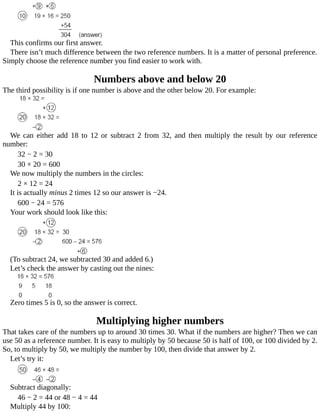
We	want	to	calculate	1000	×	1.0612
.	The	log	of	1.06	is	0.02531.
0.02531	×	12	=	0.30372.
The	log	for	0.303	is	2,	so	the	answer	will	be	marginally	greater	than	2.
To	make	a	mental	estimate,	you	could	say	10	×	0.025	is	0.25,	plus	twice	0.025	is	0.05,	added	to	0.25
is	0.30.	This	is	the	log	for	2	to	two	significant	figures.	Our	$1000	has	doubled.
Two-figure	logarithms
Actually,	for	most	mental	calculations	it	is	sufficient	to	learn	the	log	tables	to	two	digits.	Table	28.3
shows	the	two-figure	logarithms	from	2	to	19.
Table	28.3	—	two-figure	logarithms	from	2	to	19
Table	28.4	shows	the	three-digit	logs	for	the	numbers	from	1.01	to	1.10.	‘Suit’	is	the	reminder	for
1.01	because	the	1	before	the	decimal	is	understood.	So,	to	remember	the	log	for	1.01	we	memorise	the
number	01	and	004.	That	is	all	the	information	we	need	to	know.
Table	28.4	—	three-digit	logarithms	from	1.01	to	1.10
A	knowledge	of	two-digit	logarithms	will	enable	you	to	easily	calculate	the	logarithm	of	any	number
up	to	100.	If	I	wanted	the	log	for	45	I	would	simply	add	the	logs	for	5	and	9	because	5	×	9	=	45.	The	log
for	5	is	0.70	and	the	log	for	9	is	0.95.	Seventy	+	95	=	165,	so	the	log	for	45	is	1.65.	The	figure	1	(the
characteristic)	tells	us	there	are	two	digits	in	the	number	45	and	0.65	should	lie	somewhere	between	the
logs	for	4	and	5.	Four	is	0.60	and	5	is	0.70,	so	our	answer	is	exactly	between	the	two.	This	confirms	that
our	estimate	is	probably	correct.
You	could	also	memorise	the	two-digit	logarithms	for	15,	25,	35,	45,	55,	65,	75,	85	and	95	to	fill	in
the	gaps.	It	is	not	a	huge	task	—	use	the	phonetic	equivalents	listed	in	table	28.5	to	help	you.
Table	28.5	—	more	two-digit	logarithms
What	is	the	cube	root	of	100?
One	hundred	has	a	log	of	2.	Two	divided	by	3	is	2/3	or	0.6667.	We	have	just	seen	that	4.5	has	a	log	of
0.65	so	our	answer	will	be	slightly	higher,	probably	4.6	or	4.7.	This	is	a	very	close	estimate,	as	the
actual	cube	root	is	4.64.
You	will	find	that	two-digit	logs	are	sufficient	for	most	purposes	and	will	enable	you	to	perform	some
impressive	calculations.
Chapter	29
Using	what	you	have	learned
We	encounter	mathematics	every	day.	Every	time	we	make	a	purchase,	every	time	we	hear	or	see	the
time,	every	time	we	get	in	our	car	we	make	mathematical	calculations.	How	much	time	do	I	have?	Six
forty	 is	 the	 same	 as	 twenty	 to	 seven.	 How	 much	 do	 I	 give	 the	 cashier?	 Do	 I	 have	 enough	 for	 this
purchase?	How	much	will	I	have	to	budget	to	pay	for	my	house,	my	mobile	phone?	Do	I	have	enough
time	to	drive	to	town?	These	are	all	mathematical	calculations.	In	this	chapter	we	will	see	how	a	basic
knowledge	of	maths	can	help	us	in	our	everyday	lives.
Travelling	abroad
When	people	travel	to	another	country,	some	enjoy	the	differences	in	tradition,	culture	and	language;
others	are	terrified	by	the	same	differences.
I	enjoy	the	diversity.	If	everything	were	the	same,	I	might	as	well	stay	home.	When	visiting	a	foreign
country	 I	 like	 to	 think	 in	 terms	 of	 that	 country’s	 currency,	 measurements,	 temperatures,	 etc.	 Often,
though,	we	may	want	to	change	the	measurements	in	the	country	we	are	visiting	to	measurements	our
friends	and	family	at	home	can	understand.	Also,	we	often	need	to	convert	currencies	to	our	own	so	that
we	can	tell	if	we	are	making	a	good	purchase.	This	all	requires	mathematics.
Temperature	conversion
When	travelling	to	a	country	that	uses	degrees	Fahrenheit	rather	than	degrees	Celsius,	or	vice	versa,	it	is
helpful	if	we	can	easily	convert	from	one	to	the	other.	If	you	hear	the	weather	forecast,	you	want	to
know	 whether	 you	 need	 your	 overcoat	 or	 your	 summer	 clothing.	 The	 formula	 to	 change	 from
Fahrenheit	to	Celsius	is	to	subtract	32	degrees	and	multiply	the	answer	by	5	and	then	divide	by	9.	That
is	not	difficult	using	the	methods	taught	in	this	book,	but	we	might	not	need	an	exact	equivalent.	Here	is
a	simple	formula:
To	change	Fahrenheit	to	Celsius,	subtract	30	degrees	and	then	halve.
To	change	Celsius	to	Fahrenheit,	double	and	then	add	30.
The	 answer	 you	 will	 get	 using	 this	 formula	 will	 not	 be	 exact,	 but	 it’s	 close	 enough	 for	 practical
purposes.	For	instance,	if	you	are	told	the	temperature	will	be	72°F,	subtract	30	(42)	and	then	halve.	The
answer	is	21°C.	The	actual	answer	is	about	22°C.	We	are	out	by	one	degree,	but	we	have	a	fair	idea	of
what	the	temperature	will	be.
What	if	you	are	visiting	a	country	which	measures	the	temperature	in	Celsius,	and	you	are	used	to
Fahrenheit?	If	you	are	told	the	temperature	will	be	8°C,	double	it	and	add	30.	Double	8	is	16,	plus	30
makes	46°F.	The	actual	temperature	would	be	46.4°F.	That’s	close	enough	for	practical	purposes.
Easy	temperature	conversion	formulas:
(°C	×	2)	+	30	=	°F
(°F	−	30)	÷	2	=	°C
Exact	temperature	conversion	formulas:
Try	converting	the	following	temperatures	in	your	head	using	each	formula.
Change	80°F	to	°C
Using	the	simple	formula,	subtract	30	from	80	to	get	50,	then	halve	for	the	temperature	in	Celsius.
80°F	=	25°C.
Using	the	exact	formula:
Let’s	try	another:
Change	10°C	to	°F
Using	the	exact	formula:
Or,	using	the	simple	formula,	double	10°C	to	get	20,	then	add	30	to	get	your	answer	of	50°F.
In	the	first	example	our	simple	formula	gave	an	answer	that	was	close;	in	the	second	the	answer	was
exact.
If	you	feel	you	might	forget	when	you	have	to	add	or	subtract	the	30	degrees,	or	when	you	halve	or
double	the	temperatures,	memorise	an	equivalent	temperature	and	then	see	how	you	would	make	the
calculation.
For	instance,	if	you	knew	that	100°F	is	the	same	as	37	or	38°C,	how	would	you	change	100	to	get
37?	One	hundred	minus	30	is	70.	Half	of	70	is	35.	Close	enough.	If	we	want	to	change	back,	double	35
to	get	70,	then	add	30	to	get	100.	We	have	checked	the	formula	in	both	directions.
Another	generally	well-known	set	of	equivalents	is	the	fact	that	water	freezes	at	0°C	and	32°F.	Take
30	from	30°F	to	get	0°C.
It	is	good	to	have	a	median	value	memorised.	Ten	degrees	Celsius	is	equal	to	50°F.	Work	up	or	down
from	it.	20°C	=	68°F.	(A	change	of	10	degrees	Celsius	equals	a	change	of	18	degrees	Fahrenheit.)
Let’s	try	an	example:
Convert	15°C	to	°F
The	actual	formula:
Using	our	easy	formula:
15	×	2	=	30	30	+	30	=	60°F	—	1	degree	error
One	more	example:
Using	the	easy	formula:
20	×	2	=	40	40	+	30	=	70°F	—	2	degrees	error
This	is	pretty	close.	It	does	give	an	idea	of	temperatures	when	you	are	travelling.
Time	and	distances
Another	 common	 conversion	 required	 when	 travelling	 is	 the	 conversion	 factor	 from	 inches	 to
centimetres.	A	foot	rule	(another	name	for	the	common	ruler)	is	30cm.	Thirty	divided	by	12	(the	number
of	inches	on	the	ruler)	gives	us	approximately	2½.	That	gives	us	approximately	2.5	centimetres	to	the
inch.
For	time	differences	it	is	a	good	idea	to	memorise	a	time.	Work	out	a	favourable	time	to	phone	home
or	your	work	and	memorise	the	time	equivalent.
For	example,	I	spend	a	lot	of	time	travelling	between	Melbourne	and	Vancouver.	Often	I	need	to
know	the	time	in	both	cities.	I	simply	memorise	that	12	noon	summer	time	in	Melbourne	is	5	pm	the
previous	day	in	Vancouver.	To	convert	2	pm	Melbourne	summer	time	to	Vancouver	time	I	add	2	hours
to	5	pm	and	get	7	pm.	When	it	is	2	pm	Vancouver	time	it	is	9	am	Melbourne	time.	Here,	rather	than
adding	and	subtracting	19	hours	to	or	from	the	local	time,	I	work	backwards	and	forwards	from	my
memorised	time.
Money	exchange
During	 one	 of	 my	 visits	 to	 the	 United	 States,	 the	 Australian	 dollar	 was	 worth	 around	 65¢	 US.	 To
calculate	how	much	a	US	item	was	worth	in	Australian	dollars,	I	divided	its	price	by	0.65.	Alternatively,
I	could	have	doubled	the	price	and	then	divided	by	1.3,	or	divided	the	price	itself	by	1.3	and	simply
doubled	it.
Also,	look	at	the	reciprocal.	One	US	dollar	was	worth	about	$1.50	Australian.	That	made	it	easy	to
change.	Forty	dollars	US	was	worth	half	as	much	again	in	Australian	dollars,	about	$60	Australian.	The
exchange	rates	have	changed	since,	but	it	is	easy	to	calculate	similar	equivalent	values	when	you	travel.
Speeds	and	distances
Memorise	the	fact	that	100	km	is	about	60	miles.	Multiply	or	divide	by	0.6	to	make	the	conversion.
Remember	that	60	m/hr	is	a	mile	a	minute.	Travelling	at	100	km/hr	will	take	30	minutes	to	travel	30
miles.
I	also	keep	in	mind	times	for	travelling	at	100	km	per	hour.	It	will	take	two	and	a	half	hours	to	travel
250	km.	To	travel	25	km	takes	a	quarter	of	an	hour.	So,	if	I	still	have	175	km	to	drive	to	reach	my
destination,	I	know	it	will	take	me	about	one	and	three-quarter	hours	to	get	there.
How	fast	is	50	km	per	hour	in	m/hr?	If	100	km	equals	60	miles,	50	km	must	be	30	miles.	Fifty	km/hr
is	about	30	m/hr.
Pounds	to	kilograms
One	kilogram	is	equal	to	2.2	pounds.	To	change	kilograms	to	pounds	you	multiply	by	2.2.	To	change
pounds	to	kilograms	you	divide	by	2.2,	which	is	the	same	as	11	×	0.2.
How	heavy	is	someone	who	weighs	65	kg?
65	×	0.2	=	13
13	×	11	=	143	lbs.
Sporting	statistics
While	you	are	watching	a	sports	game,	either	at	the	ground	or	on	television,	calculate	the	statistics	for
yourself.	What	is	the	number	of	runs	per	over,	what	is	the	total	point	score,	what	is	the	strike	rate,	and
what	run	rate	is	required?	Almost	any	game	has	its	own	statistics	and	calculations.	You	can	become
more	involved	and	improve	your	maths	ability	at	the	same	time.
Sales	tax	or	GST
The	goods	and	services	tax	(GST)	was	introduced	in	Australia	in	2000.	As	a	consequence,	we	have	a	10
percent	tax	which	is	easy	to	calculate.	Ten	percent	of	$4.95	is	49.5¢.	It	is	easy	to	divide	by	10.
What	if	you	have	a	price	of	$4.95	including	GST?	How	much	is	the	GST	part	of	the	price?	Many
people	 would	 just	 calculate	 10	 percent	 of	 $4.95	 (which	 is	 50¢	 rounded	 off).	 But	 they	 would	 be
calculating	too	much.
If	we	had	an	item	costing	$1	and	had	to	add	10	percent	GST,	we	would	take	10	percent	of	$1	to	get
10¢.	When	we	add	10	percent,	we	get	a	total	price	of	$1.10.	Now,	how	do	we	calculate	the	price	before
10	percent	GST	was	added?	In	other	words,	how	do	we	get	back	to	$1	from	$1.10?	Certainly	it	is	not	by
subtracting	10	percent.
In	fact,	we	have	to	divide	the	price	including	GST	by	1.1	to	get	the	price	before	GST	was	added	($1).
Subtract	this	from	the	total	price	to	find	how	much	GST	must	be	paid.
So,	the	rule	is:
To	calculate	the	price	before	GST	was	added,	you	divide	by	1.1.	The	GST	component	is	one-
eleventh	of	the	total	price.
If	the	GST	were	7	percent,	you	would	divide	by	1.07.	If	it	were	12	percent,	you	would	divide	by	1.12.
How	do	you	divide	by	1.1?	Divide	by	11	and	multiply	the	answer	by	10.
Here	is	an	example	where	a	calculator	is	no	help	if	you	don’t	understand	the	calculation	you	have	to
make.
There	is	also	an	interesting	shortcut	for	adding	10	percent	GST.
What	is	$1.60	plus	10	percent	GST?
Multiply	$1.60	by	1.1.	We	can	use	our	shortcut	from	chapter	19	for	multiplying	by	11.	To	multiply
$1.60	by	11,	ignore	the	zero	and	the	decimal	and	multiply	16	by	11	to	get	176.	You	now	know	that	the
price,	including	GST,	is	$1.76.
To	add	10	percent	to	$4.20	you	multiply	42	by	1.1	to	get	$4.62.
How	about	$315	plus	10	percent?	Use	the	shortcut	for	multiplying	longer	numbers	by	11.	The	answer
is	$346.50.	You	can	easily	calculate	that	answer	without	using	pen	or	paper.	You	simply	add	each	digit
to	its	neighbour.
Estimating	distances
When	 I	 drive	 in	 Vancouver,	 British	 Columbia	 in	 Canada,	 I	 know	 that	 the	 streets	 and	 avenues	 are
numbered	eight	to	the	mile.	If	I	am	just	crossing	16th	and	I	have	to	drive	to	86th,	then	I	know	how	far	I
have	to	drive	and	can	calculate	approximately	how	long	it	will	take	me	to	arrive.	I	have	70	streets	to	go.
Seventy	divided	by	8	is	almost	9.	I	have	almost	9	miles	to	drive	or,	if	I	want	to	be	more	exact,	8¾	miles
to	go.
Miscellaneous	hints
Measure	 the	 diameter	 of	 coins	 and	 then	 use	 them	 to	 measure	 when	 you	 don’t	 have	 a	 ruler	 or	 tape
measure.	Measure	the	size	of	your	thumb	joint.	Measure	your	hand	span.	Measure	your	average	stride.
Measure	the	length	of	your	foot	and	your	shoes.	What	is	the	length	of	your	arm?	What	is	the	distance
between	the	tips	of	your	fingers	when	your	arms	are	outstretched?	What	is	the	size	of	A4	paper?	What
is	the	size	of	legal	or	US	letter	paper	size?
Use	all	of	these	measurements	to	estimate	sizes.
Walk	a	kilometre	or	a	mile	and	count	your	steps.	Then	divide	the	number	of	steps	taken	into	the
distance	to	get	the	length	of	an	average	stride.	Time	how	long	it	takes	to	walk	a	mile	or	a	kilometre.	You
can	then	calculate	your	average	speed	and	estimate	how	long	it	will	take	to	walk	a	certain	distance	or
calculate	how	far	you	have	walked.
Count	audiences	when	you	attend	a	movie	or	a	concert.	Count	the	number	of	seats	by	multiplying	the
number	of	seats	in	a	row	by	the	number	of	rows.	What	is	the	seating	capacity	of	the	theatre?
Do	you	know	the	circumference	of	the	earth?	It	is	approximately	40	000	km	or	24	000	miles.	At	the
equator,	the	earth	moves	about	1000	miles	on	its	axis	every	hour.	In	other	words,	there	are	about	1000
miles	between	hourly	time	zones	along	the	equator.	Because	the	earth	has	a	circumference	of	about	24
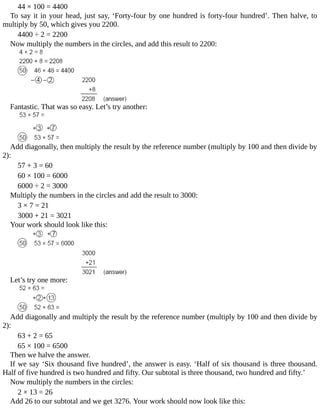
000	miles,	that	makes	it	easy	to	divide	into	hours	of	the	day.	If	you	want	the	distance	in	kilometres,
1000	miles	is	about	1600	kilometres.
Apply	the	strategies
Make	use	of	the	strategies	you	have	learnt	in	this	book,	not	only	for	school	or	work,	but	also	for	play.
Use	 the	 calculations	 when	 you	 are	 driving	 or	 travelling.	 Use	 them	 to	 calculate	 how	 your	 favourite
sporting	team	is	doing.	Use	the	strategies	when	you	are	shopping.	And,	of	course,	use	them	on	the	job
and	at	school.	You	will	develop	your	skills,	sharpen	your	brain	and	make	better	decisions.
Afterword
Recently,	I	was	teaching	a	Grade	5	class.	I	had	just	explained	how	to	multiply	numbers	in	the	teens
when	I	noticed	a	girl	experimenting	with	109	times	109.	She	drew	the	circles	above,	using	100	as	the
reference	 number,	 and	 obtained	 an	 answer	 of	 11,881.	 She	 asked	 me	 if	 this	 was	 correct.	 She	 wasn’t
asking	if	she	had	made	an	error	in	her	calculations;	she	was	asking	if	the	method	was	valid	for	her
calculation.	I	assured	her	she	was	correct	on	both	counts.
When	I	teach	a	class	as	a	visiting	teacher,	this	is	a	common	reaction.	Children	want	to	experiment.
This	is	probably	the	most	pleasing	result	of	my	teaching	as	far	as	I	am	concerned.	Children	begin	to
think	like	mathematicians.	Also,	because	they	see	results	for	their	efforts,	they	are	happy	to	put	in	even
more	effort.	Children	often	ask	their	teachers	if	they	can	do	maths	for	the	rest	of	the	day.
Making	your	own	mathematical	discoveries	is	exhilarating.	The	methods	taught	in	this	book	develop
creative	 thinking	 and	 problem-solving	 skills.	 They	 lay	 the	 groundwork	 for	 original	 thought,	 lateral
thinking	and	the	ability	to	work	outside	set	guidelines.	These	strategies	instill	an	excellent	foundation	of
basic	mathematical	principles,	and	a	knowledge	of	simple	number	facts.	The	methods	are	easy	to	master
and	applicable	to	everyday	situations.	Use	what	you	have	learnt.	Play	with	the	strategies.	Experiment
with	them.
Students
Practise	 the	 strategies	 taught	 in	 this	 book	 and	 you	 will	 gain	 a	 reputation	 for	 being	 a	 mathematical
genius.	You	will	breeze	through	your	maths	courses	and	find	maths	exciting	and	enjoyable.
Teachers
Teach	these	methods	in	the	classroom	and	maths	classes	will	be	a	pleasure	for	you	and	your	students.
Your	students	will	be	successful,	which	will	make	you	a	successful	teacher.	Also,	because	your	students
are	achieving,	you	will	find	classroom	behaviour	will	improve	and	your	students	will	be	motivated.
Everyone	benefits.
Parents
Teach	your	children	these	methods	and	they	will	excel	at	mathematics.	They	will	not	only	be	faster	than
the	other	students;	they	can	check	their	work	and	correct	any	mistakes	before	anyone	else	sees	them.
The	methods	will	boost	your	children’s	confidence,	not	only	in	maths,	but	in	their	own	intelligence	as
well.	Your	children	will	be	treated	differently	because	people	equate	maths	ability	with	intelligence.
They	will	probably	improve	in	other	subject	areas	as	well.
Many	children	have	a	low	self-esteem	and	believe	they	are	‘dumb’.	They	assume	they	don’t	have	a
‘mathematical	mind’	because	they	can’t	handle	basic	maths	problems.	Yet,	after	learning	my	methods,
many	 parents	 have	 written	 to	 say	 their	 children	 now	 love	 maths.	 Their	 children	 are	 excited	 at	 their
success	and	the	recognition	they	are	receiving.	They	have	discovered	they	don’t	have	an	inferior	mind.
It	wasn’t	the	quality	of	their	brain	—	it	was	their	problem-solving	techniques	that	were	at	fault.
I	have	enjoyed	writing	Speed	Mathematics	and	experimenting	with	the	strategies.	I	have	deliberately
tried	to	keep	the	book	non-technical	so	everyone	can	understand	the	information	it	contains.
I	 am	 available	 to	 conduct	 maths	 seminars	 and	 training	 sessions	 as	 well	 as	 programs	 for	 effective
learning	and	thinking	strategies.	For	more	information	regarding	problem-solving,	please	read	my	first
book,	Teach	Your	Children	Tables.
I	have	placed	practice	sheets	on	my	website	which	can	be	downloaded.	The	website	also	contains
details	of	other	material	that	I	offer.	If	you	would	like	to	comment	on	this	book,	want	details	of	new
books	and	other	learning	materials,	would	like	to	arrange	a	seminar,	or	if	you	have	any	questions,	please
email	 me	 at	 <bhandley@speedmathematics.com>	 or	 visit	 my	 web	 page	 at
<www.speedmathematics.com>.
Appendix	A
Frequently	asked	questions
Q.	My	child	is	already	at	the	top	of	the	class	in	mathematics.	Won’t	your	methods	make	my	child
bored?	What	do	children	do	if	they	have	finished	their	work	in	a	quarter	of	the	time	it	takes	the
other	children?
Q.	If	I	use	your	methods	I	will	finish	my	work	in	less	time	and	I	won’t	have	anything	to	do.	I	will
get	bored.
A.	Students	who	use	these	methods	love	to	experiment.	Firstly,	they	will	finish	their	assignments	in
a	fraction	of	the	time	it	takes	the	rest	of	the	class.	Then	they	can	check	their	work	for	mistakes	by
casting	out	nines	and	elevens.	They	can	experiment	with	alternative	methods	of	calculation	to	see
which	method	is	easiest.	Actually,	students	who	learn	these	methods	find	maths	exciting.
Q.	What	about	understanding?	If	you	use	this	method	to	learn	your	tables,	it	doesn’t	teach	you	why
6	times	7	is	42.
A.	No,	it	doesn’t.	Nor	does	any	other	method	of	teaching	the	tables.	Chanting	and	reciting	tables
don’t	teach	the	student	why	six	sevens	are	42.	My	strategy	is	to	teach	an	effective	and	easy	method
to	determine	the	answer.
And,	although	the	reason	why	the	method	works	is	not	immediately	apparent,	the	method	itself	can
be	 easily	 explained	 by	 the	 time	 the	 child	 reaches	 Grade	 4.	 (See	 the	 explanation	 as	 to	 why	 the
formula	works	in	appendix	E).	Any	Grade	4	child	who	has	worked	through	this	book	should	be
able	to	understand	the	explanation.
What	6	sevens	means	should	be	taught	as	well	as	how	to	calculate	the	answer.	Working	by	rules	is
not	sufficient.	You	need	an	understanding	of	mathematics.	Students	who	learn	by	these	methods
generally	have	a	better	understanding	and	are	less	likely	to	work	blindly	by	rules.
Q.	If	the	school	is	teaching	different	methods,	won’t	this	confuse	my	child?
A.	No.	These	methods	complement	what	students	learn	in	school.	Higher	achieving	students	use
different	methods	than	the	low	achievers.	Sometimes	that	can	cause	confusion	among	the	teachers,
but	it	seldom	affects	the	students.	Most	of	the	methods	are	invisible.	That	is,	the	difference	is	what
takes	place	in	the	student’s	mind.	If	the	student	chooses	to	say	nothing	about	his	or	her	different
methods,	no	one	will	ever	know.
Q.	My	children’s	teachers	demand	the	children	show	all	of	their	working	for	their	calculations.	If
the	calculations	are	in	one’s	head	or	different,	how	can	they	do	this?
A.	 Students	 can	 give	 what	 their	 teachers	 want.	 If	 the	 student	 is	 sitting	 an	 exam,	 naturally	 the
student	will	give	everything	he	or	she	believes	the	teacher	or	examiner	wants.
In	an	ordinary	class,	if	the	teacher	were	to	ask	for	the	working-out	for	13	times	14,	it	should	be
sufficient	for	the	student	to	say,	‘I	know	my	tables	up	to	the	20	times	table.	I	don’t	have	to	work
them	out’.	If	the	teacher	challenges	the	child,	the	child	should	be	able	to	give	quick	answers	to	any
multiplication	in	the	teens.	The	child	can	also	do	a	lightning	casting	out	nines	calculation	to	check
the	answer	immediately.	The	teacher	will	be	impressed,	not	annoyed.
Q.	Your	method	is	not	always	the	easiest	method.	Why	should	I	use	your	method	when	there	is	an
easier	alternative?
A.	By	all	means,	use	the	method	you	find	easiest.	I	am	suggesting	some	easy	methods	—	you
should	consider	the	methods	you	know	and	use	the	one	you	find	easiest.
For	 instance,	 if	 you	 wanted	 to	 multiply	 8	 times	 16,	 you	 could	 use	 the	 circles	 and	 10	 as	 your
reference	number.	I	wouldn’t.	I	would	probably	multiply	8	times	10	and	add	8	times	6	(80	+	48	=
128).	Or,	I	might	multiply	8	times	8	equals	64	and	double	the	answer.
I	feel	an	important	part	of	my	teaching	strategy	is	to	give	students	a	choice	of	methods.	I	had	a
student	come	up	to	me	in	the	schoolyard	and	say,	‘I	am	sorry	Mr	Handley,	I	am	not	using	your
methods	any	more’.
‘Why	not?’	I	asked.
‘I	know	my	tables	now	and	I	just	call	them	from	memory.’
Did	I	consider	this	a	bad	thing?	Not	at	all.	The	student	had	just	told	me	she	had	memorised	the
tables	beyond	15	times	15.
Students	who	learn	these	methods	are	less	likely	to	solve	problems	according	to	rules	or	a	formula.
They	are	more	likely	to	be	innovative	in	their	approach.
Q.	Why	do	you	teach	students	how	to	calculate	these	problems?	What	do	we	have	calculators	for?
A.	A	calculator	can’t	think	for	you.	Students	have	a	much	better	appreciation	of	the	properties	of
numbers	if	they	learn	these	methods.	They	understand	the	principles	involved	in	calculations	rather
than	working	by	rules	if	they	master	the	methods	in	this	book.
When	I	am	asked	this	question	in	the	classroom,	I	ask	students	to	take	out	their	calculators	and	to
put	in	the	following	problem	as	I	call	it.
I	tell	them	to	press	the	buttons	as	I	call	them.
2	+	3	×	4	=
Some	 calculators	 give	 an	 answer	 of	 20.	 Others	 give	 an	 answer	 of	 14.	 Fourteen	 is	 the	 correct
answer.
Why	the	two	different	answers?	Some	calculators	know	BODMAS,	or	the	order	of	mathematical
functions.	You	multiply	before	you	add	or	subtract.	The	problem	is	really	‘two	plus	three	fours’.
Three	fours	are	12,	added	to	the	2	is	14.
A	calculator	can’t	think	for	you.	A	calculator	isn’t	much	help	if	you	don’t	understand	mathematics.
The	best	familiarity	with	numbers	and	mathematical	principles	comes	from	learning	the	kinds	of
strategies	taught	in	this	book.
Q.	Are	you	for	or	against	calculators?
A.	Calculators	are	useful	tools.	They	can	save	a	lot	of	time	and	effort.	There	are	many	times	during
the	day	when	I	use	a	calculator.
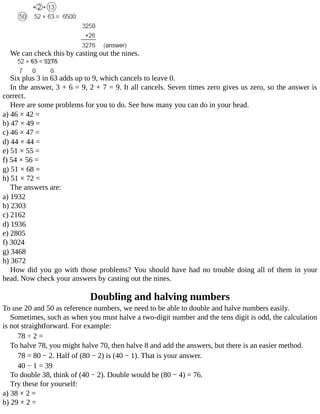
Students	sometimes	ask	me,	‘How	would	you	multiply	sixteen	million,	three	hundred	and	forty-
nine	thousand,	six	hundred	and	eighty-nine	by	four	million,	eight	hundred	and	sixty-two	thousand,
one	hundred	and	ninety-four?’	I	tell	them	my	first	step	would	be	to	take	out	my	calculator.	Often
they	seem	shocked	at	my	answer.	I	often	use	a	calculator.	I	add	up	columns	of	numbers	with	a
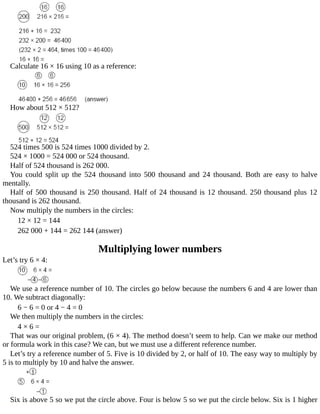
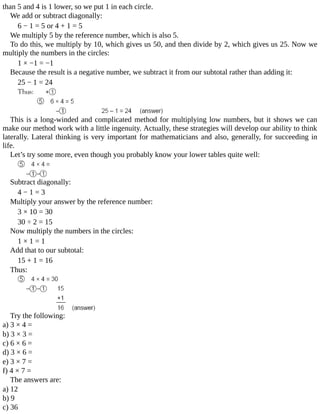
calculator.	I	double-check	my	answer	because	I	know	it	is	possible	to	make	a	mistake.
I	also	mentally	estimate	the	answer	to	see	if	the	calculator’s	answer	‘makes	sense’.	The	answer
should	be	close	to	my	estimation.
When	scientific	calculators	first	became	available,	I	purchased	a	cheap	calculator.	I	discovered	I
didn’t	understand	all	of	the	functions	and	made	sure	I	learnt	what	the	functions	did.	My	calculator
was	the	cause	of	my	learning	some	areas	of	statistics	that	I	wasn’t	aware	of.
I	have	often	wondered	what	some	of	the	mathematical	geniuses	of	the	past	would	have	done	with
the	scientific	calculators	of	today.	I	am	sure	they	would	have	made	good	use	of	them	and	maybe
achieved	much	more	than	they	did.
Q.	Did	you	make	up	these	methods	yourself?
A.	 Yes,	 I	 made	 up	 many	 of	 the	 strategies.	 I	 made	 up	 the	 ideas	 with	 the	 circles	 and	 reference
numbers,	but	I	was	taught	factorisation	for	long	multiplication	and	division	by	my	Grade	3	and
Grade	4	teachers,	Miss	Clark	and	Mrs	O’Connor.	Miss	Clark	taught	the	method	for	subtraction,
and	long	multiplication	by	factors.	Mrs	O’Connor	taught	the	method	of	long	division	by	factors.	I
have	picked	up	many	other	strategies	along	the	way.
When	I	was	in	primary	school	I	recognised	the	easy	method	for	adding	and	subtracting	fractions
but	—	can	you	believe	it	—	I	was	too	shy	to	speak	up	in	class	and	tell	anyone.
Q.	I	worked	out	some	of	these	strategies	for	myself	and	I	have	always	done	better	at	maths	than	my
classmates.	It	isn’t	fair	that	you	have	taught	them	what	I	do	and	made	them	as	good	as	I	am.	I
deserve	some	advantage	and	recognition	for	working	them	out	for	myself.
A.	An	American	high	school	student	asked	this	question.	I	think	he	has	a	point.	My	answer	is	that
when	we	teach	mathematics,	we	should	teach	the	best	strategies	and	give	the	best	explanations
possible.	We	shouldn’t	leave	it	to	the	‘more	intelligent’	students	to	work	them	out	for	themselves.
Why	not	enable	everyone	to	succeed?
Q.	Teaching	these	kinds	of	strategies	will	make	poor	students	into	good	students.	Many	of	these
students	 will	 lose	 their	 friends	 as	 they	 become	 more	 intelligent.	 Aren’t	 you	 causing	 social
problems?
A.	This	question	was	asked	after	I	had	given	an	after-dinner	talk	at	an	international	service	club.	I
am	still	not	sure	if	the	questioner	was	serious,	but	the	reactions	of	the	other	members	suggested
that	he	was.
I	 would	 rather	 deal	 with	 the	 problems	 caused	 by	 improving	 someone’s	 intelligence	 than	 those
caused	by	a	lack	of	intelligence	and	a	lack	of	success.
Q.	I	am	a	new	teacher,	recently	out	of	university.	Will	I	get	into	trouble	if	I	teach	these	strategies	in
the	classroom?	What	will	happen	if	my	Grade	4	students	are	doing	Grade	6	work	by	the	end	of	the
year?
A.	If	there	is	an	easy	method	for	teaching	a	subject	and	a	difficult	method,	who	could	teach	the
difficult	method	in	good	conscience?	If,	in	teaching	the	three	and	four	times	tables,	students	also
master	 the	 six,	 seven,	 eight	 and	 nine	 times	 tables,	 is	 this	 bad?	 You	 are	 teaching	 what	 you	 are
required	to	teach,	but	not	in	the	way	you	were	taught	to	teach	it.
These	methods	fall	within	curriculum	guidelines	because	they	teach	what	students	are	required	to
learn,	and	then	some.	My	Year	9	maths	teacher,	Harry	Forecast,	taught	us	Year	9	maths	with	Year
10	and	11	maths	thrown	in	for	good	measure.	I	loved	learning	maths	under	his	teaching.	I	couldn’t
wait	to	get	home	to	try	logarithms	for	myself.	He	taught	many	shortcuts	as	part	of	his	teaching
strategy.	I	felt	like	Sherlock	Holmes	solving	a	difficult	case	when	I	used	some	of	his	methods	to
solve	problems	in	algebra.
To	 answer	 the	 question,	 Grade	 5	 and	 6	 teachers	 should	 be	 pleased	 the	 students	 are	 ahead	 and
should	use	the	opportunity	to	stretch	the	students	even	further.	I	believe	that	when	these	methods
are	generally	taught	in	schools	this	will	happen.	I	trust	that	this	book	will	bring	this	about.
Q.	I	am	a	new	teacher	too.	I	have	always	been	terrified	of	maths.	What	if	I	teach	your	methods	and
get	stuck	myself?	What	if	students	ask	questions	I	can’t	answer?	Maybe	it	would	be	safer	to	just
teach	the	way	everybody	else	does.	Wouldn’t	I	be	taking	a	risk	teaching	your	way?
A.	Sure,	you	would.	But	you	can	minimise	the	risk.	The	methods	are	not	difficult.	Begin	slowly.
Teach	the	strategy	for	calculating	the	tables	up	to	10	times	10.	Let	them	play	with	the	strategy	for	a
day	 or	 two.	 Then,	 give	 them	 numbers	 in	 the	 nineties	 to	 calculate.	 They	 are	 doing	 similar
calculations	but	with	much	greater	satisfaction.	While	they	are	calculating	these	problems,	they	are
not	only	memorising	their	lower	tables	(from	multiplying	the	numbers	in	the	circles)	but	also	the
higher	tables,	the	combinations	of	numbers	that	add	to	10,	and	also	basic	subtraction.	It	is	then	an
easy	step	to	teach	subtraction	from	numbers	in	the	teens.	14	−	8	=	4	+	2	=	6.	(See	chapter	9.)
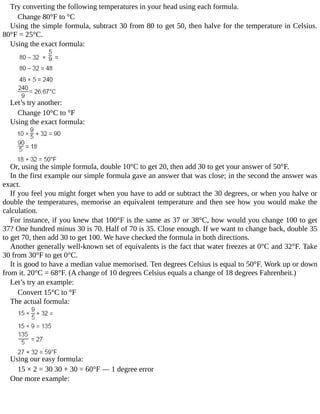
Then,	as	you	teach	multiplying	numbers	in	the	teens	you	are	introducing	positive	and	negative
numbers.	You	don’t	have	to	give	a	full	explanation.	Tell	them	the	subject	will	be	covered	later.
As	 you	 teach	 these	 methods,	 you	 will	 find	 your	 own	 ability	 with	 numbers	 will	 improve.	 Your
confidence	will	grow.	Tell	the	students	you	are	learning	the	methods	along	with	them.	This	will
tend	to	make	the	subject	and	the	methods	more	exciting	to	the	children,	and	they	will	be	more
forgiving	if	you	make	a	mistake.
Appendix	B
Estimating	cube	roots
It	is	not	often	we	have	to	estimate	cube	roots,	but	there	are	times	when	we	need	to	know	the	size	of	a
sphere	or	a	box.	For	example,	if	we	were	repaving	our	driveway,	we	may	need	to	calculate	a	cubic	value
of	liquid,	sand	or	gravel.	For	most	people,	there	is	only	one	way	to	calculate	cube	roots,	and	that	is	with
a	calculator.	Even	then,	they	could	only	use	a	scientific	calculator.
The	cube	root	of	27	is	3	because	3	×	3	×	3	=	27.	You	multiply	three	threes	together	to	cube	three.
Three	cubed	is	27.	The	cube	root	of	27	is	3.	This	would	be	written	as	 .	The	3	in	front	of	the	root
sign	tells	you	it	is	the	cube	root.	(Convention	dictates	that	square	roots	can	have	the	2	before	the	sign,
but	leaving	out	the	number	in	front	the	root	sign	also	refers	to	the	square	root.)
I	 will	 show	 you	 an	 easy	 method	 for	 estimating	 cube	 roots	 just	 as	 we	 calculated	 square	 roots	 by
estimation.	And,	if	you	have	a	cheap	four-function	calculator,	you	can	calculate	the	answer	using	our
simple	formula.
First,	you	have	to	memorise	the	cubes	of	the	numbers	1	to	10.	Here	are	the	values:
13
	=	1
23
	=	8
33
	=	27
73
	=	343
83
	=	512
43
	=	64
53
	=	125
93
	=	729
63
	=	216
103
	=	1000
The	cubes	of	the	numbers	1	to	5	are	easily	learnt	because	they	are	easily	calculated	if	you	forget.
There	are	only	four	values	that	need	to	be	memorised.
Here	is	an	easy	way	to	memorise	the	cubes	of	the	numbers	using	phonetic	equivalents.
Our	first	step	in	finding	the	square	root	of	a	number	was	to	split	the	number	into	digit	pairs,	whereas:
To	find	the	cube	root	we	split	the	digits	into	threes.	The	number	of	three-digit	groups	gives	us
the	number	of	digits	in	the	answer.
We	then	estimate	the	cube	root	of	the	first	digit	triplet.	This	is	where	you	need	to	memorise	the	above
chart.
	
If	the	first	three-digit	group	falls	between	1	and	7,	the	first	digit	of	the	answer	is	1.
If	it	falls	between	8	and	26,	the	first	digit	is	2.
If	it	falls	between	27	and	63,	the	first	digit	is	3.
You	should	have	the	idea.	The	estimate	of	the	first	triplet	gives	the	first	digit	of	the	answer.	Designate
a	zero	for	each	of	the	other	triplets.	This	is	your	first	estimate	of	the	answer.
Let’s	take	an	example	of	250:
Two	hundred	and	fifty	is	above	6	cubed,	216,	but	below	7	cubed,	343.	This	tells	us	the	answer	will	be
between	6	and	7.
We	divide	by	our	estimate,	6,	and	we	divide	twice.
250	÷	6	=	41.67
Divide	our	answer,	41.67,	by	6	again:
41.67	÷	6	=	6.94
The	difference	between	our	estimate,	6	and	our	final	answer,	6.94,	is	0.94.	Divide	this	by	3	and	add	it
to	our	estimate.
0.94	÷	3	=	0.31
Adding	this	to	6	gives	6.31.
This	will	always	be	slightly	high	so	we	round	off	downwards	to	6.3.	A	calculator	gives	an	answer	of
6.2996.	We	didn’t	round	off	sufficiently,	but	our	answer	is	correct	to	two	significant	figures.	And	the
real	advantage	is	that	the	above	calculation	can	easily	be	done	mentally.
Another	way	of	describing	the	final	step	is	to	take	the	average	of	the	three	numbers.	To	find	the
average,	we	calculate	6	+	6	+	6.94	and	divide	by	3.
6	+	6	+	6.94	=	18.94
18.94	÷	3	=	6.31
I	find	it	much	easier	to	divide	the	difference	by	3.
Using	 a	 ten-digit	 four-function	 calculator,	 I	 used	 6.31	 as	 a	 second	 estimate	 and	 repeated	 the
calculation.	 I	 got	 a	 final	 answer	 of	 6.2996053,	 whereas	 my	 scientific	 calculator	 gave	 an	 answer	 of
6.299605249	—	so	our	answer	was	accurate	to	seven	digits.
Try	these	calculations	for	yourself:
a)	
b)	
c)	
d)	
The	answers	are:
a)	6.127
b)	8.1457
c)	20.134
d)	31.07
Using	the	above	method,	your	answers	should	have	been	very	close.	You	might	like	to	calculate	your
percentage	error.
There	is	another	shortcut	you	could	use	for	c)	and	d).	The	first	estimates	for	the	answers	would	have
been	 20	 and	 30.	 You	 could	 have	 done	 one	 single	 division	 by	 202
	 and	 302
.	 That	 would	 have	 meant
dividing	by	400	and	900.	You	would	have	moved	the	decimal	two	places	to	the	left	and	divided	by	4
and	9.
In	a	similar	fashion	to	our	method	of	estimating	square	roots,	if	the	number	we	are	calculating	is	just
below	a	cube	we	can	use	the	number	above	as	the	estimate.	Then	divide	twice	by	the	estimate	and
subtract	a	third	of	the	difference	from	the	estimate.	Again,	there	is	a	similar	shortcut	for	this	calculation
to	make	it	a	reasonable	option.
Let’s	take	an	example	of	the	cube	root	of	320.
Six	cubed	is	216	and	7	cubed	is	343.	Seven	is	definitely	a	closer	estimate.
320	÷	7	=	45.71
We	divide	by	7	again:
45.7	÷	7	=	6.53
Subtract	6.53	from	7:
7	−	6.53	=	0.47
We	now	need	to	calculate	a	third	of	the	difference.
0.47	÷	3	=	0.157
Subtract	a	third	of	the	difference	(0.157)	from	our	estimate,	7.
7	−	0.157	=	6.843
Round	off	to	6.84	and	we	have	an	accurate	answer.
The	actual	answer	is	6.8399.
Now	for	the	shortcut.	What	we	really	did	was	to	average	the	three	values,	7	and	7	and	6.53.	We	could
add	these	values	and	divide	by	3.
7	+	7	+	6.53	=	20.53
20.53	÷	3	=	6.843
Dividing	3	into	20	we	get	an	answer	of	6	with	2	remainder	which	we	carried	to	the	0.53	to	give	us
2.53.
2.53	÷	3	=	0.843
Just	as	we	know	there	is	a	1	carried	for	square	roots,	we	know	a	2	is	carried	for	cube	roots.	Instead	of
subtracting	a	third	of	the	difference	from	the	higher	estimate,	we	use	the	lower	number	(in	this	case	6),
carry	2	and	divide	by	3	to	get	our	end	answer.
Why	do	we	carry	2	when	we	are	calculating	cube	roots?	Because,	like	the	example	above,	when	we
average	the	three	values	we	add	the	two	numbers	which	are	1	above	the	answer.	So	the	total	must	be
three	times	the	estimate	plus	2.
Let’s	try	another	to	illustrate.
Our	estimate	is	9,	which	we	know	is	high	(9	cubed	is	729).
Divide	700	by	9	twice.
700	÷	9	=	77.77	(rounded	off	downwards)
77.77	÷	9	=	8.64
The	first	digit	of	the	answer	is	8.	For	the	rest	of	the	answer,	put	2	in	front	of	the	decimal	and	divide
by	3.
2.64	÷	3	=	0.88
Our	answer	is	8.88.	This	answer	is	accurate	to	three	digits.
Let’s	do	one	more:
We	split	the	digits	into	groups	of	three.
We	now	have:
Estimate	the	cube	root	of	the	first	three-digit	group,	7.	Seven	is	close	to	8	which	is	23
	so	we	will	use	2
as	our	first	estimate.	There	are	two	three-digit	groups	so	there	are	two	digits	in	the	answer.	We	assign
zero	as	the	second	digit,	making	our	estimate	20.
Divide	7531	twice	by	20.	To	divide	by	20,	we	divide	by	10	and	then	by	2.
7531	÷	20	=	376.55
376.55	÷	20	=	18.8275
Or,	instead	of	dividing	by	20	twice,	we	could	have	divided	by	20	squared,	or	400.
7531	÷	100	=	75.31
75.31	÷	4	=	18.8275
We	know	the	first	digit,	1,	is	correct.	This	gives	us	the	tens	digit.	Our	subtotal	is	10.
We	place	a	2	in	front	of	the	rest	of	the	number	to	get	28.8275.
28.8275	÷	3	=	9.609
10	+	9.609	=	19.609
Rounding	 off	 we	 get	 an	 answer	 of	 19.6.	 This	 is	 accurate	 to	 three	 digits.	 Actually	 the	 answer	 is
19.60127,	which	means	our	answer	is	extremely	close.
Try	these	for	yourself	and	then	check	your	workings	with	the	explanations	below:
a)	
b)	
For	a)	we	take	5	as	our	estimate.
We	divide	115	by	5	to	get	23.	(Divide	by	10	and	double.)	We	divide	23	by	5	to	get	4.6.	(Divide	by	10
and	double.)	Four	is	the	first	digit	of	our	answer.
We	carry	2	to	put	before	the	6	to	get	26.	Then	we	divide	by	3.
2.6	÷	3	=	0.8667
We	round	off	to	4.86.	This	is	accurate	to	three	digits.
For	b),	we	take	8	as	our	first	estimate.
500	÷	8	=	62.5
62.5	÷	8	=	7.8125
To	average	the	answers	we	carry	2	to	the	8,	giving	2.8125.
Dividing	2.8125	by	3,	we	get	0.9375.	We	add	this	to	the	7	to	get	7.9375.
The	actual	answer	given	by	a	calculator	is	7.93700526.	Our	answer	is	extremely	accurate	for	a	mental
calculation	 or	 an	 easy	 pencil	 and	 paper	 calculation.	 Also,	 we	 know	 our	 answers	 are	 high.	 Had	 we
rounded	off	downwards	we	would	have	been	spot	on.
This	 is	 an	 effective	 and	 a	 very	 impressive	 method	 for	 finding	 cube	 roots.	 The	 average	 person
wouldn’t	dream	of	trying	to	calculate	the	answer	with	pencil	and	paper.	This	method	will	allow	mental
calculation.
Appendix	C
Finding	any	root	of	a	number
We	can	use	logarithms	to	find	the	cube	root,	5th
	root,	13th
	root,	or	any	root	of	a	number.	Logarithms	give
us	a	good	estimate	of	the	answer	and	we	can	then	refine	this	estimate	using	the	method	for	calculating
square	roots	and	cube	roots.
Let	us	try	an	example.	What	is	the	5th
	root	of	345	678?
Where	to	begin?	You	may	have	noticed	that	for	square	roots	you	divide	the	number	into	digit	pairs
and	the	answer	will	have	one	digit	for	each	digit	pair.	For	cube	roots,	you	divide	the	digits	into	threes
with	one	digit	of	the	answer	for	each	triplet.	For	a	fifth	root	you	would	divide	the	digits	into	groups	of
five	and	you	would	have	one	digit	of	the	answer	for	each	group.	You	could	guess	a	number	with	the
required	number	of	digits	and	find	the	answer	by	trial	and	error	using	the	method	for	square	roots	and
cube	roots.	A	better	idea	is	to	make	use	of	logarithms	to	find	our	first	estimate	and	then	refine	our
estimate	using	the	method.
First,	we	write	the	number	in	scientific	notation.	This	will	give	us	the	characteristic	of	the	logarithm.
345	678	is	equivalent	to	3.45678	×	105
This	tells	us	the	log	will	be	5	point	something,	or	just	above	5.
What	is	the	log	of	345	678?	We	can	round	it	off	to	35	for	our	approximation.	Thirty-five	is	5	×	7,	so
we	can	add	the	logs	for	5	and	for	7.	We	will	take	the	two-figure	logs	as	we	are	only	working	with
approximations.
The	log	of	5	is	0.70	and	the	log	for	7	is	0.85.
0.70	+	0.85	=	1.55
We	 ignore	 the	 characteristic	 (because	 it	 only	 tells	 us	 where	 the	 decimal	 goes)	 and	 just	 use	 the
mantissa	of	.55.	We	have	already	calculated	the	characteristic	of	our	answer	as	being	5	because	345	678
is	3.45678	×	105
.
Our	estimate	of	the	log	of	345	678	is	5.55.
We	now	have	the	easy	task	of	dividing	by	5	to	extract	the	5th
	root.
5.55	÷	5	=	1.11
The	answer	is	101.11
We	 now	 need	 to	 find	 which	 number	 has	 a	 log	 of	 1.11.	 Our	 memorised	 table	 tells	 us	 this	 will	 be
around	13,	so	13	is	our	approximate	answer	for	the	5th
	root	of	345	678.
We	can	get	a	more	accurate	answer	by	dividing	345	678	by	13	four	times.	This	will	allow	you	to	get
an	accurate	answer	using	a	four-function	pocket	calculator.
Dividing	345	678	by	13	four	times	gives	us	an	answer	of	12.103,	which	we	round	off	to	12.1.
To	find	the	average	we	can	add	4	×	13,	which	is	52,	plus	12.1	to	get	64.1.	Dividing	64.1	by	5	we	get
12.82.
To	solve	the	calculation	mentally	we	can	use	the	same	method	we	used	for	square	roots	and	cube
roots	when	the	final	answer	was	less	than	the	estimate.	In	this	case,	we	carry	4	to	the	first	digit	after	the
decimal	and	divide	by	5.	This	means	we	divide	41	by	5	to	get	our	answer	of	0.82,	which	we	add	to	12
for	our	final	answer,	12.82.
The	actual	answer	is	12.81546,	so	our	answer	is	correct	to	four	digits.	That	is	remarkable	accuracy
for	such	a	calculation.
Let’s	try	another.	Can	we	find	the	cube	root	of	100	without	using	a	pen	or	a	calculator?
We	can	make	use	of	our	memorised	cubes	of	the	numbers	one	to	ten,	or	we	can	use	logs	for	our
estimate.	Let’s	use	both	methods.
Using	 our	 memorised	 cubes,	 we	 know	 4	 cubed	 is	 64	 and	 5	 cubed	 is	 125.	 The	 answer	 must	 lie
somewhere	between.	The	cube	of	5	is	closer	to	100,	so	5	would	be	my	choice.
Let’s	try	the	same	calculation	using	logs.	We	know	the	log	for	100	is	2,	so	the	cube	root	of	100	will
be	2	divided	by	3,	or	2,	or	0.6667.	This	lies	between	the	log	for	4	(0.60)	and	the	log	for	5	(0.70).	It	is
closer	to	5,	so	we	choose	5	as	our	estimate.
100	÷	5	=	20
20	÷	5	=	4
We	average	the	two	fives	we	used	as	divisors	and	the	answer,	4.
5	+	5	+	4	=	14
÷	3	=	4.667
We	can	round	off	downwards	to	4.6	for	a	two-digit	answer.	The	actual	answer	is	4.64,	so	our	answer
is	accurate	to	two	digits.
This	calculation	can	easily	be	done	mentally.	This	is	really	impressive.
Let’s	change	the	number	to	120	to	find	the	cube	root.	The	answer	will	be	just	below	5.	We	would
guess	at	4.8	or	4.9.
120	÷	5	=	24
24	÷	5	=	4.8
Using	our	shortcut,	we	can	carry	2	and	put	it	before	the	8,	making	28,	and	divide	by	3.
28	÷	3	=	9.33
Our	answer	becomes	4.93.
The	actual	answer	is	4.9324241,	so	our	answer	is	accurate	to	three	significant	figures.	That	is	a	great
result	for	a	mental	calculation.
Would	it	help	you	if	you	could	make	these	calculations	off	the	top	of	your	head?
Appendix	D
Checks	for	divisibility
It	is	easy	to	check	to	see	if	a	number	is	evenly	divisible	by	another	number	without	doing	a	full	division.
Here	are	some	basic	rules:
All	numbers	are	divisible	by	one
All	even	numbers	are	divisible	by	2	(if	the	final	digit	of	a	number	is	even,	the	number	is	divisible	by	2).
If	a	number	is	evenly	divisible	by	3,	the	sum	of	the	digits	is	divisible	by	3.	For	instance,	12	is	divisible	by	3	as	1	+	2	=	3	which	is
divisible	by	3.
If	the	last	two	digits	are	divisible	by	4,	the	number	is	divisible	by	4.	(100	=	4	×	25.)	For	example,	116	is	divisible	by	4.	We	can	see
this	because	16	is	4	times	4.
There	is	an	easy	shortcut.	Don’t	worry	how	long	the	number	is	—	if	the	tens	(second-last)	digit	is
even,	simply	check	if	the	units	(final)	digit	is	divisible	by	4	(it	must	be	either	4	or	8).
If	the	tens	digit	is	odd,	carry	1	to	the	units	digit	and	check	if	it	is	divisible	by	4.	That	is	because	20	is
evenly	divisible	by	4	(4	×	5	=	20).	What	we	are	effectively	doing	is	casting	out	the	twenties.
For	example,	let’s	check	if	15476	is	divisible	by	four.	The	tens	digit	(7)	is	odd,	so	we	carry	1	to	the
units	digit	(6)	to	make	16.	Sixteen	is	evenly	divisible	by	4,	so	15476	is	evenly	divisible	by	4.
Is	593768	divisible	by	4?	The	tens	digit	(6)	is	even,	so	we	can	ignore	it.	The	units-digit,	8,	is	evenly
divisible	by	4,	so	593768	is	evenly	divisible	by	4.
If	the	number	ends	with	a	zero	or	five,	the	number	is	divisible	by	5.
If	the	number	is	even	and	the	sum	of	the	digits	is	divisible	by	3.
*
If	the	last	three	digits	of	a	number	are	divisible	by	8,	the	whole	number	is	divisible	by	8	(because	1000	=	8	×	125).	For	example,	1128
is	divisible	by	8	because	128	=	8	×	16.
Here	we	have	an	easy	check	similar	to	the	check	for	4.	Instead	of	casting	out	the	twenties,	we	cast	out
the	two	hundreds	because	200	is	evenly	divisible	by	8.
If	the	hundreds	digit	is	even,	it	can	be	ignored.	If	it	is	odd,	add	4	to	the	final	two	digits	of	the	number.
Then,	if	the	final	two	digits	are	divisible	by	8,	the	number	is	divisible	by	8.
For	example,	is	the	number	57328	divisible	by	8?	The	hundreds	digit	(3)	is	odd,	so	we	add	4	to	the
final	two	digits,	28.	28	+	4	=	32.	Thirty-two	is	divisible	by	8,	so	57328	is	evenly	divisible	by	8.
If	the	sum	of	the	digits	is	9	or	is	evenly	divisible	by	9,	the	whole	number	is	divisible	by	9.
If	the	number	ends	with	a	zero,	the	number	is	divisible	by	10.
If	the	difference	between	the	sum	of	the	evenly	placed	digits	and	the	oddly	placed	digits	is	zero	or	a	multiple	of	11,	the	number	is
evenly	divisible	by	11.
If	the	digit	sum	is	divisible	by	3	and	the	last	two	digits	are	divisible	by	4,	the	number	is	divisible	by	12.
*
*
*
The	tens	digit	is	even	and	the	units	digit	is	zero.
The	number	is	divisible	by	7	and	the	sum	of	the	digits	is	divisible	by	3.
*
*
*	There	is	a	simple	method,	using	check	multipliers,	for	checking	divisibility	that	can	be	used	for
these	numbers	and	higher	numbers.	The	traditional	methods	are	cumbersome	and	require	pen	and	paper
for	the	calculation.	These	checks	can	be	done	mentally.
Using	check	multipliers
To	check	divisibility	by	7,	we	use	5	as	a	check	multiplier.	We	multiply	the	units	digit	of	the	number	we
are	checking	by	our	check	multiplier.
We	add	this	answer	to	the	number	after	removing	the	units	digit.	If	this	answer	is	evenly	divisible	by
7,	the	whole	number	is	evenly	divisible	by	7.
For	example,	is	91	evenly	divisible	by	7?
Our	check	multiplier	is	5.	Multiply	the	units	digit	of	91	(1)	by	5	to	get	an	answer	of	5.	Add	5	to	the	9
to	get	an	answer	of	14,	which	is	2	×	7.	So	91	is	divisible	by	7.
Is	133	evenly	divisible	by	7?
Multiply	the	units	digit	of	133	(3)	by	our	check	multiplier,	5,	to	get	an	answer	of	15.	Add	the	answer,
15,	to	13	to	get	28	(4	×	7).	Thus,	we	find	133	is	divisible	by	7.
Let’s	try	another.	Is	152	evenly	divisible	by	7?
2	×	5	=	10.
10	+	15	=	25
Twenty-five	is	not	evenly	divisible	by	7,	so	152	is	not	evenly	divisible	by	7.
One	final	example.	Is	1638	evenly	divisible	by	7?
5	×	8	=	40
163	+	40	=	203
Because	we	may	not	know	off	the	top	of	our	heads	whether	203	is	evenly	divisible	by	7,	we	repeat
the	procedure:
5	×	3	=	15
20	+	15	=	35
Thirty-five	is	divisible	by	7	(5	×	7	=	35).	Therefore,	1638	is	evenly	divisible	by	7.
How	to	determine	the	check	multiplier
The	method	for	determining	the	check	multiplier	is	as	follows:
For	a	positive	check	multiplier,	multiply	the	number	to	get	an	answer	with	a	units	digit	of	9.	We
use	the	tens	digit	of	the	number	that	is	1	more	than	this	answer	as	our	check	multiplier.
For	instance,	if	we	want	to	check	for	divisibility	by	7,	multiply	7	by	7	to	get	49.	Forty-nine	is	one
below	50.	Our	check	multiplier	for	7	is	therefore	5.
To	check	for	divisibility	by	13,	we	multiply	it	until	we	find	a	units	digit	of	9:
13	×	3	=	39
Thirty-nine	is	1	below	40.	We	use	4	as	our	check	multiplier	for	13.
We	don’t	need	to	multiply	the	number	19	by	anything,	because	it	already	ends	in	9.	Nineteen	is	1
below	20,	so	we	use	2	as	the	check	multiplier.
To	check	divisibility	by	23,	we	note	that	the	units	digit	is	3,	and	3	×	3	=	9.	Multiplying	23	by	3	gives
us	69.	This	is	1	below	70,	so	we	use	7	as	the	check	multiplier.
Why	does	it	work?
If	you	want	to	check	whether	a	number	is	evenly	divisible	by	another	number,	adding	the	number	or	a
multiple	of	the	number	won’t	affect	the	divisibility.
When	we	checked	if	91	was	evenly	divisible	by	7,	we	actually	added	49	(7	×	7)	to	91	to	get	a	total	of
140.	Dropping	the	zero	at	the	end	of	140	doesn’t	alter	the	outcome.
To	check	if	112	is	evenly	divisible	by	7,	we	multiply	2	by	5	to	get	10.
Then,	11	+	10	=	21,	which	is	3	×	7.
Adding	100	to	110	is	the	same	as	adding	98	(2	×	49	or	7	×	7	×	2)	to	112.
98	+	112	=	210
210	=	3	×	7	×	10
Let’s	examine	the	check	multiplier	for	13	more	closely.	Firstly,	what	is	the	check	multiplier	for	13?
3	×	13	=	39
Thirty-nine	is	one	below	40,	so	we	use	4	(the	tens	digit	of	40)	as	our	check	multiplier.	To	test	for
divisibility	by	13,	multiply	the	units	digit	by	four	and	add	the	tens	digit.
For	example,	is	78	evenly	divisible	by	13?
The	units	digit	is	8:
8	×	4	=	32
32	+	7	(the	tens	digit	of	78)	=	39	(3	×	13)
Because	39	is	3	×	13,	78	is	divisible	by	13.
If	you	weren’t	sure	of	39,	you	could	repeat	the	process.
9	×	4	=	36
36	+	3	=	39
Because	we	end	up	with	the	same	number,	we	know	the	number	is	evenly	divisible.
Let’s	try	another.	Is	351	divisible	by	13?
The	units-digit	is	1:
1	×	4	=	4
4	+	35	=	39	(39	=	3	×	13)
Yes,	351	is	divisible	by	13.
How	about	3289?	Is	it	evenly	divisible	by	13?
The	units	digit	is	9:
9	×	4	=	36
328	+	36	=	364
We	don’t	know	if	364	is	divisible	by	13,	so	we	can	use	the	test	over	again.
The	units	digit	of	364	is	4.
4	×	4	=	16
36	+	16	=	52,	which	is	13	×	4
If	we	weren’t	certain	that	13	times	4	is	52,	we	could	try	once	again.
The	units	digit	of	52	is	2.
2	×	4	=	8
5	+	8	=	13
Now	we	know	for	certain	that	3289	is	evenly	divisible	by	13.
What	about	the	other	numbers	on	our	list	at	the	start	of	the	chapter?
To	check	for	divisibility	by	17,	use	12;	by	19,	use	2;	by	23,	use	7;	and	to	check	for	divisibility	by	29,
use	 3	 as	 a	 check	 multiplier.	 These	 numbers	 can	 be	 found	 by	 using	 the	 rule	 for	 determining	 check
multipliers.
For	example,	let’s	find	out	if	578	is	evenly	divisible	by	17.
Most	of	us	don’t	feel	inclined	to	even	try	a	division	by	17.	We	would	probably	just	use	a	calculator.
We	know	that	12	is	our	check	multiplier	for	17.	Multiply	the	8	of	578	by	12.
12	×	8	=	96
96	+	57	=	153
It	is	still	not	obvious	if	153	is	a	multiple	of	17.	Try	it	again.
3	×	12	=	36
36	+	15	=	51
If	you	are	not	sure	if	51	is	a	multiple	of	17,	keep	repeating	the	process.
1	×	12	=	12
12	+	5	=	17
Obviously,	17	is	evenly	divisible	by	17.	Therefore,	578	is	a	multiple	of	17.
There	 is	 an	 alternative	 method	 for	 checking	 divisibility	 by	 17	 that	 I	 will	 teach	 you	 later	 in	 this
appendix.
Let’s	try	an	example	the	other	way	around.	Seven	times	13	equals	91,	so	91	should	test	as	divisible	by
both	numbers.
Test	for	7:
1	×	5	=	5
5	+	9	=	14
Fourteen	is	2	×	7,	so	91	is	evenly	divisible	by	7.
Test	for	13:
1	×	4	=	4
4	+	9	=	13
Therefore,	91	is	evenly	divisible	by	13.
Try	these	for	yourself:
a)	Is	266	evenly	divisible	by	19?
b)	Is	259	evenly	divisible	by	7?
c)	Is	377	evenly	divisible	by	13?
d)	Is	377	evenly	divisible	by	29?
The	answer	is	yes	to	all	of	the	above	questions.
Negative	check	multipliers
There	is	also	a	negative	multiplier	for	divisibility	checks:
For	a	negative	check	multiplier,	multiply	the	number	to	get	an	answer	with	a	units	digit	of	1.	We
use	the	tens	digit	of	this	answer	as	our	check	multiplier.
The	negative	check	multiplier	for	17	would	be	5,	because	3	×	17	=	51.
Let’s	repeat	an	earlier	test	we	did	with	positive	check	multipliers.	Is	578	evenly	divisible	by	17?
Our	negative	check	multiplier	is	minus	5	(−5).
−	5	×	8	=	−	40
We	subtract	our	answer	from	the	rest	of	the	number.
57	−	40	=	17
In	one	step	we	found	578	is	evenly	divisible	by	17.
Let’s	try	another.	Is	918	divisible	by	27?
Firstly,	we	need	to	determine	our	negative	check	multiplier	for	27.
Three	times	27	is	81.	Our	negative	check	multiplier	is	minus	8.
We	multiply	the	units	digit	of	918	by	our	check	multiplier,	minus	8.
−	8	×	8	=	−	64
91	−	64	=	27
Hence,	918	is	evenly	divisible	by	27.
We	can	use	the	negative	multiplier	check	to	check	for	divisibility	by	7.
Instead	 of	 multiplying	 the	 units	 digit	 by	 5	 and	 adding,	 we	 can	 simply	 double	 the	 units	 digit	 and
subtract.	(3	×	7	=	21)
Let’s	check	91	again,	this	time	using	the	negative	multiplier	of	2	to	check	divisibility	by	7.
2	×	1	=	2
9	−	2	=	7
91	is	evenly	divisible	by	7.
Let’s	try	another.	Is	918	divisible	by	27?
What	is	our	check	multiplier	for	27?
3	×	27	=	81.
Our	check	multiplier	is	minus	8.
We	multiply	the	units	digit	of	918	by	our	check	multiplier,	8.
8	×	8	=	64
Subtract	64	from	91.
91	−	64	=	27
The	number	is	evenly	divisible.
Is	135	evenly	divisible	by	27?
The	check	multiplier	is	minus	8.
5	×	−	8	=	−40
13	−	40	=	−	27
The	answer	is	minus	27,	which	tell	us	that	135	is	evenly	divisible	by	27.
Another	way	to	get	our	answer	is	to	subtract	13	from	40	and	call	the	answer	negative.
Try	these	for	yourself	—	is:
a)	136	evenly	divisible	by	17?
b)	595	evenly	divisible	by	17?
c)	1426	evenly	divisible	by	31?
d)	756	evenly	divisible	by	27?
The	answer	is	that	they	are	all	evenly	divisible	by	the	numbers	given.
These	are	very	easy	checks.
Positive	or	negative	check	multipliers?
You	would	normally	use	negative	check	multipliers	for	numbers	ending	in	7	or	1.	Let’s	look	at	the
possible	units	digits	of	the	numbers	we	might	want	to	check.
If	the	number	ends	in	1,	we	already	have	our	negative	check	multiplier	—	it	is	the	number	in	front	of
the	1.	For	example,	31	would	have	a	negative	check	multiplier	of	3.
If	the	number	ends	in	an	even	digit,	we	would	halve	it	and	use	either	rule	for	half	the	number.
If	the	number	ends	in	3,	we	would	multiply	by	3	to	get	a	positive	check	multiplier	ending	in	9.
If	the	number	ends	in	5,	we	would	divide	the	number	by	5	and	use	the	rule	for	the	answer.
If	the	number	ends	in	7,	we	would	multiply	it	by	3	to	get	a	negative	check	multiplier	ending	in	1.
If	the	number	ends	in	9,	we	would	add	1	and	use	the	number	in	front	of	the	zero	as	a	positive	check
multiplier.
Here	are	the	general	rules	for	finding	positive	and	negative	check	multipliers:
For	a	positive	check	multiplier,	multiply	the	number	to	get	an	answer	with	a	units	digit	of	9.
For	a	negative	check	multiplier,	multiply	the	number	to	get	an	answer	with	a	units	digit	of	1.
An	alternative	method
I	received	an	email	from	Jarrod	Money,	a	25-year-old	from	Kentucky.	He	claimed	to	have	found	an
alternative	method	for	testing	divisibility	by	seven.	He	asks	if	I	am	aware	of	this	method	and	if	someone
has	already	discovered	it.	I	have	never	seen	it	before	and,	after	asking	around,	haven’t	found	anyone
who	has.
I	like	his	method.	It	is	simple	and	easy	to	use.
Jarrod	explains	that	he	realised	that	the	highest	multiple	of	7	below	100	was	98.	So,	the	next	multiple
of	7	must	be	105.	If	you	add	the	2	remainder	you	get	from	dividing	100	by	7,	and	add	it	to	the	rest	of	the
number	(05)	you	get	an	answer	of	7.
From	this	he	formulated	a	general	rule.	Double	the	number	of	hundreds	in	a	number	and	add	the
answer	to	the	rest	of	the	number.
Let’s	use	Jarrod’s	method	to	find	out	if	315	is	evenly	divisible	by	7.
We	double	the	hundreds	digit	(3	×	2	=	6)	and	add	the	answer	to	the	rest	of	the	number,	15.
15	+	6	=	21	(3	×	7)
Since	21	is	evenly	divisible	by	7,	this	demonstrates	that	the	number	we	are	checking	(315)	is	also
evenly	divisible	by	7.
Jarrod	writes,	‘What	about	4	digit	numbers?	We’ll	take	4137	as	an	example,	and	divide	it	as	such:	41
and	37.	Now	double	the	first	portion	(41)	to	get	82,	and	add	it	the	second	portion	(37)	which	gives	us
119.	That	number	is	divisible	evenly	by	7	because	119	is	divisible	evenly	by	7!	I	knew	that	119	was	a
multiple	of	7,	so	I	needed	go	no	further,	however,	someone	else	may	not	realise	this,	so	you	simply
repeat	the	process	with	119.	Split	that	number	into	1	and	19,	double	1	to	get	2,	add	it	to	19,	which	is	21!
There	you	go;	it’s	a	simple	test	for	7.’
‘If	my	idea	turns	out	to	be	the	first	of	its	kind,	I	would	consider	it	an	honour	if	you	used	it	in	one	of
your	books!	’
Comparisons
Let’s	try	comparing	the	two	methods	for	testing	for	divisibility	by	7	We’ll	start	with	the	number	987.
Method	one:
This	is	the	method	previously	explained,	in	which	we	use	5	as	a	multiplier.
7	×	5	=	35
35	+	98	=	133
Try	again:
3	×	5	=	15
13	+	15	=	28	(which	is	4	×	7)
Method	two:
This	time	we’ll	use	Jarrod	Money’s	method.
9	×	2	=	18
87	+	18	=	105
Try	again:
1	×	2	=	2
2	+	5	=	7
Jarrod’s	method	is	easier.
Now	let’s	test	1281	for	divisibility	by	7.
Method	one:
12	×	2	=	24
81	+	24	=	105
1	×	2	=	2
2	+	5	=	7
Method	two:
1	×	5	=	5
128	+	5	=	133
Try	again:
3	×	5	=	15
15	+	13	=	28	(4	×	7)
Method	one	wins.
Method	three:
Lets	try	method	three,	where	we	use	a	negative	multiplier.
1	×	2	=	2
128	−	2	=	126
6	×	2	=	12
12	−	12	=	0
We	now	have	a	choice	of	methods	to	experiment	with.
You	can	also	apply	this	principle	to	9	and	11	because	9	×	11	=	99,	so	you	get	1	remainder	for	each
100.	In	each	of	these	cases,	we	already	have	an	easier	method	to	use.
The	number	13	is	problematic.	You	get	a	9	remainder	for	each	100	so	you	can	anticipate	that	104	will
be	evenly	divisible	by	13.
Is	299	evenly	divisible	by	13?
Method	one:
2	×	9	=	18
99	+	18	=	117
We	try	again:
1	×	9	=	9
17	+	9	=	26	(which	is	2	×	13)
Method	two:
Positive	multiplier	is	4.
9	×	4	=	36
29	+	36	=	65	(which	is	13	×	5)
If	you	aren’t	confident	that	65	is	evenly	divisible	by	13,	try	the	calculation	again.
5	×	4	=	20
20	+	6	=	26	(which	is	13	×	2)
Let’s	try	another.	How	about	611?
Method	one:
6	×	9	=	54
11	+	54	=	65	(5	×	13)
Try	again:
6	×	9	=	54
54	+	11	=	65
We	get	the	same	answer	so	we	know	that	611	is	evenly	divisible	by	13.
Method	two:
1	×	4	=	4
61	+	4	=	65	(5	×	13)
5	×	4	=	20
20	+	6	=	26
In	this	instance,	the	second	method	is	easier.
Dividing	 100	 by	 17	 gives	 15	 remainder,	 100	 by	 19	 gives	 5	 remainder,	 and	 100	 by	 23	 gives	 8
remainder.
Using	negative	numbers	as	remainders
How	 about	 using	 negative	 numbers	 as	 remainders?	 The	 remainder	 for	 13	 becomes	 −	 4,	 and	 for	 17
becomes	−	2.
Let’s	test	611	again	for	divisibility	by	13.
6	×	−	4	=	−	24
11	+	−	24	=	−	13
This	shows	that	611	can	be	evenly	divided	by	13.
How	about	299?
2	×	−	4	=	−	8
99	+	−	8	=	91	(7	×	13)
If	 you	 weren’t	 sure	 whether	 91	 was	 evenly	 divisible	 by	 13,	 you	 would	 need	 to	 use	 our	 previous
check,	because	using	the	hundreds	remainder	only	works	for	numbers	with	more	than	two	digits.
Let’s	check	1156	for	divisibility	by	17	using	a	remainder	of	−	2.
We	multiply	the	number	of	hundreds	(11)	by	−	2.
Thirty-four	is	2	×	17,	so	1156	is	evenly	divisible	by	17.
Why	does	the	method	work?
Let’s	 take	 the	 original	 example	 as	 supplied	 by	 Jarrod	 Money.	 To	 check	 for	 divisibility	 by	 7,	 you
multiply	the	numbers	digit	(or	digits)	by	2	and	add	to	the	rest	of	the	number.
If	you	divide	100	by	7,	you	get	a	remainder	of	2.	If	you	divide	200	by	7,	you	get	a	remainder	of	2	for
each	hundred,	so	you	would	have	4	remainder.	With	300,	you	would	have	6	remainder.	If	you	add	the
remainder	to	the	rest	of	the	number	(tens	and	units)	then	you	have	subtracted	a	multiple	of	7	from	the
number	you	are	testing.
Subtracting	or	adding	7,	or	a	multiple	of	7,	won’t	affect	the	divisibility	of	the	number.
A	variation
Dividing	400	by	7	gives	you	a	remainder	of	8.	Because	we	are	dividing	by	7,	we	can	see	that	an	actual
remainder	of	8	would	be	impossible,	so	we	can	subtract	7	and	work	with	a	remainder	of	1.
It	would	make	no	difference	if	you	added	1	or	8	to	the	final	two	digits.	For	example,	if	you	were
checking	406,	you	would	multiply	4	by	2	to	get	8.	6	+	8	=	14	(2	×	7).
If	you	added	1	instead	of	adding	8,	you	would	get	6	+	1	=	7.
With	a	larger	number	like	3437,	we	can	use	a	shortcut.	Double	34	to	get	68,	and	then	instead	of
adding	68	to	37,	divide	68	by	7	to	get	9	r5.	Add	the	5	remainder	(instead	of	68)	to	get	an	answer	of	42
(7	×	6).
This	is	easier	than	adding	68	+	37	=	105,	which	you	may	not	recognise	as	being	divisible	by	7.
Appendix	E
Why	our	methods	work
Multiplication	with	circles
Why	does	it	work?
Firstly,	let	me	give	the	‘easy’	explanation.
Let’s	multiply	99	×	85.
The	standard	shortcut	would	go	like	this.
Ninety-nine	is	almost	100,	so	multiply	by	100	and	subtract	85.
85	×	100	=	8500
Now	we	have	to	subtract	85.	What	is	the	easy	way	to	subtract	85?
Subtract	100	and	add	15.
8500	−	100	=	8400
8400	+	15	=	8415
Doesn’t	that	look	suspiciously	like	our	method	with	the	circles?
For	the	same	problem,	99	×	85,	with	the	circles	we	take	one	from	85	to	get	84	and	multiply	by	100	to
get	8400.	Then,	because	we	only	subtracted	one	hundred,	we	added	one	15	to	the	answer.
For	98	×	85	we	could	multiply	by	100	and	subtract	2	times	85.
85	×	100	=	8500
Subtract	2	times	85	from	our	answer.	What	is	the	easy	way	to	do	that?
Instead	of	adding	85	plus	85	and	subtracting	from	8500,	let’s	take	100	twice	and	add	15	each	time	for
the	correction.	Taking	the	200	first	gives	us	8300.
Instead	of	adding	15	and	then	another	15,	just	say	2	times	15	is	30	and	simply	add	30.	The	answer	is
8330.
We	can	extend	this	reasoning	to	multiplying	numbers	below	10.
9	×	8	=
Say	10	times	8	is	80,	then	subtract	8	to	get	72.	Working	with	circles	we	get:
Let’s	try	one	more	example:	7	×	8	=
Here,	if	we	multiply	10	times	7	and	then	subtract	2	times	7	from	that	answer,	we	can	see	a	correlation
between	methods.	Ten	times	7	is	70.	The	easy	way	to	subtract	2	times	7	is	to	subtract	2	times	10	and
then	give	back	2	times	3.
That	 is	 what	 I	 would	 call	 the	 ‘easy’	 explanation	 of	 why	 multiplication	 with	 circles	 works.	 Even
primary	school	children	can	follow	this	reasoning	—	especially	after	mastering	the	methods	taught	in
this	book.
Algebraic	explanation
Now	for	the	explanation	using	algebra.
Let’s	consider	the	problem:
Let	‘a’	equal	the	reference	number,	in	this	case,	10;	‘b’	and	‘c’	are	the	units	digits	or	the	values	in	the
circles,	in	this	case,	3	and	4.
The	calculation	can	be	written	as:
(a	+	b)	×	(a	+	c)	=
Multiplying	(a	+	b)	×	(a	+	c)	we	get:
a2
	+	ab	+	ac	+	bc
The	first	three	terms	are	then	divisible	by	‘a’,	so	we	can	multiply	them	by	‘a’	outside	a	bracket.
a	(a	+	b	+	c)	+	bc
Substituting	numbers	for	13	×	14	=	we	get,
(10	+	3)	×	(10	+	4)	=
10	(10	+	3	+	4)	+	(3	×	4)	=
10	×	17	+	12	=
170	+	12	=	182
With	 this	 formula,	 ‘b’	 and	 ‘c’	 can	 represent	 either	 positive	 or	 negative	 values,	 depending	 on	 the
position	of	the	circles.	In	the	calculation	for	7	×	8,	‘b’	and	‘c’	would	be	negative	values.
The	above	formula	is	used	to	square	numbers	near	50	and	numbers	ending	in	5.
It	is	not	necessary	for	a	child	to	understand	this	formula	to	be	able	to	use	it	effectively.	(See	appendix
A:	Frequently	asked	questions.)
Using	two	reference	numbers
We	can	express	the	formula	as:
(a	+	b)	×	(xa	+	c)
We	 let	 ‘a’	 equal	 the	 reference	 number,	 ‘b’	 and	 ‘c’	 are	 the	 numbers	 in	 the	 circles,	 and	 ‘x’	 is	 the
multiplication	factor.
We	can	multiply	this	out	for:
xa2
	+	xab	+	ac	+	bc
The	first	two	terms	are	divisible	by	a,	so	we	can	reduce	this	to:
a(xa	+	xb	+	c)	+	bc
Let’s	try	this	with	an	actual	calculation.
13	×	41	=
Our	base	reference	is	10	and	our	second	reference	is	40,	4	×	10.	The	numbers	in	the	circles	are	3	and
1.	Our	calculation	should	look	like	this:
Substituting	numbers	for	our	formula	we	get:
a(xa	+	xb	+	c)	+	bc
10(4	×	10	+	4	×	3	+	1)	+	(3	×	1)
=	10	(40	+	12	+	1)	+	(3	×	1)
=	10	×	53	+	3
=	530	+	3	=	533	(answer)
The	full	calculation	would	look	like	this:
Formulas	for	squaring	numbers	ending	in	1	and	9
1.	Squaring	numbers	ending	in	1
To	square	31,	we	square	30	to	get	900.
Then	we	double	30	to	get	60	and	add	it	to	our	previous	total.
900	+	60	=	960
Then	add	1.
960	+	1	=	961
This	is	simply	cross	multiplication	or	direct	multiplication.
To	multiply	31	by	31	you	could	make	the	same	calculation	using	the	algebraic	formula.
(a	+	1)2
	=	(a	+	1)	×	(a	+	1)
(a	+	1)	×	(a	+	1)	=	a2
	+	2a	+	12
In	the	case	of	312
,	a	=	30.
We	squared	30	to	get	900.	We	doubled	‘a’	to	get	60.	We	didn’t	need	to	square	1	because	1	remains
unchanged	after	squaring.
The	benefit	of	the	formula	is	that	it	keeps	the	calculation	in	an	easy	sequence	and	allows	for	easy
mental	calculation.
2.	Squaring	numbers	ending	in	9
Squaring	numbers	ending	in	9	uses	the	same	formula	as	those	for	ending	in	1	but	with	a	negative	1.
Example:
292
	=
To	calculate	292
,	we	would	round	it	to	30.	We	square	30	to	get	900.	Then	we	double	30	to	get	60	and
subtract	this	from	our	subtotal.
900	−	60	=	840
Then	we	add	1.
840	+	1	=	841
The	standard	formula	is	(a	+	1)	×	(a	+	1).	In	this	case	1	is	negative	so	we	can	write	it:
(a	−	1)	×	(a	−	1)
Multiplying	this	out	we	get:
a2
	−	2a	+	1
This	is	precisely	what	we	did	for	292
.
Remember,	‘a’	is	30.	We	squared	30	to	get	900.	This	time	we	deduct	2a	(60)	from	900	to	get	840.
Minus	1	squared	(−1)2
	remains	1	which	we	added	to	get	our	final	answer	of	841.
This	procedure	is	simpler	than	standard	cross	multiplication.
Adding	and	subtracting	fractions
This	concept	is	simply	based	on	an	observation	I	made	in	primary	school.	You	don’t	need	to	find	the
lowest	common	denominator	to	add	and	subtract	fractions.
If	you	multiply	the	denominators	together	the	result	must	be	a	common	denominator.	Then,	if	you
wish,	 you	 can	 cancel	 the	 denominator	 to	 a	 lower	 or	 the	 lowest	 common	 denominator.	 If	 you	 don’t
cancel	to	the	lowest	common	denominator,	you	might	make	the	calculation	a	little	harder,	but	you	will
still	end	up	with	the	correct	answer.
To	take	a	simple	example:
Multiply	the	denominators	to	get	the	denominator	of	our	answer,	8.	Add	the	denominators	to	get	our
numerator	of	6.
Our	answer	is	 .
We	should	immediately	see	that	this	cancels	to	 	because	both	the	numerator	and	the	denominator	are
divisible	by	2.	In	this	case,	the	lowest	common	denominator	would	have	been	4.
Either	method	is	a	valid	means	of	reaching	the	answer.
I	would	introduce	the	concept	of	lowest	common	denominator	in	the	classroom	only	after	children
are	confident	working	with	adding	and	subtracting	fractions	by	my	method.
Appendix	F
Casting	out	nines	—	why	it	works
Why	does	casting	out	nines	work?	Why	do	the	digits	of	a	number	add	to	the	nines	remainder?
Here	is	an	explanation.
Nine	equals	10	minus	1.	For	each	10	of	a	number,	you	have	1	nine	and	1	remainder.	If	you	have	a
number	consisting	of	2	tens	(20)	you	have	2	nines	and	2	remainder.	Thirty	would	be	3	nines	and	3
remainder.
Let’s	take	the	number	32.	Thirty-two	consists	of	30,	3	tens,	and	2	units,	or	ones.	Finding	the	nines
remainder,	we	know	that	30	has	3	nines	and	3	remainder.	The	2	ones	from	32	are	remainder	as	well,
because	9	can’t	be	divided	into	2.	We	carry	the	3	remainder	from	30,	and	add	it	to	the	2	remainder	from
the	2	ones.
3	+	2	=	5
Hence,	5	is	the	nines	remainder	of	32.
For	every	100,	9	divides	10	times	with	10	remainder.	That	10	remainder	divides	by	9	again	once	with
1	remainder.	So,	for	every	100	you	have	1	remainder.	If	you	have	300,	you	have	3	remainder.
Another	way	to	look	at	the	phenomenon	is	to	see	that:
1	×	9	=	9	(10	−	1)
11	×	9	=	99	(100	−	1)
111	×	9	=	999	(1000	−	1)
1111	×	9	=	9999	(10	000	−	1)
So,	the	place	value	signifies	the	nines	remainder	for	that	particular	digit.
For	example,	in	the	number	32	145,	the	3	signifies	the	ten	thousands	—	for	each	ten	thousand	there
will	be	1	remainder.	For	3	ten	thousands	there	will	be	a	remainder	of	3.	The	2	signifies	the	thousands.
For	each	thousand	there	will	be	a	remainder	of	1.	The	same	applies	to	the	hundreds	and	the	tens.	The
units	are	remainder,	unless	it	is	9	in	which	case	we	cancel.
This	is	a	phenomenon	peculiar	to	the	number	9.	It	is	very	useful	for	checking	answers	and	divisibility
by	nine.	It	can	be	used	not	only	to	divide	by	nine,	but	also	to	illustrate	the	principle	of	division.
Appendix	G
Squaring	feet	and	inches
When	I	was	in	primary	school	and	we	had	to	find	square	areas	involving	feet	and	inches,	the	method
they	taught	us	was	to	reduce	everything	to	the	same	value	—	in	this	case,	inches	—	and	multiply.
For	instance,	if	we	had	to	find	the	area	of	a	garden	bed	or	lawn	with	the	dimensions	3	feet	5	inches	by
7	feet	1	inch,	we	would	reduce	the	values	to	inches,	multiply	them	and	then	divide	by	144	to	bring	the
values	to	square	feet	with	the	remainder	as	the	square	inches.
However,	there	is	a	much	easier	method.
We	were	taught	this	method	in	algebra	class	but	its	practical	uses	were	never	fully	explained.
Let’s	multiply	3	feet	5	inches	by	7	feet	1	inch	using	our	method	of	direct	multiplication.
Firstly,	we	will	call	the	feet	values	‘f’.	We	would	write	3	feet	5	inches	by	7	feet	1	inch	as:
(3f	+	5)	×	(7f	+	1)
We	set	it	out	like	this.
Here	we	will	use	the	direct	multiplication	method	we	learned	in	chapter	22.
Firstly,	we	multiply	3f	times	7f	to	get	21f2
.	(That’s	21	square	feet.)
Now	multiply	crossways:
3f	×	1	=	3f,	plus	7f	×	5	=	35f	(That’s	35	feet	inches.)
3f	+	35f	=	38f
Our	answer	to	date	is	21f2
	+	38f.
Now	multiply	the	inches	values.
5	×	1	=	5
Our	answer	is	21f2
	+	38f	+	5.
This	means	we	have	an	answer	of	21	square	feet	plus	38	feet	inches	plus	5	square	inches.	(Thirty-
eight	feet	inches	means	38	areas	of	one	foot	by	one	inch.	Twelve	of	these	side	by	side	would	be	one
square	foot.)	Divide	38f	by	12	to	get	3	more	square	feet,	which	we	add	to	21	to	get	24	square	feet.
Multiply	the	2	remaining	feet	inches	by	12	to	bring	them	to	square	inches:
2	×	12	=	24
5	+	24	=	29	square	inches
Our	answer	is	24	square	feet	and	29	square	inches.
This	is	a	much	simpler	method	of	calculating	the	answer.	This	method	can	be	used	to	multiply	any
values	where	the	measurements	are	not	metric.
Try	these	calculations	for	yourself:
a)	2	feet	7	inches	×	5	feet	2	inches	=
b)	3	feet	5	inches	×	7	feet	1	inch	=
The	answers	are:
a)	13	ft2
	50	in2
b)	24	ft2
	29	in2
How	did	you	go?	Try	the	calculations	again,	this	time	without	pen	or	paper.	You	are	performing	like	a
genius.	That’s	what	makes	it	fun.
Appendix	H
How	do	you	get	students	to	enjoy	mathematics?
I	am	often	asked,	‘How	can	I	get	my	children	or	students	to	enjoy	mathematics?’	‘Why	don’t	students
enjoy	mathematics?’
Are	mathematical	games	the	answer?	By	having	students	compete	in	games	or	quizzes?	Certainly,	I
have	seen	teachers	motivate	a	class	with	a	game	or	competition	that	had	every	student	involved	and
motivated	but,	if	a	child	is	struggling	and	cannot	do	the	calculations	involved,	these	activities	can	also
be	very	discouraging.
Firstly,	I	believe	the	major	reason	people	in	general	say	they	‘hate	mathematics’	is	not	that	they	really
hate	mathematics	but	that	they	hate	failure.	They	equate	mathematics	with	failure.	Which	sports	do	you
enjoy	playing?	Usually,	the	sports	you	are	reasonably	good	at.
People	 generally	 equate	 mathematical	 ability	 with	 intelligence.	 If	 we	 are	 good	 at	 maths,	 we	 are
intelligent;	if	we	do	poorly	and	struggle	we	are	not	so	smart.	Students	not	only	believe	this	about	others,
they	believe	it	about	themselves.	No	one	likes	to	feel	that	he	or	she	is	unintelligent,	especially	in	front	of
a	class	of	friends	and	peers.
The	most	certain	way	to	get	students	to	enjoy	mathematics	is	to	enable	them	to	succeed.	This	is	the
object	of	my	methods,	to	enable	those	who	have	failed	in	the	past	to	succeed.	It	is	one	thing	to	tell	a
student,	‘You	can	do	it’.	It	is	quite	another	to	get	the	student	to	believe	it.
We	all	want	to	succeed.	I	often	address	a	class	of	students	and	tell	them	what	they	will	be	doing	in	10
minutes’	 time.	 I	 teach	 them	 how	 to	 do	 it	 and	 they	 find	 to	 their	 surprise	 they	 are	 actually	 doing	 it.
Suddenly	they	are	performing	like	mathematical	geniuses.	Usually,	children	become	so	excited	with
their	achievements	they	ask	if	they	can	do	maths	for	the	rest	of	the	day.	Children	come	home	from
school	and	excitedly	tell	their	parents	and	family	what	they	can	do.	They	want	to	show	off	their	new
skills.	They	want	to	teach	their	friends	who	don’t	know	about	the	methods.
Remove	the	risk
I	always	tell	a	new	group	or	class	of	students	that	I	don’t	mind	where	they	are	now,	mathematically,
shortly	they	will	be	performing	like	geniuses,	and	I	am	going	to	show	them	how	every	step	of	the	way.
When	I	give	the	first	calculations,	how	to	multiply	7	times	8,	I	tell	them	they	can	count	on	their
fingers	if	they	like.	If	they	want,	they	can	take	off	their	shoes	and	socks	and	count	on	their	toes	—	I
won’t	 be	 offended.	 I	 tell	 them	 they	 will	 all	 know	 their	 basic	 number	 facts	 after	 just	 a	 few	 days	 —
counting	on	their	fingers	will	only	last	a	short	while.
I	give	the	class	plenty	of	easy	problems	but	have	them	achieve	something	that	they	are	impressed	by
and	 proud	 of,	 like	 96	 times	 97.	 Even	 if	 the	 students	 don’t	 know	 their	 basic	 number	 facts	 at	 the
beginning,	they	will	after	just	a	couple	of	days	as	they	practise	the	methods.
Give	plenty	of	encouragement
As	the	children	succeed	in	their	efforts,	tell	them	what	they	are	doing	is	remarkable.	Make	sure	your
encouragement	is	genuine.	It	is	not	difficult	to	find	genuine	points	to	praise	when	students	learn	the
methods	in	this	book.	For	example:
‘Most	students	in	higher	grade	levels	can’t	do	what	you	are	doing.’
‘Can	you	solve	the	problem	in	your	head?	Fantastic!’
‘Do	you	know	it	used	to	take	three	weeks	to	learn	what	we	have	done	this	morning?’
‘Did	you	think	10	minutes	ago	you	would	be	able	to	do	this?’
Tell	the	children	together	and	individually	that	you	are	proud	of	them.	They	are	doing	very	well.
They	are	one	of	the	best	classes	you	have	ever	taught.	But	be	careful.	As	soon	as	you	are	insincere	in
your	praise,	the	students	will	detect	it.
Tell	stories	to	inspire
Tell	the	students	true	stories	of	mathematicians	who	have	done	remarkable	things	in	the	past.	Stories	of
lightning	calculators,	stories	of	Tesla,	Gauss,	Newton,	Von	Neumann;	there	are	many	stories	to	inspire
students.	Look	for	books	of	stories	for	children	or	seek	them	on	the	internet.
I	have	had	students	come	to	me	after	a	class	and	ask,	‘Do	you	really	think	I	could	be	an	Einstein?’
Find	mentors
If	you	can	find	someone	who	loves	mathematics	and	has	a	story	to	tell,	invite	him	or	her	to	visit	your
school	and	speak	to	the	students.
Tell	the	students	your	own	story.	You	have	a	story	to	tell	—	even	if	it	is	how	you	discovered	the
methods	in	this	book.	We	all	need	heroes	to	relate	to	—	why	not	make	mathematical	heroes	for	the
children?
Give	puzzles
Give	easy	puzzles	for	students	to	play	with.	Give	puzzles	to	solve	of	different	levels	of	difficulty.	Make
sure	 that	 everyone	 can	 solve	 at	 least	 some	 of	 the	 puzzles.	 Teach	 the	 students	 methods	 of	 problem-
solving.
Find	puzzle	books	that	not	only	give	puzzles	suitable	for	your	class	but	also	give	good	explanations
of	how	to	solve	them.
Ask	mathematical	questions.	Bring	everyday	mathematics	into	the	classroom.	Point	out	to	child	each
time	he	or	she	uses	maths	or	needs	maths	skills.	Ask	questions	that	require	a	mathematical	answer,	like:
‘Which	is	cheaper,	how	much	will	it	cost?’
‘How	much	further	do	we	have	to	travel?	What	speed	have	we	averaged?	How	long	will	it	take	if	we
continue	at	the	same	speed?’
‘Which	is	cheaper,	to	drive	four	people	in	a	car	or	to	travel	by	train?	Or	to	fly?’
‘How	much	petrol	will	we	use	to	drive	to	_____?	How	much	will	it	cost?’
‘How	much	will	it	cost	to	keep	a	horse/pony?’
‘How	many	of	us	are	in	our	class?’
‘If	we	sit	three	to	a	table,	how	many	tables	do	we	need?’
‘If	we	each	need	10	books,	how	many	for	the	class?’
‘If	a	third	of	the	books	are	damaged	by	water,	how	many	were	damaged?	How	many	are	left?	At	$23
per	book,	how	much	will	it	cost	to	replace	them?’
Instead	 of	 just	 giving	 a	 list	 of	 questions	 for	 students	 to	 answer,	 make	 the	 questions	 part	 of	 your
conversation	with	the	class.	Work	out	problems	with	the	class.	Encourage	the	children	to	bring	their
own	puzzles	to	class.
How	to	get	children	to	believe	in	themselves
1	Tell	them	they	can	do	it.
2	Show	them	how	they	can	do	it.
3	Get	them	to	do	it.
4	Do	it	with	them	if	necessary.
5	Tell	them	they	have	done	it	—	they	can	do	it	again.
6	Fire	their	imagination	—	tell	them	to	imagine	themselves	succeeding.	What	would	it	be	like	if?	.	.	.	Imagine	yourself	.	.	.
7	Tell	them	success	stories.	Inspire	them.
Appendix	I
Solving	problems
1	Work	on	the	assumption	that	you	can	solve	the	problem,	and	you	will	solve	it.
Then,	at	least,	you	will	begin	the	process.
2	Simplify	the	numbers.
See	 what	 you	 would	 do	 to	 solve	 a	 simple	 problem.	 (Instead	 of	 $47.36,	 what	 if	 it	 were	 $100.00,	 or
$1.00?)	Simplifying	the	numbers	can	often	give	you	the	clue	you	need.	Note	your	method	to	solve	the
‘obvious’	problem	and	apply	it	to	your	‘complicated’	problem.
3	Do	the	problem	backwards.
Work	from	the	answer	backwards	and	see	what	you	did.	It	often	helps	to	combine	this	with	method	2.
4	Go	to	extremes	—	millions	or	zero.
Sometimes	this	will	make	the	method	obvious.
5	Make	a	diagram.
Draw	a	picture.	This	may	clarify	the	problem.
6	Reverse	the	details.
What	if	it	were	the	other	way	round?
7	Start,	find	something	you	can	do.
Doing	something,	even	if	it	seems	to	have	nothing	to	do	with	the	answer,	will	often	give	you	the	clue
you	need.	Maybe	you	will	find	your	step	was	an	important	part	of	solving	the	problem.
8	Look	for	analogies.
Is	this	problem	similar	to	anything	else	you	know?
9	Visualise	the	problem.
Some	logic	problems	are	best	solved	by	‘seeing’	the	situation	in	your	mind.
10	Make	no	assumptions	—	go	back	to	the	beginning.
Question	what	you	know.
11	Substitute	—	use	different	terms.	Take	out	(or	add)	emotional	elements.
So	for	example,	what	if	it	were	us,	China,	Iceland,	your	mother?
12	What	would	you	do	if	you	could	solve	the	problem?
You	would	at	least	do	something	—	not	just	sit	there.	Try	something!
13	Look	for	trends.
Ask	yourself,	if	this	increases,	does	that	increase?	What	is	the	big	picture?
14	Trial	and	error.
This	is	often	underrated.	It	is	a	valid	strategy	that	will	often	give	the	clue	to	the	correct	method.
15	Keep	an	open	mind.
Don’t	be	too	quick	to	reject	strategies	or	ideas.
16	Understand	the	problem.
What	are	they	asking?	Have	I	understood	the	question	correctly?
These	strategies	are	taught	and	explained	in	the	book,	Teach	Your	Children	Tables,	using	fun	puzzles
as	examples.
Glossary
A
addend	—	one	of	two	or	more	numbers	to	be	added
C
common	denominator	—	a	number	into	which	denominators	of	a	group	of	fractions	will	evenly	divide
constant	—	a	number	that	never	varies	—	it	is	always	the	same.	For	example,	π	is	always	3.14159.
D
denominator	—	the	number	that	appears	below	the	line	of	a	fraction
difference	 —	 the	 result	 of	 subtracting	 a	 number	 from	 another	 number	 (the	 answer	 to	 a	 subtraction
problem)
digit	—	any	figure	in	a	number,	because	a	number	is	comprised	of	digits.	For	instance,	34	is	a	two-digit
number	(see	also	place	value).
dividend	—	a	number	that	is	to	be	divided	by	another	number
divisor	—	a	number	used	to	divide	another	number
E
exponent	—	a	small	number	that	is	raised	and	written	after	a	base	number	to	signify	how	many	times
the	 base	 number	 is	 to	 be	 multiplied.	 32
	 signifies	 that	 two	 threes	 are	 to	 be	 multiplied	 (3	 is	 the	 base
number,	2	is	the	exponent).	64
	signifies	6	×	6	×	6	×	6.
F
factor	—	a	number	that	can	be	multiplied	by	another	number	or	other	numbers	to	give	a	product.	The
factors	of	6	are	2	and	3.
I
improper	fraction	—	a	fraction	of	which	the	numerator	is	larger	than	the	denominator
M
minuend	—	a	number	from	which	another	number	is	to	be	subtracted
mixed	number	—	a	number	that	contains	both	a	whole	number	and	a	fraction
multiplicand	—	a	number	that	is	to	be	multiplied	by	another	number
multiplier	—	a	number	used	to	multiply	another	number
N
number	—	an	entire	numerical	expression	of	any	combination	of	digits,	such	as	10	349	or	12	831
numerator	—	a	number	that	appears	above	the	line	of	a	fraction.
P
place	value	—	the	value	given	to	a	digit	because	of	its	position	in	a	number.	For	example,	34	is	a	two-
digit	number.	Three	(3)	is	the	tens	digit	so	its	place	value	is	3	tens.	Four	(4)	is	the	units	digit	so	its	place
value	is	4	units.
product	—	the	result	of	multiplying	two	or	more	numbers	(the	answer	to	a	multiplication	problem)
Q
quotient	—	the	result	of	dividing	a	number	by	another	number	(the	answer	to	a	division	problem)
S
square	—	a	number	multiplied	by	itself.	For	example,	the	square	of	7	(72
)	is	49.
square	root	—	a	number	which,	when	multiplied	by	itself,	equals	a	given	number.	For	instance,	the
square	root	of	16	( )	is	4.
subtrahend	—	a	number	that	is	to	be	subtracted	from	another	number
sum	—	the	result	of	adding	two	or	more	numbers	(the	answer	to	an	addition	calculation)
Terms	for	basic	calculations
Index
A
addition
—of	fractions
—of	larger	numbers
—of	money
algebra
averaging
B
base	reference	number
C
calculators
casting	out	elevens
casting	out	nines
Celsius
check	answer
checking	answers
—addition
—subtraction
check	multipliers
classroom	teaching
combining	multiplication	methods
compound	interest
—the	rule	of	seventy-two
cross	multiplication
—using	to	extract	square	roots
cube	roots,	estimating
currency	exchange,	calculating
D
decimal	point
denominator
digit	pairs
digits
distances,	estimating
divisibility,	checks	for
division	(see	also	short	division,	long	division)
—by	addition
—by	factors
—by	nine
—by	three-digit	numbers
—direct	division	by	three-digit	numbers
—direct	division	by	two-digit	numbers
—of	fractions
divisor
doubling	and	halving	numbers
E
estimating	answers
F
Fahrenheit
feet	and	inches
fractions
—adding	and	subtracting
—multiplying	and	dividing
G
goods	and	services	tax	(GST),	calculating
H
hypotenuse,	estimating
—where	the	lengths	of	the	sides	are	different
—where	the	lengths	of	the	sides	are	the	same	or	similar
I
improper	fractions
L
logarithms
—antilogs
—components	of
—phonetic	equivalents	of
—table	of
long	division
—by	factors
—standard
lowest	common	denominator
M
maths	game
memorising
—long	numbers
—pi
mental	calculations
—addition,	three-digit
—addition,	two-digit
—division
—subtraction
minuend
mixed	numbers
money
multiplication
—by	eleven
—by	five
—by	nine
—by	single-digit	numbers
—combining	methods
—direct
—factor
—of	decimals
—of	fractions
—of	large	numbers	by	eleven
—of	multiples	of	eleven
—of	numbers	above	and	below	the	reference	number
—of	numbers	above	and	below	twenty
—of	numbers	above	one	hundred
—of	numbers	below	twenty
—of	numbers	greater	than	ten
—of	numbers	higher	than	thirty
—of	numbers	in	the	circles
—of	numbers	in	the	teens
—of	numbers	lower	than	ten
—of	numbers	near	fifty
—of	numbers	up	to	ten
—of	two	numbers	that	have	the	same	tens	digit	and	whose	units	add	up	to	ten
—using	factors
—using	two	reference	numbers
—when	the	units	digits	add	to	ten	and	the	tens	digits	differ	by	one
—with	circles,	why	it	works
N
numerator
P
perfect	square
phonetic	pegs
—for	square	roots
—rules	for
phonetic	values
—rules	for
place	value
pounds	to	kilograms,	converting
practical	uses	of	mathematics
prime	numbers
R
reference	numbers
—one	hundred
—ten
—using	two	hundred	and	five	hundred
—when	to	use
remainders
rounding	off	decimals
rules
S
shortcuts
short	division
—using	circles
speeds	and	distances,	calculating
splitting	the	difference
sporting	statistics,	estimating
square	roots
—calculating
—comparing	methods
—estimating
—estimating	when	the	number	is	just	below	a	square
—of	larger	numbers
squaring	feet	and	inches
squaring	numbers
—ending	in	five
—ending	in	four
—ending	in	nine
—ending	in	one
—ending	in	other	digits
—ending	in	six
—ending	in	two
—near	fifty
—near	five	hundred
substitute	numbers
subtraction
—from	a	power	of	ten
—from	numbers	ending	in	zeros
—of	fractions
—of	numbers	below	and	above	a	hundreds	value
—of	smaller	numbers
—shortcut
—written
subtrahend
T
tables,	memorising
temperature	conversion
terms	for	basic	calculations
time	and	distance	measurement	conversion
V
visualising	problems
W
why	the	methods	work
Speed mathematics secrets of  mental calculation

Speed mathematics secrets of mental calculation