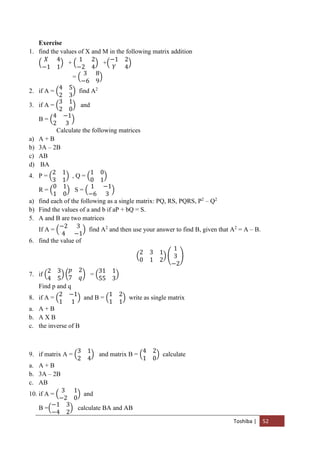
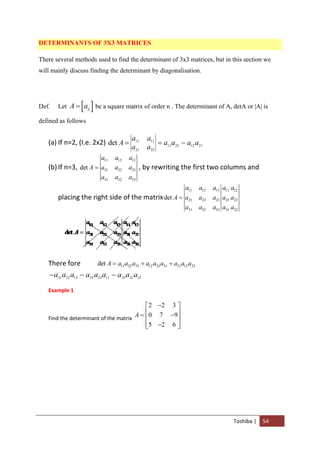
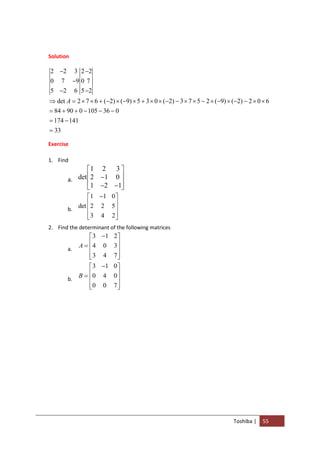
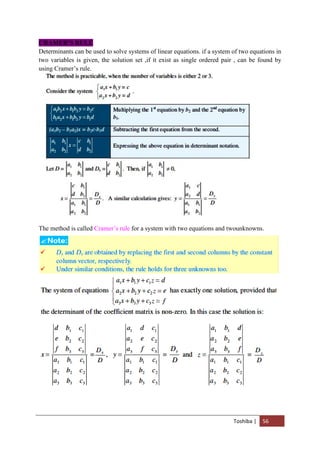
Toshiba | 32
ACKNOWLEDGEMENT
We would like to thank MASNO FOUNDATION for their inspiring guidance, constant
encouragement and constructive criticism. Their guidance at different stages of this work
enabled us to compile these books.
We will be failing in our duty, if we do not acknowledge the support for the secondary school
Head teachers of ILAYS Secondary School, for their valuable guidance and providing us the
enabling working conditions to continue the work, in addition to our official duties .We admit
that without their support, it would not have been possible to complete this work.
We also express deep gratitude to all administrators, teachers and students of the Secondary
schools of ILAYS In Hargeisa for their cooperation during our work.
Ibrahim Cilmi Hassan
Khadar Da’ud Abdirahman
Mohamed A/laahi Ahmed
Nuuradin Muse Aw Cali
Toshiba | 2
Contents
Unit one: Number 2 ............................................................................................................................6
Rational and irrational numbers..........................................................................................................6
Square roots ........................................................................................................................................7
Surds ...................................................................................................................................................8
Rules of surds..................................................................................................................................8
Simplification of surds........................................................................................................................8
Multiplication of surds........................................................................................................................9
Division of surds – rationalization of the denominator.......................................................................9
Addition and subtraction of surds.....................................................................................................11
Further rationalization of denominators (conjugate of surds)...........................................................11
Arithmetic and geometric progressions ............................................................................................13
Sequences..........................................................................................................................................13
Series.................................................................................................................................................13
Arithmetic progressions....................................................................................................................14
The sum an arithmetic progression...................................................................................................15
Using APS to solve problems ...........................................................................................................17
Geometric progressions ....................................................................................................................20
The sum of a geometric progression.................................................................................................21
When r is between – 𝟏 and 1.............................................................................................................23
Application of sum of a GP to infinity..............................................................................................24
Unit Two: Algebra II ..........................................................................................................................26
Algebraic simplification (2)..............................................................................................................26
Simplifying calculations by factorization .........................................................................................27
Factorisation of Larger Expressions .................................................................................................28
Factorisation by grouping .................................................................................................................29
Algebraic fractions............................................................................................................................31
Equivalent fractions ..........................................................................................................................32
Adding and subtracting algebraic fractions ......................................................................................33
Fractions with brackets .....................................................................................................................35
Example ............................................................................................................................................38
Types of matrices..............................................................................................................................47
Addition and Subtraction of matrices ...............................................................................................48
Multiplication of matrices.................................................................................................................48
Toshiba | 3
Transposition of Matrices .................................................................................................................49
Determinants:....................................................................................................................................49
Inverse of a matrix ............................................................................................................................49
Singular matrix..................................................................................................................................51
Equality of matrices..........................................................................................................................51
INEQUALITIES...............................................................................................................................58
Not greater than (≤) not less than (≥) .............................................................................................59
Graphs of inequality..........................................................................................................................60
Line graphs........................................................................................................................................60
Cartesian graphs................................................................................................................................61
Simultaneous inequalities .................................................................................................................63
Inequalities in one variable ...............................................................................................................63
Inequalities of two variables .............................................................................................................63
Solution of inequalities .....................................................................................................................67
Unit Three: GEOMETRY (1) ...............................................................................................................74
MENSURATION .................................................................................................................................74
Arcs and Sectors of circles................................................................................................................79
Area of Sector ...................................................................................................................................82
MENSURATION (1) Plane Shapes..................................................................................................86
Area of Triangle................................................................................................................................88
Area of parallelogram .......................................................................................................................88
MENSURATRION (2) Solid shapes................................................................................................91
Prisms................................................................................................................................................91
Cuboid...............................................................................................................................................91
Pyramid and cone..............................................................................................................................91
Cone..................................................................................................................................................92
Sphere ...............................................................................................................................................97
Addition and subtraction of volumes................................................................................................99
Frustum of a cone or pyramid.........................................................................................................105
Circle geometry...............................................................................................................................109
LOCI ...............................................................................................................................................113
UNIT FOUR: SETS.............................................................................................................................129
Types of sets ...................................................................................................................................129
Membership of a set........................................................................................................................129
Toshiba | 4
Order of a set...................................................................................................................................129
Subsets ............................................................................................................................................129
The universal set .............................................................................................................................130
Equality and Equivalence ...............................................................................................................130
Venn Diagrams ...............................................................................................................................131
Union and Intersections ..................................................................................................................132
Problems with intersections and unions..........................................................................................133
Problems with the Number of Elements of a Set............................................................................133
UNIT FIVE: Financial Mathematics 2...............................................................................................136
UNIT SIX: COORDINATE GEOMETRY (1)..........................................................................................141
Gradient of a line ............................................................................................................................141
Parallel and perpendicular lines......................................................................................................150
Sketching graphs of straight lines...................................................................................................151
Mid- point and length of a straight line...........................................................................................154
Length.............................................................................................................................................155
Equation of a straight line...............................................................................................................156
UNIT SEVEN: TRANSTORMATION GEOMETY ..................................................................................159
Vectors............................................................................................................................................159
Translation vectors..........................................................................................................................159
Sum of vectors ................................................................................................................................162
Difference of vectors.......................................................................................................................164
Magnitude of a vectors....................................................................................................................164
Unit vectors.....................................................................................................................................164
Null vectors.....................................................................................................................................165
Position vectors...............................................................................................................................166
Properties of shapes ........................................................................................................................169
Translation ......................................................................................................................................194
Reflection........................................................................................................................................196
Reflection in the X-axis ..................................................................................................................196
Reflection in the y-axis...................................................................................................................197
Reflection in the line y = x..............................................................................................................198
Rotation...........................................................................................................................................200
The inverse of a rotation .................................................................................................................203
Enlargement....................................................................................................................................204
Toshiba | 5
Areas of enlargements.....................................................................................................................209
Reference books:.............................................................................................................................211
Toshiba | 6
Unit one: Number 2
Rational and irrational numbers
Numbers such as 8,
1
4
2
,
1
5
, 0.211,
49
16
, 16 and 0.3
̅Can be expressed as exact fraction or
ratios:
8
1
,
9
2
,
1
5
,
211
1000
,
7
4
,
1
3
.
Such numbers are called rational numbers.
Numbers which cannot be written as exact fractions are called irrational numbers. 7 is an
example if an irrational number. 7 =2.645751…,the decimals extending without end and
without recurring. The number π is another example of an irrational number. 
=3.141592….., again extending for ever without repetition. The fraction
22
7
is often used for
the value of π but
22
7
is a rational number and is only approximate value of . an irrational
number extends forever and is non-recurring.
Example 1
Express 3.1̇7̇as a rational number.
Solution
Let n = 3.1
̅7
̅
i.e. n=3.17 17 17…….
Multiply both sides by 100
100n = 317.17 17 17…..
Subtract (1) from (2),
99n = (317.17 17 17…) – (3.17 17…..)
99n = 314
n=
314
99
thus 3.1̇7̇ =
314
99
, which is a rational number.
Example 2
Express 0.001̇3̇3̇ as a rational number by using the algebraic method.
Solution:
Let n= 0.001̇3̇3̇
i.e. n= 0.00133 133 133……
multiply both by 1000 (there are 3 recurring decimals):
1000n = 1.33 133 133……
Subtract (1) from (2):
999n = 1.33
n=
1.33
999
=
133
99900
For the alternative method, use the fact that
1
999
= 0.0̇0̇1̇.
Toshiba | 7
Exercise
1. which of the following are rational and which are irrational?
a)9
b)
1
9
c) √9
d) 0.9
e) 2
2
3
f) 5
3
4
g) √17
h) 0. 2
̇
i) 0.83̇
Square roots
Some square roots are rational: √4 = 2, √6.25 = 2.5 =
5
2
other square roots are irrational:√11
= 3.31662…, √4.9 = 2.21359436….
The fact that many square roots are irrational had already been discovered by the time of
Pythagoras around 350. He tried to find the length of the diagonal of a ‘unit square’. Figure
below shows a unit square, a square with side 1 unit figure
in ABD, using Pythagoras rule , BD2 =
AB2
+ AD2
= 12
+ 12
=2 therefore BD= √2
Example 3
find the value of √2 correct to 2 significant figures.
Solution
Since 2 lies between 1 and 4, √2 lies between √1 and √4, i.e. √2 lies between 1 and 2:
Try 1.5:2.25 (too large)
Try 1.4: 1.42
= 1.96 (too small)
Thus √2 lies between 1.4 and 1.5.
Since 2 is much closer to 1.96 than to 2.25. thus √2 lie between 1.41 and 1.42.√2= 1.4 to 2
s.f.
Example 4
Find the value of √94 correct to 1 decimal place.
Solution
√94 lies between √81 and √100, so √94 lies between 9 and 10. Therefore √94 = 9.7 to 1
d.p.
Toshiba | 8
Exercise
1. Write down the first digit of the square roots of the following :
a) 22
b) 6
c) 42
2. Use the method of examples 3 and 4 to find the value of the following correct to 2 significant
figures. If possible, check your answers using a calculator.
a) √3
b) √8
c) √69
d) √52
Surds
There are many kinds of irrational numbers. Square roots, cube roots and 𝜋 are just some of
them. Many numbers have irrational square roots,√3 = 1.7320508…. and √28 =
5.2915026…. irrational numbers of this kind are called surds. Surds can’t be expressed as
terminating decimals or as recurring decimals or as fractions.
Rules of surds
1. √𝑚𝑛= √𝑚 x √𝑛
2. √
𝑚
𝑛
=
√𝑚
√𝑛
,
Simplification of surds
The above facts are used when simplifying surds.
Example 5
Simplify: a) √45 b) √162 c) 2
x y
Solution
a) √45 = √9𝑥5 = √9 x √5 =3√5
b) √162 = √81𝑥2 = √81x√2 = 9√2
c) 2
x y = 2
x x y = x√𝑦
Exercise
Simplify the following, making the number under the square root sign as small as possible.
1. 20
2. 32
3. 48
4. 200
5. 75
6. 72
7. 288
8. 147
Examples 6
Express the following as the square root of a single number:
a) 2 5
b) 7 3 c) ac 3
b
Solutions:
a) 2 5 = 4 x 5 = 4 5
x = 20
b) 7 3 = 49 x 3 = 49 3 = 147
x
c) ac 3
b =√𝑎3
3
x √𝑐3
3
x √𝑏
3
= √𝑎3𝑏𝑐3
3
Toshiba | 9
Exercise
Express each of the following as the square root of a single number:
1. 2 3
2. 10 2
3. 5 7
4. 2 11
5. 3 8
Multiplication of surds
When two or more surds have to be multiplied together, they should first be simplified, if
possible. Then whole numbers should be grouped together, and surds grouped with like surds
(as a single surd).
Example 7
Simplify the following without using a calculator:
a) 27 x 50
b) 12 x 3 60 x 45
c) ( )
2
2 5
Solution
a) 27 x 50 = 9 3 x 25 2
x x = 3 3 x 5 2 = 15x 3 2
x = 15 6
b) 12 x 3 60 x 45 = 4 3 x 3 4 15 x 9 5 = 2 3 x 3x2 15 x3 5
x x x
= 36 3 15 5 36 15 15 = 36x15 = 540
x x x
=
c) ( )
2
2 5 = 2 5 x 2 5 = 4x5 =20
Example 8
Simplify:
a) 3 x 6 b) 2 x 3 x 5 x 12 x 45 x 50
c)
Solution:
a) 3 x 6 = 3 6 = 18 = 9 2 = 3 2
x x
b) 2 x 3 x 5 x 12 x 45 x 50 = 2 3 5 12 45 50 = (2 50) (3 12) (5 45)
x x x x x x x x x x
= 100 36 225
x x = 10 x 6 x 15= 900
Exercise
Simplify the following without using a calculator:
1. 5 x 10
2. 2 x 6 x 3
3. ( )
2
2 7
4. ( )
5
3
5. 10 x 3 2 x 20
6. 6 x 8 x 10 x 12
Division of surds – rationalization of the denominator
If a fraction has a surd in the denominator, it is usually best to rationalize the denominator.
This means to make the denominator into a rational number, usually a whole number. This is
done by multiplying both the numerator and denominator of the fraction by a surd which
makes the denominator rational.
Toshiba | 10
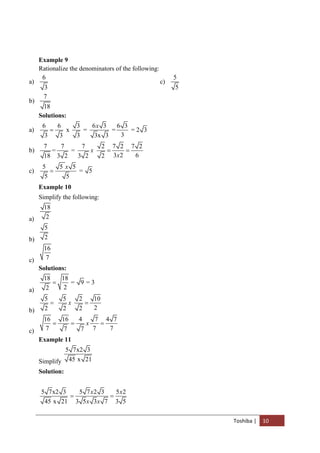
Example 9
Rationalize the denominators of the following:
a)
6
3
b)
7
18
c)
5
5
Solutions:
a)
6 6 3 6 3 6 3
x = = = 2 3
3
3 3 3 3x 3
x
=
b)
7 7 7 2 7 2 7 2
= =
3 2 6
18 3 2 3 2 2
x
x
= =
c)
5 5 5
= 5
5 5
x
=
Example 10
Simplify the following:
a)
18
2
b)
5
2
c)
16
7
Solutions:
a)
18 18
= 9 = 3
2
2
=
b)
5 5 2 10
2
2 2 2
x
= =
c)
16 16 4 7 4 7
7 7 7
7 7
x
= = =
Example 11
Simplify
5 7x2 3
45 x 21
Solution:
5 7x2 3
45 x 21
5 7 2 3 5 2
3 5 3 7 3 5
x x
x x
= =
Toshiba | 11
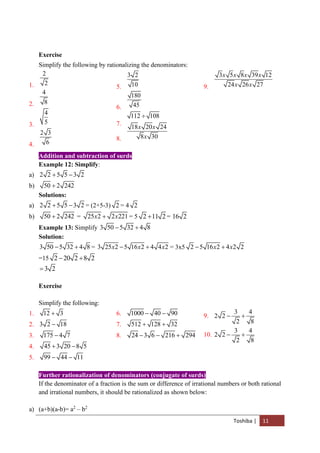
Exercise
Simplify the following by rationalizing the denominators:
1.
2
2
2.
4
8
3.
4
5
4.
2 3
6
5.
3 2
10
6.
180
45
7.
112 108

8.
18 20 24
8 30
x x
x
9.
3 5 8 39 12
24 26 27
x x x x
x x
Addition and subtraction of surds
Example 12: Simplify:
a) 2 2 5 5 3 2
+ −
b) 50 2 242
+
Solutions:
a) 2 2 5 5 3 2
+ − = (2+5-3) 2 = 4 2
b) 50 2 242
+ = 25 2 2 221
x x
+ = 5 2 11 2
+ = 16 2
Example 13: Simplify 3 50 5 32 4 8
− +
Solution:
3 50 5 32 4 8
− + = 3 25 2 5 16 2 4 4 2
x x x
− + = 3x5 2 5 16 2 4 2 2
x x
− +
=15 2 20 2 8 2
− +
3 2
=
Exercise
Simplify the following:
1. 12 3
+
2. 3 2 18
−
3. 175 4 7
−
4. 45 3 20 8 5
+ −
5. 99 44 11
− −
6. 1000 40 90
− −
7. 512 128 32
+ +
8. 24 3 6 216 294
− − +
9.
3 4
2 2
2 8
− +
10.
3 4
2 2
2 8
− +
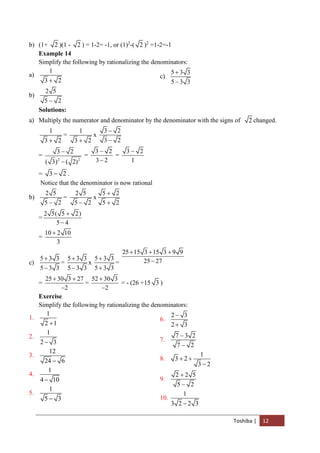
Further rationalization of denominators (conjugate of surds)
If the denominator of a fraction is the sum or difference of irrational numbers or both rational
and irrational numbers, it should be rationalized as shown below:
a) (a+b)(a-b)= a2
– b2
Toshiba | 12
b) (1+ 2 )(1 - 2 ) = 1-2= -1, or (1)2
-( 2 )2
=1-2=-1
Example 14
Simplify the following by rationalizing the denominators:
a)
1
3 2
+
b)
2 5
5 2
−
c)
5 3 3
5 3 3
+
−
Solutions:
a) Multiply the numerator and denominator by the denominator with the signs of 2 changed.
1
3 2
+
=
1
3 2
+
x
3 2
3 2
−
−
=
2 2
3 2
( 3) ( 2)
−
−
=
3 2
3 2
−
−
=
3 2
1
−
= 3 2
− .
Notice that the denominator is now rational
b)
2 5
5 2
−
=
2 5
5 2
−
x
5 2
5 2
+
+
=
2 5( 5 2)
5 4
+
−
=
10 2 10
3
+
c)
5 3 3
5 3 3
+
−
=
5 3 3
5 3 3
+
−
x
5 3 3
5 3 3
+
+
=
25 15 3 15 3 9 9
25 27
+ + +
−
=
25 30 3 27
2
+ +
−
=
52 30 3
2
+
−
= - (26 +15 3 )
Exercise
Simplify the following by rationalizing the denominators:
1.
1
2 1
+
2.
1
2 3
−
3.
12
24 6
−
4.
1
4 10
−
5.
1
5 3
−
6.
2 3
2 3
−
+
7.
7 3 2
7 2
−
−
8.
1
3 2
3 2
+ +
−
9.
2 2 5
5 2
+
−
10.
1
3 2 2 3
−
Toshiba | 13
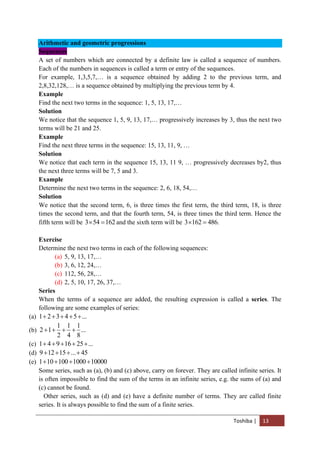
Arithmetic and geometric progressions
Sequences
A set of numbers which are connected by a definite law is called a sequence of numbers.
Each of the numbers in sequences is called a term or entry of the sequences.
For example, 1,3,5,7,… is a sequence obtained by adding 2 to the previous term, and
2,8,32,128,… is a sequence obtained by multiplying the previous term by 4.
Example
Find the next two terms in the sequence: 1, 5, 13, 17,…
Solution
We notice that the sequence 1, 5, 9, 13, 17,… progressively increases by 3, thus the next two
terms will be 21 and 25.
Example
Find the next three terms in the sequence: 15, 13, 11, 9, …
Solution
We notice that each term in the sequence 15, 13, 11 9, … progressively decreases by2, thus
the next three terms will be 7, 5 and 3.
Example
Determine the next two terms in the sequence: 2, 6, 18, 54,…
Solution
We notice that the second term, 6, is three times the first term, the third term, 18, is three
times the second term, and that the fourth term, 54, is three times the third term. Hence the
fifth term will be 3 54 162
 = and the sixth term will be 3 162 486.
 =
Exercise
Determine the next two terms in each of the following sequences:
(a) 5, 9, 13, 17,…
(b) 3, 6, 12, 24,…
(c) 112, 56, 28,…
(d) 2, 5, 10, 17, 26, 37,…
Series
When the terms of a sequence are added, the resulting expression is called a series. The
following are some examples of series:
(a) 1 2 3 4 5 ...
+ + + + +
(b)
1 1 1
2 1 ...
2 4 8
+ + + +
(c) 1 4 9 16 25 ...
+ + + + +
(d) 9 12 15 ... 45
+ + + +
(e) 1 10 100 1000 10000
+ + + +
Some series, such as (a), (b) and (c) above, carry on forever. They are called infinite series. It
is often impossible to find the sum of the terms in an infinite series, e.g. the sums of (a) and
(c) cannot be found.
Other series, such as (d) and (e) have a definite number of terms. They are called finite
series. It is always possible to find the sum of a finite series.
Toshiba | 14
Arithmetic progressions
The sequence 9, 12, 15, 18,… 45 has a first term of 9 and a common difference between
terms of 3. A sequence in which the terms either increase or decrease in equal steps is called
an arithmetic progression.
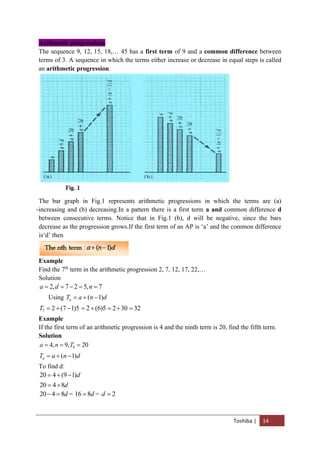
The bar graph in Fig.1 represents arithmetic progressions in which the terms are (a)
increasing and (b) decreasing.In a pattern there is a first term a and common difference d
between consecutive terms. Notice that in Fig.1 (b), d will be negative, since the bars
decrease as the progression grows.If the first term of an AP is ‘a’ and the common difference
is‘d’ then
Example
Find the 7th
term in the arithmetic progression 2, 7, 12, 17, 22,…
Solution
2, 7 2 5, 7
a d n
= = − = =
Using ( 1)
n
T a n d
= + −
7 2 (7 1)5
T = + − 2 (6)5
= + 2 30
= + 32
=
Example
If the first term of an arithmetic progression is 4 and the ninth term is 20, find the fifth term.
Solution
9
4, 9, 20
a n T
= = =
( 1)
n
T a n d
= + −
To find d:
20 4 (9 1)d
= + −
20 4 8d
= +
20 4 8d
− = = 16 8d
= = 2
d =
Toshiba | 15
To find the fifth term:
( 1)
n
T a n d
= + −
5 4 (5 1)2
T = + −
4 8
= +
12
=
Exersice
1. Find the 11th
term of the sequence 8,14,20,26,…
2. Find the 10th
term of the sequence 20,17,14,11,…
3. Find the 15th
term of an aritmetic progression of which the first term is
1
2
2
and the tenth term
is 16.
The sum an arithmetic progression
Example
Find the sum of the first 100 integers.
If S is the sum, then
1 2 3 ... 99 100
S = + + + + + (1)
Also, reversing the series:
100 99 98 ... 2 1
S = + + + + + (2)
Adding (1) and (2):
2 101 101 101 ... 101 101
S = + + + + +
100 100
=  (since there are 100 terms)
Dividing both sides by 2:
1
(101 100)
2
S =  5050
=
The following expression represents a general sum of an arithmetic progression (AP):
( ) ( 2 ) ... ( )
a a d a d l d l
+ + + + + + − +
a, d, and L are the first term, common difference and last term respectively. Using the method
of the above example, it is possible to find an expression for the sum S of the general AP.
( ) ( 2 ) ... ( )
S a a d a d l d l
= + + + + + + − +
In reverse:
( ) ( 2 ) ... ( )
S l l d l d a d a
= + − + − + + + +
Adding:
2 ( ) ( ) ( )... ( )
S a l a l a l a l
= + + + + + + + ( )
n a l
= +
(where n is the number of terms in the AP).Fig.1 shows that the nth term of an AP is
( 1)
a n d
+ − . Substituting this expression for l in formula (1):
 
1
( 1)
2
S n a a n d
= + + −
1
( )
2
S n a l
 = + (1)
 
1
2 ( 1)
2
S n a n d
 = + − (2)
Toshiba | 16
To find the sum of an AP, use either formula (1) or (2).
Example
Find the sum of the first 20 terms of the arithmetic progression 16+9+2+ (-5) +…
Solution
In the given AP,
16, 7, 20
a d n
= = − =
Using  
1
2 ( 1)
2
S n a n d
= + − :
 
1
20 2 16 (20 1)( 7)
2
S =   + − −
 
10 32 19( 7)
= + − 10(32 133)
= −
10( 101) 1010
= − = −
Example
Find the sum of the arithmetic progression whose first term and last terms are 3 and 30
respectively, if the number terms are 10.
Solution
3, 30, 10
a l n
= = =
Using
1
( )
2
S n a l
= +
1
10(3 30)
2
=  +
5(33) 165
= =
Example
The first and last terms of an AP are 0 and 108. If the sum of the series is 702, find (a) the
number of terms in the AP and (b) the common difference between them.
Solution
(a) Using
1
( ):
2
S n a l
= +
1
702 (0 108)
2
n
= +
702 54n
 =
702
13
54
n
 = =
The AP has 13 terms.
(b) Using ( 1) :
l a n d
= + −
108 0 (13 1)d
= + −
108 12d
 =
Toshiba | 17
108
9
12
d
 = =
The common difference is 9.
Exercise
1 Using the method of the first example to find the sum of the following APs.
(a) 2+4+6+…+98+100
(b) 1+3+5+…+97+99
(c) 50+49+48+…+2+1
(d) (-5)+(-10)+(-15)+…+(-50)
2 Use any suitable method to find the following sums.
(a) 60+91+122+153+184
(b) 3+6+9+…as far as the 20th
term
(c) 5+10+15+…as far as the 10th
term
(d)
3 1 3 1 3
3 6 8 11 ...28
4 4 4 4 4
+ + + +
3 The first term and last terms of an AP are 1 and 121 respectively. Fin (i) the number of terms
in the AP and (ii) the common difference between them if the sum of its terms is
(a) 549, (b) 671, (c) 976, (d) 1281
4 An AP has 15 terms and a common difference of −3 . Find its first and last terms if its sum is
(a) 120, (b) 15, (c) 0 (d) −20
5 Find the sum of all the multiples of 9 between 0 and 200.
Using APS to solve problems
Knowledge of APs can be used to solve a variety of problems in which quantities increase or
decrease by regular amounts.
Example
The salary scale for a senior officer starts at $5700 per annum. A rise of $280 is given at the
end of each year. Find the total amount of money that the officer will earn in 14 years.
Solution
1st year salary = $5700,
2nd year salary= $5980,
And so on, adding $280 each time.
Total earnings over the years = $5700 + $5980 + ⋯for 14 years
This is an AP in which
570, 280, 14
a d n
= = =
It follows that
 
1
2 ( 1)
2
S n a n d
= + −
 
1
14 (2 5700 (14 1)280
2
=   + −
7(11400 13 280)
= + 
7(11400 3640)
= +
Toshiba | 18
7 15040 105280
=  =
The officer will earn a total of = $105280 in 14 years.
Example
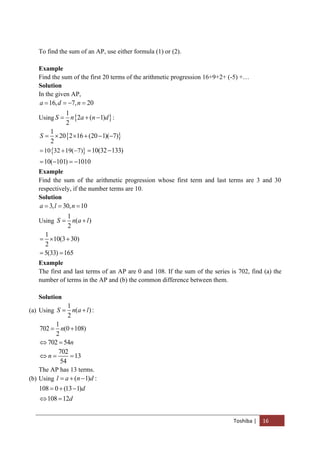
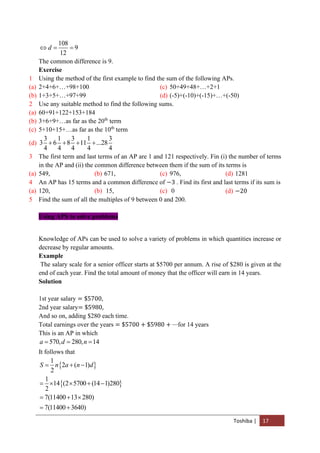
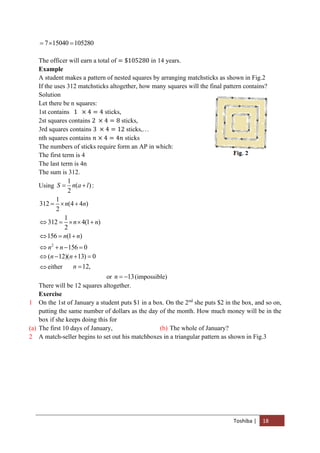
A student makes a pattern of nested squares by arranging matchsticks as shown in Fig.2
If the uses 312 matchsticks altogether, how many squares will the final pattern contains?
Solution
Let there be n squares:
1st contains 1 × 4 = 4 sticks,
2st squares contains 2 × 4 = 8 sticks,
3rd squares contains 3 × 4 = 12 sticks,…
nth squares contains 𝑛 × 4 = 4𝑛 sticks
The numbers of sticks require form an AP in which:
The first term is 4
The last term is 4n
The sum is 312.
Using
1
( ):
2
S n a l
= +
1
312 (4 4 )
2
n n
=  +
1
312 4(1 )
2
n n
 =   +
156 (1 )
n n
 = +
2
156 0
n n
 + − =
( 12)( 13) 0
n n
 − + =
 either 12,
n =
or 13
n = − (impossible)
There will be 12 squares altogether.
Exercise
1 On the 1st of January a student puts $1 in a box. On the 2nd
she puts $2 in the box, and so on,
putting the same number of dollars as the day of the month. How much money will be in the
box if she keeps doing this for
(a) The first 10 days of January, (b) The whole of January?
2 A match-seller begins to set out his matchboxes in a triangular pattern as shown in Fig.3
Toshiba | 19
He continues until there are 11 matchboxes in the bottom row of the triangle. How many
matchboxes are in the complete pattern?
3 In Fig.4 each small square measured
1
2
cm by
1
2
cm.
(a) What is the area of one small square?
(b) Calculate the total shaded area in the diagram.
4 The salary scale for a finance officer starts at $2300 per annum. A rise of $150 is given at the
end of each year. Find the total amount of money earned in 12 years.
5 A sum of money is shared among nine people on that the first gets $75, the next 9$150, the
next $225, and so on.
(a) How much money does the ninth person get?
(b) How much money is shared altogether?
6 The starting salary for a particular job is $3000. The salary increases by annual rises of $400
to a maximum of 45000.
(a) How many years does it take to reach the maximum salary?
(b) How much money would a person earn in that time?
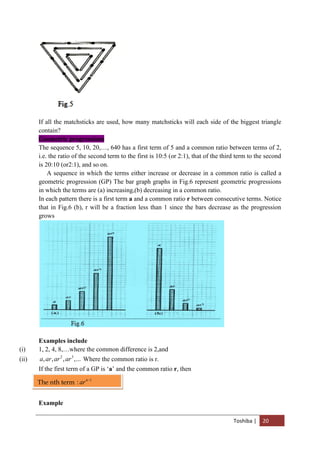
7 A student has 273 matchsticks with which to make a pattern of nested triangles as shown in
Fig.5
Toshiba | 20
If all the matchsticks are used, how many matchsticks will each side of the biggest triangle
contain?
Geometric progressions
The sequence 5, 10, 20,…, 640 has a first term of 5 and a common ratio between terms of 2,
i.e. the ratio of the second term to the first is 10:5 (or 2:1), that of the third term to the second
is 20:10 (or2:1), and so on.
A sequence in which the terms either increase or decrease in a common ratio is called a
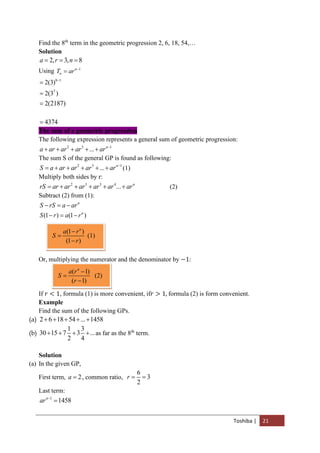
geometric progression (GP) The bar graph graphs in Fig.6 represent geometric progressions
in which the terms are (a) increasing,(b) decreasing in a common ratio.
In each pattern there is a first term a and a common ratio r between consecutive terms. Notice
that in Fig.6 (b), r will be a fraction less than 1 since the bars decrease as the progression
grows
Examples include
(i) 1, 2, 4, 8,…where the common difference is 2,and
(ii) 2 3
, , , ,...
a ar ar ar Where the common ratio is r.
If the first term of a GP is ‘a’ and the common ratio r, then
Example
The nth term 1
: n
ar −
Toshiba | 21
Find the 8th
term in the geometric progression 2, 6, 18, 54,…
Solution
2, 3, 8
a r n
= = =
Using 1
n
n
T ar −
=
8 1
2(3) −
=
7
2(3 )
=
2(2187)
=
4374
=
The sum of a geometric progression
The following expression represents a general sum of geometric progression:
2 3 1
... n
a ar ar ar ar −
+ + + + +
The sum S of the general GP is found as following:
2 3 1
... n
S a ar ar ar ar −
= + + + + + (1)
Multiply both sides by r:
2 3 3 4
... n
rS ar ar ar ar ar ar
= + + + + + (2)
Subtract (2) from (1):
n
S rS a ar
− = −
(1 ) (1 )
n
S r a r
− = −
Or, multiplying the numerator and the denominator by −1:
If 𝑟 < 1, formula (1) is more convenient, if𝑟 > 1, formula (2) is form convenient.
Example
Find the sum of the following GPs.
(a) 2 6 18 54 ... 1458
+ + + + +
(b)
1 3
30 15 7 3 ...
2 4
+ + + + as far as the 8th
term.
Solution
(a) In the given GP,
First term, 2
a = , common ratio,
6
3
2
r = =
Last term:
1
1458
n
ar −
=
(1 )
(1 )
n
a r
S
r
−
=
−
(1)
( 1)
( 1)
n
a r
S
r
−
=
−
(2)
Toshiba | 22
1
2 3 1458
n−
 =
1 6
3 729 3
n−
= = , 1 6
n− = 7
n =
Using
( 1)
( 1)
n
a r
S
r
−
=
−
7
2(3 1)
(3 1)
S
−
=
−
2(2187 1)
2186
2
−
= =
(b) In the given GP
15 1
30, , 8
30 2
a r n
= = = =
Using
(1 )
(1 )
n
a r
S
r
−
=
−
8
1
30 1
2
1
1
2
S
 
 
−
 
 
 
 
 
=
 
−
 
 
1
30 1
256
1
2
 
−
 
 
=
1
60 1
256
 
= −
 
 
60 49
60 59
256 64
= − =
Example
A GP has 6 terms. If the 3rd
and 4th
terms are 28 and −56 respectively, find
(a) the first term,
(b) the sum of the GP.
Solution
(a) 3rdterm, 2
28
ar = (1)
4thterm, 3
56
ar = − (2)
Common ratio , (2) (1) 2
r =  = −
Substitute -2 for r in (1):
2
( 2) 28
a − =
28
7
4
a = =
The first term of the GP is 7.
Toshiba | 23
(b) Using
( 1)
( 1)
n
a r
S
r
−
=
−
( )
6
7 2 1 7(64 1)
( 2 1) 3
S
 
− − −
 
= =
− − −
7 63
147
3

= = −
−
The sum of the GP is −147.
Exercise
1 Use formula (a) to calculate the sum of the following GPs.
(a) 2 4 8 16 ...
+ + + + as far as the s 8th
term
(b) 1 3 9 27 .. 729
+ + + + +
(c) 6 60 600 .. 6000000
− + − +
2 Use formula (1) to calculate the sum of the following GPs.
(a)
1 1 1 1
...
2 4 8 1024
+ + + +
(b) 448 224 112 ...
+ + + to the 6th
term
(c) 40 4 0.4 ...
− + − to the 7th
term
(d) 1 0.2 0.04 ...
+ + + to the5th term
3 A GP has 8 terms. Its first and last terms are 0.3 and 38.4. Calculate (a) the common ratio,(b)
the sum of the terms of the GP.
4 The 2nd
and 5th
terms of a GP are −7 and 56 respectively. Deduce (a) the common ratio,(b)
the first term, (c) the sum of the first five terms.
5 If (3 ) (7 5 )
x x
− + − ,find two possible values for (a) x, (b) the common ratio,(c) the sum of the
GP.
Sum of GP to infinity
When r is between – 𝟏 and 1
Suppose
9
0.9
10
r = =
2 3 729
0.81, 0.729,
1000
r r
= = =
4 6561
0.6561
1000
r = =
5 6
59049 531441
0.59049, .
100000 1000000
r r
= = =
So n
r is decreasing as n increases.
Toshiba | 24
So, if n is very large, n
r is very small. It is close to zero when n gets close to infinity.
(1 )
(1 )
n
n
a r
S
r
−
=
−
as n approaches infinity,
Example
The sum to infinity of a GP is 60. If the first term of the series is 12, find its second term.
Solution
60, 12
S r
 = =
Using
(1 )
(1 )
n
n
a r
S
r
−
=
−
12
60
1 r
=
−
12 1
1
60 5
r
− = =
1 4
1
5 5
r = − =
Second term
4
12 9.5
5
ar
= =  =
Example
Obtain
5 5
5 .......
3 9
S = + +
Solution
1
5,
3
a r
= =
Using
1
a
S
r
 =
−
5 5 5 3
7.5
1 2 2
1
3 3

= = = =
−
Application of sum of a GP to infinity
Sum of geometric progression are useful in expression of recurring decimals in fraction form.
Example
Express as 0.3 as a fraction
Solution
(1 0)
1 1
a a
S
r a

−
= =
− −
Toshiba | 25
0.3 0.33333333..............
=
0.3 0.03 0.003 0.0003 ..............
= + + + +
0.03
0.3, 0.1
0.3
a r
= = =
Using
1
a
S
r
 =
−
0.3 0.3 0.3 10 3 1
1 0.1 0.9 0.9 10 9 3

= = = = =
− 
Exercise
1 Find the sum to infinity of the following GPs.
(a)
1 1
1 .....
2 4
+ + +
(b)
1 1
1 ...
3 9
+ + +
(c)
6 6
6 ...
10 100
+ + +
(d) 8 0.8 0.08 ...
− + −
(e) 5.55555... ( . .5 0.5 0.05 0.005 ...)
i e + + + +
2 The sum to infinity of a GP is 100. Find its first term if the common ratio is
(a)
1
4
(b)
1
2
(c)
1
4
−
(d) 0.8
3 The first term of a GP is 48. Find the common ratio between its terms if its sum to infinity is
(a) 80,
(b) 64
(c) 60
(d) 30
4 Two GPs have equal sums to infinity. Their first terms are 27 and 36 respectively.
If the common ratio of the first is
3
4
, find the common ratio of the second.
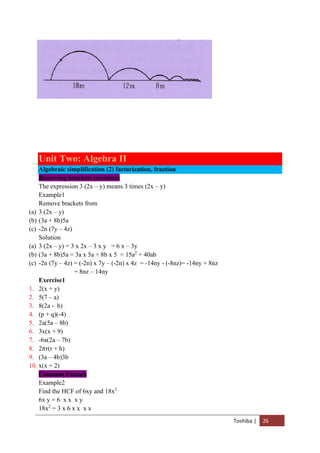
5 A ball is thrown a distance of 18 m. It bounces a further distance of 12 m and continues
bouncing in this way until it comes to rest (Fig.7) number of terms. Consider the distances
between the bounces to form a GP with an infinite
Toshiba | 26
Unit Two: Algebra II
Algebraic simplification (2) factorization, fraction
Removing brackets (revision)
The expression 3 (2x – y) means 3 times (2x – y)
Example1
Remove brackets from
(a) 3 (2x – y)
(b) (3a + 8b)5a
(c) -2n (7y – 4z)
Solution
(a) 3 (2x – y) = 3 x 2x – 3 x y = 6 x – 3y
(b) (3a + 8b)5a = 3a x 5a + 8b x 5 = 15a2
+ 40ab
(c) -2n (7y – 4z) = (-2n) x 7y – (-2n) x 4z = -14ny - (-8nz)= -14ny + 8nz
= 8nz – 14ny
Exercise1
1. 2(x + y)
2. 5(7 – a)
3. 8(2a - b)
4. (p + q)(-4)
5. 2a(5a – 8b)
6. 3x(x + 9)
7. -6a(2a – 7b)
8. 2𝜋r(r + h)
9. (3a – 4b)3b
10. x(x + 2)
Common Factors
Example2
Find the HCF of 6xy and 18x2
6x y = 6 x x x y
18x2
= 3 x 6 x x x x
Toshiba | 27
The of 6xy and 18x2
is 6 x x = 6x
Exercise 2
Find the HCF of the following
1. 5a and 5z
2. 7mnp and mp
3. ab2
and a2
b
4. 6d2
e and 3de2
5. 9xy and 24pq
6. 10ax2
and 14a2
x
7. 30ad and 28ax
8. 9xy and 24pq
9. 6x and 15y
10. 13ab and 26b
Factorisation by Taking out Common Factors
To factorize an expression is to write it as a product of its factors.
Example 3
Factorize the following.
(a) 9a – 3z
(b) 5x2
+ 15x
(c) 2mh - 8m2
h
Solution
(a) The HCF of 9a and 3z is 3
9a – 3z = 3(
9a
3
–
3z
3
)= 3(3a – z)
(b) The of 15x = 5x (
5𝑥2
5𝑥
+
15𝑥
5𝑥
)
= 5x(x + 3)
(c) The HCF of 2mh and 8m2
h.
2mh – 8m2
h = 2mh (
2𝑚ℎ
2𝑚ℎ
−
8𝑚2 ℎ
2𝑚ℎ
)
= 2mh (1 – 4m)
The above examples show that factorization is the opposite of removing brackets. Note: it is
not necessary to write the first line of working as above; this has been included to show the
method.
Exercise 3
Factorize the following question
1. 5a + 5z
2. 7mnp – mp
3. 9xy + 24pq
4. 𝜋r2
+ 𝜋rs
5. 6d2
e – 3de2
6. x2
+ 9xy
7. 24x2
y – 6xy
8. 30ad – 28ax
9. 10ax2
+14a2
x
10. 2a2
+ 10a
Simplifying calculations by factorization
Example4
By facorising, simplify 34 x 48 + 34 x 52
Solution
Toshiba | 28
34 is a common factor of 34 x 48 and 34 x 52
34 x 48 + 34 x 52 = 34 (48 + 52)= 34 (100) = 3400
Example 5
Factorise the expression 2𝜋𝑟2
+ 2𝜋rh. Hence find the value of the expression when 𝜋 =
22
7
, r =
5 and h = 16
Solution
2𝜋𝑟2
+ 2𝜋rh =2 𝜋r(r + h)
When 𝜋 =
22
7
, r = 5, h = 16
= 2 x
22
7
x 5 (5 + 16) =
220
7
(21) = 220(3) = 660
Exercise 4
Simplify questions 1 – 5
1. 79 x 37 + 21 x 37
2. 128 x 27 – 28 x 27
3. 693 x 7 + 693 x 7
4.
8
13
x 125 +
5
13
x 125
5. 53 x 49 – 53 x 39
6. Factorise the expression 𝜋𝑟2
+ 2𝜋rh. Hence find the value of 𝜋𝑟2
+ 2𝜋rh when 𝜋 =
22
7
, r = 14
and h = 43
Factorisation of Larger Expressions
Example 6
Factorise 2x (5a + 2) – 3y (5a + 2)
Solution
5a + 2 is a common factor of 2x (5a + 2) and 3y (5a + 2)
Therefore 2x (5a + 2) – 3y (5a + 2) =
(5a + 2) (
2x (5a + 2)
5a + 2
−
3y (5a + 2)
5a + 2
)
= (5a + 2) (2x – 3y)
Example 7
Factorise 2d2
+ d2
(3d – 1)
Solution
2d2
and d2
(3d – 1) have the factor d2
in common.
Thus.
2d2
+ d2
(3d – 1) = d2
[2d + (3d – 1)]
= d2
(2d + 3d – 1)
= d2
(5d – 1)
Example 8
Factorise (a + m) (2a – 5m) – (a + m)2
.
Solution
The two parts of the expression have the factor (a + m) in common. Thus.
(a + m) (2a – 5m) – (a + m)2
= (a + m)[(2a – 5m) – (a + m)]
= (a + m)(2a – 5m –a –m)
Toshiba | 29
= (a + m) (a – 6m)
Example 9
Factorise (x – 3y)(z + 3) – x + 2y.
Solution
Notice that -1 is a factor of the last two terms. The given expression may be written as
follows.
(x – 2y)(z + 3) –x + 2y
= (x – 2y)(z + 3) – 1(x – 2y )
The two parts of the expression now have (x – 2y) as a common factor.
RHS = (x – 2y)[(z + 3) – 1]
= (x – 2y)(z + 3 – 1)
= (x – 2y)(z + 2)
Exercise 5
Factorise each of the following.
1. 3m + m(u – v)
2. 2a – a(3x + y)
3. x(3 – a) – bx
4. a(m + 1) + b(m + 1)
5. 3h(5u – v) + 2k(5u – v)
6. 4x2
– x(3y + 2z)
7. 2d(3m – 4n) – 3e(3m – 4n)
8. (h + k)(r + s) + (h + k)(r – 2s)
9. (b – c)(3d + e) – (b – c)(d – 2e)
10. (5m + 2n)(6a + b) – (5m + 2n)(a – 4b)
Factorisation by grouping
Example 10
Factorise cx + cy + 2dx + 2dy
Solution
The terms cx and cy have c in common.
The terms 2dx and 2dy have 2d in common.
Grouping in pairs in this way:
cx + cy + 2dx + 2dy = (cx + cy) + (2dx + 2dy)
= c(x + y) + 2d(x + y)
The two products now have (x + y) in common.
C(x +y) + 2d( x + y) = (x + y)(c + 2d)
Hence cx + cy + 2dx + 2dy = (x + y)(c + 2d)
Example 11
Factorise 3a – 6b + ax – 2bx.
Solution
Toshiba | 30
3a – 6b + ax – 2bx = 3(a – 2b) + x(a – 2b)
= (a – 2b)(3 + x)
Notice that to factorise in this way, the same brackets must occur twice in the first line of the
working. If the given expression is to be factorised, there must be repeated bracket. For this
reason, it is often easiest to write this bracket down again immediately, as soon as it has been
found. This is shown in example 12
Example 12
Factorise 2x2
– 3x + 2x – 3.
Solution
2x2
– 3x + 2x – 3 = x (2x – 3)…(2x – 3)
The terms +2x – 3 in the given expression are obtained by multiplying (2x – 3) by +1. Thus,
2x2
– 3x + 2x – 3 = x(2x – 3) + 1(2x – 3)
= (2x – 3)(x + 1)
Exercise 6
Factorise the following by grouping in pairs.
1. ax + ay + 3bx + 3by
2. x2
+ 5x + 2x + 10
3. a2
– 9a + 3a – 27
4. pq + qr + ps + rs
5. 8m – 2 + 4mn – n
6. ab – bc + ad – cd
7. 3m – 1 + 6m2
+ 2m
In many cases it is only possible to get a repeated second bracket if a negative common factor
is taken.
Example 13
Factorise 2am – 2m2
– 3ab + 3bm.
Solution
2am – 2m2
– 3ab + 3bm = 2m(a – m)…(a – m)
The terms -3ab and +3bm in the given expression are obtained by multiplying (a – m) by -3b.
Hence,
2am – 2m2
– 3ab + 3bm = 2m(a – m) – 3b(a – m)
= (a – m)(2m – 3b)
Exercise 7
Factorise the following.
1. ab + bc – am – cm
2. 2ax – 2ay – 3bx + 3by
3. X2
– 7x – 2x + 14
4. 5a – 5b – ac + bc
5. 3pq + 12pr – qy – 4ry
6. a2
– 3a – 3a + 9
7. 3k + 1 – 3hk – h
Sometimes the first attempt at a grouping the terms does not give a common factor. In these
cases, regroup th terms and try again.
Toshiba | 31
Example 14
Factorise cd – de + d2
– ce
Solution
cd – de + d2
– ce = d(c – e) …( )
d2
and ce have no common factors. Regroup the given terms.
Either:
cd – de + d2
– ce = cd + d2
– ce – de
= d(c + d) – e(c + d)
= (c + d)(d – e)
Or
Cd – de + d2
– ce = cd – ce + d2
– de
= c(d – e) + d(d – e)
= (d – e)(c + d)
Exercise 8
Regroup then factorise the following
1. 6a + bm + 6b +am
2. 15 – xy – 5y – 3x
3. ac – bd – bc + bd
4. ax – xy + x2
– ay
5. x2
+ 15 – 3x – 5x
6. 8a + 15by + 12y + 10ab
If all the terms contain a common factor, it should be taken out first.
Example 15
Factorise 2sru + 6tru – 4srv – 12trv
Solution
2r is a factor of every term in the given expression.
2sru + 6tru – 4srv – 12trv
= 2r {su +3tu – 2sv – 6tv}
= 2r {u(s + 3t) – 2v(s + 3t)}
= 2r(s + 3t)(u – 2v)
Exercise 9
Factorise the following where possible. If there are no factors say so.
1. mx + nx + my + ny
2. 2ce + 4df – de – 2cf
3. am – an + m – n
4. abx2
+ bxy + axy + y2
5. 3eg – 4eh – 6fg + 2fh
6. xy – 2ny – 6n2 + 3nx
7. 8uv – 2v2
+ 12vw – 3vw
8. A2
m + am2
– mn – an
9. 1 + 3x – 5a – 15ax
10. 2d2
x + 4dx2
y – 3dy – 6xy2
11. 2am – 3m2
+ 4an – 6mn
Algebraic fractions
Lowest common multiple
Example 16
Find the LCM of the following, (a) 8a and 6a
(b) 2x and 3y
Solution
(a) 8a = 2 x 2 x 2 x a
= 2 x 3 x a
LCM = 2 x 2 x 3 x a = 24a
Toshiba | 32
(b) 2x = 2 x x
3y = 3 x y
LCM = 2 x 3 x x x y = 6xy
Simplifying algebraic fractions
The rules of fractions involving algebraic terms are the same as those for numeric fractions.
However the actual calculations are often easier when using algebra.
Worked examples
a)
3
4
×
5
7
=
15
28
b)
𝑎
𝑐
×
𝑏
𝑑
=
𝑎𝑏
𝑐𝑑
c)
3
4
×
5
62
=
5
8
d)
𝑎
𝑐
×
𝑏
2𝑎
=
𝑏
2𝑐
e)
𝑎𝑏
𝑒𝑐
×
𝑐𝑑
𝑓𝑎
=
𝑏𝑑
𝑒𝑓
f)
𝑚2
𝑚
=
𝑚×𝑚
𝑚
= 𝑚
g)
𝑥5
𝑥3
=
𝑥×𝑥×𝑥×𝑥×𝑥
𝑥×𝑥×𝑥
= x2
Exercise: simplify the following algebraic fractions:
1.
a)
𝑥
𝑦
×
𝑞
𝑝
b)
𝑥
𝑦
×
𝑞
𝑥
c)
𝑝
𝑞
×
𝑞
𝑟
d)
𝑎𝑏
𝑐
×
𝑑
𝑎𝑏
e)
𝑎𝑏
𝑐
×
𝑑
𝑎𝑐
f)
𝑝2
𝑞2
×
𝑞2
𝑝
2.
a)
𝑚3
𝑚
b)
𝑟7
𝑟2
c)
𝑥9
𝑥3
d)
𝑥2𝑦4
𝑥𝑦2
e)
𝑎2𝑏3𝑐4
𝑎𝑏2𝑐
f)
𝑝𝑞2𝑟2
𝑝2𝑞3
3.
a)
4𝑎𝑥
2𝑎𝑦
b)
12𝑝𝑞2
3𝑝
c)
15𝑚𝑛2
3𝑚𝑛
d)
2
𝑏
×
𝑎
3
e)
4
𝑥
×
𝑦
2
f)
g)
8
𝑥
×
𝑥
4
Equivalent fractions
Equivalent fractions can be found by multiplying or dividing the numerator and denominator
of a fraction by the same quantity.
Multiplication
(a)
a
2
=
a x 3
2 x 3
=
3a
6
(b)
a
2
=
a x a
2 x a
=
a2
2a
(c)
3
d
=
3 x 2b
d x 2b
=
6b
2bd
Division
Toshiba | 33
(d)
4x
6y
=
4x ÷ 2
6y ÷ 2
=
2x
3y
(e)
5ab
10b
=
5ab÷ 5b
10b ÷ 5b
=
a
2
Example 17
Fill the blank in the following
a)
3a
2
=
10
b)
5ab
12a
=
12
c)
9bc
12b
=
3c
Solution
a) Compare the two denominators.
2 x 5 = 10
The denominator of the first fraction has been multiplied by 5. The numerator must also be
multiplied by 5.
3a
2
=
3a x 5
2 x 5
=
15a
10
b) The denominator of the first fraction has been divided by a. the numerator must also be
divided by a
5ab
12a
=
5ab ÷ a
12 ÷ a
=
5b
12
c) Divide both numerator and denominator by 3b
9bc
12b
=
9bc ÷ 3b
12b ÷ 3b
=
3c
4
Adding and subtracting algebraic fractions
As with common numerical fractions, algebraic fractions must have common denominators
before they added or subtracted.
Example 18
Simplify the following (a)
5a
8
–
3a
8
(b)
5
2d
+
7
2d
(c)
1
x
–
1
3x
(d)
1
u
+
1
v
(e)
4
a
+ b (f)
5
4c
–
4
3d
Solution
(a)
5a
8
–
3a
8
=
5a – 3a
8
=
2a
8
=
a
4
(b)
5
2d
+
7
2d
=
5 + 7
2d
=
12
2d
=
6
d
(c)
1
x
–
1
3x
The LCM of x and 3x is 3x
1
x
–
1
3x
=
3 x 1
3 x x
–
1
3x
=
3
3x
–
1
3x
=
3 − 1
3x
=
2
3x
(d)
1
u
+
1
v
The LCM of u and v is uv.
1
u
+
1
v
=
1 x v
uv
+
1 x u
uv
=
v
uv
+
u
uv
=
v + u
uv
This does not simplify further.
(e)
4
a
+ b =
4
a
+
b
1
The LCM a and 1 is a.
4
a
+
b
1
=
4
a
+
a x b
a
=
4
a
+
ab
a
=
4 + ab
a
This does not simplify further.
Toshiba | 34
(f)
5
4c
–
4
3d
The LCM of 4c and 3d is 12cd.
5
4c
–
4
3d
=
5 x 3d
12cd
–
4 x 4c
12cd
=
15d
12cd
–
16c
12cd
=
15d – 16c
12cd
Exercise 10
Fill in blanks in the following Questions (1-6)
1.
8b
5
=
15
2.
3
12a
=
4a
3.
8yz
=
3x
2y
4.
9ah
6ak
=
3h
5.
3a
=
1
a
6.
2x
5
=
10
Simplify Questions (7 – 15)
7.
7a
5
–
4a
5
8.
x
2
-
x
3
9.
4x
9
+
8x
9
10.
a
4
-
a
20
11.
1
3x
+
1
x
12.
1
z
-
1
2z
13.
1
a
+
1
b
14.
1
x
-
1
y
15.
2
5x
+
1
3y
Toshiba | 35
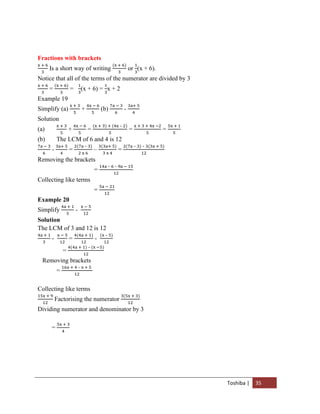
Fractions with brackets
x + 6
3
Is a short way of writing
(x + 6)
3
or
1
3
(x + 6).
Notice that all of the terms of the numerator are divided by 3
x + 6
3
=
(x + 6)
3
=
1
3
(x + 6) =
1
3
x + 2
Example 19
Simplify (a)
x + 3
5
+
4x − 6
5
(b)
7a − 3
6
-
3a+ 5
4
Solution
(a)
x + 3
5
+
4x − 6
5
=
(x + 3) + (4x – 2)
5
=
x + 3 + 4x −2
5
=
5x + 1
5
(b) The LCM of 6 and 4 is 12
7a − 3
6
-
3a+ 5
4
=
2(7a – 3)
2 x 6
–
3(3a+ 5)
3 x 4
=
2(7a – 3) – 3(3a + 5)
12
Removing the brackets
=
14a – 6 – 9a − 15
12
Collecting like terms
=
5a − 21
12
Example 20
Simplify
4a + 1
3
-
x − 5
12
Solution
The LCM of 3 and 12 is 12
4a + 1
3
-
x − 5
12
=
4(4a + 1)
12
-
(x – 5)
12
=
4(4a + 1) – (x −5)
12
Removing brackets
=
16a + 4 – x + 5
12
Collecting like terms
15x + 9
12
Factorising the numerator
3(5x + 3)
12
Dividing numerator and denominator by 3
=
5x + 3
4
Toshiba | 36
Exercise 11
1. Simplify the following
a.
2a − 3
2
+
a + 4
2
b.
4c − 3
5
–
2c + 1
5
c.
2n + 7
3
-
5n + 6
4
d. 3b –
5b − 1
2
2. Simplify the following as far as possible.
a.
3x + 1
4
–
x − 5
4
b.
7x − 14
10
–
2x + 1
10
c.
6h + 5
7
–
4h − 6
21
d.
a + 3b
3
–
5a− 3b
6
With more complex algebraic fractions, the method of getting a common denominator is still
required.
Worked examples
a)
2
𝑥+1
+
3
𝑥+2
=
2(𝑥+2)
(𝑥+1)(𝑥+2)
+
3(𝑥+1)
(𝑥+1)(𝑥+2)
=
2(𝑥+2)+ 3(𝑥+1)
(𝑥+1)(𝑥+2)
=
2𝑥+4+3𝑥+3
(𝑥+1)(𝑥+2)
=
5𝑥+7
(𝑥+1)(𝑥+2)
b)
5
𝑝+3
−
3
𝑝−5
=
5(𝑝−5)
(𝑝+3)(𝑝−5)
−
3(𝑝+3)
(𝑝+3)(𝑝−5)
=
5(𝑝−5)−3(𝑝+3)
(𝑝+3)(𝑝−5)
=
5(𝑝−5)−3(𝑝+3)
(𝑝+3)(𝑝−5)
=
5𝑝−25−3𝑝−9
(𝑝+3)(𝑝−5)
=
2𝑝−34
(𝑝+3)(𝑝−5)
c)
𝑥2−2𝑥
𝑥2+𝑥−6
=
𝑥(𝑥−2)
(𝑥+3)(𝑥−2)
=
𝑥
𝑥+3
d)
𝑥2−3𝑥
𝑥+2𝑥−15
=
𝑥(𝑥−3)
(𝑥−3)(𝑥+5)
=
𝑥
𝑥+5
Exercise: Simplify the following algebraic fractions:
1.
a)
1
𝑥+1
+
2
𝑥+2
b)
3
𝑚+2
−
2
𝑚−1
c)
2
𝑝−3
+
1
𝑝−2
d)
3
𝑤−1
−
2
𝑤+3
e)
4
𝑦+4
−
1
𝑦+1
f)
2
𝑚−2
−
3
𝑚+3
Toshiba | 37
2. a)
𝑥(𝑥−4)
(𝑥−4)(𝑥+2)
b)
𝑦(𝑦−3)
(𝑦+3(𝑦−3)
GRAPHS IN PRACTICAL SITUATION
Toshiba | 38
Example
A temperature of 20 °C is equivalent to 68 °F and a temperature of 100 °C is equivalent to a
temperature of 212 °F. Use this information to draw a conversion graph.
Use the graph to convert:
(a) 30 °C to °Fahrenheit
(b) 180 °F to °Celsius.
Solution
Taking the horizontal axis as temperature in °C and the vertical axis as temperature in °F
gives two pairs of coordinates, (20, 68) and (100, 212). These are plotted on a graph and a
straight line drawn through the points.
(a) Start at 30 °C, then move up to the line and across to the vertical axis, to give a temperature
of about 86 °F.
(b) Start at 180 °F, then move across to the line and down to the horizontal axis, to give a
temperature of about 82 °C.
Distance–time graphs
Toshiba | 39
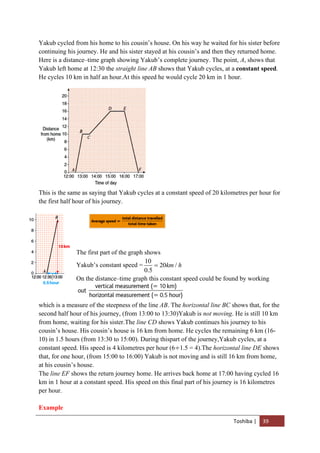
Yakub cycled from his home to his cousin’s house. On his way he waited for his sister before
continuing his journey. He and his sister stayed at his cousin’s and then they returned home.
Here is a distance–time graph showing Yakub’s complete journey. The point, A, shows that
Yakub left home at 12:30 the straight line AB shows that Yakub cycles, at a constant speed.
He cycles 10 km in half an hour.At this speed he would cycle 20 km in 1 hour.
This is the same as saying that Yakub cycles at a constant speed of 20 kilometres per hour for
the first half hour of his journey.
The first part of the graph shows
Yakub’s constant speed =
10
20 /
0.5
km h
=
On the distance–time graph this constant speed could be found by working
which is a measure of the steepness of the line AB. The horizontal line BC shows that, for the
second half hour of his journey, (from 13:00 to 13:30)Yakub is not moving. He is still 10 km
from home, waiting for his sister.The line CD shows Yakub continues his journey to his
cousin’s house. His cousin’s house is 16 km from home. He cycles the remaining 6 km (16-
10) in 1.5 hours (from 13:30 to 15:00). During thispart of the journey,Yakub cycles, at a
constant speed. His speed is 4 kilometres per hour (6÷1.5 = 4).The horizontal line DE shows
that, for one hour, (from 15:00 to 16:00) Yakub is not moving and is still 16 km from home,
at his cousin’s house.
The line EF shows the return journey home. He arrives back home at 17:00 having cycled 16
km in 1 hour at a constant speed. His speed on this final part of his journey is 16 kilometres
per hour.
Example
Toshiba | 40
Mustafe and Ibrahim go to the seaside, a distance of 30 kilometers from their home.
Mustafe leaves home on his bicycle at 12:30 pm. Ibrahim leaves later on his scooter.
The travel graphs show some information about their journeys.
a. Mustafe takes a break on his journey.
i. For how long does Mustafe take a break?
ii. How far from the seaside is he when he takes his break?
b. Mustafe cycles more quickly before the break than after it. Explain how the graph shows this.
c. At what time does Ibrahim leave home?
d. Estimate the time at which Ibrahim passes Mustafe?
e. How many minutes before Mustafe does Ibrahim arrive at the seaside?
f. Estimate Ibrahim’s speed in km/h.
Solution
a. Horizontal line on the graph shows Mustafe’s Break from 2:30 pm to 3:30 pm.
i. 1 hour
ii. 30 – 15 = 15 kilometres
b. The line before the break is steeper than the line after the break
c. 3:30 pm
d. about 3:55 pm
e. 1 hour 45 minutes= 105 minutes
f. Ibrahim travels 20 km in
1
2
hour His speed is 40 km/h
Example
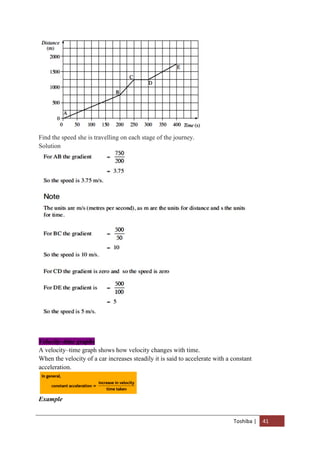
The graph shows the distance travelled by a girl on a bike.
Toshiba | 41
Find the speed she is travelling on each stage of the journey.
Solution
Velocity–time graphs
A velocity–time graph shows how velocity changes with time.
When the velocity of a car increases steadily it is said to accelerate with a constant
acceleration.
Example
Toshiba | 42
A tram travels between two stations. The diagram represents the velocity–time graph of the
tram.
a. Write down the maximum velocity of the tram.
b. Find the constant acceleration of the tram during the first 20 seconds of the journey.
c. For how many seconds did the tram have zero acceleration?
d. Describe the journey of the tram for the final 30 seconds.
Solution
a. 30 m/s
b.
30 0
1.5
20 0
−
=
−
c. Constant acceleration 1.5 m/s2
d. 90 – 20 = 70 seconds
e. The tram slows down steadily (deceleration) from a speed of 30 m/s and then finally stops
(velocity = 0m/s)
Example
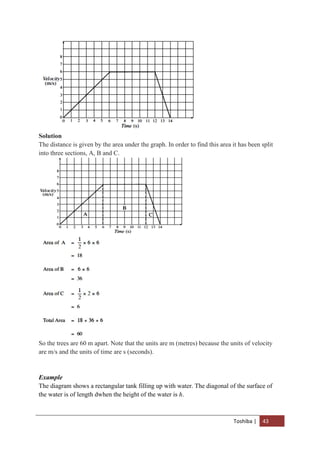
The graph shows how the velocity of a bird varies as it flies between two trees. How far
apart are the two trees?
Toshiba | 43
Solution
The distance is given by the area under the graph. In order to find this area it has been split
into three sections, A, B and C.
So the trees are 60 m apart. Note that the units are m (metres) because the units of velocity
are m/s and the units of time are s (seconds).
Example
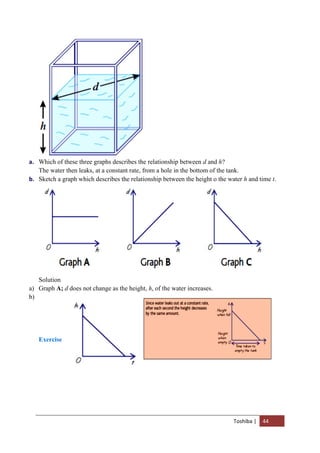
The diagram shows a rectangular tank filling up with water. The diagonal of the surface of
the water is of length dwhen the height of the water is h.
Toshiba | 44
a. Which of these three graphs describes the relationship between d and h?
The water then leaks, at a constant rate, from a hole in the bottom of the tank.
b. Sketch a graph which describes the relationship between the height o the water h and time t.
Solution
a) Graph A; d does not change as the height, h, of the water increases.
b)
Exercise
Toshiba | 45
1. The travel graph shows some information
about the flight of an aeroplane from London
to Rome and back again.
a. At what time did the aeroplane arrive in
Rome?
b. For how long did the aeroplane remain in
Rome?
c. How many hours did the flight back take?
d. Work out the average speed, in kilometres per
hour, of the aeroplane from London to Rome.
e. Estimate the distance of the aeroplane from
Rome
i. at 12:30
ii. at 15:12
2. Sangita cycles from Bury to the airport, a distance of 24 miles. The distance–time graph
shows some information about her journey.
a. Sangita stops for lunch. For how many minutes does she stop?
b. Explain how the graph shows that Sangita cycles more slowly after lunch?
c. Work out Sangita’s speed, in miles per hour, for the part of her journey before lunch.
d. Simon leaves the airport at 13:00 and travels at a steady speed to Bury. He arrives in Bury at
13:45.
i. On the resource sheet draw a distance–time graph for Simon’s journey.
ii. Use your graph to work out Simon’s speed.
iii. use your graph to estimate the time at which Simon and Sangita are at the same
distance from the airport.
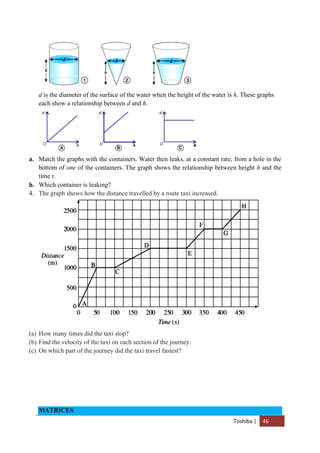
3. The diagrams show three containers filling up with water.
Toshiba | 46
d is the diameter of the surface of the water when the height of the water is h. These graphs
each show a relationship between d and h.
a. Match the graphs with the containers. Water then leaks, at a constant rate, from a hole in the
bottom of one of the containers. The graph shows the relationship between height h and the
time t.
b. Which container is leaking?
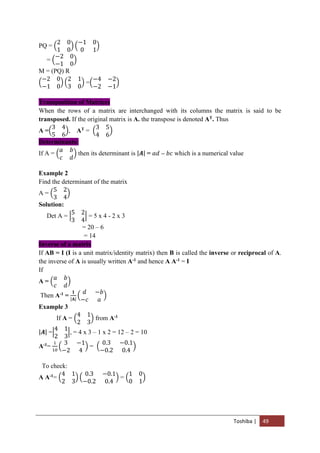
4. The graph shows how the distance travelled by a route taxi increased.
(a) How many times did the taxi stop?
(b) Find the velocity of the taxi on each section of the journey.
(c) On which part of the journey did the taxi travel fastest?
MATRICES
Toshiba | 47
Introduction
When a large amount of data has to be used it is often convenient to arrange the numbers in
the form of a matrix.
Suppose that a nurseryman offers collections of fruits trees in three separate collections. The
table below shows the name of each collection and the number of each type of tree included
in it.
Collection Apple Banana Orange Grapes
A 6 2 1 1
B 3 2 2 1
C 3 1 1 0
After a time the headings and titles could be removed because those concerned with the
packing of the collections would know what the various numbers meant. The table could then
look like this:
(
6 2 1 1
3 2 2 1
3 1 1 0
)
The information has now been arranged in the form of a matrix, this is, in the form of an
array of a numbers
A matrix is always enclosed in curved brackets. The above matrix has 3 rows and 4 columns.
It is called a matrix of order 3 x 4. In defining the order of a matrix the number of rows is
always stated first and the number of columns. The matrix shown below is of order 2 x 5
because it has 2 rows and 5columns.
(
1 3 5 2 4
3 0 3 1 2
)
Types of matrices
1) Row matrix. This is a matrix having only one row. Thus (3 5) is a row matrix
2) Column matrix. This is a matrix having only one column. Thus (
1
6
) is a column matrix.
3) Null matrix. This is a matrix with all its elements zero. Thus (
0 0
0 0
) is a null matrix.
4) Square matrix. This is a matrix having the same number of rows and columns. Thus (
2 1
6 3
)
is square matrix.
5) Diagonal matrix. This is a square matrix in which all the elements are zero except the
diagonal elements. Thus (
2 0
0 3
) is a diagonal matrix. Note that the diagonal in a matrix
always runs from upper left to lower right
6) Unit matrix or identity matrix. This is a diagonal matrix in which the diagonal elements
equal to 1. An identity matrix is usually denoted by the symbol I. thus
I = (
1 0
0 1
)
Toshiba | 48
Addition and Subtraction of matrices
Two matrices may be added or subtracted provided they are of the same order. Addition is
done by adding together the corresponding elements of each of the two matrices. Thus
(
3 5
6 2
) + (
4 7
8 1
) = (
3 + 4 5 + 7
6 + 8 2 + 1
) = (
7 12
14 3
)
Subtraction is done in a similar fashion except that the corresponding elements are subtracted.
Thus
(
6 2
1 8
) - (
4 3
7 5
) = (
6 − 4 2 − 3
1 − 7 8 − 5
) = (
2 −1
−6 3
)
Multiplication of matrices
1) Scalar multiplication. A matrix may be multiplied by a number as follows:
3(
2 1
6 4
) = (
3𝑥2 3𝑥1
3𝑥6 3𝑥4
) = (
6 3
18 12
)
2) General matrix multiplication. Two matrices can only be multiplied together if the number
of columns in the first matrix equals the number rows in the second. The multiplication is
done by multiplying a row by a column as shown below.
a) (
2 3
4 5
) x (
5 2
3 6
) = (
2𝑥5 + 3𝑥3 2𝑥2 + 3𝑥3
4𝑥5 + 5𝑥3 4𝑥2 + 5𝑥6
) = (
19 22
35 38
)
b) (
3 4
4 5
) x (
6
7
) = (
3𝑥6 + 4𝑥7
2𝑥6 + 5𝑥7
) = (
46
47
)
c) (
2 3 1
5 4 6
) x (
1 2
3 7
5 4
)= (
2𝑥1 + 3𝑥3 + 1𝑥5 2𝑥2 + 3𝑥7 + 1𝑥4
5𝑥1 + 4𝑥3 + 6𝑥5 5𝑥2 + 4𝑥7 + 6𝑥4
) = (
16 29
47 62
)
Matrix notation
It is usual to denote matrices by capital letters. Thus
A = (
3 1
7 4
) and B = (
2
3
)
Generally speaking matrix products are non-commutative, that is
A X B does not equal to B X A
If A is of order 4 x 3 and B is of order 3 x 2, then AB is of order 4 x 2
Example 1
a. Form C = A + B if
A = (
3 4
2 1
) and B =(
3 1
7 4
) = (
3 4
2 1
) + (
3 1
7 4
) = (
5 7
6 3
)
b. From Q = RS if
R = (
1 2
3 4
) and S = (
3 1
5 6
)
Q = (
1 2
3 4
)x(
3 1
5 6
)=(
13 13
29 37
)
Note that just as in ordinary algebra the multiplication sign is omitted so we omit it in matrix
algebra.
c. form M = PQR if
P = (
2 0
1 0
) , Q = (
−1 0
0 1
)
And R = (
2 1
3 0
)
Toshiba | 49
PQ = (
2 0
1 0
) (
−1 0
0 1
)
= (
−2 0
−1 0
)
M = (PQ) R
(
−2 0
−1 0
) (
2 1
3 0
) =(
−4 −2
−2 −1
)
Transposition of Matrices
When the rows of a matrix are interchanged with its columns the matrix is said to be
transposed. If the original matrix is A. the transpose is denoted AT. Thus
A =(
3 4
5 6
), AT = (
3 5
4 6
)
Determinants:
If A = (
𝑎 𝑏
𝑐 𝑑
) then its determinant is |𝑨| = 𝑎𝑑 – 𝑏𝑐 which is a numerical value
Example 2
Find the determinant of the matrix
A = (
5 2
3 4
)
Solution:
Det A = |
5 2
3 4
| = 5 x 4 - 2 x 3
= 20 – 6
= 14
Inverse of a matrix
If AB = I (I is a unit matrix/identity matrix) then B is called the inverse or reciprocal of A.
the inverse of A is usually written A-1 and hence A A-1 = I
If
A = (
𝑎 𝑏
𝑐 𝑑
)
Then A-1 =
𝟏
|𝐀|
(
𝑑 −𝑏
−𝑐 𝑎
)
Example 3
If A = (
4 1
2 3
) from A-1
|𝑨| =|
4 1
2 3
|, = 4 x 3 – 1 x 2 = 12 – 2 = 10
A-1=
1
10
(
3 −1
−2 4
) = (
0.3 −0.1
−0.2 0.4
)
To check:
A A-1= (
4 1
2 3
) (
0.3 −0.1
−0.2 0.4
) = (
1 0
0 1
)
Toshiba | 50
Method II(using simultaneous equations’ to find the inverse of a matrix
Let A-1= (
𝑎 𝑏
𝑐 𝑑
) then A A-1 = I
(
4 1
2 3
) (
𝑎 𝑏
𝑐 𝑑
) = (
1 0
0 1
)
= 4a + c = 1............... (1).
4b + d = 0................ (2)
2a +3c = 0................ (3)
2b + 3d =1................ (4)
Solving equ (s) (1) and (3) simultaneously
4a + c = 1............... (1).
2a +3c = 0................ (3)
Arranging equation (1) c = 1 – 4a
2a + 3(1 – 4a) =0 by substituting
1 – 4a into the place of c in equation (3)
2a + 3 – 12a = 0
-10a = -3
a =
−3
−10
= a = 0.3
c = 1 – 4a but a = 0.3
c = 1 – 4(0.3)
c = 1 – 1.2
c = - 0.2
Similarly solving equ (2) and (4)
Simultaneously
4b + d = 0................ (2)
2b + 3d =1................ (4)
Rearranging equation (2) gives
d = - 4b
2b + 3(- 4b) = 1 by substituting
– 4b into the place of d in equ(4)
2b – 12b = 1
- 10b = 1
b =
1
−10
= b = - 0.1
d = - 4b but b = - 0.1
d = - 4 (-0.1)
d = 0.4
Therefore
A-1 = (
0.3 −0.1
−0.2 0.4
)
Toshiba | 51
Singular matrix:
A singular matrix is a matrix which does not have an inverse.
The determinant of singular matrix is zero. Thus the matrix
(
6 12
2 4
) Is singular because its |
6 12
2 4
| =6 x 4 – 12 x 2=24 -24=0
Hence this matrix has no inverse
Equality of matrices
If two matrices are equal then their corresponding elements are equal
(
𝑎 𝑏
𝑐 𝑑
) = (
𝑒 𝑓
𝑔 ℎ
)
Then a = e, b = f, c =g, and d = h
Example 5
Find the value of x and y if
(
2 1
3 4
) (
𝑥 2
5 𝑦
) = (
7 10
23 30
)
(
2𝑥 + 5 4 + 𝑦
3𝑥 + 20 6 + 4𝑦
) =(
7 10
23 30
)
2x + 5 = 7 and x = 1
4 + y = 10 and y = 6
(We could have used 3x + 20 =23 and 6 + 4y =30 if we desired.)
Solution of Simultaneous Equations:
the simultaneous equations
3x + 2y = 12.................... (1)
4x + 5y = 23.................... (2)
We may write these equations in matrix form as follows:
(
3 2
4 5
) (
𝑥
𝑦) = (
12
23
)
If we let
A = (
3 2
4 5
) , X =(
𝑥
𝑦), K = (
12
23
)
Thus A X = K
And X = A-1
K
A-1
=
1
3 x 5 – 2 x 4
(
5 −2
−4 3
)
= (
5
7
−
2
7
−
4
7
3
7
)
(
𝑥
𝑦) = (
5
7
−
2
7
−
4
7
3
7
) (
12
23
)
= (
2
3
)
Therefore the solution are x = 2 and y = 3
Toshiba | 52
Exercise
1. find the values of X and M in the following matrix addition
(
𝑋 4
−1 1
) + (
1 2
−2 4
) +(
−1 2
𝑌 4
)
= (
3 8
−6 9
)
2. if A = (
4 5
2 3
) find A2
3. if A = (
3 1
2 0
) and
B = (
4 −1
2 3
)
Calculate the following matrices
a) A + B
b) 3A – 2B
c) AB
d) BA
4. P = (
2 1
3 1
) , Q = (
1 0
0 1
)
R = (
0 1
1 0
) S = (
1 −1
−6 3
)
a) find each of the following as a single matrix: PQ, RS, PQRS, P2
– Q2
b) Find the values of a and b if aP + bQ = S.
5. A and B are two matrices
If A = (
−2 3
4 −1
) find A2
and then use your answer to find B, given that A2
= A – B.
6. find the value of
(
2 3 1
0 1 2
) (
1
3
−2
)
7. if (
2 3
4 5
) (
𝑝 2
7 𝑞
) = (
31 1
55 3
)
Find p and q
8. if A = (
2 −1
1 1
) and B = (
1 2
1 1
) write as single matrix
a. A + B
b. A X B
c. the inverse of B
9. if matrix A = (
3 1
2 4
) and matrix B = (
4 2
1 0
) calculate
a. A + B
b. 3A – 2B
c. AB
10. if A = (
3 1
−2 0
) and
B =(
−1 3
−4 2
) calculate BA and AB
Toshiba | 53
11. solve the equation
(
2 5
1 3
) (
𝑥
𝑦) = (
3
1
)
12. solve the following simultaneous equations using matrices :
a. x + 3y = 7............(1)
2x + 5y = 12......... (2)
b. 4x + 3y = 24.........(1)
2x + 5y = 26.........(2)
c. 2x + 7y = 11......(1)
5x + 3y = 13...... (2)
13. write the inverse of the matrix
(
2 −1
2 4
) .
14. if p = (
4
2
) and q = (
2
3
), calculate
p – 2q
15. if M = (
2 4
1 0
) and N = (
2 1
0 3
)
Find MN – NM.
16. if (
2 𝑥
4 𝑦
) (
5
2
) = (
14
30
), find x and y
17. matrices A and B are given as follows :
A = (
1 −1
2 3
) and B = (
3 1
−2 1
)
a. find the products BA and AB
b. find the matrix X such that A X = B
18. Show that the matrix (
8 4
2 1
) has no inverse.
19. given that a>0 and b>0 and that
(
𝑎 𝑎
𝑏 𝑏
) (
𝑎 𝑏
𝑎 𝑏
) = (
2 𝑐
𝑐 8
) find the values of 𝑎,𝑏 and𝑐.
20. if A = (
4
6
), and B = (
−3
3
),
Find
a.
1
2
A
b. X if A + X = 4B
21. find x if (2x 3)(
11
−6𝑥
) = 100
22. evaluate as single matrix
2(
3 −1
5 2
) + 3(
4 −2
1 −1
)
Toshiba | 54
DETERMINANTS OF 3X3 MATRICES
There several methods used to find the determinant of 3x3 matrices, but in this section we
will mainly discuss finding the determinant by diagonalisation.
Def. Let  
A aij
= be a square matrix of order n . The determinant of A, detA or |A| is
defined as follows
(a) If n=2, (I.e. 2x2) det A
a a
a a
a a a a
= = −
11 12
21 22
11 22 12 21
(b) If n=3,
11 12 13
21 22 23
31 32 33
det
a a a
A a a a
a a a
= , by rewriting the first two columns and
placing the right side of the matrix
11 12 13 11 12
21 22 23 21 22
31 32 33 31 32
det
a a a a a
A a a a a a
a a a a a
=
There fore 11 22 33 12 23 31 31 12 23
det A a a a a a a a a a
= + +
− − −
a a a a a a a a a
31 22 13 32 23 11 33 21 12
Example 1
Find the determinant of the matrix
2 2 3
0 7 9
5 2 6
A
−
 
 
= −
 
 
−
 
Toshiba | 55
Solution
2 2 3 2 2
0 7 9 0 7
5 2 6 5 2
det 2 7 6 ( 2) ( 9) 5 3 0 ( 2) 3 7 5 2 ( 9) ( 2) 2 0 6
84 90 0 105 36 0
174 141
33
A
− −
−
− −
 =   + −  −  +   − −   −  −  − −  
= + + − − −
= −
=
Exercise
1. Find
a. det
1 2 3
2 1 0
1 2 1
−
− −








b.
1 1 0
det 2 2 5
3 4 2
−
 
 
 
 
 
2. Find the determinant of the following matrices
a.
3 1 2
4 0 3
3 4 7
A
−
 
 
=  
 
 
b.
3 1 0
0 4 0
0 0 7
B
−
 
 
=  
 
 
Toshiba | 56
CRAMER’S RULE
Determinants can be used to solve systems of linear equations. if a system of two equations in
two variables is given, the solution set ,if it exist as single ordered pair , can be found by
using Cramer’s rule.
The method is called Cramer’s rule for a system with two equations and twounknowns.
Toshiba | 57
Exercise
Toshiba | 58
INEQUALITIES
An inequality is a mathematics sentence that uses > (greater than). > (less than) or ≠ (is not
equal to). Which symbol is more helpful either ≠ or >?
The following sentence are inequalities .
10 > 9 3𝑥 < 10 10𝑦 ≠ 14
Example 1
Rewrite each of the following sentence using inequality symbols
a. 3 is greater than 1
b. 14 is less than 20
c. B is not less than 28
Solution
a. 3 > 1
b. 14 < 20
c. 𝐵 ≠ 28
Example2
a. The distance (d) between two towns is over 18km. Express this in inequality
b. Amir has Y shilling he spends Sh1500 to take a bus. Now he has less than Sh5000. Write
inequality this information.
Solution
a. 𝑑 > 18 𝑘𝑚
b. 𝑌 − 1500 < 5000
Exercise 1
Write inequality in terms of the given unknown
a. Height of a building h is less than 6m.
b. Mass of a body M is greater than 5kg.
c. The time of a match T is over one hour.
Exercise2
a. A boy saved over Sh20000 and his mother gave him Sh3000. Now the boy has A shilling.
Write this as inequality.
b. In 5 years time Sareedo will be over 19 years age. If she is B years old now write as
inequality.
c. A lorry can carry a mass M which is less than 2 tonnes write this as inequality.
d. State if the following are true or false.
13 > 5………….
16 < 20…………
1.4 > 1 ………….
Toshiba | 59
Not greater than (≤) not less than (≥)
Muslim people consider any one who is not less than 15 years as a mature.
Not less than means greater than or equal to.
Speed of a car in towns in Somaliland roads should not be more than 30km/h.
Not more than means less than or equal to.
Example 3
Express the following as sentence as inequality
a. The age of a girl is B years which is less than or equal to 14.
b. Africa contains countries C which are not less than 53.
c. Somaliland has been independent a time T which is not less than 20 years.
Solution
a. B ≤ 14
b. C ≥ 53
c. T ≥ 20
Example 4
a. Text books costs Sh30000 each Anab has X shilling which is not enough to buy a book while
Abib has Y shilling and he is able to buy a book. What can be said about the value of X and
Y?
Solution
x< 30000 and y≥ 30000
Also y> 𝑥 or x< y
Exercise3
For each of the following choose a letter for the unknown and then write in an inequality.
a. My car’s speed can not exceed than 180km/h
b. To join school in childhood you must be not less than 6 years
c. Raxo taxi takes passengers not more than 4.
d. A lorry carries a weight which is not less than 4 tonnes.
Exercise 4
a. The pass mark of a test is 27. One person gets x marks and another gets y marks and passed.
What can be said about x and y.
b. Pens cost Sh1500. A shilling is not enough to buy a pen. If some one has B shilling can buy a
pen write down three different inequalities in terms of A and B.
c. The radius of a circle is not greater than 3m. what can be said about its circumference
Toshiba | 60
Graphs of inequality
To draw inequality on a graph we use two types of graphs
1. Line graphs
2. Cartesian graphs
Line graphs
The inequality 𝑥 ≥ −1 means that x can have any value which is less than 3 this can be
shown on number line as.
The dark circle at −1 shows that -1 is include the value of x.
If the −1 would have an empty circle it shows that the number is exclude the value of x.
Example 5
Show the following inequalities on a line graph.
a. 𝑥 ≤ 4
b. X < 3
c. X > 2
Solutions:
a.
b.
c.
Example6
Write the inequalities which the following graphs are showing
a.
b.
Solution
a. 𝑥 ≥ −2
b. 𝑥 ≤ 5
Toshiba | 61
Exercise 5
Sketch the following inequlities on line graph.
a. 𝑋 ≤ −3
b. 𝑋 ≥ 0
c. 𝑋 > 7
d. 𝑋 ≤ 6
e. 𝑋 ≥ 6
Exercise 6
Write the inequalities which the following linegraphs stand for.
a.
b.
c.
Cartesian graphs
What is Cartesian graph?
How does Cartesian graph differ from line graph?
This is what we discussed in form one class. Now we are trying to see how an inequality can
be sketched on a Cartesian plane (graph). Consider the following diagram.
(x, y) represents any point on the Cartesian plane which has coordinates x and y. if x, y is
such that x≤ 2 then (x, y) may lies anywhere in the shaded region. The dark line at x=2
shows that2 is include the value of x.
To show inequality sentence on a Cartesian graph we may flow this procedure.
• Draw a line on the given variable
• Shade the required region
• Make a broken line to show the points are excluded
• Make a dark closed line to show that the points are included
Toshiba | 62
Example 7
Sketch on Cartesian graph these inequality and shade the required region
a. 𝑦 < −3
b. 𝑦 < −3 and 𝑥 ≤ 2
Solutions:
Example 8
State the points represented by the shaded region
Solution
a. 𝑦 ≥ 7 and 𝑥 > 5
b. 𝑥 < −3 and 𝑦 < −4
Toshiba | 63
Exercise 7
Sketch the following inequalities on a Cartesian graph
a. X≤ −5
b. Y< 4
c. X> 3
d. 𝑥 ≥ −3 𝑎𝑛𝑑 𝑦 < 1
e. x< −2 and y≤ 3
f. x≥ −2 and y≤ −1
Exercise 8
State the set of points represented by the shaded regions
Simultaneous inequalities
All the previous examples were about single inequality. In this section we will consider how
to sketch on graph if the inequality sentence is simultaneous.
Inequalities in one variable
Example 9
Illustrate on single number line the solution set of the following simultaneous equations.
a. −2 > 𝑥 ≤ 3 x> −2
b. 𝑥 ≥ 1 and −3 < 𝑥 < 5
Inequalities of two variables
Till now our examples are single variable inequality. In these examples we will see how to
sketch on Cartesian graph inequalities of two variables.
Example 9
Illustrate on a single number line
a. 𝑥 > −2 and x≤ 3
b. x≥ 1 , −3 < 𝑥 < 5
Solution
Toshiba | 64
Example 10
The following graphs show inequalities. For each express in the form a <x <b or a ≤ x ≤ b.
Solution
a. −2 > 𝑥 < 4
b. -2≤ 𝑥 ≤ 4
Exercise 9
Illustrate each of the following inequalities on a number line
a. −4 ≤ 𝑥 ≤ 1
b. −2 ≤ 𝑥 > 4
c. 0 ≤ 𝑥 < 3
d. −4 < 𝑥 > 2
e. Illustrate on the number line the solution set of of the simultaneous inequalities 𝑥 ≤ 3, −2 <
𝑥 < 6
Exercise 10
Each of the following graphs represent for inequality. Express each in terms of a*x*b
Toshiba | 65
Inequalities in two variables
In order to sketch inequalities of two variables you have to:
• Make y as the subject of the inequality in order to determine the boundary between the
required region and unwanted region.
• The boundary lines across the axes at the points where x=0 and y=0 are usually most
convenient
• Make the boundary solid line if the inequality is included, if it is excluded make a broken
line.
• Choose any point p (x, y) which is above or below the line if the point is satisfied the
inequality then that is the required region.
• Then shade the ordered usually the required region.
Example 11
Show on graph the region which contains the solution set of the simultaneous inequalities
below. And shade the required region.
a. 2x + y
b. 2𝑥 + 3𝑦 > 6, 𝑦 − 2𝑥 ≥ 2 𝑎𝑛𝑑 𝑦 ≤ 0
Solution
Toshiba | 66
Example 12
Solve graphically the simultaneous inequalities below
a. 𝑥 ≥ 0, 𝑦 ≥ 1, 𝑥 + 𝑦 ≤ 4
b. 𝑥 − 2𝑦 ≥ 7, 𝑥 + 𝑦 ≥ −2
Solution
a. The points on the line 𝑥 = 0, are part of the solution set of 𝑥 ≥ 0.similarly points on the line
𝑥+≥ 𝑦 = 4 are part of the solution set of the inequality 𝑥 + 𝑦 ≤ 4 and those on the line 𝑦 =
1 are part of the solution set of the inequality 𝑦 ≥ 1.
The solution set of the inequality is the shaded region among the three borders.
The solution set of the simultaneous inequlity is the shaded region between the two borders.
Toshiba | 67
Exercise 11
Show on graph the region which contains the solution set of the simultaneous inequalities
below. And shade the required region.
a. y≥ 0, 𝑦 < 3𝑥 𝑎𝑛𝑑 𝑥 + 𝑦 ≤ 4
b. 𝑥 ≥ −3, 𝑦 ≤ 2, 𝑥 − 𝑦 < 2
c. 𝑦 ≤ 5, 𝑥 − 𝑦 ≥ 1, 4𝑥 + 3𝑦 ≥ 12
Exercise 12
Solve graphically the simultaneous inequalities below.
a. 4𝑥 + 3𝑦 > 12, 𝑦 ≤ 0, 𝑥 > 0
b. 𝑦 > −2, 𝑥 ≥ 0, 2𝑥 + 𝑦 < 4
c. 𝑥 + 𝑦 ≥ 2, 𝑥 − 𝑦 ≥ 2, 2𝑥 + 𝑦 ≤ 2
Solution of inequalities
Properties similar to those used to solve equations can be used to solve inequalities.
Example 13
Solve the following inequalities
a. 6> 4𝑥
b. 3+x≥ 15
c. 5-x≥ 10
d. 19> 4 − 5𝑥
Solution
a. 66 > 4𝑥 (÷ 𝑏𝑦 4 𝑒𝑎𝑐ℎ 𝑠𝑖𝑑𝑒)
6
4
>
4𝑥
4
1.5 > 𝑥 𝑜𝑟 𝑥 < 1.5
b. 𝑋 + 3 − 3 ≥ 15 − 3
𝑥 ≥ 12
c. 5-x ≥ 10
-x+5-5 ≥ 10-5
-x≥ 5 (÷ 𝑏𝑦 − 1)
x≤ −5
d. 19> 4 − 5𝑥
19 − 4 > 4 − 4 − 5𝑥
15 > −5𝑥
3 > −𝑥
3 < 𝑥 𝑜𝑟 𝑥 > 3
N.B: Multiplying or dividing a negative number by an inequality expression the negative sign
reverses the inequality. Consider examples above c and d.
Exercise 13
1. Solve the following inequalities.
a. 𝑥 − 2 < 3
b. 14 ≤ 𝑥 + 10
c. 4𝑥 + 8 > 4
d. 5 − 2𝑦 ≥ 11
e. 15 − 4𝑘 > 16
f. 11𝑥 − 24 ≤ 4𝑥 + 4
Toshiba | 68
2. Find the solution set of the following and consider that 𝑥 is an integer in each case
a. 4𝑥 + 10 < 12
b. 5𝑥 − 8 ≤ 12
c. 4𝑥 + 12 ≥ 0
d. 19 ≥ 4 − 5𝑥
Word problems
As we have seen in the equations, inequalities can also have word problems and real life
applications.
Example 14
a. A triangle has sides of 𝑥, 11 𝑎𝑛𝑑 (𝑥 + 4) 𝑐𝑚. where x is a whole number if the premeter of
the triangle is less than 32cm. find the possible values of x
Premeter of a triangle is the sum of the three sides.
∴ 𝑥 + (𝑥 + 4) + 11 < 32
2𝑥 + 15 < 32
2𝑥 + 15 − 15 < 32 − 15
2𝑥 < 17
2𝑥
2
<
17
2
𝑥 < 8.5
∴ since x is a whole number the value of x may be
expressed as:0 < 𝑥 ≤ 8
Example
A man gets a monthly salary of 𝑦 shillings. After he pays a rent of Sh60,000. He is left with
amount not greater than Sh900000. Find the range of value of 𝑦.
Solution:𝑦 − 60000 ≤ 900000
𝑦 ≤ 60000 + 900000
𝑦 ≤ 960000
Therefore the value of y has a range of 900000 < 𝑦 ≤ 960000
Toshiba | 69
Exercise 14
a. I f 9 is added to a number y the result is greater than 17. Find the possible values of x.
b. 3 times a certain number is not greater than 54. Find the range of the values of the number.
c. X Is an integer. If three quarters of x is subtracted from 1, the result is greater than 0. Find
the four highest values of x.
d. A book contains 192 pages. A student reads x complete pages every day. If he hasnot finished
the book after 10 days. Find the highest possible value of x.
e. A triangle has a base of length 6cm and area less than 12cm2
. What can be said its height?
f. A rectangle is 8cm long and ycm broad. Find the range of values of y if the perimeter of the
rectangle is not greater than 50cm and not less than 18cm.
Solving Quadratic Inequalities Using
Product Properties
Suppose you want to solve the quadratic inequality(x – 2) (x + 3) > 0.
Check that x = 3 makes the statement true while x = 1 makes it false. How do you findthe
solution set of the given inequality? Observe that the left hand side of the inequalityis the
product of x – 2 and x + 3. The product of two real numbers is positive, if andonly if either
both are positive or both are negative. This fact can be used to solve thegiven inequality.
Product properties:
Example Solve each of the following inequalities:
a. (x + 1) (x –3) > 0
b. 3x2
– 2x ≥ 0
c. −2x2
+ 9x + 5 < 0
d. x2
– x – 2 ≤0
Solution:
a. By Product property 1, (x +1) (x – 3) is positive if either both the factors are positive or
both are negative. Now, consider case by case as follows:
Case i When both the factors are positive
x +1 > 0 and x – 3 > 0
x > – 1 and x > 3
Toshiba | 70
The intersection of x > – 1 and x > 3 is x > 3. This can be illustrated on thenumber line
as shown in Figure 3below.
The solution set for this first case is S1 = {x: x > 3} = (3, ∞).
Case ii When both the factors are negative
x + 1 < 0 and x – 3 < 0
x < –1 and x < 3
The intersection of x < –1 and x < 3 is x < – 1.This can be illustrated on the number line as
shown below in Figure 4
The solution set for this second case is S2 = {x: x < – 1} = (–∞, –1).
Therefore, the solution set of (x + 1) (x – 3) > 0 is:
S1S2 = {x: x < –1 or x > 3} = (–∞ , −1) È (3, ∞)
b. First, factorize 3x2 – 2x as x (3x – 2) so, 3x2 – 2x > 0 means x (3x – 2) > 0 equivalently.
i. x > 0 and 3x – 2 > 0 or
ii. x < 0 and 3x – 2 < 0
Case i When x ≥ 0 and 3x – 2 ≥ 0x ≥ 0 and x ≥
2
3
.
The intersection of x ≥ 0 and x ≥
2
3
is x ≥
2
3
Graphically.
So, S1 = { x : x ≥
2
3
} = [
2
3
, ∞ )
Toshiba | 71
Case ii When x ≤ 0 and 3x – 2 ≤ 0 that is x ≤ 0 and x ≤
2
3
The intersection of x ≤ 0 and x ≤
2
3
is x ≤ 0. Graphically,
So, S2 = {x: x < 0} = (–∞ , 0]
Therefore, the solution set for 3x2
– 2x ≥ 0 is
S1  S2= { x: x < 0 orx ≥
2
3
} = (– , 0]  [
2
3
,  )
c. −2x2
+ 9x + 5 = (–2x – 1) (x – 5) < 0
Toshiba | 72
Toshiba | 73
Exercise
Toshiba | MENSURATION 74
Unit Three: GEOMETRY (1)
MENSURATION
Circumference of a circle
The circumference is the special name of the perimeter of a circle,that is, the distance all
around it.Measure the circumference and diameter of some circular objects. For each one
work out the value of
circumference
diameter
, the answer is always just over 3
The value of
𝑐𝑖𝑟𝑐𝑢𝑚𝑓𝑒𝑟𝑒𝑛𝑐𝑒
𝑑𝑖𝑎𝑚𝑒𝑡𝑒𝑟
is the same for every circle, 3.142 correct to 3 decimal places.
The value cannot be found exactly and the Greek letter 𝜋 is used to represent it.
So for all circles
And
Using C to stand for the circumference of a circle with diameter d
and or since d = 2r
Example
Work out the circumference of a circle with a diameter of 6.8 cm.
Give your answer correct to 3 significant figures.
Solution
𝜋 x 6.8 = 21.3628 …
Circumference = 21.4 cm (1dp)
Example
The circumference of a circle is 29.4 cm.
Work out its diameter.
Give your answer correct to 3 significant figures.
Solution
Method 1
29.4 = 𝜋 x d (Substitute 29.4 for C in the formula C = 𝜋 d.
d = 29.4 𝜋 (Divide both sides by )
= 9.3583…
Toshiba | MENSURATION 75
Diameter = 9.36 cm (3 sf )
Method 2
C = 𝝅 x d by dividing each side by 𝜋 the d =
𝒄
𝝅
29.4 𝝅
d = 9.3583 …
Diameter = 9.36 cm
Exercise
If your calculator does not have a 𝝅 button, take the value of 𝝅 to be 3.142
Give answers correct to 3 significant figures.
1. Work out the circumferences of circles with these diameters.
a. 9.7 m
b. 29 cm
c. 12.7 cm
d. 17 m
e. 4.2 cm
2. Work out the circumferences of circles with these radii.
a. 3.9 cm
b. 13 cm
c. 6.3 m
d. 29 m
e. 19.4 cm
3. Work out the diameters of circles with these circumferences.
a. 17 cm
b. 25 m
c. 23.8 cm
d. 32.1 cm
e. 76.3cm
4. The circumference of a circle is 28.7cm. Work out its radius.
5. The diameter of the London Eye is 135 m. Work out its circumference.
6. The tree with the greatest circumference in the world is a Montezuma cypress tree in Mexico.
Its circumference is 35.8 m. Work out its diameter.
7. Taking the equator as a circle of radius 6370 km, work out the length of the equator.
8. The circumference of a football is 70 cm. Work out its radius.
9. A semicircle has a diameter of 25cm.
Work out its perimeter.(Hint: the perimeter is includes the diameter)
Toshiba | MENSURATION 76
10. The diagram shows a running track. The ends are semicircles of diameter 57.3 m and
The straights are 110 m long.
Work out the total perimeter of the track.
11. The radius of a cylindrical tin of soup is 3.8 cm.
Work out the length of the label. (Ignore the overlap.)
12. The diameter of a car wheel is 52cm.
Work out the circumference of the wheel. Work out the distance the car travels when the
wheel makes 400 complete turns.
Give your distance in metres.
. AREA OF A CIRCLE
The diagram shows a circle which has been split up into equal ‘slices’ called sectors.
The sectors can be rearranged to make this new shape.
Splitting the circle up into more and more sectors and rearranging
them, the new shape becomes very nearly a rectangle.
The length of the rectangle is half the circumference of the circle.
The width of the rectangle is equal to the radius of the circle.
The area of the rectangle is equal to the area of the circle.
Toshiba | MENSURATION 77
Area of circle =
1
2
x circumference x radius
=
1
2
x 2 𝜋r x r
or
If the diameter rather than the radius is given in a question, the first step is to halve the
diameter to get the radius.
Example
The diameter of a circle is 9.6 m.
Work out its area.
Give your answer correct to 3 significant figures.
Solution 10
9.6 2 = 4.8 (Divide the diameter by 2 to get the radius.)
A = 𝜋r2
A = 𝜋 X 4.82 = 72.3822 …
Area = 72.4 m2
Exercise
If your calculator does not have a 𝜋 button, take the value of 𝜋 to be 3.142. Give answers
correct to 3 significant figures.
1. Work out the areas of circles with these radii.
a. 7.2 cm
b. 14 m
c. 1.5 cm
d. 3.7 m
e. 2.43 cm
2. Work out the areas of circles with these diameters.
a. 3.8 cm
b. 5.9 cm
c. 18 m
d. 0.47 m
e. 7.42 cm
3. The radius of a dartboard is 22.86 cm. Work out its area.
4. The radius of a semicircle is 2.7 m. Work out its area.
Toshiba | MENSURATION 78
5. The diameter of a semicircle is 8.2cm. Work out its area.
6. The diagram shows a running track.
The ends are semicircles of diameter 57.3 m and the straights are 110 m long.
Work out the area enclosed by the track.
7. The diagram shows a circle of diameter 6 cm inside a square of side 10 cm.
a. Work out the area of the square.
b. Work out the area of the circle.
c. By subtraction work out the area of the shaded part of the diagram.
8. The diagram shows a 8 cm by 6 cm rectangle inside a circle Of diameter 10 cm.
Work out the area of the shaded part of the diagram.
Toshiba | MENSURATION 79
Arcs and Sectors of circles
Length of arc
Fig.2.1
In Fig.2.1 the arc ABsubtends an angle of 90̊ at O, the centre of the circle. The whole
circumference subtends 360̊ at the O. Therefore the length of arc ABis
90
360
or
1
4
of the
circumference of the circle. Similarly are CDis
45
360
or
1
12
of the circumference. It can be seen
that the length of an arc of the circle is proportional to the angle which the arc subtends at the
centre
Fig.2.2
In Fig.2.2, arc XY subtends an angle of θ̊at the O. the circumference of the circle is 2𝜋𝑟.
Therefore, in Fig.2.2, the length of I, of arc are XYis given as
l =
𝜽
𝟑𝟔𝟎
𝒙 𝟐𝝅𝒓
Example 5
An arc subtends an angle of 105 ̊ at the centre of radius 6 cm. Find the length of the arc
Fig.2.3
Arc AB =
105
360
𝑥 2𝜋 𝑥 6 𝑐𝑚
=
105
360
𝑥 2 𝑥
22
7
𝑥 6 𝑐𝑚
= 11 cm
Toshiba | MENSURATION 80
Example 6
Calculate the perimeter of a sector of a circle of radius 7 cm, the angle of the sector being
108 ̊.
Fig.2.4
Arc AB=
108
360
𝑥 2 𝑥
22
7
𝑥 7𝑐𝑚
=13.2 cm
Perimeter of a sector AOB
= (7 + 7 + 13.2) cm = 27.2 cm
Example 7
What angle does an arc 6.6 cm in length subtend at the centre of a circle of radius 14 cm?
Fig.2.5
Arc XY=
𝜃
360
𝑥 2𝜋 𝑥 14 𝑐𝑚
6.6 =
𝜃
360
𝑥 2 𝑥
22
7
𝑥 14
∴θ=
6.6 𝑥 360 𝑥 7
2 𝑥 22 𝑥 14
= 27
The arc subtends an angle of 27 ̊
Example 8
An arc subtends an angle of 72 ̊ at the circumference of a circle of radius of 5 cm. Calculate
the length of the arc in terms of 𝜋
Toshiba | MENSURATION 81
Fig.2.6
If the arc subtends 72 ̊ at the circumference, then it subtends 144 ̊at the centre of the circle
(angle at centre = 2 x angle of circumference). See Fig 2.6
X =
144
360
𝑥 2𝜋 𝑥 5
=
16
40
𝑥 10𝜋
= 4 𝜋
Exercise 2
Where necessary, use the value 3
1
7
for 𝜋
1. In fig.2.7 each circle is of the radius 6 cm. Express the lengths of the arcs l, m, n, …, z in terms
of 𝜋
fig.2.7
2. In terms of 𝜋, what is the length of an arc which subtends an angle of 30 ̊ at the centre of a circle
of radius 3
1
2
cm?
3. What is the length of an arc which subtends an angle of 60 ̊ at the centre of a circle of radius
1
2
m?
4. What angle does an arc 5.5 cm in length subtends at the centre of a circle of diameter 7 cm?
5. An arc of length 28 cm subtends an angle of 24 ̊ at the centre of a circle. In the same circle, what
angle does an arc of length 35 cm subtend?
6. In fig.2.8O is the centre of a circle.
Fig.2.8
Find the sizes of the following.
(a) AÔB (b) AD
̂ B (c) AÔD
(d) AĈD (e) BĈD (f) BD
̂ C
(g) CB
̂ D (h) CÂD
7. In fig.2.9, 4 pencils are held together in a ‘square’ by a classic band
Toshiba | MENSURATION 82
If the pencils are of diameter 7mm, what is the length of the band in the position?
8. The classic band in question 8is now used to hold 7 of the same pencils as shown in Fig.3.0
Area of Sector
In Fig.3.1, the area of sector AOB is
90
360
or
1
4
of the area of whole circle. The area of COD is
45
360
or
1
8
of the whole circle and sector EOF is
30
360
or
1
12
of the whole circle.
The area of a sector of a circle is proportional to the angle of the sector
In the Fig.3.2, the angle of the sector is θ̊. The area of the whole circle is 𝜋𝑟2
. Therefore:
Area of sector XOY =
𝜃
360
𝑥 𝜋𝑟2
Toshiba | MENSURATION 83
Example 9
A sector of 80 ̊ is removed from a circle of radius 12cm. What area of the circle is left?
Fig.3.3
Angle of sector left = 360̊ - 80 ̊ = 280 ̊
Area of sector left =
280
360
𝑥 𝜋 𝑥 122
cm 2
=
7
9
𝑥
22
7
𝑥 12 𝑥 12 cm2
= 352 cm2
Example 10
Calculate the area of the shared segment of the circle shown in Fig.3.4
Fig.3.4
Area of segment
= area of XOY – area of ∆ XOY
=
63
360
𝜋 𝑥 102
x -
1
2
x 10 x10 x sin 63 ̊ cm2
= 7
40
x
22
7
x 100 -
1
2
x 100x0.8910 cm2
= 55 – 44.55 cm2
= 10.45 cm2
Toshiba | MENSURATION 84
Exercise 3
Take 𝜋 as 3
1
7
unless told otherwise
1. In Fig.3.5 each circle of radius 6 cm.
Calculate the areas of shaded in sectors in terms of 𝜋
Fig.3.5
2. Calculate the area of a sector of circle which subtends an angleof 45 ̊ at the centre of the
circle, radius 14 cm
3. The arc of a circle of radius is 20 cm subtends an angle of 20 ̊ at the centre. Use the value
of 3.142 for 𝜋 to calculate the area of the sector correct to the nearest cm2
.
4. The arc of circle PQR with centre O is 72 cm2
. What is the area of sector POQ if PÔR =
40 ̊
5. A pie chart is divided into four sectors as shown in Fig.3.6. Each sector represents a
percentage of the whole. The two large sectors are equal and each represents X %.
What is the angle subtended by one of those larger sectors?
Fig.3.6
6. Calculate the shaded parts in Fig.3.7. All the dimensions are in cm and all arcs are
circular.
Fig.3.7
Toshiba | MENSURATION 85
7. Calculate the area of the shaded segment of the circle shown in Fig.3.8
Fig.3.8
9. In Fig.3.9, ACBD rhombus with dimensions as shown. BXD is the circular arc, centre A.
Calculate the area of the shaded section to the nearest cm2
.
Fig.3.9
Toshiba | MENSURATION 86
MENSURATION (1) Plane Shapes
Perimeter and Area (review)
Fig 1.1 gives the formulae for the perimeter and areas of common shapes already found in
this course.
Fig. 1.1
Using Trigonometry in Area Problems
Example 1
Find the area of ∆ ABC to the nearest cm2
if BA= 6cm, BC= 7cm and B
̂ = 34 ̊
Fig. 1.2
In ∆ ABC,
𝑥
6
=sin 34̊
x= 6 sin 34̊
= 6 x 0.5592
= 3.3552
Area of ∆ ABC =
1
2
x BC x AD
=
1
2
x 7 x 3.3552 cm2
= 11.7432 cm2
= 12 cm2
to the nearest cm2
Toshiba | MENSURATION 87
Example 2
Calculate the area of parallelogram PQRS if QR= 5cm. RS= 6cm, QR
̂ S=118̊
In fig.1.3QD is the height of the parallelogram
Fig. 1.3
Let QDbex cm
In ∆ QRD, QR
̂ D=180 ̊ -118 ̊ = 62 ̊
𝑥
5
=sin 62 ̊
x = 5 x 0-8829 = 4.4145
Area of PQRS = SRxQD
= 6 x 4.4145 cm2
= 26.487 cm2
= 26 cm2
to the nearest cm2
Example 3
Calculate the area of trapezium in fig. 1.4
Fig. 1.4
Construct the height of APof the trapezium as in fig. 1.5
Fig. 1.5
In ∆ ADP, DÂP = 143 ̊ - 90 ̊ = 53 ̊,
𝑥
4
= cos 53 ̊
x= 4 cos 53 ̊ = 4 x 0.6018
= 2.4072
Area of ABCD =
1
2
(AB+DC) xAP
=
1
2
(7+11) x 2.4072 cm2
=
1
2
x 18 x 2.4072
= 21.6648 cm2
= 22 cm2
to 2 s.f
Toshiba | MENSURATION 88
Area of Triangle
Fig. 1.6
Area of ∆ ABC
=
1
2
bh
=
1
2
bh sin C
(Or
1
2
bc sin A or
1
2
ac sin B)
For triangles in which the three sides are given, use Hero’s formula: Area of ∆ ABC
√𝒔(𝒔 − 𝒂)(𝒔 − 𝒃)(𝒔 − 𝒄)
Where s =
1
2
(a + b + c)
Hero is a mathematician who studded in Egypt about 2000 years ago. The proof his formula
is quite complicated. It is not included here.
Example 4
Use Hero’s formula to find the area of a triangle with sides of 5cm, 7cm and 8cm.
s =
1
2
(5 + 7 + 8) cm = 10 cm
Area of the triangle √𝒔(𝒔 − 𝒂)(𝒔 − 𝒃)(𝒔 − 𝒄)
√10(10 − 5)(10 − 7)(10 − 8)√10𝑥5𝑥3𝑥2=√300cm2
≅17.32 cm2
(from tables)
Area of parallelogram
Fig. 1.7
The parallelogram in fig. 1.7 can be divided by a diagonal into two equal triangles each
triangle has the area of
1
2
xy sin θ
Area of parallelogram = xysin θ
Toshiba | MENSURATION 89
Exercise 1
Give all answers in this exercise to a suitable degree of accuracy
1. Find the areas of the triangles in fig. 1.8. All the dimensions are in cm.
Fig 1.8
2. Find the areas of parallelograms in Fig.1.9.
All the dimensions are in cm
Fig.1.9
Toshiba | MENSURATION 90
3. Find the areas of the trapeziums in Fig.2.0.
All the dimensions
Fig.2.0
4. Use the method of Example 4 to find the areas of the following triangles. (Assume that
all sides are given in cm)
(a) a = 9, b = 7, c = 4
(b) a = 7, b = 8, c = 9
(c) a = 5, b = 7, c = 6
(d) a = 4, b = 5, c = 7
(e) a = 4, b = 3, c = 3
(f) a = 7, b = 11, c = 12
Toshiba | MENSURATION 91
MENSURATRION (2) Solid shapes
Surface area and volume of common solids
Prisms
In general,
Volume = area of constant cross section
× Perpendicular height
= area of base × height (Fig.1)
Fig.1
Cuboid
Volume lbh
=
Surface area = 2( )
lb lh bh
+ +
Volume = 2
r h

Curved surface area = base perimeter × height
=2 rh

Surface area = 2
2 2
rh r
 
+
= 2 ( )
r h r
 +
Pyramid and cone
In general,
Toshiba | MENSURATION 92
Volume =
1
3
base area height (Fig.2)
Square-based pyramid
Volume = 2
1
3
b h
Fig.2
Cone
Volume = 2
1
3
r h

Curved surface area = rl

Total surface area = 2
rl r
 
+
= ( )
r l r
 +
Example 1
A car petrol tank is 0.8m long, 25cm wide and 20cm deep. How many litres of petrol can it
hold?
Solution
Working in cm,
Volume of tank = 80 × 25 × 20 3
cm
1 litre = 1 000 3
cm
Volume
80 25 20
40
1000
litres litres
 
= =
The tank can hold 40 litres of petrol.
Example 2
Toshiba | MENSURATION 93
A circular metal sheet 48cm in diameter and 2 mm thick is melted and recast into a
cylindrical bar 6 cm in diameter. How long is the bar?
Solution
Radius of sheet
42
24
2
cm cm
= = .
Radius of bar
6
3
2
cm cm
= =
Let the bar be x cm long.
Then its volume 2 3
3 xcm

=  
Volume of circular sheet 2 3
1
24
5
cm

=  
 2 2 1
3 24
5
x
 
  =  
2
2
1
24
5
3
x


 
 =

576
9 5
=

64
12.8
5
= =
The bar is 12.8cm long.
Notice in Example 2 that no numerical value of 𝜋 was needed. Never substitute a value for 𝜋
unless it is necessary.
Example 3
A
0
216 sector of a circle of radius 5 cm is bent to form a cone. Find the radius of the base of
the cone and its vertical angle.
In fig.3, the radius of the base of the cone is r cm and the vertical angle is 2 .
Fig.3
Solution
Circumference of base of cone = length of arc of sector
2 2 5
r
 
 = 
216
5 3
360
r
 =  =
3
sin 0.6000
5
 = =
0
36.87

 =
0
2 73.74

 =
Radius of base = 3 cm
Vertical angle =
0
73.7 (to
0
0.1 )
Example 4
Toshiba | MENSURATION 94
Fig.4 shows a wooden block in the form of a prism. PQRS is a trapezium with ,
PQ SR
PQ=7 cm,PS =5 cm and SR =4cm. If the block is 12 cm long, calculate its volume.
Fig.4
Solution
Volume of block= area 3
12cm
Area of PQRS 2
1
(7 4)
2
QRcm
= + 
Fig.5
With the construction of fig. 5
SX QR
=
But 4
SX cm
= (the sides of PXS from a 3,4,5Pythagorean triple)
Volume of block 3
1
(7 4) 4 12
2
cm
= +  
3
11 2 12cm
=  
3
264cm
=
Exercise a
Toshiba | MENSURATION 95
Use the value
1
3
7
for  where necessary.
1. Calculate the volumes of the following solids.
All lengths are in cm.
Fig.6
2. Calculate the total surface areas of the solids in parts (a), (b), (c) of Fig 6.
3. A rectangular tank is 76cm long, 50cm wide and 40 cm high. How many litres of water
can it hold?
4. A water tank is 1.2 m square and 1.35 m deep. It is half full of water. How many times
can a 9-litre bucket be filled from the tank?
5.
1
2
2
litres of oil are poured into a container whose cross-section is a square of side
1
12
2
cm . How deep is the oil in the container?
6. The diagrams in Fig. 7 show the cross-sections lf steel beams. All dimensions are in cm.
calculate the volumes, in
3
,
cm of 5-metre lengths of the beams.
Fig.7
Toshiba | MENSURATION 96
7. Fig.8 shows the cross-section lf a steel rail. Dimensions being given in cm. calculate the
mass, in tones, of a 20 metre length of the rail if the mass of 3
1cm of the steel is 7.5 g.
Fig.8
8. Fig.9 shows the cross-section of a ruler.
Fig.9
(a) Calculate the volume of the ruler in 3
cm if it is 30 cm long.
(b) If the ruler is made of plastic and has a mass of 45 g, what is the density of the plastic in
g/ 3
cm ?
(c) Find the mass, to the nearest g, of the ruler if it is made of wood of density 0.7g/ 3
cm .
9. Calculate, in terms of 𝜋, the total surface area of a solid cylinder of radius 3 cm and
height 4 cm.
10. A paper label just covers the curved surface of a cylindrical tin of diameter 12 cm and
height
1
10
2
cm. Calculate the area of the paper label.
11. A cylindrical tin full of engine oil has diameter 12 cm and height 14 cm. The oil is
poured into rectangular tin 16 cm long and 11 cm wide. What is the depth of the oil in the
tin?
12. A cylindrical shoe polish tin is 10 cm in diameter and 3.5 cm deep.
(a) Calculate the capacity of the tin in 3
cm
(b) When full, the tin contains 300 g of polish. Calculate the density of the polish in g/ 3
cm
correct to 2 d.p.
13. A wire of circular cross- section bas a diameter of 2 mm and a length of 350 m. If the
mass of the wire is 6.28 kg, calculate its density in g/ 3
cm .
Toshiba | MENSURATION 97
14. Fig.10 shows a cross-section of a dam wall. How many 3
m of a concrete will it take to
build a 100-m length of this wall?
Fig.10
15. Cone of height 9 cm has a volume of n 2
cm . Find the vertical angle of the cone.
Sphere
Fig.11 represents a soled sphere of radius r.
Volume 3
3
4
r

=
Curved surface area 2
4 r

=
The proof of these formulae is beyond the scope of this course.
Fig.11
Toshiba | MENSURATION 98
Example 5
A solid sphere has a radius of 5 cm and is made of metal of density 7.2 g/ 3
cm . Calculate the
mass of the sphere in kg.
Solution
Volume of sphere 3 3
3
5
4
cm

= 
3
4 125
3
cm

 
=
3
500
3
cm

=
Mass of sphere
500
7.2
3
g

= 
500 7.2
3 1000
kg
 
=

7.2
3 2
kg

=

1.2 1.2 3.142

= = 
3.77kg
= to 3 s.f.
Example 6
Calculate the total surface area of a solid hemisphere of radius 6.8 cm. Use the value 0.4971
for log .
Solution
In Fig. 12,
Total surface area
= curved surface area + plane surface area
2 2
2 r r
 
= +
2
3 r

=
Working:
No Log
2
6.8 0.8325 2

1.6650
=
 0.4971
3 0.4771
435.7 2.6392
When r = 6.8
Total surface area 2 2
3 6.8 cm

=  
2
436cm
= to 3 s.f.
Exercise b
Toshiba | MENSURATION 99
Use the value 3.142 for 𝜋 or 0.4971 for log , whichever is more convenient.
1. Calculate the volume and surface area to 3 s.f. of each of the following.
(a) a sphere, radius 10 cm
(b) a sphere, diameter 9 cm
(c) a hemisphere, radius 2 cm
(d) a hemisphere, diameter 9 cm
2. The diameter of an iron ball used in ‘putting the shot’ is 12 cm. if the density of iron is
7.8g/ 2
cm , calculate the mass of the ball in kg to 3 s.f.
3. A cylinder and sphere both have the same diameter and the same volume. If the height of
the cylinder is 36 cm, find their common radius.
4. A metal sphere 6 cm in diameter is melted and cast into balls lf diameter
1
2
cm . How
many of the smaller balls will there be?
5. A sphere has a volume of 1000 3
cm .
(a) Use tables to calculate its radius correct to 3 s.f.
(b) Hence calculate the surface area of the sphere.
Addition and subtraction of volumes
Many composite solids can be made by joining basic solids together.
In Fig.13, the composite solids are made as follows:
(a) a cube and a square-based pyramid,
(b)a cylinder and hemisphere,
(c)a cylinder and cone.
Fig.13
Example 7
Toshiba | MENSURATION 100
Fig.14 represents a gas tank in the shape of a cylinder with a hemispherical top. The internal
height and diameter are 1m and 30 cm respectively. Calculate the capacity of the tank to the
nearest litre
.
Solution
With the lettering of Fig.14,
Volume of tank = volume of cylinder
+volume of hemisphere
2 3
2
3
r h r
 
= +
2 2
( )
3
r h r

= +
In fig. 14
r = 15
h = 100 – 15 = 85
Volume of tank 2 3
2
15 (85 15)
3
cm

= + 
3
225 (85 10)cm

= +
3
225 95cm

= 
Capacity in litres
225 95
1000

 
=
67.14
= 67
= to the nearest litre
Hollow shapes, such as boxes and pipes, have space inside.
The volume of material in a hollow object is found by subtracting the volume of the space
inside from the volume of the shape as if it were solid.
Toshiba | MENSURATION 101
Example 8
Fig.20 (a) represents an open rectangular box made of wood 1 cm thick. If the external
dimensions of the box are 42cm long, 32 cm wide and 15 cm deep, calculate the volume of
wood in the box.
Solution
The internal measurements lf of the box are 40 cm long, 30cm wide and 14 cm deep.
External volume 3
42 32 15cm
=  
3
20160cm
=
Internal volume 3
42 32 15cm
=  
3
20160cm
=
Volume of wood = 3
20160cm
3
16800cm
−
= 3
3360cm
Example 9
Find the mass of a cylindrical iron pipe 2.1 m long and 12 cm in external diamet-
eter, if the metal is 1 cm thick and of density 7.8g/ 3
cm . Take 𝜋 to be
22
7
.
Fig.16
Solution
Volume of outside cylinder
2 3
6 210cm

=  
Volume of inside cylinder
2 3
5 210cm

=  
Volume of iron
2 2 3
6 210 5 210cm
 
=   −  
2 2 3
210 (6 5 )cm

= −
3
210 11cm

= 
Mass of iron 210 11 7.8g

=  
210 22 11 7.8
7 1000
kg
  
=

56.6kg
= to 3 s.f.
Toshiba | MENSURATION 102
Example 10
Calculate, to one place of decimals, the volume in 3
cm of metal in a hollow sphere 10 cm in
external diameter, the metal being 1 mm thick.
Solution
Outer radius = 5 cm
Inner radius = 4.9 cm
Volume of metal 3 3 3
4 4
5 4.9
3 3
cm
 
=  − 
3 3
4
(125 4.9 )
3
cm

= −
3
4
(125 117.7)
3
cm

= −
3
4 7.3
3
cm

 
=
3
29.2
3
cm

=
3
30.6cm
= to 3 s.f.
In Examples 7, 8, 9, 10, notice how factorization simplifies the calculation.
Example 11
A right circular cylinder of height 12 cm and radius 4 cm is filled with water.
A heavy circular cone of height 9 cm and base-radius 6 cm is lowered, with vertex
downwards and axis vertical, into the cylinder until the cone rests on the rim of the cylinder.
Find (a) the volume of water which spills over from the cylinder, and (b) the height of the
water in the cylinder after the cone has been removed.
Fig.17 shows the position of the cone and cylinder.
Fig.17
Solution
Toshiba | MENSURATION 103
(a) let the cone be immersed to a depth d cm. By similar triangles,
9
4 6
d
=
9 4
6
6
d

= =
Volume of water which spills over
=volume displaced by end of cone
2 3
1
4
3
dcm

=  
3
1 22
16 6
3 7
cm
=   
3 3
704 4
100
7 7
cm cm
= =
(b) Let the height of the water after the cone has been removed be h cm.
Volume of water in Fig. 17(a)
= Volume of water in Fig.(b)
2 2 2
1
4 12 4 6 4
3
h
  
  −    =  
1
12 6
3
h
 −  =
12 2
h
 = −
10
=
The height of the water will be 10 cm.
Exercise c
Use the value
22
7
for 𝜋 or 0.4971for log𝜋, whichever is more convenient.
1. An open rectangular box has internal dimensions 2 m long, 20 cm wide and 22.5 cm deep. It
the box is made of wood 2.5 cm thick, calculate the volume of the wood in 3
.
cm
2. An open concrete tank is internally 1 cm wide, 2 m long and 1.5 m deep, the concrete being
10 cm thick. Calculate (a) the capacity of the tank in litres, and (b) the volume of concrete
used in 3
.
m
3. Fig.18 shows the plan of a foundation which is of uniform width 1 m.
Fig.18
4. An iron pipe has a cross-section as shown in Fig.19, the iron being 1 cm thick. The mass of 1
3
cm of cast iron is 7.2 g. calculate the mass of a 2-metre length of the pipe.
Toshiba | MENSURATION 104
Fig. 19
5. A fish tank is in the shape of an open glass cuboid 30 cm deep with a base 16 cm by 17 cm,
these measurements being external. If the glass is 0.5 cm thick and its mass is 3 g/ 3
cm , find
(a) the capacity of the tank in litres, and (b) the mass of the tank in kg.
6. Fig.20shows a storage tank made from a cylinder with a hemispherical end. Use the
dimensions in Fig20 to calculate the volume of the tank in 3
m .
Fig.20
7. Fig.21 shows a cylindrical casting of height 8 cm and external and internal diameters 9 cm
and 5 cm respectively. Calculate the volume of metal in the casting.
Fig.21
8. The outer radius of a cylindrical metal tube is R ant t is the thickness of the metal. (a) show
that the volume, V, of metal in a length, l units, of the tube is given by (2 ).
V lt R t

= − (b)
Hence calculate V when R = 7.5, t = 1 and L = 20.
9. A rectangular box, 18 cm by 12 cm by 6 cm, contains six tennis balls, each of diameter 6 cm.
Toshiba | MENSURATION 105
10. A solid aluminium casting for a pulley consists of 3 discs, each
1
1
2
cm thick, of diameters 4
cm, 6 cm and 8 cm. a central hole 2cm in diameter is drilled out as in Fig. 22. If the density of
aluminium is 2.8g/ 3
cm , calculate the mass of the casting.
Fig.22
Frustum of a cone or pyramid
If a cone or pyramid, standing on a horizontal table is cut through parallel to the table, the top
part is a smaller cone or pyramid. The other part is called a frustum (fig.23).
Fig.23
To find the volume or surface area of a frustum as a complete cone (or pyramid) with the
smaller cone removed.
Example 12
Toshiba | MENSURATION 106
Find the capacity in litres of a bucket 24 cm in diameter at the top, 16 cm in diameter at the
bottom and 20 cm deep.
Solution
Complete the cone of which the bucket is a frustum. i.e. add a cone of height x cm and base
diameter 16 cm as in Fig. 24.
Fig.24
By similar triangles,
20
8 12
x x +
=
12 8 160
x x
= +
4 160
x =
40
x =
Volume of bucket
2 2 3
1 1
12 60 8 40
3 3
cm
 
=  − 
3
1
(8640 2560)
3
cm

= −
3
1
6080
3
cm

= 
3
6366cm
=
Capacity of bucket 6.37litres
= to 3 s.f.
Example 13
Toshiba | MENSURATION 107
Find, in 3
cm ,the area of material required for a lampshade in the form of a frustum of a cone
of which the top and bottom diameters are 20 cm and 30 cm respectively, and the vertical
height is 12 cm.
Solution
Complete the cone of which the lampshade is a frustum as in a Fig.25.
With the lettering of Fig. 25, by similar triangles,
12
10 5
x
=
24
x =
By Pythagoras’ theorem, 26
y = and 13
z =
Surface area of frustum
2
15 39 10 26cm
 
=   −  
2
13 (45 20)cm

= −
2
13 (45 20)cm

= −
2
1021cm
=
Area of material required 2
1021cm
= to 3 s.f.
Fig.25
Exercise d
1. A frustum of a cone top and bottom diameters of 14 cm and 10 cm respectively and a depth
of 6 cm. find the volume of the frustum in terms of 𝜋.
2. A right pyramid on a base 10m square is 15 m high. (a)Find the volume of the pyramid. (b) If
the top 6 m of the pyramid are removed, what is the volume of the remaining frustum?
3. A frustum of a pyramid is 16cm square at the bottom, 6 cm square at the top, and 12cm high.
Find the volume of the frustum.
4. A lampshade like that of Fig.25 has a height of 12 cm and upper and lower diameters of 10
cm and 20cm. (a) what area of material is required to cover the curved surface of the
frustum?
(Give both answers in terms of 𝜋.)
Toshiba | MENSURATION 108
5 The volume of a right circular cone is 5 litres. Calculate the volumes of the two parts into
which the cone is divided by a plane parallel to the base, one third of the way down from the
vertex to the base. Give your answers to the nearest ml,
6 A storage container is in the form of a frustum of a right pyramid 4 m square at the top and
2.5 m square at the bottom. If the container is 3 m deep, what is its capacity in 3
m ?
7 The cone in Fig.26 is exactly half full of water by volume. How deep is the water in the
cone?
Fig.26
8 A bucket is 20 cm in diameter at the open end, 12cm in diameter at the bottom, and 16 cm
deep. To what depth would the bucket fill acylindrical tin 28cm indiameter?
Fig.27 This is one of the pyramids at Meroe, in Sudan. In what form is it?
Toshiba | MENSURATION 109
Circle geometry
In circle geometry there are five theorem:
First theorem: states that the angle in semi circle is 900.Look figure below
If AB represents the diameter of the circle, then the angle at C is 90˚.
Exercise
13. In each of the following diagrams, O marks the centre of the circle. calculate the value of X
in each case.
Toshiba | MENSURATION 110
Second Theorem : states that the angle between a tangent and a radius of a circle is a
right angle.
The angle between a tangent at a point and the radius to the same
point on the circle is a right angle.Triangles OAC and OBC are
congruent as OAC and OBC
are right angles, OA=OB because they are both radii and OC is
common to both triangles.
Exercise
In each of the following diagrams, O marks the centre of the circle. Calculate the value of x
in each case.
Third Theorem : states that the angle subtended at the centre of the circle is twice the
angle on the circumference.
The angle subtended at the centre of a circle by arc is twice the size of the angle on the
circumference subtended by the same arc. Both diagrams below illustrate this theorem.
Toshiba | MENSURATION 111
Exercise
In each of the following diagrams, O marks the centre of the circle. Calculate the size of the
marked angles.
fourth Theorem: this forth theorem states that angles in the same segment of a circle
are equal.
This can be explained simply by using the theorem that the angle subtended at the centre is
twice the angle on the circumference. If the angle at the centre is 2x˚, then each of the angles
at the circumference must be equal to x˚.
Exercise
calculate the angles in the following diagram;
Toshiba | MENSURATION 112
fifth Theorem: angles in opposite segments are supplementary.
Points P, Q, R, and S all lies on the circumference of the circle (left) they are called
concyclic point. Joining the point P, Q, R, and S produce cyclic quadrilateral.
The opposite angles are supplements, i.e. they add up to 180˚. Since
P˚+R˚=180˚(supplementary angles) and r˚+t˚=180˚(angles on the straight line ) it follows that
p˚ = t˚.Therefore the exterior angle of cyclic quadrilateral is equal to the interior opposite
angle.
Exercise
Calculate the size of the marked angles in each of the following:
Toshiba | MENSURATION 113
LOCI
A locus refers to all the points which fit a particular description. These points can either
belong to a region, a line or both.
 The locus of the points which are at given distance from a given points.
It can be seen from the diagram the locus of all the points from the point A is the
circumference of the circle.
 The locus of the points which are at given distance from a given straight line.
It can be seen from the above diagram the locus of all the points’ equidistance from a straight
line is parallel to the straight line AB.
 The locus of the points which are equidistant from two given points.
The locus of the points equidistant from point X and Y lies on the perpendicular bisector of
the line XY.
 The locus of the points which are equidistant from the two given intersecting straight
lines.
In this case the locus of points lies on the bisectors of both pairs of opposite straight lines.
Example
Toshiba | MENSURATION 114
1. The diagram (below) shows a trapezoidal garden. Three of its side are enclosed by a fence,
and the fourth is adjacent to house.
i. Grass is to be planted in the garden. However, it must be at least 2m away from the house and
at least 1m away from the fence. Shade the region in which the grass can be planted.
The shaded region is therefore the locus of all the points which are both at least 2m away
from the house and at least 1m away from the surrounding fence.
Note that the boundary of the region also forms part of the locus of the points.
2. Badri and Saciid are on opposite sides of a building as shown (below).
Their friend Ridwan is standing in a place such that he cannot be seen by either Badri or
Saciid. Copy the below diagram and identify the locus of points at which Ridwan could be
standing.
3. A rectangular rose bed in park measures 8 m by 5m as shown (below).
The park keeper puts a low fence around the rose bed. The fence is at a constant distance of
2m from the rose bed.
Toshiba | MENSURATION 115
a) Make a scale drawing of the bed
b) Draw the position of the fence
4. A and B are two radio becomes 80km apart. A plane flies in such a way that it is always
three times from A than from B.
Showing your method of construction clearly, draw the flight path of the aero plane.
5. A ladder 10m long is propped up against a wall as shown. A point P on the ladder is 2m from
the top.
Make a scale drawing to show the locus of point P if the ladder were to slide down the wall.
Note: several positions of the ladder will need to be shown.
6. the equilateral triangle PQR is rolled along the line shown. At first, corner Q acts as the pivot
point until P reaches the line, P acts as the pivot point until R reaches the line, and so on.
Showing your method clearly, draw the locus of point P as the triangle makes one full
rotation, assuming there is no slipping.
Toshiba | MENSURATION 116
Exercise
Questions 1-4 are about a rectangular garden8m by 6m. for each question draw a scale
diagram of the garden and identify the locus of the points which fit the criteria.
2. Draw the locus of all the points at least 1m from the edge of the garden.
3. Draw the locus of all the points at least 2m from each corner of the garden.
4. Draw the locus of all the points more than 3 m from the centre of the garden.
5. Draw the locus of all the points equidistant from the longer sides of the garden.
6. An airport has two radar stations at P and Q which are 20km apart. The radar at P is set to a
range of 20km, whilst the radar at Q is set to a range of 15km.
a. Draw a scale diagram to show the above information.
b. Shade the region in which an aeroplane must be flying if it is only picked up by radar P. label
this region ‘a’.
c. Shade the region in which an aeroplane flying if it is only picked up by radar Q. label this
region ‘b’.
d. Identify the region in which an aeroplane must be flying if it is picked up by both radars.
Label this region ‘c’.
6. X and Y are two ship –to- shore radio recivers. They are 25km apart.
A ship sends out a distress signal. Is picked up by both X and Y. The radio receiver at X
indicates that the ship is within a 30km radius of X, whilst the radio receiver at Y indicates
that the ship is within 20km of Y. Draw a scale diagram and identify the region in which the
ship must lie.
7. a) Mark three points L, M and N not in a straight line. By construction find the point
which is equidistant from L, M and N.
b) What would happen if L, M and N were on the same straight line?
8. Draw a line AB 8cm long. What is the locus of a point C such that the angle ACB is always a
right angle?
9. Threelionesses L1, L2, and L3 have surrounded a gazelle. The three lionesses are equidistant
from the gazelle. Draw a diagram with the lionesses in similar positions to those shown
(below) and by construction determine the position (g) of the gazelle.
Toshiba | MENSURATION 117
Similar shapes
Similar triangles
Triangle ABC and triangle / / /
A B C , have the same shape but
not the same size. They are called similar triangles. The
angles in triangle ABC are the same as the angles in triangle
/ / /
A B C , and so two similar triangles have equal angles.
AB and / /
A B , are a pair of corresponding sides.
AC and / /
A C , and BC and / /
B C , are also pairs of
corresponding sides.
In general, if two shapes are similar, the lengths of pairs of
corresponding sides are in the same proportion.
In this case, that means
/ / / / / /
A B A C B C
AB AC BC
= =
Example
Triangles ABC and DEF are similar.
a. Find the value of x.
b. Work out the length of
i. DE
ii. BC.
Solution
a. X = 34 ……………similar triangle have equal angles
b.
i.
DE DF
AB AC
= …..The lengths of pairs of corresponding sides are in the same proportion.
12
10 8
DE
= ………………..Substitute the known lengths.
10 12
15
8
X
DE cm
= = ………… Rearrange the equation to work out the length of DE.
ii.
EF DF
BC AC
= ………… The lengths of pairs of corresponding sides are in the same proportion.
21 12
8
BC
=
8 21
14
12
X
BC cm
= =
Toshiba | MENSURATION 118
In the diagram, ABC and AED are straight lines.
The line BE is parallel to the line CD.
Angle ABE = angle ACD. Angle AEB = angle ADC.
They are both pairs of corresponding angles.
Also, angle A is common to both triangle ABE and
triangle ACD.
So triangle ABE and triangle ACD have equal angles
and are similar triangles.
The lengths of their corresponding sides are in the same proportion, that is
Example
RS is parallel to QT.
PQR and PTS are straight lines.
PQ = 5 cm, QR = 3 cm,
QT = 6 cm, PT = 4.5 cm.
a. Calculate the length of RS.
b. Calculate the length of ST.
Solution
a.
PR RS
PQ QT
= …………….. The lengths of pairs of corresponding sides are in the same
proportion.
8
5 6
RS
= …………………… Substitute the known lengths.
6 8
9.6
5
X
RS cm
= =
b. Method 1
PR PS
PQ PT
= …………………. The lengths of pairs of corresponding sides are in the same
proportion
8
5 4.5
PS
= ……………. Substitute the known lengths.
Toshiba | MENSURATION 119
8 4.5
7.2
5
X
PS cm
= =
ST = 7.2 cm - 4.5 cm …………To find the length of ST, subtract the length of PT from the
length of PS.
ST = 2.7 cm
Method 2
PR PS
PQ PT
= ….. Let x cm represent the length of ST so (x + 4.5) cm will represent the length
of PS.
8 4.5
5 4.5
x +
= ……… Substitute the known lengths and x + 4.5 for PS.
8 x 4.5 = 5(x + 4.5) ………. Solve the equation for x.
36 = 5x + 22.5
5x = 13.5
x = 2.7
ST = 2.7 cm …… State the length of ST.
In the diagram, ACE and BCD are straight lines.
The line AB is parallel to the line DE.
Now, angle BAC= angle CED angle ABC = angle CDE as they
are both pairs of alternate angles.Also, angle ACB = angle DCE
because, where two straight lines cross, the
opposite angles are equal.So triangle ABC and triangle EDC
have equal angles and are similar triangles. The lengths of their
corresponding sides are in the same proportion, that is
Example
AB is parallel to DE.
ACE and BCD are straight lines.
AB = 10 cm, BC = 7 cm,
DE = 6 cm, CE = 3 cm.
a. Calculate the length of AC.
b. Calculate the length of CD.
Toshiba | MENSURATION 120
Solution
a.
AB AC
DE CE
= The lengths of pairs of corresponding sides are in the same proportion.
=
10
6 3
AC
=
3 10
6
X
AC = = 5 cm
b.
AB BC
DE CD
=
=
10 7
6 CD
=
6 7
10
X
CD = = 4.2 cm
Exercise
1. Triangles ABC and DEF are similar.
a. Find the size of angle DFE.
b. Work out the length of
i. DF
ii. BC.
2. Triangles PQR and STU are similar.
Calculate the length of
a. SU
b. QR.
3. Triangles ABC and DEF are similar.
Calculate the length of
a. DF
b. AB.
Toshiba | MENSURATION 121
In Questions 4–6, BE is parallel to CD. ABC and AED are straight lines.
4.
Calculate the length of
a. BC b. BE
5.
Calculate the length of
a. DE b. CD.
6.
Calculate the length of
a. CD b. AB.
In Questions 7–8, AB is parallel to DE. ACE and BCD are straight lines.
7.
Calculate the length of
a. AC
b. CD.
Toshiba 122
8.
Calculate the length of
a. BC
b. DE.
SIMILAR POLYGONS
Two polygons are similar if the lengths of pairs of corresponding sides are in the same
proportion.
For example, a square of side 2 cm and a square of side 6 cm are similar because they have
equal angles and corresponding sides are in the proportion
6
2
= 3
The same argument applies to any pair of squares and
so all squares are similar. It also applies to any pair of
regular polygons with the same number of sides.
So, for example, all regular hexagons are similar. (All
circles are also similar.)
Two rectangles may be similar.
For example, rectangle R and rectangle S are similar because
10
4
=
5
2
= 2
1
2
𝑎𝑛𝑑
15
6
=
5
2
= 2
1
2
.
So, corresponding sides are in the same proportion.
Another way of finding whether two rectangles are similar is to work out the value of
length
width
for each of them
For rectangle R,
length
width
=
6
4
=
3
2
= 1
1
2
and for rectangle S,
length
width
=
15
10
=
3
2
= 3
1
2
The value of
length
width
is the same for both rectangles and so rectangles R and S are similar.
This is not generally true for rectangles, however, as Example 4 shows. Although any two
rectangles have equal angles, this alone does not necessarily mean that they are similar. In
this respect, shapes with more than three sides differ from triangles.
Toshiba 123
Example
Show that rectangle ABCD and rectangle EFGH are not similar.
Solution
Method 1
12
1.5
8
EF
AB
= = Divide the length of rectangle EFGH by the length of rectangle ABCD.
9
1.8
5
FG
BC
= = Divide the width of rectangle EFGH by the width of rectangle ABCD.
The lengths of pairs of corresponding sides are not in the same proportion and so the
rectangles are not similar.
Method 2
8
1.6
5
AB
BC
= = Work out the value of
length
width
for rectangle ABCD.
12
1.333....
9
EF
FG
= = Work out the value of
length
width
for rectangle EFGH.
The value of
length
width
is different for each rectangle and so they are not similar.
The methods used to find the lengths of sides in pairs of similar triangles can be used to find
the lengths of sides in other pairs of
similar shapes.
Example
Pentagons P and Q are similar.
Calculate the value of
a. X
b. Y
Solution
a.
8
6 4.8
x
= The lengths of pairs of corresponding sides are in the same proportion.
8 4.8
6.4
6
x
x = = Rearrange the equation to work out the value of x.
b.
8 7.6
6 y
= The lengths of pairs of corresponding sides are in the same proportion.
6 7.6
5.7
8
x
y = = Rearrange the equation to work out the value of y.
Toshiba 124
Exercise
1. Rectangles P and Q are similar. Work
out the value of x.
2. Rectangles R and S are similar.
Work out the value of y.
3. A photograph is 15 cm long and 10 cm wide.
It is mounted on a rectangular piece of card so that there
is a border 5 cm wide all around the photograph.
Are the photograph and the card similar shapes?
Show working to explain your answer.
4. Hexagons T and U are similar.
Calculate the value of
a. x
b. y
5. Pentagons R and S are similar.
Calculate the value of
a. x
b. y
Toshiba 125
Areas of similar shapes
The diagram shows a square of side 1 cm and a square of side 2
cm.
Area of the square of side 1 cm = 1 cm2
Area of the square of side 2 cm = 4 cm2
When lengths are multiplied by 2, area is multiplied by 4
The diagram shows a cube of side 1 cm and a cube of side 2 cm.
Surface area of the cube of side 1 cm = 6 x 1 cm2
= 6 cm2
Surface area of the cube of side 2 cm = 6 x 4 cm2
= 24 cm2
.
Again, when lengths are multiplied by 2, area is multiplied by 4
The diagram shows a square of side 1 cm and a square of side 3
cm.
Area of the square of side 1 cm = 1 cm2
Area of the square of side 3 cm = 9 cm2
When lengths are multiplied by 3, area is multiplied by 9
In general, for similar shapes,
For example, if the lengths of a shape are multiplied by 5, its area is multiplied by 52
, that is
25
Example
Quadrilaterals P and Q are similar.
The area of quadrilateral P is 10 cm2
.
Calculate the area of quadrilateral Q.
Solution
Work out length of side in Q
length of corresponding side in P
to find the number by which lengths have been
multiplied, that is, find the scale factor.
12
4
3
=
42
= 16. Square the scale factor to find the number by which the area has to be multiplied.
Toshiba 126
10 cm2
x 16 = 160 cm2
Multiply the area of quadrilateral P by 16 to find the area of
quadrilateral Q.
Example
Cylinders R and S are similar.
The surface area of cylinder R is 40 cm2
Calculate the surface area of cylinder S.
Solution
Work out length of side in Q
length of corresponding side in P
to find the number by which lengths have been
multiplied, that is, find the scale factor.
35
2.5
14
=
2.52
= 6.25 Square the scale factor to find the number by which the area has to be multiplied.
40 cm2
x 6.25 = 250 cm2
Multiply the surface area of cylinder R by 6.25 to find the surface
area of cylinder S.
If the areas of two similar shapes are known, the scale factor can be found.
For example, if two similar shapes T and U have areas 5 cm2 and 320 cm2, the area of shape
T has been multiplied by
320
64
5
=
So, if the scale factor is k, then k2
= 64 and k = √64 = 8
Example
Pentagons V and W are similar.
The area of pentagon V is 40 cm2 and the area of
pentagon W is 90 cm2
Calculate the value of.
a. x
b. y
Solution
90
2.25
40
= Work out
area of W
area of V
to find the number
by which the area has been multiplied.
K2
= 2.25. This number is (scale factor) 2
K = √2.25 = 1.5 the scale factor is the square root of this number.
a. X = 8 x 1.5 = 12 multiply the 8 cm length on V by the scale factor to find the corresponding
length x cm on W.
b. Y x 1.5 = 18 the length y cm on V multiplied by the scale factor gives the corresponding
length 18 cm on W.
Y =
18
1.5
= 12 Divide 18 by the scale factor to find the value of y.
Toshiba 127
Exercise
1. Quadrilaterals P and Q are similar. The area of
quadrilateral P is 20 cm2
.
Calculate the area of quadrilateral Q.
2. Cuboids P and Q are similar. The surface area of
cuboid P is 72 cm2
. Calculate the surface area of
cuboid Q.
3. Cones P and Q are similar. The surface area of cone Q is
64 cm2
.
Calculate the surface area of cone P.
4. Pyramids P and Q are similar. The surface area of
pyramid Q is 64 times the surface area of pyramid P.
Calculate the value of
a. x
b. y.
Volumes of similar solids
The diagram shows a cube of side 1 cm and a cube of side 2 cm.
Volume of the cube of side 1 cm = (1 x 1 x 1) cm3
= cm3
.
Volume of the cube of side 2 cm = (2 x 2 x 2) cm3
= cm3
.
When lengths are multiplied by 2, volume is multiplied by 8
The diagram shows a cube of side 1 cm and a cube of side 3 cm.
Volume of the cube of side 1 cm = (1 x 1 x 1) cm3
= 1 cm3
.
Volume of the cube of side 2 cm = (3 x 3 x 3) cm3
= 27 cm3
When lengths are multiplied by 3, volume is multiplied by 27
In general, for similar solids,
Toshiba 128
For example, if the lengths of a shape are multiplied by 5, its volume is multiplied by 53
, that
is 125.
Example
Cuboids R and S are similar.
The volume of cuboid R is 50 cm3
.
Calculate the volume of cuboid S.
Solution
24
6
= 4
43
= 64
50 cm3
x 64 = 3200 cm3
Example
Cylinders T and U are similar.
The volume of cylinder T is 250 cm3
.
The volume of cylinder U is 432 cm3
.
Calculate the value of h.
Solution
432
250
= 1.728
k3
= 1.728
k = √1.728
3
= 1.2
h = 35 x 1.2 = 42
Exercise
1. Cuboids P and Q are similar.
The volume of cuboid P is 20 cm3
.
Calculate the volume of cuboid Q.
2. Cones P and Q are similar.
The volume of cone Q is 40 cm3
.
Calculate the volume of cone P.
Toshiba 129
UNIT FOUR: SETS.
Definitions
A set is collection of objects, numbers, ideas, etc. the different objects etc are called the
elements or members of the set
A set may be defined by using one of the following methods.
1) By listing all the members, for instance, A = {3, 5, 7, 9, 11}. The order in which the elements
are written does not matter and each element is listed once only.
2) By listing only enough elements to indicate the pattern and showing that the pattern
continues by using dots. for instances
B = {2, 4, 6, 8 ...}
3) By a description such as
S = {all odd numbers}.
4) By using algebraic expression such as
C = {x: 2≤x≤7, x is an integer}
Which means ‘the set of elements, x, such that x is an integer whose value lies between 2 and
7, that is
C = {2, 3, 4, 5, 6, 7}.
Types of sets
• A finite set is one in which all the elements are listed such as {3, 7, 9}.
• An infinite set is one in which it is impossible to list all the members. For instance {1, 3, 5,
7, 9 ...}. Where the dots mean ‘and so on’.
• The null or empty set which contain no elements. It is denoted by Ø or by { }.
Membership of a set
The symbol Є means ‘is member of the set’. Thus because 7 is member of the set
S = {2, 5, 6, 7, 9} we write 7 Є S.
The symbol Є means ‘is not a member of the set’. Because 3 is not a member of S we write 3
Є S.
Order of a set
The order of a set is the number of elements contained in the set. If a set A has 5 members we
write n(A) = 5.
Subsets
If all the members of set A are also members of a set B then A is said to be a subset of B.
Thus if A = {p, q, r} and B= {p, q, r, s} we write A B. every set has at least two subsets,
itself and the null set.
Example 1
List all the subsets of {a, b, c}.
Solution
The sub sets are Ø, {a},{b}, {c}, {a, b}, {a, c}, {b, c}, and {a, b, c}.
Every possible subset of a given set, except the set itself, is called proper subset.
Toshiba 130
If there are n elements in a set then the total number of subsets is given by
N = 2n
Example 2
A set has 5 members. How many subsets can be formed?
Solution
We have n = 5. Hence
N =25
= 32
Therefore 32 subsets may be formed
The universal set
The universal set for any particular problem is set which contains all the available elements
for the problem. Thus if the universal set is all he odd numbers up to and including 11, we
write ᶓ = {1, 3, 5, 7, 9, 11}
The complement of a set A is the set of elements of ᶓ which do not belong to A.
Thus if
A = {2, 4, 6}
And ᶓ = {1, 2, 3, 4, 5, 6, 7}
The complement of A is
A!
= {1, 3, 5, 7}
Equality and Equivalence
The order in which the elements of a set are written does not matter. Thus {a, b, c, d} is the
same as {c, a, d, b}. Two sets are said to equal if they have exactly the same elements. Thus
if A = {2, 3, 5, 8} and B = {3, 8, 2, 5} then A = B.
Two sets are said to be equivalent if they have exactly the same number of elements.
Thus if A = {5, 7, 9} and B = {a, b, c} then n(A) = n(B) = 3 and the two sets are equivalent.
Exercise
Write down the members of the following sets:
1. { odd numbers from 3 to 11 inclusive}
2. {even numbers less than 10}
3. {multiples of 2 up to and including 16}
4. state which of the following sets are finite or null:
a. {1, 3, 5, 7, 9 ....}
b. {2, 4, 6, 8, 10}
c. {letters of the alphabet}
d. {people who have swum the Atlantic ocean}
e. {odd numbers which can be divided exactly by 2}
5. If A = {a, b, c, d, e} what is n(A)?
6. If B = {2, 4, 6, 8, 10, 12, 14, 16} write down n (B).
7. State which of the following statements are true?
a. 7 Є {prime factors of 63}
b. 24 Є { multiples of 5}
c. octagon{polygons}
8. A = {2, 3, 4, 5, 6, 8, 9, 11, 14, 16}. List the members of the following subsets:
a. {odd numbers of A} b. {even numbers of A}
Toshiba 131
c. prime numbers of A}
d. {numbers divisible by 3 in A}
9. write down all the subsets of {a, b, c, d}
10. How many subsets have B = {2, 3, 4, 5, 6, 7}? How many of these are proper subsets?
11. Below are eight sets. connect appropriate sets with the symbol :
a. {integers between 1 and including 24}
b. {all cutlery}
c. { all foot wear}
d. {letters of the alphabet}
e. {boot , shoe}
f. {a, e, I, o, u}
g. {2, 4, 6, 8}
h. {knife, fork, spoon}
12. A set has 8 members. How many subsets can be formed from its elements?
13. if ᶓ = {2, 3, 5, 6, 7, 9, 11, 12, 13, 15, 16, 17} write down the subsets of
a. {odd numbers}
b. {prime numbers}
c. {multiples of 8}
14. show that {x: 2≤ x ≤ 5} {x : 1 ≤ x ≤ 9}
15. If A = {3, 5, 7, 8, 9}, B = {5, 7, 9} and C = {7, 10} which of the following statements is/are
correct? A B, B C, B A, C B.
16. If ᶓ = {1, 2, 4, 5, 7, 9, 10, 12, 14, 15} and A = {4, 5, 7, 10, 14, 15} write down the elements
of A!
17. if A = {a, b, c, d, e}, B = {2, 3, 4, 5}, C = {b, d, a, c, e} and D = {m, n, o , p} write down the
sets which are
a. equal b. equivalent
Venn Diagrams
Set problems may be solved by using Venn diagrams.
The universal set is represented by a rectangle and sub sets of this set are represented by
closed curves (fig. 1.1). The shaded region of the diagram represents the complement of A,
i.e. A!
.
Sub sets are represented by curves with in a curve (fig 1.2).
Toshiba 132
Union and Intersections
The intersections between two sets A and B is the set of elements which are members of both
A and B. Thus if A = {2, 4, 7} and B = {2, 3, 7, 8} then the intersection of A and B is {2, 7}.
We write A ∩ B = {2, 7}.
The shaded region of the Venn diagram shown in fig 1.3 represents P ∩ Q.
The union of the sets A and B is the set of all the elements contained in A and B. Thus
if A = {3, 4, 6} and B= {2, 3, 4, 5, 7, 8} then the union of A and B is {2, 3, 4, 5, 6, 7, 8}. We
write
A ∪ B = {2, 3, 4, 5, 6, 7, 8}
The shaded portion of the Venn diagram shown in fig 1.4 represents X ∪ Y.
Example3
If A = {3, 4, 5, 6}, B = {2, 3, 5, 7, 9} and c = {1, 2, 3, 4, 5, 6, 7, 8, 9, 10, 11}.draw a Venn
diagram to represent the information. Hence write down the elements of
a. A!
b. A ∩ B
c. A ∪ B
The Venn diagram is shown fig 1.5 and from it.
a. A!
= {1, 2, 7, 8, 9, 10, 11}
b. A ∩ B = {3, 5}
c. A ∪ B = {2, 3, 4, 5, 6, 7, 9}
Toshiba 133
Two sets A and B are said to be disjoint if they have no members which are common to each
other. I.e. A ∩ B = Ø. Two disjoint sets X and Y are shown in Venn diagram of fig 1.6
Problems with intersections and unions
So far we have dealt with the intersection and union of only two sets. it is, however quite
usual for there to be intersections between three or more sets .
in the Venn diagram(fig1.8)
The shaded portion represents
Example 4
If A = {2, 4, 6, 8, 10}, and B = {1, 2, 3, 4, 5} and C = {2, 5, 6, 8} determine:
a. A ∩(B ∩ C) b. (A ∩ B) ∩ C
Solution
a. In problem of this kind always work out the brackets first. Thus
B ∩ C = {2, 5}, A ∩ (B ∩ C) = {2}
b. A ∩ B = {2, 4}, (A ∩ B) ∩ C = {2}
It will be noticed that the way in which sets A , B, and C are grouped makes no difference to
the final result. Thus
A ∩ (B ∩ C) = (A ∩ B) ∩ C
This is known associative law of sets.
Problems with the Number of Elements of a Set
For two intersecting sets A and B it can be shown that
Toshiba 134
n (A ∪ B) = n(A) + n(B) – n(A ∩ B)
Example 5
The number of elements in sets A and B are shown in fig1.8. If n (A) = n (B) find
a. x
b. n (A)
c. n (B)
d. n (A ∪ B)
Solution
a. 2x – 4 + x = x + x + 5
3x – 4 = 2x + 5
x = 9
b. n (A) = 3x – 4
= 3x9 – 4 = 23
c. since n (A) = n (B) = 23
d. n (A ∪ B) = 2x – 4 + x +x + 5 = 4x + 1 = 4 x 9 + 1
= 37
Example 6
In a class of 25 members, 15 take history, 17 take geography and 3 take neither subjects. How
many class members take both subjects?
Solution
If H = set of students who take history and G = set of students who take geography, then
n (H) = 15, n (G) = 17, n (H ∪ G) = 22
The Venn diagram of fig 1.9 shows the number of students in each set.
Since we do not know n (H ∩ G) we let x represent this set. Thus
n (H ∪ G) = 15 – x + x + 17 – x
= 32 – x
22 = 32 – x
x = 10
Hence the number students taking both subjects are 10.
Alternatively, using the equation:
Toshiba 135
n (H ∪ G) = n (H) + n (G) – n (H ∩ G)
22 = 15 + 17 - x
x =10 (as before).
Example 7
An ice-cream seller cones serves cones with any combinations of chopped nuts, raspberry
sauce, or flakes. The following Venn diagram represents her sales on a certain day. (Fig 2.0)
Some conclusions we can draw from the diagram are:
➢ 107 ice-creams were sold.
➢ 35 were sold with sauce.
➢ were sold with sauce only.
➢ 20 were sold with nuts and sauce.
➢ 15 were sold nuts and sauce but not a flake.
➢ were sold all three.
➢ 30 plain cones were sold.
➢ 40 were sold neither flake nor chopped nuts.
➢ 50 were sold either sauce or nuts or both but not a flake.
➢ 25 were sold with sauce and either nuts or flake or both.
Note very carefully the use of the words and, or not and only.
Exercise:
1. In a group 75 girls, 54 like hockey and 42 like tennis. How many like both sports?
2. Out of 68 students in a school, 30 take English, 50 take Mathematics and 24 take physics. if
10 take mathematics and physics, 14 take English and physics and 22 take English and
mathematics, how many students take all three subjects?
3. The sets P and Q of letters from the alphabet are:
P = {a, l, d, e, r, s, h, o, t}
Q = {e, x, a, m, s}
a. Write down the value of n(P)
b. List the elements P ∪ Q?
4. In the Venn diagram (Fig. 2.1), the number of elements are as shown. Given that
ᶓ = A ∪ B ∪ C and that n (ᶓ) = 35 find:
Toshiba 136
a. n (A ∪ C)
b. n (A ∩ C)
c. n (A!
∩ C!
)
UNIT FIVE: Financial Mathematics 2
Simple and compound interest
Interest: is the fee paid for use borrowed money
Simple interest
If sl sh p is invested / borrowed for T years at R % p.a. simple interest, the interest earned by
is given by I = PRT/100
The amount to which P grows at R% p.a. the simple interest is given by A = P + I
Example
Calculate the simple interest on sl sh 1000 000
For 3 years at 14% p.a.?
Solution
Interest = PRT/100
=1000 000 x 14 x 3/100
= 420000
Example
At what simple interest will sl sh 1000 000 amount to sl sh 1700 000 in 5 years?
Solution
Interest = A ─ P
=1700 000 ─ 1000 000= 700 000
By substituting to the simple interest formula
700000 = 1000 000 x R 5/100
R = 700 000 / 50 000
R= 14%
Questions
1. Calculate the simple intereset at sl sh 100 000 for 2 years at 15% p.a.?
2. After how long sl sh 10 000 grow to 280 000 at 18% p.a. simple interest?
Compound interest
If the interest earned is compounded with added to, the principle and therefore earns interest
in subsequent periods than interest earned is called compound interest.
Toshiba 137
Sh P invested at R% p.a. compound interest for N years grows to an amount A is given by A
= p(1 +
𝑅
100
)n
The interest earned is given by I= A —P
Example
Find the compound interest on sh 20 000 for 2 years at 12% p.a.?
Solution
Method one
A = 20 000(1 +
12
100
)2
= 20 000(1 + 1.12) 2
= 20 000 (1.2544)
= 25088
Hence the interest is = 25088 —20 000
= 5088
Method two
after first year
I = 20000 x 12 x
1
100
The new principle = sh 2000+2400 = 22400
After the second year I = 22400x12/100 = 2688
The total interest = 2400+2688 = 5088
Exercise
Determine the compound interest sl sh 100,000 for 4 years at 10% p.a?
Example
In how many years will sl sh 100,000 double it self at 16% p.a compound interest ?
Solution
Let n be the number of years
100,000x2 = 100000(1 +
16
100
)n
200000 = 100000[1.16]n
2 = [1.16]n
Taking logarithm of each side
Log2 = log 1.16n
Log 2 = n log 1.16n
n =
log2
log 1.16
= 4.76 years
Then the amount will double after about 4.7 years
Exercise
In how many years will a sum of sl sh 30000 trebile it self at 12% in 5 years?
Toshiba 138
Example
A man invests sl sh 10,000 in an account which pays 16% interest p.a the interest is
compounded quarterly find the amount in the account after 1 ½ years? (hint : quarterly means
after very three months?
Solution
Method one
After 3 months
Interest = 1000x
16
100
x
3
2
= sl 400
The new principal = 10000+400 = sl 10400
After 6 months interest
= 10400 x
16
100
x ¼ = sl sh 416
The new principal = 10400+416= sl sh 10861
After 9 months interest = 10816 x
16
100
x ¼ = sl sh 432.64
New principal = 10816+432.64 = sl sh 11248.64
After 12 months interest = 11248.64x
16
100
x ¼ = sl 467.94
New principal = 11248.64 + 449.95 = 11698.59
After 15 months interest = 11698.59x
16
100
x ¼ = sl sh 467.94
New principal = 11698.59+467.94 = 12166.53
After 18 months = 12166.53x
16
100
x ¼ = sl sh486.66
Amount = 12166.53+486.66= sl sh 12653.20(to nearest 10 cent)
DEPRECIATION AND APPRECIATION
Most possession, such as cars, cloths, electrical good and caravans lose value as time passes
due to wear and tear. The loss of value possession with a time is called Depreciation,
however, some possession such as land and buildings especially in urban centers, gain value
as time passes.
The gain in value of possession with a time is called appreciation.
Depreciation and appreciation are calculated by methods similar to that those for finding
compound interest.
In general:-
If an item costing p depreciates by R% per year , its value V after N years is given by :
1
100
n
R
v p
 
= −
 
 
Toshiba 139
Similarly, if am item costing P appreciates by R% per year, its value V after n years is given
by :
1
100
n
R
v p
 
= −
 
 
Example 1
A car costing sh 1 680 000 depreciates by 25% in its first year and 20% in its second year,
find its value after 2 years?
Solution
Start of 1st year: value of the car sh 1 680 000
25% depreciation -sh 420 000 (25% of 1680 000)
Start of 2nd year: value of the car 1 260 000
20% of depreciation - sh 252 000(20% 0f I 260 000)
End of 2nd year : value of the car sh 1 008 000
After 2 years the value of the car will be sh 1 008 000
Example 2
A radio casting sh 6800 depreciates by 5% each year for 3 years, find its value after 3 years
Solution
Simplifying in last computation:
Value after 1 year (working in shillings)
=
5
6800 6800
100
x
−
=
5
6800 1
100
 
−
 
 
=
1
6800 1
20
 
−
 
 
= V1
Value after 2 years
=
1 1
1
20
V V
−
2
2
1 1 1
6800 1 6800(1 )
20 20 20
1 1
6800(1 ) 1
20 20
1
6800 1
20
x
V
 
− − −
 
 
 
= − −
 
 
 
= −
 
 
=
Value after 3 years
Toshiba 140
2 2
2 2
2
3
3
1
20
1 1 1
6800 1 6800 1
20 20 20
1 1
6800 1 1
20 20
1
6800 1
20
19
6800
20
V V
x
−
   
= − − −
   
   
   
= − −
   
   
 
= −
 
 
 
=  
 
=5830.15. the value of the radio is thus about 5830.
Example 3
A hectare of a land costing sh 200 000 appreciates by 10% each year, find its value after 3
years .
By working and simplifying values for each year
By using the formula
1
100
R
V P
 
= −
 
  n
Solution
Working in shillings
Star of 1st years: value of plot 200 000
10% appreciation +20 000 (10% of 200 000)
Start of 2nd years: value of plot 220 000
10% appreciation 22000 (10% 22 000)
Start 0f 3rd years: value of plot 242 000
10% appreciation + 24 000 (10% of 242 000)
End of 3rd year: value of plot 266 200
The value of plot after 3 years is sh 266 200.
Using formula with P =sh 200 000, R=10, n=3
1
100
n
R
V P
 
= +
 
  =
3
10
2000 1
100
 
+
 
 
=sh 200 000(1.1)3
=Sh 266 200(calculator)
INFLATION
Due to rising prices, money loses its value as a time passes, loss in value of money is called
inflation, inflation is a kind of depreciation. Similarly, if am item costing P appreciates by
R% per year, its value V after n years is given by:
Toshiba 141
1
100
n
R
V P
 
= +
 
 
Example a price of a watch in January 2001 was sh 10 000,find the price of the same watch at
the end of December 2004 if the rate of inflation is 15% per annum,
Solution
Use the formula :
1
100
n
R
V P
 
= +
 
 
To find the new price P=sh 10 000, R= 15, n=4
There for :
4
15
10,000 1
100
V
 
= +
 
 
= sh 10 000 (1.15)4
= sh 17 490 (calculator)
Exercise
9. a small business buy a computer costing sh 90 00, its rate of depreciating is 20% per annum,
what is the its value after 3 years
10. A motorbike is bought second –hand for sh 79 500, its price depreciation is 11% per year, for
how much could it be sold two years later
11. A new car cost sh 280 000,it deprecates by 25% in the first year, 20% in the second year, and
15% in the following year , find the value of the car to the nearest sh 100 after 4 years ?
12. a piece of a land increases in value by 10% each year, by what percentage does its value
increase over three years (hint let the land have an initial value of 100 units)
13. a matters cost sh 1000, find the cost of buying the same kind of matters in two years ‘time if
the rate of inflation is 15%per annum.
UNIT SIX: COORDINATE GEOMETRY (1)
The straight line
Gradient of a line
In fig.a shown above HG is horizontal line and HK is a line which an angle 𝜃 with HG. The
∆s ABC, PQR, UVW are similar Hence
BC
AB
=
QR
PQ
=
VW
UV
Toshiba 142
Each of these fractions measures the gradient of the line HK. Hence the gradient of a straight
line is the same as at any point on it. Also
tan 𝜃 =
BC
AB
=
QR
PQ
=
VW
UV
,
So tan 𝜃 is also a measure of the gradient.
In fig. b the point A has coordinate (x , y). in going from A to B the increase in y is MB.
Gradient of AB =
increase in y from A to B
increase in x from A to B
=
MB
AM
Since y increases as x increases, the gradient is positive. AB makes an acute angle 𝛼 with the
positive direction of the x axis and tan𝛼 is positive
In fig. c the point C has coordinates (x, y). in going from C to D the increase in x is CN. The
corresponding decrease in y is ND. Consider a decrease to be negative increase:
Gradient of CD =
increase in y from C to D
increase in x from C to D
=
− DN
CN
= -tan𝛼 in ∆CND
Since y decreases as x increases, the gradient is negative. CD make an acute angle 𝛼 with the
negative direction of the x- axis. The value –tan𝛼 gives the gradient of such a line.
In algebraic graphs, the gradient of a straight line is the rate of change of y compared
with x. for example, of the gradient is 3, the any increase in x, y increases 3 times as much.
Example 1
Find the gradient of the line joining (a) A(-1, 7) and B(3, -2) (b) C(0, -1) and D(4, 1)
Fig. d shows the points A, B, C, D and the lines AB and CD
Toshiba 143
1. Gradient of AB =
increase in y
increase in x
=
−PB
AP
=
−4
4
= -1
Notice that the increase in y is negative (i. e. a decrease)
2. Gradient of CD =
increase in y
increase in x
=
QD
CQ
=
2
4
= 1
2
⁄
The gradient can also be calculated without drawing the graph. Consider a line which passes
through the point (x1, y1) and (x2, y2).
Gradient of the line
=
increase in y
increase in x
=
difference in the y coordinates
difference in the x coordinates
=
y2 − y1
x2 − x1
For example, in example 1,
Gradient of AB =
(−2) – (2)
(3) – (−1)
=
−4
4
= -1
Gradient of CD =
(1) – (−1)
(4) – (0)
=
2
4
= 1
2
⁄
Exercise 1
Find the gradient of the lines joining the following pairs of points
1. (9, 7) , (2, 5)
2. (5, 3) , (0, 0)
3. (0, 4) , (3, 0)
4. (2, 3) , (6, -5)
5. (-4, -4) , (-1, 5)
6. (-4, 3) , (8, -6)
Example 2
(a) Draw the graph of the line represented by the equation 4x + 2y = 5.
(b) Find the gradient by taking measurements
Solution
Toshiba | 150
(a) First make a table of values
When x = 0, 0 + 2y = 5, y = 2
1
2
When x =1, 4 + 2y = 5, y = 1
2
⁄
When x = 2, 8 + + 2y = 5, y = -1
1
2
X 0 1 2
y 2
1
2
1
2
⁄ -1
1
2
Fig. f
(b) Choose two convenient points such that A and B in the fig. f
Gradient of AB =
increase in y
increase in x
=
−MB
AM
=
−4
2
= -2
Exercise 2
Draw the graphs of the lines represented by the following equations. In each case find the
gradient by taking measurements.
1. Y = 3x + 1
2. Y = 3x – 2
3. Y = -2x + 3
4. 4x – 3y = 5
5. 5x – 2y = 5
6. 7x + 4y – 8 = 0
Parallel and perpendicular lines
All parallel lines have same gradient.
In the fig. g the parallel lines b and c make c corresponding angles of 𝜃 with the x- axis. Line
a, if extended, also make an angle 𝜃 with the x- axis.
The gradient of each line is tan𝜃.
Toshiba | 150
Fig. h show perpendicular lines PQ and PR which meet at P.
Gradient of PQ = tan𝜃 =
PR
PQ
= m
Gradient of PR = tan𝛼 = −
PR
PQ
= −
1
PR
PQ
= −
1
m
(Gradient of PQ) x (gradient of PR)
= m x (−
1
m
) = -1
Hence the product of the gradient of perpendicular lines is -1
Example 3
Given fig. f state the gradient of any line
(a) Parallel to AB. (b) perpendicular to AB
Solution
(a) Gradient of AB is -2 gradient of line //AB is also -2
(b) Let any perpendicular to AB have a gradient of m
Then m x (-2) = -1
= m =
−1
−2
=
1
2
Any line AB will have a gradient of
1
2
(Check: (-2) x (
1
2
) = -1)
Exercise 3
1. Look at the results you obtain for Exercise 2 .
a. Find two pairs of parallel lines.
b. Find a pair of perpendicular lines.
2. State the gradient of lines of lines which will be perpendicular to lines with the following
gradients.
a. 2
b. 3
c. -3
d. -4
e.
2
3
f. −
3
4
g. -1
3
4
h. -5
Toshiba | 151
3. Sketch the following lines.
a. Line joining (0, 7) to (3, -2)
b. Lines joining (-2, 8) , (0, 2)
c. Line with equation x – 3y = 6
d. Line with equation 6x + 2y = 15
Hence or otherwise decide which lines are parallel to each other and which are perpendicular
to each other.
Sketching graphs of straight lines
From exercises 2 and 3 it can be seen that the gradient of a line depends only on the
coefficients of x and y in its equation. For example, in equations y = 3x + 1 and y = 3x - 2 the
following results are obtained
Y = 3x + 1, gradient 3
Y = 3x – 2, gradient 3
The results of equations 2x + 3y = 0 and 2x + 3y = 6
Are 2x + 3y = 0 gradient −
2
3
2x + 3y = 0 gradient −
2
3
Notice that the last two equations can be rearranged.
2x + 3y = 0
= 3y = -2x
= y = −
2
3
x
2x + 3y = 6
3y + 3y = 6
3y = -2x + 6
Y = −
2
3
x + 2
Hence when y is the subject of the equation, the coefficient of x gives the gradient. An
equation in the form y = mx + cis that of a straight line with gradient m.
If the gradient and one point on the line are known, a rough sketch of the graph can be made.
Example 4
Make a rough sketch of the line whose equation is 2x + 4y = 9
Solution
First rearranging the equation to make y the subject
2x + 4y = 9
4y = -2x + 9
Y = −
1
2
x + 2
1
4
Second: find a point on the line. The simplest point is usually that were x = 0. When x = 0, y
= 2
1
4
(0, 2
1
4
) is a point in the line. Fig. I is a rough sketch of the line
Toshiba | 152
Notice that the axes ox and oy should always be shown on a rough sketch.
An alternative method of sketching a straight line is to find the two points where the line
crosses the axes.
Example 5
Sketch the graph of the line whose equation is 4x – 3y = 12.
When x = 0, -3y = 12
Y = 4
The line crosses the y- axis at (0, -4)
When y = 0, 4x = 12
X = 3
The line crosses the x – axis at (3, 0).
Fig. j is a rough sketch of the line.
Any line which is parallel to x- axis has a zero gradient. The equation of such lines are
always in the form y = c, where c may be any number. Fig. h shows the graphs of y = 5 and y
= -3
Notice that the equation of the x – axis is y = 0.
The gradient of a line which is parallel to the y – axis is undefined (i. e. cannot be found).
The equation of such a line aare always in the form x = a where a may be any number. Fig . j
shows the graph of the lines x = 2 and x = -4
Toshiba | 153
Notice that the equation of the y- axis is x = 0
Exercise 4
1. Sketch the lines which pass through the following points with the given gradients.
a. Point (2, 1), gradient 3
b. Point (1, -3), gradient -3
c. Point (-4, -2), gradient
2
3
d. Point (5, -2), gradient −
4
3
2. Write down the gradients of the lines repressented by the following equations. Hence sketch
the graph of the l ines
a. Y = 2x + 3
b. Y =
1
3
x
c. 3x + 7y = 5
d. 4x – 7y = 7
3. Find the coordinates of any points where the lines represented by the following equations
cross the axes. Hence sketch the grsaph of lines.
a. Y = 2x -2
b. Y =
1
3
x + 1
c. 4x + 3y = 2
d. 3x – 5y = 30
4. Write down the gradient of each of the following lies represented by the sketch in Fig. j
Toshiba | 154
Mid- point and length of a straight line
Mid- point
In Fig. k, M(m, n) is the mid-point of the straight line joining P(a, b) and Q(c, d)
If M is the mid- point of PQ, then by vectors:
QM = MP
Express in column vectors
(
𝑚 − 𝑐
𝑛 − 𝑑
) = (
𝑎 − 𝑚
𝑏 − 𝑛
)
It follows that: m –c = a – m
= 2m = a + c = m
=
a + c
2
And n – d = b – n
= 2n = b + d
n =
b + d
2
Toshiba | 155
In general, the coordinates of the mid-point of the straight line joining (a, b) and (c, d) are
(
a + c
2
,
b + d
2
)
Length
In Fig. l, ∆PQR is right- angled at R
In ∆PQR,
PQ2
= QR2
+ PR2
(pythagoras)
= (a – c)2
+ (b – d)2
PQ = √(a – c)2 + (𝑏 – 𝑑)2
Ingeneral, the length of the straight line which joins points (a, b) and (c, d) is given by
√(a – c)2 + (𝑏 – 𝑑)2
Example 6
Calculate (a) the coordinates of the mid – point, (b) the length of the straight line joining P(-
2, 7) to Q(3, -5).
Solution
(a) The coordinates of the mid – point of PQ are:
(
(−2) + 3
2
,
7 + (−5)
2
)
→ (
1
2
,
2
2
)
→ (
1
2
, 1)
(b) PQ = √[(−2) – 3]2 + [7 – (−5)]2= √(−2 – 3)2 + (7 + 5)2 = √(– 5)2 + (12)2
√25 + 144 = √169 = 13
𝑃𝑄 is 13 units long
Notice that coordinates of points are given as directed numbers. In example 6, care was taken
to observe the rules of arithmetic for directed numbers.
Exercise 5
1. Find the lengths of the lines joining the folloing pairs o f points.
a. (2, 6), (-2, 3)
b. (11, 7), (3, -5)
c. (13, 14), (-7, -7)
d. (-3, -7), (5, -1)
2. Prove that the points A(3, 1), B(1, -3), C(-3, -5), D(-1, -1) are the vertices of a rhombus (i. e.
prove that ABCD is a quadrilateral with four sides of equal length but diagonals of un equal
length). Show that the diagonals of ABCD intersect at a point on the y- axis.
Toshiba | 156
3. Show that E(1, 1), F(1, -1), G(-3, -4), H(-3, -2) is parallelogram. Calculate (a) its perimeter
, (b) the coordinates of the point of intersection of its diagonals.
4. Show that P(-2, 1), Q(4, 3), R(5, 0), S(-1, -2) is arectangle. Hence calculate (a) its area, (b)the
length of one its diagonals, (c) the coordinates of the point where the diagonal cross.
Equation of a straight line
(a) Given its gradient and a pont on the line
Example 7
A straiaght line of gradient 5 passses throught the point B(3, -8). Find the equation of the line.
Fig. m is sketch of the line.
In fig. m the poiint A(x, y) is any general point on the line.
Gradient of AB =
y – (−8)
x − 3
=
y + 8
x − 3
Hence
y + 8
x − 3
= 5 since the gradient of AB is 5
Y + 8 = 5(x – 3)
= 5x – 15
Y = 5x – 23
The equation of the line is y = 5x – 23
In general, the equation of a straight line of gradient m which passes through the point
(a, b)is given by
y − b
x − a
= m
(b) Given two points on the line
Example 8
Find the equation of the strraight line which passes through the points Q(-1, 7) and R(3, -2)
Solution
Fig. n is a sketch of the through Q and R
Toshiba | 157
In fig. n the point P(x, y) on the line .
Gradient of QR =
7 – (−2)
(−1) − 3
=
9
−4
= -2
1
4
Gradient of PR =
y – (−2)
x − 3
=
y + 2
x − 3
But PQR is a straight line, hence gradient of PR = gradient of QR
y + 2
x − 3
= -2
1
4
Y + 2 = -2
1
4
Y + 2 = -2
1
4
x + 6
1
4
Y = -2
1
4
x + 4
3
4
The equatin of the line is Y = -2
1
4
x + 4
3
4
In general, the equation of a straight line which passes through the points (a, b) and (c, d) is
given by:
y − b
x − a
=
d − b
c − a
The equation of a line is usually given in one of two ways :
(1) Y = mx + c, where m is the gradient of the line and (0, c) is the point where it it cuts the y-
axis,
(2) Ax + by = c
Where a, b and c are constants.
Exercise 6
1. Find the equation of the line which passes through the point
(a) (4, 9) and hs a gradient of 3
(b) (0, 0) and has a gradient of 3
(c) (-2, 8) and has a gradient of -1
(d) (6, 0) and has a gradient of −
3
4
2. Find the equation of the line which passes through the points
(a) (0, 0) and (3, 7)
(b) (-1, 4) and (5, -2)
(c) (7, 2) and (-9, 7)
(d) (2, -1) and (-4, 4)
Toshiba | 158
3. A straight line is drawn through the points (7, 0) and
(-2, 3), find
(a) Its gradient,
(b) Its equation.
4. A straight line of gradient 4
1
2
passes through the point
(4, -3). Write down
(a) The equation of the line,
(b) The equation of a parallel line which passes through the point (0,
1
2
).
5. Line l passes sthrough the point (10, -1). Line m passes through the point
(-1
1
2
, -4
1
2
). Find the equation of l and m if both lines passes sthrough the point (1, 2).
6. (a) find the equation of the straight line which passes through the point (0, 5) and (5, 0). (b)
show that the equation of the straight line which passes through (0, a) and (a, 0) is x + y = a
Toshiba | 159
UNIT SEVEN: TRANSTORMATION GEOMETY
Vectors
A vector is any quantity which has direction as well as size.
Translation vectors
A translation is a movement in a certain direction, without turning. For example, in the below
figure ABC is translated to PQR.
Figure
In the above figure point A moves to point P. This movement can be written as AP . AP is a
translation vector. In the figure the translation vectors BQ and CR have the same size and
direction as AP. Hence
AP = BQ CR
=
Any one of these vectors describes the translation that takes ABC to the position shown by
PQR. In the above figure the dotted lines show that the vector CR is equivalent to a
movement of 3 units to the right followed by a movement of 4 units upward. These
movements can be combined as a single column matrix of column vector: CR=(3
4
)
In general any translation of the Cartesian plane can be written as a column vector (𝑥
𝑦
) where
x represents a movement parallel to the x- axis and y represents a movement parallel to the y-
axis.
1. Movements to the right and movements upwards are positive.
2. Movements to the left and movements downwards are negative.
Toshiba | 160
Example 1
In the below the line segments represent vectors , ,
AB CD ….., IJ .
Solution:
Write these vectors in the form(𝑥
𝑦
).
AB =(2
5
)
EF = ( 3
−5
)
HI =(−1
−2
)
CD=(−6
−2
)
GH =(−4
7
)
IJ =(−2
0
)
Example 2
A square OABC has coordinates 0(0,0), A(3, 0), B(3,3), C(0,3). It is translated by vectors
OP to square PQRS. Find the coordinates of P,Q,R and S if OP = ( 2
−4
).
The above figure shows the translation from square OABC to square PQRS.
The coordinates of PQRS are P(2,-4), Q(5,-4), R(5,-1) and S(2,-1).
Toshiba | 161
Exercise1
Use graphs paper when answering questions 3-10. Use a scale of 1cm to 1 unit throughout.
1. In fig. the line segments represent vectors , ,....., .
AB CD KL Write these vectors in the
form(𝑥
𝑦
).
2. If AB =( 9
−2
) what is AB ?
3. Draw line segments to represent the following vectors.
a) AB =(4
1
)
b) CD=(−6
2
)
c) EF =( 2
−5
)
d) GH =(−3
−2
)
4. A quadrilateral has vertices P(1,2), Q(5,7), R(9,4), S(5,1).
a) What kind of quadrilateral is PQRS?
b) Find the coordinates of the images of P, Q, R, S after translation of PQRS through
I. ( 3
−1
)
II. (−5
−4
)
III. PR
Toshiba | 162
Sum of vectors
In the below figure It is clear that a translation AB followed by a translation BC is
equivalent to the single translation Ac . We write this as the vector sum: AB + BC = Ac
Or, writing the vector sum with the small letters given in the below figure:
a b c
+ = , by counting units in the above figure a =(2
4
)b =(5
1
)c = (7
1
)
a b
+ =(2
4
) + (5
1
) = (7
1
).
In general, if a = a =(2
4
) and b=(𝑥
𝑦
) then a b
+ =(
1
x
1
y
) +(
2
x
2
y
)=(
1 2
x x
+
1 2
y y
+
).
There many ways of writing vectors such as:
a) Using capital letters: AB or AB or AB or 𝐴𝐵
b) Using small letters: a or a or a or 𝑎.
c) Using a column matrix: AB = a =(𝑝
𝑞
)
Toshiba | 163
Example 3
If p=(3
5
), q= (−4
3
), r=( 1
−2
). find
(a) p+q,
(b) p+r,
(c) q+r
(d) p+q+r, showing the vector sum in part (d) on a diagram.
Solutions:
a) P+q =(3
5
) + (−4
3
) = (−1
8
)
b) P+r = (3
5
) + ( 1
−2
) = (4
3
)
c) q+r = (−4
3
) + ( 1
−2
) = (−3
1
)
d) p+q+r =(3
5
) + (−4
3
) + ( 1
−2
) = (0
6
)
This figure shows the solution of (d). The broken line represents the vector p+q+r. this shows
that p+q+r= (0
6
)
Exercise
1. if vectors p, q, r, s, are as given in the below figure, express each of the following as a single
vector in the form (𝑎
𝑏
).
a) p q
+
b) p q r
+ +
c) q r
+
d) q r s
+ +
e) r s
+
f) p r q s
+ + +
2. If p= (𝑜
4
), 𝑞 = (−2
−3
), 𝑟 = ( 4
−2
), 𝑠 = (2
0
). find
a) p q
+
b) p r
+
c) p s
+
d) q r
+
e) q s
+
f) r s
+
g) p q r
+ +
h) p q s
+ +
i) q r s
+ +
j) p q r s
+ + +
Toshiba | 164
Difference of vectors
Magnitude of a vectors
In the below figure, AB=( 3
4
) and CD=(−4
3
). The magnitude or size, of AB is the length of the
line segment AB. This is often written as |𝐴𝐵|. |𝐴𝐵| = 2 2
3 4
+ = 5 units
Similarly, |𝐶𝐷| = 2 2
( 4) 3
− + = 5 units
Hence different vectors may have the same magnitude.
In general, if a =(𝑥
𝑦
) then |𝑎|= 2 2
x y
+
Where |𝑎| is the magnitude of a. Notice that the magnitude of a
vector is always given as a positive number of units.
Unit vectors
A unit vector is any vector whose magnitude is unity. Look at
vectors AB and CD in the below figure.
AB= ( 1
0
) and CD=( 0
−1
) |𝐴𝐵| = 2 2
1 0
+ = 1unit
Similarly, |𝐴𝐵| = 2 2
0 ( 1)
+ − = 1unit. AB and CD are called unit vectors. In the above
figure we see that OE =( 1
0
) and OF =( 0
1
) are special unit vectors since they point in the
direction of the x and y axes respectively. They are written as i=( 1
0
) and j=( 0
1
)
Example 4
If a=(−3
5
), b= ( 6
−7
), 𝐜 = (−4
2
) show that a + b + c=-i.
Solutions:
a+b+c =(−3
5
) + ( 6
−7
) +(−4
2
) = −( 1
0
) and the broken line of the below
figure represents the vector a+b+c.
This shows that a+b+c= -i
Toshiba | 165
Subtraction
This figure show that a=( 5
2
) and b= (−5
−2
).
Notice that b is a vector which has the same magnitude as a
but which is in the opposite direction. We say that b= - a. in general,
a( 𝑥
𝑦
), then –a=(−𝑥
−𝑦
).
Example 5
If p=( 4
1
) − (−2
7
) find p (a) by calculation, (b) by drawing, (C) hence
find the magnitude of p.
Solution:
a) Using matrix arithmetic:
P=( 4
1
) − (−2
7
) = (4−(−2)
1−7
)=( 6
−6
)
b) If -(−2
7
) = +( 2
−7
) then ( 4
1
) + ( 2
−7
)
I.e. To subtract a vector is equivalent to adding a vector of the same size in
the opposite direction. The below figure shows the vector sum ( 4
1
) +
( 2
−7
).
the broken line represents the vector p.
p = ( 6
−6
)
(c) |𝑝| = 2 2
6 ( 6)
+ − = 36 36
+ = 72 units
Null vectors
Null or zero vectors is a vector whose magnitude is zero. This figure shows that PQ=( 5
−3
)
and QP= (−5
3
)
PQ+QP=( 5
−3
) + (−5
3
) = ( 0
0
)
The magnitude of the vector sum|𝑃𝑄 + 𝑄𝑃| = 0 similarly,
RS+SR=( 0
0
) and |𝑅𝑆 + 𝑆𝑅| = 0
The vector sums PQ+QP and RS+SR are called null or zero vectors.
Toshiba | 166
Exercise
1. Find the magnitudes of the following vectors.
a) ( 4
−3
)
b) ( −5
−12
)
c) ( 8
−6
)
d) ( 0
7
)
e) (−2
0
)
f) (−2
0
)
2. If AB = (11
5
) + (−2
7
), find |𝐴𝐵|
3. Find vectors P such that
a) ( 5
−6
) + 𝐩= (0
0
)
b) ( 5
−6
) + 𝐩 = 𝐢
4. If p= ( 7
−3
)and q=(−6
2
) find :
a) P-q
b) P+q
c) q-p
d) |𝒑 + 𝒒|
e) |𝒑 − 𝒒|
Example 6
In the figure below, AB, BC, CD, DE are vectors as shown.
a) Express each vector in the form ( 𝑎
𝑏
)
b) Find |𝐃𝐄|.
c) Show that DE = -2BC
d) Express BC – CD as a single column vector
Solutions:
a) AB =( 3
−1
), BC =( 2
1
),CD=(−1
4
), DE =(−4
−2
)
b) | DE |= 2 2
( 4) ( 2)
− + − 16 4
= + 20
=
c) DE =(−𝟒
−𝟐
) = −𝟐(𝟐
𝟏
) = −𝟐𝑩𝑪
d) BC +CD=(𝟐
𝟏
) + (−𝟏
𝟒
) = (𝟏
𝟓
)
e) BC CD
− = (𝟐
𝟏
) + (−𝟏
−𝟒
) = ( 𝟑
−𝟑
)
Position vectors
In the below figure, P is a point (x,y) on the carteian plane,
origin O.
Vector a is the displacement of P from O. since this
displacement gives the position of P relative to the origin a is
called the position vector of P. in the figure a=op=(𝒙
𝒚
).
Hence if a point has coordinates (x,y), its position vector is
(𝑥
𝑦
). Position vectors can be used to find displacements
Toshiba | 167
between points:
This figure shows, by adding vectors, OP+PQ= OQ
PQ=OQ-OP
PQ=(
2
X
2
Y
) − (
1
X
1
Y
)=(
2 1
X X
−
2 1
Y Y
−
), Also by Pythagoras
theorem,|𝐏𝐐| = 2 2
2 1 2 1
( ) ( )
X X Y Y
− + − these results hold
for any two general points P and Q
Example 7
If P and Q are the points (3,7) and (11,13) respectively, find PQ and |𝐏𝐐|.
In this figure,
PQ OQ OP
= − =(11
13
) − (3
7
) = (11−3
13−7
) = (8
6
) | PQ|
2 2 2 2
(11 3) (13 7) 8 6 10
= − + − = + =
Example 8
Quadrilateral OPQR is as shown in this figure.
a) show that OPQR is a parallelogram and
b) Find the coordinates of the point of intersection of its diagonals.
Solution
a) Using the position vectors of O,P,Q and R,
OP =(2
2
) − (𝑂
𝑂
) = (2
2
)
PQ = (5
3
) − (2
2
) = (3
1
)
RQ = (5
3
) − (3
1
) = (2
2
)
OR =(3
1
) − (0
0
) = (3
1
)
Hence OP = RQ considering the sides OP and RQ: if OP = RQ, then
|OP |=| RQ|and OP // RQ since equal vectors have the same magnitude and direction.
Hence OPQR is a parallelogram since it has a pair of opposite sides equal and parallel.
Toshiba | 168
b) Let the diagonals intersect at M.
OM =
1
2
OQ (the diagonals of a parallelogram bisect each other)
OM =
1
2
(5
3
)= (2.5
1.5
) the diagonals intersect at the point (2.5, 1.5)
Example 9
In the figure below A (5, 6), B (1, 8), C (P,4), D are the vertices of a rhombus in the positive
quadrant of the Cartesian plane. Find p and hence find the coordinates of D.
If ABCD is a rhombus then adjacent sides are equal: | AB | = | BC | … . (1)
And opposite sides are equal and parallel: AB = DC ………(2)
From (1), 2 2 2 2
(1 5) (8 6) ( 1) (4 8)
p
− + − = − + −
(-4)2
+(2)2
= (p-1)2
+ (-4)2
 (p-1)2
= (2)2
 p-1=2, p=3
Let D have coordinates (q,r). from (2),
(1−5
8−6
) = (𝑝−𝑞
4−𝑟
) Hence (−4
2
) = (3−𝑞
4−𝑟
)
 q=7 and r =3 p=3 and D is the point (7,2)
Toshiba | 169
Exercise
1. Given points A(7,8) and B(2,-1), and find (a) AB, (b) BA
2. The points O,P,Q,R,S have coordinates (0,0), (1,5), (3,5), (7,10), ( 10,3) respectively. Express
each of the following as a column vector.
a) OQ
b) OS
c) PQ
d) QR
e) QS
f) RP
3. Use vectors to show that the quadrilateral P(-3,0), Q(-1,6), R(3,5), S(5,-2) is a trapezium.
4. Use the vectors to show that the quadrilateral A(3,-5),B(8,5), C(6,16), D(1,6) is a rhombus.
Properties of shapes
Vector methods can be used in any geometrical situation. They are often used to discover and
properties of shapes. In the below figure, PQRS is a parallelogram as
shown.
PR= PQ + QR or PS + SR
=a+b or b+a
Hence a+b = b+a this result shows that the addition of vectors is not
affected by the order in which they are taken.
Also ABCD in the below figure is any quadrilateral with vectors a,
b, c, d as shown.
a + b=AC and c+d=CA
adding,
a+b+c+d=AC+CA
but AC+CA=0 so a + b + c + d = 0
Example 10
PQRS is any quadrilateral. A, B, C, D are the midpoints of
PQ, QR, RS, SP respectively. Prove that A, B, C, D is
parallelogram,
Considering the opposite sides AB and CD of quadrilateral
ABCD:
AB = P + q CD= r + s But 2 2 2 2
p q r s
+ + + =0
 0
p q r s
+ + + = p q r s
 + = − −  ( )
p q r s
+ = − +
Hence AB = ( )
p q r s CD
+ = − + = −
i.e. AB DC
= . If AB DC
= , then AB//DC and AB=DC. ABCD is a parallelogram since it
has a pair opposite sides which are parallel and equal.
Toshiba | 170
Example 11
In this figure, P divides the line AB in the ratio AP: PB=7:3. If OA =a and OB=b, express
OP in terms of a and b.
Solution:
in triangle OAB, OA+ AB =OB
a + AB =b AB =b - a
Along AB , AP =
7
10
AB =
7
10
(b a
− )
OP =OA+ AP =
7
( )
10
a b a
+ −
=
7 7
10 10
a b a
+ − =
3 7
10 10
a b
+
Example12
In this figure, OA=a and OB=b
a) Express BA in terms of a and b.
b) If x is the midpoint of BA, show that OX=
1
( )
2
a b
+ .
c) Given that OC=3a, express BC in terms of a and b.
d) Given that BY= m BC, express OY in terms of a, b,m.
e) If OY= n OX use the results of (b) and (d) to evaluate m and n.
Solutions:
a) In triangle OAP, OB BA OA
+ =
b BA a
+ =
BA a b
= −
b) in OBX,
1
2
BX BA
= =
1
( )
2
a b
−
OX OB BA
= +
1
( )
2
1
( )
2
b a b
a b
= + −
= +
c) in OBC,
3
3
BC BO OC
b a
a b
= +
= − +
= −
d) in OBY,
Toshiba | 171
(3 )
3 (1 )
OY OB BY
b mBC
b m a b
OY ma m b
= +
= +
= + −
= + −
e) OY nOX
=
1
( )
2
1 1
2 2
3 (1 )
n a b
OY na nb
also
OY ma m b
= +
= +
= + −
Since the vectors are identical, the scalars multiplying a and b can be equated:
1
3
2
1
1 3m=1-m
2
1
4 1 m=
4
n m
n m
m
=
= −
 = 
1 1 1
, 3
4 2 4
1
1
2
if m then n
n
= = 
 = =
Exercise
1. Using the below figure, each of the following by a single vector.
a) PQ+QR
b) PS+ST
c) PR+RS
d) PR+RT
e) PQ+QR+RS
f) PQ+QT+TS
g) PQ+QR+RS+ST
Toshiba | 172
Vectors and Geometry
Vectors can be used to solve problems in geometry. In two dimensions, it is possible
todescribe the position of any point using two vectors. For example, using the vectors a andb
shown in the diagram:
Example
Toshiba | 173
Example
Toshiba | 174
Example
Toshiba | 175
Toshiba | 176
Toshiba | 177
Toshiba | 178
TRANSFORMATIONS
Translations
A translation moves all the points of an object in the same direction and the same distance.
The diagram shows a translation.
Here every point has been moved 8 units to the right and 3 units up.
This translation is described by what is called a vector
8
3
 
 
  .
All the points of shape A move 3
squares to the right and 5 squares up.
Toshiba | 179
A translation is a transformation in which all points of an object move
the same distance in the same direction.
In a translation:
● the lengths of the sides of the shape do not change
● the angles of the shape do not change
● the shape does not turn.
Example
Describe the translation which moves the shaded shape to each of the other shapes shown.
Solution
Toshiba | 180
To move to A, the shaded shape is moved 6 units to the right (horizontally) and 3 units up
(vertically).This is described by the vector
6
3
 
 
 
To obtain B, the shaded shape is moved 5 units to the right and 5 units down.
This is described by the vector
5
5
 
 
−
 
To obtain C, the shaded shape is moved 3 units to the left and 4 units down.
This is described by the vector
3
4
−
 
 
 
To obtain D, the shaded shape is moved 5 units to the left and then 3 units up.
This is described by the vector
5
4
−
 
 
 
Example
The shape shown in the diagram is to be translated using the vector
6
2
 
 
−
 
Draw the image obtained using this translation.
Solution
The vector
6
2
 
 
−
 
describes a translation which moves an object 6 units to the right and 2 units
down. This translation can be applied to each point of the original.
Toshiba | 181
The points can then be joined to give the translated image.
Exercises
1. The shaded shape has been moved to each of the other positions shown by a translation. Give
the vector used for each translation.
2. Describe the translation which moves:
Toshiba | 182
(a) A→C
(b) C→B
(c) F→E
(d) B→D
(e) D→B
(f) E→C
(g) C→D
(h) A→F
3. The number 45 can be formed by translation of the lines A and B. Describe the translations
which need to be applied to A and B to form the number 45.
4.
(a) Draw a simple shape.
(b) Write down the coordinates of each corner of your shape.
(c) Translate the shape using the vector
2
3
 
 
 
and write down the coordinates of the new shape.
(d) Compare the coordinates obtained in (b) and (c). How do they change as a result of the
translation?
(e) Repeat (c) and (d) with a translation using the vector
4
2
 
 
−
 
Toshiba 183
Reflections
Reflections are obtained when you draw the image that would be obtained in a mirror.
Every point on a reflected image is always the same distance from the mirror line as the
original. This is shown below.
Note
Distances are always measured at right angles to the mirror line.
Example
Draw the reflection of the shape in the mirror line shown.
Toshiba 184
Solution
The lines added to the diagram show how to find the position of each point after it has been
reflected. Remember that the image of each point is the same distance from the mirror line as
the original.
The points can then be joined to give the reflected image.
If the construction lines have been drawn in pencil they can be rubbed out.
Example
Reflect this shape in the mirror line shown in the diagram.
Solution
The lines are drawn at right angles to the mirror line. The points which form the image must
be the same distance from the mirror lines as the original points. The points which were on
the mirror line remain
there.
Toshiba 185
The points can then be joined to give the reflected image.
Exercises
1. Copy the diagrams below and draw the reflection of each object.
Toshiba 186
2. Copy each diagram and draw the reflection of each shape in the mirror line shown.
3. A student reflected his two initials, the first in the y-axis and the second in the x-axis, to
obtain the image opposite. Copy the diagram and show the original position of the initials.
4. Copy the diagram below.
Draw in the mirror line for each reflection described.
Rotations
Rotations are obtained when a shape is rotated about a fixed point, called the centre of
rotation, through a specified angle. The diagram shows a number of rotations.
Toshiba 187
It is often helpful to use tracing paper to find the position of a shape after a rotation.
Example
Rotate the triangle ABC shown in the diagram through 90° clockwise about the point with
coordinates (0, 0).
Solution
The diagram opposite shows how each vertex can be rotated through 90° to give the position
of the new triangle.
Example
The diagram shows the position of a shape A and the shapes, B, C, D, E and F which are
obtained from A by rotation.
Toshiba 188
Describe the rotation which moves A onto each other shape.
Solution
The diagram shows the centres of rotation and how one vertex of the shape A was rotated.
Each rotation is now described.
• A to B: Rotation of 180° about the point (5, 6).
• A to C: Rotation of 180° about the point (3, 2).
• A to D: Rotation of 90° anti-clockwise about the point (0, 0).
• A to E: Rotation of 180° about the point (0, 0).
• A to F: Rotation of 90° anti-clockwise about the point (0, 4).
Exercises
1. Copy the axes and triangle shown opposite.
(a) Rotate A through 90° clockwise around (0, 0) to obtain B.
(b) Rotate A through 90° anticlockwise around (0, 0) to obtain C.
(c) Rotate A through 180° around (0, 0) to obtain D.
Repeat Question 1 for the triangle with coordinates
(3, 1), (6, 2) and (0, 4).
2. Copy the axes and triangle shown below.
Toshiba 189
Rotate the triangle through 180° using each of its vertices as the centre of rotation.
3. Copy the axes and shape shown below.
(a) Rotate the original shape through 90° clockwise around the point (1, 2).
(b) Rotate the original shape through 180° around the point (3, 4).
(c) Rotate the original shape through 90° clockwise around the point (1, -2).
(d) Rotate the original shape through 90° anti-clockwise around the point (0, 1).
4. The diagram shows the position of a shape labelled A and other shapes which were obtained
by rotating A.
(a) Describe how each shape can be obtained from A by a rotation.
(b) Which shapes can be obtained by rotating the shape E?
Combined Transformations
Toshiba 190
An object can be subjected to more than one transformation, so when describing how a shape
is moved from one position to another it may be necessary to use two different
transformations.
Example
Draw the image of the triangle shown if it is first reflected in the line x = 4 and then rotated
clockwise about the point (4, 0).
The diagram below shows the line x = 4 and the image of the triangle when it has. The new
image can then be rotated been reflected in this line, about the point (4, 0) as below.
Example
Describe two different ways in which the shape marked A can be moved to the position
shown at B.
Toshiba 191
Solution: One way, shown below, is to first translate A using the vector
6
0
 
 
 
and then reflect
in the line y = 6
An alternative approach is to rotate shape A through 180° around point (2, 6). B. This can
then be reflected in the line x = 6 to obtain B, as shown below.
Example
In the diagram above, OC = OC’, BC= B' C' and all angles are right angles. OABC can be
mapped onto OA' B' C' by a transformation, J, followed by another transformation, K.
Describe fully the transformations
(a) J (b) K
Solution
Toshiba 192
(a) Rotate OABC by 90° clockwise, centre O.
(b) Reflect new shape in the y-axis.
Example
On graph paper, taking 1 cm to represent 1 unit on both the x and y axes, draw
(a) The triangle ABC formed by joining the points A (0, 0), B (2, 3) and C (4, 2).
(b) The triangle A' B' C’, the image of triangle ABC, under a reflection in the y-axis.
A transformation Q maps the image of triangle ABC onto triangle A'' B'' C'' such that
(c) Draw the triangle A'' B'' C''
(d) Describe the transformation Q in TWO different ways.
d) For example, translate ABC by the vector
3
0
 
 
 
followed by
0
4
 
 
 
Translate ABC by the vector
3
3
 
 
 
followed by
0
1
 
 
 
Exercises
1.
(a) Draw a set of axes with x and y values from 0 to 9. Plot the points (5, 1), (7, 4), (9, 4) and (7,
1). Join them to form a single shape.
(b) Reflect the shape in the line y = 4.
(c) Translate the shape obtained in (b) using the vector
4
3
−
 
 
−
 
(d) Rotate the original shape through 1800
about the point with coordinates (5, 4)
2.
(a) Draw a set of axes with x values from 0 to 16 and y values from 12 to 8.
Toshiba 193
(b) Join the points with coordinates (4, 1), (6, 1) and (6, 4) to form a triangle.
(c) Enlarge this triangle with scale factor 2 using the point (0, 1) as the centre of enlargement.
(d) Rotate the new triangle through 180 about the point (9, 2).
(e) Describe fully the transformations which map the final triangle back onto the original.
3.
(a) The triangle A can be mapped onto B, C and D using single transformations. Describe fully
each transformation.
(b) The triangle A can be mapped onto E, F, G and H using two transformations. Describe fully
each pair of transformations.
4. Copy the diagram below and then show the answers to the questions on your copy of the
diagram. (You are advised to use a pencil.)
(c) Draw the reflection of the F in the x-axis.
(d) Rotate the original F through 900
anticlockwise, with O as the centre of rotation. Draw the
image.
(e) Enlarge the original F with centre of enlargement O and scale factor 2.
TRANSFORMATIONS WITH MATRICES
Toshiba 194
Introduction
A transformation describes the relation between any point and its image point. Thus in Figure
below, the point P(4,3) has been transformed into the point P`(-4, 3). The point P is called the
object or the pre-image whilst P` is called the image.
Translation
If every point in a line or a plane figure moves the same distance in the same direction, the
transformation is called a translation. Thus in figure below every point in the line AB has
been moved 2 units to the right and 3 units upwards. Thus
A(2, 1) becomes AI
(4, 4)
B(6, 3) becomes BI
(8, 6)
The lines AB and AI
BI
are parallel and equal in length. Hence the translation can be
described by the displacement vector 







3
2
which is, in effect, a column matrix.
Generally speaking, for this translation, a point P(x, y) maps on to the point PI
(x+2, y+3).
This is equivalent to








y
x
+ 







3
2
= 







+
+
3
2
y
x
Any translation can be represented by the displacement vector 







b
a
and its inverse by 







−
−
b
a
.
Size and shape do not change under a translation and the object and the image are congruent
since the shape of the object can be fitted exactly over the shape of the image. An isometry is
a transformation in which the object and the image are congruent. Hence translation is an
isometry.
Toshiba 195
Example
ABCD is square with vertices A(1, 1), B(4, 1), C(4, 4) and D(1, 4). It is translated by the
displacement vector 







2
5
. Find the coordinates of AI
, BI
, CI
and DI
the vertices of the image
of ABCD.
The position vector of
AI
= 







1
1
+ 







2
5
= 







3
6
The position vector of BI
= 







1
4
+ 







2
5
= 







3
9
The position vector of CI
= 







4
4
+ 







2
5
= 







6
9
The position vector of DI
= 







4
1
+ 







2
5
= 







6
6
The coordinates of the vertices of AI
BI
CI
DI
are AI
(6, 3) , BI
(9, 3), CI
(9, 6)and DI
(6, 6). The
object ABCD and its image AI
BI
CI
DI
are shown in figure below.
Example
Triangle AI
BI
CI
is the image of triangle ABC
under translation by the vector 






−
2
3
. AI,
, BI
, and
CI
have the coordinates (5, 3), (3, 1) and (4, 2)
respectively. Find the coordinates of A, B, and C
before the translation.
The translation is reversed by the vector 







− 2
3
The position vector of A is








3
5
+ 







− 2
3
= 







1
8
The position vector of B is








1
3
+ 







− 2
3
= 







−1
6
The position vector of C is








2
4
+ 







− 2
3
= 







0
7
Hence the coordinates of A, B and C are (8, 1), (6, -1) and (7, 0) respectively.
Exercise
Toshiba 196
1. write down the coordinates of the following points under the translation 






−
4
2
a. (1, 3)
b. (2, 1)
c. (-4, -3)
d. (-2, 5)
e. (7, 0)
2. The vertices of the triangle ABC have the following coordinates: A(2, 1) B(5, 4). Find the
coordinates of A, B and C under the translation 







−
−
7
3
.
3. The rectangle ABCD is formed by joining four points A(1, 5), B(5, 5), C(5, 3) and D(1, 3).
Find the image of ABCD under the translation 







4
3
.
Reflection
If a point P is reflected in a mirror so that its image is P’, the mirror line or line of reflection
is the perpendicular bisector of PP’. as shown figure below.
Reflection in the X-axis
Consider the point A(2,4) in figure below. Its distance from the x-axis is given by its y
coordinates, i.e y = 4. since A is 4 units above the x-axis its image A’ will be 4 units below
the x-axis i.e y = -4, hence the coordinates of A’ are (2,-4).
Toshiba 197
In general the point P(x,y) maps to P’(x,-y) when reflected in the x-axis. Writing the points as
column matrices gives.








y
x
Maps to 







− y
x
but



−



1
0
0
1



−



1
0
0
1
= 







− y
x
Hence if the position vector of P (x, y) is pre-multiplied by the matrix



−



1
0
0
1
, the image of
P in the x-axis obtained.
Example 3
The triangle ABC is formed by joining the three points A(3,2),B(5,2) and C(3,6). Reflect this
triangle in the x-axis and state the coordinates of the transformed points A’,B’and C’.
When dealing with reflections it is convenient to write down the coordinates of the points
A,B and C in the form of a coordinate matrix.








6
2
2
3
5
3
C
B
A
To find the coordinate matrix for the reflected triangle A’B’C’ we pre-multiply the
coordinate matrix given above by the matrix



−



1
0
0
1



−



1
0
0
1








6
2
2
3
5
3
C
B
A
=
' ' 1
3 5 3
2 2 6
A B C
 
 
− − −
 
The coordinates of the vertices of the reflected triangle are A’(3,-2), B’(5,-2) and C’(3,-6)
Reflection in the y-axis
Reflection in other mirror lines follows the same principles as reflection in the x-axis. When a
point P(figure below) is reflected in the y-axis its image P’ lies as far behind the y-axis as P
Toshiba 198
lies in front of it. In general, P(x,y) maps to P’(-x,y) This is equivalent to the operation:



−



1
0
0
1








y
x
Example 4
A rectangle ABCD has the coordinate matrix








3
3
1
1
2
6
6
2
D
C
B
A
Find the coordinate matrix for A’B’C’D’ reflected in
the y-axis.





−
1
0
0
1








3
3
1
1
2
6
6
2
D
C
B
A
=







 −
−
−
−
3
3
1
1
2
6
6
2
D
C
B
A
The object ABCD and its image A’B’C’D’ are shown
in figure below.
Reflection in the line y = x
If the scales on the x and y axes are the same the line y = x will be inclined up wards at 45o
to
the x axis. If the position vector of the point P(x,y) is pre multiplied by



−



1
0
0
1
the position
vector of P’, the image of P in the line y = x is obtained. The effect of this transformation is
to reverse the coordinates of P
Example 5
The point P(3,4) is reflected in the line y = x, find the position vector of P’, the image of P.
1 0
0 1
 
 
−
 








4
3
= 







3
4
hence the position vector of P’ is 







3
4
as shown in figure below.
Toshiba 199
Reflection in the line y = -x
In figure below, the point P has been reflected in the line y = -x which is inclined down wards
at 45o
. to the x-axis. The line y = -x is the perpendicular bisector of PP’P re-multiplying 







y
x
by transforms the point P into the reflection in the line
y = -x.
Example 6
The point P has coordinates (3, 2) find its reflection in the line y =x
To find the coordinates of the image of P its position vector is pre-multiplied.
Then the coordinate of the image of P are P’ (-2,-3).
Toshiba 200
Rotation
A point which has been moved through an arc of a circle is said to have been rotated. A
rotation needs the following three quantities to describe it:
1) the center of rotation (O in figure below)
2) the angle of rotation (θ in figure below)
3) the sense of the rotation, i.e either clock wise or anticlock wise, anticlockwise rotation may
be considered to be positive and clockwise rotation negative.
With rotation only the center of the rotation remains invariant (i.e it does not move).
Since every point (except O) moves through the same angle the object and its image are
congruent figures.
Find the center of rotation
In figure on the next page, the line AB has been rotated to A’B’.To find the center of rotation.
1) join AA’ and BB’
2) construct the perpendicular bisectors of AA’ and BB’.
3) The point of intersection of the two perpendicular bisectors (O in the diagram ) is the center
of the rotation.
Example 8
Toshiba 201
The line AB with end points A(2,2) and B(4,2) is transformed into A’B’ by a rotation such
that A’ is the point (8,4) and B’ is the point(8,2). Find by drawing the coordinates of the
center of rotation, the angle of rotation and its direction.
The construction is shown in figure on the right from which the coordinates of the center of
rotation are (6,0) and the angle of rotation is 90o
clockwise.
Example 9
Triangle ABC has vertices A(3,4), B(7,4) and C(7,6). Plot these points on graph paper and
join them to form the triangle ABC. Show the image of ABC after a clockwise rotation of 90o
about the origin and mark it A’B’C’ write down the coordinates of A’,B’and C’.
Triangle ABC is drawn in figure below the image, triangle A’B’C’ has vertices A’(4,-3),
B(4.-7) and C’(6,-7).
Toshiba 202
• If the center of rotation is located at the origin then the rotation can be described by a 2x2
martirx.
• The matrix M1= 






 −
0
1
1
0
gives the point P(x,y) an anticlockwise rotation of 90o
about the
origin.
• The matrix M2 = 






 −
0
1
1
0
gives the point P(x,y) an anticlockwise rotation of 180o
about the
origin.
• The matrix M3 = gives the point P(x,y) an anticlockwise rotation of 270o
about the origin.
• A rotation of 360o
( a full revolution ) takes the point back to its original position. The
coordinates of the point P and its image P’ are the same and hence a rotation of 360o
may be
described by the identity matrix 







0
1
1
0
.
• For a clockwise rotation of 90o
use the matrix M3 because this rotation is equivalent to an
anticlockwise rotation of 270o
.
• For a clockwise rotation of 270o
use the matrix M1since this rotation is equivalent to an
anticlockwise rotation of 90o
.
Example 10
a) the rectangle A(1,1) , B(4,1), C(4,3), D(1,3) is given a clockwise rotation of 90o
about the
origin. Find the coordinates of A’ ,B’C’ and D’, the vertices of the image of ABCD under this
transformation.
Toshiba 203








− 0
1
1
0








3
3
1
1
1
4
4
1
D
C
B
A
=








−
−
−
− 1
4
4
1
2
6
6
2
'
'
'
' D
C
B
A
Hence the required coordinates are A’(1,-1),B(1,-4),C’(3,-4) and D’(3,-1). The object ABCD
and its image A’B’C’D’ are shown in figure below.
b) the trapezium A(2,2) , B(5,2),C(5,-4). D(3,4) is given a rotation of 90o
anticlockwise about
the origin. Find the coordinate matrix for A’B’C’D’. the image of ABCD under this
transformation.







 −
0
1
1
0








4
4
2
2
3
5
5
2
D
C
B
A
=







 −
−
−
−
3
3
1
1
4
4
2
2
'
'
'
' D
C
B
A
The object ABCD and its image are shown in figure below
The inverse of a rotation
Since the transformation of P to P’ is described by the matrix A the transformation of P’ back
to P is described the matrix A-1
.i.e the inverse of the matrix A.
Toshiba 204
Example 11
Quadrilateral A’B’C’D is the image of ABCD after rotation through 90o
anticlockwise about
the origin. A’B’C’and D’ have the coordinates (-2,2), (-1,4), (-4,5) and (-4,3) respectively.
Find the coordinates of A,B,C and D before the rotation.
For a rotation of 90o
anticlockwise the matrix M1=







 −
0
1
1
0 transforms the point P(x,y) to its
image P’ therefore the matrix M1
-1
will transform P’ back to P. M1
-1
=







 −
0
1
1
0







 −
0
1
1
0







 −
−
−
−
3
5
4
2
4
4
1
2
'
'
'
' D
C
B
A
=








4
4
1
2
3
5
4
2
D
C
B
A
The coordinates of A’,B’,C’ and D’ are (2,2),(4,1),(5,4) and (3,4) respectively.
Enlargement
Enlargements are transformations which multiply all lengths by a scale factor. If the scale
factor is greater than 1 then all lengths sill be increased in size. If the scale factor is less than
1 i.e a fraction, then all lengths will be decreased in size.
In figure below, the points A(3,2),B(8,2),C(8,3) and D(3,3) have been plotted and joined to
give the rectangle ABCD, in order to form the rectangle A’B’C’D’, each of the points(x,y)
has been mapped on to (x’,y’) by the mapping
(x, y) → (2x, 2y)
Thus A(3, 2) → A’(6, 4)
And B(8, 2) → (16, 4) and so on
As can be seen from the diagram each length of A’B’C’D’ is twice the corresponding length
of ABCD, for instance, A’B’ = 2AB. That is ABCD has been enlarged by a factor of 2.the
same result could have been obtained by multiplying the coordinate matrix of ABCD by the
scalar 2. thus
2








3
3
2
2
3
8
8
3
D
C
B
A








=
8
8
4
4
6
16
16
6
D
C
B
A
Toshiba 205
The same enlargement would be produced by pre-multiplying the coordinate matrix of
ABCD by the 2 x 2
Thus








2
0
0
2








3
3
2
2
3
8
8
3
D
C
B
A








=
8
8
4
4
6
16
16
6
'
'
'
' D
C
B
A
If the center of the enlargement is the origin then, in general,
(x, y)  (kx, ky)
Which is equivalent to pre-multiplying 







y
x
by 







k
k
0
0
.
K is called the linear scale factor of the enlargement
Example 12
The triangle ABC with vertices A(2,3),B(2,1) and C(3,2) is to be enlarged by a scale factor of
2, center at the origin. Draw triangle ABC and its enlargement.
The triangle ABC and its enlargement A’B’C’ have been constructed in figure below. To
obtain the vertices of A’B’C’ we mark off OA’ = 2 x OA,
OB’ = 2 x OB and OC’ = 2 x OC
Toshiba 206
We see that A’B’C’ is similar to ABC and that corresponding lines are parallel.
The center of an enlargement need not be at the origin. In this case no simple matrix
equivalent exists and enlargements can be found by drawing.
Example 13
The triangle ABC with vertices A(2,1),B(4,2) and C(3,3) is transformed to A’(7,6),B’(11,8)
and C’(9,10) by means of an enlargement. Find the coordinates of the center of the
enlargement and the scale factor.
The center of the enlargement is found by joining AA’,BB’ and CC’ and producing them to
intersect at a single point P( figure above). O is the center of the enlargement and by scaling
we find 2
'
=
PA
PA
. Thus the scale factor is 2.
The center of enlargement can also be found by solving a matrix equation of the type.








k
k
0
0








y
x
+ 







n
m
= 







y
x
Where k is the enlargement factor, x and y are coordinates of the center of enlargement and








n
m
is a vector describing a translation.
Toshiba 207
Example 14
The rectangle A(2,1),B(4,1),C(4,4),D(2,4) is mapped on to A”B”C”D” by the enlargement :








y
x
→ 







4
0
0
4








y
x
+ 







9
6
a) find the coordinates of the center of the enlargement
b) on a diagram show the transformation and the center of enlargement.
Solution
a) To find the coordinates of the center of enlargement we solve the matrix equation.








4
0
0
4








y
x
+ 







9
6
= 







y
x
= 







y
x
4
4
+ 







9
6
= 







y
x
= 







+
+
9
4
6
4
y
x
= 







y
x
4x + 6 = x, 3x= - 6 and x = -2
4x + 9= y 3y= - 9 and y = -3
The coordinates of the center of enlargement are therefore ( - 2, -3).
b) The enlargement gives the image:








4
0
0
4








4
4
1
1
2
4
4
2
D
C
B
A
=








16
16
4
4
8
16
16
8
'
'
'
' D
C
B
A
The translation gives the image:








25
25
13
13
14
22
22
14
"
"
"
'
' D
C
B
A
The transformation and the center of enlargement are shown in figure below.
When the scale factor is negative the image lies on the opposite side of the center of
enlargement and is turned up side down(figure below).however, triangles OAB and O’A’B’
are still similar and OA’ = kOA and OB’ = kOB, where k is the scale factor.
Toshiba 208
Example 15
a) triangle ABC has the following coordinate matrix:








4
2
2
3
3
1
C
B
A
Find the image of ABC after enlargement 







−
−
3
0
0
3
.
Solution:








−
−
3
0
0
3








4
2
2
3
3
1
C
B
A
=








−
−
−
−
−
−
12
6
6
9
9
3
'
'
' C
B
A
The triangle ABC and its image A’B’C’ are shown in figure below. Note that OA’ = 3 x OA,
OB’ = 3 x OB, and OC’ = 3 x OC.
Toshiba 209
b) Triangle ABC has vertices A (8, 4), B (10, 6) and C (8, 8). Find the image of ABC after the
enlargement 







4
1
4
1
0
0
.








4
1
4
1
0
0








8
6
4
8
10
8
C
B
A
=








2
5
.
1
1
2
5
.
2
2
'
'
' C
B
A
The triangle ABC and its image A’B’C’ are shown in figure below. Note that A’B’C’ is
nearer the origin that is ABC and it is reduced in size. OA’ = ¼ x OA, OB’ = ¼ x OB and
OC’ = ¼ x OC.
Areas of enlargements
When an enlargement of k : 1 is required the coordinate matrix of the figure is multiplied by
the 2 x 2 matrix, the area of the enlargement figure is then k2
times the area of the origin
figure.
Thus 2
k
image
image
of
of
Area
Area
=
Note that if M = matrices, then |M| = k2
and hence
M
image
image
of
of
Area
Area
=
Example
Triangle ABC has an area of 6cm2
. it is enlarged by pre-multiplying its coordinate matrix by
the matrix M . what is the area of the image of ABC?
|M| = 3 x 3 = 9
9
'
'
'
=
ABC
C
B
A
of
of
Area
Area
Area of A’B’C’ = 6 x 9cm2
= 54cm2
Toshiba 210
Exercise
1. The point A(4,-2) is reflected in the line y= x. find the coordinate of A’ the image of A.
2. P is the point (4,3). Plot this point on graph paper.
a) the image of P when reflected in the x-axis is the pointA. Mark A onteh graph paper and
state its coordinates.
b) the image of P when reflected in the y-axis is the point B. Mark B ont eh graph paper and
state its coordinates.
3. Write down the coordinate(p, q) of the image of the point R(3,1) under the translation 







2
3
.
4. The point P(3,-2) is given a rotation of 90o
anticlockwise about the point(2,1). Find the
coordinates of P’, the image of P. after this rotation.
5. A given translation maps (3, 5) on to P’(7,8).what is the image of the point Q(-2,4) under this
translation?
6. The triangle ABC has vertices A (0, 0), B (2, 0) and C (2,1). Find the image of ABC under an
enlargement whose center is the origin and whose scale factor is 2.
7. a trapezium is formed by joining in alphabetical order, the points A(2,1),B(7,1),C(6,3) and
D(3,3). Draw the trapezium on graph paper and mark on it all the lines of symmetry.
8. The matrix of a transformation is 







−1
0
0
1
find the image of (-4, 3) under this
transformation.
9. The matrix of a transformation is








2
0
0
2 find the image of (-2,3) under this transformation.
10. Figure below shows a triangle ABC, under reflection in the line x = 5, the triangle is mapped
on to the triangle A’B’C’. the triangle A’B’C when reflected in the line y = 0 is mapped on to
triangle A”B”C”. draw a diagram showing the triangles A’B’C and A”B”C” and write down
the coordinates of their vertices.
Toshiba 211
Reference books:
• General mathematics for secondary schools book 2,
• Explore mathematics, form 2, and form 3,
• A complete GCSE mathematics (higher course), by A. Greer,
• IGCSE mathematics,
• Algebra two
•
•

MATHEMATICS FORM TWO pdf.pdf

  • 1.
    Toshiba | 32 ACKNOWLEDGEMENT Wewould like to thank MASNO FOUNDATION for their inspiring guidance, constant encouragement and constructive criticism. Their guidance at different stages of this work enabled us to compile these books. We will be failing in our duty, if we do not acknowledge the support for the secondary school Head teachers of ILAYS Secondary School, for their valuable guidance and providing us the enabling working conditions to continue the work, in addition to our official duties .We admit that without their support, it would not have been possible to complete this work. We also express deep gratitude to all administrators, teachers and students of the Secondary schools of ILAYS In Hargeisa for their cooperation during our work. Ibrahim Cilmi Hassan Khadar Da’ud Abdirahman Mohamed A/laahi Ahmed Nuuradin Muse Aw Cali
  • 2.
    Toshiba | 2 Contents Unitone: Number 2 ............................................................................................................................6 Rational and irrational numbers..........................................................................................................6 Square roots ........................................................................................................................................7 Surds ...................................................................................................................................................8 Rules of surds..................................................................................................................................8 Simplification of surds........................................................................................................................8 Multiplication of surds........................................................................................................................9 Division of surds – rationalization of the denominator.......................................................................9 Addition and subtraction of surds.....................................................................................................11 Further rationalization of denominators (conjugate of surds)...........................................................11 Arithmetic and geometric progressions ............................................................................................13 Sequences..........................................................................................................................................13 Series.................................................................................................................................................13 Arithmetic progressions....................................................................................................................14 The sum an arithmetic progression...................................................................................................15 Using APS to solve problems ...........................................................................................................17 Geometric progressions ....................................................................................................................20 The sum of a geometric progression.................................................................................................21 When r is between – 𝟏 and 1.............................................................................................................23 Application of sum of a GP to infinity..............................................................................................24 Unit Two: Algebra II ..........................................................................................................................26 Algebraic simplification (2)..............................................................................................................26 Simplifying calculations by factorization .........................................................................................27 Factorisation of Larger Expressions .................................................................................................28 Factorisation by grouping .................................................................................................................29 Algebraic fractions............................................................................................................................31 Equivalent fractions ..........................................................................................................................32 Adding and subtracting algebraic fractions ......................................................................................33 Fractions with brackets .....................................................................................................................35 Example ............................................................................................................................................38 Types of matrices..............................................................................................................................47 Addition and Subtraction of matrices ...............................................................................................48 Multiplication of matrices.................................................................................................................48
  • 3.
    Toshiba | 3 Transpositionof Matrices .................................................................................................................49 Determinants:....................................................................................................................................49 Inverse of a matrix ............................................................................................................................49 Singular matrix..................................................................................................................................51 Equality of matrices..........................................................................................................................51 INEQUALITIES...............................................................................................................................58 Not greater than (≤) not less than (≥) .............................................................................................59 Graphs of inequality..........................................................................................................................60 Line graphs........................................................................................................................................60 Cartesian graphs................................................................................................................................61 Simultaneous inequalities .................................................................................................................63 Inequalities in one variable ...............................................................................................................63 Inequalities of two variables .............................................................................................................63 Solution of inequalities .....................................................................................................................67 Unit Three: GEOMETRY (1) ...............................................................................................................74 MENSURATION .................................................................................................................................74 Arcs and Sectors of circles................................................................................................................79 Area of Sector ...................................................................................................................................82 MENSURATION (1) Plane Shapes..................................................................................................86 Area of Triangle................................................................................................................................88 Area of parallelogram .......................................................................................................................88 MENSURATRION (2) Solid shapes................................................................................................91 Prisms................................................................................................................................................91 Cuboid...............................................................................................................................................91 Pyramid and cone..............................................................................................................................91 Cone..................................................................................................................................................92 Sphere ...............................................................................................................................................97 Addition and subtraction of volumes................................................................................................99 Frustum of a cone or pyramid.........................................................................................................105 Circle geometry...............................................................................................................................109 LOCI ...............................................................................................................................................113 UNIT FOUR: SETS.............................................................................................................................129 Types of sets ...................................................................................................................................129 Membership of a set........................................................................................................................129
  • 4.
    Toshiba | 4 Orderof a set...................................................................................................................................129 Subsets ............................................................................................................................................129 The universal set .............................................................................................................................130 Equality and Equivalence ...............................................................................................................130 Venn Diagrams ...............................................................................................................................131 Union and Intersections ..................................................................................................................132 Problems with intersections and unions..........................................................................................133 Problems with the Number of Elements of a Set............................................................................133 UNIT FIVE: Financial Mathematics 2...............................................................................................136 UNIT SIX: COORDINATE GEOMETRY (1)..........................................................................................141 Gradient of a line ............................................................................................................................141 Parallel and perpendicular lines......................................................................................................150 Sketching graphs of straight lines...................................................................................................151 Mid- point and length of a straight line...........................................................................................154 Length.............................................................................................................................................155 Equation of a straight line...............................................................................................................156 UNIT SEVEN: TRANSTORMATION GEOMETY ..................................................................................159 Vectors............................................................................................................................................159 Translation vectors..........................................................................................................................159 Sum of vectors ................................................................................................................................162 Difference of vectors.......................................................................................................................164 Magnitude of a vectors....................................................................................................................164 Unit vectors.....................................................................................................................................164 Null vectors.....................................................................................................................................165 Position vectors...............................................................................................................................166 Properties of shapes ........................................................................................................................169 Translation ......................................................................................................................................194 Reflection........................................................................................................................................196 Reflection in the X-axis ..................................................................................................................196 Reflection in the y-axis...................................................................................................................197 Reflection in the line y = x..............................................................................................................198 Rotation...........................................................................................................................................200 The inverse of a rotation .................................................................................................................203 Enlargement....................................................................................................................................204
  • 5.
    Toshiba | 5 Areasof enlargements.....................................................................................................................209 Reference books:.............................................................................................................................211
  • 6.
    Toshiba | 6 Unitone: Number 2 Rational and irrational numbers Numbers such as 8, 1 4 2 , 1 5 , 0.211, 49 16 , 16 and 0.3 ̅Can be expressed as exact fraction or ratios: 8 1 , 9 2 , 1 5 , 211 1000 , 7 4 , 1 3 . Such numbers are called rational numbers. Numbers which cannot be written as exact fractions are called irrational numbers. 7 is an example if an irrational number. 7 =2.645751…,the decimals extending without end and without recurring. The number π is another example of an irrational number.  =3.141592….., again extending for ever without repetition. The fraction 22 7 is often used for the value of π but 22 7 is a rational number and is only approximate value of . an irrational number extends forever and is non-recurring. Example 1 Express 3.1̇7̇as a rational number. Solution Let n = 3.1 ̅7 ̅ i.e. n=3.17 17 17……. Multiply both sides by 100 100n = 317.17 17 17….. Subtract (1) from (2), 99n = (317.17 17 17…) – (3.17 17…..) 99n = 314 n= 314 99 thus 3.1̇7̇ = 314 99 , which is a rational number. Example 2 Express 0.001̇3̇3̇ as a rational number by using the algebraic method. Solution: Let n= 0.001̇3̇3̇ i.e. n= 0.00133 133 133…… multiply both by 1000 (there are 3 recurring decimals): 1000n = 1.33 133 133…… Subtract (1) from (2): 999n = 1.33 n= 1.33 999 = 133 99900 For the alternative method, use the fact that 1 999 = 0.0̇0̇1̇.
  • 7.
    Toshiba | 7 Exercise 1.which of the following are rational and which are irrational? a)9 b) 1 9 c) √9 d) 0.9 e) 2 2 3 f) 5 3 4 g) √17 h) 0. 2 ̇ i) 0.83̇ Square roots Some square roots are rational: √4 = 2, √6.25 = 2.5 = 5 2 other square roots are irrational:√11 = 3.31662…, √4.9 = 2.21359436…. The fact that many square roots are irrational had already been discovered by the time of Pythagoras around 350. He tried to find the length of the diagonal of a ‘unit square’. Figure below shows a unit square, a square with side 1 unit figure in ABD, using Pythagoras rule , BD2 = AB2 + AD2 = 12 + 12 =2 therefore BD= √2 Example 3 find the value of √2 correct to 2 significant figures. Solution Since 2 lies between 1 and 4, √2 lies between √1 and √4, i.e. √2 lies between 1 and 2: Try 1.5:2.25 (too large) Try 1.4: 1.42 = 1.96 (too small) Thus √2 lies between 1.4 and 1.5. Since 2 is much closer to 1.96 than to 2.25. thus √2 lie between 1.41 and 1.42.√2= 1.4 to 2 s.f. Example 4 Find the value of √94 correct to 1 decimal place. Solution √94 lies between √81 and √100, so √94 lies between 9 and 10. Therefore √94 = 9.7 to 1 d.p.
  • 8.
    Toshiba | 8 Exercise 1.Write down the first digit of the square roots of the following : a) 22 b) 6 c) 42 2. Use the method of examples 3 and 4 to find the value of the following correct to 2 significant figures. If possible, check your answers using a calculator. a) √3 b) √8 c) √69 d) √52 Surds There are many kinds of irrational numbers. Square roots, cube roots and 𝜋 are just some of them. Many numbers have irrational square roots,√3 = 1.7320508…. and √28 = 5.2915026…. irrational numbers of this kind are called surds. Surds can’t be expressed as terminating decimals or as recurring decimals or as fractions. Rules of surds 1. √𝑚𝑛= √𝑚 x √𝑛 2. √ 𝑚 𝑛 = √𝑚 √𝑛 , Simplification of surds The above facts are used when simplifying surds. Example 5 Simplify: a) √45 b) √162 c) 2 x y Solution a) √45 = √9𝑥5 = √9 x √5 =3√5 b) √162 = √81𝑥2 = √81x√2 = 9√2 c) 2 x y = 2 x x y = x√𝑦 Exercise Simplify the following, making the number under the square root sign as small as possible. 1. 20 2. 32 3. 48 4. 200 5. 75 6. 72 7. 288 8. 147 Examples 6 Express the following as the square root of a single number: a) 2 5 b) 7 3 c) ac 3 b Solutions: a) 2 5 = 4 x 5 = 4 5 x = 20 b) 7 3 = 49 x 3 = 49 3 = 147 x c) ac 3 b =√𝑎3 3 x √𝑐3 3 x √𝑏 3 = √𝑎3𝑏𝑐3 3
  • 9.
    Toshiba | 9 Exercise Expresseach of the following as the square root of a single number: 1. 2 3 2. 10 2 3. 5 7 4. 2 11 5. 3 8 Multiplication of surds When two or more surds have to be multiplied together, they should first be simplified, if possible. Then whole numbers should be grouped together, and surds grouped with like surds (as a single surd). Example 7 Simplify the following without using a calculator: a) 27 x 50 b) 12 x 3 60 x 45 c) ( ) 2 2 5 Solution a) 27 x 50 = 9 3 x 25 2 x x = 3 3 x 5 2 = 15x 3 2 x = 15 6 b) 12 x 3 60 x 45 = 4 3 x 3 4 15 x 9 5 = 2 3 x 3x2 15 x3 5 x x x = 36 3 15 5 36 15 15 = 36x15 = 540 x x x = c) ( ) 2 2 5 = 2 5 x 2 5 = 4x5 =20 Example 8 Simplify: a) 3 x 6 b) 2 x 3 x 5 x 12 x 45 x 50 c) Solution: a) 3 x 6 = 3 6 = 18 = 9 2 = 3 2 x x b) 2 x 3 x 5 x 12 x 45 x 50 = 2 3 5 12 45 50 = (2 50) (3 12) (5 45) x x x x x x x x x x = 100 36 225 x x = 10 x 6 x 15= 900 Exercise Simplify the following without using a calculator: 1. 5 x 10 2. 2 x 6 x 3 3. ( ) 2 2 7 4. ( ) 5 3 5. 10 x 3 2 x 20 6. 6 x 8 x 10 x 12 Division of surds – rationalization of the denominator If a fraction has a surd in the denominator, it is usually best to rationalize the denominator. This means to make the denominator into a rational number, usually a whole number. This is done by multiplying both the numerator and denominator of the fraction by a surd which makes the denominator rational.
  • 10.
    Toshiba | 10 Example9 Rationalize the denominators of the following: a) 6 3 b) 7 18 c) 5 5 Solutions: a) 6 6 3 6 3 6 3 x = = = 2 3 3 3 3 3 3x 3 x = b) 7 7 7 2 7 2 7 2 = = 3 2 6 18 3 2 3 2 2 x x = = c) 5 5 5 = 5 5 5 x = Example 10 Simplify the following: a) 18 2 b) 5 2 c) 16 7 Solutions: a) 18 18 = 9 = 3 2 2 = b) 5 5 2 10 2 2 2 2 x = = c) 16 16 4 7 4 7 7 7 7 7 7 x = = = Example 11 Simplify 5 7x2 3 45 x 21 Solution: 5 7x2 3 45 x 21 5 7 2 3 5 2 3 5 3 7 3 5 x x x x = =
  • 11.
    Toshiba | 11 Exercise Simplifythe following by rationalizing the denominators: 1. 2 2 2. 4 8 3. 4 5 4. 2 3 6 5. 3 2 10 6. 180 45 7. 112 108  8. 18 20 24 8 30 x x x 9. 3 5 8 39 12 24 26 27 x x x x x x Addition and subtraction of surds Example 12: Simplify: a) 2 2 5 5 3 2 + − b) 50 2 242 + Solutions: a) 2 2 5 5 3 2 + − = (2+5-3) 2 = 4 2 b) 50 2 242 + = 25 2 2 221 x x + = 5 2 11 2 + = 16 2 Example 13: Simplify 3 50 5 32 4 8 − + Solution: 3 50 5 32 4 8 − + = 3 25 2 5 16 2 4 4 2 x x x − + = 3x5 2 5 16 2 4 2 2 x x − + =15 2 20 2 8 2 − + 3 2 = Exercise Simplify the following: 1. 12 3 + 2. 3 2 18 − 3. 175 4 7 − 4. 45 3 20 8 5 + − 5. 99 44 11 − − 6. 1000 40 90 − − 7. 512 128 32 + + 8. 24 3 6 216 294 − − + 9. 3 4 2 2 2 8 − + 10. 3 4 2 2 2 8 − + Further rationalization of denominators (conjugate of surds) If the denominator of a fraction is the sum or difference of irrational numbers or both rational and irrational numbers, it should be rationalized as shown below: a) (a+b)(a-b)= a2 – b2
  • 12.
    Toshiba | 12 b)(1+ 2 )(1 - 2 ) = 1-2= -1, or (1)2 -( 2 )2 =1-2=-1 Example 14 Simplify the following by rationalizing the denominators: a) 1 3 2 + b) 2 5 5 2 − c) 5 3 3 5 3 3 + − Solutions: a) Multiply the numerator and denominator by the denominator with the signs of 2 changed. 1 3 2 + = 1 3 2 + x 3 2 3 2 − − = 2 2 3 2 ( 3) ( 2) − − = 3 2 3 2 − − = 3 2 1 − = 3 2 − . Notice that the denominator is now rational b) 2 5 5 2 − = 2 5 5 2 − x 5 2 5 2 + + = 2 5( 5 2) 5 4 + − = 10 2 10 3 + c) 5 3 3 5 3 3 + − = 5 3 3 5 3 3 + − x 5 3 3 5 3 3 + + = 25 15 3 15 3 9 9 25 27 + + + − = 25 30 3 27 2 + + − = 52 30 3 2 + − = - (26 +15 3 ) Exercise Simplify the following by rationalizing the denominators: 1. 1 2 1 + 2. 1 2 3 − 3. 12 24 6 − 4. 1 4 10 − 5. 1 5 3 − 6. 2 3 2 3 − + 7. 7 3 2 7 2 − − 8. 1 3 2 3 2 + + − 9. 2 2 5 5 2 + − 10. 1 3 2 2 3 −
  • 13.
    Toshiba | 13 Arithmeticand geometric progressions Sequences A set of numbers which are connected by a definite law is called a sequence of numbers. Each of the numbers in sequences is called a term or entry of the sequences. For example, 1,3,5,7,… is a sequence obtained by adding 2 to the previous term, and 2,8,32,128,… is a sequence obtained by multiplying the previous term by 4. Example Find the next two terms in the sequence: 1, 5, 13, 17,… Solution We notice that the sequence 1, 5, 9, 13, 17,… progressively increases by 3, thus the next two terms will be 21 and 25. Example Find the next three terms in the sequence: 15, 13, 11, 9, … Solution We notice that each term in the sequence 15, 13, 11 9, … progressively decreases by2, thus the next three terms will be 7, 5 and 3. Example Determine the next two terms in the sequence: 2, 6, 18, 54,… Solution We notice that the second term, 6, is three times the first term, the third term, 18, is three times the second term, and that the fourth term, 54, is three times the third term. Hence the fifth term will be 3 54 162  = and the sixth term will be 3 162 486.  = Exercise Determine the next two terms in each of the following sequences: (a) 5, 9, 13, 17,… (b) 3, 6, 12, 24,… (c) 112, 56, 28,… (d) 2, 5, 10, 17, 26, 37,… Series When the terms of a sequence are added, the resulting expression is called a series. The following are some examples of series: (a) 1 2 3 4 5 ... + + + + + (b) 1 1 1 2 1 ... 2 4 8 + + + + (c) 1 4 9 16 25 ... + + + + + (d) 9 12 15 ... 45 + + + + (e) 1 10 100 1000 10000 + + + + Some series, such as (a), (b) and (c) above, carry on forever. They are called infinite series. It is often impossible to find the sum of the terms in an infinite series, e.g. the sums of (a) and (c) cannot be found. Other series, such as (d) and (e) have a definite number of terms. They are called finite series. It is always possible to find the sum of a finite series.
  • 14.
    Toshiba | 14 Arithmeticprogressions The sequence 9, 12, 15, 18,… 45 has a first term of 9 and a common difference between terms of 3. A sequence in which the terms either increase or decrease in equal steps is called an arithmetic progression. The bar graph in Fig.1 represents arithmetic progressions in which the terms are (a) increasing and (b) decreasing.In a pattern there is a first term a and common difference d between consecutive terms. Notice that in Fig.1 (b), d will be negative, since the bars decrease as the progression grows.If the first term of an AP is ‘a’ and the common difference is‘d’ then Example Find the 7th term in the arithmetic progression 2, 7, 12, 17, 22,… Solution 2, 7 2 5, 7 a d n = = − = = Using ( 1) n T a n d = + − 7 2 (7 1)5 T = + − 2 (6)5 = + 2 30 = + 32 = Example If the first term of an arithmetic progression is 4 and the ninth term is 20, find the fifth term. Solution 9 4, 9, 20 a n T = = = ( 1) n T a n d = + − To find d: 20 4 (9 1)d = + − 20 4 8d = + 20 4 8d − = = 16 8d = = 2 d =
  • 15.
    Toshiba | 15 Tofind the fifth term: ( 1) n T a n d = + − 5 4 (5 1)2 T = + − 4 8 = + 12 = Exersice 1. Find the 11th term of the sequence 8,14,20,26,… 2. Find the 10th term of the sequence 20,17,14,11,… 3. Find the 15th term of an aritmetic progression of which the first term is 1 2 2 and the tenth term is 16. The sum an arithmetic progression Example Find the sum of the first 100 integers. If S is the sum, then 1 2 3 ... 99 100 S = + + + + + (1) Also, reversing the series: 100 99 98 ... 2 1 S = + + + + + (2) Adding (1) and (2): 2 101 101 101 ... 101 101 S = + + + + + 100 100 =  (since there are 100 terms) Dividing both sides by 2: 1 (101 100) 2 S =  5050 = The following expression represents a general sum of an arithmetic progression (AP): ( ) ( 2 ) ... ( ) a a d a d l d l + + + + + + − + a, d, and L are the first term, common difference and last term respectively. Using the method of the above example, it is possible to find an expression for the sum S of the general AP. ( ) ( 2 ) ... ( ) S a a d a d l d l = + + + + + + − + In reverse: ( ) ( 2 ) ... ( ) S l l d l d a d a = + − + − + + + + Adding: 2 ( ) ( ) ( )... ( ) S a l a l a l a l = + + + + + + + ( ) n a l = + (where n is the number of terms in the AP).Fig.1 shows that the nth term of an AP is ( 1) a n d + − . Substituting this expression for l in formula (1):   1 ( 1) 2 S n a a n d = + + − 1 ( ) 2 S n a l  = + (1)   1 2 ( 1) 2 S n a n d  = + − (2)
  • 16.
    Toshiba | 16 Tofind the sum of an AP, use either formula (1) or (2). Example Find the sum of the first 20 terms of the arithmetic progression 16+9+2+ (-5) +… Solution In the given AP, 16, 7, 20 a d n = = − = Using   1 2 ( 1) 2 S n a n d = + − :   1 20 2 16 (20 1)( 7) 2 S =   + − −   10 32 19( 7) = + − 10(32 133) = − 10( 101) 1010 = − = − Example Find the sum of the arithmetic progression whose first term and last terms are 3 and 30 respectively, if the number terms are 10. Solution 3, 30, 10 a l n = = = Using 1 ( ) 2 S n a l = + 1 10(3 30) 2 =  + 5(33) 165 = = Example The first and last terms of an AP are 0 and 108. If the sum of the series is 702, find (a) the number of terms in the AP and (b) the common difference between them. Solution (a) Using 1 ( ): 2 S n a l = + 1 702 (0 108) 2 n = + 702 54n  = 702 13 54 n  = = The AP has 13 terms. (b) Using ( 1) : l a n d = + − 108 0 (13 1)d = + − 108 12d  =
  • 17.
    Toshiba | 17 108 9 12 d = = The common difference is 9. Exercise 1 Using the method of the first example to find the sum of the following APs. (a) 2+4+6+…+98+100 (b) 1+3+5+…+97+99 (c) 50+49+48+…+2+1 (d) (-5)+(-10)+(-15)+…+(-50) 2 Use any suitable method to find the following sums. (a) 60+91+122+153+184 (b) 3+6+9+…as far as the 20th term (c) 5+10+15+…as far as the 10th term (d) 3 1 3 1 3 3 6 8 11 ...28 4 4 4 4 4 + + + + 3 The first term and last terms of an AP are 1 and 121 respectively. Fin (i) the number of terms in the AP and (ii) the common difference between them if the sum of its terms is (a) 549, (b) 671, (c) 976, (d) 1281 4 An AP has 15 terms and a common difference of −3 . Find its first and last terms if its sum is (a) 120, (b) 15, (c) 0 (d) −20 5 Find the sum of all the multiples of 9 between 0 and 200. Using APS to solve problems Knowledge of APs can be used to solve a variety of problems in which quantities increase or decrease by regular amounts. Example The salary scale for a senior officer starts at $5700 per annum. A rise of $280 is given at the end of each year. Find the total amount of money that the officer will earn in 14 years. Solution 1st year salary = $5700, 2nd year salary= $5980, And so on, adding $280 each time. Total earnings over the years = $5700 + $5980 + ⋯for 14 years This is an AP in which 570, 280, 14 a d n = = = It follows that   1 2 ( 1) 2 S n a n d = + −   1 14 (2 5700 (14 1)280 2 =   + − 7(11400 13 280) = +  7(11400 3640) = +
  • 18.
    Toshiba | 18 715040 105280 =  = The officer will earn a total of = $105280 in 14 years. Example A student makes a pattern of nested squares by arranging matchsticks as shown in Fig.2 If the uses 312 matchsticks altogether, how many squares will the final pattern contains? Solution Let there be n squares: 1st contains 1 × 4 = 4 sticks, 2st squares contains 2 × 4 = 8 sticks, 3rd squares contains 3 × 4 = 12 sticks,… nth squares contains 𝑛 × 4 = 4𝑛 sticks The numbers of sticks require form an AP in which: The first term is 4 The last term is 4n The sum is 312. Using 1 ( ): 2 S n a l = + 1 312 (4 4 ) 2 n n =  + 1 312 4(1 ) 2 n n  =   + 156 (1 ) n n  = + 2 156 0 n n  + − = ( 12)( 13) 0 n n  − + =  either 12, n = or 13 n = − (impossible) There will be 12 squares altogether. Exercise 1 On the 1st of January a student puts $1 in a box. On the 2nd she puts $2 in the box, and so on, putting the same number of dollars as the day of the month. How much money will be in the box if she keeps doing this for (a) The first 10 days of January, (b) The whole of January? 2 A match-seller begins to set out his matchboxes in a triangular pattern as shown in Fig.3
  • 19.
    Toshiba | 19 Hecontinues until there are 11 matchboxes in the bottom row of the triangle. How many matchboxes are in the complete pattern? 3 In Fig.4 each small square measured 1 2 cm by 1 2 cm. (a) What is the area of one small square? (b) Calculate the total shaded area in the diagram. 4 The salary scale for a finance officer starts at $2300 per annum. A rise of $150 is given at the end of each year. Find the total amount of money earned in 12 years. 5 A sum of money is shared among nine people on that the first gets $75, the next 9$150, the next $225, and so on. (a) How much money does the ninth person get? (b) How much money is shared altogether? 6 The starting salary for a particular job is $3000. The salary increases by annual rises of $400 to a maximum of 45000. (a) How many years does it take to reach the maximum salary? (b) How much money would a person earn in that time? 7 A student has 273 matchsticks with which to make a pattern of nested triangles as shown in Fig.5
  • 20.
    Toshiba | 20 Ifall the matchsticks are used, how many matchsticks will each side of the biggest triangle contain? Geometric progressions The sequence 5, 10, 20,…, 640 has a first term of 5 and a common ratio between terms of 2, i.e. the ratio of the second term to the first is 10:5 (or 2:1), that of the third term to the second is 20:10 (or2:1), and so on. A sequence in which the terms either increase or decrease in a common ratio is called a geometric progression (GP) The bar graph graphs in Fig.6 represent geometric progressions in which the terms are (a) increasing,(b) decreasing in a common ratio. In each pattern there is a first term a and a common ratio r between consecutive terms. Notice that in Fig.6 (b), r will be a fraction less than 1 since the bars decrease as the progression grows Examples include (i) 1, 2, 4, 8,…where the common difference is 2,and (ii) 2 3 , , , ,... a ar ar ar Where the common ratio is r. If the first term of a GP is ‘a’ and the common ratio r, then Example The nth term 1 : n ar −
  • 21.
    Toshiba | 21 Findthe 8th term in the geometric progression 2, 6, 18, 54,… Solution 2, 3, 8 a r n = = = Using 1 n n T ar − = 8 1 2(3) − = 7 2(3 ) = 2(2187) = 4374 = The sum of a geometric progression The following expression represents a general sum of geometric progression: 2 3 1 ... n a ar ar ar ar − + + + + + The sum S of the general GP is found as following: 2 3 1 ... n S a ar ar ar ar − = + + + + + (1) Multiply both sides by r: 2 3 3 4 ... n rS ar ar ar ar ar ar = + + + + + (2) Subtract (2) from (1): n S rS a ar − = − (1 ) (1 ) n S r a r − = − Or, multiplying the numerator and the denominator by −1: If 𝑟 < 1, formula (1) is more convenient, if𝑟 > 1, formula (2) is form convenient. Example Find the sum of the following GPs. (a) 2 6 18 54 ... 1458 + + + + + (b) 1 3 30 15 7 3 ... 2 4 + + + + as far as the 8th term. Solution (a) In the given GP, First term, 2 a = , common ratio, 6 3 2 r = = Last term: 1 1458 n ar − = (1 ) (1 ) n a r S r − = − (1) ( 1) ( 1) n a r S r − = − (2)
  • 22.
    Toshiba | 22 1 23 1458 n−  = 1 6 3 729 3 n− = = , 1 6 n− = 7 n = Using ( 1) ( 1) n a r S r − = − 7 2(3 1) (3 1) S − = − 2(2187 1) 2186 2 − = = (b) In the given GP 15 1 30, , 8 30 2 a r n = = = = Using (1 ) (1 ) n a r S r − = − 8 1 30 1 2 1 1 2 S     −           =   −     1 30 1 256 1 2   −     = 1 60 1 256   = −     60 49 60 59 256 64 = − = Example A GP has 6 terms. If the 3rd and 4th terms are 28 and −56 respectively, find (a) the first term, (b) the sum of the GP. Solution (a) 3rdterm, 2 28 ar = (1) 4thterm, 3 56 ar = − (2) Common ratio , (2) (1) 2 r =  = − Substitute -2 for r in (1): 2 ( 2) 28 a − = 28 7 4 a = = The first term of the GP is 7.
  • 23.
    Toshiba | 23 (b)Using ( 1) ( 1) n a r S r − = − ( ) 6 7 2 1 7(64 1) ( 2 1) 3 S   − − −   = = − − − 7 63 147 3  = = − − The sum of the GP is −147. Exercise 1 Use formula (a) to calculate the sum of the following GPs. (a) 2 4 8 16 ... + + + + as far as the s 8th term (b) 1 3 9 27 .. 729 + + + + + (c) 6 60 600 .. 6000000 − + − + 2 Use formula (1) to calculate the sum of the following GPs. (a) 1 1 1 1 ... 2 4 8 1024 + + + + (b) 448 224 112 ... + + + to the 6th term (c) 40 4 0.4 ... − + − to the 7th term (d) 1 0.2 0.04 ... + + + to the5th term 3 A GP has 8 terms. Its first and last terms are 0.3 and 38.4. Calculate (a) the common ratio,(b) the sum of the terms of the GP. 4 The 2nd and 5th terms of a GP are −7 and 56 respectively. Deduce (a) the common ratio,(b) the first term, (c) the sum of the first five terms. 5 If (3 ) (7 5 ) x x − + − ,find two possible values for (a) x, (b) the common ratio,(c) the sum of the GP. Sum of GP to infinity When r is between – 𝟏 and 1 Suppose 9 0.9 10 r = = 2 3 729 0.81, 0.729, 1000 r r = = = 4 6561 0.6561 1000 r = = 5 6 59049 531441 0.59049, . 100000 1000000 r r = = = So n r is decreasing as n increases.
  • 24.
    Toshiba | 24 So,if n is very large, n r is very small. It is close to zero when n gets close to infinity. (1 ) (1 ) n n a r S r − = − as n approaches infinity, Example The sum to infinity of a GP is 60. If the first term of the series is 12, find its second term. Solution 60, 12 S r  = = Using (1 ) (1 ) n n a r S r − = − 12 60 1 r = − 12 1 1 60 5 r − = = 1 4 1 5 5 r = − = Second term 4 12 9.5 5 ar = =  = Example Obtain 5 5 5 ....... 3 9 S = + + Solution 1 5, 3 a r = = Using 1 a S r  = − 5 5 5 3 7.5 1 2 2 1 3 3  = = = = − Application of sum of a GP to infinity Sum of geometric progression are useful in expression of recurring decimals in fraction form. Example Express as 0.3 as a fraction Solution (1 0) 1 1 a a S r a  − = = − −
  • 25.
    Toshiba | 25 0.30.33333333.............. = 0.3 0.03 0.003 0.0003 .............. = + + + + 0.03 0.3, 0.1 0.3 a r = = = Using 1 a S r  = − 0.3 0.3 0.3 10 3 1 1 0.1 0.9 0.9 10 9 3  = = = = = −  Exercise 1 Find the sum to infinity of the following GPs. (a) 1 1 1 ..... 2 4 + + + (b) 1 1 1 ... 3 9 + + + (c) 6 6 6 ... 10 100 + + + (d) 8 0.8 0.08 ... − + − (e) 5.55555... ( . .5 0.5 0.05 0.005 ...) i e + + + + 2 The sum to infinity of a GP is 100. Find its first term if the common ratio is (a) 1 4 (b) 1 2 (c) 1 4 − (d) 0.8 3 The first term of a GP is 48. Find the common ratio between its terms if its sum to infinity is (a) 80, (b) 64 (c) 60 (d) 30 4 Two GPs have equal sums to infinity. Their first terms are 27 and 36 respectively. If the common ratio of the first is 3 4 , find the common ratio of the second. 5 A ball is thrown a distance of 18 m. It bounces a further distance of 12 m and continues bouncing in this way until it comes to rest (Fig.7) number of terms. Consider the distances between the bounces to form a GP with an infinite
  • 26.
    Toshiba | 26 UnitTwo: Algebra II Algebraic simplification (2) factorization, fraction Removing brackets (revision) The expression 3 (2x – y) means 3 times (2x – y) Example1 Remove brackets from (a) 3 (2x – y) (b) (3a + 8b)5a (c) -2n (7y – 4z) Solution (a) 3 (2x – y) = 3 x 2x – 3 x y = 6 x – 3y (b) (3a + 8b)5a = 3a x 5a + 8b x 5 = 15a2 + 40ab (c) -2n (7y – 4z) = (-2n) x 7y – (-2n) x 4z = -14ny - (-8nz)= -14ny + 8nz = 8nz – 14ny Exercise1 1. 2(x + y) 2. 5(7 – a) 3. 8(2a - b) 4. (p + q)(-4) 5. 2a(5a – 8b) 6. 3x(x + 9) 7. -6a(2a – 7b) 8. 2𝜋r(r + h) 9. (3a – 4b)3b 10. x(x + 2) Common Factors Example2 Find the HCF of 6xy and 18x2 6x y = 6 x x x y 18x2 = 3 x 6 x x x x
  • 27.
    Toshiba | 27 Theof 6xy and 18x2 is 6 x x = 6x Exercise 2 Find the HCF of the following 1. 5a and 5z 2. 7mnp and mp 3. ab2 and a2 b 4. 6d2 e and 3de2 5. 9xy and 24pq 6. 10ax2 and 14a2 x 7. 30ad and 28ax 8. 9xy and 24pq 9. 6x and 15y 10. 13ab and 26b Factorisation by Taking out Common Factors To factorize an expression is to write it as a product of its factors. Example 3 Factorize the following. (a) 9a – 3z (b) 5x2 + 15x (c) 2mh - 8m2 h Solution (a) The HCF of 9a and 3z is 3 9a – 3z = 3( 9a 3 – 3z 3 )= 3(3a – z) (b) The of 15x = 5x ( 5𝑥2 5𝑥 + 15𝑥 5𝑥 ) = 5x(x + 3) (c) The HCF of 2mh and 8m2 h. 2mh – 8m2 h = 2mh ( 2𝑚ℎ 2𝑚ℎ − 8𝑚2 ℎ 2𝑚ℎ ) = 2mh (1 – 4m) The above examples show that factorization is the opposite of removing brackets. Note: it is not necessary to write the first line of working as above; this has been included to show the method. Exercise 3 Factorize the following question 1. 5a + 5z 2. 7mnp – mp 3. 9xy + 24pq 4. 𝜋r2 + 𝜋rs 5. 6d2 e – 3de2 6. x2 + 9xy 7. 24x2 y – 6xy 8. 30ad – 28ax 9. 10ax2 +14a2 x 10. 2a2 + 10a Simplifying calculations by factorization Example4 By facorising, simplify 34 x 48 + 34 x 52 Solution
  • 28.
    Toshiba | 28 34is a common factor of 34 x 48 and 34 x 52 34 x 48 + 34 x 52 = 34 (48 + 52)= 34 (100) = 3400 Example 5 Factorise the expression 2𝜋𝑟2 + 2𝜋rh. Hence find the value of the expression when 𝜋 = 22 7 , r = 5 and h = 16 Solution 2𝜋𝑟2 + 2𝜋rh =2 𝜋r(r + h) When 𝜋 = 22 7 , r = 5, h = 16 = 2 x 22 7 x 5 (5 + 16) = 220 7 (21) = 220(3) = 660 Exercise 4 Simplify questions 1 – 5 1. 79 x 37 + 21 x 37 2. 128 x 27 – 28 x 27 3. 693 x 7 + 693 x 7 4. 8 13 x 125 + 5 13 x 125 5. 53 x 49 – 53 x 39 6. Factorise the expression 𝜋𝑟2 + 2𝜋rh. Hence find the value of 𝜋𝑟2 + 2𝜋rh when 𝜋 = 22 7 , r = 14 and h = 43 Factorisation of Larger Expressions Example 6 Factorise 2x (5a + 2) – 3y (5a + 2) Solution 5a + 2 is a common factor of 2x (5a + 2) and 3y (5a + 2) Therefore 2x (5a + 2) – 3y (5a + 2) = (5a + 2) ( 2x (5a + 2) 5a + 2 − 3y (5a + 2) 5a + 2 ) = (5a + 2) (2x – 3y) Example 7 Factorise 2d2 + d2 (3d – 1) Solution 2d2 and d2 (3d – 1) have the factor d2 in common. Thus. 2d2 + d2 (3d – 1) = d2 [2d + (3d – 1)] = d2 (2d + 3d – 1) = d2 (5d – 1) Example 8 Factorise (a + m) (2a – 5m) – (a + m)2 . Solution The two parts of the expression have the factor (a + m) in common. Thus. (a + m) (2a – 5m) – (a + m)2 = (a + m)[(2a – 5m) – (a + m)] = (a + m)(2a – 5m –a –m)
  • 29.
    Toshiba | 29 =(a + m) (a – 6m) Example 9 Factorise (x – 3y)(z + 3) – x + 2y. Solution Notice that -1 is a factor of the last two terms. The given expression may be written as follows. (x – 2y)(z + 3) –x + 2y = (x – 2y)(z + 3) – 1(x – 2y ) The two parts of the expression now have (x – 2y) as a common factor. RHS = (x – 2y)[(z + 3) – 1] = (x – 2y)(z + 3 – 1) = (x – 2y)(z + 2) Exercise 5 Factorise each of the following. 1. 3m + m(u – v) 2. 2a – a(3x + y) 3. x(3 – a) – bx 4. a(m + 1) + b(m + 1) 5. 3h(5u – v) + 2k(5u – v) 6. 4x2 – x(3y + 2z) 7. 2d(3m – 4n) – 3e(3m – 4n) 8. (h + k)(r + s) + (h + k)(r – 2s) 9. (b – c)(3d + e) – (b – c)(d – 2e) 10. (5m + 2n)(6a + b) – (5m + 2n)(a – 4b) Factorisation by grouping Example 10 Factorise cx + cy + 2dx + 2dy Solution The terms cx and cy have c in common. The terms 2dx and 2dy have 2d in common. Grouping in pairs in this way: cx + cy + 2dx + 2dy = (cx + cy) + (2dx + 2dy) = c(x + y) + 2d(x + y) The two products now have (x + y) in common. C(x +y) + 2d( x + y) = (x + y)(c + 2d) Hence cx + cy + 2dx + 2dy = (x + y)(c + 2d) Example 11 Factorise 3a – 6b + ax – 2bx. Solution
  • 30.
    Toshiba | 30 3a– 6b + ax – 2bx = 3(a – 2b) + x(a – 2b) = (a – 2b)(3 + x) Notice that to factorise in this way, the same brackets must occur twice in the first line of the working. If the given expression is to be factorised, there must be repeated bracket. For this reason, it is often easiest to write this bracket down again immediately, as soon as it has been found. This is shown in example 12 Example 12 Factorise 2x2 – 3x + 2x – 3. Solution 2x2 – 3x + 2x – 3 = x (2x – 3)…(2x – 3) The terms +2x – 3 in the given expression are obtained by multiplying (2x – 3) by +1. Thus, 2x2 – 3x + 2x – 3 = x(2x – 3) + 1(2x – 3) = (2x – 3)(x + 1) Exercise 6 Factorise the following by grouping in pairs. 1. ax + ay + 3bx + 3by 2. x2 + 5x + 2x + 10 3. a2 – 9a + 3a – 27 4. pq + qr + ps + rs 5. 8m – 2 + 4mn – n 6. ab – bc + ad – cd 7. 3m – 1 + 6m2 + 2m In many cases it is only possible to get a repeated second bracket if a negative common factor is taken. Example 13 Factorise 2am – 2m2 – 3ab + 3bm. Solution 2am – 2m2 – 3ab + 3bm = 2m(a – m)…(a – m) The terms -3ab and +3bm in the given expression are obtained by multiplying (a – m) by -3b. Hence, 2am – 2m2 – 3ab + 3bm = 2m(a – m) – 3b(a – m) = (a – m)(2m – 3b) Exercise 7 Factorise the following. 1. ab + bc – am – cm 2. 2ax – 2ay – 3bx + 3by 3. X2 – 7x – 2x + 14 4. 5a – 5b – ac + bc 5. 3pq + 12pr – qy – 4ry 6. a2 – 3a – 3a + 9 7. 3k + 1 – 3hk – h Sometimes the first attempt at a grouping the terms does not give a common factor. In these cases, regroup th terms and try again.
  • 31.
    Toshiba | 31 Example14 Factorise cd – de + d2 – ce Solution cd – de + d2 – ce = d(c – e) …( ) d2 and ce have no common factors. Regroup the given terms. Either: cd – de + d2 – ce = cd + d2 – ce – de = d(c + d) – e(c + d) = (c + d)(d – e) Or Cd – de + d2 – ce = cd – ce + d2 – de = c(d – e) + d(d – e) = (d – e)(c + d) Exercise 8 Regroup then factorise the following 1. 6a + bm + 6b +am 2. 15 – xy – 5y – 3x 3. ac – bd – bc + bd 4. ax – xy + x2 – ay 5. x2 + 15 – 3x – 5x 6. 8a + 15by + 12y + 10ab If all the terms contain a common factor, it should be taken out first. Example 15 Factorise 2sru + 6tru – 4srv – 12trv Solution 2r is a factor of every term in the given expression. 2sru + 6tru – 4srv – 12trv = 2r {su +3tu – 2sv – 6tv} = 2r {u(s + 3t) – 2v(s + 3t)} = 2r(s + 3t)(u – 2v) Exercise 9 Factorise the following where possible. If there are no factors say so. 1. mx + nx + my + ny 2. 2ce + 4df – de – 2cf 3. am – an + m – n 4. abx2 + bxy + axy + y2 5. 3eg – 4eh – 6fg + 2fh 6. xy – 2ny – 6n2 + 3nx 7. 8uv – 2v2 + 12vw – 3vw 8. A2 m + am2 – mn – an 9. 1 + 3x – 5a – 15ax 10. 2d2 x + 4dx2 y – 3dy – 6xy2 11. 2am – 3m2 + 4an – 6mn Algebraic fractions Lowest common multiple Example 16 Find the LCM of the following, (a) 8a and 6a (b) 2x and 3y Solution (a) 8a = 2 x 2 x 2 x a = 2 x 3 x a LCM = 2 x 2 x 3 x a = 24a
  • 32.
    Toshiba | 32 (b)2x = 2 x x 3y = 3 x y LCM = 2 x 3 x x x y = 6xy Simplifying algebraic fractions The rules of fractions involving algebraic terms are the same as those for numeric fractions. However the actual calculations are often easier when using algebra. Worked examples a) 3 4 × 5 7 = 15 28 b) 𝑎 𝑐 × 𝑏 𝑑 = 𝑎𝑏 𝑐𝑑 c) 3 4 × 5 62 = 5 8 d) 𝑎 𝑐 × 𝑏 2𝑎 = 𝑏 2𝑐 e) 𝑎𝑏 𝑒𝑐 × 𝑐𝑑 𝑓𝑎 = 𝑏𝑑 𝑒𝑓 f) 𝑚2 𝑚 = 𝑚×𝑚 𝑚 = 𝑚 g) 𝑥5 𝑥3 = 𝑥×𝑥×𝑥×𝑥×𝑥 𝑥×𝑥×𝑥 = x2 Exercise: simplify the following algebraic fractions: 1. a) 𝑥 𝑦 × 𝑞 𝑝 b) 𝑥 𝑦 × 𝑞 𝑥 c) 𝑝 𝑞 × 𝑞 𝑟 d) 𝑎𝑏 𝑐 × 𝑑 𝑎𝑏 e) 𝑎𝑏 𝑐 × 𝑑 𝑎𝑐 f) 𝑝2 𝑞2 × 𝑞2 𝑝 2. a) 𝑚3 𝑚 b) 𝑟7 𝑟2 c) 𝑥9 𝑥3 d) 𝑥2𝑦4 𝑥𝑦2 e) 𝑎2𝑏3𝑐4 𝑎𝑏2𝑐 f) 𝑝𝑞2𝑟2 𝑝2𝑞3 3. a) 4𝑎𝑥 2𝑎𝑦 b) 12𝑝𝑞2 3𝑝 c) 15𝑚𝑛2 3𝑚𝑛 d) 2 𝑏 × 𝑎 3 e) 4 𝑥 × 𝑦 2 f) g) 8 𝑥 × 𝑥 4 Equivalent fractions Equivalent fractions can be found by multiplying or dividing the numerator and denominator of a fraction by the same quantity. Multiplication (a) a 2 = a x 3 2 x 3 = 3a 6 (b) a 2 = a x a 2 x a = a2 2a (c) 3 d = 3 x 2b d x 2b = 6b 2bd Division
  • 33.
    Toshiba | 33 (d) 4x 6y = 4x÷ 2 6y ÷ 2 = 2x 3y (e) 5ab 10b = 5ab÷ 5b 10b ÷ 5b = a 2 Example 17 Fill the blank in the following a) 3a 2 = 10 b) 5ab 12a = 12 c) 9bc 12b = 3c Solution a) Compare the two denominators. 2 x 5 = 10 The denominator of the first fraction has been multiplied by 5. The numerator must also be multiplied by 5. 3a 2 = 3a x 5 2 x 5 = 15a 10 b) The denominator of the first fraction has been divided by a. the numerator must also be divided by a 5ab 12a = 5ab ÷ a 12 ÷ a = 5b 12 c) Divide both numerator and denominator by 3b 9bc 12b = 9bc ÷ 3b 12b ÷ 3b = 3c 4 Adding and subtracting algebraic fractions As with common numerical fractions, algebraic fractions must have common denominators before they added or subtracted. Example 18 Simplify the following (a) 5a 8 – 3a 8 (b) 5 2d + 7 2d (c) 1 x – 1 3x (d) 1 u + 1 v (e) 4 a + b (f) 5 4c – 4 3d Solution (a) 5a 8 – 3a 8 = 5a – 3a 8 = 2a 8 = a 4 (b) 5 2d + 7 2d = 5 + 7 2d = 12 2d = 6 d (c) 1 x – 1 3x The LCM of x and 3x is 3x 1 x – 1 3x = 3 x 1 3 x x – 1 3x = 3 3x – 1 3x = 3 − 1 3x = 2 3x (d) 1 u + 1 v The LCM of u and v is uv. 1 u + 1 v = 1 x v uv + 1 x u uv = v uv + u uv = v + u uv This does not simplify further. (e) 4 a + b = 4 a + b 1 The LCM a and 1 is a. 4 a + b 1 = 4 a + a x b a = 4 a + ab a = 4 + ab a This does not simplify further.
  • 34.
    Toshiba | 34 (f) 5 4c – 4 3d TheLCM of 4c and 3d is 12cd. 5 4c – 4 3d = 5 x 3d 12cd – 4 x 4c 12cd = 15d 12cd – 16c 12cd = 15d – 16c 12cd Exercise 10 Fill in blanks in the following Questions (1-6) 1. 8b 5 = 15 2. 3 12a = 4a 3. 8yz = 3x 2y 4. 9ah 6ak = 3h 5. 3a = 1 a 6. 2x 5 = 10 Simplify Questions (7 – 15) 7. 7a 5 – 4a 5 8. x 2 - x 3 9. 4x 9 + 8x 9 10. a 4 - a 20 11. 1 3x + 1 x 12. 1 z - 1 2z 13. 1 a + 1 b 14. 1 x - 1 y 15. 2 5x + 1 3y
  • 35.
    Toshiba | 35 Fractionswith brackets x + 6 3 Is a short way of writing (x + 6) 3 or 1 3 (x + 6). Notice that all of the terms of the numerator are divided by 3 x + 6 3 = (x + 6) 3 = 1 3 (x + 6) = 1 3 x + 2 Example 19 Simplify (a) x + 3 5 + 4x − 6 5 (b) 7a − 3 6 - 3a+ 5 4 Solution (a) x + 3 5 + 4x − 6 5 = (x + 3) + (4x – 2) 5 = x + 3 + 4x −2 5 = 5x + 1 5 (b) The LCM of 6 and 4 is 12 7a − 3 6 - 3a+ 5 4 = 2(7a – 3) 2 x 6 – 3(3a+ 5) 3 x 4 = 2(7a – 3) – 3(3a + 5) 12 Removing the brackets = 14a – 6 – 9a − 15 12 Collecting like terms = 5a − 21 12 Example 20 Simplify 4a + 1 3 - x − 5 12 Solution The LCM of 3 and 12 is 12 4a + 1 3 - x − 5 12 = 4(4a + 1) 12 - (x – 5) 12 = 4(4a + 1) – (x −5) 12 Removing brackets = 16a + 4 – x + 5 12 Collecting like terms 15x + 9 12 Factorising the numerator 3(5x + 3) 12 Dividing numerator and denominator by 3 = 5x + 3 4
  • 36.
    Toshiba | 36 Exercise11 1. Simplify the following a. 2a − 3 2 + a + 4 2 b. 4c − 3 5 – 2c + 1 5 c. 2n + 7 3 - 5n + 6 4 d. 3b – 5b − 1 2 2. Simplify the following as far as possible. a. 3x + 1 4 – x − 5 4 b. 7x − 14 10 – 2x + 1 10 c. 6h + 5 7 – 4h − 6 21 d. a + 3b 3 – 5a− 3b 6 With more complex algebraic fractions, the method of getting a common denominator is still required. Worked examples a) 2 𝑥+1 + 3 𝑥+2 = 2(𝑥+2) (𝑥+1)(𝑥+2) + 3(𝑥+1) (𝑥+1)(𝑥+2) = 2(𝑥+2)+ 3(𝑥+1) (𝑥+1)(𝑥+2) = 2𝑥+4+3𝑥+3 (𝑥+1)(𝑥+2) = 5𝑥+7 (𝑥+1)(𝑥+2) b) 5 𝑝+3 − 3 𝑝−5 = 5(𝑝−5) (𝑝+3)(𝑝−5) − 3(𝑝+3) (𝑝+3)(𝑝−5) = 5(𝑝−5)−3(𝑝+3) (𝑝+3)(𝑝−5) = 5(𝑝−5)−3(𝑝+3) (𝑝+3)(𝑝−5) = 5𝑝−25−3𝑝−9 (𝑝+3)(𝑝−5) = 2𝑝−34 (𝑝+3)(𝑝−5) c) 𝑥2−2𝑥 𝑥2+𝑥−6 = 𝑥(𝑥−2) (𝑥+3)(𝑥−2) = 𝑥 𝑥+3 d) 𝑥2−3𝑥 𝑥+2𝑥−15 = 𝑥(𝑥−3) (𝑥−3)(𝑥+5) = 𝑥 𝑥+5 Exercise: Simplify the following algebraic fractions: 1. a) 1 𝑥+1 + 2 𝑥+2 b) 3 𝑚+2 − 2 𝑚−1 c) 2 𝑝−3 + 1 𝑝−2 d) 3 𝑤−1 − 2 𝑤+3 e) 4 𝑦+4 − 1 𝑦+1 f) 2 𝑚−2 − 3 𝑚+3
  • 37.
    Toshiba | 37 2.a) 𝑥(𝑥−4) (𝑥−4)(𝑥+2) b) 𝑦(𝑦−3) (𝑦+3(𝑦−3) GRAPHS IN PRACTICAL SITUATION
  • 38.
    Toshiba | 38 Example Atemperature of 20 °C is equivalent to 68 °F and a temperature of 100 °C is equivalent to a temperature of 212 °F. Use this information to draw a conversion graph. Use the graph to convert: (a) 30 °C to °Fahrenheit (b) 180 °F to °Celsius. Solution Taking the horizontal axis as temperature in °C and the vertical axis as temperature in °F gives two pairs of coordinates, (20, 68) and (100, 212). These are plotted on a graph and a straight line drawn through the points. (a) Start at 30 °C, then move up to the line and across to the vertical axis, to give a temperature of about 86 °F. (b) Start at 180 °F, then move across to the line and down to the horizontal axis, to give a temperature of about 82 °C. Distance–time graphs
  • 39.
    Toshiba | 39 Yakubcycled from his home to his cousin’s house. On his way he waited for his sister before continuing his journey. He and his sister stayed at his cousin’s and then they returned home. Here is a distance–time graph showing Yakub’s complete journey. The point, A, shows that Yakub left home at 12:30 the straight line AB shows that Yakub cycles, at a constant speed. He cycles 10 km in half an hour.At this speed he would cycle 20 km in 1 hour. This is the same as saying that Yakub cycles at a constant speed of 20 kilometres per hour for the first half hour of his journey. The first part of the graph shows Yakub’s constant speed = 10 20 / 0.5 km h = On the distance–time graph this constant speed could be found by working which is a measure of the steepness of the line AB. The horizontal line BC shows that, for the second half hour of his journey, (from 13:00 to 13:30)Yakub is not moving. He is still 10 km from home, waiting for his sister.The line CD shows Yakub continues his journey to his cousin’s house. His cousin’s house is 16 km from home. He cycles the remaining 6 km (16- 10) in 1.5 hours (from 13:30 to 15:00). During thispart of the journey,Yakub cycles, at a constant speed. His speed is 4 kilometres per hour (6÷1.5 = 4).The horizontal line DE shows that, for one hour, (from 15:00 to 16:00) Yakub is not moving and is still 16 km from home, at his cousin’s house. The line EF shows the return journey home. He arrives back home at 17:00 having cycled 16 km in 1 hour at a constant speed. His speed on this final part of his journey is 16 kilometres per hour. Example
  • 40.
    Toshiba | 40 Mustafeand Ibrahim go to the seaside, a distance of 30 kilometers from their home. Mustafe leaves home on his bicycle at 12:30 pm. Ibrahim leaves later on his scooter. The travel graphs show some information about their journeys. a. Mustafe takes a break on his journey. i. For how long does Mustafe take a break? ii. How far from the seaside is he when he takes his break? b. Mustafe cycles more quickly before the break than after it. Explain how the graph shows this. c. At what time does Ibrahim leave home? d. Estimate the time at which Ibrahim passes Mustafe? e. How many minutes before Mustafe does Ibrahim arrive at the seaside? f. Estimate Ibrahim’s speed in km/h. Solution a. Horizontal line on the graph shows Mustafe’s Break from 2:30 pm to 3:30 pm. i. 1 hour ii. 30 – 15 = 15 kilometres b. The line before the break is steeper than the line after the break c. 3:30 pm d. about 3:55 pm e. 1 hour 45 minutes= 105 minutes f. Ibrahim travels 20 km in 1 2 hour His speed is 40 km/h Example The graph shows the distance travelled by a girl on a bike.
  • 41.
    Toshiba | 41 Findthe speed she is travelling on each stage of the journey. Solution Velocity–time graphs A velocity–time graph shows how velocity changes with time. When the velocity of a car increases steadily it is said to accelerate with a constant acceleration. Example
  • 42.
    Toshiba | 42 Atram travels between two stations. The diagram represents the velocity–time graph of the tram. a. Write down the maximum velocity of the tram. b. Find the constant acceleration of the tram during the first 20 seconds of the journey. c. For how many seconds did the tram have zero acceleration? d. Describe the journey of the tram for the final 30 seconds. Solution a. 30 m/s b. 30 0 1.5 20 0 − = − c. Constant acceleration 1.5 m/s2 d. 90 – 20 = 70 seconds e. The tram slows down steadily (deceleration) from a speed of 30 m/s and then finally stops (velocity = 0m/s) Example The graph shows how the velocity of a bird varies as it flies between two trees. How far apart are the two trees?
  • 43.
    Toshiba | 43 Solution Thedistance is given by the area under the graph. In order to find this area it has been split into three sections, A, B and C. So the trees are 60 m apart. Note that the units are m (metres) because the units of velocity are m/s and the units of time are s (seconds). Example The diagram shows a rectangular tank filling up with water. The diagonal of the surface of the water is of length dwhen the height of the water is h.
  • 44.
    Toshiba | 44 a.Which of these three graphs describes the relationship between d and h? The water then leaks, at a constant rate, from a hole in the bottom of the tank. b. Sketch a graph which describes the relationship between the height o the water h and time t. Solution a) Graph A; d does not change as the height, h, of the water increases. b) Exercise
  • 45.
    Toshiba | 45 1.The travel graph shows some information about the flight of an aeroplane from London to Rome and back again. a. At what time did the aeroplane arrive in Rome? b. For how long did the aeroplane remain in Rome? c. How many hours did the flight back take? d. Work out the average speed, in kilometres per hour, of the aeroplane from London to Rome. e. Estimate the distance of the aeroplane from Rome i. at 12:30 ii. at 15:12 2. Sangita cycles from Bury to the airport, a distance of 24 miles. The distance–time graph shows some information about her journey. a. Sangita stops for lunch. For how many minutes does she stop? b. Explain how the graph shows that Sangita cycles more slowly after lunch? c. Work out Sangita’s speed, in miles per hour, for the part of her journey before lunch. d. Simon leaves the airport at 13:00 and travels at a steady speed to Bury. He arrives in Bury at 13:45. i. On the resource sheet draw a distance–time graph for Simon’s journey. ii. Use your graph to work out Simon’s speed. iii. use your graph to estimate the time at which Simon and Sangita are at the same distance from the airport. 3. The diagrams show three containers filling up with water.
  • 46.
    Toshiba | 46 dis the diameter of the surface of the water when the height of the water is h. These graphs each show a relationship between d and h. a. Match the graphs with the containers. Water then leaks, at a constant rate, from a hole in the bottom of one of the containers. The graph shows the relationship between height h and the time t. b. Which container is leaking? 4. The graph shows how the distance travelled by a route taxi increased. (a) How many times did the taxi stop? (b) Find the velocity of the taxi on each section of the journey. (c) On which part of the journey did the taxi travel fastest? MATRICES
  • 47.
    Toshiba | 47 Introduction Whena large amount of data has to be used it is often convenient to arrange the numbers in the form of a matrix. Suppose that a nurseryman offers collections of fruits trees in three separate collections. The table below shows the name of each collection and the number of each type of tree included in it. Collection Apple Banana Orange Grapes A 6 2 1 1 B 3 2 2 1 C 3 1 1 0 After a time the headings and titles could be removed because those concerned with the packing of the collections would know what the various numbers meant. The table could then look like this: ( 6 2 1 1 3 2 2 1 3 1 1 0 ) The information has now been arranged in the form of a matrix, this is, in the form of an array of a numbers A matrix is always enclosed in curved brackets. The above matrix has 3 rows and 4 columns. It is called a matrix of order 3 x 4. In defining the order of a matrix the number of rows is always stated first and the number of columns. The matrix shown below is of order 2 x 5 because it has 2 rows and 5columns. ( 1 3 5 2 4 3 0 3 1 2 ) Types of matrices 1) Row matrix. This is a matrix having only one row. Thus (3 5) is a row matrix 2) Column matrix. This is a matrix having only one column. Thus ( 1 6 ) is a column matrix. 3) Null matrix. This is a matrix with all its elements zero. Thus ( 0 0 0 0 ) is a null matrix. 4) Square matrix. This is a matrix having the same number of rows and columns. Thus ( 2 1 6 3 ) is square matrix. 5) Diagonal matrix. This is a square matrix in which all the elements are zero except the diagonal elements. Thus ( 2 0 0 3 ) is a diagonal matrix. Note that the diagonal in a matrix always runs from upper left to lower right 6) Unit matrix or identity matrix. This is a diagonal matrix in which the diagonal elements equal to 1. An identity matrix is usually denoted by the symbol I. thus I = ( 1 0 0 1 )
  • 48.
    Toshiba | 48 Additionand Subtraction of matrices Two matrices may be added or subtracted provided they are of the same order. Addition is done by adding together the corresponding elements of each of the two matrices. Thus ( 3 5 6 2 ) + ( 4 7 8 1 ) = ( 3 + 4 5 + 7 6 + 8 2 + 1 ) = ( 7 12 14 3 ) Subtraction is done in a similar fashion except that the corresponding elements are subtracted. Thus ( 6 2 1 8 ) - ( 4 3 7 5 ) = ( 6 − 4 2 − 3 1 − 7 8 − 5 ) = ( 2 −1 −6 3 ) Multiplication of matrices 1) Scalar multiplication. A matrix may be multiplied by a number as follows: 3( 2 1 6 4 ) = ( 3𝑥2 3𝑥1 3𝑥6 3𝑥4 ) = ( 6 3 18 12 ) 2) General matrix multiplication. Two matrices can only be multiplied together if the number of columns in the first matrix equals the number rows in the second. The multiplication is done by multiplying a row by a column as shown below. a) ( 2 3 4 5 ) x ( 5 2 3 6 ) = ( 2𝑥5 + 3𝑥3 2𝑥2 + 3𝑥3 4𝑥5 + 5𝑥3 4𝑥2 + 5𝑥6 ) = ( 19 22 35 38 ) b) ( 3 4 4 5 ) x ( 6 7 ) = ( 3𝑥6 + 4𝑥7 2𝑥6 + 5𝑥7 ) = ( 46 47 ) c) ( 2 3 1 5 4 6 ) x ( 1 2 3 7 5 4 )= ( 2𝑥1 + 3𝑥3 + 1𝑥5 2𝑥2 + 3𝑥7 + 1𝑥4 5𝑥1 + 4𝑥3 + 6𝑥5 5𝑥2 + 4𝑥7 + 6𝑥4 ) = ( 16 29 47 62 ) Matrix notation It is usual to denote matrices by capital letters. Thus A = ( 3 1 7 4 ) and B = ( 2 3 ) Generally speaking matrix products are non-commutative, that is A X B does not equal to B X A If A is of order 4 x 3 and B is of order 3 x 2, then AB is of order 4 x 2 Example 1 a. Form C = A + B if A = ( 3 4 2 1 ) and B =( 3 1 7 4 ) = ( 3 4 2 1 ) + ( 3 1 7 4 ) = ( 5 7 6 3 ) b. From Q = RS if R = ( 1 2 3 4 ) and S = ( 3 1 5 6 ) Q = ( 1 2 3 4 )x( 3 1 5 6 )=( 13 13 29 37 ) Note that just as in ordinary algebra the multiplication sign is omitted so we omit it in matrix algebra. c. form M = PQR if P = ( 2 0 1 0 ) , Q = ( −1 0 0 1 ) And R = ( 2 1 3 0 )
  • 49.
    Toshiba | 49 PQ= ( 2 0 1 0 ) ( −1 0 0 1 ) = ( −2 0 −1 0 ) M = (PQ) R ( −2 0 −1 0 ) ( 2 1 3 0 ) =( −4 −2 −2 −1 ) Transposition of Matrices When the rows of a matrix are interchanged with its columns the matrix is said to be transposed. If the original matrix is A. the transpose is denoted AT. Thus A =( 3 4 5 6 ), AT = ( 3 5 4 6 ) Determinants: If A = ( 𝑎 𝑏 𝑐 𝑑 ) then its determinant is |𝑨| = 𝑎𝑑 – 𝑏𝑐 which is a numerical value Example 2 Find the determinant of the matrix A = ( 5 2 3 4 ) Solution: Det A = | 5 2 3 4 | = 5 x 4 - 2 x 3 = 20 – 6 = 14 Inverse of a matrix If AB = I (I is a unit matrix/identity matrix) then B is called the inverse or reciprocal of A. the inverse of A is usually written A-1 and hence A A-1 = I If A = ( 𝑎 𝑏 𝑐 𝑑 ) Then A-1 = 𝟏 |𝐀| ( 𝑑 −𝑏 −𝑐 𝑎 ) Example 3 If A = ( 4 1 2 3 ) from A-1 |𝑨| =| 4 1 2 3 |, = 4 x 3 – 1 x 2 = 12 – 2 = 10 A-1= 1 10 ( 3 −1 −2 4 ) = ( 0.3 −0.1 −0.2 0.4 ) To check: A A-1= ( 4 1 2 3 ) ( 0.3 −0.1 −0.2 0.4 ) = ( 1 0 0 1 )
  • 50.
    Toshiba | 50 MethodII(using simultaneous equations’ to find the inverse of a matrix Let A-1= ( 𝑎 𝑏 𝑐 𝑑 ) then A A-1 = I ( 4 1 2 3 ) ( 𝑎 𝑏 𝑐 𝑑 ) = ( 1 0 0 1 ) = 4a + c = 1............... (1). 4b + d = 0................ (2) 2a +3c = 0................ (3) 2b + 3d =1................ (4) Solving equ (s) (1) and (3) simultaneously 4a + c = 1............... (1). 2a +3c = 0................ (3) Arranging equation (1) c = 1 – 4a 2a + 3(1 – 4a) =0 by substituting 1 – 4a into the place of c in equation (3) 2a + 3 – 12a = 0 -10a = -3 a = −3 −10 = a = 0.3 c = 1 – 4a but a = 0.3 c = 1 – 4(0.3) c = 1 – 1.2 c = - 0.2 Similarly solving equ (2) and (4) Simultaneously 4b + d = 0................ (2) 2b + 3d =1................ (4) Rearranging equation (2) gives d = - 4b 2b + 3(- 4b) = 1 by substituting – 4b into the place of d in equ(4) 2b – 12b = 1 - 10b = 1 b = 1 −10 = b = - 0.1 d = - 4b but b = - 0.1 d = - 4 (-0.1) d = 0.4 Therefore A-1 = ( 0.3 −0.1 −0.2 0.4 )
  • 51.
    Toshiba | 51 Singularmatrix: A singular matrix is a matrix which does not have an inverse. The determinant of singular matrix is zero. Thus the matrix ( 6 12 2 4 ) Is singular because its | 6 12 2 4 | =6 x 4 – 12 x 2=24 -24=0 Hence this matrix has no inverse Equality of matrices If two matrices are equal then their corresponding elements are equal ( 𝑎 𝑏 𝑐 𝑑 ) = ( 𝑒 𝑓 𝑔 ℎ ) Then a = e, b = f, c =g, and d = h Example 5 Find the value of x and y if ( 2 1 3 4 ) ( 𝑥 2 5 𝑦 ) = ( 7 10 23 30 ) ( 2𝑥 + 5 4 + 𝑦 3𝑥 + 20 6 + 4𝑦 ) =( 7 10 23 30 ) 2x + 5 = 7 and x = 1 4 + y = 10 and y = 6 (We could have used 3x + 20 =23 and 6 + 4y =30 if we desired.) Solution of Simultaneous Equations: the simultaneous equations 3x + 2y = 12.................... (1) 4x + 5y = 23.................... (2) We may write these equations in matrix form as follows: ( 3 2 4 5 ) ( 𝑥 𝑦) = ( 12 23 ) If we let A = ( 3 2 4 5 ) , X =( 𝑥 𝑦), K = ( 12 23 ) Thus A X = K And X = A-1 K A-1 = 1 3 x 5 – 2 x 4 ( 5 −2 −4 3 ) = ( 5 7 − 2 7 − 4 7 3 7 ) ( 𝑥 𝑦) = ( 5 7 − 2 7 − 4 7 3 7 ) ( 12 23 ) = ( 2 3 ) Therefore the solution are x = 2 and y = 3
  • 52.
    Toshiba | 52 Exercise 1.find the values of X and M in the following matrix addition ( 𝑋 4 −1 1 ) + ( 1 2 −2 4 ) +( −1 2 𝑌 4 ) = ( 3 8 −6 9 ) 2. if A = ( 4 5 2 3 ) find A2 3. if A = ( 3 1 2 0 ) and B = ( 4 −1 2 3 ) Calculate the following matrices a) A + B b) 3A – 2B c) AB d) BA 4. P = ( 2 1 3 1 ) , Q = ( 1 0 0 1 ) R = ( 0 1 1 0 ) S = ( 1 −1 −6 3 ) a) find each of the following as a single matrix: PQ, RS, PQRS, P2 – Q2 b) Find the values of a and b if aP + bQ = S. 5. A and B are two matrices If A = ( −2 3 4 −1 ) find A2 and then use your answer to find B, given that A2 = A – B. 6. find the value of ( 2 3 1 0 1 2 ) ( 1 3 −2 ) 7. if ( 2 3 4 5 ) ( 𝑝 2 7 𝑞 ) = ( 31 1 55 3 ) Find p and q 8. if A = ( 2 −1 1 1 ) and B = ( 1 2 1 1 ) write as single matrix a. A + B b. A X B c. the inverse of B 9. if matrix A = ( 3 1 2 4 ) and matrix B = ( 4 2 1 0 ) calculate a. A + B b. 3A – 2B c. AB 10. if A = ( 3 1 −2 0 ) and B =( −1 3 −4 2 ) calculate BA and AB
  • 53.
    Toshiba | 53 11.solve the equation ( 2 5 1 3 ) ( 𝑥 𝑦) = ( 3 1 ) 12. solve the following simultaneous equations using matrices : a. x + 3y = 7............(1) 2x + 5y = 12......... (2) b. 4x + 3y = 24.........(1) 2x + 5y = 26.........(2) c. 2x + 7y = 11......(1) 5x + 3y = 13...... (2) 13. write the inverse of the matrix ( 2 −1 2 4 ) . 14. if p = ( 4 2 ) and q = ( 2 3 ), calculate p – 2q 15. if M = ( 2 4 1 0 ) and N = ( 2 1 0 3 ) Find MN – NM. 16. if ( 2 𝑥 4 𝑦 ) ( 5 2 ) = ( 14 30 ), find x and y 17. matrices A and B are given as follows : A = ( 1 −1 2 3 ) and B = ( 3 1 −2 1 ) a. find the products BA and AB b. find the matrix X such that A X = B 18. Show that the matrix ( 8 4 2 1 ) has no inverse. 19. given that a>0 and b>0 and that ( 𝑎 𝑎 𝑏 𝑏 ) ( 𝑎 𝑏 𝑎 𝑏 ) = ( 2 𝑐 𝑐 8 ) find the values of 𝑎,𝑏 and𝑐. 20. if A = ( 4 6 ), and B = ( −3 3 ), Find a. 1 2 A b. X if A + X = 4B 21. find x if (2x 3)( 11 −6𝑥 ) = 100 22. evaluate as single matrix 2( 3 −1 5 2 ) + 3( 4 −2 1 −1 )
  • 54.
    Toshiba | 54 DETERMINANTSOF 3X3 MATRICES There several methods used to find the determinant of 3x3 matrices, but in this section we will mainly discuss finding the determinant by diagonalisation. Def. Let   A aij = be a square matrix of order n . The determinant of A, detA or |A| is defined as follows (a) If n=2, (I.e. 2x2) det A a a a a a a a a = = − 11 12 21 22 11 22 12 21 (b) If n=3, 11 12 13 21 22 23 31 32 33 det a a a A a a a a a a = , by rewriting the first two columns and placing the right side of the matrix 11 12 13 11 12 21 22 23 21 22 31 32 33 31 32 det a a a a a A a a a a a a a a a a = There fore 11 22 33 12 23 31 31 12 23 det A a a a a a a a a a = + + − − − a a a a a a a a a 31 22 13 32 23 11 33 21 12 Example 1 Find the determinant of the matrix 2 2 3 0 7 9 5 2 6 A −     = −     −  
  • 55.
    Toshiba | 55 Solution 22 3 2 2 0 7 9 0 7 5 2 6 5 2 det 2 7 6 ( 2) ( 9) 5 3 0 ( 2) 3 7 5 2 ( 9) ( 2) 2 0 6 84 90 0 105 36 0 174 141 33 A − − − − −  =   + −  −  +   − −   −  −  − −   = + + − − − = − = Exercise 1. Find a. det 1 2 3 2 1 0 1 2 1 − − −         b. 1 1 0 det 2 2 5 3 4 2 −           2. Find the determinant of the following matrices a. 3 1 2 4 0 3 3 4 7 A −     =       b. 3 1 0 0 4 0 0 0 7 B −     =      
  • 56.
    Toshiba | 56 CRAMER’SRULE Determinants can be used to solve systems of linear equations. if a system of two equations in two variables is given, the solution set ,if it exist as single ordered pair , can be found by using Cramer’s rule. The method is called Cramer’s rule for a system with two equations and twounknowns.
  • 57.
  • 58.
    Toshiba | 58 INEQUALITIES Aninequality is a mathematics sentence that uses > (greater than). > (less than) or ≠ (is not equal to). Which symbol is more helpful either ≠ or >? The following sentence are inequalities . 10 > 9 3𝑥 < 10 10𝑦 ≠ 14 Example 1 Rewrite each of the following sentence using inequality symbols a. 3 is greater than 1 b. 14 is less than 20 c. B is not less than 28 Solution a. 3 > 1 b. 14 < 20 c. 𝐵 ≠ 28 Example2 a. The distance (d) between two towns is over 18km. Express this in inequality b. Amir has Y shilling he spends Sh1500 to take a bus. Now he has less than Sh5000. Write inequality this information. Solution a. 𝑑 > 18 𝑘𝑚 b. 𝑌 − 1500 < 5000 Exercise 1 Write inequality in terms of the given unknown a. Height of a building h is less than 6m. b. Mass of a body M is greater than 5kg. c. The time of a match T is over one hour. Exercise2 a. A boy saved over Sh20000 and his mother gave him Sh3000. Now the boy has A shilling. Write this as inequality. b. In 5 years time Sareedo will be over 19 years age. If she is B years old now write as inequality. c. A lorry can carry a mass M which is less than 2 tonnes write this as inequality. d. State if the following are true or false. 13 > 5…………. 16 < 20………… 1.4 > 1 ………….
  • 59.
    Toshiba | 59 Notgreater than (≤) not less than (≥) Muslim people consider any one who is not less than 15 years as a mature. Not less than means greater than or equal to. Speed of a car in towns in Somaliland roads should not be more than 30km/h. Not more than means less than or equal to. Example 3 Express the following as sentence as inequality a. The age of a girl is B years which is less than or equal to 14. b. Africa contains countries C which are not less than 53. c. Somaliland has been independent a time T which is not less than 20 years. Solution a. B ≤ 14 b. C ≥ 53 c. T ≥ 20 Example 4 a. Text books costs Sh30000 each Anab has X shilling which is not enough to buy a book while Abib has Y shilling and he is able to buy a book. What can be said about the value of X and Y? Solution x< 30000 and y≥ 30000 Also y> 𝑥 or x< y Exercise3 For each of the following choose a letter for the unknown and then write in an inequality. a. My car’s speed can not exceed than 180km/h b. To join school in childhood you must be not less than 6 years c. Raxo taxi takes passengers not more than 4. d. A lorry carries a weight which is not less than 4 tonnes. Exercise 4 a. The pass mark of a test is 27. One person gets x marks and another gets y marks and passed. What can be said about x and y. b. Pens cost Sh1500. A shilling is not enough to buy a pen. If some one has B shilling can buy a pen write down three different inequalities in terms of A and B. c. The radius of a circle is not greater than 3m. what can be said about its circumference
  • 60.
    Toshiba | 60 Graphsof inequality To draw inequality on a graph we use two types of graphs 1. Line graphs 2. Cartesian graphs Line graphs The inequality 𝑥 ≥ −1 means that x can have any value which is less than 3 this can be shown on number line as. The dark circle at −1 shows that -1 is include the value of x. If the −1 would have an empty circle it shows that the number is exclude the value of x. Example 5 Show the following inequalities on a line graph. a. 𝑥 ≤ 4 b. X < 3 c. X > 2 Solutions: a. b. c. Example6 Write the inequalities which the following graphs are showing a. b. Solution a. 𝑥 ≥ −2 b. 𝑥 ≤ 5
  • 61.
    Toshiba | 61 Exercise5 Sketch the following inequlities on line graph. a. 𝑋 ≤ −3 b. 𝑋 ≥ 0 c. 𝑋 > 7 d. 𝑋 ≤ 6 e. 𝑋 ≥ 6 Exercise 6 Write the inequalities which the following linegraphs stand for. a. b. c. Cartesian graphs What is Cartesian graph? How does Cartesian graph differ from line graph? This is what we discussed in form one class. Now we are trying to see how an inequality can be sketched on a Cartesian plane (graph). Consider the following diagram. (x, y) represents any point on the Cartesian plane which has coordinates x and y. if x, y is such that x≤ 2 then (x, y) may lies anywhere in the shaded region. The dark line at x=2 shows that2 is include the value of x. To show inequality sentence on a Cartesian graph we may flow this procedure. • Draw a line on the given variable • Shade the required region • Make a broken line to show the points are excluded • Make a dark closed line to show that the points are included
  • 62.
    Toshiba | 62 Example7 Sketch on Cartesian graph these inequality and shade the required region a. 𝑦 < −3 b. 𝑦 < −3 and 𝑥 ≤ 2 Solutions: Example 8 State the points represented by the shaded region Solution a. 𝑦 ≥ 7 and 𝑥 > 5 b. 𝑥 < −3 and 𝑦 < −4
  • 63.
    Toshiba | 63 Exercise7 Sketch the following inequalities on a Cartesian graph a. X≤ −5 b. Y< 4 c. X> 3 d. 𝑥 ≥ −3 𝑎𝑛𝑑 𝑦 < 1 e. x< −2 and y≤ 3 f. x≥ −2 and y≤ −1 Exercise 8 State the set of points represented by the shaded regions Simultaneous inequalities All the previous examples were about single inequality. In this section we will consider how to sketch on graph if the inequality sentence is simultaneous. Inequalities in one variable Example 9 Illustrate on single number line the solution set of the following simultaneous equations. a. −2 > 𝑥 ≤ 3 x> −2 b. 𝑥 ≥ 1 and −3 < 𝑥 < 5 Inequalities of two variables Till now our examples are single variable inequality. In these examples we will see how to sketch on Cartesian graph inequalities of two variables. Example 9 Illustrate on a single number line a. 𝑥 > −2 and x≤ 3 b. x≥ 1 , −3 < 𝑥 < 5 Solution
  • 64.
    Toshiba | 64 Example10 The following graphs show inequalities. For each express in the form a <x <b or a ≤ x ≤ b. Solution a. −2 > 𝑥 < 4 b. -2≤ 𝑥 ≤ 4 Exercise 9 Illustrate each of the following inequalities on a number line a. −4 ≤ 𝑥 ≤ 1 b. −2 ≤ 𝑥 > 4 c. 0 ≤ 𝑥 < 3 d. −4 < 𝑥 > 2 e. Illustrate on the number line the solution set of of the simultaneous inequalities 𝑥 ≤ 3, −2 < 𝑥 < 6 Exercise 10 Each of the following graphs represent for inequality. Express each in terms of a*x*b
  • 65.
    Toshiba | 65 Inequalitiesin two variables In order to sketch inequalities of two variables you have to: • Make y as the subject of the inequality in order to determine the boundary between the required region and unwanted region. • The boundary lines across the axes at the points where x=0 and y=0 are usually most convenient • Make the boundary solid line if the inequality is included, if it is excluded make a broken line. • Choose any point p (x, y) which is above or below the line if the point is satisfied the inequality then that is the required region. • Then shade the ordered usually the required region. Example 11 Show on graph the region which contains the solution set of the simultaneous inequalities below. And shade the required region. a. 2x + y b. 2𝑥 + 3𝑦 > 6, 𝑦 − 2𝑥 ≥ 2 𝑎𝑛𝑑 𝑦 ≤ 0 Solution
  • 66.
    Toshiba | 66 Example12 Solve graphically the simultaneous inequalities below a. 𝑥 ≥ 0, 𝑦 ≥ 1, 𝑥 + 𝑦 ≤ 4 b. 𝑥 − 2𝑦 ≥ 7, 𝑥 + 𝑦 ≥ −2 Solution a. The points on the line 𝑥 = 0, are part of the solution set of 𝑥 ≥ 0.similarly points on the line 𝑥+≥ 𝑦 = 4 are part of the solution set of the inequality 𝑥 + 𝑦 ≤ 4 and those on the line 𝑦 = 1 are part of the solution set of the inequality 𝑦 ≥ 1. The solution set of the inequality is the shaded region among the three borders. The solution set of the simultaneous inequlity is the shaded region between the two borders.
  • 67.
    Toshiba | 67 Exercise11 Show on graph the region which contains the solution set of the simultaneous inequalities below. And shade the required region. a. y≥ 0, 𝑦 < 3𝑥 𝑎𝑛𝑑 𝑥 + 𝑦 ≤ 4 b. 𝑥 ≥ −3, 𝑦 ≤ 2, 𝑥 − 𝑦 < 2 c. 𝑦 ≤ 5, 𝑥 − 𝑦 ≥ 1, 4𝑥 + 3𝑦 ≥ 12 Exercise 12 Solve graphically the simultaneous inequalities below. a. 4𝑥 + 3𝑦 > 12, 𝑦 ≤ 0, 𝑥 > 0 b. 𝑦 > −2, 𝑥 ≥ 0, 2𝑥 + 𝑦 < 4 c. 𝑥 + 𝑦 ≥ 2, 𝑥 − 𝑦 ≥ 2, 2𝑥 + 𝑦 ≤ 2 Solution of inequalities Properties similar to those used to solve equations can be used to solve inequalities. Example 13 Solve the following inequalities a. 6> 4𝑥 b. 3+x≥ 15 c. 5-x≥ 10 d. 19> 4 − 5𝑥 Solution a. 66 > 4𝑥 (÷ 𝑏𝑦 4 𝑒𝑎𝑐ℎ 𝑠𝑖𝑑𝑒) 6 4 > 4𝑥 4 1.5 > 𝑥 𝑜𝑟 𝑥 < 1.5 b. 𝑋 + 3 − 3 ≥ 15 − 3 𝑥 ≥ 12 c. 5-x ≥ 10 -x+5-5 ≥ 10-5 -x≥ 5 (÷ 𝑏𝑦 − 1) x≤ −5 d. 19> 4 − 5𝑥 19 − 4 > 4 − 4 − 5𝑥 15 > −5𝑥 3 > −𝑥 3 < 𝑥 𝑜𝑟 𝑥 > 3 N.B: Multiplying or dividing a negative number by an inequality expression the negative sign reverses the inequality. Consider examples above c and d. Exercise 13 1. Solve the following inequalities. a. 𝑥 − 2 < 3 b. 14 ≤ 𝑥 + 10 c. 4𝑥 + 8 > 4 d. 5 − 2𝑦 ≥ 11 e. 15 − 4𝑘 > 16 f. 11𝑥 − 24 ≤ 4𝑥 + 4
  • 68.
    Toshiba | 68 2.Find the solution set of the following and consider that 𝑥 is an integer in each case a. 4𝑥 + 10 < 12 b. 5𝑥 − 8 ≤ 12 c. 4𝑥 + 12 ≥ 0 d. 19 ≥ 4 − 5𝑥 Word problems As we have seen in the equations, inequalities can also have word problems and real life applications. Example 14 a. A triangle has sides of 𝑥, 11 𝑎𝑛𝑑 (𝑥 + 4) 𝑐𝑚. where x is a whole number if the premeter of the triangle is less than 32cm. find the possible values of x Premeter of a triangle is the sum of the three sides. ∴ 𝑥 + (𝑥 + 4) + 11 < 32 2𝑥 + 15 < 32 2𝑥 + 15 − 15 < 32 − 15 2𝑥 < 17 2𝑥 2 < 17 2 𝑥 < 8.5 ∴ since x is a whole number the value of x may be expressed as:0 < 𝑥 ≤ 8 Example A man gets a monthly salary of 𝑦 shillings. After he pays a rent of Sh60,000. He is left with amount not greater than Sh900000. Find the range of value of 𝑦. Solution:𝑦 − 60000 ≤ 900000 𝑦 ≤ 60000 + 900000 𝑦 ≤ 960000 Therefore the value of y has a range of 900000 < 𝑦 ≤ 960000
  • 69.
    Toshiba | 69 Exercise14 a. I f 9 is added to a number y the result is greater than 17. Find the possible values of x. b. 3 times a certain number is not greater than 54. Find the range of the values of the number. c. X Is an integer. If three quarters of x is subtracted from 1, the result is greater than 0. Find the four highest values of x. d. A book contains 192 pages. A student reads x complete pages every day. If he hasnot finished the book after 10 days. Find the highest possible value of x. e. A triangle has a base of length 6cm and area less than 12cm2 . What can be said its height? f. A rectangle is 8cm long and ycm broad. Find the range of values of y if the perimeter of the rectangle is not greater than 50cm and not less than 18cm. Solving Quadratic Inequalities Using Product Properties Suppose you want to solve the quadratic inequality(x – 2) (x + 3) > 0. Check that x = 3 makes the statement true while x = 1 makes it false. How do you findthe solution set of the given inequality? Observe that the left hand side of the inequalityis the product of x – 2 and x + 3. The product of two real numbers is positive, if andonly if either both are positive or both are negative. This fact can be used to solve thegiven inequality. Product properties: Example Solve each of the following inequalities: a. (x + 1) (x –3) > 0 b. 3x2 – 2x ≥ 0 c. −2x2 + 9x + 5 < 0 d. x2 – x – 2 ≤0 Solution: a. By Product property 1, (x +1) (x – 3) is positive if either both the factors are positive or both are negative. Now, consider case by case as follows: Case i When both the factors are positive x +1 > 0 and x – 3 > 0 x > – 1 and x > 3
  • 70.
    Toshiba | 70 Theintersection of x > – 1 and x > 3 is x > 3. This can be illustrated on thenumber line as shown in Figure 3below. The solution set for this first case is S1 = {x: x > 3} = (3, ∞). Case ii When both the factors are negative x + 1 < 0 and x – 3 < 0 x < –1 and x < 3 The intersection of x < –1 and x < 3 is x < – 1.This can be illustrated on the number line as shown below in Figure 4 The solution set for this second case is S2 = {x: x < – 1} = (–∞, –1). Therefore, the solution set of (x + 1) (x – 3) > 0 is: S1S2 = {x: x < –1 or x > 3} = (–∞ , −1) È (3, ∞) b. First, factorize 3x2 – 2x as x (3x – 2) so, 3x2 – 2x > 0 means x (3x – 2) > 0 equivalently. i. x > 0 and 3x – 2 > 0 or ii. x < 0 and 3x – 2 < 0 Case i When x ≥ 0 and 3x – 2 ≥ 0x ≥ 0 and x ≥ 2 3 . The intersection of x ≥ 0 and x ≥ 2 3 is x ≥ 2 3 Graphically. So, S1 = { x : x ≥ 2 3 } = [ 2 3 , ∞ )
  • 71.
    Toshiba | 71 Caseii When x ≤ 0 and 3x – 2 ≤ 0 that is x ≤ 0 and x ≤ 2 3 The intersection of x ≤ 0 and x ≤ 2 3 is x ≤ 0. Graphically, So, S2 = {x: x < 0} = (–∞ , 0] Therefore, the solution set for 3x2 – 2x ≥ 0 is S1  S2= { x: x < 0 orx ≥ 2 3 } = (– , 0]  [ 2 3 ,  ) c. −2x2 + 9x + 5 = (–2x – 1) (x – 5) < 0
  • 72.
  • 73.
  • 74.
    Toshiba | MENSURATION74 Unit Three: GEOMETRY (1) MENSURATION Circumference of a circle The circumference is the special name of the perimeter of a circle,that is, the distance all around it.Measure the circumference and diameter of some circular objects. For each one work out the value of circumference diameter , the answer is always just over 3 The value of 𝑐𝑖𝑟𝑐𝑢𝑚𝑓𝑒𝑟𝑒𝑛𝑐𝑒 𝑑𝑖𝑎𝑚𝑒𝑡𝑒𝑟 is the same for every circle, 3.142 correct to 3 decimal places. The value cannot be found exactly and the Greek letter 𝜋 is used to represent it. So for all circles And Using C to stand for the circumference of a circle with diameter d and or since d = 2r Example Work out the circumference of a circle with a diameter of 6.8 cm. Give your answer correct to 3 significant figures. Solution 𝜋 x 6.8 = 21.3628 … Circumference = 21.4 cm (1dp) Example The circumference of a circle is 29.4 cm. Work out its diameter. Give your answer correct to 3 significant figures. Solution Method 1 29.4 = 𝜋 x d (Substitute 29.4 for C in the formula C = 𝜋 d. d = 29.4 𝜋 (Divide both sides by ) = 9.3583…
  • 75.
    Toshiba | MENSURATION75 Diameter = 9.36 cm (3 sf ) Method 2 C = 𝝅 x d by dividing each side by 𝜋 the d = 𝒄 𝝅 29.4 𝝅 d = 9.3583 … Diameter = 9.36 cm Exercise If your calculator does not have a 𝝅 button, take the value of 𝝅 to be 3.142 Give answers correct to 3 significant figures. 1. Work out the circumferences of circles with these diameters. a. 9.7 m b. 29 cm c. 12.7 cm d. 17 m e. 4.2 cm 2. Work out the circumferences of circles with these radii. a. 3.9 cm b. 13 cm c. 6.3 m d. 29 m e. 19.4 cm 3. Work out the diameters of circles with these circumferences. a. 17 cm b. 25 m c. 23.8 cm d. 32.1 cm e. 76.3cm 4. The circumference of a circle is 28.7cm. Work out its radius. 5. The diameter of the London Eye is 135 m. Work out its circumference. 6. The tree with the greatest circumference in the world is a Montezuma cypress tree in Mexico. Its circumference is 35.8 m. Work out its diameter. 7. Taking the equator as a circle of radius 6370 km, work out the length of the equator. 8. The circumference of a football is 70 cm. Work out its radius. 9. A semicircle has a diameter of 25cm. Work out its perimeter.(Hint: the perimeter is includes the diameter)
  • 76.
    Toshiba | MENSURATION76 10. The diagram shows a running track. The ends are semicircles of diameter 57.3 m and The straights are 110 m long. Work out the total perimeter of the track. 11. The radius of a cylindrical tin of soup is 3.8 cm. Work out the length of the label. (Ignore the overlap.) 12. The diameter of a car wheel is 52cm. Work out the circumference of the wheel. Work out the distance the car travels when the wheel makes 400 complete turns. Give your distance in metres. . AREA OF A CIRCLE The diagram shows a circle which has been split up into equal ‘slices’ called sectors. The sectors can be rearranged to make this new shape. Splitting the circle up into more and more sectors and rearranging them, the new shape becomes very nearly a rectangle. The length of the rectangle is half the circumference of the circle. The width of the rectangle is equal to the radius of the circle. The area of the rectangle is equal to the area of the circle.
  • 77.
    Toshiba | MENSURATION77 Area of circle = 1 2 x circumference x radius = 1 2 x 2 𝜋r x r or If the diameter rather than the radius is given in a question, the first step is to halve the diameter to get the radius. Example The diameter of a circle is 9.6 m. Work out its area. Give your answer correct to 3 significant figures. Solution 10 9.6 2 = 4.8 (Divide the diameter by 2 to get the radius.) A = 𝜋r2 A = 𝜋 X 4.82 = 72.3822 … Area = 72.4 m2 Exercise If your calculator does not have a 𝜋 button, take the value of 𝜋 to be 3.142. Give answers correct to 3 significant figures. 1. Work out the areas of circles with these radii. a. 7.2 cm b. 14 m c. 1.5 cm d. 3.7 m e. 2.43 cm 2. Work out the areas of circles with these diameters. a. 3.8 cm b. 5.9 cm c. 18 m d. 0.47 m e. 7.42 cm 3. The radius of a dartboard is 22.86 cm. Work out its area. 4. The radius of a semicircle is 2.7 m. Work out its area.
  • 78.
    Toshiba | MENSURATION78 5. The diameter of a semicircle is 8.2cm. Work out its area. 6. The diagram shows a running track. The ends are semicircles of diameter 57.3 m and the straights are 110 m long. Work out the area enclosed by the track. 7. The diagram shows a circle of diameter 6 cm inside a square of side 10 cm. a. Work out the area of the square. b. Work out the area of the circle. c. By subtraction work out the area of the shaded part of the diagram. 8. The diagram shows a 8 cm by 6 cm rectangle inside a circle Of diameter 10 cm. Work out the area of the shaded part of the diagram.
  • 79.
    Toshiba | MENSURATION79 Arcs and Sectors of circles Length of arc Fig.2.1 In Fig.2.1 the arc ABsubtends an angle of 90̊ at O, the centre of the circle. The whole circumference subtends 360̊ at the O. Therefore the length of arc ABis 90 360 or 1 4 of the circumference of the circle. Similarly are CDis 45 360 or 1 12 of the circumference. It can be seen that the length of an arc of the circle is proportional to the angle which the arc subtends at the centre Fig.2.2 In Fig.2.2, arc XY subtends an angle of θ̊at the O. the circumference of the circle is 2𝜋𝑟. Therefore, in Fig.2.2, the length of I, of arc are XYis given as l = 𝜽 𝟑𝟔𝟎 𝒙 𝟐𝝅𝒓 Example 5 An arc subtends an angle of 105 ̊ at the centre of radius 6 cm. Find the length of the arc Fig.2.3 Arc AB = 105 360 𝑥 2𝜋 𝑥 6 𝑐𝑚 = 105 360 𝑥 2 𝑥 22 7 𝑥 6 𝑐𝑚 = 11 cm
  • 80.
    Toshiba | MENSURATION80 Example 6 Calculate the perimeter of a sector of a circle of radius 7 cm, the angle of the sector being 108 ̊. Fig.2.4 Arc AB= 108 360 𝑥 2 𝑥 22 7 𝑥 7𝑐𝑚 =13.2 cm Perimeter of a sector AOB = (7 + 7 + 13.2) cm = 27.2 cm Example 7 What angle does an arc 6.6 cm in length subtend at the centre of a circle of radius 14 cm? Fig.2.5 Arc XY= 𝜃 360 𝑥 2𝜋 𝑥 14 𝑐𝑚 6.6 = 𝜃 360 𝑥 2 𝑥 22 7 𝑥 14 ∴θ= 6.6 𝑥 360 𝑥 7 2 𝑥 22 𝑥 14 = 27 The arc subtends an angle of 27 ̊ Example 8 An arc subtends an angle of 72 ̊ at the circumference of a circle of radius of 5 cm. Calculate the length of the arc in terms of 𝜋
  • 81.
    Toshiba | MENSURATION81 Fig.2.6 If the arc subtends 72 ̊ at the circumference, then it subtends 144 ̊at the centre of the circle (angle at centre = 2 x angle of circumference). See Fig 2.6 X = 144 360 𝑥 2𝜋 𝑥 5 = 16 40 𝑥 10𝜋 = 4 𝜋 Exercise 2 Where necessary, use the value 3 1 7 for 𝜋 1. In fig.2.7 each circle is of the radius 6 cm. Express the lengths of the arcs l, m, n, …, z in terms of 𝜋 fig.2.7 2. In terms of 𝜋, what is the length of an arc which subtends an angle of 30 ̊ at the centre of a circle of radius 3 1 2 cm? 3. What is the length of an arc which subtends an angle of 60 ̊ at the centre of a circle of radius 1 2 m? 4. What angle does an arc 5.5 cm in length subtends at the centre of a circle of diameter 7 cm? 5. An arc of length 28 cm subtends an angle of 24 ̊ at the centre of a circle. In the same circle, what angle does an arc of length 35 cm subtend? 6. In fig.2.8O is the centre of a circle. Fig.2.8 Find the sizes of the following. (a) AÔB (b) AD ̂ B (c) AÔD (d) AĈD (e) BĈD (f) BD ̂ C (g) CB ̂ D (h) CÂD 7. In fig.2.9, 4 pencils are held together in a ‘square’ by a classic band
  • 82.
    Toshiba | MENSURATION82 If the pencils are of diameter 7mm, what is the length of the band in the position? 8. The classic band in question 8is now used to hold 7 of the same pencils as shown in Fig.3.0 Area of Sector In Fig.3.1, the area of sector AOB is 90 360 or 1 4 of the area of whole circle. The area of COD is 45 360 or 1 8 of the whole circle and sector EOF is 30 360 or 1 12 of the whole circle. The area of a sector of a circle is proportional to the angle of the sector In the Fig.3.2, the angle of the sector is θ̊. The area of the whole circle is 𝜋𝑟2 . Therefore: Area of sector XOY = 𝜃 360 𝑥 𝜋𝑟2
  • 83.
    Toshiba | MENSURATION83 Example 9 A sector of 80 ̊ is removed from a circle of radius 12cm. What area of the circle is left? Fig.3.3 Angle of sector left = 360̊ - 80 ̊ = 280 ̊ Area of sector left = 280 360 𝑥 𝜋 𝑥 122 cm 2 = 7 9 𝑥 22 7 𝑥 12 𝑥 12 cm2 = 352 cm2 Example 10 Calculate the area of the shared segment of the circle shown in Fig.3.4 Fig.3.4 Area of segment = area of XOY – area of ∆ XOY = 63 360 𝜋 𝑥 102 x - 1 2 x 10 x10 x sin 63 ̊ cm2 = 7 40 x 22 7 x 100 - 1 2 x 100x0.8910 cm2 = 55 – 44.55 cm2 = 10.45 cm2
  • 84.
    Toshiba | MENSURATION84 Exercise 3 Take 𝜋 as 3 1 7 unless told otherwise 1. In Fig.3.5 each circle of radius 6 cm. Calculate the areas of shaded in sectors in terms of 𝜋 Fig.3.5 2. Calculate the area of a sector of circle which subtends an angleof 45 ̊ at the centre of the circle, radius 14 cm 3. The arc of a circle of radius is 20 cm subtends an angle of 20 ̊ at the centre. Use the value of 3.142 for 𝜋 to calculate the area of the sector correct to the nearest cm2 . 4. The arc of circle PQR with centre O is 72 cm2 . What is the area of sector POQ if PÔR = 40 ̊ 5. A pie chart is divided into four sectors as shown in Fig.3.6. Each sector represents a percentage of the whole. The two large sectors are equal and each represents X %. What is the angle subtended by one of those larger sectors? Fig.3.6 6. Calculate the shaded parts in Fig.3.7. All the dimensions are in cm and all arcs are circular. Fig.3.7
  • 85.
    Toshiba | MENSURATION85 7. Calculate the area of the shaded segment of the circle shown in Fig.3.8 Fig.3.8 9. In Fig.3.9, ACBD rhombus with dimensions as shown. BXD is the circular arc, centre A. Calculate the area of the shaded section to the nearest cm2 . Fig.3.9
  • 86.
    Toshiba | MENSURATION86 MENSURATION (1) Plane Shapes Perimeter and Area (review) Fig 1.1 gives the formulae for the perimeter and areas of common shapes already found in this course. Fig. 1.1 Using Trigonometry in Area Problems Example 1 Find the area of ∆ ABC to the nearest cm2 if BA= 6cm, BC= 7cm and B ̂ = 34 ̊ Fig. 1.2 In ∆ ABC, 𝑥 6 =sin 34̊ x= 6 sin 34̊ = 6 x 0.5592 = 3.3552 Area of ∆ ABC = 1 2 x BC x AD = 1 2 x 7 x 3.3552 cm2 = 11.7432 cm2 = 12 cm2 to the nearest cm2
  • 87.
    Toshiba | MENSURATION87 Example 2 Calculate the area of parallelogram PQRS if QR= 5cm. RS= 6cm, QR ̂ S=118̊ In fig.1.3QD is the height of the parallelogram Fig. 1.3 Let QDbex cm In ∆ QRD, QR ̂ D=180 ̊ -118 ̊ = 62 ̊ 𝑥 5 =sin 62 ̊ x = 5 x 0-8829 = 4.4145 Area of PQRS = SRxQD = 6 x 4.4145 cm2 = 26.487 cm2 = 26 cm2 to the nearest cm2 Example 3 Calculate the area of trapezium in fig. 1.4 Fig. 1.4 Construct the height of APof the trapezium as in fig. 1.5 Fig. 1.5 In ∆ ADP, DÂP = 143 ̊ - 90 ̊ = 53 ̊, 𝑥 4 = cos 53 ̊ x= 4 cos 53 ̊ = 4 x 0.6018 = 2.4072 Area of ABCD = 1 2 (AB+DC) xAP = 1 2 (7+11) x 2.4072 cm2 = 1 2 x 18 x 2.4072 = 21.6648 cm2 = 22 cm2 to 2 s.f
  • 88.
    Toshiba | MENSURATION88 Area of Triangle Fig. 1.6 Area of ∆ ABC = 1 2 bh = 1 2 bh sin C (Or 1 2 bc sin A or 1 2 ac sin B) For triangles in which the three sides are given, use Hero’s formula: Area of ∆ ABC √𝒔(𝒔 − 𝒂)(𝒔 − 𝒃)(𝒔 − 𝒄) Where s = 1 2 (a + b + c) Hero is a mathematician who studded in Egypt about 2000 years ago. The proof his formula is quite complicated. It is not included here. Example 4 Use Hero’s formula to find the area of a triangle with sides of 5cm, 7cm and 8cm. s = 1 2 (5 + 7 + 8) cm = 10 cm Area of the triangle √𝒔(𝒔 − 𝒂)(𝒔 − 𝒃)(𝒔 − 𝒄) √10(10 − 5)(10 − 7)(10 − 8)√10𝑥5𝑥3𝑥2=√300cm2 ≅17.32 cm2 (from tables) Area of parallelogram Fig. 1.7 The parallelogram in fig. 1.7 can be divided by a diagonal into two equal triangles each triangle has the area of 1 2 xy sin θ Area of parallelogram = xysin θ
  • 89.
    Toshiba | MENSURATION89 Exercise 1 Give all answers in this exercise to a suitable degree of accuracy 1. Find the areas of the triangles in fig. 1.8. All the dimensions are in cm. Fig 1.8 2. Find the areas of parallelograms in Fig.1.9. All the dimensions are in cm Fig.1.9
  • 90.
    Toshiba | MENSURATION90 3. Find the areas of the trapeziums in Fig.2.0. All the dimensions Fig.2.0 4. Use the method of Example 4 to find the areas of the following triangles. (Assume that all sides are given in cm) (a) a = 9, b = 7, c = 4 (b) a = 7, b = 8, c = 9 (c) a = 5, b = 7, c = 6 (d) a = 4, b = 5, c = 7 (e) a = 4, b = 3, c = 3 (f) a = 7, b = 11, c = 12
  • 91.
    Toshiba | MENSURATION91 MENSURATRION (2) Solid shapes Surface area and volume of common solids Prisms In general, Volume = area of constant cross section × Perpendicular height = area of base × height (Fig.1) Fig.1 Cuboid Volume lbh = Surface area = 2( ) lb lh bh + + Volume = 2 r h  Curved surface area = base perimeter × height =2 rh  Surface area = 2 2 2 rh r   + = 2 ( ) r h r  + Pyramid and cone In general,
  • 92.
    Toshiba | MENSURATION92 Volume = 1 3 base area height (Fig.2) Square-based pyramid Volume = 2 1 3 b h Fig.2 Cone Volume = 2 1 3 r h  Curved surface area = rl  Total surface area = 2 rl r   + = ( ) r l r  + Example 1 A car petrol tank is 0.8m long, 25cm wide and 20cm deep. How many litres of petrol can it hold? Solution Working in cm, Volume of tank = 80 × 25 × 20 3 cm 1 litre = 1 000 3 cm Volume 80 25 20 40 1000 litres litres   = = The tank can hold 40 litres of petrol. Example 2
  • 93.
    Toshiba | MENSURATION93 A circular metal sheet 48cm in diameter and 2 mm thick is melted and recast into a cylindrical bar 6 cm in diameter. How long is the bar? Solution Radius of sheet 42 24 2 cm cm = = . Radius of bar 6 3 2 cm cm = = Let the bar be x cm long. Then its volume 2 3 3 xcm  =   Volume of circular sheet 2 3 1 24 5 cm  =    2 2 1 3 24 5 x     =   2 2 1 24 5 3 x      =  576 9 5 =  64 12.8 5 = = The bar is 12.8cm long. Notice in Example 2 that no numerical value of 𝜋 was needed. Never substitute a value for 𝜋 unless it is necessary. Example 3 A 0 216 sector of a circle of radius 5 cm is bent to form a cone. Find the radius of the base of the cone and its vertical angle. In fig.3, the radius of the base of the cone is r cm and the vertical angle is 2 . Fig.3 Solution Circumference of base of cone = length of arc of sector 2 2 5 r    =  216 5 3 360 r  =  = 3 sin 0.6000 5  = = 0 36.87   = 0 2 73.74   = Radius of base = 3 cm Vertical angle = 0 73.7 (to 0 0.1 ) Example 4
  • 94.
    Toshiba | MENSURATION94 Fig.4 shows a wooden block in the form of a prism. PQRS is a trapezium with , PQ SR PQ=7 cm,PS =5 cm and SR =4cm. If the block is 12 cm long, calculate its volume. Fig.4 Solution Volume of block= area 3 12cm Area of PQRS 2 1 (7 4) 2 QRcm = +  Fig.5 With the construction of fig. 5 SX QR = But 4 SX cm = (the sides of PXS from a 3,4,5Pythagorean triple) Volume of block 3 1 (7 4) 4 12 2 cm = +   3 11 2 12cm =   3 264cm = Exercise a
  • 95.
    Toshiba | MENSURATION95 Use the value 1 3 7 for  where necessary. 1. Calculate the volumes of the following solids. All lengths are in cm. Fig.6 2. Calculate the total surface areas of the solids in parts (a), (b), (c) of Fig 6. 3. A rectangular tank is 76cm long, 50cm wide and 40 cm high. How many litres of water can it hold? 4. A water tank is 1.2 m square and 1.35 m deep. It is half full of water. How many times can a 9-litre bucket be filled from the tank? 5. 1 2 2 litres of oil are poured into a container whose cross-section is a square of side 1 12 2 cm . How deep is the oil in the container? 6. The diagrams in Fig. 7 show the cross-sections lf steel beams. All dimensions are in cm. calculate the volumes, in 3 , cm of 5-metre lengths of the beams. Fig.7
  • 96.
    Toshiba | MENSURATION96 7. Fig.8 shows the cross-section lf a steel rail. Dimensions being given in cm. calculate the mass, in tones, of a 20 metre length of the rail if the mass of 3 1cm of the steel is 7.5 g. Fig.8 8. Fig.9 shows the cross-section of a ruler. Fig.9 (a) Calculate the volume of the ruler in 3 cm if it is 30 cm long. (b) If the ruler is made of plastic and has a mass of 45 g, what is the density of the plastic in g/ 3 cm ? (c) Find the mass, to the nearest g, of the ruler if it is made of wood of density 0.7g/ 3 cm . 9. Calculate, in terms of 𝜋, the total surface area of a solid cylinder of radius 3 cm and height 4 cm. 10. A paper label just covers the curved surface of a cylindrical tin of diameter 12 cm and height 1 10 2 cm. Calculate the area of the paper label. 11. A cylindrical tin full of engine oil has diameter 12 cm and height 14 cm. The oil is poured into rectangular tin 16 cm long and 11 cm wide. What is the depth of the oil in the tin? 12. A cylindrical shoe polish tin is 10 cm in diameter and 3.5 cm deep. (a) Calculate the capacity of the tin in 3 cm (b) When full, the tin contains 300 g of polish. Calculate the density of the polish in g/ 3 cm correct to 2 d.p. 13. A wire of circular cross- section bas a diameter of 2 mm and a length of 350 m. If the mass of the wire is 6.28 kg, calculate its density in g/ 3 cm .
  • 97.
    Toshiba | MENSURATION97 14. Fig.10 shows a cross-section of a dam wall. How many 3 m of a concrete will it take to build a 100-m length of this wall? Fig.10 15. Cone of height 9 cm has a volume of n 2 cm . Find the vertical angle of the cone. Sphere Fig.11 represents a soled sphere of radius r. Volume 3 3 4 r  = Curved surface area 2 4 r  = The proof of these formulae is beyond the scope of this course. Fig.11
  • 98.
    Toshiba | MENSURATION98 Example 5 A solid sphere has a radius of 5 cm and is made of metal of density 7.2 g/ 3 cm . Calculate the mass of the sphere in kg. Solution Volume of sphere 3 3 3 5 4 cm  =  3 4 125 3 cm    = 3 500 3 cm  = Mass of sphere 500 7.2 3 g  =  500 7.2 3 1000 kg   =  7.2 3 2 kg  =  1.2 1.2 3.142  = =  3.77kg = to 3 s.f. Example 6 Calculate the total surface area of a solid hemisphere of radius 6.8 cm. Use the value 0.4971 for log . Solution In Fig. 12, Total surface area = curved surface area + plane surface area 2 2 2 r r   = + 2 3 r  = Working: No Log 2 6.8 0.8325 2  1.6650 =  0.4971 3 0.4771 435.7 2.6392 When r = 6.8 Total surface area 2 2 3 6.8 cm  =   2 436cm = to 3 s.f. Exercise b
  • 99.
    Toshiba | MENSURATION99 Use the value 3.142 for 𝜋 or 0.4971 for log , whichever is more convenient. 1. Calculate the volume and surface area to 3 s.f. of each of the following. (a) a sphere, radius 10 cm (b) a sphere, diameter 9 cm (c) a hemisphere, radius 2 cm (d) a hemisphere, diameter 9 cm 2. The diameter of an iron ball used in ‘putting the shot’ is 12 cm. if the density of iron is 7.8g/ 2 cm , calculate the mass of the ball in kg to 3 s.f. 3. A cylinder and sphere both have the same diameter and the same volume. If the height of the cylinder is 36 cm, find their common radius. 4. A metal sphere 6 cm in diameter is melted and cast into balls lf diameter 1 2 cm . How many of the smaller balls will there be? 5. A sphere has a volume of 1000 3 cm . (a) Use tables to calculate its radius correct to 3 s.f. (b) Hence calculate the surface area of the sphere. Addition and subtraction of volumes Many composite solids can be made by joining basic solids together. In Fig.13, the composite solids are made as follows: (a) a cube and a square-based pyramid, (b)a cylinder and hemisphere, (c)a cylinder and cone. Fig.13 Example 7
  • 100.
    Toshiba | MENSURATION100 Fig.14 represents a gas tank in the shape of a cylinder with a hemispherical top. The internal height and diameter are 1m and 30 cm respectively. Calculate the capacity of the tank to the nearest litre . Solution With the lettering of Fig.14, Volume of tank = volume of cylinder +volume of hemisphere 2 3 2 3 r h r   = + 2 2 ( ) 3 r h r  = + In fig. 14 r = 15 h = 100 – 15 = 85 Volume of tank 2 3 2 15 (85 15) 3 cm  = +  3 225 (85 10)cm  = + 3 225 95cm  =  Capacity in litres 225 95 1000    = 67.14 = 67 = to the nearest litre Hollow shapes, such as boxes and pipes, have space inside. The volume of material in a hollow object is found by subtracting the volume of the space inside from the volume of the shape as if it were solid.
  • 101.
    Toshiba | MENSURATION101 Example 8 Fig.20 (a) represents an open rectangular box made of wood 1 cm thick. If the external dimensions of the box are 42cm long, 32 cm wide and 15 cm deep, calculate the volume of wood in the box. Solution The internal measurements lf of the box are 40 cm long, 30cm wide and 14 cm deep. External volume 3 42 32 15cm =   3 20160cm = Internal volume 3 42 32 15cm =   3 20160cm = Volume of wood = 3 20160cm 3 16800cm − = 3 3360cm Example 9 Find the mass of a cylindrical iron pipe 2.1 m long and 12 cm in external diamet- eter, if the metal is 1 cm thick and of density 7.8g/ 3 cm . Take 𝜋 to be 22 7 . Fig.16 Solution Volume of outside cylinder 2 3 6 210cm  =   Volume of inside cylinder 2 3 5 210cm  =   Volume of iron 2 2 3 6 210 5 210cm   =   −   2 2 3 210 (6 5 )cm  = − 3 210 11cm  =  Mass of iron 210 11 7.8g  =   210 22 11 7.8 7 1000 kg    =  56.6kg = to 3 s.f.
  • 102.
    Toshiba | MENSURATION102 Example 10 Calculate, to one place of decimals, the volume in 3 cm of metal in a hollow sphere 10 cm in external diameter, the metal being 1 mm thick. Solution Outer radius = 5 cm Inner radius = 4.9 cm Volume of metal 3 3 3 4 4 5 4.9 3 3 cm   =  −  3 3 4 (125 4.9 ) 3 cm  = − 3 4 (125 117.7) 3 cm  = − 3 4 7.3 3 cm    = 3 29.2 3 cm  = 3 30.6cm = to 3 s.f. In Examples 7, 8, 9, 10, notice how factorization simplifies the calculation. Example 11 A right circular cylinder of height 12 cm and radius 4 cm is filled with water. A heavy circular cone of height 9 cm and base-radius 6 cm is lowered, with vertex downwards and axis vertical, into the cylinder until the cone rests on the rim of the cylinder. Find (a) the volume of water which spills over from the cylinder, and (b) the height of the water in the cylinder after the cone has been removed. Fig.17 shows the position of the cone and cylinder. Fig.17 Solution
  • 103.
    Toshiba | MENSURATION103 (a) let the cone be immersed to a depth d cm. By similar triangles, 9 4 6 d = 9 4 6 6 d  = = Volume of water which spills over =volume displaced by end of cone 2 3 1 4 3 dcm  =   3 1 22 16 6 3 7 cm =    3 3 704 4 100 7 7 cm cm = = (b) Let the height of the water after the cone has been removed be h cm. Volume of water in Fig. 17(a) = Volume of water in Fig.(b) 2 2 2 1 4 12 4 6 4 3 h      −    =   1 12 6 3 h  −  = 12 2 h  = − 10 = The height of the water will be 10 cm. Exercise c Use the value 22 7 for 𝜋 or 0.4971for log𝜋, whichever is more convenient. 1. An open rectangular box has internal dimensions 2 m long, 20 cm wide and 22.5 cm deep. It the box is made of wood 2.5 cm thick, calculate the volume of the wood in 3 . cm 2. An open concrete tank is internally 1 cm wide, 2 m long and 1.5 m deep, the concrete being 10 cm thick. Calculate (a) the capacity of the tank in litres, and (b) the volume of concrete used in 3 . m 3. Fig.18 shows the plan of a foundation which is of uniform width 1 m. Fig.18 4. An iron pipe has a cross-section as shown in Fig.19, the iron being 1 cm thick. The mass of 1 3 cm of cast iron is 7.2 g. calculate the mass of a 2-metre length of the pipe.
  • 104.
    Toshiba | MENSURATION104 Fig. 19 5. A fish tank is in the shape of an open glass cuboid 30 cm deep with a base 16 cm by 17 cm, these measurements being external. If the glass is 0.5 cm thick and its mass is 3 g/ 3 cm , find (a) the capacity of the tank in litres, and (b) the mass of the tank in kg. 6. Fig.20shows a storage tank made from a cylinder with a hemispherical end. Use the dimensions in Fig20 to calculate the volume of the tank in 3 m . Fig.20 7. Fig.21 shows a cylindrical casting of height 8 cm and external and internal diameters 9 cm and 5 cm respectively. Calculate the volume of metal in the casting. Fig.21 8. The outer radius of a cylindrical metal tube is R ant t is the thickness of the metal. (a) show that the volume, V, of metal in a length, l units, of the tube is given by (2 ). V lt R t  = − (b) Hence calculate V when R = 7.5, t = 1 and L = 20. 9. A rectangular box, 18 cm by 12 cm by 6 cm, contains six tennis balls, each of diameter 6 cm.
  • 105.
    Toshiba | MENSURATION105 10. A solid aluminium casting for a pulley consists of 3 discs, each 1 1 2 cm thick, of diameters 4 cm, 6 cm and 8 cm. a central hole 2cm in diameter is drilled out as in Fig. 22. If the density of aluminium is 2.8g/ 3 cm , calculate the mass of the casting. Fig.22 Frustum of a cone or pyramid If a cone or pyramid, standing on a horizontal table is cut through parallel to the table, the top part is a smaller cone or pyramid. The other part is called a frustum (fig.23). Fig.23 To find the volume or surface area of a frustum as a complete cone (or pyramid) with the smaller cone removed. Example 12
  • 106.
    Toshiba | MENSURATION106 Find the capacity in litres of a bucket 24 cm in diameter at the top, 16 cm in diameter at the bottom and 20 cm deep. Solution Complete the cone of which the bucket is a frustum. i.e. add a cone of height x cm and base diameter 16 cm as in Fig. 24. Fig.24 By similar triangles, 20 8 12 x x + = 12 8 160 x x = + 4 160 x = 40 x = Volume of bucket 2 2 3 1 1 12 60 8 40 3 3 cm   =  −  3 1 (8640 2560) 3 cm  = − 3 1 6080 3 cm  =  3 6366cm = Capacity of bucket 6.37litres = to 3 s.f. Example 13
  • 107.
    Toshiba | MENSURATION107 Find, in 3 cm ,the area of material required for a lampshade in the form of a frustum of a cone of which the top and bottom diameters are 20 cm and 30 cm respectively, and the vertical height is 12 cm. Solution Complete the cone of which the lampshade is a frustum as in a Fig.25. With the lettering of Fig. 25, by similar triangles, 12 10 5 x = 24 x = By Pythagoras’ theorem, 26 y = and 13 z = Surface area of frustum 2 15 39 10 26cm   =   −   2 13 (45 20)cm  = − 2 13 (45 20)cm  = − 2 1021cm = Area of material required 2 1021cm = to 3 s.f. Fig.25 Exercise d 1. A frustum of a cone top and bottom diameters of 14 cm and 10 cm respectively and a depth of 6 cm. find the volume of the frustum in terms of 𝜋. 2. A right pyramid on a base 10m square is 15 m high. (a)Find the volume of the pyramid. (b) If the top 6 m of the pyramid are removed, what is the volume of the remaining frustum? 3. A frustum of a pyramid is 16cm square at the bottom, 6 cm square at the top, and 12cm high. Find the volume of the frustum. 4. A lampshade like that of Fig.25 has a height of 12 cm and upper and lower diameters of 10 cm and 20cm. (a) what area of material is required to cover the curved surface of the frustum? (Give both answers in terms of 𝜋.)
  • 108.
    Toshiba | MENSURATION108 5 The volume of a right circular cone is 5 litres. Calculate the volumes of the two parts into which the cone is divided by a plane parallel to the base, one third of the way down from the vertex to the base. Give your answers to the nearest ml, 6 A storage container is in the form of a frustum of a right pyramid 4 m square at the top and 2.5 m square at the bottom. If the container is 3 m deep, what is its capacity in 3 m ? 7 The cone in Fig.26 is exactly half full of water by volume. How deep is the water in the cone? Fig.26 8 A bucket is 20 cm in diameter at the open end, 12cm in diameter at the bottom, and 16 cm deep. To what depth would the bucket fill acylindrical tin 28cm indiameter? Fig.27 This is one of the pyramids at Meroe, in Sudan. In what form is it?
  • 109.
    Toshiba | MENSURATION109 Circle geometry In circle geometry there are five theorem: First theorem: states that the angle in semi circle is 900.Look figure below If AB represents the diameter of the circle, then the angle at C is 90˚. Exercise 13. In each of the following diagrams, O marks the centre of the circle. calculate the value of X in each case.
  • 110.
    Toshiba | MENSURATION110 Second Theorem : states that the angle between a tangent and a radius of a circle is a right angle. The angle between a tangent at a point and the radius to the same point on the circle is a right angle.Triangles OAC and OBC are congruent as OAC and OBC are right angles, OA=OB because they are both radii and OC is common to both triangles. Exercise In each of the following diagrams, O marks the centre of the circle. Calculate the value of x in each case. Third Theorem : states that the angle subtended at the centre of the circle is twice the angle on the circumference. The angle subtended at the centre of a circle by arc is twice the size of the angle on the circumference subtended by the same arc. Both diagrams below illustrate this theorem.
  • 111.
    Toshiba | MENSURATION111 Exercise In each of the following diagrams, O marks the centre of the circle. Calculate the size of the marked angles. fourth Theorem: this forth theorem states that angles in the same segment of a circle are equal. This can be explained simply by using the theorem that the angle subtended at the centre is twice the angle on the circumference. If the angle at the centre is 2x˚, then each of the angles at the circumference must be equal to x˚. Exercise calculate the angles in the following diagram;
  • 112.
    Toshiba | MENSURATION112 fifth Theorem: angles in opposite segments are supplementary. Points P, Q, R, and S all lies on the circumference of the circle (left) they are called concyclic point. Joining the point P, Q, R, and S produce cyclic quadrilateral. The opposite angles are supplements, i.e. they add up to 180˚. Since P˚+R˚=180˚(supplementary angles) and r˚+t˚=180˚(angles on the straight line ) it follows that p˚ = t˚.Therefore the exterior angle of cyclic quadrilateral is equal to the interior opposite angle. Exercise Calculate the size of the marked angles in each of the following:
  • 113.
    Toshiba | MENSURATION113 LOCI A locus refers to all the points which fit a particular description. These points can either belong to a region, a line or both.  The locus of the points which are at given distance from a given points. It can be seen from the diagram the locus of all the points from the point A is the circumference of the circle.  The locus of the points which are at given distance from a given straight line. It can be seen from the above diagram the locus of all the points’ equidistance from a straight line is parallel to the straight line AB.  The locus of the points which are equidistant from two given points. The locus of the points equidistant from point X and Y lies on the perpendicular bisector of the line XY.  The locus of the points which are equidistant from the two given intersecting straight lines. In this case the locus of points lies on the bisectors of both pairs of opposite straight lines. Example
  • 114.
    Toshiba | MENSURATION114 1. The diagram (below) shows a trapezoidal garden. Three of its side are enclosed by a fence, and the fourth is adjacent to house. i. Grass is to be planted in the garden. However, it must be at least 2m away from the house and at least 1m away from the fence. Shade the region in which the grass can be planted. The shaded region is therefore the locus of all the points which are both at least 2m away from the house and at least 1m away from the surrounding fence. Note that the boundary of the region also forms part of the locus of the points. 2. Badri and Saciid are on opposite sides of a building as shown (below). Their friend Ridwan is standing in a place such that he cannot be seen by either Badri or Saciid. Copy the below diagram and identify the locus of points at which Ridwan could be standing. 3. A rectangular rose bed in park measures 8 m by 5m as shown (below). The park keeper puts a low fence around the rose bed. The fence is at a constant distance of 2m from the rose bed.
  • 115.
    Toshiba | MENSURATION115 a) Make a scale drawing of the bed b) Draw the position of the fence 4. A and B are two radio becomes 80km apart. A plane flies in such a way that it is always three times from A than from B. Showing your method of construction clearly, draw the flight path of the aero plane. 5. A ladder 10m long is propped up against a wall as shown. A point P on the ladder is 2m from the top. Make a scale drawing to show the locus of point P if the ladder were to slide down the wall. Note: several positions of the ladder will need to be shown. 6. the equilateral triangle PQR is rolled along the line shown. At first, corner Q acts as the pivot point until P reaches the line, P acts as the pivot point until R reaches the line, and so on. Showing your method clearly, draw the locus of point P as the triangle makes one full rotation, assuming there is no slipping.
  • 116.
    Toshiba | MENSURATION116 Exercise Questions 1-4 are about a rectangular garden8m by 6m. for each question draw a scale diagram of the garden and identify the locus of the points which fit the criteria. 2. Draw the locus of all the points at least 1m from the edge of the garden. 3. Draw the locus of all the points at least 2m from each corner of the garden. 4. Draw the locus of all the points more than 3 m from the centre of the garden. 5. Draw the locus of all the points equidistant from the longer sides of the garden. 6. An airport has two radar stations at P and Q which are 20km apart. The radar at P is set to a range of 20km, whilst the radar at Q is set to a range of 15km. a. Draw a scale diagram to show the above information. b. Shade the region in which an aeroplane must be flying if it is only picked up by radar P. label this region ‘a’. c. Shade the region in which an aeroplane flying if it is only picked up by radar Q. label this region ‘b’. d. Identify the region in which an aeroplane must be flying if it is picked up by both radars. Label this region ‘c’. 6. X and Y are two ship –to- shore radio recivers. They are 25km apart. A ship sends out a distress signal. Is picked up by both X and Y. The radio receiver at X indicates that the ship is within a 30km radius of X, whilst the radio receiver at Y indicates that the ship is within 20km of Y. Draw a scale diagram and identify the region in which the ship must lie. 7. a) Mark three points L, M and N not in a straight line. By construction find the point which is equidistant from L, M and N. b) What would happen if L, M and N were on the same straight line? 8. Draw a line AB 8cm long. What is the locus of a point C such that the angle ACB is always a right angle? 9. Threelionesses L1, L2, and L3 have surrounded a gazelle. The three lionesses are equidistant from the gazelle. Draw a diagram with the lionesses in similar positions to those shown (below) and by construction determine the position (g) of the gazelle.
  • 117.
    Toshiba | MENSURATION117 Similar shapes Similar triangles Triangle ABC and triangle / / / A B C , have the same shape but not the same size. They are called similar triangles. The angles in triangle ABC are the same as the angles in triangle / / / A B C , and so two similar triangles have equal angles. AB and / / A B , are a pair of corresponding sides. AC and / / A C , and BC and / / B C , are also pairs of corresponding sides. In general, if two shapes are similar, the lengths of pairs of corresponding sides are in the same proportion. In this case, that means / / / / / / A B A C B C AB AC BC = = Example Triangles ABC and DEF are similar. a. Find the value of x. b. Work out the length of i. DE ii. BC. Solution a. X = 34 ……………similar triangle have equal angles b. i. DE DF AB AC = …..The lengths of pairs of corresponding sides are in the same proportion. 12 10 8 DE = ………………..Substitute the known lengths. 10 12 15 8 X DE cm = = ………… Rearrange the equation to work out the length of DE. ii. EF DF BC AC = ………… The lengths of pairs of corresponding sides are in the same proportion. 21 12 8 BC = 8 21 14 12 X BC cm = =
  • 118.
    Toshiba | MENSURATION118 In the diagram, ABC and AED are straight lines. The line BE is parallel to the line CD. Angle ABE = angle ACD. Angle AEB = angle ADC. They are both pairs of corresponding angles. Also, angle A is common to both triangle ABE and triangle ACD. So triangle ABE and triangle ACD have equal angles and are similar triangles. The lengths of their corresponding sides are in the same proportion, that is Example RS is parallel to QT. PQR and PTS are straight lines. PQ = 5 cm, QR = 3 cm, QT = 6 cm, PT = 4.5 cm. a. Calculate the length of RS. b. Calculate the length of ST. Solution a. PR RS PQ QT = …………….. The lengths of pairs of corresponding sides are in the same proportion. 8 5 6 RS = …………………… Substitute the known lengths. 6 8 9.6 5 X RS cm = = b. Method 1 PR PS PQ PT = …………………. The lengths of pairs of corresponding sides are in the same proportion 8 5 4.5 PS = ……………. Substitute the known lengths.
  • 119.
    Toshiba | MENSURATION119 8 4.5 7.2 5 X PS cm = = ST = 7.2 cm - 4.5 cm …………To find the length of ST, subtract the length of PT from the length of PS. ST = 2.7 cm Method 2 PR PS PQ PT = ….. Let x cm represent the length of ST so (x + 4.5) cm will represent the length of PS. 8 4.5 5 4.5 x + = ……… Substitute the known lengths and x + 4.5 for PS. 8 x 4.5 = 5(x + 4.5) ………. Solve the equation for x. 36 = 5x + 22.5 5x = 13.5 x = 2.7 ST = 2.7 cm …… State the length of ST. In the diagram, ACE and BCD are straight lines. The line AB is parallel to the line DE. Now, angle BAC= angle CED angle ABC = angle CDE as they are both pairs of alternate angles.Also, angle ACB = angle DCE because, where two straight lines cross, the opposite angles are equal.So triangle ABC and triangle EDC have equal angles and are similar triangles. The lengths of their corresponding sides are in the same proportion, that is Example AB is parallel to DE. ACE and BCD are straight lines. AB = 10 cm, BC = 7 cm, DE = 6 cm, CE = 3 cm. a. Calculate the length of AC. b. Calculate the length of CD.
  • 120.
    Toshiba | MENSURATION120 Solution a. AB AC DE CE = The lengths of pairs of corresponding sides are in the same proportion. = 10 6 3 AC = 3 10 6 X AC = = 5 cm b. AB BC DE CD = = 10 7 6 CD = 6 7 10 X CD = = 4.2 cm Exercise 1. Triangles ABC and DEF are similar. a. Find the size of angle DFE. b. Work out the length of i. DF ii. BC. 2. Triangles PQR and STU are similar. Calculate the length of a. SU b. QR. 3. Triangles ABC and DEF are similar. Calculate the length of a. DF b. AB.
  • 121.
    Toshiba | MENSURATION121 In Questions 4–6, BE is parallel to CD. ABC and AED are straight lines. 4. Calculate the length of a. BC b. BE 5. Calculate the length of a. DE b. CD. 6. Calculate the length of a. CD b. AB. In Questions 7–8, AB is parallel to DE. ACE and BCD are straight lines. 7. Calculate the length of a. AC b. CD.
  • 122.
    Toshiba 122 8. Calculate thelength of a. BC b. DE. SIMILAR POLYGONS Two polygons are similar if the lengths of pairs of corresponding sides are in the same proportion. For example, a square of side 2 cm and a square of side 6 cm are similar because they have equal angles and corresponding sides are in the proportion 6 2 = 3 The same argument applies to any pair of squares and so all squares are similar. It also applies to any pair of regular polygons with the same number of sides. So, for example, all regular hexagons are similar. (All circles are also similar.) Two rectangles may be similar. For example, rectangle R and rectangle S are similar because 10 4 = 5 2 = 2 1 2 𝑎𝑛𝑑 15 6 = 5 2 = 2 1 2 . So, corresponding sides are in the same proportion. Another way of finding whether two rectangles are similar is to work out the value of length width for each of them For rectangle R, length width = 6 4 = 3 2 = 1 1 2 and for rectangle S, length width = 15 10 = 3 2 = 3 1 2 The value of length width is the same for both rectangles and so rectangles R and S are similar. This is not generally true for rectangles, however, as Example 4 shows. Although any two rectangles have equal angles, this alone does not necessarily mean that they are similar. In this respect, shapes with more than three sides differ from triangles.
  • 123.
    Toshiba 123 Example Show thatrectangle ABCD and rectangle EFGH are not similar. Solution Method 1 12 1.5 8 EF AB = = Divide the length of rectangle EFGH by the length of rectangle ABCD. 9 1.8 5 FG BC = = Divide the width of rectangle EFGH by the width of rectangle ABCD. The lengths of pairs of corresponding sides are not in the same proportion and so the rectangles are not similar. Method 2 8 1.6 5 AB BC = = Work out the value of length width for rectangle ABCD. 12 1.333.... 9 EF FG = = Work out the value of length width for rectangle EFGH. The value of length width is different for each rectangle and so they are not similar. The methods used to find the lengths of sides in pairs of similar triangles can be used to find the lengths of sides in other pairs of similar shapes. Example Pentagons P and Q are similar. Calculate the value of a. X b. Y Solution a. 8 6 4.8 x = The lengths of pairs of corresponding sides are in the same proportion. 8 4.8 6.4 6 x x = = Rearrange the equation to work out the value of x. b. 8 7.6 6 y = The lengths of pairs of corresponding sides are in the same proportion. 6 7.6 5.7 8 x y = = Rearrange the equation to work out the value of y.
  • 124.
    Toshiba 124 Exercise 1. RectanglesP and Q are similar. Work out the value of x. 2. Rectangles R and S are similar. Work out the value of y. 3. A photograph is 15 cm long and 10 cm wide. It is mounted on a rectangular piece of card so that there is a border 5 cm wide all around the photograph. Are the photograph and the card similar shapes? Show working to explain your answer. 4. Hexagons T and U are similar. Calculate the value of a. x b. y 5. Pentagons R and S are similar. Calculate the value of a. x b. y
  • 125.
    Toshiba 125 Areas ofsimilar shapes The diagram shows a square of side 1 cm and a square of side 2 cm. Area of the square of side 1 cm = 1 cm2 Area of the square of side 2 cm = 4 cm2 When lengths are multiplied by 2, area is multiplied by 4 The diagram shows a cube of side 1 cm and a cube of side 2 cm. Surface area of the cube of side 1 cm = 6 x 1 cm2 = 6 cm2 Surface area of the cube of side 2 cm = 6 x 4 cm2 = 24 cm2 . Again, when lengths are multiplied by 2, area is multiplied by 4 The diagram shows a square of side 1 cm and a square of side 3 cm. Area of the square of side 1 cm = 1 cm2 Area of the square of side 3 cm = 9 cm2 When lengths are multiplied by 3, area is multiplied by 9 In general, for similar shapes, For example, if the lengths of a shape are multiplied by 5, its area is multiplied by 52 , that is 25 Example Quadrilaterals P and Q are similar. The area of quadrilateral P is 10 cm2 . Calculate the area of quadrilateral Q. Solution Work out length of side in Q length of corresponding side in P to find the number by which lengths have been multiplied, that is, find the scale factor. 12 4 3 = 42 = 16. Square the scale factor to find the number by which the area has to be multiplied.
  • 126.
    Toshiba 126 10 cm2 x16 = 160 cm2 Multiply the area of quadrilateral P by 16 to find the area of quadrilateral Q. Example Cylinders R and S are similar. The surface area of cylinder R is 40 cm2 Calculate the surface area of cylinder S. Solution Work out length of side in Q length of corresponding side in P to find the number by which lengths have been multiplied, that is, find the scale factor. 35 2.5 14 = 2.52 = 6.25 Square the scale factor to find the number by which the area has to be multiplied. 40 cm2 x 6.25 = 250 cm2 Multiply the surface area of cylinder R by 6.25 to find the surface area of cylinder S. If the areas of two similar shapes are known, the scale factor can be found. For example, if two similar shapes T and U have areas 5 cm2 and 320 cm2, the area of shape T has been multiplied by 320 64 5 = So, if the scale factor is k, then k2 = 64 and k = √64 = 8 Example Pentagons V and W are similar. The area of pentagon V is 40 cm2 and the area of pentagon W is 90 cm2 Calculate the value of. a. x b. y Solution 90 2.25 40 = Work out area of W area of V to find the number by which the area has been multiplied. K2 = 2.25. This number is (scale factor) 2 K = √2.25 = 1.5 the scale factor is the square root of this number. a. X = 8 x 1.5 = 12 multiply the 8 cm length on V by the scale factor to find the corresponding length x cm on W. b. Y x 1.5 = 18 the length y cm on V multiplied by the scale factor gives the corresponding length 18 cm on W. Y = 18 1.5 = 12 Divide 18 by the scale factor to find the value of y.
  • 127.
    Toshiba 127 Exercise 1. QuadrilateralsP and Q are similar. The area of quadrilateral P is 20 cm2 . Calculate the area of quadrilateral Q. 2. Cuboids P and Q are similar. The surface area of cuboid P is 72 cm2 . Calculate the surface area of cuboid Q. 3. Cones P and Q are similar. The surface area of cone Q is 64 cm2 . Calculate the surface area of cone P. 4. Pyramids P and Q are similar. The surface area of pyramid Q is 64 times the surface area of pyramid P. Calculate the value of a. x b. y. Volumes of similar solids The diagram shows a cube of side 1 cm and a cube of side 2 cm. Volume of the cube of side 1 cm = (1 x 1 x 1) cm3 = cm3 . Volume of the cube of side 2 cm = (2 x 2 x 2) cm3 = cm3 . When lengths are multiplied by 2, volume is multiplied by 8 The diagram shows a cube of side 1 cm and a cube of side 3 cm. Volume of the cube of side 1 cm = (1 x 1 x 1) cm3 = 1 cm3 . Volume of the cube of side 2 cm = (3 x 3 x 3) cm3 = 27 cm3 When lengths are multiplied by 3, volume is multiplied by 27 In general, for similar solids,
  • 128.
    Toshiba 128 For example,if the lengths of a shape are multiplied by 5, its volume is multiplied by 53 , that is 125. Example Cuboids R and S are similar. The volume of cuboid R is 50 cm3 . Calculate the volume of cuboid S. Solution 24 6 = 4 43 = 64 50 cm3 x 64 = 3200 cm3 Example Cylinders T and U are similar. The volume of cylinder T is 250 cm3 . The volume of cylinder U is 432 cm3 . Calculate the value of h. Solution 432 250 = 1.728 k3 = 1.728 k = √1.728 3 = 1.2 h = 35 x 1.2 = 42 Exercise 1. Cuboids P and Q are similar. The volume of cuboid P is 20 cm3 . Calculate the volume of cuboid Q. 2. Cones P and Q are similar. The volume of cone Q is 40 cm3 . Calculate the volume of cone P.
  • 129.
    Toshiba 129 UNIT FOUR:SETS. Definitions A set is collection of objects, numbers, ideas, etc. the different objects etc are called the elements or members of the set A set may be defined by using one of the following methods. 1) By listing all the members, for instance, A = {3, 5, 7, 9, 11}. The order in which the elements are written does not matter and each element is listed once only. 2) By listing only enough elements to indicate the pattern and showing that the pattern continues by using dots. for instances B = {2, 4, 6, 8 ...} 3) By a description such as S = {all odd numbers}. 4) By using algebraic expression such as C = {x: 2≤x≤7, x is an integer} Which means ‘the set of elements, x, such that x is an integer whose value lies between 2 and 7, that is C = {2, 3, 4, 5, 6, 7}. Types of sets • A finite set is one in which all the elements are listed such as {3, 7, 9}. • An infinite set is one in which it is impossible to list all the members. For instance {1, 3, 5, 7, 9 ...}. Where the dots mean ‘and so on’. • The null or empty set which contain no elements. It is denoted by Ø or by { }. Membership of a set The symbol Є means ‘is member of the set’. Thus because 7 is member of the set S = {2, 5, 6, 7, 9} we write 7 Є S. The symbol Є means ‘is not a member of the set’. Because 3 is not a member of S we write 3 Є S. Order of a set The order of a set is the number of elements contained in the set. If a set A has 5 members we write n(A) = 5. Subsets If all the members of set A are also members of a set B then A is said to be a subset of B. Thus if A = {p, q, r} and B= {p, q, r, s} we write A B. every set has at least two subsets, itself and the null set. Example 1 List all the subsets of {a, b, c}. Solution The sub sets are Ø, {a},{b}, {c}, {a, b}, {a, c}, {b, c}, and {a, b, c}. Every possible subset of a given set, except the set itself, is called proper subset.
  • 130.
    Toshiba 130 If thereare n elements in a set then the total number of subsets is given by N = 2n Example 2 A set has 5 members. How many subsets can be formed? Solution We have n = 5. Hence N =25 = 32 Therefore 32 subsets may be formed The universal set The universal set for any particular problem is set which contains all the available elements for the problem. Thus if the universal set is all he odd numbers up to and including 11, we write ᶓ = {1, 3, 5, 7, 9, 11} The complement of a set A is the set of elements of ᶓ which do not belong to A. Thus if A = {2, 4, 6} And ᶓ = {1, 2, 3, 4, 5, 6, 7} The complement of A is A! = {1, 3, 5, 7} Equality and Equivalence The order in which the elements of a set are written does not matter. Thus {a, b, c, d} is the same as {c, a, d, b}. Two sets are said to equal if they have exactly the same elements. Thus if A = {2, 3, 5, 8} and B = {3, 8, 2, 5} then A = B. Two sets are said to be equivalent if they have exactly the same number of elements. Thus if A = {5, 7, 9} and B = {a, b, c} then n(A) = n(B) = 3 and the two sets are equivalent. Exercise Write down the members of the following sets: 1. { odd numbers from 3 to 11 inclusive} 2. {even numbers less than 10} 3. {multiples of 2 up to and including 16} 4. state which of the following sets are finite or null: a. {1, 3, 5, 7, 9 ....} b. {2, 4, 6, 8, 10} c. {letters of the alphabet} d. {people who have swum the Atlantic ocean} e. {odd numbers which can be divided exactly by 2} 5. If A = {a, b, c, d, e} what is n(A)? 6. If B = {2, 4, 6, 8, 10, 12, 14, 16} write down n (B). 7. State which of the following statements are true? a. 7 Є {prime factors of 63} b. 24 Є { multiples of 5} c. octagon{polygons} 8. A = {2, 3, 4, 5, 6, 8, 9, 11, 14, 16}. List the members of the following subsets: a. {odd numbers of A} b. {even numbers of A}
  • 131.
    Toshiba 131 c. primenumbers of A} d. {numbers divisible by 3 in A} 9. write down all the subsets of {a, b, c, d} 10. How many subsets have B = {2, 3, 4, 5, 6, 7}? How many of these are proper subsets? 11. Below are eight sets. connect appropriate sets with the symbol : a. {integers between 1 and including 24} b. {all cutlery} c. { all foot wear} d. {letters of the alphabet} e. {boot , shoe} f. {a, e, I, o, u} g. {2, 4, 6, 8} h. {knife, fork, spoon} 12. A set has 8 members. How many subsets can be formed from its elements? 13. if ᶓ = {2, 3, 5, 6, 7, 9, 11, 12, 13, 15, 16, 17} write down the subsets of a. {odd numbers} b. {prime numbers} c. {multiples of 8} 14. show that {x: 2≤ x ≤ 5} {x : 1 ≤ x ≤ 9} 15. If A = {3, 5, 7, 8, 9}, B = {5, 7, 9} and C = {7, 10} which of the following statements is/are correct? A B, B C, B A, C B. 16. If ᶓ = {1, 2, 4, 5, 7, 9, 10, 12, 14, 15} and A = {4, 5, 7, 10, 14, 15} write down the elements of A! 17. if A = {a, b, c, d, e}, B = {2, 3, 4, 5}, C = {b, d, a, c, e} and D = {m, n, o , p} write down the sets which are a. equal b. equivalent Venn Diagrams Set problems may be solved by using Venn diagrams. The universal set is represented by a rectangle and sub sets of this set are represented by closed curves (fig. 1.1). The shaded region of the diagram represents the complement of A, i.e. A! . Sub sets are represented by curves with in a curve (fig 1.2).
  • 132.
    Toshiba 132 Union andIntersections The intersections between two sets A and B is the set of elements which are members of both A and B. Thus if A = {2, 4, 7} and B = {2, 3, 7, 8} then the intersection of A and B is {2, 7}. We write A ∩ B = {2, 7}. The shaded region of the Venn diagram shown in fig 1.3 represents P ∩ Q. The union of the sets A and B is the set of all the elements contained in A and B. Thus if A = {3, 4, 6} and B= {2, 3, 4, 5, 7, 8} then the union of A and B is {2, 3, 4, 5, 6, 7, 8}. We write A ∪ B = {2, 3, 4, 5, 6, 7, 8} The shaded portion of the Venn diagram shown in fig 1.4 represents X ∪ Y. Example3 If A = {3, 4, 5, 6}, B = {2, 3, 5, 7, 9} and c = {1, 2, 3, 4, 5, 6, 7, 8, 9, 10, 11}.draw a Venn diagram to represent the information. Hence write down the elements of a. A! b. A ∩ B c. A ∪ B The Venn diagram is shown fig 1.5 and from it. a. A! = {1, 2, 7, 8, 9, 10, 11} b. A ∩ B = {3, 5} c. A ∪ B = {2, 3, 4, 5, 6, 7, 9}
  • 133.
    Toshiba 133 Two setsA and B are said to be disjoint if they have no members which are common to each other. I.e. A ∩ B = Ø. Two disjoint sets X and Y are shown in Venn diagram of fig 1.6 Problems with intersections and unions So far we have dealt with the intersection and union of only two sets. it is, however quite usual for there to be intersections between three or more sets . in the Venn diagram(fig1.8) The shaded portion represents Example 4 If A = {2, 4, 6, 8, 10}, and B = {1, 2, 3, 4, 5} and C = {2, 5, 6, 8} determine: a. A ∩(B ∩ C) b. (A ∩ B) ∩ C Solution a. In problem of this kind always work out the brackets first. Thus B ∩ C = {2, 5}, A ∩ (B ∩ C) = {2} b. A ∩ B = {2, 4}, (A ∩ B) ∩ C = {2} It will be noticed that the way in which sets A , B, and C are grouped makes no difference to the final result. Thus A ∩ (B ∩ C) = (A ∩ B) ∩ C This is known associative law of sets. Problems with the Number of Elements of a Set For two intersecting sets A and B it can be shown that
  • 134.
    Toshiba 134 n (A∪ B) = n(A) + n(B) – n(A ∩ B) Example 5 The number of elements in sets A and B are shown in fig1.8. If n (A) = n (B) find a. x b. n (A) c. n (B) d. n (A ∪ B) Solution a. 2x – 4 + x = x + x + 5 3x – 4 = 2x + 5 x = 9 b. n (A) = 3x – 4 = 3x9 – 4 = 23 c. since n (A) = n (B) = 23 d. n (A ∪ B) = 2x – 4 + x +x + 5 = 4x + 1 = 4 x 9 + 1 = 37 Example 6 In a class of 25 members, 15 take history, 17 take geography and 3 take neither subjects. How many class members take both subjects? Solution If H = set of students who take history and G = set of students who take geography, then n (H) = 15, n (G) = 17, n (H ∪ G) = 22 The Venn diagram of fig 1.9 shows the number of students in each set. Since we do not know n (H ∩ G) we let x represent this set. Thus n (H ∪ G) = 15 – x + x + 17 – x = 32 – x 22 = 32 – x x = 10 Hence the number students taking both subjects are 10. Alternatively, using the equation:
  • 135.
    Toshiba 135 n (H∪ G) = n (H) + n (G) – n (H ∩ G) 22 = 15 + 17 - x x =10 (as before). Example 7 An ice-cream seller cones serves cones with any combinations of chopped nuts, raspberry sauce, or flakes. The following Venn diagram represents her sales on a certain day. (Fig 2.0) Some conclusions we can draw from the diagram are: ➢ 107 ice-creams were sold. ➢ 35 were sold with sauce. ➢ were sold with sauce only. ➢ 20 were sold with nuts and sauce. ➢ 15 were sold nuts and sauce but not a flake. ➢ were sold all three. ➢ 30 plain cones were sold. ➢ 40 were sold neither flake nor chopped nuts. ➢ 50 were sold either sauce or nuts or both but not a flake. ➢ 25 were sold with sauce and either nuts or flake or both. Note very carefully the use of the words and, or not and only. Exercise: 1. In a group 75 girls, 54 like hockey and 42 like tennis. How many like both sports? 2. Out of 68 students in a school, 30 take English, 50 take Mathematics and 24 take physics. if 10 take mathematics and physics, 14 take English and physics and 22 take English and mathematics, how many students take all three subjects? 3. The sets P and Q of letters from the alphabet are: P = {a, l, d, e, r, s, h, o, t} Q = {e, x, a, m, s} a. Write down the value of n(P) b. List the elements P ∪ Q? 4. In the Venn diagram (Fig. 2.1), the number of elements are as shown. Given that ᶓ = A ∪ B ∪ C and that n (ᶓ) = 35 find:
  • 136.
    Toshiba 136 a. n(A ∪ C) b. n (A ∩ C) c. n (A! ∩ C! ) UNIT FIVE: Financial Mathematics 2 Simple and compound interest Interest: is the fee paid for use borrowed money Simple interest If sl sh p is invested / borrowed for T years at R % p.a. simple interest, the interest earned by is given by I = PRT/100 The amount to which P grows at R% p.a. the simple interest is given by A = P + I Example Calculate the simple interest on sl sh 1000 000 For 3 years at 14% p.a.? Solution Interest = PRT/100 =1000 000 x 14 x 3/100 = 420000 Example At what simple interest will sl sh 1000 000 amount to sl sh 1700 000 in 5 years? Solution Interest = A ─ P =1700 000 ─ 1000 000= 700 000 By substituting to the simple interest formula 700000 = 1000 000 x R 5/100 R = 700 000 / 50 000 R= 14% Questions 1. Calculate the simple intereset at sl sh 100 000 for 2 years at 15% p.a.? 2. After how long sl sh 10 000 grow to 280 000 at 18% p.a. simple interest? Compound interest If the interest earned is compounded with added to, the principle and therefore earns interest in subsequent periods than interest earned is called compound interest.
  • 137.
    Toshiba 137 Sh Pinvested at R% p.a. compound interest for N years grows to an amount A is given by A = p(1 + 𝑅 100 )n The interest earned is given by I= A —P Example Find the compound interest on sh 20 000 for 2 years at 12% p.a.? Solution Method one A = 20 000(1 + 12 100 )2 = 20 000(1 + 1.12) 2 = 20 000 (1.2544) = 25088 Hence the interest is = 25088 —20 000 = 5088 Method two after first year I = 20000 x 12 x 1 100 The new principle = sh 2000+2400 = 22400 After the second year I = 22400x12/100 = 2688 The total interest = 2400+2688 = 5088 Exercise Determine the compound interest sl sh 100,000 for 4 years at 10% p.a? Example In how many years will sl sh 100,000 double it self at 16% p.a compound interest ? Solution Let n be the number of years 100,000x2 = 100000(1 + 16 100 )n 200000 = 100000[1.16]n 2 = [1.16]n Taking logarithm of each side Log2 = log 1.16n Log 2 = n log 1.16n n = log2 log 1.16 = 4.76 years Then the amount will double after about 4.7 years Exercise In how many years will a sum of sl sh 30000 trebile it self at 12% in 5 years?
  • 138.
    Toshiba 138 Example A maninvests sl sh 10,000 in an account which pays 16% interest p.a the interest is compounded quarterly find the amount in the account after 1 ½ years? (hint : quarterly means after very three months? Solution Method one After 3 months Interest = 1000x 16 100 x 3 2 = sl 400 The new principal = 10000+400 = sl 10400 After 6 months interest = 10400 x 16 100 x ¼ = sl sh 416 The new principal = 10400+416= sl sh 10861 After 9 months interest = 10816 x 16 100 x ¼ = sl sh 432.64 New principal = 10816+432.64 = sl sh 11248.64 After 12 months interest = 11248.64x 16 100 x ¼ = sl 467.94 New principal = 11248.64 + 449.95 = 11698.59 After 15 months interest = 11698.59x 16 100 x ¼ = sl sh 467.94 New principal = 11698.59+467.94 = 12166.53 After 18 months = 12166.53x 16 100 x ¼ = sl sh486.66 Amount = 12166.53+486.66= sl sh 12653.20(to nearest 10 cent) DEPRECIATION AND APPRECIATION Most possession, such as cars, cloths, electrical good and caravans lose value as time passes due to wear and tear. The loss of value possession with a time is called Depreciation, however, some possession such as land and buildings especially in urban centers, gain value as time passes. The gain in value of possession with a time is called appreciation. Depreciation and appreciation are calculated by methods similar to that those for finding compound interest. In general:- If an item costing p depreciates by R% per year , its value V after N years is given by : 1 100 n R v p   = −    
  • 139.
    Toshiba 139 Similarly, ifam item costing P appreciates by R% per year, its value V after n years is given by : 1 100 n R v p   = −     Example 1 A car costing sh 1 680 000 depreciates by 25% in its first year and 20% in its second year, find its value after 2 years? Solution Start of 1st year: value of the car sh 1 680 000 25% depreciation -sh 420 000 (25% of 1680 000) Start of 2nd year: value of the car 1 260 000 20% of depreciation - sh 252 000(20% 0f I 260 000) End of 2nd year : value of the car sh 1 008 000 After 2 years the value of the car will be sh 1 008 000 Example 2 A radio casting sh 6800 depreciates by 5% each year for 3 years, find its value after 3 years Solution Simplifying in last computation: Value after 1 year (working in shillings) = 5 6800 6800 100 x − = 5 6800 1 100   −     = 1 6800 1 20   −     = V1 Value after 2 years = 1 1 1 20 V V − 2 2 1 1 1 6800 1 6800(1 ) 20 20 20 1 1 6800(1 ) 1 20 20 1 6800 1 20 x V   − − −       = − −       = −     = Value after 3 years
  • 140.
    Toshiba 140 2 2 22 2 3 3 1 20 1 1 1 6800 1 6800 1 20 20 20 1 1 6800 1 1 20 20 1 6800 1 20 19 6800 20 V V x −     = − − −             = − −           = −       =     =5830.15. the value of the radio is thus about 5830. Example 3 A hectare of a land costing sh 200 000 appreciates by 10% each year, find its value after 3 years . By working and simplifying values for each year By using the formula 1 100 R V P   = −     n Solution Working in shillings Star of 1st years: value of plot 200 000 10% appreciation +20 000 (10% of 200 000) Start of 2nd years: value of plot 220 000 10% appreciation 22000 (10% 22 000) Start 0f 3rd years: value of plot 242 000 10% appreciation + 24 000 (10% of 242 000) End of 3rd year: value of plot 266 200 The value of plot after 3 years is sh 266 200. Using formula with P =sh 200 000, R=10, n=3 1 100 n R V P   = +     = 3 10 2000 1 100   +     =sh 200 000(1.1)3 =Sh 266 200(calculator) INFLATION Due to rising prices, money loses its value as a time passes, loss in value of money is called inflation, inflation is a kind of depreciation. Similarly, if am item costing P appreciates by R% per year, its value V after n years is given by:
  • 141.
    Toshiba 141 1 100 n R V P  = +     Example a price of a watch in January 2001 was sh 10 000,find the price of the same watch at the end of December 2004 if the rate of inflation is 15% per annum, Solution Use the formula : 1 100 n R V P   = +     To find the new price P=sh 10 000, R= 15, n=4 There for : 4 15 10,000 1 100 V   = +     = sh 10 000 (1.15)4 = sh 17 490 (calculator) Exercise 9. a small business buy a computer costing sh 90 00, its rate of depreciating is 20% per annum, what is the its value after 3 years 10. A motorbike is bought second –hand for sh 79 500, its price depreciation is 11% per year, for how much could it be sold two years later 11. A new car cost sh 280 000,it deprecates by 25% in the first year, 20% in the second year, and 15% in the following year , find the value of the car to the nearest sh 100 after 4 years ? 12. a piece of a land increases in value by 10% each year, by what percentage does its value increase over three years (hint let the land have an initial value of 100 units) 13. a matters cost sh 1000, find the cost of buying the same kind of matters in two years ‘time if the rate of inflation is 15%per annum. UNIT SIX: COORDINATE GEOMETRY (1) The straight line Gradient of a line In fig.a shown above HG is horizontal line and HK is a line which an angle 𝜃 with HG. The ∆s ABC, PQR, UVW are similar Hence BC AB = QR PQ = VW UV
  • 142.
    Toshiba 142 Each ofthese fractions measures the gradient of the line HK. Hence the gradient of a straight line is the same as at any point on it. Also tan 𝜃 = BC AB = QR PQ = VW UV , So tan 𝜃 is also a measure of the gradient. In fig. b the point A has coordinate (x , y). in going from A to B the increase in y is MB. Gradient of AB = increase in y from A to B increase in x from A to B = MB AM Since y increases as x increases, the gradient is positive. AB makes an acute angle 𝛼 with the positive direction of the x axis and tan𝛼 is positive In fig. c the point C has coordinates (x, y). in going from C to D the increase in x is CN. The corresponding decrease in y is ND. Consider a decrease to be negative increase: Gradient of CD = increase in y from C to D increase in x from C to D = − DN CN = -tan𝛼 in ∆CND Since y decreases as x increases, the gradient is negative. CD make an acute angle 𝛼 with the negative direction of the x- axis. The value –tan𝛼 gives the gradient of such a line. In algebraic graphs, the gradient of a straight line is the rate of change of y compared with x. for example, of the gradient is 3, the any increase in x, y increases 3 times as much. Example 1 Find the gradient of the line joining (a) A(-1, 7) and B(3, -2) (b) C(0, -1) and D(4, 1) Fig. d shows the points A, B, C, D and the lines AB and CD
  • 143.
    Toshiba 143 1. Gradientof AB = increase in y increase in x = −PB AP = −4 4 = -1 Notice that the increase in y is negative (i. e. a decrease) 2. Gradient of CD = increase in y increase in x = QD CQ = 2 4 = 1 2 ⁄ The gradient can also be calculated without drawing the graph. Consider a line which passes through the point (x1, y1) and (x2, y2). Gradient of the line = increase in y increase in x = difference in the y coordinates difference in the x coordinates = y2 − y1 x2 − x1 For example, in example 1, Gradient of AB = (−2) – (2) (3) – (−1) = −4 4 = -1 Gradient of CD = (1) – (−1) (4) – (0) = 2 4 = 1 2 ⁄ Exercise 1 Find the gradient of the lines joining the following pairs of points 1. (9, 7) , (2, 5) 2. (5, 3) , (0, 0) 3. (0, 4) , (3, 0) 4. (2, 3) , (6, -5) 5. (-4, -4) , (-1, 5) 6. (-4, 3) , (8, -6) Example 2 (a) Draw the graph of the line represented by the equation 4x + 2y = 5. (b) Find the gradient by taking measurements Solution
  • 144.
    Toshiba | 150 (a)First make a table of values When x = 0, 0 + 2y = 5, y = 2 1 2 When x =1, 4 + 2y = 5, y = 1 2 ⁄ When x = 2, 8 + + 2y = 5, y = -1 1 2 X 0 1 2 y 2 1 2 1 2 ⁄ -1 1 2 Fig. f (b) Choose two convenient points such that A and B in the fig. f Gradient of AB = increase in y increase in x = −MB AM = −4 2 = -2 Exercise 2 Draw the graphs of the lines represented by the following equations. In each case find the gradient by taking measurements. 1. Y = 3x + 1 2. Y = 3x – 2 3. Y = -2x + 3 4. 4x – 3y = 5 5. 5x – 2y = 5 6. 7x + 4y – 8 = 0 Parallel and perpendicular lines All parallel lines have same gradient. In the fig. g the parallel lines b and c make c corresponding angles of 𝜃 with the x- axis. Line a, if extended, also make an angle 𝜃 with the x- axis. The gradient of each line is tan𝜃.
  • 145.
    Toshiba | 150 Fig.h show perpendicular lines PQ and PR which meet at P. Gradient of PQ = tan𝜃 = PR PQ = m Gradient of PR = tan𝛼 = − PR PQ = − 1 PR PQ = − 1 m (Gradient of PQ) x (gradient of PR) = m x (− 1 m ) = -1 Hence the product of the gradient of perpendicular lines is -1 Example 3 Given fig. f state the gradient of any line (a) Parallel to AB. (b) perpendicular to AB Solution (a) Gradient of AB is -2 gradient of line //AB is also -2 (b) Let any perpendicular to AB have a gradient of m Then m x (-2) = -1 = m = −1 −2 = 1 2 Any line AB will have a gradient of 1 2 (Check: (-2) x ( 1 2 ) = -1) Exercise 3 1. Look at the results you obtain for Exercise 2 . a. Find two pairs of parallel lines. b. Find a pair of perpendicular lines. 2. State the gradient of lines of lines which will be perpendicular to lines with the following gradients. a. 2 b. 3 c. -3 d. -4 e. 2 3 f. − 3 4 g. -1 3 4 h. -5
  • 146.
    Toshiba | 151 3.Sketch the following lines. a. Line joining (0, 7) to (3, -2) b. Lines joining (-2, 8) , (0, 2) c. Line with equation x – 3y = 6 d. Line with equation 6x + 2y = 15 Hence or otherwise decide which lines are parallel to each other and which are perpendicular to each other. Sketching graphs of straight lines From exercises 2 and 3 it can be seen that the gradient of a line depends only on the coefficients of x and y in its equation. For example, in equations y = 3x + 1 and y = 3x - 2 the following results are obtained Y = 3x + 1, gradient 3 Y = 3x – 2, gradient 3 The results of equations 2x + 3y = 0 and 2x + 3y = 6 Are 2x + 3y = 0 gradient − 2 3 2x + 3y = 0 gradient − 2 3 Notice that the last two equations can be rearranged. 2x + 3y = 0 = 3y = -2x = y = − 2 3 x 2x + 3y = 6 3y + 3y = 6 3y = -2x + 6 Y = − 2 3 x + 2 Hence when y is the subject of the equation, the coefficient of x gives the gradient. An equation in the form y = mx + cis that of a straight line with gradient m. If the gradient and one point on the line are known, a rough sketch of the graph can be made. Example 4 Make a rough sketch of the line whose equation is 2x + 4y = 9 Solution First rearranging the equation to make y the subject 2x + 4y = 9 4y = -2x + 9 Y = − 1 2 x + 2 1 4 Second: find a point on the line. The simplest point is usually that were x = 0. When x = 0, y = 2 1 4 (0, 2 1 4 ) is a point in the line. Fig. I is a rough sketch of the line
  • 147.
    Toshiba | 152 Noticethat the axes ox and oy should always be shown on a rough sketch. An alternative method of sketching a straight line is to find the two points where the line crosses the axes. Example 5 Sketch the graph of the line whose equation is 4x – 3y = 12. When x = 0, -3y = 12 Y = 4 The line crosses the y- axis at (0, -4) When y = 0, 4x = 12 X = 3 The line crosses the x – axis at (3, 0). Fig. j is a rough sketch of the line. Any line which is parallel to x- axis has a zero gradient. The equation of such lines are always in the form y = c, where c may be any number. Fig. h shows the graphs of y = 5 and y = -3 Notice that the equation of the x – axis is y = 0. The gradient of a line which is parallel to the y – axis is undefined (i. e. cannot be found). The equation of such a line aare always in the form x = a where a may be any number. Fig . j shows the graph of the lines x = 2 and x = -4
  • 148.
    Toshiba | 153 Noticethat the equation of the y- axis is x = 0 Exercise 4 1. Sketch the lines which pass through the following points with the given gradients. a. Point (2, 1), gradient 3 b. Point (1, -3), gradient -3 c. Point (-4, -2), gradient 2 3 d. Point (5, -2), gradient − 4 3 2. Write down the gradients of the lines repressented by the following equations. Hence sketch the graph of the l ines a. Y = 2x + 3 b. Y = 1 3 x c. 3x + 7y = 5 d. 4x – 7y = 7 3. Find the coordinates of any points where the lines represented by the following equations cross the axes. Hence sketch the grsaph of lines. a. Y = 2x -2 b. Y = 1 3 x + 1 c. 4x + 3y = 2 d. 3x – 5y = 30 4. Write down the gradient of each of the following lies represented by the sketch in Fig. j
  • 149.
    Toshiba | 154 Mid-point and length of a straight line Mid- point In Fig. k, M(m, n) is the mid-point of the straight line joining P(a, b) and Q(c, d) If M is the mid- point of PQ, then by vectors: QM = MP Express in column vectors ( 𝑚 − 𝑐 𝑛 − 𝑑 ) = ( 𝑎 − 𝑚 𝑏 − 𝑛 ) It follows that: m –c = a – m = 2m = a + c = m = a + c 2 And n – d = b – n = 2n = b + d n = b + d 2
  • 150.
    Toshiba | 155 Ingeneral, the coordinates of the mid-point of the straight line joining (a, b) and (c, d) are ( a + c 2 , b + d 2 ) Length In Fig. l, ∆PQR is right- angled at R In ∆PQR, PQ2 = QR2 + PR2 (pythagoras) = (a – c)2 + (b – d)2 PQ = √(a – c)2 + (𝑏 – 𝑑)2 Ingeneral, the length of the straight line which joins points (a, b) and (c, d) is given by √(a – c)2 + (𝑏 – 𝑑)2 Example 6 Calculate (a) the coordinates of the mid – point, (b) the length of the straight line joining P(- 2, 7) to Q(3, -5). Solution (a) The coordinates of the mid – point of PQ are: ( (−2) + 3 2 , 7 + (−5) 2 ) → ( 1 2 , 2 2 ) → ( 1 2 , 1) (b) PQ = √[(−2) – 3]2 + [7 – (−5)]2= √(−2 – 3)2 + (7 + 5)2 = √(– 5)2 + (12)2 √25 + 144 = √169 = 13 𝑃𝑄 is 13 units long Notice that coordinates of points are given as directed numbers. In example 6, care was taken to observe the rules of arithmetic for directed numbers. Exercise 5 1. Find the lengths of the lines joining the folloing pairs o f points. a. (2, 6), (-2, 3) b. (11, 7), (3, -5) c. (13, 14), (-7, -7) d. (-3, -7), (5, -1) 2. Prove that the points A(3, 1), B(1, -3), C(-3, -5), D(-1, -1) are the vertices of a rhombus (i. e. prove that ABCD is a quadrilateral with four sides of equal length but diagonals of un equal length). Show that the diagonals of ABCD intersect at a point on the y- axis.
  • 151.
    Toshiba | 156 3.Show that E(1, 1), F(1, -1), G(-3, -4), H(-3, -2) is parallelogram. Calculate (a) its perimeter , (b) the coordinates of the point of intersection of its diagonals. 4. Show that P(-2, 1), Q(4, 3), R(5, 0), S(-1, -2) is arectangle. Hence calculate (a) its area, (b)the length of one its diagonals, (c) the coordinates of the point where the diagonal cross. Equation of a straight line (a) Given its gradient and a pont on the line Example 7 A straiaght line of gradient 5 passses throught the point B(3, -8). Find the equation of the line. Fig. m is sketch of the line. In fig. m the poiint A(x, y) is any general point on the line. Gradient of AB = y – (−8) x − 3 = y + 8 x − 3 Hence y + 8 x − 3 = 5 since the gradient of AB is 5 Y + 8 = 5(x – 3) = 5x – 15 Y = 5x – 23 The equation of the line is y = 5x – 23 In general, the equation of a straight line of gradient m which passes through the point (a, b)is given by y − b x − a = m (b) Given two points on the line Example 8 Find the equation of the strraight line which passes through the points Q(-1, 7) and R(3, -2) Solution Fig. n is a sketch of the through Q and R
  • 152.
    Toshiba | 157 Infig. n the point P(x, y) on the line . Gradient of QR = 7 – (−2) (−1) − 3 = 9 −4 = -2 1 4 Gradient of PR = y – (−2) x − 3 = y + 2 x − 3 But PQR is a straight line, hence gradient of PR = gradient of QR y + 2 x − 3 = -2 1 4 Y + 2 = -2 1 4 Y + 2 = -2 1 4 x + 6 1 4 Y = -2 1 4 x + 4 3 4 The equatin of the line is Y = -2 1 4 x + 4 3 4 In general, the equation of a straight line which passes through the points (a, b) and (c, d) is given by: y − b x − a = d − b c − a The equation of a line is usually given in one of two ways : (1) Y = mx + c, where m is the gradient of the line and (0, c) is the point where it it cuts the y- axis, (2) Ax + by = c Where a, b and c are constants. Exercise 6 1. Find the equation of the line which passes through the point (a) (4, 9) and hs a gradient of 3 (b) (0, 0) and has a gradient of 3 (c) (-2, 8) and has a gradient of -1 (d) (6, 0) and has a gradient of − 3 4 2. Find the equation of the line which passes through the points (a) (0, 0) and (3, 7) (b) (-1, 4) and (5, -2) (c) (7, 2) and (-9, 7) (d) (2, -1) and (-4, 4)
  • 153.
    Toshiba | 158 3.A straight line is drawn through the points (7, 0) and (-2, 3), find (a) Its gradient, (b) Its equation. 4. A straight line of gradient 4 1 2 passes through the point (4, -3). Write down (a) The equation of the line, (b) The equation of a parallel line which passes through the point (0, 1 2 ). 5. Line l passes sthrough the point (10, -1). Line m passes through the point (-1 1 2 , -4 1 2 ). Find the equation of l and m if both lines passes sthrough the point (1, 2). 6. (a) find the equation of the straight line which passes through the point (0, 5) and (5, 0). (b) show that the equation of the straight line which passes through (0, a) and (a, 0) is x + y = a
  • 154.
    Toshiba | 159 UNITSEVEN: TRANSTORMATION GEOMETY Vectors A vector is any quantity which has direction as well as size. Translation vectors A translation is a movement in a certain direction, without turning. For example, in the below figure ABC is translated to PQR. Figure In the above figure point A moves to point P. This movement can be written as AP . AP is a translation vector. In the figure the translation vectors BQ and CR have the same size and direction as AP. Hence AP = BQ CR = Any one of these vectors describes the translation that takes ABC to the position shown by PQR. In the above figure the dotted lines show that the vector CR is equivalent to a movement of 3 units to the right followed by a movement of 4 units upward. These movements can be combined as a single column matrix of column vector: CR=(3 4 ) In general any translation of the Cartesian plane can be written as a column vector (𝑥 𝑦 ) where x represents a movement parallel to the x- axis and y represents a movement parallel to the y- axis. 1. Movements to the right and movements upwards are positive. 2. Movements to the left and movements downwards are negative.
  • 155.
    Toshiba | 160 Example1 In the below the line segments represent vectors , , AB CD ….., IJ . Solution: Write these vectors in the form(𝑥 𝑦 ). AB =(2 5 ) EF = ( 3 −5 ) HI =(−1 −2 ) CD=(−6 −2 ) GH =(−4 7 ) IJ =(−2 0 ) Example 2 A square OABC has coordinates 0(0,0), A(3, 0), B(3,3), C(0,3). It is translated by vectors OP to square PQRS. Find the coordinates of P,Q,R and S if OP = ( 2 −4 ). The above figure shows the translation from square OABC to square PQRS. The coordinates of PQRS are P(2,-4), Q(5,-4), R(5,-1) and S(2,-1).
  • 156.
    Toshiba | 161 Exercise1 Usegraphs paper when answering questions 3-10. Use a scale of 1cm to 1 unit throughout. 1. In fig. the line segments represent vectors , ,....., . AB CD KL Write these vectors in the form(𝑥 𝑦 ). 2. If AB =( 9 −2 ) what is AB ? 3. Draw line segments to represent the following vectors. a) AB =(4 1 ) b) CD=(−6 2 ) c) EF =( 2 −5 ) d) GH =(−3 −2 ) 4. A quadrilateral has vertices P(1,2), Q(5,7), R(9,4), S(5,1). a) What kind of quadrilateral is PQRS? b) Find the coordinates of the images of P, Q, R, S after translation of PQRS through I. ( 3 −1 ) II. (−5 −4 ) III. PR
  • 157.
    Toshiba | 162 Sumof vectors In the below figure It is clear that a translation AB followed by a translation BC is equivalent to the single translation Ac . We write this as the vector sum: AB + BC = Ac Or, writing the vector sum with the small letters given in the below figure: a b c + = , by counting units in the above figure a =(2 4 )b =(5 1 )c = (7 1 ) a b + =(2 4 ) + (5 1 ) = (7 1 ). In general, if a = a =(2 4 ) and b=(𝑥 𝑦 ) then a b + =( 1 x 1 y ) +( 2 x 2 y )=( 1 2 x x + 1 2 y y + ). There many ways of writing vectors such as: a) Using capital letters: AB or AB or AB or 𝐴𝐵 b) Using small letters: a or a or a or 𝑎. c) Using a column matrix: AB = a =(𝑝 𝑞 )
  • 158.
    Toshiba | 163 Example3 If p=(3 5 ), q= (−4 3 ), r=( 1 −2 ). find (a) p+q, (b) p+r, (c) q+r (d) p+q+r, showing the vector sum in part (d) on a diagram. Solutions: a) P+q =(3 5 ) + (−4 3 ) = (−1 8 ) b) P+r = (3 5 ) + ( 1 −2 ) = (4 3 ) c) q+r = (−4 3 ) + ( 1 −2 ) = (−3 1 ) d) p+q+r =(3 5 ) + (−4 3 ) + ( 1 −2 ) = (0 6 ) This figure shows the solution of (d). The broken line represents the vector p+q+r. this shows that p+q+r= (0 6 ) Exercise 1. if vectors p, q, r, s, are as given in the below figure, express each of the following as a single vector in the form (𝑎 𝑏 ). a) p q + b) p q r + + c) q r + d) q r s + + e) r s + f) p r q s + + + 2. If p= (𝑜 4 ), 𝑞 = (−2 −3 ), 𝑟 = ( 4 −2 ), 𝑠 = (2 0 ). find a) p q + b) p r + c) p s + d) q r + e) q s + f) r s + g) p q r + + h) p q s + + i) q r s + + j) p q r s + + +
  • 159.
    Toshiba | 164 Differenceof vectors Magnitude of a vectors In the below figure, AB=( 3 4 ) and CD=(−4 3 ). The magnitude or size, of AB is the length of the line segment AB. This is often written as |𝐴𝐵|. |𝐴𝐵| = 2 2 3 4 + = 5 units Similarly, |𝐶𝐷| = 2 2 ( 4) 3 − + = 5 units Hence different vectors may have the same magnitude. In general, if a =(𝑥 𝑦 ) then |𝑎|= 2 2 x y + Where |𝑎| is the magnitude of a. Notice that the magnitude of a vector is always given as a positive number of units. Unit vectors A unit vector is any vector whose magnitude is unity. Look at vectors AB and CD in the below figure. AB= ( 1 0 ) and CD=( 0 −1 ) |𝐴𝐵| = 2 2 1 0 + = 1unit Similarly, |𝐴𝐵| = 2 2 0 ( 1) + − = 1unit. AB and CD are called unit vectors. In the above figure we see that OE =( 1 0 ) and OF =( 0 1 ) are special unit vectors since they point in the direction of the x and y axes respectively. They are written as i=( 1 0 ) and j=( 0 1 ) Example 4 If a=(−3 5 ), b= ( 6 −7 ), 𝐜 = (−4 2 ) show that a + b + c=-i. Solutions: a+b+c =(−3 5 ) + ( 6 −7 ) +(−4 2 ) = −( 1 0 ) and the broken line of the below figure represents the vector a+b+c. This shows that a+b+c= -i
  • 160.
    Toshiba | 165 Subtraction Thisfigure show that a=( 5 2 ) and b= (−5 −2 ). Notice that b is a vector which has the same magnitude as a but which is in the opposite direction. We say that b= - a. in general, a( 𝑥 𝑦 ), then –a=(−𝑥 −𝑦 ). Example 5 If p=( 4 1 ) − (−2 7 ) find p (a) by calculation, (b) by drawing, (C) hence find the magnitude of p. Solution: a) Using matrix arithmetic: P=( 4 1 ) − (−2 7 ) = (4−(−2) 1−7 )=( 6 −6 ) b) If -(−2 7 ) = +( 2 −7 ) then ( 4 1 ) + ( 2 −7 ) I.e. To subtract a vector is equivalent to adding a vector of the same size in the opposite direction. The below figure shows the vector sum ( 4 1 ) + ( 2 −7 ). the broken line represents the vector p. p = ( 6 −6 ) (c) |𝑝| = 2 2 6 ( 6) + − = 36 36 + = 72 units Null vectors Null or zero vectors is a vector whose magnitude is zero. This figure shows that PQ=( 5 −3 ) and QP= (−5 3 ) PQ+QP=( 5 −3 ) + (−5 3 ) = ( 0 0 ) The magnitude of the vector sum|𝑃𝑄 + 𝑄𝑃| = 0 similarly, RS+SR=( 0 0 ) and |𝑅𝑆 + 𝑆𝑅| = 0 The vector sums PQ+QP and RS+SR are called null or zero vectors.
  • 161.
    Toshiba | 166 Exercise 1.Find the magnitudes of the following vectors. a) ( 4 −3 ) b) ( −5 −12 ) c) ( 8 −6 ) d) ( 0 7 ) e) (−2 0 ) f) (−2 0 ) 2. If AB = (11 5 ) + (−2 7 ), find |𝐴𝐵| 3. Find vectors P such that a) ( 5 −6 ) + 𝐩= (0 0 ) b) ( 5 −6 ) + 𝐩 = 𝐢 4. If p= ( 7 −3 )and q=(−6 2 ) find : a) P-q b) P+q c) q-p d) |𝒑 + 𝒒| e) |𝒑 − 𝒒| Example 6 In the figure below, AB, BC, CD, DE are vectors as shown. a) Express each vector in the form ( 𝑎 𝑏 ) b) Find |𝐃𝐄|. c) Show that DE = -2BC d) Express BC – CD as a single column vector Solutions: a) AB =( 3 −1 ), BC =( 2 1 ),CD=(−1 4 ), DE =(−4 −2 ) b) | DE |= 2 2 ( 4) ( 2) − + − 16 4 = + 20 = c) DE =(−𝟒 −𝟐 ) = −𝟐(𝟐 𝟏 ) = −𝟐𝑩𝑪 d) BC +CD=(𝟐 𝟏 ) + (−𝟏 𝟒 ) = (𝟏 𝟓 ) e) BC CD − = (𝟐 𝟏 ) + (−𝟏 −𝟒 ) = ( 𝟑 −𝟑 ) Position vectors In the below figure, P is a point (x,y) on the carteian plane, origin O. Vector a is the displacement of P from O. since this displacement gives the position of P relative to the origin a is called the position vector of P. in the figure a=op=(𝒙 𝒚 ). Hence if a point has coordinates (x,y), its position vector is (𝑥 𝑦 ). Position vectors can be used to find displacements
  • 162.
    Toshiba | 167 betweenpoints: This figure shows, by adding vectors, OP+PQ= OQ PQ=OQ-OP PQ=( 2 X 2 Y ) − ( 1 X 1 Y )=( 2 1 X X − 2 1 Y Y − ), Also by Pythagoras theorem,|𝐏𝐐| = 2 2 2 1 2 1 ( ) ( ) X X Y Y − + − these results hold for any two general points P and Q Example 7 If P and Q are the points (3,7) and (11,13) respectively, find PQ and |𝐏𝐐|. In this figure, PQ OQ OP = − =(11 13 ) − (3 7 ) = (11−3 13−7 ) = (8 6 ) | PQ| 2 2 2 2 (11 3) (13 7) 8 6 10 = − + − = + = Example 8 Quadrilateral OPQR is as shown in this figure. a) show that OPQR is a parallelogram and b) Find the coordinates of the point of intersection of its diagonals. Solution a) Using the position vectors of O,P,Q and R, OP =(2 2 ) − (𝑂 𝑂 ) = (2 2 ) PQ = (5 3 ) − (2 2 ) = (3 1 ) RQ = (5 3 ) − (3 1 ) = (2 2 ) OR =(3 1 ) − (0 0 ) = (3 1 ) Hence OP = RQ considering the sides OP and RQ: if OP = RQ, then |OP |=| RQ|and OP // RQ since equal vectors have the same magnitude and direction. Hence OPQR is a parallelogram since it has a pair of opposite sides equal and parallel.
  • 163.
    Toshiba | 168 b)Let the diagonals intersect at M. OM = 1 2 OQ (the diagonals of a parallelogram bisect each other) OM = 1 2 (5 3 )= (2.5 1.5 ) the diagonals intersect at the point (2.5, 1.5) Example 9 In the figure below A (5, 6), B (1, 8), C (P,4), D are the vertices of a rhombus in the positive quadrant of the Cartesian plane. Find p and hence find the coordinates of D. If ABCD is a rhombus then adjacent sides are equal: | AB | = | BC | … . (1) And opposite sides are equal and parallel: AB = DC ………(2) From (1), 2 2 2 2 (1 5) (8 6) ( 1) (4 8) p − + − = − + − (-4)2 +(2)2 = (p-1)2 + (-4)2  (p-1)2 = (2)2  p-1=2, p=3 Let D have coordinates (q,r). from (2), (1−5 8−6 ) = (𝑝−𝑞 4−𝑟 ) Hence (−4 2 ) = (3−𝑞 4−𝑟 )  q=7 and r =3 p=3 and D is the point (7,2)
  • 164.
    Toshiba | 169 Exercise 1.Given points A(7,8) and B(2,-1), and find (a) AB, (b) BA 2. The points O,P,Q,R,S have coordinates (0,0), (1,5), (3,5), (7,10), ( 10,3) respectively. Express each of the following as a column vector. a) OQ b) OS c) PQ d) QR e) QS f) RP 3. Use vectors to show that the quadrilateral P(-3,0), Q(-1,6), R(3,5), S(5,-2) is a trapezium. 4. Use the vectors to show that the quadrilateral A(3,-5),B(8,5), C(6,16), D(1,6) is a rhombus. Properties of shapes Vector methods can be used in any geometrical situation. They are often used to discover and properties of shapes. In the below figure, PQRS is a parallelogram as shown. PR= PQ + QR or PS + SR =a+b or b+a Hence a+b = b+a this result shows that the addition of vectors is not affected by the order in which they are taken. Also ABCD in the below figure is any quadrilateral with vectors a, b, c, d as shown. a + b=AC and c+d=CA adding, a+b+c+d=AC+CA but AC+CA=0 so a + b + c + d = 0 Example 10 PQRS is any quadrilateral. A, B, C, D are the midpoints of PQ, QR, RS, SP respectively. Prove that A, B, C, D is parallelogram, Considering the opposite sides AB and CD of quadrilateral ABCD: AB = P + q CD= r + s But 2 2 2 2 p q r s + + + =0  0 p q r s + + + = p q r s  + = − −  ( ) p q r s + = − + Hence AB = ( ) p q r s CD + = − + = − i.e. AB DC = . If AB DC = , then AB//DC and AB=DC. ABCD is a parallelogram since it has a pair opposite sides which are parallel and equal.
  • 165.
    Toshiba | 170 Example11 In this figure, P divides the line AB in the ratio AP: PB=7:3. If OA =a and OB=b, express OP in terms of a and b. Solution: in triangle OAB, OA+ AB =OB a + AB =b AB =b - a Along AB , AP = 7 10 AB = 7 10 (b a − ) OP =OA+ AP = 7 ( ) 10 a b a + − = 7 7 10 10 a b a + − = 3 7 10 10 a b + Example12 In this figure, OA=a and OB=b a) Express BA in terms of a and b. b) If x is the midpoint of BA, show that OX= 1 ( ) 2 a b + . c) Given that OC=3a, express BC in terms of a and b. d) Given that BY= m BC, express OY in terms of a, b,m. e) If OY= n OX use the results of (b) and (d) to evaluate m and n. Solutions: a) In triangle OAP, OB BA OA + = b BA a + = BA a b = − b) in OBX, 1 2 BX BA = = 1 ( ) 2 a b − OX OB BA = + 1 ( ) 2 1 ( ) 2 b a b a b = + − = + c) in OBC, 3 3 BC BO OC b a a b = + = − + = − d) in OBY,
  • 166.
    Toshiba | 171 (3) 3 (1 ) OY OB BY b mBC b m a b OY ma m b = + = + = + − = + − e) OY nOX = 1 ( ) 2 1 1 2 2 3 (1 ) n a b OY na nb also OY ma m b = + = + = + − Since the vectors are identical, the scalars multiplying a and b can be equated: 1 3 2 1 1 3m=1-m 2 1 4 1 m= 4 n m n m m = = −  =  1 1 1 , 3 4 2 4 1 1 2 if m then n n = =   = = Exercise 1. Using the below figure, each of the following by a single vector. a) PQ+QR b) PS+ST c) PR+RS d) PR+RT e) PQ+QR+RS f) PQ+QT+TS g) PQ+QR+RS+ST
  • 167.
    Toshiba | 172 Vectorsand Geometry Vectors can be used to solve problems in geometry. In two dimensions, it is possible todescribe the position of any point using two vectors. For example, using the vectors a andb shown in the diagram: Example
  • 168.
  • 169.
  • 170.
  • 171.
  • 172.
  • 173.
    Toshiba | 178 TRANSFORMATIONS Translations Atranslation moves all the points of an object in the same direction and the same distance. The diagram shows a translation. Here every point has been moved 8 units to the right and 3 units up. This translation is described by what is called a vector 8 3       . All the points of shape A move 3 squares to the right and 5 squares up.
  • 174.
    Toshiba | 179 Atranslation is a transformation in which all points of an object move the same distance in the same direction. In a translation: ● the lengths of the sides of the shape do not change ● the angles of the shape do not change ● the shape does not turn. Example Describe the translation which moves the shaded shape to each of the other shapes shown. Solution
  • 175.
    Toshiba | 180 Tomove to A, the shaded shape is moved 6 units to the right (horizontally) and 3 units up (vertically).This is described by the vector 6 3       To obtain B, the shaded shape is moved 5 units to the right and 5 units down. This is described by the vector 5 5     −   To obtain C, the shaded shape is moved 3 units to the left and 4 units down. This is described by the vector 3 4 −       To obtain D, the shaded shape is moved 5 units to the left and then 3 units up. This is described by the vector 5 4 −       Example The shape shown in the diagram is to be translated using the vector 6 2     −   Draw the image obtained using this translation. Solution The vector 6 2     −   describes a translation which moves an object 6 units to the right and 2 units down. This translation can be applied to each point of the original.
  • 176.
    Toshiba | 181 Thepoints can then be joined to give the translated image. Exercises 1. The shaded shape has been moved to each of the other positions shown by a translation. Give the vector used for each translation. 2. Describe the translation which moves:
  • 177.
    Toshiba | 182 (a)A→C (b) C→B (c) F→E (d) B→D (e) D→B (f) E→C (g) C→D (h) A→F 3. The number 45 can be formed by translation of the lines A and B. Describe the translations which need to be applied to A and B to form the number 45. 4. (a) Draw a simple shape. (b) Write down the coordinates of each corner of your shape. (c) Translate the shape using the vector 2 3       and write down the coordinates of the new shape. (d) Compare the coordinates obtained in (b) and (c). How do they change as a result of the translation? (e) Repeat (c) and (d) with a translation using the vector 4 2     −  
  • 178.
    Toshiba 183 Reflections Reflections areobtained when you draw the image that would be obtained in a mirror. Every point on a reflected image is always the same distance from the mirror line as the original. This is shown below. Note Distances are always measured at right angles to the mirror line. Example Draw the reflection of the shape in the mirror line shown.
  • 179.
    Toshiba 184 Solution The linesadded to the diagram show how to find the position of each point after it has been reflected. Remember that the image of each point is the same distance from the mirror line as the original. The points can then be joined to give the reflected image. If the construction lines have been drawn in pencil they can be rubbed out. Example Reflect this shape in the mirror line shown in the diagram. Solution The lines are drawn at right angles to the mirror line. The points which form the image must be the same distance from the mirror lines as the original points. The points which were on the mirror line remain there.
  • 180.
    Toshiba 185 The pointscan then be joined to give the reflected image. Exercises 1. Copy the diagrams below and draw the reflection of each object.
  • 181.
    Toshiba 186 2. Copyeach diagram and draw the reflection of each shape in the mirror line shown. 3. A student reflected his two initials, the first in the y-axis and the second in the x-axis, to obtain the image opposite. Copy the diagram and show the original position of the initials. 4. Copy the diagram below. Draw in the mirror line for each reflection described. Rotations Rotations are obtained when a shape is rotated about a fixed point, called the centre of rotation, through a specified angle. The diagram shows a number of rotations.
  • 182.
    Toshiba 187 It isoften helpful to use tracing paper to find the position of a shape after a rotation. Example Rotate the triangle ABC shown in the diagram through 90° clockwise about the point with coordinates (0, 0). Solution The diagram opposite shows how each vertex can be rotated through 90° to give the position of the new triangle. Example The diagram shows the position of a shape A and the shapes, B, C, D, E and F which are obtained from A by rotation.
  • 183.
    Toshiba 188 Describe therotation which moves A onto each other shape. Solution The diagram shows the centres of rotation and how one vertex of the shape A was rotated. Each rotation is now described. • A to B: Rotation of 180° about the point (5, 6). • A to C: Rotation of 180° about the point (3, 2). • A to D: Rotation of 90° anti-clockwise about the point (0, 0). • A to E: Rotation of 180° about the point (0, 0). • A to F: Rotation of 90° anti-clockwise about the point (0, 4). Exercises 1. Copy the axes and triangle shown opposite. (a) Rotate A through 90° clockwise around (0, 0) to obtain B. (b) Rotate A through 90° anticlockwise around (0, 0) to obtain C. (c) Rotate A through 180° around (0, 0) to obtain D. Repeat Question 1 for the triangle with coordinates (3, 1), (6, 2) and (0, 4). 2. Copy the axes and triangle shown below.
  • 184.
    Toshiba 189 Rotate thetriangle through 180° using each of its vertices as the centre of rotation. 3. Copy the axes and shape shown below. (a) Rotate the original shape through 90° clockwise around the point (1, 2). (b) Rotate the original shape through 180° around the point (3, 4). (c) Rotate the original shape through 90° clockwise around the point (1, -2). (d) Rotate the original shape through 90° anti-clockwise around the point (0, 1). 4. The diagram shows the position of a shape labelled A and other shapes which were obtained by rotating A. (a) Describe how each shape can be obtained from A by a rotation. (b) Which shapes can be obtained by rotating the shape E? Combined Transformations
  • 185.
    Toshiba 190 An objectcan be subjected to more than one transformation, so when describing how a shape is moved from one position to another it may be necessary to use two different transformations. Example Draw the image of the triangle shown if it is first reflected in the line x = 4 and then rotated clockwise about the point (4, 0). The diagram below shows the line x = 4 and the image of the triangle when it has. The new image can then be rotated been reflected in this line, about the point (4, 0) as below. Example Describe two different ways in which the shape marked A can be moved to the position shown at B.
  • 186.
    Toshiba 191 Solution: Oneway, shown below, is to first translate A using the vector 6 0       and then reflect in the line y = 6 An alternative approach is to rotate shape A through 180° around point (2, 6). B. This can then be reflected in the line x = 6 to obtain B, as shown below. Example In the diagram above, OC = OC’, BC= B' C' and all angles are right angles. OABC can be mapped onto OA' B' C' by a transformation, J, followed by another transformation, K. Describe fully the transformations (a) J (b) K Solution
  • 187.
    Toshiba 192 (a) RotateOABC by 90° clockwise, centre O. (b) Reflect new shape in the y-axis. Example On graph paper, taking 1 cm to represent 1 unit on both the x and y axes, draw (a) The triangle ABC formed by joining the points A (0, 0), B (2, 3) and C (4, 2). (b) The triangle A' B' C’, the image of triangle ABC, under a reflection in the y-axis. A transformation Q maps the image of triangle ABC onto triangle A'' B'' C'' such that (c) Draw the triangle A'' B'' C'' (d) Describe the transformation Q in TWO different ways. d) For example, translate ABC by the vector 3 0       followed by 0 4       Translate ABC by the vector 3 3       followed by 0 1       Exercises 1. (a) Draw a set of axes with x and y values from 0 to 9. Plot the points (5, 1), (7, 4), (9, 4) and (7, 1). Join them to form a single shape. (b) Reflect the shape in the line y = 4. (c) Translate the shape obtained in (b) using the vector 4 3 −     −   (d) Rotate the original shape through 1800 about the point with coordinates (5, 4) 2. (a) Draw a set of axes with x values from 0 to 16 and y values from 12 to 8.
  • 188.
    Toshiba 193 (b) Jointhe points with coordinates (4, 1), (6, 1) and (6, 4) to form a triangle. (c) Enlarge this triangle with scale factor 2 using the point (0, 1) as the centre of enlargement. (d) Rotate the new triangle through 180 about the point (9, 2). (e) Describe fully the transformations which map the final triangle back onto the original. 3. (a) The triangle A can be mapped onto B, C and D using single transformations. Describe fully each transformation. (b) The triangle A can be mapped onto E, F, G and H using two transformations. Describe fully each pair of transformations. 4. Copy the diagram below and then show the answers to the questions on your copy of the diagram. (You are advised to use a pencil.) (c) Draw the reflection of the F in the x-axis. (d) Rotate the original F through 900 anticlockwise, with O as the centre of rotation. Draw the image. (e) Enlarge the original F with centre of enlargement O and scale factor 2. TRANSFORMATIONS WITH MATRICES
  • 189.
    Toshiba 194 Introduction A transformationdescribes the relation between any point and its image point. Thus in Figure below, the point P(4,3) has been transformed into the point P`(-4, 3). The point P is called the object or the pre-image whilst P` is called the image. Translation If every point in a line or a plane figure moves the same distance in the same direction, the transformation is called a translation. Thus in figure below every point in the line AB has been moved 2 units to the right and 3 units upwards. Thus A(2, 1) becomes AI (4, 4) B(6, 3) becomes BI (8, 6) The lines AB and AI BI are parallel and equal in length. Hence the translation can be described by the displacement vector         3 2 which is, in effect, a column matrix. Generally speaking, for this translation, a point P(x, y) maps on to the point PI (x+2, y+3). This is equivalent to         y x +         3 2 =         + + 3 2 y x Any translation can be represented by the displacement vector         b a and its inverse by         − − b a . Size and shape do not change under a translation and the object and the image are congruent since the shape of the object can be fitted exactly over the shape of the image. An isometry is a transformation in which the object and the image are congruent. Hence translation is an isometry.
  • 190.
    Toshiba 195 Example ABCD issquare with vertices A(1, 1), B(4, 1), C(4, 4) and D(1, 4). It is translated by the displacement vector         2 5 . Find the coordinates of AI , BI , CI and DI the vertices of the image of ABCD. The position vector of AI =         1 1 +         2 5 =         3 6 The position vector of BI =         1 4 +         2 5 =         3 9 The position vector of CI =         4 4 +         2 5 =         6 9 The position vector of DI =         4 1 +         2 5 =         6 6 The coordinates of the vertices of AI BI CI DI are AI (6, 3) , BI (9, 3), CI (9, 6)and DI (6, 6). The object ABCD and its image AI BI CI DI are shown in figure below. Example Triangle AI BI CI is the image of triangle ABC under translation by the vector        − 2 3 . AI, , BI , and CI have the coordinates (5, 3), (3, 1) and (4, 2) respectively. Find the coordinates of A, B, and C before the translation. The translation is reversed by the vector         − 2 3 The position vector of A is         3 5 +         − 2 3 =         1 8 The position vector of B is         1 3 +         − 2 3 =         −1 6 The position vector of C is         2 4 +         − 2 3 =         0 7 Hence the coordinates of A, B and C are (8, 1), (6, -1) and (7, 0) respectively. Exercise
  • 191.
    Toshiba 196 1. writedown the coordinates of the following points under the translation        − 4 2 a. (1, 3) b. (2, 1) c. (-4, -3) d. (-2, 5) e. (7, 0) 2. The vertices of the triangle ABC have the following coordinates: A(2, 1) B(5, 4). Find the coordinates of A, B and C under the translation         − − 7 3 . 3. The rectangle ABCD is formed by joining four points A(1, 5), B(5, 5), C(5, 3) and D(1, 3). Find the image of ABCD under the translation         4 3 . Reflection If a point P is reflected in a mirror so that its image is P’, the mirror line or line of reflection is the perpendicular bisector of PP’. as shown figure below. Reflection in the X-axis Consider the point A(2,4) in figure below. Its distance from the x-axis is given by its y coordinates, i.e y = 4. since A is 4 units above the x-axis its image A’ will be 4 units below the x-axis i.e y = -4, hence the coordinates of A’ are (2,-4).
  • 192.
    Toshiba 197 In generalthe point P(x,y) maps to P’(x,-y) when reflected in the x-axis. Writing the points as column matrices gives.         y x Maps to         − y x but    −    1 0 0 1    −    1 0 0 1 =         − y x Hence if the position vector of P (x, y) is pre-multiplied by the matrix    −    1 0 0 1 , the image of P in the x-axis obtained. Example 3 The triangle ABC is formed by joining the three points A(3,2),B(5,2) and C(3,6). Reflect this triangle in the x-axis and state the coordinates of the transformed points A’,B’and C’. When dealing with reflections it is convenient to write down the coordinates of the points A,B and C in the form of a coordinate matrix.         6 2 2 3 5 3 C B A To find the coordinate matrix for the reflected triangle A’B’C’ we pre-multiply the coordinate matrix given above by the matrix    −    1 0 0 1    −    1 0 0 1         6 2 2 3 5 3 C B A = ' ' 1 3 5 3 2 2 6 A B C     − − −   The coordinates of the vertices of the reflected triangle are A’(3,-2), B’(5,-2) and C’(3,-6) Reflection in the y-axis Reflection in other mirror lines follows the same principles as reflection in the x-axis. When a point P(figure below) is reflected in the y-axis its image P’ lies as far behind the y-axis as P
  • 193.
    Toshiba 198 lies infront of it. In general, P(x,y) maps to P’(-x,y) This is equivalent to the operation:    −    1 0 0 1         y x Example 4 A rectangle ABCD has the coordinate matrix         3 3 1 1 2 6 6 2 D C B A Find the coordinate matrix for A’B’C’D’ reflected in the y-axis.      − 1 0 0 1         3 3 1 1 2 6 6 2 D C B A =         − − − − 3 3 1 1 2 6 6 2 D C B A The object ABCD and its image A’B’C’D’ are shown in figure below. Reflection in the line y = x If the scales on the x and y axes are the same the line y = x will be inclined up wards at 45o to the x axis. If the position vector of the point P(x,y) is pre multiplied by    −    1 0 0 1 the position vector of P’, the image of P in the line y = x is obtained. The effect of this transformation is to reverse the coordinates of P Example 5 The point P(3,4) is reflected in the line y = x, find the position vector of P’, the image of P. 1 0 0 1     −           4 3 =         3 4 hence the position vector of P’ is         3 4 as shown in figure below.
  • 194.
    Toshiba 199 Reflection inthe line y = -x In figure below, the point P has been reflected in the line y = -x which is inclined down wards at 45o . to the x-axis. The line y = -x is the perpendicular bisector of PP’P re-multiplying         y x by transforms the point P into the reflection in the line y = -x. Example 6 The point P has coordinates (3, 2) find its reflection in the line y =x To find the coordinates of the image of P its position vector is pre-multiplied. Then the coordinate of the image of P are P’ (-2,-3).
  • 195.
    Toshiba 200 Rotation A pointwhich has been moved through an arc of a circle is said to have been rotated. A rotation needs the following three quantities to describe it: 1) the center of rotation (O in figure below) 2) the angle of rotation (θ in figure below) 3) the sense of the rotation, i.e either clock wise or anticlock wise, anticlockwise rotation may be considered to be positive and clockwise rotation negative. With rotation only the center of the rotation remains invariant (i.e it does not move). Since every point (except O) moves through the same angle the object and its image are congruent figures. Find the center of rotation In figure on the next page, the line AB has been rotated to A’B’.To find the center of rotation. 1) join AA’ and BB’ 2) construct the perpendicular bisectors of AA’ and BB’. 3) The point of intersection of the two perpendicular bisectors (O in the diagram ) is the center of the rotation. Example 8
  • 196.
    Toshiba 201 The lineAB with end points A(2,2) and B(4,2) is transformed into A’B’ by a rotation such that A’ is the point (8,4) and B’ is the point(8,2). Find by drawing the coordinates of the center of rotation, the angle of rotation and its direction. The construction is shown in figure on the right from which the coordinates of the center of rotation are (6,0) and the angle of rotation is 90o clockwise. Example 9 Triangle ABC has vertices A(3,4), B(7,4) and C(7,6). Plot these points on graph paper and join them to form the triangle ABC. Show the image of ABC after a clockwise rotation of 90o about the origin and mark it A’B’C’ write down the coordinates of A’,B’and C’. Triangle ABC is drawn in figure below the image, triangle A’B’C’ has vertices A’(4,-3), B(4.-7) and C’(6,-7).
  • 197.
    Toshiba 202 • Ifthe center of rotation is located at the origin then the rotation can be described by a 2x2 martirx. • The matrix M1=         − 0 1 1 0 gives the point P(x,y) an anticlockwise rotation of 90o about the origin. • The matrix M2 =         − 0 1 1 0 gives the point P(x,y) an anticlockwise rotation of 180o about the origin. • The matrix M3 = gives the point P(x,y) an anticlockwise rotation of 270o about the origin. • A rotation of 360o ( a full revolution ) takes the point back to its original position. The coordinates of the point P and its image P’ are the same and hence a rotation of 360o may be described by the identity matrix         0 1 1 0 . • For a clockwise rotation of 90o use the matrix M3 because this rotation is equivalent to an anticlockwise rotation of 270o . • For a clockwise rotation of 270o use the matrix M1since this rotation is equivalent to an anticlockwise rotation of 90o . Example 10 a) the rectangle A(1,1) , B(4,1), C(4,3), D(1,3) is given a clockwise rotation of 90o about the origin. Find the coordinates of A’ ,B’C’ and D’, the vertices of the image of ABCD under this transformation.
  • 198.
    Toshiba 203         − 0 1 1 0         3 3 1 1 1 4 4 1 D C B A =         − − − −1 4 4 1 2 6 6 2 ' ' ' ' D C B A Hence the required coordinates are A’(1,-1),B(1,-4),C’(3,-4) and D’(3,-1). The object ABCD and its image A’B’C’D’ are shown in figure below. b) the trapezium A(2,2) , B(5,2),C(5,-4). D(3,4) is given a rotation of 90o anticlockwise about the origin. Find the coordinate matrix for A’B’C’D’. the image of ABCD under this transformation.         − 0 1 1 0         4 4 2 2 3 5 5 2 D C B A =         − − − − 3 3 1 1 4 4 2 2 ' ' ' ' D C B A The object ABCD and its image are shown in figure below The inverse of a rotation Since the transformation of P to P’ is described by the matrix A the transformation of P’ back to P is described the matrix A-1 .i.e the inverse of the matrix A.
  • 199.
    Toshiba 204 Example 11 QuadrilateralA’B’C’D is the image of ABCD after rotation through 90o anticlockwise about the origin. A’B’C’and D’ have the coordinates (-2,2), (-1,4), (-4,5) and (-4,3) respectively. Find the coordinates of A,B,C and D before the rotation. For a rotation of 90o anticlockwise the matrix M1=         − 0 1 1 0 transforms the point P(x,y) to its image P’ therefore the matrix M1 -1 will transform P’ back to P. M1 -1 =         − 0 1 1 0         − 0 1 1 0         − − − − 3 5 4 2 4 4 1 2 ' ' ' ' D C B A =         4 4 1 2 3 5 4 2 D C B A The coordinates of A’,B’,C’ and D’ are (2,2),(4,1),(5,4) and (3,4) respectively. Enlargement Enlargements are transformations which multiply all lengths by a scale factor. If the scale factor is greater than 1 then all lengths sill be increased in size. If the scale factor is less than 1 i.e a fraction, then all lengths will be decreased in size. In figure below, the points A(3,2),B(8,2),C(8,3) and D(3,3) have been plotted and joined to give the rectangle ABCD, in order to form the rectangle A’B’C’D’, each of the points(x,y) has been mapped on to (x’,y’) by the mapping (x, y) → (2x, 2y) Thus A(3, 2) → A’(6, 4) And B(8, 2) → (16, 4) and so on As can be seen from the diagram each length of A’B’C’D’ is twice the corresponding length of ABCD, for instance, A’B’ = 2AB. That is ABCD has been enlarged by a factor of 2.the same result could have been obtained by multiplying the coordinate matrix of ABCD by the scalar 2. thus 2         3 3 2 2 3 8 8 3 D C B A         = 8 8 4 4 6 16 16 6 D C B A
  • 200.
    Toshiba 205 The sameenlargement would be produced by pre-multiplying the coordinate matrix of ABCD by the 2 x 2 Thus         2 0 0 2         3 3 2 2 3 8 8 3 D C B A         = 8 8 4 4 6 16 16 6 ' ' ' ' D C B A If the center of the enlargement is the origin then, in general, (x, y)  (kx, ky) Which is equivalent to pre-multiplying         y x by         k k 0 0 . K is called the linear scale factor of the enlargement Example 12 The triangle ABC with vertices A(2,3),B(2,1) and C(3,2) is to be enlarged by a scale factor of 2, center at the origin. Draw triangle ABC and its enlargement. The triangle ABC and its enlargement A’B’C’ have been constructed in figure below. To obtain the vertices of A’B’C’ we mark off OA’ = 2 x OA, OB’ = 2 x OB and OC’ = 2 x OC
  • 201.
    Toshiba 206 We seethat A’B’C’ is similar to ABC and that corresponding lines are parallel. The center of an enlargement need not be at the origin. In this case no simple matrix equivalent exists and enlargements can be found by drawing. Example 13 The triangle ABC with vertices A(2,1),B(4,2) and C(3,3) is transformed to A’(7,6),B’(11,8) and C’(9,10) by means of an enlargement. Find the coordinates of the center of the enlargement and the scale factor. The center of the enlargement is found by joining AA’,BB’ and CC’ and producing them to intersect at a single point P( figure above). O is the center of the enlargement and by scaling we find 2 ' = PA PA . Thus the scale factor is 2. The center of enlargement can also be found by solving a matrix equation of the type.         k k 0 0         y x +         n m =         y x Where k is the enlargement factor, x and y are coordinates of the center of enlargement and         n m is a vector describing a translation.
  • 202.
    Toshiba 207 Example 14 Therectangle A(2,1),B(4,1),C(4,4),D(2,4) is mapped on to A”B”C”D” by the enlargement :         y x →         4 0 0 4         y x +         9 6 a) find the coordinates of the center of the enlargement b) on a diagram show the transformation and the center of enlargement. Solution a) To find the coordinates of the center of enlargement we solve the matrix equation.         4 0 0 4         y x +         9 6 =         y x =         y x 4 4 +         9 6 =         y x =         + + 9 4 6 4 y x =         y x 4x + 6 = x, 3x= - 6 and x = -2 4x + 9= y 3y= - 9 and y = -3 The coordinates of the center of enlargement are therefore ( - 2, -3). b) The enlargement gives the image:         4 0 0 4         4 4 1 1 2 4 4 2 D C B A =         16 16 4 4 8 16 16 8 ' ' ' ' D C B A The translation gives the image:         25 25 13 13 14 22 22 14 " " " ' ' D C B A The transformation and the center of enlargement are shown in figure below. When the scale factor is negative the image lies on the opposite side of the center of enlargement and is turned up side down(figure below).however, triangles OAB and O’A’B’ are still similar and OA’ = kOA and OB’ = kOB, where k is the scale factor.
  • 203.
    Toshiba 208 Example 15 a)triangle ABC has the following coordinate matrix:         4 2 2 3 3 1 C B A Find the image of ABC after enlargement         − − 3 0 0 3 . Solution:         − − 3 0 0 3         4 2 2 3 3 1 C B A =         − − − − − − 12 6 6 9 9 3 ' ' ' C B A The triangle ABC and its image A’B’C’ are shown in figure below. Note that OA’ = 3 x OA, OB’ = 3 x OB, and OC’ = 3 x OC.
  • 204.
    Toshiba 209 b) TriangleABC has vertices A (8, 4), B (10, 6) and C (8, 8). Find the image of ABC after the enlargement         4 1 4 1 0 0 .         4 1 4 1 0 0         8 6 4 8 10 8 C B A =         2 5 . 1 1 2 5 . 2 2 ' ' ' C B A The triangle ABC and its image A’B’C’ are shown in figure below. Note that A’B’C’ is nearer the origin that is ABC and it is reduced in size. OA’ = ¼ x OA, OB’ = ¼ x OB and OC’ = ¼ x OC. Areas of enlargements When an enlargement of k : 1 is required the coordinate matrix of the figure is multiplied by the 2 x 2 matrix, the area of the enlargement figure is then k2 times the area of the origin figure. Thus 2 k image image of of Area Area = Note that if M = matrices, then |M| = k2 and hence M image image of of Area Area = Example Triangle ABC has an area of 6cm2 . it is enlarged by pre-multiplying its coordinate matrix by the matrix M . what is the area of the image of ABC? |M| = 3 x 3 = 9 9 ' ' ' = ABC C B A of of Area Area Area of A’B’C’ = 6 x 9cm2 = 54cm2
  • 205.
    Toshiba 210 Exercise 1. Thepoint A(4,-2) is reflected in the line y= x. find the coordinate of A’ the image of A. 2. P is the point (4,3). Plot this point on graph paper. a) the image of P when reflected in the x-axis is the pointA. Mark A onteh graph paper and state its coordinates. b) the image of P when reflected in the y-axis is the point B. Mark B ont eh graph paper and state its coordinates. 3. Write down the coordinate(p, q) of the image of the point R(3,1) under the translation         2 3 . 4. The point P(3,-2) is given a rotation of 90o anticlockwise about the point(2,1). Find the coordinates of P’, the image of P. after this rotation. 5. A given translation maps (3, 5) on to P’(7,8).what is the image of the point Q(-2,4) under this translation? 6. The triangle ABC has vertices A (0, 0), B (2, 0) and C (2,1). Find the image of ABC under an enlargement whose center is the origin and whose scale factor is 2. 7. a trapezium is formed by joining in alphabetical order, the points A(2,1),B(7,1),C(6,3) and D(3,3). Draw the trapezium on graph paper and mark on it all the lines of symmetry. 8. The matrix of a transformation is         −1 0 0 1 find the image of (-4, 3) under this transformation. 9. The matrix of a transformation is         2 0 0 2 find the image of (-2,3) under this transformation. 10. Figure below shows a triangle ABC, under reflection in the line x = 5, the triangle is mapped on to the triangle A’B’C’. the triangle A’B’C when reflected in the line y = 0 is mapped on to triangle A”B”C”. draw a diagram showing the triangles A’B’C and A”B”C” and write down the coordinates of their vertices.
  • 206.
    Toshiba 211 Reference books: •General mathematics for secondary schools book 2, • Explore mathematics, form 2, and form 3, • A complete GCSE mathematics (higher course), by A. Greer, • IGCSE mathematics, • Algebra two • •