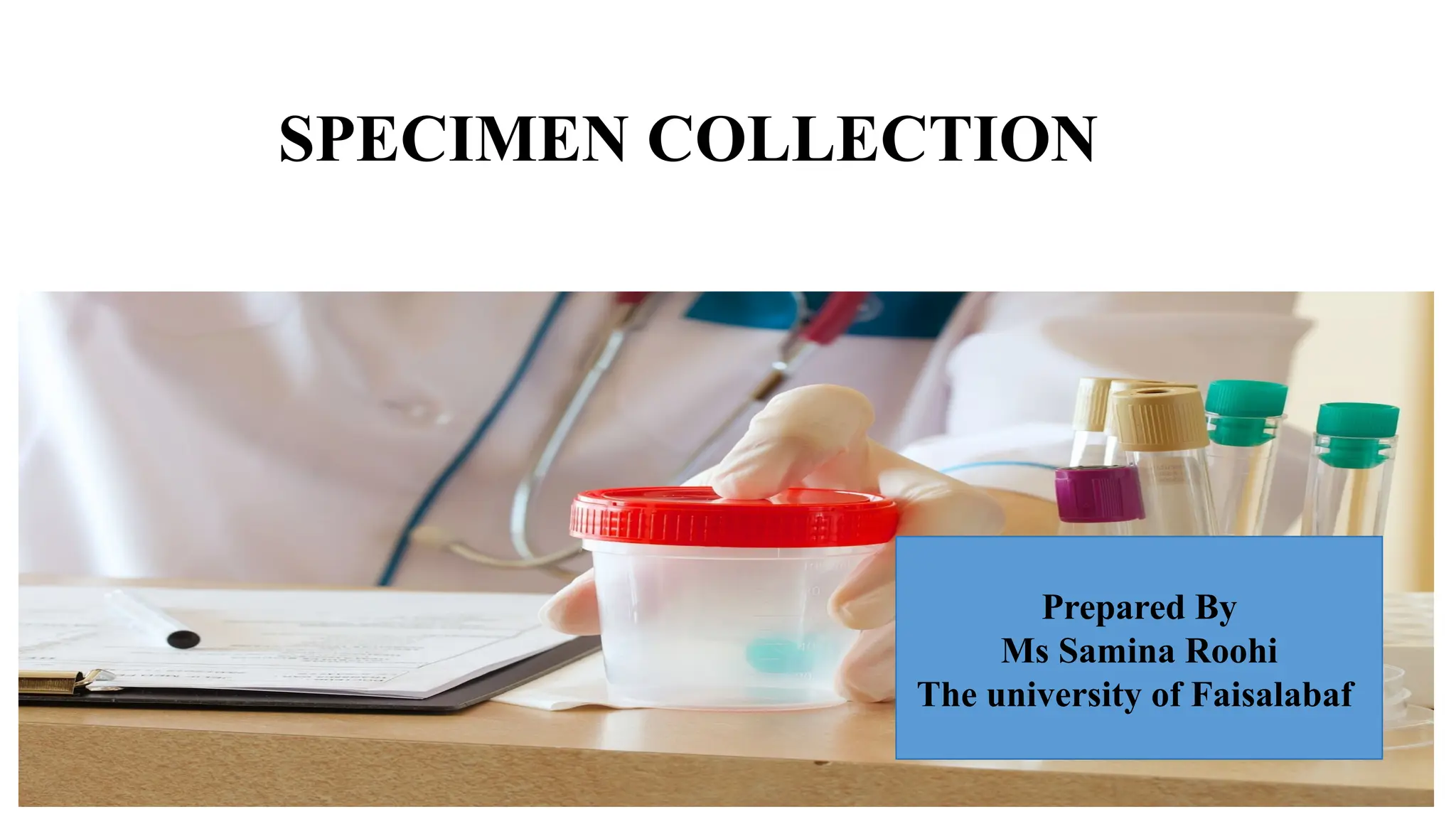
SPECIMEN COLLECTION
Prepared By
Ms Samina Roohi
The university of Faisalabaf
What is Specimen Collection?
• Collecting specimens is the process
of acquiring tissue or fluids for
laboratory analysis. Some of the
samples collected may include serum
samples, virology swab samples,
biopsy and necropsy tissue,
cerebrospinal fluid, whole blood for
PCR, and urine samples.
Purpose of Specimen Collection
Specimen collection is vital for acquiring an accurate and
timely laboratory test result. To properly collect specimens,
they must be obtained through designated containers,
correctly labeled, and promptly transported to the lab.
Most specimens can be collected in a matter of minutes. It
normally only takes a few minutes to transport them to the lab
as well. However, some specimen collection may require more
steps. It often depends on the type of tissue or fluid the patient
has provided.
Time Taking to Collect Specimen
Specimen Collection Steps
• Verify the patient’s identity. Some examples of
acceptable identifiers include the patient’s name,
date of birth, and hospital number.
• Acquire a sample from the patient. Treat all
biological material as potentially hazardous and
follow your facility’s guidelines.
• Process the specimen as required by your facility or
employer.
• Store the specimen. Appropriate storage is critical
to maintaining the integrity of the specimen and,
therefore, the test results.
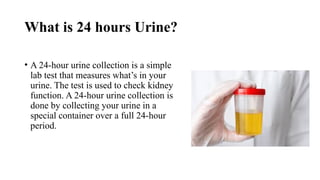
What is 24 hours Urine?
• A 24-hour urine collection is a simple
lab test that measures what’s in your
urine. The test is used to check kidney
function. A 24-hour urine collection is
done by collecting your urine in a
special container over a full 24-hour
period.
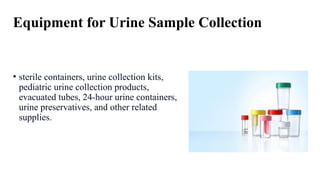
Equipment for Urine Sample Collection
• sterile containers, urine collection kits,
pediatric urine collection products,
evacuated tubes, 24-hour urine containers,
urine preservatives, and other related
supplies.
Procedure
• Begin at the usual time that you wake.
• At that time, pass your urine, flush it down the toilet and note the
exact time. You will now have an empty bladder and an empty bottle.
The collection of urine will start from this time. Please note both the
date and time on the collection bottle label, where it says ‘start date
and time’.
• Collect every drop you pass during the day and night, for 24 hours,
and finish the collection by passing urine at exactly the same time the
next morning. You should add this final specimen to the bottle to
complete the collection.
Conti..
• Keep the sample container cool; closed and protected from light
between each time you pass urine.
• Check that the bottle label contains your full name, date of birth, clinic
or GP surgery that requested the collection and the date and time of
starting and finishing collection.
• Please check that the cap is firmly screwed onto the container. Then
put the bottle in the green bag provided. Unfortunately if the urine
leaks in transit, the collection will be invalidated and the analysis will
not be carried out.
• If more than one 24 hour collection has been asked for, a second
collection, into another container, can be started with the next voiding.
Follow the same instructions.
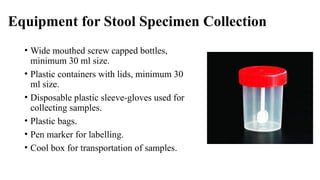
Equipment for Stool Specimen Collection
• Wide mouthed screw capped bottles,
minimum 30 ml size.
• Plastic containers with lids, minimum 30
ml size.
• Disposable plastic sleeve-gloves used for
collecting samples.
• Plastic bags.
• Pen marker for labelling.
• Cool box for transportation of samples.
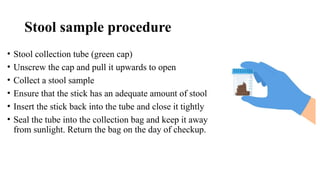
Stool sample procedure
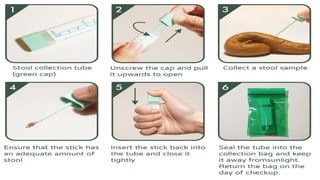
• Stool collection tube (green cap)
• Unscrew the cap and pull it upwards to open
• Collect a stool sample
• Ensure that the stick has an adequate amount of stool
• Insert the stick back into the tube and close it tightly
• Seal the tube into the collection bag and keep it away
from sunlight. Return the bag on the day of checkup.
Conti..
• Avoiding contact with urine, pass stool directly into the stool
cup OR pass stool into a large clean container (such as a cut
out milk jug) OR onto a newspaper placed under the seat of
the toilet. Transfer entire specimen into the stool cup using
the tongue depressor provided or other handy implement
(such as a plastic spoon). If your stools are loose, pass
directly into a container, not onto newspaper.
• Label the stool cup with your full name, date and time of
collection.
• Submit the specimen to the lab within two hours of collection.
Conti..
• If you had a BARIUM SWALLOW, you MUST DELAY collection until the
barium has passed from your system.
If possible, avoid the following foods, derivatives, and supplements for 72
hours before specimen collection
• False negative test results may be caused by:
Vitamin C (ascorbic acid)
• Antacids (e.g. Pepto Bismol, Maalox, mineral oil, Rolaids, Tums, Kaopectate)
• False positive test results may be caused by:
• Red meat
• Alcohol and aspirin (especially if taken together)
• Therapeutic iron
• Other gastric irritants (steroids, rauwolfia derivatives, all nonsteroidal anti-
inflammatory drugs, colchicine)
Sputum Specimen Collection
Amount to Collect
• The necessary amount of sputum for most tests is 5 ml (about 1
teaspoon). However, multiple tests are often ordered so more specimen
may be needed. Some testing is best done on serial specimens, so you
may be asked to collect for three days in a row.
When to Collect
• It’s best to collect sputum specimens first thing in the morning, when
you get up. Collect specimens only at that time unless instructed to do
otherwise by hospital personnel or your physician.
How to Collect
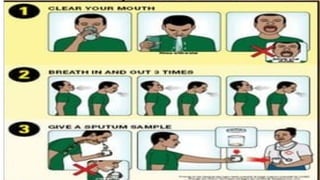
• Gargle and rinse your mouth with water just after you get up and
before you collect the specimen. (This helps to eliminate accumulated
cells arid normal bacteria that may interfere with your test results.)
Inhale repeatedly to the full capacity of your lungs and exhale the air
with an explosive cough. This should produce mucus from the lungs
that is to be expectorated into the container. The specimen MUST BE
FROM THE LUNGS. "Spit" from the mouth is inadequate and will
give incorrect results to your physician.
• After the specimen is obtained, replace the lid tightly on the cup and
return to the laboratory within two hours.
SPECIMEN COLLECTION by samina Roohi.pptx

SPECIMEN COLLECTION by samina Roohi.pptx

  • 1.
    SPECIMEN COLLECTION Prepared By MsSamina Roohi The university of Faisalabaf
  • 2.
    What is SpecimenCollection? • Collecting specimens is the process of acquiring tissue or fluids for laboratory analysis. Some of the samples collected may include serum samples, virology swab samples, biopsy and necropsy tissue, cerebrospinal fluid, whole blood for PCR, and urine samples.
  • 3.
    Purpose of SpecimenCollection Specimen collection is vital for acquiring an accurate and timely laboratory test result. To properly collect specimens, they must be obtained through designated containers, correctly labeled, and promptly transported to the lab. Most specimens can be collected in a matter of minutes. It normally only takes a few minutes to transport them to the lab as well. However, some specimen collection may require more steps. It often depends on the type of tissue or fluid the patient has provided. Time Taking to Collect Specimen
  • 4.
    Specimen Collection Steps •Verify the patient’s identity. Some examples of acceptable identifiers include the patient’s name, date of birth, and hospital number. • Acquire a sample from the patient. Treat all biological material as potentially hazardous and follow your facility’s guidelines. • Process the specimen as required by your facility or employer. • Store the specimen. Appropriate storage is critical to maintaining the integrity of the specimen and, therefore, the test results.
  • 5.
    What is 24hours Urine? • A 24-hour urine collection is a simple lab test that measures what’s in your urine. The test is used to check kidney function. A 24-hour urine collection is done by collecting your urine in a special container over a full 24-hour period.
  • 6.
    Equipment for UrineSample Collection • sterile containers, urine collection kits, pediatric urine collection products, evacuated tubes, 24-hour urine containers, urine preservatives, and other related supplies.
  • 7.
    Procedure • Begin atthe usual time that you wake. • At that time, pass your urine, flush it down the toilet and note the exact time. You will now have an empty bladder and an empty bottle. The collection of urine will start from this time. Please note both the date and time on the collection bottle label, where it says ‘start date and time’. • Collect every drop you pass during the day and night, for 24 hours, and finish the collection by passing urine at exactly the same time the next morning. You should add this final specimen to the bottle to complete the collection.
  • 8.
    Conti.. • Keep thesample container cool; closed and protected from light between each time you pass urine. • Check that the bottle label contains your full name, date of birth, clinic or GP surgery that requested the collection and the date and time of starting and finishing collection. • Please check that the cap is firmly screwed onto the container. Then put the bottle in the green bag provided. Unfortunately if the urine leaks in transit, the collection will be invalidated and the analysis will not be carried out. • If more than one 24 hour collection has been asked for, a second collection, into another container, can be started with the next voiding. Follow the same instructions.
  • 9.
    Equipment for StoolSpecimen Collection • Wide mouthed screw capped bottles, minimum 30 ml size. • Plastic containers with lids, minimum 30 ml size. • Disposable plastic sleeve-gloves used for collecting samples. • Plastic bags. • Pen marker for labelling. • Cool box for transportation of samples.
  • 10.
    Stool sample procedure •Stool collection tube (green cap) • Unscrew the cap and pull it upwards to open • Collect a stool sample • Ensure that the stick has an adequate amount of stool • Insert the stick back into the tube and close it tightly • Seal the tube into the collection bag and keep it away from sunlight. Return the bag on the day of checkup.
  • 11.
    Conti.. • Avoiding contactwith urine, pass stool directly into the stool cup OR pass stool into a large clean container (such as a cut out milk jug) OR onto a newspaper placed under the seat of the toilet. Transfer entire specimen into the stool cup using the tongue depressor provided or other handy implement (such as a plastic spoon). If your stools are loose, pass directly into a container, not onto newspaper. • Label the stool cup with your full name, date and time of collection. • Submit the specimen to the lab within two hours of collection.
  • 12.
    Conti.. • If youhad a BARIUM SWALLOW, you MUST DELAY collection until the barium has passed from your system. If possible, avoid the following foods, derivatives, and supplements for 72 hours before specimen collection • False negative test results may be caused by: Vitamin C (ascorbic acid) • Antacids (e.g. Pepto Bismol, Maalox, mineral oil, Rolaids, Tums, Kaopectate) • False positive test results may be caused by: • Red meat • Alcohol and aspirin (especially if taken together) • Therapeutic iron • Other gastric irritants (steroids, rauwolfia derivatives, all nonsteroidal anti- inflammatory drugs, colchicine)
  • 14.
    Sputum Specimen Collection Amountto Collect • The necessary amount of sputum for most tests is 5 ml (about 1 teaspoon). However, multiple tests are often ordered so more specimen may be needed. Some testing is best done on serial specimens, so you may be asked to collect for three days in a row. When to Collect • It’s best to collect sputum specimens first thing in the morning, when you get up. Collect specimens only at that time unless instructed to do otherwise by hospital personnel or your physician.
  • 15.
    How to Collect •Gargle and rinse your mouth with water just after you get up and before you collect the specimen. (This helps to eliminate accumulated cells arid normal bacteria that may interfere with your test results.) Inhale repeatedly to the full capacity of your lungs and exhale the air with an explosive cough. This should produce mucus from the lungs that is to be expectorated into the container. The specimen MUST BE FROM THE LUNGS. "Spit" from the mouth is inadequate and will give incorrect results to your physician. • After the specimen is obtained, replace the lid tightly on the cup and return to the laboratory within two hours.