Can money buy happiness?
A Vocabulary preview
Complete the sentences with the correct word from Exercise 1.
1 The __________can buy happiness.
2 Some people think it’s a good idea to support a __________by donating money or
time.
3 José wants to buy a new car, but cars are very_____________. He will need to save
some money.
4 My_________________ plan was to study on Friday, but when my friends called about
dinner, I changed my plan and decided to study on Saturday instead.
5 Giving money to people that need it can________________food or bed for a night.
6 I often help my_______________ when he has too much work to do.
7 I thought a lot of people volunteered, but actually the ______________ is true.
8 Save the Children is a very big __________________.
Discuss these questions with a partner.
1 Have you ever given money to a charity or worked with a charity? Did you
enjoy it? Why / why not?
2 Which causes do you think are most important? Why?
3 What is the most expensive thing you have ever bought for yourself? For
someone else?
Before you listen
Discuss these questions with a partner.
1 When you have a little extra money, what do you spend it on?
2 When do you buy things for other people? Give an example of
something you bought for someone else.
I like to buy …
I bought … for … because …
3 Do you think money can buy happiness? Why / why not?
You are going to hear a lecture on a psychology experiment. Number the points
in the order you think you will hear them.
• Answer the question about the experiment
• Ask a question about the experiment
• Describe the experiment
• Describe the results
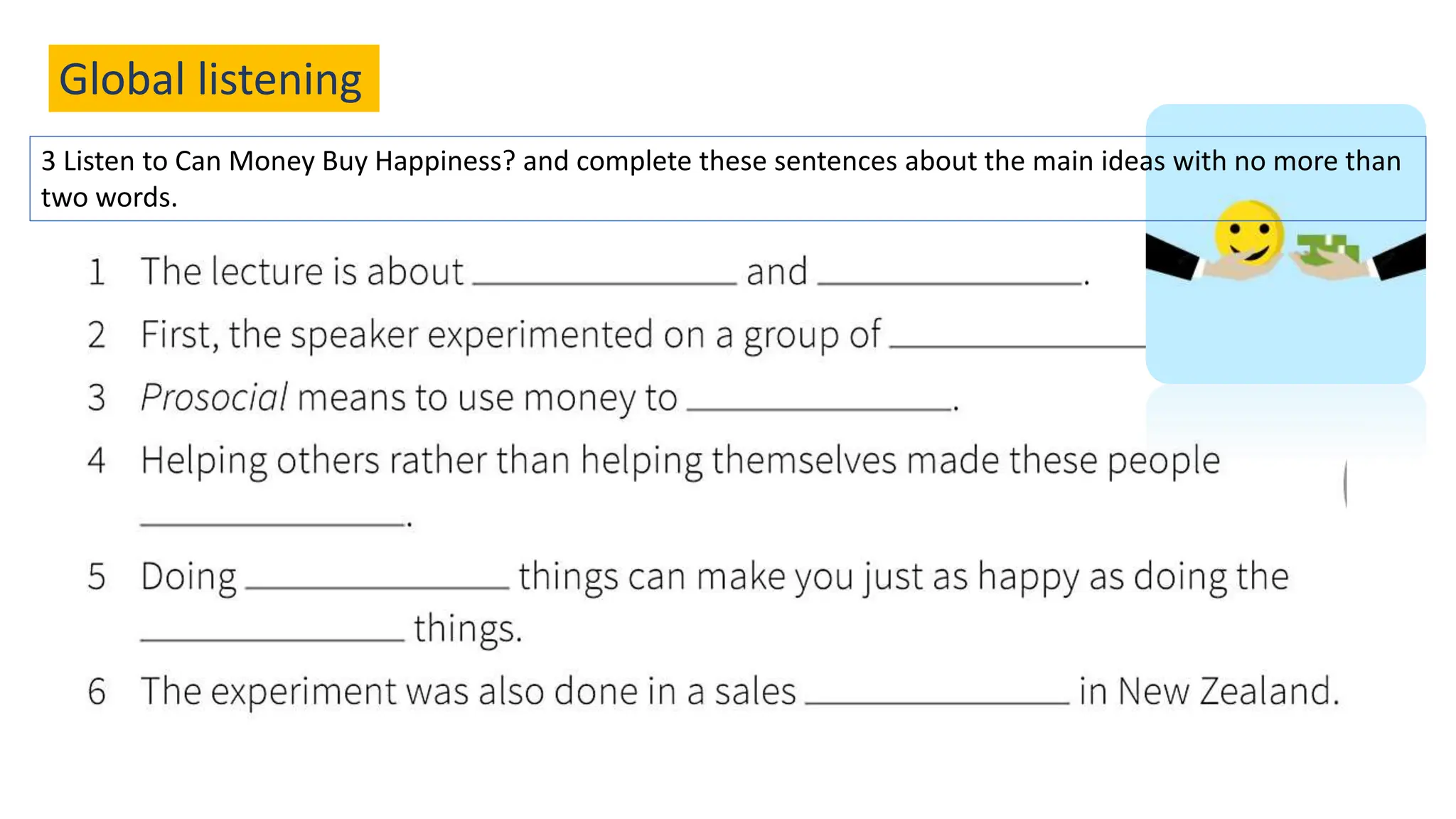
Global listening
3 Listen to Can Money Buy Happiness? and complete these sentences about the main ideas with no more than
two words.
Close listening
Detailed information is the facts and further information a speaker provides
to support their main idea, such as numbers, places, examples, or evidence.
Below are some phrases often used to indicate more detail will follow:
According to Dr. Smith, …
Furthermore, it is believed that …
Specifically, …
When you listen to something for the first time, it’s a good idea to listen just
to understand the topic and the speaker’s opinion or aim. When you listen a
second time, you can take notes on the detailed information you hear.
Listen to Can money buy happiness? again. Take notes on the two experiments. Use the
exercise in C Global listening to help.
Work with a partner. Compare your notes from Exercise 1. Did they write down
any details that you can add to your notes?
Critical thinking
Discuss these questions in a group.
1 Do you believe money can buy happiness for people?
Why / why not?
I believe money can buy happiness because …
I don’t believe money can buy happiness because …
2 How did the listening text make you feel about giving money to others? Do
you agree that this makes people happier?
Pronunciation for listening
Listen to the words. Underline the letters you don’t hear.
1 every
2 comparable
3 generally
4 different
5 favorite
6 reasonable
7 suppose
8 miserable
Read these sentences to a partner. Practice leaving out the vowel sounds.
1 I go to school every week.
2 The prices at the two stores are comparable.
3 My mother generally cooks a family dinner on Sunday.
4 My friends all have different majors.
5 My favorite subject is _____________.
6 Be reasonable when planning time to work and study.
7 I suppose it is a good idea to do community service.
8______________is one thing that makes me miserable!
Vocabulary development
Verb and noun collocations
Collocations are words that are often used together. Collocations can be formed
from different parts of speech. The most common type of collocation is verb and
noun collocations. For example:
Match the verbs in the box with the correct nouns to make common collocations.
Answer do give make manage order pay take
1. _________________________homework
2. _________________________a presentation
3. _________________________the bed
4. _________________________the phone
5. _________________________your workload
6. _________________________a drink
7. _________________________a chance
8. _________________________attention
Answer the questions with a partner.
1 When did you last take a break?
2 What is one thing you think will make a difference to someone’s happiness?
3 When did you last donate time to something or someone?
4 What is one good way to care for others?
5 Do you know anyone who does community service? Who?
6 When was the last time someone gave you their time? What was it for?
Choose the best definitions for the words in bold.
1 You can take an intermediate English test if you already know
some of the language.
2 Lucinda didn’t like anything to interrupt her normal work-study
hours.
3 The principal aim of community service is to help those less
fortunate.
4 Being prosocial is an abstract idea.
5 Pamela read the instructions on the label of her food to see
how to cook it.
6 Jacques is cooperative; he always helps new volunteers when
they first start community service.
7 Liza will make a revision to her college application after she
completes her community service.
8 Community service at the hospital benefits the patients,
doctors, and volunteers.
a. _______________(adj) exist as thoughts but are not
physical things that you
can touch
b._______________(adj) main or most important
c._______________(v) helps
d._______________(n) a change or improvement to
something
e._______________(adj) willing to do what you ask
f.________________(n) piece of paper or material that
gives information or instructions about something
g._______________(adj) expected; not unusual or
surprising
h._______________(adj) a level between beginning
and advanced
Work with a partner. Answer the questions and explain your answers.
1 Do you think community service can benefit your college application?
2 What is one abstract idea you can think of?
3 Talk about what a normal Friday is like for you.
4 Why is it helpful to have labels on food or medicine?
5 What have you recently made a revision to? How did you change it?
6 Talk about someone you know who is cooperative. What makes them cooperative?
7 What do you think is the principal part of a college application?
8 What could you do to move from intermediate level in English to advanced?
https://www.baamboozle.com/classicjr/869421/3
Game
References:
https: // www.macmillaneducationeverywhere.com
https://www.twinkl.com/teaching-wiki/speaking-skills
https://www.english-efl.com/lessons/improve-english-speaking-skill-2/
Miles Craven.(2008) Real Listening and Speaking 1. Cambridge University Press. ISBN -
13 978-0-521-70198-3 p 46- 47
Recommended literature:
Skillful 1 Listening and Speaking ( second edition ), by
Lida Baker and Steven Gerschon
Collins Easy Learning English. Textbooks That Start
Conversations.
Discussions A-Z.
Spoken English (English Improvement for success) by
Alison Reid
Thank you for your attention!

Speaking topic about money and organisation

  • 3.
    Can money buyhappiness? A Vocabulary preview
  • 4.
    Complete the sentenceswith the correct word from Exercise 1. 1 The __________can buy happiness. 2 Some people think it’s a good idea to support a __________by donating money or time. 3 José wants to buy a new car, but cars are very_____________. He will need to save some money. 4 My_________________ plan was to study on Friday, but when my friends called about dinner, I changed my plan and decided to study on Saturday instead. 5 Giving money to people that need it can________________food or bed for a night. 6 I often help my_______________ when he has too much work to do. 7 I thought a lot of people volunteered, but actually the ______________ is true. 8 Save the Children is a very big __________________.
  • 5.
    Discuss these questionswith a partner. 1 Have you ever given money to a charity or worked with a charity? Did you enjoy it? Why / why not? 2 Which causes do you think are most important? Why? 3 What is the most expensive thing you have ever bought for yourself? For someone else?
  • 6.
    Before you listen Discussthese questions with a partner. 1 When you have a little extra money, what do you spend it on? 2 When do you buy things for other people? Give an example of something you bought for someone else. I like to buy … I bought … for … because … 3 Do you think money can buy happiness? Why / why not?
  • 7.
    You are goingto hear a lecture on a psychology experiment. Number the points in the order you think you will hear them. • Answer the question about the experiment • Ask a question about the experiment • Describe the experiment • Describe the results
  • 8.
    Global listening 3 Listento Can Money Buy Happiness? and complete these sentences about the main ideas with no more than two words.
  • 9.
    Close listening Detailed informationis the facts and further information a speaker provides to support their main idea, such as numbers, places, examples, or evidence. Below are some phrases often used to indicate more detail will follow: According to Dr. Smith, … Furthermore, it is believed that … Specifically, … When you listen to something for the first time, it’s a good idea to listen just to understand the topic and the speaker’s opinion or aim. When you listen a second time, you can take notes on the detailed information you hear.
  • 10.
    Listen to Canmoney buy happiness? again. Take notes on the two experiments. Use the exercise in C Global listening to help. Work with a partner. Compare your notes from Exercise 1. Did they write down any details that you can add to your notes?
  • 11.
    Critical thinking Discuss thesequestions in a group. 1 Do you believe money can buy happiness for people? Why / why not? I believe money can buy happiness because … I don’t believe money can buy happiness because … 2 How did the listening text make you feel about giving money to others? Do you agree that this makes people happier?
  • 12.
  • 13.
    Listen to thewords. Underline the letters you don’t hear. 1 every 2 comparable 3 generally 4 different 5 favorite 6 reasonable 7 suppose 8 miserable
  • 14.
    Read these sentencesto a partner. Practice leaving out the vowel sounds. 1 I go to school every week. 2 The prices at the two stores are comparable. 3 My mother generally cooks a family dinner on Sunday. 4 My friends all have different majors. 5 My favorite subject is _____________. 6 Be reasonable when planning time to work and study. 7 I suppose it is a good idea to do community service. 8______________is one thing that makes me miserable!
  • 15.
    Vocabulary development Verb andnoun collocations Collocations are words that are often used together. Collocations can be formed from different parts of speech. The most common type of collocation is verb and noun collocations. For example:
  • 16.
    Match the verbsin the box with the correct nouns to make common collocations. Answer do give make manage order pay take 1. _________________________homework 2. _________________________a presentation 3. _________________________the bed 4. _________________________the phone 5. _________________________your workload 6. _________________________a drink 7. _________________________a chance 8. _________________________attention
  • 17.
    Answer the questionswith a partner. 1 When did you last take a break? 2 What is one thing you think will make a difference to someone’s happiness? 3 When did you last donate time to something or someone? 4 What is one good way to care for others? 5 Do you know anyone who does community service? Who? 6 When was the last time someone gave you their time? What was it for?
  • 18.
    Choose the bestdefinitions for the words in bold. 1 You can take an intermediate English test if you already know some of the language. 2 Lucinda didn’t like anything to interrupt her normal work-study hours. 3 The principal aim of community service is to help those less fortunate. 4 Being prosocial is an abstract idea. 5 Pamela read the instructions on the label of her food to see how to cook it. 6 Jacques is cooperative; he always helps new volunteers when they first start community service. 7 Liza will make a revision to her college application after she completes her community service. 8 Community service at the hospital benefits the patients, doctors, and volunteers. a. _______________(adj) exist as thoughts but are not physical things that you can touch b._______________(adj) main or most important c._______________(v) helps d._______________(n) a change or improvement to something e._______________(adj) willing to do what you ask f.________________(n) piece of paper or material that gives information or instructions about something g._______________(adj) expected; not unusual or surprising h._______________(adj) a level between beginning and advanced
  • 19.
    Work with apartner. Answer the questions and explain your answers. 1 Do you think community service can benefit your college application? 2 What is one abstract idea you can think of? 3 Talk about what a normal Friday is like for you. 4 Why is it helpful to have labels on food or medicine? 5 What have you recently made a revision to? How did you change it? 6 Talk about someone you know who is cooperative. What makes them cooperative? 7 What do you think is the principal part of a college application? 8 What could you do to move from intermediate level in English to advanced?
  • 20.
  • 21.
  • 22.
    Recommended literature: Skillful 1Listening and Speaking ( second edition ), by Lida Baker and Steven Gerschon Collins Easy Learning English. Textbooks That Start Conversations. Discussions A-Z. Spoken English (English Improvement for success) by Alison Reid
  • 23.
    Thank you foryour attention!