SPEAK DIRECT METHOD © - BOOK CONTENT
Copyright by SPEAK DIRECT METHOD © Page 1 / 10
SPEAK DIRECT METHOD©
ENGLISH BOOK CONTENT
SPEAK DIRECT METHOD © - BOOK CONTENT
Copyright by SPEAK DIRECT METHOD © Page 2 / 10
Book 1 content
Grammar Points Topics
1. The verb „to be” in the singular and
plural
2. The plural of basic regular and irregular
nouns
3. The Present Simple Tense
4. Verbs in the infinitive
5. Expressions: “there is” and “there are”
6. Cardinal numbers
7. Basic rules about the use of the articles
“a” and “the”
8. Names of the letters in the alphabet
9. Countable and uncountable nouns
10. The Present Continuous Tense
11. Ordinal numbers
12. Possessive adjectives (my, your, her,
etc.)
 Greetings and pleasantries
 Basic names of people and objects (man,
teacher, desk, etc.)
 Basic names of jobs
 Basic verbs (I live, I speak, etc.)
 Names of countries and nationalities
 Prepositions (on, under, in, above, etc.)
 Colors
 Clothes
 Frequency adverbs (always, often,
usually, etc.)
 Parts of the body
 Describing the weather
 Names of the days of the week
 Names of animals
Book 2 content
Grammar Points Topics
1. Possessive pronouns (mine, yours, hers,
etc.)
2. The expression “neither…nor”
3. Asking about a person’s age
4. “tall/short” versus “high/low”
5. Sentences in the Present Simple and the
Present Continuous
6. Talking about quantity – expressions
“much” and “many”, “few” and “little”
7. Expressions “some” and “any”
8. The imperative
9. “something”, “anything”, “nothing”
10. The Past Continuous Tense
11. The Future Continuous Tense
12. Frequency adverbs (once, twice, etc.)
 Names of countries and nationalities –
continuation
 The family
 Names of the months of the year
 Seasons of the year
 Names of basic kinds of food and drinks
 Names of meals
 Means of transport
 The senses
 Times of the day
 Asking about the time
 Describing the different kinds of rooms
(classroom, living room, etc.) and their
furnishings
 Kinds of shops
SPEAK DIRECT METHOD © - BOOK CONTENT
Copyright by SPEAK DIRECT METHOD © Page 3 / 10
Book 3 content
Grammar Points Topics
1. Ordinal numbers – continuation
2. Dates
3. Comparison of regular adjectives
4. Comparison of the irregular adjectives
“good” and “bad”
5. The Past Simple Tense
6. The past form of the verb “to be”
7. Irregular verbs – introduction
8. The use of “while”, “during” and “when”
in sentences
9. The plural of nouns ending in “f” and
“fe”
 The family – continuation
 Musical instruments
 Measurements (meter, centimeter, etc.)
 School subjects
 Cardinal directions (North, South, etc.)
 Describing the weather – continuation
 Talking about health
 Names of jobs – continuation
 Talking about holidays
 Giving directions how to get to a place
 Christmas and Easter vocabulary
Book 4 content
Grammar Points Selected Topics
1. The Future Simple Tense
2. The expressions “I’m sorry” and “excuse
me”
3. Irregular verbs – continuation
4. The verbs “must” and “have to”
5. The word order in English sentences
6. The expression “to be going to” in the
present and in the past
7. The difference between “gold” and
“golden”
8. The expressions “would you like” and
“would you prefer”
9. Sentences in the First Conditional
10. The difference in use between “wear”
and “carry”
11. Making nouns from verbs (teach-er,
sing-er, driv-er, etc.)
12. Sentence constructions with “may” and
“might”
13. “Can”, ”to be able to”, ”could”
14. The Present Perfect Tense
15. The Past Participle form of verbs
16. Comparison of the Present Perfect and
the Past Simple Tense
 Thanksgiving
 Mines
 Cooking recipes
 Soldiers, battles and wars
 The sense of humor
 Musical instruments – continuation
 Public transport
 Stairs and lifts
 Offense, crime, robbery
 The basement and the attic
 Salaries and wages
 Accent and pronunciation
 Keeping promises
 Employers and employees
 Princesses
 Teenagers
 Heroes and cowards
 Business competition
 Casinos
 Drug dealers
 Cemeteries
SPEAK DIRECT METHOD © - BOOK CONTENT
Copyright by SPEAK DIRECT METHOD © Page 4 / 10
Book 5 content
Grammar Points Selected Topics
1. Irregular verbs – continuation
2. The expression “to have something
done”
3. Uncountable nouns
4. “Hang” as regular and irregular verb
5. Sentences in the Second Conditional
6. Talking about movement direction
(“upwards”, “downwards”, etc.)
7. Rules of using the definite article “the”
 Hurricane, avalanche, snowstorm,
earthquake
 To sink and to drown
 Stubborn and clever
 My friend wants to be a priest
 The armor
 Fencing
 Household electric equipment
 Canned food
 Beauty parlors
 Job advertisements
 Mammals, reptiles and amphibians
 The truth and a lie
 TV commercials
 Marriage proposal
 Batteries and electricity
 Reviews
 Illnesses, diseases and medications
 Inventors
 Pension and retirement
 We need oxygen to live
 Football matches
 The Independence Day
 Scientific discoveries
 About the work of a servant
 Cotton, velvet and silk
 Mortgage
 Printers
 Vice and virtue
 Neighbors and neighborhood
 A Velcro, a zip or just buttons?
 Theory and practice
 A bath or a shower?
 Acronyms
 Pain and ache
 To lend and to borrow
 Qualifications
 The house of my dreams
 Industry and agriculture
 Flood
 The attendance list
 Problems and troubles
 Smoking cigarettes
SPEAK DIRECT METHOD © - BOOK CONTENT
Copyright by SPEAK DIRECT METHOD © Page 5 / 10
Book 6 content
Grammar Points Selected Topics
1. Irregular verbs – continuation
2. Expressions “each other” and “one
another”
3. The First and the Second Conditional –
comparison
4. Sentence constructions with the word
“would”
5. The expression “used to”
6. “would” in the expression “would like”
and as the past of “will”
7. “so” and “such”
8. “when”, “before” and “after” instead of
“if” in the First Conditional
9. “Amount” and “number” – difference in
use
10. Question tags (haven’t you?, don’t
they?, aren’t we?, etc.)
11. Reflexive pronouns (myself, yourself,
herself, etc.)
 Kinds of measures
 Celebrities
 Graduates
 The job of my dreams
 Native Americans
 Abbreviations (p.m., e.g., etc.)
 Sport champions
 Toys
 Bees and hives
 Motivation and determination
 What is more important: intelligence or
appearance
 Living conditions and comfort
 Car insurance
 Beach fashion
 Football – continuation
 An appointment
 Money allowance
 A good coach
 Jealousy
 Exhibitions, galleries, masterpieces
 Wounds and injuries
 Healthy produce
 Emperors
 A good car mechanic
 Parents’ expectations
 An employment contract
 Lawyers, judges and courts of law
 Traffic and traffic jams
 Mozart was a genius
 Preparing a meal
 The gym
 Kinds of car drives
 Consequences of drinking alcohol
 Product quality
 Conquerors
 Unusual phenomena
 Burglar alarm
 Uncovering children’s talents
 The Statue of Liberty
 Amusement parks
 Soldier uniforms
 Challenging to a fight
 Trust and honesty
 Disclosing secret information
SPEAK DIRECT METHOD © - BOOK CONTENT
Copyright by SPEAK DIRECT METHOD © Page 6 / 10
Book 7 content
Grammar Points Selected Topics
1. Irregular verbs – continuation
2. The First Conditional – revision
3. “Few” and “a few”
4. The Present Perfect Continuous Tense
5. The Second Conditional – revision
6. The expressions “to be used to” and “to
get used to”
7. The difference between “little” and “a
little”
 Attending a difficult client
 About traffic regulations
 Harvest
 Books and encyclopedias
 Demand in business
 How to maintain (a house, a family,
figure, etc.)
 Extending borders
 Freelancers and flexible working hours
 How to keep vegetables in winter
 How to serve wine
 When you’re stuck in a traffic jam…
 E-mail attachments
 Strength and weaknesses
 Betrayals and traitors
 Legal sentences
 Overeating
 Extravagant jewellery
 Downloading and uploading files
 Charity organizations
 Protection of endangered species
 Discounts
 How to discipline children
 Business relationships
 Advertisements
 The press
 Fairs
 Is good English necessary to get a good
job?
 Suppliers and buyers
 Welcome to Sydney
 Jack Allen – the travel writer
 Jet lag
 French diet
 Italian shoes export
 Traffic in Europe cities
 Body language
 Champagne
 About chocolate
 Chairman’s report
 Euro Tunnel
 Plan of a journey
SPEAK DIRECT METHOD © - BOOK CONTENT
Copyright by SPEAK DIRECT METHOD © Page 7 / 10
Book 8 content
Grammar Points Selected Topics
1. Irregular verbs – continuation
2. Transitive and intransitive verbs
3. The Passive Voice
4. Rules of using the definite article “the”
5. Prepositions “in”, “on”, “at” in
describing the time
6. The difference in meaning between “in
time” and “on time”
7. The Past Perfect Tense
8. Indirect Speech
9. The possessive form with “-s”
10. The expressions: “alone”, “on one’s
own”, “by oneself”
11. The difference between “among” and
“between”
12. The Third Conditional
13. Examples of differences in spelling of
words in the British English and the
American English
 Holidays abroad
 Glass production
 Where does ice-cream come from?
 Picnic
 Sources of happiness
 Laughter clubs
 Microwave dinners
 Natural medicine
 IKEA furniture
 The lucky ones
 Started business when retired…
 Computer viruses
 Shark attack
 Slimming center
 Alain Roberts – the skyscraper climber
 Success of the Nike
 Leap year
 Chocoholics
 Fast food chains
 The history of Coca-Cola
 Gossip
 Electronic gadgets for children
 Hispanics in New York
 Life without a car
 Against tests on animals
 Boston
 May I have your autograph, please…
 Love at first sight
 More than just a gym
 Penelope Cruz
 Russell Crowe
 Esperanto
 Bilingual children
 The history of English language in
America
 The story of Aron Ralstron
 Football for women
 American English versus British English
 The Beatles
 Drugs legalization
SPEAK DIRECT METHOD © - BOOK CONTENT
Copyright by SPEAK DIRECT METHOD © Page 8 / 10
Book 9 content
Grammar Points Selected Topics
1. Irregular verbs – continuation
2. Sentence constructions with the verb
“prefer”
3. Sentence constructions with “I would
rather”
4. Rules of reading the dates
5. Comparison of “all the” and “the whole”
6. Acronyms
7. Use of “wish” in sentences
8. The expressions “I’d better, you’ better”
9. Causative “have”
10. The word “unless”
11. Differences in use of “there” and “it”
 Leonardo da Vinci
 Thomas Edison
 The job of a pilot
 What London and New York have in
common
 The greatest world corporations
 Silence as a means of communication
 Against globalization
 DNA tests for employers
 The first impression
 The new Mercedes model
 Computer rage
 What to pack on a business journey
 Naming and shaming
 E-mails
 Canterbury ghosts
 Giving money to charities
 Natural environment protection
 Revenge
 Murphy’s Law
 Should we ban smacking children
 Vegetarians
 Pheasant hunting
 Why don’t men want to marry?
 Airbus
 Tourism in Argentina
 The right to vote
 Slang
 Sexual harassment
 Against the war in Vietnam
 The story of impolite robber
 Win-win negotiations
 Business plan
 The longest mustache in the world
 Job sharing
 Sumo fighters
 The Muslim veil
 Homelessness
 Part of speech by Martin Luther King
SPEAK DIRECT METHOD © - BOOK CONTENT
Copyright by SPEAK DIRECT METHOD © Page 9 / 10
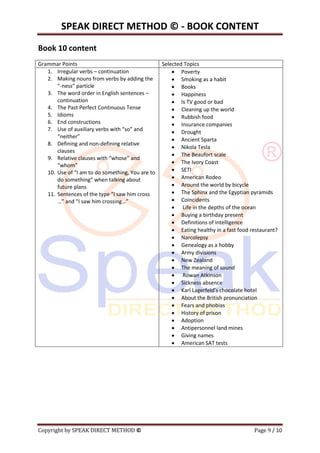
Book 10 content
Grammar Points Selected Topics
1. Irregular verbs – continuation
2. Making nouns from verbs by adding the
“-ness” particle
3. The word order in English sentences –
continuation
4. The Past Perfect Continuous Tense
5. Idioms
6. End constructions
7. Use of auxiliary verbs with “so” and
“neither”
8. Defining and non-defining relative
clauses
9. Relative clauses with “whose” and
“whom”
10. Use of “I am to do something, You are to
do something” when talking about
future plans
11. Sentences of the type “I saw him cross
…” and “I saw him crossing…”
 Poverty
 Smoking as a habit
 Books
 Happiness
 Is TV good or bad
 Cleaning up the world
 Rubbish food
 Insurance companies
 Drought
 Ancient Sparta
 Nikola Tesla
 The Beaufort scale
 The Ivory Coast
 SETI
 American Rodeo
 Around the world by bicycle
 The Sphinx and the Egyptian pyramids
 Coincidents
 Life in the depths of the ocean
 Buying a birthday present
 Definitions of intelligence
 Eating healthy in a fast food restaurant?
 Narcolepsy
 Genealogy as a hobby
 Army divisions
 New Zealand
 The meaning of sound
 Rowan Atkinson
 Sickness absence
 Karl Lagerfeld’s chocolate hotel
 About the British pronunciation
 Fears and phobias
 History of prison
 Adoption
 Antipersonnel land mines
 Giving names
 American SAT tests
SPEAK DIRECT METHOD © - BOOK CONTENT
Copyright by SPEAK DIRECT METHOD © Page 10 / 10
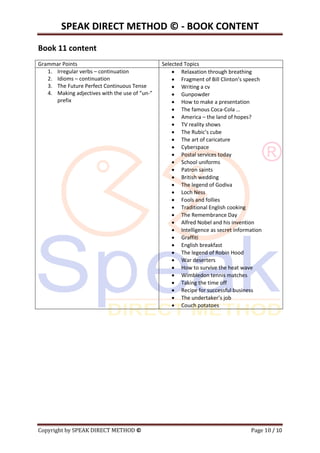
Book 11 content
Grammar Points Selected Topics
1. Irregular verbs – continuation
2. Idioms – continuation
3. The Future Perfect Continuous Tense
4. Making adjectives with the use of “un-”
prefix
 Relaxation through breathing
 Fragment of Bill Clinton’s speech
 Writing a cv
 Gunpowder
 How to make a presentation
 The famous Coca-Cola …
 America – the land of hopes?
 TV reality shows
 The Rubic’s cube
 The art of caricature
 Cyberspace
 Postal services today
 School uniforms
 Patron saints
 British wedding
 The legend of Godiva
 Loch Ness
 Fools and follies
 Traditional English cooking
 The Remembrance Day
 Alfred Nobel and his invention
 Intelligence as secret information
 Graffiti
 English breakfast
 The legend of Robin Hood
 War deserters
 How to survive the heat wave
 Wimbledon tennis matches
 Taking the time off
 Recipe for successful business
 The undertaker’s job
 Couch potatoes

Speak direct method english book content

  • 1.
    SPEAK DIRECT METHOD© - BOOK CONTENT Copyright by SPEAK DIRECT METHOD © Page 1 / 10 SPEAK DIRECT METHOD© ENGLISH BOOK CONTENT
  • 2.
    SPEAK DIRECT METHOD© - BOOK CONTENT Copyright by SPEAK DIRECT METHOD © Page 2 / 10 Book 1 content Grammar Points Topics 1. The verb „to be” in the singular and plural 2. The plural of basic regular and irregular nouns 3. The Present Simple Tense 4. Verbs in the infinitive 5. Expressions: “there is” and “there are” 6. Cardinal numbers 7. Basic rules about the use of the articles “a” and “the” 8. Names of the letters in the alphabet 9. Countable and uncountable nouns 10. The Present Continuous Tense 11. Ordinal numbers 12. Possessive adjectives (my, your, her, etc.)  Greetings and pleasantries  Basic names of people and objects (man, teacher, desk, etc.)  Basic names of jobs  Basic verbs (I live, I speak, etc.)  Names of countries and nationalities  Prepositions (on, under, in, above, etc.)  Colors  Clothes  Frequency adverbs (always, often, usually, etc.)  Parts of the body  Describing the weather  Names of the days of the week  Names of animals Book 2 content Grammar Points Topics 1. Possessive pronouns (mine, yours, hers, etc.) 2. The expression “neither…nor” 3. Asking about a person’s age 4. “tall/short” versus “high/low” 5. Sentences in the Present Simple and the Present Continuous 6. Talking about quantity – expressions “much” and “many”, “few” and “little” 7. Expressions “some” and “any” 8. The imperative 9. “something”, “anything”, “nothing” 10. The Past Continuous Tense 11. The Future Continuous Tense 12. Frequency adverbs (once, twice, etc.)  Names of countries and nationalities – continuation  The family  Names of the months of the year  Seasons of the year  Names of basic kinds of food and drinks  Names of meals  Means of transport  The senses  Times of the day  Asking about the time  Describing the different kinds of rooms (classroom, living room, etc.) and their furnishings  Kinds of shops
  • 3.
    SPEAK DIRECT METHOD© - BOOK CONTENT Copyright by SPEAK DIRECT METHOD © Page 3 / 10 Book 3 content Grammar Points Topics 1. Ordinal numbers – continuation 2. Dates 3. Comparison of regular adjectives 4. Comparison of the irregular adjectives “good” and “bad” 5. The Past Simple Tense 6. The past form of the verb “to be” 7. Irregular verbs – introduction 8. The use of “while”, “during” and “when” in sentences 9. The plural of nouns ending in “f” and “fe”  The family – continuation  Musical instruments  Measurements (meter, centimeter, etc.)  School subjects  Cardinal directions (North, South, etc.)  Describing the weather – continuation  Talking about health  Names of jobs – continuation  Talking about holidays  Giving directions how to get to a place  Christmas and Easter vocabulary Book 4 content Grammar Points Selected Topics 1. The Future Simple Tense 2. The expressions “I’m sorry” and “excuse me” 3. Irregular verbs – continuation 4. The verbs “must” and “have to” 5. The word order in English sentences 6. The expression “to be going to” in the present and in the past 7. The difference between “gold” and “golden” 8. The expressions “would you like” and “would you prefer” 9. Sentences in the First Conditional 10. The difference in use between “wear” and “carry” 11. Making nouns from verbs (teach-er, sing-er, driv-er, etc.) 12. Sentence constructions with “may” and “might” 13. “Can”, ”to be able to”, ”could” 14. The Present Perfect Tense 15. The Past Participle form of verbs 16. Comparison of the Present Perfect and the Past Simple Tense  Thanksgiving  Mines  Cooking recipes  Soldiers, battles and wars  The sense of humor  Musical instruments – continuation  Public transport  Stairs and lifts  Offense, crime, robbery  The basement and the attic  Salaries and wages  Accent and pronunciation  Keeping promises  Employers and employees  Princesses  Teenagers  Heroes and cowards  Business competition  Casinos  Drug dealers  Cemeteries
  • 4.
    SPEAK DIRECT METHOD© - BOOK CONTENT Copyright by SPEAK DIRECT METHOD © Page 4 / 10 Book 5 content Grammar Points Selected Topics 1. Irregular verbs – continuation 2. The expression “to have something done” 3. Uncountable nouns 4. “Hang” as regular and irregular verb 5. Sentences in the Second Conditional 6. Talking about movement direction (“upwards”, “downwards”, etc.) 7. Rules of using the definite article “the”  Hurricane, avalanche, snowstorm, earthquake  To sink and to drown  Stubborn and clever  My friend wants to be a priest  The armor  Fencing  Household electric equipment  Canned food  Beauty parlors  Job advertisements  Mammals, reptiles and amphibians  The truth and a lie  TV commercials  Marriage proposal  Batteries and electricity  Reviews  Illnesses, diseases and medications  Inventors  Pension and retirement  We need oxygen to live  Football matches  The Independence Day  Scientific discoveries  About the work of a servant  Cotton, velvet and silk  Mortgage  Printers  Vice and virtue  Neighbors and neighborhood  A Velcro, a zip or just buttons?  Theory and practice  A bath or a shower?  Acronyms  Pain and ache  To lend and to borrow  Qualifications  The house of my dreams  Industry and agriculture  Flood  The attendance list  Problems and troubles  Smoking cigarettes
  • 5.
    SPEAK DIRECT METHOD© - BOOK CONTENT Copyright by SPEAK DIRECT METHOD © Page 5 / 10 Book 6 content Grammar Points Selected Topics 1. Irregular verbs – continuation 2. Expressions “each other” and “one another” 3. The First and the Second Conditional – comparison 4. Sentence constructions with the word “would” 5. The expression “used to” 6. “would” in the expression “would like” and as the past of “will” 7. “so” and “such” 8. “when”, “before” and “after” instead of “if” in the First Conditional 9. “Amount” and “number” – difference in use 10. Question tags (haven’t you?, don’t they?, aren’t we?, etc.) 11. Reflexive pronouns (myself, yourself, herself, etc.)  Kinds of measures  Celebrities  Graduates  The job of my dreams  Native Americans  Abbreviations (p.m., e.g., etc.)  Sport champions  Toys  Bees and hives  Motivation and determination  What is more important: intelligence or appearance  Living conditions and comfort  Car insurance  Beach fashion  Football – continuation  An appointment  Money allowance  A good coach  Jealousy  Exhibitions, galleries, masterpieces  Wounds and injuries  Healthy produce  Emperors  A good car mechanic  Parents’ expectations  An employment contract  Lawyers, judges and courts of law  Traffic and traffic jams  Mozart was a genius  Preparing a meal  The gym  Kinds of car drives  Consequences of drinking alcohol  Product quality  Conquerors  Unusual phenomena  Burglar alarm  Uncovering children’s talents  The Statue of Liberty  Amusement parks  Soldier uniforms  Challenging to a fight  Trust and honesty  Disclosing secret information
  • 6.
    SPEAK DIRECT METHOD© - BOOK CONTENT Copyright by SPEAK DIRECT METHOD © Page 6 / 10 Book 7 content Grammar Points Selected Topics 1. Irregular verbs – continuation 2. The First Conditional – revision 3. “Few” and “a few” 4. The Present Perfect Continuous Tense 5. The Second Conditional – revision 6. The expressions “to be used to” and “to get used to” 7. The difference between “little” and “a little”  Attending a difficult client  About traffic regulations  Harvest  Books and encyclopedias  Demand in business  How to maintain (a house, a family, figure, etc.)  Extending borders  Freelancers and flexible working hours  How to keep vegetables in winter  How to serve wine  When you’re stuck in a traffic jam…  E-mail attachments  Strength and weaknesses  Betrayals and traitors  Legal sentences  Overeating  Extravagant jewellery  Downloading and uploading files  Charity organizations  Protection of endangered species  Discounts  How to discipline children  Business relationships  Advertisements  The press  Fairs  Is good English necessary to get a good job?  Suppliers and buyers  Welcome to Sydney  Jack Allen – the travel writer  Jet lag  French diet  Italian shoes export  Traffic in Europe cities  Body language  Champagne  About chocolate  Chairman’s report  Euro Tunnel  Plan of a journey
  • 7.
    SPEAK DIRECT METHOD© - BOOK CONTENT Copyright by SPEAK DIRECT METHOD © Page 7 / 10 Book 8 content Grammar Points Selected Topics 1. Irregular verbs – continuation 2. Transitive and intransitive verbs 3. The Passive Voice 4. Rules of using the definite article “the” 5. Prepositions “in”, “on”, “at” in describing the time 6. The difference in meaning between “in time” and “on time” 7. The Past Perfect Tense 8. Indirect Speech 9. The possessive form with “-s” 10. The expressions: “alone”, “on one’s own”, “by oneself” 11. The difference between “among” and “between” 12. The Third Conditional 13. Examples of differences in spelling of words in the British English and the American English  Holidays abroad  Glass production  Where does ice-cream come from?  Picnic  Sources of happiness  Laughter clubs  Microwave dinners  Natural medicine  IKEA furniture  The lucky ones  Started business when retired…  Computer viruses  Shark attack  Slimming center  Alain Roberts – the skyscraper climber  Success of the Nike  Leap year  Chocoholics  Fast food chains  The history of Coca-Cola  Gossip  Electronic gadgets for children  Hispanics in New York  Life without a car  Against tests on animals  Boston  May I have your autograph, please…  Love at first sight  More than just a gym  Penelope Cruz  Russell Crowe  Esperanto  Bilingual children  The history of English language in America  The story of Aron Ralstron  Football for women  American English versus British English  The Beatles  Drugs legalization
  • 8.
    SPEAK DIRECT METHOD© - BOOK CONTENT Copyright by SPEAK DIRECT METHOD © Page 8 / 10 Book 9 content Grammar Points Selected Topics 1. Irregular verbs – continuation 2. Sentence constructions with the verb “prefer” 3. Sentence constructions with “I would rather” 4. Rules of reading the dates 5. Comparison of “all the” and “the whole” 6. Acronyms 7. Use of “wish” in sentences 8. The expressions “I’d better, you’ better” 9. Causative “have” 10. The word “unless” 11. Differences in use of “there” and “it”  Leonardo da Vinci  Thomas Edison  The job of a pilot  What London and New York have in common  The greatest world corporations  Silence as a means of communication  Against globalization  DNA tests for employers  The first impression  The new Mercedes model  Computer rage  What to pack on a business journey  Naming and shaming  E-mails  Canterbury ghosts  Giving money to charities  Natural environment protection  Revenge  Murphy’s Law  Should we ban smacking children  Vegetarians  Pheasant hunting  Why don’t men want to marry?  Airbus  Tourism in Argentina  The right to vote  Slang  Sexual harassment  Against the war in Vietnam  The story of impolite robber  Win-win negotiations  Business plan  The longest mustache in the world  Job sharing  Sumo fighters  The Muslim veil  Homelessness  Part of speech by Martin Luther King
  • 9.
    SPEAK DIRECT METHOD© - BOOK CONTENT Copyright by SPEAK DIRECT METHOD © Page 9 / 10 Book 10 content Grammar Points Selected Topics 1. Irregular verbs – continuation 2. Making nouns from verbs by adding the “-ness” particle 3. The word order in English sentences – continuation 4. The Past Perfect Continuous Tense 5. Idioms 6. End constructions 7. Use of auxiliary verbs with “so” and “neither” 8. Defining and non-defining relative clauses 9. Relative clauses with “whose” and “whom” 10. Use of “I am to do something, You are to do something” when talking about future plans 11. Sentences of the type “I saw him cross …” and “I saw him crossing…”  Poverty  Smoking as a habit  Books  Happiness  Is TV good or bad  Cleaning up the world  Rubbish food  Insurance companies  Drought  Ancient Sparta  Nikola Tesla  The Beaufort scale  The Ivory Coast  SETI  American Rodeo  Around the world by bicycle  The Sphinx and the Egyptian pyramids  Coincidents  Life in the depths of the ocean  Buying a birthday present  Definitions of intelligence  Eating healthy in a fast food restaurant?  Narcolepsy  Genealogy as a hobby  Army divisions  New Zealand  The meaning of sound  Rowan Atkinson  Sickness absence  Karl Lagerfeld’s chocolate hotel  About the British pronunciation  Fears and phobias  History of prison  Adoption  Antipersonnel land mines  Giving names  American SAT tests
  • 10.
    SPEAK DIRECT METHOD© - BOOK CONTENT Copyright by SPEAK DIRECT METHOD © Page 10 / 10 Book 11 content Grammar Points Selected Topics 1. Irregular verbs – continuation 2. Idioms – continuation 3. The Future Perfect Continuous Tense 4. Making adjectives with the use of “un-” prefix  Relaxation through breathing  Fragment of Bill Clinton’s speech  Writing a cv  Gunpowder  How to make a presentation  The famous Coca-Cola …  America – the land of hopes?  TV reality shows  The Rubic’s cube  The art of caricature  Cyberspace  Postal services today  School uniforms  Patron saints  British wedding  The legend of Godiva  Loch Ness  Fools and follies  Traditional English cooking  The Remembrance Day  Alfred Nobel and his invention  Intelligence as secret information  Graffiti  English breakfast  The legend of Robin Hood  War deserters  How to survive the heat wave  Wimbledon tennis matches  Taking the time off  Recipe for successful business  The undertaker’s job  Couch potatoes