Journal of Agricultural and Resource Economics 40(3):442–456 ISSN 1068-5502
Copyright 2015 Western Agricultural Economics Association
Spatial Competition, Arbitrage,
and Risk in U.S. Soybeans
Kristopher Skadberg, William W. Wilson, Ryan Larsen, and Bruce Dahl
This paper analyzes spatial arbitrage and vertical integration of a U.S. soybean-trading firm. A
risk-constrained optimization model using Monte Carlo simulation and copula joint distributions
is specified. Results show that spatial-arbitrage payoffs vary regionally. Sensitivity results indicate
that payoffs and risks increase as firms become more vertically integrated.
Key words: copula, spatial arbitrage, spatial competition, trading strategies
Introduction
Many challenges confront commodity traders, including deciding where to buy and sell and how
to manage transactions and logistics. These are compounded in soybean markets because there
has been increased volatility in basis, futures, and rates for all modes of transportation in recent
years (Prokopczuk and Simen, 2014; Wilson and Dahl, 2011). There is also intense intermarket
competition, notably for shipments to the U.S. Gulf (USG) and the Pacific Northwest (PNW).
Production has shifted, with more soybeans being produced in the upper Midwest. China is the
top U.S. soybean importer, accounting for up to 64% of U.S. soybean exports in recent years.
Increased Asian demand has created congestion at ports, but expansion of port facilities in the Pacific
Northwest has mitigated these constraints (Wilson and Dahl, 2011). Taken together, these changes
are particularly important for northern soybean-growing states. Most important is the substantial
growth in soybean production, which increased for North Dakota from 2.9 million acres in 2005 to
nearly 6 million acres in 2014; exports from North Dakota have increased from 32 million bushels
in 2004 (Vachal and Benson, 2011) to 188 million bushels in 2014 (ProExporter). In 2015 North
Dakota will be the largest state net exporter of soybeans, and these exports are largely through the
Pacific Northwest. These changes have motivated research to more fully understand spatial arbitrage
in the soybean market.
The purpose of this study is to analyze spatial arbitrage for a trading firm handling soybeans
with terminal facilities in both the U.S. Gulf and Pacific Northwest. A risk-constrained optimization
model using Monte Carlo simulation with a copula joint distribution was specified to maximize
arbitrage payoffs. The portfolio consists of origin and destination prices as well as shipping costs
for rail, barge, and ocean shipping. The model was solved assuming no vertical integration, and
sensitivities were conducted to evaluate alternative vertical market strategies for the firm. Results
were used to identify locations that have the greatest opportunities for spatial arbitrage as well as
the frequency of intermarket arbitrage. The results indicate that spatial-arbitrage payoffs vary across
origins. Results from the sensitivities indicate that increased vertical integration in the supply chain
corresponds to larger spatial-arbitrage payoffs and risk.
Kristopher D. Skadberg is former graduate student in Agribusiness and Applied Economics, William W. Wilson is a university
distinguished professor, Ryan Larsen is assistant professor, and Bruce Dahl is research scientist, all at North Dakota State
University.
Review coordinated by Larry Makus.
Skadberg et al. Spatial Competition, Arbitrage, and Risk 443
Background and Related Studies
Spatial price relationships in grains and commodity trading are determined primarily by the basis
and transfer costs, which are primarily for shipping. Changes to either of these can alter commodity
flows. When prices differ by more than the marketing costs, traders can earn spatial-arbitrage
payoffs. Other costs, which vary across shippers and through time, are unobserved and include costs
related to loading and unloading; demurrage; expertise and time; contracting; insurance; financing;
and fees associated with testing, grading, and meeting phytosanitary standards.
Arbitrage refers to buying and selling commodities to take advantage of price differentials.
Weisweiller (1986, pp. 1–10) provides many definitions for arbitrage, but all of these involve
knowledge, foresight, and judgment. One of the most common forms of arbitrage in grain is spatial
arbitrage, which involves buying grain at an origin, simultaneously selling at a destination, and
accruing the costs of shipping (Kub, 2014, p. 39). While spatial arbitrage is an age-old concept
and a function of trading firms, recent research has emphasized its importance. Simon (2015)
reports several examples of simple commodity spatial arbitrage, while Pirrong (2014, p. 8) provides
analysis of the trading industries and indicates that “commodity trading firms are all essentially
in the business of transforming commodities in space (logistics).../ Their primary function is to
‘perform physical arbitrages’ which enhance value through these various transformations.” In the
process of arbitrage they conduct an “optimization process” (p. 8), accounting for shipping costs.
Through this process, their core activity is bilateral search due to the randomness of critical variables,
which is used to identify opportunities with the greatest arbitrage payoffs. The roles of information
and operations are therefore critical: “Commodity trading therefore involves the combination of
the complementary activities of information gathering and analysis and the operational capabilities
necessary to respond efficiently to this information” (Pirrong, 2015). Meersman, Reichtsteiner, and
Sharp (2012) focus their discussion on the need for trading firms to transform from non-asset-based
trading to more vertically integrated operations and show evidence that firms that have done so
capture greater returns.
Nonlinear and stochastic transfer costs cause market boundaries to fluctuate over time. Other
critical risks are the random changes in basis at competing terminal markets and the randomness in
shipping costs from each origin to each destination. Conceptually, traders arbitrage price differences
until markets have equal basis adjusted for shipping costs. In fact, location arbitrage is a “trading
strategy to profit from market inefficiencies in price differences” (Simon, 2015). Arbitrage is
the process by which markets compete and become efficient in the long run, conforming to the
law of one price, implying that markets for homogeneous products should function efficiently so
that any potential riskless payoffs through arbitrage trade are eliminated (Goodwin et al., 2011).
Spatial arbitrage entails buying from underpriced and selling to overpriced spatially disparate
markets to take advantage of price differentials. The process of spatial arbitrage has risk because
of random elements (prices, shipping and other costs, etc.). Additionally, shipments cannot be
delivered instantaneously. Ultimately, spatial arbitrage reflects local supply and demand conditions
at that time (Kub, 2014). Random unobserved costs make it difficult to accurately value spatial
arbitrage. However, forward contracts can be used to lock in destination-market prices, which
mitigate risks associated with noninstantaneous shipments. The law of one price is a longer-term
concept, though other studies have shown flaws in this concept in the short run (Ardeni, 1989; Isard,
1977; Protopapadakis and Stoll, 1983; Thursby, Johnson, and Grennes, 1986).
Following Baulch (1997), the theoretical spatial-arbitrage equations are defined below:
(1) Bd > Bo + tr,
where Bd is the basis at the destination market (defined as the difference between local cash price
and futures contract price), tr is transfer costs from the origin to the destination market, and Bo is
the origin basis (local cash price minus futures price). In equation 1, spatial-arbitrage payoffs would
exist. Use of basis in this evaluation is based on the assumption that traders are fully hedged in the
444 September 2015 Journal of Agricultural and Resource Economics
futures market. Equation (2) represents a case where there is no arbitrage opportunity:
(2) Bd = Bo + tr.
Equation (3) represents a case where no trade occurs from the export to the import market; however,
an arbitrage opportunity could occur from the import to export market:
(3) Bd + tr < Bo.
Arbitrage does not work perfectly and, in most cases, carries varying levels of risk (Shleifer and
Vishny, 1997). Therefore, markets may remain inefficient until the risk is matched with a return. If
the markets continue to diverge, more capital is needed, and more risk is involved with the transfer.
If an arbitrager can gain the same payoff with a lower amount of risk, he or she will choose the less
risky trade (Ali, Hwang, and Trombley, 2003).
Several recent studies have analyzed spatial arbitrage in commodities. Simon (2015) provides
numerous simple examples of location arbitrage. Borenstein and Kellogg (2012) study the increasing
spread between the West Texas Intermediate (WTI) oil price and Brent crude oil. Before the
introduction hydraulic fracturing (“fracking”), the WTI and Brent crude oil had small price spreads,
but increased oil production in North Dakota overwhelmed the export pipeline from Cushing,
Oklahoma, where the WTI oil price is derived (as explained in Gold and Friedman, 2013). The
excess supply at Cushing lowered the WTI oil price and represented an arbitrage opportunity for
selling oil to the export market. This study regresses price changes for crude oil and Midwest fuel
prices. The arbitrage opportunity remained due to constraints in the supply chain, and oil refineries
in the upper Midwest benefited from the lower WTI oil price.
Park et al. (2002) investigate China’s infrastructure bottlenecks, managerial incentive reforms,
and production-specialization policies, all of which are contributing factors affecting market
integration in China’s grain markets. Their study uses a parity-bounds model (Spiller and Huang,
1986; Sexton, Kling, and Carman, 1991; Baulch, 1997) to analyze whether the lack of integration,
if any, is related to failed arbitrage, autarky, or trade-flow switching. Results indicated that
inexperienced traders, market maturity, and policies segmented across different regions create
greater arbitrage opportunities. Trade barriers had a smaller effect on market inefficiencies than
originally expected.
Empirical Methods
There are four steps to our empirical analysis. First, we specify a spatial-arbitrage model for a
single representative firm with export port elevators in the Pacific Northwest and U.S. Gulf that
is capable of buying soybeans from multiple origins throughout the U.S. Midwest. The analytical
specification is adapted from a model of risk arbitrage (Winston, 2008, pp. 77–82). Second, we
derive distributions of the relevant random variables, primarily prices at Gulf and PNW locations in
addition to each of the origins, and shipping costs. Many factors may cause changes in these values,
including the level and expectations of outstanding export sales, export cancellations, competition
from competing exporting countries, Canadian grain imports which do not conform to country-of-
origin specifications for phytosanitary certification, and impacts of industry concentration, changes
in oil prices, and car placements (the effects of which are described in Wilson and Dahl, 2011). From
an individual firm perspective, it is reasonable to assume that these impacts are random and reflected
in changes in basis values. Third, we solve a base-case strategy that assumes the firm is vertically
non-integrated. Finally, we specify alternative vertical integration strategies to evaluate their impacts
relative to the base-case results. The results are compared based on returns and risk.
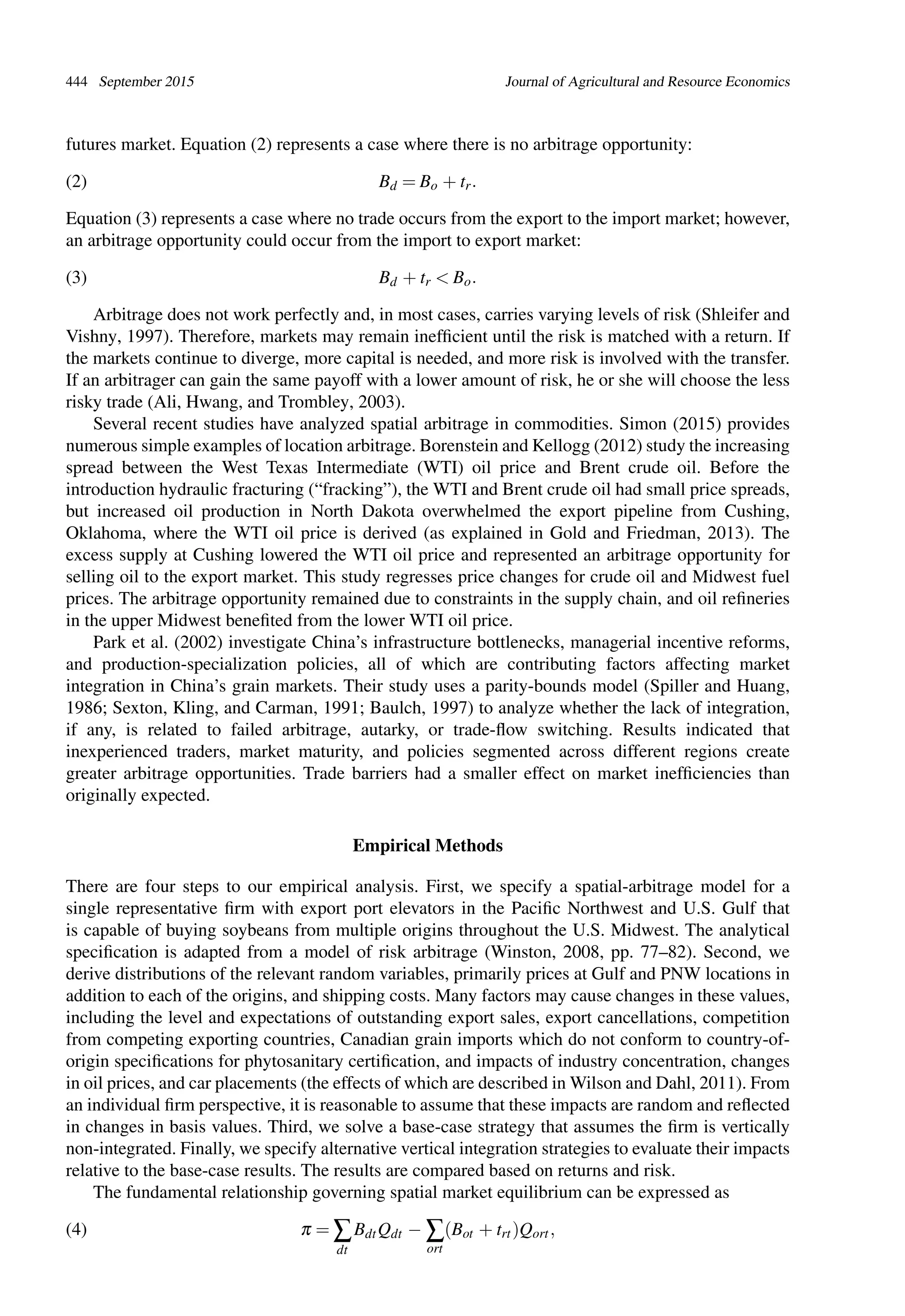
The fundamental relationship governing spatial market equilibrium can be expressed as
(4) π = ∑
dt
BdtQdt − ∑
ort
(Bot + trt)Qort,
Skadberg et al. Spatial Competition, Arbitrage, and Risk 445
where Bdt = (B1t, B2t, ..., Bdt) is the basis at destination d and time t. Variable Qdt represents the
quantity sold at destination d at time t, Qort is the quantity of soybeans bought and shipped from
origin o and transportation route r and time t, and Bot = (B1t, B2t, ..., Bit) is the basis for buying
soybeans at origin o and time t. Transportation costs are defined by trt = (t1t, t2t, ..., trt), where
trt represents the observed transfer costs for route r during time t. Transfer costs comprised many
variables, the largest being transportation.
All elevators in the model are shuttle-loading facilities (Sarmiento and Wilson, 2005; Wilson
and Dahl, 2011).1 For this reason, shipping costs include tariff rates, rail car premiums, and fuel
service charges, all of which vary through time. Other variable costs are for storage, interest, risk
premiums, shrinkage, moisture loss, electricity for elevator functions and handling. Most of the
nontransportation transfer costs are not observed and likely similar across plants. Due to the highly
competitive industry for trading and handling and the fairly homogenous technology among shuttle
elevators, differences across locations should be minimal. Regardless, these are not observed and
hence were not included in the model. Technically, the Bot observed in our model is the price offered
to growers. Hence, Ï ˘A is the payoff due to “spatial arbitrage and origination” that includes these
unobserved costs.2
An optimization model was specified based on a risk-constrained portfolio, which determines
the weight for each origin that yields the maximum payoff from spatial arbitrage and origination.
The first case examines spatial-arbitrage opportunities for shuttle loaders (shipping to a grain-trading
firm with terminals in the U.S. Gulf and Pacific Northwest) specified as
MAXπ =
D
∑
d=1
BdQd +
O
∑
o=1
−BoQo +
R
∑
r=1
trQr
s.t. 0 ≤ Qd ≤ 8,740,032,
0 ≤ Qo ≤ 832,384,
(5)
0 ≤ Qr ≤ 8,740,032,
π ≥ 0,
J
∑
j=1
Qd −
I
∑
i=1
Qo = 0,
J
∑
j=1
Qd −
R
∑
r=1
Qr = 0,
where Qd, Qo, and Qr are the decision variables representing the amount of soybeans (in bushels)
sold, bought, and shipped, per week.3 In a simple case, buyers would buy from a single origin and
ship to one destination. However, given multiple origins, two destinations (USG and PNW), and the
impact of constraints on quantities, the results become more complex. Some origins ship by truck-
barge and/or rail. The sum of these would equal Qo. From one origin, soybeans could be shipped
to the Pacific Northwest by rail and also shipped by barge to the U.S. Gulf. This could happen if
the Pacific Northwest reached its maximum capacity and an origin that had already shipped some
bushels to the Pacific Northwest had positive payoffs for shipments to the U.S. Gulf to reach the
1 Shuttle elevators are approved to ship under “shuttle terms,” which include lower rates, priority loading, and the ability
to load and unload 110 cars in a specified, limited amount of time. Conforming facilities receive rate discounts, rebates, and
varying forms of developmental assistance. See Wilson and Dahl (2011) for a description of these mechanisms and measures
of their randomness.
2 While this is not perfect, it is the best that can be done with observable variables. The results are consistent with spatial
arbitrage, but the interpretation is strictly as noted: returns to spatial arbitrage and origination.
3 An alternative would be to specify the model with Qr as the decision variable, which—subject to all arbitrage
opportunities and capacity limits—would generate optimal Qo and Qd.
446 September 2015 Journal of Agricultural and Resource Economics
origin’s maximum loading capacity.4 Each of these variables would be similar to the optimization
process that trading firms use to identify spatial-arbitrage opportunities (Pirrong, 2014, p. 8).
The variable Bd represents the sale price to the grain-trading firm’s port elevators, quoted as
either the track or CIFNOLA basis at ports d = 1, 2, 3, ..., D. The track basis is the price paid
for soybeans delivered to the terminal in a railcar and CIFNOLA is the price paid for soybeans
delivered to a New Orleans terminal. The variable Bo is the buying basis at o = 1, 2, 3, ..., O,
which represents prices paid to growers, and tr is the shipping costs for routes r = 1, 2, 3, ..., R.
The model chooses from all origins and destinations when deciding where to ship soybeans
on a weekly basis. One restriction is the number of bushels that can be handled per week, as .the
trading firm’s port facilities can only unload a limited number of bushels each week. The variable
Qd constrains the quantity bought at the port to between 0 and 8.7 million bushels per week, which
is the maximum that a typical port elevator can unload.
Other restrictions were included in the model. The combined purchases from the beginning and
end of the week cannot exceed the equivalent of two shuttle trains per week. The amount of grain
purchased at the origin must equal the amount of grain sold at the ports. The decision variable, Qo
is the number of bushels to be bought at each origin. Taken together, we assume that each origin can
load a maximum of two shuttle trains per week (832,384 bushels) and that the export elevator can
load a maximum of 8.7 million bushels per week. These restrictions imply that the trader could buy
from a maximum of 57% of the origins in any single week (or iteration). The remaining constraints
force the arbitrager to sell the same amount thawt he or she purchases.
Equation (5) is the base case representing a non-vertically integrated firm that simultaneously
buys soybeans at origins and sells at ports. In this scenario, the shuttle-loading firms are not exposed
to basis risk, because the commodity is bought and sold simultaneously. We specify alternative
structures to evaluate strategies related to vertical integration. In this case, different representative
prices are included in equation (5). The first evaluates spatial-arbitrage opportunities for the grain-
trading firm’s export terminals. Buying soybeans delivered to port terminals on a rail track or
CIFNOLA basis (delivered by barge to a port terminal) and selling on a FOB basis (“Free on Board”
an ocean-going vessel at the port elevator) is commonly termed FOBBING. The difference between
the purchase and sale values is the FOB margin. The sum of quantities sold at the ports must equal
volumes purchased from shuttle elevators. Traders have the ability to simultaneously buy track or
CIFNOLA basis and to sell exports on a FOB basis value. Traders can buy soybeans at the beginning
of the week and store the crop until they sell it at the end of the week. In this sensitivity, the basis
values at the destination and origin in equation (5) are replaced and the shipping cost becomes nil.
The destination basis becomes the FOB basis value at the port, and the origin basis is the track basis
at the port.
The second alternative poses a vertically integrated grain-trading firm owning both domestic
shuttle elevators and port terminals. The trader earns a margin by purchasing soybeans and shipping
them to its PNW or USG port terminals and selling them on a FOB basis. In this case, the destination
basis values in equation (5) (track and barge bids) were replaced with the FOB basis values at the
port for export shipment.
The next alternative represents a vertically integrated grain-trading firm that owns domestic
origins and port terminals and also sells cost and freight (C&F) (i.e., ships soybeans internationally).
In this case, the derived prices and costs represent selling and shipping to C&F destinations in Asia.
The vertically integrated firm owns shuttle and export elevators in addition to buying ocean freight
and sells soybeans basis C&F. This sensitivity evaluates the potential payoff increase attributed to a
4 In the empirical model, the firm can handle 57% of potential shipments at best. Since we measure arbitrage plus the
handling margin, arbitrage opportunities can represent at best the top 57% of potential arbitrage opportunities or (at worst)
may include origins sacrificing some or all of their margins. The model chooses those origins with the greatest payoffs and
continues buying from those origins with positive payoffs up to the restriction. Each of these variables is important, and the
optimization process would be similar to the optimization process that trading firms go through to identify spatial-arbitrage
opportunities (Pirrong, 2014, p.8). One of the restrictions applies to the point of unloading at the export. For this reason, some
origins may have positive payoffs but are lower than those of the 57% of origins with greater payoffs.
Skadberg et al. Spatial Competition, Arbitrage, and Risk 447
grain-trading company owning the most profitable locations. The amount of grain purchased at the
origin has to match the amount of grain loaded at the ports, the amount of ocean freight purchased,
and the volume of exports sold. This constraint forces the model to behave as a vertically integrated
firm. In addition, the destination basis prices in equation (5) were replaced with the values equivalent
of C&F Asia from each origin port.
Stochastic Optimization
The model was solved using stochastic optimization.5 Multivariate distributions with copula
dependence structures were derived for origin and destination basis values and transportation costs
(described below), from which we collected 10,000 sets of samples. Models were solved for the
optimal arbitrage opportunities for each set of samples. This procedure was repeated for each week
of the 10,000 sets of random draws. Using this procedure, we simulated first a base-case strategy
that assumes the firm is nonintegrated. Then we simulated alternative vertical integration strategies
to evaluate their impacts relative to the base-case results. The results for these sensitivities are
compared based on returns and risk.
Data Sources and Distributions
Weekly basis values for thirty-seven Midwest shuttle facilities representative of soybean-producing
regions were used for this research. Technically, these are basis bids offered to growers. Weekly
FOB, Track, and CIFNOLA basis values for the Pacific Northwest and U.S Gulf were used. Rail
rates and/or barge shipping costs were derived from each origin to the Pacific Northwest, U.S.
Gulf, or both (BNSF). These values included tariff shipping rates, fuel service charges, and rail-
car premiums.
The data were 2004–2009 weekly observations from the following sources: barge freight
rates (U.S. Department of Agriculture, Agricultural Marketing Service, 2014; U.S. Department of
Agriculture, Agricultural Marketing Service, Transportation Service Division, 2014), rail freight
rates (BNSF), CIFNOLA barge soybean basis (Advanced Trading, LLC), secondary rail-car values
(TradeWest Brokerage), PNW rail soybean basis (Advanced Trading, LLC), rail fuel-surcharge rates
(TradeWest Brokerage and BNSF), and origin basis price level (DTN). Ocean-shipping rates from
the U.S. Gulf and Pacific Northwest to Asia were from the USDA-AMS Transportation Service
Division.
Randomness in these variables was captured using univariate marginal distributions and copula
dependency measures. Univariate distributions were fitted for each of the basis at the ports and at
each origin, in addition to shipping costs. The results indicated that many of these were non-normal,
though some were skewed to the right.6
Copula
Distributions were used to capture interdependencies among variables. Copula dependency measures
have been used in other spatial-market studies to test market integration for strand board (e.g.,
Goodwin et al., 2011). Asymmetric dependency measures were used to allow more weight to be
placed on one tail of the marginal distribution.7 Symmetric dependency measures place equal weight
on both tails of the marginal distribution. Copulas provide more flexible dependence measures
when dealing with asymmetric dependences because no assumptions are placed on the marginal
distributions (Vose, 2008) and tail dependency can be incorporated.
5 Simon’s 2015 representation of the solution to spatial arbitrage refers to both an optimization problem and a stochastic
problem but does not apply the methodologies used here.
6 The volume of these univariate results is too extensive to present here but is available from the authors on request.
7 See Nelsen (2006) for detailed definitions and proofs.
448 September 2015 Journal of Agricultural and Resource Economics
Table 1. Sample of Gaussian Copula Parameters among Basis by Location
Variables PNW US Gulf Albany Alden Alton Aurora Ayr Bayard Beatrice
PNW 1.00 0.50 0.39 0.42 0.52 0.32 0.48 0.40 0.38
US Gulf 0.50 1.00 0.43 0.32 0.32 0.32 0.27 0.29 0.27
Albany 0.39 0.43 1.00 0.57 0.48 0.63 0.47 0.58 0.56
Alden 0.42 0.32 0.57 1.00 0.59 0.62 0.63 0.80 0.73
Alton 0.52 0.32 0.48 0.59 1.00 0.45 0.75 0.62 0.63
Aurora 0.32 0.32 0.63 0.62 0.45 1.00 0.51 0.65 0.60
Ayr 0.48 0.27 0.47 0.63 0.75 0.51 1.00 0.66 0.66
Bayard 0.40 0.29 0.58 0.80 0.62 0.65 0.66 1.00 0.78
Beatrice 0.38 0.27 0.56 0.73 0.63 0.60 0.66 0.78 1.00
Table 2. Portfolio Payoffs
Payoff Std. Dev. Payoff 1/CV
5% Seven-
Day VaR
Sensitivity ($ Millions) ($ Millions) ($/bu) ($ Millions)
Base Case $3.6 $2.3 $0.12 1.55
Sell FOB/Buy Track $2.3 $3.3 $0.07 0.72 $(1.4)
Vert. Int. w/o Ocean $6.5 $4.8 $0.22 1.37 $(4.9)
Vert. int. w/ Ocean $9.7 $11.4 $0.33 0.85 $(9.5)
In this analysis, a large number of shipping costs were highly correlated, which required an
alternative specification. Random shipping costs were included for the three main routes (a base
origin to the U.S. Gulf via rail, to the U.S. Gulf via barge, and to the Pacific Northwest). Differentials
for alternative routes were derived as the difference between the comparable base route and the rate
for the alternative route. Then the copula dependence was estimated with the random shipping costs
for the three routes and other random variables. This process simplified the estimation of the copula
parameters. There were still a large number of remaining variables; as such, the estimated copula
converges from a Student t to a Gaussian copula (Vose, 2008), which is what was used. The derived
differentials were later applied to the simulated weekly base rates to determine shipping costs for
each origin/destination movement for that week.
Maximum likelihood estimation was used to estimate the copula (Nelsen, 2006) using the
following equation:
(6) ˆδ2 = argmaxˆδ2
T
∑
t=1
lnc(Gx(xt), ˆHy(yt),δ2),
where ˆδ2 is the estimated copula parameter and (Gx(xt), ˆHy(yt),δ2) is the estimated marginal
distribution for x and y. Parameters for all copulas are estimated using SAS. Scatterplots for the
transformed data for selected origins are illustrated in figure 1 with the estimated Gaussian copula.
Table 1 illustrates a sample of estimated Kendall’s τ. The value indicates the probability of
concordance or discordance and is similar to a linear correlation. The results are the probability of
variables moving in a similar direction. For example, there is a 39% probability that Albany, Illinois,
and the Pacific Northwest will move in the same direction. If the PNW track basis increases, there is a
39% chance that Albany basis will also increase. This differs from saying that the Pacific Northwest
and Albany have a positive, linear relationship of 51% because, in this case, if the PNW track basis
increases by $1, then Albany will increase by $0.51.8
8 Kendall’s tau matrix includes eighty-seven variables, making the table is too large to include here. Kendall’s tau matrix
is available from the authors upon request.
Skadberg et al. Spatial Competition, Arbitrage, and Risk 449
Figure 1. Empirical Margins, Gaussian Copula Scatter-Plot Matrix
Results
Table 2 shows evaluations for spatial payoffs due to arbitrage and origination (hereafter referred
simply as arbitrage payoffs). Arbitrage payoffs averaged $3.6 million ($0.12/bu) across origins.
The variability of arbitrage payoffs had a standard deviation of $2.3 million ($0.08/bu), and the
estimated ratio for 1/CV was 1.55, indicating the payoffs for each unit of risk. This indicates that
there are significant spatial-arbitrage opportunities for independent shuttle operators, which have a
low proportion of variability in relation to returns.
Spatial-arbitrage payoffs were evaluated for each origin. Table 3 shows that spatial-arbitrage
payoffs, ports utilized, and the percentage of time that spatial-arbitrage payoffs occurred varied
widely for individual shuttle locations. Figure 2 shows the variability of spatial-arbitrage payoffs for
selected locations over time. For example, Alton, North Dakota, had an average payoff of $109,230
per week ($0.13/bu). On average, the model chose that location 60% of the time; the spatial-arbitrage
payoff was nil the rest of the time. At Alton, spatial arbitrage occurred 56% of the time for the Pacific
Northwest and 4% of the time for the U.S. Gulf. Hinton, Iowa, had an average payoff of $11,251
per week ($0.02/bu). On average, spatial arbitrage had nil opportunities to the Pacific Northwest and
only 6% of the time to the U.S. Gulf. These results are largely dependent on location, the structure
of geographic competition, and relative shipping costs.
450 September 2015 Journal of Agricultural and Resource Economics
Table 3. Copula Risk-Constrained Optimization Base Case
Spatial Payoff Risk
Probability of
Arbitrage > 0
Origin $/Week $/bu St. Dev. 1/CV PNW USG
Albany, IL 71,807 0.09 111,127 0.65 40%
Alden, IA 40,126 0.05 112,374 0.36 19%
Alton, ND 109,230 0.13 145,193 0.75 56% 4%
Aurora, IN 179,530 0.22 203,673 0.88 61%
Ayr, ND 118,740 0.15 196,425 0.61 60% 3%
Bayard, IA 32,374 0.04 102,569 0.32 16%
Beatrice, NE 98,996 0.12 150,808 0.66 36% 21%
Bradshaw, NE 72,917 0.09 148,449 0.49 30%
Breckenridge, MN 15,244 0.02 68,851 0.22 6%
Cairo, IL 133,260 0.16 191,373 0.70 47%
Cin Bunge, OH 96,397 0.12 165,007 0.58 41%
Cin Cargill, OH 57,061 0.07 113,636 0.50 33%
Creston, IA 19,767 0.03 86,302 0.23 9%
Dorchester, NE 165,014 0.20 209,113 0.79 39% 27%
Dubuque, IA 186,078 0.23 232,074 0.80 57%
Edison, NE 99,102 0.12 160,207 0.62 34% 18%
Evansville, IN 211,696 0.26 246,336 0.86 61%
Finley, ND 96,279 0.12 171,304 0.56 40% 4%
Fremont, NE 16,663 0.02 67,942 0.25 10% 2%
Gurley, NE 292,758 0.35 242,373 1.21 82%
Hinton, IA 11,251 0.02 64,860 0.17 6%
Jamestown, ND 99,512 0.12 148,816 0.67 53% 4%
Jasper, MN 0 0.00 0 0.00 0%
Jeffersonville, IN 168,912 0.21 205,971 0.82 57%
Madison, SD 12,117 0.02 59,290 0.20 6%
Marion, SD 11,590 0.02 61,950 0.19 6%
Maywood, NE 165,037 0.20 189,551 0.87 65% 4%
Mellette, SD 181,553 0.22 205,064 0.89 62%
Mitchell, SD 24,686 0.03 94,228 0.26 10%
Mound City, IL 158,425 0.19 191,039 0.83 60%
Mount Vernon, IN 197,068 0.24 262,528 0.75 51%
Muscatine, IA 100,143 0.13 162,758 0.62 41%
Nauvoo, IL 191,177 0.23 214,441 0.89 64%
Pekin, IL 178,627 0.22 194,729 0.92 64%
Pleasant Hill, IA 12,629 0.02 57,159 0.22 8%
Red Oak, IA 6,100 0.01 33,533 0.18 4%
Wolsey, SD 53,682 0.07 154,293 0.35 15%
The standard deviation and the 1/CV are measures of risk reported in table 3. Gurley, Nebraska,
had a payoff of $292,758 and the greatest average spatial-arbitrage payoff relative to risk with a
1/CV of 1.21; the payoff for Hinton, Iowa, was substantially lower at $11,251 and a 1/CV of 0.17,
indicating that the amount of risk for trading soybeans at this facility is large compared to the return.
Similar results are observed for Red Oak, Iowa, with a 1/CV of 0.18 and payoff of $6,100.
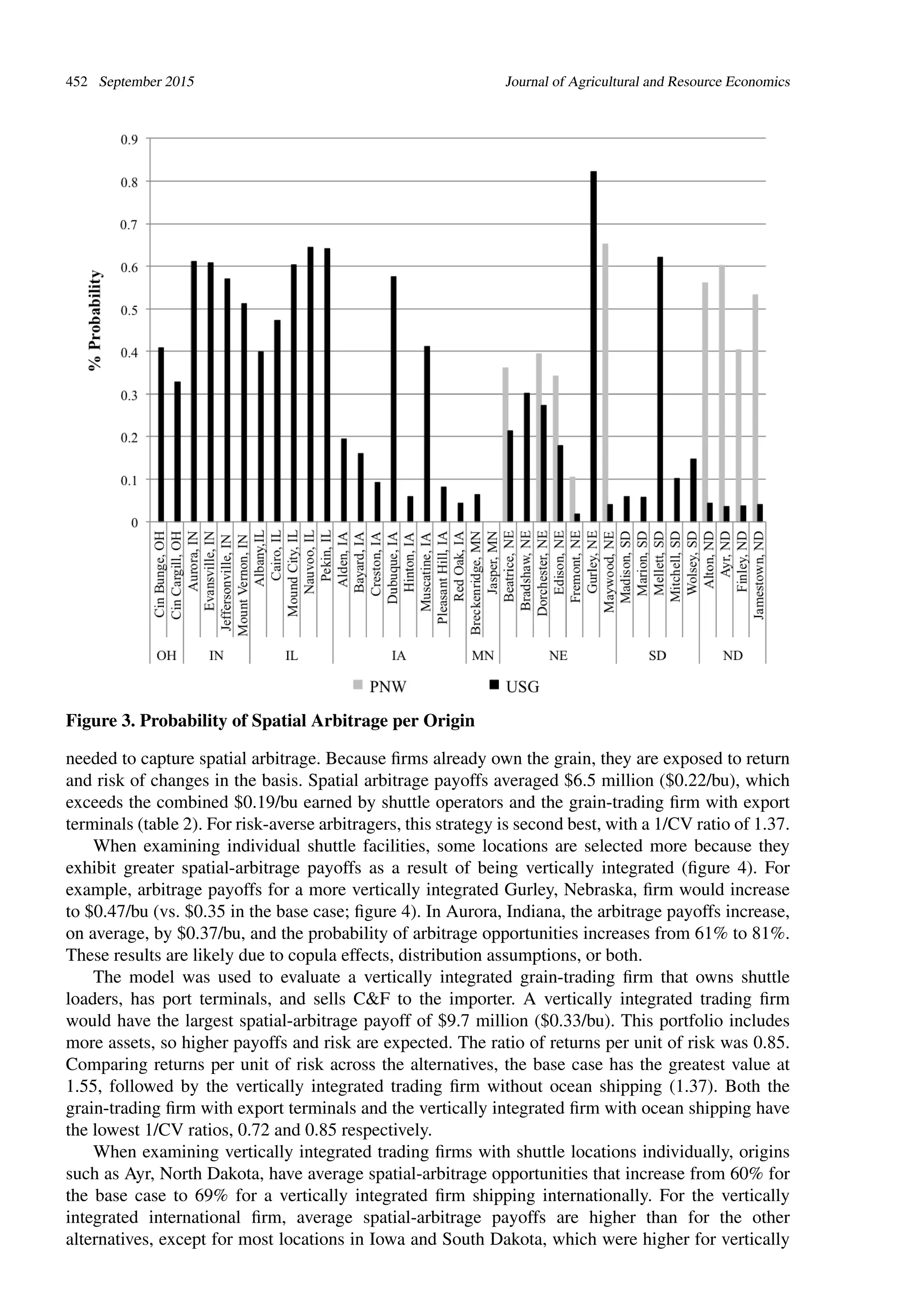
The PNW and USG columns (table 3) indicate the frequency of spatial arbitrage occurring for
each origin to either port. The sum of the PNW and USG values indicates the frequency of spatial
arbitrage occurring. For example, on average, 82% of the time, prices at Gurley and the U.S. Gulf
Skadberg et al. Spatial Competition, Arbitrage, and Risk 451
Figure 2. Spatial-Arbitrage Payoffs, 2004–2009
differ by more than the transfer costs. The remainder of the time, there is no spatial arbitrage for the
Pacific Northwest or U.S. Gulf.
An interesting observation is that locations with the largest spatial-arbitrage payoffs have less
nearby domestic processing and are located close to market boundaries. Iowa origins have the
smallest spatial-arbitrage payoffs. A potential explanation for this could be the large domestic
soybean demand from crushing plants. The reason that Jasper is not part of the solution is more
likely due to their proximity relative to local soybean crushers. Most origins in Nebraska are more
indifferent about the destination to which they ship. Locations such as Dorchester, Nebraska, are
located on the market boundary (figure 3) and have arbitrage payoffs of $0.20/bu with a 39% chance
of shipping to the Pacific Northwest and a 27% chance of shipping to the U.S. Gulf.
Sensitivities to Vertical Integration
Models were specified to evaluate the impacts of several vertical-integration strategies for the grain-
trading firm. The strategy of buying track (PNW) or CIFNOLA (USG) and selling FOB evaluates
profitability of spatial arbitrage for a firm that only operates export terminals in the U.S. Gulf and
Pacific Northwest. In this case, the grain-trading firm averaged $2.3 million ($0.07/bu) in arbitrage
payoffs (table 2), and the 1/CV of 0.72 indicates that a grain trader with export terminals sees a lower
return per unit of risk than an independent shuttle elevator shipping to the port. Taken together,
the combination of independent shuttle operators and the grain-trading firm with export terminal
operations represents combined returns of $0.19, although spatial-arbitrage returns per unit of risk
are lower for the grain trader than for shuttle operators. When export terminals were examined
individually, the U.S. Gulf has an average arbitrage payoff of $0.09/bu and the Pacific Northwest
has an average arbitrage payoff of $0.05/bu, indicating that the grain-trading firm could capture
higher average arbitrage payoffs at its U.S. Gulf port.
The next alternative is a vertically integrated grain-trading firm with shuttle-loading and port
assets. More vertical integration allows firms to capture further spatial-arbitrage payoffs. Spatial-
arbitrage opportunities increase with vertical integration because the company owns the assets
452 September 2015 Journal of Agricultural and Resource Economics
Figure 3. Probability of Spatial Arbitrage per Origin
needed to capture spatial arbitrage. Because firms already own the grain, they are exposed to return
and risk of changes in the basis. Spatial arbitrage payoffs averaged $6.5 million ($0.22/bu), which
exceeds the combined $0.19/bu earned by shuttle operators and the grain-trading firm with export
terminals (table 2). For risk-averse arbitragers, this strategy is second best, with a 1/CV ratio of 1.37.
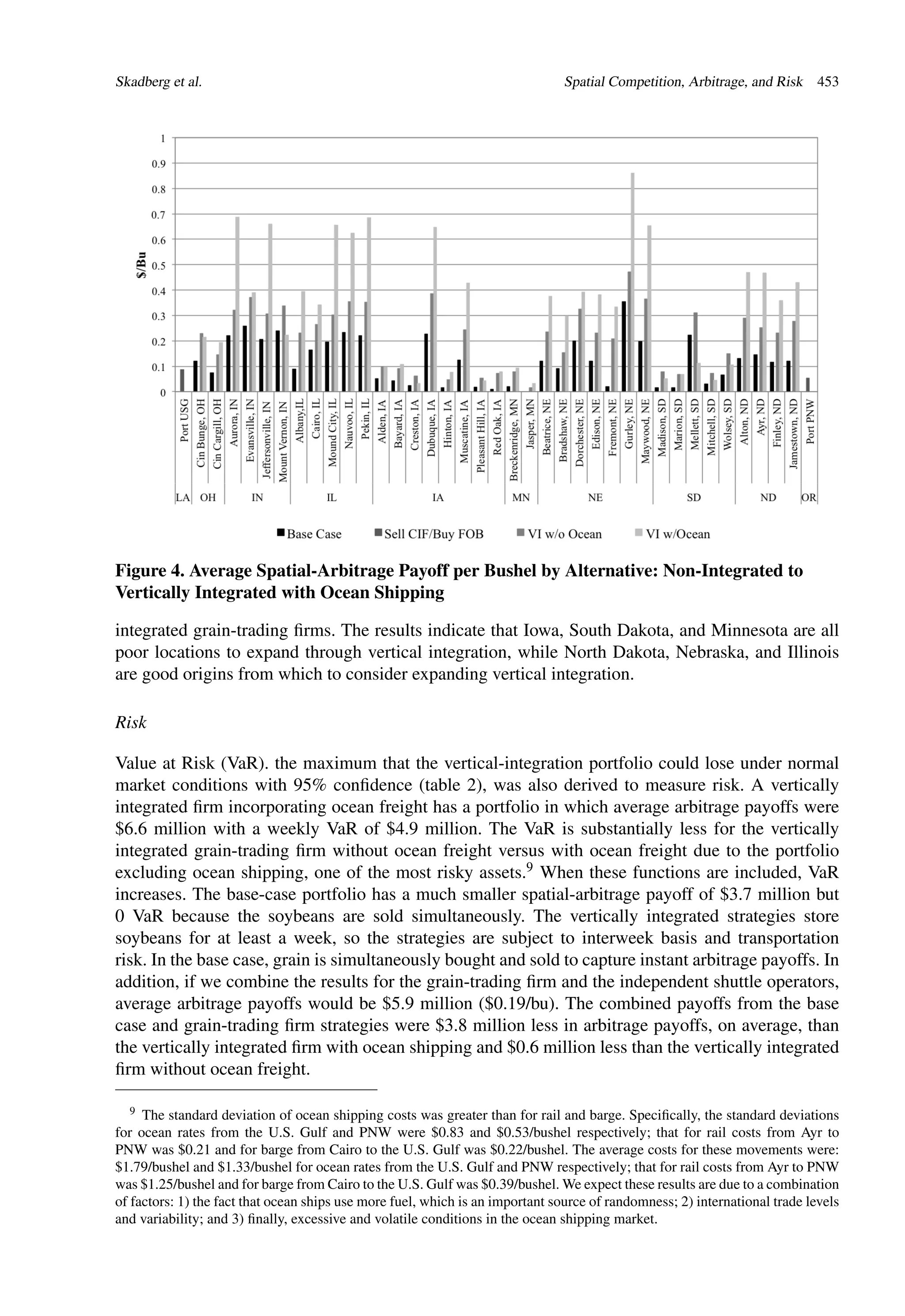
When examining individual shuttle facilities, some locations are selected more because they
exhibit greater spatial-arbitrage payoffs as a result of being vertically integrated (figure 4). For
example, arbitrage payoffs for a more vertically integrated Gurley, Nebraska, firm would increase
to $0.47/bu (vs. $0.35 in the base case; figure 4). In Aurora, Indiana, the arbitrage payoffs increase,
on average, by $0.37/bu, and the probability of arbitrage opportunities increases from 61% to 81%.
These results are likely due to copula effects, distribution assumptions, or both.
The model was used to evaluate a vertically integrated grain-trading firm that owns shuttle
loaders, has port terminals, and sells C&F to the importer. A vertically integrated trading firm
would have the largest spatial-arbitrage payoff of $9.7 million ($0.33/bu). This portfolio includes
more assets, so higher payoffs and risk are expected. The ratio of returns per unit of risk was 0.85.
Comparing returns per unit of risk across the alternatives, the base case has the greatest value at
1.55, followed by the vertically integrated trading firm without ocean shipping (1.37). Both the
grain-trading firm with export terminals and the vertically integrated firm with ocean shipping have
the lowest 1/CV ratios, 0.72 and 0.85 respectively.
When examining vertically integrated trading firms with shuttle locations individually, origins
such as Ayr, North Dakota, have average spatial-arbitrage opportunities that increase from 60% for
the base case to 69% for a vertically integrated firm shipping internationally. For the vertically
integrated international firm, average spatial-arbitrage payoffs are higher than for the other
alternatives, except for most locations in Iowa and South Dakota, which were higher for vertically
Skadberg et al. Spatial Competition, Arbitrage, and Risk 453
Figure 4. Average Spatial-Arbitrage Payoff per Bushel by Alternative: Non-Integrated to
Vertically Integrated with Ocean Shipping
integrated grain-trading firms. The results indicate that Iowa, South Dakota, and Minnesota are all
poor locations to expand through vertical integration, while North Dakota, Nebraska, and Illinois
are good origins from which to consider expanding vertical integration.
Risk
Value at Risk (VaR). the maximum that the vertical-integration portfolio could lose under normal
market conditions with 95% confidence (table 2), was also derived to measure risk. A vertically
integrated firm incorporating ocean freight has a portfolio in which average arbitrage payoffs were
$6.6 million with a weekly VaR of $4.9 million. The VaR is substantially less for the vertically
integrated grain-trading firm without ocean freight versus with ocean freight due to the portfolio
excluding ocean shipping, one of the most risky assets.9 When these functions are included, VaR
increases. The base-case portfolio has a much smaller spatial-arbitrage payoff of $3.7 million but
0 VaR because the soybeans are sold simultaneously. The vertically integrated strategies store
soybeans for at least a week, so the strategies are subject to interweek basis and transportation
risk. In the base case, grain is simultaneously bought and sold to capture instant arbitrage payoffs. In
addition, if we combine the results for the grain-trading firm and the independent shuttle operators,
average arbitrage payoffs would be $5.9 million ($0.19/bu). The combined payoffs from the base
case and grain-trading firm strategies were $3.8 million less in arbitrage payoffs, on average, than
the vertically integrated firm with ocean shipping and $0.6 million less than the vertically integrated
firm without ocean freight.
9 The standard deviation of ocean shipping costs was greater than for rail and barge. Specifically, the standard deviations
for ocean rates from the U.S. Gulf and PNW were $0.83 and $0.53/bushel respectively; that for rail costs from Ayr to
PNW was $0.21 and for barge from Cairo to the U.S. Gulf was $0.22/bushel. The average costs for these movements were:
$1.79/bushel and $1.33/bushel for ocean rates from the U.S. Gulf and PNW respectively; that for rail costs from Ayr to PNW
was $1.25/bushel and for barge from Cairo to the U.S. Gulf was $0.39/bushel. We expect these results are due to a combination
of factors: 1) the fact that ocean ships use more fuel, which is an important source of randomness; 2) international trade levels
and variability; and 3) finally, excessive and volatile conditions in the ocean shipping market.
454 September 2015 Journal of Agricultural and Resource Economics
Conclusion and Implications
Commodity traders face many challenges, including where to buy and sell and managing transaction
logistics. Soybean markets in particular have seen many recent changes, including greater volatility
in basis and futures as well as increased rates for all modes of transportation. Additional pressures
include intense intermarket competition (notably for shipments to the U.S. Gulf and Pacific
Northwest), production shifts (including more soybeans being grown in the upper Midwest), and
rapidly growing Chinese demand for soybeans drawing more soybeans to the Pacific Northwest.
Increased Asian demand has created port congestion, but expansion to facilities in the Pacific
Northwest has mitigated these constraints.
These issues have motivated research to understand the relationships between spatial arbitrage
and marketing for northern soybean origins. Spatial arbitrage occurs as a result of price inefficiencies
or differences between transfer costs and origin and destination prices. This study analyzes spatial
arbitrage for U.S. soybeans using an empirical model of spatial arbitrage, which is specified
and evaluated using stochastic optimization techniques. A risk-constrained optimization model is
specified and stochastically simulated using Monte Carlo procedures and copula joint distributions.
The model is used to optimize the spatial-arbitrage payoff based on the random values for basis at
the origins and destinations and the shipping costs.
There are several important results. First, origins in the upper Midwest have become highly
dependent on the Pacific Northwest as a destination market. These origins have limited local
processing demand and are logistically closer to the Pacific Northwest than the Gulf, which has
been an important growth market. Second, arbitrage payoffs vary regionally. Iowa and Minnesota
origins have fewer spatial-arbitrage opportunities with less frequency compared to origins closer to
the Pacific Northwest. North Dakota, South Dakota, and Nebraska all have average or above average
spatial-arbitrage payoffs. Third, the results also show motives for varying forms of investment in the
vertical market chain.
Some of these results have important implications. Traditionally, many trading firms were
vertically non-integrated, There now seems to be a tendency for trading firms to become more
vertically integrated. The greatest strategic emphasis seems to be placed on investing in U.S. shuttle
origins because of the logistical efficiency gains and the ability to control origination. These facilities
can capitalize on spatial-arbitrage payoffs, which are explained by the sensitivity where firms
are vertically integrated without ocean shipping. Firms that become more vertically integrated by
owning shuttle facilities are able to insure themselves with a greater possibility of owning soybeans
to ship in order to capture the arbitrage opportunities that arise compared to the limitations of
purchasing soybeans as a nonintegrated firm. Similar advantages exist when a firm owns a port
terminal and is shipping internationally. Here, firms can determine opportunistic times to purchase
ocean shipping and to sell internationally.
Future research could expand on the empirical models developed in this research and include
data to analyze international spatial arbitrage. This research could be expanded to include specific
costs, such as storage and handling, demurrage, etc., when estimating arbitrage payoffs. Another
innovation could be to create and evaluate the impacts of a forecasting model of basis changes
designed to capture exogenous facts impacting the basis rather than treating basis changes as
random. Additionally, this study assumes a constant copula distribution, even though the structure
could change over time. But preliminary empirical evidence suggests that the rank correlation
structure is not constant over time. An alternative approach would be to utilize a dynamic copula
(Patton, 2012) and then integrate those results with the optimization model of arbitrage. Finally,
the model could be expanded to include Brazil and Argentina, which are now important, competing
suppliers in the world soybean market.
[Received May 2014; final revision received June 2015.]
Skadberg et al. Spatial Competition, Arbitrage, and Risk 455
References
Advanced Trading, LLC. “Cash Market Sheets.” Bloomington, IL. Available online at
http://www.advance-trading.com.
Ali, A., L.-S. Hwang, and M. A. Trombley. “Arbitrage Risk and the Book-to-Market Anomaly.”
Journal of Financial Economics 69(2003):355–373. doi: 10.1016/S0304-405X(03)00116-8.
Ardeni, P. G. “Does the Law of One Price Really Hold for Commodity Prices?” American Journal
of Agricultural Economics 71(1989):661–669. doi: 10.2307/1242021.
Baulch, B. “Transfer Costs, Spatial Arbitrage, and Testing for Food Market Integration.” American
Journal of Agricultural Economics 79(1997):477–487. doi: 10.2307/1244145.
BNSF Railway. “Selected Rail Tariffs.” Fort Worth, TX. Available online at
http://www.bnsf.com/customers/prices-and-tools/. Values retained by the authors.
Borenstein, S., and R. Kellogg. “The Incidence of an Oil Glut: Who Benefits from Cheap Crude
Oil in the Midwest?” Working Paper 18127, National Bureau of Economic Research, Cambridge,
MA, 2012.
DTN/The Progressive Farmer. “Cash Market Reports.” Available online by subscription at
http://www.dtnprogressivefarmer.com/dtnag.
Gold, R., and N. Friedman. “U.S. Oil Prices Fall Sharply as Glut Forms on Gulf Coast.” Wall Street
Journal (2013).
Goodwin, B. K., M. T. Holt, G. Onel, and J. P. Prestemon. “Copula-Based Nonlinear Models of
Spatial Market Linkages.” Pittsburgh, PA: Agricultural and Applied Economics Association,
2011. Paper presented at the 2011 Annual Meeting, July 24–26.
Isard, P. “How Far Can We Push the “Law of One Price”?” American Economic Review
67(1977):942–948.
Kub, E. Mastering the Grain Markets: How Profits are Really Made. Omaha, NE: Kub Asset
Advisory, Inc., 2014.
Meersman, S., R. Reichtsteiner, and G. Sharp. “The Dawn of a New Order in Commodity Trading.”
Oliver Wyman Risk Journal 2(2012):1–9.
Nelsen, R. B. An Introduction to Copulas. New York: Springer, 2006, 2nd ed.
Park, A., H. Jin, S. Rozelle, and J. Huang. “Market Emergence and Transition: Arbitrage,
Transaction Costs, and Autarky in China’s Grain Markets.” American Journal of Agricultural
Economics 84(2002):67–82. doi: 10.1111/1467-8276.00243.
Patton, A. J. “A Review of Copula Models for Economic Time Series.” Journal of Multivariate
Analysis 110(2012):4–18. doi: 10.1016/j.jmva.2012.02.021.
Pirrong, C. The Economics of Commodity Trading Firms. Singapore: Trafigura, 2014.
———. “Not Too Big to Fail: Systemic Risk, Regulation, and the Economics of
Commodity Trading Firms.” White Paper, Trafigura, Houston, TX, 2015. Available
online at http://www.trafigura.com/media/2178/trafigura-pirrong-not-too-big-to-fail-systemic-
risk-white-paper.pdf.
ProExporter. “Grain Market Overview.” GTB 14-11, ProExporter Network, Chelsea, MI, 2014.
Prokopczuk, M., and C. W. Simen. “Variance Risk Premia in Commodity Markets.” SSRN Scholarly
Paper 2195691, Social Science Research Network, Rochester, NY, 2014. Available online at
http://papers.ssrn.com/abstract=2195691.
Protopapadakis, A., and H. R. Stoll. “Spot and Futures Prices and the Law of One Price.” Journal
of Finance 38(1983):1431–1455. doi: 10.1111/j.1540-6261.1983.tb03833.x.
Sarmiento, C., and W. W. Wilson. “Spatial Modeling in Technology Adoption Decisions: The Case
of Shuttle Train Elevators.” American Journal of Agricultural Economics 87(2005):1034–1045.
doi: 10.1111/j.1467-8276.2005.00786.x.
Sexton, R. J., C. L. Kling, and H. F. Carman. “Market Integration, Efficiency of Arbitrage, and
Imperfect Competition: Methodology and Application to U.S. Celery.” American Journal of
Agricultural Economics 73(1991):568–580. doi: 10.2307/1242810.
456 September 2015 Journal of Agricultural and Resource Economics
Shleifer, A., and R. W. Vishny. “The Limits of Arbitrage.” Journal of Finance 52(1997):35–55. doi:
10.1111/j.1540-6261.1997.tb03807.x.
Simon, J. “Commodity Trading Case: The Location Arbitrage.” Trade, Shipping, Finance Wizard,
Navigating the Commodity Markets with Freight and Spreads (2015). Available online at
https://jacquessimon506.wordpress.com/2015/07/12/12089/.
Spiller, P. T., and C. J. Huang. “On the Extent of the Market: Wholesale Gasoline in the Northeastern
United States.” Journal of Industrial Economics 35(1986):131–145. doi: 10.2307/2098354.
Thursby, M. C., P. R. Johnson, and T. J. Grennes. “The Law of One Price and the Modelling
of Disaggregated Trade Flows.” Economic Modelling 3(1986):293–302. doi: 10.1016/0264-
9993(86)90030-1.
TradeWest Brokerage. “Evening Market Recap.” Portland, OR. Daily market wires retained by the
authors.
U.S. Department of Agriculture, Agricultural Marketing Service. “Weekly Market Sheets.” 2014.
U.S. Department of Agriculture, Agricultural Marketing Service, Transportation Service Division,
Washington, DC. Available online at http://www.ams.usda.gov/services/transportation-analysis.
U.S. Department of Agriculture, Agricultural Marketing Service, Transportation Service Division.
“Grain Transportation Report, January 9.” GTR, U.S. Department of Agriculture, Agricultural
Marketing Service, Transportation Service Division, Washington, DC, 2014. Available online at
http://www.ams.usda.gov/sites/default/files/media/GTR_01-09-14.pdf.
Vachal, K., and L. Benson. “North Dakota Grain & Oilseed Transportation Statistics 2010–2011.”
UGPTI Publication No. 247, Upper Great Plains Transportation Institute, North Dakota State
University, Bismarck, ND, 2011. Available online at http://www.ugpti.org/pubs/pdf/DP247.pdf.
Vose, D. Risk Analysis: A Quantitative Guide. Hoboken, NJ: Wiley, 2008, 3rd ed.
Weisweiller, R., ed. Arbitrage: Opportunities and Techniques in the Financial and Commodity
Markets. New York: Wiley, 1986.
Wilson, W. W., and B. Dahl. “Grain Pricing and Transportation: Dynamics and Changes in Markets.”
Agribusiness 27(2011):420–434. doi: 10.1002/agr.20277.
Winston, W. L. Financial Models using Simulation and Optimization II: Investment Valuation,
Options Pricing, Real Options and Product Pricing Models. Ithaca, NY: Palisade Corporation,
2008.

Spatial Competition, Arbitrage, and Risk in U.S. Soybeans

  • 1.
    Journal of Agriculturaland Resource Economics 40(3):442–456 ISSN 1068-5502 Copyright 2015 Western Agricultural Economics Association Spatial Competition, Arbitrage, and Risk in U.S. Soybeans Kristopher Skadberg, William W. Wilson, Ryan Larsen, and Bruce Dahl This paper analyzes spatial arbitrage and vertical integration of a U.S. soybean-trading firm. A risk-constrained optimization model using Monte Carlo simulation and copula joint distributions is specified. Results show that spatial-arbitrage payoffs vary regionally. Sensitivity results indicate that payoffs and risks increase as firms become more vertically integrated. Key words: copula, spatial arbitrage, spatial competition, trading strategies Introduction Many challenges confront commodity traders, including deciding where to buy and sell and how to manage transactions and logistics. These are compounded in soybean markets because there has been increased volatility in basis, futures, and rates for all modes of transportation in recent years (Prokopczuk and Simen, 2014; Wilson and Dahl, 2011). There is also intense intermarket competition, notably for shipments to the U.S. Gulf (USG) and the Pacific Northwest (PNW). Production has shifted, with more soybeans being produced in the upper Midwest. China is the top U.S. soybean importer, accounting for up to 64% of U.S. soybean exports in recent years. Increased Asian demand has created congestion at ports, but expansion of port facilities in the Pacific Northwest has mitigated these constraints (Wilson and Dahl, 2011). Taken together, these changes are particularly important for northern soybean-growing states. Most important is the substantial growth in soybean production, which increased for North Dakota from 2.9 million acres in 2005 to nearly 6 million acres in 2014; exports from North Dakota have increased from 32 million bushels in 2004 (Vachal and Benson, 2011) to 188 million bushels in 2014 (ProExporter). In 2015 North Dakota will be the largest state net exporter of soybeans, and these exports are largely through the Pacific Northwest. These changes have motivated research to more fully understand spatial arbitrage in the soybean market. The purpose of this study is to analyze spatial arbitrage for a trading firm handling soybeans with terminal facilities in both the U.S. Gulf and Pacific Northwest. A risk-constrained optimization model using Monte Carlo simulation with a copula joint distribution was specified to maximize arbitrage payoffs. The portfolio consists of origin and destination prices as well as shipping costs for rail, barge, and ocean shipping. The model was solved assuming no vertical integration, and sensitivities were conducted to evaluate alternative vertical market strategies for the firm. Results were used to identify locations that have the greatest opportunities for spatial arbitrage as well as the frequency of intermarket arbitrage. The results indicate that spatial-arbitrage payoffs vary across origins. Results from the sensitivities indicate that increased vertical integration in the supply chain corresponds to larger spatial-arbitrage payoffs and risk. Kristopher D. Skadberg is former graduate student in Agribusiness and Applied Economics, William W. Wilson is a university distinguished professor, Ryan Larsen is assistant professor, and Bruce Dahl is research scientist, all at North Dakota State University. Review coordinated by Larry Makus.
  • 2.
    Skadberg et al.Spatial Competition, Arbitrage, and Risk 443 Background and Related Studies Spatial price relationships in grains and commodity trading are determined primarily by the basis and transfer costs, which are primarily for shipping. Changes to either of these can alter commodity flows. When prices differ by more than the marketing costs, traders can earn spatial-arbitrage payoffs. Other costs, which vary across shippers and through time, are unobserved and include costs related to loading and unloading; demurrage; expertise and time; contracting; insurance; financing; and fees associated with testing, grading, and meeting phytosanitary standards. Arbitrage refers to buying and selling commodities to take advantage of price differentials. Weisweiller (1986, pp. 1–10) provides many definitions for arbitrage, but all of these involve knowledge, foresight, and judgment. One of the most common forms of arbitrage in grain is spatial arbitrage, which involves buying grain at an origin, simultaneously selling at a destination, and accruing the costs of shipping (Kub, 2014, p. 39). While spatial arbitrage is an age-old concept and a function of trading firms, recent research has emphasized its importance. Simon (2015) reports several examples of simple commodity spatial arbitrage, while Pirrong (2014, p. 8) provides analysis of the trading industries and indicates that “commodity trading firms are all essentially in the business of transforming commodities in space (logistics).../ Their primary function is to ‘perform physical arbitrages’ which enhance value through these various transformations.” In the process of arbitrage they conduct an “optimization process” (p. 8), accounting for shipping costs. Through this process, their core activity is bilateral search due to the randomness of critical variables, which is used to identify opportunities with the greatest arbitrage payoffs. The roles of information and operations are therefore critical: “Commodity trading therefore involves the combination of the complementary activities of information gathering and analysis and the operational capabilities necessary to respond efficiently to this information” (Pirrong, 2015). Meersman, Reichtsteiner, and Sharp (2012) focus their discussion on the need for trading firms to transform from non-asset-based trading to more vertically integrated operations and show evidence that firms that have done so capture greater returns. Nonlinear and stochastic transfer costs cause market boundaries to fluctuate over time. Other critical risks are the random changes in basis at competing terminal markets and the randomness in shipping costs from each origin to each destination. Conceptually, traders arbitrage price differences until markets have equal basis adjusted for shipping costs. In fact, location arbitrage is a “trading strategy to profit from market inefficiencies in price differences” (Simon, 2015). Arbitrage is the process by which markets compete and become efficient in the long run, conforming to the law of one price, implying that markets for homogeneous products should function efficiently so that any potential riskless payoffs through arbitrage trade are eliminated (Goodwin et al., 2011). Spatial arbitrage entails buying from underpriced and selling to overpriced spatially disparate markets to take advantage of price differentials. The process of spatial arbitrage has risk because of random elements (prices, shipping and other costs, etc.). Additionally, shipments cannot be delivered instantaneously. Ultimately, spatial arbitrage reflects local supply and demand conditions at that time (Kub, 2014). Random unobserved costs make it difficult to accurately value spatial arbitrage. However, forward contracts can be used to lock in destination-market prices, which mitigate risks associated with noninstantaneous shipments. The law of one price is a longer-term concept, though other studies have shown flaws in this concept in the short run (Ardeni, 1989; Isard, 1977; Protopapadakis and Stoll, 1983; Thursby, Johnson, and Grennes, 1986). Following Baulch (1997), the theoretical spatial-arbitrage equations are defined below: (1) Bd > Bo + tr, where Bd is the basis at the destination market (defined as the difference between local cash price and futures contract price), tr is transfer costs from the origin to the destination market, and Bo is the origin basis (local cash price minus futures price). In equation 1, spatial-arbitrage payoffs would exist. Use of basis in this evaluation is based on the assumption that traders are fully hedged in the
  • 3.
    444 September 2015Journal of Agricultural and Resource Economics futures market. Equation (2) represents a case where there is no arbitrage opportunity: (2) Bd = Bo + tr. Equation (3) represents a case where no trade occurs from the export to the import market; however, an arbitrage opportunity could occur from the import to export market: (3) Bd + tr < Bo. Arbitrage does not work perfectly and, in most cases, carries varying levels of risk (Shleifer and Vishny, 1997). Therefore, markets may remain inefficient until the risk is matched with a return. If the markets continue to diverge, more capital is needed, and more risk is involved with the transfer. If an arbitrager can gain the same payoff with a lower amount of risk, he or she will choose the less risky trade (Ali, Hwang, and Trombley, 2003). Several recent studies have analyzed spatial arbitrage in commodities. Simon (2015) provides numerous simple examples of location arbitrage. Borenstein and Kellogg (2012) study the increasing spread between the West Texas Intermediate (WTI) oil price and Brent crude oil. Before the introduction hydraulic fracturing (“fracking”), the WTI and Brent crude oil had small price spreads, but increased oil production in North Dakota overwhelmed the export pipeline from Cushing, Oklahoma, where the WTI oil price is derived (as explained in Gold and Friedman, 2013). The excess supply at Cushing lowered the WTI oil price and represented an arbitrage opportunity for selling oil to the export market. This study regresses price changes for crude oil and Midwest fuel prices. The arbitrage opportunity remained due to constraints in the supply chain, and oil refineries in the upper Midwest benefited from the lower WTI oil price. Park et al. (2002) investigate China’s infrastructure bottlenecks, managerial incentive reforms, and production-specialization policies, all of which are contributing factors affecting market integration in China’s grain markets. Their study uses a parity-bounds model (Spiller and Huang, 1986; Sexton, Kling, and Carman, 1991; Baulch, 1997) to analyze whether the lack of integration, if any, is related to failed arbitrage, autarky, or trade-flow switching. Results indicated that inexperienced traders, market maturity, and policies segmented across different regions create greater arbitrage opportunities. Trade barriers had a smaller effect on market inefficiencies than originally expected. Empirical Methods There are four steps to our empirical analysis. First, we specify a spatial-arbitrage model for a single representative firm with export port elevators in the Pacific Northwest and U.S. Gulf that is capable of buying soybeans from multiple origins throughout the U.S. Midwest. The analytical specification is adapted from a model of risk arbitrage (Winston, 2008, pp. 77–82). Second, we derive distributions of the relevant random variables, primarily prices at Gulf and PNW locations in addition to each of the origins, and shipping costs. Many factors may cause changes in these values, including the level and expectations of outstanding export sales, export cancellations, competition from competing exporting countries, Canadian grain imports which do not conform to country-of- origin specifications for phytosanitary certification, and impacts of industry concentration, changes in oil prices, and car placements (the effects of which are described in Wilson and Dahl, 2011). From an individual firm perspective, it is reasonable to assume that these impacts are random and reflected in changes in basis values. Third, we solve a base-case strategy that assumes the firm is vertically non-integrated. Finally, we specify alternative vertical integration strategies to evaluate their impacts relative to the base-case results. The results are compared based on returns and risk. The fundamental relationship governing spatial market equilibrium can be expressed as (4) π = ∑ dt BdtQdt − ∑ ort (Bot + trt)Qort,
  • 4.
    Skadberg et al.Spatial Competition, Arbitrage, and Risk 445 where Bdt = (B1t, B2t, ..., Bdt) is the basis at destination d and time t. Variable Qdt represents the quantity sold at destination d at time t, Qort is the quantity of soybeans bought and shipped from origin o and transportation route r and time t, and Bot = (B1t, B2t, ..., Bit) is the basis for buying soybeans at origin o and time t. Transportation costs are defined by trt = (t1t, t2t, ..., trt), where trt represents the observed transfer costs for route r during time t. Transfer costs comprised many variables, the largest being transportation. All elevators in the model are shuttle-loading facilities (Sarmiento and Wilson, 2005; Wilson and Dahl, 2011).1 For this reason, shipping costs include tariff rates, rail car premiums, and fuel service charges, all of which vary through time. Other variable costs are for storage, interest, risk premiums, shrinkage, moisture loss, electricity for elevator functions and handling. Most of the nontransportation transfer costs are not observed and likely similar across plants. Due to the highly competitive industry for trading and handling and the fairly homogenous technology among shuttle elevators, differences across locations should be minimal. Regardless, these are not observed and hence were not included in the model. Technically, the Bot observed in our model is the price offered to growers. Hence, Ï ˘A is the payoff due to “spatial arbitrage and origination” that includes these unobserved costs.2 An optimization model was specified based on a risk-constrained portfolio, which determines the weight for each origin that yields the maximum payoff from spatial arbitrage and origination. The first case examines spatial-arbitrage opportunities for shuttle loaders (shipping to a grain-trading firm with terminals in the U.S. Gulf and Pacific Northwest) specified as MAXπ = D ∑ d=1 BdQd + O ∑ o=1 −BoQo + R ∑ r=1 trQr s.t. 0 ≤ Qd ≤ 8,740,032, 0 ≤ Qo ≤ 832,384, (5) 0 ≤ Qr ≤ 8,740,032, π ≥ 0, J ∑ j=1 Qd − I ∑ i=1 Qo = 0, J ∑ j=1 Qd − R ∑ r=1 Qr = 0, where Qd, Qo, and Qr are the decision variables representing the amount of soybeans (in bushels) sold, bought, and shipped, per week.3 In a simple case, buyers would buy from a single origin and ship to one destination. However, given multiple origins, two destinations (USG and PNW), and the impact of constraints on quantities, the results become more complex. Some origins ship by truck- barge and/or rail. The sum of these would equal Qo. From one origin, soybeans could be shipped to the Pacific Northwest by rail and also shipped by barge to the U.S. Gulf. This could happen if the Pacific Northwest reached its maximum capacity and an origin that had already shipped some bushels to the Pacific Northwest had positive payoffs for shipments to the U.S. Gulf to reach the 1 Shuttle elevators are approved to ship under “shuttle terms,” which include lower rates, priority loading, and the ability to load and unload 110 cars in a specified, limited amount of time. Conforming facilities receive rate discounts, rebates, and varying forms of developmental assistance. See Wilson and Dahl (2011) for a description of these mechanisms and measures of their randomness. 2 While this is not perfect, it is the best that can be done with observable variables. The results are consistent with spatial arbitrage, but the interpretation is strictly as noted: returns to spatial arbitrage and origination. 3 An alternative would be to specify the model with Qr as the decision variable, which—subject to all arbitrage opportunities and capacity limits—would generate optimal Qo and Qd.
  • 5.
    446 September 2015Journal of Agricultural and Resource Economics origin’s maximum loading capacity.4 Each of these variables would be similar to the optimization process that trading firms use to identify spatial-arbitrage opportunities (Pirrong, 2014, p. 8). The variable Bd represents the sale price to the grain-trading firm’s port elevators, quoted as either the track or CIFNOLA basis at ports d = 1, 2, 3, ..., D. The track basis is the price paid for soybeans delivered to the terminal in a railcar and CIFNOLA is the price paid for soybeans delivered to a New Orleans terminal. The variable Bo is the buying basis at o = 1, 2, 3, ..., O, which represents prices paid to growers, and tr is the shipping costs for routes r = 1, 2, 3, ..., R. The model chooses from all origins and destinations when deciding where to ship soybeans on a weekly basis. One restriction is the number of bushels that can be handled per week, as .the trading firm’s port facilities can only unload a limited number of bushels each week. The variable Qd constrains the quantity bought at the port to between 0 and 8.7 million bushels per week, which is the maximum that a typical port elevator can unload. Other restrictions were included in the model. The combined purchases from the beginning and end of the week cannot exceed the equivalent of two shuttle trains per week. The amount of grain purchased at the origin must equal the amount of grain sold at the ports. The decision variable, Qo is the number of bushels to be bought at each origin. Taken together, we assume that each origin can load a maximum of two shuttle trains per week (832,384 bushels) and that the export elevator can load a maximum of 8.7 million bushels per week. These restrictions imply that the trader could buy from a maximum of 57% of the origins in any single week (or iteration). The remaining constraints force the arbitrager to sell the same amount thawt he or she purchases. Equation (5) is the base case representing a non-vertically integrated firm that simultaneously buys soybeans at origins and sells at ports. In this scenario, the shuttle-loading firms are not exposed to basis risk, because the commodity is bought and sold simultaneously. We specify alternative structures to evaluate strategies related to vertical integration. In this case, different representative prices are included in equation (5). The first evaluates spatial-arbitrage opportunities for the grain- trading firm’s export terminals. Buying soybeans delivered to port terminals on a rail track or CIFNOLA basis (delivered by barge to a port terminal) and selling on a FOB basis (“Free on Board” an ocean-going vessel at the port elevator) is commonly termed FOBBING. The difference between the purchase and sale values is the FOB margin. The sum of quantities sold at the ports must equal volumes purchased from shuttle elevators. Traders have the ability to simultaneously buy track or CIFNOLA basis and to sell exports on a FOB basis value. Traders can buy soybeans at the beginning of the week and store the crop until they sell it at the end of the week. In this sensitivity, the basis values at the destination and origin in equation (5) are replaced and the shipping cost becomes nil. The destination basis becomes the FOB basis value at the port, and the origin basis is the track basis at the port. The second alternative poses a vertically integrated grain-trading firm owning both domestic shuttle elevators and port terminals. The trader earns a margin by purchasing soybeans and shipping them to its PNW or USG port terminals and selling them on a FOB basis. In this case, the destination basis values in equation (5) (track and barge bids) were replaced with the FOB basis values at the port for export shipment. The next alternative represents a vertically integrated grain-trading firm that owns domestic origins and port terminals and also sells cost and freight (C&F) (i.e., ships soybeans internationally). In this case, the derived prices and costs represent selling and shipping to C&F destinations in Asia. The vertically integrated firm owns shuttle and export elevators in addition to buying ocean freight and sells soybeans basis C&F. This sensitivity evaluates the potential payoff increase attributed to a 4 In the empirical model, the firm can handle 57% of potential shipments at best. Since we measure arbitrage plus the handling margin, arbitrage opportunities can represent at best the top 57% of potential arbitrage opportunities or (at worst) may include origins sacrificing some or all of their margins. The model chooses those origins with the greatest payoffs and continues buying from those origins with positive payoffs up to the restriction. Each of these variables is important, and the optimization process would be similar to the optimization process that trading firms go through to identify spatial-arbitrage opportunities (Pirrong, 2014, p.8). One of the restrictions applies to the point of unloading at the export. For this reason, some origins may have positive payoffs but are lower than those of the 57% of origins with greater payoffs.
  • 6.
    Skadberg et al.Spatial Competition, Arbitrage, and Risk 447 grain-trading company owning the most profitable locations. The amount of grain purchased at the origin has to match the amount of grain loaded at the ports, the amount of ocean freight purchased, and the volume of exports sold. This constraint forces the model to behave as a vertically integrated firm. In addition, the destination basis prices in equation (5) were replaced with the values equivalent of C&F Asia from each origin port. Stochastic Optimization The model was solved using stochastic optimization.5 Multivariate distributions with copula dependence structures were derived for origin and destination basis values and transportation costs (described below), from which we collected 10,000 sets of samples. Models were solved for the optimal arbitrage opportunities for each set of samples. This procedure was repeated for each week of the 10,000 sets of random draws. Using this procedure, we simulated first a base-case strategy that assumes the firm is nonintegrated. Then we simulated alternative vertical integration strategies to evaluate their impacts relative to the base-case results. The results for these sensitivities are compared based on returns and risk. Data Sources and Distributions Weekly basis values for thirty-seven Midwest shuttle facilities representative of soybean-producing regions were used for this research. Technically, these are basis bids offered to growers. Weekly FOB, Track, and CIFNOLA basis values for the Pacific Northwest and U.S Gulf were used. Rail rates and/or barge shipping costs were derived from each origin to the Pacific Northwest, U.S. Gulf, or both (BNSF). These values included tariff shipping rates, fuel service charges, and rail- car premiums. The data were 2004–2009 weekly observations from the following sources: barge freight rates (U.S. Department of Agriculture, Agricultural Marketing Service, 2014; U.S. Department of Agriculture, Agricultural Marketing Service, Transportation Service Division, 2014), rail freight rates (BNSF), CIFNOLA barge soybean basis (Advanced Trading, LLC), secondary rail-car values (TradeWest Brokerage), PNW rail soybean basis (Advanced Trading, LLC), rail fuel-surcharge rates (TradeWest Brokerage and BNSF), and origin basis price level (DTN). Ocean-shipping rates from the U.S. Gulf and Pacific Northwest to Asia were from the USDA-AMS Transportation Service Division. Randomness in these variables was captured using univariate marginal distributions and copula dependency measures. Univariate distributions were fitted for each of the basis at the ports and at each origin, in addition to shipping costs. The results indicated that many of these were non-normal, though some were skewed to the right.6 Copula Distributions were used to capture interdependencies among variables. Copula dependency measures have been used in other spatial-market studies to test market integration for strand board (e.g., Goodwin et al., 2011). Asymmetric dependency measures were used to allow more weight to be placed on one tail of the marginal distribution.7 Symmetric dependency measures place equal weight on both tails of the marginal distribution. Copulas provide more flexible dependence measures when dealing with asymmetric dependences because no assumptions are placed on the marginal distributions (Vose, 2008) and tail dependency can be incorporated. 5 Simon’s 2015 representation of the solution to spatial arbitrage refers to both an optimization problem and a stochastic problem but does not apply the methodologies used here. 6 The volume of these univariate results is too extensive to present here but is available from the authors on request. 7 See Nelsen (2006) for detailed definitions and proofs.
  • 7.
    448 September 2015Journal of Agricultural and Resource Economics Table 1. Sample of Gaussian Copula Parameters among Basis by Location Variables PNW US Gulf Albany Alden Alton Aurora Ayr Bayard Beatrice PNW 1.00 0.50 0.39 0.42 0.52 0.32 0.48 0.40 0.38 US Gulf 0.50 1.00 0.43 0.32 0.32 0.32 0.27 0.29 0.27 Albany 0.39 0.43 1.00 0.57 0.48 0.63 0.47 0.58 0.56 Alden 0.42 0.32 0.57 1.00 0.59 0.62 0.63 0.80 0.73 Alton 0.52 0.32 0.48 0.59 1.00 0.45 0.75 0.62 0.63 Aurora 0.32 0.32 0.63 0.62 0.45 1.00 0.51 0.65 0.60 Ayr 0.48 0.27 0.47 0.63 0.75 0.51 1.00 0.66 0.66 Bayard 0.40 0.29 0.58 0.80 0.62 0.65 0.66 1.00 0.78 Beatrice 0.38 0.27 0.56 0.73 0.63 0.60 0.66 0.78 1.00 Table 2. Portfolio Payoffs Payoff Std. Dev. Payoff 1/CV 5% Seven- Day VaR Sensitivity ($ Millions) ($ Millions) ($/bu) ($ Millions) Base Case $3.6 $2.3 $0.12 1.55 Sell FOB/Buy Track $2.3 $3.3 $0.07 0.72 $(1.4) Vert. Int. w/o Ocean $6.5 $4.8 $0.22 1.37 $(4.9) Vert. int. w/ Ocean $9.7 $11.4 $0.33 0.85 $(9.5) In this analysis, a large number of shipping costs were highly correlated, which required an alternative specification. Random shipping costs were included for the three main routes (a base origin to the U.S. Gulf via rail, to the U.S. Gulf via barge, and to the Pacific Northwest). Differentials for alternative routes were derived as the difference between the comparable base route and the rate for the alternative route. Then the copula dependence was estimated with the random shipping costs for the three routes and other random variables. This process simplified the estimation of the copula parameters. There were still a large number of remaining variables; as such, the estimated copula converges from a Student t to a Gaussian copula (Vose, 2008), which is what was used. The derived differentials were later applied to the simulated weekly base rates to determine shipping costs for each origin/destination movement for that week. Maximum likelihood estimation was used to estimate the copula (Nelsen, 2006) using the following equation: (6) ˆδ2 = argmaxˆδ2 T ∑ t=1 lnc(Gx(xt), ˆHy(yt),δ2), where ˆδ2 is the estimated copula parameter and (Gx(xt), ˆHy(yt),δ2) is the estimated marginal distribution for x and y. Parameters for all copulas are estimated using SAS. Scatterplots for the transformed data for selected origins are illustrated in figure 1 with the estimated Gaussian copula. Table 1 illustrates a sample of estimated Kendall’s τ. The value indicates the probability of concordance or discordance and is similar to a linear correlation. The results are the probability of variables moving in a similar direction. For example, there is a 39% probability that Albany, Illinois, and the Pacific Northwest will move in the same direction. If the PNW track basis increases, there is a 39% chance that Albany basis will also increase. This differs from saying that the Pacific Northwest and Albany have a positive, linear relationship of 51% because, in this case, if the PNW track basis increases by $1, then Albany will increase by $0.51.8 8 Kendall’s tau matrix includes eighty-seven variables, making the table is too large to include here. Kendall’s tau matrix is available from the authors upon request.
  • 8.
    Skadberg et al.Spatial Competition, Arbitrage, and Risk 449 Figure 1. Empirical Margins, Gaussian Copula Scatter-Plot Matrix Results Table 2 shows evaluations for spatial payoffs due to arbitrage and origination (hereafter referred simply as arbitrage payoffs). Arbitrage payoffs averaged $3.6 million ($0.12/bu) across origins. The variability of arbitrage payoffs had a standard deviation of $2.3 million ($0.08/bu), and the estimated ratio for 1/CV was 1.55, indicating the payoffs for each unit of risk. This indicates that there are significant spatial-arbitrage opportunities for independent shuttle operators, which have a low proportion of variability in relation to returns. Spatial-arbitrage payoffs were evaluated for each origin. Table 3 shows that spatial-arbitrage payoffs, ports utilized, and the percentage of time that spatial-arbitrage payoffs occurred varied widely for individual shuttle locations. Figure 2 shows the variability of spatial-arbitrage payoffs for selected locations over time. For example, Alton, North Dakota, had an average payoff of $109,230 per week ($0.13/bu). On average, the model chose that location 60% of the time; the spatial-arbitrage payoff was nil the rest of the time. At Alton, spatial arbitrage occurred 56% of the time for the Pacific Northwest and 4% of the time for the U.S. Gulf. Hinton, Iowa, had an average payoff of $11,251 per week ($0.02/bu). On average, spatial arbitrage had nil opportunities to the Pacific Northwest and only 6% of the time to the U.S. Gulf. These results are largely dependent on location, the structure of geographic competition, and relative shipping costs.
  • 9.
    450 September 2015Journal of Agricultural and Resource Economics Table 3. Copula Risk-Constrained Optimization Base Case Spatial Payoff Risk Probability of Arbitrage > 0 Origin $/Week $/bu St. Dev. 1/CV PNW USG Albany, IL 71,807 0.09 111,127 0.65 40% Alden, IA 40,126 0.05 112,374 0.36 19% Alton, ND 109,230 0.13 145,193 0.75 56% 4% Aurora, IN 179,530 0.22 203,673 0.88 61% Ayr, ND 118,740 0.15 196,425 0.61 60% 3% Bayard, IA 32,374 0.04 102,569 0.32 16% Beatrice, NE 98,996 0.12 150,808 0.66 36% 21% Bradshaw, NE 72,917 0.09 148,449 0.49 30% Breckenridge, MN 15,244 0.02 68,851 0.22 6% Cairo, IL 133,260 0.16 191,373 0.70 47% Cin Bunge, OH 96,397 0.12 165,007 0.58 41% Cin Cargill, OH 57,061 0.07 113,636 0.50 33% Creston, IA 19,767 0.03 86,302 0.23 9% Dorchester, NE 165,014 0.20 209,113 0.79 39% 27% Dubuque, IA 186,078 0.23 232,074 0.80 57% Edison, NE 99,102 0.12 160,207 0.62 34% 18% Evansville, IN 211,696 0.26 246,336 0.86 61% Finley, ND 96,279 0.12 171,304 0.56 40% 4% Fremont, NE 16,663 0.02 67,942 0.25 10% 2% Gurley, NE 292,758 0.35 242,373 1.21 82% Hinton, IA 11,251 0.02 64,860 0.17 6% Jamestown, ND 99,512 0.12 148,816 0.67 53% 4% Jasper, MN 0 0.00 0 0.00 0% Jeffersonville, IN 168,912 0.21 205,971 0.82 57% Madison, SD 12,117 0.02 59,290 0.20 6% Marion, SD 11,590 0.02 61,950 0.19 6% Maywood, NE 165,037 0.20 189,551 0.87 65% 4% Mellette, SD 181,553 0.22 205,064 0.89 62% Mitchell, SD 24,686 0.03 94,228 0.26 10% Mound City, IL 158,425 0.19 191,039 0.83 60% Mount Vernon, IN 197,068 0.24 262,528 0.75 51% Muscatine, IA 100,143 0.13 162,758 0.62 41% Nauvoo, IL 191,177 0.23 214,441 0.89 64% Pekin, IL 178,627 0.22 194,729 0.92 64% Pleasant Hill, IA 12,629 0.02 57,159 0.22 8% Red Oak, IA 6,100 0.01 33,533 0.18 4% Wolsey, SD 53,682 0.07 154,293 0.35 15% The standard deviation and the 1/CV are measures of risk reported in table 3. Gurley, Nebraska, had a payoff of $292,758 and the greatest average spatial-arbitrage payoff relative to risk with a 1/CV of 1.21; the payoff for Hinton, Iowa, was substantially lower at $11,251 and a 1/CV of 0.17, indicating that the amount of risk for trading soybeans at this facility is large compared to the return. Similar results are observed for Red Oak, Iowa, with a 1/CV of 0.18 and payoff of $6,100. The PNW and USG columns (table 3) indicate the frequency of spatial arbitrage occurring for each origin to either port. The sum of the PNW and USG values indicates the frequency of spatial arbitrage occurring. For example, on average, 82% of the time, prices at Gurley and the U.S. Gulf
  • 10.
    Skadberg et al.Spatial Competition, Arbitrage, and Risk 451 Figure 2. Spatial-Arbitrage Payoffs, 2004–2009 differ by more than the transfer costs. The remainder of the time, there is no spatial arbitrage for the Pacific Northwest or U.S. Gulf. An interesting observation is that locations with the largest spatial-arbitrage payoffs have less nearby domestic processing and are located close to market boundaries. Iowa origins have the smallest spatial-arbitrage payoffs. A potential explanation for this could be the large domestic soybean demand from crushing plants. The reason that Jasper is not part of the solution is more likely due to their proximity relative to local soybean crushers. Most origins in Nebraska are more indifferent about the destination to which they ship. Locations such as Dorchester, Nebraska, are located on the market boundary (figure 3) and have arbitrage payoffs of $0.20/bu with a 39% chance of shipping to the Pacific Northwest and a 27% chance of shipping to the U.S. Gulf. Sensitivities to Vertical Integration Models were specified to evaluate the impacts of several vertical-integration strategies for the grain- trading firm. The strategy of buying track (PNW) or CIFNOLA (USG) and selling FOB evaluates profitability of spatial arbitrage for a firm that only operates export terminals in the U.S. Gulf and Pacific Northwest. In this case, the grain-trading firm averaged $2.3 million ($0.07/bu) in arbitrage payoffs (table 2), and the 1/CV of 0.72 indicates that a grain trader with export terminals sees a lower return per unit of risk than an independent shuttle elevator shipping to the port. Taken together, the combination of independent shuttle operators and the grain-trading firm with export terminal operations represents combined returns of $0.19, although spatial-arbitrage returns per unit of risk are lower for the grain trader than for shuttle operators. When export terminals were examined individually, the U.S. Gulf has an average arbitrage payoff of $0.09/bu and the Pacific Northwest has an average arbitrage payoff of $0.05/bu, indicating that the grain-trading firm could capture higher average arbitrage payoffs at its U.S. Gulf port. The next alternative is a vertically integrated grain-trading firm with shuttle-loading and port assets. More vertical integration allows firms to capture further spatial-arbitrage payoffs. Spatial- arbitrage opportunities increase with vertical integration because the company owns the assets
  • 11.
    452 September 2015Journal of Agricultural and Resource Economics Figure 3. Probability of Spatial Arbitrage per Origin needed to capture spatial arbitrage. Because firms already own the grain, they are exposed to return and risk of changes in the basis. Spatial arbitrage payoffs averaged $6.5 million ($0.22/bu), which exceeds the combined $0.19/bu earned by shuttle operators and the grain-trading firm with export terminals (table 2). For risk-averse arbitragers, this strategy is second best, with a 1/CV ratio of 1.37. When examining individual shuttle facilities, some locations are selected more because they exhibit greater spatial-arbitrage payoffs as a result of being vertically integrated (figure 4). For example, arbitrage payoffs for a more vertically integrated Gurley, Nebraska, firm would increase to $0.47/bu (vs. $0.35 in the base case; figure 4). In Aurora, Indiana, the arbitrage payoffs increase, on average, by $0.37/bu, and the probability of arbitrage opportunities increases from 61% to 81%. These results are likely due to copula effects, distribution assumptions, or both. The model was used to evaluate a vertically integrated grain-trading firm that owns shuttle loaders, has port terminals, and sells C&F to the importer. A vertically integrated trading firm would have the largest spatial-arbitrage payoff of $9.7 million ($0.33/bu). This portfolio includes more assets, so higher payoffs and risk are expected. The ratio of returns per unit of risk was 0.85. Comparing returns per unit of risk across the alternatives, the base case has the greatest value at 1.55, followed by the vertically integrated trading firm without ocean shipping (1.37). Both the grain-trading firm with export terminals and the vertically integrated firm with ocean shipping have the lowest 1/CV ratios, 0.72 and 0.85 respectively. When examining vertically integrated trading firms with shuttle locations individually, origins such as Ayr, North Dakota, have average spatial-arbitrage opportunities that increase from 60% for the base case to 69% for a vertically integrated firm shipping internationally. For the vertically integrated international firm, average spatial-arbitrage payoffs are higher than for the other alternatives, except for most locations in Iowa and South Dakota, which were higher for vertically
  • 12.
    Skadberg et al.Spatial Competition, Arbitrage, and Risk 453 Figure 4. Average Spatial-Arbitrage Payoff per Bushel by Alternative: Non-Integrated to Vertically Integrated with Ocean Shipping integrated grain-trading firms. The results indicate that Iowa, South Dakota, and Minnesota are all poor locations to expand through vertical integration, while North Dakota, Nebraska, and Illinois are good origins from which to consider expanding vertical integration. Risk Value at Risk (VaR). the maximum that the vertical-integration portfolio could lose under normal market conditions with 95% confidence (table 2), was also derived to measure risk. A vertically integrated firm incorporating ocean freight has a portfolio in which average arbitrage payoffs were $6.6 million with a weekly VaR of $4.9 million. The VaR is substantially less for the vertically integrated grain-trading firm without ocean freight versus with ocean freight due to the portfolio excluding ocean shipping, one of the most risky assets.9 When these functions are included, VaR increases. The base-case portfolio has a much smaller spatial-arbitrage payoff of $3.7 million but 0 VaR because the soybeans are sold simultaneously. The vertically integrated strategies store soybeans for at least a week, so the strategies are subject to interweek basis and transportation risk. In the base case, grain is simultaneously bought and sold to capture instant arbitrage payoffs. In addition, if we combine the results for the grain-trading firm and the independent shuttle operators, average arbitrage payoffs would be $5.9 million ($0.19/bu). The combined payoffs from the base case and grain-trading firm strategies were $3.8 million less in arbitrage payoffs, on average, than the vertically integrated firm with ocean shipping and $0.6 million less than the vertically integrated firm without ocean freight. 9 The standard deviation of ocean shipping costs was greater than for rail and barge. Specifically, the standard deviations for ocean rates from the U.S. Gulf and PNW were $0.83 and $0.53/bushel respectively; that for rail costs from Ayr to PNW was $0.21 and for barge from Cairo to the U.S. Gulf was $0.22/bushel. The average costs for these movements were: $1.79/bushel and $1.33/bushel for ocean rates from the U.S. Gulf and PNW respectively; that for rail costs from Ayr to PNW was $1.25/bushel and for barge from Cairo to the U.S. Gulf was $0.39/bushel. We expect these results are due to a combination of factors: 1) the fact that ocean ships use more fuel, which is an important source of randomness; 2) international trade levels and variability; and 3) finally, excessive and volatile conditions in the ocean shipping market.
  • 13.
    454 September 2015Journal of Agricultural and Resource Economics Conclusion and Implications Commodity traders face many challenges, including where to buy and sell and managing transaction logistics. Soybean markets in particular have seen many recent changes, including greater volatility in basis and futures as well as increased rates for all modes of transportation. Additional pressures include intense intermarket competition (notably for shipments to the U.S. Gulf and Pacific Northwest), production shifts (including more soybeans being grown in the upper Midwest), and rapidly growing Chinese demand for soybeans drawing more soybeans to the Pacific Northwest. Increased Asian demand has created port congestion, but expansion to facilities in the Pacific Northwest has mitigated these constraints. These issues have motivated research to understand the relationships between spatial arbitrage and marketing for northern soybean origins. Spatial arbitrage occurs as a result of price inefficiencies or differences between transfer costs and origin and destination prices. This study analyzes spatial arbitrage for U.S. soybeans using an empirical model of spatial arbitrage, which is specified and evaluated using stochastic optimization techniques. A risk-constrained optimization model is specified and stochastically simulated using Monte Carlo procedures and copula joint distributions. The model is used to optimize the spatial-arbitrage payoff based on the random values for basis at the origins and destinations and the shipping costs. There are several important results. First, origins in the upper Midwest have become highly dependent on the Pacific Northwest as a destination market. These origins have limited local processing demand and are logistically closer to the Pacific Northwest than the Gulf, which has been an important growth market. Second, arbitrage payoffs vary regionally. Iowa and Minnesota origins have fewer spatial-arbitrage opportunities with less frequency compared to origins closer to the Pacific Northwest. North Dakota, South Dakota, and Nebraska all have average or above average spatial-arbitrage payoffs. Third, the results also show motives for varying forms of investment in the vertical market chain. Some of these results have important implications. Traditionally, many trading firms were vertically non-integrated, There now seems to be a tendency for trading firms to become more vertically integrated. The greatest strategic emphasis seems to be placed on investing in U.S. shuttle origins because of the logistical efficiency gains and the ability to control origination. These facilities can capitalize on spatial-arbitrage payoffs, which are explained by the sensitivity where firms are vertically integrated without ocean shipping. Firms that become more vertically integrated by owning shuttle facilities are able to insure themselves with a greater possibility of owning soybeans to ship in order to capture the arbitrage opportunities that arise compared to the limitations of purchasing soybeans as a nonintegrated firm. Similar advantages exist when a firm owns a port terminal and is shipping internationally. Here, firms can determine opportunistic times to purchase ocean shipping and to sell internationally. Future research could expand on the empirical models developed in this research and include data to analyze international spatial arbitrage. This research could be expanded to include specific costs, such as storage and handling, demurrage, etc., when estimating arbitrage payoffs. Another innovation could be to create and evaluate the impacts of a forecasting model of basis changes designed to capture exogenous facts impacting the basis rather than treating basis changes as random. Additionally, this study assumes a constant copula distribution, even though the structure could change over time. But preliminary empirical evidence suggests that the rank correlation structure is not constant over time. An alternative approach would be to utilize a dynamic copula (Patton, 2012) and then integrate those results with the optimization model of arbitrage. Finally, the model could be expanded to include Brazil and Argentina, which are now important, competing suppliers in the world soybean market. [Received May 2014; final revision received June 2015.]
  • 14.
    Skadberg et al.Spatial Competition, Arbitrage, and Risk 455 References Advanced Trading, LLC. “Cash Market Sheets.” Bloomington, IL. Available online at http://www.advance-trading.com. Ali, A., L.-S. Hwang, and M. A. Trombley. “Arbitrage Risk and the Book-to-Market Anomaly.” Journal of Financial Economics 69(2003):355–373. doi: 10.1016/S0304-405X(03)00116-8. Ardeni, P. G. “Does the Law of One Price Really Hold for Commodity Prices?” American Journal of Agricultural Economics 71(1989):661–669. doi: 10.2307/1242021. Baulch, B. “Transfer Costs, Spatial Arbitrage, and Testing for Food Market Integration.” American Journal of Agricultural Economics 79(1997):477–487. doi: 10.2307/1244145. BNSF Railway. “Selected Rail Tariffs.” Fort Worth, TX. Available online at http://www.bnsf.com/customers/prices-and-tools/. Values retained by the authors. Borenstein, S., and R. Kellogg. “The Incidence of an Oil Glut: Who Benefits from Cheap Crude Oil in the Midwest?” Working Paper 18127, National Bureau of Economic Research, Cambridge, MA, 2012. DTN/The Progressive Farmer. “Cash Market Reports.” Available online by subscription at http://www.dtnprogressivefarmer.com/dtnag. Gold, R., and N. Friedman. “U.S. Oil Prices Fall Sharply as Glut Forms on Gulf Coast.” Wall Street Journal (2013). Goodwin, B. K., M. T. Holt, G. Onel, and J. P. Prestemon. “Copula-Based Nonlinear Models of Spatial Market Linkages.” Pittsburgh, PA: Agricultural and Applied Economics Association, 2011. Paper presented at the 2011 Annual Meeting, July 24–26. Isard, P. “How Far Can We Push the “Law of One Price”?” American Economic Review 67(1977):942–948. Kub, E. Mastering the Grain Markets: How Profits are Really Made. Omaha, NE: Kub Asset Advisory, Inc., 2014. Meersman, S., R. Reichtsteiner, and G. Sharp. “The Dawn of a New Order in Commodity Trading.” Oliver Wyman Risk Journal 2(2012):1–9. Nelsen, R. B. An Introduction to Copulas. New York: Springer, 2006, 2nd ed. Park, A., H. Jin, S. Rozelle, and J. Huang. “Market Emergence and Transition: Arbitrage, Transaction Costs, and Autarky in China’s Grain Markets.” American Journal of Agricultural Economics 84(2002):67–82. doi: 10.1111/1467-8276.00243. Patton, A. J. “A Review of Copula Models for Economic Time Series.” Journal of Multivariate Analysis 110(2012):4–18. doi: 10.1016/j.jmva.2012.02.021. Pirrong, C. The Economics of Commodity Trading Firms. Singapore: Trafigura, 2014. ———. “Not Too Big to Fail: Systemic Risk, Regulation, and the Economics of Commodity Trading Firms.” White Paper, Trafigura, Houston, TX, 2015. Available online at http://www.trafigura.com/media/2178/trafigura-pirrong-not-too-big-to-fail-systemic- risk-white-paper.pdf. ProExporter. “Grain Market Overview.” GTB 14-11, ProExporter Network, Chelsea, MI, 2014. Prokopczuk, M., and C. W. Simen. “Variance Risk Premia in Commodity Markets.” SSRN Scholarly Paper 2195691, Social Science Research Network, Rochester, NY, 2014. Available online at http://papers.ssrn.com/abstract=2195691. Protopapadakis, A., and H. R. Stoll. “Spot and Futures Prices and the Law of One Price.” Journal of Finance 38(1983):1431–1455. doi: 10.1111/j.1540-6261.1983.tb03833.x. Sarmiento, C., and W. W. Wilson. “Spatial Modeling in Technology Adoption Decisions: The Case of Shuttle Train Elevators.” American Journal of Agricultural Economics 87(2005):1034–1045. doi: 10.1111/j.1467-8276.2005.00786.x. Sexton, R. J., C. L. Kling, and H. F. Carman. “Market Integration, Efficiency of Arbitrage, and Imperfect Competition: Methodology and Application to U.S. Celery.” American Journal of Agricultural Economics 73(1991):568–580. doi: 10.2307/1242810.
  • 15.
    456 September 2015Journal of Agricultural and Resource Economics Shleifer, A., and R. W. Vishny. “The Limits of Arbitrage.” Journal of Finance 52(1997):35–55. doi: 10.1111/j.1540-6261.1997.tb03807.x. Simon, J. “Commodity Trading Case: The Location Arbitrage.” Trade, Shipping, Finance Wizard, Navigating the Commodity Markets with Freight and Spreads (2015). Available online at https://jacquessimon506.wordpress.com/2015/07/12/12089/. Spiller, P. T., and C. J. Huang. “On the Extent of the Market: Wholesale Gasoline in the Northeastern United States.” Journal of Industrial Economics 35(1986):131–145. doi: 10.2307/2098354. Thursby, M. C., P. R. Johnson, and T. J. Grennes. “The Law of One Price and the Modelling of Disaggregated Trade Flows.” Economic Modelling 3(1986):293–302. doi: 10.1016/0264- 9993(86)90030-1. TradeWest Brokerage. “Evening Market Recap.” Portland, OR. Daily market wires retained by the authors. U.S. Department of Agriculture, Agricultural Marketing Service. “Weekly Market Sheets.” 2014. U.S. Department of Agriculture, Agricultural Marketing Service, Transportation Service Division, Washington, DC. Available online at http://www.ams.usda.gov/services/transportation-analysis. U.S. Department of Agriculture, Agricultural Marketing Service, Transportation Service Division. “Grain Transportation Report, January 9.” GTR, U.S. Department of Agriculture, Agricultural Marketing Service, Transportation Service Division, Washington, DC, 2014. Available online at http://www.ams.usda.gov/sites/default/files/media/GTR_01-09-14.pdf. Vachal, K., and L. Benson. “North Dakota Grain & Oilseed Transportation Statistics 2010–2011.” UGPTI Publication No. 247, Upper Great Plains Transportation Institute, North Dakota State University, Bismarck, ND, 2011. Available online at http://www.ugpti.org/pubs/pdf/DP247.pdf. Vose, D. Risk Analysis: A Quantitative Guide. Hoboken, NJ: Wiley, 2008, 3rd ed. Weisweiller, R., ed. Arbitrage: Opportunities and Techniques in the Financial and Commodity Markets. New York: Wiley, 1986. Wilson, W. W., and B. Dahl. “Grain Pricing and Transportation: Dynamics and Changes in Markets.” Agribusiness 27(2011):420–434. doi: 10.1002/agr.20277. Winston, W. L. Financial Models using Simulation and Optimization II: Investment Valuation, Options Pricing, Real Options and Product Pricing Models. Ithaca, NY: Palisade Corporation, 2008.