Sparse graph
Understanding
Sparse Graphs:
Concepts,
Characteristics,
and Applications
01 - Introduction
02 - Graph Basics
03 -Dense graph
04 - Algorithms for
Sparse Graphs
05-Advantages of
Sparse Graphs
A sparse graph is a type of graph in
graph theory where the number of
edges is relatively small compared to
the number of vertices.
01 - Introduction
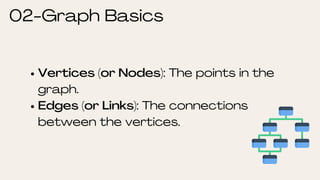
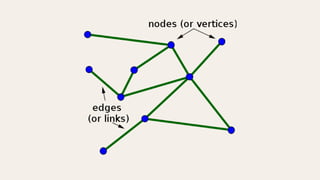
Vertices (or Nodes): The points in the
graph.
Edges (or Links): The connections
between the vertices.
02-Graph Basics
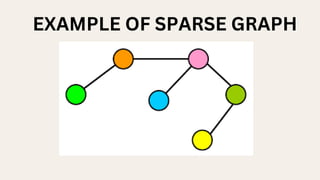
EXAMPLE OF SPARSE GRAPH
03-Dense graph
A dense graph is a type of
graph in graph theory where
the number of edges is close
to the maximum possible
number of edges.
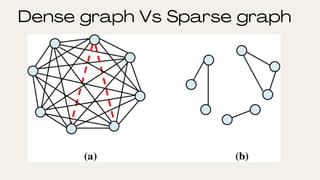
Dense graph Vs Sparse graph
Breadth-First Search (BFS) and Depth-First Search
(DFS)
Efficiently traverse sparse graphs.
Dijkstra's Algorithm
Finds shortest paths in weighted graphs; can be
optimized using data structures suited for sparsity.
Kruskal’s and Prim’s Algorithms
Find minimum spanning trees; Kruskal’s is
particularly efficient for sparse graphs.
Algorithms for Sparse Graphs
Advantages of Sparse Graphs
Memory Efficiency
Require less memory due to fewer edges.
Computational Efficiency
Many graph algorithms run faster on sparse graphs due
to fewer edges to process.
Scalability
Better suited for large-scale networks.
Applications of Sparse Graphs
Social Networks
Connections (friendships) are sparse compared to the total
number of possible connections.
Computer Networks
Routers and switches form sparse connections to optimize
performance and reduce costs.
Biological Networks
Protein-protein interaction networks where each protein
interacts with a few others.
Geographic Information Systems (GIS)
Road networks and public transportation maps are typically
sparse graphs.

Sparse graph and dense graph, algorithm use for it And advantages and their disadvantages

  • 1.
  • 2.
    01 - Introduction 02- Graph Basics 03 -Dense graph 04 - Algorithms for Sparse Graphs 05-Advantages of Sparse Graphs
  • 3.
    A sparse graphis a type of graph in graph theory where the number of edges is relatively small compared to the number of vertices. 01 - Introduction
  • 4.
    Vertices (or Nodes):The points in the graph. Edges (or Links): The connections between the vertices. 02-Graph Basics
  • 6.
  • 7.
    03-Dense graph A densegraph is a type of graph in graph theory where the number of edges is close to the maximum possible number of edges.
  • 8.
    Dense graph VsSparse graph
  • 9.
    Breadth-First Search (BFS)and Depth-First Search (DFS) Efficiently traverse sparse graphs. Dijkstra's Algorithm Finds shortest paths in weighted graphs; can be optimized using data structures suited for sparsity. Kruskal’s and Prim’s Algorithms Find minimum spanning trees; Kruskal’s is particularly efficient for sparse graphs. Algorithms for Sparse Graphs
  • 10.
    Advantages of SparseGraphs Memory Efficiency Require less memory due to fewer edges. Computational Efficiency Many graph algorithms run faster on sparse graphs due to fewer edges to process. Scalability Better suited for large-scale networks.
  • 11.
    Applications of SparseGraphs Social Networks Connections (friendships) are sparse compared to the total number of possible connections. Computer Networks Routers and switches form sparse connections to optimize performance and reduce costs. Biological Networks Protein-protein interaction networks where each protein interacts with a few others. Geographic Information Systems (GIS) Road networks and public transportation maps are typically sparse graphs.