SPAIN Capital  : Madrid Area  : 504,030 km²(World’s 51 st  ) Language :Spanish Population:  46,157,822 (90/Km 2 ) Government: P arliamentary govt under a  constitutional monarchy.   Border East  & South: Mediterranean sea      West  : Atlantic Ocean    North : France, Andorra Member  : EU since 1986. NATO since 1982
uske 7 ques he 1. napshot of socio eco political parameters 2.fin. architechture &imp. institutns n thier role 3.financial crisis /major dips in past 20 yrs 3b. in depth view on any 1 major fin crisis n hw it ws overcum 4.foriegn ownrshp participatn in eco 6.banking n financial inst framewrk & operatn 7.central bank as bieng independent of MOF
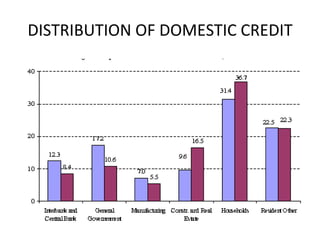
DISTRIBUTION OF DOMESTIC CREDIT
CAPITAL MARKET WELL DEVELOPED AND RAPIDLY GROWING MOST IMPORTANT VEHICAL ARE COLLECTIVE INVESTMENT INSTITUTION – MANAGE € 323 b
FINANCIAL SECTOR SUPERVISION THE BANK OF SPAIN NATIONAL SECURITT MARKET COMMISSION Directorate General of Insurance and Pension Funds (DGSFP) major violations must be formally sanctioned by the Ministry of Economy and Finance (ME) and the Council of Ministers. Going through the chain of norms (law, royal decree, ministerial order, circular) delays action
SECURITY MARKET SUPERVISION As per the main securities law ( Ley del Mercado de Valores—LMV), securities  markets are supervised by the CNMV , an autonomous public entity The CNMV conducts off-site and on-site inspections on a well-planned basis and has also developed a system for real‑time monitoring of trading on regulated markets to detect possible abuses. The assessment under the IOSCO principles for securities’ market supervision found that securities’ market regulation and supervision by CNMV is generally sound and of a high standard
MICROECONOMIC INDICATOR
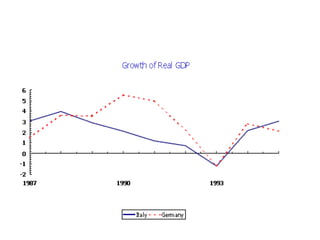
The EMS crisis of 1992/93 The European Monetary System was established in 1979 as a system of fixed exchange rates. In the period 1979-1987 the credibility of the EMS was low because of continuous realignments of the central parity In the years 1987-1991, there were fewer realignments and the system gained credibility After 1991, the process of German unification lead to economic tensions that caused the break up of the EMS. Several countries leave the discipline of fixed exchange rates, others stay devalue and stay within the system
In the period 1989-1992. increases in government spending in Germany without comparable increases in taxes caused a large government deficit. The government increased the amount of funds borrowed in financial markets .
 
The lessons Conclusion #1. Fixed exchange rates are a bad idea.  Correct but do no forget: This was a one-time event – the degree of asymmetry among EMU countries is small Monetary Policy and Exchange Rate Policy are not a magic recipe for growth
Conclusion #2. Fixed exchange rates are a bad idea if monetary policy is not disciplined enough. The only alternative is sharing a currency to avoid problems of credibility. Countries like Italy and Spain were “due” for a devaluation because they had had too high inflation during the 1987-1991 period (with the associated loss of competitiveness) Interest rates in countries that were attacked had to be raised significantly beyond German levels. The problem was not the high German interest rates but the loss of credibility in the system. A currency area solves this problem because it makes fixing the exchange rate an almost irreversible action .
Social Scenario Spain-  covers an area of 923,768 square kilometers with a  population of  45,568,152   people 94-97 percent literate  Currency: euro  Population below poverty line: 19.81% in 2005. Unemployment: 18.83% in ( Dec 2009) Castilian Spanish official language but Catalan, Galician, Euskera (the Basque language), Valencia, and Majorcan are also popular. Major ethnic groups: Basques, Catalans, Galician's, Andalusia's, Valencia's, Asturias, Navarre's, and Aragonite 99 percent nominally Roman Catholic. Other 1 percent mostly other Christian faiths. Political Scenario power centered in bicameral legislature--the Cortes (comprising lower house, Congress of Deputies, and upper house, Senate). Member of UN and its specialized agencies, International Monetary Fund (IMF--see Glossary), World Bank, General Agreement on Tariffs and Trade (GATT), and Organisation for Economic Co-operation and Development (OECD--see Glossary). Within Europe, member of Council of Europe, EC, WEU, and NATO. Also member of InterAmerican Development Bank (IDB) and had observer status in Andean Pact and Organization of American States (OAS). Bilateral military agreements with United States begun in 1953 and subsequently renewed. ANS-1
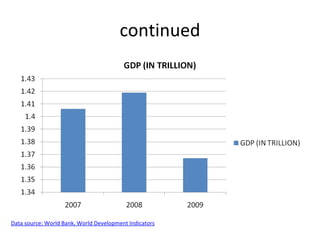
continued Data source: World Bank, World Development Indicators
Continued Source: CIA World Factbook
Source: CIA World Factbook
Spain has a diversified modern financial system which is becoming increasingly integrated with international financial markets. The system comprises credit, stock and money markets. The money market is subject to direct public-sector supervision (by the Bank of Spain), and is open both to banks and to financial investment and brokerage companies, with the result that the number of participating operators is very substantial. As far as the credit and stock markets are concerned, administrative involvement is confined almost exclusively to regulating the conditions for access by and permanence of regular operators and to monitoring the operations of financial enterprises, in accordance with the standard practice in economically developed countries. ANS-2
Ques-2  Financial Architecture
FOREIGN INVESTMENT IN SPAIN
SPAIN’S PARTICIPATION IN GLOBAL FLOWS
COMPOSITION OF FDI FLOW IN 2008
ORIGIN OF GROSS PRODUCTIVE FDI IN SPAIN
2008–2009 Spanish financial crisis The 2008–2009 Spanish financial crisis is part of the world economic crisis of 2008. In Spain, the crisis was generated by long term loans (commonly issued for 40 years), the building market crash which included the bankruptcy of major companies, and a particularly severe increase in unemployment, which officially is 20% and rising (December 2009)
Property bubble In 2004 509,293 new properties were built in Spain and in 2005 the number of new properties built were 528,754 2004 estimations of demand: 300,000 for Spanish people, 100,000 for foreign investors, 100,000 for foreign people living in Spain and 300,000  for stock in a country with 16.5 million families, 22-24 million houses and 3-4 million empty houses. From all the houses built over the 2001-2007 period, "no less than 28%" are vacant as of late 2008
SPAIN IN DEBT PROBLEM Jobless rate of nearly 20.   deficit that in 2009 equaled 11.4 percent of GDP   National debt as a proportion of GDP - 66 percent this year and peaking at 74 percent in 2012. Spanish sovereign debt has come under pressure, with creditors demanding a steeper interest rate to buy it and rates also rising for insurance against default.
India has the following treaties/agreements with Spain. Agreement on Trade and Economic Cooperation (1972) Agreement on Cultural Cooperation (1982). The CEP for the period 2005-08 was signed in March 2005, Civil Aviation Agreement (1986). Double Taxation Avoidance Agreement (1993). Bilateral Investment Protection and Promotion Agreement (1997). Extradition Treaty (2002) MoU on Institutionalization of Political Dialogue (2006) Mutual Legal Assistance treaty on Criminal Matters (2006). MoU between Technology Development Board (TDB) and the Centre for Development of Industrial Technology (2006). MoU of cooperation in the field of S&T (2007) Source:-  www.indianofficer.com ANS-5
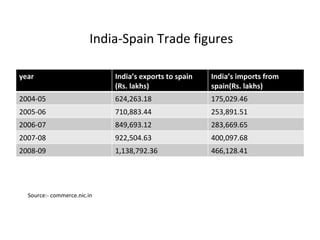
Source:- commerce.nic.in India-Spain Trade figures year India’s exports to spain (Rs. lakhs) India’s imports from spain(Rs. lakhs) 2004-05 624,263.18 175,029.46 2005-06 710,883.44 253,891.51 2006-07 849,693.12 283,669.65 2007-08 922,504.63 400,097.68 2008-09 1,138,792.36 466,128.41
continued banks and banking in Spain The Spanish banking system is well established and modern with all banking activity controlled by the Bank of Spain (Banco de Espana), which has its central office in Madrid and branches in all provincial capitals. Banks are divided into clearing banks and savings banks, and several foreign banks also operate in Spain. Clearing Banks At present the two banking giants in Spain are the BSCH (Banco de Santander y Central Hispano), which resulted from the merger of the Santander, Central and Hispano banks.  Foreign Banks There are foreign banks that operate in Spain, although they tend to be concentrated mainly in coastal resort areas and in the large cities.  savings Banks main savings banks are Caja Rural, Caja Mar, Caja Sur and UniCaja (originally from Malaga province), La General (from Granada), Caja San Fernando (from Cadiz) and El Monte (from Seville and Cordoba). Savings banks, although popular, are considerably less so than the clearing banks.
continued The Bank of Spain (Spanish: Banco de España), is the national central bank of Spain. Established in Madrid in 1782 by Carlos III, today the bank is a member of the European System of Central Banks. The governing structures of the Bank is divided among four branches: The Governor. The Sub-Governor. The Governing Council. The Executive Commission. The Governor of the Bank is formally appointed after the Prime minister of Spain has designated him/her by the Spanish monarchy. The Governor must be a Spanish citizen recognized for his or her competence in monetary or banking matters.
continued Defining and implementing the Euro system's monetary policy, with the principal aim of maintaining price stability across the euro area. Conducting currency exchange operations consistent with the provisions of Article 109 of the Treaty on European Union, and holding and managing the States' official currency reserves. Promoting the sound working of payment systems in the euro area. The holding and management of currency and precious metal reserves not transferred to the European Central Bank. The promotion of the sound working and stability of the financial system and, without prejudice to the functions of the ECB, of national payment systems. The supervision of the solvency and compliance with specific rules of credit institutions, other entities and financial markets, for which it has been assigned supervisory responsibility, in accordance with the provisions in force.
THANK YOU!!!!

Spain

  • 1.
    SPAIN Capital : Madrid Area : 504,030 km²(World’s 51 st ) Language :Spanish Population: 46,157,822 (90/Km 2 ) Government: P arliamentary govt under a constitutional monarchy. Border East & South: Mediterranean sea West : Atlantic Ocean North : France, Andorra Member : EU since 1986. NATO since 1982
  • 2.
    SPAIN Capital : Madrid Area : 504,030 km²(World’s 51 st ) Language :Spanish Population: 46,157,822 (90/Km 2 ) Government: P arliamentary govt under a constitutional monarchy. Border East & South: Mediterranean sea West : Atlantic Ocean North : France, Andorra Member : EU since 1986. NATO since 1982
  • 3.
    uske 7 queshe 1. napshot of socio eco political parameters 2.fin. architechture &imp. institutns n thier role 3.financial crisis /major dips in past 20 yrs 3b. in depth view on any 1 major fin crisis n hw it ws overcum 4.foriegn ownrshp participatn in eco 6.banking n financial inst framewrk & operatn 7.central bank as bieng independent of MOF
  • 4.
  • 5.
    CAPITAL MARKET WELLDEVELOPED AND RAPIDLY GROWING MOST IMPORTANT VEHICAL ARE COLLECTIVE INVESTMENT INSTITUTION – MANAGE € 323 b
  • 6.
    FINANCIAL SECTOR SUPERVISIONTHE BANK OF SPAIN NATIONAL SECURITT MARKET COMMISSION Directorate General of Insurance and Pension Funds (DGSFP) major violations must be formally sanctioned by the Ministry of Economy and Finance (ME) and the Council of Ministers. Going through the chain of norms (law, royal decree, ministerial order, circular) delays action
  • 7.
    SECURITY MARKET SUPERVISIONAs per the main securities law ( Ley del Mercado de Valores—LMV), securities markets are supervised by the CNMV , an autonomous public entity The CNMV conducts off-site and on-site inspections on a well-planned basis and has also developed a system for real‑time monitoring of trading on regulated markets to detect possible abuses. The assessment under the IOSCO principles for securities’ market supervision found that securities’ market regulation and supervision by CNMV is generally sound and of a high standard
  • 8.
  • 9.
    The EMS crisisof 1992/93 The European Monetary System was established in 1979 as a system of fixed exchange rates. In the period 1979-1987 the credibility of the EMS was low because of continuous realignments of the central parity In the years 1987-1991, there were fewer realignments and the system gained credibility After 1991, the process of German unification lead to economic tensions that caused the break up of the EMS. Several countries leave the discipline of fixed exchange rates, others stay devalue and stay within the system
  • 10.
    In the period1989-1992. increases in government spending in Germany without comparable increases in taxes caused a large government deficit. The government increased the amount of funds borrowed in financial markets .
  • 11.
  • 12.
    The lessons Conclusion#1. Fixed exchange rates are a bad idea. Correct but do no forget: This was a one-time event – the degree of asymmetry among EMU countries is small Monetary Policy and Exchange Rate Policy are not a magic recipe for growth
  • 13.
    Conclusion #2. Fixedexchange rates are a bad idea if monetary policy is not disciplined enough. The only alternative is sharing a currency to avoid problems of credibility. Countries like Italy and Spain were “due” for a devaluation because they had had too high inflation during the 1987-1991 period (with the associated loss of competitiveness) Interest rates in countries that were attacked had to be raised significantly beyond German levels. The problem was not the high German interest rates but the loss of credibility in the system. A currency area solves this problem because it makes fixing the exchange rate an almost irreversible action .
  • 14.
    Social Scenario Spain- covers an area of 923,768 square kilometers with a population of 45,568,152 people 94-97 percent literate  Currency: euro Population below poverty line: 19.81% in 2005. Unemployment: 18.83% in ( Dec 2009) Castilian Spanish official language but Catalan, Galician, Euskera (the Basque language), Valencia, and Majorcan are also popular. Major ethnic groups: Basques, Catalans, Galician's, Andalusia's, Valencia's, Asturias, Navarre's, and Aragonite 99 percent nominally Roman Catholic. Other 1 percent mostly other Christian faiths. Political Scenario power centered in bicameral legislature--the Cortes (comprising lower house, Congress of Deputies, and upper house, Senate). Member of UN and its specialized agencies, International Monetary Fund (IMF--see Glossary), World Bank, General Agreement on Tariffs and Trade (GATT), and Organisation for Economic Co-operation and Development (OECD--see Glossary). Within Europe, member of Council of Europe, EC, WEU, and NATO. Also member of InterAmerican Development Bank (IDB) and had observer status in Andean Pact and Organization of American States (OAS). Bilateral military agreements with United States begun in 1953 and subsequently renewed. ANS-1
  • 15.
    continued Data source: WorldBank, World Development Indicators
  • 16.
  • 17.
  • 18.
    Spain has adiversified modern financial system which is becoming increasingly integrated with international financial markets. The system comprises credit, stock and money markets. The money market is subject to direct public-sector supervision (by the Bank of Spain), and is open both to banks and to financial investment and brokerage companies, with the result that the number of participating operators is very substantial. As far as the credit and stock markets are concerned, administrative involvement is confined almost exclusively to regulating the conditions for access by and permanence of regular operators and to monitoring the operations of financial enterprises, in accordance with the standard practice in economically developed countries. ANS-2
  • 19.
    Ques-2 FinancialArchitecture
  • 20.
  • 21.
  • 22.
    COMPOSITION OF FDIFLOW IN 2008
  • 23.
    ORIGIN OF GROSSPRODUCTIVE FDI IN SPAIN
  • 24.
    2008–2009 Spanish financialcrisis The 2008–2009 Spanish financial crisis is part of the world economic crisis of 2008. In Spain, the crisis was generated by long term loans (commonly issued for 40 years), the building market crash which included the bankruptcy of major companies, and a particularly severe increase in unemployment, which officially is 20% and rising (December 2009)
  • 25.
    Property bubble In2004 509,293 new properties were built in Spain and in 2005 the number of new properties built were 528,754 2004 estimations of demand: 300,000 for Spanish people, 100,000 for foreign investors, 100,000 for foreign people living in Spain and 300,000 for stock in a country with 16.5 million families, 22-24 million houses and 3-4 million empty houses. From all the houses built over the 2001-2007 period, "no less than 28%" are vacant as of late 2008
  • 26.
    SPAIN IN DEBTPROBLEM Jobless rate of nearly 20.   deficit that in 2009 equaled 11.4 percent of GDP   National debt as a proportion of GDP - 66 percent this year and peaking at 74 percent in 2012. Spanish sovereign debt has come under pressure, with creditors demanding a steeper interest rate to buy it and rates also rising for insurance against default.
  • 27.
    India has thefollowing treaties/agreements with Spain. Agreement on Trade and Economic Cooperation (1972) Agreement on Cultural Cooperation (1982). The CEP for the period 2005-08 was signed in March 2005, Civil Aviation Agreement (1986). Double Taxation Avoidance Agreement (1993). Bilateral Investment Protection and Promotion Agreement (1997). Extradition Treaty (2002) MoU on Institutionalization of Political Dialogue (2006) Mutual Legal Assistance treaty on Criminal Matters (2006). MoU between Technology Development Board (TDB) and the Centre for Development of Industrial Technology (2006). MoU of cooperation in the field of S&T (2007) Source:- www.indianofficer.com ANS-5
  • 28.
    Source:- commerce.nic.in India-SpainTrade figures year India’s exports to spain (Rs. lakhs) India’s imports from spain(Rs. lakhs) 2004-05 624,263.18 175,029.46 2005-06 710,883.44 253,891.51 2006-07 849,693.12 283,669.65 2007-08 922,504.63 400,097.68 2008-09 1,138,792.36 466,128.41
  • 29.
    continued banks andbanking in Spain The Spanish banking system is well established and modern with all banking activity controlled by the Bank of Spain (Banco de Espana), which has its central office in Madrid and branches in all provincial capitals. Banks are divided into clearing banks and savings banks, and several foreign banks also operate in Spain. Clearing Banks At present the two banking giants in Spain are the BSCH (Banco de Santander y Central Hispano), which resulted from the merger of the Santander, Central and Hispano banks. Foreign Banks There are foreign banks that operate in Spain, although they tend to be concentrated mainly in coastal resort areas and in the large cities. savings Banks main savings banks are Caja Rural, Caja Mar, Caja Sur and UniCaja (originally from Malaga province), La General (from Granada), Caja San Fernando (from Cadiz) and El Monte (from Seville and Cordoba). Savings banks, although popular, are considerably less so than the clearing banks.
  • 30.
    continued The Bankof Spain (Spanish: Banco de España), is the national central bank of Spain. Established in Madrid in 1782 by Carlos III, today the bank is a member of the European System of Central Banks. The governing structures of the Bank is divided among four branches: The Governor. The Sub-Governor. The Governing Council. The Executive Commission. The Governor of the Bank is formally appointed after the Prime minister of Spain has designated him/her by the Spanish monarchy. The Governor must be a Spanish citizen recognized for his or her competence in monetary or banking matters.
  • 31.
    continued Defining andimplementing the Euro system's monetary policy, with the principal aim of maintaining price stability across the euro area. Conducting currency exchange operations consistent with the provisions of Article 109 of the Treaty on European Union, and holding and managing the States' official currency reserves. Promoting the sound working of payment systems in the euro area. The holding and management of currency and precious metal reserves not transferred to the European Central Bank. The promotion of the sound working and stability of the financial system and, without prejudice to the functions of the ECB, of national payment systems. The supervision of the solvency and compliance with specific rules of credit institutions, other entities and financial markets, for which it has been assigned supervisory responsibility, in accordance with the provisions in force.
  • 32.