Constructing
Two-Way
Table
Page: _____________
Date: ______________
How do I construct and interpret a
two-way table that summarize data
on two categorical variables
collected from the same subjects?
Opening: Constructing Two-Way Table
In this lesson you will learn
how to construct a two way
table by collecting and
organizing data from a
verbal description.
Opening: Constructing Two-Way Table
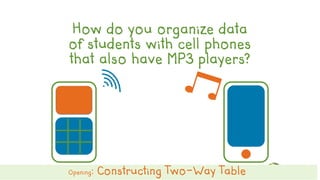
How do you organize data
of students with cell phones
that also have MP3 players?
Opening: Constructing Two-Way Table
Let’s ReviewLet’s Review
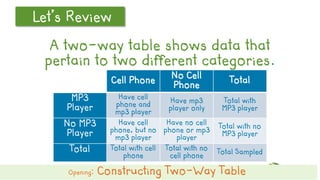
A two-way table shows data that
pertain to two different categories.
Cell Phone
No Cell
Phone
Total
MP3
Player
Have cell
phone and
mp3 player
Have mp3
player only
Total with
MP3 player
No MP3
Player
Have cell
phone, but no
mp3 player
Have no cell
phone or mp3
player
Total with no
MP3 player
Total Total with cell
phone
Total with no
cell phone
Total Sampled
Opening: Constructing Two-Way Table
Let’s ReviewA Common Mistake
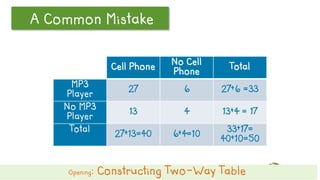
27
Cell Phone
No Cell
Phone
Total
MP3
Player
27 6 27+6 =33
No MP3
Player
13 4 13+4 = 17
Total
27+13=40 6+4=10
33+17=
40+10=50
Opening: Constructing Two-Way Table
Let’s ReviewCore Lesson
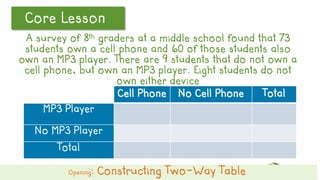
Cell Phone No Cell Phone Total
MP3 Player
No MP3 Player
Total
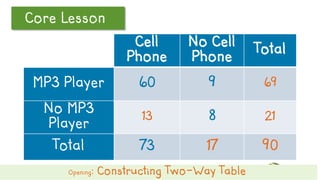
A survey of 8th graders at a middle school found that 73
students own a cell phone and 60 of those students also
own an MP3 player. There are 9 students that do not own a
cell phone, but own an MP3 player. Eight students do not
own either device
Opening: Constructing Two-Way Table
Let’s ReviewCore Lesson
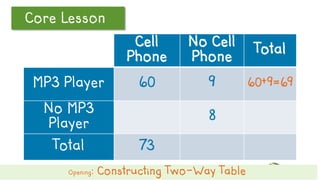
Cell
Phone
No Cell
Phone
Total
MP3 Player 60 9 60+9=69
No MP3
Player
8
Total 73
Opening: Constructing Two-Way Table
Let’s ReviewCore Lesson
Cell
Phone
No Cell
Phone
Total
MP3 Player 60 9 69
No MP3
Player
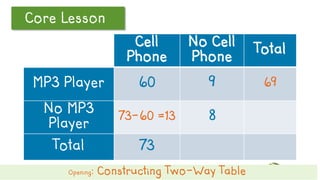
73-60 =13 8
Total 73
Opening: Constructing Two-Way Table
Let’s ReviewCore Lesson
Cell
Phone
No Cell
Phone
Total
MP3 Player 60 9 69
No MP3
Player
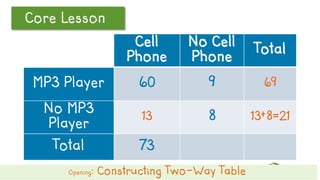
13 8 13+8=21
Total 73
Opening: Constructing Two-Way Table
Let’s ReviewCore Lesson
Cell
Phone
No Cell
Phone
Total
MP3 Player 60 9 69
No MP3
Player
13 8 21
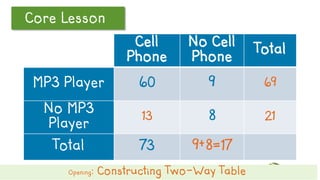
Total 73 9+8=17
Opening: Constructing Two-Way Table
Let’s ReviewCore Lesson
Cell
Phone
No Cell
Phone
Total
MP3 Player 60 9 69
No MP3
Player
13 8 21
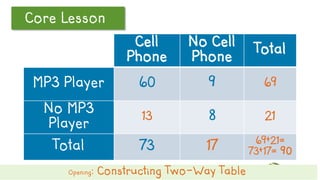
Total 73 17 69+21=
73+17= 90
Opening: Constructing Two-Way Table
Let’s ReviewGuided Practice
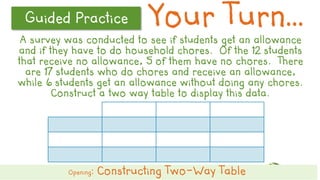
A survey was conducted to see if students get an allowance
and if they have to do household chores. Of the 12 students
that receive no allowance, 5 of them have no chores. There
are 17 students who do chores and receive an allowance,
while 6 students get an allowance without doing any chores.
Construct a two way table to display this data.
Opening: Constructing Two-Way Table
Your Turn…
Let’s ReviewCore Lesson
Cell
Phone
No Cell
Phone
Total
MP3 Player 60 9 69
No MP3
Player
13 8 21
Total 73 17 90
Opening: Constructing Two-Way Table
Work Period: Constructing Two-Way Table
Book C: Skills Practice
Pgs. 893 – 900 all
Let’s
Review
Quick Quiz
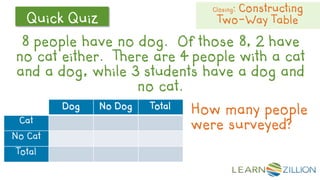
8 people have no dog. Of those 8, 2 have
no cat either. There are 4 people with a cat
and a dog, while 3 students have a dog and
no cat.
Dog No Dog Total
Cat
No Cat
Total
How many people
were surveyed?
Closing: Constructing
Two-Way Table
Let’s
Review
Quick Quiz
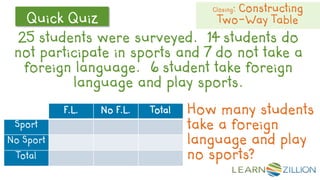
25 students were surveyed. 14 students do
not participate in sports and 7 do not take a
foreign language. 6 student take foreign
language and play sports.
F.L. No F.L. Total
Sport
No Sport
Total
How many students
take a foreign
language and play
no sports?
Closing: Constructing
Two-Way Table

Sp.4 construct a two way table

  • 1.
  • 2.
    How do Iconstruct and interpret a two-way table that summarize data on two categorical variables collected from the same subjects? Opening: Constructing Two-Way Table
  • 3.
  • 4.
    In this lessonyou will learn how to construct a two way table by collecting and organizing data from a verbal description. Opening: Constructing Two-Way Table
  • 5.
    How do youorganize data of students with cell phones that also have MP3 players? Opening: Constructing Two-Way Table
  • 6.
    Let’s ReviewLet’s Review Atwo-way table shows data that pertain to two different categories. Cell Phone No Cell Phone Total MP3 Player Have cell phone and mp3 player Have mp3 player only Total with MP3 player No MP3 Player Have cell phone, but no mp3 player Have no cell phone or mp3 player Total with no MP3 player Total Total with cell phone Total with no cell phone Total Sampled Opening: Constructing Two-Way Table
  • 7.
    Let’s ReviewA CommonMistake 27 Cell Phone No Cell Phone Total MP3 Player 27 6 27+6 =33 No MP3 Player 13 4 13+4 = 17 Total 27+13=40 6+4=10 33+17= 40+10=50 Opening: Constructing Two-Way Table
  • 8.
    Let’s ReviewCore Lesson CellPhone No Cell Phone Total MP3 Player No MP3 Player Total A survey of 8th graders at a middle school found that 73 students own a cell phone and 60 of those students also own an MP3 player. There are 9 students that do not own a cell phone, but own an MP3 player. Eight students do not own either device Opening: Constructing Two-Way Table
  • 9.
    Let’s ReviewCore Lesson Cell Phone NoCell Phone Total MP3 Player 60 9 60+9=69 No MP3 Player 8 Total 73 Opening: Constructing Two-Way Table
  • 10.
    Let’s ReviewCore Lesson Cell Phone NoCell Phone Total MP3 Player 60 9 69 No MP3 Player 73-60 =13 8 Total 73 Opening: Constructing Two-Way Table
  • 11.
    Let’s ReviewCore Lesson Cell Phone NoCell Phone Total MP3 Player 60 9 69 No MP3 Player 13 8 13+8=21 Total 73 Opening: Constructing Two-Way Table
  • 12.
    Let’s ReviewCore Lesson Cell Phone NoCell Phone Total MP3 Player 60 9 69 No MP3 Player 13 8 21 Total 73 9+8=17 Opening: Constructing Two-Way Table
  • 13.
    Let’s ReviewCore Lesson Cell Phone NoCell Phone Total MP3 Player 60 9 69 No MP3 Player 13 8 21 Total 73 17 69+21= 73+17= 90 Opening: Constructing Two-Way Table
  • 14.
    Let’s ReviewGuided Practice Asurvey was conducted to see if students get an allowance and if they have to do household chores. Of the 12 students that receive no allowance, 5 of them have no chores. There are 17 students who do chores and receive an allowance, while 6 students get an allowance without doing any chores. Construct a two way table to display this data. Opening: Constructing Two-Way Table Your Turn…
  • 15.
    Let’s ReviewCore Lesson Cell Phone NoCell Phone Total MP3 Player 60 9 69 No MP3 Player 13 8 21 Total 73 17 90 Opening: Constructing Two-Way Table
  • 16.
    Work Period: ConstructingTwo-Way Table Book C: Skills Practice Pgs. 893 – 900 all
  • 17.
    Let’s Review Quick Quiz 8 peoplehave no dog. Of those 8, 2 have no cat either. There are 4 people with a cat and a dog, while 3 students have a dog and no cat. Dog No Dog Total Cat No Cat Total How many people were surveyed? Closing: Constructing Two-Way Table
  • 18.
    Let’s Review Quick Quiz 25 studentswere surveyed. 14 students do not participate in sports and 7 do not take a foreign language. 6 student take foreign language and play sports. F.L. No F.L. Total Sport No Sport Total How many students take a foreign language and play no sports? Closing: Constructing Two-Way Table

Editor's Notes

  • #7 A two way table shows data that pertain to two different categories. This is an example of a two way table that could hold information about the number of students that have either cell phones, mp3 players, both, or none. The headers are on the top and the left. You would place the numbers that represent each scenario in the middle and then total the rows and columns. .
  • #8 A common mistake is not calculating missing information correctly. Remember that each row will be summed and each column will be summed. The sum of the two rows should be the total as should the sum of the two columns.
  • #9 When given a word problem, you should organize the data that is given in the two-way table. (Read problem). Since 73 students own a cell phone in total, we will put 73 in the total column. 60 of the cell phone owners also own a MP3 player, so we will list the 60 in the cell that corresponds to owning both. 9 students have no cell phone, but have a MP3 player, so we place a 9 in that cell. Lastly, we are told that there are 8 students who don’t own either device. We place the 8 in the appropriate cell.
  • #10 Now that we have filled in the information that we already know, we can use what we know about two-way tables to complete the rest of the table. The sum of the first row is 69.
  • #11 We cannot sum the second row until we get a value of the number of students who have a cell phone, but no MP3 player. WE know that the sum of the cell phone owners is 73. We can subtract the 60 from the 73 to get 13 people with a cell phone and no MP3 player.
  • #12 Now we can sum the second row to get 21.
  • #13 Next we can sum the 2nd column to get 17 people with no cell phone.
  • #14 Now we need to confirm that the sum of the sum of the rows is the same as the sum of the sum of the columns. 69 plus 21 is 90 as well as 73 plus 17.
  • #16 We now have a completed two way table from our original verbal description.
  • #18 15 students
  • #19 12 students