



Pedagogic Approaches
         to Using Technology
         for Learning

         Literature Review

Graham Attwell and Jenny Hughes
(Pontydysgu) for Lifelong Learning
UK

September 2010
Pedagogic Approaches to Using Technology for Learning - Literature Review


    Contents
    1.   Introduction...............................................................................................................................4
          1.1 Background......................................................................................................................4
          1.2 Scope and methodology ..................................................................................................4
          1.3 The structure of the review ..............................................................................................6
    2.   Learners in the digital age .......................................................................................................7
         2.1 Drivers for change ...........................................................................................................7
         2.2 How people use technology.............................................................................................7
         2.3 Moral concerns and panics..............................................................................................9
         2.4 The digital natives debate................................................................................................9
         2.5 The technology gap .......................................................................................................10
    3.   Digital literacies ......................................................................................................................12
         3.1 Understandings of digital literacies ................................................................................12
         3.2 Digital literacies and pedagogies ...................................................................................13
    4.   Pedagogic theories and the use of technologies for learning and their implications .....15
         4.1 Constructivism ...............................................................................................................15
         4.2 New Pedagogic Models .................................................................................................16
         4.3 Communities of practice ................................................................................................18
         4.4 Activity theory ................................................................................................................20
         4.5 Vygotsky and social constructivism ...............................................................................20
         4.6 Scaffolding learning .......................................................................................................21
         4.7 Boundary objects ...........................................................................................................22
         4.8 Models for a pedagogic toolkit .......................................................................................22
         4.9 Curriculum development and rhizomatic knowledge .....................................................23
         4.10 Discourse, collaboration and meta cognition .................................................................24
         4.11 Bricolage........................................................................................................................24
         4.12 Learning styles...............................................................................................................25
    5.   The impact of technologies on pedagogy in practice........................................................26
         5.1 The rhetoric-reality gap..................................................................................................26
         5.2 Subject areas and technologies.....................................................................................27
         5.3 ICT skills and pedagogy ................................................................................................28
         5.4 Vocational knowledge....................................................................................................29
         5.5 Subjects and learners ....................................................................................................30
         5.6 Workplace and informal learning ...................................................................................30
         5.7 The impact of technology...............................................................................................35
    6.   From current to emerging technologies for learning..........................................................36
         6.1 ‘Epoch changes’ in educational technologies ................................................................36
         6.2 Personal learning spaces and personal learning environments ....................................37
         6.3 Future trends .................................................................................................................38
         6.4 Web 3.0 and web X .......................................................................................................39
         6.5 Mobile technologies .......................................................................................................39
         6.6 Emerging Technologies .................................................................................................42
         6.7 Socio-technical developments .......................................................................................42
    7.   Teacher dispositions..............................................................................................................44
         7.1 Teachers voices.............................................................................................................45


2
                                                                                                                                                   2
Pedagogic Approaches to Using Technology for Learning - Literature Review


8.    Present qualifications for teachers and approaches to pedagogy and the use of
      technology for learning..........................................................................................................49
       8.1 Initial teacher training in England...................................................................................49
       8.2 Initial teacher training in England and ICT.....................................................................50
       8.3 Course based training and the workplace .....................................................................52
       8.4 Initial teacher training in other countries ........................................................................53
9.    Continuing professional development .................................................................................55
      9.1 Constraints and definitions ............................................................................................55
      9.2 What is delivered? .........................................................................................................55
      9.3 Who delivers it? .............................................................................................................56
      9.4 How is it delivered?........................................................................................................57
      9.5 Case studies ..................................................................................................................58
      9.6 What are the problems and barriers? ............................................................................59
      9.7 What are the successes / critical success factors? .......................................................61
10. Gaps and bias in the literature ..............................................................................................65
11. Bibliography............................................................................................................................68
Glossary of terms and definitions................................................................................................78
Left hand side page by Lifelong Learning UK


    1. Introduction
    1.1 Background
    The proliferation of new technologies and internet tools is fundamentally changing the way we live
    and work. The lifelong learning sector is no exception with technology having a major impact on
    teaching and learning. This in turn is affecting the skills needs of the learning delivery workforce.
    In 2009-10, Lifelong Learning UK carried out a small piece of research into the use of technology in
    initial teacher training (ITT) in further education in England. This research highlighted that there
    was no consensus among ITT (providers as to what constituted effective ‘digital pedagogy’, that is,
    the effective and purposeful use of technology in teaching and learning.
    The current teaching qualifications, Preparation in Teaching in the Lifelong Learning Sector
    (PTLLS), Certificate in Teaching in the Lifelong Learning (CTLLS) and Diploma in Teaching in the
    Lifelong Learning Sector (DTLLS) are due to expire in 2012. Lifelong Learning UK is reviewing the
    qualifications to ensure they are up to date and will support the development of the skills needed by
    the modern teacher, tutor or trainer.
    However, the gap in technology related skills required by teaching and learning professionals
    cannot be bridged by qualifications alone or by initial training. A programme of opportunities for
    continuing professional development (CPD) is also needed to enable people to remain up to date.
    This literature review is intended to address and support these areas by identifying new and
    emerging pedagogies; determining what constitutes effective use of technology in teaching and
    learning; looking at new developments in teacher training qualifications to ensure that they are at
    the cutting edge of learning theory and classroom practice and making suggestions as to how
    teachers can continually update their skills.

    1.2 Scope and methodology
    In searching and selecting papers and documents for inclusion in the review we were concerned to
    reflect a number of balances.
    Firstly, the review should include a range of different literature sources - including academic
    papers, reports on research and initiatives in the public, private and third sector, research carried
    out by government bodies, policy, monitoring and evaluation reports and materials aimed at
    supporting the practice of teachers.
    Secondly, the literature should reflect a balance between the UK, continental Europe and the rest
    of the world.
    Thirdly, the review should address different locations and domains of learning with technology
    including learning in the classroom, learning in work and informal learning.
    In undertaking the literature search we have not constrained the search terms but rather have
    opted for a wide range of search strings. This is because different authors use different terminology
    to describe similar things - for example, technology enhanced learning, ICT based teaching and
    learning, e-learning, digital learning.
    In addition to web searches, we have examined a number of databases (for instance the British
    Educational Index (http://brs.leeds.ac.uk/). We have also looked at the work carried out by
    agencies and organisations focused on the use of technology for learning, including JISC, the
    Institute for Learning (IfL) and Becta in the UK. Furthermore, we considered research programmes
    and projects carried out at European level including the EU Lifelong Learning programme, the EU
    Research Programme and work carried out by the Institute for Prospective Technology Studies.
    Although we have identified a broad base of research and literature in the area of technology
    enhanced learning and also in teacher training, this is not without its problems. One of these is the
    nature of the target sector for this study. The learning and skills sector in England comprises further
    education colleges, sixth form colleges, personal and community development learning, work
4
                                                                                                            4
Pedagogic Approaches to Using Technology for Learning - Literature Review


based training and learning in other adult settings, such as prisons and the uniformed services
(Maxwell, 2010).
This is an extremely diverse group of institutions with different aims, intentions and learning
processes (and different constraints - e-learning in prisons is not easy!) Furthermore, further
education colleges provide both general and vocational education and have both a social and
economic function in terms of outputs. Although there is now a single qualification framework for
those working in the sector, there are specific pedagogic concerns when it comes to vocational
teachers.
As many commentators have indicated (Coffield, 2008; Grollmann, 2008), vocational education has
suffered a relative lack of esteem when compared with school or university education. This has in
turn has impacted on the body of research into vocational education, which, in the UK in particular,
is sparse.
Although the research indicates a welcome improvement over the last two or three years,
comparatively little attention has been afforded to pedagogies in the use of technology for learning.
Most previous research has either focused on the use and impact of particular technologies, such
as virtual learning environments (VLEs) for teaching or learning or on skills development in the use
of technology.
Coffield (2008:14) says:
“In all the plans to put learners first, to invest in learning, to widen participation, to set targets, to
develop skills, to open up access, to raise standards, and to develop a national framework of
qualifications, there is no mention of a theory (or theories) of learning to drive the whole project. It is
as though there existed in the UK such widespread understanding of, and agreement about, the
processes of learning and teaching that comment was thought superfluous”.
Our literature search suggests the UK is not alone in this.
New qualifications were introduced for teachers in the lifelong learning sector in England in 2007.
There is, as yet, little research on the impact of these qualifications.
In terms of professional development, despite the priority given to information communication
technology (ICT) and learning, there is a surprising lack of research on the impact, organisation
effectiveness and still less the pedagogy of such professional development.
The present rate of technological change is rapid. For that reason we have chosen to focus mainly
on studies undertaken in the last five years.
All the above have been constraining factors on the literature review. Although we have attempted
to focus on the learning and skills sector, we have also included literature from other education
sectors where we feel it is relevant and have attempted to make clear the origins of such studies.
We have also been constrained in the breadth of our survey by the short time frame in which the
literature review has been produced. We cannot guarantee we have not overlooked some relevant
and important studies.
We were fortunate to find a small number of recent meta studies which, whilst not directly
addressing the central focus of this study, were addressing related fields:
      Ann-Britt Enochsson and Caroline Rizza, ICT in Initial Teacher Training: Research Review
       (2009).
      Helen Beetham, Lou McGill and Alison Littlejohn, Thriving in the 21st century: Learning
       Literacies for the Digital Age (2009).
      Caroline Daly, Norbert Pachler and Caroline Pelletier, Continuing Professional Development
       in ICT for Teachers: A literature review (2009).
      Mira Vogel, Engaging academics in professional development for technology enhanced
       learning, a synthesis report for the UK’s Higher Education Academy (2010).
We have drawn extensively on these studies in our review and, where appropriate, have drawn on
secondary references reported in their research.

                                                                                                                      5
Left hand side page by Lifelong Learning UK


    Finally we cannot claim to be pedagogically or culturally neutral in our choice of sources, neither
    would we wish to make a spurious claim to academic objectivity. Obviously our own prior learning
    and experiences have influenced our approaches and judgement in undertaking this work.

    1.3 The structure of the review
    There are ten main sections to this literature review:
        1. Introduction
        2. Learners in the digital age
        3. Digital literacies
        4. Pedagogic theories and the se of technology for learning and their implications
        5. The impact of technologies on pedagogy in practice
        6. From current to emerging technologies for learning
        7. Teachers dispositions
        8. Present qualifications for teachers and approaches to pedagogy and the use of technology
           for learning
        9. Continuing professional development
        10. Gaps and bias in the literature.
    In the Appendix to the report we provide a glossary and a list of definitions as we have used terms
    in this literature review.


6
                                                                                                          6
Pedagogic Approaches to Using Technology for Learning - Literature Review


2. Learners in the digital age
2.1 Drivers for change
One of the factors driving the exploration and development of new pedagogies and the use of
technology for learning is a concern that education may be becoming increasingly out of step with
the way that people use technology today for socialising, working and learning.
Furthermore educational institutions may be failing to meet the expectations of learners. Ubiquity,
accessibility, rapid feedback and ease of use are all features of learners' daily experience with
digital technologies which are changing their expectations of education (Beetham, McGill and
Littlejohn, 2009).

2.2 How people use technology
A series of surveys and reports have provided evidence of how people are using technologies,
particularly social software and web 2.0, for communication and social networking and for creating
and sharing a wide range of digital artefacts.
Hadyn (2008) draws attention to a Becta survey of learners in the UK. Of the 2,600 learners
surveyed, 74 per cent had social networking accounts and 78 per cent had uploaded artefacts
using Web 2.0 applications. However, nearly all students’ use of Web 2.0 is currently outside
school, for social purposes. Few pupils had an understanding of the ways in which Web 2.0 might
be used for educational purposes and few had well developed digital literacy and critical skills to
navigate Web 2.0 territory in a mature way (Becta, 2008).
Perhaps the most extensive surveys of how young people are using technology have been
provided by the Pew Internet and American Life project.
As early as 2005 a Pew Research Centre study (Lenhart and Madden, 2005) found that 56 per cent
of young people in America were using computers for creative activities, writing and posting to the
internet, mixing and constructing multimedia and developing their own content. Twelve to 17-year-
olds look to web tools to share what they think and do online. One in five who use the net said they
used other people’s images, audio or text to help make their own creations.
According to Raine (BBC, 2005), “These teens were born into a digital world where they expect to
be able to create, consume, remix, and share material with each other and lots of strangers.”
Much of the research into how young people use computers and social software has been from the
USA. However, a series of studies around these issues has recently been undertaken in the UK
(Ofcom Social Networking Research, the Oxford Internet Institute’s Internet Surveys, Ofcom Media
Literacy Audit). Ewan McIntosh (2008) has provided a useful summary of some of the findings.
The main use of the net by young people, by far, is for learning: 57 per cent use the net for
homework, saying it provides more information than books. 15 per cent use it for learning that is
‘not school’. 40 per cent use it to stay in touch with friends, 9 per cent for entertainment such as
YouTube (a low figure given the younger age of the respondent sample).
Most users of the net are using it at home (94 per cent), then at work (34 per cent), in another
person’s house (30 per cent) or at school (16 per cent). Only 12 per cent use public libraries and 9
per cent internet cafés. Most people’s first exposure to the web is at home.
The predominant use of media is for getting information. Both users and non-users of the internet
read as many books as each other but users watch less television (cf. Clay Shirky’s theory on
“cognitive surplus”). The result is that internet users get more information in total, and as much as
non-users through other sources. Face-to-face remains the most important source of information
but internet users actually value face-to-face meeting more than non-users. Indeed, in the ‘real
world’ internet users are more likely to be outgoing individuals and to belong to a social group or
club than non-users of the net.

                                                                                                                     7
Left hand side page by Lifelong Learning UK


    66 per cent of 15-24 year olds have broadband and about 82 per cent of them have a Social
    Networking Service (SNS) profile. Most 16-17 yrs have a profile (67 per cent).
    15 per cent of very young children (6-11 yrs) have used Bebo, 4 per cent have used Facebook and
    8 per cent have used MySpace (note that even in the short period since these surveys were
    undertaken there is likely to be radical changes in these figures). By 12 years old most of them can
    describe what a social networking site is, although they may not know the term. The majority of
    adults do not have a social networking site but are more likely to if their children do (is it for the
    purposes of snooping?). However, this figure is enormously skewed by the age profile of the adult
    population.
    Among young people, those most likely to reject social networks are older teens citing intellectual
    reasons. In social networks most people have between 1-20 friends.
    In contrast to the Pew Internet findings, McIntosh says that creativity is limited to uploading photos
    on social network sites or creating profiles and that girls, who are more active on SNSs anyway,
    are more likely to do this than boys. However, this figure depends on how ‘creative activities’ are
    defined. Over 30 per cent of young people make playlists of music, a third regularly add comments
    to web content on social media sites. Just under a fifth of 12 - 15 yr olds undertake other creative
    activities such as making ringtones, short movies on mobile phones or camcorders or writing a
    blog. Teenagers living in rural areas are statistically more likely to be creative online.
    The JISC funded SPIRE project, undertaken by the University of Oxford Department of Continuing
    Education in partnership with Penn State University, has undertaken a survey designed to discover
    the general levels of usage of the internet and the extent to which internet services are being used
    for work, for study, socially and for fun (White, 2007).
    The survey received 1418 responses 46 of which were from academics.
    The survey focused in particular on what social software services and tools were being used by
    students and academics and for what purposes.
    The survey found the widespread use of Wikipedia for study and for work, despite the ambivalence
    of many institutions towards the use of the site. Wikipedia is also used for collaborative authoring.
    Forums are used both for study and for work, as are blogs but social networking sites, despite their
    high traffic, are used almost exclusively for social purposes and not for work or study. Interestingly,
    there was little variation between the replies from students and from teachers.
    The findings showed a high level of contributing rather than simply consuming content with 20 per
    cent of respondents who use MySpace and YouTube contributing in some form. This contradicts a
    Guardian newspaper survey that “suggests that if you get a group of 100 people online then one
    will create content, 10 will ‘interact’ with it (commenting or offering improvements) and the other 89
    will just view it” Guardian Online 20 July 2006.
    However, White (2007) is cautious about this finding saying the area requires more research
    particularly into what motivates individuals to comment or create new content. “As the focus in e-
    learning shifts increasingly towards collaboration and the provision of online social spaces, the
    issue of how to encourage students to move from being ‘lurkers’ to active participants is crucial.”
    Although findings differ, there is converging evidence that young people (and not just young
    people) are increasingly using technology for creating different forms of media content, for
    communication and for publishing information and well as for consuming it. Furthermore, the
    widespread use of this technology is outside the classroom (Attwell and Costa, 2009).
    Internet use is not confined to computers. Young people have been avid early adopters of mobile
    technologies. A Pew study,Teenagers and Mobile Phones (Lenhart, Ling, Campbell & Purcell,
    2010), conducted in the USA, found that of the 75 per cent of teenagers who own mobile phones,
    87 per cent use text messaging at least occasionally. Among those texters:
            Half the number of teenagers send 50 or more text messages a day (or 1,500 texts a
             month) and one in three sends more than 100 texts a day (or more than 3,000 texts a
             month).
            15 per cent of teens who are texters send more than 200 texts a day or more than 6,000
             texts a month.
8
                                                                                                          8
Pedagogic Approaches to Using Technology for Learning - Literature Review


      Boys typically send and receive 30 texts a day; girls typically send and receive 80
       messages per day.
      Teen texters aged 12-13 typically send and receive 20 texts a day.
      14-17 year-old texters typically send and receive 60 text messages a day.
      Older girls who text are the most active, with 14-17 year-old girls typically sending 100 or
       more messages a day or more than 3,000 texts a month.
However, while many teens are avid texters, a substantial minority are not. One-fifth of teen texters
(22 per cent) send and receive just 1-10 texts a day or 30-300 a month.

2.3 Moral concerns and panics
These and similar findings have led to concerns by educationalists and especially by the popular
press. A whole number of different issues have been expressed including online safety, internet
and games addiction, obesity, impoverished language use and declining standards of spelling and
literacy. Research tends to disprove these fears - which have been dubbed ‘moral panics’ (Cohen,
1972; Marwick, 2008).
David Crystal, in an interview with the Guardian (Crace, 2008), stated that “Texting does not erode
children’s ability to read and write. On the contrary, literacy improves.” The latest studies (from a
team at Coventry University) have found strong positive links between the use of text language and
the skills underlying success in standard English in pre-teenage children. The more abbreviations
in their messages, the higher they scored on tests of reading and vocabulary. The children who
were better at spelling and writing used the most text-isms. And the younger they received their first
phone, the higher their scores.
Another persistent and populist area of concern is around social networking sites and the digital
identities of young people. Yet the Pew survey on Reputation, Management, and Social Media
(Madden and Smith, 2010) found that young adults are more actively engaged in managing what
they share online than older adults. 71 per cent of the 18-29s interviewed in August-September of
2009 who use social network sites reported having changed their privacy settings (vs. 55 per cent
of those 50-64).
Danah Boyd (2010) commented on the results:
“Young adults are actively engaged in managing their reputation but they’re not always successful.
The tools are confusing and companies continue to expose them without them understanding
what’s happening. But the fact that they go out of their way to try to shape their information is
important. It signals very clearly that young adults care deeply about information flow and
reputation…”
“Much of this is because of digital literacy – younger folks understand the controls better than the
older folks AND they understand the implications better… This is also because, as always, youth
are learning the hard way. As Pew notes, young adults have made mistakes that they regret.
They’ve also seen their friends make mistakes that they regret. All of this leads to greater
consciousness about these issues and a deeper level of engagement.”
The suggestion from Boyd is that young people are learning from experience and not from
education.

2.4 The digital natives debate
A number of recent reports have pointed out that not all young people are so well versed and
confident in the use of new technologies. The idea that society could be divided into two groups –
‘digital natives’ who grew up with digital technology from birth and ‘digital immigrants’ who were
already socialized before digital technology arrived on the scene (Prensky, 2001) – is now largely
discredited and Prensky himself now prefers to talk of ‘digital wisdom’.
David White (2008) instead makes a distinction between digital residents and digital visitors. The
resident is an individual who lives a percentage of their life online. The web supports the projection
                                                                                                                    9
Left hand side page by Lifelong Learning UK


     of their identity and facilitates relationships. The visitor is an individual who uses the web as a tool
     in an organised manner whenever the need arises. In effect, says White, “the Resident has a
     presence online which they are constantly developing while the Visitor logs on, performs a specific
     task and then logs off.”
     A major issue and perhaps one deserving of further research (especially in the context of
     education) is how people move between online and face to face communication. Hargital, Fullerton
     and Muenchen-Trevino (2010) point to the continuing importance of personal networks and
     observe an increasing interweaving of on- and off- line presence. Despite the tremendous amounts
     of information available on the Web, research has shown that users continue to rely on specific
     people in their personal networks when seeking various types of information. Kayahara & Wellman
     (2007) (studying information search around recreational activities) and Tepper, Hargittai, & Touve
     (2007) (studying cultural content searching) found that users supplement online sources with
     advice they get from friends and family. This underscores the importance of seeing information
     technology uses in the larger context of people’s everyday lives where online and offline activities
     are constantly intertwined (Wellman & Haythornthwaite, 2002).
     Another important finding is that most young people do not use the wide range of social media tools
     available. Beetham, McGill and Littlejohn (2009:15) say that “Experience with web 2.0
     technologies, particularly active engagement such as creation of blogs and wikis, tagging, meme-
     ing, reviewing, writing fan fiction, remain minority activities to which many learners are introduced
     by educators.”

     2.5 The technology gap
     There is a major concern around the increasing gap between the current use of technologies for
     teaching and learning in schools and the daily experiences that pupils have with technologies
     outside of school (OECD, 2009). Attwell (2007, (a)) expresses this most starkly when he warns that
     schools may become simply irrelevant to the day to day social life of young people.
     Christopher Sessums (2007) says: “While many kids’ social life hinges on digital social networks,
     many schools have not figured out how to tap into their power. Instead students code switch, i.e.,
     they use their MySpace, Facebook, and del.icio.us accounts for their personal life and drop them in
     their school life.”
     Ipsos MORI's Great Expectations study (2008) confirmed this dislocation between the ways
     students used online software in their social and learning lives.
     Much has also been written about how education should respond to these new ways of using
     technology. Of particular interest and relevance is Helen Beetham, Lou McGill and Alison
     Littlejohn’s study on ‘Thriving in the 21st Century: Learning Literacies for the Digital Age’ (2009).
     The report is part of a major study in English and Scottish Higher Education and Further Education
     on behalf of JISC. This study found that technology is integral to learners' lives. Given that for them
     all learning is potentially supported by technology, the term ‘e-learning’ is meaningless.
     The UK National Union of Students has recently completed a major report for the Higher Education
     Funding Council entitled ‘Student perspectives on technology – demand, perceptions and training
     needs (2010).
     A survey undertaken as part of the research found:
             72.8 per cent of respondents used ICT for both fun and for their studies, and 43.3 per cent
              preferred to use a combination of both printed and electronic resources for their work.
             90.1 per cent agreed that the internet has benefited their studies. As to whether ICT has
              improved their learning experiences, 77.7 per cent agree versus only 5.2 per cent in
              disagreement.
             ICT skills – 81 per cent agreed that their ICT skills were self-taught, with 88.6 per cent
              agreeing that they were effective online researchers.
             Opinion was divided over whether mobile phones or PDAs should be used to assist learning
              – 37.3 per cent agree, 35.4 per cent disagree and 27.4 per cent remain neutral.

10
                                                                                                           10
Pedagogic Approaches to Using Technology for Learning - Literature Review


      42.9 per cent would like academics and teachers to use ICT more. There was a common
       request for more skills training, particularly around how to effectively research and reference
       reliable online resources.
Students seem concerned about a perceived lack of formal research skills instruction, which maybe
suggests broader concerns with education and accountability beyond the ICT sphere. Training in
specific programs is also commonly desired; however, primarily the skills required are not
technological, but academic.
From the viewpoint of teaching and learning, the report found that students are concerned about
the ICT competency of lecturers and academic staff. The report says there are varying levels of ICT
competence on the part of lecturers and staff and, whilst some are clearly skilled or at least able to
function in an IT setting, others lack even the most rudimentary IT skills; 21 per cent of students
thought their lecturers needed additional training.
The report also found opinions to be fundamentally divided over e-learning, especially taking into
consideration course type and exposure to ICT and both significant advantages and disadvantages
were raised in all of the qualitative research with the students. The reality may be that different
learners may use technologies in different ways. Beetham et al (2009: p24) report that learners
want meaningful choices about how they learn, with and without ICT, and that many learners use
technology to multi-task while some find being online a distraction from study. But within
institutions, students’ use of technology is largely led by tutor recommendations and course
requirements and this may be at odds with the way they use it socially. For example, McIntosh
(2008) found that personal blogging is a minority activity but one which an increasing number of
institutions are demanding.
Amongst other findings, Beetham et al (2009) report that learners want meaningful choices about
how they learn, with and without ICT, and that many learners use technology to multi-task while
some find being online a distraction from study. They found that technology is important to learners
at a personal level.
“Learners are attached to their technologies, emotionally and in terms of personal organisation and
practice: they benefit from being able to use personal technologies and access personalised
services in institutional contexts. Learners are creating their own learning spaces, blending virtual
with face-to-face, and formal with social. Informal collaboration is widespread, often facilitated by
technology that is under learners' ownership and control” (p.24).
Citing Bruns & Humphreys (2005) and Landow (2006) as sources, Beetham et al claim that “new
ways of sharing content online are blurring the boundaries between creative production and
consumption, through practices such as commenting, reviewing, re-purposing, re-tweeting, media
meshing. Education needs to respond by focusing on creative collaboration” (p13).
Whilst Beetham, McGill and Littlejohn (2009) found some learners are agile adopters and explorers
of technology, they also found that “among novice learners at least, only a small minority actively
explore and investigate the potential of software or technologies” (p24).
This failure to explore and critically appraise internet sources is a widespread concern in the
research. OECD (Enochsson and Rizza, 2009) report that one in three Nordic teachers think that
pupils are less critical of content they find on the internet than from other sources. Hargital,
Fullerton and Muenchen-Trevino (2010) found that students trust ‘brands’ such as Google, Yahoo
and Wikipedia. They place a massive reliance on search engines with a tendency to trust the first
hit that comes up and in most cases did not evaluate the credibility of result.
Ofcom’s Media Literacy Audit (2008) also found that enthusiastic take-up of new media by young
people was not necessarily accompanied by an understanding of how new media content is
produced, that is by a capacity to read it critically, or play a role in collaborative co-creation. They
go on to say that young people’s confidence in using the internet is not complemented by reflective
thinking or appropriate care in use of web sites, potentially exposing them to risks related to
accessing unsuitable material or abuse of their personal information.
These issues will be explored further in the next section on digital literacies.


                                                                                                                     11
Left hand side page by Lifelong Learning UK


     3. Digital literacies
     A major driver of changing pedagogies has been an increased understanding of the skills and
     knowledge required of young people both for employment and for engagement in civic society.
     Whilst previously this debate tended to comprise of narrow competency or skill sets and to focus on
     the skills required to use technology effectively, there is now a wider understanding of the changes
     the use of technology is bringing, encompassed in recent research, particularly in the UK and the
     USA, around digital literacies.

     3.1 Understandings of digital literacies
     Julia Gillen and David Barton (2010) trace the evolution of our understandings of digital literacies
     from an original focus on skills required by the ICT industries towards ‘softer’ skills concerned with
     making judgements and even criticality. They go on to point out that “as digital technologies have
     spread, matured and developed, more people are participating in the creation and collaboration
     that have become characteristic of the Web 2.0 wave. Approaches to digital literacies have
     developed alongside the application of technologies” (Coiro, Knobel, Lankshear and Leu, 2008:
     p.4).
     In contrast to such terms as competency and skill, Beetham, McGill and Littlejohn (2009) explain
     their definition of digital literacy as follows:
             “a foundational knowledge or capability, such as reading, writing or numeracy, on which
              more specific skills depend cultural entitlement – a practice without which a learner is
              impoverished in relation to culturally valued knowledge communication – expressing how an
              individual relates to culturally significant communications in a variety of media.
             the need for practice – acquired through continued development and refinement in different
              contexts, rather than once-and-for-all mastery.
             a socially and culturally situated practice – often highly dependent on the context in which it
              is carried out self-transformation - literacies (and their lack) have a lifelong, life wide
              impact.” (p.9)
     Gillen and Barton (2010) say that digital literacies are always dynamic – in part because technology
     is perceptibly developing so fast in front of our eyes – but also because human purposes continue
     to develop and are reshaped in collaboration. They offer a definition of digital literacies as “the
     constantly changing practices through which people make traceable meanings using digital
     technologies” (p.9).
     Walter Kreuss (in Gillen and Barton, 2010: p.6-7) elaborates on the concept of design. Digital
     literacies, he says “are in a deep and profound sense new literacies, not merely the traditional
     concept of literacy – reading and writing – carried on in new media.” Given the emphasis on
     multimodality, new forms of literacies are required including not only the making of meanings of
     different communication modes but also the ability to understand the semiotics of those forms. “If
     the school remains (obliged to) adhere to the characteristics of the former semiotic and social
     world, there will be an increasingly vast gap of practice, understanding, and of disposition to
     knowledge.”
     Hargittai, Fullerton, Menchen-Trevino and Thomas (2010) also look at changing demands on
     learners resulting from the use of web 2.0. They say: "Thinking differently about information is
     going to be crucial as web 2.0 takes off, for both teachers and learners. To tell a story orally
     demands a certain set of skills, but to write a good report, the information must be deployed in a
     different way. A television journalist, weaving pictures and sound together to tell the story, needs a
     whole different set of skills, manipulating the information in a new way; which academics have
     called “secondary orality”. In the era of networking and emergent information systems, a whole new
     range of skills is necessary in our academic culture; the skills required to create online frameworks
     for collaborative, learner-led work" (p.468-494).
     If an aim of education is to develop digital literacies, then an understanding of pedagogy might be
     as guidance to learn (Beetham and Sharpe, 2007). However Beetham, McGill and Littlejohn (2009)
12
                                                                                                          12
Pedagogic Approaches to Using Technology for Learning - Literature Review


also emphasise that it is in the context in which learning is taking place and what is expected of
learners which is changing so radically. Thus they talk of “learning literacies for a digital age” rather
than ‘digital literacies‘ and indicate that they are open to finding major continuities in what makes
for effective learning and in how institutions should provide for it.
It should be said that such extended ideas of digital literacies are contended and are not by any
means universally adopted. There still remain many programmes that define digital literacies in a
traditional way as the attainment of narrowly defined skills and competences. Learn Direct offer an
Entry Level Digital Literacy certificate based on
      Computer Basics
      The Internet and World Wide Web
      Productivity Programmes
      Computer Security and Privacy
      Digital Lifestyles
And Microsoft’s First Course Toward Digital Literacy claims to teach absolute beginners to
computing about what a valuable tool computers can be in society today, and the basics of using
the mouse and the keyboard. The interactive, hands-on lessons, they say, will help novices feel
comfortable manipulating the mouse and typing on the keyboard!

3.2 Digital literacies and pedagogies
Broader and more extended definitions of digital literacies can help in developing new ideas around
pedagogies. Gillen and Barton (2010: p5) draw attention to the work of The New London Group
who put forward four components of pedagogy:
      “Situated Practice, which draws on the experience of meaning-making in everyday life, the
       public realm and workplaces;
      Overt Instruction, through which students develop an explicit metalanguage of design;
      Critical Framing, which interprets the social context and purpose of Designs of meaning;
       and
      Transformed Practice, in which students, as meaning-makers, become designers of social
       futures” (Cope and Kalantzis, 2000).
The UK based REVEEL project looked at how compelling is the evidence for the effectiveness of
Post-16 e-learning (Beetham, McGill and Littlejohn, 2009: p.22) and concluded that “we are now
learning in technology-rich societies and need to remodel education as lifelong learning”.
Learners therefore need to develop a ‘learning literacy’ defined as:
      “The ability to self-manage the learning process,
      The capability of negotiating learning outcomes,
      Time to review and reflect on the learning process whilst learning,
      Finding and evaluating the use of a wide-range of digital and non-digital resources,
      The ability to share and develop this learning literacy with others.”
The European iCurriculum project (Barajas at al, 2004, p.6), which focused on pedagogic
approaches to teaching and learning, also took its starting point from the new competences that
digital literacy requires.
The project considered that being ‘digitally literate’, cannot be compared to traditional forms of
print-based literacy, ie ‘digital reading and writing’. Instead, they say, “digital literacy refers more
widely to the competencies required to effectively exploit the tools, practices and symbol systems
made available by digital technologies. These competences, referred to a current context of rapid
change, can be seen as the ability to update on your own to take advantage of future socio-
economic transformations.”
                                                                                                                     13
Left hand side page by Lifelong Learning UK


     They list examples of activities that require digital literacy, however making the point that these
     activities are rarely performed as isolated acts:
             “Modelling - the creation of digital analogues of systems for analysis and experimentation.
             Knowledge management – conducting research, combining knowledge to create new
              knowledge, navigating through information structures.
             Multimodality and hypertext - new ways of creating communicative documents combining
              different modes and media and new ways of reading them.
             Electronic communication - not just email but a whole panoply of ways in which inter-human
              communication is developing and how entry into communities of learners may be
              dependent on electronic communication.
             Game play - the ways in which playing digital games exemplifies ways of thinking and
              working in a digital domain, this is potentially a summation of the above activities.”


14
                                                                                                           14
Pedagogic Approaches to Using Technology for Learning - Literature Review


4. Pedagogic theories and the use of
       technologies for learning and their
       implications
There has been increasing interest in pedagogic theories and processes for the use of technology
for learning. In part this may be seen as a reaction to the perception that despite considerable
investments in new technology for learning in many countries, technology enhanced learning has
failed to have the expected impact on learning processes. It may also be in part a reaction to
changing demands and expectations from learners and also to changing demands in competences
for learners (see previous section).
The renewed focus on pedagogy has been accompanied by a movement towards student centred
education or a movement from teaching to learning. This has led both to discussions over new
roles for teachers and attempts to redefine learning.
Coffield (2008) criticises limited understanding of learning as related to the transmission and
assimilation of knowledge and skills. He himself uses the term ‘teaching and learning’ and he offers
a number of definitions of pedagogy. He cites John Dewey (1938) as saying “learning, or as he
preferred to call it ‘the educative process’ amounts to the ‘severe discipline’ of subjecting our
experience ‘to the tests of intelligent development and direction’, so that we keep growing
intellectually and morally” (p.114).
Cofflield (2008) also refers to Etienne Wenger who argued that what differentiates learning from
mere doing is that “learning – whatever form it takes – changes who we are by changing our ability
to participate, to belong, to negotiate meaning” (1998, p226).
Coffield (2008) says “Learning refers only to significant changes in capability, understanding,
knowledge, practices, attitudes or values by individuals, groups, organisations or society” (Coffield
2000, a & b).
Knud Illeris (2007), cited by Coffield (2008), advances three different meanings of the term
‘learning’ in everyday speech. Learning can refer to:
      “the outcomes of learning, i.e. what has been learned
      the mental processes used by individuals while learning
      the interactions between individuals and their environment” (p.3).
However, Illeris himself believes learning to be “any process that in living organisms leads to
permanent capacity for change and which is not solely due to biological maturation or ageing” (p.3).

4.1 Constructivism
Much of the research into pedagogy for using technology for learning advocates a move toward
constructivist approaches. Vocational education has traditionally been based on behaviourist
pedagogies (Doolittle and Camp, 1999). Such approaches were in turn predicated on an ideological
view of the role of vocational education in teaching students “the right work and moral habits.”
Despite the movement towards information processing and constructivist theories of pedagogy,
Doolittle and Camp say “The single most pressing impediment to fundamental theoretical change in
career and technical education has been the requirement that the profession provide trained
workers for occupations based on definable worker competency lists and to document the success
of those workers through placement, follow-up and reporting. That regulatory and structural
constraint has tended to militate against a fundamental break from the historical behaviorist
perspective (Dobbins, 1999)...as long as the local curriculum derives from worker task lists, is
delivered using incremental teacher-directed instruction, and is evaluated based on criterion
referenced measures, behaviorism remains the de-facto theoretical foundation.”
                                                                                                                    15
Left hand side page by Lifelong Learning UK


     The essential core of constructivism is that learners actively construct their own knowledge and
     meaning from their experiences. Doolittle and Camp look at different ideas of constructivist theory
     including cognitive constructivism, social constructivism and radical constructivism.
     They put forward eight principles as providing the essence of constructivist pedagogy, emphasizing
     the student's role in knowledge acquisition through experience, puzzlement, reflection, and
     construction. Pedagogy “is based on the dynamic interplay of mind and culture, knowledge and
     meaning, and reality and experience.”
             “Learning should take place in authentic and real-world environments…
             Learning should involve social negotiation and mediation…
             Content and skills should be made relevant to the learner…
             Content and skills should be understood within the framework of the learner’s prior
              knowledge…
             Students should be assessed formatively, serving to inform future learning experiences…
             Students should be encouraged to become self-regulatory, self-mediated, and self-aware…
             Teachers serve primarily as guides and facilitators of learning, not instructors…
             Teachers should provide for and encourage multiple perspectives and representations of
              content.”
     Much research literature discusses how to develop constructivist approaches to the use of
     technology for teaching and learning and this approach is also embraced by many policy
     documents. However, there is a strong suspicion that in reality practice may be different.
     Enochsson and Rizza (2009) cite Bétrancourt (2007: p.73-92), who, looking at an example from the
     UK project ‘Harnessing technology’, “shows that the discourse of the politics concerning the
     implementation of ICT in schools is double: although the accent is put on national objectives
     concerning use of ICT in order to support an active pedagogy, the majority of the tools support
     traditional transfer pedagogy and the use of ICT is limited to presentations (documents) or
     evaluations (quizzes).“

     4.2 New Pedagogic Models
     Amongst others, Franklin and van Harmelen (2007) propose the need for new pedagogic models
     especially for using Web 2.0 technologies for learning. They say: “our consultative work revealed a
     strong feeling that educationalists do not as yet know how the increased use of Web 2.0 technology
     will interrelate with learning and teaching, and in turn demand new pedagogies and new
     assessment methods" (p.21).
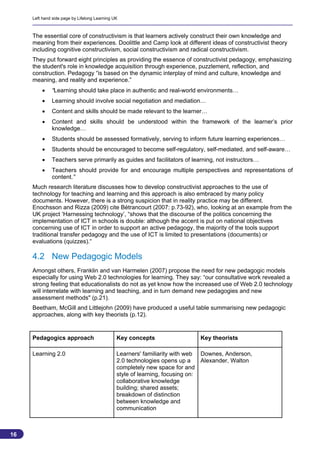
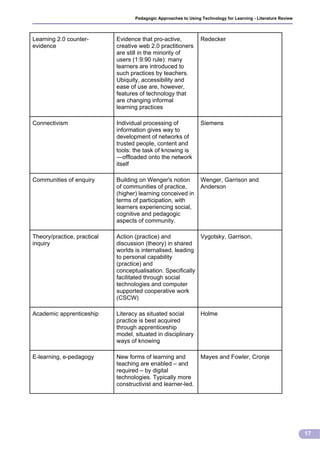
     Beetham, McGill and Littlejohn (2009) have produced a useful table summarising new pedagogic
     approaches, along with key theorists (p.12).


     Pedagogics approach                       Key concepts                  Key theorists

     Learning 2.0                              Learners' familiarity with web Downes, Anderson,
                                               2.0 technologies opens up a     Alexander, Walton
                                               completely new space for and
                                               style of learning, focusing on:
                                               collaborative knowledge
                                               building; shared assets;
                                               breakdown of distinction
                                               between knowledge and
                                               communication


16
                                                                                                        16
Pedagogic Approaches to Using Technology for Learning - Literature Review


Learning 2.0 counter-        Evidence that pro-active,            Redecker
evidence                     creative web 2.0 practitioners
                             are still in the minority of
                             users (1:9:90 rule): many
                             learners are introduced to
                             such practices by teachers.
                             Ubiquity, accessibility and
                             ease of use are, however,
                             features of technology that
                             are changing informal
                             learning practices

Connectivism                 Individual processing of             Siemens
                             information gives way to
                             development of networks of
                             trusted people, content and
                             tools: the task of knowing is
                             ―offloaded onto the network
                             itself

Communities of enquiry       Building on Wenger's notion          Wenger, Garrison and
                             of communities of practice,          Anderson
                             (higher) learning conceived in
                             terms of participation, with
                             learners experiencing social,
                             cognitive and pedagogic
                             aspects of community.

Theory/practice, practical   Action (practice) and           Vygotsky, Garrison,
inquiry                      discussion (theory) in shared
                             worlds is internalised, leading
                             to personal capability
                             (practice) and
                             conceptualisation. Specifically
                             facilitated through social
                             technologies and computer
                             supported cooperative work
                             (CSCW)

Academic apprenticeship      Literacy as situated social          Holme
                             practice is best acquired
                             through apprenticeship
                             model, situated in disciplinary
                             ways of knowing

E-learning, e-pedagogy       New forms of learning and            Mayes and Fowler, Cronje
                             teaching are enabled – and
                             required – by digital
                             technologies. Typically more
                             constructivist and learner-led.


                                                                                                                17
Left hand side page by Lifelong Learning UK


     4.3 Communities of practice
     Within vocational education and work based learning, there has been particular interest in
     communities of practice. The idea of communities of practice is based on situated learning theory
     that emphasises the situated nature of learning. Knowledge in this sense is generated, acquired,
     and transformed through the social interaction within such communities of practice. communities of
     practice are not conceptualised as an educational programme, but the teaching and learning that
     takes place in such a community is part of the daily practice (Attwell and Luebcke, forthcoming).
     Mark Smith (2003) has produced a useful summary of research and writings, particularly by Jean
     Lave and Etienne Wenger, on communities of practice.
     Wenger points out that we are all members of different communities of practice:
     “Being alive as human beings means that we are constantly engaged in the pursuit of enterprises
     of all kinds, from ensuring our physical survival to seeking the most lofty pleasures. As we define
     these enterprises and engage in their pursuit together, we interact with each other and with the
     world and we tune our relations with each other and with the world accordingly. In other words we
     learn.
     Over time, this collective learning results in practices that reflect both the pursuit of our enterprises
     and the attendant social relations. These practices are thus the property of a kind of community
     created over time by the sustained pursuit of a shared enterprise. It makes sense, therefore to call
     these kinds of communities of practice” (Wenger 1998, p.45).
     Although the nature and composition of these communities varies members are brought together
     by joining in common activities and by “what they have learned through their mutual engagement in
     these activities” (Wenger,1998).
     According to Wenger (1998), a community of practice defines itself along three dimensions:
             “What it is about – its joint enterprise as understood and continually renegotiated by its
              members…
             How it functions - mutual engagement that bind members together into a social entity...
             What capability it has produced – the shared repertoire of communal resources (routines,
              sensibilities, artefacts, vocabulary, styles, etc.) that members have developed over time”
              (see, also Wenger 1999, p.73-84).
     A community of practice involves much more than the technical knowledge or skill associated with
     undertaking some task. Members are involved in a set of relationships over time (Lave and Wenger
     1991, p.98) and communities develop around things that matter to people (Wenger, 1998). The fact
     that they are organising around some particular area of knowledge and activity gives members a
     sense of joint enterprise and identity. For a community of practice to function, it needs to generate
     and appropriate a shared repertoire of ideas, commitments and memories. It also needs to develop
     various resources such as tools, documents, routines, vocabulary and symbols that in some way
     carry the accumulated knowledge of the community. In other words, it involves practice: ways of
     doing and approaching things that are shared to some significant extent among members.
     Rather than looking to learning as the acquisition of certain forms of knowledge, Jean Lave and
     Etienne Wenger have tried to place it in social relationships – situations of co-participation. As
     William F. Hanks puts it in his introduction to their book: “Rather than asking what kind of cognitive
     processes and conceptual structures are involved, they ask what kinds of social engagements
     provide the proper context for learning to take place” (1991, p.14). It is not so much that learners
     acquire structures or models to understand the world, but they participate in frameworks that that
     have structure. Learning involves participation in a community of practice. And that participation
     “refers not just to local events of engagement in certain activities with certain people, but to a more
     encompassing process of being active participants in the practices of social communities and
     constructing identities in relation to these communities” (Wenger 1999: p.4).
     Learning is not seen as the acquisition of knowledge by individuals so much as a process of social
     participation. The nature of the situation impacts significantly on the process.

18
                                                                                                            18
Pedagogic Approaches to Using Technology for Learning - Literature Review


“Learners inevitably participate in communities of practitioners and… the mastery of knowledge and
skill requires newcomers to move toward full participation in the socio-cultural practices of a
community. "Legitimate peripheral participation" provides a way to speak about the relations
between newcomers and old-timers, and about activities, identities, artefacts, and communities of
knowledge and practice. A person’s intentions to learn are engaged and the meaning of learning is
configured through the process of becoming a full participant in a socio-cultural practice. This social
process, includes, indeed it subsumes, the learning of knowledgeable skills” (Lave and Wenger
1991, p.29).
In this there is a concern with identity, with learning to speak, act and improvise in ways that make
sense in the community. What is more, and in contrast with learning as internalisation, learning
seen ‘as increasing participation in communities of practice concerns the whole person acting in the
world’ (Lave and Wenger 1991, p.49). The focus is on the ways in which learning is ‘an evolving,
continuously renewed set of relations’ (ibid., p.50).
Coffield (2008) draws attention to the importance of metaphor and prefers to move from the
acquisition metaphor as “the unacknowledged metaphor behind government policies in education”
(p.8) and the participation metaphor which he says “locates learning “in the simultaneous social
processes of: learning to belong to different ‘communities of practice’...; learning to recognise
changes in our identity because learning changes who we are; learning to create meaning out of
our experiences; and learning what it means to know in practice.” (p.8). From such a viewpoint, he
says, the learner is “transformed into a practitioner, a newcomer becoming an old-timer, whose
changing knowledge, skills and discourse are part of a developing identity – in short, a member of a
community of practice” (Lave and Wenger 1991, p.122).
In a study undertaken by the Institute for Prospective Technological Studies (IPTS) on ‘Pedagogical
Innovation in New Learning Communities’, Aceto et al (2010) say members of online communities
“learn by making and developing connections (intentionally or not) between ideas, experiences,
and information, and by interacting, sharing, understanding, accepting, commenting, creating and
defending their own opinions, their viewpoints, their current situations and their daily experiences.”
(p.6). Personal development, they say, “goes hand-in-hand with other forms of learning, such as
knowledge and skill acquisition for practical and professional aims” (p.6).
This approach has significant impact on the balance between pedagogical models. In the
communities they studied there was more of an emphasis on constructing and creating new
knowledge rather than the focus on teaching or acquiring codified knowledge normal to traditional
education and training environments. They found that “codified knowledge constitutes only a small
proportion of online communities’ learning activities, whereas interaction among peers leads to
knowledge sharing (often based on members’ experience) and knowledge creation (based on a mix
of codified knowledge and new knowledge collaboratively developed).”
More problematic is the issue of how much it is possible to form or even to facilitate the formation of
communities of practice and how much intervention is needed or desirable. Based on six case
studies Aceto et al (ibid.) say “little support is provided to members in structuring and scaffolding
their learning or in developing learning-to-learn competences” (p.6).
They promote the use technology and tools that encourage self-expression and social networking
to support communities of practice. They also propose a series of rubrics to develop such
communities:
      “The information available in the community must be reliable;
      The interest of community members must be kept alive;
      Members need to be educated, through codes of conduct and rules, to self-manage their
       learning processes. In communities where learning is an explicit objective, a key concern is
       to empower individuals’ learning attitudes so that management plays a decreasing role in
       steering the learning process within the community” (p.8).
Communities of practice are clearly an attractive approach to fostering informal learning and
developing work based learning. However, attempts to reconceptualise the pedagogy of
communities of practice for groups of formal learners have proved less successful: it is to be
doubted whether the practice of being a learner provides a strong enough common tie to form a
community in the way Lave and Wenger envisaged.
                                                                                                                    19
Left hand side page by Lifelong Learning UK


     4.4 Activity theory
     A further theoretical approach to developing new pedagogies is that of ‘activity theory’. The activity
     theory model contextualises the interaction between humans and computers with the activity
     systems in which it takes place, recognising the mediation of instruments and tools, rules and
     divisions of labour. Daisy Mwanza and Yrjö Engeström (2005) have written a short summary of the
     ideas behind activity theory and expansive learning.
     “Activity theory presents a collection of basic ideas for conceptualising both individual and collective
     practices as developmental processes of the context in which human activities normally takes place
     (Engeström, Y.,1987) (Leontev, A.,1978). The idea of studying human activities as developmental
     processes is crucial for identifying changes and contradictions that exist in an activity. Therefore,
     contradictions serve as the means by which new knowledge about the activity being examined
     emerges (Engeström, Y.,1987.” (p.4). According to Leontev (1978), the concept of activity entails a
     complete system of human practices. Engeström (1987) conceptualised a representational model
     to portray the various elements of an activity system.
     The ‘activity triangle model’ or activity system representationally outlines the various components of
     an activity system into a unified whole. Participants in an activity are portrayed as subjects
     interacting with objects to achieve desired outcomes. In the meanwhile, human interactions with
     each other and with objects of the environment are mediated through the use of tools, rules and
     division of labour. Mediators represent the nature of relationships that exist within and between
     participants of an activity in a given community of practices. This approach to modelling various
     aspects of human activity draws the researcher’s attention to factors to consider when developing a
     learning system. However, activity theory does not include a theory of learning, instead, activity
     theory oriented pedagogical concepts are incorporated in Engeström’s (1987) theory of ‘expansive
     learning’.
     Engestrom says: "The pedagogical stance of the activity-theoretical concept of expansive learning
     differs from traditional types of learning in that:
     (a) The contents and outcomes of learning are not merely knowledge in texts and the heads of
     students but new forms of practical activity and artefacts constructed by students and teachers in
     the process of tackling real-life projects or problems - it is ‘learning what is not yet known’.
     (b) Learning is driven by genuine developmental needs in human practices and institutions,
     manifested in disturbances, breakdowns, problems, and episodes of questioning the existing
     practice.
     (c) Learning proceeds through complex cycles of learning actions in which new objects and motives
     are created and implemented, opening up wider possibilities for participants involved in that activity.
     This perspective on teaching and learning highlights the potential impact of new tools as vehicles
     for transforming activity procedures” (p. 4).

     4.5 Vygotsky and social constructivism
     Socio constructivist approaches to learning are at least in part based on the ideas of Vygotsky.
     Vygotsky considered that all artefacts are culturally, historically and institutionally situated. “In a
     sense, then, there is no way not to be socioculturally situated when carrying out an action.
     Conversely there is no tool that is adequate to all tasks, and there is no universally appropriate
     form of cultural mediation. Even language, the 'tool of tools' is no exception to this rule.” (Cole and
     Wertsch,1996).
     Vygotsky’s research focused on school based learning. He developed the idea of the ‘zone of
     proximal development’ which is the gap between ‘actual developmental level’ which children can
     accomplish independently and the ‘potential developmental level’ which children can accomplish
     when they are interacting with others who are more capable peers or adults.
     In Vygotsky's view, interactions with the social environment, including peer interaction and/or
     scaffolding, are important ways to facilitate individual cognitive growth and knowledge acquisition.
     Therefore, learning presupposes a specific social nature and a process by which children grow into
20
                                                                                                           20
Pedagogic Approaches to Using Technology for Learning - Literature Review


the intellectual life of those around them. Vygotsky said that learning awakens a variety of internal
developmental processes that are able to operate only when the child is interacting with people in
his (sic) environment and in cooperation with his peers. Once these processes are internalized,
they become part of the child's independent developmental achievement (Vygotsky, 1978).
Vygotsky also emphasized the importance of the social nature of imaginative play for development.
He saw the imaginary situations created in play as zones of proximal development that operate as
a mental support system (Fleer, 2008).
Vygotsky tended to see the creation of a zone of proximal development as a sequential process
within schools. But the idea of the zone of proximal development can be posited as also taking
place in a non sequential and episodic manner within a workplace (Pachler, Bachmair and Cook,
2010). Workplace activities can be seen as opening a ‘zone of transitional development’ for
learning in which there is a gap between the actual developmental level of an individual and the
potential developmental level.
Vykotsky called teachers - or peers - who supported learning in the zone of proximal development
as the ‘more knowledgeable other’ (MKO). “The MKO is anyone who has a better understanding or
a higher ability level than the leaner particularly in regards to a specific task, concept or process.
Traditionally the MKO is thought of as a teacher, an older adult or a peer” (Dahms et al, 2010). But
the MKO can also be viewed as a learning object or social software which embodies and mediates
learning at higher levels of knowledge about the topic being learned than the learner presently
possesses.
Attwell (2010 (a)) has looked at Vygotsky’s ideas in relation to ‘technology enhanced learning’ and
particularly ‘personal learning environments’. The role of a personal learning environment may be
not only that of a tool to provide access to more knowledgeable others but as part of a system to
allow learners to link learning to performance in practice, though work processes. And taking a
wider view of artefacts as including information or knowledge accessed through a personal learning
environment, reflection on action or performance may in turn generate new artefacts for others to
use within a zone of proximal development. Scaffolding learning may be a way in which this
process can take place.

4.6 Scaffolding learning
Scaffolding was not a term originally used by Vygotsky, but is one of a number of somewhat similar
ideas around learning which have come to be associated with Vygtotsky's ideas (Emihovich and
Souza Lima, 1995).
Scaffolding is a six-step approach to assisting learning and development of individuals within their
zone of proximal development (Feden and Vogel, 2006). Knowledge, skills and prior experiences,
which come from an individual's general knowledge, create the foundation of scaffolding for
potential development. At this stage, students interact with adults and/or peers to accomplish a task
which could possibly not be completed independently. The use of language and shared experience
is essential to successfully implementing scaffolding as a learning tool. (Feden and Vogel, 2006,
cited in Dahms et al, 2007).
Dahms et al (2007) say that Vygotsky's findings suggest methodological procedures for the
classroom. "In Vygotskian perspective, the ideal role of the teacher is that of providing scaffolding
(collaborative dialogue) to assist students on tasks within their zones of proximal development”
(Hamilton and Ghatala,1994). During scaffolding the first step is to build interest and engage the
learner. Once the learner is actively participating, the given task should be simplified by breaking it
into smaller sub-tasks. During this task, the teacher needs to keep the learner focused, while
concentrating on the most important ideas of the assignment. One of the most integral steps in
scaffolding consists of keeping the learner from becoming frustrated. The final task associated with
scaffolding involves the teacher modelling possible ways of completing tasks, which the learner can
then imitate and eventually internalise” (Dahms et al., 2007).
According to Lindsay Lipscomb, Janet Swanson, and Anne West, Lange (2002) there are two
major steps involved in instructional scaffolding: first, the “development of instructional plans to lead
the students from what they already know to a deep understanding of new material,” and second,
the “execution of the plans, wherein the instructor provides support to the students at every step of
                                                                                                                     21
Left hand side page by Lifelong Learning UK


     the learning process.” In an appropriate scaffolding process, there will be specific identifiable
     features that are in place to allow facilitation of assisting the learner in internalizing the knowledge
     until mastery occurs. Applebee and Langer (1983) identify these five features as:
             “Intentionality: The task has a clear overall purpose driving any separate activity that may
              contribute to the whole.
             Appropriateness: Instructional tasks pose problems that can be solved with help but which
              students could not successfully complete on their own.
             Structure: Modeling and questioning activities are structured around a model of appropriate
              approaches to the task and lead to a natural sequence of thought and language.
             Collaboration: The teacher’s response to student work recasts and expands upon the
              students’ efforts without rejecting what they have accomplished on their own. The teacher’s
              primary role is collaborative rather than evaluative.
             Internalization: External scaffolding for the activity is gradually withdrawn as the patterns are
              internalized by the students” (p. 6).
     Vygotsky conceived of the idea of zones of proximal development within a formal educational
     setting. The issue of identifying or creating potential zones of proximal development may be more
     problematic within a workplace setting. Ravenscroft (2009) suggests one approach is “the more
     spontaneous creation of a [zone of proximal development] ZPD in response to a problem.” Or, he
     asks, “do we set up less formal ZPDs, that are still identifiable as a ZPD, but less defined and rigid
     than Vygotsky spoke of.” (p.4). The idea of boundary objects may help in this respect.

     4.7 Boundary objects
     Boundary objects are another idea associated with Vygotsky and have attracted particular interest
     by those interested in communities of practice. The idea was introduced by Susan Leigh Star and
     James R. Griesemer (1989):
     “Boundary objects are objects which are both plastic enough to adapt to local needs and
     constraints of the several parties employing them, yet robust enough to maintain a common identity
     across sites. They are weakly structured in common use, and become strongly structured in
     individual-site use. They may be abstract or concrete. They have different meanings in different
     social worlds but their structure is common enough to more than one world to make them
     recognizable means of translation. The creation and management of boundary objects is key in
     developing and maintaining coherence across intersecting social worlds” (p.387-420).
     According to Denham (2003) “boundary objects serve as point of mediation and negotiation around
     intent” and can comprise a place for shared work. Denham goes on to say “Boundary objects are
     not necessarily physical artefacts such as a map between two people: they can be a set of
     information, conversations, interests, rules, plans, contracts, or even persons.”
     As a class of knowledge artefacts their importance may lay in their role in dynamic knowledge
     exchange and are “associated with process, meaning, participation, alignment and reification.”
     Whilst reports and documents may be considered boundary objects, they can also be seen as
     information spaces for the creation of knowledge. Mazzoni and Gaffuri (2009) consider that
     Personal Learning Environments may be seen as boundary objects in acting to support transitions
     within a Zone of Proximal Development between knowledge acquired in formal educational
     contexts and knowledge required for performance or practice within the workplace.

     4.8 Models for a pedagogic toolkit
     Conole, Dyke, Oliver and Seale (2004), have proposed a toolkit and model for mapping pedagogy
     and tools for effective learning design. They say "Toolkits are model-based resources that offer a
     way of structuring users’ engagement that encourages reflection on theoretical concerns as well as
     supporting the development of practical plans for action (Conole & Oliver, 2002). The models that
     form the heart of each toolkit consist of representations of a ‘space’, described in terms of qualities,
     in which theories or approaches can be described." They emphasise that "the descriptions of these
22
                                                                                                            22
Pedagogic Approaches to Using Technology for Learning - Literature Review


approaches reflect the beliefs of describer. These models are thus best understood as sharable
representations of beliefs and of practice, rather than as definitive account of the area" (p.18).
The framework they propose consists of the following six components (p.22-23):
      “Individual – Where the individual is the focus of learning.
      Social – learning is explained through interaction with others (such as a tutor or fellow
       students), through discourse and collaboration and the wider social context within which the
       learning takes place.
      Reflection – Where conscious reflection on experience is the basis by which experience is
       transformed into learning.
      Non-reflection – Where learning is explained with reference to processes such as
       conditioning, preconscious learning, skills learning and memorisation (Holford, Jarvis, &
       Griffin, 1998).
      Information – Where an external body of information such as text, artefacts and bodies of
       knowledge form the basis of experience and the raw material for learning.
      Experience – Where learning arises through direct experience, activity and practical
       application.”

4.9 Curriculum development and rhizomatic knowledge
Learners' familiarity with web 2.0 technologies is seen as opening up new spaces and opportunities
for learning, focusing on collaborative knowledge building; shared assets and a breakdown of
distinctions between knowledge and communication. Such changes are seen as challenging
traditional forms of curriculum and knowledge development.
In a paper entitled ‘Rhizomatic Education : Community as Curriculum’, Dave Cormier (2008)
locates traditional forms of curriculum development within societal forms of knowledge production.
“Information is the foundation of knowledge. The information in any given field consists of facts and
figures, such as may be found in the technical reference manuals of learning; in a nonrhizomatic
model, individual experts translate information into knowledge through the application of checks
and balances involving peer review and rigorous assessment against a preexisting body of
knowledge. The peers and experts are themselves vetted through a similar sanctioning process
that is the purview, largely, of degree-granting institutions. This process carries the prestige of a
thousand-year history, and the canon of what has traditionally been considered knowledge is
grounded in this historicity as a self-referential set of comparative valuations that ensure the growth
of knowledge by incremental, verified, and institutionally authorized steps.
In this model, the experts are the arbiters of the canon. The expert translation of data into verified
knowledge is the central process guiding traditional curriculum development” (p.2).
Cormier (2008) suggests that the present speed of information flows based on new technologies
has undermined such processes. The explosion of freely available sources of information has
helped drive rapid expansion in the accessibility of the canon and in the range of knowledge
available to learners. We are being forced to re-examine what constitutes knowledge and are
moving from expert developed and sanctioned knowledge to collaborative forms of knowledge
construction. Tools such as social networking and wikis are facilitating such processes. Social
learning practices are leading to new forms of knowledge discovery. “Social learning is the practice
of working in groups, not only to explore an established canon but also to negotiate what qualifies
as knowledge” (p.3). Cormier cites Brown and Adler (2008) who say "The most profound impact of
the Internet, an impact that has yet to be fully realized, is its ability to support and expand the
various aspects of social learning" (p.18).
Cormier proposes a ‘rhizomatic model’ of learning in which “a community can construct a model of
education flexible enough for the way knowledge develops and changes today by producing a map
of contextual knowledge” (p.4). In this model, “curriculum is not driven by predefined inputs from
experts; it is constructed and negotiated in real time by the contributions of those engaged in the

                                                                                                                     23
Left hand side page by Lifelong Learning UK


     learning process. This community acts as the curriculum, spontaneously shaping, constructing, and
     reconstructing itself and the subject of its learning…” (p.3).

     4.10 Discourse, collaboration and meta cognition
     Many of the attempts to reconstitute pedagogical theory are based on discourse and collaboration.
     “Perhaps the most notable shift in instructional psychology during the last quarter of the 20th
     century was the shift from focus on individual cognitive strategies to focus on community, culture,
     and collaboration” (Scardamalia and Bereitner, 2008, p 5).
     Scardamalia and Bereitner propose a pedagogic framework based on the development of deep
     content knowledge, knowledge building dialogue, epistemic agency and collaboration. Deep
     content knowledge can be supported by allowing students to move between an inclusive and
     integrative level of analysis, a more detailed level and analogous ideas. They propose to focus on
     ‘ideational content’ rather than utterance to promote dialogue. Supporting them in becoming
     knowledge managers of their own ideas and taking responsibility for their peer knowledge building
     supports the development of higher levels of epistemic agency. Collaboration can be supported
     through allowing them to cite and link to each others’ work.
     Coffield (2008) cites Robin Alexander (2006) who argues for “education as dialogue” (p.15), where
     dialogue is more purposeful, elaborated and principled than communication skills.
     Interaction, says Alexander, is more likely to be dialogic if it is:
             collective: tutors and students learn together in groups or classes;
             reciprocal: tutors show that they have listened to what the learners said and vice-versa;
             supportive: tutors and students help each other to learn and avoid point scoring;
             cumulative: tutors and students build on their own past learning and on each others’ ideas’
             Purposeful: dialogue is not mere conversation but has specific educational goals in mind”
              (Coffield 2008) (p.37).
     There is increasing interest in the idea of meta cognition and how to support learners in developing
     meta cognition. The idea builds on constructivist and Vygotskian learning approaches in supporting
     learners in constructing their own models to help them make sense of their experiences. Teachers
     support this through collaboration, challenge and dialogue. Coffield (2008) says “all learners should
     know how to: set themselves explicit, challenging goals; identify appropriate strategies to reach
     those goals; monitor their progress towards them; and restart the whole process by choosing a new
     set of sensible goals” (p.39).

     4.11 Bricolage
     The process of using technology for creation, remixing and sharing is similar to Levi Strauss's idea
     of bricolage as a functioning of the logic of the concrete. In his book 'Introducing Levi Strauss and
     Structural Anthropology', Boris Wiseman (2000) explains the work of the bricoleur:
     “Unlike the engineer who creates specialised tools and materials for each new project that he
     embarks upon, the bricoleur works with materials that are always second hand.
     In as much as he must make do with whatever is at hand, an element of chance always enters into
     the work of the bricoleur...
     The bricoleur is in possession of a stock of objects (a “treasure”). These possess “meaning” in as
     much as they are bound together by a set of possible relationships, one of which is concretized by
     the bricoleur’s choice”.
     Young people today are collecting their treasure to make their own meanings of objects they
     discover on the web. In contrast our education systems can be seen as being based on specialised
     tools and materials.


24
                                                                                                          24
Pedagogic Approaches to Using Technology for Learning - Literature Review


4.12 Learning styles
There is a surprising emphasis in research literature, particularly by technology driven projects in
education, on learning styles. Frank Coffield (2008) who undertook an in depth study of learning
styles as part of the UK Social Science Research Council’s Teaching and Learning Research
Programme says there is no “convincing evidence that learners can be divided by their learning
preferences into four groups: visual, auditory, kinaesthetic or tactile learners.” He says “this
movement allows its disciples the pretence of student-centred teaching, and it neatly transfers the
responsibility of students’ failure to learn to tutors, eg ‘You didn’t match your teaching style to their
learning styles’” (p.32). Coffield refers to his previous research which found that “there is no
evidence that the model is either a desirable basis for learning or the best use of investment,
teacher time, initial teacher education and professional development” (Coffield et al. 2004 (a), p35).
Rather than learning styles Coffield (2008) recommends Noel Entwistle’s use of ‘deep’, ‘surface’
and ‘strategic’ approaches to learning, terms which, he says, “provide us with an appropriate
lexicon.”


                                                                                                                     25
Left hand side page by Lifelong Learning UK


     5. The impact of technologies on pedagogy
              in practice
     5.1 The rhetoric-reality gap
     Compared to the school or university sectors, there is limited data available on the impact of
     technology on the further education and lifelong learning sector. What data and research there is
     presents conflicting pictures. Hadyn (2008) observes that there are problems from survey data in
     understanding what is happening in practice.
     E-learning practice has frequently been seen as being technologically rather than pedagogically
     driven (Vogel, 2010). Thus many surveys have looked at the availability of technology. Other
     surveys report on use, but pay no attention to pedagogy. Surveys on impact have tended to
     attempt to quantify impact in terms of student outcomes: an almost impossible undertaking given
     the many different possible causal factors.
     There are many case studies of effective practice, but these tend to be reporting on project
     activities and may not be generalised across a whole department, let alone an institution. It would
     appear that the impact of technologies in practice varies greatly, between institutions and within
     institutions. Implementation in the further education college sector as a whole is still at a relatively
     early stage with much unevenness in development both between and within institutions (Finlayson,
     Maxwell, Caillau and Tomalin, 2006). Golden et al (2006) point to the lack of empirical evidence
     regarding the impact of e-learning especially on variations across subject areas and within further
     education. There is almost no survey data on the impact of technology on pedagogy.
     “In spite of political commitment and financial investment, there still appears to be a ‘rhetoric-reality
     gap’ between the claims made for the use of ICT in education, and what is current practice. ...It has
     proved more difficult than envisaged to disseminate good practice in the use of ICT. In particular,
     the belief that expertise and ideas could be simply disseminated via electronic networks has proved
     to be misplaced” (Hadyn, 2008, p.2).
     Vogel (2010) reports that in their work for The Observatory on Borderless Higher Education, Becker
     and Jokivirta (2007) found that although over three quarters of Commonwealth institutions had
     implemented an institution-wide online learning platform, less than one quarter had integrated them
     into learning and teaching activities to a significant degree. This, Vogel says corresponds with the
     HEA (2008) observation that "at senior level in institutions there is sometimes compliance with the
     rhetoric of e-learning and technology-enhanced learning and teaching, with no clear evidence that
     this is truly understood" (p.28).
     It would appear that the situation is similar in the UK. Although Becta (2006) found that 52 per cent
     (down from 53 per cent in 2004) used technology to support learning, this typically took place
     outside scheduled learning and was complementary to the main learning programme. The main
     uses were for research and technology-based exercises for revision or practice. In many cases
     these activities were carried out entirely at the initiative of the student.
     Becta said the use of ICT as a traditional classroom tool was widespread in 34 per cent of colleges.
     However it is not entirely clear what the technology was being used for. Becta say this category
     include the use of display screen technologies (presumably using overhead projectors). 31 per cent
     of colleges reported using ICT and e-learning with traditional learning resources to produce
     blended learning, a figure which had increased steadily over the years.
     In a survey on the scale and breadth of e-learning in further education in England, undertaken by
     the National Foundation for Educational Research, Golden, McCrone, Walker and Rudd (2006)
     found the majority of lecturers used e-learning in their teaching practice. However this was most
     commonly to research, access and create teaching materials and prepare lesson plans.
     Technology was used less frequently to communicate with learners, track learners’ progress and
     provide one-to-one attention.
26
                                                                                                           26
Pedagogic Approaches to Using Technology for Learning - Literature Review


They concluded that “e-learning did appear to be having a noticeable impact on some intermediate
learner outcomes and on some aspects of teaching practice.”
Somewhat unsurprisingly, they reported the teaching tasks where e-learning was felt to have most
impact largely reflected those where it was most used!
Lecturers felt technology to be helping students in being more effective at researching and
presenting work and also that e-learning helped in reinforcing their knowledge and developing their
understanding.
“Lecturers’ use of e-learning was associated more with their own attitudes and confidence than with
their personal background characteristics or the context of their institution. In addition, the extent to
which lecturers felt that they had sufficient access to e-learning resources, and support, were
associated with having a positive attitude. These are not proven causal relationships but it seems
likely that the interrelationships between use, confidence, attitude and access operate multi-
directionally, working to reinforce one another, either positively or negatively” (p.4).
The issue of lack of access to appropriate and reliable technologies appears repeatedly in the
literature, despite the considerable investment in technology procurement in the sector. However it
would appear access to technology is not enough. There has been particularly heavy investment in
virtual learning environments and in interactive whiteboards in the further education sector in
England. The major issue is how they are being used and whether they are being used for teaching
and learning, rather than for managing learners, as file repositories or for video and PowerPoint
projection. What evidence there is suggests a limited use for teaching and learning and that the
root of the issue is lack of pedagogic knowledge in the use of learning technology within teachers’
own subject areas.
In their report on ‘Brilliant teaching and training in FE and skills: Sources of evidence’, IfL (2010 (c))
found that video, digital photography and interactive tools were the most commonly used
technologies in the previous year. However, fewer than 20 per cent of members were planning to
use these again in the forthcoming year.
IfL (ibid) asked their members how confident they felt about using new technologies. 60 per cent of
respondents were either ‘confident’ or ‘extremely confident’; however, 38 per cent said they were
‘not confident’. Ifl reports that a large proportion of respondents (54 per cent) said the thing that
would be most useful to them with regard to new technologies is training in how to make best of
technology in their practice. The survey of their members revealed the majority becoming more
confident in using technology, “with the highest percentage identifying virtual learning environments
(VLEs) as the most used tool for sharing good practice, information and ideas with colleagues,
peers and learners.”
But the survey also found that 38 per cent of the members surveyed were not confident in using
new technologies such as social networking, podcasts, webcasts, blogs and wikis for their
professional development and to support teaching and learning. Indeed, some members,
unprompted, asked for extra help in the use of these technologies for teaching and learning.
IfL (2010 (d)) also report that learners have high expectations of teachers’ abilities to use
technology and that the best teachers and trainers are inventive with technology to enhance the
learning experience and to inspire. However, they say, “the evidence collected from learners
suggested that only a very few teachers are using technology in the most effective way to ‘lift our
sights’ and that good teachers could become brilliant by increasing their use of Information and
communication technologies.”

5.2 Subject areas and technologies
In a report for the Department of Education and Skills, entitled ‘e-Learning in Further Education, the
Impact of Student Intermediate and End- Point Outcomes’, Finlayson, Maxwell, Caillau and
Tomalin (2006) suggested the pattern of use of computers during class time by students was
determined by the subject areas for which they were being used.
However in terms of teachers the use of interactive white boards and data projectors were much
the same across different subjects within individual institutions, but varied widely between colleges.

                                                                                                                      27
Left hand side page by Lifelong Learning UK


     Case studies suggested the most important reasons for using technology were for “the
     management of learning, in particular giving the students flexible conditions in which to work, and
     sharing and reusing learning and teaching resources” (p 42).
     They found teaching in the vocational and HSC subject areas to be generally student focused,
     although the expectations that the tutors had of their students varied considerably between tutors,
     irrespective of the level of the course.
     Computers were rarely used in mathematics and science, due to the lack of availability of
     equipment or due to teachers not seeing the pedagogic relevance to their subject area.
     In an important finding for this literature review they found that “the level of the tutors' general
     pedagogic knowledge and skill in ILT [information and learning technology] was only deployed
     effectively where the tutors possessed a sound understanding of generic and subject specific
     pedagogy. In these cases tutors chose appropriate e-learning uses to meet their pedagogic aims,
     and integrated these e-learning uses into their overall repertoire of teaching approaches to
     maximise student outcomes” (p.53).
     The importance of tutors knowing about the use of e-learning appropriate to their own subjects was
     underlined. Where tutors were not aware of how to use information and learning technology within
     their subject they made only limited or inappropriate use of e-learning. Finlayson et al emphasise it
     is not enough for teachers to know how to put materials onto a virtual learning enviornment, but
     they also need to know how to “design the materials and the accompanying student tasks to
     support the learners in developing both their understanding and their autonomy” (p.53).

     5.3 ICT skills and pedagogy
     Technical training has not helped in dealing with pedagogic issues. “All too often tutors were putting
     materials onto the VLE, but these were rarely used by the students.” (Finlayson et al, 2006).
     A key enabler in helping with the effective use of ICT for learning was “training that focuses on how
     to use ILT to support learning and teaching, and incorporates subject specific training, including
     information on the range of resources” (p.63).
     In this regard it was important to allocate time to individual tutors, and tutor teams, “to develop their
     ILT knowledge and skills, to work collaboratively to create, source and adapt ILT resources, and to
     develop, implement and review approaches to ILT use appropriate to their subject and their learner
     groups” (p.63).
     Conversely they found that key barriers to the effective use of technology for learning in further
     education were “training that primarily focuses on the development of ICT skills, or that is limited
     only to generic ILT knowledge and skills” and “lack of support for tutors who work in isolation” (p.6).
     They felt that part time tutors were particularly disadvantaged in not having been given time for the
     development of ILT knowledge, skills and resources.
     The issue of subject skills and the use of technology for teaching and learning is seen as important
     by many researchers. Frank Coffield (2008) quotes the inspectors of schools as saying: “Senior
     managers in further education colleges should...prioritise the development of trainers’ subject-
     specialist skills and knowledge across all aspects of the training.” (Ofsted, 2008, p.6).
     However as Coffield (ibid) points out, this raises the issue of what vocational knowledge and what
     vocational pedagogy trainees and their tutors need to possess. Coffield refers to Michael Young
     (2008) who argues that trainees need three types of knowledge: specialist disciplinary knowledge,
     context-specific knowledge (learned at work), and trans-sectoral knowledge (general education
     rather than ‘core skills’).


28
                                                                                                            28
Pedagogic Approaches to Using Technology for Learning - Literature Review


5.4 Vocational knowledge
The issue of knowledge as seen form a vocational standpoint is important. It has considerable
implications for pedagogic approaches to using technology for teaching and learning and
differentiates practice in vocational education from practice in teaching and learning in general
schools or universities. Philipp Grollmann (2008) looks at these issues from a German standpoint.
Supporting the technical or professional learning processes of students requires teachers to
integrate knowledge about the content as well as the appropriate methods and forms of learning,
he says, while preparation of students for work through the support of learning processes leads to
general work-related attitudes and competences as well as their role in society.
The issue of the relationship between what is learnt and how it is learnt and the world of work is
also taken up by Lipsmeier, (2001 a, b). Changes in the labour markets and work organizations
affect the practice of vocational education and learning on the very practical level of what is
available and can be enacted in vocational education institutions.
Grollmann (ibid) points out that vocational colleges often have an extended role in supporting
innovation and learning at a regional level as well as providing CPD for employees, often related to
the introduction of new technologies.
The German researcher Peter Gerds (2001) introduced the term ‘process knowledge of vocational
education’, which later became known in English as ‘work process knowledge’ (Boreham et al,
2002). It describes the domains of knowledge that must be taken into consideration in the fulfilment
of the professional tasks of vocational teachers. Besides explicit knowledge (for example,
knowledge of educational methods, knowledge and teaching of subjects) and formal knowledge of
the education system and the educational establishment, Gerds emphasizes the implicit knowledge
of vocational teachers (practical experience in work and teaching, vocational pedagogical skills).
IfL (2010 (a)) has stated the “dual professionalism of its members means that teachers and trainers
are both experts in their subject, with current vocational skills and knowledge, and in teaching and
training methods, kept up to date through highly individualised professional learning.”
If we overlay this perspective with the use of technology for learning, this would suggest a three-
fold orientation to using technology in practice for teaching and learning in vocational education.
First, the general use of technology as a tool for teaching and learning, second the use of
technology within vocational and subject didactics or pedagogy, but third is the use of technology
within the work processes for the vocational area.
Neiss (2005) claims that developing a technology-enhanced pedagogical content knowledge in
mathematics – and also science – is “dependent on the student teachers‘ views on the integration
of technology in combination with the nature of the discipline.” (Enochsson and Rizza, 2009, p.19).
A number of researchers point to the importance of teaching teams in bringing together the
different knowledge required. The 'Ducktectives' project at Whittle College took this further in
developing collaboration between a landscape design tutor and a new media designer, “who clearly
learned much from each others' design practices” (Beetham, McGill and Littlejohn, 2009, p.57-58).
Students of landscape design engaged with school children to develop a shared understanding of a
playground site and used digital technologies including global positioning systems and personal
digital assistant (PDAs) as part of a game that the students devised to help children express their
ideas and engage with the design process. The task focused on their creativity, client-facing
communication skills and problem-solving capabilities.
The issue of vocational pedagogies is complex. IfL (2010 (b)) have called on the forthcoming Wolf
Review to “make the case for an independent inquiry into vocational pedagogy and establish the
basis for comprehensive research into vocational teaching and training, drawing on the experience
of expert teachers and trainers.”


                                                                                                                    29
Left hand side page by Lifelong Learning UK


     5.5 Subjects and learners
     Of course it is not only subject differences which are important in influencing approaches to
     pedagogic designs for learning, but also the nature of the learners. The Camel project (JISC/
     HEFC, 2006) provides an example from Leeds Technology College with considerable differences
     between courses for different student groups, e.g. between the Print courses and those of the
     Professional Development Unit where evidence of professional reflection is an important aspect of
     the curriculum. “The approaches recognise that the needs of someone who has done a job for
     many years and now needs a certificate to prove their abilities are different from those of someone
     taking an ‘improving’ course” (ibid, p.15).
     The Camel project suggests another barrier to the creative pedagogic use of technology is “the
     demands of the competitive environment” (p.14) in which colleges exist. Leeds College of
     Technology felt they were forced to make pragmatic choices between new pedagogic approaches
     and a focus on exam results and qualifications even though more reflection might prepare learners
     better for the world of work. This was leading to “an emphasis on what is needed to pass the exam
     rather than on the educational experience with the result that some courses are heavily text based
     rather than activity based.” “This is not an unusual situation” (p.14), commented the JISC report.

     5.6 Workplace and informal learning
     At a pedagogic level, it may be that the greatest impact of the use of technologies for learning is in
     informal and workplace learning (Attwell, 2010). The findings of the Information and Communication
     Technologies and Small and Medium Enterprises project, which was based on 106 case studies in
     six European countries (Attwell, 2007), focused on the use of technologies for informal learning.
     The study suggested that although social software was used for information seeking and for social
     and communication purposes it was also being widely used for informal learning. In such a context:
             “Learning takes place in response to problems or issues or is driven by the interests of the
              learner;
             Learning is sequenced by the learner;
             Learning is episodic;
             Learning is controlled by the learner in terms of pace and time;
             Learning is heavily contextual in terms of time, place and use;
             Learning is cross disciplinary or cross subject;
             Learning is interactive with practice;
             Learning builds on often idiosyncratic and personal knowledge bases;
             Learning takes place in communities of practice” (p.172).
     Although there may be no formal learning programme or teacher, Attwell suggests that peer
     learning is enabled though the Internet, in line with Vygotsky’s ideas of learning being facilitated by
     a ‘significantly knowledgeable other’ (Vygotsky, 1978).
     However researching the impact of technology on practice in the work based learning sector is
     problematic. Literature on the use of ICT in the work based learning is patchy - partly because of
     the heterogeneous nature of the sector, which makes it difficult to generalise, and partly because of
     the diversity of the research base. Some studies have focussed on small and medium enterprises,
     some on large companies, some cover both (for example the Mackinnon survey for Becta and the
     Association of Learning Providers (ALP), 2006). Moreover, within the ‘independent’ sector, some
     training is supported by public funding, which imposes certain requirements in terms of trainer
     competence and qualification and some (unfunded) training, which does not.
     As the European Centre for the Development of Vocational Training (CEDEFOP) (2003) notes: “In
     many cases the focus is the training of trainers in the state rather than the private sector, for
     example, trainers working for regional or state training agencies. There is also a bias in the
     [research] sample towards the training of teachers in, or for, the higher education sector. Future
30
                                                                                                          30
Pedagogic Approaches to Using Technology for Learning - Literature Review


research may need to focus on trainers working and training in the private sector, both SME and
corporate.”
Also, many of the cutting edge researchers involved in work-based learning are outside the UK
where vocational education and training (VET) research is better established and there are major
differences in work organisation, vocational cultures and labour market regulation between
countries which make it difficult to draw useful conclusions.
Another problem has been a growing criticism of the validity and reliability of some of the large
scale transnational research projects into the training of trainers - notably that sample sizes are not
big enough and data capture categories are too crude to reflect significant national diversity.
Finally, there is some ambiguity in the way searches on work-based learning and work place
learning generate information relating to training in commercial or industrial concerns but also
relating to work-place based CPD for teachers in the public education system.

The extent of the problem across Europe

Deitmer and Heinemann (2009) claim that the traditional model of training in large companies is
changing. There is a trend towards closing training workshops and training centres and towards
decentralised learning within the work process. They note that in German companies there has
been a 30 per cent cutback in full time trainers in the last 10 years whilst maintaining the same
numbers of apprentices. This is supported by The EUROTRAINER I (2008) study which set out to
provide an overview and analysis of the situation of trainers in enterprises in the 32 European
countries, looking in particular at their tasks and responsibilities, competences, initial training and
CPD. It concluded that not only is the number of full time trainers diminishing but that the definition
of ‘trainer’ is being expanded to include the increasing number of workers have a training or
mentoring role in addition to their normal work.
Running in parallel with this trend, the Eurotrainer report (ibid) also noted that “instruction-based
training approaches no longer seem to be appropriate and accepted, neither by trainees nor
companies” but that “a considerable proportion of trainers still revert to conventional learning
methods and training styles”.
They concluded that this was linked to the lack of continuing learning and training opportunities for
trainers and lack of knowledge of, and access to, innovative training methods. That is, although the
delivery model is new, the emerging workplace trainers tend to work quite traditionally, using
teaching and learning methods based on their own experience as learners.
In fact, the Eurotrainer study also found that “the majority of trainers have not been trained at all”
and “In terms of qualifications and skills...in most countries trainers in companies are not expected
to have a particular trainer qualification, but need to be skilled workers with a certain period of work
experience...thus, countries tend to focus on trainers’ vocational background and expertise as a
prerequisite for becoming a trainer, while only a minority of trainers are also expected to have
received some pedagogical training to be able to train others.”
Similarly, a report produced for the European Commission (2010) noted that “for competences in
VET, teachers rely largely on formal training and qualifications. For trainers in industry, a
background as a skilled craftsman was more important with less concern over formal
qualifications.”
Overall, evidence of work-based trainers being familiar with or able to use ICT-based training tools
was scarce. While some countries are engaging in on-line learning and networking initiatives to a
much greater extent than others “it can be expected that only a minority of trainers will be able to
use such tools. Thus, the development of alternative training materials and their easy distribution,
exchange and application should be one priority in the future”. Unsurprisingly, the trainers who did
use ICT were almost exclusively restricted to large multinational companies with in house training
departments and the resources to invest.
The European Commission report on ‘VET Teachers and Trainers: Key Actors to Make Lifelong
Learning a reality in Europe’ (2010) was based on the output of a series of seven data-gathering
seminars with education and training professionals from all member states. It identified one of the
biggest problems in providing training and support for trainers in the use of ICT as “a problem with
                                                                                                                     31
Left hand side page by Lifelong Learning UK


     the definitions of teachers and trainers. Whilst in most countries a ‘VET teacher’ is relatively easy to
     define, trainers are not a homogenous group and there is a wide variation both in the definition and
     practice of trainers. One important distinction in all counties is between those working in school
     driven contexts, those in market driven contexts and those working in company driven contexts.
     The increasing use of work based learning is adding another dimension and this area is becoming
     more dominant.”
     Definitions of teacher competences already exist in most countries. However, there is less clarity
     around defining competences in trainers simply because of the diversity of role and function. Whilst
     the skills and competences for VET teachers and trainers, whether in schools or companies or
     even in the workplace, may be similar, the context in which they operate are very different as are
     the pressures and influences on them.
     Participants at the seminars had been broadly in agreement that formal qualifications were
     important for teachers and should include competences in the use of ICT but were less convinced
     that this was appropriate for trainers, with some feeling that formal qualifications might provide a
     barrier to learning unless there was open access to qualifications, including accreditation through
     prior experience and learning (APEL) and portfolio building. But as the report ironically pointed out
     “Whilst teachers and teacher education institutions are aware of the importance of informal
     learning, this is not yet being recognised in the training and accreditation of teachers and trainers
     themselves...whilst this [APEL] is being implemented for other people [sectors] it is not for the
     teaching profession.”
     This is consistent with their overall finding that as trainers will increasingly need to fund and
     structure their own continuing learning instead of relying on initiatives and support from
     management or public initiatives, both ITT and CPD will need to become increasingly flexible, less
     prescriptive and more individualised.
     The report also documented another interesting discussion around responsiveness to individual
     realities which was whether the small but growing number of teachers and trainers who work
     predominantly or exclusively on-line should be required to undertake the general ITT qualification
     for teachers and trainers. They argued that although some of the knowledge base might be similar,
     the skills and competences were significantly different and that it made no sense to be a student on
     an in-service face-to-face ITT programme. Whilst this may only apply to a minority, the numbers of
     educators working wholly in an online environment will increase rapidly and this needs to be
     anticipated. Similarly, it makes no sense to define either learning on-line or teaching on-line in
     terms of ‘face-to-face’ hours which is a criterion in the ITT and CPD programmes of several
     countries including the UK.
     The earlier CEDEFOP report (2003), comparing the competences, qualifications and accreditation
     routes for teachers in member states, also highlighted this problem.
     “Above all, the major conclusion lies in the limited number of available accreditation procedures.
     Only about 25 % of the cases refer to accredited training programmes for e-tutors”.

     The UK situation

     One of the most detailed pieces of research was the UK based survey of ‘The use of ICT and e-
     learning by work based learning providers’ prepared by the MacKinnon partnership for Becta and
     ALP (2006). This survey was carried out and reported in two consecutive years (2005 and 2006)
     with a sample of 171 and 271 companies, respectively.
     Although the report showed that work based learning providers have invested substantially in their
     ICT infrastructure, they are most commonly using ICT as a tool for registering, assessing and
     monitoring learners or for helping tutors to develop paper-based learning materials rather than for
     training delivery. This is apparently at odds with the figures provided by Colin McCullough (2005)
     who said:
     “While we can observe an increase use and impact of e-learning in large European companies - up
     to 60% of the training needs of key players in the ICT sector is now provided by e-learning - the
     uptake in SMEs is at best slow and does not meet initial hopes and expectations.”

32
                                                                                                          32
Pedagogic Approaches to Using Technology for Learning - Literature Review


The most important section of the Mackinnon report (2006) covers the barriers to the use of ICT
and e-learning that work-based learning providers have identified and some of the support they
would find helpful. In 2005, “Nearly half of providers (47%) identified a lack of skills... as a barrier to
their organisation’s use of ICT to manage or deliver learning in the next two years. However, just
8% report this as the main barrier to its use.”
Other barriers identified include:
       time to investigate or implement e-learning (40 per cent). Most providers (18 per cent)
        identified this as the main barrier;
       lack of knowledge about its potential use and implementation (35 per cent). This was the
        main barrier for (13 per cent) of providers;
       employers’ ICT infrastructure (32 per cent), although this was the main barrier for just 5 per
        cent of providers;
       lack of suitable e-learning material (30 per cent). This was the main barrier for 9% of
        providers.”
By 2006, there had been a slight increase in the number of companies identifying lack of skills in e-
learning suggesting no progress in this area. However there was a 10 per cent decrease in the
number claiming lack of time - which may simply mean that employers are becoming more
convinced that this is an area in which they need to invest time or it could mean that information is
becoming more readily available and less time consuming to find. Similarly, there was a 10 per cent
drop in those claiming that lack of suitable materials was a barrier. This could be because the
amount of on-line learning materials increases year on year or it could be that the emergence of
social software has reduced the reliance on formal learning materials.
Although only half the employers reported a lack of skills as a barrier to using ICT based training,
nearly two thirds said there was a gap between the skills they believe their workforce needs to
deliver and support learning effectively using ICT and the skills they actually have. For nearly half
of providers (44 per cent) the gap is in terms of not having enough people with the right skills.
Around one sixth (15 per cent) report not having the right skills at all.
When asked to break down this skills gap, almost half said teaching and facilitating online (46 per
cent) was a problem and similar numbers said inability to use specialist software (43 per cent), lack
of skill in developing e-materials (42 per cent) and lack of knowledge in how to best to use ICT
resources (42 per cent).
A massive 77 per cent of providers said that lack of time to identify and undertake the necessary
training was the biggest problem and two thirds said it was lack of money. Only a quarter claimed
that there was a lack of quality training available or that there was reluctance on the part of staff to
undertake the training.
Finally providers were asked to identify what support they thought they needed and who should
provide it. Half wanted information about e-learning products, half wanted training for tutors and
assessors and just under half wanted advice on using ICT to deliver learning. Interestingly, only
about a fifth wanted advice customised for their business and about a quarter wanted training for
management staff. This is problematic given that a lot of the available research argues that
successful implementation of e-learning depends on the commitment and understanding of the
management and also rather refutes the claim that e-learning solutions have to be customised and
contextualised.
The majority of providers were expecting the Learning and Skills Councils (60 per cent), ALP (40
per cent) and private companies to provide this support. Only a few said they would use JISC
regional support centres (7 per cent) or Becta (11 per cent).
Other sections of the survey show that providers are thinking more in terms of blended learning
rather than stand-alone computer based training or programmed learning. It also indicates that
evaluation is still a major problem as although providers expect and assume that improved quality
of delivery will increase learner satisfaction, improve retention and deliver better outcomes, there is
little evidence that these are measured systematically. Similarly, over half of those providers that
have developed resources in-house believe they will not recover the costs of their development or
                                                                                                                      33
Left hand side page by Lifelong Learning UK


     do not know if they will. This is at odds with the American research arena which includes many
     return on investment surveys.
     Other slight but important trends highlighted by the Mackinnon report were a move towards using
     networked rather than stand alone resources, an increase in the use of ICT to support collaboration
     between learners and ICT being used by tutors to provide on-line support for learners. In the four
     years since this survey was undertaken, other reports (see, for example the work of the Wales
     eTraining network) have shown that there has been rapid progress and major developments in
     these areas.
     Set against these findings, McCullough (2005) cites a study carried out by Cedefop and the
     European Commission showing that e-learning has had a limited impact on SMEs in terms of those
     who use it and what it is used for. It claimed that use of ICT for learning (in SMEs) was almost
     always limited to managers and ICT based staff. The case studies carried out showed that in five
     European countries there were a number of factors decisive in influencing the development of ICT
     for learning in SMEs. The most significant were:
             the total lack of training culture within the SMEs
             lack of appropriate learning materials
             the attitude of individual managers
             and lack of access to sufficient bandwidth to ensure high quality training.
     He claims:
     “Broadly speaking and with few exceptions, despite spawning a number of new technology
     companies and numerous government and European sponsored programmes the uptake and
     efficacy of learning using ICT has been less than convincing. The development of learning in
     Europe has been dominated by the metaphor of the virtual classroom and the virtual university. It
     has equally been dominated with an obsession with technology and very little attention has been
     paid to vocational and occupational learning or the development of e-learning environments in less
     formal learning contexts.”
     However, this survey was carried out in 2005 and Attwell and Costa (2009) claim that “research
     suggests today that most learning takes place in everyday and work social situations, In other
     words, most of our learning is informal and takes place in a variety of social contexts”. They also
     argue that work is carried out in a social context - this is particularly the case in small and medium-
     sized enterprises and plays a very important part in people's lives. Thus, if e-learning is to make a
     contribution to changing the traditional learning paradigm, it must become embedded in the social
     organisation of the work organisation.
     Another crucial area is the level of support offered to e-learners and who provides this support. The
     Supporting the Workforce Project (IfL, 2010, (a)) explored the differences between the public and
     private sector in terms of support offered to e-learners. Their findings were that, overall, 60 per
     cent of learners felt they did get support but a significant 35 per cent said they did not. However,
     there is a sharp divide both between the public and private sectors and also within the public
     sector. Only 24 per cent of college based staff felt unsupported compared with 39 per cent of adult
     education staff and 44 per cent of staff in the private sector. If e-learning is to be effective then
     quality of support is a crucial factor and this research indicates there is a considerable way to go in
     improving this.

     Qualifications and accreditation

     The Workforce Project final report noted that the take up of the current qualifications by work based
     learning and adult and community learning had been low compared with the college sector. They
     concluded that this could be attributed to a mismatch between the practitioner roles and the
     standards.
     “Some respondents comment that the content of the NOS are not relevant (or they perceive the
     functions are covered by other standards) or the title of standards or qualifications does not engage
     them e.g. NOS for Learning Support Staff suggests an individual whereas for some contexts,
     supporting learners may only be one part of their role.”
34
                                                                                                          34
Pedagogic Approaches to Using Technology for Learning - Literature Review


It also argued that there were ‘perceptual barriers’ as many work based trainers thought that the
teaching qualifications were too ‘academic’. This was corroborated by the findings of the
CEDEFOP (2010) report.

5.7 The impact of technology
One major problem in judging the impact of new technologies on teaching and learning and on
pedagogical approaches to teaching and learning is the need for metrics for judging such impact. It
is relatively simple to survey the number of computers in a school, or the speed of an internet
connection. It is also not impossible to count how many teachers are using a particular piece of
technology. It is far harder to judge pedagogic change. One tool which could prove useful in this
respect is the iCurriculum Framework (Barajas et al, 2004), developed by the European project of
the same name. The framework was intended as a tool that can be used by educators to record the
effects of their learners’ activities. It is based on viewing pedagogic and curricula activities along
three dimensions - an ‘operational curriculum’, an ‘integrating curriculum’ and a ‘transformational
curriculum’. It is possible to approach pedagogies for using technologies for learning for the same
subject and for the same intended outcomes on any one of those three dimensions.
      “Operational curriculum is learning to use the tools and technology effectively. Knowing how
       to word-process, how to edit a picture, enter data and make simple queries of an
       information system, save and load files and so on.
      Integrating curriculum is where the uses of technology are applied to current curricula and
       organisation of teaching and learning. This might be using an online library of visual
       material, using a virtual learning environment to deliver a course or part of a course. The
       nature of the subject and institution of learning is essentially the same, but technology is
       used for efficiency, motivation and effectiveness.
      Transformational curriculum is based on the notion that what we might know, and how, and
       when we come to know it is changed by the existence of the technologies we use and
       therefore the curriculum and organisation of teaching and learning needs to change to
       reflect this” (p.8).
In terms of general approaches suggested by the literature, most vocational education providers in
the UK are still approaching pedagogy and curriculum design from the standpoint of an operational
curriculum, and although there are some examples of an integrating curriculum, there is little
evidence of using technology for transformation.


                                                                                                                    35
Left hand side page by Lifelong Learning UK


     6. From current to emerging technologies for
              learning
     A major bias in many of the studies looking at the technologies that are used to support learning is
     that they take the technology as the starting point and research what can be done with it. Very few
     set out to establish what needs to be done and then to investigate the technologies that can be
     used to support it. This is a serious gap in the available academic research but one which is
     plugged to an extent by many of the online websites geared at practitioners.
     An additional problem is that teacher surveys into technology usage tend to generate responses
     dominated by the hardware they are using rather than the software applications or the way they are
     using technologies to support specific pedagogies. For example, a survey undertaken by the
     Comenius Taccle project (Atwell et al, 2008) showed that the technologies that teachers identified
     as those they used most often were interactive whiteboards and projectors. Whilst this is almost
     certainly true, it is open to debate whether these are specific technologies or simply electronic
     devices which substitute for overhead projectors and chalkboards (for the debate over the
     effectiveness and pedagogic use of interactive whiteboards see the long running debate on the
     Becta mailing list).

     6.1 ‘Epoch changes’ in educational technologies
     Since the introduction of ‘multi media’ educational packages nearly two decades ago, educational
     technologies have undergone several ‘epoch changes’.
     The pre-web era was dominated by the use of multimedia ‘off the peg’ programmed learning
     packages available on electronic media such as CD ROMs and subsequently DVDs. Whilst their
     use is declining rapidly, many research reports, for example, some of those produced by Ofsted, do
     not distinguish between this technology and web-based technologies.
     The first generation of web-based technologies, retrospectively labelled web 1.0, allowed a greater
     degree of interaction and connectivity outside the classroom (although it should be noted that the
     widespread practice of firewalling or even white listing certain sites has limited this functionality in
     many educational institutions).
     The dominant model in most of the lifelong learning sector is still firmly rooted in web 1.0 type
     technologies, that is where learners consume educational products created by teachers or
     specialist content developers. This is characterised by the institutional adoption of learning
     management system software (LMS). However despite the rapid uptake of learning management
     systems or virtual learning environments, researchers continue to be critical about their impact.
     They have variously been seen as silos and walled gardens and as constraining pedagogic
     approaches to learning. Despite vendors claims, Attwell (2007 (a)) maintains that no software is
     pedagogically neutral.
     Dave Wiley (2009), in a paper entitled ‘Open for learning: the CMS and the Open Learning
     Network‘ and co-written with Jon Mott, explains the failure of Technology Enhanced Education as
     being due to the way technology has been used to maintain existing practices “by perpetuating the
     Industrial Era-inspired, assembly line notion that the semester-bound course is the naturally
     appropriate unit of instruction (Reigeluth, 1999).”
     The paper quotes Herrington, Reeves, and Oliver (2005) who argue that course management
     software leads institutions to “think they are in the information industry”. In contrast to ”the authentic
     learning environments prompted by advances in cognitive and constructivist learning theories:
     …the industrial, course management model has its center of gravity in teachers generating content,
     teachers gathering resources, teachers grouping and sequencing information, and teachers giving
     the information to students.”


36
                                                                                                            36
Pedagogic Approaches to Using Technology for Learning - Literature Review


6.2 Personal learning spaces and personal learning
       environments
In contrast, socio-cultural theories of knowledge acquisition stress the importance of collaborative
learning and ‘learning communities’. Agostini et al. (2003) complain about the lack of support
offered by many VLEs for emerging communities of interest and the need to link with official
organisational structures within which individuals are working. Ideally, VLEs should link knowledge
assets with people, communities and informal knowledge (Agostini et al, 2003) and support the
development of social networks for learning (Fischer, 1995). The idea of a personal learning space
is taken further by Razavi and Iverson (2006) who suggest integrating weblogs, ePortfolios, and
social networking functionality in this environment both for enhanced e-learning and knowledge
management, and for developing communities of practice.
Based on these ideas of collaborative learning and social networks within communities of practice,
the notion of Personal Learning Environments (PLEs) is being put forward as an approach to the
development of e-learning tools (Wilson et al, 2006) no longer focused on integrated learning
platforms such as VLEs or course management systems. In contrast, these PLEs are made-up of a
collection of loosely coupled tools, including web 2.0 technologies, used for working, learning,
reflection and collaboration with others. PLEs can be seen as the spaces in which people interact
and communicate and whose ultimate result is learning and the development of collective know-
how (Attwell, 2010 (a)). A PLE can use social software for informal learning which is learner driven,
problem-based and motivated by interest – not as a process triggered by a single learning provider,
but as a continuing activity.
PLEs are by definition individual. However it is possible to provide tools and services to support
individuals in developing their own environment. In looking at the needs of careers guidance
advisors for learning, Attwell, Barnes, Bimrose and Brown (2008) say a PLE should be based on a
set of tools to allow personal access to resources from multiple sources, and to support knowledge
creation and communication.
Whilst PLEs may be represented as technology, including applications and services, more
important is the idea of supporting individual and group based learning in multiple contexts and of
promoting learner autonomy and control. Conole (2008) suggests a personal working environment
and mixture of institutional and self selected tools are increasingly becoming the norm. She says:
“Research looking at how students are appropriating technologies points to similar changes in
practice: students are mixing and matching different tools to meet their personal needs and
preferences, not just relying on institutionally provided tools and indeed in some instances
shunning them in favour of their own personal tools.”
Fraser (2007) has looked at how web 2.0 tools and applications are currently being used to
supplement the limitations of Learning Management Systems (or Virtual Learning Environments).
Fraser says the PLE has become a tool for empowerment as it embodies the principles of self-
directed learning. It recognises that learners exist in an ecosystem and that the PLE is a tool for
learning within that ecosystem. The PLE is the system (or multiple systems) that enables and
supports the growth and behaviour of self-directed or self-motivated learners. Fraser sees such a
development as a move from adaptive personalisation to dynamic personalisation.
Learning management systems, as they currently stand, she says, “can deliver two elements of
personalisation – they deal well with delivering, monitoring and recording institutional provision and
procedure, although you’d have to argue out on the ground how well they cope with the
customisation. Web 2.0 applications offer a quick solution to the far more difficult issue of how
institutions might engage with and support student-led participation.”
Beetham, McGill and Littlejohn (2009) also acknowledge a growing challenge to the concept of
institutionally focussed technologies “and experimentation with student-centred personal
technologies or Personal Learning Environments and personal access to third party (or 'public')
services” (p.18).
Critical to such an understanding is a basic paradigm shift from learners engaging with institutional
provision and procedures to the institution engaging with the learner (Attwell, 2007 (a)). This would
imply that institutions have to recognise the new cultures of learning and networking and engage
                                                                                                                    37
Left hand side page by Lifelong Learning UK


     with those cultures. Yet that involves profound change in institutional practice and procedures and
     institutional organisation and in curriculum organisation and pedagogic approach.
     There is a growing body of literature on the development and impact of PLEs, personal learning
     networks and social software for learning (see the PLE2010 Conference Website). Interestingly,
     much of this literature focuses on pedagogic approaches to learning, rather than educational
     technology per se.

     6.3 Future trends
     Steve Wheeler (2010) has been looking beyond present uses of technology for learning to consider
     future impact. He says whilst “Multimedia brought the world into the classroom, smart technologies
     will take the classroom into the world” (Wheeler, 2010 (b)).
     Wheeler looks at three different phases of web development and the affordances for learning and
     teaching:
             web 1.0 anything can link to anything
             web 2.0 user participation
             web 3.0 existing data reconnected for other smarter uses (Wheeler, 2010 (b), adapted from
              Sabin-Corneliu Buraga).
     There are a host of publications regarding future trends in technology and also their possible
     impacts on education. The following provides a brief summary:
             A move from proprietary to open source software (for example the widespread adoption of
              Moodle in schools and further education as opposed to Blackboard in higher education).
             A similar move from restricted access repositories and copyrighted learning material to
              open educational content and social networking sites for sharing digital artefacts.
             The provision of tools that enhance self-organisation and autonomy and ‘just-in–time’
              learning (Ala-Mutka et al, 2009).
             The undermining of the importance of curricula and syllabi in favour of learning pathways.
              Enhancing the importance of identity construction within the learning path (Ala-Mutka et al,
              2009).
             Allowing learners to generate new learning contexts (and not only content). Lowering the
              barriers between formal and informal/non-formal learning, school, home and work (Ala-
              Mutka et al, 2009).
             The increasing use of social software.
             Large-scale, stable applications giving way to small scale apps and services, some in
              constant beta mode (Beetham et al, 2009).
             The increasing importance of environmental considerations and resilience in technology
              enhanced learning (Hall, 2009).
             Trusted content sources giving way to personal aggregators (Beetham et al, 2009).
             Building on distributed knowledge, enabling peer learning (Ala-Mutka et al, 2009).
             Online articles giving way to blog entries and tweets (Beetham et al, 2009)
             The explosion in mobile devices. bandwidth availability learning how to use it learning what
              it can be used for (Traxler, 2007).
             Fabric of connectivity – always on, virtual presence (Wenger et all 2005).
             Changes in the modes of engagement – generalised self-expression, mass collaboration,
              creative re-appropriation of media (Wenger et all 2005).
             Dealing with multiplicity – competing services, multi-membership, thin connections (Wenger
              et al 2005).
38
                                                                                                       38
Pedagogic Approaches to Using Technology for Learning - Literature Review


      New communities – multi-space, multi-scale, dynamic boundaries, social learning spaces.
       (Wenger et al 2005).
      Supporting the development of interest groups, communities of practice, and learning
       communities (Tammets, Tammets and Laanpere, 2008).
      Active media – social computing, semantic web, digital footprint (Wenger et al 2005).
      Reconfigured geographies – homesteading of the web, individualisation of orientation
       (Wenger et al 2005).
      Modulating polarities – togetherness and separation, interacting and publishing, individual
       and group (Wenger et al 2005).
      Real world leads to augmented reality leads to augmented virtuality leads to virtual world
       (Wheeler, 2010b) (the virtual augments the real versus the real augments the virtual).
      Augmented reality - the phone app, the wearable. Context awareness (see information
       about what is in front of you).

6.4 Web 3.0 and web X
In terms of directions from web 1.0 to web 3.0, Steve Wheeler (2010b) says we are moving from
web 1.0, where the web connects information, to social software connecting people through web 2
and to the semantic web connecting knowledge through web 3. In a widely discussed presentation
he predicts the metaweb will connect intelligence in what he names as ‘web X’.
The technologies which will enable this include:
      distributed cloud computing;
      extended smart mobile technology;
      collaborative, intelligent filtering;
      3D visualisation and interaction (Wheeler, 2010 (b)).
In this vision learning content is not as important as knowing where or who to connect to find it.
Greg Boutan (2009) sees Web 3.0 as “the web of open-ness. A web that breaks the old silos, links
everyone, everything, everywhere and makes the whole thing potentially smarter.” John Markuff,
writing in the New York Times, has a similar vision: “In its current state, the web is often described
as being in the lego phase with all of its different parts capable of connecting to one another. Those
who envision the next phase, Web 3.0, will see it as an era when machines will do seemingly
intelligent things.” (John Markuff, New York Times, 12 November, 2006).

6.5 Mobile technologies
No review, however perfunctory, would be complete without considering the potential and impact of
mobile technologies.
Mobile devices are becoming ever more important due in main to their ubiquity. The number of
mobile phone subscribers will increase to five billion people this year thanks to the growth of
smartphones in developed nations and mobile services in poor nations, according to the
International Telecoms Union (2010).
Industry predictions are that the sales of smart phones, able to access internet services, will
surpass that of ‘ordinary’ mobile phones by March, 2011. Added to this is the rapid development
and take up of all kinds of different mobile devices, ranging from tablets such as the iPad and book
readers such as the Kindle.
Although in an early phase, the potential of these devices for teaching and learning is being
recognised (indeed so much is being written, it is hard to keep up to date with the research).
Alan Livingston, writing in Educause Quarterly (2009) says:

                                                                                                                       39
Left hand side page by Lifelong Learning UK


     “The past decade has witnessed two revolutions in communication technology. The first — the
     Internet revolution — has changed everything in higher education. The second — the mobile phone
     revolution — has changed nothing. We're vaguely aware that our students have mobile phones
     (and annoyed when they forget to turn them off in class), but it hasn't occurred to us that the fact
     they have these devices might have anything to do with our effort to provide them with educational
     experiences and services.
     ‘HELLO?’ as our students sometimes say when trying to communicate with someone who's being
     particularly obtuse. Mobile phone usage among our students has become virtually universal. Isn't it
     time for us to stop ignoring and start taking advantage of this fact?”
     The definition and scope of mobile learning is central to the debate over the pedagogic use of such
     devices.
     According to MoLeNet, mobile learning can be broadly defined as “the exploitation of ubiquitous
     handheld technologies, together with wireless and mobile phone networks, to facilitate, support,
     enhance and extend the reach of teaching and learning.”
     The London Mobile Learning Group (LMLG) has been working on conceptualising pedagogies for
     mobile learning.
     “Mobile learning - as we understand it - is not about delivering content to mobile devices but
     instead about the processes of coming to know and being able to operate successfully in and
     across, new and ever changing contexts and learning spaces. And, if it is about understanding and
     knowing how to utilise our everyday life-worlds as learning spaces. Therefore in case it needs to be
     stated explicitly, mobile learning is not primarily about technology” (Pachler, Bachmair and Cook,
     2010, p.6).
     The London Mobile Learning Group have developed the idea of a “social-cultural ecology of mobile
     devices” based on the triangular relationship between structures, cultural practices ad the agency
     within which they conceptualise the use of mobile devices.
     In this approach they say “learning is understood as the process of coming to know and being able
     to operate successfully in and across ever changing contexts and learning spaces as well as
     understanding and knowing how to utilise our everyday life worlds as learning spaces. It is viewed
     as a process of meaning making through communication / conversation across multiple contexts
     among people within a triangle of social structures, cultural practices and agency as well as an
     augmentation of the inner, conceptual and outer semiotic resources - increasingly with and through
     mobile devices” (Pachler, 2010).
     Socio-semantic tools including language, material artefacts and technology mediate the actions of
     learners as they seek to augment their conceptual resources.
     John Cook (UK) develops the idea of mobile phones as mediating tools within augmented contexts
     for development further through a re-conceptualisation of Vygotsky's notion of a zone for proximal
     development as “responsive situations for development’ in recognition of the socio-cultural,
     economic and technological conditions of the early 21st century” (Cook, 2010).
     Other writers have looked at mobile devices as offering a pedagogy for the social inclusion of at
     risk groups or people socially marginalised. Margrit Boeck (2010) says mobile devices are:
             “making learners mobile so that they are able to expand their horizons;
             engaging learners on their own ground and addressing them as people who are learners
              already and as knowledge makers;
             according them full recognition in their position and achievements in their lives; as well as of
              their position as learners and makers of knowledge. In this context, learning means being
              mobile, being able to change.”
     Reporting on a symposium on mobile or m-learning, Laurillard (2007) quotes Geoff Stead as
     arguing that mobile learning is important for access, personalisation, engagement and inclusion
     providing learners with control over learning, ownership, and the ability to demand things, and thus
     meeting the rights of the learner.


40
                                                                                                           40
Pedagogic Approaches to Using Technology for Learning - Literature Review


Naeve (2005) points to the ability of mobile learning to support more learner centric interest
oriented and knowledge pulling types of learning architectures. The traditional educational
architectures are based on teacher-centric, curriculum-oriented, knowledge-push. The new
demands are largely concerned with a shift along all of these (Naeve, 2010).
Diana Laurillard (2007) has highlighted the mobility of digital technologies in providing
“opportunities for new forms of learning because they change the nature of the physical relations
between teachers, learners, and the objects of learning” (p.1).
Niall Winters (2007) suggests we have to address three mobilities in mobile learning – learners,
technology objects, and information – and the objects can be differentiated by being in:
      regional space – three-dimensional physical space;
      network space – the social space of participants and technologies; or
      fluid space – learners, relations, and the object of learning.
At a practical level there are many discussions, often in social media such as community web sites
or blogs, suggesting how mobile devices can be used in teaching and learning.
The presenters at a 2006 Kaleidoscope Convergence Workshop on computer-supported
collaborative learning, entitled ‘Inquiry Learning and Mobile Learning’ collectively offered a wide
range of learning activities that could be supported through mobile digital tools and environments
(Laurillard, 2007):
      exploring – real physical environments linked to digital guides;
      investigating – real physical environments linked to digital guides;
      discussing – with peers, synchronously or asynchronously, audio or text;
      recording, capturing data – sounds, images, videos, text, locations;
      building, making, modelling – using captured data and digital tools;
      sharing – captured data, digital products of building and modelling;
      testing – the products built, against others’ products, others’ comments or real physical
       environments;
      adapting – the products developed, in light of feedback from tests or comments; and
      reflecting – guided by digital collaborative software, using shared products, test results, and
       comments.
There is a growing body of research over the use of mobile devices for work based learning
Sharples et al, (2005) says “Just as learning is now regarded as a situated and collaborative
activity (Brown, Collins, & Duguid, 1989), occurring wherever people, individually or collectively,
have problems to solve or knowledge to share, so mobile networked technology enables people to
communicate regardless of their location” (p.5).
Liz Kolb (2010) links the use of technologies for learning to the way we communicate, not just in
education but in the world of work: “...many are still shying away from this new literacy (even
dismissing it as a negative form of communication). Knowing that text messaging is fast becoming
the #1 form of communication reminds me that it will also be an important literacy for the 21st
century job force.”
Winters, (2007) points to the potential of mobile devices for learning in the workplace to enable
knowledge building by learners in different contexts and to enable learners to construct
understandings.
Mobile technology, he says, often changes the pattern of learning and work activity.
Naeve (2010) also points out that mobile devices can link learning to knowledge management.
“At the same time, within most organisations, new demands are being placed on effective and
efficient knowledge management. Promoting the creation and sharing of knowledge in order to

                                                                                                                    41
Left hand side page by Lifelong Learning UK


     assure the right person with the right knowledge in the right place at the right time for the right cost
     is the overall aim of these demands.” (Naeve, 2010).
     Attwell (2010 (b)) has pointed to the potential of mobile devices for developmental learning in the
     workplace. This allows the bringing together of learning from different context and domains,
     including the informal learning which is developed through work processes. He outlines the design
     of a ‘Work Based Mobile Learning Environment’ (WoMBLE).
     Perhaps the greatest impact of mobile devices may be in changing the relationship between
     institutional or classroom based learning and learning in a wider society.

     6.6 Emerging Technologies
     Each year since 2003, the New Media Consortium, in conjunction with the Educause Learning
     Initiative, has published an annual report identifying and describing emerging technologies “likely to
     have a large impact on teaching, learning, or creative inquiry on college and university campuses
     within the next five years” (Johnson, Levine, Smith and Stone, 2010, p.3).
     In the 2010 report (Johnson, Levine, Smith and Stone, 2010 p.3-4) they identify four trends as key
     drivers of technology adoptions for the period 2010 to 2015:
             “The abundance of resources and relationships made easily accessible via the Internet is
              increasingly challenging us to revisit our roles as educators in sense-making, coaching, and
              credentialing.”
             “People expect to be able to work, learn, and study whenever and wherever they want to.”
             “The technologies we use are increasingly cloud-based, and our notions of IT support are
              decentralized.”
             “The work of students is increasingly seen as collaborative by nature, and there is more
              cross campus collaboration between departments “
     As well as trends they also report on key challenges:
             “The role of the academy - and the way we prepare students for their future lives - is
              changing.”
             “New scholarly forms of authoring, publishing, and researching continue to emerge but
              appropriate metrics for evaluating them increasingly and far too often lag behind.”
             “Digital media literacy continues its rise in importance as a key skill in every discipline and
              profession.”
             “Institutions increasingly focus more narrowly on key goals, as a result of shrinking budgets
              in the present economic climate” (p.4-5).
     They look at three adoption horizons for new technologies in education “that indicate likely time
     frames for their entrance into mainstream use for teaching, learning, or creative inquiry” (p.5).
     On their near term for the next twelve months are mobile computing and open content.
     They predict that in the next two to three years out, we will begin to see widespread adoptions of
     electronic books and simple augmented reality.
     In the longer term future, set at four to five years away for widespread adoption, are gesture-based
     computing and visual data analysis.

     6.7 Socio-technical developments
     In reality, emerging, socio-technical developments could be mobilised to create widely divergent
     education systems. Ceri Facer (2009) says:
     “The developments in remote interactions and in disaggregation of content from institution; the rise
     of the personal ‘cloud‘; the diagnostic potential of genetic and neuro-science; the ageing
     population; all of these, when combined with different social, political and cultural values lead to
42
                                                                                                           42
Pedagogic Approaches to Using Technology for Learning - Literature Review


very different pedagogies, curriculum, institutional arrangements and cultural dispositions towards
learners.”
Facer (ibid) suggests that “the coming two decades may see a significant shift away from the
equation of ‘learning‘ with ‘educational institutions‘ that emerged with industrialisation, toward a
more mixed, diverse and complex learning landscape which sees formal and informal learning
taking place across a wide range of different sites and institutions.”
Facer (ibid) says that rather than try to develop a single blueprint for dealing with change we should
rather develop a resilient education system based on diversity to deal with the different challenges
of an uncertain future. But such diversity “will emerge only if educators, researchers and
communities are empowered to develop localised or novel responses to socio-technical change –
including developing new approaches to curriculum, to assessment, to the workforce and
governance, as well as to pedagogy.”
This approach, if adopted, would have major implications for the training of teachers in the use of
new technologies for teaching and learning. Firstly, it means a move towards an understanding of
the social impact of technologies and of socio-technical developments, rather than a focus on
technology per se.
Secondly, it places a high value on creativity and willingness to explore, model and experiment with
new pedagogic approaches. LSIS (2010) have pointed out that creativity and innovation are
important for successful leadership and management in the learning and skills sector during a
recession.
However, in this respect competences cannot be based on prescribed outcomes but rather in
innovation in process. LSIS (2010) report that “with the heavy focus on accredited provision over
recent years the skills of curriculum design and development have been less evident than would
have been the case a decade or so ago”. A movement towards creativity and innovation in the
training of teachers and trainers is required along with freedom to develop more localised and novel
responses to the socio-technical change, rather than a standardised curricula response. Staff will
need new skills to deal with a more varied range of learners, to deliver in new sectors or
qualifications (LSIS, 2010).


                                                                                                                     43
Left hand side page by Lifelong Learning UK


     7. Teacher dispositions
     One of the most cited reasons for the limited success in introducing new pedagogies for the use of
     technology for teaching and learning - and indeed for the lack of technology used in education - is
     resistance by teachers and trainers. Various reasons are suggested - most often it is their own lack
     of ability and confidence is using technology. However, much of the evidence for this appears to be
     anecdotal. In the last few years there has been more systematic research under the banner of
     ‘teacher dispositions’.
     In her study, ‘In-service Initial Teacher Education in the Learning and Skills Sector in England:
     Integrating Course and Workplace Learning’, Bronwen Maxwell (2010) says dispositions, which
     “develop and evolve through the experiences and interactions within the learner’s life course”
     (Hodkinson and Hodkinson 2003), are influential in teacher learning (Hodkinson and Hodkinson
     2005). For the most part, they are held unconsciously and are “embodied, involving emotions and
     practice, as well as thoughts” (p.117-8). She points out that teachers have different “prior
     experiences of education, life and work, begin teaching at different ages and stages in their
     careers, and hold differing beliefs about education and training, so bring differing dispositions to
     participation in their course and workplace” (p.1).
     Maxwell (ibid) points to a well established research base (including Eraut, 2007 and Hodkinson,
     2004 et al) demonstrating the significance of workers’ prior knowledge, skills and disposition
     towards their work and careers on their engagement in workplace learning. Earlier, Wideen et al.
     (1998) had come to similar conclusions and claimed there was a strong evidence base that “attests
     to the strength and resilience of school trainees’ beliefs, which, together with prior experiences,
     strongly influences their approaches to practice and their ITE course.” (Maxwell, 2010, p.8).
     Hadyn (2008) asks why, with the same ‘input’ in Initial Teacher Education courses, do some
     students make much more progress than others in their use of ICT? “Is it about teacher
     dispositions towards technology or learning styles and approaches?” (p.3).
     Hadyn suggests there is evidence that, in the UK, teachers’ attitudes to the use of ICT are
     changing. Citing earlier surveys that showed teachers had negative attitudes and were resistant to
     ICT, he says “more recently, research has suggested that the majority of teachers have positive
     views about the potential of ICT to improve teaching and learning outcomes; one of their main
     concerns was finding time to fully explore this potential (See, for instance, Haydn and Barton,
     2006)” (Hadyn, 2008, p.3).
     One of the issues is why teachers appear to use ICT for their personal use but less so for teaching
     and learning? (Enochsson and Rizza, 2009). This is borne out by UK reports that teachers use ICT
     widely for lesson planning but far less so for teaching and learning (Twidle, Sorensen, Childs,
     Godwin, & Dussart, 2006).
     Enochsson and Rizza, (2009) report similar findings with new teachers in America, confident with
     the technology and using it for lesson preparation but less for teaching and learning than more
     experienced colleagues.
     Twidle, Sorensen, Childs, Godwin, and Dussart (2006) found that student teachers in the UK feel
     relatively unprepared to use ICT for pedagogical practices and ascribe this to their lack of
     operational skills with computers.
     But this is contradicted by Bétrancourt (2007) who claims that there is no correlation between
     student teachers’ technological competencies and their pedagogical use of ICT (Enochsson and
     Rizza, 2009).
     Vogel (2010) talks about the need for engagement “conceived as motivation - enthusiasm, interest
     and ongoing commitment - on the part of an academic teacher to explore the potential of
     technologies in their practice” (p.10)
     Vogel quotes Land (2001) who summarised these kinds of person-oriented approach as:
             “romantic (ecological humanist): concerned with personal development, growth and well-
              being of individual academics within the organisation

44
                                                                                                        44
Pedagogic Approaches to Using Technology for Learning - Literature Review


      interpretive-hermeneutic: working towards new shared insights and practice through a
       dialectic approach of intelligent conversation
      reflective practitioner: fostering a culture of self- or mutually critical reflection on the part of
       colleagues in order to achieve continuous improvement” (Vogel, p.10).
Vogel says “good practice in e-learning is context-specific and impossible to define” (p.11). She is
concerned that professional development practices have been driven by institutional and
technological concerns. Instead she would prefer Argyis and Schon’s (1974) approach to
overcoming the divide between espoused theories or beliefs and theories in use or practice:
"Educating students under the conditions that we are suggesting requires competent teachers at
the forefront of their field - teachers who are secure enough to recognize and not be threatened by
the lack of consensus about competent practice" (p.174-180).
Vogel refers to Browne et al (2008) who undertook a survey of technology enhanced e-learning in
higher education in the UK. They found that where there was less extensive use of technology-
enhanced learning tools than the institutional norm, this was often because of the perceived
irrelevance of technology enhanced learning to the learning and teaching approach.
Interestingly, where there was more extensive use than the norm, this was primarily attributed to
the presence of a champion, who could represent the value of technology enhanced learning to
colleagues.
In this regard, it may be important that IfL are encouraging teachers and trainers to use the
REfLECT e-Portfolios tools to submit their continuing professional development declaration. It is
significant that some of the members contacted through the 2010 membership survey (IfL, 2010
(a)) felt that having a standardised system and format to work towards made them feel part of a
profession. IfL report that from their sample over 90 per cent had used REfLECT, 50 per cent using
it frequently and 39 per cent using it infrequently over the past year. Eighty-seven per cent felt okay
or better in their confidence in using REfLECT and the opportunities to experience and experiment
with new technologies that REfLECT offers have led to 39 per cent feeling that it had increased
their knowledge of ICT and e-learning.
One of the issues related to teachers’ dispositions appears to be that of time. As long ago as 1998,
Conole and Oliver (1998) said that the demands of technology enhanced learning on time had
already been recognised for many years.
Another issue may be the way in which technology is introduced into schools and colleges. Often
this is through projects. However the Jisc funded Flourish project (University of Cumbria, 2008)
suggested that a 'project' is not necessarily the best method for introducing a change on this scale.
“Staff perceptions of a project mean that they are cautious and unwilling to be the test case,
especially when they are taking time to document their own development. There have to be
tangible and immediate benefits to engaging in this new way of working” (p.6).

7.1 Teachers voices
One result of the adoption of web 2.0 and especially of blogs has been to give voice to teachers
writing about their own experiences. Indeed, this is increasingly being adopted for reflection on
intitial teacher training programmes and for continuing professional development. Sadly, much
research has yet to catch up with blogs as a valuable source of research evidence, yet such work
can present a rich picture of practice. Here, we present extracts from blogs by trainee teachers and
teacher educators. Interestingly these comments are drawn from practitioners in the USA, Wales.
England, New Zealand, Germany and Canada. It is hard to discern the difference based on
country.
Christopher Sessums is a teacher trainer:
“My belief, when I teach using what is freely available on the web, is that I am contributing to my
students' futures. I embed experience using the web and Word into the curriculum, using these
communication tools in a way that prepares students for their professional, not simply recreational,
future use. I don't "teach" web 2.0 applications; I simply mandate their use, the same way teachers
in a pre-computer era demanded good penmanship and library skills. And I don't use web
                                                                                                                     45
Left hand side page by Lifelong Learning UK


     applications simply because they are "trendy"; I use them because they contribute directly to
     student learning.
     The reality is, the teacher educators I work with who are reluctant to use technology in their
     curriculum do not use it for several of the following reasons: 1) they don’t want to learn about it; 2)
     they don’t see any value in its use; 3) it’s not the way they learned; 4) its considered just another
     educational “fad;” and 5) they don’t know anybody else using it effectively.”
     http://eduspaces.net/csessums/weblog/162890.html
     Sigi Jacob is a teacher trainer:
     “While most teacher training programs and concepts have focussed on the technological side of
     media, the pedagogical scenarios for teaching and LEARNING have been almost completely
     neglected. Teachers certainly need to be trained in the use of technology but this has to be done
     without teaching them the technological skills but showing them great ways to engage their
     students in learning by using technology. I can tell you from my own experience that these official
     techie trainings are not good for anything! If we do not guide teachers showing them how to
     develop scenarios for their classrooms and giving them best practice examples we will never win
     them. When I do teacher training on LMS with a colleague, the USP for our workshop always turns
     out to be the easiness using web 2.0 content and embedding it in the courseroom with just 2 clicks.
     Take for example the “wallwisher” to collect opinions and statements, you will get your course
     move instantly…. take voicethread where you can engage students and teachers on any subject
     you can imagine…
     The trouble with these new ways of communicating and cooperating is that for the students there is
     no problem, they immediately adopt it. With teachers there is still a long way to go and it neds a
     whole new conception of the role of the teacher, learning with the students etc….. if we continue to
     use the new media for the same “teach to test ” scenarios we will not make any progress. That’s
     where change has to set in, driven by enthusiastic teachers with their networks and supported by
     school administration and staff! I have tried for so many years but with all the barriers around it’s a
     difficult task!”
     http://www.pontydysgu.org/2010/08/training-teachers-in-effective-pedagogic-practices-of-use-of-
     technologies-for-learning/comment-page-1/#comment-47528
     Tom Henzley is a newly qualified teacher:
     “I for one are ‘sold’ on the humongous benefits of using ICT in the classroom, and tried on my
     placement last term to use ICT whenever it presented an added benefit to the lesson/learning etc.
     But it appears that many of my peers on the course are sadly not so sold on the benefits. In
     sessions in uni I frequently hear many people lamenting over their hate of IWB’s or how everything
     can be done as easily and well without ICT than with it etc… Tutors lament to us that they can
     count on their hands the number of effective uses of ICT they have seen on observations over the
     past few years- but I sadly don’t think this will change over the next few years.
     This saddens me- I think that people, like me, on ITE courses, at the start of their career in teaching
     should be enthusiastic and positive about ICT, not unmotivated and negative! I think (well hope
     anyway) that ICT will become even bigger in education over the next few years and therefore if
     people aren’t ‘on board’ they may find things more difficult. Trainee teachers also go into multiple
     schools, and themselves can be used as a dissemination of ICT / new things to use etc.
     But is there anything we can do in ITE routes to help embed ICT? On my course, our ICT input is
     quite high (it’s half the time given to maths / english but double that given to the humanities etc!)
     and take the form of workshop sessions focusing on different discrete technologies (video, control
     etc) and our ICT tutors are enthusiastic. Let me just clarify- I consider the ICT input on my ITE
     course to personally be both useful and ‘good’.
     But if anything is lacking it is input into how to use these things practically in the classroom, and
     more over, what day to day tools (Wordle, Primarypad etc.) teachers have at their disposal.
     People need sessions on the practical USE of IWB (or the option to come to them) rather than the
     theory and I think tutors should encourage the use of blogs (and twitter), and create a general list of
     resources/websites for people to try out. Perhaps there should be some way for trainees to share
     what they have done in schools and what worked and what didn’t etc… But these are only a few
46
                                                                                                           46
Pedagogic Approaches to Using Technology for Learning - Literature Review


quick thoughts - I’d be interested to see what other people thought, and if people think we will ever
get to the stage where most people in education are enthusiastic about the use of ICT?”
http://classroomtales.com/2010/01/05/ict-in-ite/
Nick Taylor is a trainee teacher:
“I’m on a three year ITT course and have had 10 weeks of ‘humanities’ input and yet none of it has
been based on classroom application. And worse – we get no more on the subjects. I really do feel
unprepared to teach this subject.”
http://classroomtales.com/2010/01/05/ict-in-ite/#comment-11
Pete Whitfield is an ex teacher:
“I’m not teaching anymore but when I was and I did my teaching qual I was frustrated that the
concepts required to make learning with tech work just didn’t join up. And the one that was most
lacking was the need for the teacher to live in the tech world, not just to promote it. If the teacher
didn’t make use of wikis and blogs and twitter et al in their own life and practice, why expect them
to be good advocates for their students?”
http://www.pontydysgu.org/2010/08/training-teachers-in-effective-pedagogic-practices-of-use-of-
technologies-for-learning/comment-page-1/#comment-47662
Vanessa Cassie, an ex teacher, is now a consultant in educational technology:
“Technology itself does not change teaching practice. If you put good technology in the hands of a
bad teacher, you have a bad teacher with good technology.”
http://classroomtales.com/2010/01/05/ict-in-ite/#comment-17
‘Mrs Dem’ is a newly qualified teacher:
“I have also found that many teachers are reluctant to embrace the use of digital technologies
because they don’t know how to apply it effectively in their classrooms. Many use IWB’s as glorified
whiteboards. We need to think in new ways so that we create learning experiences that were not
once possible. One way we can help one another is to collaborate globally on social media sites
such as Twitter where we can share resources and ideas and learn from one another’s
experiences.”
http://classroomtales.com/2010/01/05/ict-in-ite/#comment-19
Oliver Quinian is a newly qualified teacher:
“I did my PGCE training last year and I wish I had discovered twitter and the online teaching
community at the stage you have. Many of the trainees on my course seemed to be scared of ICT,
and many more seemed to think that its effective use was them using it and the children watching. I
think the key thing we need to encourage is an openness to new ideas and the confidence not to
feel the teacher is the ‘expert’ but rather a guide to children who might be more expert to them in
some areas. Those two things seem to stand out with those who use ICT well in the classroom; the
willingness to experiment is so important. I think ITT tutors should be focusing on encouraging
these attitudes rather than simply giving people skills in tools which are often out of date very
quickly.
At my school now the use of ICT is excellent, but I really think this is not because of staff’s skills,
but their attitude and willingness to try new things that could fail. To be fair, with the regular
assessments and risk of getting an observer who ‘doesn’t get’ ICT, that is a hard thing to do when
doing your training.”
http://classroomtales.com/2010/01/05/ict-in-ite/#comment-22
Joyce Seltzinger is an an e-learning instructional designer and project manager:
“My preference would be to run staff development through networked learning. Inducting staff into
an education technology network of like-minded colleagues, would make on-going encouragement
and support easy. But this is not a part of our institution (yet – give me time
So in traditional staff development situations (one day, 2 days, a 2-hour workshop), how do I deal
with my side of the bargain? If participants are expected to continue using a newly acquired skill
                                                                                                                     47
Left hand side page by Lifelong Learning UK


     and give me feedback on my workshop/my work, then my side is to provide active encouragement
     & support (more than just being on the end of a phone or email). But being realistic about my
     available time too, as only e-learning advisor in an institution of 350 staff.
     Options to keep my side of the bargain within current institution structures:
     Use the newly set up Faculty community page to provide links to examples and instruction videos
     Send weekly emails to the group with interesting education technology and 21st C learning news
     Send 3 surveys for feedback, 1 next week, 1 in 6 weeks, 1 at end of the year. These need to be
     informative & snappy, but not happy sheets
     Encourage the staff with more education technology experience to share examples of their work on
     the Faculty community page
     Run virtual debates via the Faculty community page. Some valid questions and worries were posed
     today about use of social media in education. This conversation can be continued
     Ask faculty managers to take active role in encouraging continued ed tech use (through above
     mentioned methods).”
     http://www.cats-pyjamas.net/2010/06/staff-development-link-between-feedback-and-
     encouragement/#more-203
     Colin Thomas is an adult education teacher trainer:
     “The notion of teachers-as-facilitators, teachers-as-managers of the learning environment – all that
     stuff is not new. We call it new approaches to teaching and learning but we were teaching that back
     in the 70’s.
     I think it’s maybe every generation reinventing the wheel and getting excited that no one has done
     it before. I think there’s a certain arrogance about it as well that no one can have been as clever as
     us to have thought about all this and come up with some answers.
     If you want learner centred teachers and trainers who are creative and flexible and responsive and
     infinitely adaptable to student needs then you have to put those teachers to work in a system which
     fosters it and is creative and flexible and responsive and adaptable itself.
     But what we have is a system which is increasingly bureaucratic and rigid and output driven and
     obsessed with these damn competencies and we put teachers in a straight jacket and then say to
     teachers ‘go-be-creative’. It’s nonsense. Teachers and trainers need more freedom to operate not
     more straightjackets.”
     Interview with Jenny Hughes (Cedefop, forthcoming).


48
                                                                                                         48
Pedagogic Approaches to Using Technology for Learning - Literature Review


8. Present qualifications for teachers and
       approaches to pedagogy and the use of
       technology for learning
8.1 Initial teacher training in England
Major reforms to the system for training teachers in the lifelong learning sector were introduced in
2007. This followed a report from Ofsted (2003) which found that the system of further education
teacher training did not provide a satisfactory foundation of professional development for further
education teachers at the start of their careers and criticised the national standards used. Following
the Foster Review, the Department for Education and Skills drew up requirements for all further
education teachers to take responsibility for registering with the Institute for Learning and to update
their own expertise through CPD for further education teachers (Ofsted, 2010 (a)).
The new regulations came into force in September 2007 and included the following key
requirements for teachers in adult and community learning, further education, offender learning and
work-based learning (ibid):
      “All new teachers must gain a recognised initial teaching qualification and the full
       professional status of QTLS or ATLS within five years of entering employment in the further
       education sector.
      All teachers must be registered with the Institute for Learning.
      All teachers must complete at least 30 hours of professional development annually. The
       allocation for part-time teachers is proportional, with a minimum of six hours”.
The regulations introduced initial teaching qualifications leading to three main awards: Preparing to
Teach in the Lifelong Learning Sector (PTLLS); Certificate in Teaching in the Lifelong Learning
Sector (CTLLS); and Diploma in Teaching in the Lifelong Learning Sector (DTLLS).
All new entrants, whether full- or part-time, must gain the PTLLS initial award within a year and
before they can teach without the professional support of a qualified teacher. They need to gain the
CTLLS or DTLLS ITT qualifications within five years of starting to teach.
The regulations also introduced the status of licensed practitioner. To gain this, teachers must hold
an initial qualification and complete a period of ‘professional formation’, including supervised
teaching experience, to demonstrate their competence in the workplace. They are then eligible for
the Institute for Learning’s recognition as either a Qualified Teacher Learning and Skills (QTLS) or
an Associate Teacher Learning and Skills (ATLS).
The new qualifications were based on revised national standards which included reference to
teachers working to address literacy, language and numeracy and ICT developments in their own
specialist area (LLUK, 2007). Consequently, reference to the minimum core was incorporated into
all endorsed ITE qualifications from September 2007 with the implication that all teachers have a
responsibility to include these into their teaching.
ITE qualifications are awarded by awarding bodies, e.g. City & Guilds, or through higher education
institutions (HEIs) and must be endorsed by Standards and Verification UK (SVUK).
The way in which the programmes are delivered may vary. (Giles and Yelland 2010) The range of
ITE programmes being delivered in organisations also varies; some may only be delivering the
introductory module, Preparing to Teach in the Lifelong Learning Sector (PTLLS), some may be
offering the Certificate in Teaching in the Lifelong Learning sector (CTLLS), whilst others deliver the
full qualification, the DTLLS or the Postgraduate Certificate in Education (PGCE).

                                                                                                                    49
Left hand side page by Lifelong Learning UK


     8.2 Initial teacher training in England and ICT
     The new qualifications include a ‘minimum core’ for competence in English, Maths and ICT. As
     Giles and Yelland (2010) point out there is at present little research in the public domain which
     reports on the effectiveness of the minimum core aspect of generic initial teacher education (ITE)
     programmes. Indeed their report, ‘A minimal approach to the minimum core? An investigation into
     how well new teachers are supported to integrate English, maths and ICT into their teaching’,
     appears to be the only substantive research in this area. Despite Ofsted releasing a report on
     progress in the minimum core areas in 2010 this appears to have forgotten the issue of ICT. Ofsted
     report “four fifths of the providers visited had made too little progress in ensuring that all teachers
     met the minimum levels of skill in literacy and numeracy.” The report makes no mention
     whatsoever of ICT. Their previous inspection report on ITE, in 2009 (Ofsted, 2009), referred to the
     increased focus on the minimum core, saying that the minimum core elements were to be more
     effectively embedded into programmes but little information was provided on the ‘how’.
     Giles and Yelland (2010) say “the emphasis was more on the development of the personal skills of
     the ‘apprentice’ teacher in relation to their own abilities in English, maths and ICT rather than
     embedding these within their own teaching” (p.11). This issue will be looked at in more depth later
     in this section.
     The embedding of the minimum core is intended to be observed through the ‘apprentice teachers’
     practical teaching activities, (Giles and Yelland, 2010).
     Giles and Yeland provide details of a number of case studies in their research. “One HEI had the
     development of English, maths and ICT identified on their practical teaching assessment record
     and the awarding body DTLLS programme included minimum core on the observation form.
     However, it was unclear what the assessment criteria were for the application of the minimum core
     in any of the programmes since they were not clearly articulated in the documentation” (p.11).
     The also say “questions remained about what was expected of apprentice teachers with regard to
     the application of the minimum core, the relationship between minimum core and subject
     specialism and how apprentice teachers were supported to continue developing the skills to embed
     the minimum core throughout their ITE programme” (p.11).
     Although mentors have an important role in the new programmes, it is unclear as to what
     responsibility they have with regard to functional skills in the new programmes.
     Giles and Yeland (2010) quote a respondent as commenting that “lots of tutors need training
     themselves on how best to embed functional skills” (p.12).
     They found teacher trainers who delivered and assessed the minimum core could come from either
     academic or vocational specialist subject areas and that the extent to which they felt comfortable in
     delivering the minimum core varied.
     Of the twelve organisations they surveyed, seven assessed the minimum core through observed
     practical teaching and five through written assignments.
     For the introductory PTLLS programme, the awarding body required trainees to explain ways in
     which they could embed functional skills in a written assignment. Trainees would also be required
     to address this more fully in their reflective journals.
     Gilers and Yeland (2010) quote one respondent as saying “there was an expectation from the
     assessor, that trainees should be demonstrating application in their micro-teaching which was
     assessed via observed teaching practice.” They report that she felt that “approximately 75% of
     trainees try to do so” (p14).
     However half of those asked felt the present assessment criteria guidelines for the common core
     were neither clear or usable. As Giles and Yeland (ibid) point out “if those assessing do not think
     the criteria are clear, this does raise the question about how accurate are the judgements they are
     making and, consequently, what is the quality of the feedback to the apprentice teacher” (p.14).


50
                                                                                                         50
Pedagogic Approaches to Using Technology for Learning - Literature Review


Whilst they were able to highlight examples of good practice in providing for the minimum core in
literacy and numeracy, these exemplars excluded ICT. In general they found there to be
inconsistency and confusion over the application of the minimum core concluding “the effectiveness
of this aspect of teacher training appeared weak”.
Maxwell (2010) points out that trainees should demonstrate how they apply the minimum core in
their teaching and how it relates to the learners in their classroom.
However literature suggests a degree of confusion between the application of the common core as
raising the personal skills of teachers and the application of the common core for teaching and
learning. In general there appears to be more emphasis on the former rather than the latter.
Maxwell (2010) looked at the links between course and workplace learning on ITE programmes
which she says are “loosely coupled”, with responsibility for integrating the two resting with the
trainee.
Trainees are intended to learn from workplace experience through reflection and to apply the
principles and theories from their ITE course to practice. However, she cites Harkin et al (2003) as
saying learning and skills sector trainees often struggle to integrate theory and practice.
Despite the requirement for all trainees have a workplace mentor, there is pressure from OfSTED
for more rigorous assessment of trainees’ teaching (DfES, 2004), Maxwell (2010) says
communication is usually confined to teaching assessments.
Lucas and Unwin (2009) consider the reforms fail to consider the role of the workplace as a context
for trainee learning.
Maxwell also picks up the issue of individual skill development which she holds as crucial. But she
also sees collective competence as defined by Boreham (2004) - “making collective sense of
events in the workplace, developing and using a collective knowledge base, [and] developing a
sense of interdependency” (p.9) - as an important dimension of beginner teacher learning (McNally
et al. 2004).
Ofsted has produced a report entitled ‘Progress in implementing reforms in the accreditation and
continuing professional development of teachers in further education, based on a limited sample’
(Ofsted, 2010).
Ofsted found that the sample of 29 providers that inspectors visited during the period September
2008 to May 2009 welcomed the reforms as very supportive of their efforts to improving the quality
of teaching, raising standards and giving greater standing to teachers in further education.
However, although most of the managers and teachers interviewed understood the key aspects of
the reforms, some were still unclear about how to interpret the details and how to relate the new
requirements to the varying experiences and qualifications of staff already in post. There was
uncertainty about the routes open to teachers and trainers to progress between different levels of
the initial teaching awards and the funding arrangements for these. There was also a lack of clarity
about the relationship between qualified teacher status in further education and qualified teacher
status in schools.
Providers were unclear about the distinction between Qualified Teacher Learning and Skills (QTLS)
and Associate Teacher Learning and Skills (ATLS) and significantly there was considerable
confusion how to relate the new requirements to the varying experiences and qualifications of staff
already in post.
Providers were also found to be very unclear about the demarcation of responsibilities between
Lifelong Learning UK, Standards Verification UK and the Institute for Learning in implementing the
reforms.
Ofsted propose that the guidance on the reforms is simplified so that all providers have a clear
understanding of what is required of them. It recommends that providers support teachers in
developing their numeracy and literacy skills to the level required to gain qualified or associate
teacher status. Providers, they say, should also make greater use of the professional standards to
plan and evaluate CPD of staff.
The ‘Qualifications for Learning Professionals in England Review Document’ (LLUK, 2010) points
out that the current qualifications do not require trainee teachers to develop their skills in the use of
                                                                                                                     51
Left hand side page by Lifelong Learning UK


     technology for learning. However they state that “teachers’ skills in using technology can enhance
     inclusion and learning outcomes” and propose that “the updated qualifications should ensure that
     all newly trained teachers are better equipped with skills to use technology effectively for learning.”
     Lifelong Learning UK say that they are referring to the use of technology as a pedagogic tool rather
     than developing individual ICT user skills.
     Further issues are raised in a review of the National Occupational Standards (NOS) and
     Qualifications. Whilst seen as generally welcomed in the college sector, Lifelong Learning UK draw
     attention to “noticeable barriers to take-up of the qualifications and usage of the standards within
     certain FE sector providers, mainly WBL and ACL.” One issue raised is the relevance to the roles
     of employees in these sector providers. A second was a “perceptual barrier” with employers and
     practitioners referring to the teaching qualifications being ‘academic’. Furthermore it was felt that
     the current modes of delivery of the teaching qualifications - often in formal learning environments,
     in group settings and classroom-based were unsuited to the context of work based learning and
     adult and community learning practice and that key aspects pertinent to the work based learning
     community are not overtly available within the current teaching provision e.g. coaching and
     mentoring, instruction, demonstration and presentation skills. Respondents within the work based
     learning and adult and community learning contexts in the survey undertaken for the report
     suggested that the inclusion of one-to-one teaching and work-based teaching should be acceptable
     forms of teaching practice for evidence generation.

     8.3 Course based training and the workplace
     Different work settings for teachers on ITE programmes will offer different affordances.
     In terms of the ITE programmes, most trainees’ workplace will be a college. Maxwell says that the
     breadth of opportunities the college may offer for work based learning is an important issue.
     In terms of affordances for learning, courses offer “activities and interactions that generate
     knowledge of learning and teaching and provide guidance on how to teach. These affordances are
     shaped by the socially an historically derived norms, practices and relationships of the team
     delivering the course, as well as the providers’ organisational values and practices and the wider
     political context.”
     A major issue is the integration between course based learning and the workplace. Maxwell cites
     Hager and Hodkinson (2009) who believe the traditional idea of knowledge being transferred from
     education to practice is wrong. “This entails understanding learning as social and embodied
     (practical, physical and emotional, as well as cognitive)” (p.633) and “transactional in that it
     changes both the learners and the context” (p.631).
     Maxwell points to research undertaken by Lucas (2007) looking at the workplace as a site where
     trainee teachers reconstruct course based and subject content knowledge into pedagogical content
     knowledge - using knowledge for the practice of teaching.
     This process of reconstruction in a particular setting embeds such practice in teachers’
     dispositions, thus influencing the way they engage with affordances for learning in other settings.
     Research from case studies suggests teaching experiences and interactions with colleagues are
     the strongest workplace affordances and also interaction and support from workplace colleagues.
     Maxwell cites Hatch at al (2005) who found interactions with colleagues “validate and challenge
     [teachers’] experiences and emerging hypotheses and connects [them] with a wide range of related
     research ideas and information” (p.329).
     Whilst Maxwell found that workplace mentors are important in these processes, the Ofsted report
     (2010) leads to doubt as to whether they are able to provide support in using technology for
     learning or even if this is part of their role.
     Maxwell also found that trainee teachers had only limited access to teacher communities of
     practice.
     She also found that trainee teachers had varied levels of access to resources such as lesson plans
     and learning resources, seen as important for “conceptual and practice development.”

52
                                                                                                           52
Pedagogic Approaches to Using Technology for Learning - Literature Review


Maxwell considers “the main ITE course affordances perceived by trainees’ were observations of
their teaching, course activities, and their experiences as a learner on the course” (p.9).
Course participation could be important in developing new concepts and ideas for practice and also
for reflection on areas of practice that students had given little attention to previously.
Maxwell suggests developing a “workplace pedagogy of guided participation” and suggests an
“intentional workplace curriculum” (Billett 2002) and “practical theorising” (p.1) could help trainee
teachers integrate course and workplace learning.

8.4 Initial teacher training in other countries
Whilst this section of the review has focused on ITT in England, it is worth looking at experiences
from other countries. OECD (Enochsson and Rizza, 2009) have published a research review
reporting on articles presenting empirical research in the area of how teacher training institutions
work on preparing future teachers for the integration of information and communication
technologies in their future classrooms. The review covers research in 11 OECD countries during
the years 2002–2009. Although the survey was mainly focused on school teachers, many of the
findings concur with the experiences in England described above.
Interestingly they found that whilst there were many examples of student teachers being taught
online, there were fewer cases of student teachers being taught to teach online. They describe one
course in the United States to prepare K-12 teachers for future online teaching (Davis et al., 2007)
where 52 student teachers piloted a specific tool designed for virtual schooling. However even here
the student teachers learned how to use the tool but did not use it with young pupils. Nevertheless
an evaluation found improvements in awareness, confidence in teaching online, competence in
teaching online and competence in developing virtual courses (Enochsson and Rizza, 2009).
They also describe a successful virtual practicum organised in the USA where 30 student teachers
engaged with two experienced teachers and their students over a six week period (Karchmer-Klein,
2007).
In a further programme, ‘Preparing Tomorrow Teachers to use Technology (PT3) in Florida’,
Enochsson and Rizza (2009) explain how the course model “was built upon 10 conditions defined
by The International Society for Technology in Education (ISTE), which in turn built on earlier
research. The 10 conditions were: shared vision, access, skilled educators, professional
development, technical assistance, content standards and curriculum resources, student-centered
teaching, assessment, community support, and support policies” (p.10).
Student teachers were provided with laptops to allow regular practice. They report that according to
Judge and O'Bannon (2007) “the evaluation of this project supports the effectiveness of this multi-
approach model for developing new teachers that are capable of infusing technology into the
curriculum” (p.299).
Haydn and Barton (2007 found that student teachers in the UK look for role models in schools and
Larose et al (2002) “claim the student teachers‘ use of ICT in their future teaching strongly depend
on representations and practices of teachers they meet during their field placements and training.”
Enochsson and Rizza (2009) also look at theoretical approaches to understanding identities and
role modelling for student teachers drawn from a socio-cultural approach to apprenticeship (Grove,
Strudler, & Odell, 2004; Ottesen, 2006).
They say “student teachers form their identities as teachers during their training, and who they are
and how others see them is an important part of building a professional identity. Where others (e.g.
Grove et al., 2004) find a technology rich environment important, Ottesen claims this is not
enough...In teacher education it is imperative that such figured worlds are cultivated, allowing for
the development of teachers‘ identities as potential architects of ‘new worlds’.” (Enochsson and
Rizza, 2009, p.15).
Interestingly the OECD report also points to a shortage of technologically competent mentor
teachers as a significant issue. Similarly they report that a wide range of literature and studies from
different countries points to the problem of a lack of observable innovative ICT use in classrooms

                                                                                                                     53
Left hand side page by Lifelong Learning UK


     for student teachers. This may be due to lack of equipment and lack of knowledge or interest by
     mentors.
     Enochsson and Rizza (2009) report on a ten year overview study by Peraya, Lombard and
     Bétrancourt (2008) from the University of Geneva. The study reports on a change in approach over
     that period for ICT in teacher training from an initial focus on the use of technology, to actively
     using the web for producing materials, to the present approach based on collaboration and
     reflection. They suggest that students’ use of technology for their own learning can support
     reflection and collaboration.
     Enochsson and Rizza (2009) also examined a number of literature overviews. They concluded that:
     “It is important that student teachers have the possibility to see and experience pedagogical
     integration of ICT in the classroom during internship, both looking at good examples and being able
     to learn by doing themselves. The students’ personal level of computer competence, but also the
     value placed on ICT, matters. A number of obstacles prevent successful implementation such as
     lack of time, lack of access to adequate technology, and teacher trainers’ and mentors’
     technological skills” (p.8).


54
                                                                                                       54
Pedagogic Approaches to Using Technology for Learning - Literature Review


9. Continuing professional development
9.1 Constraints and definitions
There are several constraints on reviewing the way that in-service teachers are being helped to
gain skills in changing technologies and new pedagogies. Firstly, CPD in this area has grown much
faster than the research. Blog posts, on-line forums, conferences and other forms of
communication suggest that far more is happening than is recorded in published research.
Secondly, Daly, Pachler and Pelletier (2009) argue that “the literature provides evidence that many
effective approaches to ICT CPD are in place, but they remain localized.” CPD is fragmented -
unlike initial training, it is not a homogenous model and interesting small scale developments may
not be widely disseminated. What ICT CPD lacks in coherence, it makes up for in innovation but
this is difficult to capture. As Daly, Pachler and Pelletier (2009) note, it is “a very varied provision
which has grown ahead of a comparable rate of research into its effects.”
Thirdly there are issues around definitions. We have already raised the problem of defining e-
learning but defining ‘CPD’ is also problematic - in terms of exactly what can be labelled as ‘CPD’
and also in terms of scale. As Becta (2006) points out:
“However, it is worth noting that the lack of a commonly agreed and well understood set of
definitions of e-learning competences, taken together with the uncertainty about what constitutes
good practice and effective pedagogy for e-learning, may have led many respondents to overstate
the e-learning skills levels of staff” (p.25).
Fourthly, the data sources of some of the published research should be taken into account. For
example, the statement “Some 80 per cent of colleges offered staff development programmes to
support staff who wished to develop or adapt e-learning materials” (Becta, 2006) is based on the
replies to a postal questionnaire sent to college principals.
Finally, in looking at research into effective practices in ICT CPD in order to draw out what appear
to be critical success factors, it is hard to isolate “... CPD issues which are specific to ICT CPD [as
opposed to those] which are linked to wider approaches to the effective professional development
of teachers” (Daly, Pachler and Pelletier, 2009).
Whilst some of the evidence in this section is drawn from the school and university sectors, the
Institute for Learning’s research in the lifelong learning sector (IfL, 2010 (a)) reports similar findings
to research in other sectors. “The evidence is mixed”, they say. “Although there are many examples
of good practice, there still seems to be an over-emphasis on formal courses and less evidence of
personalised CPD. Activities known to be effective, such as peer coaching, were not widely
practiced.”

9.2 What is delivered?
Becta (2006) reported that over 90 per cent of colleges offer some development opportunities in
using classroom technologies and learning platforms and in developing learning materials.
The literature identifies two distinct trajectories: the digital literacy approach with the focus on
developing teachers’ technical skills and a pedagogic approach with the emphasis on new teaching
and learning opportunities afforded by the technology.
Some of the literature has adopted a critical stance or been supportive of one or the other.
For example Daly, Pachler and Pelletier (2009) claimed that there was
“An over-emphasis on skills training in itself at the expense of deep understanding and application
of skills to developing learning and teaching. This is linked to a perceived need to address a skills
‘deficit’ in teachers, rather than to develop a focus on pedagogy.”
Writing from a Higher Education perspective, Davis and Fill (2007) found that:

                                                                                                                     55
Left hand side page by Lifelong Learning UK


     "A good approach has been to allow the academics to specify their needs, then to show them
     technological solutions that might meet those requirements, rather than start with the technology”
     (p.4).
     “Thus, when the idea of a ‘nugget’ emerged from the early meetings that sought to establish
     common ground, the learning technologists did not initially rush to replace it with the term ‘learning
     object’, nor to expose the academics to emerging interoperability standards and metadata theories"
     (p.4).
     Conversely, Westerman and Graham-Matheson (2008), cited in Vogel (2010), identified digital
     literacy as key. Their claim was based on action research in Canterbury Christchurch's Learning
     and Teaching Enhancement Unit to build digital literacy among academics.
     “Twenty five volunteer participants selected six digital tools from a suite of institutional and Web 2.0
     tools assembled by the LTEU...and devised their own personal development plans for the coming
     year. The LTEU provided group workshops or demonstrations, with homework and a follow-up
     session. All but the most experienced self-reported significant gains in digital literacy and many
     reported easily applying what they learnt to their practice” (p.15).
     In terms of practice, the technical skills approach seems to predominate although most of the
     rhetoric advocates concentrating on the pedagogy.
     Becta (2006) reported “Generic ICT skills, along with training in particular packages or applications,
     were the most widely offered areas for skills development, offered by 99 per cent of
     colleges”.(p.25).
     However, it is unclear whether this is 99 per cent of all colleges or 99 per cent of the 80 per cent of
     the colleges which said they provided ICT CPD.
     In marked contrast, Daly, Pachlet and Pelletier (2009) concluded
     “There are insufficient means for ensuring that all teachers can access high-quality professional
     development in this area.”
     Becta (2006) also noted that
     “The skills needed for teaching online were offered far less widely, with 28 per cent of colleges not
     offering development in this area” (p.26).
     This suggests that 72 per cent of colleges do offer training in on-line teaching, which actually
     seems a very high percentage.

     9.3 Who delivers it?
     Daly, Pachler and Pelletier (2009) found that the dominant model across both primary and
     secondary schools was school-based and ‘in-house’ ICT CPD.
     “Although some use was made of external providers, the vast majority of ICT CPD experienced by
     teachers was reported as being provided by colleagues within their own school” (p.3).
     According to the teachers and headteachers who were interviewed as part of the study, there was
     little evidence of co-operation with other schools or use of the universities or freelance trainers and
     there was a reported shift away from course-based CPD. The exception was that vendors or other
     commercial companies were occasionally used to provide short term skills training following the
     introduction of new hardware or software (e.g. the purchase of interactive whiteboards).
     The Becta (2006) report confirmed that this pattern was reflected in colleges. They reported that
     “Around 66 per cent offered support from [in house] e-learning ‘champions’ and 68 per cent offered
     support from technical staff... Of the 26 per cent of colleges that offered other support, a number
     mentioned support from other members of staff, often on a one-to-one or mentoring basis” (p.9).
     There has been no change in these figures over the last few years.
     Daly, Pachler and Pelletier (2009) supported the move to using in-house staff to deliver ICT CPD
     and were of the opinion that it was a more effective model than using outside suppliers but added

56
                                                                                                          56
Pedagogic Approaches to Using Technology for Learning - Literature Review


that external providers were useful in providing new ideas and for finding out what happening
elsewhere. They concluded that the ideal was a blend of the two.

9.4 How is it delivered?
Trying to map the different models of delivery and the range of activities which constitute CPD is
not straightforward. As Daly, Pachler and Pelletier (2009) commented:
“The devolution of control over ICT CPD provision to school leaders in an expanding free market
economy for CPD has meant that an extremely varied pattern of provision exists.
There is much inconsistency in reporting on the effectiveness of certain types of provision,
especially regarding Local Authorities and Higher Education Institutions. CPD arrangements with
these stakeholders are so varied that it is difficult to generalise about them in terms of their
approach and success.”
The same is true of the FE sector.
In order to make sense of the range of provision which exists, Vogel (2010) suggested a framework
based on Land’s (2001) work. She suggested that different delivery models of ICT CPD could be
located somewhere along the following axes:
      Technology-centred - pedagogy-centred
      Learner-centred - institution-centred
      Centralised - local
      Extrinsic - intrinsic motivation
      Formal - informal
      Situated - generalised
      Support - development ethos
      Voluntary - compulsory
Daly, Pachler and Pelletier (2009) made similar distinctions and identified a “...main feature which
distinguishes models of provision is how far the CPD is based on collaborative, bottom-up, teacher-
generated activities involving several contributors, in contrast with centralised, one-size-fits-all,
whole-staff CPD usually provided by a single ‘expert” (p.4).
(Daly, Pachler and Pelletier (2009) were actually concerned with the school sector and Vogel
(2010) with higher education but their distinctions are generic and work across sectors).
There was a common theme in the research that the traditional model of sending staff on inset
courses was not the right one. Boud (1999) was concerned that centralised workshops or courses
resulted in limited benefits:
"There is often little opportunity to practice new skills or ways of working, the colleagues who can
support or undermine initiatives are rarely involved in such programs and new practices are often
insufficiently contextualised to work in what might appear to be an alien environment.”
This was backed up by Daly, Pachler and Pelletier (2009) who noted “the prevalent dissatisfaction
with one-off courses and external programmes which do not take account of the specific contexts of
the school” and Vogel (2010) who found “Poor attendance at centralised workshops” (p.30).
However, the dichotomy is probably painted too starkly. CPD may be delivered in house by outside
‘experts’ or external CPD programmes may be delivered through on-line courses, be heavily
contextualised and use a problem centred approach.
Becta (2006) reported that in colleges “face-to-face delivery was by far the most common method
of delivering staff development to teaching staff. Blended learning solutions were the next most
commonly deployed, with self-study options (either electronic or paper-based) offered by a smaller,
though still significant, number of colleges” (p.25).


                                                                                                                      57
Left hand side page by Lifelong Learning UK


     The picture in schools was more varied. Daly, Pachler and Pelletier (2009) identified the following
     ways in which in-house CPD was being delivered in the secondary sector:
             “Compulsory formal ‘Inset’ sessions for all staff about using new technologies
             Compulsory small group sessions for staff who share subject or phase backgrounds,
              frequently based on developing pedagogy
             Optional after-school CPD sessions on specific software
             Brief ‘tasters’ or briefings at staff meetings to provide updates on new software” (p.3-4).

     9.5 Case studies
     Other research focused on small scale case studies. For example, Hanrahan and colleagues
     (2001) designed their Professional Engagement Group (PEG) model “as a community-based
     alternative in a school within their institution's Faculty of Education. Small groups convening,
     sometimes only briefly, round a given problem, were facilitated by academics who had taken on the
     remunerated role of school online teaching advisors (SOTAs)”.
     Vogel (2010) reports that Heaney and Odell presented a case study of work they undertook as
     Advisors for Learning Technology at the University of East London, focussing on bridging the gap
     from knowledge and skills to practice in the classroom. This was based on:
     “A structured, rapid and iterative problem-based group activity to introduce academics in the
     departments to Web 2.0 technologies as follows:
     Preliminary stage: a needs-analysis questionnaire to help narrow down the technologies to be
     introduced
     Stage 1: in a ten minute presentation, a technology is briefly “passed in front of the eyes” of
     academics
     Stage 2: in groups they then brainstorm how these might used it in their own contexts, write
     succinct ideas on post-it notes and stick them onto the wall. The process is repeated with a number
     of technologies.
     Stage 3: academics look at each others' posted ideas, and use stickers to prioritise them.
     Stage 4: there and then if possible, the Learning Technology Adviser summarises the priorities,
     proposes an action plan to bring them about, and encourages the group to nominate a contact for
     each project” (p.40).
     Vogel (2010) cited MacFarlan and Everett’s (2010) innovative work on e-mentoring in which a
     buddy system was set up between a lecturer who was inexperienced with technologies and a
     learner who was confident with them. The university had invested in new technologies but the take
     up was poor, which they attributed to lack of skills and also no organisational culture of e-learning.
     Recognising that it was the students who had the ICT skills, they built capacity through some
     interesting role reversal.
     “The institution offered training sessions with the technologies to both partners...and the two would
     take an as-and-when, on-the-job approach to working technologies into designs for learning.
     Lecturers reported feeling more relaxed about using technologies in the classroom and were not
     reluctant to ask for help. There was a suggestion that students were primarily required to provide
     technical support, and that any educational focus was on their own initiative.”
     Several universities run professional development courses on line. For example, Glyndyr University
     offers the Postgraduate Certificate in E-learning “which is delivered entirely on-line, provides a
     flexible yet coherent programme of accredited professional development designed to increase the
     knowledge and skills needed to apply technology effectively to support teaching and learning
     across a range of educational and training contexts.”
     The University of Greenwich runs a professional development programme leading to a Certificate in
     e-Learning, Teaching and Training (CeLTT) to help staff understand both technology and
     pedagogy. The course was originally offered fully online but it was found that people can feel

58
                                                                                                            58
Pedagogic Approaches to Using Technology for Learning - Literature Review


disempowered without a face-to-face element so it now also offers a blended approach for learners
able to attend.
Camel Stoke College has ‘Holy Hours’ set aside for staff development whereby all tutors have two
hours per week for ICT CPD. This was in response to a skills audit, which revealed that many
middle and senior managers are embarrassed by their lack of IT skills. Staff are asked to identify
their own priorities and skills deficits. Since introducing the scheme they say they have been
overwhelmed by requests for one-to-one training.
In summary, the research indicated that the source of CPD provision itself is less important than
the learning approach which is adopted. CPD which is designed to be collaborative is reported as
effective in a majority of studies whereas CPD designed for, and delivered didactically to teachers
by a third party is not.
“The core issue to emerge from the review is that teachers need to be at the centre of their own
learning if they are to change their deep-seated beliefs and habits regarding the use of technology.
Otherwise, surface-level adoption occurs.” (Daly, Pachler and Pelletier, 2009).

9.6 What are the problems and barriers?
Lack of adequate access to technology

This is a dominant theme in the literature. Daly, Pachler and Pelletier (2009) say there were two
levels to this problem. Firstly, it was difficult for teachers to practice using the technology as it was
centrally stored and could not be taken off the premises. Booking it out could only be done during
school hours and ‘free’ periods were often not long enough to make this worthwhile. In particular,
computers in staff rooms are often shared and lack of laptops with appropriate software means
teachers cannot experiment at home. Secondly, once teachers have mastered the technology, they
found it difficult to embed e-learning in their practice as computers are almost always located in
specialist rooms. This was reported as having a ‘seriously detrimental effect’ on teachers:
“The persistent pattern is of teachers lacking easy access to flexible ICT in their own teaching
classroom. Lack of access for non-ICT teachers to physical space where computers are based in
specialised suites is a major factor which restricts the everyday adoption of practice involving
technologies” (Daly, Pachler and Pelletier, 2009, p.30).

Dumbing down

The same study noted that teachers said they were demotivated by the lack of intellectual
challenge offered by a purely skills based approach and objected to having to practice de-
contextualised skills without reference to any underlying pedagogy. Several teachers commented
that ICT CPD was aimed at raising all teachers to a common basic standard, rather than
developing their expertise as individuals. Another criticism was that courses were often run by ICT
technical staff not teachers.
Commercial providers who deliver ICT CPD report that their brief is often to bring everyone up to
speed. However, it is important that CPD encourages innovation and excellence as well as
addressing deficits.

Hard sell

Teachers were also alienated by what they saw as hard-sell approaches by zealous ‘experts’ and
the often insensitive attitudes of people outside the profession who were implicitly or explicitly
critical of their current practice. This reflects the above point - that teachers perceive a credibility
gap when taught by non-teachers.
Daly, Pachler and Pelletier (2009) reported instances where:
“Representatives of the Building Schools for the Future initiative had argued that face-to-face
learning in classrooms is outmoded. Teachers have deep commitment to making personal

                                                                                                                      59
Left hand side page by Lifelong Learning UK


     relationships and cultivating effective communication with young people in real classrooms, and
     wish to use technologies to support these values.”

     Commercial considerations / vendor influence

     In some institutions ICT CPD is heavily linked with buying particular products from commercial
     providers. This may be dictated by purchasing policy, by technical support departments or service
     level agreements rather than by assessment of learning needs.
     In addition, vendors are often responsible for the CPD linked to the use of a particular platform or
     software application. This may stifle exploration of other available software and act as a barrier to
     innovation and the adoption of new applications as they become available.
     “The ICT CPD landscape is subject to many powerful influences, including commercial interests,
     the demand to showcase high-profile technologies and the competing CPD agendas driven by high
     stakes testing which can inhibit pedagogical development.” (Daly, Pachler and Pelletier, 2009).

     Individual vs institutional needs

     There appears to be a tension between addressing individual and whole-institution development
     needs. Teachers report that the latter usually dominate the CPD agenda. However, treating
     teachers as individual learners is important if deep-seated beliefs about learning are to be reviewed
     and attitudes changed regarding the role of technologies for teaching and learning.
     Daly, Pachler and Pelletier (2009) point out that:
     “The main feature of successful CPD is that it addresses teachers’ individual needs as a priority.
     Their needs are highly varied, and are determined by their histories of using technologies at work
     and in their home life, as well as their subject specialisms and context-specific issues related to the
     students in their schools.”
     Moreover, Vogel (2010) argues that these “Policy tensions...deflect from coherent and consistent
     development of pedagogy using technologies, and create conflicts over how time and resources
     are used to embed technologies within schools.”


60
                                                                                                          60
Pedagogic Approaches to Using Technology for Learning - Literature Review


9.7 What are the successes / critical success factors?
A summary of the research reveals the following key factors as critical to effective ICT CPD.

Peer learning / skill sharing

Teachers who have more experience are given structured opportunities to share with those who
have less and there are no hierarchical divisions between ‘experts’ and ‘non-experts’. Most
importantly, this sharing process is valued and legitimated. This depends on the institution having a
strong sense of community and a shared ethos of peer learning. This has to be built rather than
imposed.
The Institute for Learning (IfL, 2010 (a)) report: that “evidence shows that the CPD most likely to
lead to the desired impact is based on learning from others – from shared resources, from peer
support and working together and through formal and informal networks” (p.10).

Small group learning

As noted above, there has been a trend away from mass training sessions towards group work as
a valid form of CPD activity. Groups may be based around skill levels, different software interests,
subject specialities or different target groups (e.g. Women returners, Special Educational Needs
etc). There were many positive reports on the effectiveness of this approach as a vehicle for
discussing practice and planning new approaches.

Informal learning

Informal leaning may be more important than formal courses.
“Informal conversations are vital, as is dedicated time to allow teachers to talk together and plan for
new approaches in terms of their use of ICT in learning and teaching” (Daly, Pachler and Pelletier,
2009).
Informal learning, by definition, cannot be planned but can be facilitated by creating time and space
for networking, inclusive leadership styles, democratic staff relationships and the development of
staff as a learning community.

Clear links between CPD and practice

The additional benefits of using ICT must be very clear. CPD activities have to be immediately
relevant to the individual teacher and applicable in the classroom.
As teachers become more familiar with the technology, there is an increasing demand for subject
specialist CPD, an area which is not well developed and frequently not a priority. It is also likely to
be one in which there is least in-house expertise available.
“There is also .... disatisfaction with school-based CPD where it is poorly planned and does not
take account of subject differences and ‘mixed ability’ issues in teachers’ technical competence.”
(Daly, Pachler and Pelletier, 2009).

A sound pedagogic base and reflexivity

There should be a shared understanding of how learning occurs, how it can be planned and
facilitated and what constitutes effective teaching and learning. This may be stating the obvious
but there criticisms of some commercial providers who were perceived as having a different
baseline.
The design of the ICT CPD should incorporate effective use of ICT for learning. That is, it should
practice what it preaches. Teachers need to experience and participate in e-learning activities as
part of their professional development:
                                                                                                                     61
Left hand side page by Lifelong Learning UK


     “The incorporation of group work, collaborative problem-solving, independent thinking, articulation
     of thought and creative presentation of ideas are examples of the ways in which teachers’ CPD
     might focus on pedagogy, with a view to how technologies can support these processes” (Daly,
     Pachler and Pelletier, 2009).
     This is not simply a UK perspective. In the Netherlands, Drent and Meelissen (2008) studied what
     factors obstructed or stimulated teacher trainers to use ICT innovatively and observed that:
     “Teacher trainers who use ICT innovatively in their [own] learning process are interested in their
     own professional development, keep extensive contacts with colleagues and experts in the area of
     ICT, see and experience the advantages of the innovative use of ICT in education and the
     pedagogical approach can be described as student-oriented (Enochsson and Rizza, 2009).

     Leadership

     A clear vision for ICT CPD focused on pedagogy and teacher development was seen as a prime
     factor by staff and providers.
     If the overall objectives and a coherent strategy are in place this can help avoid or overcome
     operational problems of time and funding. Effective leaders can build capacity by maximising the
     range of expertise that staff already have and drawing them together as part of a co-ordinated
     approach to CPD. This could include, for example, identifying excellent practitioners who use
     creative approaches in the classroom (using traditional pedagogies), staff with ICT skills, staff with
     experience of facilitating peer learning groups, staff with staff training and communication skills.
     “Organisations with a real interest in developing teaching and learning also identified working in
     teams, mentoring, and engaging in action research as most likely to lead to brilliant teaching and
     training” (IfL, 2010 (a), p.10).

     Working with newly qualified and trainee teachers

     New teachers, particularly younger ones, may be able to make a valuable contribution to the ICT
     CPD of established staff and this should not be over-looked.

     Ownership of equipment

     Teachers and lecturers need to feel that they can ‘play’ with their own kit in order to develop
     familiarity and confidence, that they can use it for learning outside working hours and that they can
     customise it in a way which reflects their particular needs. This was a big issue for teachers but
     often at odds with institutional policy despite the fact that the preparedness of teachers to use their
     own time for learning actually saves money!
     “Problem-free access to equipment and specialist technical support are pre-requisites for CPD to
     take effect. Without these, teachers become de-motivated and lack confidence in trying out new
     ideas” (Daly, Pachler and Pelletier, 2009).

     Time usage

     Teachers resented time wasted on a lot of formal CPD, especially if it was not directly related to
     classroom practice, but valued time they could spend with colleagues to generate ideas and plan
     activities that could be implemented in the classroom.
     “It has been shown that teachers need regular time during the standard working week in order to
     discuss teaching and learning. They need both knowledge of the research base and continuing
     ‘structured opportunities for new learning, practice, reflection and adjustment” (Coffield, 2008).

     Involvement of non-teaching staff

     Senior management felt that this was important but perceived as less so by teachers.

62
                                                                                                          62
Pedagogic Approaches to Using Technology for Learning - Literature Review


Use of mentors or learning coaches

Apprenticeship and support are very important for in-service teachers in acquiring knowledge and
adopting innovatory approaches in their classrooms.

Observation of practice

According to Daly, Pachler and Pelletier (2009), watching colleagues use ICT in the classroom was
seen by the majority of teachers as one of the most valuable forms of CPD. However, very few had
had the opportunity to do so. Another strategy which was popular was chance to observe and work
with external experts who visit classrooms to teach CPD by working with students.

Ring fenced funding

In the school sector headteachers felt strongly that funding for ICT CPD should be ring-fenced due
to “competing agendas for school improvement”, and the use of technology for teaching and
learning not being “associated by some headteachers with raising attainment levels in literacy and
numeracy, which currently dominates CPD plans in many schools” (Daly, Pachler and Pelletier,
2009).
It is difficult to see how this could be done in the corporate FE sector. The motivation for introducing
ICT in colleges or in the workplace is far more complex and includes not only an appreciation of the
pedagogical benefits of using ICT in the classroom but also an awareness that vocational
education and training needs to reflect the increased use of ICT in the workplace and a perception
that e-learning is cheaper than traditional learning (Punie and Cabrera, 2005). This has a direct
impact on the priority given to ICT CPD.

Networks and communities of practice

Kirsti Ala-Mutka et al (2008) recognise the usefulness of social software in ICT CPD. They argue
that establishing and participating in teacher networks and following innovative practice
development in the field is a crucial part of effective CPD:
“Initial and in-service teacher training should disseminate insights and best practices with new
innovative approaches, encouraging teachers to experiment with digital and media technologies
and to reflect on the learning impacts of their own teaching practices.”
An example of best practice in establishing a community of practice to support ICT CPD is probably
TeachMeet. Tim and Moby of BrainPop explain what TeachMeet is in their Scottish Learning
Festival Teachmeet movie (2009)
(http://www.youtube.com/watch?v=SlSQYSnPUQY&feature=player_embedded):
“It’s like Show and Tell for teachers. That is to say, it is a model of Continuing Professional
Development (CPD) which involves those attending as participants in delivering the training as well
as receiving it.”
Teach Meet began in Scotland in 2005 and has grown and spread very quickly. It was initially
designed as a one-off meeting of on-line colleagues but...
“What we ended up with was a kind of regular event that we could have where people were sharing
stories and trying to share some practice as well, but in a really laid-back, informal environment.”
Ewan McIntosh quoted on the H-Blog (unattributed, 2010) (http://h-blog.me.uk/?p=161)
In some ways a product of its own success, TeachMeet might be in danger of becoming too
mainstream, not different enough, or too dependent on sponsorship and needs to diversify beyond
the very large, but still very ‘niche’ group that attend it.


                                                                                                                     63
Left hand side page by Lifelong Learning UK


     The use of E-portfolios as a tool in ICT CPD

     “The ...eportfolio is a purposeful aggregation of digital items – ideas, evidence, reflections,
     feedback etc., which 'presents' a selected audience with evidence of a person's learning and/or
     ability” (Sutherland and Powell, 2007).
     Enochsson and Rizza (2010) recommend that all teachers develop an e-portfolio to support, record
     and reflect their CPD. This serves three purposes. Firstly, it encourages teachers to use ICT
     regularly and systematically to support learning. Secondly, they will understand the potential of
     using e-portfolios with their students and will have first hand experiences of the issues, problems
     and benefits they offer. Thirdly, it will serve as a model to encourage student teachers to use ICT
     during their ITT.
     iCatalyst from MirandaNet are CPD providers. In their publicity they describe key features of the
     programmes they provide, many of which can be transferred and generalised across ICT CPD:
             a mixed-methods or blended learning programme which provides mentoring and resources
              to scaffold learning about subjects that are relevant to the challenges for teachers in
              schools;
             [opportunities for] the learners to negotiate customised programmes based upon their own
              practice and the vision of their institution (these may be individual or based on small
              groups);
             the use of internet technologies to maximise flexibility of where and when the programme is
              accessed;
             the creation of mature sustainable e-communities of practice where views and knowledge
              both of teachers and of students, can be shared to the benefit of all;
             the development of Knowledge Hubs where all resources developed are made available to
              the community of practice and where new knowledge and evidence-based theory can be
              created as a result;
             leadership development so that participants will eventually become field tutors and run the
              programme themselves;
             an approach which is based on co-production of knowledge, a co-determination of meaning,
              collective problem solving and multiple perspectives among learners;
             work-based accreditation techniques that motivate participants to continue to learn and
              contribute to the community of practice.


64
                                                                                                         64
Pedagogic Approaches to Using Technology for Learning - Literature Review


10. Gaps and bias in the literature
Although the focus of this literature survey is to report on current research, it would be incomplete if
it did not also report on the gaps in that research. There are some areas, such as studies looking at
the way young people use technology, in which much work has been done. There are other areas,
such as research into the impact of ICT on student performance, where we could find virtually
nothing. Similarly, the research we looked at was, by definition, of variable quality. We have not
commented on the validity or reliability of these individual studies but have collected together some
general comments below. Also, some of the research that was based on a less than rigorous
methodology or a small sample size nevertheless offered some useful insights whereas other large
scale or more robust surveys sometimes did not add much in the way of understanding.

1. Impact analyses of ICT in the classroom

Research is needed on the impact of ICT in the classroom. This should include student perceptions
of the use of ICT, the effect on student performance, longitudinal studies tracking students with
different learning histories, impact on future behaviour in the workplace, comparative studies
between groups using ICT and those who do not. There are also methodological issues as there
are no tools specifically designed to measure the impact of e-learning and these need developing.

2. No systematic evaluation studies

There needs to be more and better evaluation of specific projects and initiatives and also research
into the tools available for the evaluation of e-learning. Different evaluation approaches and
perspectives need to be explored for their applicability to e-learning and evaluation criteria
developed. Further research is needed on how the outcomes of evaluation studies and impact
analyses are fed back into teacher training.

3. Reflexive delivery of ITT and CPD

There is research evidence (quoted in CPD section) that suggests that teacher training should not
only develop knowledge and skills about the use of ICT in learning but should also provide
exemplary practice in the use of ICT in the way that it is delivered - effectively providing a role
model. An audit is needed of how ITT courses are actually delivered, what methodologies are used
(in particular, how curriculum content around e-learning is approached) and the skills needs of
teacher trainers.

4. Personas, demographics and dispositions

Existing research indicates that different teachers will have different ICT related learning needs and
training should be individualised. That is, in terms of training needs, one size does not fit all - but
what are the sizes? Can all these differences be realistically accommodated, especially on ITT
courses or can different ‘personas’ or ‘dispositions’ be identified and generalised? Do particular
demographic groups have similar needs? What factors are most significant in accounting for the
differences - such as previous learning histories, attitude to technology, pedagogic approaches,
prior exposure to technology in their professional and personal life and so on.

5. Scaling and level of research

There have been large scale meta level studies (e.g. the BECTA survey) which will help
infrastructure planners and senior institutional managers but which are likely to be too generalised
to be useful in training teachers. Conversely, at a micro level, there are many interesting but non-
generalisable case studies. The gap is at the meso level - especially research projects which are
specifically aimed at gathering data which will inform the content and processes of ITT.

                                                                                                                     65
Left hand side page by Lifelong Learning UK


     6. Small scale and practice based research.

     More small scale or single issue research is needed to flesh out some of the larger surveys. We
     have case studies but need tightly defined and narrowly focused research around specific themes,
     innovatory practices, success criteria and so on.

     7. Contradictory research

     Research contradictions need further research! For example, the technical skills versus pedagogy
     issue or some of the populist concerns around the impact of heavy internet usage on classroom
     performance.

     8. Management of change

     There is little research into the heuristics, models and routemaps appropriate for effecting
     institutional change in the use of ICT and how these impact on staff development. There are some
     case studies around best practice in CPD but many are not contextualised against particular
     models of institutional installation, adoption and use of ICT.

     9. Core skills

     ICT needs de-coupling from literacy and numeracy in the sense of it being labelled a ‘core skill’ as it
     is of a fundamentally different nature. This has directly shaped the research agenda, the way it is
     perceived by practitioners and the way that it is dealt with on many ITT courses. Many teachers are
     still following an institutional policy of ‘integrating and embedding ICT skills (for students) across the
     curriculum’ as they might do for literacy and numeracy. This is a totally different perspective from
     training teachers to use ICT for learning.

     10. Bottom up / top down balance

     Other than some of the case studies, most of the existing studies have been driven from above,
     that is, from the perspective of the researcher or the researcher’s institution or funding agency.
     There is a gap in small scale, practitioner-led research around practitioner generated research
     questions either undertaken by individual teacher-researchers or by institutional research groups or
     teacher-led networks.

     11. Links between theory and practice

     There is research into the theory and pedagogy of using ICT in learning (albeit not a rich area) and
     research into the practice presented, for example, in case studies, handbooks. The big gap is in
     research which links the two together - in particular research looking at how observations of
     practice have generated new theoretical models and how pedagogic theory has directly impacted
     on classroom practice.

     12. Skewed research agenda

     The available literature is heavily skewed by the agenda of the research funding programmes (e.g.
     JISC digital literacy, or the Economic and Social Research Council (ESRC) funded by Teaching
     and Learning Research Programme (TLRP)) or reflects existing policies and standards (e.g.
     Ofsted). This is linked to the point above. For the body of research to be useful, it needs to address
     research questions of concern to a wider range of stakeholders and also employ a wider range of
     methodologies. Large scale, quantitative surveys and small scale case studies dominate the UK
     research portfolio.


66
                                                                                                            66
Pedagogic Approaches to Using Technology for Learning - Literature Review


13. Built in bias

Most of the work labelled as ‘research’ has been carried out by researchers working in the higher
education sector in line with a formal research tradition. Concepts such as a ‘literature search’ are
heavily rooted in this tradition. This has two implications for the reliability and validity of the
research outputs. Firstly, the academics most likely to undertake research into, e.g. the use of ICT
in ITT, will be those working in education departments of universities - who also provide the ITT.
Irrespective of the political consequences of adverse reporting, the values, attitude, ideologies and
pedagogic practices of ITT departments are likely to be shared by the research community and will
influence the research outcomes - a classic case of unintentional experimenter bias. Secondly, the
people most actively engaged in e-learning, whether as practitioners or as teacher trainers or as
developers are more likely than most to use web technologies and web 2.0 protocols for
communicating, sharing and publishing their work. So, much of the interesting ‘research’ on e-
learning, on how teachers can be trained to use technologies and on trends and directions in ICT
will not be held in academic papers or refereed journal articles but published on blogs, forums,
shared slide presentations, wikis and so on.

14. Sectoral division

There are issues around the school / lifelong learning / university divide. Some research is generic
and applies to all sectors, some research is located in a particular sector but with results that may
be transferable and some is sector specific. Identifying (and funding) the research issues which
apply to all and where it is not useful to split the research will enable remaining resources to be
focused on the unique areas - where there are the biggest gaps.

15. Cultural differences

There is a very specific gap in the research around the effect of sectoral cultures on ICT CPD. The
hypothesis is that university staff are academics and highly resistant to CPD. School teachers are
practitioners and tend to accept or even demand CPD. Further education is an interesting mix!
However, the absence of any background research in this area means it is difficult interpreting
some of the research into ICT CPD in schools, lifelong learning and universities.

16. Return-on-investment (ROI) studies

Impact analysis and evaluation have been mentioned already but there is a particular gap around
ROI research. One of the biggest reasons that industry human resource development (HRD)
managers give for investigating e-learning solutions is they see it as a cheaper option. Many
practitioners would disagree. This is a big issue for institutional managers who are being asked to
make heavy investment in ICT and in ICT CPD at a point when budgets are being cut. In terms of
CPD for these managers, there is a gap in the research around cost benefit analyses of different
ICT solutions, the added value it brings, ROI studies and so on.

17. What has been structured out

Finally, there is probably a need for some research into what the existing research literature does
not cover. This list of ‘gaps’ is subjective and based on personal prejudice and experience.
However, it would be interesting to look in a more rigorous way at exactly what factors are being
ignored in existing research, what are the important independent, dependent and irrelevant
variables which have not yet made the research agenda, what issues are being discounted and
what methodologies are available which are not currently being exploited.


                                                                                                                    67
Left hand side page by Lifelong Learning UK


     11. Bibliography
     Aceto, S., Dondi, C., & Marzotto, P. (2010). Pedagogical Innovation in New Learning Communities.
     Seville: IPTS.
     Agostini, A., Albolino, S., Michelis, G. D., Paoli, F. D., & Dondi, R. (2003). Stimulating Knowledge
     Discovery and Sharing. Proceedings from International ACM SIG GROUP conference on
     Supporting group work, Sanibel Island, Florida, USA.
     Ala-Mutka, K., Punie, Y., & Redecker, C. (2008). ICT for Learning, Innovation and Creativity.
     Seville: IPTS.
     Ala-Mutka, A., Bacigalupo, M., Kluzer, S., Pascu, C., Punie, Y., & Redecker, C. (2009).
     Learning2.0: The Impact of Web2.0 Innovation on Education and Training in Europe. Seville: JRC /
     IPTS.
     Alexander, B. (2008). Social Networking in Higher Education. In The Tower and the Cloud.
     EduCause, e-book.
     Alexander, R. (2006). Education as Dialogue: Moral and Pedagogical Choices for a Runaway
     World. Hong Kong: Hong Kong Institute of Education in conjunction with Dialogos UK.
     Alexander, R. (2006). Towards Dialogic Teaching: Rethinking Classroom Talk. Dialogos UK Ltd.
     Anderson, P. (2007). What is Web 2.0? Ideas, Technologies and Implications for Education.
     Applebee, A. N., & Langer, J. A. (1983). Instructional Scaffolding: Reading and Writing as Natural
     Language Activities. Language Arts, 60/2.
     Arca, M. (2004). L'entrellaçament deIs Modes de Mirar. Perspectiva Escola, 281.
     Argyris, C., & Schon, D. (1974). Theory in Practice: Increasing Professional Effectiveness. San
     Francisco: Jossey-Bass.
     Arthur, C. (2006). What is the 1 per cent rule? The Guardian.
     Attwell, G. (2007) (a). Personal Learning Environments – The Future of e-learning? eLearning
     Papers, 2(1).
     Attwell, G. (ed.), (2007) (b). Searching, Lurking and the Zone of Proximal Development, e-learning
     in Small and Medium Enterprises in Europe. Vienna: Navreme.
     Attwell, G. (2010). (a) Workbased Mobile Learning Environments: Contributing to a Socio-Cultural
     Ecology of Mobile Learning, in Pachler, N. (ed) Mobile Learning in the Context of Transformation.
     Special Issue of International Journal of Mobile and Blended Learning, December 2010.
     Attwell, G. (2010). (b). The Future of Learning Environments.
     http://www.pontydysgu.org/2010/06/the-future-of-learning-environments-short-version/.
     Attwell, G., Giglietto, F., Grillitsch, S., Jáimez Toro, N. & Vermeersch J (2008). Taccle Survey.
     Brussels: GO! onderwijs van de Vlaamse Gemeenschap.
     Attwell, G., Barnes, S.A., Bimrose, J., & Brown, A (2008). Maturing Learning: Mashup Personal
     Learning Environments. Proceedings from CEUR Workshops, Aachen, Germany.
     Attwell, G., & Costa, C. (2009). Integrating Personal Learning and Working Environments.
     http://www.beyondcurrenthorizons.org.uk/integrating-personal-learning-and-working-environments/.
     Attwell, G., Barnes, S. A., & Bimrose, J. (2010). An Investigation into the Skills Needed by
     Connexions Personal Advisers to Develop Internet-Based Guidance.
     http://www.cfbt.com/evidenceforeducation/our_research/evidence_for_youth/advice_and_guidance/
     connexions_personal_advisors.aspx.
     Attwell, G., & Lübcke, E. (2010). Learning in Networks and the Development of Personal Learning
     Environments. Paper produced for the European PLE Baum project.
     Barajas, M., Heinemann, L., Higueras, E., Kikis-Papakadis, K., Logofatu, B., Owen, M. et al.
     (2004). Guidelines for Emergent Competences at Schools.
68
                                                                                                            68
Pedagogic Approaches to Using Technology for Learning - Literature Review


Becker, R., & Jokivirta, L. (2007). Online Learning in Universities: Selected Data from the 2006
Observatory Survey. London: Observatory on Borderless Higher Education.
Becta. (2006). ICT and e-Learning in Further Education: Management, Learning and Improvement.
Becta.
Becta. (2008). Web 2.0 Technologies for Learning at KS3 and KS4: Learners’ Use of Web 2.0
Technologies in and out of School.
Beetham, H., & Sharpe, R. (2007). An Introduction to Rethinking Pedagogy for a Digital Age. In H.
In H. B. R. Sharpe (Ed.), Rethinking Pedagogy for a Digital Age: Designing and Delivering e-
learning. London: Routledge.
Beetham, H., McGill, L., & Littlejohn, A. (2009). Thriving in the 21st century: Learning Literacies for
the Digital Age (LLiDA project). Glasgow: the Caledonian Academy, Glasgow Caledonian
University.
Bétrancourt, M. (2007). Pour des Usages des TIC au Service de l‘apprentissage. In G. Puimatto
(Ed.), Les Dossiers de l'ingénierie Educative (p. 73ß92). Paris: SEREN-CNDP.
Billett, S. (2002). Towards a Workplace Pedagogy: Guidance, Participation and Engagement. Adult
Education Quarterly, 53(1), 27-43.
Boreham, N., Fischer, M., & Samurcay, R. (2002). Work process knowledge. London: Routledge.
Boeck, M. (2010). Mobile Learning, digital literacies, information habitus and at risk social groups,
in Pachler, N. (ed) Mobile learning in the context of transformation. Special Issue of International
Journal of Mobile and Blended Learning, December, 2010.
Boreham, N. (2004). A theory of collective competence: challenging neo-liberal individualisation of
performance at work. British Journal of Educational Studies, 52(1), 5-17.
Boud, D. (1995). Enhancing learning through self assessment. London: Kogan Page.
Boutin, G. (2009). Tying Web 3.0, the Semantic Web and Linked Data Together --- Part 1/3: Web
3.0 Will Not Solve Information Overload. http://www.semanticsincorporated.com/2009/05/tying-
web-30-the-semantic-web-and-linked-data-together-part-13-web-30-will-not-solve-information-
ove.html.
Boyd, D. (2006). Identity Production in a Networked Culture: Why Youth Heart MySpace. Retrieved
1 September, 2007, from http://www.danah.org/papers/AAAS2006.html.
Boyd, D. (2010). Pew Research confirms that youth care about their reputation.
http://www.zephoria.org/thoughts/archives/2010/05/26/pew-research-confirms-that-youth-care-
about-their-reputation.html.
Brown, J. S., & Adler, R. P. (2008). Minds on fire: Open education, the long tail, and Learning 2.0.
Educause Review, 43,1.
Brown, J.S., Collins. A., and Duguid, P. (1989) Situated Cognition and the Culture of Learning,
Educational Researcher, 18, 32-42.
Browne, T., Hewitt, R., Jenkins, M., & Walker, R. (2008). UCISA Technology enhanced learning
survey. http://www.ucisa.ac.uk/publications/tel_survey.aspx.
Bruns, A., & Humpreys, S. (2005). Wikis in teaching and assessment: the M/Cyclopedia project,
International Symposium on Wikis. Proceedings from International symposium on Wikis, San
Diego, California.
Cassie, V. (2010). Retrieved August 24, 2010, from http://classroomtales.com/2010/01/05/ict-in-
ite/#comment-17.
CEDEFOP, (2003). E-learning for teachers and trainers - Innovative practices, skills and
competences. Thessaloniki: CEDEFOP.
Coffield F (2000a) (ed). Differing visions of a learning society. Research findings, Vol 1, Bristol:
Policy Press.
Coffield F (2000b) (ed). Differing visions of a learning society. Research findings, Vol 2, Bristol:
Policy Press.
                                                                                                                     69
Left hand side page by Lifelong Learning UK


     Coffield, F. (2008). Just suppose teaching and learning became the first priority. Learning and Skills
     Network
     Cohen, S. (1972). Folk Devils and Moral Panics: The Creation of the Mods and Rockers. London:
     MacGibbon and Kee.
     Coiro, J., Knobel, M., Lankshear, C., & Leu, D. (2008). Handbook of research on new literacies.
     New York: Laurence Erlbaum.
     Cole, M., & Werstch, J. (1996). Beyond the Individual-Social Antimony in Discussions of Piaget and
     Vygotsky. University of California San Diego USA.
     Conole, G. (2008). New Schemas for Mapping Pedagogies and Technologies, Ariadne, 56.
     Conole, G., & Oliver, M. (1998). A pedagogical framework for embedding C&IT into the curriculum.
     ALT-J: Research in Learning Technology, 6(2), 4-16.
     Conole, G., Dyke, M., Oliver, M., & Seale, J. (2004). Mapping pedagogy and tools for effective
     learning design. Computers and Education, 43, 1-2, 17-33.
     Cook, J. (2010). Mobile phones as mediating tools within augmented contexts for development. in
     Pachler, N. (ed) Mobile learning in the context of transformation. Special Issue of International
     Journal of Mobile and Blended Learning
     Cope, B., & Kalantzis, M. (2000). Introduction: Multiliteracies. In B. Cope & M. Kalantzis (Eds.),
     Multiliteracies: Literacy learning and the design of social futures. London: Routledge.
     Cormier, D. (2008). Rhizomatic education: Community as curriculum. Innovate 4(5).
     Crace, J. (2008). Gr8 db8r takes on linguistic luddites. The Guardian.
     Daele, Amaury, & Lusalusa, Simon. (2003). Les apprentissages vécus par les étudiants. In
     Charlier, Bernadette,& Peraya, Daniel, Technologie et innovation en pédagogie : dispositifs
     innovants de formation pour l’enseignement supérieur, 164–176.
     Dahms, M., Geonnotti, K., Passalacqua, D., Schilk, N. J., Wetzel, A., & Zulkowsky, M. (2007). The
     Educational Theory of Lev Vygotsky: an analysis. Retrieved August 24, 2010, from
     http://www.newfoundations.com/GALLERY/Vygotsky.html.
     Daly, C., Pachler, N., & Pelletier, C. (2009). Continuing Professional Development in ICT for
     teachers. London: WLE Centre, Institute of Education, University of London.
     Davis, H. C., & Fill, K. (2007). Embedding blended learning in a university's teaching culture:
     Experiences and reflections. British Journal of Educational Technology, 38(5), 817-828.
     Davis, N., Roblyer, M. D. P., Charania, A., Ferdig, R., Harms, C., Compton, L. et al. (2007).
     Illustrating the virtual? in Virtual Schooling: Challenges and strategies for creating real tools to
     prepare virtual teachers. Internet and Higher Education, 10, 27–39.
     Deitmer, L. & Heinemann, L. (2009). Innovation through evaluation and quality development of in-
     company training and workplace learning. “Innovation in Training Practice” Second International
     Online Conference , Network to Support Trainers in Europe, Online Conference, November 2009.
     Dem, M. Retrieved August 24, 2010, from http://classroomtales.com/2010/01/05/ict-in-
     ite/#comment-19.
     Denham. (2003). Boundary objects and KM. Retrieved August 24, 2010, from
     http://denham.typepad.com/km/2003/10/boundary_object.html.
     Department for Education and Skills, (2004). Equipping our teachers for the future: Reforming initial
     teacher training for the learning and skills sector.
     Dewey, J. (1938). Experience and Education. USA: Kappa Delta Pl.
     Dobbins, T. R. (1999). Experiential Components of Agricultural Teacher Education. Unpublished
     doctoral dissertation, Virginia Tech, Virginia Polytechnic Institute & State University Blacksburg.
     Doolittle, P. E., & Camp, W. G. (1999). Constructivism: the career and technical education
     perspective. Journal of Vocational and Technical Education, Volume 16, Number 1.
     Downes, S. (2005). E-learning 2.0,. eLearn Magazine.
70
                                                                                                            70
Pedagogic Approaches to Using Technology for Learning - Literature Review


Drent, M, & Meelissen, M. (2008). Which factors obstruct or stimulate teacher educators to use ICT
innovatively? Computers & Education, 51, 187-199.
Emihovich, C., & Souza Lima, E. (1995). The Many Facets of Vygotsky: A Cultural Historical Voice
from the Future. Anthropology & Education Quarterly, 26,(4,e Dec.), 375-383.
Engeström, Y. (1987). Learning by Expanding. An activity theoretical approach to developmental
research. Orienta konsultit.
Engeström, Y. (1999). Activity Theory and Individual and Social Transformation. In Y. E. e. al.
(Ed.), Perspectives on Activity Theory: Learning in Doing: Social, Cognitive & Computational
Perspectives (pp. 19-39). New York: Cambridge UP..
Enochsson, A-B., & Rizza, C. (2009). ICT in Initial Teacher Training: Research Review. OECD
Working Papers, 38.
Entwistle, N., McCune, V., & Walker, P. (2001). Conceptions, styles and approaches within higher
education: analytical abstractions and everyday experience. In R. J. Z. Sternberg, LF (Ed.),
Perspectives on thinking, learning and cognitive styles. Mahwah New Jersey: Lawrence Erlbaum.
Eraut, M. (2007). Learning from other people in the workplace. Oxford Review of Education, 33(4),
403-433.
Erpenbeck, J., & Sauter, W. (2007). Kompetenzentwicklung im Netz - New Blended Learning mit
Web 2.0. Berlin, Ulm: Luchterhand
European Commission, (2006). Common European Principles for Teacher’s Competences and
Qualifications. Brussels: European Commission, http:// ec.europa.eu/education/more-
information/doc/eurotrainer2_en.pdf
European Commission (2008). A study of the situation and qualification of trainers in Europe.
European Commission, (2010). VET Teachers and Trainers: Key actors to make lifelong learning a
reality in Europe.
Facer, K. (2009) Beyond Current Horizons: for DCSF. Bristol: Futurelab
www.beyondcurrenthorizons.org.uk
Feden, P., & Vogel R. (2006). Education. New York USA: McGraw-Hill.
Finlayson, B., Maxwell, H., Caillau, I., & Tomalin, J. (2006). e-Learning in Further Education: The
Impact on Student Intermediate and End-point Outcomes. Sheffield: Department for Education and
Skills.
Fischer, M. D. (1995). Using computers in ethnographic fieldwork. In R. M. lee (Ed.), Information
Technology for the Social Scientist (pp. 110-128). London: UCL Press.
Fleer, M., & Pramling Samuelsson, I. (2008). Play and Learning in Early Childhood Settings:
International Perspectives, Springer. Springer.
Franklin, T., & van Harmelen, M. (2007). Web 2.0 for content for learning and teaching in higher
education. Jisc.
Fraser, J. (2007). Open Complimenting Closed?
http://eduspaces.net/josiefraser/weblog/169960.html.
Gerds, P. (2001). Arbeitsprozesswissen für Berufspädagogen.
Giles, J., & Yelland, A. (2010). A minimal approach to the minimum? An investigation into how well
new teachers are supported to integrate English, maths and ICT into their teaching.
Gillen, J., & Barton, D. (2010). Digital Literacies. TLRP.
Giovannini, M. L., Hunya, M., Lakkala, M., Moebius, S., Raymond, C., Simonnot, B. et al. (2010).
Fostering the Use of ICT in Pedagogical Practices in Science Education. e-Learning Papers, 20.
Golden, S., McCrone, T., Walker, M., & Rudd, P. (2006). Impact of e-learning in further education:
Survey of scale and breadth. National Foundation for Educational Research, 745.
Goodyear, P., & Ellis, R. (2008). University students' approaches to learning: rethinking the place of
technology. Distance Education, 29, 141-152.
                                                                                                                     71
Left hand side page by Lifelong Learning UK


     Grollmann, P. (2008). The Quality of Vocational Teachers’ Teacher Education, institutional roles
     and professional reality. European Educational Research Journal, 7 No.4.
     Grove, K., Strudler, N., & Odell, S. (2004). Mentoring toward technology use: Cooperating teacher
     practice in supporting student teachers. Journal of Research on Technology in Education, 37(1),
     85–109.
     Hadyn, T. (2008). Teacher education and ICT: some points for consideration from the UK.
     Proceedings from Ceri expert meeting on ICT and Initial Teacher Education.
     Hall. R. (2009). Towards a resilient curriculum for HE.
     http://www.learnex.dmu.ac.uk/2009/12/08/towards-a-resilient-curriculum-for-he/
     Hager, P., & Hodkinson, P. (2009). Moving beyond the metaphor of transfer of learning. British
     Educational Research Journal, 35(4), 619–638.
     Hamilton, R., & Ghatala, E. (1994). Learning and instruction. New York, USA: McGraw-Hill.
     Hanrahan, M., Ryan, M., & Duncan, M. (2001). Professional engagement model of academic
     induction into on-line teaching. International Journal for Academic Development, 6(2), 130-142.
     Hargittai, E., Fullerton, L., Muenchen-Trevino, E., & Yates Thomas, K. (2010). Trust Online: Young
     Adults’ Evaluation of Web Content°. International Journal of Communication, 4, 468-494.
     Harkin, J., Clow, R., & Hillier, Y. (2003). Recollected in tranquillity? FE teachers’ perceptions of
     their initial teacher training. London: Learning and Skills Development Agency.
     Hatch, T., White, M. E., & Capitelli, S. (2005). Learning from teaching: what’s involved in the
     development of classroom practice? Cambridge Journal of Education, 35(3), 323–331.
     Haydn, T. (2008). Teacher education and ICT: some points for consideration from the UK. http://
     www.oecd.org/dataoecd/13/29/41674026.pdf.
     Haydn, T., & Barton, R. (2007). Common needs and different agendas: how trainee teachers make
     progress in their ability to use ICT in subject teaching. Some lessons from the UK. Computers and
     Education, 49, 1018-1036.
     Henzley, T. Retrieved August 24, 2010, from http://classroomtales.com/2010/01/05/ict-in-ite/.
     Herrington, J., Reeves, T., & Oliver, R. (2005). Online learning as information delivery: Digital
     myopia. Journal of Interactive Learning Research, 16(4), 353-367.

     Higher Education Academy, 2008. Challenges and realisations from the Higher Education
     Academy / JISC Benchmarking and Pathfinder Programme.
     http://elearning.heacademy.ac.uk/weblogs/pathfinder/wp-
     content/uploads/2008/09/Bench_and_PathFinalReview20080926.pdf.
     Hodkinson, P., & Hodkinson, H. (2003). Individuals, communities of practice and the policy context:
     school teachers’ learning in the workplace. Studies in Continuing Education, 25(1), 3-21.
     Hodkinson, H., & Hodkinson, P. (2005). Improving schoolteachers’ workplace learning. Research
     Papers in Education, 20(2), 109-131.
     Hodkinson, H., & Hodkinson, P. (2010). Thee Role of Thinking, Experimenting and Communicating
     in the Science Lab. e-learningpapers, 20.
     Hodkinson, P., Hodkinson, H., Evans, K., Kersch, N., Fuller, A., Unwin, L. et al. (2004). The
     significance of individual biography in the workplace. Studies in the Education of Adults, 36(1), 6-
     24.
     Holford, J., Jarvis, P., & Griffin, C. (Eds.). (1998). International Perspectives on Lifelong Learning.
     London: Kogan Page.
     Illeris, K. (2007). How we learn: learning and non learning in school and beyond.
     Institute for Learning (2010) (a) Supporting the Workforce Project Final Report – 31 March 2010 IfL
     research project. London: IfL.


72
                                                                                                            72
Pedagogic Approaches to Using Technology for Learning - Literature Review


Institute for Learning (2010) (b) The Wolf Review of Vocational Education: a response from the
Institute for Learning: the professional body for teachers, trainers and other teaching and training
professionals working in further education and skills. London: IfL.
Institute for Learning (2010) (c) Brilliant teaching and training in FE and skills. Sources of
evidence. London: IfL.
Institute for Learning (IfL), 2010. (d) Brilliant teaching and training in FE and skills: A guide to
effective CPD for teachers, trainers and leaders. London: IfL.
International Telecoms Union (2010) ITU sees 5 billion mobile subscriptions globally in
2010, http://www.itu.int/newsroom/press_releases/2010/06.html
Jisc HEFC (2006). The CAMEL Project: Collaborative Approaches to the Management of E-
Learning.
Johnson, L., Levine, A., Smith, R., & Stone, S. (2010). The Horizon Report. Austin, Texas: The
New Media Consortium.
Judge, S., & O'Bannon, B. (2007). Integrating technology into field-based experiences: A model
that fosters change.
Karchmer-Klein, R. (2007). Reexamining the practicum placement: How to leverage technology to
prepare preservice teachers for the demand of the 21st century. Journal of Computing in Teacher
Education, 23(4), 121–129.
Kayahara, J., & Wellman, B. (2007). Searching for culture – High and low. Journal of Computer
Mediated Communication, 12(3).
Kirpal, S. (ed.) (2008). Studies on Trainers in Enterprises. Eurotrainer Consortium. Bremen:
University of Bremen.
Kolb, L. (2010). From Toy to Tool: Cell Phones in Learning. http://www.cellphonesinlearning.com/.
Land, R. (2001). Agency, context and change in academic development. The International Journal
for Academic Development, 6(1), 4-20.
Landow, G. (2006). Critical Theory and New Media in an Era of Globalization. Balitimore, Maryland:
The John Hopkins University Press.
Larose, F., Lenoir, Y., Karsenti, T., & Grenon, V. (2002). Les facteurs sous-jacents au transfert des
compétences informatiques construites par les futurs maîtres du primaire sur le plan de
l‘intervention éducative. Revue des sciences de l’éducation, 28(2), 265–287.
Laurillard, D. (2007). Pedagogical forms for mobile learning, in: Pachler, N. (ed) (2007) Mobile
learning: towards a research agenda. London: WLE Centre, Institute of Education
Lave, J., & Wenger, E. (1991). Situated learning: Legitimate peripheral participation. Cambridge
UK: Cambridge University Press.
Lenhardt, A., & Madden, M. (2005). Teen content creators and consumers. Retrieved April 21,
2007, from http://www.pewinternet.org/pdfs/PIP_Teens_Content_Creation.pdf.
Lenhart, A., Ling, R., Campbell, S., & Purcell, K. (2010). Teens and Mobile Phones.
http://www.pewinternet.org/Reports/2010/Teens-and-Mobile-Phones.aspx.
Leontev, A. (1978). Activity, consciousness and personality. Englewood Cliffs, NJ: Prentice-Hall.
Lipscomb, L., Swanson, J., & west, A. Scaffolding. Retrieved 2/09/2010,
http://projects.coe.uga.edu/epltt/index.php?title=Scaffolding.
Lipsmeier, A. (2001) (a). Internationale Aspekte der Lehrerbildung für berufliche Schulen. Zeitschrift
für Berufs- und Wirtschaftspädagogik, 97(2), 186-195.
Lipsmeier, A. (2001) (b). Internationale Trends in der Curriculumentwicklung für die
Berufsausbildung und in der Lehrerausbildung für diesen Bereich. Gestalten statt Anpassen in
Arbeit, Technik und Beruf, Festschrift zum 60. Geburtstag von Felix Rauner.
Livingston, A. (2009). The Revolution No One Noticed: Mobile Phones and Multimobile Services in
Higher Education. Educause Quarterly, 32(1).
                                                                                                                      73
Left hand side page by Lifelong Learning UK


     LLUK (2009) Using Technology to Support Learning for Teachers, Tutors and Trainers in the
     Lifelong Learning Sector. London: LLUK
     LLUK (2010) Qualifications for Learning Professionals in England Review Document: Phase 1.
     London: LLUK.
     LSIS, (2009) The world we’re in – A stock-take of the policy context for the learning and skills
     sector. Coventry: LSIS.
     Lucas, N. (2007). Rethinking initial teacher education for further education teachers: from a
     standards to a knowledge-based approach. Teaching Education, 18(2), 93-106.
     Lucas, N., & Unwin, L. (2009). Developing teacher expertise at work: in-service trainee teachers in
     colleges of further education in England. Journal of Further and Higher Education, 33(4), 423–433.
     Mackinnon Partnership, (2006). The use of ICT and e-learning by workbased learning providers:
     2006 Survey, Waves 1 and 2. A final report to Becta and the Association of Learning Providers.
     Coventry: Becta.
     Madden, M., & Smith, A. (2010). Reputation Management and Social Media. Pew Internet.
     http://www.pewinternet.org/Reports/2010/Reputation-Management.aspx
     Markoff, J. (2006). Entrepreneurs See a Web Guided by Common Sense. The New York Times.
     Marwick, A. (2008). To Catch a Predator? The Myspace Moral Panic. First Monday, 13(6).
     Maxwell, B. (2010). In-service Initial Teacher Education in the Learning and Skills Sector in
     England: Integrating Course and Workplace Learning. Vocations and Learning, 3(2). Retrieved July
     24, 2010.
     Mayes, T. & Fowler, C. (2006) ‘Learners, learning literacy and pedagogy of e-learning’, in eds A.
     Martin & D. Madigan, Digital literacies for learning. London: Facet Publishing, pp.26-33.
     Mazzoni, E., & Gaffuri, P. (2009). Personal learning environments for overcoming knowledge
     boundaries between activity systems in emerging adulthood, e-learning papers. Retrieved
     December 26, 2009, from http://www.e-
     learningpapers.eu/index.php?page=doc&doc_id=14400&doclng=6&vol=15.
     McCullough, C. (2005). Business Usage of e-learning In Europe,
     http://www.webpronews.com/node/21841/talk
     MacFarlan, B., & Everett, R. (2010). E-Mentors: A Case Study in Effecting Cultural Change.
     Pennsylvania: IGI Global.
     McIntosh, E. (2008). Special Series, Connected Live Research Summaries. Retrieved September
     2, 2008, from http://ltsblogs.org.uk/connected/2008/08/10/special-series-connected-live-research-
     summaries/.
     McNally, J., Boreham, N., Cope, P., Gray, P., Stonach, I., & Corbin, B. (2004). Informal learning in
     early teacher development. Proceedings from British Educational Research Conference, University
     of Manchester.
     MirandaNet. The MirandaNet iCatalyst CPD Programme. http://www.mirandanet.ac.uk/profdev/
     MoLeNET. What is Mobile Learning?. http://www.molenet.org.uk/about/
     MORI, Ipsis. (2008). Great expectations of ICT how higher education Institutions are measuring up.
     Jisc.
     Morin, E. (2000). Els set coneixements necessaris per a l'educació del futur. Barcelona: UNESCO.
     Mwanza, Daisy, & Engeström, Y. (2005). "Managing Content in e-Learning Environments. British
     Journal of Educational Technology, 36(3), 453-463.
     Naeve, A. (2010). Opportunistic (l)earning in the mobile knowledge society, in Pachler, N. (ed)
     Mobile learning in the context of transformation. Special Issue of International Journal of Mobile
     and Blended Learning, December, 2010.
     National Union of Students (2010) Student perspectives on technology – demand, perceptions and
     training needs, Report to HEFCE by NUS
74
                                                                                                          74
Pedagogic Approaches to Using Technology for Learning - Literature Review


Neiss, M. L. Preparing teachers to teach science and mathematics with technology: Developing a
technology pedagogical content knowledge. Teaching and Teacher Education, 21, 509-523.
Northumberland University. (2006). The CAMEL Project: Collaborative Approaches to the
Management of E-Learning. HEFC / Jisc infoNet.
Ofsted. (2003). The initial training of further education teachers: A survey. HMI 17.
www.ofsted.gov.uk Retrieved 15th August 2005.
Ofcom. (2008). Media Literacy Audit - Report on UK children’s media literacy.
http://stakeholders.ofcom.org.uk/market-data-research/media-
literacy/medlitpub/medlitpubrss/ml_childrens08/
Ofsted. (2008). The initial training of further education teachers: findings from 2006/07 inspections
of courses leading to national awarding body qualifications.
http://www.ofsted.gov.uk/assets/Internet_Content/Shared_Content/Files/2008/jan/itt_fet.pdf
Ofsted. (2010). Progress in implementing reforms in the accreditation and continuing professional
development of teachers in further education.
http://www.ofsted.gov.uk/content/download/10755/128280/file/Progress%20in%20implementing%2
0reforms%20in%20the%20accreditation%20and%20continuing%20professional%20development
%20of%20teachers%20in%20further%20education.pdf
Ofsted. (2010). The Safe Use of New Technologies.
http://www.ofsted.gov.uk/content/download/10750/128225/file/The%20safe%20use%20of%20new
%20technologies.pdf
Ottesen, E. (2006). Learning to teach with technology: Authoring practised identities. Pedagogy
and Education, 15(3), 275–290.
Pachler, N. (2010). Guest editorial, in Pachler, N. (ed) Mobile learning in the context of
transformation. Special Issue of International Journal of Mobile and Blended Learning, December,
2010.
Pachler, N., Bachmair, B., & Cook, J. (2010). Mobile Learning. Structures, Agency, Practices. New
York USA: Springer.
Peraya, D., & Lombard, F. & Bétrancourt, M. (2008). De la culture du paradoxe à la cohérence
pédagogique: Bilan de dix années de formation à l'intégration des TICE pour les futures
enseignantes du primaire à Genève. In B. Charlier & P. F. Coen (Eds.), Formation des enseignants
et intégration des TIC: Faire le bilan pour comprendre. Neuchâtel: CDHEP.
Philip, C. (1991). Self-direction for lifelong learning. San Francisco: Jossy-Bass.
Pierson, M. E., & Cozart, A. (2005). Case studies of future teachers: Learning to teach with
technology. Journal of Computing in Teacher Education, 21.
Prensky, M. (2001). Digital Natives, Digital Immigrants. On the Horizon, 9(5).
Punie, Y., & Cabrera, M. (2005). The Future of ICT and Learning in the Knowledge Society. Sevllle:
IPTS.
Quinian, O. Retrieved August 24, 2010, from http://classroomtales.com/2010/01/05/ict-in-
ite/#comment-22.
Raine, L. (2005). US youths use internet to create. Retrieved April 21, 2007, from
http://news.bbc.co.uk/2/hi/technology/4403574.stm.
Ravenscroft, A. (2009). Mature, the knowledge maturing model and Vygotsky. Unpublished paper
for the Mature-IP project
Razavi, M. N., & Iverson, L. (2006). A grounded theory of information sharing behavior in a
personal learning space. Proceedings from 20th anniversary conference on Computer supported
cooperative work, Banff, Alberta, Canada.
Redecker, K., Ala-Mutka, M., Bacigalupo, A., & Ferrari, Y. Learning 2.0: The impact of web 2.0
Innovations on education and training in Europe. JCR Scientific and technical report.

                                                                                                                    75
Left hand side page by Lifelong Learning UK


     Reigeluth, C. M. (1999). What is instructional design theory and how is it changing. In C. M.
     Reigeluth (Ed.), Instructional Design Theories and Models: A New Paradigm of Instructional
     T5heory (pp. 5-29). Hillsdale, NJ: Lawrence Erlbaum Associates.
     Scardamalia, M., & Bereiter, C. (2008). Pedagogical Biases in Educational Technologies.
     Educational Technology, 48, No 3.
     Seltzinger, J. Retrieved August 24, 2010, from http://www.cats-pyjamas.net/2010/06/staff-
     development-link-between-feedback-and-encouragement/#more-203.
     Sessums, C. (2007). Educational Technology and Teacher Preparation: Bridging Theory to
     Practice. Retrieved 10/09/2010, http://eduspaces.net/csessums/weblog/162890.html.
     Sharples, M. Taylor, J. Vavoula, G. (2005). Towards a Theory of Mobile Learning
     Siemens, G. (2010). Xweb. http://www.connectivism.ca/?p=264
     Smith, M. K. (1999) 'The social/situational orientation to learning', the encyclopedia of informal
     education, www.infed.org/biblio/learning-social.htm.
     Star, S. L., & Griesemer, J. R. (1989). Institutional Ecology, 'Translations' and Boundary Objects:
     Amateurs and Professionals in Berkeley's Museum of Vertebrate Zoology, 1907-39". Social studies
     of science, 19(4), 387-420.
     Stefania Aceto, S., Dondi, C., & Marzotto, P. (2010). Pedagogical Innovation in New Learning
     Communities. IPTS.
     Sutherland, S., & Powell, A. (2007). CETIS SIG mailing list discussions 9 July 2007 in e-Portfolios:
     An overview of JISC activities.
     http://www.jisc.ac.uk/publications/publications/eportfoliooverviewv2.aspx.
     Tammets, K., Tammets, P., & Laanpere, M. (2008). Introducing Open Classroom 2.0 to Teachers
     through Immersive Learning. http://www.eden-
     online.org/contents/conferences/OCRCs/.../KT_PT_ML.pdf
     Taylor, N. Retrieved August 24, 2010, from http://classroomtales.com/2010/01/05/ict-in-
     ite/#comment-11.
     Tepper, S.J., Hargittai, E. & Touve, D. (2008). Music, Mavens and Technology. In Engaging Art:
     The Next Great Transformation in America's Cultural Life. Edited by Bill Ivey and Steven Tepper.
     Routledge. 199-220.
     Tim and Mobie. (2009). Scottish Learning Festival Teachmeet movie.
     http://www.youtube.com/watch?v=SlSQYSnPUQY&feature=player_embedded.
     Traxler, J. (2007). Current State of Mobile Learning. International Review on Research in Open and
     Distance Learning (IRRODL) 8, no.2.
     Twidle, J., Sorensen, P., Childs, A., Godwin, J., & Dussart, M. (2006). Issues, challenges and
     needs of student science teachers in using the Internet as a tool for teaching. Technology,
     Pedagogy and Education, 15(2), 207-221.
     Twidle, J., Sorensen, P., Childs, A., Godwin, J., & Dussart, M. (2006). Issues, challenges and
     needs of student science teachers in using the Internet as a tool for teaching. Technology,
     Pedagogy and Education, 15(2), 207-221.
     Unattributed. (2010). TeachMeet - the Story so far. Retrieved 12 august 2010, http://h-
     blog.me.uk/?p=161.
     University of Cumbria (2008). Flourish: the ECPD project.
     https://portfolio.pebblepad.co.uk/cumbria/viewasset.aspx?oid=12116&type=webfolio.
     Vogel, M. (2010). Engaging Academics in Professional Development for Technology Enhanced
     Learning, a Synthesis Report for the UK.
     Vygotsky, L. (1978). Mind in society: The Development of Higher Psychological Processes.
     Cambridge: Harvard University Press.
     Vygotsky, L. (1986). Thought and Language. Cambridge: The MIT Pres.
76
                                                                                                          76
Pedagogic Approaches to Using Technology for Learning - Literature Review


Walton, G., Barker, J., Hepworth, M., & Stephens, D. (2007). Using online collaborative learning to
enhance information literacy delivery in a Level 1 module: an evaluation. Journal of Information
Literacy, 1(1), 13-30.
Wellman, B., & Haythornthwaite, C. (2002). The Internet in Everyday Life. Oxford UK: Wiley-
Blackwell.
Wenger, E. (1999). Communities of Practice. Learning, meaning and identity. Cambridge:
Cambridge University Press.
Wenger, E., White, N., Smith, J. D., & Rowe, K. (2005). Technology for communities. In Cefrio
(Ed.), Communities of practice in 21st-century organizations.
Westerman, S., & Graham-Matheson, L. (2008). Digital Experience Building in University Teaching
(DEBUT) Briefing Paper 2. Learning the lesson: a briefing paper for educational developers on the
effectiveness of a range of different staff development strategies used within a digital literacy
development programme. http://www.canterbury.ac.uk/support/learning-teaching-enhancement-
unit/Debut/.
Wheeler, S. (2010). The New Smart Devices for Learning. Proceedings from Learning
Technologies 2010 Conference, London. Wheeler, S. (2010). http://steve-
wheeler.blogspot.com/2010/01/new-smart-devices.html
Wheeler, S. (2010). Web 3.0: The Way Forward? http://steve-wheeler.blogspot.com/2010/07/web-
30-way-forward.html.
White, D. (2007). Results and analysis of the Web 2.0 services survey undertaken by the SPIRE
project. http://www.jisc.ac.uk/media/documents/programmes/digitalrepositories/spiresurvey.pdf
White, D. (2008). Not ‘Natives’ & ‘Immigrants’ but ‘Visitors’ & ‘Residents’.
http://tallblog.conted.ox.ac.uk/index.php/2008/07/23/not-natives-immigrants-but-visitors-residents/.
Whittier, David, & Lara, S. (2006). Preparing Tomorrows Teachers to use Technology (PT3) at
Boston University through faculty development: Assessment of three years of the project.
Pedagogy and Education, 15(3), 321–335.
Wideen, M., Mayer-Smith, J., & Moon, B. (1998). A critical analysis of the research on learning to
teach: making the case for an ecological perspective on inquiry. Review of Educational Research,
68(2), 130-178.
Wiley, D., & Mott, J. (2009). Open for learning: the CMS and the Open Learning Network, in
education, issue 15 (2),. in education, 15(2).
Wilson, S., Liber, O., Johnson, M., Beauvoir, P., Sharples, P., & Milligan, C. (2006). Personal
learning environments challenging the dominant design of educational systems. Proceedings from
ECTEL Workshops, Heraklion, Crete.
Winters, N. (2007) What is mobile learning? In M. Sharples (Ed.), Big issues in mobile learning (pp.
7–11): LSRI University of Nottingham
Wiseman, B. (2000). Introducing Levi-Strauss and Structural Anthropology. Totem Books.
Young, M. F. D. (2008). Bringing knowledge back in. Oxon: Routledge.


                                                                                                                    77
Left hand side page by Lifelong Learning UK


     Glossary of terms and definitions

       Organisational acronyms
       ALP                             Association of Learning Providers
       Becta                           British Educational Communications Technology Agency
       CEDEFOP                         European Centre for the Development of Vocational Training
       CETT                            Centre for Excellence in Teacher Training
       ERSC                            Economic and Social Research Council
       Elesig                          the Experiences of E-Learning Special Interest Group
       HE Academy                      Higher Education Academy
       HEFC                            Higher Education Funding Council
       HEI                             Higher Education Institution
       HMPS                            Her Majesty’s Prison Service
       IfL                             Institute for Learning
       IPTS                            Institute for Prospective Technological Studies
       JISC                            Joint Information Systems Committee
       LLUK                            Lifelong Learning UK
       LSIS                            Learning and Skills Improvement Service
       NIACE                           National Institute of Adult Education
       NOMS                            National Offender Management Service
       OECD                            Organisation for Economic Cooperation and Development
       Ofcom                           Office of Communications
       Ofsted                          Office for Standards in Education
       OLASS                           Offender Learning and Skills Unit
       SVUK                            SVUK - Standards and Verification UK
       TLRP                            Teaching and Learning Research Programme
       UNESCO                          United Nations Educational, Scientific and Cultural Organization


       Non-organisational acronyms
       ACL                              Adult and Community Learning
       ATLS                             Associate Teacher Learning and Skills
       CoP                              Community of Practice
       CPD                              Continuing Professional Development
       CTLLS                            Certificate in Teaching in the Lifelong Learning
       DTLLS                            Diploma in Teaching in the Lifelong Learning Sector
       HMP                              Her Majesty’s Prison
       HRD                              Human Resource Development

78
                                                                                                          78
Pedagogic Approaches to Using Technology for Learning - Literature Review


  ICT                      Information and Communication Technology
  ILT                      Information and Learning technology
  ITE                      Initial Teacher Education
  ITT                      Initial Teacher Training
  LLN                      Language, Literacy, Numeracy
  LMS                      Learning Management System
  LSS                      Learning and Skills Sector
  NOS                      National Occupational Standards
  PGCE                     Postgraduate Certificate in Education
  PLE                      Personal Learning Environment
  PTLLS                    Preparation in Teaching in the Lifelong Learning Sector
  QTLS                     Qualified Teacher Learning and Skills
  QTS                      Qualified Teacher Status
  ROI                      Return on Investment
  VLE                      Virtual Learning Environment
  WBL                      Work Based Learning
  WPL                      Work Place Learning


Definitions

These definitions relate to the way that we have used the terms in this literature review. Other
writers may use the terms differently. Reaching consensus about terminology takes time and the
rate of change, the emergence of new ideas and the different contexts in which concepts are being
used often outpace this process.

Another problem is the indirect quoting of other writers. In the interests of authenticity, there is a
case for using the authors’ own terminology and definitions. However, in the interests of clarity and
the ability to generalise or make comparisons, it is sometimes better to use a common terminology.
For this reason we have not been consistent in using one approach or the other but have taken
readability and usefulness as criteria for making that choice when necessary.

We have used the phrase ‘the use of technology for teaching and learning’ as a preferred term
for all activities relating to the management, organisation, design, implementation and support of
learning and teaching which make of information and computer technologies. This will include
institutional use of ICT as well as using ICT at the point of delivery.

  Definition of terms

  3D                Refers to a variety of technologies that provide a real-life 3D visual
  visualisation     appearance that is displayed in print, in a computer, in the movies or on TV.
                    The 3D in this context, also called "stereoscopic imaging" and "3D imaging,"
                    differs from 3D graphics, 3D computer-aided design (CAD) and regular 3D
                    animations. Such images may be rendered very realistically as 3D objects,
                    but viewers clearly do not sense real depth.


                                                                                                                    79
Left hand side page by Lifelong Learning UK


       Apps                    An abbreviation for application. An app is a piece of software. It can run on
                               the Internet, on your computer, or on your phone or other electronic device.


       Blended                 Learning programmes that combine e-learning methods with face-to-face
       learning                delivery or traditional learning and teaching methods.


       Blog                    From the term weblog, a website that allows users to reflect, share
                               opinions, and discuss various topics in the form of an online journal.
                               Readers can comment on posts and entries typically appear in reverse
                               chronological order.

       Braided                 A form of collaborative learning whereby online communities combine to
       learning                answer a question or respond to a learning problem. The resultant ‘braided
                               text’ is characterised by heterogeneity of style and multiple perspectives
                               and it is left to individual users to construct their own meanings. That is, no
                               effort is made by the learners to develop the kind of overall style that formal
                               reports or academic research documents would traditionally demand.

       Cloud    based Use of the Internet to access hardware, software, and other resources that
       technologies   are provided on-demand to perform work.

       Collaborative           Also known as "social filtering" and "social information filtering," it refers to
       filtering               techniques that identify information a user might be interested in. There are
                               different kinds of algorithms used, but the basic principle is to develop a
                               rating system for matching incoming material. "Collaborative" means that a
                               group of people interested in the subject define their preferences in order to
                               set up the system. Collaborative filtering is used to create "recommendation
                               systems" that can, for example, enhance your experience on a Web site by
                               suggesting music or movies that you might like
       Communities             Social networks of individuals who share common interests, purposes,
       of practice             artifacts and practice and are a rich source of learning for members of the
                               community. Social software has provided the tools to facilitate the
                               development of on-line communities of practice made up of dispersed
                               users.
       Continuing              CPD is taken to mean the conscious process by which individuals update
       professional            their professional knowledge and develop professional competences
       development             throughout their working life in order to respond to a changing work
                               environment. It may be compulsory or voluntary, formal or informal,
                               regulated or flexible.
                               It is also used to describe the provision of learning opportunities which are
                               designed to maintain, improve and broaden the knowledge and skills of
                               employees and develop the personal qualities required in their professional
                               lives.
       Digital identity        The aspect of digital technology that is concerned with the mediation of
                               people's experience of their own identity and the identity of other people
                               and things.


80
                                                                                                                   80
Pedagogic Approaches to Using Technology for Learning - Literature Review


Digital literacy   Broadly speaking, digital literacy now describes the totality of an individual’s
                   digital activities or interactions whereas in the past it was restricted to an
                   individual’s functional level of competence in using ICT and their ability to
                   deploy those competences in a variety of contexts. Because the report
                   specifically addresses different definitions of the term and the concepts they
                   describes, our own use of the term varies but is contextually restricted.

Digital natives    A person who was born after the general implementation of digital
                   technology and, as a result, has had a familiarity with digital technologies
                   such as computers, the Internet, mobile phones and digital audio players
                   over their entire lifespan.

Digital            A person who through attitude or choice does not use computers and the
refusenik          internet.

Digital resident   An individual who lives a percentage of their life online.

Digital visitor    An individual who uses the web as a tool in an organised manner whenever
                   the need arises.

Display screen Technology including hardware and software linked to the display part of a
technologies   monitor.

Dispositions       Disposition is used [about teachers and learners] to describe the tendencies
                   of individuals to behave and react in a certain way and to take up particular
                   positions. Teachers’ dispositions toward e-learning will be made up of their
                   attitudes towards technology, their habits as teachers and as technology
                   users, their state of readiness, level of preparation and previous learning
                   history. This will be manifested in the way that they use technology for
                   learning and teaching and the diversity of dispositions needs to be reflected
                   in the design and delivery of teacher training.
Distance           This is a term which is less commonly used and one which we have tried to
learning           avoid because of its ambiguity. Traditionally, distance learning has been
                   used simply to describe a learning situation in which teacher and learner
                   are geographically separated, often where the identity of one is not known
                   to the other. It does not necessarily involve the use of ICT but may do. It is
                   often, unhelpfully, set in opposition to face-to-face learning but the use of
                   on-line synchronous learning technologies where learners and teachers
                   may be ‘face-to-face’ in a virtual rather than physical space has blurred
                   these boundaries.

Domain             Earlier definitions of formal and informal learning were based on the
                   location in which learning takes place, that is, whether learning occurred in
                   a ‘formal’ learning environment, such as a college, or an ‘informal’ one such
                   as the home. However, this was limited because a lot of informal learning
                   will also take place in institutions which are designed as formal learning
                   environments. Domain is therefore a preferred term to describe the
                   particular physical space in which learning occurs.


                                                                                                                   81
Left hand side page by Lifelong Learning UK


       Educators               A broader term covering the all the individuals who have a direct
                               responsibility for the learning of others, whether covered by the qualification
                               framework or not. This may be all of their job (such as a private free-lance
                               trainer or college lecturer) or a small part of their job (for example, a shop-
                               floor craftsman who acts as a mentor).
       Education               An even broader term which covers teachers, trainers and educators (see
       professionals           above) but also includes managers (for example training officers or college
                               principals) and professionals from other disciplines who are working in the
                               education service but who do not have direct responsibility for teaching and
                               learning at the point of delivery.
       e-Learning              We have used e-learning to describe the use of ICT by learners and
                               teachers at the point of delivery and, by implication, where the use of the
                               technology is a dominant feature of the teaching or learning or where the
                               pedagogy is dependent on the use of the technology. That is, it is a sub set
                               of ‘the use of technology for teaching and learning’ but does not include
                               organisational use of tools and processes to manage learning.

       e-Portfolio
                               A purposeful collection of digital items representing ideas, evidence,
                               reflections, feedback, etc, which presents a selected audience with
                               evidence of a person's learning and/or ability.


       European                A globally recognised information and communication technology and digital
       Computer                literacy qualification
       Driving Licence

       Formal                  Learning which takes place within an institution or organisation or other
       learning                context the designated purpose of which is to provide education or training.
                               It is characterised by the existence of curricula, differentiation of role
                               between teacher and learner and a prescribed relationship between them.

       Gesture based Allows users to engage in virtual activities with motion and movement
       computing     similar to what they would use in the real world, manipulating content
                     intuitively. The idea that natural, comfortable motions can be used to control
                     computers is opening the way to a host of input devices that look and feel
                     very different from the keyboard and mouse — and that enable our devices
                     to infer meaning from the movements and gestures we make.

       Informal                Learning which takes place in a context which is not externally structured by
       learning                a learning institution, a teacher, a curriculum or by a particular relationship
                               between teacher and learner. This typically includes learning occurring in
                               the home, in a social context or in the workplace and embedded in activities
                               which are part of a learner’s everyday life. The learning is more likely to be
                               unstructured or structured internally by the learner and is continual.


82
                                                                                                                 82
Pedagogic Approaches to Using Technology for Learning - Literature Review


Interactive    Products and services on digital computer-based systems which respond to
media          the user’s actions by presenting content such as text, graphics, animation,
               video, audio etc.

Interactive    A large interactive display that connects to a computer and projector. A
whiteboard     projector projects the computer's desktop onto the board's surface, where
               users control the computer using a pen, finger or other device.

Learning       A learning management system (LMS) is a software tool, typically web
management     based, which helps to plan and deliver learning events and to ‘manage’
system         learners by keeping track of their progress and their performance across a
               range of learning activities. It also facilitates interaction between teachers
               and students and among students themselves. Formerly called managed
               learning environments (MLE).


Licensed       A teacher or trainers in the Lifelong Learning sector who has completed the
practitioner   professional formation process and gained Qualified Teacher Learning and
               Skills (QTLS) or Associate Teacher Learning and Skills (ATLS) status.
               Formal recognition of full professional status is awarded by the IfL

Lifelong       All learning activity undertaken throughout life, whether formal or informal,
learning       with the aim of improving knowledge, skills and competence, within a
               personal, civic, social and/or employment-related perspective.

Mentor         In a general sense, a mentor is an individual who provides advice, guidance
               and scaffolding for learners. In the context of the report, mentors are
               individuals identified within the qualification framework who have a
               prescribed role in supporting trainee teachers.

Mobile         A generic term describing one's ability to use technology while moving, as
computing      opposed to portable computers, which are only practical for use while
               deployed in a stationary configuration.

Non formal     Learning that occurs in a formal learning environment or context but is not
learning       formally recognised or determined by a curriculum or syllabus. It typically
               involves workshops, community courses, interest based courses, short
               courses, conference style or seminars and participation is usually voluntary
               rather than prescribed.

Open content   See open educational resources

Open           Existing learning resources that are made freely available online, licensed in
educational    such a way to enable them to be used and repurposed worldwide.
resources

Pedagogy       We have used this as an umbrella term to cover the processes and
               practices of teaching, the strategies, methodologies and techniques that are
               used and also their theoretical basis.


                                                                                                              83
Left hand side page by Lifelong Learning UK


       Personal        ICT By this we mean the capabilities and the technical skills of individuals to use
       skills              technology. A reasonable level of personal competence in the use of ICT is
                           a necessary but not sufficient baseline for designing and delivering e-
                           learning in the same way that the ability to read is a prerequisite of being
                           able to teach someone else to read, which requires an additional set of
                           skills.

       Personal                An individual’s combination and use of tools for the purposes of learning.
       Learning                Personal learning environments are systems that help learners take control
       Environment             of, and manage their own learning. This includes providing support for
                               learners to set their own learning goals, manage both the content and
                               process of their learning and communicate with others in the process of
                               learning.

       Podcast                 A digital audio or video file published and available for download through
                               syndication on the World Wide Web. Technically, audio or video files that
                               are accessed by downloading or streaming but are not syndicated, are not
                               podcasts.

       Professional            Professional formation is defined by the Institute for Learning in the 2007
       formation               Regulations as “the post-qualification process by which a teacher
                               demonstrates through professional practice the ability to use effectively the
                               skills and knowledge acquired whilst training to be a teacher and the
                               capacity to meet the occupational standards required of a teacher”. We
                               have used this definition.

       Programmed     Both these terms have been used to refer to stand alone learning
       learning   and programmes, either web based or on a CDROM / DVD, which are designed
       computer       to be used by individuals working autonomously or with a minimum level of
       based learning
                      support. They are often designed by commercial developers for a mass
                      audience or may be heavily customised for a particular context. This was
                      the predominant use of ICT across all sectors in the 1980s but cost of
                      production, among other reasons, has seen a reduction in their importance
                      in the education sector. However, they are still used extensively in the
                      business sector.

       Repositories            A managed, persistent way of making research, learning and teaching
                               content with continuing value discoverable and accessible. Repositories can
                               be subject or institutional in their focus.

       Scaffolding             Scaffolding is a term to describe those activities which provide structure and
                               support for e-learners and can include both technical tools and processes.
                               Acquiring and deploying the knowledge and skills to scaffold learning is one
                               way in which e-learning is changing the role of teachers and trainers.

       SCORM                   The Sharable Content Object Reference Model is a collection of standards
                               and specifications for web-based e-learning. It defines communications
                               between client side content and a host system called the run-time
                               environment, which is commonly supported by a learning management
                               system.


84
                                                                                                                84
Pedagogic Approaches to Using Technology for Learning - Literature Review


Semantic web       Seamless 'anytime, anywhere' business, entertainment and social
                   networking over fast reliable and secure networks, for a more productive
                   and intuitive user experience, it is the third generation of the World Wide
                   Web.

Smartphone         A mobile phone offering advanced capabilities, often with personal
                   computer like functionality
Social software    On-line tools designed to enhance communication and collaboration. These
                   include social networking sites, blogs, wikis and user-generated taxonomies
                   or ‘folksonomies'.
Tablet             A portable personal computer equipped with a touch-screen as a primary
                   input device and designed to be operated and owned by an individual.
Teachers           The word teacher has been adopted as a generic term that includes adult
                   education tutors, lecturers, trainers and anyone whose core role is the
                   design and delivery of learning experiences. We have used the specific
                   terms where it is necessary to distinguish between them or if we are
                   discussing a particular context where they are in common use.
Technology         This is used in preference to e-learning when the use of ICT is to add value
enhanced           to the learning process rather than the learning being dependent on it or
learning           where the technology is the basis for the design of the learning activity.

Trainers           We have used trainer in two different ways. Firstly to describe individuals
                   who deliver ITT or CPD i.e teacher trainers. Secondly, to refer to individuals
                   working in the private training or industry sectors when it is necessary to
                   distinguish them from college lecturers or adult education tutors.
Virtual learning   A learning content management system (LCMS) is a software system that
environments /     supports teaching and learning by facilitating the development,
learning           management and publishing of the content that will typically be delivered
content            through the LMS. It provides teachers and trainers with the means to create
management         e-learning content efficiently and provides learners with the means to
system             access it. Formerly called virtual learning environments.
                   In practice, it is normal to find software solutions that combine learning
                   management and learning content management systems.
Visual     data The science of analytical reasoning supported by interactive visual
analysis        interfaces.

Web 1, web These terms are used to describe paradigm shifts in the ways that people
2.0, web 3.0, use the world wide web and also the changes in the technology that
web X         simultaneously drive and reflect those changes.
Web 1              A retrospective label for the first stage of development of the world wide
                   web which was based on linking information. Web users accessed that
                   information and were essentially passive recipients of content and media
                   products created by experts - as they would visit a library or watch
                   television or go to see a film.


                                                                                                                  85
Left hand side page by Lifelong Learning UK


       Web 2.0                 The term ‘2.0’ mimics the way developers label new versions of software.
                               However, web 2.0 does not refer to an upgrade in the technical specification
                               of the web, it is a metaphor used to describe how web designers and web
                               users are moving in a new direction. Web 2.0 is based on linking people. A
                               key feature of web 2.0 is the development of social networking software
                               which promotes the development of online communities and allows people
                               to work collaboratively. The other major change has been that web 2.0
                               applications allow users to generate and publish their own content rather
                               than just being consumers.
       Web 3.0                 The emerging paradigm, still in its infancy, based on linking knowledge.
                               Also called the semantic web, it is enables users to combine data from
                               different sources in innovative ways to generate new meanings.
       Webcast                 Media file distributed over the Internet using streaming media technology to
                               distribute a single content source to many simultaneous listeners/viewers. A
                               webcast may either be distributed live or on demand. Essentially,
                               webcasting is ‘broadcasting’ over the Internet.

       Wiki                    A collaborative website which can be directly edited by anyone with access
                               to it.

       Wolf Review             An independent review of vocational education being carried out by
                               Professor Wolf to look at the organisation of vocational education and its
                               responsiveness to a changing labour market, and to consider ways to
                               increase incentives for young people to participate.

       Work      based In further education these terms are often used interchangeably and refer to
       learning / work two different situations. Work based learning (WBL) is more typically used
       place learning  to describe employer-led training which may include both on- and off-the-job
                       learning. It is often used to used to distinguish that training sector from
                       further education colleges. Work place learning (WPL) is an increasingly
                       used term for teachers learning within their own institutions rather than on
                       external courses. This is an imperfect definition as obviously colleges and
                       adult education centres are employers as well as providers but we have
                       maintained the distinction for convenience.


     LLUK publication: CC/01 2011/01


86
                                                                                                              86

Pedagogical appraches-for-using-technology-literature-review-january-11-final

  • 1.
    Pedagogic Approaches to Using Technology for Learning Literature Review Graham Attwell and Jenny Hughes (Pontydysgu) for Lifelong Learning UK September 2010
  • 2.
    Pedagogic Approaches toUsing Technology for Learning - Literature Review Contents 1. Introduction...............................................................................................................................4 1.1 Background......................................................................................................................4 1.2 Scope and methodology ..................................................................................................4 1.3 The structure of the review ..............................................................................................6 2. Learners in the digital age .......................................................................................................7 2.1 Drivers for change ...........................................................................................................7 2.2 How people use technology.............................................................................................7 2.3 Moral concerns and panics..............................................................................................9 2.4 The digital natives debate................................................................................................9 2.5 The technology gap .......................................................................................................10 3. Digital literacies ......................................................................................................................12 3.1 Understandings of digital literacies ................................................................................12 3.2 Digital literacies and pedagogies ...................................................................................13 4. Pedagogic theories and the use of technologies for learning and their implications .....15 4.1 Constructivism ...............................................................................................................15 4.2 New Pedagogic Models .................................................................................................16 4.3 Communities of practice ................................................................................................18 4.4 Activity theory ................................................................................................................20 4.5 Vygotsky and social constructivism ...............................................................................20 4.6 Scaffolding learning .......................................................................................................21 4.7 Boundary objects ...........................................................................................................22 4.8 Models for a pedagogic toolkit .......................................................................................22 4.9 Curriculum development and rhizomatic knowledge .....................................................23 4.10 Discourse, collaboration and meta cognition .................................................................24 4.11 Bricolage........................................................................................................................24 4.12 Learning styles...............................................................................................................25 5. The impact of technologies on pedagogy in practice........................................................26 5.1 The rhetoric-reality gap..................................................................................................26 5.2 Subject areas and technologies.....................................................................................27 5.3 ICT skills and pedagogy ................................................................................................28 5.4 Vocational knowledge....................................................................................................29 5.5 Subjects and learners ....................................................................................................30 5.6 Workplace and informal learning ...................................................................................30 5.7 The impact of technology...............................................................................................35 6. From current to emerging technologies for learning..........................................................36 6.1 ‘Epoch changes’ in educational technologies ................................................................36 6.2 Personal learning spaces and personal learning environments ....................................37 6.3 Future trends .................................................................................................................38 6.4 Web 3.0 and web X .......................................................................................................39 6.5 Mobile technologies .......................................................................................................39 6.6 Emerging Technologies .................................................................................................42 6.7 Socio-technical developments .......................................................................................42 7. Teacher dispositions..............................................................................................................44 7.1 Teachers voices.............................................................................................................45 2 2
  • 3.
    Pedagogic Approaches toUsing Technology for Learning - Literature Review 8. Present qualifications for teachers and approaches to pedagogy and the use of technology for learning..........................................................................................................49 8.1 Initial teacher training in England...................................................................................49 8.2 Initial teacher training in England and ICT.....................................................................50 8.3 Course based training and the workplace .....................................................................52 8.4 Initial teacher training in other countries ........................................................................53 9. Continuing professional development .................................................................................55 9.1 Constraints and definitions ............................................................................................55 9.2 What is delivered? .........................................................................................................55 9.3 Who delivers it? .............................................................................................................56 9.4 How is it delivered?........................................................................................................57 9.5 Case studies ..................................................................................................................58 9.6 What are the problems and barriers? ............................................................................59 9.7 What are the successes / critical success factors? .......................................................61 10. Gaps and bias in the literature ..............................................................................................65 11. Bibliography............................................................................................................................68 Glossary of terms and definitions................................................................................................78
  • 4.
    Left hand sidepage by Lifelong Learning UK 1. Introduction 1.1 Background The proliferation of new technologies and internet tools is fundamentally changing the way we live and work. The lifelong learning sector is no exception with technology having a major impact on teaching and learning. This in turn is affecting the skills needs of the learning delivery workforce. In 2009-10, Lifelong Learning UK carried out a small piece of research into the use of technology in initial teacher training (ITT) in further education in England. This research highlighted that there was no consensus among ITT (providers as to what constituted effective ‘digital pedagogy’, that is, the effective and purposeful use of technology in teaching and learning. The current teaching qualifications, Preparation in Teaching in the Lifelong Learning Sector (PTLLS), Certificate in Teaching in the Lifelong Learning (CTLLS) and Diploma in Teaching in the Lifelong Learning Sector (DTLLS) are due to expire in 2012. Lifelong Learning UK is reviewing the qualifications to ensure they are up to date and will support the development of the skills needed by the modern teacher, tutor or trainer. However, the gap in technology related skills required by teaching and learning professionals cannot be bridged by qualifications alone or by initial training. A programme of opportunities for continuing professional development (CPD) is also needed to enable people to remain up to date. This literature review is intended to address and support these areas by identifying new and emerging pedagogies; determining what constitutes effective use of technology in teaching and learning; looking at new developments in teacher training qualifications to ensure that they are at the cutting edge of learning theory and classroom practice and making suggestions as to how teachers can continually update their skills. 1.2 Scope and methodology In searching and selecting papers and documents for inclusion in the review we were concerned to reflect a number of balances. Firstly, the review should include a range of different literature sources - including academic papers, reports on research and initiatives in the public, private and third sector, research carried out by government bodies, policy, monitoring and evaluation reports and materials aimed at supporting the practice of teachers. Secondly, the literature should reflect a balance between the UK, continental Europe and the rest of the world. Thirdly, the review should address different locations and domains of learning with technology including learning in the classroom, learning in work and informal learning. In undertaking the literature search we have not constrained the search terms but rather have opted for a wide range of search strings. This is because different authors use different terminology to describe similar things - for example, technology enhanced learning, ICT based teaching and learning, e-learning, digital learning. In addition to web searches, we have examined a number of databases (for instance the British Educational Index (http://brs.leeds.ac.uk/). We have also looked at the work carried out by agencies and organisations focused on the use of technology for learning, including JISC, the Institute for Learning (IfL) and Becta in the UK. Furthermore, we considered research programmes and projects carried out at European level including the EU Lifelong Learning programme, the EU Research Programme and work carried out by the Institute for Prospective Technology Studies. Although we have identified a broad base of research and literature in the area of technology enhanced learning and also in teacher training, this is not without its problems. One of these is the nature of the target sector for this study. The learning and skills sector in England comprises further education colleges, sixth form colleges, personal and community development learning, work 4 4
  • 5.
    Pedagogic Approaches toUsing Technology for Learning - Literature Review based training and learning in other adult settings, such as prisons and the uniformed services (Maxwell, 2010). This is an extremely diverse group of institutions with different aims, intentions and learning processes (and different constraints - e-learning in prisons is not easy!) Furthermore, further education colleges provide both general and vocational education and have both a social and economic function in terms of outputs. Although there is now a single qualification framework for those working in the sector, there are specific pedagogic concerns when it comes to vocational teachers. As many commentators have indicated (Coffield, 2008; Grollmann, 2008), vocational education has suffered a relative lack of esteem when compared with school or university education. This has in turn has impacted on the body of research into vocational education, which, in the UK in particular, is sparse. Although the research indicates a welcome improvement over the last two or three years, comparatively little attention has been afforded to pedagogies in the use of technology for learning. Most previous research has either focused on the use and impact of particular technologies, such as virtual learning environments (VLEs) for teaching or learning or on skills development in the use of technology. Coffield (2008:14) says: “In all the plans to put learners first, to invest in learning, to widen participation, to set targets, to develop skills, to open up access, to raise standards, and to develop a national framework of qualifications, there is no mention of a theory (or theories) of learning to drive the whole project. It is as though there existed in the UK such widespread understanding of, and agreement about, the processes of learning and teaching that comment was thought superfluous”. Our literature search suggests the UK is not alone in this. New qualifications were introduced for teachers in the lifelong learning sector in England in 2007. There is, as yet, little research on the impact of these qualifications. In terms of professional development, despite the priority given to information communication technology (ICT) and learning, there is a surprising lack of research on the impact, organisation effectiveness and still less the pedagogy of such professional development. The present rate of technological change is rapid. For that reason we have chosen to focus mainly on studies undertaken in the last five years. All the above have been constraining factors on the literature review. Although we have attempted to focus on the learning and skills sector, we have also included literature from other education sectors where we feel it is relevant and have attempted to make clear the origins of such studies. We have also been constrained in the breadth of our survey by the short time frame in which the literature review has been produced. We cannot guarantee we have not overlooked some relevant and important studies. We were fortunate to find a small number of recent meta studies which, whilst not directly addressing the central focus of this study, were addressing related fields:  Ann-Britt Enochsson and Caroline Rizza, ICT in Initial Teacher Training: Research Review (2009).  Helen Beetham, Lou McGill and Alison Littlejohn, Thriving in the 21st century: Learning Literacies for the Digital Age (2009).  Caroline Daly, Norbert Pachler and Caroline Pelletier, Continuing Professional Development in ICT for Teachers: A literature review (2009).  Mira Vogel, Engaging academics in professional development for technology enhanced learning, a synthesis report for the UK’s Higher Education Academy (2010). We have drawn extensively on these studies in our review and, where appropriate, have drawn on secondary references reported in their research. 5
  • 6.
    Left hand sidepage by Lifelong Learning UK Finally we cannot claim to be pedagogically or culturally neutral in our choice of sources, neither would we wish to make a spurious claim to academic objectivity. Obviously our own prior learning and experiences have influenced our approaches and judgement in undertaking this work. 1.3 The structure of the review There are ten main sections to this literature review: 1. Introduction 2. Learners in the digital age 3. Digital literacies 4. Pedagogic theories and the se of technology for learning and their implications 5. The impact of technologies on pedagogy in practice 6. From current to emerging technologies for learning 7. Teachers dispositions 8. Present qualifications for teachers and approaches to pedagogy and the use of technology for learning 9. Continuing professional development 10. Gaps and bias in the literature. In the Appendix to the report we provide a glossary and a list of definitions as we have used terms in this literature review. 6 6
  • 7.
    Pedagogic Approaches toUsing Technology for Learning - Literature Review 2. Learners in the digital age 2.1 Drivers for change One of the factors driving the exploration and development of new pedagogies and the use of technology for learning is a concern that education may be becoming increasingly out of step with the way that people use technology today for socialising, working and learning. Furthermore educational institutions may be failing to meet the expectations of learners. Ubiquity, accessibility, rapid feedback and ease of use are all features of learners' daily experience with digital technologies which are changing their expectations of education (Beetham, McGill and Littlejohn, 2009). 2.2 How people use technology A series of surveys and reports have provided evidence of how people are using technologies, particularly social software and web 2.0, for communication and social networking and for creating and sharing a wide range of digital artefacts. Hadyn (2008) draws attention to a Becta survey of learners in the UK. Of the 2,600 learners surveyed, 74 per cent had social networking accounts and 78 per cent had uploaded artefacts using Web 2.0 applications. However, nearly all students’ use of Web 2.0 is currently outside school, for social purposes. Few pupils had an understanding of the ways in which Web 2.0 might be used for educational purposes and few had well developed digital literacy and critical skills to navigate Web 2.0 territory in a mature way (Becta, 2008). Perhaps the most extensive surveys of how young people are using technology have been provided by the Pew Internet and American Life project. As early as 2005 a Pew Research Centre study (Lenhart and Madden, 2005) found that 56 per cent of young people in America were using computers for creative activities, writing and posting to the internet, mixing and constructing multimedia and developing their own content. Twelve to 17-year- olds look to web tools to share what they think and do online. One in five who use the net said they used other people’s images, audio or text to help make their own creations. According to Raine (BBC, 2005), “These teens were born into a digital world where they expect to be able to create, consume, remix, and share material with each other and lots of strangers.” Much of the research into how young people use computers and social software has been from the USA. However, a series of studies around these issues has recently been undertaken in the UK (Ofcom Social Networking Research, the Oxford Internet Institute’s Internet Surveys, Ofcom Media Literacy Audit). Ewan McIntosh (2008) has provided a useful summary of some of the findings. The main use of the net by young people, by far, is for learning: 57 per cent use the net for homework, saying it provides more information than books. 15 per cent use it for learning that is ‘not school’. 40 per cent use it to stay in touch with friends, 9 per cent for entertainment such as YouTube (a low figure given the younger age of the respondent sample). Most users of the net are using it at home (94 per cent), then at work (34 per cent), in another person’s house (30 per cent) or at school (16 per cent). Only 12 per cent use public libraries and 9 per cent internet cafés. Most people’s first exposure to the web is at home. The predominant use of media is for getting information. Both users and non-users of the internet read as many books as each other but users watch less television (cf. Clay Shirky’s theory on “cognitive surplus”). The result is that internet users get more information in total, and as much as non-users through other sources. Face-to-face remains the most important source of information but internet users actually value face-to-face meeting more than non-users. Indeed, in the ‘real world’ internet users are more likely to be outgoing individuals and to belong to a social group or club than non-users of the net. 7
  • 8.
    Left hand sidepage by Lifelong Learning UK 66 per cent of 15-24 year olds have broadband and about 82 per cent of them have a Social Networking Service (SNS) profile. Most 16-17 yrs have a profile (67 per cent). 15 per cent of very young children (6-11 yrs) have used Bebo, 4 per cent have used Facebook and 8 per cent have used MySpace (note that even in the short period since these surveys were undertaken there is likely to be radical changes in these figures). By 12 years old most of them can describe what a social networking site is, although they may not know the term. The majority of adults do not have a social networking site but are more likely to if their children do (is it for the purposes of snooping?). However, this figure is enormously skewed by the age profile of the adult population. Among young people, those most likely to reject social networks are older teens citing intellectual reasons. In social networks most people have between 1-20 friends. In contrast to the Pew Internet findings, McIntosh says that creativity is limited to uploading photos on social network sites or creating profiles and that girls, who are more active on SNSs anyway, are more likely to do this than boys. However, this figure depends on how ‘creative activities’ are defined. Over 30 per cent of young people make playlists of music, a third regularly add comments to web content on social media sites. Just under a fifth of 12 - 15 yr olds undertake other creative activities such as making ringtones, short movies on mobile phones or camcorders or writing a blog. Teenagers living in rural areas are statistically more likely to be creative online. The JISC funded SPIRE project, undertaken by the University of Oxford Department of Continuing Education in partnership with Penn State University, has undertaken a survey designed to discover the general levels of usage of the internet and the extent to which internet services are being used for work, for study, socially and for fun (White, 2007). The survey received 1418 responses 46 of which were from academics. The survey focused in particular on what social software services and tools were being used by students and academics and for what purposes. The survey found the widespread use of Wikipedia for study and for work, despite the ambivalence of many institutions towards the use of the site. Wikipedia is also used for collaborative authoring. Forums are used both for study and for work, as are blogs but social networking sites, despite their high traffic, are used almost exclusively for social purposes and not for work or study. Interestingly, there was little variation between the replies from students and from teachers. The findings showed a high level of contributing rather than simply consuming content with 20 per cent of respondents who use MySpace and YouTube contributing in some form. This contradicts a Guardian newspaper survey that “suggests that if you get a group of 100 people online then one will create content, 10 will ‘interact’ with it (commenting or offering improvements) and the other 89 will just view it” Guardian Online 20 July 2006. However, White (2007) is cautious about this finding saying the area requires more research particularly into what motivates individuals to comment or create new content. “As the focus in e- learning shifts increasingly towards collaboration and the provision of online social spaces, the issue of how to encourage students to move from being ‘lurkers’ to active participants is crucial.” Although findings differ, there is converging evidence that young people (and not just young people) are increasingly using technology for creating different forms of media content, for communication and for publishing information and well as for consuming it. Furthermore, the widespread use of this technology is outside the classroom (Attwell and Costa, 2009). Internet use is not confined to computers. Young people have been avid early adopters of mobile technologies. A Pew study,Teenagers and Mobile Phones (Lenhart, Ling, Campbell & Purcell, 2010), conducted in the USA, found that of the 75 per cent of teenagers who own mobile phones, 87 per cent use text messaging at least occasionally. Among those texters:  Half the number of teenagers send 50 or more text messages a day (or 1,500 texts a month) and one in three sends more than 100 texts a day (or more than 3,000 texts a month).  15 per cent of teens who are texters send more than 200 texts a day or more than 6,000 texts a month. 8 8
  • 9.
    Pedagogic Approaches toUsing Technology for Learning - Literature Review  Boys typically send and receive 30 texts a day; girls typically send and receive 80 messages per day.  Teen texters aged 12-13 typically send and receive 20 texts a day.  14-17 year-old texters typically send and receive 60 text messages a day.  Older girls who text are the most active, with 14-17 year-old girls typically sending 100 or more messages a day or more than 3,000 texts a month. However, while many teens are avid texters, a substantial minority are not. One-fifth of teen texters (22 per cent) send and receive just 1-10 texts a day or 30-300 a month. 2.3 Moral concerns and panics These and similar findings have led to concerns by educationalists and especially by the popular press. A whole number of different issues have been expressed including online safety, internet and games addiction, obesity, impoverished language use and declining standards of spelling and literacy. Research tends to disprove these fears - which have been dubbed ‘moral panics’ (Cohen, 1972; Marwick, 2008). David Crystal, in an interview with the Guardian (Crace, 2008), stated that “Texting does not erode children’s ability to read and write. On the contrary, literacy improves.” The latest studies (from a team at Coventry University) have found strong positive links between the use of text language and the skills underlying success in standard English in pre-teenage children. The more abbreviations in their messages, the higher they scored on tests of reading and vocabulary. The children who were better at spelling and writing used the most text-isms. And the younger they received their first phone, the higher their scores. Another persistent and populist area of concern is around social networking sites and the digital identities of young people. Yet the Pew survey on Reputation, Management, and Social Media (Madden and Smith, 2010) found that young adults are more actively engaged in managing what they share online than older adults. 71 per cent of the 18-29s interviewed in August-September of 2009 who use social network sites reported having changed their privacy settings (vs. 55 per cent of those 50-64). Danah Boyd (2010) commented on the results: “Young adults are actively engaged in managing their reputation but they’re not always successful. The tools are confusing and companies continue to expose them without them understanding what’s happening. But the fact that they go out of their way to try to shape their information is important. It signals very clearly that young adults care deeply about information flow and reputation…” “Much of this is because of digital literacy – younger folks understand the controls better than the older folks AND they understand the implications better… This is also because, as always, youth are learning the hard way. As Pew notes, young adults have made mistakes that they regret. They’ve also seen their friends make mistakes that they regret. All of this leads to greater consciousness about these issues and a deeper level of engagement.” The suggestion from Boyd is that young people are learning from experience and not from education. 2.4 The digital natives debate A number of recent reports have pointed out that not all young people are so well versed and confident in the use of new technologies. The idea that society could be divided into two groups – ‘digital natives’ who grew up with digital technology from birth and ‘digital immigrants’ who were already socialized before digital technology arrived on the scene (Prensky, 2001) – is now largely discredited and Prensky himself now prefers to talk of ‘digital wisdom’. David White (2008) instead makes a distinction between digital residents and digital visitors. The resident is an individual who lives a percentage of their life online. The web supports the projection 9
  • 10.
    Left hand sidepage by Lifelong Learning UK of their identity and facilitates relationships. The visitor is an individual who uses the web as a tool in an organised manner whenever the need arises. In effect, says White, “the Resident has a presence online which they are constantly developing while the Visitor logs on, performs a specific task and then logs off.” A major issue and perhaps one deserving of further research (especially in the context of education) is how people move between online and face to face communication. Hargital, Fullerton and Muenchen-Trevino (2010) point to the continuing importance of personal networks and observe an increasing interweaving of on- and off- line presence. Despite the tremendous amounts of information available on the Web, research has shown that users continue to rely on specific people in their personal networks when seeking various types of information. Kayahara & Wellman (2007) (studying information search around recreational activities) and Tepper, Hargittai, & Touve (2007) (studying cultural content searching) found that users supplement online sources with advice they get from friends and family. This underscores the importance of seeing information technology uses in the larger context of people’s everyday lives where online and offline activities are constantly intertwined (Wellman & Haythornthwaite, 2002). Another important finding is that most young people do not use the wide range of social media tools available. Beetham, McGill and Littlejohn (2009:15) say that “Experience with web 2.0 technologies, particularly active engagement such as creation of blogs and wikis, tagging, meme- ing, reviewing, writing fan fiction, remain minority activities to which many learners are introduced by educators.” 2.5 The technology gap There is a major concern around the increasing gap between the current use of technologies for teaching and learning in schools and the daily experiences that pupils have with technologies outside of school (OECD, 2009). Attwell (2007, (a)) expresses this most starkly when he warns that schools may become simply irrelevant to the day to day social life of young people. Christopher Sessums (2007) says: “While many kids’ social life hinges on digital social networks, many schools have not figured out how to tap into their power. Instead students code switch, i.e., they use their MySpace, Facebook, and del.icio.us accounts for their personal life and drop them in their school life.” Ipsos MORI's Great Expectations study (2008) confirmed this dislocation between the ways students used online software in their social and learning lives. Much has also been written about how education should respond to these new ways of using technology. Of particular interest and relevance is Helen Beetham, Lou McGill and Alison Littlejohn’s study on ‘Thriving in the 21st Century: Learning Literacies for the Digital Age’ (2009). The report is part of a major study in English and Scottish Higher Education and Further Education on behalf of JISC. This study found that technology is integral to learners' lives. Given that for them all learning is potentially supported by technology, the term ‘e-learning’ is meaningless. The UK National Union of Students has recently completed a major report for the Higher Education Funding Council entitled ‘Student perspectives on technology – demand, perceptions and training needs (2010). A survey undertaken as part of the research found:  72.8 per cent of respondents used ICT for both fun and for their studies, and 43.3 per cent preferred to use a combination of both printed and electronic resources for their work.  90.1 per cent agreed that the internet has benefited their studies. As to whether ICT has improved their learning experiences, 77.7 per cent agree versus only 5.2 per cent in disagreement.  ICT skills – 81 per cent agreed that their ICT skills were self-taught, with 88.6 per cent agreeing that they were effective online researchers.  Opinion was divided over whether mobile phones or PDAs should be used to assist learning – 37.3 per cent agree, 35.4 per cent disagree and 27.4 per cent remain neutral. 10 10
  • 11.
    Pedagogic Approaches toUsing Technology for Learning - Literature Review  42.9 per cent would like academics and teachers to use ICT more. There was a common request for more skills training, particularly around how to effectively research and reference reliable online resources. Students seem concerned about a perceived lack of formal research skills instruction, which maybe suggests broader concerns with education and accountability beyond the ICT sphere. Training in specific programs is also commonly desired; however, primarily the skills required are not technological, but academic. From the viewpoint of teaching and learning, the report found that students are concerned about the ICT competency of lecturers and academic staff. The report says there are varying levels of ICT competence on the part of lecturers and staff and, whilst some are clearly skilled or at least able to function in an IT setting, others lack even the most rudimentary IT skills; 21 per cent of students thought their lecturers needed additional training. The report also found opinions to be fundamentally divided over e-learning, especially taking into consideration course type and exposure to ICT and both significant advantages and disadvantages were raised in all of the qualitative research with the students. The reality may be that different learners may use technologies in different ways. Beetham et al (2009: p24) report that learners want meaningful choices about how they learn, with and without ICT, and that many learners use technology to multi-task while some find being online a distraction from study. But within institutions, students’ use of technology is largely led by tutor recommendations and course requirements and this may be at odds with the way they use it socially. For example, McIntosh (2008) found that personal blogging is a minority activity but one which an increasing number of institutions are demanding. Amongst other findings, Beetham et al (2009) report that learners want meaningful choices about how they learn, with and without ICT, and that many learners use technology to multi-task while some find being online a distraction from study. They found that technology is important to learners at a personal level. “Learners are attached to their technologies, emotionally and in terms of personal organisation and practice: they benefit from being able to use personal technologies and access personalised services in institutional contexts. Learners are creating their own learning spaces, blending virtual with face-to-face, and formal with social. Informal collaboration is widespread, often facilitated by technology that is under learners' ownership and control” (p.24). Citing Bruns & Humphreys (2005) and Landow (2006) as sources, Beetham et al claim that “new ways of sharing content online are blurring the boundaries between creative production and consumption, through practices such as commenting, reviewing, re-purposing, re-tweeting, media meshing. Education needs to respond by focusing on creative collaboration” (p13). Whilst Beetham, McGill and Littlejohn (2009) found some learners are agile adopters and explorers of technology, they also found that “among novice learners at least, only a small minority actively explore and investigate the potential of software or technologies” (p24). This failure to explore and critically appraise internet sources is a widespread concern in the research. OECD (Enochsson and Rizza, 2009) report that one in three Nordic teachers think that pupils are less critical of content they find on the internet than from other sources. Hargital, Fullerton and Muenchen-Trevino (2010) found that students trust ‘brands’ such as Google, Yahoo and Wikipedia. They place a massive reliance on search engines with a tendency to trust the first hit that comes up and in most cases did not evaluate the credibility of result. Ofcom’s Media Literacy Audit (2008) also found that enthusiastic take-up of new media by young people was not necessarily accompanied by an understanding of how new media content is produced, that is by a capacity to read it critically, or play a role in collaborative co-creation. They go on to say that young people’s confidence in using the internet is not complemented by reflective thinking or appropriate care in use of web sites, potentially exposing them to risks related to accessing unsuitable material or abuse of their personal information. These issues will be explored further in the next section on digital literacies. 11
  • 12.
    Left hand sidepage by Lifelong Learning UK 3. Digital literacies A major driver of changing pedagogies has been an increased understanding of the skills and knowledge required of young people both for employment and for engagement in civic society. Whilst previously this debate tended to comprise of narrow competency or skill sets and to focus on the skills required to use technology effectively, there is now a wider understanding of the changes the use of technology is bringing, encompassed in recent research, particularly in the UK and the USA, around digital literacies. 3.1 Understandings of digital literacies Julia Gillen and David Barton (2010) trace the evolution of our understandings of digital literacies from an original focus on skills required by the ICT industries towards ‘softer’ skills concerned with making judgements and even criticality. They go on to point out that “as digital technologies have spread, matured and developed, more people are participating in the creation and collaboration that have become characteristic of the Web 2.0 wave. Approaches to digital literacies have developed alongside the application of technologies” (Coiro, Knobel, Lankshear and Leu, 2008: p.4). In contrast to such terms as competency and skill, Beetham, McGill and Littlejohn (2009) explain their definition of digital literacy as follows:  “a foundational knowledge or capability, such as reading, writing or numeracy, on which more specific skills depend cultural entitlement – a practice without which a learner is impoverished in relation to culturally valued knowledge communication – expressing how an individual relates to culturally significant communications in a variety of media.  the need for practice – acquired through continued development and refinement in different contexts, rather than once-and-for-all mastery.  a socially and culturally situated practice – often highly dependent on the context in which it is carried out self-transformation - literacies (and their lack) have a lifelong, life wide impact.” (p.9) Gillen and Barton (2010) say that digital literacies are always dynamic – in part because technology is perceptibly developing so fast in front of our eyes – but also because human purposes continue to develop and are reshaped in collaboration. They offer a definition of digital literacies as “the constantly changing practices through which people make traceable meanings using digital technologies” (p.9). Walter Kreuss (in Gillen and Barton, 2010: p.6-7) elaborates on the concept of design. Digital literacies, he says “are in a deep and profound sense new literacies, not merely the traditional concept of literacy – reading and writing – carried on in new media.” Given the emphasis on multimodality, new forms of literacies are required including not only the making of meanings of different communication modes but also the ability to understand the semiotics of those forms. “If the school remains (obliged to) adhere to the characteristics of the former semiotic and social world, there will be an increasingly vast gap of practice, understanding, and of disposition to knowledge.” Hargittai, Fullerton, Menchen-Trevino and Thomas (2010) also look at changing demands on learners resulting from the use of web 2.0. They say: "Thinking differently about information is going to be crucial as web 2.0 takes off, for both teachers and learners. To tell a story orally demands a certain set of skills, but to write a good report, the information must be deployed in a different way. A television journalist, weaving pictures and sound together to tell the story, needs a whole different set of skills, manipulating the information in a new way; which academics have called “secondary orality”. In the era of networking and emergent information systems, a whole new range of skills is necessary in our academic culture; the skills required to create online frameworks for collaborative, learner-led work" (p.468-494). If an aim of education is to develop digital literacies, then an understanding of pedagogy might be as guidance to learn (Beetham and Sharpe, 2007). However Beetham, McGill and Littlejohn (2009) 12 12
  • 13.
    Pedagogic Approaches toUsing Technology for Learning - Literature Review also emphasise that it is in the context in which learning is taking place and what is expected of learners which is changing so radically. Thus they talk of “learning literacies for a digital age” rather than ‘digital literacies‘ and indicate that they are open to finding major continuities in what makes for effective learning and in how institutions should provide for it. It should be said that such extended ideas of digital literacies are contended and are not by any means universally adopted. There still remain many programmes that define digital literacies in a traditional way as the attainment of narrowly defined skills and competences. Learn Direct offer an Entry Level Digital Literacy certificate based on  Computer Basics  The Internet and World Wide Web  Productivity Programmes  Computer Security and Privacy  Digital Lifestyles And Microsoft’s First Course Toward Digital Literacy claims to teach absolute beginners to computing about what a valuable tool computers can be in society today, and the basics of using the mouse and the keyboard. The interactive, hands-on lessons, they say, will help novices feel comfortable manipulating the mouse and typing on the keyboard! 3.2 Digital literacies and pedagogies Broader and more extended definitions of digital literacies can help in developing new ideas around pedagogies. Gillen and Barton (2010: p5) draw attention to the work of The New London Group who put forward four components of pedagogy:  “Situated Practice, which draws on the experience of meaning-making in everyday life, the public realm and workplaces;  Overt Instruction, through which students develop an explicit metalanguage of design;  Critical Framing, which interprets the social context and purpose of Designs of meaning; and  Transformed Practice, in which students, as meaning-makers, become designers of social futures” (Cope and Kalantzis, 2000). The UK based REVEEL project looked at how compelling is the evidence for the effectiveness of Post-16 e-learning (Beetham, McGill and Littlejohn, 2009: p.22) and concluded that “we are now learning in technology-rich societies and need to remodel education as lifelong learning”. Learners therefore need to develop a ‘learning literacy’ defined as:  “The ability to self-manage the learning process,  The capability of negotiating learning outcomes,  Time to review and reflect on the learning process whilst learning,  Finding and evaluating the use of a wide-range of digital and non-digital resources,  The ability to share and develop this learning literacy with others.” The European iCurriculum project (Barajas at al, 2004, p.6), which focused on pedagogic approaches to teaching and learning, also took its starting point from the new competences that digital literacy requires. The project considered that being ‘digitally literate’, cannot be compared to traditional forms of print-based literacy, ie ‘digital reading and writing’. Instead, they say, “digital literacy refers more widely to the competencies required to effectively exploit the tools, practices and symbol systems made available by digital technologies. These competences, referred to a current context of rapid change, can be seen as the ability to update on your own to take advantage of future socio- economic transformations.” 13
  • 14.
    Left hand sidepage by Lifelong Learning UK They list examples of activities that require digital literacy, however making the point that these activities are rarely performed as isolated acts:  “Modelling - the creation of digital analogues of systems for analysis and experimentation.  Knowledge management – conducting research, combining knowledge to create new knowledge, navigating through information structures.  Multimodality and hypertext - new ways of creating communicative documents combining different modes and media and new ways of reading them.  Electronic communication - not just email but a whole panoply of ways in which inter-human communication is developing and how entry into communities of learners may be dependent on electronic communication.  Game play - the ways in which playing digital games exemplifies ways of thinking and working in a digital domain, this is potentially a summation of the above activities.” 14 14
  • 15.
    Pedagogic Approaches toUsing Technology for Learning - Literature Review 4. Pedagogic theories and the use of technologies for learning and their implications There has been increasing interest in pedagogic theories and processes for the use of technology for learning. In part this may be seen as a reaction to the perception that despite considerable investments in new technology for learning in many countries, technology enhanced learning has failed to have the expected impact on learning processes. It may also be in part a reaction to changing demands and expectations from learners and also to changing demands in competences for learners (see previous section). The renewed focus on pedagogy has been accompanied by a movement towards student centred education or a movement from teaching to learning. This has led both to discussions over new roles for teachers and attempts to redefine learning. Coffield (2008) criticises limited understanding of learning as related to the transmission and assimilation of knowledge and skills. He himself uses the term ‘teaching and learning’ and he offers a number of definitions of pedagogy. He cites John Dewey (1938) as saying “learning, or as he preferred to call it ‘the educative process’ amounts to the ‘severe discipline’ of subjecting our experience ‘to the tests of intelligent development and direction’, so that we keep growing intellectually and morally” (p.114). Cofflield (2008) also refers to Etienne Wenger who argued that what differentiates learning from mere doing is that “learning – whatever form it takes – changes who we are by changing our ability to participate, to belong, to negotiate meaning” (1998, p226). Coffield (2008) says “Learning refers only to significant changes in capability, understanding, knowledge, practices, attitudes or values by individuals, groups, organisations or society” (Coffield 2000, a & b). Knud Illeris (2007), cited by Coffield (2008), advances three different meanings of the term ‘learning’ in everyday speech. Learning can refer to:  “the outcomes of learning, i.e. what has been learned  the mental processes used by individuals while learning  the interactions between individuals and their environment” (p.3). However, Illeris himself believes learning to be “any process that in living organisms leads to permanent capacity for change and which is not solely due to biological maturation or ageing” (p.3). 4.1 Constructivism Much of the research into pedagogy for using technology for learning advocates a move toward constructivist approaches. Vocational education has traditionally been based on behaviourist pedagogies (Doolittle and Camp, 1999). Such approaches were in turn predicated on an ideological view of the role of vocational education in teaching students “the right work and moral habits.” Despite the movement towards information processing and constructivist theories of pedagogy, Doolittle and Camp say “The single most pressing impediment to fundamental theoretical change in career and technical education has been the requirement that the profession provide trained workers for occupations based on definable worker competency lists and to document the success of those workers through placement, follow-up and reporting. That regulatory and structural constraint has tended to militate against a fundamental break from the historical behaviorist perspective (Dobbins, 1999)...as long as the local curriculum derives from worker task lists, is delivered using incremental teacher-directed instruction, and is evaluated based on criterion referenced measures, behaviorism remains the de-facto theoretical foundation.” 15
  • 16.
    Left hand sidepage by Lifelong Learning UK The essential core of constructivism is that learners actively construct their own knowledge and meaning from their experiences. Doolittle and Camp look at different ideas of constructivist theory including cognitive constructivism, social constructivism and radical constructivism. They put forward eight principles as providing the essence of constructivist pedagogy, emphasizing the student's role in knowledge acquisition through experience, puzzlement, reflection, and construction. Pedagogy “is based on the dynamic interplay of mind and culture, knowledge and meaning, and reality and experience.”  “Learning should take place in authentic and real-world environments…  Learning should involve social negotiation and mediation…  Content and skills should be made relevant to the learner…  Content and skills should be understood within the framework of the learner’s prior knowledge…  Students should be assessed formatively, serving to inform future learning experiences…  Students should be encouraged to become self-regulatory, self-mediated, and self-aware…  Teachers serve primarily as guides and facilitators of learning, not instructors…  Teachers should provide for and encourage multiple perspectives and representations of content.” Much research literature discusses how to develop constructivist approaches to the use of technology for teaching and learning and this approach is also embraced by many policy documents. However, there is a strong suspicion that in reality practice may be different. Enochsson and Rizza (2009) cite Bétrancourt (2007: p.73-92), who, looking at an example from the UK project ‘Harnessing technology’, “shows that the discourse of the politics concerning the implementation of ICT in schools is double: although the accent is put on national objectives concerning use of ICT in order to support an active pedagogy, the majority of the tools support traditional transfer pedagogy and the use of ICT is limited to presentations (documents) or evaluations (quizzes).“ 4.2 New Pedagogic Models Amongst others, Franklin and van Harmelen (2007) propose the need for new pedagogic models especially for using Web 2.0 technologies for learning. They say: “our consultative work revealed a strong feeling that educationalists do not as yet know how the increased use of Web 2.0 technology will interrelate with learning and teaching, and in turn demand new pedagogies and new assessment methods" (p.21). Beetham, McGill and Littlejohn (2009) have produced a useful table summarising new pedagogic approaches, along with key theorists (p.12). Pedagogics approach Key concepts Key theorists Learning 2.0 Learners' familiarity with web Downes, Anderson, 2.0 technologies opens up a Alexander, Walton completely new space for and style of learning, focusing on: collaborative knowledge building; shared assets; breakdown of distinction between knowledge and communication 16 16
  • 17.
    Pedagogic Approaches toUsing Technology for Learning - Literature Review Learning 2.0 counter- Evidence that pro-active, Redecker evidence creative web 2.0 practitioners are still in the minority of users (1:9:90 rule): many learners are introduced to such practices by teachers. Ubiquity, accessibility and ease of use are, however, features of technology that are changing informal learning practices Connectivism Individual processing of Siemens information gives way to development of networks of trusted people, content and tools: the task of knowing is ―offloaded onto the network itself Communities of enquiry Building on Wenger's notion Wenger, Garrison and of communities of practice, Anderson (higher) learning conceived in terms of participation, with learners experiencing social, cognitive and pedagogic aspects of community. Theory/practice, practical Action (practice) and Vygotsky, Garrison, inquiry discussion (theory) in shared worlds is internalised, leading to personal capability (practice) and conceptualisation. Specifically facilitated through social technologies and computer supported cooperative work (CSCW) Academic apprenticeship Literacy as situated social Holme practice is best acquired through apprenticeship model, situated in disciplinary ways of knowing E-learning, e-pedagogy New forms of learning and Mayes and Fowler, Cronje teaching are enabled – and required – by digital technologies. Typically more constructivist and learner-led. 17
  • 18.
    Left hand sidepage by Lifelong Learning UK 4.3 Communities of practice Within vocational education and work based learning, there has been particular interest in communities of practice. The idea of communities of practice is based on situated learning theory that emphasises the situated nature of learning. Knowledge in this sense is generated, acquired, and transformed through the social interaction within such communities of practice. communities of practice are not conceptualised as an educational programme, but the teaching and learning that takes place in such a community is part of the daily practice (Attwell and Luebcke, forthcoming). Mark Smith (2003) has produced a useful summary of research and writings, particularly by Jean Lave and Etienne Wenger, on communities of practice. Wenger points out that we are all members of different communities of practice: “Being alive as human beings means that we are constantly engaged in the pursuit of enterprises of all kinds, from ensuring our physical survival to seeking the most lofty pleasures. As we define these enterprises and engage in their pursuit together, we interact with each other and with the world and we tune our relations with each other and with the world accordingly. In other words we learn. Over time, this collective learning results in practices that reflect both the pursuit of our enterprises and the attendant social relations. These practices are thus the property of a kind of community created over time by the sustained pursuit of a shared enterprise. It makes sense, therefore to call these kinds of communities of practice” (Wenger 1998, p.45). Although the nature and composition of these communities varies members are brought together by joining in common activities and by “what they have learned through their mutual engagement in these activities” (Wenger,1998). According to Wenger (1998), a community of practice defines itself along three dimensions:  “What it is about – its joint enterprise as understood and continually renegotiated by its members…  How it functions - mutual engagement that bind members together into a social entity...  What capability it has produced – the shared repertoire of communal resources (routines, sensibilities, artefacts, vocabulary, styles, etc.) that members have developed over time” (see, also Wenger 1999, p.73-84). A community of practice involves much more than the technical knowledge or skill associated with undertaking some task. Members are involved in a set of relationships over time (Lave and Wenger 1991, p.98) and communities develop around things that matter to people (Wenger, 1998). The fact that they are organising around some particular area of knowledge and activity gives members a sense of joint enterprise and identity. For a community of practice to function, it needs to generate and appropriate a shared repertoire of ideas, commitments and memories. It also needs to develop various resources such as tools, documents, routines, vocabulary and symbols that in some way carry the accumulated knowledge of the community. In other words, it involves practice: ways of doing and approaching things that are shared to some significant extent among members. Rather than looking to learning as the acquisition of certain forms of knowledge, Jean Lave and Etienne Wenger have tried to place it in social relationships – situations of co-participation. As William F. Hanks puts it in his introduction to their book: “Rather than asking what kind of cognitive processes and conceptual structures are involved, they ask what kinds of social engagements provide the proper context for learning to take place” (1991, p.14). It is not so much that learners acquire structures or models to understand the world, but they participate in frameworks that that have structure. Learning involves participation in a community of practice. And that participation “refers not just to local events of engagement in certain activities with certain people, but to a more encompassing process of being active participants in the practices of social communities and constructing identities in relation to these communities” (Wenger 1999: p.4). Learning is not seen as the acquisition of knowledge by individuals so much as a process of social participation. The nature of the situation impacts significantly on the process. 18 18
  • 19.
    Pedagogic Approaches toUsing Technology for Learning - Literature Review “Learners inevitably participate in communities of practitioners and… the mastery of knowledge and skill requires newcomers to move toward full participation in the socio-cultural practices of a community. "Legitimate peripheral participation" provides a way to speak about the relations between newcomers and old-timers, and about activities, identities, artefacts, and communities of knowledge and practice. A person’s intentions to learn are engaged and the meaning of learning is configured through the process of becoming a full participant in a socio-cultural practice. This social process, includes, indeed it subsumes, the learning of knowledgeable skills” (Lave and Wenger 1991, p.29). In this there is a concern with identity, with learning to speak, act and improvise in ways that make sense in the community. What is more, and in contrast with learning as internalisation, learning seen ‘as increasing participation in communities of practice concerns the whole person acting in the world’ (Lave and Wenger 1991, p.49). The focus is on the ways in which learning is ‘an evolving, continuously renewed set of relations’ (ibid., p.50). Coffield (2008) draws attention to the importance of metaphor and prefers to move from the acquisition metaphor as “the unacknowledged metaphor behind government policies in education” (p.8) and the participation metaphor which he says “locates learning “in the simultaneous social processes of: learning to belong to different ‘communities of practice’...; learning to recognise changes in our identity because learning changes who we are; learning to create meaning out of our experiences; and learning what it means to know in practice.” (p.8). From such a viewpoint, he says, the learner is “transformed into a practitioner, a newcomer becoming an old-timer, whose changing knowledge, skills and discourse are part of a developing identity – in short, a member of a community of practice” (Lave and Wenger 1991, p.122). In a study undertaken by the Institute for Prospective Technological Studies (IPTS) on ‘Pedagogical Innovation in New Learning Communities’, Aceto et al (2010) say members of online communities “learn by making and developing connections (intentionally or not) between ideas, experiences, and information, and by interacting, sharing, understanding, accepting, commenting, creating and defending their own opinions, their viewpoints, their current situations and their daily experiences.” (p.6). Personal development, they say, “goes hand-in-hand with other forms of learning, such as knowledge and skill acquisition for practical and professional aims” (p.6). This approach has significant impact on the balance between pedagogical models. In the communities they studied there was more of an emphasis on constructing and creating new knowledge rather than the focus on teaching or acquiring codified knowledge normal to traditional education and training environments. They found that “codified knowledge constitutes only a small proportion of online communities’ learning activities, whereas interaction among peers leads to knowledge sharing (often based on members’ experience) and knowledge creation (based on a mix of codified knowledge and new knowledge collaboratively developed).” More problematic is the issue of how much it is possible to form or even to facilitate the formation of communities of practice and how much intervention is needed or desirable. Based on six case studies Aceto et al (ibid.) say “little support is provided to members in structuring and scaffolding their learning or in developing learning-to-learn competences” (p.6). They promote the use technology and tools that encourage self-expression and social networking to support communities of practice. They also propose a series of rubrics to develop such communities:  “The information available in the community must be reliable;  The interest of community members must be kept alive;  Members need to be educated, through codes of conduct and rules, to self-manage their learning processes. In communities where learning is an explicit objective, a key concern is to empower individuals’ learning attitudes so that management plays a decreasing role in steering the learning process within the community” (p.8). Communities of practice are clearly an attractive approach to fostering informal learning and developing work based learning. However, attempts to reconceptualise the pedagogy of communities of practice for groups of formal learners have proved less successful: it is to be doubted whether the practice of being a learner provides a strong enough common tie to form a community in the way Lave and Wenger envisaged. 19
  • 20.
    Left hand sidepage by Lifelong Learning UK 4.4 Activity theory A further theoretical approach to developing new pedagogies is that of ‘activity theory’. The activity theory model contextualises the interaction between humans and computers with the activity systems in which it takes place, recognising the mediation of instruments and tools, rules and divisions of labour. Daisy Mwanza and Yrjö Engeström (2005) have written a short summary of the ideas behind activity theory and expansive learning. “Activity theory presents a collection of basic ideas for conceptualising both individual and collective practices as developmental processes of the context in which human activities normally takes place (Engeström, Y.,1987) (Leontev, A.,1978). The idea of studying human activities as developmental processes is crucial for identifying changes and contradictions that exist in an activity. Therefore, contradictions serve as the means by which new knowledge about the activity being examined emerges (Engeström, Y.,1987.” (p.4). According to Leontev (1978), the concept of activity entails a complete system of human practices. Engeström (1987) conceptualised a representational model to portray the various elements of an activity system. The ‘activity triangle model’ or activity system representationally outlines the various components of an activity system into a unified whole. Participants in an activity are portrayed as subjects interacting with objects to achieve desired outcomes. In the meanwhile, human interactions with each other and with objects of the environment are mediated through the use of tools, rules and division of labour. Mediators represent the nature of relationships that exist within and between participants of an activity in a given community of practices. This approach to modelling various aspects of human activity draws the researcher’s attention to factors to consider when developing a learning system. However, activity theory does not include a theory of learning, instead, activity theory oriented pedagogical concepts are incorporated in Engeström’s (1987) theory of ‘expansive learning’. Engestrom says: "The pedagogical stance of the activity-theoretical concept of expansive learning differs from traditional types of learning in that: (a) The contents and outcomes of learning are not merely knowledge in texts and the heads of students but new forms of practical activity and artefacts constructed by students and teachers in the process of tackling real-life projects or problems - it is ‘learning what is not yet known’. (b) Learning is driven by genuine developmental needs in human practices and institutions, manifested in disturbances, breakdowns, problems, and episodes of questioning the existing practice. (c) Learning proceeds through complex cycles of learning actions in which new objects and motives are created and implemented, opening up wider possibilities for participants involved in that activity. This perspective on teaching and learning highlights the potential impact of new tools as vehicles for transforming activity procedures” (p. 4). 4.5 Vygotsky and social constructivism Socio constructivist approaches to learning are at least in part based on the ideas of Vygotsky. Vygotsky considered that all artefacts are culturally, historically and institutionally situated. “In a sense, then, there is no way not to be socioculturally situated when carrying out an action. Conversely there is no tool that is adequate to all tasks, and there is no universally appropriate form of cultural mediation. Even language, the 'tool of tools' is no exception to this rule.” (Cole and Wertsch,1996). Vygotsky’s research focused on school based learning. He developed the idea of the ‘zone of proximal development’ which is the gap between ‘actual developmental level’ which children can accomplish independently and the ‘potential developmental level’ which children can accomplish when they are interacting with others who are more capable peers or adults. In Vygotsky's view, interactions with the social environment, including peer interaction and/or scaffolding, are important ways to facilitate individual cognitive growth and knowledge acquisition. Therefore, learning presupposes a specific social nature and a process by which children grow into 20 20
  • 21.
    Pedagogic Approaches toUsing Technology for Learning - Literature Review the intellectual life of those around them. Vygotsky said that learning awakens a variety of internal developmental processes that are able to operate only when the child is interacting with people in his (sic) environment and in cooperation with his peers. Once these processes are internalized, they become part of the child's independent developmental achievement (Vygotsky, 1978). Vygotsky also emphasized the importance of the social nature of imaginative play for development. He saw the imaginary situations created in play as zones of proximal development that operate as a mental support system (Fleer, 2008). Vygotsky tended to see the creation of a zone of proximal development as a sequential process within schools. But the idea of the zone of proximal development can be posited as also taking place in a non sequential and episodic manner within a workplace (Pachler, Bachmair and Cook, 2010). Workplace activities can be seen as opening a ‘zone of transitional development’ for learning in which there is a gap between the actual developmental level of an individual and the potential developmental level. Vykotsky called teachers - or peers - who supported learning in the zone of proximal development as the ‘more knowledgeable other’ (MKO). “The MKO is anyone who has a better understanding or a higher ability level than the leaner particularly in regards to a specific task, concept or process. Traditionally the MKO is thought of as a teacher, an older adult or a peer” (Dahms et al, 2010). But the MKO can also be viewed as a learning object or social software which embodies and mediates learning at higher levels of knowledge about the topic being learned than the learner presently possesses. Attwell (2010 (a)) has looked at Vygotsky’s ideas in relation to ‘technology enhanced learning’ and particularly ‘personal learning environments’. The role of a personal learning environment may be not only that of a tool to provide access to more knowledgeable others but as part of a system to allow learners to link learning to performance in practice, though work processes. And taking a wider view of artefacts as including information or knowledge accessed through a personal learning environment, reflection on action or performance may in turn generate new artefacts for others to use within a zone of proximal development. Scaffolding learning may be a way in which this process can take place. 4.6 Scaffolding learning Scaffolding was not a term originally used by Vygotsky, but is one of a number of somewhat similar ideas around learning which have come to be associated with Vygtotsky's ideas (Emihovich and Souza Lima, 1995). Scaffolding is a six-step approach to assisting learning and development of individuals within their zone of proximal development (Feden and Vogel, 2006). Knowledge, skills and prior experiences, which come from an individual's general knowledge, create the foundation of scaffolding for potential development. At this stage, students interact with adults and/or peers to accomplish a task which could possibly not be completed independently. The use of language and shared experience is essential to successfully implementing scaffolding as a learning tool. (Feden and Vogel, 2006, cited in Dahms et al, 2007). Dahms et al (2007) say that Vygotsky's findings suggest methodological procedures for the classroom. "In Vygotskian perspective, the ideal role of the teacher is that of providing scaffolding (collaborative dialogue) to assist students on tasks within their zones of proximal development” (Hamilton and Ghatala,1994). During scaffolding the first step is to build interest and engage the learner. Once the learner is actively participating, the given task should be simplified by breaking it into smaller sub-tasks. During this task, the teacher needs to keep the learner focused, while concentrating on the most important ideas of the assignment. One of the most integral steps in scaffolding consists of keeping the learner from becoming frustrated. The final task associated with scaffolding involves the teacher modelling possible ways of completing tasks, which the learner can then imitate and eventually internalise” (Dahms et al., 2007). According to Lindsay Lipscomb, Janet Swanson, and Anne West, Lange (2002) there are two major steps involved in instructional scaffolding: first, the “development of instructional plans to lead the students from what they already know to a deep understanding of new material,” and second, the “execution of the plans, wherein the instructor provides support to the students at every step of 21
  • 22.
    Left hand sidepage by Lifelong Learning UK the learning process.” In an appropriate scaffolding process, there will be specific identifiable features that are in place to allow facilitation of assisting the learner in internalizing the knowledge until mastery occurs. Applebee and Langer (1983) identify these five features as:  “Intentionality: The task has a clear overall purpose driving any separate activity that may contribute to the whole.  Appropriateness: Instructional tasks pose problems that can be solved with help but which students could not successfully complete on their own.  Structure: Modeling and questioning activities are structured around a model of appropriate approaches to the task and lead to a natural sequence of thought and language.  Collaboration: The teacher’s response to student work recasts and expands upon the students’ efforts without rejecting what they have accomplished on their own. The teacher’s primary role is collaborative rather than evaluative.  Internalization: External scaffolding for the activity is gradually withdrawn as the patterns are internalized by the students” (p. 6). Vygotsky conceived of the idea of zones of proximal development within a formal educational setting. The issue of identifying or creating potential zones of proximal development may be more problematic within a workplace setting. Ravenscroft (2009) suggests one approach is “the more spontaneous creation of a [zone of proximal development] ZPD in response to a problem.” Or, he asks, “do we set up less formal ZPDs, that are still identifiable as a ZPD, but less defined and rigid than Vygotsky spoke of.” (p.4). The idea of boundary objects may help in this respect. 4.7 Boundary objects Boundary objects are another idea associated with Vygotsky and have attracted particular interest by those interested in communities of practice. The idea was introduced by Susan Leigh Star and James R. Griesemer (1989): “Boundary objects are objects which are both plastic enough to adapt to local needs and constraints of the several parties employing them, yet robust enough to maintain a common identity across sites. They are weakly structured in common use, and become strongly structured in individual-site use. They may be abstract or concrete. They have different meanings in different social worlds but their structure is common enough to more than one world to make them recognizable means of translation. The creation and management of boundary objects is key in developing and maintaining coherence across intersecting social worlds” (p.387-420). According to Denham (2003) “boundary objects serve as point of mediation and negotiation around intent” and can comprise a place for shared work. Denham goes on to say “Boundary objects are not necessarily physical artefacts such as a map between two people: they can be a set of information, conversations, interests, rules, plans, contracts, or even persons.” As a class of knowledge artefacts their importance may lay in their role in dynamic knowledge exchange and are “associated with process, meaning, participation, alignment and reification.” Whilst reports and documents may be considered boundary objects, they can also be seen as information spaces for the creation of knowledge. Mazzoni and Gaffuri (2009) consider that Personal Learning Environments may be seen as boundary objects in acting to support transitions within a Zone of Proximal Development between knowledge acquired in formal educational contexts and knowledge required for performance or practice within the workplace. 4.8 Models for a pedagogic toolkit Conole, Dyke, Oliver and Seale (2004), have proposed a toolkit and model for mapping pedagogy and tools for effective learning design. They say "Toolkits are model-based resources that offer a way of structuring users’ engagement that encourages reflection on theoretical concerns as well as supporting the development of practical plans for action (Conole & Oliver, 2002). The models that form the heart of each toolkit consist of representations of a ‘space’, described in terms of qualities, in which theories or approaches can be described." They emphasise that "the descriptions of these 22 22
  • 23.
    Pedagogic Approaches toUsing Technology for Learning - Literature Review approaches reflect the beliefs of describer. These models are thus best understood as sharable representations of beliefs and of practice, rather than as definitive account of the area" (p.18). The framework they propose consists of the following six components (p.22-23):  “Individual – Where the individual is the focus of learning.  Social – learning is explained through interaction with others (such as a tutor or fellow students), through discourse and collaboration and the wider social context within which the learning takes place.  Reflection – Where conscious reflection on experience is the basis by which experience is transformed into learning.  Non-reflection – Where learning is explained with reference to processes such as conditioning, preconscious learning, skills learning and memorisation (Holford, Jarvis, & Griffin, 1998).  Information – Where an external body of information such as text, artefacts and bodies of knowledge form the basis of experience and the raw material for learning.  Experience – Where learning arises through direct experience, activity and practical application.” 4.9 Curriculum development and rhizomatic knowledge Learners' familiarity with web 2.0 technologies is seen as opening up new spaces and opportunities for learning, focusing on collaborative knowledge building; shared assets and a breakdown of distinctions between knowledge and communication. Such changes are seen as challenging traditional forms of curriculum and knowledge development. In a paper entitled ‘Rhizomatic Education : Community as Curriculum’, Dave Cormier (2008) locates traditional forms of curriculum development within societal forms of knowledge production. “Information is the foundation of knowledge. The information in any given field consists of facts and figures, such as may be found in the technical reference manuals of learning; in a nonrhizomatic model, individual experts translate information into knowledge through the application of checks and balances involving peer review and rigorous assessment against a preexisting body of knowledge. The peers and experts are themselves vetted through a similar sanctioning process that is the purview, largely, of degree-granting institutions. This process carries the prestige of a thousand-year history, and the canon of what has traditionally been considered knowledge is grounded in this historicity as a self-referential set of comparative valuations that ensure the growth of knowledge by incremental, verified, and institutionally authorized steps. In this model, the experts are the arbiters of the canon. The expert translation of data into verified knowledge is the central process guiding traditional curriculum development” (p.2). Cormier (2008) suggests that the present speed of information flows based on new technologies has undermined such processes. The explosion of freely available sources of information has helped drive rapid expansion in the accessibility of the canon and in the range of knowledge available to learners. We are being forced to re-examine what constitutes knowledge and are moving from expert developed and sanctioned knowledge to collaborative forms of knowledge construction. Tools such as social networking and wikis are facilitating such processes. Social learning practices are leading to new forms of knowledge discovery. “Social learning is the practice of working in groups, not only to explore an established canon but also to negotiate what qualifies as knowledge” (p.3). Cormier cites Brown and Adler (2008) who say "The most profound impact of the Internet, an impact that has yet to be fully realized, is its ability to support and expand the various aspects of social learning" (p.18). Cormier proposes a ‘rhizomatic model’ of learning in which “a community can construct a model of education flexible enough for the way knowledge develops and changes today by producing a map of contextual knowledge” (p.4). In this model, “curriculum is not driven by predefined inputs from experts; it is constructed and negotiated in real time by the contributions of those engaged in the 23
  • 24.
    Left hand sidepage by Lifelong Learning UK learning process. This community acts as the curriculum, spontaneously shaping, constructing, and reconstructing itself and the subject of its learning…” (p.3). 4.10 Discourse, collaboration and meta cognition Many of the attempts to reconstitute pedagogical theory are based on discourse and collaboration. “Perhaps the most notable shift in instructional psychology during the last quarter of the 20th century was the shift from focus on individual cognitive strategies to focus on community, culture, and collaboration” (Scardamalia and Bereitner, 2008, p 5). Scardamalia and Bereitner propose a pedagogic framework based on the development of deep content knowledge, knowledge building dialogue, epistemic agency and collaboration. Deep content knowledge can be supported by allowing students to move between an inclusive and integrative level of analysis, a more detailed level and analogous ideas. They propose to focus on ‘ideational content’ rather than utterance to promote dialogue. Supporting them in becoming knowledge managers of their own ideas and taking responsibility for their peer knowledge building supports the development of higher levels of epistemic agency. Collaboration can be supported through allowing them to cite and link to each others’ work. Coffield (2008) cites Robin Alexander (2006) who argues for “education as dialogue” (p.15), where dialogue is more purposeful, elaborated and principled than communication skills. Interaction, says Alexander, is more likely to be dialogic if it is:  collective: tutors and students learn together in groups or classes;  reciprocal: tutors show that they have listened to what the learners said and vice-versa;  supportive: tutors and students help each other to learn and avoid point scoring;  cumulative: tutors and students build on their own past learning and on each others’ ideas’  Purposeful: dialogue is not mere conversation but has specific educational goals in mind” (Coffield 2008) (p.37). There is increasing interest in the idea of meta cognition and how to support learners in developing meta cognition. The idea builds on constructivist and Vygotskian learning approaches in supporting learners in constructing their own models to help them make sense of their experiences. Teachers support this through collaboration, challenge and dialogue. Coffield (2008) says “all learners should know how to: set themselves explicit, challenging goals; identify appropriate strategies to reach those goals; monitor their progress towards them; and restart the whole process by choosing a new set of sensible goals” (p.39). 4.11 Bricolage The process of using technology for creation, remixing and sharing is similar to Levi Strauss's idea of bricolage as a functioning of the logic of the concrete. In his book 'Introducing Levi Strauss and Structural Anthropology', Boris Wiseman (2000) explains the work of the bricoleur: “Unlike the engineer who creates specialised tools and materials for each new project that he embarks upon, the bricoleur works with materials that are always second hand. In as much as he must make do with whatever is at hand, an element of chance always enters into the work of the bricoleur... The bricoleur is in possession of a stock of objects (a “treasure”). These possess “meaning” in as much as they are bound together by a set of possible relationships, one of which is concretized by the bricoleur’s choice”. Young people today are collecting their treasure to make their own meanings of objects they discover on the web. In contrast our education systems can be seen as being based on specialised tools and materials. 24 24
  • 25.
    Pedagogic Approaches toUsing Technology for Learning - Literature Review 4.12 Learning styles There is a surprising emphasis in research literature, particularly by technology driven projects in education, on learning styles. Frank Coffield (2008) who undertook an in depth study of learning styles as part of the UK Social Science Research Council’s Teaching and Learning Research Programme says there is no “convincing evidence that learners can be divided by their learning preferences into four groups: visual, auditory, kinaesthetic or tactile learners.” He says “this movement allows its disciples the pretence of student-centred teaching, and it neatly transfers the responsibility of students’ failure to learn to tutors, eg ‘You didn’t match your teaching style to their learning styles’” (p.32). Coffield refers to his previous research which found that “there is no evidence that the model is either a desirable basis for learning or the best use of investment, teacher time, initial teacher education and professional development” (Coffield et al. 2004 (a), p35). Rather than learning styles Coffield (2008) recommends Noel Entwistle’s use of ‘deep’, ‘surface’ and ‘strategic’ approaches to learning, terms which, he says, “provide us with an appropriate lexicon.” 25
  • 26.
    Left hand sidepage by Lifelong Learning UK 5. The impact of technologies on pedagogy in practice 5.1 The rhetoric-reality gap Compared to the school or university sectors, there is limited data available on the impact of technology on the further education and lifelong learning sector. What data and research there is presents conflicting pictures. Hadyn (2008) observes that there are problems from survey data in understanding what is happening in practice. E-learning practice has frequently been seen as being technologically rather than pedagogically driven (Vogel, 2010). Thus many surveys have looked at the availability of technology. Other surveys report on use, but pay no attention to pedagogy. Surveys on impact have tended to attempt to quantify impact in terms of student outcomes: an almost impossible undertaking given the many different possible causal factors. There are many case studies of effective practice, but these tend to be reporting on project activities and may not be generalised across a whole department, let alone an institution. It would appear that the impact of technologies in practice varies greatly, between institutions and within institutions. Implementation in the further education college sector as a whole is still at a relatively early stage with much unevenness in development both between and within institutions (Finlayson, Maxwell, Caillau and Tomalin, 2006). Golden et al (2006) point to the lack of empirical evidence regarding the impact of e-learning especially on variations across subject areas and within further education. There is almost no survey data on the impact of technology on pedagogy. “In spite of political commitment and financial investment, there still appears to be a ‘rhetoric-reality gap’ between the claims made for the use of ICT in education, and what is current practice. ...It has proved more difficult than envisaged to disseminate good practice in the use of ICT. In particular, the belief that expertise and ideas could be simply disseminated via electronic networks has proved to be misplaced” (Hadyn, 2008, p.2). Vogel (2010) reports that in their work for The Observatory on Borderless Higher Education, Becker and Jokivirta (2007) found that although over three quarters of Commonwealth institutions had implemented an institution-wide online learning platform, less than one quarter had integrated them into learning and teaching activities to a significant degree. This, Vogel says corresponds with the HEA (2008) observation that "at senior level in institutions there is sometimes compliance with the rhetoric of e-learning and technology-enhanced learning and teaching, with no clear evidence that this is truly understood" (p.28). It would appear that the situation is similar in the UK. Although Becta (2006) found that 52 per cent (down from 53 per cent in 2004) used technology to support learning, this typically took place outside scheduled learning and was complementary to the main learning programme. The main uses were for research and technology-based exercises for revision or practice. In many cases these activities were carried out entirely at the initiative of the student. Becta said the use of ICT as a traditional classroom tool was widespread in 34 per cent of colleges. However it is not entirely clear what the technology was being used for. Becta say this category include the use of display screen technologies (presumably using overhead projectors). 31 per cent of colleges reported using ICT and e-learning with traditional learning resources to produce blended learning, a figure which had increased steadily over the years. In a survey on the scale and breadth of e-learning in further education in England, undertaken by the National Foundation for Educational Research, Golden, McCrone, Walker and Rudd (2006) found the majority of lecturers used e-learning in their teaching practice. However this was most commonly to research, access and create teaching materials and prepare lesson plans. Technology was used less frequently to communicate with learners, track learners’ progress and provide one-to-one attention. 26 26
  • 27.
    Pedagogic Approaches toUsing Technology for Learning - Literature Review They concluded that “e-learning did appear to be having a noticeable impact on some intermediate learner outcomes and on some aspects of teaching practice.” Somewhat unsurprisingly, they reported the teaching tasks where e-learning was felt to have most impact largely reflected those where it was most used! Lecturers felt technology to be helping students in being more effective at researching and presenting work and also that e-learning helped in reinforcing their knowledge and developing their understanding. “Lecturers’ use of e-learning was associated more with their own attitudes and confidence than with their personal background characteristics or the context of their institution. In addition, the extent to which lecturers felt that they had sufficient access to e-learning resources, and support, were associated with having a positive attitude. These are not proven causal relationships but it seems likely that the interrelationships between use, confidence, attitude and access operate multi- directionally, working to reinforce one another, either positively or negatively” (p.4). The issue of lack of access to appropriate and reliable technologies appears repeatedly in the literature, despite the considerable investment in technology procurement in the sector. However it would appear access to technology is not enough. There has been particularly heavy investment in virtual learning environments and in interactive whiteboards in the further education sector in England. The major issue is how they are being used and whether they are being used for teaching and learning, rather than for managing learners, as file repositories or for video and PowerPoint projection. What evidence there is suggests a limited use for teaching and learning and that the root of the issue is lack of pedagogic knowledge in the use of learning technology within teachers’ own subject areas. In their report on ‘Brilliant teaching and training in FE and skills: Sources of evidence’, IfL (2010 (c)) found that video, digital photography and interactive tools were the most commonly used technologies in the previous year. However, fewer than 20 per cent of members were planning to use these again in the forthcoming year. IfL (ibid) asked their members how confident they felt about using new technologies. 60 per cent of respondents were either ‘confident’ or ‘extremely confident’; however, 38 per cent said they were ‘not confident’. Ifl reports that a large proportion of respondents (54 per cent) said the thing that would be most useful to them with regard to new technologies is training in how to make best of technology in their practice. The survey of their members revealed the majority becoming more confident in using technology, “with the highest percentage identifying virtual learning environments (VLEs) as the most used tool for sharing good practice, information and ideas with colleagues, peers and learners.” But the survey also found that 38 per cent of the members surveyed were not confident in using new technologies such as social networking, podcasts, webcasts, blogs and wikis for their professional development and to support teaching and learning. Indeed, some members, unprompted, asked for extra help in the use of these technologies for teaching and learning. IfL (2010 (d)) also report that learners have high expectations of teachers’ abilities to use technology and that the best teachers and trainers are inventive with technology to enhance the learning experience and to inspire. However, they say, “the evidence collected from learners suggested that only a very few teachers are using technology in the most effective way to ‘lift our sights’ and that good teachers could become brilliant by increasing their use of Information and communication technologies.” 5.2 Subject areas and technologies In a report for the Department of Education and Skills, entitled ‘e-Learning in Further Education, the Impact of Student Intermediate and End- Point Outcomes’, Finlayson, Maxwell, Caillau and Tomalin (2006) suggested the pattern of use of computers during class time by students was determined by the subject areas for which they were being used. However in terms of teachers the use of interactive white boards and data projectors were much the same across different subjects within individual institutions, but varied widely between colleges. 27
  • 28.
    Left hand sidepage by Lifelong Learning UK Case studies suggested the most important reasons for using technology were for “the management of learning, in particular giving the students flexible conditions in which to work, and sharing and reusing learning and teaching resources” (p 42). They found teaching in the vocational and HSC subject areas to be generally student focused, although the expectations that the tutors had of their students varied considerably between tutors, irrespective of the level of the course. Computers were rarely used in mathematics and science, due to the lack of availability of equipment or due to teachers not seeing the pedagogic relevance to their subject area. In an important finding for this literature review they found that “the level of the tutors' general pedagogic knowledge and skill in ILT [information and learning technology] was only deployed effectively where the tutors possessed a sound understanding of generic and subject specific pedagogy. In these cases tutors chose appropriate e-learning uses to meet their pedagogic aims, and integrated these e-learning uses into their overall repertoire of teaching approaches to maximise student outcomes” (p.53). The importance of tutors knowing about the use of e-learning appropriate to their own subjects was underlined. Where tutors were not aware of how to use information and learning technology within their subject they made only limited or inappropriate use of e-learning. Finlayson et al emphasise it is not enough for teachers to know how to put materials onto a virtual learning enviornment, but they also need to know how to “design the materials and the accompanying student tasks to support the learners in developing both their understanding and their autonomy” (p.53). 5.3 ICT skills and pedagogy Technical training has not helped in dealing with pedagogic issues. “All too often tutors were putting materials onto the VLE, but these were rarely used by the students.” (Finlayson et al, 2006). A key enabler in helping with the effective use of ICT for learning was “training that focuses on how to use ILT to support learning and teaching, and incorporates subject specific training, including information on the range of resources” (p.63). In this regard it was important to allocate time to individual tutors, and tutor teams, “to develop their ILT knowledge and skills, to work collaboratively to create, source and adapt ILT resources, and to develop, implement and review approaches to ILT use appropriate to their subject and their learner groups” (p.63). Conversely they found that key barriers to the effective use of technology for learning in further education were “training that primarily focuses on the development of ICT skills, or that is limited only to generic ILT knowledge and skills” and “lack of support for tutors who work in isolation” (p.6). They felt that part time tutors were particularly disadvantaged in not having been given time for the development of ILT knowledge, skills and resources. The issue of subject skills and the use of technology for teaching and learning is seen as important by many researchers. Frank Coffield (2008) quotes the inspectors of schools as saying: “Senior managers in further education colleges should...prioritise the development of trainers’ subject- specialist skills and knowledge across all aspects of the training.” (Ofsted, 2008, p.6). However as Coffield (ibid) points out, this raises the issue of what vocational knowledge and what vocational pedagogy trainees and their tutors need to possess. Coffield refers to Michael Young (2008) who argues that trainees need three types of knowledge: specialist disciplinary knowledge, context-specific knowledge (learned at work), and trans-sectoral knowledge (general education rather than ‘core skills’). 28 28
  • 29.
    Pedagogic Approaches toUsing Technology for Learning - Literature Review 5.4 Vocational knowledge The issue of knowledge as seen form a vocational standpoint is important. It has considerable implications for pedagogic approaches to using technology for teaching and learning and differentiates practice in vocational education from practice in teaching and learning in general schools or universities. Philipp Grollmann (2008) looks at these issues from a German standpoint. Supporting the technical or professional learning processes of students requires teachers to integrate knowledge about the content as well as the appropriate methods and forms of learning, he says, while preparation of students for work through the support of learning processes leads to general work-related attitudes and competences as well as their role in society. The issue of the relationship between what is learnt and how it is learnt and the world of work is also taken up by Lipsmeier, (2001 a, b). Changes in the labour markets and work organizations affect the practice of vocational education and learning on the very practical level of what is available and can be enacted in vocational education institutions. Grollmann (ibid) points out that vocational colleges often have an extended role in supporting innovation and learning at a regional level as well as providing CPD for employees, often related to the introduction of new technologies. The German researcher Peter Gerds (2001) introduced the term ‘process knowledge of vocational education’, which later became known in English as ‘work process knowledge’ (Boreham et al, 2002). It describes the domains of knowledge that must be taken into consideration in the fulfilment of the professional tasks of vocational teachers. Besides explicit knowledge (for example, knowledge of educational methods, knowledge and teaching of subjects) and formal knowledge of the education system and the educational establishment, Gerds emphasizes the implicit knowledge of vocational teachers (practical experience in work and teaching, vocational pedagogical skills). IfL (2010 (a)) has stated the “dual professionalism of its members means that teachers and trainers are both experts in their subject, with current vocational skills and knowledge, and in teaching and training methods, kept up to date through highly individualised professional learning.” If we overlay this perspective with the use of technology for learning, this would suggest a three- fold orientation to using technology in practice for teaching and learning in vocational education. First, the general use of technology as a tool for teaching and learning, second the use of technology within vocational and subject didactics or pedagogy, but third is the use of technology within the work processes for the vocational area. Neiss (2005) claims that developing a technology-enhanced pedagogical content knowledge in mathematics – and also science – is “dependent on the student teachers‘ views on the integration of technology in combination with the nature of the discipline.” (Enochsson and Rizza, 2009, p.19). A number of researchers point to the importance of teaching teams in bringing together the different knowledge required. The 'Ducktectives' project at Whittle College took this further in developing collaboration between a landscape design tutor and a new media designer, “who clearly learned much from each others' design practices” (Beetham, McGill and Littlejohn, 2009, p.57-58). Students of landscape design engaged with school children to develop a shared understanding of a playground site and used digital technologies including global positioning systems and personal digital assistant (PDAs) as part of a game that the students devised to help children express their ideas and engage with the design process. The task focused on their creativity, client-facing communication skills and problem-solving capabilities. The issue of vocational pedagogies is complex. IfL (2010 (b)) have called on the forthcoming Wolf Review to “make the case for an independent inquiry into vocational pedagogy and establish the basis for comprehensive research into vocational teaching and training, drawing on the experience of expert teachers and trainers.” 29
  • 30.
    Left hand sidepage by Lifelong Learning UK 5.5 Subjects and learners Of course it is not only subject differences which are important in influencing approaches to pedagogic designs for learning, but also the nature of the learners. The Camel project (JISC/ HEFC, 2006) provides an example from Leeds Technology College with considerable differences between courses for different student groups, e.g. between the Print courses and those of the Professional Development Unit where evidence of professional reflection is an important aspect of the curriculum. “The approaches recognise that the needs of someone who has done a job for many years and now needs a certificate to prove their abilities are different from those of someone taking an ‘improving’ course” (ibid, p.15). The Camel project suggests another barrier to the creative pedagogic use of technology is “the demands of the competitive environment” (p.14) in which colleges exist. Leeds College of Technology felt they were forced to make pragmatic choices between new pedagogic approaches and a focus on exam results and qualifications even though more reflection might prepare learners better for the world of work. This was leading to “an emphasis on what is needed to pass the exam rather than on the educational experience with the result that some courses are heavily text based rather than activity based.” “This is not an unusual situation” (p.14), commented the JISC report. 5.6 Workplace and informal learning At a pedagogic level, it may be that the greatest impact of the use of technologies for learning is in informal and workplace learning (Attwell, 2010). The findings of the Information and Communication Technologies and Small and Medium Enterprises project, which was based on 106 case studies in six European countries (Attwell, 2007), focused on the use of technologies for informal learning. The study suggested that although social software was used for information seeking and for social and communication purposes it was also being widely used for informal learning. In such a context:  “Learning takes place in response to problems or issues or is driven by the interests of the learner;  Learning is sequenced by the learner;  Learning is episodic;  Learning is controlled by the learner in terms of pace and time;  Learning is heavily contextual in terms of time, place and use;  Learning is cross disciplinary or cross subject;  Learning is interactive with practice;  Learning builds on often idiosyncratic and personal knowledge bases;  Learning takes place in communities of practice” (p.172). Although there may be no formal learning programme or teacher, Attwell suggests that peer learning is enabled though the Internet, in line with Vygotsky’s ideas of learning being facilitated by a ‘significantly knowledgeable other’ (Vygotsky, 1978). However researching the impact of technology on practice in the work based learning sector is problematic. Literature on the use of ICT in the work based learning is patchy - partly because of the heterogeneous nature of the sector, which makes it difficult to generalise, and partly because of the diversity of the research base. Some studies have focussed on small and medium enterprises, some on large companies, some cover both (for example the Mackinnon survey for Becta and the Association of Learning Providers (ALP), 2006). Moreover, within the ‘independent’ sector, some training is supported by public funding, which imposes certain requirements in terms of trainer competence and qualification and some (unfunded) training, which does not. As the European Centre for the Development of Vocational Training (CEDEFOP) (2003) notes: “In many cases the focus is the training of trainers in the state rather than the private sector, for example, trainers working for regional or state training agencies. There is also a bias in the [research] sample towards the training of teachers in, or for, the higher education sector. Future 30 30
  • 31.
    Pedagogic Approaches toUsing Technology for Learning - Literature Review research may need to focus on trainers working and training in the private sector, both SME and corporate.” Also, many of the cutting edge researchers involved in work-based learning are outside the UK where vocational education and training (VET) research is better established and there are major differences in work organisation, vocational cultures and labour market regulation between countries which make it difficult to draw useful conclusions. Another problem has been a growing criticism of the validity and reliability of some of the large scale transnational research projects into the training of trainers - notably that sample sizes are not big enough and data capture categories are too crude to reflect significant national diversity. Finally, there is some ambiguity in the way searches on work-based learning and work place learning generate information relating to training in commercial or industrial concerns but also relating to work-place based CPD for teachers in the public education system. The extent of the problem across Europe Deitmer and Heinemann (2009) claim that the traditional model of training in large companies is changing. There is a trend towards closing training workshops and training centres and towards decentralised learning within the work process. They note that in German companies there has been a 30 per cent cutback in full time trainers in the last 10 years whilst maintaining the same numbers of apprentices. This is supported by The EUROTRAINER I (2008) study which set out to provide an overview and analysis of the situation of trainers in enterprises in the 32 European countries, looking in particular at their tasks and responsibilities, competences, initial training and CPD. It concluded that not only is the number of full time trainers diminishing but that the definition of ‘trainer’ is being expanded to include the increasing number of workers have a training or mentoring role in addition to their normal work. Running in parallel with this trend, the Eurotrainer report (ibid) also noted that “instruction-based training approaches no longer seem to be appropriate and accepted, neither by trainees nor companies” but that “a considerable proportion of trainers still revert to conventional learning methods and training styles”. They concluded that this was linked to the lack of continuing learning and training opportunities for trainers and lack of knowledge of, and access to, innovative training methods. That is, although the delivery model is new, the emerging workplace trainers tend to work quite traditionally, using teaching and learning methods based on their own experience as learners. In fact, the Eurotrainer study also found that “the majority of trainers have not been trained at all” and “In terms of qualifications and skills...in most countries trainers in companies are not expected to have a particular trainer qualification, but need to be skilled workers with a certain period of work experience...thus, countries tend to focus on trainers’ vocational background and expertise as a prerequisite for becoming a trainer, while only a minority of trainers are also expected to have received some pedagogical training to be able to train others.” Similarly, a report produced for the European Commission (2010) noted that “for competences in VET, teachers rely largely on formal training and qualifications. For trainers in industry, a background as a skilled craftsman was more important with less concern over formal qualifications.” Overall, evidence of work-based trainers being familiar with or able to use ICT-based training tools was scarce. While some countries are engaging in on-line learning and networking initiatives to a much greater extent than others “it can be expected that only a minority of trainers will be able to use such tools. Thus, the development of alternative training materials and their easy distribution, exchange and application should be one priority in the future”. Unsurprisingly, the trainers who did use ICT were almost exclusively restricted to large multinational companies with in house training departments and the resources to invest. The European Commission report on ‘VET Teachers and Trainers: Key Actors to Make Lifelong Learning a reality in Europe’ (2010) was based on the output of a series of seven data-gathering seminars with education and training professionals from all member states. It identified one of the biggest problems in providing training and support for trainers in the use of ICT as “a problem with 31
  • 32.
    Left hand sidepage by Lifelong Learning UK the definitions of teachers and trainers. Whilst in most countries a ‘VET teacher’ is relatively easy to define, trainers are not a homogenous group and there is a wide variation both in the definition and practice of trainers. One important distinction in all counties is between those working in school driven contexts, those in market driven contexts and those working in company driven contexts. The increasing use of work based learning is adding another dimension and this area is becoming more dominant.” Definitions of teacher competences already exist in most countries. However, there is less clarity around defining competences in trainers simply because of the diversity of role and function. Whilst the skills and competences for VET teachers and trainers, whether in schools or companies or even in the workplace, may be similar, the context in which they operate are very different as are the pressures and influences on them. Participants at the seminars had been broadly in agreement that formal qualifications were important for teachers and should include competences in the use of ICT but were less convinced that this was appropriate for trainers, with some feeling that formal qualifications might provide a barrier to learning unless there was open access to qualifications, including accreditation through prior experience and learning (APEL) and portfolio building. But as the report ironically pointed out “Whilst teachers and teacher education institutions are aware of the importance of informal learning, this is not yet being recognised in the training and accreditation of teachers and trainers themselves...whilst this [APEL] is being implemented for other people [sectors] it is not for the teaching profession.” This is consistent with their overall finding that as trainers will increasingly need to fund and structure their own continuing learning instead of relying on initiatives and support from management or public initiatives, both ITT and CPD will need to become increasingly flexible, less prescriptive and more individualised. The report also documented another interesting discussion around responsiveness to individual realities which was whether the small but growing number of teachers and trainers who work predominantly or exclusively on-line should be required to undertake the general ITT qualification for teachers and trainers. They argued that although some of the knowledge base might be similar, the skills and competences were significantly different and that it made no sense to be a student on an in-service face-to-face ITT programme. Whilst this may only apply to a minority, the numbers of educators working wholly in an online environment will increase rapidly and this needs to be anticipated. Similarly, it makes no sense to define either learning on-line or teaching on-line in terms of ‘face-to-face’ hours which is a criterion in the ITT and CPD programmes of several countries including the UK. The earlier CEDEFOP report (2003), comparing the competences, qualifications and accreditation routes for teachers in member states, also highlighted this problem. “Above all, the major conclusion lies in the limited number of available accreditation procedures. Only about 25 % of the cases refer to accredited training programmes for e-tutors”. The UK situation One of the most detailed pieces of research was the UK based survey of ‘The use of ICT and e- learning by work based learning providers’ prepared by the MacKinnon partnership for Becta and ALP (2006). This survey was carried out and reported in two consecutive years (2005 and 2006) with a sample of 171 and 271 companies, respectively. Although the report showed that work based learning providers have invested substantially in their ICT infrastructure, they are most commonly using ICT as a tool for registering, assessing and monitoring learners or for helping tutors to develop paper-based learning materials rather than for training delivery. This is apparently at odds with the figures provided by Colin McCullough (2005) who said: “While we can observe an increase use and impact of e-learning in large European companies - up to 60% of the training needs of key players in the ICT sector is now provided by e-learning - the uptake in SMEs is at best slow and does not meet initial hopes and expectations.” 32 32
  • 33.
    Pedagogic Approaches toUsing Technology for Learning - Literature Review The most important section of the Mackinnon report (2006) covers the barriers to the use of ICT and e-learning that work-based learning providers have identified and some of the support they would find helpful. In 2005, “Nearly half of providers (47%) identified a lack of skills... as a barrier to their organisation’s use of ICT to manage or deliver learning in the next two years. However, just 8% report this as the main barrier to its use.” Other barriers identified include:  time to investigate or implement e-learning (40 per cent). Most providers (18 per cent) identified this as the main barrier;  lack of knowledge about its potential use and implementation (35 per cent). This was the main barrier for (13 per cent) of providers;  employers’ ICT infrastructure (32 per cent), although this was the main barrier for just 5 per cent of providers;  lack of suitable e-learning material (30 per cent). This was the main barrier for 9% of providers.” By 2006, there had been a slight increase in the number of companies identifying lack of skills in e- learning suggesting no progress in this area. However there was a 10 per cent decrease in the number claiming lack of time - which may simply mean that employers are becoming more convinced that this is an area in which they need to invest time or it could mean that information is becoming more readily available and less time consuming to find. Similarly, there was a 10 per cent drop in those claiming that lack of suitable materials was a barrier. This could be because the amount of on-line learning materials increases year on year or it could be that the emergence of social software has reduced the reliance on formal learning materials. Although only half the employers reported a lack of skills as a barrier to using ICT based training, nearly two thirds said there was a gap between the skills they believe their workforce needs to deliver and support learning effectively using ICT and the skills they actually have. For nearly half of providers (44 per cent) the gap is in terms of not having enough people with the right skills. Around one sixth (15 per cent) report not having the right skills at all. When asked to break down this skills gap, almost half said teaching and facilitating online (46 per cent) was a problem and similar numbers said inability to use specialist software (43 per cent), lack of skill in developing e-materials (42 per cent) and lack of knowledge in how to best to use ICT resources (42 per cent). A massive 77 per cent of providers said that lack of time to identify and undertake the necessary training was the biggest problem and two thirds said it was lack of money. Only a quarter claimed that there was a lack of quality training available or that there was reluctance on the part of staff to undertake the training. Finally providers were asked to identify what support they thought they needed and who should provide it. Half wanted information about e-learning products, half wanted training for tutors and assessors and just under half wanted advice on using ICT to deliver learning. Interestingly, only about a fifth wanted advice customised for their business and about a quarter wanted training for management staff. This is problematic given that a lot of the available research argues that successful implementation of e-learning depends on the commitment and understanding of the management and also rather refutes the claim that e-learning solutions have to be customised and contextualised. The majority of providers were expecting the Learning and Skills Councils (60 per cent), ALP (40 per cent) and private companies to provide this support. Only a few said they would use JISC regional support centres (7 per cent) or Becta (11 per cent). Other sections of the survey show that providers are thinking more in terms of blended learning rather than stand-alone computer based training or programmed learning. It also indicates that evaluation is still a major problem as although providers expect and assume that improved quality of delivery will increase learner satisfaction, improve retention and deliver better outcomes, there is little evidence that these are measured systematically. Similarly, over half of those providers that have developed resources in-house believe they will not recover the costs of their development or 33
  • 34.
    Left hand sidepage by Lifelong Learning UK do not know if they will. This is at odds with the American research arena which includes many return on investment surveys. Other slight but important trends highlighted by the Mackinnon report were a move towards using networked rather than stand alone resources, an increase in the use of ICT to support collaboration between learners and ICT being used by tutors to provide on-line support for learners. In the four years since this survey was undertaken, other reports (see, for example the work of the Wales eTraining network) have shown that there has been rapid progress and major developments in these areas. Set against these findings, McCullough (2005) cites a study carried out by Cedefop and the European Commission showing that e-learning has had a limited impact on SMEs in terms of those who use it and what it is used for. It claimed that use of ICT for learning (in SMEs) was almost always limited to managers and ICT based staff. The case studies carried out showed that in five European countries there were a number of factors decisive in influencing the development of ICT for learning in SMEs. The most significant were:  the total lack of training culture within the SMEs  lack of appropriate learning materials  the attitude of individual managers  and lack of access to sufficient bandwidth to ensure high quality training. He claims: “Broadly speaking and with few exceptions, despite spawning a number of new technology companies and numerous government and European sponsored programmes the uptake and efficacy of learning using ICT has been less than convincing. The development of learning in Europe has been dominated by the metaphor of the virtual classroom and the virtual university. It has equally been dominated with an obsession with technology and very little attention has been paid to vocational and occupational learning or the development of e-learning environments in less formal learning contexts.” However, this survey was carried out in 2005 and Attwell and Costa (2009) claim that “research suggests today that most learning takes place in everyday and work social situations, In other words, most of our learning is informal and takes place in a variety of social contexts”. They also argue that work is carried out in a social context - this is particularly the case in small and medium- sized enterprises and plays a very important part in people's lives. Thus, if e-learning is to make a contribution to changing the traditional learning paradigm, it must become embedded in the social organisation of the work organisation. Another crucial area is the level of support offered to e-learners and who provides this support. The Supporting the Workforce Project (IfL, 2010, (a)) explored the differences between the public and private sector in terms of support offered to e-learners. Their findings were that, overall, 60 per cent of learners felt they did get support but a significant 35 per cent said they did not. However, there is a sharp divide both between the public and private sectors and also within the public sector. Only 24 per cent of college based staff felt unsupported compared with 39 per cent of adult education staff and 44 per cent of staff in the private sector. If e-learning is to be effective then quality of support is a crucial factor and this research indicates there is a considerable way to go in improving this. Qualifications and accreditation The Workforce Project final report noted that the take up of the current qualifications by work based learning and adult and community learning had been low compared with the college sector. They concluded that this could be attributed to a mismatch between the practitioner roles and the standards. “Some respondents comment that the content of the NOS are not relevant (or they perceive the functions are covered by other standards) or the title of standards or qualifications does not engage them e.g. NOS for Learning Support Staff suggests an individual whereas for some contexts, supporting learners may only be one part of their role.” 34 34
  • 35.
    Pedagogic Approaches toUsing Technology for Learning - Literature Review It also argued that there were ‘perceptual barriers’ as many work based trainers thought that the teaching qualifications were too ‘academic’. This was corroborated by the findings of the CEDEFOP (2010) report. 5.7 The impact of technology One major problem in judging the impact of new technologies on teaching and learning and on pedagogical approaches to teaching and learning is the need for metrics for judging such impact. It is relatively simple to survey the number of computers in a school, or the speed of an internet connection. It is also not impossible to count how many teachers are using a particular piece of technology. It is far harder to judge pedagogic change. One tool which could prove useful in this respect is the iCurriculum Framework (Barajas et al, 2004), developed by the European project of the same name. The framework was intended as a tool that can be used by educators to record the effects of their learners’ activities. It is based on viewing pedagogic and curricula activities along three dimensions - an ‘operational curriculum’, an ‘integrating curriculum’ and a ‘transformational curriculum’. It is possible to approach pedagogies for using technologies for learning for the same subject and for the same intended outcomes on any one of those three dimensions.  “Operational curriculum is learning to use the tools and technology effectively. Knowing how to word-process, how to edit a picture, enter data and make simple queries of an information system, save and load files and so on.  Integrating curriculum is where the uses of technology are applied to current curricula and organisation of teaching and learning. This might be using an online library of visual material, using a virtual learning environment to deliver a course or part of a course. The nature of the subject and institution of learning is essentially the same, but technology is used for efficiency, motivation and effectiveness.  Transformational curriculum is based on the notion that what we might know, and how, and when we come to know it is changed by the existence of the technologies we use and therefore the curriculum and organisation of teaching and learning needs to change to reflect this” (p.8). In terms of general approaches suggested by the literature, most vocational education providers in the UK are still approaching pedagogy and curriculum design from the standpoint of an operational curriculum, and although there are some examples of an integrating curriculum, there is little evidence of using technology for transformation. 35
  • 36.
    Left hand sidepage by Lifelong Learning UK 6. From current to emerging technologies for learning A major bias in many of the studies looking at the technologies that are used to support learning is that they take the technology as the starting point and research what can be done with it. Very few set out to establish what needs to be done and then to investigate the technologies that can be used to support it. This is a serious gap in the available academic research but one which is plugged to an extent by many of the online websites geared at practitioners. An additional problem is that teacher surveys into technology usage tend to generate responses dominated by the hardware they are using rather than the software applications or the way they are using technologies to support specific pedagogies. For example, a survey undertaken by the Comenius Taccle project (Atwell et al, 2008) showed that the technologies that teachers identified as those they used most often were interactive whiteboards and projectors. Whilst this is almost certainly true, it is open to debate whether these are specific technologies or simply electronic devices which substitute for overhead projectors and chalkboards (for the debate over the effectiveness and pedagogic use of interactive whiteboards see the long running debate on the Becta mailing list). 6.1 ‘Epoch changes’ in educational technologies Since the introduction of ‘multi media’ educational packages nearly two decades ago, educational technologies have undergone several ‘epoch changes’. The pre-web era was dominated by the use of multimedia ‘off the peg’ programmed learning packages available on electronic media such as CD ROMs and subsequently DVDs. Whilst their use is declining rapidly, many research reports, for example, some of those produced by Ofsted, do not distinguish between this technology and web-based technologies. The first generation of web-based technologies, retrospectively labelled web 1.0, allowed a greater degree of interaction and connectivity outside the classroom (although it should be noted that the widespread practice of firewalling or even white listing certain sites has limited this functionality in many educational institutions). The dominant model in most of the lifelong learning sector is still firmly rooted in web 1.0 type technologies, that is where learners consume educational products created by teachers or specialist content developers. This is characterised by the institutional adoption of learning management system software (LMS). However despite the rapid uptake of learning management systems or virtual learning environments, researchers continue to be critical about their impact. They have variously been seen as silos and walled gardens and as constraining pedagogic approaches to learning. Despite vendors claims, Attwell (2007 (a)) maintains that no software is pedagogically neutral. Dave Wiley (2009), in a paper entitled ‘Open for learning: the CMS and the Open Learning Network‘ and co-written with Jon Mott, explains the failure of Technology Enhanced Education as being due to the way technology has been used to maintain existing practices “by perpetuating the Industrial Era-inspired, assembly line notion that the semester-bound course is the naturally appropriate unit of instruction (Reigeluth, 1999).” The paper quotes Herrington, Reeves, and Oliver (2005) who argue that course management software leads institutions to “think they are in the information industry”. In contrast to ”the authentic learning environments prompted by advances in cognitive and constructivist learning theories: …the industrial, course management model has its center of gravity in teachers generating content, teachers gathering resources, teachers grouping and sequencing information, and teachers giving the information to students.” 36 36
  • 37.
    Pedagogic Approaches toUsing Technology for Learning - Literature Review 6.2 Personal learning spaces and personal learning environments In contrast, socio-cultural theories of knowledge acquisition stress the importance of collaborative learning and ‘learning communities’. Agostini et al. (2003) complain about the lack of support offered by many VLEs for emerging communities of interest and the need to link with official organisational structures within which individuals are working. Ideally, VLEs should link knowledge assets with people, communities and informal knowledge (Agostini et al, 2003) and support the development of social networks for learning (Fischer, 1995). The idea of a personal learning space is taken further by Razavi and Iverson (2006) who suggest integrating weblogs, ePortfolios, and social networking functionality in this environment both for enhanced e-learning and knowledge management, and for developing communities of practice. Based on these ideas of collaborative learning and social networks within communities of practice, the notion of Personal Learning Environments (PLEs) is being put forward as an approach to the development of e-learning tools (Wilson et al, 2006) no longer focused on integrated learning platforms such as VLEs or course management systems. In contrast, these PLEs are made-up of a collection of loosely coupled tools, including web 2.0 technologies, used for working, learning, reflection and collaboration with others. PLEs can be seen as the spaces in which people interact and communicate and whose ultimate result is learning and the development of collective know- how (Attwell, 2010 (a)). A PLE can use social software for informal learning which is learner driven, problem-based and motivated by interest – not as a process triggered by a single learning provider, but as a continuing activity. PLEs are by definition individual. However it is possible to provide tools and services to support individuals in developing their own environment. In looking at the needs of careers guidance advisors for learning, Attwell, Barnes, Bimrose and Brown (2008) say a PLE should be based on a set of tools to allow personal access to resources from multiple sources, and to support knowledge creation and communication. Whilst PLEs may be represented as technology, including applications and services, more important is the idea of supporting individual and group based learning in multiple contexts and of promoting learner autonomy and control. Conole (2008) suggests a personal working environment and mixture of institutional and self selected tools are increasingly becoming the norm. She says: “Research looking at how students are appropriating technologies points to similar changes in practice: students are mixing and matching different tools to meet their personal needs and preferences, not just relying on institutionally provided tools and indeed in some instances shunning them in favour of their own personal tools.” Fraser (2007) has looked at how web 2.0 tools and applications are currently being used to supplement the limitations of Learning Management Systems (or Virtual Learning Environments). Fraser says the PLE has become a tool for empowerment as it embodies the principles of self- directed learning. It recognises that learners exist in an ecosystem and that the PLE is a tool for learning within that ecosystem. The PLE is the system (or multiple systems) that enables and supports the growth and behaviour of self-directed or self-motivated learners. Fraser sees such a development as a move from adaptive personalisation to dynamic personalisation. Learning management systems, as they currently stand, she says, “can deliver two elements of personalisation – they deal well with delivering, monitoring and recording institutional provision and procedure, although you’d have to argue out on the ground how well they cope with the customisation. Web 2.0 applications offer a quick solution to the far more difficult issue of how institutions might engage with and support student-led participation.” Beetham, McGill and Littlejohn (2009) also acknowledge a growing challenge to the concept of institutionally focussed technologies “and experimentation with student-centred personal technologies or Personal Learning Environments and personal access to third party (or 'public') services” (p.18). Critical to such an understanding is a basic paradigm shift from learners engaging with institutional provision and procedures to the institution engaging with the learner (Attwell, 2007 (a)). This would imply that institutions have to recognise the new cultures of learning and networking and engage 37
  • 38.
    Left hand sidepage by Lifelong Learning UK with those cultures. Yet that involves profound change in institutional practice and procedures and institutional organisation and in curriculum organisation and pedagogic approach. There is a growing body of literature on the development and impact of PLEs, personal learning networks and social software for learning (see the PLE2010 Conference Website). Interestingly, much of this literature focuses on pedagogic approaches to learning, rather than educational technology per se. 6.3 Future trends Steve Wheeler (2010) has been looking beyond present uses of technology for learning to consider future impact. He says whilst “Multimedia brought the world into the classroom, smart technologies will take the classroom into the world” (Wheeler, 2010 (b)). Wheeler looks at three different phases of web development and the affordances for learning and teaching:  web 1.0 anything can link to anything  web 2.0 user participation  web 3.0 existing data reconnected for other smarter uses (Wheeler, 2010 (b), adapted from Sabin-Corneliu Buraga). There are a host of publications regarding future trends in technology and also their possible impacts on education. The following provides a brief summary:  A move from proprietary to open source software (for example the widespread adoption of Moodle in schools and further education as opposed to Blackboard in higher education).  A similar move from restricted access repositories and copyrighted learning material to open educational content and social networking sites for sharing digital artefacts.  The provision of tools that enhance self-organisation and autonomy and ‘just-in–time’ learning (Ala-Mutka et al, 2009).  The undermining of the importance of curricula and syllabi in favour of learning pathways. Enhancing the importance of identity construction within the learning path (Ala-Mutka et al, 2009).  Allowing learners to generate new learning contexts (and not only content). Lowering the barriers between formal and informal/non-formal learning, school, home and work (Ala- Mutka et al, 2009).  The increasing use of social software.  Large-scale, stable applications giving way to small scale apps and services, some in constant beta mode (Beetham et al, 2009).  The increasing importance of environmental considerations and resilience in technology enhanced learning (Hall, 2009).  Trusted content sources giving way to personal aggregators (Beetham et al, 2009).  Building on distributed knowledge, enabling peer learning (Ala-Mutka et al, 2009).  Online articles giving way to blog entries and tweets (Beetham et al, 2009)  The explosion in mobile devices. bandwidth availability learning how to use it learning what it can be used for (Traxler, 2007).  Fabric of connectivity – always on, virtual presence (Wenger et all 2005).  Changes in the modes of engagement – generalised self-expression, mass collaboration, creative re-appropriation of media (Wenger et all 2005).  Dealing with multiplicity – competing services, multi-membership, thin connections (Wenger et al 2005). 38 38
  • 39.
    Pedagogic Approaches toUsing Technology for Learning - Literature Review  New communities – multi-space, multi-scale, dynamic boundaries, social learning spaces. (Wenger et al 2005).  Supporting the development of interest groups, communities of practice, and learning communities (Tammets, Tammets and Laanpere, 2008).  Active media – social computing, semantic web, digital footprint (Wenger et al 2005).  Reconfigured geographies – homesteading of the web, individualisation of orientation (Wenger et al 2005).  Modulating polarities – togetherness and separation, interacting and publishing, individual and group (Wenger et al 2005).  Real world leads to augmented reality leads to augmented virtuality leads to virtual world (Wheeler, 2010b) (the virtual augments the real versus the real augments the virtual).  Augmented reality - the phone app, the wearable. Context awareness (see information about what is in front of you). 6.4 Web 3.0 and web X In terms of directions from web 1.0 to web 3.0, Steve Wheeler (2010b) says we are moving from web 1.0, where the web connects information, to social software connecting people through web 2 and to the semantic web connecting knowledge through web 3. In a widely discussed presentation he predicts the metaweb will connect intelligence in what he names as ‘web X’. The technologies which will enable this include:  distributed cloud computing;  extended smart mobile technology;  collaborative, intelligent filtering;  3D visualisation and interaction (Wheeler, 2010 (b)). In this vision learning content is not as important as knowing where or who to connect to find it. Greg Boutan (2009) sees Web 3.0 as “the web of open-ness. A web that breaks the old silos, links everyone, everything, everywhere and makes the whole thing potentially smarter.” John Markuff, writing in the New York Times, has a similar vision: “In its current state, the web is often described as being in the lego phase with all of its different parts capable of connecting to one another. Those who envision the next phase, Web 3.0, will see it as an era when machines will do seemingly intelligent things.” (John Markuff, New York Times, 12 November, 2006). 6.5 Mobile technologies No review, however perfunctory, would be complete without considering the potential and impact of mobile technologies. Mobile devices are becoming ever more important due in main to their ubiquity. The number of mobile phone subscribers will increase to five billion people this year thanks to the growth of smartphones in developed nations and mobile services in poor nations, according to the International Telecoms Union (2010). Industry predictions are that the sales of smart phones, able to access internet services, will surpass that of ‘ordinary’ mobile phones by March, 2011. Added to this is the rapid development and take up of all kinds of different mobile devices, ranging from tablets such as the iPad and book readers such as the Kindle. Although in an early phase, the potential of these devices for teaching and learning is being recognised (indeed so much is being written, it is hard to keep up to date with the research). Alan Livingston, writing in Educause Quarterly (2009) says: 39
  • 40.
    Left hand sidepage by Lifelong Learning UK “The past decade has witnessed two revolutions in communication technology. The first — the Internet revolution — has changed everything in higher education. The second — the mobile phone revolution — has changed nothing. We're vaguely aware that our students have mobile phones (and annoyed when they forget to turn them off in class), but it hasn't occurred to us that the fact they have these devices might have anything to do with our effort to provide them with educational experiences and services. ‘HELLO?’ as our students sometimes say when trying to communicate with someone who's being particularly obtuse. Mobile phone usage among our students has become virtually universal. Isn't it time for us to stop ignoring and start taking advantage of this fact?” The definition and scope of mobile learning is central to the debate over the pedagogic use of such devices. According to MoLeNet, mobile learning can be broadly defined as “the exploitation of ubiquitous handheld technologies, together with wireless and mobile phone networks, to facilitate, support, enhance and extend the reach of teaching and learning.” The London Mobile Learning Group (LMLG) has been working on conceptualising pedagogies for mobile learning. “Mobile learning - as we understand it - is not about delivering content to mobile devices but instead about the processes of coming to know and being able to operate successfully in and across, new and ever changing contexts and learning spaces. And, if it is about understanding and knowing how to utilise our everyday life-worlds as learning spaces. Therefore in case it needs to be stated explicitly, mobile learning is not primarily about technology” (Pachler, Bachmair and Cook, 2010, p.6). The London Mobile Learning Group have developed the idea of a “social-cultural ecology of mobile devices” based on the triangular relationship between structures, cultural practices ad the agency within which they conceptualise the use of mobile devices. In this approach they say “learning is understood as the process of coming to know and being able to operate successfully in and across ever changing contexts and learning spaces as well as understanding and knowing how to utilise our everyday life worlds as learning spaces. It is viewed as a process of meaning making through communication / conversation across multiple contexts among people within a triangle of social structures, cultural practices and agency as well as an augmentation of the inner, conceptual and outer semiotic resources - increasingly with and through mobile devices” (Pachler, 2010). Socio-semantic tools including language, material artefacts and technology mediate the actions of learners as they seek to augment their conceptual resources. John Cook (UK) develops the idea of mobile phones as mediating tools within augmented contexts for development further through a re-conceptualisation of Vygotsky's notion of a zone for proximal development as “responsive situations for development’ in recognition of the socio-cultural, economic and technological conditions of the early 21st century” (Cook, 2010). Other writers have looked at mobile devices as offering a pedagogy for the social inclusion of at risk groups or people socially marginalised. Margrit Boeck (2010) says mobile devices are:  “making learners mobile so that they are able to expand their horizons;  engaging learners on their own ground and addressing them as people who are learners already and as knowledge makers;  according them full recognition in their position and achievements in their lives; as well as of their position as learners and makers of knowledge. In this context, learning means being mobile, being able to change.” Reporting on a symposium on mobile or m-learning, Laurillard (2007) quotes Geoff Stead as arguing that mobile learning is important for access, personalisation, engagement and inclusion providing learners with control over learning, ownership, and the ability to demand things, and thus meeting the rights of the learner. 40 40
  • 41.
    Pedagogic Approaches toUsing Technology for Learning - Literature Review Naeve (2005) points to the ability of mobile learning to support more learner centric interest oriented and knowledge pulling types of learning architectures. The traditional educational architectures are based on teacher-centric, curriculum-oriented, knowledge-push. The new demands are largely concerned with a shift along all of these (Naeve, 2010). Diana Laurillard (2007) has highlighted the mobility of digital technologies in providing “opportunities for new forms of learning because they change the nature of the physical relations between teachers, learners, and the objects of learning” (p.1). Niall Winters (2007) suggests we have to address three mobilities in mobile learning – learners, technology objects, and information – and the objects can be differentiated by being in:  regional space – three-dimensional physical space;  network space – the social space of participants and technologies; or  fluid space – learners, relations, and the object of learning. At a practical level there are many discussions, often in social media such as community web sites or blogs, suggesting how mobile devices can be used in teaching and learning. The presenters at a 2006 Kaleidoscope Convergence Workshop on computer-supported collaborative learning, entitled ‘Inquiry Learning and Mobile Learning’ collectively offered a wide range of learning activities that could be supported through mobile digital tools and environments (Laurillard, 2007):  exploring – real physical environments linked to digital guides;  investigating – real physical environments linked to digital guides;  discussing – with peers, synchronously or asynchronously, audio or text;  recording, capturing data – sounds, images, videos, text, locations;  building, making, modelling – using captured data and digital tools;  sharing – captured data, digital products of building and modelling;  testing – the products built, against others’ products, others’ comments or real physical environments;  adapting – the products developed, in light of feedback from tests or comments; and  reflecting – guided by digital collaborative software, using shared products, test results, and comments. There is a growing body of research over the use of mobile devices for work based learning Sharples et al, (2005) says “Just as learning is now regarded as a situated and collaborative activity (Brown, Collins, & Duguid, 1989), occurring wherever people, individually or collectively, have problems to solve or knowledge to share, so mobile networked technology enables people to communicate regardless of their location” (p.5). Liz Kolb (2010) links the use of technologies for learning to the way we communicate, not just in education but in the world of work: “...many are still shying away from this new literacy (even dismissing it as a negative form of communication). Knowing that text messaging is fast becoming the #1 form of communication reminds me that it will also be an important literacy for the 21st century job force.” Winters, (2007) points to the potential of mobile devices for learning in the workplace to enable knowledge building by learners in different contexts and to enable learners to construct understandings. Mobile technology, he says, often changes the pattern of learning and work activity. Naeve (2010) also points out that mobile devices can link learning to knowledge management. “At the same time, within most organisations, new demands are being placed on effective and efficient knowledge management. Promoting the creation and sharing of knowledge in order to 41
  • 42.
    Left hand sidepage by Lifelong Learning UK assure the right person with the right knowledge in the right place at the right time for the right cost is the overall aim of these demands.” (Naeve, 2010). Attwell (2010 (b)) has pointed to the potential of mobile devices for developmental learning in the workplace. This allows the bringing together of learning from different context and domains, including the informal learning which is developed through work processes. He outlines the design of a ‘Work Based Mobile Learning Environment’ (WoMBLE). Perhaps the greatest impact of mobile devices may be in changing the relationship between institutional or classroom based learning and learning in a wider society. 6.6 Emerging Technologies Each year since 2003, the New Media Consortium, in conjunction with the Educause Learning Initiative, has published an annual report identifying and describing emerging technologies “likely to have a large impact on teaching, learning, or creative inquiry on college and university campuses within the next five years” (Johnson, Levine, Smith and Stone, 2010, p.3). In the 2010 report (Johnson, Levine, Smith and Stone, 2010 p.3-4) they identify four trends as key drivers of technology adoptions for the period 2010 to 2015:  “The abundance of resources and relationships made easily accessible via the Internet is increasingly challenging us to revisit our roles as educators in sense-making, coaching, and credentialing.”  “People expect to be able to work, learn, and study whenever and wherever they want to.”  “The technologies we use are increasingly cloud-based, and our notions of IT support are decentralized.”  “The work of students is increasingly seen as collaborative by nature, and there is more cross campus collaboration between departments “ As well as trends they also report on key challenges:  “The role of the academy - and the way we prepare students for their future lives - is changing.”  “New scholarly forms of authoring, publishing, and researching continue to emerge but appropriate metrics for evaluating them increasingly and far too often lag behind.”  “Digital media literacy continues its rise in importance as a key skill in every discipline and profession.”  “Institutions increasingly focus more narrowly on key goals, as a result of shrinking budgets in the present economic climate” (p.4-5). They look at three adoption horizons for new technologies in education “that indicate likely time frames for their entrance into mainstream use for teaching, learning, or creative inquiry” (p.5). On their near term for the next twelve months are mobile computing and open content. They predict that in the next two to three years out, we will begin to see widespread adoptions of electronic books and simple augmented reality. In the longer term future, set at four to five years away for widespread adoption, are gesture-based computing and visual data analysis. 6.7 Socio-technical developments In reality, emerging, socio-technical developments could be mobilised to create widely divergent education systems. Ceri Facer (2009) says: “The developments in remote interactions and in disaggregation of content from institution; the rise of the personal ‘cloud‘; the diagnostic potential of genetic and neuro-science; the ageing population; all of these, when combined with different social, political and cultural values lead to 42 42
  • 43.
    Pedagogic Approaches toUsing Technology for Learning - Literature Review very different pedagogies, curriculum, institutional arrangements and cultural dispositions towards learners.” Facer (ibid) suggests that “the coming two decades may see a significant shift away from the equation of ‘learning‘ with ‘educational institutions‘ that emerged with industrialisation, toward a more mixed, diverse and complex learning landscape which sees formal and informal learning taking place across a wide range of different sites and institutions.” Facer (ibid) says that rather than try to develop a single blueprint for dealing with change we should rather develop a resilient education system based on diversity to deal with the different challenges of an uncertain future. But such diversity “will emerge only if educators, researchers and communities are empowered to develop localised or novel responses to socio-technical change – including developing new approaches to curriculum, to assessment, to the workforce and governance, as well as to pedagogy.” This approach, if adopted, would have major implications for the training of teachers in the use of new technologies for teaching and learning. Firstly, it means a move towards an understanding of the social impact of technologies and of socio-technical developments, rather than a focus on technology per se. Secondly, it places a high value on creativity and willingness to explore, model and experiment with new pedagogic approaches. LSIS (2010) have pointed out that creativity and innovation are important for successful leadership and management in the learning and skills sector during a recession. However, in this respect competences cannot be based on prescribed outcomes but rather in innovation in process. LSIS (2010) report that “with the heavy focus on accredited provision over recent years the skills of curriculum design and development have been less evident than would have been the case a decade or so ago”. A movement towards creativity and innovation in the training of teachers and trainers is required along with freedom to develop more localised and novel responses to the socio-technical change, rather than a standardised curricula response. Staff will need new skills to deal with a more varied range of learners, to deliver in new sectors or qualifications (LSIS, 2010). 43
  • 44.
    Left hand sidepage by Lifelong Learning UK 7. Teacher dispositions One of the most cited reasons for the limited success in introducing new pedagogies for the use of technology for teaching and learning - and indeed for the lack of technology used in education - is resistance by teachers and trainers. Various reasons are suggested - most often it is their own lack of ability and confidence is using technology. However, much of the evidence for this appears to be anecdotal. In the last few years there has been more systematic research under the banner of ‘teacher dispositions’. In her study, ‘In-service Initial Teacher Education in the Learning and Skills Sector in England: Integrating Course and Workplace Learning’, Bronwen Maxwell (2010) says dispositions, which “develop and evolve through the experiences and interactions within the learner’s life course” (Hodkinson and Hodkinson 2003), are influential in teacher learning (Hodkinson and Hodkinson 2005). For the most part, they are held unconsciously and are “embodied, involving emotions and practice, as well as thoughts” (p.117-8). She points out that teachers have different “prior experiences of education, life and work, begin teaching at different ages and stages in their careers, and hold differing beliefs about education and training, so bring differing dispositions to participation in their course and workplace” (p.1). Maxwell (ibid) points to a well established research base (including Eraut, 2007 and Hodkinson, 2004 et al) demonstrating the significance of workers’ prior knowledge, skills and disposition towards their work and careers on their engagement in workplace learning. Earlier, Wideen et al. (1998) had come to similar conclusions and claimed there was a strong evidence base that “attests to the strength and resilience of school trainees’ beliefs, which, together with prior experiences, strongly influences their approaches to practice and their ITE course.” (Maxwell, 2010, p.8). Hadyn (2008) asks why, with the same ‘input’ in Initial Teacher Education courses, do some students make much more progress than others in their use of ICT? “Is it about teacher dispositions towards technology or learning styles and approaches?” (p.3). Hadyn suggests there is evidence that, in the UK, teachers’ attitudes to the use of ICT are changing. Citing earlier surveys that showed teachers had negative attitudes and were resistant to ICT, he says “more recently, research has suggested that the majority of teachers have positive views about the potential of ICT to improve teaching and learning outcomes; one of their main concerns was finding time to fully explore this potential (See, for instance, Haydn and Barton, 2006)” (Hadyn, 2008, p.3). One of the issues is why teachers appear to use ICT for their personal use but less so for teaching and learning? (Enochsson and Rizza, 2009). This is borne out by UK reports that teachers use ICT widely for lesson planning but far less so for teaching and learning (Twidle, Sorensen, Childs, Godwin, & Dussart, 2006). Enochsson and Rizza, (2009) report similar findings with new teachers in America, confident with the technology and using it for lesson preparation but less for teaching and learning than more experienced colleagues. Twidle, Sorensen, Childs, Godwin, and Dussart (2006) found that student teachers in the UK feel relatively unprepared to use ICT for pedagogical practices and ascribe this to their lack of operational skills with computers. But this is contradicted by Bétrancourt (2007) who claims that there is no correlation between student teachers’ technological competencies and their pedagogical use of ICT (Enochsson and Rizza, 2009). Vogel (2010) talks about the need for engagement “conceived as motivation - enthusiasm, interest and ongoing commitment - on the part of an academic teacher to explore the potential of technologies in their practice” (p.10) Vogel quotes Land (2001) who summarised these kinds of person-oriented approach as:  “romantic (ecological humanist): concerned with personal development, growth and well- being of individual academics within the organisation 44 44
  • 45.
    Pedagogic Approaches toUsing Technology for Learning - Literature Review  interpretive-hermeneutic: working towards new shared insights and practice through a dialectic approach of intelligent conversation  reflective practitioner: fostering a culture of self- or mutually critical reflection on the part of colleagues in order to achieve continuous improvement” (Vogel, p.10). Vogel says “good practice in e-learning is context-specific and impossible to define” (p.11). She is concerned that professional development practices have been driven by institutional and technological concerns. Instead she would prefer Argyis and Schon’s (1974) approach to overcoming the divide between espoused theories or beliefs and theories in use or practice: "Educating students under the conditions that we are suggesting requires competent teachers at the forefront of their field - teachers who are secure enough to recognize and not be threatened by the lack of consensus about competent practice" (p.174-180). Vogel refers to Browne et al (2008) who undertook a survey of technology enhanced e-learning in higher education in the UK. They found that where there was less extensive use of technology- enhanced learning tools than the institutional norm, this was often because of the perceived irrelevance of technology enhanced learning to the learning and teaching approach. Interestingly, where there was more extensive use than the norm, this was primarily attributed to the presence of a champion, who could represent the value of technology enhanced learning to colleagues. In this regard, it may be important that IfL are encouraging teachers and trainers to use the REfLECT e-Portfolios tools to submit their continuing professional development declaration. It is significant that some of the members contacted through the 2010 membership survey (IfL, 2010 (a)) felt that having a standardised system and format to work towards made them feel part of a profession. IfL report that from their sample over 90 per cent had used REfLECT, 50 per cent using it frequently and 39 per cent using it infrequently over the past year. Eighty-seven per cent felt okay or better in their confidence in using REfLECT and the opportunities to experience and experiment with new technologies that REfLECT offers have led to 39 per cent feeling that it had increased their knowledge of ICT and e-learning. One of the issues related to teachers’ dispositions appears to be that of time. As long ago as 1998, Conole and Oliver (1998) said that the demands of technology enhanced learning on time had already been recognised for many years. Another issue may be the way in which technology is introduced into schools and colleges. Often this is through projects. However the Jisc funded Flourish project (University of Cumbria, 2008) suggested that a 'project' is not necessarily the best method for introducing a change on this scale. “Staff perceptions of a project mean that they are cautious and unwilling to be the test case, especially when they are taking time to document their own development. There have to be tangible and immediate benefits to engaging in this new way of working” (p.6). 7.1 Teachers voices One result of the adoption of web 2.0 and especially of blogs has been to give voice to teachers writing about their own experiences. Indeed, this is increasingly being adopted for reflection on intitial teacher training programmes and for continuing professional development. Sadly, much research has yet to catch up with blogs as a valuable source of research evidence, yet such work can present a rich picture of practice. Here, we present extracts from blogs by trainee teachers and teacher educators. Interestingly these comments are drawn from practitioners in the USA, Wales. England, New Zealand, Germany and Canada. It is hard to discern the difference based on country. Christopher Sessums is a teacher trainer: “My belief, when I teach using what is freely available on the web, is that I am contributing to my students' futures. I embed experience using the web and Word into the curriculum, using these communication tools in a way that prepares students for their professional, not simply recreational, future use. I don't "teach" web 2.0 applications; I simply mandate their use, the same way teachers in a pre-computer era demanded good penmanship and library skills. And I don't use web 45
  • 46.
    Left hand sidepage by Lifelong Learning UK applications simply because they are "trendy"; I use them because they contribute directly to student learning. The reality is, the teacher educators I work with who are reluctant to use technology in their curriculum do not use it for several of the following reasons: 1) they don’t want to learn about it; 2) they don’t see any value in its use; 3) it’s not the way they learned; 4) its considered just another educational “fad;” and 5) they don’t know anybody else using it effectively.” http://eduspaces.net/csessums/weblog/162890.html Sigi Jacob is a teacher trainer: “While most teacher training programs and concepts have focussed on the technological side of media, the pedagogical scenarios for teaching and LEARNING have been almost completely neglected. Teachers certainly need to be trained in the use of technology but this has to be done without teaching them the technological skills but showing them great ways to engage their students in learning by using technology. I can tell you from my own experience that these official techie trainings are not good for anything! If we do not guide teachers showing them how to develop scenarios for their classrooms and giving them best practice examples we will never win them. When I do teacher training on LMS with a colleague, the USP for our workshop always turns out to be the easiness using web 2.0 content and embedding it in the courseroom with just 2 clicks. Take for example the “wallwisher” to collect opinions and statements, you will get your course move instantly…. take voicethread where you can engage students and teachers on any subject you can imagine… The trouble with these new ways of communicating and cooperating is that for the students there is no problem, they immediately adopt it. With teachers there is still a long way to go and it neds a whole new conception of the role of the teacher, learning with the students etc….. if we continue to use the new media for the same “teach to test ” scenarios we will not make any progress. That’s where change has to set in, driven by enthusiastic teachers with their networks and supported by school administration and staff! I have tried for so many years but with all the barriers around it’s a difficult task!” http://www.pontydysgu.org/2010/08/training-teachers-in-effective-pedagogic-practices-of-use-of- technologies-for-learning/comment-page-1/#comment-47528 Tom Henzley is a newly qualified teacher: “I for one are ‘sold’ on the humongous benefits of using ICT in the classroom, and tried on my placement last term to use ICT whenever it presented an added benefit to the lesson/learning etc. But it appears that many of my peers on the course are sadly not so sold on the benefits. In sessions in uni I frequently hear many people lamenting over their hate of IWB’s or how everything can be done as easily and well without ICT than with it etc… Tutors lament to us that they can count on their hands the number of effective uses of ICT they have seen on observations over the past few years- but I sadly don’t think this will change over the next few years. This saddens me- I think that people, like me, on ITE courses, at the start of their career in teaching should be enthusiastic and positive about ICT, not unmotivated and negative! I think (well hope anyway) that ICT will become even bigger in education over the next few years and therefore if people aren’t ‘on board’ they may find things more difficult. Trainee teachers also go into multiple schools, and themselves can be used as a dissemination of ICT / new things to use etc. But is there anything we can do in ITE routes to help embed ICT? On my course, our ICT input is quite high (it’s half the time given to maths / english but double that given to the humanities etc!) and take the form of workshop sessions focusing on different discrete technologies (video, control etc) and our ICT tutors are enthusiastic. Let me just clarify- I consider the ICT input on my ITE course to personally be both useful and ‘good’. But if anything is lacking it is input into how to use these things practically in the classroom, and more over, what day to day tools (Wordle, Primarypad etc.) teachers have at their disposal. People need sessions on the practical USE of IWB (or the option to come to them) rather than the theory and I think tutors should encourage the use of blogs (and twitter), and create a general list of resources/websites for people to try out. Perhaps there should be some way for trainees to share what they have done in schools and what worked and what didn’t etc… But these are only a few 46 46
  • 47.
    Pedagogic Approaches toUsing Technology for Learning - Literature Review quick thoughts - I’d be interested to see what other people thought, and if people think we will ever get to the stage where most people in education are enthusiastic about the use of ICT?” http://classroomtales.com/2010/01/05/ict-in-ite/ Nick Taylor is a trainee teacher: “I’m on a three year ITT course and have had 10 weeks of ‘humanities’ input and yet none of it has been based on classroom application. And worse – we get no more on the subjects. I really do feel unprepared to teach this subject.” http://classroomtales.com/2010/01/05/ict-in-ite/#comment-11 Pete Whitfield is an ex teacher: “I’m not teaching anymore but when I was and I did my teaching qual I was frustrated that the concepts required to make learning with tech work just didn’t join up. And the one that was most lacking was the need for the teacher to live in the tech world, not just to promote it. If the teacher didn’t make use of wikis and blogs and twitter et al in their own life and practice, why expect them to be good advocates for their students?” http://www.pontydysgu.org/2010/08/training-teachers-in-effective-pedagogic-practices-of-use-of- technologies-for-learning/comment-page-1/#comment-47662 Vanessa Cassie, an ex teacher, is now a consultant in educational technology: “Technology itself does not change teaching practice. If you put good technology in the hands of a bad teacher, you have a bad teacher with good technology.” http://classroomtales.com/2010/01/05/ict-in-ite/#comment-17 ‘Mrs Dem’ is a newly qualified teacher: “I have also found that many teachers are reluctant to embrace the use of digital technologies because they don’t know how to apply it effectively in their classrooms. Many use IWB’s as glorified whiteboards. We need to think in new ways so that we create learning experiences that were not once possible. One way we can help one another is to collaborate globally on social media sites such as Twitter where we can share resources and ideas and learn from one another’s experiences.” http://classroomtales.com/2010/01/05/ict-in-ite/#comment-19 Oliver Quinian is a newly qualified teacher: “I did my PGCE training last year and I wish I had discovered twitter and the online teaching community at the stage you have. Many of the trainees on my course seemed to be scared of ICT, and many more seemed to think that its effective use was them using it and the children watching. I think the key thing we need to encourage is an openness to new ideas and the confidence not to feel the teacher is the ‘expert’ but rather a guide to children who might be more expert to them in some areas. Those two things seem to stand out with those who use ICT well in the classroom; the willingness to experiment is so important. I think ITT tutors should be focusing on encouraging these attitudes rather than simply giving people skills in tools which are often out of date very quickly. At my school now the use of ICT is excellent, but I really think this is not because of staff’s skills, but their attitude and willingness to try new things that could fail. To be fair, with the regular assessments and risk of getting an observer who ‘doesn’t get’ ICT, that is a hard thing to do when doing your training.” http://classroomtales.com/2010/01/05/ict-in-ite/#comment-22 Joyce Seltzinger is an an e-learning instructional designer and project manager: “My preference would be to run staff development through networked learning. Inducting staff into an education technology network of like-minded colleagues, would make on-going encouragement and support easy. But this is not a part of our institution (yet – give me time So in traditional staff development situations (one day, 2 days, a 2-hour workshop), how do I deal with my side of the bargain? If participants are expected to continue using a newly acquired skill 47
  • 48.
    Left hand sidepage by Lifelong Learning UK and give me feedback on my workshop/my work, then my side is to provide active encouragement & support (more than just being on the end of a phone or email). But being realistic about my available time too, as only e-learning advisor in an institution of 350 staff. Options to keep my side of the bargain within current institution structures: Use the newly set up Faculty community page to provide links to examples and instruction videos Send weekly emails to the group with interesting education technology and 21st C learning news Send 3 surveys for feedback, 1 next week, 1 in 6 weeks, 1 at end of the year. These need to be informative & snappy, but not happy sheets Encourage the staff with more education technology experience to share examples of their work on the Faculty community page Run virtual debates via the Faculty community page. Some valid questions and worries were posed today about use of social media in education. This conversation can be continued Ask faculty managers to take active role in encouraging continued ed tech use (through above mentioned methods).” http://www.cats-pyjamas.net/2010/06/staff-development-link-between-feedback-and- encouragement/#more-203 Colin Thomas is an adult education teacher trainer: “The notion of teachers-as-facilitators, teachers-as-managers of the learning environment – all that stuff is not new. We call it new approaches to teaching and learning but we were teaching that back in the 70’s. I think it’s maybe every generation reinventing the wheel and getting excited that no one has done it before. I think there’s a certain arrogance about it as well that no one can have been as clever as us to have thought about all this and come up with some answers. If you want learner centred teachers and trainers who are creative and flexible and responsive and infinitely adaptable to student needs then you have to put those teachers to work in a system which fosters it and is creative and flexible and responsive and adaptable itself. But what we have is a system which is increasingly bureaucratic and rigid and output driven and obsessed with these damn competencies and we put teachers in a straight jacket and then say to teachers ‘go-be-creative’. It’s nonsense. Teachers and trainers need more freedom to operate not more straightjackets.” Interview with Jenny Hughes (Cedefop, forthcoming). 48 48
  • 49.
    Pedagogic Approaches toUsing Technology for Learning - Literature Review 8. Present qualifications for teachers and approaches to pedagogy and the use of technology for learning 8.1 Initial teacher training in England Major reforms to the system for training teachers in the lifelong learning sector were introduced in 2007. This followed a report from Ofsted (2003) which found that the system of further education teacher training did not provide a satisfactory foundation of professional development for further education teachers at the start of their careers and criticised the national standards used. Following the Foster Review, the Department for Education and Skills drew up requirements for all further education teachers to take responsibility for registering with the Institute for Learning and to update their own expertise through CPD for further education teachers (Ofsted, 2010 (a)). The new regulations came into force in September 2007 and included the following key requirements for teachers in adult and community learning, further education, offender learning and work-based learning (ibid):  “All new teachers must gain a recognised initial teaching qualification and the full professional status of QTLS or ATLS within five years of entering employment in the further education sector.  All teachers must be registered with the Institute for Learning.  All teachers must complete at least 30 hours of professional development annually. The allocation for part-time teachers is proportional, with a minimum of six hours”. The regulations introduced initial teaching qualifications leading to three main awards: Preparing to Teach in the Lifelong Learning Sector (PTLLS); Certificate in Teaching in the Lifelong Learning Sector (CTLLS); and Diploma in Teaching in the Lifelong Learning Sector (DTLLS). All new entrants, whether full- or part-time, must gain the PTLLS initial award within a year and before they can teach without the professional support of a qualified teacher. They need to gain the CTLLS or DTLLS ITT qualifications within five years of starting to teach. The regulations also introduced the status of licensed practitioner. To gain this, teachers must hold an initial qualification and complete a period of ‘professional formation’, including supervised teaching experience, to demonstrate their competence in the workplace. They are then eligible for the Institute for Learning’s recognition as either a Qualified Teacher Learning and Skills (QTLS) or an Associate Teacher Learning and Skills (ATLS). The new qualifications were based on revised national standards which included reference to teachers working to address literacy, language and numeracy and ICT developments in their own specialist area (LLUK, 2007). Consequently, reference to the minimum core was incorporated into all endorsed ITE qualifications from September 2007 with the implication that all teachers have a responsibility to include these into their teaching. ITE qualifications are awarded by awarding bodies, e.g. City & Guilds, or through higher education institutions (HEIs) and must be endorsed by Standards and Verification UK (SVUK). The way in which the programmes are delivered may vary. (Giles and Yelland 2010) The range of ITE programmes being delivered in organisations also varies; some may only be delivering the introductory module, Preparing to Teach in the Lifelong Learning Sector (PTLLS), some may be offering the Certificate in Teaching in the Lifelong Learning sector (CTLLS), whilst others deliver the full qualification, the DTLLS or the Postgraduate Certificate in Education (PGCE). 49
  • 50.
    Left hand sidepage by Lifelong Learning UK 8.2 Initial teacher training in England and ICT The new qualifications include a ‘minimum core’ for competence in English, Maths and ICT. As Giles and Yelland (2010) point out there is at present little research in the public domain which reports on the effectiveness of the minimum core aspect of generic initial teacher education (ITE) programmes. Indeed their report, ‘A minimal approach to the minimum core? An investigation into how well new teachers are supported to integrate English, maths and ICT into their teaching’, appears to be the only substantive research in this area. Despite Ofsted releasing a report on progress in the minimum core areas in 2010 this appears to have forgotten the issue of ICT. Ofsted report “four fifths of the providers visited had made too little progress in ensuring that all teachers met the minimum levels of skill in literacy and numeracy.” The report makes no mention whatsoever of ICT. Their previous inspection report on ITE, in 2009 (Ofsted, 2009), referred to the increased focus on the minimum core, saying that the minimum core elements were to be more effectively embedded into programmes but little information was provided on the ‘how’. Giles and Yelland (2010) say “the emphasis was more on the development of the personal skills of the ‘apprentice’ teacher in relation to their own abilities in English, maths and ICT rather than embedding these within their own teaching” (p.11). This issue will be looked at in more depth later in this section. The embedding of the minimum core is intended to be observed through the ‘apprentice teachers’ practical teaching activities, (Giles and Yelland, 2010). Giles and Yeland provide details of a number of case studies in their research. “One HEI had the development of English, maths and ICT identified on their practical teaching assessment record and the awarding body DTLLS programme included minimum core on the observation form. However, it was unclear what the assessment criteria were for the application of the minimum core in any of the programmes since they were not clearly articulated in the documentation” (p.11). The also say “questions remained about what was expected of apprentice teachers with regard to the application of the minimum core, the relationship between minimum core and subject specialism and how apprentice teachers were supported to continue developing the skills to embed the minimum core throughout their ITE programme” (p.11). Although mentors have an important role in the new programmes, it is unclear as to what responsibility they have with regard to functional skills in the new programmes. Giles and Yeland (2010) quote a respondent as commenting that “lots of tutors need training themselves on how best to embed functional skills” (p.12). They found teacher trainers who delivered and assessed the minimum core could come from either academic or vocational specialist subject areas and that the extent to which they felt comfortable in delivering the minimum core varied. Of the twelve organisations they surveyed, seven assessed the minimum core through observed practical teaching and five through written assignments. For the introductory PTLLS programme, the awarding body required trainees to explain ways in which they could embed functional skills in a written assignment. Trainees would also be required to address this more fully in their reflective journals. Gilers and Yeland (2010) quote one respondent as saying “there was an expectation from the assessor, that trainees should be demonstrating application in their micro-teaching which was assessed via observed teaching practice.” They report that she felt that “approximately 75% of trainees try to do so” (p14). However half of those asked felt the present assessment criteria guidelines for the common core were neither clear or usable. As Giles and Yeland (ibid) point out “if those assessing do not think the criteria are clear, this does raise the question about how accurate are the judgements they are making and, consequently, what is the quality of the feedback to the apprentice teacher” (p.14). 50 50
  • 51.
    Pedagogic Approaches toUsing Technology for Learning - Literature Review Whilst they were able to highlight examples of good practice in providing for the minimum core in literacy and numeracy, these exemplars excluded ICT. In general they found there to be inconsistency and confusion over the application of the minimum core concluding “the effectiveness of this aspect of teacher training appeared weak”. Maxwell (2010) points out that trainees should demonstrate how they apply the minimum core in their teaching and how it relates to the learners in their classroom. However literature suggests a degree of confusion between the application of the common core as raising the personal skills of teachers and the application of the common core for teaching and learning. In general there appears to be more emphasis on the former rather than the latter. Maxwell (2010) looked at the links between course and workplace learning on ITE programmes which she says are “loosely coupled”, with responsibility for integrating the two resting with the trainee. Trainees are intended to learn from workplace experience through reflection and to apply the principles and theories from their ITE course to practice. However, she cites Harkin et al (2003) as saying learning and skills sector trainees often struggle to integrate theory and practice. Despite the requirement for all trainees have a workplace mentor, there is pressure from OfSTED for more rigorous assessment of trainees’ teaching (DfES, 2004), Maxwell (2010) says communication is usually confined to teaching assessments. Lucas and Unwin (2009) consider the reforms fail to consider the role of the workplace as a context for trainee learning. Maxwell also picks up the issue of individual skill development which she holds as crucial. But she also sees collective competence as defined by Boreham (2004) - “making collective sense of events in the workplace, developing and using a collective knowledge base, [and] developing a sense of interdependency” (p.9) - as an important dimension of beginner teacher learning (McNally et al. 2004). Ofsted has produced a report entitled ‘Progress in implementing reforms in the accreditation and continuing professional development of teachers in further education, based on a limited sample’ (Ofsted, 2010). Ofsted found that the sample of 29 providers that inspectors visited during the period September 2008 to May 2009 welcomed the reforms as very supportive of their efforts to improving the quality of teaching, raising standards and giving greater standing to teachers in further education. However, although most of the managers and teachers interviewed understood the key aspects of the reforms, some were still unclear about how to interpret the details and how to relate the new requirements to the varying experiences and qualifications of staff already in post. There was uncertainty about the routes open to teachers and trainers to progress between different levels of the initial teaching awards and the funding arrangements for these. There was also a lack of clarity about the relationship between qualified teacher status in further education and qualified teacher status in schools. Providers were unclear about the distinction between Qualified Teacher Learning and Skills (QTLS) and Associate Teacher Learning and Skills (ATLS) and significantly there was considerable confusion how to relate the new requirements to the varying experiences and qualifications of staff already in post. Providers were also found to be very unclear about the demarcation of responsibilities between Lifelong Learning UK, Standards Verification UK and the Institute for Learning in implementing the reforms. Ofsted propose that the guidance on the reforms is simplified so that all providers have a clear understanding of what is required of them. It recommends that providers support teachers in developing their numeracy and literacy skills to the level required to gain qualified or associate teacher status. Providers, they say, should also make greater use of the professional standards to plan and evaluate CPD of staff. The ‘Qualifications for Learning Professionals in England Review Document’ (LLUK, 2010) points out that the current qualifications do not require trainee teachers to develop their skills in the use of 51
  • 52.
    Left hand sidepage by Lifelong Learning UK technology for learning. However they state that “teachers’ skills in using technology can enhance inclusion and learning outcomes” and propose that “the updated qualifications should ensure that all newly trained teachers are better equipped with skills to use technology effectively for learning.” Lifelong Learning UK say that they are referring to the use of technology as a pedagogic tool rather than developing individual ICT user skills. Further issues are raised in a review of the National Occupational Standards (NOS) and Qualifications. Whilst seen as generally welcomed in the college sector, Lifelong Learning UK draw attention to “noticeable barriers to take-up of the qualifications and usage of the standards within certain FE sector providers, mainly WBL and ACL.” One issue raised is the relevance to the roles of employees in these sector providers. A second was a “perceptual barrier” with employers and practitioners referring to the teaching qualifications being ‘academic’. Furthermore it was felt that the current modes of delivery of the teaching qualifications - often in formal learning environments, in group settings and classroom-based were unsuited to the context of work based learning and adult and community learning practice and that key aspects pertinent to the work based learning community are not overtly available within the current teaching provision e.g. coaching and mentoring, instruction, demonstration and presentation skills. Respondents within the work based learning and adult and community learning contexts in the survey undertaken for the report suggested that the inclusion of one-to-one teaching and work-based teaching should be acceptable forms of teaching practice for evidence generation. 8.3 Course based training and the workplace Different work settings for teachers on ITE programmes will offer different affordances. In terms of the ITE programmes, most trainees’ workplace will be a college. Maxwell says that the breadth of opportunities the college may offer for work based learning is an important issue. In terms of affordances for learning, courses offer “activities and interactions that generate knowledge of learning and teaching and provide guidance on how to teach. These affordances are shaped by the socially an historically derived norms, practices and relationships of the team delivering the course, as well as the providers’ organisational values and practices and the wider political context.” A major issue is the integration between course based learning and the workplace. Maxwell cites Hager and Hodkinson (2009) who believe the traditional idea of knowledge being transferred from education to practice is wrong. “This entails understanding learning as social and embodied (practical, physical and emotional, as well as cognitive)” (p.633) and “transactional in that it changes both the learners and the context” (p.631). Maxwell points to research undertaken by Lucas (2007) looking at the workplace as a site where trainee teachers reconstruct course based and subject content knowledge into pedagogical content knowledge - using knowledge for the practice of teaching. This process of reconstruction in a particular setting embeds such practice in teachers’ dispositions, thus influencing the way they engage with affordances for learning in other settings. Research from case studies suggests teaching experiences and interactions with colleagues are the strongest workplace affordances and also interaction and support from workplace colleagues. Maxwell cites Hatch at al (2005) who found interactions with colleagues “validate and challenge [teachers’] experiences and emerging hypotheses and connects [them] with a wide range of related research ideas and information” (p.329). Whilst Maxwell found that workplace mentors are important in these processes, the Ofsted report (2010) leads to doubt as to whether they are able to provide support in using technology for learning or even if this is part of their role. Maxwell also found that trainee teachers had only limited access to teacher communities of practice. She also found that trainee teachers had varied levels of access to resources such as lesson plans and learning resources, seen as important for “conceptual and practice development.” 52 52
  • 53.
    Pedagogic Approaches toUsing Technology for Learning - Literature Review Maxwell considers “the main ITE course affordances perceived by trainees’ were observations of their teaching, course activities, and their experiences as a learner on the course” (p.9). Course participation could be important in developing new concepts and ideas for practice and also for reflection on areas of practice that students had given little attention to previously. Maxwell suggests developing a “workplace pedagogy of guided participation” and suggests an “intentional workplace curriculum” (Billett 2002) and “practical theorising” (p.1) could help trainee teachers integrate course and workplace learning. 8.4 Initial teacher training in other countries Whilst this section of the review has focused on ITT in England, it is worth looking at experiences from other countries. OECD (Enochsson and Rizza, 2009) have published a research review reporting on articles presenting empirical research in the area of how teacher training institutions work on preparing future teachers for the integration of information and communication technologies in their future classrooms. The review covers research in 11 OECD countries during the years 2002–2009. Although the survey was mainly focused on school teachers, many of the findings concur with the experiences in England described above. Interestingly they found that whilst there were many examples of student teachers being taught online, there were fewer cases of student teachers being taught to teach online. They describe one course in the United States to prepare K-12 teachers for future online teaching (Davis et al., 2007) where 52 student teachers piloted a specific tool designed for virtual schooling. However even here the student teachers learned how to use the tool but did not use it with young pupils. Nevertheless an evaluation found improvements in awareness, confidence in teaching online, competence in teaching online and competence in developing virtual courses (Enochsson and Rizza, 2009). They also describe a successful virtual practicum organised in the USA where 30 student teachers engaged with two experienced teachers and their students over a six week period (Karchmer-Klein, 2007). In a further programme, ‘Preparing Tomorrow Teachers to use Technology (PT3) in Florida’, Enochsson and Rizza (2009) explain how the course model “was built upon 10 conditions defined by The International Society for Technology in Education (ISTE), which in turn built on earlier research. The 10 conditions were: shared vision, access, skilled educators, professional development, technical assistance, content standards and curriculum resources, student-centered teaching, assessment, community support, and support policies” (p.10). Student teachers were provided with laptops to allow regular practice. They report that according to Judge and O'Bannon (2007) “the evaluation of this project supports the effectiveness of this multi- approach model for developing new teachers that are capable of infusing technology into the curriculum” (p.299). Haydn and Barton (2007 found that student teachers in the UK look for role models in schools and Larose et al (2002) “claim the student teachers‘ use of ICT in their future teaching strongly depend on representations and practices of teachers they meet during their field placements and training.” Enochsson and Rizza (2009) also look at theoretical approaches to understanding identities and role modelling for student teachers drawn from a socio-cultural approach to apprenticeship (Grove, Strudler, & Odell, 2004; Ottesen, 2006). They say “student teachers form their identities as teachers during their training, and who they are and how others see them is an important part of building a professional identity. Where others (e.g. Grove et al., 2004) find a technology rich environment important, Ottesen claims this is not enough...In teacher education it is imperative that such figured worlds are cultivated, allowing for the development of teachers‘ identities as potential architects of ‘new worlds’.” (Enochsson and Rizza, 2009, p.15). Interestingly the OECD report also points to a shortage of technologically competent mentor teachers as a significant issue. Similarly they report that a wide range of literature and studies from different countries points to the problem of a lack of observable innovative ICT use in classrooms 53
  • 54.
    Left hand sidepage by Lifelong Learning UK for student teachers. This may be due to lack of equipment and lack of knowledge or interest by mentors. Enochsson and Rizza (2009) report on a ten year overview study by Peraya, Lombard and Bétrancourt (2008) from the University of Geneva. The study reports on a change in approach over that period for ICT in teacher training from an initial focus on the use of technology, to actively using the web for producing materials, to the present approach based on collaboration and reflection. They suggest that students’ use of technology for their own learning can support reflection and collaboration. Enochsson and Rizza (2009) also examined a number of literature overviews. They concluded that: “It is important that student teachers have the possibility to see and experience pedagogical integration of ICT in the classroom during internship, both looking at good examples and being able to learn by doing themselves. The students’ personal level of computer competence, but also the value placed on ICT, matters. A number of obstacles prevent successful implementation such as lack of time, lack of access to adequate technology, and teacher trainers’ and mentors’ technological skills” (p.8). 54 54
  • 55.
    Pedagogic Approaches toUsing Technology for Learning - Literature Review 9. Continuing professional development 9.1 Constraints and definitions There are several constraints on reviewing the way that in-service teachers are being helped to gain skills in changing technologies and new pedagogies. Firstly, CPD in this area has grown much faster than the research. Blog posts, on-line forums, conferences and other forms of communication suggest that far more is happening than is recorded in published research. Secondly, Daly, Pachler and Pelletier (2009) argue that “the literature provides evidence that many effective approaches to ICT CPD are in place, but they remain localized.” CPD is fragmented - unlike initial training, it is not a homogenous model and interesting small scale developments may not be widely disseminated. What ICT CPD lacks in coherence, it makes up for in innovation but this is difficult to capture. As Daly, Pachler and Pelletier (2009) note, it is “a very varied provision which has grown ahead of a comparable rate of research into its effects.” Thirdly there are issues around definitions. We have already raised the problem of defining e- learning but defining ‘CPD’ is also problematic - in terms of exactly what can be labelled as ‘CPD’ and also in terms of scale. As Becta (2006) points out: “However, it is worth noting that the lack of a commonly agreed and well understood set of definitions of e-learning competences, taken together with the uncertainty about what constitutes good practice and effective pedagogy for e-learning, may have led many respondents to overstate the e-learning skills levels of staff” (p.25). Fourthly, the data sources of some of the published research should be taken into account. For example, the statement “Some 80 per cent of colleges offered staff development programmes to support staff who wished to develop or adapt e-learning materials” (Becta, 2006) is based on the replies to a postal questionnaire sent to college principals. Finally, in looking at research into effective practices in ICT CPD in order to draw out what appear to be critical success factors, it is hard to isolate “... CPD issues which are specific to ICT CPD [as opposed to those] which are linked to wider approaches to the effective professional development of teachers” (Daly, Pachler and Pelletier, 2009). Whilst some of the evidence in this section is drawn from the school and university sectors, the Institute for Learning’s research in the lifelong learning sector (IfL, 2010 (a)) reports similar findings to research in other sectors. “The evidence is mixed”, they say. “Although there are many examples of good practice, there still seems to be an over-emphasis on formal courses and less evidence of personalised CPD. Activities known to be effective, such as peer coaching, were not widely practiced.” 9.2 What is delivered? Becta (2006) reported that over 90 per cent of colleges offer some development opportunities in using classroom technologies and learning platforms and in developing learning materials. The literature identifies two distinct trajectories: the digital literacy approach with the focus on developing teachers’ technical skills and a pedagogic approach with the emphasis on new teaching and learning opportunities afforded by the technology. Some of the literature has adopted a critical stance or been supportive of one or the other. For example Daly, Pachler and Pelletier (2009) claimed that there was “An over-emphasis on skills training in itself at the expense of deep understanding and application of skills to developing learning and teaching. This is linked to a perceived need to address a skills ‘deficit’ in teachers, rather than to develop a focus on pedagogy.” Writing from a Higher Education perspective, Davis and Fill (2007) found that: 55
  • 56.
    Left hand sidepage by Lifelong Learning UK "A good approach has been to allow the academics to specify their needs, then to show them technological solutions that might meet those requirements, rather than start with the technology” (p.4). “Thus, when the idea of a ‘nugget’ emerged from the early meetings that sought to establish common ground, the learning technologists did not initially rush to replace it with the term ‘learning object’, nor to expose the academics to emerging interoperability standards and metadata theories" (p.4). Conversely, Westerman and Graham-Matheson (2008), cited in Vogel (2010), identified digital literacy as key. Their claim was based on action research in Canterbury Christchurch's Learning and Teaching Enhancement Unit to build digital literacy among academics. “Twenty five volunteer participants selected six digital tools from a suite of institutional and Web 2.0 tools assembled by the LTEU...and devised their own personal development plans for the coming year. The LTEU provided group workshops or demonstrations, with homework and a follow-up session. All but the most experienced self-reported significant gains in digital literacy and many reported easily applying what they learnt to their practice” (p.15). In terms of practice, the technical skills approach seems to predominate although most of the rhetoric advocates concentrating on the pedagogy. Becta (2006) reported “Generic ICT skills, along with training in particular packages or applications, were the most widely offered areas for skills development, offered by 99 per cent of colleges”.(p.25). However, it is unclear whether this is 99 per cent of all colleges or 99 per cent of the 80 per cent of the colleges which said they provided ICT CPD. In marked contrast, Daly, Pachlet and Pelletier (2009) concluded “There are insufficient means for ensuring that all teachers can access high-quality professional development in this area.” Becta (2006) also noted that “The skills needed for teaching online were offered far less widely, with 28 per cent of colleges not offering development in this area” (p.26). This suggests that 72 per cent of colleges do offer training in on-line teaching, which actually seems a very high percentage. 9.3 Who delivers it? Daly, Pachler and Pelletier (2009) found that the dominant model across both primary and secondary schools was school-based and ‘in-house’ ICT CPD. “Although some use was made of external providers, the vast majority of ICT CPD experienced by teachers was reported as being provided by colleagues within their own school” (p.3). According to the teachers and headteachers who were interviewed as part of the study, there was little evidence of co-operation with other schools or use of the universities or freelance trainers and there was a reported shift away from course-based CPD. The exception was that vendors or other commercial companies were occasionally used to provide short term skills training following the introduction of new hardware or software (e.g. the purchase of interactive whiteboards). The Becta (2006) report confirmed that this pattern was reflected in colleges. They reported that “Around 66 per cent offered support from [in house] e-learning ‘champions’ and 68 per cent offered support from technical staff... Of the 26 per cent of colleges that offered other support, a number mentioned support from other members of staff, often on a one-to-one or mentoring basis” (p.9). There has been no change in these figures over the last few years. Daly, Pachler and Pelletier (2009) supported the move to using in-house staff to deliver ICT CPD and were of the opinion that it was a more effective model than using outside suppliers but added 56 56
  • 57.
    Pedagogic Approaches toUsing Technology for Learning - Literature Review that external providers were useful in providing new ideas and for finding out what happening elsewhere. They concluded that the ideal was a blend of the two. 9.4 How is it delivered? Trying to map the different models of delivery and the range of activities which constitute CPD is not straightforward. As Daly, Pachler and Pelletier (2009) commented: “The devolution of control over ICT CPD provision to school leaders in an expanding free market economy for CPD has meant that an extremely varied pattern of provision exists. There is much inconsistency in reporting on the effectiveness of certain types of provision, especially regarding Local Authorities and Higher Education Institutions. CPD arrangements with these stakeholders are so varied that it is difficult to generalise about them in terms of their approach and success.” The same is true of the FE sector. In order to make sense of the range of provision which exists, Vogel (2010) suggested a framework based on Land’s (2001) work. She suggested that different delivery models of ICT CPD could be located somewhere along the following axes:  Technology-centred - pedagogy-centred  Learner-centred - institution-centred  Centralised - local  Extrinsic - intrinsic motivation  Formal - informal  Situated - generalised  Support - development ethos  Voluntary - compulsory Daly, Pachler and Pelletier (2009) made similar distinctions and identified a “...main feature which distinguishes models of provision is how far the CPD is based on collaborative, bottom-up, teacher- generated activities involving several contributors, in contrast with centralised, one-size-fits-all, whole-staff CPD usually provided by a single ‘expert” (p.4). (Daly, Pachler and Pelletier (2009) were actually concerned with the school sector and Vogel (2010) with higher education but their distinctions are generic and work across sectors). There was a common theme in the research that the traditional model of sending staff on inset courses was not the right one. Boud (1999) was concerned that centralised workshops or courses resulted in limited benefits: "There is often little opportunity to practice new skills or ways of working, the colleagues who can support or undermine initiatives are rarely involved in such programs and new practices are often insufficiently contextualised to work in what might appear to be an alien environment.” This was backed up by Daly, Pachler and Pelletier (2009) who noted “the prevalent dissatisfaction with one-off courses and external programmes which do not take account of the specific contexts of the school” and Vogel (2010) who found “Poor attendance at centralised workshops” (p.30). However, the dichotomy is probably painted too starkly. CPD may be delivered in house by outside ‘experts’ or external CPD programmes may be delivered through on-line courses, be heavily contextualised and use a problem centred approach. Becta (2006) reported that in colleges “face-to-face delivery was by far the most common method of delivering staff development to teaching staff. Blended learning solutions were the next most commonly deployed, with self-study options (either electronic or paper-based) offered by a smaller, though still significant, number of colleges” (p.25). 57
  • 58.
    Left hand sidepage by Lifelong Learning UK The picture in schools was more varied. Daly, Pachler and Pelletier (2009) identified the following ways in which in-house CPD was being delivered in the secondary sector:  “Compulsory formal ‘Inset’ sessions for all staff about using new technologies  Compulsory small group sessions for staff who share subject or phase backgrounds, frequently based on developing pedagogy  Optional after-school CPD sessions on specific software  Brief ‘tasters’ or briefings at staff meetings to provide updates on new software” (p.3-4). 9.5 Case studies Other research focused on small scale case studies. For example, Hanrahan and colleagues (2001) designed their Professional Engagement Group (PEG) model “as a community-based alternative in a school within their institution's Faculty of Education. Small groups convening, sometimes only briefly, round a given problem, were facilitated by academics who had taken on the remunerated role of school online teaching advisors (SOTAs)”. Vogel (2010) reports that Heaney and Odell presented a case study of work they undertook as Advisors for Learning Technology at the University of East London, focussing on bridging the gap from knowledge and skills to practice in the classroom. This was based on: “A structured, rapid and iterative problem-based group activity to introduce academics in the departments to Web 2.0 technologies as follows: Preliminary stage: a needs-analysis questionnaire to help narrow down the technologies to be introduced Stage 1: in a ten minute presentation, a technology is briefly “passed in front of the eyes” of academics Stage 2: in groups they then brainstorm how these might used it in their own contexts, write succinct ideas on post-it notes and stick them onto the wall. The process is repeated with a number of technologies. Stage 3: academics look at each others' posted ideas, and use stickers to prioritise them. Stage 4: there and then if possible, the Learning Technology Adviser summarises the priorities, proposes an action plan to bring them about, and encourages the group to nominate a contact for each project” (p.40). Vogel (2010) cited MacFarlan and Everett’s (2010) innovative work on e-mentoring in which a buddy system was set up between a lecturer who was inexperienced with technologies and a learner who was confident with them. The university had invested in new technologies but the take up was poor, which they attributed to lack of skills and also no organisational culture of e-learning. Recognising that it was the students who had the ICT skills, they built capacity through some interesting role reversal. “The institution offered training sessions with the technologies to both partners...and the two would take an as-and-when, on-the-job approach to working technologies into designs for learning. Lecturers reported feeling more relaxed about using technologies in the classroom and were not reluctant to ask for help. There was a suggestion that students were primarily required to provide technical support, and that any educational focus was on their own initiative.” Several universities run professional development courses on line. For example, Glyndyr University offers the Postgraduate Certificate in E-learning “which is delivered entirely on-line, provides a flexible yet coherent programme of accredited professional development designed to increase the knowledge and skills needed to apply technology effectively to support teaching and learning across a range of educational and training contexts.” The University of Greenwich runs a professional development programme leading to a Certificate in e-Learning, Teaching and Training (CeLTT) to help staff understand both technology and pedagogy. The course was originally offered fully online but it was found that people can feel 58 58
  • 59.
    Pedagogic Approaches toUsing Technology for Learning - Literature Review disempowered without a face-to-face element so it now also offers a blended approach for learners able to attend. Camel Stoke College has ‘Holy Hours’ set aside for staff development whereby all tutors have two hours per week for ICT CPD. This was in response to a skills audit, which revealed that many middle and senior managers are embarrassed by their lack of IT skills. Staff are asked to identify their own priorities and skills deficits. Since introducing the scheme they say they have been overwhelmed by requests for one-to-one training. In summary, the research indicated that the source of CPD provision itself is less important than the learning approach which is adopted. CPD which is designed to be collaborative is reported as effective in a majority of studies whereas CPD designed for, and delivered didactically to teachers by a third party is not. “The core issue to emerge from the review is that teachers need to be at the centre of their own learning if they are to change their deep-seated beliefs and habits regarding the use of technology. Otherwise, surface-level adoption occurs.” (Daly, Pachler and Pelletier, 2009). 9.6 What are the problems and barriers? Lack of adequate access to technology This is a dominant theme in the literature. Daly, Pachler and Pelletier (2009) say there were two levels to this problem. Firstly, it was difficult for teachers to practice using the technology as it was centrally stored and could not be taken off the premises. Booking it out could only be done during school hours and ‘free’ periods were often not long enough to make this worthwhile. In particular, computers in staff rooms are often shared and lack of laptops with appropriate software means teachers cannot experiment at home. Secondly, once teachers have mastered the technology, they found it difficult to embed e-learning in their practice as computers are almost always located in specialist rooms. This was reported as having a ‘seriously detrimental effect’ on teachers: “The persistent pattern is of teachers lacking easy access to flexible ICT in their own teaching classroom. Lack of access for non-ICT teachers to physical space where computers are based in specialised suites is a major factor which restricts the everyday adoption of practice involving technologies” (Daly, Pachler and Pelletier, 2009, p.30). Dumbing down The same study noted that teachers said they were demotivated by the lack of intellectual challenge offered by a purely skills based approach and objected to having to practice de- contextualised skills without reference to any underlying pedagogy. Several teachers commented that ICT CPD was aimed at raising all teachers to a common basic standard, rather than developing their expertise as individuals. Another criticism was that courses were often run by ICT technical staff not teachers. Commercial providers who deliver ICT CPD report that their brief is often to bring everyone up to speed. However, it is important that CPD encourages innovation and excellence as well as addressing deficits. Hard sell Teachers were also alienated by what they saw as hard-sell approaches by zealous ‘experts’ and the often insensitive attitudes of people outside the profession who were implicitly or explicitly critical of their current practice. This reflects the above point - that teachers perceive a credibility gap when taught by non-teachers. Daly, Pachler and Pelletier (2009) reported instances where: “Representatives of the Building Schools for the Future initiative had argued that face-to-face learning in classrooms is outmoded. Teachers have deep commitment to making personal 59
  • 60.
    Left hand sidepage by Lifelong Learning UK relationships and cultivating effective communication with young people in real classrooms, and wish to use technologies to support these values.” Commercial considerations / vendor influence In some institutions ICT CPD is heavily linked with buying particular products from commercial providers. This may be dictated by purchasing policy, by technical support departments or service level agreements rather than by assessment of learning needs. In addition, vendors are often responsible for the CPD linked to the use of a particular platform or software application. This may stifle exploration of other available software and act as a barrier to innovation and the adoption of new applications as they become available. “The ICT CPD landscape is subject to many powerful influences, including commercial interests, the demand to showcase high-profile technologies and the competing CPD agendas driven by high stakes testing which can inhibit pedagogical development.” (Daly, Pachler and Pelletier, 2009). Individual vs institutional needs There appears to be a tension between addressing individual and whole-institution development needs. Teachers report that the latter usually dominate the CPD agenda. However, treating teachers as individual learners is important if deep-seated beliefs about learning are to be reviewed and attitudes changed regarding the role of technologies for teaching and learning. Daly, Pachler and Pelletier (2009) point out that: “The main feature of successful CPD is that it addresses teachers’ individual needs as a priority. Their needs are highly varied, and are determined by their histories of using technologies at work and in their home life, as well as their subject specialisms and context-specific issues related to the students in their schools.” Moreover, Vogel (2010) argues that these “Policy tensions...deflect from coherent and consistent development of pedagogy using technologies, and create conflicts over how time and resources are used to embed technologies within schools.” 60 60
  • 61.
    Pedagogic Approaches toUsing Technology for Learning - Literature Review 9.7 What are the successes / critical success factors? A summary of the research reveals the following key factors as critical to effective ICT CPD. Peer learning / skill sharing Teachers who have more experience are given structured opportunities to share with those who have less and there are no hierarchical divisions between ‘experts’ and ‘non-experts’. Most importantly, this sharing process is valued and legitimated. This depends on the institution having a strong sense of community and a shared ethos of peer learning. This has to be built rather than imposed. The Institute for Learning (IfL, 2010 (a)) report: that “evidence shows that the CPD most likely to lead to the desired impact is based on learning from others – from shared resources, from peer support and working together and through formal and informal networks” (p.10). Small group learning As noted above, there has been a trend away from mass training sessions towards group work as a valid form of CPD activity. Groups may be based around skill levels, different software interests, subject specialities or different target groups (e.g. Women returners, Special Educational Needs etc). There were many positive reports on the effectiveness of this approach as a vehicle for discussing practice and planning new approaches. Informal learning Informal leaning may be more important than formal courses. “Informal conversations are vital, as is dedicated time to allow teachers to talk together and plan for new approaches in terms of their use of ICT in learning and teaching” (Daly, Pachler and Pelletier, 2009). Informal learning, by definition, cannot be planned but can be facilitated by creating time and space for networking, inclusive leadership styles, democratic staff relationships and the development of staff as a learning community. Clear links between CPD and practice The additional benefits of using ICT must be very clear. CPD activities have to be immediately relevant to the individual teacher and applicable in the classroom. As teachers become more familiar with the technology, there is an increasing demand for subject specialist CPD, an area which is not well developed and frequently not a priority. It is also likely to be one in which there is least in-house expertise available. “There is also .... disatisfaction with school-based CPD where it is poorly planned and does not take account of subject differences and ‘mixed ability’ issues in teachers’ technical competence.” (Daly, Pachler and Pelletier, 2009). A sound pedagogic base and reflexivity There should be a shared understanding of how learning occurs, how it can be planned and facilitated and what constitutes effective teaching and learning. This may be stating the obvious but there criticisms of some commercial providers who were perceived as having a different baseline. The design of the ICT CPD should incorporate effective use of ICT for learning. That is, it should practice what it preaches. Teachers need to experience and participate in e-learning activities as part of their professional development: 61
  • 62.
    Left hand sidepage by Lifelong Learning UK “The incorporation of group work, collaborative problem-solving, independent thinking, articulation of thought and creative presentation of ideas are examples of the ways in which teachers’ CPD might focus on pedagogy, with a view to how technologies can support these processes” (Daly, Pachler and Pelletier, 2009). This is not simply a UK perspective. In the Netherlands, Drent and Meelissen (2008) studied what factors obstructed or stimulated teacher trainers to use ICT innovatively and observed that: “Teacher trainers who use ICT innovatively in their [own] learning process are interested in their own professional development, keep extensive contacts with colleagues and experts in the area of ICT, see and experience the advantages of the innovative use of ICT in education and the pedagogical approach can be described as student-oriented (Enochsson and Rizza, 2009). Leadership A clear vision for ICT CPD focused on pedagogy and teacher development was seen as a prime factor by staff and providers. If the overall objectives and a coherent strategy are in place this can help avoid or overcome operational problems of time and funding. Effective leaders can build capacity by maximising the range of expertise that staff already have and drawing them together as part of a co-ordinated approach to CPD. This could include, for example, identifying excellent practitioners who use creative approaches in the classroom (using traditional pedagogies), staff with ICT skills, staff with experience of facilitating peer learning groups, staff with staff training and communication skills. “Organisations with a real interest in developing teaching and learning also identified working in teams, mentoring, and engaging in action research as most likely to lead to brilliant teaching and training” (IfL, 2010 (a), p.10). Working with newly qualified and trainee teachers New teachers, particularly younger ones, may be able to make a valuable contribution to the ICT CPD of established staff and this should not be over-looked. Ownership of equipment Teachers and lecturers need to feel that they can ‘play’ with their own kit in order to develop familiarity and confidence, that they can use it for learning outside working hours and that they can customise it in a way which reflects their particular needs. This was a big issue for teachers but often at odds with institutional policy despite the fact that the preparedness of teachers to use their own time for learning actually saves money! “Problem-free access to equipment and specialist technical support are pre-requisites for CPD to take effect. Without these, teachers become de-motivated and lack confidence in trying out new ideas” (Daly, Pachler and Pelletier, 2009). Time usage Teachers resented time wasted on a lot of formal CPD, especially if it was not directly related to classroom practice, but valued time they could spend with colleagues to generate ideas and plan activities that could be implemented in the classroom. “It has been shown that teachers need regular time during the standard working week in order to discuss teaching and learning. They need both knowledge of the research base and continuing ‘structured opportunities for new learning, practice, reflection and adjustment” (Coffield, 2008). Involvement of non-teaching staff Senior management felt that this was important but perceived as less so by teachers. 62 62
  • 63.
    Pedagogic Approaches toUsing Technology for Learning - Literature Review Use of mentors or learning coaches Apprenticeship and support are very important for in-service teachers in acquiring knowledge and adopting innovatory approaches in their classrooms. Observation of practice According to Daly, Pachler and Pelletier (2009), watching colleagues use ICT in the classroom was seen by the majority of teachers as one of the most valuable forms of CPD. However, very few had had the opportunity to do so. Another strategy which was popular was chance to observe and work with external experts who visit classrooms to teach CPD by working with students. Ring fenced funding In the school sector headteachers felt strongly that funding for ICT CPD should be ring-fenced due to “competing agendas for school improvement”, and the use of technology for teaching and learning not being “associated by some headteachers with raising attainment levels in literacy and numeracy, which currently dominates CPD plans in many schools” (Daly, Pachler and Pelletier, 2009). It is difficult to see how this could be done in the corporate FE sector. The motivation for introducing ICT in colleges or in the workplace is far more complex and includes not only an appreciation of the pedagogical benefits of using ICT in the classroom but also an awareness that vocational education and training needs to reflect the increased use of ICT in the workplace and a perception that e-learning is cheaper than traditional learning (Punie and Cabrera, 2005). This has a direct impact on the priority given to ICT CPD. Networks and communities of practice Kirsti Ala-Mutka et al (2008) recognise the usefulness of social software in ICT CPD. They argue that establishing and participating in teacher networks and following innovative practice development in the field is a crucial part of effective CPD: “Initial and in-service teacher training should disseminate insights and best practices with new innovative approaches, encouraging teachers to experiment with digital and media technologies and to reflect on the learning impacts of their own teaching practices.” An example of best practice in establishing a community of practice to support ICT CPD is probably TeachMeet. Tim and Moby of BrainPop explain what TeachMeet is in their Scottish Learning Festival Teachmeet movie (2009) (http://www.youtube.com/watch?v=SlSQYSnPUQY&feature=player_embedded): “It’s like Show and Tell for teachers. That is to say, it is a model of Continuing Professional Development (CPD) which involves those attending as participants in delivering the training as well as receiving it.” Teach Meet began in Scotland in 2005 and has grown and spread very quickly. It was initially designed as a one-off meeting of on-line colleagues but... “What we ended up with was a kind of regular event that we could have where people were sharing stories and trying to share some practice as well, but in a really laid-back, informal environment.” Ewan McIntosh quoted on the H-Blog (unattributed, 2010) (http://h-blog.me.uk/?p=161) In some ways a product of its own success, TeachMeet might be in danger of becoming too mainstream, not different enough, or too dependent on sponsorship and needs to diversify beyond the very large, but still very ‘niche’ group that attend it. 63
  • 64.
    Left hand sidepage by Lifelong Learning UK The use of E-portfolios as a tool in ICT CPD “The ...eportfolio is a purposeful aggregation of digital items – ideas, evidence, reflections, feedback etc., which 'presents' a selected audience with evidence of a person's learning and/or ability” (Sutherland and Powell, 2007). Enochsson and Rizza (2010) recommend that all teachers develop an e-portfolio to support, record and reflect their CPD. This serves three purposes. Firstly, it encourages teachers to use ICT regularly and systematically to support learning. Secondly, they will understand the potential of using e-portfolios with their students and will have first hand experiences of the issues, problems and benefits they offer. Thirdly, it will serve as a model to encourage student teachers to use ICT during their ITT. iCatalyst from MirandaNet are CPD providers. In their publicity they describe key features of the programmes they provide, many of which can be transferred and generalised across ICT CPD:  a mixed-methods or blended learning programme which provides mentoring and resources to scaffold learning about subjects that are relevant to the challenges for teachers in schools;  [opportunities for] the learners to negotiate customised programmes based upon their own practice and the vision of their institution (these may be individual or based on small groups);  the use of internet technologies to maximise flexibility of where and when the programme is accessed;  the creation of mature sustainable e-communities of practice where views and knowledge both of teachers and of students, can be shared to the benefit of all;  the development of Knowledge Hubs where all resources developed are made available to the community of practice and where new knowledge and evidence-based theory can be created as a result;  leadership development so that participants will eventually become field tutors and run the programme themselves;  an approach which is based on co-production of knowledge, a co-determination of meaning, collective problem solving and multiple perspectives among learners;  work-based accreditation techniques that motivate participants to continue to learn and contribute to the community of practice. 64 64
  • 65.
    Pedagogic Approaches toUsing Technology for Learning - Literature Review 10. Gaps and bias in the literature Although the focus of this literature survey is to report on current research, it would be incomplete if it did not also report on the gaps in that research. There are some areas, such as studies looking at the way young people use technology, in which much work has been done. There are other areas, such as research into the impact of ICT on student performance, where we could find virtually nothing. Similarly, the research we looked at was, by definition, of variable quality. We have not commented on the validity or reliability of these individual studies but have collected together some general comments below. Also, some of the research that was based on a less than rigorous methodology or a small sample size nevertheless offered some useful insights whereas other large scale or more robust surveys sometimes did not add much in the way of understanding. 1. Impact analyses of ICT in the classroom Research is needed on the impact of ICT in the classroom. This should include student perceptions of the use of ICT, the effect on student performance, longitudinal studies tracking students with different learning histories, impact on future behaviour in the workplace, comparative studies between groups using ICT and those who do not. There are also methodological issues as there are no tools specifically designed to measure the impact of e-learning and these need developing. 2. No systematic evaluation studies There needs to be more and better evaluation of specific projects and initiatives and also research into the tools available for the evaluation of e-learning. Different evaluation approaches and perspectives need to be explored for their applicability to e-learning and evaluation criteria developed. Further research is needed on how the outcomes of evaluation studies and impact analyses are fed back into teacher training. 3. Reflexive delivery of ITT and CPD There is research evidence (quoted in CPD section) that suggests that teacher training should not only develop knowledge and skills about the use of ICT in learning but should also provide exemplary practice in the use of ICT in the way that it is delivered - effectively providing a role model. An audit is needed of how ITT courses are actually delivered, what methodologies are used (in particular, how curriculum content around e-learning is approached) and the skills needs of teacher trainers. 4. Personas, demographics and dispositions Existing research indicates that different teachers will have different ICT related learning needs and training should be individualised. That is, in terms of training needs, one size does not fit all - but what are the sizes? Can all these differences be realistically accommodated, especially on ITT courses or can different ‘personas’ or ‘dispositions’ be identified and generalised? Do particular demographic groups have similar needs? What factors are most significant in accounting for the differences - such as previous learning histories, attitude to technology, pedagogic approaches, prior exposure to technology in their professional and personal life and so on. 5. Scaling and level of research There have been large scale meta level studies (e.g. the BECTA survey) which will help infrastructure planners and senior institutional managers but which are likely to be too generalised to be useful in training teachers. Conversely, at a micro level, there are many interesting but non- generalisable case studies. The gap is at the meso level - especially research projects which are specifically aimed at gathering data which will inform the content and processes of ITT. 65
  • 66.
    Left hand sidepage by Lifelong Learning UK 6. Small scale and practice based research. More small scale or single issue research is needed to flesh out some of the larger surveys. We have case studies but need tightly defined and narrowly focused research around specific themes, innovatory practices, success criteria and so on. 7. Contradictory research Research contradictions need further research! For example, the technical skills versus pedagogy issue or some of the populist concerns around the impact of heavy internet usage on classroom performance. 8. Management of change There is little research into the heuristics, models and routemaps appropriate for effecting institutional change in the use of ICT and how these impact on staff development. There are some case studies around best practice in CPD but many are not contextualised against particular models of institutional installation, adoption and use of ICT. 9. Core skills ICT needs de-coupling from literacy and numeracy in the sense of it being labelled a ‘core skill’ as it is of a fundamentally different nature. This has directly shaped the research agenda, the way it is perceived by practitioners and the way that it is dealt with on many ITT courses. Many teachers are still following an institutional policy of ‘integrating and embedding ICT skills (for students) across the curriculum’ as they might do for literacy and numeracy. This is a totally different perspective from training teachers to use ICT for learning. 10. Bottom up / top down balance Other than some of the case studies, most of the existing studies have been driven from above, that is, from the perspective of the researcher or the researcher’s institution or funding agency. There is a gap in small scale, practitioner-led research around practitioner generated research questions either undertaken by individual teacher-researchers or by institutional research groups or teacher-led networks. 11. Links between theory and practice There is research into the theory and pedagogy of using ICT in learning (albeit not a rich area) and research into the practice presented, for example, in case studies, handbooks. The big gap is in research which links the two together - in particular research looking at how observations of practice have generated new theoretical models and how pedagogic theory has directly impacted on classroom practice. 12. Skewed research agenda The available literature is heavily skewed by the agenda of the research funding programmes (e.g. JISC digital literacy, or the Economic and Social Research Council (ESRC) funded by Teaching and Learning Research Programme (TLRP)) or reflects existing policies and standards (e.g. Ofsted). This is linked to the point above. For the body of research to be useful, it needs to address research questions of concern to a wider range of stakeholders and also employ a wider range of methodologies. Large scale, quantitative surveys and small scale case studies dominate the UK research portfolio. 66 66
  • 67.
    Pedagogic Approaches toUsing Technology for Learning - Literature Review 13. Built in bias Most of the work labelled as ‘research’ has been carried out by researchers working in the higher education sector in line with a formal research tradition. Concepts such as a ‘literature search’ are heavily rooted in this tradition. This has two implications for the reliability and validity of the research outputs. Firstly, the academics most likely to undertake research into, e.g. the use of ICT in ITT, will be those working in education departments of universities - who also provide the ITT. Irrespective of the political consequences of adverse reporting, the values, attitude, ideologies and pedagogic practices of ITT departments are likely to be shared by the research community and will influence the research outcomes - a classic case of unintentional experimenter bias. Secondly, the people most actively engaged in e-learning, whether as practitioners or as teacher trainers or as developers are more likely than most to use web technologies and web 2.0 protocols for communicating, sharing and publishing their work. So, much of the interesting ‘research’ on e- learning, on how teachers can be trained to use technologies and on trends and directions in ICT will not be held in academic papers or refereed journal articles but published on blogs, forums, shared slide presentations, wikis and so on. 14. Sectoral division There are issues around the school / lifelong learning / university divide. Some research is generic and applies to all sectors, some research is located in a particular sector but with results that may be transferable and some is sector specific. Identifying (and funding) the research issues which apply to all and where it is not useful to split the research will enable remaining resources to be focused on the unique areas - where there are the biggest gaps. 15. Cultural differences There is a very specific gap in the research around the effect of sectoral cultures on ICT CPD. The hypothesis is that university staff are academics and highly resistant to CPD. School teachers are practitioners and tend to accept or even demand CPD. Further education is an interesting mix! However, the absence of any background research in this area means it is difficult interpreting some of the research into ICT CPD in schools, lifelong learning and universities. 16. Return-on-investment (ROI) studies Impact analysis and evaluation have been mentioned already but there is a particular gap around ROI research. One of the biggest reasons that industry human resource development (HRD) managers give for investigating e-learning solutions is they see it as a cheaper option. Many practitioners would disagree. This is a big issue for institutional managers who are being asked to make heavy investment in ICT and in ICT CPD at a point when budgets are being cut. In terms of CPD for these managers, there is a gap in the research around cost benefit analyses of different ICT solutions, the added value it brings, ROI studies and so on. 17. What has been structured out Finally, there is probably a need for some research into what the existing research literature does not cover. This list of ‘gaps’ is subjective and based on personal prejudice and experience. However, it would be interesting to look in a more rigorous way at exactly what factors are being ignored in existing research, what are the important independent, dependent and irrelevant variables which have not yet made the research agenda, what issues are being discounted and what methodologies are available which are not currently being exploited. 67
  • 68.
    Left hand sidepage by Lifelong Learning UK 11. Bibliography Aceto, S., Dondi, C., & Marzotto, P. (2010). Pedagogical Innovation in New Learning Communities. Seville: IPTS. Agostini, A., Albolino, S., Michelis, G. D., Paoli, F. D., & Dondi, R. (2003). Stimulating Knowledge Discovery and Sharing. Proceedings from International ACM SIG GROUP conference on Supporting group work, Sanibel Island, Florida, USA. Ala-Mutka, K., Punie, Y., & Redecker, C. (2008). ICT for Learning, Innovation and Creativity. Seville: IPTS. Ala-Mutka, A., Bacigalupo, M., Kluzer, S., Pascu, C., Punie, Y., & Redecker, C. (2009). Learning2.0: The Impact of Web2.0 Innovation on Education and Training in Europe. Seville: JRC / IPTS. Alexander, B. (2008). Social Networking in Higher Education. In The Tower and the Cloud. EduCause, e-book. Alexander, R. (2006). Education as Dialogue: Moral and Pedagogical Choices for a Runaway World. Hong Kong: Hong Kong Institute of Education in conjunction with Dialogos UK. Alexander, R. (2006). Towards Dialogic Teaching: Rethinking Classroom Talk. Dialogos UK Ltd. Anderson, P. (2007). What is Web 2.0? Ideas, Technologies and Implications for Education. Applebee, A. N., & Langer, J. A. (1983). Instructional Scaffolding: Reading and Writing as Natural Language Activities. Language Arts, 60/2. Arca, M. (2004). L'entrellaçament deIs Modes de Mirar. Perspectiva Escola, 281. Argyris, C., & Schon, D. (1974). Theory in Practice: Increasing Professional Effectiveness. San Francisco: Jossey-Bass. Arthur, C. (2006). What is the 1 per cent rule? The Guardian. Attwell, G. (2007) (a). Personal Learning Environments – The Future of e-learning? eLearning Papers, 2(1). Attwell, G. (ed.), (2007) (b). Searching, Lurking and the Zone of Proximal Development, e-learning in Small and Medium Enterprises in Europe. Vienna: Navreme. Attwell, G. (2010). (a) Workbased Mobile Learning Environments: Contributing to a Socio-Cultural Ecology of Mobile Learning, in Pachler, N. (ed) Mobile Learning in the Context of Transformation. Special Issue of International Journal of Mobile and Blended Learning, December 2010. Attwell, G. (2010). (b). The Future of Learning Environments. http://www.pontydysgu.org/2010/06/the-future-of-learning-environments-short-version/. Attwell, G., Giglietto, F., Grillitsch, S., Jáimez Toro, N. & Vermeersch J (2008). Taccle Survey. Brussels: GO! onderwijs van de Vlaamse Gemeenschap. Attwell, G., Barnes, S.A., Bimrose, J., & Brown, A (2008). Maturing Learning: Mashup Personal Learning Environments. Proceedings from CEUR Workshops, Aachen, Germany. Attwell, G., & Costa, C. (2009). Integrating Personal Learning and Working Environments. http://www.beyondcurrenthorizons.org.uk/integrating-personal-learning-and-working-environments/. Attwell, G., Barnes, S. A., & Bimrose, J. (2010). An Investigation into the Skills Needed by Connexions Personal Advisers to Develop Internet-Based Guidance. http://www.cfbt.com/evidenceforeducation/our_research/evidence_for_youth/advice_and_guidance/ connexions_personal_advisors.aspx. Attwell, G., & Lübcke, E. (2010). Learning in Networks and the Development of Personal Learning Environments. Paper produced for the European PLE Baum project. Barajas, M., Heinemann, L., Higueras, E., Kikis-Papakadis, K., Logofatu, B., Owen, M. et al. (2004). Guidelines for Emergent Competences at Schools. 68 68
  • 69.
    Pedagogic Approaches toUsing Technology for Learning - Literature Review Becker, R., & Jokivirta, L. (2007). Online Learning in Universities: Selected Data from the 2006 Observatory Survey. London: Observatory on Borderless Higher Education. Becta. (2006). ICT and e-Learning in Further Education: Management, Learning and Improvement. Becta. Becta. (2008). Web 2.0 Technologies for Learning at KS3 and KS4: Learners’ Use of Web 2.0 Technologies in and out of School. Beetham, H., & Sharpe, R. (2007). An Introduction to Rethinking Pedagogy for a Digital Age. In H. In H. B. R. Sharpe (Ed.), Rethinking Pedagogy for a Digital Age: Designing and Delivering e- learning. London: Routledge. Beetham, H., McGill, L., & Littlejohn, A. (2009). Thriving in the 21st century: Learning Literacies for the Digital Age (LLiDA project). Glasgow: the Caledonian Academy, Glasgow Caledonian University. Bétrancourt, M. (2007). Pour des Usages des TIC au Service de l‘apprentissage. In G. Puimatto (Ed.), Les Dossiers de l'ingénierie Educative (p. 73ß92). Paris: SEREN-CNDP. Billett, S. (2002). Towards a Workplace Pedagogy: Guidance, Participation and Engagement. Adult Education Quarterly, 53(1), 27-43. Boreham, N., Fischer, M., & Samurcay, R. (2002). Work process knowledge. London: Routledge. Boeck, M. (2010). Mobile Learning, digital literacies, information habitus and at risk social groups, in Pachler, N. (ed) Mobile learning in the context of transformation. Special Issue of International Journal of Mobile and Blended Learning, December, 2010. Boreham, N. (2004). A theory of collective competence: challenging neo-liberal individualisation of performance at work. British Journal of Educational Studies, 52(1), 5-17. Boud, D. (1995). Enhancing learning through self assessment. London: Kogan Page. Boutin, G. (2009). Tying Web 3.0, the Semantic Web and Linked Data Together --- Part 1/3: Web 3.0 Will Not Solve Information Overload. http://www.semanticsincorporated.com/2009/05/tying- web-30-the-semantic-web-and-linked-data-together-part-13-web-30-will-not-solve-information- ove.html. Boyd, D. (2006). Identity Production in a Networked Culture: Why Youth Heart MySpace. Retrieved 1 September, 2007, from http://www.danah.org/papers/AAAS2006.html. Boyd, D. (2010). Pew Research confirms that youth care about their reputation. http://www.zephoria.org/thoughts/archives/2010/05/26/pew-research-confirms-that-youth-care- about-their-reputation.html. Brown, J. S., & Adler, R. P. (2008). Minds on fire: Open education, the long tail, and Learning 2.0. Educause Review, 43,1. Brown, J.S., Collins. A., and Duguid, P. (1989) Situated Cognition and the Culture of Learning, Educational Researcher, 18, 32-42. Browne, T., Hewitt, R., Jenkins, M., & Walker, R. (2008). UCISA Technology enhanced learning survey. http://www.ucisa.ac.uk/publications/tel_survey.aspx. Bruns, A., & Humpreys, S. (2005). Wikis in teaching and assessment: the M/Cyclopedia project, International Symposium on Wikis. Proceedings from International symposium on Wikis, San Diego, California. Cassie, V. (2010). Retrieved August 24, 2010, from http://classroomtales.com/2010/01/05/ict-in- ite/#comment-17. CEDEFOP, (2003). E-learning for teachers and trainers - Innovative practices, skills and competences. Thessaloniki: CEDEFOP. Coffield F (2000a) (ed). Differing visions of a learning society. Research findings, Vol 1, Bristol: Policy Press. Coffield F (2000b) (ed). Differing visions of a learning society. Research findings, Vol 2, Bristol: Policy Press. 69
  • 70.
    Left hand sidepage by Lifelong Learning UK Coffield, F. (2008). Just suppose teaching and learning became the first priority. Learning and Skills Network Cohen, S. (1972). Folk Devils and Moral Panics: The Creation of the Mods and Rockers. London: MacGibbon and Kee. Coiro, J., Knobel, M., Lankshear, C., & Leu, D. (2008). Handbook of research on new literacies. New York: Laurence Erlbaum. Cole, M., & Werstch, J. (1996). Beyond the Individual-Social Antimony in Discussions of Piaget and Vygotsky. University of California San Diego USA. Conole, G. (2008). New Schemas for Mapping Pedagogies and Technologies, Ariadne, 56. Conole, G., & Oliver, M. (1998). A pedagogical framework for embedding C&IT into the curriculum. ALT-J: Research in Learning Technology, 6(2), 4-16. Conole, G., Dyke, M., Oliver, M., & Seale, J. (2004). Mapping pedagogy and tools for effective learning design. Computers and Education, 43, 1-2, 17-33. Cook, J. (2010). Mobile phones as mediating tools within augmented contexts for development. in Pachler, N. (ed) Mobile learning in the context of transformation. Special Issue of International Journal of Mobile and Blended Learning Cope, B., & Kalantzis, M. (2000). Introduction: Multiliteracies. In B. Cope & M. Kalantzis (Eds.), Multiliteracies: Literacy learning and the design of social futures. London: Routledge. Cormier, D. (2008). Rhizomatic education: Community as curriculum. Innovate 4(5). Crace, J. (2008). Gr8 db8r takes on linguistic luddites. The Guardian. Daele, Amaury, & Lusalusa, Simon. (2003). Les apprentissages vécus par les étudiants. In Charlier, Bernadette,& Peraya, Daniel, Technologie et innovation en pédagogie : dispositifs innovants de formation pour l’enseignement supérieur, 164–176. Dahms, M., Geonnotti, K., Passalacqua, D., Schilk, N. J., Wetzel, A., & Zulkowsky, M. (2007). The Educational Theory of Lev Vygotsky: an analysis. Retrieved August 24, 2010, from http://www.newfoundations.com/GALLERY/Vygotsky.html. Daly, C., Pachler, N., & Pelletier, C. (2009). Continuing Professional Development in ICT for teachers. London: WLE Centre, Institute of Education, University of London. Davis, H. C., & Fill, K. (2007). Embedding blended learning in a university's teaching culture: Experiences and reflections. British Journal of Educational Technology, 38(5), 817-828. Davis, N., Roblyer, M. D. P., Charania, A., Ferdig, R., Harms, C., Compton, L. et al. (2007). Illustrating the virtual? in Virtual Schooling: Challenges and strategies for creating real tools to prepare virtual teachers. Internet and Higher Education, 10, 27–39. Deitmer, L. & Heinemann, L. (2009). Innovation through evaluation and quality development of in- company training and workplace learning. “Innovation in Training Practice” Second International Online Conference , Network to Support Trainers in Europe, Online Conference, November 2009. Dem, M. Retrieved August 24, 2010, from http://classroomtales.com/2010/01/05/ict-in- ite/#comment-19. Denham. (2003). Boundary objects and KM. Retrieved August 24, 2010, from http://denham.typepad.com/km/2003/10/boundary_object.html. Department for Education and Skills, (2004). Equipping our teachers for the future: Reforming initial teacher training for the learning and skills sector. Dewey, J. (1938). Experience and Education. USA: Kappa Delta Pl. Dobbins, T. R. (1999). Experiential Components of Agricultural Teacher Education. Unpublished doctoral dissertation, Virginia Tech, Virginia Polytechnic Institute & State University Blacksburg. Doolittle, P. E., & Camp, W. G. (1999). Constructivism: the career and technical education perspective. Journal of Vocational and Technical Education, Volume 16, Number 1. Downes, S. (2005). E-learning 2.0,. eLearn Magazine. 70 70
  • 71.
    Pedagogic Approaches toUsing Technology for Learning - Literature Review Drent, M, & Meelissen, M. (2008). Which factors obstruct or stimulate teacher educators to use ICT innovatively? Computers & Education, 51, 187-199. Emihovich, C., & Souza Lima, E. (1995). The Many Facets of Vygotsky: A Cultural Historical Voice from the Future. Anthropology & Education Quarterly, 26,(4,e Dec.), 375-383. Engeström, Y. (1987). Learning by Expanding. An activity theoretical approach to developmental research. Orienta konsultit. Engeström, Y. (1999). Activity Theory and Individual and Social Transformation. In Y. E. e. al. (Ed.), Perspectives on Activity Theory: Learning in Doing: Social, Cognitive & Computational Perspectives (pp. 19-39). New York: Cambridge UP.. Enochsson, A-B., & Rizza, C. (2009). ICT in Initial Teacher Training: Research Review. OECD Working Papers, 38. Entwistle, N., McCune, V., & Walker, P. (2001). Conceptions, styles and approaches within higher education: analytical abstractions and everyday experience. In R. J. Z. Sternberg, LF (Ed.), Perspectives on thinking, learning and cognitive styles. Mahwah New Jersey: Lawrence Erlbaum. Eraut, M. (2007). Learning from other people in the workplace. Oxford Review of Education, 33(4), 403-433. Erpenbeck, J., & Sauter, W. (2007). Kompetenzentwicklung im Netz - New Blended Learning mit Web 2.0. Berlin, Ulm: Luchterhand European Commission, (2006). Common European Principles for Teacher’s Competences and Qualifications. Brussels: European Commission, http:// ec.europa.eu/education/more- information/doc/eurotrainer2_en.pdf European Commission (2008). A study of the situation and qualification of trainers in Europe. European Commission, (2010). VET Teachers and Trainers: Key actors to make lifelong learning a reality in Europe. Facer, K. (2009) Beyond Current Horizons: for DCSF. Bristol: Futurelab www.beyondcurrenthorizons.org.uk Feden, P., & Vogel R. (2006). Education. New York USA: McGraw-Hill. Finlayson, B., Maxwell, H., Caillau, I., & Tomalin, J. (2006). e-Learning in Further Education: The Impact on Student Intermediate and End-point Outcomes. Sheffield: Department for Education and Skills. Fischer, M. D. (1995). Using computers in ethnographic fieldwork. In R. M. lee (Ed.), Information Technology for the Social Scientist (pp. 110-128). London: UCL Press. Fleer, M., & Pramling Samuelsson, I. (2008). Play and Learning in Early Childhood Settings: International Perspectives, Springer. Springer. Franklin, T., & van Harmelen, M. (2007). Web 2.0 for content for learning and teaching in higher education. Jisc. Fraser, J. (2007). Open Complimenting Closed? http://eduspaces.net/josiefraser/weblog/169960.html. Gerds, P. (2001). Arbeitsprozesswissen für Berufspädagogen. Giles, J., & Yelland, A. (2010). A minimal approach to the minimum? An investigation into how well new teachers are supported to integrate English, maths and ICT into their teaching. Gillen, J., & Barton, D. (2010). Digital Literacies. TLRP. Giovannini, M. L., Hunya, M., Lakkala, M., Moebius, S., Raymond, C., Simonnot, B. et al. (2010). Fostering the Use of ICT in Pedagogical Practices in Science Education. e-Learning Papers, 20. Golden, S., McCrone, T., Walker, M., & Rudd, P. (2006). Impact of e-learning in further education: Survey of scale and breadth. National Foundation for Educational Research, 745. Goodyear, P., & Ellis, R. (2008). University students' approaches to learning: rethinking the place of technology. Distance Education, 29, 141-152. 71
  • 72.
    Left hand sidepage by Lifelong Learning UK Grollmann, P. (2008). The Quality of Vocational Teachers’ Teacher Education, institutional roles and professional reality. European Educational Research Journal, 7 No.4. Grove, K., Strudler, N., & Odell, S. (2004). Mentoring toward technology use: Cooperating teacher practice in supporting student teachers. Journal of Research on Technology in Education, 37(1), 85–109. Hadyn, T. (2008). Teacher education and ICT: some points for consideration from the UK. Proceedings from Ceri expert meeting on ICT and Initial Teacher Education. Hall. R. (2009). Towards a resilient curriculum for HE. http://www.learnex.dmu.ac.uk/2009/12/08/towards-a-resilient-curriculum-for-he/ Hager, P., & Hodkinson, P. (2009). Moving beyond the metaphor of transfer of learning. British Educational Research Journal, 35(4), 619–638. Hamilton, R., & Ghatala, E. (1994). Learning and instruction. New York, USA: McGraw-Hill. Hanrahan, M., Ryan, M., & Duncan, M. (2001). Professional engagement model of academic induction into on-line teaching. International Journal for Academic Development, 6(2), 130-142. Hargittai, E., Fullerton, L., Muenchen-Trevino, E., & Yates Thomas, K. (2010). Trust Online: Young Adults’ Evaluation of Web Content°. International Journal of Communication, 4, 468-494. Harkin, J., Clow, R., & Hillier, Y. (2003). Recollected in tranquillity? FE teachers’ perceptions of their initial teacher training. London: Learning and Skills Development Agency. Hatch, T., White, M. E., & Capitelli, S. (2005). Learning from teaching: what’s involved in the development of classroom practice? Cambridge Journal of Education, 35(3), 323–331. Haydn, T. (2008). Teacher education and ICT: some points for consideration from the UK. http:// www.oecd.org/dataoecd/13/29/41674026.pdf. Haydn, T., & Barton, R. (2007). Common needs and different agendas: how trainee teachers make progress in their ability to use ICT in subject teaching. Some lessons from the UK. Computers and Education, 49, 1018-1036. Henzley, T. Retrieved August 24, 2010, from http://classroomtales.com/2010/01/05/ict-in-ite/. Herrington, J., Reeves, T., & Oliver, R. (2005). Online learning as information delivery: Digital myopia. Journal of Interactive Learning Research, 16(4), 353-367. Higher Education Academy, 2008. Challenges and realisations from the Higher Education Academy / JISC Benchmarking and Pathfinder Programme. http://elearning.heacademy.ac.uk/weblogs/pathfinder/wp- content/uploads/2008/09/Bench_and_PathFinalReview20080926.pdf. Hodkinson, P., & Hodkinson, H. (2003). Individuals, communities of practice and the policy context: school teachers’ learning in the workplace. Studies in Continuing Education, 25(1), 3-21. Hodkinson, H., & Hodkinson, P. (2005). Improving schoolteachers’ workplace learning. Research Papers in Education, 20(2), 109-131. Hodkinson, H., & Hodkinson, P. (2010). Thee Role of Thinking, Experimenting and Communicating in the Science Lab. e-learningpapers, 20. Hodkinson, P., Hodkinson, H., Evans, K., Kersch, N., Fuller, A., Unwin, L. et al. (2004). The significance of individual biography in the workplace. Studies in the Education of Adults, 36(1), 6- 24. Holford, J., Jarvis, P., & Griffin, C. (Eds.). (1998). International Perspectives on Lifelong Learning. London: Kogan Page. Illeris, K. (2007). How we learn: learning and non learning in school and beyond. Institute for Learning (2010) (a) Supporting the Workforce Project Final Report – 31 March 2010 IfL research project. London: IfL. 72 72
  • 73.
    Pedagogic Approaches toUsing Technology for Learning - Literature Review Institute for Learning (2010) (b) The Wolf Review of Vocational Education: a response from the Institute for Learning: the professional body for teachers, trainers and other teaching and training professionals working in further education and skills. London: IfL. Institute for Learning (2010) (c) Brilliant teaching and training in FE and skills. Sources of evidence. London: IfL. Institute for Learning (IfL), 2010. (d) Brilliant teaching and training in FE and skills: A guide to effective CPD for teachers, trainers and leaders. London: IfL. International Telecoms Union (2010) ITU sees 5 billion mobile subscriptions globally in 2010, http://www.itu.int/newsroom/press_releases/2010/06.html Jisc HEFC (2006). The CAMEL Project: Collaborative Approaches to the Management of E- Learning. Johnson, L., Levine, A., Smith, R., & Stone, S. (2010). The Horizon Report. Austin, Texas: The New Media Consortium. Judge, S., & O'Bannon, B. (2007). Integrating technology into field-based experiences: A model that fosters change. Karchmer-Klein, R. (2007). Reexamining the practicum placement: How to leverage technology to prepare preservice teachers for the demand of the 21st century. Journal of Computing in Teacher Education, 23(4), 121–129. Kayahara, J., & Wellman, B. (2007). Searching for culture – High and low. Journal of Computer Mediated Communication, 12(3). Kirpal, S. (ed.) (2008). Studies on Trainers in Enterprises. Eurotrainer Consortium. Bremen: University of Bremen. Kolb, L. (2010). From Toy to Tool: Cell Phones in Learning. http://www.cellphonesinlearning.com/. Land, R. (2001). Agency, context and change in academic development. The International Journal for Academic Development, 6(1), 4-20. Landow, G. (2006). Critical Theory and New Media in an Era of Globalization. Balitimore, Maryland: The John Hopkins University Press. Larose, F., Lenoir, Y., Karsenti, T., & Grenon, V. (2002). Les facteurs sous-jacents au transfert des compétences informatiques construites par les futurs maîtres du primaire sur le plan de l‘intervention éducative. Revue des sciences de l’éducation, 28(2), 265–287. Laurillard, D. (2007). Pedagogical forms for mobile learning, in: Pachler, N. (ed) (2007) Mobile learning: towards a research agenda. London: WLE Centre, Institute of Education Lave, J., & Wenger, E. (1991). Situated learning: Legitimate peripheral participation. Cambridge UK: Cambridge University Press. Lenhardt, A., & Madden, M. (2005). Teen content creators and consumers. Retrieved April 21, 2007, from http://www.pewinternet.org/pdfs/PIP_Teens_Content_Creation.pdf. Lenhart, A., Ling, R., Campbell, S., & Purcell, K. (2010). Teens and Mobile Phones. http://www.pewinternet.org/Reports/2010/Teens-and-Mobile-Phones.aspx. Leontev, A. (1978). Activity, consciousness and personality. Englewood Cliffs, NJ: Prentice-Hall. Lipscomb, L., Swanson, J., & west, A. Scaffolding. Retrieved 2/09/2010, http://projects.coe.uga.edu/epltt/index.php?title=Scaffolding. Lipsmeier, A. (2001) (a). Internationale Aspekte der Lehrerbildung für berufliche Schulen. Zeitschrift für Berufs- und Wirtschaftspädagogik, 97(2), 186-195. Lipsmeier, A. (2001) (b). Internationale Trends in der Curriculumentwicklung für die Berufsausbildung und in der Lehrerausbildung für diesen Bereich. Gestalten statt Anpassen in Arbeit, Technik und Beruf, Festschrift zum 60. Geburtstag von Felix Rauner. Livingston, A. (2009). The Revolution No One Noticed: Mobile Phones and Multimobile Services in Higher Education. Educause Quarterly, 32(1). 73
  • 74.
    Left hand sidepage by Lifelong Learning UK LLUK (2009) Using Technology to Support Learning for Teachers, Tutors and Trainers in the Lifelong Learning Sector. London: LLUK LLUK (2010) Qualifications for Learning Professionals in England Review Document: Phase 1. London: LLUK. LSIS, (2009) The world we’re in – A stock-take of the policy context for the learning and skills sector. Coventry: LSIS. Lucas, N. (2007). Rethinking initial teacher education for further education teachers: from a standards to a knowledge-based approach. Teaching Education, 18(2), 93-106. Lucas, N., & Unwin, L. (2009). Developing teacher expertise at work: in-service trainee teachers in colleges of further education in England. Journal of Further and Higher Education, 33(4), 423–433. Mackinnon Partnership, (2006). The use of ICT and e-learning by workbased learning providers: 2006 Survey, Waves 1 and 2. A final report to Becta and the Association of Learning Providers. Coventry: Becta. Madden, M., & Smith, A. (2010). Reputation Management and Social Media. Pew Internet. http://www.pewinternet.org/Reports/2010/Reputation-Management.aspx Markoff, J. (2006). Entrepreneurs See a Web Guided by Common Sense. The New York Times. Marwick, A. (2008). To Catch a Predator? The Myspace Moral Panic. First Monday, 13(6). Maxwell, B. (2010). In-service Initial Teacher Education in the Learning and Skills Sector in England: Integrating Course and Workplace Learning. Vocations and Learning, 3(2). Retrieved July 24, 2010. Mayes, T. & Fowler, C. (2006) ‘Learners, learning literacy and pedagogy of e-learning’, in eds A. Martin & D. Madigan, Digital literacies for learning. London: Facet Publishing, pp.26-33. Mazzoni, E., & Gaffuri, P. (2009). Personal learning environments for overcoming knowledge boundaries between activity systems in emerging adulthood, e-learning papers. Retrieved December 26, 2009, from http://www.e- learningpapers.eu/index.php?page=doc&doc_id=14400&doclng=6&vol=15. McCullough, C. (2005). Business Usage of e-learning In Europe, http://www.webpronews.com/node/21841/talk MacFarlan, B., & Everett, R. (2010). E-Mentors: A Case Study in Effecting Cultural Change. Pennsylvania: IGI Global. McIntosh, E. (2008). Special Series, Connected Live Research Summaries. Retrieved September 2, 2008, from http://ltsblogs.org.uk/connected/2008/08/10/special-series-connected-live-research- summaries/. McNally, J., Boreham, N., Cope, P., Gray, P., Stonach, I., & Corbin, B. (2004). Informal learning in early teacher development. Proceedings from British Educational Research Conference, University of Manchester. MirandaNet. The MirandaNet iCatalyst CPD Programme. http://www.mirandanet.ac.uk/profdev/ MoLeNET. What is Mobile Learning?. http://www.molenet.org.uk/about/ MORI, Ipsis. (2008). Great expectations of ICT how higher education Institutions are measuring up. Jisc. Morin, E. (2000). Els set coneixements necessaris per a l'educació del futur. Barcelona: UNESCO. Mwanza, Daisy, & Engeström, Y. (2005). "Managing Content in e-Learning Environments. British Journal of Educational Technology, 36(3), 453-463. Naeve, A. (2010). Opportunistic (l)earning in the mobile knowledge society, in Pachler, N. (ed) Mobile learning in the context of transformation. Special Issue of International Journal of Mobile and Blended Learning, December, 2010. National Union of Students (2010) Student perspectives on technology – demand, perceptions and training needs, Report to HEFCE by NUS 74 74
  • 75.
    Pedagogic Approaches toUsing Technology for Learning - Literature Review Neiss, M. L. Preparing teachers to teach science and mathematics with technology: Developing a technology pedagogical content knowledge. Teaching and Teacher Education, 21, 509-523. Northumberland University. (2006). The CAMEL Project: Collaborative Approaches to the Management of E-Learning. HEFC / Jisc infoNet. Ofsted. (2003). The initial training of further education teachers: A survey. HMI 17. www.ofsted.gov.uk Retrieved 15th August 2005. Ofcom. (2008). Media Literacy Audit - Report on UK children’s media literacy. http://stakeholders.ofcom.org.uk/market-data-research/media- literacy/medlitpub/medlitpubrss/ml_childrens08/ Ofsted. (2008). The initial training of further education teachers: findings from 2006/07 inspections of courses leading to national awarding body qualifications. http://www.ofsted.gov.uk/assets/Internet_Content/Shared_Content/Files/2008/jan/itt_fet.pdf Ofsted. (2010). Progress in implementing reforms in the accreditation and continuing professional development of teachers in further education. http://www.ofsted.gov.uk/content/download/10755/128280/file/Progress%20in%20implementing%2 0reforms%20in%20the%20accreditation%20and%20continuing%20professional%20development %20of%20teachers%20in%20further%20education.pdf Ofsted. (2010). The Safe Use of New Technologies. http://www.ofsted.gov.uk/content/download/10750/128225/file/The%20safe%20use%20of%20new %20technologies.pdf Ottesen, E. (2006). Learning to teach with technology: Authoring practised identities. Pedagogy and Education, 15(3), 275–290. Pachler, N. (2010). Guest editorial, in Pachler, N. (ed) Mobile learning in the context of transformation. Special Issue of International Journal of Mobile and Blended Learning, December, 2010. Pachler, N., Bachmair, B., & Cook, J. (2010). Mobile Learning. Structures, Agency, Practices. New York USA: Springer. Peraya, D., & Lombard, F. & Bétrancourt, M. (2008). De la culture du paradoxe à la cohérence pédagogique: Bilan de dix années de formation à l'intégration des TICE pour les futures enseignantes du primaire à Genève. In B. Charlier & P. F. Coen (Eds.), Formation des enseignants et intégration des TIC: Faire le bilan pour comprendre. Neuchâtel: CDHEP. Philip, C. (1991). Self-direction for lifelong learning. San Francisco: Jossy-Bass. Pierson, M. E., & Cozart, A. (2005). Case studies of future teachers: Learning to teach with technology. Journal of Computing in Teacher Education, 21. Prensky, M. (2001). Digital Natives, Digital Immigrants. On the Horizon, 9(5). Punie, Y., & Cabrera, M. (2005). The Future of ICT and Learning in the Knowledge Society. Sevllle: IPTS. Quinian, O. Retrieved August 24, 2010, from http://classroomtales.com/2010/01/05/ict-in- ite/#comment-22. Raine, L. (2005). US youths use internet to create. Retrieved April 21, 2007, from http://news.bbc.co.uk/2/hi/technology/4403574.stm. Ravenscroft, A. (2009). Mature, the knowledge maturing model and Vygotsky. Unpublished paper for the Mature-IP project Razavi, M. N., & Iverson, L. (2006). A grounded theory of information sharing behavior in a personal learning space. Proceedings from 20th anniversary conference on Computer supported cooperative work, Banff, Alberta, Canada. Redecker, K., Ala-Mutka, M., Bacigalupo, A., & Ferrari, Y. Learning 2.0: The impact of web 2.0 Innovations on education and training in Europe. JCR Scientific and technical report. 75
  • 76.
    Left hand sidepage by Lifelong Learning UK Reigeluth, C. M. (1999). What is instructional design theory and how is it changing. In C. M. Reigeluth (Ed.), Instructional Design Theories and Models: A New Paradigm of Instructional T5heory (pp. 5-29). Hillsdale, NJ: Lawrence Erlbaum Associates. Scardamalia, M., & Bereiter, C. (2008). Pedagogical Biases in Educational Technologies. Educational Technology, 48, No 3. Seltzinger, J. Retrieved August 24, 2010, from http://www.cats-pyjamas.net/2010/06/staff- development-link-between-feedback-and-encouragement/#more-203. Sessums, C. (2007). Educational Technology and Teacher Preparation: Bridging Theory to Practice. Retrieved 10/09/2010, http://eduspaces.net/csessums/weblog/162890.html. Sharples, M. Taylor, J. Vavoula, G. (2005). Towards a Theory of Mobile Learning Siemens, G. (2010). Xweb. http://www.connectivism.ca/?p=264 Smith, M. K. (1999) 'The social/situational orientation to learning', the encyclopedia of informal education, www.infed.org/biblio/learning-social.htm. Star, S. L., & Griesemer, J. R. (1989). Institutional Ecology, 'Translations' and Boundary Objects: Amateurs and Professionals in Berkeley's Museum of Vertebrate Zoology, 1907-39". Social studies of science, 19(4), 387-420. Stefania Aceto, S., Dondi, C., & Marzotto, P. (2010). Pedagogical Innovation in New Learning Communities. IPTS. Sutherland, S., & Powell, A. (2007). CETIS SIG mailing list discussions 9 July 2007 in e-Portfolios: An overview of JISC activities. http://www.jisc.ac.uk/publications/publications/eportfoliooverviewv2.aspx. Tammets, K., Tammets, P., & Laanpere, M. (2008). Introducing Open Classroom 2.0 to Teachers through Immersive Learning. http://www.eden- online.org/contents/conferences/OCRCs/.../KT_PT_ML.pdf Taylor, N. Retrieved August 24, 2010, from http://classroomtales.com/2010/01/05/ict-in- ite/#comment-11. Tepper, S.J., Hargittai, E. & Touve, D. (2008). Music, Mavens and Technology. In Engaging Art: The Next Great Transformation in America's Cultural Life. Edited by Bill Ivey and Steven Tepper. Routledge. 199-220. Tim and Mobie. (2009). Scottish Learning Festival Teachmeet movie. http://www.youtube.com/watch?v=SlSQYSnPUQY&feature=player_embedded. Traxler, J. (2007). Current State of Mobile Learning. International Review on Research in Open and Distance Learning (IRRODL) 8, no.2. Twidle, J., Sorensen, P., Childs, A., Godwin, J., & Dussart, M. (2006). Issues, challenges and needs of student science teachers in using the Internet as a tool for teaching. Technology, Pedagogy and Education, 15(2), 207-221. Twidle, J., Sorensen, P., Childs, A., Godwin, J., & Dussart, M. (2006). Issues, challenges and needs of student science teachers in using the Internet as a tool for teaching. Technology, Pedagogy and Education, 15(2), 207-221. Unattributed. (2010). TeachMeet - the Story so far. Retrieved 12 august 2010, http://h- blog.me.uk/?p=161. University of Cumbria (2008). Flourish: the ECPD project. https://portfolio.pebblepad.co.uk/cumbria/viewasset.aspx?oid=12116&type=webfolio. Vogel, M. (2010). Engaging Academics in Professional Development for Technology Enhanced Learning, a Synthesis Report for the UK. Vygotsky, L. (1978). Mind in society: The Development of Higher Psychological Processes. Cambridge: Harvard University Press. Vygotsky, L. (1986). Thought and Language. Cambridge: The MIT Pres. 76 76
  • 77.
    Pedagogic Approaches toUsing Technology for Learning - Literature Review Walton, G., Barker, J., Hepworth, M., & Stephens, D. (2007). Using online collaborative learning to enhance information literacy delivery in a Level 1 module: an evaluation. Journal of Information Literacy, 1(1), 13-30. Wellman, B., & Haythornthwaite, C. (2002). The Internet in Everyday Life. Oxford UK: Wiley- Blackwell. Wenger, E. (1999). Communities of Practice. Learning, meaning and identity. Cambridge: Cambridge University Press. Wenger, E., White, N., Smith, J. D., & Rowe, K. (2005). Technology for communities. In Cefrio (Ed.), Communities of practice in 21st-century organizations. Westerman, S., & Graham-Matheson, L. (2008). Digital Experience Building in University Teaching (DEBUT) Briefing Paper 2. Learning the lesson: a briefing paper for educational developers on the effectiveness of a range of different staff development strategies used within a digital literacy development programme. http://www.canterbury.ac.uk/support/learning-teaching-enhancement- unit/Debut/. Wheeler, S. (2010). The New Smart Devices for Learning. Proceedings from Learning Technologies 2010 Conference, London. Wheeler, S. (2010). http://steve- wheeler.blogspot.com/2010/01/new-smart-devices.html Wheeler, S. (2010). Web 3.0: The Way Forward? http://steve-wheeler.blogspot.com/2010/07/web- 30-way-forward.html. White, D. (2007). Results and analysis of the Web 2.0 services survey undertaken by the SPIRE project. http://www.jisc.ac.uk/media/documents/programmes/digitalrepositories/spiresurvey.pdf White, D. (2008). Not ‘Natives’ & ‘Immigrants’ but ‘Visitors’ & ‘Residents’. http://tallblog.conted.ox.ac.uk/index.php/2008/07/23/not-natives-immigrants-but-visitors-residents/. Whittier, David, & Lara, S. (2006). Preparing Tomorrows Teachers to use Technology (PT3) at Boston University through faculty development: Assessment of three years of the project. Pedagogy and Education, 15(3), 321–335. Wideen, M., Mayer-Smith, J., & Moon, B. (1998). A critical analysis of the research on learning to teach: making the case for an ecological perspective on inquiry. Review of Educational Research, 68(2), 130-178. Wiley, D., & Mott, J. (2009). Open for learning: the CMS and the Open Learning Network, in education, issue 15 (2),. in education, 15(2). Wilson, S., Liber, O., Johnson, M., Beauvoir, P., Sharples, P., & Milligan, C. (2006). Personal learning environments challenging the dominant design of educational systems. Proceedings from ECTEL Workshops, Heraklion, Crete. Winters, N. (2007) What is mobile learning? In M. Sharples (Ed.), Big issues in mobile learning (pp. 7–11): LSRI University of Nottingham Wiseman, B. (2000). Introducing Levi-Strauss and Structural Anthropology. Totem Books. Young, M. F. D. (2008). Bringing knowledge back in. Oxon: Routledge. 77
  • 78.
    Left hand sidepage by Lifelong Learning UK Glossary of terms and definitions Organisational acronyms ALP Association of Learning Providers Becta British Educational Communications Technology Agency CEDEFOP European Centre for the Development of Vocational Training CETT Centre for Excellence in Teacher Training ERSC Economic and Social Research Council Elesig the Experiences of E-Learning Special Interest Group HE Academy Higher Education Academy HEFC Higher Education Funding Council HEI Higher Education Institution HMPS Her Majesty’s Prison Service IfL Institute for Learning IPTS Institute for Prospective Technological Studies JISC Joint Information Systems Committee LLUK Lifelong Learning UK LSIS Learning and Skills Improvement Service NIACE National Institute of Adult Education NOMS National Offender Management Service OECD Organisation for Economic Cooperation and Development Ofcom Office of Communications Ofsted Office for Standards in Education OLASS Offender Learning and Skills Unit SVUK SVUK - Standards and Verification UK TLRP Teaching and Learning Research Programme UNESCO United Nations Educational, Scientific and Cultural Organization Non-organisational acronyms ACL Adult and Community Learning ATLS Associate Teacher Learning and Skills CoP Community of Practice CPD Continuing Professional Development CTLLS Certificate in Teaching in the Lifelong Learning DTLLS Diploma in Teaching in the Lifelong Learning Sector HMP Her Majesty’s Prison HRD Human Resource Development 78 78
  • 79.
    Pedagogic Approaches toUsing Technology for Learning - Literature Review ICT Information and Communication Technology ILT Information and Learning technology ITE Initial Teacher Education ITT Initial Teacher Training LLN Language, Literacy, Numeracy LMS Learning Management System LSS Learning and Skills Sector NOS National Occupational Standards PGCE Postgraduate Certificate in Education PLE Personal Learning Environment PTLLS Preparation in Teaching in the Lifelong Learning Sector QTLS Qualified Teacher Learning and Skills QTS Qualified Teacher Status ROI Return on Investment VLE Virtual Learning Environment WBL Work Based Learning WPL Work Place Learning Definitions These definitions relate to the way that we have used the terms in this literature review. Other writers may use the terms differently. Reaching consensus about terminology takes time and the rate of change, the emergence of new ideas and the different contexts in which concepts are being used often outpace this process. Another problem is the indirect quoting of other writers. In the interests of authenticity, there is a case for using the authors’ own terminology and definitions. However, in the interests of clarity and the ability to generalise or make comparisons, it is sometimes better to use a common terminology. For this reason we have not been consistent in using one approach or the other but have taken readability and usefulness as criteria for making that choice when necessary. We have used the phrase ‘the use of technology for teaching and learning’ as a preferred term for all activities relating to the management, organisation, design, implementation and support of learning and teaching which make of information and computer technologies. This will include institutional use of ICT as well as using ICT at the point of delivery. Definition of terms 3D Refers to a variety of technologies that provide a real-life 3D visual visualisation appearance that is displayed in print, in a computer, in the movies or on TV. The 3D in this context, also called "stereoscopic imaging" and "3D imaging," differs from 3D graphics, 3D computer-aided design (CAD) and regular 3D animations. Such images may be rendered very realistically as 3D objects, but viewers clearly do not sense real depth. 79
  • 80.
    Left hand sidepage by Lifelong Learning UK Apps An abbreviation for application. An app is a piece of software. It can run on the Internet, on your computer, or on your phone or other electronic device. Blended Learning programmes that combine e-learning methods with face-to-face learning delivery or traditional learning and teaching methods. Blog From the term weblog, a website that allows users to reflect, share opinions, and discuss various topics in the form of an online journal. Readers can comment on posts and entries typically appear in reverse chronological order. Braided A form of collaborative learning whereby online communities combine to learning answer a question or respond to a learning problem. The resultant ‘braided text’ is characterised by heterogeneity of style and multiple perspectives and it is left to individual users to construct their own meanings. That is, no effort is made by the learners to develop the kind of overall style that formal reports or academic research documents would traditionally demand. Cloud based Use of the Internet to access hardware, software, and other resources that technologies are provided on-demand to perform work. Collaborative Also known as "social filtering" and "social information filtering," it refers to filtering techniques that identify information a user might be interested in. There are different kinds of algorithms used, but the basic principle is to develop a rating system for matching incoming material. "Collaborative" means that a group of people interested in the subject define their preferences in order to set up the system. Collaborative filtering is used to create "recommendation systems" that can, for example, enhance your experience on a Web site by suggesting music or movies that you might like Communities Social networks of individuals who share common interests, purposes, of practice artifacts and practice and are a rich source of learning for members of the community. Social software has provided the tools to facilitate the development of on-line communities of practice made up of dispersed users. Continuing CPD is taken to mean the conscious process by which individuals update professional their professional knowledge and develop professional competences development throughout their working life in order to respond to a changing work environment. It may be compulsory or voluntary, formal or informal, regulated or flexible. It is also used to describe the provision of learning opportunities which are designed to maintain, improve and broaden the knowledge and skills of employees and develop the personal qualities required in their professional lives. Digital identity The aspect of digital technology that is concerned with the mediation of people's experience of their own identity and the identity of other people and things. 80 80
  • 81.
    Pedagogic Approaches toUsing Technology for Learning - Literature Review Digital literacy Broadly speaking, digital literacy now describes the totality of an individual’s digital activities or interactions whereas in the past it was restricted to an individual’s functional level of competence in using ICT and their ability to deploy those competences in a variety of contexts. Because the report specifically addresses different definitions of the term and the concepts they describes, our own use of the term varies but is contextually restricted. Digital natives A person who was born after the general implementation of digital technology and, as a result, has had a familiarity with digital technologies such as computers, the Internet, mobile phones and digital audio players over their entire lifespan. Digital A person who through attitude or choice does not use computers and the refusenik internet. Digital resident An individual who lives a percentage of their life online. Digital visitor An individual who uses the web as a tool in an organised manner whenever the need arises. Display screen Technology including hardware and software linked to the display part of a technologies monitor. Dispositions Disposition is used [about teachers and learners] to describe the tendencies of individuals to behave and react in a certain way and to take up particular positions. Teachers’ dispositions toward e-learning will be made up of their attitudes towards technology, their habits as teachers and as technology users, their state of readiness, level of preparation and previous learning history. This will be manifested in the way that they use technology for learning and teaching and the diversity of dispositions needs to be reflected in the design and delivery of teacher training. Distance This is a term which is less commonly used and one which we have tried to learning avoid because of its ambiguity. Traditionally, distance learning has been used simply to describe a learning situation in which teacher and learner are geographically separated, often where the identity of one is not known to the other. It does not necessarily involve the use of ICT but may do. It is often, unhelpfully, set in opposition to face-to-face learning but the use of on-line synchronous learning technologies where learners and teachers may be ‘face-to-face’ in a virtual rather than physical space has blurred these boundaries. Domain Earlier definitions of formal and informal learning were based on the location in which learning takes place, that is, whether learning occurred in a ‘formal’ learning environment, such as a college, or an ‘informal’ one such as the home. However, this was limited because a lot of informal learning will also take place in institutions which are designed as formal learning environments. Domain is therefore a preferred term to describe the particular physical space in which learning occurs. 81
  • 82.
    Left hand sidepage by Lifelong Learning UK Educators A broader term covering the all the individuals who have a direct responsibility for the learning of others, whether covered by the qualification framework or not. This may be all of their job (such as a private free-lance trainer or college lecturer) or a small part of their job (for example, a shop- floor craftsman who acts as a mentor). Education An even broader term which covers teachers, trainers and educators (see professionals above) but also includes managers (for example training officers or college principals) and professionals from other disciplines who are working in the education service but who do not have direct responsibility for teaching and learning at the point of delivery. e-Learning We have used e-learning to describe the use of ICT by learners and teachers at the point of delivery and, by implication, where the use of the technology is a dominant feature of the teaching or learning or where the pedagogy is dependent on the use of the technology. That is, it is a sub set of ‘the use of technology for teaching and learning’ but does not include organisational use of tools and processes to manage learning. e-Portfolio A purposeful collection of digital items representing ideas, evidence, reflections, feedback, etc, which presents a selected audience with evidence of a person's learning and/or ability. European A globally recognised information and communication technology and digital Computer literacy qualification Driving Licence Formal Learning which takes place within an institution or organisation or other learning context the designated purpose of which is to provide education or training. It is characterised by the existence of curricula, differentiation of role between teacher and learner and a prescribed relationship between them. Gesture based Allows users to engage in virtual activities with motion and movement computing similar to what they would use in the real world, manipulating content intuitively. The idea that natural, comfortable motions can be used to control computers is opening the way to a host of input devices that look and feel very different from the keyboard and mouse — and that enable our devices to infer meaning from the movements and gestures we make. Informal Learning which takes place in a context which is not externally structured by learning a learning institution, a teacher, a curriculum or by a particular relationship between teacher and learner. This typically includes learning occurring in the home, in a social context or in the workplace and embedded in activities which are part of a learner’s everyday life. The learning is more likely to be unstructured or structured internally by the learner and is continual. 82 82
  • 83.
    Pedagogic Approaches toUsing Technology for Learning - Literature Review Interactive Products and services on digital computer-based systems which respond to media the user’s actions by presenting content such as text, graphics, animation, video, audio etc. Interactive A large interactive display that connects to a computer and projector. A whiteboard projector projects the computer's desktop onto the board's surface, where users control the computer using a pen, finger or other device. Learning A learning management system (LMS) is a software tool, typically web management based, which helps to plan and deliver learning events and to ‘manage’ system learners by keeping track of their progress and their performance across a range of learning activities. It also facilitates interaction between teachers and students and among students themselves. Formerly called managed learning environments (MLE). Licensed A teacher or trainers in the Lifelong Learning sector who has completed the practitioner professional formation process and gained Qualified Teacher Learning and Skills (QTLS) or Associate Teacher Learning and Skills (ATLS) status. Formal recognition of full professional status is awarded by the IfL Lifelong All learning activity undertaken throughout life, whether formal or informal, learning with the aim of improving knowledge, skills and competence, within a personal, civic, social and/or employment-related perspective. Mentor In a general sense, a mentor is an individual who provides advice, guidance and scaffolding for learners. In the context of the report, mentors are individuals identified within the qualification framework who have a prescribed role in supporting trainee teachers. Mobile A generic term describing one's ability to use technology while moving, as computing opposed to portable computers, which are only practical for use while deployed in a stationary configuration. Non formal Learning that occurs in a formal learning environment or context but is not learning formally recognised or determined by a curriculum or syllabus. It typically involves workshops, community courses, interest based courses, short courses, conference style or seminars and participation is usually voluntary rather than prescribed. Open content See open educational resources Open Existing learning resources that are made freely available online, licensed in educational such a way to enable them to be used and repurposed worldwide. resources Pedagogy We have used this as an umbrella term to cover the processes and practices of teaching, the strategies, methodologies and techniques that are used and also their theoretical basis. 83
  • 84.
    Left hand sidepage by Lifelong Learning UK Personal ICT By this we mean the capabilities and the technical skills of individuals to use skills technology. A reasonable level of personal competence in the use of ICT is a necessary but not sufficient baseline for designing and delivering e- learning in the same way that the ability to read is a prerequisite of being able to teach someone else to read, which requires an additional set of skills. Personal An individual’s combination and use of tools for the purposes of learning. Learning Personal learning environments are systems that help learners take control Environment of, and manage their own learning. This includes providing support for learners to set their own learning goals, manage both the content and process of their learning and communicate with others in the process of learning. Podcast A digital audio or video file published and available for download through syndication on the World Wide Web. Technically, audio or video files that are accessed by downloading or streaming but are not syndicated, are not podcasts. Professional Professional formation is defined by the Institute for Learning in the 2007 formation Regulations as “the post-qualification process by which a teacher demonstrates through professional practice the ability to use effectively the skills and knowledge acquired whilst training to be a teacher and the capacity to meet the occupational standards required of a teacher”. We have used this definition. Programmed Both these terms have been used to refer to stand alone learning learning and programmes, either web based or on a CDROM / DVD, which are designed computer to be used by individuals working autonomously or with a minimum level of based learning support. They are often designed by commercial developers for a mass audience or may be heavily customised for a particular context. This was the predominant use of ICT across all sectors in the 1980s but cost of production, among other reasons, has seen a reduction in their importance in the education sector. However, they are still used extensively in the business sector. Repositories A managed, persistent way of making research, learning and teaching content with continuing value discoverable and accessible. Repositories can be subject or institutional in their focus. Scaffolding Scaffolding is a term to describe those activities which provide structure and support for e-learners and can include both technical tools and processes. Acquiring and deploying the knowledge and skills to scaffold learning is one way in which e-learning is changing the role of teachers and trainers. SCORM The Sharable Content Object Reference Model is a collection of standards and specifications for web-based e-learning. It defines communications between client side content and a host system called the run-time environment, which is commonly supported by a learning management system. 84 84
  • 85.
    Pedagogic Approaches toUsing Technology for Learning - Literature Review Semantic web Seamless 'anytime, anywhere' business, entertainment and social networking over fast reliable and secure networks, for a more productive and intuitive user experience, it is the third generation of the World Wide Web. Smartphone A mobile phone offering advanced capabilities, often with personal computer like functionality Social software On-line tools designed to enhance communication and collaboration. These include social networking sites, blogs, wikis and user-generated taxonomies or ‘folksonomies'. Tablet A portable personal computer equipped with a touch-screen as a primary input device and designed to be operated and owned by an individual. Teachers The word teacher has been adopted as a generic term that includes adult education tutors, lecturers, trainers and anyone whose core role is the design and delivery of learning experiences. We have used the specific terms where it is necessary to distinguish between them or if we are discussing a particular context where they are in common use. Technology This is used in preference to e-learning when the use of ICT is to add value enhanced to the learning process rather than the learning being dependent on it or learning where the technology is the basis for the design of the learning activity. Trainers We have used trainer in two different ways. Firstly to describe individuals who deliver ITT or CPD i.e teacher trainers. Secondly, to refer to individuals working in the private training or industry sectors when it is necessary to distinguish them from college lecturers or adult education tutors. Virtual learning A learning content management system (LCMS) is a software system that environments / supports teaching and learning by facilitating the development, learning management and publishing of the content that will typically be delivered content through the LMS. It provides teachers and trainers with the means to create management e-learning content efficiently and provides learners with the means to system access it. Formerly called virtual learning environments. In practice, it is normal to find software solutions that combine learning management and learning content management systems. Visual data The science of analytical reasoning supported by interactive visual analysis interfaces. Web 1, web These terms are used to describe paradigm shifts in the ways that people 2.0, web 3.0, use the world wide web and also the changes in the technology that web X simultaneously drive and reflect those changes. Web 1 A retrospective label for the first stage of development of the world wide web which was based on linking information. Web users accessed that information and were essentially passive recipients of content and media products created by experts - as they would visit a library or watch television or go to see a film. 85
  • 86.
    Left hand sidepage by Lifelong Learning UK Web 2.0 The term ‘2.0’ mimics the way developers label new versions of software. However, web 2.0 does not refer to an upgrade in the technical specification of the web, it is a metaphor used to describe how web designers and web users are moving in a new direction. Web 2.0 is based on linking people. A key feature of web 2.0 is the development of social networking software which promotes the development of online communities and allows people to work collaboratively. The other major change has been that web 2.0 applications allow users to generate and publish their own content rather than just being consumers. Web 3.0 The emerging paradigm, still in its infancy, based on linking knowledge. Also called the semantic web, it is enables users to combine data from different sources in innovative ways to generate new meanings. Webcast Media file distributed over the Internet using streaming media technology to distribute a single content source to many simultaneous listeners/viewers. A webcast may either be distributed live or on demand. Essentially, webcasting is ‘broadcasting’ over the Internet. Wiki A collaborative website which can be directly edited by anyone with access to it. Wolf Review An independent review of vocational education being carried out by Professor Wolf to look at the organisation of vocational education and its responsiveness to a changing labour market, and to consider ways to increase incentives for young people to participate. Work based In further education these terms are often used interchangeably and refer to learning / work two different situations. Work based learning (WBL) is more typically used place learning to describe employer-led training which may include both on- and off-the-job learning. It is often used to used to distinguish that training sector from further education colleges. Work place learning (WPL) is an increasingly used term for teachers learning within their own institutions rather than on external courses. This is an imperfect definition as obviously colleges and adult education centres are employers as well as providers but we have maintained the distinction for convenience. LLUK publication: CC/01 2011/01 86 86