Lockdown Economics:
Key Challenges Facing the
South African Economy
by Prof. Haroon Bhorat
Development Policy Research Unit (DPRU) | School of Economics | University of Cape Town
GOVERNANCE ACCOUNTABILITY PLATFORM ONLINE DEBATE
Friday, 16 October 2020
Outline
• The Outlook for Economic Growth
• The Fiscal Deficit Spike
• Employment and Inequality: The Covid-19 Impact
• The Ramaphosa Stimulus Package
• A Post-Covid Economy: A Few Discrete Considerations
The Outlook For Economic Growth
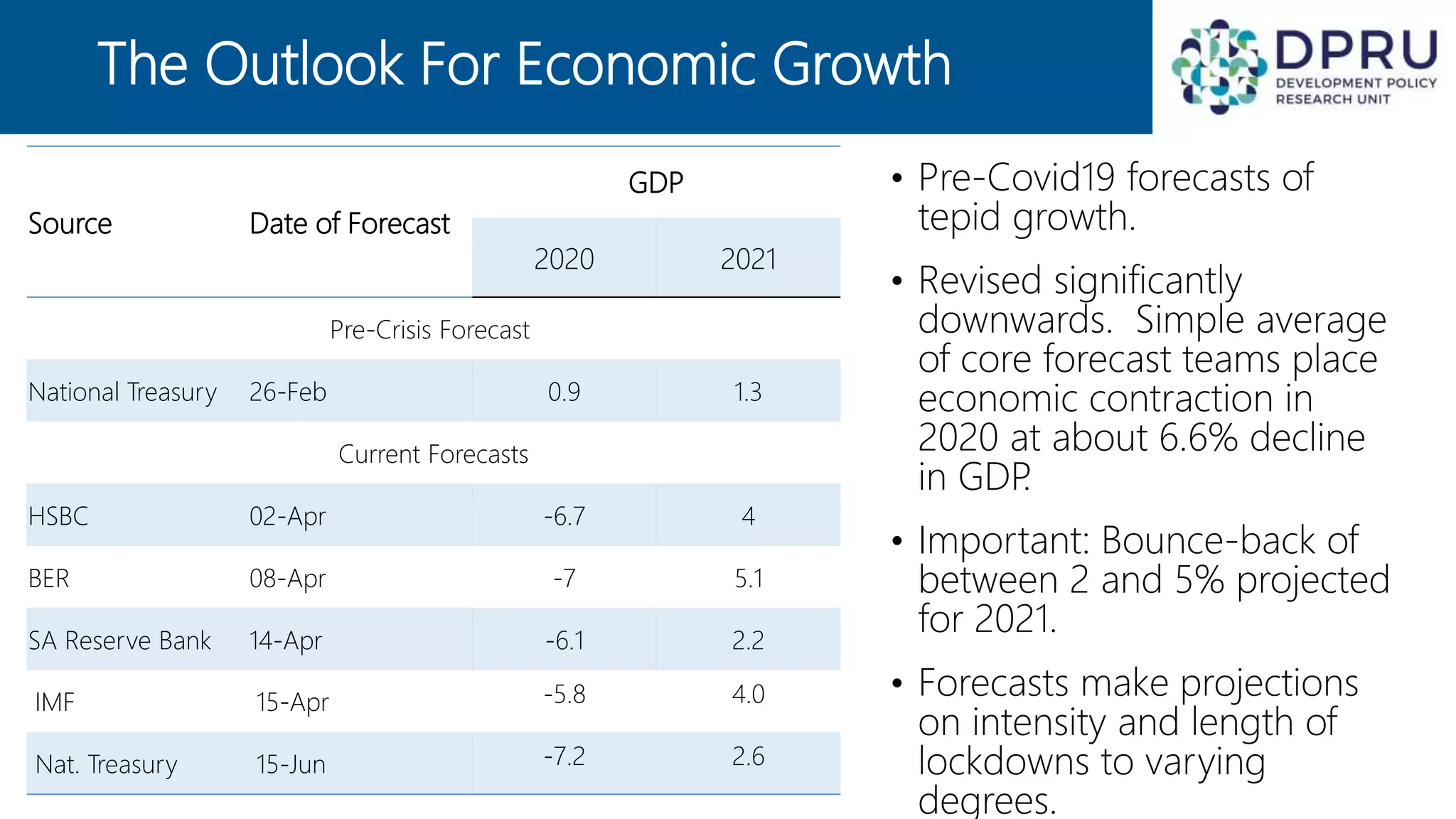
• Pre-Covid19 forecasts of
tepid growth.
• Revised significantly
downwards. Simple average
of core forecast teams place
economic contraction in
2020 at about 6.6% decline
in GDP.
• Important: Bounce-back of
between 2 and 5% projected
for 2021.
• Forecasts make projections
on intensity and length of
lockdowns to varying
degrees.
Source Date of Forecast
GDP
2020 2021
Pre-Crisis Forecast
National Treasury 26-Feb 0.9 1.3
Current Forecasts
HSBC 02-Apr -6.7 4
BER 08-Apr -7 5.1
SA Reserve Bank 14-Apr -6.1 2.2
IMF 15-Apr -5.8 4.0
Nat. Treasury 15-Jun -7.2 2.6
The Fiscal Deficit Spike
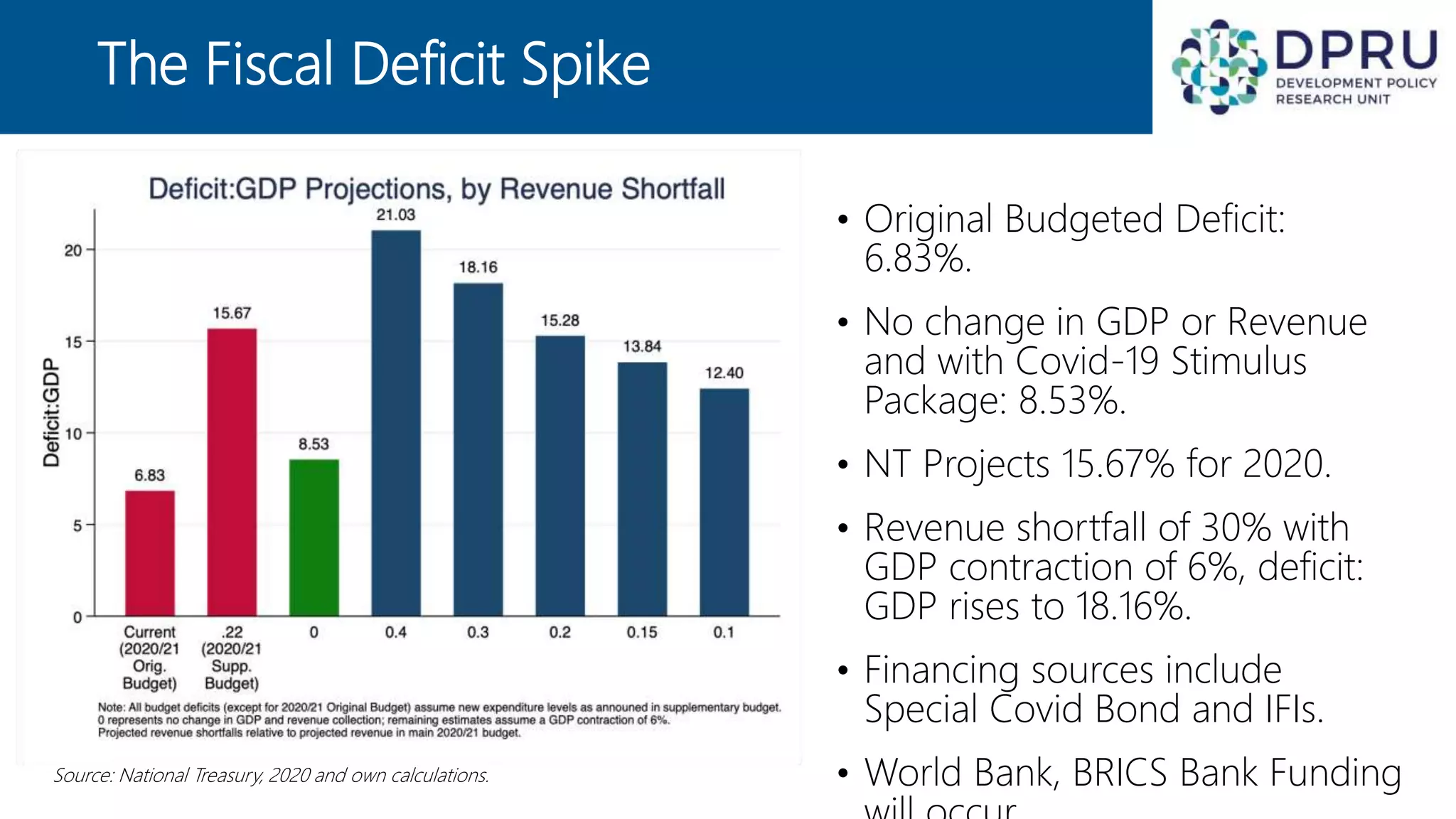
• Original Budgeted Deficit:
6.83%.
• No change in GDP or Revenue
and with Covid-19 Stimulus
Package: 8.53%.
• NT Projects 15.67% for 2020.
• Revenue shortfall of 30% with
GDP contraction of 6%, deficit:
GDP rises to 18.16%.
• Financing sources include
Special Covid Bond and IFIs.
• World Bank, BRICS Bank FundingSource: National Treasury, 2020 and own calculations.
Employment and Inequality:
The Covid-19 Impact
Distributional Projections
Source: Sulla, V. (et al), World Bank, April 2020
-25
-20
-15
-10
-5
0
5
Annualgrowthrate,%
Expenditure percentiles
10 20 30 40 50 60 70 80 90 100
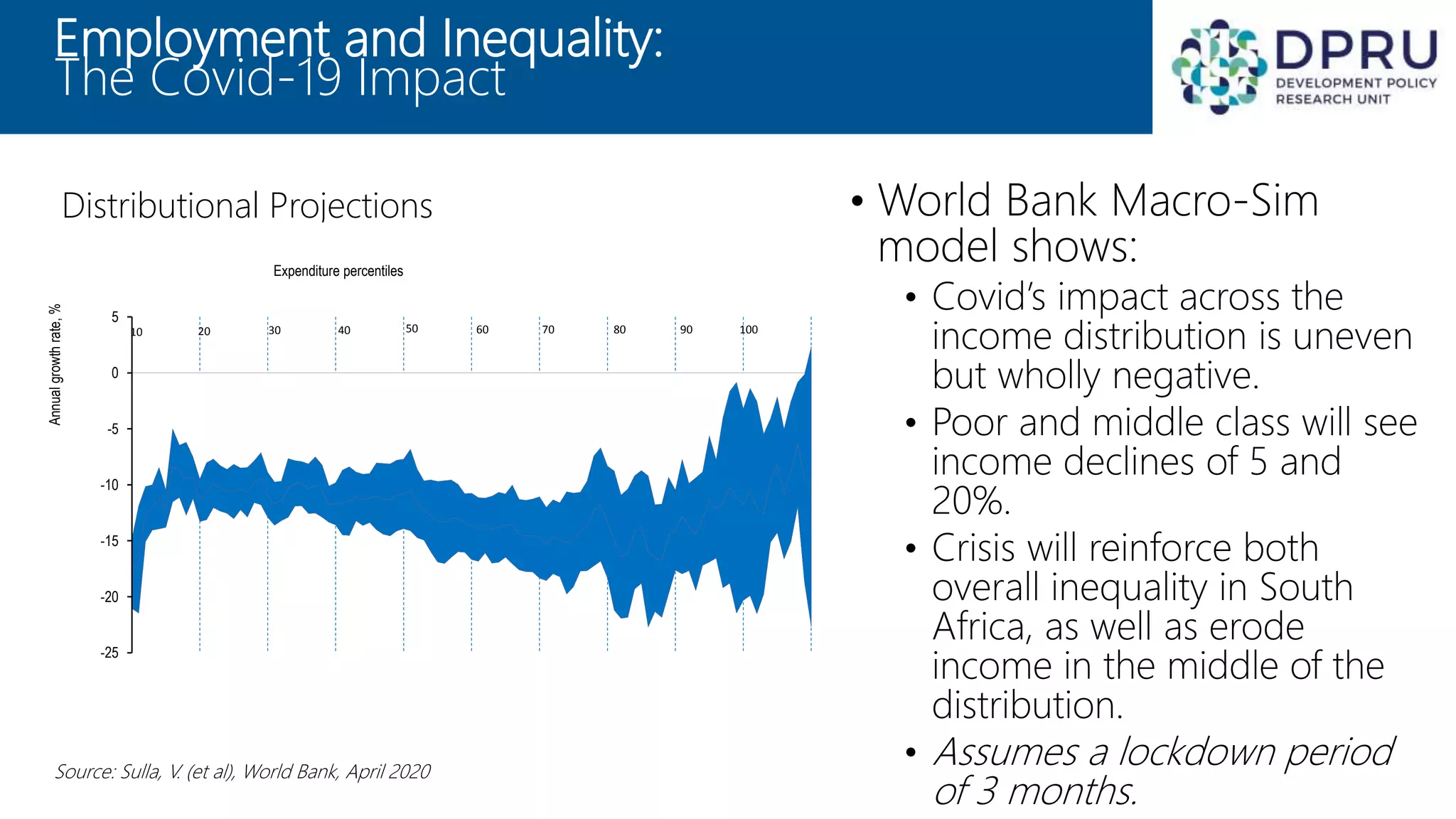
• World Bank Macro-Sim
model shows:
• Covid’s impact across the
income distribution is uneven
but wholly negative.
• Poor and middle class will see
income declines of 5 and
20%.
• Crisis will reinforce both
overall inequality in South
Africa, as well as erode
income in the middle of the
distribution.
• Assumes a lockdown period
of 3 months.
Employment and Inequality:
The Covid-19 Impact
• Job losses total 2.18
million q-on-q.
• 67% of jobs lost emanate
from tertiary sectors, 30%
from secondary sector.
• Over 300 000 jobs lost in
manufacturing and CSP.
• 250 000 domestic
workers lost their jobs.
• Majority of workers losing
their jobs are semi-skilled
(65%) or low skilled
(35%).
Employment and Inequality:
The Covid-19 Impact
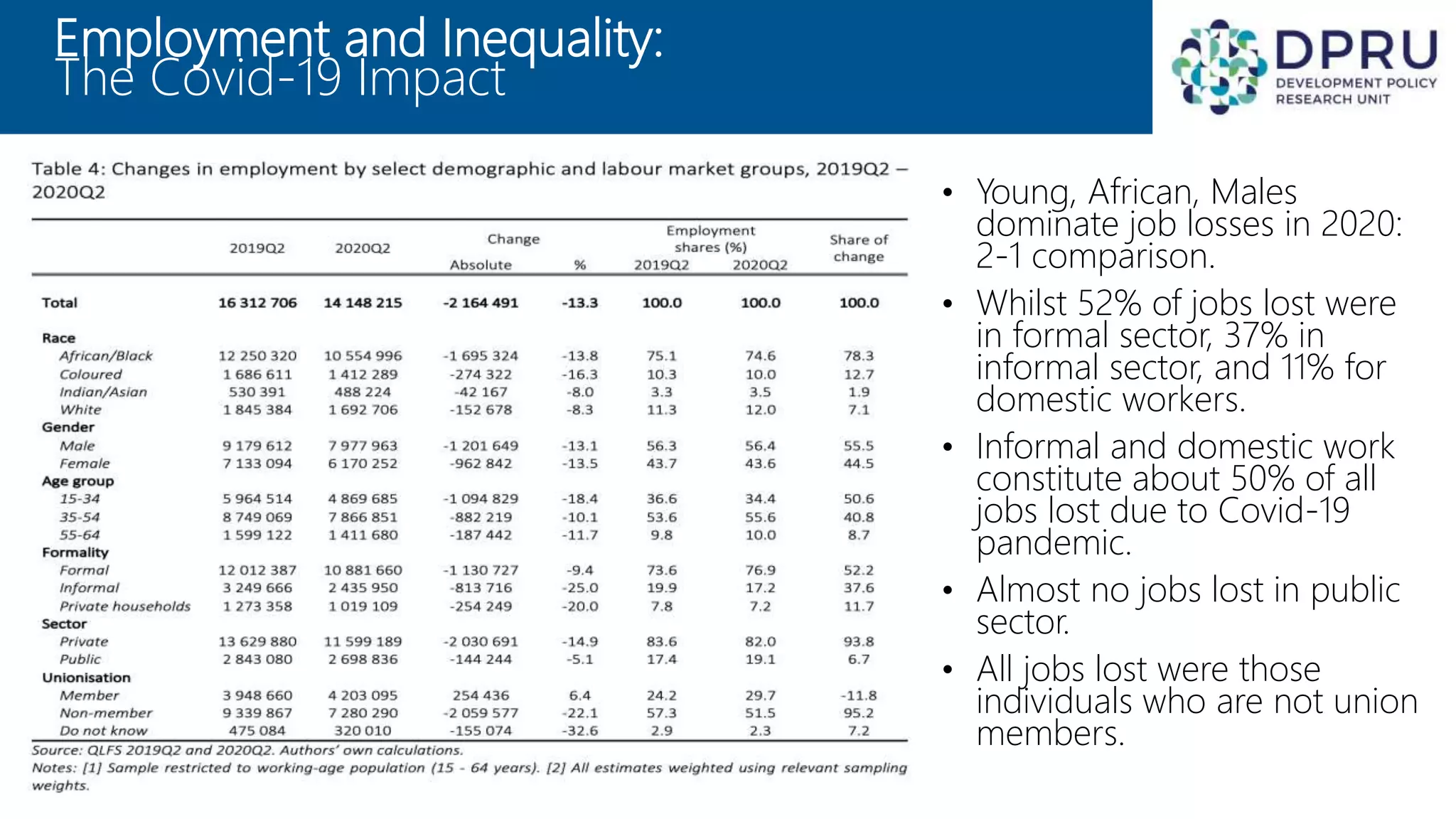
• Young, African, Males
dominate job losses in 2020:
2-1 comparison.
• Whilst 52% of jobs lost were
in formal sector, 37% in
informal sector, and 11% for
domestic workers.
• Informal and domestic work
constitute about 50% of all
jobs lost due to Covid-19
pandemic.
• Almost no jobs lost in public
sector.
• All jobs lost were those
individuals who are not union
members.
The Ramaphosa Covid-19 Support Package
Source: https://www.csis.org/analysis/breaking-down-g20-covid-19-
fiscal-response & own calculations
Covid-19 Expenditure as Share of GDP, By Country
Intervention R (bn) % of Total
Expenditure & Tax Measures
Additional Health Support 20 3.98
Municipal Assistance (water and
sanitation)
20 3.98
Social Assistance (Grants) 50 9.96
Wage Protection (UIF) 40 7.97
Job Protection & Creation 100 19.92
SMME Support 2 0.40
Tax Relief 70 13.94
Loans
Credit Guarantee Scheme 200 39.84
Total Allocation 502 100.00
(Less - Reprioritisation & Tax Deferrals) 174 34.66
Total Net Spend 328 65.34
Covid-19 Social Assistance in Context
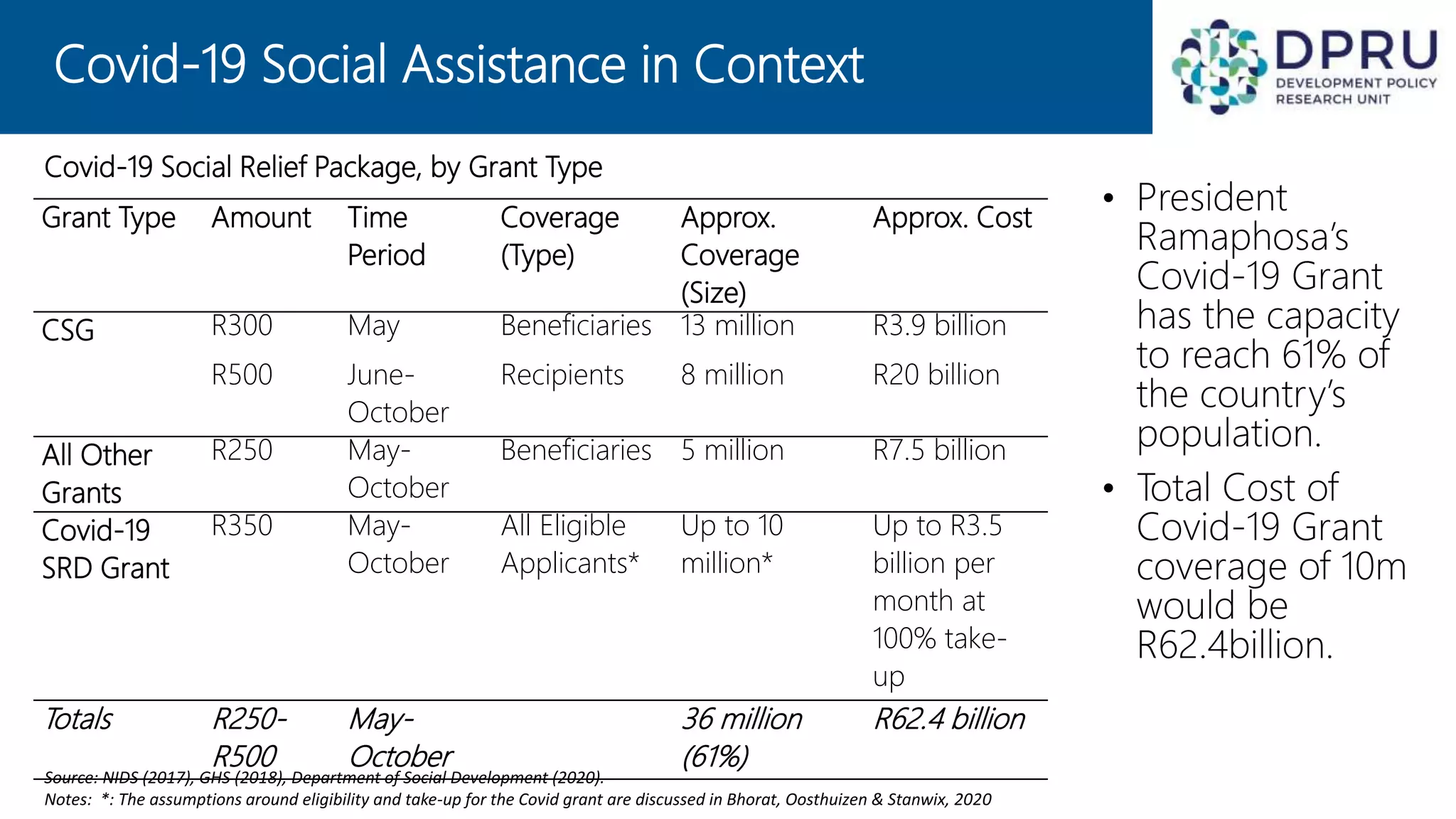
• President
Ramaphosa’s
Covid-19 Grant
has the capacity
to reach 61% of
the country’s
population.
• Total Cost of
Covid-19 Grant
coverage of 10m
would be
R62.4billion.
Grant Type Amount Time
Period
Coverage
(Type)
Approx.
Coverage
(Size)
Approx. Cost
CSG R300 May Beneficiaries 13 million R3.9 billion
R500 June-
October
Recipients 8 million R20 billion
All Other
Grants
R250 May-
October
Beneficiaries 5 million R7.5 billion
Covid-19
SRD Grant
R350 May-
October
All Eligible
Applicants*
Up to 10
million*
Up to R3.5
billion per
month at
100% take-
up
Totals R250-
R500
May-
October
36 million
(61%)
R62.4 billion
Covid-19 Social Relief Package, by Grant Type
Source: NIDS (2017), GHS (2018), Department of Social Development (2020).
Notes: *: The assumptions around eligibility and take-up for the Covid grant are discussed in Bhorat, Oosthuizen & Stanwix, 2020
A Post-Covid 19 Economic Growth Policy:
A Few Discrete Considerations
Fiscal Challenges:
• Non-discretionary costs are crowding out complementary
inputs to service delivery and infrastructure:
• Transfer payments (35%), wage bill (34%), debt service costs
(12%)
• Only 18% left for goods and services and capital spending
• Generate more space for capital expenditure (reduction in
transfers, wage bill and interest burden)
• Revenue Collection Efficiency
• Efficiency gains in current expenditure
State-Owned Enterprises
• Private sector participation (the state as a minority
shareholder)
• ‘Crowding In’ SOEs vs. Privatisation of Other SOEs
• The Eskom Debt Solution
State Capacity and The Role of the Private Sector
• Schooling
• Employment Matching
• Infrastructure Provision
• Debt Markets
Thank you

South Africa's Economy In 10 Slides

  • 1.
    Lockdown Economics: Key ChallengesFacing the South African Economy by Prof. Haroon Bhorat Development Policy Research Unit (DPRU) | School of Economics | University of Cape Town GOVERNANCE ACCOUNTABILITY PLATFORM ONLINE DEBATE Friday, 16 October 2020
  • 2.
    Outline • The Outlookfor Economic Growth • The Fiscal Deficit Spike • Employment and Inequality: The Covid-19 Impact • The Ramaphosa Stimulus Package • A Post-Covid Economy: A Few Discrete Considerations
  • 3.
    The Outlook ForEconomic Growth • Pre-Covid19 forecasts of tepid growth. • Revised significantly downwards. Simple average of core forecast teams place economic contraction in 2020 at about 6.6% decline in GDP. • Important: Bounce-back of between 2 and 5% projected for 2021. • Forecasts make projections on intensity and length of lockdowns to varying degrees. Source Date of Forecast GDP 2020 2021 Pre-Crisis Forecast National Treasury 26-Feb 0.9 1.3 Current Forecasts HSBC 02-Apr -6.7 4 BER 08-Apr -7 5.1 SA Reserve Bank 14-Apr -6.1 2.2 IMF 15-Apr -5.8 4.0 Nat. Treasury 15-Jun -7.2 2.6
  • 4.
    The Fiscal DeficitSpike • Original Budgeted Deficit: 6.83%. • No change in GDP or Revenue and with Covid-19 Stimulus Package: 8.53%. • NT Projects 15.67% for 2020. • Revenue shortfall of 30% with GDP contraction of 6%, deficit: GDP rises to 18.16%. • Financing sources include Special Covid Bond and IFIs. • World Bank, BRICS Bank FundingSource: National Treasury, 2020 and own calculations.
  • 5.
    Employment and Inequality: TheCovid-19 Impact Distributional Projections Source: Sulla, V. (et al), World Bank, April 2020 -25 -20 -15 -10 -5 0 5 Annualgrowthrate,% Expenditure percentiles 10 20 30 40 50 60 70 80 90 100 • World Bank Macro-Sim model shows: • Covid’s impact across the income distribution is uneven but wholly negative. • Poor and middle class will see income declines of 5 and 20%. • Crisis will reinforce both overall inequality in South Africa, as well as erode income in the middle of the distribution. • Assumes a lockdown period of 3 months.
  • 6.
    Employment and Inequality: TheCovid-19 Impact • Job losses total 2.18 million q-on-q. • 67% of jobs lost emanate from tertiary sectors, 30% from secondary sector. • Over 300 000 jobs lost in manufacturing and CSP. • 250 000 domestic workers lost their jobs. • Majority of workers losing their jobs are semi-skilled (65%) or low skilled (35%).
  • 7.
    Employment and Inequality: TheCovid-19 Impact • Young, African, Males dominate job losses in 2020: 2-1 comparison. • Whilst 52% of jobs lost were in formal sector, 37% in informal sector, and 11% for domestic workers. • Informal and domestic work constitute about 50% of all jobs lost due to Covid-19 pandemic. • Almost no jobs lost in public sector. • All jobs lost were those individuals who are not union members.
  • 8.
    The Ramaphosa Covid-19Support Package Source: https://www.csis.org/analysis/breaking-down-g20-covid-19- fiscal-response & own calculations Covid-19 Expenditure as Share of GDP, By Country Intervention R (bn) % of Total Expenditure & Tax Measures Additional Health Support 20 3.98 Municipal Assistance (water and sanitation) 20 3.98 Social Assistance (Grants) 50 9.96 Wage Protection (UIF) 40 7.97 Job Protection & Creation 100 19.92 SMME Support 2 0.40 Tax Relief 70 13.94 Loans Credit Guarantee Scheme 200 39.84 Total Allocation 502 100.00 (Less - Reprioritisation & Tax Deferrals) 174 34.66 Total Net Spend 328 65.34
  • 9.
    Covid-19 Social Assistancein Context • President Ramaphosa’s Covid-19 Grant has the capacity to reach 61% of the country’s population. • Total Cost of Covid-19 Grant coverage of 10m would be R62.4billion. Grant Type Amount Time Period Coverage (Type) Approx. Coverage (Size) Approx. Cost CSG R300 May Beneficiaries 13 million R3.9 billion R500 June- October Recipients 8 million R20 billion All Other Grants R250 May- October Beneficiaries 5 million R7.5 billion Covid-19 SRD Grant R350 May- October All Eligible Applicants* Up to 10 million* Up to R3.5 billion per month at 100% take- up Totals R250- R500 May- October 36 million (61%) R62.4 billion Covid-19 Social Relief Package, by Grant Type Source: NIDS (2017), GHS (2018), Department of Social Development (2020). Notes: *: The assumptions around eligibility and take-up for the Covid grant are discussed in Bhorat, Oosthuizen & Stanwix, 2020
  • 10.
    A Post-Covid 19Economic Growth Policy: A Few Discrete Considerations Fiscal Challenges: • Non-discretionary costs are crowding out complementary inputs to service delivery and infrastructure: • Transfer payments (35%), wage bill (34%), debt service costs (12%) • Only 18% left for goods and services and capital spending • Generate more space for capital expenditure (reduction in transfers, wage bill and interest burden) • Revenue Collection Efficiency • Efficiency gains in current expenditure State-Owned Enterprises • Private sector participation (the state as a minority shareholder) • ‘Crowding In’ SOEs vs. Privatisation of Other SOEs • The Eskom Debt Solution State Capacity and The Role of the Private Sector • Schooling • Employment Matching • Infrastructure Provision • Debt Markets
  • 11.