International Research Journal of Engineering and Technology (IRJET) e-ISSN: 2395-0056
Volume: 10 Issue: 12 | Dec 2023 www.irjet.net p-ISSN: 2395-0072
© 2023, IRJET | Impact Factor value: 8.226 | ISO 9001:2008 Certified Journal | Page 195
Sounding the Keys: A Comprehensive FFT-Based Approach for Piano
Note Detection
Neethu Marriam Joji1, Pooja Namjoshi2, Jerryn Joeboy3, Suraj Khandare4
1Student, Dept. of Information Technology, Fr. C. Rodrigues Institute of Technology, Navi Mumbai
2Student, Dept. of Information Technology, Fr. C. Rodrigues Institute of Technology, Navi Mumbai
3Student, Dept. of Information Technology, Fr. C. Rodrigues Institute of Technology, Navi Mumbai
4Professor, Dept. of Information Technology, Fr. C. Rodrigues Institute of Technology, Navi Mumbai
---------------------------------------------------------------------***---------------------------------------------------------------------
Abstract –Piano - a popular skill for both young andadults
alike, is something that requiresproperpracticeandguidance.
When learning a new skill, a tutor plays an important role as
the learner familiarizes themselves with the foreign skill.
However, a tutor cannot always monitor and guide the
student. While feedback from a professionaleducator ishighly
valuable, this traditional method of learning the piano is not
viable for all; appointing a tutor becomes tedious and
expensive. While practice makes perfect, it is equally
important to practice correctly. Lackofproperguidanceatthe
early stages of learning may lead to the development of
incorrect practices. Timely and consistent feedback motivates
players and ensures accurate practices from early learning
stages. This research explores the application of signal
processing, specifically utilizing the Fast Fourier Transform
algorithm. By leveraging FFT’s capabilities, our research
demonstrates the successful development of models that
exhibit accurate note identification. The findings finally
highlight the transformative potential of integrating signal
processing into the piano learning process. This researchaims
to make learning the arts more accessible to all, toensurethat
keen learners are not hindered from learning the piano. The
proposed system is designed to assess piano performances in
real-time using the Fast Fourier Transform (FFT) algorithm
and thresholding techniques for note identification. The
proposed algorithm aims to improve the music evaluation
process by providing real-time assessment, eventually
enhancing the quality of automated assessments of piano
performances. This paper’s main emphasis is on the
implementation of the FFT algorithm, thresholding methods,
and real-time feedback.
Key Words: Fast Fourier Transfer algorithm, High
Frequency Content (HFC) detection, thresholding
methods, and real-time assessment.
1.INTRODUCTION
A piano is an instrument that produces sound by striking
strings with hammers. Pianos have a wide frequency range,
from about 27 Hz to 4186 Hz. Learning a piano and
mastering it takes many years and a lot of practice.
Practicing with proper guidanceeverytimeisnotfeasible for
many aspiring pianists. Students look to seek feedback on
their performances in order to improve their technique and
musicality. Traditional methods of assessing piano playing,
such as hiring a music teacher can be time consuming and
economically taxing. To address these challenges, we
propose a solution that implements digital signal processing
techniques to provide real-time feedback and performance
assessment for piano players. The Fast Fourier Transform
(FFT) algorithm is used for note detection and thresholding
techniques are used to separate noise from the musical
notes. The developed algorithm takes piano audio samples
as input and generates a real-time ’correctness’ score to
verify how accurately the piano piece was played.
The paper focuses on the implementation of signal pre-
processing and signal analysis functions to identify piano
notes and assess them against their definedsheetmusic.Our
algorithm aims to overcome the gas in existing systems by
improving the accuracy of note detection and implementing
real-time evaluation.
2.PROPOSED SYSTEM
The proposed algorithm aims to automate the process of
students receiving feedback for their piano play. The
algorithm, written in Python, accepts audio input in MP3
format (.mp3 and .m4a). The algorithm’s main features
include audio pre-processing to reduce noise and assess
audio accuracy. The raw audio received consists of noise
along with the play. In order to extract the clean audio, the
algorithm thus employs a pre-processing algorithm to
reduce the noise and assess the audio’s accuracy.
Using the Fast Fourier Transform algorithm, the proposed
system assesses the processed audio file. Factors such as
frequency of the note, and rhythm of the piano piece are
evaluated to calculate a correctness score for the piano play.
The algorithm assesses thepianoplayagainstthepredefined
sheet music.
International Research Journal of Engineering and Technology (IRJET) e-ISSN: 2395-0056
Volume: 10 Issue: 12 | Dec 2023 www.irjet.net p-ISSN: 2395-0072
© 2023, IRJET | Impact Factor value: 8.226 | ISO 9001:2008 Certified Journal | Page 196
Fig. 1: Block diagram
2.1 Hann Windowing
Hann windowing, or Hanning window, is used for the
audio input’s pre-processing. The audio signal is segmented
into frames of 20 milliseconds. The Hann function is applied
to each frame. The processed audio segments are used, in
tandem with the raw audio segments to minimize abrupt
transitions and reduce noise. The individual segments are
then combined to form the complete audio with reduced
noise and undesired jumps in the audio. The Hann
windowing facilitates further spectral analysis of the audio
file, increasing the efficiency of the proposed algorithm in
assessing the frequency of the piano notes played.
2.2 Fast Fourier Transform
The Fast Fourier Transform algorithm is used to convert
the audio signal from a time domain signal to a frequency
domain signal and to further perform spectral analysis to
identify the piano notes. FFT breaks down a signal into its
constituentfrequencies,revealingtheamplitudesandphases
of the frequencies. FFT is a more efficient way of computing
the Discrete Fourier Transform (DFT). Due to the improved
efficiency of FFT algorithm, it is better suited for the real
time analysis of the piano notes; which our proposedsystem
aims to achieve. The audio signal issegmentedintoframesof
20 milliseconds, to accurately represent the pitch of a
musical note in the small timeframe. The FFT function is
applied to each frame to convert the time domain segments
to frequency domain signals. The function analyses each
frame to identify the dominant frequencies. As pianos keys
have unique frequencies, by identifying the dominant
frequency in the frame, we can subsequently identify the
note played in the piano sample.
2.3 High-Frequency Content Detection
Onset detection is the process of identifyingthe beginning
of all individual notes in audio samples. The proposed
algorithm utilizes the high-frequencycontent(HFC)function
to identify the individual piano notes in the piano play. The
frequency-domain audio segments are inputted to the HFC
functions. The HFC onset detectionfunctiondetectsthehigh-
frequency content and identifies the peaks as the onsets of
the piano notes. Piano notes are characteristically high-
frequency notes. The frequency peaks are matched with the
defined dataset of piano notes’ frequencies. Thus, the use of
the HFC onset detection function allows for accurate
detection of the piano notes of the audio sample.
Fig. 2: Sheet Music for Ode to Joy [8]
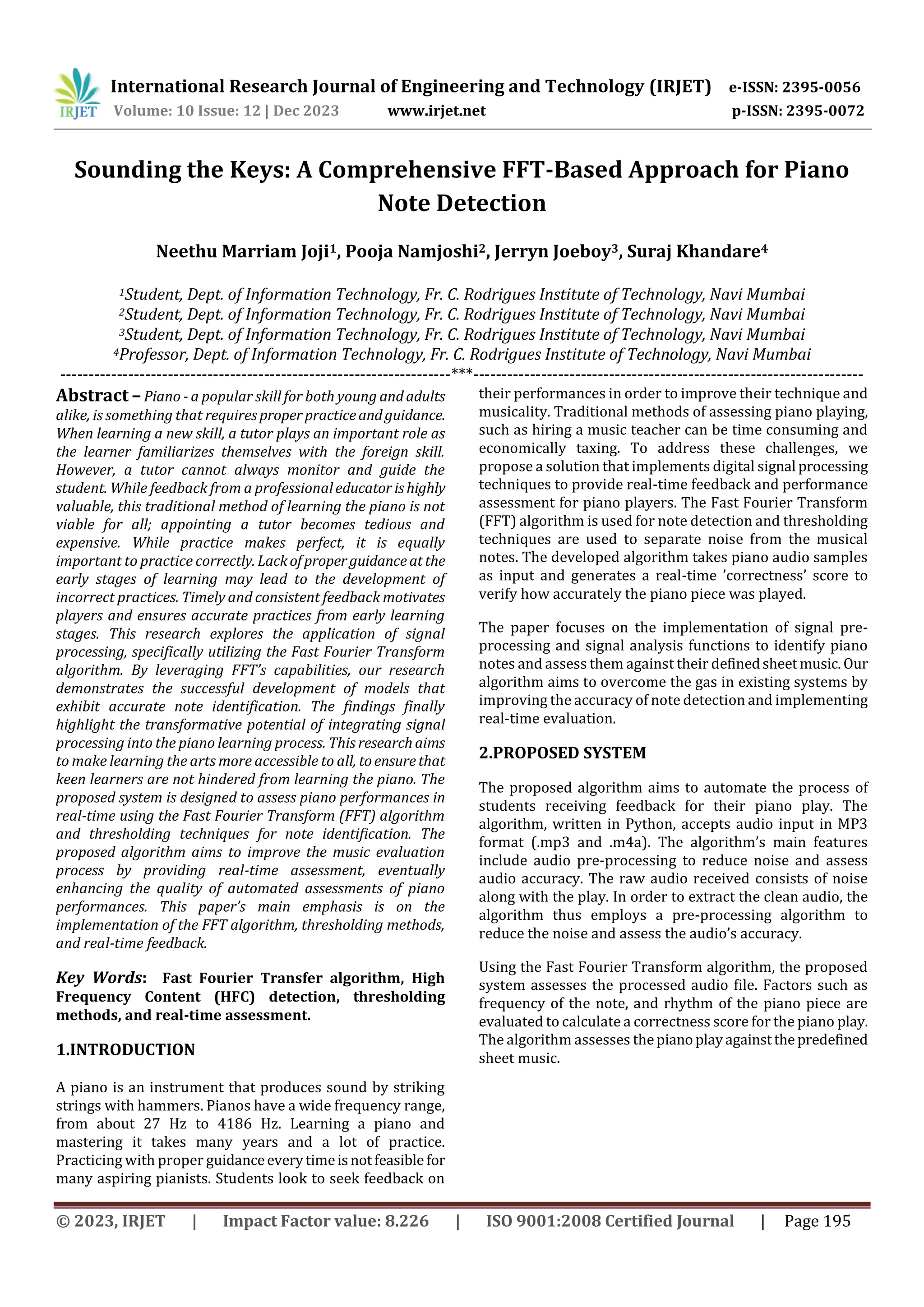
In the figure 3, the x-axis represents the time in
millisecond to showcase the segments of the ‘Ode to Joy’
audio samples. The y-axis represents the amplitudes of the
audio signal. The HFC function can identify the onset of the
notes in the Ode to Joy audio sample based on the
frequencies of the notes defined in the sheet music, as per
figure 2.
International Research Journal of Engineering and Technology (IRJET) e-ISSN: 2395-0056
Volume: 10 Issue: 12 | Dec 2023 www.irjet.net p-ISSN: 2395-0072
© 2023, IRJET | Impact Factor value: 8.226 | ISO 9001:2008 Certified Journal | Page 197
Fig. 3: HFC graph showing the onset detection of notes
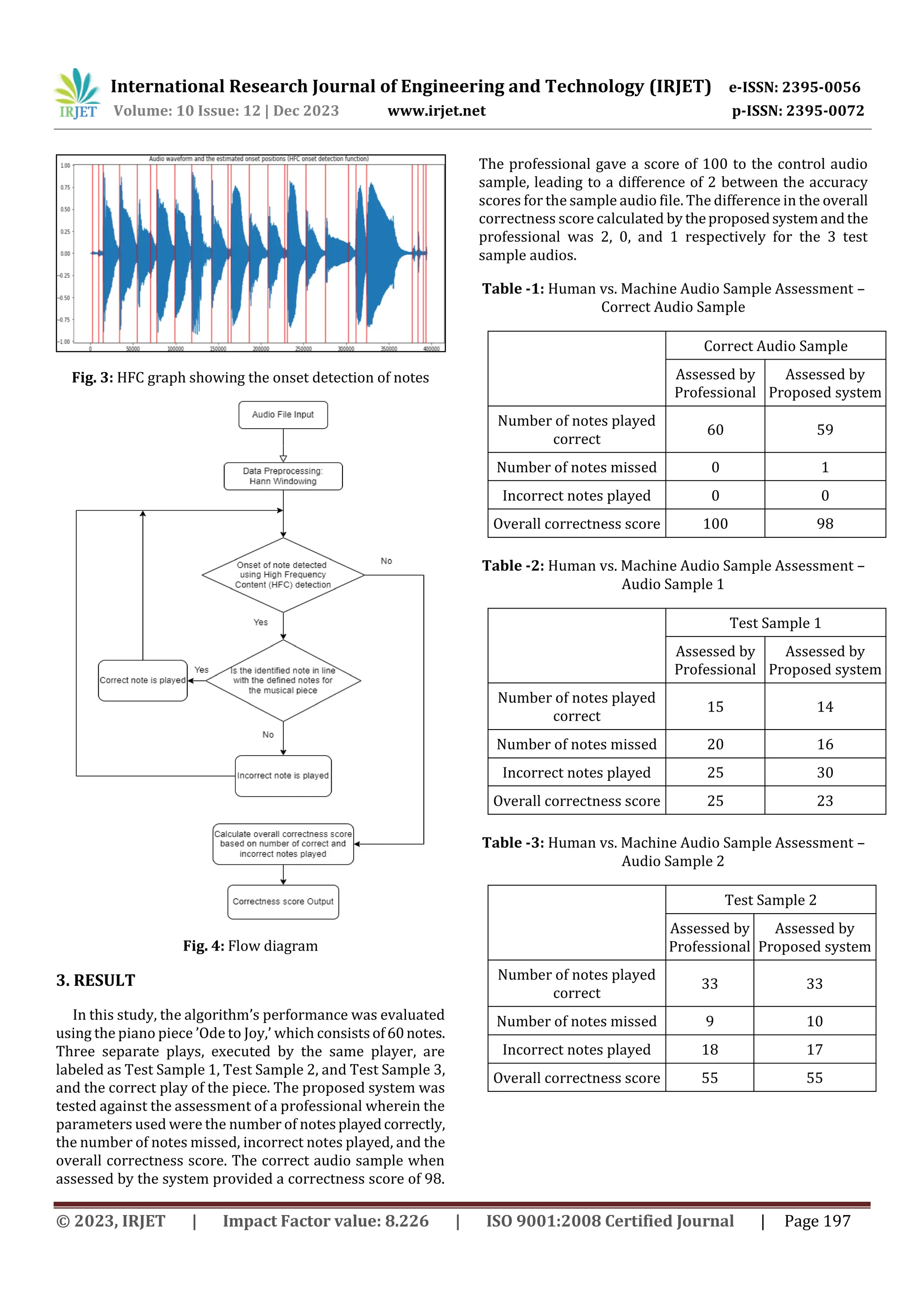
Fig. 4: Flow diagram
3. RESULT
In this study, the algorithm’s performance was evaluated
using the piano piece ’Ode to Joy,’ which consists of60notes.
Three separate plays, executed by the same player, are
labeled as Test Sample 1, Test Sample 2, and Test Sample 3,
and the correct play of the piece. The proposed system was
tested against the assessment of a professional wherein the
parameters used were the number of notesplayedcorrectly,
the number of notes missed, incorrect notes played, and the
overall correctness score. The correct audio sample when
assessed by the system provided a correctness score of 98.
The professional gave a score of 100 to the control audio
sample, leading to a difference of 2 between the accuracy
scores for the sample audio file. The difference in the overall
correctness score calculated by theproposedsystemandthe
professional was 2, 0, and 1 respectively for the 3 test
sample audios.
Table -1: Human vs. Machine Audio Sample Assessment –
Correct Audio Sample
Assessed by
Professional
Assessed by
Proposed system
Number of notes played
correct
60 59
Number of notes missed 0 1
Incorrect notes played 0 0
Overall correctness score 100 98
Table -2: Human vs. Machine Audio Sample Assessment –
Audio Sample 1
Test Sample 1
Assessed by
Professional
Assessed by
Proposed system
Number of notes played
correct
15 14
Number of notes missed 20 16
Incorrect notes played 25 30
Overall correctness score 25 23
Table -3: Human vs. Machine Audio Sample Assessment –
Audio Sample 2
Test Sample 2
Assessed by
Professional
Assessed by
Proposed system
Number of notes played
correct
33 33
Number of notes missed 9 10
Incorrect notes played 18 17
Overall correctness score 55 55
International Research Journal of Engineering and Technology (IRJET) e-ISSN: 2395-0056
Volume: 10 Issue: 12 | Dec 2023 www.irjet.net p-ISSN: 2395-0072
© 2023, IRJET | Impact Factor value: 8.226 | ISO 9001:2008 Certified Journal | Page 198
Table -4: Human vs. Machine Audio Sample Assessment –
Audio Sample 3
Test Sample 3
Assessed by
Professional
Assessed by
Proposed system
Number of notes played
correct
55 56
Number of notes missed 2 0
Incorrect notes played 3 4
Overall correctness score 92 93
4. CONCLUSIONS
By utilizing the Fast Fourier Transform for audio signal
processing, we have implementedtheconversionofanaudio
signal from its time domain to the frequency domain.
Conversion of the audio signal in the frequency domain has
allowed us to identify individual piano notes and how
accurate they are to the original piano piece. While the
proposed algorithm has achieved an accuracy rateof94% in
identifying the piano notes, improvements can be made to
accommodate complex piano plays and nuances of the
players’ musicality. Future works may focus on the
assessment of the audio quality and timbre of the piano play
to provide a more holistic assessment.
REFERENCES
[1] J.K. Patel and E.S. Gopi,” Musical Notes Identification
Using Digital Signal Processing”, Procedia Computer
Science, vol. 57, pp. 876-884, 3rd International
Conference on Recent Trends in Computing 2015
(ICRTC-2015)
[2] Sumarno, Linggo & Iswanjono, Iswanjono. (2017).
Feature Extraction of Musical Instrument Tones using
FFT and Segment Averaging. Telkomnika
(Telecommunication Computing Electronics and
Control).15.1280-1289.
10.12928/TELKOMNIKA.v15i3.3381.
[3] S.W. Foo and P.L. Wong,” Recognition of piano notes” in
Proceedings of the International Conference on
Information, Communications and Signal Processing,
1999: National University of Singapore
[4] Zielinski, Tomasz. (2021). Fast Fourier Transform.
[5] Settel, J. and Lippe, Cort. (1994). Real-time musical
applications using the FFT-based resynthesis.
[6] Monnier, Nolan & Ghali, Darien & Liu, Sophie. (2021).
FFT and Machine Learning Application on Major Chord
Recognition. 426-429.
10.1109/ICUFN49451.2021.9528762.
[7] Podder, Prajoy & Khan, Tanvir & Khan, Mamdudul &
Rahman, M. (2014). Comparative Performance Analysis
of Hamming, Hanning and Blackman Window.
International Journal of Computer Applications. 96.1-7.
10.5120/16891-6927.
[8] https://www.music-for-music-teachers.com/ode-to-
joy.html

Sounding the Keys: A Comprehensive FFT-Based Approach for Piano Note Detection

  • 1.
    International Research Journalof Engineering and Technology (IRJET) e-ISSN: 2395-0056 Volume: 10 Issue: 12 | Dec 2023 www.irjet.net p-ISSN: 2395-0072 © 2023, IRJET | Impact Factor value: 8.226 | ISO 9001:2008 Certified Journal | Page 195 Sounding the Keys: A Comprehensive FFT-Based Approach for Piano Note Detection Neethu Marriam Joji1, Pooja Namjoshi2, Jerryn Joeboy3, Suraj Khandare4 1Student, Dept. of Information Technology, Fr. C. Rodrigues Institute of Technology, Navi Mumbai 2Student, Dept. of Information Technology, Fr. C. Rodrigues Institute of Technology, Navi Mumbai 3Student, Dept. of Information Technology, Fr. C. Rodrigues Institute of Technology, Navi Mumbai 4Professor, Dept. of Information Technology, Fr. C. Rodrigues Institute of Technology, Navi Mumbai ---------------------------------------------------------------------***--------------------------------------------------------------------- Abstract –Piano - a popular skill for both young andadults alike, is something that requiresproperpracticeandguidance. When learning a new skill, a tutor plays an important role as the learner familiarizes themselves with the foreign skill. However, a tutor cannot always monitor and guide the student. While feedback from a professionaleducator ishighly valuable, this traditional method of learning the piano is not viable for all; appointing a tutor becomes tedious and expensive. While practice makes perfect, it is equally important to practice correctly. Lackofproperguidanceatthe early stages of learning may lead to the development of incorrect practices. Timely and consistent feedback motivates players and ensures accurate practices from early learning stages. This research explores the application of signal processing, specifically utilizing the Fast Fourier Transform algorithm. By leveraging FFT’s capabilities, our research demonstrates the successful development of models that exhibit accurate note identification. The findings finally highlight the transformative potential of integrating signal processing into the piano learning process. This researchaims to make learning the arts more accessible to all, toensurethat keen learners are not hindered from learning the piano. The proposed system is designed to assess piano performances in real-time using the Fast Fourier Transform (FFT) algorithm and thresholding techniques for note identification. The proposed algorithm aims to improve the music evaluation process by providing real-time assessment, eventually enhancing the quality of automated assessments of piano performances. This paper’s main emphasis is on the implementation of the FFT algorithm, thresholding methods, and real-time feedback. Key Words: Fast Fourier Transfer algorithm, High Frequency Content (HFC) detection, thresholding methods, and real-time assessment. 1.INTRODUCTION A piano is an instrument that produces sound by striking strings with hammers. Pianos have a wide frequency range, from about 27 Hz to 4186 Hz. Learning a piano and mastering it takes many years and a lot of practice. Practicing with proper guidanceeverytimeisnotfeasible for many aspiring pianists. Students look to seek feedback on their performances in order to improve their technique and musicality. Traditional methods of assessing piano playing, such as hiring a music teacher can be time consuming and economically taxing. To address these challenges, we propose a solution that implements digital signal processing techniques to provide real-time feedback and performance assessment for piano players. The Fast Fourier Transform (FFT) algorithm is used for note detection and thresholding techniques are used to separate noise from the musical notes. The developed algorithm takes piano audio samples as input and generates a real-time ’correctness’ score to verify how accurately the piano piece was played. The paper focuses on the implementation of signal pre- processing and signal analysis functions to identify piano notes and assess them against their definedsheetmusic.Our algorithm aims to overcome the gas in existing systems by improving the accuracy of note detection and implementing real-time evaluation. 2.PROPOSED SYSTEM The proposed algorithm aims to automate the process of students receiving feedback for their piano play. The algorithm, written in Python, accepts audio input in MP3 format (.mp3 and .m4a). The algorithm’s main features include audio pre-processing to reduce noise and assess audio accuracy. The raw audio received consists of noise along with the play. In order to extract the clean audio, the algorithm thus employs a pre-processing algorithm to reduce the noise and assess the audio’s accuracy. Using the Fast Fourier Transform algorithm, the proposed system assesses the processed audio file. Factors such as frequency of the note, and rhythm of the piano piece are evaluated to calculate a correctness score for the piano play. The algorithm assesses thepianoplayagainstthepredefined sheet music.
  • 2.
    International Research Journalof Engineering and Technology (IRJET) e-ISSN: 2395-0056 Volume: 10 Issue: 12 | Dec 2023 www.irjet.net p-ISSN: 2395-0072 © 2023, IRJET | Impact Factor value: 8.226 | ISO 9001:2008 Certified Journal | Page 196 Fig. 1: Block diagram 2.1 Hann Windowing Hann windowing, or Hanning window, is used for the audio input’s pre-processing. The audio signal is segmented into frames of 20 milliseconds. The Hann function is applied to each frame. The processed audio segments are used, in tandem with the raw audio segments to minimize abrupt transitions and reduce noise. The individual segments are then combined to form the complete audio with reduced noise and undesired jumps in the audio. The Hann windowing facilitates further spectral analysis of the audio file, increasing the efficiency of the proposed algorithm in assessing the frequency of the piano notes played. 2.2 Fast Fourier Transform The Fast Fourier Transform algorithm is used to convert the audio signal from a time domain signal to a frequency domain signal and to further perform spectral analysis to identify the piano notes. FFT breaks down a signal into its constituentfrequencies,revealingtheamplitudesandphases of the frequencies. FFT is a more efficient way of computing the Discrete Fourier Transform (DFT). Due to the improved efficiency of FFT algorithm, it is better suited for the real time analysis of the piano notes; which our proposedsystem aims to achieve. The audio signal issegmentedintoframesof 20 milliseconds, to accurately represent the pitch of a musical note in the small timeframe. The FFT function is applied to each frame to convert the time domain segments to frequency domain signals. The function analyses each frame to identify the dominant frequencies. As pianos keys have unique frequencies, by identifying the dominant frequency in the frame, we can subsequently identify the note played in the piano sample. 2.3 High-Frequency Content Detection Onset detection is the process of identifyingthe beginning of all individual notes in audio samples. The proposed algorithm utilizes the high-frequencycontent(HFC)function to identify the individual piano notes in the piano play. The frequency-domain audio segments are inputted to the HFC functions. The HFC onset detectionfunctiondetectsthehigh- frequency content and identifies the peaks as the onsets of the piano notes. Piano notes are characteristically high- frequency notes. The frequency peaks are matched with the defined dataset of piano notes’ frequencies. Thus, the use of the HFC onset detection function allows for accurate detection of the piano notes of the audio sample. Fig. 2: Sheet Music for Ode to Joy [8] In the figure 3, the x-axis represents the time in millisecond to showcase the segments of the ‘Ode to Joy’ audio samples. The y-axis represents the amplitudes of the audio signal. The HFC function can identify the onset of the notes in the Ode to Joy audio sample based on the frequencies of the notes defined in the sheet music, as per figure 2.
  • 3.
    International Research Journalof Engineering and Technology (IRJET) e-ISSN: 2395-0056 Volume: 10 Issue: 12 | Dec 2023 www.irjet.net p-ISSN: 2395-0072 © 2023, IRJET | Impact Factor value: 8.226 | ISO 9001:2008 Certified Journal | Page 197 Fig. 3: HFC graph showing the onset detection of notes Fig. 4: Flow diagram 3. RESULT In this study, the algorithm’s performance was evaluated using the piano piece ’Ode to Joy,’ which consists of60notes. Three separate plays, executed by the same player, are labeled as Test Sample 1, Test Sample 2, and Test Sample 3, and the correct play of the piece. The proposed system was tested against the assessment of a professional wherein the parameters used were the number of notesplayedcorrectly, the number of notes missed, incorrect notes played, and the overall correctness score. The correct audio sample when assessed by the system provided a correctness score of 98. The professional gave a score of 100 to the control audio sample, leading to a difference of 2 between the accuracy scores for the sample audio file. The difference in the overall correctness score calculated by theproposedsystemandthe professional was 2, 0, and 1 respectively for the 3 test sample audios. Table -1: Human vs. Machine Audio Sample Assessment – Correct Audio Sample Correct Audio Sample Assessed by Professional Assessed by Proposed system Number of notes played correct 60 59 Number of notes missed 0 1 Incorrect notes played 0 0 Overall correctness score 100 98 Table -2: Human vs. Machine Audio Sample Assessment – Audio Sample 1 Test Sample 1 Assessed by Professional Assessed by Proposed system Number of notes played correct 15 14 Number of notes missed 20 16 Incorrect notes played 25 30 Overall correctness score 25 23 Table -3: Human vs. Machine Audio Sample Assessment – Audio Sample 2 Test Sample 2 Assessed by Professional Assessed by Proposed system Number of notes played correct 33 33 Number of notes missed 9 10 Incorrect notes played 18 17 Overall correctness score 55 55
  • 4.
    International Research Journalof Engineering and Technology (IRJET) e-ISSN: 2395-0056 Volume: 10 Issue: 12 | Dec 2023 www.irjet.net p-ISSN: 2395-0072 © 2023, IRJET | Impact Factor value: 8.226 | ISO 9001:2008 Certified Journal | Page 198 Table -4: Human vs. Machine Audio Sample Assessment – Audio Sample 3 Test Sample 3 Assessed by Professional Assessed by Proposed system Number of notes played correct 55 56 Number of notes missed 2 0 Incorrect notes played 3 4 Overall correctness score 92 93 4. CONCLUSIONS By utilizing the Fast Fourier Transform for audio signal processing, we have implementedtheconversionofanaudio signal from its time domain to the frequency domain. Conversion of the audio signal in the frequency domain has allowed us to identify individual piano notes and how accurate they are to the original piano piece. While the proposed algorithm has achieved an accuracy rateof94% in identifying the piano notes, improvements can be made to accommodate complex piano plays and nuances of the players’ musicality. Future works may focus on the assessment of the audio quality and timbre of the piano play to provide a more holistic assessment. REFERENCES [1] J.K. Patel and E.S. Gopi,” Musical Notes Identification Using Digital Signal Processing”, Procedia Computer Science, vol. 57, pp. 876-884, 3rd International Conference on Recent Trends in Computing 2015 (ICRTC-2015) [2] Sumarno, Linggo & Iswanjono, Iswanjono. (2017). Feature Extraction of Musical Instrument Tones using FFT and Segment Averaging. Telkomnika (Telecommunication Computing Electronics and Control).15.1280-1289. 10.12928/TELKOMNIKA.v15i3.3381. [3] S.W. Foo and P.L. Wong,” Recognition of piano notes” in Proceedings of the International Conference on Information, Communications and Signal Processing, 1999: National University of Singapore [4] Zielinski, Tomasz. (2021). Fast Fourier Transform. [5] Settel, J. and Lippe, Cort. (1994). Real-time musical applications using the FFT-based resynthesis. [6] Monnier, Nolan & Ghali, Darien & Liu, Sophie. (2021). FFT and Machine Learning Application on Major Chord Recognition. 426-429. 10.1109/ICUFN49451.2021.9528762. [7] Podder, Prajoy & Khan, Tanvir & Khan, Mamdudul & Rahman, M. (2014). Comparative Performance Analysis of Hamming, Hanning and Blackman Window. International Journal of Computer Applications. 96.1-7. 10.5120/16891-6927. [8] https://www.music-for-music-teachers.com/ode-to- joy.html