Sound and Image Aesthetics and Practices Sound
Design 1st Edition Andrew Knight-Hill (Editor)
download
https://textbookfull.com/product/sound-and-image-aesthetics-and-
practices-sound-design-1st-edition-andrew-knight-hill-editor/
Download more ebook from https://textbookfull.com
We believe these products will be a great fit for you. Click
the link to download now, or visit textbookfull.com
to discover even more!
Musical Sound Effects Analog and Digital Sound
Processing 1st Edition Reveillac
https://textbookfull.com/product/musical-sound-effects-analog-
and-digital-sound-processing-1st-edition-reveillac/
Designing Sound Audiovisual Aesthetics in 1970s
American Cinema Jay Beck
https://textbookfull.com/product/designing-sound-audiovisual-
aesthetics-in-1970s-american-cinema-jay-beck/
Computational Intelligence in Music Sound Art and
Design Antonios Liapis
https://textbookfull.com/product/computational-intelligence-in-
music-sound-art-and-design-antonios-liapis/
Sound and the Ancient Senses 1st Edition Meg Grigal
https://textbookfull.com/product/sound-and-the-ancient-
senses-1st-edition-meg-grigal/
Fluid Structure Sound Interactions and Control
Proceedings of the 3rd Symposium on Fluid Structure
Sound Interactions and Control 1st Edition Yu Zhou
https://textbookfull.com/product/fluid-structure-sound-
interactions-and-control-proceedings-of-the-3rd-symposium-on-
fluid-structure-sound-interactions-and-control-1st-edition-yu-
zhou/
Sound, Media, Ecology Milena Droumeva
https://textbookfull.com/product/sound-media-ecology-milena-
droumeva/
Fluid Structure Sound Interactions and Control Yu Zhou
https://textbookfull.com/product/fluid-structure-sound-
interactions-and-control-yu-zhou/
Music Sound and Architecture in Islam Michael Frishkopf
https://textbookfull.com/product/music-sound-and-architecture-in-
islam-michael-frishkopf/
Sound of Snow Falling 1st Edition Maggie Umber
https://textbookfull.com/product/sound-of-snow-falling-1st-
edition-maggie-umber/
Sound and Image
Sound and Image: Aesthetics and Practices brings together international artist
scholars to explore diverse sound and image practices, applying critical perspectives
to interrogate and evaluate both the aesthetics and practices that underpin the
audiovisual.
Contributions draw upon established discourses in electroacoustic music,
media art history, flm studies, critical theory and dance; framing and critiquing
these arguments within the context of diverse audiovisual practices. The volume’s
interdisciplinary perspective contributes to the rich and evolving dialogue
surrounding the audiovisual, demonstrating the value and signifcance of practice-
informed theory, and theory derived from practice. The ideas and approaches
explored within this book will fnd application in a wide range of contexts across the
whole scope of audiovisuality, from visual music and experimental flm, to narrative
flm and documentary, to live performance, sound design and into sonic art and
electroacoustic music.
This book is ideal for artists, composers and researchers investigating theoretical
positions and compositional practices which bring together sound and image.
Andrew Knight-Hill is a composer specialising in studio composed works, both sound-
based electroacoustic and audiovisual. He is Senior Lecturer in Sound Design and
Music Technology at the University of Greenwich, programme leader of Sound Design
BA, director of the Loudspeaker Orchestra Concert Series and convenor of the annual
SOUND/IMAGE conference.
Sound Design
The Sound Design series takes a comprehensive and multidisciplinary view of the
feld of sound design across linear, interactive and embedded media and design
contexts. Today’s sound designers might work in flm and video, installation and
performance, auditory displays and interface design, electroacoustic composition
and software applications, and beyond. These forms and practices continuously
cross-pollinate and produce an ever-changing array of technologies and techniques
for audiences and users, which the series aims to represent and foster.
Series Editor
Michael Filimowicz
Titles in the Series
Foundations in Sound Design for Linear Media
A Multidisciplinary Approach
Edited by Michael Filimowicz
Foundations in Sound Design for Interactive Media
A Multidisciplinary Approach
Edited by Michael Filimowicz
Foundations in Sound Design for Embedded Media
A Multidisciplinary Approach
Edited by Michael Filimowicz
Sound and Image
Aesthetics and Practices
Edited by Andrew Knight-Hill
For more information about this series, please visit: www.routledge.com/Sound-
Design/book-series/SDS
Sound and Image
Aesthetics and Practices
Edited by Andrew Knight-Hill
First published 2020
by Routledge
2 Park Square, Milton Park, Abingdon, Oxon OX14 4RN
and by Routledge
52 Vanderbilt Avenue, New York, NY 10017
Routledge is an imprint of the Taylor & Francis Group, an informa business
© 2020 selection and editorial matter, Andrew Knight-Hill; individual chapters,
the contributors
The right of Andrew Knight-Hill to be identifed as the author of the editorial
material, and of the authors for their individual chapters, has been asserted in
accordance with sections 77 and 78 of the Copyright, Designs and Patents Act
1988.
All rights reserved. No part of this book may be reprinted or reproduced or
utilised in any form or by any electronic, mechanical, or other means, now
known or hereafter invented, including photocopying and recording, or in any
information storage or retrieval system, without permission in writing from the
publishers.
Trademark notice: Product or corporate names may be trademarks or registered
trademarks, and are used only for identifcation and explanation without intent
to infringe.
British Library Cataloguing-in-Publication Data
A catalogue record for this book is available from the British Library
Library of Congress Cataloging-in-Publication Data
Names: Knight-Hill, Andrew, editor.
Title: Sound and image : aesthetics and practices / edited by Andrew Knight-Hill.
Description: New York : Routledge, 2020. | Series: Sound design | Includes
bibliographical references and index.
Identifers: LCCN 2020001660 (print) | LCCN 2020001661 (ebook) |
ISBN 9780367271473 (hardback) | ISBN 9780367271466 (paperback) |
ISBN 9780429295102 (ebook)
Subjects: LCSH: Motion picture music—History and criticism. | Motion picture
music—Philosophy and aesthetics. | Experimental flms—History and criticism. |
Mixed media (Music)—History and criticism.
Classifcation: LCC ML2075 .S674 2020 (print) | LCC ML2075 (ebook) |
DDC 781.5/42—dc23
LC record available at https://lccn.loc.gov/2020001660
LC ebook record available at https://lccn.loc.gov/2020001661
ISBN: 978-0-367-27147-3 (hbk)
ISBN: 978-0-367-27146-6 (pbk)
ISBN: 978-0-429-29510-2 (ebk)
Typeset in Times New Roman
by Apex CoVantage, LLC
Visit the eResources: www.routledge.com/9780367271466
For Emma, Peter and Joan.
Contents
List of contributors
Preface
x
xiv
1 Connected media, connected idioms: the relationship between video
and electroacoustic music from a composer’s perspective
DIEGO GARRO
1
2 Sound/image relations in videomusic: a typological proposition
MYRIAM BOUCHER AND JEAN PICHÉ
13
3 The question of form in visual music
MAURA MCDONNELL
30
4 Audiovisual spaces: spatiality, experience and potentiality in
audiovisual composition
ANDREW KNIGHT-HILL
49
5 Rhythm as the intermediary of audiovisual fusions
DANIEL VON RÜDIGER
65
6 The curious case of the plastic hair-comb: a rhythm-based approach
to a parallel (sound-image-touch) theory of aesthetic practices
MATTHEW GALEA
83
7 The spaces between gesture, sound and image
MARK PEDERSEN, BRIGID BURKE AND ROGER ALSOP
99
8 The gift of sound and vision: visual music as a form of glossolalic
speech
PHILIP SANDERSON
120
9 Visual music and embodied visceral affect
JULIE WATKINS
132
vii
viii Contents
10 The function of Mickey-Mousing: a re-assessment
EMILIO AUDISSINO
145
11 Performing the real: audiovisual documentary performances and
the senses 161
CORNELIA LUND
12 Blending image and music in Jim Jarmusch’s cinema
CELINE MURILLO
177
13 The new analogue: media archaeology as creative practice in
21st-century audiovisual art
JOSEPH HYDE
188
14 Screen grammar for mobile frame media: the audiovisual language
of cinematic virtual reality, case studies and analysis
SAM GILLIES
206
15 Nature Morte: examining the sonic and visual potential of a
16mm flm 219
JIM HOBBS
16 Capturing movement: a videomusical approach sourced in the
natural environment 226
MYRIAM BOUCHER
17 Constructing visual music images with electroacoustic music
concepts
MAURA MCDONNELL
240
18 Technique and audiovisual counterpoint in the Estuaries series
BRET BATTEY
263
19 Exploring Expanded Audiovisual Formats (EAFs) – a practitioner’s
perspective
LOUISE HARRIS
281
20 Making a motion score: a graphical and genealogical inquiry into
a multi-screen cinegraphy
LEYOKKI
294
21 The human body as an audiovisual instrument
CLAUDIA ROBLES-ANGEL
316
22 Sound – [object] – dance: a holistic approach to interdisciplinary
composition
JUNG IN JUNG
331
Contents ix
23 Son e(s)t Lumière: expanding notions of composition, transcription
and tangibility through creative sonifcation of digital images
SIMON CUMMINGS
348
24 Audiovisual heterophony: a musical reading of Walter Ruttmann’s
flm Lichtspiel Opus 3 (1924)
TOM REID
365
Index 381
Contributors
Roger Alsop, PhD, is a composer, musician and mixed-media artist, focusing on
developing interactive and collaborative approaches that enhance and exemplify the
hybrid, genre-breaking nature of modern creativity. He supervises research students
and teaches Interactive Art, Research Skills, Electronic Music and Mixed Media.
His writing and artwork is presented internationally.
Emilio Audissino holds one PhD in visual and performing arts and one PhD in
flm studies. His interests are flm analysis, screenwriting, flm style and technique,
comedy, horror and flm sound and music. Notably, he is the author of John Wil-
liams’s Film Music (2014) and Film/Music Analysis (2017). He is also an active
screenwriter.
Bret Battey, PhD, is Professor of Audiovisual Composition at the Music, Tech-
nology, and Innovation Institute for Sonic Creativity at De Montfort University,
Leicester, UK. He creates electronic, acoustic and audiovisual concert works
and installations, with a focus on generative techniques. His website is www.
BatHatMedia.com
Myriam Boucher is a video and sound artist based in Montreal (Canada). Her sensi-
tive and polymorphic work concerns the intimate dialogue between sound and image
in fxed videomusical form and live AV performance. Inspired by the natural envi-
ronment, she creates audiovisual compositions from feld recordings augmented by
synthetic materials. The relationship between nature and humanity is central to her
aesthetic. She is currently a stydying for a D.Mus. in videomusical composition at the
Université de Montréal.
Brigid Burke is an Australian clarinet soloist, composer, performance artist, visual
artist, video artist and educator whose creative practice explores the use of acous-
tic sound, contemporary new music, technology, visual arts, video, notation and
improvisation to enable cross-media performances that are rich in aural and visual
nuances.
x
xi
Contributors
Simon Cummings, PhD, is a composer, writer and researcher based in the Cotswolds.
His music harnesses intricate algorithmic processes to create stochastic transforma-
tions between carefully defned musical behaviours. Cummings is an accomplished
writer about contemporary music; he is the author of music blog 5:4 and is a con-
tributor to numerous print and web journals.
Matthew Galea, PhD, is a hypermedia sculptor and researcher based at the Depart-
ment of Digital Arts within the University of Malta. The focus of his practice and
research lie in the intersections between media and disciplinarity within the arts, the
notion of ‘otherness’ and sculpture through a hyperdisciplinary approach.
Diego Garro, PhD, worked in the UK as a university lecturer for twenty years
researching electroacoustic music and audiovisual composition. His creative work
has been presented internationally on many occasions and was awarded the frst
prize in two consecutive years at the Bourges International Competition of Electro-
acoustic Music and Sound Art (2004 and 2005).
Sam Gillies is an audiovisual artist with an interest in the function of noise as both a
musical and communicative code in music and art. His work treads the line between
the musically beautiful and ugly, creating alternating sound worlds of extreme fra-
gility and overwhelming density. He is currently the Liz Rhodes Scholar in Musical
Multimedia (PhD) at the University of Huddersfeld.
Louise Harris, PhD, is an electronic and audiovisual composer and Senior Lecturer
in Sonic and Audiovisual Practices at the University of Glasgow. She specialises in
the creation and exploration of audiovisual relationships utilising electronic music,
recorded sound and computer-generated visual environments. Louise’s work encom-
passes fxed media, live performance and large-scale installation pieces, with a recent
research strand specifcally addressing Expanded Audiovisual Formats (EAF).
Jim Hobbs is an artist, lecturer and Programme Leader for the MA Digital Arts at the
University of Greenwich, UK. He is a multimedia artist working across 16mm flm,
video, performance, installation, site-specifc work, drawing, sculpture, sound and pho-
tography.Hisworkhasbeenexhibitedinternationallyinmuseums,galleriesandfestivals.
Joseph Hyde, PhD, Professor of Music Bath Spa University, is interested in music’s
place in an interdisciplinary landscape. In particular, he has engaged with audiovi-
sual performance and visual music since the mid-1990s, as an artist and a writer. He
has undertaken a project on the unique musical notation used by Oskar Fischinger,
and in his creative practice he has focused on the use of ‘obsolete’ technologies:
cathode ray tubes, oscilloscopes and analogue (audio and video) synthesisers. Since
2009 he has run a symposium on visual music at Bath Spa, Seeing Sound.
xii Contributors
Jung In Jung, PhD, is an interdisciplinary artist and researcher. She has presented
her works at various international festivals and conferences such as Sonica, ISEA,
xCoAx, ICLI, NEoN, MIVSC São Carlos Videodance, Athens Video Dance Proj-
ect and Vivarium Festival. Currently, she is a R&D fellow at the research centre
InGAME.
Andrew Knight-Hill, PhD, is a composer specialising in studio composed works,
both sound-based electroacoustic and audiovisual. His works are composed
with materials captured from the human and natural world, seeking to explore
the beauty in everyday objects. He is particularly interested in how these mate-
rials are interpreted by audiences, and how these interpretations relate to our
experience of the real and the virtual. He is Senior Lecturer in Sound Design
and Music Technology at the University of Greenwich, programme leader of
Sound Design BA, director of the Loudspeaker Orchestra Concert Series and
convenor of the annual SOUND/IMAGE conference. His website is www.
ahillav.co.uk
Leyokki is a weaver of “lines of fight”. A flm-maker, his work engages cinema as
a musical practice, dealing with non-verbal meaning and movies made in realtime.
His pieces, made through layers of compositing and chaotic algorithms, create a
narration of shapes and textures.
Cornelia Lund, PhD, is an art and media theorist and curator living in Berlin with
a focus on audiovisual artistic practices, documentary practices, design theory and
de- and post-colonial theories. Since 2004, she has been co-director of fuctuat-
ing images (www.fuctuating-images.de), a platform for media art and design. Her
publications include Audio.Visual – On Visual Music and Related Media (2009)
and The Audiovisual Breakthrough (2015). For more information, please see: www.
fuctuating-images.de/cornelia-lund-en
Maura McDonnell, PhD, is an award-winning visual music artist who has been
involved in visual music since 1997. She is Assistant Professor at Trinity College,
Dublin, and teaches a visual music module on the M.Phil. Music and Media Tech-
nologies course. Her doctoral thesis on visual music was completed in 2019.
Celine Murillo, PhD, defended a dissertation in 2008 about reference and repetition
in Jim Jarmusch’s flms and has published Le Cinéma de Jim Jarmusch. Un monde
plus loin (Paris: L’Harmattan, 2016). She works as a senior lecturer at the University
of Paris 13 (Sorbonne Paris Cité).
xiii
Contributors
Mark Pedersen, PhD, is a Melbourne-based interactive media artist. His work
includes sound design for choreography, theatre, flm, poetry and radio, interactive
audio/visual installation and various solo and collaborative audio projects. His work
has been presented at Dance Massive, ABC Radio National, Mesmerism Festival,
International Symposium of Electronic Art, International Computer Music Confer-
ence and the Melbourne Festival.
Jean Piché, PhD, is a composer, professor and visual artist. He was one of the origi-
nators of the videomusic movement in the late 1980s. He taught at the Université de
Montréal for many years and is actively engaged in theoretical and practical audiovi-
sual research.
Tom Reid, PhD, is an emerging composer and academic researcher, having worked
with performers such as the Riot Ensemble, New Music Players, Heath Quartet
and London Sinfonietta. He graduated with a PhD in Musical Composition at the
University of Sussex in 2017. For more information, please see: soundcloud.com/
tom-a-reid vimeo.com/tomreidcomposer
Claudia Robles-Angel is a new media artist whose work and research cover different
aspects of visual and sonic art, extending from audiovisual fxed-media composi-
tions to performances interacting with biomedical signals. She has been artist-
in-residence in several outstanding institutions, for example at ZKM (Karlsruhe/
Germany), ICST (Zurich/Switzerland) and CMMAS (Morelia/Mexico).
Daniel von Rüdiger, PhD, is a documentary flmmaker, musician and lecturer. He
studied Media Design as well as Communication Strategies and Iconic Research in
Munich, Augsburg and Basel. He holds a PhD from the University of Art Linz for
his artistic research on rhythm as the intermediary of audiovisual fusions.
Philip Sanderson, PhD, works with a range of media including moving image, sound
and installation with a particular focus on the nature and dynamics of the audio-
visual relationship. Philip has exhibited widely both in the UK and internationally
and had a number of music CDs and LPs released. Philip has worked as a senior
lecturer, gallery director, curator and reviewer.
Julie Watkins, PhD, worked as lead creative in prestigious post-production facili-
ties in Soho and Manhattan before joining the University of Greenwich as a senior
lecturer and founding the successful undergraduate degree in Film and Television
and initiating a unique learning partnership with the BBC. She presents her research
and visual music at international conferences.
Preface
Bringing together artists, composers, academics and thinkers, this inherently inter-
disciplinary volume integrates practice with critical refection, seeking to negotiate
the construction of robust frameworks of understanding that are thoroughly rooted
in both acting upon and thinking about the aesthetics and practices of sound and
image works.
The international scope of this collection is clear, with contributors from three
continents and twelve countries. This is an international discipline that benefts
greatly from the open exchange of people and ideas that the world can so often seem
to devalue or neglect. Such fora are increasingly essential to foster engagement, col-
laboration, support and exchange between, often disparate and sometimes isolated,
practitioners and thinkers.
The past twenty years has seen a marked increase in the proliferation of audio-
visual artforms, facilitated by the catalyst of increasingly accessible technologies,
faster computing potential and the explosion of audiovisual content that surrounds
us. And yet the discussions and theoretical discourse around these practices still
remains relatively nascent. A number of publications and edited volumes have
emerged over the last ten years which have promised to engage with and explore
artistic audiovisual practice. But while these volumes were often titled affrmatively,
their reality often failed to refect the rich diversity of sound and image practices in
action, weighting their contributions rather heavily towards more traditional narra-
tive forms, such as Hollywood flm.
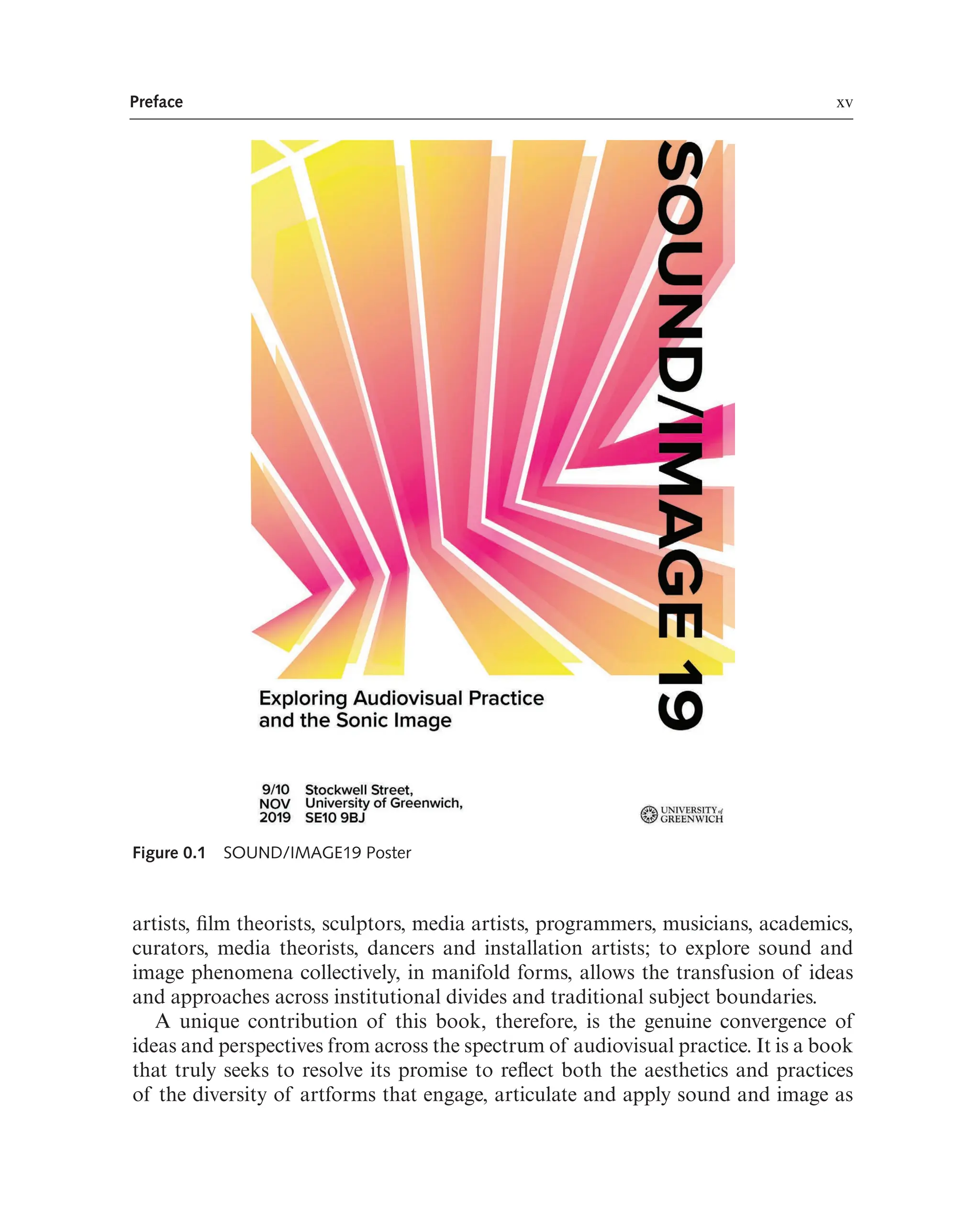
All contributors within this volume have shared their research as part of SOUND/
IMAGE, a conference running annually since 2015 (Figure 0.1). This international
colloquium seeks to catalyse both theoretical and practice research within audio-
visual composition; an area that lies at the intersection of many different artistic
practices and academic disciplines, and which embraces the many different forms of
audiovisuality, from abstract experimental flm, to installation, to performance, to
narrative flm analysis. Refecting the spirit of the original conference, this volume
embraces the multiplicities and potentialities at the intersection of these diverse dis-
ciplines. Bringing together composers, flmmakers, animators, video artists, sound
xiv
Preface xv
Figure 0.1 SOUND/IMAGE19 Poster
artists, flm theorists, sculptors, media artists, programmers, musicians, academics,
curators, media theorists, dancers and installation artists; to explore sound and
image phenomena collectively, in manifold forms, allows the transfusion of ideas
and approaches across institutional divides and traditional subject boundaries.
A unique contribution of this book, therefore, is the genuine convergence of
ideas and perspectives from across the spectrum of audiovisual practice. It is a book
that truly seeks to resolve its promise to refect both the aesthetics and practices
of the diversity of artforms that engage, articulate and apply sound and image as
xvi Preface
both artistic material and for philosophical enquiry. That practice and theory are
so coherently imbricated throughout this volume is a testament to the strength of
contemporary practice research; demonstrating the value and signifcance of prac-
tice-informed theory, and theory derived from practice. This is a feld which draws
upon established discourses in art history, flm studies, electroacoustic music, critical
theory, and thus the ideas and approaches in this book will fnd application in a wide
range of contexts across the whole scope of audiovisuality, from visual music and
experimental flm, to narrative flm and documentary, to live performance, sound
design and composition for flm, into sonic art and electroacoustic music.
The structure of this volume opens with contributions exploring wider aesthetic
and philosophical concerns in relation to sound and image practice. While often
concept-driven, these are always frmly grounded in relation to creative prac-
tices, suggesting frameworks and new paradigms for framing and considering the
audiovisual.
Later chapters critically refect upon individual artistic practices, revealing
approaches and techniques of working with sound and image that have the poten-
tial to greatly beneft those seeking to understand the practice, whether as a critical
thinker, ‘audiovisuologist’ or as a sound image composer/flmmaker/artist.
Each author makes a unique and valuable contribution to this volume, bridging
both across and between the diverse subject felds and practices that make up the
rich potential of audiovisuality. Their research refects the manifold approaches and
enquiries which interrogate the aesthetics and practices of sound and image; and, by
extension, to the developing discourse of audiovisual practices.
This edited collection would not have been possible without the support and
encouragement of my colleagues in the School of Design at the University of
Greenwich, particularly Professor Steven Kennedy, who has been an unwaver-
ing supporter of the SOUND/IMAGE project and of critically informed creative
practice research; Professor Gregory Sporton, who believed in the potential of a
young academic and who explicitly encouraged the development of a publication
to refect and recognise the valuable work being undertaken by those engaging with
the SOUND/IMAGE conference.
It is also essential to thank Professor Leigh Landy who provided invaluable
guidance and support as both my PhD supervisor and as director of the Institute
for Sonic Creativity at De Montfort University; Professor Bret Battey, who’s sen-
sitivity for, and insight, into audiovisual practice are refected in his beautiful and
inspirational audiovisual compositions – works which drew me to study with him
for Master’s and PhD research at De Montfort University; and to Dr Diego Garro
Preface xvii
who inspired my trajectory of fascination with the audiovisual, by sharing his own
passion for and mastery of sound and image composition, opening up whole new
worlds of enquiry to an enthusiasic undergraduate student.
Alongside of this I have been incredibly fortunate to have the unwavering sup-
port of my family; especially that of my wife Emma, who has been steadfast and
graciously accepting of the demands that arise as a consequence of creating and
organising the great many conference events which have developed, evolved and
expanded over the past ten years into SOUND/IMAGE. Without this foundational
support, it would not have been possible to create a platform which is able to inspire
and attract leading researchers from around the world to contribute and to innovate
in the area of sound and image research.
Finally, thanks must obviously go to all of the contributors of this volume, for
their openness and generosity in engaging with and delivering the project, and in
sharing their invaluable research within this collection.
Andrew Knight-Hill
November 2019
1
Connected media, connected idioms
The relationship between video and electroacoustic
music from a composer’s perspective
Diego Garro
Editor’s note
This chapter was originally presented at various international conferences between
2006–2008, but was never formally published. Its inclusion within this volume pro-
vides a permanent published record of the perspectives and ideas within and refects
the signifcant infuence that the author had upon the editor as an undergraduate
student, introducing him to the audiovisual.
This chapter is where this book began.
Introduction
As the enabling technologies for creative work with digital audio now reside on
the same computers as those used for video applications, composers have the, rela-
tively affordable, opportunity to ‘connect’ these two digital-media in their creative
endeavors. Yet, despite the facilitating role of software interfaces and the inheritance
of past experiences in mapping musical gestures to the moving image, the inherent
diffculty of an interconnected audiovisual ‘idiom’ soon becomes apparent. The
exposition and development of such an idiom represents a stimulating, yet daunting,
challenge for both audiences and composers.
Electroacoustic music communities have treasured and pioneered technological
advances in electronic and digital media tools. Sound and Image practices may fnd
beneft in seeking to extend into the audiovisual domain the powerful and distinctive
traits of a form of art that originally based itself, historically, culturally and aestheti-
cally, on the primacy of the ear.
Strategies adopted by a new breed of – sometimes self-taught – audiovisual
composers are informed by their experiences as Electroacoustic composers, sound
designers and sound artists, but their very actions also throw the acousmatic para-
digm into question. We will leave the darkness of the concert room behind us and
1
2 Diego Garro
refect upon works articulated through the combination of shifting audible and vis-
ible morphologies.
Although this topic can be approached from the viewpoint of the connection
between the two ‘physical’digital media, it becomes apparent that simply connecting
two media opens up several interesting questions, not only on the techniques and
technologies, but, especially, questions on the ‘connected idioms’, notably how the
sonic language and the language of the moving image relate to each other, and what
(if any) new combined, integrated idiom they contribute to form. The authors posi-
tion as a composer ensures that the following discussion is directed and informed
by applied experience in practice.
A new trend has emerged within the electoacoustic community during the last
twenty years: the combination of Electroacoustic Music soundtracks with video
material to form audiovisual works in which the sound and images are more or
less equally important. To illustrate the growing status of audiovisual compo-
sition within the Electroacoustic Music community I will cite a few historical
precedents:
● The International Electroacoustic Music and Sonic Art Competitions of Bourges
(www.imeb.net): this competition was founded in 1973 by Françoise Barrière and
Christian Clozier and has been for many years one of the most important com-
petitions in this feld, certainly in Europe, attracting approximately 200 partici-
pants every year from 30 different countries. In the year 2001 for the frst time the
Bourges competition featured a category for multi-media works.
● The Computer Music Journal (MIT press), published since 1977, covers a wide
range of topics related to digital audio signal processing and Electroacoustic
Music. The frst Video Anthology DVD, containing video works, was published
in Winter 2003 as an accompanying disc to issue Vol. 27, Number 4 of the
journal.
● The Computer Music Journal issue Vol. 29, Number 4, Winter 2005, was entirely
dedicated to topics relevant to Visual Music. This issue also included a second
Video Anthology DVD, with selected video works and video examples.
● The biannual Seeing Sound Conference/Festival, hosted by Joseph Hyde at
Bath Spa University since 2009. An informal practice-led symposium exploring
multimedia work which foregrounds the relationship between sound and image;
exploring areas such as visual music, abstract cinema, experimental anima-
tion, audiovisual performance and installation practice through paper sessions,
screenings, performances and installations, bringing together international art-
ists and thinkers to discuss their work and the aesthetics of audiovisual practice.
● SOUND/IMAGE conference/festival hosted by Andrew Knight-Hill in Green-
wich, running annually since 2015, bringing together international practitio-
ners to share concepts and creative approaches to audiovisual composition in
3
Connected media, connected idioms
concert with exhibitions, screenings and performances. Colliding the worlds of
experimental flmmaking and multichannel eletroacoustic composition.
Electroacoustic Music
For the sake of the ensuing discussion we should come, if at all possible, to an agree-
ment of what constitutes ‘Electroacoustic Music’. The reader can refer to many
recent writings on the subject as well as a critical review of at least some seminal
works from the repertoire (see, for example, Knight-Hill 2020). But in the immediate
context, we can take a giant leap forward to consider the following defnition:
Electroacoustic Music is a form of art that is concerned with the technologi-
cally aided exploration of ‘sound’ in all its phenomenological aspects, and with
the organisation of sonic material in time.
This defnition follows closely Edgard Varèse’s idea of Music as ‘organised sounds’.
Another defnition could be:
The structuring and the articulation of time with the materials of sound pat-
terns, which is both technically enabled and aesthetically informed by the capa-
bilities of electro-acoustic transducers (microphones, loudspeakers) and by the
opportunity to access and manipulate sound spectra by means of electronic
analog and digital technologies.
(expanded from a defnition of ‘Absolute Music’
by Brian Evans 2005)
Both these defnitions are obviously incomplete, and they over-simplify a form of
art which is complex, still evolving, and possibly still trying to defne itself amongst
the same tidal of globalised fragmentation that characterises all modern electronic
arts (and perhaps all human endeavours).
Nevertheless, these defnitions give us at least a starting point and some basic
principles. More discursively, the concerns of Electroacoustic Music can be identi-
fed as follows:
● It has a concern with the ‘discovery’ of sound (recording, synthesis, processing).
● It is a time-based form of art, hence concerned with the evolution and organisa-
tion of sounds in time. This raises typical issues of all time-based media such as
structure, balance, articulation, progression, direction, etc.
● It uses technology to ‘augment’ composers’ and performers’ control of sound
material and audiences’ experience of sound stimuli in an artistic context.
4 Diego Garro
● It assumes the ‘primacy of the ear’ promoted by members of the French school
of Musique Concrète (Pierre Schaeffer and others) in the 1950s. This is a cul-
tural attitude both for composers and for listeners. For composers, because they
use their hearing ability as primary informant when they ‘compose the sound’ in
the studio and when they ‘compose with sound’. For listeners, because in most
cases they rely only on their hearing ability (no visual clues) to understand the
artistic message in the music. The primacy of the ear is at the core of what we
may label the ‘acousmatic paradigm’ of Electroacoustic Music culture.
● It draws together creators and audiences who share a deep fascination with the
material of the acoustic space surrounding all of us. Not just the ‘music’ but,
rather the ‘sound of it’.
These elements are important because they give us some clues on how to relate to
the body of works for electroacoustic sounds and video discussed in this chapter.
The art of visible light – Visual Music
Electroacoustic Music developed alongside innovations and progress in audio
technology, the realisation of a quest for a medium of artistic expression that uti-
lised sounds freed from the expectations and cultural references of ‘music’, as we
knew it, until the beginning of the 20th century. We could trace a similar path in
the development of a non-narrative language of the moving image. In Germany,
for example, pioneering flm-makers such as Walter Ruttman, Viking Eggeling and
Hans Richter developed a type of experimental cinema that articulated abstract
shapes moving over time. Oskar Fischinger worked for over 30 years on this type
of flmic language and is considered by many the father ofthis type of flmmaking,
choreographing abstraction in connection with musical form (Evans 2005).
Experimental cinema of this kind is considered innovative, but was in effect a re-
mediated version of practices that date back a couple of centuries further in time,
to the pioneers of ‘Visual Music’.
Visual Music can be defned as time-based visual imagery that establishes a
temporal architecture in a way similar to ‘absolute’ music. It is typically non-
narrative and non-representational (although it need not be either). Visual
Music can be accompanied by sound but can also be silent.
(Evans 2005)
Visual Music precedes even flm. Early examples of gas-lamp Colour Organs
date back to the 18th century. Colour organs were instruments that pro-
jected coloured light under the control of an organ-like keyboard and were used
5
Connected media, connected idioms
to provide a visual accompaniment to music performances (Peacock 1988). Such instru-
ments became increasingly sophisticated, in terms of technology, control and visual
sophistication, especially with the advent of electricity, but they responded to the same
aesthetic quest as their predecessors. Interestingly, there has been a resurgence of inter-
est in Visual Music with exhibitions, screenings and museum galleries in major cities in
North America and Europe (see www.iotacenter.org and www.centerforvisualmusic.
org for information and catalogues of works in the feld, now available on DVDs1
).
Convergences
Media art histories of recent years may depict a parallel development of languages of
sonicarts,withElectroacousticMusicattheforefrontof thismovement,andlanguages
of the moving image with Visual Music and experimental non-narrative cinematogra-
phy on the other side. We can see such a parallel development as an anticipation of an
encounter between these disciplines, facilitated by certain key convergences:
Convergence in the type of media
Both the ‘art of sound’ and the ‘art of visible light’ are time-based media. They
engage the viewer/listener in a revisited and augmented experience of chronometric
time, accomplished through articulation of their time-varying stimuli (audible and
visible respectively).
Technological convergence
Both the ‘art of sound’and the ‘art of visible light’can inhabit the digital domain, hence
their materials can be stored and manipulated by computers. Nowadays the same rela-
tively ‘inexpensive’ desktop computer and even laptops can handle digital audio and,
with more diffculty, digital video data. In the solitary reclusion of the music project
studio, enabling tools for digital audio-video experimentation reside in the same work-
stations used for modern computer-music endeavours. It is an opportunity that has
been staring at Electroacoustic Music composers for the last 10 years.
Artistic and idiomatic convergences
Both the ‘art of sound’ and the ‘art of visible light’ developed a language that is very
experimental, often abstract and breaks away from historically established forms
(classical music, fgurative art), concentrating on the exploration of the basic mat-
ter in the respective media and in the construction of temporal articulations of that
matter for artistic purpose (see, for example, Whitney 1960).
6 Diego Garro
Mapping between sound and images
Strategies to combine sound and images have been the subject of study and experi-
mentation for centuries, from Isaac Newton and his correspondences colour-pitch,
through the inventors of the colour organs down to the creators of modern music
visualiser software such as those supported by iTunes, Windows Media Player
and WinAmp (Collopy 2000). Furthermore, psychologists of cognition have been
intrigued since the beginning of the 20th century by so-called synaesthesic corre-
spondences correspondences, within which stimuli in one sense modality is trans-
posed, to a different modality (for example, in some individuals certain sounds are
perceived with an strong sense of certain taste/favours).
Many strategies of mapping audio and visual have concentrated on seeking
to establish normative mappings between sound pitches and colour hues, in an
attempt to create a ‘colour harmony/disharmony’ that can be related to musical
consonance/dissonance. Fred Collopy provides a compendium of possible ‘cor-
respondences’ between music and images (see for example a summary of the vari-
ous ‘colour scales’ developed by thinkers and practitioners over three centuries to
associate normatively certain pitches in the tempered scale with certain colour hues
[Collopy 2001]).
However, prescriptive mapping techniques, such as colour-scales, quickly become
grossly inadequate once the palette of sound and visual material at a composers’
disposal expands. If models for correspondences are to be sought, they need to
account for more complex phenomenoloies of audio and video stimuli, far beyond
simplistic mappings between, for example, musical pitch and colour hue, or sound
loudness and image brightness.
Let us, for a start, introduce a taxonomy of phenomenological parameters of
the moving image and of sound, that we may consider a deeper mapping strategy
between the two media.2
Phenomenological parameters of the moving image
● Colour – hue, saturation, value (brightness).
● Shapes – geometry, size.
● Surface texture.
● Granularity – single objects, groups/aggregates, clusters, clouds.
● Position/Movement – trajectory, speed, acceleration in the (virtual) 2-D or 3-D
space recreated on the projection screen.
● Surrogacy – links to reality, how ‘recognisable’ and how representational visual
objects are.
7
Connected media, connected idioms
Phenomenological parameters of sound
● Spectrum – pitch, frequencies, harmonics, spectral focus.
● Amplitude envelope – energy profle.
● Granularity – individually discernible sound grains, sequences, aggregates,
streams, granular synthesis/reconstruction.
● Spatial behaviour – position, trajectory, speed, acceleration in the 2-D or 3-D
virtual acoustic space recreated in a stereo or surround sound feld.
● Surrogacy – links to reality, how ‘recognisable’ and how representational our
sound objects are.
We can not forget that we are dealing with two time-based media. Therefore, all these
preceding parameters must be considered, not just in their absolute values at certain
points in time or in averages, but should instead be considered as time-varying enti-
ties with individual temporal trajectories.
An audiovisual language can be thus constructed using association strategies
relating one or more parameters of audio material to one or more parameters of the
visual, including the profle of their behaviour in time. Some of these associations
are more naturally justifable than others (Jones and Nevile 2005: 56). For instance,
a mapping between sound frequencies and the size of corresponding visual objects
may take into account the fact that objects of smaller size are likely to produce sounds
that resonate at higher frequencies. In another example, a mapping strongly rooted
on the physics of the stimuli can be established between the amplitude of a sound
and the brightness of the associated imagery whereby louder sounds correspond to
brighter images, on the basis of the fact that both loudness and brightness are related
to the intensity (energy per unit of time and surface) of the respective phenomenon.
The viability and the laws of sound-to-image mappings can represent a fascinat-
ing feld of research and experimentation. However, with regards to the desirability
and the use for creative purposes of, more or less strict, parametric mapping, opin-
ions may vary dramatically between different artists and viewers. On this matter, two
interesting viewpoints:
The principle of synergy, i.e. that the whole is greater than the sum of its parts,
is fundamental to the nature of complex interactive dynamic sound and light
system and their resulting forms.
(Pellegrino 1983: 208)
A direct, synaesthesic mapping of music’s most basic parameters (pitch, loud-
ness and so forth) fails to capture the expressive vision of great works of music,
8 Diego Garro
which depend more directly on multi-dimensional interplay of tension and
resolution.
(extrapolated from John Whitney’s idea of ‘complementarity’
between music and visual arts [Alves 2005: 46])
From ‘mapping’ to ‘composing’
The “multi-dimensional interplay of tension and resolution” mentioned by Alves
indicates an angle of analysis creativity that is richer than parametric mapping,
albeit less rigorous, because the articulation of tension-release is indeed a more use-
ful compositional paradigm than any, more or less formalised, mapping between
audio and video material.
Instead of pursuing strict parametric mapping of audio into video or vice versa,
composers can aim at the formulation of a more complex ‘language’ based on the
articulation of sensory and emotional responses to artistically devised stimuli.
Roger B. Dannemberg observed that composers may opt for connections between
sound and moving image that, because they are based on explicit mapping, operate
at very superfcial levels. He advocates links between the two dimensions that are
not obvious, but are somewhat hidden within the texture of the work, at a deeper
level. Audiences may grasp intuitively the existence of a link and feel an emotional
connection with the work, while the subtlety of this link allows the viewer to relate
to the soundtrack and the video track as separate entities, as well to the resulting
‘Gestalt’ of the combination, thus fnding the work more interesting and worth
repeated visits (Dannemberg 2005: 26).
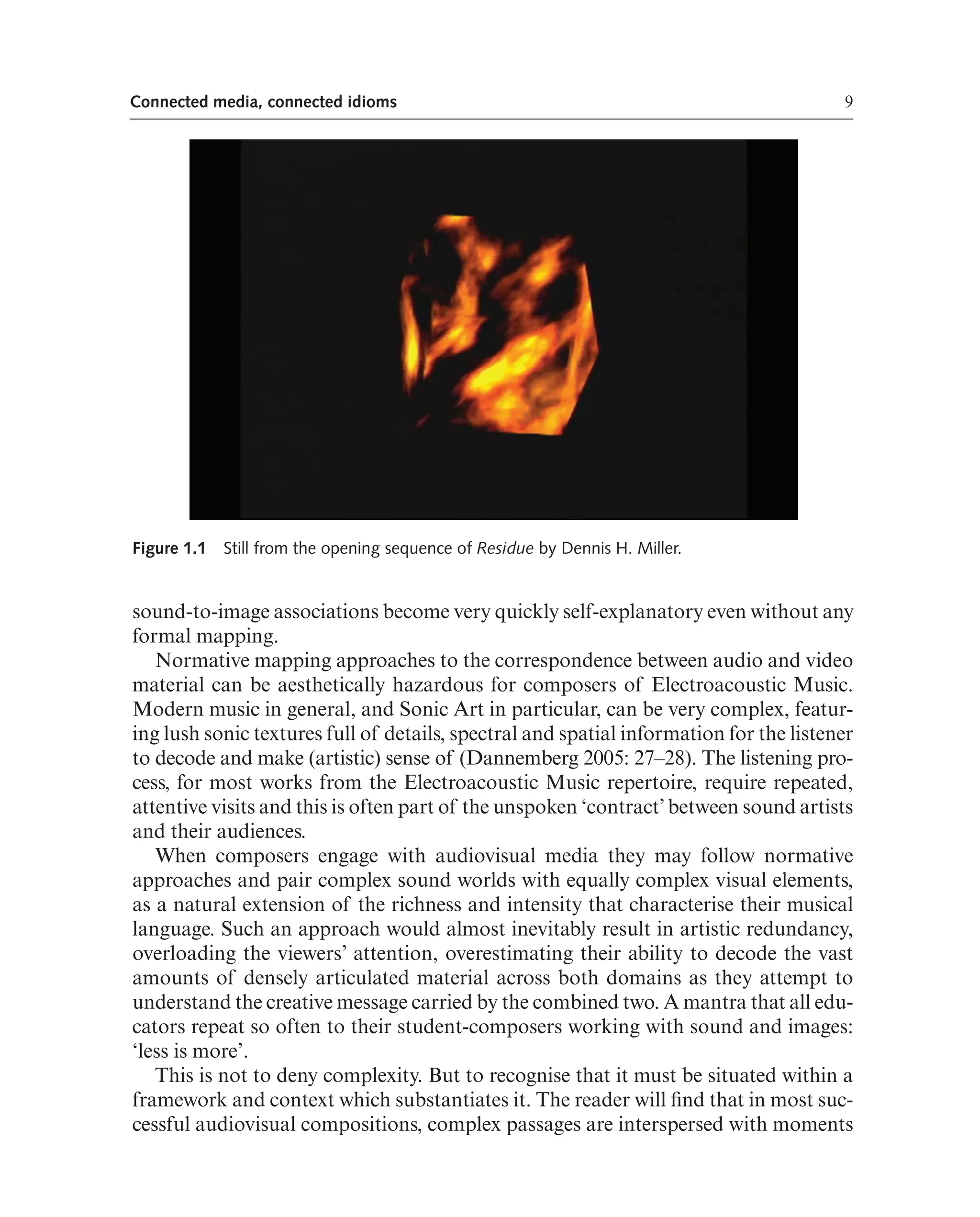
A beautiful example of such approach can be found in Dennis H. Miller’s work
Residue (1999) (Figure 1.1). At the onset of this audiovisual composition a mov-
ing, semi-transparent cubic solid, textured with shifting red vapours, is associated
with long, ringing inharmonic tones on top of which sharp reverberated sounds –
resembling magnifed echoes of water drops in a vast cavern – occasionally appear.
The association between the cube and the related sounds cannot be described in
parametrical mapping terms and, in fact, seems at frst rather arbitrary. However,
the viewer is quickly transported into an audiovisual discourse that is surprisingly
coherent and aesthetically enchanting. It is clear that those images and sounds
‘work well’ together although we are not able to explain why, certainly not in terms
of parametric mapping. A closer analysis of this work, and others by the same
author, reveals that it is the articulation in time of the initial, deliberate, audiovi-
sual association that makes the associations so convincing: we do not know why
the red cube is paired with inharmonic drones at the very onset of Residue but,
once that audiovisual statement is made, it is then articulated in such a compel-
ling way – by means of alternating repetitions, variations, developments – that the
9
Connected media, connected idioms
Figure 1.1 Still from the opening sequence of Residue by Dennis H. Miller.
sound-to-image associations become very quickly self-explanatory even without any
formal mapping.
Normative mapping approaches to the correspondence between audio and video
material can be aesthetically hazardous for composers of Electroacoustic Music.
Modern music in general, and Sonic Art in particular, can be very complex, featur-
ing lush sonic textures full of details, spectral and spatial information for the listener
to decode and make (artistic) sense of (Dannemberg 2005: 27–28). The listening pro-
cess, for most works from the Electroacoustic Music repertoire, require repeated,
attentive visits and this is often part of the unspoken ‘contract’between sound artists
and their audiences.
When composers engage with audiovisual media they may follow normative
approaches and pair complex sound worlds with equally complex visual elements,
as a natural extension of the richness and intensity that characterise their musical
language. Such an approach would almost inevitably result in artistic redundancy,
overloading the viewers’ attention, overestimating their ability to decode the vast
amounts of densely articulated material across both domains as they attempt to
understand the creative message carried by the combined two. A mantra that all edu-
cators repeat so often to their student-composers working with sound and images:
‘less is more’.
This is not to deny complexity. But to recognise that it must be situated within a
framework and context which substantiates it. The reader will fnd that in most suc-
cessful audiovisual compositions, complex passages are interspersed with moments
10 Diego Garro
of release; the viewer’s focus thus moves from global entities with high internal activ-
ity (tension), to local entities at lower internal activity (release).3
Electroacoustics, video and reality
Issues of sonic and narrative coherence brought upon by the use of recognisable
‘real’ sounds in Electroacoustic Music are magnifed when recognisable imagery is
also used in combination with the sounds. There is an enormous creative potential
when composers utilise material that, thanks to their representational value, call
upon very tangible associations and cultural responses from the audiences. For
instance, a generic inharmonic sound can be perceived as a rather abstract object
and can acquire a variety of aesthetic connotations depending on the (sonic)
context it is immersed in. A particularly recognisable inharmonic sound, for
example, a church bell, might function in a similarly reduced way,4
however, such
sound is more likely to conjure images and memories of church, faith, religious
ritual, spirituality, call, wedding, funeral, mass, joy, mourning, etc. depending on
the particular experience – and possibly state of mind – of a particular listener.
The dramaturgical implications are very potent and can be used to enhance the
‘theatre’ of a piece, or even as a primary compositional and interpretational
paradigm of the work itself (Jonathan Harvey’s Mortuos Plango, Vivos Voco is a
case in point).
We can construct works that are recognisably ‘about something’ that is easily
understood (Rudi 2005: 37) or use illusory references to a chunk of reality that
the viewer can relate to through more or less deep refection5
. These are obviously
compositional choices that refect the artistic intention of the work. This aspect
is particularly interesting because it bridges the audiovisual art discussed in this
chapter with the cinematography it often strives to separate from. The availabil-
ity, and affordability, of digital camcorders exerts on audiovisual composers an
attraction as irresistible as that posed by microphones to electroacousticians, to
access an entire universe of material that can be used for artistic expression. This is
inevitably refected within a body of work that applies elements of audio and video
material captured from reality to articulate discourses that are not necessarily, or
not entirely, based on narratives and which often attempt to transcend reality itself.
In these pieces, the viewer is often informed of the poetic intention of the work
via text credits at the beginning of the flm or through printed programme notes.
However, although such works use cinematographic techniques, they are not ‘flm’
in the traditional sense of the word, and nor are they documentaries, although
they feature, sometimes extensively, recognisable material flmed with a video
camera. Their concrete nature foregrounds their cultural and historical settings
which reinforce their audiovisual impact and, vice versa. The sophistication
Discovering Diverse Content Through
Random Scribd Documents
etc. The principle involved is identical in each and every case. The
"All A is B" symbology is merely adopted for simplicity, and for the
purpose of rendering the logical process akin to that of mathematics.
The letters play the same part that the numerals or figures do in
arithmetic or the a, b, c; x, y, z, in algebra. Thinking in symbols
tends toward clearness of thought and reasoning.
Exercise: Let the student apply the principles of Opposition by
using any of the above judgments mentioned in the preceding
paragraph, in the direction of erecting a Square of Opposition of
them, after having attached the symbolic letters A, E, I and O, to the
appropriate forms of the propositions.
Then let him work out the following problems from the Tables and
Square given in this chapter.
1. If "A" is true; show what follows for E, I and O. Also what
follows if "A" be false.
2. If "E" is true; show what follows for A, I and O. Also what
follows if "E" be false.
3. If "I" is true; show what follows for A, E and O. Also what
follows if "I" be false.
4. If "O" is true; show what follows for A, E and I. Also what
happens if "O" be false.
CONVERSION OF JUDGMENTS
Judgments are capable of the process of Conversion, or the
change of place of subject and predicate. Hyslop says: "Conversion
is the transposition of subject and predicate, or the process of
immediate inference by which we can infer from a given preposition
another having the predicate of the original for its subject, and the
subject of the original for its predicate." The process of converting a
proposition seems simple at first thought but a little consideration
will show that there are many difficulties in the way. For instance,
while it is a true judgment that "All horses are animals," it is not a
correct Derived Judgment or Inference that "All animals are horses."
The same is true of the possible conversion of the judgment "All
biscuit is bread" into that of "All bread is biscuit." There are certain
rules to be observed in Conversion, as we shall see in a moment.
The Subject of a judgment is, of course, the term of which
something is affirmed; and the Predicate is the term expressing that
which is affirmed of the Subject. The Predicate is really an
expression of an attribute of the Subject. Thus when we say "All
horses are animals" we express the idea that all horses possess the
attribute of "animality;" or when we say that "Some men are artists,"
we express the idea that some men possess the attributes or
qualities included in the concept "artist." In Conversion, the original
judgment is called the Convertend; and the new form of judgment,
resulting from the conversion, is called the Converse. Remember
these terms, please.
The two Rules of Conversion, stated in simple form, are as
follows:
I. Do not change the quality of a judgment. The quality of the
converse must remain the same as that of the convertend.
II. Do not distribute an undistributed term. No term must be
distributed in the converse which is not distributed in the
convertend.
The reason of these rules is that it would be contrary to truth and
logic to give to a converted judgment a higher degree of quality and
quantity than is found in the original judgment. To do so would be to
attempt to make "twice 2" more than "2 plus 2."
There are three methods or kinds of Conversion, as follows: (1)
Simple Conversion; (2) Limited Conversion; and (3) Conversion by
Contraposition.
In Simple Conversion, there is no change in either quality or
quantity. For instance, by Simple Conversion we may convert a
proposition by changing the places of its subject and predicate,
respectively. But as Jevons says: "It does not follow that the new
one will always be true if the old one was true. Sometimes this is the
case, and sometimes it is not. If I say, 'some churches are wooden-
buildings,' I may turn it around and get 'some wooden-buildings are
churches;' the meaning is exactly the same as before. This kind of
change is called Simple Conversion, because we need do nothing but
simply change the subjects and predicates in order to get a new
proposition. We see that the Particular Affirmative proposition can be
simply converted. Such is the case also with the Universal Negative
proposition. 'No large flowers are green things' may be converted
simply into 'no green things are large flowers.'"
In Limited Conversion, the quantity is changed from Universal to
Particular. Of this, Jevons continues: "But it is a more troublesome
matter, however, to convert a Universal Affirmative proposition. The
statement that 'all jelly fish are animals,' is true; but, if we convert it,
getting 'all animals are jelly fish,' the result is absurd. This is
because the predicate of a universal proposition is really particular.
We do not mean that jelly fish are 'all' the animals which exist, but
only 'some' of the animals. The proposition ought really to be 'all
jelly fish are some animals,' and if we converted this simply, we
should get, 'some animals are all jelly fish.' But we almost always
leave out the little adjectives some and all when they would occur in
the predicate, so that the proposition, when converted, becomes
'some animals are jelly fish.' This kind of change is called Limited
Conversion, and we see that a Universal Affirmative proposition,
when so converted, gives a Particular Affirmative one."
In Conversion by Contraposition, there is a change in the position
of the negative copula, which shifts the expression of the quality. As
for instance, in the Particular Negative "Some animals are not
horses," we cannot say "Some horses are not animals," for that
would be a violation of the rule that "no term must be distributed in
the converse which is not distributed in the convertend," for as we
have seen in the preceding chapter: "In Particular propositions the
subject is not distributed." And in the original proposition, or
convertend, "animals" is the subject of a Particular proposition.
Avoiding this, and proceeding by Conversion by Contraposition, we
convert the Convertend (O) into a Particular Affirmative (I), saying:
"Some animals are not-horses;" or "Some animals are things not
horses;" and then proceeding by Simple Conversion we get the
converse, "Some things not horses are animals," or "Some not-
horses are animals."
The following gives the application of the appropriate form of
Conversion to each of the several four kind of Judgments or
Propositions:
(A) Universal Affirmative: This form of proposition is converted by
Limited Conversion. The predicate not being distributed in the
convertend, it cannot be distributed in the converse, by saying "all."
("In affirmative propositions the predicate is not distributed.") Thus
by this form of Conversion, we convert "All horses are animals" into
"Some animals are horses." The Universal Affirmative (A) is
converted by limitation into a Particular Affirmative (I).
(E) Universal Negative: This form of proposition is converted by
Simple Conversion. In a Universal Negative both terms are
distributed. ("In universal propositions, the subject is distributed;"
"In negative propositions, the predicate is distributed.") So we may
say "No cows are horses," and then convert the proposition into "No
horses are cows." We simply convert one Universal Negative (E) into
another Universal Negative (E).
(I) Particular Affirmative: This form of proposition is converted by
Simple Conversion. For neither term is distributed in a Particular
Affirmative. ("In particular propositions, the subject is not
distributed. In affirmative propositions, the predicate is not
distributed.") And neither term being distributed in the convertend, it
must not be distributed in the converse. So from "Some horses are
males" we may by Simple Conversion derive "Some males are
horses." We simply convert one Particular Affirmative (I), into
another Particular Affirmative (I).
(O) Particular Negative: This form of proposition is converted by
Contraposition or Negation. We have given examples and
illustrations in the paragraph describing Conversion by
Contraposition. The Particular Negative (I) is converted by
contraposition into a Particular Affirmative (I) which is then simply
converted into another Particular Affirmative (I).
There are several minor processes or methods of deriving
judgments from each other, or of making immediate inferences, but
the above will give the student a very fair idea of the minor or more
complete methods.
Exercise: The following will give the student good practice and
exercise in the methods of Conversion. It affords a valuable mental
drill, and tends to develop the logical faculties, particularly that of
Judgment. The student should convert the following propositions,
according to the rules and examples given in this chapter:
1. All men are reasoning beings.
2. Some men are blacksmiths.
3. No men are quadrupeds.
4. Some birds are sparrows.
5. Some horses are vicious.
6. No brute is rational.
7. Some men are not sane.
8. All biscuit is bread.
9. Some bread is biscuit.
10. Not all bread is biscuit.
CHAPTER XIII.
REASONING
In the preceding chapters we have seen that in the group of
mental processes involved in the general process of Understanding,
there are several stages or steps, three of which we have considered
in turn, namely: (1) Abstraction; (2) Generalization or Conception;
(3) Judgment. The fourth step, or stage, and the one which we are
now about to consider, is that called Reasoning.
Reasoning is that faculty of the mind whereby we compare two
Judgments, one with the other, and from which comparison we are
enabled to form a third judgment. It is a form of indirect or mediate
comparison, whereas, the ordinary Judgment is a form of immediate
or direct comparison. As, when we form a Judgment, we compare
two concepts and decide upon their agreement or difference; so in
Reasoning we compare two Judgments and from the comparison we
draw or produce a new Judgment. Thus, we may reason that the
particular dog "Carlo" is an animal, by the following process:
(1) All dogs are animals; (2) Carlo is a dog; therefore, (3) Carlo is
an animal. Or, in the same way, we may reason that a whale is not a
fish, as follows:
(1) All fish are cold-blooded animals; (2) A whale is not a cold-
blooded animal; therefore, (3) A whale is not a fish.
In the above processes it will be seen that the third and final
Judgment is derived from a comparison of the first two Judgments.
Brooks states the process as follows: "Looking at the process more
closely, it will be seen that in inference in Reasoning involves a
comparison of relations. We infer the relation of two objects from
their relation to a third object. We must thus grasp in the mind two
relations and from the comparison of these two relations we infer a
third relation. The two relations from which we infer a third, are
judgments; hence, Reasoning may also be defined as the process of
deriving one judgment from two other judgments. We compare the
two given judgments and from this comparison derive the third
judgment. This constitutes a single step in Reasoning, and an
argument so expressed is called a Syllogism."
The Syllogism consists of three propositions, the first two of which
express the grounds or basis of the argument and are called the
premises; the third expresses the inference derived from a
comparison of the other two and is called the conclusion. We shall
not enter into a technical consideration of the Syllogism in this book,
as the subject is considered in detail in the volume of this series
devoted to the subject of "Logic." Our concern here is to point out
the natural process and course of Reasoning, rather than to consider
the technical features of the process.
Reasoning is divided into two general classes, known respectively
as (1) Inductive Reasoning; (2) Deductive Reasoning.
Inductive Reasoning is the process of arriving at a general truth,
law or principle from a consideration of many particular facts and
truths. Thus, if we find that a certain thing is true of a great number
of particular objects, we may infer that the same thing is true of all
objects of this particular kind. In one of the examples given above,
one of the judgments was that "all fish are cold-blooded animals,"
which general truth was arrived at by Inductive Reasoning based
upon the examination of a great number of fish, and from thence
assuming that all fish are true to this general law of truth.
Deductive Reasoning is the reverse of Inductive Reasoning, and is
a process of arriving at a particular truth from the assumption of a
general truth. Thus, from the assumption that "all fish are cold-
blooded animals," we, by Deductive Reasoning, arrive at the
conclusion that the particular fish before us must be cold-blooded.
Inductive Reasoning proceeds upon the basic principle that "What
is true of the many is true of the whole," while Deductive Reasoning
proceeds upon the basic principle that "What is true of the whole is
true of its parts."
Regarding the principle of Inductive Reasoning, Halleck says: "Man
has to find out through his own experience, or that of others, the
major premises from which he argues or draws his conclusions. By
induction, we examine what seems to us a sufficient number of
individual cases. We then conclude that the rest of these cases,
which we have not examined, will obey the same general law. The
judgment 'All men are mortal' was reached by induction. It was
observed that all past generations of men had died, and this fact
warranted the conclusion that all men living will die. We make that
assertion as boldly as if we had seen them all die. The premise, 'All
cows chew the cud,' was laid down after a certain number of cows
had been examined. If we were to see a cow twenty years hence,
we should expect to find that she chewed the cud. It was noticed by
astronomers that, after a certain number of days, the earth regularly
returned to the same position in its orbit, the sun rose in the same
place, and the day was of the same length. Hence, the length of the
year and of each succeeding day was determined, and the almanac
maker now infers that the same will be true of future years. He tells
us that the sun on the first of next December will rise at a given
time, although he cannot throw himself into the future to verify the
conclusion."
Brooks says regarding this principle: "This proposition is founded
on our faith in the uniformity of nature; take away this belief, and all
reasoning by induction fails. The basis of induction is thus often
stated to be man's faith in the uniformity of nature. Induction has
been compared to a ladder upon which we ascend from facts to
laws. This ladder cannot stand unless it has something to rest upon;
and this something is our faith in the constancy of nature's laws."
There are two general ways of obtaining our basis for the process
of Inductive Reasoning. One of these is called Perfect Induction and
the other Imperfect Induction. Perfect Induction is possible only
when we have had the opportunity of examining every particular
object or thing of which the general idea is expressed. For instance,
if we could examine every fish in the universe we would have the
basis of Perfect Induction for asserting the general truth that "all
fishes are cold-blooded." But this is practically impossible in the
great majority of cases, and so we must fall back upon more or less
Imperfect Induction. We must assume the general law from the fact
that it is seen to exist in a very great number of particular cases;
upon the principle that "What is true of the many is true of the
whole." As Halleck says regarding this: "Whenever we make a
statement such as, 'All men are mortal,' without having tested each
individual case or, in other words, without having seen every man
die, we are reasoning from imperfect induction. Every time a man
buys a piece of beef, a bushel of potatoes or a loaf of bread, he is
basing his action on inference from imperfect induction. He believes
that beef, potatoes and bread will prove nutritious food, although he
has not actually tested those special edibles before purchasing them.
They have hitherto been found to be nutritious on trial and he
argues that the same will prove true of those special instances.
Whenever a man takes stock in a new national bank, a manufactory
or a bridge, he is arguing from past cases that this special
investment will prove profitable. We instinctively believe in the
uniformity of nature; if we did not we should not consult our
almanacs. If sufficient heat will cause phosphorus to burn today, we
conclude that the same result will follow tomorrow if the
circumstances are the same."
But, it will be seen, much care must be exercised in making
observations, experiments and comparisons, and in making
generalizations. The following general principles will give the views
of the authorities regarding this:
Atwater gives the two general rules:
Rule of Agreement: "If, whenever a given object or agency is
present, without counteracting forces, a given effect is produced,
there is a strong evidence that the object or agency is the cause of
the effect."
Rule of Disagreement: "If when the supposed cause is present the
effect is present, and when the supposed cause is absent the effect
is wanting, there being in neither case any other agents present to
effect the result, we may reasonably infer that the supposed cause is
the real one."
Rule of Residue: "When in any phenomena we find a result
remaining after the effects of all known causes are estimated, we
may attribute it to a residual agent not yet reckoned."
Rule of Concomitant Variations: "When a variation in a given
antecedent is accompanied by a variation of a given consequent,
they are in some manner related as cause and effect."
Atwater says, of the above rules, that "whenever either of these
criteria is found, free from conflicting evidence, and especially when
several of them concur, the evidence is clear that the cases observed
are fair representatives of the whole class, and warrant a valid
universal inductive conclusion."
We now come to what is known as Hypothesis or Theory, which is
an assumed general principle—a conjecture or supposition founded
upon observed and tested facts. Some authorities use the term
"theory" in the sense of "a verified hypothesis," but the two terms
are employed loosely and the usage varies with different authorities.
What is known as "the probability of a hypothesis" is the proportion
of the number of facts it will explain. The greater the number of
facts it will explain, the greater is its "probability." A Hypothesis is
said to be "verified" when it will account for all the facts which are
properly to be referred to it. Some very critical authorities hold that
verification should also depend upon there being no other possible
hypotheses which will account for the facts, but this is generally
considered an extreme position.
A Hypothesis is the result of a peculiar mental process which
seems to act in the direction of making a sudden anticipatory leap
toward a theory, after the mind has been saturated with a great
body of particular facts. Some have spoken of the process as almost
intuitive and, indeed, the testimony of many discoverers of great
natural laws would lead us to believe that the Subconscious region
of the mind is most active in making what La Place has called "the
great guess" of discovery of principle. As Brooks says: "The forming
of hypotheses requires a suggestive mind, a lively fancy, a
philosophic imagination, that catches a glimpse of the idea through
the form, or sees the law standing behind the fact."
Thomson says: "The system of anatomy which has immortalized
the name of Oken, is the consequence of a flash of anticipation
which glanced through his mind when he picked up in a chance walk
the skull of a deer, bleached and disintegrated by the weather, and
exclaimed, after a glance, 'It is part of a vertebral column.' When
Newton saw the apple fall, the anticipatory question flashed through
his mind, 'Why do not the heavenly bodies fall like this apple?' In
neither case had accident any important share; Newton and Oken
were prepared by the deepest previous study to seize upon the
unimportant fact offered to them, and show how important it might
become; and if the apple and the deer-skull had been wanting, some
other falling body, or some other skull, would have touched the
string so ready to vibrate. But in each case there was a great step of
anticipation; Oken thought he saw the type of the whole skeleton in
a single vertebra, whilst Newton conceived at once that the whole
universe was full of bodies tending to fall."
Passing from the consideration of Inductive Reasoning to that of
Deductive Reasoning we find ourselves confronted with an entirely
opposite condition. As Brooks says: "The two methods of reasoning
are the reverse of each other. One goes from particulars to generals;
the other from generals to particulars. One is a process of analysis;
the other is a process of synthesis. One rises from facts to laws; the
other descends from laws to facts. Each is independent of the other;
and each is a valid and essential method of inference."
Deductive Reasoning is, as we have seen, dependent upon the
process of deriving a particular truth from a general law, principle or
truth, upon the fundamental axiom that: "What is true of the whole
is true of its parts." It is an analytical process, just as Inductive
Reasoning is synthetical. It is a descending process, just as Inductive
Reasoning is ascending.
Halleck says of Deductive Reasoning: "After induction has
classified certain phenomena and thus given us a major premise, we
proceed deductively to apply the inference to any new specimen that
can be shown to belong to that class. Induction hands over to
deduction a ready-made major premise, e.g. 'All scorpions are
dangerous.' Deduction takes this as a fact, making no inquiry about
its truth. When a new object is presented, say a possible scorpion,
the only troublesome step is to decide whether the object is really a
scorpion. This may be a severe task on judgment. The average
inhabitant of the temperate zone would probably not care to risk a
hundred dollars on his ability to distinguish a scorpion from a
centipede, or from twenty or thirty other creatures bearing some
resemblance to a scorpion. Here there must be accurately formed
concepts and sound judgment must be used in comparing them. As
soon as we decide that the object is really a scorpion, we complete
the deduction in this way:—'All scorpions are dangerous; this
creature is a scorpion; this creature is dangerous.' The reasoning of
early life must be necessarily inductive. The mind is then forming
general conclusions from the examination of individual phenomena.
Only after general laws have been laid down, after objects have
been classified, after major premises have been formed, can
deduction be employed."
What is called Reasoning by Analogy is really but a higher degree
of Generalization. It is based upon the idea that if two or more
things resemble each other in many particulars, they are apt to
resemble each other in other particulars. Some have expressed the
principle as follows: "Things that have some things in common have
other things in common." Or as Jevons states it: "The rule for
reasoning by analogy is that if two or more things resemble each
other in many points, they will probably resemble each other also in
more points."
This form of reasoning, while quite common and quite convenient,
is also very dangerous. It affords many opportunities for making
false inferences. As Jevons says: "In many cases Reasoning by
Analogy is found to be a very uncertain guide. In some cases
unfortunate mistakes are committed. Children are sometimes killed
by gathering and eating poisonous berries, wrongly inferring that
they can be eaten, because other berries, of a somewhat similar
appearance, have been found agreeable and harmless. Poisonous
toadstools are occasionally mistaken for mushrooms, especially by
people not accustomed to gather them.... There is no way in which
we can really assure ourselves that we are arguing safely by
analogy. The only rule that can be given is this, that the more things
resemble each other, the more likely is it that they are the same in
other respects, especially in points closely connected with those
observed."
Halleck says: "In argument or reasoning we are much aided by
the habit of searching for hidden resemblances. We may here use
the term analogy in the narrower sense as a resemblance of ratios.
There is analogical relation between autumnal frosts and vegetation
on the one hand, and death and human life on the other. Frosts
stand in the same relation to vegetation that death does to life. The
detection of such a relation cultivates thought. If we are to succeed
in argument, we must develop what some call a sixth sense for the
detection of such relations.... Many false analogies are manufactured
and it is excellent thought training to expose them. The majority of
people think so little that they swallow false analogies just as newly-
fledged robins swallow small stones dropped into their open
mouths.... The study of poetry may be made very serviceable in
detecting analogies and cultivating the reasoning powers. When the
poet brings clearly to mind the change due to death, using as an
illustration the caterpillar body transformed into the butterfly spirit,
moving with winged ease over flowing meadows, he is cultivating
our apprehension of relations, none the less valuable because they
are beautiful."
There are certain studies which tend to develop the power or
faculty of Inductive Reasoning. Any study which leads the mind to
consider classification and general principles, laws or truth, will tend
to develop the faculty of deduction. Physics, Chemistry, Astronomy,
Biology and Natural History are particularly adapted to develop the
mind in this particular direction. Moreover, the mind should be
directed to an inquiry into the causes of things. Facts and
phenomena should be observed and an attempt should be made not
only to classify them, but also to discover general principles moving
them. Tentative or provisional hypotheses should be erected and
then the facts re-examined in order to see whether they support the
hypotheses or theory. Study of the processes whereby the great
scientific theories were erected, and the proofs then adduced in
support of them, will give the mind the habit of thinking along the
lines of logical induction. The question ever in the mind in Inductive
Reasoning is "Why?" The dominant idea in Inductive Reasoning is
the Search for Causes.
In regard to the pitfalls of Inductive Reasoning—the fallacies, so-
called, Hyslop says: "It is not easy to indicate the inductive fallacies,
if it be even possible, in the formal process of induction.... It is
certain, however, that in respect to the subject-matter of the
conclusion in inductive reasoning there are some very definite
limitations upon the right to transcend the premises. We cannot infer
anything we please from any premises we please. We must conform
to certain definite rules or principles. Any violation of them will be a
fallacy. These rules are the same as those for material fallacies in
deduction, so that the fallacies of induction, whether they are ever
formal or not, are at least material; that is they occur whenever
equivocation and presumption are committed. There are, then, two
simple rules which should not be violated. (1) The subject-matter in
the conclusion should be of the same general kind as in the
premises. (2) The facts constituting the premises must be accepted
and must not be fictitious."
One may develop his faculty or power of Deductive Reasoning by
pursuing certain lines of study. The study of Mathematics,
particularly in its branch of Mental Arithmetic is especially valuable in
this direction. Algebra and Geometry have long been known to
exercise an influence over the mind which gives to it a logical trend
and cast. The processes involved in Geometry are akin to those
employed in Logical reasoning, and must necessarily train the mind
in this special direction. As Brooks says: "So valuable is geometry as
a discipline that many lawyers and others review their geometry
every year in order to keep the mind drilled to logical habits of
thinking." The study of Grammar, Rhetoric and the Languages, are
also valuable in the culture and development of the faculty of
Deductive Reasoning. The study of Psychology and Philosophy have
value in this connection. The study of Law is very valuable in
creating logical habits of thinking deductively.
But in the study of Logic we have possibly the best exercise in the
development and culture of this particular faculty. As Brooks well
says: "The study of Logic will aid in the development of the power of
deductive reasoning. It does this first by showing the method by
which we reason. To know how we reason, to see the laws which
govern the reasoning process, to analyze the syllogism and see its
conformity to the laws of thought, is not only an exercise of
reasoning, but gives that knowledge of the process that will be both
a stimulus and a guide to thought. No one can trace the principles
and processes of thought without receiving thereby an impetus to
thought. In the second place, the study of logic is probably even
more valuable because it gives practice in deductive thinking. This,
perhaps, is its principal value, since the mind reasons instinctively
without knowing how it reasons. One can think without the
knowledge of the science of thinking, just as one can use language
correctly without a knowledge of grammar; yet as the study of
grammar improves one's speech, so the study of logic cannot but
improve one's thought."
The study of the common fallacies, such as "Begging the
Question," "Reasoning in a Circle," etc., is particularly important to
the student, for when one realizes that such fallacies exist, and is
able to detect and recognize them, he will avoid their use in framing
his own arguments, and will be able to expose them when they
appear in the arguments of others.
The fallacy of "Begging the Question" consists in assuming as a
proven fact something that has not been proven, or is not accepted
as proven by the other party to the argument. It is a common trick
in debate. The fact assumed may be either the particular point to be
proved, or the premise necessary to prove it. Hyslop gives the
following illustration of this fallacy: "Good institutions should be
united; Church and State are good institutions; therefore, Church
and State should be united." The above syllogism seems reasonable
at first thought, but analysis will show that the major premise "Good
institutions should be united" is a mere assumption without proof.
Destroy this premise and the whole reasoning fails.
Another form of fallacy, quite common, is that called "Reasoning in
a Circle," which consists in assuming as proof of a proposition the
proposition itself, as for instance, "This man is a rascal, because he
is a rogue; he is a rogue, because he is a rascal." "We see through
glass, because it is transparent." "The child is dumb, because it has
lost the power of speech." "He is untruthful, because he is a liar."
"The weather is warm, because it is summer; it is summer, because
the weather is warm."
These and other fallacies may be detected by a knowledge of
Logic, and the perception and detection of them strengthens one in
his faculty of Deductive Reasoning. The study of the Laws of the
Syllogism, in Logic, will give to one a certain habitual sense of
stating the terms of his argument according to these laws, which
when acquired will be a long step in the direction of logical thinking,
and the culture of the faculties of deductive reasoning.
In concluding this chapter, we wish to call your attention to a fact
often overlooked by the majority of people. Halleck well expresses it
as follows: "Belief is a mental state which might as well be classed
under emotion as under thinking, for it combines both elements.
Belief is a part inference from the known to the unknown, and part
feeling and emotion." Others have gone so far as to say that the
majority of people employ their intellects merely to prove to
themselves and others that which they feel to be true, or wish to be
true, rather than to ascertain what is actually true by logical
methods. Others have said that "men do not require arguments to
convince them; they want only excuses to justify them in their
feelings, desires or actions." Cynical though this may seem, there is
sufficient truth in it to warn one to guard against the tendency.
Jevons says, regarding the question of the culture of logical
processes of thought: "Monsieur Jourdain, an amusing person in one
of Moliere's plays, expressed much surprise on learning that he had
been talking prose for more than forty years without knowing it.
Ninety-nine people out of a hundred might be equally surprised on
hearing that they had long been converting propositions, syllogizing,
falling into paralogisms, framing hypotheses and making
classifications with genera and species. If asked if they were
logicians, they would probably answer, No. They would be partly
right; for I believe that a large number even of educated persons
have no clear idea of what logic is. Yet, in a certain way, every one
must have been a logician since he began to speak. It may be
asked:—If we cannot help being logicians, why do we need logic
books at all? The answer is that there are logicians, and logicians. All
persons are logicians in some manner or degree; but unfortunately
many people are bad ones and suffer harm in consequence. It is just
the same in other matters. Even if we do not know the meaning of
the name, we are all athletes in some manner or degree. No one can
climb a tree or get over a gate without being more or less an
athlete. Nevertheless, he who wishes to do these actions really well,
to have a strong muscular frame and thereby to secure good health
and personal safety, as far as possible, should learn athletic
exercises."
CHAPTER XIV.
CONSTRUCTIVE IMAGINATION
From the standpoint of the old psychology, a chapter bearing the
above title would be considered quite out of place in a book on
Thought-Culture, the Imagination being considered as outside the
realm of practical psychology, and as belonging entirely to the
idealistic phase of mental activities. The popular idea concerning the
Imagination also is opposed to the "practical" side of its use. In the
public mind the Imagination is regarded as something connected
with idle dreaming and fanciful mental imaging. Imagination is
considered as almost synonomous with "Fancy."
But the New Psychology sees beyond this negative phase of the
Imagination and recognizes the positive side which is essentially
constructive when backed up with a determined will. It recognizes
that while the Imagination is by its very nature idealistic, yet these
ideals may be made real—these subjective pictures may be
materialized objectively. The positive phase of the Imagination
manifests in planning, designing, projecting, mapping out, and in
general in erecting the mental framework which is afterward clothed
with the material structure of actual accomplishment. And,
accordingly, it has seemed to us that a chapter on "Constructive
Imagination" might well conclude this book on Thought-Culture.
Halleck says: "It was once thought that the imagination should be
repressed, not cultivated, that it was in the human mind like weeds
in a garden.... In this age there is no mental power that stands more
in need of cultivation than the imagination. So practical are its
results that a man without it cannot possibly be a good plumber. He
must image short cuts for placing his pipe. The image of the
direction to take to elude an obstacle must precede the actual laying
of the pipe. If he fixes it before traversing the way with his
imagination, he frequently gets into trouble and has to tear down his
work. Some one has said that the more imagination a blacksmith
has, the better will he shoe a horse. Every time he strikes the red-
hot iron, he makes it approximate to the image in his mind. Nor is
this image a literal copy of the horse's foot. If there is a depression
in that, the imagination must build out a corresponding elevation in
the image, and the blows must make the iron fit the image."
Brodie says: "Physical investigation, more than anything else,
helps to teach us the actual value and right use of the imagination—
of that wondrous faculty, which, when left to ramble uncontrolled,
leads us astray into a wilderness of perplexities and errors, a land of
mists and shadows; but which, properly controlled by experience
and reflection, becomes the noblest attribute of man, the source of
poetic genius, the instrument of discovery in science, without the aid
of which Newton would never have invented fluxions nor Davy have
decomposed the earths and alkalies, nor would Columbus have
found another continent."
The Imagination is more than Memory, for the latter merely
reproduces the impressions made upon it, while the Imagination
gathers up the material of impression and weaves new fabrics from
them or builds new structures from their separated units. As Tyndall
well said: "Philosophers may be right in affirming that we cannot
transcend experience; but we can at all events carry it a long way
from its origin. We can also magnify, diminish, qualify and combine
experiences, so as to render them fit for purposes entirely new. We
are gifted with the power of imagination and by this power we can
lighten the darkness which surrounds the world of the senses. There
are tories, even in science, who regard imagination as a faculty to be
feared and avoided rather than employed. But bounded and
conditioned by cooperant reason, imagination becomes the mightiest
instrument of the physical discoverer. Newton's passage from a
falling apple to a falling moon was, at the outset, a leap of the
imagination."
Welcome to our website – the ideal destination for book lovers and
knowledge seekers. With a mission to inspire endlessly, we offer a
vast collection of books, ranging from classic literary works to
specialized publications, self-development books, and children's
literature. Each book is a new journey of discovery, expanding
knowledge and enriching the soul of the reade
Our website is not just a platform for buying books, but a bridge
connecting readers to the timeless values of culture and wisdom. With
an elegant, user-friendly interface and an intelligent search system,
we are committed to providing a quick and convenient shopping
experience. Additionally, our special promotions and home delivery
services ensure that you save time and fully enjoy the joy of reading.
Let us accompany you on the journey of exploring knowledge and
personal growth!
textbookfull.com

Sound and Image Aesthetics and Practices Sound Design 1st Edition Andrew Knight-Hill (Editor)
  • 1.
    Sound and ImageAesthetics and Practices Sound Design 1st Edition Andrew Knight-Hill (Editor) download https://textbookfull.com/product/sound-and-image-aesthetics-and- practices-sound-design-1st-edition-andrew-knight-hill-editor/ Download more ebook from https://textbookfull.com
  • 2.
    We believe theseproducts will be a great fit for you. Click the link to download now, or visit textbookfull.com to discover even more! Musical Sound Effects Analog and Digital Sound Processing 1st Edition Reveillac https://textbookfull.com/product/musical-sound-effects-analog- and-digital-sound-processing-1st-edition-reveillac/ Designing Sound Audiovisual Aesthetics in 1970s American Cinema Jay Beck https://textbookfull.com/product/designing-sound-audiovisual- aesthetics-in-1970s-american-cinema-jay-beck/ Computational Intelligence in Music Sound Art and Design Antonios Liapis https://textbookfull.com/product/computational-intelligence-in- music-sound-art-and-design-antonios-liapis/ Sound and the Ancient Senses 1st Edition Meg Grigal https://textbookfull.com/product/sound-and-the-ancient- senses-1st-edition-meg-grigal/
  • 3.
    Fluid Structure SoundInteractions and Control Proceedings of the 3rd Symposium on Fluid Structure Sound Interactions and Control 1st Edition Yu Zhou https://textbookfull.com/product/fluid-structure-sound- interactions-and-control-proceedings-of-the-3rd-symposium-on- fluid-structure-sound-interactions-and-control-1st-edition-yu- zhou/ Sound, Media, Ecology Milena Droumeva https://textbookfull.com/product/sound-media-ecology-milena- droumeva/ Fluid Structure Sound Interactions and Control Yu Zhou https://textbookfull.com/product/fluid-structure-sound- interactions-and-control-yu-zhou/ Music Sound and Architecture in Islam Michael Frishkopf https://textbookfull.com/product/music-sound-and-architecture-in- islam-michael-frishkopf/ Sound of Snow Falling 1st Edition Maggie Umber https://textbookfull.com/product/sound-of-snow-falling-1st- edition-maggie-umber/
  • 5.
    Sound and Image Soundand Image: Aesthetics and Practices brings together international artist scholars to explore diverse sound and image practices, applying critical perspectives to interrogate and evaluate both the aesthetics and practices that underpin the audiovisual. Contributions draw upon established discourses in electroacoustic music, media art history, flm studies, critical theory and dance; framing and critiquing these arguments within the context of diverse audiovisual practices. The volume’s interdisciplinary perspective contributes to the rich and evolving dialogue surrounding the audiovisual, demonstrating the value and signifcance of practice- informed theory, and theory derived from practice. The ideas and approaches explored within this book will fnd application in a wide range of contexts across the whole scope of audiovisuality, from visual music and experimental flm, to narrative flm and documentary, to live performance, sound design and into sonic art and electroacoustic music. This book is ideal for artists, composers and researchers investigating theoretical positions and compositional practices which bring together sound and image. Andrew Knight-Hill is a composer specialising in studio composed works, both sound- based electroacoustic and audiovisual. He is Senior Lecturer in Sound Design and Music Technology at the University of Greenwich, programme leader of Sound Design BA, director of the Loudspeaker Orchestra Concert Series and convenor of the annual SOUND/IMAGE conference.
  • 6.
    Sound Design The SoundDesign series takes a comprehensive and multidisciplinary view of the feld of sound design across linear, interactive and embedded media and design contexts. Today’s sound designers might work in flm and video, installation and performance, auditory displays and interface design, electroacoustic composition and software applications, and beyond. These forms and practices continuously cross-pollinate and produce an ever-changing array of technologies and techniques for audiences and users, which the series aims to represent and foster. Series Editor Michael Filimowicz Titles in the Series Foundations in Sound Design for Linear Media A Multidisciplinary Approach Edited by Michael Filimowicz Foundations in Sound Design for Interactive Media A Multidisciplinary Approach Edited by Michael Filimowicz Foundations in Sound Design for Embedded Media A Multidisciplinary Approach Edited by Michael Filimowicz Sound and Image Aesthetics and Practices Edited by Andrew Knight-Hill For more information about this series, please visit: www.routledge.com/Sound- Design/book-series/SDS
  • 7.
    Sound and Image Aestheticsand Practices Edited by Andrew Knight-Hill
  • 8.
    First published 2020 byRoutledge 2 Park Square, Milton Park, Abingdon, Oxon OX14 4RN and by Routledge 52 Vanderbilt Avenue, New York, NY 10017 Routledge is an imprint of the Taylor & Francis Group, an informa business © 2020 selection and editorial matter, Andrew Knight-Hill; individual chapters, the contributors The right of Andrew Knight-Hill to be identifed as the author of the editorial material, and of the authors for their individual chapters, has been asserted in accordance with sections 77 and 78 of the Copyright, Designs and Patents Act 1988. All rights reserved. No part of this book may be reprinted or reproduced or utilised in any form or by any electronic, mechanical, or other means, now known or hereafter invented, including photocopying and recording, or in any information storage or retrieval system, without permission in writing from the publishers. Trademark notice: Product or corporate names may be trademarks or registered trademarks, and are used only for identifcation and explanation without intent to infringe. British Library Cataloguing-in-Publication Data A catalogue record for this book is available from the British Library Library of Congress Cataloging-in-Publication Data Names: Knight-Hill, Andrew, editor. Title: Sound and image : aesthetics and practices / edited by Andrew Knight-Hill. Description: New York : Routledge, 2020. | Series: Sound design | Includes bibliographical references and index. Identifers: LCCN 2020001660 (print) | LCCN 2020001661 (ebook) | ISBN 9780367271473 (hardback) | ISBN 9780367271466 (paperback) | ISBN 9780429295102 (ebook) Subjects: LCSH: Motion picture music—History and criticism. | Motion picture music—Philosophy and aesthetics. | Experimental flms—History and criticism. | Mixed media (Music)—History and criticism. Classifcation: LCC ML2075 .S674 2020 (print) | LCC ML2075 (ebook) | DDC 781.5/42—dc23 LC record available at https://lccn.loc.gov/2020001660 LC ebook record available at https://lccn.loc.gov/2020001661 ISBN: 978-0-367-27147-3 (hbk) ISBN: 978-0-367-27146-6 (pbk) ISBN: 978-0-429-29510-2 (ebk) Typeset in Times New Roman by Apex CoVantage, LLC Visit the eResources: www.routledge.com/9780367271466
  • 9.
    For Emma, Peterand Joan.
  • 11.
    Contents List of contributors Preface x xiv 1Connected media, connected idioms: the relationship between video and electroacoustic music from a composer’s perspective DIEGO GARRO 1 2 Sound/image relations in videomusic: a typological proposition MYRIAM BOUCHER AND JEAN PICHÉ 13 3 The question of form in visual music MAURA MCDONNELL 30 4 Audiovisual spaces: spatiality, experience and potentiality in audiovisual composition ANDREW KNIGHT-HILL 49 5 Rhythm as the intermediary of audiovisual fusions DANIEL VON RÜDIGER 65 6 The curious case of the plastic hair-comb: a rhythm-based approach to a parallel (sound-image-touch) theory of aesthetic practices MATTHEW GALEA 83 7 The spaces between gesture, sound and image MARK PEDERSEN, BRIGID BURKE AND ROGER ALSOP 99 8 The gift of sound and vision: visual music as a form of glossolalic speech PHILIP SANDERSON 120 9 Visual music and embodied visceral affect JULIE WATKINS 132 vii
  • 12.
    viii Contents 10 Thefunction of Mickey-Mousing: a re-assessment EMILIO AUDISSINO 145 11 Performing the real: audiovisual documentary performances and the senses 161 CORNELIA LUND 12 Blending image and music in Jim Jarmusch’s cinema CELINE MURILLO 177 13 The new analogue: media archaeology as creative practice in 21st-century audiovisual art JOSEPH HYDE 188 14 Screen grammar for mobile frame media: the audiovisual language of cinematic virtual reality, case studies and analysis SAM GILLIES 206 15 Nature Morte: examining the sonic and visual potential of a 16mm flm 219 JIM HOBBS 16 Capturing movement: a videomusical approach sourced in the natural environment 226 MYRIAM BOUCHER 17 Constructing visual music images with electroacoustic music concepts MAURA MCDONNELL 240 18 Technique and audiovisual counterpoint in the Estuaries series BRET BATTEY 263 19 Exploring Expanded Audiovisual Formats (EAFs) – a practitioner’s perspective LOUISE HARRIS 281 20 Making a motion score: a graphical and genealogical inquiry into a multi-screen cinegraphy LEYOKKI 294 21 The human body as an audiovisual instrument CLAUDIA ROBLES-ANGEL 316 22 Sound – [object] – dance: a holistic approach to interdisciplinary composition JUNG IN JUNG 331
  • 13.
    Contents ix 23 Sone(s)t Lumière: expanding notions of composition, transcription and tangibility through creative sonifcation of digital images SIMON CUMMINGS 348 24 Audiovisual heterophony: a musical reading of Walter Ruttmann’s flm Lichtspiel Opus 3 (1924) TOM REID 365 Index 381
  • 14.
    Contributors Roger Alsop, PhD,is a composer, musician and mixed-media artist, focusing on developing interactive and collaborative approaches that enhance and exemplify the hybrid, genre-breaking nature of modern creativity. He supervises research students and teaches Interactive Art, Research Skills, Electronic Music and Mixed Media. His writing and artwork is presented internationally. Emilio Audissino holds one PhD in visual and performing arts and one PhD in flm studies. His interests are flm analysis, screenwriting, flm style and technique, comedy, horror and flm sound and music. Notably, he is the author of John Wil- liams’s Film Music (2014) and Film/Music Analysis (2017). He is also an active screenwriter. Bret Battey, PhD, is Professor of Audiovisual Composition at the Music, Tech- nology, and Innovation Institute for Sonic Creativity at De Montfort University, Leicester, UK. He creates electronic, acoustic and audiovisual concert works and installations, with a focus on generative techniques. His website is www. BatHatMedia.com Myriam Boucher is a video and sound artist based in Montreal (Canada). Her sensi- tive and polymorphic work concerns the intimate dialogue between sound and image in fxed videomusical form and live AV performance. Inspired by the natural envi- ronment, she creates audiovisual compositions from feld recordings augmented by synthetic materials. The relationship between nature and humanity is central to her aesthetic. She is currently a stydying for a D.Mus. in videomusical composition at the Université de Montréal. Brigid Burke is an Australian clarinet soloist, composer, performance artist, visual artist, video artist and educator whose creative practice explores the use of acous- tic sound, contemporary new music, technology, visual arts, video, notation and improvisation to enable cross-media performances that are rich in aural and visual nuances. x
  • 15.
    xi Contributors Simon Cummings, PhD,is a composer, writer and researcher based in the Cotswolds. His music harnesses intricate algorithmic processes to create stochastic transforma- tions between carefully defned musical behaviours. Cummings is an accomplished writer about contemporary music; he is the author of music blog 5:4 and is a con- tributor to numerous print and web journals. Matthew Galea, PhD, is a hypermedia sculptor and researcher based at the Depart- ment of Digital Arts within the University of Malta. The focus of his practice and research lie in the intersections between media and disciplinarity within the arts, the notion of ‘otherness’ and sculpture through a hyperdisciplinary approach. Diego Garro, PhD, worked in the UK as a university lecturer for twenty years researching electroacoustic music and audiovisual composition. His creative work has been presented internationally on many occasions and was awarded the frst prize in two consecutive years at the Bourges International Competition of Electro- acoustic Music and Sound Art (2004 and 2005). Sam Gillies is an audiovisual artist with an interest in the function of noise as both a musical and communicative code in music and art. His work treads the line between the musically beautiful and ugly, creating alternating sound worlds of extreme fra- gility and overwhelming density. He is currently the Liz Rhodes Scholar in Musical Multimedia (PhD) at the University of Huddersfeld. Louise Harris, PhD, is an electronic and audiovisual composer and Senior Lecturer in Sonic and Audiovisual Practices at the University of Glasgow. She specialises in the creation and exploration of audiovisual relationships utilising electronic music, recorded sound and computer-generated visual environments. Louise’s work encom- passes fxed media, live performance and large-scale installation pieces, with a recent research strand specifcally addressing Expanded Audiovisual Formats (EAF). Jim Hobbs is an artist, lecturer and Programme Leader for the MA Digital Arts at the University of Greenwich, UK. He is a multimedia artist working across 16mm flm, video, performance, installation, site-specifc work, drawing, sculpture, sound and pho- tography.Hisworkhasbeenexhibitedinternationallyinmuseums,galleriesandfestivals. Joseph Hyde, PhD, Professor of Music Bath Spa University, is interested in music’s place in an interdisciplinary landscape. In particular, he has engaged with audiovi- sual performance and visual music since the mid-1990s, as an artist and a writer. He has undertaken a project on the unique musical notation used by Oskar Fischinger, and in his creative practice he has focused on the use of ‘obsolete’ technologies: cathode ray tubes, oscilloscopes and analogue (audio and video) synthesisers. Since 2009 he has run a symposium on visual music at Bath Spa, Seeing Sound.
  • 16.
    xii Contributors Jung InJung, PhD, is an interdisciplinary artist and researcher. She has presented her works at various international festivals and conferences such as Sonica, ISEA, xCoAx, ICLI, NEoN, MIVSC São Carlos Videodance, Athens Video Dance Proj- ect and Vivarium Festival. Currently, she is a R&D fellow at the research centre InGAME. Andrew Knight-Hill, PhD, is a composer specialising in studio composed works, both sound-based electroacoustic and audiovisual. His works are composed with materials captured from the human and natural world, seeking to explore the beauty in everyday objects. He is particularly interested in how these mate- rials are interpreted by audiences, and how these interpretations relate to our experience of the real and the virtual. He is Senior Lecturer in Sound Design and Music Technology at the University of Greenwich, programme leader of Sound Design BA, director of the Loudspeaker Orchestra Concert Series and convenor of the annual SOUND/IMAGE conference. His website is www. ahillav.co.uk Leyokki is a weaver of “lines of fight”. A flm-maker, his work engages cinema as a musical practice, dealing with non-verbal meaning and movies made in realtime. His pieces, made through layers of compositing and chaotic algorithms, create a narration of shapes and textures. Cornelia Lund, PhD, is an art and media theorist and curator living in Berlin with a focus on audiovisual artistic practices, documentary practices, design theory and de- and post-colonial theories. Since 2004, she has been co-director of fuctuat- ing images (www.fuctuating-images.de), a platform for media art and design. Her publications include Audio.Visual – On Visual Music and Related Media (2009) and The Audiovisual Breakthrough (2015). For more information, please see: www. fuctuating-images.de/cornelia-lund-en Maura McDonnell, PhD, is an award-winning visual music artist who has been involved in visual music since 1997. She is Assistant Professor at Trinity College, Dublin, and teaches a visual music module on the M.Phil. Music and Media Tech- nologies course. Her doctoral thesis on visual music was completed in 2019. Celine Murillo, PhD, defended a dissertation in 2008 about reference and repetition in Jim Jarmusch’s flms and has published Le Cinéma de Jim Jarmusch. Un monde plus loin (Paris: L’Harmattan, 2016). She works as a senior lecturer at the University of Paris 13 (Sorbonne Paris Cité).
  • 17.
    xiii Contributors Mark Pedersen, PhD,is a Melbourne-based interactive media artist. His work includes sound design for choreography, theatre, flm, poetry and radio, interactive audio/visual installation and various solo and collaborative audio projects. His work has been presented at Dance Massive, ABC Radio National, Mesmerism Festival, International Symposium of Electronic Art, International Computer Music Confer- ence and the Melbourne Festival. Jean Piché, PhD, is a composer, professor and visual artist. He was one of the origi- nators of the videomusic movement in the late 1980s. He taught at the Université de Montréal for many years and is actively engaged in theoretical and practical audiovi- sual research. Tom Reid, PhD, is an emerging composer and academic researcher, having worked with performers such as the Riot Ensemble, New Music Players, Heath Quartet and London Sinfonietta. He graduated with a PhD in Musical Composition at the University of Sussex in 2017. For more information, please see: soundcloud.com/ tom-a-reid vimeo.com/tomreidcomposer Claudia Robles-Angel is a new media artist whose work and research cover different aspects of visual and sonic art, extending from audiovisual fxed-media composi- tions to performances interacting with biomedical signals. She has been artist- in-residence in several outstanding institutions, for example at ZKM (Karlsruhe/ Germany), ICST (Zurich/Switzerland) and CMMAS (Morelia/Mexico). Daniel von Rüdiger, PhD, is a documentary flmmaker, musician and lecturer. He studied Media Design as well as Communication Strategies and Iconic Research in Munich, Augsburg and Basel. He holds a PhD from the University of Art Linz for his artistic research on rhythm as the intermediary of audiovisual fusions. Philip Sanderson, PhD, works with a range of media including moving image, sound and installation with a particular focus on the nature and dynamics of the audio- visual relationship. Philip has exhibited widely both in the UK and internationally and had a number of music CDs and LPs released. Philip has worked as a senior lecturer, gallery director, curator and reviewer. Julie Watkins, PhD, worked as lead creative in prestigious post-production facili- ties in Soho and Manhattan before joining the University of Greenwich as a senior lecturer and founding the successful undergraduate degree in Film and Television and initiating a unique learning partnership with the BBC. She presents her research and visual music at international conferences.
  • 18.
    Preface Bringing together artists,composers, academics and thinkers, this inherently inter- disciplinary volume integrates practice with critical refection, seeking to negotiate the construction of robust frameworks of understanding that are thoroughly rooted in both acting upon and thinking about the aesthetics and practices of sound and image works. The international scope of this collection is clear, with contributors from three continents and twelve countries. This is an international discipline that benefts greatly from the open exchange of people and ideas that the world can so often seem to devalue or neglect. Such fora are increasingly essential to foster engagement, col- laboration, support and exchange between, often disparate and sometimes isolated, practitioners and thinkers. The past twenty years has seen a marked increase in the proliferation of audio- visual artforms, facilitated by the catalyst of increasingly accessible technologies, faster computing potential and the explosion of audiovisual content that surrounds us. And yet the discussions and theoretical discourse around these practices still remains relatively nascent. A number of publications and edited volumes have emerged over the last ten years which have promised to engage with and explore artistic audiovisual practice. But while these volumes were often titled affrmatively, their reality often failed to refect the rich diversity of sound and image practices in action, weighting their contributions rather heavily towards more traditional narra- tive forms, such as Hollywood flm. All contributors within this volume have shared their research as part of SOUND/ IMAGE, a conference running annually since 2015 (Figure 0.1). This international colloquium seeks to catalyse both theoretical and practice research within audio- visual composition; an area that lies at the intersection of many different artistic practices and academic disciplines, and which embraces the many different forms of audiovisuality, from abstract experimental flm, to installation, to performance, to narrative flm analysis. Refecting the spirit of the original conference, this volume embraces the multiplicities and potentialities at the intersection of these diverse dis- ciplines. Bringing together composers, flmmakers, animators, video artists, sound xiv
  • 19.
    Preface xv Figure 0.1SOUND/IMAGE19 Poster artists, flm theorists, sculptors, media artists, programmers, musicians, academics, curators, media theorists, dancers and installation artists; to explore sound and image phenomena collectively, in manifold forms, allows the transfusion of ideas and approaches across institutional divides and traditional subject boundaries. A unique contribution of this book, therefore, is the genuine convergence of ideas and perspectives from across the spectrum of audiovisual practice. It is a book that truly seeks to resolve its promise to refect both the aesthetics and practices of the diversity of artforms that engage, articulate and apply sound and image as
  • 20.
    xvi Preface both artisticmaterial and for philosophical enquiry. That practice and theory are so coherently imbricated throughout this volume is a testament to the strength of contemporary practice research; demonstrating the value and signifcance of prac- tice-informed theory, and theory derived from practice. This is a feld which draws upon established discourses in art history, flm studies, electroacoustic music, critical theory, and thus the ideas and approaches in this book will fnd application in a wide range of contexts across the whole scope of audiovisuality, from visual music and experimental flm, to narrative flm and documentary, to live performance, sound design and composition for flm, into sonic art and electroacoustic music. The structure of this volume opens with contributions exploring wider aesthetic and philosophical concerns in relation to sound and image practice. While often concept-driven, these are always frmly grounded in relation to creative prac- tices, suggesting frameworks and new paradigms for framing and considering the audiovisual. Later chapters critically refect upon individual artistic practices, revealing approaches and techniques of working with sound and image that have the poten- tial to greatly beneft those seeking to understand the practice, whether as a critical thinker, ‘audiovisuologist’ or as a sound image composer/flmmaker/artist. Each author makes a unique and valuable contribution to this volume, bridging both across and between the diverse subject felds and practices that make up the rich potential of audiovisuality. Their research refects the manifold approaches and enquiries which interrogate the aesthetics and practices of sound and image; and, by extension, to the developing discourse of audiovisual practices. This edited collection would not have been possible without the support and encouragement of my colleagues in the School of Design at the University of Greenwich, particularly Professor Steven Kennedy, who has been an unwaver- ing supporter of the SOUND/IMAGE project and of critically informed creative practice research; Professor Gregory Sporton, who believed in the potential of a young academic and who explicitly encouraged the development of a publication to refect and recognise the valuable work being undertaken by those engaging with the SOUND/IMAGE conference. It is also essential to thank Professor Leigh Landy who provided invaluable guidance and support as both my PhD supervisor and as director of the Institute for Sonic Creativity at De Montfort University; Professor Bret Battey, who’s sen- sitivity for, and insight, into audiovisual practice are refected in his beautiful and inspirational audiovisual compositions – works which drew me to study with him for Master’s and PhD research at De Montfort University; and to Dr Diego Garro
  • 21.
    Preface xvii who inspiredmy trajectory of fascination with the audiovisual, by sharing his own passion for and mastery of sound and image composition, opening up whole new worlds of enquiry to an enthusiasic undergraduate student. Alongside of this I have been incredibly fortunate to have the unwavering sup- port of my family; especially that of my wife Emma, who has been steadfast and graciously accepting of the demands that arise as a consequence of creating and organising the great many conference events which have developed, evolved and expanded over the past ten years into SOUND/IMAGE. Without this foundational support, it would not have been possible to create a platform which is able to inspire and attract leading researchers from around the world to contribute and to innovate in the area of sound and image research. Finally, thanks must obviously go to all of the contributors of this volume, for their openness and generosity in engaging with and delivering the project, and in sharing their invaluable research within this collection. Andrew Knight-Hill November 2019
  • 23.
    1 Connected media, connectedidioms The relationship between video and electroacoustic music from a composer’s perspective Diego Garro Editor’s note This chapter was originally presented at various international conferences between 2006–2008, but was never formally published. Its inclusion within this volume pro- vides a permanent published record of the perspectives and ideas within and refects the signifcant infuence that the author had upon the editor as an undergraduate student, introducing him to the audiovisual. This chapter is where this book began. Introduction As the enabling technologies for creative work with digital audio now reside on the same computers as those used for video applications, composers have the, rela- tively affordable, opportunity to ‘connect’ these two digital-media in their creative endeavors. Yet, despite the facilitating role of software interfaces and the inheritance of past experiences in mapping musical gestures to the moving image, the inherent diffculty of an interconnected audiovisual ‘idiom’ soon becomes apparent. The exposition and development of such an idiom represents a stimulating, yet daunting, challenge for both audiences and composers. Electroacoustic music communities have treasured and pioneered technological advances in electronic and digital media tools. Sound and Image practices may fnd beneft in seeking to extend into the audiovisual domain the powerful and distinctive traits of a form of art that originally based itself, historically, culturally and aestheti- cally, on the primacy of the ear. Strategies adopted by a new breed of – sometimes self-taught – audiovisual composers are informed by their experiences as Electroacoustic composers, sound designers and sound artists, but their very actions also throw the acousmatic para- digm into question. We will leave the darkness of the concert room behind us and 1
  • 24.
    2 Diego Garro refectupon works articulated through the combination of shifting audible and vis- ible morphologies. Although this topic can be approached from the viewpoint of the connection between the two ‘physical’digital media, it becomes apparent that simply connecting two media opens up several interesting questions, not only on the techniques and technologies, but, especially, questions on the ‘connected idioms’, notably how the sonic language and the language of the moving image relate to each other, and what (if any) new combined, integrated idiom they contribute to form. The authors posi- tion as a composer ensures that the following discussion is directed and informed by applied experience in practice. A new trend has emerged within the electoacoustic community during the last twenty years: the combination of Electroacoustic Music soundtracks with video material to form audiovisual works in which the sound and images are more or less equally important. To illustrate the growing status of audiovisual compo- sition within the Electroacoustic Music community I will cite a few historical precedents: ● The International Electroacoustic Music and Sonic Art Competitions of Bourges (www.imeb.net): this competition was founded in 1973 by Françoise Barrière and Christian Clozier and has been for many years one of the most important com- petitions in this feld, certainly in Europe, attracting approximately 200 partici- pants every year from 30 different countries. In the year 2001 for the frst time the Bourges competition featured a category for multi-media works. ● The Computer Music Journal (MIT press), published since 1977, covers a wide range of topics related to digital audio signal processing and Electroacoustic Music. The frst Video Anthology DVD, containing video works, was published in Winter 2003 as an accompanying disc to issue Vol. 27, Number 4 of the journal. ● The Computer Music Journal issue Vol. 29, Number 4, Winter 2005, was entirely dedicated to topics relevant to Visual Music. This issue also included a second Video Anthology DVD, with selected video works and video examples. ● The biannual Seeing Sound Conference/Festival, hosted by Joseph Hyde at Bath Spa University since 2009. An informal practice-led symposium exploring multimedia work which foregrounds the relationship between sound and image; exploring areas such as visual music, abstract cinema, experimental anima- tion, audiovisual performance and installation practice through paper sessions, screenings, performances and installations, bringing together international art- ists and thinkers to discuss their work and the aesthetics of audiovisual practice. ● SOUND/IMAGE conference/festival hosted by Andrew Knight-Hill in Green- wich, running annually since 2015, bringing together international practitio- ners to share concepts and creative approaches to audiovisual composition in
  • 25.
    3 Connected media, connectedidioms concert with exhibitions, screenings and performances. Colliding the worlds of experimental flmmaking and multichannel eletroacoustic composition. Electroacoustic Music For the sake of the ensuing discussion we should come, if at all possible, to an agree- ment of what constitutes ‘Electroacoustic Music’. The reader can refer to many recent writings on the subject as well as a critical review of at least some seminal works from the repertoire (see, for example, Knight-Hill 2020). But in the immediate context, we can take a giant leap forward to consider the following defnition: Electroacoustic Music is a form of art that is concerned with the technologi- cally aided exploration of ‘sound’ in all its phenomenological aspects, and with the organisation of sonic material in time. This defnition follows closely Edgard Varèse’s idea of Music as ‘organised sounds’. Another defnition could be: The structuring and the articulation of time with the materials of sound pat- terns, which is both technically enabled and aesthetically informed by the capa- bilities of electro-acoustic transducers (microphones, loudspeakers) and by the opportunity to access and manipulate sound spectra by means of electronic analog and digital technologies. (expanded from a defnition of ‘Absolute Music’ by Brian Evans 2005) Both these defnitions are obviously incomplete, and they over-simplify a form of art which is complex, still evolving, and possibly still trying to defne itself amongst the same tidal of globalised fragmentation that characterises all modern electronic arts (and perhaps all human endeavours). Nevertheless, these defnitions give us at least a starting point and some basic principles. More discursively, the concerns of Electroacoustic Music can be identi- fed as follows: ● It has a concern with the ‘discovery’ of sound (recording, synthesis, processing). ● It is a time-based form of art, hence concerned with the evolution and organisa- tion of sounds in time. This raises typical issues of all time-based media such as structure, balance, articulation, progression, direction, etc. ● It uses technology to ‘augment’ composers’ and performers’ control of sound material and audiences’ experience of sound stimuli in an artistic context.
  • 26.
    4 Diego Garro ●It assumes the ‘primacy of the ear’ promoted by members of the French school of Musique Concrète (Pierre Schaeffer and others) in the 1950s. This is a cul- tural attitude both for composers and for listeners. For composers, because they use their hearing ability as primary informant when they ‘compose the sound’ in the studio and when they ‘compose with sound’. For listeners, because in most cases they rely only on their hearing ability (no visual clues) to understand the artistic message in the music. The primacy of the ear is at the core of what we may label the ‘acousmatic paradigm’ of Electroacoustic Music culture. ● It draws together creators and audiences who share a deep fascination with the material of the acoustic space surrounding all of us. Not just the ‘music’ but, rather the ‘sound of it’. These elements are important because they give us some clues on how to relate to the body of works for electroacoustic sounds and video discussed in this chapter. The art of visible light – Visual Music Electroacoustic Music developed alongside innovations and progress in audio technology, the realisation of a quest for a medium of artistic expression that uti- lised sounds freed from the expectations and cultural references of ‘music’, as we knew it, until the beginning of the 20th century. We could trace a similar path in the development of a non-narrative language of the moving image. In Germany, for example, pioneering flm-makers such as Walter Ruttman, Viking Eggeling and Hans Richter developed a type of experimental cinema that articulated abstract shapes moving over time. Oskar Fischinger worked for over 30 years on this type of flmic language and is considered by many the father ofthis type of flmmaking, choreographing abstraction in connection with musical form (Evans 2005). Experimental cinema of this kind is considered innovative, but was in effect a re- mediated version of practices that date back a couple of centuries further in time, to the pioneers of ‘Visual Music’. Visual Music can be defned as time-based visual imagery that establishes a temporal architecture in a way similar to ‘absolute’ music. It is typically non- narrative and non-representational (although it need not be either). Visual Music can be accompanied by sound but can also be silent. (Evans 2005) Visual Music precedes even flm. Early examples of gas-lamp Colour Organs date back to the 18th century. Colour organs were instruments that pro- jected coloured light under the control of an organ-like keyboard and were used
  • 27.
    5 Connected media, connectedidioms to provide a visual accompaniment to music performances (Peacock 1988). Such instru- ments became increasingly sophisticated, in terms of technology, control and visual sophistication, especially with the advent of electricity, but they responded to the same aesthetic quest as their predecessors. Interestingly, there has been a resurgence of inter- est in Visual Music with exhibitions, screenings and museum galleries in major cities in North America and Europe (see www.iotacenter.org and www.centerforvisualmusic. org for information and catalogues of works in the feld, now available on DVDs1 ). Convergences Media art histories of recent years may depict a parallel development of languages of sonicarts,withElectroacousticMusicattheforefrontof thismovement,andlanguages of the moving image with Visual Music and experimental non-narrative cinematogra- phy on the other side. We can see such a parallel development as an anticipation of an encounter between these disciplines, facilitated by certain key convergences: Convergence in the type of media Both the ‘art of sound’ and the ‘art of visible light’ are time-based media. They engage the viewer/listener in a revisited and augmented experience of chronometric time, accomplished through articulation of their time-varying stimuli (audible and visible respectively). Technological convergence Both the ‘art of sound’and the ‘art of visible light’can inhabit the digital domain, hence their materials can be stored and manipulated by computers. Nowadays the same rela- tively ‘inexpensive’ desktop computer and even laptops can handle digital audio and, with more diffculty, digital video data. In the solitary reclusion of the music project studio, enabling tools for digital audio-video experimentation reside in the same work- stations used for modern computer-music endeavours. It is an opportunity that has been staring at Electroacoustic Music composers for the last 10 years. Artistic and idiomatic convergences Both the ‘art of sound’ and the ‘art of visible light’ developed a language that is very experimental, often abstract and breaks away from historically established forms (classical music, fgurative art), concentrating on the exploration of the basic mat- ter in the respective media and in the construction of temporal articulations of that matter for artistic purpose (see, for example, Whitney 1960).
  • 28.
    6 Diego Garro Mappingbetween sound and images Strategies to combine sound and images have been the subject of study and experi- mentation for centuries, from Isaac Newton and his correspondences colour-pitch, through the inventors of the colour organs down to the creators of modern music visualiser software such as those supported by iTunes, Windows Media Player and WinAmp (Collopy 2000). Furthermore, psychologists of cognition have been intrigued since the beginning of the 20th century by so-called synaesthesic corre- spondences correspondences, within which stimuli in one sense modality is trans- posed, to a different modality (for example, in some individuals certain sounds are perceived with an strong sense of certain taste/favours). Many strategies of mapping audio and visual have concentrated on seeking to establish normative mappings between sound pitches and colour hues, in an attempt to create a ‘colour harmony/disharmony’ that can be related to musical consonance/dissonance. Fred Collopy provides a compendium of possible ‘cor- respondences’ between music and images (see for example a summary of the vari- ous ‘colour scales’ developed by thinkers and practitioners over three centuries to associate normatively certain pitches in the tempered scale with certain colour hues [Collopy 2001]). However, prescriptive mapping techniques, such as colour-scales, quickly become grossly inadequate once the palette of sound and visual material at a composers’ disposal expands. If models for correspondences are to be sought, they need to account for more complex phenomenoloies of audio and video stimuli, far beyond simplistic mappings between, for example, musical pitch and colour hue, or sound loudness and image brightness. Let us, for a start, introduce a taxonomy of phenomenological parameters of the moving image and of sound, that we may consider a deeper mapping strategy between the two media.2 Phenomenological parameters of the moving image ● Colour – hue, saturation, value (brightness). ● Shapes – geometry, size. ● Surface texture. ● Granularity – single objects, groups/aggregates, clusters, clouds. ● Position/Movement – trajectory, speed, acceleration in the (virtual) 2-D or 3-D space recreated on the projection screen. ● Surrogacy – links to reality, how ‘recognisable’ and how representational visual objects are.
  • 29.
    7 Connected media, connectedidioms Phenomenological parameters of sound ● Spectrum – pitch, frequencies, harmonics, spectral focus. ● Amplitude envelope – energy profle. ● Granularity – individually discernible sound grains, sequences, aggregates, streams, granular synthesis/reconstruction. ● Spatial behaviour – position, trajectory, speed, acceleration in the 2-D or 3-D virtual acoustic space recreated in a stereo or surround sound feld. ● Surrogacy – links to reality, how ‘recognisable’ and how representational our sound objects are. We can not forget that we are dealing with two time-based media. Therefore, all these preceding parameters must be considered, not just in their absolute values at certain points in time or in averages, but should instead be considered as time-varying enti- ties with individual temporal trajectories. An audiovisual language can be thus constructed using association strategies relating one or more parameters of audio material to one or more parameters of the visual, including the profle of their behaviour in time. Some of these associations are more naturally justifable than others (Jones and Nevile 2005: 56). For instance, a mapping between sound frequencies and the size of corresponding visual objects may take into account the fact that objects of smaller size are likely to produce sounds that resonate at higher frequencies. In another example, a mapping strongly rooted on the physics of the stimuli can be established between the amplitude of a sound and the brightness of the associated imagery whereby louder sounds correspond to brighter images, on the basis of the fact that both loudness and brightness are related to the intensity (energy per unit of time and surface) of the respective phenomenon. The viability and the laws of sound-to-image mappings can represent a fascinat- ing feld of research and experimentation. However, with regards to the desirability and the use for creative purposes of, more or less strict, parametric mapping, opin- ions may vary dramatically between different artists and viewers. On this matter, two interesting viewpoints: The principle of synergy, i.e. that the whole is greater than the sum of its parts, is fundamental to the nature of complex interactive dynamic sound and light system and their resulting forms. (Pellegrino 1983: 208) A direct, synaesthesic mapping of music’s most basic parameters (pitch, loud- ness and so forth) fails to capture the expressive vision of great works of music,
  • 30.
    8 Diego Garro whichdepend more directly on multi-dimensional interplay of tension and resolution. (extrapolated from John Whitney’s idea of ‘complementarity’ between music and visual arts [Alves 2005: 46]) From ‘mapping’ to ‘composing’ The “multi-dimensional interplay of tension and resolution” mentioned by Alves indicates an angle of analysis creativity that is richer than parametric mapping, albeit less rigorous, because the articulation of tension-release is indeed a more use- ful compositional paradigm than any, more or less formalised, mapping between audio and video material. Instead of pursuing strict parametric mapping of audio into video or vice versa, composers can aim at the formulation of a more complex ‘language’ based on the articulation of sensory and emotional responses to artistically devised stimuli. Roger B. Dannemberg observed that composers may opt for connections between sound and moving image that, because they are based on explicit mapping, operate at very superfcial levels. He advocates links between the two dimensions that are not obvious, but are somewhat hidden within the texture of the work, at a deeper level. Audiences may grasp intuitively the existence of a link and feel an emotional connection with the work, while the subtlety of this link allows the viewer to relate to the soundtrack and the video track as separate entities, as well to the resulting ‘Gestalt’ of the combination, thus fnding the work more interesting and worth repeated visits (Dannemberg 2005: 26). A beautiful example of such approach can be found in Dennis H. Miller’s work Residue (1999) (Figure 1.1). At the onset of this audiovisual composition a mov- ing, semi-transparent cubic solid, textured with shifting red vapours, is associated with long, ringing inharmonic tones on top of which sharp reverberated sounds – resembling magnifed echoes of water drops in a vast cavern – occasionally appear. The association between the cube and the related sounds cannot be described in parametrical mapping terms and, in fact, seems at frst rather arbitrary. However, the viewer is quickly transported into an audiovisual discourse that is surprisingly coherent and aesthetically enchanting. It is clear that those images and sounds ‘work well’ together although we are not able to explain why, certainly not in terms of parametric mapping. A closer analysis of this work, and others by the same author, reveals that it is the articulation in time of the initial, deliberate, audiovi- sual association that makes the associations so convincing: we do not know why the red cube is paired with inharmonic drones at the very onset of Residue but, once that audiovisual statement is made, it is then articulated in such a compel- ling way – by means of alternating repetitions, variations, developments – that the
  • 31.
    9 Connected media, connectedidioms Figure 1.1 Still from the opening sequence of Residue by Dennis H. Miller. sound-to-image associations become very quickly self-explanatory even without any formal mapping. Normative mapping approaches to the correspondence between audio and video material can be aesthetically hazardous for composers of Electroacoustic Music. Modern music in general, and Sonic Art in particular, can be very complex, featur- ing lush sonic textures full of details, spectral and spatial information for the listener to decode and make (artistic) sense of (Dannemberg 2005: 27–28). The listening pro- cess, for most works from the Electroacoustic Music repertoire, require repeated, attentive visits and this is often part of the unspoken ‘contract’between sound artists and their audiences. When composers engage with audiovisual media they may follow normative approaches and pair complex sound worlds with equally complex visual elements, as a natural extension of the richness and intensity that characterise their musical language. Such an approach would almost inevitably result in artistic redundancy, overloading the viewers’ attention, overestimating their ability to decode the vast amounts of densely articulated material across both domains as they attempt to understand the creative message carried by the combined two. A mantra that all edu- cators repeat so often to their student-composers working with sound and images: ‘less is more’. This is not to deny complexity. But to recognise that it must be situated within a framework and context which substantiates it. The reader will fnd that in most suc- cessful audiovisual compositions, complex passages are interspersed with moments
  • 32.
    10 Diego Garro ofrelease; the viewer’s focus thus moves from global entities with high internal activ- ity (tension), to local entities at lower internal activity (release).3 Electroacoustics, video and reality Issues of sonic and narrative coherence brought upon by the use of recognisable ‘real’ sounds in Electroacoustic Music are magnifed when recognisable imagery is also used in combination with the sounds. There is an enormous creative potential when composers utilise material that, thanks to their representational value, call upon very tangible associations and cultural responses from the audiences. For instance, a generic inharmonic sound can be perceived as a rather abstract object and can acquire a variety of aesthetic connotations depending on the (sonic) context it is immersed in. A particularly recognisable inharmonic sound, for example, a church bell, might function in a similarly reduced way,4 however, such sound is more likely to conjure images and memories of church, faith, religious ritual, spirituality, call, wedding, funeral, mass, joy, mourning, etc. depending on the particular experience – and possibly state of mind – of a particular listener. The dramaturgical implications are very potent and can be used to enhance the ‘theatre’ of a piece, or even as a primary compositional and interpretational paradigm of the work itself (Jonathan Harvey’s Mortuos Plango, Vivos Voco is a case in point). We can construct works that are recognisably ‘about something’ that is easily understood (Rudi 2005: 37) or use illusory references to a chunk of reality that the viewer can relate to through more or less deep refection5 . These are obviously compositional choices that refect the artistic intention of the work. This aspect is particularly interesting because it bridges the audiovisual art discussed in this chapter with the cinematography it often strives to separate from. The availabil- ity, and affordability, of digital camcorders exerts on audiovisual composers an attraction as irresistible as that posed by microphones to electroacousticians, to access an entire universe of material that can be used for artistic expression. This is inevitably refected within a body of work that applies elements of audio and video material captured from reality to articulate discourses that are not necessarily, or not entirely, based on narratives and which often attempt to transcend reality itself. In these pieces, the viewer is often informed of the poetic intention of the work via text credits at the beginning of the flm or through printed programme notes. However, although such works use cinematographic techniques, they are not ‘flm’ in the traditional sense of the word, and nor are they documentaries, although they feature, sometimes extensively, recognisable material flmed with a video camera. Their concrete nature foregrounds their cultural and historical settings which reinforce their audiovisual impact and, vice versa. The sophistication
  • 33.
    Discovering Diverse ContentThrough Random Scribd Documents
  • 34.
    etc. The principleinvolved is identical in each and every case. The "All A is B" symbology is merely adopted for simplicity, and for the purpose of rendering the logical process akin to that of mathematics. The letters play the same part that the numerals or figures do in arithmetic or the a, b, c; x, y, z, in algebra. Thinking in symbols tends toward clearness of thought and reasoning. Exercise: Let the student apply the principles of Opposition by using any of the above judgments mentioned in the preceding paragraph, in the direction of erecting a Square of Opposition of them, after having attached the symbolic letters A, E, I and O, to the appropriate forms of the propositions. Then let him work out the following problems from the Tables and Square given in this chapter. 1. If "A" is true; show what follows for E, I and O. Also what follows if "A" be false. 2. If "E" is true; show what follows for A, I and O. Also what follows if "E" be false. 3. If "I" is true; show what follows for A, E and O. Also what follows if "I" be false. 4. If "O" is true; show what follows for A, E and I. Also what happens if "O" be false. CONVERSION OF JUDGMENTS Judgments are capable of the process of Conversion, or the change of place of subject and predicate. Hyslop says: "Conversion is the transposition of subject and predicate, or the process of immediate inference by which we can infer from a given preposition another having the predicate of the original for its subject, and the subject of the original for its predicate." The process of converting a proposition seems simple at first thought but a little consideration will show that there are many difficulties in the way. For instance, while it is a true judgment that "All horses are animals," it is not a correct Derived Judgment or Inference that "All animals are horses."
  • 35.
    The same istrue of the possible conversion of the judgment "All biscuit is bread" into that of "All bread is biscuit." There are certain rules to be observed in Conversion, as we shall see in a moment. The Subject of a judgment is, of course, the term of which something is affirmed; and the Predicate is the term expressing that which is affirmed of the Subject. The Predicate is really an expression of an attribute of the Subject. Thus when we say "All horses are animals" we express the idea that all horses possess the attribute of "animality;" or when we say that "Some men are artists," we express the idea that some men possess the attributes or qualities included in the concept "artist." In Conversion, the original judgment is called the Convertend; and the new form of judgment, resulting from the conversion, is called the Converse. Remember these terms, please. The two Rules of Conversion, stated in simple form, are as follows: I. Do not change the quality of a judgment. The quality of the converse must remain the same as that of the convertend. II. Do not distribute an undistributed term. No term must be distributed in the converse which is not distributed in the convertend. The reason of these rules is that it would be contrary to truth and logic to give to a converted judgment a higher degree of quality and quantity than is found in the original judgment. To do so would be to attempt to make "twice 2" more than "2 plus 2." There are three methods or kinds of Conversion, as follows: (1) Simple Conversion; (2) Limited Conversion; and (3) Conversion by Contraposition. In Simple Conversion, there is no change in either quality or quantity. For instance, by Simple Conversion we may convert a proposition by changing the places of its subject and predicate, respectively. But as Jevons says: "It does not follow that the new one will always be true if the old one was true. Sometimes this is the
  • 36.
    case, and sometimesit is not. If I say, 'some churches are wooden- buildings,' I may turn it around and get 'some wooden-buildings are churches;' the meaning is exactly the same as before. This kind of change is called Simple Conversion, because we need do nothing but simply change the subjects and predicates in order to get a new proposition. We see that the Particular Affirmative proposition can be simply converted. Such is the case also with the Universal Negative proposition. 'No large flowers are green things' may be converted simply into 'no green things are large flowers.'" In Limited Conversion, the quantity is changed from Universal to Particular. Of this, Jevons continues: "But it is a more troublesome matter, however, to convert a Universal Affirmative proposition. The statement that 'all jelly fish are animals,' is true; but, if we convert it, getting 'all animals are jelly fish,' the result is absurd. This is because the predicate of a universal proposition is really particular. We do not mean that jelly fish are 'all' the animals which exist, but only 'some' of the animals. The proposition ought really to be 'all jelly fish are some animals,' and if we converted this simply, we should get, 'some animals are all jelly fish.' But we almost always leave out the little adjectives some and all when they would occur in the predicate, so that the proposition, when converted, becomes 'some animals are jelly fish.' This kind of change is called Limited Conversion, and we see that a Universal Affirmative proposition, when so converted, gives a Particular Affirmative one." In Conversion by Contraposition, there is a change in the position of the negative copula, which shifts the expression of the quality. As for instance, in the Particular Negative "Some animals are not horses," we cannot say "Some horses are not animals," for that would be a violation of the rule that "no term must be distributed in the converse which is not distributed in the convertend," for as we have seen in the preceding chapter: "In Particular propositions the subject is not distributed." And in the original proposition, or convertend, "animals" is the subject of a Particular proposition. Avoiding this, and proceeding by Conversion by Contraposition, we convert the Convertend (O) into a Particular Affirmative (I), saying:
  • 37.
    "Some animals arenot-horses;" or "Some animals are things not horses;" and then proceeding by Simple Conversion we get the converse, "Some things not horses are animals," or "Some not- horses are animals." The following gives the application of the appropriate form of Conversion to each of the several four kind of Judgments or Propositions: (A) Universal Affirmative: This form of proposition is converted by Limited Conversion. The predicate not being distributed in the convertend, it cannot be distributed in the converse, by saying "all." ("In affirmative propositions the predicate is not distributed.") Thus by this form of Conversion, we convert "All horses are animals" into "Some animals are horses." The Universal Affirmative (A) is converted by limitation into a Particular Affirmative (I). (E) Universal Negative: This form of proposition is converted by Simple Conversion. In a Universal Negative both terms are distributed. ("In universal propositions, the subject is distributed;" "In negative propositions, the predicate is distributed.") So we may say "No cows are horses," and then convert the proposition into "No horses are cows." We simply convert one Universal Negative (E) into another Universal Negative (E). (I) Particular Affirmative: This form of proposition is converted by Simple Conversion. For neither term is distributed in a Particular Affirmative. ("In particular propositions, the subject is not distributed. In affirmative propositions, the predicate is not distributed.") And neither term being distributed in the convertend, it must not be distributed in the converse. So from "Some horses are males" we may by Simple Conversion derive "Some males are horses." We simply convert one Particular Affirmative (I), into another Particular Affirmative (I). (O) Particular Negative: This form of proposition is converted by Contraposition or Negation. We have given examples and illustrations in the paragraph describing Conversion by
  • 38.
    Contraposition. The ParticularNegative (I) is converted by contraposition into a Particular Affirmative (I) which is then simply converted into another Particular Affirmative (I). There are several minor processes or methods of deriving judgments from each other, or of making immediate inferences, but the above will give the student a very fair idea of the minor or more complete methods. Exercise: The following will give the student good practice and exercise in the methods of Conversion. It affords a valuable mental drill, and tends to develop the logical faculties, particularly that of Judgment. The student should convert the following propositions, according to the rules and examples given in this chapter: 1. All men are reasoning beings. 2. Some men are blacksmiths. 3. No men are quadrupeds. 4. Some birds are sparrows. 5. Some horses are vicious. 6. No brute is rational. 7. Some men are not sane. 8. All biscuit is bread. 9. Some bread is biscuit. 10. Not all bread is biscuit.
  • 39.
    CHAPTER XIII. REASONING In thepreceding chapters we have seen that in the group of mental processes involved in the general process of Understanding, there are several stages or steps, three of which we have considered in turn, namely: (1) Abstraction; (2) Generalization or Conception; (3) Judgment. The fourth step, or stage, and the one which we are now about to consider, is that called Reasoning. Reasoning is that faculty of the mind whereby we compare two Judgments, one with the other, and from which comparison we are enabled to form a third judgment. It is a form of indirect or mediate comparison, whereas, the ordinary Judgment is a form of immediate or direct comparison. As, when we form a Judgment, we compare two concepts and decide upon their agreement or difference; so in Reasoning we compare two Judgments and from the comparison we draw or produce a new Judgment. Thus, we may reason that the particular dog "Carlo" is an animal, by the following process: (1) All dogs are animals; (2) Carlo is a dog; therefore, (3) Carlo is an animal. Or, in the same way, we may reason that a whale is not a fish, as follows: (1) All fish are cold-blooded animals; (2) A whale is not a cold- blooded animal; therefore, (3) A whale is not a fish. In the above processes it will be seen that the third and final Judgment is derived from a comparison of the first two Judgments. Brooks states the process as follows: "Looking at the process more closely, it will be seen that in inference in Reasoning involves a comparison of relations. We infer the relation of two objects from their relation to a third object. We must thus grasp in the mind two relations and from the comparison of these two relations we infer a
  • 40.
    third relation. Thetwo relations from which we infer a third, are judgments; hence, Reasoning may also be defined as the process of deriving one judgment from two other judgments. We compare the two given judgments and from this comparison derive the third judgment. This constitutes a single step in Reasoning, and an argument so expressed is called a Syllogism." The Syllogism consists of three propositions, the first two of which express the grounds or basis of the argument and are called the premises; the third expresses the inference derived from a comparison of the other two and is called the conclusion. We shall not enter into a technical consideration of the Syllogism in this book, as the subject is considered in detail in the volume of this series devoted to the subject of "Logic." Our concern here is to point out the natural process and course of Reasoning, rather than to consider the technical features of the process. Reasoning is divided into two general classes, known respectively as (1) Inductive Reasoning; (2) Deductive Reasoning. Inductive Reasoning is the process of arriving at a general truth, law or principle from a consideration of many particular facts and truths. Thus, if we find that a certain thing is true of a great number of particular objects, we may infer that the same thing is true of all objects of this particular kind. In one of the examples given above, one of the judgments was that "all fish are cold-blooded animals," which general truth was arrived at by Inductive Reasoning based upon the examination of a great number of fish, and from thence assuming that all fish are true to this general law of truth. Deductive Reasoning is the reverse of Inductive Reasoning, and is a process of arriving at a particular truth from the assumption of a general truth. Thus, from the assumption that "all fish are cold- blooded animals," we, by Deductive Reasoning, arrive at the conclusion that the particular fish before us must be cold-blooded. Inductive Reasoning proceeds upon the basic principle that "What is true of the many is true of the whole," while Deductive Reasoning
  • 41.
    proceeds upon thebasic principle that "What is true of the whole is true of its parts." Regarding the principle of Inductive Reasoning, Halleck says: "Man has to find out through his own experience, or that of others, the major premises from which he argues or draws his conclusions. By induction, we examine what seems to us a sufficient number of individual cases. We then conclude that the rest of these cases, which we have not examined, will obey the same general law. The judgment 'All men are mortal' was reached by induction. It was observed that all past generations of men had died, and this fact warranted the conclusion that all men living will die. We make that assertion as boldly as if we had seen them all die. The premise, 'All cows chew the cud,' was laid down after a certain number of cows had been examined. If we were to see a cow twenty years hence, we should expect to find that she chewed the cud. It was noticed by astronomers that, after a certain number of days, the earth regularly returned to the same position in its orbit, the sun rose in the same place, and the day was of the same length. Hence, the length of the year and of each succeeding day was determined, and the almanac maker now infers that the same will be true of future years. He tells us that the sun on the first of next December will rise at a given time, although he cannot throw himself into the future to verify the conclusion." Brooks says regarding this principle: "This proposition is founded on our faith in the uniformity of nature; take away this belief, and all reasoning by induction fails. The basis of induction is thus often stated to be man's faith in the uniformity of nature. Induction has been compared to a ladder upon which we ascend from facts to laws. This ladder cannot stand unless it has something to rest upon; and this something is our faith in the constancy of nature's laws." There are two general ways of obtaining our basis for the process of Inductive Reasoning. One of these is called Perfect Induction and the other Imperfect Induction. Perfect Induction is possible only when we have had the opportunity of examining every particular
  • 42.
    object or thingof which the general idea is expressed. For instance, if we could examine every fish in the universe we would have the basis of Perfect Induction for asserting the general truth that "all fishes are cold-blooded." But this is practically impossible in the great majority of cases, and so we must fall back upon more or less Imperfect Induction. We must assume the general law from the fact that it is seen to exist in a very great number of particular cases; upon the principle that "What is true of the many is true of the whole." As Halleck says regarding this: "Whenever we make a statement such as, 'All men are mortal,' without having tested each individual case or, in other words, without having seen every man die, we are reasoning from imperfect induction. Every time a man buys a piece of beef, a bushel of potatoes or a loaf of bread, he is basing his action on inference from imperfect induction. He believes that beef, potatoes and bread will prove nutritious food, although he has not actually tested those special edibles before purchasing them. They have hitherto been found to be nutritious on trial and he argues that the same will prove true of those special instances. Whenever a man takes stock in a new national bank, a manufactory or a bridge, he is arguing from past cases that this special investment will prove profitable. We instinctively believe in the uniformity of nature; if we did not we should not consult our almanacs. If sufficient heat will cause phosphorus to burn today, we conclude that the same result will follow tomorrow if the circumstances are the same." But, it will be seen, much care must be exercised in making observations, experiments and comparisons, and in making generalizations. The following general principles will give the views of the authorities regarding this: Atwater gives the two general rules: Rule of Agreement: "If, whenever a given object or agency is present, without counteracting forces, a given effect is produced, there is a strong evidence that the object or agency is the cause of the effect."
  • 43.
    Rule of Disagreement:"If when the supposed cause is present the effect is present, and when the supposed cause is absent the effect is wanting, there being in neither case any other agents present to effect the result, we may reasonably infer that the supposed cause is the real one." Rule of Residue: "When in any phenomena we find a result remaining after the effects of all known causes are estimated, we may attribute it to a residual agent not yet reckoned." Rule of Concomitant Variations: "When a variation in a given antecedent is accompanied by a variation of a given consequent, they are in some manner related as cause and effect." Atwater says, of the above rules, that "whenever either of these criteria is found, free from conflicting evidence, and especially when several of them concur, the evidence is clear that the cases observed are fair representatives of the whole class, and warrant a valid universal inductive conclusion." We now come to what is known as Hypothesis or Theory, which is an assumed general principle—a conjecture or supposition founded upon observed and tested facts. Some authorities use the term "theory" in the sense of "a verified hypothesis," but the two terms are employed loosely and the usage varies with different authorities. What is known as "the probability of a hypothesis" is the proportion of the number of facts it will explain. The greater the number of facts it will explain, the greater is its "probability." A Hypothesis is said to be "verified" when it will account for all the facts which are properly to be referred to it. Some very critical authorities hold that verification should also depend upon there being no other possible hypotheses which will account for the facts, but this is generally considered an extreme position. A Hypothesis is the result of a peculiar mental process which seems to act in the direction of making a sudden anticipatory leap toward a theory, after the mind has been saturated with a great body of particular facts. Some have spoken of the process as almost
  • 44.
    intuitive and, indeed,the testimony of many discoverers of great natural laws would lead us to believe that the Subconscious region of the mind is most active in making what La Place has called "the great guess" of discovery of principle. As Brooks says: "The forming of hypotheses requires a suggestive mind, a lively fancy, a philosophic imagination, that catches a glimpse of the idea through the form, or sees the law standing behind the fact." Thomson says: "The system of anatomy which has immortalized the name of Oken, is the consequence of a flash of anticipation which glanced through his mind when he picked up in a chance walk the skull of a deer, bleached and disintegrated by the weather, and exclaimed, after a glance, 'It is part of a vertebral column.' When Newton saw the apple fall, the anticipatory question flashed through his mind, 'Why do not the heavenly bodies fall like this apple?' In neither case had accident any important share; Newton and Oken were prepared by the deepest previous study to seize upon the unimportant fact offered to them, and show how important it might become; and if the apple and the deer-skull had been wanting, some other falling body, or some other skull, would have touched the string so ready to vibrate. But in each case there was a great step of anticipation; Oken thought he saw the type of the whole skeleton in a single vertebra, whilst Newton conceived at once that the whole universe was full of bodies tending to fall." Passing from the consideration of Inductive Reasoning to that of Deductive Reasoning we find ourselves confronted with an entirely opposite condition. As Brooks says: "The two methods of reasoning are the reverse of each other. One goes from particulars to generals; the other from generals to particulars. One is a process of analysis; the other is a process of synthesis. One rises from facts to laws; the other descends from laws to facts. Each is independent of the other; and each is a valid and essential method of inference." Deductive Reasoning is, as we have seen, dependent upon the process of deriving a particular truth from a general law, principle or truth, upon the fundamental axiom that: "What is true of the whole
  • 45.
    is true ofits parts." It is an analytical process, just as Inductive Reasoning is synthetical. It is a descending process, just as Inductive Reasoning is ascending. Halleck says of Deductive Reasoning: "After induction has classified certain phenomena and thus given us a major premise, we proceed deductively to apply the inference to any new specimen that can be shown to belong to that class. Induction hands over to deduction a ready-made major premise, e.g. 'All scorpions are dangerous.' Deduction takes this as a fact, making no inquiry about its truth. When a new object is presented, say a possible scorpion, the only troublesome step is to decide whether the object is really a scorpion. This may be a severe task on judgment. The average inhabitant of the temperate zone would probably not care to risk a hundred dollars on his ability to distinguish a scorpion from a centipede, or from twenty or thirty other creatures bearing some resemblance to a scorpion. Here there must be accurately formed concepts and sound judgment must be used in comparing them. As soon as we decide that the object is really a scorpion, we complete the deduction in this way:—'All scorpions are dangerous; this creature is a scorpion; this creature is dangerous.' The reasoning of early life must be necessarily inductive. The mind is then forming general conclusions from the examination of individual phenomena. Only after general laws have been laid down, after objects have been classified, after major premises have been formed, can deduction be employed." What is called Reasoning by Analogy is really but a higher degree of Generalization. It is based upon the idea that if two or more things resemble each other in many particulars, they are apt to resemble each other in other particulars. Some have expressed the principle as follows: "Things that have some things in common have other things in common." Or as Jevons states it: "The rule for reasoning by analogy is that if two or more things resemble each other in many points, they will probably resemble each other also in more points."
  • 46.
    This form ofreasoning, while quite common and quite convenient, is also very dangerous. It affords many opportunities for making false inferences. As Jevons says: "In many cases Reasoning by Analogy is found to be a very uncertain guide. In some cases unfortunate mistakes are committed. Children are sometimes killed by gathering and eating poisonous berries, wrongly inferring that they can be eaten, because other berries, of a somewhat similar appearance, have been found agreeable and harmless. Poisonous toadstools are occasionally mistaken for mushrooms, especially by people not accustomed to gather them.... There is no way in which we can really assure ourselves that we are arguing safely by analogy. The only rule that can be given is this, that the more things resemble each other, the more likely is it that they are the same in other respects, especially in points closely connected with those observed." Halleck says: "In argument or reasoning we are much aided by the habit of searching for hidden resemblances. We may here use the term analogy in the narrower sense as a resemblance of ratios. There is analogical relation between autumnal frosts and vegetation on the one hand, and death and human life on the other. Frosts stand in the same relation to vegetation that death does to life. The detection of such a relation cultivates thought. If we are to succeed in argument, we must develop what some call a sixth sense for the detection of such relations.... Many false analogies are manufactured and it is excellent thought training to expose them. The majority of people think so little that they swallow false analogies just as newly- fledged robins swallow small stones dropped into their open mouths.... The study of poetry may be made very serviceable in detecting analogies and cultivating the reasoning powers. When the poet brings clearly to mind the change due to death, using as an illustration the caterpillar body transformed into the butterfly spirit, moving with winged ease over flowing meadows, he is cultivating our apprehension of relations, none the less valuable because they are beautiful."
  • 47.
    There are certainstudies which tend to develop the power or faculty of Inductive Reasoning. Any study which leads the mind to consider classification and general principles, laws or truth, will tend to develop the faculty of deduction. Physics, Chemistry, Astronomy, Biology and Natural History are particularly adapted to develop the mind in this particular direction. Moreover, the mind should be directed to an inquiry into the causes of things. Facts and phenomena should be observed and an attempt should be made not only to classify them, but also to discover general principles moving them. Tentative or provisional hypotheses should be erected and then the facts re-examined in order to see whether they support the hypotheses or theory. Study of the processes whereby the great scientific theories were erected, and the proofs then adduced in support of them, will give the mind the habit of thinking along the lines of logical induction. The question ever in the mind in Inductive Reasoning is "Why?" The dominant idea in Inductive Reasoning is the Search for Causes. In regard to the pitfalls of Inductive Reasoning—the fallacies, so- called, Hyslop says: "It is not easy to indicate the inductive fallacies, if it be even possible, in the formal process of induction.... It is certain, however, that in respect to the subject-matter of the conclusion in inductive reasoning there are some very definite limitations upon the right to transcend the premises. We cannot infer anything we please from any premises we please. We must conform to certain definite rules or principles. Any violation of them will be a fallacy. These rules are the same as those for material fallacies in deduction, so that the fallacies of induction, whether they are ever formal or not, are at least material; that is they occur whenever equivocation and presumption are committed. There are, then, two simple rules which should not be violated. (1) The subject-matter in the conclusion should be of the same general kind as in the
  • 48.
    premises. (2) Thefacts constituting the premises must be accepted and must not be fictitious." One may develop his faculty or power of Deductive Reasoning by pursuing certain lines of study. The study of Mathematics, particularly in its branch of Mental Arithmetic is especially valuable in this direction. Algebra and Geometry have long been known to exercise an influence over the mind which gives to it a logical trend and cast. The processes involved in Geometry are akin to those employed in Logical reasoning, and must necessarily train the mind in this special direction. As Brooks says: "So valuable is geometry as a discipline that many lawyers and others review their geometry every year in order to keep the mind drilled to logical habits of thinking." The study of Grammar, Rhetoric and the Languages, are also valuable in the culture and development of the faculty of Deductive Reasoning. The study of Psychology and Philosophy have value in this connection. The study of Law is very valuable in creating logical habits of thinking deductively. But in the study of Logic we have possibly the best exercise in the development and culture of this particular faculty. As Brooks well says: "The study of Logic will aid in the development of the power of deductive reasoning. It does this first by showing the method by which we reason. To know how we reason, to see the laws which govern the reasoning process, to analyze the syllogism and see its conformity to the laws of thought, is not only an exercise of reasoning, but gives that knowledge of the process that will be both a stimulus and a guide to thought. No one can trace the principles and processes of thought without receiving thereby an impetus to thought. In the second place, the study of logic is probably even more valuable because it gives practice in deductive thinking. This, perhaps, is its principal value, since the mind reasons instinctively without knowing how it reasons. One can think without the knowledge of the science of thinking, just as one can use language correctly without a knowledge of grammar; yet as the study of grammar improves one's speech, so the study of logic cannot but improve one's thought."
  • 49.
    The study ofthe common fallacies, such as "Begging the Question," "Reasoning in a Circle," etc., is particularly important to the student, for when one realizes that such fallacies exist, and is able to detect and recognize them, he will avoid their use in framing his own arguments, and will be able to expose them when they appear in the arguments of others. The fallacy of "Begging the Question" consists in assuming as a proven fact something that has not been proven, or is not accepted as proven by the other party to the argument. It is a common trick in debate. The fact assumed may be either the particular point to be proved, or the premise necessary to prove it. Hyslop gives the following illustration of this fallacy: "Good institutions should be united; Church and State are good institutions; therefore, Church and State should be united." The above syllogism seems reasonable at first thought, but analysis will show that the major premise "Good institutions should be united" is a mere assumption without proof. Destroy this premise and the whole reasoning fails. Another form of fallacy, quite common, is that called "Reasoning in a Circle," which consists in assuming as proof of a proposition the proposition itself, as for instance, "This man is a rascal, because he is a rogue; he is a rogue, because he is a rascal." "We see through glass, because it is transparent." "The child is dumb, because it has lost the power of speech." "He is untruthful, because he is a liar." "The weather is warm, because it is summer; it is summer, because the weather is warm." These and other fallacies may be detected by a knowledge of Logic, and the perception and detection of them strengthens one in his faculty of Deductive Reasoning. The study of the Laws of the Syllogism, in Logic, will give to one a certain habitual sense of stating the terms of his argument according to these laws, which when acquired will be a long step in the direction of logical thinking, and the culture of the faculties of deductive reasoning. In concluding this chapter, we wish to call your attention to a fact often overlooked by the majority of people. Halleck well expresses it
  • 50.
    as follows: "Beliefis a mental state which might as well be classed under emotion as under thinking, for it combines both elements. Belief is a part inference from the known to the unknown, and part feeling and emotion." Others have gone so far as to say that the majority of people employ their intellects merely to prove to themselves and others that which they feel to be true, or wish to be true, rather than to ascertain what is actually true by logical methods. Others have said that "men do not require arguments to convince them; they want only excuses to justify them in their feelings, desires or actions." Cynical though this may seem, there is sufficient truth in it to warn one to guard against the tendency. Jevons says, regarding the question of the culture of logical processes of thought: "Monsieur Jourdain, an amusing person in one of Moliere's plays, expressed much surprise on learning that he had been talking prose for more than forty years without knowing it. Ninety-nine people out of a hundred might be equally surprised on hearing that they had long been converting propositions, syllogizing, falling into paralogisms, framing hypotheses and making classifications with genera and species. If asked if they were logicians, they would probably answer, No. They would be partly right; for I believe that a large number even of educated persons have no clear idea of what logic is. Yet, in a certain way, every one must have been a logician since he began to speak. It may be asked:—If we cannot help being logicians, why do we need logic books at all? The answer is that there are logicians, and logicians. All persons are logicians in some manner or degree; but unfortunately many people are bad ones and suffer harm in consequence. It is just the same in other matters. Even if we do not know the meaning of the name, we are all athletes in some manner or degree. No one can climb a tree or get over a gate without being more or less an athlete. Nevertheless, he who wishes to do these actions really well, to have a strong muscular frame and thereby to secure good health and personal safety, as far as possible, should learn athletic exercises."
  • 52.
    CHAPTER XIV. CONSTRUCTIVE IMAGINATION Fromthe standpoint of the old psychology, a chapter bearing the above title would be considered quite out of place in a book on Thought-Culture, the Imagination being considered as outside the realm of practical psychology, and as belonging entirely to the idealistic phase of mental activities. The popular idea concerning the Imagination also is opposed to the "practical" side of its use. In the public mind the Imagination is regarded as something connected with idle dreaming and fanciful mental imaging. Imagination is considered as almost synonomous with "Fancy." But the New Psychology sees beyond this negative phase of the Imagination and recognizes the positive side which is essentially constructive when backed up with a determined will. It recognizes that while the Imagination is by its very nature idealistic, yet these ideals may be made real—these subjective pictures may be materialized objectively. The positive phase of the Imagination manifests in planning, designing, projecting, mapping out, and in general in erecting the mental framework which is afterward clothed with the material structure of actual accomplishment. And, accordingly, it has seemed to us that a chapter on "Constructive Imagination" might well conclude this book on Thought-Culture. Halleck says: "It was once thought that the imagination should be repressed, not cultivated, that it was in the human mind like weeds in a garden.... In this age there is no mental power that stands more in need of cultivation than the imagination. So practical are its results that a man without it cannot possibly be a good plumber. He must image short cuts for placing his pipe. The image of the direction to take to elude an obstacle must precede the actual laying of the pipe. If he fixes it before traversing the way with his
  • 53.
    imagination, he frequentlygets into trouble and has to tear down his work. Some one has said that the more imagination a blacksmith has, the better will he shoe a horse. Every time he strikes the red- hot iron, he makes it approximate to the image in his mind. Nor is this image a literal copy of the horse's foot. If there is a depression in that, the imagination must build out a corresponding elevation in the image, and the blows must make the iron fit the image." Brodie says: "Physical investigation, more than anything else, helps to teach us the actual value and right use of the imagination— of that wondrous faculty, which, when left to ramble uncontrolled, leads us astray into a wilderness of perplexities and errors, a land of mists and shadows; but which, properly controlled by experience and reflection, becomes the noblest attribute of man, the source of poetic genius, the instrument of discovery in science, without the aid of which Newton would never have invented fluxions nor Davy have decomposed the earths and alkalies, nor would Columbus have found another continent." The Imagination is more than Memory, for the latter merely reproduces the impressions made upon it, while the Imagination gathers up the material of impression and weaves new fabrics from them or builds new structures from their separated units. As Tyndall well said: "Philosophers may be right in affirming that we cannot transcend experience; but we can at all events carry it a long way from its origin. We can also magnify, diminish, qualify and combine experiences, so as to render them fit for purposes entirely new. We are gifted with the power of imagination and by this power we can lighten the darkness which surrounds the world of the senses. There are tories, even in science, who regard imagination as a faculty to be feared and avoided rather than employed. But bounded and conditioned by cooperant reason, imagination becomes the mightiest instrument of the physical discoverer. Newton's passage from a falling apple to a falling moon was, at the outset, a leap of the imagination."
  • 54.
    Welcome to ourwebsite – the ideal destination for book lovers and knowledge seekers. With a mission to inspire endlessly, we offer a vast collection of books, ranging from classic literary works to specialized publications, self-development books, and children's literature. Each book is a new journey of discovery, expanding knowledge and enriching the soul of the reade Our website is not just a platform for buying books, but a bridge connecting readers to the timeless values of culture and wisdom. With an elegant, user-friendly interface and an intelligent search system, we are committed to providing a quick and convenient shopping experience. Additionally, our special promotions and home delivery services ensure that you save time and fully enjoy the joy of reading. Let us accompany you on the journey of exploring knowledge and personal growth! textbookfull.com