Choose the letter of the best answer in each questions.
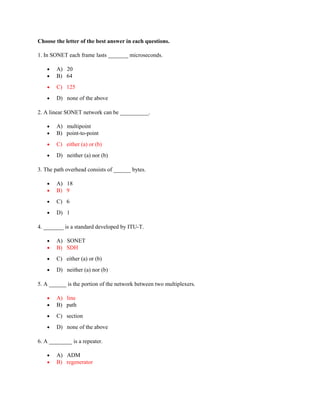
1. In SONET each frame lasts _______ microseconds.
• A) 20
• B) 64
• C) 125
• D) none of the above
2. A linear SONET network can be __________.
• A) multipoint
• B) point-to-point
• C) either (a) or (b)
• D) neither (a) nor (b)
3. The path overhead consists of ______ bytes.
• A) 18
• B) 9
• C) 6
• D) 1
4. _______ is a standard developed by ITU-T.
• A) SONET
• B) SDH
• C) either (a) or (b)
• D) neither (a) nor (b)
5. A ______ is the portion of the network between two multiplexers.
• A) line
• B) path
• C) section
• D) none of the above
6. A ________ is a repeater.
• A) ADM
• B) regenerator
• C) STS multiplexer/demultiplexer
• D) none of the above
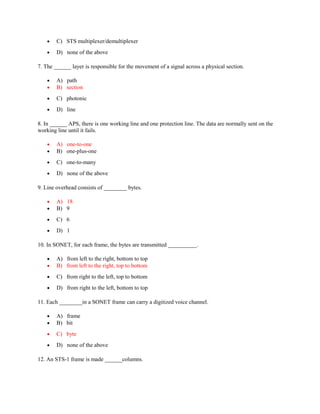
7. The ______ layer is responsible for the movement of a signal across a physical section.
• A) path
• B) section
• C) photonic
• D) line
8. In ______ APS, there is one working line and one protection line. The data are normally sent on the
working line until it fails.
• A) one-to-one
• B) one-plus-one
• C) one-to-many
• D) none of the above
9. Line overhead consists of ________ bytes.
• A) 18
• B) 9
• C) 6
• D) 1
10. In SONET, for each frame, the bytes are transmitted __________.
• A) from left to the right, bottom to top
• B) from left to the right, top to bottom
• C) from right to the left, top to bottom
• D) from right to the left, bottom to top
11. Each ________in a SONET frame can carry a digitized voice channel.
• A) frame
• B) bit
• C) byte
• D) none of the above
12. An STS-1 frame is made ______columns.
• A) 90
• B) 9
• C) 1
• D) none of the above
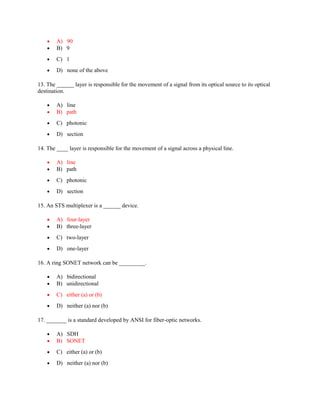
13. The ______ layer is responsible for the movement of a signal from its optical source to its optical
destination.
• A) line
• B) path
• C) photonic
• D) section
14. The ____ layer is responsible for the movement of a signal across a physical line.
• A) line
• B) path
• C) photonic
• D) section
15. An STS multiplexer is a ______ device.
• A) four-layer
• B) three-layer
• C) two-layer
• D) one-layer
16. A ring SONET network can be _________.
• A) bidirectional
• B) unidirectional
• C) either (a) or (b)
• D) neither (a) nor (b)
17. _______ is a standard developed by ANSI for fiber-optic networks.
• A) SDH
• B) SONET
• C) either (a) or (b)
• D) neither (a) nor (b)
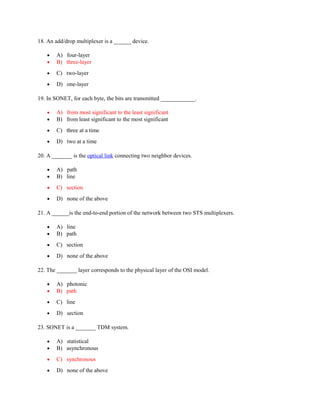
18. An add/drop multiplexer is a ______ device.
• A) four-layer
• B) three-layer
• C) two-layer
• D) one-layer
19. In SONET, for each byte, the bits are transmitted ____________.
• A) from most significant to the least significant
• B) from least significant to the most significant
• C) three at a time
• D) two at a time
20. A _______ is the optical link connecting two neighbor devices.
• A) path
• B) line
• C) section
• D) none of the above
21. A ______is the end-to-end portion of the network between two STS multiplexers.
• A) line
• B) path
• C) section
• D) none of the above
22. The _______ layer corresponds to the physical layer of the OSI model.
• A) photonic
• B) path
• C) line
• D) section
23. SONET is a _______ TDM system.
• A) statistical
• B) asynchronous
• C) synchronous
• D) none of the above
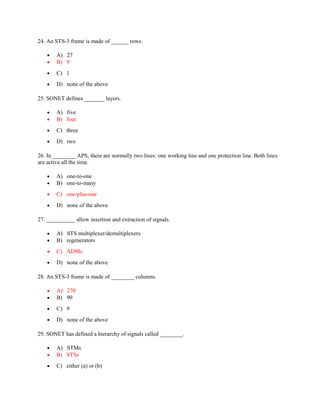
24. An STS-3 frame is made of ______ rows.
• A) 27
• B) 9
• C) 1
• D) none of the above
25. SONET defines _______ layers.
• A) five
• B) four
• C) three
• D) two
26. In ________ APS, there are normally two lines: one working line and one protection line. Both lines
are active all the time.
• A) one-to-one
• B) one-to-many
• C) one-plus-one
• D) none of the above
27. __________ allow insertion and extraction of signals.
• A) STS multiplexer/demultiplexers
• B) regenerators
• C) ADMs
• D) none of the above
28. An STS-3 frame is made of ________ columns.
• A) 270
• B) 90
• C) 9
• D) none of the above
29. SONET has defined a hierarchy of signals called ________.
• A) STMs
• B) STSs
• C) either (a) or (b)
• D) neither (a) nor (b)
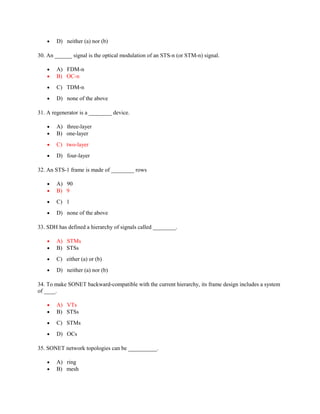
30. An ______ signal is the optical modulation of an STS-n (or STM-n) signal.
• A) FDM-n
• B) OC-n
• C) TDM-n
• D) none of the above
31. A regenerator is a ________ device.
• A) three-layer
• B) one-layer
• C) two-layer
• D) four-layer
32. An STS-1 frame is made of ________ rows
• A) 90
• B) 9
• C) 1
• D) none of the above
33. SDH has defined a hierarchy of signals called ________.
• A) STMs
• B) STSs
• C) either (a) or (b)
• D) neither (a) nor (b)
34. To make SONET backward-compatible with the current hierarchy, its frame design includes a system
of ____.
• A) VTs
• B) STSs
• C) STMs
• D) OCs
35. SONET network topologies can be __________.
• A) ring
• B) mesh
• C) linear
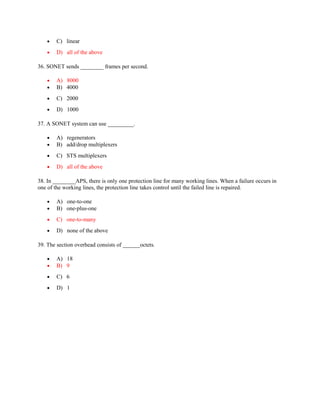
• D) all of the above
36. SONET sends ________ frames per second.
• A) 8000
• B) 4000
• C) 2000
• D) 1000
37. A SONET system can use _________.
• A) regenerators
• B) add/drop multiplexers
• C) STS multiplexers
• D) all of the above
38. In ________APS, there is only one protection line for many working lines. When a failure occurs in
one of the working lines, the protection line takes control until the failed line is repaired.
• A) one-to-one
• B) one-plus-one
• C) one-to-many
• D) none of the above
39. The section overhead consists of ______octets.
• A) 18
• B) 9
• C) 6
• D) 1

Sonet mcqs by M.Salim Khan

  • 1.
    Choose the letterof the best answer in each questions. 1. In SONET each frame lasts _______ microseconds. • A) 20 • B) 64 • C) 125 • D) none of the above 2. A linear SONET network can be __________. • A) multipoint • B) point-to-point • C) either (a) or (b) • D) neither (a) nor (b) 3. The path overhead consists of ______ bytes. • A) 18 • B) 9 • C) 6 • D) 1 4. _______ is a standard developed by ITU-T. • A) SONET • B) SDH • C) either (a) or (b) • D) neither (a) nor (b) 5. A ______ is the portion of the network between two multiplexers. • A) line • B) path • C) section • D) none of the above 6. A ________ is a repeater. • A) ADM • B) regenerator
  • 2.
    • C) STSmultiplexer/demultiplexer • D) none of the above 7. The ______ layer is responsible for the movement of a signal across a physical section. • A) path • B) section • C) photonic • D) line 8. In ______ APS, there is one working line and one protection line. The data are normally sent on the working line until it fails. • A) one-to-one • B) one-plus-one • C) one-to-many • D) none of the above 9. Line overhead consists of ________ bytes. • A) 18 • B) 9 • C) 6 • D) 1 10. In SONET, for each frame, the bytes are transmitted __________. • A) from left to the right, bottom to top • B) from left to the right, top to bottom • C) from right to the left, top to bottom • D) from right to the left, bottom to top 11. Each ________in a SONET frame can carry a digitized voice channel. • A) frame • B) bit • C) byte • D) none of the above 12. An STS-1 frame is made ______columns.
  • 3.
    • A) 90 •B) 9 • C) 1 • D) none of the above 13. The ______ layer is responsible for the movement of a signal from its optical source to its optical destination. • A) line • B) path • C) photonic • D) section 14. The ____ layer is responsible for the movement of a signal across a physical line. • A) line • B) path • C) photonic • D) section 15. An STS multiplexer is a ______ device. • A) four-layer • B) three-layer • C) two-layer • D) one-layer 16. A ring SONET network can be _________. • A) bidirectional • B) unidirectional • C) either (a) or (b) • D) neither (a) nor (b) 17. _______ is a standard developed by ANSI for fiber-optic networks. • A) SDH • B) SONET • C) either (a) or (b) • D) neither (a) nor (b)
  • 4.
    18. An add/dropmultiplexer is a ______ device. • A) four-layer • B) three-layer • C) two-layer • D) one-layer 19. In SONET, for each byte, the bits are transmitted ____________. • A) from most significant to the least significant • B) from least significant to the most significant • C) three at a time • D) two at a time 20. A _______ is the optical link connecting two neighbor devices. • A) path • B) line • C) section • D) none of the above 21. A ______is the end-to-end portion of the network between two STS multiplexers. • A) line • B) path • C) section • D) none of the above 22. The _______ layer corresponds to the physical layer of the OSI model. • A) photonic • B) path • C) line • D) section 23. SONET is a _______ TDM system. • A) statistical • B) asynchronous • C) synchronous • D) none of the above
  • 5.
    24. An STS-3frame is made of ______ rows. • A) 27 • B) 9 • C) 1 • D) none of the above 25. SONET defines _______ layers. • A) five • B) four • C) three • D) two 26. In ________ APS, there are normally two lines: one working line and one protection line. Both lines are active all the time. • A) one-to-one • B) one-to-many • C) one-plus-one • D) none of the above 27. __________ allow insertion and extraction of signals. • A) STS multiplexer/demultiplexers • B) regenerators • C) ADMs • D) none of the above 28. An STS-3 frame is made of ________ columns. • A) 270 • B) 90 • C) 9 • D) none of the above 29. SONET has defined a hierarchy of signals called ________. • A) STMs • B) STSs • C) either (a) or (b)
  • 6.
    • D) neither(a) nor (b) 30. An ______ signal is the optical modulation of an STS-n (or STM-n) signal. • A) FDM-n • B) OC-n • C) TDM-n • D) none of the above 31. A regenerator is a ________ device. • A) three-layer • B) one-layer • C) two-layer • D) four-layer 32. An STS-1 frame is made of ________ rows • A) 90 • B) 9 • C) 1 • D) none of the above 33. SDH has defined a hierarchy of signals called ________. • A) STMs • B) STSs • C) either (a) or (b) • D) neither (a) nor (b) 34. To make SONET backward-compatible with the current hierarchy, its frame design includes a system of ____. • A) VTs • B) STSs • C) STMs • D) OCs 35. SONET network topologies can be __________. • A) ring • B) mesh
  • 7.
    • C) linear •D) all of the above 36. SONET sends ________ frames per second. • A) 8000 • B) 4000 • C) 2000 • D) 1000 37. A SONET system can use _________. • A) regenerators • B) add/drop multiplexers • C) STS multiplexers • D) all of the above 38. In ________APS, there is only one protection line for many working lines. When a failure occurs in one of the working lines, the protection line takes control until the failed line is repaired. • A) one-to-one • B) one-plus-one • C) one-to-many • D) none of the above 39. The section overhead consists of ______octets. • A) 18 • B) 9 • C) 6 • D) 1