solving social problemsDaniel “Timo” Barajas Community College of DenverSociety and Technology
References Sociology (with MySocLab Student Access Code Card), 13/E John J. Macionis, Kenyon College ISBN-10: 0205769098ISBN-13:  9780205769094Publisher:  PearsonCopyright:  2010Format:  Kit/Package/ShrinkWrapPublished:  10/29/2009Status: InstockSuggested retail price: $156.00  Buy from myPearsonStoreCustomers outside the U.S., click here. BarajasSociety and Technology 2
References Wild KnowledgeScience, Language, and Social Life in a Fragile EnvironmentWill Wright$25.00 paper ISBN: 0-8166-2051-2ISBN-13: 978-0-8166-2051-7"Science is an incoherent form of knowledge, and, despite technical proficiency, it 'is conceptually wrong, wrong about nature, and wrong about knowledge' (p. 3). With this radical premise, Will Wright's intentions in this book are to challenge the validity of the so-called instrumental successes of scientific technologies, to demonstrate the incoherence and inadequacy of science, and to establish new criteria for evaluating the legitimacy of knowledge claims.." —Contemporary SociologyBarajasSociety and Technology 3
References Political Ideologies: Their Origins And Impact (10th Edition).Using A Chronological Organization, Political Ideologise Explains The Evolving Of Political Thought Over The Past Three Centuries And Describes Political Ideolgoies In The Context Of The Social, Household, And Political Circumstances In Which They Developed. It Provides Students With A Complete Understanding Of Political Ideologies And How These Concepts Relate To Their Admit Lives. Manufacturer: Prentice HallSKU: 0136037186BarajasSociety and Technology 4
Seeing Patterns: The Sociological PerspectiveSociology is the systematic study of human societies.Society is a term referring to people who live within a territory and share many patterns of behaviors.Culture refers to a way of life including widespread values, beliefs, and behavior.BarajasSociety and Technology 5
Concept Web What is Sociology?Society and Technology Barajas6
Life Chances BarajasSociety and Technology 7Max Weber’s term life chances refers to the extent to which individuals have access to important societal resources such as food, clothing, shelter, educational and health care. According to sociologists, more-affluent people typically have better life chances than the less-affluent because they have greater access to quality education, safe neighborhoods, high-quality nutrition and health care, police and private security protection, and an extensive array of other good s and services.
WealthBarajasSociety and Technology 8Wealth is the value of all of a person’s or family’s economic assets, including income, personal property, and income-producing property. Prestige – the respect or regard with which a person or status position is regarded by others. Power – the ability of people or group[s to achieve their goals despite opposition from others.
Weber’s Multidimensional ApproachBarajasSociety and Technology 9
Life Chances BarajasSociety and Technology 10In contrast, persons with low- and poverty-level incomes tend to have limited access to these resources. Resources are anything valued in a society, ranging from money and property to medical care and education; they are considered to be scarce because of unequal distribution among social categories.
Defining Social ProblemsA social problem  is a condition that undermines the well-being of   some or all members of society is usually a matter of public controversyDetermining social problems can be controversialsubjective and objective realities may      actually end up being quite different what people identify as the most serious   social problems varies over timeBarajasSociety and Technology 11
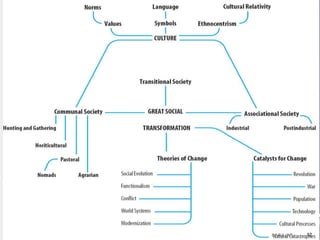
Concept WebCulture, Society, and Social Change Society and Technology Barajas12
Sociological theoryFunctional ApproachStructural ApproachSocial Conflict ApproachSymbolic Interaction BarajasSociety and Technology 13
Concept Web  (p. 104)SocializationSociety and Technology Barajas14
“The Map is Not the Territory”Barajas15praxisthinking about doinginner conversationSelfreflexivityOntologySociety and Technology
What then is Reality? Most restrictively, those aspects of the physical universe that are directly or indirectly measurable. The term may be used to include constructs that are inferable or interpretable from logical induction or theoretical analysis, but not measurable in the above sense.Also used by many to include all that which forms an integral part of what an individual believes to be “real”. BarajasSociety and Technology 16
BarajasSociety and Technology 17PracticalDiscursive KnowledgeEmbodied Knowledge
SubjectivityBarajasSociety and Technology 18The unique perspective each of us has on our own conscious experience. What we see, hear, feel, and think can be discussed with other people, but the actual experience of these things can never be shared in a manner resembling our own internal awareness of them. One of the difficult questions of consciousness is how to account for “qualia,” or the phenomenological percepts of the world.
Ways of KnowingSense Experience (empiricism) – gathering knowledge by observing occurrences and organisms in the real world.Tenacity – “stubbornness” Authority – accept the word of a famous or respected figure without skepticism. Emotion – “gut feeling” that may cause us to believe more in one idea than in another. BarajasSociety and Technology 19Epistemology
Ways of KnowingCommon Sense – sound practical judgment is based on individual experiences and perceptions, though, and is therefore not really “common” at all. Common sense is based on only one person’s experiences, it is limited to that person’s biases. Intuition – knowledge that seems to enter our consciousness without much voluntary effort. BarajasSociety and Technology 20
Ways of KnowingLogic (rationalism) BarajasSociety and Technology 21Premise: All humans are mortal ; Premise: I am a human;Conclusion : Therefore, I must be mortal. Premise: No woman can count ; Premise: I am a woman;Conclusion : Therefore, I cannot count. Often, logical reasoning takes the form of a syllogism, which is a series of premises that lead to a conclusion. The logic in syllogism 2 is flawless, but the fact that the first premise is wrong ensures that the conclusion will also be wrong.
Ways of KnowingScience (objective) The scientific method of knowing is a combination of observation by sense experience plus reasoning by logic.Scientists start to evaluate new ideas by observing events directly These observations are considered to be objective, or unbiased, because they can be verified by others. If such replication does not produce similar results, then the new idea is not accepted. BarajasSociety and Technology 22
Is Psychology Free of Value Judgments?BarajasSociety and Technology 23Value Judgmentsubjective judgment: a judgment of the worth, appropriateness, or importance of somebody or something made on the basis of personal beliefs, opinions, or prejudices rather than facts.Justificationsomething that justifies: something, for example, a reason or circumstance, that justifies an action or attitude
The Structural-Functional ApproachA theoretical framework that sees society as a system of many interrelated parts.BarajasSociety and Technology 24
The Structural-Functional ApproachA theoretical framework that sees society as a system of many interrelated partsSocial Institutions: the main parts of this system (organized to meet basic human needs)educationfamilyeconomicspoliticsreligionBarajasSociety and Technology 25
The Structural-Functional ApproachEarly Functionalism: Problems as Social PathologyThe “Chicago School”: Problems as DisorganizationMore Recent Functionalism: Problems as DysfunctionsManifest versus Latent FunctionsEufunctions versus DysfunctionsBarajasSociety and Technology 26
The Social Conflict ApproachA theoretical framework that sees society as divided by inequality and conflictSocial problems arise because our society is divided into “haves” and “have nots”BarajasSociety and Technology 27
The Social Conflict ApproachMarxism: Problems and Class ConflictCapitalistsProletariansMulticulturalism: Problems of Racial and Ethnic InequalityFeminism: Problems and Gender ConflictBarajasSociety and Technology 28
Society and Technology The Relationship Between Economic Structure and the Ideational Superstructure (Ideology) in Marxian Theory: Ideology and ExploitationBarajas29
The Symbolic-Interaction ApproachA theoretical framework that sees society as the product of individuals interacting with one anotherBarajasSociety and Technology 30
The Symbolic-Interaction ApproachLearning Theory: Problems and the Social EnvironmentLabeling Theory: Problems and Social DefinitionsBarajasSociety and Technology 31
Truth, Science, and PoliticsMax Weber’s “value-free” approachThe “value commitment” approachIs “objective” research even possible?BarajasSociety and Technology 32
Responding to Social Problems:  Social PolicySocial policy refers to formal strategies to affect how society operates.BarajasSociety and Technology 33
Responding to Social Problems:  Social PolicyThe evaluation of social policy:How is success defined? What are the costs? Whom should get the help?BarajasSociety and Technology 34
Policy and CultureSocial policy tends to be shaped by existing cultural valuesBarajasSociety and Technology 35
Concept Web  The Political OrderSociety and Technology Barajas36
Policy and PoliticsConservatives: seek to limit the scope of societal change (focus is on shortcomings of individuals, not society)Liberals: favor more sweeping change in society (see problems in the organization of society)Radicals: support policies that go beyond mere reform can be either ultra liberal or ultra conservativeBarajasSociety and Technology 37
The role of ideas in politicsWhat people think and believe about society, power, rights, etc., determines their actionsEverything has to pass through the mind of the individual before he or she actsHow do the ideas and beliefs appear in our minds?Critical examination of reality – thinking for oneselfInfluence of others’ opinions – family, education, mass media, etc.Some forms of teaching imprison the mindOthers liberate the mind, enabling it to think criticallySubjugation by force is the crudest form of social controlMind control is a much more effective methodBut is it really effective? BarajasSociety and Technology 38
main concepts about the role of ideas in politics:Political culture – the broad pattern of political orientations shared by a large group of people (a nation, a region, a class, an ethnic group)Political ideology – a system of political ideas, developed for the purposes of political action (governing a country, launching a social movement or a political party, organizing a revolution – or a counterrevolution, etc.)BarajasSociety and Technology 39
What are political ideologies for?To provide people with programs of political action:to govern societies, orto struggle for changeBoth for integration and for conflict, you need an ideology – a coherent set of ideas for purposeful actionThe earliest ideologies were religions. Many of the earliest rulers in history were priests.In the Modern Age, political ideologies become increasingly secular (non-religious, some anti-religious), but religions continue to serve as important sources for ideologies to this dayExamples: Christian democracy, Christian socialism, Protestant fundamentalism, Islamic radicalismBarajasSociety and Technology 40
It is the very essence of political ideology to differ from another ideology on what to do with the status quo (the existing order of things):To keep it – or to change it.At the core of every political idea, every political action is a choice between YES and NO. Look at the work of the parliament… Or the UN… Or an election…The differences between ideologies are rooted in basic assumptions about:human nature – are humans naturally peaceful, cooperative, rational?individual and society: which interests come first?equality: how much social inequality is acceptableBarajasSociety and Technology 41
Ideology vs. pragmatismDoes too much ideology make you narrow-minded?Should one’s political beliefs be based on one ideology - be doctrinaire?Shouldn’t politicians be free to borrow ideas from different ideologies if they work better in a particular situation?At issue: orthodoxy vs. pluralismOrthodoxy (traditionalist, pre-modern view): the rulers should maintain one ideology as dominant – to foster unity and harmony in society. UNITY THROUGH UNIFORMITYCan work only: in traditional, pre-modern societies – or, in societies in transition to modernity, in periods of extreme crisis. Requires generally low educational levelsBarajasSociety and Technology 42
Pluralism (modern view associated with liberalism): the rulers allow different ideologies in society to compete.  UNITY THROUGH TOLERATION OF DIFFERENCES“E pluribus unum”Works better in developed, modern and postmodern, complex societies with high educational levelsAre there limits to toleration? Should some ideologies be banned?Is there such a thing as liberal orthodoxy?BarajasSociety and Technology 43
The challenge of liberal-democratic politicsTo accept ideological pluralism as a normal condition of society -And try to maintain social unity through toleration of differences and management of conflictIt is not always possibleSome ideologies can coexist with each otherOthers are so strongly opposed to each other that they cannot be reconciled by means of compromiseOr can they?	BarajasSociety and Technology 44
Political Spectrum: From Left to RightPolitical ideologies, through opposition, competition, fusion, mixing, etc. exist in constant interaction with each otherTogether, they form a political spectrumIt is a useful tool of political analysis BarajasSociety and Technology 45
The terms “Left” and “Right” originate from the seating of the members of the newly elected French Legislative Assembly in 1791 – during the French RevolutionThe Right:Supporters of the existing order, monarchistsThe Left:Advocates of radical change, republicansKing Louis XVILegislative AssemblyBarajasSociety and Technology 46
It was in the interests of the King to be able to manage the conflict between Left and Right –through centrist, pragmatic policies, borrowing ideas for state policy from both sides and trying to build a consensus It proved impossible. France experienced a revolution – a radical change of the political and social orderBut even then, there were people in the middle between the extremesExtremists vs. moderatesIn normal conditions, the political spectrum includes a range of ideological “colours”  between the extremes BarajasSociety and Technology 47
Table 1-2BarajasSociety and Technology 48
Politics:  Constructing Problems and Defining SolutionsThe Political Spectrum: a continuum representing a range of political attitudes from “left” to “right”Social Issues: political debates involving moral judgments about how people should liveEconomic Issues: political debates about how a society should distribute material resourcesBarajasSociety and Technology 49
Who Thinks What?Two good predictors of political attitudes are education and wealth – both of which are elements of social classThe fact that social class affects social and economic attitudes differently means that most people have some combination of liberal and conservative attitudesBarajasSociety and Technology 50
Far Left         Centre- Left      Centre     Centre- Right        Far Right            Socialists       Liberal Conservatives     UltraconservativesCommunists          Liberals                    Conservatives               Fascists                 Radicals                                                 ReactionariesPolitical spectrum: the standard linear modelBarajasSociety and Technology 51
Ideas associated with different fields of political spectrumThe Right:Conservatism – preserve the status quo, oppose changeReaction – throw back the forces of change, restore the old orderFascism – mobilize the nation for war, suppress pluralism to achieve unity through orthodoxyThe Left:Radicalism – go to the roots of problems, change the foundations of societySocialism – advance the interests of society against the interests of elitesCommunism – abolish private property to achieve equality and social harmony, suppress pluralism to achieve unity through orthodoxy The Centre:Liberalism – expand the scope of freedom, accept change, assert the primacy of individual rights, develop market economy and political pluralismBorrow ideas from Left and RightBarajasSociety and Technology 52
So, there are several dimensions here:Change or preservation of status quoFreedom or orderPluralism or orthodoxyEquality or inequalityMarket or stateIdeas interact, travel across the spectrum…Too many possible combinations…How can all these complexities be taken into account?BarajasSociety and Technology 53
           Political spectrum: a 2-dimensional modelMarket     Welfare state liberalismNeoliberalismMarket authoritarianism     Social democracyMarket socialismRightLeftTraditional conservatismState socialism(Communism)                                   FascismStateBarajasSociety and Technology 54
You may use 3 or more dimensions…MarketInequalityAuthoritarianismDemocracyEqualityStateBarajasSociety and Technology 55
 the market, tradePolitical spectrum: the circular model, based on Clinton RossiterCONSERVATISMLIBERALISMTHE LEFT:change, freedom, equality, laborTHE RIGHT: status quo, order, inequality, capital FASCISMCOMMUNISMBarajasSociety and Technology 56

Solving Social Problems

  • 1.
    solving social problemsDaniel“Timo” Barajas Community College of DenverSociety and Technology
  • 2.
    References Sociology (withMySocLab Student Access Code Card), 13/E John J. Macionis, Kenyon College ISBN-10: 0205769098ISBN-13:  9780205769094Publisher:  PearsonCopyright:  2010Format:  Kit/Package/ShrinkWrapPublished:  10/29/2009Status: InstockSuggested retail price: $156.00  Buy from myPearsonStoreCustomers outside the U.S., click here. BarajasSociety and Technology 2
  • 3.
    References Wild KnowledgeScience,Language, and Social Life in a Fragile EnvironmentWill Wright$25.00 paper ISBN: 0-8166-2051-2ISBN-13: 978-0-8166-2051-7"Science is an incoherent form of knowledge, and, despite technical proficiency, it 'is conceptually wrong, wrong about nature, and wrong about knowledge' (p. 3). With this radical premise, Will Wright's intentions in this book are to challenge the validity of the so-called instrumental successes of scientific technologies, to demonstrate the incoherence and inadequacy of science, and to establish new criteria for evaluating the legitimacy of knowledge claims.." —Contemporary SociologyBarajasSociety and Technology 3
  • 4.
    References Political Ideologies:Their Origins And Impact (10th Edition).Using A Chronological Organization, Political Ideologise Explains The Evolving Of Political Thought Over The Past Three Centuries And Describes Political Ideolgoies In The Context Of The Social, Household, And Political Circumstances In Which They Developed. It Provides Students With A Complete Understanding Of Political Ideologies And How These Concepts Relate To Their Admit Lives. Manufacturer: Prentice HallSKU: 0136037186BarajasSociety and Technology 4
  • 5.
    Seeing Patterns: TheSociological PerspectiveSociology is the systematic study of human societies.Society is a term referring to people who live within a territory and share many patterns of behaviors.Culture refers to a way of life including widespread values, beliefs, and behavior.BarajasSociety and Technology 5
  • 6.
    Concept Web Whatis Sociology?Society and Technology Barajas6
  • 7.
    Life Chances BarajasSocietyand Technology 7Max Weber’s term life chances refers to the extent to which individuals have access to important societal resources such as food, clothing, shelter, educational and health care. According to sociologists, more-affluent people typically have better life chances than the less-affluent because they have greater access to quality education, safe neighborhoods, high-quality nutrition and health care, police and private security protection, and an extensive array of other good s and services.
  • 8.
    WealthBarajasSociety and Technology8Wealth is the value of all of a person’s or family’s economic assets, including income, personal property, and income-producing property. Prestige – the respect or regard with which a person or status position is regarded by others. Power – the ability of people or group[s to achieve their goals despite opposition from others.
  • 9.
  • 10.
    Life Chances BarajasSocietyand Technology 10In contrast, persons with low- and poverty-level incomes tend to have limited access to these resources. Resources are anything valued in a society, ranging from money and property to medical care and education; they are considered to be scarce because of unequal distribution among social categories.
  • 11.
    Defining Social ProblemsAsocial problem is a condition that undermines the well-being of some or all members of society is usually a matter of public controversyDetermining social problems can be controversialsubjective and objective realities may actually end up being quite different what people identify as the most serious social problems varies over timeBarajasSociety and Technology 11
  • 12.
    Concept WebCulture, Society,and Social Change Society and Technology Barajas12
  • 13.
    Sociological theoryFunctional ApproachStructuralApproachSocial Conflict ApproachSymbolic Interaction BarajasSociety and Technology 13
  • 14.
    Concept Web (p. 104)SocializationSociety and Technology Barajas14
  • 15.
    “The Map isNot the Territory”Barajas15praxisthinking about doinginner conversationSelfreflexivityOntologySociety and Technology
  • 16.
    What then isReality? Most restrictively, those aspects of the physical universe that are directly or indirectly measurable. The term may be used to include constructs that are inferable or interpretable from logical induction or theoretical analysis, but not measurable in the above sense.Also used by many to include all that which forms an integral part of what an individual believes to be “real”. BarajasSociety and Technology 16
  • 17.
    BarajasSociety and Technology17PracticalDiscursive KnowledgeEmbodied Knowledge
  • 18.
    SubjectivityBarajasSociety and Technology18The unique perspective each of us has on our own conscious experience. What we see, hear, feel, and think can be discussed with other people, but the actual experience of these things can never be shared in a manner resembling our own internal awareness of them. One of the difficult questions of consciousness is how to account for “qualia,” or the phenomenological percepts of the world.
  • 19.
    Ways of KnowingSenseExperience (empiricism) – gathering knowledge by observing occurrences and organisms in the real world.Tenacity – “stubbornness” Authority – accept the word of a famous or respected figure without skepticism. Emotion – “gut feeling” that may cause us to believe more in one idea than in another. BarajasSociety and Technology 19Epistemology
  • 20.
    Ways of KnowingCommonSense – sound practical judgment is based on individual experiences and perceptions, though, and is therefore not really “common” at all. Common sense is based on only one person’s experiences, it is limited to that person’s biases. Intuition – knowledge that seems to enter our consciousness without much voluntary effort. BarajasSociety and Technology 20
  • 21.
    Ways of KnowingLogic(rationalism) BarajasSociety and Technology 21Premise: All humans are mortal ; Premise: I am a human;Conclusion : Therefore, I must be mortal. Premise: No woman can count ; Premise: I am a woman;Conclusion : Therefore, I cannot count. Often, logical reasoning takes the form of a syllogism, which is a series of premises that lead to a conclusion. The logic in syllogism 2 is flawless, but the fact that the first premise is wrong ensures that the conclusion will also be wrong.
  • 22.
    Ways of KnowingScience(objective) The scientific method of knowing is a combination of observation by sense experience plus reasoning by logic.Scientists start to evaluate new ideas by observing events directly These observations are considered to be objective, or unbiased, because they can be verified by others. If such replication does not produce similar results, then the new idea is not accepted. BarajasSociety and Technology 22
  • 23.
    Is Psychology Freeof Value Judgments?BarajasSociety and Technology 23Value Judgmentsubjective judgment: a judgment of the worth, appropriateness, or importance of somebody or something made on the basis of personal beliefs, opinions, or prejudices rather than facts.Justificationsomething that justifies: something, for example, a reason or circumstance, that justifies an action or attitude
  • 24.
    The Structural-Functional ApproachAtheoretical framework that sees society as a system of many interrelated parts.BarajasSociety and Technology 24
  • 25.
    The Structural-Functional ApproachAtheoretical framework that sees society as a system of many interrelated partsSocial Institutions: the main parts of this system (organized to meet basic human needs)educationfamilyeconomicspoliticsreligionBarajasSociety and Technology 25
  • 26.
    The Structural-Functional ApproachEarlyFunctionalism: Problems as Social PathologyThe “Chicago School”: Problems as DisorganizationMore Recent Functionalism: Problems as DysfunctionsManifest versus Latent FunctionsEufunctions versus DysfunctionsBarajasSociety and Technology 26
  • 27.
    The Social ConflictApproachA theoretical framework that sees society as divided by inequality and conflictSocial problems arise because our society is divided into “haves” and “have nots”BarajasSociety and Technology 27
  • 28.
    The Social ConflictApproachMarxism: Problems and Class ConflictCapitalistsProletariansMulticulturalism: Problems of Racial and Ethnic InequalityFeminism: Problems and Gender ConflictBarajasSociety and Technology 28
  • 29.
    Society and TechnologyThe Relationship Between Economic Structure and the Ideational Superstructure (Ideology) in Marxian Theory: Ideology and ExploitationBarajas29
  • 30.
    The Symbolic-Interaction ApproachAtheoretical framework that sees society as the product of individuals interacting with one anotherBarajasSociety and Technology 30
  • 31.
    The Symbolic-Interaction ApproachLearningTheory: Problems and the Social EnvironmentLabeling Theory: Problems and Social DefinitionsBarajasSociety and Technology 31
  • 32.
    Truth, Science, andPoliticsMax Weber’s “value-free” approachThe “value commitment” approachIs “objective” research even possible?BarajasSociety and Technology 32
  • 33.
    Responding to SocialProblems: Social PolicySocial policy refers to formal strategies to affect how society operates.BarajasSociety and Technology 33
  • 34.
    Responding to SocialProblems: Social PolicyThe evaluation of social policy:How is success defined? What are the costs? Whom should get the help?BarajasSociety and Technology 34
  • 35.
    Policy and CultureSocialpolicy tends to be shaped by existing cultural valuesBarajasSociety and Technology 35
  • 36.
    Concept Web The Political OrderSociety and Technology Barajas36
  • 37.
    Policy and PoliticsConservatives:seek to limit the scope of societal change (focus is on shortcomings of individuals, not society)Liberals: favor more sweeping change in society (see problems in the organization of society)Radicals: support policies that go beyond mere reform can be either ultra liberal or ultra conservativeBarajasSociety and Technology 37
  • 38.
    The role ofideas in politicsWhat people think and believe about society, power, rights, etc., determines their actionsEverything has to pass through the mind of the individual before he or she actsHow do the ideas and beliefs appear in our minds?Critical examination of reality – thinking for oneselfInfluence of others’ opinions – family, education, mass media, etc.Some forms of teaching imprison the mindOthers liberate the mind, enabling it to think criticallySubjugation by force is the crudest form of social controlMind control is a much more effective methodBut is it really effective? BarajasSociety and Technology 38
  • 39.
    main concepts aboutthe role of ideas in politics:Political culture – the broad pattern of political orientations shared by a large group of people (a nation, a region, a class, an ethnic group)Political ideology – a system of political ideas, developed for the purposes of political action (governing a country, launching a social movement or a political party, organizing a revolution – or a counterrevolution, etc.)BarajasSociety and Technology 39
  • 40.
    What are politicalideologies for?To provide people with programs of political action:to govern societies, orto struggle for changeBoth for integration and for conflict, you need an ideology – a coherent set of ideas for purposeful actionThe earliest ideologies were religions. Many of the earliest rulers in history were priests.In the Modern Age, political ideologies become increasingly secular (non-religious, some anti-religious), but religions continue to serve as important sources for ideologies to this dayExamples: Christian democracy, Christian socialism, Protestant fundamentalism, Islamic radicalismBarajasSociety and Technology 40
  • 41.
    It is thevery essence of political ideology to differ from another ideology on what to do with the status quo (the existing order of things):To keep it – or to change it.At the core of every political idea, every political action is a choice between YES and NO. Look at the work of the parliament… Or the UN… Or an election…The differences between ideologies are rooted in basic assumptions about:human nature – are humans naturally peaceful, cooperative, rational?individual and society: which interests come first?equality: how much social inequality is acceptableBarajasSociety and Technology 41
  • 42.
    Ideology vs. pragmatismDoestoo much ideology make you narrow-minded?Should one’s political beliefs be based on one ideology - be doctrinaire?Shouldn’t politicians be free to borrow ideas from different ideologies if they work better in a particular situation?At issue: orthodoxy vs. pluralismOrthodoxy (traditionalist, pre-modern view): the rulers should maintain one ideology as dominant – to foster unity and harmony in society. UNITY THROUGH UNIFORMITYCan work only: in traditional, pre-modern societies – or, in societies in transition to modernity, in periods of extreme crisis. Requires generally low educational levelsBarajasSociety and Technology 42
  • 43.
    Pluralism (modern viewassociated with liberalism): the rulers allow different ideologies in society to compete. UNITY THROUGH TOLERATION OF DIFFERENCES“E pluribus unum”Works better in developed, modern and postmodern, complex societies with high educational levelsAre there limits to toleration? Should some ideologies be banned?Is there such a thing as liberal orthodoxy?BarajasSociety and Technology 43
  • 44.
    The challenge ofliberal-democratic politicsTo accept ideological pluralism as a normal condition of society -And try to maintain social unity through toleration of differences and management of conflictIt is not always possibleSome ideologies can coexist with each otherOthers are so strongly opposed to each other that they cannot be reconciled by means of compromiseOr can they? BarajasSociety and Technology 44
  • 45.
    Political Spectrum: FromLeft to RightPolitical ideologies, through opposition, competition, fusion, mixing, etc. exist in constant interaction with each otherTogether, they form a political spectrumIt is a useful tool of political analysis BarajasSociety and Technology 45
  • 46.
    The terms “Left”and “Right” originate from the seating of the members of the newly elected French Legislative Assembly in 1791 – during the French RevolutionThe Right:Supporters of the existing order, monarchistsThe Left:Advocates of radical change, republicansKing Louis XVILegislative AssemblyBarajasSociety and Technology 46
  • 47.
    It was inthe interests of the King to be able to manage the conflict between Left and Right –through centrist, pragmatic policies, borrowing ideas for state policy from both sides and trying to build a consensus It proved impossible. France experienced a revolution – a radical change of the political and social orderBut even then, there were people in the middle between the extremesExtremists vs. moderatesIn normal conditions, the political spectrum includes a range of ideological “colours” between the extremes BarajasSociety and Technology 47
  • 48.
  • 49.
    Politics: ConstructingProblems and Defining SolutionsThe Political Spectrum: a continuum representing a range of political attitudes from “left” to “right”Social Issues: political debates involving moral judgments about how people should liveEconomic Issues: political debates about how a society should distribute material resourcesBarajasSociety and Technology 49
  • 50.
    Who Thinks What?Twogood predictors of political attitudes are education and wealth – both of which are elements of social classThe fact that social class affects social and economic attitudes differently means that most people have some combination of liberal and conservative attitudesBarajasSociety and Technology 50
  • 51.
    Far Left Centre- Left Centre Centre- Right Far Right Socialists Liberal Conservatives UltraconservativesCommunists Liberals Conservatives Fascists Radicals ReactionariesPolitical spectrum: the standard linear modelBarajasSociety and Technology 51
  • 52.
    Ideas associated withdifferent fields of political spectrumThe Right:Conservatism – preserve the status quo, oppose changeReaction – throw back the forces of change, restore the old orderFascism – mobilize the nation for war, suppress pluralism to achieve unity through orthodoxyThe Left:Radicalism – go to the roots of problems, change the foundations of societySocialism – advance the interests of society against the interests of elitesCommunism – abolish private property to achieve equality and social harmony, suppress pluralism to achieve unity through orthodoxy The Centre:Liberalism – expand the scope of freedom, accept change, assert the primacy of individual rights, develop market economy and political pluralismBorrow ideas from Left and RightBarajasSociety and Technology 52
  • 53.
    So, there areseveral dimensions here:Change or preservation of status quoFreedom or orderPluralism or orthodoxyEquality or inequalityMarket or stateIdeas interact, travel across the spectrum…Too many possible combinations…How can all these complexities be taken into account?BarajasSociety and Technology 53
  • 54.
    Political spectrum: a 2-dimensional modelMarket Welfare state liberalismNeoliberalismMarket authoritarianism Social democracyMarket socialismRightLeftTraditional conservatismState socialism(Communism) FascismStateBarajasSociety and Technology 54
  • 55.
    You may use3 or more dimensions…MarketInequalityAuthoritarianismDemocracyEqualityStateBarajasSociety and Technology 55
  • 56.
    the market,tradePolitical spectrum: the circular model, based on Clinton RossiterCONSERVATISMLIBERALISMTHE LEFT:change, freedom, equality, laborTHE RIGHT: status quo, order, inequality, capital FASCISMCOMMUNISMBarajasSociety and Technology 56

Editor's Notes

  • #17 In this sense, reality is objective and limited to what can be publicly and reliably measured. E.g. gravity, natural selection, personality, etc would all be regarded as parts of reality by 2, although they may be problematical by 1. Free will, ghosts, God, etc for a compelling part of reality for some but not for all. - social reality.