Download the full version and explore a variety of test banks
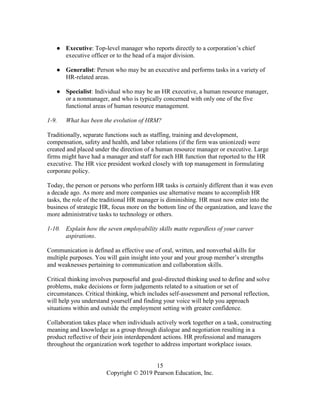
or solution manuals at https://testbankbell.com
Solution Manual for Human Resource Management 15th
Edition Martocchio •
_____ Follow the link below to get your download now _____
http://testbankbell.com/product/solution-manual-for-human-
resource-management-15th-edition-martocchio/
Access testbankbell.com now to download high-quality
test banks or solution manuals
We have selected some products that you may be interested in
Click the link to download now or visit testbankbell.com
for more options!.
Solution Manual for Human Resource Management 15th Edition
Gary Dessler
http://testbankbell.com/product/solution-manual-for-human-resource-
management-15th-edition-gary-dessler/
Human Resource Management 15th Edition Dessler Solutions
Manual
http://testbankbell.com/product/human-resource-management-15th-
edition-dessler-solutions-manual/
Test Bank for Human Resource Management 15th Edition
Mathis
http://testbankbell.com/product/test-bank-for-human-resource-
management-15th-edition-mathis/
Solution Manual for College Mathematics for Business,
Economics Life Sciences and Social Sciences 14th by
Barnett
http://testbankbell.com/product/solution-manual-for-college-
mathematics-for-business-economics-life-sciences-and-social-
sciences-14th-by-barnett/
Solution Manual for Inquiry into Physics 8th Edition
http://testbankbell.com/product/solution-manual-for-inquiry-into-
physics-8th-edition/
Solution Manual for American Government Institutions and
Policies, 14th Edition
http://testbankbell.com/product/solution-manual-for-american-
government-institutions-and-policies-14th-edition/
Hesi Pharmacology 2018 Most Recent – Updated
http://testbankbell.com/product/hesi-pharmacology-2018-most-recent-
updated/
Test Bank for Conflict Survival Kit: Tools for Resolving
Conflict at Work, 2/E 2nd Edition : 0132741059
http://testbankbell.com/product/test-bank-for-conflict-survival-kit-
tools-for-resolving-conflict-at-work-2-e-2nd-edition-0132741059/
College Algebra Blitzer 6th Edition Solutions Manual
http://testbankbell.com/product/college-algebra-blitzer-6th-edition-
solutions-manual/
Solution Manual for Core Concepts of Accounting
Information Systems 14th by Simkin
http://testbankbell.com/product/solution-manual-for-core-concepts-of-
accounting-information-systems-14th-by-simkin/
1
Copyright © 2019 Pearson Education, Inc.
Solution Manual for Human Resource
Management 15th Edition Martocchio •
Full chapter at:
https://testbankbell.com/product/solu
tion-manual-for-human-resource-
management-15th-edition-
martocchio/
CHAPTER 1
HUMAN RESOURCE MANAGEMENT: AN OVERVIEW
LEARNING OBJECTIVES
1.1 Define human resource management (HRM) and the importance of studying it
1.2 Describe who performs HRM
1.3 Explain how the HRM function serves as a strategic business partner and the
elements of the dynamic HRM environment
1.4 Discuss the role of HRM in building corporate culture and employer branding
1.5 Summarize HRM issues for small businesses
1.6 Identify ways that country culture influences global business
1.7 Explore essential skills for developing your career in HR or any other career path
KEY TERMS
Human resource management (HRM): The utilization of individuals to achieve
organizational objectives.
Staffing: Process through which an organization ensures that it always has the proper
number of employees with the appropriate skills in the right jobs, at the right time, to
achieve organizational objectives.
Performance management (PM): Goal-oriented process directed toward ensuring that
organizational processes are in place to maximize the productivity of employees, teams,
and ultimately, the organization.
Human resource development (HRD): Major HRM function consisting not only of
training and development, but also of individual career planning and development
activities, organization development, and performance management and appraisal.
Direct financial compensation (monetary compensation): Pay that a person receives in
the form of wages, salary, commissions, and bonuses.
Indirect financial compensation (benefits): All financial rewards that are not included
in direct financial compensation.
2
Copyright © 2019 Pearson Education, Inc.
Nonfinancial compensation: Satisfaction that person receives from the job itself or from
the psychological and/or physical environment in which the person works.
Safety: Protection of employees from injuries caused by work-related accidents.
Health: Employees’ freedom from physical or emotional illness.
Human resource management professional: An individual who normally acts in an
advisory or staff capacity, working with other managers to help them address human
resource matters.
Line managers: Individuals directly involved in accomplishing the primary purpose of
the organization.
3
Copyright © 2019 Pearson Education, Inc.
HR outsourcing (HRO): Process of hiring external HR professionals to do the HR work
that was previously done internally.
Shared service center (SSC): A center that takes routine, transaction-based activities
dispersed throughout the organization and consolidates them in one place.
Professional employer organization (PEO): A company that leases employees to other
businesses.
Executive: Top-level manager who reports directly to a corporation’s chief executive
officer or to the head of a major division.
Generalist: Person who may be an executive and performs tasks in a variety of HR-
related areas.
Specialist: Individual who may be an HR executive, a human resource manager, or a
nonmanager, and who is typically concerned with only one of the six functional areas of
human resource management.
Profession: Vocation characterized by the existence of a common body of knowledge
and a procedure for certifying members.
Human capital: As defined by economists, human capital refers to sets of collective
skills, knowledge, and ability that employees can apply to create economic value for their
employers.
Union: Comprised of employees who have joined together for the purpose of dealing
with their employer.
Shareholders: Owners of a corporation.
Human resource information system (HRIS): Any organized approach for obtaining
relevant and timely information on which to base human resource decisions.
Corporate culture: System of shared values, beliefs, and habits within an organization
that interacts with the formal structure to produce behavioral norms.
Employer branding: Firm’s corporate image or culture focused on attracting the type of
employees the firm is seeking.
Country’s culture: Set of values, symbols, beliefs, language, and norms that guide
human behavior within the country.
LECTURE OUTLINE
HUMAN RESOURCE MANAGEMENT
Human resource management (HRM) can be defined as the optimal utilization of
individuals to achieve organizational objectives.
HUMAN RESOURCE MANAGEMENT FUNCTIONS
Six functional areas are associated with effective human resource management: staffing,
human resource development, performance management, compensation, safety and
health, and employee and labor relations.
4
Copyright © 2019 Pearson Education, Inc.
● STAFFING—Process through which an organization ensures that it always has
the proper number of employees with the appropriate skills in the right jobs, at the
right time, to achieve organizational objectives.
● Job analysis: Systematic process of determining the skills, duties, and
knowledge required for performing specific jobs in an organization.
● Human resource planning: Systematic process of matching the internal
and external supply of people with job openings anticipated in the
organization over a specified period of time.
● Recruitment: Process of attracting qualified individuals and encouraging
them to apply for work with the organization.
● Selection: Process through which the organization chooses, from a group
of applicants, those individuals best suited both for open positions and the
company.
● PERFORMANCE MANAGEMENT—A goal-oriented activity to ensure
organizational processes are in place to maximize the productivity of employees,
teams, and ultimately, the organization.
● Performance appraisal: A formal system to review and evaluate
individual or team performance.
● HUMAN RESOURCE DEVELOPMENT—A major HRM function consisting
not only of training and development, but also of career planning and
development activities, organization development, performance management, and
appraisal.
● Training: Activities designed to provide learners with the knowledge and
skills needed for their present jobs.
● Organization development (OD): A planned and systematic attempt to
change the organization to a more behavioral environment.
● Career planning: Ongoing process whereby an individual sets career
goals and identifies the means to achieve them.
● Career development: Formal approach used by the organization to ensure
that people with the proper qualifications and experiences are available
when needed.
5
Copyright © 2019 Pearson Education, Inc.
● COMPENSATION—All rewards that individuals receive as a result of their
employment.
● Direct Financial Compensation: Pay that a person receives in the form
of wages, salaries, bonuses, and commissions.
● Indirect Financial Compensation (Benefits): All financial rewards that
are not included in direct compensation such as paid vacations, sick leave,
holidays, and medical insurance.
● Nonfinancial Compensation: Satisfaction that a person receives from the
job itself or from the psychological and/or physical environment in which
the person works.
● EMPLOYEE AND LABOR RELATIONS—Businesses are required by law to
recognize a union and bargain with it in good faith if the firm’s employees want
the union to represent them. Internal employee relations comprise the human
resource management activities associated with the movement of employees
within the organization such as promotions, demotion, termination, and
resignation.
● SAFETY AND HEALTH—Employees who work in a safe environment and
enjoy good health are more likely to be productive and yield long-term benefits to
the organization.
● Safety: Activities involved in protecting employees from injuries caused
by work-related accidents.
● Health: Activities involved in securing the employees’ freedom from
illness and their general physical and mental well-being.
● HUMAN RESOURCE DATA ANALYTICS—Pervades all HRM functional
areas and the researcher’s laboratory is the entire work environment. Human
resource research is key to developing the most productive and satisfied
workforce possible. Data analytics go a long way towards establishing the HRM
function as a strategic business partner.
● INTERRELATIONSHIPS OF HRM FUNCTIONS—All HRM functional
areas are highly interrelated.
WHO PERFORMS THE HUMAN RESOURCE MANAGEMENT ACTIVITIES?
The person or units who perform human resource management tasks has changed
dramatically in recent years.
6
Copyright © 2019 Pearson Education, Inc.
● HUMAN RESOURCE MANAGEMENT PROFESSIONAL—An individual
who normally acts in an advisory (or staff) capacity when working with other
(line) managers regarding human resource matters.
● LINE MANAGERS—Individuals directly involved in accomplishing the
primary purpose of the organization. As the traditional work of HR managers
diminishes, line managers are stepping up and performing some duties typically
done by human resource professionals.
● HR OUTSOURCING—Process of hiring an external provider to do the work
that was previously done internally.
● Discrete services outsourcing: Involves one element of a business
process or a single set of high-volume repetitive functions such as
benefits.
● Business process outsourcing (BPO): The transfer of the majority of HR
services to a third party.
● HR SHARED SERVICE CENTERS—Take routine, transaction-based
activities that are dispersed throughout the organization and consolidate them in
one place.
● PROFESSIONAL EMPLOYER ORGANIZATION (PEO)—Company that
leases employees to other businesses. When a decision is made to use a
professional employer organization, the company releases its employees who
are then hired by the PEO.
HUMAN RESOURCE MANAGEMENT PROFESSION
There are various designations in the human resource management profession.
● EXECUTIVE—A top-level manager who reports directly to a corporation’s chief
executive officer or to the head of a major division is called an executive.
● GENERALIST—A person who may be an executive and performs tasks in a
variety of HR-related areas is called a Generalist.
● SPECIALIST—An individual who may be an HR executive, a human resource
manager, or a non-manager, and who is typically concerned with only one of the
five functional areas of human resource management.
7
Copyright © 2019 Pearson Education, Inc.
● PROFESSION: Vocation characterized by the existence of a common body of
knowledge and a procedure for certifying members. Professions have
representative organizations. In HR these include the Society for Human
Resource Management, the Human Resource Certification Institute, the
Association for Talent Development, and WorldatWork. Opportunities and
compensation in this profession are growing.
HUMAN RESOURCES AS A STRATEGIC BUSINESS PARTNER IN A
DYNAMIC ENVIRONMENT
Today’s HR professional must be a strategic business partner with upper management.
HR must thoroughly understand all aspects of the businesses they support. Working as a
strategic partner requires a deeper and broader understanding of business issues. The HR
professional must inform executives of the key role employees play in achieving
organizational goals. Doing so requires HR professionals to understand the role of capital
in value creation.
● CAPITAL: The factors that enable companies to generate income, increase
company stock prices, economic value, strong brand identity, and reputation.
● HUMAN CAPITAL: As defined by economists, refers to sets of collective skills,
knowledge, and ability that employees can apply to create economic value for
their employers.
DYNAMIC HUMAN RESOURCE MANAGEMENT ENVIRONMENT Many
interrelated factors affect the five HRM functions. Factors outside an organization’s
boundaries that affect a firm’s human resources make up the external environment.
● LEGAL CONSIDERATIONS—Federal, state, and local legislation, and the
many court decisions interpreting this legislation, in addition to many presidential
executive orders, have had a major impact on human resource management.
● LABOR MARKET—Potential employees located within the geographic area
from which employees are normally recruited.
● SOCIETY—Society may also exert pressure on human resource management.
● Ethics: Discipline dealing with what is good and bad, or right and wrong,
or with moral duty and obligation.
● Corporate social responsibility: Implied, enforced, or felt obligation of
managers, acting in their official capacity, to serve or protect the interests
of groups other than themselves.
8
Copyright © 2019 Pearson Education, Inc.
● POLITICAL PARTIES—There are two major political parties in the United
States. These parties often have differing opinions on human resource topics.
● UNIONS—Employees who have come together for the purpose of dealing
collectively with their employer are collectively called a union. A union is treated
as an environmental factor because they become a third party when dealing with
the company.
● SHAREHOLDERS—Owners of a corporation are called shareholders. Because
shareholders have invested money in a firm, they may at times challenge
programs considered by management to be beneficial to the organization.
● COMPETITION—Firms may face intense competition in both their product or
service and labor markets.
● CUSTOMERS—People who actually use a firm’s goods and services.
Management has the task of ensuring that its employment practices do not
antagonize the members of the market it serves.
● HR TECHNOLOGY—The world has never before seen the rapid rate of
technological change that is occurring today. The development of technology has
created new roles for HR professionals but also places additional pressures on
them to keep abreast of the technology.
With the increased sophistication of technology has come the ability to design
more useful human resource information systems (HRIS). An HRIS is any
organized approach for obtaining relevant and timely information on which to
base human resource decisions.
Cloud computing, which is a means of providing software and data via the
Internet, and the use of mobile devices are changing the way that HR work is
performed. Social media is also an important HR tool, in particular for use in
recruiting.
● ECONOMY—As a generalization, when the economy is booming, it is often
more difficult to recruit qualified workers.
● UNANTICIPATED EVENTS—Many of the human resource functions require
modification when unanticipated events such as major weather incidents occur.
9
Copyright © 2019 Pearson Education, Inc.
THE ROLE OF HRM IN BUILDING CORPORATE CULTURE AND
EMPLOYER BRANDING
As an internal environmental factor affecting human resource management, corporate
culture refers to the firm’s social and psychological climate.
● CORPORATE CULTURE: The system of shared values, beliefs, and habits
within an organization that interacts with the formal structure to produce
behavioral norms. An infinite variety of cultures could exist, so one should view
them as a continuum.
● EMPLOYER BRANDING: The firm’s corporate image or culture created to
attract and retain the type of employees the firm is seeking
● Diversity management: Pursuing an inclusive corporate culture which
makes everyone feel welcome.
● Organizational fit: Management’s perception of the degree to which an
individual fits with the culture.
● New hire orientation: The corporate culture by showing how things are
done
● Talent management: The strategic endeavor to optimize the use of
employees to drive short and long-term organizational results.
● Organizational development: A means to achieving change in corporate
culture.
● Country’s culture: The set of values, symbols, beliefs, languages, and
norms that guide human behavior within the country. It is learned behavior
that develops as individuals grow from childhood to adulthood.
EMPLOYER BRANDING
Employer branding is the firm’s corporate image or culture focused on attracting the
type of employees the firm is seeking. Through employer branding, people get to know
what the company stands for, the people it hires, the fit between jobs and people, and the
results it recognizes and rewards.
HUMAN RESOURCE MANAGEMENT IN SMALL BUSINESSES
Typically the same HR functions previously identified must be accomplished by small
business, but the manner in which they are accomplished may be altered. Small
businesses often do not have a formal HR unit or HRM specialists, rather, line managers
handle the HR functions. The focus of their activities is generally on hiring and retaining
10
Copyright © 2019 Pearson Education, Inc.
capable employees. Some aspects of HR functions may actually be more significant in
smaller firms than in larger ones.
COUNTRY CULTURE AND GLOBAL BUSINESS
A country’s culture is the set of values, symbols, beliefs, languages, and norms that guide
human behavior within the country. Cultural differences between countries are a major
factor influencing global business. This borderless world adds dramatically to the
difficulty of managing employees. Cultural differences reveal themselves in everything
from the workplace environments to differences in the concept of time, space, and social
interaction. Cultural misunderstandings are common, but they can be hazards to
executives managing global workforces, creating significant challenges in managing a
firm’s human resources.
DEVELOPING SKILLS FOR YOUR CAREER
You will have the opportunity to develop many of the skills that employers have
identified as critical to success in the workplace.
● Communication: The effective use of oral, written, and nonverbal skills for
multiple purposes, effective listening, and teamwork.
● Critical thinking: The purposeful and goal-directed thinking used to define and
solve problems.
● Collaboration: Individuals actively work together on a task and construct
meaning and knowledge as a group through dialogue and negotiation.
● Knowledge applicator and analysis: The ability to learn a concept and then
appropriately apply that knowledge in another setting to achieve a higher level of
understanding.
● Business ethics and social responsibility: Business ethics are sets of guiding
principles that influence the way individuals and organizations behave within the
society that they operate.
● Corporate social responsibility is the implied, enforced, or felt obligation
of managers to serve or protect the interests of groups other than
themselves.
● Corporate sustainability focuses on the possible future impact of an
organization on society, including social welfare, the economy, and the
environment.
● Information technology application and computing skills: The ability to select
11
Copyright © 2019 Pearson Education, Inc.
and use appropriate technology to accomplish a given task.
● Data literacy: The ability to access, assess, interpret, manipulate, summarize, and
communicate data.
ANSWERS TO CHAPTER 1 QUESTIONS FOR REVIEW
1-1. Define human resource management. What HRM functions must be performed
regardless of the organization’s size?
Human resource management is the utilization of a firm’s human resources to achieve
organizational objectives. The following functions are necessary for any size
organization.
Staffing: Process through which an organization ensures that it always has the
proper number of employees with the appropriate skills in the right jobs, at the
right time, to achieve organizational objectives.
Human resource development: Major HRM function consisting not only of
training and development, but also of career planning and development activities,
organization development, and performance management and appraisal.
Compensation: Compensation includes all rewards individuals receive as a result
of their employment. The reward may be one or a combination of the following:
● Direct financial compensation: Pay that a person receives in the form of
wages, salaries, commissions, and bonuses.
● Indirect financial compensation (Benefits): All financial rewards that
are not included in direct compensation such as paid vacations, sick leave,
holidays, and medical insurance.
● Nonfinancial compensation: Satisfaction that a person receives from the
job itself or from the psychological and/or physical environment in which
the person works.
Safety and health: Safety involves protecting employees from injuries due to
work-related accidents. Health refers to the employees’ freedom from illness, and
their general physical and mental well-being.
12
Copyright © 2019 Pearson Education, Inc.
Employee and labor relations: Even with the projected decline in union
membership, a business firm is required by law to recognize a union, and bargain
with it in good faith, if the firm’s employees want the union to represent them.
1-2. Define profession. Do you believe that the field of human resource management is
a profession? Explain your answer.
Profession is a vocation characterized by the existence of a common body of knowledge
and a procedure for certifying members. Performance standards are established by
members of the profession rather than by outsiders; that is, the profession is self-
regulated. Most professions also have effective representative organizations that permit
members to exchange ideas of mutual concern. These characteristics apply to the field of
human resources, and several well-known organizations serve the profession.
1-3. What are the environmental factors that affect HRM? Describe each one.
● Legal considerations: Another significant external force affecting human
resource management relates to federal, state, and local legislation, and the many
court decisions interpreting this legislation. In addition, many presidential
executive orders have had a major impact on human resource management.
● Labor market: Potential employees located within the geographic area from
which employees are normally recruited.
● Society: Society may also exert pressure on human resource management. If a
firm is to remain acceptable to the general public, it must be capable of
accomplishing its purpose in line with societal norms.
● Political parties: There are two major political parties in the United States. These
parties often have differing opinions on human resource topics.
● Unions: Group of employees who have joined together for the purpose of dealing
collectively with their employer.
● Shareholders: Owners of a corporation. Because shareholders have invested
money in a firm, they may at times challenge programs considered by
management to be beneficial to the organization.
● Competition: For a firm to succeed, grow, and prosper, it must be able to
maintain a supply of competent employees. Other organizations are also striving
toward that objective.
13
Copyright © 2019 Pearson Education, Inc.
● Customers: Because sales are critical to the firm’s survival, management has the
task of ensuring that its employment practices do not antagonize members of the
market it serves.
● HR technology: The development of technology has created new roles for HR
professionals but also places additional pressures on them to keep abreast of the
technology. With the increased sophistication of technology has come the ability
to design more useful human resource information systems (HRIS).
● Economy: The economy of the nation—on the whole—and of its various
segments is a major environmental factor affecting human resource management.
As a generalization, when the economy is booming, it is often more difficult to
recruit qualified workers. On the other hand, when a downturn is experienced,
more applicants are typically available.
● Unanticipated events: Occurrences in the external environment that could not be
foreseen such as a significant weather event.
1-4. How might HR technology affect the various HR functions?
There is no doubt that HR technology is truly the trend of the future. There are many
advantages to using HR technology, but the most important benefit is that it lets HR
professionals accomplish their tasks in a quicker and more efficient manner. Cloud
computing can change the way HR work is performed as secure access to applications
can happen anywhere. HR professionals are not required to work in their office; HR tasks
can be performed anywhere there is a signal. While this will affect all functions of HR,
recruitment is likely most affected as social media can be used to build a company’s
brand and attract potential employees.
1-5. Define corporate culture. Explain why corporate culture is a major internal
environment factor.
Corporate culture is defined as the system of shared values, beliefs, and habits within an
organization that interacts with the formal structure to produce behavioral norms.
Culture gives people a sense of how to behave and what they ought to be doing. Each
individual gradually forms such perceptions over a period of time as the person performs
assigned activities under the general guidance of a superior and a set of organizational
policies. The culture existing within a firm influences the employee's’ degree of
satisfaction with the job, as well as the level and quality of their performance.
1-6. This chapter describes HR’s changing role in business. Describe each component
that is involved in HRM.
14
Copyright © 2019 Pearson Education, Inc.
HR professionals are increasingly taking on the role of a strategic partner with upper
management within organizations. To become a strategic partner, HR must understand
the company as a whole and build HR systems to support the organization’s strategy.
This includes all the functions of HR such as staffing, compensation, performance
management, human resource development, safety and health, and labor and employee
relations.
1-7. How does HRM become more complex as a company's workforce reaches 25
employees?
New small businesses are faced with a host of federal and state government regulatory
requirements, tax laws, and compensation demands. The SBA has identified various
compliance steps for new small businesses. Before anyone is hired, an Employment
Identification Number (EIN) should be obtained. EINs can be acquired online from the
IRS and are needed to report taxes as well as information about new employees to state
government. Then, procedures for withholding taxes should be made. The IRS requires
that businesses keep records of employment taxes for at least four years. This includes
employee wages, tips, and sickness records, as well as employee tax withholding
certificates.
Verification of eligibility to work is required for new employees within three days of the
hire date. An Employment Eligibility Verification Form I-9 must be completed. Also all
employers are required to report newly hired and rehired employees to a state directory
within 20 days of their hire or rehire date.
Workers’ compensation insurance should then be obtained. Any business that hires
employees must carry this insurance. A new business should also register for
unemployment insurance tax. Small businesses may also be required to pay
unemployment insurance tax. New companies should also check to see if they are
required to purchase disability insurance. Some states require employers to provide
partial wage replacement insurance coverage to eligible employees for non-work related
sickness or injury.
Laws also require that the business prominently display posters that inform employees of
their rights and the small business’s responsibilities to them under labor laws. New
employers now have different and new federal and state tax filing requirements that
apply.
Once the above discussed tasks have been completed, new small businesses can focus on
creating a fulfilling, safe, and fair workplace.
1-8. What are the various designations associated with the HRM profession?
15
Copyright © 2019 Pearson Education, Inc.
● Executive: Top-level manager who reports directly to a corporation’s chief
executive officer or to the head of a major division.
● Generalist: Person who may be an executive and performs tasks in a variety of
HR-related areas.
● Specialist: Individual who may be an HR executive, a human resource manager,
or a nonmanager, and who is typically concerned with only one of the five
functional areas of human resource management.
1-9. What has been the evolution of HRM?
Traditionally, separate functions such as staffing, training and development,
compensation, safety and health, and labor relations (if the firm was unionized) were
created and placed under the direction of a human resource manager or executive. Large
firms might have had a manager and staff for each HR function that reported to the HR
executive. The HR vice president worked closely with top management in formulating
corporate policy.
Today, the person or persons who perform HR tasks is certainly different than it was even
a decade ago. As more and more companies use alternative means to accomplish HR
tasks, the role of the traditional HR manager is diminishing. HR must now enter into the
business of strategic HR, focus more on the bottom line of the organization, and leave the
more administrative tasks to technology or others.
1-10. Explain how the seven employability skills matte regardless of your career
aspirations.
Communication is defined as effective use of oral, written, and nonverbal skills for
multiple purposes. You will gain insight into your and your group member’s strengths
and weaknesses pertaining to communication and collaboration skills.
Critical thinking involves purposeful and goal-directed thinking used to define and solve
problems, make decisions or form judgements related to a situation or set of
circumstances. Critical thinking, which includes self-assessment and personal reflection,
will help you understand yourself and finding your voice will help you approach
situations within and outside the employment setting with greater confidence.
Collaboration takes place when individuals actively work together on a task, constructing
meaning and knowledge as a group through dialogue and negotiation resulting in a
product reflective of their join interdependent actions. HR professional and managers
throughout the organization work together to address important workplace issues.
Exploring the Variety of Random
Documents with Different Content
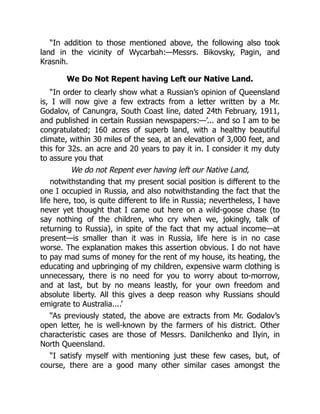
“In addition to those mentioned above, the following also took
land in the vicinity of Wycarbah:—Messrs. Bikovsky, Pagin, and
Krasnih.
We Do Not Repent having Left our Native Land.
“In order to clearly show what a Russian’s opinion of Queensland
is, I will now give a few extracts from a letter written by a Mr.
Godalov, of Canungra, South Coast line, dated 24th February, 1911,
and published in certain Russian newspapers:—’... and so I am to be
congratulated; 160 acres of superb land, with a healthy beautiful
climate, within 30 miles of the sea, at an elevation of 3,000 feet, and
this for 32s. an acre and 20 years to pay it in. I consider it my duty
to assure you that
We do not Repent ever having left our Native Land,
notwithstanding that my present social position is different to the
one I occupied in Russia, and also notwithstanding the fact that the
life here, too, is quite different to life in Russia; nevertheless, I have
never yet thought that I came out here on a wild-goose chase (to
say nothing of the children, who cry when we, jokingly, talk of
returning to Russia), in spite of the fact that my actual income—at
present—is smaller than it was in Russia, life here is in no case
worse. The explanation makes this assertion obvious. I do not have
to pay mad sums of money for the rent of my house, its heating, the
educating and upbringing of my children, expensive warm clothing is
unnecessary, there is no need for you to worry about to-morrow,
and at last, but by no means leastly, for your own freedom and
absolute liberty. All this gives a deep reason why Russians should
emigrate to Australia....’
“As previously stated, the above are extracts from Mr. Godalov’s
open letter, he is well-known by the farmers of his district. Other
characteristic cases are those of Messrs. Danilchenko and Ilyin, in
North Queensland.
“I satisfy myself with mentioning just these few cases, but, of
course, there are a good many other similar cases amongst the
Russian colony in Queensland. I have taken the above cases at
random, and think that they clearly illustrate that a good, honest,
and energetic Russian agriculturist cannot find a country with more
favourable conditions than those offered him by Queensland for
applying his knowledge and labour to.
“In view of my having received a large number of inquiries as to
the shortest space of time in which profit can be obtained from land
still to be cleared, I, in the interests of intending emigrants, would
like to give the following facts, which are based on my own
experiences:—
Mr. A. Mendrin’s Experiences.
“We will say, then, that you have gone through the formalities of
obtaining your land (in Queensland they are not complicated). From
the first day of your arrival on your farm you will start cutting down
your trees (these are mostly soft), a normally healthy agricultural
peasant should fell from 2 to 2-1/2 acres of brigalow scrub in a
week. In this way in a month’s time you should have about ten acres
of trees felled, provided you started this during the summer months.
You will want, say 2-1/2 months, for the fallen timber to dry before
you burn it. Having burnt it, you promptly start sowing maize
between the stumps, and while this is taking root you continue
felling or putting up your fence, as the case may be. It will take
about 105 days for your maize to grow. You then pull the cobs, and
prepare them for drying and threshing, which should take about two
weeks, at the end of which time you will be in a position to realise
your first crop. Virgin soil in the district I am speaking of (Wycarbah)
will yield about 60 bushels of maize to the acre; that is, from 10
acres you will get 600 bushels; the average price is 3s. per bushel,
or £90 for the 10 acres you have cleared. In this way seven months
have gone by since the day on which you started work, and you
have £90 in your pocket, less from £10 to £12 for various expenses,
such as packing, delivery, &c. I would like to make it quite clear that
I have taken only the average price of maize above. Lately this
article has been quoted at Rockhampton at from 4s. to 4s. 3d. per
bushel.
“Knowing how popular pig and poultry breeding and farming is
amongst Russian peasantry, I can say, with conviction, that these
two yield a very good source of income, as do all other branches of
pastoral and agricultural enterprise, all of which I cannot give details
of here in view of the space such information would take up.
“Finally, I consider it my bounden duty to assert that my two
years of careful study of agricultural and other conditions of life in
Queensland give me good foundation on which to consider this
country as the
Most Convenient, Favourable, and Attractive Country
for the average Russian agricultural or other peasant to emigrate
to.
“I have to express my thanks to the Lands Department for the
kindness and attention shown by them in all cases when Russian
subjects have approached them requesting advice and assistance.”
For fuller information in regard to the resources, modes of land
selection, and general description of Queensland, see the booklet,
entitled “Pocket Queensland.”
Compiled 31st December, 1914.
By Authority: Anthony J. Cumming, Government Printer, Brisbane.
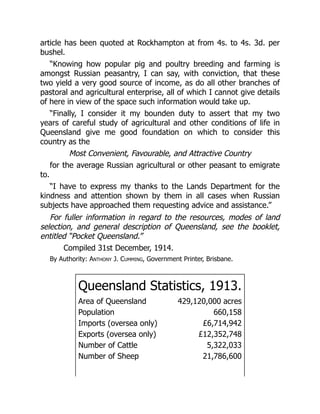
Queensland Statistics, 1913.
Area of Queensland 429,120,000 acres
Population 660,158
Imports (oversea only) £6,714,942
Exports (oversea only) £12,352,748
Number of Cattle 5,322,033
Number of Sheep 21,786,600
Miles of Railways opened
(Govt. and Private),
31st December, 1914
5,186
Miles of Lines under
Construction
389
Miles of Lines approved 1,723
Death Rate per 1,000 10·39
Healthy Climate. Magnificent Scenery.
Liberal Land Laws.
Transcriber’s Notes:
Front and back covers of the brochure contain text and images, so have been
transcribed.
Page 3: livihood changed to livelihood.
Page 9: rhubard changed to rhubarb.
Page 45: Plunket changed to Plunkett.
*** END OF THE PROJECT GUTENBERG EBOOK QUEENSLAND, THE
RICH BUT SPARSELY PEOPLED COUNTRY, A PARADISE FOR
WILLING WORKERS ***
Updated editions will replace the previous one—the old editions will
be renamed.
Creating the works from print editions not protected by U.S.
copyright law means that no one owns a United States copyright in
these works, so the Foundation (and you!) can copy and distribute it
in the United States without permission and without paying
copyright royalties. Special rules, set forth in the General Terms of
Use part of this license, apply to copying and distributing Project
Gutenberg™ electronic works to protect the PROJECT GUTENBERG™
concept and trademark. Project Gutenberg is a registered trademark,
and may not be used if you charge for an eBook, except by following
the terms of the trademark license, including paying royalties for use
of the Project Gutenberg trademark. If you do not charge anything
for copies of this eBook, complying with the trademark license is
very easy. You may use this eBook for nearly any purpose such as
creation of derivative works, reports, performances and research.
Project Gutenberg eBooks may be modified and printed and given
away—you may do practically ANYTHING in the United States with
eBooks not protected by U.S. copyright law. Redistribution is subject
to the trademark license, especially commercial redistribution.
START: FULL LICENSE
THE FULL PROJECT GUTENBERG LICENSE
PLEASE READ THIS BEFORE YOU DISTRIBUTE OR USE THIS WORK
To protect the Project Gutenberg™ mission of promoting the free
distribution of electronic works, by using or distributing this work (or
any other work associated in any way with the phrase “Project
Gutenberg”), you agree to comply with all the terms of the Full
Project Gutenberg™ License available with this file or online at
www.gutenberg.org/license.
Section 1. General Terms of Use and
Redistributing Project Gutenberg™
electronic works
1.A. By reading or using any part of this Project Gutenberg™
electronic work, you indicate that you have read, understand, agree
to and accept all the terms of this license and intellectual property
(trademark/copyright) agreement. If you do not agree to abide by all
the terms of this agreement, you must cease using and return or
destroy all copies of Project Gutenberg™ electronic works in your
possession. If you paid a fee for obtaining a copy of or access to a
Project Gutenberg™ electronic work and you do not agree to be
bound by the terms of this agreement, you may obtain a refund
from the person or entity to whom you paid the fee as set forth in
paragraph 1.E.8.
1.B. “Project Gutenberg” is a registered trademark. It may only be
used on or associated in any way with an electronic work by people
who agree to be bound by the terms of this agreement. There are a
few things that you can do with most Project Gutenberg™ electronic
works even without complying with the full terms of this agreement.
See paragraph 1.C below. There are a lot of things you can do with
Project Gutenberg™ electronic works if you follow the terms of this
agreement and help preserve free future access to Project
Gutenberg™ electronic works. See paragraph 1.E below.
1.C. The Project Gutenberg Literary Archive Foundation (“the
Foundation” or PGLAF), owns a compilation copyright in the
collection of Project Gutenberg™ electronic works. Nearly all the
individual works in the collection are in the public domain in the
United States. If an individual work is unprotected by copyright law
in the United States and you are located in the United States, we do
not claim a right to prevent you from copying, distributing,
performing, displaying or creating derivative works based on the
work as long as all references to Project Gutenberg are removed. Of
course, we hope that you will support the Project Gutenberg™
mission of promoting free access to electronic works by freely
sharing Project Gutenberg™ works in compliance with the terms of
this agreement for keeping the Project Gutenberg™ name associated
with the work. You can easily comply with the terms of this
agreement by keeping this work in the same format with its attached
full Project Gutenberg™ License when you share it without charge
with others.
1.D. The copyright laws of the place where you are located also
govern what you can do with this work. Copyright laws in most
countries are in a constant state of change. If you are outside the
United States, check the laws of your country in addition to the
terms of this agreement before downloading, copying, displaying,
performing, distributing or creating derivative works based on this
work or any other Project Gutenberg™ work. The Foundation makes
no representations concerning the copyright status of any work in
any country other than the United States.
1.E. Unless you have removed all references to Project Gutenberg:
1.E.1. The following sentence, with active links to, or other
immediate access to, the full Project Gutenberg™ License must
appear prominently whenever any copy of a Project Gutenberg™
work (any work on which the phrase “Project Gutenberg” appears,
or with which the phrase “Project Gutenberg” is associated) is
accessed, displayed, performed, viewed, copied or distributed:
This eBook is for the use of anyone anywhere in the United
States and most other parts of the world at no cost and with
almost no restrictions whatsoever. You may copy it, give it away
or re-use it under the terms of the Project Gutenberg License
included with this eBook or online at www.gutenberg.org. If you
are not located in the United States, you will have to check the
laws of the country where you are located before using this
eBook.
1.E.2. If an individual Project Gutenberg™ electronic work is derived
from texts not protected by U.S. copyright law (does not contain a
notice indicating that it is posted with permission of the copyright
holder), the work can be copied and distributed to anyone in the
United States without paying any fees or charges. If you are
redistributing or providing access to a work with the phrase “Project
Gutenberg” associated with or appearing on the work, you must
comply either with the requirements of paragraphs 1.E.1 through
1.E.7 or obtain permission for the use of the work and the Project
Gutenberg™ trademark as set forth in paragraphs 1.E.8 or 1.E.9.
1.E.3. If an individual Project Gutenberg™ electronic work is posted
with the permission of the copyright holder, your use and distribution
must comply with both paragraphs 1.E.1 through 1.E.7 and any
additional terms imposed by the copyright holder. Additional terms
will be linked to the Project Gutenberg™ License for all works posted
with the permission of the copyright holder found at the beginning
of this work.
1.E.4. Do not unlink or detach or remove the full Project
Gutenberg™ License terms from this work, or any files containing a
part of this work or any other work associated with Project
Gutenberg™.
1.E.5. Do not copy, display, perform, distribute or redistribute this
electronic work, or any part of this electronic work, without
prominently displaying the sentence set forth in paragraph 1.E.1
with active links or immediate access to the full terms of the Project
Gutenberg™ License.
1.E.6. You may convert to and distribute this work in any binary,
compressed, marked up, nonproprietary or proprietary form,
including any word processing or hypertext form. However, if you
provide access to or distribute copies of a Project Gutenberg™ work
in a format other than “Plain Vanilla ASCII” or other format used in
the official version posted on the official Project Gutenberg™ website
(www.gutenberg.org), you must, at no additional cost, fee or
expense to the user, provide a copy, a means of exporting a copy, or
a means of obtaining a copy upon request, of the work in its original
“Plain Vanilla ASCII” or other form. Any alternate format must
include the full Project Gutenberg™ License as specified in
paragraph 1.E.1.
1.E.7. Do not charge a fee for access to, viewing, displaying,
performing, copying or distributing any Project Gutenberg™ works
unless you comply with paragraph 1.E.8 or 1.E.9.
1.E.8. You may charge a reasonable fee for copies of or providing
access to or distributing Project Gutenberg™ electronic works
provided that:
• You pay a royalty fee of 20% of the gross profits you derive
from the use of Project Gutenberg™ works calculated using
the method you already use to calculate your applicable
taxes. The fee is owed to the owner of the Project
Gutenberg™ trademark, but he has agreed to donate
royalties under this paragraph to the Project Gutenberg
Literary Archive Foundation. Royalty payments must be paid
within 60 days following each date on which you prepare
(or are legally required to prepare) your periodic tax
returns. Royalty payments should be clearly marked as such
and sent to the Project Gutenberg Literary Archive
Foundation at the address specified in Section 4,
“Information about donations to the Project Gutenberg
Literary Archive Foundation.”
• You provide a full refund of any money paid by a user who
notifies you in writing (or by e-mail) within 30 days of
receipt that s/he does not agree to the terms of the full
Project Gutenberg™ License. You must require such a user
to return or destroy all copies of the works possessed in a
physical medium and discontinue all use of and all access to
other copies of Project Gutenberg™ works.
• You provide, in accordance with paragraph 1.F.3, a full
refund of any money paid for a work or a replacement copy,
if a defect in the electronic work is discovered and reported
to you within 90 days of receipt of the work.
• You comply with all other terms of this agreement for free
distribution of Project Gutenberg™ works.
1.E.9. If you wish to charge a fee or distribute a Project Gutenberg™
electronic work or group of works on different terms than are set
forth in this agreement, you must obtain permission in writing from
the Project Gutenberg Literary Archive Foundation, the manager of
the Project Gutenberg™ trademark. Contact the Foundation as set
forth in Section 3 below.
1.F.
1.F.1. Project Gutenberg volunteers and employees expend
considerable effort to identify, do copyright research on, transcribe
and proofread works not protected by U.S. copyright law in creating
the Project Gutenberg™ collection. Despite these efforts, Project
Gutenberg™ electronic works, and the medium on which they may
be stored, may contain “Defects,” such as, but not limited to,
incomplete, inaccurate or corrupt data, transcription errors, a
copyright or other intellectual property infringement, a defective or
damaged disk or other medium, a computer virus, or computer
codes that damage or cannot be read by your equipment.
1.F.2. LIMITED WARRANTY, DISCLAIMER OF DAMAGES - Except for
the “Right of Replacement or Refund” described in paragraph 1.F.3,
the Project Gutenberg Literary Archive Foundation, the owner of the
Project Gutenberg™ trademark, and any other party distributing a
Project Gutenberg™ electronic work under this agreement, disclaim
all liability to you for damages, costs and expenses, including legal
fees. YOU AGREE THAT YOU HAVE NO REMEDIES FOR
NEGLIGENCE, STRICT LIABILITY, BREACH OF WARRANTY OR
BREACH OF CONTRACT EXCEPT THOSE PROVIDED IN PARAGRAPH
1.F.3. YOU AGREE THAT THE FOUNDATION, THE TRADEMARK
OWNER, AND ANY DISTRIBUTOR UNDER THIS AGREEMENT WILL
NOT BE LIABLE TO YOU FOR ACTUAL, DIRECT, INDIRECT,
CONSEQUENTIAL, PUNITIVE OR INCIDENTAL DAMAGES EVEN IF
YOU GIVE NOTICE OF THE POSSIBILITY OF SUCH DAMAGE.
1.F.3. LIMITED RIGHT OF REPLACEMENT OR REFUND - If you
discover a defect in this electronic work within 90 days of receiving
it, you can receive a refund of the money (if any) you paid for it by
sending a written explanation to the person you received the work
from. If you received the work on a physical medium, you must
return the medium with your written explanation. The person or
entity that provided you with the defective work may elect to provide
a replacement copy in lieu of a refund. If you received the work
electronically, the person or entity providing it to you may choose to
give you a second opportunity to receive the work electronically in
lieu of a refund. If the second copy is also defective, you may
demand a refund in writing without further opportunities to fix the
problem.
1.F.4. Except for the limited right of replacement or refund set forth
in paragraph 1.F.3, this work is provided to you ‘AS-IS’, WITH NO
OTHER WARRANTIES OF ANY KIND, EXPRESS OR IMPLIED,
INCLUDING BUT NOT LIMITED TO WARRANTIES OF
MERCHANTABILITY OR FITNESS FOR ANY PURPOSE.
1.F.5. Some states do not allow disclaimers of certain implied
warranties or the exclusion or limitation of certain types of damages.
If any disclaimer or limitation set forth in this agreement violates the
law of the state applicable to this agreement, the agreement shall be
interpreted to make the maximum disclaimer or limitation permitted
by the applicable state law. The invalidity or unenforceability of any
provision of this agreement shall not void the remaining provisions.
1.F.6. INDEMNITY - You agree to indemnify and hold the Foundation,
the trademark owner, any agent or employee of the Foundation,
anyone providing copies of Project Gutenberg™ electronic works in
accordance with this agreement, and any volunteers associated with
the production, promotion and distribution of Project Gutenberg™
electronic works, harmless from all liability, costs and expenses,
including legal fees, that arise directly or indirectly from any of the
following which you do or cause to occur: (a) distribution of this or
any Project Gutenberg™ work, (b) alteration, modification, or
additions or deletions to any Project Gutenberg™ work, and (c) any
Defect you cause.
Section 2. Information about the Mission
of Project Gutenberg™
Project Gutenberg™ is synonymous with the free distribution of
electronic works in formats readable by the widest variety of
computers including obsolete, old, middle-aged and new computers.
It exists because of the efforts of hundreds of volunteers and
donations from people in all walks of life.
Volunteers and financial support to provide volunteers with the
assistance they need are critical to reaching Project Gutenberg™’s
goals and ensuring that the Project Gutenberg™ collection will
remain freely available for generations to come. In 2001, the Project
Gutenberg Literary Archive Foundation was created to provide a
secure and permanent future for Project Gutenberg™ and future
generations. To learn more about the Project Gutenberg Literary
Archive Foundation and how your efforts and donations can help,
see Sections 3 and 4 and the Foundation information page at
www.gutenberg.org.
Section 3. Information about the Project
Gutenberg Literary Archive Foundation
The Project Gutenberg Literary Archive Foundation is a non-profit
501(c)(3) educational corporation organized under the laws of the
state of Mississippi and granted tax exempt status by the Internal
Revenue Service. The Foundation’s EIN or federal tax identification
number is 64-6221541. Contributions to the Project Gutenberg
Literary Archive Foundation are tax deductible to the full extent
permitted by U.S. federal laws and your state’s laws.
The Foundation’s business office is located at 809 North 1500 West,
Salt Lake City, UT 84116, (801) 596-1887. Email contact links and up
to date contact information can be found at the Foundation’s website
and official page at www.gutenberg.org/contact
Section 4. Information about Donations to
the Project Gutenberg Literary Archive
Foundation
Project Gutenberg™ depends upon and cannot survive without
widespread public support and donations to carry out its mission of
increasing the number of public domain and licensed works that can
be freely distributed in machine-readable form accessible by the
widest array of equipment including outdated equipment. Many
small donations ($1 to $5,000) are particularly important to
maintaining tax exempt status with the IRS.
The Foundation is committed to complying with the laws regulating
charities and charitable donations in all 50 states of the United
States. Compliance requirements are not uniform and it takes a
considerable effort, much paperwork and many fees to meet and
keep up with these requirements. We do not solicit donations in
locations where we have not received written confirmation of
compliance. To SEND DONATIONS or determine the status of
compliance for any particular state visit www.gutenberg.org/donate.
While we cannot and do not solicit contributions from states where
we have not met the solicitation requirements, we know of no
prohibition against accepting unsolicited donations from donors in
such states who approach us with offers to donate.
International donations are gratefully accepted, but we cannot make
any statements concerning tax treatment of donations received from
outside the United States. U.S. laws alone swamp our small staff.
Please check the Project Gutenberg web pages for current donation
methods and addresses. Donations are accepted in a number of
other ways including checks, online payments and credit card
donations. To donate, please visit: www.gutenberg.org/donate.
Section 5. General Information About
Project Gutenberg™ electronic works
Professor Michael S. Hart was the originator of the Project
Gutenberg™ concept of a library of electronic works that could be
freely shared with anyone. For forty years, he produced and
distributed Project Gutenberg™ eBooks with only a loose network of
volunteer support.
Project Gutenberg™ eBooks are often created from several printed
editions, all of which are confirmed as not protected by copyright in
the U.S. unless a copyright notice is included. Thus, we do not
necessarily keep eBooks in compliance with any particular paper
edition.
Most people start at our website which has the main PG search
facility: www.gutenberg.org.
This website includes information about Project Gutenberg™,
including how to make donations to the Project Gutenberg Literary
Archive Foundation, how to help produce our new eBooks, and how
to subscribe to our email newsletter to hear about new eBooks.
Welcome to our website – the perfect destination for book lovers and
knowledge seekers. We believe that every book holds a new world,
offering opportunities for learning, discovery, and personal growth.
That’s why we are dedicated to bringing you a diverse collection of
books, ranging from classic literature and specialized publications to
self-development guides and children's books.
More than just a book-buying platform, we strive to be a bridge
connecting you with timeless cultural and intellectual values. With an
elegant, user-friendly interface and a smart search system, you can
quickly find the books that best suit your interests. Additionally,
our special promotions and home delivery services help you save time
and fully enjoy the joy of reading.
Join us on a journey of knowledge exploration, passion nurturing, and
personal growth every day!
testbankbell.com
Solution Manual for Human Resource Management 15th Edition Martocchio •

  • 1.
    Download the fullversion and explore a variety of test banks or solution manuals at https://testbankbell.com Solution Manual for Human Resource Management 15th Edition Martocchio • _____ Follow the link below to get your download now _____ http://testbankbell.com/product/solution-manual-for-human- resource-management-15th-edition-martocchio/ Access testbankbell.com now to download high-quality test banks or solution manuals
  • 2.
    We have selectedsome products that you may be interested in Click the link to download now or visit testbankbell.com for more options!. Solution Manual for Human Resource Management 15th Edition Gary Dessler http://testbankbell.com/product/solution-manual-for-human-resource- management-15th-edition-gary-dessler/ Human Resource Management 15th Edition Dessler Solutions Manual http://testbankbell.com/product/human-resource-management-15th- edition-dessler-solutions-manual/ Test Bank for Human Resource Management 15th Edition Mathis http://testbankbell.com/product/test-bank-for-human-resource- management-15th-edition-mathis/ Solution Manual for College Mathematics for Business, Economics Life Sciences and Social Sciences 14th by Barnett http://testbankbell.com/product/solution-manual-for-college- mathematics-for-business-economics-life-sciences-and-social- sciences-14th-by-barnett/
  • 3.
    Solution Manual forInquiry into Physics 8th Edition http://testbankbell.com/product/solution-manual-for-inquiry-into- physics-8th-edition/ Solution Manual for American Government Institutions and Policies, 14th Edition http://testbankbell.com/product/solution-manual-for-american- government-institutions-and-policies-14th-edition/ Hesi Pharmacology 2018 Most Recent – Updated http://testbankbell.com/product/hesi-pharmacology-2018-most-recent- updated/ Test Bank for Conflict Survival Kit: Tools for Resolving Conflict at Work, 2/E 2nd Edition : 0132741059 http://testbankbell.com/product/test-bank-for-conflict-survival-kit- tools-for-resolving-conflict-at-work-2-e-2nd-edition-0132741059/ College Algebra Blitzer 6th Edition Solutions Manual http://testbankbell.com/product/college-algebra-blitzer-6th-edition- solutions-manual/
  • 4.
    Solution Manual forCore Concepts of Accounting Information Systems 14th by Simkin http://testbankbell.com/product/solution-manual-for-core-concepts-of- accounting-information-systems-14th-by-simkin/
  • 5.
    1 Copyright © 2019Pearson Education, Inc. Solution Manual for Human Resource Management 15th Edition Martocchio • Full chapter at: https://testbankbell.com/product/solu tion-manual-for-human-resource- management-15th-edition- martocchio/ CHAPTER 1 HUMAN RESOURCE MANAGEMENT: AN OVERVIEW LEARNING OBJECTIVES 1.1 Define human resource management (HRM) and the importance of studying it 1.2 Describe who performs HRM 1.3 Explain how the HRM function serves as a strategic business partner and the elements of the dynamic HRM environment 1.4 Discuss the role of HRM in building corporate culture and employer branding 1.5 Summarize HRM issues for small businesses 1.6 Identify ways that country culture influences global business 1.7 Explore essential skills for developing your career in HR or any other career path KEY TERMS Human resource management (HRM): The utilization of individuals to achieve organizational objectives. Staffing: Process through which an organization ensures that it always has the proper number of employees with the appropriate skills in the right jobs, at the right time, to achieve organizational objectives. Performance management (PM): Goal-oriented process directed toward ensuring that organizational processes are in place to maximize the productivity of employees, teams, and ultimately, the organization. Human resource development (HRD): Major HRM function consisting not only of training and development, but also of individual career planning and development activities, organization development, and performance management and appraisal. Direct financial compensation (monetary compensation): Pay that a person receives in the form of wages, salary, commissions, and bonuses. Indirect financial compensation (benefits): All financial rewards that are not included in direct financial compensation.
  • 6.
    2 Copyright © 2019Pearson Education, Inc. Nonfinancial compensation: Satisfaction that person receives from the job itself or from the psychological and/or physical environment in which the person works. Safety: Protection of employees from injuries caused by work-related accidents. Health: Employees’ freedom from physical or emotional illness. Human resource management professional: An individual who normally acts in an advisory or staff capacity, working with other managers to help them address human resource matters. Line managers: Individuals directly involved in accomplishing the primary purpose of the organization.
  • 7.
    3 Copyright © 2019Pearson Education, Inc. HR outsourcing (HRO): Process of hiring external HR professionals to do the HR work that was previously done internally. Shared service center (SSC): A center that takes routine, transaction-based activities dispersed throughout the organization and consolidates them in one place. Professional employer organization (PEO): A company that leases employees to other businesses. Executive: Top-level manager who reports directly to a corporation’s chief executive officer or to the head of a major division. Generalist: Person who may be an executive and performs tasks in a variety of HR- related areas. Specialist: Individual who may be an HR executive, a human resource manager, or a nonmanager, and who is typically concerned with only one of the six functional areas of human resource management. Profession: Vocation characterized by the existence of a common body of knowledge and a procedure for certifying members. Human capital: As defined by economists, human capital refers to sets of collective skills, knowledge, and ability that employees can apply to create economic value for their employers. Union: Comprised of employees who have joined together for the purpose of dealing with their employer. Shareholders: Owners of a corporation. Human resource information system (HRIS): Any organized approach for obtaining relevant and timely information on which to base human resource decisions. Corporate culture: System of shared values, beliefs, and habits within an organization that interacts with the formal structure to produce behavioral norms. Employer branding: Firm’s corporate image or culture focused on attracting the type of employees the firm is seeking. Country’s culture: Set of values, symbols, beliefs, language, and norms that guide human behavior within the country. LECTURE OUTLINE HUMAN RESOURCE MANAGEMENT Human resource management (HRM) can be defined as the optimal utilization of individuals to achieve organizational objectives. HUMAN RESOURCE MANAGEMENT FUNCTIONS Six functional areas are associated with effective human resource management: staffing, human resource development, performance management, compensation, safety and health, and employee and labor relations.
  • 8.
    4 Copyright © 2019Pearson Education, Inc. ● STAFFING—Process through which an organization ensures that it always has the proper number of employees with the appropriate skills in the right jobs, at the right time, to achieve organizational objectives. ● Job analysis: Systematic process of determining the skills, duties, and knowledge required for performing specific jobs in an organization. ● Human resource planning: Systematic process of matching the internal and external supply of people with job openings anticipated in the organization over a specified period of time. ● Recruitment: Process of attracting qualified individuals and encouraging them to apply for work with the organization. ● Selection: Process through which the organization chooses, from a group of applicants, those individuals best suited both for open positions and the company. ● PERFORMANCE MANAGEMENT—A goal-oriented activity to ensure organizational processes are in place to maximize the productivity of employees, teams, and ultimately, the organization. ● Performance appraisal: A formal system to review and evaluate individual or team performance. ● HUMAN RESOURCE DEVELOPMENT—A major HRM function consisting not only of training and development, but also of career planning and development activities, organization development, performance management, and appraisal. ● Training: Activities designed to provide learners with the knowledge and skills needed for their present jobs. ● Organization development (OD): A planned and systematic attempt to change the organization to a more behavioral environment. ● Career planning: Ongoing process whereby an individual sets career goals and identifies the means to achieve them. ● Career development: Formal approach used by the organization to ensure that people with the proper qualifications and experiences are available when needed.
  • 9.
    5 Copyright © 2019Pearson Education, Inc. ● COMPENSATION—All rewards that individuals receive as a result of their employment. ● Direct Financial Compensation: Pay that a person receives in the form of wages, salaries, bonuses, and commissions. ● Indirect Financial Compensation (Benefits): All financial rewards that are not included in direct compensation such as paid vacations, sick leave, holidays, and medical insurance. ● Nonfinancial Compensation: Satisfaction that a person receives from the job itself or from the psychological and/or physical environment in which the person works. ● EMPLOYEE AND LABOR RELATIONS—Businesses are required by law to recognize a union and bargain with it in good faith if the firm’s employees want the union to represent them. Internal employee relations comprise the human resource management activities associated with the movement of employees within the organization such as promotions, demotion, termination, and resignation. ● SAFETY AND HEALTH—Employees who work in a safe environment and enjoy good health are more likely to be productive and yield long-term benefits to the organization. ● Safety: Activities involved in protecting employees from injuries caused by work-related accidents. ● Health: Activities involved in securing the employees’ freedom from illness and their general physical and mental well-being. ● HUMAN RESOURCE DATA ANALYTICS—Pervades all HRM functional areas and the researcher’s laboratory is the entire work environment. Human resource research is key to developing the most productive and satisfied workforce possible. Data analytics go a long way towards establishing the HRM function as a strategic business partner. ● INTERRELATIONSHIPS OF HRM FUNCTIONS—All HRM functional areas are highly interrelated. WHO PERFORMS THE HUMAN RESOURCE MANAGEMENT ACTIVITIES? The person or units who perform human resource management tasks has changed dramatically in recent years.
  • 10.
    6 Copyright © 2019Pearson Education, Inc. ● HUMAN RESOURCE MANAGEMENT PROFESSIONAL—An individual who normally acts in an advisory (or staff) capacity when working with other (line) managers regarding human resource matters. ● LINE MANAGERS—Individuals directly involved in accomplishing the primary purpose of the organization. As the traditional work of HR managers diminishes, line managers are stepping up and performing some duties typically done by human resource professionals. ● HR OUTSOURCING—Process of hiring an external provider to do the work that was previously done internally. ● Discrete services outsourcing: Involves one element of a business process or a single set of high-volume repetitive functions such as benefits. ● Business process outsourcing (BPO): The transfer of the majority of HR services to a third party. ● HR SHARED SERVICE CENTERS—Take routine, transaction-based activities that are dispersed throughout the organization and consolidate them in one place. ● PROFESSIONAL EMPLOYER ORGANIZATION (PEO)—Company that leases employees to other businesses. When a decision is made to use a professional employer organization, the company releases its employees who are then hired by the PEO. HUMAN RESOURCE MANAGEMENT PROFESSION There are various designations in the human resource management profession. ● EXECUTIVE—A top-level manager who reports directly to a corporation’s chief executive officer or to the head of a major division is called an executive. ● GENERALIST—A person who may be an executive and performs tasks in a variety of HR-related areas is called a Generalist. ● SPECIALIST—An individual who may be an HR executive, a human resource manager, or a non-manager, and who is typically concerned with only one of the five functional areas of human resource management.
  • 11.
    7 Copyright © 2019Pearson Education, Inc. ● PROFESSION: Vocation characterized by the existence of a common body of knowledge and a procedure for certifying members. Professions have representative organizations. In HR these include the Society for Human Resource Management, the Human Resource Certification Institute, the Association for Talent Development, and WorldatWork. Opportunities and compensation in this profession are growing. HUMAN RESOURCES AS A STRATEGIC BUSINESS PARTNER IN A DYNAMIC ENVIRONMENT Today’s HR professional must be a strategic business partner with upper management. HR must thoroughly understand all aspects of the businesses they support. Working as a strategic partner requires a deeper and broader understanding of business issues. The HR professional must inform executives of the key role employees play in achieving organizational goals. Doing so requires HR professionals to understand the role of capital in value creation. ● CAPITAL: The factors that enable companies to generate income, increase company stock prices, economic value, strong brand identity, and reputation. ● HUMAN CAPITAL: As defined by economists, refers to sets of collective skills, knowledge, and ability that employees can apply to create economic value for their employers. DYNAMIC HUMAN RESOURCE MANAGEMENT ENVIRONMENT Many interrelated factors affect the five HRM functions. Factors outside an organization’s boundaries that affect a firm’s human resources make up the external environment. ● LEGAL CONSIDERATIONS—Federal, state, and local legislation, and the many court decisions interpreting this legislation, in addition to many presidential executive orders, have had a major impact on human resource management. ● LABOR MARKET—Potential employees located within the geographic area from which employees are normally recruited. ● SOCIETY—Society may also exert pressure on human resource management. ● Ethics: Discipline dealing with what is good and bad, or right and wrong, or with moral duty and obligation. ● Corporate social responsibility: Implied, enforced, or felt obligation of managers, acting in their official capacity, to serve or protect the interests of groups other than themselves.
  • 12.
    8 Copyright © 2019Pearson Education, Inc. ● POLITICAL PARTIES—There are two major political parties in the United States. These parties often have differing opinions on human resource topics. ● UNIONS—Employees who have come together for the purpose of dealing collectively with their employer are collectively called a union. A union is treated as an environmental factor because they become a third party when dealing with the company. ● SHAREHOLDERS—Owners of a corporation are called shareholders. Because shareholders have invested money in a firm, they may at times challenge programs considered by management to be beneficial to the organization. ● COMPETITION—Firms may face intense competition in both their product or service and labor markets. ● CUSTOMERS—People who actually use a firm’s goods and services. Management has the task of ensuring that its employment practices do not antagonize the members of the market it serves. ● HR TECHNOLOGY—The world has never before seen the rapid rate of technological change that is occurring today. The development of technology has created new roles for HR professionals but also places additional pressures on them to keep abreast of the technology. With the increased sophistication of technology has come the ability to design more useful human resource information systems (HRIS). An HRIS is any organized approach for obtaining relevant and timely information on which to base human resource decisions. Cloud computing, which is a means of providing software and data via the Internet, and the use of mobile devices are changing the way that HR work is performed. Social media is also an important HR tool, in particular for use in recruiting. ● ECONOMY—As a generalization, when the economy is booming, it is often more difficult to recruit qualified workers. ● UNANTICIPATED EVENTS—Many of the human resource functions require modification when unanticipated events such as major weather incidents occur.
  • 13.
    9 Copyright © 2019Pearson Education, Inc. THE ROLE OF HRM IN BUILDING CORPORATE CULTURE AND EMPLOYER BRANDING As an internal environmental factor affecting human resource management, corporate culture refers to the firm’s social and psychological climate. ● CORPORATE CULTURE: The system of shared values, beliefs, and habits within an organization that interacts with the formal structure to produce behavioral norms. An infinite variety of cultures could exist, so one should view them as a continuum. ● EMPLOYER BRANDING: The firm’s corporate image or culture created to attract and retain the type of employees the firm is seeking ● Diversity management: Pursuing an inclusive corporate culture which makes everyone feel welcome. ● Organizational fit: Management’s perception of the degree to which an individual fits with the culture. ● New hire orientation: The corporate culture by showing how things are done ● Talent management: The strategic endeavor to optimize the use of employees to drive short and long-term organizational results. ● Organizational development: A means to achieving change in corporate culture. ● Country’s culture: The set of values, symbols, beliefs, languages, and norms that guide human behavior within the country. It is learned behavior that develops as individuals grow from childhood to adulthood. EMPLOYER BRANDING Employer branding is the firm’s corporate image or culture focused on attracting the type of employees the firm is seeking. Through employer branding, people get to know what the company stands for, the people it hires, the fit between jobs and people, and the results it recognizes and rewards. HUMAN RESOURCE MANAGEMENT IN SMALL BUSINESSES Typically the same HR functions previously identified must be accomplished by small business, but the manner in which they are accomplished may be altered. Small businesses often do not have a formal HR unit or HRM specialists, rather, line managers handle the HR functions. The focus of their activities is generally on hiring and retaining
  • 14.
    10 Copyright © 2019Pearson Education, Inc. capable employees. Some aspects of HR functions may actually be more significant in smaller firms than in larger ones. COUNTRY CULTURE AND GLOBAL BUSINESS A country’s culture is the set of values, symbols, beliefs, languages, and norms that guide human behavior within the country. Cultural differences between countries are a major factor influencing global business. This borderless world adds dramatically to the difficulty of managing employees. Cultural differences reveal themselves in everything from the workplace environments to differences in the concept of time, space, and social interaction. Cultural misunderstandings are common, but they can be hazards to executives managing global workforces, creating significant challenges in managing a firm’s human resources. DEVELOPING SKILLS FOR YOUR CAREER You will have the opportunity to develop many of the skills that employers have identified as critical to success in the workplace. ● Communication: The effective use of oral, written, and nonverbal skills for multiple purposes, effective listening, and teamwork. ● Critical thinking: The purposeful and goal-directed thinking used to define and solve problems. ● Collaboration: Individuals actively work together on a task and construct meaning and knowledge as a group through dialogue and negotiation. ● Knowledge applicator and analysis: The ability to learn a concept and then appropriately apply that knowledge in another setting to achieve a higher level of understanding. ● Business ethics and social responsibility: Business ethics are sets of guiding principles that influence the way individuals and organizations behave within the society that they operate. ● Corporate social responsibility is the implied, enforced, or felt obligation of managers to serve or protect the interests of groups other than themselves. ● Corporate sustainability focuses on the possible future impact of an organization on society, including social welfare, the economy, and the environment. ● Information technology application and computing skills: The ability to select
  • 15.
    11 Copyright © 2019Pearson Education, Inc. and use appropriate technology to accomplish a given task. ● Data literacy: The ability to access, assess, interpret, manipulate, summarize, and communicate data. ANSWERS TO CHAPTER 1 QUESTIONS FOR REVIEW 1-1. Define human resource management. What HRM functions must be performed regardless of the organization’s size? Human resource management is the utilization of a firm’s human resources to achieve organizational objectives. The following functions are necessary for any size organization. Staffing: Process through which an organization ensures that it always has the proper number of employees with the appropriate skills in the right jobs, at the right time, to achieve organizational objectives. Human resource development: Major HRM function consisting not only of training and development, but also of career planning and development activities, organization development, and performance management and appraisal. Compensation: Compensation includes all rewards individuals receive as a result of their employment. The reward may be one or a combination of the following: ● Direct financial compensation: Pay that a person receives in the form of wages, salaries, commissions, and bonuses. ● Indirect financial compensation (Benefits): All financial rewards that are not included in direct compensation such as paid vacations, sick leave, holidays, and medical insurance. ● Nonfinancial compensation: Satisfaction that a person receives from the job itself or from the psychological and/or physical environment in which the person works. Safety and health: Safety involves protecting employees from injuries due to work-related accidents. Health refers to the employees’ freedom from illness, and their general physical and mental well-being.
  • 16.
    12 Copyright © 2019Pearson Education, Inc. Employee and labor relations: Even with the projected decline in union membership, a business firm is required by law to recognize a union, and bargain with it in good faith, if the firm’s employees want the union to represent them. 1-2. Define profession. Do you believe that the field of human resource management is a profession? Explain your answer. Profession is a vocation characterized by the existence of a common body of knowledge and a procedure for certifying members. Performance standards are established by members of the profession rather than by outsiders; that is, the profession is self- regulated. Most professions also have effective representative organizations that permit members to exchange ideas of mutual concern. These characteristics apply to the field of human resources, and several well-known organizations serve the profession. 1-3. What are the environmental factors that affect HRM? Describe each one. ● Legal considerations: Another significant external force affecting human resource management relates to federal, state, and local legislation, and the many court decisions interpreting this legislation. In addition, many presidential executive orders have had a major impact on human resource management. ● Labor market: Potential employees located within the geographic area from which employees are normally recruited. ● Society: Society may also exert pressure on human resource management. If a firm is to remain acceptable to the general public, it must be capable of accomplishing its purpose in line with societal norms. ● Political parties: There are two major political parties in the United States. These parties often have differing opinions on human resource topics. ● Unions: Group of employees who have joined together for the purpose of dealing collectively with their employer. ● Shareholders: Owners of a corporation. Because shareholders have invested money in a firm, they may at times challenge programs considered by management to be beneficial to the organization. ● Competition: For a firm to succeed, grow, and prosper, it must be able to maintain a supply of competent employees. Other organizations are also striving toward that objective.
  • 17.
    13 Copyright © 2019Pearson Education, Inc. ● Customers: Because sales are critical to the firm’s survival, management has the task of ensuring that its employment practices do not antagonize members of the market it serves. ● HR technology: The development of technology has created new roles for HR professionals but also places additional pressures on them to keep abreast of the technology. With the increased sophistication of technology has come the ability to design more useful human resource information systems (HRIS). ● Economy: The economy of the nation—on the whole—and of its various segments is a major environmental factor affecting human resource management. As a generalization, when the economy is booming, it is often more difficult to recruit qualified workers. On the other hand, when a downturn is experienced, more applicants are typically available. ● Unanticipated events: Occurrences in the external environment that could not be foreseen such as a significant weather event. 1-4. How might HR technology affect the various HR functions? There is no doubt that HR technology is truly the trend of the future. There are many advantages to using HR technology, but the most important benefit is that it lets HR professionals accomplish their tasks in a quicker and more efficient manner. Cloud computing can change the way HR work is performed as secure access to applications can happen anywhere. HR professionals are not required to work in their office; HR tasks can be performed anywhere there is a signal. While this will affect all functions of HR, recruitment is likely most affected as social media can be used to build a company’s brand and attract potential employees. 1-5. Define corporate culture. Explain why corporate culture is a major internal environment factor. Corporate culture is defined as the system of shared values, beliefs, and habits within an organization that interacts with the formal structure to produce behavioral norms. Culture gives people a sense of how to behave and what they ought to be doing. Each individual gradually forms such perceptions over a period of time as the person performs assigned activities under the general guidance of a superior and a set of organizational policies. The culture existing within a firm influences the employee's’ degree of satisfaction with the job, as well as the level and quality of their performance. 1-6. This chapter describes HR’s changing role in business. Describe each component that is involved in HRM.
  • 18.
    14 Copyright © 2019Pearson Education, Inc. HR professionals are increasingly taking on the role of a strategic partner with upper management within organizations. To become a strategic partner, HR must understand the company as a whole and build HR systems to support the organization’s strategy. This includes all the functions of HR such as staffing, compensation, performance management, human resource development, safety and health, and labor and employee relations. 1-7. How does HRM become more complex as a company's workforce reaches 25 employees? New small businesses are faced with a host of federal and state government regulatory requirements, tax laws, and compensation demands. The SBA has identified various compliance steps for new small businesses. Before anyone is hired, an Employment Identification Number (EIN) should be obtained. EINs can be acquired online from the IRS and are needed to report taxes as well as information about new employees to state government. Then, procedures for withholding taxes should be made. The IRS requires that businesses keep records of employment taxes for at least four years. This includes employee wages, tips, and sickness records, as well as employee tax withholding certificates. Verification of eligibility to work is required for new employees within three days of the hire date. An Employment Eligibility Verification Form I-9 must be completed. Also all employers are required to report newly hired and rehired employees to a state directory within 20 days of their hire or rehire date. Workers’ compensation insurance should then be obtained. Any business that hires employees must carry this insurance. A new business should also register for unemployment insurance tax. Small businesses may also be required to pay unemployment insurance tax. New companies should also check to see if they are required to purchase disability insurance. Some states require employers to provide partial wage replacement insurance coverage to eligible employees for non-work related sickness or injury. Laws also require that the business prominently display posters that inform employees of their rights and the small business’s responsibilities to them under labor laws. New employers now have different and new federal and state tax filing requirements that apply. Once the above discussed tasks have been completed, new small businesses can focus on creating a fulfilling, safe, and fair workplace. 1-8. What are the various designations associated with the HRM profession?
  • 19.
    15 Copyright © 2019Pearson Education, Inc. ● Executive: Top-level manager who reports directly to a corporation’s chief executive officer or to the head of a major division. ● Generalist: Person who may be an executive and performs tasks in a variety of HR-related areas. ● Specialist: Individual who may be an HR executive, a human resource manager, or a nonmanager, and who is typically concerned with only one of the five functional areas of human resource management. 1-9. What has been the evolution of HRM? Traditionally, separate functions such as staffing, training and development, compensation, safety and health, and labor relations (if the firm was unionized) were created and placed under the direction of a human resource manager or executive. Large firms might have had a manager and staff for each HR function that reported to the HR executive. The HR vice president worked closely with top management in formulating corporate policy. Today, the person or persons who perform HR tasks is certainly different than it was even a decade ago. As more and more companies use alternative means to accomplish HR tasks, the role of the traditional HR manager is diminishing. HR must now enter into the business of strategic HR, focus more on the bottom line of the organization, and leave the more administrative tasks to technology or others. 1-10. Explain how the seven employability skills matte regardless of your career aspirations. Communication is defined as effective use of oral, written, and nonverbal skills for multiple purposes. You will gain insight into your and your group member’s strengths and weaknesses pertaining to communication and collaboration skills. Critical thinking involves purposeful and goal-directed thinking used to define and solve problems, make decisions or form judgements related to a situation or set of circumstances. Critical thinking, which includes self-assessment and personal reflection, will help you understand yourself and finding your voice will help you approach situations within and outside the employment setting with greater confidence. Collaboration takes place when individuals actively work together on a task, constructing meaning and knowledge as a group through dialogue and negotiation resulting in a product reflective of their join interdependent actions. HR professional and managers throughout the organization work together to address important workplace issues.
  • 20.
    Exploring the Varietyof Random Documents with Different Content
  • 21.
    “In addition tothose mentioned above, the following also took land in the vicinity of Wycarbah:—Messrs. Bikovsky, Pagin, and Krasnih. We Do Not Repent having Left our Native Land. “In order to clearly show what a Russian’s opinion of Queensland is, I will now give a few extracts from a letter written by a Mr. Godalov, of Canungra, South Coast line, dated 24th February, 1911, and published in certain Russian newspapers:—’... and so I am to be congratulated; 160 acres of superb land, with a healthy beautiful climate, within 30 miles of the sea, at an elevation of 3,000 feet, and this for 32s. an acre and 20 years to pay it in. I consider it my duty to assure you that We do not Repent ever having left our Native Land, notwithstanding that my present social position is different to the one I occupied in Russia, and also notwithstanding the fact that the life here, too, is quite different to life in Russia; nevertheless, I have never yet thought that I came out here on a wild-goose chase (to say nothing of the children, who cry when we, jokingly, talk of returning to Russia), in spite of the fact that my actual income—at present—is smaller than it was in Russia, life here is in no case worse. The explanation makes this assertion obvious. I do not have to pay mad sums of money for the rent of my house, its heating, the educating and upbringing of my children, expensive warm clothing is unnecessary, there is no need for you to worry about to-morrow, and at last, but by no means leastly, for your own freedom and absolute liberty. All this gives a deep reason why Russians should emigrate to Australia....’ “As previously stated, the above are extracts from Mr. Godalov’s open letter, he is well-known by the farmers of his district. Other characteristic cases are those of Messrs. Danilchenko and Ilyin, in North Queensland. “I satisfy myself with mentioning just these few cases, but, of course, there are a good many other similar cases amongst the
  • 22.
    Russian colony inQueensland. I have taken the above cases at random, and think that they clearly illustrate that a good, honest, and energetic Russian agriculturist cannot find a country with more favourable conditions than those offered him by Queensland for applying his knowledge and labour to. “In view of my having received a large number of inquiries as to the shortest space of time in which profit can be obtained from land still to be cleared, I, in the interests of intending emigrants, would like to give the following facts, which are based on my own experiences:— Mr. A. Mendrin’s Experiences. “We will say, then, that you have gone through the formalities of obtaining your land (in Queensland they are not complicated). From the first day of your arrival on your farm you will start cutting down your trees (these are mostly soft), a normally healthy agricultural peasant should fell from 2 to 2-1/2 acres of brigalow scrub in a week. In this way in a month’s time you should have about ten acres of trees felled, provided you started this during the summer months. You will want, say 2-1/2 months, for the fallen timber to dry before you burn it. Having burnt it, you promptly start sowing maize between the stumps, and while this is taking root you continue felling or putting up your fence, as the case may be. It will take about 105 days for your maize to grow. You then pull the cobs, and prepare them for drying and threshing, which should take about two weeks, at the end of which time you will be in a position to realise your first crop. Virgin soil in the district I am speaking of (Wycarbah) will yield about 60 bushels of maize to the acre; that is, from 10 acres you will get 600 bushels; the average price is 3s. per bushel, or £90 for the 10 acres you have cleared. In this way seven months have gone by since the day on which you started work, and you have £90 in your pocket, less from £10 to £12 for various expenses, such as packing, delivery, &c. I would like to make it quite clear that I have taken only the average price of maize above. Lately this
  • 23.
    article has beenquoted at Rockhampton at from 4s. to 4s. 3d. per bushel. “Knowing how popular pig and poultry breeding and farming is amongst Russian peasantry, I can say, with conviction, that these two yield a very good source of income, as do all other branches of pastoral and agricultural enterprise, all of which I cannot give details of here in view of the space such information would take up. “Finally, I consider it my bounden duty to assert that my two years of careful study of agricultural and other conditions of life in Queensland give me good foundation on which to consider this country as the Most Convenient, Favourable, and Attractive Country for the average Russian agricultural or other peasant to emigrate to. “I have to express my thanks to the Lands Department for the kindness and attention shown by them in all cases when Russian subjects have approached them requesting advice and assistance.” For fuller information in regard to the resources, modes of land selection, and general description of Queensland, see the booklet, entitled “Pocket Queensland.” Compiled 31st December, 1914. By Authority: Anthony J. Cumming, Government Printer, Brisbane. Queensland Statistics, 1913. Area of Queensland 429,120,000 acres Population 660,158 Imports (oversea only) £6,714,942 Exports (oversea only) £12,352,748 Number of Cattle 5,322,033 Number of Sheep 21,786,600
  • 24.
    Miles of Railwaysopened (Govt. and Private), 31st December, 1914 5,186 Miles of Lines under Construction 389 Miles of Lines approved 1,723 Death Rate per 1,000 10·39 Healthy Climate. Magnificent Scenery. Liberal Land Laws.
  • 25.
  • 26.
    Front and backcovers of the brochure contain text and images, so have been transcribed. Page 3: livihood changed to livelihood. Page 9: rhubard changed to rhubarb. Page 45: Plunket changed to Plunkett.
  • 27.
    *** END OFTHE PROJECT GUTENBERG EBOOK QUEENSLAND, THE RICH BUT SPARSELY PEOPLED COUNTRY, A PARADISE FOR WILLING WORKERS *** Updated editions will replace the previous one—the old editions will be renamed. Creating the works from print editions not protected by U.S. copyright law means that no one owns a United States copyright in these works, so the Foundation (and you!) can copy and distribute it in the United States without permission and without paying copyright royalties. Special rules, set forth in the General Terms of Use part of this license, apply to copying and distributing Project Gutenberg™ electronic works to protect the PROJECT GUTENBERG™ concept and trademark. Project Gutenberg is a registered trademark, and may not be used if you charge for an eBook, except by following the terms of the trademark license, including paying royalties for use of the Project Gutenberg trademark. If you do not charge anything for copies of this eBook, complying with the trademark license is very easy. You may use this eBook for nearly any purpose such as creation of derivative works, reports, performances and research. Project Gutenberg eBooks may be modified and printed and given away—you may do practically ANYTHING in the United States with eBooks not protected by U.S. copyright law. Redistribution is subject to the trademark license, especially commercial redistribution. START: FULL LICENSE
  • 28.
    THE FULL PROJECTGUTENBERG LICENSE
  • 29.
    PLEASE READ THISBEFORE YOU DISTRIBUTE OR USE THIS WORK To protect the Project Gutenberg™ mission of promoting the free distribution of electronic works, by using or distributing this work (or any other work associated in any way with the phrase “Project Gutenberg”), you agree to comply with all the terms of the Full Project Gutenberg™ License available with this file or online at www.gutenberg.org/license. Section 1. General Terms of Use and Redistributing Project Gutenberg™ electronic works 1.A. By reading or using any part of this Project Gutenberg™ electronic work, you indicate that you have read, understand, agree to and accept all the terms of this license and intellectual property (trademark/copyright) agreement. If you do not agree to abide by all the terms of this agreement, you must cease using and return or destroy all copies of Project Gutenberg™ electronic works in your possession. If you paid a fee for obtaining a copy of or access to a Project Gutenberg™ electronic work and you do not agree to be bound by the terms of this agreement, you may obtain a refund from the person or entity to whom you paid the fee as set forth in paragraph 1.E.8. 1.B. “Project Gutenberg” is a registered trademark. It may only be used on or associated in any way with an electronic work by people who agree to be bound by the terms of this agreement. There are a few things that you can do with most Project Gutenberg™ electronic works even without complying with the full terms of this agreement. See paragraph 1.C below. There are a lot of things you can do with Project Gutenberg™ electronic works if you follow the terms of this agreement and help preserve free future access to Project Gutenberg™ electronic works. See paragraph 1.E below.
  • 30.
    1.C. The ProjectGutenberg Literary Archive Foundation (“the Foundation” or PGLAF), owns a compilation copyright in the collection of Project Gutenberg™ electronic works. Nearly all the individual works in the collection are in the public domain in the United States. If an individual work is unprotected by copyright law in the United States and you are located in the United States, we do not claim a right to prevent you from copying, distributing, performing, displaying or creating derivative works based on the work as long as all references to Project Gutenberg are removed. Of course, we hope that you will support the Project Gutenberg™ mission of promoting free access to electronic works by freely sharing Project Gutenberg™ works in compliance with the terms of this agreement for keeping the Project Gutenberg™ name associated with the work. You can easily comply with the terms of this agreement by keeping this work in the same format with its attached full Project Gutenberg™ License when you share it without charge with others. 1.D. The copyright laws of the place where you are located also govern what you can do with this work. Copyright laws in most countries are in a constant state of change. If you are outside the United States, check the laws of your country in addition to the terms of this agreement before downloading, copying, displaying, performing, distributing or creating derivative works based on this work or any other Project Gutenberg™ work. The Foundation makes no representations concerning the copyright status of any work in any country other than the United States. 1.E. Unless you have removed all references to Project Gutenberg: 1.E.1. The following sentence, with active links to, or other immediate access to, the full Project Gutenberg™ License must appear prominently whenever any copy of a Project Gutenberg™ work (any work on which the phrase “Project Gutenberg” appears, or with which the phrase “Project Gutenberg” is associated) is accessed, displayed, performed, viewed, copied or distributed:
  • 31.
    This eBook isfor the use of anyone anywhere in the United States and most other parts of the world at no cost and with almost no restrictions whatsoever. You may copy it, give it away or re-use it under the terms of the Project Gutenberg License included with this eBook or online at www.gutenberg.org. If you are not located in the United States, you will have to check the laws of the country where you are located before using this eBook. 1.E.2. If an individual Project Gutenberg™ electronic work is derived from texts not protected by U.S. copyright law (does not contain a notice indicating that it is posted with permission of the copyright holder), the work can be copied and distributed to anyone in the United States without paying any fees or charges. If you are redistributing or providing access to a work with the phrase “Project Gutenberg” associated with or appearing on the work, you must comply either with the requirements of paragraphs 1.E.1 through 1.E.7 or obtain permission for the use of the work and the Project Gutenberg™ trademark as set forth in paragraphs 1.E.8 or 1.E.9. 1.E.3. If an individual Project Gutenberg™ electronic work is posted with the permission of the copyright holder, your use and distribution must comply with both paragraphs 1.E.1 through 1.E.7 and any additional terms imposed by the copyright holder. Additional terms will be linked to the Project Gutenberg™ License for all works posted with the permission of the copyright holder found at the beginning of this work. 1.E.4. Do not unlink or detach or remove the full Project Gutenberg™ License terms from this work, or any files containing a part of this work or any other work associated with Project Gutenberg™. 1.E.5. Do not copy, display, perform, distribute or redistribute this electronic work, or any part of this electronic work, without prominently displaying the sentence set forth in paragraph 1.E.1
  • 32.
    with active linksor immediate access to the full terms of the Project Gutenberg™ License. 1.E.6. You may convert to and distribute this work in any binary, compressed, marked up, nonproprietary or proprietary form, including any word processing or hypertext form. However, if you provide access to or distribute copies of a Project Gutenberg™ work in a format other than “Plain Vanilla ASCII” or other format used in the official version posted on the official Project Gutenberg™ website (www.gutenberg.org), you must, at no additional cost, fee or expense to the user, provide a copy, a means of exporting a copy, or a means of obtaining a copy upon request, of the work in its original “Plain Vanilla ASCII” or other form. Any alternate format must include the full Project Gutenberg™ License as specified in paragraph 1.E.1. 1.E.7. Do not charge a fee for access to, viewing, displaying, performing, copying or distributing any Project Gutenberg™ works unless you comply with paragraph 1.E.8 or 1.E.9. 1.E.8. You may charge a reasonable fee for copies of or providing access to or distributing Project Gutenberg™ electronic works provided that: • You pay a royalty fee of 20% of the gross profits you derive from the use of Project Gutenberg™ works calculated using the method you already use to calculate your applicable taxes. The fee is owed to the owner of the Project Gutenberg™ trademark, but he has agreed to donate royalties under this paragraph to the Project Gutenberg Literary Archive Foundation. Royalty payments must be paid within 60 days following each date on which you prepare (or are legally required to prepare) your periodic tax returns. Royalty payments should be clearly marked as such and sent to the Project Gutenberg Literary Archive Foundation at the address specified in Section 4,
  • 33.
    “Information about donationsto the Project Gutenberg Literary Archive Foundation.” • You provide a full refund of any money paid by a user who notifies you in writing (or by e-mail) within 30 days of receipt that s/he does not agree to the terms of the full Project Gutenberg™ License. You must require such a user to return or destroy all copies of the works possessed in a physical medium and discontinue all use of and all access to other copies of Project Gutenberg™ works. • You provide, in accordance with paragraph 1.F.3, a full refund of any money paid for a work or a replacement copy, if a defect in the electronic work is discovered and reported to you within 90 days of receipt of the work. • You comply with all other terms of this agreement for free distribution of Project Gutenberg™ works. 1.E.9. If you wish to charge a fee or distribute a Project Gutenberg™ electronic work or group of works on different terms than are set forth in this agreement, you must obtain permission in writing from the Project Gutenberg Literary Archive Foundation, the manager of the Project Gutenberg™ trademark. Contact the Foundation as set forth in Section 3 below. 1.F. 1.F.1. Project Gutenberg volunteers and employees expend considerable effort to identify, do copyright research on, transcribe and proofread works not protected by U.S. copyright law in creating the Project Gutenberg™ collection. Despite these efforts, Project Gutenberg™ electronic works, and the medium on which they may be stored, may contain “Defects,” such as, but not limited to, incomplete, inaccurate or corrupt data, transcription errors, a copyright or other intellectual property infringement, a defective or
  • 34.
    damaged disk orother medium, a computer virus, or computer codes that damage or cannot be read by your equipment. 1.F.2. LIMITED WARRANTY, DISCLAIMER OF DAMAGES - Except for the “Right of Replacement or Refund” described in paragraph 1.F.3, the Project Gutenberg Literary Archive Foundation, the owner of the Project Gutenberg™ trademark, and any other party distributing a Project Gutenberg™ electronic work under this agreement, disclaim all liability to you for damages, costs and expenses, including legal fees. YOU AGREE THAT YOU HAVE NO REMEDIES FOR NEGLIGENCE, STRICT LIABILITY, BREACH OF WARRANTY OR BREACH OF CONTRACT EXCEPT THOSE PROVIDED IN PARAGRAPH 1.F.3. YOU AGREE THAT THE FOUNDATION, THE TRADEMARK OWNER, AND ANY DISTRIBUTOR UNDER THIS AGREEMENT WILL NOT BE LIABLE TO YOU FOR ACTUAL, DIRECT, INDIRECT, CONSEQUENTIAL, PUNITIVE OR INCIDENTAL DAMAGES EVEN IF YOU GIVE NOTICE OF THE POSSIBILITY OF SUCH DAMAGE. 1.F.3. LIMITED RIGHT OF REPLACEMENT OR REFUND - If you discover a defect in this electronic work within 90 days of receiving it, you can receive a refund of the money (if any) you paid for it by sending a written explanation to the person you received the work from. If you received the work on a physical medium, you must return the medium with your written explanation. The person or entity that provided you with the defective work may elect to provide a replacement copy in lieu of a refund. If you received the work electronically, the person or entity providing it to you may choose to give you a second opportunity to receive the work electronically in lieu of a refund. If the second copy is also defective, you may demand a refund in writing without further opportunities to fix the problem. 1.F.4. Except for the limited right of replacement or refund set forth in paragraph 1.F.3, this work is provided to you ‘AS-IS’, WITH NO OTHER WARRANTIES OF ANY KIND, EXPRESS OR IMPLIED,
  • 35.
    INCLUDING BUT NOTLIMITED TO WARRANTIES OF MERCHANTABILITY OR FITNESS FOR ANY PURPOSE. 1.F.5. Some states do not allow disclaimers of certain implied warranties or the exclusion or limitation of certain types of damages. If any disclaimer or limitation set forth in this agreement violates the law of the state applicable to this agreement, the agreement shall be interpreted to make the maximum disclaimer or limitation permitted by the applicable state law. The invalidity or unenforceability of any provision of this agreement shall not void the remaining provisions. 1.F.6. INDEMNITY - You agree to indemnify and hold the Foundation, the trademark owner, any agent or employee of the Foundation, anyone providing copies of Project Gutenberg™ electronic works in accordance with this agreement, and any volunteers associated with the production, promotion and distribution of Project Gutenberg™ electronic works, harmless from all liability, costs and expenses, including legal fees, that arise directly or indirectly from any of the following which you do or cause to occur: (a) distribution of this or any Project Gutenberg™ work, (b) alteration, modification, or additions or deletions to any Project Gutenberg™ work, and (c) any Defect you cause. Section 2. Information about the Mission of Project Gutenberg™ Project Gutenberg™ is synonymous with the free distribution of electronic works in formats readable by the widest variety of computers including obsolete, old, middle-aged and new computers. It exists because of the efforts of hundreds of volunteers and donations from people in all walks of life. Volunteers and financial support to provide volunteers with the assistance they need are critical to reaching Project Gutenberg™’s goals and ensuring that the Project Gutenberg™ collection will
  • 36.
    remain freely availablefor generations to come. In 2001, the Project Gutenberg Literary Archive Foundation was created to provide a secure and permanent future for Project Gutenberg™ and future generations. To learn more about the Project Gutenberg Literary Archive Foundation and how your efforts and donations can help, see Sections 3 and 4 and the Foundation information page at www.gutenberg.org. Section 3. Information about the Project Gutenberg Literary Archive Foundation The Project Gutenberg Literary Archive Foundation is a non-profit 501(c)(3) educational corporation organized under the laws of the state of Mississippi and granted tax exempt status by the Internal Revenue Service. The Foundation’s EIN or federal tax identification number is 64-6221541. Contributions to the Project Gutenberg Literary Archive Foundation are tax deductible to the full extent permitted by U.S. federal laws and your state’s laws. The Foundation’s business office is located at 809 North 1500 West, Salt Lake City, UT 84116, (801) 596-1887. Email contact links and up to date contact information can be found at the Foundation’s website and official page at www.gutenberg.org/contact Section 4. Information about Donations to the Project Gutenberg Literary Archive Foundation Project Gutenberg™ depends upon and cannot survive without widespread public support and donations to carry out its mission of increasing the number of public domain and licensed works that can be freely distributed in machine-readable form accessible by the widest array of equipment including outdated equipment. Many
  • 37.
    small donations ($1to $5,000) are particularly important to maintaining tax exempt status with the IRS. The Foundation is committed to complying with the laws regulating charities and charitable donations in all 50 states of the United States. Compliance requirements are not uniform and it takes a considerable effort, much paperwork and many fees to meet and keep up with these requirements. We do not solicit donations in locations where we have not received written confirmation of compliance. To SEND DONATIONS or determine the status of compliance for any particular state visit www.gutenberg.org/donate. While we cannot and do not solicit contributions from states where we have not met the solicitation requirements, we know of no prohibition against accepting unsolicited donations from donors in such states who approach us with offers to donate. International donations are gratefully accepted, but we cannot make any statements concerning tax treatment of donations received from outside the United States. U.S. laws alone swamp our small staff. Please check the Project Gutenberg web pages for current donation methods and addresses. Donations are accepted in a number of other ways including checks, online payments and credit card donations. To donate, please visit: www.gutenberg.org/donate. Section 5. General Information About Project Gutenberg™ electronic works Professor Michael S. Hart was the originator of the Project Gutenberg™ concept of a library of electronic works that could be freely shared with anyone. For forty years, he produced and distributed Project Gutenberg™ eBooks with only a loose network of volunteer support.
  • 38.
    Project Gutenberg™ eBooksare often created from several printed editions, all of which are confirmed as not protected by copyright in the U.S. unless a copyright notice is included. Thus, we do not necessarily keep eBooks in compliance with any particular paper edition. Most people start at our website which has the main PG search facility: www.gutenberg.org. This website includes information about Project Gutenberg™, including how to make donations to the Project Gutenberg Literary Archive Foundation, how to help produce our new eBooks, and how to subscribe to our email newsletter to hear about new eBooks.
  • 39.
    Welcome to ourwebsite – the perfect destination for book lovers and knowledge seekers. We believe that every book holds a new world, offering opportunities for learning, discovery, and personal growth. That’s why we are dedicated to bringing you a diverse collection of books, ranging from classic literature and specialized publications to self-development guides and children's books. More than just a book-buying platform, we strive to be a bridge connecting you with timeless cultural and intellectual values. With an elegant, user-friendly interface and a smart search system, you can quickly find the books that best suit your interests. Additionally, our special promotions and home delivery services help you save time and fully enjoy the joy of reading. Join us on a journey of knowledge exploration, passion nurturing, and personal growth every day! testbankbell.com