Soil Mechanics Lab CE
350
350 1
1
Experiment # 6
Experiment # 6
Consolidation
Consolidation
ASTM D 1883
ASTM D 1883
Soil Mechanics Lab CE
350
350 2
2
Consolidation
Consolidation
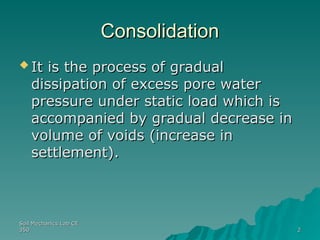
 It is the process of gradual
It is the process of gradual
dissipation of excess pore water
pressure under static load which is
accompanied by gradual decrease in
volume of voids (increase in
settlement).
settlement).
Soil Mechanics Lab CE
350
350 3
3
Settlement
Settlement
 Immediate Settlement
Immediate Settlement
 Consolidation Settlement
Consolidation Settlement time
settlemen
t
time
settlemen
t
Soil Mechanics Lab CE
350
350 4
4
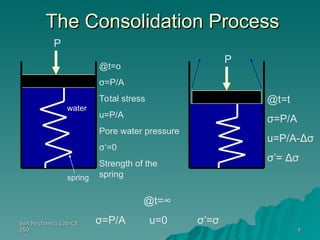
spring
water
P
P
@t=o
σ=P/A
Total stress
u=P/A
Pore water pressure
σ’=0
Strength of the
spring
@t=t
σ=P/A
u=P/A-Δσ
σ’= Δσ
@t=∞
σ=P/A u=0 σ’=σ
The Consolidation Process
Soil Mechanics Lab CE
350
350 5
5
The Parameters
The Parameters
 Compression Index, C
Compression Index, Cc
c
used to determine the amount of consolidation.
 Coefficient of Consolidation, C
Coefficient of Consolidation, Cv
v
used to determine the rate of consolidation.
Soil Mechanics Lab CE
350
350 6
6
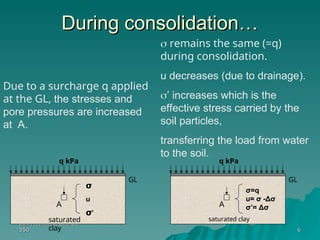
During consolidation…
Due to a surcharge q applied
at the GL, the stresses and
pore pressures are increased
at A.
GL
saturated
clay
q kPa
A
σ
u
σ’
GL
saturated clay
q kPa
A
 remains the same (=q)
during consolidation.
u decreases (due to drainage).
’ increases which is the
effective stress carried by the
soil particles,
transferring the load from water
to the soil.
σ=q
u= σ -Δσ
σ’= Δσ
Soil Mechanics Lab CE
350
350 7
7
Consolidation Test
Consolidation Test
fiel
d
GL
lab
undisturbed soil
specimen
Dia = 75 mm
Height = 20 mm
metal ring
(oedometer)
porous
stone
9P
P
= 9P/A ≈ 20kpa
For the first day
Plate load
dial
gauge
Soil Mechanics Lab CE
350
350 8
8
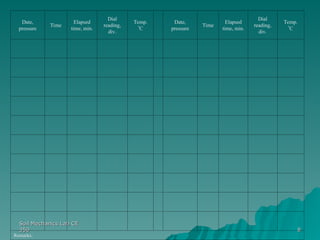
Date,
pressure
Time
Elapsed
time, min.
Dial
reading,
div.
Temp.
C
Date,
pressure
Time
Elapsed
time, min.
Dial
reading,
div.
Temp.
C
Remarks:
Soil Mechanics Lab CE
350
350 9
9
400
420
440
460
480
500
520
540
560
0.1 1 10 100 1000 10000
Dial
Reading
(div)
Time (min) - log Scale
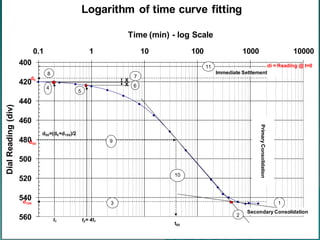
Logarithm of time curve fitting
t1 t2= 4t1
1
2
3
5
4
X
6
X
7
8
d50
9
d0
d100
t50
10
11
d50=(d0+d100)/2
Immediate Settlement
Primary
Consolidation
Secondary Consolidation
di = Reading @ t=0
Soil Mechanics Lab CE
350
350 10
10
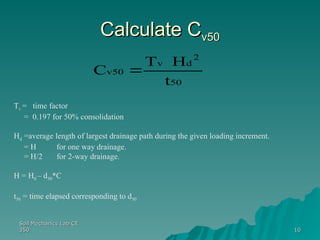
Calculate C
Calculate Cv50
v50
50
2
d
v
v50
t
H
T
C 
Tv = time factor
= 0.197 for 50% consolidation
Hd =average length of largest drainage path during the given loading increment.
= H for one way drainage.
= H/2 for 2-way drainage.
H = H0 – d50*C
t50 = time elapsed corresponding to d50
Soil Mechanics Lab CE
350
350 11
11
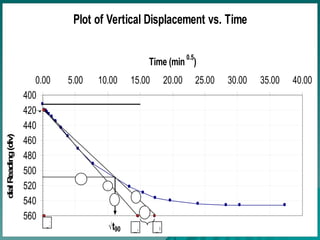
Plot of Vertical Displacement vs. Time
400
420
440
460
480
500
520
540
560
0.00 5.00 10.00 15.00 20.00 25.00 30.00 35.00 40.00
Time (min
0.5
)
dial
R
ead
in
g
(d
iv)
√t90
1
2
3
4
5
d90
d0
B D
C BD= 0.15 BC
di
Soil Mechanics Lab CE
350
350 12
12
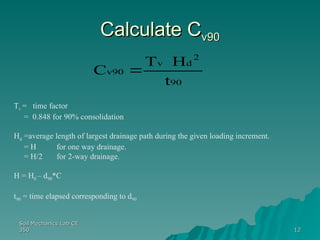
Calculate C
Calculate Cv90
v90
90
2
d
v
v90
t
H
T
C 
Tv = time factor
= 0.848 for 90% consolidation
Hd =average length of largest drainage path during the given loading increment.
= H for one way drainage.
= H/2 for 2-way drainage.
H = H0 – d90*C
t90 = time elapsed corresponding to d90
Soil Mechanics Lab CE
350
350 13
13
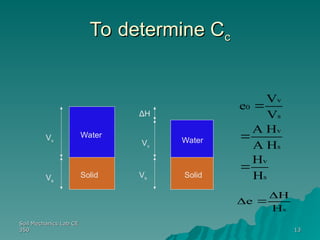
To determine C
To determine Cc
c
Vs
Vv
ΔH
Vv
Vs
Water
Solid Solid
Water
s
v
s
v
s
v
0
H
H
H
A
H
A
V
V
e



s
H
H
e



Soil Mechanics Lab CE
350
350 14
14
Pressure, p
Pressure, p
(kpa)
(kpa)
Initial deformation
Initial deformation
dial reading at
dial reading at
beginning of first
beginning of first
loading, d
loading, d0
0 (div.)
(div.)
Deformation dial
Deformation dial
reading
reading
representing 100%
representing 100%
primary
primary
consolidation, d
consolidation, d100
100
(div.)
(div.)
Change in thickness
Change in thickness
of specimen,
of specimen, 
H
H
(mm)
(mm)
Change in
Change in
void ratio
void ratio

e
e
Void ratio, e
Void ratio, e
[e = e
[e = e0
0 
 
e]
e]
(1)
(1) (2)
(2) (3)
(3) (4)=[(3)
(4)=[(3)
(2)]
(2)]
 0.002
0.002 (5)=(4)/H
(5)=(4)/Hs
s (6) = e
(6) = e0
0 –(5)
–(5)
0
0
20
20
40
40
80
80
160
160
320
320
160
160
80
80
40
40
R320
R320
R160
R160
R80
R80
R160
R160
R80
R80
R40
R40





 


s
H
H
e
Loading
Unloading
Soil Mechanics Lab CE
350
350 15
15
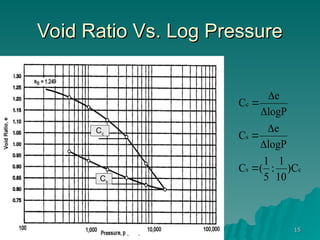
Void Ratio Vs. Log Pressure
Cc
Cs
c
s
s
c
C
)
10
1
:
5
1
(
C
logP
e
C
logP
e
C







Soil Mechanics Lab CE
350
350 16
16
Applications
Applications
 Settlement under foundations
Settlement under foundations
 Soil Stabilization
Soil Stabilization
 Dealing with ground water control
Dealing with ground water control

Soil + Consolidation for soil mechanics.ppt

  • 1.
    Soil Mechanics LabCE Soil Mechanics Lab CE 350 350 1 1 Experiment # 6 Experiment # 6 Consolidation Consolidation ASTM D 1883 ASTM D 1883
  • 2.
    Soil Mechanics LabCE Soil Mechanics Lab CE 350 350 2 2 Consolidation Consolidation  It is the process of gradual It is the process of gradual dissipation of excess pore water dissipation of excess pore water pressure under static load which is pressure under static load which is accompanied by gradual decrease in accompanied by gradual decrease in volume of voids (increase in volume of voids (increase in settlement). settlement).
  • 3.
    Soil Mechanics LabCE Soil Mechanics Lab CE 350 350 3 3 Settlement Settlement  Immediate Settlement Immediate Settlement  Consolidation Settlement Consolidation Settlement time settlemen t time settlemen t
  • 4.
    Soil Mechanics LabCE Soil Mechanics Lab CE 350 350 4 4 spring water P P @t=o σ=P/A Total stress u=P/A Pore water pressure σ’=0 Strength of the spring @t=t σ=P/A u=P/A-Δσ σ’= Δσ @t=∞ σ=P/A u=0 σ’=σ The Consolidation Process The Consolidation Process
  • 5.
    Soil Mechanics LabCE Soil Mechanics Lab CE 350 350 5 5 The Parameters The Parameters  Compression Index, C Compression Index, Cc c used to determine the amount of consolidation. used to determine the amount of consolidation.  Coefficient of Consolidation, C Coefficient of Consolidation, Cv v used to determine the rate of consolidation. used to determine the rate of consolidation.
  • 6.
    Soil Mechanics LabCE Soil Mechanics Lab CE 350 350 6 6 During consolidation… During consolidation… Due to a surcharge q applied at the GL, the stresses and pore pressures are increased at A. GL saturated clay q kPa A σ u σ’ GL saturated clay q kPa A  remains the same (=q) during consolidation. u decreases (due to drainage). ’ increases which is the effective stress carried by the soil particles, transferring the load from water to the soil. σ=q u= σ -Δσ σ’= Δσ
  • 7.
    Soil Mechanics LabCE Soil Mechanics Lab CE 350 350 7 7 Consolidation Test Consolidation Test fiel d GL lab undisturbed soil specimen Dia = 75 mm Height = 20 mm metal ring (oedometer) porous stone 9P P = 9P/A ≈ 20kpa For the first day Plate load dial gauge
  • 8.
    Soil Mechanics LabCE Soil Mechanics Lab CE 350 350 8 8 Date, pressure Time Elapsed time, min. Dial reading, div. Temp. C Date, pressure Time Elapsed time, min. Dial reading, div. Temp. C Remarks:
  • 9.
    Soil Mechanics LabCE Soil Mechanics Lab CE 350 350 9 9 400 420 440 460 480 500 520 540 560 0.1 1 10 100 1000 10000 Dial Reading (div) Time (min) - log Scale Logarithm of time curve fitting t1 t2= 4t1 1 2 3 5 4 X 6 X 7 8 d50 9 d0 d100 t50 10 11 d50=(d0+d100)/2 Immediate Settlement Primary Consolidation Secondary Consolidation di = Reading @ t=0
  • 10.
    Soil Mechanics LabCE Soil Mechanics Lab CE 350 350 10 10 Calculate C Calculate Cv50 v50 50 2 d v v50 t H T C  Tv = time factor = 0.197 for 50% consolidation Hd =average length of largest drainage path during the given loading increment. = H for one way drainage. = H/2 for 2-way drainage. H = H0 – d50*C t50 = time elapsed corresponding to d50
  • 11.
    Soil Mechanics LabCE Soil Mechanics Lab CE 350 350 11 11 Plot of Vertical Displacement vs. Time 400 420 440 460 480 500 520 540 560 0.00 5.00 10.00 15.00 20.00 25.00 30.00 35.00 40.00 Time (min 0.5 ) dial R ead in g (d iv) √t90 1 2 3 4 5 d90 d0 B D C BD= 0.15 BC di
  • 12.
    Soil Mechanics LabCE Soil Mechanics Lab CE 350 350 12 12 Calculate C Calculate Cv90 v90 90 2 d v v90 t H T C  Tv = time factor = 0.848 for 90% consolidation Hd =average length of largest drainage path during the given loading increment. = H for one way drainage. = H/2 for 2-way drainage. H = H0 – d90*C t90 = time elapsed corresponding to d90
  • 13.
    Soil Mechanics LabCE Soil Mechanics Lab CE 350 350 13 13 To determine C To determine Cc c Vs Vv ΔH Vv Vs Water Solid Solid Water s v s v s v 0 H H H A H A V V e    s H H e   
  • 14.
    Soil Mechanics LabCE Soil Mechanics Lab CE 350 350 14 14 Pressure, p Pressure, p (kpa) (kpa) Initial deformation Initial deformation dial reading at dial reading at beginning of first beginning of first loading, d loading, d0 0 (div.) (div.) Deformation dial Deformation dial reading reading representing 100% representing 100% primary primary consolidation, d consolidation, d100 100 (div.) (div.) Change in thickness Change in thickness of specimen, of specimen,  H H (mm) (mm) Change in Change in void ratio void ratio  e e Void ratio, e Void ratio, e [e = e [e = e0 0    e] e] (1) (1) (2) (2) (3) (3) (4)=[(3) (4)=[(3) (2)] (2)]  0.002 0.002 (5)=(4)/H (5)=(4)/Hs s (6) = e (6) = e0 0 –(5) –(5) 0 0 20 20 40 40 80 80 160 160 320 320 160 160 80 80 40 40 R320 R320 R160 R160 R80 R80 R160 R160 R80 R80 R40 R40          s H H e Loading Unloading
  • 15.
    Soil Mechanics LabCE Soil Mechanics Lab CE 350 350 15 15 Void Ratio Vs. Log Pressure Void Ratio Vs. Log Pressure Cc Cs c s s c C ) 10 1 : 5 1 ( C logP e C logP e C       
  • 16.
    Soil Mechanics LabCE Soil Mechanics Lab CE 350 350 16 16 Applications Applications  Settlement under foundations Settlement under foundations  Soil Stabilization Soil Stabilization  Dealing with ground water control Dealing with ground water control