Software Project Management
04-05-2023Faculty Name Unit -1 1
Raj Kumar Goel Institute of Technology
Ghaziabad
Faculty Name
Mahima Tayal
Unit: IVth
Project Management and
Control
2.
Faculty Information
Ms. MahimaTayal
Assistant Professor
CSE-AI&ML
+91-9718010401
mahi5fai@rkgit.edu.in
Qualification – MCA, M.Tech.
Experience – More than 10 years
Faculty
Passport Size
photo
04-05-2023 Faculty Name Unit -2 2
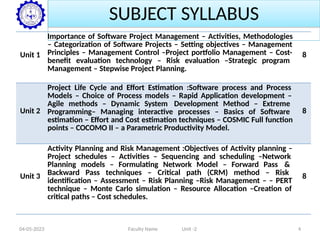
SUBJECT SYLLABUS
Unit 1
Importanceof Software Project Management – Activities, Methodologies
– Categorization of Software Projects – Setting objectives – Management
Principles – Management Control –Project portfolio Management – Cost-
benefit evaluation technology – Risk evaluation –Strategic program
Management – Stepwise Project Planning.
8
Unit 2
Project Life Cycle and Effort Estimation :Software process and Process
Models – Choice of Process models – Rapid Application development –
Agile methods – Dynamic System Development Method – Extreme
Programming– Managing interactive processes – Basics of Software
estimation – Effort and Cost estimation techniques – COSMIC Full function
points – COCOMO II – a Parametric Productivity Model.
8
Unit 3
Activity Planning and Risk Management :Objectives of Activity planning –
Project schedules – Activities – Sequencing and scheduling –Network
Planning models – Formulating Network Model – Forward Pass &
Backward Pass techniques – Critical path (CRM) method – Risk
identification – Assessment – Risk Planning –Risk Management – – PERT
technique – Monte Carlo simulation – Resource Allocation –Creation of
critical paths – Cost schedules.
8
04-05-2023 Faculty Name Unit -2 4
5.
SUBJECT SYLLABUS
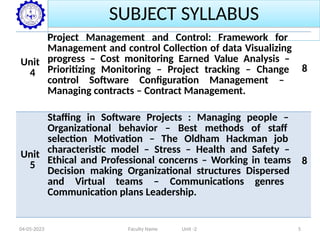
Unit
4
Project Managementand Control: Framework for
Management and control Collection of data Visualizing
progress – Cost monitoring Earned Value Analysis –
Prioritizing Monitoring – Project tracking – Change
control Software Configuration Management –
Managing contracts – Contract Management.
8
Unit
5
Staffing in Software Projects : Managing people –
Organizational behavior – Best methods of staff
selection Motivation – The Oldham Hackman job
characteristic model – Stress – Health and Safety –
Ethical and Professional concerns – Working in teams
Decision making Organizational structures Dispersed
and Virtual teams – Communications genres
Communication plans Leadership.
8
04-05-2023 Faculty Name Unit -2 5
6.
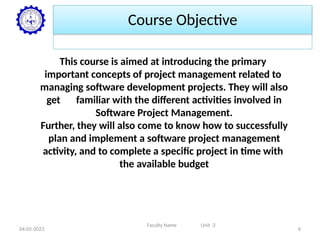
Course Objective
This courseis aimed at introducing the primary
important concepts of project management related to
managing software development projects. They will also
get familiar with the different activities involved in
Software Project Management.
Further, they will also come to know how to successfully
plan and implement a software project management
activity, and to complete a specific project in time with
the available budget
Faculty Name Unit -2
04-05-2023 6
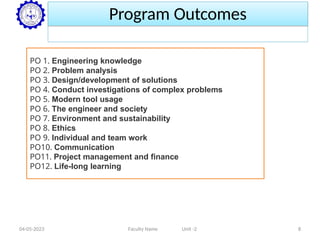
Program Outcomes
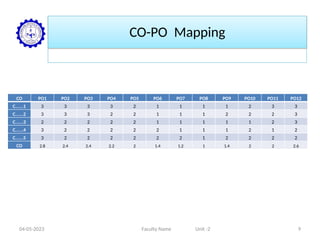
PO 1.Engineering knowledge
PO 2. Problem analysis
PO 3. Design/development of solutions
PO 4. Conduct investigations of complex problems
PO 5. Modern tool usage
PO 6. The engineer and society
PO 7. Environment and sustainability
PO 8. Ethics
PO 9. Individual and team work
PO10. Communication
PO11. Project management and finance
PO12. Life-long learning
04-05-2023 Faculty Name Unit -2 8
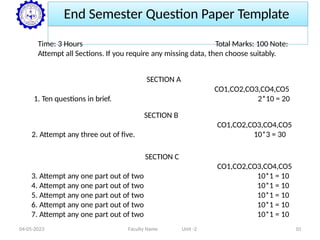
End Semester QuestionPaper Template
Time: 3 Hours Total Marks: 100 Note:
Attempt all Sections. If you require any missing data, then choose suitably.
SECTION A
04-05-2023 Faculty Name Unit -2 10
CO1,CO2,CO3,CO4,CO5
2*10 = 20
1. Ten questions in brief.
SECTION B
CO1,CO2,CO3,CO4,CO5
10*3 = 30
2. Attempt any three out of five.
SECTION C
CO1,CO2,CO3,CO4,CO5
10*1 = 10
10*1 = 10
10*1 = 10
10*1 = 10
10*1 = 10
3. Attempt any one part out of two
4. Attempt any one part out of two
5. Attempt any one part out of two
6. Attempt any one part out of two
7. Attempt any one part out of two
11.
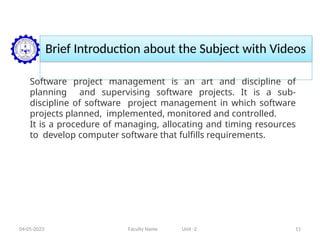
Brief Introduction aboutthe Subject with Videos
Software project management is an art and discipline of
planning and supervising software projects. It is a sub-
discipline of software project management in which software
projects planned, implemented, monitored and controlled.
It is a procedure of managing, allocating and timing resources
to develop computer software that fulfills requirements.
04-05-2023 Faculty Name Unit -2 11
Unit 4
• ProjectManagement and Control: Framework for
Management and control Collection of data Visualizing
progress – Cost monitoring Earned Value Analysis –
Prioritizing Monitoring – Project tracking – Change control
Software Configuration Management – Managing contracts –
Contract Management.
04-05-2023 Faculty Name Unit -2 13
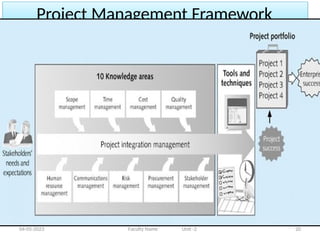
Project Management Framework
04-05-2023Faculty Name Unit -2 15
• PMF: A project Framework is a set of processes,
task and tools that guide and organized the
execution of project.
• It helps an organizations plan and track
different steps of project start to finish.
• Threemaincomponents
• Projectlifecycle
• Projectcontrolcycle
• ToolsandTemplats
16.
Project life cycle
04-05-2023Faculty Name Unit -2 16
• 5 Steps
1. Initiation: Starting point
Idea generated
Research took place
Key component are analyzed
2. Planning: Project Thoroughly planned
Teams are assigned
milestone and risk are scatch
3. Execution: Actual work done
Each member assign authority and
responsibility to complete project.
17.
Project life cycle
04-05-2023Faculty Name Unit -2 17
• 5 Steps.
4. Management:
Focus Documentation
Monitoring and reporting project
progress report at each milestone
Track of project performance
5. Review:
Analyze what went well and
challenges
How to make it improve in future
18.
Project Control cycle
04-05-2023Faculty Name Unit -2 18
• Project control cycle involves actively monitoring and
managing the project throughout its life cycle.
1. Initial planning (Plan creation , List of Task, resources
and timeline)
2. Progress monitoring (Manager keeps eyes)
3. Progress Evaluation (Compare actual with planned)
4. Deviation Analyses (Investigate reasons and Evaluate
it)
5. Corrective action (necessary adjustment made and
bring it on track)
19.
Tools and Templates
04-05-2023Faculty Name Unit -2 19
• These are ready made resources that provides
structure and assistance in implementing the project
Management framework. they include various
Software tools and pre-designed templates that help in
planning, scheduling, tracking & reporting.
• The Project Management Framework Serves as a
roadmap for managing project efficiently, ensuring that
tasks are completed in timely manners, goals are
achieved.
Framework For managementand
Control
04-05-2023 Faculty Name Unit -2 21
• Once the Project is started, the attention should
be given on progress, which involves
monitoring of what is happening, comparing
actual achievement against schedule and
revising the plans and schedules.
• To achieve this, a framework is needed to
monitor the progress. For that, a cycle is needed
to monitor progress regularly.
22.
Project Management Framework
04-05-2023Faculty Name Unit -2 22
• A project management framework is important
because it helps improve efficiency and
encourages collaboration with tools that offer
organization, accountability and help to review
work processes. Project management is a key
factor in achieving success with projects.
23.
Project Management Framework
04-05-2023Faculty Name Unit -2 23
• A project management framework is important
because it helps improve efficiency and
encourages collaboration with tools that offer
organization, accountability and help to review
work processes. Project management is a key
factor in achieving success with projects.
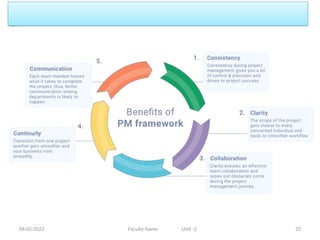
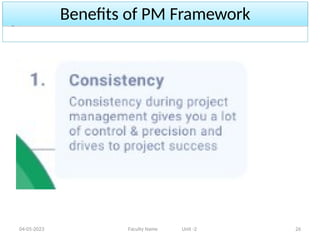
Benefits of PMFramework
04-05-2023 Faculty Name Unit -2 26
27.
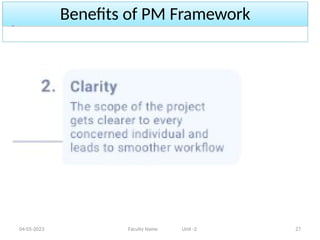
Benefits of PMFramework
04-05-2023 Faculty Name Unit -2 27
28.
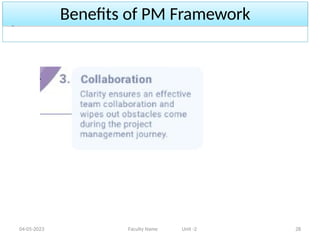
Benefits of PMFramework
04-05-2023 Faculty Name Unit -2 28
29.
Benefits of PMFramework
04-05-2023 Faculty Name Unit -2 29
30.
Benefits of PMFramework
04-05-2023 Faculty Name Unit -2 30
31.
Benefits of PMFramework
04-05-2023 Faculty Name Unit -2 31
32.
Collection of Data
(Helpin How much work done or need to
be completed)
04-05-2023 Faculty Name Unit -2 32
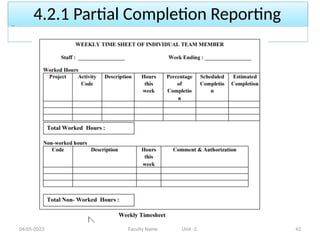
• Partial completion Reporting
1. Gather information on partial
completion of activities.
2. Estimate remaining work based on
percentage of completion.
3. Monitor progress and Make necessary
adjustment.
33.
Framework of Managementand control
04-05-2023 Faculty Name Unit -2 33
• Creating Framework
• Project reporting Structure
• Categories of report
• Progress Assessment
34.
Creating Framework
04-05-2023 FacultyName Unit -2 34
• After the project starts its execution, the project must be carefully
monitored to ensure the project’s progress.
• Monitoring process focuses on comparing the actual output with the
expected one and reviews the schedule to fit on target.
• Regular monitoring of the project is needed to have more control
over the project. Always the expected outcomes are compared with
the actual ones and analyzed whether there is any slack in the
planned process.
• Project control is a continuous process of monitoring the progress of
the project plan and it also includes re-planning of activities if
necessary.
• The experience gained from the current project can be taken as an
input over future project establishment of activities.
35.
Creating Framework
04-05-2023 FacultyName Unit -2 35
• Generally, revising the planning strategy is due
to:
– Delay in completion of the project within the target
time
– Quality factors
– Inadequate functionality in adopting newer
techniques
– Actual estimation is above the estimated
one
36.
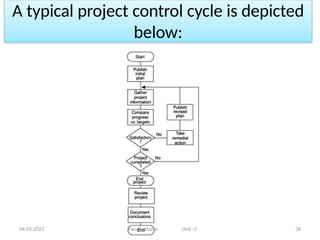
A typical projectcontrol cycle is depicted
below:
04-05-2023 Faculty Name Unit -2 36
37.
Project Reporting Structures
04-05-2023Faculty Name Unit -2 37
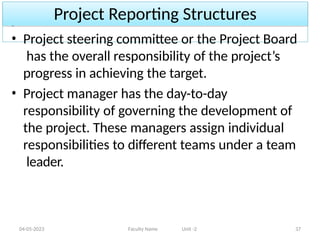
• Project steering committee or the Project Board
has the overall responsibility of the project’s
progress in achieving the target.
• Project manager has the day-to-day
responsibility of governing the development of
the project. These managers assign individual
responsibilities to different teams under a team
leader.
38.
Project Reporting Structures
04-05-2023Faculty Name Unit -2 38
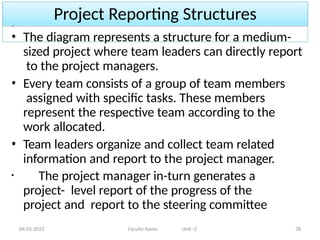
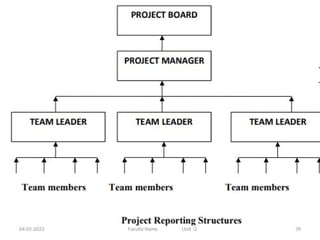
• The diagram represents a structure for a medium-
sized project where team leaders can directly report
to the project managers.
• Every team consists of a group of team members
assigned with specific tasks. These members
represent the respective team according to the
work allocated.
• Team leaders organize and collect team related
information and report to the project manager.
• The project manager in-turn generates a
project- level report of the progress of the
project and report to the steering committee
Categories of Reporting
04-05-2023Faculty Name Unit -2 40
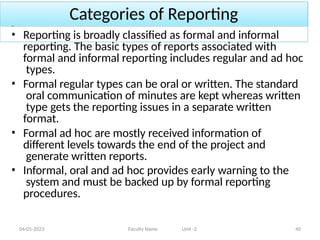
• Reporting is broadly classified as formal and informal
reporting. The basic types of reports associated with
formal and informal reporting includes regular and ad hoc
types.
• Formal regular types can be oral or written. The standard
oral communication of minutes are kept whereas written
type gets the reporting issues in a separate written
format.
• Formal ad hoc are mostly received information of
different levels towards the end of the project and
generate written reports.
• Informal, oral and ad hoc provides early warning to the
system and must be backed up by formal reporting
procedures.
41.
Progress Assessment
04-05-2023 FacultyName Unit -2 41
• Based on the information collected from various levels at regular
intervals during the development of the project measures the progress
assessment.
• The information can however, measure the project’s objectives in
determining whether the project can produce deliverables or not.
• Every single activity will not yield a deliverable work product but a
group of activities can achieve the specified tangible product.
• Usually, the assessment process is carried out by the team members
who are associated with the project activities.
• Checkpoints can be used to check the initial activity plan which may
govern specific events in generating report or a deliverable.
• Team leaders will have to assess the project daily while the project
leaders can do it on a weekly basis. Higher level members generate
less reporting than their subordinates.
• Review points or control points can be set at different points in the
project life cycle to review the progress of the project.
Collection of Data
04-05-2023Faculty Name Unit -2 43
• process of Gathering quantitative and
qualitative information
• Must have Clear process
• Use of standard validated techniques
• Cab be evaluate hypothesis
• Different approaches
Collection of dataproject termination
04-05-2023 Faculty Name Unit -2 45
• Collecting information of the project progress at
regular instances provides much control over
the project.
• However, gathering of partial completion of
activities can be used to calculate the remaining
work needed to complete.
• Intermediate products that are achieved can
specify a milestone in the development of the
project.
46.
Collection of Data
(Helpin How much work done or need to
be completed)
04-05-2023 Faculty Name Unit -2 46
• Reporting risk using traffic light method
1. Identifying the first level elements for
assessment.
2. Break first level elements into second
level.
3. Analyze the second level elements and
mark the colour as Green , Amber and
Red
47.
4.2.2 Reporting Risk
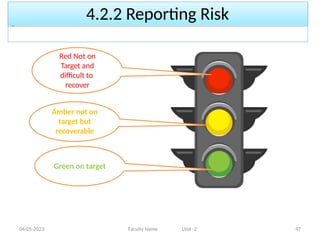
RedNot on
Target and
difficult to
recover
Amber not on
target but
recoverable
Green on target
04-05-2023 Faculty Name Unit -2 47
48.
Collection of Data
(Helpin How much work done or need to
be completed)
04-05-2023 Faculty Name Unit -2 48
• Reporting risk using traffic light method
4. Review all the second level elements to reach
first level assessment.
5. Review both 1st
and 2nd
– to produce overall
assessment.
6. Assessment form evaluates overall status of
project.
7. Critical activities must be recognized during
revision of project schedule.
49.
Visualizing Progress
04-05-2023 FacultyName Unit -2 49
• Collected data shows visually.
• Its important to effectively communicate the
project status to visualize progress techniques.
50.
Visualizing Progress
04-05-2023 FacultyName Unit -2 50
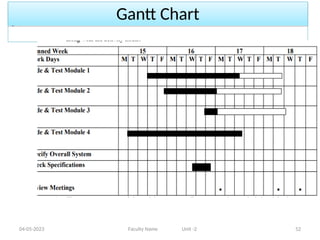
• Gantt chart:– It is used to track project
progress .It is the simple and the oldest form of
representing the progress of the project. It
consists of an activity bar that indicates the
scheduled activity dates and the duration
along with the activity floats.
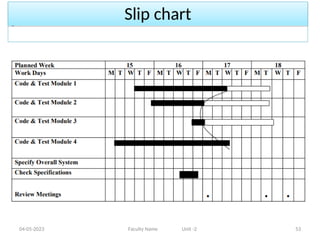
• Slip Chart: It is a visual indication of activities
that are not progressing to schedule.
51.
Visualizing Progress
04-05-2023 FacultyName Unit -2 51
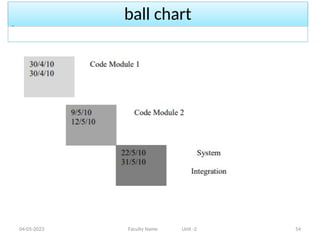
• Ball Chart: The way of showing whether or not
targets have been met or not. It is represented
in the form of circles that indicate the start and
the end point completion of activities
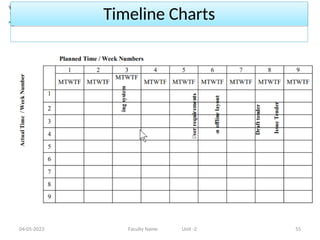
• Time line: The timeline is a method of
recording and displaying the way in which
targets have changed throughout the duration
of the project.
Cost Management
04-05-2023 FacultyName Unit -2 56
• Process of Estimating, allocating and controlling
the cost of a project.
• Ensure that project stays within budget and
effectively utilize resources.
• Benefit Preventing Cost overruns, minimizing risk
& aiming in future planning.
• Challenges → Lack of resources, Inacccurate
estimation, Outdated technology.
57.
Cost Monitoring
04-05-2023 FacultyName Unit -2 57
• Cost Monitoring is about keeping track of how
much Money is being spent on project.
• It is important because a project can be on time
but still go over budget.
• A Cost Chart and Computer based planning tools
are used to help monitor expenses.
• A project behind Schedule (Staff Member &
Resources not deployed) but can be under budget
• It is necessary to monitor both project progress
and cost to ensure success within the allocated
budget.
Earned Value Analysis(BudgetedCost
of Worked Performed)
04-05-2023 Faculty Name Unit -2 60
• EVM is an industry standard method of measuring
progress at any point of time.
• Compares planned work to actual work.
• After completion of work, it is considered as
“earned”.
• EVM is a method that allows the project manager
to measure the amount of work actually
performed on a project beyond the basic review of
cost and schedule reports.
61.
Earned Value Analysis(BudgetedCost
of Worked Performed)
04-05-2023 Faculty Name Unit -2 61
1) Planned Value (PV): (BCWS)
• Budgeted Cost for the work Schedule to be done.
• Portion of the project budget planned to be
Spent at any given point of time.
2) Actual Cost (AC): (ACWP)
• Money Spent for the work accomplished.
• Total Cost involved up to a specific point in time.
3) Earned Value (EV): (BCWP)
• Percent of the total budget actually completed at
a point in time.
62.
Earned Value Analysis(BudgetedCost
of Worked Performed)
04-05-2023 Faculty Name Unit -2 62
Suppose you are going to make website for client
and and he has budget 5000. now break down work
into different task such as designing, coding,
content. Let you planned to spend 2000 in coding,
2500 design and 500 content. But actual cost are
1800, 2000, 400 respectively of coding, design and
content and Earned value 80%, 60% and 90%. Now
calculate cost variance and schedule variance.
63.
Earned Value Analysis(BudgetedCost
of Worked Performed)
04-05-2023 Faculty Name Unit -2 63
CV= EV-AC
SV= EV-PV
CPI=EV/AC
SPI= EV/PV
By analyzing these earned value metrics, you can identify area where
you may be over and under budget & behind of Schedule. This
information help us to make informed decisions and take corrective
actions to keep the project on the track.
Goal→ Earned Value Analysis → project performance, enable
provide forecasting and allow for better control over costs &
schedule.
64.
getting project backto target after
completion of earned value analysis,
the progress report has to be sent
to the following members.
04-05-2023 Faculty Name Unit -2 64
Project Team
Quality Assurance
IT Management
Customer Management
Users
65.
Progress report shouldcontain the
following content
04-05-2023 Faculty Name Unit -2 65
• Period covered
• Narrative summary of progress
• Milestones achieved /deliverable completed
• Problem encountered
• Cost to date and predicted
• Changes identified and implemented
66.
Prioritizing Monitoring
04-05-2023 FacultyName Unit -2 66
• We assumed that all aspect of a project will
receive equal treatment of the degree of
monitoring applied. The monitoring takes time
and uses resources that might sometimes be put
to better use.
67.
Prioritizing Monitoring
04-05-2023 FacultyName Unit -2 67
• In this section we list the priorities we might
apply in deciding levels of monitoring.
Critical Path activities
Activities with no free float
Activities with less than a specific float
High risk activities
Activities using critical resource
Free float is how much time is available in the
schedule without risk before impacting other
project activities.
68.
Critical Path activities
04-05-2023Faculty Name Unit -2 68
• Any delay in an activity on the critical path will
cause a delay in the completion date for the
project. Critical path activities are therefore
likely to have a very high priority for close
monitoring.
69.
Activities with nofree float
04-05-2023 Faculty Name Unit -2 69
• A delay in any activity with no free float will
delay at least some subsequent activities even
though, if the delay is less than the total float, it
might not delay the project completion date.
These subsequent delays can have serious
effects on our resource schedule as a delay in a
• Free float is the amount of time an activity may
be delayed without affecting any subsequent
activity.
70.
Activities with lessthan a
specified float
04-05-2023 Faculty Name Unit -2 70
• If any activity has very little float it might use up
this float before the regular activity monitoring
brings the problem to the project manager's
attention. It is common practice to monitor
closely those activities with less than, say, one
week free float.
71.
High risk activities
04-05-2023Faculty Name Unit -2 71
• A set of high risk activities should have been
identified as part of the initial risk profiling
exercise. If we are using the PERT three-estimate
approach we will designate as high risk those
activities that have a high estimated duration
variance. These activities will be given close
attention because they are most likely to
overrun or overspend.
72.
Activities using criticalresources
04-05-2023 Faculty Name Unit -2 72
• Activities can be critical because they are very
expensive (as in the case of specialized contract
programmers). Staff or other resources might be
available only for a limited period, especially if
they are controlled outside the project team. In
any event, an activity that demands a critical
resource requires a high level of monitoring
Change control
04-05-2023 FacultyName Unit -2 76
• Change control is a methodology used to manage any
change requests that impact the baseline of your project.
It’s a way to capture that change from the point where
it’s been identified through every step of the project
cycle. That includes evaluating the request and then
approving, rejecting or deferring it.
• The purpose of this process is to make sure that you’re
not changing things in the project that don’t need to be
changed. The last thing you want to do is disrupt the
project for no good reason, wasting valuable time and
resources. Any changes that are approved are then
documented. The change control process is part of the
larger change management plan.
77.
Change control
04-05-2023 FacultyName Unit -2 77
• Record (request for changes)
• Assess (risk analysis)
• Plan (Assign Team)
• Test (build and test)
• Implement (review and meeting)
• Close (delivered to client)
78.
Key Elements ofChange Control
04-05-2023 Faculty Name Unit -2 78
• Change Control Board: A change control board
is a group of representatives from the project
team that regularly meet to approve or
disapprove change requests. If they approve a
change request, it can turn into a change order.
79.
Key Elements ofChange Control
04-05-2023 Faculty Name Unit -2 79
• Change Requests: A change request is a formal
petition for change in a project. It’s a document
that explains what are the changes to be made
and the main reasons why they should be
implemented. Change requests can either be
submitted by internal or external project
stakeholders. Our free change request template
can help you streamline this process.
80.
Key Elements ofChange Control
04-05-2023 Faculty Name Unit -2 80
• Change Orders: Once the change control board
has approve a change request, a change order is
signed by the board and the clients or
stakeholders. This is an agreement from both
parties to change the conditions that were first
drafted in the original contract. Our free change
order template is a great tool to create your
change orders.
81.
Key Elements ofChange Control
04-05-2023 Faculty Name Unit -2 81
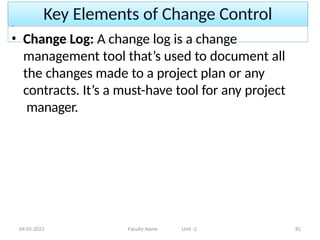
• Change Log: A change log is a change
management tool that’s used to document all
the changes made to a project plan or any
contracts. It’s a must-have tool for any project
manager.
82.
Software Configuration Management
04-05-2023Faculty Name Unit -2 82
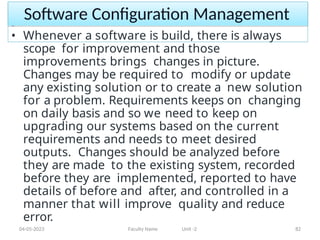
• Whenever a software is build, there is always
scope for improvement and those
improvements brings changes in picture.
Changes may be required to modify or update
any existing solution or to create a new solution
for a problem. Requirements keeps on changing
on daily basis and so we need to keep on
upgrading our systems based on the current
requirements and needs to meet desired
outputs. Changes should be analyzed before
they are made to the existing system, recorded
before they are implemented, reported to have
details of before and after, and controlled in a
manner that will improve quality and reduce
error.
83.
Software Configuration Management
04-05-2023Faculty Name Unit -2 83
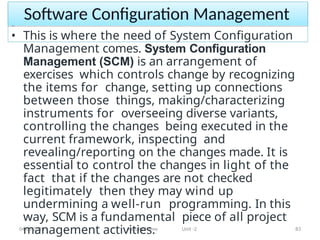
• This is where the need of System Configuration
Management comes. System Configuration
Management (SCM) is an arrangement of
exercises which controls change by recognizing
the items for change, setting up connections
between those things, making/characterizing
instruments for overseeing diverse variants,
controlling the changes being executed in the
current framework, inspecting and
revealing/reporting on the changes made. It is
essential to control the changes in light of the
fact that if the changes are not checked
legitimately then they may wind up
undermining a well-run programming. In this
way, SCM is a fundamental piece of all project
management activities.
84.
Software Configuration Management
04-05-2023Faculty Name Unit -2 84
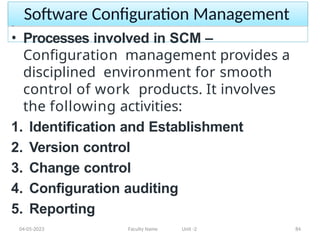
• Processes involved in SCM –
Configuration management provides a
disciplined environment for smooth
control of work products. It involves
the following activities:
1. Identification and Establishment
2. Version control
3. Change control
4. Configuration auditing
5. Reporting