SOFTWARE T EST T ING
R
E
Y
M
A
R
T
D
O
C
T
O
L
E
R
O
TABL E OF CONT ENT
WHAT IS SOFT WARE T EST I NG
TYPE S OF SOFT WARE T E STI NG
TYPE S OF FUNCTI ONA L T EST I NG
TYPE S OF NON FUNCTI ONAL T EST I NG
MET HODS AND LEV EL OF SOFT WARE T EST I NG
03
04
05
07
08
0 2
WHAT IS SOFT WARE TESTING ?
0 3
Software testing is a critical process within the realm
of software development that helps to identify
defects or bugs in a program or application. It
involves running the software in different scenarios
to ensure that it meets the specified requirements
and functions as intended. Testing can be done
manually by a tester or automated using specialized
tools. The goal of software testing is to ensure the
quality, reliability, and performance of the software
before it is released to end-users. It is an essential
part of the development cycle that helps in delivering
a seamless and error-free user experience.
0 4
1.Unit Testing: Testing individual units or components of the
software to ensure they function correctly.
2.Integration Testing: Testing how different units or components
work together when integrated.
3.System Testing: Testing the entire system as a whole to verify
that it meets the specified requirements.
4.Acceptance Testing: Testing the software from the end-user's
perspective to ensure it meets their needs.
5.Regression Testing: Testing to ensure that new changes do not
negatively impact existing functionality.
TYPES OF SOF TWA RE TE ST ING
0 4
6. Performance Testing: Testing the software's performance under different
conditions to ensure it meets performance requirements.
7. Security Testing: Testing the software for vulnerabilities and ensuring it is secure
from potential threats.
8. Usability Testing: Testing the software's user interface to ensure it is user-friendly
and intuitive.
9. Compatibility Testing: Testing the software on different devices, browsers, and
operating systems to ensure compatibility.
10.Exploratory Testing: Testing the software by exploring it without predefined test
cases to uncover unexpected issues.
TYPES OF SOF TWA RE TE ST ING
UNI T TESTING INTEGR ATI ON TESTING
TYPES OF FUNTIONA L TESTING
0 5
Unit testing is vital in software development, where
individual units are tested independently to identify bugs
early, enhance code quality, ease debugging, and
improve software reliability. It acts as a safety net for
future changes and helps teams create more robust
software applications.
Integration testing combines and tests individual
units to uncover inconsistencies in software
development. It ensures smooth functioning of
different components interacting, leading to a
robust and reliable end product.
INTERFACE TESTING REGRESSION TESTING
TYPES OF FUNTIONA L TESTING
0 5
Interface testing in software development
ensures components interact correctly. It
detects data communication issues,
protocols, and integration points to
enhance reliability and performance of
software applications.
Regression testing in software development
ensures recent changes do not impact existing
features. It helps identify defects introduced
during modifications, maintaining software quality
and reliability. Developers can confidently update
software while ensuring existing functionalities
remain intact through this iterative process.
SYSTEM TESTI NG SANITY TESTING
TYPES OF FUNTIONA L TESTING
0 5
System testing is essential in software
development to evaluate functionality and
performance, ensuring requirements are met. It
helps detect and fix issues before software
release, enhancing user experience and product
quality.
Sanity testing, or smoke testing, is a vital initial
software testing step to check basic functionality after
updates. It focuses on critical features, helps identify
early defects, and ensures software stability before
more testing. This testing phase saves time and
resources, instills confidence in software quality, and
aids informed decisions on further testing and
deployment.
USER ACCEPTAN CE
TESTING
TYPES OF FUNTIONA L TESTING
0 5
User acceptance testing (UAT) is vital in software
development as end-users validate the system to
ensure it meets requirements. It involves simulating
real-world scenarios to test usability, performance, and
user experience, identifying issues before the official
launch. Involving end-users provides valuable
feedback for refining the software to meet user needs.
COMPATA BI LI TY TESTING
TYPE S OF NON-FUNCTIONAL TESTING
0 6
Compatibility testing ensures
software functions well across various
devices, operating systems, browsers,
and networks. It helps developers
identify and fix issues, leading to a
better user experience.
COMPLIANCE TESTING
Conducting compliance testing ensures
adherence to rules and standards, identifies
deviations, and mitigates risks. It maintains
integrity, trust, ethical practices, and legal
obligations within organizations. Safeguards
against non-compliance, promotes
accountability, and transparency.
INSTALL TESTING
TYPE S OF NON-FUNCTIONAL TESTING
0 6
LOAD TESTI NG
Installing testing is vital in software
development to detect and address bugs
before user exposure, ensuring high-
quality, functional, reliable, and user-
friendly products. Proper testing improves
performance and user experience,
contributing to successful outcomes.
Load testing is vital in software
development, simulating demand to assess
performance under different conditions,
identifying bottlenecks, weaknesses, and
areas for improvement. It ensures reliable
and efficient application performance for
real-world users, leading to a successful
software product.
LOCA LIZ ATI ON TESTING
TYPE S OF NON-FUNCTIONAL TESTING
0 6
RECOVERY TESTI NG
Localization testing ensures software is
adapted for specific markets by verifying
language, cultural elements, and regional
preferences. It addresses compatibility issues
with languages, currencies, and date formats
to create a seamless user experience globally.
Recovery testing in software development
ensures the system can recover from failures
gracefully, maintaining data integrity. It helps
identify weaknesses in recovery mechanisms
for improved reliability, reduced downtime,
enhanced user experience, and system
integrity in challenging scenarios.
RELI ABILITY TESTING
TYPE S OF NON-FUNCTIONAL TESTING
0 6
SECURITY TESTING
Reliability testing in product development
assesses consistency and dependability
under various conditions. It helps identify
weaknesses, simulate real-world
scenarios, and ensure product reliability,
meeting quality standards and consumer
expectations.
Security testing is essential for software
safety. It identifies vulnerabilities like
unauthorized access and data breaches
before exploitation. Rigorous testing
enhances protection against cyber threats,
ensuring long-term security and reliability.
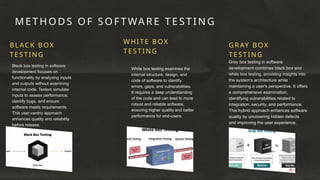
GRAY BOX
TESTING
Gray box testing in software
development combines black box and
white box testing, providing insights into
the system's architecture while
maintaining a user's perspective. It offers
a comprehensive examination,
identifying vulnerabilities related to
integration, security, and performance.
This hybrid approach enhances software
quality by uncovering hidden defects
and improving the user experience.
MET HODS OF SOF TWARE TESTING
BLACK BOX
TESTING
Black box testing in software
development focuses on
functionality by analyzing inputs
and outputs without examining
internal code. Testers simulate
inputs to assess performance,
identify bugs, and ensure
software meets requirements.
This user-centric approach
enhances quality and reliability
before release.
WHITE BOX
TESTING
White box testing examines the
internal structure, design, and
code of software to identify
errors, gaps, and vulnerabilities.
It requires a deep understanding
of the code and can lead to more
robust and reliable software,
ensuring higher quality and better
performance for end-users.
SOFT WARE TESTING LEVEL S
There are different levels of software testing that are crucial in ensuring the quality and
functionality of a software product. These levels include unit testing, integration testing, system
testing, and acceptance testing.
1.Unit Testing: This level involves testing individual components or modules of the software to
ensure that each unit functions correctly in isolation.
2.Integration Testing: Integration testing focuses on testing the interaction between different
units or modules to uncover any issues that may arise when they are integrated.
3.System Testing: System testing involves testing the entire software system as a whole to
validate that it meets the specified requirements and functions correctly in the intended
environment.
4.Acceptance Testing: Acceptance testing is the final level where the software is tested by end-
users to ensure that it meets their expectations and is ready for deployment.
By conducting thorough testing at each of these levels, software developers can identify and
address any issues early in the development process, ultimately leading to a more reliable and
high-quality software product.
THANK YO U
R
E
Y
M
A
R
T
D
O
C
T
O
L
E
R
O

software testting.pptxxxxxxxxxxxxxxxxxxx

  • 1.
    SOFTWARE T ESTT ING R E Y M A R T D O C T O L E R O
  • 2.
    TABL E OFCONT ENT WHAT IS SOFT WARE T EST I NG TYPE S OF SOFT WARE T E STI NG TYPE S OF FUNCTI ONA L T EST I NG TYPE S OF NON FUNCTI ONAL T EST I NG MET HODS AND LEV EL OF SOFT WARE T EST I NG 03 04 05 07 08 0 2
  • 3.
    WHAT IS SOFTWARE TESTING ? 0 3 Software testing is a critical process within the realm of software development that helps to identify defects or bugs in a program or application. It involves running the software in different scenarios to ensure that it meets the specified requirements and functions as intended. Testing can be done manually by a tester or automated using specialized tools. The goal of software testing is to ensure the quality, reliability, and performance of the software before it is released to end-users. It is an essential part of the development cycle that helps in delivering a seamless and error-free user experience.
  • 4.
    0 4 1.Unit Testing:Testing individual units or components of the software to ensure they function correctly. 2.Integration Testing: Testing how different units or components work together when integrated. 3.System Testing: Testing the entire system as a whole to verify that it meets the specified requirements. 4.Acceptance Testing: Testing the software from the end-user's perspective to ensure it meets their needs. 5.Regression Testing: Testing to ensure that new changes do not negatively impact existing functionality. TYPES OF SOF TWA RE TE ST ING
  • 5.
    0 4 6. PerformanceTesting: Testing the software's performance under different conditions to ensure it meets performance requirements. 7. Security Testing: Testing the software for vulnerabilities and ensuring it is secure from potential threats. 8. Usability Testing: Testing the software's user interface to ensure it is user-friendly and intuitive. 9. Compatibility Testing: Testing the software on different devices, browsers, and operating systems to ensure compatibility. 10.Exploratory Testing: Testing the software by exploring it without predefined test cases to uncover unexpected issues. TYPES OF SOF TWA RE TE ST ING
  • 6.
    UNI T TESTINGINTEGR ATI ON TESTING TYPES OF FUNTIONA L TESTING 0 5 Unit testing is vital in software development, where individual units are tested independently to identify bugs early, enhance code quality, ease debugging, and improve software reliability. It acts as a safety net for future changes and helps teams create more robust software applications. Integration testing combines and tests individual units to uncover inconsistencies in software development. It ensures smooth functioning of different components interacting, leading to a robust and reliable end product.
  • 7.
    INTERFACE TESTING REGRESSIONTESTING TYPES OF FUNTIONA L TESTING 0 5 Interface testing in software development ensures components interact correctly. It detects data communication issues, protocols, and integration points to enhance reliability and performance of software applications. Regression testing in software development ensures recent changes do not impact existing features. It helps identify defects introduced during modifications, maintaining software quality and reliability. Developers can confidently update software while ensuring existing functionalities remain intact through this iterative process.
  • 8.
    SYSTEM TESTI NGSANITY TESTING TYPES OF FUNTIONA L TESTING 0 5 System testing is essential in software development to evaluate functionality and performance, ensuring requirements are met. It helps detect and fix issues before software release, enhancing user experience and product quality. Sanity testing, or smoke testing, is a vital initial software testing step to check basic functionality after updates. It focuses on critical features, helps identify early defects, and ensures software stability before more testing. This testing phase saves time and resources, instills confidence in software quality, and aids informed decisions on further testing and deployment.
  • 9.
    USER ACCEPTAN CE TESTING TYPESOF FUNTIONA L TESTING 0 5 User acceptance testing (UAT) is vital in software development as end-users validate the system to ensure it meets requirements. It involves simulating real-world scenarios to test usability, performance, and user experience, identifying issues before the official launch. Involving end-users provides valuable feedback for refining the software to meet user needs.
  • 10.
    COMPATA BI LITY TESTING TYPE S OF NON-FUNCTIONAL TESTING 0 6 Compatibility testing ensures software functions well across various devices, operating systems, browsers, and networks. It helps developers identify and fix issues, leading to a better user experience. COMPLIANCE TESTING Conducting compliance testing ensures adherence to rules and standards, identifies deviations, and mitigates risks. It maintains integrity, trust, ethical practices, and legal obligations within organizations. Safeguards against non-compliance, promotes accountability, and transparency.
  • 11.
    INSTALL TESTING TYPE SOF NON-FUNCTIONAL TESTING 0 6 LOAD TESTI NG Installing testing is vital in software development to detect and address bugs before user exposure, ensuring high- quality, functional, reliable, and user- friendly products. Proper testing improves performance and user experience, contributing to successful outcomes. Load testing is vital in software development, simulating demand to assess performance under different conditions, identifying bottlenecks, weaknesses, and areas for improvement. It ensures reliable and efficient application performance for real-world users, leading to a successful software product.
  • 12.
    LOCA LIZ ATION TESTING TYPE S OF NON-FUNCTIONAL TESTING 0 6 RECOVERY TESTI NG Localization testing ensures software is adapted for specific markets by verifying language, cultural elements, and regional preferences. It addresses compatibility issues with languages, currencies, and date formats to create a seamless user experience globally. Recovery testing in software development ensures the system can recover from failures gracefully, maintaining data integrity. It helps identify weaknesses in recovery mechanisms for improved reliability, reduced downtime, enhanced user experience, and system integrity in challenging scenarios.
  • 13.
    RELI ABILITY TESTING TYPES OF NON-FUNCTIONAL TESTING 0 6 SECURITY TESTING Reliability testing in product development assesses consistency and dependability under various conditions. It helps identify weaknesses, simulate real-world scenarios, and ensure product reliability, meeting quality standards and consumer expectations. Security testing is essential for software safety. It identifies vulnerabilities like unauthorized access and data breaches before exploitation. Rigorous testing enhances protection against cyber threats, ensuring long-term security and reliability.
  • 14.
    GRAY BOX TESTING Gray boxtesting in software development combines black box and white box testing, providing insights into the system's architecture while maintaining a user's perspective. It offers a comprehensive examination, identifying vulnerabilities related to integration, security, and performance. This hybrid approach enhances software quality by uncovering hidden defects and improving the user experience. MET HODS OF SOF TWARE TESTING BLACK BOX TESTING Black box testing in software development focuses on functionality by analyzing inputs and outputs without examining internal code. Testers simulate inputs to assess performance, identify bugs, and ensure software meets requirements. This user-centric approach enhances quality and reliability before release. WHITE BOX TESTING White box testing examines the internal structure, design, and code of software to identify errors, gaps, and vulnerabilities. It requires a deep understanding of the code and can lead to more robust and reliable software, ensuring higher quality and better performance for end-users.
  • 15.
    SOFT WARE TESTINGLEVEL S There are different levels of software testing that are crucial in ensuring the quality and functionality of a software product. These levels include unit testing, integration testing, system testing, and acceptance testing. 1.Unit Testing: This level involves testing individual components or modules of the software to ensure that each unit functions correctly in isolation. 2.Integration Testing: Integration testing focuses on testing the interaction between different units or modules to uncover any issues that may arise when they are integrated. 3.System Testing: System testing involves testing the entire software system as a whole to validate that it meets the specified requirements and functions correctly in the intended environment. 4.Acceptance Testing: Acceptance testing is the final level where the software is tested by end- users to ensure that it meets their expectations and is ready for deployment. By conducting thorough testing at each of these levels, software developers can identify and address any issues early in the development process, ultimately leading to a more reliable and high-quality software product.
  • 16.