SOFTWARE PROJECT MANAGEMENT Submitted by
k.Abisha
II Msc cs
Nadar saraswathi college of arts and
science.
FRAMEWORK OF MANAGEMENT AND CONTROL
Creating Framework
 After the project starts its execution, the project must be carefully monitored to
ensure the project’s progress.
 Monitoring process focuses on comparing the actual output with the expected one
and reviews the schedule to fit on target.
 Regular monitoring of the project is needed to have more control over the project.
Always the expected outcomes are compared with the actual ones and analyzed
whether there is any slack in the planned process.
Project control is a continuous process of monitoring the progress of the project plan
and it also includes re-planning of activities if necessary.
 The experience gained from the current project can be taken as an input over future
project establishment of activities.
 Generally, revising the planning strategy is due to:
• Delay in completion of the project within the target time
• Quality factors
• Inadequate functionality in adopting newer techniques
• Actual estimation is above the estimated one.
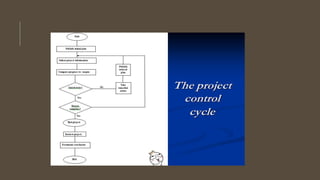
 A typical project control cycle is depicted below:
PROJECT REPORTING STRUCTURES
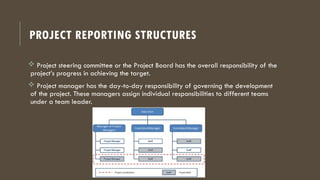
 Project steering committee or the Project Board has the overall responsibility of the
project’s progress in achieving the target.
 Project manager has the day-to-day responsibility of governing the development
of the project. These managers assign individual responsibilities to different teams
under a team leader.
 The diagram represents a structure for a medium-sized project where team leaders
can directly report to the project managers.
 Every team consists of a group of team members assigned with specific tasks. These
members represent the respective team according to the work allocated.
 Team leaders organize and collect team related information and report to the
project manager.
The project manager in-turn generates a project-level report of the progress of the
project and report to the steering committee.
CATEGORIES OF REPORTING
Reporting is broadly classified as formal and informal reporting. The basic types of
reports associated with formal and informal reporting includes regular and ad hoc
types.
 Formal regular types can be oral or written. The standard oral communication of
minutes are kept whereas written type gets the reporting issues in a separate written
format.
 Formal ad hoc are mostly received information of different levels towards the end
of the project and generate written reports.
 Informal, oral and ad hoc provides early warning to the system and must be
backed up by formal reporting procedures.
PROGRESS ASSESSMENT
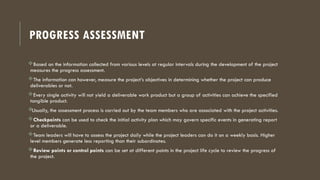
Based on the information collected from various levels at regular intervals during the development of the project
measures the progress assessment.
The information can however, measure the project’s objectives in determining whether the project can produce
deliverables or not.
Every single activity will not yield a deliverable work product but a group of activities can achieve the specified
tangible product.

Usually, the assessment process is carried out by the team members who are associated with the project activities.
Checkpoints can be used to check the initial activity plan which may govern specific events in generating report
or a deliverable.
Team leaders will have to assess the project daily while the project leaders can do it on a weekly basis. Higher
level members generate less reporting than their subordinates.
Review points or control points can be set at different points in the project life cycle to review the progress of
the project.
COLLECTION OF DATA
Collecting information of the project progress at regular instances provides much
control over the project.
 However, gathering of partial completion of activities can be used to calculate the
remaining work needed to complete.
Intermediate products that are achieved can specify a milestone in the development
of the project.
PARTIAL COMPLETION REPORTING
 The staff time related to a specific project indicates the work that has to be carried
out by the particular staff.
 Every organization uses an accounting method to calculate the charges of their
employees. However, the information related to project schedule is not shown in this
report.
 Timesheets can be maintained on a weekly basis to measure the staff involvement in
the development process.
WEEKLY TIMESHEET
 Weekly timesheets contain the breakdown activities and holds information about
the scheduled and estimated completion time of individuals and do not contain the
project completion dates.
Reporting Risk
 Risk reporting uses a traffic light method concept and consists of the following steps:
• Identify the first level elements for assessment
• Break the first level elements into second level elements
• Assess the second level elements and mark the color as
Green – on target
Amber – not on target but recoverable
Red – not on target and difficult to recover
• Review all the second level elements to reach the first level assessments
• Review both first and the second level assessments to produce an overall assessment
This method only focuses on non-achievement factors and do not mention about any
delay in the development process.
 Assessment forms can be used to evaluate the overall status of the project.
 Critical activities denoted by red color must be reconsidered during the revision of
project schedule.
THANK YOU!!!

Software project management, computer science

  • 1.
    SOFTWARE PROJECT MANAGEMENTSubmitted by k.Abisha II Msc cs Nadar saraswathi college of arts and science.
  • 2.
    FRAMEWORK OF MANAGEMENTAND CONTROL Creating Framework  After the project starts its execution, the project must be carefully monitored to ensure the project’s progress.  Monitoring process focuses on comparing the actual output with the expected one and reviews the schedule to fit on target.  Regular monitoring of the project is needed to have more control over the project. Always the expected outcomes are compared with the actual ones and analyzed whether there is any slack in the planned process. Project control is a continuous process of monitoring the progress of the project plan and it also includes re-planning of activities if necessary.
  • 3.
     The experiencegained from the current project can be taken as an input over future project establishment of activities.  Generally, revising the planning strategy is due to: • Delay in completion of the project within the target time • Quality factors • Inadequate functionality in adopting newer techniques • Actual estimation is above the estimated one.  A typical project control cycle is depicted below:
  • 5.
    PROJECT REPORTING STRUCTURES Project steering committee or the Project Board has the overall responsibility of the project’s progress in achieving the target.  Project manager has the day-to-day responsibility of governing the development of the project. These managers assign individual responsibilities to different teams under a team leader.
  • 6.
     The diagramrepresents a structure for a medium-sized project where team leaders can directly report to the project managers.  Every team consists of a group of team members assigned with specific tasks. These members represent the respective team according to the work allocated.  Team leaders organize and collect team related information and report to the project manager. The project manager in-turn generates a project-level report of the progress of the project and report to the steering committee.
  • 7.
    CATEGORIES OF REPORTING Reportingis broadly classified as formal and informal reporting. The basic types of reports associated with formal and informal reporting includes regular and ad hoc types.  Formal regular types can be oral or written. The standard oral communication of minutes are kept whereas written type gets the reporting issues in a separate written format.  Formal ad hoc are mostly received information of different levels towards the end of the project and generate written reports.  Informal, oral and ad hoc provides early warning to the system and must be backed up by formal reporting procedures.
  • 8.
    PROGRESS ASSESSMENT Based onthe information collected from various levels at regular intervals during the development of the project measures the progress assessment. The information can however, measure the project’s objectives in determining whether the project can produce deliverables or not. Every single activity will not yield a deliverable work product but a group of activities can achieve the specified tangible product.  Usually, the assessment process is carried out by the team members who are associated with the project activities. Checkpoints can be used to check the initial activity plan which may govern specific events in generating report or a deliverable. Team leaders will have to assess the project daily while the project leaders can do it on a weekly basis. Higher level members generate less reporting than their subordinates. Review points or control points can be set at different points in the project life cycle to review the progress of the project.
  • 9.
    COLLECTION OF DATA Collectinginformation of the project progress at regular instances provides much control over the project.  However, gathering of partial completion of activities can be used to calculate the remaining work needed to complete. Intermediate products that are achieved can specify a milestone in the development of the project.
  • 10.
    PARTIAL COMPLETION REPORTING The staff time related to a specific project indicates the work that has to be carried out by the particular staff.  Every organization uses an accounting method to calculate the charges of their employees. However, the information related to project schedule is not shown in this report.  Timesheets can be maintained on a weekly basis to measure the staff involvement in the development process.
  • 11.
    WEEKLY TIMESHEET  Weeklytimesheets contain the breakdown activities and holds information about the scheduled and estimated completion time of individuals and do not contain the project completion dates. Reporting Risk  Risk reporting uses a traffic light method concept and consists of the following steps: • Identify the first level elements for assessment • Break the first level elements into second level elements • Assess the second level elements and mark the color as Green – on target Amber – not on target but recoverable Red – not on target and difficult to recover
  • 12.
    • Review allthe second level elements to reach the first level assessments • Review both first and the second level assessments to produce an overall assessment This method only focuses on non-achievement factors and do not mention about any delay in the development process.  Assessment forms can be used to evaluate the overall status of the project.  Critical activities denoted by red color must be reconsidered during the revision of project schedule.
  • 13.