1
Halstead’s Software
Science
2
Halstead's Software
Science
 An analytical technique to
measure:
 size, development effort, and
development time.
3
Halstead's Software
Science
 Halstead used primitive program
parameters:
 developed expressions for:
 over all program length,
 potential minimum volume,
 actual volume,
 language level,
 effort,
 development time.
4
Halstead's Software
Science (CONT.)
 For some given program, let:

1 be the number of unique operators
used in the program,

2 be the number of unique operands
used in the program,
 N1 be the total number of operators
used in the program,
 N2 be the total number of operands
used in the program.
5
Halstead's Software
Science(CONT.)
 The terms operators and operands
have intuitive meanings,
 a precise definition of these terms is
needed to avoid ambiguities.
 Unfortunately there is no general
agreement among researchers
 on definition of operators and operands:
6
Operators
 Some general guidelines can be provided:
 All assignment, arithmetic, and logical
operators are operators.
 A pair of parentheses,
 as well as a block begin --- block end pair, are
considered as single operators.
 A label is considered to be an operator,
 if it is used as the target of a GOTO
statement.
7
Operators
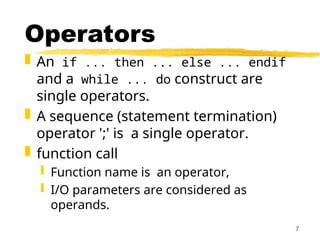
 An if ... then ... else ... endif
and a while ... do construct are
single operators.
 A sequence (statement termination)
operator ';' is a single operator.
 function call
 Function name is an operator,
 I/O parameters are considered as
operands.
8
Halstead's Software
Science(CONT.)
 The set of operators and operands for the
ANSI C language:() [] . , -> * +
- ~ ! ++ -- * / % + - <<
>> < > <= >= != == & ^ |
&& || = *= /= %= += -= <<=
>>= &= ^= |= : ? { ; CASE
DEFAULT IF ELSE SWITCH WHILE DO
FOR GOTO CONTINUE BREAK RETURN
and a function name in a function
call
9
Halstead's Software
Science(CONT.)
 Operands are those variables and
constants
 which are being used with operators in
expressions.
 Note that variable names appearing in
declarations
 are not considered as operands.
10
Examples:
 In the expression a = &b;
 {a, b} are operators and
 { =, &} are operands.
11
Examples:
 The function name in a function
definition
 not counted as an operator.
 int func ( int a, int b )
{ . . .
}
 the operators are: {}, ( )
 We do not consider func, a, and b as
operands.
12
Examples(CONT.):
 In the function call statement:
func ( a, b );
 {func ( ) ;} are considered as a
operator
 variables a, b are treated as
operands.
13
Length and Vocabulary
 Length of a program quantifies
 total usage of all operators and operands
in the program:
 Thus, length N=N1+N2.
 Program vocabulary:
 number of unique operators and
operands used in the program.
 program vocabulary = 1 + 2 .
14
Program Volume:
 The length of a program:
 total number of operators and
operands used in the code
 depends on the choice of the
operators and operands,
 i.e. for the same program, the length
depends on the style of programming.
15
Program Volume:
 We can have highly different
measures of length
 for essentially the same problem.
 To avoid this kind of problem,
 the notion of program volume V is
introduced:
 V= N log2 
16
Potential Minimum Volume:
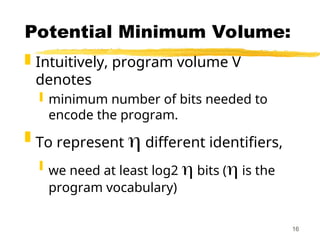
 Intuitively, program volume V
denotes
 minimum number of bits needed to
encode the program.
 To represent  different identifiers,
 we need at least log2  bits ( is the
program vocabulary)
17
Potential Minimum Volume:
 The potential minimum
volume V*:
 volume of the most succinct
program in which the program
can be coded.
18
Potential Minimum Volume:
 Minimum volume is obtained :
 when the program can be
expressed using a single source
code instruction:
 say a function call like foo().
19
Potential Minimum Volume
(CONT.):
 Lower bound on volume:
 a program would have at least
two operators
 and no less than the requisite
number of operands (i.e.
input/output data items).
20
Potential Minimum Volume:
 If an algorithm operates on
input/output data d1, d2,... dn,
 the most succinct program is
f(d1,d2, ...,dn);
 for which 1 = 2, 2 =n
 Therefore, V*=(2+ 2) log2(2+ 2)
21
Potential Minimum Volume:
 The program level L is given by
L=V*/V.
 L is a measure of the level of
abstraction:
 languages can be ranked into levels
that appear intuitively correct.
22
Effort and Time:
 Effort E=V/L, where
 E is the number of mental
discriminations required to write
the program
 also the effort required to read and
understand the program.
23
Effort and Time:
 Thus, programming effort E =
V2/V*
 since L= V*/V varies as the square of
the volume.
 Experience shows
 E is well correlated to the effort
needed for maintenance.
24
Effort and Time:
 The programmer's time T=E/S,
 where S is the speed of mental
discriminations developed from
psychological results due to Stroud,
 the recommended value for software
is 18.
25
Length Estimation:
 Halstead assumed that it is quite
unlikely that a program has several
identical parts ---
 or substrings of length greater than
( being the program vocabulary).

26
Length Estimation:
 In fact, once a piece of code occurs
identically in several places,
 it is usually made into a procedure or a
function.
 Thus, we can safely assume:
 any program of length N consists of
N/) unique strings of length .
27
Length Estimation(CONT.):
 It is a standard combinatorial result
that for any given alphabet of size
K,
 there are exactly Kr different strings of
length r.
 Thus, N/  < 
 Or, N < +1
28
Length Estimation:
 Since operators and operands
usually alternate in a program,
 we can further refine the upper
bound into
N < (1)1
(2)2
.
29
Length Estimation(CONT.):
 Also, N must include not only the
ordered set of N elements,
 but it must also include all possible
subsets of that ordered set,
 i.e. the power set of N strings.
 Therefore, 2N
= (1)1
(2)2
.
30
Length Estimation:
 N=log2((1)1
(2)2
) (approximately)
 Or, N=log2 (1)1
+ log2 (2)2
= 1log2 1 + 2log2 2
 Experimental analysis of large number
of programs suggests:
 computed and actual lengths match very
closely.
31
Example:
 main()
{
int a,b,c,avg;
scanf("%d %d
%d",&a,&b,&c);
avg=(a+b+c)/3;
printf("avg= %d",avg);
}
32
Example:
 The unique operators are: main,
(), {}, int, scanf, &, ",",
";", =, +, /, printf
 The unique operands are:
a,b,c,&a,&b,
&c,a+b+c,avg,3,"%d %d %d",
"avg=%d”
33
Example(CONT.):
 Therefore 1=12, 2=11
 Estimated
Length=(12*log12+11*log11)
=(12*3.58 + 11*3.45)
=(43+38)=81
Volume=Length*log(23)=81*4.52=3
66

5. HALSTEAD SOFTWARE SCIENCE.ppt software engineering

  • 1.
  • 2.
    2 Halstead's Software Science  Ananalytical technique to measure:  size, development effort, and development time.
  • 3.
    3 Halstead's Software Science  Halsteadused primitive program parameters:  developed expressions for:  over all program length,  potential minimum volume,  actual volume,  language level,  effort,  development time.
  • 4.
    4 Halstead's Software Science (CONT.) For some given program, let:  1 be the number of unique operators used in the program,  2 be the number of unique operands used in the program,  N1 be the total number of operators used in the program,  N2 be the total number of operands used in the program.
  • 5.
    5 Halstead's Software Science(CONT.)  Theterms operators and operands have intuitive meanings,  a precise definition of these terms is needed to avoid ambiguities.  Unfortunately there is no general agreement among researchers  on definition of operators and operands:
  • 6.
    6 Operators  Some generalguidelines can be provided:  All assignment, arithmetic, and logical operators are operators.  A pair of parentheses,  as well as a block begin --- block end pair, are considered as single operators.  A label is considered to be an operator,  if it is used as the target of a GOTO statement.
  • 7.
    7 Operators  An if... then ... else ... endif and a while ... do construct are single operators.  A sequence (statement termination) operator ';' is a single operator.  function call  Function name is an operator,  I/O parameters are considered as operands.
  • 8.
    8 Halstead's Software Science(CONT.)  Theset of operators and operands for the ANSI C language:() [] . , -> * + - ~ ! ++ -- * / % + - << >> < > <= >= != == & ^ | && || = *= /= %= += -= <<= >>= &= ^= |= : ? { ; CASE DEFAULT IF ELSE SWITCH WHILE DO FOR GOTO CONTINUE BREAK RETURN and a function name in a function call
  • 9.
    9 Halstead's Software Science(CONT.)  Operandsare those variables and constants  which are being used with operators in expressions.  Note that variable names appearing in declarations  are not considered as operands.
  • 10.
    10 Examples:  In theexpression a = &b;  {a, b} are operators and  { =, &} are operands.
  • 11.
    11 Examples:  The functionname in a function definition  not counted as an operator.  int func ( int a, int b ) { . . . }  the operators are: {}, ( )  We do not consider func, a, and b as operands.
  • 12.
    12 Examples(CONT.):  In thefunction call statement: func ( a, b );  {func ( ) ;} are considered as a operator  variables a, b are treated as operands.
  • 13.
    13 Length and Vocabulary Length of a program quantifies  total usage of all operators and operands in the program:  Thus, length N=N1+N2.  Program vocabulary:  number of unique operators and operands used in the program.  program vocabulary = 1 + 2 .
  • 14.
    14 Program Volume:  Thelength of a program:  total number of operators and operands used in the code  depends on the choice of the operators and operands,  i.e. for the same program, the length depends on the style of programming.
  • 15.
    15 Program Volume:  Wecan have highly different measures of length  for essentially the same problem.  To avoid this kind of problem,  the notion of program volume V is introduced:  V= N log2 
  • 16.
    16 Potential Minimum Volume: Intuitively, program volume V denotes  minimum number of bits needed to encode the program.  To represent  different identifiers,  we need at least log2  bits ( is the program vocabulary)
  • 17.
    17 Potential Minimum Volume: The potential minimum volume V*:  volume of the most succinct program in which the program can be coded.
  • 18.
    18 Potential Minimum Volume: Minimum volume is obtained :  when the program can be expressed using a single source code instruction:  say a function call like foo().
  • 19.
    19 Potential Minimum Volume (CONT.): Lower bound on volume:  a program would have at least two operators  and no less than the requisite number of operands (i.e. input/output data items).
  • 20.
    20 Potential Minimum Volume: If an algorithm operates on input/output data d1, d2,... dn,  the most succinct program is f(d1,d2, ...,dn);  for which 1 = 2, 2 =n  Therefore, V*=(2+ 2) log2(2+ 2)
  • 21.
    21 Potential Minimum Volume: The program level L is given by L=V*/V.  L is a measure of the level of abstraction:  languages can be ranked into levels that appear intuitively correct.
  • 22.
    22 Effort and Time: Effort E=V/L, where  E is the number of mental discriminations required to write the program  also the effort required to read and understand the program.
  • 23.
    23 Effort and Time: Thus, programming effort E = V2/V*  since L= V*/V varies as the square of the volume.  Experience shows  E is well correlated to the effort needed for maintenance.
  • 24.
    24 Effort and Time: The programmer's time T=E/S,  where S is the speed of mental discriminations developed from psychological results due to Stroud,  the recommended value for software is 18.
  • 25.
    25 Length Estimation:  Halsteadassumed that it is quite unlikely that a program has several identical parts ---  or substrings of length greater than ( being the program vocabulary). 
  • 26.
    26 Length Estimation:  Infact, once a piece of code occurs identically in several places,  it is usually made into a procedure or a function.  Thus, we can safely assume:  any program of length N consists of N/) unique strings of length .
  • 27.
    27 Length Estimation(CONT.):  Itis a standard combinatorial result that for any given alphabet of size K,  there are exactly Kr different strings of length r.  Thus, N/  <   Or, N < +1
  • 28.
    28 Length Estimation:  Sinceoperators and operands usually alternate in a program,  we can further refine the upper bound into N < (1)1 (2)2 .
  • 29.
    29 Length Estimation(CONT.):  Also,N must include not only the ordered set of N elements,  but it must also include all possible subsets of that ordered set,  i.e. the power set of N strings.  Therefore, 2N = (1)1 (2)2 .
  • 30.
    30 Length Estimation:  N=log2((1)1 (2)2 )(approximately)  Or, N=log2 (1)1 + log2 (2)2 = 1log2 1 + 2log2 2  Experimental analysis of large number of programs suggests:  computed and actual lengths match very closely.
  • 31.
    31 Example:  main() { int a,b,c,avg; scanf("%d%d %d",&a,&b,&c); avg=(a+b+c)/3; printf("avg= %d",avg); }
  • 32.
    32 Example:  The uniqueoperators are: main, (), {}, int, scanf, &, ",", ";", =, +, /, printf  The unique operands are: a,b,c,&a,&b, &c,a+b+c,avg,3,"%d %d %d", "avg=%d”
  • 33.
    33 Example(CONT.):  Therefore 1=12,2=11  Estimated Length=(12*log12+11*log11) =(12*3.58 + 11*3.45) =(43+38)=81 Volume=Length*log(23)=81*4.52=3 66