1
Chapter 30
Product Metrics
2
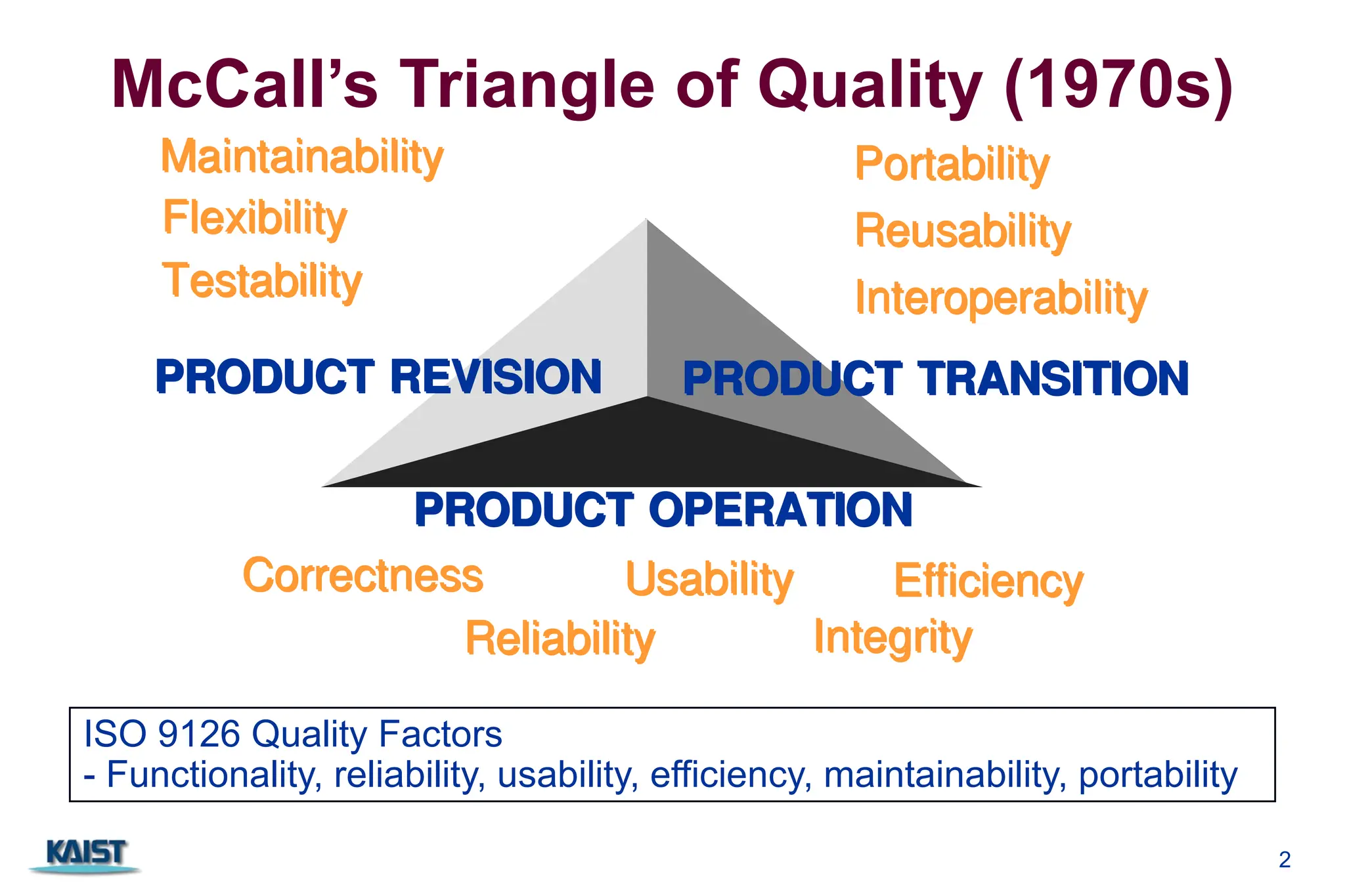
McCall’s Triangle of Quality (1970s)
Maintainability
Maintainability
Flexibility
Flexibility
Testability
Testability
Portability
Portability
Reusability
Reusability
Interoperability
Interoperability
Correctness
Correctness
Reliability
Reliability
Efficiency
Efficiency
Integrity
Integrity
Usability
Usability
PRODUCT TRANSITION
PRODUCT TRANSITION
PRODUCT REVISION
PRODUCT REVISION
PRODUCT OPERATION
PRODUCT OPERATION
ISO 9126 Quality Factors
- Functionality, reliability, usability, efficiency, maintainability, portability
3
Measures, Metrics and Indicators
 A SW engineer collects measures and develops metrics so that
indicators will be obtained
 A measure provides a quantitative indication of the extent, amount,
dimension, capacity, or size of some attribute of a product or process
 The IEEE defines a metric as “a quantitative measure of the degree to
which a system, component, or process possesses a given attribute.”
 IEEE Standard Glossary of Software Engineering Terminology (IEEE Std
610.12-1990)
 An indicator is a metric or combination of metrics that provide insight into
the software process, a software project, or the product itself
 Ex. Moonzoo Kim
 Measure: height=170cm, weight=65 kg
 Metric: fat metric= 0.38 ( =weight/height)
 Indicator: normal health condition (since fat metric < 0.5 )
4
Measurement Principles
 The objectives of measurement should be established before data
collection begins
 Ex. It is useless for black-box testers to measure a # of words in a C file.
 Ex. It is useful for C compiler developers to measure a # of words in a C file.
 Each technical metric should be defined in an unambiguous manner
 Ex. For measuring a total line number of a C program
 Including comments? Including empty lines?
 Metrics should be derived based on a theory that is valid for the domain
of application
 Metrics for design should draw upon basic design concepts and principles
and attempt to provide an indication of the presence of a desirable attribute
 Metrics should be tailored to best accommodate specific products and
processes
5
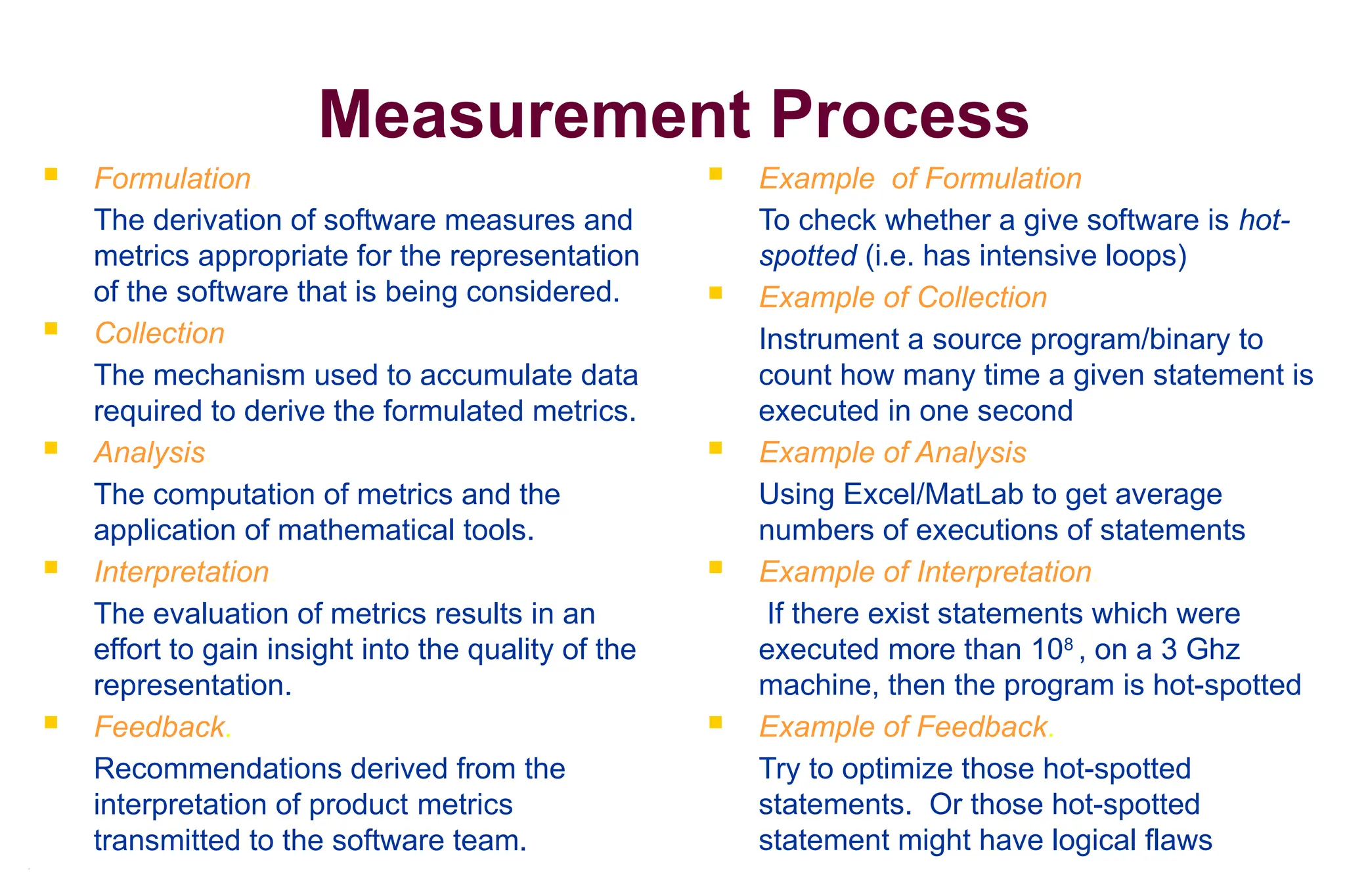
Measurement Process
 Formulation.
The derivation of software measures and
metrics appropriate for the representation
of the software that is being considered.
 Collection
The mechanism used to accumulate data
required to derive the formulated metrics.
 Analysis.
The computation of metrics and the
application of mathematical tools.
 Interpretation.
The evaluation of metrics results in an
effort to gain insight into the quality of the
representation.
 Feedback.
Recommendations derived from the
interpretation of product metrics
transmitted to the software team.
 Example of Formulation
To check whether a give software is hot-
spotted (i.e. has intensive loops)
 Example of Collection
Instrument a source program/binary to
count how many time a given statement is
executed in one second
 Example of Analysis.
Using Excel/MatLab to get average
numbers of executions of statements
 Example of Interpretation.
If there exist statements which were
executed more than 108
, on a 3 Ghz
machine, then the program is hot-spotted
 Example of Feedback.
Try to optimize those hot-spotted
statements. Or those hot-spotted
statement might have logical flaws
6
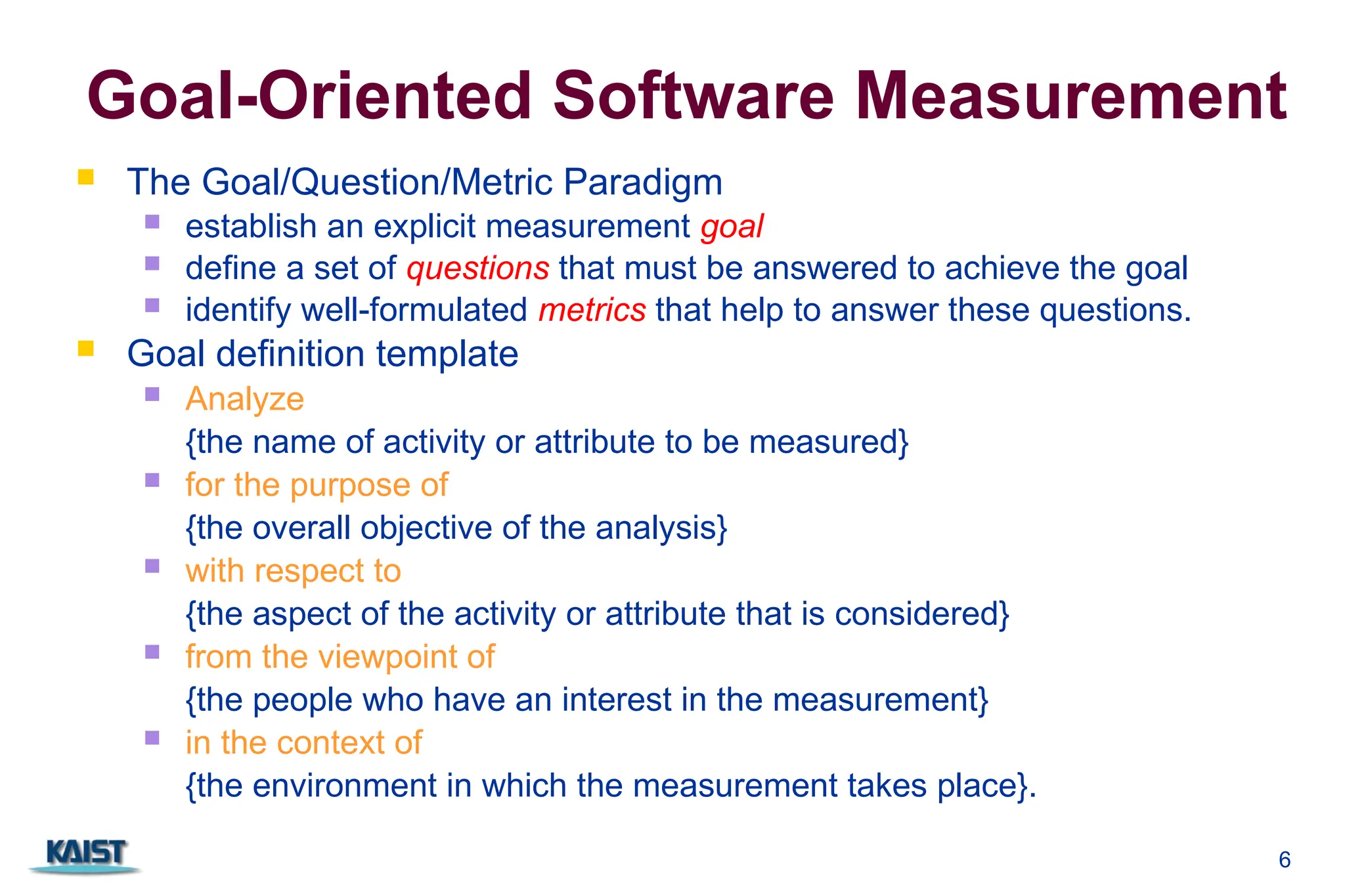
Goal-Oriented Software Measurement
 The Goal/Question/Metric Paradigm
 establish an explicit measurement goal
 define a set of questions that must be answered to achieve the goal
 identify well-formulated metrics that help to answer these questions.
 Goal definition template
 Analyze
{the name of activity or attribute to be measured}
 for the purpose of
{the overall objective of the analysis}
 with respect to
{the aspect of the activity or attribute that is considered}
 from the viewpoint of
{the people who have an interest in the measurement}
 in the context of
{the environment in which the measurement takes place}.
7
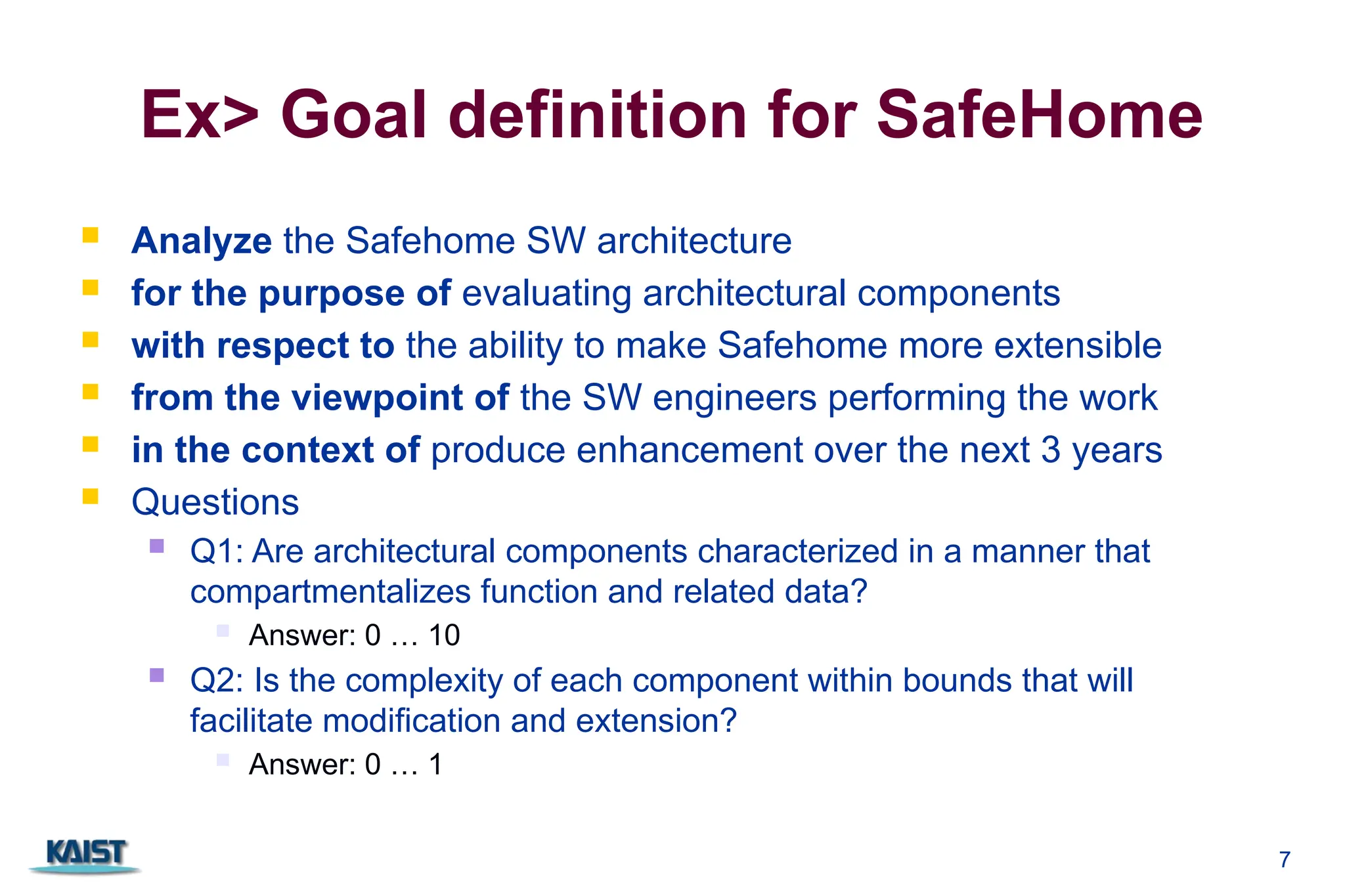
Ex> Goal definition for SafeHome
 Analyze the Safehome SW architecture
 for the purpose of evaluating architectural components
 with respect to the ability to make Safehome more extensible
 from the viewpoint of the SW engineers performing the work
 in the context of produce enhancement over the next 3 years
 Questions
 Q1: Are architectural components characterized in a manner that
compartmentalizes function and related data?
 Answer: 0 … 10
 Q2: Is the complexity of each component within bounds that will
facilitate modification and extension?
 Answer: 0 … 1
8
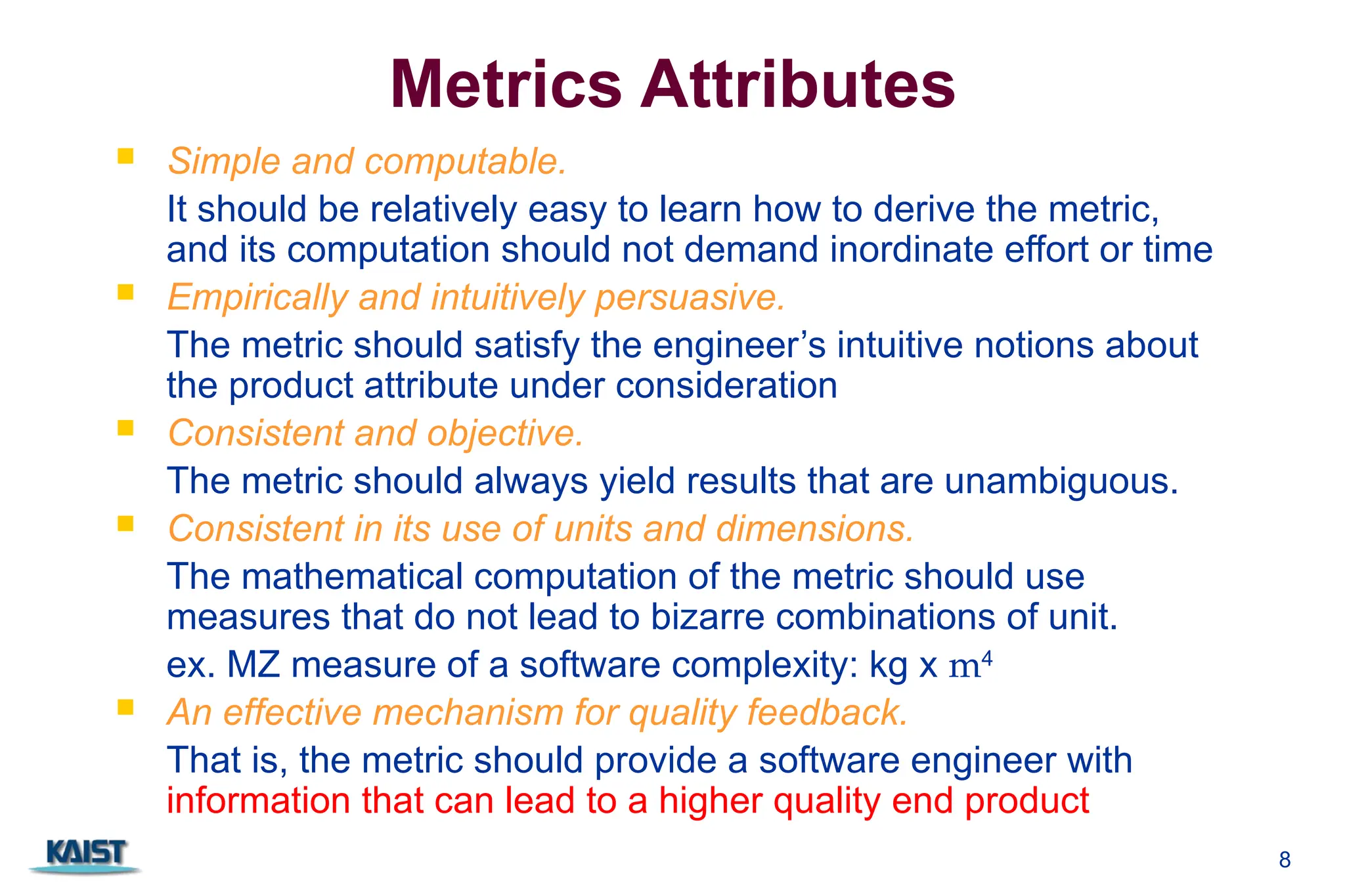
Metrics Attributes
 Simple and computable.
It should be relatively easy to learn how to derive the metric,
and its computation should not demand inordinate effort or time
 Empirically and intuitively persuasive.
The metric should satisfy the engineer’s intuitive notions about
the product attribute under consideration
 Consistent and objective.
The metric should always yield results that are unambiguous.
 Consistent in its use of units and dimensions.
The mathematical computation of the metric should use
measures that do not lead to bizarre combinations of unit.
ex. MZ measure of a software complexity: kg x m4
 An effective mechanism for quality feedback.
That is, the metric should provide a software engineer with
information that can lead to a higher quality end product
9
Collection and Analysis Principles
 Whenever possible, data collection and analysis should
be automated
 Valid statistical techniques should be applied to establish
relationship between internal product attributes and
external quality characteristics
 Interpretative guidelines and recommendations should
be established for each metric
 Ex. Fat metric greater than 0.5 indicates obesity. A person who
has more than 0.7 fat metric should consult a doctor.
10
Overview of Ch30. Product Metrics
 30.1 A Framework for Product Metrics
 30.2 Metrics for the Requirement Model
 Function point metrics
 30.3 Metrics for the Design Model
 Architectural design metrics
 Metrics for OO design
 Class-oriented metrics
 Component-level design metrics
 Operation oriented metrics
 30.4 Design Metrics for Web and Mobile Apps
 30.5 Metrics for Source Code
 30.6 Metrics for Testing
 30.7 Metrics for Maintenance
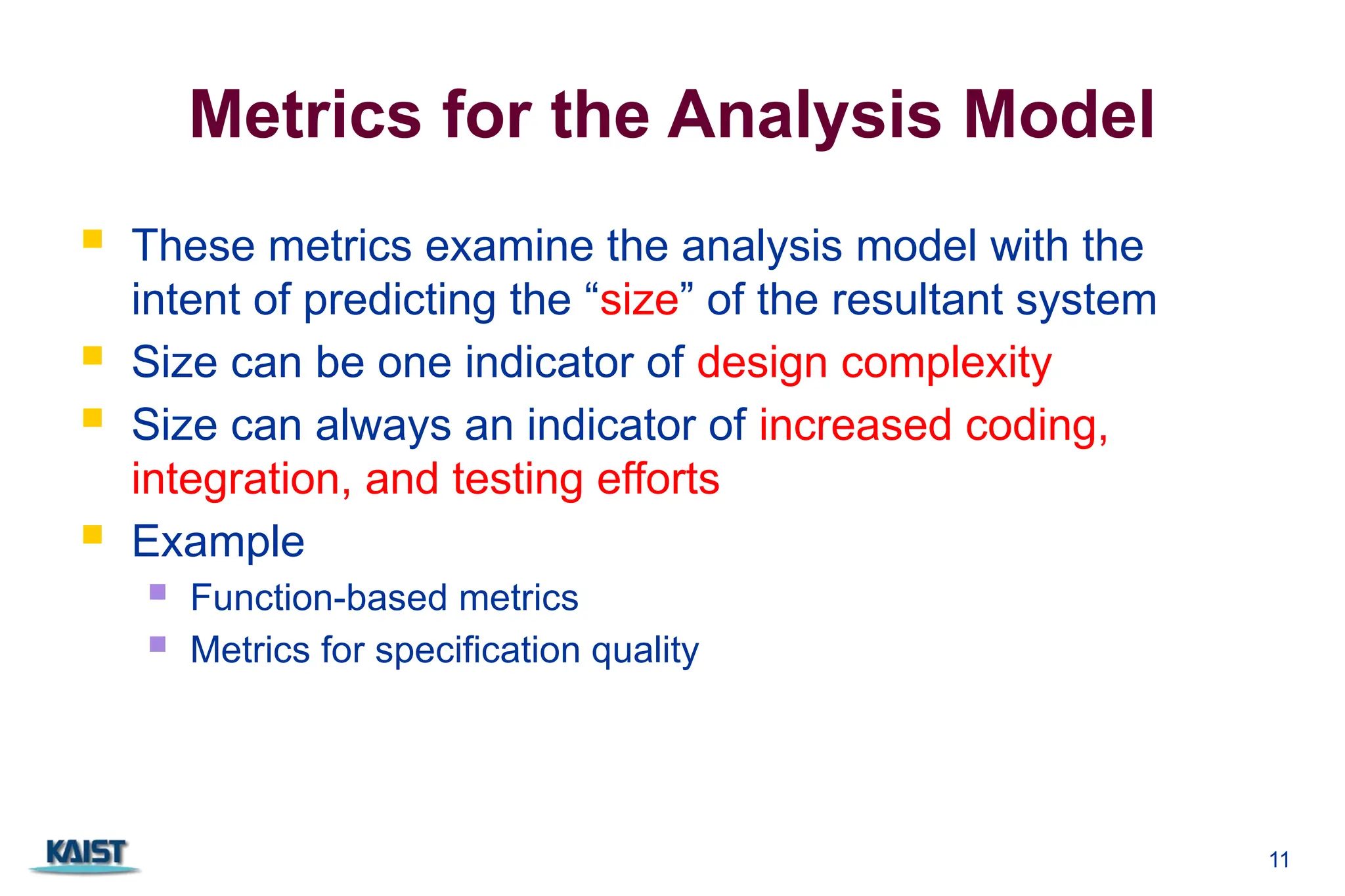
Metrics for the Analysis Model
 These metrics examine the analysis model with the
intent of predicting the “size” of the resultant system
 Size can be one indicator of design complexity
 Size can always an indicator of increased coding,
integration, and testing efforts
 Example
 Function-based metrics
 Metrics for specification quality
11
12
Function-Based Metrics
 The function point metric (FP), first proposed by Albrecht [ALB79],
can be used effectively as a means for measuring the functionality
delivered by a system.
 Function points are derived using an empirical relationship based on
countable (direct) measures of software's information domain and
assessments of software complexity
 Information domain values are defined in the following manner:
 number of external inputs (EIs)
 often used to update internal logical files
 number of external outputs (EOs)
 number of external inquiries (EQs)
 number of internal logical files (ILFs)
 Number of external interface files (EIFs) (
13
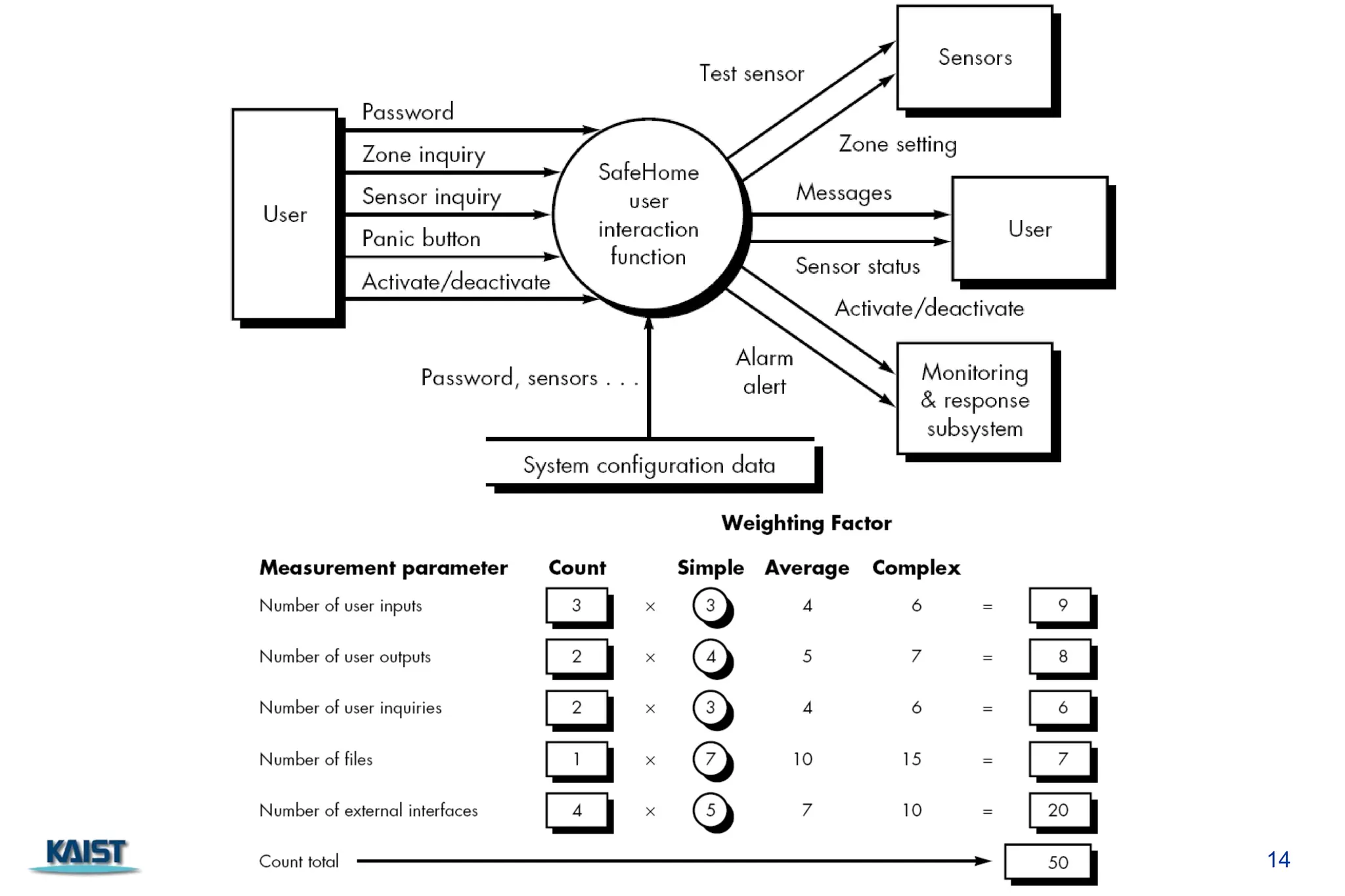
Function Points
Information
Domain Value Count simple average complex
Weighting factor
External Inputs ( EIs)
External Outputs ( EOs)
External Inquiries (EQs)
Internal Logical Files ( ILFs)
External Interface Files ( EIFs)
3 4 6
4 5 7
3 4 6
7 10 15
5 7 10
=
=
=
=
=
Count total
3
3
3
3
3
FP = count total x (0.65 + 0.01 x ∑(Fi))
where Fi’s are value adjustment factors based on
responses to the 14 questions
14
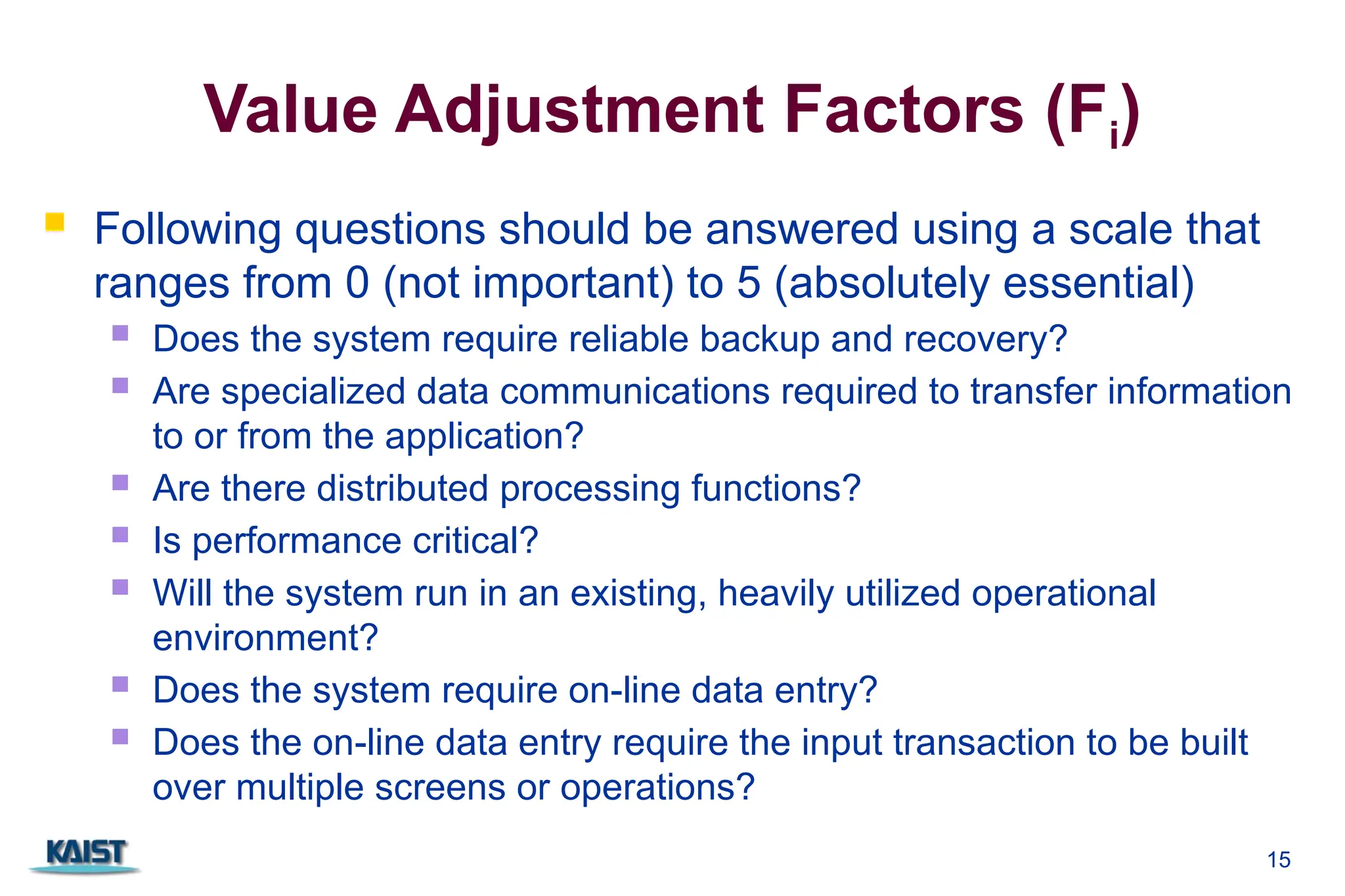
Value Adjustment Factors (Fi)
 Following questions should be answered using a scale that
ranges from 0 (not important) to 5 (absolutely essential)
 Does the system require reliable backup and recovery?
 Are specialized data communications required to transfer information
to or from the application?
 Are there distributed processing functions?
 Is performance critical?
 Will the system run in an existing, heavily utilized operational
environment?
 Does the system require on-line data entry?
 Does the on-line data entry require the input transaction to be built
over multiple screens or operations?
15
16
Usage of Function Points
 Assume that
 past data indicates that one FP translates into 60 lines of code
 12 FPs are produced for each person-month of effort
 Past projects have found an average of 3 errors per FP during analysis and
design reviews
 4 errors per FP during unit and integration testing
 These data can help SW engineers assess the completeness of their review
and testing activities.
 Suppose that Safehome has 56 FPs
 56 =50 x [0.65 +0.01 x ∑(Fi) (= 46)]
 Safehome will be
 Expected size: 60 lines * 56 =3360 lines
 Expected required man-month: 1/12 MM * 56 = 4.7 MM
 Total analysis/design errors expected: 3 * 56 = 168 errors
 Total testing errors expected: 4 * 56 = 224 errors
17
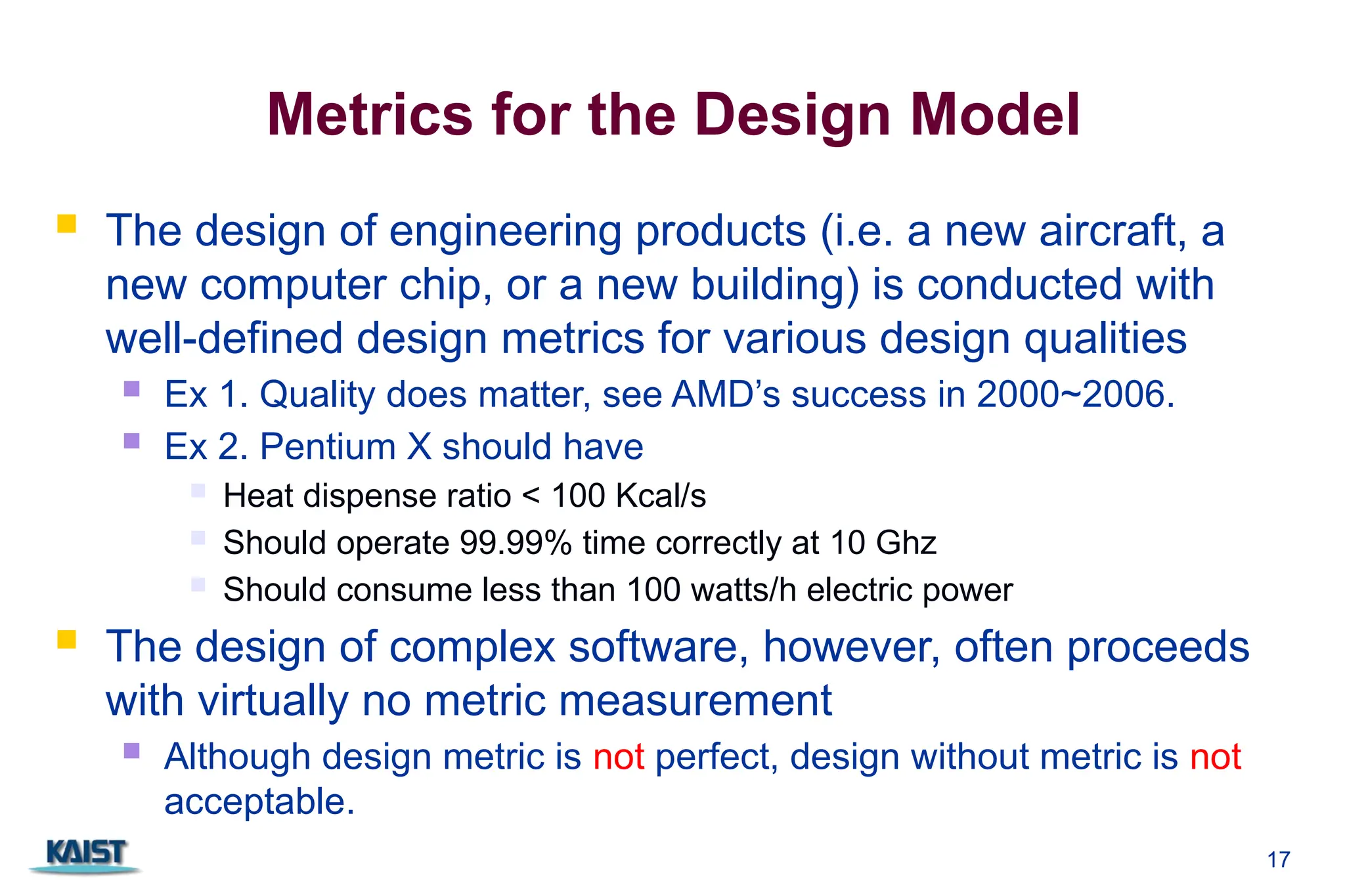
Metrics for the Design Model
 The design of engineering products (i.e. a new aircraft, a
new computer chip, or a new building) is conducted with
well-defined design metrics for various design qualities
 Ex 1. Quality does matter, see AMD’s success in 2000~2006.
 Ex 2. Pentium X should have
 Heat dispense ratio < 100 Kcal/s
 Should operate 99.99% time correctly at 10 Ghz
 Should consume less than 100 watts/h electric power
 The design of complex software, however, often proceeds
with virtually no metric measurement
 Although design metric is not perfect, design without metric is not
acceptable.
18
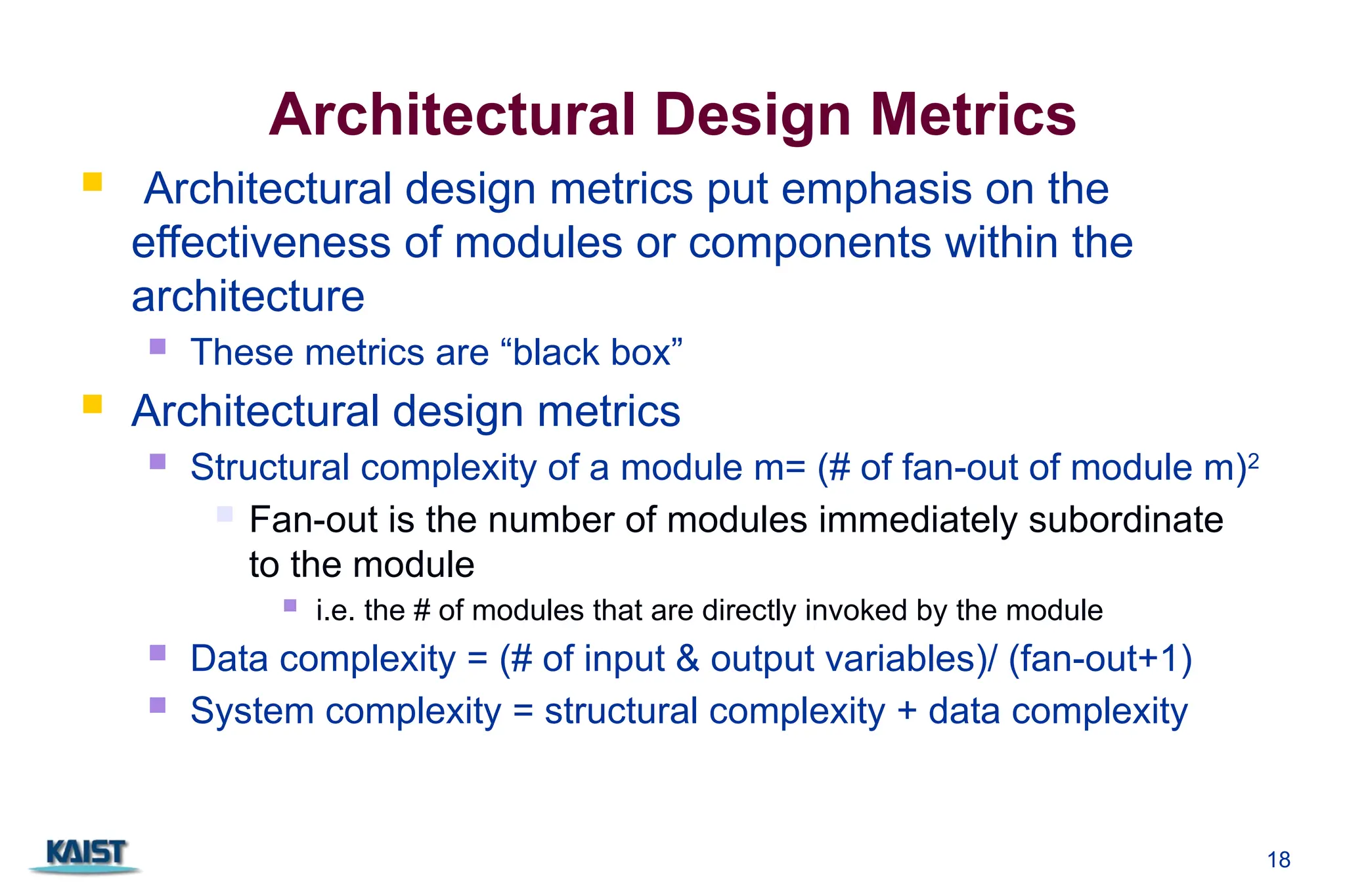
Architectural Design Metrics
 Architectural design metrics put emphasis on the
effectiveness of modules or components within the
architecture
 These metrics are “black box”
 Architectural design metrics
 Structural complexity of a module m= (# of fan-out of module m)2
 Fan-out is the number of modules immediately subordinate
to the module
 i.e. the # of modules that are directly invoked by the module
 Data complexity = (# of input & output variables)/ (fan-out+1)
 System complexity = structural complexity + data complexity
19
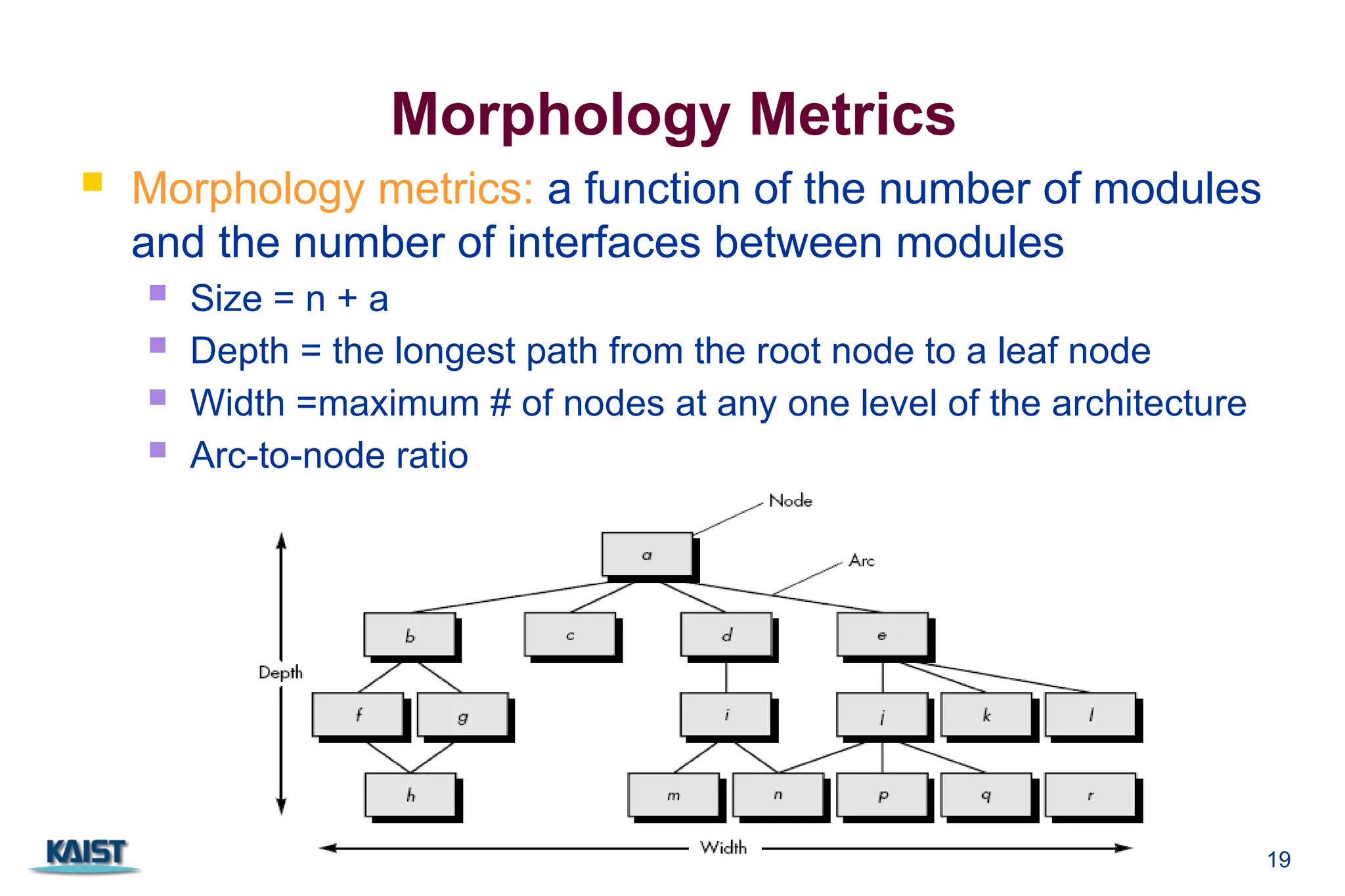
Morphology Metrics
 Morphology metrics: a function of the number of modules
and the number of interfaces between modules
 Size = n + a
 Depth = the longest path from the root node to a leaf node
 Width =maximum # of nodes at any one level of the architecture
 Arc-to-node ratio
20
Metrics for OO Design-I
 Whitmire [WHI97] describes nine distinct and measurable
characteristics of an OO design:
 Size
 Size is defined in terms of the following four views:
 Population: a static count of OO entities such as classes
 Volume: a dynamic count of OO entities such as objects
 Length: a measure of a chain of interconnected design elements
 Functionality: value delivered to the customer
 Complexity
 How classes of an OO design are interrelated to one another
 Coupling
 The physical connections between elements of the OO design
 The # of collaborations between classes
 Sufficiency
 “the degree to which an abstraction possesses the features required of it, ...
from the point of view of the current application.”
 Whether the abstraction (class) possesses the features required of it
21
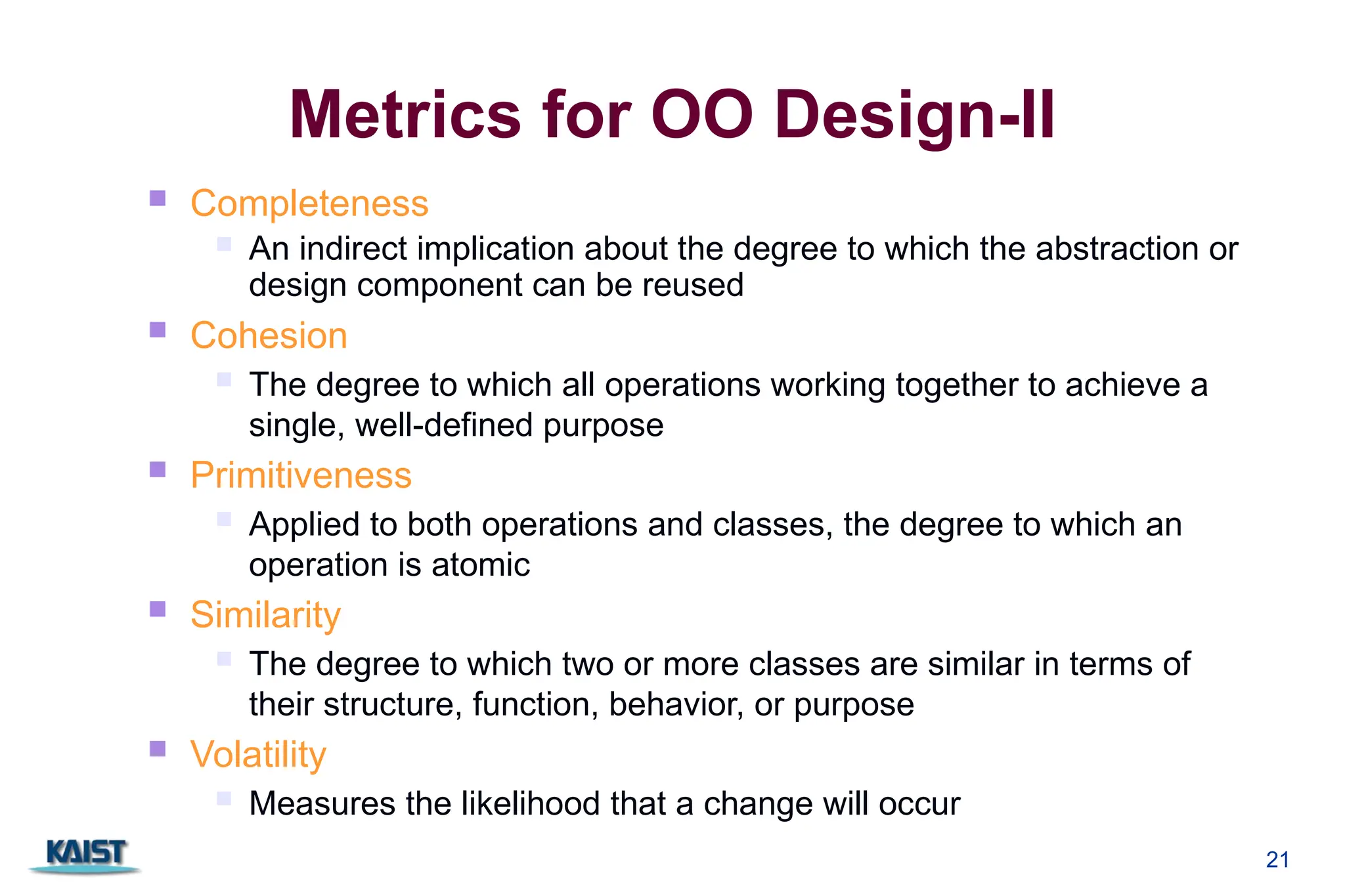
Metrics for OO Design-II
 Completeness
 An indirect implication about the degree to which the abstraction or
design component can be reused
 Cohesion
 The degree to which all operations working together to achieve a
single, well-defined purpose
 Primitiveness
 Applied to both operations and classes, the degree to which an
operation is atomic
 Similarity
 The degree to which two or more classes are similar in terms of
their structure, function, behavior, or purpose
 Volatility
 Measures the likelihood that a change will occur
22
Distinguishing Characteristics
 Encapsulation
the packaging of data and processing
 Information hiding
the way in which information about operational details is hidden by a
secure interface
 Inheritance
the manner in which the responsibilities of one class are propagated to
another
 Abstraction
the mechanism that allows a design to focus on essential details
 Localization
the way in which information is concentrated in a program
Berard [BER95] argues that the following characteristics require
that special OO metrics be developed:
23
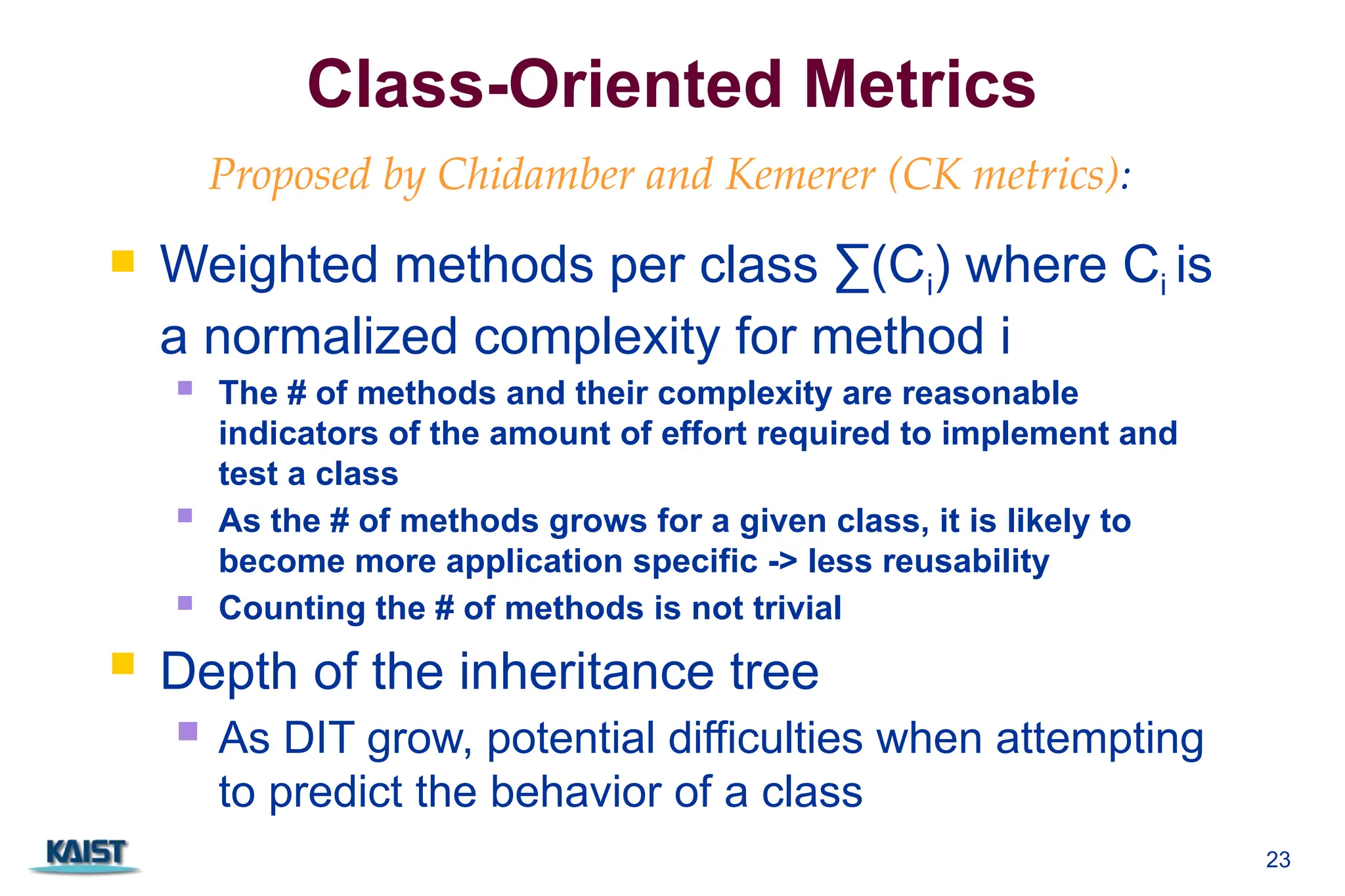
Class-Oriented Metrics
 Weighted methods per class ∑(Ci) where Ci is
a normalized complexity for method i
 The # of methods and their complexity are reasonable
indicators of the amount of effort required to implement and
test a class
 As the # of methods grows for a given class, it is likely to
become more application specific -> less reusability
 Counting the # of methods is not trivial
 Depth of the inheritance tree
 As DIT grow, potential difficulties when attempting
to predict the behavior of a class
Proposed by Chidamber and Kemerer (CK metrics):
24
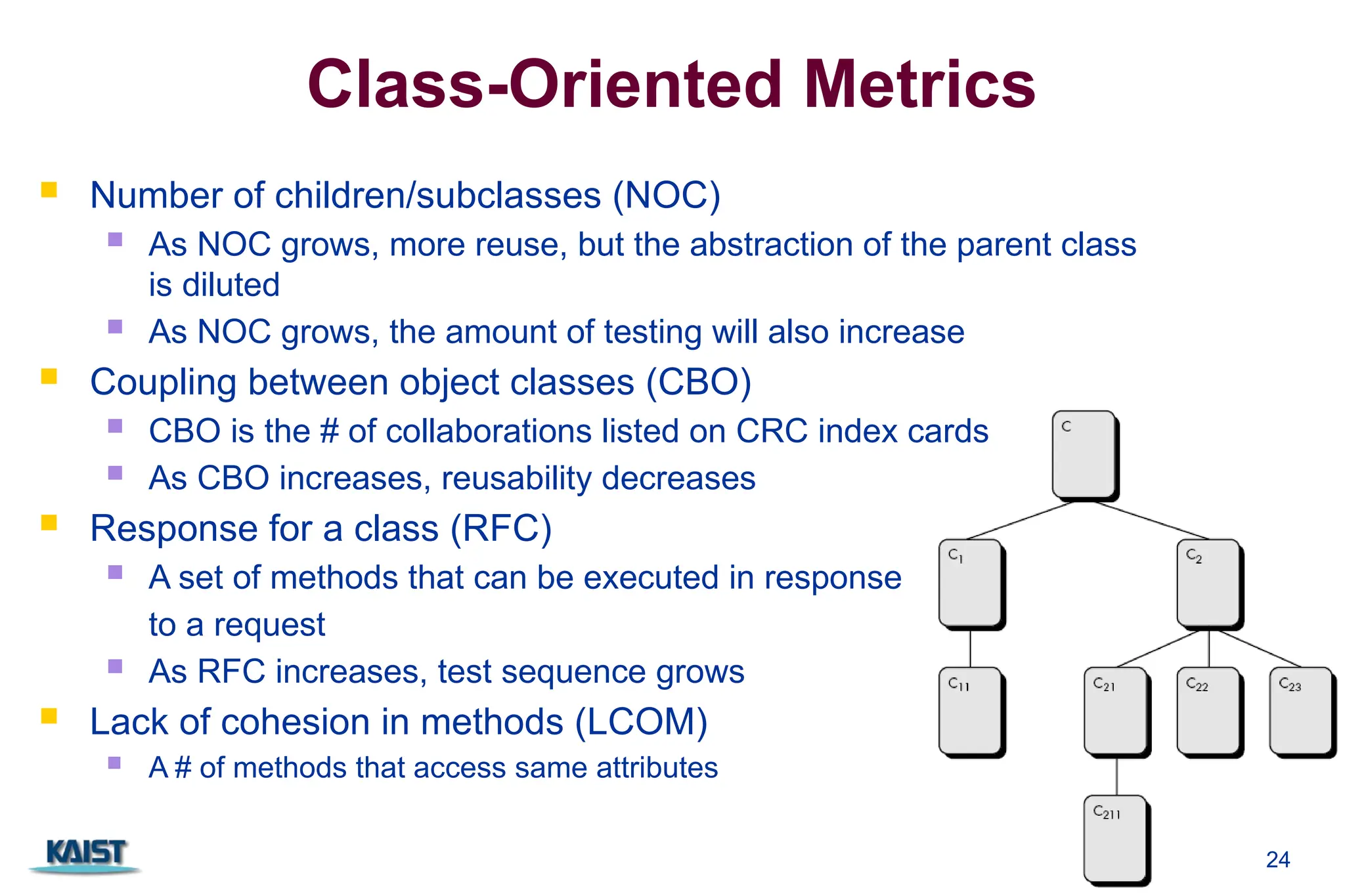
Class-Oriented Metrics
 Number of children/subclasses (NOC)
 As NOC grows, more reuse, but the abstraction of the parent class
is diluted
 As NOC grows, the amount of testing will also increase
 Coupling between object classes (CBO)
 CBO is the # of collaborations listed on CRC index cards
 As CBO increases, reusability decreases
 Response for a class (RFC)
 A set of methods that can be executed in response
to a request
 As RFC increases, test sequence grows
 Lack of cohesion in methods (LCOM)
 A # of methods that access same attributes
25
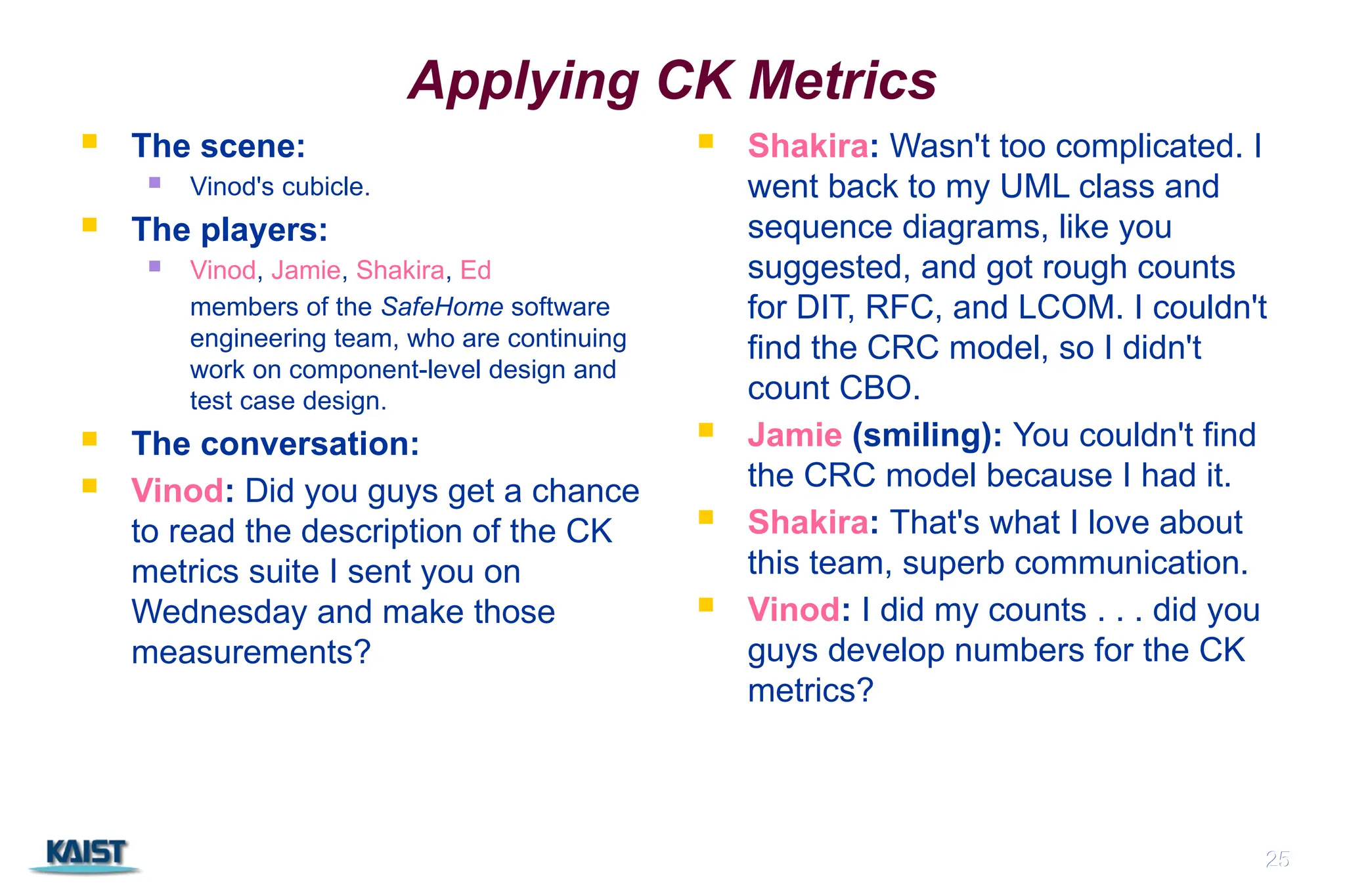
Applying CK Metrics
 The scene:
 Vinod's cubicle.
 The players:
 Vinod, Jamie, Shakira, Ed
members of the SafeHome software
engineering team, who are continuing
work on component-level design and
test case design.
 The conversation:
 Vinod: Did you guys get a chance
to read the description of the CK
metrics suite I sent you on
Wednesday and make those
measurements?
 Shakira: Wasn't too complicated. I
went back to my UML class and
sequence diagrams, like you
suggested, and got rough counts
for DIT, RFC, and LCOM. I couldn't
find the CRC model, so I didn't
count CBO.
 Jamie (smiling): You couldn't find
the CRC model because I had it.
 Shakira: That's what I love about
this team, superb communication.
 Vinod: I did my counts . . . did you
guys develop numbers for the CK
metrics?
25
26
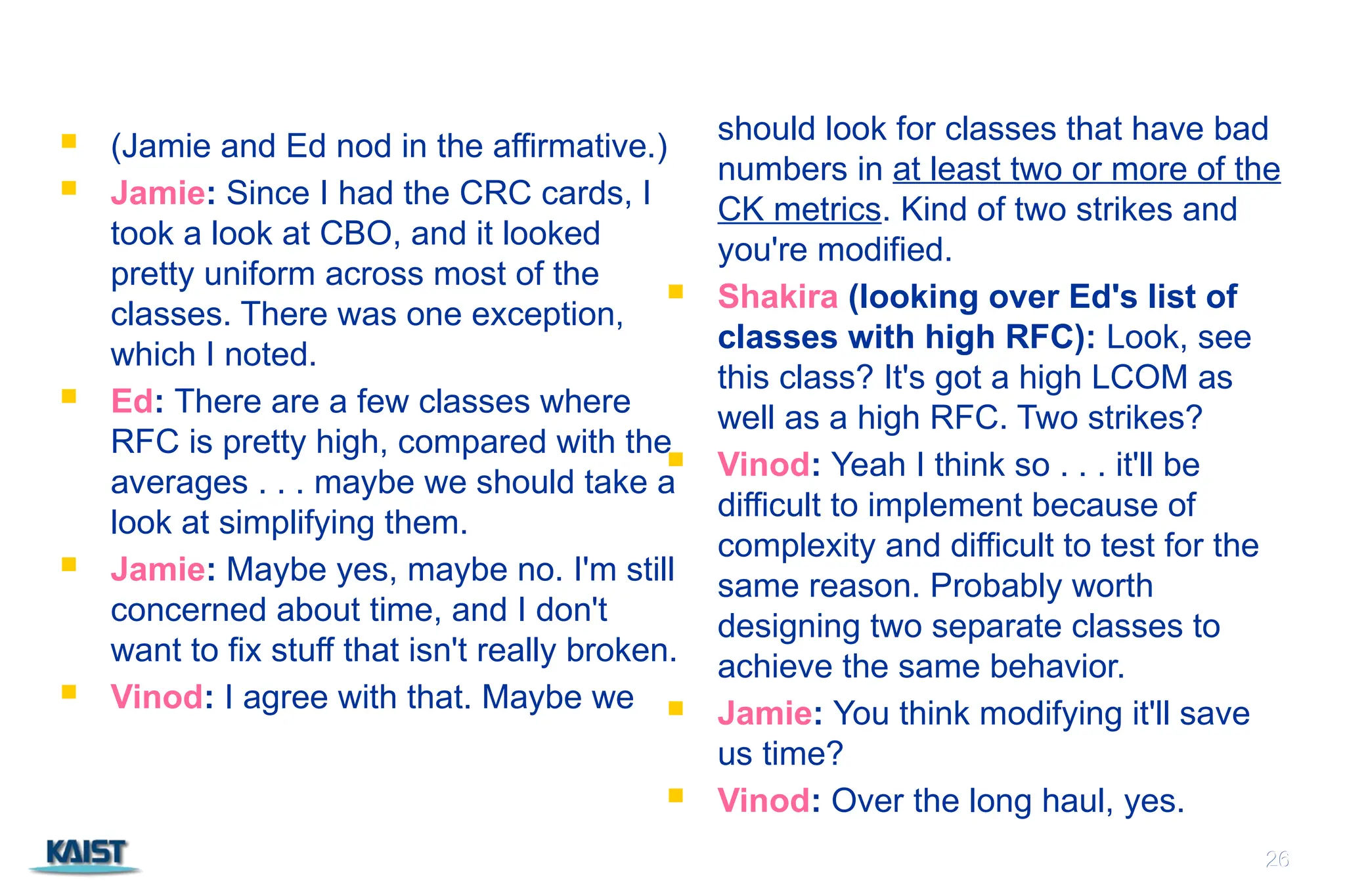
 (Jamie and Ed nod in the affirmative.)
 Jamie: Since I had the CRC cards, I
took a look at CBO, and it looked
pretty uniform across most of the
classes. There was one exception,
which I noted.
 Ed: There are a few classes where
RFC is pretty high, compared with the
averages . . . maybe we should take a
look at simplifying them.
 Jamie: Maybe yes, maybe no. I'm still
concerned about time, and I don't
want to fix stuff that isn't really broken.
 Vinod: I agree with that. Maybe we
should look for classes that have bad
numbers in at least two or more of the
CK metrics. Kind of two strikes and
you're modified.
 Shakira (looking over Ed's list of
classes with high RFC): Look, see
this class? It's got a high LCOM as
well as a high RFC. Two strikes?
 Vinod: Yeah I think so . . . it'll be
difficult to implement because of
complexity and difficult to test for the
same reason. Probably worth
designing two separate classes to
achieve the same behavior.
 Jamie: You think modifying it'll save
us time?
 Vinod: Over the long haul, yes.
26
27
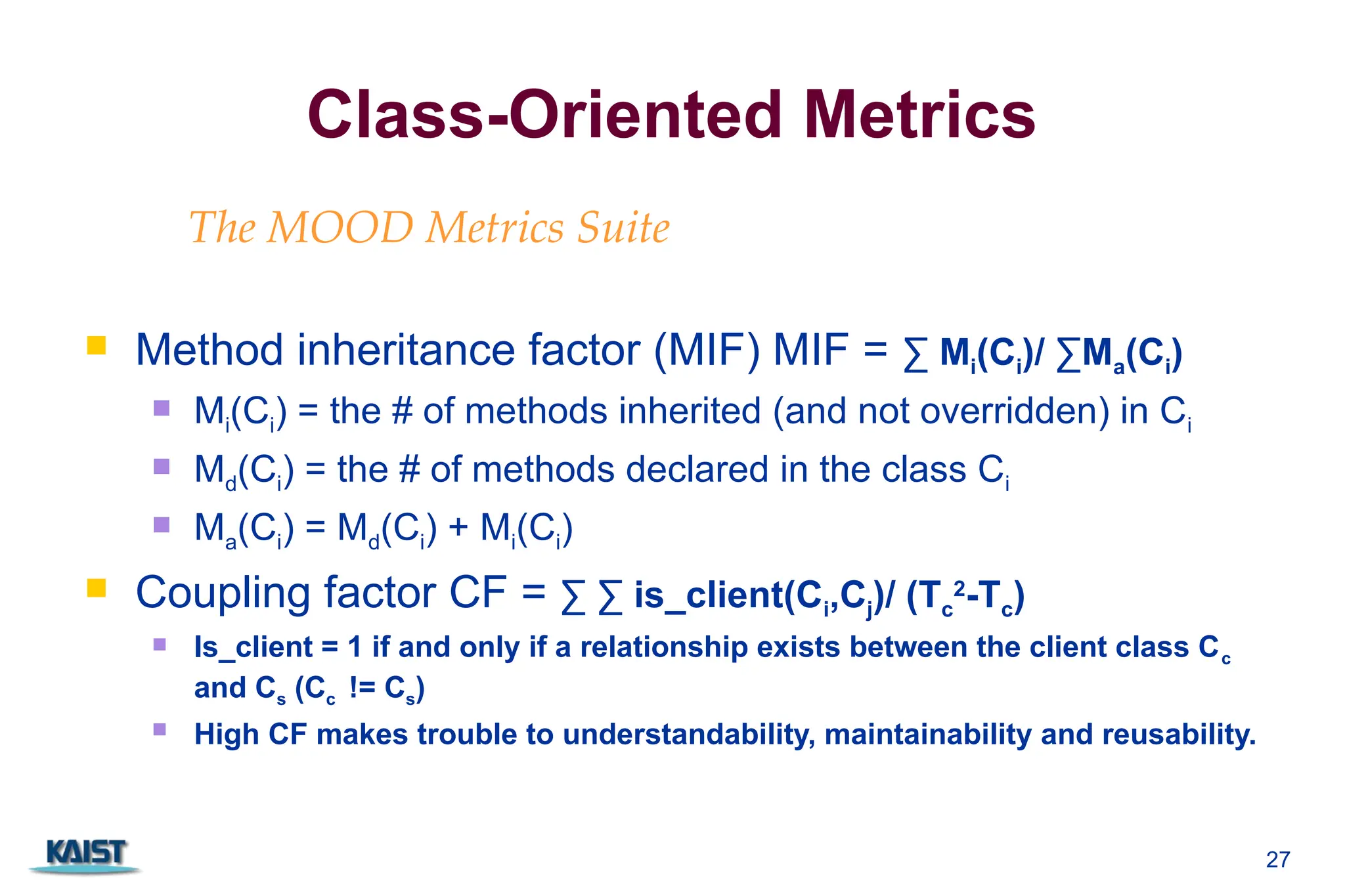
Class-Oriented Metrics
 Method inheritance factor (MIF) MIF = ∑ Mi(Ci)/ ∑Ma(Ci)
 Mi(Ci) = the # of methods inherited (and not overridden) in Ci
 Md(Ci) = the # of methods declared in the class Ci
 Ma(Ci) = Md(Ci) + Mi(Ci)
 Coupling factor CF = ∑ ∑ is_client(Ci,Cj)/ (Tc
2
-Tc)
 Is_client = 1 if and only if a relationship exists between the client class Cc
and Cs (Cc != Cs)
 High CF makes trouble to understandability, maintainability and reusability.
The MOOD Metrics Suite
28
Class-Oriented Metrics
 class size
 number of operations overridden by a subclass
 number of operations added by a subclass
Proposed by Lorenz and Kidd [LOR94]:
29
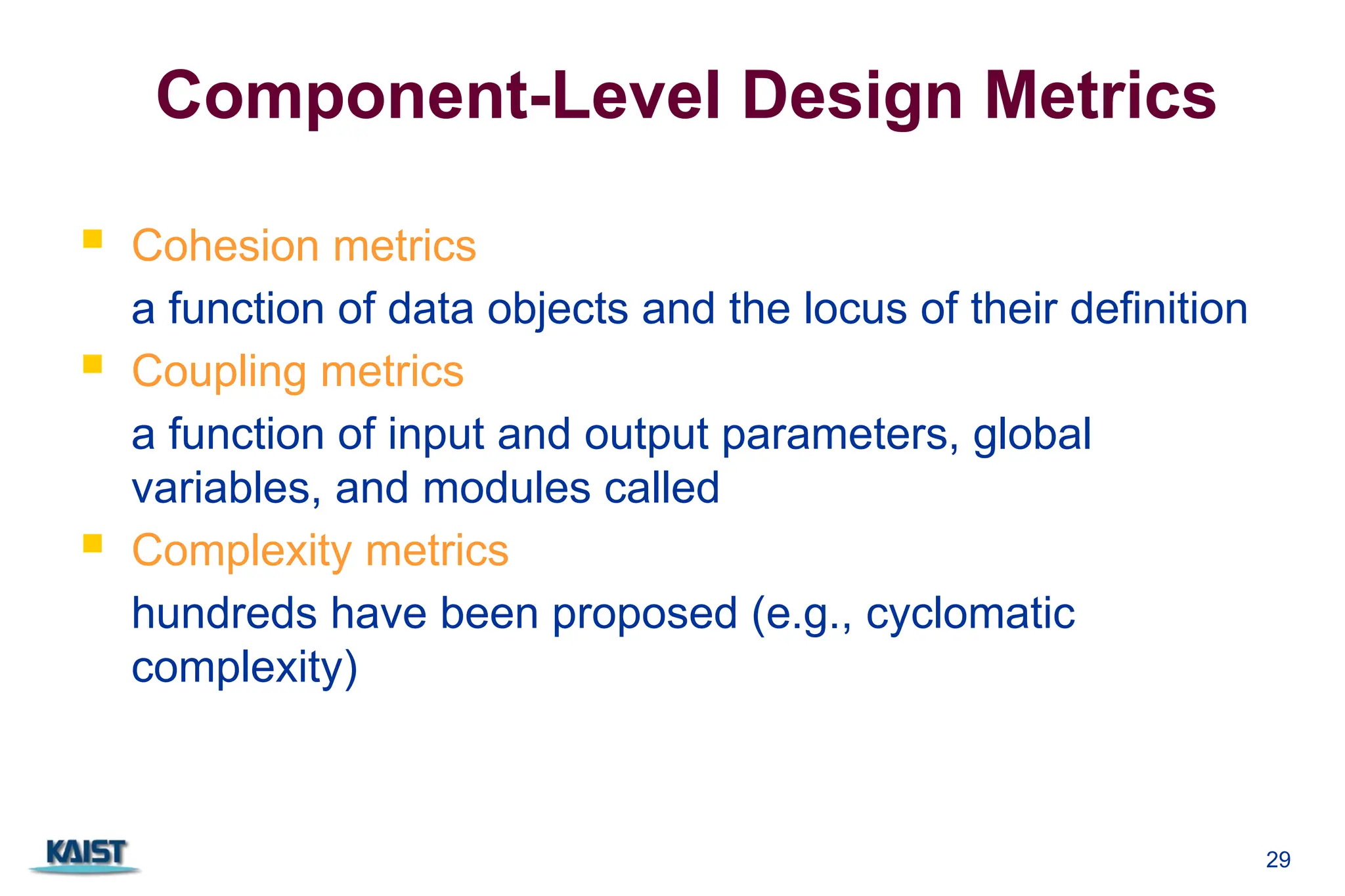
Component-Level Design Metrics
 Cohesion metrics
a function of data objects and the locus of their definition
 Coupling metrics
a function of input and output parameters, global
variables, and modules called
 Complexity metrics
hundreds have been proposed (e.g., cyclomatic
complexity)
30
Operation-Oriented Metrics
 average operation size
# of messages sent by the operation
 operation complexity
 average number of parameters per operation
Proposed by Lorenz and Kidd [LOR94]:
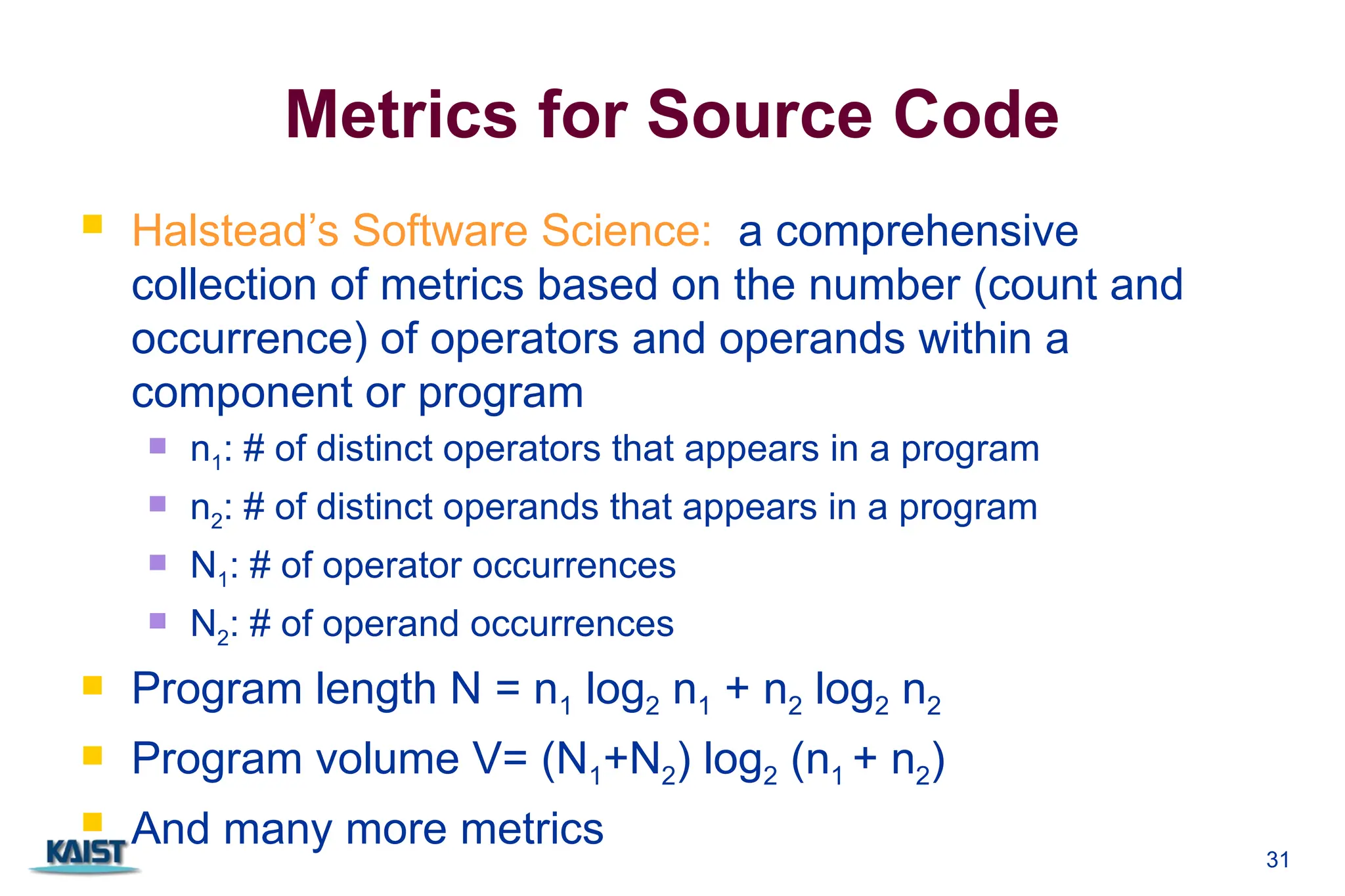
Metrics for Source Code
 Halstead’s Software Science: a comprehensive
collection of metrics based on the number (count and
occurrence) of operators and operands within a
component or program
 n1: # of distinct operators that appears in a program
 n2: # of distinct operands that appears in a program
 N1: # of operator occurrences
 N2: # of operand occurrences
 Program length N = n1 log2 n1 + n2 log2 n2
 Program volume V= (N1+N2) log2 (n1 + n2)
 And many more metrics
31
CS350 32
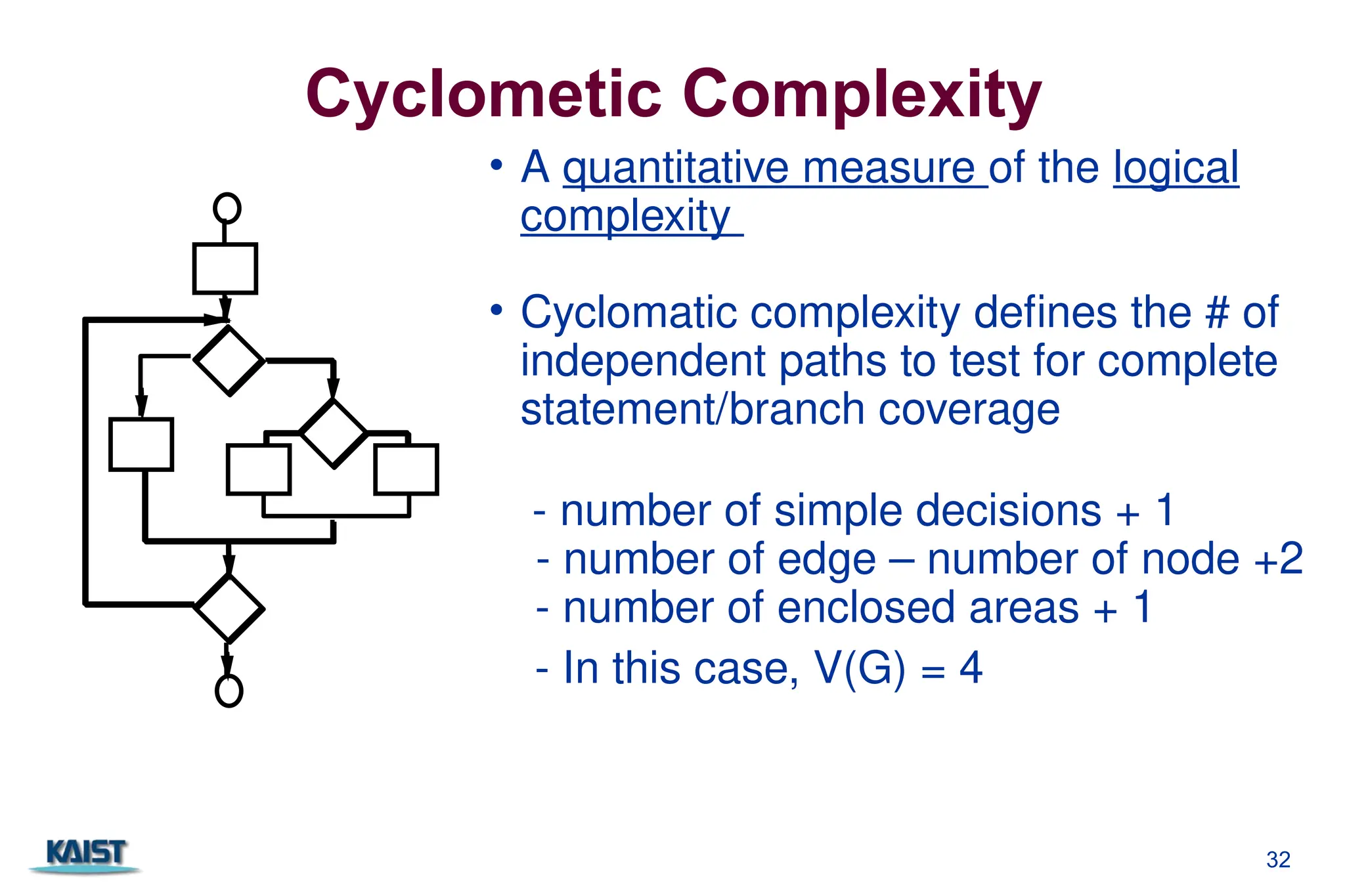
Cyclometic Complexity
• A quantitative measure of the logical
complexity
• Cyclomatic complexity defines the # of
independent paths to test for complete
statement/branch coverage
- number of simple decisions + 1
- number of enclosed areas + 1
- In this case, V(G) = 4
- number of edge – number of node +2
33
Metrics for Testing
 Testing effort can also be estimated using metrics derived
from Halstead measures
 Binder [BIN94] suggests a broad array of design metrics
that have a direct influence on the “testability” of an OO
system.
 Lack of cohesion in methods (LCOM).
 Percent public and protected (PAP).
 Public access to data members (PAD).
 Number of root classes (NOR).
 Fan-in (FIN).
 Number of children (NOC) and depth of the inheritance tree (DIT).
34
Metrics for Maintenance
 IEEE Std 982.1-1998 Software Maturity Index (SMI)
 SMI = [Mt - (Fa + Fc + Fd)]/Mt
 Mt = # of modules in the current release
 Fc = # of modules in the current release that have been changed
 Fa = # of modules in the current release that have been added
 Fd = # of modules from the preceding release that were deleted
in the current release
35
Design Structure Quality Index
(DSQI)
 Developed by U.S. Air Force Systems Command
 DSQI (ranging 0 to 1) is calculated from the following 7
values
 S1 = the total # of modules define in the program architecture
 S2 = the # of modules whose correct function depends on the
source of data input or that produce data to be used elsewhere
…
 S7 = the # of modules with a single entry and exit
36

software engineering metrics concpets in advanced sotwrae

  • 1.
  • 2.
    2 McCall’s Triangle ofQuality (1970s) Maintainability Maintainability Flexibility Flexibility Testability Testability Portability Portability Reusability Reusability Interoperability Interoperability Correctness Correctness Reliability Reliability Efficiency Efficiency Integrity Integrity Usability Usability PRODUCT TRANSITION PRODUCT TRANSITION PRODUCT REVISION PRODUCT REVISION PRODUCT OPERATION PRODUCT OPERATION ISO 9126 Quality Factors - Functionality, reliability, usability, efficiency, maintainability, portability
  • 3.
    3 Measures, Metrics andIndicators  A SW engineer collects measures and develops metrics so that indicators will be obtained  A measure provides a quantitative indication of the extent, amount, dimension, capacity, or size of some attribute of a product or process  The IEEE defines a metric as “a quantitative measure of the degree to which a system, component, or process possesses a given attribute.”  IEEE Standard Glossary of Software Engineering Terminology (IEEE Std 610.12-1990)  An indicator is a metric or combination of metrics that provide insight into the software process, a software project, or the product itself  Ex. Moonzoo Kim  Measure: height=170cm, weight=65 kg  Metric: fat metric= 0.38 ( =weight/height)  Indicator: normal health condition (since fat metric < 0.5 )
  • 4.
    4 Measurement Principles  Theobjectives of measurement should be established before data collection begins  Ex. It is useless for black-box testers to measure a # of words in a C file.  Ex. It is useful for C compiler developers to measure a # of words in a C file.  Each technical metric should be defined in an unambiguous manner  Ex. For measuring a total line number of a C program  Including comments? Including empty lines?  Metrics should be derived based on a theory that is valid for the domain of application  Metrics for design should draw upon basic design concepts and principles and attempt to provide an indication of the presence of a desirable attribute  Metrics should be tailored to best accommodate specific products and processes
  • 5.
    5 Measurement Process  Formulation. Thederivation of software measures and metrics appropriate for the representation of the software that is being considered.  Collection The mechanism used to accumulate data required to derive the formulated metrics.  Analysis. The computation of metrics and the application of mathematical tools.  Interpretation. The evaluation of metrics results in an effort to gain insight into the quality of the representation.  Feedback. Recommendations derived from the interpretation of product metrics transmitted to the software team.  Example of Formulation To check whether a give software is hot- spotted (i.e. has intensive loops)  Example of Collection Instrument a source program/binary to count how many time a given statement is executed in one second  Example of Analysis. Using Excel/MatLab to get average numbers of executions of statements  Example of Interpretation. If there exist statements which were executed more than 108 , on a 3 Ghz machine, then the program is hot-spotted  Example of Feedback. Try to optimize those hot-spotted statements. Or those hot-spotted statement might have logical flaws
  • 6.
    6 Goal-Oriented Software Measurement The Goal/Question/Metric Paradigm  establish an explicit measurement goal  define a set of questions that must be answered to achieve the goal  identify well-formulated metrics that help to answer these questions.  Goal definition template  Analyze {the name of activity or attribute to be measured}  for the purpose of {the overall objective of the analysis}  with respect to {the aspect of the activity or attribute that is considered}  from the viewpoint of {the people who have an interest in the measurement}  in the context of {the environment in which the measurement takes place}.
  • 7.
    7 Ex> Goal definitionfor SafeHome  Analyze the Safehome SW architecture  for the purpose of evaluating architectural components  with respect to the ability to make Safehome more extensible  from the viewpoint of the SW engineers performing the work  in the context of produce enhancement over the next 3 years  Questions  Q1: Are architectural components characterized in a manner that compartmentalizes function and related data?  Answer: 0 … 10  Q2: Is the complexity of each component within bounds that will facilitate modification and extension?  Answer: 0 … 1
  • 8.
    8 Metrics Attributes  Simpleand computable. It should be relatively easy to learn how to derive the metric, and its computation should not demand inordinate effort or time  Empirically and intuitively persuasive. The metric should satisfy the engineer’s intuitive notions about the product attribute under consideration  Consistent and objective. The metric should always yield results that are unambiguous.  Consistent in its use of units and dimensions. The mathematical computation of the metric should use measures that do not lead to bizarre combinations of unit. ex. MZ measure of a software complexity: kg x m4  An effective mechanism for quality feedback. That is, the metric should provide a software engineer with information that can lead to a higher quality end product
  • 9.
    9 Collection and AnalysisPrinciples  Whenever possible, data collection and analysis should be automated  Valid statistical techniques should be applied to establish relationship between internal product attributes and external quality characteristics  Interpretative guidelines and recommendations should be established for each metric  Ex. Fat metric greater than 0.5 indicates obesity. A person who has more than 0.7 fat metric should consult a doctor.
  • 10.
    10 Overview of Ch30.Product Metrics  30.1 A Framework for Product Metrics  30.2 Metrics for the Requirement Model  Function point metrics  30.3 Metrics for the Design Model  Architectural design metrics  Metrics for OO design  Class-oriented metrics  Component-level design metrics  Operation oriented metrics  30.4 Design Metrics for Web and Mobile Apps  30.5 Metrics for Source Code  30.6 Metrics for Testing  30.7 Metrics for Maintenance
  • 11.
    Metrics for theAnalysis Model  These metrics examine the analysis model with the intent of predicting the “size” of the resultant system  Size can be one indicator of design complexity  Size can always an indicator of increased coding, integration, and testing efforts  Example  Function-based metrics  Metrics for specification quality 11
  • 12.
    12 Function-Based Metrics  Thefunction point metric (FP), first proposed by Albrecht [ALB79], can be used effectively as a means for measuring the functionality delivered by a system.  Function points are derived using an empirical relationship based on countable (direct) measures of software's information domain and assessments of software complexity  Information domain values are defined in the following manner:  number of external inputs (EIs)  often used to update internal logical files  number of external outputs (EOs)  number of external inquiries (EQs)  number of internal logical files (ILFs)  Number of external interface files (EIFs) (
  • 13.
    13 Function Points Information Domain ValueCount simple average complex Weighting factor External Inputs ( EIs) External Outputs ( EOs) External Inquiries (EQs) Internal Logical Files ( ILFs) External Interface Files ( EIFs) 3 4 6 4 5 7 3 4 6 7 10 15 5 7 10 = = = = = Count total 3 3 3 3 3 FP = count total x (0.65 + 0.01 x ∑(Fi)) where Fi’s are value adjustment factors based on responses to the 14 questions
  • 14.
  • 15.
    Value Adjustment Factors(Fi)  Following questions should be answered using a scale that ranges from 0 (not important) to 5 (absolutely essential)  Does the system require reliable backup and recovery?  Are specialized data communications required to transfer information to or from the application?  Are there distributed processing functions?  Is performance critical?  Will the system run in an existing, heavily utilized operational environment?  Does the system require on-line data entry?  Does the on-line data entry require the input transaction to be built over multiple screens or operations? 15
  • 16.
    16 Usage of FunctionPoints  Assume that  past data indicates that one FP translates into 60 lines of code  12 FPs are produced for each person-month of effort  Past projects have found an average of 3 errors per FP during analysis and design reviews  4 errors per FP during unit and integration testing  These data can help SW engineers assess the completeness of their review and testing activities.  Suppose that Safehome has 56 FPs  56 =50 x [0.65 +0.01 x ∑(Fi) (= 46)]  Safehome will be  Expected size: 60 lines * 56 =3360 lines  Expected required man-month: 1/12 MM * 56 = 4.7 MM  Total analysis/design errors expected: 3 * 56 = 168 errors  Total testing errors expected: 4 * 56 = 224 errors
  • 17.
    17 Metrics for theDesign Model  The design of engineering products (i.e. a new aircraft, a new computer chip, or a new building) is conducted with well-defined design metrics for various design qualities  Ex 1. Quality does matter, see AMD’s success in 2000~2006.  Ex 2. Pentium X should have  Heat dispense ratio < 100 Kcal/s  Should operate 99.99% time correctly at 10 Ghz  Should consume less than 100 watts/h electric power  The design of complex software, however, often proceeds with virtually no metric measurement  Although design metric is not perfect, design without metric is not acceptable.
  • 18.
    18 Architectural Design Metrics Architectural design metrics put emphasis on the effectiveness of modules or components within the architecture  These metrics are “black box”  Architectural design metrics  Structural complexity of a module m= (# of fan-out of module m)2  Fan-out is the number of modules immediately subordinate to the module  i.e. the # of modules that are directly invoked by the module  Data complexity = (# of input & output variables)/ (fan-out+1)  System complexity = structural complexity + data complexity
  • 19.
    19 Morphology Metrics  Morphologymetrics: a function of the number of modules and the number of interfaces between modules  Size = n + a  Depth = the longest path from the root node to a leaf node  Width =maximum # of nodes at any one level of the architecture  Arc-to-node ratio
  • 20.
    20 Metrics for OODesign-I  Whitmire [WHI97] describes nine distinct and measurable characteristics of an OO design:  Size  Size is defined in terms of the following four views:  Population: a static count of OO entities such as classes  Volume: a dynamic count of OO entities such as objects  Length: a measure of a chain of interconnected design elements  Functionality: value delivered to the customer  Complexity  How classes of an OO design are interrelated to one another  Coupling  The physical connections between elements of the OO design  The # of collaborations between classes  Sufficiency  “the degree to which an abstraction possesses the features required of it, ... from the point of view of the current application.”  Whether the abstraction (class) possesses the features required of it
  • 21.
    21 Metrics for OODesign-II  Completeness  An indirect implication about the degree to which the abstraction or design component can be reused  Cohesion  The degree to which all operations working together to achieve a single, well-defined purpose  Primitiveness  Applied to both operations and classes, the degree to which an operation is atomic  Similarity  The degree to which two or more classes are similar in terms of their structure, function, behavior, or purpose  Volatility  Measures the likelihood that a change will occur
  • 22.
    22 Distinguishing Characteristics  Encapsulation thepackaging of data and processing  Information hiding the way in which information about operational details is hidden by a secure interface  Inheritance the manner in which the responsibilities of one class are propagated to another  Abstraction the mechanism that allows a design to focus on essential details  Localization the way in which information is concentrated in a program Berard [BER95] argues that the following characteristics require that special OO metrics be developed:
  • 23.
    23 Class-Oriented Metrics  Weightedmethods per class ∑(Ci) where Ci is a normalized complexity for method i  The # of methods and their complexity are reasonable indicators of the amount of effort required to implement and test a class  As the # of methods grows for a given class, it is likely to become more application specific -> less reusability  Counting the # of methods is not trivial  Depth of the inheritance tree  As DIT grow, potential difficulties when attempting to predict the behavior of a class Proposed by Chidamber and Kemerer (CK metrics):
  • 24.
    24 Class-Oriented Metrics  Numberof children/subclasses (NOC)  As NOC grows, more reuse, but the abstraction of the parent class is diluted  As NOC grows, the amount of testing will also increase  Coupling between object classes (CBO)  CBO is the # of collaborations listed on CRC index cards  As CBO increases, reusability decreases  Response for a class (RFC)  A set of methods that can be executed in response to a request  As RFC increases, test sequence grows  Lack of cohesion in methods (LCOM)  A # of methods that access same attributes
  • 25.
    25 Applying CK Metrics The scene:  Vinod's cubicle.  The players:  Vinod, Jamie, Shakira, Ed members of the SafeHome software engineering team, who are continuing work on component-level design and test case design.  The conversation:  Vinod: Did you guys get a chance to read the description of the CK metrics suite I sent you on Wednesday and make those measurements?  Shakira: Wasn't too complicated. I went back to my UML class and sequence diagrams, like you suggested, and got rough counts for DIT, RFC, and LCOM. I couldn't find the CRC model, so I didn't count CBO.  Jamie (smiling): You couldn't find the CRC model because I had it.  Shakira: That's what I love about this team, superb communication.  Vinod: I did my counts . . . did you guys develop numbers for the CK metrics? 25
  • 26.
    26  (Jamie andEd nod in the affirmative.)  Jamie: Since I had the CRC cards, I took a look at CBO, and it looked pretty uniform across most of the classes. There was one exception, which I noted.  Ed: There are a few classes where RFC is pretty high, compared with the averages . . . maybe we should take a look at simplifying them.  Jamie: Maybe yes, maybe no. I'm still concerned about time, and I don't want to fix stuff that isn't really broken.  Vinod: I agree with that. Maybe we should look for classes that have bad numbers in at least two or more of the CK metrics. Kind of two strikes and you're modified.  Shakira (looking over Ed's list of classes with high RFC): Look, see this class? It's got a high LCOM as well as a high RFC. Two strikes?  Vinod: Yeah I think so . . . it'll be difficult to implement because of complexity and difficult to test for the same reason. Probably worth designing two separate classes to achieve the same behavior.  Jamie: You think modifying it'll save us time?  Vinod: Over the long haul, yes. 26
  • 27.
    27 Class-Oriented Metrics  Methodinheritance factor (MIF) MIF = ∑ Mi(Ci)/ ∑Ma(Ci)  Mi(Ci) = the # of methods inherited (and not overridden) in Ci  Md(Ci) = the # of methods declared in the class Ci  Ma(Ci) = Md(Ci) + Mi(Ci)  Coupling factor CF = ∑ ∑ is_client(Ci,Cj)/ (Tc 2 -Tc)  Is_client = 1 if and only if a relationship exists between the client class Cc and Cs (Cc != Cs)  High CF makes trouble to understandability, maintainability and reusability. The MOOD Metrics Suite
  • 28.
    28 Class-Oriented Metrics  classsize  number of operations overridden by a subclass  number of operations added by a subclass Proposed by Lorenz and Kidd [LOR94]:
  • 29.
    29 Component-Level Design Metrics Cohesion metrics a function of data objects and the locus of their definition  Coupling metrics a function of input and output parameters, global variables, and modules called  Complexity metrics hundreds have been proposed (e.g., cyclomatic complexity)
  • 30.
    30 Operation-Oriented Metrics  averageoperation size # of messages sent by the operation  operation complexity  average number of parameters per operation Proposed by Lorenz and Kidd [LOR94]:
  • 31.
    Metrics for SourceCode  Halstead’s Software Science: a comprehensive collection of metrics based on the number (count and occurrence) of operators and operands within a component or program  n1: # of distinct operators that appears in a program  n2: # of distinct operands that appears in a program  N1: # of operator occurrences  N2: # of operand occurrences  Program length N = n1 log2 n1 + n2 log2 n2  Program volume V= (N1+N2) log2 (n1 + n2)  And many more metrics 31
  • 32.
    CS350 32 Cyclometic Complexity •A quantitative measure of the logical complexity • Cyclomatic complexity defines the # of independent paths to test for complete statement/branch coverage - number of simple decisions + 1 - number of enclosed areas + 1 - In this case, V(G) = 4 - number of edge – number of node +2
  • 33.
    33 Metrics for Testing Testing effort can also be estimated using metrics derived from Halstead measures  Binder [BIN94] suggests a broad array of design metrics that have a direct influence on the “testability” of an OO system.  Lack of cohesion in methods (LCOM).  Percent public and protected (PAP).  Public access to data members (PAD).  Number of root classes (NOR).  Fan-in (FIN).  Number of children (NOC) and depth of the inheritance tree (DIT).
  • 34.
    34 Metrics for Maintenance IEEE Std 982.1-1998 Software Maturity Index (SMI)  SMI = [Mt - (Fa + Fc + Fd)]/Mt  Mt = # of modules in the current release  Fc = # of modules in the current release that have been changed  Fa = # of modules in the current release that have been added  Fd = # of modules from the preceding release that were deleted in the current release
  • 35.
  • 36.
    Design Structure QualityIndex (DSQI)  Developed by U.S. Air Force Systems Command  DSQI (ranging 0 to 1) is calculated from the following 7 values  S1 = the total # of modules define in the program architecture  S2 = the # of modules whose correct function depends on the source of data input or that produce data to be used elsewhere …  S7 = the # of modules with a single entry and exit 36