Software engineering
5th Lecture
Software Development Life Cycle (SDLC)
Process Activities
Process Activities
1. Real software processes are inter-leaved (to
put layers) sequences of technical,
collaborative and managerial activities with
the overall goal of specifying, designing,
implementing and testing a software system.
2. The four basic process activities of
specification, development, validation and
evolution are organized differently in different
development processes.
1. For example, in the waterfall model, they
are organized in sequence, whereas in
incremental development they are
interleaved.
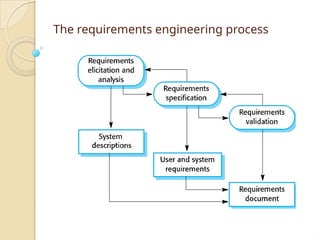
The requirements engineering process
Software specification
1. The process of establishing what services are
required and the constraints on the system’s
operation and development.
2. Requirements engineering process
i. Requirements elicitation and analysis
i. What do the system stakeholders require or
expect from the system?
ii. Requirements specification
i. Defining the requirements in detail
iii. Requirements validation
i. Checking the validity of the requirements
Software design and implementation
1. The process of converting the system
specification into an executable system.
2. Software design: a software structure that
realises the specification;
3. Implementation : Translate this structure into
an executable program;
4. The activities of design and implementation
are closely related and may be inter-leaved.
A general model of the design process
Design activities
1. Architectural design, where you identify the
overall structure of the system, the principal
components (subsystems or modules), their
relationships and how they are distributed.
2. Database design, where you design the system
data structures and how these are to be
represented in a database.
3. Interface design, where you define the
interfaces between system components.
4. Component selection and design, where you
search for reusable components. If
unavailable, you design how it will operate.
System implementation
1. The software is implemented either by
developing a program or programs or
by configuring an application system.
2. Design and implementation are
interleaved activities for most types of
software system.
3. Programming is an individual activity
with no standard process.
4. Debugging is the activity of finding
program faults and correcting these
faults.
Software validation
1. Verification and validation (V & V) is
intended to show that a system
conforms to its specification and meets
the requirements of the system
customer.
2. Involves checking and review processes
and system testing.
3. System testing involves executing the
system with test cases that are derived
from the specification of the real data to
be processed by the system.
4. Testing is the most commonly used V &
Stages of testing
Stages of testing
1. Component testing
Individual components are tested independently;
Components may be functions or objects or
coherent groupings of these entities.
2. System testing
Testing of the system as a whole. Testing of emergent
properties is particularly important. Testing of
multiple components.
3. Customer testing
Testing with customer data to check that the system
meets the customer’s needs.
Testing phases in a plan-driven software process
(V-model)
Software evolution
1. Software is inherently flexible and can change.
2. As requirements change through changing
business circumstances, the software that
supports the business must also evolve and
change.
3. Although there has been a separation between
development and evolution (maintenance) this
is increasingly irrelevant as fewer and fewer
systems are completely new.
System evolution
Q / A

Software engineering lecture: What is SE.pptx

  • 1.
  • 2.
  • 3.
  • 4.
    Process Activities 1. Realsoftware processes are inter-leaved (to put layers) sequences of technical, collaborative and managerial activities with the overall goal of specifying, designing, implementing and testing a software system. 2. The four basic process activities of specification, development, validation and evolution are organized differently in different development processes. 1. For example, in the waterfall model, they are organized in sequence, whereas in incremental development they are interleaved.
  • 5.
  • 6.
    Software specification 1. Theprocess of establishing what services are required and the constraints on the system’s operation and development. 2. Requirements engineering process i. Requirements elicitation and analysis i. What do the system stakeholders require or expect from the system? ii. Requirements specification i. Defining the requirements in detail iii. Requirements validation i. Checking the validity of the requirements
  • 7.
    Software design andimplementation 1. The process of converting the system specification into an executable system. 2. Software design: a software structure that realises the specification; 3. Implementation : Translate this structure into an executable program; 4. The activities of design and implementation are closely related and may be inter-leaved.
  • 8.
    A general modelof the design process
  • 9.
    Design activities 1. Architecturaldesign, where you identify the overall structure of the system, the principal components (subsystems or modules), their relationships and how they are distributed. 2. Database design, where you design the system data structures and how these are to be represented in a database. 3. Interface design, where you define the interfaces between system components. 4. Component selection and design, where you search for reusable components. If unavailable, you design how it will operate.
  • 10.
    System implementation 1. Thesoftware is implemented either by developing a program or programs or by configuring an application system. 2. Design and implementation are interleaved activities for most types of software system. 3. Programming is an individual activity with no standard process. 4. Debugging is the activity of finding program faults and correcting these faults.
  • 11.
    Software validation 1. Verificationand validation (V & V) is intended to show that a system conforms to its specification and meets the requirements of the system customer. 2. Involves checking and review processes and system testing. 3. System testing involves executing the system with test cases that are derived from the specification of the real data to be processed by the system. 4. Testing is the most commonly used V &
  • 12.
  • 13.
    Stages of testing 1.Component testing Individual components are tested independently; Components may be functions or objects or coherent groupings of these entities. 2. System testing Testing of the system as a whole. Testing of emergent properties is particularly important. Testing of multiple components. 3. Customer testing Testing with customer data to check that the system meets the customer’s needs.
  • 14.
    Testing phases ina plan-driven software process (V-model)
  • 15.
    Software evolution 1. Softwareis inherently flexible and can change. 2. As requirements change through changing business circumstances, the software that supports the business must also evolve and change. 3. Although there has been a separation between development and evolution (maintenance) this is increasingly irrelevant as fewer and fewer systems are completely new.
  • 16.
  • 17.