SOFTWARE ENGINEERING
SOFTWARE ENGINEERING
CHAPTEROBJECTIVES
● Know about fundamental process activities of software requirements
engineering, software development, testing, and evolution.
● Discuss thoroughly the four basic process activities.
● Explore and discuss the sequences of software processes.
3.
SOFTWARE ENGINEERING
SOFTWARE ENGINEERING
PROCESSACTIVITIES
Real software processes are interleaved sequences of technical,
collaborative, and managerial activities with the overall goal of specifying,
designing, implementing, and testing a software system.
4.
SOFTWARE ENGINEERING
SOFTWARE ENGINEERING
PROCESSACTIVITIES
Generally, processes are now tool-supported.
This means that software developers may use a range of software tools to
help them, such as requirements management systems, design model
editors, program editors, automated testing tools, and debuggers.
SOFTWARE ENGINEERING
SOFTWARE ENGINEERING
PROCESSACTIVITIES
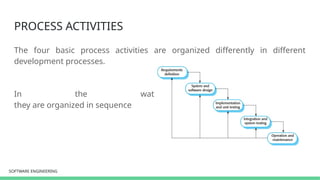
The four basic process activities are organized differently in different
development processes.
In the waterfall model,
they are organized in sequence
7.
SOFTWARE ENGINEERING
SOFTWARE ENGINEERING
PROCESSACTIVITIES
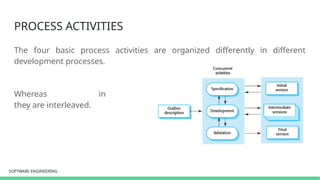
The four basic process activities are organized differently in different
development processes.
Whereas in incremental development,
they are interleaved.
8.
SOFTWARE ENGINEERING
SOFTWARE ENGINEERING
PROCESSACTIVITIES
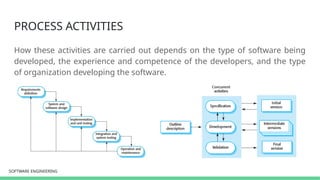
How these activities are carried out depends on the type of software being
developed, the experience and competence of the developers, and the type
of organization developing the software.
SOFTWARE ENGINEERING
SOFTWARE ENGINEERING
SOFTWARESPECIFICATION
Software specification or requirements engineering is the process of
understanding and defining what services are required from the system and
identifying the constraints on the system’s operation and development.
11.
SOFTWARE ENGINEERING
SOFTWARE ENGINEERING
SOFTWARESPECIFICATION
Before the requirements engineering process starts, a company may carry
out a feasibility or marketing study to assess whether or not there is a need
or a market for the software and whether or not it is technically and
financially realistic to develop the software required.
Feasibility studies are short-term, relatively cheap studies that inform the
decision of whether or not to go ahead with a more detailed analysis.
12.
SOFTWARE ENGINEERING
SOFTWARE ENGINEERING
SOFTWARESPECIFICATION
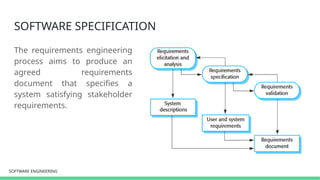
The requirements engineering
process aims to produce an
agreed requirements
document that specifies a
system satisfying stakeholder
requirements.
13.
SOFTWARE ENGINEERING
SOFTWARE ENGINEERING
SOFTWARESPECIFICATION
Requirements are usually
presented at two levels of
detail;
● End-users and customers
need a high-level statement
of the requirements.
● System developers need a
more detailed system
specification
14.
SOFTWARE ENGINEERING
SOFTWARE ENGINEERING
SOFTWARESPECIFICATION
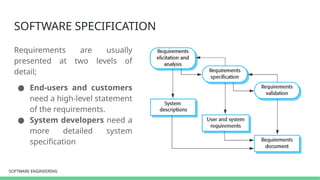
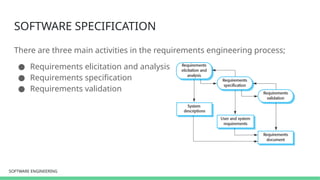
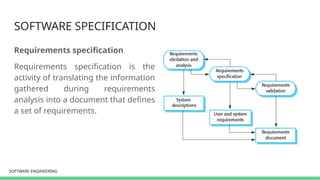
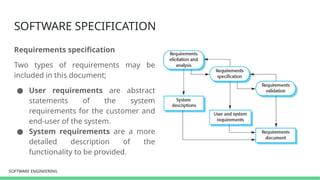
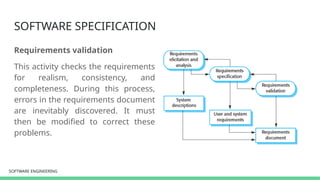
There are three main activities in the requirements engineering process;
● Requirements elicitation and analysis
● Requirements specification
● Requirements validation
15.
SOFTWARE ENGINEERING
SOFTWARE ENGINEERING
SOFTWARESPECIFICATION
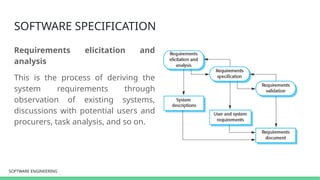
Requirements elicitation and
analysis
This is the process of deriving the
system requirements through
observation of existing systems,
discussions with potential users and
procurers, task analysis, and so on.
16.
SOFTWARE ENGINEERING
SOFTWARE ENGINEERING
SOFTWARESPECIFICATION
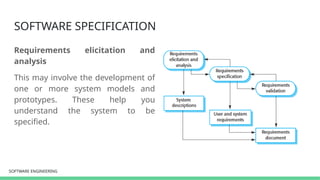
Requirements elicitation and
analysis
This may involve the development of
one or more system models and
prototypes. These help you
understand the system to be
specified.
17.
SOFTWARE ENGINEERING
SOFTWARE ENGINEERING
SOFTWARESPECIFICATION
Requirements specification
Requirements specification is the
activity of translating the information
gathered during requirements
analysis into a document that defines
a set of requirements.
18.
SOFTWARE ENGINEERING
SOFTWARE ENGINEERING
SOFTWARESPECIFICATION
Requirements specification
Two types of requirements may be
included in this document;
● User requirements are abstract
statements of the system
requirements for the customer and
end-user of the system.
● System requirements are a more
detailed description of the
functionality to be provided.
19.
SOFTWARE ENGINEERING
SOFTWARE ENGINEERING
SOFTWARESPECIFICATION
Requirements validation
This activity checks the requirements
for realism, consistency, and
completeness. During this process,
errors in the requirements document
are inevitably discovered. It must
then be modified to correct these
problems.
SOFTWARE ENGINEERING
SOFTWARE ENGINEERING
SOFTWAREDESIGN AND IMPLEMENTATION
The implementation stage of software development is the process of
developing an executable system for delivery to the customer.
A software design is a description of the structure of the software to be
implemented, the data models and structures used by the system, the
interfaces between system components and, sometimes, the algorithms
used.
22.
SOFTWARE ENGINEERING
SOFTWARE ENGINEERING
SOFTWAREDESIGN AND IMPLEMENTATION
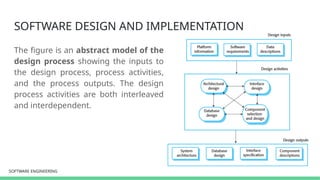
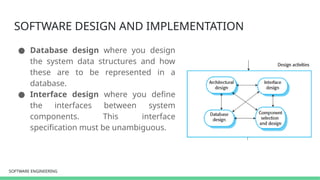
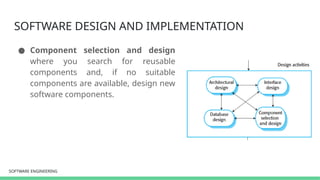
The figure is an abstract model of the
design process showing the inputs to
the design process, process activities,
and the process outputs. The design
process activities are both interleaved
and interdependent.
23.
SOFTWARE ENGINEERING
SOFTWARE ENGINEERING
SOFTWAREDESIGN AND IMPLEMENTATION
The activities in the design process vary, depending on the type of system
being developed.
For example, real-time systems require an additional stage of timing design
but may not include a database, so there is no database design involved.
24.
SOFTWARE ENGINEERING
SOFTWARE ENGINEERING
SOFTWAREDESIGN AND IMPLEMENTATION
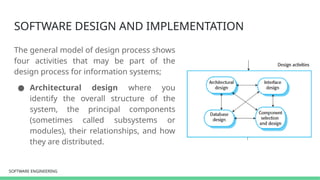
The general model of design process shows
four activities that may be part of the
design process for information systems;
● Architectural design where you
identify the overall structure of the
system, the principal components
(sometimes called subsystems or
modules), their relationships, and how
they are distributed.
25.
SOFTWARE ENGINEERING
SOFTWARE ENGINEERING
SOFTWAREDESIGN AND IMPLEMENTATION
● Database design where you design
the system data structures and how
these are to be represented in a
database.
● Interface design where you define
the interfaces between system
components. This interface
specification must be unambiguous.
26.
SOFTWARE ENGINEERING
SOFTWARE ENGINEERING
SOFTWAREDESIGN AND IMPLEMENTATION
● Component selection and design
where you search for reusable
components and, if no suitable
components are available, design new
software components.
SOFTWARE ENGINEERING
SOFTWARE ENGINEERING
SOFTWAREVALIDATION
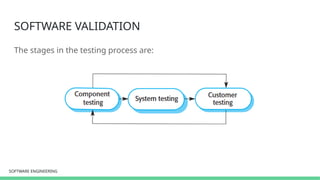
Software validation or, more generally, verification and validation (V & V) is
intended to show that a system both conforms to its specification and meets
the expectations of the system customer.
Program testing, where the system is executed using simulated test data, is
the principal validation technique.
Validation may also involve checking processes, such as inspections and
reviews, at each stage of the software process from user requirements
definition to program development.
SOFTWARE ENGINEERING
SOFTWARE ENGINEERING
SOFTWAREVALIDATION
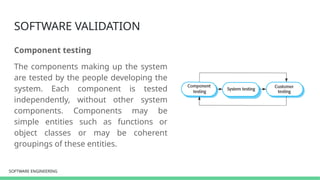
Component testing
The components making up the system
are tested by the people developing the
system. Each component is tested
independently, without other system
components. Components may be
simple entities such as functions or
object classes or may be coherent
groupings of these entities.
31.
SOFTWARE ENGINEERING
SOFTWARE ENGINEERING
SOFTWAREVALIDATION
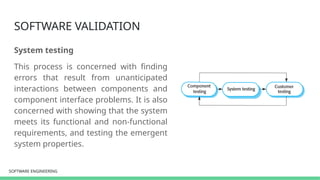
System testing
This process is concerned with finding
errors that result from unanticipated
interactions between components and
component interface problems. It is also
concerned with showing that the system
meets its functional and non-functional
requirements, and testing the emergent
system properties.
32.
SOFTWARE ENGINEERING
SOFTWARE ENGINEERING
SOFTWAREVALIDATION
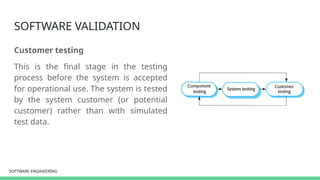
Customer testing
This is the final stage in the testing
process before the system is accepted
for operational use. The system is tested
by the system customer (or potential
customer) rather than with simulated
test data.
SOFTWARE ENGINEERING
SOFTWARE ENGINEERING
SOFTWAREEVOLUTION
The flexibility of software is one of the main reasons why more and more
software is being incorporated into large, complex systems. Once a decision
has been made to manufacture hardware, it is very expensive to make
changes to the hardware design.
35.
SOFTWARE ENGINEERING
SOFTWARE ENGINEERING
SOFTWAREEVOLUTION
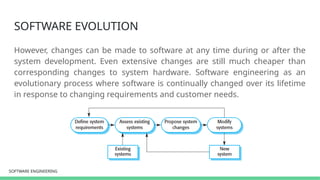
However, changes can be made to software at any time during or after the
system development. Even extensive changes are still much cheaper than
corresponding changes to system hardware. Software engineering as an
evolutionary process where software is continually changed over its lifetime
in response to changing requirements and customer needs.