UNDERWRITTEN BY
SPONSORED BY
RESEARCH SUPPORT BY
For a copy of the complete study, please visit
sandiegobusiness.org/research
Released in March 2016
PRODUCED BY
AN ECONOMIC IMPACT ANALYSIS
AND COMPARISON OF US METROS
HOW SAN DIEGO STACKS UP
TOP 10 AMONG 50 US METROS
SAN DIEGO RANKS
The software power index* combines data on the
concentration of software developers, employee retention,
computer science degrees per capita, computer/math
degree attainment among the 25+ population, job/wage
growth, average wage adjusted for cost of living and VC
dollars per capita to compare the top 50 US metros.
#10CONCENTRATION
#6TALENT
#7PROSPERITY
#4CAPITAL
CONCENTRATION
OF SOFTWARE
DEVELOPERS
EMPLOYEE
RETENTION, CS
DEGREES PER
CAPITA, COMPUTER/
MATH DEGREE
ATTAINMENT
JOB GROWTH,
WAGE GROWTH,
WAGE ADJUSTED
FOR COST
OF LIVING
VC DOLLARS
PER CAPITA
San Diego is a great place to build a company and
recruiting talent has been relatively easy. Our staff stays
with us, on average, two to three times longer than industry
averages found in Silicon Valley. We recruit from both the
local talent and universities, as well as other tech hubs like
Seattle, Boston and the Bay Area. MindTouch has found
it easy to attract interest from venture and growth capital
from outside the region.”
Aaron Fulkerson, founder & CEO, MindTouch
“
EXECUTIVE SUMMARY
SOFTWARE
DEVELOPMENT:
DRIVING SAN DIEGO’S
TECH ECOSYSTEM#8 Atlanta
#10 Denver #5 Baltimore
#9 Washington DC
#4 Boston
#2 Seattle
#3 San Francisco
#1 San Jose
#6 SAN DIEGO
#7 Raleigh
*The software power index was calculated using a weighted
ranking system reflecting each metric’s relative importance with
input from industry partners.
CORE SOFTWARE INDUSTRIES
All employees who work for software
publishers, systems designers and
computer equipment manufacturers.
SOFTWARE-DEPENDENT
Software developers and some related
support staff in software-dependent tech
sectors, including biotech, aerospace,
cleantech and telecom.
OTHER DEVELOPERS
Software developers who work in a
variety of non-tech sectors.
SOFTWARE DEVELOPMENT:
DRIVING SAN DIEGO’S TECH
ECOSYSTEM
Software development is infused throughout the region’s diverse
tech and innovation ecosystem – providing the building blocks
behind the technology revolutionizing our world today. This study
seeks to capture the economic impact of software development
across a wide variety of industries critical to San Diego’s growth.
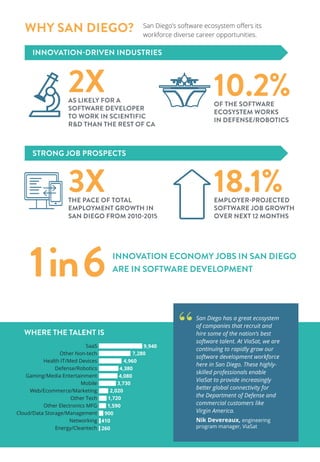
San Diego’s software ecosystem offers its
workforce diverse career opportunities.
SOFTWARE
DEVELOPMENT=
SOFTWARE ECOSYSTEM BREAKDOWN
$12.2BTOTAL
ECONOMIC
IMPACT
100K+TOTAL
JOBS
IMPACTED
SaaS
Other Non-tech
Health IT/Med Devices
Defense/Robotics
Gaming/Media Entertainment
Mobile
Web/Ecommerce/Marketing
Other Tech
Other Electronics MFG
Cloud/Data Storage/Management
Networking
Energy/Cleantech
9,940
7,280
4,960
4,380
4,080
3,730
2,020
1,720
1,590
900
410
260
WHERE THE TALENT IS
3XTHE PACE OF TOTAL
EMPLOYMENT GROWTH IN
SAN DIEGO FROM 2010-2015
18.1%EMPLOYER-PROJECTED
SOFTWARE JOB GROWTH
OVER NEXT 12 MONTHS
1in6
2XAS LIKELY FOR A
SOFTWARE DEVELOPER
TO WORK IN SCIENTIFIC
R&D THAN THE REST OF CA
10.2%OF THE SOFTWARE
ECOSYSTEM WORKS
IN DEFENSE/ROBOTICS
AN ATTRACTIVE MARKET
FOR CAPITAL INVESTMENT
Capital drives growth in software and tech-related industries. While San Diego has
traditionally commanded a large share of biotech funding, in 2015, nearly half of
San Diego’s total VC investment was in software and related industries – a 38%
increase from the previous year.
STRONG JOB PROSPECTS
CAPITAL FLOW AND DEAL TYPE, 2010-2015
CONCENTRATION OF INVESTMENT
	68%	 Merger/Acquisition	
16%	 VC/Angel/Seed	
7%	 Leveraged Buyout	
6%	 Other	
2%	 IPO
	1%	Recapitalization
SaaS
Health IT/Med Devices
Energy/Cleantech
Gaming/Media Entertainment
Mobile
Other
Defense/Robotics
Web/Ecommerce/Marketing
$228.2
$134.4
$88.8
$33.0
$19.1
$12.2
$0.6
$0.2
$517MSOFTWARE AND RELATED
VC INVESTMENT
BY PRODUCT VERTICAL IN 2015
SAN DIEGO COMPANIES RELY ON DIVERSIFIED
CAPITAL TO MEET THEIR NEEDS.
$750MSOFTWARE-DRIVEN
M&A DEALS IN 2015
• Entropic Communications
• MaintenanceNet
• Lumedyne Technologies
• HealthLine Systems
• DR Systems
• DivX
• Bretelon, Inc.
• Detectent
2XUS AVERAGE
HEALTH IT/DEVICES
6.6XUS AVERAGE
ENERGY/CLEANTECH
3.9XUS AVERAGE
BIOTECH/GENOMICS
Although biotech is not captured
in software VC verticals, software
creation within key biotech fields
such as genomics is increasingly
critical to the industry.
San Diego has a great ecosystem
of companies that recruit and
hire some of the nation’s best
software talent. At ViaSat, we are
continuing to rapidly grow our
software development workforce
here in San Diego. These highly-
skilled professionals enable
ViaSat to provide increasingly
better global connectivity for
the Department of Defense and
commercial customers like
Virgin America.
Nik Devereaux, engineering
program manager, ViaSat
“
25,060
8,920
7,280
41,260JOBS WHY SAN DIEGO?
On average, US metros receive
42% of capital investment
through M&A deals.
21,600SOFTWARE DEVELOPERS
There are 21,600 software developers in San Diego
who work across the software ecosystem.
INNOVATION-DRIVEN INDUSTRIES
INNOVATION ECONOMY JOBS IN SAN DIEGO
ARE IN SOFTWARE DEVELOPMENT
CORE SOFTWARE INDUSTRIES
All employees who work for software
publishers, systems designers and
computer equipment manufacturers.
SOFTWARE-DEPENDENT
Software developers and some related
support staff in software-dependent tech
sectors, including biotech, aerospace,
cleantech and telecom.
OTHER DEVELOPERS
Software developers who work in a
variety of non-tech sectors.
SOFTWARE DEVELOPMENT:
DRIVING SAN DIEGO’S TECH
ECOSYSTEM
Software development is infused throughout the region’s diverse
tech and innovation ecosystem – providing the building blocks
behind the technology revolutionizing our world today. This study
seeks to capture the economic impact of software development
across a wide variety of industries critical to San Diego’s growth.
San Diego’s software ecosystem offers its
workforce diverse career opportunities.
SOFTWARE
DEVELOPMENT=
SOFTWARE ECOSYSTEM BREAKDOWN
$12.2BTOTAL
ECONOMIC
IMPACT
100K+TOTAL
JOBS
IMPACTED
SaaS
Other Non-tech
Health IT/Med Devices
Defense/Robotics
Gaming/Media Entertainment
Mobile
Web/Ecommerce/Marketing
Other Tech
Other Electronics MFG
Cloud/Data Storage/Management
Networking
Energy/Cleantech
9,940
7,280
4,960
4,380
4,080
3,730
2,020
1,720
1,590
900
410
260
WHERE THE TALENT IS
3XTHE PACE OF TOTAL
EMPLOYMENT GROWTH IN
SAN DIEGO FROM 2010-2015
18.1%EMPLOYER-PROJECTED
SOFTWARE JOB GROWTH
OVER NEXT 12 MONTHS
1in6
2XAS LIKELY FOR A
SOFTWARE DEVELOPER
TO WORK IN SCIENTIFIC
R&D THAN THE REST OF CA
10.2%OF THE SOFTWARE
ECOSYSTEM WORKS
IN DEFENSE/ROBOTICS
AN ATTRACTIVE MARKET
FOR CAPITAL INVESTMENT
Capital drives growth in software and tech-related industries. While San Diego has
traditionally commanded a large share of biotech funding, in 2015, nearly half of
San Diego’s total VC investment was in software and related industries – a 38%
increase from the previous year.
STRONG JOB PROSPECTS
CAPITAL FLOW AND DEAL TYPE, 2010-2015
CONCENTRATION OF INVESTMENT
	68%	 Merger/Acquisition	
16%	 VC/Angel/Seed	
7%	 Leveraged Buyout	
6%	 Other	
2%	 IPO
	1%	Recapitalization
SaaS
Health IT/Med Devices
Energy/Cleantech
Gaming/Media Entertainment
Mobile
Other
Defense/Robotics
Web/Ecommerce/Marketing
$228.2
$134.4
$88.8
$33.0
$19.1
$12.2
$0.6
$0.2
$517MSOFTWARE AND RELATED
VC INVESTMENT
BY PRODUCT VERTICAL IN 2015
SAN DIEGO COMPANIES RELY ON DIVERSIFIED
CAPITAL TO MEET THEIR NEEDS.
$750MSOFTWARE-DRIVEN
M&A DEALS IN 2015
• Entropic Communications
• MaintenanceNet
• Lumedyne Technologies
• HealthLine Systems
• DR Systems
• DivX
• Bretelon, Inc.
• Detectent
2XUS AVERAGE
HEALTH IT/DEVICES
6.6XUS AVERAGE
ENERGY/CLEANTECH
3.9XUS AVERAGE
BIOTECH/GENOMICS
Although biotech is not captured
in software VC verticals, software
creation within key biotech fields
such as genomics is increasingly
critical to the industry.
San Diego has a great ecosystem
of companies that recruit and
hire some of the nation’s best
software talent. At ViaSat, we are
continuing to rapidly grow our
software development workforce
here in San Diego. These highly-
skilled professionals enable
ViaSat to provide increasingly
better global connectivity for
the Department of Defense and
commercial customers like
Virgin America.
Nik Devereaux, engineering
program manager, ViaSat
“
25,060
8,920
7,280
41,260JOBS WHY SAN DIEGO?
On average, US metros receive
42% of capital investment
through M&A deals.
21,600SOFTWARE DEVELOPERS
There are 21,600 software developers in San Diego
who work across the software ecosystem.
INNOVATION-DRIVEN INDUSTRIES
INNOVATION ECONOMY JOBS IN SAN DIEGO
ARE IN SOFTWARE DEVELOPMENT
CORE SOFTWARE INDUSTRIES
All employees who work for software
publishers, systems designers and
computer equipment manufacturers.
SOFTWARE-DEPENDENT
Software developers and some related
support staff in software-dependent tech
sectors, including biotech, aerospace,
cleantech and telecom.
OTHER DEVELOPERS
Software developers who work in a
variety of non-tech sectors.
SOFTWARE DEVELOPMENT:
DRIVING SAN DIEGO’S TECH
ECOSYSTEM
Software development is infused throughout the region’s diverse
tech and innovation ecosystem – providing the building blocks
behind the technology revolutionizing our world today. This study
seeks to capture the economic impact of software development
across a wide variety of industries critical to San Diego’s growth.
San Diego’s software ecosystem offers its
workforce diverse career opportunities.
SOFTWARE
DEVELOPMENT=
SOFTWARE ECOSYSTEM BREAKDOWN
$12.2BTOTAL
ECONOMIC
IMPACT
100K+TOTAL
JOBS
IMPACTED
SaaS
Other Non-tech
Health IT/Med Devices
Defense/Robotics
Gaming/Media Entertainment
Mobile
Web/Ecommerce/Marketing
Other Tech
Other Electronics MFG
Cloud/Data Storage/Management
Networking
Energy/Cleantech
9,940
7,280
4,960
4,380
4,080
3,730
2,020
1,720
1,590
900
410
260
WHERE THE TALENT IS
3XTHE PACE OF TOTAL
EMPLOYMENT GROWTH IN
SAN DIEGO FROM 2010-2015
18.1%EMPLOYER-PROJECTED
SOFTWARE JOB GROWTH
OVER NEXT 12 MONTHS
1in6
2XAS LIKELY FOR A
SOFTWARE DEVELOPER
TO WORK IN SCIENTIFIC
R&D THAN THE REST OF CA
10.2%OF THE SOFTWARE
ECOSYSTEM WORKS
IN DEFENSE/ROBOTICS
AN ATTRACTIVE MARKET
FOR CAPITAL INVESTMENT
Capital drives growth in software and tech-related industries. While San Diego has
traditionally commanded a large share of biotech funding, in 2015, nearly half of
San Diego’s total VC investment was in software and related industries – a 38%
increase from the previous year.
STRONG JOB PROSPECTS
CAPITAL FLOW AND DEAL TYPE, 2010-2015
CONCENTRATION OF INVESTMENT
	68%	 Merger/Acquisition	
16%	 VC/Angel/Seed	
7%	 Leveraged Buyout	
6%	 Other	
2%	 IPO
	1%	Recapitalization
SaaS
Health IT/Med Devices
Energy/Cleantech
Gaming/Media Entertainment
Mobile
Other
Defense/Robotics
Web/Ecommerce/Marketing
$228.2
$134.4
$88.8
$33.0
$19.1
$12.2
$0.6
$0.2
$517MSOFTWARE AND RELATED
VC INVESTMENT
BY PRODUCT VERTICAL IN 2015
SAN DIEGO COMPANIES RELY ON DIVERSIFIED
CAPITAL TO MEET THEIR NEEDS.
$750MSOFTWARE-DRIVEN
M&A DEALS IN 2015
• Entropic Communications
• MaintenanceNet
• Lumedyne Technologies
• HealthLine Systems
• DR Systems
• DivX
• Bretelon, Inc.
• Detectent
2XUS AVERAGE
HEALTH IT/DEVICES
6.6XUS AVERAGE
ENERGY/CLEANTECH
3.9XUS AVERAGE
BIOTECH/GENOMICS
Although biotech is not captured
in software VC verticals, software
creation within key biotech fields
such as genomics is increasingly
critical to the industry.
San Diego has a great ecosystem
of companies that recruit and
hire some of the nation’s best
software talent. At ViaSat, we are
continuing to rapidly grow our
software development workforce
here in San Diego. These highly-
skilled professionals enable
ViaSat to provide increasingly
better global connectivity for
the Department of Defense and
commercial customers like
Virgin America.
Nik Devereaux, engineering
program manager, ViaSat
“
25,060
8,920
7,280
41,260JOBS WHY SAN DIEGO?
On average, US metros receive
42% of capital investment
through M&A deals.
21,600SOFTWARE DEVELOPERS
There are 21,600 software developers in San Diego
who work across the software ecosystem.
INNOVATION-DRIVEN INDUSTRIES
INNOVATION ECONOMY JOBS IN SAN DIEGO
ARE IN SOFTWARE DEVELOPMENT
UNDERWRITTEN BY
SPONSORED BY
RESEARCH SUPPORT BY
For a copy of the complete study, please visit
sandiegobusiness.org/research
Released in March 2016
PRODUCED BY
AN ECONOMIC IMPACT ANALYSIS
AND COMPARISON OF US METROS
HOW SAN DIEGO STACKS UP
TOP 10 AMONG 50 US METROS
SAN DIEGO RANKS
The software power index* combines data on the
concentration of software developers, employee retention,
computer science degrees per capita, computer/math
degree attainment among the 25+ population, job/wage
growth, average wage adjusted for cost of living and VC
dollars per capita to compare the top 50 US metros.
#10CONCENTRATION
#8TALENT
#7PROSPERITY
#4CAPITAL
CONCENTRATION
OF SOFTWARE
DEVELOPERS
EMPLOYEE
RETENTION, CS
DEGREES PER
CAPITA, COMPUTER/
MATH DEGREE
ATTAINMENT
JOB GROWTH,
WAGE GROWTH,
WAGE ADJUSTED
FOR COST
OF LIVING
VC DOLLARS
PER CAPITA
San Diego is a great place to build a company and
recruiting talent has been relatively easy. Our staff stays
with us, on average, two to three times longer than industry
averages found in Silicon Valley. We recruit from both the
local talent and universities, as well as other tech hubs like
Seattle, Boston and the Bay Area. MindTouch has found
it easy to attract interest from venture and growth capital
from outside the region.”
Aaron Fulkerson, founder & CEO, MindTouch
“
EXECUTIVE SUMMARY
SOFTWARE
DEVELOPMENT:
DRIVING SAN DIEGO’S
TECH ECOSYSTEM#9 Atlanta
#8 Austin
#6 Baltimore
#10 Washington DC
#4 Boston
#2 Seattle
#3 San Francisco
#1 San Jose
#7 SAN DIEGO
#5 Raleigh
*The software power index was calculated using a weighted
ranking system reflecting each metric’s relative importance with
input from industry partners.
TABLE OF CONTENTS
SAN DIEGO SOFTWARE DEVELOPMENT STUDY // 1
THE SOFTWARE ECOSYSTEM
SOFTWARE POWER INDEX
CAPITAL
NEXT STEPS
ECONOMIC IMPACTS
APPENDIX
INTRO & OBJECTIVES
5
4
3
2
1
A look at how San Diego stacks up against
the 50 largest US metros across a variety of
key performance indicators.
An economic impact analysis that reveals
how much software development
contributes to employment and GDP.
A detailed analysis of how software
development permeates nearly every
corner of the region’s innovation economy.
A detailed breakdown of how different
types of capital flow to San Diego
companies for software development.
A road map for improving our software
development ecosystem, based on feedback
from key employers and influencers.
2-3
4-12
13-16
17-27
28-31
32-35
Citations, Acknowledgments, Methodology,
Data Tables and Survey Toplines
36
SAN DIEGO SOFTWARE DEVELOPMENT STUDY // 2
TECH INTRODUCTION
Software development is disrupting the global
marketplace like never before. Mobile apps, cloud
computing, cybersecurity, big data, digital health,
genomics, contextual robotics and the internet of things
(IoT) are rapidly changing the way people live their
lives and do business. At the core of these tools and
technologies is sophisticated software developed by
talented professionals working in a variety of industries,
and San Diego has long been one of the global centers
of software and technology development.
Recently, investment in software has exploded. In 2015, software firms received $23.8 billion
in venture capital—a 400% increase in investment since 2010 (see figure 0.1). This figure does
not even account for the growth in software-dependent fields like health IT, genomics, medical
devices, communications and clean technology. While the region has no shortage of companies
and entrepreneurs working on new consumer apps and software platforms, the region has
a particular advantage in the sciences, health and communications. For example, a software
developer in San Diego is two times more likely to work in scientific research and development—
including life sciences, cleantech and defense—than a developer elsewhere in California. As a
result, software development—a crucial component of the a tech ecosystem—is driving startup
and job growth and the convergence of new industries.
Therefore, software development is not so much an industry as it is a tool and skill that
permeates many corners of the region’s economy; most importantly, San Diego’s innovation
economy. This study deconstructs software in San Diego beyond the region’s software
publishers and IT firms, and displays how the technology is changing the landscape of all types
of innovation in San Diego.
FIGURE 0.1: NATIONWIDE VC INVESTMENT IN SOFTWARE SINCE 2005
Source: NVCA/PwC Moneytree
SAN DIEGO SOFTWARE DEVELOPMENT STUDY // 3
TECH OBJECTIVES
This study is broken down into five main components with the goal of better understanding and
communicating the region’s position and strengths in software development. This study focuses
on the universe of companies that sell a software product, platform or service to external
customers, as well as those companies that develop software as an integral part of a product or
device that they sell.
•	 THE SOFTWARE ECOSYSTEM: This study details the skilled software professionals and unique
assets that make up the software development ecosystem in San Diego.
•	 ECONOMIC IMPACTS: This study assesses the economic impacts of software development
activity on the region’s economy, employment and wages.
•	 SOFTWARE POWER INDEX: This study places San Diego among the 50 largest US metros
through a comprehensive software power index, using metrics on talent, concentration,
prosperity and capital to rank regions and draw comparisons.
•	 CAPITAL: This study demonstrates how capital flows to the region catalyze software
development and innovation, identifying strengths and weaknesses, and highlighting the
region’s unique capital attraction.
•	 NEXT STEPS: In order to remain an attractive market for software development companies
and investments, the region will need to collaborate to address key weaknesses and
reinforce strengths. This study offers recommendations for next steps on how the region can
work together to maximize the software ecosystem in San Diego.
KEY TAKEAWAYS
•	 San Diego is one of the premier US markets for software development.
•	 Software development has an immense economic impact on the region’s economy.
•	 San Diego’s software development ecosystem is unique, with employment and investment
dispersed throughout many product verticals and innovation sectors.
•	 Software development offers an immense opportunity for growth in the region, and local
collaboration can help ensure that the region will capitalize.
SAN DIEGO SOFTWARE DEVELOPMENT STUDY // 4
HIGHLIGHTS
KEYTAKEAWAY
HIGHLIGHTS
San Diego’s software ecosystem consists of
21,600 software developers and an additional
19,660 related workers. These 41,260
employees span more than 60 different
industries in San Diego, mostly in the region’s
innovation economy, and are growing at a very
high rate.
More than one-fifth of all software
development jobs are in life
sciences, defense and robotics.
San Diego software developers are
twice as likely to work in scientific
R&D than their CA counterparts.
Employers expect software jobs to
grow by 18.1% in the coming year.
21.6%
2X
18.1%
Software developer jobs have
grown 3x faster than total jobs in
San Diego from 2010-15.
3X
THESOFTWAREECOSYSTEM
1
KEYTAKEAWAY
SAN DIEGO SOFTWARE DEVELOPMENT STUDY // 5
TECH
THE SOFTWARE DEVELOPMENT ECOSYSTEM
TALENT
SOFTWARE DEVELOPERS
APPLICATIONS, SYSTEMS, WEB & COMPUTER PROGRAMMERS
SOFTWARE SUPPORT
ACCOUNTING, MARKETING, IT, MANAGEMENT, ETC.
INDUSTRIES
CORE
SOFTWARE
3 INDUSTRIES
SOFTWARE-
DEPENDENT
9 INDUSTRIES
OTHER
NON-TECH
52 INDUSTRIES
COMPANIES
INTUIT
ESET
MITCHELL
CYMER
CITY OF SAN DIEGO
JACK IN THE BOX
BANK OF AMERICA
SHARP
QUALCOMM
VIASAT
ILLUMINA
GENERAL ATOMICS
TECH
SCENARIOS
Core software industries are those in
which software development jobs make up
more than 20% of the total employment in
that industry. Given that these industries
are so heavily dependent on developers,
all employment from these industries is
included in the software ecosystem.
Because core industries only account for 39% of
all software developers, this study accounted for
software-dependent industries—those that have
a relatively high share of developers (3%-19.9%).
This study determined how many employees were
working in a support role for software development
in addition to the software developers in those
industries.
CORE SOFTWARE-DEPENDENT
The remaining software developers
work in a total of 52 different non-
tech industries (e.g. government,
education). Includes only software
developers (no support).
OTHER NON-TECH
DEVELOPERS
(examples)
INCLUDED
• Applications developer at Intuit
• Sales rep at ESET
• Computer programmer at Illumina
• Program manager for a software 	
project at VIASAT
• Research scientist at Illumina
NOT INCLUDED
• Web developer at Jack in the Box
• Finance manager at Bank of America
• Sales rep for Cox Communications 	
selling cable packages
1.1 DEFINING THE ECOSYSTEM
PART 1: THE SOFTWARE ECOSYSTEM
Approximately 21,600 applications developers, systems developers, computer programmers and web developers work
in 64 industries throughout San Diego’s economy. To determine San Diego’s software ecosystem, this study determined
which industries were most heavily concentrated with software developers, breaking them down into three categories.
FIGURE 1.1
SAN DIEGO SOFTWARE DEVELOPMENT STUDY // 6
TECH1.1 DEFINING THE ECOSYSTEM
PART 1: THE SOFTWARE ECOSYSTEM
FIGURE 1.2: SOFTWARE ECOSYSTEM BREAKDOWN
Source: California Employment Development Department,
Industry Staffing Patterns; BW Research; CBRE Research
INDUSTRY TITLE
% of Industry
Employment
from Software
Developers
% of Industry
Employment
from Software
Developers
CORE >20% 39.0%
Software Publishers 37.2% 28.5%
Computer Systems Design 29.7% 7.7%
Computer Mfg. 23.2% 2.9%
SOFTWARE-DEPENDENT 3%-19.9% 27.3%
ISPs, Web Search and Data Processing 14.7% 1.4%
Communications Equipment Mfg. 9.2% 4.5%
Nav/Measuring/Electromedical Instruments Mfg. 7.7% 1.8%
Scientific R&D Services 5.8% 10.0%
Aerospace Product and Parts Mfg. 5.3% 2.9%
Equipment and Supplies Wholesalers 4.8% 1.4%
Semiconductor/Electronic Component Mfg. 4.0% 3.7%
MGMT, Scientific and Technical Consulting 3.8% 1.1%
Electronic Shopping 3.1% 0.4%
OTHER NON-TECH DEVELOPERS <3% 33.7%
FIGURE 1.3: STAFFING PATTERN DISPERSION
Source: California Employment Development Department, Industry Staffing Patterns
Category
(Developer Share)
Software
Developers
Support/
Related
Total
Software
Core (>20%) 8,430 16,630 25,060
Dependent (3%-19.9%) 5,890 3,030 8,920
Other Non-Tech (<3%) 7,280 - 7,280
Total 21,600 19,660 41,260
Core industries account
for 61% of all software
development employment,
but only 39% of software
developers, due to the many
support positions within these
companies
SAN DIEGO SOFTWARE DEVELOPMENT STUDY // 7
TECH PART 1: THE SOFTWARE ECOSYSTEM
San Diego’s software development ecosystem is rapidly evolving. As industries continue to innovate
and adopt new technologies, software developers are increasingly finding employment in other
tech-related verticals. Sectors in the life sciences, clean technologies and telecommunications are
becoming increasingly dependent on software development professionals.
FIGURE 1.4: EMPLOYMENT GROWTH INDEX BY TYPE
Source: Bureau of Labor Statistics, OES, QCEW, 2010-14
2015 data based on simple extrapolation from CES data.
5,233
1,154
10,510
-
2,000
4,000
6,000
8,000
10,000
12,000
Software Developers Core Software Industries Software-Dependent
FIGURE 1.5: JOBS ADDED BY TYPE, 2010-15
Source: Bureau of Labor Statistics, OES, QCEW, 2010-14
2015 data based on simple extrapolation from CES data.
Software developers are growing at a
faster rate than the jobs being added
in core software industries. From
2010-15, software developers grew
by 30% compared to 4.7% growth in
core software industries and 12.9%
in software-dependent (figure 1.4).
San Diego employers added
approximately 4,100 software
developers from 2010 to 2015, but
only about 1,150 jobs were added in
the core software industries (figure
1.5). This trend indicates that software-
dependent and other industries are
hiring more software developers as
software development becomes a more
important part of their business or
function.
RAPID GROWTH
MORE DISPERSION
Employers surveyed for this
study indicated that they expect
software employment to grow
by 18.1% in the next year
1.2 DEVELOPMENT DISPERSED
SAN DIEGO SOFTWARE DEVELOPMENT STUDY // 8
TECH 1.3 SPECIALIZATION
PART 1: THE SOFTWARE ECOSYSTEM
FIGURE 1.6: SOFTWARE DEVELOPMENT
SPECIALIZATION VS. CALIFORNIA
(1.0 = AVERAGE CONCENTRATION)
Source: California Employment Development Department,
Industry Staffing Patterns; BW Research; CBRE Research
When compared to California as a whole, software developers in San Diego are far more likely
to work in industries outside of the core. Software developers in San Diego are roughly 21%
less likely to work in core industries, while 43% more likely to work in tertiary industries like
government, finance, law, engineering and medicine (figure 1.6). Within secondary industries,
developers are far more likely to work in scientific firms.
FIGURE 1.7: DETAILED SOFTWARE DEVELOPMENT SPECIALIZATION VS. CALIFORNIA
(1.0 = AVERAGE CONCENTRATION)
Source: California Employment Development Department,
Industry Staffing Patterns; BW Research; CBRE Research
A software developer in San Diego
is approximately 1.9 times more
likely to work in scientific research
and development (R&D) services
than developers in the rest of
California
Core
Software
Dependent
Other/
Non-Tech
SAN DIEGO SOFTWARE DEVELOPMENT STUDY // 9
TECH1.4 PRODUCT VERTICALS
PART 1: THE SOFTWARE ECOSYSTEM
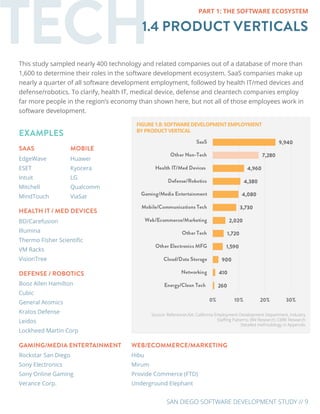
This study sampled nearly 400 technology and related companies out of a database of more than
1,600 to determine their roles in the software development ecosystem. SaaS companies make up
nearly a quarter of all software development employment, followed by health IT/med devices and
defense/robotics. To clarify, health IT, medical device, defense and cleantech companies employ
far more people in the region’s economy than shown here, but not all of those employees work in
software development.
EdgeWave
ESET
Intuit
Mitchell
MindTouch
SAAS
FIGURE 1.8: SOFTWARE DEVELOPMENT EMPLOYMENT
BY PRODUCT VERTICAL
Source: ReferenceUSA; California Employment Development Department, Industry
Staffing Patterns; BW Research; CBRE Research
Detailed methodology in Appendix
BD/Carefusion
Illumina
Thermo Fisher Scientific
VM Racks
VisionTree
HEALTH IT / MED DEVICES
Booz Allen Hamilton
Cubic
General Atomics
Kratos Defense
Leidos
Lockheed Martin Corp
DEFENSE / ROBOTICS
Huawei
Kyocera
LG
Qualcomm
ViaSat
MOBILE
Rockstar San Diego
Sony Electronics
Sony Online Gaming
Verance Corp.
GAMING/MEDIA ENTERTAINMENT
Hibu
Mirum
Provide Commerce (FTD)
Underground Elephant
WEB/ECOMMERCE/MARKETING
EXAMPLES
SAN DIEGO SOFTWARE DEVELOPMENT STUDY // 10
TECH1.5 THE GROWTH OF WEB
PART 1: THE SOFTWARE ECOSYSTEM
Even within the software developer category, occupations and programming languages are
evolving1
. Networking, database, web and mobile languages are most important to San Diego
firms, with SQL and JavaScript languages being the most important factor for firms with a
software development component. More firms are engaging in web and mobile development
than ever before and the labor market is adjusting to that trend.
FIGURE 1.9: SOFTWARE DEVELOPMENT OCCUPATION GROWTH INDEX
Source: Bureau of Labor Statistics, OES, QCEW, 2010-14
2015 data based on simple extrapolation from CES data.
Web and Systems Developers are
largely driving the growth in software
development. Web Developer jobs
more than doubled in San Diego
from 2010 to 2015. Computer
Programmers were the only
occupation to decline, but this trend
is reflected in both state and national
data. It is likely that many computer
programmers either switched
occupations or were reclassified to
Web or Systems Developer, rather
than indicating job loss.
A SHIFT TOWARD WEB/SYSTEMS
SQL, JavaScript, Java and
PHP are among the most
common web programming
languages and important to
San Diego companies that
develop software
Source: San Diego Regional EDC; Survey performed by
BW Research, depends and not sure removed. n=57
FIGURE 1.10: IMPORTANCE OF PROGRAMMING LANGUAGES WHEN
CONSIDERING A CANDIDATE FOR A POSITION, SAN DIEGO FIRMS
SAN DIEGO SOFTWARE DEVELOPMENT STUDY // 11
TECH1.6 OTHER EMPLOYER FEEDBACK
PART 1: THE SOFTWARE ECOSYSTEM
San Diego employers provided responses to a variety of questions about their software skill
needs and current workforce. Employers were generally favorable about their ability to find and
attract talent to the region. Only 10% of employers reported dissatisfaction with their ability to
recruit experienced high level talent and only 5% reported dissatisfaction with their ability to
retain valued employees. Below are responses about their workforce and hiring preferences.
Technical training and
experience were identified as the
most important aspects when
considering a candidate
Source: San Diego Regional EDC; Survey performed by
BW Research, depends and not sure removed. n=57
FIGURE 1.12: IMPORTANCE WHEN CONSIDERING A CANDIDATE FOR A
POSITION, SAN DIEGO FIRMS
Source: San Diego Regional EDC; Survey performed by
BW Research, depends and not sure removed. n=57
FIGURE 1.11: GENERAL TITLES OF PEOPLE ON SOFTWARE
TEAMS
Majority of companies surveyed have
product managers, DevOps staff
and UI/UX designers on their
software development teams
SAN DIEGO SOFTWARE DEVELOPMENT STUDY // 12
TECH1.7 COMPETITIVE ASSETS
PART 1: THE SOFTWARE ECOSYSTEM
San Diego has many local assets that help the region compete for software development jobs,
including world-class universities, successful incubators and accelerators, and local trade
organizations dedicated to helping software development companies and employers grow. The
survey of firms performed for this study showed that employers have generally favorable views
of these assets and the software ecosystem at large (see appendix for full results).
San Diego’s five major Universities, Cal State San Marcos,
Point Loma Nazarene, San Diego State University,
University of California San Diego and the University of San
Diego each offer computer science degrees1
. The students
from the programs, as well as the professors who teach
them, are an asset to the community. These universities
are not only a source of future talent for the industry but
can provide regional companies with highly-skilled interns
before graduation.
UNIVERSITIES
INCUBATORS/ACCELERATORS
The San Diego region has 27 incubators and
accelerators2
. Successful incubators like EvoNexus
have been able to support tech startups with the
mentorship, space and access to capital necessary to
succeed. EvoNexus alone has helped companies since
2010 with funding outcomes that have totaled nearly
a billion dollars at $974 million to date3
.
Software companies in San Diego have access to a wide variety of non-profits who offer customized
services to support entrepreneurs. Some of those include Connect, Cyber Center of Excellence (CCOE),
CyberHive and Tech San Diego. Connect is one of San Diego’s most well-recognized non-profits with
several programs designed to help students and businesses create lasting enterprises4
. A new wave of
tech-focused non-profits are also developing to meet more specialized sectors of the software ecosystem
from cybersecurity to IoT5
.
DEDICATED LOCAL TRADE ORGS
79% of companies surveyed for
this studied indicated that they
were satisfied or very satisfied
with education and training
institutions that help develop
software talent
SAN DIEGO SOFTWARE DEVELOPMENT STUDY // 13
HIGHLIGHTS
KEYTAKEAWAY
Software development generates large
and demonstrable impacts on the region’s
economy. This activity generates substantial
wages for employees in nearly all industries
in San Diego, while also generating millions
in new local and state tax revenues.
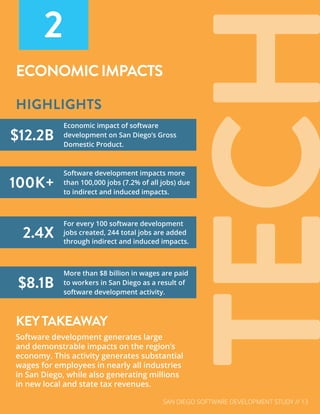
$12.2B
100K+
2.4X
$8.1B
More than $8 billion in wages are paid
to workers in San Diego as a result of
software development activity.
For every 100 software development
jobs created, 244 total jobs are added
through indirect and induced impacts.
Software development impacts more
than 100,000 jobs (7.2% of all jobs) due
to indirect and induced impacts.
Economic impact of software
development on San Diego’s Gross
Domestic Product.
ECONOMICIMPACTS
2
SAN DIEGO SOFTWARE DEVELOPMENT STUDY // 14
TECH 2.1 EMPLOYMENT
PART 2: ECONOMIC IMPACTS
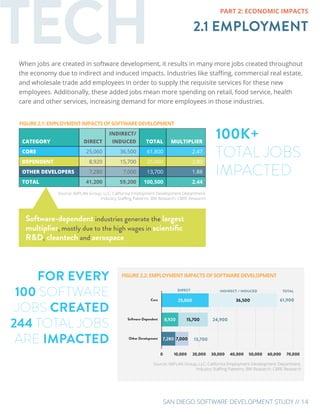
When jobs are created in software development, it results in many more jobs created throughout
the economy due to indirect and induced impacts. Industries like staffing, commercial real estate,
and wholesale trade add employees in order to supply the requisite services for these new
employees. Additionally, these added jobs mean more spending on retail, food service, health
care and other services, increasing demand for more employees in those industries.
FIGURE 2.2: EMPLOYMENT IMPACTS OF SOFTWARE DEVELOPMENT
CATEGORY DIRECT
INDIRECT/
INDUCED TOTAL MULTIPLIER
CORE 25,060 36,500 61,800 2.47
DEPENDENT 8,920 15,700 25,000 2.80
OTHER DEVELOPERS 7,280 7,000 13,700 1.88
TOTAL 41,200 59,200 100,500 2.44
FIGURE 2.1: EMPLOYMENT IMPACTS OF SOFTWARE DEVELOPMENT
100K+
TOTAL JOBS
IMPACTED
FOR EVERY
100 SOFTWARE
JOBS CREATED
244 TOTAL JOBS
ARE IMPACTED
Software-dependent industries generate the largest
multiplier, mostly due to the high wages in scientific
R&D, cleantech and aerospace
Source: IMPLAN Group, LLC; California Employment Development Department,
Industry Staffing Patterns; BW Research; CBRE Research
Source: IMPLAN Group, LLC; California Employment Development Department,
Industry Staffing Patterns; BW Research; CBRE Research
SAN DIEGO SOFTWARE DEVELOPMENT STUDY // 15
TECH2.2 GROSS DOMESTIC PRODUCT
PART 2: ECONOMIC IMPACTS
Software development generates substantial value for the region’s economy, totaling more
than $12.2 billion in gross domestic product (GDP) per year. Core software industries alone
generate more than $7.2 billion dollars in economic activity. Like employment, software-
dependent industries generate a higher multiplier effect, due to high wages and the high value of
manufacturing industries like communications equipment and aerospace.
FIGURE 2.4: VALUE ADDED IMPACTS OF SOFTWARE DEVELOPMENT
CATEGORY
DIRECT
($MIL)
INDIRECT/
INDUCED
($MIL)
TOTAL
($MIL) MULTIPLIER
CORE $4,046.9 $3,223.6 $7,270.5 1.80
DEPENDENT $1,750.4 $1,507.8 $3,258.2 1.86
OTHER DEVELOPERS $1,079.3 $616.8 $1,696.1 1.57
TOTAL $6,876.6 $5,348.3 $12,224.9 1.78
FIGURE 2.3: VALUE ADDED IMPACTS OF SOFTWARE DEVELOPMENT
$12.2B
TOTAL
ECONOMIC
IMPACT
TOTAL
SOFTWARE
IMPACTS
ACCOUNT
FOR
5.9% OF ALL
LOCAL GDP
Source: IMPLAN Group, LLC; California Employment Development Department,
Industry Staffing Patterns; BW Research; CBRE Research
Source: IMPLAN Group, LLC; California Employment Development Department,
Industry Staffing Patterns; BW Research; CBRE Research
SAN DIEGO SOFTWARE DEVELOPMENT STUDY // 16
TECH 2.3 OTHER IMPACTS
PART 2: ECONOMIC IMPACTS
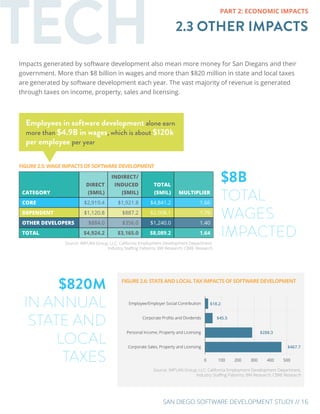
Impacts generated by software development also mean more money for San Diegans and their
government. More than $8 billion in wages and more than $820 million in state and local taxes
are generated by software development each year. The vast majority of revenue is generated
through taxes on income, property, sales and licensing.
FIGURE 2.6: STATE AND LOCAL TAX IMPACTS OF SOFTWARE DEVELOPMENT
CATEGORY
DIRECT
($MIL)
INDIRECT/
INDUCED
($MIL)
TOTAL
($MIL) MULTIPLIER
CORE $2,919.4 $1,921.8 $4,841.2 1.66
DEPENDENT $1,120.8 $887.2 $2,008.1 1.79
OTHER DEVELOPERS $884.0 $356.0 $1,240.0 1.40
TOTAL $4,924.2 $3,165.0 $8,089.2 1.64
FIGURE 2.5: WAGE IMPACTS OF SOFTWARE DEVELOPMENT
$8B
TOTAL
WAGES
IMPACTED
$820M
IN ANNUAL
STATE AND
LOCAL
TAXES
Employees in software development alone earn
more than $4.9B in wages, which is about $120k
per employee per year
Source: IMPLAN Group, LLC; California Employment Development Department,
Industry Staffing Patterns; BW Research; CBRE Research
Source: IMPLAN Group, LLC; California Employment Development Department,
Industry Staffing Patterns; BW Research; CBRE Research
SAN DIEGO SOFTWARE DEVELOPMENT STUDY // 17
HIGHLIGHTS
KEYTAKEAWAY
San Diego received more than $1 billion
in VC investment in 2015, which ranks
4th in the US on a per capita basis.
$1.16B
San Diego software developers
receive higher than average cost-of-
living-adjusted pay.
$97K
Companies in core software
industries in San Diego enjoy lower
replacement rates for talent.
3.1%
San Diego is ranked the seventh
best metro for software
development according to the index.
The Software Power Index demonstrates
that San Diego is one of the top metro areas
for software development in the US. San
Diego has unique competitive advantages
over many regions, scoring above average in
every measure.
#7
SOFTWAREPOWERINDEX
3
SAN DIEGO SOFTWARE DEVELOPMENT STUDY // 18
TECH3.1 COMPOSITE SCORE
PART 3: POWER INDEX
The Software Power Index combines a variety of factors to score San Diego’s software development
activity relative to other major metro areas in the US. The findings show that San Diego is a premier region
for software development. The region has many unique advantages, as demonstrated on the following
pages, but the high composite score is in large part due to the region’s well-roundedness, scoring high in
nearly every measure studied.
An index was developed to take a more holistic look at a region’s software development capacity. Rather
than focusing simply on one category, like size or talent base, this study analyzed the 50 largest US metros
by looking at the concentration of software developers, the ability to attract, retain and develop talent, the
continued growth and prosperity for developers, and the region’s attractiveness for capital investment.
COMPOSITE
30% 30% 30% 10%
COMPOSITESCORE
#7114.3 / 50
San Diego ranked in
the top ten in every
category measured
#8
#7
Source:
San Diego Regional EDC;
CBRE Research;
BLS OES; NCES IPEDS;
US Census Bureau ACS, QWI;
BEA; NVCA/PwC Moneytree
FIGURE 3.1 FIGURE 3.2
SAN DIEGO SOFTWARE DEVELOPMENT STUDY // 19
TECH 3.2 CONCENTRATION
PART 3: POWER INDEX
Concentration of software development workers was the most impactful single metric used
in the index, accounting for 30% of the composite score. Without the requisite number of app
developers, systems developers and computer programmers, a region is unlikely to compete for
business or investment in software development. In this measure, San Diego ranked 10th, the
lowest of any category in the index.
SANDIEGO
/ TOP 50 AVG. RANK
14.9
SOFTWARE DEVELOPERS PER 1,000
WORKERS
(BLS OES 2014)
/ 13.1
#10
CONCENTRATIONSCORE
110.2 / 50
#10
“San Diego has a great ecosystem of
companies that recruit and hire some of the
nation’s best software talent. At ViaSat, we
are continuing to rapidly grow our software
development workforce here in San Diego.
These highly-skilled professionals enable
ViaSat to provide increasingly better
global connectivity for the Department of
Defense and commercial customers like
Virgin America.”
NIK DEVEREAUX, ENGINEERING
PROGRAM MANAGER, VIASAT
FACTORS(30% OF TOTAL)
FIGURE 3.4: SOFTWARE DEVELOPER CONCENTRATION (TOP 50 US METROS)
Source:
San Diego Regional EDC;
CBRE Research;
BLS OES
Source:
San Diego Regional EDC;
CBRE Research;
BLS OES
FIGURE 3.3
SAN DIEGO SOFTWARE DEVELOPMENT STUDY // 20
TECH 3.3 TALENT
PART 3: POWER INDEX
Talent is the lifeblood of any technology ecosystem and San Diego is a top location for software
development talent. The region scores particularly high in developing a pipeline of software developer
talent, due in large part to UC San Diego’s Jacobs School of Engineering, which conferred the third most
undergraduate computer science degrees in 2014, behind only Arizona State and Georgia Tech1
.
SANDIEGO
/ TOP 50 AVG. RANK
4.0
COMPUTER SCIENCE DEGREES
AWARDED PER 10,000 WORKERS
(NCES IPEDS 2014)
/ 2.3
#7
2.0%
% OF 25+ POPULATION WITH
COMPUTER OR MATH DEGREE
(US CENSUS ACS 2014 1-YR ESTIMATES)
/ 1.8%
#14
3.1%
% OF TOTAL DEGREE-HOLDING IT
WORKERS REPLACED IN 2014
(US CENSUS QWI 2014 AVERAGE)
/ 3.4%
#13
SCORE
#8115.5 / 50
PIPELINETALENTPOOLRETENTION
San Diego is one of only five
metros with above average
concentration of developers and
better than average retention
“San Diego is a great place to build a company and recruiting talent
has been relatively easy. Our staff stays with us, on average, two to
three times longer than industry averages found in Silicon Valley. We
recruit from both the local talent and universities, as well as other
tech hubs like Seattle, Boston and the Bay Area.”
AARON FULKERSON, FOUNDER & CEO, MINDTOUCH
FACTORS(WEIGHTED EQUALLY AT 10% OF TOTAL)
Source:
San Diego Regional EDC;
CBRE Research;
BLS OES; NCES IPEDS;
US Census Bureau ACS, QWI;
FIGURE 3.5
SAN DIEGO SOFTWARE DEVELOPMENT STUDY // 21
TECH 3.4 PROSPERITY
PART 3: POWER INDEX
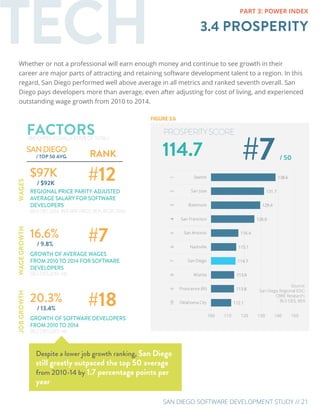
Whether or not a professional will earn enough money and continue to see growth in their
career are major parts of attracting and retaining software development talent to a region. In this
regard, San Diego performed well above average in all metrics and ranked seventh overall. San
Diego pays developers more than average, even after adjusting for cost of living, and experienced
outstanding wage growth from 2010 to 2014.
SANDIEGO
/ TOP 50 AVG. RANK
$97K
REGIONAL PRICE PARITY-ADJUSTED
AVERAGE SALARY FOR SOFTWARE
DEVELOPERS
(BLS OES 2014, BEA RPP PRICE DEFLATOR 2014)
/ $92K
#12
16.6%
GROWTH OF AVERAGE WAGES
FROM 2010 TO 2014 FOR SOFTWARE
DEVELOPERS
(BLS OES 2010-14)
/ 9.8%
#7
20.3%
GROWTH OF SOFTWARE DEVELOPERS
FROM 2010 TO 2014
(BLS OES 2010-14)
/ 13.4%
#18
#7114.7 / 50
WAGESWAGEGROWTHJOBGROWTH
PROSPERITYSCORE
Despite a lower job growth ranking, San Diego
still greatly outpaced the top 50 average
from 2010-14 by 1.7 percentage points per
year
FACTORS(WEIGHTED EQUALLY AT 10% OF TOTAL)
Source:
San Diego Regional EDC;
CBRE Research;
BLS OES; BEA
FIGURE 3.6
SAN DIEGO SOFTWARE DEVELOPMENT STUDY // 22
TECH 3.5 CAPITAL
PART 3: POWER INDEX
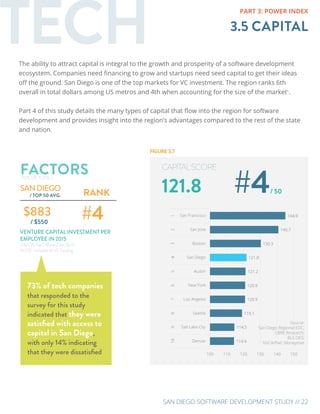
The ability to attract capital is integral to the growth and prosperity of a software development
ecosystem. Companies need financing to grow and startups need seed capital to get their ideas
off the ground. San Diego is one of the top markets for VC investment. The region ranks 6th
overall in total dollars among US metros and 4th when accounting for the size of the market1
.
Part 4 of this study details the many types of capital that flow into the region for software
development and provides insight into the region’s advantages compared to the rest of the state
and nation.
SANDIEGO
/ TOP 50 AVG. RANK
$883
VENTURE CAPITAL INVESTMENT PER
EMPLOYEE IN 2015
(NVCA, PwC MoneyTree, BLS)
NOTE: Includes all VC funding
/ $550
#4
#4	121.8 / 50
CAPITALSCORE
73% of tech companies
that responded to the
survey for this study
indicated that they were
satisfied with access to
capital in San Diego,
with only 14% indicating
that they were dissatisfied
FACTORS(10% OF TOTAL)
Source:
San Diego Regional EDC;
CBRE Research;
BLS OES;
NVCA/PwC Moneytree
FIGURE 3.7
SAN DIEGO SOFTWARE DEVELOPMENT STUDY // 23
TECH3.6 PEER COMPARISONS
PART 3: POWER INDEX
MAJOR TECH CENTERS NOT IN TOP 10
Los Angeles (LA) and New York City (NYC) are two major US regions that may surprise many to see out of the top
ten in the composite score. Both regions have gone through concerted branding efforts to demonstrate their tech
prowess. New York has taken the nickname “Silicon Alley” to reflect the booming tech activities in Manhattan1
, while
Los Angeles-area leaders have branded the western part of the region “Silicon Beach” to emphasize its large and
growing tech scene2
. While these regions are two of the largest tech centers, they score low on multiple important
metrics.
Los Angeles suffers in large part due to the size and complexity of the region’s economy, depressing its concentration
score below the average, but the region also exhibits slow job growth and talent shortcomings according to the
index. LA has a relatively low share of computer and math degree holders age 25 and older, and their replacement
rate of degree-holding workers in core software firms is below average, indicating that firms have challenges
attracting and retaining top talent.
Despite its size and economic complexity, NYC actually has a higher than average concentration of software
developers, but lacks a concentrated pipeline of talent coming out of the region’s universities. The region also ranked
40th in replacement rate, resulting in a 32nd place ranking in talent.
SD VS. NYC (RANK 15)
FIGURE 3.8: SD/NYC COMPARISON OF ALL FACTORS FIGURE 3.9: SD/LA COMPARISON OF ALL FACTORS
SD VS. LA (RANK 16)
Source:
San Diego Regional EDC; CBRE Research; BLS OES; NCES IPEDS;
US Census Bureau ACS, QWI; BEA; NVCA/PwC Moneytree
Source:
San Diego Regional EDC; CBRE Research; BLS OES; NCES IPEDS;
US Census Bureau ACS, QWI; BEA; NVCA/PwC Moneytree
SAN DIEGO SOFTWARE DEVELOPMENT STUDY // 24
TECH
Source:
San Diego Regional EDC; CBRE Research; BLS OES; NCES IPEDS;
US Census Bureau ACS, QWI; BEA; NVCA/PwC Moneytree
Source:
San Diego Regional EDC; CBRE Research; BLS OES; NCES IPEDS;
US Census Bureau ACS, QWI; BEA; NVCA/PwC Moneytree
3.6 PEER COMPARISONS
PART 3: POWER INDEX
OTHER TOP 10 PEERS
San Diego peers Austin and Boston both unsurprisingly ranked in the top 10 with many scores similar to San Diego.
Austin has received a lot of attention in the past several years as a booming Southwest tech hub3
, while Boston has
long been known as a center of innovation surrounding several of the world’s top universities4
. Both regions have
a large talent pool of computer and math degree holders and generate a large pipeline of graduates coming out of
local universities, most notably at University of Texas at Austin and MIT. Both regions are also already significantly
more concentrated with developers.
Although Boston and Austin are competitive with San Diego, both regions experienced weak recent growth
compared to San Diego and other major metros, especially when looking at wage growth in Austin. In addition,
employers in Austin already pay a lower adjusted wage than in San Diego and these negative figures place Austin
36th in prosperity. These negatives, along with a low employee retention rate, are enough to drive Austin slightly
below San Diego in the rankings.
SD VS. BOSTON (RANK 4)
FIGURE 3.10: SD/BOSTON COMPARISON OF ALL FACTORS FIGURE 3.11: SD/AUSTIN COMPARISON OF ALL FACTORS
SD VS. AUSTIN (RANK 8)
SAN DIEGO SOFTWARE DEVELOPMENT STUDY // 25
TECH
Source:
San Diego Regional EDC; CBRE Research; BLS OES; NCES IPEDS;
US Census Bureau ACS, QWI; BEA; NVCA/PwC Moneytree
Source:
San Diego Regional EDC; CBRE Research; BLS OES; NCES IPEDS;
US Census Bureau ACS, QWI; BEA; NVCA/PwC Moneytree
3.6 PEER COMPARISONS
PART 3: POWER INDEX
SURPRISINGLY HIGH
People who are unfamiliar with the tech scenes in Raleigh and Baltimore are likely to be surprised to see the two
regions ranked in the top ten and ahead of San Diego, but both regions have dense and growing tech scenes.
Raleigh’s tech scene is anchored by North Carolina State, with nearby UNC—Chapel Hill and Duke University
rounding out the Research Triangle region5
. This dense core of top research universities makes Raleigh the number
two location for talent, most notably in pipeline and degree attainment. The region has a relatively high replacement
rate (ranked 25th) and low capital attraction (20th), but very high concentration and talent scores make it one of the
top software development regions.
Like San Diego, the Baltimore region benefits from a large federal military presence6
. The area is home to Fort
Meade, which includes the US Cyber Command, National Security Agency (NSA) and Defense Information Systems
Agency (DISA). These defense assets likely attract top talent to the region, which is reflected in its high degree
attainment score and rank (6th). Software developers in the region also receive the third highest wages and have
experienced the largest wage growth in recent years.
SD VS. RALEIGH (RANK 5)
FIGURE 3.12: SD/RALEIGH COMPARISON OF ALL FACTORS FIGURE 3.13: SD/BALTIMORE COMPARISON OF ALL FACTORS
SD VS. BALTIMORE (RANK 6)
SAN DIEGO SOFTWARE DEVELOPMENT STUDY // 26
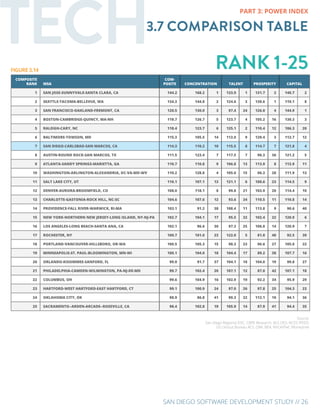
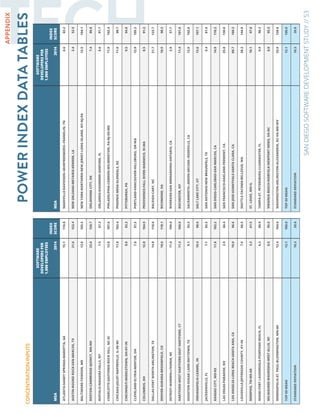
TECH3.7 COMPARISON TABLE
PART 3: POWER INDEX
COMPOSITE
RANK MSA
COM-
POSITE CONCENTRATION TALENT PROSPERITY CAPITAL
1 SAN JOSE-SUNNYVALE-SANTA CLARA, CA 144.2 168.2 1 133.9 1 131.7 2 140.7 2
2 SEATTLE-TACOMA-BELLEVUE, WA 134.3 144.8 2 124.6 3 138.6 1 119.1 8
3 SAN FRANCISCO-OAKLAND-FREMONT, CA 120.5 130.0 3 97.4 24 126.0 4 144.9 1
4 BOSTON-CAMBRIDGE-QUINCY, MA-NH 119.7 126.7 5 123.7 4 105.2 16 130.3 3
5 RALEIGH-CARY, NC 118.4 123.7 6 125.1 2 110.4 12 106.3 20
6 BALTIMORE-TOWSON, MD 115.3 105.5 14 112.0 9 129.4 3 112.7 12
7 SAN DIEGO-CARLSBAD-SAN MARCOS, CA 114.3 110.2 10 115.5 8 114.7 7 121.8 4
8 AUSTIN-ROUND ROCK-SAN MARCOS, TX 111.5 123.4 7 117.5 7 90.3 36 121.2 5
9 ATLANTA-SANDY SPRINGS-MARIETTA, GA 110.7 110.8 9 106.8 13 113.9 8 112.9 11
10 WASHINGTON-ARLINGTON-ALEXANDRIA, DC-VA-MD-WV 110.2 128.8 4 105.0 15 96.3 28 111.9 13
11 SALT LAKE CITY, UT 110.1 107.1 13 121.1 6 100.6 23 114.5 9
12 DENVER-AURORA-BROOMFIELD, CO 108.0 118.1 8 99.8 21 103.9 20 114.4 10
13 CHARLOTTE-GASTONIA-ROCK HILL, NC-SC 104.6 107.6 12 93.6 34 110.5 11 110.8 14
14 PROVIDENCE-FALL RIVER-WARWICK, RI-MA 103.1 91.2 38 108.4 11 113.8 9 90.6 40
15 NEW YORK-NORTHERN NEW JERSEY-LONG ISLAND, NY-NJ-PA 102.7 104.1 17 95.5 32 102.4 22 120.9 6
16 LOS ANGELES-LONG BEACH-SANTA ANA, CA 102.1 96.6 30 97.3 25 106.0 14 120.9 7
17 ROCHESTER, NY 100.7 101.0 23 122.0 5 81.8 48 92.5 39
18 PORTLAND-VANCOUVER-HILLSBORO, OR-WA 100.5 105.3 15 98.3 23 96.6 27 105.0 22
19 MINNEAPOLIS-ST. PAUL-BLOOMINGTON, MN-WI 100.1 104.0 18 104.4 17 89.2 38 107.7 16
20 ORLANDO-KISSIMMEE-SANFORD, FL 99.9 91.7 37 104.1 18 104.0 19 99.8 27
21 PHILADELPHIA-CAMDEN-WILMINGTON, PA-NJ-DE-MD 99.7 102.4 20 107.1 12 87.0 42 107.1 18
22 COLUMBUS, OH 99.6 104.9 16 102.9 19 92.2 34 95.9 29
23 HARTFORD-WEST HARTFORD-EAST HARTFORD, CT 99.1 100.9 24 97.0 26 97.8 25 104.3 23
24 OKLAHOMA CITY, OK 98.9 86.8 41 99.3 22 112.1 10 94.1 36
25 SACRAMENTO--ARDEN-ARCADE--ROSEVILLE, CA 98.4 102.8 19 105.9 14 87.9 41 94.4 35
RANK 1-25
Source:
San Diego Regional EDC; CBRE Research; BLS OES; NCES IPEDS;
US Census Bureau ACS, QWI; BEA; NVCA/PwC Moneytree
FIGURE 3.14
SAN DIEGO SOFTWARE DEVELOPMENT STUDY // 27
TECH3.7 COMPARISON TABLE
PART 3: POWER INDEX
RANK 26-50
COMPOSITE
RANK MSA
COM-
POSITE CONCENTRATION TALENT PROSPERITY CAPITAL
26 PITTSBURGH, PA 98.3 94.9 33 104.8 16 92.4 33 106.4 19
27 INDIANAPOLIS-CARMEL, IN 96.9 98.0 28 90.0 41 103.0 21 95.8 31
28 ST. LOUIS, MO-IL 96.6 97.0 29 96.0 30 93.3 31 107.3 17
29 DALLAS-FORT WORTH-ARLINGTON, TX 96.2 110.0 11 83.5 48 94.8 29 97.1 28
30 HOUSTON-SUGAR LAND-BAYTOWN, TX 96.1 93.5 34 86.9 44 108.1 13 95.5 32
31 SAN ANTONIO-NEW BRAUNFELS, TX 95.6 81.9 45 88.2 43 116.4 5 95.8 30
32 CHICAGO-JOLIET-NAPERVILLE, IL-IN-WI 95.5 102.4 21 96.6 27 82.9 46 109.7 15
33 DETROIT-WARREN-LIVONIA, MI 95.5 100.0 25 90.6 39 97.0 26 92.6 38
34 KANSAS CITY, MO-KS 95.3 102.2 22 89.9 42 94.0 30 94.8 33
35 PHOENIX-MESA-GLENDALE, AZ 94.6 99.7 26 85.9 45 98.1 24 94.8 34
36 VIRGINIA BEACH-NORFOLK-NEWPORT NEWS, VA-NC 94.3 92.3 36 90.2 40 104.7 17 80.9 44
37 NASHVILLE-DAVIDSON--MURFREESBORO--FRANKLIN, TN 93.2 83.2 44 77.1 49 115.1 6 105.8 21
38 CINCINNATI-MIDDLETOWN, OH-KY-IN 92.7 93.2 35 93.1 35 89.0 39 100.5 26
39 LOUISVILLE-JEFFERSON COUNTY, KY-IN 91.8 86.5 42 109.3 10 80.9 49 88.0 43
40 BUFFALO-NIAGARA FALLS, NY 91.3 87.3 40 100.5 20 92.7 32 72.1 46
41 TAMPA-ST. PETERSBURG-CLEARWATER, FL 90.4 96.2 31 83.6 47 91.5 35 89.8 41
42 MIAMI-FORT LAUDERDALE-POMPANO BEACH, FL 90.0 80.9 46 96.5 28 88.1 40 103.3 24
43 MILWAUKEE-WAUKESHA-WEST ALLIS, WI 89.1 95.0 32 95.6 31 80.2 50 79.0 45
44 CLEVELAND-ELYRIA-MENTOR, OH 89.1 87.5 39 92.2 38 83.4 45 101.6 25
45 RICHMOND, VA 88.6 98.3 27 92.6 37 85.9 43 56.1 48
46 RIVERSIDE-SAN BERNARDINO-ONTARIO, CA 86.1 57.7 49 93.7 33 104.2 18 93.9 37
47 LAS VEGAS-PARADISE, NV 83.9 66.4 47 83.9 46 105.4 15 71.9 47
48 JACKSONVILLE, FL 83.5 85.5 43 92.8 36 85.4 44 43.7 49
49 NEW ORLEANS-METAIRIE-KENNER, LA 75.6 52.5 50 96.3 29 89.5 37 40.8 50
50 MEMPHIS, TN-MS-AR 73.3 61.5 48 71.7 50 81.8 47 88.2 42
Source:
San Diego Regional EDC; CBRE Research; BLS OES; NCES IPEDS;
US Census Bureau ACS, QWI; BEA; NVCA/PwC Moneytree
FIGURE 3.15
SAN DIEGO SOFTWARE DEVELOPMENT STUDY // 28
HIGHLIGHTS
KEYTAKEAWAY
San Diego has long been one of the top markets
for VC investment in the US, but the region is
often considered only a biotech town, despite
receiving large sums of software investment.
This study dissects recent investments to show
that the region has unique advantages compared
to California and the US within the software
development ecosystem.
From 2010-15, M&A activity
accounted for more than two-thirds
of software-related investment.
68%
San Diego receives two times the
national average of VC invested in
health IT and medical devices.
2X
More than a half billion dollars in
venture capital flowed to San Diego
companies in 2015.
$517M
Software development and related
investment accounted for nearly
half of all VC in San Diego in 2015.
44.3%
CAPITAL
4
SAN DIEGO SOFTWARE DEVELOPMENT STUDY // 29
TECH 4.1 RECENT TRENDS
PART 4: CAPITAL
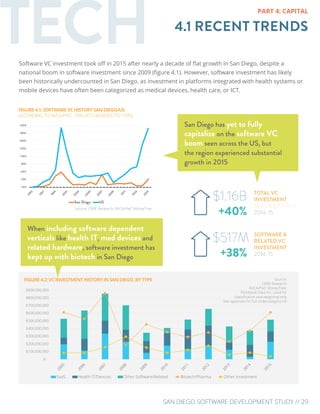
Software VC investment took off in 2015 after nearly a decade of flat growth in San Diego, despite a
national boom in software investment since 2009 (figure 4.1). However, software investment has likely
been historically undercounted in San Diego, as investment in platforms integrated with health systems or
mobile devices have often been categorized as medical devices, health care, or ICT.
$1.16B TOTAL VC
INVESTMENT
(ALL INDUSTRIES)
2014-15+40%
$517M SOFTWARE &
RELATED VC
INVESTMENT
2014-15+38%
FIGURE 4.2: VC INVESTMENT HISTORY IN SAN DIEGO, BY TYPE
FIGURE 4.1: SOFTWARE VC HISTORY SAN DIEGO/US
ACCORDING TO NVCA/PWC, 1995-2015 (INDEXED TO 1995)
San Diego has yet to fully
capitalize on the software VC
boom seen across the US, but
the region experienced substantial
growth in 2015
When including software dependent
verticals like health IT, med devices and
related hardware, software investment has
kept up with biotech in San Diego
Source:
CBRE Research
NVCA/PwC MoneyTree;
Pitchbook Data Inc. used for
classification and weighting only
See appendix for full code/category list
Source: CBRE Research; NVCA/PwC MoneyTree
SAN DIEGO SOFTWARE DEVELOPMENT STUDY // 30
TECH 4.2 SPECIALIZATION
PART 4: CAPITAL
San Diego has a unique specialization in software development that lives within the universe
of heatlhcare and energy. San Diego receives roughly two times the investment in health IT
and medical devices when compared to the US average, and more than six times the average
cleantech investment. These two industries rely heavily on software for product development.
San Diego is also one of the largest recipients of biotech funding, an industry that is becoming
increasingly reliant on bioinformatics—software platforms that are revolutionizing the analysis
and editing of DNA, genetics and neuroscience1
. While these deals may often fall under biotech
and thus are not counted as part of the software universe, San Diego is poised to capitalize on the
growing wave bioinformatics.
In 2015, VC investment in
SaaS dominated. In past
years, SaaS investment was
more on par with investments
in health IT/devices and
energy/cleantech
Source:
CBRE Research
NVCA/PwC MoneyTree;
Pitchbook Data Inc. used for
classification and weighting only
FIGURE 4.3: VC INVESTMENT IN SAN DIEGO BY PRODUCT VERTICAL
SAN DIEGO SOFTWARE DEVELOPMENT STUDY // 31
TECH 4.3 OTHER CAPITAL
PART 4: CAPITAL
While venture capital deals tend to dominate the dialogue around capital, they only make up a small
amount of the total capital invested into San Diego. Mergers and acquisitions (M&A) dominate investment
into San Diego’s software companies. M&A deals can sometimes come with concerns over whether or not
it will result in a firm downsizing or leaving the area altogether, but these deals often provide the financial
and institutional support for companies to grow in San Diego. Recent examples like BD’s acquisition of
Carefusion show that M&A deals can result in significant investment in the San Diego community beyond
the acquisition of assets and intellectual property1
.
When looking at total investment,
including IPOs and M&A deals, most
software and related investment went to
health IT, med devices and electronics
manufacturers
On average, US metros receive only 42%
of capital investment in software and related
companies through M&A deals versus 68%
in San Diego
Software and related investment
represented 29.6% of all investment
from 2010-15, compared to biotech/
pharma, which accounted for 29.4%
Source: CBRE Research
Pitchbook Data Inc. used for classification and weighting
Source:
CBRE Research
Pitchbook Data Inc. used for
classification and weighting
Source: CBRE Research
Pitchbook Data Inc. used for classification and weighting
FIGURE 4.4: TOTAL INVESTMENT IN SAN DIEGO BY TYPE
(2010-15)
FIGURE 4.5: TOTAL INVESTMENT IN SAN DIEGO BY GROUP
(2010-15)
FIGURE 4.6: TOTAL INVESTMENT IN SAN DIEGO BY VERTICAL
(2010-15)
SAN DIEGO SOFTWARE DEVELOPMENT STUDY // 32
HIGHLIGHTS
Expand access to capital
Strengthen industry/university partnerships
Support infrastructure for tech hubs
Prime the talent pipeline and create workforce
opportunities
KEYTAKEAWAY
This study has demonstrated that San Diego
is one of the top software development
markets in the US. In order to remain a
competitive software development market,
the region will need to come together to
address key challenges to capitalize on
forthcoming opportunities.
NEXTSTEPS
5
Build upon regional branding efforts
SAN DIEGO SOFTWARE DEVELOPMENT STUDY // 33
TECH NEXT STEPS
PART 5
While San Diego’s software ecosystem is competitive, if the region wants to continue to attract talent
and investment it should amplify and replicate tools, programs, and systems that have strengthened its
position as a software and tech hub.
PRIME THE TALENT PIPELINE AND CREATE WORKFORCE OPPORTUNITIES. San Diego is home
to numerous universities and community colleges that offer computer science and related degrees.
Additionally, school districts and other programs engage students in software-centric careers from
an early age. Alternative programs also cater to individuals who want to explore software and related
careers.
•	 FOCUS EFFORTS TO PROMOTE AND EXPAND EXISTING CODE ACADEMIES. Code academies and highly
specialized programs are training for individuals who may have no previous coding experience.
With demand for these programs skyrocketing, San Diego must help scale these models.
•	 SCALE THINKABIT LAB FOR SAN DIEGO EMPLOYERS. Qualcomm’s Thinkabit Lab is a lab, makers’ space
and classroom for 6th through 8th grade students to spur interest in STEM and programming. Its
success has inspired San Diego Mayor Kevin Faulconer, San Diego Regional EDC and San Diego
Unified School District to establish new labs at San Diego companies interested in replicating the
model.
•	 DEVELOP PATHWAYS AND JOB SHADOW PROGRAMS FOR HIGH SCHOOL STUDENTS. California Career
Pathways Trust has funded a regional consortium of high school and community college districts in
San Diego County to support career pathway development and work-based learning opportunities.
The grant encourages students to pursue educational opportunities and employment in software
development and other tech sectors.
SUPPORT INFRASTRUCTURE FOR TECH HUBS. Companies and entrepreneurs need both hard
(e.g. transit, fiber connectivity, space) and soft (e.g. mentoring) infrastructure to grow the ecosystem.
Expanding existing programs will catalyze San Diego’s tech hub.
•	 FOCUS ON INCUBATORS AND ACCELERATORS. Since 2010, non-profit incubator EvoNexus has helped
its companies by providing mentorship, space and access to capital, helping their companies raise
more nearly a billion dollars in capital. San Diego should continue to support EvoNexus and other
San Diego incubators and accelerators, including JLabs, HERA LABS and Plug and Play.
•	 EXPAND EXISTING CO-WORKING OPTIONS. Co-working spaces offer flexible workspace, competitive
pricing, access to talent and spur creativity. San Diego must continue to scale these programs and
offer resources for tenants to grow their companies.
•	 WIRE SAN DIEGO WITH FIBER CONNECTIVITY. Fiber connectivity – super high-speed internet connectivity
– increases productivity of the data-dependent tech ecosystem. San Diego’s cities should continue
to pursue fiber opportunities.
•	 INVEST IN SMART GROWTH AND PUBLIC TRANSIT. Continue developing walkable neighborhoods and
infrastructure that supports alternative modes of transportation to attract a younger workforce
across all sectors.
SAN DIEGO SOFTWARE DEVELOPMENT STUDY // 34
TECHSTRENGTHEN INDUSTRY/UNIVERSITY PARTNERSHIPS. Universities provide both talent and ideas
that are crucial to building a tech ecosystem. The business community and universities must continue to
work together to support software development jobs.
•	 COORDINATE HACKATHONS. In 2015, UC, San Diego students with the TESC Engineering Council
launched the largest student-run Hackathon in San Diego with more than 1,000 student
competitors. Support regional hackathons and encourage software development companies to
participate in these competitions.
•	 EXPAND LINK2 INDUSTRY SERIES. Link2 Industries tech executives onto campuses to speak about
industry trends and showcase opportunities for employment across the region. Link2 has also
been leveraged as way to bring students off campus into the heart of tech hubs like downtown San
Diego. Coalitions will scale this program by focusing on a variety industries, from cybersecurity to
digital marketing, with strong student interest.
•	 DEVELOP INDUSTRY/UNIVERSITY CURRICULUM ALIGNMENT. Encouraging open channels of
communication between industry and university leadership is key to responding to evolving
workforce needs. Tech San Diego’s and Cyber Center of Excellence (CCOE) have both launched
programs to evaluate existing curriculum and provide industry feedback directly to the leadership
of universities across San Diego County.
•	 SUPPORT TECH TRANSFER. Regional universities and research labs including Systems Center Pacific
(SSC-Pac) for the Navy are tremendous sources of intellectual capital. Initiatives like the iDEA
Hub provide a mechanism for a coalition of business and non-profit partners to establish better
communications channels to support tech transfer missions.
EXPAND ACCESS TO CAPITAL. While San Diego has strengthened its ability to attract venture capital
(vc) to the region in the past year, it will need to redouble its efforts and cater to its strengths if it wants
to help software companies grow.
•	 ENGAGE EXISTING VC AND ANGEL NETWORKS IN SAN DIEGO. San Diego is home to prominent vc firms
and angel investors including Qualcomm Venture and others. Through San Diego Venture Group
and other partners, continue to engage these firms in the community and provide intros to capital-
ready companies.
•	 DEVELOP SAN DIEGO-SPECIFIC FUNDS AND SUPPORT NETWORKS. San Diego-specific funds provide
companies with heightened access to resources. San Diego-based Analytic Ventures is responding
by raising funds to invest exclusively in San Diego companies. CONNECT and other organizations
also have established venture capital programs and provide linkages for entrepreneurs to seasoned
mentors.
•	 CONVENE M&A SUPPORT NETWORKS. Since San Diego software companies receive a significant
percentage of capital from M&A activity, entrepreneurs and leadership must be better equipped to
deal with mergers. Economic developers and regional partners are developing protocol network to
support companies through acquisitions.
NEXT STEPS
PART 5
SAN DIEGO SOFTWARE DEVELOPMENT STUDY // 35
TECHBUILD UPON REGIONAL BRANDING EFFORTS. Given the region’s standing as a tech hub, San
Diego is still “under the radar” when it comes to its global tech ecosystems. Communicating San Diego’s
competitive advantages helps solidify the region as an attractive place to invest and build a software
company.
•	 CREATE A DEDICATED DIGITAL PRESENCE. Cities like Denver and NYC have established centralized online
resources to highlight activities/support services for tech companies. San Diego should develop a
website and interactive startup map that will showcase concentrations of companies and create a
road map to financial, legal, real-estate, and non-profit resources within the region.
•	 UNIFY PARTNERS THROUGH A BRAND ALLIANCE. Communicating San Diego’s competitive advantages
for the sector helps solidify the region as an attractive place to build a software company. Local
champions should create a brand alliance and consistent messaging about the sector.
•	 LEVERAGE EXISTING EVENTS TO PROMOTE INTERNAL AWARENESS FOR ECOSYSTEM. Celebrate and promote
San Diego Startup Week which showcases leading innovators in software, consumer, Internet,
mobile tech, hardware and defense tech. Participants include entrepreneurs, top-tier regional and
national investors, strategic advisors, and high profile community and political supporters raising
the profile of San Diego’s thriving startup ecosystem.
NEXT STEPS
PART 5
SAN DIEGO SOFTWARE DEVELOPMENT STUDY // 36
CITATIONS
APPENDIX
ACKNOWLEDGMENTS
METHODOLOGY
FULL DATA TABLES
SURVEY TOPLINES
SAN DIEGO SOFTWARE DEVELOPMENT STUDY // 37
TECH CITATIONS
APPENDIX
1.5
1	 Kunst, Joshua. “What Do We Ask In Stack Overflow.” December 2015. http://jkunst.com/r/what-do-we-ask-in-
stackoverflow/
1.7
1	 National Center for Education Statistics, The Integrated Postsecondary Education Data System (IPEDS), 2014. https://
nces.ed.gov/ipeds
2	 City of San Diego: https://www.sandiego.gov/sites/default/files/legacy/economic-development/pdf/
incubatorsaccelerators.pdf
3	 EvoNexus, About: http://evonexus.org/about/
4	 CONNECT, About: http://www.connect.org/about-connect
5	 City of San Diego: https://www.sandiego.gov/sites/default/files/legacy/economic-development/pdf/
incubatorsaccelerators.pdf
3.3
1	 National Center for Education Statistics, The Integrated Postsecondary Education Data System (IPEDS), 2014. https://
nces.ed.gov/ipeds
3.5
1	 National Venture Capital Association: http://nvca.org/research/stats-studies/
3.6
1	 Rose, David S. “Silicon Alley Rising: New York Startup Funding Applications Trump The Long-Reigning Valley.” Forbes.
com, April 28, 2015. http://www.forbes.com/sites/groupthink/2015/04/28/silicon-alley-rising-new-york-startup-
funding-applications-trump-the-long-reigning-valley/#201cbf7f6db1
2	 Silicon Beach LA: http://www.siliconbeachla.com/
3	 Austin Chamber of Commerce, Site Selection: http://www.austinchamber.com/site-selection/
4	 City of Boston, Economic Development: http://www.cityofboston.gov/economicdevelopment/
5	 Raleigh For You, Industries: http://www.raleigh4u.com/industries
6	 Economic Alliance of Greater Baltimore, Industry Profiles: Government: http://www.greaterbaltimore.org/
UploadedPDFs/government_profile.pdf
4.2	
1	 Booth, Bruce. “Startups, Exits, And Ecosystem Flux In Software And Biotech.” Forbes.com, September 8, 2014. http://
www.forbes.com/sites/brucebooth/2014/09/08/startups-exits-and-ecosystem-flux-bullish-for-biotech/#60ea76e21455
4.3	
1	 Meiling, Brittany. “Becton, Dickinson to Grow Presence in Region.” San Diego Business Journal, February 3rd, 2016.
http://sdbj.com/news/2016/feb/03/becton-dickinson-grow-presence-region/
SAN DIEGO SOFTWARE DEVELOPMENT STUDY // 38
TECHACKNOWLEDGMENTS
APPENDIX
SUPPORT
Underwritten by HIRED.COM
Sponsored by TVC CAPITAL
Sponsored by BENEFITS TECH TRUST
Research Provided by CBRE
ADVISORY TEAM
SEAN BARR	 		 San Diego Regional EDC
BRUCE BIGELOW		 Xconomy San Diego
NEAL BLOOM			 Hired.com
KIRBY BRADY			 San Diego Regional EDC
KEVIN CARROLL		 Tech San Diego
MICHAEL COMBS		 CBRE Research
STEVEN COX 			 Take Lessons
JESSE GIPE			 San Diego Regional EDC
RAJESH GUPTA			 UC San Diego
MIKE KRENN			 San Diego Venture Group
BRIAN MESIC			 Anthem Venture Partners
ERIC OTTERSON			 Silicon Valley Bank
ALLISON LONG PETTINE		 CRP Ventures
NAVRINA SINGH		 Qualcomm
JEB SPENCER			TVC Capital
PETER TOWNSHEND		 Perkins Coie LLP
JOSH WILLIAMS			BW Research
RESEARCH TEAM
MICHAEL COMBS		 Author and Research, CBRE Research
JESSE GIPE			 Co-Author and Research Support, San Diego Regional EDC
JOSH WILLIAMS			 Co-Author and Research Support, BW Research
SARAH LUBECK			 Research Support and Communications, San Diego Regional EDC
BREE BURRIS			 Research Support and Communications, San Diego Regional EDC
ALEXANDRA DELL		 Research Support, CBRE Research
ERIC WALKER			 Research Support, CBRE Research
RYAN YOUNG			 Research Support, BW Research
SAN DIEGO SOFTWARE DEVELOPMENT STUDY // 39
TECHEMPLOYMENT / ECOSYSTEM
METHODOLOGY
APPENDIX
To define the software development ecosystem, the research team used a multi-layered methodology, starting with
occupation data from the Bureau of Labor Statistics and the California Employment Development Department. The
research team determined employment for software developers, web developers and computer programmers (all
referred to as software developers) as a base.
However, the goal of this research was to not only understand the number of developers, but determine where
these developers were working and how many total people in total work in the software development ecosystem.
To do this, the team used statewide Industry Staffing Patterns data developed by the California Employment
Development Department to determine which industries were most heavily concentrated with software developers.
The following diagram demonstrates this process.
DEFINING THE ECOSYSTEM
INDUSTRY
STAFFING
PATTERNS MATRIX
All 4-digit NAICS
SOFTWARE
DEVELOPERS
APPLICATIONS,
SYSTEMS, WEB
& COMPUTER
PROGRAMMERS
CORE,
DEPENDENT
& OTHER
DETERMINED
Select 4-digit NAICS
NON-SOFTWARE
REMOVED FROM
DEPENDENT
Dependent 4-digit
NAICS
FINAL COUNT
DETERMINED
Dependent 4-digit
NAICS
The team then determined which industries were most concentrated with developers,
based on their employment concentration within every 4-digit industry.
Research started with determining who the people are that develop software in the region.
We did this by looking through occupational definitions from the Bureau of Labor Statistics.
The following occupation codes were used: 15-1131, 15-1132, 15-1133 and 15-1134.
Clean breaks emerged and 20% concentration was determined to be a good threshold for
those industries that are in the core. All employment in these industries was used, since
we determined that software development was inextricable from the core, due to the high
presence of developers.
Dependent industries were those with more than 3% employment from software
developers, but below the 20% threshold. The remaining developers were considered
part of the ecosystem, but their industries were not heavily dependent on software
development. Nearly all of these leftover industries were non-technical.
We determined that dependent industries had a share of employment dedicated to
development beyond the software developers, but not all of it. We weighted employment
in these industries based the developer share of technical occupations, those in occupation
codes beginning with 11 to 27, which consists of scientists, managers, designers, engineers
and other technical occupations. Those beginning with 29 and higher were considered
supporting jobs.
For example, there were 34,771 people working in NAICS 5417 (scientific R&D services). We
know from staffing patterns that 2,158 were developers and 27,239 were other technical
positions like research scientists and lab technicians, for example. We took the developer
share of those positions [2,158 / (27,239 + 2,158) = 7.9%] and applied that share to the total
number of non-technical employees [7.9% * 4,979 = 395] to get the number of support
positions. See the table on the following page for all calculations.
Finally, we summed all core employment, the software share of dependent employment,
and the remaining developers not in core or dependent industries to get a final 41,260
number.
TECH
SANDIEGOSOFTWAREDEVELOPMENTSTUDY//40
NAICSIndustry/Category
Total
Industry
Employment
Total
Software
inIndustry
Employment
inIndustry
Software
Developers
inIndustry
Software
Support
Employees
inIndustry
Technical
Non-
Software
Employment
inIndustry
Support
Non-
Software
Employment
inIndustry
Software
Shareof
Industry
Non-
Software
Shareof
Industry
CoreSoftwareIndustries(20%orgreaterindustry
employmentfromsoftwaredevelopment
occupations)
25,06025,0608,43016,630N/AN/A100.0%0.0%
5415ComputerSystemsDesignandRelatedServices18,58618,5866,14612,439N/AN/A100.0%0.0%
5112SoftwarePublishers4,0474,0471,6522,395N/AN/A100.0%0.0%
3341ComputerandPeripheralEquipmentManufacturing2,4272,4276311,796N/AN/A100.0%0.0%
Software-DependentIndustries(3.0%-19.9%of
industryemploymentinsoftwaredevelopment
occupations)
92,5868,9205,8903,03058,53225,1349.6%90.4%
518InternetServiceProviders,WebSearchPortals,and
DataProcessingServices
1,84645230614694345124.5%75.5%
3345Navigational,Measuring,Electromedical,and
ControlInstrumentsManufacturing
11,0491,5879816065,8513,61214.4%85.6%
3342CommunicationsEquipmentManufacturing3,6496043852181,9431,10216.5%83.5%
5417ScientificResearchandDevelopmentServices34,7712,5532,15839527,2394,9797.3%92.7%
3364AerospaceProductandPartsManufacturing10,1371,1156284865,0873,93511.0%89.0%
4234ProfessionalandCommercialEquipmentand
SuppliesMerchantWholesalers
4,9837492994501,6922,54215.0%85.0%
5416Management,Scientific,andTechnicalConsulting
Services
18,5441,10979031912,4205,0146.0%94.0%
3344SemiconductorandOtherElectronicComponent
Manufacturing
5,2544322471852,7542,0688.2%91.8%
4541ElectronicShoppingandMail-OrderHouses2,352320952256031,42913.6%86.4%
OtherSoftwareDevelopers(Developersin
industrieswithlessthan3.0%employmentfrom
softwaredevelopmentoccupations)
N/A7,2807,2800N/AN/AN/AN/A
AllIndustriesN/A41,26021,60019,660N/AN/AN/AN/A
EMPLOYMENT/ECOSYSTEM
METHODOLOGY
APPENDIX
STAFFINGPATTERNSUSEDTODETERMINEEMPLOYMENTBREAKDOWN
SAN DIEGO SOFTWARE DEVELOPMENT STUDY // 41
TECHEMPLOYMENT / ECOSYSTEM
METHODOLOGY
APPENDIX
In order to understand how software developers and related industries break down by product
vertical, this study compiled a database of known software and software-dependent firms using data
from ReferenceUSA by InfoGroup and the San Diego Business Journal Book of Lists. We searched for
firms that matched any of the core software NAICS codes as a primary, secondary or tertiary NAICS
code in the ReferenceUSA listing, and populated the database with any additional relevant firms from
the Book of Lists.
This study then sampled 386 technology and related companies out of a database of more than 1,600
to determine their roles in the software development ecosystem and confirm their employment size
and primary NAICS. We sampled 100 firms with 1-4 employees, 100 firms with 5-9 employees, 100
firms with 10-99 employees, and all firms (86) with 100 or more employees.
We called and e-mailed sampled companies as well as investigated their web sites to place them in a
product vertical. We also confirmed if they are still in operation and if they belong in the database at
all. We also attempted to verify their employment and primary NAICS code.
Once we had categorized our sample of 386 companies, we had to determine their effective
employment based on their NAICS code. This is because not all employees in a non-core company
work in software development. For example, we know that a scientific R&D firm in defense or
biotech (NAICS 5417) has some portion of their employment in software development, but we know
that it is not all of their employment. They have many other types of engineers and scientists, as
well as their respective support staff, who work on projects unrelated to software development.
Using the employment weights determined through our staffing patterns analysis (see previous
page), we applied a standard weight to employment in these firms outside of the core. Using our
previous example, this would mean a defense contractor or scientific R&D company (NAICS 5417) is
assumed to have about 7.3% of employment in software development. On the contrary, there are a
few large firms that we were able to confirm have more than 20% of their employment in software
development. These firms were marked special and 100% of their employment was deemed in
software development.
Finally, we multiplied these percentage shares from each sample class to the total employment
in those classes in our database, and summed them by product vertical to determine the total
employment in each product vertical as according to our database. We then calculated a final
percentage share from our database and applied it to the 41,200 employee number from our staffing
patterns data, minus those employees that we knew were in non-tech industries (7,280). This is
because our database of firms do not have as accurate of total employment since we know some
small firms in particular are missing, unlike the total number determined from the staffing patterns.
Therefore, we simply applied percentage weights from our database to give us our final estimated
breakdown of the software ecosystem by product vertical, rather than using the counts.
PRODUCT VERTICALS
NAICS WEIGHT
5415 100.0%
5112 100.0%
3341 100.0%
5181 24.5%
5182 24.5%
3342 16.5%
4234 15.0%
3345 14.4%
4541 13.6%
3364 11.0%
3344 8.2%
5417 7.3%
5416 6.0%
5171 5.9%
2211 4.2%
2212 4.2%
3254 3.0%
4431 2.4%
3391 1.1%
OTHER 0.0%
SPECIAL 100.0%
EFFECTIVE
EMPLOYMENT
BRIDGE
TECH
SANDIEGOSOFTWAREDEVELOPMENTSTUDY//42
EMPLOYMENT/ECOSYSTEM
METHODOLOGY
APPENDIX
PRODUCTVERTICAL1TO45TO910TO99100+
Cloud/DataStorage/DataManagement4.0%0.8%1.6%2.8%
Defense/Robotics0.0%0.0%0.1%17.3%
Energy/CleanTech0.0%0.0%0.0%1.0%
Gaming/MediaEntertainment0.0%0.0%3.4%15.1%
HealthIT/MedDevices1.7%3.5%1.9%18.7%
Mobile0.0%0.4%0.7%14.5%
Networking3.4%1.6%0.0%1.3%
NOFIT30.4%11.1%21.1%0.1%
Other21.0%18.6%11.8%0.8%
OtherElectronicsMFG0.2%0.2%0.7%6.1%
SaaS15.9%43.5%43.1%21.8%
Web/Ecommerce/Marketing23.2%20.3%15.5%0.5%
A:WEIGHTSFROMSAMPLE
PRODUCTVERTICAL1TO45TO910TO99100+TOTALWEIGHT*
Cloud/DataStorage/DataManagement35151046007542.6%
Defense/Robotics--53,6683,67312.9%
Energy/CleanTech---2152150.8%
Gaming/MediaEntertainment-12193,2003,42012.0%
HealthIT/MedDevices15651203,9634,16314.6%
Mobile-8473,0733,12811.0%
Networking303032833451.2%
NOFIT2642041,364231,856N/A
Other1823447591611,4465.1%
OtherElectronicsMFG23461,2861,3384.7%
SaaS1388022,7854,6198,34429.3%
Web/Ecommerce/Marketing2013741,0031131,6915.9%
*MinusNoFit
C:VALUESFROMDATABASEBYPRODUCTVERTICAL
PRODUCTVERTICALEMPLOYMENT
StaffingPatternsTotal41,263
OtherNon-Tech7,280
TotalforWeightApplication33,983
D:VALUESFROMSTAFFINGPATTERNS
PRODUCTVERTICALEMP%TOT
Cloud/DataStorage/DataManagement8982.2%
Defense/Robotics4,37710.6%
Energy/CleanTech2570.6%
Gaming/MediaEntertainment4,0759.9%
HealthIT/MedDevices4,96112.0%
Mobile3,7279.0%
Networking4111.0%
Other1,7234.2%
OtherElectronicsMFG1,5943.9%
SaaS9,94324.1%
Web/Ecommerce/Marketing2,0154.9%
OtherNon-Tech7,28017.6%
Total41,263100.0%
E:FINALCOUNTS
PRODUCTVERTICAL1TO45TO910TO99100+TOTAL
EFF.
TOTAL*
TotalDatabaseEmployment8661,8476,45521,20430,37228,517
B:TOTALDATABASEEMPLOYMENTBY
A(each weight)
* B(class #)
= C(each value)
C(weight shares)
* D(total for weight)
= E(each value)
SAN DIEGO SOFTWARE DEVELOPMENT STUDY // 43
TECH ECONOMIC IMPACT
METHODOLOGY
APPENDIX
The research team used MIG IMPLAN, a widely accepted tool for economic impact assessment, to asses the indirect
and induced impacts on employment, value added (gross regional product), labor income (wages) and taxes.
Indirect impacts are the effects of local industries buying goods and services from other industries. For instance,
management consultants, law firms, market research, and other establishments generate local impacts through
their buying and selling activities with software development firms or divisions. Induced impacts are a result of
employees at these firms spending their dollars in the local economy, usually on food services, medical services,
housing, and leisure.
The inputs for the model came from the results of the JAWS extrapolation detailed in Part I. The team used the
total employment for each NAICS code and converted these to IMPLAN codes using the built-in code bridge in
the IMPLAN software. Because wages for specific divisions within firms are unknown for software-dependent
employees, we used the model input for wages generated by IMPLAN. For the 3rd-tier or non-tech inputs, we input
any industry that accounted for more than 3% of software developers to further refine the model. We were able to
use the average wage from the staffing patterns data, since we knew that these employees were strictly software
developers in those industries. For the remaining employees, we simply used the multipliers and factors output
from the 3rd-tier data to calculate the remaining impacts of the 2,178 unaccounted software developers.
The final results were rounded for reporting purposes.
IMPLAN
IMPLAN
CODE
NAICS
CODE NAICS DESCRIPTION
EMPLOY-
MENT
INPUT
TOTAL
WAGE INPUT
451 5415 COMPUTER SYSTEMS DESIGN AND RELATED SERVICES 18,842 MODEL
422 5112 SOFTWARE PUBLISHERS 4,055 MODEL
303 3341 COMPUTER AND PERIPHERAL EQUIPMENT MANUFACTURING 2,487 MODEL
432 518 INTERNET SERVICE PROVIDERS, WEB SEARCH PORTALS, AND DATA PROCESSING SERVICES 466 MODEL
315 3345 NAVIGATIONAL, MEASURING, ELECTROMEDICAL, AND CONTROL INSTRUMENTS MANUFACTURING 1,669 MODEL
305 3342 COMMUNICATIONS EQUIPMENT MANUFACTURING 631 MODEL
456 5417 SCIENTIFIC RESEARCH AND DEVELOPMENT SERVICES 2,471 MODEL
358 3364 AEROSPACE PRODUCT AND PARTS MANUFACTURING 1,194 MODEL
395 4234 PROFESSIONAL AND COMMERCIAL EQUIPMENT AND SUPPLIES MERCHANT WHOLESALERS 848 MODEL
455 5416 MANAGEMENT, SCIENTIFIC, AND TECHNICAL CONSULTING SERVICES 1,128 MODEL
309 3344 SEMICONDUCTOR AND OTHER ELECTRONIC COMPONENT MANUFACTURING 462 MODEL
407 4541 ELECTRONIC SHOPPING AND MAIL-ORDER HOUSES 374 MODEL
531 9992 STATE GOVERNMENT, EXCLUDING EDUCATION AND HOSPITALS 726 $94,901,288
533 9993 LOCAL GOVERNMENT, EXCLUDING EDUCATION AND HOSPITALS 717 $93,684,605
473 6113 COLLEGES, UNIVERSITIES, AND PROFESSIONAL SCHOOLS 652 $85,167,823
461 5500 MANAGEMENT OF COMPANIES AND ENTERPRISES 596 $77,867,724
449 5413 ARCHITECTURAL, ENGINEERING, AND RELATED SERVICES 586 $76,651,041
464 5613 EMPLOYMENT SERVICES 410 $53,534,060
437 5241 INSURANCE CARRIERS 289 $37,717,179
423 5121 MOTION PICTURE AND VIDEO INDUSTRIES 261 $34,067,129
433 5221 DEPOSITORY CREDIT INTERMEDIATION 223 $29,200,396
N/A MULTI REMAINDER 2,178 N/A
IMPLANMODELINPUTS
SAN DIEGO SOFTWARE DEVELOPMENT STUDY // 44
TECHINDEX METHODOLOGY
APPENDIX
In order to index around an average, this study had to first standardize the values. Standardization is a simple
formula based on the mean and standard deviation of a data set. Standard Value = (Base Value - Mean)/Standard
Deviation. This makes every value in the data set a reflection of how many standard deviations it is from the mean,
with the new mean set to zero. Standard values are typically very small numbers, generally ranging from -2.5 to
+2.5. The size of these values make it challenging to draw meaningful comparisons. Therefore, in order to make a
more intelligible comparison, we multiplied standard values by 20 and added 100. The mean thus became 100, and
every standard deviation from the mean became worth 20 points, positive or negative. In a normally distributed
data set, values would range from 50 to 150. Since these data sets aren’t normally distributed, some metrics have
values above 150 and below 50, but only in a few extreme cases.
STANDARDIZATION TO 100
As noted, these data sets are not normally distributed. Some data sets were highly skewed due to very high or low
outliers, distorting the differences between the bulk of the metros in the data set (see input table for data sets in
which the log function was applied). In order to make more meaningful comparisons and make the data sets more
normal, we transformed several data sets logarithmically. We then standardized these values and applied the same
standardization method described above.
SKEWNESS/LOGARITHM
Wages carry different purchasing powers depending on where the employee is located. In order to account for
the differences in prices or buying power in each region, this study deflated wages using the Bureau of Economic
Analysis’s Implicit Regional Price Deflator (IRPD), the essential deflator for their Regional Price Parities Index (RPP).
These values are reported as an index, similar to our indexing methodology, with higher values indicating a higher
cost. We standardized and flipped these values, in order to make the standard deviations valuable and make higher
costs negative as opposed to positive. As the index is reported by the BEA, the values are meaningless in terms
of application to a wage. Therefore, we had to make them meaningful. We decided that every negative standard
deviation away from the mean meant a 5% deflation in wages, and the inverse being true for lower cost metros. For
example, San Diego was -1.93 standard deviations from the mean, meaning wages were deflated by 9.65%.
PRICE DEFLATION
In order to more accurately and clearly compare metros, this study used an indexing approach. The goal of
the index approach was to take complicated or difficult to quantify metrics (e.g. replacement rate) and use a
more familiar scale, with a common average of 100. The study used a common indexing methodology based on
standardized values, and weighted metrics based on the judgment of a panel of advisors. The result is eight metrics
with an average score of 100. For a detailed description of each measure, see the input table on the following page.
OVERVIEW/CONCEPT
This study applied unequal weights to one of the eight metrics, with the remaining seven weights being equal.
Weighting of variables in an index is always a challenge and is always subjective. This study panel decided an
equal weight should be the default, but that one metric in particular, employment density of software developers,
should receive more weight (30%). The remaining seven metrics all received 10%. The reasoning for this is rooted
in the absolute necessity of developers (talent) to a software ecosystem. Without a requisite share of developers,
a software development ecosystem would not be able to develop software. The other factors, while important,
are less absolutely necessary to the core function. We also grouped these measures into four categories (see
index table on following page). Concentration and VC/Employee (renamed Capital for simplicity) data sets were
not grouped with any others, therefore carrying weights of 30% and 10%. Conversely, the remaining six index
scores were combined into two categories, talent and prosperity, with three sets in each category. Since these sets
are all worth 10% each toward the final score, combined, they equal 30% of the total score. Categorizing these
sets does not affect the final score, as no additional weight is applied to any data set. It is meant to simply better
communicate the data to a broader audience.
WEIGHTING
SAN DIEGO SOFTWARE DEVELOPMENT STUDY // 45
TECHINDEX METHODOLOGY
APPENDIX
METRIC DESCRIPTION CATEGORY INPUTS SOURCES COMMENTS
Software
Developer
Concentration
(30%)*
The number of software
developers per 1,000 jobs
Concentration Occupation
Employment per
1,000
Bureau of Labor Statistics,
Occupation Employment
Survey, 2014
Includes software developers (applications),
software developers (systems) and computer
programmers. Excludes web developers due
to insufficient data going back to 2010. A
per 1,000 employees measure was used to
compare metros of varying size.
Talent Pool
(10%)*
Computer and math degree
bachelor’s degree attainment
as a share of the 25 and older
population
Talent Computer and
Math Degree
Holders, 25+
population
United States Census Bureau,
American Community Survey,
1-Year Estimates, 2014
The American Community Survey does not
provide data more granular than computer/
math degrees. A share of 25+ measure was
used to compare metros of varying size.
Pipeline
(10%)*
Undergraduate Computer
Science (CS) degrees conferred by
education institutions in the MSA
per employee
Talent Computer
Science Degrees
Conferred, Total
Employees in
MSA
National Center for Education
Statistics, Integrated
Postsecondary Education Data
System (IPEDS), 2014
Bureau of Labor Statistics,
Occupation Employment
Survey, 2014
See table below for a complete list of degree
titles included.
A per employee measure was used to
compare metros of varying size.
Retention
(10%)
Number of replacement hires
as a percentage of average
employment in an industry
Talent Replacement
rate as
calculated by
QWI Explorer
United States Census
Bureau, Quarterly Workforce
Indicators, 1-Year Estimates,
2014
Industries included: Software publishers,
Computer systems design and related
services, and Computer and peripheral
equipment manufacturing. Includes degree
holders only.
Wages
(10%)*
Average wage of a software
developer adjusted for regional
price parities
Prosperity Wages for
computer
programmers
and software
developers,
Price deflator
calculation.
Bureau of Labor Statistics,
Occupation Employment
Survey, 2014
Bureau of Economic Analysis,
Implicit Regional Price
Deflator (IRPD), 2013
Total wages were calculated for each
occupation, then summed, then divided
by the total number of all software
development occupations.
Wage Growth
(10%)
Percentage change in average
wage for software developers
from 2010 to 2014
Prosperity Wages for
computer
programmers
and software
developers
Bureau of Labor Statistics,
Occupation Employment
Survey, 2010, 2014
Nominal wages, not IRPD-adjusted wages,
were used.
Job Growth
(10%)
Percentage change in number of
software developers from 2010
to 2014
Prosperity Software
developer jobs
Bureau of Labor Statistics,
Occupation Employment
Survey, 2010, 2014
Includes software developers (applications),
software developers (systems) and computer
programmers. Excludes web developers due
to insufficient data going back to 2010.
Capital (10%)* Total venture capital dollars
received by MSA per employee in
the region
Capital Total VC Dollars,
Total
Employment
National Venture Capital
Association, 2015
Bureau of Labor Statistics,
Current Employment Survey,
2015
Total VC used due to the unavailability of
software VC by MSA.
A per employee measure was used to
compare metros of varying size.
*A logarithm was applied to values to account for outliers/skewness.
INPUT MATRIX
CIP NAME
CIP
CODE
Accounting and Computer Science 30.1601
Computational Science 30.3001
Computer and Information Sciences and Support Services, Other 11.9999
Computer and Information Sciences, General 11.0101
Computer and Information Sciences, Other 11.0199
Computer Engineering Technology/Technician 15.1201
Computer Engineering, General 14.0901
CIP NAME
CIP
CODE
Computer Programming, Specific Applications 11.0202
Computer Programming/Programmer, General 11.0201
Computer Science 11.0701
Computer Software and Media Applications, Other 11.0899
Computer Software Engineering 14.0903
Computer Technology/Computer Systems Technology 15.1202
Mathematics and Computer Science 30.0801
CLASSIFICATION OF INSTRUCTIONAL PROGRAM (CIP) CODES USED FOR SOFTWARE DEVELOPMENT DEGREES (NCES, IPEDS)
SAN DIEGO SOFTWARE DEVELOPMENT STUDY // 46
TECHCAPITAL METHODOLOGY
APPENDIX
This study relied on three main data sources for capital, the National Venture Capital Association (NVCA), Price
Waterhouse Coopers (PwC) MoneyTree Report and PitchBook Data. NVCA and PwC work together to produce the
MoneyTree report, generally the most widely used and cited US VC database. PitchBook Data is a subscription-
based data provider, and also a very commonly cited, though there are restrictions to the use and reporting of their
data. This study uses the NVCA/PwC data as much as possible for two reasons: first, to not violate any terms of use
with PitchBook, and second, to report total figures that can be tracked and verified by anyone—not just those with
a subscription.
DATA SOURCES
NVCA/PwC does not provide very much detail on the industry or product vertical of a VC deal. Categories like
software, biotechnology, healthcare and medical devices are useful, but do not allow us to differentiate between
types of software products. In addition, deals are sometimes miscategorized based on their industry instead of their
product code. For instance, a company who developed a healthcare information system or medical records system
may be categorized under healthcare alongside a company who is providing laboratory services. While these can
both be considered healthcare, this categorization makes it challenging to distinguish the software component of
the former.
PitchBook Data, on the other hand, reports deals by industry product code. This study looked at 204 industry
product codes in all, and recategorized them by product vertical (e.g. SaaS, Mobile) based on if they matched the
software ecosystem as defined in this study. We then calculated how much of the total capital invested, as reported
by PitchBook, was across these categories, going back to 2005. In order to not disclose any specific deal information
or total numbers from PitchBook, we applied these weights/shares to the total numbers reported by NVCA/PwC to
report an estimate of how much capital was being invested into San Diego. Therefore, sums of dollars will reflect
the NVCA/PwC figure, and no detailed dollar or deal information from PitchBook is reported. We used this method
for all types of capital to show how San Diego’s capital infrastructure breaks down by product vertical and deal type.
See tables on the following pages for a list of which industry codes were included and excluded from the analysis.
WEIGHTING METHOD
SAN DIEGO SOFTWARE DEVELOPMENT STUDY // 47
TECHCAPITAL METHODOLOGY
APPENDIX
CATEGORY PRIMARY INDUSTRY CODE
DEFENSE/ROBOTICS Aerospace & Defense
ENERGY/CLEAN TECH Alternative Energy Equipment
ENERGY/CLEAN TECH Energy Production
GAMING/MEDIA ENTERTAINMENT Entertainment Software
GAMING/MEDIA ENTERTAINMENT Media & Information Services (B2B)
GAMING/MEDIA ENTERTAINMENT Movies, Music & Entertainment
GAMING/MEDIA ENTERTAINMENT Other Media
LIFE SCIENCES/HEALTH Diagnostic Equipment
LIFE SCIENCES/HEALTH Discovery Tools (Healthcare)
LIFE SCIENCES/HEALTH Medical Records Systems
LIFE SCIENCES/HEALTH Monitoring Equipment
LIFE SCIENCES/HEALTH Other Healthcare Technology Systems
LIFE SCIENCES/HEALTH Practice Management (Healthcare)
LIFE SCIENCES/HEALTH Surgical Devices
LIFE SCIENCES/HEALTH Therapeutic Devices
MOBILE Application Specific Semiconductors
MOBILE Communication Software
MOBILE Wireless Communications Equipment
MOBILE Wireless Service Providers
NETWORKING Connectivity Products
NETWORKING Fiberoptic Equipment
NETWORKING Internet Service Providers
NETWORKING Other Communications & Networking
NETWORKING Telecommunications Service Providers
OTHER Information Services (B2C)
OTHER Other Hardware
OTHER Other Information Technology
OTHER Other IT Services
OTHER Other Services (B2C Non-Financial)
OTHER Security Services (B2B)
OTHER Social Content
OTHER Systems & Information Management
CATEGORY PRIMARY INDUSTRY CODE
OTHER ELECTRONICS MFG Computers, Parts & Peripherals
OTHER ELECTRONICS MFG Electrical Equipment
OTHER ELECTRONICS MFG Electronic Components
OTHER ELECTRONICS MFG Electronic Equipment & Instruments
OTHER ELECTRONICS MFG Electronics (B2C)
OTHER ELECTRONICS MFG General Purpose Semiconductors
OTHER ELECTRONICS MFG Other Semiconductors
OTHER ELECTRONICS MFG Production (Semiconductors)
SAAS Application Software
SAAS Automation/Workflow Software
SAAS Business/Productivity Software
SAAS Database Software
SAAS Decision/Risk Analysis
SAAS Educational Software
SAAS Enterprise Systems (Healthcare)
SAAS Financial Software
SAAS Internet Software
SAAS Multimedia & Design Software
SAAS Network Management Software
SAAS Operating Systems Software
SAAS Other Software
SAAS Social/Platform Software
SAAS Software Development Applications
SAAS Vertical Market Software
WEB/ECOMMERCE/MARKETING Internet Retail
PITCHBOOK INDUSTRY CODES INCLUDED BY CATEGORY
SAN DIEGO SOFTWARE DEVELOPMENT STUDY // 48
TECHCAPITAL METHODOLOGY
APPENDIX
CATEGORY PRIMARY INDUSTRY CODE
BIOTECH Biotechnology
BIOTECH Drug Delivery
BIOTECH Drug Discovery
BIOTECH Other Pharmaceuticals & Biotechnology
BIOTECH Pharmaceuticals
ENERGY/CLEAN TECH Energy Storage
ENERGY/CLEAN TECH Environmental Services (B2B)
ENERGY/CLEAN TECH Other Energy
ENERGY/CLEAN TECH Other Energy Services
ENERGY/CLEAN TECH Electric Utilities
ENERGY/CLEAN TECH Energy Exploration
ENERGY/CLEAN TECH Energy Marketing
ENERGY/CLEAN TECH Energy Refining
ENERGY/CLEAN TECH Energy Infrastructure
ENERGY/CLEAN TECH Energy Traders & Brokers
ENERGY/CLEAN TECH Energy Transportation
ENERGY/CLEAN TECH Gas Utilities
GAMING/MEDIA ENTERTAINMENT Broadcasting, Radio & Television
LIFE SCIENCES/HEALTH Clinics/Outpatient Services
LIFE SCIENCES/HEALTH Laboratory Services (Healthcare)
LIFE SCIENCES/HEALTH Medical Supplies
LIFE SCIENCES/HEALTH Other Healthcare
LIFE SCIENCES/HEALTH Other Healthcare Services
OTHER Agricultural Chemicals
OTHER Automotive
OTHER Beverages
OTHER Clothing
OTHER Construction & Engineering
OTHER Consumer Finance
OTHER Education & Training Services (B2B)
OTHER Educational & Training Services (B2C)
OTHER Elder & Disabled Care
OTHER Food Products
OTHER Government
OTHER Horticulture
OTHER Human Capital Services
OTHER Industrial Chemicals
OTHER Legal Services (B2C)
OTHER Machinery (B2B)
OTHER Multi-line Chemicals
OTHER Other Business Products & Services
OTHER Other Chemicals & Gases
OTHER Other Consumer Durables
OTHER Other Containers & Packaging
OTHER Other Devices & Supplies
OTHER Other Financial Services
OTHER Other Commercial Services
OTHER Other Commercial Products
PITCHBOOK INDUSTRY CODES EXCLUDED BY CATEGORY
CAT PRIMARY INDUSTRY CODE
OTHER Personal Products
OTHER Real Estate Services (B2C)
OTHER Recreational Goods
OTHER Restaurants & Bars
OTHER Specialty Chemicals
OTHER Footwear
OTHER Animal Husbandry
OTHER Accessories
OTHER Accounting, Audit & Tax Services (B2B)
OTHER Accounting, Audit & Tax Services (B2C)
OTHER Air
OTHER Air
OTHER Aluminum Mining
OTHER Aquaculture
OTHER Asset Management
OTHER Automotive Insurance
OTHER BPO/Outsource Services
OTHER Brokerage
OTHER Building Products
OTHER Buildings & Property
OTHER Business Equipment & Supplies
OTHER Cable Service Providers
OTHER Casinos & Gaming
OTHER Catalog Retail
OTHER Coal & Consumable Fuels Equipment
OTHER Commercial/Professional Insurance
OTHER Commodity Chemicals
OTHER Consulting Services (B2B)
OTHER Cruise Lines
OTHER Cultivation
OTHER Department Stores
OTHER Distributors/Wholesale
OTHER Distributors/Wholesale (B2C)
OTHER Distributors (Healthcare)
OTHER General Merchandise Stores
OTHER Gold Mining
OTHER Holding Companies
OTHER Home Furnishings
OTHER Hospitals/Inpatient Services
OTHER Hotels & Resorts
OTHER Household Appliances
OTHER Household Products
OTHER Industrial Supplies & Parts
OTHER Infrastructure
OTHER Insurance Brokers
OTHER Investment Banks
OTHER IT Consulting & Outsourcing
OTHER Legal Services (B2B)
CAT PRIMARY INDUSTRY CODE
OTHER Leisure Facilities
OTHER Life & Health Insurance
OTHER Logistics
OTHER Luxury Goods
OTHER Managed Care
OTHER Marine
OTHER Marine
OTHER Metal Containers & Packaging
OTHER Mineral Textiles
OTHER Multi-line Insurance
OTHER Multi-Utilities
OTHER National Banks
OTHER Office Electronics
OTHER Office Services (B2B)
OTHER Oil & Gas Equipment
OTHER Other Apparel
OTHER Other Capital Markets/Institutions
OTHER Other Consumer Non-Durables
OTHER Other Consumer Products & Services
OTHER Other Equipment
OTHER Other Insurance
OTHER Other Materials
OTHER Other Metals, Minerals & Mining
OTHER Other Retail
OTHER Other Textiles
OTHER Other Utilities
OTHER Other Agriculture
OTHER Other Commercial Banks
OTHER Other Restaurants, Hotels & Leisure
OTHER Other Transportation
OTHER Outcome Management (Healthcare)
OTHER Paper Containers & Packaging
OTHER Plastic Containers & Packaging
OTHER Precious Metals & Minerals Mining
OTHER Printing Services (B2B)
OTHER Private Equity
OTHER Property & Casualty Insurance
OTHER Publishing
OTHER Raw Materials (Non-Wood)
OTHER Real Estate Investment Trusts (REITs)
OTHER Regional Banks
OTHER Re-Insurance
OTHER Road
OTHER Specialized Finance
OTHER Specialty Retail
OTHER Synthetic Textiles
OTHER Thrifts & Mortgage Finance
OTHER Water Utilities
OTHER Wood/Hard Products
TECH
SANDIEGOSOFTWAREDEVELOPMENTSTUDY//49
POWERINDEXDATATABLES
APPENDIX
AVG.WAGE(RAW)
WAGE
GROWTH
RPP
DEFLA-
TOR
ADJUSTED
WAGE
TOTALSOFTWARE
JOBS
JOB
GROWTHINDEXSCORE
MSA201020142010-142014201020142010-14
WAGE
GROWTH
ADJ.
WAGE
JOB
GROWTH
CAT.
INDEX
ATLANTA-SANDYSPRINGS-MARIETTA,GA$89,207$95,3346.9%3.3%$98,43624,28036,08048.6%90.1116.4135.2113.9
AUSTIN-ROUNDROCK-SANMARCOS,TX$94,476$95,0590.6%1.3%$96,25318,35019,1204.2%68.7111.490.890.3
BALTIMORE-TOWSON,MD$93,223$114,40822.7%-4.6%$109,11114,29016,79017.5%144.4139.7104.1129.4
BOSTON-CAMBRIDGE-QUINCY,MA-NH$99,612$109,1119.5%-5.9%$102,70458,81061,0003.7%99.2126.090.3105.2
BUFFALO-NIAGARAFALLS,NY$72,518$79,7049.9%4.1%$82,9433,5904,06013.1%100.577.899.792.7
CHARLOTTE-GASTONIA-ROCKHILL,NC-SC$89,831$94,7635.5%4.3%$98,8198,85012,57042.0%85.4117.3128.7110.5
CHICAGO-JOLIET-NAPERVILLE,IL-IN-WI$86,335$85,158-1.4%-3.3%$82,31942,21052,33024.0%61.976.1110.682.9
CINCINNATI-MIDDLETOWN,OH-KY-IN$75,725$81,0007.0%6.0%$85,8238,7309,1304.6%90.485.591.289.0
CLEVELAND-ELYRIA-MENTOR,OH$74,248$76,2092.6%6.5%$81,1996,6907,70015.1%75.673.0101.783.4
COLUMBUS,OH$80,217$88,87210.8%4.2%$92,62814,75012,370-16.1%103.5102.770.592.2
DALLAS-FORTWORTH-ARLINGTON,TX$93,547$95,9922.6%0.0%$96,00542,04046,79011.3%75.5110.897.994.8
DENVER-AURORA-BROOMFIELD,CO$91,776$101,60410.7%-2.3%$99,26023,77024,6303.6%103.2118.390.2103.9
DETROIT-WARREN-LIVONIA,MI$79,611$85,7537.7%1.9%$87,38616,87020,55021.8%93.089.6108.497.0
HARTFORD-WESTHARTFORD-EASTHARTFORD,CT$82,281$90,2239.7%0.2%$90,4305,8406,4109.8%99.697.396.497.8
HOUSTON-SUGARLAND-BAYTOWN,TX$88,931$97,82110.0%0.1%$97,94121,33025,90021.4%100.8115.3108.0108.1
INDIANAPOLIS-CARMEL,IN$74,397$82,56211.0%4.1%$85,9627,3709,76032.4%104.185.9119.1103.0
JACKSONVILLE,FL$81,622$85,4774.7%2.7%$87,7974,4604,290-3.8%82.890.682.885.4
KANSASCITY,MO-KS$80,288$87,2328.6%4.1%$90,82411,75011,8701.0%96.298.387.694.0
LASVEGAS-PARADISE,NV$75,207$83,87111.5%0.9%$84,6522,4003,39041.3%106.082.4127.9105.4
LOSANGELES-LONGBEACH-SANTAANA,CA$92,857$105,07513.2%-9.8%$94,82049,62055,43011.7%111.6108.098.3106.0
LOUISVILLE-JEFFERSONCOUNTY,KY-IN$72,084$74,1382.8%5.5%$78,2323,9704,57015.1%76.364.6101.780.9
MEMPHIS,TN-MS-AR$72,395$82,58514.1%5.0%$86,7443,5101,970-43.9%114.887.942.781.8
MIAMI-FORTLAUDERDALE-POMPANOBEACH,FL$74,538$83,51512.0%-2.5%$81,40715,06014,520-3.6%107.873.683.088.1
MILWAUKEE-WAUKESHA-WESTALLIS,WI$75,965$80,2735.7%3.2%$82,8418,6407,820-9.5%86.077.577.180.2
MINNEAPOLIS-ST.PAUL-BLOOMINGTON,MN-WI$86,797$91,1105.0%-1.1%$90,13922,50022,6900.8%83.696.687.589.2
TOP50MEAN$84,189$92,3649.8%0.0%$91,886N/AN/A13.4%100.0100.0100.0100.0
STANDARDDEVIATION$10,109$12,0705.8%5.0%$8,414N/AN/A20.0%20.020.020.012.9
PROSPERITYINPUTS(A-M)
TECH
SANDIEGOSOFTWAREDEVELOPMENTSTUDY//50
APPENDIX
AVG.WAGE(RAW)
WAGE
GROWTH
RPP
DEFLA-
TOR
ADJUSTED
WAGE
TOTALSOFTWARE
JOBS
JOB
GROWTHINDEXSCORE
MSA201020142010-142014201020142010-14
WAGE
GROWTH
ADJ.
WAGE
JOB
GROWTH
CAT.
INDEX
NASHVILLE-DAVIDSON--MURFREESBORO--FRANKLIN,TN$69,137$82,09918.7%4.1%$85,4363,7905,44043.5%130.784.5130.2115.1
NEWORLEANS-METAIRIE-KENNER,LA$65,961$79,77520.9%2.7%$81,8971,9101,310-31.4%138.374.955.289.5
NEWYORK-NORTHERNNEWJERSEY-LONGISLAND,NY-NJ-PA$93,726$104,69311.7%-12.4%$91,70594,520107,39013.6%106.6100.5100.2102.4
OKLAHOMACITY,OK$67,383$77,49015.0%4.8%$81,2252,8304,49058.7%117.973.1145.3112.1
ORLANDO-KISSIMMEE-SANFORD,FL$73,708$87,80719.1%1.7%$89,2909,4009,290-1.2%132.094.485.5104.0
PHILADELPHIA-CAMDEN-WILMINGTON,PA-NJ-DE-MD$90,335$92,0681.9%-4.1%$88,30229,38032,1509.4%73.191.996.187.0
PHOENIX-MESA-GLENDALE,AZ$87,814$90,7183.3%1.3%$91,85715,55020,03028.8%77.9100.8115.498.1
PITTSBURGH,PA$73,899$80,0608.3%3.8%$83,1419,17010,74017.1%95.178.3103.792.4
PORTLAND-VANCOUVER-HILLSBORO,OR-WA$89,732$91,8122.3%0.1%$91,87510,67013,62027.6%74.5100.9114.396.6
PROVIDENCE-FALLRIVER-WARWICK,RI-MA$82,817$95,23715.0%0.8%$96,0223,7304,70026.0%117.9110.8112.6113.8
RALEIGH-CARY,NC$84,186$94,45612.2%3.0%$97,3259,69011,85022.3%108.3113.9108.9110.4
RICHMOND,VA$85,406$88,5873.7%2.7%$90,9436,9506,480-6.8%79.398.679.985.9
RIVERSIDE-SANBERNARDINO-ONTARIO,CA$82,965$96,11215.8%-3.0%$93,2713,6003,6300.8%120.8104.387.5104.2
ROCHESTER,NY$77,946$80,6143.4%2.1%$82,2795,4005,6404.4%78.376.091.181.8
SACRAMENTO--ARDEN-ARCADE--ROSEVILLE,CA$90,175$93,2293.4%-1.1%$92,23510,60010,310-2.7%78.2101.883.987.9
SALTLAKECITY,UT$81,676$89,2479.3%0.7%$89,8387,4309,00021.1%98.395.8107.8100.6
SANANTONIO-NEWBRAUNFELS,TX$81,073$98,16721.1%3.8%$101,9445,8705,840-0.5%138.7124.486.1116.4
SANDIEGO-CARLSBAD-SANMARCOS,CA$92,260$107,61516.6%-9.7%$97,22816,34019,66020.3%123.5113.7106.9114.7
SANFRANCISCO-OAKLAND-FREMONT,CA$102,639$116,46613.5%-11.3%$103,33836,08054,53051.1%112.7127.4137.8126.0
SANJOSE-SUNNYVALE-SANTACLARA,CA$118,458$135,95814.8%-11.9%$119,82551,98067,85030.5%117.1160.9117.2131.7
SEATTLE-TACOMA-BELLEVUE,WA$97,666$117,19320.0%-3.6%$112,96946,10067,53046.5%135.0147.5133.1138.6
ST.LOUIS,MO-IL$83,096$89,6557.9%6.4%$95,38014,65013,220-9.8%93.6109.376.993.3
TAMPA-ST.PETERSBURG-CLEARWATER,FL$81,034$85,6315.7%0.8%$86,29110,13011,67015.2%86.086.7101.891.5
VIRGINIABEACH-NORFOLK-NEWPORTNEWS,VA-NC$78,614$89,46113.8%1.2%$90,5375,5206,41016.1%113.897.6102.7104.7
WASHINGTON-ARLINGTON-ALEXANDRIA,DC-VA-MD-WV$100,057$107,2077.1%-10.9%$95,47072,33073,5701.7%91.0109.588.396.3
TOP50MEAN$84,189$92,3649.8%0.0%$91,886N/AN/A13.4%100.0100.0100.0100.0
STANDARDDEVIATION$10,109$12,0705.8%5.0%$8,414N/AN/A20.0%20.020.020.012.9
PROSPERITYINPUTS(N-Z)POWERINDEXDATATABLES
TECH
SANDIEGOSOFTWAREDEVELOPMENTSTUDY//51
APPENDIX
REPLACEMENT
RATE
CSDEGREES/
EMPLOYEE
COMP/MATH
DEGREE%INDEXSCORE
MSA201420142014RETENTIONPIPELINE
DEGREE
ATTAINMENT
CATEGORY
INDEX
ATLANTA-SANDYSPRINGS-MARIETTA,GA3.8%3.192.31%88.8114.8117.0106.8
AUSTIN-ROUNDROCK-SANMARCOS,TX3.5%4.202.69%98.2129.6124.6117.5
BALTIMORE-TOWSON,MD3.3%2.642.73%104.5106.0125.5112.0
BOSTON-CAMBRIDGE-QUINCY,MA-NH2.7%4.202.37%123.3129.7118.2123.7
BUFFALO-NIAGARAFALLS,NY3.0%2.371.25%113.9101.686.0100.5
CHARLOTTE-GASTONIA-ROCKHILL,NC-SC4.4%3.141.56%69.9114.097.093.6
CHICAGO-JOLIET-NAPERVILLE,IL-IN-WI3.7%1.701.93%91.990.0107.996.6
CINCINNATI-MIDDLETOWN,OH-KY-IN3.3%1.241.43%104.582.392.793.1
CLEVELAND-ELYRIA-MENTOR,OH3.2%1.101.32%107.680.188.892.2
COLUMBUS,OH3.5%2.581.84%98.2105.0105.4102.9
DALLAS-FORTWORTH-ARLINGTON,TX4.8%1.351.97%57.484.2108.983.5
DENVER-AURORA-BROOMFIELD,CO3.4%1.212.27%101.381.9116.199.8
DETROIT-WARREN-LIVONIA,MI3.3%1.091.28%104.579.987.390.6
HARTFORD-WESTHARTFORD-EASTHARTFORD,CT3.9%2.111.95%85.697.1108.397.0
HOUSTON-SUGARLAND-BAYTOWN,TX3.6%0.841.35%95.076.089.786.9
INDIANAPOLIS-CARMEL,IN3.6%1.301.40%95.083.491.690.0
JACKSONVILLE,FL3.4%1.651.30%101.389.287.892.8
KANSASCITY,MO-KS4.0%1.491.67%82.586.5100.689.9
LASVEGAS-PARADISE,NV3.1%0.710.85%110.774.366.783.9
LOSANGELES-LONGBEACH-SANTAANA,CA3.5%2.321.44%98.2100.693.197.3
LOUISVILLE-JEFFERSONCOUNTY,KY-IN1.8%1.831.20%151.592.484.0109.3
MEMPHIS,TN-MS-AR4.5%1.190.86%66.881.666.871.7
MIAMI-FORTLAUDERDALE-POMPANOBEACH,FL2.8%1.601.14%120.288.481.096.5
MILWAUKEE-WAUKESHA-WESTALLIS,WI3.6%2.401.35%95.0102.089.795.6
MINNEAPOLIS-ST.PAUL-BLOOMINGTON,MN-WI3.6%2.562.15%95.0104.7113.4104.4
TOP50MEAN3.4%2.341.80%100.0100.0100.0100.0
STANDARDDEVIATION0.6%1.320.89%20.020.020.012.9
TALENTINPUTS(A-M)
POWERINDEXDATATABLES
TECH
SANDIEGOSOFTWAREDEVELOPMENTSTUDY//52
APPENDIX
REPLACEMENT
RATE
CSDEGREES/
EMPLOYEE
COMP/MATH
DEGREE%INDEXSCORE
MSA201420142014RETENTIONPIPELINE
DEGREE
ATTAINMENT
CATEGORY
INDEX
NASHVILLE-DAVIDSON--MURFREESBORO--FRANKLIN,TN4.4%3.192.31%88.8114.8117.077.1
NEWORLEANS-METAIRIE-KENNER,LA2.2%4.202.69%98.2129.6124.696.3
NEWYORK-NORTHERNNEWJERSEY-LONGISLAND,NY-NJ-PA4.0%2.642.73%104.5106.0125.595.5
OKLAHOMACITY,OK2.7%4.202.37%123.3129.7118.299.3
ORLANDO-KISSIMMEE-SANFORD,FL2.8%2.371.25%113.9101.686.0104.1
PHILADELPHIA-CAMDEN-WILMINGTON,PA-NJ-DE-MD3.0%3.141.56%69.9114.097.0107.1
PHOENIX-MESA-GLENDALE,AZ4.5%1.701.93%91.990.0107.985.9
PITTSBURGH,PA3.3%1.241.43%104.582.392.7104.8
PORTLAND-VANCOUVER-HILLSBORO,OR-WA3.0%1.101.32%107.680.188.898.3
PROVIDENCE-FALLRIVER-WARWICK,RI-MA2.7%2.581.84%98.2105.0105.4108.4
RALEIGH-CARY,NC3.5%1.351.97%57.484.2108.9125.1
RICHMOND,VA4.1%1.212.27%101.381.9116.192.6
RIVERSIDE-SANBERNARDINO-ONTARIO,CA2.6%1.091.28%104.579.987.393.7
ROCHESTER,NY3.1%2.111.95%85.697.1108.3122.0
SACRAMENTO--ARDEN-ARCADE--ROSEVILLE,CA3.1%0.841.35%95.076.089.7105.9
SALTLAKECITY,UT3.3%1.301.40%95.083.491.6121.1
SANANTONIO-NEWBRAUNFELS,TX3.5%1.651.30%101.389.287.888.2
SANDIEGO-CARLSBAD-SANMARCOS,CA3.1%1.491.67%82.586.5100.6115.5
SANFRANCISCO-OAKLAND-FREMONT,CA4.6%0.710.85%110.774.366.797.4
SANJOSE-SUNNYVALE-SANTACLARA,CA3.5%2.321.44%98.2100.693.1133.9
SEATTLE-TACOMA-BELLEVUE,WA2.1%1.831.20%151.592.484.0124.6
ST.LOUIS,MO-IL3.7%1.190.86%66.881.666.896.0
TAMPA-ST.PETERSBURG-CLEARWATER,FL4.1%1.601.14%120.288.481.083.6
VIRGINIABEACH-NORFOLK-NEWPORTNEWS,VA-NC4.0%2.401.35%95.0102.089.790.2
WASHINGTON-ARLINGTON-ALEXANDRIA,DC-VA-MD-WV3.9%2.562.15%95.0104.7113.4105.0
TOP50MEAN3.4%2.341.80%100.0100.0100.0100.0
STANDARDDEVIATION0.6%1.320.89%20.020.020.012.9
TALENTINPUTS(N-Z)
POWERINDEXDATATABLES
TECH
SANDIEGOSOFTWAREDEVELOPMENTSTUDY//53
APPENDIX
SOFTWARE
DEVELOPERSPER
1,000EMPLOYEES
INDEX
SCOREMSA2014
ATLANTA-SANDYSPRINGS-MARIETTA,GA15.1110.8
AUSTIN-ROUNDROCK-SANMARCOS,TX21.6123.4
BALTIMORE-TOWSON,MD13.0105.5
BOSTON-CAMBRIDGE-QUINCY,MA-NH23.6126.7
BUFFALO-NIAGARAFALLS,NY7.587.3
CHARLOTTE-GASTONIA-ROCKHILL,NC-SC13.8107.6
CHICAGO-JOLIET-NAPERVILLE,IL-IN-WI11.9102.4
CINCINNATI-MIDDLETOWN,OH-KY-IN9.093.2
CLEVELAND-ELYRIA-MENTOR,OH7.687.5
COLUMBUS,OH12.8104.9
DALLAS-FORTWORTH-ARLINGTON,TX14.8110.0
DENVER-AURORA-BROOMFIELD,CO18.6118.1
DETROIT-WARREN-LIVONIA,MI11.0100.0
HARTFORD-WESTHARTFORD-EASTHARTFORD,CT11.3100.9
HOUSTON-SUGARLAND-BAYTOWN,TX9.193.5
INDIANAPOLIS-CARMEL,IN10.498.0
JACKSONVILLE,FL7.185.5
KANSASCITY,MO-KS11.8102.2
LASVEGAS-PARADISE,NV3.966.4
LOSANGELES-LONGBEACH-SANTAANA,CA10.096.6
LOUISVILLE-JEFFERSONCOUNTY,KY-IN7.486.5
MEMPHIS,TN-MS-AR3.361.5
MIAMI-FORTLAUDERDALE-POMPANOBEACH,FL6.280.9
MILWAUKEE-WAUKESHA-WESTALLIS,WI9.595.0
MINNEAPOLIS-ST.PAUL-BLOOMINGTON,MN-WI12.4104.0
TOP50MEAN13.1100.0
STANDARDDEVIATION10.320.0
CONCENTRATIONINPUTS
SOFTWARE
DEVELOPERSPER
1,000EMPLOYEES
INDEX
SCOREMSA2014
NASHVILLE-DAVIDSON--MURFREESBORO--FRANKLIN,TN6.683.2
NEWORLEANS-METAIRIE-KENNER,LA2.452.5
NEWYORK-NORTHERNNEWJERSEY-LONGISLAND,NY-NJ-PA12.5104.1
OKLAHOMACITY,OK7.486.8
ORLANDO-KISSIMMEE-SANFORD,FL8.691.7
PHILADELPHIA-CAMDEN-WILMINGTON,PA-NJ-DE-MD11.9102.4
PHOENIX-MESA-GLENDALE,AZ11.099.7
PITTSBURGH,PA9.594.9
PORTLAND-VANCOUVER-HILLSBORO,OR-WA12.9105.3
PROVIDENCE-FALLRIVER-WARWICK,RI-MA8.591.2
RALEIGH-CARY,NC21.7123.7
RICHMOND,VA10.598.3
RIVERSIDE-SANBERNARDINO-ONTARIO,CA2.957.7
ROCHESTER,NY11.4101.0
SACRAMENTO--ARDEN-ARCADE--ROSEVILLE,CA12.0102.8
SALTLAKECITY,UT13.6107.1
SANANTONIO-NEWBRAUNFELS,TX6.481.9
SANDIEGO-CARLSBAD-SANMARCOS,CA14.9110.2
SANFRANCISCO-OAKLAND-FREMONT,CA25.8130.0
SANJOSE-SUNNYVALE-SANTACLARA,CA69.7168.2
SEATTLE-TACOMA-BELLEVUE,WA38.3144.8
ST.LOUIS,MO-IL10.197.0
TAMPA-ST.PETERSBURG-CLEARWATER,FL9.996.2
VIRGINIABEACH-NORFOLK-NEWPORTNEWS,VA-NC8.892.3
WASHINGTON-ARLINGTON-ALEXANDRIA,DC-VA-MD-WV25.0128.8
TOP50MEAN13.1100.0
STANDARDDEVIATION10.320.0
POWERINDEXDATATABLES
TECH
SANDIEGOSOFTWAREDEVELOPMENTSTUDY//54
APPENDIX
TOTALVC
INVESTMENT
PEREMPLOYEE
INDEX
SCOREMSA2015
ATLANTA-SANDYSPRINGS-MARIETTA,GA$350.11112.9
AUSTIN-ROUNDROCK-SANMARCOS,TX$834.62121.2
BALTIMORE-TOWSON,MD$343.88112.7
BOSTON-CAMBRIDGE-QUINCY,MA-NH$2,156.95130.3
BUFFALO-NIAGARAFALLS,NY$4.9172.1
CHARLOTTE-GASTONIA-ROCKHILL,NC-SC$281.50110.8
CHICAGO-JOLIET-NAPERVILLE,IL-IN-WI$250.21109.7
CINCINNATI-MIDDLETOWN,OH-KY-IN$95.45100.5
CLEVELAND-ELYRIA-MENTOR,OH$107.60101.6
COLUMBUS,OH$58.8395.9
DALLAS-FORTWORTH-ARLINGTON,TX$66.9597.1
DENVER-AURORA-BROOMFIELD,CO$407.61114.4
DETROIT-WARREN-LIVONIA,MI$41.7292.6
HARTFORD-WESTHARTFORD-EASTHARTFORD,CT$142.19104.3
HOUSTON-SUGARLAND-BAYTOWN,TX$56.5995.5
INDIANAPOLIS-CARMEL,IN$58.2395.8
JACKSONVILLE,FL$0.2543.7
KANSASCITY,MO-KS$52.8594.8
LASVEGAS-PARADISE,NV$4.7871.9
LOSANGELES-LONGBEACH-SANTAANA,CA$808.81120.9
LOUISVILLE-JEFFERSONCOUNTY,KY-IN$25.8288.0
MEMPHIS,TN-MS-AR$26.3588.2
MIAMI-FORTLAUDERDALE-POMPANOBEACH,FL$128.09103.3
MILWAUKEE-WAUKESHA-WESTALLIS,WI$10.0879.0
MINNEAPOLIS-ST.PAUL-BLOOMINGTON,MN-WI$202.37107.7
TOP50MEAN$549.89100.0
STANDARDDEVIATION$1,638.1720.0
CAPITALINPUTS
TOTALVC
INVESTMENT
PEREMPLOYEE
INDEX
SCOREMSA2015
NASHVILLE-DAVIDSON--MURFREESBORO--FRANKLIN,TN$165.75105.8
NEWORLEANS-METAIRIE-KENNER,LA$0.1940.8
NEWYORK-NORTHERNNEWJERSEY-LONGISLAND,NY-NJ-PA$810.31120.9
OKLAHOMACITY,OK$48.7694.1
ORLANDO-KISSIMMEE-SANFORD,FL$89.2099.8
PHILADELPHIA-CAMDEN-WILMINGTON,PA-NJ-DE-MD$190.75107.1
PHOENIX-MESA-GLENDALE,AZ$52.5594.8
PITTSBURGH,PA$176.34106.4
PORTLAND-VANCOUVER-HILLSBORO,OR-WA$152.72105.0
PROVIDENCE-FALLRIVER-WARWICK,RI-MA$33.8290.6
RALEIGH-CARY,NC$175.03106.3
RICHMOND,VA$0.9156.1
RIVERSIDE-SANBERNARDINO-ONTARIO,CA$48.0393.9
ROCHESTER,NY$41.2092.5
SACRAMENTO--ARDEN-ARCADE--ROSEVILLE,CA$50.3694.4
SALTLAKECITY,UT$414.51114.5
SANANTONIO-NEWBRAUNFELS,TX$58.5295.8
SANDIEGO-CARLSBAD-SANMARCOS,CA$883.48121.8
SANFRANCISCO-OAKLAND-FREMONT,CA$9,959.80144.9
SANJOSE-SUNNYVALE-SANTACLARA,CA$6,408.44140.7
SEATTLE-TACOMA-BELLEVUE,WA$665.16119.1
ST.LOUIS,MO-IL$194.87107.3
TAMPA-ST.PETERSBURG-CLEARWATER,FL$31.1089.8
VIRGINIABEACH-NORFOLK-NEWPORTNEWS,VA-NC$12.3580.9
WASHINGTON-ARLINGTON-ALEXANDRIA,DC-VA-MD-WV$313.80111.9
TOP50MEAN$549.89100.0
STANDARDDEVIATION$1,638.1720.0
POWERINDEXDATATABLES
bwresearch.com
twitter.com/BW_Research
facebook.com/bwresearch
2725 JEFFERSON STREET, SUITE 13, CARLSBAD CA 92008
50 MILL POND DRIVE, WRENTHAM, MA 02093
T (760) 730-9325 F (888) 457-9598
Page | 1
MEMORANDUM
To: San Diego Regional EDC, Software Advisory Committee
From: Josh Williams, BW Research
Date: January 26, 2016
Re: Analysis of Software Business Surveys in San Diego County (SDC)
107 surveys were completed with SDC businesses that are in one of four industries where
software occupational employment1 is highest. These industries include;
 Computer Systems Design & related services (NAICS: 5415)
 Scientific Research & Development services (NAICS: 5417)
 Computer & Peripheral equipment manufacturing (NAICS:3341)
 Architecture & Engineering Services (NAICS:5413)
 Software publishers (NAICS: 5112)
Approximately one-third of SDC firms in these industries engage directly in software
development. We also completed surveys with known software development firms to get more
detailed feedback on the software development process, their financing experiences as well as
their talent needs and expectations.
Here are some of the key findings from the survey research.
 More than half (54%) of SDC software firms expect to grow (number of employees) in
the next 12 months, with about 40 percent (37%) expecting to stay the same size, and
another 7 percent not sure and only 2 percent expecting to shrink. Current SDC software
development firms expect to grow by over 10 percent in the next 12 months. These are
strong growth expectations.
 Over the last three years, 42 percent of SDC software development firms have grown,
45 percent have stayed the same size, and only 13 percent have experienced declines
in terms of total employment. These figures translate into strong overall growth (15
percent) for software development firms in SDC over the last 36 months.
 In general, software firms were positive about SDC as a place to do business (21%
excellent, 48% good, and less than 10% poor or very poor). Software firms with little to
no difficulty finding qualified applicants for positions related to software development,
were considerably more likely to rate SDC as an excellent (50%) or good (43%) place to
1
Software occupations include; Computer programmers, Software Developers (Applications), Software
Developers (Systems Software), and Web Developers.
bwresearch.com
twitter.com/BW_Research
facebook.com/bwresearch
2725 JEFFERSON STREET, SUITE 13, CARLSBAD CA 92008
50 MILL POND DRIVE, WRENTHAM, MA 02093
T (760) 730-9325 F (888) 457-9598
Page | 2
MEMORANDUM
do business compared to those that had great difficulty finding talent (excellent - 8% or
good - 33%).
FINANCING ASSESSMENT OF SDC SOFTWARE DEVELOPMENT FIRMS
Just under half (44%) of SDC software development firms had tried to getting financing or
funding in the last 5 years, and of those that were seeking funding most received it (96%). Of
those that got funding or financing, almost half (48%) were through a traditional bank loan or
small business loan, a little over a third (36%) were from an angel investment, 20 percent from
grant funding (SBIR or STTR), and 16 percent from a venture capital investment. About a
quarter (24%) of SDC software development firms that were seeking financing indicated they
had little to no difficulty getting financed, while the majority (64%) indicated some difficulty, but
only twelve percent stated they had great difficulty getting financed.
SATISFACTION/DISSATISFACTION WITH KEY ISSUES
Of the 8 issues we tested, software firms were most satisfied2 with San Diego County’s:
 Access to relevant vendors and suppliers (88% satisfaction)
 Ability to retain valued employees (84% satisfaction)
 Education & training institutions that help develop software talent (79%
satisfaction)
 Access to clients and customers (78% satisfaction)
Of the 8 issues we tested, software firms were most dissatisfied with San Diego County’s:
 Ability to find qualified entry to mid-level software developers (25%
dissatisfaction)
 Ability to recruit experienced, high-level software developers (18%
dissatisfaction)
 Access to capital (14% dissatisfaction)
WORKFORCE ASSESSMENT
Over seventy percent of SDC software development firms are having some (51%) or great
(21%) difficulty finding qualified applicants for positions related to software development and the
results of the survey show that this questions is strongly correlated with their ranking of doing
business in San Diego County.
Positions like Product Manager and Development Operations (or DevOps) can be found at a
majority of SDC’s software development firms, while over 40 percent hire UI or UX designer as
well as Quality Assurance or QA positions. Data Scientists are found at about one quarter (26%)
of SDC software development firms.
2
DK/NA Responses have been factored out of the satisfaction and dissatisfaction percentages
bwresearch.com
twitter.com/BW_Research
facebook.com/bwresearch
2725 JEFFERSON STREET, SUITE 13, CARLSBAD CA 92008
50 MILL POND DRIVE, WRENTHAM, MA 02093
T (760) 730-9325 F (888) 457-9598
Page | 3
MEMORANDUM
Technical training and expertise as well as industry work experience was very important to over
60 percent of SDC software development firms. A 4 year college degree (40%), or an industry
credential or certificate (25%) were important to employers, but not at the same level as
experience and technical skills.
Programming languages that were more important to SDC software development firms
included;
 Programming in SQL and related database languages (47% very important)
 Programming in C, C sharp or C ++ (39% very important & 32% primary coding
language)
 Programming in Javascript (30% very important)
 Programming in R, or Python or related data mining & analytics languages (26% very
important)
 Programming in PHP (16% primary coding language)
In general, SDC firms in software industries or more specifically those businesses directly
engaged in software development are tough to connect with and tend to be relatively secretive
regarding talent, financing and larger regional economic development issues. This is seen in the
relatively low cooperation rates on the survey and the 56 percent of firms that did not want to be
contacted by researchers, even after completing the survey.
BW Research Partnership
` SDREDC – Software
January 2016
Toplines (n=107)
`````````````````````````````````````````````````````````````````````````````````````````````````````````````````````````````````
Introduction:
Hello, my name is __________. May I speak to _________________ [IF NO NAME IS
DETERMINED USE] May I please speak to a manager or a decision maker who is involved in
planning, research or budgeting at [firm name]?
I am calling on behalf of BW Research, an independent research organization working on behalf
of the San Diego Regional Economic Development Corporation.
The survey will take a few minutes of your time and will help us better understand how to support
businesses in our region.
(If needed): This survey has been commissioned by the San Diego Regional Economic
Development Corporation, which is committed to supporting the businesses in the County.
(If needed): The survey is being conducted by BW Research, an independent research
organization, and should take approximately ten minutes of your time.
(If needed): Your individual responses will not be published; only aggregate information will be
used in the reporting of the survey results.
`````````````````````````````````````````````````````````````````````````````````````````````````````````````````````````````````
Screener Questions
A. Are you involved or leading the hiring, planning, or budgeting at your firm?
100.0% Yes [CONTINUE]
0.0% No [TERMINATE]
0.0% Not sure [TERMINATE]
B. How many business locations does your company or organization have in San Diego
County?
93.5% One business location
6.5% Two or more business locations
C. Is your company involved in any type of software or applications development or does your
firm employ, software developers, programmers or engineers?
53.3% Yes [CONTINUE ON LONG SURVEY]
46.7% No [CONTINUE ON SHORT SURVEY]
0.0% Not sure [TERMINATE]
BW Research Partnership
[PART 1 – BUSINESS PROFILE AND CUSTOMER AND SUPPLIER CONNECTIONS]
1. How many years have you had at least one business location in San Diego County?
9.3% 0 to 2 years
14.0% More than 2 up to 5 years
17.8% More than 5 up to 10 years
36.4% More than 10 years up to 20 years
22.4% More than 20 years
Next I would like to ask about the industries that are most important to your firm.
2. What industry or industries best describes the work that your firm is involved in and
connected to? (DO NOT READ, ALLOW MORE THAN ONE RESPONSE)
26.2% Construction, architecture & engineering
11.2% Web design, web hosting & web marketing
10.3% Software
7.5% Biotech & life sciences
7.5% Manufacturing
6.5% Government
6.5% Healthcare & medical
5.6% Defense
4.7% Aerospace
2.8% Non-profit
2.8% Energy & environment
2.8% Finance & legal
2.8% Transportation
2.8% Agriculture
2.8% Electronics
1.9% Trade
1.9% Research & development
1.9% IT consulting & support
10.3% Other – no single category more than one response
0.0% DK/NA
BW Research Partnership
3. Are your customers primarily local - within San Diego County, regional - within Southern
California, Statewide – within California, national – within the Country, or international -
outside the Country? [ALLOW MULTIPLE RESPONSES]
29.0% Local - San Diego County
21.5% Regional - Within Southern California
11.2% Statewide - Within California
43.9% National - Within the United States
27.1% International - Outside the United States
0.0% (DON'T READ) Don't know
4. Next, I would like to ask if your firm is primarily focused on serving customers in other
businesses, a b2b focus, or primarily focused on serving consumers directly or a combination
of both b2b and consumers?
68.2% Primarily businesses or B2B
5.6% Primarily consumers directly
23.4% A combination of both businesses and consumers
2.8% (DON'T READ) Don't know
5. What industry or industries are your customers primarily found in? (DO NOT READ, ALLOW
MORE THAN ONE RESPONSE)
18.7% Construction, architecture & engineering
15.0% Government
10.3% Trade
7.5% Biotech & life sciences
7.5% Manufacturing
7.5% Energy & environment
7.5% Finance & legal
6.5% Higher education
5.6% Defense
5.6% Healthcare & medical
3.7% Research & development
3.7% Aerospace
2.8% Web design, web hosting & web marketing
2.8% Electronics
1.9% Software
1.9% Transportation
1.9% Agriculture
12.1% Wide variety of industries
15.0% Other - no single category more than one response
BW Research Partnership
[PART 2 – SOFTWARE PROFILE AND FUNDING]
For this survey, we will just be asking about the employees that work from or directly report to
your San Diego County location(s). [CONFIRM ZIP CODE OF THE CURRENT LOCATION/S]
6. Including all full-time and part-time employees, including permanent, contract and contingent
workers, how many work at or from your San Diego County location(s)? (n=57)
38.6% Less than 5
22.8% Between 5 and 9
19.3% Between 10 and 24
14.0% Between 25 and 49
3.5% Between 50 and 99
1.8% 100 or more
7. If you currently have [TAKE Q1 #] full-time and part-time employees, including permanent,
contract and contingent workers, how many more or less employees do you expect to have at
your San Diego County location(s) 12 months from now? (n=57)
Breakdown:
54.4% More
1.8% Fewer
36.8% Same number of employees
7.0% DK/NA
Expected Employment in 12 months
(Calculated by only examining businesses with both current and projected data)
Current 12 months
n 52 52
Mean 17.08 19.79
Median 5.00 7.00
Total Employees 888 1,029
Change 141
% Growth 15.9%
[If amount differs by 10% or more in either direction, ask: ]
Just to confirm, you currently have ____ employees and you expect to have _____ (more/less)
employees, for a total of ____ employees 12 months from now.
BW Research Partnership
[IF Q1>1 THEN ASK Q8, OTHERWISE SKIP]
8. Over the last three years, has your company grown, declined or stayed about the same in
terms of permanent, contract and contingent employment at your San Diego County
location(s)? [If it has grown or declined, ask] By about how many people? (n=53)
Breakdown:
41.5% Grown
45.3% Stayed the same
13.2% Declined
0.0% DK/NA
Growth in Employment over last 36 months
(Calculated by only examining businesses with both current and past data)
36 months ago Current
n 50 50
Mean 15.20 17.40
Median 4.50 5.50
Total Employees 760 870
Change 110
% Growth 14.5%
Next I want you to think about the people at your work that are directly involved in developing
software or related applications, this could include software developers, programmers and
engineers as well as those individuals that are web developers and/or creating mobile
applications. [REMIND AND REPEAT SOFTWARE EMPLOYMENT DEFINITION AS NEEDED].
– CONFIRM DEFINITION
9. If you currently have [TAKE Q6 #] full-time and part-time permanent, contract & contingent
employees at your San Diego County location(s), how many of these employees are directly
engaged in developing software or related applications? (n=57)
35.1% Less than 3
56.1% Between 3 and 10
3.5% Between 11 and 24
3.5% Between 25 and 99
1.8% DK/NA
BW Research Partnership
10. If you currently have [TAKE Q9 #] full-time and part-time permanent, contract & contingent
employees at your San Diego County location(s) who are directly engaged in developing
software or related applications, how many more or less software employees do you expect
to have at your location 12 months from now?
Breakdown:
43.9% More
1.8% Fewer
50.9% Same number of employees
3.5% DK/NA
Expected Software Employment in 12 months (outliers removed)
(Calculated by only examining businesses with both current and projected data)
Current 12 months
n 51 51
Mean 4.45 5.26
Median 3.00 4.00
Total Employees 227 268
Change 41
% Growth 18.1%
PART 3 - Location and Overall Rating for Economic Development
Next I want to ask about San Diego County as a place to do business for firms engaged in
software development
11. How would you rate San Diego County as a place to do business for firms that are engaged
in software development?
20.6% Excellent
47.7% Good
19.6% Fair
7.5% Poor
0.9% Very poor
3.7% (DON’T READ) DK/NA
BW Research Partnership
12. Please tell me how satisfied your company is with the following issues and attributes
regarding the business climate in San Diego County.
Is your company satisfied, dissatisfied, or neither satisfied nor dissatisfied with San Diego
County’s: _____________? (GET ANSWER AND THEN ASK:) Would that be very
(satisfied/dissatisfied) or somewhat (satisfied/dissatisfied)?
RANDOMIZE
Very
satisfied
Somewhat
satisfied
Neither
satisfied
nor
dissatisfied
Somewhat
dissatisfied
Very
dissatisfied
(DON'T
READ)
DK/NA
A. Access to capital 21.5% 33.6% 10.3% 7.5% 2.8% 24.3%
B. Access to clients
and customers
32.7% 35.5% 13.1% 4.7% 1.9% 12.1%
C. Ability to recruit
experienced, high-
level software
developers
20.6% 42.1% 11.2% 9.3% 6.5% 10.3%
D. Ability to find
qualified entry to mid-
level software
developers
24.3% 36.4% 8.4% 13.1% 9.3% 8.4%
E. Access to relevant
vendors and
suppliers
41.1% 40.2% 7.5% 1.9% 1.9% 7.5%
F. Ability to retain
valued employees
over time
41.1% 37.4% 8.4% 4.7% 1.9% 6.5%
G. Access to other
firms you can partner
with that provide
similar products or
services
28.0% 41.1% 10.3% 6.5% 3.7% 10.3%
H. Education and
training institutions
that help develop
software talent
31.8% 39.3% 7.5% 8.4% 2.8% 10.3%
BW Research Partnership
Q12 w/ DK/NA removed
Very
satisfied
Somewhat
satisfied
Neither
satisfied
nor
dissatisfied
Somewhat
dissatisfied
Very
dissatisfied
A. Access to capital
(n=81)
28.4% 44.4% 13.6% 9.9% 3.7%
B. Access to clients
and customers
(n=94)
37.2% 40.4% 14.9% 5.3% 2.1%
C. Ability to recruit
experienced, high-
level software
developers (n=96)
22.9% 46.9% 12.5% 10.4% 7.3%
D. Ability to find
qualified entry to
mid-level software
developers (n=98)
26.5% 39.8% 9.2% 14.3% 10.2%
E. Access to relevant
vendors and
suppliers (n=99)
44.4% 43.4% 8.1% 2.0% 2.0%
F. Ability to retain
valued employees
over time (n=100)
44.0% 40.0% 9.0% 5.0% 2.0%
G. Access to other
firms you can
partner with that
provide similar
products or
services (n=96)
31.3% 45.8% 11.5% 7.3% 4.2%
H. Education and
training institutions
that help develop
software talent
(n=96)
35.4% 43.8% 8.3% 9.4% 3.1%
Next, I would like to ask you about financing or funding that your firm may have considered or
sought after.
13. Has your firm tried to get financing or funding in [IF NEEDED THIS COULD INCLUDE
TRADITIONAL BANK LOANS, VENTURE CAPITAL INVESTING AND/OR
CROWDFUNDING] the last five years [IF NEEDED FROM 2011 THROUGH 2015]? (n=57)
43.9% Yes
50.9% No
5.3% (DON'T READ) DK/NA
BW Research Partnership
[IF Q13=”No” OR “Don’t know/ Refused” SKIP TO Q17 – ASK Q14 IF Q13 =1]
14. Over that 5 year time period, did your firm receive financing or funding? [IF NEEDED FROM
2010 THROUGH 2015]? (n=25)
96.0% Yes
4.0% No
0.0% Currently or still in the process of trying to get funding
0.0% (DON'T READ) DK/NA
[ASK Q15 IF Q14=”Yes”, “No” OR “Currently or still in the process of trying to get funding”]
15. What type of financing or funding did your firm receive (Q15=”Yes”) / try to get (Q15=”No” OR
“Currently or still in the process of trying to get funding”)? (n=25)
48.0% Traditional bank loan or small business loan
36.0% Angel investment
20.0% Grant funding, such as SBIR of STTR
16.0% Venture capital investment
8.0% (DON'T READ) Not sure
16. How much difficulty has (did) your firm had (have) getting financing? (n=25)
24.0% Little to no difficulty
64.0% Some difficulty
12.0% Great difficulty
0.0% (DON'T READ) DK/NA
PART 4 – Workforce Development & Skills Assessment
Now I would like to ask about your organization’s need for new employees.
17. Thinking about the positions related to software development you hire at your San Diego
County location(s), how much difficulty does your company have finding qualified applicants
who meet the organization’s hiring standards? (n=57)
24.6% Little to no difficulty
50.9% Some difficulty
21.1% Great difficulty
3.5% (DON'T READ) DK/NA
BW Research Partnership
18. Please tell me if you employ individuals in your software team that generally meet the
following position titles. (n=57)
RANDOMIZE
Yes No
(DON'T
READ)
Not sure
A. Product manager 52.6% 47.4% 0.0%
B. Data scientist 26.3% 73.7% 0.0%
C. UI or UX designer 49.1% 49.1% 1.8%
D. Development operations or DevOps 50.9% 49.1% 0.0%
E. Quality assurance or QA 43.9% 54.4% 1.8%
19. Please tell me how important the following items are when considering candidates for
available software development positions at your firm: very important, somewhat important,
or not at all important. (n=57)
RANDOMIZE
Very
important
Somewhat
important
Not at all
important
(DON'T
READ)
It depends
(DON'T
READ)
Not sure
A. An industry recognized
credential or certificate
24.6% 43.9% 29.8% 0.0% 1.8%
B. At least one year of industry
related work experience
61.4% 29.8% 8.8% 0.0% 0.0%
C. A four-year college degree or
higher
40.4% 43.9% 15.8% 0.0% 0.0%
D. Technical training and expertise
specific to the position they are
applying for
68.4% 28.1% 3.5% 0.0% 0.0%
BW Research Partnership
20. Please tell me how important the following skills are when considering candidates for
available software development positions at your firm: very important, somewhat important,
or not at all important. (n=57)
RANDOMIZE
Very
important
Somewhat
important
Not at all
important
(DON'T
READ)
It depends
(DON'T
READ)
Not sure
A. Programming in SQL and related
database languages
47.4% 26.3% 21.1% 0.0% 5.3%
B. Programming in Java 24.6% 33.3% 38.6% 0.0% 3.5%
C. Programming in iOS/Android
mobile
19.3% 22.8% 54.4% 0.0% 3.5%
D. Programming in Php 14.0% 38.6% 40.4% 1.8% 5.3%
E. Programming in C, C sharp or C
plus plus
38.6% 31.6% 28.1% 0.0% 1.8%
F. Programming in Javascript 29.8% 42.1% 24.6% 0.0% 3.5%
G. Programming in Ruby on Rails 5.3% 29.8% 59.6% 0.0% 5.3%
H. Programming in R, or Python or
related data mining & analytics
languages
26.3% 31.6% 36.8% 0.0% 5.3%
21. What is the primary coding language used by your software developers or engineers? (n=57)
31.6% C, C++
15.8% PHP
10.5% Java
8.8% HTML
7.0% SQL
5.3% Python
5.3% Javascript
3.5% Swift
17.5% Other
17.5% DK/NA/None
22. What city is your firm headquartered in?
Verbatim responses to be provided
23. Would you be willing to be contacted by researchers and/or educators who are developing
new strategies and regional plans to support the San Diego County business community?
43.9% Yes
54.2% No
1.9% (DON’T READ) Not sure
BW Research Partnership
Since it sometimes becomes necessary for the project manager to call back and confirm
responses to certain questions, I would like to verify your contact information.
A. First and Last Name___________________
B. Position__________________________
C. Phone_____________
D. Email ______________
E. Company Name___________________
Those are all of the questions I have for you.
Thank you very much for participating!
F. Company Name _______________________________
G. Company location______________________________
H. Date and time of Interview________________________
I. Name of Interviewer _____________________________
J. PRIMARY NAICS CODE (ACCORDING TO DATA FILE)________________________
K. SECONDARY NAICS CODE (ACCORDING TO DATA FILE)____________________
L. NUMBER OF EMPLOYEES (ACCORDING TO DATA FILE)_______________________
Software: San Diego County - EI page 1
SDREDC
January 2016
Version 2.0
Executive Interview Discussion Guide
Software – San Diego County
``````````````````````````````````````````````````````````````````````````````````````````````````````````````````````````````
INTRODUCTION:
Hello, my name is __________ and I’m with BW Research, an independent research
firm. I am part of a research team that is working with the San Diego Regional EDC to
better understand the needs and priorities of San Diego County’s software development
related businesses.
(If needed): Depending on your input, this discussion could take anywhere from 10 to 15
minutes of your time.
Let’s go ahead and begin.
`````````````````````````````````````````````````````````````````````````````````````````````````````````````````````````````````
SHORT PROFILE ON EACH RESPONDENT
Name of Individual:
Name of Company:
Contact information
phone:
Email:
Date & Time of Interview:
BW Research Partnership
Software: San Diego County - EI page 2
I. Profile & General Information [FILL OUT IN ADVANCE AS INFORMATION IS AVAILABLE]
Let me begin by asking a few general questions about [NAME OF ORGANIZATION]
1. What is your title or position within the firm?
[Record title] ______________________________
2. How long have you been with the organization?
[Record years / months] ______________________________
3. What industry would you say your firm is in?
_______________________________________________________________________
_______________________________________________________________________
_______________________________________________________________________
4. What industry or industries are your customers primarily in?
__________________________________________________________________________
__________________________________________________________________________
_________________________________________________________________
5. What location(s) does your firm have in San Diego County?
_______________________________________________________________________
_______________________________________________________________________
_______________________________________________________________________
6. Does your firm have location(s) outside of San Diego County and is yes, where (where are
your Headquarters)?
_______________________________________________________________________
_______________________________________________________________________
_______________________________________________________________________
7. Over the next 12 months do you expect to be increasing, decreasing or maintaining about the
same number of employees in San Diego County?
[IF MORE OR LESS, ASSESS HOW MANY]
1 Increasing  How many? _______________
2 Decreasing  How many? _______________
3 Maintaining about the same number
BW Research Partnership
Software: San Diego County - EI page 3
II. Access to Capital
I would like to ask you about financing or funding that your firm may have considered or sought
after.
8. Has your firm tried to get financing or funding, if yes, did you end up getting funded, how
(traditional loan, angel, VC, Grant funding…), and what was the funding for?
__________________________________________________________________________
__________________________________________________________________________
__________________________________________________________________________
9. [IF THEY RECEIVED FUNDING FOLLOW UP WITH] Was the firm that funded or financed
your organization in San Diego, if not what City, and what role does location play in getting
funded, if at all?
__________________________________________________________________________
__________________________________________________________________________
__________________________________________________________________________
10. Is getting funding a challenge or difficulty for firms like yours, and if it is why and what can be
done to improve the situation?
__________________________________________________________________________
__________________________________________________________________________
__________________________________________________________________________
Know I want to ask you about those positions related to software and software
development, this could include software engineers, developers, programmers and web
developers or any other position at your firm that requires programming or working
knowledge of software development (systems or applications).
III. Talent & Workforce
11. Over the next 12 months do you expect to be increasing, decreasing or maintaining about the
same number of software development employees in San Diego County?
[IF MORE OR LESS, ASSESS HOW MANY]
1 Increasing  How many? _______________
2 Decreasing  How many? _______________
3 Maintaining about the same number
BW Research Partnership
Software: San Diego County - EI page 4
Next I want to briefly ask you about recruiting and evaluating new software and/or software
development employees.
12. What are the most immediate workforce or talent needs related to software develop at your
firm? [WAIT FOR INITIAL RESPONSE AND THEN PROBE ON – SHORT TERM NEEDS 6
to 24 MONTHS]
a. Key occupations
b. Skills and abilities
c. Deficiencies among current job applicants
d. Key areas of education & training
e. Key computer programming languages or software/hardware that is important
f. New emerging employment opportunities
13. What are the key characteristics and/or attributes you are looking for when hiring someone in
these positions? [WAIT FOR INITIAL RESPONSE AND THEN PROBE ON]
a. Nontechnical skills (attitude and attributes)
b. Technical skills (Certificates, programming languages, applications.,)
c. Academic background (Degree level and type)
14. What would you recommend to current High School or College students who want to work in
the software development in the next 3 to 5 years, in terms of skills, training and education
they should focus on? [WAIT FOR INITIAL RESPONSE AND THEN PROBE ON- LONG
TERM NEEDS 3 to 5 YEARS]
15. Are there any education, training, or degree/certificate programs that you would like to see
offered in the region to prepare workers who are engaged or moving into software
development?
PROBE 1 – Are there any programs that are already in existence that you think should be
copied or expanded?
__________________________________________________________________________
__________________________________________________________________________
PROBE 2 – Are there any technologies, applications or programming languages that you
think students and job-seekers should focus on if they want to work in software development?
__________________________________________________________________________
__________________________________________________________________________
BW Research Partnership
Software: San Diego County - EI page 5
IV. Regional Assessment
16. What are the strengths or advantages and weaknesses or disadvantages of software
development in San Diego? [WAIT FOR INITIAL RESPONSE AND THEN PROBE ON]
a. Key resources or programs in San Diego County that are a strength in the region
in software development
b. Obstacles or challenges in San Diego County for firms engaged in software
development and/or creating new software products/applications.
17. Have you done any work in Software development outside of San Diego County?
a. Yes (continue to Q14)
b. No (Thank and Finish)
18. What do you see as the key regions for software development and how do they compare to
San Diego County? [WAIT FOR INITIAL RESPONSE AND THEN PROBE ON]
a. Key Strengths & Weaknesses in
i. Bay Area (Silicon Valley, San Francisco, Oakland)
ii. Seattle
iii. Boston
iv. Austin
v. North Carolina Research Triangle
BW Research Partnership
Software: San Diego County - EI page 6
On behalf of SDREDC Thank you very much for your time and expertise in this discussion.
If you have any interest in seeing the findings of this research, please let us know and
when it is completed we will make sure you get a copy.
Thank you for your time!
A. Name of Respondent _____________________________________
B. Position __________________________________________________
C. Date and time of Interview ______________________________
D. Relevant Contact Information
Phone: ______________________________
Email: ______________________________
E. Organization __________________________________________________
F. Segment __________________________________________________
UNDERWRITTEN BY
SPONSORED BY
RESEARCH SUPPORT BY
For a copy of the complete study, please visit
sandiegobusiness.org/research
Released in March 2016
PRODUCED BY
AN ECONOMIC IMPACT ANALYSIS
AND COMPARISON OF US METROS
HOW SAN DIEGO STACKS UP
TOP 10 AMONG 50 US METROS
SAN DIEGO RANKS
The software power index* combines data on the
concentration of software developers, employee retention,
computer science degrees per capita, computer/math
degree attainment among the 25+ population, job/wage
growth, average wage adjusted for cost of living and VC
dollars per capita to compare the top 50 US metros.
#10CONCENTRATION
#6TALENT
#7PROSPERITY
#4CAPITAL
CONCENTRATION
OF SOFTWARE
DEVELOPERS
EMPLOYEE
RETENTION, CS
DEGREES PER
CAPITA, COMPUTER/
MATH DEGREE
ATTAINMENT
JOB GROWTH,
WAGE GROWTH,
WAGE ADJUSTED
FOR COST
OF LIVING
VC DOLLARS
PER CAPITA
San Diego is a great place to build a company and
recruiting talent has been relatively easy. Our staff stays
with us, on average, two to three times longer than industry
averages found in Silicon Valley. We recruit from both the
local talent and universities, as well as other tech hubs like
Seattle, Boston and the Bay Area. MindTouch has found
it easy to attract interest from venture and growth capital
from outside the region.”
Aaron Fulkerson, founder & CEO, MindTouch
“
EXECUTIVE SUMMARY
SOFTWARE
DEVELOPMENT:
DRIVING SAN DIEGO’S
TECH ECOSYSTEM#8 Atlanta
#10 Denver #5 Baltimore
#9 Washington DC
#4 Boston
#2 Seattle
#3 San Francisco
#1 San Jose
#6 SAN DIEGO
#7 Raleigh
*The software power index was calculated using a weighted
ranking system reflecting each metric’s relative importance with
input from industry partners.

Software Development Full Study Final

  • 1.
    UNDERWRITTEN BY SPONSORED BY RESEARCHSUPPORT BY For a copy of the complete study, please visit sandiegobusiness.org/research Released in March 2016 PRODUCED BY AN ECONOMIC IMPACT ANALYSIS AND COMPARISON OF US METROS HOW SAN DIEGO STACKS UP TOP 10 AMONG 50 US METROS SAN DIEGO RANKS The software power index* combines data on the concentration of software developers, employee retention, computer science degrees per capita, computer/math degree attainment among the 25+ population, job/wage growth, average wage adjusted for cost of living and VC dollars per capita to compare the top 50 US metros. #10CONCENTRATION #6TALENT #7PROSPERITY #4CAPITAL CONCENTRATION OF SOFTWARE DEVELOPERS EMPLOYEE RETENTION, CS DEGREES PER CAPITA, COMPUTER/ MATH DEGREE ATTAINMENT JOB GROWTH, WAGE GROWTH, WAGE ADJUSTED FOR COST OF LIVING VC DOLLARS PER CAPITA San Diego is a great place to build a company and recruiting talent has been relatively easy. Our staff stays with us, on average, two to three times longer than industry averages found in Silicon Valley. We recruit from both the local talent and universities, as well as other tech hubs like Seattle, Boston and the Bay Area. MindTouch has found it easy to attract interest from venture and growth capital from outside the region.” Aaron Fulkerson, founder & CEO, MindTouch “ EXECUTIVE SUMMARY SOFTWARE DEVELOPMENT: DRIVING SAN DIEGO’S TECH ECOSYSTEM#8 Atlanta #10 Denver #5 Baltimore #9 Washington DC #4 Boston #2 Seattle #3 San Francisco #1 San Jose #6 SAN DIEGO #7 Raleigh *The software power index was calculated using a weighted ranking system reflecting each metric’s relative importance with input from industry partners.
  • 2.
    CORE SOFTWARE INDUSTRIES Allemployees who work for software publishers, systems designers and computer equipment manufacturers. SOFTWARE-DEPENDENT Software developers and some related support staff in software-dependent tech sectors, including biotech, aerospace, cleantech and telecom. OTHER DEVELOPERS Software developers who work in a variety of non-tech sectors. SOFTWARE DEVELOPMENT: DRIVING SAN DIEGO’S TECH ECOSYSTEM Software development is infused throughout the region’s diverse tech and innovation ecosystem – providing the building blocks behind the technology revolutionizing our world today. This study seeks to capture the economic impact of software development across a wide variety of industries critical to San Diego’s growth. San Diego’s software ecosystem offers its workforce diverse career opportunities. SOFTWARE DEVELOPMENT= SOFTWARE ECOSYSTEM BREAKDOWN $12.2BTOTAL ECONOMIC IMPACT 100K+TOTAL JOBS IMPACTED SaaS Other Non-tech Health IT/Med Devices Defense/Robotics Gaming/Media Entertainment Mobile Web/Ecommerce/Marketing Other Tech Other Electronics MFG Cloud/Data Storage/Management Networking Energy/Cleantech 9,940 7,280 4,960 4,380 4,080 3,730 2,020 1,720 1,590 900 410 260 WHERE THE TALENT IS 3XTHE PACE OF TOTAL EMPLOYMENT GROWTH IN SAN DIEGO FROM 2010-2015 18.1%EMPLOYER-PROJECTED SOFTWARE JOB GROWTH OVER NEXT 12 MONTHS 1in6 2XAS LIKELY FOR A SOFTWARE DEVELOPER TO WORK IN SCIENTIFIC R&D THAN THE REST OF CA 10.2%OF THE SOFTWARE ECOSYSTEM WORKS IN DEFENSE/ROBOTICS AN ATTRACTIVE MARKET FOR CAPITAL INVESTMENT Capital drives growth in software and tech-related industries. While San Diego has traditionally commanded a large share of biotech funding, in 2015, nearly half of San Diego’s total VC investment was in software and related industries – a 38% increase from the previous year. STRONG JOB PROSPECTS CAPITAL FLOW AND DEAL TYPE, 2010-2015 CONCENTRATION OF INVESTMENT 68% Merger/Acquisition 16% VC/Angel/Seed 7% Leveraged Buyout 6% Other 2% IPO 1% Recapitalization SaaS Health IT/Med Devices Energy/Cleantech Gaming/Media Entertainment Mobile Other Defense/Robotics Web/Ecommerce/Marketing $228.2 $134.4 $88.8 $33.0 $19.1 $12.2 $0.6 $0.2 $517MSOFTWARE AND RELATED VC INVESTMENT BY PRODUCT VERTICAL IN 2015 SAN DIEGO COMPANIES RELY ON DIVERSIFIED CAPITAL TO MEET THEIR NEEDS. $750MSOFTWARE-DRIVEN M&A DEALS IN 2015 • Entropic Communications • MaintenanceNet • Lumedyne Technologies • HealthLine Systems • DR Systems • DivX • Bretelon, Inc. • Detectent 2XUS AVERAGE HEALTH IT/DEVICES 6.6XUS AVERAGE ENERGY/CLEANTECH 3.9XUS AVERAGE BIOTECH/GENOMICS Although biotech is not captured in software VC verticals, software creation within key biotech fields such as genomics is increasingly critical to the industry. San Diego has a great ecosystem of companies that recruit and hire some of the nation’s best software talent. At ViaSat, we are continuing to rapidly grow our software development workforce here in San Diego. These highly- skilled professionals enable ViaSat to provide increasingly better global connectivity for the Department of Defense and commercial customers like Virgin America. Nik Devereaux, engineering program manager, ViaSat “ 25,060 8,920 7,280 41,260JOBS WHY SAN DIEGO? On average, US metros receive 42% of capital investment through M&A deals. 21,600SOFTWARE DEVELOPERS There are 21,600 software developers in San Diego who work across the software ecosystem. INNOVATION-DRIVEN INDUSTRIES INNOVATION ECONOMY JOBS IN SAN DIEGO ARE IN SOFTWARE DEVELOPMENT
  • 3.
    CORE SOFTWARE INDUSTRIES Allemployees who work for software publishers, systems designers and computer equipment manufacturers. SOFTWARE-DEPENDENT Software developers and some related support staff in software-dependent tech sectors, including biotech, aerospace, cleantech and telecom. OTHER DEVELOPERS Software developers who work in a variety of non-tech sectors. SOFTWARE DEVELOPMENT: DRIVING SAN DIEGO’S TECH ECOSYSTEM Software development is infused throughout the region’s diverse tech and innovation ecosystem – providing the building blocks behind the technology revolutionizing our world today. This study seeks to capture the economic impact of software development across a wide variety of industries critical to San Diego’s growth. San Diego’s software ecosystem offers its workforce diverse career opportunities. SOFTWARE DEVELOPMENT= SOFTWARE ECOSYSTEM BREAKDOWN $12.2BTOTAL ECONOMIC IMPACT 100K+TOTAL JOBS IMPACTED SaaS Other Non-tech Health IT/Med Devices Defense/Robotics Gaming/Media Entertainment Mobile Web/Ecommerce/Marketing Other Tech Other Electronics MFG Cloud/Data Storage/Management Networking Energy/Cleantech 9,940 7,280 4,960 4,380 4,080 3,730 2,020 1,720 1,590 900 410 260 WHERE THE TALENT IS 3XTHE PACE OF TOTAL EMPLOYMENT GROWTH IN SAN DIEGO FROM 2010-2015 18.1%EMPLOYER-PROJECTED SOFTWARE JOB GROWTH OVER NEXT 12 MONTHS 1in6 2XAS LIKELY FOR A SOFTWARE DEVELOPER TO WORK IN SCIENTIFIC R&D THAN THE REST OF CA 10.2%OF THE SOFTWARE ECOSYSTEM WORKS IN DEFENSE/ROBOTICS AN ATTRACTIVE MARKET FOR CAPITAL INVESTMENT Capital drives growth in software and tech-related industries. While San Diego has traditionally commanded a large share of biotech funding, in 2015, nearly half of San Diego’s total VC investment was in software and related industries – a 38% increase from the previous year. STRONG JOB PROSPECTS CAPITAL FLOW AND DEAL TYPE, 2010-2015 CONCENTRATION OF INVESTMENT 68% Merger/Acquisition 16% VC/Angel/Seed 7% Leveraged Buyout 6% Other 2% IPO 1% Recapitalization SaaS Health IT/Med Devices Energy/Cleantech Gaming/Media Entertainment Mobile Other Defense/Robotics Web/Ecommerce/Marketing $228.2 $134.4 $88.8 $33.0 $19.1 $12.2 $0.6 $0.2 $517MSOFTWARE AND RELATED VC INVESTMENT BY PRODUCT VERTICAL IN 2015 SAN DIEGO COMPANIES RELY ON DIVERSIFIED CAPITAL TO MEET THEIR NEEDS. $750MSOFTWARE-DRIVEN M&A DEALS IN 2015 • Entropic Communications • MaintenanceNet • Lumedyne Technologies • HealthLine Systems • DR Systems • DivX • Bretelon, Inc. • Detectent 2XUS AVERAGE HEALTH IT/DEVICES 6.6XUS AVERAGE ENERGY/CLEANTECH 3.9XUS AVERAGE BIOTECH/GENOMICS Although biotech is not captured in software VC verticals, software creation within key biotech fields such as genomics is increasingly critical to the industry. San Diego has a great ecosystem of companies that recruit and hire some of the nation’s best software talent. At ViaSat, we are continuing to rapidly grow our software development workforce here in San Diego. These highly- skilled professionals enable ViaSat to provide increasingly better global connectivity for the Department of Defense and commercial customers like Virgin America. Nik Devereaux, engineering program manager, ViaSat “ 25,060 8,920 7,280 41,260JOBS WHY SAN DIEGO? On average, US metros receive 42% of capital investment through M&A deals. 21,600SOFTWARE DEVELOPERS There are 21,600 software developers in San Diego who work across the software ecosystem. INNOVATION-DRIVEN INDUSTRIES INNOVATION ECONOMY JOBS IN SAN DIEGO ARE IN SOFTWARE DEVELOPMENT
  • 4.
    CORE SOFTWARE INDUSTRIES Allemployees who work for software publishers, systems designers and computer equipment manufacturers. SOFTWARE-DEPENDENT Software developers and some related support staff in software-dependent tech sectors, including biotech, aerospace, cleantech and telecom. OTHER DEVELOPERS Software developers who work in a variety of non-tech sectors. SOFTWARE DEVELOPMENT: DRIVING SAN DIEGO’S TECH ECOSYSTEM Software development is infused throughout the region’s diverse tech and innovation ecosystem – providing the building blocks behind the technology revolutionizing our world today. This study seeks to capture the economic impact of software development across a wide variety of industries critical to San Diego’s growth. San Diego’s software ecosystem offers its workforce diverse career opportunities. SOFTWARE DEVELOPMENT= SOFTWARE ECOSYSTEM BREAKDOWN $12.2BTOTAL ECONOMIC IMPACT 100K+TOTAL JOBS IMPACTED SaaS Other Non-tech Health IT/Med Devices Defense/Robotics Gaming/Media Entertainment Mobile Web/Ecommerce/Marketing Other Tech Other Electronics MFG Cloud/Data Storage/Management Networking Energy/Cleantech 9,940 7,280 4,960 4,380 4,080 3,730 2,020 1,720 1,590 900 410 260 WHERE THE TALENT IS 3XTHE PACE OF TOTAL EMPLOYMENT GROWTH IN SAN DIEGO FROM 2010-2015 18.1%EMPLOYER-PROJECTED SOFTWARE JOB GROWTH OVER NEXT 12 MONTHS 1in6 2XAS LIKELY FOR A SOFTWARE DEVELOPER TO WORK IN SCIENTIFIC R&D THAN THE REST OF CA 10.2%OF THE SOFTWARE ECOSYSTEM WORKS IN DEFENSE/ROBOTICS AN ATTRACTIVE MARKET FOR CAPITAL INVESTMENT Capital drives growth in software and tech-related industries. While San Diego has traditionally commanded a large share of biotech funding, in 2015, nearly half of San Diego’s total VC investment was in software and related industries – a 38% increase from the previous year. STRONG JOB PROSPECTS CAPITAL FLOW AND DEAL TYPE, 2010-2015 CONCENTRATION OF INVESTMENT 68% Merger/Acquisition 16% VC/Angel/Seed 7% Leveraged Buyout 6% Other 2% IPO 1% Recapitalization SaaS Health IT/Med Devices Energy/Cleantech Gaming/Media Entertainment Mobile Other Defense/Robotics Web/Ecommerce/Marketing $228.2 $134.4 $88.8 $33.0 $19.1 $12.2 $0.6 $0.2 $517MSOFTWARE AND RELATED VC INVESTMENT BY PRODUCT VERTICAL IN 2015 SAN DIEGO COMPANIES RELY ON DIVERSIFIED CAPITAL TO MEET THEIR NEEDS. $750MSOFTWARE-DRIVEN M&A DEALS IN 2015 • Entropic Communications • MaintenanceNet • Lumedyne Technologies • HealthLine Systems • DR Systems • DivX • Bretelon, Inc. • Detectent 2XUS AVERAGE HEALTH IT/DEVICES 6.6XUS AVERAGE ENERGY/CLEANTECH 3.9XUS AVERAGE BIOTECH/GENOMICS Although biotech is not captured in software VC verticals, software creation within key biotech fields such as genomics is increasingly critical to the industry. San Diego has a great ecosystem of companies that recruit and hire some of the nation’s best software talent. At ViaSat, we are continuing to rapidly grow our software development workforce here in San Diego. These highly- skilled professionals enable ViaSat to provide increasingly better global connectivity for the Department of Defense and commercial customers like Virgin America. Nik Devereaux, engineering program manager, ViaSat “ 25,060 8,920 7,280 41,260JOBS WHY SAN DIEGO? On average, US metros receive 42% of capital investment through M&A deals. 21,600SOFTWARE DEVELOPERS There are 21,600 software developers in San Diego who work across the software ecosystem. INNOVATION-DRIVEN INDUSTRIES INNOVATION ECONOMY JOBS IN SAN DIEGO ARE IN SOFTWARE DEVELOPMENT
  • 5.
    UNDERWRITTEN BY SPONSORED BY RESEARCHSUPPORT BY For a copy of the complete study, please visit sandiegobusiness.org/research Released in March 2016 PRODUCED BY AN ECONOMIC IMPACT ANALYSIS AND COMPARISON OF US METROS HOW SAN DIEGO STACKS UP TOP 10 AMONG 50 US METROS SAN DIEGO RANKS The software power index* combines data on the concentration of software developers, employee retention, computer science degrees per capita, computer/math degree attainment among the 25+ population, job/wage growth, average wage adjusted for cost of living and VC dollars per capita to compare the top 50 US metros. #10CONCENTRATION #8TALENT #7PROSPERITY #4CAPITAL CONCENTRATION OF SOFTWARE DEVELOPERS EMPLOYEE RETENTION, CS DEGREES PER CAPITA, COMPUTER/ MATH DEGREE ATTAINMENT JOB GROWTH, WAGE GROWTH, WAGE ADJUSTED FOR COST OF LIVING VC DOLLARS PER CAPITA San Diego is a great place to build a company and recruiting talent has been relatively easy. Our staff stays with us, on average, two to three times longer than industry averages found in Silicon Valley. We recruit from both the local talent and universities, as well as other tech hubs like Seattle, Boston and the Bay Area. MindTouch has found it easy to attract interest from venture and growth capital from outside the region.” Aaron Fulkerson, founder & CEO, MindTouch “ EXECUTIVE SUMMARY SOFTWARE DEVELOPMENT: DRIVING SAN DIEGO’S TECH ECOSYSTEM#9 Atlanta #8 Austin #6 Baltimore #10 Washington DC #4 Boston #2 Seattle #3 San Francisco #1 San Jose #7 SAN DIEGO #5 Raleigh *The software power index was calculated using a weighted ranking system reflecting each metric’s relative importance with input from industry partners.
  • 6.
    TABLE OF CONTENTS SANDIEGO SOFTWARE DEVELOPMENT STUDY // 1 THE SOFTWARE ECOSYSTEM SOFTWARE POWER INDEX CAPITAL NEXT STEPS ECONOMIC IMPACTS APPENDIX INTRO & OBJECTIVES 5 4 3 2 1 A look at how San Diego stacks up against the 50 largest US metros across a variety of key performance indicators. An economic impact analysis that reveals how much software development contributes to employment and GDP. A detailed analysis of how software development permeates nearly every corner of the region’s innovation economy. A detailed breakdown of how different types of capital flow to San Diego companies for software development. A road map for improving our software development ecosystem, based on feedback from key employers and influencers. 2-3 4-12 13-16 17-27 28-31 32-35 Citations, Acknowledgments, Methodology, Data Tables and Survey Toplines 36
  • 7.
    SAN DIEGO SOFTWAREDEVELOPMENT STUDY // 2 TECH INTRODUCTION Software development is disrupting the global marketplace like never before. Mobile apps, cloud computing, cybersecurity, big data, digital health, genomics, contextual robotics and the internet of things (IoT) are rapidly changing the way people live their lives and do business. At the core of these tools and technologies is sophisticated software developed by talented professionals working in a variety of industries, and San Diego has long been one of the global centers of software and technology development. Recently, investment in software has exploded. In 2015, software firms received $23.8 billion in venture capital—a 400% increase in investment since 2010 (see figure 0.1). This figure does not even account for the growth in software-dependent fields like health IT, genomics, medical devices, communications and clean technology. While the region has no shortage of companies and entrepreneurs working on new consumer apps and software platforms, the region has a particular advantage in the sciences, health and communications. For example, a software developer in San Diego is two times more likely to work in scientific research and development— including life sciences, cleantech and defense—than a developer elsewhere in California. As a result, software development—a crucial component of the a tech ecosystem—is driving startup and job growth and the convergence of new industries. Therefore, software development is not so much an industry as it is a tool and skill that permeates many corners of the region’s economy; most importantly, San Diego’s innovation economy. This study deconstructs software in San Diego beyond the region’s software publishers and IT firms, and displays how the technology is changing the landscape of all types of innovation in San Diego. FIGURE 0.1: NATIONWIDE VC INVESTMENT IN SOFTWARE SINCE 2005 Source: NVCA/PwC Moneytree
  • 8.
    SAN DIEGO SOFTWAREDEVELOPMENT STUDY // 3 TECH OBJECTIVES This study is broken down into five main components with the goal of better understanding and communicating the region’s position and strengths in software development. This study focuses on the universe of companies that sell a software product, platform or service to external customers, as well as those companies that develop software as an integral part of a product or device that they sell. • THE SOFTWARE ECOSYSTEM: This study details the skilled software professionals and unique assets that make up the software development ecosystem in San Diego. • ECONOMIC IMPACTS: This study assesses the economic impacts of software development activity on the region’s economy, employment and wages. • SOFTWARE POWER INDEX: This study places San Diego among the 50 largest US metros through a comprehensive software power index, using metrics on talent, concentration, prosperity and capital to rank regions and draw comparisons. • CAPITAL: This study demonstrates how capital flows to the region catalyze software development and innovation, identifying strengths and weaknesses, and highlighting the region’s unique capital attraction. • NEXT STEPS: In order to remain an attractive market for software development companies and investments, the region will need to collaborate to address key weaknesses and reinforce strengths. This study offers recommendations for next steps on how the region can work together to maximize the software ecosystem in San Diego. KEY TAKEAWAYS • San Diego is one of the premier US markets for software development. • Software development has an immense economic impact on the region’s economy. • San Diego’s software development ecosystem is unique, with employment and investment dispersed throughout many product verticals and innovation sectors. • Software development offers an immense opportunity for growth in the region, and local collaboration can help ensure that the region will capitalize.
  • 9.
    SAN DIEGO SOFTWAREDEVELOPMENT STUDY // 4 HIGHLIGHTS KEYTAKEAWAY HIGHLIGHTS San Diego’s software ecosystem consists of 21,600 software developers and an additional 19,660 related workers. These 41,260 employees span more than 60 different industries in San Diego, mostly in the region’s innovation economy, and are growing at a very high rate. More than one-fifth of all software development jobs are in life sciences, defense and robotics. San Diego software developers are twice as likely to work in scientific R&D than their CA counterparts. Employers expect software jobs to grow by 18.1% in the coming year. 21.6% 2X 18.1% Software developer jobs have grown 3x faster than total jobs in San Diego from 2010-15. 3X THESOFTWAREECOSYSTEM 1 KEYTAKEAWAY
  • 10.
    SAN DIEGO SOFTWAREDEVELOPMENT STUDY // 5 TECH THE SOFTWARE DEVELOPMENT ECOSYSTEM TALENT SOFTWARE DEVELOPERS APPLICATIONS, SYSTEMS, WEB & COMPUTER PROGRAMMERS SOFTWARE SUPPORT ACCOUNTING, MARKETING, IT, MANAGEMENT, ETC. INDUSTRIES CORE SOFTWARE 3 INDUSTRIES SOFTWARE- DEPENDENT 9 INDUSTRIES OTHER NON-TECH 52 INDUSTRIES COMPANIES INTUIT ESET MITCHELL CYMER CITY OF SAN DIEGO JACK IN THE BOX BANK OF AMERICA SHARP QUALCOMM VIASAT ILLUMINA GENERAL ATOMICS TECH SCENARIOS Core software industries are those in which software development jobs make up more than 20% of the total employment in that industry. Given that these industries are so heavily dependent on developers, all employment from these industries is included in the software ecosystem. Because core industries only account for 39% of all software developers, this study accounted for software-dependent industries—those that have a relatively high share of developers (3%-19.9%). This study determined how many employees were working in a support role for software development in addition to the software developers in those industries. CORE SOFTWARE-DEPENDENT The remaining software developers work in a total of 52 different non- tech industries (e.g. government, education). Includes only software developers (no support). OTHER NON-TECH DEVELOPERS (examples) INCLUDED • Applications developer at Intuit • Sales rep at ESET • Computer programmer at Illumina • Program manager for a software project at VIASAT • Research scientist at Illumina NOT INCLUDED • Web developer at Jack in the Box • Finance manager at Bank of America • Sales rep for Cox Communications selling cable packages 1.1 DEFINING THE ECOSYSTEM PART 1: THE SOFTWARE ECOSYSTEM Approximately 21,600 applications developers, systems developers, computer programmers and web developers work in 64 industries throughout San Diego’s economy. To determine San Diego’s software ecosystem, this study determined which industries were most heavily concentrated with software developers, breaking them down into three categories. FIGURE 1.1
  • 11.
    SAN DIEGO SOFTWAREDEVELOPMENT STUDY // 6 TECH1.1 DEFINING THE ECOSYSTEM PART 1: THE SOFTWARE ECOSYSTEM FIGURE 1.2: SOFTWARE ECOSYSTEM BREAKDOWN Source: California Employment Development Department, Industry Staffing Patterns; BW Research; CBRE Research INDUSTRY TITLE % of Industry Employment from Software Developers % of Industry Employment from Software Developers CORE >20% 39.0% Software Publishers 37.2% 28.5% Computer Systems Design 29.7% 7.7% Computer Mfg. 23.2% 2.9% SOFTWARE-DEPENDENT 3%-19.9% 27.3% ISPs, Web Search and Data Processing 14.7% 1.4% Communications Equipment Mfg. 9.2% 4.5% Nav/Measuring/Electromedical Instruments Mfg. 7.7% 1.8% Scientific R&D Services 5.8% 10.0% Aerospace Product and Parts Mfg. 5.3% 2.9% Equipment and Supplies Wholesalers 4.8% 1.4% Semiconductor/Electronic Component Mfg. 4.0% 3.7% MGMT, Scientific and Technical Consulting 3.8% 1.1% Electronic Shopping 3.1% 0.4% OTHER NON-TECH DEVELOPERS <3% 33.7% FIGURE 1.3: STAFFING PATTERN DISPERSION Source: California Employment Development Department, Industry Staffing Patterns Category (Developer Share) Software Developers Support/ Related Total Software Core (>20%) 8,430 16,630 25,060 Dependent (3%-19.9%) 5,890 3,030 8,920 Other Non-Tech (<3%) 7,280 - 7,280 Total 21,600 19,660 41,260 Core industries account for 61% of all software development employment, but only 39% of software developers, due to the many support positions within these companies
  • 12.
    SAN DIEGO SOFTWAREDEVELOPMENT STUDY // 7 TECH PART 1: THE SOFTWARE ECOSYSTEM San Diego’s software development ecosystem is rapidly evolving. As industries continue to innovate and adopt new technologies, software developers are increasingly finding employment in other tech-related verticals. Sectors in the life sciences, clean technologies and telecommunications are becoming increasingly dependent on software development professionals. FIGURE 1.4: EMPLOYMENT GROWTH INDEX BY TYPE Source: Bureau of Labor Statistics, OES, QCEW, 2010-14 2015 data based on simple extrapolation from CES data. 5,233 1,154 10,510 - 2,000 4,000 6,000 8,000 10,000 12,000 Software Developers Core Software Industries Software-Dependent FIGURE 1.5: JOBS ADDED BY TYPE, 2010-15 Source: Bureau of Labor Statistics, OES, QCEW, 2010-14 2015 data based on simple extrapolation from CES data. Software developers are growing at a faster rate than the jobs being added in core software industries. From 2010-15, software developers grew by 30% compared to 4.7% growth in core software industries and 12.9% in software-dependent (figure 1.4). San Diego employers added approximately 4,100 software developers from 2010 to 2015, but only about 1,150 jobs were added in the core software industries (figure 1.5). This trend indicates that software- dependent and other industries are hiring more software developers as software development becomes a more important part of their business or function. RAPID GROWTH MORE DISPERSION Employers surveyed for this study indicated that they expect software employment to grow by 18.1% in the next year 1.2 DEVELOPMENT DISPERSED
  • 13.
    SAN DIEGO SOFTWAREDEVELOPMENT STUDY // 8 TECH 1.3 SPECIALIZATION PART 1: THE SOFTWARE ECOSYSTEM FIGURE 1.6: SOFTWARE DEVELOPMENT SPECIALIZATION VS. CALIFORNIA (1.0 = AVERAGE CONCENTRATION) Source: California Employment Development Department, Industry Staffing Patterns; BW Research; CBRE Research When compared to California as a whole, software developers in San Diego are far more likely to work in industries outside of the core. Software developers in San Diego are roughly 21% less likely to work in core industries, while 43% more likely to work in tertiary industries like government, finance, law, engineering and medicine (figure 1.6). Within secondary industries, developers are far more likely to work in scientific firms. FIGURE 1.7: DETAILED SOFTWARE DEVELOPMENT SPECIALIZATION VS. CALIFORNIA (1.0 = AVERAGE CONCENTRATION) Source: California Employment Development Department, Industry Staffing Patterns; BW Research; CBRE Research A software developer in San Diego is approximately 1.9 times more likely to work in scientific research and development (R&D) services than developers in the rest of California Core Software Dependent Other/ Non-Tech
  • 14.
    SAN DIEGO SOFTWAREDEVELOPMENT STUDY // 9 TECH1.4 PRODUCT VERTICALS PART 1: THE SOFTWARE ECOSYSTEM This study sampled nearly 400 technology and related companies out of a database of more than 1,600 to determine their roles in the software development ecosystem. SaaS companies make up nearly a quarter of all software development employment, followed by health IT/med devices and defense/robotics. To clarify, health IT, medical device, defense and cleantech companies employ far more people in the region’s economy than shown here, but not all of those employees work in software development. EdgeWave ESET Intuit Mitchell MindTouch SAAS FIGURE 1.8: SOFTWARE DEVELOPMENT EMPLOYMENT BY PRODUCT VERTICAL Source: ReferenceUSA; California Employment Development Department, Industry Staffing Patterns; BW Research; CBRE Research Detailed methodology in Appendix BD/Carefusion Illumina Thermo Fisher Scientific VM Racks VisionTree HEALTH IT / MED DEVICES Booz Allen Hamilton Cubic General Atomics Kratos Defense Leidos Lockheed Martin Corp DEFENSE / ROBOTICS Huawei Kyocera LG Qualcomm ViaSat MOBILE Rockstar San Diego Sony Electronics Sony Online Gaming Verance Corp. GAMING/MEDIA ENTERTAINMENT Hibu Mirum Provide Commerce (FTD) Underground Elephant WEB/ECOMMERCE/MARKETING EXAMPLES
  • 15.
    SAN DIEGO SOFTWAREDEVELOPMENT STUDY // 10 TECH1.5 THE GROWTH OF WEB PART 1: THE SOFTWARE ECOSYSTEM Even within the software developer category, occupations and programming languages are evolving1 . Networking, database, web and mobile languages are most important to San Diego firms, with SQL and JavaScript languages being the most important factor for firms with a software development component. More firms are engaging in web and mobile development than ever before and the labor market is adjusting to that trend. FIGURE 1.9: SOFTWARE DEVELOPMENT OCCUPATION GROWTH INDEX Source: Bureau of Labor Statistics, OES, QCEW, 2010-14 2015 data based on simple extrapolation from CES data. Web and Systems Developers are largely driving the growth in software development. Web Developer jobs more than doubled in San Diego from 2010 to 2015. Computer Programmers were the only occupation to decline, but this trend is reflected in both state and national data. It is likely that many computer programmers either switched occupations or were reclassified to Web or Systems Developer, rather than indicating job loss. A SHIFT TOWARD WEB/SYSTEMS SQL, JavaScript, Java and PHP are among the most common web programming languages and important to San Diego companies that develop software Source: San Diego Regional EDC; Survey performed by BW Research, depends and not sure removed. n=57 FIGURE 1.10: IMPORTANCE OF PROGRAMMING LANGUAGES WHEN CONSIDERING A CANDIDATE FOR A POSITION, SAN DIEGO FIRMS
  • 16.
    SAN DIEGO SOFTWAREDEVELOPMENT STUDY // 11 TECH1.6 OTHER EMPLOYER FEEDBACK PART 1: THE SOFTWARE ECOSYSTEM San Diego employers provided responses to a variety of questions about their software skill needs and current workforce. Employers were generally favorable about their ability to find and attract talent to the region. Only 10% of employers reported dissatisfaction with their ability to recruit experienced high level talent and only 5% reported dissatisfaction with their ability to retain valued employees. Below are responses about their workforce and hiring preferences. Technical training and experience were identified as the most important aspects when considering a candidate Source: San Diego Regional EDC; Survey performed by BW Research, depends and not sure removed. n=57 FIGURE 1.12: IMPORTANCE WHEN CONSIDERING A CANDIDATE FOR A POSITION, SAN DIEGO FIRMS Source: San Diego Regional EDC; Survey performed by BW Research, depends and not sure removed. n=57 FIGURE 1.11: GENERAL TITLES OF PEOPLE ON SOFTWARE TEAMS Majority of companies surveyed have product managers, DevOps staff and UI/UX designers on their software development teams
  • 17.
    SAN DIEGO SOFTWAREDEVELOPMENT STUDY // 12 TECH1.7 COMPETITIVE ASSETS PART 1: THE SOFTWARE ECOSYSTEM San Diego has many local assets that help the region compete for software development jobs, including world-class universities, successful incubators and accelerators, and local trade organizations dedicated to helping software development companies and employers grow. The survey of firms performed for this study showed that employers have generally favorable views of these assets and the software ecosystem at large (see appendix for full results). San Diego’s five major Universities, Cal State San Marcos, Point Loma Nazarene, San Diego State University, University of California San Diego and the University of San Diego each offer computer science degrees1 . The students from the programs, as well as the professors who teach them, are an asset to the community. These universities are not only a source of future talent for the industry but can provide regional companies with highly-skilled interns before graduation. UNIVERSITIES INCUBATORS/ACCELERATORS The San Diego region has 27 incubators and accelerators2 . Successful incubators like EvoNexus have been able to support tech startups with the mentorship, space and access to capital necessary to succeed. EvoNexus alone has helped companies since 2010 with funding outcomes that have totaled nearly a billion dollars at $974 million to date3 . Software companies in San Diego have access to a wide variety of non-profits who offer customized services to support entrepreneurs. Some of those include Connect, Cyber Center of Excellence (CCOE), CyberHive and Tech San Diego. Connect is one of San Diego’s most well-recognized non-profits with several programs designed to help students and businesses create lasting enterprises4 . A new wave of tech-focused non-profits are also developing to meet more specialized sectors of the software ecosystem from cybersecurity to IoT5 . DEDICATED LOCAL TRADE ORGS 79% of companies surveyed for this studied indicated that they were satisfied or very satisfied with education and training institutions that help develop software talent
  • 18.
    SAN DIEGO SOFTWAREDEVELOPMENT STUDY // 13 HIGHLIGHTS KEYTAKEAWAY Software development generates large and demonstrable impacts on the region’s economy. This activity generates substantial wages for employees in nearly all industries in San Diego, while also generating millions in new local and state tax revenues. $12.2B 100K+ 2.4X $8.1B More than $8 billion in wages are paid to workers in San Diego as a result of software development activity. For every 100 software development jobs created, 244 total jobs are added through indirect and induced impacts. Software development impacts more than 100,000 jobs (7.2% of all jobs) due to indirect and induced impacts. Economic impact of software development on San Diego’s Gross Domestic Product. ECONOMICIMPACTS 2
  • 19.
    SAN DIEGO SOFTWAREDEVELOPMENT STUDY // 14 TECH 2.1 EMPLOYMENT PART 2: ECONOMIC IMPACTS When jobs are created in software development, it results in many more jobs created throughout the economy due to indirect and induced impacts. Industries like staffing, commercial real estate, and wholesale trade add employees in order to supply the requisite services for these new employees. Additionally, these added jobs mean more spending on retail, food service, health care and other services, increasing demand for more employees in those industries. FIGURE 2.2: EMPLOYMENT IMPACTS OF SOFTWARE DEVELOPMENT CATEGORY DIRECT INDIRECT/ INDUCED TOTAL MULTIPLIER CORE 25,060 36,500 61,800 2.47 DEPENDENT 8,920 15,700 25,000 2.80 OTHER DEVELOPERS 7,280 7,000 13,700 1.88 TOTAL 41,200 59,200 100,500 2.44 FIGURE 2.1: EMPLOYMENT IMPACTS OF SOFTWARE DEVELOPMENT 100K+ TOTAL JOBS IMPACTED FOR EVERY 100 SOFTWARE JOBS CREATED 244 TOTAL JOBS ARE IMPACTED Software-dependent industries generate the largest multiplier, mostly due to the high wages in scientific R&D, cleantech and aerospace Source: IMPLAN Group, LLC; California Employment Development Department, Industry Staffing Patterns; BW Research; CBRE Research Source: IMPLAN Group, LLC; California Employment Development Department, Industry Staffing Patterns; BW Research; CBRE Research
  • 20.
    SAN DIEGO SOFTWAREDEVELOPMENT STUDY // 15 TECH2.2 GROSS DOMESTIC PRODUCT PART 2: ECONOMIC IMPACTS Software development generates substantial value for the region’s economy, totaling more than $12.2 billion in gross domestic product (GDP) per year. Core software industries alone generate more than $7.2 billion dollars in economic activity. Like employment, software- dependent industries generate a higher multiplier effect, due to high wages and the high value of manufacturing industries like communications equipment and aerospace. FIGURE 2.4: VALUE ADDED IMPACTS OF SOFTWARE DEVELOPMENT CATEGORY DIRECT ($MIL) INDIRECT/ INDUCED ($MIL) TOTAL ($MIL) MULTIPLIER CORE $4,046.9 $3,223.6 $7,270.5 1.80 DEPENDENT $1,750.4 $1,507.8 $3,258.2 1.86 OTHER DEVELOPERS $1,079.3 $616.8 $1,696.1 1.57 TOTAL $6,876.6 $5,348.3 $12,224.9 1.78 FIGURE 2.3: VALUE ADDED IMPACTS OF SOFTWARE DEVELOPMENT $12.2B TOTAL ECONOMIC IMPACT TOTAL SOFTWARE IMPACTS ACCOUNT FOR 5.9% OF ALL LOCAL GDP Source: IMPLAN Group, LLC; California Employment Development Department, Industry Staffing Patterns; BW Research; CBRE Research Source: IMPLAN Group, LLC; California Employment Development Department, Industry Staffing Patterns; BW Research; CBRE Research
  • 21.
    SAN DIEGO SOFTWAREDEVELOPMENT STUDY // 16 TECH 2.3 OTHER IMPACTS PART 2: ECONOMIC IMPACTS Impacts generated by software development also mean more money for San Diegans and their government. More than $8 billion in wages and more than $820 million in state and local taxes are generated by software development each year. The vast majority of revenue is generated through taxes on income, property, sales and licensing. FIGURE 2.6: STATE AND LOCAL TAX IMPACTS OF SOFTWARE DEVELOPMENT CATEGORY DIRECT ($MIL) INDIRECT/ INDUCED ($MIL) TOTAL ($MIL) MULTIPLIER CORE $2,919.4 $1,921.8 $4,841.2 1.66 DEPENDENT $1,120.8 $887.2 $2,008.1 1.79 OTHER DEVELOPERS $884.0 $356.0 $1,240.0 1.40 TOTAL $4,924.2 $3,165.0 $8,089.2 1.64 FIGURE 2.5: WAGE IMPACTS OF SOFTWARE DEVELOPMENT $8B TOTAL WAGES IMPACTED $820M IN ANNUAL STATE AND LOCAL TAXES Employees in software development alone earn more than $4.9B in wages, which is about $120k per employee per year Source: IMPLAN Group, LLC; California Employment Development Department, Industry Staffing Patterns; BW Research; CBRE Research Source: IMPLAN Group, LLC; California Employment Development Department, Industry Staffing Patterns; BW Research; CBRE Research
  • 22.
    SAN DIEGO SOFTWAREDEVELOPMENT STUDY // 17 HIGHLIGHTS KEYTAKEAWAY San Diego received more than $1 billion in VC investment in 2015, which ranks 4th in the US on a per capita basis. $1.16B San Diego software developers receive higher than average cost-of- living-adjusted pay. $97K Companies in core software industries in San Diego enjoy lower replacement rates for talent. 3.1% San Diego is ranked the seventh best metro for software development according to the index. The Software Power Index demonstrates that San Diego is one of the top metro areas for software development in the US. San Diego has unique competitive advantages over many regions, scoring above average in every measure. #7 SOFTWAREPOWERINDEX 3
  • 23.
    SAN DIEGO SOFTWAREDEVELOPMENT STUDY // 18 TECH3.1 COMPOSITE SCORE PART 3: POWER INDEX The Software Power Index combines a variety of factors to score San Diego’s software development activity relative to other major metro areas in the US. The findings show that San Diego is a premier region for software development. The region has many unique advantages, as demonstrated on the following pages, but the high composite score is in large part due to the region’s well-roundedness, scoring high in nearly every measure studied. An index was developed to take a more holistic look at a region’s software development capacity. Rather than focusing simply on one category, like size or talent base, this study analyzed the 50 largest US metros by looking at the concentration of software developers, the ability to attract, retain and develop talent, the continued growth and prosperity for developers, and the region’s attractiveness for capital investment. COMPOSITE 30% 30% 30% 10% COMPOSITESCORE #7114.3 / 50 San Diego ranked in the top ten in every category measured #8 #7 Source: San Diego Regional EDC; CBRE Research; BLS OES; NCES IPEDS; US Census Bureau ACS, QWI; BEA; NVCA/PwC Moneytree FIGURE 3.1 FIGURE 3.2
  • 24.
    SAN DIEGO SOFTWAREDEVELOPMENT STUDY // 19 TECH 3.2 CONCENTRATION PART 3: POWER INDEX Concentration of software development workers was the most impactful single metric used in the index, accounting for 30% of the composite score. Without the requisite number of app developers, systems developers and computer programmers, a region is unlikely to compete for business or investment in software development. In this measure, San Diego ranked 10th, the lowest of any category in the index. SANDIEGO / TOP 50 AVG. RANK 14.9 SOFTWARE DEVELOPERS PER 1,000 WORKERS (BLS OES 2014) / 13.1 #10 CONCENTRATIONSCORE 110.2 / 50 #10 “San Diego has a great ecosystem of companies that recruit and hire some of the nation’s best software talent. At ViaSat, we are continuing to rapidly grow our software development workforce here in San Diego. These highly-skilled professionals enable ViaSat to provide increasingly better global connectivity for the Department of Defense and commercial customers like Virgin America.” NIK DEVEREAUX, ENGINEERING PROGRAM MANAGER, VIASAT FACTORS(30% OF TOTAL) FIGURE 3.4: SOFTWARE DEVELOPER CONCENTRATION (TOP 50 US METROS) Source: San Diego Regional EDC; CBRE Research; BLS OES Source: San Diego Regional EDC; CBRE Research; BLS OES FIGURE 3.3
  • 25.
    SAN DIEGO SOFTWAREDEVELOPMENT STUDY // 20 TECH 3.3 TALENT PART 3: POWER INDEX Talent is the lifeblood of any technology ecosystem and San Diego is a top location for software development talent. The region scores particularly high in developing a pipeline of software developer talent, due in large part to UC San Diego’s Jacobs School of Engineering, which conferred the third most undergraduate computer science degrees in 2014, behind only Arizona State and Georgia Tech1 . SANDIEGO / TOP 50 AVG. RANK 4.0 COMPUTER SCIENCE DEGREES AWARDED PER 10,000 WORKERS (NCES IPEDS 2014) / 2.3 #7 2.0% % OF 25+ POPULATION WITH COMPUTER OR MATH DEGREE (US CENSUS ACS 2014 1-YR ESTIMATES) / 1.8% #14 3.1% % OF TOTAL DEGREE-HOLDING IT WORKERS REPLACED IN 2014 (US CENSUS QWI 2014 AVERAGE) / 3.4% #13 SCORE #8115.5 / 50 PIPELINETALENTPOOLRETENTION San Diego is one of only five metros with above average concentration of developers and better than average retention “San Diego is a great place to build a company and recruiting talent has been relatively easy. Our staff stays with us, on average, two to three times longer than industry averages found in Silicon Valley. We recruit from both the local talent and universities, as well as other tech hubs like Seattle, Boston and the Bay Area.” AARON FULKERSON, FOUNDER & CEO, MINDTOUCH FACTORS(WEIGHTED EQUALLY AT 10% OF TOTAL) Source: San Diego Regional EDC; CBRE Research; BLS OES; NCES IPEDS; US Census Bureau ACS, QWI; FIGURE 3.5
  • 26.
    SAN DIEGO SOFTWAREDEVELOPMENT STUDY // 21 TECH 3.4 PROSPERITY PART 3: POWER INDEX Whether or not a professional will earn enough money and continue to see growth in their career are major parts of attracting and retaining software development talent to a region. In this regard, San Diego performed well above average in all metrics and ranked seventh overall. San Diego pays developers more than average, even after adjusting for cost of living, and experienced outstanding wage growth from 2010 to 2014. SANDIEGO / TOP 50 AVG. RANK $97K REGIONAL PRICE PARITY-ADJUSTED AVERAGE SALARY FOR SOFTWARE DEVELOPERS (BLS OES 2014, BEA RPP PRICE DEFLATOR 2014) / $92K #12 16.6% GROWTH OF AVERAGE WAGES FROM 2010 TO 2014 FOR SOFTWARE DEVELOPERS (BLS OES 2010-14) / 9.8% #7 20.3% GROWTH OF SOFTWARE DEVELOPERS FROM 2010 TO 2014 (BLS OES 2010-14) / 13.4% #18 #7114.7 / 50 WAGESWAGEGROWTHJOBGROWTH PROSPERITYSCORE Despite a lower job growth ranking, San Diego still greatly outpaced the top 50 average from 2010-14 by 1.7 percentage points per year FACTORS(WEIGHTED EQUALLY AT 10% OF TOTAL) Source: San Diego Regional EDC; CBRE Research; BLS OES; BEA FIGURE 3.6
  • 27.
    SAN DIEGO SOFTWAREDEVELOPMENT STUDY // 22 TECH 3.5 CAPITAL PART 3: POWER INDEX The ability to attract capital is integral to the growth and prosperity of a software development ecosystem. Companies need financing to grow and startups need seed capital to get their ideas off the ground. San Diego is one of the top markets for VC investment. The region ranks 6th overall in total dollars among US metros and 4th when accounting for the size of the market1 . Part 4 of this study details the many types of capital that flow into the region for software development and provides insight into the region’s advantages compared to the rest of the state and nation. SANDIEGO / TOP 50 AVG. RANK $883 VENTURE CAPITAL INVESTMENT PER EMPLOYEE IN 2015 (NVCA, PwC MoneyTree, BLS) NOTE: Includes all VC funding / $550 #4 #4 121.8 / 50 CAPITALSCORE 73% of tech companies that responded to the survey for this study indicated that they were satisfied with access to capital in San Diego, with only 14% indicating that they were dissatisfied FACTORS(10% OF TOTAL) Source: San Diego Regional EDC; CBRE Research; BLS OES; NVCA/PwC Moneytree FIGURE 3.7
  • 28.
    SAN DIEGO SOFTWAREDEVELOPMENT STUDY // 23 TECH3.6 PEER COMPARISONS PART 3: POWER INDEX MAJOR TECH CENTERS NOT IN TOP 10 Los Angeles (LA) and New York City (NYC) are two major US regions that may surprise many to see out of the top ten in the composite score. Both regions have gone through concerted branding efforts to demonstrate their tech prowess. New York has taken the nickname “Silicon Alley” to reflect the booming tech activities in Manhattan1 , while Los Angeles-area leaders have branded the western part of the region “Silicon Beach” to emphasize its large and growing tech scene2 . While these regions are two of the largest tech centers, they score low on multiple important metrics. Los Angeles suffers in large part due to the size and complexity of the region’s economy, depressing its concentration score below the average, but the region also exhibits slow job growth and talent shortcomings according to the index. LA has a relatively low share of computer and math degree holders age 25 and older, and their replacement rate of degree-holding workers in core software firms is below average, indicating that firms have challenges attracting and retaining top talent. Despite its size and economic complexity, NYC actually has a higher than average concentration of software developers, but lacks a concentrated pipeline of talent coming out of the region’s universities. The region also ranked 40th in replacement rate, resulting in a 32nd place ranking in talent. SD VS. NYC (RANK 15) FIGURE 3.8: SD/NYC COMPARISON OF ALL FACTORS FIGURE 3.9: SD/LA COMPARISON OF ALL FACTORS SD VS. LA (RANK 16) Source: San Diego Regional EDC; CBRE Research; BLS OES; NCES IPEDS; US Census Bureau ACS, QWI; BEA; NVCA/PwC Moneytree Source: San Diego Regional EDC; CBRE Research; BLS OES; NCES IPEDS; US Census Bureau ACS, QWI; BEA; NVCA/PwC Moneytree
  • 29.
    SAN DIEGO SOFTWAREDEVELOPMENT STUDY // 24 TECH Source: San Diego Regional EDC; CBRE Research; BLS OES; NCES IPEDS; US Census Bureau ACS, QWI; BEA; NVCA/PwC Moneytree Source: San Diego Regional EDC; CBRE Research; BLS OES; NCES IPEDS; US Census Bureau ACS, QWI; BEA; NVCA/PwC Moneytree 3.6 PEER COMPARISONS PART 3: POWER INDEX OTHER TOP 10 PEERS San Diego peers Austin and Boston both unsurprisingly ranked in the top 10 with many scores similar to San Diego. Austin has received a lot of attention in the past several years as a booming Southwest tech hub3 , while Boston has long been known as a center of innovation surrounding several of the world’s top universities4 . Both regions have a large talent pool of computer and math degree holders and generate a large pipeline of graduates coming out of local universities, most notably at University of Texas at Austin and MIT. Both regions are also already significantly more concentrated with developers. Although Boston and Austin are competitive with San Diego, both regions experienced weak recent growth compared to San Diego and other major metros, especially when looking at wage growth in Austin. In addition, employers in Austin already pay a lower adjusted wage than in San Diego and these negative figures place Austin 36th in prosperity. These negatives, along with a low employee retention rate, are enough to drive Austin slightly below San Diego in the rankings. SD VS. BOSTON (RANK 4) FIGURE 3.10: SD/BOSTON COMPARISON OF ALL FACTORS FIGURE 3.11: SD/AUSTIN COMPARISON OF ALL FACTORS SD VS. AUSTIN (RANK 8)
  • 30.
    SAN DIEGO SOFTWAREDEVELOPMENT STUDY // 25 TECH Source: San Diego Regional EDC; CBRE Research; BLS OES; NCES IPEDS; US Census Bureau ACS, QWI; BEA; NVCA/PwC Moneytree Source: San Diego Regional EDC; CBRE Research; BLS OES; NCES IPEDS; US Census Bureau ACS, QWI; BEA; NVCA/PwC Moneytree 3.6 PEER COMPARISONS PART 3: POWER INDEX SURPRISINGLY HIGH People who are unfamiliar with the tech scenes in Raleigh and Baltimore are likely to be surprised to see the two regions ranked in the top ten and ahead of San Diego, but both regions have dense and growing tech scenes. Raleigh’s tech scene is anchored by North Carolina State, with nearby UNC—Chapel Hill and Duke University rounding out the Research Triangle region5 . This dense core of top research universities makes Raleigh the number two location for talent, most notably in pipeline and degree attainment. The region has a relatively high replacement rate (ranked 25th) and low capital attraction (20th), but very high concentration and talent scores make it one of the top software development regions. Like San Diego, the Baltimore region benefits from a large federal military presence6 . The area is home to Fort Meade, which includes the US Cyber Command, National Security Agency (NSA) and Defense Information Systems Agency (DISA). These defense assets likely attract top talent to the region, which is reflected in its high degree attainment score and rank (6th). Software developers in the region also receive the third highest wages and have experienced the largest wage growth in recent years. SD VS. RALEIGH (RANK 5) FIGURE 3.12: SD/RALEIGH COMPARISON OF ALL FACTORS FIGURE 3.13: SD/BALTIMORE COMPARISON OF ALL FACTORS SD VS. BALTIMORE (RANK 6)
  • 31.
    SAN DIEGO SOFTWAREDEVELOPMENT STUDY // 26 TECH3.7 COMPARISON TABLE PART 3: POWER INDEX COMPOSITE RANK MSA COM- POSITE CONCENTRATION TALENT PROSPERITY CAPITAL 1 SAN JOSE-SUNNYVALE-SANTA CLARA, CA 144.2 168.2 1 133.9 1 131.7 2 140.7 2 2 SEATTLE-TACOMA-BELLEVUE, WA 134.3 144.8 2 124.6 3 138.6 1 119.1 8 3 SAN FRANCISCO-OAKLAND-FREMONT, CA 120.5 130.0 3 97.4 24 126.0 4 144.9 1 4 BOSTON-CAMBRIDGE-QUINCY, MA-NH 119.7 126.7 5 123.7 4 105.2 16 130.3 3 5 RALEIGH-CARY, NC 118.4 123.7 6 125.1 2 110.4 12 106.3 20 6 BALTIMORE-TOWSON, MD 115.3 105.5 14 112.0 9 129.4 3 112.7 12 7 SAN DIEGO-CARLSBAD-SAN MARCOS, CA 114.3 110.2 10 115.5 8 114.7 7 121.8 4 8 AUSTIN-ROUND ROCK-SAN MARCOS, TX 111.5 123.4 7 117.5 7 90.3 36 121.2 5 9 ATLANTA-SANDY SPRINGS-MARIETTA, GA 110.7 110.8 9 106.8 13 113.9 8 112.9 11 10 WASHINGTON-ARLINGTON-ALEXANDRIA, DC-VA-MD-WV 110.2 128.8 4 105.0 15 96.3 28 111.9 13 11 SALT LAKE CITY, UT 110.1 107.1 13 121.1 6 100.6 23 114.5 9 12 DENVER-AURORA-BROOMFIELD, CO 108.0 118.1 8 99.8 21 103.9 20 114.4 10 13 CHARLOTTE-GASTONIA-ROCK HILL, NC-SC 104.6 107.6 12 93.6 34 110.5 11 110.8 14 14 PROVIDENCE-FALL RIVER-WARWICK, RI-MA 103.1 91.2 38 108.4 11 113.8 9 90.6 40 15 NEW YORK-NORTHERN NEW JERSEY-LONG ISLAND, NY-NJ-PA 102.7 104.1 17 95.5 32 102.4 22 120.9 6 16 LOS ANGELES-LONG BEACH-SANTA ANA, CA 102.1 96.6 30 97.3 25 106.0 14 120.9 7 17 ROCHESTER, NY 100.7 101.0 23 122.0 5 81.8 48 92.5 39 18 PORTLAND-VANCOUVER-HILLSBORO, OR-WA 100.5 105.3 15 98.3 23 96.6 27 105.0 22 19 MINNEAPOLIS-ST. PAUL-BLOOMINGTON, MN-WI 100.1 104.0 18 104.4 17 89.2 38 107.7 16 20 ORLANDO-KISSIMMEE-SANFORD, FL 99.9 91.7 37 104.1 18 104.0 19 99.8 27 21 PHILADELPHIA-CAMDEN-WILMINGTON, PA-NJ-DE-MD 99.7 102.4 20 107.1 12 87.0 42 107.1 18 22 COLUMBUS, OH 99.6 104.9 16 102.9 19 92.2 34 95.9 29 23 HARTFORD-WEST HARTFORD-EAST HARTFORD, CT 99.1 100.9 24 97.0 26 97.8 25 104.3 23 24 OKLAHOMA CITY, OK 98.9 86.8 41 99.3 22 112.1 10 94.1 36 25 SACRAMENTO--ARDEN-ARCADE--ROSEVILLE, CA 98.4 102.8 19 105.9 14 87.9 41 94.4 35 RANK 1-25 Source: San Diego Regional EDC; CBRE Research; BLS OES; NCES IPEDS; US Census Bureau ACS, QWI; BEA; NVCA/PwC Moneytree FIGURE 3.14
  • 32.
    SAN DIEGO SOFTWAREDEVELOPMENT STUDY // 27 TECH3.7 COMPARISON TABLE PART 3: POWER INDEX RANK 26-50 COMPOSITE RANK MSA COM- POSITE CONCENTRATION TALENT PROSPERITY CAPITAL 26 PITTSBURGH, PA 98.3 94.9 33 104.8 16 92.4 33 106.4 19 27 INDIANAPOLIS-CARMEL, IN 96.9 98.0 28 90.0 41 103.0 21 95.8 31 28 ST. LOUIS, MO-IL 96.6 97.0 29 96.0 30 93.3 31 107.3 17 29 DALLAS-FORT WORTH-ARLINGTON, TX 96.2 110.0 11 83.5 48 94.8 29 97.1 28 30 HOUSTON-SUGAR LAND-BAYTOWN, TX 96.1 93.5 34 86.9 44 108.1 13 95.5 32 31 SAN ANTONIO-NEW BRAUNFELS, TX 95.6 81.9 45 88.2 43 116.4 5 95.8 30 32 CHICAGO-JOLIET-NAPERVILLE, IL-IN-WI 95.5 102.4 21 96.6 27 82.9 46 109.7 15 33 DETROIT-WARREN-LIVONIA, MI 95.5 100.0 25 90.6 39 97.0 26 92.6 38 34 KANSAS CITY, MO-KS 95.3 102.2 22 89.9 42 94.0 30 94.8 33 35 PHOENIX-MESA-GLENDALE, AZ 94.6 99.7 26 85.9 45 98.1 24 94.8 34 36 VIRGINIA BEACH-NORFOLK-NEWPORT NEWS, VA-NC 94.3 92.3 36 90.2 40 104.7 17 80.9 44 37 NASHVILLE-DAVIDSON--MURFREESBORO--FRANKLIN, TN 93.2 83.2 44 77.1 49 115.1 6 105.8 21 38 CINCINNATI-MIDDLETOWN, OH-KY-IN 92.7 93.2 35 93.1 35 89.0 39 100.5 26 39 LOUISVILLE-JEFFERSON COUNTY, KY-IN 91.8 86.5 42 109.3 10 80.9 49 88.0 43 40 BUFFALO-NIAGARA FALLS, NY 91.3 87.3 40 100.5 20 92.7 32 72.1 46 41 TAMPA-ST. PETERSBURG-CLEARWATER, FL 90.4 96.2 31 83.6 47 91.5 35 89.8 41 42 MIAMI-FORT LAUDERDALE-POMPANO BEACH, FL 90.0 80.9 46 96.5 28 88.1 40 103.3 24 43 MILWAUKEE-WAUKESHA-WEST ALLIS, WI 89.1 95.0 32 95.6 31 80.2 50 79.0 45 44 CLEVELAND-ELYRIA-MENTOR, OH 89.1 87.5 39 92.2 38 83.4 45 101.6 25 45 RICHMOND, VA 88.6 98.3 27 92.6 37 85.9 43 56.1 48 46 RIVERSIDE-SAN BERNARDINO-ONTARIO, CA 86.1 57.7 49 93.7 33 104.2 18 93.9 37 47 LAS VEGAS-PARADISE, NV 83.9 66.4 47 83.9 46 105.4 15 71.9 47 48 JACKSONVILLE, FL 83.5 85.5 43 92.8 36 85.4 44 43.7 49 49 NEW ORLEANS-METAIRIE-KENNER, LA 75.6 52.5 50 96.3 29 89.5 37 40.8 50 50 MEMPHIS, TN-MS-AR 73.3 61.5 48 71.7 50 81.8 47 88.2 42 Source: San Diego Regional EDC; CBRE Research; BLS OES; NCES IPEDS; US Census Bureau ACS, QWI; BEA; NVCA/PwC Moneytree FIGURE 3.15
  • 33.
    SAN DIEGO SOFTWAREDEVELOPMENT STUDY // 28 HIGHLIGHTS KEYTAKEAWAY San Diego has long been one of the top markets for VC investment in the US, but the region is often considered only a biotech town, despite receiving large sums of software investment. This study dissects recent investments to show that the region has unique advantages compared to California and the US within the software development ecosystem. From 2010-15, M&A activity accounted for more than two-thirds of software-related investment. 68% San Diego receives two times the national average of VC invested in health IT and medical devices. 2X More than a half billion dollars in venture capital flowed to San Diego companies in 2015. $517M Software development and related investment accounted for nearly half of all VC in San Diego in 2015. 44.3% CAPITAL 4
  • 34.
    SAN DIEGO SOFTWAREDEVELOPMENT STUDY // 29 TECH 4.1 RECENT TRENDS PART 4: CAPITAL Software VC investment took off in 2015 after nearly a decade of flat growth in San Diego, despite a national boom in software investment since 2009 (figure 4.1). However, software investment has likely been historically undercounted in San Diego, as investment in platforms integrated with health systems or mobile devices have often been categorized as medical devices, health care, or ICT. $1.16B TOTAL VC INVESTMENT (ALL INDUSTRIES) 2014-15+40% $517M SOFTWARE & RELATED VC INVESTMENT 2014-15+38% FIGURE 4.2: VC INVESTMENT HISTORY IN SAN DIEGO, BY TYPE FIGURE 4.1: SOFTWARE VC HISTORY SAN DIEGO/US ACCORDING TO NVCA/PWC, 1995-2015 (INDEXED TO 1995) San Diego has yet to fully capitalize on the software VC boom seen across the US, but the region experienced substantial growth in 2015 When including software dependent verticals like health IT, med devices and related hardware, software investment has kept up with biotech in San Diego Source: CBRE Research NVCA/PwC MoneyTree; Pitchbook Data Inc. used for classification and weighting only See appendix for full code/category list Source: CBRE Research; NVCA/PwC MoneyTree
  • 35.
    SAN DIEGO SOFTWAREDEVELOPMENT STUDY // 30 TECH 4.2 SPECIALIZATION PART 4: CAPITAL San Diego has a unique specialization in software development that lives within the universe of heatlhcare and energy. San Diego receives roughly two times the investment in health IT and medical devices when compared to the US average, and more than six times the average cleantech investment. These two industries rely heavily on software for product development. San Diego is also one of the largest recipients of biotech funding, an industry that is becoming increasingly reliant on bioinformatics—software platforms that are revolutionizing the analysis and editing of DNA, genetics and neuroscience1 . While these deals may often fall under biotech and thus are not counted as part of the software universe, San Diego is poised to capitalize on the growing wave bioinformatics. In 2015, VC investment in SaaS dominated. In past years, SaaS investment was more on par with investments in health IT/devices and energy/cleantech Source: CBRE Research NVCA/PwC MoneyTree; Pitchbook Data Inc. used for classification and weighting only FIGURE 4.3: VC INVESTMENT IN SAN DIEGO BY PRODUCT VERTICAL
  • 36.
    SAN DIEGO SOFTWAREDEVELOPMENT STUDY // 31 TECH 4.3 OTHER CAPITAL PART 4: CAPITAL While venture capital deals tend to dominate the dialogue around capital, they only make up a small amount of the total capital invested into San Diego. Mergers and acquisitions (M&A) dominate investment into San Diego’s software companies. M&A deals can sometimes come with concerns over whether or not it will result in a firm downsizing or leaving the area altogether, but these deals often provide the financial and institutional support for companies to grow in San Diego. Recent examples like BD’s acquisition of Carefusion show that M&A deals can result in significant investment in the San Diego community beyond the acquisition of assets and intellectual property1 . When looking at total investment, including IPOs and M&A deals, most software and related investment went to health IT, med devices and electronics manufacturers On average, US metros receive only 42% of capital investment in software and related companies through M&A deals versus 68% in San Diego Software and related investment represented 29.6% of all investment from 2010-15, compared to biotech/ pharma, which accounted for 29.4% Source: CBRE Research Pitchbook Data Inc. used for classification and weighting Source: CBRE Research Pitchbook Data Inc. used for classification and weighting Source: CBRE Research Pitchbook Data Inc. used for classification and weighting FIGURE 4.4: TOTAL INVESTMENT IN SAN DIEGO BY TYPE (2010-15) FIGURE 4.5: TOTAL INVESTMENT IN SAN DIEGO BY GROUP (2010-15) FIGURE 4.6: TOTAL INVESTMENT IN SAN DIEGO BY VERTICAL (2010-15)
  • 37.
    SAN DIEGO SOFTWAREDEVELOPMENT STUDY // 32 HIGHLIGHTS Expand access to capital Strengthen industry/university partnerships Support infrastructure for tech hubs Prime the talent pipeline and create workforce opportunities KEYTAKEAWAY This study has demonstrated that San Diego is one of the top software development markets in the US. In order to remain a competitive software development market, the region will need to come together to address key challenges to capitalize on forthcoming opportunities. NEXTSTEPS 5 Build upon regional branding efforts
  • 38.
    SAN DIEGO SOFTWAREDEVELOPMENT STUDY // 33 TECH NEXT STEPS PART 5 While San Diego’s software ecosystem is competitive, if the region wants to continue to attract talent and investment it should amplify and replicate tools, programs, and systems that have strengthened its position as a software and tech hub. PRIME THE TALENT PIPELINE AND CREATE WORKFORCE OPPORTUNITIES. San Diego is home to numerous universities and community colleges that offer computer science and related degrees. Additionally, school districts and other programs engage students in software-centric careers from an early age. Alternative programs also cater to individuals who want to explore software and related careers. • FOCUS EFFORTS TO PROMOTE AND EXPAND EXISTING CODE ACADEMIES. Code academies and highly specialized programs are training for individuals who may have no previous coding experience. With demand for these programs skyrocketing, San Diego must help scale these models. • SCALE THINKABIT LAB FOR SAN DIEGO EMPLOYERS. Qualcomm’s Thinkabit Lab is a lab, makers’ space and classroom for 6th through 8th grade students to spur interest in STEM and programming. Its success has inspired San Diego Mayor Kevin Faulconer, San Diego Regional EDC and San Diego Unified School District to establish new labs at San Diego companies interested in replicating the model. • DEVELOP PATHWAYS AND JOB SHADOW PROGRAMS FOR HIGH SCHOOL STUDENTS. California Career Pathways Trust has funded a regional consortium of high school and community college districts in San Diego County to support career pathway development and work-based learning opportunities. The grant encourages students to pursue educational opportunities and employment in software development and other tech sectors. SUPPORT INFRASTRUCTURE FOR TECH HUBS. Companies and entrepreneurs need both hard (e.g. transit, fiber connectivity, space) and soft (e.g. mentoring) infrastructure to grow the ecosystem. Expanding existing programs will catalyze San Diego’s tech hub. • FOCUS ON INCUBATORS AND ACCELERATORS. Since 2010, non-profit incubator EvoNexus has helped its companies by providing mentorship, space and access to capital, helping their companies raise more nearly a billion dollars in capital. San Diego should continue to support EvoNexus and other San Diego incubators and accelerators, including JLabs, HERA LABS and Plug and Play. • EXPAND EXISTING CO-WORKING OPTIONS. Co-working spaces offer flexible workspace, competitive pricing, access to talent and spur creativity. San Diego must continue to scale these programs and offer resources for tenants to grow their companies. • WIRE SAN DIEGO WITH FIBER CONNECTIVITY. Fiber connectivity – super high-speed internet connectivity – increases productivity of the data-dependent tech ecosystem. San Diego’s cities should continue to pursue fiber opportunities. • INVEST IN SMART GROWTH AND PUBLIC TRANSIT. Continue developing walkable neighborhoods and infrastructure that supports alternative modes of transportation to attract a younger workforce across all sectors.
  • 39.
    SAN DIEGO SOFTWAREDEVELOPMENT STUDY // 34 TECHSTRENGTHEN INDUSTRY/UNIVERSITY PARTNERSHIPS. Universities provide both talent and ideas that are crucial to building a tech ecosystem. The business community and universities must continue to work together to support software development jobs. • COORDINATE HACKATHONS. In 2015, UC, San Diego students with the TESC Engineering Council launched the largest student-run Hackathon in San Diego with more than 1,000 student competitors. Support regional hackathons and encourage software development companies to participate in these competitions. • EXPAND LINK2 INDUSTRY SERIES. Link2 Industries tech executives onto campuses to speak about industry trends and showcase opportunities for employment across the region. Link2 has also been leveraged as way to bring students off campus into the heart of tech hubs like downtown San Diego. Coalitions will scale this program by focusing on a variety industries, from cybersecurity to digital marketing, with strong student interest. • DEVELOP INDUSTRY/UNIVERSITY CURRICULUM ALIGNMENT. Encouraging open channels of communication between industry and university leadership is key to responding to evolving workforce needs. Tech San Diego’s and Cyber Center of Excellence (CCOE) have both launched programs to evaluate existing curriculum and provide industry feedback directly to the leadership of universities across San Diego County. • SUPPORT TECH TRANSFER. Regional universities and research labs including Systems Center Pacific (SSC-Pac) for the Navy are tremendous sources of intellectual capital. Initiatives like the iDEA Hub provide a mechanism for a coalition of business and non-profit partners to establish better communications channels to support tech transfer missions. EXPAND ACCESS TO CAPITAL. While San Diego has strengthened its ability to attract venture capital (vc) to the region in the past year, it will need to redouble its efforts and cater to its strengths if it wants to help software companies grow. • ENGAGE EXISTING VC AND ANGEL NETWORKS IN SAN DIEGO. San Diego is home to prominent vc firms and angel investors including Qualcomm Venture and others. Through San Diego Venture Group and other partners, continue to engage these firms in the community and provide intros to capital- ready companies. • DEVELOP SAN DIEGO-SPECIFIC FUNDS AND SUPPORT NETWORKS. San Diego-specific funds provide companies with heightened access to resources. San Diego-based Analytic Ventures is responding by raising funds to invest exclusively in San Diego companies. CONNECT and other organizations also have established venture capital programs and provide linkages for entrepreneurs to seasoned mentors. • CONVENE M&A SUPPORT NETWORKS. Since San Diego software companies receive a significant percentage of capital from M&A activity, entrepreneurs and leadership must be better equipped to deal with mergers. Economic developers and regional partners are developing protocol network to support companies through acquisitions. NEXT STEPS PART 5
  • 40.
    SAN DIEGO SOFTWAREDEVELOPMENT STUDY // 35 TECHBUILD UPON REGIONAL BRANDING EFFORTS. Given the region’s standing as a tech hub, San Diego is still “under the radar” when it comes to its global tech ecosystems. Communicating San Diego’s competitive advantages helps solidify the region as an attractive place to invest and build a software company. • CREATE A DEDICATED DIGITAL PRESENCE. Cities like Denver and NYC have established centralized online resources to highlight activities/support services for tech companies. San Diego should develop a website and interactive startup map that will showcase concentrations of companies and create a road map to financial, legal, real-estate, and non-profit resources within the region. • UNIFY PARTNERS THROUGH A BRAND ALLIANCE. Communicating San Diego’s competitive advantages for the sector helps solidify the region as an attractive place to build a software company. Local champions should create a brand alliance and consistent messaging about the sector. • LEVERAGE EXISTING EVENTS TO PROMOTE INTERNAL AWARENESS FOR ECOSYSTEM. Celebrate and promote San Diego Startup Week which showcases leading innovators in software, consumer, Internet, mobile tech, hardware and defense tech. Participants include entrepreneurs, top-tier regional and national investors, strategic advisors, and high profile community and political supporters raising the profile of San Diego’s thriving startup ecosystem. NEXT STEPS PART 5
  • 41.
    SAN DIEGO SOFTWAREDEVELOPMENT STUDY // 36 CITATIONS APPENDIX ACKNOWLEDGMENTS METHODOLOGY FULL DATA TABLES SURVEY TOPLINES
  • 42.
    SAN DIEGO SOFTWAREDEVELOPMENT STUDY // 37 TECH CITATIONS APPENDIX 1.5 1 Kunst, Joshua. “What Do We Ask In Stack Overflow.” December 2015. http://jkunst.com/r/what-do-we-ask-in- stackoverflow/ 1.7 1 National Center for Education Statistics, The Integrated Postsecondary Education Data System (IPEDS), 2014. https:// nces.ed.gov/ipeds 2 City of San Diego: https://www.sandiego.gov/sites/default/files/legacy/economic-development/pdf/ incubatorsaccelerators.pdf 3 EvoNexus, About: http://evonexus.org/about/ 4 CONNECT, About: http://www.connect.org/about-connect 5 City of San Diego: https://www.sandiego.gov/sites/default/files/legacy/economic-development/pdf/ incubatorsaccelerators.pdf 3.3 1 National Center for Education Statistics, The Integrated Postsecondary Education Data System (IPEDS), 2014. https:// nces.ed.gov/ipeds 3.5 1 National Venture Capital Association: http://nvca.org/research/stats-studies/ 3.6 1 Rose, David S. “Silicon Alley Rising: New York Startup Funding Applications Trump The Long-Reigning Valley.” Forbes. com, April 28, 2015. http://www.forbes.com/sites/groupthink/2015/04/28/silicon-alley-rising-new-york-startup- funding-applications-trump-the-long-reigning-valley/#201cbf7f6db1 2 Silicon Beach LA: http://www.siliconbeachla.com/ 3 Austin Chamber of Commerce, Site Selection: http://www.austinchamber.com/site-selection/ 4 City of Boston, Economic Development: http://www.cityofboston.gov/economicdevelopment/ 5 Raleigh For You, Industries: http://www.raleigh4u.com/industries 6 Economic Alliance of Greater Baltimore, Industry Profiles: Government: http://www.greaterbaltimore.org/ UploadedPDFs/government_profile.pdf 4.2 1 Booth, Bruce. “Startups, Exits, And Ecosystem Flux In Software And Biotech.” Forbes.com, September 8, 2014. http:// www.forbes.com/sites/brucebooth/2014/09/08/startups-exits-and-ecosystem-flux-bullish-for-biotech/#60ea76e21455 4.3 1 Meiling, Brittany. “Becton, Dickinson to Grow Presence in Region.” San Diego Business Journal, February 3rd, 2016. http://sdbj.com/news/2016/feb/03/becton-dickinson-grow-presence-region/
  • 43.
    SAN DIEGO SOFTWAREDEVELOPMENT STUDY // 38 TECHACKNOWLEDGMENTS APPENDIX SUPPORT Underwritten by HIRED.COM Sponsored by TVC CAPITAL Sponsored by BENEFITS TECH TRUST Research Provided by CBRE ADVISORY TEAM SEAN BARR San Diego Regional EDC BRUCE BIGELOW Xconomy San Diego NEAL BLOOM Hired.com KIRBY BRADY San Diego Regional EDC KEVIN CARROLL Tech San Diego MICHAEL COMBS CBRE Research STEVEN COX Take Lessons JESSE GIPE San Diego Regional EDC RAJESH GUPTA UC San Diego MIKE KRENN San Diego Venture Group BRIAN MESIC Anthem Venture Partners ERIC OTTERSON Silicon Valley Bank ALLISON LONG PETTINE CRP Ventures NAVRINA SINGH Qualcomm JEB SPENCER TVC Capital PETER TOWNSHEND Perkins Coie LLP JOSH WILLIAMS BW Research RESEARCH TEAM MICHAEL COMBS Author and Research, CBRE Research JESSE GIPE Co-Author and Research Support, San Diego Regional EDC JOSH WILLIAMS Co-Author and Research Support, BW Research SARAH LUBECK Research Support and Communications, San Diego Regional EDC BREE BURRIS Research Support and Communications, San Diego Regional EDC ALEXANDRA DELL Research Support, CBRE Research ERIC WALKER Research Support, CBRE Research RYAN YOUNG Research Support, BW Research
  • 44.
    SAN DIEGO SOFTWAREDEVELOPMENT STUDY // 39 TECHEMPLOYMENT / ECOSYSTEM METHODOLOGY APPENDIX To define the software development ecosystem, the research team used a multi-layered methodology, starting with occupation data from the Bureau of Labor Statistics and the California Employment Development Department. The research team determined employment for software developers, web developers and computer programmers (all referred to as software developers) as a base. However, the goal of this research was to not only understand the number of developers, but determine where these developers were working and how many total people in total work in the software development ecosystem. To do this, the team used statewide Industry Staffing Patterns data developed by the California Employment Development Department to determine which industries were most heavily concentrated with software developers. The following diagram demonstrates this process. DEFINING THE ECOSYSTEM INDUSTRY STAFFING PATTERNS MATRIX All 4-digit NAICS SOFTWARE DEVELOPERS APPLICATIONS, SYSTEMS, WEB & COMPUTER PROGRAMMERS CORE, DEPENDENT & OTHER DETERMINED Select 4-digit NAICS NON-SOFTWARE REMOVED FROM DEPENDENT Dependent 4-digit NAICS FINAL COUNT DETERMINED Dependent 4-digit NAICS The team then determined which industries were most concentrated with developers, based on their employment concentration within every 4-digit industry. Research started with determining who the people are that develop software in the region. We did this by looking through occupational definitions from the Bureau of Labor Statistics. The following occupation codes were used: 15-1131, 15-1132, 15-1133 and 15-1134. Clean breaks emerged and 20% concentration was determined to be a good threshold for those industries that are in the core. All employment in these industries was used, since we determined that software development was inextricable from the core, due to the high presence of developers. Dependent industries were those with more than 3% employment from software developers, but below the 20% threshold. The remaining developers were considered part of the ecosystem, but their industries were not heavily dependent on software development. Nearly all of these leftover industries were non-technical. We determined that dependent industries had a share of employment dedicated to development beyond the software developers, but not all of it. We weighted employment in these industries based the developer share of technical occupations, those in occupation codes beginning with 11 to 27, which consists of scientists, managers, designers, engineers and other technical occupations. Those beginning with 29 and higher were considered supporting jobs. For example, there were 34,771 people working in NAICS 5417 (scientific R&D services). We know from staffing patterns that 2,158 were developers and 27,239 were other technical positions like research scientists and lab technicians, for example. We took the developer share of those positions [2,158 / (27,239 + 2,158) = 7.9%] and applied that share to the total number of non-technical employees [7.9% * 4,979 = 395] to get the number of support positions. See the table on the following page for all calculations. Finally, we summed all core employment, the software share of dependent employment, and the remaining developers not in core or dependent industries to get a final 41,260 number.
  • 45.
    TECH SANDIEGOSOFTWAREDEVELOPMENTSTUDY//40 NAICSIndustry/Category Total Industry Employment Total Software inIndustry Employment inIndustry Software Developers inIndustry Software Support Employees inIndustry Technical Non- Software Employment inIndustry Support Non- Software Employment inIndustry Software Shareof Industry Non- Software Shareof Industry CoreSoftwareIndustries(20%orgreaterindustry employmentfromsoftwaredevelopment occupations) 25,06025,0608,43016,630N/AN/A100.0%0.0% 5415ComputerSystemsDesignandRelatedServices18,58618,5866,14612,439N/AN/A100.0%0.0% 5112SoftwarePublishers4,0474,0471,6522,395N/AN/A100.0%0.0% 3341ComputerandPeripheralEquipmentManufacturing2,4272,4276311,796N/AN/A100.0%0.0% Software-DependentIndustries(3.0%-19.9%of industryemploymentinsoftwaredevelopment occupations) 92,5868,9205,8903,03058,53225,1349.6%90.4% 518InternetServiceProviders,WebSearchPortals,and DataProcessingServices 1,84645230614694345124.5%75.5% 3345Navigational,Measuring,Electromedical,and ControlInstrumentsManufacturing 11,0491,5879816065,8513,61214.4%85.6% 3342CommunicationsEquipmentManufacturing3,6496043852181,9431,10216.5%83.5% 5417ScientificResearchandDevelopmentServices34,7712,5532,15839527,2394,9797.3%92.7% 3364AerospaceProductandPartsManufacturing10,1371,1156284865,0873,93511.0%89.0% 4234ProfessionalandCommercialEquipmentand SuppliesMerchantWholesalers 4,9837492994501,6922,54215.0%85.0% 5416Management,Scientific,andTechnicalConsulting Services 18,5441,10979031912,4205,0146.0%94.0% 3344SemiconductorandOtherElectronicComponent Manufacturing 5,2544322471852,7542,0688.2%91.8% 4541ElectronicShoppingandMail-OrderHouses2,352320952256031,42913.6%86.4% OtherSoftwareDevelopers(Developersin industrieswithlessthan3.0%employmentfrom softwaredevelopmentoccupations) N/A7,2807,2800N/AN/AN/AN/A AllIndustriesN/A41,26021,60019,660N/AN/AN/AN/A EMPLOYMENT/ECOSYSTEM METHODOLOGY APPENDIX STAFFINGPATTERNSUSEDTODETERMINEEMPLOYMENTBREAKDOWN
  • 46.
    SAN DIEGO SOFTWAREDEVELOPMENT STUDY // 41 TECHEMPLOYMENT / ECOSYSTEM METHODOLOGY APPENDIX In order to understand how software developers and related industries break down by product vertical, this study compiled a database of known software and software-dependent firms using data from ReferenceUSA by InfoGroup and the San Diego Business Journal Book of Lists. We searched for firms that matched any of the core software NAICS codes as a primary, secondary or tertiary NAICS code in the ReferenceUSA listing, and populated the database with any additional relevant firms from the Book of Lists. This study then sampled 386 technology and related companies out of a database of more than 1,600 to determine their roles in the software development ecosystem and confirm their employment size and primary NAICS. We sampled 100 firms with 1-4 employees, 100 firms with 5-9 employees, 100 firms with 10-99 employees, and all firms (86) with 100 or more employees. We called and e-mailed sampled companies as well as investigated their web sites to place them in a product vertical. We also confirmed if they are still in operation and if they belong in the database at all. We also attempted to verify their employment and primary NAICS code. Once we had categorized our sample of 386 companies, we had to determine their effective employment based on their NAICS code. This is because not all employees in a non-core company work in software development. For example, we know that a scientific R&D firm in defense or biotech (NAICS 5417) has some portion of their employment in software development, but we know that it is not all of their employment. They have many other types of engineers and scientists, as well as their respective support staff, who work on projects unrelated to software development. Using the employment weights determined through our staffing patterns analysis (see previous page), we applied a standard weight to employment in these firms outside of the core. Using our previous example, this would mean a defense contractor or scientific R&D company (NAICS 5417) is assumed to have about 7.3% of employment in software development. On the contrary, there are a few large firms that we were able to confirm have more than 20% of their employment in software development. These firms were marked special and 100% of their employment was deemed in software development. Finally, we multiplied these percentage shares from each sample class to the total employment in those classes in our database, and summed them by product vertical to determine the total employment in each product vertical as according to our database. We then calculated a final percentage share from our database and applied it to the 41,200 employee number from our staffing patterns data, minus those employees that we knew were in non-tech industries (7,280). This is because our database of firms do not have as accurate of total employment since we know some small firms in particular are missing, unlike the total number determined from the staffing patterns. Therefore, we simply applied percentage weights from our database to give us our final estimated breakdown of the software ecosystem by product vertical, rather than using the counts. PRODUCT VERTICALS NAICS WEIGHT 5415 100.0% 5112 100.0% 3341 100.0% 5181 24.5% 5182 24.5% 3342 16.5% 4234 15.0% 3345 14.4% 4541 13.6% 3364 11.0% 3344 8.2% 5417 7.3% 5416 6.0% 5171 5.9% 2211 4.2% 2212 4.2% 3254 3.0% 4431 2.4% 3391 1.1% OTHER 0.0% SPECIAL 100.0% EFFECTIVE EMPLOYMENT BRIDGE
  • 47.
    TECH SANDIEGOSOFTWAREDEVELOPMENTSTUDY//42 EMPLOYMENT/ECOSYSTEM METHODOLOGY APPENDIX PRODUCTVERTICAL1TO45TO910TO99100+ Cloud/DataStorage/DataManagement4.0%0.8%1.6%2.8% Defense/Robotics0.0%0.0%0.1%17.3% Energy/CleanTech0.0%0.0%0.0%1.0% Gaming/MediaEntertainment0.0%0.0%3.4%15.1% HealthIT/MedDevices1.7%3.5%1.9%18.7% Mobile0.0%0.4%0.7%14.5% Networking3.4%1.6%0.0%1.3% NOFIT30.4%11.1%21.1%0.1% Other21.0%18.6%11.8%0.8% OtherElectronicsMFG0.2%0.2%0.7%6.1% SaaS15.9%43.5%43.1%21.8% Web/Ecommerce/Marketing23.2%20.3%15.5%0.5% A:WEIGHTSFROMSAMPLE PRODUCTVERTICAL1TO45TO910TO99100+TOTALWEIGHT* Cloud/DataStorage/DataManagement35151046007542.6% Defense/Robotics--53,6683,67312.9% Energy/CleanTech---2152150.8% Gaming/MediaEntertainment-12193,2003,42012.0% HealthIT/MedDevices15651203,9634,16314.6% Mobile-8473,0733,12811.0% Networking303032833451.2% NOFIT2642041,364231,856N/A Other1823447591611,4465.1% OtherElectronicsMFG23461,2861,3384.7% SaaS1388022,7854,6198,34429.3% Web/Ecommerce/Marketing2013741,0031131,6915.9% *MinusNoFit C:VALUESFROMDATABASEBYPRODUCTVERTICAL PRODUCTVERTICALEMPLOYMENT StaffingPatternsTotal41,263 OtherNon-Tech7,280 TotalforWeightApplication33,983 D:VALUESFROMSTAFFINGPATTERNS PRODUCTVERTICALEMP%TOT Cloud/DataStorage/DataManagement8982.2% Defense/Robotics4,37710.6% Energy/CleanTech2570.6% Gaming/MediaEntertainment4,0759.9% HealthIT/MedDevices4,96112.0% Mobile3,7279.0% Networking4111.0% Other1,7234.2% OtherElectronicsMFG1,5943.9% SaaS9,94324.1% Web/Ecommerce/Marketing2,0154.9% OtherNon-Tech7,28017.6% Total41,263100.0% E:FINALCOUNTS PRODUCTVERTICAL1TO45TO910TO99100+TOTAL EFF. TOTAL* TotalDatabaseEmployment8661,8476,45521,20430,37228,517 B:TOTALDATABASEEMPLOYMENTBY A(each weight) * B(class#) = C(each value) C(weight shares) * D(total for weight) = E(each value)
  • 48.
    SAN DIEGO SOFTWAREDEVELOPMENT STUDY // 43 TECH ECONOMIC IMPACT METHODOLOGY APPENDIX The research team used MIG IMPLAN, a widely accepted tool for economic impact assessment, to asses the indirect and induced impacts on employment, value added (gross regional product), labor income (wages) and taxes. Indirect impacts are the effects of local industries buying goods and services from other industries. For instance, management consultants, law firms, market research, and other establishments generate local impacts through their buying and selling activities with software development firms or divisions. Induced impacts are a result of employees at these firms spending their dollars in the local economy, usually on food services, medical services, housing, and leisure. The inputs for the model came from the results of the JAWS extrapolation detailed in Part I. The team used the total employment for each NAICS code and converted these to IMPLAN codes using the built-in code bridge in the IMPLAN software. Because wages for specific divisions within firms are unknown for software-dependent employees, we used the model input for wages generated by IMPLAN. For the 3rd-tier or non-tech inputs, we input any industry that accounted for more than 3% of software developers to further refine the model. We were able to use the average wage from the staffing patterns data, since we knew that these employees were strictly software developers in those industries. For the remaining employees, we simply used the multipliers and factors output from the 3rd-tier data to calculate the remaining impacts of the 2,178 unaccounted software developers. The final results were rounded for reporting purposes. IMPLAN IMPLAN CODE NAICS CODE NAICS DESCRIPTION EMPLOY- MENT INPUT TOTAL WAGE INPUT 451 5415 COMPUTER SYSTEMS DESIGN AND RELATED SERVICES 18,842 MODEL 422 5112 SOFTWARE PUBLISHERS 4,055 MODEL 303 3341 COMPUTER AND PERIPHERAL EQUIPMENT MANUFACTURING 2,487 MODEL 432 518 INTERNET SERVICE PROVIDERS, WEB SEARCH PORTALS, AND DATA PROCESSING SERVICES 466 MODEL 315 3345 NAVIGATIONAL, MEASURING, ELECTROMEDICAL, AND CONTROL INSTRUMENTS MANUFACTURING 1,669 MODEL 305 3342 COMMUNICATIONS EQUIPMENT MANUFACTURING 631 MODEL 456 5417 SCIENTIFIC RESEARCH AND DEVELOPMENT SERVICES 2,471 MODEL 358 3364 AEROSPACE PRODUCT AND PARTS MANUFACTURING 1,194 MODEL 395 4234 PROFESSIONAL AND COMMERCIAL EQUIPMENT AND SUPPLIES MERCHANT WHOLESALERS 848 MODEL 455 5416 MANAGEMENT, SCIENTIFIC, AND TECHNICAL CONSULTING SERVICES 1,128 MODEL 309 3344 SEMICONDUCTOR AND OTHER ELECTRONIC COMPONENT MANUFACTURING 462 MODEL 407 4541 ELECTRONIC SHOPPING AND MAIL-ORDER HOUSES 374 MODEL 531 9992 STATE GOVERNMENT, EXCLUDING EDUCATION AND HOSPITALS 726 $94,901,288 533 9993 LOCAL GOVERNMENT, EXCLUDING EDUCATION AND HOSPITALS 717 $93,684,605 473 6113 COLLEGES, UNIVERSITIES, AND PROFESSIONAL SCHOOLS 652 $85,167,823 461 5500 MANAGEMENT OF COMPANIES AND ENTERPRISES 596 $77,867,724 449 5413 ARCHITECTURAL, ENGINEERING, AND RELATED SERVICES 586 $76,651,041 464 5613 EMPLOYMENT SERVICES 410 $53,534,060 437 5241 INSURANCE CARRIERS 289 $37,717,179 423 5121 MOTION PICTURE AND VIDEO INDUSTRIES 261 $34,067,129 433 5221 DEPOSITORY CREDIT INTERMEDIATION 223 $29,200,396 N/A MULTI REMAINDER 2,178 N/A IMPLANMODELINPUTS
  • 49.
    SAN DIEGO SOFTWAREDEVELOPMENT STUDY // 44 TECHINDEX METHODOLOGY APPENDIX In order to index around an average, this study had to first standardize the values. Standardization is a simple formula based on the mean and standard deviation of a data set. Standard Value = (Base Value - Mean)/Standard Deviation. This makes every value in the data set a reflection of how many standard deviations it is from the mean, with the new mean set to zero. Standard values are typically very small numbers, generally ranging from -2.5 to +2.5. The size of these values make it challenging to draw meaningful comparisons. Therefore, in order to make a more intelligible comparison, we multiplied standard values by 20 and added 100. The mean thus became 100, and every standard deviation from the mean became worth 20 points, positive or negative. In a normally distributed data set, values would range from 50 to 150. Since these data sets aren’t normally distributed, some metrics have values above 150 and below 50, but only in a few extreme cases. STANDARDIZATION TO 100 As noted, these data sets are not normally distributed. Some data sets were highly skewed due to very high or low outliers, distorting the differences between the bulk of the metros in the data set (see input table for data sets in which the log function was applied). In order to make more meaningful comparisons and make the data sets more normal, we transformed several data sets logarithmically. We then standardized these values and applied the same standardization method described above. SKEWNESS/LOGARITHM Wages carry different purchasing powers depending on where the employee is located. In order to account for the differences in prices or buying power in each region, this study deflated wages using the Bureau of Economic Analysis’s Implicit Regional Price Deflator (IRPD), the essential deflator for their Regional Price Parities Index (RPP). These values are reported as an index, similar to our indexing methodology, with higher values indicating a higher cost. We standardized and flipped these values, in order to make the standard deviations valuable and make higher costs negative as opposed to positive. As the index is reported by the BEA, the values are meaningless in terms of application to a wage. Therefore, we had to make them meaningful. We decided that every negative standard deviation away from the mean meant a 5% deflation in wages, and the inverse being true for lower cost metros. For example, San Diego was -1.93 standard deviations from the mean, meaning wages were deflated by 9.65%. PRICE DEFLATION In order to more accurately and clearly compare metros, this study used an indexing approach. The goal of the index approach was to take complicated or difficult to quantify metrics (e.g. replacement rate) and use a more familiar scale, with a common average of 100. The study used a common indexing methodology based on standardized values, and weighted metrics based on the judgment of a panel of advisors. The result is eight metrics with an average score of 100. For a detailed description of each measure, see the input table on the following page. OVERVIEW/CONCEPT This study applied unequal weights to one of the eight metrics, with the remaining seven weights being equal. Weighting of variables in an index is always a challenge and is always subjective. This study panel decided an equal weight should be the default, but that one metric in particular, employment density of software developers, should receive more weight (30%). The remaining seven metrics all received 10%. The reasoning for this is rooted in the absolute necessity of developers (talent) to a software ecosystem. Without a requisite share of developers, a software development ecosystem would not be able to develop software. The other factors, while important, are less absolutely necessary to the core function. We also grouped these measures into four categories (see index table on following page). Concentration and VC/Employee (renamed Capital for simplicity) data sets were not grouped with any others, therefore carrying weights of 30% and 10%. Conversely, the remaining six index scores were combined into two categories, talent and prosperity, with three sets in each category. Since these sets are all worth 10% each toward the final score, combined, they equal 30% of the total score. Categorizing these sets does not affect the final score, as no additional weight is applied to any data set. It is meant to simply better communicate the data to a broader audience. WEIGHTING
  • 50.
    SAN DIEGO SOFTWAREDEVELOPMENT STUDY // 45 TECHINDEX METHODOLOGY APPENDIX METRIC DESCRIPTION CATEGORY INPUTS SOURCES COMMENTS Software Developer Concentration (30%)* The number of software developers per 1,000 jobs Concentration Occupation Employment per 1,000 Bureau of Labor Statistics, Occupation Employment Survey, 2014 Includes software developers (applications), software developers (systems) and computer programmers. Excludes web developers due to insufficient data going back to 2010. A per 1,000 employees measure was used to compare metros of varying size. Talent Pool (10%)* Computer and math degree bachelor’s degree attainment as a share of the 25 and older population Talent Computer and Math Degree Holders, 25+ population United States Census Bureau, American Community Survey, 1-Year Estimates, 2014 The American Community Survey does not provide data more granular than computer/ math degrees. A share of 25+ measure was used to compare metros of varying size. Pipeline (10%)* Undergraduate Computer Science (CS) degrees conferred by education institutions in the MSA per employee Talent Computer Science Degrees Conferred, Total Employees in MSA National Center for Education Statistics, Integrated Postsecondary Education Data System (IPEDS), 2014 Bureau of Labor Statistics, Occupation Employment Survey, 2014 See table below for a complete list of degree titles included. A per employee measure was used to compare metros of varying size. Retention (10%) Number of replacement hires as a percentage of average employment in an industry Talent Replacement rate as calculated by QWI Explorer United States Census Bureau, Quarterly Workforce Indicators, 1-Year Estimates, 2014 Industries included: Software publishers, Computer systems design and related services, and Computer and peripheral equipment manufacturing. Includes degree holders only. Wages (10%)* Average wage of a software developer adjusted for regional price parities Prosperity Wages for computer programmers and software developers, Price deflator calculation. Bureau of Labor Statistics, Occupation Employment Survey, 2014 Bureau of Economic Analysis, Implicit Regional Price Deflator (IRPD), 2013 Total wages were calculated for each occupation, then summed, then divided by the total number of all software development occupations. Wage Growth (10%) Percentage change in average wage for software developers from 2010 to 2014 Prosperity Wages for computer programmers and software developers Bureau of Labor Statistics, Occupation Employment Survey, 2010, 2014 Nominal wages, not IRPD-adjusted wages, were used. Job Growth (10%) Percentage change in number of software developers from 2010 to 2014 Prosperity Software developer jobs Bureau of Labor Statistics, Occupation Employment Survey, 2010, 2014 Includes software developers (applications), software developers (systems) and computer programmers. Excludes web developers due to insufficient data going back to 2010. Capital (10%)* Total venture capital dollars received by MSA per employee in the region Capital Total VC Dollars, Total Employment National Venture Capital Association, 2015 Bureau of Labor Statistics, Current Employment Survey, 2015 Total VC used due to the unavailability of software VC by MSA. A per employee measure was used to compare metros of varying size. *A logarithm was applied to values to account for outliers/skewness. INPUT MATRIX CIP NAME CIP CODE Accounting and Computer Science 30.1601 Computational Science 30.3001 Computer and Information Sciences and Support Services, Other 11.9999 Computer and Information Sciences, General 11.0101 Computer and Information Sciences, Other 11.0199 Computer Engineering Technology/Technician 15.1201 Computer Engineering, General 14.0901 CIP NAME CIP CODE Computer Programming, Specific Applications 11.0202 Computer Programming/Programmer, General 11.0201 Computer Science 11.0701 Computer Software and Media Applications, Other 11.0899 Computer Software Engineering 14.0903 Computer Technology/Computer Systems Technology 15.1202 Mathematics and Computer Science 30.0801 CLASSIFICATION OF INSTRUCTIONAL PROGRAM (CIP) CODES USED FOR SOFTWARE DEVELOPMENT DEGREES (NCES, IPEDS)
  • 51.
    SAN DIEGO SOFTWAREDEVELOPMENT STUDY // 46 TECHCAPITAL METHODOLOGY APPENDIX This study relied on three main data sources for capital, the National Venture Capital Association (NVCA), Price Waterhouse Coopers (PwC) MoneyTree Report and PitchBook Data. NVCA and PwC work together to produce the MoneyTree report, generally the most widely used and cited US VC database. PitchBook Data is a subscription- based data provider, and also a very commonly cited, though there are restrictions to the use and reporting of their data. This study uses the NVCA/PwC data as much as possible for two reasons: first, to not violate any terms of use with PitchBook, and second, to report total figures that can be tracked and verified by anyone—not just those with a subscription. DATA SOURCES NVCA/PwC does not provide very much detail on the industry or product vertical of a VC deal. Categories like software, biotechnology, healthcare and medical devices are useful, but do not allow us to differentiate between types of software products. In addition, deals are sometimes miscategorized based on their industry instead of their product code. For instance, a company who developed a healthcare information system or medical records system may be categorized under healthcare alongside a company who is providing laboratory services. While these can both be considered healthcare, this categorization makes it challenging to distinguish the software component of the former. PitchBook Data, on the other hand, reports deals by industry product code. This study looked at 204 industry product codes in all, and recategorized them by product vertical (e.g. SaaS, Mobile) based on if they matched the software ecosystem as defined in this study. We then calculated how much of the total capital invested, as reported by PitchBook, was across these categories, going back to 2005. In order to not disclose any specific deal information or total numbers from PitchBook, we applied these weights/shares to the total numbers reported by NVCA/PwC to report an estimate of how much capital was being invested into San Diego. Therefore, sums of dollars will reflect the NVCA/PwC figure, and no detailed dollar or deal information from PitchBook is reported. We used this method for all types of capital to show how San Diego’s capital infrastructure breaks down by product vertical and deal type. See tables on the following pages for a list of which industry codes were included and excluded from the analysis. WEIGHTING METHOD
  • 52.
    SAN DIEGO SOFTWAREDEVELOPMENT STUDY // 47 TECHCAPITAL METHODOLOGY APPENDIX CATEGORY PRIMARY INDUSTRY CODE DEFENSE/ROBOTICS Aerospace & Defense ENERGY/CLEAN TECH Alternative Energy Equipment ENERGY/CLEAN TECH Energy Production GAMING/MEDIA ENTERTAINMENT Entertainment Software GAMING/MEDIA ENTERTAINMENT Media & Information Services (B2B) GAMING/MEDIA ENTERTAINMENT Movies, Music & Entertainment GAMING/MEDIA ENTERTAINMENT Other Media LIFE SCIENCES/HEALTH Diagnostic Equipment LIFE SCIENCES/HEALTH Discovery Tools (Healthcare) LIFE SCIENCES/HEALTH Medical Records Systems LIFE SCIENCES/HEALTH Monitoring Equipment LIFE SCIENCES/HEALTH Other Healthcare Technology Systems LIFE SCIENCES/HEALTH Practice Management (Healthcare) LIFE SCIENCES/HEALTH Surgical Devices LIFE SCIENCES/HEALTH Therapeutic Devices MOBILE Application Specific Semiconductors MOBILE Communication Software MOBILE Wireless Communications Equipment MOBILE Wireless Service Providers NETWORKING Connectivity Products NETWORKING Fiberoptic Equipment NETWORKING Internet Service Providers NETWORKING Other Communications & Networking NETWORKING Telecommunications Service Providers OTHER Information Services (B2C) OTHER Other Hardware OTHER Other Information Technology OTHER Other IT Services OTHER Other Services (B2C Non-Financial) OTHER Security Services (B2B) OTHER Social Content OTHER Systems & Information Management CATEGORY PRIMARY INDUSTRY CODE OTHER ELECTRONICS MFG Computers, Parts & Peripherals OTHER ELECTRONICS MFG Electrical Equipment OTHER ELECTRONICS MFG Electronic Components OTHER ELECTRONICS MFG Electronic Equipment & Instruments OTHER ELECTRONICS MFG Electronics (B2C) OTHER ELECTRONICS MFG General Purpose Semiconductors OTHER ELECTRONICS MFG Other Semiconductors OTHER ELECTRONICS MFG Production (Semiconductors) SAAS Application Software SAAS Automation/Workflow Software SAAS Business/Productivity Software SAAS Database Software SAAS Decision/Risk Analysis SAAS Educational Software SAAS Enterprise Systems (Healthcare) SAAS Financial Software SAAS Internet Software SAAS Multimedia & Design Software SAAS Network Management Software SAAS Operating Systems Software SAAS Other Software SAAS Social/Platform Software SAAS Software Development Applications SAAS Vertical Market Software WEB/ECOMMERCE/MARKETING Internet Retail PITCHBOOK INDUSTRY CODES INCLUDED BY CATEGORY
  • 53.
    SAN DIEGO SOFTWAREDEVELOPMENT STUDY // 48 TECHCAPITAL METHODOLOGY APPENDIX CATEGORY PRIMARY INDUSTRY CODE BIOTECH Biotechnology BIOTECH Drug Delivery BIOTECH Drug Discovery BIOTECH Other Pharmaceuticals & Biotechnology BIOTECH Pharmaceuticals ENERGY/CLEAN TECH Energy Storage ENERGY/CLEAN TECH Environmental Services (B2B) ENERGY/CLEAN TECH Other Energy ENERGY/CLEAN TECH Other Energy Services ENERGY/CLEAN TECH Electric Utilities ENERGY/CLEAN TECH Energy Exploration ENERGY/CLEAN TECH Energy Marketing ENERGY/CLEAN TECH Energy Refining ENERGY/CLEAN TECH Energy Infrastructure ENERGY/CLEAN TECH Energy Traders & Brokers ENERGY/CLEAN TECH Energy Transportation ENERGY/CLEAN TECH Gas Utilities GAMING/MEDIA ENTERTAINMENT Broadcasting, Radio & Television LIFE SCIENCES/HEALTH Clinics/Outpatient Services LIFE SCIENCES/HEALTH Laboratory Services (Healthcare) LIFE SCIENCES/HEALTH Medical Supplies LIFE SCIENCES/HEALTH Other Healthcare LIFE SCIENCES/HEALTH Other Healthcare Services OTHER Agricultural Chemicals OTHER Automotive OTHER Beverages OTHER Clothing OTHER Construction & Engineering OTHER Consumer Finance OTHER Education & Training Services (B2B) OTHER Educational & Training Services (B2C) OTHER Elder & Disabled Care OTHER Food Products OTHER Government OTHER Horticulture OTHER Human Capital Services OTHER Industrial Chemicals OTHER Legal Services (B2C) OTHER Machinery (B2B) OTHER Multi-line Chemicals OTHER Other Business Products & Services OTHER Other Chemicals & Gases OTHER Other Consumer Durables OTHER Other Containers & Packaging OTHER Other Devices & Supplies OTHER Other Financial Services OTHER Other Commercial Services OTHER Other Commercial Products PITCHBOOK INDUSTRY CODES EXCLUDED BY CATEGORY CAT PRIMARY INDUSTRY CODE OTHER Personal Products OTHER Real Estate Services (B2C) OTHER Recreational Goods OTHER Restaurants & Bars OTHER Specialty Chemicals OTHER Footwear OTHER Animal Husbandry OTHER Accessories OTHER Accounting, Audit & Tax Services (B2B) OTHER Accounting, Audit & Tax Services (B2C) OTHER Air OTHER Air OTHER Aluminum Mining OTHER Aquaculture OTHER Asset Management OTHER Automotive Insurance OTHER BPO/Outsource Services OTHER Brokerage OTHER Building Products OTHER Buildings & Property OTHER Business Equipment & Supplies OTHER Cable Service Providers OTHER Casinos & Gaming OTHER Catalog Retail OTHER Coal & Consumable Fuels Equipment OTHER Commercial/Professional Insurance OTHER Commodity Chemicals OTHER Consulting Services (B2B) OTHER Cruise Lines OTHER Cultivation OTHER Department Stores OTHER Distributors/Wholesale OTHER Distributors/Wholesale (B2C) OTHER Distributors (Healthcare) OTHER General Merchandise Stores OTHER Gold Mining OTHER Holding Companies OTHER Home Furnishings OTHER Hospitals/Inpatient Services OTHER Hotels & Resorts OTHER Household Appliances OTHER Household Products OTHER Industrial Supplies & Parts OTHER Infrastructure OTHER Insurance Brokers OTHER Investment Banks OTHER IT Consulting & Outsourcing OTHER Legal Services (B2B) CAT PRIMARY INDUSTRY CODE OTHER Leisure Facilities OTHER Life & Health Insurance OTHER Logistics OTHER Luxury Goods OTHER Managed Care OTHER Marine OTHER Marine OTHER Metal Containers & Packaging OTHER Mineral Textiles OTHER Multi-line Insurance OTHER Multi-Utilities OTHER National Banks OTHER Office Electronics OTHER Office Services (B2B) OTHER Oil & Gas Equipment OTHER Other Apparel OTHER Other Capital Markets/Institutions OTHER Other Consumer Non-Durables OTHER Other Consumer Products & Services OTHER Other Equipment OTHER Other Insurance OTHER Other Materials OTHER Other Metals, Minerals & Mining OTHER Other Retail OTHER Other Textiles OTHER Other Utilities OTHER Other Agriculture OTHER Other Commercial Banks OTHER Other Restaurants, Hotels & Leisure OTHER Other Transportation OTHER Other Transportation OTHER Outcome Management (Healthcare) OTHER Paper Containers & Packaging OTHER Plastic Containers & Packaging OTHER Precious Metals & Minerals Mining OTHER Printing Services (B2B) OTHER Private Equity OTHER Property & Casualty Insurance OTHER Publishing OTHER Raw Materials (Non-Wood) OTHER Real Estate Investment Trusts (REITs) OTHER Regional Banks OTHER Re-Insurance OTHER Road OTHER Specialized Finance OTHER Specialty Retail OTHER Synthetic Textiles OTHER Thrifts & Mortgage Finance OTHER Water Utilities OTHER Wood/Hard Products
  • 54.
    TECH SANDIEGOSOFTWAREDEVELOPMENTSTUDY//49 POWERINDEXDATATABLES APPENDIX AVG.WAGE(RAW) WAGE GROWTH RPP DEFLA- TOR ADJUSTED WAGE TOTALSOFTWARE JOBS JOB GROWTHINDEXSCORE MSA201020142010-142014201020142010-14 WAGE GROWTH ADJ. WAGE JOB GROWTH CAT. INDEX ATLANTA-SANDYSPRINGS-MARIETTA,GA$89,207$95,3346.9%3.3%$98,43624,28036,08048.6%90.1116.4135.2113.9 AUSTIN-ROUNDROCK-SANMARCOS,TX$94,476$95,0590.6%1.3%$96,25318,35019,1204.2%68.7111.490.890.3 BALTIMORE-TOWSON,MD$93,223$114,40822.7%-4.6%$109,11114,29016,79017.5%144.4139.7104.1129.4 BOSTON-CAMBRIDGE-QUINCY,MA-NH$99,612$109,1119.5%-5.9%$102,70458,81061,0003.7%99.2126.090.3105.2 BUFFALO-NIAGARAFALLS,NY$72,518$79,7049.9%4.1%$82,9433,5904,06013.1%100.577.899.792.7 CHARLOTTE-GASTONIA-ROCKHILL,NC-SC$89,831$94,7635.5%4.3%$98,8198,85012,57042.0%85.4117.3128.7110.5 CHICAGO-JOLIET-NAPERVILLE,IL-IN-WI$86,335$85,158-1.4%-3.3%$82,31942,21052,33024.0%61.976.1110.682.9 CINCINNATI-MIDDLETOWN,OH-KY-IN$75,725$81,0007.0%6.0%$85,8238,7309,1304.6%90.485.591.289.0 CLEVELAND-ELYRIA-MENTOR,OH$74,248$76,2092.6%6.5%$81,1996,6907,70015.1%75.673.0101.783.4 COLUMBUS,OH$80,217$88,87210.8%4.2%$92,62814,75012,370-16.1%103.5102.770.592.2 DALLAS-FORTWORTH-ARLINGTON,TX$93,547$95,9922.6%0.0%$96,00542,04046,79011.3%75.5110.897.994.8 DENVER-AURORA-BROOMFIELD,CO$91,776$101,60410.7%-2.3%$99,26023,77024,6303.6%103.2118.390.2103.9 DETROIT-WARREN-LIVONIA,MI$79,611$85,7537.7%1.9%$87,38616,87020,55021.8%93.089.6108.497.0 HARTFORD-WESTHARTFORD-EASTHARTFORD,CT$82,281$90,2239.7%0.2%$90,4305,8406,4109.8%99.697.396.497.8 HOUSTON-SUGARLAND-BAYTOWN,TX$88,931$97,82110.0%0.1%$97,94121,33025,90021.4%100.8115.3108.0108.1 INDIANAPOLIS-CARMEL,IN$74,397$82,56211.0%4.1%$85,9627,3709,76032.4%104.185.9119.1103.0 JACKSONVILLE,FL$81,622$85,4774.7%2.7%$87,7974,4604,290-3.8%82.890.682.885.4 KANSASCITY,MO-KS$80,288$87,2328.6%4.1%$90,82411,75011,8701.0%96.298.387.694.0 LASVEGAS-PARADISE,NV$75,207$83,87111.5%0.9%$84,6522,4003,39041.3%106.082.4127.9105.4 LOSANGELES-LONGBEACH-SANTAANA,CA$92,857$105,07513.2%-9.8%$94,82049,62055,43011.7%111.6108.098.3106.0 LOUISVILLE-JEFFERSONCOUNTY,KY-IN$72,084$74,1382.8%5.5%$78,2323,9704,57015.1%76.364.6101.780.9 MEMPHIS,TN-MS-AR$72,395$82,58514.1%5.0%$86,7443,5101,970-43.9%114.887.942.781.8 MIAMI-FORTLAUDERDALE-POMPANOBEACH,FL$74,538$83,51512.0%-2.5%$81,40715,06014,520-3.6%107.873.683.088.1 MILWAUKEE-WAUKESHA-WESTALLIS,WI$75,965$80,2735.7%3.2%$82,8418,6407,820-9.5%86.077.577.180.2 MINNEAPOLIS-ST.PAUL-BLOOMINGTON,MN-WI$86,797$91,1105.0%-1.1%$90,13922,50022,6900.8%83.696.687.589.2 TOP50MEAN$84,189$92,3649.8%0.0%$91,886N/AN/A13.4%100.0100.0100.0100.0 STANDARDDEVIATION$10,109$12,0705.8%5.0%$8,414N/AN/A20.0%20.020.020.012.9 PROSPERITYINPUTS(A-M)
  • 55.
    TECH SANDIEGOSOFTWAREDEVELOPMENTSTUDY//50 APPENDIX AVG.WAGE(RAW) WAGE GROWTH RPP DEFLA- TOR ADJUSTED WAGE TOTALSOFTWARE JOBS JOB GROWTHINDEXSCORE MSA201020142010-142014201020142010-14 WAGE GROWTH ADJ. WAGE JOB GROWTH CAT. INDEX NASHVILLE-DAVIDSON--MURFREESBORO--FRANKLIN,TN$69,137$82,09918.7%4.1%$85,4363,7905,44043.5%130.784.5130.2115.1 NEWORLEANS-METAIRIE-KENNER,LA$65,961$79,77520.9%2.7%$81,8971,9101,310-31.4%138.374.955.289.5 NEWYORK-NORTHERNNEWJERSEY-LONGISLAND,NY-NJ-PA$93,726$104,69311.7%-12.4%$91,70594,520107,39013.6%106.6100.5100.2102.4 OKLAHOMACITY,OK$67,383$77,49015.0%4.8%$81,2252,8304,49058.7%117.973.1145.3112.1 ORLANDO-KISSIMMEE-SANFORD,FL$73,708$87,80719.1%1.7%$89,2909,4009,290-1.2%132.094.485.5104.0 PHILADELPHIA-CAMDEN-WILMINGTON,PA-NJ-DE-MD$90,335$92,0681.9%-4.1%$88,30229,38032,1509.4%73.191.996.187.0 PHOENIX-MESA-GLENDALE,AZ$87,814$90,7183.3%1.3%$91,85715,55020,03028.8%77.9100.8115.498.1 PITTSBURGH,PA$73,899$80,0608.3%3.8%$83,1419,17010,74017.1%95.178.3103.792.4 PORTLAND-VANCOUVER-HILLSBORO,OR-WA$89,732$91,8122.3%0.1%$91,87510,67013,62027.6%74.5100.9114.396.6 PROVIDENCE-FALLRIVER-WARWICK,RI-MA$82,817$95,23715.0%0.8%$96,0223,7304,70026.0%117.9110.8112.6113.8 RALEIGH-CARY,NC$84,186$94,45612.2%3.0%$97,3259,69011,85022.3%108.3113.9108.9110.4 RICHMOND,VA$85,406$88,5873.7%2.7%$90,9436,9506,480-6.8%79.398.679.985.9 RIVERSIDE-SANBERNARDINO-ONTARIO,CA$82,965$96,11215.8%-3.0%$93,2713,6003,6300.8%120.8104.387.5104.2 ROCHESTER,NY$77,946$80,6143.4%2.1%$82,2795,4005,6404.4%78.376.091.181.8 SACRAMENTO--ARDEN-ARCADE--ROSEVILLE,CA$90,175$93,2293.4%-1.1%$92,23510,60010,310-2.7%78.2101.883.987.9 SALTLAKECITY,UT$81,676$89,2479.3%0.7%$89,8387,4309,00021.1%98.395.8107.8100.6 SANANTONIO-NEWBRAUNFELS,TX$81,073$98,16721.1%3.8%$101,9445,8705,840-0.5%138.7124.486.1116.4 SANDIEGO-CARLSBAD-SANMARCOS,CA$92,260$107,61516.6%-9.7%$97,22816,34019,66020.3%123.5113.7106.9114.7 SANFRANCISCO-OAKLAND-FREMONT,CA$102,639$116,46613.5%-11.3%$103,33836,08054,53051.1%112.7127.4137.8126.0 SANJOSE-SUNNYVALE-SANTACLARA,CA$118,458$135,95814.8%-11.9%$119,82551,98067,85030.5%117.1160.9117.2131.7 SEATTLE-TACOMA-BELLEVUE,WA$97,666$117,19320.0%-3.6%$112,96946,10067,53046.5%135.0147.5133.1138.6 ST.LOUIS,MO-IL$83,096$89,6557.9%6.4%$95,38014,65013,220-9.8%93.6109.376.993.3 TAMPA-ST.PETERSBURG-CLEARWATER,FL$81,034$85,6315.7%0.8%$86,29110,13011,67015.2%86.086.7101.891.5 VIRGINIABEACH-NORFOLK-NEWPORTNEWS,VA-NC$78,614$89,46113.8%1.2%$90,5375,5206,41016.1%113.897.6102.7104.7 WASHINGTON-ARLINGTON-ALEXANDRIA,DC-VA-MD-WV$100,057$107,2077.1%-10.9%$95,47072,33073,5701.7%91.0109.588.396.3 TOP50MEAN$84,189$92,3649.8%0.0%$91,886N/AN/A13.4%100.0100.0100.0100.0 STANDARDDEVIATION$10,109$12,0705.8%5.0%$8,414N/AN/A20.0%20.020.020.012.9 PROSPERITYINPUTS(N-Z)POWERINDEXDATATABLES
  • 56.
    TECH SANDIEGOSOFTWAREDEVELOPMENTSTUDY//51 APPENDIX REPLACEMENT RATE CSDEGREES/ EMPLOYEE COMP/MATH DEGREE%INDEXSCORE MSA201420142014RETENTIONPIPELINE DEGREE ATTAINMENT CATEGORY INDEX ATLANTA-SANDYSPRINGS-MARIETTA,GA3.8%3.192.31%88.8114.8117.0106.8 AUSTIN-ROUNDROCK-SANMARCOS,TX3.5%4.202.69%98.2129.6124.6117.5 BALTIMORE-TOWSON,MD3.3%2.642.73%104.5106.0125.5112.0 BOSTON-CAMBRIDGE-QUINCY,MA-NH2.7%4.202.37%123.3129.7118.2123.7 BUFFALO-NIAGARAFALLS,NY3.0%2.371.25%113.9101.686.0100.5 CHARLOTTE-GASTONIA-ROCKHILL,NC-SC4.4%3.141.56%69.9114.097.093.6 CHICAGO-JOLIET-NAPERVILLE,IL-IN-WI3.7%1.701.93%91.990.0107.996.6 CINCINNATI-MIDDLETOWN,OH-KY-IN3.3%1.241.43%104.582.392.793.1 CLEVELAND-ELYRIA-MENTOR,OH3.2%1.101.32%107.680.188.892.2 COLUMBUS,OH3.5%2.581.84%98.2105.0105.4102.9 DALLAS-FORTWORTH-ARLINGTON,TX4.8%1.351.97%57.484.2108.983.5 DENVER-AURORA-BROOMFIELD,CO3.4%1.212.27%101.381.9116.199.8 DETROIT-WARREN-LIVONIA,MI3.3%1.091.28%104.579.987.390.6 HARTFORD-WESTHARTFORD-EASTHARTFORD,CT3.9%2.111.95%85.697.1108.397.0 HOUSTON-SUGARLAND-BAYTOWN,TX3.6%0.841.35%95.076.089.786.9 INDIANAPOLIS-CARMEL,IN3.6%1.301.40%95.083.491.690.0 JACKSONVILLE,FL3.4%1.651.30%101.389.287.892.8 KANSASCITY,MO-KS4.0%1.491.67%82.586.5100.689.9 LASVEGAS-PARADISE,NV3.1%0.710.85%110.774.366.783.9 LOSANGELES-LONGBEACH-SANTAANA,CA3.5%2.321.44%98.2100.693.197.3 LOUISVILLE-JEFFERSONCOUNTY,KY-IN1.8%1.831.20%151.592.484.0109.3 MEMPHIS,TN-MS-AR4.5%1.190.86%66.881.666.871.7 MIAMI-FORTLAUDERDALE-POMPANOBEACH,FL2.8%1.601.14%120.288.481.096.5 MILWAUKEE-WAUKESHA-WESTALLIS,WI3.6%2.401.35%95.0102.089.795.6 MINNEAPOLIS-ST.PAUL-BLOOMINGTON,MN-WI3.6%2.562.15%95.0104.7113.4104.4 TOP50MEAN3.4%2.341.80%100.0100.0100.0100.0 STANDARDDEVIATION0.6%1.320.89%20.020.020.012.9 TALENTINPUTS(A-M) POWERINDEXDATATABLES
  • 57.
    TECH SANDIEGOSOFTWAREDEVELOPMENTSTUDY//52 APPENDIX REPLACEMENT RATE CSDEGREES/ EMPLOYEE COMP/MATH DEGREE%INDEXSCORE MSA201420142014RETENTIONPIPELINE DEGREE ATTAINMENT CATEGORY INDEX NASHVILLE-DAVIDSON--MURFREESBORO--FRANKLIN,TN4.4%3.192.31%88.8114.8117.077.1 NEWORLEANS-METAIRIE-KENNER,LA2.2%4.202.69%98.2129.6124.696.3 NEWYORK-NORTHERNNEWJERSEY-LONGISLAND,NY-NJ-PA4.0%2.642.73%104.5106.0125.595.5 OKLAHOMACITY,OK2.7%4.202.37%123.3129.7118.299.3 ORLANDO-KISSIMMEE-SANFORD,FL2.8%2.371.25%113.9101.686.0104.1 PHILADELPHIA-CAMDEN-WILMINGTON,PA-NJ-DE-MD3.0%3.141.56%69.9114.097.0107.1 PHOENIX-MESA-GLENDALE,AZ4.5%1.701.93%91.990.0107.985.9 PITTSBURGH,PA3.3%1.241.43%104.582.392.7104.8 PORTLAND-VANCOUVER-HILLSBORO,OR-WA3.0%1.101.32%107.680.188.898.3 PROVIDENCE-FALLRIVER-WARWICK,RI-MA2.7%2.581.84%98.2105.0105.4108.4 RALEIGH-CARY,NC3.5%1.351.97%57.484.2108.9125.1 RICHMOND,VA4.1%1.212.27%101.381.9116.192.6 RIVERSIDE-SANBERNARDINO-ONTARIO,CA2.6%1.091.28%104.579.987.393.7 ROCHESTER,NY3.1%2.111.95%85.697.1108.3122.0 SACRAMENTO--ARDEN-ARCADE--ROSEVILLE,CA3.1%0.841.35%95.076.089.7105.9 SALTLAKECITY,UT3.3%1.301.40%95.083.491.6121.1 SANANTONIO-NEWBRAUNFELS,TX3.5%1.651.30%101.389.287.888.2 SANDIEGO-CARLSBAD-SANMARCOS,CA3.1%1.491.67%82.586.5100.6115.5 SANFRANCISCO-OAKLAND-FREMONT,CA4.6%0.710.85%110.774.366.797.4 SANJOSE-SUNNYVALE-SANTACLARA,CA3.5%2.321.44%98.2100.693.1133.9 SEATTLE-TACOMA-BELLEVUE,WA2.1%1.831.20%151.592.484.0124.6 ST.LOUIS,MO-IL3.7%1.190.86%66.881.666.896.0 TAMPA-ST.PETERSBURG-CLEARWATER,FL4.1%1.601.14%120.288.481.083.6 VIRGINIABEACH-NORFOLK-NEWPORTNEWS,VA-NC4.0%2.401.35%95.0102.089.790.2 WASHINGTON-ARLINGTON-ALEXANDRIA,DC-VA-MD-WV3.9%2.562.15%95.0104.7113.4105.0 TOP50MEAN3.4%2.341.80%100.0100.0100.0100.0 STANDARDDEVIATION0.6%1.320.89%20.020.020.012.9 TALENTINPUTS(N-Z) POWERINDEXDATATABLES
  • 58.
    TECH SANDIEGOSOFTWAREDEVELOPMENTSTUDY//53 APPENDIX SOFTWARE DEVELOPERSPER 1,000EMPLOYEES INDEX SCOREMSA2014 ATLANTA-SANDYSPRINGS-MARIETTA,GA15.1110.8 AUSTIN-ROUNDROCK-SANMARCOS,TX21.6123.4 BALTIMORE-TOWSON,MD13.0105.5 BOSTON-CAMBRIDGE-QUINCY,MA-NH23.6126.7 BUFFALO-NIAGARAFALLS,NY7.587.3 CHARLOTTE-GASTONIA-ROCKHILL,NC-SC13.8107.6 CHICAGO-JOLIET-NAPERVILLE,IL-IN-WI11.9102.4 CINCINNATI-MIDDLETOWN,OH-KY-IN9.093.2 CLEVELAND-ELYRIA-MENTOR,OH7.687.5 COLUMBUS,OH12.8104.9 DALLAS-FORTWORTH-ARLINGTON,TX14.8110.0 DENVER-AURORA-BROOMFIELD,CO18.6118.1 DETROIT-WARREN-LIVONIA,MI11.0100.0 HARTFORD-WESTHARTFORD-EASTHARTFORD,CT11.3100.9 HOUSTON-SUGARLAND-BAYTOWN,TX9.193.5 INDIANAPOLIS-CARMEL,IN10.498.0 JACKSONVILLE,FL7.185.5 KANSASCITY,MO-KS11.8102.2 LASVEGAS-PARADISE,NV3.966.4 LOSANGELES-LONGBEACH-SANTAANA,CA10.096.6 LOUISVILLE-JEFFERSONCOUNTY,KY-IN7.486.5 MEMPHIS,TN-MS-AR3.361.5 MIAMI-FORTLAUDERDALE-POMPANOBEACH,FL6.280.9 MILWAUKEE-WAUKESHA-WESTALLIS,WI9.595.0 MINNEAPOLIS-ST.PAUL-BLOOMINGTON,MN-WI12.4104.0 TOP50MEAN13.1100.0 STANDARDDEVIATION10.320.0 CONCENTRATIONINPUTS SOFTWARE DEVELOPERSPER 1,000EMPLOYEES INDEX SCOREMSA2014 NASHVILLE-DAVIDSON--MURFREESBORO--FRANKLIN,TN6.683.2 NEWORLEANS-METAIRIE-KENNER,LA2.452.5 NEWYORK-NORTHERNNEWJERSEY-LONGISLAND,NY-NJ-PA12.5104.1 OKLAHOMACITY,OK7.486.8 ORLANDO-KISSIMMEE-SANFORD,FL8.691.7 PHILADELPHIA-CAMDEN-WILMINGTON,PA-NJ-DE-MD11.9102.4 PHOENIX-MESA-GLENDALE,AZ11.099.7 PITTSBURGH,PA9.594.9 PORTLAND-VANCOUVER-HILLSBORO,OR-WA12.9105.3 PROVIDENCE-FALLRIVER-WARWICK,RI-MA8.591.2 RALEIGH-CARY,NC21.7123.7 RICHMOND,VA10.598.3 RIVERSIDE-SANBERNARDINO-ONTARIO,CA2.957.7 ROCHESTER,NY11.4101.0 SACRAMENTO--ARDEN-ARCADE--ROSEVILLE,CA12.0102.8 SALTLAKECITY,UT13.6107.1 SANANTONIO-NEWBRAUNFELS,TX6.481.9 SANDIEGO-CARLSBAD-SANMARCOS,CA14.9110.2 SANFRANCISCO-OAKLAND-FREMONT,CA25.8130.0 SANJOSE-SUNNYVALE-SANTACLARA,CA69.7168.2 SEATTLE-TACOMA-BELLEVUE,WA38.3144.8 ST.LOUIS,MO-IL10.197.0 TAMPA-ST.PETERSBURG-CLEARWATER,FL9.996.2 VIRGINIABEACH-NORFOLK-NEWPORTNEWS,VA-NC8.892.3 WASHINGTON-ARLINGTON-ALEXANDRIA,DC-VA-MD-WV25.0128.8 TOP50MEAN13.1100.0 STANDARDDEVIATION10.320.0 POWERINDEXDATATABLES
  • 59.
    TECH SANDIEGOSOFTWAREDEVELOPMENTSTUDY//54 APPENDIX TOTALVC INVESTMENT PEREMPLOYEE INDEX SCOREMSA2015 ATLANTA-SANDYSPRINGS-MARIETTA,GA$350.11112.9 AUSTIN-ROUNDROCK-SANMARCOS,TX$834.62121.2 BALTIMORE-TOWSON,MD$343.88112.7 BOSTON-CAMBRIDGE-QUINCY,MA-NH$2,156.95130.3 BUFFALO-NIAGARAFALLS,NY$4.9172.1 CHARLOTTE-GASTONIA-ROCKHILL,NC-SC$281.50110.8 CHICAGO-JOLIET-NAPERVILLE,IL-IN-WI$250.21109.7 CINCINNATI-MIDDLETOWN,OH-KY-IN$95.45100.5 CLEVELAND-ELYRIA-MENTOR,OH$107.60101.6 COLUMBUS,OH$58.8395.9 DALLAS-FORTWORTH-ARLINGTON,TX$66.9597.1 DENVER-AURORA-BROOMFIELD,CO$407.61114.4 DETROIT-WARREN-LIVONIA,MI$41.7292.6 HARTFORD-WESTHARTFORD-EASTHARTFORD,CT$142.19104.3 HOUSTON-SUGARLAND-BAYTOWN,TX$56.5995.5 INDIANAPOLIS-CARMEL,IN$58.2395.8 JACKSONVILLE,FL$0.2543.7 KANSASCITY,MO-KS$52.8594.8 LASVEGAS-PARADISE,NV$4.7871.9 LOSANGELES-LONGBEACH-SANTAANA,CA$808.81120.9 LOUISVILLE-JEFFERSONCOUNTY,KY-IN$25.8288.0 MEMPHIS,TN-MS-AR$26.3588.2 MIAMI-FORTLAUDERDALE-POMPANOBEACH,FL$128.09103.3 MILWAUKEE-WAUKESHA-WESTALLIS,WI$10.0879.0 MINNEAPOLIS-ST.PAUL-BLOOMINGTON,MN-WI$202.37107.7 TOP50MEAN$549.89100.0 STANDARDDEVIATION$1,638.1720.0 CAPITALINPUTS TOTALVC INVESTMENT PEREMPLOYEE INDEX SCOREMSA2015 NASHVILLE-DAVIDSON--MURFREESBORO--FRANKLIN,TN$165.75105.8 NEWORLEANS-METAIRIE-KENNER,LA$0.1940.8 NEWYORK-NORTHERNNEWJERSEY-LONGISLAND,NY-NJ-PA$810.31120.9 OKLAHOMACITY,OK$48.7694.1 ORLANDO-KISSIMMEE-SANFORD,FL$89.2099.8 PHILADELPHIA-CAMDEN-WILMINGTON,PA-NJ-DE-MD$190.75107.1 PHOENIX-MESA-GLENDALE,AZ$52.5594.8 PITTSBURGH,PA$176.34106.4 PORTLAND-VANCOUVER-HILLSBORO,OR-WA$152.72105.0 PROVIDENCE-FALLRIVER-WARWICK,RI-MA$33.8290.6 RALEIGH-CARY,NC$175.03106.3 RICHMOND,VA$0.9156.1 RIVERSIDE-SANBERNARDINO-ONTARIO,CA$48.0393.9 ROCHESTER,NY$41.2092.5 SACRAMENTO--ARDEN-ARCADE--ROSEVILLE,CA$50.3694.4 SALTLAKECITY,UT$414.51114.5 SANANTONIO-NEWBRAUNFELS,TX$58.5295.8 SANDIEGO-CARLSBAD-SANMARCOS,CA$883.48121.8 SANFRANCISCO-OAKLAND-FREMONT,CA$9,959.80144.9 SANJOSE-SUNNYVALE-SANTACLARA,CA$6,408.44140.7 SEATTLE-TACOMA-BELLEVUE,WA$665.16119.1 ST.LOUIS,MO-IL$194.87107.3 TAMPA-ST.PETERSBURG-CLEARWATER,FL$31.1089.8 VIRGINIABEACH-NORFOLK-NEWPORTNEWS,VA-NC$12.3580.9 WASHINGTON-ARLINGTON-ALEXANDRIA,DC-VA-MD-WV$313.80111.9 TOP50MEAN$549.89100.0 STANDARDDEVIATION$1,638.1720.0 POWERINDEXDATATABLES
  • 60.
    bwresearch.com twitter.com/BW_Research facebook.com/bwresearch 2725 JEFFERSON STREET,SUITE 13, CARLSBAD CA 92008 50 MILL POND DRIVE, WRENTHAM, MA 02093 T (760) 730-9325 F (888) 457-9598 Page | 1 MEMORANDUM To: San Diego Regional EDC, Software Advisory Committee From: Josh Williams, BW Research Date: January 26, 2016 Re: Analysis of Software Business Surveys in San Diego County (SDC) 107 surveys were completed with SDC businesses that are in one of four industries where software occupational employment1 is highest. These industries include;  Computer Systems Design & related services (NAICS: 5415)  Scientific Research & Development services (NAICS: 5417)  Computer & Peripheral equipment manufacturing (NAICS:3341)  Architecture & Engineering Services (NAICS:5413)  Software publishers (NAICS: 5112) Approximately one-third of SDC firms in these industries engage directly in software development. We also completed surveys with known software development firms to get more detailed feedback on the software development process, their financing experiences as well as their talent needs and expectations. Here are some of the key findings from the survey research.  More than half (54%) of SDC software firms expect to grow (number of employees) in the next 12 months, with about 40 percent (37%) expecting to stay the same size, and another 7 percent not sure and only 2 percent expecting to shrink. Current SDC software development firms expect to grow by over 10 percent in the next 12 months. These are strong growth expectations.  Over the last three years, 42 percent of SDC software development firms have grown, 45 percent have stayed the same size, and only 13 percent have experienced declines in terms of total employment. These figures translate into strong overall growth (15 percent) for software development firms in SDC over the last 36 months.  In general, software firms were positive about SDC as a place to do business (21% excellent, 48% good, and less than 10% poor or very poor). Software firms with little to no difficulty finding qualified applicants for positions related to software development, were considerably more likely to rate SDC as an excellent (50%) or good (43%) place to 1 Software occupations include; Computer programmers, Software Developers (Applications), Software Developers (Systems Software), and Web Developers.
  • 61.
    bwresearch.com twitter.com/BW_Research facebook.com/bwresearch 2725 JEFFERSON STREET,SUITE 13, CARLSBAD CA 92008 50 MILL POND DRIVE, WRENTHAM, MA 02093 T (760) 730-9325 F (888) 457-9598 Page | 2 MEMORANDUM do business compared to those that had great difficulty finding talent (excellent - 8% or good - 33%). FINANCING ASSESSMENT OF SDC SOFTWARE DEVELOPMENT FIRMS Just under half (44%) of SDC software development firms had tried to getting financing or funding in the last 5 years, and of those that were seeking funding most received it (96%). Of those that got funding or financing, almost half (48%) were through a traditional bank loan or small business loan, a little over a third (36%) were from an angel investment, 20 percent from grant funding (SBIR or STTR), and 16 percent from a venture capital investment. About a quarter (24%) of SDC software development firms that were seeking financing indicated they had little to no difficulty getting financed, while the majority (64%) indicated some difficulty, but only twelve percent stated they had great difficulty getting financed. SATISFACTION/DISSATISFACTION WITH KEY ISSUES Of the 8 issues we tested, software firms were most satisfied2 with San Diego County’s:  Access to relevant vendors and suppliers (88% satisfaction)  Ability to retain valued employees (84% satisfaction)  Education & training institutions that help develop software talent (79% satisfaction)  Access to clients and customers (78% satisfaction) Of the 8 issues we tested, software firms were most dissatisfied with San Diego County’s:  Ability to find qualified entry to mid-level software developers (25% dissatisfaction)  Ability to recruit experienced, high-level software developers (18% dissatisfaction)  Access to capital (14% dissatisfaction) WORKFORCE ASSESSMENT Over seventy percent of SDC software development firms are having some (51%) or great (21%) difficulty finding qualified applicants for positions related to software development and the results of the survey show that this questions is strongly correlated with their ranking of doing business in San Diego County. Positions like Product Manager and Development Operations (or DevOps) can be found at a majority of SDC’s software development firms, while over 40 percent hire UI or UX designer as well as Quality Assurance or QA positions. Data Scientists are found at about one quarter (26%) of SDC software development firms. 2 DK/NA Responses have been factored out of the satisfaction and dissatisfaction percentages
  • 62.
    bwresearch.com twitter.com/BW_Research facebook.com/bwresearch 2725 JEFFERSON STREET,SUITE 13, CARLSBAD CA 92008 50 MILL POND DRIVE, WRENTHAM, MA 02093 T (760) 730-9325 F (888) 457-9598 Page | 3 MEMORANDUM Technical training and expertise as well as industry work experience was very important to over 60 percent of SDC software development firms. A 4 year college degree (40%), or an industry credential or certificate (25%) were important to employers, but not at the same level as experience and technical skills. Programming languages that were more important to SDC software development firms included;  Programming in SQL and related database languages (47% very important)  Programming in C, C sharp or C ++ (39% very important & 32% primary coding language)  Programming in Javascript (30% very important)  Programming in R, or Python or related data mining & analytics languages (26% very important)  Programming in PHP (16% primary coding language) In general, SDC firms in software industries or more specifically those businesses directly engaged in software development are tough to connect with and tend to be relatively secretive regarding talent, financing and larger regional economic development issues. This is seen in the relatively low cooperation rates on the survey and the 56 percent of firms that did not want to be contacted by researchers, even after completing the survey.
  • 63.
    BW Research Partnership `SDREDC – Software January 2016 Toplines (n=107) ````````````````````````````````````````````````````````````````````````````````````````````````````````````````````````````````` Introduction: Hello, my name is __________. May I speak to _________________ [IF NO NAME IS DETERMINED USE] May I please speak to a manager or a decision maker who is involved in planning, research or budgeting at [firm name]? I am calling on behalf of BW Research, an independent research organization working on behalf of the San Diego Regional Economic Development Corporation. The survey will take a few minutes of your time and will help us better understand how to support businesses in our region. (If needed): This survey has been commissioned by the San Diego Regional Economic Development Corporation, which is committed to supporting the businesses in the County. (If needed): The survey is being conducted by BW Research, an independent research organization, and should take approximately ten minutes of your time. (If needed): Your individual responses will not be published; only aggregate information will be used in the reporting of the survey results. ````````````````````````````````````````````````````````````````````````````````````````````````````````````````````````````````` Screener Questions A. Are you involved or leading the hiring, planning, or budgeting at your firm? 100.0% Yes [CONTINUE] 0.0% No [TERMINATE] 0.0% Not sure [TERMINATE] B. How many business locations does your company or organization have in San Diego County? 93.5% One business location 6.5% Two or more business locations C. Is your company involved in any type of software or applications development or does your firm employ, software developers, programmers or engineers? 53.3% Yes [CONTINUE ON LONG SURVEY] 46.7% No [CONTINUE ON SHORT SURVEY] 0.0% Not sure [TERMINATE]
  • 64.
    BW Research Partnership [PART1 – BUSINESS PROFILE AND CUSTOMER AND SUPPLIER CONNECTIONS] 1. How many years have you had at least one business location in San Diego County? 9.3% 0 to 2 years 14.0% More than 2 up to 5 years 17.8% More than 5 up to 10 years 36.4% More than 10 years up to 20 years 22.4% More than 20 years Next I would like to ask about the industries that are most important to your firm. 2. What industry or industries best describes the work that your firm is involved in and connected to? (DO NOT READ, ALLOW MORE THAN ONE RESPONSE) 26.2% Construction, architecture & engineering 11.2% Web design, web hosting & web marketing 10.3% Software 7.5% Biotech & life sciences 7.5% Manufacturing 6.5% Government 6.5% Healthcare & medical 5.6% Defense 4.7% Aerospace 2.8% Non-profit 2.8% Energy & environment 2.8% Finance & legal 2.8% Transportation 2.8% Agriculture 2.8% Electronics 1.9% Trade 1.9% Research & development 1.9% IT consulting & support 10.3% Other – no single category more than one response 0.0% DK/NA
  • 65.
    BW Research Partnership 3.Are your customers primarily local - within San Diego County, regional - within Southern California, Statewide – within California, national – within the Country, or international - outside the Country? [ALLOW MULTIPLE RESPONSES] 29.0% Local - San Diego County 21.5% Regional - Within Southern California 11.2% Statewide - Within California 43.9% National - Within the United States 27.1% International - Outside the United States 0.0% (DON'T READ) Don't know 4. Next, I would like to ask if your firm is primarily focused on serving customers in other businesses, a b2b focus, or primarily focused on serving consumers directly or a combination of both b2b and consumers? 68.2% Primarily businesses or B2B 5.6% Primarily consumers directly 23.4% A combination of both businesses and consumers 2.8% (DON'T READ) Don't know 5. What industry or industries are your customers primarily found in? (DO NOT READ, ALLOW MORE THAN ONE RESPONSE) 18.7% Construction, architecture & engineering 15.0% Government 10.3% Trade 7.5% Biotech & life sciences 7.5% Manufacturing 7.5% Energy & environment 7.5% Finance & legal 6.5% Higher education 5.6% Defense 5.6% Healthcare & medical 3.7% Research & development 3.7% Aerospace 2.8% Web design, web hosting & web marketing 2.8% Electronics 1.9% Software 1.9% Transportation 1.9% Agriculture 12.1% Wide variety of industries 15.0% Other - no single category more than one response
  • 66.
    BW Research Partnership [PART2 – SOFTWARE PROFILE AND FUNDING] For this survey, we will just be asking about the employees that work from or directly report to your San Diego County location(s). [CONFIRM ZIP CODE OF THE CURRENT LOCATION/S] 6. Including all full-time and part-time employees, including permanent, contract and contingent workers, how many work at or from your San Diego County location(s)? (n=57) 38.6% Less than 5 22.8% Between 5 and 9 19.3% Between 10 and 24 14.0% Between 25 and 49 3.5% Between 50 and 99 1.8% 100 or more 7. If you currently have [TAKE Q1 #] full-time and part-time employees, including permanent, contract and contingent workers, how many more or less employees do you expect to have at your San Diego County location(s) 12 months from now? (n=57) Breakdown: 54.4% More 1.8% Fewer 36.8% Same number of employees 7.0% DK/NA Expected Employment in 12 months (Calculated by only examining businesses with both current and projected data) Current 12 months n 52 52 Mean 17.08 19.79 Median 5.00 7.00 Total Employees 888 1,029 Change 141 % Growth 15.9% [If amount differs by 10% or more in either direction, ask: ] Just to confirm, you currently have ____ employees and you expect to have _____ (more/less) employees, for a total of ____ employees 12 months from now.
  • 67.
    BW Research Partnership [IFQ1>1 THEN ASK Q8, OTHERWISE SKIP] 8. Over the last three years, has your company grown, declined or stayed about the same in terms of permanent, contract and contingent employment at your San Diego County location(s)? [If it has grown or declined, ask] By about how many people? (n=53) Breakdown: 41.5% Grown 45.3% Stayed the same 13.2% Declined 0.0% DK/NA Growth in Employment over last 36 months (Calculated by only examining businesses with both current and past data) 36 months ago Current n 50 50 Mean 15.20 17.40 Median 4.50 5.50 Total Employees 760 870 Change 110 % Growth 14.5% Next I want you to think about the people at your work that are directly involved in developing software or related applications, this could include software developers, programmers and engineers as well as those individuals that are web developers and/or creating mobile applications. [REMIND AND REPEAT SOFTWARE EMPLOYMENT DEFINITION AS NEEDED]. – CONFIRM DEFINITION 9. If you currently have [TAKE Q6 #] full-time and part-time permanent, contract & contingent employees at your San Diego County location(s), how many of these employees are directly engaged in developing software or related applications? (n=57) 35.1% Less than 3 56.1% Between 3 and 10 3.5% Between 11 and 24 3.5% Between 25 and 99 1.8% DK/NA
  • 68.
    BW Research Partnership 10.If you currently have [TAKE Q9 #] full-time and part-time permanent, contract & contingent employees at your San Diego County location(s) who are directly engaged in developing software or related applications, how many more or less software employees do you expect to have at your location 12 months from now? Breakdown: 43.9% More 1.8% Fewer 50.9% Same number of employees 3.5% DK/NA Expected Software Employment in 12 months (outliers removed) (Calculated by only examining businesses with both current and projected data) Current 12 months n 51 51 Mean 4.45 5.26 Median 3.00 4.00 Total Employees 227 268 Change 41 % Growth 18.1% PART 3 - Location and Overall Rating for Economic Development Next I want to ask about San Diego County as a place to do business for firms engaged in software development 11. How would you rate San Diego County as a place to do business for firms that are engaged in software development? 20.6% Excellent 47.7% Good 19.6% Fair 7.5% Poor 0.9% Very poor 3.7% (DON’T READ) DK/NA
  • 69.
    BW Research Partnership 12.Please tell me how satisfied your company is with the following issues and attributes regarding the business climate in San Diego County. Is your company satisfied, dissatisfied, or neither satisfied nor dissatisfied with San Diego County’s: _____________? (GET ANSWER AND THEN ASK:) Would that be very (satisfied/dissatisfied) or somewhat (satisfied/dissatisfied)? RANDOMIZE Very satisfied Somewhat satisfied Neither satisfied nor dissatisfied Somewhat dissatisfied Very dissatisfied (DON'T READ) DK/NA A. Access to capital 21.5% 33.6% 10.3% 7.5% 2.8% 24.3% B. Access to clients and customers 32.7% 35.5% 13.1% 4.7% 1.9% 12.1% C. Ability to recruit experienced, high- level software developers 20.6% 42.1% 11.2% 9.3% 6.5% 10.3% D. Ability to find qualified entry to mid- level software developers 24.3% 36.4% 8.4% 13.1% 9.3% 8.4% E. Access to relevant vendors and suppliers 41.1% 40.2% 7.5% 1.9% 1.9% 7.5% F. Ability to retain valued employees over time 41.1% 37.4% 8.4% 4.7% 1.9% 6.5% G. Access to other firms you can partner with that provide similar products or services 28.0% 41.1% 10.3% 6.5% 3.7% 10.3% H. Education and training institutions that help develop software talent 31.8% 39.3% 7.5% 8.4% 2.8% 10.3%
  • 70.
    BW Research Partnership Q12w/ DK/NA removed Very satisfied Somewhat satisfied Neither satisfied nor dissatisfied Somewhat dissatisfied Very dissatisfied A. Access to capital (n=81) 28.4% 44.4% 13.6% 9.9% 3.7% B. Access to clients and customers (n=94) 37.2% 40.4% 14.9% 5.3% 2.1% C. Ability to recruit experienced, high- level software developers (n=96) 22.9% 46.9% 12.5% 10.4% 7.3% D. Ability to find qualified entry to mid-level software developers (n=98) 26.5% 39.8% 9.2% 14.3% 10.2% E. Access to relevant vendors and suppliers (n=99) 44.4% 43.4% 8.1% 2.0% 2.0% F. Ability to retain valued employees over time (n=100) 44.0% 40.0% 9.0% 5.0% 2.0% G. Access to other firms you can partner with that provide similar products or services (n=96) 31.3% 45.8% 11.5% 7.3% 4.2% H. Education and training institutions that help develop software talent (n=96) 35.4% 43.8% 8.3% 9.4% 3.1% Next, I would like to ask you about financing or funding that your firm may have considered or sought after. 13. Has your firm tried to get financing or funding in [IF NEEDED THIS COULD INCLUDE TRADITIONAL BANK LOANS, VENTURE CAPITAL INVESTING AND/OR CROWDFUNDING] the last five years [IF NEEDED FROM 2011 THROUGH 2015]? (n=57) 43.9% Yes 50.9% No 5.3% (DON'T READ) DK/NA
  • 71.
    BW Research Partnership [IFQ13=”No” OR “Don’t know/ Refused” SKIP TO Q17 – ASK Q14 IF Q13 =1] 14. Over that 5 year time period, did your firm receive financing or funding? [IF NEEDED FROM 2010 THROUGH 2015]? (n=25) 96.0% Yes 4.0% No 0.0% Currently or still in the process of trying to get funding 0.0% (DON'T READ) DK/NA [ASK Q15 IF Q14=”Yes”, “No” OR “Currently or still in the process of trying to get funding”] 15. What type of financing or funding did your firm receive (Q15=”Yes”) / try to get (Q15=”No” OR “Currently or still in the process of trying to get funding”)? (n=25) 48.0% Traditional bank loan or small business loan 36.0% Angel investment 20.0% Grant funding, such as SBIR of STTR 16.0% Venture capital investment 8.0% (DON'T READ) Not sure 16. How much difficulty has (did) your firm had (have) getting financing? (n=25) 24.0% Little to no difficulty 64.0% Some difficulty 12.0% Great difficulty 0.0% (DON'T READ) DK/NA PART 4 – Workforce Development & Skills Assessment Now I would like to ask about your organization’s need for new employees. 17. Thinking about the positions related to software development you hire at your San Diego County location(s), how much difficulty does your company have finding qualified applicants who meet the organization’s hiring standards? (n=57) 24.6% Little to no difficulty 50.9% Some difficulty 21.1% Great difficulty 3.5% (DON'T READ) DK/NA
  • 72.
    BW Research Partnership 18.Please tell me if you employ individuals in your software team that generally meet the following position titles. (n=57) RANDOMIZE Yes No (DON'T READ) Not sure A. Product manager 52.6% 47.4% 0.0% B. Data scientist 26.3% 73.7% 0.0% C. UI or UX designer 49.1% 49.1% 1.8% D. Development operations or DevOps 50.9% 49.1% 0.0% E. Quality assurance or QA 43.9% 54.4% 1.8% 19. Please tell me how important the following items are when considering candidates for available software development positions at your firm: very important, somewhat important, or not at all important. (n=57) RANDOMIZE Very important Somewhat important Not at all important (DON'T READ) It depends (DON'T READ) Not sure A. An industry recognized credential or certificate 24.6% 43.9% 29.8% 0.0% 1.8% B. At least one year of industry related work experience 61.4% 29.8% 8.8% 0.0% 0.0% C. A four-year college degree or higher 40.4% 43.9% 15.8% 0.0% 0.0% D. Technical training and expertise specific to the position they are applying for 68.4% 28.1% 3.5% 0.0% 0.0%
  • 73.
    BW Research Partnership 20.Please tell me how important the following skills are when considering candidates for available software development positions at your firm: very important, somewhat important, or not at all important. (n=57) RANDOMIZE Very important Somewhat important Not at all important (DON'T READ) It depends (DON'T READ) Not sure A. Programming in SQL and related database languages 47.4% 26.3% 21.1% 0.0% 5.3% B. Programming in Java 24.6% 33.3% 38.6% 0.0% 3.5% C. Programming in iOS/Android mobile 19.3% 22.8% 54.4% 0.0% 3.5% D. Programming in Php 14.0% 38.6% 40.4% 1.8% 5.3% E. Programming in C, C sharp or C plus plus 38.6% 31.6% 28.1% 0.0% 1.8% F. Programming in Javascript 29.8% 42.1% 24.6% 0.0% 3.5% G. Programming in Ruby on Rails 5.3% 29.8% 59.6% 0.0% 5.3% H. Programming in R, or Python or related data mining & analytics languages 26.3% 31.6% 36.8% 0.0% 5.3% 21. What is the primary coding language used by your software developers or engineers? (n=57) 31.6% C, C++ 15.8% PHP 10.5% Java 8.8% HTML 7.0% SQL 5.3% Python 5.3% Javascript 3.5% Swift 17.5% Other 17.5% DK/NA/None 22. What city is your firm headquartered in? Verbatim responses to be provided 23. Would you be willing to be contacted by researchers and/or educators who are developing new strategies and regional plans to support the San Diego County business community? 43.9% Yes 54.2% No 1.9% (DON’T READ) Not sure
  • 74.
    BW Research Partnership Sinceit sometimes becomes necessary for the project manager to call back and confirm responses to certain questions, I would like to verify your contact information. A. First and Last Name___________________ B. Position__________________________ C. Phone_____________ D. Email ______________ E. Company Name___________________ Those are all of the questions I have for you. Thank you very much for participating! F. Company Name _______________________________ G. Company location______________________________ H. Date and time of Interview________________________ I. Name of Interviewer _____________________________ J. PRIMARY NAICS CODE (ACCORDING TO DATA FILE)________________________ K. SECONDARY NAICS CODE (ACCORDING TO DATA FILE)____________________ L. NUMBER OF EMPLOYEES (ACCORDING TO DATA FILE)_______________________
  • 75.
    Software: San DiegoCounty - EI page 1 SDREDC January 2016 Version 2.0 Executive Interview Discussion Guide Software – San Diego County `````````````````````````````````````````````````````````````````````````````````````````````````````````````````````````````` INTRODUCTION: Hello, my name is __________ and I’m with BW Research, an independent research firm. I am part of a research team that is working with the San Diego Regional EDC to better understand the needs and priorities of San Diego County’s software development related businesses. (If needed): Depending on your input, this discussion could take anywhere from 10 to 15 minutes of your time. Let’s go ahead and begin. ````````````````````````````````````````````````````````````````````````````````````````````````````````````````````````````````` SHORT PROFILE ON EACH RESPONDENT Name of Individual: Name of Company: Contact information phone: Email: Date & Time of Interview:
  • 76.
    BW Research Partnership Software:San Diego County - EI page 2 I. Profile & General Information [FILL OUT IN ADVANCE AS INFORMATION IS AVAILABLE] Let me begin by asking a few general questions about [NAME OF ORGANIZATION] 1. What is your title or position within the firm? [Record title] ______________________________ 2. How long have you been with the organization? [Record years / months] ______________________________ 3. What industry would you say your firm is in? _______________________________________________________________________ _______________________________________________________________________ _______________________________________________________________________ 4. What industry or industries are your customers primarily in? __________________________________________________________________________ __________________________________________________________________________ _________________________________________________________________ 5. What location(s) does your firm have in San Diego County? _______________________________________________________________________ _______________________________________________________________________ _______________________________________________________________________ 6. Does your firm have location(s) outside of San Diego County and is yes, where (where are your Headquarters)? _______________________________________________________________________ _______________________________________________________________________ _______________________________________________________________________ 7. Over the next 12 months do you expect to be increasing, decreasing or maintaining about the same number of employees in San Diego County? [IF MORE OR LESS, ASSESS HOW MANY] 1 Increasing  How many? _______________ 2 Decreasing  How many? _______________ 3 Maintaining about the same number
  • 77.
    BW Research Partnership Software:San Diego County - EI page 3 II. Access to Capital I would like to ask you about financing or funding that your firm may have considered or sought after. 8. Has your firm tried to get financing or funding, if yes, did you end up getting funded, how (traditional loan, angel, VC, Grant funding…), and what was the funding for? __________________________________________________________________________ __________________________________________________________________________ __________________________________________________________________________ 9. [IF THEY RECEIVED FUNDING FOLLOW UP WITH] Was the firm that funded or financed your organization in San Diego, if not what City, and what role does location play in getting funded, if at all? __________________________________________________________________________ __________________________________________________________________________ __________________________________________________________________________ 10. Is getting funding a challenge or difficulty for firms like yours, and if it is why and what can be done to improve the situation? __________________________________________________________________________ __________________________________________________________________________ __________________________________________________________________________ Know I want to ask you about those positions related to software and software development, this could include software engineers, developers, programmers and web developers or any other position at your firm that requires programming or working knowledge of software development (systems or applications). III. Talent & Workforce 11. Over the next 12 months do you expect to be increasing, decreasing or maintaining about the same number of software development employees in San Diego County? [IF MORE OR LESS, ASSESS HOW MANY] 1 Increasing  How many? _______________ 2 Decreasing  How many? _______________ 3 Maintaining about the same number
  • 78.
    BW Research Partnership Software:San Diego County - EI page 4 Next I want to briefly ask you about recruiting and evaluating new software and/or software development employees. 12. What are the most immediate workforce or talent needs related to software develop at your firm? [WAIT FOR INITIAL RESPONSE AND THEN PROBE ON – SHORT TERM NEEDS 6 to 24 MONTHS] a. Key occupations b. Skills and abilities c. Deficiencies among current job applicants d. Key areas of education & training e. Key computer programming languages or software/hardware that is important f. New emerging employment opportunities 13. What are the key characteristics and/or attributes you are looking for when hiring someone in these positions? [WAIT FOR INITIAL RESPONSE AND THEN PROBE ON] a. Nontechnical skills (attitude and attributes) b. Technical skills (Certificates, programming languages, applications.,) c. Academic background (Degree level and type) 14. What would you recommend to current High School or College students who want to work in the software development in the next 3 to 5 years, in terms of skills, training and education they should focus on? [WAIT FOR INITIAL RESPONSE AND THEN PROBE ON- LONG TERM NEEDS 3 to 5 YEARS] 15. Are there any education, training, or degree/certificate programs that you would like to see offered in the region to prepare workers who are engaged or moving into software development? PROBE 1 – Are there any programs that are already in existence that you think should be copied or expanded? __________________________________________________________________________ __________________________________________________________________________ PROBE 2 – Are there any technologies, applications or programming languages that you think students and job-seekers should focus on if they want to work in software development? __________________________________________________________________________ __________________________________________________________________________
  • 79.
    BW Research Partnership Software:San Diego County - EI page 5 IV. Regional Assessment 16. What are the strengths or advantages and weaknesses or disadvantages of software development in San Diego? [WAIT FOR INITIAL RESPONSE AND THEN PROBE ON] a. Key resources or programs in San Diego County that are a strength in the region in software development b. Obstacles or challenges in San Diego County for firms engaged in software development and/or creating new software products/applications. 17. Have you done any work in Software development outside of San Diego County? a. Yes (continue to Q14) b. No (Thank and Finish) 18. What do you see as the key regions for software development and how do they compare to San Diego County? [WAIT FOR INITIAL RESPONSE AND THEN PROBE ON] a. Key Strengths & Weaknesses in i. Bay Area (Silicon Valley, San Francisco, Oakland) ii. Seattle iii. Boston iv. Austin v. North Carolina Research Triangle
  • 80.
    BW Research Partnership Software:San Diego County - EI page 6 On behalf of SDREDC Thank you very much for your time and expertise in this discussion. If you have any interest in seeing the findings of this research, please let us know and when it is completed we will make sure you get a copy. Thank you for your time! A. Name of Respondent _____________________________________ B. Position __________________________________________________ C. Date and time of Interview ______________________________ D. Relevant Contact Information Phone: ______________________________ Email: ______________________________ E. Organization __________________________________________________ F. Segment __________________________________________________
  • 81.
    UNDERWRITTEN BY SPONSORED BY RESEARCHSUPPORT BY For a copy of the complete study, please visit sandiegobusiness.org/research Released in March 2016 PRODUCED BY AN ECONOMIC IMPACT ANALYSIS AND COMPARISON OF US METROS HOW SAN DIEGO STACKS UP TOP 10 AMONG 50 US METROS SAN DIEGO RANKS The software power index* combines data on the concentration of software developers, employee retention, computer science degrees per capita, computer/math degree attainment among the 25+ population, job/wage growth, average wage adjusted for cost of living and VC dollars per capita to compare the top 50 US metros. #10CONCENTRATION #6TALENT #7PROSPERITY #4CAPITAL CONCENTRATION OF SOFTWARE DEVELOPERS EMPLOYEE RETENTION, CS DEGREES PER CAPITA, COMPUTER/ MATH DEGREE ATTAINMENT JOB GROWTH, WAGE GROWTH, WAGE ADJUSTED FOR COST OF LIVING VC DOLLARS PER CAPITA San Diego is a great place to build a company and recruiting talent has been relatively easy. Our staff stays with us, on average, two to three times longer than industry averages found in Silicon Valley. We recruit from both the local talent and universities, as well as other tech hubs like Seattle, Boston and the Bay Area. MindTouch has found it easy to attract interest from venture and growth capital from outside the region.” Aaron Fulkerson, founder & CEO, MindTouch “ EXECUTIVE SUMMARY SOFTWARE DEVELOPMENT: DRIVING SAN DIEGO’S TECH ECOSYSTEM#8 Atlanta #10 Denver #5 Baltimore #9 Washington DC #4 Boston #2 Seattle #3 San Francisco #1 San Jose #6 SAN DIEGO #7 Raleigh *The software power index was calculated using a weighted ranking system reflecting each metric’s relative importance with input from industry partners.