2020 Software Report
Kelly Thomas, CEO, Worldlocity
kelly.thomas@worldlocity.com
24 April, 2020
Benchmarking data for 132 public software companies
Version 2020-1.1
2
Welcome
Copyright © 2020 Worldlocity, LLC
Welcome to the 2020 Software Report. This report is designed for software professionals with an interest in understanding software company operations. The report also provides management and
boards with a useful data set for comparison and discussion. This information can be very helpful in developing an operating model specific to your goals within your specific competitive context.
This effort started in earnest in 2019 in the last year of an epic decade for software. The software business entered 2020 with the tailwinds of this momentum but, like the rest of the world’s
economy, the software business has quickly been upended by the coronavirus pandemic. I am hesitant to publish a report in the middle of a global crisis in which foundations of society are being
shaken to their core. Individuals, businesses, and governments are reacting to the crisis and at the same time are wondering what things will look like once we reach the other side. In the midst of
fear, uncertainty, and the fog of war, it is difficult to think longer term. That said, it is inevitable that there is an other side; the collective power, ingenuity, and perseverance of humankind will allow
us to not just get through the crisis but will enable us to create a future that is stronger and more resilient. Software will be a key ingredient to this strength and resilience.
Like many things, this endeavor started out with a simple curiosity. As one curiosity has led to another, this report has grown in breadth and has turned into a research project that will publish on a
regular basis. Future versions will provide more depth and insights, making the data more useful to practitioners. This research also provides input into a forthcoming book.
This report is based solely on public companies for which key data are readily available. The report considers public software companies with market valuations greater than $500M, for which data
are available through the US SEC EDGAR database. Since market caps fluctuate (and have fluctuated considerably during the first part of this year), a number of companies are likely to periodically dip
below the $500M threshold. The list of companies is evaluated regularly based on companies going public, companies going private, and company capitalization changes.
There are other reports under the SaaS banner that are generated using many of the same companies. However, none of the other reports include some of the information necessary for managers
running software companies to make informed decisions on things like balancing growth, profit, and cash generation and aligning investing decisions accordingly. Furthermore, it is incorrect to think
that all software companies are “SaaS” companies. There is a spectrum, with some companies completely SaaS, some in transition to SaaS (subscription plus perpetual license) and a mix of different
business models that mix perpetual license, subscription, cloud, and on-premise. This and future reports will provide insights into these various business models.
Robert Smith, founder of Vista Equity Partners, says that “software companies taste like chicken. They’re selling different products, but 80% of what they do is pretty much the same.” We agree with
that assertion, to a point. Where things differ considerably is in the “how” part of what software companies do. How software companies go about executing their strategies can differ dramatically
based on a host of factors, including their product portfolio, market position, architectural strength, and capital structure. Making the right decisions and investments depends on correctly assessing
the company’s position across a number of variables. While this report does not address the different situations and possible decisions, it does offer information that could be important to your
particular situation and in your associated decision-making process. Our aspiration is to continuously add to this information in each future report and to provide increasingly tangible insights that are
directly useful to a broad set of specific situations. This is just the start. Please provide feedback and suggestions. If you would like additional analyses or insights, please send your thoughts to
info@worldlocity.com.
3
What’s New in 2020?
▪ Starting in 2020, the analysis makes use of Calcbench as the foundational data sourcing and analysis tool.
Calcbench (www.calcbench.com) is an excellent tool for pulling XBRL-tagged financial data directly from financial
reports contained in the US EDGAR database. It has full support for XBRL tags and allows for rapid cross-referencing
between data points and their sources embedded in financial documents.
▪ The 2020 report contains a number of new reports and analyses:
▪ Ten year historical analysis for all variables for 2010-2019
▪ IPO analysis for companies that went public 2010-2014
▪ Overall market growth rate analysis
▪ Capital expenditures
▪ Property, plant, and equipment
▪ Goodwill
▪ Remaining performance obligations
▪ Sales efficiency
▪ Return on assets
▪ Revenue per employee
Copyright © 2020 Worldlocity, LLC
4
Notes
▪ This report only includes companies that sell software as their principal source of revenue. Thus, it does not include companies such as Google and
Facebook, which sell advertising as their principal source of revenue. These companies may be considered software companies, but their economic
ecosystem is very different from the companies in this report, which sell software directly.
▪ It’s important to note that the many of the averages found in this report are averages of percentages. For example, to calculate the average
investment in sales and marketing as a percentage of revenue, it simply takes the sum of all the percentages for all 132 companies and then divides
by 132. This contrasts with what the overall industry is spending on sales and marketing as a percentage of revenue, which is obtained by summing
up the sales and marketing investment numbers for all companies and dividing it by the sum of all the revenues in a given year.
▪ This report provides both views – an average of the percentages view, which provides percentages for each company; and a summed view, which is a market level view of
absolute dollars.
▪ This is particularly important when looking at growth rates, since the large companies with large revenue streams are growing at much lower rates than smaller
companies with smaller revenue streams. Thus, the overall market growth rate based on a sum of revenues is much less than the average of the percentages growth rate.
This also shows that many smaller companies are capturing market share from the larger players.
▪ This report also provides distribution charts for all companies. This negates distortions that may be caused by averages of percentages, by showing each individual
company percentage, along with quartile analysis.
▪ This report includes information on revenue sub-classes: cloud subscription, license, maintenance, and professional services. There is some
judgement involved in attributing revenue sub-classes because, among the companies that report revenue sub-class information, it is not uniformly
reported. For example, some such companies will group together maintenance and services, or license and maintenance. Furthermore, subscription
could mean cloud subscription or on-premise subscription, which have very different gross margins. Where it is unclear, attribution judgement has
applied made based on an understanding of the company’s underlying business and operating models.
▪ This document is versioned as follows: YYYY.N.n, where YYYY is the year, N is the major release number, and n is the minor release number. A major
release is when the number of companies changes and/or reports and analyses change. A minor release is an update to the numbers based on most
recent data retrieved from the database as of the date of the report and/or formatting and data error fixes.
Copyright © 2020 Worldlocity, LLC
5
Version
Copyright © 2020 Worldlocity, LLC
2020-1.1 Initial version
VERSION NOTES
6
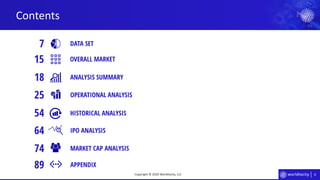
Contents
Copyright © 2020 Worldlocity, LLC
DATA SET
ANALYSIS SUMMARY
OPERATIONAL ANALYSIS
IPO ANALYSIS
MARKET CAP ANALYSIS
7
18
25
64
74
APPENDIX89
HISTORICAL ANALYSIS54
OVERALL MARKET15
7
2020 Software Report: Key Takeaways
Copyright © 2020 Worldlocity, LLC
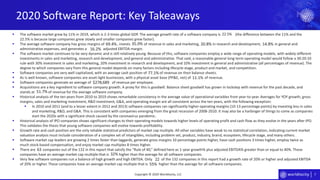
▪ The software market grew by 11% in 2019, which is 2-3 times global GDP. The average growth rate of a software company is (the difference between the 11% and the
22.5% is because large companies grew slowly and smaller companies grew faster).
▪ The average software company has gross margins of , invests of revenue in sales and marketing, in research and development, in general and
administrative expenses, and generates a adjusted EBITDA margin.
▪ The software market continues to be very dynamic and is still relatively young. Because of this, software companies employ a wide range of operating models, with widely-different
investments in sales and marketing, research and development, and general and administrative. That said, a reasonable general long-term operating model would follow a 30:20:10
rule with 30% investment in sales and marketing, 20% investment in research and development, and 10% investment in general and administrative (all percentages of revenue). The
degree to which companies vary from this general model depends on many factors including lifecycle stage, product and market, and competition.
▪ Software companies are very well capitalized, with an average cash position of of revenue on their balance sheets.
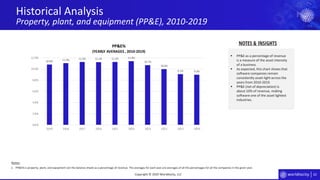
▪ As is well known, software companies are asset-light businesses, with a physical asset base (PP&E, net) of of revenue.
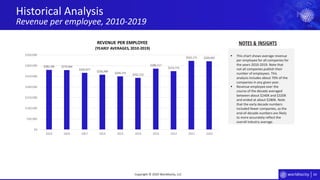
▪ Software companies generate an average of of revenue per employee.
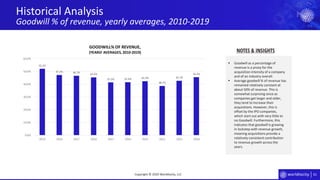
▪ Acquisitions are a key ingredient to software company growth. A proxy for this is goodwill. Balance sheet goodwill has grown in lockstep with revenue for the past decade, and
stands at of revenue for the average software company.
▪ Historical analysis of the ten years from 2010 to 2019 shows remarkable consistency in the average value of operational variables from year-to-year. Averages for YOY growth, gross
margins, sales and marketing investment, R&D investment, G&A, and operating margin are all consistent across the ten years, with the following exception:
▪ In 2010 and 2011 (and to a lesser extent in 2012 and 2013) software companies ran significantly higher operating margins (10-13 percentage points) by investing less in sales
and marketing, R&D, and G&A. This is consistent with companies emerging from the great recession of 2008-2010. It may also be a harbinger of things to come as companies
start the 2020s with a significant shock caused by the coronavirus pandemic.
▪ Historical analysis of IPO companies shows significant changes to their operating models towards higher levels of operating profit and cash flow as they evolve in the years after IPO.
This validates the thesis that young software companies will evolve towards profitability.
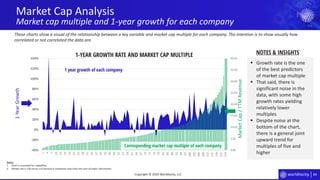
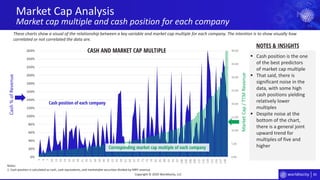
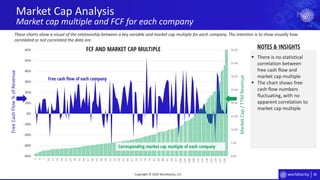
▪ Growth rate and cash position are the only reliable statistical predictors of market cap multiple. All other variables have weak to no statistical correlation, indicating current market
valuation analysis must include consideration of a complex set of intangibles, including problem set, product, industry, brand, ecosystem, lifecycle stage, and many others.
▪ Software market cap leaders are growing 2 times faster than laggards, generate gross margins 10 percentage points higher, have cash positions 3 times higher, employ twice as
much stock-based compensation, and enjoy market cap multiples 8 times higher.
▪ There are companies out of the 132 in this report that satisfy the “Rule of 40,” defined here as 1-year growth% plus adjusted EBITDA% greater than or equal to 40%. These
companies have an average market cap multiple that is higher than the average for all software companies.
▪ Very few software companies run a balance of high growth and high EBITDA. Only of the 132 companies in this report had a growth rate of 20% or higher and adjusted EBITDA
of 20% or higher. These companies have an average market cap multiple that is higher than the average for all software companies.
32%
55%
22.5%
69.4% 35.0% 20.8% 14.8%
16.2%
63
22
77.1%
11.1%
$278,689
51.7%
Data Set
Information on the companies and the data set used in
the analysis.
9
Data Set
Copyright © 2020 Worldlocity, LLC
132
B
T
COMPANIES
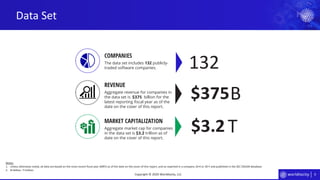
The data set includes 132 publicly-
traded software companies.
REVENUE
Aggregate revenue for companies in
the data set is billion for the
latest reporting fiscal year as of the
date on the cover of this report.
MARKET CAPITALIZATION
Aggregate market cap for companies
in the data set is trillion as of
date on the cover of this report.
Notes:
1. Unless otherwise noted, all data are based on the most recent fiscal year (MRY) as of the date on the cover of this report, and as reported in a company 10-K or 20-F and published in the SEC EDGAR database.
2. B=billion; T=trillion.
$375$375
$3.2
$3.2
10
2
1
1
PRIVATE
MIN REQMENTS
MERGER
14
1
3
IPO
MIN REQMENTS
OTHER
Data Set
Changes from version 2019-2 to 2020-1
Copyright © 2020 Worldlocity, LLC
COMPANY DELETIONS COMPANY ADDITIONS
COMPANIES
ADDED
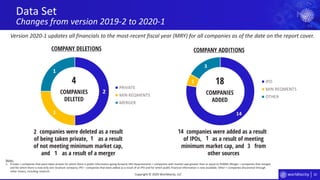
companies were added as a result
of IPOs, as a result of meeting
minimum market cap, and from
other sources
COMPANIES
DELETED
companies were deleted as a result
of being taken private, as a result
of not meeting minimum market cap,
and as a result of a merger
Version 2020-1 updates all financials to the most-recent fiscal year (MRY) for all companies as of the date on the report cover.
18
14
1
3
4
2
1
1
Notes:
1. Private = companies that were taken private for which there is public information going forward; Min Requirements = companies with market caps greater than or equal to $500M; Merger = companies that merged
and for which there is now only one resultant company; IPO – companies that were added as a result of an IPO and for which public financial information is now available; Other = companies discovered through
other means, including research.
11
79
53
Fiscal Year = Calendar Year
Fiscal Year <> Calendar Year
10
31
30
27
26
8
>$5B
$1B - $5B
$500M - $1B
$300M - $500M
$200M - $300M
<$200M
Data Set
Company distribution by annual revenue
Copyright © 2020 Worldlocity, LLC
BY ANNUAL REVENUE
TOTAL
COMPANIES
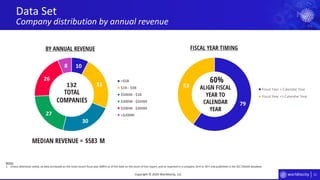
MEDIAN REVENUE = M
FISCAL YEAR TIMING
ALIGN FISCAL
YEAR TO
CALENDAR
YEAR
132
Notes:
1. Unless otherwise noted, all data are based on the most recent fiscal year (MRY) as of the date on the cover of this report, and as reported in a company 10-K or 20-F and published in the SEC EDGAR database.
$583
60%
12
25
11
15
COMPUTING
COLLABORATION
SECURITY
8
18
14
10
7
7
8 ANALYTICS
CRM
ERP
FINANCIAL
HCM
R&D
SCM
72
51
APPLICATIONS INFRASTRUCTURE
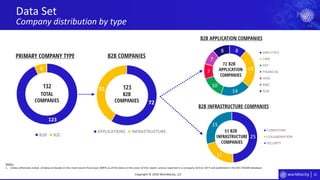
123
9
B2B B2C
Data Set
Company distribution by type
Copyright © 2020 Worldlocity, LLC
PRIMARY COMPANY TYPE B2B COMPANIES
TOTAL
COMPANIES
B2B
COMPANIES
B2B APPLICATION COMPANIES
B2B
APPLICATION
COMPANIES
B2B INFRASTRUCTURE COMPANIES
B2B
INFRASTRUCTURE
COMPANIES
Notes:
1. Unless otherwise noted, all data are based on the most recent fiscal year (MRY) as of the date on the cover of this report, and as reported in a company 10-K or 20-F and published in the SEC EDGAR database.
132 123
72
51
13
19
34
42
22
15
< 7 Years
>=7, <10
>=10, <15
>=15, <20
>=20
38
40
14
26
14
< 5 Years
>=5, <10
>=10, <20
>=20, <30
>=30
33
26
28
30
15
< 15 Years
>=15, <20
>=20, <30
>=30, <40
>=40
Data Set
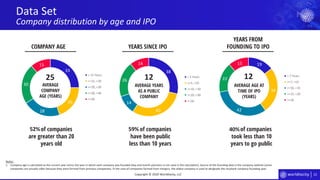
Company distribution by age and IPO
Copyright © 2020 Worldlocity, LLC
COMPANY AGE
Notes:
1. Company age is calculated as the current year minus the year in which each company was founded (day and month precision is not used in the calculation). Source of the founding date is the company website (some
companies are actually older because they were formed from previous companies). In the case of companies formed from mergers, the oldest company is used to designate the resultant company founding year.
YEARS SINCE IPO
YEARS FROM
FOUNDING TO IPO
AVERAGE
COMPANY
AGE (YEARS)
AVERAGE AGE AT
TIME OF IPO
(YEARS)
AVERAGE YEARS
AS A PUBLIC
COMPANY
of companies
have been public
less than 10 years
of companies
took less than 10
years to go public
of companies
are greater than 20
years old
25
52%
12
59%
12
40%
14
Data Set
Companies included in this report
Copyright © 2020 Worldlocity, LLC
15
Data Set
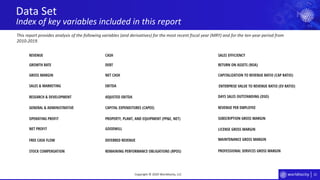
Index of key variables included in this report
Copyright © 2020 Worldlocity, LLC
REVENUE
This report provides analysis of the following variables (and derivatives) for the most recent fiscal year (MRY) and for the ten-year period from
2010-2019.
GROWTH RATE
GROSS MARGIN
SALES & MARKETING
RESEARCH & DEVELOPMENT
GENERAL & ADMINISTRATIVE
OPERATING PROFIT
NET PROFIT
FREE CASH FLOW
STOCK COMPENSATION
CASH
DEBT
NET CASH
EBITDA
ADJUSTED EBITDA
CAPITAL EXPENDITURES (CAPEX)
PROPERTY, PLANT, AND EQUIPMENT (PP&E, NET)
GOODWILL
DEFERRED REVENUE
REMAINING PERFORMANCE OBLIGATIONS (RPOS)
SALES EFFICIENCY
RETURN ON ASSETS (ROA)
CAPITALIZATION TO REVENUE RATIO (CAP RATIO)
DAYS SALES OUTSTANDING (DSO)
REVENUE PER EMPLOYEE
SUBSCRIPTION GROSS MARGIN
LICENSE GROSS MARGIN
MAINTENANCE GROSS MARGIN
PROFESSIONAL SERVICES GROSS MARGIN
ENTERPRISE VALUE TO REVENUE RATIO (EV RATIO)
Overall Market
Summary of the market using the companies in this
report as a proxy for the overall software market.
17
2019 2018 2017 2016 2015 2014 2013 2012 2011
All Companies 11.1% 13.2% 10.7% 4.6% 8.1% 7.4% 5.4% 7.6% 16.3%
Sixty Companies 10.0% 11.3% 8.2% 2.4% 6.3% 6.4% 4.9% 7.4% 16.3%
BEA Prepackaged Software 11.9% 6.1% 7.1% 7.1% 5.8% 6.8% 12.0% 14.2%
World GDP (current $) 6.1% 6.3% 1.5% -5.4% 2.7% 2.9% 2.3% 11.1%
US GDP (current $) 5.4% 4.2% 2.7% 4.0% 4.4% 3.6% 4.2% 3.7%
-10.0%
-5.0%
0.0%
5.0%
10.0%
15.0%
20.0%
Overall Market
YOY growth rates, 2011-2019
Copyright © 2020 Worldlocity, LLC
YOY Market Growth Rate (based on aggregate revenue)
US GDP
Sixty Companies
World GDP
All Companies
BEA Prepackaged
2011-2018 CAGR
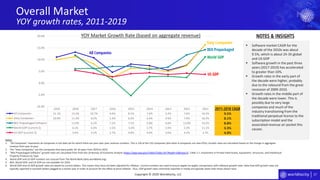
▪ Software market CAGR for the
decade of the 2010s was about
9.5%, which is about 2X-3X global
and US GDP
▪ Software growth in the past three
years (2017-2019) has accelerated
to greater than 10%.
▪ Growth rates in the early part of
the decade were higher, probably
due to the rebound from the great
recession of 2009-2010.
▪ Growth rates in the middle part of
the decade were lower. This is
possibly due to very large
companies and much of the
industry transitioning from the
traditional perpetual license to the
subscription model and the
associated revenue air pocket this
causes.
NOTES & INSIGHTS
Notes:
1. “All Companies” represents all companies in the data set for which there are year-over-year revenue numbers. This is 126 of the 132 companies (the other 6 companies are new IPOs). Growth rates are calculated based on the change in aggregate
revenue from year to year.
2. The “Sixty Companies” are the companies that were public for all years from 2010 to 2019.
3. “BEA Prepackaged Software” growth rates are calculated from from the US Bureau of Economic Analysis (https://apps.bea.gov/iTable/iTable.cfm?ReqID=10&step=2), Table 2.7. Investment in Private Fixed Assets, Equipment, Structures, and Intellectual
Property Products by Type
4. World GDP and US GDP numbers are sourced from The World Bank (data.worldbank.org)
5. BEA, World GDP, and US GDP are not available for 2019.
6. World GDP and US GDP growth rates are based on current dollars. This means they have not been adjusted for inflation. Current numbers are used to ensure apples-to-apples comparisons with software growth rates. Note that GDP growth rates are
typically reported in constant dollars pegged to a certain year in order to account for the effect of price inflation. Thus, GDP growth rates commonly reported in media are typically lower than those shown here.
9.5%
8.1%
8.8%
3.3%
4.0%
18
Overall Market
Based on aggregate revenues, costs, and market caps
Copyright © 2020 Worldlocity, LLC
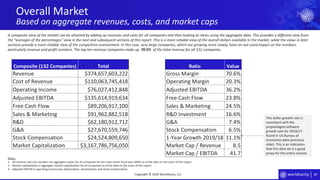
A composite view of the market can be attained by adding up revenues and costs for all companies and then looking at ratios using the aggregate data. This provides a different view from
the “averages of the percentages” view in the next and subsequent sections of this report. This is a more reliable view of the overall dollars available in the market, while the views in later
sections provide a more reliable view of the competitive environment. In this case, very large companies, which are growing more slowly, have an out-sized impact on the numbers,
particularly revenue and profit numbers. The top ten revenue companies make up of the total revenue for all 132 companies.
This dollar growth rate is
consistent with the
prepackaged software
growth rate for 2018/17
found in US Bureau of
Economics data (previous
slide). This is an indication
that this data set is a good
proxy for the entire market.
Composite (132 Companies) Total
Revenue $374,657,603,222
Cost of Revenue $110,063,745,418
Operating Income $76,027,412,848
Adjusted EBITDA $135,614,919,634
Free Cash Flow $89,206,917,100
Sales & Marketing $91,962,882,518
R&D $62,180,912,712
G&A $27,670,559,746
Stock Compensation $24,524,809,650
Market Capitalization $3,167,786,756,050
Ratio Value
Gross Margin 70.6%
Operating Margin 20.3%
Adjusted EBITDA 36.2%
Free Cash Flow 23.8%
Sales & Marketing 24.5%
R&D Investment 16.6%
G&A 7.4%
Stock Compensation 6.5%
1-Year Growth 2019/18 11.1%
Market Cap / Revenue 8.5
Market Cap / EBITDA 41.7
Notes:
1. All revenue and cost numbers are aggregate values for all companies for the most recent fiscal year (MRY) as of the date on the cover of this report.
2. Market capitalization is aggregate market capitalization for all companies as of the date on the cover of this report.
3. Adjusted EBITDA is operating income plus depreciation, amortization, and stock compensation.
70.5%
Analysis Summary
Charts that summarize key variables in the report.
20
Analysis Summary
Average and median for different variables, most recent fiscal year (MRY)
Copyright © 2020 Worldlocity, LLC
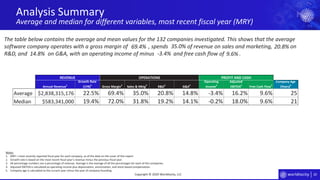
The table below contains the average and mean values for the 132 companies investigated. This shows that the average
software company operates with a gross margin of , spends of revenue on sales and marketing, on
R&D, and on G&A, with an operating income of minus and free cash flow of .
Notes:
1. MRY = most recently reported fiscal year for each company, as of the date on the cover of this report.
2. Growth rate is based on the most recent fiscal year’s revenue minus the previous fiscal year.
3. All percentage numbers are a percentage of revenue. Average is the average of all the percentages for each of the companies.
4. Adjusted EBITDA is calculated as operating income plus depreciation, amortization, and stock-based compensation.
5. Company age is calculated as the current year minus the year of company founding.
Annual Revenue1
Growth Rate
(1YR)2
Gross Margin3
Sales & Mktg3
R&D3
G&A3
Operating
Income3
Adjusted
EBITDA3
Free Cash Flow3
Company Age
(Years)4
Average $2,838,315,176 22.5% 69.4% 35.0% 20.8% 14.8% -3.4% 16.2% 9.6% 25
Median $583,341,000 19.4% 72.0% 31.8% 19.2% 14.1% -0.2% 18.0% 9.6% 21
PROFIT AND CASHOPERATIONSREVENUE
69.4% 35.0% 20.8%
14.8% -3.4% 9.6%
21
Analysis Summary
Average values by revenue quartile, MRY1
Copyright © 2020 Worldlocity, LLC
All numbers are averages within each quartile
Quartile 4 >=
Quartile 3 >= , <
Quartile 2 >= , <
Quartile 1 <
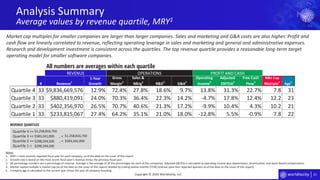
Market cap multiples for smaller companies are larger than larger companies. Sales and marketing and G&A costs are also higher. Profit and
cash flow are linearly correlated to revenue, reflecting operating leverage in sales and marketing and general and administrative expenses.
Research and development investment is consistent across the quartiles. The top revenue quartile provides a reasonable long-term target
operating model for smaller software companies.
# Revenue
1
1-Year
Growth
Gross
Margin
3
Sales &
Mktg
3
R&D
3
G&A
3
Operating
Income
3
Adjusted
EBITDA
3
Free Cash
Flow
3
Mkt Cap
Multiple
4
Age
5
Quartile 4 33 $9,836,669,576 12.9% 72.4% 27.8% 18.6% 9.7% 13.8% 31.3% 22.7% 7.8 31
Quartile 3 33 $880,419,091 24.0% 70.3% 36.4% 22.3% 14.2% -4.7% 17.8% 12.4% 12.2 23
Quartile 2 33 $402,356,970 26.5% 70.7% 40.6% 21.3% 17.2% -9.9% 10.4% 4.3% 10.2 21
Quartile 1 33 $233,815,067 27.4% 64.2% 35.1% 21.0% 18.0% -12.8% 5.5% -0.9% 7.8 22
REVENUE OPERATIONS PROFIT AND CASH
$1,258,816,750
$1,258,816,750$583,341,000
$583,341,000$298,594,500
$298,594,500
Notes:
1. MRY = most recently reported fiscal year for each company, as of the date on the cover of this report.
2. Growth rate is based on the most recent fiscal year’s revenue minus the previous fiscal year.
3. All percentage numbers are a percentage of revenue. Average is the average of all the percentages for each of the companies. Adjusted EBITDA is calculated as operating income plus depreciation, amortization, and stock-based compensation.
4. Market capital multiple is market cap (as of the date on the cover of this report) divided by trailing twelve months (TTM) revenue (past four reported quarters as of the date on the cover of this report).
5. Company age is calculated as the current year minus the year of company founding.
REVENUE QUARTILES
22
Analysis Summary
Average values by market cap quartile, MRY1
Copyright © 2020 Worldlocity, LLC
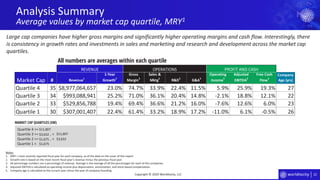
Large cap companies have higher gross margins and significantly higher operating margins and cash flow. Interestingly, there
is consistency in growth rates and investments in sales and marketing and research and development across the market cap
quartiles.
Notes:
1. MRY = most recently reported fiscal year for each company, as of the date on the cover of this report.
2. Growth rate is based on the most recent fiscal year’s revenue minus the previous fiscal year.
3. All percentage numbers are a percentage of revenue. Average is the average of all the percentages for each of the companies.
4. Adjusted EBITDA is calculated as operating income plus depreciation, amortization, and stock-based compensation.
5. Company age is calculated as the current year minus the year of company founding.
Market Cap # Revenue
1
1-Year
Growth
2
Gross
Margin
3
Sales &
Mktg
3
R&D
3
G&A
3
Operating
Income
3
Adjusted
EBITDA
3
Free Cash
Flow
3
Company
Age (yrs)
Quartile 4 35 $8,977,064,657 23.0% 74.7% 33.9% 22.4% 11.5% 5.9% 25.9% 19.3% 27
Quartile 3 34 $993,088,941 25.2% 71.0% 36.1% 20.4% 14.8% -2.1% 18.8% 12.1% 22
Quartile 2 33 $529,856,788 19.4% 69.4% 36.6% 21.2% 16.0% -7.6% 12.6% 6.0% 23
Quartile 1 30 $307,001,407 22.4% 61.4% 33.2% 18.9% 17.2% -11.0% 6.1% -0.5% 26
REVENUE OPERATIONS PROFIT AND CASH
All numbers are averages within each quartile
Quartile 4 >=
Quartile 3 >= , <
Quartile 2 >= , <
Quartile 1 <
MARKET CAP QUARTILES ($M)
$11,807
$11,807$3,632
$3,632$1,675
$1,675
23
Analysis Summary
Average numbers for the entire data set, MRY1
Copyright © 2020 Worldlocity, LLC
1-YEAR GROWTH2 GROSS MARGIN MARKET CAP3
SALES & MKTG
X
ADJ EDITDA4
R&D G&A STOCK COMP5
OP INCOME FREE CASH FLOW CASH6 NET CASH6
Notes:
1. MRY = most recently reported fiscal year for each company, as of the date on the cover of this report. All percentage numbers are a percentage of revenue (except growth rate). Average is the average of all the percentages for each of the companies.
2. Growth rate is based on the most recent fiscal year’s revenue minus the previous fiscal year. Since some companies have only recently gone public, not all companies are included.
3. Market cap is expressed as a multiple of annual revenue and is based on market capitalizations as of the date on the cover of this report. For market cap multiple calculations, trailing twelve months (TTM) revenue is used.
4. Adjusted EBITDA is calculated as operating income plus depreciation, amortization, and stock-based compensation.
5. Stock comp = stock compensation as a percentage of revenue.
6. Cash = total cash on hand as a % of revenue. Net cash = cash on hand minus total debt. Cash includes cash, cash equivalents, and marketable securities.
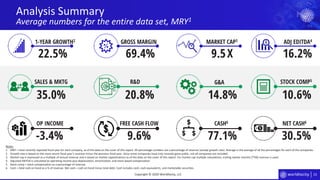
22.5% 69.4% 9.5 16.2%
35.0% 20.8% 14.8% 10.6%
-3.4% 9.6% 77.1% 30.5%
24
Analysis Summary
Average numbers for the top-quartile market cap3 multiple leaders
Copyright © 2020 Worldlocity, LLC
3-YEAR CAGR2 GROSS MARGIN MARKET CAP3
SALES & MKTG
X
ADJ EDITDA4
R&D G&A STOCK COMP5
OP INCOME FREE CASH FLOW CASH6 NET CASH6
Notes:
1. MRY = most recently reported fiscal year for each company, as of the date on the cover of this report. All percentage numbers are a percentage of revenue (except growth rate). Average is the average of all the percentages for each of the companies.
2. Growth rate is based on the most recent year’s fiscal revenue minus the previous fiscal year. Since some companies have only recently gone public, not all companies are included.
3. Market cap is expressed as a multiple of annual revenue and is based on market capitalizations as of the date on the cover of this report. For market cap multiple calculations, trailing twelve months (TTM) revenue is used.
4. Adjusted EBITDA is calculated as operating income plus depreciation, amortization, and stock-based compensation.
5. Stock comp = stock compensation as a percentage of revenue.
6. Cash = total cash on hand as a % of revenue. Net cash = cash on hand minus total debt. Cash includes cash, cash equivalents, and marketable securities.
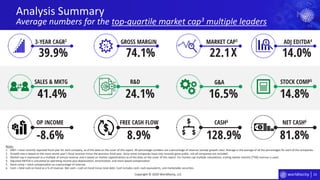
39.9% 74.1% 22.1 14.0%
41.4% 24.1% 16.5% 14.8%
-8.6% 8.9% 128.9% 81.8%
25
Analysis Summary
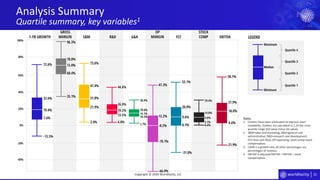
Quartile summary, key variables1
Copyright © 2020 Worldlocity, LLC
100%
80%
60%
40%
20%
0%
-20%
-40%
1-YR GROWTH
GROSS
MARGIN S&M G&AR&D
OP
MARGIN FCF
STOCK
COMP EBITDA
Notes:
1. Outliers have been eliminated to improve chart
readability. Outliers are calculated as 1.5X the inner
quartile range (Q3 value minus Q1 value).
2. S&M=sales and marketing; G&A=general and
administrative; R&D=research and development;
FCF=free cash flow; OP=operating; stock comp=stock
compensation.
3. CAGR is a growth rate; all other percentages are
percentages of revenue.
4. EBITDA is adjusted EBITDA = EBITDA + stock
compensation.
Maximum
Median
Minimum
Quartile 4
Quartile 3
Quartile 2
Quartile 1
LEGEND
72.6%
33.6%
19.4%
7.6%
-13.5%
96.3%
78.0%
72.0%
60.4%
35.1%
73.6%
47.4%
31.8%
21.9%
3.4%
44.6%
26.0%
19.2%
13.5%
4.0%
30.9%
18.6%
14.1%
10.3%
2.7%
47.3%
12.2%
-0.2%
-19.1%
-66.0%
52.1%
20.9%
9.6%
0.1%
-31.0%
29.4%
14.8%
9.0%
5.1%
0.4%
58.1%
27.9%
18.0%
4.6%
-21.9%
Operational Analysis
Charts that provide analysis and distribution for key
variables for the most recent fiscal year for all
companies.
27
-20%
0%
20%
40%
60%
80%
100%
1
3
5
7
9
11
13
15
17
19
21
23
25
27
29
31
33
35
37
39
41
43
45
47
49
51
53
55
57
59
61
63
65
67
69
71
73
75
77
79
81
83
85
87
89
91
93
95
97
99
101
103
105
107
109
111
113
115
117
119
121
123
125
Operational Analysis
1-year growth rate
Copyright © 2020 Worldlocity, LLC
Average =
Quartile 1: <
Quartile 2: >= ;
<
Quartile 3: >= ;
<
Quartile 4: >=
1-Year Growth – Distribution Across 126 Software Companies1
1-YearGrowth
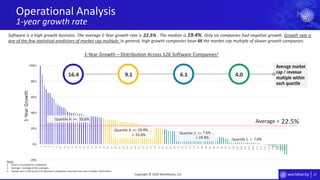
Software is a high growth business. The average 1-Year growth rate is . The median is . Only six companies had negative growth. Growth rate is
one of the few statistical predictors of market cap multiple. In general, high growth companies have 4X the market cap multiple of slower growth companies.
Average market
cap / revenue
multiple within
each quartile
Notes:
1. Chart is truncated for readability.
2. Average = average of the averages.
3. Sample size is 126 versus 132 because 6 companies only have one year of public information.
22.5%
22.5% 19.4%
33.6%
33.6%
7.6%
19.4%
19.4% 7.6%
16.4 9.1 6.1 4.0
28
0%
10%
20%
30%
40%
50%
60%
70%
80%
90%
100%
1
3
5
7
9
11
13
15
17
19
21
23
25
27
29
31
33
35
37
39
41
43
45
47
49
51
53
55
57
59
61
63
65
67
69
71
73
75
77
79
81
83
85
87
89
91
93
95
97
99
101
103
105
107
109
111
113
115
117
119
121
123
125
127
129
131
Operational Analysis
Gross margin
Copyright © 2020 Worldlocity, LLC
Average =
Quartile 1: <
Quartile 2: >= ;
<
Quartile 3: >= ;
<
Quartile 4: >=
Gross Margin – Distribution Across 132 Software Companies
GrossMargin
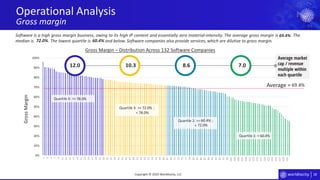
Software is a high gross margin business, owing to its high IP content and essentially zero material-intensity. The average gross margin is . The
median is . The lowest quartile is and below. Software companies also provide services, which are dilutive to gross margin.
Average market
cap / revenue
multiple within
each quartile
72.0%
12.0 10.3 8.6 7.0
69.4%
78.0%
78.0%
72.0%
72.0%
60.4%
60.4%
69.4%
60.4%
29
0%
10%
20%
30%
40%
50%
60%
70%
80%
90%
100%
1
3
5
7
9
11
13
15
17
19
21
23
25
27
29
31
33
35
37
39
41
43
45
47
49
51
53
55
57
59
61
63
65
67
69
71
73
75
77
79
81
83
85
87
89
91
93
95
97
99
101
103
105
107
109
111
113
115
117
119
121
123
125
127
129
131
Operational Analysis
Gross margin – business model insights
Copyright © 2020 Worldlocity, LLC
Quartile 1: <
Quartile 2: >= ;
<
Quartile 3: >= ;
<
Quartile 4: >=
GrossMargin
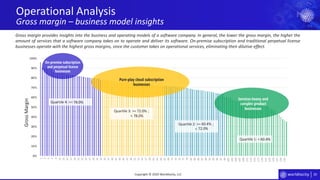
Gross margin provides insights into the business and operating models of a software company. In general, the lower the gross margin, the higher the
amount of services that a software company takes on to operate and deliver its software. On-premise subscription and traditional perpetual license
businesses operate with the highest gross margins, since the customer takes on operational services, eliminating their dilutive effect.
78.0%
78.0%
72.0%
72.0%
60.4%
60.4%
On-premise subscription
and perpetual license
businesses
Services-heavy and
complex product
businesses
Pure-play cloud subscription
businesses
30
0%
10%
20%
30%
40%
50%
60%
70%
80%
90%
100%
1 3 4 5 6 7 8 9 10 11 12 13 14 15 16 17 18 19 20 21 22 23 24 25 26 27 28 29 30 31 32 33 34 35 36 37 38 39 40 41 42 43 44 45 46 47 48 49 50 51 52 53 54 55 56 57 58 59 60
Average market
cap / revenue
multiple within
each quartile
Operational Analysis
Cloud subscription gross margin
Copyright © 2020 Worldlocity, LLC
Quartile 1: <
Quartile 2: >= ;
<
Quartile 3: >= ;
<
Quartile 4: >=
CloudSubscriptionGrossMargin
Cloud Subscription Gross Margin – Distribution Across Software Companies
Average =
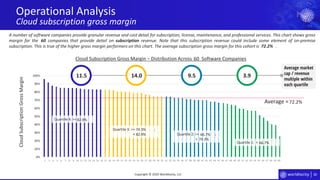
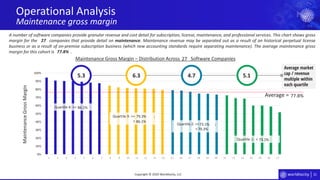
A number of software companies provide granular revenue and cost detail for subscription, license, maintenance, and professional services. This chart shows gross
margin for the companies that provide detail on subscription revenue. Note that this subscription revenue could include some element of on-premise
subscription. This is true of the higher gross margin performers on this chart. The average subscription gross margin for this cohort is .
11.5 14.0 9.5 3.9
72.2%
72.2%
60
82.9%
82.9%
74.3%
74.3%
66.7%
66.7%
60
31
0%
10%
20%
30%
40%
50%
60%
70%
80%
90%
100%
1 2 3 4 5 6 7 8 9 10 11 12 13 14 15 16 17 18 19 20 21 22 23 24 25 26 27
Average market
cap / revenue
multiple within
each quartile
Operational Analysis
Maintenance gross margin
Copyright © 2020 Worldlocity, LLC
Quartile 1: <
Quartile 2: >= ;
<
Quartile 3: >= ;
<
Quartile 4: >=
MaintenanceGrossMargin
Maintenance Gross Margin – Distribution Across Software Companies
Average =
A number of software companies provide granular revenue and cost detail for subscription, license, maintenance, and professional services. This chart shows gross
margin for the companies that provide detail on maintenance. Maintenance revenue may be separated out as a result of an historical perpetual license
business or as a result of on-premise subscription business (which new accounting standards require separating maintenance). The average maintenance gross
margin for this cohort is .
77.8%
5.3 6.3 4.7 5.1
27
77.8%
86.1%
86.1%
79.3%
79.3%
73.1%
73.1%
27
32
0%
10%
20%
30%
40%
50%
60%
70%
80%
90%
100%
1 2 3 4 5 6 7 8 9 10 11 12 13 14 15 16 17 18 19 20 21 22 23 24 25 26 27 28 29 30 31 32
Average market
cap / revenue
multiple within
each quartile
Operational Analysis
License gross margin
Copyright © 2020 Worldlocity, LLC
Quartile 1: <
Quartile 2: >= ;
<
Quartile 3: >= ;
<
Quartile 4: >=
MaintenanceGrossMargin
License Gross Margin – Distribution Across Software Companies
Average =
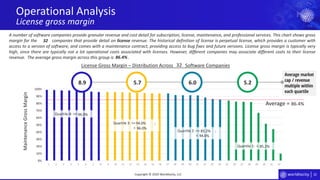
A number of software companies provide granular revenue and cost detail for subscription, license, maintenance, and professional services. This chart shows gross
margin for the companies that provide detail on license revenue. The historical definition of license is perpetual license, which provides a customer with
access to a version of software, and comes with a maintenance contract, providing access to bug fixes and future versions. License gross margin is typically very
high, since there are typically not a lot operational costs associated with licenses. However, different companies may associate different costs to their license
revenue. The average gross margin across this group is .
32
86.4%
8.9 5.7 6.0 5.2
86.4%
96.0%
96.0%
94.0%
94.0%
85.2%
85.2%
32
33
-100%
-80%
-60%
-40%
-20%
0%
20%
40%
60%
80%
1 2 3 4 5 6 7 8 9 10 11 12 13 14 15 16 17 18 19 20 21 22 23 24 25 26 27 28 29 30 31 32 33 34 35 36 37 38 39 40 41 42 43 44 45 46 47 48 49 50 51 52 53
Average market
cap / revenue
multiple within
each quartile
Operational Analysis
Professional services gross margin
Copyright © 2020 Worldlocity, LLC
Quartile 1: <
Quartile 2: >= ;
<
Quartile 3: >= ;
<
Quartile 4: >=
ProfessionalServicesGrossMargin
Professional Services Gross Margin – Distribution Across Software Companies
Average =
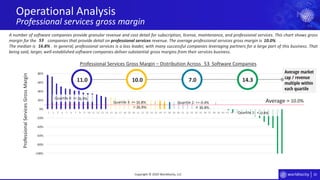
A number of software companies provide granular revenue and cost detail for subscription, license, maintenance, and professional services. This chart shows gross
margin for the companies that provide detail on professional services revenue. The average professional services gross margin is .
The median is . In general, professional services is a loss leader, with many successful companies leveraging partners for a large part of this business. That
being said, larger, well-established software companies deliver substantial gross margins from their services business.
11.0 10.0 7.0 14.3
10.0%
16.8%
53
10.0%26.9%
26.9%
16.8%
16.8%
-0.4%
-0.4%
53
34
0%
10%
20%
30%
40%
50%
60%
70%
80%
90%
100%
1 2 3 4 5 6 7 8 9 10 11 12 13 14 15 16 17 18 19 20 21 22 23 24 25 26 27 28 29 30 31 32 33 34 35 36 37 38 39 40 41
Subscription PS Overall GM
Operational Analysis
Gross margin subscription/professional services mix analysis
Copyright © 2020 Worldlocity, LLC
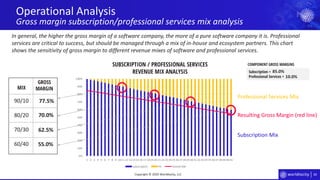
In general, the higher the gross margin of a software company, the more of a pure software company it is. Professional
services are critical to success, but should be managed through a mix of in-house and ecosystem partners. This chart
shows the sensitivity of gross margin to different revenue mixes of software and professional services.
SUBSCRIPTION / PROFESSIONAL SERVICES
REVENUE MIX ANALYSIS
Professional Services Mix
Subscription Mix
Resulting Gross Margin (red line)
90/10
80/20
70/30
60/40
MIX
GROSS
MARGIN
Subscription =
Professional Services =
COMPONENT GROSS MARGINS
85.0%
10.0%
77.5%
70.0%
62.5%
55.0%
35
0%
10%
20%
30%
40%
50%
60%
70%
1
3
5
7
9
11
13
15
17
19
21
23
25
27
29
31
33
35
37
39
41
43
45
47
49
51
53
55
57
59
61
63
65
67
69
71
73
75
77
79
81
83
85
87
89
91
93
95
97
99
101
103
105
107
109
111
113
115
117
119
121
123
125
127
129
131
Operational Analysis
Sales and marketing % of revenue
Copyright © 2020 Worldlocity, LLC
Quartile 1: <
Quartile 2: >= ;
<
Quartile 3: >= ;
<
Quartile 4: >=
Sales&Marketing%ofRevenue
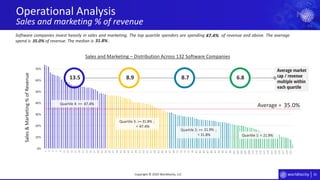
Software companies invest heavily in sales and marketing. The top quartile spenders are spending of revenue and above. The average
spend is of revenue. The median is .
Sales and Marketing – Distribution Across 132 Software Companies
Average =
Average market
cap / revenue
multiple within
each quartile
13.5 8.9 8.7 6.8
35.0%47.4%
47.4%
31.8%
31.8%
21.9%
21.9%
47.4%
31.8%35.0%
36
-50%
0%
50%
100%
150%
200%
250%
300%
350%
400%
5 7 9 11 13 15 17 19 21 23 25 27 29 31 33 35 37 39 41 43 45 47 49 51 53 55 57 59 61 63 65 67 69 71 73 75 77 79 81 83 85 87 89 91 93 95 97 99 101103105107109111113115117119121123
Average market
cap / revenue
multiple within
each quartile
Operational Analysis
Sales and marketing efficiency
Copyright © 2020 Worldlocity, LLC
Quartile 2: >= ;
<
Quartile 3: >= ;
<
Quartile 4: >=
SalesandMarketingEfficiency
Sales Efficiency – Distribution Across Software Companies
Average =
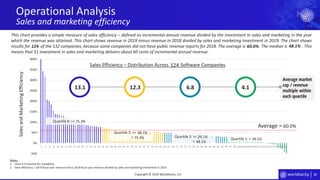
This chart provides a simple measure of sales efficiency – defined as incremental annual revenue divided by the investment in sales and marketing in the year
which the revenue was attained. This chart shows revenue in 2019 minus revenue in 2018 divided by sales and marketing investment in 2019. The chart shows
results for of the 132 companies, because some companies did not have public revenue reports for 2018. The average is . The median is . This
means that $1 investment in sales and marketing delivers about 60 cents of incremental annual revenue.
Quartile 1: <
Notes:
1. Chart is truncated for readability.
2. Sales efficiency = 2019 fiscal year revenue minus 2018 fiscal year revenue divided by sales and marketing investment in 2019.
13.1 12.3 6.8 4.1
60.0%
75.3%
75.3%
48.1%
48.1%
29.1%
29.1%
60.0% 48.1%124
124
37
0%
5%
10%
15%
20%
25%
30%
35%
40%
45%
50%
1
3
5
7
9
11
13
15
17
19
21
23
25
27
29
31
33
35
37
39
41
43
45
47
49
51
53
55
57
59
61
63
65
67
69
71
73
75
77
79
81
83
85
87
89
91
93
95
97
99
101
103
105
107
109
111
113
115
117
119
121
123
125
127
129
131
Average market
cap / revenue
multiple within
each quartile
Operational Analysis
R&D % of revenue
Copyright © 2020 Worldlocity, LLC
Quartile 1: <
Quartile 2: >= ;
<
Quartile 3: >= ;
<
Quartile 4: >=
Research&Development%ofRevenue
Research & Development – Distribution Across 132 Software Companies
Average =
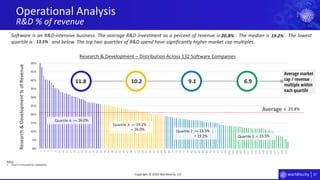
Software is an R&D-intensive business. The average R&D investment as a percent of revenue is . The median is . The lowest
quartile is and below. The top two quartiles of R&D spend have significantly higher market cap multiples.
Notes:
1. Chart is truncated for readability.
11.8 10.2 9.1 6.9
26.0%
19.2%
26.0%
19.2%
13.5%
13.5%
20.8% 19.2%
13.5%
20.8%
38
0%
5%
10%
15%
20%
25%
30%
35%
40%
1
3
5
7
9
11
13
15
17
19
21
23
25
27
29
31
33
35
37
39
41
43
45
47
49
51
53
55
57
59
61
63
65
67
69
71
73
75
77
79
81
83
85
87
89
91
93
95
97
99
101
103
105
107
109
111
113
115
117
119
121
123
125
127
129
131
Average market
cap / revenue
multiple within
each quartile
Operational Analysis
G&A % of revenue
Copyright © 2020 Worldlocity, LLC
Quartile 1: <
Quartile 2: >= ;
<
Quartile 3: >= ;
<
Quartile 4: >=
General&Administrative%ofRevenue
General & Administrative – Distribution Across 132 Software Companies
Average =
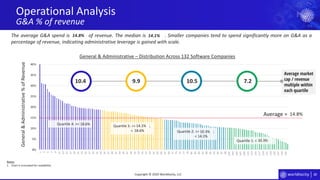
The average G&A spend is of revenue. The median is . Smaller companies tend to spend significantly more on G&A as a
percentage of revenue, indicating administrative leverage is gained with scale.
10.4 9.9 10.5 7.2
14.8%
18.6%
18.6%
14.1%
14.1%
10.3%
10.3%
14.8% 14.1%
Notes:
1. Chart is truncated for readability.
39
-20%
-10%
0%
10%
20%
30%
40%
50%
60%
1
3
5
7
9
11
13
15
17
19
21
23
25
27
29
31
33
35
37
39
41
43
45
47
49
51
53
55
57
59
61
63
65
67
69
71
73
75
77
79
81
83
85
87
89
91
93
95
97
99
101
103
105
107
109
111
113
115
117
119
121
123
125
127
129
131
Average market
cap / revenue
multiple within
each quartile
Operational Analysis
Adjusted EBITDA % of revenue
Copyright © 2020 Worldlocity, LLC
Quartile 1: <
Quartile 2: >= ;
<
Quartile 3: >= ;
<
Quartile 4: >=
AdjustedEBITDA%ofRevenue
Adjusted EBITDA – Distribution Across 132 Software Companies
Average =
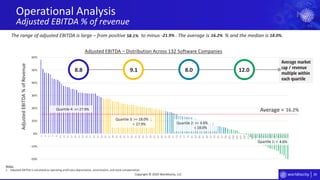
The range of adjusted EBITDA is large – from positive to minus . The average is % and the median is .
Notes:
1. Adjusted EBITDA is calculated as operating profit plus depreciation, amortization, and stock compensation.
8.8 9.1 8.0 12.0
27.9%
27.9%
18.0%
18.0%
4.6%
4.6%
16.2%
58.1% -21.9% 16.2% 18.0%
40
-50%
-40%
-30%
-20%
-10%
0%
10%
20%
30%
40%
50%
1
3
5
7
9
11
13
15
17
19
21
23
25
27
29
31
33
35
37
39
41
43
45
47
49
51
53
55
57
59
61
63
65
67
69
71
73
75
77
79
81
83
85
87
89
91
93
95
97
99
101
103
105
107
109
111
113
115
117
119
121
123
125
127
129
131
Average market
cap / revenue
multiple within
each quartile
Operational Analysis
Operating profit margin % of revenue
Copyright © 2020 Worldlocity, LLC
Quartile 1: <
Quartile 2: >= ;
<
Quartile 3: >= ;
<
Quartile 4: >=
OperatingProfit%ofRevenue
Operating Profit Margin – Distribution Across 132 Software Companies
Average =
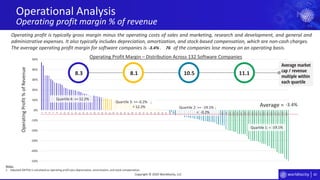
Operating profit is typically gross margin minus the operating costs of sales and marketing, research and development, and general and
administrative expenses. It also typically includes depreciation, amortization, and stock-based compensation, which are non-cash charges.
The average operating profit margin for software companies is . of the companies lose money on an operating basis.
Notes:
1. Adjusted EBITDA is calculated as operating profit plus depreciation, amortization, and stock compensation.
8.3 8.1 10.5 11.1
-3.4%
-3.4% 76
12.2%
12.2%
-0.2%
-19.1%
-0.2%
-19.1%
41
-50%
-40%
-30%
-20%
-10%
0%
10%
20%
30%
40%
50%
1
3
5
7
9
11
13
15
17
19
21
23
25
27
29
31
33
35
37
39
41
43
45
47
49
51
53
55
57
59
61
63
65
67
69
71
73
75
77
79
81
83
85
87
89
91
93
95
97
99
101
103
105
107
109
111
113
115
117
119
121
123
125
127
129
131
Average market
cap / revenue
multiple within
each quartile
Operational Analysis
Net operating profit after taxes (NOPAT) margin
Copyright © 2020 Worldlocity, LLC
Quartile 1: <
Quartile 2: >= ;
<
Quartile 3: >= ;
<
Quartile 4: >=
NOPAT%ofRevenue
NOPAT – Distribution Across 132 Software Companies
Average =
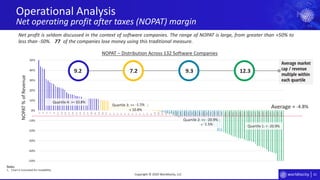
Net profit is seldom discussed in the context of software companies. The range of NOPAT is large, from greater than +50% to
less than -50%. of the companies lose money using this traditional measure.
9.2 7.2 9.3 12.3
Notes:
1. Chart is truncated for readability.
77
10.8%
10.8%
-1.5%
-1.5%
-20.9%
-20.9%
-4.8%
42
-40%
-30%
-20%
-10%
0%
10%
20%
30%
40%
50%
60%
1
3
5
7
9
11
13
15
17
19
21
23
25
27
29
31
33
35
37
39
41
43
45
47
49
51
53
55
57
59
61
63
65
67
69
71
73
75
77
79
81
83
85
87
89
91
93
95
97
99
101
103
105
107
109
111
113
115
117
119
121
123
125
127
129
131
Average market
cap / revenue
multiple within
each quartile
Operational Analysis
Free cash flow % of revenue
Copyright © 2020 Worldlocity, LLC
Quartile 1: <
Quartile 2: >= ;
<
Quartile 3: >= ;
<
Quartile 4: >=
FreeCashFlow%ofRevenue
Free Cash Flow – Distribution Across 132 Software Companies
Average =
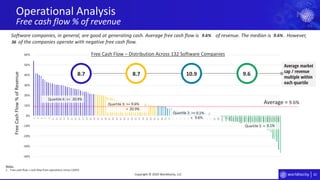
Software companies, in general, are good at generating cash. Average free cash flow is of revenue. The median is . However,
of the companies operate with negative free cash flow.
Notes:
1. Free cash flow = cash flow from operations minus CAPEX.
8.7 8.7 10.9 9.6
20.9%
9.6%
20.9%
0.1%
9.6%
0.1%
9.6%
9.6% 9.6%
36
43
0%
50%
100%
150%
200%
250%
1
3
5
7
9
11
13
15
17
19
21
23
25
27
29
31
33
35
37
39
41
43
45
47
49
51
53
55
57
59
61
63
65
67
69
71
73
75
77
79
81
83
85
87
89
91
93
95
97
99
101
103
105
107
109
111
113
115
117
119
121
123
125
127
129
131
Average market
cap / revenue
multiple within
each quartile
Operational Analysis
Cash % of revenue
Copyright © 2020 Worldlocity, LLC
Quartile 1: <
Quartile 2: >= ;
<
Quartile 3: >= ;
<
Quartile 4: >=
Cash%ofRevenue
Cash Position – Distribution Across 132 Software Companies
Average =
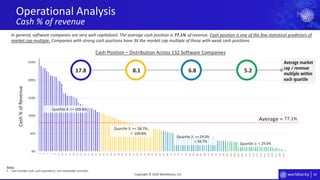
In general, software companies are very well capitalized. The average cash position is of revenue. Cash position is one of the few statistical predictors of
market cap multiple. Companies with strong cash positions have 3X the market cap multiple of those with weak cash positions.
17.8 8.1 6.8 5.2
109.8%
109.8%
58.7%
58.7%
29.0%
29.0%
77.1%
77.1%
Notes:
1. Cash includes cash, cash equivalents, and marketable securities.
44
0%
50%
100%
150%
200%
250%
1
3
5
7
9
11
13
15
17
19
21
23
25
27
29
31
33
35
37
39
41
43
45
47
49
51
53
55
57
59
61
63
65
67
69
71
73
75
77
79
81
83
85
87
89
91
93
95
97
99
101
103
105
107
109
111
113
115
117
119
121
123
125
127
129
131
Average market
cap / revenue
multiple within
each quartile
Operational Analysis
Total debt % of revenue1
Copyright © 2020 Worldlocity, LLC
Quartile 1: =
Quartile 2: >= ;
<
Quartile 3: >= ;
<
Quartile 4: >=
Debt%ofRevenue
Debt Position – Distribution Across 132 Software Companies
Average =
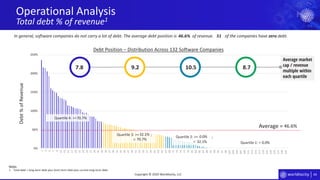
In general, software companies do not carry a lot of debt. The average debt position is of revenue. of the companies have zero debt.
7.8 9.2 10.5 8.7
70.7%
70.7%
32.1%
32.1%
0.0%
0.0%
46.6%
46.6% 51
Notes:
1. Total debt = long-term debt plus short-term debt plus current long-term debt.
45
-200%
-150%
-100%
-50%
0%
50%
100%
150%
200%
1
3
5
7
9
11
13
15
17
19
21
23
25
27
29
31
33
35
37
39
41
43
45
47
49
51
53
55
57
59
61
63
65
67
69
71
73
75
77
79
81
83
85
87
89
91
93
95
97
99
101
103
105
107
109
111
113
115
117
119
121
123
125
127
129
131
Average market
cap / revenue
multiple within
each quartile
Operational Analysis
Net cash % of revenue
Copyright © 2020 Worldlocity, LLC
Quartile 1: <
Quartile 2: >= ;
<
Quartile 3: >= ;
<
Quartile 4: >=
NetCash%ofRevenue
Net Cash Position – Distribution Across 132 Software Companies
Average =
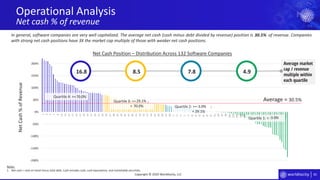
In general, software companies are very well capitalized. The average net cash (cash minus debt divided by revenue) position is of revenue. Companies
with strong net cash positions have 3X the market cap multiple of those with weaker net cash positions.
Notes:
1. Net cash = cash on hand minus total debt. Cash includes cash, cash equivalents, and marketable securities.
16.8 8.5 7.8 4.9
30.5%
30.5%
70.0%
29.1%
70.0%
29.1%
-3.0%
-3.0%
46
0%
5%
10%
15%
20%
25%
30%
35%
1
3
5
7
9
11
13
15
16
18
20
22
24
26
28
30
32
34
36
38
40
42
44
46
48
50
52
54
56
58
60
62
64
66
68
70
72
74
76
78
80
82
84
86
88
90
92
94
96
98
100
102
104
106
108
110
112
114
116
118
120
122
124
126
128
130
Average market
cap / revenue
multiple within
each quartile
Operational Analysis
Stock compensation % of revenue
Copyright © 2020 Worldlocity, LLC
Quartile 1: <
Quartile 2: >= ;
<
Quartile 3: >= ;
<
Quartile 4: >=
StockCompensation%ofRevenue
Stock Compensation – Distribution Across 132 Software Companies
Average =
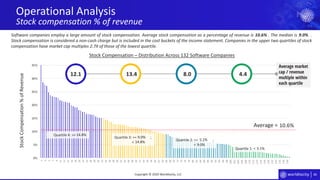
Software companies employ a large amount of stock compensation. Average stock compensation as a percentage of revenue is . The median is .
Stock compensation is considered a non-cash charge but is included in the cost buckets of the income statement. Companies in the upper two quartiles of stock
compensation have market cap multiples 2.7X of those of the lowest quartile.
12.1 13.4 8.0 4.4
10.6%
14.8%
14.8%
9.0%
9.0%
5.1%
5.1%
9.0%10.6%
47
0%
2%
4%
6%
8%
10%
12%
14%
16%
18%
20%
1
3
5
7
9
11
13
15
17
19
21
23
25
27
29
31
33
35
37
39
41
43
45
47
49
51
53
55
57
59
61
63
65
67
69
71
73
75
77
79
81
83
85
87
89
91
93
95
97
99
101
103
105
107
109
111
113
115
117
119
121
123
125
127
129
131
Average market
cap / revenue
multiple within
each quartile
Operational Analysis
Capital expenditure (CAPEX) % of revenue
Copyright © 2020 Worldlocity, LLC
Quartile 1: <
Quartile 2: >= ;
<
Quartile 3: >= ;
<
Quartile 4: >=
CAPEX%ofRevenue
CAPEX – Distribution Across 132 Software Companies
Average =
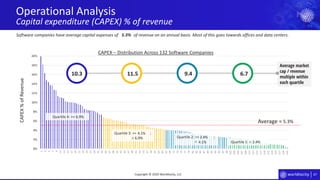
Software companies have average capital expenses of of revenue on an annual basis. Most of this goes towards offices and data centers.
10.3 11.5 9.4 6.7
5.3%
5.3%
6.9%
6.9%
4.1%
4.1%
2.4%
2.4%
48
0%
5%
10%
15%
20%
25%
30%
35%
40%
1
3
5
7
9
11
13
15
17
19
21
23
25
27
29
31
33
35
37
39
41
43
45
47
49
51
53
55
57
59
61
63
65
67
69
71
73
75
77
79
81
83
85
87
89
91
93
95
97
99
101
103
105
107
109
111
113
115
117
119
121
123
125
127
129
131
Average market
cap / revenue
multiple within
each quartile
Operational Analysis
Property, plant, and equipment (PP&E) % of revenue
Copyright © 2020 Worldlocity, LLC
Quartile 1: <
Quartile 2: >= ;
<
Quartile 3: >= ;
<
Quartile 4: >=
PP&E%ofRevenue
PP&E – Distribution Across 132 Software Companies
Average =
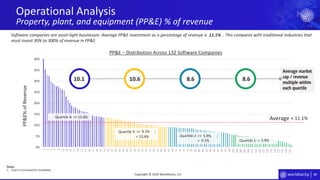
Software companies are asset-light businesses. Average PP&E investment as a percentage of revenue is . This compares with traditional industries that
must invest 30% to 300% of revenue in PP&E.
11.1%
10.1 10.6 8.6 8.6
11.1%13.4%
13.4%
9.1%
9.1%
5.9%
5.9%
Notes:
1. Chart is truncated for readability.
49
0%
50%
100%
150%
200%
250%
1
3
5
7
9
11
13
15
17
19
21
23
25
27
29
31
33
35
37
39
41
43
45
47
49
51
53
55
57
59
61
63
65
67
69
71
73
75
77
79
81
83
85
87
89
91
93
95
97
99
101
103
105
107
109
111
113
115
117
119
121
123
125
127
129
131
Average market
cap / revenue
multiple within
each quartile
Operational Analysis
Goodwill % of revenue
Copyright © 2020 Worldlocity, LLC
Quartile 1: <
Quartile 2: >= ;
<
Quartile 3: >= ;
<
Quartile 4: >=
Goodwill%ofRevenue
Goodwill – Distribution Across 132 Software Companies
Average =
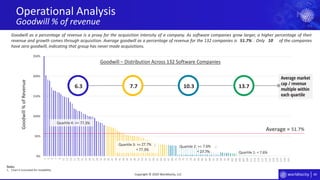
Goodwill as a percentage of revenue is a proxy for the acquisition intensity of a company. As software companies grow larger, a higher percentage of their
revenue and growth comes through acquisition. Average goodwill as a percentage of revenue for the 132 companies is . Only of the companies
have zero goodwill, indicating that group has never made acquisitions.
Notes:
1. Chart is truncated for readability.
6.3 7.7 10.3 13.7
51.7%
51.7%
77.3%
77.3%
27.7%
27.7% 7.6%
10
7.6%
50
0%
10%
20%
30%
40%
50%
60%
70%
2 3 4 5 6 7 8 9 10 11 12 13 14 15 16 17 18 19 20 21 22 23 24 25 26 27 28 29 30 31 32 33 34 35 36 37 38 39 40 41 42 43 44 45 46 47
Average market
cap / revenue
multiple within
each quartile
Operational Analysis
Stock repurchases % of revenue
Copyright © 2020 Worldlocity, LLC
Quartile 1: <
Quartile 2: >= ;
<
Quartile 3: >= ;
<
Quartile 4: >=
StockRepurchases%ofRevenue
Stock Repurchases – Distribution Across Software Companies
Average =
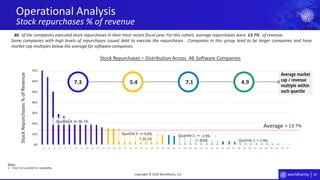
of the companies executed stock repurchases in their most recent fiscal year. For this cohort, average repurchases were of revenue.
Some companies with high levels of repurchases issued debt to execute the repurchases . Companies in this group tend to be larger companies and have
market cap multiples below the average for software companies.
Notes:
1. Chart is truncated for readability.
46 13.7%
7.3 5.4 7.1 4.9
13.7%
16.1%
16.1%
9.0%
9.0%
2.9%
2.9%
46
51
0%
20%
40%
60%
80%
100%
120%
1
3
5
7
9
11
13
15
17
19
21
23
25
27
29
31
33
35
37
39
41
43
45
47
49
51
53
55
57
59
61
63
65
67
69
71
73
75
77
79
81
83
85
87
89
91
93
95
97
99
101
103
105
107
109
111
113
115
117
119
121
123
125
127
129
131
Average market
cap / revenue
multiple within
each quartile
Operational Analysis
Deferred revenue % of revenue
Copyright © 2020 Worldlocity, LLC
Quartile 2: >= ;
<
Quartile 3: >= ;
<
Quartile 4: >=
DeferredRevenue%ofRevenue
Deferred Revenue – Distribution Across 132 Software Companies
Average =
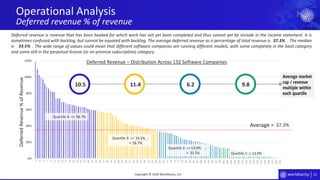
Deferred revenue is revenue that has been booked for which work has not yet been completed and thus cannot yet be include in the income statement. It is
sometimes confused with backlog, but cannot be equated with backlog. The average deferred revenue as a percentage of total revenue is . The median
is . The wide range of values could mean that different software companies are running different models, with some completely in the SaaS category
and some still in the perpetual license (or on-premise subscription) category.
10.5 11.4 6.2 9.8
37.3%
37.3%
33.5%
58.7%
58.7%
33.5%
33.5%
13.0%
Quartile 1: < 13.0%
52
0%
50%
100%
150%
200%
250%
3 5 7 9 11 13 15 17 19 21 23 25 27 29 31 33 35 37 39 41 43 45 47 49 51 53 55 57 59 61 63 65 67 69 71 73 75 77 79 81 83 85 87 89 91 93 95 97 99 101 103 105 107 109
Average market
cap / revenue
multiple within
each quartile
Operational Analysis
Remaining performance obligations (RPOs) % of revenue
Copyright © 2020 Worldlocity, LLC
Quartile 2: >= ;
<
Quartile 3: >= ;
<
Quartile 4: >=
RPOs%ofRevenue
RPOs % of Revenue – Distribution Across Software Companies
Average =
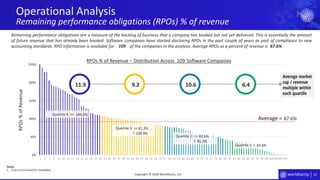
Remaining performance obligations are a measure of the backlog of business that a company has booked but not yet delivered. This is essentially the amount
of future revenue that has already been booked. Software companies have started disclosing RPOs in the past couple of years as part of compliance to new
accounting standards. RPO information is available for of the companies in the analysis. Average RPOs as a percent of revenue is .
Quartile 1: <
109 87.6%
11.9 9.2 10.6 6.4
Notes:
1. Chart is truncated for readability.
109.9%
109.9%
81.3%
81.3%
43.6%
43.6%
87.6%
109
53
0
20
40
60
80
100
120
140
160
1
3
5
7
9
11
13
15
17
19
21
23
25
27
29
31
33
35
37
39
41
43
45
47
49
51
53
55
57
59
61
63
65
67
69
71
73
75
77
79
81
83
85
87
89
91
93
95
97
99
101
103
105
107
109
111
113
115
117
119
121
123
125
127
129
131
Average market
cap / revenue
multiple within
each quartile
Operational Analysis
Days sales outstanding (DSO)
Copyright © 2020 Worldlocity, LLC
Quartile 1: <
Quartile 2: >= ;
<
Quartile 3: >= ;
<
Quartile 4: >=
DaysSalesOutstanding
Days Sales Outstanding – Distribution Across 132 Software Companies
Average =
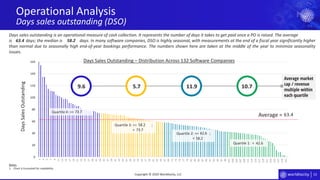
Days sales outstanding is an operational measure of cash collection. It represents the number of days it takes to get paid once a PO is raised. The average
is days; the median is days. In many software companies, DSO is highly seasonal, with measurements at the end of a fiscal year significantly higher
than normal due to seasonally high end-of-year bookings performance. The numbers shown here are taken at the middle of the year to minimize seasonality
issues.
Notes:
1. Chart is truncated for readability.
9.6 5.7 11.9 10.7
63.4 58.2
63.4
73.7
73.7
58.2
58.2
42.6
42.6
54
$0
$100,000
$200,000
$300,000
$400,000
$500,000
$600,000
$700,000
$800,000
$900,000
2 4 6 8 10 12 14 16 18 20 22 24 26 28 30 32 34 36 38 40 42 44 46 48 50 52 54 56 58 60 62 64 66 68 70 72 74 76 78 80 82 84 86 88 90 92 94 96 98 100102104106108110112114
Average market
cap / revenue
multiple within
each quartile
Operational Analysis
Revenue per employee
Copyright © 2020 Worldlocity, LLC
Quartile 1: <
Quartile 2: >= ;
<
Quartile 3: >= ;
<
Quartile 4: >=
RevenueperEmployee
Revenue per Employee – Distribution Across 113 Software Companies
Average =
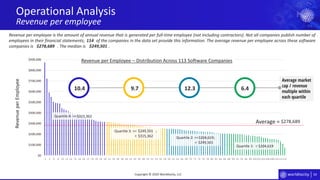
Revenue per employee is the amount of annual revenue that is generated per full-time employee (not including contractors). Not all companies publish number of
employees in their financial statements; of the companies in the data set provide this information. The average revenue per employee across these software
companies is . The median is .
$278,689
114
$278,689 $249,501
10.4 9.7 12.3 6.4
$315,362
$315,362
$249,501
$249,501
$204,619
$204,619
Historical Analysis
Charts that provide analysis of key variables across all
companies for the ten years from 2010 to 2019.
56
Historical Analysis
Summary table of all variables, 2010-2019
Copyright © 2020 Worldlocity, LLC
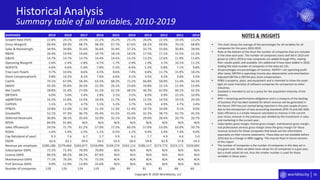
▪ This chart shows the average of the percentages for all variables for all
companies for the years 2010-2019.
▪ Note at the bottom of the chart the number of companies that are included
in the view each year. The number of companies starts with 60 in 2010 and
grows to 128 in 2019 as new companies are added through IPOs, making
their results public and available. (An additional 4 have been added in 2020,
making the total number of companies in the data set 132.
▪ All percentages are percentages of revenue. NOPAT= net operating profit
after taxes; EBITDA is operating income plus depreciation and amortization.
Adjusted EBITDA is EBITDA plus stock compensation.
▪ PP&E is property, plant, and equipment and is intended to show the asset-
light (or asset intensity) of software companies for comparison to other
industries.
▪ Goodwill is intended to act as a proxy for the acquisition-intensity of the
industry.
▪ RPO = remaining performance obligations and is a measure of the backlog
of business that has been booked for which revenue will be generated in
the future. RPO has just started being reported in the past couple of years
due to the introduction of new accounting standards (IFRS 15 and ASC 606)
▪ Sales efficiency is a simple measure calculated as revenue in the current
year minus revenue in the previous year divided by the investment in sales
and marketing in the current year.
▪ Subscription gross margin, license gross margin, maintenance gross margin,
and professional services gross margin show the gross margin for those
revenue streams for those companies that break out this information
separately on their income statements. These data are not available before
2016 due to a change in XBRL tagging. This may be fixed in future versions
of this report
▪ The number of companies is the number of companies in the data set in
any given year. Most variables have values for all companies in a give year,
but a small subset do not, thus the smaller number is used for those
variables in those years.
NOTES & INSIGHTSAVERAGES 2019 2018 2017 2016 2015 2014 2013 2012 2011 2010
Growth Rate (YOY) 22.8% 24.1% 24.5% 22.2% 26.2% 25.1% 26.0% 22.5% 19.3% 13.2%
Gross Margin% 69.4% 69.3% 68.7% 68.3% 67.7% 67.6% 68.1% 69.0% 70.1% 68.8%
Sales & Marketing% 34.9% 34.8% 35.6% 36.6% 35.4% 37.2% 33.7% 33.6% 30.8% 28.9%
R&D% 20.4% 19.9% 19.6% 19.7% 18.1% 18.5% 17.5% 17.1% 15.5% 15.2%
G&A% 14.7% 14.7% 14.7% 14.4% 14.5% 14.1% 13.2% 12.6% 11.9% 11.6%
Operating Margin% -2.6% -2.4% -2.8% -4.7% -1.7% -2.9% 1.9% 3.7% 10.1% 11.2%
NOPAT% -4.6% -4.6% -5.9% -7.8% -5.5% -6.4% -1.2% 0.8% 7.1% 9.8%
Free Cash Flow% 9.7% 10.6% 8.6% 6.5% 8.6% 7.4% 8.8% 11.7% 15.9% 18.2%
Stock Compensation% 9.8% 10.2% 8.1% 7.6% 6.6% 6.1% 4.5% 4.2% 3.6% 3.5%
Cash% 74.1% 67.0% 58.3% 63.5% 68.2% 72.2% 66.8% 58.0% 51.4% 56.3%
Debt% 45.3% 35.6% 30.3% 22.3% 26.1% 23.6% 19.8% 15.1% 11.4% 13.0%
Net Cash% 28.8% 31.4% 27.0% 41.2% 42.1% 48.5% 46.3% 42.9% 40.1% 42.3%
EBITDA% 6.0% 5.6% 5.4% 2.8% 5.1% 3.5% 8.0% 9.9% 15.5% 16.9%
adjEBITDA% 16.2% 15.8% 13.4% 10.4% 11.7% 9.6% 12.5% 14.5% 19.1% 20.3%
CAPEX% 5.1% 4.7% 4.7% 5.5% 5.2% 5.7% 5.6% 4.9% 4.7% 3.4%
PP&E% 10.8% 11.0% 11.3% 11.2% 11.3% 11.4% 10.7% 10.0% 9.1% 9.0%
Goodwill% 52.1% 47.3% 46.7% 45.4% 41.5% 41.6% 42.3% 38.7% 42.7% 45.5%
Deferred Revenue% 36.8% 38.1% 35.6% 32.0% 32.1% 30.3% 29.0% 28.4% 26.7% 20.7%
RPO% 84.9% 91.8% N/A N/A N/A N/A N/A N/A N/A N/A
Sales Efficiency% 59.5% 71.7% 61.2% 57.0% 72.5% 60.5% 57.6% 53.0% 63.6% 50.7%
ROA% -1.6% -1.9% -2.5% -1.1% -0.5% -1.2% 0.9% 3.4% 7.4% 9.0%
Cap Ratio(end of year) 9.3 7.6 6.7 5.7 5.9 6.2 7.7 4.9 4.6 5.0
DSO% 62.6 63.1 59.4 54.2 53.4 56.0 59.8 62.8 57.8 54.3
Revenue per employee $280,186 $279,464 $265,877 $256,996 $249,274 $242,115 $286,117 $273,773 $322,171 $320,692
Subscription GM% 72.2% 71.4% 70.0% 70.8% N/A N/A N/A N/A N/A N/A
License GM% 86.5% 88.2% 88.2% 87.6% N/A N/A N/A N/A N/A N/A
Maintenance GM% 77.1% 76.3% 75.7% 73.5% N/A N/A N/A N/A N/A N/A
Prof Services GM% 9.9% 12.9% 13.8% 25.6% N/A N/A N/A N/A N/A N/A
Number of companies 128 126 124 119 106 99 91 82 68 60
57
2019 2018 2017 2016 2015 2014 2013 2012 2011 2010
Growth Rate (YOY) 22.8% 24.1% 24.5% 22.2% 26.2% 25.1% 26.0% 22.5% 19.3% 13.2%
Gross Margin% 69.4% 69.3% 68.7% 68.3% 67.7% 67.6% 68.1% 69.0% 70.1% 68.8%
Sales & Marketing% 34.9% 34.8% 35.6% 36.6% 35.4% 37.2% 33.7% 33.6% 30.8% 28.9%
R&D% 20.4% 19.9% 19.6% 19.7% 18.1% 18.5% 17.5% 17.1% 15.5% 15.2%
G&A% 14.7% 14.7% 14.7% 14.4% 14.5% 14.1% 13.2% 12.6% 11.9% 11.6%
Operating Margin% -2.6% -2.4% -2.8% -4.7% -1.7% -2.9% 1.9% 3.7% 10.1% 11.2%
-10.0%
0.0%
10.0%
20.0%
30.0%
40.0%
50.0%
60.0%
70.0%
80.0%
INCOME STATEMENT YEARLY AVERAGES, 2010-2019
Historical Analysis
Income statement yearly averages, 2010-20191
Copyright © 2020 Worldlocity, LLC
Gross Margin
Sales & Marketing%
Growth Rate%R&D%
G&A%
Operating Margin%
▪ Remarkable year-to-year
consistency in all variables for the
six years 2014-2019.
▪ In the years 2010-2011 the
industry operated with
significantly higher operating
margins, with lower growth rates
and lower investments in sales and
marketing, R&D, and G&A. This
may indicate a different economic
environment emerging from the
great recession.
▪ 2011-2012 seem to be transition
years, as the industry started to
invest significantly more in sales
and marketing, R&D, and G&A and
run lower operating margins. This
also is the beginning of a period of
significant number of IPOs,
increasing the number of
companies in the data set.
▪ The average software company in
2019 operated with thirteen
percentage points more
investment in sales and marketing,
R&D, and G&A than in 2010.
NOTES & INSIGHTS
Notes:
1. Yearly averages represent the average of the percentages for all companies in a given year. The number of companies changes as time goes on
and additional companies become public.
Number of companies 128 126 124 119 106 99 91 82 68 60
58
2019 2018 2017 2016 2015 2014 2013 2012 2011 2010
Operating Margin% -2.6% -2.4% -2.8% -4.7% -1.7% -2.9% 1.9% 3.7% 10.1% 11.2%
adjEBITDA% 16.2% 15.8% 13.4% 10.4% 11.7% 9.6% 12.5% 14.5% 19.1% 20.3%
Free Cash Flow% 9.7% 10.6% 8.6% 6.5% 8.6% 7.4% 8.8% 11.7% 15.9% 18.2%
CAPEX% 5.1% 4.7% 4.7% 5.5% 5.2% 5.7% 5.6% 4.9% 4.7% 3.4%
Stock Compensation% 9.8% 10.2% 8.1% 7.6% 6.6% 6.1% 4.5% 4.2% 3.6% 3.5%
-5.0%
0.0%
5.0%
10.0%
15.0%
20.0%
PROFIT, CASH FLOW, STOCK, CAPEX: YEARLY AVERAGES,
2010-2019
Historical Analysis
Profit, cash flow, stock comp, CAPEX, yearly averages, 2010-2019
Copyright © 2020 Worldlocity, LLC
▪ Average operating margins have
declined steadily over the decade,
as investment increased in sales
and marketing, R&D, and G&A.
About half of this decline can be
explained by a concurrent steady
rise in stock-based compensation.
▪ Average adjEBITDA ranges from
roughly 10% of revenue to 20% of
revenue. Free cash flow ranges
from 7% to 18% and follows the
same curve as adjEBITDA, as one
might expect.
▪ Average CAPEX across the years is
remarkably consistent at about 5%
of revenue.
NOTES & INSIGHTS
Notes:
1. All numbers are the averages of all the percentages of all the companies in a given year.
2. adjEBITDA = operating income plus depreciation and amortization and stock-based compensation.
3. Free cash flow = cash from operations minus CAPEX.
Stock Comp%
adjEBITDA%
CAPEX%
Operating Margin%
Free Cash Flow%
Number of companies 128 126 124 119 106 99 91 82 68 60
59
74.1%
67.0%
58.3%
63.5%
68.2%
72.2%
66.8%
58.0%
51.4%
56.3%
28.8%
31.4%
27.0%
41.2% 42.1%
48.5%
46.3%
42.9%
40.1%
42.3%
0.0%
10.0%
20.0%
30.0%
40.0%
50.0%
60.0%
70.0%
80.0%
2 0 1 9 2 0 1 8 2 0 1 7 2 0 1 6 2 0 1 5 2 0 1 4 2 0 1 3 2 0 1 2 2 0 1 1 2 0 1 0
CASH POSITION, % OF REVENUE,
YEARLY AVERAGES, 2010-2019
Historical Analysis
Cash and net-cash yearly averages, 2010-2019
Copyright © 2020 Worldlocity, LLC
▪ Software companies have been
consistently well-capitalized over
the ten years from 2010-2019.
▪ Average cash position as a
percentage of revenue ended
2019 at 75% of revenue, the
highest in the decade.
▪ Average cash position at the
beginning of the decade was
lower, which may be an result of
emerging from the great
recession. Cash position started
growing in 2012, which may be the
result of the data set growing
significantly due to IPO companies,
with strong starting capital
positions.
NOTES & INSIGHTS
1. Yearly averages represent the average of the percentages for all companies in a given year. This does not necessarily represent the capital structure of the overall industry since larger companies may
have larger absolute amounts of debt but their percentage is equivalent to all other percentages in this view.
2. Net cash = Total cash minus total debt. Cash includes cash, cash equivalents, short-term investments.
Notes:
Cash%
Net Cash%
60
Historical Analysis
Sales and marketing efficiency, 2010-2019
Copyright © 2020 Worldlocity, LLC
Notes: .
1. Sales efficiency = revenue in a given year minus revenue in the previous year revenue divided by sales and marketing investment in the given year.
▪ Software company sales efficiency
has been reasonably consistent
across the decade from 2010-
2019.
▪ In general, it takes $1 of
investment in sales and marketing
to generate about 60 cents of new
annual revenue. With a multi-year
subscription model with high
retention rates, this level of
performance is sufficient to create
a strong business and operating
model (details on this will be
further explored in future reports).
NOTES & INSIGHTS
59.5%
71.7%
61.2%
57.0%
72.5%
60.5%
57.6%
53.0%
63.6%
50.7%
0.0%
10.0%
20.0%
30.0%
40.0%
50.0%
60.0%
70.0%
80.0%
2019 2018 2017 2016 2015 2014 2013 2012 2011 2010
SALES & MARKETING EFFICIENCY %
(YEARLY AVERAGES, 2010-2019)
61
Historical Analysis
Goodwill % of revenue, yearly averages, 2010-2019
Copyright © 2020 Worldlocity, LLC
▪ Goodwill as a percentage of
revenue is a proxy for the
acquisition intensity of a company
and of an industry overall.
▪ Average goodwill % of revenue has
remained relatively constant at
about 50% of revenue. This is
somewhat surprising since as
companies get larger and older,
they tend to increase their
acquisitions. However, this is
offset by the IPO companies,
which start out with very little to
no Goodwill. Furthermore, this
indicates that goodwill is growing
in lockstep with revenue growth,
meaning acquisitions provide a
relatively consistent contribution
to revenue growth across the
years.
NOTES & INSIGHTS
52.1%
47.3% 46.7%
45.4%
41.5% 41.6% 42.3%
38.7%
42.7%
45.5%
0.0%
10.0%
20.0%
30.0%
40.0%
50.0%
60.0%
2019 2018 2017 2016 2015 2014 2013 2012 2011 2010
GOODWILL% OF REVENUE,
(YEARLY AVERAGES, 2010-2019)
62
Historical Analysis
Property, plant, and equipment (PP&E), 2010-2019
Copyright © 2020 Worldlocity, LLC
▪ PP&E as a percentage of revenue
is a measure of the asset intensity
of a business.
▪ As expected, this chart shows that
software companies remain
consistently asset-light across the
years from 2010-2019.
▪ PP&E (net of depreciation) is
about 10% of revenue, making
software one of the asset lightest
industries.
NOTES & INSIGHTS
1. PP&E% is property, plant, and equipment (on the balance sheet) as a percentage of revenue. The averages for each year are averages of all the percentages for all the companies in the given year.
Notes:
10.8% 11.0% 11.3% 11.2% 11.3% 11.4%
10.7%
10.0%
9.1% 9.0%
0.0%
2.0%
4.0%
6.0%
8.0%
10.0%
12.0%
2019 2018 2017 2016 2015 2014 2013 2012 2011 2010
PP&E%
(YEARLY AVERAGES , 2010-2019)
63
Historical Analysis
Market cap revenue multiple, 2010-2019
Copyright © 2020 Worldlocity, LLC
9.3
7.6
6.7
5.7 5.9
6.2
7.7
4.9
4.6
5.0
0.0
1.0
2.0
3.0
4.0
5.0
6.0
7.0
8.0
9.0
10.0
2019 2018 2017 2016 2015 2014 2013 2012 2011 2010
MARKET CAP/REVENUE
(AVERAGE END-OF-YEAR VALUES, 2010-2019)
▪ This chart shows the average end-
of-year market capitalization
revenue multiple for all companies
in the data set in that given year.
Market capitalization is taken for
each company on the last trading
year of each year.
▪ Average market cap multiple
(market capitalization divided by
annual revenue) started the
decade of the 2010s at around 5
and finished the decade at a level
of almost double that, with
continued growth from 2016
through 2019.
NOTES & INSIGHTS
Notes: .
1. Market capitalization is taken from the last trading day of each year. Multiple is calculated by taking this value and dividing it by that year’s revenue for each of the companies in the data set.
64
Historical Analysis
Revenue per employee, 2010-2019
Copyright © 2020 Worldlocity, LLC
$280,186 $279,464
$265,877
$256,996
$249,274 $242,115
$286,117
$273,773
$322,171 $320,692
$0
$50,000
$100,000
$150,000
$200,000
$250,000
$300,000
$350,000
2019 2018 2017 2016 2015 2014 2013 2012 2011 2010
REVENUE PER EMPLOYEE
(YEARLY AVERAGES, 2010-2019)
▪ This chart shows average revenue
per employee for all companies for
the years 2010-2019. Note that
not all companies publish their
number of employees. This
analysis includes about 70% of the
companies in any given year.
▪ Revenue employee over the
course of the decade averaged
between about $240K and $320K
and ended at about $280K. Note
that the early decade numbers
included fewer companies, so the
end-of-decade numbers are likely
to more accurately reflect the
overall industry average.
NOTES & INSIGHTS
IPO Analysis
Charts that show operating model evolution in the years
after companies go public. 33 companies in the data set
executed IPOs in the years 2010-2014. This analysis
shows how the operating models of these 33
companies evolved in the years after IPO (2014-2019).
66
IPO Analysis
Summary table of all variables, 2014-2019
Copyright © 2020 Worldlocity, LLC
▪ 33 of the companies in the data set executed IPOs in the years
2010-2014. This analysis tracks the evolution of key operating
variables for these companies in the six years after their IPO (2014-
2019).
▪ This analysis validates that IPO companies evolve their operating
models significantly in the years after they go public. In general,
growth slows, and there is a much higher focus on all forms of
profitability.
▪ Some of the key points are summarized in the comments on the left
(to the right of the table).
▪ This analysis shows that growth slows substantially to closer to the
average for all companies in the analysis, but that all forms of
profitability increase substantially:
▪ Operating margin increases by 17 percentage points
▪ Free cash flow increases by 13 percentage points
▪ Adjusted EBITDA increases by 24 percentage points
▪ A big part of the increase in profitability is due to lower operating
investments:
▪ Sales and marketing investment decreases by 10
percentage pints
▪ G&A decreases by 2+ percentage points
▪ Interestingly, investment in R&D stays relatively the same as the
companies evolve
▪ This also shows that companies increase their acquisition-intensity,
with goodwill as a percentage of revenue increasing by about 17
percentage points
NOTES & INSIGHTSAVERAGES 2019 2018 2017 2016 2015 2014
Growth Rate (YOY) 23.2% 29.7% 25.6% 30.6% 37.3% 43.8%
Gross Margin% 70.1% 69.7% 69.6% 69.0% 67.2% 66.2%
Sales & Marketing% 36.2% 36.0% 38.6% 40.7% 43.7% 46.5%
R&D% 21.6% 20.6% 20.9% 21.5% 21.9% 22.8%
G&A% 14.7% 15.4% 15.6% 16.1% 16.8% 17.2%
Operating Margin% -4.3% -3.2% -6.3% -10.5% -15.1% -21.3%
NOPAT% -6.0% -4.9% -8.2% -13.2% -18.2% -23.2%
Free Cash Flow% 10.5% 11.7% 9.7% 6.2% 3.2% -3.3%
Stock Compensation% 13.1% 12.4% 12.3% 12.4% 12.0% 10.0%
Cash% 86.2% 81.2% 73.2% 74.8% 95.2% 101.3%
Debt% 60.2% 45.4% 29.3% 22.9% 27.8% 20.9%
Net Cash% 26.1% 35.8% 44.0% 51.8% 67.4% 80.4%
EBITDA% 5.5% 4.9% 1.6% -3.0% -8.1% -14.9%
adjEBITDA% 18.5% 17.3% 13.8% 9.3% 3.9% -4.9%
CAPEX% 6.4% 5.9% 6.5% 6.4% 6.0% 7.3%
PP&E% 11.8% 13.7% 14.6% 13.4% 13.5% 13.7%
Goodwill% 40.3% 31.8% 29.7% 24.3% 26.0% 23.4%
Deferred Revenue% 40.7% 39.9% 41.9% 39.7% 38.5% 39.1%
RPO% 86.1% 94.6% N/A N/A N/A N/A
Sales Efficiency% 64.7% 89.8% 60.1% 68.2% 71.3% 64.8%
ROA% -3.4% -3.4% -6.5% -9.3% -11.0% -15.0%
Cap Ratio(end of year) 9.4 8.4 7.7 6.7 8.0 8.9
DSO% 49.1 51.5 47.7 47.7 45.9 50.5
Revenue per employee $257,265 $246,270 $231,902 $223,643 $207,535 $191,235
Subscription GM% 74.4% 74.4% 74.3% N/A N/A N/A
License GM% N/A N/A N/A N/A N/A N/A
Maintenance GM% N/A N/A N/A N/A N/A N/A
Prof Services GM% -13.2% -9.3% -7.2% N/A N/A N/A
Number of companies 32 33 33 33 33 32
Growth rate down by 50%
Gross margin up by 4 percentage points
Sales and marketing down by 10 percentage points
R&D relatively flat
G&A down by 2+ percentage points
Operating margin up by 17 percentage points
Free cash flow up by 13 percentage points
Stock compensation up by 3 percentage points
Debt up substantially, possibly due to acquisitions
Adjusted EBITDA up by 24 percentage points
Goodwill up substantially, reflecting acquisitions
Sales per employee up >25%
Cap ratio relatively stable
Sales efficiency relatively stable
67
2019 2018 2017 2016 2015 2014
Growth Rate (YOY) 23.2% 29.7% 25.6% 30.6% 37.3% 43.8%
Gross Margin% 70.1% 69.7% 69.6% 69.0% 67.2% 66.2%
Sales & Marketing% 36.2% 36.0% 38.6% 40.7% 43.7% 46.5%
R&D% 21.6% 20.6% 20.9% 21.5% 21.9% 22.8%
G&A% 14.7% 15.4% 15.6% 16.1% 16.8% 17.2%
Operating Margin% -4.3% -3.2% -6.3% -10.5% -15.1% -21.3%
-25.0%
-5.0%
15.0%
35.0%
55.0%
75.0%
INCOME STATEMENT YEARLY AVERAGES, 2014-2019
IPO Analysis
Income statement yearly averages, 2014-20191
Copyright © 2020 Worldlocity, LLC
Gross Margin
Sales & Marketing%
Growth Rate%
R&D%
G&A%
Operating Margin%
▪ 33 companies in the data set went
public from 2010 to 2014. This
chart shows how key variables
changed after their IPOs.
▪ Summary of changes:
▪ Gross margin increased by
4 percentage points
▪ Sales and marketing
investment decreased by
10 percentage points
▪ Growth rate decreased by
20 percentage points
▪ G&A decreased by 3
percentage points
▪ R&D held relatively steady
▪ Operating margin
increased by 17
percentage points
NOTES & INSIGHTS
Notes:
1. Yearly averages represent the average of the percentages for all companies in a given year. The number of companies changes as time goes on and additional companies become public.
68
2019 2018 2017 2016 2015 2014
Operating Margin% -4.3% -3.2% -6.3% -10.5% -15.1% -21.3%
adjEBITDA% 18.5% 17.3% 13.8% 9.3% 3.9% -4.9%
Free Cash Flow% 10.5% 11.7% 9.7% 6.2% 3.2% -3.3%
CAPEX% 6.4% 5.9% 6.5% 6.4% 6.0% 7.3%
Stock Compensation% 13.1% 12.4% 12.3% 12.4% 12.0% 10.0%
-25.0%
-20.0%
-15.0%
-10.0%
-5.0%
0.0%
5.0%
10.0%
15.0%
20.0%
PROFIT, CASH FLOW, STOCK, CAPEX: YEARLY AVERAGES, 2014-
2019
IPO Analysis
Profit, cash flow, stock comp, CAPEX, yearly averages, 2014-2019
Copyright © 2020 Worldlocity, LLC
▪ 33 companies in the data set went
public from 2010 to 2014. This
chart shows how key profitability,
cash flow, and investment
variables changed over time after
their IPOs.
▪ Summary of changes:
▪ Operating margin
increased by 17
percentage points
▪ Adjusted EBITDA increased
by 24 percentage points
▪ Free cash flow increased
by 14 percentage points
▪ CAPEX held relatively
steady
▪ Stock compensation
increased by 3 percentage
points
▪ This chart adds credence to the
thesis that while many IPO
companies lose money, they do
evolve over time to dramatically
improve their profit and cash flow
measures.
NOTES & INSIGHTS
Notes:
1. All numbers are the averages of all the percentages of all the companies in a given year.
2. adjEBITDA = operating income plus depreciation and amortization and stock-based compensation.
3. Free cash flow = cash from operations minus CAPEX.
Stock Comp%
adjEBITDA%
CAPEX%
Operating Margin%
Free Cash Flow%
69
86.2%
81.2%
73.2% 74.8%
95.2%
101.3%
26.1%
35.8%
44.0%
51.8%
67.4%
80.4%
0.0%
20.0%
40.0%
60.0%
80.0%
100.0%
120.0%
2 0 1 9 2 0 1 8 2 0 1 7 2 0 1 6 2 0 1 5 2 0 1 4
CASH POSITION, % OF REVENUE,
YEARLY AVERAGES, 2014-2019
IPO Analysis
Cash and net-cash yearly averages, 2014-2019
Copyright © 2020 Worldlocity, LLC
▪ 33 companies in the data set went
public from 2010 to 2014. This
chart shows how their cash and
net cash positions changed in the
years after their IPOs.
▪ Summary of changes:
▪ Cash position declined by
15 percentage points but
was still very robust.
▪ Net cash position (cash
minus debt as a
percentage of revenue)
declined significantly,
indicating companies took
on debt to execute
acquisitions.
NOTES & INSIGHTS
1. Yearly averages represent the average of the percentages for all companies in a given year. This does not necessarily represent the capital structure of the overall industry since larger companies may
have larger absolute amounts of debt but their percentage is equivalent to all other percentages in this view.
2. Net cash = Total cash minus total debt. Cash includes cash, cash equivalents, short-term investments.
Notes:
Cash%
Net Cash%
70
IPO Analysis
Sales and marketing efficiency, 2014-2019
Copyright © 2020 Worldlocity, LLC
Notes: .
1. Sales efficiency = revenue in a given year minus revenue in the previous year revenue divided by sales and marketing investment in the given year.
▪ 33 companies in the data set went
public from 2010 to 2014. This
chart shows how their sales and
marketing efficiency changed in
the years after their IPOs.
▪ This chart shows that sales and
marketing efficiency held pretty
steady over the six years after IPO.
(2018 is distorted by one data
point due to an acquisition).
NOTES & INSIGHTS
64.7%
89.8%
60.1%
68.2%
71.3%
64.8%
0.0%
10.0%
20.0%
30.0%
40.0%
50.0%
60.0%
70.0%
80.0%
90.0%
100.0%
2019 2018 2017 2016 2015 2014
SALES & MARKETING EFFICIENCY %
(YEARLY AVERAGES, 2014-2019)
71
IPO Analysis
Goodwill % of revenue, yearly averages, 2014-2019
Copyright © 2020 Worldlocity, LLC
▪ 33 companies in the data set went
public from 2010 to 2014. This
chart shows how their goodwill as
a percentage of revenue changed
in the years after their IPOs.
▪ Goodwill as a percentage of
revenue is a proxy for the
acquisition intensity of a company
and of an industry overall.
▪ Goodwill increased steadily over
the six years, indicating an
increasing propensity for
acquisitions.
NOTES & INSIGHTS
40.3%
31.8%
29.7%
24.3%
26.0%
23.4%
0.0%
10.0%
20.0%
30.0%
40.0%
50.0%
60.0%
2019 2018 2017 2016 2015 2014
GOODWILL% OF REVENUE,
(YEARLY AVERAGES, 2014-2019)
72
IPO Analysis
Property, plant, and equipment (PP&E), 2014-2019
Copyright © 2020 Worldlocity, LLC
▪ 33 companies in the data set went
public from 2010 to 2014. This
chart shows how their asset
intensity changed in the years
after their IPOs.
▪ This chart indicates that asset
intensity stayed relatively steady
over the six years.
▪ It’s interesting to note that the
asset intensity of this IPO cohort is
slightly higher than the average for
the entire data set. This is possibly
due to higher data center
investment for pure SaaS
companies (which most of the
newer companies would be).
NOTES & INSIGHTS
1. PP&E% is property, plant, and equipment (on the balance sheet) as a percentage of revenue. The averages for each year are averages of all the percentages for all the companies in the given year.
Notes:
11.8%
13.7%
14.6%
13.4% 13.5% 13.7%
0.0%
2.0%
4.0%
6.0%
8.0%
10.0%
12.0%
14.0%
16.0%
2019 2018 2017 2016 2015 2014
PP&E%
(YEARLY AVERAGES , 2014-2019)
73
IPO Analysis
Market cap revenue multiple, 2014-2019
Copyright © 2020 Worldlocity, LLC
▪ 33 companies in the data set went
public from 2010 to 2014. This
chart shows how their market
capitalization to revenue multiples
changed in the years after their
IPOs.
▪ This chart shows that multiples
were high in the start, dipped, and
then steadily increased, which is
consistent with all software
companies. Furthermore, this
cohort has an average multiple
that are very similar to the
multiples for the overall data set.
NOTES & INSIGHTS
9.4
8.4
7.7
6.7
8.0
8.9
0.0
2.0
4.0
6.0
8.0
10.0
12.0
14.0
2019 2018 2017 2016 2015 2014
MARKET CAP/REVENUE
(AVERAGE END-OF-YEAR VALUES, 2014-2019)
Notes: .
1. Market capitalization is taken from the last trading day of each year. Multiple is calculated by taking this value and dividing it by that year’s revenue for the 33 companies in this cohort of the data set.
74
IPO Analysis
Revenue per employee, 2014-2019
Copyright © 2020 Worldlocity, LLC
▪ 33 companies in the data set went
public from 2010 to 2014. This
chart shows how their revenue per
employee changed in the six years
from 2014 to 2019.
▪ For this IPO cohort, average
revenue employee increased by
more than 25% over the six year
period.
NOTES & INSIGHTS
$257,265
$246,270
$231,902
$223,643
$207,535
$191,235
$0
$50,000
$100,000
$150,000
$200,000
$250,000
$300,000
2019 2018 2017 2016 2015 2014
REVENUE PER EMPLOYEE
(YEARLY AVERAGES, 2014-2019)
Market Cap Analysis
Charts that provide analysis of market capitalization and
market capitalization to revenue ratios for all companies
for their most recent fiscal year.
76
0.0
5.0
10.0
15.0
20.0
25.0
30.0
35.0
40.0
1
3
5
7
9
11
13
15
17
19
21
23
25
27
29
31
33
35
37
39
41
43
45
47
49
51
53
55
57
59
61
63
65
67
69
71
73
75
77
79
81
83
85
87
89
91
93
95
97
99
101
103
105
107
109
111
113
115
117
119
121
123
125
127
129
131
Average market
cap / revenue
multiple within
each quartile
Market Cap Analysis
Market cap / TTM revenue distribution
Copyright © 2020 Worldlocity, LLC
Quartile 1: <
Quartile 2: >= ;
<
Quartile 3: >= ;
<
Quartile 4: >=
MarketCap/MRYRevenue
Market Cap / TTM Revenue – Distribution Across 132 Software Companies
Average =
The average market cap to revenue across the data set is . The median is . However, the average for the highest quartile is and for the
lowest quartile is , indicating a wide range of market caps based on a wide range of company performances, lifecycle stages, and business models.
Notes:
1. Market cap multiple is market capitalization divided by trailing twelve months (TTM) of revenue for each company (as reported in most recent four quarters of public statements), as of the date on the cover of this report.
22.1 8.5 4.9 2.6
9.5 6.2 22.1
2.6
11.1
11.1
6.2
6.2
3.7
3.7
9.5
77
0.0
5.0
10.0
15.0
20.0
25.0
30.0
35.0
40.0
1
3
5
7
9
11
13
15
17
19
21
23
25
27
29
31
33
35
37
39
41
43
45
47
49
51
53
55
57
59
61
63
65
67
69
71
73
75
77
79
81
83
85
87
89
91
93
95
97
99
101
103
105
107
109
111
113
115
117
119
121
123
125
127
129
131
Average
enterprise
value / revenue
multiple within
each quartile
Market Cap Analysis
Enterprise Value / TTM revenue distribution
Copyright © 2020 Worldlocity, LLC
Quartile 1: <Quartile 2: >= ;
<
Quartile 3: > ;
<
Quartile 4: >=
EnterpriseValue/TTMRevenue
Enterprise Value / TTM Revenue – Distribution Across 132 Software Companies
Average =
Enterprise values (market cap plus debt minus cash) are not significantly different from market cap values. The
average EV revenue multiple is . The median is .
22.0 8.4 4.9 2.7
9.2
9.2 5.8
11.0
11.0
5.8
5.8
3.8 3.8
78
40.0%
45.0%
50.0%
55.0%
60.0%
65.0%
70.0%
75.0%
80.0%
85.0%
90.0%
0.00 5.00 10.00 15.00 20.00 25.00 30.00
Market Cap Analysis
Rule of 40: 1-year growth + adjusted EBITDA% >=40%
Copyright © 2020 Worldlocity, LLC
“Rule of 40” analysis adds growth rate and adjusted EBITDA together and determines which companies equal or exceed
40%. For the 132 companies in this report, satisfy this requirement. The average market cap / revenue multiple for
this group is . The median is .
RULE OF 40 COMPANIES (n= )
1-YearGrowth%+ADJEBITDA%
Market Cap / TTM Revenue
63
63
9.512.5
79
Market Cap Analysis
Balanced rule of 40: 1-Year growth>=20% AND adjEBITDA >=20%
Copyright © 2020 Worldlocity, LLC
Companies that satisfy the balanced “rule of 40” form a more selective group. In this case, the companies satisfy the rule of 40,
but do so by exceeding growth of 20% AND adjusted EBIDTA of 20%. To meet this criteria, companies cannot achieve the rule of
40 by overachieving in one variable or the other; they must excel in both. For the 132 companies in this report, satisfy this
requirement. The average market cap / revenue multiple for this group is . The median is .
40.0%
45.0%
50.0%
55.0%
60.0%
65.0%
70.0%
75.0%
80.0%
85.0%
90.0%
0.00 5.00 10.00 15.00 20.00 25.00
1-YearGrowth%+ADJEBITDA%
Market Cap / TTM Revenue
BALANCED RULE OF 40 COMPANIES (n= )22
14.7 10.7
22
80
-20.0%
0.0%
20.0%
40.0%
60.0%
80.0%
-20.0% -10.0% 0.0% 10.0% 20.0% 30.0% 40.0% 50.0% 60.0%
Market Cap Analysis
Operating models: growth versus EBITDA
Copyright © 2020 Worldlocity, LLC
ADJUSTED EBITDA
HIGH
1-YEARGROWTH
LOW
LOWHIGH
Median=
companies
Cap Ratio=
companies
Cap Ratio=
companies
Cap Ratio=
companies
Cap Ratio=
Median=
▪ This is a scatter chart for 126 companies
showing where they stand on 1-year
growth versus adjusted EBITDA.
▪ It splits the chart into a 2x2 by dividing
each dimension at its median.
▪ The upper right hand quadrant yields the
highest cap multiple. This is a slight shift
from past reports in which the upper left
hand quadrant has had the highest
multiples. This may show a slight market
shift towards greater focus on
profitability.
▪ The “goldilocks companies” represent a
group of companies that performs at our
just above the median for both
measures. They are growing not too fast
and not too slow, while still delivering
strong EBITDA returns. It remains to be
seen how these will perform over time,
but their operating models may be more
durable across business cycles.
NOTES & INSIGHTS
19.4%
19.1%
25
4.3
38
12.2
25
13.8
38
5.6
“GOLDILOCKS” COMPANIES
Notes:
1. The chart shows data for 126 companies (versus 132 for the entire data set) because 6 of the companies are new and have only one year of public data (no growth data).
2. Adjusted EBITDA = operating income plus depreciation, amortization, and stock compensation.
3. Market cap multiple is market capitalization divided by trailing twelve months (TTM) of revenue for each company (as reported in most recent four quarters of public statements), as of the date on the cover of this report.
81
Market Cap Analysis
Ranked table of correlations between variables and market cap multiple
Copyright © 2020 Worldlocity, LLC
There have been many reports over the years that show high correlations between certain operational variables and software company market cap multiples. Most of these have focused
on growth rate and free cash flow. The broader data set in this report simply do not support those conclusions. It’s possible that a subset of the data could find those high correlations, but
that would be choosing the data to fit the narrative. That said, while there are no variables with high correlations, there are some that are statistically significant and it is also useful to
see variable correlations relative to each other. The tables below shows all variables in this report and their correlation coefficients (R) for market cap multiple.
MODERATE AND LOW CORRELATIONS MIN OR NO CORRELATION
VARIABLE NAME CORREL COEFF (R)
SALES EFFICIENCY 0.14
GENERAL & ADMIN EXPENSE 0.11
OPERATING LEASE 0.10
RETURN ON EQUITY 0.08
MAINTENANCE MARGIN 0.07
DEFERRED REVENUE 0.08
RETURN ON INVESTED CAPITAL 0.06
PROPERTY, PLANT, AND EQUIPMENT 0.05
DEBT -0.01
FREE CASH FLOW -0.01
STOCK REPURCHASES -0.01
RETURN ON ASSETS -0.03
DAYS SALES OUTSTANDING -0.02
YEARS SINCE IPO -0.06
ADJUSTED EBITDA -0.08
SERVICES GROSS MARGIN -0.08
NET OPERATING PROFIT AFTER TAXES -0.11
OPERATING PROIFT MARGIN -0.11
EBITDA -0.15
GOODWILL -0.21
VARIABLE NAME CORREL COEFF (R)
CASH 0.53
GROWTH RATE 0.50
NET CASH 0.46
SUBSCRIPTION MARGIN 0.32
IPO YEAR 0.33
FOUNDING YEAR 0.32
LICENSE MARGIN 0.30
STOCK COMPENSATION 0.29
SALES & MARKETING 0.23
GROSS MARGIN 0.22
REMAINING PERF OBLIG 0.19
RESEARCH & DEVELOPMENT 0.18
CAPEX 0.17
82
1-YEAR GROWTH GROSS MARGIN R&D SALES & MKTG OP MARGIN FCF ADJ EBITDA CASH
0.50 0.23 0.18 0.22 -0.08 -0.01 -0.06 0.53
Market Cap Analysis
Market cap / TTM revenue correlation to individual variables
Copyright © 2020 Worldlocity, LLC
All individual variables show weak statistical correlation to market cap multiple. The two variables that show moderate correlation to market cap for the entire
data set are growth rate and cash position. All other variables show weak to no correlation.
Correlation coefficients (R) associated with single variable correlations to market cap / revenue multiple
Only CAGR and Cash show moderate correlation.
That being said, they only predict a small part of
the variation in market cap multiple.
Cash may be a proxy for the
ability of a company to
maintain its growth. This
makes it closely tied to
growth, and also has the
effect of making profitability
less important (at least in
the near term)
83
Market Cap Analysis
Balanced scorecard variables
Copyright © 2020 Worldlocity, LLC
GROWTH RATE
EBITDA
Growth rate is king
when it comes to
valuation, as investors
bet on future winners.
This variable has the
highest correlation to
market cap. Consistent
performance is just as
important.
EBITDA exhibits very little
statistical correlation to market
cap multiple. This is likely due to a
current market that values growth
significantly above profitability.
However, EBITDA is still widely
viewed as an important
determinant of long-term
performance.
Cash appears to be a key lever,
allowing companies to grow faster.
CASH
In the current market, growth is rewarded more than EBITDA. Longer term, these two will likely come more
into balance in terms of importance.
84
0.00
5.00
10.00
15.00
20.00
25.00
30.00
35.00
40.00
-40%
-20%
0%
20%
40%
60%
80%
100%
120%
140%
1
4
7
10
13
16
19
22
25
28
31
34
37
40
43
46
49
52
55
58
61
64
67
70
73
76
79
82
85
88
91
94
97
100
103
106
109
112
115
118
121
124
Market Cap Analysis
Market cap multiple and 1-year growth for each company
Copyright © 2020 Worldlocity, LLC
1 year growth of each company
Corresponding market cap multiple of each company
1-YearGrowth
MarketCap/TTMRevenue
▪ Growth rate is the one
of the best predictors
of market cap multiple
▪ That said, there is
significant noise in the
data, with some high
growth rates yielding
relatively lower
multiples
▪ Despite noise at the
bottom of the chart,
there is a general joint
upward trend for
multiples of five and
higher
NOTES & INSIGHTS1-YEAR GROWTH RATE AND MARKET CAP MULTIPLE
These charts show a visual of the relationship between a key variable and market cap multiple for each company. The intention is to show visually how
correlated or not correlated the data are.
Notes:
1. Chart is truncated for readability.
2. Sample size is 126 versus 132 because 6 companies only have one year of public information.
85
0.00
5.00
10.00
15.00
20.00
25.00
30.00
35.00
40.00
0%
20%
40%
60%
80%
100%
120%
140%
160%
180%
200%
220%
240%
260%
1
4
7
10
13
16
19
22
25
28
31
34
37
40
43
46
49
52
55
58
61
64
67
70
73
76
79
82
85
88
91
94
97
100
103
106
109
112
115
118
121
124
127
130
Market Cap Analysis
Market cap multiple and cash position for each company
Copyright © 2020 Worldlocity, LLC
Cash position of each company
Corresponding market cap multiple of each company
Cash%ofRevenue
MarketCap/TTMRevenue
▪ Cash position is the one
of the best predictors
of market cap multiple
▪ That said, there is
significant noise in the
data, with some high
cash positions yielding
relatively lower
multiples
▪ Despite noise at the
bottom of the chart,
there is a general joint
upward trend for
multiples of five and
higher
NOTES & INSIGHTS
CASH AND MARKET CAP MULTIPLE
Notes:
1. Cash position is calculated as cash, cash equivalents, and marketable securities divided by MRY revenue
These charts show a visual of the relationship between a key variable and market cap multiple for each company. The intention is to show visually how
correlated or not correlated the data are.
86
0.00
5.00
10.00
15.00
20.00
25.00
30.00
35.00
40.00
-40%
-30%
-20%
-10%
0%
10%
20%
30%
40%
50%
60%
1
4
7
10
13
16
19
22
25
28
31
34
37
40
43
46
49
52
55
58
61
64
67
70
73
76
79
82
85
88
91
94
97
100
103
106
109
112
115
118
121
124
127
130
Market Cap Analysis
Market cap multiple and FCF for each company
Copyright © 2020 Worldlocity, LLC
Free cash flow of each company
Corresponding market cap multiple of each company
FreeCashFlow%ofRevenue
MarketCap/TTMRevenue
▪ There is no statistical
correlation between
free cash flow and
market cap multiple
▪ The chart shows free
cash flow numbers
fluctuating, with no
apparent correlation to
market cap multiple
NOTES & INSIGHTSFCF AND MARKET CAP MULTIPLE
These charts show a visual of the relationship between a key variable and market cap multiple for each company. The intention is to show visually how
correlated or not correlated the data are.
87
0.00
5.00
10.00
15.00
20.00
25.00
30.00
35.00
40.00
-30%
-20%
-10%
0%
10%
20%
30%
40%
50%
60%
1
4
7
10
13
16
19
22
25
28
31
34
37
40
43
46
49
52
55
58
61
64
67
70
73
76
79
82
85
88
91
94
97
100
103
106
109
112
115
118
121
124
127
130
Market Cap Analysis
Market cap multiple and Adjusted EBITDA for each company
Copyright © 2020 Worldlocity, LLC
Adjusted EBITDA of each company
Corresponding market cap multiple of each company
FreeCashFlow%ofRevenue
MarketCap/TTMRevenue
▪ There is no statistical
correlation between
adjusted EBITDA flow
and market cap multiple
▪ The chart shows adjusted
EBITDA numbers
fluctuating, with no
apparent correlation to
market cap multiple
NOTES & INSIGHTSADJUSTED EBITDA AND MARKET CAP MULTIPLE
These charts show a visual of the relationship between a key variable and market cap multiple for each company. The intention is to show visually how
correlated or not correlated the data are.
88
Market Cap Analysis
Comparison of top quartile to bottom quartile
Copyright © 2020 Worldlocity, LLC
Since there is too much noise in the data to derive any statistical conclusions, perhaps the best insights can be gained by comparing averages for the top quartile
market cap multiple performers to those of the bottom quartile market cap performers. (Differences other than market cap multiple are expressed in basis points).
X the multiple against revenue
2X the growth rate
2.0x the stock compensation
3X the cash position
Larger gross margin of leaders is invested, resulting in lower op margin
Notes:
1. All quartile numbers are averages within the quartiles. All quartile percentage numbers are a percentage of revenue.
2. Market cap multiple is based on market capitalizations for each company divided by their most recent fiscal year (MRY) revenue, both as of the date on the cover of this report.
3. Adjusted EBITDA is calculated as operating income plus depreciation, amortization, and stock-based compensation.
4. Cash = cash, cash equivalents, and marketable securities. Net cash = cash on hand minus total debt.
VARIABLE TOP BOTTOM DIFFERENCE
Market Cap Multiple 22.1 2.6 858%
1-Year Growth 39.9% 16.6% 23.3
Gross Margin 74.1% 65.3% 8.8
Adjusted EBITDA 14.0% 14.8% -0.9
Sales & Marketing 41.4% 31.9% 9.5
R&D 24.1% 18.1% 6.0
G&A 16.5% 14.2% 2.3
Stock Compensation 14.8% 7.5% 7.2
Operating Income -8.6% -2.9% -5.7
Free Cash Flow 8.9% 8.1% 0.8
Cash 128.9% 41.7% 87.2
Net Cash 81.8% -11.7% 93.5
QUARTILE
8.6
Appendix
Additional supporting material and notes.
90
Appendix
World and US GDP 2000-20181
Copyright © 2020 Worldlocity, LLC
2009 2010 2011 2012 2013 2014 2015 2016 2017 2018
World GDP (current US$) $60,334,107,287,213 $66,051,180,948,591 $73,393,151,742,720 $75,085,087,909,756 $77,236,276,160,204 $79,332,625,229,255 $75,049,412,247,228 $76,163,840,829,220 $80,950,587,981,544 $85,909,727,209,569
US GDP (current US$) $14,448,933,025,000 $14,992,052,727,000 $15,542,581,104,000 $16,197,007,349,000 $16,784,849,190,000 $17,521,746,534,000 $18,219,297,584,000 $18,707,188,235,000 $19,485,393,853,000 $20,544,343,456,937
World GDP (constant 2010 US$) $63,328,727,683,832 $66,051,180,948,591 $68,120,551,479,749 $69,828,765,432,176 $71,682,273,959,188 $73,713,165,230,762 $75,781,513,686,934 $77,662,032,001,558 $80,076,400,995,796 $82,457,593,609,264
US GDP (constant 2010 US$) $14,617,299,295,858 $14,992,052,727,000 $15,224,554,803,721 $15,567,038,144,850 $15,853,795,607,833 $16,242,526,401,218 $16,710,459,044,262 $16,972,347,893,377 $17,348,626,599,471 $17,856,476,888,950
World GDP Growth (current US$) -5.2% 9.5% 11.1% 2.3% 2.9% 2.7% -5.4% 1.5% 6.3% 6.1%
US GDP Growth (current US $) -1.8% 3.8% 3.7% 4.2% 3.6% 4.4% 4.0% 2.7% 4.2% 5.4%
World GDP Growth (constant 2010 US$) -1.7% 4.3% 3.1% 2.5% 2.7% 2.8% 2.8% 2.5% 3.1% 3.0%
US GDP Growth (constant 2010 US$) -2.5% 2.6% 1.6% 2.2% 1.8% 2.5% 2.9% 1.6% 2.2% 2.9%
The following chart provides global and US GDP information for comparison with software growth rates. GDP information is
provided in current US$ and constant 2010 US$. This report uses current US$ to ensure apples-to-apples comparisons.
Notes:
1. Source is The World Bank (databank.worldbank.org)
91
Appendix
Notes
Copyright © 2020 Worldlocity, LLC
1. Unless otherwise noted, all data are based on the most recent fiscal year (MRY) for each company, as reported in the SEC EDGAR database as of the date on
the cover of this report.
2. Historical data is for fiscal years 2010-2019 for all companies. The number of companies grows for each year in the historical analysis, as more companies
became public across the decade.
3. Company age is calculated as the current year (2020) minus the year in which each company was founded (day and month precision is not used in the
calculation). Source of the founding date is the company website (some companies are actually older because they were formed from previous companies).
In the case of companies formed from mergers, the oldest company is used to designate the resultant company founding year.
4. Growth rate in the operational analysis is based on the most recent fiscal year (MRY) compared to the previous fiscal year for each company.
5. Market capitalization is based on the stock prices as of the date on the cover of this report for each company. Market cap to revenue ratios are market
capitalization divided by trailing twelve months (TTM) revenue through the most recently reported fiscal quarter as of the date on the cover of this report.
6. Adjusted EBITDA is calculated as operating income plus depreciation, amortization, and stock-based compensation. Adjusted EBITDA generally includes all
forms of depreciation and amortization as reflected in the cash flow statement.
7. Cash = cash, cash equivalents, and marketable securities.
8. Total debt includes short-term debt, the current portion of long-term debt, long-term debt, borrowings under credit facility, capital lease obligations,
convertible notes, and deferred rent.
9. CAPEX = gross CAPEX, in other words it does not net out the sale of assets.
10. Enterprise value (EV) = market cap plus total debt minus cash.
11. Most companies allocate depreciation and amortization costs to individual cost buckets, including cost of revenue, sales and marketing, G&A, and R&D.
Some subset of companies explicitly show depreciation and amortization costs on the income statement after the other cost buckets. No attempt was made
to reallocate these costs for this subset of companies. This has the effect of understating COGS, sales and marketing, G&A, and R&D for those companies.
12. Individual company YOY numbers may be distorted due to mergers and acquisitions. For example, sales efficiency can be distorted significantly up or down
because of a significant acquisition or divestiture. No attempt has been made to normalize for mergers, acquisitions, and divestitures.
www.worldlocity.com

2020 Software Company Benchmark Report - 132 Companies

  • 1.
    2020 Software Report KellyThomas, CEO, Worldlocity kelly.thomas@worldlocity.com 24 April, 2020 Benchmarking data for 132 public software companies Version 2020-1.1
  • 2.
    2 Welcome Copyright © 2020Worldlocity, LLC Welcome to the 2020 Software Report. This report is designed for software professionals with an interest in understanding software company operations. The report also provides management and boards with a useful data set for comparison and discussion. This information can be very helpful in developing an operating model specific to your goals within your specific competitive context. This effort started in earnest in 2019 in the last year of an epic decade for software. The software business entered 2020 with the tailwinds of this momentum but, like the rest of the world’s economy, the software business has quickly been upended by the coronavirus pandemic. I am hesitant to publish a report in the middle of a global crisis in which foundations of society are being shaken to their core. Individuals, businesses, and governments are reacting to the crisis and at the same time are wondering what things will look like once we reach the other side. In the midst of fear, uncertainty, and the fog of war, it is difficult to think longer term. That said, it is inevitable that there is an other side; the collective power, ingenuity, and perseverance of humankind will allow us to not just get through the crisis but will enable us to create a future that is stronger and more resilient. Software will be a key ingredient to this strength and resilience. Like many things, this endeavor started out with a simple curiosity. As one curiosity has led to another, this report has grown in breadth and has turned into a research project that will publish on a regular basis. Future versions will provide more depth and insights, making the data more useful to practitioners. This research also provides input into a forthcoming book. This report is based solely on public companies for which key data are readily available. The report considers public software companies with market valuations greater than $500M, for which data are available through the US SEC EDGAR database. Since market caps fluctuate (and have fluctuated considerably during the first part of this year), a number of companies are likely to periodically dip below the $500M threshold. The list of companies is evaluated regularly based on companies going public, companies going private, and company capitalization changes. There are other reports under the SaaS banner that are generated using many of the same companies. However, none of the other reports include some of the information necessary for managers running software companies to make informed decisions on things like balancing growth, profit, and cash generation and aligning investing decisions accordingly. Furthermore, it is incorrect to think that all software companies are “SaaS” companies. There is a spectrum, with some companies completely SaaS, some in transition to SaaS (subscription plus perpetual license) and a mix of different business models that mix perpetual license, subscription, cloud, and on-premise. This and future reports will provide insights into these various business models. Robert Smith, founder of Vista Equity Partners, says that “software companies taste like chicken. They’re selling different products, but 80% of what they do is pretty much the same.” We agree with that assertion, to a point. Where things differ considerably is in the “how” part of what software companies do. How software companies go about executing their strategies can differ dramatically based on a host of factors, including their product portfolio, market position, architectural strength, and capital structure. Making the right decisions and investments depends on correctly assessing the company’s position across a number of variables. While this report does not address the different situations and possible decisions, it does offer information that could be important to your particular situation and in your associated decision-making process. Our aspiration is to continuously add to this information in each future report and to provide increasingly tangible insights that are directly useful to a broad set of specific situations. This is just the start. Please provide feedback and suggestions. If you would like additional analyses or insights, please send your thoughts to info@worldlocity.com.
  • 3.
    3 What’s New in2020? ▪ Starting in 2020, the analysis makes use of Calcbench as the foundational data sourcing and analysis tool. Calcbench (www.calcbench.com) is an excellent tool for pulling XBRL-tagged financial data directly from financial reports contained in the US EDGAR database. It has full support for XBRL tags and allows for rapid cross-referencing between data points and their sources embedded in financial documents. ▪ The 2020 report contains a number of new reports and analyses: ▪ Ten year historical analysis for all variables for 2010-2019 ▪ IPO analysis for companies that went public 2010-2014 ▪ Overall market growth rate analysis ▪ Capital expenditures ▪ Property, plant, and equipment ▪ Goodwill ▪ Remaining performance obligations ▪ Sales efficiency ▪ Return on assets ▪ Revenue per employee Copyright © 2020 Worldlocity, LLC
  • 4.
    4 Notes ▪ This reportonly includes companies that sell software as their principal source of revenue. Thus, it does not include companies such as Google and Facebook, which sell advertising as their principal source of revenue. These companies may be considered software companies, but their economic ecosystem is very different from the companies in this report, which sell software directly. ▪ It’s important to note that the many of the averages found in this report are averages of percentages. For example, to calculate the average investment in sales and marketing as a percentage of revenue, it simply takes the sum of all the percentages for all 132 companies and then divides by 132. This contrasts with what the overall industry is spending on sales and marketing as a percentage of revenue, which is obtained by summing up the sales and marketing investment numbers for all companies and dividing it by the sum of all the revenues in a given year. ▪ This report provides both views – an average of the percentages view, which provides percentages for each company; and a summed view, which is a market level view of absolute dollars. ▪ This is particularly important when looking at growth rates, since the large companies with large revenue streams are growing at much lower rates than smaller companies with smaller revenue streams. Thus, the overall market growth rate based on a sum of revenues is much less than the average of the percentages growth rate. This also shows that many smaller companies are capturing market share from the larger players. ▪ This report also provides distribution charts for all companies. This negates distortions that may be caused by averages of percentages, by showing each individual company percentage, along with quartile analysis. ▪ This report includes information on revenue sub-classes: cloud subscription, license, maintenance, and professional services. There is some judgement involved in attributing revenue sub-classes because, among the companies that report revenue sub-class information, it is not uniformly reported. For example, some such companies will group together maintenance and services, or license and maintenance. Furthermore, subscription could mean cloud subscription or on-premise subscription, which have very different gross margins. Where it is unclear, attribution judgement has applied made based on an understanding of the company’s underlying business and operating models. ▪ This document is versioned as follows: YYYY.N.n, where YYYY is the year, N is the major release number, and n is the minor release number. A major release is when the number of companies changes and/or reports and analyses change. A minor release is an update to the numbers based on most recent data retrieved from the database as of the date of the report and/or formatting and data error fixes. Copyright © 2020 Worldlocity, LLC
  • 5.
    5 Version Copyright © 2020Worldlocity, LLC 2020-1.1 Initial version VERSION NOTES
  • 6.
    6 Contents Copyright © 2020Worldlocity, LLC DATA SET ANALYSIS SUMMARY OPERATIONAL ANALYSIS IPO ANALYSIS MARKET CAP ANALYSIS 7 18 25 64 74 APPENDIX89 HISTORICAL ANALYSIS54 OVERALL MARKET15
  • 7.
    7 2020 Software Report:Key Takeaways Copyright © 2020 Worldlocity, LLC ▪ The software market grew by 11% in 2019, which is 2-3 times global GDP. The average growth rate of a software company is (the difference between the 11% and the 22.5% is because large companies grew slowly and smaller companies grew faster). ▪ The average software company has gross margins of , invests of revenue in sales and marketing, in research and development, in general and administrative expenses, and generates a adjusted EBITDA margin. ▪ The software market continues to be very dynamic and is still relatively young. Because of this, software companies employ a wide range of operating models, with widely-different investments in sales and marketing, research and development, and general and administrative. That said, a reasonable general long-term operating model would follow a 30:20:10 rule with 30% investment in sales and marketing, 20% investment in research and development, and 10% investment in general and administrative (all percentages of revenue). The degree to which companies vary from this general model depends on many factors including lifecycle stage, product and market, and competition. ▪ Software companies are very well capitalized, with an average cash position of of revenue on their balance sheets. ▪ As is well known, software companies are asset-light businesses, with a physical asset base (PP&E, net) of of revenue. ▪ Software companies generate an average of of revenue per employee. ▪ Acquisitions are a key ingredient to software company growth. A proxy for this is goodwill. Balance sheet goodwill has grown in lockstep with revenue for the past decade, and stands at of revenue for the average software company. ▪ Historical analysis of the ten years from 2010 to 2019 shows remarkable consistency in the average value of operational variables from year-to-year. Averages for YOY growth, gross margins, sales and marketing investment, R&D investment, G&A, and operating margin are all consistent across the ten years, with the following exception: ▪ In 2010 and 2011 (and to a lesser extent in 2012 and 2013) software companies ran significantly higher operating margins (10-13 percentage points) by investing less in sales and marketing, R&D, and G&A. This is consistent with companies emerging from the great recession of 2008-2010. It may also be a harbinger of things to come as companies start the 2020s with a significant shock caused by the coronavirus pandemic. ▪ Historical analysis of IPO companies shows significant changes to their operating models towards higher levels of operating profit and cash flow as they evolve in the years after IPO. This validates the thesis that young software companies will evolve towards profitability. ▪ Growth rate and cash position are the only reliable statistical predictors of market cap multiple. All other variables have weak to no statistical correlation, indicating current market valuation analysis must include consideration of a complex set of intangibles, including problem set, product, industry, brand, ecosystem, lifecycle stage, and many others. ▪ Software market cap leaders are growing 2 times faster than laggards, generate gross margins 10 percentage points higher, have cash positions 3 times higher, employ twice as much stock-based compensation, and enjoy market cap multiples 8 times higher. ▪ There are companies out of the 132 in this report that satisfy the “Rule of 40,” defined here as 1-year growth% plus adjusted EBITDA% greater than or equal to 40%. These companies have an average market cap multiple that is higher than the average for all software companies. ▪ Very few software companies run a balance of high growth and high EBITDA. Only of the 132 companies in this report had a growth rate of 20% or higher and adjusted EBITDA of 20% or higher. These companies have an average market cap multiple that is higher than the average for all software companies. 32% 55% 22.5% 69.4% 35.0% 20.8% 14.8% 16.2% 63 22 77.1% 11.1% $278,689 51.7%
  • 8.
    Data Set Information onthe companies and the data set used in the analysis.
  • 9.
    9 Data Set Copyright ©2020 Worldlocity, LLC 132 B T COMPANIES The data set includes 132 publicly- traded software companies. REVENUE Aggregate revenue for companies in the data set is billion for the latest reporting fiscal year as of the date on the cover of this report. MARKET CAPITALIZATION Aggregate market cap for companies in the data set is trillion as of date on the cover of this report. Notes: 1. Unless otherwise noted, all data are based on the most recent fiscal year (MRY) as of the date on the cover of this report, and as reported in a company 10-K or 20-F and published in the SEC EDGAR database. 2. B=billion; T=trillion. $375$375 $3.2 $3.2
  • 10.
    10 2 1 1 PRIVATE MIN REQMENTS MERGER 14 1 3 IPO MIN REQMENTS OTHER DataSet Changes from version 2019-2 to 2020-1 Copyright © 2020 Worldlocity, LLC COMPANY DELETIONS COMPANY ADDITIONS COMPANIES ADDED companies were added as a result of IPOs, as a result of meeting minimum market cap, and from other sources COMPANIES DELETED companies were deleted as a result of being taken private, as a result of not meeting minimum market cap, and as a result of a merger Version 2020-1 updates all financials to the most-recent fiscal year (MRY) for all companies as of the date on the report cover. 18 14 1 3 4 2 1 1 Notes: 1. Private = companies that were taken private for which there is public information going forward; Min Requirements = companies with market caps greater than or equal to $500M; Merger = companies that merged and for which there is now only one resultant company; IPO – companies that were added as a result of an IPO and for which public financial information is now available; Other = companies discovered through other means, including research.
  • 11.
    11 79 53 Fiscal Year =Calendar Year Fiscal Year <> Calendar Year 10 31 30 27 26 8 >$5B $1B - $5B $500M - $1B $300M - $500M $200M - $300M <$200M Data Set Company distribution by annual revenue Copyright © 2020 Worldlocity, LLC BY ANNUAL REVENUE TOTAL COMPANIES MEDIAN REVENUE = M FISCAL YEAR TIMING ALIGN FISCAL YEAR TO CALENDAR YEAR 132 Notes: 1. Unless otherwise noted, all data are based on the most recent fiscal year (MRY) as of the date on the cover of this report, and as reported in a company 10-K or 20-F and published in the SEC EDGAR database. $583 60%
  • 12.
    12 25 11 15 COMPUTING COLLABORATION SECURITY 8 18 14 10 7 7 8 ANALYTICS CRM ERP FINANCIAL HCM R&D SCM 72 51 APPLICATIONS INFRASTRUCTURE 123 9 B2BB2C Data Set Company distribution by type Copyright © 2020 Worldlocity, LLC PRIMARY COMPANY TYPE B2B COMPANIES TOTAL COMPANIES B2B COMPANIES B2B APPLICATION COMPANIES B2B APPLICATION COMPANIES B2B INFRASTRUCTURE COMPANIES B2B INFRASTRUCTURE COMPANIES Notes: 1. Unless otherwise noted, all data are based on the most recent fiscal year (MRY) as of the date on the cover of this report, and as reported in a company 10-K or 20-F and published in the SEC EDGAR database. 132 123 72 51
  • 13.
    13 19 34 42 22 15 < 7 Years >=7,<10 >=10, <15 >=15, <20 >=20 38 40 14 26 14 < 5 Years >=5, <10 >=10, <20 >=20, <30 >=30 33 26 28 30 15 < 15 Years >=15, <20 >=20, <30 >=30, <40 >=40 Data Set Company distribution by age and IPO Copyright © 2020 Worldlocity, LLC COMPANY AGE Notes: 1. Company age is calculated as the current year minus the year in which each company was founded (day and month precision is not used in the calculation). Source of the founding date is the company website (some companies are actually older because they were formed from previous companies). In the case of companies formed from mergers, the oldest company is used to designate the resultant company founding year. YEARS SINCE IPO YEARS FROM FOUNDING TO IPO AVERAGE COMPANY AGE (YEARS) AVERAGE AGE AT TIME OF IPO (YEARS) AVERAGE YEARS AS A PUBLIC COMPANY of companies have been public less than 10 years of companies took less than 10 years to go public of companies are greater than 20 years old 25 52% 12 59% 12 40%
  • 14.
    14 Data Set Companies includedin this report Copyright © 2020 Worldlocity, LLC
  • 15.
    15 Data Set Index ofkey variables included in this report Copyright © 2020 Worldlocity, LLC REVENUE This report provides analysis of the following variables (and derivatives) for the most recent fiscal year (MRY) and for the ten-year period from 2010-2019. GROWTH RATE GROSS MARGIN SALES & MARKETING RESEARCH & DEVELOPMENT GENERAL & ADMINISTRATIVE OPERATING PROFIT NET PROFIT FREE CASH FLOW STOCK COMPENSATION CASH DEBT NET CASH EBITDA ADJUSTED EBITDA CAPITAL EXPENDITURES (CAPEX) PROPERTY, PLANT, AND EQUIPMENT (PP&E, NET) GOODWILL DEFERRED REVENUE REMAINING PERFORMANCE OBLIGATIONS (RPOS) SALES EFFICIENCY RETURN ON ASSETS (ROA) CAPITALIZATION TO REVENUE RATIO (CAP RATIO) DAYS SALES OUTSTANDING (DSO) REVENUE PER EMPLOYEE SUBSCRIPTION GROSS MARGIN LICENSE GROSS MARGIN MAINTENANCE GROSS MARGIN PROFESSIONAL SERVICES GROSS MARGIN ENTERPRISE VALUE TO REVENUE RATIO (EV RATIO)
  • 16.
    Overall Market Summary ofthe market using the companies in this report as a proxy for the overall software market.
  • 17.
    17 2019 2018 20172016 2015 2014 2013 2012 2011 All Companies 11.1% 13.2% 10.7% 4.6% 8.1% 7.4% 5.4% 7.6% 16.3% Sixty Companies 10.0% 11.3% 8.2% 2.4% 6.3% 6.4% 4.9% 7.4% 16.3% BEA Prepackaged Software 11.9% 6.1% 7.1% 7.1% 5.8% 6.8% 12.0% 14.2% World GDP (current $) 6.1% 6.3% 1.5% -5.4% 2.7% 2.9% 2.3% 11.1% US GDP (current $) 5.4% 4.2% 2.7% 4.0% 4.4% 3.6% 4.2% 3.7% -10.0% -5.0% 0.0% 5.0% 10.0% 15.0% 20.0% Overall Market YOY growth rates, 2011-2019 Copyright © 2020 Worldlocity, LLC YOY Market Growth Rate (based on aggregate revenue) US GDP Sixty Companies World GDP All Companies BEA Prepackaged 2011-2018 CAGR ▪ Software market CAGR for the decade of the 2010s was about 9.5%, which is about 2X-3X global and US GDP ▪ Software growth in the past three years (2017-2019) has accelerated to greater than 10%. ▪ Growth rates in the early part of the decade were higher, probably due to the rebound from the great recession of 2009-2010. ▪ Growth rates in the middle part of the decade were lower. This is possibly due to very large companies and much of the industry transitioning from the traditional perpetual license to the subscription model and the associated revenue air pocket this causes. NOTES & INSIGHTS Notes: 1. “All Companies” represents all companies in the data set for which there are year-over-year revenue numbers. This is 126 of the 132 companies (the other 6 companies are new IPOs). Growth rates are calculated based on the change in aggregate revenue from year to year. 2. The “Sixty Companies” are the companies that were public for all years from 2010 to 2019. 3. “BEA Prepackaged Software” growth rates are calculated from from the US Bureau of Economic Analysis (https://apps.bea.gov/iTable/iTable.cfm?ReqID=10&step=2), Table 2.7. Investment in Private Fixed Assets, Equipment, Structures, and Intellectual Property Products by Type 4. World GDP and US GDP numbers are sourced from The World Bank (data.worldbank.org) 5. BEA, World GDP, and US GDP are not available for 2019. 6. World GDP and US GDP growth rates are based on current dollars. This means they have not been adjusted for inflation. Current numbers are used to ensure apples-to-apples comparisons with software growth rates. Note that GDP growth rates are typically reported in constant dollars pegged to a certain year in order to account for the effect of price inflation. Thus, GDP growth rates commonly reported in media are typically lower than those shown here. 9.5% 8.1% 8.8% 3.3% 4.0%
  • 18.
    18 Overall Market Based onaggregate revenues, costs, and market caps Copyright © 2020 Worldlocity, LLC A composite view of the market can be attained by adding up revenues and costs for all companies and then looking at ratios using the aggregate data. This provides a different view from the “averages of the percentages” view in the next and subsequent sections of this report. This is a more reliable view of the overall dollars available in the market, while the views in later sections provide a more reliable view of the competitive environment. In this case, very large companies, which are growing more slowly, have an out-sized impact on the numbers, particularly revenue and profit numbers. The top ten revenue companies make up of the total revenue for all 132 companies. This dollar growth rate is consistent with the prepackaged software growth rate for 2018/17 found in US Bureau of Economics data (previous slide). This is an indication that this data set is a good proxy for the entire market. Composite (132 Companies) Total Revenue $374,657,603,222 Cost of Revenue $110,063,745,418 Operating Income $76,027,412,848 Adjusted EBITDA $135,614,919,634 Free Cash Flow $89,206,917,100 Sales & Marketing $91,962,882,518 R&D $62,180,912,712 G&A $27,670,559,746 Stock Compensation $24,524,809,650 Market Capitalization $3,167,786,756,050 Ratio Value Gross Margin 70.6% Operating Margin 20.3% Adjusted EBITDA 36.2% Free Cash Flow 23.8% Sales & Marketing 24.5% R&D Investment 16.6% G&A 7.4% Stock Compensation 6.5% 1-Year Growth 2019/18 11.1% Market Cap / Revenue 8.5 Market Cap / EBITDA 41.7 Notes: 1. All revenue and cost numbers are aggregate values for all companies for the most recent fiscal year (MRY) as of the date on the cover of this report. 2. Market capitalization is aggregate market capitalization for all companies as of the date on the cover of this report. 3. Adjusted EBITDA is operating income plus depreciation, amortization, and stock compensation. 70.5%
  • 19.
    Analysis Summary Charts thatsummarize key variables in the report.
  • 20.
    20 Analysis Summary Average andmedian for different variables, most recent fiscal year (MRY) Copyright © 2020 Worldlocity, LLC The table below contains the average and mean values for the 132 companies investigated. This shows that the average software company operates with a gross margin of , spends of revenue on sales and marketing, on R&D, and on G&A, with an operating income of minus and free cash flow of . Notes: 1. MRY = most recently reported fiscal year for each company, as of the date on the cover of this report. 2. Growth rate is based on the most recent fiscal year’s revenue minus the previous fiscal year. 3. All percentage numbers are a percentage of revenue. Average is the average of all the percentages for each of the companies. 4. Adjusted EBITDA is calculated as operating income plus depreciation, amortization, and stock-based compensation. 5. Company age is calculated as the current year minus the year of company founding. Annual Revenue1 Growth Rate (1YR)2 Gross Margin3 Sales & Mktg3 R&D3 G&A3 Operating Income3 Adjusted EBITDA3 Free Cash Flow3 Company Age (Years)4 Average $2,838,315,176 22.5% 69.4% 35.0% 20.8% 14.8% -3.4% 16.2% 9.6% 25 Median $583,341,000 19.4% 72.0% 31.8% 19.2% 14.1% -0.2% 18.0% 9.6% 21 PROFIT AND CASHOPERATIONSREVENUE 69.4% 35.0% 20.8% 14.8% -3.4% 9.6%
  • 21.
    21 Analysis Summary Average valuesby revenue quartile, MRY1 Copyright © 2020 Worldlocity, LLC All numbers are averages within each quartile Quartile 4 >= Quartile 3 >= , < Quartile 2 >= , < Quartile 1 < Market cap multiples for smaller companies are larger than larger companies. Sales and marketing and G&A costs are also higher. Profit and cash flow are linearly correlated to revenue, reflecting operating leverage in sales and marketing and general and administrative expenses. Research and development investment is consistent across the quartiles. The top revenue quartile provides a reasonable long-term target operating model for smaller software companies. # Revenue 1 1-Year Growth Gross Margin 3 Sales & Mktg 3 R&D 3 G&A 3 Operating Income 3 Adjusted EBITDA 3 Free Cash Flow 3 Mkt Cap Multiple 4 Age 5 Quartile 4 33 $9,836,669,576 12.9% 72.4% 27.8% 18.6% 9.7% 13.8% 31.3% 22.7% 7.8 31 Quartile 3 33 $880,419,091 24.0% 70.3% 36.4% 22.3% 14.2% -4.7% 17.8% 12.4% 12.2 23 Quartile 2 33 $402,356,970 26.5% 70.7% 40.6% 21.3% 17.2% -9.9% 10.4% 4.3% 10.2 21 Quartile 1 33 $233,815,067 27.4% 64.2% 35.1% 21.0% 18.0% -12.8% 5.5% -0.9% 7.8 22 REVENUE OPERATIONS PROFIT AND CASH $1,258,816,750 $1,258,816,750$583,341,000 $583,341,000$298,594,500 $298,594,500 Notes: 1. MRY = most recently reported fiscal year for each company, as of the date on the cover of this report. 2. Growth rate is based on the most recent fiscal year’s revenue minus the previous fiscal year. 3. All percentage numbers are a percentage of revenue. Average is the average of all the percentages for each of the companies. Adjusted EBITDA is calculated as operating income plus depreciation, amortization, and stock-based compensation. 4. Market capital multiple is market cap (as of the date on the cover of this report) divided by trailing twelve months (TTM) revenue (past four reported quarters as of the date on the cover of this report). 5. Company age is calculated as the current year minus the year of company founding. REVENUE QUARTILES
  • 22.
    22 Analysis Summary Average valuesby market cap quartile, MRY1 Copyright © 2020 Worldlocity, LLC Large cap companies have higher gross margins and significantly higher operating margins and cash flow. Interestingly, there is consistency in growth rates and investments in sales and marketing and research and development across the market cap quartiles. Notes: 1. MRY = most recently reported fiscal year for each company, as of the date on the cover of this report. 2. Growth rate is based on the most recent fiscal year’s revenue minus the previous fiscal year. 3. All percentage numbers are a percentage of revenue. Average is the average of all the percentages for each of the companies. 4. Adjusted EBITDA is calculated as operating income plus depreciation, amortization, and stock-based compensation. 5. Company age is calculated as the current year minus the year of company founding. Market Cap # Revenue 1 1-Year Growth 2 Gross Margin 3 Sales & Mktg 3 R&D 3 G&A 3 Operating Income 3 Adjusted EBITDA 3 Free Cash Flow 3 Company Age (yrs) Quartile 4 35 $8,977,064,657 23.0% 74.7% 33.9% 22.4% 11.5% 5.9% 25.9% 19.3% 27 Quartile 3 34 $993,088,941 25.2% 71.0% 36.1% 20.4% 14.8% -2.1% 18.8% 12.1% 22 Quartile 2 33 $529,856,788 19.4% 69.4% 36.6% 21.2% 16.0% -7.6% 12.6% 6.0% 23 Quartile 1 30 $307,001,407 22.4% 61.4% 33.2% 18.9% 17.2% -11.0% 6.1% -0.5% 26 REVENUE OPERATIONS PROFIT AND CASH All numbers are averages within each quartile Quartile 4 >= Quartile 3 >= , < Quartile 2 >= , < Quartile 1 < MARKET CAP QUARTILES ($M) $11,807 $11,807$3,632 $3,632$1,675 $1,675
  • 23.
    23 Analysis Summary Average numbersfor the entire data set, MRY1 Copyright © 2020 Worldlocity, LLC 1-YEAR GROWTH2 GROSS MARGIN MARKET CAP3 SALES & MKTG X ADJ EDITDA4 R&D G&A STOCK COMP5 OP INCOME FREE CASH FLOW CASH6 NET CASH6 Notes: 1. MRY = most recently reported fiscal year for each company, as of the date on the cover of this report. All percentage numbers are a percentage of revenue (except growth rate). Average is the average of all the percentages for each of the companies. 2. Growth rate is based on the most recent fiscal year’s revenue minus the previous fiscal year. Since some companies have only recently gone public, not all companies are included. 3. Market cap is expressed as a multiple of annual revenue and is based on market capitalizations as of the date on the cover of this report. For market cap multiple calculations, trailing twelve months (TTM) revenue is used. 4. Adjusted EBITDA is calculated as operating income plus depreciation, amortization, and stock-based compensation. 5. Stock comp = stock compensation as a percentage of revenue. 6. Cash = total cash on hand as a % of revenue. Net cash = cash on hand minus total debt. Cash includes cash, cash equivalents, and marketable securities. 22.5% 69.4% 9.5 16.2% 35.0% 20.8% 14.8% 10.6% -3.4% 9.6% 77.1% 30.5%
  • 24.
    24 Analysis Summary Average numbersfor the top-quartile market cap3 multiple leaders Copyright © 2020 Worldlocity, LLC 3-YEAR CAGR2 GROSS MARGIN MARKET CAP3 SALES & MKTG X ADJ EDITDA4 R&D G&A STOCK COMP5 OP INCOME FREE CASH FLOW CASH6 NET CASH6 Notes: 1. MRY = most recently reported fiscal year for each company, as of the date on the cover of this report. All percentage numbers are a percentage of revenue (except growth rate). Average is the average of all the percentages for each of the companies. 2. Growth rate is based on the most recent year’s fiscal revenue minus the previous fiscal year. Since some companies have only recently gone public, not all companies are included. 3. Market cap is expressed as a multiple of annual revenue and is based on market capitalizations as of the date on the cover of this report. For market cap multiple calculations, trailing twelve months (TTM) revenue is used. 4. Adjusted EBITDA is calculated as operating income plus depreciation, amortization, and stock-based compensation. 5. Stock comp = stock compensation as a percentage of revenue. 6. Cash = total cash on hand as a % of revenue. Net cash = cash on hand minus total debt. Cash includes cash, cash equivalents, and marketable securities. 39.9% 74.1% 22.1 14.0% 41.4% 24.1% 16.5% 14.8% -8.6% 8.9% 128.9% 81.8%
  • 25.
    25 Analysis Summary Quartile summary,key variables1 Copyright © 2020 Worldlocity, LLC 100% 80% 60% 40% 20% 0% -20% -40% 1-YR GROWTH GROSS MARGIN S&M G&AR&D OP MARGIN FCF STOCK COMP EBITDA Notes: 1. Outliers have been eliminated to improve chart readability. Outliers are calculated as 1.5X the inner quartile range (Q3 value minus Q1 value). 2. S&M=sales and marketing; G&A=general and administrative; R&D=research and development; FCF=free cash flow; OP=operating; stock comp=stock compensation. 3. CAGR is a growth rate; all other percentages are percentages of revenue. 4. EBITDA is adjusted EBITDA = EBITDA + stock compensation. Maximum Median Minimum Quartile 4 Quartile 3 Quartile 2 Quartile 1 LEGEND 72.6% 33.6% 19.4% 7.6% -13.5% 96.3% 78.0% 72.0% 60.4% 35.1% 73.6% 47.4% 31.8% 21.9% 3.4% 44.6% 26.0% 19.2% 13.5% 4.0% 30.9% 18.6% 14.1% 10.3% 2.7% 47.3% 12.2% -0.2% -19.1% -66.0% 52.1% 20.9% 9.6% 0.1% -31.0% 29.4% 14.8% 9.0% 5.1% 0.4% 58.1% 27.9% 18.0% 4.6% -21.9%
  • 26.
    Operational Analysis Charts thatprovide analysis and distribution for key variables for the most recent fiscal year for all companies.
  • 27.
    27 -20% 0% 20% 40% 60% 80% 100% 1 3 5 7 9 11 13 15 17 19 21 23 25 27 29 31 33 35 37 39 41 43 45 47 49 51 53 55 57 59 61 63 65 67 69 71 73 75 77 79 81 83 85 87 89 91 93 95 97 99 101 103 105 107 109 111 113 115 117 119 121 123 125 Operational Analysis 1-year growthrate Copyright © 2020 Worldlocity, LLC Average = Quartile 1: < Quartile 2: >= ; < Quartile 3: >= ; < Quartile 4: >= 1-Year Growth – Distribution Across 126 Software Companies1 1-YearGrowth Software is a high growth business. The average 1-Year growth rate is . The median is . Only six companies had negative growth. Growth rate is one of the few statistical predictors of market cap multiple. In general, high growth companies have 4X the market cap multiple of slower growth companies. Average market cap / revenue multiple within each quartile Notes: 1. Chart is truncated for readability. 2. Average = average of the averages. 3. Sample size is 126 versus 132 because 6 companies only have one year of public information. 22.5% 22.5% 19.4% 33.6% 33.6% 7.6% 19.4% 19.4% 7.6% 16.4 9.1 6.1 4.0
  • 28.
    28 0% 10% 20% 30% 40% 50% 60% 70% 80% 90% 100% 1 3 5 7 9 11 13 15 17 19 21 23 25 27 29 31 33 35 37 39 41 43 45 47 49 51 53 55 57 59 61 63 65 67 69 71 73 75 77 79 81 83 85 87 89 91 93 95 97 99 101 103 105 107 109 111 113 115 117 119 121 123 125 127 129 131 Operational Analysis Gross margin Copyright© 2020 Worldlocity, LLC Average = Quartile 1: < Quartile 2: >= ; < Quartile 3: >= ; < Quartile 4: >= Gross Margin – Distribution Across 132 Software Companies GrossMargin Software is a high gross margin business, owing to its high IP content and essentially zero material-intensity. The average gross margin is . The median is . The lowest quartile is and below. Software companies also provide services, which are dilutive to gross margin. Average market cap / revenue multiple within each quartile 72.0% 12.0 10.3 8.6 7.0 69.4% 78.0% 78.0% 72.0% 72.0% 60.4% 60.4% 69.4% 60.4%
  • 29.
    29 0% 10% 20% 30% 40% 50% 60% 70% 80% 90% 100% 1 3 5 7 9 11 13 15 17 19 21 23 25 27 29 31 33 35 37 39 41 43 45 47 49 51 53 55 57 59 61 63 65 67 69 71 73 75 77 79 81 83 85 87 89 91 93 95 97 99 101 103 105 107 109 111 113 115 117 119 121 123 125 127 129 131 Operational Analysis Gross margin– business model insights Copyright © 2020 Worldlocity, LLC Quartile 1: < Quartile 2: >= ; < Quartile 3: >= ; < Quartile 4: >= GrossMargin Gross margin provides insights into the business and operating models of a software company. In general, the lower the gross margin, the higher the amount of services that a software company takes on to operate and deliver its software. On-premise subscription and traditional perpetual license businesses operate with the highest gross margins, since the customer takes on operational services, eliminating their dilutive effect. 78.0% 78.0% 72.0% 72.0% 60.4% 60.4% On-premise subscription and perpetual license businesses Services-heavy and complex product businesses Pure-play cloud subscription businesses
  • 30.
    30 0% 10% 20% 30% 40% 50% 60% 70% 80% 90% 100% 1 3 45 6 7 8 9 10 11 12 13 14 15 16 17 18 19 20 21 22 23 24 25 26 27 28 29 30 31 32 33 34 35 36 37 38 39 40 41 42 43 44 45 46 47 48 49 50 51 52 53 54 55 56 57 58 59 60 Average market cap / revenue multiple within each quartile Operational Analysis Cloud subscription gross margin Copyright © 2020 Worldlocity, LLC Quartile 1: < Quartile 2: >= ; < Quartile 3: >= ; < Quartile 4: >= CloudSubscriptionGrossMargin Cloud Subscription Gross Margin – Distribution Across Software Companies Average = A number of software companies provide granular revenue and cost detail for subscription, license, maintenance, and professional services. This chart shows gross margin for the companies that provide detail on subscription revenue. Note that this subscription revenue could include some element of on-premise subscription. This is true of the higher gross margin performers on this chart. The average subscription gross margin for this cohort is . 11.5 14.0 9.5 3.9 72.2% 72.2% 60 82.9% 82.9% 74.3% 74.3% 66.7% 66.7% 60
  • 31.
    31 0% 10% 20% 30% 40% 50% 60% 70% 80% 90% 100% 1 2 34 5 6 7 8 9 10 11 12 13 14 15 16 17 18 19 20 21 22 23 24 25 26 27 Average market cap / revenue multiple within each quartile Operational Analysis Maintenance gross margin Copyright © 2020 Worldlocity, LLC Quartile 1: < Quartile 2: >= ; < Quartile 3: >= ; < Quartile 4: >= MaintenanceGrossMargin Maintenance Gross Margin – Distribution Across Software Companies Average = A number of software companies provide granular revenue and cost detail for subscription, license, maintenance, and professional services. This chart shows gross margin for the companies that provide detail on maintenance. Maintenance revenue may be separated out as a result of an historical perpetual license business or as a result of on-premise subscription business (which new accounting standards require separating maintenance). The average maintenance gross margin for this cohort is . 77.8% 5.3 6.3 4.7 5.1 27 77.8% 86.1% 86.1% 79.3% 79.3% 73.1% 73.1% 27
  • 32.
    32 0% 10% 20% 30% 40% 50% 60% 70% 80% 90% 100% 1 2 34 5 6 7 8 9 10 11 12 13 14 15 16 17 18 19 20 21 22 23 24 25 26 27 28 29 30 31 32 Average market cap / revenue multiple within each quartile Operational Analysis License gross margin Copyright © 2020 Worldlocity, LLC Quartile 1: < Quartile 2: >= ; < Quartile 3: >= ; < Quartile 4: >= MaintenanceGrossMargin License Gross Margin – Distribution Across Software Companies Average = A number of software companies provide granular revenue and cost detail for subscription, license, maintenance, and professional services. This chart shows gross margin for the companies that provide detail on license revenue. The historical definition of license is perpetual license, which provides a customer with access to a version of software, and comes with a maintenance contract, providing access to bug fixes and future versions. License gross margin is typically very high, since there are typically not a lot operational costs associated with licenses. However, different companies may associate different costs to their license revenue. The average gross margin across this group is . 32 86.4% 8.9 5.7 6.0 5.2 86.4% 96.0% 96.0% 94.0% 94.0% 85.2% 85.2% 32
  • 33.
    33 -100% -80% -60% -40% -20% 0% 20% 40% 60% 80% 1 2 34 5 6 7 8 9 10 11 12 13 14 15 16 17 18 19 20 21 22 23 24 25 26 27 28 29 30 31 32 33 34 35 36 37 38 39 40 41 42 43 44 45 46 47 48 49 50 51 52 53 Average market cap / revenue multiple within each quartile Operational Analysis Professional services gross margin Copyright © 2020 Worldlocity, LLC Quartile 1: < Quartile 2: >= ; < Quartile 3: >= ; < Quartile 4: >= ProfessionalServicesGrossMargin Professional Services Gross Margin – Distribution Across Software Companies Average = A number of software companies provide granular revenue and cost detail for subscription, license, maintenance, and professional services. This chart shows gross margin for the companies that provide detail on professional services revenue. The average professional services gross margin is . The median is . In general, professional services is a loss leader, with many successful companies leveraging partners for a large part of this business. That being said, larger, well-established software companies deliver substantial gross margins from their services business. 11.0 10.0 7.0 14.3 10.0% 16.8% 53 10.0%26.9% 26.9% 16.8% 16.8% -0.4% -0.4% 53
  • 34.
    34 0% 10% 20% 30% 40% 50% 60% 70% 80% 90% 100% 1 2 34 5 6 7 8 9 10 11 12 13 14 15 16 17 18 19 20 21 22 23 24 25 26 27 28 29 30 31 32 33 34 35 36 37 38 39 40 41 Subscription PS Overall GM Operational Analysis Gross margin subscription/professional services mix analysis Copyright © 2020 Worldlocity, LLC In general, the higher the gross margin of a software company, the more of a pure software company it is. Professional services are critical to success, but should be managed through a mix of in-house and ecosystem partners. This chart shows the sensitivity of gross margin to different revenue mixes of software and professional services. SUBSCRIPTION / PROFESSIONAL SERVICES REVENUE MIX ANALYSIS Professional Services Mix Subscription Mix Resulting Gross Margin (red line) 90/10 80/20 70/30 60/40 MIX GROSS MARGIN Subscription = Professional Services = COMPONENT GROSS MARGINS 85.0% 10.0% 77.5% 70.0% 62.5% 55.0%
  • 35.
    35 0% 10% 20% 30% 40% 50% 60% 70% 1 3 5 7 9 11 13 15 17 19 21 23 25 27 29 31 33 35 37 39 41 43 45 47 49 51 53 55 57 59 61 63 65 67 69 71 73 75 77 79 81 83 85 87 89 91 93 95 97 99 101 103 105 107 109 111 113 115 117 119 121 123 125 127 129 131 Operational Analysis Sales andmarketing % of revenue Copyright © 2020 Worldlocity, LLC Quartile 1: < Quartile 2: >= ; < Quartile 3: >= ; < Quartile 4: >= Sales&Marketing%ofRevenue Software companies invest heavily in sales and marketing. The top quartile spenders are spending of revenue and above. The average spend is of revenue. The median is . Sales and Marketing – Distribution Across 132 Software Companies Average = Average market cap / revenue multiple within each quartile 13.5 8.9 8.7 6.8 35.0%47.4% 47.4% 31.8% 31.8% 21.9% 21.9% 47.4% 31.8%35.0%
  • 36.
    36 -50% 0% 50% 100% 150% 200% 250% 300% 350% 400% 5 7 911 13 15 17 19 21 23 25 27 29 31 33 35 37 39 41 43 45 47 49 51 53 55 57 59 61 63 65 67 69 71 73 75 77 79 81 83 85 87 89 91 93 95 97 99 101103105107109111113115117119121123 Average market cap / revenue multiple within each quartile Operational Analysis Sales and marketing efficiency Copyright © 2020 Worldlocity, LLC Quartile 2: >= ; < Quartile 3: >= ; < Quartile 4: >= SalesandMarketingEfficiency Sales Efficiency – Distribution Across Software Companies Average = This chart provides a simple measure of sales efficiency – defined as incremental annual revenue divided by the investment in sales and marketing in the year which the revenue was attained. This chart shows revenue in 2019 minus revenue in 2018 divided by sales and marketing investment in 2019. The chart shows results for of the 132 companies, because some companies did not have public revenue reports for 2018. The average is . The median is . This means that $1 investment in sales and marketing delivers about 60 cents of incremental annual revenue. Quartile 1: < Notes: 1. Chart is truncated for readability. 2. Sales efficiency = 2019 fiscal year revenue minus 2018 fiscal year revenue divided by sales and marketing investment in 2019. 13.1 12.3 6.8 4.1 60.0% 75.3% 75.3% 48.1% 48.1% 29.1% 29.1% 60.0% 48.1%124 124
  • 37.
    37 0% 5% 10% 15% 20% 25% 30% 35% 40% 45% 50% 1 3 5 7 9 11 13 15 17 19 21 23 25 27 29 31 33 35 37 39 41 43 45 47 49 51 53 55 57 59 61 63 65 67 69 71 73 75 77 79 81 83 85 87 89 91 93 95 97 99 101 103 105 107 109 111 113 115 117 119 121 123 125 127 129 131 Average market cap /revenue multiple within each quartile Operational Analysis R&D % of revenue Copyright © 2020 Worldlocity, LLC Quartile 1: < Quartile 2: >= ; < Quartile 3: >= ; < Quartile 4: >= Research&Development%ofRevenue Research & Development – Distribution Across 132 Software Companies Average = Software is an R&D-intensive business. The average R&D investment as a percent of revenue is . The median is . The lowest quartile is and below. The top two quartiles of R&D spend have significantly higher market cap multiples. Notes: 1. Chart is truncated for readability. 11.8 10.2 9.1 6.9 26.0% 19.2% 26.0% 19.2% 13.5% 13.5% 20.8% 19.2% 13.5% 20.8%
  • 38.
    38 0% 5% 10% 15% 20% 25% 30% 35% 40% 1 3 5 7 9 11 13 15 17 19 21 23 25 27 29 31 33 35 37 39 41 43 45 47 49 51 53 55 57 59 61 63 65 67 69 71 73 75 77 79 81 83 85 87 89 91 93 95 97 99 101 103 105 107 109 111 113 115 117 119 121 123 125 127 129 131 Average market cap /revenue multiple within each quartile Operational Analysis G&A % of revenue Copyright © 2020 Worldlocity, LLC Quartile 1: < Quartile 2: >= ; < Quartile 3: >= ; < Quartile 4: >= General&Administrative%ofRevenue General & Administrative – Distribution Across 132 Software Companies Average = The average G&A spend is of revenue. The median is . Smaller companies tend to spend significantly more on G&A as a percentage of revenue, indicating administrative leverage is gained with scale. 10.4 9.9 10.5 7.2 14.8% 18.6% 18.6% 14.1% 14.1% 10.3% 10.3% 14.8% 14.1% Notes: 1. Chart is truncated for readability.
  • 39.
    39 -20% -10% 0% 10% 20% 30% 40% 50% 60% 1 3 5 7 9 11 13 15 17 19 21 23 25 27 29 31 33 35 37 39 41 43 45 47 49 51 53 55 57 59 61 63 65 67 69 71 73 75 77 79 81 83 85 87 89 91 93 95 97 99 101 103 105 107 109 111 113 115 117 119 121 123 125 127 129 131 Average market cap /revenue multiple within each quartile Operational Analysis Adjusted EBITDA % of revenue Copyright © 2020 Worldlocity, LLC Quartile 1: < Quartile 2: >= ; < Quartile 3: >= ; < Quartile 4: >= AdjustedEBITDA%ofRevenue Adjusted EBITDA – Distribution Across 132 Software Companies Average = The range of adjusted EBITDA is large – from positive to minus . The average is % and the median is . Notes: 1. Adjusted EBITDA is calculated as operating profit plus depreciation, amortization, and stock compensation. 8.8 9.1 8.0 12.0 27.9% 27.9% 18.0% 18.0% 4.6% 4.6% 16.2% 58.1% -21.9% 16.2% 18.0%
  • 40.
    40 -50% -40% -30% -20% -10% 0% 10% 20% 30% 40% 50% 1 3 5 7 9 11 13 15 17 19 21 23 25 27 29 31 33 35 37 39 41 43 45 47 49 51 53 55 57 59 61 63 65 67 69 71 73 75 77 79 81 83 85 87 89 91 93 95 97 99 101 103 105 107 109 111 113 115 117 119 121 123 125 127 129 131 Average market cap /revenue multiple within each quartile Operational Analysis Operating profit margin % of revenue Copyright © 2020 Worldlocity, LLC Quartile 1: < Quartile 2: >= ; < Quartile 3: >= ; < Quartile 4: >= OperatingProfit%ofRevenue Operating Profit Margin – Distribution Across 132 Software Companies Average = Operating profit is typically gross margin minus the operating costs of sales and marketing, research and development, and general and administrative expenses. It also typically includes depreciation, amortization, and stock-based compensation, which are non-cash charges. The average operating profit margin for software companies is . of the companies lose money on an operating basis. Notes: 1. Adjusted EBITDA is calculated as operating profit plus depreciation, amortization, and stock compensation. 8.3 8.1 10.5 11.1 -3.4% -3.4% 76 12.2% 12.2% -0.2% -19.1% -0.2% -19.1%
  • 41.
    41 -50% -40% -30% -20% -10% 0% 10% 20% 30% 40% 50% 1 3 5 7 9 11 13 15 17 19 21 23 25 27 29 31 33 35 37 39 41 43 45 47 49 51 53 55 57 59 61 63 65 67 69 71 73 75 77 79 81 83 85 87 89 91 93 95 97 99 101 103 105 107 109 111 113 115 117 119 121 123 125 127 129 131 Average market cap /revenue multiple within each quartile Operational Analysis Net operating profit after taxes (NOPAT) margin Copyright © 2020 Worldlocity, LLC Quartile 1: < Quartile 2: >= ; < Quartile 3: >= ; < Quartile 4: >= NOPAT%ofRevenue NOPAT – Distribution Across 132 Software Companies Average = Net profit is seldom discussed in the context of software companies. The range of NOPAT is large, from greater than +50% to less than -50%. of the companies lose money using this traditional measure. 9.2 7.2 9.3 12.3 Notes: 1. Chart is truncated for readability. 77 10.8% 10.8% -1.5% -1.5% -20.9% -20.9% -4.8%
  • 42.
    42 -40% -30% -20% -10% 0% 10% 20% 30% 40% 50% 60% 1 3 5 7 9 11 13 15 17 19 21 23 25 27 29 31 33 35 37 39 41 43 45 47 49 51 53 55 57 59 61 63 65 67 69 71 73 75 77 79 81 83 85 87 89 91 93 95 97 99 101 103 105 107 109 111 113 115 117 119 121 123 125 127 129 131 Average market cap /revenue multiple within each quartile Operational Analysis Free cash flow % of revenue Copyright © 2020 Worldlocity, LLC Quartile 1: < Quartile 2: >= ; < Quartile 3: >= ; < Quartile 4: >= FreeCashFlow%ofRevenue Free Cash Flow – Distribution Across 132 Software Companies Average = Software companies, in general, are good at generating cash. Average free cash flow is of revenue. The median is . However, of the companies operate with negative free cash flow. Notes: 1. Free cash flow = cash flow from operations minus CAPEX. 8.7 8.7 10.9 9.6 20.9% 9.6% 20.9% 0.1% 9.6% 0.1% 9.6% 9.6% 9.6% 36
  • 43.
    43 0% 50% 100% 150% 200% 250% 1 3 5 7 9 11 13 15 17 19 21 23 25 27 29 31 33 35 37 39 41 43 45 47 49 51 53 55 57 59 61 63 65 67 69 71 73 75 77 79 81 83 85 87 89 91 93 95 97 99 101 103 105 107 109 111 113 115 117 119 121 123 125 127 129 131 Average market cap /revenue multiple within each quartile Operational Analysis Cash % of revenue Copyright © 2020 Worldlocity, LLC Quartile 1: < Quartile 2: >= ; < Quartile 3: >= ; < Quartile 4: >= Cash%ofRevenue Cash Position – Distribution Across 132 Software Companies Average = In general, software companies are very well capitalized. The average cash position is of revenue. Cash position is one of the few statistical predictors of market cap multiple. Companies with strong cash positions have 3X the market cap multiple of those with weak cash positions. 17.8 8.1 6.8 5.2 109.8% 109.8% 58.7% 58.7% 29.0% 29.0% 77.1% 77.1% Notes: 1. Cash includes cash, cash equivalents, and marketable securities.
  • 44.
    44 0% 50% 100% 150% 200% 250% 1 3 5 7 9 11 13 15 17 19 21 23 25 27 29 31 33 35 37 39 41 43 45 47 49 51 53 55 57 59 61 63 65 67 69 71 73 75 77 79 81 83 85 87 89 91 93 95 97 99 101 103 105 107 109 111 113 115 117 119 121 123 125 127 129 131 Average market cap /revenue multiple within each quartile Operational Analysis Total debt % of revenue1 Copyright © 2020 Worldlocity, LLC Quartile 1: = Quartile 2: >= ; < Quartile 3: >= ; < Quartile 4: >= Debt%ofRevenue Debt Position – Distribution Across 132 Software Companies Average = In general, software companies do not carry a lot of debt. The average debt position is of revenue. of the companies have zero debt. 7.8 9.2 10.5 8.7 70.7% 70.7% 32.1% 32.1% 0.0% 0.0% 46.6% 46.6% 51 Notes: 1. Total debt = long-term debt plus short-term debt plus current long-term debt.
  • 45.
    45 -200% -150% -100% -50% 0% 50% 100% 150% 200% 1 3 5 7 9 11 13 15 17 19 21 23 25 27 29 31 33 35 37 39 41 43 45 47 49 51 53 55 57 59 61 63 65 67 69 71 73 75 77 79 81 83 85 87 89 91 93 95 97 99 101 103 105 107 109 111 113 115 117 119 121 123 125 127 129 131 Average market cap /revenue multiple within each quartile Operational Analysis Net cash % of revenue Copyright © 2020 Worldlocity, LLC Quartile 1: < Quartile 2: >= ; < Quartile 3: >= ; < Quartile 4: >= NetCash%ofRevenue Net Cash Position – Distribution Across 132 Software Companies Average = In general, software companies are very well capitalized. The average net cash (cash minus debt divided by revenue) position is of revenue. Companies with strong net cash positions have 3X the market cap multiple of those with weaker net cash positions. Notes: 1. Net cash = cash on hand minus total debt. Cash includes cash, cash equivalents, and marketable securities. 16.8 8.5 7.8 4.9 30.5% 30.5% 70.0% 29.1% 70.0% 29.1% -3.0% -3.0%
  • 46.
    46 0% 5% 10% 15% 20% 25% 30% 35% 1 3 5 7 9 11 13 15 16 18 20 22 24 26 28 30 32 34 36 38 40 42 44 46 48 50 52 54 56 58 60 62 64 66 68 70 72 74 76 78 80 82 84 86 88 90 92 94 96 98 100 102 104 106 108 110 112 114 116 118 120 122 124 126 128 130 Average market cap /revenue multiple within each quartile Operational Analysis Stock compensation % of revenue Copyright © 2020 Worldlocity, LLC Quartile 1: < Quartile 2: >= ; < Quartile 3: >= ; < Quartile 4: >= StockCompensation%ofRevenue Stock Compensation – Distribution Across 132 Software Companies Average = Software companies employ a large amount of stock compensation. Average stock compensation as a percentage of revenue is . The median is . Stock compensation is considered a non-cash charge but is included in the cost buckets of the income statement. Companies in the upper two quartiles of stock compensation have market cap multiples 2.7X of those of the lowest quartile. 12.1 13.4 8.0 4.4 10.6% 14.8% 14.8% 9.0% 9.0% 5.1% 5.1% 9.0%10.6%
  • 47.
    47 0% 2% 4% 6% 8% 10% 12% 14% 16% 18% 20% 1 3 5 7 9 11 13 15 17 19 21 23 25 27 29 31 33 35 37 39 41 43 45 47 49 51 53 55 57 59 61 63 65 67 69 71 73 75 77 79 81 83 85 87 89 91 93 95 97 99 101 103 105 107 109 111 113 115 117 119 121 123 125 127 129 131 Average market cap /revenue multiple within each quartile Operational Analysis Capital expenditure (CAPEX) % of revenue Copyright © 2020 Worldlocity, LLC Quartile 1: < Quartile 2: >= ; < Quartile 3: >= ; < Quartile 4: >= CAPEX%ofRevenue CAPEX – Distribution Across 132 Software Companies Average = Software companies have average capital expenses of of revenue on an annual basis. Most of this goes towards offices and data centers. 10.3 11.5 9.4 6.7 5.3% 5.3% 6.9% 6.9% 4.1% 4.1% 2.4% 2.4%
  • 48.
    48 0% 5% 10% 15% 20% 25% 30% 35% 40% 1 3 5 7 9 11 13 15 17 19 21 23 25 27 29 31 33 35 37 39 41 43 45 47 49 51 53 55 57 59 61 63 65 67 69 71 73 75 77 79 81 83 85 87 89 91 93 95 97 99 101 103 105 107 109 111 113 115 117 119 121 123 125 127 129 131 Average market cap /revenue multiple within each quartile Operational Analysis Property, plant, and equipment (PP&E) % of revenue Copyright © 2020 Worldlocity, LLC Quartile 1: < Quartile 2: >= ; < Quartile 3: >= ; < Quartile 4: >= PP&E%ofRevenue PP&E – Distribution Across 132 Software Companies Average = Software companies are asset-light businesses. Average PP&E investment as a percentage of revenue is . This compares with traditional industries that must invest 30% to 300% of revenue in PP&E. 11.1% 10.1 10.6 8.6 8.6 11.1%13.4% 13.4% 9.1% 9.1% 5.9% 5.9% Notes: 1. Chart is truncated for readability.
  • 49.
    49 0% 50% 100% 150% 200% 250% 1 3 5 7 9 11 13 15 17 19 21 23 25 27 29 31 33 35 37 39 41 43 45 47 49 51 53 55 57 59 61 63 65 67 69 71 73 75 77 79 81 83 85 87 89 91 93 95 97 99 101 103 105 107 109 111 113 115 117 119 121 123 125 127 129 131 Average market cap /revenue multiple within each quartile Operational Analysis Goodwill % of revenue Copyright © 2020 Worldlocity, LLC Quartile 1: < Quartile 2: >= ; < Quartile 3: >= ; < Quartile 4: >= Goodwill%ofRevenue Goodwill – Distribution Across 132 Software Companies Average = Goodwill as a percentage of revenue is a proxy for the acquisition intensity of a company. As software companies grow larger, a higher percentage of their revenue and growth comes through acquisition. Average goodwill as a percentage of revenue for the 132 companies is . Only of the companies have zero goodwill, indicating that group has never made acquisitions. Notes: 1. Chart is truncated for readability. 6.3 7.7 10.3 13.7 51.7% 51.7% 77.3% 77.3% 27.7% 27.7% 7.6% 10 7.6%
  • 50.
    50 0% 10% 20% 30% 40% 50% 60% 70% 2 3 45 6 7 8 9 10 11 12 13 14 15 16 17 18 19 20 21 22 23 24 25 26 27 28 29 30 31 32 33 34 35 36 37 38 39 40 41 42 43 44 45 46 47 Average market cap / revenue multiple within each quartile Operational Analysis Stock repurchases % of revenue Copyright © 2020 Worldlocity, LLC Quartile 1: < Quartile 2: >= ; < Quartile 3: >= ; < Quartile 4: >= StockRepurchases%ofRevenue Stock Repurchases – Distribution Across Software Companies Average = of the companies executed stock repurchases in their most recent fiscal year. For this cohort, average repurchases were of revenue. Some companies with high levels of repurchases issued debt to execute the repurchases . Companies in this group tend to be larger companies and have market cap multiples below the average for software companies. Notes: 1. Chart is truncated for readability. 46 13.7% 7.3 5.4 7.1 4.9 13.7% 16.1% 16.1% 9.0% 9.0% 2.9% 2.9% 46
  • 51.
    51 0% 20% 40% 60% 80% 100% 120% 1 3 5 7 9 11 13 15 17 19 21 23 25 27 29 31 33 35 37 39 41 43 45 47 49 51 53 55 57 59 61 63 65 67 69 71 73 75 77 79 81 83 85 87 89 91 93 95 97 99 101 103 105 107 109 111 113 115 117 119 121 123 125 127 129 131 Average market cap /revenue multiple within each quartile Operational Analysis Deferred revenue % of revenue Copyright © 2020 Worldlocity, LLC Quartile 2: >= ; < Quartile 3: >= ; < Quartile 4: >= DeferredRevenue%ofRevenue Deferred Revenue – Distribution Across 132 Software Companies Average = Deferred revenue is revenue that has been booked for which work has not yet been completed and thus cannot yet be include in the income statement. It is sometimes confused with backlog, but cannot be equated with backlog. The average deferred revenue as a percentage of total revenue is . The median is . The wide range of values could mean that different software companies are running different models, with some completely in the SaaS category and some still in the perpetual license (or on-premise subscription) category. 10.5 11.4 6.2 9.8 37.3% 37.3% 33.5% 58.7% 58.7% 33.5% 33.5% 13.0% Quartile 1: < 13.0%
  • 52.
    52 0% 50% 100% 150% 200% 250% 3 5 79 11 13 15 17 19 21 23 25 27 29 31 33 35 37 39 41 43 45 47 49 51 53 55 57 59 61 63 65 67 69 71 73 75 77 79 81 83 85 87 89 91 93 95 97 99 101 103 105 107 109 Average market cap / revenue multiple within each quartile Operational Analysis Remaining performance obligations (RPOs) % of revenue Copyright © 2020 Worldlocity, LLC Quartile 2: >= ; < Quartile 3: >= ; < Quartile 4: >= RPOs%ofRevenue RPOs % of Revenue – Distribution Across Software Companies Average = Remaining performance obligations are a measure of the backlog of business that a company has booked but not yet delivered. This is essentially the amount of future revenue that has already been booked. Software companies have started disclosing RPOs in the past couple of years as part of compliance to new accounting standards. RPO information is available for of the companies in the analysis. Average RPOs as a percent of revenue is . Quartile 1: < 109 87.6% 11.9 9.2 10.6 6.4 Notes: 1. Chart is truncated for readability. 109.9% 109.9% 81.3% 81.3% 43.6% 43.6% 87.6% 109
  • 53.
    53 0 20 40 60 80 100 120 140 160 1 3 5 7 9 11 13 15 17 19 21 23 25 27 29 31 33 35 37 39 41 43 45 47 49 51 53 55 57 59 61 63 65 67 69 71 73 75 77 79 81 83 85 87 89 91 93 95 97 99 101 103 105 107 109 111 113 115 117 119 121 123 125 127 129 131 Average market cap /revenue multiple within each quartile Operational Analysis Days sales outstanding (DSO) Copyright © 2020 Worldlocity, LLC Quartile 1: < Quartile 2: >= ; < Quartile 3: >= ; < Quartile 4: >= DaysSalesOutstanding Days Sales Outstanding – Distribution Across 132 Software Companies Average = Days sales outstanding is an operational measure of cash collection. It represents the number of days it takes to get paid once a PO is raised. The average is days; the median is days. In many software companies, DSO is highly seasonal, with measurements at the end of a fiscal year significantly higher than normal due to seasonally high end-of-year bookings performance. The numbers shown here are taken at the middle of the year to minimize seasonality issues. Notes: 1. Chart is truncated for readability. 9.6 5.7 11.9 10.7 63.4 58.2 63.4 73.7 73.7 58.2 58.2 42.6 42.6
  • 54.
    54 $0 $100,000 $200,000 $300,000 $400,000 $500,000 $600,000 $700,000 $800,000 $900,000 2 4 68 10 12 14 16 18 20 22 24 26 28 30 32 34 36 38 40 42 44 46 48 50 52 54 56 58 60 62 64 66 68 70 72 74 76 78 80 82 84 86 88 90 92 94 96 98 100102104106108110112114 Average market cap / revenue multiple within each quartile Operational Analysis Revenue per employee Copyright © 2020 Worldlocity, LLC Quartile 1: < Quartile 2: >= ; < Quartile 3: >= ; < Quartile 4: >= RevenueperEmployee Revenue per Employee – Distribution Across 113 Software Companies Average = Revenue per employee is the amount of annual revenue that is generated per full-time employee (not including contractors). Not all companies publish number of employees in their financial statements; of the companies in the data set provide this information. The average revenue per employee across these software companies is . The median is . $278,689 114 $278,689 $249,501 10.4 9.7 12.3 6.4 $315,362 $315,362 $249,501 $249,501 $204,619 $204,619
  • 55.
    Historical Analysis Charts thatprovide analysis of key variables across all companies for the ten years from 2010 to 2019.
  • 56.
    56 Historical Analysis Summary tableof all variables, 2010-2019 Copyright © 2020 Worldlocity, LLC ▪ This chart shows the average of the percentages for all variables for all companies for the years 2010-2019. ▪ Note at the bottom of the chart the number of companies that are included in the view each year. The number of companies starts with 60 in 2010 and grows to 128 in 2019 as new companies are added through IPOs, making their results public and available. (An additional 4 have been added in 2020, making the total number of companies in the data set 132. ▪ All percentages are percentages of revenue. NOPAT= net operating profit after taxes; EBITDA is operating income plus depreciation and amortization. Adjusted EBITDA is EBITDA plus stock compensation. ▪ PP&E is property, plant, and equipment and is intended to show the asset- light (or asset intensity) of software companies for comparison to other industries. ▪ Goodwill is intended to act as a proxy for the acquisition-intensity of the industry. ▪ RPO = remaining performance obligations and is a measure of the backlog of business that has been booked for which revenue will be generated in the future. RPO has just started being reported in the past couple of years due to the introduction of new accounting standards (IFRS 15 and ASC 606) ▪ Sales efficiency is a simple measure calculated as revenue in the current year minus revenue in the previous year divided by the investment in sales and marketing in the current year. ▪ Subscription gross margin, license gross margin, maintenance gross margin, and professional services gross margin show the gross margin for those revenue streams for those companies that break out this information separately on their income statements. These data are not available before 2016 due to a change in XBRL tagging. This may be fixed in future versions of this report ▪ The number of companies is the number of companies in the data set in any given year. Most variables have values for all companies in a give year, but a small subset do not, thus the smaller number is used for those variables in those years. NOTES & INSIGHTSAVERAGES 2019 2018 2017 2016 2015 2014 2013 2012 2011 2010 Growth Rate (YOY) 22.8% 24.1% 24.5% 22.2% 26.2% 25.1% 26.0% 22.5% 19.3% 13.2% Gross Margin% 69.4% 69.3% 68.7% 68.3% 67.7% 67.6% 68.1% 69.0% 70.1% 68.8% Sales & Marketing% 34.9% 34.8% 35.6% 36.6% 35.4% 37.2% 33.7% 33.6% 30.8% 28.9% R&D% 20.4% 19.9% 19.6% 19.7% 18.1% 18.5% 17.5% 17.1% 15.5% 15.2% G&A% 14.7% 14.7% 14.7% 14.4% 14.5% 14.1% 13.2% 12.6% 11.9% 11.6% Operating Margin% -2.6% -2.4% -2.8% -4.7% -1.7% -2.9% 1.9% 3.7% 10.1% 11.2% NOPAT% -4.6% -4.6% -5.9% -7.8% -5.5% -6.4% -1.2% 0.8% 7.1% 9.8% Free Cash Flow% 9.7% 10.6% 8.6% 6.5% 8.6% 7.4% 8.8% 11.7% 15.9% 18.2% Stock Compensation% 9.8% 10.2% 8.1% 7.6% 6.6% 6.1% 4.5% 4.2% 3.6% 3.5% Cash% 74.1% 67.0% 58.3% 63.5% 68.2% 72.2% 66.8% 58.0% 51.4% 56.3% Debt% 45.3% 35.6% 30.3% 22.3% 26.1% 23.6% 19.8% 15.1% 11.4% 13.0% Net Cash% 28.8% 31.4% 27.0% 41.2% 42.1% 48.5% 46.3% 42.9% 40.1% 42.3% EBITDA% 6.0% 5.6% 5.4% 2.8% 5.1% 3.5% 8.0% 9.9% 15.5% 16.9% adjEBITDA% 16.2% 15.8% 13.4% 10.4% 11.7% 9.6% 12.5% 14.5% 19.1% 20.3% CAPEX% 5.1% 4.7% 4.7% 5.5% 5.2% 5.7% 5.6% 4.9% 4.7% 3.4% PP&E% 10.8% 11.0% 11.3% 11.2% 11.3% 11.4% 10.7% 10.0% 9.1% 9.0% Goodwill% 52.1% 47.3% 46.7% 45.4% 41.5% 41.6% 42.3% 38.7% 42.7% 45.5% Deferred Revenue% 36.8% 38.1% 35.6% 32.0% 32.1% 30.3% 29.0% 28.4% 26.7% 20.7% RPO% 84.9% 91.8% N/A N/A N/A N/A N/A N/A N/A N/A Sales Efficiency% 59.5% 71.7% 61.2% 57.0% 72.5% 60.5% 57.6% 53.0% 63.6% 50.7% ROA% -1.6% -1.9% -2.5% -1.1% -0.5% -1.2% 0.9% 3.4% 7.4% 9.0% Cap Ratio(end of year) 9.3 7.6 6.7 5.7 5.9 6.2 7.7 4.9 4.6 5.0 DSO% 62.6 63.1 59.4 54.2 53.4 56.0 59.8 62.8 57.8 54.3 Revenue per employee $280,186 $279,464 $265,877 $256,996 $249,274 $242,115 $286,117 $273,773 $322,171 $320,692 Subscription GM% 72.2% 71.4% 70.0% 70.8% N/A N/A N/A N/A N/A N/A License GM% 86.5% 88.2% 88.2% 87.6% N/A N/A N/A N/A N/A N/A Maintenance GM% 77.1% 76.3% 75.7% 73.5% N/A N/A N/A N/A N/A N/A Prof Services GM% 9.9% 12.9% 13.8% 25.6% N/A N/A N/A N/A N/A N/A Number of companies 128 126 124 119 106 99 91 82 68 60
  • 57.
    57 2019 2018 20172016 2015 2014 2013 2012 2011 2010 Growth Rate (YOY) 22.8% 24.1% 24.5% 22.2% 26.2% 25.1% 26.0% 22.5% 19.3% 13.2% Gross Margin% 69.4% 69.3% 68.7% 68.3% 67.7% 67.6% 68.1% 69.0% 70.1% 68.8% Sales & Marketing% 34.9% 34.8% 35.6% 36.6% 35.4% 37.2% 33.7% 33.6% 30.8% 28.9% R&D% 20.4% 19.9% 19.6% 19.7% 18.1% 18.5% 17.5% 17.1% 15.5% 15.2% G&A% 14.7% 14.7% 14.7% 14.4% 14.5% 14.1% 13.2% 12.6% 11.9% 11.6% Operating Margin% -2.6% -2.4% -2.8% -4.7% -1.7% -2.9% 1.9% 3.7% 10.1% 11.2% -10.0% 0.0% 10.0% 20.0% 30.0% 40.0% 50.0% 60.0% 70.0% 80.0% INCOME STATEMENT YEARLY AVERAGES, 2010-2019 Historical Analysis Income statement yearly averages, 2010-20191 Copyright © 2020 Worldlocity, LLC Gross Margin Sales & Marketing% Growth Rate%R&D% G&A% Operating Margin% ▪ Remarkable year-to-year consistency in all variables for the six years 2014-2019. ▪ In the years 2010-2011 the industry operated with significantly higher operating margins, with lower growth rates and lower investments in sales and marketing, R&D, and G&A. This may indicate a different economic environment emerging from the great recession. ▪ 2011-2012 seem to be transition years, as the industry started to invest significantly more in sales and marketing, R&D, and G&A and run lower operating margins. This also is the beginning of a period of significant number of IPOs, increasing the number of companies in the data set. ▪ The average software company in 2019 operated with thirteen percentage points more investment in sales and marketing, R&D, and G&A than in 2010. NOTES & INSIGHTS Notes: 1. Yearly averages represent the average of the percentages for all companies in a given year. The number of companies changes as time goes on and additional companies become public. Number of companies 128 126 124 119 106 99 91 82 68 60
  • 58.
    58 2019 2018 20172016 2015 2014 2013 2012 2011 2010 Operating Margin% -2.6% -2.4% -2.8% -4.7% -1.7% -2.9% 1.9% 3.7% 10.1% 11.2% adjEBITDA% 16.2% 15.8% 13.4% 10.4% 11.7% 9.6% 12.5% 14.5% 19.1% 20.3% Free Cash Flow% 9.7% 10.6% 8.6% 6.5% 8.6% 7.4% 8.8% 11.7% 15.9% 18.2% CAPEX% 5.1% 4.7% 4.7% 5.5% 5.2% 5.7% 5.6% 4.9% 4.7% 3.4% Stock Compensation% 9.8% 10.2% 8.1% 7.6% 6.6% 6.1% 4.5% 4.2% 3.6% 3.5% -5.0% 0.0% 5.0% 10.0% 15.0% 20.0% PROFIT, CASH FLOW, STOCK, CAPEX: YEARLY AVERAGES, 2010-2019 Historical Analysis Profit, cash flow, stock comp, CAPEX, yearly averages, 2010-2019 Copyright © 2020 Worldlocity, LLC ▪ Average operating margins have declined steadily over the decade, as investment increased in sales and marketing, R&D, and G&A. About half of this decline can be explained by a concurrent steady rise in stock-based compensation. ▪ Average adjEBITDA ranges from roughly 10% of revenue to 20% of revenue. Free cash flow ranges from 7% to 18% and follows the same curve as adjEBITDA, as one might expect. ▪ Average CAPEX across the years is remarkably consistent at about 5% of revenue. NOTES & INSIGHTS Notes: 1. All numbers are the averages of all the percentages of all the companies in a given year. 2. adjEBITDA = operating income plus depreciation and amortization and stock-based compensation. 3. Free cash flow = cash from operations minus CAPEX. Stock Comp% adjEBITDA% CAPEX% Operating Margin% Free Cash Flow% Number of companies 128 126 124 119 106 99 91 82 68 60
  • 59.
    59 74.1% 67.0% 58.3% 63.5% 68.2% 72.2% 66.8% 58.0% 51.4% 56.3% 28.8% 31.4% 27.0% 41.2% 42.1% 48.5% 46.3% 42.9% 40.1% 42.3% 0.0% 10.0% 20.0% 30.0% 40.0% 50.0% 60.0% 70.0% 80.0% 2 01 9 2 0 1 8 2 0 1 7 2 0 1 6 2 0 1 5 2 0 1 4 2 0 1 3 2 0 1 2 2 0 1 1 2 0 1 0 CASH POSITION, % OF REVENUE, YEARLY AVERAGES, 2010-2019 Historical Analysis Cash and net-cash yearly averages, 2010-2019 Copyright © 2020 Worldlocity, LLC ▪ Software companies have been consistently well-capitalized over the ten years from 2010-2019. ▪ Average cash position as a percentage of revenue ended 2019 at 75% of revenue, the highest in the decade. ▪ Average cash position at the beginning of the decade was lower, which may be an result of emerging from the great recession. Cash position started growing in 2012, which may be the result of the data set growing significantly due to IPO companies, with strong starting capital positions. NOTES & INSIGHTS 1. Yearly averages represent the average of the percentages for all companies in a given year. This does not necessarily represent the capital structure of the overall industry since larger companies may have larger absolute amounts of debt but their percentage is equivalent to all other percentages in this view. 2. Net cash = Total cash minus total debt. Cash includes cash, cash equivalents, short-term investments. Notes: Cash% Net Cash%
  • 60.
    60 Historical Analysis Sales andmarketing efficiency, 2010-2019 Copyright © 2020 Worldlocity, LLC Notes: . 1. Sales efficiency = revenue in a given year minus revenue in the previous year revenue divided by sales and marketing investment in the given year. ▪ Software company sales efficiency has been reasonably consistent across the decade from 2010- 2019. ▪ In general, it takes $1 of investment in sales and marketing to generate about 60 cents of new annual revenue. With a multi-year subscription model with high retention rates, this level of performance is sufficient to create a strong business and operating model (details on this will be further explored in future reports). NOTES & INSIGHTS 59.5% 71.7% 61.2% 57.0% 72.5% 60.5% 57.6% 53.0% 63.6% 50.7% 0.0% 10.0% 20.0% 30.0% 40.0% 50.0% 60.0% 70.0% 80.0% 2019 2018 2017 2016 2015 2014 2013 2012 2011 2010 SALES & MARKETING EFFICIENCY % (YEARLY AVERAGES, 2010-2019)
  • 61.
    61 Historical Analysis Goodwill %of revenue, yearly averages, 2010-2019 Copyright © 2020 Worldlocity, LLC ▪ Goodwill as a percentage of revenue is a proxy for the acquisition intensity of a company and of an industry overall. ▪ Average goodwill % of revenue has remained relatively constant at about 50% of revenue. This is somewhat surprising since as companies get larger and older, they tend to increase their acquisitions. However, this is offset by the IPO companies, which start out with very little to no Goodwill. Furthermore, this indicates that goodwill is growing in lockstep with revenue growth, meaning acquisitions provide a relatively consistent contribution to revenue growth across the years. NOTES & INSIGHTS 52.1% 47.3% 46.7% 45.4% 41.5% 41.6% 42.3% 38.7% 42.7% 45.5% 0.0% 10.0% 20.0% 30.0% 40.0% 50.0% 60.0% 2019 2018 2017 2016 2015 2014 2013 2012 2011 2010 GOODWILL% OF REVENUE, (YEARLY AVERAGES, 2010-2019)
  • 62.
    62 Historical Analysis Property, plant,and equipment (PP&E), 2010-2019 Copyright © 2020 Worldlocity, LLC ▪ PP&E as a percentage of revenue is a measure of the asset intensity of a business. ▪ As expected, this chart shows that software companies remain consistently asset-light across the years from 2010-2019. ▪ PP&E (net of depreciation) is about 10% of revenue, making software one of the asset lightest industries. NOTES & INSIGHTS 1. PP&E% is property, plant, and equipment (on the balance sheet) as a percentage of revenue. The averages for each year are averages of all the percentages for all the companies in the given year. Notes: 10.8% 11.0% 11.3% 11.2% 11.3% 11.4% 10.7% 10.0% 9.1% 9.0% 0.0% 2.0% 4.0% 6.0% 8.0% 10.0% 12.0% 2019 2018 2017 2016 2015 2014 2013 2012 2011 2010 PP&E% (YEARLY AVERAGES , 2010-2019)
  • 63.
    63 Historical Analysis Market caprevenue multiple, 2010-2019 Copyright © 2020 Worldlocity, LLC 9.3 7.6 6.7 5.7 5.9 6.2 7.7 4.9 4.6 5.0 0.0 1.0 2.0 3.0 4.0 5.0 6.0 7.0 8.0 9.0 10.0 2019 2018 2017 2016 2015 2014 2013 2012 2011 2010 MARKET CAP/REVENUE (AVERAGE END-OF-YEAR VALUES, 2010-2019) ▪ This chart shows the average end- of-year market capitalization revenue multiple for all companies in the data set in that given year. Market capitalization is taken for each company on the last trading year of each year. ▪ Average market cap multiple (market capitalization divided by annual revenue) started the decade of the 2010s at around 5 and finished the decade at a level of almost double that, with continued growth from 2016 through 2019. NOTES & INSIGHTS Notes: . 1. Market capitalization is taken from the last trading day of each year. Multiple is calculated by taking this value and dividing it by that year’s revenue for each of the companies in the data set.
  • 64.
    64 Historical Analysis Revenue peremployee, 2010-2019 Copyright © 2020 Worldlocity, LLC $280,186 $279,464 $265,877 $256,996 $249,274 $242,115 $286,117 $273,773 $322,171 $320,692 $0 $50,000 $100,000 $150,000 $200,000 $250,000 $300,000 $350,000 2019 2018 2017 2016 2015 2014 2013 2012 2011 2010 REVENUE PER EMPLOYEE (YEARLY AVERAGES, 2010-2019) ▪ This chart shows average revenue per employee for all companies for the years 2010-2019. Note that not all companies publish their number of employees. This analysis includes about 70% of the companies in any given year. ▪ Revenue employee over the course of the decade averaged between about $240K and $320K and ended at about $280K. Note that the early decade numbers included fewer companies, so the end-of-decade numbers are likely to more accurately reflect the overall industry average. NOTES & INSIGHTS
  • 65.
    IPO Analysis Charts thatshow operating model evolution in the years after companies go public. 33 companies in the data set executed IPOs in the years 2010-2014. This analysis shows how the operating models of these 33 companies evolved in the years after IPO (2014-2019).
  • 66.
    66 IPO Analysis Summary tableof all variables, 2014-2019 Copyright © 2020 Worldlocity, LLC ▪ 33 of the companies in the data set executed IPOs in the years 2010-2014. This analysis tracks the evolution of key operating variables for these companies in the six years after their IPO (2014- 2019). ▪ This analysis validates that IPO companies evolve their operating models significantly in the years after they go public. In general, growth slows, and there is a much higher focus on all forms of profitability. ▪ Some of the key points are summarized in the comments on the left (to the right of the table). ▪ This analysis shows that growth slows substantially to closer to the average for all companies in the analysis, but that all forms of profitability increase substantially: ▪ Operating margin increases by 17 percentage points ▪ Free cash flow increases by 13 percentage points ▪ Adjusted EBITDA increases by 24 percentage points ▪ A big part of the increase in profitability is due to lower operating investments: ▪ Sales and marketing investment decreases by 10 percentage pints ▪ G&A decreases by 2+ percentage points ▪ Interestingly, investment in R&D stays relatively the same as the companies evolve ▪ This also shows that companies increase their acquisition-intensity, with goodwill as a percentage of revenue increasing by about 17 percentage points NOTES & INSIGHTSAVERAGES 2019 2018 2017 2016 2015 2014 Growth Rate (YOY) 23.2% 29.7% 25.6% 30.6% 37.3% 43.8% Gross Margin% 70.1% 69.7% 69.6% 69.0% 67.2% 66.2% Sales & Marketing% 36.2% 36.0% 38.6% 40.7% 43.7% 46.5% R&D% 21.6% 20.6% 20.9% 21.5% 21.9% 22.8% G&A% 14.7% 15.4% 15.6% 16.1% 16.8% 17.2% Operating Margin% -4.3% -3.2% -6.3% -10.5% -15.1% -21.3% NOPAT% -6.0% -4.9% -8.2% -13.2% -18.2% -23.2% Free Cash Flow% 10.5% 11.7% 9.7% 6.2% 3.2% -3.3% Stock Compensation% 13.1% 12.4% 12.3% 12.4% 12.0% 10.0% Cash% 86.2% 81.2% 73.2% 74.8% 95.2% 101.3% Debt% 60.2% 45.4% 29.3% 22.9% 27.8% 20.9% Net Cash% 26.1% 35.8% 44.0% 51.8% 67.4% 80.4% EBITDA% 5.5% 4.9% 1.6% -3.0% -8.1% -14.9% adjEBITDA% 18.5% 17.3% 13.8% 9.3% 3.9% -4.9% CAPEX% 6.4% 5.9% 6.5% 6.4% 6.0% 7.3% PP&E% 11.8% 13.7% 14.6% 13.4% 13.5% 13.7% Goodwill% 40.3% 31.8% 29.7% 24.3% 26.0% 23.4% Deferred Revenue% 40.7% 39.9% 41.9% 39.7% 38.5% 39.1% RPO% 86.1% 94.6% N/A N/A N/A N/A Sales Efficiency% 64.7% 89.8% 60.1% 68.2% 71.3% 64.8% ROA% -3.4% -3.4% -6.5% -9.3% -11.0% -15.0% Cap Ratio(end of year) 9.4 8.4 7.7 6.7 8.0 8.9 DSO% 49.1 51.5 47.7 47.7 45.9 50.5 Revenue per employee $257,265 $246,270 $231,902 $223,643 $207,535 $191,235 Subscription GM% 74.4% 74.4% 74.3% N/A N/A N/A License GM% N/A N/A N/A N/A N/A N/A Maintenance GM% N/A N/A N/A N/A N/A N/A Prof Services GM% -13.2% -9.3% -7.2% N/A N/A N/A Number of companies 32 33 33 33 33 32 Growth rate down by 50% Gross margin up by 4 percentage points Sales and marketing down by 10 percentage points R&D relatively flat G&A down by 2+ percentage points Operating margin up by 17 percentage points Free cash flow up by 13 percentage points Stock compensation up by 3 percentage points Debt up substantially, possibly due to acquisitions Adjusted EBITDA up by 24 percentage points Goodwill up substantially, reflecting acquisitions Sales per employee up >25% Cap ratio relatively stable Sales efficiency relatively stable
  • 67.
    67 2019 2018 20172016 2015 2014 Growth Rate (YOY) 23.2% 29.7% 25.6% 30.6% 37.3% 43.8% Gross Margin% 70.1% 69.7% 69.6% 69.0% 67.2% 66.2% Sales & Marketing% 36.2% 36.0% 38.6% 40.7% 43.7% 46.5% R&D% 21.6% 20.6% 20.9% 21.5% 21.9% 22.8% G&A% 14.7% 15.4% 15.6% 16.1% 16.8% 17.2% Operating Margin% -4.3% -3.2% -6.3% -10.5% -15.1% -21.3% -25.0% -5.0% 15.0% 35.0% 55.0% 75.0% INCOME STATEMENT YEARLY AVERAGES, 2014-2019 IPO Analysis Income statement yearly averages, 2014-20191 Copyright © 2020 Worldlocity, LLC Gross Margin Sales & Marketing% Growth Rate% R&D% G&A% Operating Margin% ▪ 33 companies in the data set went public from 2010 to 2014. This chart shows how key variables changed after their IPOs. ▪ Summary of changes: ▪ Gross margin increased by 4 percentage points ▪ Sales and marketing investment decreased by 10 percentage points ▪ Growth rate decreased by 20 percentage points ▪ G&A decreased by 3 percentage points ▪ R&D held relatively steady ▪ Operating margin increased by 17 percentage points NOTES & INSIGHTS Notes: 1. Yearly averages represent the average of the percentages for all companies in a given year. The number of companies changes as time goes on and additional companies become public.
  • 68.
    68 2019 2018 20172016 2015 2014 Operating Margin% -4.3% -3.2% -6.3% -10.5% -15.1% -21.3% adjEBITDA% 18.5% 17.3% 13.8% 9.3% 3.9% -4.9% Free Cash Flow% 10.5% 11.7% 9.7% 6.2% 3.2% -3.3% CAPEX% 6.4% 5.9% 6.5% 6.4% 6.0% 7.3% Stock Compensation% 13.1% 12.4% 12.3% 12.4% 12.0% 10.0% -25.0% -20.0% -15.0% -10.0% -5.0% 0.0% 5.0% 10.0% 15.0% 20.0% PROFIT, CASH FLOW, STOCK, CAPEX: YEARLY AVERAGES, 2014- 2019 IPO Analysis Profit, cash flow, stock comp, CAPEX, yearly averages, 2014-2019 Copyright © 2020 Worldlocity, LLC ▪ 33 companies in the data set went public from 2010 to 2014. This chart shows how key profitability, cash flow, and investment variables changed over time after their IPOs. ▪ Summary of changes: ▪ Operating margin increased by 17 percentage points ▪ Adjusted EBITDA increased by 24 percentage points ▪ Free cash flow increased by 14 percentage points ▪ CAPEX held relatively steady ▪ Stock compensation increased by 3 percentage points ▪ This chart adds credence to the thesis that while many IPO companies lose money, they do evolve over time to dramatically improve their profit and cash flow measures. NOTES & INSIGHTS Notes: 1. All numbers are the averages of all the percentages of all the companies in a given year. 2. adjEBITDA = operating income plus depreciation and amortization and stock-based compensation. 3. Free cash flow = cash from operations minus CAPEX. Stock Comp% adjEBITDA% CAPEX% Operating Margin% Free Cash Flow%
  • 69.
    69 86.2% 81.2% 73.2% 74.8% 95.2% 101.3% 26.1% 35.8% 44.0% 51.8% 67.4% 80.4% 0.0% 20.0% 40.0% 60.0% 80.0% 100.0% 120.0% 2 01 9 2 0 1 8 2 0 1 7 2 0 1 6 2 0 1 5 2 0 1 4 CASH POSITION, % OF REVENUE, YEARLY AVERAGES, 2014-2019 IPO Analysis Cash and net-cash yearly averages, 2014-2019 Copyright © 2020 Worldlocity, LLC ▪ 33 companies in the data set went public from 2010 to 2014. This chart shows how their cash and net cash positions changed in the years after their IPOs. ▪ Summary of changes: ▪ Cash position declined by 15 percentage points but was still very robust. ▪ Net cash position (cash minus debt as a percentage of revenue) declined significantly, indicating companies took on debt to execute acquisitions. NOTES & INSIGHTS 1. Yearly averages represent the average of the percentages for all companies in a given year. This does not necessarily represent the capital structure of the overall industry since larger companies may have larger absolute amounts of debt but their percentage is equivalent to all other percentages in this view. 2. Net cash = Total cash minus total debt. Cash includes cash, cash equivalents, short-term investments. Notes: Cash% Net Cash%
  • 70.
    70 IPO Analysis Sales andmarketing efficiency, 2014-2019 Copyright © 2020 Worldlocity, LLC Notes: . 1. Sales efficiency = revenue in a given year minus revenue in the previous year revenue divided by sales and marketing investment in the given year. ▪ 33 companies in the data set went public from 2010 to 2014. This chart shows how their sales and marketing efficiency changed in the years after their IPOs. ▪ This chart shows that sales and marketing efficiency held pretty steady over the six years after IPO. (2018 is distorted by one data point due to an acquisition). NOTES & INSIGHTS 64.7% 89.8% 60.1% 68.2% 71.3% 64.8% 0.0% 10.0% 20.0% 30.0% 40.0% 50.0% 60.0% 70.0% 80.0% 90.0% 100.0% 2019 2018 2017 2016 2015 2014 SALES & MARKETING EFFICIENCY % (YEARLY AVERAGES, 2014-2019)
  • 71.
    71 IPO Analysis Goodwill %of revenue, yearly averages, 2014-2019 Copyright © 2020 Worldlocity, LLC ▪ 33 companies in the data set went public from 2010 to 2014. This chart shows how their goodwill as a percentage of revenue changed in the years after their IPOs. ▪ Goodwill as a percentage of revenue is a proxy for the acquisition intensity of a company and of an industry overall. ▪ Goodwill increased steadily over the six years, indicating an increasing propensity for acquisitions. NOTES & INSIGHTS 40.3% 31.8% 29.7% 24.3% 26.0% 23.4% 0.0% 10.0% 20.0% 30.0% 40.0% 50.0% 60.0% 2019 2018 2017 2016 2015 2014 GOODWILL% OF REVENUE, (YEARLY AVERAGES, 2014-2019)
  • 72.
    72 IPO Analysis Property, plant,and equipment (PP&E), 2014-2019 Copyright © 2020 Worldlocity, LLC ▪ 33 companies in the data set went public from 2010 to 2014. This chart shows how their asset intensity changed in the years after their IPOs. ▪ This chart indicates that asset intensity stayed relatively steady over the six years. ▪ It’s interesting to note that the asset intensity of this IPO cohort is slightly higher than the average for the entire data set. This is possibly due to higher data center investment for pure SaaS companies (which most of the newer companies would be). NOTES & INSIGHTS 1. PP&E% is property, plant, and equipment (on the balance sheet) as a percentage of revenue. The averages for each year are averages of all the percentages for all the companies in the given year. Notes: 11.8% 13.7% 14.6% 13.4% 13.5% 13.7% 0.0% 2.0% 4.0% 6.0% 8.0% 10.0% 12.0% 14.0% 16.0% 2019 2018 2017 2016 2015 2014 PP&E% (YEARLY AVERAGES , 2014-2019)
  • 73.
    73 IPO Analysis Market caprevenue multiple, 2014-2019 Copyright © 2020 Worldlocity, LLC ▪ 33 companies in the data set went public from 2010 to 2014. This chart shows how their market capitalization to revenue multiples changed in the years after their IPOs. ▪ This chart shows that multiples were high in the start, dipped, and then steadily increased, which is consistent with all software companies. Furthermore, this cohort has an average multiple that are very similar to the multiples for the overall data set. NOTES & INSIGHTS 9.4 8.4 7.7 6.7 8.0 8.9 0.0 2.0 4.0 6.0 8.0 10.0 12.0 14.0 2019 2018 2017 2016 2015 2014 MARKET CAP/REVENUE (AVERAGE END-OF-YEAR VALUES, 2014-2019) Notes: . 1. Market capitalization is taken from the last trading day of each year. Multiple is calculated by taking this value and dividing it by that year’s revenue for the 33 companies in this cohort of the data set.
  • 74.
    74 IPO Analysis Revenue peremployee, 2014-2019 Copyright © 2020 Worldlocity, LLC ▪ 33 companies in the data set went public from 2010 to 2014. This chart shows how their revenue per employee changed in the six years from 2014 to 2019. ▪ For this IPO cohort, average revenue employee increased by more than 25% over the six year period. NOTES & INSIGHTS $257,265 $246,270 $231,902 $223,643 $207,535 $191,235 $0 $50,000 $100,000 $150,000 $200,000 $250,000 $300,000 2019 2018 2017 2016 2015 2014 REVENUE PER EMPLOYEE (YEARLY AVERAGES, 2014-2019)
  • 75.
    Market Cap Analysis Chartsthat provide analysis of market capitalization and market capitalization to revenue ratios for all companies for their most recent fiscal year.
  • 76.
    76 0.0 5.0 10.0 15.0 20.0 25.0 30.0 35.0 40.0 1 3 5 7 9 11 13 15 17 19 21 23 25 27 29 31 33 35 37 39 41 43 45 47 49 51 53 55 57 59 61 63 65 67 69 71 73 75 77 79 81 83 85 87 89 91 93 95 97 99 101 103 105 107 109 111 113 115 117 119 121 123 125 127 129 131 Average market cap /revenue multiple within each quartile Market Cap Analysis Market cap / TTM revenue distribution Copyright © 2020 Worldlocity, LLC Quartile 1: < Quartile 2: >= ; < Quartile 3: >= ; < Quartile 4: >= MarketCap/MRYRevenue Market Cap / TTM Revenue – Distribution Across 132 Software Companies Average = The average market cap to revenue across the data set is . The median is . However, the average for the highest quartile is and for the lowest quartile is , indicating a wide range of market caps based on a wide range of company performances, lifecycle stages, and business models. Notes: 1. Market cap multiple is market capitalization divided by trailing twelve months (TTM) of revenue for each company (as reported in most recent four quarters of public statements), as of the date on the cover of this report. 22.1 8.5 4.9 2.6 9.5 6.2 22.1 2.6 11.1 11.1 6.2 6.2 3.7 3.7 9.5
  • 77.
    77 0.0 5.0 10.0 15.0 20.0 25.0 30.0 35.0 40.0 1 3 5 7 9 11 13 15 17 19 21 23 25 27 29 31 33 35 37 39 41 43 45 47 49 51 53 55 57 59 61 63 65 67 69 71 73 75 77 79 81 83 85 87 89 91 93 95 97 99 101 103 105 107 109 111 113 115 117 119 121 123 125 127 129 131 Average enterprise value / revenue multiplewithin each quartile Market Cap Analysis Enterprise Value / TTM revenue distribution Copyright © 2020 Worldlocity, LLC Quartile 1: <Quartile 2: >= ; < Quartile 3: > ; < Quartile 4: >= EnterpriseValue/TTMRevenue Enterprise Value / TTM Revenue – Distribution Across 132 Software Companies Average = Enterprise values (market cap plus debt minus cash) are not significantly different from market cap values. The average EV revenue multiple is . The median is . 22.0 8.4 4.9 2.7 9.2 9.2 5.8 11.0 11.0 5.8 5.8 3.8 3.8
  • 78.
    78 40.0% 45.0% 50.0% 55.0% 60.0% 65.0% 70.0% 75.0% 80.0% 85.0% 90.0% 0.00 5.00 10.0015.00 20.00 25.00 30.00 Market Cap Analysis Rule of 40: 1-year growth + adjusted EBITDA% >=40% Copyright © 2020 Worldlocity, LLC “Rule of 40” analysis adds growth rate and adjusted EBITDA together and determines which companies equal or exceed 40%. For the 132 companies in this report, satisfy this requirement. The average market cap / revenue multiple for this group is . The median is . RULE OF 40 COMPANIES (n= ) 1-YearGrowth%+ADJEBITDA% Market Cap / TTM Revenue 63 63 9.512.5
  • 79.
    79 Market Cap Analysis Balancedrule of 40: 1-Year growth>=20% AND adjEBITDA >=20% Copyright © 2020 Worldlocity, LLC Companies that satisfy the balanced “rule of 40” form a more selective group. In this case, the companies satisfy the rule of 40, but do so by exceeding growth of 20% AND adjusted EBIDTA of 20%. To meet this criteria, companies cannot achieve the rule of 40 by overachieving in one variable or the other; they must excel in both. For the 132 companies in this report, satisfy this requirement. The average market cap / revenue multiple for this group is . The median is . 40.0% 45.0% 50.0% 55.0% 60.0% 65.0% 70.0% 75.0% 80.0% 85.0% 90.0% 0.00 5.00 10.00 15.00 20.00 25.00 1-YearGrowth%+ADJEBITDA% Market Cap / TTM Revenue BALANCED RULE OF 40 COMPANIES (n= )22 14.7 10.7 22
  • 80.
    80 -20.0% 0.0% 20.0% 40.0% 60.0% 80.0% -20.0% -10.0% 0.0%10.0% 20.0% 30.0% 40.0% 50.0% 60.0% Market Cap Analysis Operating models: growth versus EBITDA Copyright © 2020 Worldlocity, LLC ADJUSTED EBITDA HIGH 1-YEARGROWTH LOW LOWHIGH Median= companies Cap Ratio= companies Cap Ratio= companies Cap Ratio= companies Cap Ratio= Median= ▪ This is a scatter chart for 126 companies showing where they stand on 1-year growth versus adjusted EBITDA. ▪ It splits the chart into a 2x2 by dividing each dimension at its median. ▪ The upper right hand quadrant yields the highest cap multiple. This is a slight shift from past reports in which the upper left hand quadrant has had the highest multiples. This may show a slight market shift towards greater focus on profitability. ▪ The “goldilocks companies” represent a group of companies that performs at our just above the median for both measures. They are growing not too fast and not too slow, while still delivering strong EBITDA returns. It remains to be seen how these will perform over time, but their operating models may be more durable across business cycles. NOTES & INSIGHTS 19.4% 19.1% 25 4.3 38 12.2 25 13.8 38 5.6 “GOLDILOCKS” COMPANIES Notes: 1. The chart shows data for 126 companies (versus 132 for the entire data set) because 6 of the companies are new and have only one year of public data (no growth data). 2. Adjusted EBITDA = operating income plus depreciation, amortization, and stock compensation. 3. Market cap multiple is market capitalization divided by trailing twelve months (TTM) of revenue for each company (as reported in most recent four quarters of public statements), as of the date on the cover of this report.
  • 81.
    81 Market Cap Analysis Rankedtable of correlations between variables and market cap multiple Copyright © 2020 Worldlocity, LLC There have been many reports over the years that show high correlations between certain operational variables and software company market cap multiples. Most of these have focused on growth rate and free cash flow. The broader data set in this report simply do not support those conclusions. It’s possible that a subset of the data could find those high correlations, but that would be choosing the data to fit the narrative. That said, while there are no variables with high correlations, there are some that are statistically significant and it is also useful to see variable correlations relative to each other. The tables below shows all variables in this report and their correlation coefficients (R) for market cap multiple. MODERATE AND LOW CORRELATIONS MIN OR NO CORRELATION VARIABLE NAME CORREL COEFF (R) SALES EFFICIENCY 0.14 GENERAL & ADMIN EXPENSE 0.11 OPERATING LEASE 0.10 RETURN ON EQUITY 0.08 MAINTENANCE MARGIN 0.07 DEFERRED REVENUE 0.08 RETURN ON INVESTED CAPITAL 0.06 PROPERTY, PLANT, AND EQUIPMENT 0.05 DEBT -0.01 FREE CASH FLOW -0.01 STOCK REPURCHASES -0.01 RETURN ON ASSETS -0.03 DAYS SALES OUTSTANDING -0.02 YEARS SINCE IPO -0.06 ADJUSTED EBITDA -0.08 SERVICES GROSS MARGIN -0.08 NET OPERATING PROFIT AFTER TAXES -0.11 OPERATING PROIFT MARGIN -0.11 EBITDA -0.15 GOODWILL -0.21 VARIABLE NAME CORREL COEFF (R) CASH 0.53 GROWTH RATE 0.50 NET CASH 0.46 SUBSCRIPTION MARGIN 0.32 IPO YEAR 0.33 FOUNDING YEAR 0.32 LICENSE MARGIN 0.30 STOCK COMPENSATION 0.29 SALES & MARKETING 0.23 GROSS MARGIN 0.22 REMAINING PERF OBLIG 0.19 RESEARCH & DEVELOPMENT 0.18 CAPEX 0.17
  • 82.
    82 1-YEAR GROWTH GROSSMARGIN R&D SALES & MKTG OP MARGIN FCF ADJ EBITDA CASH 0.50 0.23 0.18 0.22 -0.08 -0.01 -0.06 0.53 Market Cap Analysis Market cap / TTM revenue correlation to individual variables Copyright © 2020 Worldlocity, LLC All individual variables show weak statistical correlation to market cap multiple. The two variables that show moderate correlation to market cap for the entire data set are growth rate and cash position. All other variables show weak to no correlation. Correlation coefficients (R) associated with single variable correlations to market cap / revenue multiple Only CAGR and Cash show moderate correlation. That being said, they only predict a small part of the variation in market cap multiple. Cash may be a proxy for the ability of a company to maintain its growth. This makes it closely tied to growth, and also has the effect of making profitability less important (at least in the near term)
  • 83.
    83 Market Cap Analysis Balancedscorecard variables Copyright © 2020 Worldlocity, LLC GROWTH RATE EBITDA Growth rate is king when it comes to valuation, as investors bet on future winners. This variable has the highest correlation to market cap. Consistent performance is just as important. EBITDA exhibits very little statistical correlation to market cap multiple. This is likely due to a current market that values growth significantly above profitability. However, EBITDA is still widely viewed as an important determinant of long-term performance. Cash appears to be a key lever, allowing companies to grow faster. CASH In the current market, growth is rewarded more than EBITDA. Longer term, these two will likely come more into balance in terms of importance.
  • 84.
    84 0.00 5.00 10.00 15.00 20.00 25.00 30.00 35.00 40.00 -40% -20% 0% 20% 40% 60% 80% 100% 120% 140% 1 4 7 10 13 16 19 22 25 28 31 34 37 40 43 46 49 52 55 58 61 64 67 70 73 76 79 82 85 88 91 94 97 100 103 106 109 112 115 118 121 124 Market Cap Analysis Marketcap multiple and 1-year growth for each company Copyright © 2020 Worldlocity, LLC 1 year growth of each company Corresponding market cap multiple of each company 1-YearGrowth MarketCap/TTMRevenue ▪ Growth rate is the one of the best predictors of market cap multiple ▪ That said, there is significant noise in the data, with some high growth rates yielding relatively lower multiples ▪ Despite noise at the bottom of the chart, there is a general joint upward trend for multiples of five and higher NOTES & INSIGHTS1-YEAR GROWTH RATE AND MARKET CAP MULTIPLE These charts show a visual of the relationship between a key variable and market cap multiple for each company. The intention is to show visually how correlated or not correlated the data are. Notes: 1. Chart is truncated for readability. 2. Sample size is 126 versus 132 because 6 companies only have one year of public information.
  • 85.
    85 0.00 5.00 10.00 15.00 20.00 25.00 30.00 35.00 40.00 0% 20% 40% 60% 80% 100% 120% 140% 160% 180% 200% 220% 240% 260% 1 4 7 10 13 16 19 22 25 28 31 34 37 40 43 46 49 52 55 58 61 64 67 70 73 76 79 82 85 88 91 94 97 100 103 106 109 112 115 118 121 124 127 130 Market Cap Analysis Marketcap multiple and cash position for each company Copyright © 2020 Worldlocity, LLC Cash position of each company Corresponding market cap multiple of each company Cash%ofRevenue MarketCap/TTMRevenue ▪ Cash position is the one of the best predictors of market cap multiple ▪ That said, there is significant noise in the data, with some high cash positions yielding relatively lower multiples ▪ Despite noise at the bottom of the chart, there is a general joint upward trend for multiples of five and higher NOTES & INSIGHTS CASH AND MARKET CAP MULTIPLE Notes: 1. Cash position is calculated as cash, cash equivalents, and marketable securities divided by MRY revenue These charts show a visual of the relationship between a key variable and market cap multiple for each company. The intention is to show visually how correlated or not correlated the data are.
  • 86.
    86 0.00 5.00 10.00 15.00 20.00 25.00 30.00 35.00 40.00 -40% -30% -20% -10% 0% 10% 20% 30% 40% 50% 60% 1 4 7 10 13 16 19 22 25 28 31 34 37 40 43 46 49 52 55 58 61 64 67 70 73 76 79 82 85 88 91 94 97 100 103 106 109 112 115 118 121 124 127 130 Market Cap Analysis Marketcap multiple and FCF for each company Copyright © 2020 Worldlocity, LLC Free cash flow of each company Corresponding market cap multiple of each company FreeCashFlow%ofRevenue MarketCap/TTMRevenue ▪ There is no statistical correlation between free cash flow and market cap multiple ▪ The chart shows free cash flow numbers fluctuating, with no apparent correlation to market cap multiple NOTES & INSIGHTSFCF AND MARKET CAP MULTIPLE These charts show a visual of the relationship between a key variable and market cap multiple for each company. The intention is to show visually how correlated or not correlated the data are.
  • 87.
    87 0.00 5.00 10.00 15.00 20.00 25.00 30.00 35.00 40.00 -30% -20% -10% 0% 10% 20% 30% 40% 50% 60% 1 4 7 10 13 16 19 22 25 28 31 34 37 40 43 46 49 52 55 58 61 64 67 70 73 76 79 82 85 88 91 94 97 100 103 106 109 112 115 118 121 124 127 130 Market Cap Analysis Marketcap multiple and Adjusted EBITDA for each company Copyright © 2020 Worldlocity, LLC Adjusted EBITDA of each company Corresponding market cap multiple of each company FreeCashFlow%ofRevenue MarketCap/TTMRevenue ▪ There is no statistical correlation between adjusted EBITDA flow and market cap multiple ▪ The chart shows adjusted EBITDA numbers fluctuating, with no apparent correlation to market cap multiple NOTES & INSIGHTSADJUSTED EBITDA AND MARKET CAP MULTIPLE These charts show a visual of the relationship between a key variable and market cap multiple for each company. The intention is to show visually how correlated or not correlated the data are.
  • 88.
    88 Market Cap Analysis Comparisonof top quartile to bottom quartile Copyright © 2020 Worldlocity, LLC Since there is too much noise in the data to derive any statistical conclusions, perhaps the best insights can be gained by comparing averages for the top quartile market cap multiple performers to those of the bottom quartile market cap performers. (Differences other than market cap multiple are expressed in basis points). X the multiple against revenue 2X the growth rate 2.0x the stock compensation 3X the cash position Larger gross margin of leaders is invested, resulting in lower op margin Notes: 1. All quartile numbers are averages within the quartiles. All quartile percentage numbers are a percentage of revenue. 2. Market cap multiple is based on market capitalizations for each company divided by their most recent fiscal year (MRY) revenue, both as of the date on the cover of this report. 3. Adjusted EBITDA is calculated as operating income plus depreciation, amortization, and stock-based compensation. 4. Cash = cash, cash equivalents, and marketable securities. Net cash = cash on hand minus total debt. VARIABLE TOP BOTTOM DIFFERENCE Market Cap Multiple 22.1 2.6 858% 1-Year Growth 39.9% 16.6% 23.3 Gross Margin 74.1% 65.3% 8.8 Adjusted EBITDA 14.0% 14.8% -0.9 Sales & Marketing 41.4% 31.9% 9.5 R&D 24.1% 18.1% 6.0 G&A 16.5% 14.2% 2.3 Stock Compensation 14.8% 7.5% 7.2 Operating Income -8.6% -2.9% -5.7 Free Cash Flow 8.9% 8.1% 0.8 Cash 128.9% 41.7% 87.2 Net Cash 81.8% -11.7% 93.5 QUARTILE 8.6
  • 89.
  • 90.
    90 Appendix World and USGDP 2000-20181 Copyright © 2020 Worldlocity, LLC 2009 2010 2011 2012 2013 2014 2015 2016 2017 2018 World GDP (current US$) $60,334,107,287,213 $66,051,180,948,591 $73,393,151,742,720 $75,085,087,909,756 $77,236,276,160,204 $79,332,625,229,255 $75,049,412,247,228 $76,163,840,829,220 $80,950,587,981,544 $85,909,727,209,569 US GDP (current US$) $14,448,933,025,000 $14,992,052,727,000 $15,542,581,104,000 $16,197,007,349,000 $16,784,849,190,000 $17,521,746,534,000 $18,219,297,584,000 $18,707,188,235,000 $19,485,393,853,000 $20,544,343,456,937 World GDP (constant 2010 US$) $63,328,727,683,832 $66,051,180,948,591 $68,120,551,479,749 $69,828,765,432,176 $71,682,273,959,188 $73,713,165,230,762 $75,781,513,686,934 $77,662,032,001,558 $80,076,400,995,796 $82,457,593,609,264 US GDP (constant 2010 US$) $14,617,299,295,858 $14,992,052,727,000 $15,224,554,803,721 $15,567,038,144,850 $15,853,795,607,833 $16,242,526,401,218 $16,710,459,044,262 $16,972,347,893,377 $17,348,626,599,471 $17,856,476,888,950 World GDP Growth (current US$) -5.2% 9.5% 11.1% 2.3% 2.9% 2.7% -5.4% 1.5% 6.3% 6.1% US GDP Growth (current US $) -1.8% 3.8% 3.7% 4.2% 3.6% 4.4% 4.0% 2.7% 4.2% 5.4% World GDP Growth (constant 2010 US$) -1.7% 4.3% 3.1% 2.5% 2.7% 2.8% 2.8% 2.5% 3.1% 3.0% US GDP Growth (constant 2010 US$) -2.5% 2.6% 1.6% 2.2% 1.8% 2.5% 2.9% 1.6% 2.2% 2.9% The following chart provides global and US GDP information for comparison with software growth rates. GDP information is provided in current US$ and constant 2010 US$. This report uses current US$ to ensure apples-to-apples comparisons. Notes: 1. Source is The World Bank (databank.worldbank.org)
  • 91.
    91 Appendix Notes Copyright © 2020Worldlocity, LLC 1. Unless otherwise noted, all data are based on the most recent fiscal year (MRY) for each company, as reported in the SEC EDGAR database as of the date on the cover of this report. 2. Historical data is for fiscal years 2010-2019 for all companies. The number of companies grows for each year in the historical analysis, as more companies became public across the decade. 3. Company age is calculated as the current year (2020) minus the year in which each company was founded (day and month precision is not used in the calculation). Source of the founding date is the company website (some companies are actually older because they were formed from previous companies). In the case of companies formed from mergers, the oldest company is used to designate the resultant company founding year. 4. Growth rate in the operational analysis is based on the most recent fiscal year (MRY) compared to the previous fiscal year for each company. 5. Market capitalization is based on the stock prices as of the date on the cover of this report for each company. Market cap to revenue ratios are market capitalization divided by trailing twelve months (TTM) revenue through the most recently reported fiscal quarter as of the date on the cover of this report. 6. Adjusted EBITDA is calculated as operating income plus depreciation, amortization, and stock-based compensation. Adjusted EBITDA generally includes all forms of depreciation and amortization as reflected in the cash flow statement. 7. Cash = cash, cash equivalents, and marketable securities. 8. Total debt includes short-term debt, the current portion of long-term debt, long-term debt, borrowings under credit facility, capital lease obligations, convertible notes, and deferred rent. 9. CAPEX = gross CAPEX, in other words it does not net out the sale of assets. 10. Enterprise value (EV) = market cap plus total debt minus cash. 11. Most companies allocate depreciation and amortization costs to individual cost buckets, including cost of revenue, sales and marketing, G&A, and R&D. Some subset of companies explicitly show depreciation and amortization costs on the income statement after the other cost buckets. No attempt was made to reallocate these costs for this subset of companies. This has the effect of understating COGS, sales and marketing, G&A, and R&D for those companies. 12. Individual company YOY numbers may be distorted due to mergers and acquisitions. For example, sales efficiency can be distorted significantly up or down because of a significant acquisition or divestiture. No attempt has been made to normalize for mergers, acquisitions, and divestitures.
  • 92.