Soft Tissue MSK InjuriesSoft Tissue MSK Injuries
Chris Parfitt MD FRCS©Chris Parfitt MD FRCS©
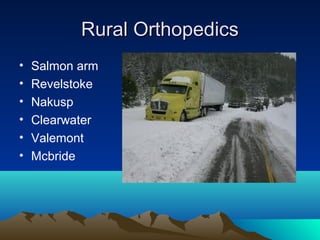
Rural OrthopedicsRural Orthopedics
• Salmon arm
• Revelstoke
• Nakusp
• Clearwater
• Valemont
• Mcbride
When the X-ray is negativeWhen the X-ray is negative
The Sprain Brain DrainThe Sprain Brain Drain
• The diagnosis of
sprain generally
means we don’t know
exactly what is injured
BUT:
• We assume…
• The condition will get
better with or without
ancillary therapies
• And the condition
does not need any
further thought from
us
Injured limbInjured limb
• HISTORY
• OBSERVATION
• XRAY
• COMPLETE PHYSICAL EXAM (this is
what is forgotten)
PrinciplesPrinciples
• Let me know if
this principle is
not apparent
Prize QuestionsPrize Questions
• Students and
residents get first
chance
• Then open to the floor
PRETESTPRETEST
• The worse you do on
the pretest, the better
for the teacher
An acute Boutonniere deformityAn acute Boutonniere deformity
1. Results from a tear of conjoint tendon
2. Always requires surgery
3. Can be managed with a paper clip splint
4. Results from avulsion of the central slip
5. Can be managed by a rural family doctor
Jersey FingerJersey Finger
1. Is a common sprain that occurs milking
Jersey cows
2. Cannot be diagnosed clinically
3. Characterized by loss of fds funtion
4. Can be managed by the rural family
doctor
5. Always requires referral to a plastic
surgeon
A Stener lesionA Stener lesion
• Is caused by being shot by a Sten gun
• Is characterized by loss of flexion of the
pip joint
• Can only be diagnosed at time of surgery
• Mention of this lesion can get a surgeon to
see the patient
Distal Biceps AvulsionDistal Biceps Avulsion
1. Cannot be diagnosed clinically
2. Can be treated non surgically
3. Can occur with minimal injury
4. Can be treated successfully by the rural
family doctor
The Hook signThe Hook sign
• 1. is found in compartment syndrome
• 2. is performed in pronation and flexion
• 3. is not very sensitive or reliable
• 4. can be used for clinical diagnosis of
distal biceps tear
• 5. none of the above
Acute Compartment SyndromeAcute Compartment Syndrome
1. Can be successfully managed by waiting
until the 5 “P”’s are noted
2. Occurs only after fractures and burns
3. Must be diagnosed by measurement of
compartment pressures
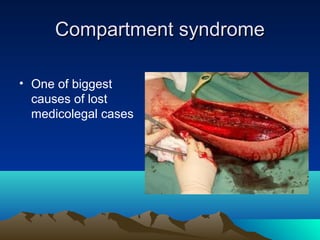
4. Can be managed by the rural family
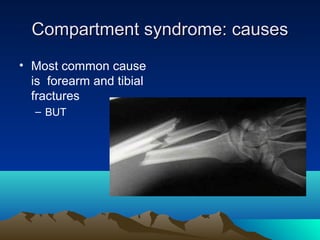
physician
What is true about TAL tearsWhat is true about TAL tears
1. Surgery is always required
2. No treatment gives equal results to
surgical care
3. Physiotherapists often make the
diagnosis
4. Can be treated successfully by the rural
family doctor with surgical skills
DisclosureDisclosure
Do I have any conflict of interest or bias
regarding equipment supply companies,
Well…yes!
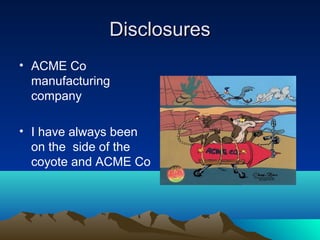
DisclosuresDisclosures
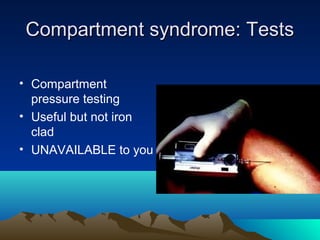
• ACME Co
manufacturing
company
• I have always been
on the side of the
coyote and ACME Co
Upper LimbUpper Limb
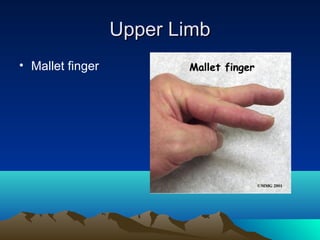
• Mallet finger
Mallet FingerMallet Finger
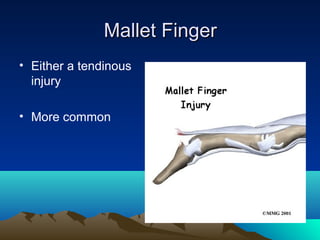
• Either a tendinous
injury
• More common
Mallet FingerMallet Finger
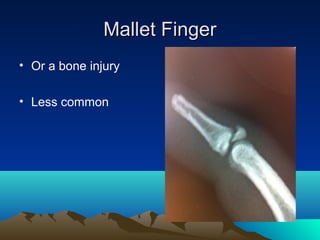
• Or a bone injury
• Less common
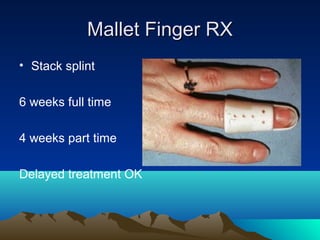
Mallet Finger RXMallet Finger RX
• Stack splint
6 weeks full time
4 weeks part time
Delayed treatment OK
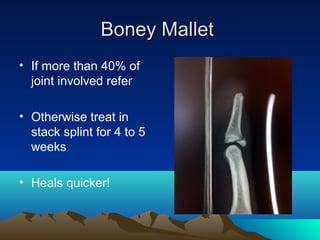
Boney MalletBoney Mallet
• If more than 40% of
joint involved refer
• Otherwise treat in
stack splint for 4 to 5
weeks
• Heals quicker!
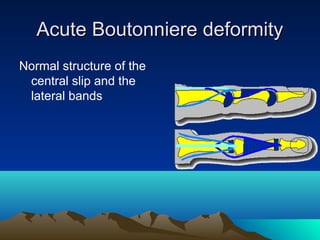
Acute Boutonniere deformityAcute Boutonniere deformity
Normal structure of the
central slip and the
lateral bands
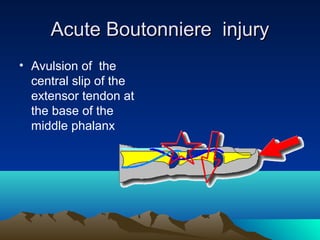
Acute Boutonniere injuryAcute Boutonniere injury
• Avulsion of the
central slip of the
extensor tendon at
the base of the
middle phalanx
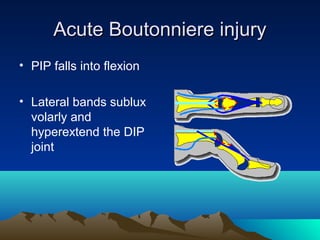
Acute Boutonniere injuryAcute Boutonniere injury
• PIP falls into flexion
• Lateral bands sublux
volarly and
hyperextend the DIP
joint
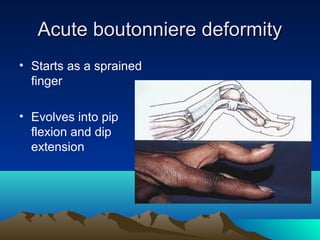
Acute boutonniere deformityAcute boutonniere deformity
• Starts as a sprained
finger
• Evolves into pip
flexion and dip
extension
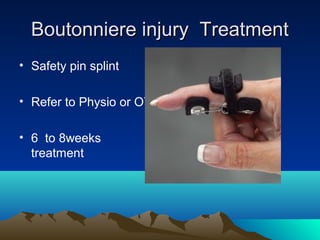
Boutonniere injury TreatmentBoutonniere injury Treatment
• Safety pin splint
• Refer to Physio or OT
• 6 to 8weeks
treatment
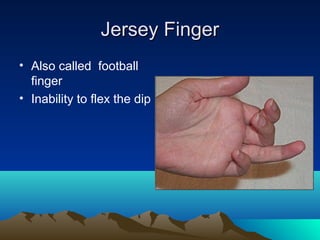
Jersey FingerJersey Finger
• Also called football
finger
• Inability to flex the dip
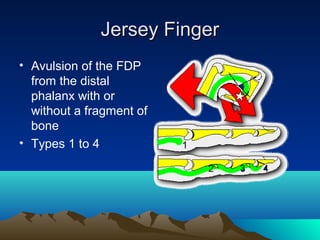
Jersey FingerJersey Finger
• Avulsion of the FDP
from the distal
phalanx with or
without a fragment of
bone
• Types 1 to 4
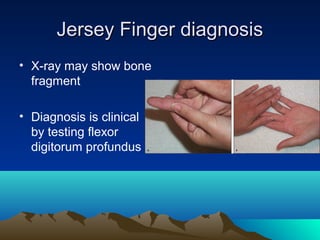
Jersey Finger diagnosisJersey Finger diagnosis
• X-ray may show bone
fragment
• Diagnosis is clinical
by testing flexor
digitorum profundus
Jersey Finger RXJersey Finger RX
• Referral to plastics
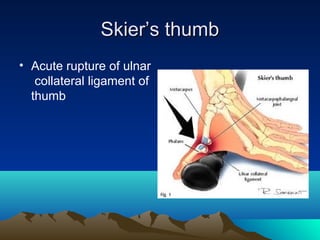
Skier’s thumbSkier’s thumb
• Acute rupture of ulnar
collateral ligament of
thumb
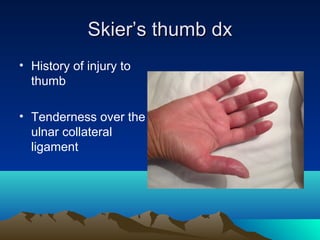
Skier’s thumb dxSkier’s thumb dx
• History of injury to
thumb
• Tenderness over the
ulnar collateral
ligament
Skier’s thumb dxSkier’s thumb dx
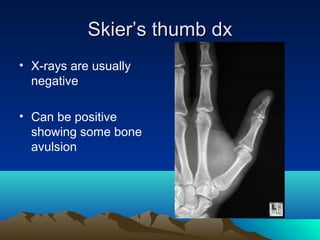
• X-rays are usually
negative
• Can be positive
showing some bone
avulsion
Skier’s Thumb DxSkier’s Thumb Dx
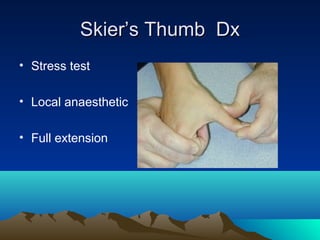
• Stress test
• Local anaesthetic
• Full extension
Skier’s Thumb AssessmentSkier’s Thumb Assessment
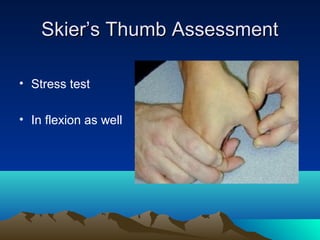
• Stress test
• In flexion as well
Skier’s Thumb AssessmentSkier’s Thumb Assessment
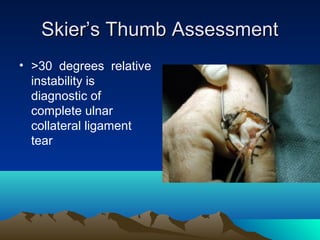
• >30 degrees relative
instability is
diagnostic of
complete ulnar
collateral ligament
tear
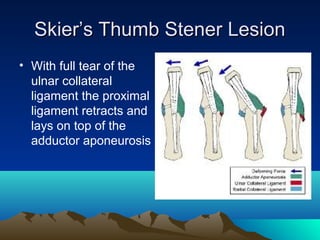
Skier’s Thumb Stener LesionSkier’s Thumb Stener Lesion
• With full tear of the
ulnar collateral
ligament the proximal
ligament retracts and
lays on top of the
adductor aponeurosis
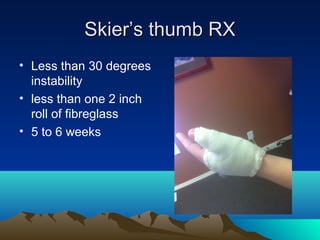
Skier’s thumb RXSkier’s thumb RX
• Less than 30 degrees
instability
• less than one 2 inch
roll of fibreglass
• 5 to 6 weeks
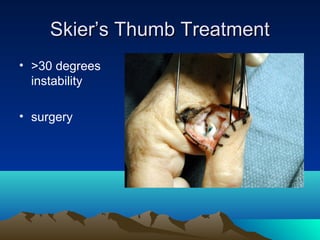
Skier’s Thumb TreatmentSkier’s Thumb Treatment
• >30 degrees
instability
• surgery
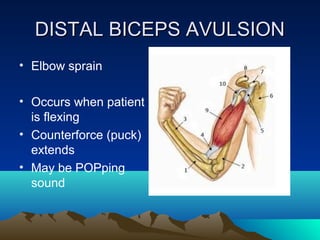
DISTAL BICEPS AVULSIONDISTAL BICEPS AVULSION
• Elbow sprain
• Occurs when patient
is flexing
• Counterforce (puck)
extends
• May be POPping
sound
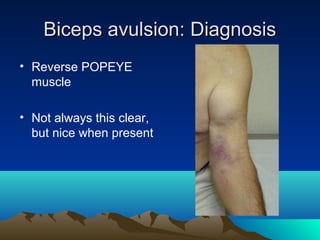
Biceps avulsion: DiagnosisBiceps avulsion: Diagnosis
• Reverse POPEYE
muscle
• Not always this clear,
but nice when present
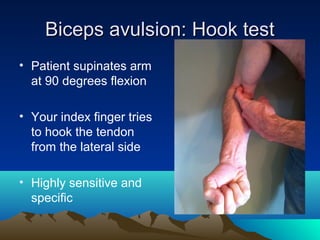
Biceps avulsion: Hook testBiceps avulsion: Hook test
• Patient supinates arm
at 90 degrees flexion
• Your index finger tries
to hook the tendon
from the lateral side
• Highly sensitive and
specific
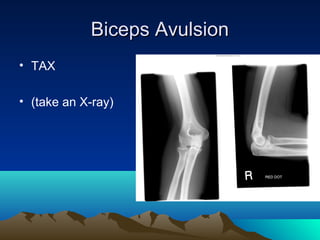
Biceps AvulsionBiceps Avulsion
• TAX
• (take an X-ray)
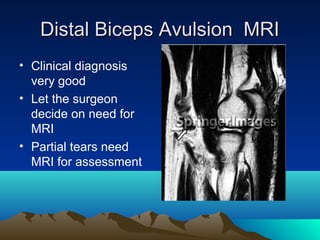
Distal Biceps Avulsion MRIDistal Biceps Avulsion MRI
• Clinical diagnosis
very good
• Let the surgeon
decide on need for
MRI
• Partial tears need
MRI for assessment
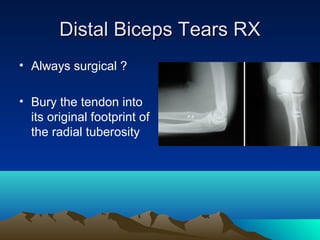
Distal Biceps Tears RXDistal Biceps Tears RX
• Always surgical ?
• Bury the tendon into
its original footprint of
the radial tuberosity
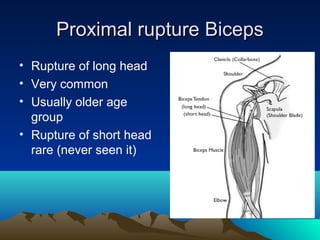
Proximal rupture BicepsProximal rupture Biceps
• Rupture of long head
• Very common
• Usually older age
group
• Rupture of short head
rare (never seen it)
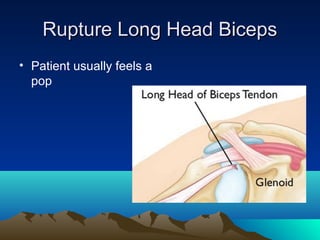
Rupture Long Head BicepsRupture Long Head Biceps
• Patient usually feels a
pop
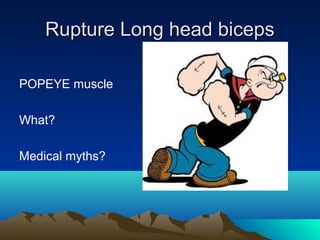
Rupture Long head bicepsRupture Long head biceps
POPEYE muscle
What?
Medical myths?
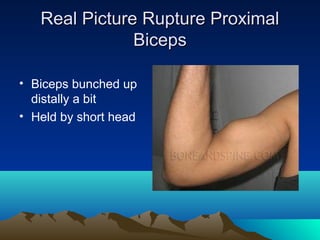
Real Picture Rupture ProximalReal Picture Rupture Proximal
BicepsBiceps
• Biceps bunched up
distally a bit
• Held by short head
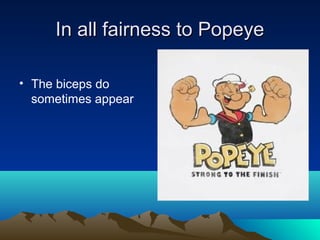
In all fairness to PopeyeIn all fairness to Popeye
• The biceps do
sometimes appear
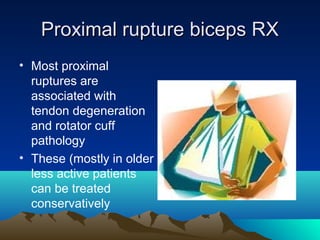
Proximal rupture biceps RXProximal rupture biceps RX
• Most proximal
ruptures are
associated with
tendon degeneration
and rotator cuff
pathology
• These (mostly in older
less active patients
can be treated
conservatively
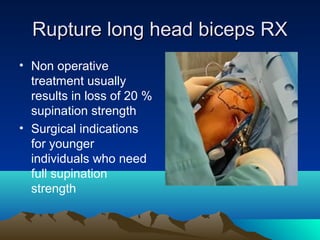
Rupture long head biceps RXRupture long head biceps RX
• Non operative
treatment usually
results in loss of 20 %
supination strength
• Surgical indications
for younger
individuals who need
full supination
strength
Take home MessageTake home Message
• Middle age and older
patients with non
labour occupations
• Younger patients with
higher energy injury
and need for full
strength (minority of
cases)
• Sling, pain control,
physiotherapy
• Refer for surgical
treatment
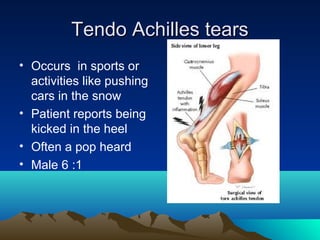
Tendo Achilles tearsTendo Achilles tears
• Occurs in sports or
activities like pushing
cars in the snow
• Patient reports being
kicked in the heel
• Often a pop heard
• Male 6 :1
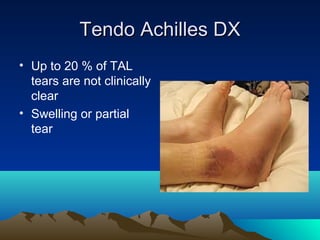
Tendo Achilles DXTendo Achilles DX
• Up to 20 % of TAL
tears are not clinically
clear
• Swelling or partial
tear
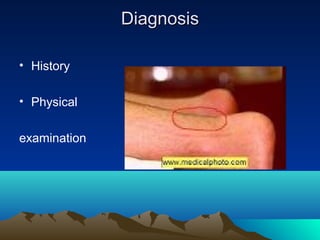
• History
• Physical
examination
DiagnosisDiagnosis
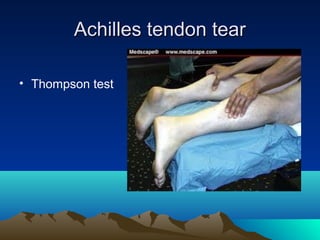
Achilles tendon tearAchilles tendon tear
• Thompson test
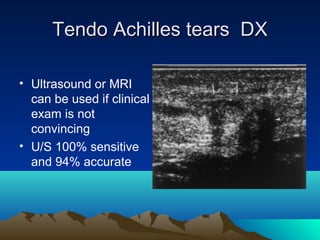
Tendo Achilles tears DXTendo Achilles tears DX
• Ultrasound or MRI
can be used if clinical
exam is not
convincing
• U/S 100% sensitive
and 94% accurate
Tendo Achilles Tears RXTendo Achilles Tears RX
• CAST IN EQUINUS • SURGERY AND
CAST IN EQUINUS
Medical Evidence HierarchyMedical Evidence Hierarchy
• Level one studies
• 2
• 3
• 4
• 5 expert opinion
• Best
• worst
Tendo Achilles RXTendo Achilles RX
• Level one studies
support cast regimen
treatment
• No surgical
complications
Tendo Achilles tearsTendo Achilles tears
• controversies • Increased re-rupture
tear with non
operative treatment
• tendon heals
elongated with
conserative treatment
Tendo Achilles tears: compromiseTendo Achilles tears: compromise
• 1. Call orthopod and
pass responsibility
• 2. Agree with
surgeon to treat
conservatively or
send for surgery
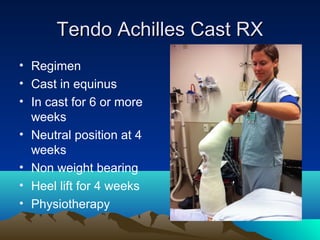
Tendo Achilles Cast RXTendo Achilles Cast RX
• Regimen
• Cast in equinus
• In cast for 6 or more
weeks
• Neutral position at 4
weeks
• Non weight bearing
• Heel lift for 4 weeks
• Physiotherapy
Tendo Achilles RXTendo Achilles RX
• Newer studies suggest that use of
functional brace and
• Functional rehab (early ROM and weight
bearing) may be acceptable
• KEEP TUNED IN
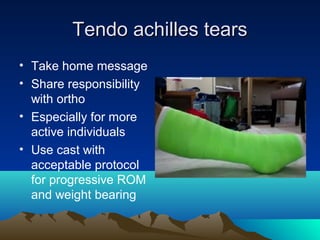
Tendo achilles tearsTendo achilles tears
• Take home message
• Share responsibility
with ortho
• Especially for more
active individuals
• Use cast with
acceptable protocol
for progressive ROM
and weight bearing
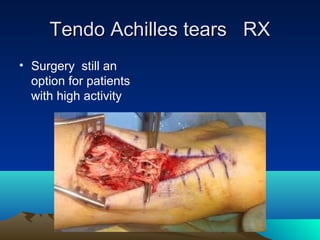
Tendo Achilles tears RXTendo Achilles tears RX
• Surgery still an
option for patients
with high activity
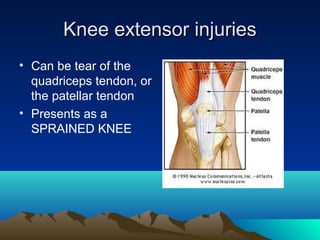
Knee extensor injuriesKnee extensor injuries
• Can be tear of the
quadriceps tendon, or
the patellar tendon
• Presents as a
SPRAINED KNEE
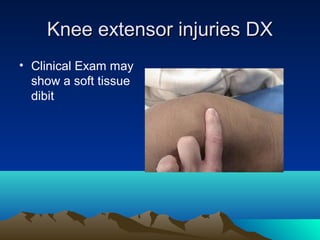
Knee extensor injuries DXKnee extensor injuries DX
• Clinical Exam may
show a soft tissue
dibit
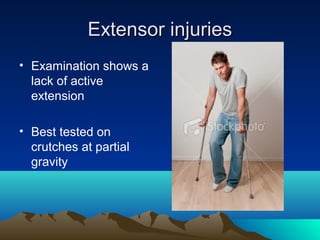
Extensor injuriesExtensor injuries
• Examination shows a
lack of active
extension
• Best tested on
crutches at partial
gravity
Knee Extensor Tears XRAYKnee Extensor Tears XRAY
• Valuable
• May see elevated patella
• May see fragments of bone above patella
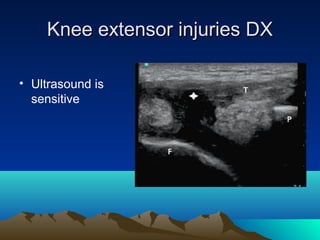
Knee extensor injuries DXKnee extensor injuries DX
• Ultrasound is
sensitive
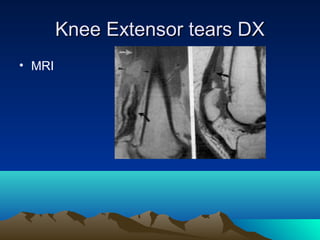
Knee Extensor tears DXKnee Extensor tears DX
• MRI
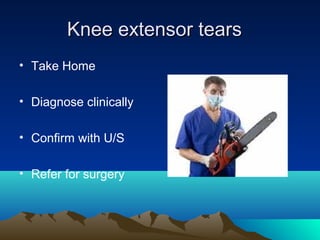
Knee extensor tearsKnee extensor tears
• Take Home
• Diagnose clinically
• Confirm with U/S
• Refer for surgery
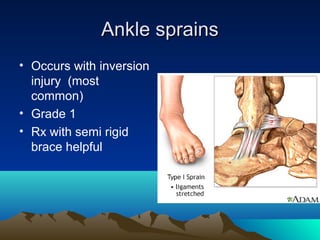
Ankle sprainsAnkle sprains
• Occurs with inversion
injury (most
common)
• Grade 1
• Rx with semi rigid
brace helpful
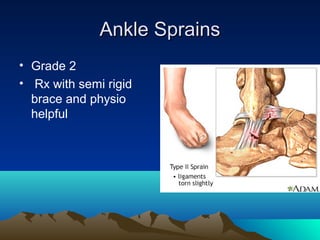
Ankle SprainsAnkle Sprains
• Grade 2
• Rx with semi rigid
brace and physio
helpful
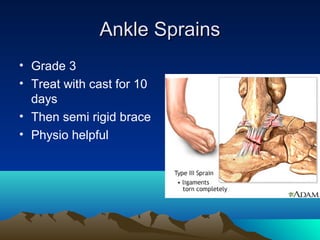
Ankle SprainsAnkle Sprains
• Grade 3
• Treat with cast for 10
days
• Then semi rigid brace
• Physio helpful
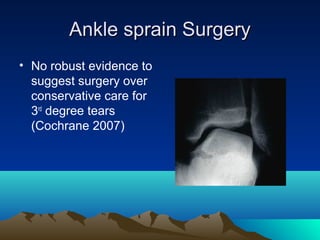
Ankle sprain SurgeryAnkle sprain Surgery
• No robust evidence to
suggest surgery over
conservative care for
3rd
degree tears
(Cochrane 2007)
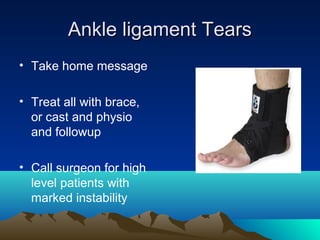
Ankle ligament TearsAnkle ligament Tears
• Take home message
• Treat all with brace,
or cast and physio
and followup
• Call surgeon for high
level patients with
marked instability
COMPARTMENTCOMPARTMENT
SYNDROMESYNDROME
THE BIG ONE! Don’t let it getTHE BIG ONE! Don’t let it get
awayaway
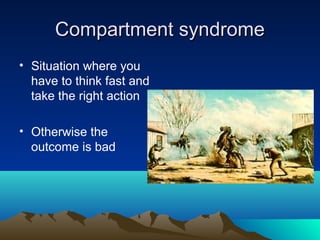
Compartment syndromeCompartment syndrome
• Situation where you
have to think fast and
take the right action
• Otherwise the
outcome is bad
Compartment Syndrome PrognosisCompartment Syndrome Prognosis
• Treatment in < 6
hours gives good
result
• Treatment in 6 to 12
hours gives 68%
normal function
Treatment in > 12 hours
only 8 % normal
function
Compartment syndromeCompartment syndrome
• One of biggest
causes of lost
medicolegal cases
Compartment syndrome: causesCompartment syndrome: causes
• Most common cause
is forearm and tibial
fractures
– BUT
Compartment syndrome: causesCompartment syndrome: causes
• Burns
• Envenomation
• Decreased osmolality
(nephrotic syndrome)
• Hemorrhage
• DVT
• Ruptured bakers cyst
• Hemophilia
• Influenza myositis
• Androgen abuse
• Rhabdomyolysis
Compartment syndrome: causesCompartment syndrome: causes
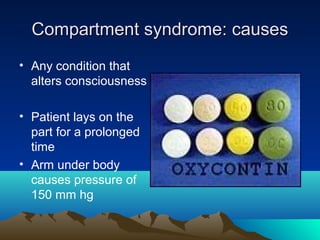
• Any condition that
alters consciousness
• Patient lays on the
part for a prolonged
time
• Arm under body
causes pressure of
150 mm hg
Compartment syndrome: causesCompartment syndrome: causes
Iatrogenic causes
Should we include
Oxycontin
prescription?
• Any injection or
vascular cannulation
particularly in
anticoagulated patient
• Tight cast
• Intraosseous infusion
• ETC
Compartment syndrome: causesCompartment syndrome: causes
• The bottom line
• Can present in numerous clinical
situations
• BE CAREFUL OUT THERE
PATHYSIOPHYSIOLOGYPATHYSIOPHYSIOLOGY
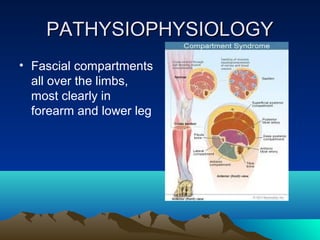
• Fascial compartments
all over the limbs,
most clearly in
forearm and lower leg
PATHOPHYSIOLOGYPATHOPHYSIOLOGY
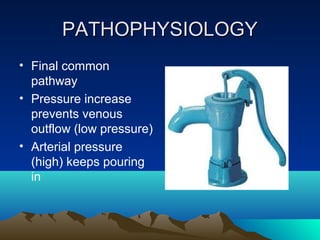
• Final common
pathway
• Pressure increase
prevents venous
outflow (low pressure)
• Arterial pressure
(high) keeps pouring
in
PATHOPHYSIOLOGYPATHOPHYSIOLOGY
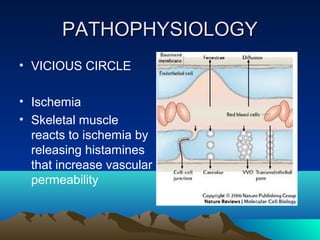
• VICIOUS CIRCLE
• Ischemia
• Skeletal muscle
reacts to ischemia by
releasing histamines
that increase vascular
permeability
Compartment Syndrome DXCompartment Syndrome DX
• 5 P’s
• Pain
• Paresthesia
• pallor
• Pulseless
• Poikilothermia
• FORGET THE LAST
3
• Call your lawyer
Compartment syndrome: DXCompartment syndrome: DX
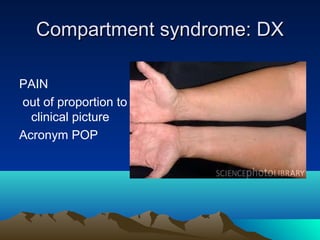
PAIN
out of proportion to the
clinical picture
Acronym POP
Compartment syndrome DXCompartment syndrome DX
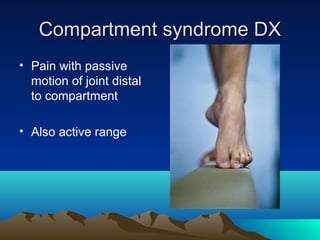
• Pain with passive
motion of joint distal
to compartment
• Also active range
Compartment syndrome DXCompartment syndrome DX
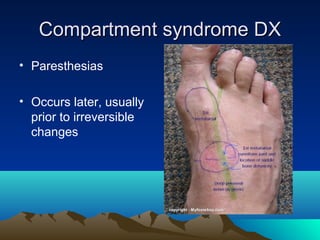
• Paresthesias
• Occurs later, usually
prior to irreversible
changes
Compartment syndrome: DXCompartment syndrome: DX
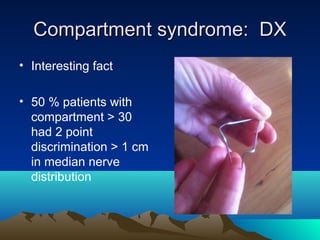
• Interesting fact
• 50 % patients with
compartment > 30
had 2 point
discrimination > 1 cm
in median nerve
distribution
Compartment syndrome DXCompartment syndrome DX
• Compartment may
feel tense
• Like wood
Compartment syndrome: TestsCompartment syndrome: Tests
• Compartment
pressure testing
• Useful but not iron
clad
• UNAVAILABLE to you
Compartment syndrome:TestsCompartment syndrome:Tests
• Order CPK, urine,
myoglobulin studies
and renal function
tests
• CPK > 1000 units
suggestive of
compartment
syndrome
Compartment Syndrome RXCompartment Syndrome RX
• If patient has swollen
and painful part, but
no clear signs of
compartment
syndrome, then
• REEXAMINE with any
clinical change for the
worse
Compartment Syndrome RXCompartment Syndrome RX
1. Swollen limb
2. Pain out of
proportion
3. Tense compartment
4. Pain with passive
motion
5. Paresthesia
6. ACT
What the non-surgeon can doWhat the non-surgeon can do
• DIAGNOSIS
• AWARENESS OF
DIAGNOSIS
What the non-surgeon can doWhat the non-surgeon can do
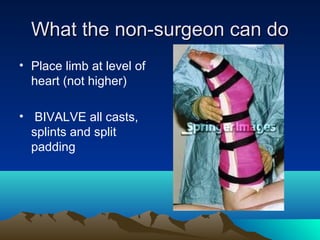
• Place limb at level of
heart (not higher)
• BIVALVE all casts,
splints and split
padding
What the non-surgeon can doWhat the non-surgeon can do
• Split cast
• Bivalve cast
• Take off cast
• Split padding
• 30 % reduction
pressure
• Further 35%
reduction pressure
• Further 15%
reduction
• 10 to 15 % reduction
pressure
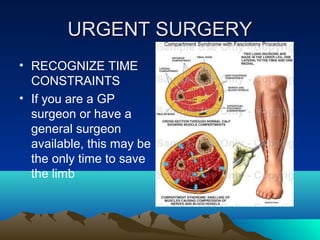
URGENT SURGERYURGENT SURGERY
• RECOGNIZE TIME
CONSTRAINTS
• If you are a GP
surgeon or have a
general surgeon
available, this may be
the only time to save
the limb
SIMILAR TO C SECTIONSIMILAR TO C SECTION
• IT IS BETTER TO DO THE C SECTION
UNNECESSARILY THAN NOT TO DO
ONE THAT IS NEEDED
• IT IS BETTER TO DO A FASCIOTOMY
UNNECESSARILY THAN NOT TO DO
ONE THAT IS NEEDED
REVENGE ON CITY SURGEONSREVENGE ON CITY SURGEONS
• Keep the surgical
techniques book
available
• Telephone
consultation with
orthopedic surgeon
• Cut and send
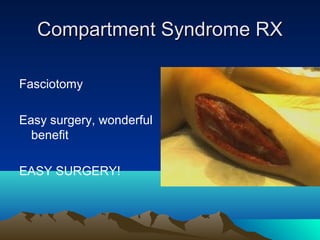
Compartment Syndrome RXCompartment Syndrome RX
Fasciotomy
Easy surgery, wonderful
benefit
EASY SURGERY!
Post testPost test
• You have to ace this to make the teacher
look good
What is true about TAL tearWhat is true about TAL tear
• 1. Surgery is always indicated
• 2. No treatment gives equal results to
surgical care
• 3. Studies comparing surgical to non
surgical care are not well done
• 4. Physiotherapists often make the DX
• 5. Can be treated by rural family docs
Acute Boutonniere injuryAcute Boutonniere injury
• 1. Results from a tear of the conjoint
tendon
• 2. Always requires surgery
• 3. Can be managed with a paper clip
splint
• 4. Results from the avulsion of the central
slip
• 5. Can be managed by the rural family doc
Distal Biceps AvulsionDistal Biceps Avulsion
• 1. Cannot be diagnosed clinically
• 2. Can be treated non surgically
• 3. Can occur with minimal injury
• 4. Can be treated by rural family doc
Acute compartment syndromeAcute compartment syndrome
• 1. Can be successfully managed by
waiting until the 5 ‘P’s are noted
• 2. Occurs only after fracture and burns
• 3. Must be diagnosed by measurement of
compartment pressures
• 4. Can be managed by the GP surgeon
Jersey FingerJersey Finger
• 1. A common sprain that occurs milking
Jersey cows
• 2. Cannot be diagnosed clinically
• 3. Characterized by loss of FDS function
• 4. Can be managed by the rural family
doc
• 5. Always requires referral to a hand
surgeon
A Stener lesionA Stener lesion
• 1. Caused by being shot by a sten gun
• 2. Characterized by loss of flexion of the
PIP joint
• 3. Can only be diagnosed at time of
surgery
• 4. Mention of this lesion can get a
surgeon’s attention and expedite the
referral
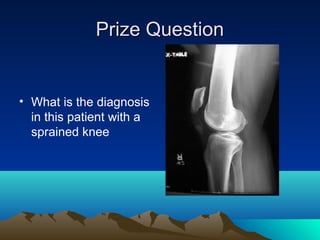
Prize QuestionPrize Question
• What is the diagnosis
in this patient with a
sprained knee
Soft Tissue MSK injuriesSoft Tissue MSK injuries
• QUESTON PERIOD

Soft tissue msk injuries

  • 1.
    Soft Tissue MSKInjuriesSoft Tissue MSK Injuries Chris Parfitt MD FRCS©Chris Parfitt MD FRCS©
  • 2.
    Rural OrthopedicsRural Orthopedics •Salmon arm • Revelstoke • Nakusp • Clearwater • Valemont • Mcbride
  • 3.
    When the X-rayis negativeWhen the X-ray is negative
  • 4.
    The Sprain BrainDrainThe Sprain Brain Drain • The diagnosis of sprain generally means we don’t know exactly what is injured BUT: • We assume… • The condition will get better with or without ancillary therapies • And the condition does not need any further thought from us
  • 5.
    Injured limbInjured limb •HISTORY • OBSERVATION • XRAY • COMPLETE PHYSICAL EXAM (this is what is forgotten)
  • 6.
    PrinciplesPrinciples • Let meknow if this principle is not apparent
  • 7.
    Prize QuestionsPrize Questions •Students and residents get first chance • Then open to the floor
  • 8.
    PRETESTPRETEST • The worseyou do on the pretest, the better for the teacher
  • 9.
    An acute BoutonnieredeformityAn acute Boutonniere deformity 1. Results from a tear of conjoint tendon 2. Always requires surgery 3. Can be managed with a paper clip splint 4. Results from avulsion of the central slip 5. Can be managed by a rural family doctor
  • 10.
    Jersey FingerJersey Finger 1.Is a common sprain that occurs milking Jersey cows 2. Cannot be diagnosed clinically 3. Characterized by loss of fds funtion 4. Can be managed by the rural family doctor 5. Always requires referral to a plastic surgeon
  • 11.
    A Stener lesionAStener lesion • Is caused by being shot by a Sten gun • Is characterized by loss of flexion of the pip joint • Can only be diagnosed at time of surgery • Mention of this lesion can get a surgeon to see the patient
  • 12.
    Distal Biceps AvulsionDistalBiceps Avulsion 1. Cannot be diagnosed clinically 2. Can be treated non surgically 3. Can occur with minimal injury 4. Can be treated successfully by the rural family doctor
  • 13.
    The Hook signTheHook sign • 1. is found in compartment syndrome • 2. is performed in pronation and flexion • 3. is not very sensitive or reliable • 4. can be used for clinical diagnosis of distal biceps tear • 5. none of the above
  • 14.
    Acute Compartment SyndromeAcuteCompartment Syndrome 1. Can be successfully managed by waiting until the 5 “P”’s are noted 2. Occurs only after fractures and burns 3. Must be diagnosed by measurement of compartment pressures 4. Can be managed by the rural family physician
  • 15.
    What is trueabout TAL tearsWhat is true about TAL tears 1. Surgery is always required 2. No treatment gives equal results to surgical care 3. Physiotherapists often make the diagnosis 4. Can be treated successfully by the rural family doctor with surgical skills
  • 16.
    DisclosureDisclosure Do I haveany conflict of interest or bias regarding equipment supply companies, Well…yes!
  • 17.
    DisclosuresDisclosures • ACME Co manufacturing company •I have always been on the side of the coyote and ACME Co
  • 18.
  • 19.
    Mallet FingerMallet Finger •Either a tendinous injury • More common
  • 20.
    Mallet FingerMallet Finger •Or a bone injury • Less common
  • 21.
    Mallet Finger RXMalletFinger RX • Stack splint 6 weeks full time 4 weeks part time Delayed treatment OK
  • 22.
    Boney MalletBoney Mallet •If more than 40% of joint involved refer • Otherwise treat in stack splint for 4 to 5 weeks • Heals quicker!
  • 23.
    Acute Boutonniere deformityAcuteBoutonniere deformity Normal structure of the central slip and the lateral bands
  • 24.
    Acute Boutonniere injuryAcuteBoutonniere injury • Avulsion of the central slip of the extensor tendon at the base of the middle phalanx
  • 25.
    Acute Boutonniere injuryAcuteBoutonniere injury • PIP falls into flexion • Lateral bands sublux volarly and hyperextend the DIP joint
  • 26.
    Acute boutonniere deformityAcuteboutonniere deformity • Starts as a sprained finger • Evolves into pip flexion and dip extension
  • 27.
    Boutonniere injury TreatmentBoutonniereinjury Treatment • Safety pin splint • Refer to Physio or OT • 6 to 8weeks treatment
  • 28.
    Jersey FingerJersey Finger •Also called football finger • Inability to flex the dip
  • 29.
    Jersey FingerJersey Finger •Avulsion of the FDP from the distal phalanx with or without a fragment of bone • Types 1 to 4
  • 30.
    Jersey Finger diagnosisJerseyFinger diagnosis • X-ray may show bone fragment • Diagnosis is clinical by testing flexor digitorum profundus
  • 31.
    Jersey Finger RXJerseyFinger RX • Referral to plastics
  • 32.
    Skier’s thumbSkier’s thumb •Acute rupture of ulnar collateral ligament of thumb
  • 33.
    Skier’s thumb dxSkier’sthumb dx • History of injury to thumb • Tenderness over the ulnar collateral ligament
  • 34.
    Skier’s thumb dxSkier’sthumb dx • X-rays are usually negative • Can be positive showing some bone avulsion
  • 35.
    Skier’s Thumb DxSkier’sThumb Dx • Stress test • Local anaesthetic • Full extension
  • 36.
    Skier’s Thumb AssessmentSkier’sThumb Assessment • Stress test • In flexion as well
  • 37.
    Skier’s Thumb AssessmentSkier’sThumb Assessment • >30 degrees relative instability is diagnostic of complete ulnar collateral ligament tear
  • 38.
    Skier’s Thumb StenerLesionSkier’s Thumb Stener Lesion • With full tear of the ulnar collateral ligament the proximal ligament retracts and lays on top of the adductor aponeurosis
  • 39.
    Skier’s thumb RXSkier’sthumb RX • Less than 30 degrees instability • less than one 2 inch roll of fibreglass • 5 to 6 weeks
  • 40.
    Skier’s Thumb TreatmentSkier’sThumb Treatment • >30 degrees instability • surgery
  • 41.
    DISTAL BICEPS AVULSIONDISTALBICEPS AVULSION • Elbow sprain • Occurs when patient is flexing • Counterforce (puck) extends • May be POPping sound
  • 42.
    Biceps avulsion: DiagnosisBicepsavulsion: Diagnosis • Reverse POPEYE muscle • Not always this clear, but nice when present
  • 43.
    Biceps avulsion: HooktestBiceps avulsion: Hook test • Patient supinates arm at 90 degrees flexion • Your index finger tries to hook the tendon from the lateral side • Highly sensitive and specific
  • 44.
    Biceps AvulsionBiceps Avulsion •TAX • (take an X-ray)
  • 45.
    Distal Biceps AvulsionMRIDistal Biceps Avulsion MRI • Clinical diagnosis very good • Let the surgeon decide on need for MRI • Partial tears need MRI for assessment
  • 46.
    Distal Biceps TearsRXDistal Biceps Tears RX • Always surgical ? • Bury the tendon into its original footprint of the radial tuberosity
  • 47.
    Proximal rupture BicepsProximalrupture Biceps • Rupture of long head • Very common • Usually older age group • Rupture of short head rare (never seen it)
  • 48.
    Rupture Long HeadBicepsRupture Long Head Biceps • Patient usually feels a pop
  • 49.
    Rupture Long headbicepsRupture Long head biceps POPEYE muscle What? Medical myths?
  • 50.
    Real Picture RuptureProximalReal Picture Rupture Proximal BicepsBiceps • Biceps bunched up distally a bit • Held by short head
  • 51.
    In all fairnessto PopeyeIn all fairness to Popeye • The biceps do sometimes appear
  • 52.
    Proximal rupture bicepsRXProximal rupture biceps RX • Most proximal ruptures are associated with tendon degeneration and rotator cuff pathology • These (mostly in older less active patients can be treated conservatively
  • 53.
    Rupture long headbiceps RXRupture long head biceps RX • Non operative treatment usually results in loss of 20 % supination strength • Surgical indications for younger individuals who need full supination strength
  • 54.
    Take home MessageTakehome Message • Middle age and older patients with non labour occupations • Younger patients with higher energy injury and need for full strength (minority of cases) • Sling, pain control, physiotherapy • Refer for surgical treatment
  • 55.
    Tendo Achilles tearsTendoAchilles tears • Occurs in sports or activities like pushing cars in the snow • Patient reports being kicked in the heel • Often a pop heard • Male 6 :1
  • 56.
    Tendo Achilles DXTendoAchilles DX • Up to 20 % of TAL tears are not clinically clear • Swelling or partial tear
  • 57.
  • 58.
    Achilles tendon tearAchillestendon tear • Thompson test
  • 59.
    Tendo Achilles tearsDXTendo Achilles tears DX • Ultrasound or MRI can be used if clinical exam is not convincing • U/S 100% sensitive and 94% accurate
  • 60.
    Tendo Achilles TearsRXTendo Achilles Tears RX • CAST IN EQUINUS • SURGERY AND CAST IN EQUINUS
  • 61.
    Medical Evidence HierarchyMedicalEvidence Hierarchy • Level one studies • 2 • 3 • 4 • 5 expert opinion • Best • worst
  • 62.
    Tendo Achilles RXTendoAchilles RX • Level one studies support cast regimen treatment • No surgical complications
  • 63.
    Tendo Achilles tearsTendoAchilles tears • controversies • Increased re-rupture tear with non operative treatment • tendon heals elongated with conserative treatment
  • 64.
    Tendo Achilles tears:compromiseTendo Achilles tears: compromise • 1. Call orthopod and pass responsibility • 2. Agree with surgeon to treat conservatively or send for surgery
  • 65.
    Tendo Achilles CastRXTendo Achilles Cast RX • Regimen • Cast in equinus • In cast for 6 or more weeks • Neutral position at 4 weeks • Non weight bearing • Heel lift for 4 weeks • Physiotherapy
  • 66.
    Tendo Achilles RXTendoAchilles RX • Newer studies suggest that use of functional brace and • Functional rehab (early ROM and weight bearing) may be acceptable • KEEP TUNED IN
  • 67.
    Tendo achilles tearsTendoachilles tears • Take home message • Share responsibility with ortho • Especially for more active individuals • Use cast with acceptable protocol for progressive ROM and weight bearing
  • 68.
    Tendo Achilles tearsRXTendo Achilles tears RX • Surgery still an option for patients with high activity
  • 69.
    Knee extensor injuriesKneeextensor injuries • Can be tear of the quadriceps tendon, or the patellar tendon • Presents as a SPRAINED KNEE
  • 70.
    Knee extensor injuriesDXKnee extensor injuries DX • Clinical Exam may show a soft tissue dibit
  • 71.
    Extensor injuriesExtensor injuries •Examination shows a lack of active extension • Best tested on crutches at partial gravity
  • 72.
    Knee Extensor TearsXRAYKnee Extensor Tears XRAY • Valuable • May see elevated patella • May see fragments of bone above patella
  • 73.
    Knee extensor injuriesDXKnee extensor injuries DX • Ultrasound is sensitive
  • 74.
    Knee Extensor tearsDXKnee Extensor tears DX • MRI
  • 75.
    Knee extensor tearsKneeextensor tears • Take Home • Diagnose clinically • Confirm with U/S • Refer for surgery
  • 76.
    Ankle sprainsAnkle sprains •Occurs with inversion injury (most common) • Grade 1 • Rx with semi rigid brace helpful
  • 77.
    Ankle SprainsAnkle Sprains •Grade 2 • Rx with semi rigid brace and physio helpful
  • 78.
    Ankle SprainsAnkle Sprains •Grade 3 • Treat with cast for 10 days • Then semi rigid brace • Physio helpful
  • 79.
    Ankle sprain SurgeryAnklesprain Surgery • No robust evidence to suggest surgery over conservative care for 3rd degree tears (Cochrane 2007)
  • 80.
    Ankle ligament TearsAnkleligament Tears • Take home message • Treat all with brace, or cast and physio and followup • Call surgeon for high level patients with marked instability
  • 81.
    COMPARTMENTCOMPARTMENT SYNDROMESYNDROME THE BIG ONE!Don’t let it getTHE BIG ONE! Don’t let it get awayaway
  • 82.
    Compartment syndromeCompartment syndrome •Situation where you have to think fast and take the right action • Otherwise the outcome is bad
  • 83.
    Compartment Syndrome PrognosisCompartmentSyndrome Prognosis • Treatment in < 6 hours gives good result • Treatment in 6 to 12 hours gives 68% normal function Treatment in > 12 hours only 8 % normal function
  • 84.
    Compartment syndromeCompartment syndrome •One of biggest causes of lost medicolegal cases
  • 85.
    Compartment syndrome: causesCompartmentsyndrome: causes • Most common cause is forearm and tibial fractures – BUT
  • 86.
    Compartment syndrome: causesCompartmentsyndrome: causes • Burns • Envenomation • Decreased osmolality (nephrotic syndrome) • Hemorrhage • DVT • Ruptured bakers cyst • Hemophilia • Influenza myositis • Androgen abuse • Rhabdomyolysis
  • 87.
    Compartment syndrome: causesCompartmentsyndrome: causes • Any condition that alters consciousness • Patient lays on the part for a prolonged time • Arm under body causes pressure of 150 mm hg
  • 88.
    Compartment syndrome: causesCompartmentsyndrome: causes Iatrogenic causes Should we include Oxycontin prescription? • Any injection or vascular cannulation particularly in anticoagulated patient • Tight cast • Intraosseous infusion • ETC
  • 89.
    Compartment syndrome: causesCompartmentsyndrome: causes • The bottom line • Can present in numerous clinical situations • BE CAREFUL OUT THERE
  • 90.
    PATHYSIOPHYSIOLOGYPATHYSIOPHYSIOLOGY • Fascial compartments allover the limbs, most clearly in forearm and lower leg
  • 91.
    PATHOPHYSIOLOGYPATHOPHYSIOLOGY • Final common pathway •Pressure increase prevents venous outflow (low pressure) • Arterial pressure (high) keeps pouring in
  • 92.
    PATHOPHYSIOLOGYPATHOPHYSIOLOGY • VICIOUS CIRCLE •Ischemia • Skeletal muscle reacts to ischemia by releasing histamines that increase vascular permeability
  • 93.
    Compartment Syndrome DXCompartmentSyndrome DX • 5 P’s • Pain • Paresthesia • pallor • Pulseless • Poikilothermia • FORGET THE LAST 3 • Call your lawyer
  • 94.
    Compartment syndrome: DXCompartmentsyndrome: DX PAIN out of proportion to the clinical picture Acronym POP
  • 95.
    Compartment syndrome DXCompartmentsyndrome DX • Pain with passive motion of joint distal to compartment • Also active range
  • 96.
    Compartment syndrome DXCompartmentsyndrome DX • Paresthesias • Occurs later, usually prior to irreversible changes
  • 97.
    Compartment syndrome: DXCompartmentsyndrome: DX • Interesting fact • 50 % patients with compartment > 30 had 2 point discrimination > 1 cm in median nerve distribution
  • 98.
    Compartment syndrome DXCompartmentsyndrome DX • Compartment may feel tense • Like wood
  • 99.
    Compartment syndrome: TestsCompartmentsyndrome: Tests • Compartment pressure testing • Useful but not iron clad • UNAVAILABLE to you
  • 100.
    Compartment syndrome:TestsCompartment syndrome:Tests •Order CPK, urine, myoglobulin studies and renal function tests • CPK > 1000 units suggestive of compartment syndrome
  • 101.
    Compartment Syndrome RXCompartmentSyndrome RX • If patient has swollen and painful part, but no clear signs of compartment syndrome, then • REEXAMINE with any clinical change for the worse
  • 102.
    Compartment Syndrome RXCompartmentSyndrome RX 1. Swollen limb 2. Pain out of proportion 3. Tense compartment 4. Pain with passive motion 5. Paresthesia 6. ACT
  • 103.
    What the non-surgeoncan doWhat the non-surgeon can do • DIAGNOSIS • AWARENESS OF DIAGNOSIS
  • 104.
    What the non-surgeoncan doWhat the non-surgeon can do • Place limb at level of heart (not higher) • BIVALVE all casts, splints and split padding
  • 105.
    What the non-surgeoncan doWhat the non-surgeon can do • Split cast • Bivalve cast • Take off cast • Split padding • 30 % reduction pressure • Further 35% reduction pressure • Further 15% reduction • 10 to 15 % reduction pressure
  • 106.
    URGENT SURGERYURGENT SURGERY •RECOGNIZE TIME CONSTRAINTS • If you are a GP surgeon or have a general surgeon available, this may be the only time to save the limb
  • 107.
    SIMILAR TO CSECTIONSIMILAR TO C SECTION • IT IS BETTER TO DO THE C SECTION UNNECESSARILY THAN NOT TO DO ONE THAT IS NEEDED • IT IS BETTER TO DO A FASCIOTOMY UNNECESSARILY THAN NOT TO DO ONE THAT IS NEEDED
  • 108.
    REVENGE ON CITYSURGEONSREVENGE ON CITY SURGEONS • Keep the surgical techniques book available • Telephone consultation with orthopedic surgeon • Cut and send
  • 109.
    Compartment Syndrome RXCompartmentSyndrome RX Fasciotomy Easy surgery, wonderful benefit EASY SURGERY!
  • 110.
    Post testPost test •You have to ace this to make the teacher look good
  • 111.
    What is trueabout TAL tearWhat is true about TAL tear • 1. Surgery is always indicated • 2. No treatment gives equal results to surgical care • 3. Studies comparing surgical to non surgical care are not well done • 4. Physiotherapists often make the DX • 5. Can be treated by rural family docs
  • 112.
    Acute Boutonniere injuryAcuteBoutonniere injury • 1. Results from a tear of the conjoint tendon • 2. Always requires surgery • 3. Can be managed with a paper clip splint • 4. Results from the avulsion of the central slip • 5. Can be managed by the rural family doc
  • 113.
    Distal Biceps AvulsionDistalBiceps Avulsion • 1. Cannot be diagnosed clinically • 2. Can be treated non surgically • 3. Can occur with minimal injury • 4. Can be treated by rural family doc
  • 114.
    Acute compartment syndromeAcutecompartment syndrome • 1. Can be successfully managed by waiting until the 5 ‘P’s are noted • 2. Occurs only after fracture and burns • 3. Must be diagnosed by measurement of compartment pressures • 4. Can be managed by the GP surgeon
  • 115.
    Jersey FingerJersey Finger •1. A common sprain that occurs milking Jersey cows • 2. Cannot be diagnosed clinically • 3. Characterized by loss of FDS function • 4. Can be managed by the rural family doc • 5. Always requires referral to a hand surgeon
  • 116.
    A Stener lesionAStener lesion • 1. Caused by being shot by a sten gun • 2. Characterized by loss of flexion of the PIP joint • 3. Can only be diagnosed at time of surgery • 4. Mention of this lesion can get a surgeon’s attention and expedite the referral
  • 117.
    Prize QuestionPrize Question •What is the diagnosis in this patient with a sprained knee
  • 118.
    Soft Tissue MSKinjuriesSoft Tissue MSK injuries • QUESTON PERIOD

Editor's Notes